The Advocate
Thursday, February 7, 1907
Charleston, West Virginia
Page text (machine-generated)
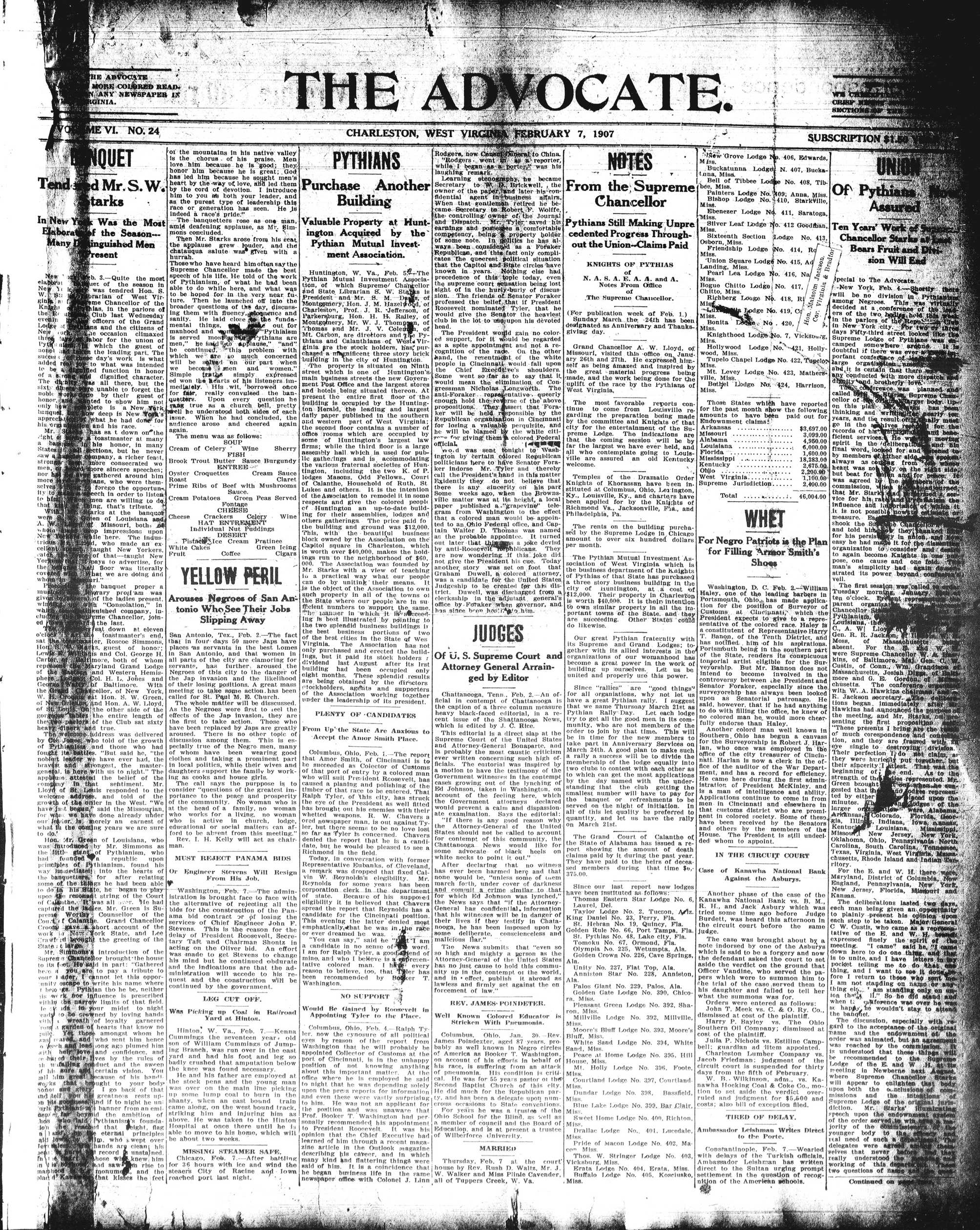
Mr. Stuart has sat down on the right of many of us to a mastermaster at many a banquet, in his honor, in many states of all sections, but he never saw him in company, a richer feast, stronger company, an inoccerated woman, or a more shiny nor hairy body gathered around him more than civilians, who were themselves foreigno forego the opportunity to hear speech in order to listen to the men are willing to do that, being, that's tribute. With the help of the banquet were men of the Lusitania and A. W. W. of Missouri, both of whom have kept impressions upon New York while here. The industrious man, who made an excellent dress, taught New Yorkers, who made of that—taught New Yorkers to advertise, for the retail floor where we covered what we are doing and whom we call."
Pioneer of the banquet proper a multitude of literary program was given by one of the ladies present, who was with "Consolation," in which she unmistakable company, included the prominent Chancellor, joined the east. The banquet drew down at eleven o'clock in the afternoon to foastmaster's end, sat the foastmaster, Roscoe Simmons, Hon. S. W. Marks, guest of honor; Lewis L. M. Williams and Col. George H. Carter, of Baltimore, both of whom reppresent the Maryland Grand Lodge of the Society and Western Hemisphere, led by Col. H. L, Jones and George A. Moore of Baltimore. With the Grand Cancellor, of New York, led by George A. Moore, of New Duluth, and Hon. A. W. L. St. Louis. On the other side of the gorgous tables the entire length of the two-posteries of the Club sat sixty heavy diners and true.
The welcome address was delivered by Cecel Jones, who told of the growth of Epithalianism and those who had fought its battles. "But said he, "the noblest leader we have ever had, the bravest and strongest, the master-general, is here with us to night." The applause attested the belief of the company in that sentiment. Mr. Lloyd of Laus responded to the noose address and told of the growth of the order in the West. "We have just begun," said the Missouriian, for who, we have done already under our leader, is merely an earnest of what in the coming years we are sure to do."
1.
Hon. Mr. Green of Louisiana, who was introduced by Mr. Simmons as the little giant of Pythianism, who had founded a republic upon principles of Pythianism, found his home in New York and the banquets, for after relating some of the things he had been able to do in his State, he began to play upon the resonant string of the Court of Calcutta. It was all over. He had captured the ladies, Mr. Green is Supreme Worthy. Counsellor of the Court of Calcutta. Grand Chancellor of the University. Work in New York State, and Lee Graftt brought the greeting of the State, large.
---
Mr. Simmons's introduction of the Supper's Chancelor brought the house to its feet. He said in part: "Gathered here a you, are to pay a tribute to your adder. I cannot let this opportunity escape to write his name where he beges. Pythian tho he be, neither within the narrow arms of that field. He kids to your midst to night lead to be crowned by loving hands with a wreath of loyalty garnered from a garden of hearts that know no guilty. Yet these amongst whom he has cared, and who sent him hence to watch and long ago plumed him with help love and confidence, and hardened lives by the rules of his sure and certain vision. You all him great because of his hands that brought to your body honor and glory. I go back of that and tell you his greatness rests upon his goodness, and if to night he unpuffs Pythianthum banner from an emblem for beyond the ambition of kids who had Pythianthus's foundation, and has his flag, flag and chain, on behalf of him, who swept over fierer hearts and hands are clean his secret. He records in unstained, in the heart, those who knew him, in his life, and saw him rise to manhood, and monumet, and the plaid of Kaen. That skies the feet
of the mountains in his native valley is the chorus of his praise. Men love him because he is 'good'; they honor him because he is great; God hearted him because he sought men's heart by his praise, and by the cord of devotion. I introduce him to you as both your leader, and as the purest type of leadership this race or generation has seen. He is indeed a race's pride". He is as one man, amid deafening applause, as Mr. Simmons concluded.
Then Mr. Starks arose from his seat the applause grew boulder, and the chataquia salute was given with a hurrah.
Those who have heard him often say the Supreme Chancellor made the best speech of his life. He told of the work of Pythianism, of what he had been able to do while here, and what was to be hoped for in the very near future. Then he launched off into the broader questions of the day, discussing them with fluency, sequence and the kind of close to the fundamental things he out manhood and womanhood. "Pythianism is served most of the Pythians are men," he said, to applause, "and he continued, "this problem with which we are so much concerned will be solved on our part when we become men and women." Simple truths simply expressed ed won the hearts of his listeners immediately. His wit, borrowed once for fair, really convulsed the hand, and Upon every question a rung true as a church bell, pretty well he understood both sides of each issue. When he had concluded, the audience arose and cheered again again.
The menu was as follows:
SOUP
Cream of Celery Wine Sherry
FISH
Brook Trout Butter Sauce Burgundy
ENTREE
Oyster Croquettes Cream Sauce
Roast Claret
Prime Ribs of Beef with Mushrooms
Sauce.
Cream Potatoes Green Peas Served
Portage
CHEESE
Cheese Crackers Celery Wine
HAT ENTREMENT
Individual Nut Puddings
DESERT
Pistachio Ice Cream Pratinee
White Cakes Green Icing
Fruit Coffee Cigars
YELLOW PERIL
Arouses Negroes of San Antonio Who See Their Jobs Slipping Away
San Antonio, Tex., Feb. 2.—The fact that in four days 50 more Japs have places as servants in the best lomes in San Antonio, and that women in all parts of the city are clamoring for servants, has further, aroused the Negroes of this city to the danger of the Jap invasion and the likelihood of their losing positions. A great mass has been called for St. Paul M. B. Church. The whole matter will be discussed. As the Negroes were first to feel the effects of the Jap invasion, they are the first to take action. Those who have been replaced by Japs are greatly aroused. There is no other topic of discussion among them. This is especially true of the Negroes, many of whom have been wearing good and kindly pramembrant part in local politics, while their wives daughters support the family by working as cooks and house girls.
The call says the purpose is to consider "questions of the greatest importance to the peace and prosperity of the community. No woman who is at the head of a family, no woman who works for a living, no woman who is active church, lodge, educational social center, ford to be absent from this meeting." Rev. I. H. Kelly will act as chairman.
MUST REJECT PANAMA BIDS
Or Engineer Stevens Will Resign
From His Job.
Washington, Feb. 7.—The administration is brought face to face with the alternative of rejecting all the bids for the construction of the Panama bid contract or of losing the services of Chief Engineer John F. Stevens. This is the reason for the delay of President Roosevelt, Secretary Taft and Chairman Shontz in acting on the Oliver bid. An effort was made to get Stevens to change his mind but he continued obdurate and the indications are that the administration will accede to his request and the construction will be continued by the government.
LEG CUT OFF.
Was Picking up Coal in Railroad Yard at Hinton.
Hinton, W. Va., Feb. 7. - Kenna Cummings the seventeen year, old son of William Cummings of Jumping Branch, was run over in the east yard and had his foot and leg so badly crushed that amputation below the knee was found necessary. He was attended at the stock pens and the young man was over on the main line picking up some lump coal to burn in the shanty, when an east bound train came along, on the west bound track, striking him and injuring him as above. He was taken to the Hinton on April 11, until he is able to move to his home, which will be about two weeks.
MISSING STEAMER SAFE
Chicago, Feb. 7.—After battling for 36 hours with ice and wind the steamer City of Racine and Iowa reached port last night.
THE ADVOCATE.
CHARLESTON, WEST VIRGINIA FEBRUARY 7, 1907
Huntington, W. Va., Feb. 5. The Pythian Mutual Investment Association, of which Supreme/ Chancellor and State Librarian S. W. Starks is President, and Mr. S. M. Daws, of Montgomery, Hon. J. M. Hazelwood, of Charleston, Prof. J. R. Jefferson, of Parkersburg, Hon. H. H. Ralley, of Montgomery, Mr. W. J. Thompson, of Thomas and Mr. J. V. Coleman, of Carbon, are directors and the Pythian Mutual Investment Association. Virginia are the stock holders, have purchased a magnificent three story brick building in the city of Huntington.
The property is situated on Ninth street which is one of Huntington's main business streets the new Government Post Office and the largest stores and hotels being situated thereon. At present the entire first floor of the building is occupied by the Huntington Herald, the leading and largest paper published in the southern and western part of the city, the second floor contains a number of office rooms which are occupied by some of Huntington's largest law firms; while the third floor is a large assembly hall which is used for public gatherings and is accommodating the various fraternal societies of Huntington, including the two K. of P. M. McKeehold and R. of Calanthe Household of St. Luces and others. It is the intention of the Association to remodel it in some respects and give the colored people of Huntington an up-to-date building for their assemblies, lodges and others gatherings. The price paid for the building and ground was $12,000. This, with the beautiful business owned by the Association on the Capitol Square in Queens, is worth over $40,000 makes the holdings run to the neighborhood of $60,000. The Association was founded by Mr. Starks with a view of teaching in a practical way what our people can do by uniting their means. It is the object of the Association to own property in all of the towns of the State of New York in sufficient numbers to support the manner in which it is succeeding is best illustrated by pointing to the two splendid business buildings in the best business portions of two of the best cities in the State of Wes Virginia. The Association has not only purchased and erected the building but it paid its stock holders a dividend. August after its first building had been opened only eight months. These splendid items are being obtained by the directors stockholders, agents and supporters of the Association working together under the leadership of its president.
PLENTY OF CANDIDATES
From Up' the State Are Anxious to
Accept the Amor Smith Place.
Columbus, Ohio, Feb. 1.—The report that Amor Smith, of Cincinnati is to be succeeded as Collector of Customs of that port of entry by a colored man who will suit President Roosevelt, has caused a planning and polishing of the timber of that race to be entered. That Ralph Tylor, of this city, has struck the eye of the President as well fitted through out his enemies with their whetting brought up his enemies with their blows, R. W. Chavers aired newspaper, R. W. Chavers against Tyler, but there seems to be no love lost far as Tyler is concerned. Chavers denied the report that he is a candidate, but he would be pleased to see a Richmond in the field.
Today, in conversation with former Representative Eubank, of Cleveland, a remark was dropped that fixed Calvin W. Reynolds's eligibility. Mr. Reynolds for some years has been corporation clerk in the department of state. Because of his supposed eligibility it was said that Chavers spread the report that Reynolds has a candidate for the Cincinnati position. This evening the latter denied emphatically, that he was in the race or ever dreamed he was.
"You can say," said he "I am I a candidate in no sense of the word. I am for Ralph Tyler, a good friend of mine, and who I believe is a representative colored man. I have every reason to believe, too, that Tyler has been recommended by Border T. Washington.
NO SUPPORT
Would Be Gained by Roosevelt in Appointing Tyler to the Place.
Columbus, Ohio, Feb. 4. Ralph Tyler, now the cynosure of all political eyes by reason of the report from Washington that he will probably be appointed Collector of Customs at the Office of Clinton, is in the unhappy position of Clinton, knowing about this important matter. At the office where he is employed he said to night that he was depending solely upon the press reports for information and even these were vastly surprising to him. He was not an applicant for the position and was unaware that Prof. Booker T. Washington had personally recommended his appointment to President Roosevelt. It was his Chief Executive had learned of him and a recent magazine article in the Outlook describing his career, and in which many kind and flattering things were said of him. It is a coincidence that he began business life in the same newspaper office with Colonel L. Jinn
Rodgers, now Coca-Cola International to China. "Rodgers, went in as a reporter, while I began as a porter," was his laughing remark.
Learning stenography, he became Secretary to W. B. Brickwell, the owner of the paper, and later his confidential agent in business affairs. When that gentleman retired he begged the Senate to allow him the controlling/owner of the Journal and Dispatch. Mr. Tyler saved his earnings and possesses a comfortable competency, being a property holder of some note. In politics he has always been considered as a Foraker Republican, and this fact only compliments his character. That the Capitol and State circles have known in years. Nothing else had precedence of this topic today, even the supreme court sensation being lost sight of in the hurly-burly of discussion. The friends of Senator Foraker professed the belief that if President Obama would give the Senator the heaviest club in the lot to use upon his devoted head.
The President would gain no colored support, for it would be regarded as a spite appointment and not a recognition of the race. On the other hand, the resentment of the white people in Cincinnati would fall upon the Chief Executive's shoulders. Some went so far as to say that it would be better for agressivegressman Nicholas Longworth. The anti-Foraker representative, queerly enough hold the reverse of the above propositions. They assert that Foraker will be held responsible by the Republican organization in Cincinnati for losing a valuable perquisite, and he will be blamed by the white citizen for giving him a colored Federal office. Wood was sent tonight to Washington by certain colored Republican politicians here to have Senator Foraker indorse Mr. Tyler and thereby call the President's hand in this matter. Explicitly they do not believe that there is any sincerity on his part. Some weeks ago, when the Brownville matter was at its height, a local paper published a "grapevine" telephone message to the president that a colored man would be appointed to an Ohio Federal office, and Captain Walter D. Thomas was named as the probable appointee. It turned out later that this was a joke devil by anti-Roosevelt republicans. They are now wondering if this joke did not give the President his cue. Today another story was set on foot that the president was a candidate for the United States Judgeship to be created for this district. Duwell, was discharged from a clerkship in the adjutant's office by Foraker when governor, and has since been held for him.
JUDGES
Of U, S. Supreme Court and Attorney General Arrained by Editor
Chattanooga, Tenn., Feb. 2.—An official in contempt of Chattanooga, the caption of a three column measure heavy black-faced editorial, in a recent issue of the Shattanooga News, which is edited by J. C. Rice. This editorial is a direct slap at the Supreme Court of the United States and is probably the most caustic criticism ever written concerning such high officials. The entailment was inspired by a motion to have the testimony of the Government witnesses in the contempt cases growing out of the lynching of Ed Johnson, taken from Washington, on April 16, 2013, in the Government attorneys declared would prevent a calm and dispassionate examination. Says the editorial: "If there is any good reason why the Attorney-General of the United States should not be called to account for contempt of this community, the Chattanooga News like for some advocate of black heels on white necks to point it out."
After declaring that no witness has ever been harmed here and that none would be, "unless some of me march forth, under cover of darkness and commit a crime similar to that for which Ed Johnson was lynched," the News says that "if the Attorney-General has confidential, information that his witnesses will be in danger of their lives if they testify in Chatanoga, he has been imposed upon by the governor, conscienceless and malicious bar." The News submits that "even so high and mighty a person as the Attorney-General of the United States has no just cause to hold this community up in the contempt of the world, and in effect, publish it abroad as lawless and firmly set against the enforcement of law."
REV. JAMES: POINDETER.
Well Known Colored Educator is Stricken with Pneumonia.
Columbus, Ohio, Jan. 30. -Rev James Poindexter, aged 87 years, probably as well known in Negro circles of America as Booker T. Washington, on account of his efforts in behalf of his race, is suffering from an attack of pneumonia. His condition is critical. He was for 55 years pastor of the Second Baptist Church of this city. He did much for the Republican party, and has been a delegate upon numerous occasions to State conventions. He was a member of the Ohio School for the Blind, as well a member of council and the Board of Education, and is at present a trustee of Wilberforce university.
MARRIED
Thursday, Feb. 7 at the court house by Rev. Rush D. Waltz, Mr. J. W. Walker and Miss Plinie Cavender, all of Tuppers Creek, W. Va.
(For publication week of Feb. 1.)
Sunday March the, 24th has been designated as Anniversary and Thanksgiving day.
Grand Chancellor A. W. Lloyd, of Missouri, visited this office on January 26th and 27th. He expressed himself as being amazed and inspired by the great material progress being made, and the work being done for the uplift of the race by the Pythians of West Virginia.
The most favorable reports continue to come from Louisville regarding the preparation being made by the committee and Knights of that city for the entertainments of the Supreme Lodge. The indications are that the coming session will be far the largest we have ever held, and all who contemplate going to Louisville are assured an old Kentucky welcome.
Temples of the Dramatic Order Knights of Khorassan have been instituted at Columbus, Ohio, Lexington, Ky., Louisville, Ky., and charters have been applied for by the Knights of Richmond Va., Jacksonville, Fla., and Philadelphia, Pa.
The rents on the building purchased by the Supreme Lodge in Chicago amount to over six hundred dollars per month.
The Pythian Mutual Investment Association of West Virginia which is the business department of the Knights of Pythias of that State has purchased a three story business building in the city of huntington, at a cost of $12,000. Their property in Charleston is worth $40,000. It is their intention to build in all the important towns of the state, and that are succeeding. Other States could do likewise.
Our great Pythian fraternity with its Supreme and Grand Lodges, together with its allied interests in the organizations of our womanhood has become a great power in the work of building up ourselves. Let us be united and properly use this power.
Since "rallies" are "good things" for all organizations, why not let us have a great Pythian rally. I suggest that we name Thursday March 21st as Pythian Rally Day. Let each lodge try to get all the good men in its community, who are not members of the order to join by that time. This will be in one for the new members to part in an anniversary Service on March 24th. A good plan to make such a rally a success will be to divide the membership of the lodge equally into two clubs to contest with each other as to which can get the most applications by the day named with the understanding that the club getting the smallest number will have to pay for the number of applications served on the night of initiation. In all of this let quality be preferred to quantity, and let us have the rally on March 21st.
The Grand Court of Calanthe of the State of Alabama has issued a report showing the amount of death claims paid by it during the past year. They have paid to the heirs of deceased members during that time $o. 375.00.
Since our last report new lodges have been instituted as follows:
Thomas Eastern Star Lodge No. 6, Laurel, Del.
Taylor Lodge No. 2, Tucson, Az.
King Daniel No. 23, Perry, Fla.
St. Briar No. 24, Quincy, Fla.
Golden Rule No. 66, Pet Tampa, Fla.
St. Pythias No. 48, Lake city, Fla.
Tomoku No. 67, Ormond, Fla.
Olympia No. 225, Wetumpa, Ala.
Golden Crown No. 226, Cave Springs, Ala.
Unity No. 227, Flat Top, Ala.
Aniston Star No. 228, Aniston, Ala.
Palos Gate No. 229, Palos, Ala.
Golden Gate Lodge No. 390, Chicora, Miss.
Pleasant Green Lodge No. 392, Sharon, Miss.
Millville Lodge No. 392, Millville, Miss.
Moore's Bluff Lodge No. 393, Moore's Bluff, Miss.
White Sand Lodge No. 394, White Sand, Miss.
Peace at Home Lodge No. 395, Hill House, Miss.
Mt. Holly Lodge No. 396, Foote, Miss.
Courtland Lodge No. 397, Courtland, Miss.
Dundar Lodge No. 398, Bassfield, Miss.
Blue Lake Lodge No. 399, Bar Clair, Miss.
Sweet Home Lodge No. 400, Richton, Miss.
Dralac Lodge No. 401, Lucedale, Miss.
Pride of Macon Lodge No. 402, Macon, Miss.
Thos W. Stringer Lodge No. 403, Vickersburg, Miss.
Erata Lodge No. 404, Erata, Miss.
Buffalo Lodge No. 405, Kosciusko, Miss.
New Grove Lodge No. 406, Edwards, Miss.
Buckatunna Lodge N. 407, Buckatana, Miss.
Bell of Tibbee Lodge No. 408, Tibbee, Miss.
Painters Lodge No. 409, Anna, Miss.
Bishop Lodge No. 410, Starkville, Miss.
Ebenezer Lodge No. 411, Saratoga, Miss.
Silver Leaf Lodge No. 412 Goodman, Miss.
Sixteenth Section Lodge No. 413, Osborn, Miss.
Friendship Lodge No. 414, Ro-
Miss.
Union Square Lodge No. 415, Ad-
Landing, Miss.
Pearl Lea Lodge No. 416, Na-
Miss.
Bogota Chitto Lodge No. 417,
Chitto, Miss.
Richberg Lodge No. 418, Ri-
Miss.
Luxemburg Lodge No. 419, Co-
Miss.
Bonita Lodge No. 420, Miss.
Knighthood Lodge No. 7, Vicksburg, Miss.
Hollywood Lodge No. 421, Hollywood, Miss.
Tupelo Chapel Lodge No. 422, Tupelo Miss.
Mt. Levey Lodge No. 423, Mathersville, Miss.
Bethel Lodge No. 424, Harrison, Miss.
Those States which have reported
for the past month show the following
amounts to have been paid out for
Endowment claims:
Arkansas ..... $3,697.00
Missouri ..... 3,099.00
Alabama ..... 4,950.00
Louisiana ..... 6,000.00
Florida ..... 1,600.00
Mississippi ..... 18,283.00
Kentucky ..... 2,875.00
Ohio ..... 2,200.00
West Virginia ..... 1,100.00
Supreme Jurisdiction ..... 2,400.00
Total ..... 46,004.00
WHET
For Negro Patriots is the Plan for Filling Armor Smith's Shoes
Washington, D. C. Feb. 2—William Haley, one of the leading barbers in Portsmouth, Ohio has made application for the position of Surveyor of Customs at Cincinnati, which the surveyor represents to a representative of the colored race a constituent of Representative Harry T. Bannon, of the Tenth District, and has notified, him of his aspirations, Portsmouth being in the southern part of the State, renders his conspicuous and more eligible for the Surveyorship. But he intends to become involved in the controversy between the President and Senator Foraker, especially since the surveyorship has always been looked upon as Senatorial patronage. He said, however, that if he had anything to prove, he knew of no colored man he would more cheerfully endorse than Haley.
Another color man well known in Southern, Ohio has begun a canvass for the Surveyorship is Robert J. Harlan, who once was employed in the office of the city treasurer of Cincinnati. Harlan is now a clerk in the office of the auditor of the War Department, and has a record for efficiency. He came here during the first administration of President McKinley, and applications for intelligence and ability. Applications come in from men in Cincinnati and elsewhere in that customs district who are prominent in colored society. Some of these have been received by the Senators and others by the members of the House. The President is still underdeed whom to appoint.
IN THE CIRCUIT COURT
Case of Kanawha National Bank Against the Asburys.
Another phase of the case of the Kanawaha National Bank vs. B. M., R. H., and Jack Asbury which was tried some time ago before Judge Burdett, was heard this afternoon in the circuit court before the same judge.
The case was brought by a note indorsed by one of the Asburya which is said to be a forgery and now the defendant asked the court to set aside the verdict on the ground that Officer Vandine, who served the papers which were to summon him to the trial of the case served them to his daughter and failed to tell her what the summons was for.
Orders were entered as follows: John T. Meek vs. C. & O. Ry. Co., discharged at cost of the plaintiff.
Harry P. Bumpley vs. The Ohio Southern Oil Company; dismissed at cost of the plaintiff.
Julia P. Nichols vs. Estiline Campbell; guardian ad litem appointed.
Charleston Lumber Company vs. Jacob Friedman; judgment of the circuit court is suspended for thirty days from the fifth of February.
W. B., Wilkinson, adm. vs. KAWAhoka Whacho Coal and Coke Co., motion to set aside the verdict over costs and costs; also bill of exception filed.
TIRED OF DELAY.
Ambassador Leishman Writes Direct to the Porte.
Constantinople, Feb. 7. —Wearied with delays of the Turkish officials, Ambassador Leishman has written direct to the Sultan urging prompt settlement in the question of recognition of the American schools.
Special to The Advocate.
—New York, Feb. 4.—Shortly there will be no division in Pythianism among Negroes. This was virtually decided at a conference of the leaders of the two, head held high, work in the parlors of the State in New York city. For two days Fifty-third street looked like the Supreme Lodge of Pythians was encamped somewhere around. It is doubtful if there was ever an important conference of leaders large organization, numerous and it is certain that there was any conducted with more dispatch and
density and brotherly love. The conference was planned, and called by B. Stark, Supreme Chancellor of the national larger body, upon this plan. Mr. Stark has been thinking and writing nearly ten years, and the result of officially must go in the archives received for the records of his institution and best services. He wrote a moving spirit of deliberation and his final word, book for, and attended to by members of the church always as coming from the same heart was not only on the right side, but beat for men and for women. It was agreed by the members of the commission, when he announced that Mr. Stark, and appointed a service for his race, and emphasized the influence and importance of which it is not possible now to estimate or measure the shock the Stark
parent organizer, the parent organizer, the Chancellor St. Pythianian, the Louisiana, the C., A. W| Lloyd, of Gen. R. R. Jackson, of H. H. Moss, of Massachusetts, be absent. For the B. and W. Were Supreme Chancellor W. A. Hawkins, of Baltimore, Mal. G. C. W. Kins, of Conn., Wm. Grandson of Massachusetts, Josiah Dinga, of Baltimore more and G. C. W. chusets. The conference with W. A. Hawkins chairman, and R. Jackson secretary. The discussions began immediately after Hawkins had announced the purpose of the meeting, and Mr. Starka, on presenting the first proposition, said: "These presents I bring are the result of much correspondence and consultation, and they are framed with five single to destroying division. Their I do not claim, as they were hurriedly sent together, but their sincerity I insist. That was the beginning of the end, and the strength of the bodies represented. Mr. Green brought it on, when he suggested that the bodies represented by either one placed upon the minutes. The arrangement of the larger organization were Alabama, Arkansas, Colorado, Florida, Georgia, Illinois, Indiana, Iowa, nanaa, Kentucky, Louisiana, Mississippi, Missouri, New Jersey, New York, Oklahoma, Ohio, Pennsylvania, North Carolina, South Carolina, Tennessee, Texas, Virginia, West Virginia, Massachusetts, Rhode Island and Indian Territory.
For the E. and W. H. there were Maryland, District of Columbia, New England, Pennsylvania, New York, New Jersey, Florida, Missouri and Kansas.
The deliberations lasted two days, each man being given an opportunity to plead his present, his opinion upon each step in the process, major General C W. Custis, who came to express the of the E. and W. H. he expressed finely the spirit of the meeting. "I came" said he, "I came down here to do one thing, and that is to unite, and I have letters in my pocket telling me to do that one thing, and I want to see it done before I return to those who sent me standing on name or anything else, standing only on union that is." If so, conference was over he was so happy, he wouldn't stay to attend the bandget.
The discussion, especially with regard to the acceptance, of the original name and the endowment of the order was animated, but an agreement was reached by the commission. It is understood that these things will be recommended to the Supreme Lodge of the E. and W. H. at its meeting in Newberne next August, where Supreme Chancellor Starks will appear to enlighten that body both the exclusions of commission and the limitations of Supreme Lodge of the department. Mr. Starks' illumination speech upon the endowment condition of the order served in win a majority of the commissioners to the younger body to the authority and real need of such a department. The delegates were aggrandised themselves that never before and thereby understood the importance and working of this department. In these two questions of name and
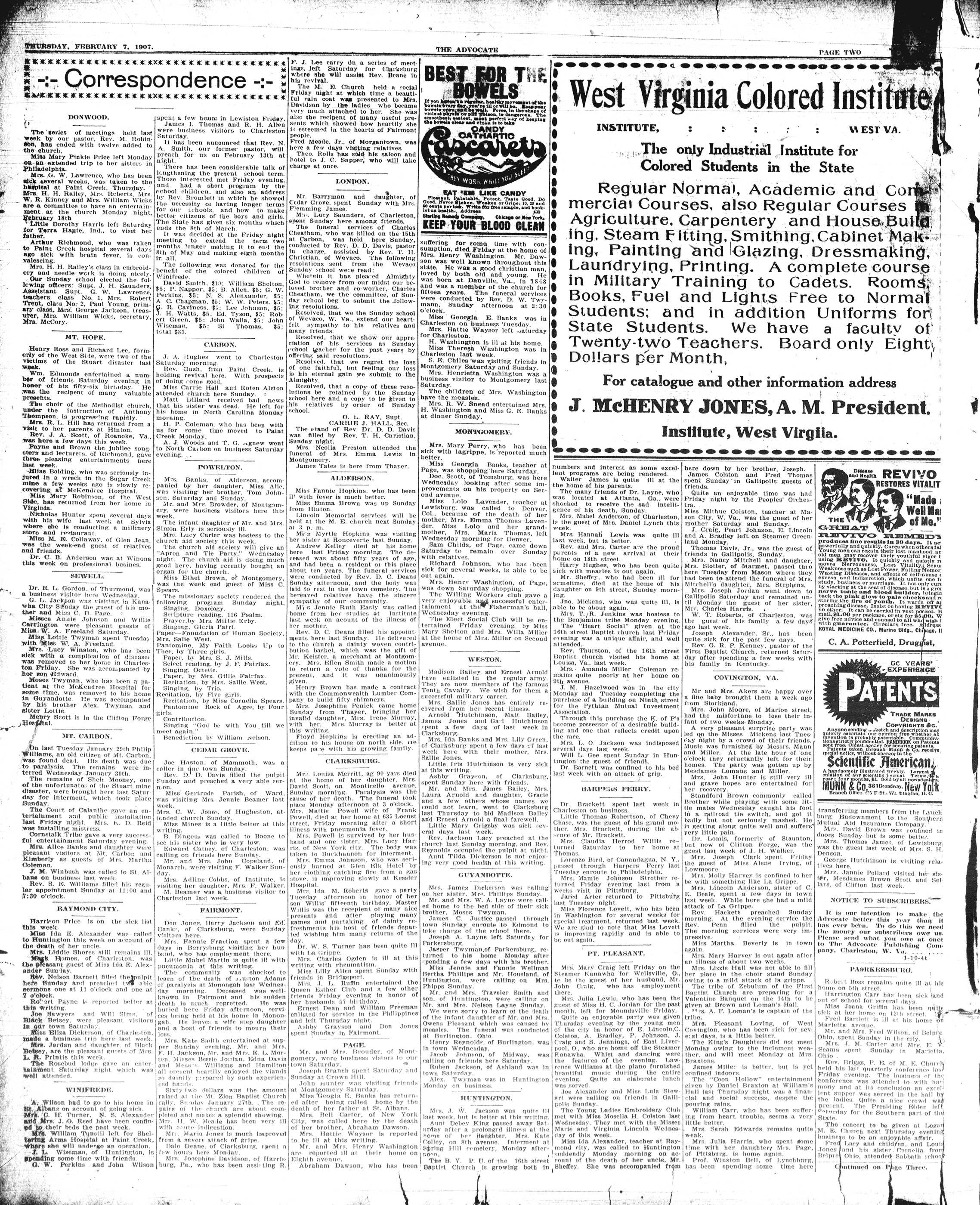
-:- Correspondence -:-
THURSDAY, FEBRUARY 7, 1907.
-- Corresp
DONWOOD.
DONWOOD
The series of meetings held last week by our pastor, Rev. M. Robinson, has ended with twelve added to the church.
Miss Mary Pinkie Price left Monday on an extended trip to her sisters in Philadelphia.
Mrs. G. W. Lawrence, who has been sick several weeks, was taken to the hospital at Paint Creek, Thursday.
Mrs. H. H. Railey, Mrs. Roberts, Mrs. W. R. Kinney and Mrs. William Wicks are a committee to have an entertainment at the church Monday night, February 18th
Little Dorothy Harris left Saturday for Terra Haute, Ind., to visit her father.
Arthur Richmond, who was taken to Paint Creek hospital several days ago sick with brain fever, is convalescing.
Mrs. H. H. Railey's class in embroidery and needle work is doing nicely. Our Sunday school elected the follwing officers: Supt. J. H. Saunders Assistant Supt. G. W. Lawrence teachers class No. 1, Mrs. Robert Trent, class No. 2, Paul Young, primary class, Mrs. George Jackson, treasurer, Mrs. William Wicks, secretary Mrs. McCory.
MT. HOPE.
Henry Ross and Richard Lee, formerly of the West Side, were two of the victims of the Stuart disaster last week.
Wm. Edmonds entertained a number of friends Saturday evening in honor of his fifty-six birthday. He was the recipient of many valuable presents.
The choir of the Methodist church, under the instruction of Anthony Thompson, is progressing rapidly.
Mrs. R. L. Hill has returned from a visit to her parents at Hinton.
Rev. J. A. Scott, of Roanoke, Va., was here a few days this week.
Fayne and Brown the jubilee songsters and lecturers of Richmond, gave three pleasing entertainments here last week.
Miss Mary Robinson, of the West Side, has returned from her home in Virginia.
Nicholas Hunter spent several days with his wife last week at Sylvia where she is conducting a millinery store and restaurant.
Miss M. E. Collaway, of Glen Jean, was the week-end guest of relatives and friends.
Dr. C. B. Anderson was at Winona this week on professional business.
SEWELL
Dr. R. L. Gordon, of Thurmond, was a business visitor here Wednesday. Jason was visiting in Kanawha City State, of this mother and Miss C. R. Page.
Mrs. Lucy Winston, who has been slick with a complication of diseases, was removed to her home in Charleston Friday. She was accompanied by her son Edward.
Moses Twyman, who has been a patient at the McKendree Hospital for some time, was removed to his home in Guyandotte. He was accompanied by his brother Alex. Twyman and glister Lottie.
Merry Scott is in the Clifton Forge Hospital.
MT. CARBON
On last Tuesday January 29th Philip Williams, an old citizen of Mt. Carbon, was found dead. His death was due to paralysis. The remains were interred Wednesday January 30th.
The remains of Shelt Mooney, one of the unfortunate ones of the Stuart mine disaster, were brought here last Saturday for interment, which took place Sunday.
The Court of Calanthe gave an entertainment and public installation last Friday night. Mrs. A. D. Reid was installing mistress.
Cornstalk Tribe gave a very successful entertainment Saturday evening.
Mrs. Alice Banks and daughter were pleasant visitors at Mt. Carbon and Kimberly as guests of Mrs. Martha Coleman.
J. M. Winbush was called to St. Albans on business last week.
Rev. S. E. Williams filled his regular appointment Sunday at 11:00 and 7:30 o'clock.
RAYMOND CITY.
Harrison Price is on the sick list this week.
Miss Ida E. Alexander was called to Huntington this week on account of the death of her uncle.
Rev. Nelson Barnett filled the pulpit here Sunday and preached two able sermons one at 11 o'clock and one at 7 o'clock.
Robert Payne is reported better at this writing.
Joe Sawyers and Will Sims, of Black Betsey, were pleasant visitors in our town Saturday.
Miss Eliza Dickerson, of Charleston, made a business trip here last week.
Mrs. Jordan and daughter, of Black Betsey, are the pleasant guests of Mrs. L. R. Printis this week.
The Rosebud lodge gave an entertainment Saturday night which was well attended.
WINIFREDE
A. Wilson had to go to his home in St. Albans on account of geling sick. Mrs. C. H. Turner. N. S. Alexander and Mrs. J. O. Reed have been confined to their beds the past week. Mrs. William Tunstil left for Sheltering Arms Hospital at Paint Creek, where she will undergo an operation. J. L. Wiseman, of Huntington, is spending some time with friends. G. W. Perkins and John Wilson
spent a few hours in Lewiston Friday. James I. Thomas and R. H. Alleu were business visitors to Charleston Saturday. It has been announced that Rev. N. A. Smith, our former pastor, will preach for us on February 13th at night. There has been considerable talk of lengthening the present school term. Those interested met Friday evenings, and had a short program by the school children, and also an address by Rev. Bromlett in which he showed the necessity of having longer terms for our schools, and how to make better citizens of the boys and girls. The State has given six months which ends the 8th of March. It was decided at the Friday night meeting to extend the term two months longer making it to end the 8th of May and making eighth months in all. The following was donated for the benefit of the colored children of Winifrede.
David Smith, $10; William Shelton,
$5; P. Napper, $5; B. Allen, $5; G. W.
Perkins, $5; N. S. Alexander, $5;
A. C. Chapman, $5; W. W. Peters, $5;
G. R. Caylness, $.; Lee Johnson, $5;
G. H. Mattis, $5; Ed. Tyson, $5; Robt
Gert Gaw, $5; John Walla, $; John
Wiseman, $5; Si Thomas, $5;
tetal $85.
CARBON
J. A. Hughes went to Charleston Saturday morning.
Rev. Bush, from Paint Creek, is holding revival here. With prospects of doing come good.
Miss Carrie Hall and Roten Alston attended church here Sunday.
H. P. Coleman, who has been with us for some time moved to Paint Creek Monday. A. J. Woods and T. G. Agnew went to North Carbon on business Saturday evening.
POWELTON.
Mrs. Banks, of Alderson, accompanied by her daughter, Miss Alle was visiting her brother, Tom Johnson, Saturday and Sunday. Mr. and Mrs. Browder, of Montgomery, were business visitors here this week. The infant daughter of Mr. and Mrs. Simon Erly is seriously ill. Mrs. Lucy Carter was hostess to the church aid society this week.
The church aid society will give an "Apron and Tie Party." Wednesday night. The church aid is doing much good here, having recently bought an organ for the church. Miss Ethel Brown, of Montgomery, was the week end guest of Miss C. Spears. The missionary society rendered the following program Sunday night, Singing, Doxology. Scripture reading, 116 Psalm. Prayer, by Mrs. Mittie Erby. Singing, Gloria Patri. Paper—Foundation of Human Society, Mrs. Salie West.
Pantomine, My Faith Looks Up to
Thee, by Three girls.
Paper, by Mrs. S. J. Mills.
Select reading, by J. F. Fairfax.
Singing, Octette.
Paper, by Mrs. Gillie Fairfax.
Recitation, by Mrs. Sallie West.
Singing, by Trio.
Recitation, by Five girls.
Recitation, by Miss Cornelia Spears.
Pantomine Rock of Ages, by Four
girls.
Contribution.
Singing "God be with You, till we
meet again."
Benediction by William Nelson.
CEDAR GROVE
Joe Haston, of Mammoth, was a caller in our town Sunday.
Rev. D. D. Davis filled the pulpit Sunday and preached a very able sermon.
Miss Gertrude Parish, of Ward, was visiting Mrs. Jennie Beamer last week.
Mrs. C. W. Jones, of Hugheston, attended church Sunday.
Miss Mines is a little better at this writing.
B. Dingess was called to Boone to see his sister who is very low.
Mrs. Adline Cobbs, of Institute, is visiting her daughter, Mrs. F. Walker. M. Beamer was a business visitor to Charleston last week.
FAIRMONT.
Don Jones, Harry Jackson and Ed. Banks, of Clarksburg, were Sunday visitors here.
Mrs. Fannie Fraction spent a few days in Berryburg visiting her husband, who has employment there.
Little Mabel Martin is quite ill with pneumonia at this writing.
The community was shocked to learn of the death of Luston Adams of paralysis at Monongah last Wednesday morning. Deceased was well-known in Fairmont and his sudden death is much regretted. He was buried here Friday afternoon, services being held at his home in Monongah. He leaves a wife step daughter and a host of friends to mourn their loss.
Mrs. Kate Smith entertained at super Sunday evening, Mr. and Mrs. F. H. Jackson, Mr. and Mrs. E. L. Morton, Misses Bessie Jordan, Edna Davis and Messrs. Williams and Hamilton all present heartily enjoyed the vials so dainty prepared by such experienced hands.
Sixty two dollars was the amount raised at the Mt. Zion Baptist Church rally, Sunday January 27th. The repairs of the church are about completed and makes a splendid showing. Mrs. H. W. Meale has been very ill with acute indigestion. Mrs. Maria Jones is much Improved from a severe attack of gripe. Dale Deane, of Clarksburg, spent a few hours here Monday. Mrs. Josephine Davidson, of Harrisburg, Pa., who has been assisting R
F. J. Lee carry on a series of meetings, left Saturday for Clarksville where she will assist Rev. Beane in his revival.
The M. E. Church held a social Friday night at which time a beautiful rain coat was presented to Mrs. Davidson by the ladies who became very much attached to her. She was also the recipient of many useful presents which showed how heartily she is esteemed in the hearts of Fairmont people.
Fred Meade, Jr., of Morgantown, was here a few days visiting relatives.
Theo. Rolls has sold his saloon and hotel to J. C. Sapper, who will take charge at once.
LONDON.
LONDON.
Mr. Barryman and daughter, of Codar Gore, spent Sunday with Mrs. Flemming James.
Mr. Lucy Saunders, of Charleston, spent Sunday here among friends. The funeral services of Charles Cheatham, who was killed on the 15th at Carbon, was held here Sunday, conducted by Rev. D. D. Davis, pastor in charge, assisted by Rev. T. H. Christian, of Wevaco. The following resolutions sent from the Wevaco Sunday school were read:
Wherein it has pleased Almighty God to remove from our midst our beloved brother and co-worker, Charles Cheatham, we the committee, of Sunday school beg to submit the following resolutions.
Resolved that we the Sunday school of Wevaco, W. Va., extend our heartfelt sympathy to his relatives and many friends.
Resolved that we show our appreciation of his services as Sunday school teacher for the past years by offering said resolutions.
Resolved, that we regret the loss of one faithful, but feeling our loss is his eternal gain we submit to the Almighty.
Resolved, that a copy of these resolutions be retained by the Sunday school here and a copy to be given to his relatives by order of Sunday school.
O. L. RAY, Supt.
CARRIE J. HALL, Sec.
The stand of Rev. Dr. D. D. Davis was filled by Rev. T. H. Christian, Sunday night.
Mrs. Neolla Preston attended the funeral of Mrs. Emma Lewis in Montgomery.
James Tates is here from Thayer.
ALDERSON.
Miss Fannie Hopkins, who has been ill with fever is much better.
Lincoln Memorial services will be held at the M. E. church next Sunday at 3 p. m.
Mrs Myrtle Hopkins was visiting her sister at Ronceverte last Sunday.
Andrew Kelley died at his home here last Friday morning. The deceased was about fifty years of age, and had been a resident or this place about ten years. The funeral services were conducted by Rev. D. C. Deans Sunday afternoon, and the body was laid to rest in the town cemetery. The bereaved relatives have the sincere sympathy of our community.
Mrs Jennie Ruth Easly was called home from her studies at Institute last week on account of the illness of her mother.
Rev. D. C. Deans filled his appointments here last Sunday. He delivered to the church a dainty woven contribution basket, which was the gift of Mr. Keister, a merchant at Montgomery. Mrs. Ellen Smith made a motion to return a vote of thanks for the present, and it was unanimously given
Henry Brown has made a contract with the Commonwealth Lumber Company to build fifty chimneys. Mrs. Josephine Penick came home Sunday from Thayer, bringing her invalid daughter, Mrs. Irene Murray, with her. Mrs. Murray is better at this writing. Floyd Hopkins is erecting an addition to his house on north side, he keeps pace with his growing family.
CLARKSBURG.
Mrs. Louisa Merritt, ag 90 yars died at the home of her daughter, Mrs. David Scott, on Monticello avenue, Sunday morning. Paralysis was the cause of her death. The funeral took place Monday afternoon at 3 o'clock. Mrs. Mattie Powell wife of Frank Powell, died at her home at 635 Locust street, Friday morning after a short illness with pneumonia fever. Mrs. Powell is survived by her husband and one sister. Mrs. Lucy Harris, of New York city. The body was taken to Buckhannon for interment. Mrs. Emma Johnson, who was seriously burned at Glen Elk Hotel by her clothing catching fire from a gas stove, is improving slowly at Kessler Hospital.
Mrs. Ida M. Roberts gave a party Tuesday afternoon in honor of her son Willis' fifteenth birthday. Master Willis was the recipient of many nice presents and after playing many games and partaking of dainty refreshments his host of friends departed wishing him many returns of the day.
Dr. W. S. Turner has been quite ill with La Grippie.
Mrs. Charles Ogden is ill at this writing with rheumatism.
Miss Lilly Allen spent Sunday with friends in Bridgeport.
Mrs. J. L. Ruffin entertained the Queen Either Club and a few other friends Friday evening in honor of her husbands 57 birthday.
Ashby Grayson and Don Jones
spent Sunday in Fairmont.
PAGE
Mr. and Mrs. Brouder, of Montgomery, were business visitors to our town Saturday. Joseph Branch spent Saturday and Sunday at Crown Hill.
Miss Georgia E. Banks has returned after being called home by the death of her father at St. Albans. Mrs. Bell Carter, of New York City, was called here by the death of her brother, Abraham Dawson. Mrs. Hattie Waysor is reported to be ill at this writing. Mr. and Mrs. Henry Washington are reported ill at their home on Eighth avenue. Abraham Dawson, who has been
BEST FOR THE BOWELS
If you haven't a regular, healthy movement of the bowels every day, you re'll or will be. Keep your bowels clean and healthy with violent palsy or pilt poison, is dangerous. The smoothest, easiest, most perfect way of keeping the bowels clear and clean is to take
CANDY
OATHARTIC
Fascarets
HEY WORK WHILE YOU SLEEP
EAT 'EM LIKE CANDY
Pleasant, Palatable, Potent, Taste Good, Do Good, Never Sicken, Weaken or Gripe, 10, 25 and 50 cents per book. Write for free sample, and booklet on health. Address
Sleet
suffering for some time with consumption, died Friday at the home of Mrs. Henry Washington. Mr. Dawson was well known throughout this state. He was a good Christian man, loved by both old and young. He was born at Danville, Va., in 1848 and was a member of the church for fifteen years. The funeral services were conducted by Rev. D. W. Twymann, Sunday afternoon at 2:30 o'clock.
Miss Georgia E. Banks was in Charleston on business Tuesday.
Mrs. Hattie Waysor left Saturday for Charleston.
H. Washington is ill at his home.
Miss Theresa Washington was in Charleston last week.
S. E. Chiles was visiting friends in Montgomery Saturday and Sunday.
Mrs. Henrietta Washington was a business visitor to Montgomery last Saturday.
The children of Mrs. Washington have the measles.
Mrs. R. W. Snead entertained Mrs. H. Washington and Miss G. E. Banks at dinner Sunday.
MONTGOMERY
Mrs. Mary Perry, who has been sick with lagripe, is reported much better.
Miss Georgia Banks, teacher at Page, was shopping here Saturday.
Doc. Scott, of Tomsburg, was here Wednesday looking after some improvements on his property on Second avenue.
Miss Lolo Lavender, teacher at Lewisburg, was called to Denver. Col., because of the death of her mother, Mrs. Emma Thomas Lavender. Miss Lolo and her grandmother, Mrs. Maria Thomas, left Wednesday morning for Denver.
Sam Childs, of Page, came down Saturday to remain over Sunday with relatives.
Richard Johnson, who has been sick for several weeks, is able to be out again.
Mrs. Henry Washington, of Page, was down Saturday shopping.
The Willing Workers club gave a very enjoyable and successful entertainment at the Fisherman's hall, Wednesday evening. The festicial club will be entertained Friday evening by Miss Mary Shelton and Mrs. Willa Miller at the home of Mrs. Miller on Second avenue.
WESTON
Madison Bailey and Ernest Arnold have enlisted in the regular army. They are now members of the famous Tenth Cavalry. We wish for them a successful military career.
Mrs. Sallie Jones has entirely recovered from her recent illness.
Arnold Hutchinson, Matt Bailey, James Jones and Ga-1 Hutchinson spent a few days of last week in Clarksburg.
Mrs. Ida Banks and Mrs. Lily Green, of Clarksburg spent a few days of last week here with their mother, Mrs. Sallie Jones.
Little Iris Hutchinson is very sick at this writing.
Ashby Grayson, of Clarksburg,
spent. Sunday, hey with friends.
spent Sunday here with friends. Mr. and Mrs. James Bailey, Mrs. Laura Arnold and daughter, Grace and a few others whose names we could not learn, went to Clarksburg last Thursday to bid Madison Bailey and Ernest Arnold a final farewell. Little Mary Griggsby is sick several days last week. Rev. Jackson Lacy preached at the church last Sunday morning, and Rev Reynolds occupied the pulpit at night. Aunt Tilda Dickerson is not enjoying very good health at this writing.
GUYANDOTTE
Mrs. James Dickerson was calling on her sister, Mrs. Phillips Sunday.
James C. Justice passed through town Sunday enroute to Edmond to take charge of the school there.
Joseph A. Layne left Saturday for Parkersburg.
Jasper Twyman of Parkersburg, returned to his home Monday after spending a few days with his brother.
Miss Jennie and Fannie Wellman Bertha Phillips and Mr. Housland, of Huntington, were calling on Mrs. Phipps Sunday.
Mr. and Mrs. Traveler Smith and son, of Huntington, were calling on Mr. and Mrs. Nelson Layne Sunday.
We were sorry to learn of the death of the infant daughter of Mr. and Mrs. Owena Pleasant which was caused by meagles. The funeral was conducted at Burlington, Ohio.
Henry Reynolds, of Burlington, was in town Wednesday.
Alex. Twyman was in Huntington Monday on business.
HUNTINGTON
Mrs. J. W. Jackson was quite ill last week, but is better at this writing.
Aunt Debey King passed away Saturday after a prolonged illness at the home of her daughter, Mrs. Kate Colley, on 8th avenue. Interment at Spring Hill cemetery, Monday afternoon.
The B. Y. P. U. of the 16th street Baptist Church is growing both in
West Virginia Colored Institute
The only Industrial Institute for Colored Students in the State
Regular Normal, Academic and Commercial Courses, also Regular Courses in Agriculture, Carpentery and House Building, Steam Fitting, Smithing, Cabinet Making, Painting and Glazing, Dressmaking, Laundrying, Printing. A complete course in Military Training to Cadets. Rooms, Books, Fuel and Lights Free to Normal Students; and in addition Uniforms for State Students. We have a faculty of Twenty-two Teachers. Board only Eight Dollars per Month.
For catalogue and other information address
---
The many friends of Dr. Layne, who was located at Atlanta, Ga., were shocked to receive the sad intelligence of his death, Sunday. Mrs. Mabel Anderson, of Charleston, is the guest of Mrs. Daniel Lynch this week. Mrs. Hannah Lewis was quite ill last week, but is better.
Harry Hughes, who has been quite sick with measles is out again.
Mr. Sheffey, who had been ill for sctetime, died at the home of his daughter on 9th street, Sunday morning.
Jno. Mickens, who was quite ill, is able to be about again.
Mrs. T./R. Jenkins was hostess to the Benjamine tribe Monday evening.
The "Heart Social" given at the 16th street Baptist church last Friday evening was a unique affair, and well attended.
Rev. Thurston, of the 16th street Baptist church visited his home at Louisa, Va., last week.
Mrs. Amanda Miller Coleman remains quite poorly at her home on 9th avenue.
J. M. Hazelwood was in the city Monday and Tuesday completing the purchase of a building on Ninth street for the Pythian Mutual Investment Association.
Through this purchase the K. of P's become possessor of a desirable building and one that reflects credit upon the race.
Mrs. L. O. Jackson was indisposed several days last week.
Will L. Gee spent Sunday in Huntington the guest of friends.
Dr. Barnett was confined to his bed last week with an attack of grip.
HARPE'S FERRY
Dr. Brackett spent last week in Charleston on business.
Little Thomas Robertson, of Chevy Chase, was the guest of his grand mother, Mrs. Brackett, during the absence of Mr. Brackett.
Mrs. Claudia Herrod Willis returned Saturday to her home at Thomas.
Lorenzo Bird, of Canadagua, N. Y., passed through Harpers Ferry last Tuesday enroute to Philadelphia.
Mrs. Mamie Johnson Strother returned Friday evening last from a weeks visit in Pittsburg.
Jared Arter returned to Pittsburg last Tuesday night.
Miss Florence Lovett, who has been in Washington for several weeks for special treatment, returned last week.
We are glad to note that Miss Lovett is improving rapidly and is able to be out again.
PT. PLEASANT
Mrs. Mary Craig left Friday on the Steamer Kanawha for Wellsville, O. to be the guest of her husband, Mr. John Craig, who has employment there.
Mrs. Julia Lewis, who has been the guest of Miss H. C. Jordan for the past month, left for Moundsville Friday. Quite an enjoyable party was given Thursday evening by the young men of the city in honor of E. Lincoln, C. Colston, A. Bradley, P. Johnson, J. Craig and S. Jennings, of East Liverpool, O. who are home off the Steamer Kanawha. Whist and dancing were the features of the evening. Lawrence Williams at the piano furnished beautiful music during the entire evening. Quite an elaborate lunch was served.
Joe Alexander and Miss Lula Stewart were calling on friends in Gallipolis Sunday.
The Young Ladies Embroidery Club met with Miss Mossella H. Colston last Wednesday. They met with the Misses Marie and Virginia Lincoln Wednesday of this week. Miss Ida Alexander, teacher at Raymond city, was called to Huntington suddenly Monday morning on account of the death of her uncle, Mr Sheffey. She was accompanied frqm
here down by her brother, Joseph.
James Colston and Fred Thomas spent Sunday in Gallipolis guests of friends.
Quite an enjoyable time was had Friday night by the Peoples' Orchestra.
Miss Mithue Colston, teacher at Mason City, W. Va., was the guest of her mother Saturday and Sunday.
J. Craig, Pearl Johnson, E. Lincoln and A. Bradley left on Steamer Greenland Monday.
Thomas Davis, Jr., was the guest of friends in Gallipolis, Sunday.
Mrs. Nancy Mitchell and daughter, Mrs. Slotter, of Marmet, passed thro here Tuesday from Mason where they had been to attend the funeral of Mrs. Mitchell's daughter, Mrs. Stephens.
Mrs. Joseph Jordan went down to Gallipolis Saturday and remained until Monday the guest of her sister, Mrs. Charles Harris.
W. T. Roberts, of Charleston, was the guest of his family a few days ago last week.
Joseph Alexander, Sr., has been quite sick for the past few days.
Rev. G. R. P. Kenney, pastor of the First Baptist Church, returned Saturday after spending a few weeks with his family in Kentucky.
COVINGTON, VA.
Mr and Mrs. Akers are happy over a fine baby brought them a week ago from Storkland.
Mrs. John Moore, of Marion street, had the misfortune to lose their infant of two weeks-Monday.
A very pleasant surprise party was led on the Misses Mickens last Tuesday night by a crowd of their friends. Music was furnished by Messrs. Mann and Miller. At the late hour of one o'clock they reluctantly left for their homes. The party was gotten up by Mesdames Lomans and Miller.
Mrs. John Hunter is still very ill and grave hopes are entertained for her recovery.
Standford Brown commonly called Brother while playing with some little mates Wednesday caught his foot in a railroad tie switch, and got it badly but not seriously mashed. He is getting along quite well and suffers very little pain.
Dr. Louis, formerly of Staunton, but now of Clifton Forge, was the guest last week of J. H. Walker.
Mrs. Molly Harvey is confined to her be with something like La Gripe.
Mrs. Lincoln Anderson, sister of C. K. Beale, spent a few days in town last week. While here she had a mild attack of La Gripe.
Rev. Hackett preached Sunday morning. At the evening service the Rev. Penn filled the pulpit. The morning services were very impressive.
Miss Martha Beverly is in town again.
Mrs. Mary Harvey is out again after an illness of about two weeks.
Mrs. Lizzie Hall was not able to fill her place in the choir stand Sunday owing to a mild attack of La gripe.
Mrs. Pleasant Loving, of West Covington, who has been sick for several days, is a little better.
The King's Daughters did not meet Monday owing to the inclement weather, and will meet Monday at Mrs. Braxtons.
James Miller is better, but is yet confined indoors.
The "Coon Hollow" entertainment given by Daniel Braxton at William's Hall last Thursday night was a financial and social success, despite the pouring rains.
William Carr, who has been suffering from heart trouble, seems a very little better.
Mrs. Sarah Edwards remains quite weak.
Mrs. Julia Harris, who spent some time with her daughter, Mrs. Page, of Pittsburg, is home again.
Prof. Winston Bell, of Lynchburg, has been spending some time here
Disease and Health REVIVO RESTORES VITALITY
"The Made in Well Man of Me."
THE GREAT REVIVO REMEDY produces fine results in 30 days. It can powerfully and quickly. Cures when other fails. Young men can regain their lost manhood, and men can recover their youthful vigor by using REVIVO. It moves Nervousness, Lost Vitality, Serum Weakness such as Lost Power, Fatal Memory Wasting Diseases, and effects of self-abuse of food, and it helps which unfit one for study, business or marriage. It also helps by starting at the seat of disease, but is a great nerve tonic and blood builder, bringing back the fire to pale checks and restoring the fire of the mind. Proaching disease. Insist on having REVIVO no other. It can be carried in vests pocket. Have 00.000 packs, or six for 85.00. We give free advice and marriage with guarantee. Chronicles free. Address ROYAL MEDICINE CO., Marine Bldg., Changsha,
GC YEARS
EXPERIENCE
PATENTS
TRADE MARKS
DESIGNS
COPYRIGHTS & C.
Anyone sending ... ketches description may quickly ascertain our opinion free with further invention is probably patentable. Communica-
tion merely worded. MUNN & Co. patents sont free. Oldest agency for securing patents. Patents taken through Munn & Co. receive
special notice, will bolt charge, in the
Scientific American
A handsomely illustrated weekly. Largest
collection of any scientific journal. Terms,
year, four months, $1. Sold by all newdealers.
MUNN & Co. 361 Broadway, New York
Branch Office, 65 F St. W. St.ington, D.C.
transferring members from the Lauch burg Endowment to the Southern Mutual Aid Insurance Company.
Mrs. David Brown was confined in doors Sunday but is some better.
Mrs. Thomas James, of Lewisburg was the guest last week of Mrs. S. H. Denson.
George Hutchinson is visiting relatives here.
Mrs. Jannie Pollard visited her sister, Mesdames Brown Scott and Sellars, of Clifton last week.
NOTICE TO SUBSCRIBERS.
It is our intention to make the Advocate better this year than it has ever been. To do this we need the money our subscribers owe us. Please send what you owe at once to The Advocate Publishing Company, Charleston, W. Va. 1-10-4t
PA9RKERSBURQ
Robert Boss remains quite ill at his home on 5th street.
Harrington Carr has been sick and out of school for several days.
Miss Joanna Griffin has been quite sick at her home on 12th street.
Fred Bartlett is ill at his home on Marietta avenue.
Mr. and Mrs. Fred Wilson, of Belphei Ohio, spent Sunday in the city.
Mrs. J. M. Carter and Mrs. E. V. Seams spent Sunday in Marietta, Ohio.
Rev. Briggs, P. E. of M. E. Church held his last quarterly conference last Friday evening. The business of the conference was attended to with hard money and at its conclusion an excellent supper was served in the hall by the ladies. Quite a nice crowd was present. The Presiding Elder left Saturday for the Southern part of the State.
The concert to be given at Logan
M. E. Church next Thursday evening
business to be an enjoyable affair.
Fred Lacy and childen, and Louis
Jones and his sister. Carmelia from
Belpie, Ohio, attended Sabbath school
New Words
of the World
in Literature, based on the
Biblical Dictionary
over 10,000 noted
death, etc.
Edited by W. M. M. RIS, Ph.D., LL.D.
United States Commissioner of Education.
2380 Quarto Pages
New Plates. 8000 Illustrations. Rich Blindings.
Needed in Every Home
Also Webster's Collegiate Dictionary
116 Pages. 800 Illustrations.
Regular Edition 7 x 10 x 21½ in. Blindings.
De Luxe Edition 6 x 12 x 1½ in. Printed from
same plates, on bible paper, 9 beautiful blindings.
FREE, "Dictionary Wrinkles," Illustrated pamphlets.
G. O. C. MERRIAM CO.
Publishers, Springfield, Mass.
CORRESPONDENCE
and church in the city Sunday.
Harvard. Lee, who was quite sick last. week at his home on Clay street, is now improving and is out again.
Mrs. Nancy Calloway is quite sick with inflammatory rheumatism at Senator Camden's where she is employed.
Mrs. J. W, Shellcroft is sick at her home on 5th street.
Mrs. William Mellentree, who has been indisposed for the past week, is now able to be about again.
Joseph Peters remains about the same at his home on 20th street.
Rev. E. E. O'Brien returned last week from McKeesport, where he has been for several weeks conducting revival.
George Edmonston, who has been confined for some weeks, with rheumatism, is somewhat better at this writing.
Master Blair Jones has been out of school for several weeks on account of illness.
Charles Wells returned home Wednesday of last week from Columbus, Ohio.
The Needle Work Club met last Thursday week with Mrs. Fred Wilson, of Pepper, Ohio. In suite of the inclement weather and high water quite a large percent of the members was present, and an enjoyable session was held. At the conclusion a fine luncheon was served.
The Measuring Party and Pink Social given by the Vendetta Court No. 5, at the K. of P. Hall last Thursday night week was quite a success.
A large crowd responded to the unique and catchy invitations which had been sent out and notwithstanding the inclementity of the weather they took advantage of the opportunity to spend a pleasant social hour.
Quite a neat little sum was realized, Mr. and Mrs. E. V. Seams entertained the card party last Saturday evening.
The usual crowd was present and an enjoyable time was spent by all.
Miss Grace Wells won the first prize which was a beautiful porcelain stine.
Dr. J. W. Shellcroft received the consolation prize which was a unique candle holder.
ORDER OF PUBLICATION.
State of West Virginia.
At Rules held in the clerk's office of the circuit court of Kanawha county, on Monday, the 7th day of January, 1907.
Lucy Parrott
vs.
Samuel Parrott,
In Chancery No. 1282.
And it appearing by affidavit filed in this cause that Samuel Parrot is a non-resident of this State, it is ordered that he do appear here within one month after the date of the first publication hereof, and do what is necessary to protect his interests.
The object of the above entitled suit is to obtain an absolute divorce from the bonds of matrimony.
D. M. SHIRKEY, Clerk.
Middleton & Alberston, Solicitors.
NOTICE TO TAKE DEPOSITIONS.
To Samuel Parrott.
Take notice, That on the 9th day of February, A. D., 1907, between the hours of 9 o'clock a. m., and 4 o'clock p. m., at the office of Middleton & Albertson, rooms 21 to 24. Lawrence block, in the city of Charleston, county of Kanawha, state of West Virginia, I will take the deposition of myself and others, to be read in evidence in my behalf in a certain suit in chancery now penning in the circuit court for the county of Kanawha, and state of West Virginia, in which I am plaintiff and you are defendant.
If from any cause the taking of said deposition shall not be commenced or completed on the day aforesaid, the same shall be continued from day to day, or from time to time, at the same place, and between the same hours, until the same shall be completed.
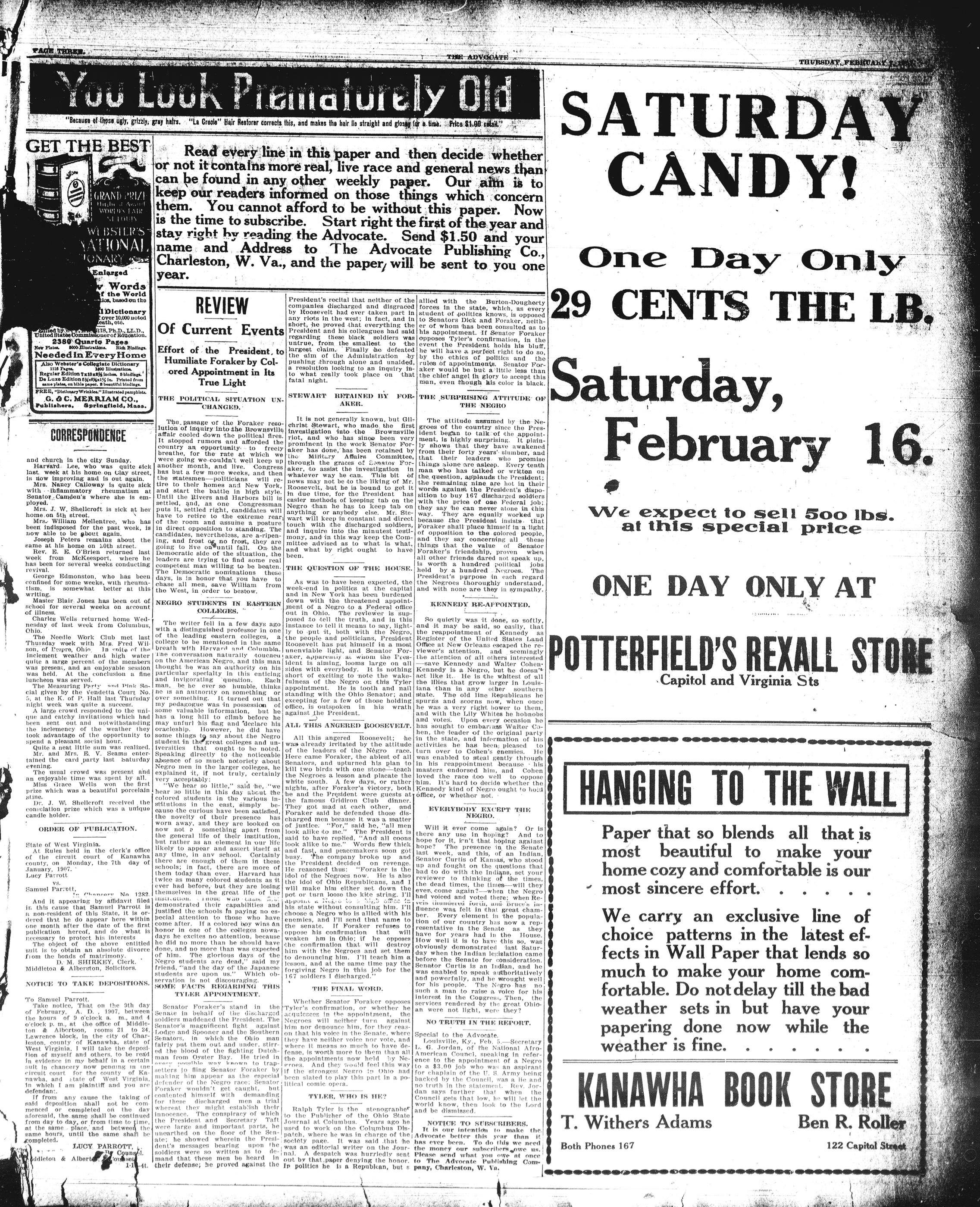
Read every line in this paper and then decide whether or not it contains more real, live race and general news than can be found in any other weekly paper. Our aim is to keep our readers informed on those things which concern them. You cannot afford to be without this paper. Now is the time to subscribe. Start right the first of the year and stay right by reading the Advocate. Send $1.50 and your name and Address to The Advocate Publishing Co., Charleston, W. Va., and the paper will be sent to you one year.
THE POLITICAL SITUATION UN- CHANGED.
The passage of the Foraker resolution of inquiry into the Brownsville affair cooled down the political fires. It stopped rumors and afforded the country an opportunity to freely breathe, for the rate at which we were going we couldn't well keep up another month, and live. Congress has but a few more weeks, and then the statesmen—politicians will retire to their homes and New York, and start the battle in high style. Until the Rivers and Harbors bill is settled, and, as one Congressman puts it, settled right, candidates will have to retire to the extreme rear of the room and assume a posture in direct opposition to standing. The candidates, nevertheless, are a-ripening, and frost or no frost, they are going to live on until fall. On the Democratic side of the situation, the leaders are trying to find some real competent man willing to be beaten. The Democratic nominations these days, is in honor that you have to chase all men, save William from the West, in order to bestow.
NEGRO STUDENTS IN EASTERN COLLEGES.
The writer fell in a few days ago with a distinguished professor in one of the leading eastern colleges, a college to be mentioned in the same breath with Harvard and Columbia. The conversation naturally touched on the American Negro, and this man thought he was an authority on his particular specialty in this enticing and invigorating question. Each man, be he ever so humble, thinks he is an authority on something or over something. It turned out that my pedagogue was in possession of some valuable information, but he has a long hill to climb before he may unfurl his flag and declare his oracleship. However, he did have some things to say about the Negro student in the great colleges and universities that ought to be noted. Speaking directly to the noticeable absence of so much notoriety about Negro men in the larger colleges, he explained it, if not truly, certainly very acceptably:
"We hear so little," said he, "we hear so little in this day about the colored students in the various institutions in the east, simply because the curious have been satisfied, the novelty of their presence has worn away, and they are looked on now not a something apart from the general life of their institution, but rather as an element in our life likely to appear and assert itself at any time, in any school. Certainly there are enough of them in these schools; in fact, there are more of them today than ever. Harvard has twice as many colored students as it ever had before, but they are losing themselves in the great life of the institution. Those who have demonstrated their capabilities and justified the schools in paying no especial attention to those who have come after. If a colored boy wins an honor in one of the colleges nowdays he excites no attention, because he did no more than he should have done, and no more than was expected of him. The glorious days of the Negro students are dead," said my friend, "and the day of the Japanese students are upon us." Which observation is not discouraging.
TYLER APPOINTMENT.
Senator Foraker's stand in the Senate in behalf of the discharged soldiers maddened the President. The Senator's magnificent fight against Lodge and Spooner and the Southern Senators, in which the Ohio man fairly put them out and under, stirred the blood of the fighting Dutchman from Oyster Bay. He tried in every possible way known to trapsetters to fling Senator Foraker by making him appear as the especial defender of the Negro race; Senator Foraker wouldn't get caught, but contented himself with demanding for these discharged men a trial whereat they might establish their innocence. The conspiracy of which the President and Secretary Taft were large and important parts, he unearthed on the floor of the Senate; he showed wherein the President's messages bearing upon the soldiers were so written as to demand that these men be heard in their defense; he proved against the
President's recital that neither of the companies discharged and disgraced by Roosevelt had ever taken part in any riots in the west; in fact, and in short, he proved that everything the President and his colleagues had said regarding these black soldiers was untrue, from the smallest to the largest claim. Finally he defeated the aim of the Administration by pushing through alone and unaided, a resolution looking to an inquiry into what really took place on that fatal night.
It is not generally known, but Gillchrist Stewart, who made the first investigation into the Brownsville riot, and who has since been very prominent in the work Senator Foraker has done, has been retained by the Military Affairs Committee, through the graces of Senator Foraker, to assist the investigation in whatever way he can. This bit of news may not be to the liking of Mr. Roosevelt, but he is bound to get it in due time, for the President has easier methods of keeping tab on the Negro than he has to keep tab on anything or anybody else. Mr. Stewart will keep in constant and direct touch with the discharged soldiers, and inquire into the minutest testimony, and in this way keep the Committee advised as to what is what, and what by right ought to have been.
THE QUESTION OF THE HOUSE
As was to have been expected, the week-end in politics at the capital and in New York has been burdened down with the threatened appointment of a Negro to a Federal office out in Ohio. The reviewer is supposed to tell the truth, and in this instance to tell it means to say, lightly to put it, both with the Negro, the people and politicians, President Roosevelt has put himself in a most unenvitable light, and Senator Foraker, apparently at whom the President is aiming, looms large on all sides with everybody. It is nothing short of exciting to note the wakefulness of the Negro on this Tyler appointment. He is tooth and nail standing with the Ohio Senator; and excepting for a few of those holding office, is outspoken in his wrath against the President.
ALL THIS ANGERED ROOSEVELT
All this angered Roosevelt; he was already irritated by the attitude of the leaders of the Négro race. Here came Foraker, the ablest of all Senators, and upturned his plan to kill two birds with one stone—teach the Negroes a lesson and placate the white south. A few days, or rather nights, after Foraker's victory, both he and the President were guests at the famous Gridiron Club dinner. They got mad at each other, and Foraker said he defended those discharged men because it was a matter of justice. "For," said he, "all men look alike to me." The President is said to have replied, "And all coons look alike to me." Words flew thick and fast, and peacemakers soon got busy. The company broke up and the President decided on revenge. He reasoned thus: "Foraker is the idol of the Negroes now. He is also the idol of Ohio Republicans, and I will make him either set down the pot or turn loose the kite string. I will appoint a Negro to help office in his state without consulting him. I'll choose a Negro who is allied with his enemies, and I'll send that name to the senate. If Foraker refuses to oppose his confirmation that will weaken him in Ohio; if he opposes the confirmation that will destroy him with the Negroes and set them to denouncing him. I'll teach him a lesson, and at the same time pay the forgiving Negro in this job for the 167 soldiers I discharged."
THE FINAL WORD
Whether Senator Foraker opposes Tyler's confirmation, or whether he acquiesces in the appointment, the Negroes will neither turn against him nor denounce him, for they reason that his voice in the Senate, where they have neither voice nor vote, and where it means so much to have defense, is worth more to them than all the appointments now held by Negroes. And they would feel this way if the strongest Negro in Ohio had been slated to play this part in a political comic opera.
TYLER, WHO IS HE?
Ralph Tyler is the stenographer to the Publisher of the Ohio State Journal at Columbus. Years ago he used to work on the Columbus Dispatch, where he was in charge of the society page. It was said that he was an editorial writer on the Journal. A despatch was hurriedly sent out by that paper denying the honor. In politics he is a Republican, but a
allied with the Burton-Dougherty forces in the state, which, as every student of politics knows, is opposed to Senators Dick and Foraker, neither of whom has been consulted as to his appointment. If Senator Foraker opposes Tyler's confirmation, in the event the President holds his bluff, he will have a perfect right to do so, by the ethics of politics and the rules of appointments. Senator Foraker would be but a little less than the chief angel in glory to accept this man, even though his color is black.
THE SURPRISEING ATTITUDE OF
THE NEGRO
The attitude assumed by the Negroes of the country since the President began to talk of the appointment, is highly surprising. It plainly shows that they have awakened from their forty years' slumber, and that their leaders who promise things alone are asleep. Every tenth man who has talked or written on the question, applauds the President; the remaining nine are hot in their words against the President's disposition to buy 167 discharged soldiers with the price of one Federal job; they say he can never alone in this way. They are equally worked up because the President insists that Foraker shall place himself in a light of opposition to the colored people, and they say concerning all these things that the value of Senator Foraker's friendship, proven when all other friends dared not speak up, is worth a hundred political jobs held by a hundred Negroes. The President's purpose in each regard the Negroes thoroughly understand, and with none are they in sympathy.
KENNEDY RE-AFPOINTED.
So quietly was it done, so softly, and it may be said, so easily, that the reappointment of Kennedy as Register of the United States Land Office at New Orleans escaped the reviewer's attention, and seemingly the attention of all others interested—save Kennedy and Walter Cohen. Kennedy is a Negro, but he doesn't act like it. He is the whitest of all the illies that grow larger in Louisiana than in any other southern state. The old line Republicans he spurs and scorns now, when once he was a very right bower to them, and with the Lily Whites he hobnobbs and votes. Upon every occasion he has sought to embarrass Walter Cohen, the leader of the original party in the state, and information of his activities he has been, pleased to turn over to Cohen's enemies. He was enabled to steal gently through in his reappointment because his masters endorsed him, and Cohen loved the race too well to oppose him. It's hard to decide whether the Kennedy kind of Negro ought to hold office, or whether not.
EVERYBODY EXCEPT THE NEGRO.
Will it ever come again? Or is there any use in hoping? And to hope for it, isn't that hoping against hope? The presence in the Senate last week, and this, of an Indian, Senator Curtis of Kansas, who stood up and fought on the questions that had to do with the Indians, set your reviewer to thinking of the times, the dead times, the times—will they even come again?—when the Negro had voiced and voted there; when Revis thundered forth, and bruces influence was felt in that great chamber. Every element in the population of our country has now a representative in the Senate as they have for years had in the House. How well it is to have this so, was obviously demonstrated last Saturday when the Indian legislation came before the Senate for consideration. Senator Curtis is an Indian, and he was enabled to speak authoritatively and powerfully, and he wrought well for his people. The Negro has no such a man to raise a voice for his interest in the Congress. Then, the services rendered by the great Ohioan were not light, were they?
NO TRUTH IN THE REPORT.
Special to the Advocate.
Louisville, Ky., Feb. 5.—Secretary L. G. Jordan, of the National Afro-American Council, speaking in reference to the appointment of a Negro to a $3,00 job who was an aspirant for chaplain of the U. S. Army being backed by the Council, was a lie and no truth in the statement. Rev. Jordan says further that when the Council gets that low, he will let the world know, then look to the Lord and be dismissed.
NOTICE TO SUBSCRIBERS
NOTICE TO SUBSCRIBERS.
It is our intention to make the Advocate better this year than it has ever been. To do this we need the money our subscribers give us. Please send what you owe at once to The Advocate Publishing Company, Charleston, W. Va.
SATURDA CANDY!
One Day Only 29 CENTS THE LB.
Saturday, February 16.
We expect to sell 500 lbs. at this special price
ONE DAY ONLY AT
HANGING
Paper that so
most beautiful
home cozy and
most sincere
We carry an
choice pattern
fects in Wall
much to make
fortable. Do m
weather sets
papering don
weather is fin
KANAWHA
HANGING TO THE WALL
Paper that so blends all that is most beautiful to make your home cozy and comfortable is our most sincere effort.
We carry an exclusive line of choice patterns in the latest effects in Wall Paper that lends so much to make your home comfortable. Do not delay till the bad weather sets in but have your papering done now while the weather is fine.
T. Withers Adams
Both Phones 167
Capitol and Virginia Sts
BING TO THE
that so blends all
beautiful to make
cozy and comfortable
incere effort. . .
carry an exclusive life
patterns in the late
Wall Paper that lea
to make your home
like. Do not delay till th
er sets in but have
ing done now while
er is fine. . . .
WHA BOOK S
---
THE ADVOCATE PUBLISHINGCO.
Office Room 3 K. of P. Building Home Phone 923.
The Advocate is entered in the Post-office at Charleston, W. Va., as second class matter.
Three months ..... $0.50
Sixxx months ..... 1.00
One year ..... 1.50
THURSDAY, FEBRUARY 7, 1907.
Ordinarily the announcement by the President that he had in mind to appoint to a Federal office of dignity a Negro would excite in the Advocate a great deal of joy, for we delight to welcome each manifestation of appreciation of the ability of black men, and even opportunity opened up to them to show how deep in them is planted the spirit of America; with what ability and carriage they are able to conduct themselves in high office, and with what skill they can acquit them selves whenever and wherever they are called upon to perform duties, howsoever exacting they may be. We confess that the President's declared purpose to appoint Ralph Tyler Surveyor of the Port, or Collector of Customs, at Cincinnati gives us no little concernment, for with the avowal of this purpose there arises a situation the complexity of which is of far-reaching import, and is not to be solved as easily as stated. We say the President's avowal gives us concernment, and we say this with no malice towards Mr. Tyler, whose ambition for political preferment we have no right to question or limit, and who, as he himself says, should not be declared incompetent, until that incompetency has been shown beyond every reasonable doubt. With this phase of the question we are not very much concerned. All things being equal none were louder in the demand for his appointment than we would dare to be. That all things at this moment are equal we have many reasons to doubt.
In the first place, if, as claimed by some of the leaders of the Negro race, President Roosevelt is preparing to atone for his outrageous conduct towards the discharged soldiers of the Twenty-fifth Infantry, by appointing a Negro to a Federal job, we hasten to assure him that atonement for that unnecessary, inexcusable and previous error, cannot be made in that way. Upon the hearts of the Negroes, once his admirers, are writ in bloody letters, the doom to which with the braggart's abandon, he flung those soldiers. An hundred such appointments as he promises to make in Ohio would not, could not, can never atone for his crime. If he desires to set himself aright with the Negro, the Republic and the civilized world, let him be as brave to admit and correct his error, as he has partially done, as he was hasty to commit it. Those who have advised Mr. Rosevelt that by appointing Negroes to office he could cover up his crime or blind them to his folly, were true neither to themselves nor to the President.
In the second place, we see what we wish we did not see, that is, an effort in this promised preferment to embarass the senior Senator from Ohio, who, we regret to acknowledge, for the first time since he has been a Senator, has not been consulted with reference to Tyler's availability and fitness. That Senator Foraker, by his victory in the Senate against the President, endured himself beyond the power of terms to describe, to the American Negroes, is evident to those who read and whisper to the President; that the President is anxious to be little and embarrass Senator Foraker for his defense of the Negro soldiers, came unmistakably out in dinner in Washington a few nights ago, when to the statement by Senator Foraker, who was explaining his position with reference to his now famous resolution, that "all men look alike to me," the President replied in heated fashion, "and all coons look alike to me." Immediately afterwards came the announcement of what the President intended to do in Senator Foraker's state, reasoning, subtly we admit, that if the Senator accepted Tyler he would lose influence in Ohio, and if he opposes him, the Negroes would forsake him. As to the first part of the President's premise, we will not engage ourselves; but as to the second, we beg leave to say a word. "The Negroes are not really crazy, nor stupid; nor silly. Upon the other hand, they are awake, both to their own condition, and to the services gloriously rendered their cause by Senator Foraker, when none other had courage to stand up for right and justice. Where the Senator
stood and fought, it was necessary to wage battle, and sad to relate, the Negroes had then, nor have now, nor will have tomorrow, one of their number to enter the fray: Can they forget those long hours of debate? the Senator's eloquence? the unaflinching way in which he stood against the aspersions and insinuations of the Senators from the south? the fortitude with which he withstood the onslaught of those upon is own side? the carelessness with which he received and welcomed message after message from the White House abusing the soldiers? They have not forgotten the least of this and they pray for the dumbness of speech and the wanton arm when they do forget it, even for the twinkling of an eye. Remembering it, their sympathy is altogether with Senator Foraker in this his latest battle, for they well reason, that gratitude belongs to this man, and he shall have it; better that the Negroes should have the friendship of a Foraker than ten Negroes holding office in any state in the Union.
These are the phases of this question which give us deep concernment, and both to assure Senator Foraker that, as far as the Negroes are concerned, he may deport himself with reference to Tyler as he sees fit, and to reassure the Republic at large that the Negro is in the morning of a new day, and sleepeth not, do we set ourselves at length. Tyler associates with that faction of the Republican party in Ohio opposed to Senator Foraker. Is he willing to stand up and take his medicine like any other enemy of Senator Foraker's? If he understands politics, he is, nor beg accept what would not be given another.
Let it pass, our readers understand the position of the men upon the board; we content ourselves in the knowledge that the truth has been told, and in the belief that right will prevail.
WANTED—A SCARECROW
The Primary Election and "Jim-Crow" bills have exposed an alarming defection on the part of some Delegates in the Lower House whom we had reason to believe would prove veritable Gibralters of defense against any attack upon their black constitutents. The former provides that the nomination of all candidates for office shall be made by primary elections held throughout the state on the same day, all parties voting at the same time, but in different ballot boxes, the rules governing general elections prevailing. In effect every voter would have an opportunity to say who the standard bearers of his party should be at each general election.
The placing of such powers in the hands of common voters is not at all to the liking of the peanut politicians. They have waxed fat in office through their ability to pack conventions, name candidates and railroad resolutions and the fight to kill the measure developed the fact that because of fear less the Negroes of McDowell, Mercer, Mingo and other counties in which their number is considerable, should be represented upon the ticket and get an elective office or two, the Delegates from these counties enrolled themselves with the opposition.
It thus appears that these republican gentlemen are content, nay anxious to have the colored brother "whoop it up"—after the candidate is chosen; they expect the Negroes to toss their ready caps in air and split the very heavens with approving yells—when the nominee is selected; and vote early and often—on election day. But when it comes to the point where Negroes are to have a voice in the selection of the men for office, our Ily-white friends see "Negro Domination," more fearsome than any bogman of their childhood days.
Our rpaders will remember two years ago, when the Republican party, divided against itself, hung over the abyss of inglorious defeat, how some of these men, with broken voices and (crocodile) tears flowing down their cheeks, implored their Negro hearers to rally around the old flag as of yore. They will remember in what lurid colors disfranchisement and jim crowism, the pet doctrines of Democracy, were painted and held up for the inspection of Negro voters by these men who now fear "Negro Domination." We readily recall the campaign of last fall when the same old scare crow, which has done duty for many a year, was again dragged from the closet and placed upon a pedestal for us to how before with the superstious fear that the heathen worships his wooden god.
With what specious argument will our suffrage be solicited hereafter? Surely not by taxing the Democrats with the desire to disfranchise us; for Republican Delegates from the counties having the largest Negro vote are ready in effect to do that very thing, in that they are unwilling to give us the right to nominate candidates. The jim crow car argument will fall flat, for a Republican Delegate, elected by Negro
votes, has all but succeeded in having a jim crow bill reported favorably by a committee, the majority of whom are Republicans. The condition of the West Virginia Negro, between the devil and the deep blue sea, is a precarious one, but he will wait with pleasant anticipations to see the fateful efforts these gentlemen will make to extricate themselves from the quagmire of their own making. He will not judge the party by a few ingrates, but he will make certain of the fealty of those who hereafter shall receive his support.
THE TRIAL OF MAJOR PENROSE.
At San Antonia, Texas, is now being held the trial before a regular court-martial of Major Charles W. Penrose, of the Twenty-fifth Infantry, who has been charged with neglect of duty, etc., on the night of the Brownsville fray. It is expected that the Major will plead guilty to each of the several charges, and thereby save himself the expense of a long and tedious trial, and the humiliation of testimony the damage of which might effect both his army record and his promotions in the years to follow, if not lead directly to his withdrawal from the service
What we are particularly interested in is the detestable failure of the War Department; to order this trial immediately after the secretary had received a report of the disturbance at Brownsville, instead of making victims of the privates in the ranks. There has been so much confusion since the President's original discharge order that that phase of the question, this vital point we may say, has been overlooked since the first day the discussion began to pour forth. It is not only military custom, but military law that where disturbances break out in field or tent, not the soldiers, but the commanding officers are to be held accountable to headquarters; and they, not the privates, are to receive whatever punishment there is to be meted out. Not only was this not done in the case of the Twenty-fifth Infantry, but it is only after the soldiers have been two months under dishonourable discharge orders, and on the very day the Senate Committee on Military Affairs began its inquiry into the events that led up to the affair, and the affair itself, do we find the commanding officer of the post brought face to face with the charges of negligence lodged against him. Major Penrose's quondam soldiers have already received double the punishment that he might have well stood in fear of.
But we should not be surprised, for we have been led to expect anything under the government of the United States, which at this time seems to be well in the hands of academicians, golf-players and tennis shouters. If this Brownville regret had occurred under any other government in civilization, it would have been settled altogether differently from the manner in which those in power sought to settle it. And one of the first steps taken in the settlement would have been the court-martial of Major Penrose and his associate officers. All of which reminds us that insofar as government is concerned, we are but children yet.
ENGLAND STANDS BY SWETTEN-HAM.
Following closely upon the heels of President Roosevelt's letter to Admiral Davis, in which the President congratulates him for his conduct in Jamaica, and tells him that the United States is more than proud of its militant commander, came report after report that the English Parliament, man after man, came out in open interviews in praise of the course pursued by Governor Swettenham of Jamaica, who, it will be remembered, ordered Admiral Davis, and his jackles to pack up and get out, after these soldiers of this Union, had disgraced themselves and their country by going into Jamaica, in its stricken period, and maltreating a part of the population because of its colour, and overlooking them in administering reliefs on the same account. It is all right for the President to hurry to cover up a bad error of a high official, and close an "incident"; for we perceive that the Administration is fairly burdened down with international questions, most of them arising from the question of colour, which, added to the acuteness of that question at home, are enough for one bad man's feast and desert. But it is extremely invigorating to note that old England, with its rich history and heritage, is standing by Gov. Swettenham, because he dared stand up in the face of American epaulets for British honesty and British Justice. Wherever an American white man has set foot in foreign soil he has planted his prejudice, and he tried to do that in Jamaica. He met a warrior of forty years against that very thing. Rara avis. Not so rare, but more inspiring is a noble nation's stand against perilty and meanness. The United States can
learn much of justice and patience from the mother-land.
The plan adopted by the people of Winifrede to have a longer school term might be followed with incalculable advantage by other communities finding themselves situated as is Winifrede. Realizing that a term of six months is inadequate, they put up the money—the indisputable argument of sincerity of purpose—for two months more, eighty-five dollars being subscribed by patrons of the school for the teacher's salary.
UNOLE REMUS ON THE NEGRO.
(From The (N. Y.) Sun.)
We see no occasion for the astonishment that has been aroused in this part of the country by the eloquent and touching tribute to the Negro's virtues by Mr. Joel Chandler Harris of Georgia. It is by no means the first time he has spoken to the same effect, nor is he the only Southerner of his class who has proclaimed similar opinions. It ought to be perfectly well known to the entire country that the better class of whites dwell in peace and kindness and good will with their colored fellow creatures, and what practically all of the so-called "race conflicts" are the product of an ancient hate rating back far beyond the civil war and involving, now as always hitherto, no one of whom either race it at all proud.
This is a fragrant truth which Northern people have had the opportunity of assimilating any time during the past forty years. The emancipation of the slaves, effected in reality after the surrender of Lee, Johnston and Kirby Smith, made no change in the purely personal relations between the freedmen and their former masters. Not even the abominable episode of reconstruction availed to eradicate the affectionate entente of the classes and turn them against each other to the evil ends of animosity and vengeance. The old slaveholders knew that their quondam servants and dependents were innocent of vicious purpose. The latter understood full well that when in need of help and sympathy and pitying ministration the former offered them their only sure refuge and relief. No actor in this mournful tragedy has forgotten anything. No political or social transmutation has changed anything so far as these two are concerned. The quarrels and the violent and bloody clashes of which so much is made in our newspapers, whether through honest ignorance or malign intent, are far outside of the philosophy of any important element of the Southern population.
Joel Chandler Harris tells the simple truth when he says that the Negroes of the South are moving onward, accumulating property, making themselves useful citizens and cementing the hallowed ties of respect and confidence between, the classes which represent the South's righteousness and civilization, much with the insignificant minority. We accept the testimony of the "educated few on the Negro side—educated to little more than a fruitless smattering of vanity and conceit—and we much too easily imagine that the Southern "cracker" stands for the ideas and illustrates the methods of the whites. No falser or more misleading hypotheses could be presented. The Negro who typifies violence and barbarism is one in ten thousand. The white man who employs the shotgun and the totor is quite as important. We shower our solicitudes on the pesuerous exception and overlook the wholesome rule.
Uncle Remus knows what he is talking about—knows it to its deepest depths.
UNION
Continued from Page One.
tion of endowment, were those that gave the commission any real serious trouble, or produced any protracted debate, as it was plainly to be observed that a majority came to talk and seek union. Proposition after proposition presented by Mr. Starks was readily accepted, the motion for acceptance usually coming from a commissioner representing the smaller organization. In this connection it might be well to mention that so interested in union is the E. and W. H. Grand Lodge of Maryland, that several of the leaders came to New York especially to attend the session and learn what really is the cause of the continued division in the order. Among those who sat in the chamber were L. E. Williams, Grand Chancellor George Watty, G. V. C. Col. George H. Carter and James Blackwell.
Each of these leaders were loud in their protestations that they did not before exactly understand either the nature of the difference, or the system of the endowment department of the organization, which had been thoroughly explained by Supreme Chancellor Starks. There was no real opposition at any time, save for a speech in explanation by Sir William Grandlison, S. K. of R. and S. in the Eastern and Western Hemisphere.
It developed during the debates that there was only one thing in all these years that has kept the E. and W. Hemisphere Supreme Lodge from accepting the overtures of the parent body, and that was the fear of humiliation. Both Mr. Starks and Mr. Green were eloquent in their speeches in disabusing the minds of those who had thought this way. "The moment" said Mr. Starks, "the moment this commission agrees on something definite, that moment will division cease to be." For the moment he said that division began to disappear.
Subcommittees of two were appointed to deal with the vexing questions of the conference, R. R. Jackson and G. E. Gordon were appointed to consider a way out of that. As to endowment, S. W. Starks and Josiah Diggs were appointed to agree for the commission as to the solution of the problem. Both these committees succeeded in arriving at conclusions satisfactory to a majority of the commission, and they will report to the Supreme Lodges.
After the articles of agreement had been signed by the commission, each man there felt as if Python's problem
SATURDAY NIGHT FEBRUARY 9
has been solved. That night at a banquet tendered Supreme Chancellor Starks, the joint commission sat around the guests table. Verily, the lamb and the lion lay down together.
NEGRO EUGENICS.
(From the New York Times.)
Mr. Bryan Cummings, a lawyer of Augusta, Ga., referring to our recent discussion of a list of distinguished Negroes, asks The Times "how much white blood was in the veins" of these persons, and whether their capacity for development along intellectual, artistic, and mechanical lines was not "in direct proportion to the infusion of white blood." Some of the colored people, especially Booker Washington, are of pronounced negroid type. Toussaint L'Overture was a blooded black. We will say, however, for Mr. Cumming's information, that most Negroes who excel in the arts and professions do possess an infusion of white blood. But so, also, do nearly all Negroes on this hemisphere, and in most instances a previous acmixture is discoverable through African ancestry with the ancient Hamitic and Semitic stocks. There are few pure-blooded Negroes even in Africa.
The investigations of Dr. Robert B. Bean have determined that the average Negro brain is fundamentally different from the Caucasian brain. It lacks in anterior, frontal development; the back area, the proper seat of the senses, emotions, and passions, is developed beyond the white's. With a cerebrum to match his cerebellum, we are not sure that the Negro would not outstrip the white in exhibitions of genius. But with his unstable control over the lower, basic, and instinctive faculties, the black can with difficulty rise to a higher civilized plane.
Discipites and prophets of eugenics say that a higher type of man may be evolved by the scientific crossing of different races and nationalities. The mere fact of a mixture, and not at its relative proportions, whether white or black, may bring into play unknown potentialities. Lutner Burbank, the creator of new plants, predicts astonishing results from the crossings of human species in America. But he adds, warningly, that mere intermixture of blood, unaccompanied by selection and wise supervision, is often "most vicious in its tendencies." Two types of mulattoes in the South, remarked Dr. Bean in his Century article last year, represent in the worst individuals "one of the gravest menaces to society, one of the most dangerous elements of the population."
The norticulturist's experiments involving the extermination of tens or thousands of the unfit for the production of one best ancestor, may not be practiced among human individuals. But Mr. Burbank hopes reasonably that, where intermixtures take place, the powerful forces of environment and education may accomplish indirectly the selective process—for criminals quick penalties and segregation, and every encouragement for types that are approved.
MILITIA FORMS ASSOCIATION
State Guard of Kentucky Unite In Effort to Bring About Better Results
Frankfort, Ky., Feb. 6.—Officers of the state guard of Kentucky in session here today formed an association to be composed of all commissioned officers and which will take proper steps to become affiliated with the interstate national guard association of the United States.
Maj. Austin of the first Kentucky regiment, was chosen president of the association and Captain A. G. Chapman of Hopkinsville, Captain Vernon Richardson of Danville and Major Ellis Duncan of Louisville, vice presidents. A special committee composed of Col. W. B. Haldeman of Louisville and J. Embry Allen of Lexington and Major Talbot Berry of Union county, were deputed to submit to the next general assembly a proposition to compensate noncommissioned officers and privates for attending drill. Regulations of the national guard for physical examination were adopted.
nati.
Washington, D. C., Feb. 1.—The President has not yet succeeded in finding a representative of the colored race, who in his judgment, measures up to the job of Surveyor of Customs at Cincinnati. He is still using a fine-tooth comb in going over the State, but it has not been productive of satisfactory results. Mr. Roosevelt is making further inquiries concerning Ralph Tyler, of Columbus, whom Booker T. Washington, the Alabama educator recommended. He invited Representative E. L. Taylor, of the Twelfth District, to the White House today to ask him what he knew about the professor's candidate. Mr. Taylor that he had known Tyler a great many years, but was aware of nothing to his discredit. He explained what the former society editor had been doing for a living, and made no statement which was of an uncomplimentary character.
The President did not ask the Representative whether he would indorse Tyler. Evidently he did not wish to put him in an embarrassing position, for Mr. Tyler has no desire to take sides in the controversy between the President and Senator Foraker by indorsing men for office in the Senator's bailiwick. One inference to be drawn from the President's inquiry is that he may be compelled by reason of his inability to find a Cincinnati Negro who possesses the necessary qualifications, to apoint Tyler, even though he lives in another customs district. In that event as has already been stated, Senator Foraker, aided and abetted by his colleague, Senator Dick, will feel constrained to oppose his conspiracy.
Since the announcement was made that a Negro was to be appointed to the Cincinnati Surveyorship or some other good Federal office in Ohio, there has developed great activity among ambitious Negro Republicans to land the berth, whatever it may be. Letters are coming in from Cincinnati, Columbus and other cities which, in effect, are applications for appointment. These communications are from Negro preachers, lawyers doctors, dentists and veterinary surgeons. The situation is becoming decidedly interesting, and the longer the appointment is deferred the greater will be the rush among the patrols. It developed today that Charles H. Fillmore, a clerk in the War Department, is after the place. He hails from Springfield and was a Major of the Ninth Battalion, colored, that was enlisted in Ohio for service in the Spanish War. Fillmore is a man of intelligence and ability.
The President is giving careful consideration to the invitation he received last week to attend the colored fair to be given in Columbus next summer. He has received several letters from Ohio informing him that a similar show, given under the auspices of the Colored Educational and Industrial Association last year was not a howling success, that it would be wise for him to deliberate carefully before accepting the invitation to the next one. While Representative Taylor was at the White House today the President sought his advice on the subject, and the latter said he would write home and get all the information possible. The President would like to attend the fair, but will not do so if it is to be a mere side show.
WASTE OF BY-PODUCTS.
Loss to Commerce of Valuable Material in the Northwest.
In the.new and rapidly developing country of British Columbia, Consul L. E. Dudley, of Vancouver, finds in commercial enterprises a degree of wastefulness that appalls one who
THURSDAY, FEBRUARY 7, 1907.
NIGHT
Y 9
Regular
ance Sa
r & Co.
Clothiers
has been accustomed to the economical methods of older communities. This leads him to write:
But little attempt is made to utilize by-products in any of the enterprises in this province. I will call attention to a few of the opportunities that exist for making fortunes from materials that are at best thrown away, more often disposed of at considerable cost of labor and expense. There are in the province from 1,200 to 1,500 coke ovens and the number is constantly increasing, yet there is no attempt made to utilize the coal tar, which is available in large quantities. Persons familiar with the numerous valuable articles of commerce which coal tar yields can but wonder that some chemist with capital does not seize upon the opportunity here presented.
There are now many smelters at work night and day in several portions of British Columbia. Most of the ores smelted contain sulphur, which must be disposed of before the ores can be successfully treated. The ores are roasted, and the sulphur is vaporized and allowed to pollute the atmosphere, and often to kill the vegetation in the vicinity. Yet there is a great demand for sulphur and sulphuric acid.
The supply of timber here seems inexhaustible. So it seemed to the people of New England not so long ago, but they would give much today for the great white pine and spruce logs they rolled in heaps and burned in the process of clearing their lands. It would be well to conserve the great forests of British Columbia. As I understand, only the largest of the fir and cedar trees are taken and only the better portion of these. The tangled brush that covers the so-called "logged-off" lands presents the best possible opportunity for the spread of forest fires.
But it is not in the forests alone but at the saw mills where we see much waste. At most mills a large fire burns from year's end to year's end, consuming the waste. I do not know just how this can be avoided. Of course, much of this waste is sold to the people in the vicinity of the mills for fire-wood as they will buy at very reasonable figures. Some time ago I visited at Bellingham, Wash., a large plant which was distilling tar, pitch and turpentine from the Douglas fir. It would seem to me that a similar plant near each of the saw-mills might result. In the utilization of some part of the waste that is now disposed of by fire
In the salmon fishing the heeds, tails, fins and offal are mostly wasted. Some attempts have been made upon a small scale to utilize some of this by-product by saving the oil and turning the residue into fertilizer. have seen no attempt to make fish glue nor other valuable products. To one who has been at Gloucester, Mass., and seen how every part of the cod-fish is utilized the waste seen here is appalling.
KEEP STEPPING
(From the Denver Republican
"Keeping stepping, Joe," was the telegram sent by Mrs. Gans to her son, the colored puglist, before his New Year's Day battle.
It's mighty good advice for all
Keep stepping;
It holds in hovel or in hall,
On this old rushing, frenzled ball;
So pay attention to the call—
Keep stepping!
Don't daly on the primrose way—
Keep stepping;
Count not a single wasted day;
Just thing what Mrs. Gans would say,
And let this be your joyous lay—
Keep stepping!
If parson or if puglist,
Keep stepping;
If using brains or needs or fist,
Don't let another get the grist.
Or by the world you'll ne'er be
missed—
Keep stepping!
If Bate on you the cards has stacked
Keep stepping,
There's no crying, that's a fac
So if both people you have lacked
Just do a legless wonder act—
Keep. stepping
The Restaurant
now managed by Harvey Lowery & Co., No. 417 Kanawha St., opposite Court House square, will after January 1st, 1907, be operated and conducted by
BOARDING AND LODGING
by the day, week or month.
Officers men served at all
houses and right. Dont
forget the place.
CHARLESTON
Rev. T. H. Christian, of Carbon, was a business visitor to the city yesterday.
J. M. Hazlewood returned yesterday from Huntington, where he went the first of the week to receive the transfer of the property recently purchased by the Pythian Mutual Investment Association, of which he is treasurer.
Miss Charlotte Anderson and Emanuel Wood went to Huntington Saturday to spend a few days with friends. Mrs. Ellen Taylor has been able to be out again.
At their meeting Monday night with Mrs. Nannie M. Brown, the Loyal Union perfected arrangements for their public meeting to be held on the evening of the 22nd, at which time a Martha Washington program will be rendered. Their next meeting will be held with Mrs. J. P. Caul, Wealth street.
Individuals have been sent to the members of the West Virginia Colored Institute alumni for their fourth monthly meeting, Tuesday evening.
This promises to be the most interesting meeting yet held.
Miss Caroline Rice, who is teaching at Warrior, spent Saturday and Sunday with her parents, Prof. and Mrs. H. B. Rice.
John Simpkins is ill at his home on North Rand street.
The funeral services over the remains of the mother of Mrs. Kate Colley of Huntington, were attended by memorialist Presston, Francis Loewy, M. O. Michell and Sarah Dickerson. Mrs. Colley and was a former resident of this city and her many friends here sympathize with her in her bereavement.
Mrs. Minkle Harris is indisposed at her home on Truslow avenue.
Mrs. Emma Jackson has been seri-
ally ill for the past week at her
home on "Elizabeth street.
Hair goods and novelties at. Mrs.
Bryant on street. adv
Mrs. D. W. Butler is very ill at her
home on Sentinz street.
Mrs. John Straughter has returned from Mason City, where she attended the funeral of her sister.
Mrs. Winston, of Montgomery, is ill at the home of her brother, Andrew Jefferson, Court street.
S. W. Starks returned Saturday from a trip to New York.
Junius Marsh is ill at his home on North Rand street.
Frank Coleman, one of the oldest barbers of the city, died Monday after an illness of two weeks. He is survived by his wife and five children.
J. W. Marshall is ill with typhoid fever at his home on Young street. Mrs. C. H. Vernon very pleasantly entertained the Charleston Women's Improvement League Friday afternoon at her home on Summers street. Mr. and Mrs. Commodore Hardys' daughter Leota is ill.
Mr. Danel Ecton is ill at his home on Summers street. The benefit given at the Baptist church by the Woman's Improvement League on Tuesday evening was a great success. The principal feature of the program was a recitation by Mrs. R. L. Jones.
Mrs. Virginia Wade is ill at her home on Railroad avenue.
The friends of John P. Smith will regret to-hear of his illness at his home. Mr. Smith has been confined to his bed for some time. Mrs. Wm. Houston is ill at her home, on Elizabeth street.
Mr. and Mrs. J. W. Essox' little daughter Vivian is very . . . at their home on Jacob street with fever. Misses Mrs H. Clinton and Fannie C. Cobb attended the entertainment of the King's Daughters at Institute for the Arts. Dr. and Mrs. R. L. Jones and baby Helen were guests of Mrs. J. McHenry Jones, of Institute, Friday evening. Mrs. Jones went to fill an engagement with the Kings Daughters. An excellent program consisting of pantomimes, solos, recitations and duettes was rendered. Mrs. Jones retook the position, and other choice selections especially from Paul Lawrence Dunbar. Mrs. S. M. Davis was hostess Thursday afternoon to the Twentieth Century Club. Mrs. F. H. Huskins, of Montgomery, spent Saturday in the city. The friends of Mrs. Nina Davis regretted the illness. Mrs. Davis makes her home on Morris street. William Hogue on Morris street.
Mrs. Maggie Davis and her little daughter Clementina are in the city guests of Mrs. Davis' mother, Mrs Thomas Davis on Washington street, Mrs. Davis has been visiting relatives in Virginia. She will leave in a few days for her home in Columbus.
A called meeting of the 'Charles ton Woman's improvement League' was held Tuesday evening at the home of the president, Mrs. B. F Clarke.
Mrs. Lillie Chappell died Saturday afternoon at her home on Brook street, after being confined to her only three days. Mrs. Chappell wa
30 years old, the time of her death which was due to general debility. She has lived in this city nine years having moved here with her family from Institute. She leaves eleven children, most of whom live in this city, fifty grand children and thirty-one great grand children. Mrs. Chapell lived a long and useful life. She was a Christian and a devoted mother, and will be sadly missed in her home. The funeral services were conducted at the residence Monday morning at 10 o'clock by Rev. R. M. Mayhew. The remains were taken at noon to the Chapell garden, interment in the Chapall grave yard. The death of Mrs. Emma Lavender at her home in Denver, Col. Tuesday morning of last week was a sad surprise to her relatives and friends in this city.
The death of Mrs. Lavender is sad because of the recent death of her husband which occurred just six months ago. Mrs. Lavender has been ill several months and her death resulted from an operation. Her sister, Mrs. Elza Dawson of Clincinnati was at her bedside at the time of her Lolo M. Lavender a prominent teacher in the state, Mrs. Annie DefHonney and Mrs. Jane Mcritt of this city. Miss Lavender accompanied by her grand mother and aunt left Tuesday noonst Denver.
The direct primary bill, introduced by John T. Cooper, of Wood county, came up for its second reading in the house Friday morning and after a long discussion was made a special order of business for 10 o'clock Monday morning, when those opposed to the bill expect to safely tuck it away in the cold, cold ground.
Mr. Cooper's bill is a radical departure from the present mode of nominating candidates for the various offices. It is a voluminous affair containing 29 sections and is patterned after direct primary laws now in force in several of the states in the north and west. A direct primariy law was advocated by Governor Dawson his biennial message to the legislature but there is a large opposition to the bill coming from the southern tier of voters who claim that it would mean their objection from politics owing to the large number of colored voters in the southern portion of the state.
On motion of Mr. Cooper, Thursday, the bill was made a special order of business for 10 o'clock Friday morning and accordingly it was taken up immediately after the house convened. Several amendments were offered to the bill and defeated. Judge Evans of Mingo county, one of the counties that would be affected by the bill, offered an amendment that would exclude all the counties south of the Kanawha river but the amendment was lost. The Mingo delegate denounced in fury term the bill as an attempt to depose the representatives of those counties south of the Kanawha river from the field of politics. He included in this list Mingo, McBowell, Mercer, Fayette, Wyoming and Kanawha counties and appealed to the delegates to adopt the amendments and he would then favor the bill, but in its present shape, he thought the bill would be voted down.
Mr. Jacobs of Marlon county, stated that he could not vote for the amendment as he was not in favor of disfranchising the voters of that section of the state named by Mr. Evans. Mr. Staunton believed the bill as offered by Mr. Cooper to be meritorious and worthy of the support of the delegates south of the Kanawa river, as he thought they would profit by it. He said it seemed to him that it was a purification of the ballot and should give universal satisfaction.
The Kanawha delegates were divided on the bill, Mr. Massey opposing the adoption of the measure because of the extra expense that was incurred by the county. He cited that the last primary held in the county of Kanawha was fair and was proof that a fair primary could be held under the old law, Mr. Roach, also from Kanawha county denounced the bill and said it would not apply in the mining counties of the state toward the advancement of the republican party. He said the best proof that could be offered that the bill was wrong because the democrats were arrayed behind the bill and the favor of its passage. He was followed by Kuykendall, the democratic delegate from the county of Hampshire, who said that he was in accord with Mr. Roach on his bill and asked the democrats delegates to vote against the bill. He said there was a limitation on the counties of the state at the present time and there would be another measure to be passed that would further affect counties in the matter of expenditures. Mr. Ingram spoke in favor of the bill.
$ \% $ BUT I WON'T HURT ANY.
New York Herald.
"Liar, briber, spy." Those be fighting words, and now that the Interstate Commerce Commission has appled them to Standard Oil, we await the sound of "swatting."
SEEMS LIKE OLD TIMES
Atlanta Journal
The counting of the insurance ballets takes as long as it used to find out the majority from some negro districts when it was uncertain how much majority was needed.
A MEERI ONLOOKER
"They claim the cost of living is going up. Do you find it so?"
"What have I to do with the cost of living? I board."
Cinchmatti, Ohio, Feb. 2. With teeth fairly aching to meet in the luscious plum and with enthusiasm aroused to its highest pitch by the fromment from the White House that President Roosevelt is seeking a colored man for the Surveyorship of customs, the many candidates, both avowed and receptive, scorched the grass and asphalt under their feet yesterday in circulating among their friends, white as well as black.
The burden of each one's song was his peculiar fitness for the job, and James J. Corbett in his prime never showed fancier or faster footwork than that which was indulged in: by the candidates, who were legging when the 6 o'clock whistles blew yesterday morning. There is but little doubt that the great majority of the colored citizens have the fullest confidence in Washington story, as they feel that the race is to be recognized in this city as it never has been before. Neither is there any doubt that many of the leading men have been advised from Washington to preside Roosevelt is thoroughly in earrings his desires to destroy any misconception of his attitude in the Brownsty affair.
The colored people in this instance do not materially differ from the white folks when public offices is concerned. Like Barkis, each one of them is willing to serve a paternal Government and do his best for Uncle Samuel. It would not be amiss to say that the cenths of the colored men in the country whatever may be his station in life, would have the job, and each of them needs that he is suitably adapted to meet the duties of the office, no holds barred. Naturally an element of comedy has been injected into the situation, and only personal contact with the Negroes can give the curious a fair idea of the happiness that prevails among them. The conditions have not yet crystallized. Each candidate is work for himself; the de'l take the hindmost; and the de'l take the situation the possibility of those being on man centered upon seems hopeless although an effort will be made to have this done.
Considerable local resentment is displayed because of the likelihood of the appointment of Ralph Tyler, an ambitious man, and this feeling was further fuelled by the knowledge that Colonel Reynolds, who is employed in the secretary of state's office, is also a hard-working candidate for the position. There was a switch in sentiment yesterday, and as a result, George W, Hayes, erler in the county court, who has been favorably mentioned in Washington, has lost ground.
Dr. Frank Johnson, of Mound street, who was in the city treasurer's office under Mr. Kinsley, is a dark horse who is making 1:40 flat. The doctor who is a very able and intelligent man was reticent when approached yesterday. He stated that, like others of the white and colored races, he never idlesteps a public job when one is bumping around loose without any anchor, and although he teed it, it was not incumbent upon himself to discuss whether, yet he expressed himself as being, previously impressed with his chances. He intuitively impressed with his knowledge. Nicholas Longworth has been informed of his candidacy. The doctor has a host of friends who are working for him.
Attorney George Jackson, who has a bank roll that a hippopotamus couldn't swallow, is another man whom the other candidates are recruiting from the corners of their eyes. Mr. Jackson's office presented scenes of activity yesterday. He received numerous callers, and speculation and an answer from Mr. Jackson announced that he had chosen a typewriter. He received numerous envelopes bearing the Washington postmark, but Mr. Jackson refrained from divulging their contents. He has a long and active list of supporters.
On the floor above him in the Temple Bar Building is another candidate, Attorney A. L. Dalton, who is sawing wood and saying nothing. Mr. Dalton would not discuss his candidacy to any extent, but he asserted that he has friends working for him in Washington and that as he was the Presidential Fleschmann Club which attended the Roosevelt inauguration, he felt that he stood a fair chance of being selected. Thursday evening, a law partner, R. D. Brown, declared he was not a candidate, but he slept on the proposition all night, with the result that when he arose yesterday morning he announced that he wanted the job and was going to work like a Trojan to land it.
Mr. Dalton branded as false the story that she was sent to Mr. Fleschmann's office on a fake telephone call in effect that Booker T. Washington was cloaked with Mr. Fleschmann desired to talk over the situation with him. He he said he was false that in his hurry he slipped on the ice and fell on his plug. At any rate, Mr. Dalton is worrying the other fellows.
The story in yesterday's Enquirer had a most peculiar effect upon Henry Fox, who is the head of the shoe-shining staff 'a the barber shop at Fifth and Broadway. When he had finished the barber shop the bruch and bottle of polish and a lady Jerry Mulroy, who was in the shop at the time, to get him the job. Mr. Mulroy was surprised, but said he would see what he could do. Fox went to his room, put on his new suit of clothes, a red vest and his new yellow shoes to do a train for Wilmington, Ohio, where he was the only of the Congressman Hildebrandt. And Mr. Mulroy that it was not a hard job to sign checks and the office wasn't as difficult to fill as that of a street car conductor who has to pull down the trolleys so often. Dr. Duvall, the central avenue druggist, is another candidate who has an active committee working in his behalf. Townsend, who is in the county recorder's office, is also a candidate, an Ed
Penn, the janitor at the Cincinnati Democratic Club, hopes the lighting will hit him right between the shoulder blades. Leslie Tull, who in former years was the President of the Independent Publican Club, and who clerk under him, also a candidate. He and Penn made speeches against the Republican ticket last fall, but they figure that this will help them at the White House.
J. W. Bell, the porter at Huggins and MacArthur cigar store, declares he would not throw the commission for the job into the fire.
John McRoberts, a barber on varnitur Hills, who shaves Rev. Herbert Bigelow, is also after the place.
William M. Porter, undertaker, on Court street, would not run up an alley if the job name sauntered along with Rev. Henry W. Tate, of the Mt. Zion church, believes that holding the office would not interfere with his duties as the shepherd of his fock.
Peter Whitlow, ex-sweater tap inspector, is willing to listen to reason; Martin Richardson, who is a Republican executive in the Third ward, has also boisted a lighting rod, and Charles Bell, statistician in the county clerk's office, has his ear close to the ground, he heard, the G. O. P. elephant stamping patients in and White House cannakebrake. Sam Hooland believes that he should be rewarded for handling patients to the city hospital in ambulance, and Bob Wills late night clerk at the hospital, would not choke the job to death before it got a chance to shake with him.
Alf Marchand, Lafe Smith, Harry Jones, the big policeman, and in fact hundreds of others hope that they will be run into a corner, and have the position forced upon them.
That the story has and 'it's effect was evidenced yesterday by the great many colored men who visited the Police building and casuario santered threw the corridors upon which the rooms of the Surveyor of customs is located. The position now held by Mr. Smith pays about $6,500 a year.
He is the collector of customs, the surveyor of the port and custodian of the Government Building. Everything required in the various offices must be passed upon by him. His duties are manifold. He has 60 men unimpeded him, including janitors, elevator men, men in the fireman. His immediate working force is that private secretary. All of the rest are under the Civil Service. The offices are commodious and the working force is located in a room which bears the resemblance to a bank with garish fixtures. The private office of the Surveyor is a symphony in drab. It is magnificently furnished. On the balcony, a beautiful rug, into which the caller glinks to the entrance. In the center of the rug is the main desk of the Surveyor. It fairly glistens. Several articles of bric-a-brac adron the desk. The chair in which the Surveyor sits is a wonderful creation of leather. On one side of the room is a golden, ginkgo bookcase; on the other side is a heavy wardrobe. From the ceiling, which is suspended a gorgeted chair, which is fairly studded with elephant skin, the old-fashioned fireplace leads to a city and comfort to the room, and this is accentuated by the heavy mahogany mantel piece. Over the fireplace is hung a speaking likeness of the President. He glares straight ahead, and singularly enough on the opposite wall hangs the picture of Senate. Foraker, who also appears to be glaring in the direction of the President, the glances meet right above the head of the room, the walls of the room are tinted an olive drab color. In short, it is well worth visiting.
Above the clamor of the mob of of face seekers rises the voice of W. L. Anderson, the printer and bookbinder on West Eighth street, near Plumb Mr. Anderson is one of the brightest this race in this city, and when he says his strong commands attention Yesterday he is not accepted the Surveyorship if it was tamed me. I would in no way be a party to any scheme to humiliate Senator Foraker on account of any breach that may exist between the Senator and the President. I am a Forakerite day in and day cut. There is rhetoric in the present siltation. Not a bad time, when the name of Peter Clark a colored man, was suggested for postmaster, has the local colored people received any recognition of any value at the hands of the Government. When I became known in those days that President Grant contemplated the appointment of a colored man, people of our country were Kentucky into this State in drove whites as well as blacks, when opportunity knocks at the door. We have good, clean, representative colored men in this city who can acceptably fill any position in the gift of the people, and although the appointment of a colored man may cause some disfellowship, believe that if he fills the position with credit to himself and to his race the animosity will soon pass away."
Nothing has been heard as to the whereabouts of the 'indefatigable Prof. W. P. Dabney, who is on a mysterious Eastern mission. His absence is worrying his rivals, who fear he may be taken away home in the house. The anxiety until Prof. Dabney's latitude and longitude is correctly ascertained will be intense.
MEMORIAL IS COMPLETED
MEMORIAL IS COMPLETED
Washington, Feb. 6. — Arrangement for dedication ceremonies incident to the unveiling of the monument to President McKinley at Canton, Ohio, next September and plans that are expected of the great thrups that occasion were among the matters considered at the meeting of the McKinley Memorial Association at the Arlington hotel here today.
The meeting which was behind closed doors was presided over by Justice Day, president of the association, of treasurer Myron T. Herrick and of counsel Hartzell, of Ohio, were read and approved.
The report from architect H. Van Buren Magonigle, of New York, was considered. His report showed satisfactory progress was being made toward the completion of
Columbus, Ohio, Feb. 4. —Ruminating over the recent exciting political events, John F. White, for many years the Republican leader in Hocking county, remarked: "There are certain people in the Republican party who are eternally making trouble for it. We got a deserved whipping at the hands of the temperance forces year before last, and I am as of if there was another licking due at the hands of the colored voters."
This is but a sample of many similar misstatements that have been made since the Brownville "horror" has come to the attention of the nation through the war between President Roosevelt and Senator Foraker. From this correspondence it has been pointed out in this correspondence that the colored voters practically can control of power in Ohio in normal elections. They have remained loyal under all of the changing conditions to the Republican leaders, no matter which fact happened to be in control. That they have been ignored in the matter of official patronage is an obvious. No coloreed man holds an election for state position, nor has any member of the state been placed at the head of a state department through appointment by the governor. Three counties have sent members of the General Assembly—Hamilton, Cuyahoga and Mahoning. But one colored man has ever sat in the senate—John P. Green, of and around. There have been colored men appointed county offices, but always in Democratic colors, a white Republican could not hope for success. George W. Hayes, of Cincinnati, and Rev. James Poindexter, of this city have been about the only representatives recognized in appointments as members of boards of trustees of state institutions. The dispute between the President and Senator the fact that serves to emphasize the fact that the president appointed to a Federal office in Ohio. There is a rumor that there is a fourth-class postmaster somewhere in existence, but his identity is vague. Years ago colonel Bob Harian, of Cincinnati, was wont to rear his giant form in state conventions and in the name of many thousand colored voters himander recognition on the title of lustful office out getting it. Once every four years a colored man is nominated for alternate at large to the national convention.
The Republican leaders appear to proceed under the theory that, no matter how difficult it is made for them, the colored voters will remain steadfast. One of the Republican party's mainstays is the compromising attitude of the Democratic party in favor of white domination. It even may be formed in some cases by feeling of content. They cut the emphasis concerning the temperance vote. Through the mistake of Democratic leaders in interpreting the doctrine of opposition to supremary legislation as unlimited license in tipping they secured for themselves the name of the whiskey party. It was never dreamed that there could ever be a union between the Democratic and the Republican leaders, notably Senator Hanna, felt entirely free to make alliances with the liquor element. But the unexpected happened when a man was found in the person of John M. Patterson for whom the law and order men felt could safely vote. The result was the coup that he took over the organization, and it is now promised that the errors of Hanna will never be repeated. Thinking men in the party now foresee a danger from the colored vote. Some hema may arise who will lead a hegira out of the Republican party for the purpose of furnishing a positive example for the colored man in the case of the colored man as the protector for their quarrel the President and Senator the old maxim: "Let a sleeping dog lie." As long as he was not an issue the colored voter might have gone along supporting the party ticket and gratefully accepting the carcass of the turkey after it had been stripped of the flesh. The party would have supported it through it his despised position in the party whose principal bulwark of strength he is has been made painfully clear to him. His extreme readiness to swing from Roosevelt, once his great hero, to Foraker, and from that statesman back to Roosevelt, is indicative of discontent and a yearling for a share in the division of the war at every election. The Washington fight has whethed his appetite and the question arises, is he to remain hungry, or will he be fed until contentment again returns?
TABLED WAS THE BROWNS
VILLE RESOLUTION.
Washington, D. C. Feb. 4.-The sub Committee of the House by a britt party vote today laid on the table the resolution of Representative Sims, of Tennessee, commending the President for his action in discharging the colored soldiers engaged in "shooting the town of Brownsville, Texas. The motion was made by a Republican and carried by the Republicans, the Democrats vote against it. Mr. Sims will now bring the resolution before the House on motion to discharge the Military Committee from further consideration and have the resolution considered by the House, providing the Speaker will recognize him for that purpose.
Messrs. Hay, of Virginia and Cavon, of Texas, the only two Democrats subcommittee, voted against tabling the resolution. To other Republicans, who voted to table the measure, were Messrs. Hull, of Iowa, Chairman of the Military Affairs committee of the House, as Chairman of the subcommittee; Capron, of Rhode Island, Young, of Michigan and Bradley, of New York.
Formerly known as Johnson's Rink located at the corner of Dickey and Lee Sts., will be thrown open to the COLORED PEOPLE on
RIGHT MAN
Not Yet Found
Position of Survey or of Customs at Cincinnati is Still Open for Suitable Man
the port, can reached and eses possibly a presumed that quest would not Of course, in n dent exactly, prising if Mr. 25 years' exp had a better colored man suited for s third Senator 'Speaking to way, serves not stand tain element
Morning sessions 15c, including admission... Afternoon, Ladies and Gents 30c including admission. Nights, Ladies 25c, Gents 35c including admission. General admission to spectators 10c.
the port, common ground might be reached and embarrassing consequences possibly avoided; for it in to be presumed that the Senator, upon request would make a recommendation. Of course, it might not suit the President exactly, but it would not be surprising if Mr. Foraker, by virtue of his 55 years' experience in Ohio politics and their knowledge of where a colored man be found who was sulted for such a man, "third Senator from Ohio, Mr. Washington." Speaking of the professor, by way, serves to remind one that he does not stand 'ace high' with a certain element of his colored brethren, who organized recently what is called the Niagara Movement. Those who profite to understand what this means says that certain distinguished an agitator in the Negro race have begun a discernible discernible doctrine which he is constantly repounding, that the way for the colored people to get along best in this country is to work, and work hard.
The "Niagaraans" came out in force not long ago, when the President appointed William T. Vernon, of Kanaan, the minister of the Treasury, to succeed Judson, a colorful man of Georgia, who had held the position tween nine and ten years. Vernon had been indorsed by "Senator Washington", and the Niagra protestants sought to defeat his confirmation. But they failed they caused the Kansas State University to trouble, because there is a large percentage of Negro voters in that State.
There was considerable speculation among the Ohio members of Congress today as to who, if anybody, would profit by the appointment of a Negro one of the big Federal jobs in the State. The blow was best expressed by a well-known member of the delegation who is soon to return to private life. This man said:
"If a Negro is appointed Surveyor at Cincinnati I believe his appointment would prove unpopular, especially in that city and in the southern part of the State, no matter whether or not objectable to the Senators or was objectable to do what he would take kindly to seeing a Negro occupy that or any other position which invariably has been filled by a white man. I apprehend that the popular dissatisfaction would be almost as great as in a Southern city if I could recognize the colored electorate by placement in subordinate positions and sending a few of them to the legislature, but I have no doubt there would be a marked revolu-tion of sentiment among the white people against the President if he placed one of them in an impolite secular office and also against Senator. If the opposition some time, there is this to be remembered now that the President has declared his intention of appointing a colored man, to wit, that if he fails to do so, or does it and the Senators disapprove of his choice, there is very much affection among the Negroes from the popularian party in the next campaign. There is whichever way you look at it, it is an unfortunate situation."
SIMPLE CLOTHES FOR SARAH.
Mme. Bernhardt Refuses to Swell Coffers of Dressmakers.
One of the reasons why Sarah Bernhardt received Cattley Mendes' play with delight was that she liberated her from all necessity of thriving away a fortune on clothing. she makes a tour in the provinces or abroad to appear at St. Theresa her costumes will almost fit n'a value.
For a similar reason she gladly accepted "L'Aiglon" and "Worther." She had grown very sleek of paying blotted bills to dressmakers and cook refuge from them in third sex impressions.
Yes, Sarah Bernhardt now has taste purity by experience, is independent of the trades of the dressmaking trades, and is more come home to the sweet and holy simplicity of the classical age.
At her place in Belle Isle, off the coast of Brittany, Sarah Bernhardt follows the aboriginal woman we wearing clothes adapted to the wet climate and rough, rock coast. This experience of ages has taught her poorer neighbors what to wear. She has not a dozen hourglasses near her.
As the great actress has not a Brownie face or figure and need not swim fish or gather seawed for manure, she has modified the costume of the Belle isolate to suit herself. The daughter of the avowel of the porting the island provides her with patterns for embroidered hoods and other garments, which are sent to Paris to be done in colors.
Sarah Bernhardt does not spend 200 francs on clothes in the whole of a Bele Ile season. If she were to a fashionable watering place and there either sought to lead or to follow the fashions, she would return to Paris many thousand francs the poorer.
Her young friend at Belle Isle has provided her with a costume flowered and otherwise adorned with real seawedes. They are first dried flat for an album, and then arranged in decorative patterns. London Truth.
WORKED LIKE A TROJAR.
Boston Transcript.
"Wonder who was the first woman to get her gowns from Paris?"
"Helen of Troy, no doubt."
Washington, D. C. Feb. 4.—No end of gossip was provoked today by the announcement that the President had decided to appoint a colored man to one of the best Federal offices in Ohio, preferably the Surveyorship of Customs at Chicago, and that his action could be construed as the nature of a rebuke to Mr. Foraker. A more of his colleagues spoke to Senator Foraker and also to General Dick about it at the Capitol, while it furnished a sweet morsel of discussion among the members of the House from the Buckeye and other States. The President's attitude has both a humorous, serious side and any one not controlled could produce see them. It excites all of them to contemplate how he expects to "ruit it in" on Foraker and what a time he is having attaining his end, for he has not yet discovered the man with a dark skin and a white man's soul who measures up to the job he has in store for him. Again his tactics serve as an excuse for the complications which the game of pittics frequently leads to and expresses the frailties of the men who practic it.
The serious phase of the situation lies in the fact that the relations between the President and the Ohio Senators, particularly Mr. Foraker, have become more strained than ever is now nearly two years since the entire corporeal between Mr. Roosevelt and the senator was cooled, and since then they have become farther apart. The till between them at a club dinner last Saturday night is an indication of the extent of the estrangement, and now when the President threatened to ignore his forerer supporter and ally in the importance of patronage, it is easy to realize frigidity has formed even the heat of a Washington summer may prove insufficient to displace.
Unless it has been to attend an official function or to respond to an Executive summons, Mr. Foraker has not called at the White House for more than a year and a half, and his friends he never intends to go there again. He intends to on some such mission. It is idle to take the action of deep antagonism has been engendered between the two men, and there is yet to become apparent a single harbinger of the restoration of the former state of amity and comity. All this, of course is to be depreplated, but it is a condition which has come in adversely recognized and, has been introduced in the last 24 hours by the decision of the President to make an appointment without consulting the Senator.
Booker T. Washington has won the cobriquet of the "Third Senator from Ohio," since it was he whom the President conferred with when looking for a successor to Amor Sustom, Jr., the Cincinnati Surveyor of Customs appellation was bestowed upon the head of the Tuskegee Institute by one of the Buckeyes in his third term, and while he spoke it with a smile, it was impossible not to observe that it was with some bitterness, too. Quite naturally a Senator is jealous of his right to be consulted when Federal offices in his State are to be distributed, inasmuch as under the constitution he is really a part of the appointing power. Although yesterday both Ohio Senators signified that they would oppose the confirmation of any Negro President the President might appoint, they have concluded upon reflection, not to adhere to that resolution absolutely.
It was ascertained today that the appointee will be required to stand the usual test to which every man whose name is sent to the Senate is submitted. That is to say, the president's quorum must possess qualification which in the case of a properly equip him for performing the duties of an important public office.
Said an Ohio Congressman today: "The President has it within his power to relieve the tenseness of the situation by recognizing the senior Senator or both Senators in the matter, and asking them for suggestions. If he would like to take a different stance, that he would like his advice as to whom to appoint. Survior of
THE BAUER MEAT & FISH COMPANY 28 AND 30 CAPITOL ST.
In our new dedrtment we now have the following line of fresh fish
Trout, Pickere, Mackerel, Herring, Salmon, Bue and atfish
And the Sea Foods as follows:-
Shrimp, Clams
Deviled Crab
Soft Shell
Also all kinds of Famer Sausages, Bull Pickles, etc.
Don't Forget we clean
HOTEL J
Montgomerie
New Hotel the finest ed People in the Sta with all modern con electricity
Sidney
Propri
amp, Clams, Lobster, Sviled Crabs, Hard and Soft Shell Crabs, T
so all kinds of Fancy Cheese, Svler Sausages, Bullions, Sauses, Ollackles, etc.
orget we clean all Fish ready
HOTEL JACKS
Montgomery, W. W
Hotel the finest equipped hotel for people in the State. Finely Ful all modern conveniences. Lig city
ney Jack
Proprietor.
Shrimp, Clams, Lobsters Deviled Crabs, Hard and Soft Shell Crabs, Turtles.
Also all kinds of Fancy Cheese, Summer Sausages, Bullions, Sauses, Olives Picklec, etc.
Don't Forget we clean all Fish ready for pan.
HOTEL JACKSON.
Montgomery, W. Va.
New Hotel the finest equipped hotel for Colored People in the State. Finely Furnished with all modern conveniences. Lighted by electricity
Sidney Jackson Proprietor.
PARTING AT THE STATION
San Francisco Argonant
Those who listened as the man and woman parted at the station heard this conversation:
"Goodby, dear.
"Goodby. Don't forget to tell Bridget to have the chops for dinner."
"All right."
"And be sure and feed the canary."
"Sure."
"Lock up the silver every night."
"Very well."
"And don't forget that the gasman is coming to renew the burners. Be sure and have him put the four-foot burner in the servant's room."
"I'll remember."
"Order kindling wood on Wednesday."
"All right."
"Consult the list I made out if you forget anything."
"I will."
"Better not kiss me. People will think we are just married."
"Not if they have been listening."
OLIVE OIL SHORTAGE
Consul D. R. Birch of Malaga reports that no Spanish olive oil will find its way into the American market during 1907. The present crop, now being pressed, is so small that very little oil, if any, will be available for exportation. There are no statistics on the subject, and thus accurate figures cannot be given, but local exporters say the yield will be barely sufficient for home consumption. The cause of the poorness of the
Lobsters
Crops, Hard and
Crabs, Turtles.
Fancy Cheese, Sum-
tations, Sauses, Olives
all Fish ready for pan.
JACKSON.
Berry, W. Va.
equipped hotel for Color-
ate. Finely Furnished
veniences. Lighted by
Jackson,
rietor.
crop was long drought, followed by untimely rains, the heavy thunderstorms of last September being responsible for the loss of a large portion of the fruit. These conditions mark the low limit of production for Spanish oil in this section. Not during the last 20 years has such an unfavorable situation confronted the Malaga growers and exporters. The crop of the previous season was also exceedingly short, but of sufficient size to warrant some shipment at high figures.
An idea of the extent to which the industry has been paralyzed may be gathered from consular invoice figures. The crop of 1902 made sales to the United States alone of 25,517 barrels while but one shipment of 75 barrels went out during the past year. This was of a quantity known as "manufacturing" or "machinery" olive oil, as the better quality for edible purposes is not shipped from Malaga.
STAY WITHIN REACH
"Don't get too far above the law, my son, cautioned the old millionaire.
"All right, pop."
"Not too far. Some time you may want to give the law a kick in the face."
IN COMMERCIAL TERMS
"Yes, I've deserted commercial life for the sock and buskin."
"I hear you're getting $100 a week."
"Yes; loss 50, 20 and 20."
Of Supreme Lodge at Louisville is Very Bright and tee City is Almost Ready
Succeed in the Advocate.
Louisville Ky., Feb. 3.—In the city of Louisville there are seven Knights of Pythias lodges in Coffman ranks and three Coats of Calanthe. These lodges are in a healthy condition and prospering with great success. Nearly every meeting there are usually several members added to their number; information reaches your correspondent that there is every reason to believe that by August there will be a cavalry trooporganized by Capt Bowen, a Battle Ai Company by F. W. Huffman, and possibly another new company for the uniform rank. With such outlook it is expected that this city will have the most brilliant uniform rank during the Supreme Lodge.
The city of Louisville lost last week one of its most valuable citizens in the person of Brother George Ford. He was a member of the 13th and Broadway Street A. M. E. Zion church for thirty years. He was a Mason, Odd Fellw and a Pythian. Brother Ford was a man of character, a christain and died honored and loved by his friends and neighbors. His funeral was preached by Rev. Reves and the lodges turned out very strong, the Pythians saying the last rites of burial ceremony.
The Elks who number 250 in this city have launched a bright breezy and newsy journal, edited by Mr. Joseph Frye. The paper made its appearance the first of the month, and is being widely circulated. Two-thirds of the Elks are Pythians, and we are informed that the Elks will have a Home for the visiting Pythians by the time the Supreme Lodge convenes. The Antler, the mouth piece of the Elks is pushing a project for the erection of the Home.
There is in the Pythians ranks all over this country some of the best citizens of the United States. They appreciate the principles of Pythianism at all times as near as possible. Yet there are in the city of Louisville many who boast of Pythianism, Negro enterprises, churches, and other institutions that are doing a noble work, who don't give enough time and service to promote the work that would pay for the settling of dust in front of any of these Negro institutions. It should be well for those soul mouth Pythians to be relegated to the rear, and push those to the front who are "doing things."
The Supreme Lodge is a gathering for the business workings of the order, and no doubt a bulk of business will be transacted as many of the delegates this year are likely to be business men of the first water. During the leisure hours of the visitors, some time will be given to social life. The social side of Louisville is known all over the country. Gallant young Kentuckians and charming young misses will be a revelation to those who have never met a tue blue Kentuckian. One of the social lights of this city is Miss Mary V Hicks, who was at Pittsburgh last Supreme Lodge. She is widely known and has done more traveling than any of the girls of this city. Her manner of entertaining is charming, and at her home she will spread with an unsparing hand.
Another one of th homes where Kentuckians and visitors of the best respect often sit down to "feast." is the home of Miss Athene Peyton, 420 18th street. Miss Peyton is the author of the Peytonia Cook Book and the first colored girl it enter this branch of literature. She is one of the most hospitable and congenial of Louisvillies' society girls. While Miss Peyton is a teacher in the public schools, she takes time to give lessons in domestic science to those who desire to become skillful in this branch of industry. During this Supreme Lodge Miss Peyton will be one of the many young ladies to extend a hand of welcome to those Pythians she has met in the far West, and others with whom she is acquainted in other sections.
One of the most constant agitations that is being kept up in this city is that of Miss Nannie H. Buhroughs in the intest-eest of the National Training School For Women. For years Miss Buroughs has been the Secretary to the Women's Convention, Auxiliary to the National Baptist Convention. She has a long cherished hope to do something for the women of her race, and she has inaugurated a plan to establish a school at Washington, D.C., where "women can be taught to do things." Miss Buroughs is issuing a beautiful picture to all who contribute to the cause. It shows how young girls are engaged in many industries of which they can pursue. Speaking to a representative of The Advocate, Miss Buroughs said, "the increasing demand for trained missionaries at home and abroad. Sunday school teachers, nurses, cooks, dye smakers, laundresses the business world, makes it necessary for us to be prepared to meet the demand or find our women pushed out of the positions and their places taken by those who are preparing to meet the new requirements. The Institution will be the first of its kind in America, and we believe it will go a long way toward solving the vexed servant problem, and giving dignity to every industry in which our women are engaged.
Miss Burroughs states that when the Pythians arrive this summer she will make welcome to her office and dining room the "Brave Boys," who are expected here from coast to coast and from the lakes to the Gulf.
WELL FIXED.
The poet some wealth has amassed
Since the ruinous holidays passed.
Observe his proud glance
At his $2 pants!
What dandy has got him outclassed?
THE ADVOCATE BATHING OF INFANTS.
If these talks of mine were with experienced mothers I should say nothing about how to give baby his bath, but I am much more interested in trying to help mothers who are working through their initial experience. More than one letter in the past few weeks has asked me precisely the best way this part of the morning dressing should be done, and it is so important and at the same time such a jolly part of the day that it gives me pleasure to tell about it.
The room must be warm, and the articles necessary are a screen about the tub and chair in which the person sitting bathes the baby, a low chair that is more comfortable than a high one, the tub itself, which, if it has not a stand of its own, may be on a chair or low table, and another table for the baby's basket. The basket, of course, contains all the little things connected with dressing, including threaded needles with which to sew on abdominal bands and fannel skirt.
By the. tub should be caustic, palm or other pure oil soap, a bath thermometer, which is inexpensively bought at any toilet department; cheese cloth wash cloths, a soft towel, a couple of new wire hairpins with a little absorbent cotton fastened around the end (this is done by merely twisting; it will hold itself), a pitcher of warm water, another of cold, and a basin of warm water. The tub, more than half full, should be at 99 degrees Fahrenheit, and, if the tub is thin, there should be a thin flannel laid in the bottom. If possible a bath should be given before a fire or radiator, and on a rack or chair near the tub should be all the baby's clothes, so hung that each will be warm when put on. The nurse or mother wears a long flannel apron, and has a flannel sheet where she can pick it up easily.
The tub filled and everything ready, the screen is spread around to keep off the draught, and baby is undressed and quickly covered with the flannel apron. He is not put into the tub until after six weeks of age. Whether younger or older the head is first washed, the body being carefully covered with the flannel. Wash the face, using no soap and the water from the basin. Dry the face, soap the cloth and carefully wash the head, ears and neck, and rinse, using a fresh cloth and water in the tub which, of course, is quite clear, the soapy water being in the basin. If the baby is of an age for it, he may then be put into the tub quickly and carefully washed with soap on the cloth, and, taken out, wrapped in the fresh flannel sheet and kept covered while he is being dried with a soft towel. The drying under such circumstances is necessarily slow, but no air should strike the child's skin while it is wet.
If he is too young for the tub he is washed under the blanket, the cloth being well soaped, and each and every part of the body gone over, still not uncovering at all. A fresh cloth and fresh water are used for rinsing which is done, in same way as the washing, and as soon as the rinsing is completed the damp flannel is slipped out, the dry flannel sheet put under and the wiping is the same as when tubbed. Still covered, the body is dusted with talcum powder in the neck and groins, or olive oil may be rubbed in the latter creases if desired, and subnitrate of bismuth is dusted about the cord. Take a piece of linen four inches wide and longer than the flannel band is wide. Lay this linen over the cord so that each end of the cloth comes above and below the band. In this way the linen can be stretched quite smooth. The flannel band is basted over this, the underclothes put on at once and baby is put on his back for the finishing process.
Wrap a piece of absorbent cotton about the tip of the fore-finger, wet it in a solution of boric acid and wipe out the mouth. Take a fresh piece of cotton, dip it in the boric acid solution, squeeze a few drops into the baby's eyes and wash the lids, doing first one and then the other, taking a fresh piece of cotton for each.
For cleansing the ears and nose a good old-fashioned wire hair-pin is best, but I cannot too strongly impress upon those inexperienced dressing babies that they must be more than careful not to push these cleaning instruments too far into ears or nose. Permanent injury may result. Some specialists recommend the use of a toothpick for these purposes, but I disagree with them, for, though the end is wrapped in absorbent cotton, the cotton is too apt to push away, leaving a sharp point, and also a mother is more apt to push a thin stick in farther than she can a hair-pin. So, in spite of what "up-to-date" people may tell you, use a wire hair-pin, a new one with every bath.
The wrap a little piece of absorbent cotton about the end of the hairpin and dip it into the boric acid solution. Gently, oh, so very gently, wash out the cars, drying with the softest bit of gauze, and wash out the noirts, removing any secretions. Sometimes, in case of cold, the usual secretions are hard, and in that case a drop of warm olive oil must be used on the cotton, finishing with the acid solution.
A bit of cotton wrapped about the end of a tooth-pick is the best method of cleaning the nails, which must be bitten off, not cut, when too long.
GIVES HISTORY OF DRESS SUIT.
Professor Starr Says It's a Relic of Norman Conquest Days.
Professor Frederick Starr, of the University of Chicago, recently returned from the jungles of Africa, has analyzed the evening dress suit, its origin and component parts, and finds that it is a survival of a riding habit in vogue at the time of the Norman conquest, 800 years ago. He explained to his class in anthropology at the university that the dress coat has descended from an "old-fashioned practical coat in which a man worked and walked." He also pointed out what he called the real reason why waiters dress
Do you know of the new Cafe dining service on the trains of the Ohio Central Lines? They now have Cafe cars on all through trains, thus doing away with the annoyance of having to depend on lunch counters for meals.
This innovation has been highly complimented and has proven perfectly satisfactory to the traveling public.
Have you ever been to Chicago via the Ohio Central Lines? They have a through sleeper daily without change via Toledo, Ohio, and Lake Shore Ry. Train leaving Charleston at 11:20 a.m. and arriving LaSalle street station, Chicago at 7:50 next morning. Charge for lower berth to Chicago is $3.00. Call on agents for further particulars the next time you have occasion to travel in that direction.
CHAS. B. DAUM. C. T. A..
themselves in the customary "open-work regalia."
The anthropologist's analysis of the dress suit was as follows:
"The cutting away at the waist of the coat had once the purpose of preventing the coat skirts from getting in the way of riding.
"Three buttons at the back of the coat once served the purpose of fastening the skirts behind to prevent flaring in the wind or wrinkling.
"The present cut of the collar keeps the now misplaced notches to allow its being turned up or down.
"The silk facings represented the old ordinary lining.
"The sham cuffs now made with a seam around the wrist once were real cuffs when the sleeves were turned back.
"Our dress suit today is only a survival of what originally was a riding habit. Its use was confined entirely to the richer class, who alone could afford to own horses. When a riding habit showed signs of wear it was given a servant, and today our waiters, butlers, and other servants are using the conventional fashion which originated centuries ago."
BROOM MAY BE ABOLISHED.
Vacuum Dust Removers are Coming Into Vogue of Late.
London Lancet.
The broom threatens soon to be as obsolete as the copper warming pan, judging from the number of vacuum dust removers which are being placed upon the market. The change is one which must meet with the unqualified approval of all who know what a breeding ground of disease is the common dust of houses. Every housewife who is possessed of cleanly instincts should welcome an apparatus which removes dust instead of scattering it in all directions, lost to the senses, so to speak, for a time by its attenuation in air, only sooner or later to settle again on the shelves, pictures, curtains and carpets in a thin film. Moreover, the removal of dust and its collection in a receptacle by means of the vacuum cleaner permit of its absolute destruction by fire.
Bacteriological science can easily demonstrate the existence of disease germs in common household dust, and there is evidence of an eminently practical character that dust is otherwise a source of disease; there could hardly be a more effective means of spreading the infective and irritating particles than the old-fashioned broom. The method is not only insanitary, but absurd from the point of view of its application
The broom may clean the surface of a carpet, chair or curtain effectively enough, but the dust is only removed to be scattered elsewhere and to be spread over an even wider area than ever before. The great and important difference between the cult of the broom and vacuum cleaner may be summed up by saying that while the former is calculated to sperad-disease the latter enables the dust and its pathogenic contents to be removed and destroyed by fire. The passing of the broom, when it comes to be un fait accompli will be a fact of great sanitary significance.
81 BODIES RECOVERED
From the Stuart Mine, Seven of Those Recovered Unrecognizable.
A telegram was received in the city yesterday by state mine inspector Paul, from the general superintendent of the Davis Coal & Coke company, in whose mine at Thomas, Tucker county, an explosion occurred last Monday morning. Mr. Paul was on Loup Creek locking after the victims of the Stuart mine when the accident occurred at Thomas, but he immediately sent two of his inspectors to the scene and they are now attending to everything that is needed. The message yesterday from the general superintendent stated that nine men had been killed and four injured in mine No. 25 at Thomas and no trouble was encountered in getting the bodies from the mines.
The mine was not damaged at all and as soon as the investigation was completed work would be resumed. Mr. Paul returned Tuesday night from Fayette county and stated to a reporter yesterday afternoon that before he left eighty-one bodies had been taken from the mine. Four men are still unaccounted for, but seven bodies which had been recovered had not been identified and it was thought perhaps these four were among the unidentified ones. An exploration was made through the mine on Tuesday to get the victims, but a thorough investigation as to the cause of the explosion was postponed because of a breakdown Tuesday morning. The main pump of the shaft broke which shut off the water supply from the boilers.
THE GEM PHARMACY
Appreciates this fact that you are paid drug needs and medicines: that you de-tions to contain the purest and fres-t up with the utmost care and skill know of the Gem's facilities for keep- of the profession of Pharmacy.
The Gem White Pine, [Menth- cellent cure for Coughs, Colds and Cr- If you want to be happy go to tain.
If not convenient to call, Phone Old and our Messenger will call for deliver what ever you order.
Gem Phar
Corner Washington and Dicki CHARLESTON,
H. E. KINGSLOW. Phar.
STORER CO
Harper's Ferry,
fact that you are particular about your medicines: that you desire your prescrip-
the purest and freshest ingredients put
most care and skill. Everyone should
's facilities for keeping up this standard
of Pharmacy.
White Pine, [Menthol and Tar is an ex-
coughs, Colds and Croup.
It to be happy go to the Gem Soda Foun
enient to call, Phone 1207 New or 879
passenger will call for your prescription or
you order.
Pharmacy
Washington and Dickinson Streets.
WEST V.A.
KINGSLOW. Phar. D. Mgr.
ER COLLEGE,
Merry, : : West Va.
Appreciates the fact that you are particular about your drug needs and medicines: that you desire your prescriptions to contain the purest and freshest ingredients put up with the utmost care and skill. Everyone should know of the Gem's facilities for keeping up this standard of the profession of Pharmacy.
The Gem White Pine, [Menthol and Tar is an excellent cure for Coughs, Colds and Croup.
If you want to be happy go to the Gem Soda Fountain.
If not convenient to call, Phone 1207 New or 879 Old and our Messenger will call for your prescription or deliver what ever you order.
Gem Pharmacy
Gem Pharmacy
Corner Washington and Dickinson Streets. CHARLESTON, WEST V.A H. E. KINGSLOW. Phar. D. Mgr.
Courses
Equipment
Ample Buildings, Beautiful Campus, Lake braries of over 6000 volumes, Commodo Hennery, Dairy, several acres of garages, Hot Beds.
Expenses
Books, Room Rent and Tuition free to Vessary Expense not over $6.50 per month.
Special Feature
Eight valuable scholarships and six prizes, Athletics, Band, Literary Societies, frequent entertainments, Musical Clubs, Y. M. C. A.
Storer is a Non-Sectarian, Christian I. For Illustrated Catalogue send to Henry T. McD.
HOW TO
Kanawha Banking and Trust Co., Charleston
Mail particulars of your system or blanks for opening an account.
Name
Town
County
State
Fill in and mail the above will be the passport to probably fortune for Kanawha
Banking & Trust Co.
Charleston
Beautiful Campus, Laboratory, Telescope, Li-
000 volumes, Commodious Barn, Piggy,
Several acres of of gardens, Cold Frames and
Expenses
and Tuition free to West Virginians. Nec-
trol over $6.50 per month to State students
Special Features
Scholarships and six prizes awarded annually.
Literary Societies, frequent Lectures and Ea-
nical Clubs, Y. M. C. A.
- Sectartan, Christian Institution.
- Catalogue send to
Harry T. McDonald, Prest
HOW TO SAVE
and Trust Co., Charleston, West Va.:
Dears of your system of Savings by mail, and
an account.
I will mail the above coupon. It
be the passport to success,
probably fortune for you.
Nawha
Building & Trust Company
West Virginia
HOW TO SAVE
Her Sweetheart Wins, But Admits
He Took a Long Chance.
Tld-Bits.
"I couldn't feel sure," said he to
his chum, "that she really cared for
me, so I wrote myself this telegram:
'Will you go as accountant for tea
firm in China at salary of $50 per
week? Start Thursday. Answer at
once.' I signed the name of a ficti-
tious firm and showed her the tele-
gram as soon as I got to her house
that night.
'What do you think about it?' she asked.
"I don't know what to think,
said I.
'She mused a little while.
'Do you want to go?' she asked
me.
"If it wasn't for you I'd want to go."
"Then she said in a faint voice:
"Do whatever you think best."
"I'd go if it wasn't for you." I replied.
"She sat still, looking at the fire. Then of a sudden she began to cry.
"Oh, don't go! don't go!' she wailed. 'Don't go and leave me all alone. What would I do—what would I do without you?'
"If I had been the girl," said the young man's listener. "I should have said. 'Accept the offer and we'll be married at once and start for Chhina together.'"
The young man grinned, "Bv Jove I hadn't thought of that," he admitted. "Wouldn't I have been in a fix though, if she had said that?"
"We are particular about the books our girls read," remarks an urban philosopher, "but when it comes to newspapers, everything goes."
---
TEST OF THE GIRL'S LOVE.
T1d-Bits
"She mused a little while.
QUITE SO.
THURSDAY, FEBRUARY 7, 1907.
POLICE COURT.
A West Side Belligerent Gets a Stiff Fine.
As the result of an altercation which occurred in Hyman's saloon on the West Side at eight o'clock last night, James Stoglin received a fine of twenty-five dollars and the costs, in police court this morning.
It seems that J. A. Young entered the saloon drunk and made some threatening remarks to a group of men in which Stoglin was included, and that Stoglin struck him on the head with a billiard cue with such force as to render him unconscious.
Judge Wertz imposed the above fine on Stoglin and dismissed Young. Stoglin appealed.
Mary Britt, charged with disorderly conduct, was dismissed. Peter Perry got seven dollars for being drunk.
John Smith and Lottie Jarrel, disorderly, failed to appear and their bonds were forfeited.
TEACHERS' WAGES
New York World.
The Educational Review has discovered that in sixty-four American cities school teachers' wages average 95 cents a working day, the bricklayers' average is from $5 to $5.50 and the hod-carriers' $2 to $2.25. It does not entirely destroy the force of this comparison to say that few teachers could lay bricks straight or carry a hod for eight hours. Really, in a way, it does take something of preparation and special gifts to rame up a child's mind, even as it does to raise up the walls of a house.
New York, Feb. 7.—It turns out that the discovery by a Royal Commission in Great Britain that the drinking of raw milk is the chief cause or consumption is not at all new here. The health authorities were told about the matter several years ago by some of the most eminent medical research men in this country. These men said that Dr. Koch was all wrong when he held that bovine tuberculosis was not transmittable to human beings through milk. Nobody was found to disagree with them, either.
The conclusions of these experts were reached at least four years ago. It has frequently been the boast of Dr. Darlington that New York took the lead in movements looking to the preservation of the health of its inhabitants. That it spends millions more for this purpose there isn't any doubt. Yet, since this discovery was made, the most that has been done by Dr. Darlington and those supposed to have the health of this city under their care has been to appoint some thirty inspectors to $^{1,200}$ a year jobs, most of their work being to see that New Yorkers are not cheated in getting adulterated milk even if they get germs.
So far as could be learned yesterday no expert has stood for the theory as yet that water is the cause of germs in milk or that it does any particular harm, providing it is clean. But of course when water is put in milk and the price a quart is unchanged somebody is getting cheated, and that's all wrong. The Health Board's position, as one physician said yesterday, appears at present to be summoned up thus: "You may get germs, but we'll try and see that you don't get cheated."
Following the discovery by the medical research men of this country that there was this grave danger in milk some of the private specialists got-together in this city and formed a milk commission of their own. Their object was to get as pure milk as possible for their patients. Among the members of this commission were Dr. W. H. Park, the Health Board's bacteriologist; Dr. Jacobi and Dr. R. G. Freeman. They found that nearly half the cattle of this state were tuberculous. That doesn't mean, of course, that they have developed tuberculosis, but they have the germs and ought to be killed.
As the result of two years' work on the part of these private physicians this commission has got up to date just fifteen dairies to agree to conform to such requirements as these doctors believed would allow them to certify their milk as containing not more than 30,000 germs to a cubic contimetre. As the milk from these dairies is not pasteurized they could not, of course, certify that even this milk was absolutely free from germs, because the only way that can be done is by submitting milk to sufficient heat to kill any germ it may contain, which is what pasteurization does.
The requirements exacted of these dairies in order that the physicians may certify that the milk does not contain over 30,000 germs per cubic centimetre are that the cows shall be examined once every three weeks, that the barns shall have cement floors, that all milking utensils shall be sterilized, that the minkers shall wear nothing but white duck uniforms which shall also be sterilized and that no person shall touch a cow unless he has absolutely clean hands.
The fifteen dairies that are now conforming to these requirements are without exception the dairies of so-called gentlemen farmers. Though the milk brings twice as much, not a regular farmer in this state so far has adopted these improvements or even consented to having his cows examined. And after the lapse of four years the health board has not seen fit as yet to take any steps toward keeping tuberculosis from entering New York from any of the 300,000 tuberculous cows which . was said yesterday the state undoubtedly contains.
The fact that almost half the cattle of this state are tuberculous isn't very well known to any but experts and physicians. It is very well known to the latter. A good many of them have been wondering for several years why not a thing was done by the health authorities toward seeing that milk from these cows was not admitted here to fill up the hospitals with consumptives. Even if pasteurization was not required, as many believed it should be, it was felt that something ought to be done toward compelling these cows to be killed or that a bacteriological standard should be fixed for milk coming into New York.
The reason why nothing like this has been done is the expense. Under the law of this state a farmer agreeing to allow his cows to be killed is entitled to get at least 40 per cent. of their value, and in some cases 60 per cent. the money to be paid by the state. The annual appropriation for this purpose since the law was passed, several years ago, has been a few thousand dollars. It hasn't been enough to reimburse the owners of the dairies, the gentleman farmers who agree to allow frequent inspections and kill every cow they find diseased. Just at present there isn't a cent in the state treasury to pay any one who will kill his cow. To pay for the 300,000 cows that ought to be killed if the milk was to be purified a small bit, as one of the members of this milk commission said yesterday, would require something over $15,000,000. And even by paying that amount to clean the herds
of this state alone there wouldn't be any guarantee of pure milk.
With the cost of getting rid of the tuberculous cows in this state alone so prohibitive, it might be wondered why Dr. Darlington wants to have a few more $1,200 inspectors, so that every few years one may drop in at a dairy and try to throw a scare into the farmer. None of the farmers is green when it comes to sizing up inspectors, and all of them are pretty sure to know that inspectors are the same whether they hold a job down in the city or in the country. The only else thing to be urged about this inspection method of guarding New York from the grave danger of menaces is that the more scared people get the more inspectors, perhaps, will be. authorized, and the more jobs there will be at $1,200 a year for some fortunate individuals to pick up. The inspectors will have no more power to rid the state of the tuberculous cows than the present ones have, but they will undoubtedly enjoy visiting the farmers.
The absolute futility of this method of guarding this city from consumption and epidemics of scarlet fever, typhoid fever and diphtheria is known to almost every one who has looked into the milk question at all with the possible exception of Dr. Darlington. Dr. Darlington is still for the preventive method, as no pill it, for purifying at the source, with no power given to the purifier and with about a thousand danger spots to each purifier. One of those who say that the thing is absolutely impossible by this method is Dr. W. H. Park, the bacteriologist of the health department.
"There is absolutely no way," said he yesterday, "that New York may be certain to get milk that is free from germs except by pasteurizing the milk. In my opinion it ought to be done in this city, the nearest point to the consumer. Whether or not the city should do it and pay the expense is of course another thing. But even should the dairymen themselves do it they would not be justified in charging more than a cent more a quart, and perhaps not that. I do not say that. I am in favor of pasteurizing every quart of milk, but I believe that most of the milk should be pasteurized, and that certainly only two kinds of milk should be sold in this city, pasteurized milk or raw milk that was certified to by physicians as coming from such dairies as the milk commission supervises. The fact that the farmers are not seeking to conform to these requirements means that all but a few quarts should certainly be pasteurized, as the rest comes from places where there is an ever present danger, particularly from tuberculosis."
There were 207 deaths from tuberculosis reported last week in this city, and that isn't by any means the total number of deaths from that disease, because many are not reported. It was pointed out yesterday that this would seem to show that there was decidedly more need of a pure milk law even than of a pure food law. The government stopped in when it came to correcting the abuses in regard to foods.
You've got to label food what it is under this new law, but there isn't any label on most of the milk coming into New York, because, as it was admitted yesterday, nobody can certify that milk doesn't contain thousands of the germs of tuberculosis unless it has been pasteurized. Dr. Darlington and the health board have the power at any time to declare that no milk shall be sold here that isn't pasteurized just as the government has decreed that no food shall be hold that is harmless. The simple plea that it was necessary to stop the spread of consumption would be enough to justify it. The only possible way to have it done properly, most experts agree, would be for the city to do it. That would mean an annual expense perhaps of several millions of dollars, an amount little short of that asked for frequently of the board of estimate by Dr Darlington to stop the spread of diseases which the city hasn't tried to prevent.
LOW RATES FOR TROOPS
Senate Military Committee Proposes Amendment to R. R. Law.
Washington, Feb. 4.—The Military Affairs Committee of the senate evidently believes that it's a poor rule which works all ways, at least so far as the rate law enacted by the last session of congress is concerned.
In the army appropriation bill, reported to the senate yesterday, the committee has incorporated an amendment providing that the rate law shall not be held "to prohibit the allowance of reduced rates to the government for the transportation of persons or property, or to prohibit the transportation of officers or enlisted men in the service of the United States, or their families at reduced rates."
This amendment was proposed and adopted by the committee as a result of the inability of the government to secure reduced rates for transportation of soldiers and immedimenta.
Another amendment to the army bill which is of much interest to the service, is that which provides for free heat and free lights for officers and enlisted men in authorized barracks. This matter has been a subject of contention for some time. Under existing law a fixed allowance is made for fuel and lights. This allowance is more than sufficient in posts located in the south, or elsewhere, where the temperature is never unduly low, and it is possible, in some instances, for officers to save a considerable part of the sum paid them by the government. But in posts farther north, and especially in Alaska, the allowance is far too small to furnish adequate heat in quarters. Heat and ligat will be furnished in quarters in authorized barracks, and the allowance will be cut off.
The army bill, as reported, carries a total of $81,500,000, an increase of $9,000,000 over the total of the bill passed by the house. Senator Warren chairman of the military affairs committee, has given notice that he will call up the measure immediately after the Indian bill is disposed of.
Substitute house bill No. 11, a bill regulating the manufacture and sale of food, drink, and drugs against fraud and deception therein, together with the punishment for the violation of such law, is the number and title of the first pure food law that promises to pass the house at this session. The bill came up on its second reading yesterday as a special order of business and after three amendments offered by Mr. Wetzel were inserted the bill was ordered to its third reading and engrossment and will likely come up today for its passage in the house of delegates.
The bill was introduced by Mr. Harper, the delegate from Mason county and as the vote yesterday was unanimous to order it to its third reading and engrossment, it is not expected that any opposition will develop. The bill has been endorsed by prominent drugglers and officials of druggists' associations from over the state.
The bill as it will read when it comes up today, with all the added amendments, for its third reading and passage, reads as follows:
Sec. 1. The prosecuting attorney of each county in this state shall have the power, and it will be his duty under this act, to enter during the usual hours of business into any creamery, factory, store, sales-room, drug store or laboratory, or any place where he has reason to believe food, drink or drugs are made, prepared or sold or offered for sale, and to open any case, tub, jar, bottle or package containing or supposed to contain any articles of food, drink or drugs, and examine or cause to be examined and analyzed the contents thereof. It shall be the duty of the chemist of the state agricultural department to analyze any of the above enumerated articles that may be sent him by the prosecuting attorney, and certify the result of said analysis to said prosecuting attorney. Provided, that if less than a whole package shall be taken under this section, the samples so taken shall be sealed and prepared in every manner for shipment to the person who shall make the analysis hereinafter provided for. No package taken and prepared for shipment shall be opened before it has been received by the analyst aforesaid. If a whole package be taken it shall not be opened before it has been received by the analyst aforesaid.
Sec. 2. No person shall within this state, manufacture for sale, offer for sale, or sell any drug or article of food which is adulterated within the meaning of this act. The term "drug" as used in this act, shall include all medicines for internal or external use, antiseptics, disinfectants, and cosmetics. The term "food" as used herein shall include all articles used for food, drink, confectionery or condiment for man, whether simple, mixed or compound. Sec. 3. An article shall be deemed to be adulterated within the meaning of this act:
(a) In case of drugs; (1) If, when sold under or by a name recognized in the United States Pharmacopia official at the time, if it differs from the standard of strength, quality or purity laid down therein, (2) If, when sold under or by a name not recognized in the United States Pharmacopia official at that time, but which is found in some other pharmacopia or other standard work of materia medica, it differs materially from the standard of strength, quality or purity laid down in such work, (3) If its strength, quality or purity falls below the professed standard under which it is sold. (b) In case of food, drink, confectionery or condiment.
(1) If any substance or substances have been mixed with it, so as to lower or depreciate, or injuriously affect its quality, strength or purity, (2) of any inferior or cheaper substance or substances have been substituted wholly or in part for it, (3) If any valuable or necessary constituent or ingredient has been wholly or in part abstracted from it, (4) If it is an imitation of, or is sold under the name of another article, (5) If it consists wholly or in part of diseased, decomposed, putrid, infected, tainted or rotten animal or vegetable substance, or article, whether manufactured or not, or in the case of milk, if it is the product of a diseased animal, (6) If it is colored, coated, polished or powdered, whereby damage or inferiority is concealed, or if by any means it is made to appear better or of greater value than it really is, (7) If it contains any added substance ingredients which is poisonous or injurious to the health, (8) If it is sold under a coined name and does not contain some ingredient suggested by such name or contains only an considerable quantity, (9) If the package containing it or any label thereon shall bear any statement regarding it or its composition which shall be false or misleading in any particular, Provided. That the provisions of the act shall not apply to mixtures or compounds recognized as ordinary articles or ingredients of articles of food or drink, if each and every package sold or offered for sale is distinctly labelled in words of the English language, as mixtures or compounds, with the name and per cent of each ingredient therein. The word 'Compound' or 'Mixture' shall be printed in type not smaller in either height or width than one-half the largest type upon any label on the package and the formula shall be printed in letters not smaller in either height or width than one-fourth the largest type upon any label on
$8,000.00 Worth Up-to- Date Footwear
Must be sold, and sold right away. Our Spring Goods are coming in and we are compelled to make room.
A look at our Window Display will show you the exceptional large bargains to be had here.
the package, and said compound or mixture must not contain any ingredient injurious to the health. Sec. 4. In the case of drugs: First: If it be an imitation of or offered for sale under the name of another article. Second. If the contents of the package as originally put up shall have been removed, in whole or in part, and other contents shall have been placed in such package, or if the package fails to bear a statement on the label of the quantity or proportion of any alcohol, morphine, opium, cocaine, heroin, alpha or beta eucaine, chloroform 'cannibis indica, chloral hydrate ascananilide or any derivative or preparation of any such substance contained therein.
Provided, That nothing in this paragraph shall be construed to apply to the dispensing of prescriptions written by regular licensed practicing physicians, veterinary surgeons and dentists, and kept on file by the dispensing pharmacist, nor to such drugs as are recognized in the United States Pharmocopia and the National Formulary, which are sold under the name by which they are recognized.
Sec. 5. Whoever, by himself or his agents, violates any of the provisions of this act, shall upon conviction be punished by a fine of not less than fifty nor more than one hundred dollars, or by imprisonment in the county jail not less than twenty days nor more than sixty days, or both for each subsequent offense.
Sec. 6. The word "person" as used in this act shall include persons, corporations, and co-partnerships.
Sec. 7. Whoever, by himself or his agents, kills for the purpose of sale, any calf less than four weeks old, or sells, or has in his possession with the intent to sell, the meat of any calf which he knows to have been killed when less than four weeks old, shall be fined not less than five dollars, or more than fifteen dollars or imprisonment not more than sixty days, or both.
Sec. 8. Any person guilty of violating the provisions of this act shall be adjudged to pay, in addition to the penalties hereinbefore provided for, all necessary costs and expenses incurred in inspecting and analyzing any such adulterated food, drink, or drugs of which said party may have been guilty of adulterating, or selling, or keeping for sale or offering for sale, including a fee of twenty dollars to the prosecuting attorney. The costs incurred by reason of the examination of such food, drink or drugs shall be paid, when collected, into the county treasury. Sec. 9. This Act shall not go into effect until January the first, 1908.
ENGLISH POOR UNCLEANLY
Case Instanced by Canon Horsley
Typical—Foreigners Do Better.
New York Sun.
The statement made by Canon Horsley, rector of St. Peter's parish, Walworth, regarding the non-pathing proclivities of his 13,000 parishioners, has attracted much attention.
The local health officer at Walworth and the chief sanitary inspector, when interviewed on the subject, said perhaps Mr. Horsley would not repeat the statement literally if he were on oath in a court of justice, but, broadly speaking, he was accurate.
He certainly did not overstate regarding the general lack of cleanliness. The bedding used by some of these people was horrible. There were some who have been married 30 or 40 years who have never once in that time changed their bedding.
The English poor in this respect are far dirtier than the Continental poor. The Italians in London were much cleaner than the same class of
Bluefield, W. Va. A College and Normal Institute for colored students, located at Bluefield, the leading commercial town of the southern part of West Virginia. on the Norfolk and Western railroad, 205 miles east of Kenova
BLUEFIELD
COLORED INSTITUTE
Splendid College Buildings, Beautiful Grounds, Dormitories
for male and female students; furnished rooms, a reading room supplied with the best current literature; a good library, and a physical and chemical laboratory.
Healthful location and wholesome surroundings. Board $8.00 per month. Tuition free to state students, rates very low to non-resident students.
The Bluefield School offers an uncompulsed opportunity for young men to secure an education, for they can always find profitable employment when at shool, during vacation, holidays and on saturdays.
For catalogue and other information, write the Principle.
English. Of course, even in the worst slums some clean people can be found, but thousands, especially women, never bathe and would not dare to allow their bodies to be inspected.
FOR STOMACH SUFFERERS.
Don't Use Any Remedy That Keeps Its Formula a Secret.
People who are troubled with stomach weakness cannot afford to use any remedy unless they know what it contains.
Mi-o-na is not a mere digestive giving only temporary relief, but a specific for all disorders of the digestive organs, and so effects a permanent cure for stomach troubles.
Your physician will tell you that nothing is better than a combination of chemically pure bismuth subgallate to allay any inflammation of the stomach and bowls; cerium oxalate to strengthen the stomach nerves; sodium bl-carbonate, which neutralizes the poisonous acids that are present in stomach troubles; and nux vomica, which will restore vigor to
Bluefield, W. Va.
the digestive organs and tone the whole nervous system.
This combination is found only in Mi-o-na stomach tablets, and it so rarely fails to strengthen the digestive system and cure all forms of stomach disorders, that Scott Bros. sell the remedy under a guarantee to refund the money unless it cures. If you suffer from indigestion, distress after eating, specks before the eyes, headaches, pains in the backs and side, emaciation, bloating, nervousness, sleeplessness, or any of the other symptoms of stomach troubles begin the use of Mi-o-na stomach tablets at once. Scott Bros. sell them in 50 cents boxes, with a guarantee to refund money unless they cure.
ANTI-TREATING BILL
The anti-treating bill, by which every man who frequents a wet goods emporium, imagines he could save a tidy sum each week, has been introduced in the house. It bears the
number of 302 and was introduced in the house of delegates yesterday morning by Mr. Stone, by request. Just who is behind the bill is difficult to say, but it is spoken of as an anti-saloon league measure and is not expected to find its way back from the room of the committee on judiciary, to which it was referred for consideration.
The bill asks that a subsection be inserted between section 21 and 22 to be numbered section 21a and the same provides that no person shall, in any saloon, or room connected therewith, or at any bar, or in any other public place where liquor is sold or furnished, directly or indirectly, give to another, without pay therefor, any spirituous liquors, wine, porter, ale or beer or any drink of a like nature.
Any person violating the provisions of the act shall be guilty of a misdemeanor and upon conviction thereof shall be fined not less than $10 or more than $25, and may, at the discretion of the court of justice trying the case, be confined in jail not exceeding ten days.
CLOTHING 50c to $1.00 a week.
you read our advertisement and begin to "sit up and take notice"
70-MORROW
ALCO SYSTEM CLOTHING
you hike to our place and get some swell clothes
NEXT DAY
you go to church or some-where else dressed up as nice as anybody.
DAY
AFER
you go to work happy because you only pay us a small portion of your wages each week
LIBERTY CREDIT CLOTHING CO.
617 Virginia St
TO IMPROVE ROADS
By Using Penitentiary Earnings
JS FEASIBLE PLAN
```markdown
```
An amendment will probably be tacked onto Mr. Parson's bill in the house of delegates that provides for the creation of the state highway commissioner, in the shape of a provision that is intended to be the fore-runner of the good roads movement. The original bill has been carefully drawn up and would create a highway commissioner whose duty it would be to literally educate the people as to the meaning of good roads and educate the representatives of the people in the legislature at some future session, the manner in which it must to accomplish some good roads legislation and what it should consist of.
Along with this bureau of education it is sought by many in the house to have the state inspector supervise some practical work, so that when he makes a report at the session of the legislature two years hence, it will not be all theory, but will have some practical demonstrations to produce for the solons. In order that the work of road building begin at once, so that there will be a beginning, it is proposed that the state of West Virginia offer an inducement to the several counties of the state that they will gladly snap up.
The penultentiary at Moundsville, under able management, is in the best possible condition and is now laying aside, above expenditures, the sum of about $8,000 each month of the year, or making a yearly profit of $8,000 above all expenses. It is proposed by the delegates that the state make an inducement to the counties by adopting the Carnegie plan; that for every sum the county raises, the state will contribute one-fourth of that amount from the earnings of the penultentiary, to a sum at exceeding the sum of $ not exceeding $500 to each of the several counties. So if a county court would raise the sum of $2,000 for road improvements in any one year, the state would contribute one-fourth that amount or $500, the maximum amount of the state contribution and the county would have the sum of $2,500 to expend upon their roads.
The maximum amount that would be paid out by the state from the earnings of the penitentiary, provided that the 55 counties in the state took advantage of the offer and raised the maximum sum, would be $27,500. This would be a little more than one-fourth of the total clearings of the institution and it has been suggested that the balance be divided, at the end of the year among the counties where improvements had been made during the year, the money to go to the road fund. It has been proposed that the penitentiary board will authorize several improvements in the next two years that will amount to several thousands of dollars and of course a part of their clearings would naturally be used for this.
Voted Down in the Senate by Strict Party Vote of Twenty-two to Four
Democratic hate of Negro participation in the right of suffrage was in evidence in the senate Friday morning when Senator Campbell offered a resolution proposing an amendment to the constitution the intent and purpose of which is to disfranchise the colored people. After several speeches had been made the resolution was on motion of Senator Blue laid on the table.
Senator Bailey was first to attack the resolution and he offered a motion that it be referred to the committee on mines and mining. Senator Campbell objected, stating that there was no question involved on which the mining committee could properly render a verdict. He made a facetious reference to Senator Johnson, who is chairman of the mining committee, and who comes from a county in which there are a large number of colored voters.
Senator Bailey said that the proposed amendment strikes at a vital principle of our government and assailed it in vigorous terms. He called particular attention to the educational qualifications required, that the voter must be able to read and understand some one section of the constitution, and pointed out that even the courts had such grave doubts as to the construction of certain sections that even the patron of the bill might be disfranchised.
Senator Kidd interrupted with a question as to whether the supreme court would not be disfranchised, intimated that the court had at times misconstructed the constitution. Senator Blue said he could not see the use of frittering away the time of the senate with, such a resolution and that as the republican members were ready to vote it should be taken up at once.
Senator Forman then threw some grape-shot into the democratic camp. He said the constitution of the state had been made by his friends, the democrats, and that he supposes they are now dissatisfied with it. He said the resolution had been introduced in the hope of making political capital, although he believed its author was sincere in his desire to have it passed.
Senator Campbell said it is true the democrats framed the constitution, but that at the time it met the situation. Senator Forman inquired of him if the situation did not then demand such a provision.
"I think not," replied Senator Campbell. "The criminal classes," he continued, "have been shipped into this state in such large numbers that they practically control the elections, at least they hold the balance of power. The last federal census showed 17,000 negroes of a voting age in this state and this number is supplemented as exigencies require and that more are brought in on the eve of election. This element controls in this section.
"An illustrated journal in the east some time ago pictured the chief of police of Charleston in the laudable undertaking of buying Negro voters on the street as one would buy sheep. One Negro in the election in which our governor was making such a fight for supremacy raised a disturbance because he had been promised $1 for each time he voted and after voting 24 times had received only 23."
"He probably had a ticket for the other dollar," said Senator Kidd.
Senator Bailey then withdrew his motion, stating that not one of the republican members was afraid to meet the issue. Senator Blue then moved to lay the resolution on the table and this carried by a street party vote of 22 to 4. Senator Littlepage was not in his seat when this vote was taken. He is the only democratic senator who has much of a colored constituency to contend with.
Following is the full text of Senator Campbell's resolution:
Senate joint resolution No. 14, by Mr. Campbell, proposing an amendment to section 1 of article 4 of the constitution of this state, concerning the right of suffrage.
Resolved by the legislature of West Virginia, two-thirds of all the members elected to each house agreeing thereto, that the following amendment to section 1 of article 4 of the constitution of this state be and the same is hereby proposed, to wit:
That section 1 of article 4 of the constitution as the same now is to be stricken out and the following be inserted in illu thereof:
Section 1. Every male citizen of the state, of the age of 21 years or upwards, who shall have resided in this state for one year and in the county in which he shall offer to vote for sixty days next preceding the election at which he shall offer to vote and who is not of unsound mind or a pauper, or under conviction of treason or felony or of bribery in an election, and who, moreover, is duly registered as a qualified voter as hereinafter provided, shall be entitled to vote in the election preceded in which he resides, at all elections hereafter to be held in this state for the election of representatives in congress, senators, delegates, state county, district and municipal officers or for any purpose for which an election may be held under the laws now or hereafter in force. Every such male citizen having the above prescribed qualifications shall be entitled to be registered so as to become a qualified voter, if he be
First. A person able to read any section of the constitution of this state submitted to him by the officer of registration and to give a reasonable explanation of the same, or if unable to read such section is able to understand and give a reasonable
explanation thereof when read to him by the registration officer, or. Second. A person who on the first day of January, 1869, or prior thereto, was entitled to vote under the laws of this state or of any other state of the United States wherein he then resided, or Third. Any male lineal descendant of such last mentioned person who may be twenty-one (21) years of age or over in the year 1909. No person not then qualified by coming under some of the above descriptions shall be entitled to be registered as a qualified voter, nor entitled to vote.
CIVILIZATION
Robbed Africa of
Ideal Days
Plaintive Note Struck by
Basuto Chiefs Carrying
Grievance to King
Edward
London, Feb. 2.---The three Basuto chiefs are still waiting patiently to lay the grievances of their South African subjects before King Edward, and Legulla, the "Eagle," the white-bearded father of the party, who is almost a nonagenarian, is suffering from the fashionable malady of influenza.
Seeing that the present times appear to be so full of tribulation for the Basutos, an Express representative interviewed the two chiefs Moloi and Lessia Tsotetsi ("Clearing of the Skies") on the past of their people and its comparison with the present.
Speaking through an interpreter, the representative gained information which showed that this dusk race had realized the ideal republic at its very genesis, and would be only too glad to go back to the first state of things now, with just a few amenities: civilization thrown in.
"What we have heard from our fathers tongues," said old, smiling Lessisa Tnotetsi, "and they form the tongues of their fathers, is that at the beginning all the people and all the cattle and goats and livestock came up out of the earth, and then the found maize and mealies growing in the valleys in abundance. They did not plow and sow, but when the crop were ripe they gathered them.
"We have also heard that in those days our people did no work; but they sat down, sang and danced and the chiefs gave feasts of cattle, milk and yuala (native beer). No man under 50 years of age was allowed to have any yuala.
"The people were very peaceful, and if any quarrel occurred between two tribes it was settled in a day and the next day was peaceful. The Basuto all dressed in those days."
"Our trouble compel us to recall the stories of our fathers, an some of our people wish they have never been civilized. We record the history of the past from the words of our parents. The fathers call the young boys to their knees and tell them all about their great relations and the names and acts of the chief and great men, and the boys want the past back again.
"We occupied large tracts of land and I do not know why it was begun, but our people of the past started to plant crops of maize and measles and to rear large herds of cattle and goats and native sheep. We were very happy always. There was plenty of maize, melons and pumpkins, and these were our principle food. Whenever we wished to go hunting we could do so. We believe that there was a God before anybody else told us so, and he was known as Molino. We called our departed fathers balimo (spirits), and we believe that they looked just like ourselves."
Thus was completed a picture of a state as near the ideal as possible; peace, prosperity, health, happiness, perfect freedom and definite religious belief. But it was a savage state and civilization came to the country. The old chief's idea of the present state may be gathered from the rest of the interview.
"Now we are not happy," said "Clearing of the Skies." "We are constantly in trouble. Things are quite different from what they were before. In the days I have told you of we could travel to any place where we wished to go without carrying a pass, as we must do now civilization has come.
"Our country is fenced round and when we want to go to see a relation in another place we must travel round the fence to find the gate. The old paths trodden by our fathers are all closed or wiped away. All civilization has brought us trouble with its claas laws in our country.
"But what we like in civilization, even though now all the peace and abundance and freedom seems to have gone the past days, is education and religion and clothes, horses and wagons, plows, brick houses, salt and sugar, and other things that make food taste to eat. Ah, yes;" and the old chief's face lightened "we should like the past to be just as it was, and all the civilized things added to it."
WILL BE ARGUED SATURDAY:
Injunction in Baird vs. Burlew Case
Will Then Be Heard.
A motion to dissolve the injunction granted by Judge Sanders of the supreme court in the case of Baird vs. Burlew yesterday will be argued by the attorneys for Gen. Burlew Saturday in Judge Burdett's court. Judge Sanders granted an injunction which restrained and prohibited Mr. Burlew from disposing of his hardware store or selling any merchandise until Judge Burdett acted upon the case.
DUAL GOVERNOR DEAD
Governor of Kentucky and Montana
Territory Also.
Helena, Feb. 7. 7—Former Governor Preston H. Leslie died at his home here. Leslie had the distinction of having been governor of Kentucky and of the territory of Montana.
Ex-Mayor of New York is Pleased With His Visit and Tells What He Saw at Washington's School
New York, Jan. 31.—Robert C. Ogden, president of the board of trustees of the Tuskegee Normal and Industrial Institute, made public yesterday a letter from ex-Mayor Seth Low to him concerning his recent visit to Tuskegee. Mr. Low said that he was even more favorably impressed than he expected to be. The letter follows:
I avail myself of my first opportunity to submit to you in writing a brief report of my recent visit to the Institute at Tuskegee. I arrived there late on Sunday evening, December 2, and remained there until 4 o'clock in the afternoon of Wednesday, December 5. You will perceive, therefore, that my visit was long enough to enable me to see the work of the Institute somewhat thoroughly. I wish to thank Mr. Washington and all his colleagues for the pains they took to make my visit both instructive and interesting.
Speaking in general terms, I am glad to say that I was even more favorably impressed than I expected to be. The entire institution is pervaded by an air of industry and of self-respect that is very sthiking. Here the young Negro can see on a commanding scale what his race is capable of doing, and here he is evidently inspired by the subtle influence of his surroundings to work hard and to do his best. I found all the buildings, even those which are sometimes neglected, clean, fresh and in good order. The good air, the brightness and the neatness of the schoolroom in particular pleased me very much.
I did not give much attention to the teaching, as my object was rather to obtain a general view of the Institution, and in particular to acquaint myself with its manner, of keeping its accounts. I did, however, observe the method used to correlate the work of the industrial Departments with the academic in the matter of literary composition. Every other week a student in the shop writes a composition on the work which he is about to do. This composition is criticised from the technical point of view by the English department. "The work seemed to be conscientiously done at all points and the method seemed exceedingly good.
I did not, of course, go into any examination of the treasurer's books, is that a matter for the auditor; but I did examine very carefully the whole system of accounting. The late Mr. Baldwin organized this side of the work at Tuskegee on a railroad basis. That is to say, the Institute, instead of having a treasurer who keeps the books and whose work is audited once a year from the outside, has besides a treasurer, a permanent auditor's bureau. The office of which is to keep all the Accounts.
This bureau was placed by Mr. Baldwin under the charge of Daniel C. Smith, who is entitled, I think to very great credit for the work which has been done under his direction, Mr Smith has trained capable young Negro men to do diff' the clerical work, and he himself, being an expert accountant, visits Tuskegee only two or three times a year. I found that the Institute has a ledger account with every student, even though he should be there only two weeks; that it has a ledger account with every Industrial Department and with every important department of the farm. These accounts are kept with such minuteness as to show for the last few years the cost of every department and the condition of every student's account. There was no question of financial detail which I could ask relating to last year, the last month, the last week or the last day, which could not be answered in a moment from the records of the auditor's office. In a word, the system seemed to me ideal, and it is carried out with a thoroughness that reflects the greatest credit on all concerned.
The principal receives daily reports from the farm, showing the condition of the herd and the quantity of milk produced, and the like. In addition, there is a committee, consisting of a number of the principal officers and teachers of the school, called a finance committee, which meets once a week or as often as necessary. When material is wanted for any of the shops, or in fact any part of the Institute, a requisition is made by the person immediately responsible. This is first checked by the head of the division, an in that form comes before the finance committee. The requisition, as received by the committee on finance, states in detail what is wanted and the cost, or the estimated cost, as the case may be. Nothing whatever is bought in any department of the Institute until it has been formerly passed and approved by the committee on finance. A certain discretion to deal with emergencies is exercised by the principal; but this is the rule.
In addition, there is a committee on the reduction of expenses, which hereafter is to prepare the annual budget to be submitted to the trustees. The immediate object of my visit was to confer with Mr. Washington and Mr. Hare on the revision of the by laws. I am happy to report the unanimous decision of the committee, which is made up of these gentlemen and myself, to submit to the next meeting of the trustees a revision of the by laws based upon a somewhat radical reconstruction of the relation of the trustees to the work of the Institute. The new by laws will provide for a finance committee to have the oversight of the work now done by the investment committee, and also of the current finances of the Institute, which at present is outside of the control of any committee.
The proposed by laws will also provide for an educational committee, which will pass upon the annual budget before its submission to the trustees committee on finance and to the trustees. They will also provide for a committee on buildings and grounds and grounds of the institute and of
and groufs of the Institute and of all future construction work. When I use the expression "have charge of" I use it in the legislative sense. The executive officers of the school will of course be barged, as heretofore, with the duty of carrying out the plans agreed upon.
As the board can only meet occasionally, the executive committee will be retained with all powers of the trustees between meetings, so far as such powers can be devolved upon a committee under the charter. I take great pleasure in saying in the light of my visit that I think the work of Tuskegee Institute deserves the confidence and heartiest support not only of the trustees but of the public. I am quite confident that there are very few institutions of an educational or philanthropic character whose accounts are in better condition than those of Tuskegee or whose method of accounting is superior to that of Tuskegee.
The New Hotel Brown conducted on the European plan.
When completed will have reception parlors and both local and long distant phones. There are 33 rooms including annex. Rates per day, 25, 50, and 75 cents. Located 500 Capitol street.
Charleston, W. Va.
New phone 1098.
Granted in the United States in 20 Years
MARRIAGE LAWS
New York, Feb. 7.—On account of the growth of divorce in this country, the national government is collecting statistics from the various states with a view to throwing light on the subject, and encouraging remedial legislation. It is eestimated that there have been 500,000 divorces in the United States in the last twenty years and that 1,500,000 children have seen their homes broken up. Only nine states now publish divorce statistics. These are Malne, New Hampshire, Vermont, Massachusetts, Rhode Island, Connecticut, Ohio, Indiana and Michigan.
So many excuses for divorce have been found that the comic papers find the subject one that yields much rich material. A South Dakota woman recently got a divorce from her husband because he refused to pay for a pair of corsets she had bought. One wife secured a separation from her husband because he persisted in stoning their neighbors' cats, thus making her unpopular in the community. Another woman who married a carpenter begged to be released from the union on account of the fear that if she ever had children they would inherit a tendency to pound and make a noise. Mrs. Jas. Alexander, of New York state, carried off the honors as a most unique divorce by issuing cards that read: "Mrs. James Alexander requests the honor of your presence at the celebration of her divorce from Mr. James Alexander." However, it remained for a Baltimore man to do the handsome thing by his dissatisfied wife. When he found she was in love with another man he helped her secure her release from himself, settled the house and a fine income on her and crowned his generosity by giving her away at the wedding.
As a rule the states have adopted the philosophical view that it is wiser not to interfere with marriage relations that are not pleasant, and so have been reluctant to enact divorce laws. Those that have been enacted vary much in what is considered justification, length of legal residence required and terms of settlement. They range all the way from South Carolina, with no divorce law at all, to Tennessee's willingness to grant a divorce on any one of twelve reasons after one year's residence in the state. The length of residence required before a divorce can be obtained ranges from six months in South Dakota, Idaho, Nebraska, Nevada and Texas, to five years in Massachusetts. The causes range from very grave crimes down to mere trivialities.
New York grants a divorce only for adultery, and in fifty out of fifty-one states and territories this is recognized as just ground for issuing a decree. In twenty-four out of fifty-one states and territories willful neglect to provide, in forty habitual drunkenness and in forty three desertion or abandonment is considered sufficient cause for legal separation. In forty-three states cruelty is accepted, but the word is widely interpreted. It runs the whole gamut from physical force to "outrageous temper." In thirty-nine states drunkenness is ground for absolute divorce. In Georgia if both husband and wife drink neither can obtain a decree. In Nevada divorce for drunkenness is granted only when it is proved that the man cannot support his family, while in Kentucky evidence must also be provided to show that the drunken husband is "wasting his estate."
The present variation of the marriage laws throughout the states is said to be largely responsible for the prevailing muddle in divorces. Only eleven state constitutions treat the subject of marriage at all. An old statute of Pennsylvania requires twelve witnesses to a marriage; some states require three witnesses, some two, some one and some none at all. In New York practically no ceremony beyond registry is required. A man gave a woman a ring, saying: "This is your wedding ring," and the courts held it to be a valid marriage. In South Carolina a person convicted of bigamy is disqualified from being registered or from voting. In Utah "polgamous or plural marriages are forever prohibited." The constitution of California states
LAST WEEK
of Our Great
Inventory Sale
Goods offered for Less than Manufacturer's Prices During this Sale . . .
You cannot afford to miss it. Every article in our large store marked down
THE PEOPLES STORE
"THAT POPULAR TRADING PLACE"
JOSEPH SCHWAB, Proprietor.
New Phone 195. • 602 Kanawha cor. Alderson St.
L. A. Topson, CUTTING SCHOOL
where cutting is taught exclusively, in the middle west.
A full course of instructions covers the scientific and artistic production of patterns for all garments made by merchant tailors, includes all forms and sizes, taking measures, making layouts of all kinds of garments, marking out these lays with proper outlets, and other important work, which gives you the practical experience one should have if he wants to become a cutter, and in sures proficiency and success at the cutting-board.
Each student is taught individually.
Hours for instructions are from 9 a.m. to 4 p.m.
Time usually required for beginners is from 5 to 6 weeks practical cutters from 2 to 3 weeks, to complete the course.
Terms reasonable. For further information address
L. A. Topson, 664 West 5th St., Cin., Ohio
Only Colored School
where cutting is taught exclusively, in the
A full course of instructions co versi-
duction of patterns for all garments made
all forms and sizes, taking measures, n
garments, marking out these lays with pr
tant work, which gives you the practical
he wants to become a cutter, and in sures
cutting-board.
Each student is taught individually.
Hours for instructions are from 9 a.
Time usually required for beginners
cutters from 2 to 3 weeks, to complete t
Terms reasonable. For further info
L. A. Topson, 664 West 5
that "no contract for marriage, if otherwise duly made, shall be invalidated for want of conformity to any religious sect." Wide latitude is allowed in the various states in the choice of the celebrant of the marriage. He may be any qualified civil officer, or any minister of the gospel, and in Arkansas, under special provision, the governor himself may officiate.
Some states are stern in their decision as to whom one may marry. Marriage between whites and persons of negro descent is prohibited in twenty-six states. Marriage between whites and Indians is prohibited in four states, and between whites and Chinese in five states. In Virginia a provision of old English common law is still in force which prohibits a man from marrying his deceased wife's sister, though other states have laws permitting a woman to marry any and all of her brothers-in-law who may be willing, provided of course she marries them one at a time. Connecticut forbids feeble minded women to marry. New Jersey decides that as the deaf and dumb do not come under the head of imbeciles they may marry within her borders. The law makers of Vermont have gravely ruled that a man may marry his mother-in-law if he likes. In some states a man is prohibited from marrying his son's wife and a woman from marrying her daughter's husband. Ohio forbids the marriage of a drunkard, and will actually refuse to grant a license to a man who is drunk when he asks for it.
The laws of the states also differ widely as to the remarriage of divorced people. In twenty-six states the divorced may remarry when, where, how and whom they please, without any qualifications whatsoever. In Massachusetts the refundant may be married within two years by petitioning the court and securings its permission. In Malne the guilty party can never be married without the consent of the court. In Virginia the court may forbid the defendant to marry any one but the plaintiff. In Louisiana a second marriage without divorce is valid if either party has been absent for ten years and is not known by the other party to be living. This absence and silence is considered sufficient to dissolve the first marriage. In Mississippi when a wife secures a divorce her husband is considered dead and she is counted a widow. In Tennessee a wife suing for divorce loses right of dower and can under no circumstances claim allmony.
While there are four other states in the union where the term of residence necessary to secure a divorce is just as short as in South Dakota, the nast named state has the most accommodating courts of any, and the business of granting while you wait decrees of separation to dissatisfied married people has developed into a sort of home grown industry. It has been charged that the only stipulation necessary to get a divorce in South Dakota is the payment of six months board at a hotel there. The most recent instance of the "hurry up" way of doing things in the northwestern state w as the divorce lately granted to Mrs. James G. Blaine, Jr. This lady was in a hurry to geet to her home in Washington for Christmas, so the Judge held a night session of the court while a special train was kept wailing. Before her marriage to Mr. Blaine she was the beautiful Martha Highborn, whom the society reporters called "Martha in Lavendar." Now she is neither Miss Highborn nor Mrs. Blaine, but Mrs. Pearlsall, having promptly married again.
RECEIVED RUSH ORDERS
Vallejo, Calif., Feb. 7.—The cruiser
er Yorktown has received rush or
orders to proceed to San Salvador.
WEDNESDAY, FEBRUARY 6; 1907.
WEEK
Great
Very Sale
less than Manufact-
ing this Sale . . .
to miss it. Every
store marked down
LES STORE
"TRADING PLACE"
LAB, Proprietor.
Kanawha cor. Alderson St.
TING SCHOOL
in the middle west.
vers the scientific and artistic pro-
made by merchant tailors, includes
ses, making layouts of all kinds of
th proper outlets, and other impor-
tational experience one should have if
sures proficiency and success at the
qually.
9 a. m. to 4 p. m.
nners is from 5 to 6 weeks practical
delete the course.
or information address,
West 5th St., Cin., Ohio
MRS. SIMPSON FLAYED
COUNSEL IN CELEBRATED TRIAL OF DR. SIMPSON BITTERLY ARRAIGNS WIFE.
Says She Only Wanted to Rid Herself of Him So As to Appropriate Funds.
Riverhead, L. L., Feb. 6.—The defense and prosecution tonight finished their arguments in the trial of Dr. James W. Simpson, charged with killing his father-In-law Bartley T. Horner.
In his address to the jury Manton, counsel for the defense, said prosecution of his client was the result of a conspiracy instigated by Mrs. Simpson, "who wants to rid herself of her husband and so, with $15,000 of his money in the bank, she has him clapped into jail and then goes out driving on Sunday with another man."
WHEELING LOBBY
Arrives In The City Last Night To Pull For Their Charter.
Mayor Chas. C. Schmidt, of Wheeling, who was recently elected to his second term as the chief executive of the stogie town, together with councilmen John Waterhouse, Clark Hamilton, Jr. and Edward Elliott, Wm. Schwertferger, secretary of the water board, S. O. Boyce, city solicitor, Wm. Browne, a prominent business man and Albert M. Schenk, a capitalist, all of Wheeling, arrived in the city last night about 9 o'clock and will remain here for several days in the interests of the Wheeling charter.
The lobby will likely appear before the committee in the house of delegates on counties, districts and municipal corporations, before which the charter will be discussed before it is reported back to the house. While there has been some opposition to the charter, it seems to have disappeared and there is no apprehension felt over any reputed unfavorable action. Like the Charleston charter, the Wheeling document was not acceptable to some owing to one or two provisions that were supposed to affect some special interests but they concede that there are so many good qualities in the charter, that it would be impossible to attack it for a few minor objections.
SCHOONER GOES TO PIECES.
And Her Crow Are Believed to Have Perished.
Associated Press.
Norfolk, Feb. 7.—The schooner which went ashore on Diamond Shoals, off Cape Hatteras Tuesday night, went to pieces last night. Her crew is believed to have perished. Nothing is known of the identity of the schooner.
BARLEY ESCAPES DEATH
King of Belgium's Carriage Meets Violent Collision With Street Car —Monarch Badly Shocked.
Brussels, Feb. 6.—One of the royal carriages in which King Leopold was riding today had a collision with an electric street car. His Majesty was thrown violently to the floor of his vehicle. He sustained no injury but the shock was severe. He was subsequently conducted to his palace. This accident resulted, in King Leopold postponing his departure for south of France.