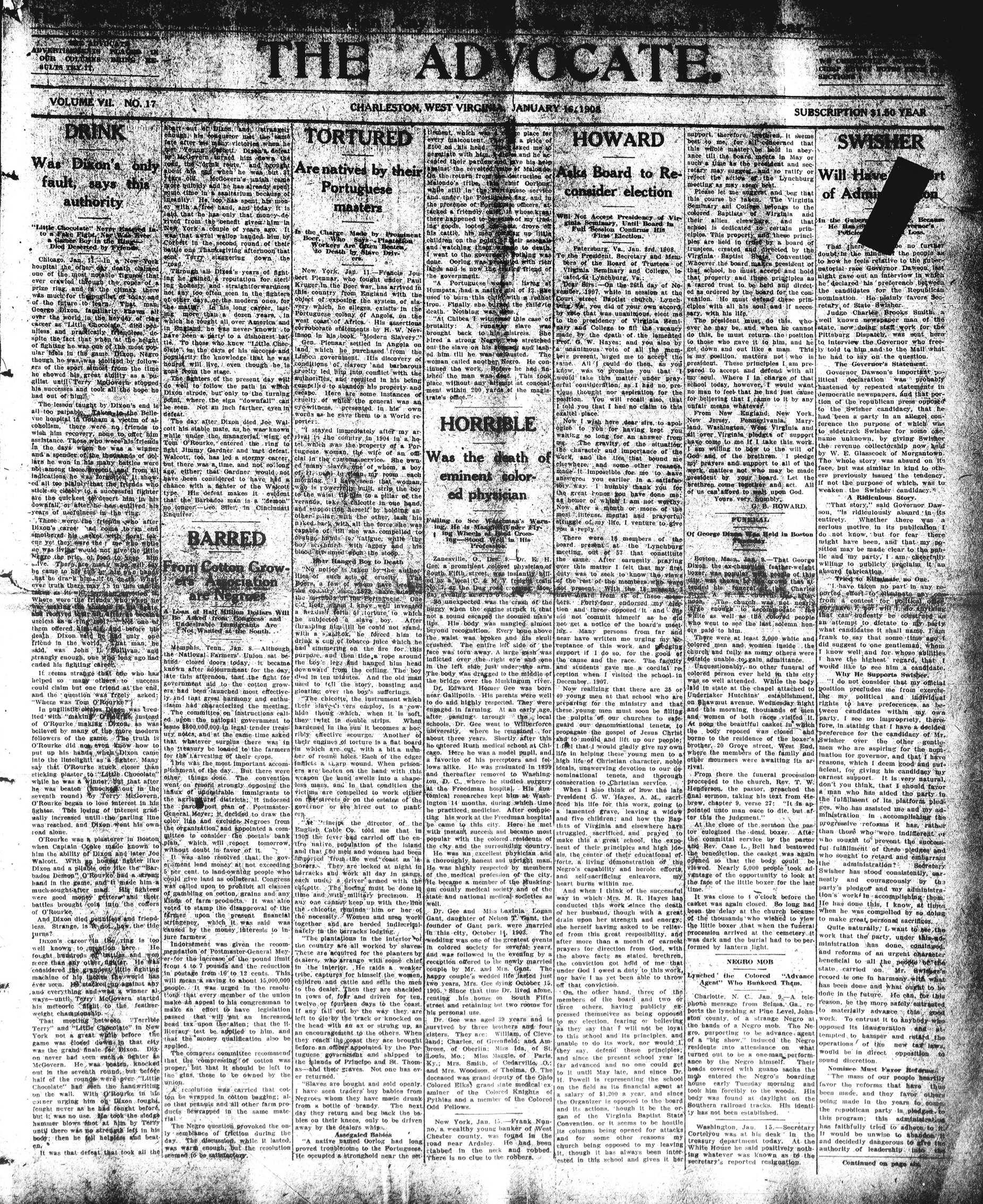
The Advocate
Thursday, January 16, 1908
Charleston, West Virginia
Page text (machine-generated)
Dog Deserted by Friends
Chicago, Jan. 11—In a New York hospital the other day death claimed one of the most notable figures that ever crawled through the ropes of a prize ring, and in the clinix there was much for the gallant of today and of the future to learn. That man, George Bixon, familiarity knew all over the world in the heyday of ring career as "Little Chocolate," died pauless and practically friendless, despite the fact that when at the height of fighting he was one of the most popular idols in the game. Dixon, Negro though he was, was idolized by followers of the sport almost from the time he showed his great ability as a pugilist until Terry McGovern stopped his successes and took all the hope he had out of him.
The lesson taught by Dixon's end is all too patible. Taken from the Bellevue hospital in Gouham a victim of alcoholism, there were no friends to wish him recovery, none to offer him assistance. Those who wore his friends in the days when he was a winner and a spender of the thousands of dollars he won in his many battles were not among those present, and from all indications he was forbidden. It showed all too plainly that the friends who stole so closely to a successful fighter are the quickest desert him in his downfall, or after he has culled his years of neglect in the ring. Those were the friends who after Dixon's career had come to an end smothered his sister with floral lest they were the one who while he was living would not give the little girl a meal of food to keep him alive. They came to his aid and helped him he camp to his aid and helped him that he drank him all to death. Whenever truth there may be in this case, he will withhold it from her. Where were the friends who when he was suffering from alcoholism and received better affection became useless as a 'they man'—not one of them offered him aid and before his death Dixon said he had only one friend in the world. What man he said, was John D. Bullivan, and strangely enough, one who long ago had ended his fighting career.
If seems strange that one who has helped so many others to success could hurt him, but the end, the question was "Frequently asked; "Where was Tom O'Connor?"
In pugilistic objections, Dixon was treated with "making" O'Rourke instead of O'Rourke making Dixon, as was believed by many of the more modern followers of the game. The truth is O'Rourke did not even know how to put up his hands, when Dixon came into the limelettght as a fighter. Many say that O'Rourke stuck closer than eticking plaster to "Little Chocolate" while he was a winner, but that after he was beaten (much out in the seventh round) by Terry McMoyen, O'Rourke began to lose interest in his fighter. This losing of interest gradually increased until the parting line was reached, and Dixon wont his own reckoning. O'Rourke was a plasterer in Boston when Captain Cooke made known to him the ability of Dixon and later Joe Walcott. With an honest fighter like Dixon and a plable one like the "Barbados Demon", O'Rourke had a strong hand in the game, and it made him a much-soughtafter man. His fighters were good money getters, and their battles brought coins into the coffers of O'Rourke.
And Dixon died ponthless and friendless. Strange, is it not, how the tide turns?
Dixon's career in the ring is too well known to mention here. He fought hundreds of battles, and won more than any other fighter. He was considered the greatest little fighting machine of his fighters the world has ever seen. He stacked up against any and everything and was a winner always-until Terry McGovera started his meteoric flight to the featherweight championship.
That meeting between "Terrible Terry" and "Little Chocolate" in New York not a great width before the game was closed down in that was the grand finale when Dixon on never had seen him in the fighter as McGovera. He beaten, knocked half to the seventh round, but before half of the rounds were over "Little Chocolate" had seen the handwriting on the wall. With O'Bourke in his corner urging him on Dixon fought never as he had fought before, but it was no use. He took the stedge hammer blows at him by Terry until there was no strength left in his body, then he fell helpless and beaten.
It was that defeat that took all the
short, wit and offense," he said. "Mirabella enunciated his conqueror met the "male fate after a few more victories when he now" "Venn's object." Diana de la Cruz he McGovern trained him down the road, the "armyrote", and bought about him and when he was, but 27 years old, McGovern's uncle came more quickly and he has already spent some time in a sanitarium because of illness. He too has spent his money with a free hand, and today it is said that he has only that money - derived from the benefit given him in New York a couple of years ago. It was that awful wallop handed him by the second round of their battle. Thanksgiving afternoon that oneerry digging down the road.
Through all Diana's years of fighting he gained a reputation for sterling honesty, and straightforwardness not any too often seen in the fighters of other days, on the modern ones, for the master. In his long career, lasting more than a dozen years, in which he taught all over America and in England, he was never known to have been a party to a dishonest battle. To those who knew "Little Chocolate," in the days of his success and popularity the knowledge that he was honored will live, even though he is gone from the stage.
The fighters of the present day will do well to follow the path in which Dixon strode, but only to the turning point, where the sign "downfall" can be seen. Not an inch farther, even in defeat.
The day after, Dixon died. Joe Walcott his stable mate, as he was known while under the managerial wing of Tom O'Rourke, entered the ring to fight Jimmy Gardner and met defeat. Walcott, too, has led a stormy career, but there was a time, and not so long ago, either; that Gardner would not have been considered to have had a chance with a fighter of the Walcott type. His defeat makes it evident that the Barbados man is a "demon" no longer—Ice. Sifter, in Cincinnati Enquirer.
BARRED
From Cotton Growers Association are Negroes
A Loan of Half Million Dollars Will Be Asked from Congress and Undesirable Immigrants Are I Not Wanted at the South.
Memphis, Tenn., Jan. 8. Although the "National Farmers' Union sat behind closed doors, they became known after adjournment for the date this afternoon, that the farm government aid to the cotton growers had been launched most effectively and that great harmony and enthusiasm had characterized the meeting. The committee on instructions called upon the national government to lease $600,000,000 in legal tender treasury notes, and at the same time asked that whatever surplus there was in the treasury be loaned to the farmers for the harvesting of their crops.
This was the most important accomplishment of the day. But there were other things done. The convention went on resort strongly, opposing the influx of undesirable immigrants to the agricultural districts; it indorsed the parcel post plan of Postmaster-General Moyer; it decided to draw the color line and exclude Negroes from the organization; and appointed a committee to consider the postals bank plan, which will report tomorrow, without doubt in favor of it. The committee also received that the government would exceed 5 per cent to land-owning people who could give land as collateral. Congress was called upon to prohibit all classes of gambling on cotton, grains and any kinds of farm products. It was also voted to stamp the disapproval of the farmer upon the present financial stringency, which it was said was caused by the money interests to injure farmers.
Indorsement was given the recommendation of Postmaster-General Meyer for the increase of the pound limit from 4 to 7 pounds and the reduction in postage from 16 to 12 cents. This will mean a saving to about 15,000,000 people. It was urged in the resolution that every member of the union make an appeal to his congressman to make an effort to have legislation passed that will put an increased head tax upon the alien; that the literacy text be applied to him, and that the money qualification also be applied. The compress committee recommend that the compressing of cotton was proper, but that it should be left to the gins, these to be owned by the union.
A resolution was carried that cotton be wrapped in cotton bagging; also that peanuts and all other farm products be wrapped in the same material.
The Negro question provoked the only semblance of friction during the last warm enough, but the resolution seemed to be satisfactory.
TORTURED
Are natives by their
Portuguese
masters
Is the Charge Made by Prominent
Boor, Who Says, Plantation
Workers Are Often Beaten,
to Death by Slave Driv-
Now York, Jan. 11.—Francis Joubert Plennar, who fought under Paul Kruger in the Boer war, has arrived in this country from England with the object of exposing the system of slavery which, he alleges, exists in the Portuguese colony of Angola on the west coast of Africa. His assertions evoyebate statements by H. W. Noviapin in his book, "Modern Slavey." Gen Plennar settled in Angola on land which he built from the Lisbon government. His discovery of conditions of slavery and land greatly led him into conflict with the authorities, and resulted in his being compelled to abandon his property and escape. Here are some instances of cruelty of which the general was an eye witness, presented in his own words as he gave them to a World reporter.
"I stayed immediately after my arrival in the country in 1904 in a hotel, which was the property of a Portuguese woman, the wife of an official in the customs service. She owned many slaves one of whom, a boy of 11, used to clean my room each morning. I have seen that woman, who is powerless built, strip the boy to the waist; him to a pillar of the veranda, take a chocolate in one hand, and supporting herself by holding another pillar, with the other, lash his naked back, with all the force she was capable of, 'all she was compelled to change himself (o, fatigue, white the boy beheaded with agony and his blood swammed into the stoop.
Bear Hanged Boy to Death
No notice is taken by the authorities of such acts of cruelty. The Doors, a few of whom have been in the country since 1472, have added the murders to the Fortressness. One cut, Hed, who I know, well invaded a herdish birth of torture to which he subjected a slave boy. After thrashing him till he could not stand, with a sadikok, he foiled him to a cup of tobacco juice which he had 'taken on the fire for this purpose, and then on the ground around the boy's legs and hanged him downward from the colling. The boy died in ten minutes. And the old man used to tell the story, boasting and gloating over the boy's sufferings.
The chicote, the instrument which their slave clerks employ, is a cowhide thong which, when it is soft, they twint in double strips. When hardened in the sun it becomes a horribly effective scourge. Another of their engines of torture is a flat board in which are cut, with a bit a number of round holes. Each of the edges are lacerated, warm. When prisoners are beaten on the hand with a weapon (he hind swells into a shrapnel mass, and in that condition the victims are compelled to work effector on the streets or on the estates of the governor or are hirer out to plant org.
"I encircle the director of the English Cable Co. told me that in 1900 the fever had carried off the native population of the island and that 500 men and women had been瘁损 from the west coast as laborers. They are looked at night in barracks and work all day in gangas, each under a driver armed with the coptopte. The hosting must be done in time and with military precision. If any one cannot keep up with the lime the chicotte rounds him or her of the necessity. Women and men work together and are herded indisciplinately in the barracks lodging.
"The plantations in the interior nor the country are all worked by slaves. These are acquired for the planters by dealers, who arrange with some chief in the interior. He raids a weaker tribe, captures for himself the women, children and cattle and sells the men to the dealer. Then they are shackled in rows of four, and driven for ten, twelve, or fourteen days to the coast. If any fall out by the way they are left to die by the track or knocked on the head with an ax or strung up, as an encouragement to the others. When they reach the coast they are brought before an officer appointed by the Port Authority, and sent to the islands of Principio and St. Thomas—and their graves. Not one has ever returned.
"Slaves are bought and sold openly. I have seen traders buy babies from Negroes whom they have made drunk from a bottle of brandy. The next day they return and beg back the babies on their knees, only to be driven away by the dealers whips."
Assegualed Babies
"A native named Orolog had long proved troublesome to the Portuguese.
He occupied a stronghold near the set.
HORRIBLE
Was the death of eminent colored physician
Falling to See Waterman's Warning. He is Mistaken by Flying Wheels in Head Crossing—Stood. Well in His Profession.
Zanesville, G. Dec. 8—Dr. E. H. Gee a prominent colored physician of South Fifth Street, was instantly killed by a local C. M. V. T. trainee No. 7, of the Dug road trainee. Monday evening at 6 o'clock.
So unexpected was the crash of the buggy when the ogne strick it that not a sound escaped the doomed man's lips. His body was mangled almost beyond recognition. Every bone above the wrist was broken and crushed. The entire left side of the face was torn away. A large crash was inflicted over the right eye and one in the left side just under the arm. The body was dragged to the middle of the bridge over the Muskogun river. Dr. Edward Homer Gee was born near Gallipoli. His parents were well to do and highly respected. They were engaged in farming. At an early age, after passing through the local schools, Dr. Gee went to Wilberforce university, where he remained for about three years. Shortly after this he entered Rush medical school at Chicago. Here he was a model pupil, and a favorite of his preceptors and fellows alike. He was graduated in 1899 and thereafter removed to Washington, D. C., where he studied surgery at the Freedman hospital. His anatomical researches kept him at Washington 14 months, during which time he practiced medicine. After completing his work at the Freedman hospital he moved to this city, where he met with biomedical andborn popular with the colored residents of the city and the surrounding country. He was an excellent physician and a thoroughly honest and upright man. He was highly respected by members of the medical profession of the city. He became a member of the Muskogun county medical society and of the state and national medical societies as well.
Dr. Gee and Miss Laxmina, Logan Gant, daughter of Nelson T. Gant, the founder of Gant park, were married in this city, October 14, 1903. The wedding was one of the greatest events in colored society for several years, and was followed in the evening by a reception offered to the newly married couple by Mr. and Mrs. Gant. The happy couple's wedded life lasted just two years, Mrs. Gee dying October 15, 1905. Since that time Dr. Lived alone, renting his house on South Fifth street and retaining but two rooms for his personal use.
Dr. Gee was aged 39 years and is survived by three brothers and four sisters. They are: William, of Clever land; Charles, of Greenfield; and Ambrose, of Oberlin; Miss Ida, of St. Louis, Mo.; Miss Maggle, of Paris, Ky.; Mrs. Smith, of Cedarville, O.; and Mrs. Woodson, of Thelma, O. The deceased was grand deputy of the Ohio Colored Elks) grand state medical examiner of the Colored Knights of Pythias and a member of the Colored Odd Fellows.
New York, Jan. 15. —Frank Nguo,
n.a. wealthy young banker of West
Chester county, was found in the
road near Ardsley. He had been
stabbed in the neck and robbed.
There is no clue to the robbers.
Will Not Accept Presidency of Virginia Seminary, Until Board in Full Session Continue His First Election.
E Petersburg, Va., Jan. 2nd, 1908.
To the President, Secretary and Members of the Board of Trustees of Virginia Seminary and College, located at Lynchburg, Va.
Dept. Brief—On the 28th day of November, 1907, while in session at the Court street Hastil church, Lynchburg, Va. you did your own account, by vote that was unanimous, elect to the presidency of Virginia Seminary and College to fill the vacancy made by the death of the isamented Prof. G. W. Hayes; and you also by a unanimous vote of all the members, present, urged me to accept the same. All I could do then, as you know, was to promise you that I would take this matter under prayer consideration, as I had no previous thought nor aspiration for the position. You will recall also, that I told you that I had no claim to this exalted place.
Now I wish here, dear sir, to apologize to you for having kept you waiting so long for an answer from me. The gravity of the situation, the character and importance of the work, and the ties that bound me elsewhere, and some other reasons, made it impossible for me to have answered you earlier in a satisfactory way. I humbly thank you for the great honor you have done me; as honor of whom I am not worthy. Now after a month or more of the most intense mental and painful struggle of my life, I venture to give you a reply.
There were 18 members of the board present at the Lynchburg meeting, out of 57 that constitute the same. After earnestly praying over this matter I felt that my first duty was to seek to know the views of the rest of the members who were not present. With the 18 present I have been from 48 of these members. Forty-four endorsed my decision and three opposed it, and one did not commit himself as he did not get a notice of the board's meeting. The persons from far and near have written me the reptience of this work and pledging support if I do so, for the good of the cause and the race. The faculty and students gave me a cordial reception when I visited the school in December, 1907.
Now realizing that there are 35 or 40 young men at that school who are preparing for the ministry and that these young men must soon be filling the pulpits of our churches to safeguard our denominational tenets, to propagate the gospel of Jesus Christ and to mould and lift up our people; I feel that I would gladly give my own life in helping these young men to a high life of Christian character, noble ideals, unwerving devotion to our denominational tenets, and through consecration to Christian service.
When I also think of row the late President G. W. Hayes, A. M., sacrificed his life for this work, going to a lamented grave, leaving a widow and five children; and how the Baptists of Virginia and elsewhere have struggled, sacrificed, and prayed to make this a great school, the exponent of their principles and high ideals, the center of their educational efforts, a living demonstration of the Negro's capability and heroic efforts, and self-sacrificing enleavers, my heart burns within me.
And when I think of the successful way in which Mrs. M. R. Hayes has conducted this work since the death of her husband, though with a great drain upon her strength and energy; she herself having asked to be relieved from this great responsibility, and after more than a month of earnest prayers for direction from God, with the above facts as stated, brethren, the conviction got hold of me that under God I owed a duty to this work, nor have I as yet been able to throw off that conviction.
On the other hand, three of the members of the board and two or three others, having publicly expressed themselves as being opposed to my election, fearing or believing as they say that if will not be loyal to this school and its principles, and unable to do its work, nor would I, they say, defend these principles; and since the present school year is far advanced and no one could get to it until May late, and since Dr. H. Powell is representing the school on the field as its financial agent at a salary of $1,200 a year, and since the Organizer is opposed to the board and its actions, though it be the organ of the Virginia Baptist State Convention, or it seems to be hostile its columns been opened for attacks and for some other reasons my church being opposed to my leaving it, though it has always been interested in this school and gives it her
support, therefore, baggage, it seems best to me, for all concerned that this whole matter he hold in abeyance till the board meets in May or such a time as the president and secretary may suggest, and so ratify or reject the action of the Lynchburg meeting as may agree beat.
Please let me suggest and beg that this course be taken. The Virginia Seminary and College belongs to the colored Baptists of Virginia and their allies elsewhere, and that school is dedicated to certain principles. This property and these principles are held in trust by a board of trustees, created and directed by the Virginia Baptist State Convention. Whoever the board makes president of that school, he must accept and hold that property and these principles as a sacred trust to be held and directed as ordered by the board for the convention. He must defend these principles with all his soul and if necessary, with his life.
The president must do this, whoever he may be, and when he cannot do this, he must return the position to those who gave it to him, and he get down and out like a man. This is my position, matters not who is president. These principles I am prepared to accept and defend with all my soul. Where I in charge of that matter want no man to feel that he had just cause for believing that I came to it by any unfair means whatever.
From New England, New York
New Jersey, Pennsylvania, Maryland, Washington, Virginia and all over Virginia pledges of support have come to me if I take this work. I am willing to how to the will of God and of the brethren. I pledge my prayers and support to all of the work, matters not who may be made president my board. Let the one come on and help me. All of us can afford to go up upon God.
Yours, very humbly
Boston, Mass., Jan. 9.—That George Dixon, the ax-champion feather-weight boxer, was popular with people of this era, was shown by a crowd that attained his funeral at the Charles Zucker Funeral Home. The shrugs he wore were white and he wore a necklace enduring "to accompany" white as well as the colored people who went to see the last solemn honors paid to him.
There were at least 2,000 white and colored men and women inside the church and fully as many others were outside unable to gain admittance.
Unquestionably, no other funeral of colored person ever held in this city was so well attended. While the body laid in state at the chapel attached to Underkaker Hutchins' establishment, on Shawmut avenue. Wednesday night and this morning, thousands of men and women of both races visited it. At noon the beautiful casket in which the body reposed was closed and borne to the residence of the boxer's brother, 20 Groye street, West End, where the members of the family and other mourners were awaiting its arrival.
From there the funeral procession proceeded to the church, Rev. T. W. Henderson, the pastor, preached the final sermon, taking his text from Hebrew, chapter 9, verse 27: "It is appointed unto man ouce to die, but after this the judgment."
At the close of the sermon the pastor cologized the dead boxer. After the committal service by the pastor and Rev. Case L. Bell had bestowed the benediction, the casket was again opened so that the body could be viewed. Nearly 5,000 people took advantage of the opportunity to look at the face of the little boxer for the last time. We was close to 4 wollok before the casket was again closed. So long had been the delay at the church because of the thousands who wished to view the little boxer, that when the funeral procession arrived at the cemetery it was dark and the burial had to be performed by lantern light.
NEGRO MOB
Lynched 'the Colored "Advance Agent" Who Bunked Thm.
Charlotte, N. C. Jan. 3—A telephone message from Selina, Ga., reports the lynching at Pine Level, Johnston county, of a strange Negro at the hands of a Negro mob. The Negro, purporting to be advance agent of a "big show," induced the Negro residents into attendance on what turned out to be a one-man performance by the Negro himself. Their heads covered with guano sacks the mob entered the Negro's boarding house early Tuesday morning and took him forcibly to the woods. His body was found at daylight on the Southern railroad tracks. His identity has not been established.
Washington, Jan. 15.—Secretary Cortelyou was at his desk in the treasury department today. At the White House he said positively nothing whatever was known as to the secretary's reported resignation.
doubts in the minima, the people are to how he feels relative to the supernatural-race Governor Davenport, last night gave out an interview in which he declared his preference between the candidates for the Republican nomination. He plainly favors Secretary of State Swiner. Judge Charles Brooks Smith, a well known newspaper man of the state, now doing staff work for the Pittsburgh Dispatch, was sent here to interview the Governor who freely told to him and to the Mall what he had to say on the question.
The Governor's Statement.
Governor Dawson's important political declaration was probably hastened by repeated statements in democratic newspapers, and that portion of the republican press opposed to the Swisher candidacy, that he had been a party in an illegal conference the purpose of which was to sldetrack Swisher for some one name unknown, by giving Swisher the revenue collectorship now held by W. E. Glasscoff of Morgantown. The whole story was absurd on its face, but was similar in kind to others previously issued the tendency, if not the purpose of which, was to weaken the Swisher candidacy.
A Ridiculous Story.
"That story," said Governor Dawson,
"is ridiculously aband in its entirety. Whether there was a serious motive in its publication I do not know, but for fear there might have been, and that my position may be made clear to the public and my party. I am cleverly willing to publicly proclaim it an absurd fabrication.
Part 1: to formulate, no one.
"I have no part in any reported event," he said, from a context for politeness or morality. "I will tell you that can honestly be conceived, an attempt to dictate to my party what candidate it shall name. I am frank to say that some time ago I did suggest to one gentleman, whom I know well and for whose abilities I have the highest regard, that I would like to see him a candidate.
Why He Supports Swisher.
"I do not consider that my official position precludes me from exercising my political and individual rights to have preferences as between candidates within my own party. I see no impropriety, therefore, in stating that I have a decided preference for the candidacy of Mr. Swisher over the other gentlemen who are aspiring for the nomination for governor, and that I have reasons, which I deem good and sufficient, for giving his candidacy my earnest support. It is very natural, don't you think, that I should favor a man who has aided the party in the fulfillment of its platform pledges, who has assisted me and my administration, in accomplishing the progressive reforms it has rather than those who were indifferent or who sought to prevent the successful fulfillment of these pledges and who sought to retard and embarrass the administration?
Secretary Swisher has stood consistently, earnestly and courageously by the party's pledges and my administration's work in accomplishing them. He has done this, I know, at times when he was compelled by so doing to make great personal sacrifices.
Quite naturally: I want to see the work that the party, under this administration has done, continued, and reforms of an urgent character beneficial to all the people of the state carried on. Mr. Swiftmore record is one in harmony with what has been done and what ought to be done in the future. He can, for this reason, be the more safely entrusted to materially advance this good work. To entrust it to anybody who opposed its inauguration and attempted to hamper and retard the operations of the new tax laws, would be in direct opposition to sound discretion.
Nominee Must Favor Reforms.
"The mass of our people heartily favor the reforms that have thus been made, and they favor others being made in the years to come, the republican party is pledged to this program; this administration has faithfully tried to adheres to it. It would be unwise to abandon it and decidedly dangerous to give the authority of leadership into the
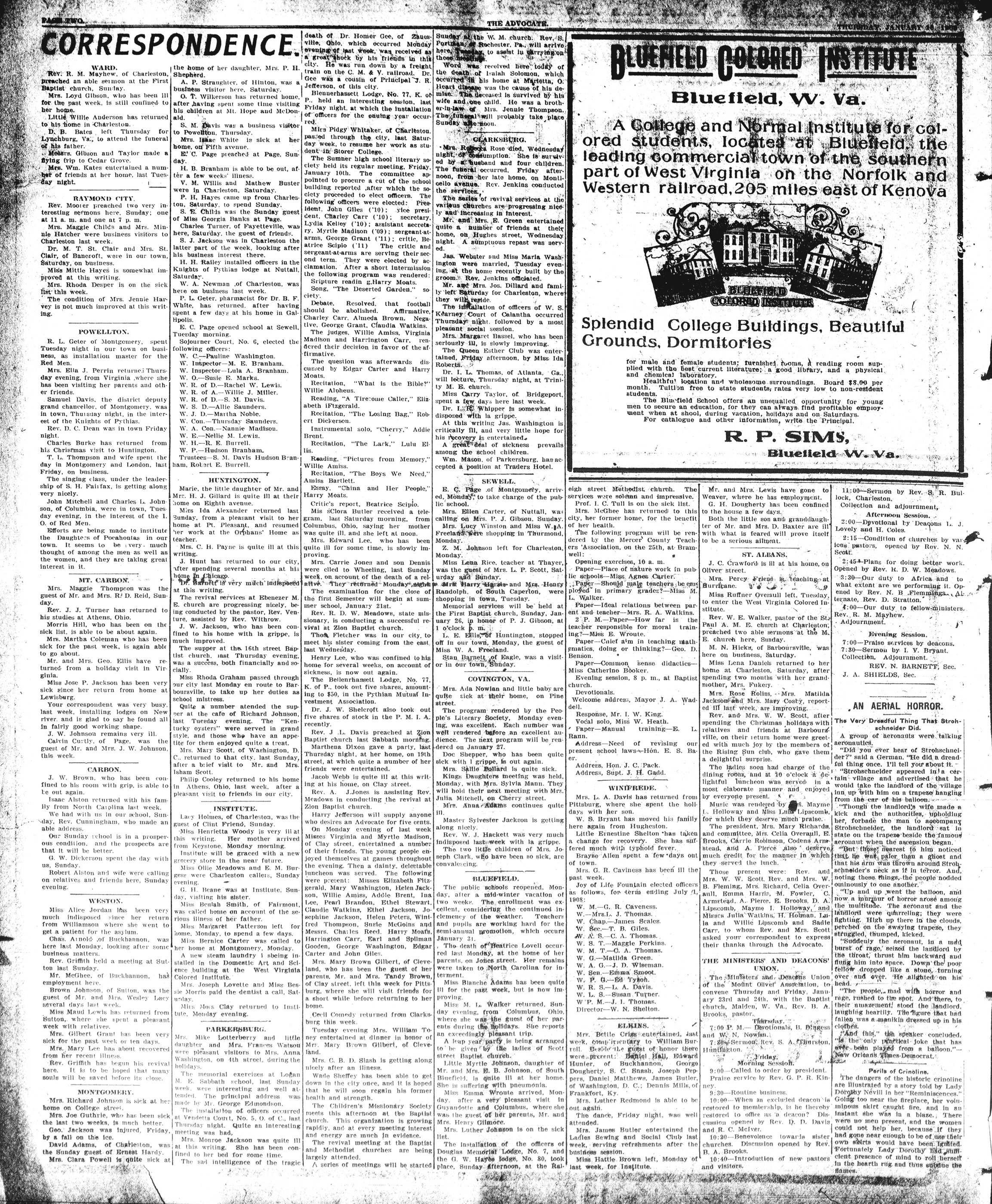
CORRESPONDENCE
WARD.
Rev. R. M. Mayhew, of Charleston, preached an able seminum at the First Baptist church, Sunday.
Mrs. Loyd Gibson, who has been ill for the past week, is still confined to her home.
Little Willie Anderson has returned to his home in Charleston.
D. B. Bates left Thursday for Lynchburg, Va., to attend the funeral of his father.
Meers. Gibson and Taylor made a flying trip to Cedar Grove.
Mrs. Wm. Kates entertained a number of friends at her home, last Tuesday night.
RAYMOND CITY
Rev. Mooier preached two very interesting sermons here. Sunday; one at 11 a. m. and one at 7 p. m.
Mrs. Maggie Childs and Mrs. Minkle Hatcher were business visitors to Charleston last week.
Dr. M. T. St. Clair and Mrs. St. Clair, of Bancroft, were in our town, Saturday, on business.
Miss Mittle Hayes is somewhat improved at this writing.
Mrs. Rhoda Desper is on the sick list this week.
The condition of Mrs. Jennie Harvey is not much improved at this writing.
POWELLTON.
R. L. Geter of Montgomery, spent Tuesday night in our town on business, as installation master for the Red Men.
Mrs. Ella J. Perrin returned Thursday evening, from Virginia, where she has been visiting her parents and other friends.
Samuel Davis, the district deputy grand chancellor, of Montgomery, was in town, Thursday night, in the interest of the Knights of Pythias.
Charles Burke has returned from his Christmas visit to Huntington.
T. L. Thompson and wife spent the day in Montgomery and London, last Friday, on business.
The singing class, under the leadership of S. H. Fairfax, is getting along very nicely.
John Mitchell and Charles L. Johnson, of Columbia, were in town, Tuesday evening, in the interest of the I. O. of Red Men.
Efforts are being made to institute the Daughters of Pocahontas in our town. It seems to be very much thought of among the men as well as the women, and they are taking great interest in it.
MT. CARBON.
Mrs. Maggie Thompson was the guest of Mr. and Mrs. R! D. Reid, Sunday.
Rev. J. J. Turner has returned to his studies at Athens, Ohio.
Morris Hill, who has been on the sick list, is able to be about again.
Mrs. Martha Coleman who has been sick for the past week, is again able to go about.
Mr. and Mrs. Geo. Ellis have returned from a holiday visit in Virginia.
Miss Jose P. Jackson has been very sick since her return from home at Lewisburg.
Your correspondent was very busy, last week, installing lodges on New river, and is glad to see he found all in fairly good working shape.
J. W. Johnson remains very ill. Calvin Curtly, of Page, was the guest of Mr. and Mrs. J. W. Johnson this week.
CARBON.
J. W. Brown, who has been confined to his room with grip, is able to be out again.
Isaac Alston returned with his family from North Carolina last week.
We had with us in our school, Sunday, Rev. Cunningham, who made an able address.
G. W. Dickerson spent the day with us, Sunday.
Robert Alston and wife were calling on relatives and friends here, Sunday evening.
WESTON.
Miss Alice Jordan has been very much indisposed since her return from Williamson where she went to get a patient for the asylum. Chas. Arnold of Buckhannon, was here last Monday, looking after some business matters. Rev. Griffith held a meeting at Sutton last Sunday. Mr. McGhee, of Buckhannon, had employment here. Brown Johnson, of Sutton, was the guest of Mr. and Mrs. Wesley Lacy several days last week. Miss Maud Lewis has returned from Sutton, where she spent a pleasant week with relatives. Mrs. Gilbert Grant has been very sick for the past week or ten days. Mrs. Mary Lee has about recovered from her recent illness.
Rev. Griffith has begun his revival here. It is to be hoped that many souls will be saved before its close.
MONTGOMERY
Mrs. Richard Johnson is sick at her home on College street.
Mrs. Joe Guthrie, who has been sick the last two weeks, is much better.
Geo. Jackson was injured, Friday, by a fall on the ice.
David Adams, of Charleston, was the Sunday guest of Ernest Hardy.
Mrs. Clara Powell is quite sick at
the home of her daughter, Mrs. P. H. Shepherd.
A. P. Straughter, of Hinton, was a business visitor here. Saturday.
O. T. Wilkerson has returned home, after having spent some time visiting his children at Mt. Hope and McDonald.
S. M. Davis was a business visitor to Powellton, Thursday.
Mrs. Isaac White is sick at her home, on Fifth avenue.
E' C. Page preached at Page, Sunday.
H. B. Branham is able to be out, after a few weeks' illness.
V. M. Willis and Mathew Buster were in Charleston, Saturday.
P. H. Hayes came up from Charleston, Saturday, to spend Sunday.
S. E. Chills was the Sunday guest of Miss Georgia Banks at Page.
Charles Turner, of Fayetteville, was here, Saturday, the guest of friends.
S. J. Jackson was in Charleston the latter part of the week, looking after his business interest there.
H. H. Railey installed officers in the Knights of Pythias lodge at Nuttall, Saturday.
W. A. Newman of Charleston, was here on business last week.
P. L. Geter, pharmacist for Dr. B. F. White, has returned, after having spent a few days at his home in Gal Hpolis. E. C. Page opened school at Sewell Tuesday morning.
Sojourner Court, No. 6, elected the following officers:
W. C.—Pauline Washington.
W. O.—Susie E. Marks.
W. R. of D.—Rachel W. Lewis.
W. R. of A.—Willie J. Miller.
W. R. of D.—S. M. Davis.
W. S. D.—Allie Saunders.
W. J. D.—Martha Noble.
W. Con.—Thursday Saunders.
W. A. Con.—Nannie Madlson.
W. E.—Nellie M. Lewis.
W. H.—R. E. Burrell.
W. P.—Hudson Branham.
Trustees. S. M. Davis Hudson Branham, Robert E. Burrell.
HUNTINGTON.
Marie, the little daughter of Mr. and Mrs. H. J. Gillard is quite ill at their home on Eighth avenue.
Miss Ida Alexander returned last Sunday, from a pleasant visit to her home at Pt. Pleasant, and resumed her work at the Orphans' Home as teacher.
Mrs. C. H. Payne is quite ill at this writing.
J. Hunt has returned to our city, after spending several months at his home in Chicago.
Dr. Barnett is very much indisposed at this writing.
The revival services at Ebenezer M. E. church are progressing nicely, being conducted by the pastor, Rev. Venture, assisted by Rev. Withrow.
J. W. Jackson, who has been confined to his home with la grippe, is much improved.
The supper at the 16th street Baptist church, last Thursday evening, was a success, both financially and socially.
Miss Rhoda Graham passed through our city last Monday en route to Barboursville, to take up her duties as school mistress.
Quite a number attended the supper at the cafe of Richard Johnson, last Tuesday evening. The "Kentucky oysters" were served in grand style, and those who have an appetite for them enjoyed quite a treat.
Mrs. Mary Scott, of Washington, D.C., returned to that city, last Sunday, after a brief visit to Mr. and Mrs. Isham Scott.
Philip Cooley returned to his home in Athens, Ohio, last week, after a pleasant visit to friends in our city.
INSTITUTE.
Lacy Holmes, of Charleston, was the guest of Clint Friend, Sunday.
Miss Henrietta Woody is very ill at this writing. Her mother arrived from Keystone, Monday morning.
Institute will be graced with a new grocery store in the near future.
Miss Ollie Meadows and E. M. Burgess were Charleston callers, Sunday evening.
G. H. Beane was at Institute, Sunday, visiting his sister.
Miss Beulah Smith, of Fairmont, was called home on account of the serious illness of her father.
Miss Margaret Patterson left for home, Monday, to spend a few days.
Miss Bernice Carter was called to her home at Montgomery, Monday.
A new steam laundry 1 sheing installed in the Domestic Art and Science building at the West Virginia Colored Institute.
Mrs. Joseph Lovette and Miss Bessie Morris paid the dentist a call, Saturday. Miss Moss Clay returned to Institute, Monday evening.
PARKERSBURG
Mrs. Mike Lotterberry and little daughter, and Mrs. Frances Watson were pleasant visitors to Mrs. Anna Washington, on 4th street, during the holidays.
The memorial exercises at Logan M. E. Sabbath school, last Sunday week, were interesting and well attended. The principal address was made by Mr. George Edmondson.
The installation of officers occurred at Vendetta Court, No. 5, O. of C., last Thursday night. Quite an interesting meeting was had.
Mrs. Monroe Jackson was quite ill at this writing. She has been confined to her bed for some time.
The sad intelligence of the tragic
death of Dr. Homer Gee, of Zauzousville, Ohio, which occurred Monday evening of last week, was received as a great shock by his friends in this city. He was run down by a freight train on the C. M. & V. railroad. Dr. Gee was a cousin of Principal J. R. Jefferson, of this city.
Blenuerhassett Lodge, No. 77, K. of P., held an interesting session, last Friday night, at which the installation of officers for the enuing year occurred.
Miss Pidgy Whitaker, of Charleston, passed through the city, last Saturday day, to resume her work as student in Storer College.
The Sumner high school literary society held its regular meeting, Friday, January 10th. The committee appointed to procure a cut of the school building reported, after which the society proceeded to elect officers. The following officers were elected: President, John Giles ('10); vice president, Charley Carr ('10); secretary, Lydia Kelley ('10); assistant secretary, Myrtle Madison ('09); sergeant-at-arms, George Grant ('11); critic, Beatrice Scipio ('11) The critic and sergeant-at-arms are serving their second term. They were elected by acclamation. After a short intermission the following program was rendered: Scripture readin g.Harry Moats. Song, "The Deserted Garden," society.
The judges, Willie Amiss, Virginia Madison and Harrington Carr, rendered their decision in favor of the affirmative.
The question was afterwards discussed by Edgar Carter and Harry Moats.
Reading, "A Tiresome Caller," Elizabeth iFtzergerald.
Recitation, "The Losing Bag," Robert Dickerson.
Instrumental solo, "Cherry," Addie Brent.
Recitation, "The Lark," Lulu Ellis.
Reading, "Pictures from Memory," Willie Amiss.
Recitation, "The Boys We Need," Amiss Bartlett.
Essay, "China and Her People," Harry Moats.
Mrs. Edward Lee, who has been quite ill for some time, is slowly improving.
Mrs. Carrie Jones and son Dennis were cled to Wheeling, last Sunday week, on account of the death of a relative. They returned Monday night.
The examination for the close of the first Semester will begin at summer school, January 21st.
Rev. R. D. W. Meadows, state missionary, is conducting a successful revival at Zlon Baptist church.
Thomas Fletcher was in our city, to meet his sister coming from the east, last Wednesday.
Henry Lee, who was confined to his home for several weeks, on account of sickness, is now out again.
The Bellenrhassett Lodge, No. 77, K. of P., took out five shares, amounting to $50, in the Pythian Mutual Investment Association.
Dr. J. W. Shelcroft also took out five shares of stock in the P. M. I. A. recently.
Rev. J. L. Davis preached at Zion Baptist church last Sabbath morning, Marthena Dixon gave a party, last Thursday night, at her home, on 19th street, at which quite a number of her friends were entertained.
Jacob Webb is quite ill at this writing at his home, on Clay street.
Rev. A. J.Jones is assisting Rev Meadows in conducting the revival at Zion Baptist church.
Harry Jefferson will supply anyone who desires an Advocate for five cents. On Monday evening of last week Misses Virginia and Myrtle Madison, of Clay street, entertained a number of their friends. The young people enjoyed themselves at games throughout the evening. Then a dainty, delectable luncheon was served. The following were present: Misses Elizabeth Fitzgerald, Mary Washington, Helen Jackson, Willie Amiss, Addie Brent, Ina Lee, Pearl Brandon, Ethel Stewart, Claudie Watkins, Ethel Jackson, Josephine Jackson, Helen Peters, Wintfred Thompson, Susie McGoins and Messrs. Charles Reed, Harry Moafs, Harrington Carr, Earl and Spliman Gooden, George Washington, Edgar Carter and John Giles.
Mrs. Mary Brown Gilbert, of Cleveland, who has been the guest of her parents, Mr. and Mrs. Tandy Brown, of Clay street, left this week for Pittsburg, where she will visit friends for a short while before returning to her home.
Cecil Comedy returned from Clarksburg this week.
Tuesday evening Mrs. William Toney entertained at dinner in honor of Mrs. Mary Brown Gilbert, of Cleveland.
Mrs. C. B. D. Slash is getting along nicely after an illness.
Wade Sheffey has been able to get down in the city once, and it is hoped that he will soon regain his former health and strength.
The Children's Missionary Society meets this afternoon at the Baptist church. This organization is growing rapidly, and at every meeting interest and energy are much in evidence. The revival meeting at the Baptist and Methodist churches are being largely attended.
Sunday at the W. M. church. Rev. S. Portman, of Rochester, Pa., will arrive here. Tuesday to assist in carrying on these meetings.
Word was received here today of the death of Isahal Solomon, which occurred in his home at Marletta, O. Heart disease was the cause of his demise. The deceased is survived by his wife and one child. He was a brother-in-law of Mrs. Jennie Thompson. The funeral will probably take place Sunday afternoon.
GLARKSBURG.
Mrs. Rebecca Rose died, Wednesday night, of consumption. She is survived by a husband and four children. The funeral occurred, Friday afternoon, from her late home, on Monticello avenue. Rev. Jenkins conducted the services.
The series of revival services at the various churches are progressing nicely and increasing in interest.
Mr. and Mrs. E. Green entertained quite a number of friends at their home, on Hughes street, Wednesday night. A sumptuous repast was served.
Jas. Webster and Miss Maria Washington were married, Tuesday evening, at the home recently built by the groom. Rev. Jenkins officiated.
Mr. and Mrs. Jos. Dillard and family left Saturday for Charleston, where they will reside.
The installation of officers of W. S. Kearney, Court of Calantha occurred Thursday night, followed by a most pleasant social session.
Mrs. Margaret Bassel, who has been seriously ill, is slowly improving.
The Queen Esther Club was entertained, Friday afternoon, by Miss Ida Roberts. Dr. I. L. Thomas, of Atlanta, Ga., will lecture, Thursday night, at Trinity M. E. church.
At this writing Jas. Washington is critically ill, and very little hope for his recovery is entertained.
A great deal of sickness prevails among the school children.
Wm. Mason, of Parkersburg, has accepted a position at Traders Hotel.
SEWELL
E. C. Page of Montgomery, arrived, Monday, to take charge of the public school.
Mrs. Ellen Carter, of Nuttall, was calling on Mrs. P. J. Gibson, Sunday.
Mrs. Lucy Winston and Miss W. A. Freeland were shopping in Thurmond, Monday.
Z. M. Johnson left for Charleston, Monday.
Miss Lona Rice, teacher at Thayer, was the guest of Mrs. L. P. Scott, Saturday and Sunday.
Mrs. Harry Harris and Mrs. Henry Randolph, of South Caperton, were shopping in town, Tuesday.
Memorial services will be held at the First Baptist church, Sunday, January 26, in honor of P. J. Gibson, at 1 o'clock p. m.
L. E. Ellis, of Huntington, stopped off in our town, Monday, the guest of Miss W. A. Freeland.
Stan Baynett of Eagle, was a visit or in our town, Sunday.
COVINGTON, VA.
Mrs. Ada Nowlan and little baby are quite sick at their home, on Pine street.
The program rendered by the People's Literary Society, Monday evening, was excellent. Each number was well rendered before an excellent audience. The next program will be rendered on January 27.
Doc Shepper, who has been quite sick with I gripe, is out again.
Mrs. Sallie Bollard is quite sick.
Kings Daughters meeting was held, Monday, with Mrs. Sylvia Mann. They will hold their next meeting with Mrs. Julia Mitchell, on Cherry street.
Mrs. Anna Adams continues quite ill.
Master Sylvester Jackson is getting along nicely.
Rev. W. J. Hackett was very much indisposed last week with la gripe.
The two little children of Mrs. Joseph Clark, who have been so slick, are convalescing.
BLUEFIELD
The public schools reopened. Monday, after a mid-winter vacation of two weeks. The enrollment was excellent, considering the continued inclemency of the weather. Teachers and pupils are working hard for the semi-annual promotion, which occurs January 21.
The death of Heatrice Lovell occurred last Monday, at the home of her parents, on Jolies street. Her remains were taken to North Carolina for interment.
Miss Blanche Adams has been quite ill for the past week, but is now improving.
Miss M. L. Walker returned, Sunday evening, from Columbus, Ohio, where she was the guest of her parents during the holidays. She reports an exceedingly pleasant trip.
A leap year party is being arranged to be given by the ladies of Scott street Baptist church.
Little Myrtle Johnson, daughter of Mr. and Mrs. E. B. Johnson, of South Bluefield, is quite ill at her home. She is suffering with pneumonia.
Miss Emma Wrotee arrived, Monday, after a very pleasant visit in Guyandotte and Columbus, where she was the guest of her parents, Mr. and Mrs. Henry Gilmore.
Mrs. Luther Johnson is on the sick list.
The installation of the officers of Douglas Memorial Lodge, No. 7, and the G. W. Hayes Lodge, No. 80, took place Sunday afternoon, at the Ral-
BLUEFIELD COLORED INSTITUTE
Bluefield, W. Va.
A College and Normal Institute for colored students, located at Bluefield, the leading commercial town of the southern part of West Virginia on the Norfolk and Western railroad,205 miles east of Kenova
BLUFIELD
COLORED INSTITUTE
Splendid College Buildings, Beautiful Grounds, Dormitories
for male and female students; furnished rooms, a reading room supplied with the best current literature; a good library, and a physical and chemical laboratory. Healthful location and wholesome surroundings. Board $8.00 per month. Tuition free to state students, rates very low to non-resident students. The Blufield School offers an unequalled opportunity for young men to secure an education, for they can always find profitable employment when at shool, during vacation, holidays and on Saturdays. For catalogue and other information, write the Principal.
eigh street Methodist church. The services were solumn and impressive. Prof. I. C. Tull is on the sick list. Mrs. McGhee has returned to this city, her former home, for the benefit of her health. The following program will be rendered by the Mercer County Teachers' Association, on the 25th, at Bramwell: Opening exercises, 10 a. m. Paper—Place of nature work in public schools—Miss. Agnes Carter. Paper—Should male teachers be employed in primary grades?—Miss M. L. Walker. Paper—Ideal relations between parent and teacher—Mrs. R. A. Walkins. 2 P. M.—Paper—How far is the teacher responsible for moral training?—Miss E. Wrone.
Paper—Caiel a'm in teaching mathematics, doing or thinking?—Geo. D. Benson.
Paper—Common sense didactics—Miss Catherine Booker.
Evening session, 8 p. m., at Baptist church.
Devotionals.
Welcome address, Mayor J. A. Waddell.
Response, Mr. I. W. King.
Vocal solo, Miss W. Heath.
Paper—Manual training—E. L. Rann.
Address—Need of revising our present school laws—Hon. E. S. Baer.
Address, Hon. J. C. Pack.
Address, Supt. J. H. Gadd.
WINIFREDE.
Mrs. L. A. Davis has returned from Pittsburg, where she spent the holiday days with her son. W. S. Bryant has moved his family here again from Hughesston.
Brayse Allen spent a few days out of town.
Mrs. G. R. Caviness has been ill the past week.
Joy of Life Fountain elected officers as follows, for term ending July 11,
1908:
W. M.—G. R. Caveness.
W.—Mrs.L. J. Thomas.
W. Chap.—James Scales.
W. Sec.—T. B. Giles.
W. A. S.—C. A. Thomas.
W. S. T.—Maggie Perkins.
W. M. T.—C. A. Thomas.
W. G.—Matlida Green.
W. A. G.—J. D. Wiseman.
W. Sen.—Emma Smoot.
W. P. G.—Ed Tykon.
W. R. S.—L. A. Davis.
W. L. S.—Susan Turner.
W. P. M.—J. I. Thomas.
Director—W. N. Shelton.
ELKINS.
ELKINS.
Mrs. Bettle Griss entertained last week, complimentary to William Burrell. Beside the guest of honor there were present: Daniel Hall, Edward Hunter, of Buckhannon, George Dougherty, S. C. Snash, Joseph Peppers, Daniel Matthews, James Butler, of Washington, D. C.; Dennis Mills, of Frankfort, Ky.
Mrs. Luther Redmond is able to be out again.
The dance, Friday night, was well attended.
Mrs. James Butler entertained the Ladies Sewing and Social Club last week, serving refreshments after the business session.
Miss Hattie Brown left, Monday of last week, for Institute.
R. P. SIMS.
Mr. and Mrs. Lewis have gone to Weaver, where he has employment. G. H. Dougherty has been confined to the house a few days. Both the little son and granddaughter of Mr. and Mrs. D. Baxter are ill with what is feared will prove itself to be a serious ailment.
ST. ALBANS.
11:00- Clock, C. Collect
2:00- Lovely
2:15- lions' pas Scott.
ST. ALBANS.
J. C. Crawford is ill at his home, on Oliver street.
Mrs. Percy Friend in teaching at Hurricane.
Miss Ruffner Overaull left Tuesday, to enter the West Virginia Colored Institute.
Rev. W. E. Walker, pastor of the St. Paul A. M. E. church at Charleston, preached two able sermons at the M. E. church here, Sunday.
M. N. Hicks, of Barboursville, was here on business, Saturday.
Miss Lena Daniels returned to her home at Charleston, Saturday, after spending two months with her grandmother, Mrs. Fukery.
Mrs. Rose Rolins, Mrs. Matilda Jackson and Mrs. Mary Costy, reported ill last week, are improving.
Rev. and Mrs. W. W. Scott, after spending the Christmas holidays with relatives and friends at Barbourville, on their return home were greeted with much joy by the members of the Rising Sun club, who gave them a delightful surprise.
The ladies soon had charge of the dining room, and at 10 o'clock a delightful luncheon was served in a most elaborate manner and enjoyed by everyone present.
Music was rendered by Mrs. Mayme L. Holloway and Miss Luna Lipscomb, for which they deserve much praise.
The president, Mrs. Mary Richards, and committee, Mrs. Cella Overall, E. Brooks, Carrie Robinson, Codens Armstead, and A. Pierce also deserve much credit for the manner in which they served the lunch.
Those present were: Rev. and Mrs. W. W. Scott, Rev. and Mrs. W. B. Fleming, Mrs. Richard, Cella Overaull, Emma Harris, M. Fowler, C. Armretead, A. Pierce, E. Brooks, D. A. Lipscomb, Mayme I. Holloway, and Misses Julia Watkins, H. Holman, Lilia and Willie Lipscomb and Sadie Carr, to whom Rev. and Mrs. Scott asked your correspondent to express their thanks through the Advocate.
THE MINISTERS AND DEACONS' UNION.
The Ministers and Deacons Union of the Mount Oliver Association, to convene Thursday and Friday, January 23rd and 24th, with the Baptist church, Malden, W. Va., Rev. B. A. Brooks, pastor.
Thursday.
7:00 P. M.—Devotionals, B. Dugess and W. N. Nowlan.
7:30—Sermon, Rev. S. A. Flurston, Huntington.
Friday.
Morning Session.
9:00—Called to order by president.
Praise service by Rev. G. P. R. Kinney.
9:30—Routine business.
10:00—When an excluded deacon is restored to membership, is he thereby restored to office as a deacon? Discussion opened by Rev. D. D. Davis and R. C. Melver.
10:20—Benevolence towards sister churches. Discussion opened by Rev. B. A. Brooks.
10:40—Introduction of new pastors and visitors.
11:00—Sermon by Rev. S. R. Bullock, Charleston.
Collection and adjournment,
Afternoon Session.
2:00—Dvotional by Deacons L. J.
Lovely and H. Coles.
---
2:15—Condition of churches by var-
lions pastors, opened by Rev. N. N.
Scott.
2:45—Plans for doing better work.
Opened by Rev. R. D. W. Meadows.
3:30—Our duty to Africa and to
what extent are we performing it. Opened by Rev. N. B. Flemmings. Alternate, Rev. D. Stratton.
4:00—Our duty to fellow ministers.
Rev. R. M. Mayhew.
Adjournment.
Evening Session.
7:00—Praise services by deacons.
7:30—Sermon by I. V. Bryant.
Collection. Adjournment.
REV. N. BARNETT, Sec.
J. A. SHIELDS, Sec.
AN AERIAL HORROR.
A group of aeronauts were talking aeronautics.
"Did you ever hear of Strohschneider?" said a German. "He did a dreadful thing once. I'll tell you about it.
"Strohschneider appeared in a certain village and advertised that he would take the landlord of the village inn up with him on a trapeze hanging from the car of his balloon.
"Though the landlord's wife made a kick and the authorities, upholding her, forbade the man to accompany Strohschneider, the landlord sat in state on the trapeze beside the famous aeronaut when the ascension began.
"But those nearest to him noticed that he was paler than a ghost and that his arm was thrown around Strohschneider's neck as if in terror. And, noting these things, the people nodded ominously to one another.
"Up and up went the balloon, and now a murmur of horror arose among the multitude. The aeronaut and the landlord were quarreling; they were fighting. High up there in the clouds, perched on the swaying trapeze, they struggled, thumped, kicked.
"Suddenly the aeronaut, in a mad burst of rage, seized the landlord by the throat, thrust him backward and flung him into space. Down the poor fellow dropped like a stone, turning over and over. He alighted on his head.
"The people, mad with horror and rage, rushed to the spot. And there, to their amazement! stood the landlord, laughing heartily. The figure that had fallen was a manikin dressed up in his clothes.
"And this," the speaker concluded,
"is the only practical joke that has ever been played from a balloon."—New Orleans Times-Democrat.
Perils of Crinolina:
The dangers of the historic crinoline are illustrated by a story told by Lady Dorophy Névill in her "Reminiscences." Going too near the fireplace, her voluminous skirt caught fire, and in an instant she was in a blaze. There were no men present, and the women could not help her, because if they had gone near enough to be of use their own skirts would have been ignited. Fortunately Lady Dorophy had sufficient presence of mind to roll herself in the hearth rug and thus subdue the flames.
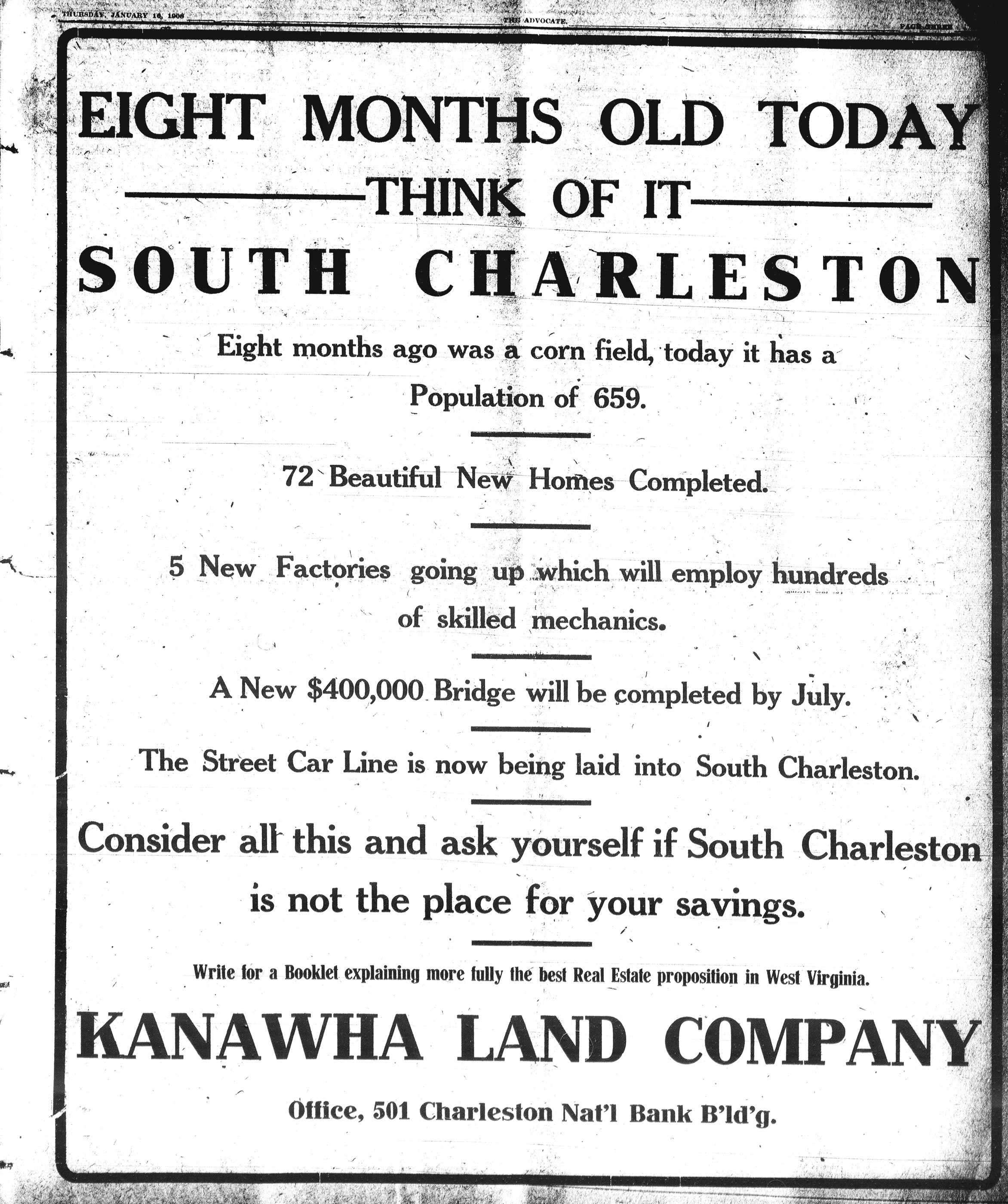
EIGHT MONTHS OLD TODAY THINK OF IT
Eight months ago was a corn field, today it has a
72 Beautiful New Homes Completed.
5 New Factories going up which will employ hundreds of skilled mechanics.
A New $400,000 Bridge will be completed by July.
The Street Car Line is now being laid into South Charleston.
Consider all this and ask yourself if South Charleston is not the place for your savings.
Write for a Booklet explaining more fully the best Real Estate proposition in West Virginia.
Office, 501 Charleston Nat'l Bank B'ld'g.
The Advocate is entered in the Post-office at Charleston, W. Va., as second class matter.
SUBSCRIPTION RATES:
Three months $0.50
Three months 1.50
One year 1.60
THURSDAY, JAN. 9, 1908.
New York:
738 7th Avenue.
Washington:
1325 12th St. N. W.
Louisville:
1112 W. Madison St.
St. Louis:
8137 Pine St.
Philadelphia:
702 So. 15th St.
Baltimore:
502 W. Biddle St.
Boston:
94 a Harvard St., Cambridge
Pittsburg:
461 6th St., Braddock.
Columbus:
266 St. Clair Ave.
New Orleans:
226 So. Robertson St.
Jacksonville.
526 W. Union St.
Nashville:
706 Bass St.
Indianapolis:
1605 Alvord St.
Lexington:
567 N. Upper St.
San Francisco:
865 Union St., Oakland.
Detroit:
261 Elliot St.
El Paso:
Chicago:
3519 Calumet Ave.
PEDDLING DIPLOMAS
"Our pulpit was filled last Sunday morning by Prof. —, who at 3:30 o'clock conferred the degree of D. D. upon our worthy pastor, Rev. —," is a highly interesting bit of news The Advocate conveyed to its readers last week, the names being omitted now for reasons which will appear later.
With one but exception, when this same institution inaugurated the innovation, no instance has come under the observation of the writer in which the college, though its representative, went to the man upon whom it was to confer the highest honors in its power; but, rather, the man, either in person or by proxy, had gone to the college. As representative of the first is cited the case of "Mark Twain" who, last summer, crossed the ocean to receive an honorary degree from an English university. The sending of a representative by Emperor William to an American university illustrates the second. In each instance thousands of miles had to be traveled, but such was the demand of custom.
In the case under consideration we find the man and the college about 30 miles apart, but Mahomet would not or could not go to the mountain, so forsooth, the mountain went to Mahomet.
Was there ever such a prostitution of the privilege vested by the state in an institution of learning? The idea of a school, whose curriculum is surpassed by a good high school; a school with less than 100 in attendance; a school which has never conferred a degree in course, scattering so promuscuously the degree of doctor of divinity, which reputable universities jealously guard, would be laughable, were the practice not fraught with so much injury to the giver, the recipient and the race.
When during the state meeting of a strong religious organization last summer, this same institution, through its president, saw fit to honor two of its co-religionists with the degree of doctor of divinity. The Advocate was approached by one of the most intelligent members of the denomination, who, deploring the course pursued, asked that some protest be made. Realizing how easily and how quickly anything appearing in a newspaper on denominational matters is misconstrued to the disadvantage of the paper, no notice was taken of such a flagrant misuse of power, but to remain silent longer would betoken either ignorance or indifference on our part to the educational interests of our people.
Surely the trustees, if the president does not, must see that the institution contributes nothing to the cause it is supposed to represent by its utter disregard, in at least one instance, of the motives which actuate our leading colleges in conferring their honors. To be doctorated presupposes the recipient either a man of extraordinary learning or one who, by exceptional services, has added to the sum total of human knowledge along his particular line, whether it be letters, law, science or religion. The mere fact that a preacher is a good financier, an evangelist, above the average, or has spent two score years or more in the ministry does not cuticle him to an honorary degree, and to confer it for any or all the above reasons bespeaks lamentable ignorance.
We are loath to believe that it is a matter of dollars and cents with the
donor, but even if it were, one, knowing the facts, would ask himself, in the language of one of these doctors, "Do it pay?" Does it pay to make a doctor of a preacher who does not know a Hebrew or Greek root from a sweet potato? Is it not lowering the standard of our ministry, which is already so low in some localities as to be a mockery?
PAY UP
On the first of the year the third assistant postmaster-general issued a notice to postmasters bearing on orders issued some time ago, becoming effective January 1st, relating to lapsed subscriptions. Postmasters were advised that though the rule governing expired subscriptions went into effect with the year, it is the desire of the department to give every publisher a reasonable opportunity to adjust his business to the new conditions. The notice reads in part:
"Publishers who show good faith and that they are making progress should in fairness have such opportunity. The purpose of the new regulations is to correct real abuses and not to put into the hands of postmasters instruments with which to annoy and vex publishers whose practices are normal."
Hereafter, under the rulings of the department, publishers of weekly newspapers cannot carry subscribers in arrears more than one year. For each violation of this regulation publishers will be fined one cent for each four ounces.
The enforcement of this regulation with the increased cost of paper and labor will work a hardship upon Negro publishers, in particular, which their clientele seems not to realize. To be specific, the cost of printing The Advocate is 50 per cent, more this year than last, and we, like a number of our contemporaries, are compelled either to raise our subscription rates or reduce the size of the paper. Fur thermore, we are compelled, perforce to insist upon the immediate settlement of subscription accounts in arrears more than one year, or to discontinue sending the paper.
Again, cards of thanks, resolutions of condolence, sermons, and the like, which have been published heretofore without cost, must in the future, be paid for. News of general interest, as has been our custom, will be cheerfully given publicity, but notices of enterprises or entertainments, the object of which is to make money for organizations or individuals, must be accompanied by coin of the realm, otherwise, they will be consigned to the waste basket.
We trust that our readers and subscribers will appreciate our position, and govern themselves accordingly.
MINING LEGISLATION
That there is a pressing need of mining legislation there is no question, but it would be absurd to think that the ordinary legislature, many of whose members do not know the difference between a coal mine and a ground-hog burrow, can be depended upon, without expert advice, to enact a law which will meet the requirements. The report of the Ohio mine inspectors upon the Monongah horror, coming as it does from practical miners—men who know the dangers of underground soil—is entitled to the most serious consideration and should be borne in mind by our solons when they take up this question which affects the greatest industry in the state.
"We feel that the sacrifice of over 600 lives by mine explosions in Pennsylvania, West Virginia and Alabama during the present month ought to stir the moral sensibilities and teach a never-to-be-forgotten lesson to those connected with mines, prompting every possible precaution against such calamities. We are not disposed to criticise, and particularly not in an unfriendly way, but we are not clear as to the advantages to be derived from the system of driving seven parallel main headings. It is clear, however, from what we have all seen that in the Monongah case they acted as storage chambers for mine dust, which we consider is one of the greatest sources of danger at those mines. The great evil of connecting mining properties is also forcibly presented in this case by doubling the number of dead. In the annual report issued by this department in 1994 we wrote a rather strong comment against the dangers and evils incident to the connecting of mining properties, and closed with the following paragraph:
"We fear that if there is not some check in this direction and more care exercised about the connection of mining properties that the time is not far distant when the subject will be presented to the people in such a serious aspect that a prohibitory law will be enacted."
"Close observation and striking recent events justify a further prediction that if the general conditions of operating mines in the various states are not soon covered by adequate federal laws that the sacrifice of human life in the mines has merely just begun."
Now that the Washington Bee has succeeded in onsetting Superintendent Chancellor Its editorial space will be confined to the free advertisement of the alleged unfitness of Mr. Roscoe Conklin Bruce for the assistant principalship. Poor Washington! Will it never have done with its school muddles?
The Cleveland Journal is out in a double leaded, double column editorial
MILITARY HOSPITAL
ARE YOU WORKING FOR MONEY? OR IS YUR MONEY WORKING FOR YOU?
If you are working and saving your money and putting it in a bank where you get no interest, keeping it in a trunk or hiding it somewhere about your house—You Are Working. For Money. If
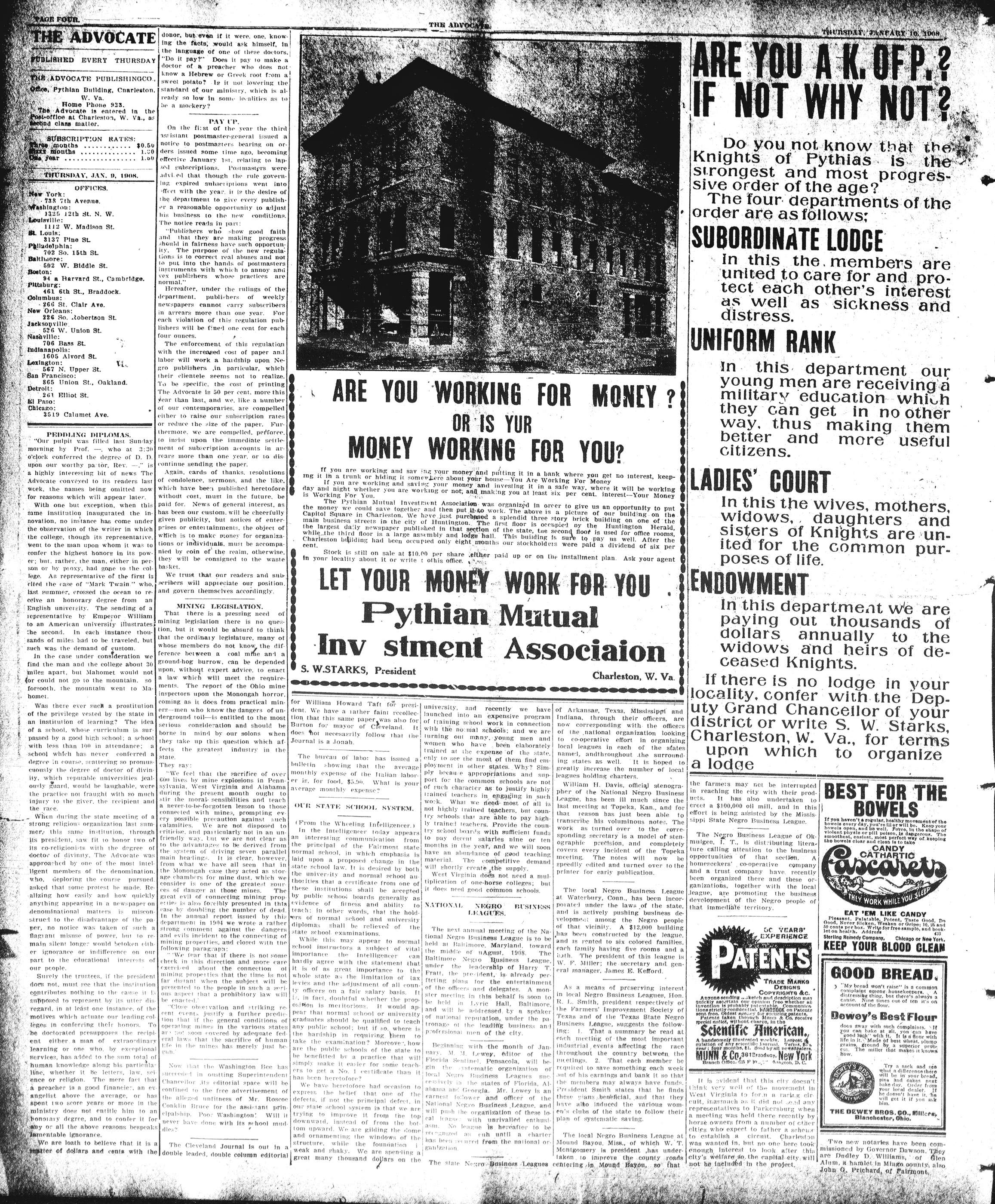
The Pythian Mutual Investment Association was organized in order to give us an opportunity to put the money we could save together and then put it to work. The above is a picture of our building on the Capitol Square in Charleston. We have just purchased a splendid three story brick building on one of the main business streets in the city of Huntington. The first floor is occupied by the Huntington Herald, the largest daily newspaper published in that section of the state, the second floor is used for office rooms, while the third floor is a large assembly and lodge hall. This building is sure to pay us well. After the Charleston building had been occupied only eight months our stockholders were paid a dividend of six per cent.
Stock is still on sale at $10.00 per share either paid up or on the installment plan. Ask your agent in your locality about it or write t othis office.
LET YOUR MONEY WORK FOR YOU Pythian Mutual Inv stment Associaion
S. W.STARKS, President
for William Howard Taft for president. We have a rather faint recollection that this same paper was also for Burton for mayor of Cleveland. It does not necessarily follow that the Journal is a Jonah.
The bureau of labo: has issued a bulletin showing that the average monthly expense of the Italian laborer is, for food, $5.90. What is your average monthly expense?
OUR STATE SCHOOL SYSTEM.
(From the Wheeling Infliigencer.) In the Intelligencer today appears an interesting communication from the principal of the Fairmont state normal school, in which emphasis is laid upon a proposed change in the state school law. It is desired by both the university and normal school authorities that a certificate from one of these institutions shall be accepted by public school boards generally as evidence of fitness and ability to teach; in other words, that the holders of normal school and university diplomas shall be relieved of the state school examinations.
While this may appear to normal school instructors a subject of vital importance the Intelligencer can hardly agree with the statement that it is of as great importance to the whole state as the limitation of tax levies and the adjustment of all county officers on a fair salary basis. It is, in fact, doubtful whether the proposition is meritorious. It would appear that normal school or university graduates should be qualified to teach any public school; but if so, where is the hardship in requiring them to take the examination? Moreover, how are the public schools of the state to be benefitted by a practice that will simply make it easier for some teachers to get a No. 1 certificate than it has been heretofore?
We have heretofore had occasion to express the belief that one of the defects, if not the principal defect, in our state school system is that we are trying to improve it from the top downward, instead of from the bottom upward. We are gliding the dome and ornamenting the windows of the structure, while the foundation is weak and shaky. We are spending a great many thousand dollars on the
university, and recently we have launched into an expensive program of training school work in connection with the normal schools; and we are turning out many, young men and women who have been elaborately trained at the expense of the state, only to see the most of them find employment in other states. Why? Simply because appropriations and support for the common schools are not of such character as to justify highly trained teachers in engaging in such work. What we need most of all is not highly trained teachers, but country schools that are able to pay highly trained teachers. Provide the country school boards with sufficient funds to pay decent salaries nine or ten months in the year, and we will soon have an abundance of good teaching material. The competitive demand will shortly create the supply.
West Virginia does not need a multiplication of one-horse colleges; but it does need good common schools.
NATIONAL NEGRO BUSINESS LEAGUES.
The next annual meeting of the National Negro Business League is to be held at Baltimore, Maryland, toward the middle of uAgust, 1908. The Baltimore Negro Business League, under the leadership of Harry T. Fratt, the president, is already perfeting plans for the entertainment of the officers and delegates. A monster meeting in this behalf is soon to be held in Lyric Hall, Baltimore, and will be addressed by a speaker of national reputation, under the patronage of the leadffig business and professional men of the city.
Beginning with the month of January, M. M. Lewey, editor of the Florida Sentinel, Pensacola, will begin the systematic organization of local Negro Business Leagues successively in the states of Florida, Alabama and Georgia. Mr. Lewey is an earnest follower and officer of the National Negro Business, League, and will push the organization of these local leagues with unrivalled enthusiasm. No league is hereafter to be recognized as cuh until a charter has been secured from the national organization.
Charleston, W. Va.
of Arkansas, Texas, Mississippi and Indiana, through their officers, are now corresponding with the officers of the national organization looking to co-operative effort in organizing local leagues in each of the states named, and throughout the surrounding states as well. It is hoped to greatly increase the number of local leagues holding charters.
William H. Davis, official stenographer of the National Negro Business League, has been ill much since the last meeting at Topeka, Kan., and for that reason has just been able to transcribe his voluminous notes. The work as turned over to the corresponding secretary is a model of stenographic precision, and completely covers every incident of the Topeka meeting. The notes will now be speedily edited and turned over to the printer for early publication.
The local Negro Business League at Waterbury, Conn., has been incorporated under the laws of the state, and is actively pushing business development among the Negro people of that vicinity. A $12,000 building has been constructed by the league, and is rented to six colored families, each family having five rooms and a bath. The president of this league is W. F. Miller; the secretary and general manager, James E. Keford.
As a means of preserving interest in local Negro Business Leagues, Hon. R. L. Smith, president respectively of the Farmers' Improvement Society of Texas and of the Texas State Negro Business League, suggests the following: 1. That a summary be read at each meeting of the most important industrial events affecting the race throughout the country between the meetings. 2. That each member be required to save something each week out of his earnings and bank it so that the members may always have funds. President Smith states that he finds these plans beneficial, and that they have also induced the various women's clubs of the state to follow their plan of systematic saving.
The local Negro Business League at Mound Bayou. Miss., of which W. T. Montgomery is president, has undertaken to improve the county roads centering in Mound Bayou, so that
ARE YOU A K.OFP.? IF NOT WHY NOT?
Do you not know that the Knights of Pythias is the strongest and most progressive order of the age? The four departments of the order are as follows:
SUBORDINATE LODGE
In this the members are united to care for and protect each other's interest as well as sickness and distress.
In this department our young men are receiving a military education which they can get in no other way. thus making them better and more useful citizens.
In this the wives, mothers, widows, daughters and sisters of Knights are united for the common purposes of life.
In this department we are paying out thousands of dollars annually to the widows and heirs of deceased Knights. If there is no lodge in your locality, confer with the Deputy Grand Chancellor of your district or write S. W. Starks, Charleston, W. Va., for terms upon which to organize a lodge
UNIFORM RANK
In this depo young men an military educo they can get way, thus m better and citizens.
LADIES' COURT
In this the wit widows, da sisters of Kn ited for the poses of life.
ENDOWMENT
In this depart pay ing out the dollars annu widows and ceased Knight If there is no locality, confer w uty Grand Chanc district or write Charleston, W. V upon which a lodge
the farmers may not be interrupted in reaching the city with their products. It has also undertaken to erect a $100,000 oil mill, and in this effort is being assisted by the Mississippi State Negro Business League.
The Negro Business League of Okmulgee, L. T., is distributing literature calling attention to the business opportunities of that section. A homeseekers' cooperative company and a trust company have recently been organized there and these organizations, together with the local league, are promoting the business development of the Negro people of that immediate territory.
GO YEARS' EXPERIENCE
PATENTS
TRADE MARKS DESIGN
COPYRIGHTS & C.
Anyone sending sketch and description may quickly ascertain our opinion free whether as commissioned or illustrated. HANDBOOK on Patents sent free. Oldest agency for securing patents, nearest to the nearest Co. receive special notice, without charge, in the Scientific American.
A handsomely illustrated worldly. Largest citation of any scientific journal. Terms, 56 years, four months, £1. Sold by all new dealers.
MUNN & Co. 361 Broadway, New York
Branch Office, 625 P. St., Boston, D. C.
It is evident that this city doesn't think very well of the movement in West Virginia to form a racing circuit, inasmuch as it did not send any representatives to Parkersburg when a meeting was held there recently by horse owners from a number of other cities who expect to father a scheme to establish a circuit. Charleston was wanted in, but no one here took enough interest to look after this city's welfare so, the capital city will not be included in the protect
BEST FOR THE BOWELS
If you haven't a regular, healthy movement of the bowels every day, you're ill or will be. Keep your bowels open, and be well. Force, in the shape of violent physio or pill poison, is dangerous. The smoothest, easiest, most perfect way of keeping the bowels clear and clean is to take
CANDY
CATHARTIC
Cascarets
THY WORK WHILE YOU SLEEP
EAT 'EM LIKE CANDY
Pleasant, Palatable, Potent, Taste Good, Do
Good over Slicen, Weaken or Gripe: 10, 25
and 50 conts per box. Write for free sample, and book-
let on health. Address
633
Sterling Remedy Company,
Chicago or New York.
KEEP YOUR BLOOD CLEAN
GOOD BREAD
) "My bread won't raise" is a common complaint among housekeepers. A distressful thing, but there always a chance that out of ten it's on account of the four.
Dewey's Best Flour
docs away with such complaints. If you can bake at all, you can have good back with it. It is a flour with life in it and a wheat, plump grains, ground by a superior process. The miller that makes it know how.
Try a sack and see what a difference there was in your bread, pies and bake day. Order from your local dealer. If he doesn't have it, he will get it if you ask him.
DEWEY'S REST
DEWEY'S REST
Try a sack and see what a difference there will be in your bread, bread and bread next bake day. Order from your local dealer. If he doesn't have it, he will get it if you ask him.
THE DEWEY BROS. CO., Millers, Blanchon, Ohio.
Two new notaries have been commissioned by Governor Dawson. They are Dudley D. Williams, of Glen Alum, a hamlet in Mingo county, also John G. Prichard, of Fairmont
Miss Mary Jones and Mr. Pleasance Johnson were married by Rev. H. K. Johnson, at his residence on the 4th Inns.
Norman-Cooper has so far recovered as to permit of his sister's return to her home at Parkersburg.
Mr. and Mrs. Russell Forney are in the city from Dayton, O., to spend a few weeks with Mrs. Forney's mother, Mrs. M. A. Mitchell.
John Scott, an old resident of the city, died at his residence, on Eastlake street, Tuesday night, of consumption.
Mrs. J. H. Vigal, who will be remembered as having assisted in a revival here some years ago, is in the city, and will assist the pastor of the Fifth Baptist church, Rev. S. R. Bullock, in the series of meetings which he is holding.
Mr. and Mrs. Joseph Dillard, who have made their home at Clarksville for some months, returned here, Sunday, for permanent residence.
The presence of Mrs. R. E. Brown, who has charge of a rescue mission for fallen women in New York City, lends additional interest to the revival services at Simpson M. E. church. At the meeting, Tuesday night, there were three conversions and eight appeals for prayer. Mrs. Brown is so much encouraged by the results of her labor that she has decided to remain as long as she can contribute to the welfare of the church and community.
The Peoples Grocery Co. has recently added to its equipment an electric coffee mill and a cabinet containing the American Account Register system, labor saving devices to be found in/but few groceries in the city. The new mill is superior to the old in that it does not crush or grind the berry, but cuts it, the little oil cells remaining unbroken, and there is an absence of the dust produced by the grinding method. The mill is operated by electricity. The accounting system will simplify the method of bookkeeping and minimize the chances of errors, besides safeguarding creditors against overcharges, since each is furnished with a file for the duplicate bills sent them with each purpose.
Andrew Parker remains very ill at his home on Wall street.
The funeral of Mrs. Mary Bolden, who died Friday of dropsy after a year's illness, was preached Sunday at her late residence by Rev. S. R. Bullock. The deceased is survived by a nephew, who, at the request of Mrs. Bolden, was adopted by Rev. Bullock.
The Loyal Union had as guests at their meeting with Mrs. Mattle Moss, Monday evening, Mrs. Goin's, of Cincinnati; Mrs. Browder, of Greenville, O., and Mrs. Sarah Johnson and daughter, of this city. After the business session a hot lunch was served by the hostess. Their next meeting will be held with Mrs. Dora Moss.
Mrs. Maria Alexander is visiting her daughter Mrs. Dandridge, at Parkersburg.
For Rent—A six room house, on McCormick street. All modern conveniences. Apply to Dr. H. F. Gumble, corner Washington and Bradford sts. Mrs. Sarah Parker is constructing a sitre room on Estill street.
Mr. W. H. Clark and Miss Alice Lazenbury were united in marriage, last Sunday, by Rev. W. E. Walker, at the A. M. E. church parsonage.
Mrs. Alice Gohs, guest of her sister-in-law, Mrs. Mattie Moss, is reported very ill.
Rev. W. E. Walker preached at St. Albans, Sunday foremon and evening. He reports his church there in good condition.
In order not to detract from the services being held at the other churches the protracted meetings at St. Paul A. M. E. church have been discontinued.
The Leap Year ball is now the chief topic of conversation, the interest in which increases with each passing day, the fact of the ladies having secured a gentleman to escort being by no means a deterrent.
Large puffs, seven in a set, at Mrs. Brown's, 500 Capitol street.
Miss Mary Patterson passed through the city, Monday, from Institute, on her way to her home at Wright.
Mrs. Nannle Lewis is quite ill at her home on Shrewsbury street.
Dr. Sessons, of Wilmrigton, Ohio, is in the city on business.
Mrs. G. W. Clafre has returned from a visit to her parents at Lancaster, O.
Miss L. O. Hopkins was hostess to the League last week. Their meeting tomorrow will be held with Mrs. C. H. James.
Miss Aristis Johnson is ill at her home on Sentz street.
Senator Sproul Visits Charleston
Senator Sproul Visits Charleston
Together with a number of other men of prominence both in financial and political circles, Senator W. C. Sproul, of Pennsylvania, will arrive in the city this evening to look after vast interests here and elsewhere in the lower end of the state with which they are identified.
The party will likely spend about two days in Charleston before returning to their respective homes.
Senator Sproul is one of the best known men of his state and has been in a number of enterprises in this state for several years. He is recognized as a millionaire and has invested enormous sums of money in West Virginia, especially in and about Charleston.
NEGROES
Should be Responsible for Negroes
Is Governor Northen's/ Plan for
Checking Crime at the South—
Cites Other Cities Where
this Method Prevails.
Editor Constitution: Every good citizen who read your recent editorial, "Our National Shame," will give your statements hearty and unqualified endorsement and approval. It is true, however, as you say, "The story is told and lettered in vain. Human life remains as cheap, almost, as in the days of early settlers when the shotgun was about the only available law. Georgia has contributed—we say it with deep regret—her full quota to the criminal clearing house of the nation and the reading public passes it over with scarce a thought because it is not unusual.
The most startling statement in your editorial is, not the general prevalence of crime, but the absolute inference and inaction of the reading public "because it is not unusual."
Is there not some way to awaken the public to tendencies of the times and to such wise enactment as, will safeguard the lives of the people and preserve our civilization? Can we not begin by studying individual instances and apply the remedies best suited to correct their evils? Take the last criminal incident that happened in this local community. It is full of striking lessons and distinct suggestions for the future. As I understand, it followed seven shocking murders of the same kind, without any change in our methods for preventing this special crime. In the killing of Officer Manler the first fact emphasized is, as we have all the time known, there is a large class of, vicious, lawless, just like Johnson. We are liable to run against them at any moment.
The second fact emphasized is as we have all the time known there is a large class of worthy, peaceable, law-abiding Negroes in the community, splendidly represented by Bartow Blackman, who stand just as pronounced as the best white people for law and order and who are ready to help, at great risk, to maintain the peace of the community.
Now, let us hold to this latter fact and use it to counteract the former fact, by acting upon it. We must no longer censure all the Negroes for the crimes of the wicked of their race any more than we censure all the white people for the crimes you have enumerated as committed by lawless white men. We must exercise common sense in such matters and be just in judgment and in action.
Another prominent fact developed by the unfortunate slaying of Officer Mander is that, at least one Negro minister preached to his people about the horrors of the crime and that his congregation immediately took unanimous action deploring and condemning the crime and commending Blackman for capturing and delivering a man of their race into the hands of the officers of the law.
It is further to be noted that at different places of business, Negroes made collections' of money to be forwarded to the widow of the slain officer and to Blackman, showing their appreciation of his conduct as representing the best element of the Negroes of the community.
Are we now to see nothing in all this that suggests action that will lessen crime in the city? Surely not.
Why not study and apply, some what, the methods of other peoples, that have been successful in the suppression of crime?
On the Island of Malta, where the population is composed of different nationalities, between whom there are strong prejudices and jealousies, there are several divisions of the police assigned separately, to the charge of one of the three elements of the island population.
In Hong Kong there is still a more confused mixture of elements and the problem is even more complicated. There are several kinds of police—English, Chinese and Hindoo.
The English police have comprehensive powers and exclusive control of the whole. The other two classes of officers are authorized to arrest members of the races to which they respectively belong and not allowed to interfere with others. Each class of officers is held responsible for the conduct of the people of his own race.
This is what we must do to lessen crime in Atlanta. I am sure it will work, and now is an admirable time to make the experiment.
Let us put upon a certain number of representative Negroes the responsibility for the conduct of the people of their race and they will have the hacking and support of all the best Negroes of the community and we will have better order and far less crime. In the name of law and order for the city, first, and then in the name of the better element of the Negroes, who I am sure will willingly carry the responsibility. I am making this suggestion and urge its adoption. If the authorities are not willing to adopt it as a permanent feature, at least make a trial of it for one month, as additional force is to be appointed anyhow, for that time. Appoint some Negroes and try them. All Negroes may be alike in general appearance, but they are not all alike in character. The good Negroes will be made stronger if put under responsibility. I have already given to the public
an incident illustrative of the co-operation of the best elements of the races, as happening in a town in South Georgia.
I had spoken to the people of the community upon this subject and, nine days later, there was an attempt at criminal assault by a Negro. The better class of Nogroge, who had been relied upon, located the criminal Negro and delivered him to the officers of the law.
My communication has been written in response to your editorial, that the people may not read "the story and have it reiterated in vain." We must awaken the public mind not only to discussion, but to action—W. J. Northen, in Atlanta Constitution.
Louisville, Ky., dan. 12. — Within the next few days, it is probable that Taft leaders in Kentucky will hold a meeting either in Louisville or in Frankfort, and, at this meeting, the chances are that definite plans for making an organization in the state will be announced, and work will be begun with a view to casting the 26 votes of Kentucky for the war secretary for president.
The Fairbanks men are also planning a meeting, but it will not be, be held until later along in the legislative session, the supporters of the Indiana man being of the opinion that it would be unwise to argue that the Kentucky vote be instructed for any candidate for president until after other matters in which the party is interested are determined at Frankfort. Already the contest for the vote of the commonwealth has aroused considerable feeling, and in some instances bitterness, among republican leaders. The Fairbanks men are using with much effect the alleged unfriendiness of Secretary Taft to the Negro race, and the Kentucky Standard, which is the organ of the colored people of Kentucky, says that Negroes cannot afford to support Secretary Taft, for "in his Lexington speech he tacitly put his stamp of approval on the Jim Crow laws, which humiliate and work a hardship on the Negro." The war secretary's alleged position on this question is being talked of throughout the state by friends of the vice president, and as Kentucky has a large Negro vote it is certain to cut a big figure in determining the control of the two factions now fighting for supremacy.
PARALLEL TO BRADLEY-BROWN MURDER, CASE
Associated Press.
Chicago, Jan. 15.—The case of Mrs Thomas Motealf, who last evening shot at Banker John H. Walsh's attorney, Samuel R. Hamelf in the federal building here paralleled strongly, in some respects, the case of Mrs. Annie M. Bradley, who was recently acquitted in Washington after the killing of former Senator Brown. Mrs. Metcalf is a former resident of Hamelf's home city, Terre Haute. She and her husband were at one time active in church work. She at different times consulted a lawyer here with a view to bringing suit against Hamelf for alleged wrongs she claimed to have suffered at his hands. As in the case of Brown, Mrs. Metcalf followed Hamelf across the continent.
Associated Press.
Terro Haute, Jan. 15.—No woman named Mrs. Thomas Metcalf can be located here. Inquiry at Hamell's office here failed to disclose any information on the matter.
Associated Press.
Chicago, Jan. 15.—Attorney Ritcher, of Walsh's counsel, issued a statement today relative to the shooting, on behalf of Hamell, in which he said the trouble grew out of a claim which Mrs. Metcalf believed she had against an estate in St. Louis, and which she wished to have adjusted by Hamell. In this connection, Ritcher said, Mrs. Metcalf became a frequent caller at Hamell's office in the last few years.
$300 Reward For Missing Iowa Man
Hotel men and police officers in this city have been asked to keep a lookout for George W. Jones, M. D., of Iowa. A card bearing description and offer of a reward of $300 for information leading to his discovery is as follows, having been sent out by Chief of Police J. M. Kennedy and Attorney W. Clyde Jones of Keokuk: $300 Reward For information leading to the discovery of Dr. George W. Jones, or his body, May be traveling and if so will be probably stop at good hotels. In a prominent office, an expert in genito-urinary diseases, and of a family Disappeared at Burlington Iowa, December 25, 1907, at 9 p. m. if wending, is in fear of imaginary enemies, but may appear perfectly gone to strangers. All police departments are asked and instructed to take him into custody and hold, and in this will be perfectly protected. Telegraph collect (do not use malls).
John Langdon spent Sunday in the city with his wife.
Ancient Legends of the Sacred River
of the Hindos.
From an air cavern at the foot of a
Himalayan snow bed more than 60,000
feet above the level of the sea lakes,
a small stream which becomes the
mighty Ganges, flowing for 3,000 miles
through India to the bay of Bengal,
and of whose course every foot is holy
ground.
With Mother, Ganga, as the plops
Hindos reverently call her, no river
on earth can compare in sanctity.
The old poem tells us that the bea-
venly Ganges flowed from the toe of
Vishnu and was brought down from
heaven, by the prayers of the saint
Bhagiratha to purify the ashes of the
60,000 sons of Klugh Sagara, who had
been buried by the angry glances of the
sage Kapil.
Ganga, was angry at being brought down from heaven, and to save the earth from her incessant rush Siva caught the river on his brow and with his mutted locks checked its course. The legends go on to tell how the descent of the Ganges disturbed the sage Jahun in the performance of his religious duties, upon it in his sage he drank up the river, but subsequently relented and permitted it to flow from his ear.—Pearson's Weekly.
END OF THE WORLD.
One Sciencefiction Theory of How Our
Planet May Perish.
A scientific forecast of how the end of the world might come has been given by Professor Ellard Gore. His theory is that final catastrophe may possibly be the result of a collision between the sun and some dark, dead, derekel planet. Although astronomers have no actual proof that such dead suns exist, without life or light and careering about in space they believe it quite possible. The result of a collision between the sun and a dark planet would be that the former's light and heat would be enormously increased and the earth instantly destroyed by combustion.
Professor Gore tells how we should be warned of your approaching doom. "When about 15,000,000 miles from the sun, the dark body would begin to shine by reflected light. In about ten years it would have become as bright as to be visible to the naked eye. In fifteen years it would be brighter than any object except the moon. Very soon afterward would come the great catastrophe of its collision, moving at 400 miles a second, with the sun moving at the same speed." -Dundee Observer.
Proverbs of Siam.
It has been said, "Tell me a people's proverbs, and I will tell you what sort of people they are." Judged in this way, the Slammes are a shrewd people. The Menman, their chief river, is to Slain what the Nile is to forget, and the elephant, tiger and crocodile are found in jungle and stream.
Here are, a few of their proverbs: "When you go into the woods, do not forget your wood grape." "Place not your boat across the stream" (because of the current). "An elephant, though he has four legs, may slip, and a doctor is not always right."
"Go up by land, you meet a tiger, go down by water, you meet a crocodile" (there are difficulties on all sides). "Nobility is seen in the race, manners in the individual." "If a dog bite you, do not bite him again." "He who lives under the sky should not be afraid of the rhin." "Nourish no worms that eat timber" (be careful in the choice of friends)—London Scraps.
The Effect on the Nerves of Gamblings.
How can a man do his daily work quietly, which represents perhaps only the earning of a few shillings, when his anxious other neurotic self is wondering how a horse he has never seen, ridden by a jockey he has only heard of, in a race he has only read about, is faring as to money ostensibly his, which he cannot afford to lose because he has not perhaps got it if he should have to pay? Is such an existence likely to add to the race value of our stock of fleeing patriotism? - Kry's Magazine.
A PROPER EPITHET.
Easy Way In Which a Domestic Rapture Was Averted.
The troubles which are brought to a parish priest for solution are almost infinite in their variety. In a certain Prussian village, says Friedrich August Dressier in "Molike in His Home," an old woman came to her spiritual adviser and proposed a separation from her husband.
"If he would beat me," she said, "that would be all right; that would show that he was really my man. But he calls me worse names; he calls me a 'subject!' I will not stand for that!" "So, 'subject,' eh?" said the priest. "Yes, that is bad. It is a bad word. I did not think he would say that. But are you sure you understood? Did he say 'subject or object?'"
The old woman shook her head. She was not certain. The priest smiled serenely.
"Ah, I thought so," he said. "Now, I am sure that is what he called you. 'Subject would have been very bad. It would be hard to forgive that, but 'object,' pooh, it is nothing. If at all, it flatters one."
The woman laughed happily. "And, then, I need not leave him? I can still keep him for my man?" she asked eagerly.
"Certainly," said her mentor, "and rejoice, 'object,' that is very fine! I was sure he did not say 'subject.'"
She went away entirely satisfied.
Henry Jefferson is confined to his room by illness.
COLORED MEN'S TAFT CLUB IN OHIO.
Columbus, O., Jan. 10. -Young colored republicans to the number of 250 organized the Young Men's Taft club in the Fifth ward here, Monday night. The formation of this club shows that the colored voters regard the nomination of the able and patriotic secretary of war with favor and believe his succession to the presidency would be to the advantage of the race and nation. The founders of the organization are representative men, some of then ministers, factors in the business world, and others are engaged in pro professional, educational and industrial pursuits—all of them substantial citizens. They expect the club to grow and that it will exert a large degree of influence in the forthcoming cam paign. The club will be a permanen institution.
At the meeting the following reslutions were adopted, after having been drafted by Rev. R. C. Lowe, D. W. L. Burr and Mr. Shelby Jones composing the resolutions committee Whereas, The policies of the administration of Theodore Roosevelt under which the country has prospered as never before, and cleaner and higher standards have been established for the conduct of both private and public business, have the unqualified approval of the American people, an Whereas, We believe and desire that these policies should be perpetuated, and regard it a matter of vita concern that the right man should be chosen as the republican standard bearer in 1908; therefore be it
Resolved. By the Young Mens Taft Club, of Columbus, Ohio, that in William H. Taft we recognize a man whose personal, character, whose long experience in national affairs, whose conspicuous identity with the great work of the present administration, whose position on the vital national issues, and whose frank, courageous avowal of his position mark him as pre-eminently the most available and most desirable candidate for president; and be it further
Resolved. That we hereby pledge our earnest efforts as an organization and as individuals to bring about the nomination and election of William H. Taft as president of the United States.
The following officers were elected:
Rev. R. C. Jones president; Rev. R. C. Lowe, vice president; J. E. Moore, secretary; Dr. W. L. Burr, treasurer; John Allen, sergeant-at-arms; board of directors, J. S. Jones, John H. Booker, Cyrus A. Jones, Earl Harrington, Riley Dues.
ANSTED.
Henry Green, of Cotton Hill, was the guest of his daughter, Sunday.
Miss Linthicolm spent a few days with friends at Powellton and Mt. Carbon last week.
The Sunday school elected the following officers for the year:
Superintendent—Sam Clay.
Assistant Superintendent—Albert Dues.
Secretary—Wm. Jordan.
Assistant Secretary—Mrs. N. C. Clay.
Treasurer—John Seabon.
No. 1 Class—C. Randolph.
No. 2 Class—S. W. Williams.
No. 3 Class—R. E. Banks.
Mr. and Mrs. Clay spent a week with relatives at Greenwood.
Mrs. L. D. Hodge, state's deputy, was here, and paid the death claim of Mrs. Amanda Hatcher to her husband, Henry Hatcher.
Miss Mary Clayter, of Page, spent a month here with her father.
The B. Y. P. U. elected the following officers:
President—J. B. Brannum.
Vice President—Allen Eldridge.
Secretary—Charley Randolph.
Assistant Secretary—Mrs. Steward.
Treasurer—H. banks.
Program—Robt. Brooks and others.
Mrs. Luvenia Wooldridge visited friends at Arbuckle.
Mrs. Sallie Jones Joanna and Mrs. Claytor visited Friends at Arbuckle.
Mrs. Cox and Sadle Brock are on the rick list.
L. N. BROWN, CONTRACTOR
AND BUEDER, WILL GLADLY
FURNISH ESTIMATES ON ALL
STYLES OF BUILDINGS AND
GUARANTEES SATIRE ACTION. IF
YOU INTEND TO BUILD, WRITE
ME AT INSTITTE, W. VA.
FRUITS, CANDIES ICE CREAM
Families Furnished with Ice Cream. Orders for shipment solicited. We make prompt delivery of Cream and Ices for Sunday orders.
Our offering is of high-class novels recently published at $1.50, handsomely bound and mostly all illustrated.
Now 50 Cents Per
There will be a big demand for special price. We have space here to a few of the titles.
ALL ARE WINNERS.
ents Per Volume. a big demand for these books at have space here to mention only ARE WINNERS.
Now 50 Cents Per Volume.
There will be a big demand for these books at special price. We have space here to mention only a few of the titles.
Beverly of Graustark
By Geo. Barr McCutcheon
The Gambler
By Katherine Cecil Thurston
Princess Maritza
By Percy Brebner
St. Elmo
By Augusta J. Evans
The Marriage of Wm.
Ashe
By Mrs. Humphrey Ward
The Virginian
By Owen Wister
bove by Mail 60c. er Moore & Co.
Any of above S. Spencer
118 Capitol Street.
A Bag of Dew will put more loaves of good bread you can buy. We said good bread comes out in plump, sweet swelli
Dewey's Best Flour
good bread on your table, than any other flour
good bread. The kind that raises right and
let swelling, well browned leaves that make
your mouth water if you are around them
the oven door is opened. Inside it's light
and it's white—sure to be.
WE WANT YOU TO TRY
will put more leaves of good bread on your table, than any other flour you can buy. We said good bread. The kind that raises right and comes out in plump, sweet swelling, well browned loaves that make your mouth water if you are around when the oven door is opened. Inside it's light and it's white—sure to be.
WE WANT YOU TO TRY
Dewey's Best Flour
Order a sack from your dealer and if you don't like it just send back what you did use. It will not cost you a cent. We are thorize all our dealers to make this offer. It helps to let the people know what the flour really is, and that is what has made the wonderful demand for it.
The flour with life in it—the flour of heaven!
The flour with life in it,-the flour of health.
The Dewey Bros. Co., For S WEST CHARLE
Co., Millers, Blanchester, Ohio.
For Sale By
RLESTON FEED CO.
North Wants Griggs' Place
Washington, Jan. 14.—That the chairmanship of the Democratic Congressional Committee should go this time to a Northern member of the party is the belief of a number of members from that section of the country, and especially Representative Ryan, of Buffalo. He has been mentioned for the place, and so has Representative William Sulzer, of New York. The argument of the Northerners is that the South is bound to send Democratic members, whether the committee does any work or not, and that the place where gains must be made if there is a change in the majority of the house is in the North and West.
As it stands now, Chairman James Griggs is not a candidate for re-election, the candidates so far announced being Flood, of Virginia; Lloyd, of Missouri, and Bowers, of Mississippi. The indications are said to favor the election of Flood, but the friends of Bowers and Lloyd both insist they are in the race.
"It is quite apparent," says Representative Ryan, in discussing the matter. "that if the Democrats are to control the next House they must gain members in the North and West. Hence, the chairman of the committee should be a man familiar with the conditions there. We know what the South can do, and while the Southern chairmen have done well, they cannot be expected to know the situation in the North and West."
Francis Burton Harrison is another man who has been mentioned; but
The Masquerader
By Catherine Cecil Thurston
The Right of Way
By Gilbert Parker
The Captain of the Gray-
Horse Troop
By Hamlin Garland
Brewster's Millions
By Geo. Barr McCutcheon
The Blazed Trail
By Stewart Edward White
Lady Rose's Daughter
By Mrs. Humphrey Ward
Dewey's Best Flour
Order a sack from your dealer and if you don't like it just back what you did not use. It will not cost you. It will thorize all our dealers to make this offer. It helps to let the people know what the flour really is, and that is what has made the wonderful demand for it.
he declined to be considered a candidate. If the Southern members cannot see the force of the argument of the Northern members, a Southern man will get the place for the South has the votes. Under Griggs, the Republican majority has been out and is always from 50 to 100. Cowherd, of Missouri, once cut it to 30.
We have a new line of
GAS
STAND
LAMPS
Come in and look them over
COFFEY
Plumbing Co.
Quarrier St., near Capitol
Virginia Colored Institute
INSTITUTE, : : : : WEST VA. The only Industrial Institute for colored Students in the State
Regular Normal, Academic and Commercial Courses, also Regular Courses in Agriculture, Carpentery and House Building, Steam Fitting, Smithing, Cabinet Making, Painting and Glazing, Dressmaking, Laundrying, Printing. A complete course in Military Training to Cadets. Rooms Books, Fuel and Lights Free to Normal Students; and in addition Uniforms, for State Students. We have a faculty of Twenty-two Teachers Board only Eight Dollars per Month,
For catalogue and other information address
IN THE NATIONAL FIELD
Color prejudice gets a body blow by transfer of Marshall
Will Hereafter Be Located at Ellis Island, Where His Work Will Prove More Effective—Chas, W. Anderson to be the Guest at a National Dinner on the 30th—Emmett Scott Fully Recovered from Effects of a Surgical Operation Arranges for Tuskegee Meeting at New York.
(Staff Correspondence)
Washington, D. C., Jan. 15.—It is fortunate for the race that we have on guard at Washington such ability, in intelligent, courageous and unselfish champions of civic righteousness as
Register W. T. Vernon, Auditor Ralph W. Tyler, and others of similar caliber. This was happily demonstrated the other day when the case of Mr. George O. Marshall, cf Pittsburg, Kansas, came up for adjustment be-
THE BAUE
& FISH CO
28 AND 30
Beef, Veal. M
Fresh Pork
and W
Our Own
Try our ma
Hams an
OYSTERS, FIS
The Best Qu
popular kinds o
BAUER MEAT
FISH COMPANY
AND 30 CAPITOL
of, Veal. Mutton, Pork
Fresh Pork Sausage
and Weiner
Our Own Make
try our machine sliced
rams and Bac
STERS, FISH, POULT
the Best Qualities in all the popular kinds of
THE BAUER MEAT & FISH COMPANY 28 AND 30 CAPITOL ST.
Beef, Veal, Mutton, Pork, Fresh Pork Sausage and Weiner Our Own Make
Try our machine sliced Hams and Bacon OYSTERS, FISH, POULTRY
The Best Qualities in all the popular kinds of Cheese
We want your patronage, f we have complete stock in o lines and you can get it when y want it most.
We want your patronage have complete stock in and you can get it when it most.
We want your patronage, for we have complete stock in our lines and you can get it when you want it most.
Register W. T. Vernon, Auditor Ralph W. Tyler, and others of similar caliber. This was happily demonstrated the other day when the case of Mr George O. Marshall, of Pittsburg Kansas, came up for adjustment be
ER MEAT
COMPANY
CAPITOL ST.
Hutton, Pork,
Sausage
Weiner
in Make
machine sliced
d Bacon
SH, POULTRY
olitics in all the
ur patronage, for
ete stock in our
get it when you
fore the department of commerce and labor. Mr. Marshall had been serving as an inspector of immigration at Winnepeg, Canada, and his official record was unassailable. For reasons nevertheless, which suggested unacceptability on account of color, his stay at this out-of-the-way post became unpleasant. Through friends, who had known Mr. Marshall in Texas and South Carolina, the delicate situation was called to the attention of Register Vernon. Auditor Tyler and other administration leaders at Washington, who, ever mindful of the welfare of those in need of the wheel, determined to solve the problem, if possible, to the satisfaction of all concerned.
In company with Mr. Whitfield McKinlay, of South Carolina, they at once waited upon the Hon. Oscar S. Straus, the sympathetic secretary of commerce and labor. In eloquent and convincing language they laid the facts before him, pointing out the insidious workings of race prejudice that hampered Mr. Marshall in the performance of his duty, and suggested that, instead of separating him from the service or reducing him—as had been recommended by a petty chief on the spot—he be transferred at his original salary to a more congenial field of labor. Secretary Straus gave the gentlemen an attentive hearing, and, as an outcome, Mr. Marshall was changed from Winnepeg and assigned at a salary of $1,200, to the well known immigration station at Ellis Island, New York, where his talents will be appreciated, and where, as a natural consequence, his work will prove more effective. By meeting the issue squarely and going directly to the "fountain-head" they saved a worthy member of the race about to be cast adrift in an alien land, and strict color prejudice a body blow that will stand as a precedent for all such cases in the future.
Rev. Oscar J. W. Scott, accredited to Ohio, who was appointed chaplain of the 25th infantry, last spring, during a recess of congress, has been confirmed by the senate, with the grade of first lieutenant.
Dr. Chancellor is no longer superintendent of the school here, and the dove of peace hovers about our educational system. The colored teachers turned out en masse last Friday, to greet the new head of the schools, Prof. A. H. Stuart, and gave hearty assurances of their support. Miss Mildred Gibbs presided, and speeches were made by Mrs. Mary Church Terrell. Assistant Superintendent R. C. Bruce, Mr. R. R. Hoover and others. Mrs. A. M. Curtis, on behalf of the mothers, presented the new superintendent with a bouquet of choice flow-
Quite a number of local leaders are invited to attend the great national dinner tendered Mr. Charles W. Anderson, at the Manhattan Casino, in New York, on the 30th, tendered by the Colored Republican club, of New York City. Among those expected are: Dr. Booker T. Washington, Recorder Dancy, Justice Terrell, Register Jumon, Auditor Tyler, Hon. Herbert L. Parsons, chairman of New York county committee, Hon. E. D. Morgan, postmaster at New York, and Hon. William Leary, superintendent of elections for Metropolitan district.
No man who possesses the slightest claim to leadership disdains the so-called "press agent." Whether the worker for the race elevation be a bishop or a candidate for the bishopric, a minister politician, educator, than of business, society factor, frater-
nity promoter or whatnot, his influence for good is widened by the judicious use of printers' ink. Without the advertising that the press agent can give, his light is narrowed to the little sphere in which he lives. If not hidden entirely beneath the proverbial bushel, if a man is doing anything for humanity, or can do anything for the betterment of his fellows, he owes it to himself and to his cause, to let the facts be known that the world may be bright and cheerful by them. Sometimes we find a putative cader whose egotism and crass pighad dunes move him to believe he is important to need newspaper "justice"; others are really too modest to appear to be pushing themselves into notice, and lose much of the effectiveness thereby. The honest serious seeks out the worthy and "gets" the unworthy, without "slopping ones" on the one hand, or going out of his way to "knock" needlessly, in the other, flowbelt, the wise leader, keeps on the good side of the press, and goes on to glory and results. The press agent is an indispensable factor in our latter-day civilization. Mark cast!
Howard University has now 1,020 students on its rolls, the largest number within the history of the school. Professor Thirkeld is building the institution up to high-water mark, and additional facilities must be provided. More students are to be accommodated. Mr. Ca negle's $50,000 for a new library came at a most timely moment.
Congressman Jesse Overstreet, of Indiana, has intervened in the interest of a colored constituent, Erastus Moore, who was denied an appointment in the postal service because he was a rifle under the five-foot four requirement of the civil service commission. President Roosevelt declared there was no reason for such a restriction, and Moore is to be appointed. Thus a colored man's contention, sustained by the administration, threatens to revolutionize postal regulations and afford relief for all other "shoot men."
Mr. Emmett J. Scott, private secretary to Dr. Booker T. Washington, has recovered from the effects of an operation or apendicitis, and passed through the city, Saturday, en route to New York, where he is to assist in making arrangements for the monster meeting in Tuskegee's behalf, on the 17th of January, at Carnegie Hall. Ex-Mayor Seth Low will preside, and among the speakers will be Governor Hughes, Mr. Henry Watterson, editor of the Louisville Courier-Journal; Bishop Abraham Grant, of Indiana; and possibly Cardinal Gibbons, of the Catholic Church. Hampton students will sing, and the occasion will be a notable one in the annals of Negro education.
Register Vernon begins a speaking itinerary next week, opening at Xenia, Ohio, where he addresses the faculty and students of the high school. On the 22nd he speaks at his own school, the Western University, at Quindaro, Kansas. On the 23rd he will be at Pueblo, Col., at Colorado Springs on the 24th, and at Denver on the 27th. Returning eastward, he speaks at Topeka on the 29th. (Kansas Day). and at Kansas City, Mo., February 2. for the Y. M. C. A., of which Mr. R. B. DeFrantz is general secretary. On February 4th, the board of trustees of Western University will be in session, and Dr. Vernon will make a report. He will be back to Washington In time to attend the joint conference of the bishops of the three Methodist connections in February 12th.
Contrary to the belief in some quarters, the joint council of Methodist bishops here on the 12th of February, is not for the purpose of consumalizing organization of the A. M. E., C. M. E. and A. M. E. Zion churches, although that matter may be touched upon in the deliberations as a very desirable thing to be brought about in the future. The preliminary purpose is to arrange a plan for federation and mutual co-operation along religious lines, and as a step toward this, it is desired to adopt a common hymnal and form of ritualistic service, to simplify and harmonize Methodist systems of worship. Further, the council will consider, the educational, economic, political and commercial condition of the Negro and may issue a conservatively-worded address to the country. The churches represented by this council are essentially conservative on public questions, regarding them as corollary to the work of evangelism, not as prime factors, and the suggestions given to the race and to the dominant forces of the country will partake more of the advisory spirit than of denunciation on endorsement of individuals or parties, as such. This is a time for sober expression and calm counsel—not for the explosion of rhetorical bombs or extravagant exorciation.
The semi-annual bishops' council of the A. M. E. Zion Church will be held here, February 5th, in Union Wesley church, of which Rev. W. H. Davenport is pastor. The call is signed by Bishop J. W. Hood, president of the council, and by Bishop A. Walters, secretary. All of the bishops, with the exception of Bishop Lomax, and the general officers of the connection, are expected to be present.
Mr. C. First Johnson, a leading factor in the Odd Fellows' order in the country, with headquarters at Birmingham, Alabama, was in the city. Saturday, en route to attend the meeting of the sub-committee of management at Philadelphia. He was the
guest of Grand Master W. L. Houston, who entertained him handsomely and accompanied him to the Quaker City, Sunday. It is pretty generally regarded as settled that Mr. Houston will succeed himself as Grand Master at the October session of the B. M. C. He has made an excellent record, and the order has prospered under his administration.
R. L. Pendleton, who conducts one of the most complete printing offices in the country, is getting out an important publication to be known as "Colored Washington." It will be a book of 200 pages, profusely illustrated, showing the pictures of the race's many places of business, handsome homes, stately churches, well-equipped schools, public institutions and of individuals who are assisting in the work of human uplift. Mr. Pendleton hopes to have the book on the market by early spring, and it will no doubt meet with a wide sale. Such comprehensive showings of what the Negro is actually doing will go farther to demonstrate our capacity for solid achievement than all the big talk we can do in a decade.
It does not look now as if any legislation affecting the Negro directly will be enacted by the present session of congress.
R. W. THOMPSON.
SWISHER
hands of anybody not in hearty sympathy with it. Believing sincerely in the justice of my party's position on these matters, and believing, too, quite naturally, in the justice of my administration's position, touching the reforms brought about under it, is it strange that I should give my support to a man, who has helped me and stood by me as Secretary Swisher has done? I regard the nomination of such a man by the party as in every way desirable, and his election as a guarantee that the course the party has taken as sure to be steadily and wisely adhered to.
Mr. Swisher's frank, concise statement of his position on the questions now uppermost in the public mind, which he recently caused to be published, meets with my earnest approval, and I believe, with the cordial approbation of the majority of the thinking people of the state. The republican party in West Virginia should take no backward step, but should press forward to the accomplishment of a steady improving government to the end that taxation be made juster, that the greatest perfection in laws and their administration may be obtained. This should be the highest mission of all political, parties, and above all the party into whose keeping the governing powers have been reposed by the voters."
A Political Sensation
Writing of the interview Judge it is read in the Dispatch to Smith sent the Dispatch the following:
"Governor Dawson's declaration of support of the Swisher candidacy will prove the biggest political sensation of the day in this state, when morrow. There is no discounting its importance on the political fortunes of the three candidates. It will send Swisher stock booming to top-notch prices, that is certain, and have a correspondingly depressing effect on that of Scherr and Hearne. It is plain, from the tenor of the Governor's remarks, that he had Scherr's record on tax reform uppermost in mind while he was talking; it was equally plain, too, that the governor does not regard Hearne's claims worthy of serious consideration. Hearne is an ex-democrat, and he too, it is charged, opposed the reforms enacted under the Dawson regime. The Governor's interview settles beyond question where the party organization stands on the gubernatorial succession. It is virtually call to arms for all organization men, a sounding of the trumpet that means a rallying of the tax-reform hosts to the Swisher standard. It means, in short more than anything else that has been said or done, the probable nomination of Swisher as the party leader in the important campaign that is to follow.
JUST LISTEN TO MR. VARDAMAN
Mississippi Governor Goes After the Black Man in Vigorous Fashion.
Jackson, Miss., Jn. 10. "To give the Negro the suffrage right and place him on the white's man equality was the age's capital crime against white man's civilization." This was Gov. Vardaman's recommendation to the Mississippi legislature today to memorialize congress to call a constitutional convention to repeal the fourteenth and fifteenth amendments. He adds: "You can't adjust laws suited to the white man's government to this low browed, veneered savage. It is worse than crime to attempt it."
Rio Janeiro, Jan. 15.—The American officers with the Pacific fleet were entertained at breakfast at the residence of President Panna this afternoon and are guests at a garden party at the American embassy. The newspapers this morning all comment favorably upon the good behavior of the sailors who had shore liberty yesterday.
GOASTER-BRAKES, built-up-wheels, saddles, podals, parts and repairs, and all other items charged by dealers and repaint men. Write for our big SUNDRIAL catalogue.
DO NOT WAIT, but write us a postal note. DO NOT THINK OF BUYING a wonderful offer we are making. It only costs a postal to learn everything. Write NOW.
MEAD CYCLE COMPANY, Dept. "J L" CHICAGO, ILL.
Academic, State Normal, Biblical, Vocal and Instrumental Music, Carpentry, Blacksmithing, Practical Gardenling and Husbandry, Cookery, Serving and Dressmaking.
Equipment
Ample Buildings, Beautiful G
braries of over 6000 volumes,
Henrycy, Dairy, several acres
Hot Beds.
Expe
Books, Room Rent and Tuition
essary Expense not over $6.5
Special
Eight valuable scholarships and
Athletics, Band, Literary Societ
tertainments, Musical Clubs, Y
Storer is a Non-Sectarian, C
For Illustrated Catalogue so
Wings, Beautiful Campus, Laboratory, Telescope, Library 6000 volumes, Commendous Barn, Piggery, Dairy, several acres of of gardens, Cold Frames and
Expenses
On Rent and Tuition free to West Virginians. No charge not over $6.50 per month to State students
Special Features
Single scholarships and six prizes awarded annually.
Literary Societies, frequent Lectures and Musical Clubs, Y. M. C. A.
Non-Sectarian, Christian Institution.
Created Catalogue send to
Ample Buildings, Beautiful Campus, Laboratory, Telescope, Libraries of over 6000 volumes, Commendous Barn, Piggery, Hennery, Dairy, several acres of gardens, Cold Frames and Hot Beds.
Books, Room Rent and Tuition free to West Virginians. Necessary Expense not over $6.50 per month to State students
Special Features
Eight valuable scholarships and six prizes awarded annually. Athletics, Band, Literary Societies, frequent Lectures and Entertainments, Musical Clubs, Y. M. C. A.
Storer is a Non-Sectarian, Christian Institution.
For Illustrated Catalogue send to
so interest at a good percentage if your
count is opened here.
Also interest at a go account is opened he
Also interest at a good percentage if your account is opened here.
Write or call for full particulars
Capital $250,000 Surplus $150,000
Kanawh
Banking & Trust Compan
Charleston
WILL BAR NEGROES' VOTES.
Parkersburg,
warrant was sworn
anawha Banking & Trust Company West Virginia
They Are Pledged to Prohibition, but Are Barred from Polls.
Shreveport, La., Jan. 11.—The Negroes of Shreveport and Caddo parish have been notified by both the prohibitionists and anti-prohibitionists that they will not be allowed to vote in the election next Tuesday on the liquor question.
Recently several thousand Negroes adopted a resolution pledging support to prohibition. The warnings today followed a conference of attorneys for both sides in the prohibitionist contest.
ONLY TWO NEGROES
In the New Taft Club at Lima, Ohio
Fight for Control.
Lima, Ohio, Jan. 10. In the Taft
club of 200 formed here last night it
is a significant fact, that only two Negroes from a voting strength of 800 in the city alone joined the organization. Both the Enck-Laudick and the Dowing forces are claiming control of the central committee meeting, which broke up in a row last night.
A second meeting is called for next Thursday, when Taft resolutions are to be presented and the vote to request a primary determined.
---
SECURITY FOR YOUR SAVINGS
Notice the thick rubber tread
and puncture styles and "D" for
preventant dusting. This
would contain any other
makeup. 500 BITCH TREAT
EASK BIRDING.
McDONALD, Pres.
Parkersburg, W. Va., an 16.,—A warrant was sworn on before "Squire Thomas for Leslie O'Dell, because of a little transaction in which O'Dell and a $750 diamond ring, which did not belong to him, figured."
O'Dell has been in the employ of J. D. McClung, at Fayetteville, and enjoyed a large measure of his employer's confidence. So much was this the case, that, when O'Dell came home to spend the holidays, he asked for the privilege of wearing McClung's diamond ring, which was freely granted him. However, when the specified time at which the young man was to return passed by with no sign of his showing up McClung became suspicion that all was not as it should be, and came to Fayetteburg. He arrived here afternoon night, and found his tears verified. O'Dell was not to be found. Chief Oliver in whose hands McClung put the case, succeeded in locating the ring. O'Dell had pawned it at Orgonwold's for $300.
McClung will recover the ring, and Greenwold says he will recover the $300. First, it will be necessary to catch O'Dell, however, and he has skipped the town. O'Dell is of a good family, and has hitherto borne an excellent reputation. He is the son of Mrs. O'Dell, who conducts a boarding house on Ann street.
Mrs. Alice Powell is ill at her home, o nSentz street.