The Advocate
Thursday, April 29, 1909
Charleston, West Virginia
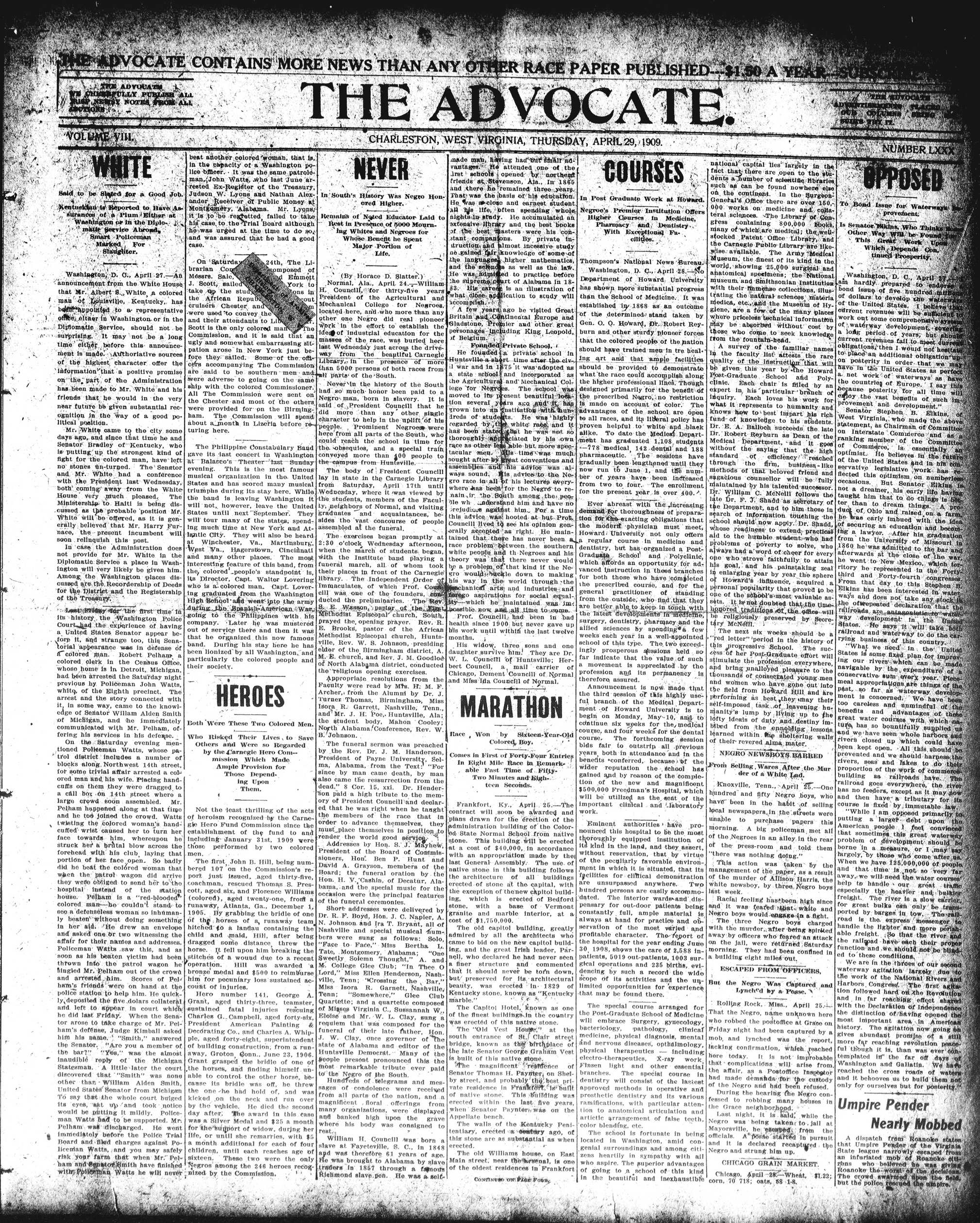
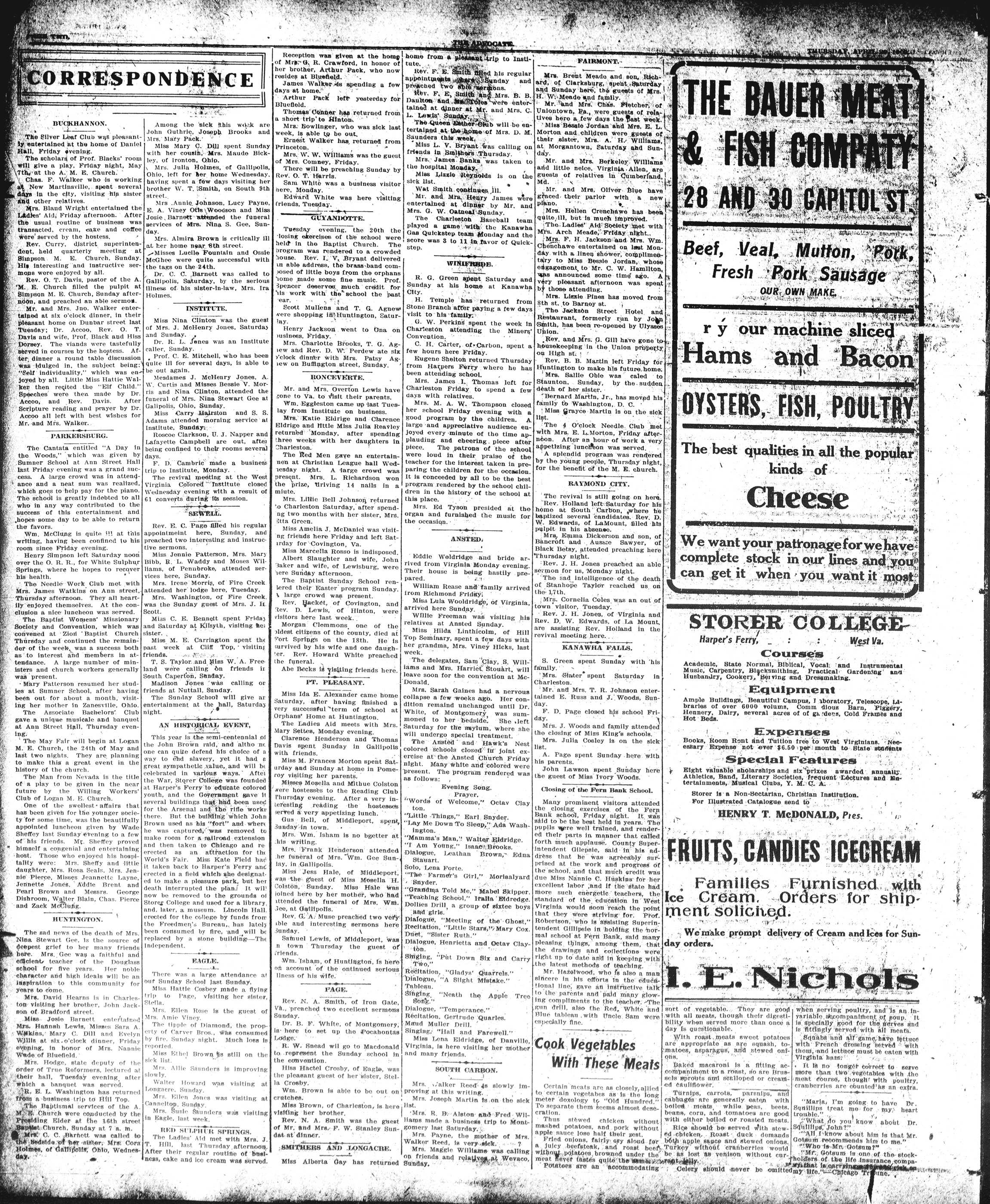
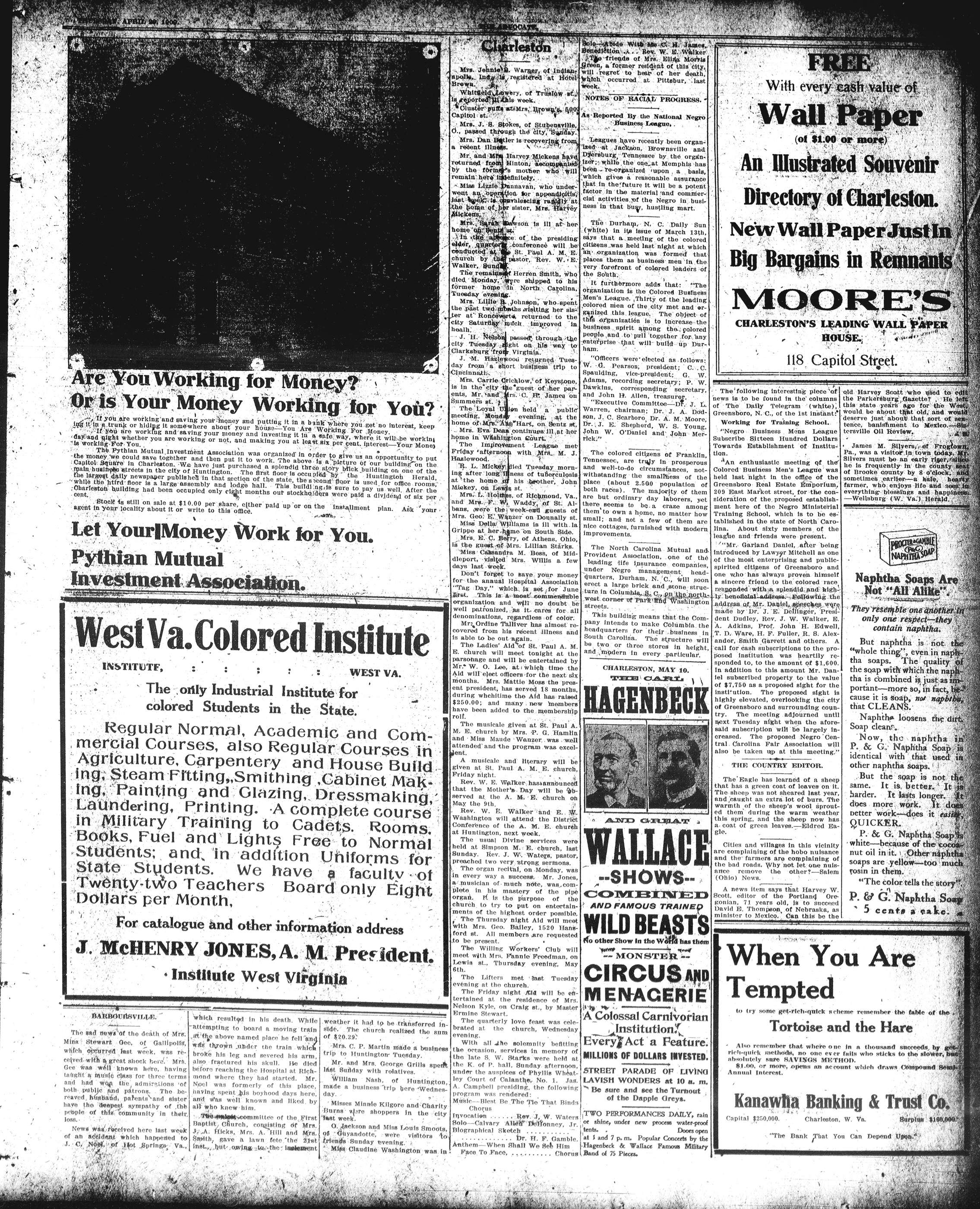
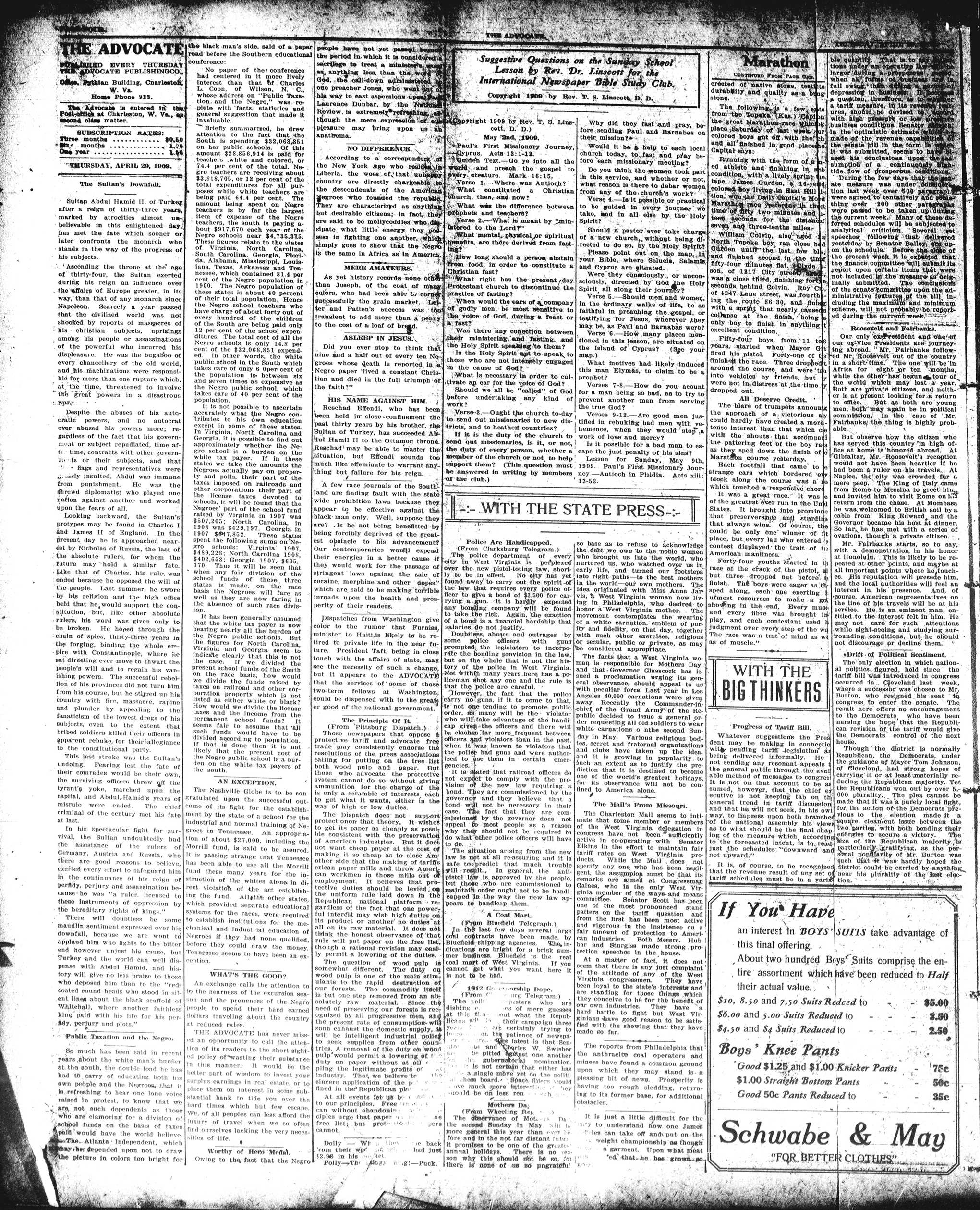
Page text (machine-generated)
Washington, D. G., April 27. An announcement from the White House that Mr. Albert S. White, a colored man of Louisville, Kentucky, has been appointed to a representative office, either in Washington or in the Diplomatic Service, should not be surprising. It may not be a long time either before this announcement is made. Authoritative sources of the highest character offer the information that a positive promise on the part of the Administration has been made to Mr. White and his friends that he would in the very near future be given substantial recognition in the way of a good political position.
Mr. White came to the city some days ago, and since that time he and Senator Bradley of Kentucky, who is putting up the strongest kind of fight for the colored man, have left no stones un-turned. The Senator and Mr. White had a conference with the President last Wednesday, both coming away from the White House very much pleased. The Ministership to Haiti is being discussed as the probable position Mr. White will be offered, as it is generally believed that Mr. Harry Furnace, the present incumbent will soon relinquish this post.
In case the Administration does not provide for Mr. White in the Diplomatic Service a place in Washington will very likely be given him. Among the Washington places discussed are the Recordership of Deeds for the District and the Registership of the Treasury.
Last Friday for the first time in its history the Washington Police Court had the experience of having a United States Senator appear before it, and strange too, this Senatorial appearance was in defense of a colored man. Robert Pelham a colored clerk in the Census Office, whose home is in Detroit, Michigan, had been arrested the Saturday night previous by Policeman John Watts, whit, of the Eighth precinct. The arrest and the story connected with it, in some way, came to the knowledge of Senator William Alden Smith of Michigan, and he immediately communicated with Mr. Pelham, offering his services in his defense.
On the Saturday evening mentioned Polleman Watts, whose patrol district includes a number of blocks along Northwest 14th street, for some trivial affair arrested a colored man and his wife. Placeing handcuffs on them they were dragged to a call box on 14th street where a large crowd soon assembled. Mr. Pelham happened along at that time and he too joined the crowd. Watts twisting the colored woman's handcuffed wrist caused her to turn her face towards him, whereupon he struck her a brutal blow across the forehead with his club, laying that portion of her face open. So badly did he beat the colored woman that when the patrol wagon did arrive they were obliged to send her to the hospital instead of the station house. Pelham is a "red-blooded colored man—he couldn't stand to a defenseman so inhumanly beaten without doing something in her aid. He drew an envelope and asked one or two witnessing the affair for their names and addresses, Policeman Watts saw this, and as soon as his beaten victim had been thrown into the patrol wagon he singled Mr. Pelham out of the crowd and arrested him. Scores of Pelham's friends were on hand at the police station to help him. He quickly deposited the five dollars collateral and left to appear in court which he did last Friday. When the Senator arose to take charge of Mr. Pelham's defense, Judge Kimball asked him his name, "Smith," answered the Senator, "Are you a member of the bar?" "Yes," was the almost inaudible reply of the Michigan Statesman. A little later the court discovered that "Smith" was none other than William Alden Smith, United States Senator from Michigan To say that the whole court bulged his eyes, sat up and took notice would be putting it mildly. Policeman Watts had to be supported. Mr. Pelham was discharged. He went immediately before the Police Trial Board and filed charges against Policeman Watts, and you may safely risk your farm that when Mr. Pelham and Senator Smith have finished with Policeman Watts he will never
beat another colored woman, that is, in the capacity of a Washington police officer. It was the same patrolleeman, John Watts, who last June arrested Ex-Register of the Treasury, Judson W. Lyons and Nathan Alexander Receiver of Public Money at Montgomery, Alabama. Mr. Lyons, it is to be regretted, failed to take his case, to the Trial Board although he was urged at the time to do so, and was assured that he had a good case.
On Saturday, the 24th, The Librarian Commission composed of Messrs. Sale, Merrill and Emmett J. Scott, sailed from New York to take up the study of missions in the African Republic and to cruisers Chester, and to whom were used to convey the news and their attendants to Librarian Scott. It is the only colored man. The Commission, and it is said that an ugly and somewhat embarrassing situation arose in New York just before they sailed. Some of the officers accompanying The Commission are said to be southern men and were adverse to going on the same ship with the colored Commissioner. All The Commission were sent on the Chester and most of the others were provided for on the Birmingham. The Commission will spend about a month in Lizeria before retiring here.
The Philippine Constabulary Band gave its last concert in Washington at Balacco's Theater last Sunday evening. This is the most famous musical organization in the United States and has scored many musical triumphs during its stay here. While the band is leaving Washington it will not, however, leave the United States until next September. They will tour many of the states, spending much time at New York and Atlantic City. They will also be heard at Winchester, Va., Martinsburg, West Va., Hagerstown, Cincinnati and many other places. The most interesting feature of this band, from the colored people's standpoint is, its Director, Capt. Walter Lovering who is a colored man. Capt. Lovering graduated from the Washington High School and went into the army during the Spanish-American War, going to the Philippines with his company. Later he was mustered out of service there and then it was that he organized this now famous band. During his stay here he has been lionized by all Washington, and particularly the colored people and their society.
Who Risked Their Lives, to Save Others and Were so Regarded by the Carnegie Hero Commission Which Made Ample Provision for Those Depend- Upon Them.
Not the least thrilling of the acts of heroism recognized by the Carnegie Hero Fund Commission since the establishment of the fund to and including January 31st, 1909 were those performed by two colored men.
The first, John B. Hill, being numbered 107 on the Commission's report just issued, aged thirty-five, coachman, rescued Thomas S. Prescott, aged six, and Florence Williams (colored), aged twenty-one, from a runaway, Atlanta, Ga., December 1, 1905. By grabbing the bridle of one of the horses of a runaway team hitched to a landau containing the child and maid, Hill, after being dragged some distance, threw the horse. It fell upon him breaking the stitches of a wound due to a recent operation. Hill was awarded a bronze medal and $500 to reimburse him for pecunially loss sustained account of injuries.
Hero number 141, George A. Grant, aged thirty-three, teamster, sustained fatal injuries rescuing Charles G..Campbell, aged forty-six, President American Painting & Decorating Co., and Charles A. Whipple, aged forty-eight, superintendent of building construction, from a runaway, Groton Conn.. June 23, 1906. Grant grasped the bridle of one of the horses, and finding himself unable to control the other horse, because its bridle was off, he threw the one he had hold of, and was kicked on the neck and run over by the vehicle. He died the second day after. The award in this case was a Silver Medal and $25 a month for the support of widow, during her life, or until she remarries, with $5 a month additional for each of four children, until each reaches age of sixteen. These two were the only Negroes among the 246 heroes recognized by the Commission.
In South's History Was Negro Honored Higher.
(By Horace D. Slatter)
Normal, Ala. April 24. William H. Councill, for thirty-five years President of the Agricultural and Mechanical College for Negroes, located here, and who more than any other one Negro did real pioneer work in the effort to establish the idea of industrial education for the masses of the race, was buried here last Wednesday just across the driveway from the beautiful Carnegie Library, in the presence of more than 5000 persons of both races from all parts of the South.
Never \nIn the history of the South had so much honor been paid to a Negro man, born in slavery. It is said of President Councill that he did more than any other single character to help in the uplift of his people. Prominent Negroes were here from all parts of the South, who could reach the school in time for the obsequious, and a special train conveyed more than 400 people to the campus from Hunleyville.
The body of President Council lay in state in the Carnegie Library from Saturday, April 17th until Wednesday, where it was viewed by the students, members of the Faculty, neighbors of Normal, and visiting graduates and acquaintances, besides the vast concourse of people assembled at the funeral.
The exercises began promptly at 2:30 o'clock Wednesday afternoon, when the march of students began, with the Institute band playing a funeral march, all of whom took their places in front of the Carnegie library. The Independent Order of Immaculates, of which Prof. Cousill was one of the founders, conducted the preliminaries. The Rev. S. E. Wasson, pastor of the First Methodist Episcopal church, South, prayed the opening prayer. Rev. R. E. Brooks, pastor of the African Methodist Episcopal church, Huntsville, Rev. W. S. Johnson, presiding elder of the Birmingham district, A. M. E. church, and Rev. J. M. Goodlood of North Alabma district, conducted the religious opening exercises.
Appropriate resolutions from the Faculty were read by Mrs. H. M. F. Archer, from the Alumni by Dr. J. Turner R. Thomas, Birmingham, Miss Isora R. Garrett, Nashville, Tennessee, and Mr. J. H. Poe, Huntsville, Ala; the student body, Mahon Cooley; North Alabama/Conference, Rev. W. B. Johnson.
The funeral sermon was preached by the Rev. Dr. J. M. Handerson, President of Payne University, Selma, Alabama, from the Text." For since by man came death, by man also came the resurrection from the dead." 8 Cor. 15, xxi. Dr. Henderson bald a high tribute to the memory of President Councill and declared that he was right when he taught the members of the race that in order to advance themselves, they must place themselves in position to render the world good service. Addresses by Hon. S. J. Mayhew, President of the Board of Commissioners, Hon.' Ben P. Hunt and David A. Grayson, members of the Board; the funeral oration by the Hon. H. V. Cashin, of Decatur, Alabama, and the special music for the occasion were the principal features of the funeral ceremonies.
Short addresses were delivered by Dr. R. F. Boyd, Hon. J. C. Napier, A. N. Johnson and Ira T. Bryant, all of Nashville and special musical numbers were sung as follows: Solo, "Face to Face," Miss Bertha L. Late, Montgomery, Alabama; "One Sweetly Solemn Thought," A. and M. College Glee Club; "In The O Lord," Miss Ellen Henderson, Nashville, Tenn; "Crossing the Bar," Miss Isora R. Garnett, Nashville, Tenn; "Somewhere," Glee Club Quartette; and a quartette composed of Misses Virginia C., Sussannah W., Eloise and Mr. W. L. Clay, sung a requiem that was composed for the funeral of their late father, Hon. J. W. Clay, once governor of the state of Alabama and editor of the Huntsville Democrat. Many of the people present pronounced this the most remarkable tribute ever paid to the Negro of the South.
Hundreds of telegrams and messages of condolence were received from all parts of the nation, and a magnificent floral offerings from many organizations, were displayed and banked high upon the grave where his body was consigned to rest.
William H. Councilill was born a slave at Fayetteville, S. C., in 1848 and was therefore 61 years of age. He was brought to Alabama by slave traders in 1857 through a famous Rielmond slave pen. He was a self-
made man, having hard but mild advantages. He attended one of the first schools opened by northern friends at Stevenson, Ala., in 1865 and there he remained three years. That was the basis of his education. He was close and earnest student all his life, often spending whole nights in study. He accumulated an extensive library and the best books of the best masters were his constant companions. By private instruction and almost almostive study he gained fair knowledge of some of the languages, higher mathematics, and the sciences as well as the law. He was admitted to practice before the supreme court of Alabama in 1833. His career is an illustration of what close application to study will accomplish.
A few years ago he visited Great Britain and Continental Europe and Gladstone, Premier and other great personages, including King Leopold, if Belgium.
Founded Private School.
Founded Private School. He founded a private school in Huntsville a short time after the civil war and in 1875 it was adopted as a state school and incorporated as the Agricultural and Mechanical College For Negroes. The school was moved to its present location several years ago and it has grown into an institution with hundreds of students. He was highly regarded by the white race and it has been stated that he was not so thoroughly appreciated by his own race as other able but more spectacular men. His time was much sought after by great conventions and assemblies and his advice was always sound. His advice to the Negro race in all of his lectures everywhere has been for the Negro to remain in the South among the people wh. understand him and have no prejudice against him. For a time this advice was hooted at but. Prof. Council lived to see his opinion generally accepted as right. He maintained that there has never been a race problem between the southern white people and the Negroes and his theory was that there never would be a problem of that kind if the Negro would buckle down to making his way in the world through the mechanical arts and industries and foreign aspirations for social equality—which he maintained was impossible now and all time to come. Prof. Council, had been in bad health since 1900 but never gave up his work until within the last twelve months.
His widow, three sons and one daughter survive him! They are Dr. W. L. Councili of Huntsville; Herbert Council, a mail carrier of Chicago; Dement Council of Normal and Miss Ida Council of Normal.
Race , Won by Sixteen-Year-Old Colored Boy.
Frankfort, Ky., April 25.—The contract will soon be awarded and plans drawn for the erection of the administration building of the Colored State Normal School from native stone. This building will be erected at a cost of $40,000, in accordance with an appropriation made by the last General Assembly. The use of native stone in this building follows the architecture of all buildings erected of stone at the capital, with the exception of thenew capital building, which is erected of Bedford stone, with a base of Vermont granite and marble interior, at a cost of $1,750,000.
The old capitol building, greatly admired by all the architects who came to bid on the new capitol building, and the great Irish leader, Parnell, who declared he had never seen a finer structure and commented that it should never be torn down, but preserved for its architectural beauty, was erected in 1829 of Kentucky stone, known as "Kentucky marble."
The Capitol Hotel, known as one of the finest buildings in the country was erected of this native stone.
The "Old Vest Home," at the south entrance of St. Clair street bridge, known as the birthplace of the late Senator George Graham Vest is built of this native stone.
The magnificent residence of Senator Thomas H. Paynter, on Shelby street, and probably the best private residence in Frankfort, the built of native stone. This building was erected within the last five years, when Senator Paynter, was on the Appellate bench. The walls of the Kentucky Penitentiary, erected a century ago, of this stone are as substantial as when erected. The old Williams house, on East Main street, near the senexal, is one of the oldest residences in Frankfort
CONTINUOUS ON PAGE FOUR
Thompson's National News Bureau, Washington, D. C., April 28. No Department of Howard University has shown more substantial progress than the School of Medicine. It was established in 1868 as an outcome of the determined stand taken by Gen. O. O. Howard, Dr. Robert Reyburn and other sturdy pioneers forces that the colored people of the nation should have trained men in the healing art and that ample facilities should be provided to demonstrate what the race could accomplish along the higher professional lines. Though designed primarily for the benefit of the proscribed Negro, no restriction is made on account of color. The advantages of the school are open to all races, and its liberal policy has proven helpful to white and black alike. To date the Medical Department has graduated 1,108 students - 778 medical 142 dental and 188 pharmaceutic. The sessions have gradually been lengthened until they now run to June 1, and the number of years have been increased from two to four. The enrollment for the present year is over 400.
Ever abreast with the increasing demand for thoroughness of preparation for the exacting obligations that the modern physician must meet, Howard University not only offers a regular course in medicine and dentistry, but has organized a Post-Graduate School and Polyclinic, which offers an opportunity for advanced instruction in these branches for both those who have completed the prescribed course, and for the general practitioner of standing from the outside, who find that they are better able to keep in touch with the latest developments in medicine, surgery, dentistry, pharmacy and the allied sciences by spending a few weeks each year in a well-appointed school of this type. The two exceedingly prosperous sessions held so far indicate that the value of such a movement is appreciated by the profession and its permanency is therefore assured.
Announcement is now made that the third session of this highly useful branch of the Medical Department of Howard University is to begin on Monday, May-10, and to continue six weeks for the medical course, and four weeks for the dental course. The forthcoming session bids fair to outstrip all previous years both in attendance and in the benefits conferred, because of the wider reputation the school has gained and by reason of the completion of the new and magnificent $500,000 Freedman's Hospital, which will be utilized as the seat of the important clinical and laboratory work.
Eminent authorities have pronounced this hospital to be the most thoroughly equipped institution of its kind in the land, and they assert, without reservation, that by virtue of the peculiarly favorable environment in which it is situated, that its facilities for clinical demonstration are unsurpassed anywhere. Two hundred persons are easily accommodated. The interior wards and dispensary for out-door patients being constantly full, ample material is always at hand for practice and observation of the most varied and profitable character. The report of the hospital for the year ending June 30, 1908, shows the care of 2,588 inpatients, 5019 out-patients, 1003 surgical operations and 235 births, evidencing by such a record the wide scope of its activities and the unlimited opportunities for experience that may be found there.
The special course arranged for the Post-Graduate School of Medicine will embrace Surgery, gynecology, bacteriology, pathology, clinical medicine, physical diagnosis, mental and nervous diseases, ophthalmology, physical therapeutics — including electro-therapeutics, X-ray work, Finsen light and other essential branches. The special course in dentistry will consist of the fastest approved methods in operative and prosthetic dentistry and its various ramifications, with particular attention to anatomical articulation and artistic arrangement of false teeth, color blending, etc.
The school is fortunate in being located in Washington, amid congenial surroundings and among citizens heartily in sympathy with all who aspire. The superior advantages of going to a school of this kind in the beautiful and inexhaustible
national capital lies largely in the fact that there are open to the students a number of scientific libraries such as can be found nowhere else on the continent. In the Surgeon-Genecal's Office there are over 150,000 works on medicine and collateral sciences. The Library of Congress containing 800,000 books, many of which are medical; the well-stocked Patent, Office Library, and the Carnegie Public Library are likewise available. The Army Medical Museum, the finest of its kind in the world, showing 25,000 surgical and anatomical specimens; the National museum and Smithsonian Institution with their immense collections, illustrating the natural sciences, materia medica, etc., and the Museum of Hygiene, are a few of the many places where priceless technical information may be absorbed without cost by those who come to seek knowledge from the fountain-head.
A survey of the familiar names in the faculty list attests the rare quality of the instruction that will be given this year by the Howard Post-Graduate School and Polyclinic. Each chair is filled by an expert in his particular branch of inquiry. Each loves his work for what it represents to humanity and knows how to best impart his rich fund of knowledge to his students. Dr. E. A. Bailoch succeeds the late Dr. Robert Reyburn as Dean of the Medical Department, and it goes without the saying that the high standard of efficiency reached through the firm, business-like methods of that beloved friend and sagacious counselor will be fully maltained by his talented successor. Dr. William C. McNell follows the late Dr. F. T. Shadd as secretary of the Department, and to him those in search of information touching the school should now apply. Dr. Shadd, whose readiness to extend, practical aid to the humble student, who had problems of poverty to solve, who always had a word of cheer for every one who strove faithfully to attain his goal, and his painstaking zeal in enlarging year by year the sphere of Howard's influence, acquired a personal popularity that proved to be one of the school's most valuable assets. It is not doubted that the time honored traditions of the office will be religiously preserved by Secretary McNell.
The next six weeks should be a "red letter" period in the history of this progressive School. The success of her Post-Graduate effort will stimulate the profession everywhere, and bring unloved pleasure to the thousands of consecrated young men and women who have gone out into the field from Howard Hill and are performing as best they may their self-imposed task of leavening humanity's lump by living up to the lofty ideals of duty and destiny imbued from the ennobling lessons learned within the sheltering walls of their revered alma mater.
NEGRO NEWSBOYS BARRED
From Selling, Wares. After the Mur der of a White Lad.
Knoxville, Tenn., April 25.—One hundred and fifty Negro boys, who have been in the habit of selling local newspapers, in the streets were unable to purchase papers this morning. A big policeman met all of the Negroes in an alley in the rear of the press-room and told them "there was nothing doing." This action was taken by the management of the paper, as a result of the murder of Allison Harris, the white newsboy, by three Negro boys last week. Racial feeling has been high since and it was feared that white and Negro boys would engage in a fight. The three Negro boys charged with the murder, after being spitted away by officers who feared an attack on the jail, were returned Saturday morning. They had been confined in a building eight miles out.
ESCAPED FROM OFFICERS
But the Negro Was Captured and Lynch'd by a Progose.
Rolling Rock, Miss., April 25.
That the Negro, name unknown here who robbed the postoffice at Grace on Friday night had been captured by a mob, and lynched was the report, lacking confirmation, which reached here today. It is not improbable that complications will arise from the affair, as a Postoffice Inspector had made demands for the custody of the Negro and had been refused.
During the hearing the Negro confessed to robbing many houses in the Grace neighborhood.
Last night, it is said, while the Negro was being taken to jail at Mayorsville, he escaped; from the office. A poststar started in pursuit and it is declared recaptured the Negro and strung him up.
CHICAGO GRAIN MARKET
Chicago, April 28--Wheat, $1.22
corn, 70.71; oats, 8.18.
Washington, D. C., April 27 — I am hardly prepared to endorse a bond issue of five hundred millions of dollars to develop the waterways of the United States. I believe that current revenues will be sufficient to work out some comprehensive system of waterway development, sovering a long period of years, but should current revenues fail to meet current obligations, then I would not hesitate to place an additional obligation upon posterity in order that we may have in the United States as perfect a net work of waterways as have the countries of Europe. I say this because posterity for all time will enjoy the vast benefits of such improvement and development."
Senator Stephen B. Elkins, of West Virginia, who made the above statement, as Chairman of Committee on Interstate Commerce and as a ranking member of the Committee of Commerce, is essentially an optimist. He believes in the future of the United States and in his conservative legislative work has reflected this optimism on numberless occasions. But Senator Elkins is not a dreamer, his early life having taught him that to do things is better than to dream things. A product of Ohio and raised on a farm, he was early imbued with the idea of securing an education and becoming a lawyer. After his graduation from the University of Missouri in 1860 he was admitted to the bar and afterwards at the close of the war, he went to New Mexico, which territory he represented in the Forty-third and Forty-fourth congresses. From that day to this Stephen B. Elkins has been interested in waterways and does not take any stock in the oft-appeared declaration that the railroads are antagonistic to waterway development in the United States. He says it will take both railroad and waterway to do the carrying business of this country.
"What we need in the United States is some fixed plan for improving our rivers which can be made navigable by the expenditure of a conservative sum every year. Plessmeal appropriations are things of the past, so far as waterway development is concerned. We have been too careless and unmindful of the benefits and advantages of these great water courses with which nature has so boundfully supplied us and we have seen whole harbors and rivers closed up which could have been kept open. All this should be prevented and we should harness the rivers, seas and lakes to do their proportion of the work of commercial building as railroads have. The railroad goes everywhere, the river has no feeders, except as it may now and then have a tributary for its course is fixed by immutable laws."
"While I am opposed primarily to putting a larger debt upon the American people I feel convinced that sometimes this great waterway problem of development should be borne in a measure, or I may say hargely, by those who come after us. When we have 125,000,000 of people and that time is not so far away, we will need the water course help to handle our great trance especially the heavier and bulkier freight. The river is a slow carrier, for great bulks can only be transported by barges in tow. The railroad is the express messenger to handle the lighter and more portable freight. So that the river and the railroad have each their proper function and we should not be blamed to these conditions.
We are in the throes of our second waterway agitation largely due to the work of the National Rivers and Harbors Congress. The first agitation followed hard on the Revolution and in far reaching effect shared with the Declaration of Independence the distinction of having opened the most important area, in American history. The agitation now going on gives abundant promise of a still more far reaching revolution peaceful though it is, than was ever contemplated in the far off days of Washington and Gallatin. We have reached the cross roads of waters and it behooves us to build them not only for ourselves but for posterity.
Umpire Pender
A dispatch from Roanoke states that Umpire Pender of the Virginia State league narrowly escaped from an infuriated mob of Roanoke citizens who believed he was giving Roanoke the worst of the decisions. The crowd awarded upon the field, but the police rescued the unhit.
CORRESPONDENCE
BUCKHANNON.
The Silver Leaf Club was pleasantly entertained at the home of Daniel Hall, Friday evening.
The scholars of Prof. Blacks' room will give a play, Friday night, May 7th, at the A. M. E. Church.
Chas. F. Walker who is working at New Martinsville, spent several days in the city, visiting his sister and other relatives.
Mrs. Bland Wright entertained the Ladies' Aid, Friday afternoon. After the usual routine of business was transacted, cream, cake and coffee were served by the hostess.
Rev. Curry, district superintendent, held quarterly meeting at Simpson M. E. Church, Sunday. His interesting and instructive sermons were enjoyed by all.
Rev. O. T. Davis, pastor of the A. M. E. Church filled the pulpit at Simpson M. E. Church, Sunday afternoon, and preached an able sermon. Mr. and Mrs. Jno. Walker entertained at six o'clock dinner, in their pleasant home on Dunbar street last Tuesday; Dr. Accoo, Rev. O. T. Davis and wife, Prof. Black and Hiss Dorsey. The viands were tastefully served in courses by the hostess. After dinner a round table discussion was idulged in, the subject being: "Self individuality," which was enjoyed by all. Little Miss Hattie Walker then recited the "Elf Child." Speeches were then made by Dr. Accoo, and Rev. Davis. After Scripture reading and prayer by Dr. Accoo all left with best wishes for Mr. and Mrs. Walker.
PARKERSBURG.
The Cantata entitled "A Day in the Woods," which was given by Sumner School at Ann Street Hall last Friday evening was a grand success. A large crowd was in attendance and a neat sum was realized, which goes to help pay for the piano. The school is greatly indebted to all who in any way contributed to the success of this entertainment and hopes some day to be able to return the favors.
Wm. McClung is quite ill at this writing, having been confined to his room since Friday evening.
Henry Simpson left Saturday noon over the O. R. R., for White Sulphur Springs, where he hopes to recover his health.
The Needle Work Club met with Mrs. James Watkins on Ann street, Thursday afternoon. They all heartily enjoyed themselves. At the conclusion a nice luncheon was served.
The Baptist Womens' Missionary Society and Convention, which was convened at Zion Baptist Church Thursday and continued the remainder of the week, was a success both as to interest and members in attendance. A large number of ministers and church workers generally was present. Mary Patterson resumed her studies at Sumner School, after having been out for about a month, visiting her mother in Zanesville, Ohio. The Associate Bachelors' Club gave a unique musicale and banquet at Ann Street Hall, Thursday evening. The May Fair will begin at Logan M. E. Church, the 24th of May and last two nights. They are planning to make this a great event in the history of the church.
The Man from Nevada is the title of a play to be given in the near future by the Willing Workers' Club of Logan M. E. Church.
One of the swellest affairs that has been given for the younger society for some time, was the beautifully appointed luncheon given by Wade Sheffey last Sunday evening to a few of his friends. Mr. Sheffey proved himself a congenial and entertaining host. Those who enjoyed his hospitality were: Mrs. Sheffy and little daughter, Mrs. Rosa Seals, Mrs. Jennie Pierce, Misses Jeannette Layne, Jennette Jones, Addie Brent and Pearl Brown and Messrs. George Dishroom, Walter Blain, Chas. Pierce and Zack McClung.
HUNTINGTON
The sad news of the death of Mrs. Nina Stewart Gee, is the source of deepest grief to her many friends here. Mrs. Gee was a faithful and efficient teacher of the Douglass school for five years. Her noble character and high ideals will be an inspiration to this community for years to come.
Mrs. David Hearns is in Charleston visiting her brother, John Jackson of Bradford street.
Miss Josie Barnett entertained Mrs. Hannah Lewis, Misses Sara A. Wakins, Mary C. Dill and Evelyn Willis at six o'clock dinner, Friday evening, in honor of Mrs. Nannie Wade of Bluefield.
Mrs. Hodge, state deputy of the order of True Reformers, lectured at their hall, Tuesday evening, after which a banquet was served.
Among the sick this week are John Guthrie, Joseph Brooks and Mrs. Mary Pack.
Miss Mary C. Dill spent Sunday with her cousin Mrs. Maude Bickley, of Ironton, Ohio.
Mrs. Julla Holmes, of Gallipollis, Ohio, left for her home Wednesday, having spent a few days visiting her brother W. T. Smith, on South 9th street.
Mrs. Annie Johnson, Lucy Payne, E. A. Viney Otis Woodson and Miss Josie, Barnett attended the funeral services of Mrs. Nina S. Gee, Sunday.
Misses Lucile Fountain and Ossie McGhee were quite successful with the tags on the 24th. Dr. C. C. Barnett was called to Gallipolis, Saturday, by the serious illness of his sister-in-law, Mrs. Ira Holmes.
INSTITUTE
Miss Nina Clinton was the guest of Mrs. J. McHenry Jones, Saturday and Sunday.
Dr. R. L. Jones was an Institute caller, Sunday.
Prof. C. E. Mitchell, who has been quite ill for several days, is able to be out again.
Mesdames J. McHenry Jones, A. W. Curtis and Misses Bessie V. Morris and Nina Clinton, attended the funeral of Mrs. Nina Stewart Gee at Galipolis, Ohio, Sunday.
Miss Carry Hairston and S. S. Adams attended morning service at Institute, Sunday.
Roscoe Clarkson, U. J. Napper and Lafayette Campbell are out, after being confined to their rooms several days.
F. D. Cambric made a business trip to Institute, Monday.
The revival meeting at the West Virginia Colored Institute closed Wednesday evening with a result of 61 converts during its session.
SEWELL.
Rev. E. C. Page filled his regular appointment here, Sunday, and preached two interesting and instructive sermons.
Miss Jennie Patterson, Mrs. Mary Bibb, R. L. Waddy and Moses Williams, of Pennbroke, attended services here, Sunday.
Mrs. Irene Morris, of Fire Creek attended her lodge here, Tuesday.
Mrs. Washington, of Fire Creek was the Sunday guest of Mrs. J. H. Scott.
Miss C. E. Bennett spent Friday and Saturday at Kilsyth, visiting her sister.
Miss M. E. Carrington spent the past week at Cliff Top, visiting friends.
T. S. Taylor and Miss W. A. Freeland were calling on friends in South Caperton, Sunday.
Madison Jones was calling or friends at Nuttall, Sunday.
The Sunday School will give an entertainment at the hall, Saturday night.
AN HISTORICAL EVENT
This year is the semi-centennial of the John Brown raid, and altho one can quite defend his choice of a way to end slavery, yet it had a great sympathetic value, and will be celebrated in various ways. After the War, Storer College was founded at Harper's Ferry to educate colored youth, and the Government gave it several buildings that had been used for the Arsenal and the rifle works there. But the building which John Brown used as his "fort" and where he was captured, was removed to make room for a railroad extension and then taken to Chicago and re-erected as an attraction for the World's Fair. Miss Kate Field had it taken back to Harper's Ferry and erected in a field which she designated to make a pleasure park, but her death interrupted the plan. It will now be removed to the grounds of Storer College and used for a library, and, later, a museum. Lincoln Hall erected for the college by funds from the Freedmen's Bureau, has lately been consumed by fire, and will be replaced by a stone building—The Independent.
EAGLE.
Mrs. Ellen Rose is the guest of Mrs. Amie Viney.
The tipple of Diamond, the property of Carver Bros., was consumed by fire. Sunday night. Much loss is reported.
Miss Ethel Brown is still on the sick list.
Mrs. Allie Saunders is improving slowly.
Walter Howard was visiting at Longacre, Sunday.
Mrs. Ellen Jones was visiting at Cannellton, Sunday.
Mrs. Susie Saunders was visiting in Eagle, last week.
RED SULPHUR SPRINGS.
The Ladies' Aid met with Mrs. J. T. Hill, last Thursday afternoon. After their regular routine of business, cake and ice cream was served.
Reception was given at the homest of Mrs. G. R. Crawford, in honor of her brother, Arthur Pack, who now resides at Bluefield.
James Walker is spending a few days at home.
Arthur Pack left yesterday for Bluefield.
Thomas Conner has returned from a short trip to Hinton.
Mrs. Bowlinger, who was slick last week, is able to be out.
Ernest Walker has returned from Princeton.
Mrs. W. W. Williams was the guest of Mrs. Conney, Friday. There will be preaching Sunday by Rev. O. T. Harris.
Sam White was a business visitor here, Monday.
Edward White was here visiting friends, Tuesday.
GUYANDOTTE
Tuesday evening, the 20th the closing exercises of the school were held in the Baptist Church. The program was rendered to a crowded house. Rev. I. V. Bryant delivered an able address, the brass-band composed of little boys from the orphans home made some fine music. Prof. Spencer deserves much credit for his work with the school the past year.
Scott Mullens and T. G. Agnew were shopping in Huntington, Saturday.
Henry Jackson went to Ona on business, Friday.
Mrs. Charlotte Brooks, T. G. Agnew and Rev. D. W. Perdew ate six clock dinner with Mrs. Patsy Agnew on Buffington street, Sunday.
RONCEVERTE.
Mrs. Katie Eldrige and Clarence Eldrige and Little Miss Julia Reavley returned Monday, after spending three weeks with her daughters in Charleston.
The Red Men gave an entertainmen at Christian League hall Wednesday night. A large crowd was present. Mrs. L. Richardson won the prize, driving 14 nails in a minute.
Mrs. Lillie Bell Johnson returned to Charleston Saturday, after spending two months with her sister, Mrs.itta Green.
Miss Amelia J. McDaniel was visiting friends here Friday and left Saturday for Covington, Va.
Miss Marcella Rosso is indisposed, Albert Slaughter and wife, John Baker and wife, of Lewisburg, were here Sunday afternoon.
The Baptist Sunday School rendered their Easter program Sunday. A large crowd was present.
Rev. Hacket, of Covington, and Rev. D. Lewis, of Hinton, were visitors here last week.
Morgan Clemmons, one of the oldest citizens of the county, died at Fort Springs on the 18th. He is survived by his wife and one daughter. Rev. Howard White preached the funeral.
Abe Becks is visiting friends here.
PT. PLEASANT.
Miss Ida E. Alexander came home Saturday, after having finished a very successful "term of school at Orphans' Home at Huntington.
The Ladies Aid meets with Mrs. Mary Settes, Monday evening.
Clarence Henderson and Thomas Davis spent Sunday in Gallipolis with friends.
Miss M. Frances Morton spent Saturday and Sunday at home in Pomeroy visiting her parents.
Misses Mosella and Mithue Colston were hostesses to the Reading Club Thursday evening. After a very interesting reading the hostesses served a very appetizing lunch.
Gus Bell, of Middleport, spent Sunday in town.
Mrs. Wm. Isham is no better at his writing.
Mrs. Frank Henderson attended the funeral of Mrs. Wm. Gee Sunlay, in Gallipolis.
Miss Jess Hale, of Middleport, was the guest of Miss Mosella H. Colston, Sunday. Miss Hale was joined here by her mother, who had attended the funeral of Mrs. Wm. Jee, at Gallipolis.
Rev. G. A. Muse preached two very able and interesting sermons here Sunday.
Samuel Lewis, of Middleport, was n town Thursday the guest of friends.
Wm. Isham, of Huntington, is here on account of the ontinued serious illness of his wife.
FAGE.
Rev. N. A. Smith, of Iron Gate, Va., preached two excellent sermons Sunday.
Dr. B. F. White, of Montgomery, is here to set up the Pocahontas Lodge.
R. W. Snead will go to Macdonald to represent the Sunday school in the convention.
Hiss Hactel Crosby, of Eagle, was the pleasant guest of her sister, Stella Crosby.
Wm. Brown is able to be out on crutches.
Rev. N. A. Smith was the guest of Mr. and Mrs. F. W. Stanley Sundat at dinner.
SMITHERS AND LONGACRE.
Miss Alberta Gay has returned
home from a pleasant trip to Institute.
Rev. F. E. Smith filled his regular appointments. Mrs. Sunday and preached two able sermons.
Rev. F. E, Smith and Mrs. B. B. Dautton and Mrs. Notes were entertained at dinner at Mr. and Mrs. C. L. Lewis' Sunday.
The Queen Esther Club will be entertained at the home of Mrs. D. M. Saunders this week.
Miss L. V. Bryant was calling on friends in Smithers Thursday.
Miss Lizzle Reynolds is on the sick list.
Wat Smith continues ill.
Mr. and Mrs. Henry James were entertained at dinner by Mr. and Mrs. G. W. Oatmeal Sunday.
The Charleston Baseball team played a game with the Kanawha Gas Quickstep team Monday and the score was 3 to 11 in favor of Quickstep.
WINIFREDE.
R. G. Green apent Saturday and Sunday at his home at Kanawha City.
H. Temple has returned from Stone Branch after paying a few days visit to his family.
G. W. Perkins spent the week In Charleston attending the Miners' Convention.
C. H. Carter, of Carbon, spent a few hours here Friday.
Eugene Shelton returned Thursday from Harpers Ferry where he has been attending school.
Mrs. James I. Thomas left for Charleston Friday to spend a few days with relatives.
Mrs. M. A. W. Thompson closed her school Friday evening with a good program by the children. A large and appreciative audience enjoyed every minute of the time applauding and cheering piece after piece. The patrons of the school were loud in their praise of the teacher for the interest taken in preparing the children for the occasion. It is conceded by all to be the best program rendered by the school children in the history of the school at this place.
Mrs. Ed Tyson presided at the organ and furnished the music for the occasion.
ANSTED
Eddie Woldridge and bride arrived from Virginia Monday evening. Their house is being hastily prepared. William Rease and family arrived from Richmond Friday.
Miss Hilda Linthicolm, of Hill Top Seminary, spent a few days with her grandma, Mrs. Viney Hicks, last week.
The delegates, Sam Clay, S. Williams and Mrs. Harriet Stouart, will leave soon for the convention at McDonald.
Mrs. Sarah Gaines had a nervous collapse a few weeks ago. Her condition remained unchanged until Dr. White, of Montgomery, was summoned to her bedside. She left Saturday for the maylum, where she will undergo special treatment.
The Ansted and Hawk's Nest colored schools closed in joint exercise at the Ansted Church Friday night. Many white and colored were present. The program rendered was as follows:
Evening Song.
"Words of Welcome," Octav Clayton.
"Little Things," Earl Snyder.
"Lay Me Down To Sleep," Ada Washington.
"Mamma's Man," Walter Eldridge.
"I Am Young," Isaac Brooks.
Dialogue, Leathan Brown, Edna Stauart.
Solo, Lena Forte.
"The Farmer's Girl," Moriaalyard Snyder.
"Grandma Told Me," Mabel Skipper.
"Teaching School," Iralla Eldredge.
Dollies Drill, a group of sixtee boys and girls.
Dialogue, "Meeting of the Ghost," Recitation, "Little Stars," Mary Cox.
Duet, "Sister Ruth."
Dialogue, Henrietta and Octav Clayton.
Singling, "Put Down Six and Carry Two."
Recitation, "Gladys' Quarrels."
Dialogue, "A Slight Mistake."
Tableau.
Singling, "Neath the Apple Tree Sonk."
Singing; "Hail and Farewell."
Miss Lena Eldridge, of Danville, Virginia, is here visiting her mother and many friends.
SOUTH CARBON.
Mrs. Walker Reed is slowly improving at this writing.
Mrs. Joseph Martin is on the sick list.
Mrs. R. B. Alston and Fred Williams made a business trip to Montgomery last Saturday.
Mrs. Payne, the mother of Mrs. Walker Reed, is very sick. ?
Mrs. Maggie Williams was calling on friends and relatives at Wevaco, Sunday.
Mrs. Brent Meado and son, Richard, of Clarkburg, spent Saturday and Sunday here, the guests of Mrs. H. W. Meade and family.
Mr. and Mrs. Chas. Fletcher, of Unlontown, Pa., were guests of relatives here a few days the past week.
Miss Bessie Jordan and Mrs. E. L. Morton and children were guests of their sister, Mrs. A. H. Williams, at Morgantown, Saturday and Sunday.
Mr. and Mrs. Berkeley Williams and little neice, Virginia Allen, are guests of relatives in Cumberland, Md.
Mrs. Hellen Crenchchawe has been quite ill, but is much improved.
The Ladies' Aid Society met with Mrs. Arch Meade, Friday night...
Mrs. F. H. Jackson and Mrs. Wm. Chenchchawe entertained on last Monday with a linen shower, complimentary to Miss Bessie Jordan, whose engagement to Mr. C. W. Hamilton, was announced some time ago. A very pleasant afternoon was spent by those attending.
Mrs. Lizzie Pines has moved from 8th st. to Barney st.
The Jackson Street Hotel and Restaurant, formerly run by John Smith, has been re-opened by Ulysses Union.
Rev. and Mrs. G. Gill have gone to housekeeping in the Union property on High st.
Rev. B. B. Martin left Friday for Huntington to make his future home. Mrs. Sallie Oble was caled to Staunton. Sunday, by the sudden death of her sister. Bernard Martin, Jr., has moved his family to Washington, D. C. Miss Grayce Martin is on the sick list. The 4 O'clock Needle Club met with Mrs. E. L. Morton, Friday afternoon. After an hour of work a very appetizing lunchoon was served. A splendid program was rendered by the young people, Thursday night, for the benefit of the M. E. church.
RAYMOND CITY.
The revival is still going on here. Rev. Holland left Saturday for his home at South Carbon, where he baptized several candidates. Rev. D. W. Edwards, of LaMount, filled his pulpit in his absence. Mrs. Emma Dickerson and son, of Bancroft and Aussie Sawyer, of Black Betsy, attended preaching here Thursday night. Rev. J. H. Jones preached an able sermon for us, Monday night. The sad intelligence of the death of Stanhope Taylor reached us on the 17th. Mrs. Cornelia Coles was an out of town visitor, Tuesday.
KANAWHA FALLS.
S. Green spent Sunday with his family.
Mrs. Slater spent Saturday in Charleston.
F. D. Page closed his school Friday.
A. Page spent Sunday here with his parents.
John Lawson spent Sunday here the guest of Miss Ivory Woods.
Closing of the Fern Bank School.
Many prominent visitors attended the closing exercises of the Fern Bank school, Friday night. It was said to be the best held in years. The pupils were well trained, and rendered their parts in manner that called forth much applause. County Superintendent Gilepispe, said in his address that he was agreeably surprised at the work and progress of the school, and that much credit was due Miss Nannie C. Huskins for her excellent labor, and if the state had more such energetic teachers, the standard of the education in West Virginia would soon reach the point that they were striving for. Prof. Robertson, who is assisting Superintendent Gillpispe in holding the normal school at Fern Bank, said many pleasing things, among them, that the drawings and collections were right up to date and in keeping with the latest methods of teaching.
Mr. Hazelwood, who is also a man sincere in his efforts in the educational line, gave an instructive talk to the parents and paid many glowing compliments to the teacher. The gun drill, also the Red, White and Blue tableau, with Uncle Sam were especially fine.
Cook Vegetables With These Meats
Cook Vegetables With These Meats
Certain meats are as closely, allied to certain vegetabes as is the long meter doxology to "Old Hundred." To separate them seems almost desecration.
Thus stewed chicken without mashed potatoes, and pork without apple sauce lose half their zest.
Fried onions, fairly ary aloud for a julky beefsteak, and roast beef without potatoes browned under the meat never tastes quite the same.
Potatoes are an accommodating
Beef, Veal, Mutton, Pork, Fresh Pork Sausage OUR OWN MAKE.
We want your patronage for we have complete stock in our lines and you can get it when you want it most
STORER COLLEGE Harper's Ferry. West Va.
Harper's Ferry, : : West Va.
Courses
Academic, State Normal, Biblical, Vocal and Instrumental Music, Carpentry, Blacksmithing, Practical Gardening and Husbandry, Cookery, Serving and Dressmaking.
Equipment
Ample Buildings, Beautiful Cars
braries of over 6000 volumes,
Hennery, Dairy, several acres,
Hot Beds.
Expo
Books, Room Rent and Tuition
essary Expense not over $6.5.
Special I
Eight valuable scholarships and
Athletics, Band, Literary Socie
tertainments, Musical Clubs, Y
Storer is a Non-Sectarian, C
For Illustrated Catalogue se
Ample Buildings, Beautiful Campus, Laboratory, Telescope, Libraries of over 6000 volumes, Comm dous Barn, Piggery, Hennery, Dairy, several acres of of gardens, Cold Frames and Hot Beds.
Expenses
Books, Room Rent and Tuition free to West Virginians. Necessary Expense not over $6.50 per month to State students.
Room Rent and Tuition free to West Virginia Expense not over $6.50 per month to Sta
Special Features
valuable scholarships and six prizes awarded
Band, Literary Societies, frequent Lecture
ents, Musical Clubs, Y. M. C. A.
It is a Non-Sectarian, Christian Institution.
Illustrated Catalogue send to
Special Features
Eight valuable scholarships and six prizes awarded annually. Athletics, Band, Literary Societies, frequent Lectures and Entertainments, Musical Clubs, Y. M. C. A.
Storer is a Non-Sectarian, Christian Institution.
For Illustrated Catalogue send to
HENRY T. McDONALD, Pres.
FRUITS, CAND
Families
Ice Cream. O
ment solicited.
We make prompt delive
day orders.
I. E. N
TS, CANDIES ICE
families Furnishe
ream. Orders for
solicited.
take prompt delivery of Cream and
E. Nich
FRUITS, CANDIES ICECREAM
Families Furnished with Ice Cream. Orders for shipment solicited.
We make prompt delivery of Cream and Ices for Sunday orders.
I. E. Nichols
sort of vegetable. They are good with all meats, though their digestibility when served more than once a day is questionable.
when serving poultry, and is an invariable accompaniment of soup. It is specially good for the serves and is fittingly served with all meats.
With roast meats sweet potatoes are appropriate as are squash, tomatoes, asparagus, and stewed onions.
Baked macaroni is a fitting accompaniment to a roast, so are Brussels sprouts and scalloped or creamed cauliflower.
Turnips, carrots, parsnips, and cabbages are generally eaten with boiled meats, while peas, beets, beans, corn, and tomatoes are good with either boiled or roasted meats.
Rice should be served with stewed chicken. Roast duck demands both apple sauce and stewed onions. Turkey without cranberries would be as lost as venison without currant tally.
in free to West Virginians. Nee-
50 per month to State students
Features
six prizes awarded annually
ties, frequent Lectures and Ma-
Y. M. C. A.
Christian Institution.
end to
DIES ICECREAM
Furnished with
orders for ship-
ery of Cream and Ices for Sun-
ichols
when serving poultry, and is an invariable accompaniment of soup. It is specially good for theerves and is fatingly served with all meats. Squabs and all game have lettuce with French dressing served with them, and lettuce must be eaten with Virginia ham.
It is no longer correct to serve more than two vegetables with the meat course, though with poultry, cranberries are counted as an extra.
"Marla, I'm going to have Dr. Squillips treat me for my heart trouble."
"What do you know about Dr. Squillips, John?"
"All I know about him is that Mr. Gotsum recommends him to me."
"Who is Mr. Gotsum?"
"Mr. Gotsum is one of the stockholders of the life insurance company that is caring for you."
1
Are You Working for Money? Or is Your Money Working for You?
If you are working and saving your money and putting it in a bank where you get no interest, keep it in a trunk or hiding it somewhere about your house—You Are Working For Money. If you are working and saving your money and investing it in a safe way, where it will be working day and night whether you are working or not, and making you at least six per cent, interest—Your Money is working For You.
The Pythian Mutual Investment Association was organized in order to give us an opportunity to put the money we could save together and then put it to work. The above is a picture of our building on the Capitol Square in Charleston. We have just purchased a splendid three story brick building on one of the main business streets in the city of Huntington. The first floor is occupied by the Huntington Herald, the largest daily newspaper published in that section of the state, the second floor is used for office rooms, while the third floor is a large assembly and lodge hall. This building is sure to pay us well. After the Charleston building had been occupied only eight months our stockholders were paid a dividend of six per cent.
Stock 14 still on sale at $10.00 per share, either paid up or on the installment plan. Ask your agent in your locality about it or write to this office.
Investment Association.
WestVa.Colored Institute
INSTITUTE, WEST VA. The only Industrial Institute for colored Students in the State.
Regular Normal, Academic and Commercial Courses, also Regular Courses in Agriculture, Carpentery and House Building, Steam Fitting, Smithing, Cabinet Making, Painting and Glazing, Dressmaking, Laundering, Printing. A complete course in Military Training to Cadets. Rooms. Books, Fuel and Lights Free to Normal Students; and, in addition Uniforms for State Students. We have a faculty of Twenty-two Teachers Board only Eight Dollars per Month,
The sad news of the death of Mrs. Mina Stewart Gee, of Gallipolis, which occurred last week, was received with a great shock here. Mrs. Gee was well known here, having taught a music class for three terms and had won the admirations of both public and patrons. The bereaved husband, parents and sister have the deepest sympathy of the people of this community in their loss.
News was received here last week of an accident which happened to J. C. Noel, of Hot Springs, Va.,
which resulted in his death. While attempting to board a moving train at the above named place he fell and was thrown under the train which broke his leg and severed his arm, also fractured his skull. He died before reaching the Hospital at Richmond where they had started. Mr. Noel was formerly of this place, having spent his boyhood days here, and was well known and liked, by all who knew him.
The joint committee of the First Baptist Church, consisting of Mrs. J. A. Hicks, Mrs. A. Hill and Mrs. Smith, gave a lawn fete the 21st inst., but owing to the inclement
weather it had to be transferred inside. The church realized the sum of $20.29.
Mrs. C. P. Martin made a business trip to Huntington Tuesday.
Mr. and Mrs. George Grills spent last Sunday with relatives.
William Nash, of Huntington, made a business trip here Wednesday.
Misses Minnie Kiligore and Charity Burns were shoppers in the city last week.
O. Jackson and Miss Louis Smoots, of Guyandotte, were visitors to friends Sunday evening.
Miss Claudine Washington was in
Whitfield Lowery, of Truslow st. is reported ill this week. Cluster puns at Mrs. Brown's, 500 Capitol st. Mrs. J. S. Stokes, of Stubenaville, O., passed through the city, Sunday. Mrs. Dan Butler is recovering from a recent illness.
Mr. and Mrs Harvey Mickens have returned from Hinton, accompanied by the former mother who will remain here intently.
Miss Lizzie Dunnavan, who underwent an operation for appendicitis, last week, is convalescing rapidly at the home of her sister, Mrs. Harvey Mickens.
Mrs. Sarah Dawson is ill at her home on Sentit st.
In the absence of the presiding elder, quarterly conference will be conducted at the St. Paul A. M. E. church by the pastor, Rev. W. E. Walker, Sunday.
The remains of Herren Smith, who died Monday, were shipped to his former home in North Carolina, Tuesday evening.
Mrs. Lillie B. Johnson, who spent the past two months visiting her sister at Ronceverte, returned to the city Saturday much improved in health.
J. H. Nelson passed through the city Tuesday night on his way to Clarksburg from Virginia.
J. M. Hazlewood returned Tuesday from a short business trip to Cincinnati.
Mrs. Carrie Cricchlow, of Keystone, is in the city the guest of her parents, Mr. and Mrs. C. H. James on Summers st.
The Loyal Union held a public meeting, Monday evening, at the home of Mrs. Ann Hart, on Sentz st. Mrs. Eva Dean continues ill at her home in Washington Court.
The Improvement League met Friday afternoon with Mrs. M. J. Hazlewood.
R. L. Mickey died Tuesday morning after long illness of tuberculosis at the home of his brother, John Mickey, on Lewis st.
Mrs. L. Holmes, of Richmond, Va., and Mrs. F. W. Waddy, of St. Albans, were the week-end guests of Mrs. Geo: E. Wanzer on Donnally st.
Miss Della Williams is ill with la Grippe at her home on South Side. Mrs. E. C. Berry, of Athens, Ohio, is the guest of Mrs. Lillian Starks.
Miss Cassandra M. Bess, of Middleport, visited Mrs. Willis a few days last week.
Don't forget to save your money for the annual Hospital Association "Tag Day," which is set for June first. This is a most commendable organization and will no doubt be well patronized, as it cares for all denominations, regardless of color. Mr. Ordine Talliver has almost recovered from his recent illness and is able to be out again.
The Ladies' Aid of St. Paul A. M. E. church will meet tonight at the parsonage and will be entertained by Mr. W. O. Lee, at which time the Aid will elect officers for the next six months. Mrs. Mattie Moss the present president, has served 18 months, during whchitime the Aid has raised $250.00; and many new members have been added to the membership roll.
The musicale given at St. Paul A. M. E. church by Mrs. P. G. Hamlin and Miss Maude Wanzer, was well attended and the program was excellent.
A musicale and literary will be given at St. Paul A. M. E. church, Friday night.
Rev. W. E. Walker has announced that the Mother's Day will be observed at the A. M. E. church on May the 9th.
Rev. W. E. Walker and E. W. Washington will attend the District Conference of the A. M. E. church at Huntington, next week.
The usual Divine services were held at Simpson M. E. church, last Sunday. Rev. J. W. Waters, pastor, preached two very strong sermons. The organ recital, on Monday, was in every way a success. Mr. Jones, a musician of much note, was, complete in his mastery of the pipe organ. It is the purpose of the church to try to put on entertainments of the highest order possible. The Thursday night Ald will meet with Mrs. Geo. Bailey, 1520 Hansford st. All members are requested to be present. The Willing Workers' Club will meet with Mrs. Fannie Freedman, on Lewis st., Thursday evening, May 6th. The Lifters met last Tuesday evening at the church.
The Friday night A&A will be entertained at the residence of Mrs. Nelson Kyle, on Craig st., by Master Ermine Stewart.
The quarterly love feast was celebrated at the church, Wednesday evening.
With all the solemnity befitting the occasion, services in memory of the late S. W. Starks were held at the K. of P. hall, Sunday afternoon, under the auspices of Phyllis Wheatley Court of Calanthe, No. 1. Jas. A. Campbell presiding, the following program was rendered:
Music—Blest Be The Tie That Binds Chorus
Invocation .... Rev. J. W. Waters
Solo—Calvary Allah DeHonney, Jr.
Blographical Sketch
..... Dr. H. F. Gamble.
Anthem—When Shall We See Him
Face To Face,
Sole - Abide With Me C. H. James.
Benediction A... Rev. W. E. Walker.
The friends of Mrs. Elise Morris
Green, a former resident of this city,
will regret to hear of her death,
which occurred at Pittsbur, last
week.
As Reported By the National Negro Business League.
Leagues have recently been organized at Jackson, Brownsville and Dyersburg, Tennessee by the organizer; while the one at Memphis has been re-organized upon a basis, which gives a reasonable assurance that in the future it will be a potent factor in the material and commercial activities, of the Negro in business in that busy, hustling mart.
The Durham, N. C. Dally Sun (white) in its issue of March 13th, says that a meeting of the colored citizens was held last night at which an organization was formed that places them as business men in the very forefront of colored leaders of the South.
It furthermore adds that: "The organization is the Colored Business Men's League. Thirty of the leading colored men of the city met and organized this league. The object of this organization is to increase the business spirit among the colored people and to pull together for any enterprise that will build up Durham.
"Officers were elected as follows: W. G. Pearson, president; C. C. Spaulding, vice-president; G. W. Adams, recording secretary; P. W. Dawkins, corresponding secretary, and John H. Allen, treasurer.
"Executive Committee—Dr. J. L. Warren, chairman; Dr. J. A. Dodson, J. C. Scarboro, Dr. A. M. Moore, Dr. J. E. Shepherd, W. S. Young, John W. O'Daniel and John Merrick."
The colored citizens of Franklin, Tennessee, are truly in prosperous and well-to-do circumstances, notwithstanding the smallness of the place (about 2.500 population of both races). The majority of them are but ordinary day laborers, yet there seems to be a craze among them to own a home, no matter how small; and not a few of them are nice cottages, furnished with modern improvements.
The North Carolina Mutual and Provident Association, one of the leading life insurance companies, under Negro management, headquarters, Durham, N. C., will soon erect a large brick and stone structure in Columbia, S. C., on the north-west corner of Park and Washington streets.
This building means that the Company intends to make Columbia the headquarters for their business in South Carolina. The structure will be two or three stores in height, and modern in every particular.
CHARLESTON, MAY 10.
THE CARL
HAGENBECK
AND GREAT
WALLACE
--SHOWS--
COMBINED
AND FAMOUS TRAINED
WILD BEASTS
No other Show in the World has them
MONSTER
CIRCUS AND MENAGERIE A Colossal Carnivorian Institution.
STREET PARADE OF LIVING
LAVISH WONDERS at 10 a. m.
Be sure and see the Turnout of the Dapple Greys.
TWO PERFORMANCES DAILY, rain or shine, under new process water-proof tents. Doors open at 1 and 7 p.m. Popular Concerts by the Hagenbeck & Wallace Famous Military Band of 75 Pieces.
FREE
With every cash value of
Wall Paper
(of $1.00 or more)
An Illustrated Souvenir
Directory of Charleston.
New Wall Paper Just In
Big Bargains in Remnants
MOORE'S
CHARLESTON'S LEADING WALL PAPER
HOUSE.
118 Capitol Street.
When You Are Tempted
Also remember that where one in a thousand succeeds, by get- rich-quick methods, no one ever fails who sticks to the slower, but absolutely sure SAVINGS METHOD. $4.00, or more, opens an account which draws Compound Savings.
The following interesting piece of news is to be found in the columns of The Daily Telegram (white), Greensboro, N.C., of the 1st instant. Working for Training School. "Negro Business Mens League Subscribe Sirteen Hundred Dollars Towards Establishment of Institution. An enthusiastic meeting of the Colored Business Men's League was held last night in the office of the Greensboro Real Estate Emporium, 209 East Market street, for the consideration of the proposed establishment here of the Negro Ministerial Training School, which is to be established in the state of North Carolina. About sixty members of the league and friends were present.
"Mr. Garland Daniel, after being introduced by Lawyer Mitchell as one of the most enterprising and public-spirited citizens of Greensboro and one who has always proven himself a sincere friend to the colored race responded with a splendid and highly beneficial address. Following the address of Mr. Daniel, speeches were made by Dr. J. E. Dellinger, President Dudley, Rev. J. W. Walker, E. A. Adkins, Prof. John H. Edwell, T. D. Ware, H. F. Fuller, R. S. Alexander, Smith Garrett and others. A call for cash subscriptions to the proposed institution was heartily responded to, to the amount of $1,600. In addition to this amount Mr. Daniel subscribed property to the value of $7,750 as a proposed sight for the institution. The proposed sight is highly elevated, overlooking the city of Greensboro and surrounding country. The meeting adjourned until next Tuesday night when the aforesaid subscription will be largely increased. The proposed Negro Central Carolina Fair Association will also be taken up at this meeting."
THE COUNTRY EDITOR.
The Eagle has learned of a sheep that has a green coat of leaves on it. The sheep was not sheared last year, and caught an extra lot of burs. The warmth of the sheep's wool sprouted them during the warm weather this spring, and the sheep now has a coat of green leaves.—Eldred Eagle.
Cities and villages in this vicinity are complaining of the hobo nuisance and the farmers are complaining of the bad roads. Why not let one nuisance remove the other?—Salem (Ohio) News.
A news item says that Harvey W. Scott, editor of the Portland Oregonian, 71 years old, is to succeed David E. Thompson, of Nebraska, as minister to Mexico. Can this be the
old Harvey Scott who used to edit the Parkersburg Gazette? He left this state years ago for the West, would be about that old, and would deserve just about that sort of sentence, banishment to Mexico.—Sistersville Oil Review.
James M. Silyers, of Frostown, Pa., was a visitor in town today. Mr. Silvers must be an early riser, since he is frequently in the county seat of Brooke county by 8 o'clock, and sometimes earlier—a hale, hearty farmer, who enjoys life and so in everything blessings and happiness.—Wellsburg (W. Va.) Heard.
PROCTER & GAMBLE
Pacific
NAPHTHA SOAP
Naphtha Soaps Are
Not "All Alike".
They resemble one another in
only one respect—they
contain naphtha.
But naphtha is not the "whole thing", even in naphtha soaps. The quality of the soap with which the naphtha is combined is just as important—more so, in fact, because it is soap, not naphtha, that CLEANS.
Naphtha loosens the dirt. Soap cleans.
Now, the naphtha in P. & G. Naphtha Soap is identical with that used in other naphtha soaps.
But the soap is not the same. It is better. It is harder. It lasts longer. It does more work. It does better work—does it easier, QUICKER.
P. & G. Naphtha Soap is white—because of the cocoa nut oil in it. Other naphtha soaps are yellow—too much rosin in them.
"The color tells the story."
P. & G. Naphtha Soap 5 cents a cake.
u Are
. ae + Tm
/ ERE: ADVOCA'
“MpHED VERY THURSDAY
NAPYOCATE PUBLISHINGOD,
‘oblige, Pythian Bullding, Caarieatok,
if W. Va.
Home Phone 933.
‘Mee “Advocate is entered in thie
f pores ‘at Charleston, W. Va., ap
@oond oldss matter.
Op
SUBSCRIFHION RaTSS: +
‘Three monthe ............ 90,50
fs months Tae
FORT sescccscescocesose, KOM
ea a eeeneeses
“MAURSDAY, APRIL 20, 1909.
‘The Sultan's Downfall,
Sultan Abdul Hamid 11, of Turkey
after a reign of thirty-three year
‘marked by atrocities almost. um.
velfevable in this enlightened day,
has met the fate which sooner or
later confronts the monarch whe
stands in the way of tho progress of
his subjects.
‘Asconding the throne at te age
of thirty-four, the Sultan exerted
during his reign an mfluence over
the @flairs of Europe greater, In its
way, than that of any monarch since
Napoleon. Scarcely a year passed
that the clvilized world was not
shocKed by reports of masgteres of
his - christian subjects, uprisings
among bis people or assassinations
of the powerful who incurred his
Alspleasure. He was the bugatioo of
every chancellery of the old world,
and Ms machinations were responst-
blé for more than one rupture which,
ai.‘the ‘thme, threatened to involve
“the “great ‘powers in a disastrous
sere 8 :
Despite the abuses of his auto-
erat powers, and no autocrat
ever abused his powers more; re-
gatdless of the fact that his govern-
nuat or subject repudiated, time af-
te time, contraets with other govern-
tivvts or their subjects, and that
* > flags and representatives were
g-vesly insulted, Abdul was immune
from punishment. He was the
dhrewd diplomatist who played one
nation against another and worked
Upon the fears of all,
Looking backward, the Sultan's:
protypes may be found in Charles 1
and James IT of England. In the!
Brevent day he is approached near-
@st by Nicholas of Russia, the last of
the absolute rulers, for whom the
futuro may ~hold a similar fate.
Jake that of Charles, his. rule: was
ondod because he opposed the will of
the people. Last. summer, he swore
by his retigion and the high office
held that he, would support the con-
stitution, but, like other absolute
rulers, his word was given only to
be broken. He hoped through the:
chain of spies, thirty-three years in
the forging, binding the whole em-
pire with Constantinople, where jie
Sal directing ever move to thwart the
People’s will and to regain his van-
ishing powers, ‘The successful rebel
ion of his provinces did not turn him
from his course, but he stigred up his
country with fire, massaere, rapine
and plunder by appealing to the
fanaticism of the lowest dregs of his
subjects, oven to the extent that
bribed soldiers Killed their officers in
gPPAront rebuke, for their iallegiance
to the constitutional party.
This last stroke was the Sultan's
undoing. Fearing lest the fate of
thelr comrades would be their own,
the surviving officers throw gi the
tyrant'p yoke, marched upon the
capital, and Abdul, Hamid's years of
misrule were ended, ‘The chiof
criminal of the century met his fate
at Inst.
In his spectacular fight for sur-
vival, the Sultan undoubtedly had
the assistance of the rulers of
Germany, Austria and Russia, who
there aro good reasons to believe,
exefted every effort to safeguard him
ti the continuance of his reign of
perfidy, perjury and assassination be-
cause-ho was “a ruler. licensed to
theso Instruments of oppression by
the hereditary rights of kings."*
There will doubtless be some
maudlin sentiment expressed over his
downfall, because we are wont té
applaud him who fights to the bitter
end however unjust his cause, but
Turkey and the world can well dis-
pense with Abdul Hamid, and his
tory will give no less praise to those
Who deposed him than to the “red
coated pound heads who stood in sit-
ent. lines about the black scaffold of
Whitehall, where another faithless
King’ paid with his tite for his. per-
fay, perjury and plots.”
Dablia Waputiie cn tn k=
So much has been said in recont
years about the white man’s burden
at.tha gouth, the double load he has
had th carry of educating both hie
own pedple and the Negroag thet i
{a.refreshing to hear one lone voice
raised In protest, to know that we
Ara not such dopendents as (hose
who are clamoring for a division of
echool funds on the basis of taxes
ait would have the world believe.
‘The... Atlanta Independent, whict
ay her depended upon not to draw
Dietnre in colors too bright for
onferonce:
No paper of the: conference
bad centered in it more Hvely
Interest. than that 6f Charles
L. Coon, of Wilson, N.C,
whose address on “Public Taxa
tion. and tho Negro,” was. re-
plete with ‘facts, statistics and
goneral suggestion that made It
snvaluable.
Briefly summarized, he drew
attention to the fact that the
South is spending $82,068,851
‘on her public schools. | Of ‘this
amount $28,856,914 Is pad for
teachers .white and colored, or
74.4 per ‘cont of the total. 'Ne-
Bro teachers are receiving about
$3,818,705, or 12 per cent of the
total expenditures for all. pur-
poses while white teachers are
being paid 64.4 per cent, The
amount being spent on “Nogro
teachers is by far the largest
item of expense of the Negro
teachers, the south is paying a-
bout $917,670 each year of the
Negro schools near $4,785,875.
These figures relate to the states
of Virginia, North Carolina,
South Carolina, Georgia, Flori:
da, Alabama, Mississippl, Louis
jana, Texas, “Arkansas and ‘Ten-
nessee, which contained 81.4 per
ceut of the Negro population In
1900. The Negro population of
(hese states is about 40 percent
of thelr total population. Hence
the Negro school teachers who
have charge of about forty out of
every hundred of the children
of the South are being paid only
12 por cent of the school expen-
ditures. ‘The total cost of all the
Negro schools is only 14.8 per
cent of the $32,068,851 expend-
ed. In other words, the white
public school in the South which
takes care of only 6 Oper cent of
the population is between. stx
and seven times as expensive as
the Negro public school, which
takes care of 40 per cent of the
population.
It is not possible to ascertain
accurately what the Negro con-
tributes to his own education
except in some of these states,
In Virginia, North Carolina and
Georgia, it is possible to find out
approximately whether the No-
ro school is a burden on tho
white tax payer. If in these
states we take the amounts the
Negroes actually pay on proper-
ty and polls, thelr part ‘of the
taxes imposed on railroads and
other corporations thelr part of
the license taxes devoted to
schools, it will be found that the
Negroes’ part of the school fund
rafsed by Virginia in 1907 was
$507,205; North Carolina, In
1908 was $429,197. Georgia in
1907 $647,852. ‘Theso states
spent the following sums on’Ne-
Ero schools: Virginia’ 1967,
$489,228; North Carolina 1908,
$402,653; Georgia 1907, $605,
170." Thus it will be séen that
when any fair division of the
school funds of these. throe
states is made, on the race
basis the Negroes will fare as
well ag they are now faring in
the absence of such race divis-
ion.
It has been generally assumed
that the white tax payer is now
bearing nearly all the burden of
the Negro public schools. But
the figures for North Carolina,
Virginia and Georgia seem to
indiedto clearly that. this is. not.
the case. If we divided the
present school funds of the South
on the race basis, how would
we divide the funds raised by
taxes on railroad and other cor.
poration property. which js ‘not
Usted as cither white or black?
How would we divide the license
taxes and the income from the
permanent school funds? It
seoms fair to assume that “All
such funds would have to. be
divided ageording to population,
If that ig done then it is not
likely that the present cost of
the Negro public school is a bur-
den on the white tax payers of
See eet
AN EXCEPTION, é
The Nashville Globe is to be eon-
sratulated upon the successful out-
come of its fight for the establish-
ment by the state of a school for the
industrial and normal training of Ne-
sroes in Tennessee. An appropria-
tion of about $27,000, including the
Morrill fund, is said to be assured.
It is passing strange tnat ‘Tennessee
has been able to use all the Morrill
fund these many years for’ the in-
struction of the whites alone in di,
rect violatioh of the act establish-
ing the fund. Allein other states,
Which provided separate educational
systems for the races, were required
to establish institutions for the me-
chanical and industrial education of
Negroes if they had none qualified,
before they could draw the money,
‘Tennessee seems to have been an ex.
ception, .
WHAT'S THRE coon
An exchange calls the attention to
to the nearness of the excursion sea-
son and the proneness of the Negro
[veople to spend. thelr hard, careod
dollars traveling about the country
aL reduced rates.
THE ADVOCATE has never miss-
ed an opportunity to call the atten-
tion of Its readers to the short sight-
cd policy ofswasting their gubstanee.
in this manner. It would be the
hetter part of wisdom to invest your
surplus earnings in real estate, or to
place them on interest in some sub-
stantial bank to tide you over the
hard times which but few escape,
We, of all peoples can leas afford the
luxury of travel when we so often
find onrsetves lacking the very neces-
sities of life,
Worthy of Hera “Medal.
Owing to tha fact that the Negro!
‘people have not yet a >
the peridd In. which tt 18 congtdofedi
sacrilege te treat a milnleteya
anything less, than the,’
aba, ad ceatdowa, aghsinetn
one preacher Jones, who wenk
hig way to cast aspersions peal
Laurence Dunbar, by’ the it
Rpuew ie oatremota re RAS, ae
though the mere expression of,
Pleasure may bring upon us) ah
/anattrema, yt
NO DIFFERENCE, \ " “:
According to a corresponder¢” dt
the New York Age who real
Liberia, the woes .of! that ualiapby:
country are directly charkeablé to
the descendenats of the anerionh
Yosroce “who founded the repubitg,
hey are characterizpd as ae
but desirable citizens; In fact, th
fare sald to be mollycoddles who)
sipate. what little’ energy. thoy ‘sok
sess in fighting one another, Which:
simply goes to show that the Nene
ts the samo in Africa as’ in Amerie
MERE AMATEURS. Ny
As yet history records ‘none ott
than Joseph, of the cost, of many,
ealors, who had bed able to ong
gucgessfully the grain market, 'Lel
ior and Patten’s success was (8a
transtont to add more than a ‘penny:
to the cost of a loaf of bragd. . *!
ASLEEP IN JESUSS. |<;
Did you ever stop to think that
nine and @ half out of every ten Ne
Broes whose death is reported in
Negro paper ‘lived « constant Chris.
tian and died in the full triumph ‘of
the faith?”
| ls NAME AGAINST HIM. ;
, Reschad Effendi, who has been
faeon held ir close confinement the
past thirty years by hls brother, the
Sultan of Turkey, has succeeded Ab-
faut Hamil 11 to the Ottamor throne.
|Reachad! may be abie to master the
situation, but Effendi sounds too
much like effeminate to warrant any-
[thing but, failure tor his relgn,
‘A few race journals of the South
land are finding fault with the staté
wide prohibition laws because they
Appear tg be effective against the
black-man only. Well, suppose they
are? .Is he not being benefitted: by
being forcibly deprived of the great-
est opstacle to his advancement?
Our contemporaries woul! expend
their energies in a better cause if
they would work for the passage of
stringent laws against the sale of
cocaine, morphine and other dopes'”
which are sald to be making’ torrble
inroads upon the health and pros-
perity of their readers.
Pispatches from Washington give
color to the rumor that Furniss,
minister to Haiti,is Ikely te be re-
tired to private Ife in the near fu:
ture. President Taft, being in close
touch with the affairs of state, may
see the necessity of such a change,
but it appears to the ADVOCATH
that the services of some of those
two-term fellows at Washington,
could be dispensed with to the great
er good of the national government.
The Principle Of iu. 4.
eee gg re 8:
Those newspapers that oppose @
protective tariff! and adyocate tree
trade may consistently endorse the
Tesolutions of the press associations
calling for putting on the free. list
both wood pulp and paper. But
those who advocate the protective
system cannot do so without giving
ammunition, for the charge of the
is only a sctamble of interests, each
to got what It wants, efther in the
way of high or low duties.
‘The Dispatch does not support
protectionon that theory, It wishes
to get its paper as cheaply as poselr
We consistent with the prosorsatioy
of American industsies. But tt do
not want cheap paper at the cost, of
making it so cheap as to close Ame
other side that the making of tarffts
erlean paper mills and, throw Amery
can workmen in those mills ott
employment. It believes that pro-
tective duties should be levied 09
the uniform rule laid down fn ‘thi
Republican national platform » re-
gardless of the fact that one power;
ful interést may wish high dutles on
its product or another’ no duties”at
all on its raw material. It does not
Urink the honest. observance of ‘that
rule will put paper on the free ist,
thongh a rational revision may east
ly permit. lowering of the duties,
The question of wood pulp 1
Somewhat different. ‘The duty on
Wood pulp is one of the main stim:
ulante to the rapid destruction. of
our forests, ‘The commodity It#el
Is but one step removed from an ab
solutely raw material, Since tht
need of preserving our forests 18 rec:
ognized by ail progressive men, aug
the presont rate of consumptforr wi
Foon exhaust the domestic supply, M
will be Intelligent industrial poltog
to seek stpplica from other coun
tries, A removal of the duty on wor
pulp*would permit a lowering of |
duty on paper without at all «
pling the legitimate profits of — «
Industry. ‘That, we belleve'te 1!
sincere application of the p:
Aned in the’ Republican ply
At all events Tet yB be 1 a8!
to our principlos. Free ‘1 «
can without abandonin '
ciples urge that paper ne
free Met; but prove 0.) yer
cannot,
Dolly — Wr « ties se back
‘rom thelr Wer of or had just
$2.98 An his jo Keo
Polly—>Th: .Asnas i .g!—Puck,
Suggestive “Questions on the Sunday lay Shoot:
Lesson by Rev. ‘Dr. Linscott for the
International Newspaper Bible: Stitey Club,
< Copyright 1900 by Rev. Yr. 'G: Tancoe: Db. pd. ‘bs
. WITH THE STATE PRESS-:-
‘TEE ADVOOANH,
right 1909 by Rev. T, 8. Ling
cott, B.D.)
GL * May “ana, ;s000,
Shpaut's First Misslonary Journey
peers Acts 18:1-12,
*N@oldeh Text —Go ye into all the
Werki:.and preach the gospel ’ tc
jpréexcereature, “Mark 16:15,
“Yorse 1,—-Whero. was Antioch?
py What constituted a Christian
urch, then; and. now?
& What was the difference between
"PEbphets and teachers?
Verse 2.-What ts meant by ‘unin.
figrea'to the Lord
| sWhat ‘mental, physical pr spiritual
ee are thére derived from fast-
;SHow long should a person abstain
ae food, in order to constitute a
Parietian fast?
SvWnat right has the: present aay
‘Brotestant church to discontinue the
Practice of fasting?
“When would the ears of q company
‘Of godly men, be most sensitive: to
Mle Voice: of God, during a feast or
& Tat? 4
‘Was there ‘any conection between
their ministering,and: fasting, and
the Holy Spirit speating to them?
Is the Holy Spirit -apt to. speak to
those who are not Inténitly engaged
im the cause of God? ~
} What 1s necessary In prder to cul
tivate ap ear for the volee Sf God?
Should we ‘all be “called” of God
before undertaking any kind of
work?
‘Verse-8.—Ought the church to-day
to'send out missfonaries to new dis-
tricts, and to heathert countries?
If tt is the duty of the church to
send out missionaries, is it, or not,
the duty of every person, whether a
member of the chureh or not, to help
support them? (‘This question must
he answered in writing by members
of the club.)
Police Are Handicapped.
rom: Clarkshure Catereanas.
‘Fhe police department of | every
jeity in West Virginia Is potplexed
over the new pistoltoting law, short
Jy to be in effect. No elty han yet
found away to carry out the spirit-o
the'law that requires oyery police of
ficer to g}va a bond of $3,500 for car.
rying gun. “It is hardly expected
finy bonding company will De. found
to take the risk. Again, the exaction
of a bongl is a financial hardship that
salaries do not justity.
Doubtless, abuges and outrages by
some police officers with guns
prompted, the legislators to incorpo
rate the Bonding provision In the lav,
‘but on the whole that is not the his:
ory jot the police in West. Virginia
Not withf{n many years here has a po
Miceman shot any one and the rule’ is
that the police are careful.
oQiOwerge, the fact that’ the pote
rry nd guns. if It to come to that,
fe not one tending to promote public
order, ig many will be the- violator
who Wilf take advantage of the handi
cap givensthe officers and there will
be clashes ‘far more frequent. between
officers gud violators than in the past,
when {t”was known to violators ‘that
the pollep had guns and were author
teed to "yse them In certain” emer
geneies.
Tt in: dfated that railroad oMcers do
not expaet to comply with the pro
vision of the new law requiring. a
bond. They are commisstoned by the
governor and they helleve that
ond wil) mot be necessary in thet
case, ‘The fact that they are com.
malesione by the Kovernor does not
appeal fo most people as a. reason
why they, should not be reauired t
do what other police officers will have
to do. +
‘The situation arising trom the new
Jaw J nigt at all reassuring and it Is
sate tospredict that much. trouble
will -rosplt., In general, the anti
Pistol dw 16. approved by the people,
nt those who. are commissioned to
majritath order ought not to be handt
capped Inthe way the ew law ap:
‘peare ti. banicap them.
A Coal Mart,
ae oe Bluefleld Telegraph.)
adit OOS Mant fow days several Inrgo
fecal captracta, have beon made. by
Bluefleld shipping agencies. Chey in-
dications are bright for a brisk sum.
mer business. Bluefleld is the real
coal mart of Wést Virginia. Tf you
cannot get what you want here it
in not to be had.
7 4982 Cie 0rship Dope.
(From ¢ Wg Telegram.)
The yol!t esters who are
Jdishine 0 4 of mere guesses
at this tha» sout what. the Repub-
Hfenns wl" 4. their campalgn three
yews, 3 arb certainly trying to
In se on thy patience of newapa-
ve ri. ie latest is that Sen-
io sue and “Gteries W. Swisher
hs be pitted st one another
(fhe gubermaRorhy “nomination,
ot $s not eertag that either has
single mbye yet on the politi.
heas board.¢ «Spach filer sould
sve much more interest hey
sould be on less ren ,
Mothers Da:
(From Wheeling Res +.)
‘the. Gouoreance ot Mote =” Dn
the second Sunday In May ili»
more general this year than ever Jw
fore and in the not far distant f(s
it_prontigen to be one of the great:
annval holfdays. . There 18 no. ye:
son why this should not be #0, Zo:
thera Is note of us 86 pngratetu!
Why did they fast‘and, pray, be-
fore, sending Paul. and Barnabas on
their missiont® >, :
Would tt be & help to’ each local
chareh today, to.fest and pray be-
fore “each missionary meeting?
‘Do you think the women took part
th this gervice, and whether or not
what reason is there to debar women
from any of the-churoh’s work?’
‘Verse 4.—Ie-it pobsible or praotical
to be guided in every journey’ we
take, amd In all else by the: Holy
Spirit?
Should ® pastor ‘ever’ take charge
of a new church, without being df-
Teoted to do go, by the Holy Spirit}
Please point out'on the map, in
your Bible, where Solucia, Salamis
and Cyprus are gitaated.
‘Were they consclously,, or uncon-
sclously, directed. by God gee Fo
Spirit, all along their jourmty?
Verse 5.—Should mon and women,
in the ordinary .walks of life, de as
faithful in preaohing the gospel, or
testifying ‘tor Jesus, wherever ,tbey
may, be, as Paw! and Barnabas were?
Verse '6.—How many places men-
toned In this Jesson, are situated on
the Island of Cyprus? (Sge_your
mup.) ‘
| What motives had: Hkely :induced
this man Elymas, to clatm’to be a
prophet?
Verses 7-8.—How do yow acount
for a man being so bad, as to try to
prevent another man from serving
the true God?
Verses 9-12.—Are good men jus-
tifed In rebukitg bad mon with ve-
hemence, when they would stop a
work of love and mercy?
Is it possible for a bad man to es-
cape the just penalty of his sins?
Lesson for Sunday, May 9th,
1909. Paul's First Missionary Jour-
ney —Antioch in Pisidia. Acts xiii:
43-52.
80 base as to refuse to acknowledge
the debt we owe to the noble women
who brought us into the world, who
nurtured us, who watched over ‘us In
early life, and turned our footsteps
into right paths—to the best mothers
in the world—owr own mothers. ‘The
idea originated with Miss Anna Jar
vis,‘ West Virginia woman now liv.
ing in Philadelphia, who desired: to
hohor & West Virginia mother. . The
movement contemplates the’ wearing
of a white carnation. emblem of pur
ity and fidelity, on that day, together
with such other exercises, religious
or seenlar, public or private, as may
considered appropiate.
‘The facts that a West Virginia wo:
man is responsible for Mothers Day,
and that-Governor Glasscock has 1s.
sued a proclamation urging its gen-
eral observance, should appeal to. us
with peculiar foree. Last year In Los
Angeles 40,000 carnations were given
away. Recently the Commander-it
jchief, of the Grand Army of the Re-
public decided to insue a general or-
der requesting all old soldiers to wear
white carnations 0 nthe second Sun-
day in May. Vartous religious bod.
es, secret and fraternal organizations
and clubs have taken up the {dea,
and it is growing in popularity. to
Such an extent as to justify the pre-
diction that ft 18 destined to become
one of the world’s greatest holidays,
for its observance will not be con:
fined to America alone.
The Mail's From Missouri,
‘The Charleston Mail seoms to intl:
mate that some momber or members
of tho West Virgina delegation in
congress have not been.” suMciontly
active In co-operating with Senator
Elkins In the effort to maintain fait
tariff rates on West Virginia — pro
ducts, While the Mail . docs not
specify any one who has been. negll
ent. the assumplon must be that its
Temarks are almetl at Congressman
Gaines, who is the only West Vir.
Finla member of the waye-and means
commitfee, Sehator Scott has -been
one of the most pronounced stand
patters on the tarift question and
from the first has been most active
and vigorous in the insistence on a
fair amount of protection to Amert-
can Industries. “Both Messrs, Hub.
bar and Sturgiss made. strong . pro-
tection speeches In the house.
At a matter of fact, it does not
seem that there is any just complaint
of tho attitude of any of the Weat
Virginia congressmen. ‘They have
been loyal to the state's Interests and
are standing for those things which
they concelve to bé for the benedt of
our own industries. ‘They have ~a
hard battle to fight but West. Vir-
kinfans taave good reason to be satie
fied with the showing that they have
made 80 far.
The reports from Philadelphia that
tho anthracite coal operators and
miners have fonnd a common ground
upon which they may stand ts. a
pleasing bit of news. Prosperity 1s
having too rough sledding, return-
Ing to Its former base, for additional
obstacles. :
It fe juat a tittle gyitent tor the
'y to understand How. one Jamoa
(tes can take off andy put on the
velght championship ae Choygh
‘A garment. Upon what moat
‘ed that-he has growh.go
7 ae | ’ a ye
‘If You Have. nN
an interest In pors'suns take advantage of |
this final offering. . | - fs
_ About two hundred Bi lys” Suits comprise the en-
_ tire’ assortment which have been reduced to Half
their actual value. > |
$10, 8.50 and 7,50 Suits Redced to x -) $5.00,
$6.00 and 5.00 Suits Redueedto - - - 3.80
$4.50 and $4 Suits Reducedto © - ~~ 2.50,
Boys’ Knee Pants ive
+ “Good $1.28,and $1.00 Knicker Pants - '78e
$1.00 Straight Bottom Pants ~ - Sle
Good 50c Pants Reduced to = - B35¢
ee
|
‘Schwabe & May
« a
‘ roR Herik CLOTHES ay
Meare the jean
Che ee
crested Gt" ative atone, toquihite
durability and quailty as-a biog
stone, SAB SE. Sep
The. followinka is “a , taw) ests
from! ie opera teen Ofpipa
the‘gteat Marathon ace. phicip
place \Saturday cof last woos dur
colored /boys gat om, with the: fh
an@_all’ finished tn: good placed
Capltateays: =~ yee
| Running with tle torm of & fo
ed athlete and’ dnihing iy hb
condition, witha lively. éariptp ie
tbe, James Gurdon, "9 16-yehd
colored Boy ‘Iiving.in Bast: 44) |
ercgmte bu ena oFd
tate ae two mone ‘and h.
A0OR, Records <for ‘the’ distandh
Sven ang three-tenths mile
William "Colvin, alsd-aged Ye
‘North Topas UD, ron aes qd
sition until the | last. few dik,
nd finished second in the dnp
fifty-four hiinutes’ flat, blade. }:
son, of 1817. City ‘atresia
Tat f close tiilta, anishing toe
secohds, behind Golvin. Roy’ Ch
of 4247. Lane street, was tourthb.
Ing the Fouts 66:30, and. fife)
witha opeyhy that nearly caused
collapse. at the finish, “being
only ‘boy to finish in’ anything!
excellent condition, i
Fifty-toir boys, from.11 to
years, :started when’ Mayor G|
fired his pistol. Forty-one of
‘nishet the race. Three dropbed
around the course, and were’
into vehicles by friends, but |;
were not In distress at the-timo |
dropped ont.
All Deserve Credit. *
‘The dlare of trumpets announ|
the approach of a. victorious af
could hardly tiave created a mord
tetise Interest than that which ¢
witht the ‘shouts: that accdmpai
the pattering feet’ the boy ral
as they sped down the fntsh of
Maratfon course yesterday
Bach footfall that came’ to
strange ears which bordered ‘6
bloek along the course was a’
which touched a responsive chord
It was a great race.” It was
of the greatest ver run in the Un
States, It brought Jnto promind
that preserverain anf} atiyrdi
that always wins. Of course, t
could be only one” winner of
place, but every lad Who entered |
contest displayed: the tratt of t
Amoriean manliness.
Forty-four youths étarted’ in i
Tace af the. cfack of the pistol, «
but three aropped out before
finish. Th€ boys were eager as t
sped along, each’ ope exerting
utmost resources fo make ag
showing i the end, Every mus
and every fibre was brought 1
play, and each contestant ushd
judgment over every step of the w
The race was a test‘of mind as
as of muscle.”
WITH THE -
BIGTHINKEAS
“Progtess of Tarif Bil,
Whatever suggestioris the Pred
dent may be making in connestic
witly pending tariff Jogtslation” a
beings delivered informally. He
not sending any resonant appeals
the general publ{e through.the aval
able method of messages to congres
It { not on that account to bo as
sumed, however, that the chict 3
ecutive 1s not keeping tab on ti
general trend in tarift discussion
and that he wfll not seek, in his ow
way, to Impress upon both branche
‘of the national assembly his. view
as to what showid be the final shay
ing of the measure which, accordin
to the forecasted Intent, is tq.read
Just the schedules: “downward ‘an
not upward,”
“It 1s, of course, to no recognize
that the revenue result of any sot 0
tariff schedules must be in a yarid
Besoin Lucikabsllact oe
die guhantey, ‘to: a iano
toad anc bogeatien Pe
larger /dutling ‘A DAO EDEN TEE
Ties a be ec
full s@igh* heh ainlind a Rear
doprosstog in: Rushey: Th sogmeelt
# question, shendtors, i tiaiby Paes
4 teri meee, 18 ts savaay fet
“ures, shodildsbe devised: thy, daatnd
with. nigh: viene ‘OF JO OKeRERED:
‘dusinéss conditions. Benator, AMP RT
1m the’ optimistio ‘enttmaate:Swhiiiihg
made ‘of the: revenue, capabilities BF
the:aditate pit. in the torn: Th sein,
At was submitted, ‘soem to, hee Bl
aged his conclusions." upow: the!
eeaatere of & . continyouaty Wins
tide. tow of yrosperpun. camditions.”
‘During tho fow days thab thei
ato measure was ‘under SdMiideirg
ton last’ Week, over 4600: paregraplt
wore agreed to’ tentatively and 9
thing ovér 200 other paragraph
wore panied to be taken .uprduemg
the current woek.s Many of theapdo:
ferred schedules wil} be subjected to
analytical critlelsmy. “ Beverdl: yet
speechos, following that. delivered
yesterday by Senator Bailey, @ne. up-
on the schedule: Before the: alive of
the present Week it 1s exbebted that
fhe finan commits will submit ts
Teport upon gevtain: items. that, were
hot included: Wr the seaautre gs’ Srige
inally submitted... ‘Tho oonélysiorts
of the denatergomiaittse upd the’ a-
ministrative feature, of the bil]. in-
cluding the maxiniti and caine
echomo, will not probably'be renort
2 during the curren$ week? ="c>
lt and Fairbanks,
Our only SePresldent anf ote sot
our ox:Vico Presidents wre: journey-
ing abroad. Mr, Fairbanks follow-
ed Mr, ‘Rooevelt out of the ‘country
in a short!t{me. ‘The ono” will be In
Africa for" elght or ten ‘months,
while the dtherhay begun, tour of,
the world which may lasts year.
Both aro private eltizons, and nelth
er Is at pfosont looking’for-a return
to ode, But as both are young
men, hoth"may again be in political
commission, In the ‘case of Mr,
Falrbanks, thd, thing ts highly prob-
able. , ‘
But observe how the citizen who
has gorved this country "In high of-
fice at homé is ‘honorgd abroad, At
(Gibraltar, Mr. Roosevelt's recoption
would not have Been heartier If he
had been a ruler on his travels, At
Naples, the! clty was crowded for a
more peop. ‘The King of Italy came
from Romé.to Mesalna to greet. bir
and invited him to visit Rome on lit
return from the chase. At Mombasa
he was, welcomed to British soll by a
cable from King Edward, and the
Governor became his host &t dinner,
So far, he has, met with a series of
ovations, though’® private citizen.
Mr. Fairbanks starts, so to say,
with ‘a demonstration, in his honor
at Honolulu. . This is likely to be re-
peated at other points, and maybe at
all important points where he,touch-
es. His reputation will preeede him,
and the local authorities will feel an
Interest in his presence. And, of
scourse, American representatives on
the Ine Of his travols will be at his
service. Ho, {s an eminent man, en-
titled to the interest felt in him, He
may not care for such attentions
while sight-sgeing and studying sur-
‘rounding, conditions, but, he slould
not discourage pr decling them. *
*Drift.of Political Sentiment.
‘The ‘only election in which nation-
al polities. figured, held since tho
tariff bill was introduced in congress
secured 4n.. Gloveland Inst.” week,
where @ successor was'chosen to Mr,
Burton, who resigned his seat %
congress Yo enter the senate. ‘The
result here offers no encouragement
to the Democrats, who have been
nuraing the hope’ that the Republl-
can revision of the tariff would givo
the Democrats’ control of tho next
houte. 5
‘Though “the district {s normaty
Republican, the Dethocrats, under
the guldayce of Mayor Tom Johnson,
of Cloveland, had strong hopes of
carrying"it or at least materially re-
ducing the Republican majority. Yet
the Republicans won out by over 5,~
000 plurality, The plea cannot bo
matic that It was'a purely local fight,
for. the action of the Democrats pré-
vlous to the, election made it a
“square, cleanseut Isste between the
Viwo (partion, with both bending, thelr
jenléraies to'secure a victory. ‘The
{hize of. the Republican majority,, ts
| Rerticwlarly,<gratitying, ae tho ‘por-
smal poniffarity of Mr. Burton was
uch, iit “was: hardly hoped tho
istrict could be carried by anything
near his plithltty at the Inst olge-
‘Ban. ac Pe ‘ns
The Advocate is One of the Leading Race Newspapers
A Trained Nurse Uses and Endorses
M. A. S.
"I assisted nursing the son of a friend who was very ill, very weak, and had tried many remedies and doctors without relief. At first, as the family grew strong temperance people, they objected to using liquor, until they saw how Duffy's Pure Malt Whiskey gave strength and wiser to the patient. It was given in milk and alternated with clam juice. He is making rapid strides toward recovery. I will be glad to let you know from time to time the progress of this case."
"I shall use Duffy's Pure Malt Whiskey whenever a tonic-stimulant is needed. I can recommend it to the young and the old."—Miss Katie Greiner, graduate nurd, 3347 Market St., W. Philadelphia, Pa.
Every testimonial is guaranteed genuine and is published in read text with full content.
If you wish to keep young, strong and vigorous, and have on your cheeks the glow of perfect health, take Duffy's Pure Male Whiskey regularly, according to directions. It tones and strengthens the heart action and purifies the entire system. It is recognized as a family medicine everywhere. It is invaluable for overworked men, delicate women and tickly children. It is a promoter of health and longevity; makes the old feel young and keeps the young strong.
CAUTION: When you ask your drugstall, grocer or dealer for Duffy's Pure Malt Whiskey he be sure you get only absolutely pure medicinal malt, whiskey and is sold in sealed bottles only; never bulk. Price is based on the in the cabinet and make sure the best over the cork is unbroken. Write Consulting Physician, Duffy Malt Whiskey Co., Rockefeller, N. V., for a free illustrated medical booklet and free advice.
ERE we have a Puritan of the Puritans a man of stern and unbending rectitude of generous and truly heroic temper-
ament. Descended from a pious God-fearing New England family of Pilgrims and Pioneers (who were for generations brewers, maltsters, barley and hop growers) he became the mouthpiece of the Revolution—the terror of tyrants—a giant in debate—and diplomatically more than a match for Pitt and Talleyrand.
I would rather die than be dictated to—this sentence accurately describes the stubborn spirit of this valiant old patriot whom all England cotuld not govern.
John Adams, even as his fathers before him, nourished mind and body on health-giving barley beer, and died at 91 (twenty-one years beyond the scriptural span) enjoying all his mental powers to the very last.*
Descended from a pious God-fearing New England family of Pilgrims and Pioneers (who were for generations brewers, maltsters, barley and hop growers) he became the mouthpiece of the Revolution the terror of tyrants a giant in debate and diplomatically more than a match for Pitt and Talleyrand. I would rather die than be dictated to this sentence accurately describes the stubborn spirit of this valiant old patriot whom all England could not govern.
John Adams, even as his fathers before him, nourished mind and body on health-giving barley beer, and died at 91 (twenty-one years beyond the scriptural span) enjoying all his mental powers to the very last.*
*Familiar Letters—Riverside Press, N.Y., 1776, pages 22, 43, 46, 47, 79, 121, 220, 277.
Life and works by his son, John Quincy Adams, Vol:1, pages 6, 8, 9, 10, 11, etc.
A letter to his wife, Abigail, May 22, 1777, says: "I would give $8.00 for a gallon of your beer."
THE most popular beer in the world. There is less profit to the dealer who sells it, because it costs more money at the brewery than any other beer made. A royal brew of malt and hops whose absolute sovereignty has never been challenged. Unquestionably-
THE KING OF ALL BOTTLED BEERS
Bottled Only at the
ANHEUSER-BUSCH BREWERY
St. Louis, Mo.
A
Charleston Liquor Company
Distributors Charleston, W. Va.
Leading Race Newspaper
urse
and Endorses
Miss Greiner, a well-known trained nurse of Philadelphia, who has a large practice, is loud in her praise of what Duffy's Pure Malt Whiskey has done for her patients and herself. When very weak it built her up and greatly increased her weight. She strongly recommends it to all in need of a tonic and strength builder.
"As a trained nurse, I have often had cases where the attending doctor prescribed Duffy's Pure Malt Whiskey when a tonite was needed, and the results were uniformly satisfactory. I was sick from 1900 to 1904, was very weak and to the milk diet, ordered by the doctors. I added a little Duffy's Pure Malt Whiskey, which helped me wonderfully. From May to August I gained 8½ lbs. A teaspoonful in the morning gave me a good appetite, and when I had a billious attack could retain it when nothing else would remain on my stomach. It has also benefited me when I had the gripe. I prefer it to any other on account of its purity and quality.
"When I was taken sick I weighed 155 lbs. I went down to 110½ lbs, and now weigh 152½ lbs. due, I fully believe, to the use of Duffy's Pure Malt Whiskey."
y ill and weak, and had tried many remedies and doctorsrance people, they objected to using liquor, until theycried to the patient. It was given in milk and alternatedevery. I will be glad to let you know from time to time a tonic-stimulant is needed. I can recommend it to the3347 Market St., W. Philadelphia, Pa.olished in good faith with full consent. Malt Whiskeyand have on your cheeks the glow of perfect health,zy to directions. It tones and strengthens the heart
FOR AMPLE PROTECTION
Washington, April, 25 - Senator Scott, of West Virginia, one of the old time rock-ribbed protectionists of the country, in speaking on the tariff bill in the senate, yesterday, declared that he did so from the standpoint of its effect on the south in general and on West Virginia in particular. Mr. Scott submitted an aggressive series of statistics to show progress that had been made by West Virginia and the south along many lines of industry and declared that his own belief that if it had not been for the benefits of the protective tariff system his state would today be a wilderness, instead of one of the most thriving industrial centers of the country.
Mr. Scott insisted that when congress is through with the enactment of a new tariff law "we will not have nearly so good a bill, in my judgement, as the present Dingley law." He said that his section of the country has profited from the tariff in the past and will profit more in the future.
"New England, for instance, profits in the past," said Mr. Scott. "New she is ready for a downward revival of the tariff and for free coal if she can. But she southland sees ahead of her mother's prosperity under a protective tariff. She has developed more rapidly in manufactures than any other portion of our country."
Webster, he said, was a free-trader until conditions changed in Massachusetts. As it became evident that that state was to become a manufacturing state, he became a strong protectionist. On the other hand, Calhoun, who believed that the south was to be a manufacturing part of the country, was a strong protectionist, but when he found the south turned to agriculture and New England manufacture, he also changed his position and became a free-trader. This suggested Mr. Scott, explains the changes from on the part of southern statesmen in respect to the tariff. The $0,000,000 acres of West Virginia coal, he said, can supply the markets of the United States for 200 years with biltuminous coal at the present rate of production. He pointed out the richness of his state in oil, natural gas, sandstone, potter's and fire clay, and that West Virginia has the largest pottery factory in the world. Mr. Scott referred also to West Virginia's iron ore, forests and many other sources of natural wealth. "I believe in the great majority of the people of West Virginia believe, that the raw material cheap fuel, would still be trying undeveloped in our mountains and valleys, had it not been for a protective tariff," said Mr. Scott.
"In addition," he said, "to the proposed change in tariff rates, West Virginia is threatened with a traffic arrangement, almost shitting her out of the market. Lying almost half way between the lakes and the seaside Ohio and Illinois on the north, and Pennsylvania on the east, can reach forty-mile shipping points with a shorter hand in West Virginia. When the railroad bill was before congress, I suggested that it was only a question of time, the policy being inaugurated were followed, until a fixed charge per ton per mile would be the established rate in this country. I fear that we are rapidly approaching this condition. So with freight discrimination also with discrimination, can it be wondered why my state is up in arms, and that I am beseeded by letters and telegrams begging for relief?"
Mr. Scott insisted that sixty-seven cents a ton on coal—provided by the Payne bill—was a small duty. But, in making the ton, a long ton, and in providing for a countervailing duty, a great injustice has been done to that industry.
"I utterly and absolutely opposed to the intervening duty," said Mr. Scott. "I think an American congress is able to American law to govern an American industry. Further than that the countervailing or reciprocal clause is a delusion and a snare. It is in the interest of a few coal operators located near the Canadian border and in the interest of New England. The remainder of the entire country "suffer, and very grievously." Mr. Scott said that during the late coal mining the Canadian officials were ordered to sack the coal for their own people, and not to into the United States and the Canadian railroads put up their rates.
"Yet," he added, "we are to give to these people the right to say when our duties shall come off, or how long they shall remain on. Not while I have a voice and a vote." Speaking of the lumber industry of West Virginia Mr. Scott said that even under tariff, such as provided by the Dincan ada exported to the United States exported to Canada. Forty-eight per cent of all the lumber manufactured in the United States, he added, is produced in the south, so that the south is affected the extent of one-half of the cut man-made lumber. If this tariff is reduced or if it is placed on the free list, Mr. Scott said there is nothing left for the American lumbermen to do, but to cut wages.
Lower wages also, he said, would follow cuts of the tariff rates in the iron and steel industries. There would be no other way in which to get down the costs of such products. There would be no demand for a few furnaces would be obtained by having free iron or, white, the greatest amount would suffer. He said his state was interested in the iron industry because it furnishes coal to the furnaces that reduced the ore. So long as the tariff on leather, shoes and articles manufactured of leather, is retained, said Mr. Scott, the wool would accrue to the consumer. But on the free list, Such action would suit, he said, in reducing the cost of a pair of shoes just three cents.
Such action would result in a loss of from two to four dollars on every farm, the farmers and cattle raisers, in West Virginia put on the market.
Since the Dingley bill became a law, West Virginia had grown in wool raising leathers and bounds. If wanted the wool schedule to remain as it now is, in which event he declared that West Virginia would become one of the great wool producing states. The people of West Virginia also demand that there shall be a duty on petroleum, said Mr. Scott. "They do not hold that the Standard Oil company is a great monster, devouring alike the living, and destroying the said. They see the development he said, and brought to the state of West Virginia, and they desire that it shall be fairly treated. Today there are thirteen thousand oil wells in West Virginia. They are producing 25,000 barrels of oil today, worth $1.78 a barrel. Nino thousand men are employed in this business. These men know that the Standard Oil company buys their oil. There the transaction begins and ends. They know that the Standard is in the market to buy the best grade of oil at the cheapest price. They know that it makes but little, if any, difference to the Standard whether there is a duty or not. These independent oil operators do not. That the placing of crude oil on the front dents death and destruction to their homes. That the Standard Oil company produces less than ten per cent of the crude oil of this country, was asserted by Mr. Scott, who added that congress should pause before passing a law that would bring wide-spread destruction to the oil producers.
"I do not propose to let any populist howlings influence me in what I can see to be my duty in regard to taking care of the independent old producers in my state," he said.
Mr. Scott emphasized the importance of a tariff for the pottery industry of his state and concluded by picturing the prosperity that had existed under the Dingley law and appealed to the senate to maintain the true principles of a protective tariff which, he said, in the end "lowers the cost to the ultimate consumer and eventually cheapens the cost of every necessity of life.
A STEADY DRAIN
Sick Kidneys Weaken the Whole Body—Make You Ill, Lanquid and Depressed.
Sick kidneys weaken the body through the continual drainage of life-giving albumen from the blood into the urine, and the substitution of poisonous uric acid that goes broadcast through the system, sowing the seeds of disease. Loss of an albumen causes weakness, languor, deformity. Uric acid poisoning causes rheumatic pain in nausea, nausea, crick in the back, gravel, and kidney stones. The proper treatment is a kidney treatment and the best remedy is Doan's Kidney Pills. Great Charleston cures prove it. W. L. Brookman, 409 Ross street, Charleston, W. Va., says;
"Twenty years ago I received an injury to my back while trying to remove a large stump from my farm I have always been a strong man, but since then my health has been poor. My kidnows became disordered and the secretions were highly colored and too frequent and painful in passage. I at length learned about Doan's Kidney Pills curing others of similar troubles and I began their use. I must say I was surprised at the benefit received. My health has been improved greatly." For sale by all dealers. Price 50 cents. Foster-Milburn Co., Buffalo, New York, sole agents for the United States. Remember the name—Doan's—and take no other.
Fossil Fish to Look As Natural as Life
Fossil Fish to Look As Natural as Life
New York, April 28.—It is the proud boast of aquarra in various cities of the world that they possess fish or reptiles that count their years among the hundreds, but there will be placed on exhibition within a few days a collection of fish that for houry headed age are entitled to all the honors in the class. The matter of the detail that the fish in North America fossils. They swam about the North So. a years period of thousands of years ago, and, while they no longer swim, they are perfect as to form and are being restored to their original color.
The fossil aquarium is being prepared at the American Museum of Natural History, and the dish will be exhibited in a case which will represent a section of primeval submarine landscape. To the uninitiated observer the exhibit will appear to be of the parlor aquaria once in vogue, when he looks closely he will see that he are not waving and that the failure fly alive could skim the surface above them with impunity. The fish were found in mining operations and are considered very valuable. An artist is painting them in lifelike colors.
KICKED OUT OF HIS RIGHTS.
It seems in this age that a person who is not in his brightest mood is forced to take a back seat. Any person who does not feel equal to its opportunities should at once go
C. A. POTTER PIELD,
DRUGGIST
Corner Capitol and Virginia Streets,
where they sell all the principal remedies
and do not substitute, and get
a treatment of Sexine Pills. Price,
$1 a box, or six boxes for $5. Treatment,
guaranteed.
Does Your Back Ache?
If you are a woman and you have this symptom get Lydia E. Pinkham's Vegetable Compound without delay. Backache seems an invention of the evil one to try woman's souls. Only those who suffer this way can understand the wearing, ceaseless misery. We ask all such women to read the two following letters for proof that Mrs. Pinkham's medicine cures backache caused by female diseases.
Brooklyn, N. Y.—"I have been a great sufferer with a constant pain in my back. I was advised to use Lydia E. Pinkham's Vegetable Compound for it, and the pain has disappeared. I feel like a new woman since that awful pain has gone away. May God bless the discoverer of that great and wonderful remedy."—Mrs. Peter Gaffney, 548 Marcey Ave., Brooklyn, N. Y.
Milwaukee, Wis.—"Lydia E. Pinkham's Vegetable Compound has made me a well woman, and I would like to tell the whole world about it.
Lydia E. Pinkham's Vegetable Compound has made thousands of cures of such cases. You notice we say has cured thousands of cases. That means that we are telling you what it has done, not what we think it will do. We are stating facts, not guesses.
We challenge the world to name another remedy for female ills which has been so successful or received so many testimonials as has Lydia E. Pinkham's Vegetable Compound.
For 30 years Lydia E. Pinkham's Vegetable Compound has been the standard remedy for female ills. No sick women justice to herself who will not try this famous medicine. Made exclusively from roots and herbs, and has thousands of cures to its credit.
Mrs. Pinkham invites all, sick women to write her for advice. She has guided thousands to health free of charge. Address Mrs. Pinkham, Lynn, Mass.
S.S.S.
BLOOD POISON
aptoms is not all that is necessary to cure Con
The virulent germs which produce these out
must be completely driven from the blood before
ed. The least taint left in the circulation will
a fresh outbreak of the trouble, with all, the bid
ated mouth and throat, copper colored splotches
ulcers, etc.
Poison is the most treacherous of all diseases
power
alize its
S.S.S.
CURES BLOOD POISON
Removing the symptoms is not all that is necessary to cure Contagious Blood Poison. The virulent germs which produce these outward manifestations must be completely driven from the blood before a real cure can be effected. The least taint left in the circulation will sooner or later, cause a fresh outbreak of the trouble, with all, the hideous symptoms of ulcerated mouth and throat, copper colored splotches, falling hair, sores and ulcers, etc.
Contagious Blood Poison is the most treacherous of all diseases. It has its victims in its power
pure
does not
face of the disease for future outbreaks. S. S. S.
boots, herbs and barks, all of which are heal-
their nature. It does not contain a particle
to injure the delicate parts of the system,
out any lingering remains of mineral poison
from the former treatment. If you are sur-
Blood Poison S. S. S. will cure you, because it
Home treatment book and any medical advice
leave the slightest trace of the disease for future outbreaks. S. S. S. is made entirely of roots, herbs and barks, all of which are healing and cleansing in their nature. It does not contain a particle of mineral in any form to injure the delicate parts of the system. S. S. S. will also drive out any lingering remains of mineral poison that may be in the blood from the former treatment. If you are suffering with Contagious Blood Poison S. S. S. will cure you, because it will purify your blood. Home treatment book and any medical advice free to all who write.
THE SWIFT SPECIFIC CO., ATLANTA, GA.
Subscribe For The Advocate---$1.50.
Subscribe For The Advocate----$1.50.
Contagious Blood Poison It has its victims in its power almost before they realize its presence, because its first symptom is usually a little sore or pimple so insignificant that it does not excite suspicion. But the insidious poison is at work on the blood and in a short while the patient finds he is more or less affected from head to foot.
Contagious Blood Poison is too dangerous to trifle with. No time should be lost in ridding the blood of this destructive poison, and in no disease it is more important to have the proper remedy. Medicines which merely check the symptoms for a time and leave the real cause smouldering in the system have brought misery and disappointment to thousands. Faithfully the sufferers took such treatment, usually of mineral nature, and when all symptoms had disappeared and the treatment was left off, found the virus, had offly been shut up in the system awaiting a favorable opportunity to return, with every symptom intensified.
S. S. P. s. cures Contagious Blood Poison and cures it permanently. It goes down into the blood and removes every particle of the poison, makes the circulation pure and healthy, and does not
LYNCH & PARKER
CURED SOUND AND WELL
That Bils—I didn't find opt that I had contracted Contagious Bibod Poison until it had made considerable headway, and fortunately for me I was afraid that I first consulted had had some experience with the disease, and advised me to take S. S. B. so I didn't fool with any doctors, but began at once the use of your medicine, taking it as directed. My friend told me to stick to it and that was what I did and got along splendidly from the very first; and my recovery was rapid. I took a number of bottles, and am now as well as ever. When I began S. B. my face was so full of sore and eruptious that I could not share; and now there is not a block or pimple on my body. There is nothing in the world that can beat S. B. for Blood-Poison; and what ways recommend it for such cases. A friend of mine is taking it now, and is getting along with
COVERED WITH SORRS.
I was afflicted with a terrible blood disease, which was in spots at first, but afterwards caused all over my body. These soon broke out into pains, and it is easy to imagine the suffering. I entered. Before I became convinced that the doctors could do no good, I had spent a hundred dollars, which was really thrown away. I then tried various drugs that medicines, but they did not recover their disease. When I had finished my first bottle of B.B. I was greatly improved, and was delighted with the result. The large red splotches on my chest began to grow paler and smaller, and before being cleaved entirely, I regained my lost weight, became stronger and my appetite greatly improved. I was soon entirely well, and my skin was clear as a piece of glass.
58 Clinton Street, Newark, N. J.
THE USUAL SYMPTOMS
Having used S. B. S. quite extensively, I am in position to know its virtues. As the result of a serene position, I suffered severely with Rheumatism and other symptoms not necessary to mention. A friend told me that upon his recommendation I begged by S. B. S. and upon his recommendation I begged by him. Using it for some time my blood was thoroughly used of all poisons and made pure and strong. I wish also to speak of its tonic properties. In my general health, it improved my appetite, it gave me strength and energy in every way. I am a great believer in S. B. S. and with pleasure recommend it to all who need it. 30 Chestnut Street, Johnson, PA.
ese Ste aN #3, Shark Aantal e
Se aS ) : SR rear tenet !
an , “Rites hak hare le SRG ere Pal
z eee ee Nas, SARA - a ates ane
ey Ran Pa LN Ae es : een smche e
Shc aA RRM 2 at : ae : af Se ea bins Sncalh mee onak cana Sash the fa
SS eRe Se ae iS ons PSS ek Teal a ie ay UGE cous sate poten
nee es cos Ate feed ae ee ae en ¥ Wwe » ic Bet
0 ae OSES aia gee Soo Bere bain a Pe PEE a ee Riese stent ut —
= : = —= J “ip RS bt SEC EHBA hn pee ee! vaca pation.
sac con vee 8 Hs S: a te ar mane: eat tes AREA HORS,
“ ae = oes eva 5 OR ee TREE or pleasant, Fides Fh
Re ER > beteerers i Spvact. 528 CR ae EOE A TRO Reined yh ee Led eee sg ete
Boe aro’ =e — He par Be Sak caitisa bey em. . ss cea oo et ss
Pepe nen oh te a Ee : b Rw bles ae Tent guaran iar kine ee inds'or moment Cae Cs aera
74 Le = = a 4 Ss Ww 7 ASE eta Y ee ae he care tthe uae Tey met eae ee Z ates
sr a QO j cS 2 Saha : ¥1909,°a8 ‘Dal bata fis firentet Bribery ction talcty ye
Meeemin T fi as — ae eet eas. sng | pponerement on Pas es
ae ee } Rie? 20 <= 3 be way fram made’ disttege! ty ei nis eae sc oe :
6 19 ¥ a Ft. tied |] a rds have One owner TBR ty. ‘ henna a i
mal AS I ’ ‘ - othe’ Ne Oa. + Yyandlo t years, fino | ehuldsbuethe DRC ie coh Thi |
ti i 4 , ‘ tore. fo the Ue i Mak ja Theat veers. Bower of a0 tthe Syston for. thes to Sn is Pes es
Mt luitauacaun _ oun es ER ou otterfag: place. to fhe moar af es iMOT ¥s
: 3 reel See tes eee tt ey gree dest babe ware inte de mo’ to. 900 event, rel 2rd oihet | Sie ama es. tM,
: eee = sees se [imate ee geo Serkasarenecene el ae Easter is ee
aaa, sl bee Ee oe ie mene Sh | NOE big Ale roe aera | Gee honde oa aa msc By
oF Se Ti a Ee “Ystag, lea. diets, Bee Svory Wn. Sheppard. sg. Sates Pad heat | teat bal B the streamss oF On <i ailing its Sree eee Se cera er eo
PERE: eee ae sneeeGhiee io ee RRS er a Loree eeu ery ae ee ee f
a ae at a oe fo antbna ‘of the: sg aden oud rich jack Glemonds ay So ee kee mats yw | pl the. 1. tine AE ACS Eo ERE RT ae rh yee 5 oe re
ao fe See mihi eae, eae teara esi tankmegidases aed hn tmpartan, toe ats 908 an SSaICT GRDRER aa Pa A een '
Ty ae eee meres ber alare ode ton ve tho how f auch as into § eM ie ge OCRPAET 4 k
Ree vet oie aaah sn vee ee eae ee ee ccteun, Hye Sa fies ws va [one tit wiht gata ob ‘tae ba HEA : : iF fo, aen sees
eas os iz toauatry tn | Siete to * Footettely atta ae aoe ho} aera Se retencene 1 aah SU er
none ee. corns Saase fam? us mga ees Stet | vy fo tbe nae TORE cnn Tere aaa ‘tear thot ted Batt OR Lo i ON v-:
ee Shee "rate rn (of Ss oe ciclo fr ytupoag, Sh ae ee ee ee isiqn.@n
ae (nei arg ht nom coments eserah Weaite LA Set reaiaptee sepeeatcaleeay ‘he’ Hogm aa | nto varaiantat bogs: See SE ete at”
Zs om anes vp un Staueof agua at Beaty vere ap. Ure sOu Resin state feat ich proimiyes Fors ae Phe oat tora bast “fnallys chi cP ct a he
fa aa aren eee ee 1 AN Sabe t8%ehe shel ake, W Ven) explanntio Bunton eitles efor Fe '2! eatin. suvestignt au aa “Creer: if
nes “SE AMR Ter Stace conection at It An SNe Wise rie: Hygena Paver, Ghee ere Ny ahiem daea tothe: mina will Piney-Creek:
ea | er nee wri othe ai chariee-| CBs ing Wes es clea: 1907 panko, The § ‘esting Cs ary ae aor of eo ‘praddnt. ‘ohp-| a AES
ee yee lor Native Sam) aes Beals ion on, toswing Ben Rite We eee ora wera eRe eee during ‘thé, preg
sats eee {infor "wi baa viene tHiages" iy: Rana] OP: Created
ae sinreutrs, (ea ped ti |nerrs ihe TER ee vets a a uP ba w anesiang PO Ssepy. villhees Bes:
Ae0 MSE kona sss Hie SS oa fate Rr tanne aati ora ioshig te SEE a eee eS ea
fc unmiarcurre. nga ei {ee ate at eee May, tbe Wheeling tebat ‘Ree
RE lea ot nd he Inne aie |Meat ea ueeee
= Seao S[ Se come trom a Fale: |B Saal
Here's to factories, her = = es
ea te ita memes et
voto the tnd of the rast ¢ nn
we ee at, vattey, mountain | 1
Tantoe the tore x. m0
‘The land of the
eS Dace Freie oar ale somata
mate,
taaew'a Safer bite and valleys and scenery
uae" an ge
Morea Ta'Ghr* Keung waters tor those: who
ae ett nee
Merete Wet VIE, the grandest state
SSL rene,
: 6," 618 Caphol
Mere's to the tiie monntata tate,
Hee ea elt ee hace
ren Lonard ia Wea Virelats
May sho uever love her Repuitican pate.
a ate es
Here's to the suite sponge states, V eay
‘Basie taste oe an!
Net's more glorious state war ever fowud
ate was ever foul
(By a Native.)
Hore's to the one great Mouatatn State
For West. Virginia, sirong and reat
‘The land of wunsblie and of sone.
‘Ot stalwart sons, both brave and’ strong.
(Here's to the tand of iberty,
“The. mountainoers ‘who're alveays free
Chitivaliua, "Mexteo,
To the picturesque mountains of West Va.
‘Whore the clear ‘waters churn Tato trait
ining sbeay,
‘Where huge’ frowning rocks jut high over~
a neat
And great rock-strewn chasms have fas
i Snnting. dread,
Ab, here's to grand hilltops, green valleys
© MTo uF mothers’ and sweethearts you stu
hear from. axain”
SD. We Baueche, Biking, W.Va,
‘Here's to the tand of boondless wealth,
‘OF bright green valleys, happiness ae
Thealth 2
AWhere mountains of mineral in geandeur
stand
An reat treasure houses through our
Our peopla are happy. prosperous and tree
“tne state of Went Virginia always for me.
1 Owen Whittington, Guthrie, We Va
‘West Virginia, land of beauty ;
Weet Virginia, theme for song :
Went "Virginia, here's our fealty,
For weil love. thee, love thee ton:
urn Livia Simpson Portenberker, Point
Pleasant:
Here's to West Virginia, the child born of
the torin:
Here's to West Virginians, whose hearts
are always warm,
Weat Virginia doth Welight us,
‘The whole world can not alright we:
We'll proclaim. in sons "and. story
West Virginia and her. lors.
—Mra. Livia Simpson Pottenverger, Point
Proasant,
Beloved: West Virginia in’ the ship of state
'No other one fo mo seins to. be so, great
‘The wea'th and beanty makes me xad
Inthe Beams of light of all future time.
mmomas J. Catton, Hinton, W. Vac
Here's to the west part of the grand “Old
Where the pills yieid us wealth by the
thousand. milion:
Firdt, by the primeval forest of poplar and
‘Ten it'was doubled by the cont and the
Fortunes run out by the ells and the gases,
Ww. 6. G. Weir, W Vas
‘As foxt as o'er run the famous Pegasve,
Grip and Chronic Bronchitis Cures
a =
ee _
mee x z a
a es
Se
Ces. 3 Zo ee
N° Fagg ee
Gini eae Le ee
sf eee SE ae aa Z ZB
Gore oa
eam: oe a S
IN sits g2 <7, ban, CURITIAN CaULSR.
VV a
sf “s Pur
DU
{4 A-you wish to keep young, strong and vigorous and have on your cheeks the glow of perfect health,
“titke Duffy's Pare Male Whiskey regularly, according to directions. It tones and strengthens the he wt
Sion. and putifics the entire system.” Iris recogntaut aso family medicine everywhere.
Rt It is invaluable fo: overworked men, delicate women and sickly children. It strengthens and suseaiz3
s the éysterh; is a promoter of health and longevity; makes the old young and keeps the young strong,
‘ij, GAUTION.— When you ask your druggist, grocer or dealer for Dufty’s Pure Malt Whiskey be sure sou wet t wsaiiues
‘Ako ih onty aise pure mgatlndt mat" hiokey and i So ID sealed ove mae SEIN get Khe oyun
a for ibe trade-mark, ine + Old Chemist,” on the label, and make sure the seal over the cork Is unbroken: Welle
: hysicax, Duity Malt Whiskey Co., Rochester, Ns ¥., for free Illustrated medical booklet az f-ve eek
+ A
tre meer,
{The follow)ng Is printed slong with the
rests but the ies Wery not toveeed St
ines ag Se MS
Where Potomse foe Mer waters
Tore athena ee ahs
here the mountains stand forever —
ature’ evorluating atriues,
Wiere the Great Rasawta stimbere
Ta" the owoin of the aie
‘Ther 'the mpuntatna.Piae forever
"Phowely Che Drab altars bates
Where the Guan whlapgrs ently
He nent at aR tar
Tire the mountatas g@MY are stsding
“Tavwentig heaven's "golaen vars.
‘ren "witht mountains eal around Ws,
‘Shatin river, MU gd “Toa,
vorn i lderaia te eget —
“\ouneatneere abe ateage fete
WoT Moran, Parkersburg, W.Va,
tly Her Native Son)
Here's to the nuene great Monmiain, State,
Wo from” the atokan, weet Meal Take
Her bowels kronaiie withthe fond
evlimrded wealth, by wnture stored,
Heres to the land. of pines and oaks
‘Corn, rweet pountors; artichokes
Se eeeet cater
(The: feltoring theae:come:trome a Flt
mont owt Bat
Sik ae a
Petite erate
rea NR 2 ae
epee habe Se
wei lg a
ec a Sat
Es a
ee SS
ite ee
sar tat ey
wie Gato ae
se ab
eae a a
Be As a ae
vr i ae
ton in a he
jigte oe
<i (oe
cee aa
sae gota
wale mais ere
Cel
wi ae
Tyee AE
ae
pecans eect
sit
via occa et a oe
ca a
ct Orn mene tt
os ta
0 a nc oe ae
ie
Lo ee ear
we sa RE cae wa
ane
a ao ce
im ng ae Sa cans
iat McA NE
im
lice eens cane cela
&
The oi, coal and gas which supplies ur
at og
ngpn ttt Bate ne meme res
cris tant pts
ces
re TESS
eet FE a oe
wo rad Ee ce
re Se es
Piatt ean
eg
he ae
Oe irene
wage smcis ne Et ag on
gn 5, a
webb Tae he Th
te ag a a
rae camranc
Tee Bet a
“tf aM aps
Recee er eae oe pa
te at, an
1 sar com
lea in pete ee
Eth gi pent
eh oe RPE he a oo
von ane ma
&
oe lua ao keoen wanes
eae
eet nannies
ost
Wie oa Mi
su A By
ibaa ane ht
areca ae
Nae te ee
at aga ba 2
cit titatle BEs
PIE your, giaasee to, the tia
‘Aud dri to the test drop?
Leh every heart In fesponse thrill —
eink Weat! Virginta with «wil
May" God bless ber every vate aud bill
“And-overy mouatadu ta the: wp.
win. Sheppara.
Here's to the proud rich state of "WW. Van"
Chder whose hilly Che Diuek diamonds Yay :
Here's to her valleys admired by all men.
Node"a ‘Stale ations ataten by Abe Tto-
‘colu’s pon.
—F. @. Woodrum.
Here's to the State where industry dott
“gredauinate, .
Narehs“to the State where masutacturers
Row congregate,
Here's {othe Stato of reat mineral wealth,
Hers to the State of meungain alr hoalth,
More's (o the State, the Delgo sar tn the
States" constetation,
Nere’s to Wert Virginia Mate, conceded to
bo the pride Of the. Nation.
—atehison Booth, "Sta. i, Weat Charles-
ton 7
Here's to the stato that & dear
To'all of ‘us, “a lund of nits
Ava’ valleys, the land God sare
Cato oar fathers and thelr. seed,
The Lord ‘eureth for itand His
Eyes aro contiuually on it,
Max Mer brave soos and
iatiehicra Hive worthy of
‘The tand. given Unets to, poskess.
‘abe Carrie HIN.
Here's to the noble mountaineer ;
‘rhe Wappieet, the alrest, tho
rondeaty thé, purest, the, peacl
OC te Appatatisian’ with atamond
‘That comeorts and sulightens our
Pathway. and With rural” benutles mon
“tabi ‘
Mority ‘aur warmeat love,
MG Shhh Hox: 390, charteston, W.Va.
(Xext comes “ieee contetbutlons stened
euSster Dae Ba)
Here's to the land ef mountains’ so green,
‘Whos treasures within are not all seen
Mere to {ie land. of onl, timber aud grain
Whee fruit and flowers have grows 100
Tame.
Here's “tote land of glories untold,
“Phat West Virginia, some day wilt Unfold
Here's to the land of mauntains and rite,
“Where coat-picks work aud the oll well
‘ei
Where “thestimber'd itl-sided clothed
green,
surround ue genin-felde of golden sheen.
Here’ to Weat "Virginia. up-toraate,
Toren to ou Krad little Mountata State
Here's to the land of a: tong-beaded peopte,
Whose nape swing high aa the bell Ia
steeple
Who value their resonrces mo ried and rare,
rou "to promete them cverywhere.
Here to West Virginia, ‘the wide "awake
atte,
‘Phat troxress I mgking, with a steady
eae
: —Baster Day.
Here's to, eur Little Mountain State,
Whe? cowering heaghts we emulate
Heram every penge this fing uncured:
Sitecources boundless for, che Werld.
lower states to reach ux Taay’ ample,
Rive “our. mountains "id's come up
nigher” erScot.
Mege's to the tand of Elkins and Scott
Whore potites. secthe and grow. red-hot :
where the" Districts march fo" the. ple:
counter brave
‘here thelr hunger appease. thier thirst
All but tte “Fhied, 4 vattant and bold,
‘which, erstwhile, forbouth,. (9 out tn’ the
‘old, sau Grapes
Here's to the The New Dominton—we've
sith thou to the Ole
Home of the Whododendron, and home of
‘he hearte of ola
Tong may the Beaks now. standing, remain
vee cll ferandee eat
0 relieet thele mighty “glory in tho sons
of the Mountain States
"Fred 'W. Goshor.
Ver is to the West Virginian,
Which “rormeriy" belonged t0 the. old Do-
But in eighteen and skxty-throe,
ter toyal soma ret her free
‘Then’ froma poverty stricken State,
‘She ‘fous, poweetuly prosperous, and’ great.
As ‘one'of ner humbie! loyal sone,
‘Hope ner ‘greatness hate ust Begun.
ALN, "Steg ehaeitn, We va
All Nall, to the State of Mountalne grand,
‘AU whose: feet majestic rivers fm,
| whose rugged charms do eer command
‘Fhe "ofitest'praisey ‘mana rou! can
know
[rats west Virginia, the Mountain Stato,
‘Ot Tovely” wormen, ‘nnd statermen great.
sid. Loomis, Charleston W. Van
Mr. and Mrs. Chrisiian
Geisler, of 3434 A Street,
Philadelphia, Pa., have
just celebrated their gol-
den wedding. . Mr. Geisler
has been cured of chronic
bronchitis, Mrs. Geisler
of grip and _ indigestion
by Duffy’s Pure Mal:
Whiskey.
Mr. Geisler, like ‘thousands
of others who have been cured
by Duffy’s Pure Malt Whiskey,
is glad to tell of if so ‘that
others who are sick may know
of this great medicine.
Mr. Geisler*wiigs : “I had a very iad
case of chronic bronchitis. Alter éryin.;
othe remedies was cured by Duly’:
Pure Malt Whiskey. My wile bad grip
and indigestion and is being rapidly r2-
stored to health by Daffy's Pure Male
Whiskey. We can sco a daily iniyecys
ment in ber. We have been tnatrie
over filty years. Tsend you this tose
monial with pleasure as 1 wish oho
to be benefited by Duffy's Pare hie:
Whiskey as we have been, [heartily
endorse it as a tonic-stimulant.”
Every testimonial is guaranteed. ge
uine and is published in good faith wit!
terse ko the ln tat
ene i
‘A “Montant poe See: ee! ie
0 be,
ee a elt
ares, Sete iegreDar vt
inaepareble; pares
EERE wotson Peso.
Here's Sa Sor blag Daya ef atlaoral weal
ieee at hae ING iden
ores toh Rr pone, fib
we .
Here's le ie meogeet Pom God knows
veges AUS Bt on tte war,
rere” OU temaggtecatbene W.Va.
tiers to the Wie TARE scons,
i Co hes valle ie crs,
ou erga chile ove,
rose Beat Noo
SABLA SSeS Btatn, stato"
chase Whvolary, Magoakes Wee
(The following two fam Glenvile, W,
Yul, conto to" thy eit Wnigaade "we. Te
{in go for wag thea, Beet)
Heres to Qe ithte anil peges of Wonk VIE
May, tbe Wheeling Fapor alecontlaue
eh ot vee
‘Until better known "to, whist ‘party sbe be-
We MEN g comaliteewbotly Republican
Te pen
ot of thelr Delligh AA wo want to be
ure) PRAY
Hitero's to the State.of Milklnn and Scott,
reilcconds food, Willows piano Hot.
ere to th Hal Os
Who alg’ "Gorporatigas, abeil ut the
ate OF ;
Hore 1G™he atate oven whieh Glassock
Despite Demotraty end insurgent Gaines.
E oS aT ‘
Noses to, Wout Virglilgs the greatest ante
Ner’s fo hér coak anttinber, also
‘and oll ;
Here's “fo, tor _pable: Wedtésinon, In. qually
aid tomaery*: Ttebem. Io, cuatty
No other, late bam oqun!, or rend them
Here's te her brave sotgjers, cror ready for
duuy's calls :
oreo" Waet Vegan, the grpatest ot
hem at
Ghee! Turmer, 619 Capitol St
AER EI? See
Here's to the, State, “whdke people stand
Here's'(o the Statge apie inouatatos of
refs to the rhe inguntaos
‘coal rive. to. tage elghte,
Hero's “to ‘ube ‘State, ‘id In Biatory
or eon teanty “beg,
Here!a tor the "sth “whose fuel” supply
‘cn nover_ be, cutee”
Heres ibe eran old ite, thous her
tends have boon ba Htinstion,
of all Ghe ‘Staton under the atin of the
age we Wal ICR prego the mn
oak,
“nichtvon Booth, West Charleston.
T seo Weat Virginia Io ahip of state,
No. otter one to. me" so. gest
Hey wealth aud beauty takes sie. gad
a The Found of Hight in eamtoi tive:
“Srhomaa‘d. ‘Cotton, Maton, W.Va
Hese's to the Stats of Palfjot born;
iy ‘generous ‘wealth wakaincd,
ot Tadiee Tate ‘he tbo"bluabiag! morn
‘And chivalry, Soneataed,
fiere's to the Great Momithin State
“rehtn. W. Good,
Hoge'a to the State, That fo, oOF dplalon,
‘Gwen wot aye cont ta the Oia. ominton
eres” aie stato With ka eGuntalne 0
Destined in future to py m great rote.
ees ovine poole, wpe, should mover grow
Tin (Gah, oft and gay pay their Sunt
“i. B. Clayton, “Gighvtto, W. Va.
aan ae
Here's to tho land of the. “Panhandle Stato,”
With iGa"gah ot ana Rasy tn nenonrce
Tis women of heauty and ih ren of famio,
15° Young ope Tatelligence aod noble
‘Tho land” that ts hesithy’ and proapéroun,
‘ee,
And ‘st're proud of aur State, and the
Rea, “whhite and Blue
“ows.
A health, a hoaith, to the Mountatn Mate,
And. hor laurel" crowned suountaing igh
Where'er we are, go where we wie
or West’ Virkinta we would ale,
“rena heatth to gur Mountain State s0 dear,
j Miter vons and daughters. tar of igh,
Wen. “Sheppard.
Sho bas roared un and endeared on,
She has Blessed un and’ caressed ts,
Sty the Rott“ adenoid wa
wort Virginia?
Fred. W. Gosborn.
Hero's to West. Virginta, ‘to ‘aed minera
She's all that God tntended in, Unis land of
‘he free nd brads
Her coaly Umber: gam sid oll are tho” bea
ot all thelr indy
Her women ‘ara. the talreit, “and men the
truest born,
on't think we "ire goncelted for she can
staal the teat. Ns
Here's to. the tand of coal, and le
oe pleturesaue scener ang hoy ferite sol
er “beauty ad “atrenrihy Mor fougtalne’ 0
And ieratént of all her modntaine 0
ego's fo West, Virginia both great and good,
"Foe prow" brountatn: Stata pr aster
ECan, TM, Mis Garbon, We Va.
Heron to Went Virgiia and Yhe poopie 0
er tn;
To the Mhlodentron wooing. by” er
To her forests and “hor minet, to-her tac-
‘grten tad its
Ava (thereon stn that ates on th
Weat Virginia bite
rea W. Goshorn.
Fioeey to, Wont Virginia, Ste, sho 38 mee
“Thoel the Gays’ of her’ atatenood npr
Socvaat is her wealth it ta boygad estimate,
ovaat In her wealth it te cpt,
‘Thirst lace to Heaven AdsJust ino
Nor gate,
v0 fabio rith peole. bid mde
To ok the”'world over you can't bent
‘sem caewere. _
Ate en ENE, nent. ak
Real Estate Transfers
Real estate transfers’ have been
recorded at the -office of; County
Clerk Massey as follows: * 4
Owen Fields to H. 0. Hamrle «
parcel of Jand in Washington distriet
vieb
F. M. Staunton to #, 7, Crawforts
oll and gas lease in Bik district. $1.
F, M. Kesterson to Bo. ems, Jot
on Charleston street. $906,
RK. Ry Ream to V. L, Blaek, trus-
tee, lot-on Lee street:. $6.00,
John W. Moore to PR. Ream, a
Jot on Lee’ street. $4,100.
John Greenway, trusted to Mrs. J.
M. Hundley, a Jot near: Siaiae M1,
Meo wa
F. H. Sattes to Dalsy Sattes, tot
in West Charleston, $590,
Ga BUTE TE
i 5 ~ pi Repel
3 3;
}important, for ‘the total’ sim: that
went fite now dats tegen red 2
670,000; five tInies, ad:ttuch’ ax tnto,
fuctottel, -Withy the gute of 8.5
000,000 ‘In“riitna™we’ the: poputadion
of Shiouxo im 1946, according tt fhe
culations’ tor QB cab way thet! te:
xplanntion for the stir is reat Di
gto whlch droiaige she! Boa 4
Was-on in Busterp cities Syren
1907 panio.’ The gaburpa’s n.B@; to
[38 miles out-are bogtining to Raph
the influx of a vanguany or otty
ple, sleepy villages: bawig - =
see surprising ‘prices roan
Decatise of the ‘spread Ot the, Sis
millions. “According to the” Moving
Man--who Is-spalled_ with capitals
around May 1— thoss Wo AS 166
Ing for the suburb’ are not ‘goin
the sdmmer only. ‘The moving fever
has only just become virul oh
host of peovle wilt wait,-aj eft
contented "with. thelr old quarters ut.
til about @ Wook before’ May 1
then::become solid with the fever
of moving, Bhan eee é
With’ the “young man's ora" and
“the swomati's Invasion’: acaomplish-
Jed facts @ moyomiént has ‘toon set. on
foot hore to recover for old men the
footitold they, have 16st! In redent
years. It has been found ‘that the
preference for young nfen hag. reso)
ed such a point that aa ‘who have
passed ihajr prime, but have. attain-
ed maturity of Judgment, « ‘get nb
hearing whatever, no matter what
theft competency and qualtfleations
may be. The casd is related of a
former ‘railway president, wlio re-
ceived the thorough old-school train-
ing in all. branches of the service,
who is vainly seeking a position In
Chicago as an accountant owing to
a reversal of fortune which left him
stranded. Notwithstanding “his
broad grasp of accounting, engineér-
{ng and construction from having
organized accounting, engineering.
and construction departments, as
mille, "ho han opoat’ weeks wbnent
mills, Ae has spent weeks without
gotting employment, althongh he
was’ ready, he sald, "to polish the
door knob" to got bis abilities under
the oye of executives. ‘This and ot
er similar cases have shown the
need for a reaction fram the blind
preference for young activities. For
lack of mature men, ike this ex-rall-
way executive, many corporation
heads are said to be working them-
selves into thelr graves, complaining
at tho same time that’ thay eannot
get “the right sort of hélp.” ‘The
blame fs laid upon the chiet clerks
and petty executives who have come
to regard it their duty to. “turn
down” curtly men, whose hair {t
tinged with gray,
“How can employers expect to get
the most competent help If -they ‘al-
low subordinates to follow blindly
the rule of ‘young men only” in: re-
xard to applicants for employment,”
was the comment of a director of ‘a
big corporations. “Big business has
Vlundered in failing to, know, not
only the kindof men employed, but
the kind that are turned down,”
‘The bills pending to enable Chica-
0 to Increase its bonded indebted-
ness promise not only to permit the
big profects of the subway and bead:
eifleation fo become posstble, but to
end anomalles of the present in elty
financing. For instance, old pay-
figs cannot now be repaired, no mat-
ter how much the need; , ‘the only
| way the Chicago streets can be fixed
1s by special assessment to pay for
brand new paving. ‘Tas payers have
to bump.the bumps of pay another
pavittg bill. Another point in efty
Nnancing was pointed oyt by City
‘Troasurer ‘Traeger on retiring front
office. He condemned the awarding
of deposits to the banks on competi:
tive bids, a system under which the
rate of interest pafd on clty deposits
recently was reduced by the banks
from 2 1-2 to 2 per cont. He also
criticised the fact that the traction
fund, amotinting to $2,98%746.81.
Pierawing only 2 per eént. Interest,
hiereas becauise of its pormanont
character it could be deposited {n
sayings banks at 3: per cont,
“Tho: banks of the efty by a mu:
tua} arrangement,” obsetved Mr.
‘Traeger, “could bla even lower than
2 ‘perp cont., thereby compelling the
sity to place the fimds with thom,
And by this arrangement deprive the
pty of tho talr rate which the funds
ro actually worth.”
He didn’t say the hanks did com-
bine—but “they ¢ould.”” ‘
:Right when wheat was dropping
ike a skyrocket stick and farmers
throughont the West wero selling
their winter wheat at $1 per buehel
for July delivery, a bil Introduced
Into the Illinois legislature hit at
"atures" de a remedy against nach
“corners” ax have been ascribed to
“Jim" Patten -and smashed on. the
Chicago board of teide. ‘The dil
Provided: that ‘any ‘ohe who eolls
what he does not actually possess a
the time, oF buys what.Je not Aclgal
by delivered to him.on the 9p6t, shall
Begpent to che penitentiary Inada
ttdh ‘to paying a fine fanging, from
DECOM ING
AW pa eae
he System “for: ‘thescn mined M ‘eG ae . as nl
vent, petleves, ‘; britney Pe aed Wee i
eked,’ and - other scigeambeca patti Seo ae
Bes, laden ewe oN
RiRitie yscr-cor eo. ae i
sii ied Sea ee
ia oo ee ree ee ere ee
ay BDA: Ae : Rae
Leary POHLAG Gi LAGE] : tn nay!
i yi Maisie FUE ER
we RRUSANGS OF Women, haves
1 ‘ ent of wikeh Bae
ade tea
ean ea
the. rs cD
Sted roticves ate
Bernese her aa
SEU Son hat ae
SGretes cece
a TLATON GO.
She-fght for» permanent: body. of,
-tavig: mavostigatons, bas gellar:
wag \dawa: to ths ‘in cat fore:
it” some sort of: comintanton ‘will
patel wars Seas
}ptdltdt<cotigrods’ 18: nettiot ch
*xldriof Ie rio’ quoted’ ai sist old
if alionruing on “tis fnaoe Gon
.zudton and othore that he favory 6
lad. to-estadlistry a shody “ot invest:
@ators,-and hth colleagues aro entire-
Inuit to gave thé. inatter to’ him.
2 The-sole Fémaining t squeetion’ ti
‘ie kind of board. “The triedde and
advocates of a commisalou, inalud-
Hing the two hundred ‘prominent pt
ines assotlationa: which ‘dent ‘ele:
atee t0 the Indlanapelis Taal Oom-
Pilision | Conventio® consider the
ight only half wop. "They apprebl-
ste {ho stupendous advance tnade tn
gaining even an’ acknowledgment 'of
te need ofa board of investigatoty,
but they -insigt that a make-ehitt
board wil not anawer and must nat
‘be accepted. *, Foe
“The 'tarif bureau plan originated
by Senator Aldrich 1s by nb. melts
acceptable 'to the advocates ot taritt
reform. Jt fs now. seperally known
‘that he “wishes fo Tsmit the conces-
sion’ to the creation of a bureau
made up of representatives from the
dureau of foreign relations, of the
state slepartment, the bureau of cus-
toms, from the treasury department.
aud” bureaiis of manufacturers and
of statistics from the department of
éommerce and labor. This Joint bur.
eau ‘wil havg no powor save to se
curg information for the President
{6 utilize tn the applicatjen of | the
maxifum. and tinkmum "policy and
to be on hind in case ‘congress de-
sires tari enlightenment.
“This {s a far ery from,the plans of
the commission advocates, ‘They be-
Neve Bh a seiontific, protective. tarstr,
ole based tipon the difference be-
tween the cost of production at home
knd the ‘cost abroad. Such a-tarift
must, n the mature of ‘things, be a
matter of expert-and painstaking’ In-
vestigation and) statisties involving
constant | ndaeation to! ‘andet, th
shitting, conditiOpe of indystrial te.
A tarlf burdau made up of gbv-
ernmental employes such as Senator
‘Alttrich’ proposes; will not ‘be able to
pass: upon costs, of production. Ex-
perience in manufacturing. is” abso-
lntely ‘necessary, ind at least one or
two members of any board must have
practical knqwlédge.
‘Phare {s only one tight solution
-of the American tariff problem—
the formation of a permanent ‘triby,
nal “of men equipped with expert
knowledge of American industries,
yet bound to no special Interest;
men of prominence and character
such as will’command the confidence
of the people, yet dependent in no
way for their livelihood or standing
upon political loaders.
Hertry R. Towne, president of the
Merchants’ Association of New York,
epltomized ‘tho vituation by, baying:
“It is evident already that’the new
Yariff bill, whatever its final form,
will not satisty popular demand.
‘This implies the danger of cont{n-
ed tariff agitation, and the demand
for another tariff" bill noct year,
wheras, if provision is made now
for the’ Intelligent and impartial
study of tari facts by a permanent
board, It fs probabld that the. peop
will bé content to bear with the new
DAN until congress ts prepared, on
the secure foundation of the ‘work
of such a board.””
H. E. Miles, the Racine maputac:
turor and chairman of the executive
committee authorized at the Indlan-
apolis Tariff Commission Convention,
sald recently: ‘
“J belleve with Roosevelt and Me-
Kinley that we should look out frst
for number one and should try and
push our exports. A competent board
with a knowledge of production ‘and
Gost could satisfactorily study’ con-
Aitions at home and abroad that con-
greas might: logisiate wisely and that
{hie executive might justly apply the
maximim and-minimum rates.” » /
‘Hat a competent tari board
would mean real protection is the
Linportant, -point. brought, out By
Charlos M: Jarvis, hoad ot the Am-
érlegn Hardware’ Corporation, of
Coshecticut, who sald In a recent In-
tervion:
MEhe salvation of the protective
PoUey. in his country Hea through a
tarfft board, or soni method of ae-
curately, carefully, systematleadly,
find’ honestly inventteating our man:
ufacturing Industries In order. to
Ivo adequate | protection to sthoee
who ‘need’ protection.) Buch an fn-
vestigation would show ¢learly the
‘Aifterenco in wages: and other cope
of piduction and the Amerigan pho-
sidatonta upprove ot Seprorcion to
homie’ industries baked pon aecurnte
tentimony?”
vest months when deliveries are
heaviest and produce 4ow prices for
griln at the expense of the growers.
‘Phia was the situation In Argonting
until last year, when a Aystem of
“Caturg, selling,”* BAROd bY wept
able grain gxahrange was eatablistod
to lessens tle Guetaation of pried and
supply before, and after. harvests. ~
$e ass oedlest wdhd is
spprogch. . with ieaia), Te
thing cdlmparda.t6 the fatG
ote etn eueie
of the ing in SoBe sto
her robstheexpectant motive
RR, Collision gn
S22 gh RE Gar Manatees
ier grea Bue Raa
'elock, Den eaiarene ‘beaeok.
ided with the réat -o 4, Of trejght:
train’ bxtve 381 any ‘#4 -
trot’ “Prined, on’ the Pa i
rbranen he frejghe trata i ae
‘tOUpeMRGE dome’ work, ‘ate bad: ea)
Sea cast eagaad
ott lest anager wt
He anl 6, teneatetron tas eteane
With no gelay,-and-te shah eee
cldared. within about-2,hoarti. 7°...
Bluefield’s Indian
Ste fae ae detaavadcth
|. “Resident Dying
Saeed OY, Ven Aunt Aba Mi
C, Adams, one of he best Nivel
characters ti. thie’ ‘elb¥ Hes Aver
‘death’s-door at his home, on Beash
street, suffering from kniney. troub.
Je8, ‘and his. friends -and-phyatelans
entertain but little pope ‘ot his, re-
‘covery. “Adams, who, 16° w.fulkleod-
ed Choctaw Indian, came, to.this city
enarly 20 years ago and Kes bee
employed by the Norfolk and West-
‘orn railroad ever sined, \otKing at
the freight depot,'‘aud: is ‘known by
fveryone in railroad elicles; He left
‘nie home among the Indiads when
a child and came'té -Vifginia, ‘Where
‘he received his education at the Em-
gry and Honry College, at Emory,
Va. 9
A GREAT DISCOVERY ~,
Certain Ingredients that, ' Really
Grow Hatr When 'Propetly
‘Combined,
Resorcin 1s one of the’ most effect-
lve germ destroyers ‘ever Mlaedvored
ty sctence, and In connection with
Reta Natphol, which’ is bbtif gefmi-
cidal and antiseptfe, a combination
{s formed which destroys the gorms
which rob the hair of ite nhtural
nonrishment, and also creates a
clean, liealthy condition of the scalp,
which prevents the development. of
new germs,
oF Hocarpin, although not . eolor-
Ing’ matter or dye, Is a well-known
ingredient for restoring the halt to
its natural color, when the loss of
hair has beon emtised by a disease of
the sealp,
‘These ingrodtents In ‘proper com-
bination, with alcohol ‘tdded as a
stimulant ‘and. for ite well defined
viourlaling properties, perfect the
most offecive remedy hat. jg known
for scalp and halr trowbheg. 2 \
‘We have.a remedy wuteh 3a dhlenty
composed of these Inmvedtehta’ in
Cohmblantion | wit othe “eal silaly
invaluable modicinal ‘agente., "Wo
guarantee jt to positively :dute dan-
drum and to-grow hair; ‘though
| the scalp 1) ‘spots 46 bare. of hair. If
there is any vitality Jeft. in the roots,
ult posltvels cura Bufdness, It
the scalp has a, glazedcabliry appoar-
noo, Ie an -Indleation that bald-
ness Is bermanent,- but In every oth-
er instance, ‘daldnéss 48 curable.
We ‘wont! pvery one troubled wita
scalp disease or Tose of halt to try,
Becall 93" Hair Tonio, It it apes
ot cute Pondrutt and ‘grow halt to
tho satisfiction of the user, we will
without ‘question op quibbie return,
every cent. pald ud for ft. Wo print
thts “enasantes ons very bottle, It
has effected a positive cure in 93
per cent of cases, whors put to @
practical test. ee 8
‘Rexall “93" Wair Tonte Js entirely
Unite, and In every, Particular bet.
(or, (hau anything elée we know of
for the piirposo for which it ts pre-
raeribad. We urge you to try this
proparation at our entire risk. Cer-
tainly we know of no better guaran
feo to give you. . A. Potterfld,
corner Gapitol and Virginia streets,
NOTICK TO CONTRACTORS,
Spaled bids will bo recetved until
‘Thursday, May 6th, 1909, B o'clock
P. m, for. the “cdhstraction. of a
Lwelve room school building in Firat
ward sn tho-clty of Charleston, up-
on tho present site Of the Pdittek
ego! buildings ait io
© Plang.,and. Bpectfieat any |
toencot pf after anritrith oie "ae
fice oF the Saporintendent ot Wehools
Jn the High School a ay
he right 18 rosorved to Fologt any
or ail bids, A costine’ ohotk Yor
$1,000 must accompany’ tie. propos:
al, as An evidence, of Rood faith:
‘Addrpnt. “W. O. DAUM, Secretary
Board 6f inducation, Charlotson, W.
Va. . Mark «Proposed fot, ‘TDwalve
Room Building.” A249
) eee ees |
+ SATURDAY, TAG DAY. Cg’
BLUEFIELD COLORED·INSTITUTE
A College and Normal Institute for colored students, located at Bluefield, the leading commercial town of the southern part of West Virginia. on the Norfolk Westrem railroad. 205 miles east of Kenova
BLUEFIELD
COLORED INSTITUTE
Splendid College Buildings, Beautiful Play Grounds, Dormitories
for male and female students; furnished rooms, a reading room supplied with the best current literature; a good library, and a physical and chemical laboratory.
Healthful location and wholesome surroundings. Board $2.00 per month. Tuition free to state students, rates very low to non-resident students.
The Bluefield School offers an unequalled opportunity for young men to secure an education, for they can always find profitable employment when at school, during vacation, holidays and on Saturdays.
For catalogue and other information, write the Principal.
CANDY
GATHERING
WOOAHLEY
MY WORK WHILE YOU SLEEP
EAT JEN LINK CANDY
Pineau, Palakta, Flamenco, Florence, Do Good, Never Slacker, Wanda, Ogrente 130, and a couple to Zorro, example, and book into health, Addison 435
Making Remedy Company, 1000 Avenue of New York
KEEP YOUR BLOOD CLEAN
WE ARE
SPECIALISTS
SMALL
Eye Dofects Have
BIG
Names and Wul Have
BAD
Results If Neglected. Especially is this true of young people. Don't allow YOUR child's eyes to be neglected. It costs nothing to KNOW their true condition from a Reliable Optician.
CONSULT
ERNST
JEWELER and MEG. OPTICIAN.
Cor. Virginia St., and Arcade.
CHARLESTON, W. VA.
CATON COLLEGE Penn & Sixth St, Pittsburgh best school of Accounting and Stoegraphy. No Bottar School at any price.
PENNSYLVANIA TELEGRAPH COLLEGE 80 Graft street, Pittsburgh Educates operators for Ballroad. Positions sure $35.00 monthly. Write to CATON TECHNICAL SCHOOL 6th & Penn A V Engineering Electricity Drafting Mathematics Erary graduate employed. Short Practical Course
BLUEFIELD
OSIN PASSES TURPENTINE IN NAVAL STORES VALUES
R. P. SIMS,
Bluefield W. Va.
Washington, April 28. - For the 40th time in the history of the navalizes industry, the production of oil in the United States during 1820 led turpentine in value. Since the introduction of improvemethods of handling the great oil pine forests of the Southern states the comparative value of rosin advanced by leaps and bounds. 1800 the value of turpentine expanded the value of the rosin product by more than $9,000,000 and 1905 by nearly $6,500,000. By 07. the value of the output of the condary product advanced to the int where it was less than $1,000.00 under the value of turpentine last year its value jumped to at place in the naval stores output here it was $3,500,000 over the line of the turpentine production, of following figures give a graphiced of the rise of the product in time.
carar . . . Turpentine . . . Rosin
000 . . . $14,960,235 $ 5,129,268
005 . . . 15,170,496 8,725,619
007 . . . 18,283,309 17,317,059
008 . . . 14,112,377 17,783,509
Rosin finds increasing use in many industries. The finest grades, which are valued according to their degree of clearness, are used in the manufacture of soaps, fine varnish and for "sizing" in the manufacture of paper. The medium qualities are mostly consumed in making yellow sap, as a flux for solder, as a constituent of sealing wax, with tallow, common candies, and in pharmacy. The lowest qualities of rosin are used for paint, ship and boat building, for brower's ship and in sealing the heads and staves of barrels which hood liquids, and for the dilution of rosin oil which enters to the manufacture of lubricating materials. With these varied and ever-increasing uses it is easy to see how the annual consumption of rosin last year amounted to more than 250,000 barrels, valued at nearly 18,000,000.
The great decline in the prices
received for turpentine in 1908.
COLUMBUS
OHIO
EXCURSION
Via K. & M.
GOING
Saturday, May 1
Special train from Charleston at
10:00 p. m., arriving Columbus 5:00
a. m., Sunday, May 2nd.
BASEBALL--Toledo at Columbus
Returning: Special train will leave
Columbus at 7:00 p. m., Sunday, May
2nd.
Round Trip - 1.50
COLORED·
uefield, W.
while the prices for rosin were ranging more in conformity with those of the preceding year, has much to do with this condition, but there are other causes which combine to lend interest to this climax in the general trend of advancement in the value and importance of this product of the naval stores industry.
That the general improvement in the grades of rosin, produced by a more general use of improved methods of turpantaining, is responsible to an appreciable extent for the increase in the value of the entire rosin output is unquestioned, according to men familiar with the trade.
Another cause for this condition is the constantly increasing demand for rosin, and especially the paler, and more valuable grades both in this and in foreign countries.
Some of those at present engaged in the manufacture of naval stores remember the time when they found it unprofitable to preserve the residue of the turpentine still—rosin. A few years, preceding the Civil war, there were few uses for rosin and only a slight demand. During that period rosin was permitted to accumulate with other discarded and unuseful waste about the turpentine still. The demand for rosin increased and year by year it has been climbing higher in the scale of value and importance until it has succeeded in passing turpentine the heretofore vastly more valuable and more important product of the naval stores form.
The position which rosin has assumed in the naval stores markets argues well for increasing the use of conservative methods which have resulted to such a great extent in induction of the value of the rosin by producing a larger excess. More has been more potent and no more be used to greater advantage in an effort to encourage conservative turpentineing than the knowledge that paler and more valuable grades of rosin is one of the most pronounced results following its use.
Now that naval stores operators rosin that rosin is no longer to be classed as a dry and inert product of the still and appreciate the growing necessity for improving the grade, trade authorities say there should be a decided increase in the use of the cup and gutter or the cup and apron system for extracting the rosin from the tree.
Lightning Burns Fine, Large Barn
Elkins, W. Va., April 28.—The fine large barn owned by A. E. Lytle, located about 3 1-2 miles south of Drift, was struck by lightning, at 11 o'clock at night, and was entirely destroyed. Four horses and a number of cattle were in the barn at tech time the lightning struck, but Mr. Lytle, with the aid of some neighbors succeeded in getting them all out, with the exception of a yearling steer, which was destroyed. A large quantity of hay and oats and some valuable harness was also destroyed. The flames could be seen for miles around. One horse, which was outside, in the barn lot, was killed. The loss is estimated at more than $1,200.
BUSINESS MEN'S LEAGUE TO FIGHT WHITE SLAVERY
Swings from $5.50 to $10.50;
Porch Chairs $2.50 to $5.00;
Setters $5.00.
WE
Also Handle the famous Heywood
and Wakefield "Bros." Wicker
goods.
BUSINESS MEN
TO FIGHT WI
Chicago, April 28.—A national organization of business men to systematically fight the white slave traffic, proposed here when the enactment of the new laws in Illinois became assured by favorable committee report promises to become a fact and to make the warfare against the widespread evil, in the courts, in securing legislation and in secret service work the country over, continuous, effectual and speedy.
The proposal was made by George H. Pierer, publisher of the Woman's World which has already Inspired legislation in Michigan, the Dakota, and prospective legislation in Illinois, Iowa, Arkansas and several states.
He also offered to aid the financing of such an organization if it was comprised of representative men. In an address issued here he said:
"Illinois statutes are now certain to include adequate slaves against white slavery and what is needed next, for the protection of our girls, is an organization of business men to aid in enforcement of the laws and to extend similar laws to other states. When horse thieves grow numerous, we can clean them out. Our sisters and daughters being captured by white slavers at the rate of 80,000 a year and we have just waked up to realize it.
"We must aid the public prosecutors or the task will be too huge. Woman's World will aid the financing of an organization of representative men who realize that a determined campaign must be made if white slavery is to be exterminated. The Woman's World proposed bills, for the State laws because we wanted to do more than expose the egomony of this evil. Now we are ready to go a step further and help to provide a representative and national organization to extend the legislation to other States and having financial support enough to be able to help their enforcement. The fight is only just begun." Mr. Currier is president of the $2,500,000 Currier Publishing Co.
Impetus has been given to the steps to provide organized protection of the girls and young, women of the country by the discussion of the "white slave" traffic by the archbishops of the Roman Catholic church at Washington, April 22. The archbishops, voicing the sentiment of the church in the United States, unanimously agreed to lend their co-operation to the movement. Those present were: Cardinal Gibbons, Archbishop Blorde of San Francisco, Archbishop St. Paul, Archbishop Moeller of Chicago, Archbishop Farley of New York, Archbishop Glennon of St. Louis, Bishop Gases of Covington, Ky., Bishop Foley of Droit, Bishop Harkins of Providence Mgr. Laule of New York, former attorney Cecil Chas, J. Bonaparte, Michael Jenkins of Baltimore, Richard C. Kerens of St. Louis, Walter George Smith of Philadelphia and the Very Rev. Thomas Shahan, pro-roctor of the Catholic university.
Eucalyptus Proves a Valuable Tree
Albuquerque, N. M., April 28.—Plans are being made to have a special study undertaken by a representative of the United States Forest Service in the near future to determine the feasibility of the culture of the eucalyptus tree in the lower Rio Grande valley and along the Gulf coast of Texas.
The importance of eucalyptus culture from a commercial standpoint has within the last few months aroused general interest throughout the country concerning these rapid growing trees, and the district office of the Forest Service of Albuquerque receives almost daily inquiries as to the feasibility of planting eucalyptus in the southwest, particularly in the State of Texas.
The eucalyptus is a native of the coast region of Australia and Tasmania, where at least 150 distinct species are specialized. It was introduced into California about 1850 and first plasted near San Francisco for ornamental purposes.
The extremely rapid growth of certain species, their value for fuel, lumber and special products, have resulted in the undertaking of extensive investigations concerning the habits of these trees and their commercial uses, and possibilities. Fully 100 species have been introduced into the United States.
Among the most important species at present planted in this country are blue gum, sugar gum, gray gum, red gum and manna gum. Blue gum is one of the largest and most rap-
In genuine leather, $65.00, $75.00
and $85.00; Imitation leather
$25.00 to $40.00.
LEATHER
Couches from $75.50 to $60.00;
Imitation Leather $15.00 to $30.
214-216 CAPTOL STREET.
RAILROAD COMPANY NOT RESPONSIBLE FOR SERVANTS
A railroad company cannot be convicted of the offense of obstructing a public road at a railroad crossing when the evidence shows such obstruction was in violation of the rules of the company and against its instructions. So held the Supreme Court in plain speech Tuesday in the case of the State vs. Kalimantle and Ohio railroad company. An indictment was returned against the Baltimore and Ohio railroad for obstructing a public road and the court in lieu of a jury, found the defendant guilty and imposed a fine of fifty dollars and costs.
In the Supreme court it was claimed that the evidence was wholly indicted to support the judgment of conviction, the evidence shows that the conductor was able to cut the train and because of it being a heavy train refused to do so, and blocking the crossing for some forty minutes.
Judge Miller in his opinion says that there is no evidence showing any reason for holding the train so long over the crossing and that it was a misdemeanor in violation of the statute for any person to obstruct a public road. It was proven, however, that the rules of the company had been violated by the conductor in keeping the train on the crossing longer than five minutes. If the rule is true as the court says that in wrongdoing company is liable criminally for wrongs or offenses of this character but for a single offense committed by such an agent in violation of the rules of the company, the court in view of other opinions, opines that the company is not liable. In the syllabus, Judge Miller says:
"Upon an indictment thereafter a railroad company cannot be convicted of the offence of obstructing a public road at a railroad crossing, by a freight train in charge of its servants, when the evidence shows but a single offense and that such obstruction was in violation of the rules of such company and against its positive instructions to the conductor in charge of the train.
Maud—Don't you think they are well matched?
Mary—Rather; he's a vegetarian and she's a grass wldow.—Pick-Me Up.
The Bride—I want you to send me some coffee please.
The Grocer - Yes, ma'am. Ground?
The Bride - No, third floor, front.
— Woman's Home Companion.
id growing trees in the world. In California, under favorable conditions, trees have attained a height of 175 feet and a diameter of 5 feet. in 25 years, while trees have reached a height of 125 feet and a diameter of 3 feet in 9 years. Sprouts from the stumpy of eucalyptus trees frequently reach 3 inches in diameter and 35 feet in height in 8 months.
The wood of the blue gum is principally valuable for fuel and lumber, although it finds numerous other uses. Eucalyptus oil, a drug of considerable commercial importance, is distilled from the leaves.
Sugar gum is also a very rapid grower, but like the blue gum will not tolerate much frost. Red gum and gray gum, while possibly a little slower in growth than these, are more drought and frost resistant. They are being planted extensively owing to the durability of their timber in contact with the soil and its many commercial uses. Both red gum and gray gum are valuable for piles, ties, posts and poles, while the wood of red gum is said to be considered an excellent substitute for mahogany. Manna gum is also fairly frost resistant and is a rapid grower. The wood, however, is principally valuable for fuel.
The cactusptus is adapted to a subtropical climate and the limits within which it may be planted for commercial purposes in this country may be broadly defined as that bounded by the frost line. It is, therefore, adapted for planting in the warmer portions of California and in parts of southern Arizona and Texas. It is not likely that it can be grown with any degree of success in New Mexico.
THROW 90 PER CENT of its light downward. The best and "cheapest" light ever placed on the market. I will place on trial in any business house or residence one of these famous lights and convince you of its great value.
P. A. Donovan
Autoes and 66-Carts from $16.00
to $35.00. The best on the market.
BRASS
Beds from $22.50 to $55.00. Best
Quality.
214-216 CAPITOL STREET.
He Doesn't Need
New York, April 28.—Undaunted by the fact that during the last three months he has had a broken leg, a broken arm, a mastoid operation, a severe scalp wound, which was inflicted when a bottle fell from a shelf and contusions which followed a fall down stairs, Michael Killackle, a purchasing agent, of No. 206 East Senevente street, told friends yesterday he was going to live without a liver.
Dr. Francis J. Murphy of No. 210 West Fifty-seventh street, in attendance on Mr. Killackle, declined last night to discuss his patient's case, but at Mr. Killackle's residence it was said that members of the family had been told by Dr. Murray and three other medical men that Mr. Killackle is one the road to recovery, despite eleven recent hemorrhages.
White
Worth $1.25 a
.98
Note Th
(1)—We offer a large line from
(2)—We can give you any size in
(3)—These are not the usual y
ity and workmanship, co
other stores.
SEE SAMPLE WAISTS IN OUR
Sahley, Georgia
ENTRANCES 11 CAPITOL STRE
Refle
```markdown
```
THROW of its life The best and ever placed c I will place on
::TICKLING SENSATIONS::
"I hear a good deal of talk about about the price of peace." "Well? " "What it it?" "Just now it's spring hat."—Louisville Courier-Journal.
"Blinks has a fine apartment."
"Everything stationary in it, I suppose."
"Absolutely everything—except his wife and the cook."—Harper's Bazaar.
"Where's your watch?"
"Here it is."
"But that watch is silver. The one you used to carry had a fine gold case."
"Circumstances alter cases, you know." Cleveland Leader.
Waists
and $1.50, only
8c
ese Facts
which to select,
a almost afly pattern,
cheap sale" waists but are, in qual-
ual to the $1.50 waists offered at
KANAWHA STREET WINDOW.
ge & Bsharah
STREET & 720 KANAWHA STREET.
500 Candle Power Light at a cost of one cent per day.
90 PER CENT light downward. "cheapest" light on the market. trial in any busi esidence one of lights and con its great value. onovan
Arcade
a o."\ weak PATE Cree a Re MRSS oe RA A PRES OR abe SAL As PERM A RR Str
Wiener) Te CRB ek eo Oe ee ee aes en eg UE es Oe ene MAGe eve rect PGES ee eae
Re tee : S: is RE enVoUATE. SR he Bi a a ee ORGS
en egy peer eypeeneesenenideeenneneseneesinnesets cecal i ene tk
It Pays to Please
is the place to buy e
Ice Cream |
| We have received a large
shipment of cones, all sizes
. and have another large
shipment ordered.
Give us a trial and we will ,
treat you right. One trial
calls for another.
,
HOME PHONE : - - 654
‘1321 WASHINGTON STREET.
Ladies’ Misses’ and Children’s Ready-to-
. Wear garments, Millinery and Dress Fabrics
|. Is the largest if the City and our Prices as usual the lowest that
can be made up-to-date Merchandise,
GIVE US 9 “That Popular
»cats, The People’s Store yr... rnc:
‘
JOSEPH SCHWAB, Prop.
602 Kanawha, cor. Alderson St., CHARLESTON, W. VA.
Call and see our full line of
Perfumes, Soaps, Rubber
‘ Goods and Drug Sundries.
Wemakeaspecialty of pre- -
scriptions using only the
purest drugs : : : : :
We send medicine to anypart of the state upon orde
Fountain service and ice cream pre-
: pared to take home at all times.
; We Welcome You.
New Phone 1072. Old Phone 897
Corner Washington & Dickinson Streets.
}CHARLESTON - - - . owen
RNG yee
Ron.
Trolley Road Scheme
Still in Dreamland
Morgantown, W. Va.. April 28.—
The Pitsburg’ Dispatch is trying
with’ all its might and main to build
tralley roads through Greene county
and into Morgantown. It is _indus-
Ww sly tooting the horn of W. J.
lon, of McKeesport. The latest
«Jon is given below. This man
Sheldon is the same one who recent-
ly built a trolley road through
Southern Fayette county info Point
Marion, connecting with Masontown
and Smithfield. The line is not be-
ing operated yet largely because no
construction Work has been done.
However, the trusty typewriter of
the booster of his schemes is work-
Ing. overtime, Here is the — latest
dream of the trolley builder:
“With all plans completed. con-
struction work will begin during the
Jatter part of May on a new electric
traffic system, which will have Way-
nesburg for its hub and will radiate
in four directions from that point,
with Washington, Wheeling, Union.
town and Morgantown as its termi.
nals.
“The system, which will be onc
of the most complete in the country,
will thread a great area of Southern
Pennsylvania and will connect with
Pittsburg via Washington and also
have two connections with the West
Penn railroad.
"The tentacles leading from Way-
nesburg will run to Washington via
Syeamore and Prosperity, with a
IRE. it cargo:
branch from Prosperity to Clayes-
ville; to Wheeling via Rogersville;
to Uniontown via Jefferson, Rices
Landing, Carmichael and Masontown
and to Morgantown via Mount Mor
ris. A branch line will connect
Jefferson with Brownsville, Mariana,
Millsboro, Frederickstown and West
Brownsville.
“Connections with the Pittsburg
Railways company's lines will be
made at Washington and with the
West Pehn railway at Masontown
and Brownsville. ‘The new company
expects to take over the Brownsville-
Masontown and the Smithfield trol-
ley line and complete that system as
an associate interest of the larger
one.
“The title of the new company is
the Waynesburg and Monongahela
Street Railway Company. It is offi-
cered by Peter Langsdorf president,
McKeesport; W. J. Sheldon, Waynes-
burg, vice’ president and general
manager; Charles O. Koehler, Me-
Keesport, treasurer; J. Carson Shel-
don, Buffalo, sceretary; and the fol-
lowing directors: James F, Wood-
ward, David Hardy, McKeesport: D.
S. Walton, T. H, Shannon, EB. L. Den-
ny, Waynesburg.
“The system will have 100 mies
of trackage. fifty of which will be
built this year.”
A. Baldwin, of Monaeca, killed a
huge blacksnake, measuring over 6
fect in length, several days ago on
Frank Thompson's farm, in Ohio
township, where Mr. Baldwin is er-
ecting a saw mill and hewing the
timber on the farm. ‘The snake put
up a lively fight before it was final-
ly dispatched.—Beaver Valley News.
rr
“THE MEADOW
RIVER VALLEY.
Hinton, W. Va., April 26—Yester-
day Judge Miller appointed commis-
sioners to settle the value of. the
Fight ‘of way of the Sewell Valley
Railroad through the™and of J...
Gwinn and others at Meadow Creek,
The commjssioners appointed are:
G. J. Hughes, J. T. McCrerry. 0. T.
Honaker, C. S. King and T. H. Lily.
They will report their finding on
Thursday of this week. A short
while ago, the Independent Herald
éaid, “Keep Your Eye on Meadow
River." Continuing, that paper
says: “The reagon we published that
article we knew what we were talk-
ing about.”
‘The Sewell Valley Railroad will
run from Meadow Creek over by!
Springdale in Fayette and down Sew-,
ell Creek to its mouth. eight mil
below Rupert, on Meadow river. Te
will then come up Meadow River by
Ruperé and up Little Clear oe
by Glencoe, in Greenbrier. It wil
open up for Mr. T. W. Raine and his:
associates twenty-eight thousand:
acres of coal lands besides thousants
of acres of coal and timber landg,
owned by Berwind White and the,
Gauley Land Association. A town’
will be built at the mouth of Sewell
Creex and named Kaine.
The railroad is a certainty so tar
as this end of it is concerned.
Where the other end will strike af-
ter it starts up Little Clear Creek
we do not know. But it will develop
one of the finest sections of the
state.
THE GREATHESS OF
GENERAL GRANT
IS PICTURED
Pittsburg. Pa., April 28.—Speaking
of General Grant, Mr. Foster, yester-
day, said: :
“During my eight years’ sojourn in
the nation’s capital I have stood
many times before the saddest, the
most, patheti¢ picture ever frozen in
marble. It is the sculptor’s vision of
the last days of Napoleon; Napoleon
on the barren rock of St. Helena, an
exile, broken in spirit and wasted by
disease, his end unsoothed and un-
‘gladdened by the presence of: wife
or child. There he sits in his inval-
id chair, supported by cushions, his
morning gown loosely drawn about
him, a*map of Burope on his lap,
looking out with sad vacant eyes
upon the sunshine that is fast fading
into eternal night. The last days
of Napoleon, with his lust of con-
quest, his passion for empire and his
greed of power! His military gen-
ins had turned to dust and "ashes.
Marengo. Austerlitz, Jena, Wagram,
Friedland, how they mock him. This
is the end of the man of destiny, of
the autocrat of France, of the great
Captain who in the words of his dy-
ing general ruined all with his terrt-
ble wars.
“And often as T have stood fasei-
nated before that statue, I have con-
trasted with it the picture of the dy:
ing hero at Mt. MacGQregor.~ It is
the picture of the last days of the
man who abhorred war, but who
when war came unbidden, gave him.
self to his country and with utter ab-
negation devoted himself to the cause
of the Union, the cause of freedom,
the cause of humanity; the citizen
soldier who has under his command
a larger army than was ever mar-
shaled in the civilized world -under
one head, whose first act when vic-
tory @me was to hasten to Wash:
ington to take up fhe task of dis
banding that noble army that his
country might be relieved of the bur.
den of war. Pain and disease have
left their furrows deep upon that
calm imperturbable face but his suf
fering is assuaged by the tender min
istrations of wife and children and
his heroic spirt is sustained and
comforted by the prayer of his coun
trymen rising like a mighty sympho
hy from victor and vanquished altke
that in the providence of God hie
life might be spared. Masterful in
the agony of his fatal disease, and
sill unmindful of self he toils on. té
complete his memoirs. that he may
provide his family with the com
forts of life. He too looks out upot
that sunshine deepening into night
Dut modest and self contained hi
can look down the ages and. see hii
memory cherished and revered by 3
united and grateful people and ~ hi
name enrolled forever among th
great and good of the earth. ‘Th
last days of Grant; Grant of th
guileless heart, the ‘stmple character
the iron will, the magnanimous soul
Grant the citizen, the soldier and th
natcian”
ss sc YEARS?
eis EXPERIENCE
i rn
PUES)
0
2 BAR Trace Manne
ee Desians {
y Copymianrs &c.
Ca Sarena
“scl tas hl a Pa
wes et Bae
ce a St Mane
Scientific American,
increments rey, em
ANA & Cy om Na fg
UNH & Co,38s0rceeee, New Yor
Snip eben as etl tia th ebaesieemmmeding ee ER OR Ts ae Cae aa te
gee EEE ic eer ea
an a eet . \ Pe 5 e an Pe 7 ~~, Ro "
South Charleston
BS SN gk Le
7 _ PEOPLE. IN SOUT CHARLESTON NOW. Jee
ee. ‘THERE APRIL 1; 1907.0 - wee
“sf tt Factories Employing Qver 400 Men::_ 5 oe ;
‘Dunkirk. Window Glass, Co, i.“ Banner Window Glass Co.
uO Kanawha ‘Chemical Engine Mfg Co. Nae .
: Kenton Iron & Steel Co. > as x , Hemlock Lumber Co.
| 125 Houses and other buildings now in South Charleston...
'. Church, School House, Concrete Sidewalk, Sewers,
under construction, Natural Gas, Everything. 4g
"Bridge nearly completed—then the trolly cars.
Buy now before the prices go up. They go up when ‘the
. the cars go in. ~ laiede
‘ Terms: 1-10 cash, balance in monthly payments to suit.. °°"
: ; Discount for all cash. coe
Kanawha Land Co.
A Room 501 Charleston National Bank Building
Beil Phone 750; Home Phone 1214 . = . ‘ .
Sa EERE (emer ei
ONE OF FEW. WHO
“GROSSED WAL
ATRETTYSBURE
News has reached here of the
death in Augusta county; Va., of
Rev. G. W. Finley, a Presbyterian
minister, who has a son, Augustine
C. Finley, living here, and another
son, John B., living in Parkersburg.
Dr. Finley served in the Confederate
army during the Civil war.
In May, 1861, he entered the Con-
federate. service as captain of the
Clarksville? Blubs, Co. EB, i4th Va.
Infantry, Col, J. Gregory Hodges
commanding. Later he was adjutant
of the same regiment, resigning in
November, 1862, -being forced to go
‘to his home to look after certain
matters, but -he was there only a
short time when he was elected first
Meutenant of Co. K, 56th Va, Infan-
try, Col. Wm.. D. Stuart, of Staun-
‘ton, Garnett’s brigade, Pickett's di-
yision. He :commarided his compa-
ny at the Mttle of Gettysburg, and
was among the small number -who
crossed the stone walt used as the
federal’ breastworks, and saw Gen.
yAmmstead killed at the mduth of a
federal cannop. “ He won a reputa-
tion for gallantry at this battte not
surpassed {i the annals of the war.
Capt. H. Clay Michie, of Charlottes-
‘ville, who commanded Co, H of this
regiment, ‘and who was one of the
pallbearers, was one of the few who
ferossed thts wall with Dr. Finley.
Few ‘of .thosa' who crossed ot back
alive. Dr. Finley was mado a pris.
oner at Gettysburg and held to the
Alose -of thé war. He was first tak-
‘n to Fort Delaware, then to John.
foin's Island, and was one of tho 60%
Confederate prisoners who were tak-
en by the federals to Charleston, $
C., harbor aif exposed to the fire o!
the Confederate troops.
While in prigon and conducting
reHgious exercises he formed the res
qiution to preach the | Gospel, an
aving been educated before the wa
4at Hampden-Sidney and Washingtor
|Gotlege, taking @ degree at the tat
| ter, he was well-prepared, to enter ;
théological shoe He,’ therefore
attended Union ological Semina
fy at Hampden-Sidney, completin
the course, ,when he was called t
Gerardstown, W. Va., soon going t
Romney, where he was pastor for 2
years, then 17 years ago acceptin
‘| call to Tinksing Spring.
Dr. Finley held many position o
trnst and, responsibility:
Irvine, Ky, April 28—The jur
found Beach Margi guilgs of mun
der of his fs er, and was sentence
00,000 PEOPLES
THE CLAIM OF
HUNTINGTON
Huntington, W. Va., April 28.—
That greater Huntington ras a pop-
ulation of itis J: any tes than
30,000-is proven aimest leyond 1
doubt by the figures shown by the
registration which was completed
yesterday. The-total registration of
every precinct has been certifled to
City Clerk K.' 1, Hamilton. ‘There
are now twenty-one precincts in the
city and in all of them a total of
6,388 registered as qualified voters.
According to statisticians the pop-
ulation of the city may be fairly
estimated’ at five times the number
of voters. This method of calcula-
tion if correct, shows the population
of the city to be 31,940, The ac-
curacy of this means of calculation
however, is challenged by’ many,
who assert that the records show
that: the total population is more
nearly 4.25 times the number of
voters. Calculated on this latter
basis the populatioh ofthe city must
be something like 27,500,
‘The list of” voters as submitted
to Clerk Hamiiton by the registrator
will be corrected by, the c®uneil in
case any corrections’ are shown to
be necessary, on the fifth day pre-
ceding the election: «
Following is the registration by
Brecinets; “No. 1, 280; No. 2, 246;
No. 3, 346; No. 4, 292; No. 5, 325:
No. 6, 300; No. 7, 3443 No. 8, 215;
No. 9, 288;'No. 10, 298; No. 11, 218:
No. 12, 469; No. 13, 194; No. 14
292; No. 15, 404; No. 16, 246; No
17, 281; No. 48, 500; No. 19, 328;
No. 20,402; No. 21, 123.
Huntington to Be
a Pipe-Line Center
Huntington, W. Va., April 27.—
Henceforth Huntington will+be one
of the country's greatest pipe line
centers and activities of this class
will have much to do with local In-
dustrial conditions during the next
two decades. The gréat enterprise
of the Columbia Gas and Electric
company in piping West Virginia
‘gas to Cincinnati has opened up a
ready market for a heavy flow of
West Virginia gas and-it has already
been shown that the company will
draw by far the greater part of its
produce from a territory tmmediate-
ly adjacent. to eptington. In order
to feed the, big Mnedt will be neces-
sary to keep up incessantly tne work
of drilling and coristant changes will
be necessary in. ofder to keep the
a A et cosesie. #
new wells connected with the main
line. When a produclng well is ex-
hausted the pipe leading from the
well to the main line is torn up and
relaid so as to connect a live well
with the main line. .
This process will give constant
employment a large force of en-
gineers, drillers. and line men.
Huntington is being made the gen-
eral headquarters for this work and
scores of young men are now mak-
ing Huntington their home, though
they spend the greater part of their
time In the field. 2
‘The home officers of the Columbia
company have brought a number of
desirable people to Huntington, ‘The
activities in building the pipe line
and drilling for gas have been im-
portant in holding up the loaal bust-
ness situation during a time which
was natuFally characterized by deep
depression.
ee
Sees te ee ee ee ene
Governor W. E. Glasscock left at
noon today for Wheeling, over the
Kanawha and Michigan frain, and
will return to the ¢xecufive offices
at the capitol, Friday. - .
Tonight at Wheeling, on behalf. of’
the State of West Virginia and the
Metohdists of the State, Governor
Glasscock will extend a ‘hearty wel-
coe to the bishops of the M. E,
church, who begin & seven days’ ses
sion at Wheeling tonight.
On Thursday, the baseball). shason
in the Central League, of which
Wheeling is a member, will begin,
ind Governor Glasscock will be pres-
ent.to witness the beginning of hos-
tilities and to root for the Stogie-
makers, who seem to have a good
team this year, jidging from the
records of some of the players Man-
ager Bill Phillips corralled from the
Bush leagues,
6 ——e
Rainey Day Girls
ss
BHave Many Charms
This should not necessaryfly pre-
font a pleture of drooping chittons
and straggling forelocks, for the
practical girl takes care to equip her,
fell to suit the caprice of the clerk
of the weather; and surely there ts
something quite irresistible in the
light trkppingness of her well-shod
fect aé they twinkle over the shin-
ing pavements.’
‘There is a charm, too, In the
breezy independence of her manner,
as she firmly, grasps her weather-
proof skirt with one hand, while
fWelave |
;a néw line of
GAS :
‘STAND |
Come in.and
look them |
- ayer ay
|: OFFE :
Plumbing Co. |
Quarter St., near Caplio |
with the ot bef tim Nex to¥ousty wields
her umbrell@tirough'-the mass -of
hurrying people, ll possessed with
the one absarhing, fdea, of how to
p¥eserve themsglves “from the: in-
clement weather; .
It Ia quite a mistaken idea with
some girls that it is not econsary to
expend so mush care over their tojl-
ot on a wet day. “Ob, “I shall, bo
dressed in. as few minutes; it’s not
<worth while to take.much ‘timo!’ is
often the cry of the fair Diana, as
she disconsolately watches the pat-
tering drops; but surely this is quite
erroneous, ag it Is then that the re-
sourceful maiden should take advan-
tage of the.pecasion to prove the fact
that ‘she can took quite ‘as attractive
in her smart blue suit of serge: and
coquettishly polsed toque, as in’ the
more elaborate fnories in which she
may indulge to her heart's content
while the sun shines brilliantly.
Then, too, what could equal. tho
dazzling glow of her checks; tho
brifiiant clearness of her eyes, as sho
trips on With head held high, drink-
ink in the freshness of the air, de-
Wehting “tn the’ swoetpess of ' the
LAhowor, and looking the very embod-
‘ment, of youthful brightness and
glowing with her cheerful smile.
Newed (after: thé ceremony) —
Dearest, do,¥ot realty) think Twill
prove a sattat mate?
Mra. New h, T guess’ you'll do
as a mate, *Heht, Now look moe
over and tell me what you think of
your captata, — Lippincott’s Maga-
mine. Dy 1 te amis Ml saa
"ATR ASO tee oa vs ca enecween,