The Advocate
Thursday, September 23, 1909
Charleston, West Virginia
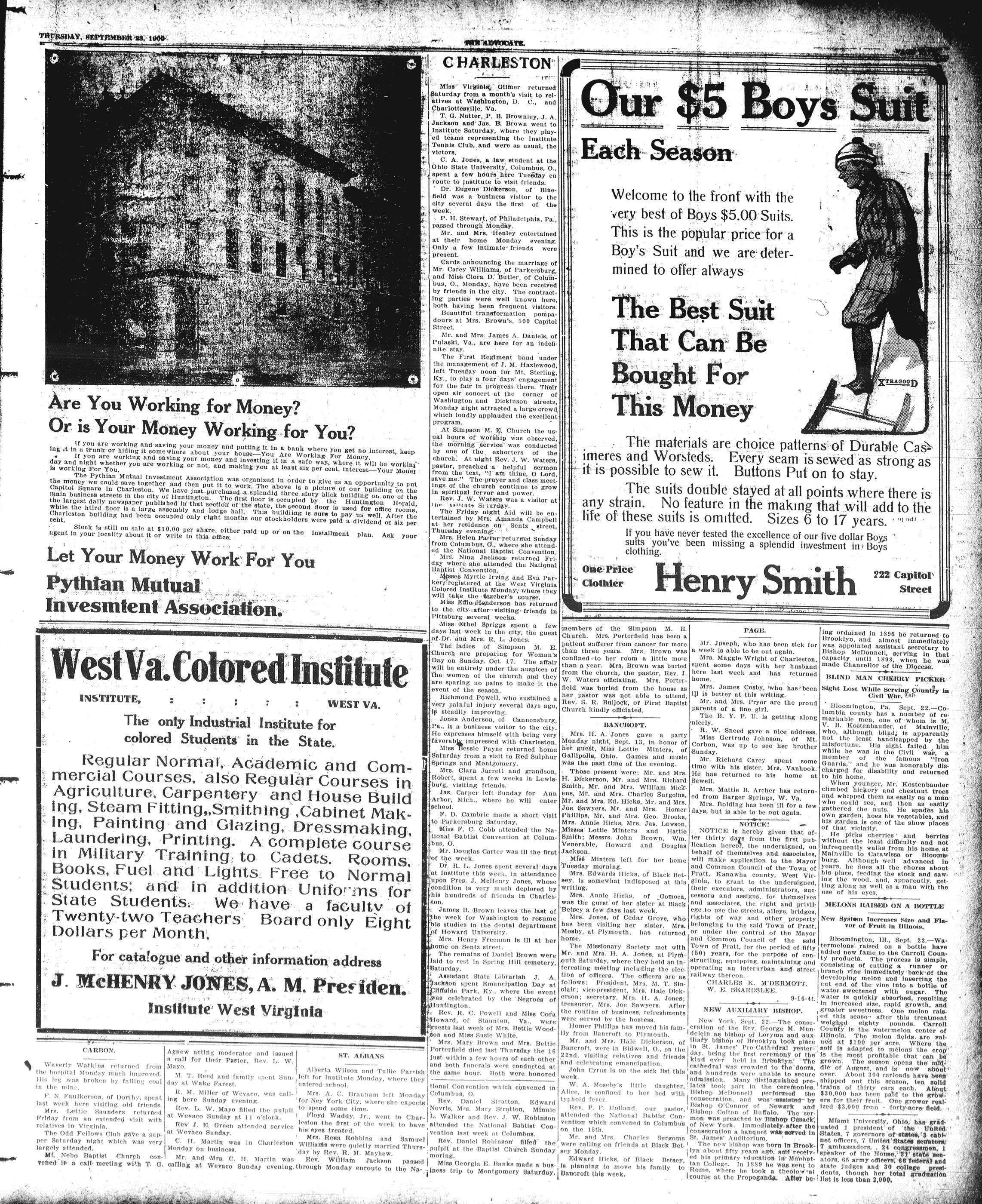
Page text (machine-generated)
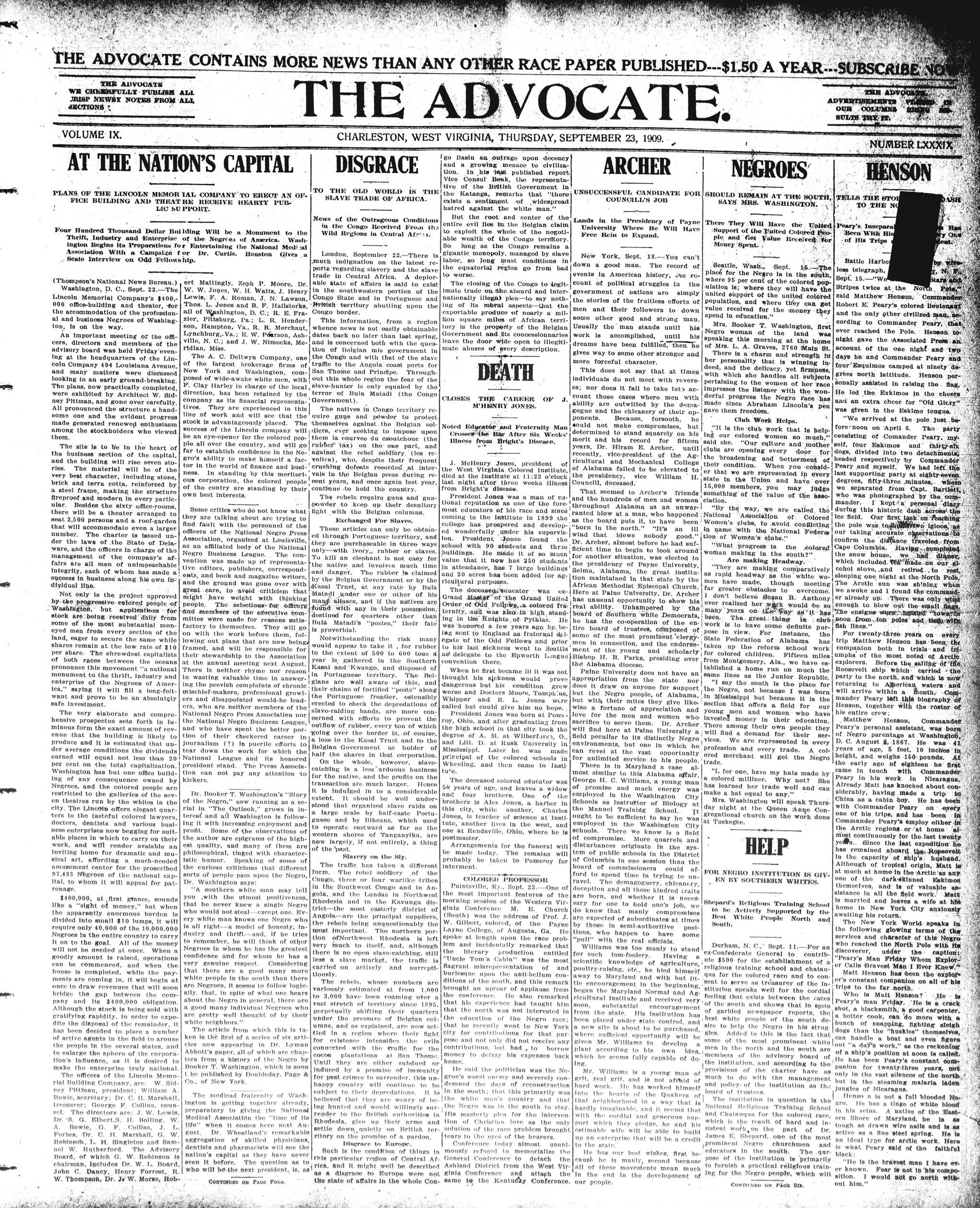
AT THE NATION'S CAPITAL
AT THE NATION'S CAPITAL
PLANS OF THE LINCOLN MEMORIAL COMPANY TO ERECT AN OFFICE BUILDING AND THEATRE RECEIVE HEARTY PUBLIC SUPPORT.
Four Hundred Thousand Dollar Building Will be a Monument to the Thrift, Industry and Enterprise of the Negroes of America. Washington Begins its Preparations for Entertaining the National Medical Association With a Campaign for Dr. Curtis. Houston Gives a Scale Interview on Odd Fellowship.
WE CHEERFULLY PUBLISH ALL
JRISP NEWSY NOTES FROM ALL
SECTIONS
VOLUME IX.
(Thompson's National News Bureau.)
Washington, D. C., Sept. 22. $400,000 office-building and theater, for the accommodation of the professional and business Negroes of Washington, is on the way.
An important meeting or the officers, directors and members of the advisory board was held Friday evening at the headquarters of the Lincoln Company 494 Louisiana Avenue, and many matters were discussed looking to an early ground-breaking. The plans, now practically completed, were exhibited by Architect W. Sidney Pitman, and gone over carefully. All pronounced the structure a handsome one and the evident progress made generated renewed enthusiasm among the stockholders who viewed them.
The site is to be in the heart of the business section of the capital, and the building will rise seven stories. The material will be of the very beat character, including stone, brick and terra cotta, reinforced by a steel frame, making the structure fireproof and modern in every particular. Besides the sixty office-rooms, there will be a theater arranged to seat 2,500 persons and a roof-garden that will accommodate even a larger number. The charter is issued under the laws of the State of Delaware, and the officers in charge of the management of the company's affairs are all men of unimpeachable integrity, each of whom has made a success in business along his own individual line.
Not only is the project approved by the progressive colored people of Washington, but applications for stock are being received daily from some of the most substantial moneyed men from every section of the land, eager to secure the same while shares remain at the low rate of $10 per share. The shrewdest capitalists of both races between the oceans pronounce this movement "a national monument to the thrift, industry and enterprise of the Negroes of America," saying it will fill a long-felt-want and prove to be an absolutely safe investment.
The very elaborate and comprehensive prospectus sets forth in luminous form the exact amount of revenue that the building is likely to produce and it is estimated that under average conditions the dividends earned will equal not less than 20 per cent on the total capitalization. Washington has but one office building of any consequence owned by Negroes, and the colored people are restricted to the galleries of the seven theatres run by the whites in the city. The Lincoln offers elegant quarters to the tasteful colored lawyers, doctors, dentists and various business enterprises now begging for suitable places in which to carry on their work, and will render available an inviting home for dramatic and musical art, affording a much-needed amusement center for the proscribed 97,483 Negroes of the national capital, to whom it will appeal for patronage.
$400,000, at first glance, sounds like a "sight of money," but when the apparently enormous burden is divided into small $10 lumps, it will require only 40,000 of the 10,000,000 Negroes in the entire country to carry it on to the goal. All of the money will not be needed at once. When a goodly amount is raised, operations can be commenced, and when the house is completed, while the payments are coming in, it will begin at once to draw revenues that will soon bridge the gap between the company and its $400,000 obligation. Although the stock is being sold with gratifying rapidity, in order to expedite the disposal of the remainder, it has been decided to place a number of active agents in the field to arouse the people in the several states, and to enlarge the sphere of the corporation's influence, as it is desired to make the enterprise truly national
The officers of the Lincoln Memorial Building Company, are: W. Sidney Pittman, president; William A. Bowie, secretary; Dr. C. H. Marshall, treasurer; George F. Collins, counsel. The directors are: J. W. Lewis, Dr. S. G. Elbert, S. H. Bolling, W. A. Bowie, G. F. Collins, J. L. Forbes, Dr. C. H. Marshall, G. W. Robinson, L. H. Singleton and Samuel W. Rutherford. The Advisory Board, of which G. W. Robinson is chairman, includes Dr. W. L. Board, John C. Dancy, Henry Forrest, W. R. Thompson, Dr. J. W. Morse, Rob-
ort Mattingly, Zeph P. Moore, Dr. W. W. Joupes, W. H. Watts, J. Henry Lewis, F. A. Roman, J. N. Lawson, Th. L. Jones and B. F. Halltorks, all of Washington, D. C.; R. E. Frazier, Pittsburgh, Pa.; L. R. Henderson, Hampton, Va. R. R. Merchant, Lynchburg, Va.; E. W. Pearson, Ashville, N. C.; and J. W. Nimocks, Merdian, Miss.
The A. C. Deltwyn Company, one of the largest brokerage firms of New York and Washington, composed of wide-a-wake white men, with F. Clay Harley in charge of the local direction, has been retained by the company as its financial representatives. They are experienced in this line of work and will see that the stock is advantageously placed. The success of the Lincoln company will be an eye-opener for the colored people all over the country, and will go far to establish confidence in the Negro's ability to make himself a factor in the world of finance and business. In standing by this meritorious corporation, the colored people of the contry are standing by their own best interests.
Some critics who do not know what they are talking about are trying to find fault with the personnel of the officers of the National Negro Press Association, organized at Louisville, as an affiliated body of the National Negro Business League. The convention was made up of representative editors, publishers, correspondents, and book and magazine writers, and the ground was gone over with great care, to avoid criticism that might have weight with thinking people. The selections for officers and members of the executive committee were made for reasons satisfactory to themselves. They will go on with the work before them, following out plans that are now being framed, and will be responsible for their stewardship to the Association at the annual meeting next August. There is neither rhyme nor reason in wasting valuable time in answering the peevish complaints of chronic mischief-makers, professional growlers and disappointed would-be leaders, who are neither members of the National Negro Press Association nor the National Negro Business League, and who have spent the better portion of their checkered career in journalism (?) in puerile efforts to tear down the work for which the National League and its honored president stand. The Press Association can not pay any attention to kickers.
Dr. Booker T. Washington's "Story of the Negro," now running as a serial in "The Outlook," grows in interest and all Washington is following it with increasing enjoyment and profit. Some of the observations of the author are epigrams of the highest quality, and many of them are philosophical, tinged with characteristic humor. Speaking of some of the curious criticisms that different sorts of people pass upon the Negro, Dr. Washington says:
"A southern white man may tell you, with the utmost positiveness, that he never knew a single Negro who would not steal—except one. Every white man knows one Negro who is all right—a model of honesty, industry and thrift—and, if he tries to remember, he will think of other Negroes in whom he has the greatest confidence and for whom he has a very genuine respect. Considering that there are a good many more white people in the south than there are Negroes, it seems to follow logically, that, in spite of what one hears about the Negro in general, there are a good many individual Negroes who are pretty well thought of by their white neighbors."
The article from which this is taken is the first of a series of six articles now appearing in Dr. Lyman Abbott's paper, all of which are chapters from a history of the Negro by Booker T. Washington, which is soon to be published by Doubleday, Page & Co., of New York.
The medical fraternity of Washington is getting together already, preparatory to giving the National Medical Association the "time of its life" when it comes here next August. Dr. Wheatland's remarkable aggregation of skilled physicians, dentists and pharmacists will see the nation's capital as they have never seen it before. The question as to who will be the next president, is, as
CONTINUED ON PAGE FOUR.
THE ADVOCATE.
CHARLESTON, WEST VIRGINIA, THURSDAY, SEPTEMBER 23, 1909.
DISGRACE
TO THE OLD WORLD IS THE SLAVE TRADE OF AFRICA.
News of the Outrageous Conditions in the Congo Received From the Wild Regions in Central Africa.
London, September 22.—There is much indignation on the latest reports regarding slavery and the slave trade in Central Africa. A deplorable state of affairs is said to exist in the southwestern portion of the Congo State and in Portuguese and British territory abutting upon the Congo border.
This information, from a region whence news is not easily obtainable dates back no later than last spring, and is concerned both with the question of Belgian mis government in the Congo and with that of the slave traffic to the Angola coast ports for San Thome and Prindpe. Throughout this whole region the fear of the slave-hunter is only equaled by the terror of Bula Matadi (the Congo Government). The natives in Congo territory require guus and powder to protect themselves against the Belgian soldiers, ever seeking to impose upon them la courve du caoutchouc (the rubber 'tax') on the one part, and against the rebel soldiery (les revolts), who, despite their frequent crushing defeats recorded at intervals in the Belgian press during recent years, and once again last year, continue to hold the country.
The rebels require guns and gun powder to keep up their desultory fight with the Belgian columns.
Exchanged For Slaves.
These articles can only be obtained through Portuguese territory, and they are purehaseable in three ways only—with ivory, rubber or slaves. To kill an elephant is not easy for the native and involves much time and danger. The rubber is claimed by the Belgian Government or by the Kasal Trust, at any rate by Bula Matadi under one or other of his many aliases, and if the natives are found with any in their possession, destined for quarters other than Bula Matadi's "postes," their fate is proverbial.
Notwithstanding the risk many would appear to take it , for rubber to the extent of 500 to 600 tons a year is gathered in the Southern Kasal and Kwango, and disposed of in Portuguese territory. The Belgians are well aware of this, and their chains of fortified "posts" along the Portuguese frontier, ostensibly erected to check the depredations of slave-raiding bands, are more concerned with efforts to prevent the outflow of rubber, every ton of which going over the border is, of course, a loss to the Kasal Trust and to the Belgian Government as holder of half the shares in that corporation. On the whole, however, slave-catching is a less arduous business for the native, and the profits on the transaction are much larger. Hence it is indulged in to a considerable extent. It should be well understood that organized slave raids on a large scale by half-caste Portuguese and by Biyeans, which used to operate eastward as far as the western shores of Tanganyika, are now largely, if not entirely, a thing of the past.
Slavery on the Sly.
The traffic has taken a different form. The rebel soldiery of the Congo, three or four warlike tribes in the Southwest Congo and in Angola, and the Lundas in Northwest Rhodesia and in the Kavunga district—the most easterly district of Angola—are the principal suppliers, the rebels being unquestionably the most important. The northern portion of Northwest Rhodesia is left very much to itself, and, although there is no open slave-catching, still less a slave market, the traffic is carried on actively and surreptitiously.
The rebels, whose numbers are variously estimated at from 1,000 to 3,000 have been roaming over a vast stretch of territory since 1895, perpetually shifting their quarters under the pressure of Belgian columns, and as explained, are now settled in a region where their fight for existence intensifies the evils connected with the traffic for the cocoa plantations at San Thome. Until they are either subdued or induced by a promise of immunity for past crimes to surrender, this unhappy country will continue to be subject to their depredations. It is believed that they are weary of being hunted and would willingly surrender to the British authorities in Rhodesia, give up their arms and settle down quietly on British territory on the promise of a pardon.
Such is the condition of things in this particular region of Central Africa, and it might well be described as a disgrace to Europe were not the state of affairs in the whole Con-
go Baslin an outrage upon decoy and a growing menace to civilization. In his last published report Vice Consul Beak, the representative of the British Government in the Katanga, remarks that "there exists a sentiment of widespread hatred against the white man."
But the root and center of the entire evil lies in the Belgian claim to exploit the whole of the negotiable wealth of the Congo territory. So long as the Congo remains a gigantic monopoly, managed by slave labor, so long must conditions in the equatorial region go from bad to worse.
The closing of the Congo to legitimate trade on the absurd and internationally illegal plan—to say nothing of its moral aspects—that the exportable produce of nearly a million square miles of African territory is the property of the Belgian Government and its concessionnaries leave the door wide open to illegitimate abuses of every description.
CLOSES THE CAREER OF J. M'HENRY JONES.
Noted Educator and Fraternity Man Crosses the Bar After Six Weeks' Illness from Bright's Disease.
J. McHenry Jones, president of the West Virginia Colored Institute, died at the Institute at 11:22 o'clock last night after three weeks' illness from Bright's disease.
President Jones was a man of national reputation as one of the foremost educators of his race and since coming to the institute in 1899 the college has prospered and developed wonderfully under his supervision. President Jones found the school with 90 students and three buildings. He made it of so much value that it now has 250 students in attendance, has 7 large buildings and 20 acres has been added for agricultural purposes.
The deceased educator was ex- Grand Master of the Grand United Order of Old Fellows, a colored fraternity, and was also in high standing in the Knights of Pythias. He was honored a few years ago by, being sent to England as fraternal delegate of the Old Fellows and prior to his last sickness went to Seattle as delegate to the Epworth Languages convention there.
When he first became ill it was not thought his sickness would prove dangerous but his condition grew worse and Doctors Moore, Tompkins, Whipper and R. L. Jones were called but could give him no hope.
President Jones was born at Pomeroy, Ohio, and after graduating from the high school in that city took the degree of A. M. at Wilberforce, O., and Litt. at D. at Rusk University in Mississippi. Later he was made principal of the colored schools in Wheeling, and then came to Institute
The deceased colored educator was 50 years of age, and leaves a widow and four brothers. One of the brothers is Alex Jones, a barber in this city, while another, Charles Jones, is teacher of science at institute, another lives in the west, and one at Rendsville, Ohio, where he is postmaster.
Arrangements for the funeral will be made today. The remains will probably be taken to Pomeroy for interment.
COLORED PROFESSOR
Paintsville, Ky., Sept. 23.—One of the most important features of the morning session of the Western Virginia Conference M. E. Church (South) was the address of Prof. J. W. Gilbert, colored, of the Payne Layne College, of Augusta, Ga. He spoke at length upon the race problem and incidentally remarked that the literary production entitled "Uncle Tom's Cabin" was the most flagrant misrepresentation of and burlesque upon the anti-bellium conditions of the south, and this remark brought an uproar of applause from the conference. He also remarked that his experience had taught him that the north was not interested in the education of the Negro race; that he recently went to New York city for contributions for that purpose and not only did not receive any contributions, but had, to borrow money to defray his expenses back home.
He said the politician was the Negroe's worst enemy and severely condemned the days of reconstruction in the south; that this primarily was the white man's country and that the Negro was in the south to stay. His masterly plea for the intervention of Christian love as the only solution of the race problem brought tears to the eyes of the hearers. Conference today almost unanimously refused to memorialize the General Conference to detach the Ashland District from the West Virginia Conference and attach the same to the Kentucky Conference.
ARCHER
UNSUCCESSFUL CANDIDATE FOR COUNCILL'S JOB
Lands in the Presidency of Payne University Where He Will Have Free Rein to Expand.
New York, Sept. 18.—You can't down a good man. The record of events in American history, the recount of political struggles in the government of nations are simply the stories of the fruitless efforts of men and their followers to down some other good and strong man. Usually the man stands until his work is accomplished, until his dreams have been fulfilled, then he gives way to some other stronger and more forceful character.
This does not say that at times individuals do not meet with reverses; nor does it fall to take into account those cases where men with ability are outwitted by the denragogue and the chicancy of their opponents. Because, forsooth, he could not make compromises, but determined to stand squarely on his merit and his record for fifteen years, Dr. Hiram E. Archer, until recently, vice-president of the Agricultural and Mechanical College of Alabama failed to be elevated to the presidency, vice William H. Councill, deceased.
That seemed to Archer's friends and the hundreds of men and women throughout Alabama as an unwarranted blow at a man, who happened as the board puts it, to have been "born in the north." "It's an ill wind that blows nobody good." Dr. Archer, almost before he had sufficient time to begin to look around for another situation, was elected to the presidency of Payne University, Selma, Alabama, the great institution maintained in that state by the African Methodist Episcopal Church. Here at Palne University, Dr. Archer has unusual opportunity to show his real ability. Unhampered by the board of Southern white Democrats, he has the co-operation of the entire board of trustees, composed of some of the most prominent clergymen in connection, and the endorsement of the young and scholarly Bishop H. B. Parks, presiding over the Alabama diocese.
Paine University does not have an appropriation from the state nor does it draw on anyone for support but the Negro people, of Alabama, but with their mites they give likewise a fortune of appreciation and love for the men and women who sacrifice to serve them. Dr. Archer will find here at Paine University a field peculiar to its distinctly Negro environments, but one in which he can revel at the vast opportunity for unlimited service to his people
There is in Maryland a case almost similar to this Alabama affair. George H. C. Williams, a young man of promise and much energy was employed in the Washington City Schools as instructor of Biology at the Manuel Training School. It ought to be sufficient to say he was employed in the Washington City schools. There we know is a field of compromise. More quarrels and disturbances originate in the system of public schools in the District of Columbia in one session than the board of commissioners could afford to spend time in trying to unravel. The demagoguery, chicancry, deception and all those kindred trails are born, and whether it is necessary for one to hold one's job, we do know that manly compromises are expected of subordinates at times by those in semi-authoritative positions, who happen to have some "pull" with the real officials.
Williams was too manly to stand for such tom-foolery. Having a scientific knowledge of agriculture, poultry-raising, etc., he hied himself away to Maryland and with but little encouragement in the beginning, began the Maryland Normal and Agricultural Institute and received very soon, substantial encouragement from the state. His institution has been placed under state control, and a new site is about to be purchased, where sufficient opportunity will be given Mr. Williams to develop a plant according to his own idea, which he seems fully capable of doing.
Mr. Williams is a young man of grit, real grit, and is not afraid of hard work. He has worked himself into the hearts of the Quakers of that neighborhood in a way that is hardly imaginable, and it seems that with the cordial and generous support which they pledge, he and his estimable wife will be able to build up an enterprise that will be a credit to the state.
He has our best wishes, first because he is manly, second because all of these movements mean much in the end in the development of our people.
NEGROES
There They Will Have the United Support of the United Colored People and Get Value Received for Money Spent.
Seattle, Wash., Sept. 15.—The place for the Negro is in the south, where 95 per cent of the colored population is; where they will have the united support of the united colored population, and where they can get value received for the money they spend in education."
Mrs. Booker T. Washington, first Negro woman of the land was speaking this morning at the home of Mrs. L. A. Graves, 2760 Main St. There is a charm and strength in her personality that is winning indeed, and the delicacy, yet firmness, with which she handles all subjects pertaining to the women of her race impresses the listener with the wonderful progress the Negro race has made since Abraham Lincoln's pen gave them freedom.
Club Work Helps.
"It is the club work that is helping our colored women so much," said she. "Our culture and mother clubs are opening every door for the broadening and betterment of their condition. When you consider that we are represented in every state in the Union and have over 15,000 members, you may judge something of the value of the association.
"By the way, we are called the National Association of Colored Women's clubs, to avoid conflicting in name with the National Federation of Women's clubs."
"They are making comparatively as rapid headway as the white women have made, though meeting far greater obstacles to overcome. I don't believe Susan B. Anthony ever realized her work would be so many years on the way as it has been. The great thing in club work is to have some definite purpose in view. For instance, the State Federation of Alabama has taken up the reform school work for colored children. Fifteen miles from Montgomery, Ala., we have established a home run on much the same lines as the Junior Republic. "I say the south is the place for the Negro, not because I was born in Mississippi but because it is the section that offers a field for our young men and women who have invested money in their education. There among their own people they will find a demand for their services. We are represented in every profession and every trade. A colored merchant will get the Negro trade.
"I, for one, have my hats made by a colored milliner. Why not? She has learned her trade well and can make a hat equal to any." Mrs. Washington will speak Thursday night at the Queen Anne Congregational church on the work done at Tuskeree.
FOR NEGRO INSTITUTION IS GIVEN BY SOUTHERN WHITES.
Shepard's Religious Training School to be Actively Supported by the Best White People North and South.
Durham, N. C., Sept. 11.—For an ex-Confederate General to contribute $500 for the establishment of a religious training school and chatauqua for the colored race and to consent to serve as treasurer of the institution speaks well for the cordial feeling that exists between the caces of the south and shows that in spite of garbled newspaper reports, the best white people of the south desire to help the Negro in his struggles. Added to this is the fact that some of the most prominent white men in the north and the south are members of the advisory board of the institution, and according to the provisions of the charter have as much to do with the management and policy of the institution as the board of trustees.
The institution in question is the National Religious Training School and Chataquna for the colored race, which is the result of hard and insistent work on the part of Dr. James E. Shepard, one of the most prominent Negro churchmen and educators in the south. The purpose of the institution is primarily to furnish a practical religious training for the Negro people, which will
CONTINUED ON PAGE 51.
NUMBER LXXXIX
Stripes twice at the North Poles," said Matthew Henson, Commander Robert E. Peary's colored lieutenant and the only other civilized man, according to Commander Peary, that ever reached the Pole. Henson tonight gave the Associated Press an account of the one night and two days he and Commander Peary and four Esquimos camped at ninety degrees north latitude. Henson personally assisted in raising the flag. He led the Exklimos in the cheers and an extra cheer for "Old Glory" was given in the Esklimo tongue.
"We arrived at the pole just before noon on April 6. The party consisting of Comander Peary, myself, four Eskimos and thirty-six dogs, divided into two detachments, headed respectively by Commander Peary and myself. We had left the last supporting party at eighty-seven degrees, fifty-three minutes, where we separated from Capt. Bartlett, who was photographed by the commander. I kept a personal diary during this historic ditch across the ice field. Our first task on reaching the pole was to shuffle two igloos, as our taking accurate observations to confirm the distance traveled from Cape Columbia. Having completed the snow house, we had dinner, which included tea made on our alcohol stove, and retired, to rest, sleeping one night at the North Pole. The Arctic sun was shining when we awoke and I found the commander already up. There was only wind enough to blow out the small flag. The ensigns were hung "tower noon from ten poles and tash with fish lines."
For twenty-three years on every trip Matthew Henson has been the companion both in trials and triumphs of the most noted of Arcto explorers. Before the sailing of the Roosevelt ship which carried the party to the north, and which is now returning to American waters and will arrive within a month, Commander Peary left this biography of Henson, together with the roster of his entire crew:
Matthew Henson, Commander Peary's personal assistant, was born of Negro parentage at Washington, D. C. August 3, 1867. He was 41 years of age, 5 feet, 10 inches in height, and weighs 150 pounds. At the early age of eighteen he first came in touch with Commander Peary in his work in Nicaragua. Already Matt has knocked about considerably, having made a trip to China as a cabin boy. He has been with Commander Peary on every one of his trips, and has been in Commander Peary's employ either in the Arctic regions or at home almost continuously for the last twenty years. Since the last expedition he has remained aboard the Ropeviee in the capacity of ship's husband. Although of tropical origin, Matt is at much at home in the Arctic as any one of the dark-skinned Eskimos themselves, and is of valuable assistance in all the field work. Matt is married and leaves a wife at his home in New York City anxiously awaiting his return.
The New York World speaks in the following glowing terms of the services and character of this Negro who reached the North Pole with His discoverer, under the caption: "Peary's Man Friday Whom Explorer Calls Bravest Man I Ever Knew." Matt Henson has been the explorer's constant companion on all of his trips to the far north.
Who is Matt Henson? He is Peary's man Friday. He is a crack shot, a blacksmith, a good carpenter, a better cook, can do more with a bunch of snapping, fighting alegh dogs than the "huskies" themselves, can handle a boat and even figure out "a day's work," as the reckoning of a ship's position at noon is called.
He has been Peary's constant companion for twenty-three years, not only in the vast silences of the north but in the steaming malaria laden jungles of Nicaragua.
Henso n is not a full blooded Negro. He has a tinge of white blood in his veins. A native of the Eastern Shore of Maryland, he is as tough as drawn wire nails and is as active as a fine steel spring. He is an ideal type for arctic work. Here is what Peary said of the faithful black:
"He is the bravest man I have ever known. Fear is not in his composition. I would not go north without him."
RONCERVERE.
Miss Lula Brinkley, who has been sick for the past week, is able to be out again.
Mrs. Ann Reavely and little daughter, Julia, of Charleston, are visiting friends and relatives here.
Alex Brown returned home Friday from a pleasant trip to New York and Atlantic City.
Miss Carrie Stover has returned from Clitton Forge, where she spent the summer with her sister, Mrs. Jas. Morris.
Miss Minnie V. Allen entertained the Ladies' Aid Society Wednesday evening. Refreshments were served.
Jno. Washington visited White
Sliphur, Sunday.
Mr. and Mrs. H. T. Moore were
guests of relatives at Brush Ridge,
Sunday.
Haptist S. S. had their picnic au
Bruce's Hollow Thursday. Refreshments
were served to S. S. scholars
and all had a pleasant time.
W. E. Stevenson; of Hirton, was
a business visitor here last week.
Rev. W. E. Jefferson conducted
his usual services at M. E. Church,
Sunday.
Chas. Brinkley visited his sister,
Mrs. Richard Diggs, at Fort Springs,
Sunday.
Mrs. N. B. Rose visited Lewisburg,
Thursday.
Rev. Chas. Lewis preached at Covington, Sunday.
Miss Clara Slaughter is visiting friends and relatives at Covington, Va.
Jno. Allen, of Covington, was the guest of Miss Francis Wood. Sunday.
Mrs. Banks Scott, who has been ill for some time, is able to be out again.
Earnest Miller entertained the Y. P. Club at his residence Thursday evening. Many interesting subjects were discussed and a light lunch served. Those present were: Mrs. Bessie Lewis, Mrs. Lillie B. Johnson, Mrs. Mary Miller, Misses Essie P. Williams, Brunnett Brown, Minnie Allen, Messrs Jno. Ward, Jno. Riddle, Wm. Eggleston and W. E. Jefferson.
MONTGOMERY.
Simmons graded school opened Monday with a large enrollment. H. H. Railey, principal; E. C. Page, Miss Henrietta M. James, Miss Ethel Brown and Mrs. Goldie Page, assistants. Rev. D. C. Deans accompanied three of his children to the W. Va. Institute, Wednesday. Horace Caster, of Hansford, was here Thursday the guest of Mr. and Mrs. George Jackson. Rev. Warner Brown has returned from several weeks' visit to points in Virginia. Mrs. S. J. Jackson is spending some time at Orange, Va., the guest of relatives. Eagle school opened Monday with Miss Minnie Carr, of Marietta, O. as principal and Miss Etta Hall, of this town, assistant.
F. D. and Charles Page and Miss Cornelia, of Kanawha City, were the Sunday guests of their brother, John Page.
Miss Rosa Hardy is teaching at Glen Jean.
Mrs. Archie McKinney, who has been puite sick, is reported much better.
Mr. and Mrs. Samuel Buster left Tuesday for a visit to Charlottesville, Va.
Miss Katherine Brown is teaching at Elk Ridge.
Mrs. Maria Thomas has returned from a visit to Cincinnati.
Mrs. B. F. White' is on' the sick list.
Charles Snowden has opened a barber shop on the corner of 13th and Main and has a fine trade. Mrs. Lucy Williams tendered a farewell reception, on Thursday evening, in honor of Rev. Hogan and Mahlon Lewis. Rev. Hogan will leave this week to attend conference in Cleveland, while Mr. Lewis goes to Wilberforce to prepare himself for the ministry. Both are young men of ability and have the well wishes of all for their future success. Little Miss Ola Snowden, who was slick for a few days last week, is able to be out again. Mrs. James Brown, who has been the guest of friends in Staunton, Va. for several weeks, has returned home.
Emancipation Day was celebrated here Monday, the 20th, for the first time. The exercises of the day were opened by a grand parade at 10:30.
PATENTS
Patents obtained in all countries OR MG FEE.
Made in England, Scotland, Ireland, France, and Bretch. Mount or Photo, for PATENTS on patentability. Patent practicable in stamps for invaluable book.
BROW TO OBTAIN AND SELL PATENTS,
BROW TO OBTAIN AND SELL PATENTS,
BROW TO OBTAIN AND SELL PATENTS,
and other variable information.
D. SWIFT & CO.
PATENT OF AMY LEE.
D. SWIFT ST., Washington, D. C.
A. M. and was followed in the afternoon by speaking in the city hall. Presiding Elder Bundy, of Cleveland, made the principal speech of the day and it was a masterpiece of oratory. Rev. Pannell and others followed and were received by the audience with much appreciation. Mrs Good, of East Liverpool and Miss Emma Howard, of Salem, sang solos. After the speaking there were field sports.
CEDAR GROVE.
Mrs. Viola Hardy, of Montgomery, was the guest of Misses Peters and Meadows here Sunday.
Born—to Mr. and Mrs. James Austin, a fine baby boy.
John and Green Smith, of Ward, were seen in town Sunday.
Mrs. Brooks, of Charleston, was the guest of her daughter, Mrs. Ida Buster, this week.
John Q. Adams, of Charleston, was in town calling on Misses Meadows and Peters, Sunday.
Rev. B. B. Brinkley was in town on business this week.
Leroy Hall was also a business caller this week.
Mrs. John Richmond is able to be out again.
Rev. Mr. Scott, of Sharon, preached an able sermon here, Wednesday evening.
Dr. W. H. Thomas, of Wheeling, preached two able sermons at the Methodist church, Sunday.
Mrs. Turner, the sister of Mrs. W. F. Martin, left for her home in Lynchburg last Monday.
Rev. D. Davis, our pastor, filled the pulpit Sunday. He has begun a series of meetings here for this week.
Thos. Martin is improving greatly and will be able to get about on crutches soon.
The parents and pupils gladly welcomed their former teacher, Miss Hattie Pefers, and also their new teacher, Miss Ollie Meadows. They are looking forward to a successful term. School opened Monday with a good enrollment.
Miss Nina Lawson, was the guest of her sister, Mrs. Anderson, last week.
Mrs. Olive Meadows made a business trip to Institute Saturday.
ALDERSON
Rev. C. C. Booze, of Beckley, filled the pulpit of the Shilo Baptist church last Sunday night and preached a very appropriate sermon to the "Woman's Missionary Society."
The Independent School, of Alderson, opened Monday the 20th inst. The enrollment was larger than usual. Prof. Ernest Banks, principal, and Miss Cornelia Page, assistant.
Mr. and Mrs. Jesse Smith, Miss Maria Waldron, and James Hargrove returned from the National Baptist Convention held in Columbus, O., and they all have reported a pleasant trip and visit.
Ernest Hopkins, Charlie Brinkley and Nichol Young were visitors were here Sunday.
R. Lee Wilson and Miss Lucretia Hill leave for Cincinnati this week after spending a joyful vacation in our town.
Jake Crawford and family have moved to Claremont.
The Church Aid met at the home of Mrs. Julia Rucker last week. A large number attended.
Prof. Walter Banks has gone to take up his school at Fire Creek.
Thos. Woodford, Joe Walker and Charlie Perking were visitors here for a few days after which they left for Sam Anderson's Stock Sale for employment.
Mrs. Mildred Brown has returned from a pleasant visit with her daughter, Mrs. Emma Smithers, of Hinton.
Miss Susie Crawford is visiting her friends at Renick, W. Va.
BUCKHANNON.
Chas. Green, of Parkersburg, is here visiting relatives.
Miss Leila Powell and Thomas Taylor left Tuesday for Institute, where they will attend school.
Miss Beulah Wright was at Weston, Sunday.
Miss Ingie Taylor, Austin Taylor, Mrs. Jas. Wade, Mr. and Mrs. Jas. Carter, Mr. and Mrs. Rickert and others went to Pittsburgh, Saturday evening on the excursion.
The parsonage of Simpson M. E. Church has been painted and plumbed for gas.
Miss Maude Davis entertained the Ladies' Aid Society, Friday afternoon.
A nice donation was given Mr. and Mrs. Silas Murphy, who are both in poor health, by some of the members of Simpson M. E. Church, Monday evening.
Rev. Geo. DeYoung was at Weston Tuesday.
There was a picnic at Jackson's Grove, Saturday, for the Sunday School scholars of Hall's Chapel A. M. E. Church.
Chas. Smith was the guest of his mother at Weston, Saturday.
Mrs. Geo. Williams is ill at this time.
Russel Moulton spent several hours at Weston, Sunday.
CLARKSBURG.
A number of persons spent Sunday in Pittsburg.
Mrs. Aaron Wilson entertained Thursday evening for her daughter, Mrs. Freeman Lowry, the occasion being Mrs. Lowry's birthday. Quite a number of invited guests assembled to wish Mrs. Lowry many returns of the day. Music and games of various kinds formed the evening's diversions. At a late hour a delicious repast was served. The evening was very delightfully spent.
The 39th anniversary of Pride's A. M. E. Church closed with special services Sunday. The morning and evening services consisted of sermons including the history of the local church. After special exercises in the Sunday School, it being educational day, a platform meeting took place with Rev. Colbert, of Trinity M. E. Church presiding. Rev. Bird, of Goff M. E. Church, brought a message of good cheer from the "Mother Church". Rev. McClellan, of the First Presbyterian Church discussed, "Has Mission Work Among the Colored People Been a Success?" Both addresses were helpful and inspiring. Miss Maud Lewis sang a beautiful solo, entitled: The Lord is my Shepherd. $121.00 was realized.
Mrs. Aaron Wilson and little daughter, Naomi, Mrs. Freeman Lowry and Miss Mary Miller spent Sunday in Fairmont.
Miss Autoinette McGee has returned home after a pleasant visit with relatives.
Miss Geraldine Lassiter gave a delightful party, complimentary to Miss Edith Williams, just before her departure for school.
Mrs. Ida Roberts, who has been quite ill, is convalescent.
Willis Roberts has returned from Parkersburg, where he spent a week visiting friends.
Dr. R. D. Stinson, Vice-president of Morris Brown College at Atlanta, Ga., lectured at Pride A. M. E. Church Monday night on "Practical Education." The lecture was a rare treat and it is to be sincerely regretted that so few persons take advantage of these opportunities of able men.
Mrs. Jennie Kelley and Mrs. Mary Settles spent Sunday in Gallipolis the guests of Mrs. Settles' son, Gus Bell.
Wm. Newsom, who has been employed in Charleston, for the past three months, returned Tuesday.
Rev. C. Davis, of Gallipolis, preached a very able sermon at the First Baptist church, Sunday night, to a large and appreciative congregation.
Miss Annie Brown, of Charleston, has been the guest of Mr. and Mrs. Smith Burton for the past few days.
Miss Brown leavs Monday for Clarksburg.
Mrs. William Bell and daughter, of Henderson, are guests of her brother, Wm. Williams.
Mrs. H. C. Washington and daughter arrived here Monday to be the guests of her parents, Mr. and Mrs. Joseph Alexander.
The Willing Workers' Club of the First Baptist church met with Mrs. Smith Burton, Monday evening.
Teddy Bears played Middleport here Sept. 19. Score 5-6 favor of Teddy Bears.
Mrs. Ellen Blackwell, who has been quite ill for the past few weeks, is improving rapidly.
Prof. J. W. Robinson, principal of Langston High School, left Friday evening for Columbus to be present at the closing of the Baptist State Convention convening in that city.
Chas. Settles, Joe Jordan and Sam Craig left Wednesday for Ashland, Ky., where they will have positions on a government boat.
RAYMOND CITY.
Rev. P. F. Holland, and wife passed through here Wednesday en route to Columbus, Ohio, where they attended the National Baptist Convention.
Rev. D. W. Edwards, of LaMont, filled the pulpit here Sunday in his absence and preached two very inspiring sermons.
Rev. J. W. Crosby attended services in Charleston Sunday morning.
Miss Hazel Price, left Tuesday for Institute to resume her studies.
Mr. and Mrs. Garfield Trust, Mr. and Mrs. Ayre Roy, of Charleston, were the week-end guests of relatives here.
Mrs. Elizabeth Harvey, had a very bad accident last week by sticking a nail in her foot.
Mrs. Emma Prentiss is suffering with her eyes at this writing.
Mrs. Arizona Carey was an out-of-town visitor Monday.
Mrs. Ellijah Gatewood is having a new house erected on Front street.
Mrs. Cornelia-Coles will entertain the Missionary Society at her home on College Hill Friday evening.
C. E. Saunders and Rev. H. B. Good spent Sunday in Charleston with their families.
John Ross, of Black Betsey, was in our town Monday.
Sam Cogle is unable to be out.
Mrs. M. A. Pierson and Miss Ollie Coleman spent Sunday here.
South Charleston
FACTORIES EMPLOYING OVER 400 MEN Dunkirk Window Glass Co. Banner Window Glass Co. Kanawha Chemical Engine Mfg. Co.
cars go in. Terms: 1-10 cash, balance in monthly payments to suit. Discount for all cash. Kanawha Land Co. Room 501 Charleston National Bank Building
Bell Phone 750; Home Phone 1214
Rev. Warren, of Mt. Hope, preached two sermons Sunday. While with us he organized a church and Sunday school. Sunday school will be held at 2:30 each Sunday.
Mrs. H. C. Washington has gone to her home in Pt. Pleasant, accompanied by her little daughter, where there they will visit friends and relatives.
Mrs. Melvey and Mrs. Grey went to Thurmond on business for the Woman's Improvement League, Monday morning.
Miss Randolph was visiting in Hill Top, Saturday and Sunday.
Miss Emma White was visiting her sister, Mrs. L. Davis.
Miss Ella Pryor is visiting relatives and friends.
Mrs. Ragland, of Glen Jean, was entertained at dinner by Mrs. Washington, Sunday.
The Woman's Improvement League will meet with Mrs. J. D. Price, Thursday.
Miss Eva Murry, of Staunton, Va., is visiting her sister, Mrs. Emma Jefferson at Hill Top.
Prof. Jefferson began his school Monday at Sun.
Mrs. L. Crumpton has returned from her visit at Raleigh.
Mrs. Ada and Miss Ellen Calloway, of Mt. Hope, were here visiting friends.
Mrs. H. A. Carter, of Richmond, Va., is visiting her brother, Lewis Gurrison, after an absence of twenty-three years.
Dr. R. C. Pannell, of Stauxton, Va., returning from the National Baptist Convention stopped over and preached two sermons in our grand rally, Sunday.
Rev. Wm. Jackson conducted his grand rally at Mt. Tabor Baptist Church. The amount raised was $226.76.
Miss Florence Bolling left Saturday for Raleigh county, where she will teach again this term.
Many of our people attended camp meeting at Williamsburg Sunday.
Oliver Wilkerson, of Montgomery, after spending the summer here, as the guest of C. A. Robinson, returned home Saturday.
Mrs. Lula Moore and Mrs. N. B. Rose were here Thursday calling on Miss Josephine Jackson and Mrs. M. C. Slaughter. Mrs. Harriet Johnson, who has been living with her daughter, Mrs. Phebe Moss, of Norfolk, for the last eight years, is here visiting friends. The Willing Workers' Club of which Mrs. M. F. Stewart, is President, has had our cemetery cleaned up and greatly beautified. Mrs. Stewart and her tireless workers deserve great credit for their good work.
Hall of Pocataligo Lodge, No. 36 A. F. & A. M.
Raymond, City, W. Va., Sept. 10, 1909.
Whereas, it has pleased Almighty God, the Grand Master of the Universe, to take away our beloved and esteemed Grand Master, R. D. Robinson; and,
Whereas, We as Masons regret the loss of such a man who was an honored and valuable member of the order, therefore, be it
Resolved, That Pocataligo Lodge No. 36 A. F. & A. M. hereby extend to the members of the family our tenderest sympathy; and,
Be it further resolved, That a copy of these resolutions be inscribed upon the record of this Lodge, a copy be sent to the Advocate for publication, a copy of the same be forwarded to his family.
Adopted in this lodge this 10th day of September, A. D., A. L., 5909.
R. W. WILLIAMS, Master.
I. C. McKINNEY, Secretary.
H. WOOD,
C. W. KINGELEY,
L. H. DUCKWYLER.
WINNIFREDE
R. H. Allen spent a few days at his home in St. Albans.
J. D. Wiseman and B. P. Allen were business visitors to Charleston Thursday.
Mr. and Mrs. H. E. Harris have returned to Cabin Creek after spending a few weeks here visiting.
Mrs. James I. Thomas left for Cabin Creek to spend a few weeks with her husband.
Miss Alice Smith spent a few hours in Lewiston Friday.
W. W. Lewis and T. R. Johnson spent Saturday and Sunday at their home in Kanawha City.
Miss Emma Meadows was entertained at dinner Sunday by Miss Willie Chapman.
A. C. Chapman was a business visitor to Charleston Saturday.
Rev. F. E. Smith filled his regular appointment here Sunday and preached two very interesting sermons. He was granted a leave of absence for next month to go to Madison.
HILL TOP.
Miss Henrietta James returned to Montgomery Friday to begin school Monday.
Prof. Arter returned to Hill Top after attending the convention at Columbus, Ohio.
Mr. Napper left for Institute Friday.
Mrs. Smith entertained at dinner Sunday, Mrs. Vaughn and her three daughters, Mr. and Mrs. H. Richardson, Mr. Davis, of Red Star, Mrs. Agee, of Greenstown, Mrs. E. James and Leana Megee.
25 THERE APRIL 1, 1907
&
LEWISBURG.
THURSDAY, SEPTEMBER 23, 1909
lesto
TON NOW
R 400 MEN
Banner Window
fg. Co.
Hemlock Lu
South Charles
are Walk, Sew
s, Everything.
the trollly car
ey go up wh
payments to suit.
and C
ink Building
BAUER M
FISH COM
D 30 CAPIT
Weal, Mutton
th Pork Sau
OUR OWN MAKE.
our machine
s and B
RS, FISH, PO
qualities in all th
kinds of
EN
Window Glass Co.
Block Lumber Co.
Charleston.
k, Sewers,
thing.
ly cars.
up when the
to suit.
I Co.
ER MEAT
COMPATY
CAPITOL ST.
Mutton, Pork,
k Sausage
N MAKE.
chine sliced
and Bacon
SH, POULTRY
in all the popular
s of
Beef, Veal, Mutton, Pork Fresh Pork Sausage OUR OWN MAKE.
Try our machine sliced Hams and Bacon
OYSTERS, FISH, POULTRY
The best qualities in all the popular kinds of
Cheese
your patronage for stock in our line when you want
ronage for we have our lines and you you want it most.
We want your patronage for we have complete stock in our lines and you can get it when you want it most.
THE WEST IS PROSPEROUS DECLARATION OF WILSON
THURSDAY, SEPTEMBER 25, 1909
THE WEST IS
DECLARATE
Washington, Sept. 22.—Secretary
of Agriculture, James Wilson returned
to Washington today after a protracted tour of the Western States.
He returned impressed with the prosperity he had seen on every hand in the west.
"The farmers," says Secretary
Wilson, "are buying more farms and more automobiles. The prospects this year are for big crops. The prices of land are steadily going up."
Secretary Wilson offers little encouragement of the idea of cheaper cost of living. "I see no prospect," he said, "of cheaper meats. Cattle and other live stock are high. Meats will not be cheaper this winter. The price of corn is dear and is now about 60 cents. It will go higher. The rancher in much of the west are going out of business" added the Secretary. "Now settlers are going in and occupying the ranches, and breaking them up into small farms. They are not producing as much meat as the farmer. In time they will produce more. Through the reclamation work and the dry land farming, we are going to have greater production of crops and live stock. Just now production is not keeping pace with the increase of population.
Better Methods.
"We must use better methods of farming, more intensive methods. I believe the high prices will help to bring about these better methods." The severe drought in the corn belt has hurt the corn, according to Secretary Wilson, but there is still a big crop in sight. The grain crops generally, he says, are fine, and while there are some short pastures, the hay crop is good. While in the west, in Idaho, Utah, Colorado and other Locky Mountain states, Secretary Wilson gave especial attention to the question of dry land farming. He says that he has lived through two great movements of population west. Now a third movement is in progress. It is the movement to settle up the semi-arid lands of the west, embracing hundreds of millions of acres
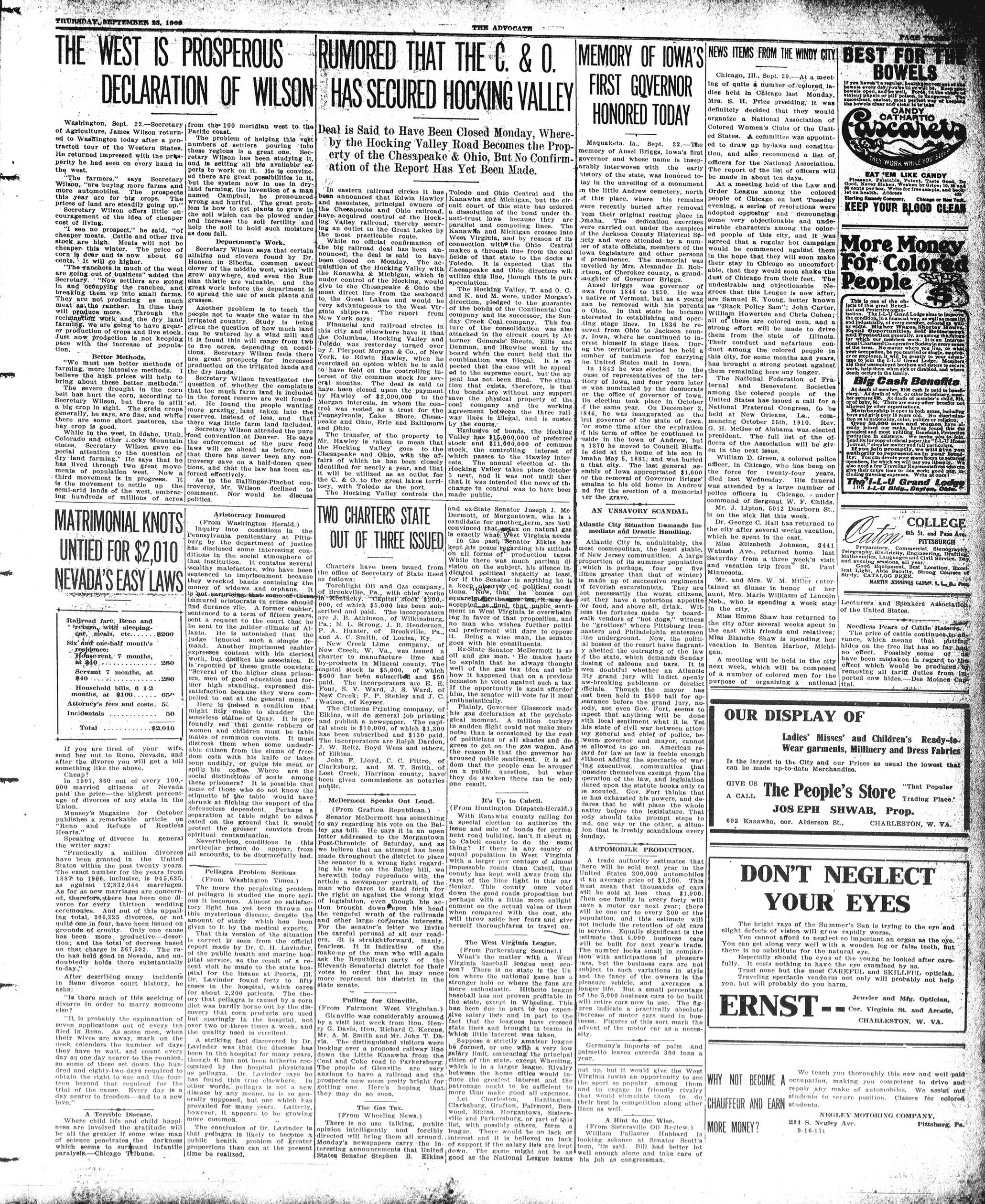
MATRIMONIAL KNOTS UNTIED FOR $2,010 NEVADA'S EASY LAWS
Railroad fare, Reno and return, with sleeping car, meals, etc....$200
Six and one-half month's residence:
House rent, 7 months, at $40.280
Servant 7 months, at $40.280
Household bills, 6 1-2 months, at $100.050
Attorney's fees and costs. 50
Incidents. 50
Total. $2,010
If you are tired of your wife, send her out to Reno, Nevada, and after the divorce you will get a bill something like the above.
In 1907, 860 out of every 100,000 married citizens of Nevada paid the price—the highest percentage of divorces of any state in the Union. Munsey's Magazine for October publishes a remarkable article on Poverty and Refuge of Restless Heart's. Speaking of divorce in general the writer says:
"Practically a million divorces have been granted in the United States within the past twenty years. The exact number for the years from 1887 to 1906, inclusive, is 945,625 as against 12,832,044 marriages. As far as new marriages are concerned, therefore, there has been one divorce for every thirteen wedding ceremonies. And out of this appalling total, 20,622 divorces, or not one in four, have been issued on grounds of cruelty. Only one cause has been more productive—desertation; and the total of decrees based on that charge is 367,502. The ratio has held good in Nevada, and undoubtedly holds there substantially to-day."
After describing many incidents in Reno divorce court history, he asks:
"Is there much of this seeking of divorce in order to marry someone else?
"It is probably the explanation of seven applications out of every ten filled in Reno. As some men, when their wives are away, mark on the desk calenders the number of days they have to wait, and count every day as one day nearer to the reunion so some of these set down the hundred and eighty-two days required to obtain the right to sue and the fourteen beyond that required for the trial of the cause. Every day is a day nearer to freedom—and to a new love."
A. Terrible Disease.
Where child life and child happiness are involved the gratitude will be all the greater if some wise man of science penetrates the darkness which seems to surround infantile paralysis.—Chicago Tribune.
from the 100 meridian west to the Pacific coast.
The problem of helping this vast numbers of settlers pouring into these regions is a great one. Secretary Wilson has been studying it, and is setting all his available exports to work on it. He is convinced there are great possibilities in it, but the system now in use in dryland farming, the invention of a man named Campbell, he pronounced wrong and hurtful. The great problem is how to get plants to grow in the soil which can be plowed under and increase the soil fertility and help the soil to hold such moisture as does fall.
Department's Work.
Secretary Wilson says that certain alfalfa and clovers found by Dr. Hansen in Siberia, common sweet clover of the middle west, which will grow anywhere, and even the Russian thistle are valuable, and the great work before the department is to spread the use of such plants and grasses.
Another problem is to teach the people not to waste the water in the irrigated country. Study is being given the opportunity of how much land can be watered by a wind mill and it is found this will range on two to five acres, depending on conditions. Secretary Wilson feels there are great prospects for increased production on the irrigated lands and the dry lands.
Secretary Wilson investigated the question of whether the complaints that too much farm land is included in the forest reserve are well founded. He found the people wanting more grazing, land taken into the reserves, instead of less, and that there was
arm land included.
Secretary Wilson attended the pure food convention at Denver. He says the enforcement of the pure food laws will go ahead as before, and that there has never been any controversy save on a half-dozen questions, and that the law has been enforced effectively.
As to the Ballinger-Pinchot controversy, Mr. Wilson declined to comment. Nor would he discuss politics.
Aristocracy Immured
(From Washington Herald.) Inquiry into conditions in the Pennsylvania pententary at Pittsburgh by the department of justice has disclosed some interesting conditions in the social atmosphere of that institution. It contains several wealthy malefactors, who have been sentenced to imprisonment because they wrecked bands containing the money of widows and orphans. It is not surprising that some of these immurated aristocrats in crime should find durance vile. A former cashier, sentenced to a term of fifteen years, sent a request to the court that he be sent to the milder climate of Atlanta. He is astonished that the judge ignored such a simple demand. Another imprisoned cashier expresses content with his clerical work, but dislikes his associates. It is reported of these gentle convicts: "Several of the higher class prisoners, men of good education and former high standing, expressed dissatisfaction because they were compelled to eat at the general mess."
Here is indeed a condition that might fitly make to shudder the senseless statue of Quay. It is profoundly sad that gentle robbers of women and children must be table mates of common convicts. It must distress them when some undesirable citizen from the slums of freedom eats with his knife or takes soup audibly, or gulps his meat or spills his coffee. Where are the social distinctions of souls among these prisoners? It is possible that some of those who do not know the etiquette of the table would have shrunk at filching the support of the defenseless dependent. Perhaps a separation at table might be advocated on the ground that it would protect the grosser convicts from spiritual contamination.
Nevertheless, conditions in this particular prison do appear, from all accounts, to be disgraceful bad.
Pellagra Problem Serious
(From Washington Times)
The more the perplexing problem of pollegra is studied the more serious it becomes. Almost no satisfactory light has yet been thrown on this mysterious disease, despite the amount of study which has been given to it by the medical experts. That this version of the situation is correct is seen from the official report made by Dr. C. H. Lavinder, of the public health and marine hospital service, as the result of a recent visit he made to the state hospital for the insane at Peoria, Ill. Lavinder found forty to fifty cases in the hospital, which cared for about 2,200. The theory that pollegra is caused by a diet was hardly borne out by the discovery that corn products are used but sparingly in the hospital, not over two or three times a week, and the quality used is excellent.
A striking fact discovered by Dr. Lavinder was that the disease has been in the hospital for many years, though it has not been hitherto recognized by the hospital physicians as pellagra. Dr. Lavinder says he has found this true elsewhere. In other words, pellagra is not a new disease by any means, as is so generally supposed, but one which has prevailed for many years. Latterly, however, it appears to be growing more common.
The conclusion of Dr. Lavinder is that pellagra is likely to become a public health problem of greater proportions than can at the present time be realized.
RUMORED THAT THE C. & O. HAS SECURED HOCKING VALLEY
Deal is Said to Have Been Closed Monday, Whereby the Hocking Valley Road Becomes the Property of the Chesapeake & Ohio, But No Confirmation of the Report Has Yet Been Made.
In eastern railroad circles it has Toledo and Ohio Central and the been announced that Edwin Hawley and associates, principal owners of the Chesapeake and Ohio railroad, have acquired control of the Hocking Valley railroad, thereby securing an outlet to the Great Lakes by the most practicable route.
While no official confirmation of the big railroad deal has been announced; the deal is said to have been closed on Monday. The acquisition of the Hocking Valley with the Kenawha & Michigan, which is the only control of the Hocking, would give to the shawapease & Ohio the most direct link from the seaboard to the Great Lakes and would be very advantageous to the West Virginia shippers. "The report from New York says:
Financial and railroad circles in this city and elsewhere have it that the Columbus, Hocking Valley and Toledo was yesterday turned over by J. Pierpont Morgan & Co., of New York, to Edwin Hawley, when he exercised an option which he is said to have field on the controlling interest of the common stock for several months. The deal is said to have been closed upon the payment by Hawley of $2,000,000 to the Morgan interests, in whom the control was vested as a trust for the Pennsylvania, Lake Shore, Chesapeake and Ohio, Erie and Baltimore and Ohio.
The transfer, of the property to Mr. Hawley is taken to mean that the Hocking valley" goes to the Chesapeake and Ohio, with the affairs of which he has been closely identified for nearly a year, and that it will be utilized as an outlet for the C. & O. to the nearest lakes territory, with Toledo as the center. The Hocking Valley controls the
TWO CHARTERS STATE OUT OF THREE ISSUED
Charters have been issued from the office of Secretary of State Reed as follows:
Torchlight Oil and Gas company, of Brookville, Pa., with chief works in Kentucky. Capital stock $200,000, of which $5,000 has been subscribed and paid. The incorporators are J. B. Atkinson, of Wilkinsburg, Pa.; N. L. Strong, J. B. Henderson, P. A. Hunter, of Brookville, Pa., and A. C. Smith, of Louisa, Ky.
New Creek Lime company, of New Creek, W. Va., was issued a charter to manufacture lime and by-product in Mineral county. The capital stock is $600 of which $600 has been subscribed and $2 paid. The incorporators are E. E. Fout, S. V. Ward, J. S. Ward, of New Creek; F. P. Stleyh and J. C. Watson, of Keyser.
The Citizens Printing company, of Elkins, will do general job printing and publish a newspaper. The capital stock is $10,000, of which $1,300 has been subscribed and $130 paid. The incorporators are Ralph Darden, J. Erik Reitz, Boyd Wees and others, of Elkins. John F. Lloyd, C. C. Fittro, of Clarksburg, and M. T. Smith, of Lost Creek, Harrison county, have been given commissions as notaries public.
McDermott Speaks Out Loud.
(From Grafton Republican.) Senator McDermott has something to say regarding his vote on the Bailey gas bill. He says it in an open letter addressed to the Morgantown Post-Chronicle of Saturday, and as we believe that an attempt has been made throughout the district to place the senator in a wrong light regarding his vote on the Bailey bill, we herewith today reproduce with the article a newspaper portrait, of the man who dares to stand forth for the right as against the wrong kind of legislation, even though his action brought down upon his head the vengeful wrath of the railroads and other large corporate interests. For the senator's letter we invite the careful perusal of all our readers. It is straightforward, manly, fearless. It is indicative of the make-up of the man who will again ask the Republican party of the Eleventh Senatorial district for their votes in order that he may once more represent his district in the state state.
Pulling for Glenville.
(From Fairmont West Virginiaian.)
Glenville was considerably aroused by a visit last week from Hon. Henry G. Davis, Hon. Richard C. Kerenza, Mr. A. M. Smith and Mr. John T. Davis. The distinguished visitors were looking over a proposed railway line down the Little Kanawha from the Coal and Coke road to Parkersburg. The people of Glenville are very anxious to have a railroad and the prospects now seem pretty bright for getting one. Here's hoping that they may do so soon.
The Gas Tax.
There is no use talking, public opinion intelligently and forcibly directed will bring them all around. Monday's newspapers carry the interesting announcements that United States Senator Stephen B. Elkina
THE C. & O. HOCKING VALLEY
On Closed Monday, Where- y Road Becomes the Prop- e & Ohio, But No Confirm- as Yet Been Made.
Toledo and Ohio Central and the Kanawha and Michigan, but the circuit court of this state has ordered a dissolution of the bond under the ant-trust laws because they are parallel and competing lines. The Kanawha and Michigan crosses into West Virginia, and by reason of its connection with the Ohio Central makes a thru-line from the coal fields of that state to the docks at Toledo. It is expected that the Cheesapeake and Ohio directors will utilize this line, though this is pure speculation.
The Hocking Valley, T. and O. C. and K. and M. were, under Morgan's direction, pledged to the guarantee of the bonds of the Continental Coal company and its successor, the Sunday Creek Coal company. This feature of the consolidation was also attacked in the circuit court by Attorney Generals Sheets, Ellis and Denman, and likewise went by the board when the court held that the combination was illegal. It is expected that the case will be appeal to the supreme court, but the appeal has not been filed. The situation that exists, therefore, is that the bonds are without any support save the physical property of the coal company and the working agreement between the three railway lines is illegal, and is ousted by the courts.
Exclusive of bonds, the Hocking Valley has $15,000,000 of preferred stock and $11,000,000 of common stock, the controlling interest of which passes to the Hawley interests. The annual election of the Hocking Valley takes place October 5 next, and it was not until that day was intended the news of the change 4 control was to have beer made public.
and ex-State Senator Jonoph I. McDermott, of Morgantown, who is a candidate for another term, are both convinced that tax on natural gas is exactly what West Virginia needs
In the past, Senator Elkus has kept his peace regarding his attitude on all forms of production taxes. While there was much partisan division on the subject, his silence indicated political sagacity at least, for if the Senator is anything he is a keen observer of political conditions, he comes out squarely for the state, and accepted as equal that public sentiment in West Virginia is overwhelming in favor of that proposition, and no man who wishes further political preferment will dare to oppose it. Being a wise man, the senator goes with his constituents.
Ex-State Senator McDermott is an oil and gas man. He makes haste to explain that he always thought well that the gas tax idea and tells him it happens against a previous occasion he voted against a tax. If the opportunity is again afforded him, the senator will vote for it most enthusiastically.
Plainly, Governor Glasscock made his gas declaration at the psychological moment. A million turkeys in sudden flight could not make more noise than is occasioned by the rush of politicians of all shades and degrees to get on the gas wagon. And the governor is that the governor harassed the investment. It is seldom that the people can be aroused on a public question, but when they do awaken there can be only one result.
It's Up to Cabell.
(From Huntington Dispatch-Herald). With Kanawa county calling for a special election to authorize the issue and sale of bonds for permanent road building, isn't it about to Cabell county to do the same thing? If there is any county of equal population in West Virginia larger per centage of almost impassable roads than county has kept well away from rays of the line light in this particular. This county once voted down the good roads proposition but perhaps with a little more enlightenment on the actual value of them when compared with the cost, she will throw aside her fears and give herself thoroughfares to travel on.
The West Virginia League.
(From Parkersburg Sentinel.)
What's the matter with a West Virginia baseball league next season? There is no state in the Union where the national game has a stronger hold or where the fans are more enthusiastic. Hitherto league baseball has not proven profitable in the state, except in Wheeling. This has been due in part to too expensive salary lists and in part to the fact that the leagues have crossed state lines and brought in teams in which little interest was taken.
Suppose a strictly amateur league be formed, or one with a very low salary limit, embracing the principal cities of the state, except Wheeling, which is in a larger league. Rivalry between the home cities would induce the greatest interest and the patronage ought to be sufficient to more than make good all expenses. Let, Charleston, Huntington, Clarksville, Grafton, Fairmont, Benwood, Elkton, Gap, down, Sistersville and Parkersburg, or put this list, with possibly others, form league. There would be no lack of interest and it is believed no lack of support if the salary lists are kept down. The game might not be as good as the National League team
MEMORY OF IOWA'S FIRST GOVERNOR HONORED TODAY
Maquaketa, In., Sept. 22.—The memory of Ansel Briggs, Iowa's first governor and whose name is inseparably interwoven with the early history of the state, was honored today in the unveiling of a monument in the little Andrew cemetery, north of this place, where his remains were recently buried after removal from their original resting place in Omaha. The dedication exercises were carried out under the auspices of the Jackson County Historical Society and were attended by a number of state officials, members of the Iowa legislature and other persons of prominence. The memorial was unveiled by Mrs. Alexander D. Robertson, of Cherokee county, a grand-daughter of Governor Briggs.
Ansel Britgs was governor of Iowa from 1846 to 1850. He was a native of Vermont, but as a young man he removed with his parents to Ohio. In that state he became interested in establishing and operating stage lines. In 1836 he re-entered in Jackson county, Iowa, where he continued to interest himself in stage lighting the territorial period he held a number of contracts for carrying the United States mail in Iowa.
In 1842 he was elected to the house of representatives of the territory of Iowa, and four years later he was nominated by the democrat or the office of governor of Iowa his election took place in October of the same year. On December 3, 1846, he was inaugurated as the first governor of the state of Iowa, or some time after the expiration term of office he continued to serve in the town of Andrew, but in 1870 he Council Bluffs he died at the home of his son in Omaha May 5, 1881, and was buried in that city. The last general assembly of Iowa appropriated $1,000 or the removal of Governor Briggs' remains to his old home in Andrew and for the erection of a memorial over the grave.
AN UNSAVORY SCANDAL
Atlantic City Situation Demands Immediate and Drastic Handling.
Atlantic City is, undubutiful, the most cosmopolitan, the least stable, of New Jersey communities. A large proportion of its summer population (which is perhaps, four or five times greater than that of winter) is made up of successive regiments of feverish excursionists. They are not necessarily the worst citizens, but they have a notorious appetite for food, and above all, drink. Witness the fortunes made by boardwalk vendors of "hot dogs," witness the "grottoes" that Pittsburg ironmasters and Philadelphia statesmen line underground. Now, the political bosses of the resort have flagrantly abetted the outraging of the law of the state, which demands Sunday closing of saloons and bars. It is even doubtful whether an Atlantic City grand jury will indict openly law-breaking publicans or derelict officials. Though the mayor has been held in $500 ball for appearance before the grand jury, nobody even Gov. Fort, seems to expect that anything will be done with local sentiment what it is. Yet this state of civil war get een attorney general and chief of police, between governor and mayor, be allowed to go on. American regard for law as law is feeble enough without adding the spectacle of warring executives, communities that consider themselves exempt from the operation of the law, and legislation placed upon the statute books only to be scouted. Gov. Fort thinks that he has exhausted his powers, and declares that he will place the whole matter before the legislature. That body should take prompt steps to end, one way or the other, a situation that is freshly scandalous every Sunday.
AUTOMOBILE PRODUCTION
A trade authority estimates that there will be sold next year in the United States 200,000 automobiles at an average price of $1,200. This must mean that thousands of cars will be sold at less than $1,000. Then one family in every forty will have a motor car next year; there will be one car to every 200 of the population, and this estimate will not include the retention of old cars in service. Equally significant is the estimate that 5,000 business cars will be built for next year's trade. The number looks small in comparison with anticipations of pleasure cars, but the business cars are not subject to such variations in style and the fancy of the owners is the pleasure vehicle, and averages a longer life. But a small percentage of the 5,000 business cars to be built will retire cars now in use. The figures indicate a practically absolute increase of motor cars used in business. Figures of this sort mark the advent of the motor car as a necessity.
Germany's imports of palm and palmetto leaves exceeds 300 tons a year.
put up, but it would give the West Virginia towns an opportunity to see the sport so popular, bring them and to engage in friendly rivalry that would stimulate them to do their best in competition along other lines as well.
A Hint to the Wise.
(From Sidwellsville Oll Review.)
William Pallaster Hubbard is looking askance at Senator Scott's toga, 'its said. Bill had better let well enough alone and take care of his job as congressman.
OUR DISPLAY OF
Is the largest in the City and our Prices as usual the lowest that can be made up-to-date Merchandise.
DON'T NEGLECT YOUR EYES
The bright rays of the Summer's Sun is trying to the eye and slight defects of vision will grow rapidly worse.
You cannot afford to neglect so important an organ as the eye. You can get along very well with a wooden leg or false teeth, but there is no substitute for the natural eye.
Especially should the eyes of the young 'be looked after carefully.' It costs nothing to the eye examined by us. Traveling spectacle CA pupilL and SKILLPUP optician. Traveling spectacle venders not only will probably not help you, but will probably do you harm.
We teach you thoroughly this new and well paid occupation, making you competent to drive and repair any make of automobiles. We assist our students to secure position. Classes for colored students.
NEGLEY MOTORING COMPANY,
211 S. Negley Ave.
Pittsburg, Pa.
9-16-17:
Chicago, Ill., Sept. 20.—At a meeting of quite a number of colored, ladies held in Chicago last Monday, Mrs. S. H. Price presiding, it was definitely decided that they would organize a National Association of Colored Women's Clubs of the United States. A committee was appointed to draw up by-laws and constitution, and also recommend a list of officers for the National Association. The report of the list of officers will be made in about ten days.
At a meeting held of the Law and Order League among the colored people of Chicago on last Tuesday evening, a series of resolutions were adopted opposing and denouncing some very objectionable and undesirable characters among the colored people of this city, and it was agreed that a regular hot campaign would be commenced against them in the hope that they will soon make their stay in Chicago so uncomfortable, that they would soon shake the dust of Chicago from their feet. The undesirable and objectionable Negroes that this League is now after, are Samuel R. Young, better known as "Black Policy Sam"; John Carter, William Howerton and Chris Cohen; all of these are colored men, and a strong effort will be made to drive them from the state of Illinois. Their conduct and nefarious conduct among the colored people in this city, for some months and years, has brought a strong protest against them remaining here any longer.
The National Federation of Fraternal and Benevolent Societies among the colored people of the United States has issued a call for a National Fraternal Congress, to be held at New Orleans, La., commencing October 25th, 1910. Rev. G. H. McGee of Alabama was elected president. The full list of the officers of the Association will be given in the next issue.
William D. Green, a colored police officer, in Chicago, who has been on the force for twenty-four years, died last Wednesday. His funeral was attended by a large number of police officers in Chicago, under command of Sergeant W. F. Childs. Mr. J. Lipton, 5012 Dearborn St., is on the slick list this week.
Dr. George C. Hall has returned to the city after several weeks vacation, which he spent in the east.
Miss Elizabeth Johnson, 3441 Wabash Ave., returned home last Saturday from a three week's visit and vacation trip from St. Paul Minnesota.
Mr. and Mrs. W. M. Miller entertained at dinner in honor of her aunt, Mrs. Marie Williams of Lincoln Neb., who is spending a week stay in the city.
Miss Emma Shaw has returned to the city after several weeks spent in the east with friends and relatives; Miss Blanche Shaw is spending her vacation in Benton Harbor, Michigan.
A meeting will be held in the city next week, which will be composed of a number of colored men for the purpose of organizing a national
If you haven't beware, regularly move more of the bowels open, and be well. Forces, if the intestines violent or pill poison, is dangerous. You should bowel clear and clean it to the bowels clear and clean is to take
CANDY
OATHARTIO
Fascaretta
THEY WORK WHILE YOU SLEEP
EAT JEM LIKE CANDY
Pleasant, Paletteb, Pottery; That Good, Do
Good, Never Slicken, Waken or Gripe; 10, 25 and
25 ounces per box, Write for free sample, and book
let on health.
Ressurem Remedy Company. Chicago or New York.
KEEP YOUR BLOOD CLEAN
More Money For Colored People This is one of the obje ctions of this recent issue
The I-L-U Grand Lodge aims to improve the condition, in a financial way, as well as mostly and industrially, of every member, colored in well as white. Higher Wages, Shorter Hours, Equal Opportunities, Self-Betterment and Protection generally, are among the things for which our members work. It is an International Chartered Co-operative Society in every sense of the term. No matter where you live, or what your occupation, be you married or single, employer or employee, it will be greatly to your advantage to join the I-L-U Grand Lodge. Members and their unemployed brothers and sisters to secure work, help them when sick or disabled, and where they die, occur in the family.
Big Cash Benefits
At death of member, $100 cash is paid to beneficiaries. At death of wife, or other beneficiary, mentions of the deceased are made to or of baby, $8. There are many other benefits may be allowed by other organizations. The benefits include boys and girls over 15 years old. No discrimination as to nationality, color, politics or religion. We have already joined our group and most uplifting Beneficial Protective Institutions in existence. We invite you to join. Send 100 to Beneficial Protective Journal, "circular matter and full particul
If you join promptly, we will give you
mandatory training in life and safety. You can devote your spare hours to securing
management of which we will pay you liberally. We also need you for Traveling Reorganized jobs,
give their entire time to this work; good pay, in
including traveling expenses. Write at once!
The I-L-U Grand Lodge
105 I-L-U Bldg., Dayton, Ohio.
COLLEGE
6th St. and Paine Ave.
PITTSBURGH
Preparatory, Commercial, Stenography
Telegraphy, Electricity, Engineering, Drafting,
Math and Engineering and Civil Service. Day
and evening sessions will be held.
Good Equipment, Best Location, Excellent
Light and Hardness, Strong Courses of
Stylish, CATALOG PRINT.
MARTIN JENNINGS CATON. I. L. M. P. P.
Lecturers and Speakers Association
of the United States.
Needless Fears of Cattle Raisers.
The price of cattle continues to advance, which means that putting hides on the free list has so far had no effect. Possibly some of us have been mistaken in regard to the effect which would be produced by removing all tariff duties from imported cow hides.—Des Moines Capital.
OF
'ss' and Children's Ready-to-lice, Millinery and Dress Fabrics
ar Prices as usual the lowest that notice.
The Advocate is entered in the Post-office at Charleston, W. Va., as second class matter.
BETRAYING THEIR TRUST.
Our readers have doubtless long since grown tired of the question of Negro conventions, but Washington's announcement of its preparations to entertain the National Medical Association, next August, coupled with a boost for Dr. Curtis for the presidency of the association, furnishes an opportunity too good to pass by, as it confirms what has been said frequently in these columns: the official roster is the paramount object of the great majority of Negro conventions.
It is barely a month since the National Medical Association met; none of that part of its discussions which might prove of interest or benefit to the layman, such as the prevention and cure of tuberculosis, has been given publicity, but candidates are already being groomed for the presidential futurity. Office! Office! Who gives a hoot about the time wasted and money squandered simply to confer upon this one or that one the empty honor of being addressed as "Mr. President." Since all the delegates to the convention named pay their own expenses, it may appear as an impertinence to question their use of the time, still we venture the assertion that suffering humanity would deem it a favor if less time were spent in electioneering and more devoted to the discussion of the prevention and cure of the ills to which flesh is heir.
CLEAN UP DAY.
October 1st, by the proclamation of State Superintendent of Schools Shawkey, is clean up day. This does not mean, Q Reader, that you are to defer your usual daily cleaning up till October 1st, but that special effort is to be made on that day to make your back yard as presentable as your front yard, that each man, woman and child in every city, village, township and habitation of man is to lay aside some of the customary cares of life, and to devote the time thus gained to "scrubbing windows and floors, cleaning away debris, planting vines, building walks, erecting flag poles or putting up pictures" and the many other small things which may add to the appearance of school houses and private property. The State Superintendent also suggests that city folks make a concerted crusade that day, against filthy alleys, back yards, unsanitary cars, indecent bill boards, noxious shows and indecent language on the streets.
There is much need of some such campaign here in Charleston where, since municipal funds ran low, there is accumulating in the back streets and alleys piles of refuse as unhealthful as they are unsightly. By all means let there be a universal observance of Clean Up Day.
A GOOD LAW.
The stock argument of the radicals for the drawing, quartering, cremating and scattering to the winds of the ashes of the whole Negro race is receiving a set-back in Louisiana since the passage and attempted enforcement of her anti-miscegenation laws. Rather than discontinue their illicit relations, scores of white men are hieing themselves with their Negro paramours to more congenial climes, while others are repudiating their identity with the white race by making solemn declarations of Negro parentage. Protests loud and long are being made by white men, but not one word comes from the Negro, especially from that class of the race which has long seen and proclaimed the injury to both races arising from the nefartious practice.
The white women of Louisiana, who indirectly suffered as much degradation as the Negro woman whose avarice or ignorance made her the willing object of the white man's passion, are responsible for passage and enforcement of the law. They have grown tired of the dual household maintained by their husbands the flagrant disregard of the bar later by their sons. It was not so much for the Negro as their own protection that they demanded and received the law, but the Negro will be the greatest beneficiary, even if some Negroes, to evade the law, are becoming white, and some white are becoming, or at least swearing themselves, Negroes.
Any movement which has for its
object the upbuilding of Charleston or any other city deserves the sup port, not only of the rich and power ful but also of the poor and lowly, for the latter will be benefitted proportionately as much as the former. This being the case, it behooves every voter to cast his ballot for the issuance of bonds to erect a permanent road to Sissonville and the Roane county oil fields. Easy access to this territory means money to Charleston for the sale of supplies of all kinds, and in the purchase of farm products. A marked increase in business will create a demand for more store rooms; the erection of more buildings will give more employment to the artisan and laborer, who, by the same means, will have opened to him a market from which to purchase the necessities of life at lower rates.
Good roads mean even more to the farmers of the county to whom a market accessible the year round would be of incalculable benefit. It is to their interests as much as to the interest of the laboring element to vote for the bonds.
THE NATIONAL NEGRO PRESS AS SOCIATION.
The formation of the National Negro Press Association at Louisville, Ky., as an affiliated body of the National Negro Business League, was a step in the right direction. A closer union of the journalists of the race cannot fail to be productive of good results. Emphasizing the gospel of moral and material development, there is no danger of the organization being wrecked on the shoals of political division, denominational entanglements or personal ambitions. The selection of Mr. W. R. Thompson as president was in accord with the fitness of things and his painstaking administration is certain to demonstrate the wisdom of those who placed the scepter in his hands. Mr. Thompson is surrounded with a set of officers and an executive committee that stand for the best thought and substance of the race. Backed by the leader of the press fraternity and the people at large, this young organization will be a power for the uplift of the calling that has so much to do with the real progress of the race.
It had the hearty endorsement of The ADVOCATE at the outset, when proposed by Mr. Thompson. It has our best wishes for success, now that it has become a fact.
Why not a reception for explorer Matthew Henson when he reaches Washington?
The appointment of Wade H. Hammond, the fourth Negro to be placed at the head of a regimental band in the United States Army, is another feather in the cap of Emmett J. Scott, as well as an instance of the help which Register W. T. Vernon is willing to render a member of his race when that member proves himself worthy of his support.
RESOLUTIONS ON THE DEATH OF
ROSSER D. ROBINSON.
Lodge room of Rising Sun Lodge No.
5 A. F. & A. M.
Harper's Ferry, W. Va., Sept.
16, 1999.
Whereas, The Supreme Architect of the Universe, in His Allwise Providence, has called our beloved Grand Master, Bro. R. D. Robinson, from labor to reward; Be it
Resolved, That, with deep sorrow, we bow in submission to His will;
That in the death of Grand Master R. D. Robinson, the Masonic Fraternity has lost an earnest advocate of the tenets of Masonry, the family a kind and loving protector, the State an honorable and most useful citizen;
That we extend to the grief stricken family our sincere sympathy, with the assurance that the life of this good man will be to us an inspiration to live nearer the principles of the noble order to which he was so deeply attached.
That a copy of these resolutions be sent to his family, a copy inscribed upon the records of this lodge and that copies be sent to the Advocate and Pioneer Press.
Adopted by Rising Sun Lodge No. 5.
A. HERROD.
J. E. ROBINSON.
J. E. BRUNSWICK.
Committee
WANTED—Success Magazine wants an energetic and responsible man or woman in Charleston to collect for renewals and solicit new subscriptions during full or spare time. Experience "unnecessary. Anyone can start among friends and acquaintances and build up a paying and permanent business without capital. Complete outfit and instructions free. Address "VON." Success Magazine, Room 193. Success Magazine Building New York City, N. Y.
BOYS! GIRLS! COLUMBIA BICYCLE FREE! Greatest offer out. Get your friends to subscribe to our magazine and we will make you a present of a $40.00 Columbia Bicycle—the best made. Ask for particulars, free outfit and circular telling "how to start." Address "The Bicycle Man," 29-31 East 22nd Street, New York City, N. Y.
Suggestive Questions on the Sunday School Lesson by Rev. Dr. Linscott for the International Newspaper Bible Study Club
Copyright 1900 by Rev. T. S. Linscott, D. D.
Golden Text.—Let every one of us please his neighbor for his good to edification. Rom. 15:2.
Verse 23—If a man could lawfully drink intoxicating liquor, in moderation, would it be a good thing to do, seeing so many thousands are being ruined yearly, by drinking, all of whom commenced to drink in moderation? (This question must be answered in writing by members of the club.)
Is a man honest in either money and morals, who always goes as far as the law allows him and no further?
If the general influence of anything we do, which may be lawful in itself, is injurious to ourselves or others, what is our duty?
What is the general influence of the dring traffic?
Verse 24.—Why is not all our duty to our neighbor fulfilled when we have succeeded in doing him no harm?
Does Paul mean that we are to devote more time to thought and adding to our neighbor's wealth, than we do to our own, and if not, what does he mean?
To how much of our respect is a man entitled, who cares nothing for the success of others, but is devoted wholly to his own?
Verse 25.—In those days meat was offered to idols and afterwards sold in the market for food, and some conscientious people objected to eating it for that reason. What did Paul advise in the circumstances and why did he advise it?
Should we always pay the price demanded without question, or
At the Nation's Capital
CONTINUED FROM PAGE ONE
usual, a "live wire," but sentiment is rapidly crystalizing on this important point in this and other sections of the country. We have traveled some in the past month and have talked with many members of the profession who possess weighty influence in their respective communities, and we find a wonderful agreement of feeling that Dr. A. M. Curtis, of Washington, is the most available man for the next presidency of the Association. Heretofore, he has invariably declined and thrown his support to worthy and ambitious young men, who, he felt, needed the encouragement that such an election would give them. This year, however, his close friends have prevailed upon him to allow them to bring him forward, and it is understood that he has given his consent, it having been shown him that his duty to the organization demanded that he sacrifice something for it, especially when the convention is to come to his home city and it is customary to honor the entertaining town with the highest office within the gift of the body. As Washington is to have the presidency, the logical choice would be Dr. Curtis. Since the states in which the N. M. A. is the strongest are centering on Dr. Curtis, it behooves the medicos of the capital to unite upon him in some formal way between now and spring, so as to present a solid front to the country for their favorite son. The divisions in home communities that have given so much trouble heretofore should not be permitted to mar the convention of 1910. Although Washington is rich in presidential timber, wisdom, fair play and the best interests of the Association suggest that the honor go to Dr. Curtis at the next election.
William L. Houston, the energetic Grand Master of the G. U. O. of O. F., spent the week here with his family, following a lengthy tour of the East and South, where he has been making his annual visitation of the District Grand Lodges. From Cape Cod to the Gulf he saw gratifying evidences of prosperity upon all sides. "Not only are the lodges growing in membership", said he, "but the quality of the men who are allying themselves with the order is of a superior type—men of business ability, organizing capacity and of reliable character. The local lodges are getting their affairs in such systematic shape that a glance at their books is sufficient to tell the exact story of their financial and general condition. This was not so common a few years ago. The Order now numbers over 400,000—making the Grand United Order of Odd Follows the strongest fraternal society of Negroes in the world.
"And," continued the Grand Master, "we are not confining our attention to 'taking care of the sick and burying the dead,' as in ye old time—commandable as that duty is in the hour of necessity. The Order is encouraging its members to invest their money in five business enterprises, to buy homes and to acquire landed holdings for the future and to get the habit of having a bank account. Co-operative stores for the accommodation of members of the Order and their friends will yet come, and we shall be able to lower the
THE ADVOCATE
should we endeavor to buy for the lowest possible price?
Verse 26.—If the earth is the Lord's why should not all real estate be public property?
How much of our property should we consider we own in our own right?
Verse 27.—Is it right for a christian to be intimate with worldly people, to attend their parties and conform to their usages, when such usages are not actually sinful?
If wine is used, at any party which a christian attends, would it be right or wrong for him to drink it and why?
Is it a christian's right to do as he is "disposed" in any matter, or has God a specific plan for him for all matters great and small?
Verses 28-30.—Was the meat in itself any less good for having been offered to an idol?
Why does Paul here not advise to eat meat that had been offered to an idol, if any person calls attention to it who thought it was wrong to do so?
Is it necessarily hypocracy to do a thing behind a person's back, that you would not do before his face?
If no person ever got drunk, and if drinking was doing no harm, would it be right or wise for us to drink intoxicating liquor as a beverage?
Verse 31.—Are all our actions taken by God as worship if they are done to his glory?
How is it possible for a christian to do literally everything he does, to the glory of God?
Verses 32:33.—What should be our supreme desire in all our dealing with our fellow men?
Lesson for Sunday, October 3, 1909—Paul as prisoner—The Arrest. Acts 21:17 to 22:29.
enormous cost of living by purchasing supplies for communities at wholesale rates and selling to our folks at practically the cost price. We shall get to this beneficial policy by and by, and make the Order of more and more commercial value to its members. Wherever we can, the lodges are encouraged to own their buildings and keep the thousands of dollars paid for rentals in the hands of the race. Any city in which we have any respectable following a hall worth from $3,000 to $10,000 can be erected and paid for in a few years, and in the large cities, costlier structures would be paying investments.
"The next meeting of the B. M. C. will be held in the hospitable city of Baltimore. There will be at least 1,500 delegates in attendance, which, with the visitors who are usually attracted by the convention will bring the attendance up to 5,000. I have every reason to believe that the Baltimore meeting will be the best in our history, for the committee is going at things in a vigorous fashion and the lodges in the country at large are exhibiting a deeper interest than ever before in the internal workings of the organization. They will come to the B. M. C. to have a voice in making the laws by which they are to be governed. Hon. Harry S. Cummings, Baltimore's well-known leader, is at the head of the committee on arrangements. This is, in itself, a guarantee that the work will be thoroughly done."
Mr. Houlston is succeeding admirably in the practice of law in Chicoa, in partnership with the veteran E. H. Morris, and is in love with the city and with his labors at the bar. He sees vast opportunities and will not be g'ow to take advantage of them in the hustling Middle West. He has yet to regret separating himself from a government 'desk, and is of the opinion that a man of action is better off in the world of business and professional life than in official routine life at Washington. His example is one that others could follow with profit to themselves and to posterity.
NATIONAL CAPITAL NOTES
The public schools opened Monday, with an attendance of colored pupils numbering over 15,000.
Emmett J. Scott, United States Commissioner to Liberia, was in the city this week, and with his two associates, completed the report they are to lay before the President and the State Department. Mr. Scott has gone to New York to join Dr. Booker T. Washington.
The stork visited the home of Prof. and Mrs. Roscoe Conkling Bruce Monday morning and left a bouncing baby boy. "Everybody happy".
Prof. E. C. Williams, of Cleveland, Ohio, made his first appearance at the building Monday and was cordially received.
Former Register of the Treasury
J. W. Lyona has re-located at his old home in Augusta, Ga., where he will practice law.
Dr. Roger Conkling Wormley has hung out his shingle at 1922 11th street, N. W., and opened a first-class establishment. He has been appointed assistant demonstrator in dehydro at Howard University.
Register W. T. Vernon has gone
West on a lecturing tour and to inspect the condition of his school, the Western University, at Quindare, Kansas.
Explorer Matthew Hensen is to be given a royal reception by his Washington fellow citizens when he reaches here. Mr. Hensen is a Washington boy and the natives of this city are justly proud of him.
Mr. Cyrus Fled Adams, Assistant Register of the Treasury, is rapidly improving under the care of Dr. A. M. Curtis. He has been seriously ill for several days with a muscular affliction, and was compelled to forego his intended trip to Louisville, to serve as transportation agent of the National Negro Business League.
Miss Fannie Alexander, who was the house guest of Register and Mrs. W. T. Vernon during a portion of August, and afterwards spent some time in New York City, has resumed her duties as a teacher in the public schools at El Paso, Texas. Miss Alexander is a graduate of Western University, Quindaro, Kansas, and through the influence of Dr. Vernon and as a reward for her own excellent service, she has been given a substantial promotin by the school officials at El Paso.
Mr. Ralph W. Tyler, Jr., went to Tuskegee Institute, Alaama, last Sunday to enter upon a three years' course in electrical engineering. He will make his home with the family of Mr. Emmett. Scott, private secretary to Dr. Booker T. Washington.
Three prominent True Reformers Mr. A. W. Holmes, of Richmond, deputy-general of the South, Mr. Thomas W. Taylor, superintendent of the Old Folks' Home at Richmond, and Mr. J. G. Hunter, of Hartford, chief of the Connecticut Division, were recent guests of Mr. and Mrs. R. W. Thompson, 1918 11th street,'N. W. All took an active part in the celebration of the 25th anniversary of the United Order of the True Reformers.
Mr. Waren B. Douglass, a graduate of the Western University at Quindaro, Kansas, and who is now studying in Chicago, was the guest of Dr. and Mrs. W. T. Vernon, of 420 T street, N. W., a few days ago. Mr. Douglass is one of the brightest young men the famous Western University has given to the world and will make his mark.
Now that it is pretty definitely settled that Matthew Henson, the faithful companion of Commander Peary, metaphorically, if not literally "nailed the Stars and Stripes to the North Pole, it would be a fine idea for the colored citizens of Washington to give him a suitable reception when he reaches here with his chief. Negro explorers are few and far between, and when one of our race can share in such an international honor and almost impossible feat as discovering the "top-o-the-world," due recognition should be accorded him. The "Smart Set" will now please get busy and do the right thing by Explorer Henson. His description of how the feat was accomplished will make a hit with the staid and conservative Washingtonians.
"The Industrial Enterprise," a new paper with Mr. W. A. Conway as editor and manager, has made its appearance. "The more the merrier." Washington needs all the reliable race journals it can get.
Mr. Hugh E. Macbeth, editor of the Baltimore Times, one of the best papers in the country, spent Sunday in the city. The Times has a big circulation in Baltimore and will do business here as soon as the necessary arrangements can be made.
Talking Business Now.
(From McDowell Recorder.) It is pleasing to note that many new conceria are being chartered by the Secretary of State to do business in West Virginia. This would indicate that the people have confidence in the business of the state or they would not put their money into the different concerns. There is not a better opportunity anywhere for an investment than West Virginia and its people, do not have to go west to get big returns for their money. All they have to do is to invest it judiciously at home.
Ayainst.
(From Parkersburg State Journal.)
The Morgantown Post-Chronicle's idea that a state genator only represents the particular county in which he lives, is certainly a novel one. Is all that a member of the Legislature has to do, to look after the interests of his own county?
The Post-Chronicle advances this as an argument for having a genator from each county, but it looks like the opposite.
Will Peny Need Cook?
It will be a fine irony of fate if the Cook narrative should yet be relied upon by the Peny adherents to prove that both men were at the pole. Indianapolis Star.
Surer and Quicker Justice.
The President is never given to intemperate statement, a fact which adds all the more force to his declaration that "of all the questions that are before the American people I regard none as more important than this, to wit, the improvement of the administration of justice."—New York Press.
an interest in BOYS' SUITS take advantage of this liberal offering. About two hundred Boys' Suits comprise the entire assortment which have been reduced to Half their actual value.
If You Have
an interest in BOYS' this liberal offering.
About two hundred Boys' tire assortment which has their actual value.
$10, 8.50 and 7.50 Suits Reduced
$6.00 and 5.00 Suits Reduced
$4.50 and $4 Suits Reduced
Boys' Knee Pants
Good $1.25 and $1.00
$1.00 Straight Bottom T
Good 50c Pants Reduced
Schwabe
"FOR BETTER
WHAT CAN THE TRAINED WORKER DO FOR THE MASSES?
(AN ADDRESS DELIVERED BY
PROF. BYRD PRILLERMÄN
BEFORE THE NATIONAL
BAPTIST CONVENTION
AT COLUMBUS, O.)
A.
PROF. BYRD PRILLERMAN
America occupies a peculiar place in the History of the World, and the Negro occupies the most peculiar place in American History. The true order of development for the individual, race or nation is from the home to the school, and from the school into the citizenship. But we have been compelled to go from the school before we could properly manage the home or citizenship. This leads to the question "What can the trained worker do for the masses?" The answer to this question is more indefinite than the answer to the question "What is the influence of the sun on life and the material world?" In the limited time given for this discussion only a few points may be treated.
The question may be asked with equal propriety, "What does the masses need most?" No community, nor race nor nation can rise without a proper standard. That example is more powerful, that precept is a fundamental truth that was taught by Jesus Christ himself. It has not been so much what he said or did, but what He is that has blessed the world.
It is the trained worker who must go into all the world and teach all nations. He must have a life worth living and be willing to give this life for the masses.
"Not what we give but what we share,
For the gift without the giver is bare;
Who gives himself with his alms feeds them.
Himself, his hungering neighbor, and Me.' What the masses among us most need today is a proper business standard, a correct social standard, a right Intellectual standard, and a pure moral and religious standard. These standards cannot be established by words only; they must be expressed in the life and character of the trained worker. He must teach by his daily life that it is a person's duty to spend less than he makes. The person who buys land, builds a house, and paints it well, may expect to have much good influence in the business world. The masses must be taught by example that a well-painted two-story house owned by a Negro is sharper than a two-edged sword.
The masses among us are in need of correct social standard. They can be taught by example that the best society can be built only of persons of high moral character. Fine clothes and intellectual attainments
THURSDAY, SEPTEMBER, 28, 1909
'S' SUITS take advantage of
Boys' Suits comprise the en-
ch have been reduced to Half
Redced to - - $5.00
duced to - - 3.50
ed to - - 2.50
Pants
00 Knicker Pants - 75c
Pants - - 50c
duced to - - 35c
& May
ER CLOTHES"
should be regarded only as ornaments of good society. In this respect the worker must be a creator of public sentiment.
One of the great evils of the present time is a wrong intellectual or educational standard. This is seen more particularly in our selection of teachers and preachers.
The trained worker can give us the right intellectual standard.
The greatest and best thing the trained worker can do for the masses, however, is to set a pure moral and religious standard. Dr. Churchill King was right when he said, "Character must be caught, not taught."
In selecting persons to be trained for workers, the first thing to be taken into consideration is their moral and religious fitness. This is especially true of teachers, ministers and other religious workers. The worker must teach by his daily life the important lessons of industry sobriety, truthfulness, honesty and purity.
If we would, in a measure, appredo for the masses, let us try to do far the masses, let us try to weigh the influences of Miss Nannie H. Burroughs, Walter J. Simmons and Booker T. Washington; let us visit the communities in which properly trained men preach the gospel, and where christian teachers conduct the schools.
What has made the National Baptist Convention one of the greatest agencies in promoting American civilization? What has made the progress of the American Negro the admiration of the world and the wonder of the age?
The trained worker is indeed the salt of the earth and the light of the world. Whether he is laboring as a lawyer or mason, a physleian or mechanic, a minister or a blacksmith, a teacher or a farmer, he is a builder of character. He is a builder of human souls. Let him build them up in truth, build them up in hope, build them up in goodness, build them up in righteousness, build them up in firmness, build them up for the benefit of man and the glory of God.
League Baseball in Huntington
League baseball in Huntington
The success of week day baseball
at Camden Park has demonstrated,
to the minds of many, that league
baseball in Huntington would prove
a paying venture. A semi-professional organization, playing only a few games a week, the Mountain State team has given Huntington a deserved reputation in the baseball world. The team, by its splendid work, and by bringing to Huntington some of the strongest similar teams in the Ohio Valley, has aroused an interest in the national game that had long been dormant in Huntington, and has paved the way for a successful inauguration of a league season in West Virginia's second city. Whether this will be accomplished remains to be determined, but the movement is on foot, and it will receive the hearty support of lovers of baseball throughout this section.
Of just what league Huntington may become a member, there is considerable speculation. There have been negotiations looking to a franchise in the Ohio State League, which would probably prove satisfactory, inasmuch as the jump from Portsmouth, now a member of that organization, would be a comparatively short one. Again it has been proposed to organize a West Virginia State League. There is talk that Wheeling will be dropped from the Central League, and Wheeling, with the West Virginia cities now holding franchises in the Pa-W. Va. League, would form a nucleus, which, with the addition of Huntington, Parkersburg and Charleston, could be developed into a healthy baseball organization.
Whatever the arrangements may be, it is the earnest desire of the Huntington fans that Huntington have a winning team in a strong baseball league during the coming season.
This Wonderful Age.
The very multiplication of marvels of human progress has made it indifferent to achievements which a generation ago would have ranked as stupendous.—New York World.
THE COURT
Are You Working for Money? Or is Your Money Working for You?
If you are working and saving your money and putting it in a bank where you get no interest, keep ing it in a trunk or hiding it somewhere about your house—You Are Working For Money.
If you are working and saving your money and investing it in a safe way, where it will be working day and night whether you are working or not.
day and night whether you are working or not, and making you at least six per cent. interest—Your Money is working For You. The Pythian Mutual Investment Association
The Pythian Mutnal Investment Association was organized in order to give us an opportunity to put the money we could save together and then put it to work. The above is a picture of our building on the Capitol Square in Charleston. We have just purchased a splendid three story block building on one of the main business streets in the city of Huntington. The first floor is occupied by the Huntington Herald, the largest daily newspaper published in that section of the state, the second floor is used for office rooms, while the htird floor is a large assembly and lodge hall. This building is sure to pay us well. After the Charleston building had been occupied only eight months our stockholders were paid a dividend of six per cent.
Stock is still on sale at $10.00 per share, either paid up or on the installment plan. Ask your agent in your locality about it or write to this office.
WestVa.Colored Institute
INSTITUTE, : : : : WEST VA. The only Industrial Institute for colored Students in the State.
Regular Normal, Academic and Commercial Courses, also Regular Courses in Agriculture, Carpentery and House Building, Steam Fitting,Smithing,Cabinet Making, Painting and Glazing, Dressmaking, Laundering, Printing. A complete course in Military Training to Cadets. Rooms. Books, Fuel and Lights Free to Normal Students; and in addition Uniforms for State Students. We have a faculty of Twenty-two Teachers Board only Eight Dollars per Month.
THURSDAY, SEPTEMBER 28, 1969
Let Your Money Work For You
Invesmtent Association.
Mrs. Rosa Robbins and Samuel Williams were quietly married Thursday by Rev. R. M. Mayhew.
CHARLESTON
Miss Virginia, Gilmer returned Saturday from a month's visit to relatives at Washington, D. C., and Charlottesville, Va.
T. G. Nutter, P. B. Brownley, J. A. Jackson and Jas. B. Brown went to Institute Saturday, where they played teams representing the Institute Tennis Club, and were as usual, the victors.
C. A. Jones, a law student at the Ohio State University, Columbus, O., spent a few hours here Tuesday en route to Institute to visit friends.
Dr. Eugene Dickerson, of Bluefield was a business visitor to the city several days the first of the week.
P. H. Stewart, of Philadelphia, Pa., passed through Monday.
Mr. and Mrs. Henley entertained at their home Monday evening. Only a few intimate friends were present.
Cards announcing the marriage of Mr. Carey Williams, of Parkersburg, and Miss Clora D. Butler, of Columbus, O., Monday, have been received by friends in the city. The contracting parties were well known here, both having been frequent visitors.
Beautiful transformation pompadours at Mrs. Brown's, 500 Capitol Street.
Mr. and Mrs. James A. Daniels, of Pulaski, Va., are here for an indefinite stay.
The First Regiment band under the management of J. M. Hazlewood, left Tuesday noon for Mt. Sterling, Ky., to play a four days' engagement for the fair in progress there. Their open air concert at the corner of Washington and Dickinson streets, Monday night attracted a large crowd, which loudly applauded the excellent program.
At Simpson M. E. Church the usual hours of worship was observed, the morning service was conducted by one of the exhorters of the church. At night Rev. J. W. Waters, pastor, preached a helpful sermon from the text, "I am thine, O Lord, save me." The prayer and class meetings of the church continue to grow in spiritual fervor and power.
Rev. J. W. Waters was a visitor at the institute Saturday.
The Friday night Aid will be entertained by Mrs. Amanda Campbell at her residence on Sentz street, Thursday evening.
Mrs. Nina Jackson returned Friday where she attended the National Bantist Convention. Miss Myrtle Irving and Eva Parker registered at the West Virginia Colored Institute Monday, where they will take the teacher's course. Miss Effie Henderson has returned to the city after visiting friends in Pittsburgh several weeks. Miss Ethel Spriggs spent a few days last week in the city, the guest of Dr. and Mrs. R. L. Jones.
The ladies of Simpson M. E. Church are preparing for Woman's Day on Sunday, Oct. 17. The affair will be entirely under the auspices of the women of the church and they are sparing no pains to make it the event of the season.
Richmond Powell, who sustained a very painful injury several days ago, is steadily improving.
Jones Anderson, of Cannonsburg, Pa., is a business visitor to the city. He expresses himself with being very favorably impressed with Charleston. Miss Bessie Payne returned home Saturday from a visit to Red Sulphur Springs and Montgomery. Mrs. Clara Jarrett and grandson, Robert, spent a few weeks in Lewisburg, visiting friends. Jas. Carper left Sunday for Ann Arbor, Mich., where he will enter school. F. D. Cambric made a short visit to Parkersburg Saturday. Miss F. C. Cobb attended the National Babistat Convention at Columbus, O. Mr. Douglas Carter was ill the first of the week.
Dr. R. L. Jones spent several days at Institute this week, in attendance upon Pres. J. McHenry Jones, whose condition is very much deplored by his hundreds of friends in Charleston.
James B. Brown leaves the last of the week for Washington to resume his studies in the dental department of Howard University.
Mrs. Henry Freeman is ill at her home on Sentz street.
The remains of Daniel Brown were laid to rest in Spring Hill cemetery, Saturday.
Assistant State Librarian J. A. Jackson spent Emancipation Day at Cliffside Park, Ky., where the event was celebrated by the Negroes of Huntington.
Rev. R. C. Powell and Miss Cora Howard, of Staunton, Va., were guests last week of Mrs. Bettie Woodson and Miss Susie White.
Mrs. Mary Brown and Mrs. Bettie Porterfield died last Thursday the 16 just within a few hours of each other and both funerals were conducted at the same hour. Both were honored national Convention which convened in Columbus, O.
Rev. Daniel Stratton, Edward Novris, Mrs. Mary Stratton, Minnie L. Walker and Rev. J. W. Robinson attended the National Baptist Convention last week at Columbus.
Rev. Daniel Robinson filled the pulpit at the Baptist Church Sunday morning.
Miss Georgia E. Banks made a business trip to Montgomery Saturday.
Welcome to the front with the very best of Boys $5.00 Suits. This is the popular price for a Boy's Suit and we are determined to offer always
The Best Suit That Can Be Bought For This Money
The materials are choice patterns of Durable Cas- imeres and Worsteds. Every seam is sewed as strong as it is possible to sew it. Buttons Put on to stay.
The suits double stayed at all points where there is any strain. No feature in the making that will add to the life of these suits is omitted. Sizes 6 to 17 years.
If you have never tested the excellence of our five dollar Boys suits you've been missing a splendid investment in Boys clothing.
Henry Smith
One Price
Clothier
members of the Simpson M. E. Church. Mrs. Porterfield has been a patient sufferer from cancer for more than three years. Mrs. Brown was confined to her room a little more than a year. Mrs. Brown was buried from the church, the pastor, Rev. J. W. Waters officiating. Mrs. Porterfield was buried from the house as her pastor was not able to attend. Rev. S. R. Bullock, of First Baptist Church kindly officiated.
BANCROFT
Mrs. H. A. Jones gave a party Monday night, Sept. 13, in honor of her guest, Miss Lottie Minters, of Gallipolis, Ohio. Games and music was the past time of the evening.
Those present were: Mr. and Mrs. H. Dickerson, Mr. and Mrs. Richard Smith, Mr. and Mrs. William Mickens, Mr. and Mrs. Charles Surgolns, Mr. and Mrs. Ed. Hicks, Mr. and Mrs. Joe Sawyers, Mr. and Mrs. Homer Phillips, Mr. and Mrs. Geo. Brooks, Mrs. Annie Hicks, Mrs. Jas. Lawson, Misses Lottie Minters and Hattie Smith; Messrs. John Brown, Wm. Venerable, Howard and Douglas Jackson.
Miss Minters left for her home Tuesday morning.
Mrs. Edwards Hicks, of Black Betsey, is somewhat indlsposed at this writing.
Mrs. Annie Hicks, of Gomoca, was the guest of her sister at Black Betsey a few days last week.
Mrs. Jones, of Cedar Grove, who has been visiting her sister, Mrs. Mosby, at Plymouth, has returned home.
The Missionary Society met with Mr. and Mrs. H. A. Jones, at Plymouth Saturday, where they held an interesting meeting including the election of officers. The officers are as follows: President, Mrs. M. T. Sinclair; vice-president, Mrs. Hale Dickerson; secretary, Mrs. H. A. Jones; treasurer, Mrs. Joe Sawyers. After the routine of business, refreshments were served by the hostess.
Homer Phillips has moved his family from Bancroft to Plymouth.
Mr. and Mrs. Hale Dickerson, of Bancroft, were in Bidwell, O., on the 22nd, visiting relatives and friends and celebrating emancipation.
John Cyrus is on the sick list this week.
W. A. Moseby's little daughter, Alice, is confined to her bed with typhoid fever.
Rev. P. P. Holland, our pastor, attended the National Babtist Convention which convened in Columbus on the 15th.
Mr. and Mrs. Charles Surgoms were calling on friends at Black Betsey Monday.
Edward Hicks, of Black Betsey, is planning to move his family to Bancroft this week.
PAGE.
Mr. Joseph, who has been sick for a week is able to be out again.
Mrs. Maggie Wright of Charleston, spent some days with her husband here last week and has returned home.
Mrs. James Cosby, who has been ill is better at this writing.
Mr. and Mrs. Pryor are the proud parents of a fine girl.
The B. Y. P. U. is getting along nicely.
R. W. Sneed gave a nice address.
Miss Gertrude Johnson, of Mt. Corbon, was up to see her brother Sunday.
Mr. Richard Carey spent some time with his sister, Mrs. Vanhook.
He has returned to his home at Sewell.
Mrs. Mattie B. Archer has returned from Barger Springs, W. Va.
Mrs. Bolding has been ill for a few days, but is able to be out again.
NOTICE!
NOTICE is hereby given that after thirty days from the first publication hereof, the undersigned, on behalf of themselves and associates, will make application to the Mayor and Common Council of the Town of Pratt, Kanawha county, West Virginia, to grant to the undersigned, their executors, administrators, successors and assigns, for themselves and associates, the right and privilege to use the streets, alleys, bridges, rights of way and other property belonging to the said Town of Pratt, or under the control of the Mayor and Common Council of the said Town of Pratt, for the period of fifty (50) years, for the purpose of constructing, equipping, maintaining and operating an interurban and street railway thercon.
CHARLES K. M'DERMOTT.
W. E. BEARDSLEE
New York, Sept. 22. The consecration of the Rev. George M. Mundellein as bishop of Loryma and auxiliary bishop of Brooklyn took place in St. James' Pro-Cathedral yesterday, being the first ceremony of the kind ever held in Brooklyn. The cathedral was crowded to the doors, and hundreds were unable to secure admission. Many distinguished prelates took part in the ceremonies. Bishop McDonnell performed the consecration, and was assisted by Bishop O'Connor of Newark and Bishop Colton of Buffalo. The sermon was preached by Bishop Cusack, of New York. Immediately after the consecration a banquet was served in St. James' Auditorium.
The new bishop was born in Brooklyn about fifty years ago, and received his primary education in Manhattan College. In 1889 he was sent to Rome, where he took a theological course at the Propoganda. After be-
XTRAGOOD
atterns of Durable Cas-
m is sewed as strong as
out on to stay.
all points where there is
ing that will add to the
s 6 to 17 years.
of our five dollar Boys
investment in Boys
nith
222 Capitol
Street
ick for ing ordained in 1895 he returned to Brooklyn, and almost immediately was appointed assistant secretary to Bishop McDonnell, serving in that capacity, until 1898, when he was made Chancellor of the Diocese.
Bloomington, Pa. Sept. 22.—Columbia county has a number of remarkable men, one of whom is M. V. B. Kostenbauder, of Malville, who, although blind, is apparently not the least handicapped by the misfortune. His sight failed him while he was in the Civil war, a member of the famous "Iron Guards," and he was honorably discharged for disability and returned to his home.
When younger, Mr. Kostenbauder climbed hickory and chestnut trees and whipped them as easily as a man who could see, and then as easily gathered the nuts. He spades his own garden, hoes his vegetables, and his garden is one of the show places of that vicinity.
He picks cherries and berries without the least difficulty and not infrequently walks from his home at Mainville to Catawissa or Bloomsburg. Although well advanced in years, he does all the chores about his place, feeding the stock and sawing the wood, and, apparently, getting along as well as a man with the use of his eyes.
MELONS RAISED ON A BOTTLE
New System Increases Size and Flavor of Fruit in Illinois.
Bloomington, Ill., Sept. 22.—Watermelons raised on a bottle have added new fame to the Carroll County products. The process is simple, consisting of cutting a runner or branch vine immediately back of the developing melon and inserting the cut end of the vine into a bottle of water sweetened with sugar. The water is quickly absorbed, resulting in increased size, rapid growth, and greater sweetness. One melon raised this season after this treatment weighed eighty pounds. Carroll County is the watermelon center of Illinois. The melon fields are valued at $100 per acre. Where the soil is adapted to melons the crop is the most profitable that can be grown. The season opens the middle of August, and is now about over. About 300 carloads have been shipped out this season, ten solid trains of thirty cars each. About $30,000 has been paid to the growers for their fruit. One grower realized $3,000 from forty-acre field.
Miami University, Ohio, has graduated 1 president of the United States, 7 governors of states, 3 cabinet officers, 7 United States senators, 7 ambassadors, 24 congressmen, 1 speaker of the House, 31 state senators, 65 army officers, 66 federal and state judges and 30 college presidents, though her total graduation list is less than 2,000.