The Advocate
Thursday, October 21, 1909
Charleston, West Virginia
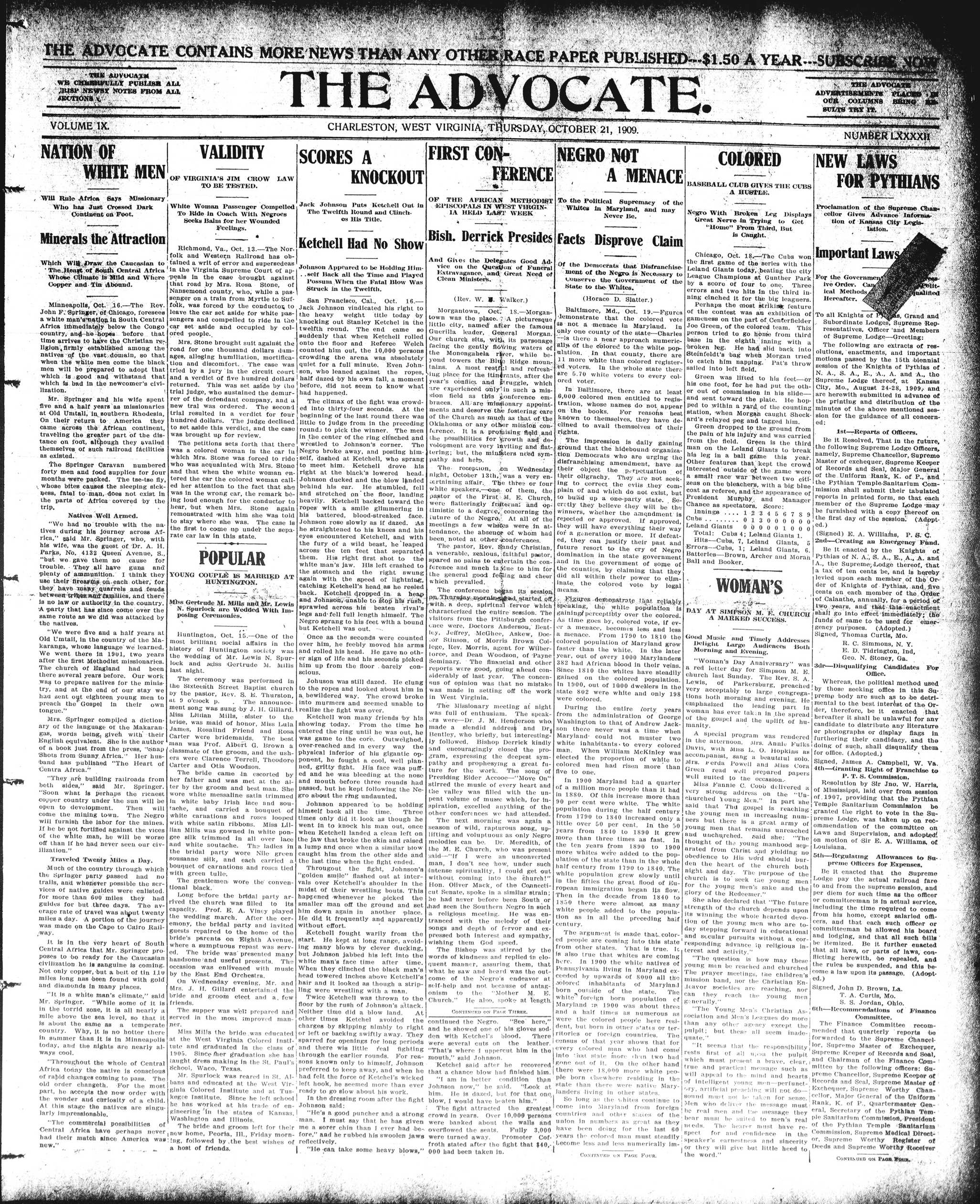
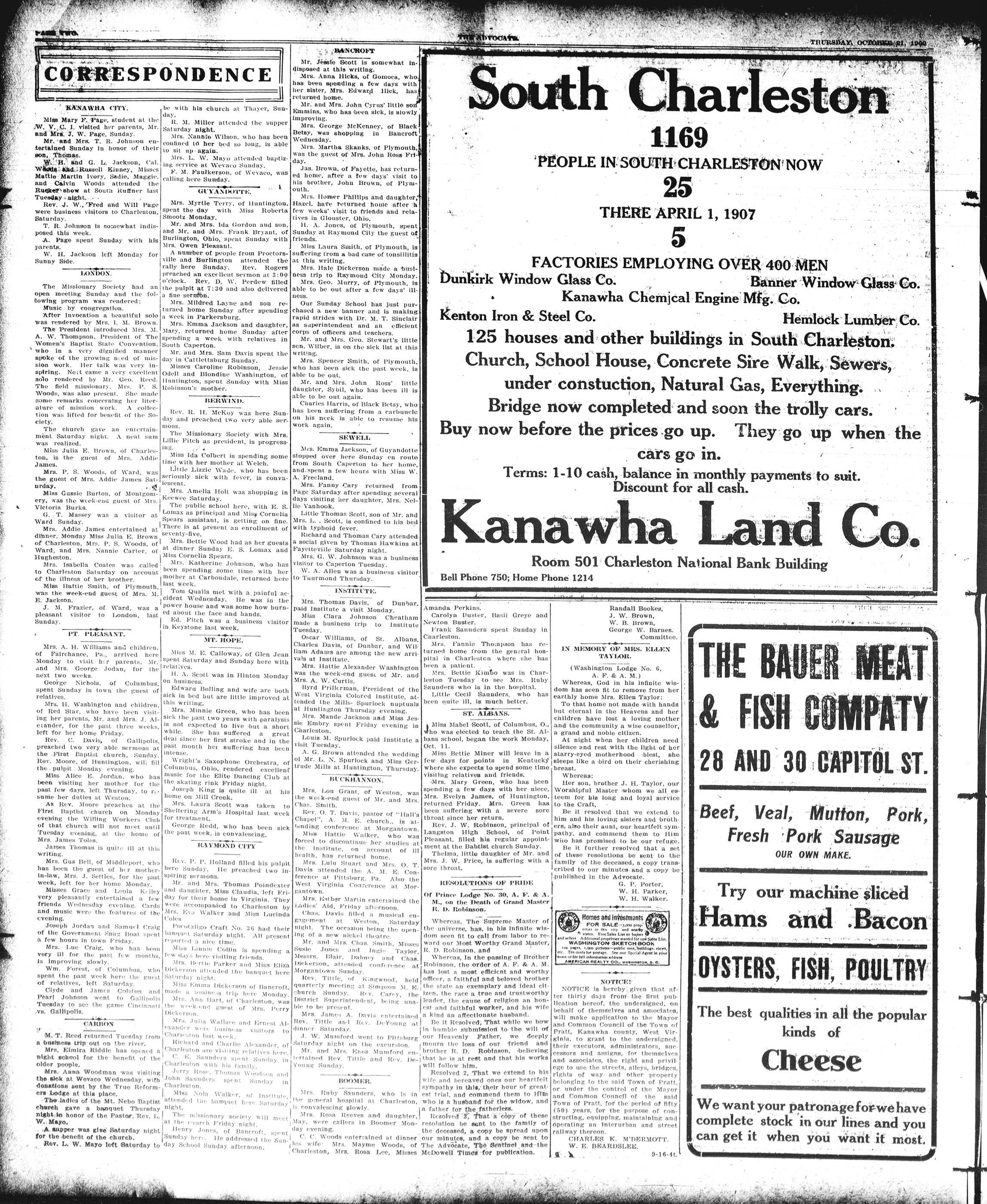
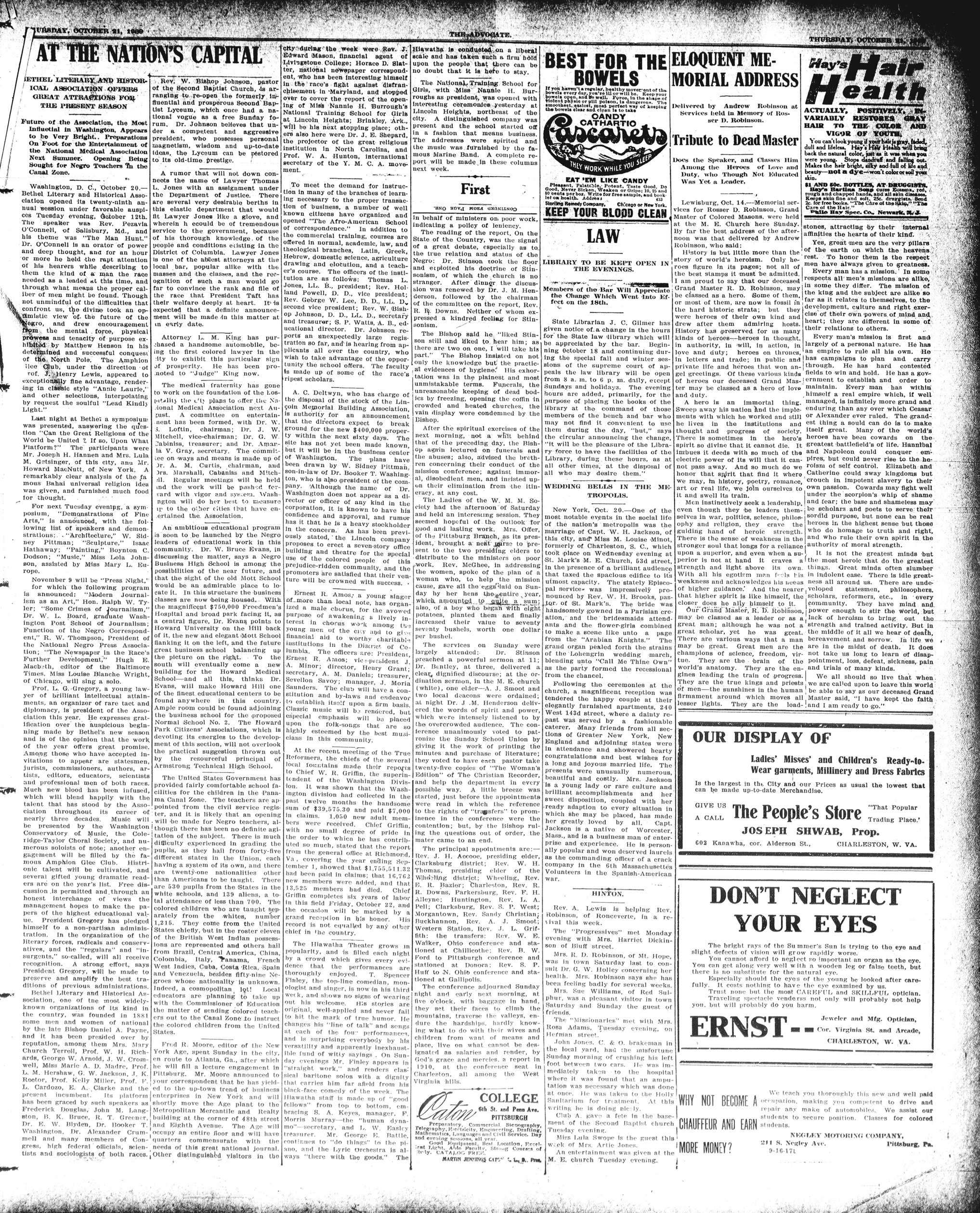
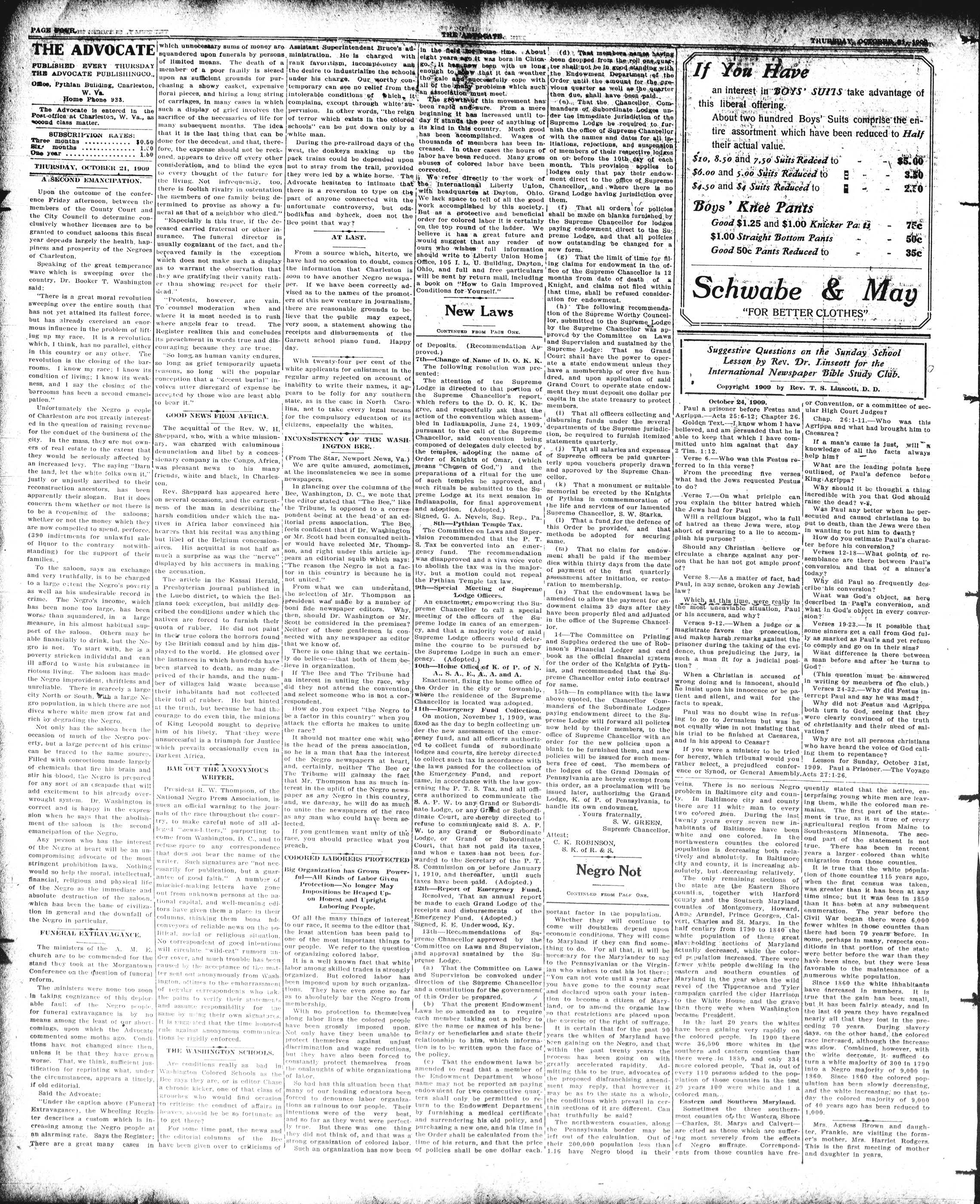
Page text (machine-generated)
THE ADVOCAT
WE CHEREBULLY PUBLISH ALL
JRISP NEWSY NOTES FROM ALL
JECTIONS
VOLUME IX.
Will Rule Africa Says Missionary Who has Just Crossed Dark Continent on Foot.
Minerals the Attraction
Which Will Draw the Caucasian to
The Heart of South Central Africa
Whose Climate is Mild and Where
Copper and Tin Abound.
Minneapolis, Oct. 16 — The Rev.
John F. Springer, of Chicago, foresees
a white man's nation in South Central
Africa immediately below the Congo
country, and he hopes before that
time arrives to have the Christian
religion, firmly established among the
natives of the vast domain, so that
when the white men come the black
men will be prepared to adopt that
which is good and withstand that
which is bad in the newcomer's civilization.
Mr. Springer and his wife spent five and a half years as missionaries at Old Umtall, in southern Rhodesia. On their return to America they came across the African continent, travelling the greater part of the distance on foot, although they availed themselves of such railroad facilities as existed.
The Springer Caravan numbered forty men and food supplies for four months were packed. The tse-tse fly, whose bites causes the sleeping sickness, fatal to man, does not exist in the parts of Africa covered by the trip.
Natives Well Armed.
"We had no trouble with the natives during his journey across Africa," said Mr. Springer, who, with his wife, was the guest of Dr. A. H. Parks, No. 4132 Queen Avenue, S., "but we gave them no cause for trouble. They all have guns and plenty of ammunition. I think they use their firearms on each other, for they have many quarrels and feuds between tribes and families, and there is no law or authority in the country. A party that has since come over the same route as we did was attacked by the natives.
"We were five and a half years at Old Umtail, in the country of the Makaranga, whose language we learned. We went there in 1901, two years after the first Methodist missionaries. The church of England had been there several years before. Our work was to prepare natives for the ministry, and at the end of our stay we had sent out eighteen young men to preach the Gospel in their own tongue."
Mrs. Springer compiled a dictionary of the language of the Makarangas, words being, given with their English equivalent. She is the author of a book just from the press, "snap Shots from Sunny Africa." Her husband has published "The Heart of Centra Africa."
"They are building railroads from both sides," said Mr. Springer. "Soon what is perhaps the richest copper country under the sun will be open to development. Then will come the mining town. The Negro will furnish the labor for the mines. If he be not fortified against the vices of the white man, he will be worse off than if he had never seen our civilization."
Traveled Twenty Miles a Day.
Much of the country through which the Springer party passed had no trails, and whenever possible the services of native guides were enlisted, for more than 600 miles they had guides for but three days. The average rate of travel was about twenty miles a day. A portion of the journey was made on the Cape to Cairo Railway.
It is in the very heart of South Central Africa that Mr. Springer proposes to be ready for the Caucasian civilization he is sanguine is coming. Not only copper, but a belt of tin 110 miles long has been found with gold and diamonds in many places.
"It is a white man's climate," said Mr. Springer. "While some of it is in the torrid zone, it is all nearly a mile above the sea level, so that it is about the same as a temperate country. Why, it is no hotter there in summer than it is in Minneapolis today, and the nights are nearly always cool.
"Throughout the whole of Central Africa today the native is conscious of rabid changes coming to pass. The old order changeth. For the most part, he accepts the new order with the wonder and curiosity of a child. At this stage the natives are singularly impressionable.
"The commercial possibilities of Central Africa have perhaps never had their match since America was new."
VALIDITY
OF VIRGINIA'S JIM CROW LAW TO BE TESTED.
White Woman Passenger Compelled To Ride in Coach With Negroes Seeks Balm for her Wounded
Richmond, Va., Oct. 13.—The Norfolk and Western Railroad has obtained a writ of error and supersedeas in the Virginia Supreme Court of appeals in the case brought against that road by Mrs. Rosa Stone, of Nansennd county, who, while a passenger on a train from Myrtle to Suffolk, was forced by the conductor to leave the car set aside for white passengers and compelled to ride in the car set aside and occupied by colored people.
Mrs. Stone brought suit against the road for one thousand dollars damages, alleging humiliation, mortification and discomfort. The case was tried by a jury in the circuit court and a verdict of five hundred dollars returned. This was set aside by the trial judge, who sustained the demurrier of the defendant company, and a new trial was ordered. The second trial resulted in a verdict for four hundred dollars. The judge declined to set aside this verdict, and the case was brought up for review.
The petitions sets forth that there was a colored woman in the car in which Mrs. Stone was forced to ride who was acquainted with Mrs. Stone and that when the white woman entered the car the colored woman called her attention to the fact that she was in the wrong car, the remark being loud enough for the conductor to hear, but when Mrs. Stone again remonstrated with him she was told to stay where she was. The case is the first to come up under the separate car law in this state.
POPULAR
YOUNG COUPLE IS MARRIED AT HUNTINGTON.
Miss Gertrude M. Mills and Mr. Lewis N. Spurlock are Wedded With Imposing Ceremonies.
Huntington, Oct. 15.—One of the most brilliant social affairs in the history of Huntington society was the wedding of Mr. Lewis N. Spurlock and miss Gertrude M. Mills last night.
The ceremony was performed in the Sixteenth Street Baptist church by the pastor, Rev. S. E. Thurston, at 9 o'clock p. . . . The announcement song was sung by J. H. Gillard. Miss Lutian Mills, sister to the bride, was maid of honor, Miss Lula James, Rosalind Friend and Rosa Carter were bridemaids. The best man was Prof. Albert G. Brown a classmate of the groom, and the ushers were Clarence Terrell, Theodore Carter and Otis Woodson.
The bride came in escorted by her father and was met at the alter by the groom and best man. She wore white messaeline satin trimmed in white baby Irish lace and soutache, and carried a bouquet of white carnations and roses looped with white satin ribbons. Miss Lillian Mills was gowned in white ponge silk trimmed in all over lace and white soutache. The ladies in the bridal party wore Nile green sousaune silk, and each carried a bouquet of carnations and roses tied with green tulle.
The gentlemen wore the conventional black.
Long before the bridal party arrived the church was filled to its capacity. Prof. E. A. Vince played the wedding march. After the ceremony, the bridal party and invited guests repaired to the home of the bride's parents on Eighth Avenue, where a sumptuous repast was served. The bride was presented many handsome and useful presents. The occasion was enlivened with music by the East End Orchestra.
On Wednesday evening, Mr. and Mrs. J. H. Gillard entertained the bride and groom elect and a few friends.
The supper was well prepared and served in the most improved manner.
Miss Mills the bride was educated at the West Virginia Colored Institute and graduated in the class of 1905. Since her graduation she has taught dress making in the St. Paul's School, Waco, Texas.
Mr. Spurlock was reared in St. Albans and educated at the West Virginia Colored Institute and at Tuskegee Institute. Since he left school he has worked at his trade of engineering 'In the states of Kansas, Washington and Illinois. The bride and groom left for their new home, Peoria, Ill., Friday morning, followed by the best wishes of a host of friends.
THE ADVOCATE.
KNOCKOUT
Jack Johnson Puts Ketchell Out in The Twelfth Round and Clinches His Title.
Ketchell Had No Show
Johnson Appeared to be Holding Him. .self Back all the Time and Played Possum When the Fatal Blow Was Struck in the Twelfth.
San Francisco, Cal., Oct. 16.—Jack Johnson vindicated his right to the heavy weight title today by knocking out Stanley Ketchel in the twelfth round. The end came so suddenly that when Ketchel rolled onto the floor and Referee Welch counted him out, the 10,000 persons crowding the arena was absolutely quiet for a full minute. Even Johnson, who leaned against the ropes, half dazed by his own fall, a moment before, did not seem to know what had happened.
The climax of the fight was crowded into thirty-four seconds. At the beginning of the last round there was little to Judge from in the preceding rounds to pick the winner. The men in the center of the ring clinched and wrestled to Johnson's corner. The Negro broke away, and posting himself, dashed at Ketchell, who sprang to meet him. Ketchell drove his right at the black's lowered head. Johnson ducked and the blow landed behind his ear. He stumbled, fell and stretched on the floor, landing heavily. Ketchell backed toward the ropes with a smile glimmering in his battered, blood-streaked face. Johnson rose slowly as if dazed. He straightened to his knees and his eyes encountered Ketchell, and with the fury of a wild beast, he leaped across the ten feet that separated them. His right first shot to the white man's jaw. His left crashed to the stomach and the right swung again with the speed of lightning, catching Ketchell's head as he resked back. Ketchell dropped in a heap and Johnson, unable to stop his rush, sprawled across his beaten rival's legs and fell full length himself. The Negro sprang to his feet with a bound but Ketchell was out.
Once as the seconds were counted over him, he feebly moved his arms and rolled his head. He gave no other sign of life and his seconds picked him up from the floor barely conscious.
Johnson was still dazed. He elung to the ropes and looked about him in a bewildered way. The crowd broke into murmurs and seemed unable to realize the fight was over.
Ketchell won many friends by his showing today. From the time he entered the ring until he was out, he was game to the core. Outweighed, over-reached and in every way the physical inferior of his gigantic opponent, he fought a cool, well planned, gritty fight. His face was puffed and he was bleeding at the nose and mouth before three rounds had passed, but he kept following the Negro about the ring undaunted.
Johnson appeared to be holding himself back all the time. Three times only did it look as though he went in to knock his man out, once when Ketchell landed a clean left on the jaw that broke the skin and raised a lump and once when a similar blow caught him from the other side and the last time when the fight ended. Throughout the fight, Johnson's "golden umile" flashed out at intervals over Ketchell's shoulder in the midst of their wrestling bouts. This happened whenever he picked the smaller man off the ground and set him down again in another place. He did it frequently and apparently without effort.
Ketchell fought warily from the start. He kept at long range, avoiding many blows by clever ducking, but Johnson jabbed his left into the white man's face time after time. When they clinched the black man's head towered inches above Ketchell's hair and it looked as though a stripping wrestling with a man.
Twice Ketchell was thrown to the floor by the rush of Johnson's attack. Neither time did a blow land. At other times Ketchell avoided the charges by skipping nimbly to right or left or backing swiftly away. They sparred for openings for long periods and there was little real fighting through the earlier rounds. For reasons known only to himself, Johnson preferred to keep away, and when he had felt the force of Ketchell's wicked left hook, he seemed more than ever to ready to go slow about his work.
In the dressing room after the fight Johnson said:
"He's a good puncher and a strong man. I must say that he has given me a sorer chin than I ever had before," and he rubbed his swollen jaws reflectively.
"He can take some heavy blows."
OF THE AFRICAN METHODIST
EPISCOPALS IN WEST VIRGINIA
HELD LAST WEEK
And Gives the Delegates Good Advice on the Question of Funeral Extravagance, and Great Need of Clean Ministers.
(Rev. W. W. Walker.)
Morgantown, Oct. 18.—Morgantown was the place. A picturesque little city, named after the famous Guerilla leader, General Morgan. Our church stirs, with its parsonage facing the gently flowing waters of the Monongahela river, while beyond towers the Blue Ridge mountains. A most restful and refreshing place for the fiterants, after the year's conflict and struggle, which are experienced only in such a mission field as this conference embraces. All are missionary appointments and deserve the fostering care of the Church as much as that of the Oklahoma or any other mission conference. It is a promising field and the possibilities for growth and development are very inviting and flattering; but, the ministers need sympathy and help.
The reception, on Wednesday night, October 13th, was a very entertaining affair. The threes or four white speakers, one of them, the pastor of the First M. E. Church, were flatteringly frutinal; and optimistic to a degree, concerning the future of the Negro. At all of the meetings a few whites were in attendance, the absence of whom had been noted at other conferences. The pastor, Rev. Sandy Christian, a venerable, zealous, faithful pastor, spared no pains to entertain the conference and much is due to him for the general good feeling and cheer which prevailed.
The conference began its session on Thursday morning and started off with a deep, spiritual fervor which characterized the entire session. The visitors from the Pittsburgh conference were, Doctors Anderson, Bentley, Jeffrey, McGhee, Askew, Doctor Stinson, of Morris Brown College, Rev. Morris, agent for Wil伯堡, and Dean Woodson, of Payne Seminary. The financial and other reports were good, going ahead considerably of last year. The consensus of opinion was that no mistake was made in setting off the work in West Virginia.
The Missionary meeting at night was full of enthusiasm. The speakers were—Dr. J. M. Henderson who made a slendid address and Dr. Bentley, who briefly, but interestingly followed. Bishop Derrick kindly and encouragingly closed the program, expressing the deepest sympathy and prophesying a great future for the work. The song of Presiding Elder Accooe—"Move On" stirred the music of every heart and the valley was filled with the unpent volume of music which, for inspiration, excelled anything of the other conferences we had attended.
The next morning was again a season of wild, rapturous song, uplifting and voluptuous as only Negro melodies can be. Dr. Meredith, of the M. E. Church, who was present said—"If I were an unconverted man, I don't see how, under such intense spirituality, I could get out without coming into the church!" Hon. Oliver Mack, of the Connecticut Senate, spoke in a similar strain; he had never before been South or had seen the Southern Negro in such a religious meeting. He was entranced with the melody of their songs and depth of fervor and expressed both interest and sympathy, wishing them God speed.
The Bishop was stirred by the words of kindness and replied in eloquent manner, assuring them, that what he saw and heard was the outcome of the Negro's endeavor at self-heal and not because of antagonism to the "Mother M. E. Church." He also spoke at length
CONTINUED ON PAGE THREE
continued the Negro. "See here," and he showed one of his gloves sadden with Ketchel's blood. There were several cuts on the leather, "That's where I uppercut him in the mouth," said Johnson. Ketchel said after he recovered that a chance blow had finished him. "I am in better condition than Johnson now," he said. "Look at him. He is dazed, but for that one blow, I would have beaten him." The fight attracted the greatest crowd in years. Over 10,000 persons were banked about the walls and overflowed the seats. Fully 3,000 were turned away. Promoter Cof froth stated after the fight that $40,000 had been taken in.
To the Political Supremacy of the Whites in Maryland, and may Never Be.
Of the Democrats that Disfranchise-
ment of the Negro is Necessary to
conserve the Government of the
State to the Whites.
(Horace D. Slatter.)
Baltimore, Md., Oct. 19.—Figures demonstrate that the colored voter as not a menace in Maryland. In only one county of the state—Charles—is there a near approach numerically of the colored to the white population. In that county, there are 11 more white than colored registered voters. In the whole state there are 5.70 white voters to every colored voter.
In Baltimore, there are at least 6,000 colored men entitled to registration, whose names do not appear on the books. For reasons best known to themselves, they have declined to avail themselves of their rights.
The impression is daily gaining ground that the hidebound organization Democrats who are urging the distranchising amendment, have as their object the perpetuation of their oligarchy. They are not seeking to correct the evils they complain of and which do not exist, but to build up a one-party state. Secretly they believe they will be the winners, whether the amendment is rejected or approved. If approved, they will have everything their way for a generation or more. If defeated, they can justify their past and future resort to the cry of Negro domination in the state government and in the government of some of the counties, by claiming that they did all within their power to eliminate the colored vote by legal means.
Figures demonstrate that reliably speaking, the white population is gaining perceptibly over the colored. As time goes by, colored vote, if ever a menace, becomes less and less a menace. From 1790 to 1810 the colored population of Maryland grow faster than the white. In the later year, out of every 1000 Marylanders 382 had African blood in their veins. Since 1810 the whites have steadily gained on the colored population. In 1900, out of 1000 dwellers in the state 802 were white and only 198 were colored.
During the entire forty years from the administration of George Washington to that of Andrew Jackson there never was a time when Maryland could not muster two white inhabitants to every colored man. When William McKinley was elected the proportion of white to colored men had risen more than five to one.
In 1900 Maryland had a quarter of a million more people than it had in 1880. Of this increase more than 90 per cent were white. The white population during the half century from 1790 to 1840 increased only a little over 50 per cent. In the 50 years from 1840 to 1890 it grew more than three times as fast. In the ten years from 1890 to 1900 more whites were added to the population of the state than in the whole half century from 1790 to 1840. The white population grew slowly until in the fifties the great flood of European immigration began its flow. Then in the decade from 1840 to 1850 there were almost as many white people added to the population as in all the preceding half century.
The argument is made that colored people are coming into this state from other states. That is true. It is also true that whites are coming here. In 1900 the white natives of Pennsylvania living in Maryland exceeded by upwards of 8000 all the colored inhabitants of Maryland born outside of the state. The white foreign born population of Maryland in 1900 was about three and a half times as numerous as were the colored people here resident, but born in other states or territories or foreign countries. The census of that year shows that for every colored man who had come into that state more than two had gone out of it. On the other hand there were 18,000 more white people born elsewhere residing in the state than there were native Marylanders living in other states.
So long as the whites continue to come into Maryland from foreign countries and other states of the union in numbers as great as they have been doing for the last 60 years the colored man must steadily become less and less numerically im-
CONTINUED ON PAGE FOUR.
BASEBALL CLUB GIVES THE CUBS
A HUSTLE.
Negro With Broken Leg Displays
Great Nerve in Trying to Get
"Home" From Third, But
is Caught.
Chicago, Oct. 18.—The Cubs won
the first game of the series with the
Leland Giants today, beating the city
League Champions at Gunther Park
by a score of four to one. Three
errors and two hits in the third
inning clinched it for the big leaguers.
Perhaps the most striking feature of the contest was an exhibition of gameness on the part of Centerfelder Joe Green, of the colored team. This person tried to go home from third base in the eighth inning with a broken leg. He had slid back into Steinfeldt's bag when Morgan tried to catch him napping. Pat's throw sailed into left field.
Green was lited to his feet—or his one foot, for he had put the other out of commission in his slide—and sent toward the plate. He hoped to within a yard of the counting station, when Morgan caught Sheckard's relay pelg and tagged him.
Green dropped to the ground from the pain of his injury and was carried from the field. Green is the third man on the Leland Giants to break his leg in a ball game this year. Other features that kept the crowd interested outside of the game were a small race war between two citizens on the bleachers, with a big blue coat as referee, and the appearance of President Murphy, and Manager Chance as spectators. Score:
Innings . . . 1 2 3 4 5 6 7 8 9
Cubs . . . 0 1 3 0 0 0 0 0
Leland Giants . 0 0 0 0 1 0 0 0
Total: Cubs 4; Leland Giants 1.
Hits—Cubs, 7; Leland Giants, 5.
Errors—Cubs, 1; Leland Giants, 6.
Batteries—Brown, Archer and Moran Ball and Booker.
DAY AT SIMPSON M. E. CHURCH
A MARKED SUCCESS.
Good Music and Timely Addresses
Delight Large Audiences Both
Morning and Evening.
"Woman's Day Anniversary" was
a red letter day for Simpson M. E.
church last Sunday. The Rev. S. A.
Lewis, of Parkersburg, preached
very acceptably to large congregations
both morning and evening. He
emphasized the leading part in
woman has ever taken in the spread
of the gospel and the uplift of
humanity.
A special program was rendered
in the afternoon. Mrs. Annie Fulks
Davis, with Miss L. O. Hopkins as
accompanist, sang a beautiful solo.
Mrs. perda Powell and Miss Cora
Green read well prepared papers
well suited to the occasion.
Miss Fannie C. Cobb delivered a very strong address on the "Unchurched Young Men." In part she said that Thd gospel is reaching the young men in increasing numbers but there is a great army of young men that remains unreached and unchurched. Said she: "The thought of the young manhood separated from Christ and yielding no obedience to His word should burden the heart of the church both night and day. The purpose of the church is to seek the young men for the young men's sake and the glory of the Redeemer." She also declared that "The future strength of the church depends upon its winning the whole hearted devotion of the young men who are today stepping forward in educational and secular pursuits without a corresponding advance in religious interest and activity."
"The question is how may these young men be reached and churched the prayer meetings, the children's mission band, nor the Christian En-Jacover societies are reaching, nor can they reach the young men generally."
"The Young Men's Christian Association and Men's Leagues do more than any other agency except the pulpit; but these all seem inadequate."
"It seems that the responsibility rests first of all upon the pulpit which must present a brave, clear, true and practical message such as will appeal to the mind and hearts of intelligent young men—perfunctory, artificial preaching will not do—sound must not be taken for sense. Men who deliver the message must be real men and the message they hear must be suited to men's real needs. The healer must have respect for and confidence in the speaker's earnestness and sincerity or they will give but little heed to the word."
NUMBER LXXXXH
NEW LAWS
FOR PYTHIANS
Proclamation of the Supreme Chancellor Gives Advance Information of Kansas City Legis-
Important Laws
For the Government to possessive Order. Can be applied to Political Methods, and to qualified Hereafter.
To all Knights of Pytheas, Grand and Subordinate Lodges, Supreme Representatives, Officer and Members of Supreme Lodge—Greeting:
The following are extracts of resolutions, enactments, and important motions passed by the 15th biennial session of the Knights of Pytheas of N. A., S. A., E., A., A. and A., the Supreme Lodge thereof, at Kansas City, Mo., August 24-28, 1909, and are herewith submitted in advance of the printing and distribution of the minutes of the above mentioned session for the guidance of all concern-
1st—Reparts of Officers.
Be it Resolved, That in the future, the following Supreme Lodge Officers, namely, Supreme Chancellor, Supreme Master of exchequer, Supreme Keeper of Records and Seal, Major General of the Uniform Rank, K. of P., and the Pythian Temple-Sanitary Commission shall submit their tabulated reports in printed form, so that each member of the Supreme Lodge may be furnished with a copy thereof on the first day of the session. (Adopted.)
(Signed) E. A. Williams, P. S. C.
2nd—Creating an Emergency Fund.
Be it enacted by the Knights of
Pythias of N. A., S. A., E., A., A. and
A., the Supreme; Lodge thereof, that
a tax of ten cents be, and is hereby
levied upon each member of the Order
of Knights of Pythias, and five
cents on each member of the Order
of Calanthe, annually, for a period of
two years, and that this enactment
shall go into effect immediately; the
funds of same to be used for emergency
purposes. (Adopted.)
Signed, Thomas Curtis, Mo.
R. C. Simmons, N. Y.
E. D. Tldrington, Ind,
Geo. N. Stoney, Ga.
3dr—Disqualifying Candidates For Office.
Whereas, the political method used by those seeking office in this Supreme body are such as to be detrimental to the best interest of the Order, therefore, be it enacted that herafter it shall be unlawful for any candidate to distribute any literature or photographs or display flags in furthering their candidacy, and the doing of such, shall disqualify them for office. (Adopted.)
Signed, James A. Campbell, W. Va. 4th—Granting Right of Franchise to P. T. S. Commission.
Resolution by Sir Jno. W. Harris, of Mississippi, laid over from session of 1907, providing that the Fythian Temple Sanitarium Commission be granted the right to vote in the Supreme Lodge, was taken up on recommendation of the committee on Laws and Supervision, and adopted; on motion of Sir E. A. Williama, of Louisiana.
5th—Regulating Allowances to Supreme Officers for Expenses.
Be it enacted that the Supreme Lodge pay the actual railroad fare to and from the supreme session, and per diem for such time as the officer or committeeman is in actual service, including the time required to come from his home, except salaried officers, and that each such officer or committeeman be allowed his board and lodging, and that all such bills be itemized. Be it further enacted that all laws, or parts of laws, conflicting herewith, be repealed, and the rules be suspended, and this become a law upon its passage. (Adopted.)
6th—Recommendations of Finance Committee.
The Finance Committee recommended that quarterly reports be forwarded to the Supreme Chancellor, Supreme Master of Exchequer, Supreme Keeper of Records and Seal, and Chairman of the Finance Committee by the following officers: Supreme Chancellor, Supreme Keeper of Records and Seal, Supreme Master of Exchequer, Supreme Worthy Chancellor, Major General of the Uniform Rank, K. of P., Quartermaster General, Secretary of the Pythian Temple Sanitarium Commission, President of the Pythian Temple Sanitarium Commission, Supreme Medical Director, Supreme Worthy Register of Deeds and Worthy Worthy Receiver
CONTINUED ON PAGE FOUR.
CORRESPONDENCE
KANAWHA CITY
Miss Mary F. Page, student at the W. V. G. I. visited her parents, Mr. and Mrs. J. W. Page, Sunday.
Mr. and Mrs. T. R. Johnson entertained Sunday in honor of their son, Thomas.
W. H. and G. L. Jackson, Cal Woods and Russell Kinney, Misses Mattie Martin Ivory, Sadie, Maggie and Calvin Woods attended the Rucker show at South Ruffner last Tuesday night.
Rev. J. W., Fred and Will Page were business visitors to Charleston, Saturday.
T. R. Johnson is somewhat indisposed this week.
A. Page spent Sunday with his parents.
W. H. Jackson left Monday for Sunny Side.
LONDON
The Missionary Society had an open meeting Sunday and the following program was rendered: Music by congregation.
After Invocation a beautiful solo was rendered by Mrs. I. M. Brown. The President introduced Mrs. M. A. W. Thompson, President of The Women's Baptist State Convention, who in a very dignified manner spoke of the growing need of mission work. Her talk was very inspiring. Next came a very excellent solo rendered by Mr. Geo. Reed. The field missionary, Mrs. P. S. Woods, was also present. She made some remarks concerning her literature of mission work. A collection was lifted for benefit of the Society. The church gave an entertainment Saturday night. A neat sum was realized. Miss Julia E. Brown, of Charleston, is the guest of Mrs. Addie James.
Mrs. P. S. Woods, of Ward, was the guest of Mrs. Addie James Saturday.
Miss Gussie Burton, of Montgomery, was the week-end guest of Mrs. Victoria Burks.
G. T. Massey was a visitor at Ward Sunday.
Mrs. Addie James entertained at dinner, Monday Miss Julia E. Brown of Charleston, Mrs. P. S. Woods, of Ward, and Mrs. Nannie Carter, of Hugheston.
Mrs. Isabella Coates was called to Charleston Saturday on account of the illness of her brother.
Miss Huttie Smith, of Plymouth, was the week-end guest of Mrs. M. J. Jackson.
J. M. Frazier, of Ward, was a pleasant visitor to London, last Sunday.
PT. PLEASANT.
Mrs. A. H. Williams and children, of Fairchance, Pa., arrived here Monday to visit her parents, Mr. and Mrs. George Jodan, for the next two weeks.
George Nichols, of Columbus, spent Sunday in town the guest of relatives.
Mrs. H. Washington and children, of Red Star, who have been visiting her parents, Mr. and Mrs. J. Alexander, for the past three weeks, left for her home Friday.
Rev. C. Davis, of Gallipolis, preached two very able sermons at the First Baptist church, Sunday, Rev. Moore, of Huntington, will fill the pulpit Monday evening.
Miss Alice E. Jordan, who has been visiting her mother for the past few days, left Thursday, to resume her duties at Weston.
As Rev. Moore preaches at the First Baptist church on Monday evening the Willing Workers Club of that church will not meet until Tuesday evening, at the home of Mrs. James Toles.
James Thomas is quite ill at this writing.
Mrs. Gus Bell, of Middleport, who has been the guest of her mother-in-law, Mrs. J. Settles, for the past week, left for her home Monday.
Misses Grace and Leola Kelley very pleasantly entertained a few friends Wednesday evening. Cards and music were the features of the evening.
Joseph Jordan and Samuel Craig of the Government Snag Boat spent a few hours in town Friday.
Mrs. Lue Craig, who has been vory ill for the past few months, is improving slowly.
Wm. Forest, of Columbus, who spent the past week here the guest of relatives, left Saturday. Clyde and James Colston and Pearl Johnson went to Gallipolis Tuesday to see the game Cincinnati vs. Gallipolis.
CARBON
M. T. Reed returned Tuesday from a business trip out on the river.
Mrs. Elmira Riddle has opened a night school for the benefit of the older people.
Mrs. Anna Woodman was visiting the slick at Wevaco Wednesday, with donations sent by the True Reformers Lodge at this place.
The ladies of the Mt. Nebo Baptist church gave a banquet Thursday night in honor of the Pastor, Rev. L. W. Mayo.
A supper was give Saturday night for the benefit of the church.
Rev. L. W. Mayo left Saturday to
be with his church at Thayer, Sunday.
R. M. Miller attended the supper Saturday night.
Mrs. Nannie Wilson, who has been confined to her bed so long, is able to sit up again.
Mrs. L. W. Mayo attended baptizing service at Wevaco Sunday.
F. M. Faulkerson, of Wevaco, was calling here Sunday.
GUYANDOTTE.
Mrs. Myrtle Terry, of Huntington, spent the day with Miss Roberta Smootz Monday.
Mr. and Mrs. Ida Gordon and son, and Mr. and Mrs. Frank Bryant, of Burlington, Ohio, spent Sunday with Mrs. Owen Pleasant.
A number of people from Proctorsville and Burlington attended the rally here Sunday. Rev. Rogers preached an excellent sermon at 3:00 o'clock. Rev. D. W. Perdew filled the pulpit at 7:30 and also delivered a fine sermon.
Mrs. Mildred Layne and son returned home Sunday after spending a week in Parkersburg.
Mrs. Emma Jackson and daughter, Mary, returned home Sunday after spending a week with relatives in South Caperton.
Mr. and Mrs. Sam Davis spent the day in Cattlettsburg Sunday.
Misses Caroline Robinson, Jessie Odell and Blondine Washington, of Huntington, spent Sunday with Miss Robinson's mother.
BERWIND.
Rev. R. H. McKoy was here Sunday and preached two very able sermons.
The Missionary Society with Mrs. Lillie Fitch as president, is progressing.
Miss Ida Colbert is spending some time with her mother at Welch.
Little Lizzie Wade, who has been seriously sick with fever, is convalescent.
Mrs. Amelia Holt was shopping in Keewee Saturday.
The public school here, with E. S. Lomax as principal and Miss Cornelia Spears assistant, is getting on fine. There is at present an enrollment of seventy-five.
Mrs. Bettie Wood had as her guests at dinner Sunday E. S. Lomax and Miss Cornelia Spears.
Mrs. Katherine Johnson, who has been spending some time with her mother at Carbondale, returned here last week.
Tom Qualls met with a painful accident Wednesday. He was in the power house and was some how burned about the face and hands.
Ed. Fitch was a business visitor in Keystone last week.
MT. HOPE.
Miss M. E. Calloway, of Glen Jean spent Saturday and Sunday here with relatives.
H. A. Scott was in Hinton Monday on business.
Edward Bolling and wife are both sick in bed but are little improved at this writing.
Mrs. Minnie Green, who has been sick the past two years with paralysis is not expected to live but a short while. She has suffered a great deal since her first stroke and in the past month her suffering has been intense.
Wright's Saxophone Orchestra, of Columbus, Ohio, rendered excellent music for the Elite Dancing Club at the skating rink Friday night.
Joseph King is quite ill at his home on Mill Creek.
Mrs. Laura Scott was taken to Sheltering Arm's Hospital last week for treatment. George Redd, who has been sick the past week, is convalescing.
RAYMOND CITY
Rev. P. P. Holland filled his pulpit here Sunday. He preached two inspiring sermons.
Mr. and Mrs. Thomas Poindexter and daughter, Miss Claudia, left Friday for their home in Virginia. They were accompanied to Charleston by Mrs. Eva Walker and Miss Lucinda Coles
Pocotaligo Craft No. 36 had their banquet Saturday night. All present reported a nice time.
Miss Linnie Collin is spending a few days here visiting friends.
Mrs. Bertie Parker and Miss Eliza Dickerson attended the banquet here Saturday night.
Miss Emina Dickerson of Bancroft, made a business trip here Monday.
Mrs. Ann Hart, of Charleston, was the week-end guest of Mrs. Perry Dickerson.
Mrs. Julia Wallace and Ernest Alexander were business visitors to Charleston last week.
Richard and Charlie Alexander, of Charleston are visiting relatives here. C. E. Saunders spent Sunday in Charleston with his family.
Jerry Rose, Thomas Woodson and John Saunders spent Sunday in Charleston.
Miss Nola Walker, of Institute, attended the banquet here Saturday night.
The missionary society will meet at the cathouse Friday night.
Henry Jones, of Bancroft, spent Sunday here. He addressed the Sunday School Sunday afternoon
BANCROFT
Mr. Jessie Scott is somewhat indisposed at this writing.
Mrs. Anna Hicks, of Gomoca, who has been spending a few days with her sister, Mrs. Edward Hick, has returned home.
Mr. and Mrs. John Cyrus' little son Emmins, who has been sick, is slowly improving.
Mr. George McKenney, of Black Betsy, was shopping in Bancroft Wednesday.
Mrs. Martha Skanks, of Plymouth, was the guest of Mrs. John Ross Friday.
Jas. Brown, of Fayette, has returned home, after a few days' visit to his brother, John Brown, of Plymouth.
Mrs. Homer Phillips and daughter, Hazel, have returned home after a few weeks' visit to friends and relatives in Glouster, Ohio.
H. A. Jones, of Plymouth, spent Sunday at Raymond City the guest of friends.
Miss Laura Smith, of Plymouth, is suffering from a bad case of tonsillitis at this writing.
Mrs. Hale Dickerson made a business trip to Raymond City Monday.
Mrs. Geo. Murry, of Plymouth, is able to be out after a few days' illness.
Our Sunday School has just purchased a new banner and is making rapid strides with Dr. M. T. Sinclair as superintendent and an efficient corps of officers and teachers.
Mr. and Mrs. Geo. Stewart's little son, Wilber, is on the sick list at this writing.
Mrs. Spencer Smith, of Plymouth, who has been sick the past week, is able to be out.
Mr. and Mrs. John Ross' little daughter, Sybil, who has been ill is able to be out again.
Charles Harris, of Black Betsy, who has been suffering from a carbuncle on his neck is able to resume his work again.
SEWELL
Mrs. Emma Jackson, of Guyandotte stopped over here Sunday en route from South Caperton to her home, and spent a few hours with Miss W. A. Freeland.
Mrs. Fanny Cary returned from Page Saturday after spending several days visiting her daughter, Mrs. Nellie Vanhook.
Little Thomas Scott, son of Mr. and Mrs. L. , Scott, is confined to his bed with typhoid fever.
Richard and Thomas Cary attended a social given by Thomas Hawkins at Fayetteville Saturday night.
Mrs. G. W. Johnson was a business visitor to Caperton Tuesday.
W. A. Allen was a business visitor to Taunmond Thursday.
INSTITUTE
Mrs. Thomas Davis, of Dunbar, paid Institute a visit Monday.
Miss Clara Johnson Cheatham made a business trip to Institute Tuesday.
Oscar Williams, of St. Albans, Charles Davis, of Dunbar, and William Adams are among the new arrivals at Institute.
Mrs. Hattie Alexander Washington was the week-end guest of Mr. and Mrs. A. W. Curtis.
Byrd Prillcrman, President of the West Virginia Colored Institute, attended the Mills- Spurlock nuptuals at Huntington Thursday evening.
Mrs. Mande Jackson and Miss Jessie Embry spent Friday evening in Charleston.
Louis M. Spurlock paid Institute a visit Tuesday.
A. G. Brown attended the wedding of Mr. L. N. Spurlock and Miss Gertrude Mills at Huntington, Thursday.
BUCKHANNON
Mrs. Lou Grant, of Weston, was the week-end guest of Mr. and Mrs. Chas. Smith.
Rev. O. T. Davis, pastor of "Hall's Chapel", A. M. E. church., is attending conference at Morgantown.
Miss Hattie Walker, who was forced to discontinue her studies at the institute, on account of ill health, has returned home.
Mrs. Lulu Stuart and Mrs. O. T. Davis attended the A. M. E. Conference at Pittsburg, Pa. Also the West Virginia Conference at Morgantown.
Mrs. Esther Martin entertained the Ladies' Aid, Friday afternoon.
Chas. Davis filled a musical engagement at Weston, Saturday night. The occasion being the opening of a new nickel theatre.
Mr. and Mrs. Chas. Smith, Misses Susie Jones and Ingie Taylor Messrs. Blair, Dabney and Chas. Dickerson, attended conference at Morgantown Sunday.
Rev. Tittle, of Kingwood, held quarterly meeting at Simpson M. E church Sunday. Rev. Carey, the District Superintendent, being unable to be present.
Mrs. James A. Davis entertained Rev. Tittle and Rev. DeYoung at dinner Saturday.
J. W. Mumford went to Pittsburg Saturday night on the excursion.
Mr. and Mrs. Enos Mumford entertained Rev. Tittle and Rev. DeYoung Sunday.
BOOMER.
Mrs. Ruby Saunders, who is in the general hospital at Charleston, is convalescing slowly.
Mrs. Rosa Reeves and daughter, May, were callers in Boomer Monday evening.
C. C. Woods entertained at dinner his wife: Mrs. Mayme Woods, of Charleston, Mrs. Rosa Lee, Misses
South Charleston
PEOPLE IN SOUTH CHARLESTON NOW
5
FACTORIES EMPLOYING OVER
Glass Co.
Kanawha Chemjcal Engine M
steel Co.
s and other buildings in S
chool House, Concrete Si
construction, Natural Gas
now completed and soon t
ore the prices go up. Th
cars go in.
1-10 cash, balance in monthly p
Discount for all cash.
awha La
from 501 Charleston National Ba
hone 1214
FACTORIES EMPLOYING OVER 400 MEN Dunkirk Window Glass Co. Banner Window Glass Co. Kanawha Chemjcal Engine Mfg. Co.
Terms: 1-10 cash, balance in monthly payments to suit. Discount for all cash. Kanawha Land Co. Room 501 Charleston National Bank Building Bell Phone 750; Home Phone 1214
Whereas, God in his infinite wisdom has seen fit to remove from her earthly home Mrs. Ellen Taylor: To that home not made with hands but eternal in the Heavens and her children have lost a loving mother and the community a wise counsellor, a grand and noble citizen. At night when her children need silence and rest with the light of her starry-eyed motherhood blest, she sleeps like a bird on their cherishing breast. Whereas: Her son, brother J. H. Taylor, our Worshipful Master whom we all esteem for his long and loyal service to the Craft.
Be it resolved that we extend to him and his loving sisters and brothers, also their aunt, our heartfelt sympathy, and commend them to Him who has promised to be our refuge. Be it further resolved that a set of these resolutions be sent to the family of the deceased, a copy transcribed to our minutes and a copy be published in the Advocate.
INVESTMENTS
FOR SALE - 1,000,000
prices in this city and nearby
states. Free Sales List to buyers
and sellers. Additional properties wanted for new sales List.
WASHINGTON SKETCH BOOK
123,456 - 1,000 pictures - public buildings, views,
etc. Ten credit for postage. See our Special Agent in your
town or for full information
AMERICAN REALTY CO., WASHINGTON, O. O.
NOTICE is hereby given that after thirty days from the first publication hereof, the undersigned, on behalf of themselves and associates, will make application to the Mayor and Common Council of the Town of Pratt, Kanawha county, West Virginia, to grant to the undersigned, their executors, administrators, successors and assigns, for themselves and associates, the right and privilege to use the streets, alleys, bridges, rights of way and other property belonging to the said Town of Pratt, or under the control of the Mayor and Common Council of the said Town of Pratt, for the period of fifty (50) years, for the purpose of constructing, equipping, maintaining and operating an interurban and street railway thereon.
9-16-4t.
Amanda Perkins.
Carolyn Buster, Basil Greye and Newton Buster.
Frank Saunders spent Sunday in Charleston.
Mrs. Fannie Thompson has returned home from the general hospital in Charleston where she has been a patient.
Mrs. Bettie Kimbo was in Charleston Tuesday to see Mrs. Ruby Saunders who is in the hospital.
Little Cecil Saunders, who has been quite ill, is much better.
ST. ALBANS.
Miss Mabel Scott, of Columbus, O., who was elected to teach the St. Albans school, began the work Monday, Oct. 11.
Miss Bettie Miner will leave in a few days for points in Kentucky where she expects to spend some time visiting relatives and friends.
Mrs. Mary Green, who has been spending a few days with her niece, Mrs. Evelyn James, of Huntington, returned Friday. Mrs. Green has been suffering with a severe sore throat since her return.
Rev. J. W. Robinson, principal of Langton High School, of Point Pleasant, filled his regular appointment at the Babist church Sunday.
Thelma, little daughter of Mr. and Mrs. J. W. Price, is suffering with a sore throat.
RESOLUTIONS OF PRIDE
Of Prince Lodge No. 30, A. F. & A. M., on the Death of Grand Master R. D. Robinson.
Whereas, The Supreme Master of the universe, has, in his infinite wisdom seen fit to call from labor to reward our Most Worthy Grand Master, R. D. Robinson, and Whereas, In the passing of Brother Robinson, the order of A. F. & A. M. has lost a most efficient and worthy officer, a faithful and beloved brother the state an exemplary and ideal citizen, the race a true and trustworthy leader, the cause of religion an honest and faithful worker, and his wife a kind an affectionate husband.
Be it Resolved; That while we how in humble submission to the will of our Heavenly Father, we deeply mourn the loss of our friend and brother R. D. Robinson, believing that he is at rest and that his works will follow him.
Resolved 2, That we extend to his wife and bereaved ones our heartfelt sympathy in this, their hour of greatest trial, and commend them to Him who is a husband for the widow, and a father for the fatherless.
Resolved 3, That a copy of these resolution be sent to the family of the deceased, a copy be spread upon our minutes, and a copy be sent to The Advocate, The Sentinel and the McDowell Times for publication.
28 AND 30 CAPITOL ST.
Beef, Veal, Mutton, Pork, Fresh Pork Sausage OUR OWN MAKE.
OYSTERS, FISH, POULTRY
The best qualities in all the popular kinds of
We want your patronage for wehave complete stock in our lines and you can get it when you want it most.
THERE APRIL 1, 1907
Randall Bookes,
J. W. Brown,
W. B. Brown,
George W. Barnes.
Committee
IN MEMORY OF MRS. ELLEN TAYLOR.
(Washington Lodge No. 6,
A. F. & A. M.)
&
Whereas:
G. P. Porter,
W. H. Parker,
W. H. Walker.
NOTICE!
CHARLES K. M'DERMOTT.
W. E. BEARDSLEE.
9-16-4t.
Try our machine sliced
Cheese
AT THE NATION'S CAPITAL
JETHEL LITERARY AND HISTORICAL ASSOCIATION OFFERS GREAT ATTRACTIONS FOR THE PRESENT SEASON
Future of the Association, the Most Infuctual in Washington, Appears to be Very Bright. Preparations On Foot for the Entertainment of the National Medical Association Next Summer. Opening Being Sought for Negro Teachers In the Canal Zone.
Washington, D. C., October 20.—Bethel Literary and Historical Association opened its twenty-ninth annual session under favorable auspices Tuesday evening, October 12th. The speaker was Rev. Pezavia O'Connell, of Salisbury, Md., and his theme was "The Man Hunt." Dr. O'Connell is an orator of power and deep thought, and for an hour or more he held the rept attention of his hearers while describing to them the kind of a man the race needed as a leaded at this time, and through what means the proper caliber of men might be found. Though not unmindful of the difficulties that confront us, the divine took an optimistic view of the future of the Negro, and drew encouragement from the mental force, physical prowess and tenacity of purpose exhibited by Matthew Henson in his determined and successful conquest of the North Pole. The Amphion Ilee Club, under the direction of ref. J. Henry Lewis, appeared to exceptionally fine advantage, rendering in classic style "Annie Laurle," and other selections, interpolating by request the soulful "Lead Kindly Light."
Last night at Bethel a symposium was presented, answering the question "Can the Great Religions of the World be United? If so, Upon What Platform?" The participants were Mr. Joseph H. Hannen and Mrs. Lula M. Getsinger, of this city, anu Mr. Howard MacNutt, of New York. A remarkably clear analysis of the famous Bahai universal religion idea was given, and furnished much food for thought.
For next Tuesday evening, a symposium, "Demonstrations of Fine Arts," is announced, with the following list of speakers and demonstrations: "Architecture," W. Sidney Pittman; "Sculpture," Isaac Hathaway; "Painting," Boynton C. Dodson; "Music," Miss Lola Johnson, assisted by Miss Mary L. Europe.
November 9 will be "Press Night," for which the following program is announced; "Modern Journalism as an Art," Hon. Ralph W. Tyler; "Some Crimes of Journalism," Dr. W. L. Board, graduate Washington Post School of Journalism; Function of the Negro Correspondent," R. W. Thompson, President of the National Negro Press Association; "The Newspaper in the Race's Further Development," Hugh E. Macbeth, editor of the Baltimore Times, Miss Louise Blanche Wright, of Chicago, will sing a solo.
Prof. L. G. Gregory, a young lawyer of brilliant intellectual attainments, an organizer of rare tact and diplomacy, is president of the Association this year. He expresses gratification over the auspicious beginning made by Bethel's new season and is of the opinion that the work of the year offers great promise. Among those who have accepted invitations to appear are statesmen, jurists, commissioners, authors, artists, editors, educators, scientists and professional men of both races. Much new blood has been infused, which will blend happily with the talent that has stood by the Association throughout its career of nearly three decades. Music will be presented by the Washington Conservatory of Music, the Coleridge-Taylor Choral Society, and numerous soloists of note; another engagement will be filled by the famous Amphion Glee Club. Histrionic talent will be cultivated, and several gifted young dramatic readers are on the year's list. Free discussion is permitted and, through an honest interchange of views the management hopes to make the papers of the highest educational value. President Gregory has pledged himself to a non-partisan administration. In the organization of the literary forces, radicals and conservatives, and the "regulars" and "insurgents," so-called, will all receive recognition. A strong effort, says President Gregory, will be made to preserve and amplify the best traditions of previous administrations.
Bethel Literary and Historical Association, one of the most widely known organizations of its kind in the country, was founded in 1881 some men and women of national by the late Bishop Daniel A. Payne, and it has been presided over by reputation, among them Mrs. Mary Church Terrell, Prof. W. H. Richards, George W. W Arnold, J. W. Cromwell, Miss Marie A. D. Madre, Prof. L. M. Hershaw, G. W. Jackson, J. K. Rooter, Prof. Kelly Miller, Prof. F. L. Cardozo, E. A. Clarke and the present incumbent. Its platform has been graced by such speakers as Frederick Douglas, John M. Langston, B. K. Bruce, R. T. Greeran, Dr. E. W. Blyden, Dr. Booker T. Washington, Dr. Alexander Crummell and many members of Congress, high federal officials, scientists and sociologists of both races.
Rev. W. Blahp Johnson, pastor of the Second Baptist Church, is arranging to re-open the formerly influential and prosperous Second Baptist Lyceum, which once had a national vogue as a free Sunday forum. Dr. Johnson believes that under a competent and aggressive president, who possesses personal magnetism, wisdom and up-to-date ideas, the Lyceum can be restored to its old-time prestige.
A rumor that will not down connects the name of Lawyer Thomas L. Jones with an assignment under the Department of Justice. There are several very desirable berths in this elastic department that would fit Lawyer Jones like a glove, and wherein h could be of tremendous service to the government, because of his thorough knowledge of the people and conditions existing in the District of Columbia. Lawyer Jones is one of the oldest attorneys at the local bar, popular alike with the masses and the classes, and the recognition of such a man would go far to convince the rank and file of the race that President Taft has their welfare deeply at heart. It is expected that a definite announcement will be made in this matter at an early date.
Attorney L. M. King has purchased a handsome automobile, being the first colored lawyer in the city to exhibit this particular sign of prosperity. He has been promoted to "Judge" King now.
The medical fraternity has gone to work on the foundation of the Hospitality the city plans to offer the National Medical Association next August. A committee on entertainment has been formed, with Dr. W. S. Loftin, chairman; Dr. J. W. Mitchell, vice-chairman; Dr. G. W. Cabinliss, treasurer; and Dr. Amarila V. Gray, secretary. The committee on ways and means is made up of Dr. A. M. Curtis, chairman, and Drs. Marshall, Cabanliss and Mitchell. Regular meetings will be held and the work will be pushed forward with vigor and system. Washington will do her best to measure up to the other cities that have entertained the Association.
An ambitious educational program is soon to be launched by the Negro leaders of educational work in this community. Dr. W. Bruce Evans, in discussing the matter, says a Negro Business High School is among the possibilities of the near future, and that the sight of the old Mott School would be an admirable place to locate it. In this structure the business classes are now being housed.. With the magnificent $750,000 Freedmen's Hospital and broad park facing it, as a central figure, Dr. Evans points to Howard University on the hill back of it, the new and elegant Mott School flanking it on the left, and the future great business school balancing up the picture on the right. To the south will eventually come a new building for the Howard Medical School—and all this, thinks Dr. Evans, will make Howard Hill one of the finest educational centers to be found anywhere in this country. Ample room could be found adjoining the business school for the proposed Normal School No. 2. The Howard Park Citizens' Associations, which is devoting its energies to the development of this section, will not overlook the practical suggestion thrown out by the resourceful principal of Armstrong Technical High School.
The United States Government has provided fairly comfortable school facilities for the children in the Panama Canal Zone. The teachers are appointed from the civil service register, and it is likely that an opening will be made for Negro teachers, although there has been no definite agitation of the subject. There is much difficulty experienced in grading the pupils, as they hall from forty-five different states in the Union, each having a system of its own, and there are twenty-one nationalities other than Americans to be taught. There are 530 pupils from the States in the white schools, and 139 aliens, a total attendance of less than 700. The colored children who are taught separately from the whites, number 1,215. They come from the United States chiefly, but in the roster eleven of the British West Indian possessions are represented and others hall from Brazil, Central America, China, Colombia, Italy, Panama, French West Indies, Cuba, Costa Rica, Spain and Venezuela, besides fifty-nine Negroes whose nationality is unknown. Indeed, a cosmopolitan, lot! Local educators are planning to take up with the Commissioner of Education the matter of sending colored teachers out to the Canal Zone to instruct the colored children from the United States.
Frud R. Moore, editor of the New York Age, spent Sunday in the city, en route to Atlanta, Ga., after which he will fill a lecture engagement in Pittsburgh. Mr. Moore announced to your correspondent that he has yielded to the up-town trend of business enterprises in New York and will shortly move the Age plant to the Metropolitan Mercantile and Realty building at the corner of 48th street and Eighth Avenue. The Age will occupy an entire floor and will have quarters commensurate with the needs of this great national journal. Other distinguished visitors in the
city during the week were Rev. J. Edward Mason, financial agent of Livingstone College; Horace D. Slatter, national newspaper correspondent, who has been interesting himself in the race's fight against distranchement in Maryland, and stopped over to cover the report of the opening of Miss Nannie H. Burrough's National Training School for Girls at Lincoln Heights; Brinkley, Ark. will be his next stopping place; others also here were Dr. J. E. Shepard, the projector of the great religious institution in North Carolina, and Prof. W. A. Hunton, international secretary of the Y. M. C. A. movement.
To meet the demand for instruction in many of the branches of learning necessary to the proper transaction of business, a number of well known citizens have organized and opened "The Afro-American School of correspondence." In addition to the commercial training, courses are offered in normal, academic, law, and theological branches, Latin, Greek, Hebrew, domestic science, agriculture drawing and elocation, and a teacher's course. The officers of the institution are as follows: Thomas L. Jones, LL. B., president; Rev. Holland Powell, D. D., vice president; Rev. Gwore W. Lee, D. D., LL. D, second vice president; Rev. W. Bishop Johnson, D. D., LL. D., secretary and treasurer; S. P. Watts, A. B., educational director. Dr. Johnson reports an unexpectedly large registration so far, and is hearing from applicants all over the country, who wish to take advantage of the opportunity the school offers. The faculty is made up of some of the race's ripest scholars.
A. C. Deltwyn, who has charge of the disposal of the stock of the Lincoln Memorial Building Association, is authority for an announcement that the directors expect to break ground for the new $400,000 property within the next sixty days. The site has not yet been made known, but it will be in the business center of Washington. The plans have been drawn by W. Sidney Pittman, son-in-law of Dr. Booker T. Washington, who is also president of the company. Although the name of Dr. Washington does not appear as a director or officer of any kind in the corporation, it is known to have his confidence and approval, and rumor has it that he is a heavy stockholder in the concern. As has been previously stated, the Lincoln company proposes to erect a seven-story office building and theatre for the special use of the colored people of this prejudice-ridden community, and the promoters are satisfied that their venture will be crowned with success.
Ernest R. Amos; a young singer of more than local note, has organized a male chorus, for the avowed purpose of awakening a lively interest in chorus work among the young men of the city and to give financial aid to worthy charitable institutions in the District of Columbia. The officers are: President, Ernest R. Amos; vice president J. A. Minor; director, Henry Grant; secretary, A. M. Daniels; treasurer, Sevellon Savoy; manager, J. Moria Saunders. The club will have a constitution and by-laws and endeavor to establish itself upon a firm basis. Classic music will be rendered, but especial emphasis will be placed upon the folk-songs that are so highly esteemed by the best musicians in this community.
At the recent meeting of the True Reformers, the chiefs of the several local tountains made their reports to Chief W. R. Griffin, the superintendent of the Washington Division. It was shown that the Washington division had collected in the past twelve months the handsome sum of $39,575.30 and paid $7,000 in claims. 1,050 new adult members were received. Chief Griffin, with no small degree of pride in the order to when he has contributed so much, stated that the report from the general office at Richmond, Va. covering the year ending September 1, showed that $1,755,511.32 had been paid in claims; that 16,762 new members were added, and that 13,525 members had died. Chief Griffin completes six years of labor in this field Friday, October 22, and the occasion will be marked by a grand reception in his honor. His record is not equalled by any other chief in the country.
The Hiawatha Theater grows in popularity, and is filled each night by a crowd which gives every evidence that the performances are thoroughly enjoyed. T. Spencer Finley, the top-line comedian, monologist and singer, is now in his third week, and shows no signs of wearing out his welcome. His stories are original, well-applied and never fail to hit the mark of true humor. He changes his "line of talk" and sings at each of the four performances, and is surprising everybody by his versatility and apparently inexhaustible fund of witty sayings. On Sunday evenings Mr. Finley appears in "straight work," and renders classical baritone solos with a dignity that carries him far afield from his black-face comedy of the week. The Hiawatha staff is made up of "good fellows" from top to bottom, embracing S. A. Keyes, manager, F. Morris Murray—the "human dynamo"—secretary, and L. W. Easley treasurer. Mr. George E. Battle, continues to "do things" to the piano, and the Lyric Orchestra is always "there with the goods." The
Hiwatna is conducted on a liberal scale and has taken such a firm hold upon the people that there can be no doubt that it is here to stay.
The National Training School for Girls, with Miss Nannle H. Burroughs as president, was opened with interesting ceremonies yesterday at Lincoln Heights, northeast of the city. A distinguished company was present and the school started on in a fashion that means business. The addresses were spirited and the music was furnished by the famous Marine Band. A complete report will be made in these columns next week.
First
in behalf of ministers on poor work, indicating a policy of lenency. The reading of the report, On the State of the Country, was the signal of a great debate, especially as to the true relation and status of the Negro. Dr. Stinson took the floor and epitolied his doctrine of Stinsonism, of which the church is no stranger. After dinner the discussion was renewed by Dr. J. M. Henderson, followed by the chairman of the committee on the report, Rev. R. R. Downs. Nether of whom expressed a kindred feeling for Stinsonism.
The Bishop said he "liked Stinson still and liked to hear him; as there are two on one, I will take his part." The Bishop insisted on not only the knowledge but the practical evidences of hygiene'. His exhortation was in the plainest and most unmistakable terms. Funerals, the unreasonable keeping of dead bodies by freezing, opening the coffin in crowded and heated churches, the vain display were condemned by the Bishop.
After the spiritual exercises of the next morning, not a wilt behind that of the preceding day, the Bishop again lectured on funerals and the abuses; also, advised the brethren concerning their conduct of the mission conference; against immoral, disobedient men, and insisted upon their elimination from the itineracy, at any cost.
The Ladies of the W. M. M. Society had the afternoon of Saturday and held an interesting session. They seemed hopeful of the outlook for good and lasting work. Mrs. Offer, of the Pittsburgh Branch, as its president, brought a neat nurse to present to the two presiding elders to distribute to the ministers on poor work. Rev. McGhee, in addressing the women, spoke of the plan of a woman who, to help the mission cause, gave all the eggs laid on Sunday by her hens the entire year, which amounted to quite a sum also, of a boy who began with eight potatoes, planted them and finally increased their value to seventy seventy bushels, worth one dollar per bushel.
The services on Sunday were largely attended: Dr. Stinson preached a powerful sermon at 11; Dr. Bentley, at three, delivered a clear, dignified discourse; at the ordination sermon, in the M. E. church (white), one elder—A. J. Smoot and two local deacons were ordained; at night Dr. J. M. Henderson delivered the words of spirit and power, which intensely listened to by the overcrowded audience. The conference unanimously voted to patronize the Sunday School Union by giving it the work of printing the minutes and purchase of literature; they voted to have each pastor take twenty-five copies of "The Woman's Recorder, and help the department in every possible way. A little breeze was started, just before the appointments were read in which the reference to the rights of "transfers" to prominence in the conference were the contention; but, by the Bishop ruling the questions out of order, the mater came to an end.
The principal appointments are:—
Rev. J. H. Aceooc, presiding elder
Clarksburg district; Rev. W. H.
Thomas, presiding elder of the
Whal-ing district; Wheeling, Rev.
E. R. Bazier; Charleston, Rev.
R. R. Downs, Parkersburg, Rev. F. H.
Alleyne; Huntington, Rev. L. A.
Pell; Clarksburg, Rev. S. P. West;
Morgantown, Rev. Sandy Christian;
Buckhannon, Rev. A. J. Smoot;
Western Station, Rev. J. L. Griffith: the transfers; Rev. W. E. Walker, Ohio conference and stationed at Chillicothe; Rev. B. W. Ford to Pittsburgh conference and stationed at Donora; Rev. S. P. Huff to N. Ohio conference and stationed at Gallipolis.
The conference adjourned Sunday night and early next morning, at five o'clock, with baggage in hand, they set their faces to climb the mountains, traverse the valleys, endure the hardships, hardly knowing what to do with their wives and children from want of means and place, live on what cannot be designated as salaries and render, by God's grace and mercies, a report in 1910, at the conference seat in Charleston, all among the West Virginia hills.
COLLEGE
6th St. and Penn Ave.
PITTSBURGH
Preparatory, Commercial, Steepography,
Telegrammetry, Postal, Engineering, Drifting,
Mathematics, Language, Civil Service, Day
and excelling sessions, all year.
Good Equipment, Best Location, Excellent
Course, Strong Strengths of Course
of Study, CATALOG ERRITIES
BEST FOR THE BOWELS
If you haven't a regular, healthy move out of the book every day, you will. Ease your bowels and go well. Fyroin. In the case of violent physic or pill poison, is dangerous. The right posture is perfect way of keeping the bowels clear and clean is to take CANDY OATHARTIO Cancanets THY WORK WHILE YOU SLEEP EAT JIM LIKE CANDY Pleasant, Palatable, Potent, Taste Good, Do Good, Never Sicken, Weaken or Gripe; 10.25 and 10.50 for free sample, and booklet on health. Address: Sterling Remedy Company, Chicago or New York. KEEP YOUR BLOOD CLEAN
LAW
LIBRARY TO BE KEPT OPEN IN THE EVENINGS.
Members of the Bar Will Appreciate the Change Which Went Into Effect on the 18th.
State Librarian J. C. Gilmer has given notice of a change in the hours for the State law library which will be appreciated by the bar. Beginning October 18 and continuing during the special fall and winter sessions of the supreme court of appeals the law library will be open from 8 a. m. to 6 p. m. daily, except Sundays and holidays. The evening hours are added, primarily, for the purpose of placing the books of the library at the command of those members of the bench and bar who may not find it convenient to use them during the day, "but," says the circular announcing the change, "it will be the pleasure of the Library force to have the facilities of the Library, during these hours, as at all other times, at the disposal of all who may desire them."
WEDDING BELLS IN THE ME
TROPOLIS.
New York, Oct. 20.—One of the most notable events in the social life of the nation's metropolis was the marriage of Capt. W. H. Jackson, of this city, and Miss M. Louise Minot, formerly of Charleston, S. C., which took place on Wednesday evening at St. Mark's M. E. Church, 53d street, in the presence of a brilliant audience that taxed the spacious edifice to its utmost capacity. The stately Episcopal service was impressively pronounced by Rev. W. H. Brooks, pastor of St. Mark's. The bride was handsomely gowned in a Parisian creation, and the bridesmaids attendants and the flower-girls combined to make a scene like unto a page from the "Arabian Knights." The grand organ paused forth the strains of the Lohengrin wedding march, blending unto "Call Me Thine Own" as the party formed the recessional from the chancel.
Following the ceremonies at the church, a magnificent reception was tendered the happy couple at their elegantly furnished apartments, 240 West 143d street, where a dainty repast was served by a fashionable caterer. Many friends from all sections of Greater New York, New England and adjoining states were in attendance and showered hearty congratulations and best wishes for a long and joyous married life. The presents were unusually numerous, beautiful and costly. Mrs. Jackson is a young lady or rare culture and brilliant accomplishments and her sweet disposition, coupled with her ready adaptation to every situation in which she may be placed, has made her greatly loved by all. Capt. Jackson is a native of Worcester, Mass., and is a business man of enterprise and experience. He is personally popular and won deserved laurels as the commanding officer of a crack company in the 6th Massachusetts Volunteers in the Spanish-American war.
HINTON.
Rev. A. Lewis is helping Rev. Robinson, of Ronceverte, in a revival this week.
The "Progressives" met Monday evening with Mrs. Harriet Dickinson of Bluff street.
Mrs. R. D. Robinson, of Mt. Hope, was in town Saturday last to consult Dr. G. W. Holley concerning her health. Mrs. Robinson says she has been feeling badly for several weeks.
Mrs. Sue Williams, of Red Sulphur, was a pleasant visitor in town Saturday and Sunday the guest of friends.
The "Missionaries" met with Mrs. Rosa Adams, Tuesday evening, on Hermian street.
John Jones, C. & O. brakeman in the local yard, had the unsfortune Sunday morning of crushing his left foot between two cars. He was immediately taken to the hospital where it was found that an amputation was necessary which was done at once. He was taken to the Holly Sanitarium for treatment. At this writing he is doing nicely.
Club A. gave a fete in the basement of the Second Baptist church Tuesday evening.
Miss Lula Swope is the guest this week of Mrs. Artie Jones.
An entertainment was given at the M. E. church Tuesday evening.
OUR DISPLAY OF
Is the largest in the City and our Prices as usual the lowest that can be made up-to-date Merchandise.
DON'T NEGLECT YOUR EYES
The bright rays of the Summer's Sun is trying to the eye and slight defects of vision will grow rapidly worse. You cannot afford to neglect so important an organ as the eye. You can get along very well with a wooden leg or false teeth, but there is no substitute for the natural eye. Especially should the eyes of the young be looked after carefully. It costs nothing to have the eye examined by us. Trust none but the most CAREFUL and SKILLFUL optician. Traveling spectacle vendors not only will probably not help you, but will probably do you harm.
We teach you thoroughly this new and well paid occupation, making you competent to drive and repair any make of automobiles. We assist our students to secure position. Classes for colored students.
NEGLEY MOTORING COMPANY,
211 S. Negley Ave. Pittsburg, Pa.
9-16-177
ELOQUENT ME-MORIAL ADDRESS
Delivered by Andrew Robinson at Services held in Memory of Rosser D. Robinson.
Tribute to Dead Master
Does the Speaker, and Classes Him Among the Heroes of Love and Duty, who Though Not Educated Was Yet a Leader.
Lewisburg, Oct. 14.—Memorial services for Rosser D. Robinson, Grand Master of Colored Masons, were held at the M. E. Church here Sunday. By far the best address of the afternoon was that delivered by Andrew Robinson, who said:
History is but little more than the story of world's heroslum. Only heroes figure in its pages; not all of the best stamps it must be admitted. I am proud to say that our deceased Grand Master R. D. Robinson, may be classed as a hero. Some of them, or most of them, are now in fossil in the hard historic strata; but they were heroes of their own kind and drew after them admiring hosts. History has preserved for us many kinds of heroes—heroes in thought, in authority, in will, in action, in love and duty; heroes on thrones in letters and trade; in public and private life and heroes that won angel greetings. Of these various kinds of heroes the deceased Grand Master may be classed as a hero of love and duty.
A hero is an immortal thing. Sweep away his nation and the implements with which he worked and still he lives in the institutions and thought and progress of society. There is sometimes in the hero's spirit so divine that it cannot die. It imbues it deeds with so much of the electric power of its will that it cannot pass away. And so much do we honor that spirit that find it where we may, in history, poetry, romance art or real life, we join ourselves to it and swell its train.
Men instinctively seek a leadership, even though they be leaders themselves in war, politics, science, philosophy and religion, they crave the gulding hand of heroic strength. There is the sense of weakness in the stronger soul that longs for a reliance upon a superior, and even when a superior is not at hand it craves a strength and light above its own. With all his egotism man feels his weakness and acknowledges his necessity of higher guidance.' And the nearer that higher spirit is like himself, the closer does he ally himself to it.
Our Grand Master, R. D. Robinson, may be classed as a leader or as a great man; although he was not a great scholar, yet he was great. There are various ways that a man may be great. Great men are the champions of science, freedom, virtue. They are the brain of the world's anatomy. They are the engines leading the train of progress. They are the true kings and priests of men—the sunshines in the human firmament around which moves all lesser lights. They are the load-
Hay's Hair Health
ACTUALLY, POSITIVELY, INVARIABLY RESTORES GRAY HAIR TO THE COLOR AND VIGOR OF YOUTH.
You can't look young if your hair is gray, faded, dull and lifeless. Hay's Hair Health will bring back the natural color, just as it was when you were young. Stops dandruff and falling out. Makes the hair bright, silky and full of life and beauty—not a dye—won't color or soil your skin.
$1 AND 50c. BOTTLES, AT DRUGGISTS, rough and chapped hands, and all skin diseases. Keeps skin fine and soft. 25c. drugsurg. Send Care of the Hair, "The Care of the Skin," "The Care of the Hair."
stones, attracting by their internal affinities the hearts of their kind.
Yes, great men are the very pillars of the earth on which the heavens rest. To honor them is the respect men have always given to greatness. Every man has a mission. In some respects all men's missions are alike, in some they differ. The mission of the king and the subject are alike so far as it relates to themselves, to the development, culture and right exercise of their own powers of mind and heart; they are different in some of their relations to others.
Every man's mission is first and largely of a personal nature. He has an empire to rule all his own. He has campaigns to plan and carry through. He has hard contested fields to win and hold. He has a government to establish and order to maintain. Every man has within himself a real empire which, if well managed, is infinitely more grand and enduring than any over which Ceasar or Alexander ever ruled. The grandest thing a sould can do is to make itself great. Many of the world's heroes have been cowards on the greatest battlefield's of life. Hannibal and Napoleon could conquer empires, but could never rise to the heremism of self control. Elizabeth and Catherine could sway kingdoms but crouch in impotent slavery to their own passion. Cowards may fight well under the scorpion's whip of shame and fear; the base and shameless may be scholars and poets to serve; their sordid purpose, but none can be real heroes in the highest sense but those who do homage to truth and right, and who rule their own spirit in the authority of moral strength.
It is not the greatest minds but the most heroic that do the greatest things. Great minds often slumber in indolent ease. There is idle greatness all around us. There are undeveloped statesmen, philosophers, scholars, reformers, etc., in every community. They have mind and power enough to stir the world, but lack of heroism to bring out the strength and trained activity. But in the middle of it all we hear of death, bereavement and sorrow. In life we are in the midst of death. It does not take us long to learn of disappointment, loss, defeat, sickness, pain and trials of many kinds.
We all should so live that when we are called upon to leave this world be able to say as our deceased Grand Master said, "I have kept the faith and I am ready to go."
PAGE 504R. IN MEMORIAM, NOVEMBER 1977
PUBLISHED EVERY THURSDAY
THE ADVOCATE PUBLISHINGCO.
The Advocate is entered in the
Post-office at Charleston, W. Va., as
second class matter.
SUBSCRIPTION RATES:
Three months $0.50
Six months $1.50
One year $1.50
THURSDAY, OCTOBER 21, 1909
Upon the outcome of the conference Friday afternoon, between the members of the County Court and the City Council to determine conclusively whether licenses are to be granted to conduct saloons this fiscal year depends largely the health, happiness and prosperity of the Negroes of Charleston.
Speaking of the great temperance wave which is sweeping over the country, Dr. Booker T. Washington said:
"There is a great moral revolution sweeping over the entire south that has not yet attained its fullest force, but has already exercised an enormous influence in the problem of lifting up my race. It is a revolution which, I think, has no parallel, either in this country or any other. The revolution is the closing of the barrooms. I know my race; I know its condition of living; I know its weakness, and I say the closing of the barrooms has been a second emancipation."
Unfortunately the Negro p copies of Charleston are not greatly interested in the question of raising revenue for the conduct of the business of the city. In the mass, they are not owners of real estate to the extent that they would be seriously affected by an increased levy. The saying "Darn the land, let the white folks own it," justly or unjustly ascribed to their reconstruction ancestors, has been apparently their slogan. But it does concern them whether or not there is to be a reopening of the saloons; whether or not the money which they are now compelled to spend, perforce, (390 indictments for unlawful sale of liquor to the contrary notwithstanding) for the support of their families.
To the saloon, says an exchange and very truthfully, is to be charged to a large extent the Negro's poverty as well as his undesirable record in crime. The Negro's income, which has been none too large, has been worse than squandered, in a large measure, in his almost habitual support of the saloon. Others may be able financially to drink, but the Negro is not. To start with, he is a poverty stricken individual and can ill afford to waste his substance in riotous living. The saloon has made the Negro improvident, thriftless and unreliable. There is scarcely a large city North or South, with a large Negro population, in which there are not dives where white men grow fat and rich by degrading the Negro.
---
Not only has the saloon been the occasion of much of the Negro poverty, but a large percent of his crime can be traced to the same source. Filled with concoctions made largely of chemicals that fire his brain and stir his blood, the Negro is prepared for any sort of an escapade that will add excitement to his already overwrought system. Dr. Washington is correct and is happy in the expression when he says that the abolishment of the saloon is the second emancipation of the Negro.
Any person who has the interest of the Negro at heart will be an uncompromising advocate of the most stringent prohibition laws. Nothing would so help the moral, intellectual, financial, religious and physical life of the Negro as the immediate and absolute destruction of the saloon, which has been the bane of civilization in general and the downfall of the Negro in particular.
FUNERAL EXTRAVAGANCE
The ministers of the A. M. E. church are to be commended for the stand they took at the Morgantown Conference on the question of funeral reform.
The ministers were none too soon in taking cognizance of this deplorable fault of the Negro people, for funeral extravagance is by no means among the least of our short-comings, upon which the Advocate commented some moths ago. Conditions have not changed since then, unless it be that they have grown worse. That, we think, sufficient justification for reprinting what, under the circumstances, appears a timely if old editorial.
Said the Advocate:
"Under the caption above (Funeral Extravagance), the Wheeling Register describes a custom which is increasing among the Negro people at an alarming rate. Says the Register: There are a great many cases in
which unnecessary sums of money are squandered upon funerals by persons of limited means. The death of a member of a poor family is siezed upon as sufficient grounds for purchasing a showy casket, expensive floral pieces, and hiring a long string of carriages, in many cases in which such a display of grief involves the sacrifice of the necessaries of life for many subsequent months. The idea that it is the last thing that can be done for the decedent, and that, therefore, the expense should not be reckoned, appears to drive off every other consideration, and to blind the eyes to every thought of the future for the living. Not infrequently, too, there is foolish rivalry in ostentation the members of one family being determined to provise as showy a funeral as that of a neighbor who died."
"Especially is this true, if the deceased carried fraternal or other insurance. The funeral director is usually cognizant of the fact, and the bereaved family is the exception which does not make such a display as to warrant the observation that they are gratifying their vanity rather than showing respect for their dead."
"Protests, however, are vain. To counsel moderation when and where it is most needed is to rush where angels fear to tread. The Register realizes this and concludes its preachment in words true and discouraging because they are true:
"So long as human vanity endures, so long as grief temporarily upsets reasons, so long will the popular conception that a "decent burial" involves utter disregard of expense be accepted by those who are least able to bear it."
GOOD NEWS FROM AFRICA
The acquittal of the Rev. W. H. Sheppard, who, with a white missionary, was charged with caluminous denunciation and libel by a concessionary company in the Congo, Africa, was pleasant news to his many friends, white and black, in Charleston.
Rev. Sheppard has appeared here on several occasions, and the earnestness of the man in describing the harsh condition under which the natives in Africa labor convinced his hearers that his recital was anything but libel of the Belgium concessionaires. His acquittal is not half as much a surprise as was the "nerve" displayed by his accusers in making the accusation.
The article in the Kassai Herald, a Presbyterian journal published in the Luebo district, to which the Belgians took exception, but mildly described the conditions under which the natives are forced to furnish their quota of rubber. He did not paint in their true colors the horrors found by the British consul and by him displayed to the world. He glossed over the instances in which hundreds have been starved to death, as many deprived of their hands, and the number of villages laid waste because their inhabitants had not collected their toll of rubber. He but hinted at the truth, but because he had the courage to do even this, the minions of King Leopold sought to deprive him of his liberty. That they were unsuccessful is a triumph for Justice which prevails occasionally even in Darkest Africa.
BAR OUT THE ANONYMOUS WRITER.
President R. W. Thompson, of the National Negro Press Association, issues an official warning to the journals of the race throughout the country, to make careful note of all alleged "news-letters," purporting to come from Washington, D. C., and to refuse space to any correspondence that does not bear the name of the writer. Such signatures are "not necessarily for publication, but a guarantee of good faith." A number of mischief-making letters have gone out from unknown persons at the national capital, and well-meaning editors have given them a place in their columns, thinking them bona fide conveyors of reliable news on the political, social or religious situation. No correspondent of good intentions will circulate "wild-cat" rumors under cover, and much trouble has been caused by the acceptance of the matter sent out anonymously from Washington, oftimes to the embarrassment of regular correspondents who take the pains to verify their statements and assume responsibility for the same by using their own signatures. It is suggested that the time honored rule against anonymous communications be rigidly enforced.
THE WASHINGTON SCHOOLS
Are conditions really as bad in Washington Colored Schools as the Bee says they are, or is editor Chase a chronic kicker, one of that class of grouches who would find occasion to criticise the conduct of affairs in heaven, should he be so fortunate as to get there?
For some time past, the news and the editorial columns of the Bee have been given over to criticisms of
Assistant Superintendent Bruce's administration. He is charged with rank favoritism, incompetency and the desire to industrialize the schools under his charge. Our worthy contemporary can see no relief from the intolerable conditions of which it complains, except through white supervision. In other words, "the reign of terror which exists in the colored schools" can be put down only by a white man.
During the pre-railroad days of the west, the donkeys making up the pack trains could be depended upon not to stray from the trail, provided they were led by a white horse. The Advocate hesitates to intimate that there is a reversion to type on the part of anyone connected with the unfortunate controversy, but odsbodikins and byheck, does not the Bee point that way?
AT LAST.
From a source which, hitherto, we have had no occasion to doubt, comes the information that Charleston is soon to have another Negro newspaper. If we have been correctly advised as to the names of the promoters of this new venture in journalism, there are reasonable grounds to believe that the public may expect, very soon, a statement showing the receipts and disbursements of the Garnett school piano fund. Happy day.
With twenty-four per cent of the white applicants for enlistment in the regular army rejected on account of inability to write their names, it appears to be folly for any southern state, as is the case in North Carolina, not to take every legal means for the compulsory education of its citizens, especially the whites.
INCONSISTENCY OF THE WASH INGTON BEE.
(From The Star, Newport News, Va.) We are quite amused, sometimes, at the inconsistencies we see in some newspapers.
In glancing over the columns of the Bee, Washington, D. C., we note that the editor stated that "The Bee," like the Tribune, is opposed to a correspondent being at the head of an editorial press association. The Bee feels confident that if Dr. Washington or Mr. Scott had been consulted neither would have selected Mr. Thompson, and right under this article appears an editorial squib which says: "The reason the Negro is not a factor in this country is because he is not united."
From what we can understand, the selection of Mr. Thompson as president was made by a number of boni fide newspaper editors. Why then, should Dr. Washington or Mr. Scott be considered in the premises? Neither of these gentlemen is connected with any newspaper as editor that we know of.
There is one thing that we certainly do believe—that both of them believe in organization.
If The Bee and The Tribune had an interest in uniting the race, why did they not attend the convention and select someone who is not a correspondent.
How do you expect "the Negro to be a factor in this country" when you attack the efforts he makes to unite the race?
It should not matter one whit who is the head of the press association, so he is a man that has the interest of the Negro newspapers at heart, and, certainly, neither The Bee or The Tribune will gainsay the fact that Mr. Thompson has as much interest in the uplift of the Negro newspaper as any Negro in this country, and, we daresay, he will do as much to unite the newspapers of the race as any man who could have been selected.
If you gentlemen want unity of the race, you should practice what you preach.
CODORED LABORERS PROTECTED
Big Organization has Grown Power ful—All Kinds of Labor Given Protection—No longer May Impositions be Heaped Upon Honest and Upright Laboring People.
Of all the many things of interest to our race, it seems to the editor that the least attention has been paid to one of the most important things to our people. We refer to the question of organizing colored labor.
It is a well known fact that white labor among skilled trades is strongly organized. But colored labor has been imposed upon by such organizations. They have even gone so far as to absolutely bar the Negro from membership.
With no protection to themselves along labor lines the colored people have been grossly imposed upon. Not only have they been unable to protect themselves against unjust discrimination and wage reductions, but they have also been forced to constantly protect themselves from the onslaughts of white organizations of labor.
So bad has this situation been that many of our leading educators been forced to denounce labor organizations as rulous to our people. Their intentions were of the very best, and so far as they went were perfectly true. But there was one thing they did not think of, and that was a strong organization of colored labor. Such an organization has now been
in the field for some time. About eight years ago it was born in Chicago. It has now been with us long enough to know that it can weather the gale and successfully cope with all of the many problems which such an association must meet. The growth of this movement has been rapid and sure. From a mere beginning it has increased until today it stands the peer of anything of its kind in this country. Much good has been accomplished. Wages of thousands of members has been increased. In other cases the hours of labor have been reduced. Many gross abuses of colored labor have been corrected.
We refer directly to the work of the International Liberty Union, with headquarters at Dayton, Ohio. We lack space to tell of all the good work accomplished by this society. But as a protective and beneficial order for colored labor it is certainly on the top round of the ladder. We believe it has a great future and would suggest that any reader of ours wishes full information should write to Liberty Union Home Office, 105 I. L. U. Building, Dayton, Ohio, and full and free particulars will be sent by return mail, including a book on "How to Gain Improved Conditions for Yourself."
CONTINUED FROM PAGE ONE.
of Deposits. (Recommendation Approved.)
7th—Change of Name of D. O. K. K.
The following resolution was presented:
The attention of the Supreme Lodge is directed to that portion of the Supreme Chancellor's report, which refers to the D. O. K. K. Degree, and respectfully ask that the action of the convention which assembled in Indianapolis, June 24, 1909, pursuant to the call of the Supreme Chancellor, said convention being composed of delegates duly elected by the temples, adopting the name of Order of Knights of Omar, (which means "Chosen of God,") and the preparations of a ritual for the use of such temples be approved, and such rituals be submitted to the Supreme Lodge at its next session in Indianapolis, for final approval and adoption. (Adopted.) Signed G. A. Novello Sum Rex B.
8th—Pythian Temple Tax.
The Committee on Laws and Supervision recommended that the P. T. S. Tax be converted into an emergency fund. The recommendation was disapproved and a viva voce vote to abolish the tax was in the majority, but a motion could not repeal the Pythian Temple tax law.
9th—Special Meeting of Supreme Lodge Officers.
An enactment, empowering the Supreme Chancellor to call a special meeting of the officers of the Supreme lodge in cases of an emergency, and that a majority vote of said Supreme Lodge officers would determine the course to be pursued by the Supreme Lodge in such an emergency. (Adopted.)
A. enactment, fixing the home office of the Order in the city or township, where the residence of the Supreme Chancellor is located was adopted.
11th—Emergency Fund Collection.
On motion, November 1, 1909, was fixed as the day to begin collecting under the new assessment of the emergency fund, and all officers authorized to collect funds of subordinate lodges and courts, are hereby directed to collect such tax in accordance with the laws passed for the collection of the Emergency Fund, and report same, in accordance with the law governing the P. T. S. Tax, and all officers authorized to communicate the S. A. P. W. to any Grand or Subordinate Lodge, or any Grand or Subordinate Court, are thereby directed to refuse to communicate said S. A. P. W. to any Grand or Subordinate Lodge, or Grand or Subordinate Court, that has not paid its taxes, and whoso e taxes has not been forwarded to the Secretary of the P. T. S. Commission on or before January 1, 1910, and thereafter, until such taxes have been paid. (Adopted.)
12th—Report of Emergency Fund.
Resolved, That an annual report be made to each Grand Lodge of the receipts and disbursements of the Emergency Fund. (Adopted.)
Signed. E. E. Underwood, Ky.
13th—Recommendations of Supreme Chancellor approved by the Committee on Laws and Supervision, and approval sustained by the Supreme Lodge.
(a) That the Committee on Laws and Supervision be convoked under direction of the Supreme Chancellor and a constitution for the government of this Order be prepared.
(b) That the present Endowment Laws be so amended as to require each member taking out a policy to give the name or names of his beneficiary or beneficiaries and state their relationship to him, which information is to be written upon the face of the policy.
(c) That the endowment laws be amended to read that a member of the Endowment Department whose name may not be reported as paying endowment for two consecutive quarters shall only be permitted to return to the Endowment Department by furnishing a medical certificate and surrendering his old policy, and purchasing a new one, and his time in the Order shall be calculated from the time of his return, and that the price of policies shall be one dollar each.
(d). That members names having been dropped from the roll one, quarter shall not be in good standing with the Endowment Department of the Order until the amount for the previous quarter as well as the quarter then due, shall have been paid.
(e). That the Chancellor, Commanders of Subordinate Lodges under the immediate jurisdiction of the Supreme Lodge be required to furnish the office of Supreme Chancellor with the names and dates for all institutions, rejections, and suspension of members of their respective lodges on or before the 10th day of each month. This provision applies to lodges only that pay their endowment direct to the office of Supreme Chancellor, and where there is no Grand Lodge having jurisdiction over them.
(f) That all orders for policlos shall be made on blanks furnished by the Supreme Chancellor for lodges paying endowment direct to the Supreme Lodge, and that all policies now outstanding be changed for a new form.
(g) That the limit of time for filing claims for endowment in the office of the Supreme Chancellor is 12 months from date of death of a Knight, and claims not filed within that time, shall be refused consideration for endowment.
(1) The following recommendation of the Supreme Worthy Councillor, submitted to the Supreme Lodge by the Supreme Chancellor was approved by the Committee on Laws and Supervision and sustained by the Supreme Lodge: That no Grand Court shall have the power to operate a state endowment unless they have a membership of over five hundred, and upon application of said Grand Court to operate state endowment they must deposit one dollar per capita in the state treasury to protect members.
(1) That all officers collecting and disbursing funds under the several departments of the Supreme jurisdiction, be required to furnish itemized statements quarterly.
(j) That all salaries and expenses of Supreme officers be paid quarterly upon vouchers properly drawn and approved by the Supreme Chancellor.
(k) That a monument or suitable memorial be erected by the Knights of Pythias in commemoration of the life and services of our lamented Supreme Chancellor, S. W. Starks.
(l) That a fund for the defence of this Order be provided, and that methods be adopted for securing same.
(m) That no claim for endowment shall be paid if the member dies within thirty days from the date of payment of the first quarterly assessment after initiation, or restoration to membership.
(n) That the endowment laws be amended to allow the payment for endowment claims 39 days after they have been properly filed and adjusted in the office of the Supreme Chancellor.
14—The Committee on Printing and Supplies ordered the use of Robinson's Financial Ledger and card book as the official financial system for the order of the Knights of Pythias, and recommended that the Supreme Chancellor enter into contract for same.
15th—In compliance with the laws above quoted, the Chancellor Commanders of the Subordinate Lodges paying endowment direct to the Supreme Lodge will forward all policies now held by their members, to the office of Supreme Chancellor with an order for the new policies upon a blank to be furnished them, and new policies will be issued for such members free of cost. The members of the lodges of the Grand Domain of Pennsylvania are hereby exempt from this order, as a proclamation will be issued later, authorizing the Grand Lodge, K. of P. of Pennsylvania, to handle its own endowment.
C. K. ROBINSON,
S. K. of R. & S.
Negro Not
CONTINUED FROM PAGE ONE.
portant factor in the population. Whether they will continue to come will doubtless depend upon economic conditions. They will come to Maryland if they can find something to do. For all that, it will be necessary for the Marylander to go.
to the Pennsylvanian or the Virginian who wishes to cast his lot there: "You can not vote until a year after you have gone to the county seat and declared upon oath your intention to become a citizen of Maryland, or to amend the organic law so that restrictions are placed upon the exercise of the right of suffrage. It is certain that for the past 90 years the whites of Maryland have been gaining on the Negro, and that within the past twenty years the process has been going on with greatly accelerated rapidity. Admitting this to be true, advocates of the proposed disfranchising amendment may reply, that however it may be as to the state as a whole, the conditions which prevail in certain sections of it are different. Can that truthfully be said?
The northwestern counties, along the Pennsylvania border may be left out of the calculation. Out of their 200,000 population less than 1.16 have Negro blood in their
SUITS take advantage of
Boys' Suits comprise the en-
hance have been reduced to Half
Redced to - - $5.00
Redced to - - 3.50
Redced to - - 2.70
TS
10 Knicker Pants - 75c
Pants - 50c
Redced to - - 35c
& May
ER CLOTHES"
on the Sunday School
Dr. Linseott for the
Super Bible Study Club.
V. T. S. Linscott, D. D.
an interest in BOYS' SUITS this liberal offering. About two hundred Boys' Suit tire assortment which have been their actual value.
an interest in BOYS' SUITS take advantage of this liberal offering.
About two hundred Boys' Suits comprise the entire assortment which have been reduced to Half their actual value.
$10, 8.50 and 7.50 Suits Redced to - - $5.00
$6.00 and 5.00 Suits Reduced to - - 3.50
$4.50 and $4 Suits Reduced to - - 2.70
Boys' Knee Pants
Good $1.25 and $1.00 Knicke
$1.00 Straight Bottom Pants
Good 50c Pants Reduced to
Schwabe &
"FOR BETTER CLO
Suggestive Questions on the S
Lesson by Rev. Dr. Linse
International Newspaper Bib
Copyright 1900 by Rev. T. S. L
Schwabe & May "FOR BETTER CLOTHES"
Suggestive Questions on the Sunday School Lesson by Rev. Dr. Linseott for the International Newspaper Bible Study Club.
Copyright 1909 by Rev. T. S. Linscott, D. D.
October 24, 1909.
prisoner before Festus and
Acts 25:6-12; Chapter 26.
Text—I know whom I have and am persuaded that he is keep that which I have cometo him against that day 12.
6.—Who was this Festus re-in this verse?
the preceding five verses
the Jews requested Festus
7.—On what priciple canain the bitter hatred which or Convention, or a committee of secular High Court Judges?
Chap. 26:1-11—Who was this Agrippa and what had brought him to Caesarea?
If a man's cause is just, will a knowledge of all the facts always help him?
What are the leading points here outlined, of Paul's defence before King Agrippa?
Why should it be thought a thing incredible with you that God should raise the dead? v-8.
Was Paul any better when he persecuted and caused Christians to be put to death, than the Jews were then in wanting to put him to death?
How do you estimate Paul's character before his conversion?
Verses 12-18—What points of resemblance are there between Paul's conversion and that of a sinner's today?
Why did Paul so frequently describe his conversion?
What was God's object, as here described in Paul's conversion, and what in God's object in every conversion?
Verses 19-23—Is it possible that some sinners get a call from God fully as marked as Paul's and yet refuse to comply and go on in their sins?
What difference is there between a man before and after he turns to God?
(This question must be answered in writing by members of the club.) Verses 24-32.—Why did Festus interrupt Paul and say he was mad?
Why did not Festus and Agrippa both turn to God, seeing that they were clearly convinced of the truth of Christianity and their need of salvation?
Why are not all persons christians who have heard the voice of God calling them to repentance?
Lesson for Sunday, October 31st, 1909. Paul a Prisoner.—The Voyage Acts 27:1-26.
quently stated that the active, enterprising young white men are leaving them, while the colored man remains. The first part of the statement is true, as it is true of every agricultural region from Maine to Southeastern Minnesota. The second part of the statement is not true. There has been in recent years a larger-colored than white emigration from those counties.
It is true that the white population of those counties 115 years ago, when the first census was taken, was greater than it has been at any time since; but it was less in 1850 than it has been at any subsequent enumeration. The year before the Civil War began there were 6,000 fewer whites in those counties than there had been 70 years before. In some, perhaps in many, respects conditions in that portion of the state were better before the war than they have been since, but they were less favorable to the maintenance of a numerous white population.
surely, but decreasing relatively. The only remaining sections of the state are the Eastern Shore counties, together with Harford county and the Southern Maryland counties of Montgomery, Howard, Anne Arundel, Prince Georges, Calvert, Charles and St. Marys. In the half century from 1790 to 1840 the white population of these great slaveholding sections of Maryland actually decreased, while the colored population increased. There were fewer white people dwelling in the eastern and southern counties of Maryland in the year when the wild revel of the Tippecanoe and Tyler campaign carried the elder Harrison to the White House and the grave then there were when Washington became President.
Since 1860 the white inhabitants have increased in numbers. It is true that the gain has been small, but it has been fairly steady, and in the last 40 years they have regained nearly all that they lost in the preceding 70 years. During slavery days, on the other hand, the colored race increased, although the increase was slow. Combined, however, with the white decrease, it suffaced to turn a white majority of 300 in 1790 into a Negro majority of 9,000 in 1860. Since 1860 the colored population has been slowly decreasing, and the white increasing; so that today the colored majority of 9,000 of 40 years ago has been reduced to 1,000.
Mrs. Agness Brown and daughter. Frankie, are visiting the former's mother. Mrs. Harriet Rodgers. This is the first meeting of mother and daughter in years.
---
---
If You Have
October 24, 1909.
Paul a prisoner before Festus and Agrippa.—Acts 25:6-12; Chapter 26.
Golden Text.—I know whom I have believed, and am persuaded that he is able to keep that which I have committed unto him against that day 2 Tim. 1:12.
Verse 6.—Who was this Festus referred to in this verse?
From the preceding five verses what had the Jews requested Festus to do?
Verse 7.—On what priciple can you explain the bitter hatred which the Jews had for Paul
Will a religious biggot, who is full of hatred as these Jews were, stop short of swearing to a lie to accomplish his purpose?
Should any Christian believe or circulate a charge against any person that he has not got ample proof of?
Verse 8.—As a matter of fact, had Paul, in any sense, broken any Jewish law?
Which, at this time, were really in the most unenviable situation, Paul or his accusers, and why?
Verses 9-12.—When a judge or a magistrate favors the prosecution, and makes harsh remarks against the prisoner during the taking of the evidence, thus prejudicing the jury, is such a man fit for a judicial position?
When a Christian is accused of wrong doing and is innocent, should he insist upon his innocence or be patient and silent, and wait for the facts to speak.
Paul was no doubt wise in refusing to go to Jerusalem but was he not equally wise in not insisting that his trial to be finished at Caesarea, and in his appeal to Ceasar?
If you were a minister to be tried for heresy, which tribunal would you rather select, a prejudiced conference or Synod, or General Assembly veins. There is no serious Negro problem in Baltimore city and county. In Baltimore city and county there are 11 white man to every two colored men. During the last twenty years every seven new inhabitants of Baltimore have been white and one colored. In the northwestern counties the colored population is decreasing both relatively and absolutely. In Baltimore city and county, it is increasing absolutely, but decreases.
In the last 20 years the whites have been gaining very rapidly on the colored people. In 1900 there were 36,500 more whites in the southern and eastern counties than there were in 1880, and only 334 more colored people. That is, out of every 110 persons added to the population of those counties in the last 20 years 100 were white and 1 a colored man.
Eastern and Southern Maryland. Sometimes the three southern-most counties of the Western Shore—Charles, St. Marys and Calvert—are cited as those which are suffering most severely from the effects of Negro suffrage. Correspondents from those counties have fre-
THURSDAY, OCTOBER 9, 1903
9
Are You Working for Money? Or is Your Money Working for You?
Are You Working for Money? Or is Your Money Working for You?
If you are working and saving your money and putting it in a bank where you get no interest, keep ing it in a trunk or hiding it some where about your house—You Are Working For Money.
If you are working and saving your money and investing it in a safe way, where it will be working day and night whether you are working or not, and making you at least six per cent. interest—Your Money is working For You.
The Pythian Mutual Investment Association was organized in order to give us an opportunity to put the money we could save together and then put it to work. The above is a picture of our building on the Capitol Square in Charleston. We have just purchased a splendid three story block building on one of the main business streets in the city of Huntington. The first floor is occupied by the Huntington Herald, the largest daily newspaper published in that section of the state, the second floor is used for office rooms, while the htird floor is a large assembly and lodge hall. This building is sure to pay us well. After the Charleston building had been occupied only eight months our stockholders were paid a dividend of six per cent.
Stock is still on sale at $10.00 per share, either paid up or on the installment plan. Ask your agent in your locality about it or, write to this office.
Let Your Money Work For You
WestVa.ColoredInstitute
WestVa.ColoredInstitute
INSTITUTE, : : : : WEST VA. The only Industrial Institute for colored Students in the State.
Regular Normal, Academic and Commercial Courses, also Regular Courses in Agriculture, Carpentery and House Building, Steam Fitting,Smithing,Cabinet Making, Painting and Glazing, Dressmaking, Laundering, Printing. A complete course in Military Training to Cadets. Rooms. Books, Fuel and Lights Free to Normal Students; and in addition Uniforms for State Students. We have a faculty of Twenty-two Teachers Board only Eight Dollars per Month.
For catalogue and other information address Bird Prillerman, A. M., Acting President Institute West Virginia
CHARLESTON
Prof. J. M. Artor, president of the West Virginia Seminary and College at Hill Top, was in the city Saturday tainkg the uniform examination.
Rev. A. F. Sims and Miss Mary A. Williams were married at the First Baptist church, Thursday evening, in the presence of a large number of friends. The ceremony was performed by Rev. S. R. Bullock.
The Charleston Woman's Im-
provement League met Friday evening with Miss Nina Clinton at the home of Mrs. G. W. Muse, Piedmont street.
Mr. and Mrs. Alexander, of Ashland, Ky., have moved here for permanent residence.
H. Claybourne, or Toledo, O., spent Tuesday in the city. Miss. Lillian Taylor is slowly recovering from a recent illness. Mrs. Joe Burton, of Belpre, O., is the guest of Mrs. Amanda Taylor, Court street.
Brown street, are the parents of a baby girl.
A. King, of Baltimore, Md., was in the city this week.
Miss Rosalynde Friend returned Monday from Huntington where she served as a bridesmaid at the wedding of Miss Gertrude Mills and L. N. Spurlock.
R. H. Lowry made a business trip to Huntington, Monday.
J. M. Hazlewood returned, Monday, from Chicago where he closed a contract by which the Majestic
MAJESTIC THEATRE
14 SUMMERS ST.
Opening Monday, October 25th
WITH
MOVING PICTURES POLITE VAUDEVILLE ILLUSTRATED SONGS
COMING from Cincinnati, where their turn, "A Lulu Travesty", was the top liner in the best vaudeville houses, Bland and Jones will amuse the people of Charleston all the week with their mirth provoking, side-splitting "Dream of Dehomey." Illustrated Songs will be portrayed, a different one each day, by Miss Lula Miller, a premier soloist of Chicago, who will open the eyes of the natives with her singing.
The Moving Pictures Are the Best on the Market and Will Be Changed Daily
Three Vaudeville Performances Nightly, Beginning at 7:00. ADMISSION 10C.
Theatre will be placed on the vaude-
ville circuit. He secured the ser-
vices of Bland and Jones for the
week beginning Monday, the 25th.
He also engaged Miss Lula Miller as
soloist.
Miss Hazel Lucas has filled the
vacancy created on the Advocate
Staff by the marriage of Miss Mattie
Hackley.
Miss Manie Elliott has returned
from Pittsburgh, Pa., where she has
been visiting relatives.
Miss Pearl Walker, of White Sul-
phur Springs, was the guest of Mrs.
Napoleon Gardner last week.
A number of young people gave a dinner party Wednesday evening of last week at the home of Mrs. Chas. Stephenson on Bibby street. Those participating in the pleasant affair were—Misses Maude Viney, Mary Preston, Esther Fulks, Virginia Gilmer, and Hazel Lucas; Messrs. Claude Holiday, T. G. Nutter, J. A. Jackson, J. F. J. Clark, and Dr. C. H. Gray.
Mrs. Sallie Campbell has returned from a visit to friends in Pennsylvania.
Mr. and Mrs. Beig. Burks were called to Cincinnati last week because of the illness of the former's mother.
Several young men entertained Wednesday, Oct. 13 at Mrs. Jas.
Page's on Bradford street in honor of Miss Pearl Walker, of White Sulphur Springs.
Miss Mary Dickinson returned Sunday from Allegheny, Pa., where she visited relatives.
The Loyal Union met Monday evening with Mrs. Rosa Thompson on Young street. After the business session, a delicious lunch was served.
Miss Virginia Cleveland, of Institute, was the week-end guest of Mrs. J. W. Waters on Brooks street.
Miss Hattie Peters, of Cedar Grove, was a business visitor to the city Saturday.
Rome Tinsley died Monday evening after a long illness of tuberculosis at his home on Wall street.
Miss Mossie Clay, of Clarksville, arrived in the city Monday to fill the position as piano player at the Majestic theatre on Sunders street.
The Lifers met Tuesday evening with Mrs. Geo. Wanzer at her home on Domnally street.
S. M. Davis spent Tuesday at Mucklow on business.
Mrs. Annie Coles, of Charlottesville, Va., is the guest of her brother, Dr. H. F. Gamble on Washington street. Rev. S. R. Bullock spent Sunday in Huntington.
The revival meeting at Simpson M. E. Church, beginning with Mon-
Moving Pictures Will Be Exhibited Every Day From 2:00 to 6.00. ADMISSION 5C.
day night last are deeply spiritual from the start. Rev. S. A. Lewis, of Parkersburg, who is doing evangelistic work for this District of the Washington Conference is assisting the pastor, Rev. J. W. Waters. The church is looking forward to a great revival and conversion of many souls to Christ.
To indicate the dignity with which last Sunday's programme at Simpson M. E. Church was carried out it is only needed to say that Mrs. J. W. Waters was Mistress of Ceremonies.
At their residence, 1411 Fifth Ave., W. Charleston, Mr. and Mrs. Coleman Hammond celebrated the twentieth anniversary of their marriage, Thursday, the 14th inst. The high esteem in which Mr. and Mrs. Hammond are held was attested by the large number of guests who parteok of their hospitality and the number of presents which the host and hostess received. Since their coming to the city from Alexandria, Ith., with the Kelley Axe Manufacturing Company, of which Mr. Hammond is an old and trusted employee, they have surrounded themselves with a wide circle of friends who gladly leashed with them in celebrating the auspicious occasion.
VIGOROUS PROSECUTION OF LYNCHING CHARGES
Elkins, W. Va., Oct. 20. The state, through the attorney general, will take a hand in the prosecution of the three men under indictment for the lynching of Joe Brown at Whitmer on the 19th of last March. This was hinted at last week, and was confirmed today when Assistant Attorney General Frank Lively came here to consult with the prosecuting attorney. That the state has been gathering what evidence it could on the quiet is positively known.
Citizens of Whitmer who may or may not have been implicated in the lynching were somewhat perturbed a week ago by the visit of two detectives, and from remarks dropped by various people it is certain that the state has not been idle in preparing for the case, acting under instructions from the governor.
The assistant attorney general's remark that a number of men had left Whitmer since the lynching only goes to confirm the conjecture about the detectives and emphasizes the fact that several citizens of Whitmer have sold their interests there and changed their residence to other parts.
The attorney general, William G. Conley, will himself have charge of the state's side of the case.
A LIBERAL OFFER.
We are established right here where you live. Now, it stands to reason we would not dare make the claim that Rexall "93" Hair Tonic will cure dandruff, grow hair and prevent baldness, except we are positive it will do so. We ask you to try this remedy on our guarantee. Your money back if not satisfied. Two sizes, 50c. and $1.00.
Moore's
118 Capitol Street, 118
West Virginia's Oldest and Largest
Book Store
We can supply at Lowest Prices Any Book Published
SOLE AGENTS FOR BROWNIES
The low-priced but high quality cameras that have put amateur photography within the reach of everyone. Prices from $1.00 to $12.00
LET US SHOW YOU
Charleston Souvenirs 1c to $1.00
Moore's
118 CAPITOL ST. 118
HOW YOU STAND LAMPS
L ST. 118 COFFE Plumbing
Catalog of Kodaks and Brownie Cameras Free.
A little opt which will cost you probably save you a your ease of reading be sure we will chat for what new glasses tle in comparison you'll obtain.
le optical adv
l cost you nothing here
save you a headache, a
of reading and sewing
we will charge you some
new glasses you need, but
comparison with the b
ain.
A little optical advice
which will cost you nothing here, will probably save you a headache, add to your ease of reading and sewing. To be sure we will charge you something for what new glasses you need, but little in comparison with the benefit you'll obtain. C. G. BERGMAN, 231 Capitol St., Charleston, W. Va.
HENRY T. M'DONALD
President
Harper's Ferry, W. Va
More than 400 men and women school in the state for Colored station high. Remarkably healthful. BUILDINGS BEING ADDED TO OLAR faculty of sixteen highly educa assistants.
Our Library catalogued accorde the largest in the state.
FIRST GRADE CERTIFICATE BERS OF THE GRADUATING CIE TO THE STATE BOARD OF EDUC in its faculty and student body. LIVING. Literary Societies, Christ Bands and Sane Athletics.
COURSES: Academic, State For illustrated catalogue and
—Founded in 1867—
100 men and women have graduated here.
State for Colored students. Magnificent location
markably healthful. Ample buildings. THE
ING ADDED TO OUR PLANT THIS YEAR.
Eteen highly educated, carnest teachers does
catalogued according to the Dewey System.
State.
ADE CERTIFICATES ARE GRANTED TO THE
GRADUATING CLASSES WHO ARE RECOR
BOARD OF EDUCATION. Storer is interden-
tional student body. Its whole influence is tow
Societies, Christian Organizations, Musi
Athletics.
Academic, State Normal, Industrial, Music.
Ked catalogue and other printed matter write
More than 400 men and women have graduated here. The oldest school in the state for Colored students. Magnificent location. Elevation high. Remarkably healthful. Ample buildings. THREE NEW BUILDINGS BEING ADDED TO OUR PLANT THIS YEAR. The regular faculty of sixteen highly educated, earnest teachers does not include assistants.
Our Library catalogued according to the Dewey System, is one of the largest in the state.
FIRST GRADE CERTIFICATES ARE GRANTED TO THOSE MEMBERS OF THE GRADUATING CLASSES WHO ARE RECOMMENDED TO THE STATE BOARD OF EDUCATION. Storer is interdenominational in its faculty and student body. Its whole influence is toward Christian living. Literary Societies, Christian Organizations, Musical Clubs, Bands and Sane Athletics.
COURSES: Academic, State Normal, Industrial, Music.
For illustrated catalogue and other printed matter write to
---
VAGE STL
cial and Protective organization. The I-L-U Grand Lodge aims to improve the work of its members and industrially, of every member, colored as well as white. Hither Wager Wages, Shorter Hours, Equity Opportunities, Self Betterment and Protections. It protects the members for which our members work. It is an International Chartered Co-operative Society in every sense of the term. No matter where you live, or what job you are working for, the benefit or employee, it will be greatly to your advantage to join the I-L-U Grand Lodge. Members unemployed brothers and sisters to secure work, help them or be disabled, and where death occurs in the family.
At death of member, $100 cash is paid to beneficiary. At death of wife, or other beneficiary, member secures $25. At death of member's child, $10, or of baby, $5. There are many other benefits not allowed by other organizations.
Membership is open to both sexes, including boys and girls over 15 years old. No discrimination to optionality, color, politics or religion.
Our $50,000 men and women have already joined our family. During the first of the 1st year, a person is the grandest and most uplifting Beneficial Protective institution in existence. We invite you to join. Send 10¢ for copy of official paper, the "I-L-U Home Journal," circular matter and full particulars.
If you join promptly, we will give you authority to represent us in your locality. You can devote your spare hours to securing members, for which we will pay you liberally. We also need a few Traveling Rep! sentatives who can give their entire time to this work; good pay, including traveling expenses. Write at once!
The I-L-U Grand Lodge
105 I-L-U Bldg., Dayton, Ohio.
PRESS ASSOCIATION GETS LOTS OF ADVERTISING.
The National Negro Press Association is attracting more attention than all of the other affiliated bodies of the Business League put together—illustrating the remarkable influence of the press. The new organization has our support. President R. W. Thompson is the right man in the right place, and he will lay the foundation of the organization broad and deep. Kickers can kick, but the Negro Business League and its press auxiliary will continue to hew to the line of genuine and permanent advancement.
We have a new line of GAS STAND LAMPS
Come in and look them over
COFFEY
Plumbing Co.
Quarrier St., near Capitol
tical advice
nothing here, will
a headache, add to
ing and sewing. To
arge you something
es you need, but lit-
with the benefit
N. C. BRACKETT,
Treasurer.
can have graduated here. The oldest
students. Magnificent Location. Elevat-
ample buildings. THREE NEW
OUR PLANT THIS YEAR. The regu-
lated, earnest teachers does not include
leading to the Dewey System, is one of
TES ARE GRANTED TO THOSE MEM
CLASSES WHO ARE RECOMMENDED
EATION. Storer is interdenominational
its whole influence is toward Christian
Organizations, Musical Clubs.
Normal, Industrial, Music.
I other printed matter write to
The President
---
GOV. DAWSON
MAY BE THE NEXT MINISTER TO CELESTIAL EMPIRE.
Former Chief Executive has all the Qualifications of a Diplomat and Is well Liked by President TAFT
The determination to keep former Governor W. M. O. Dawson, who retired from the Governor's office with health and fortune both shattered, in a nice position has taken a new turn, says George W. Summers, of Parkersburg, in Sunday's Dispatch. This time an effort will be made to get him a position of Minister to China, which was resigned a few days ago by Mr. Crane. Just why they persist his wanting to send Mr. Dawson to China is not understood here, but it is a nice post and one requiring the diplomatic skill for which Mr. Dawson has long been famous. When he left the capitol Mr. Dawson was offered a special Federal mission in China and was given until the first of next January to accept or decline the proffer. Then he was employed as assistant counsel for the state in the Virginia debt case at a salary of $5,000 a year, and is sticking to that. However since Mr. Crane's sudden giving up of the position of Minister to China, West Virginia friends have become active in behalf of Mr. Dawson for the place. With the President away no intimation as to Mr. Dawson's chances can be had but it is known that Mr. Taft has a very high opinion of Mr. Dawson's ability in diplomacy, and his especial fitness for work of this kind and his capacity for persistently keeping his mouth shut may land him the job.
NEW PASTOR
At St. Paul A, M. E. Church, Rev. Walker Having Been Transfedder to Ohio.
At the A. M. E. annual conference held at Morgantown last week, Rev. W. E. Walker, who has pastored the St. Paul A. M. E. church here so acceptably for the past three years, was transferred to the Ohio conference, being stationed at Chillicothe. He will succeeded by Rev. R. R. Downs.
Rev. Downs comes to Charleston from the pastorate of some of the best churches in this diocese. For a number of years he was located at St. Paul's, Columbus, O., going from there to Allen Temple at Cincinnati. Later, he served at Washington, Pa., then at Wheeling, this state, coming from the last named city to the charge here.
He will conduct the regular services Sunday, preaching both morning and eveng. Rev. Walker left this morning for Chillicothe, but expects to return next week to close up his affairs.
BOYS! GIRLS! COLUMBIA BICYCLE FREE! Greatest offer out. Get your friends to subscribe to our magazine and we will make you a present of a $40.00 Columbia Bicycle—the best made. Ask for particulars, free outfit and circular telling "how to start." Address "The Bicycle Man," 29-31 East 22nd Street, New York City, N. Y.
NOTICE
The undersigned together holding and owning more than one-tenth (1 1-0) of the capital of the Wake Forest Mining Company, a corporation of West Virginia, hereby call a general meeting of the stockholders of said corporation to be held, at the principal office of said corporation at Wake Forest, Kanawha County, West Virginia, on the 16 day of October, 1909, at 12 o'clock noon. And the undersigned hereby give notice that at the said meeting a resolution will be offered to increase the authorized capital stock of said corporation from 250 shares of the par value of $100.00 each to 500 shares of the par value of $100.00 each, so that the authorized capital stock of said corporation shall there after be $50,000.00 instead of $25,000.00.
J. R. THOMAS.
UNIVERSALISTS IN CONVENTION
Detroit, Oct. 20.—Five hundred delegates representing nearly all parts of the country gathered in Detroit today for the opening of the biennial National Convention of the Universalist church. The sessions will last an entire week and during that time the policies of the church will be exhaustively discussed. Attention will be drawn to the Sunday school, the Y. P. C. U., the Laymen's League, the Woman's Missionary Society, foreign missions, the work of State superintendents and the administration of affairs by the board of trustees. A number of prominent speakers, both lay and clerical, are on the program.
Grafton, W. Va., Oct. 20.—Walter B. Sawyer, aged 75 years, and a cousin of Commander Robert E. Peary, is dead here after a brief illness. Deceased was born in West Stoncham, Me., in 1834. He was a shoe manufacturer in Portiand and retired in 1888. In 1894 he removed to Grafton. He is survived by his wife, who was Miss Mary I. C. Painter, of Painter's Mills, this State, and four sons, E. L, R. H., M. A. and L. F. Sawyer, all of Grafton.
NO CAR SHORTAGE IN THE FAR WEST
Washington, Oct. 20.—Interstate Commerce Commissioner Charles A. Prouty, who has been in Spokane, Seattle, and other Western cities with the other members of the Interstate Commerce Commission is in Washington today. He was called East suddenly on private business and after remaining in Washington for a day, will join the commission again in the West. Judge Prouty said the railroads in the far West had about all the business they could do. He did not see any signs of a car shortage in that part of the country, though one has apparently begun in the middle West and Southwest.
"The outlook for business for the railroads in the far West is excellent," said Judge Prouty. "The way the railroads are extending their lines in that part of the country is evidence of that. The Western Pacific is just opening up its line to San Francisco; the Milwaukee is just completing its through line; the Grand Trunk Pacific is building rapidly through the Port Simpson on the Pacific, and while I was out there the Canadian Northern bought land for terminals at Westminster, near Vancouver. All this activity indicates that the railroads see excellent prospects for business ahead."
Judge Prouty said he had not heard much demand from shippers in the Pacific coast country for many changes in the interstate commerce law. They were anxious, he found, to have the commission empowered to pass on a proposed increase of a rate before it goes into effect.
Speaking of the prospects of rate legislation this winter, Judge Prouty pointed out the fact that the Supreme Court had not yet passed on the question of what power the commission had, would be an obstacle to getting additional legislation.
Judge Prouty is friendly to the proposed interstate commerce court. That is, he takes the position that if there is to be court review of the orders of the commission, it can be obtained with more expedition by a special court than otherwise. He thinks, too, the special court, being composed of men thoroughly familiar with their subject, would be preferable to the present system, whereby a large number of different courts passes on the commission's orders.
Under the interstate commerce court system there would be no question as to where to fix responsibility for any court decisions. Under the present system this is not possible.
SEA POSTOFFICE
DOES BIC BUSINESS
Washington, Oct. 20.—The sea postoffice on board the steamships of the world, arriving at, and departing from, New York have come to be a tremendous business, according to figures on file at the postoffice department.
More than 80,000,000 pieces of mail matter, a letter for every man, woman and child in the United States, is handled each year in these offices. Some idea of the great bulk of mail on the ocean liners may be had when it is known that it weighs 14,700,000 pounds. This would fill 2,203 standard mail cars on the postoffice department's basis of three tons of mail matter to each postal car. On an average, a passenger train consists of ten coaches, and to haul the mails handled by the sea postoffices would require not less than 220 trains. Of the 6,610 tons of mail matter, 4,310 tons are what are known as trans-Atlantic mails. The letters for trans-Atlantic mails alone weigh 2,000,000 pounds, while the newspapers and other articles aggregate 8,000,000 pounds, making a total of 10,000,000 pounds.
In handling this great quantity of mail matter only 230 errors in distribution were made in sorting some 40,000,000. The sea postoffices cost the United States government annually $2,875,000.
Congress authorized the postoffice department to sort and pouch mails on board steamships in 1890, but it was not until 1891 that any systematic effort was made to take advantage of the authority conferred. Then regular service between the United States and Germany was established on the fast express steamships of the North German Lloyd, sailing between New York and Cherbourg. After this initiative had been taken, and the experiment had been demonstrated as good, the other ocean liners were included in the Mail for outgoing steamships sailing or about to sail on the day of arrival was placed in sacks and delivered aboard the destined ships.
In the building of their modern steamships, the North German Lloyd line has been a model in providing every comfort and convenience for the clerks handling the mail. The mail clerks have their own mess, their own quarters and uniforms, but are required to conform strictly to the discipline of the steamship. The nature of the work on the sea postoffice is in most respects similar to that in the railway mail service. On a recent voyage to New York from Bremen, the steamship Kaiser Wilhelm II of the North German Lloyd brought 1,925 sacks of mail. Some idea of the work of sea postal clerks may be had from the quantity of mail handled on this trip, which was in February, 1909, not a particularly busy season of the year. The sea postoffice force consisted of two German clerks, two United States clerks, and three German subalterns, who are akin to porters in a United States postoffice.
On this voyage 785 sacks of mail were opened, 455,500 ordinary letters assorted, 2,481 registered let-
ters and parcels assorted, and the other mail handled as needed. To do this the clerks were compelled to work in the office eleven hours each day. The mail for New York city was distributed and sacked for each of the 44 stations there, and that for the United States according to a schedule which has 128 divisions, service.
Many Letters Far Across Pacific.
In addition to the distribution for the United States, the clerks are compelled to assort and sack mail destined for Cuba, Mexico, Canada, and countries south of the United States and across the Pacific.
The quantity of mail assorted varies for the reason that rough weather retards the work by causing the clerks to become seasick, and again it is sometimes necessary to send in experienced clerks on board, who are unable to keep up the pace set by the experienced handlers of the world's mail.
To expedite the mails two mail boats are maintained at New York which meet incoming steamships at the quarantine station and while the steamships are awaiting the medical and customs inspection, the mails are transferred to the mail boats. The mail destined for trains is put aboard one boat, which steams directly to, the railroad stations along the river front, while the other is loaded with mails for New York and other sections which require a rehandling.
HONOR MANILA BAY HERO AT ANNAPOLIS
Annapolis, Oct. 20.—The presence of many distinguished naval officers added much to the brilliance of the ceremonies held in Bancroft Hall of the United States Naval Academy today at the dedication of a memorial tablet to Captain Charles Vernon Gridley, U. S. N. Captain Gridley was in command of Admiral Dewey's flagship Olympia at the battle of Manila Bay, and it was to him that the admiral said at the beginning of the battle, "You may fire when you are ready, Gridley." The erection of the tablet in memory of Captain Gridley was made possible by contributions from friends in the navy and in civil life. Most of the money was contributed through the personal efforts of Mrs. Allyn K. Capron, a Washington woman who lost her husband and a son in the war with Spain.
PRISONER ON WAY TO PEN JUMPS FROM TRAIN
Now Martinsville, W. Va., Oct. 20. —While the evening train to Wheeling, on the Ohio river road was speeding through this city Ed. Henselman, who with six other convicts from Wood county were being taken to the penitentiary by Prison Guard Buzzard, slipped the handcuffs off his hands and springing to his feet jumped to the vestibule of the coach and then sprang off. In alighting the man was thrown down a steep embankment but he quickly got up and made good his escape.
Prison Guard Buzzard left the Wood county jail, Parkersburg, with his prisoners shortly after 4 o'clock. He conveyed the prisoners to the depot in the "black marla." Henselman has a bad reputation and is considered a very dangerous man. When he made his daring jump for liberty Guard Buzzard was unable to follow him as he had to watch the other prisoners who were only awaiting for an opportunity to follow the daring Henselman. The New Martinsville police were immediately notified but although they made a careful search they were unable to find any trace of the missing man. Should Henselman be cornered he will doubtlessly fight to the death. A farmer living in the rural districts stated that he saw a strange man answering the description of Henselman running across his field.
NEW RAILROAD IN THE SOUTH
Spartansburg, S. C., Oct. 20.—Today saw the completion and formal inauguration of the Carolina, Clinchfield and Ohio railroad, which is regarded as one of the most important undertakings of its kind completed in this section of the country in some years. The line is 240 miles long, and extends from this city to Dante, Va., which is in the heart of a rich coal country. In addition to opening up a large section that is rich in timber, minerals and other resources the road will afford a short route between the South Atlantic States and a large section of the middle West.
San Francisco, Oct. 20.—The biggest events of the year in Pacific coast golfing circles began today on the links of the San Francisco Golf and Country Club. The tournament, which is a part of the athletic program of the Portola festival, is to determine both the professional and amateur championships of the Pacific coast. The quality of the entries in both events is such as to insure competition of an unusually keen character.
PATENTS
promptly obtained in all countries OR NO FEE,
TRADE-MARKS, Caveats and Copyrights registr.
ed, signed, held, Mail or Fax.
FREE REPORT on patentability. Patent practice
exclusively. BANK REFERENCES.
Justices and attorneys are liable book
on HOW TO OBTAIN and SELL PATENTS.
Which ones will pay. How to get a partner,
patent law and other valuable information.
D. SWIFT & CO.
PATENT LAWYERS.
303 Seventh St., Washington, D. C.
RENT AND INTEREST
are unpleasant when you have to pay them, but you can't imagine the satisfaction of having them paid to you until you try it.
$1.00, or more. will open a Savings Account at "The Bank That You Can Depend Upon," which will bring you the satisfaction of drawing Compound Semi-annual Interest, and regular deposits at small sums every pay-day will swell the account to proportions which will enable you to invest in rent producing or rent saving property.
Open your account at the
Kanawha Banki
CHARLEST
Capital $250,000.
Do You
The Banner
is now prepared
beautiful assortm
Misses' Coats and
serges, blue and
mixtures, chiffo
Scotch tweeds a
meres. We hav
ety of coats & su
Tha Banking & Trust
CHARLESTON. W. VA.
50,000. Surplus
You Know
the Banner Credit Co
w prepared to show a
fabulous assortment of Wom-
' Coats and Suits in sp
blue and black; also
res, chiffons, broad
tweeds and messaline
We have the greatest
coats & suits in the city
Kanawha Banking & Trust Co.
CHARLESTON. W. VA.
Capital $250,000. Surplus $175,000.
is now prepared to show you a beautiful assortment of Women's & Misses' Coats and Suits in splendid serges, blue and black; also fancy mixtures, chiffons, broad cloths, Scotch tweeds and messaline cassimeres. We have the greatest variety of coats & suits in the city from $10.00 to $40.00
GET ACCO
with our smart co
Young Men, built
interest the con
well as the young
and patterns are
neat colors, black
blue serges and c
$10; $11.50,
$15.0
Boys' fall and winter
in Norfolk style and doub
cheviots, tweeds and stor
A Little
Down 24 Capit
SET ACQUAINTEN
our smart clothes for Men
for Men, built on lines tha
at the conservative m
is the young fellow. The
patterns are very exten
colors, black Thibest, w
erges and cassimere at
$11.50, $13.50
$15.00, $18.00
fall and winter Knickerbocker S
k style and double breasted styles,
tweeds and storm serges.
24 Capitol Street
phone 128
Open
GET ACQUAINTED
with our smart clothes for Men and Young Men, built on lines that will interest the conservative man as well as the young fellow. The styles and patterns are very extensive in neat colors, black Thibest, worsted blue serges and cassimere at
Boys' fall and winter Knickerbocker Suits made in Norfolk style and double breasted styles, in Scotch cheviots, tweeds and storm serges.
A Little Down 24 Capitol Street A Little Each week
Home Phone 128 Open Evening
SPANISH PEASANTS READY FOR REVOLT AGAINST THE KING
Madrid, via Hendaye, Oct. 20.—More fuel today was added to the rapidly growing flame of dissatisfaction throughout Spain by the announcement that the cabinet has had introduced in the cortes a bill providing for the further extension of the conscription by forcing conscripts, who have already bought their exemption from service for $300, to pay an additional $100, or serve, despite their original purchase.
As a result of this bill, if it is passed, thousands of peasant families, poverty-stricken by their efforts to raise the $300 to keep father or son at home, will find their sacrifices unavailing. The bill strikes directly at the poorer classes, and has caused more revolutionary feeling than any action of the government except the Ferrer execution.
First Test of Strength.
The first real test of the strength of the liberal and conservative parties in parliament is expected to come on the question of the prosecution of Senator Ortega, who is charged with complicity in the Barcelona riots. The established courts-martial at Barcelona have demanded that the law-exempting legislative officials from prosecution be suspended to allow the
---
QUAINTED
lohes for Men and
on lines that will
servative man as
fellow. The styles
are very extensive in
k Thibest, worsted
cassimere at
$13.50
00, $18.00, $25
or Knickerbocker Suits made
ble breasted styles, in Scotch
m serges.
ol Street A Little
Each week
trial of Ortega by court-martial. The conservatives are generally understood to favor the suspension of the rule, while the liberals will go to great lengths to save Ortega. In the legislative struggle on this question is very likely to develop the crisis which will mean the downfall of the present cabinet.
Blames Cabinet.
It is reported that King Alfonso, wrought up by the international agitation following Ferrer's execution, held a long conference yesterday with Premier Maura, at the conclusion of which he told Maura that the present cabinet had lost the royal favor by its attitude in the Ferrer case. Alfonso, it is declared, accused Maura of hiding the condemnation of Ferrer from him until it was too late to interfere.
Alfonso told the minister that the execution of Ferrer had been untidy hastened to present the possibility of the King's pardoning the revolutionist. The report of the interview has caused a sensation. In government circles.
Raleigh, N. C., Oct. 20.—Owners, superintendents and master mechanics of large cotton mills throughout the South attended the annual fall meeting of the Southern Textile association in Raleigh today. The program of the meeting included papers on "Power Economy in Mills," by Chief Engineer G. F. King, of King's Mountain, N. C.; "Care of Operative Health," by Superintendent A. S. Winslow, of Clinton, N. C.; "The Card Room," by Superintendent A. N. Landau, of New Orleans; "The Spinning Frame," by Superintendent T. F. Cuddy, of Cleo, S. C.; "Humidifiers," by W. P. Hazlewood, of Atlanta, and "Weaving," by Prof. William Nelson, formerly instructor in the Lowell Textile School.
Open Evenings