The Advocate
Thursday, December 30, 1909
Charleston, West Virginia
Page text (machine-generated)
VOLUME IX.
AVAILABLE CANDIDATE IF THE WEST CAN DECIDE ON THE MAN IF WANTS.
Grand Master of the Free and Accepted Masons of His State, Prominent in Politics, He will be a Powerful Factor in the Race for C. M. E. Bishopric.
(Horace D. Slatter.)
Hopkinnaville, Ky., Dec. 26.—In such a manner as not to be construed as particularly drawing the sectional fine, the West is clamoring for a member of the Episcopacy in the Colored Methodist Episcopal Church. While two of the general officers of the church live west of the Mississippi river that section has never had a bishop, who has lived there, all of the five bishops residing on the eastern side.
Bishop L. H. Holsey and Bishop R. S. Williams each live in Georgia, at Atlanta and Augusta, respectively; Bishop Lane at Jackson, Tenn., and Bishop Phillips at Nashville, Tenn., while Bishop Elias Cottrell resides at Holly Springs, Miss.
If the West will decide on any one man, its demands will be heeded. No one can tell what kind of a combination will be made, or how such combination will affect this or that candidate. Texas has made many steps forward in the last quadrennium, and its large reputation in the general conference, as well as the ability and moral worth of many of its men will compel certain forcible recognition. The Rev. J. W. McKinney, of Sherman, Texas, Grand Master of the Free and Accepted Masons in that state and a recognized factor in the religious, educational and commercial activities of our people in that commonwealth is to be a powerful factor in the race.
He will certainly be felt, for there is none with a cleaner record, or who stands better. He was born in Texas in 1864 and all his life and work has been expended for the betterment of his people in that western state. Arriving at school late, he divided his time between work on the farm and attending school when the rainy season came. Until his sixteenth winter, this process was followed. Afterwards he became a country school teacher and student in a high school at Sherman. He completed the Normal course at the Prairie View Normal school at 21 years of age. The early portion of his career was spent in the school room, in Jasper county, at his home town, and at Sherman.
In order to increase his fitness for his work, he arranged with the president of Austin college, a white institution, to pursue the study of the languages after school hours, and alternately taught school and pursued his studies until the satisfactory course was concluded. This occupied three years of his time. He began the study of law, and received license to practice in all the course of Texas in 1892. His law examination has been declared to have been one of the most rigid ever given to an applicant in the state. The learned Hon. Frank Dillard, who now stands at the head of the legal profession in Texas, and who handles all the immense law business of the Harriman Systems was a member of the examining committee Dr. McKinney's success as a lawyer was phonomenal and he has to his credit some well earned legal victories, both in the criminal and civil courts.
Dr. McKinney has been likewise very prominent in Texas politics, and was a member of the national Republican convention that nominated Harrison for the presidency for the second time. He was rewarded for his political services by the appointment as Deputy United States Marshall for the Eastern District of Texas, in which office he served for more than four years. Dr. McKinney's career as a minister has been lessened not one iota by his other work. He became a member of the Colored Methodist Church at the age of eleven. When he had reached the age of fifteen he is said to have filled every office in his church except pastor. He was licensed to preach in 1883 and preached his first sermon under a brush harbor. In the fall of 1894 he joined the annual conference under Bishop Beebe, in the city of Fort Worth and later was admitted into full connection under the same bishop.
For many years, at his own request he was placed on the mission fields and in that way became thoroughly familiar with the, hardships of the itinerant minister who has to serve the charges that are not self supporting. In 1904, he was sent by Bishop R. S. Williams to the pastorate of the
Prince Hall Grand Lodge of Negro Masons Said to Have Been Irregularly Instituted and Its Standing is in Doubt.
Chicago, Dec. 28.—Your correspondent has just returned from Boston Massachusetts, and while there he investigated the controversy that has been going on for some time among the Negro Masons of this country as to the regularity and legality of the Prince Hall Grand Lodge of Negro Masons that has its headquarters at Boston. It is surprising to know that so many of the Negro Masons in this country have been for so many years misled in the belief that the Negro Masons in Massachusetts belong to the Prince Hall Grand Lodge of Massachusetts, were regular and lawful Masons, when as a matter of fact, according to the Masonic laws of this country, they have no legitimate origin whatever. The commencement of the Negro Masonry in this country was in 1775, at Boston, Massachusetts, Prince Hall, a Negro, is reported to have been made a Mason in the white Masonic Lodge at Boston, Massachusetts, in 1775, and that this white Masonic lodge belonged to the Grand Lodge of England; now according to the reports that I have investigated and seen from the Grand Lodge of England, the Grand Lodge of England has no record of any such transaction. The African Lodge, No. 459, which is said to be chartered by the Grand Lodge of England, which was in force at that time and is in force now, says that it requires three lodges to organize a Grand Lodge. It is high time that those who are in the Prince Hall Grand Lodge of Massachusetts, and those of the other bodies that affiliate with them give this matter some thought and not be misled any longer.
The 22th Century Club, gave a pleasant whole party Monday at the residence of Mr. and Mrs. Jackson. Joseph B. Hawkins, of New Jersey is in the city to spend the holidays. Wednesday evening a strong organization was established among the colored people, which is known as "The National Colored Men's Council of the United States." A. J. Golden, of Cary, Miss., was elected president; W. E. Benjamin, of Wyoming, was elected Grand Secretary. A full and complete list of officers of this national body will be given in the next letter.
Rev. J. F. Thomas, Pastor of the Ebenezer Baptist Church, is making remarkable progress in the way of increasing membership in his church and building up a strong and powerful religious organization.
It is reported that 'Lawyer E. H. Morris will give a lecture in this city soon, as to what he thinks of the teachings and policy of Booker T. Washington.
```markdown
```
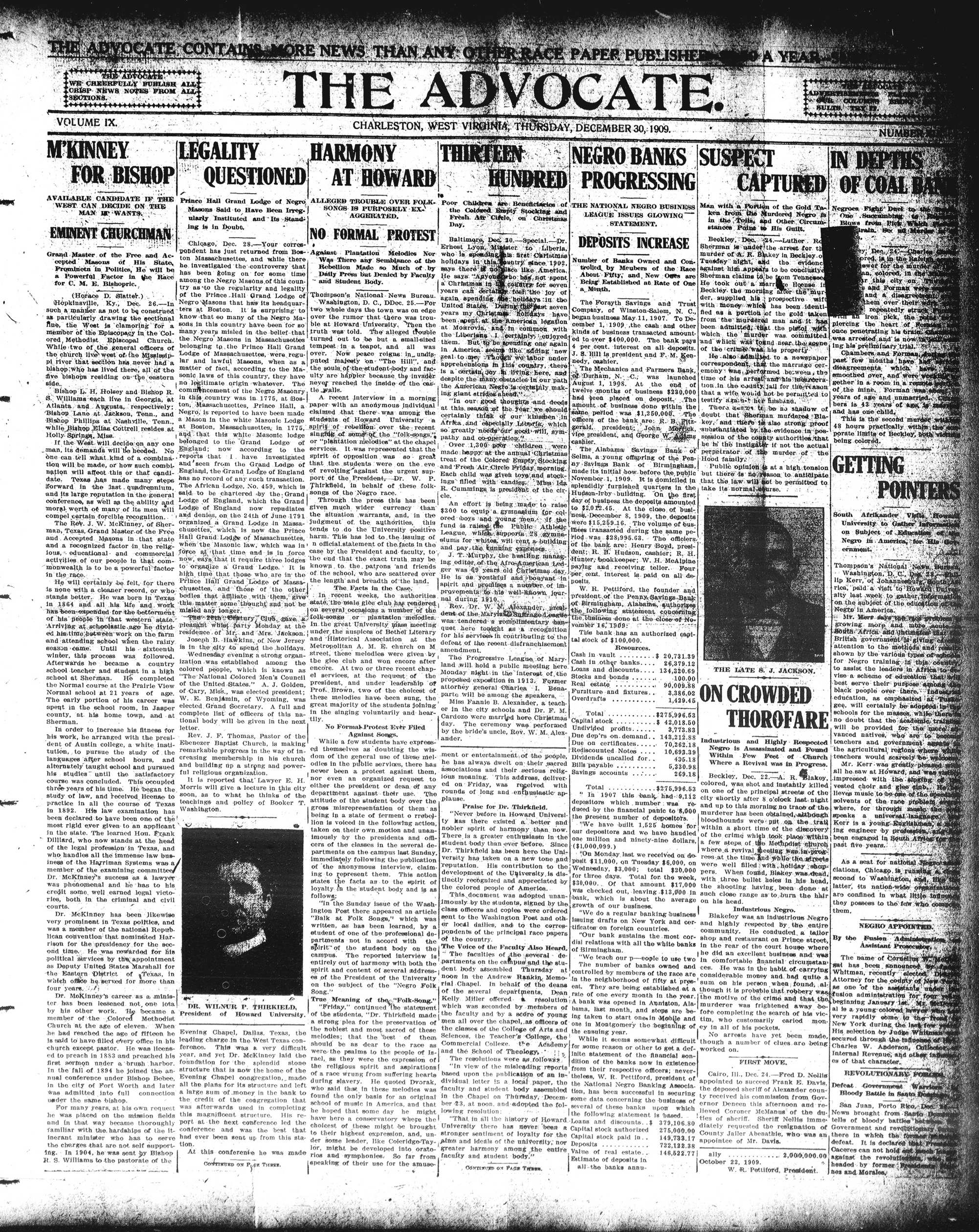
DR. WILNUR P. THIRKIELD,
President of Howard University.
Evening Chapel, Dallas, Texas, the leading charge in the West Texas conference. This was a very difficult year, and yet Dr. McKinney laid the foundation for the splendid stone structure that is now the home of the Evening Chapel congregation, made all the plans for its structure and left a large sum of money in the bank to the credit of the congregation that was afterwards used in completing this magnificent structure. His report at the next conference led the conference and was the best that had ever been sent up from this station.
At this conference he was made
CONTINUED ON P.C.F. TIBER.
ALLEGED TROUBLE OVER FOLK-
SONGS IS PURPOSELY EX-
AGGERATED.
NO FORMAL PROTEST
Against Plantation Melodies Nor was There any Semblance of the Rebellion Made so Much of by Daily Press but Denied by Faculty and Student Body.
Thompson's National News Bureau. Washington, D. C., DDec. 25.—For two whole days the town was on edge over the rumor that there was trouble at Howard University. Then the truth was told. The alleged trouble turned out to be but a small-sized tempest in a teapot, and all was over. Now peace reigns in undisputed majesty on "The Hill", and the souls of the student-body and faculty are happier because the invader never reached the inside of the castle walls.
A recent interview in a morning paper with an anonymous individual claimed that there was among the students of Howard University a spirit of rebellion over the recent slinging of some of the "folk-songs," or "plenation melodies" at the chapel services. It was represented that the spirit of opposition was so great that the students were on the eve of revolting against the urgent support of the President, Dr. W. P. Thirkhold, in behalf of these folk-songs of the Negro race.
Through the press this has been given much wider currency than the situation warrants, and, in the judgment of the authorities, this tends to do the University positive harm. This has led to the issuing of a official statement of the facts in the case by the President and faculty, to the end that the exact truth may be known to the patrons and friends of the school, who are scattered over the length and breadth of the land.
The Facts in the Case.
In recent weeks, the authorities state, the male glee club has rendered on several occasions a number of the folk-songs or plantation melodies. In the great University mass meeting under the ausplea of Bethel Literary and Historical Association at the Metropolitan A. M. E. church on M street, these melodies were given by the glee club and won encore after encore. At two or three recent chapel services, at the request of the president, and under leadership of Prof. Brown, two of the choicest of these melodies have been sung, the great majority of the students joining in the singing voluntarily and heartily.
No Formal Protest Ever Filed
Against Songs.
While a few students have expressed themselves as doubting the wisdom of the general use of these melodies in the public services, there has never been a protest against them, nor even an organized request to either the president or dean of any department against their use. The attitude of the student body over the gross misrepresentation of them as being in a state of ferment o rebellion is voiced in the following action, taken on their own motion and unanimously by the presidents and officers of the classes in the several departments on the campus last Sunday, immediately following the publication of the anonymous interview, claiming to represent them. This action states the facts as to the spirit of loyalty in the student body and is as follows:
"In the Sunday issue of the Washington Post there appeared an article "Balk at Folk Songs," which was written, as has been learned, by a student of one of the professional departments not in accord with the spirit of the student body on the campus. The reported interview is entirely out of harmony with both the spirit and content of several addresses of the President of the University on the subject of the "Negro Folk Song."
True Meaning of the "Folk-Song"
"Friday," continued the statement of the students, "Dr. Thirkfield made a strong plea for the preservation of the noblest and most sacred of these melodies; that the best of them should be as dear to the race as were the psalms to the people of Israel, as they were the expression of the religious spirit and aspirations of a race wrung from suffering hearts during slavery. He quoted Dvorak, who said that in these melodies was found the only basis for an original school of music in America, and that he hoped that some day he might have here a conservatory where the choicest of these might be brought to their highest expression, and, under some leader, like Coleridge-Taylor, might be developed into oratorios and symphonies. So far from speaking of their use for the amuse-
Poor Children are Beneficiaries of the Colored Empty Stocking and Fresh Air Circle, on Christmas Day.
Baltimore, Dec. 30.—Special—Dr. Ernest Lyon, Minister to Liberia, who is spending his first Christmas holidays in this country since 1902, says there is no place like America. He says "Anyone who has not spent a Christmas in the country for seven years can certainly feel the joy of again spending his holidays. In the United States. During the past seven years my Christmas holidays have been spent at the American legation at Mourova, and in common with the Liberians. I, certainly, enjoyed them. But to be spending one again in America seems like adding new zeal to me. Though we labor under apprehensions in this country, there is a certain joy in living here, and despite the many obstacles in our path the American Negro is certainly making giant strides ahead."
"In our good thoughts and deeds at this season of the Year, we should certainly think of our klinischen in Africa and especially Liberia, which so greatly needs our good will, sympathy and co-operation."
Over 1,300 poor children were made happy at the annual Christmas treat of the Colored Empty Stocking and Fresh Air Circle Friday morning. Each child was given toys and stockings filled with candies. Miss Ida R. Cummings is president of the circle.
An effort is being made to raise $300 to equip a gymnasium for colored boys and young men. If the fund is raised the Public Athletic League, which supports 28 gymnasiums for whites, will rent a building and pay the running expenses.
J. T. Murphy, the healing managing editor of, the Afro-American Ledger was 69 years old Christmas day. He is as youthful and boyant in spirit and promises a number of improvements to his well-known journal during 1810.
Rev. Dr. W. M. Alexander, president of the Maryland Suffrage League was tendered a complimentary banquet here tonight as a recognition for his services in contributing to the defeat of the recent disfranchisement amendment.
The Progressive League of Maryland will hold a public meeting here Monday night in the interest of the proposed exposition in 1913. Former attorney general Charlea I. Benaparte will be among the speakers.
Miss Fannie B. Alexander, a teacher in the city schools and Dr. F. M. Cardozo were married here Christmas day. The ceremony was performed by the bride's uncle, Rev. W. M. Alexander.
ment or entertainment of the people, he has always dwelt on their sacred associations and their serious religious meaning. This address, delivered on Friday, was received with rounds of long and enthusiastic applause.
Praise for Dr. Thirkfield.
"Never before in Howard University has there existed a better and nobler spirit of harmony than now. There is a greater enthusiasm in the student body than ever before. Since Dr. Thirkfield has been here the University has taken on a new tone and reputation. His contribution to the development of the University is distinctly recognized and appreciated by the colored people of America. This document was adopted unanimously by the students, signed by the class officers and copies were ordered sent to the Washington Post and other local dailies, and to the correspondents of the principal race papers of the country.
The Voice of the Faculty Also Heard.
The faculties of the several departments on the campus and the student body assembled Thursday at noon in the Andrew Rankin, Memorial Chapel. In behalf of the deans of the several departments, Dean Kelly Miller offered a resolution which was seconded by members of the faculty and by a score of young men all over the chapel, as officers of the classes of the College of Arts and Sciences, the Teacher's College, the Commercial College, the Academy and the School of Theology.
The resolutions were as follows:
"In view of the misleading reports based upon the publication of an individual letter in a local paper, the faculty and student body assembled in the Chapel on Thursday, December 23, at noon, and adopted the following resolution:
"That in all the history of Howard University there has never been a stronger sentiment of loyalty for the alms and ideals of the university, nor greater harmony among the entire faculty and student body."
CONTINUED ON PAGE THIRTEEN.
THE NATIONAL NEGRO BUSINESS LEAGUE ISSUES GLOWING STATEMENT.
DEPOSITS INCREASE
Number of Banks Owned and Controlled, by Members of the Race About Fifty; and New Ores are Being Established at Rate of One a Month.
The Forsyth Savings and Trust Company, of Winston-Salem, N. C., began business May 11, 1907. To December 1, 1909, the cash and other kinds of business transacted amounted to over $400,000. The bank pays 4 per cent. interest on all deposits. J. S. Hill is president and F. M. Kennedy, cashier.
The Mechanics and Farmers Bank, of Durham, N. C., was launched August 1, 1908. At the end of twelve months of business $220,000 had been placed on deposit. The amount of business done within the same period was $1,250,000. The officers of the bank are: R. B. Fitzgerald, president; John M. Merrick vice president, and George W. Adams cashier.
The Alabama Savings Bank of Selma, a young offspring of the Penny Savings Bank of Birmingham, made its initial bank before the public November 1, 1909. It is domiciled in splendidly furnished quarters in the Hudson-Irby building. On the first day of business the deposits amounted to $20,22.45. At the close of business, December 8, 1909, the deposits were $15,259.16. The volume of business transacted during the same period was $28,995.63. The officers of the bank are: Henry Boyd, president; R. H. Hudson, cashier; R. H. Hunter, bookkeeper; W. H. Moalpine paying and receiving toller. Four per cent. interest is paid on all deposits. W. R. Pettiford, the founder and president of the Penny Savings Bank of Birmingham, Alabama, authorizes the following statement concerning the business done at the close of November 16, 1909:
This bank has an authorized capital stock of 100,000.
Resources.
Cash in vault . . . $ 20,731.39
Cash in other banks . . . $ 26,379.12
Loans and discounts . . . 134,230.69
Stocks and bonds . . . 100.00
Real estate . . . $ 90,009.88
Furniture and fixtures . . . 3,886.02
Overdrafts . . . $ 1,429.45
Total.....$275,996.63
"In 1907 this bank had $9,112 depositors which number was reduced by the financial panic to $8,000 the present number of depositors.
"We have built 1,525 homes for our depositors and we have handled one million and ninety-nine dollars, ($1,000,099).
"On Monday last we received on deposit $11,000, on Tuesday $6,000, on Wednesday $3,000; total for $20,000 for three days. Total for the week, $30,000. Of that amount $17,000 was checked out, leaving $13,000 in bank, which is about the average growth of our business.
"We do a regular banking business issuing drafts on New York and certificates on foreign countries.
"Our bank sustains the most cordial relations with all the white banks of Birmingham.
"We teach our p—people to use two
The number of banks owned and
controlled by members of the race are
in the neighborhood of fifty at
present. They are being established at a
rate of one every month in the year.
A bank was opened in Anniston, Ala-
bama, last month, and steps are be-
ing taken to start one in Mobile
and one in Montgomery the beginning of
the ensuing year.
While it seems somewhat difficult for some reason or other to get a definite statement of the financial condition of the banks now in existence from their respective officers; nevertheless, W. R. Pettiford, president of the National Negro Banking Association, has been successful in securing some data concerning the business of several of these banks upon which the following statement is based.
Loans and discounts. $ 373,106.80
Capital stock authorized 275,000.00
Capital stock paid in. 149,733.17
Deposits . . . . . . 722,122.38
Value of real estate. . . . 148,522.77
Estimate of deposits in all—the banks annu-
Man with a Portion of the Gold Taken from His Murdered Negro is in the Tolls, and Other Circumstances Points to His Guilt.
Beckley, Dec. 24.—Luther, Rd. Sherman is under the arrest for the murder of A. R. Bakey in Beckley, or Tuesday's night, and the evidence against him appears to be conclusive Sherman claims to be from Tennessee. He took out a marriage license in Beckley, the morning after the murder, supplied his prospective wifi with money which has been identified as a portion of the gold taken from the murdered man and it has been admitted, that the pistol with which the murder was committed and which was found near the scene of the crime was his property.
He also admitted to a newspaper correspondent, that the marriage ceremony was performed by ween, the time of his arrest and his unmarriage in the county jail for the reason that a wife would not be permitted to testify against her fusband. There seems to be no shadow of doubt that Sheriman murdered Blakey, and there is also strong proof substantiated by the evidence in possession of the county authorities that he is the instigator if not the actual perpetrator of the murder of the Hood family.
Public opinion is at a high tension but there is no reason to anticipate that the law will not be permitted to take its normal course.
THE LATE S. J. JACKSON.
ON CROWDED THOROFARE
Industrious and Highly Respected Negro is Assimilated and Found Within Few Feet of Church Where a Revival was in Progress.
Beckley, Dec. 22. A. R. Blakey, colored, was shot and instantly killed on one of the principal streets of the city shortly after 8 o'clock last night and up to this morning no trace of the murderer has been obtained, although bloodhounds were put on the trail within a short time of the discovery of the crime which took place within a few steps of the Methodist church where a revival meeting was in progress at the time and while the streets were well filled with holiday shoppers. When found, Blakey was dead, with three bullet holes in his head, the shooting having been done at such close range as to burn the hair on his head.
Industrious Negro
Blakeley was an industrious Negro and highly respected by the entire community. He conducted a tailor shop and restaurant on Prince street, in the rear of the court house where he did an excellent business and was in comfortable financial circumstances. He was in the habit of carrying considerable money and had quite a sum on his person when found, although it is probable that robbery was the motive of the crime and that the murderer was frightened away before completing the search of his victim, who customarily carried money in all of his pockets.
No arrests have yet been made, though a number of clues are being worked on.
FIRST MOVE.
Cairo, Ill., Dec. 24. — Fred D. Nellis
appointed to succeed Frank E. Davis,
the deposed sheriff of Alexander county
received his commission from Governor Deneen this afternoon and relieved Coroner McManus of the duties of sheriff. Sheriff Nellis immediately requested the resignation of
County Jailer Abenable, who was an appointee of Mr. Davis.
ally 22, 1909. 2.000,000.00
October 22, 1909.
W. R. Postford President
Negroca Fight Duel to the Death
One Succumbing to Murder
Blows from Pick Which Whistle
Grain. See all Murder cases
May, Dec. 24—Charles Gormore
preds in the Rafael Gormore
sweater for the murder of
man, colored, in the white
or this city on. Thurdo
me and Forman were wounded
and a disagreeable man
them over their wounds
repeatedly struck.
with an iron pick, the painter plercing the heart of Forsyth, once penetrating his brain, chomping was arrested, and is now in hiding ling his preliminary trial.
Chambers and Forman, among the past few months have had their disagreements which have smoothed over, and were settled together in a room in a remote part of the mine. Forman was sent years of age and unmarried. Chambers is 43 years of age is married and has one child.
This is the second murder within the corporate limits of Beckley, both witness being colored.
South Afrikander Villa, Howard University to Gather Information on Subject of Education of the Negro in America, for His Government.
Thompson's National News, Burton, Washington, D. C., Dec. 23—Philip Kerr, of Johannesburg, South America, paid a visit to Howard University last week to gather information on the subject of the education of the Negro in America.
Mr. Here says the rule promotes growing more and more students in South Africa and urges that British government is giving careful attention to the methods and results shown by the various types of schools for Negro training in this country to assist the leaders in Africa to revise a scheme of education that will best serve their purpose among the black people over there. Industrial education, as emphasized at Tudugee, will certainly be adopted in the schools for the masses, while there is no doubt that the academic training will be provided for the more advanced natives, who are to become teachers and government agents the agricultural regions where white teachers would scarcely be welcome.
Mr. Kerr was greatly pleased with all he saw at Howard, and was greatly impressed with the singing of the vowed choir and glee club. How he lives music to be one of the greatest solvents of the race problem abroad where, for through music she speaks a universal language. Mr. Kerr is a young Englishman, a working engineer by profession, and has been engaged in South Africa for the past five years.
As a seat for national Negro emancipation, Chicago, is running a second to Washington, and, like the latter, its nation-wide organizations are confined in what little information they possess to the few who compose them.
NEGRO APPOINTED
By the Fusion Administration and Assistant Prosecutor.
The name of Corculius W. Whitman has been announced by the Whitman, recently elected. Died Attorney for the court of New York as one of the assistants under the fusion administration for four years beginning January 1st. Mr. Whitman is a young colored lawyer who lives very rapidly obese to the Trout in New York during the last four years His selection by Judge Whitman secured through the influence of Mr. Charles W. Anderson, Collector, Internal Revenue, and other influences of that character.
REVOLUTIONARY FORUM
Defeat Government Warfare Bloody Battle in Santo Domingo
San Juan, Porto Rico, Dec. 28. News brought from Santo Domingo tells of bloody battles between Government and revolutionaries, and there in whoh the former must defeat. It is declared that President Caceres can not hold and much longer against the revolutionaries, who are headed by former President Manuelnez and Morales.
CORRESPONDENCE
Sidney J. Jackson, owner and proprietor of Hotel Jackson and owner of much other valuable real estate, which has made him the wealthiest bank in this county, if not in this nation of the state, died Thursday last at John Hopkins Hospital, Baltimore, Md., after an illness of about two months of stomach troubles.
The remains, accompanied by his wife, were taken to Orange, Va., his birthplace, where they were interred Saturday. Mr. Jackson was charter member of the Masonic lodge which was represented by Prof. H. H. Ralley and P. M. Hayes. His nephew, James Jackson, who was employed in the hotel was also present at the funeral, having left here Friday night.
Mrs. Smith Brown is reported quite sick at her home in West Montgomery.
Christmas services were held at the First Baptist church and M. E. church Saturday morning.
Principal E. L. Rann, of the Bluefield city school, is here the guest of friends.
J. V. Coleman, of Mt. Carbon, was here on business Monday.
Mrs. Willa Washington and daughters, of Hawks Nest, were the week-end guests of Mr. and Mrs. P. H. Shepherd.
Miss Ollie Meadows is here the guest of Miss Beula Saunders.
A. L. Thompson is reported on the sick list.
Claudie Hurt, of Cedar Grove, was a business visitor here Saturday.
H. H. Ralley is spending this week at Charlotteville, Staunton and Brookwood, Va.
Mrs. Isaac Rogers visited her mother at Paint Creek Hospital Monday.
J. H. Hardy, tailor from Oak Hill, is spending this week with his parents Mr. and Mrs. Henry Hardy.
Mrs. William Brown and mother, Mrs. Maria Thomas, are guests of relatives in Charleston this week.
Miss Nellie May Lewis, teacher at Bluedfield, is home to spend the holidays with her mother, Mrs. Issie Lewis.
Miss Joe Willa Morgan and brother, Nathantiel, were guests of relatives at Mucklow Monday and Tuesday.
BANCROFT.
The Sunday School had their Christmas tree on the night of December 24th. Preceding the undressing of the tree and the distribution of the presents a delightful and well prepared program was rendered consisting of the following numbers:
Opening chorus—'Christmas Tree'
↳ The Children.
Prayer by assistant Superintendent Wm. Mickens.
Chorus "December brings Christ mas"—The School.
Recitation—"The Youngest Boy"
—Engene Hill.
Recitation—Santa Clause is Jolly'
—Rosa Bell Shanks.
Recitation—"Night Before Christ mas."—Wilber Wilson.
Selection—"What a Friend".—The
Orchestra.
Essay—"World's Christmas Gift".
—Mra. Mae Jones.
Recitation—"Hang up the Baby's
Stocking."—Josie Shanks.
Recitation—"In Time's Swing."
Edward Dickerson.
Trio—"In the Upper Garden."—
Misses Laura Smith, Gretta Roberta
and Dr. M. T. Sinclair.
Recitation—"Christmas Carol."—
Willie May Hicks.
Selection—"I love to tell the
Story."—Orchestra.
Recitation—"Christmas Morning."
Ernest Sawyers.
Solo—"Beautiful Gates."—Madge
Phillips.
Violin Solo, accompanied by guitar
—Phillips Shanks and Archie Moseby.
Selection—Orchestra.
Address—Superintendent M. T. Sinclair.
Chorus — "Christmas Hymn."—School.
Mrs. Laura Lawson, widow of Jas. Lawson, has broken up housekeeping and gone to live with her daughter Mrs. Wm. Lewis, of Powellton.
Mrs. Geo. Steward, of Plymouth, spent Monday in Middleport, the guest of her mother, Mrs. Willie Willey.
Mrs. Lee Prentis, of Raymond, was
OO YEARS' EXPERIENCE
PATENTS
TRADE MARKS
Copyrights &c.
Attention reading ... ketch and description may
be provided in probably patentable Communications
conducted. HANDBOOK on Patents
and Copyrights. HANDBOOK on Patents
and Copyrights taken through Mann & co. receive
without charge, in the
calling on friends in Betty Monday.
Mrs. Ada Wilson, of Columbus,
Ohio, who was called here on account
of the death of her father, Jas. Lawson,
has returned home.
Mrs. Florence Coles, of Raymond,
spent a few days last week here with
her sister Mrs. Hale Dickerson.
Mr. and Mrs. Wm. Lewis and
Charles Lawson who were called here
to attend the funeral of their father
returned home Wednesday.
Dr. M. T. Sinclair was shopping in
Charleston Friday.
Geo. L. Brooks, of Plymouth, was
a business visitor to Charleston Wednesday.
Mr. and Mrs. Charles Surgolns are
spending the holidays visiting friends
in Bidwell.
Mrs. Hale Dickerson entertained at dinner Christmas day Mr. and Mrs. Wm. Mickens, Mr. and Mrs. H. A. Jones, of Plymouth, Dr. anr Mrs. Sinclair and little son Terry.
Edward Hicks and children are spending a few days at Gomoca visiting his brother.
Mr. and Mrs. Wm. Mickens, of Plymouth, were guests of friends in Charleston Sunday and Monday, returning home Monday evening.
Mr. and Mrs. Chas. Harris and children of Betsey, are guests of the former's sister, Mrs. Minerva Woodley of Charleston.
Mr. and Mrs. Richard Smith's little son Joseph is suffering from an attack of typhoid fever.
Simon Wooda, of Betsey, is spending the holidays with his family in Charleston.
Edward Stevens of Plymouth, is spending the week with his family at Bidwell, Ohio.
Mr. and Mrs. Geo. Steward's little son, Willie, of Plymouth, died Friday Dec. 24, at Middleport, O., where they had gone to visit Mrs. Steward's mother.
Joseph Sawyers, of Betsey, spent a few days in Montgomery this week.
HINTON.
Miss Alfreda Smithers left last Friday for Danville, Va., where she will act as maid of honor for her cousin, Miss Smithers, who lives in that city. The wedding took place Monday, 27th and Miss Alfreda left on Tuesday morning for Washington, D. C., where she will join Misses Virginia Warren and Dorthula Pack as the guests of Mrs. Arthur Kyle for the remaining holidays.
Dr. G. W. Holley left last Wednesday for Montgomery, Ala., where he will spend the holidays as guest of Dr. T. C. Coffer. It is rumored that the doctor will bring back a southern beauty as his bounnie bride. Let's all who are his friends hope that the rumor is true.
Hemer Smithers, of Rendeville, O., is spending the holidays in town the guest of his sister, Mrs. A. P. Straughter, and Mrs. J. E. Smithers, his sister-in-law.
Erastus Garland Pack, Sr., is spending the holidays in Lynchburg Va., as guest of his daughter, Mrs. J. R. L. Diggs.
William and Wentworth Lewis and Harry French spent last Wednesday and Thursday in Washington, D.C., the guests of the sons of Rev. M. W. Clair. The remaining holidays they spent in Union, W. Va., visiting their grand mother, Mrs. Ollie Small. Misses Catherine Booker, Estella Wells and Juanita Johnson are home for Christmas.
The Second Baptist church had its Christmas tree Friday night and the Sunday School gave its entertainment on Monday night. Both affairs were well attended and much enjoyed.
The household of Ruth gave a banquet Tuesday night, which was a well planned affair. Refreshments were served in the church's hall and the social side of it took place in the Odd Fellows Hall.
Rev. A. D. Lewis left Sunday night for Huntington, where he will spend the week with his family.
Mrs. Iverson Smithers and little daughter, Louise left Monday for Alderson to visit her mother, Mrs. Mildred Brown.
Mrs. Mattle Johnson and husband, of Sowell, were guests of Mrs. Lizzie Muse Christmas day.
Mrs. Ellen Richardson is visiting friends in Covington, Va.
The M. E. Church had its Christmastree Wednesday night.
Miss Sadie Haynes is spending the holidays with Mrs. E. G. Pack, Sr.
The married ladies, vlz.: Mrs. GeoSmith, Mary Payne, Matte StrangeRosa Adams, Jennie Jones, LucyLewis, Willie Straughter, CynthiPayne, Maggie Winfield, Labella Mickens will serve a progressive dinner Thursday evening beginning at 8:00 o'clock.
SEWELL.
G. L. Jackson, of Kanawha City,
spent the holidays here.
W. A. Allen visited friends at
Anatead Monday.
Mr. and Mrs. W. W. G. Vanhook are
spending the holidays here with their
parents.
Mrs. Janie Allen came from Hinton
Saturday to spend the holidays with
her husband.
Mrs. Matie Jones, of Charleston.
Is the pleasant guest of Mrs. Fanny
Cary.
Morning Star Lodge, A. F. & A. M.
No. 35, held their annual banquet
Monday night.
Dr. R. L. Gordon attended the Mosonic banquet.
Mr. and Mrs. H. B. Hundley, of McDonald attended the Masonic banquet.
Mr. and Mrs. Rufus Bowman, Miss Annie Bowman, Wallace Powell, Preston Moore, of Finlow, Brooks Hendricks, Alex Harris, of South Caperton, attended the banquet here Monday night.
We regret to announce the death of little Lola Jasper, the two-year-old daughter of Mr. and Mrs. P. B. Jasper, of Pembrooke. Little Lola died Thursday, December 23 and was buried Friday in Lone Oak Cemetery. The community extends to the family its heart felt sympathy in the death of their little daughter.
Harvey Fountain, G. L. Jackson
Mrs. G. W. Johnson and Miss W. A.
Freeland attended the funeral of
Lola Jasper at Pennbrook Friday.
William Cowherd spent Sunday in
Montgomery.
CLARKSBURG.
Mrs. Mary Dillard, of Charleston, is spending the holidays here the guest of Mr. and Mrs. M. W. Grayson.
Mr. and Mrs. R. L. Lowry, of Charleston, are guests of Mr. and Mrs. P. H. Lowry.
Miss Amelia Lowry, a student at the West Virginia Institute, is spending the Christmas vacation here with her parents and has as her guest Miss Hazel Dillard, of Charleston.
Trinity M. E. Sunday School and Mt. Zion Sunday School had splendid exercises and made many little hearts merry by the treat on Friday night.
On Monday night a large audience listened to a pleasing program by the little folks at Pride A. M. E. church.
Mr. Arrington, of Wheeling, was the Christmas guest of Miss Anna Poindexter.
Mr. Clemens, of Morgantown is spending the holidays here.
Mr. Williams, of Hampton Institute, spent Christmas here with his Mother, Mrs. Allen.
D. W. Lee, of Detroit, Mich., was the Christmas guest of Miss Emma Thomas.
Fred and Miles Banks were called to Charleston Monday by the sudden death of their father.
Blucher Lee, of Wheeling, is the guest of his brother, Chas. Lee.
Miss Inez Tuck is home for the Christmas vacation after attending school in California, Pa.
Thursday evening Miss Beatrice Roberts and Ernest Monroe were united in marriage at the home of the bride's mother. Rev. S. P. West officiated.
Miss Byrdie Robinson and Walter Boggess were married Thursday evening, Rev. Colbert officiating.
Miss Lily Allen is spending the holidays at Fairchance, Pa., with her parents.
Rev. W. T. Kenney was called to Pittsburg on business.
Union services were held at Trinity M. E. Church on Christmas day.
At the lodge hall on Hughes street a public installation of officers took place followed by a banquet Monday night. Quite a number were in attendance.
Mrs. David Scott, who has been quite ill, is convalescing slowly. S. S. Class No. III will give an entertainment on Thursday evenings. Much interest is being taken in the emancipation celebration Monday January 3rd.
MT CARBON.
R. D. Reed spent his Christmas holidays in Rendville, visiting his brother Aaron. W. E. Gillerson, of Standard, was up during the holidays visiting his brother John. M. H. Hill was at Charleston a few days last week on legal business. Rev. S. E. Williams conducted Christmas services at Powellton on Christmas day and filled his regular appointment at Eagle Sunday. J. V. Coleman, George Ellis, J. J. Anderson and Wm. Vaughan have dressed the walls and ceiling of the K. of P. Hall in a pea green color with morron trimming which adds much to its beauty.
The members of the K. of P. Lodge and the Court of Calanthe were very much disappointed on the evening of the 27th, in the failure of Grand Chancellor L. O. Wilson, and Grand Worthy Chancellor, J. Ruppert Jefferson to lecture as they had promised. The ladies had prepared to serve refreshments and have a general good time in a social way. The Sunday School of the New Hope Baptist Church had its Christmas tree Friday evening. The program rendered by the school children
son, Mr. and Mrs. Lee Roy Lowry. Sunday was stormy, the attendance at church was unusually small. Rev. J. J. Turner preached a good Christmas sermon.
The Sunday School during the year 1910 will be in the hands of new officers' selected largely from the younger people. M. H. Hill, who has been serving so faithfully for ten years as superintendent, will be succeeded by Willie Vaughan who is a member of the graduating class of the public school. The cool miners will take a longer Christmas than they had planned on account of the pump house being destroyed by fire Saturday night. It will soon be rebuilt so as to avoid serious delay.
---
Boyd Chappel and little son Harry are visiting friends in Richmond, Va. Among our visitors this week were the following: Missen Bessie, Allie and Hattie Hicks, of Barboursville, and R. Q. Hill, of Charleston. Mrs. Arminta Toppan, of Cincinnati is the guest of her sister, Mrs. S. A. Thurston, on Dalton avenue. W. H. Harris is at home with his family this week. Walter Smith, of Wilberforce, O., is visiting his parents, Mr. and Mrs. W. T. Smith at 1513 Ninth avenue. A beautiful Christmas cantata was presented by the pupils of the 3rd and 4th grades of our school Tuesday evening at the Sixteenth Street Baptist Church. Much credit is due the teachers, Miss James and Miss Norman for the excellent manner of the presentation.
Miss Mary Dill has gone home to spend the holidays with her parents in Portsmouth, O.
Gee. H. Barnett is at home to spend the holidays.
Mrs. R. J. Perkins is indisposed this week.
Miss Lavina Norman is the guest of her sister, Mrs. Solomon Brown, of Institute.
Miss Lula James entertained at dinner Sunday the Misses Hicks and Miss Clara Stewart.
A program entitled "An Evening with Dumbar" will be rendered at the 16th St. Baptist Church.
Mrs. George Cookey is among her many friends this week.
Mrs. G. W. Fitzgerald entertained Mr. and Mrs. J. G. Gillard, Mr. and Mrs. H. J. Gillard, Miss Luella Bouldin and Mr. Mathew Hicks.
Mr. and Mrs. Dan Morris and daughter, Mr. and Mrs. James Green and Mr. and Mrs. Wagner spent Monday with friends in Ashland.
Mise Leota Johnson, accompanied by her guests, Miss Blanche Thomas, Lollage Rudesel and Mr. Wiley Brown all of Bluefield Normal School, is at home spending her vacation.
WINIFREDE.
Mr. and Mrs. Jan J. Thomas, of Cabin Creek, spent Christmas here visiting friends.
A. Wilson and R. H. Allen left the latter part of last week to spend the holidays at their home in St. Albans.
Mr. and Mrs. B. B. Allen gave a house party in honor of Miss Cassie Allen, of St. Albans Thursday night.
Mr. and Mrs. J. F. Moseley are spending Christmas week in Charleston visiting her sister, Mrs. Geo. Williams.
Mr. and Mrs. James R. Randolph entertained at dinner Sunday Mr. and Mrs. J. F. Smoot, Mr. and Mrs. N. S. Alexander, Mr. and Mrs. Ed Tyson, Mr. and Mrs. Jas. I. Thomas.
Bruce Smith is here spending the holidays with his parents.
Miss Ella Smith and her uncle, Geo. Keeley, left Friday for Smithers to spend the holidays with her sister, Mrs. J. M. Woodins. Jubilant Lodge No. 17 elected the following officers:
S. Johnson, C. C.; David Smith, V. C.; James R. Randolph, P.; G. W. Perkins, M. of Ex.; W. N. Shelton, M. of F.; N. S. Alexander, K. of R. and G.; Jas. Randolph, Trustee.
Wm. Brown is spending the holiday days with his family in Charleston.
The Sunday School children rendered the following program under the supervision of Mies E. L. Moad owes.
Singing—"No room in the Inn."—Choir.
Prayer by J. F. Smoot.
Singing—"Just as I Am."—Choir.
Address—W. N. Shelton.
Christmas Dance—Myrtle Randolph.
"Three Bad Boys"—Roosevelt Shelton.
"When Papa is Sick."—Miss Sadie Smith.
"Teaching Dollie."—Dolla Napper.
Select Reading—Miss W. Chapman.
"Helping the Temperance Canse"
—Thomas Mitchell and William Smith.
"Who Santa Clause Is."—J. C. Colen.
Music.
Restitution—Bugene Shelton.
"Make a Place for the Boys"—William Smith.
Miss E. L. Meadows left to spend the holidays at Institute with relatives.
Mrs. Alice Smith and daughter Miss Virginia, were shopping in Charleston Thursday.
Mrs. L. A. Davin leaves Thursday for Pittsburg for a affection day's visit to her son and daughter.
Mrs. G. W. Perkins and daughter, Mrs. G. E. Wisemah and nephew, Lt-
ST. ALBANS.
Miss Mabel T. Scott, teacher of the St. Albans school has gone to Columbus, Ohio, where she will spend the holidays with her parents.
Miss Minnie L. Walker, assistant teacher of Amandaville 'school, is spending the holidays with her parents who live in Columbus.
Mr. and Mrs. John Clark, of Handley, are visiting Mrs. Clark's mother, Mrs. Ada Preston.
William Preston, of Elk Ridge, is spending a few days with his mother, Mrs. Ada Preston.
Mr. and Mrs. George Bond, of McKendre, are visiting Mrs. Bond's father, Mr. Cornelius Sewell.
Mrs. George Banks, teacher at Page, came home Friday to spend the holidays.
Le Roy Hall, teacher at Wisconsin, is at home with his family this week.
Price Holeman, an aged citizen of this place departed this Life Saturday, December 25th. The funeral was conducted at the house, Sunday at 2 o'clock by Rev. J. W. Robinson. Mr. Holeman connected himself with the Baptist church when he was 18 years old, lived a conscientious Christian and died on the triumph of faith. Interment Tees Hill Cemetery.
Miss Alberta Wilson, Oscar William and Tallie Parish, students at the W. V. C. I. are spending the holidays at home.
Miss Clara Hill, of In institute, is spending a few days with her aunt, Mrs. William Erskins.
Harry Erskine was in Huntington Friday.
RONCEVERTE.
Rev. Robinson filled his usual appointment here Sunday.
Miss Grace D. Williams, and Mr. Wm. B. Sheffey were quietly married Thursday, Dec. 23 at M. E. parsonage.
Rev. W. E. Jefferson officiated.
Mrs. Katie Eldridge, who has been sick for the past week, is improving.
Clarence Eldridge and little Julia Reaveley are spending the holidays with relatives at Charleston.
J. M. Mallory and Overton Lewis are visiting friends in Virginia during the holidays.
Rev. Jefferson left Sunday night to visit friends and relatives at Winchester Va.
Mrs. L. E. Richardson, of Charleston, was a guest of Mrs. H. T. Moore during the holidays.
Charles Brinkley visited Charleston this week.
Mr. and Mrs. W. B. Shefay entertained a select party for dinner Christmas day.
Prof. D. W. Calloway is spending the holidays with his family.
Sidney Holly is at home again among his friends and relatives.
Herold Woods and wife, of Marlinton, were guests of his mother, Mrs. Edna Woods, this week.
Mrs. Mary J. Brinkley is visiting Mrs. S. A. Colbert at Charleston this week.
Mrs. Debby Terry has been indisposed for a few days this week.
SYLVIA.
Born to Dr. and Mrs. H. C. Hargrove Sunday afternoon, December 26, a fine boy.
Mrs. Florence Carrington, of South Caperton, visited her daughter and son-in-law, Dr. and Mrs. H. C. Hargrove Monday and Tuesday.
D. W. Calloway is spending his Christmas holidays at his home in Ronceverte.
Miss Herrett Ferguson gave a very pleasant entertainment at Gunnison's Hall Friday night. Much interest was shown in the prize contest.
The young lady receiving the greatest number of treats received a very handsome prize. The lucky lady being Miss Mabel Anderson.
Caleb Hargrove, Press Mens and Miss Lillian Sullivan stopped in our town Thursday and Friday on route to Chiff Top to spend the Christmas holidays with Mrs. Reaves Thompson. While here they were the guests of Mrs. H. C. Hargrove.
A number of manions attended the masonic feast which was given at Sewell Monday night.
GUYANDOTTE
Joseph Layne came home Friday to spend a few days with his parents, Mr. and Mrs. Shields Layne.
Mr. and Mrs. Frank Davis, of Wheeling, are in town to spend the holidays, with their parents and Mrs. Sam Davis.
William Scott, of Huntington, was in town Sunday calling on friends.
Norman Carrington and Irving Yancy, of South Caperton, are in town visiting relatives.
Miss Caroline Robinson, Dessa O'Dell and Daisy Prater, of Huntington were calling on friends Sunday.
Misses Julia and Willie Roby, of Huntington, were calling on Mrs. Davis Sunday.
Mrs. Fannie Johnson, of Huntington, spent Sunday and Monday with Mrs. Mildred Layno.
Misses Lula LLewis and Fleeta Brooks were calling on friends in Huntington Sunday.
THE BAUER MEAT & FISH COMPATY 28 AND 30 CAPITOL ST.
We want your patronage for we have complete stock in our lines and you can get it when you want it most.
Mr. and Mrs. W. M. Lewis, of Elkins, spent Christmas day in our town as the guests of W. J. Thompson.
The exercises of the Baptist church on Saturday night were highly pleasing and reflected much credit on the participants.
Mrs. W. H. Bolts was recently called to Manchester, Va., by the death of her sister.
Jas. Washington, of Elkins, was on our streets last Sunday.
Vice Grand Chancellor, E. L. Morton visited Sons of Toll lodge on the 21st.
Mrs. W. F. Thomson is spending the holidays with relatives in Virginia.
The voters of Thomas will vote for and against liquor license on the first Thursday in January. Clashon Johneon visited friends in Piedmont last week. Mrs. Hannah Daniels returned from Pittsburg on Saturday the 25th. We have had extremely cold weather for the last week and the people of Thomas are all Eskimos.
LEWISBURG
Miss Caffie Jackson is home from her school to spend the holidays. The Christmas exercises of the M. E. church were remodeled Friday evening before a large crowd. The program was greatly enjoyed.
work with relatives in Charleston.
Mrs. Blanche Ellis, of Dayton, is at the bedside of her mother-in-law, Mrs. Kate Dangerfield; who continues quite ill.
Mrs. Charity Robinson left for Clarksburg to spend the month with her son.
A. D. Seams, who has been teaching school at Brownstown, spent the holidays with his family.
Randolph Scott and Miss Idu were happily united in marriage a few days ago.
John Chambers and E. R. Grant were down from Frankfort Christmas visiting friends.
SOUTH CARBON
Mrs. Hattle Martin and son Clarence were shopping in Charleston Monday.
Rev. L. W, Mayo and wife and F. W. Williams and wife were shopping in Charleston Tuesday.
S. G. Scott of Wake Forest, and Miss Elmira Riddle were quietly married here Tuesday night the 21st at
THE BAU
the residence of T. T. Alston by Rev. W. W. Scott, of Cedar Grove.
Rev. C. H. Carter was in Charleston Tuesday on business.
H. M. C. Reid, T. B. Martin and James Saunders spent Tuesday in Montgomery.
Winston Railey left Tuesday for Charleston to spend the holidays.
Miss Bottle McCoy and J. T. Mitchell and wife were shopping at Miami.
Mr. and Mrs. G. W. Williams, of Paint Branch spent Saturday, and Sunday with Mrs. Bettle McCoy.
Edward Hughes of Lamont, was the guest of Harry Young Saturday and Sunday.
Carbon Sunday School had a Christmas tree Friday night and an excellent program was delivered by the little children. Excellent addresses were made by T. T. Alston, Rev. L. W. Mayo and others.
Saturday at 2 o'clock Rev. L. W.
Mayo delivered an excellent sermon
which was attended by a large crowd.
Alex Montague and H. Woods are
IIK.
F. M. Faulkerson of Dorothy, was
the guest of J. L. Green Saturday and
Sunday.
GLADE
Andrew Johnson made a business trip to Meadow Creek Saturday.
Mrs. Willie J. Muller, who was recently burnt out in Montgomery, is spending some time with his sunt. Mrs. Nora Poindexter.
Mr. and Mrs. Joe Morris were in Thurmond last week on business.
Win. Miller, of Fort Defiance visited his wife Saturday.
Eddie Groom spent Christmas with his sister, Mrs. Mary Noris.
Will Poindexter made a business trip to Hinton Friday.
Mrs. Worrell continues in.
Joe Morris spent several days at
Gauley last week.
Miss Ottie Reed, of Quinnimont, is
spending some time with Mrs. Alice
Reed.
A number of people from our town went sketch-riding to Thomas Friday. J. H. Johnson, of Piedmont, came here to assist in playing the drama, "Out in the Streets." Prof. Clarence Black, teacher at Thomas, made a trip to our town last week. The Christmas exercises were very good. Much credit is due the program committee. Rev. M. D. Willis is in town attending to his church work. He held services here Christmas and preached a very instructive sermon, taking for his text the second chapter of Luke, 11th verse. "This day is born in the city of David, a Savior, which is Christ, the Lord." He also preached two excellent morning Sunday
fi ry 5 " Pere ies a Berna eet Pee ta re eS SSPE Narre ras
ie Cen ert Sear ier Rune a as OC Me Naan LAD RAC AN pce Skt eae ae Ty mena aT ote ore ra ;
CS Ale erator haa re ral ae ae ee ee a ee RR VOOR RR Te tes | CHAAR SNe on ee a Oa ee crane
NF ES GS Stee
You Can Get”
oa odds and ends’
in SUITS and OVERCOATS
‘elsewhere at low prices butiyou
can not get new, stylish SUITS:
and overcoats for men and boys:
at the prices we offer =’
Special Reductions on ‘Suits
and Overcoats. Buy now, ‘and
save almost half. cs
4 ;
B. BROWN.
226 Capitol Street; 4
Our Magazine Bargains
+ The following are the best Club Ofters that will be made this
“season, All Subscription are for ONE FULL YEAR,”
McKinney
| ConriNuED FROM Pack One.
chairman of the delegation that was
‘sent ug to the general egnterence
that adit in Memphis, and was ap-
+ ‘The following are the best. ¢
~ season, All Subseriptio:
Ladies' Home Journal,.’ ‘Both
Saturday Evening Post. ¢
$3.00
ee
‘The Youth's Companion., AM For
(Including all extra num-
bers, the 52 issues for
1910, and the “Venetian”
Calendar for 1910.)
81.75
eee rere Ss
‘The Advocate , . . .".$1.50 All Three
Pictorial Review ... 1.00
Success Magazine. 1.00
> $2.70"
———
‘The Advocate .....$1.50 AN ‘Three
Modern Priscilla .. |75 -
‘The Housekeeper |. 75
eee eee eee
The Advocate ..... $1.50 All Three
The Independent .. 3.00
Success Magazine . .1.00
i . $3.25
oo
‘The Advocate .....81.60 AN Four
Pictorial Review... 1.00
Home Needlework... 75
The Housekeeper... 176
82.70
Tho Advocate .... .1.50 All, Three
‘The Housekeeper. .75
Home Needlework... 75 .
1 92.20
———$ 1
Tho Advocate... .$1:50 All Four
World To-Day.... 1.50
Pictorial Reviow... 1.00
Buccers Magazine. . 1.00
« $8.70
ae a eee SN
The Advocate .....$1.50 All Three
Metropolitan ...... 1.50
World To-Day..2.) 1:50
88.50
‘Tho Advocate .....$1.50 All Four
Home & Farm .... .50 *
Poultry Success, ... 150
Paris “Modes....°... 150
(Including one pattern
fred.)
82.20
eS ]
‘The Advocate .....81.60 All Four
Home & Farm..... .50
Farm Poultry... .. “60,
Paris Modes...... 60
(Including one pattern
free.) . :
$2.20
$$
The Advocate .....81,50 All Thres
Farm Journal
(5 Years) ...... 1.00
The Housekeoper.. 175
$2.55
——_$_$_______
‘The Advocate .....81.50 All Thro
Pictorial Review... 1.00 a
American Boy... . 1.00
$2.90
Addree
‘cai itt alia ee, —_ «inne
pointed presiding oder of the Fort
Worth District by Bishop Phillips.
He has always presenteg » !round”
report, and iy the great educational
convocation held in the Interest of
Phillips University at Dallas, in 1907
he raised over a thousand dollars,
which was double his assessment
The Advocate .....$1.50 All Three
Pearson's Magazine. 1.50
Success Magadine.. 1.00
$2.00
eae ncaa
‘The Advornte”! <GL0O" RN Three
Pearson's Magazine. 1.56
American Boy .... 1.60 =
S 82.90
es
‘Tho Advocatp .....@1.50 All Four
Pictorial Review... 1.00
Ladies’ World.... 50
Modern Priscilla... 275 |
$2.70
The Advocate»... 81.50 AN Three
World ‘To-Day .... 1.50
Pearson’s Magazine. 1.50
88.20
‘The Advocate .....$1.60 Al Four
Suecess Magazine... 1.00
Pictorial Review... 1.00 .
American Boy .... 1.00
8310
a
‘Tho Advocate... ...81.50 \ All Four
Earmor's Volco....° .50
ome & Farm..., 50
‘Uoultry Success... 150 :
wins $220
aan pny
‘The Advocate .....$1.50 All Four
‘Farmer’s Volee.... 50
Home & Farm... 150
Parls Modes... ... 150
(including one ‘pattern
+ free.)
2 $2.20
Tho Advocate .....61.50 All Threo
Homo & Farm..... 50
Reliabe Poultry
Journal ......., 50
° 82.20
The Advocate .....$1.50 Al Four
Housekeeper ....,. 75
Modern Priscilla. !), “75
Américan Boy... . "1.00
| 92.90
‘Tho Advocate .....81.50 All Three
Metroopiitan ...... 1.50 .
Success Magazine .. 1.00
Ge 83.20
‘Epp Advocato .....81.50 Both
Technical World .. 1.60
(Or World To-Day) :
¢ . $2.50
‘The Advocate ..,..$1.50 Both
Ainsiee’s Magazin, 1.50
: 82.50
The Advocate .....81.50 . Both
Success Magazine... 1.00
Or Pictorial Review)
“ 42.20
The Advocate .....@1.50 All Four
Uncle Remus'-Home 1.00
Metropolitan ...... 1.50
Paris Modes ..2. 2. 150
(including one pattern,
free.)
93.20
all orders to
VOCATE
Diss 2oy iosoenbe ale ‘Naw
‘the: eolrituad Intonoats or hp shaa
Were eritived for tHe Anancial,, ank
tiie/areat: meeting. will go, down,
the: history of the church ag one ¢
‘the most condrete examples of wacri:
floe dnd Interest in belt help, yet, pre;
sented by our people, In all of this
Work, Dr..MeKinney. wag one of the
foremost moving splsion et)
| Im the tour yours cuat he has been
the presiding elder of tha Fort
Werth District, the mission points
have ‘steadily grown, church hoyses
have been erected aid” membership
§nereased to such’ an extent that. {t
Was necessary to form a new district
gut of the Old Fort Worth District,
without taking a single: charge trom
another district. ‘Thus by his tireless
work, Dr. MeKtaneyt ies built two
Aistriets out of the, Old Fort Worth
District, and again,/ the confidence
aud esteem in which he was. held
by his brethren wag manifested -in
their action,-which again placed him
At tho head of the West Toxag ‘dele
gation, for the ‘general conference to
Do hela in Augusta. Ho Meetved a
but ten votes of the conference. The
neh love and revere him. In fact all
‘Texas loves the genial, loyal and sin:
‘cere McKinney, and will, no doubt
evince their regard for him at the
next general conference,
Dr. McKinney ts an educational
enthusiast, and the new school in Tex.
as has no more ardent supporter.
He is’a speaker of no mean ability,
and a pulpiteer without a superior
in the church. He is a member of
the board of trustees of Phillips Unt-
versity and also a member of the
general board. An address which Dr.
McKinney delvered at ‘the deaf,
dumb and blind asylum in 1902 80
pleased the governor of the state, who
Was present, that he ordered it print-
ed for general distribution over the
state,
Dr. McKinney's record and ‘ability
entitle him to some consideration,
and the way the Texans appear to
stand up to him, will make him a
forceful factor in the running. . In
fact, the west ought to stand up to
‘aim, which is almost certain to hap;
pen. i
Harmony
Cements vine hGacond:
ee ee
This resolution was ‘unanimously
adopted with enthusiasmeand hearty
applause, A general love feast was
held: on the campus after adjourn.
ment, and many visited the president
in his home and repledged their loy-
alty fo him and to the institution in
which-they took such pride.
It is the opinion of the officials of
the’ school and of the conservative
citizens of Washington that the inct-
dent is now closed, and that’no more
will be heard of it.
| Dr. Thirkfield took no paing.to con.
éeal ‘his gratification over the satis
factory outcome of the short-sighted
effort to injure the university. He
thinks the institution is stronger ‘be
cause gf the attack, for it has shown
that there is a deep-seated veneration
in the heart of every student and
teacher for the ideals established by
the founders years ago, and no at-
tempt to frustrate the well-intention
ed plans of any administration, iby
some unsympathetic and irresponsi-
ble interloper will be tolerated for
single moment.
At'an early date it is probable that
Dr. Thirkfeld will deliver sa specially
prepared address setting forth in de
tail his view of the history, the valu
and, the possibilities of the Negre
Folk Song. .
CARES AAA A AAEM A EY 4
a have |
a new line of
ee ,
STAND |
LAMPS
Come in and
‘look them |
over :
COFFEY
Plumbing Co. —
Quarrier St., near Capito
_ ORDER OF PUBLICATION
Btate of West Virginia, Kanawha
County, 88:
At Rules held In the Clerk’s office
of the Circuit Court of Kanawha
County, on the first Monday in the
month of December, 1909.
Mincey F. Sayers, Viaintiff,
va. :
J. H. Sayers, Defendant.
In Chancery No. 2290.
(The object of this ault ts to ob-
tain a divorce from the bonds of
matrimony.)
- ‘This day came the Plaintiff by her
PROSPECTS. FOR RE-ELECTION
THE “HOOKWORM” DISEASE
AND RACE QUESTION INVOLVED
| No serious opposition to his. re-
election to the United States sonate
fa antlotpated by, Senator Nathan By
Beott,-whd Ig nai at his home | in
Wheekng, to spend tho holidays. The
federal’ sppelntments, agreed “upon
recently, will be sent to congress by.
the Prostdent ‘next week.
“Tt 1s practleally settled, $ think,”
sald Sonator Soott, ‘that ‘the nomi-
nations of Witugh, Doyle and:.Tyree
will be sent tothe senate by Prest-
dent Taft early this week, probably
today, and they will’ be promptly
gontirmed. When a large number of
Good men are pandidates for a tew
Places, gpme oné. has to be isap-
polnted, aid ‘the lot of the publi of-
Adial, who HAS to decide amongst
them, is not an dasy one, In making
our reaommendations of federal ap:
pointeés, Senator, Elkins and myself
fave the most epreful consideration
‘© every, case, and from what we
hay heard wé think our ‘ction has
met public ‘approval. Our aim has
been to'ensure ‘to the people efficient
Public ‘Service, and‘ at the same time
to make gurvappolntmente ag, repre-
sentative of all elements of our par-
ty and all sections of our state,. as
possible. These recommendatiqns 1
think make {t plain that the influenca
of the senators ‘from West Virginia
and of the natiqnal administration
4s to be‘exerted’'and will be exerted,
not for the benefit of any particular
man or get of men, but for harmony,
and the strengtiiening of the entire
republican panty in the state. Some
of the candidates turned down were
my persona} friends of long! years,
and It was a-great source of regret
to me that we could not please all of
them,” A \
Hope for Re-clection,
“What developments, if any, ‘aro
there in your cathpaign for re-elec-
on?” was asked: him.
“Well, naturally I hope to. be .re~
Bosted.’ Wost. Virginia has. many
good. men who would make good sen-
ators, and the ambition to represent
the state at Washington Js an bonor-
able one. However, I am ‘inclined
to think that I will’ not have much
serious opposition. Personally, I feel
that my twelve ‘Years’ sorvice has
givon me an insight into affairs and
a>position of influence that a new
man could not attain. in years: and
Dan Of ORO eit
Boston, Dec, 29.—Dr. Stiles spoke
vn the hookworm disease of which
no has made some extensive study.
ie declared that in the United States
a law of nature was being violated
when an effort was-made to lodge
uifferent races, of men side by slae
im tne same area. Dr. Stiles sald in
part:
“It is an unnatural biological con-
dition ito have two closely allied
species of anitnals living siae by side
im the same area. In this country
We have four races of animals, viz:
the white, the red, the yellow and
ine black’ man—breaking — nature's
saws by trying to live together. The
éompetition of the individuals is in-
tensified by being extended to a com-
petition between the races and we
must, in the end, submit to the
workings of the law of the survival
of the fittest. Different races may
have different diseases and after long
generations of infection a relative
Immunity may be developed in a, giv-
en race through the survival of the
fittest individuals. ‘This partial im-
munity to the serious effects ‘of a
disease does not imply immunity
from infection, On the contrary that
very immunity may tend to make the
partially Immune race a reservoir for
Infection and .that Infection when
transmitted to a more — sasceptible
race will, upon reaching such virgin
sdll, be very fatal.
“The white raco has brought tc
the south certain diseases from north
Europe. These have epread with
deadly effects to the blacks. The
negroea have brought to the ‘south
certain tropical diseases which have
spread to the whites with serious re-
sults. ‘These conditions are not fn
any way blameable to the south as a
portion of the country, but upon the
fact that in the United States we are
violating a law of nature when we
attempt ito lodge different’ races of
men side by side in the same aroa,
“It 48 not an exaggeration to say
that the negro in the south lives un-
Attorney; and on his motion, and {t
appearing by affidavit filed, that the
Defendant is a non-resident of this
Btate, it is ordered that he do appear
within one month after the date of
the first publication hereof, afl do
what is necessary to protect his in-
terest in bhis suit
Teste:
IRA H. MOTTESHEARD, Clerk.
J. A. Seaman, Sol.
Notice to Take Depositions,
To J. H. Sayers
Take notice that on the 6th day
of January, 1919, at the office of J.
A. Seaman in the “Bradford Build-
ing,” in the City of Charleston, Ka
nawha County, West Virginia, be-
tween the hours of 10 A. M. and 5
P. M., of that day, I shall proceed to
take the depositions of myself and
others, to be read in evidence in my
that. I am now better able to do good
Work, for West Virginia than ever
before. The late extra session of
congresis and the fight over the tariff
showed pretty clearly the advantage
of having trained men on the firing
ine, so to speak. No state in the
‘Union tares better amder the tariff
‘MH than West Virginia, Our inter-
esta were carefully Ioked after, and
received their falr share of consld-
eration: and f think that all West
Virginians, whether democrat or re-
publican, will agree that the judicl-
ous, protettion of our cwn industries
as our first duty; and that we wore
‘szecessful. For niyself, t can say in
Nl frankness (hat L would not geek
‘fe-election If I did not feel ‘that my
service’ and ‘experience were worth
something, and that I would be able
to serve the state offectively,
| ‘some Big Questions,
“Durisg the next six years,” con-
tinued Mr, Satkt, “we aro likely to
have some great public questions to
solve. In the west am agitation has
already begun against the new tariff
law. I would hot be surprised to sea
that question re-opened during the
next four years, Further changes in
the interstate commerce laws and in
anti-trust legislation will soon be up;
the curréney questlon will come up
next fall. Those aro all strictly -bus-
iness questions of prime importace.
As a business man, as commissioner
of internal revenue, and as a sena-
tor, T have had something to do with
many of these questions, and it.1s my
ambition to take some ‘part in. solv-
ing them for the benefit of the whole
country, and of my own people in
Particular. My own business experl-
énce, as well as tay experience In: the
senato, I-may say, with all due mod-
esty, Ieads mo to believe, that in
consideration of these matters, I will
have some influence, and will be able
to: ec@NE It to advantage,”
“What about state affairs?” was
asked shim, 2
“well,” gald Mr. Scott, “I am:
strongly In favor of somo legislation
on the natural gas question, but
would not like to seo an extra ses-
sion: unless {t 1s reasonably. certain
that: somé effective action will be
taken. Governor, Glasseogk doubt.
loss thas studied the situatfon — caré-
fully, and will act with prudence.”
der 4 hindicapecause6r-tne pres?
ence of the white man’s disease and
because of the presence of African
diseases, the white man there 4s also
‘ving “under a handicap. Senitary
science, it backed by intelligent,
jpracttcal application and ‘authority,
gan overcome that handleap, Theory
lemands that tn rural negro locali-
ties with anything less than good
anemia among the whites, and ptac-
&nomia among the whites, and prac-
tical experfence bears out this theory
among the tennant whites of the
south, *
“It 48 not only foolish but coward-
ly to awitempt to deny the existing
conditions and pay for a false sense
of local pride at the price of the lives
of women and children. Fortunate-
ly, the better class of thought in the
south is facing facts and organizing
for an extensivg campaign to improve
sanitary: conditions, And when the
south shall win its noble fight against
disease the victory will be great and
ty repay the efforts spent upon it.”
Dr. Stiles, speaking upon child la-
bor in the ‘south, took a position
which some of his hearers aight
havo fidged radical. Ho said:
ony haw never defended child la-
bor as an abstragt proposition, but
when I compare child labor and ‘ehild
misery upon the soil polluted on one
horse farms with child labor under
the’ vastly improved sanitary condi-
|ttons in the southern cotton mills, 1
am forced to the conclusfon that tho
latter Is infinitely better than the
former,and if tt came to @ choloe be-
tween the two for my young daugh-
ter now ton years old, my duty would
compel me to choose for her a Iife in
the spinning room of the average
cotton mill of the south, which T
{have visited, In preference to a Iife
{Of tofl and risory on the average in-
jsanitary tennant farm [have atudled,
“Tam unable to join in the whole-
sale condemnation 6f the south’
cotton mills, for I recognize in them
ithe best friends the tennant whites
of the south have.”
behalf, in a certain chancery cause
depending tn the Circuit Court of
sald Kanawha county, wherein T am
Plaintiff, and you are defendant; and
i from any cause the taking of said
depositions be not commenced, or, if
commenced, be not concludes, "on
that day, the taking thereof will be
adjourned from day to day, at the
same place, and between the samo
ours, until ‘the same shall be com-
pleted.
MINCEY F. SAYERS,
+ By, Counsel,
J. A. SHAMAN, Sol.
12,9-4t.
eae
BOYS! GIRLS! COLUMBIA BICY-
"CLE FREE! Greatest offer out.
Get your friends to subscribe to
our magazine and we will make
you a prosent of a $40.00 Colum-
bla Bicyclo—tho best made, Ask
: y i 1U EERE zy
14 SUMMERS STREET “4
ae Ct PE Be ne
Balance of the Week 4
MAUD SEWALL.” EVA’ ©
SINGLETON . SAMPSON SAMPSON,
no # pikes ape: ¥
&: tr ef
Original Black Beés
SUPPORTING . ae :
Walter S. Lyons, Comedian :
aS IN : i hee:
“Southern Pastimes” «|
PB tel gp
“Uncle Eph’s Return From the: North” *
MOVING PICTURES. . a
ILLUSTRATED SONGS.
Benefit Performance For the Anti-Tuberculosis :
League ‘Saturday Afternoon. ‘ 4
. mon ye
(AT AMIT Or ” a.
WANTED---A HOME
Tee
* i
Many 4 man dies without one because he {6 unwilling to save. thd.
dimes but hopes to make @ fortune by a single stroke, a
a
A small sum saved regulgrly from each’ envelope and deposited
y in the Savings department of “The Bank that you can Depend upon’)
will soon give you @ fumd which will buy you a home, it ia
We pay compound semi-annual Interest on Savings Deposits, - | 44
$1.00 or more opens an account at the ee!
1 Sie
: ee ee
SSE :
F sa
Kanawha Banking & Trust Co.
CHARLESTON. W. VA, 2 Gl
|. Capital $250,000. Charleston, W. Va, Surplus, $£70,600.4,
See ht ser
RESOLUTION NUMBER 4)
RESOLUTION NUMBER }}
“RESOLVED that I will keep every engagement madd daring 1940, ;|
punctually.’” Pr Oa ts 3
In order todo #0 you must have a reliable timeplecs. ‘There 1%,
one watch that makes you feel like the owner of a Bovernment |
bond every time you take it from your p8cket, It is the HOWARD) 4
than which no better wateh 1s mado, 4
We carry all standard makes of watches, ranging in prico’ froth }
$1.00 to $150.00, «nd our well known deperidable guarantes fo bill,
of every timepioca sold, vey
Our repair department, too, has an enviablé Tephtatio®.> + at
JEWELER & WEE neal
Cor. Va. Street an® yareadey
Chartestom, We Wah? “A
"i
for particulars, free outfit and oie
cular telling “how to start.” Ad-
dress “Tho Bleyele’ Man?* i
East 22nd Street, New Bork sony
图会
PUBLISHED EVERY THURSDAY
BY THE ADVOCATE PUB. CO.
Office, Pythian Building, Charleston,
SUBSCRIPTION RATES:
Three months ..... $0.50
Six months ..... 1.00
One year ..... 1.50
The old year hath come and gone and left us the gift of another harvest. Each man has garnered his share of golden grain, of weeds, of wild oats, and experience withal.
But now the planting time returneth. This year is mine and thine. Choose well thy field; work it with energy; water it with faith and sow with a right good will. And whether the gain be great or small, if here and there thou dropest a human kindness, thy labor shall not have been in vain.
A MEMORIAL TO J. MHENRY
JONES.
The Advocate acknowledges the receipt of a neat booklet containing a biographical sketch and other interesting papers on the late J. McHenry Jones, president of the West Virginia Colored Institute, author, educator and fraternal society man.
The scope of the book necessarily precluded the inclusion of much that was interesting and inspirational in the life of Dr. Jones; none the less, it is to be deplored that a copy can not be placed in the hands of every Negro youth in the state. Therein is much of encouragement for those inclined to take a pessimistic view of their station in life; much in opposition to the generally accepted belief that it were a hopeless struggle for the Negro boy to attempt to climb the ladder of success.
We learn that Dr. Jones' environments, his opportunities differed but little, if any, from those of the average Negro boy. The large number of children in the family, and the meagre wage received by the father who was almost its sole support, threw him largely upon his own resources. Then, too, there were not at that time the state supported schools offering the many courses now open to our boys and girls. No Negro of his acquaintance had pursued a course higher than that to be under incompetent district school teachers of his period, yet he aspired to climb higher and forced his entrance into a high school where his native ability asserted itself and placed him at the head of the class. At his funeral the highest representatives of the state participated and expressed regret at his loss.
What "Jimmy" Jones did other Negro boys can do, and many should do it better than he, for their opportunities are greater. Some will object that "times have changed." Yes, but for the better. There were never more openings nor more roads to these openings than there are today. If, with the educational foundation to be had in a high school of the '80's, Dr. Jones arose to eminence, what is impossible for the boy of this day? There are but few places to which he may not aspire and which he may not attain has he but ability, patience and determination.
THE CASTLE OF MAYOR
THE CASTE OF RACE AND COLOR.
The New Orleans Picayune takes a very pessimistic view of the future of the Negro and professes to see nothing for him but a permanent occupancy of "his place". "From the earliest times," says the Picayune, "and in every age of the world's history, the Negroes have been in contact with the whites of the dominant races, such as the Egyptians, the Greeks, Carthaginians and Romans, and yet the Negro has made no advances in civilization as a race."
It is strange how prejudice blinds a man.
If this were not so, the editorial writer of the Picayune could see many refutations of his statement right in New Orleans. He could see the magnificent seven-story Pythian building (a cut of which appeared in this paper some weeks ago) an evidence of racial co-operation, an advance in civilization; he could see the many beautiful homes, prosperous business establishments, and imposing church edifices, other advances in civilization; he would know the astounding "advances in civilization" in the way of the acquirement of real and personal property made by the American Negro since his liberation from slavery.
The Picayune is as trustworthy in prophecy as it is in history. It argues that because the Negro race has made no appreciable advancement in 3,000 years, it will occupy a subordinate
position forever and forever. It forgets all the people it cites; the Egyptians, Greeks, Carthaginians and Romans, struggled to the dizzy heights looked down on all others with arrogant contempt, declined and fell. The short and insignificant period of man's existence on this planet is characterized by the successive dominance of several different races. "And in every case, the dominant race was firmly convinced of its own inherent and permanent superiority and was very sure that each of the others was several hundred years behind and could never catch up. It was the pride which precedes the fall. History has a way of repeating itself
SIDNEY, J. JACKSON.
In the passing of Sidney J. Jackson, Montgomery, Fayette county and the state lose a valuable citizen. Though handicapped by lack of an education, Mr. Jackson, placed himself, by native ability, in the front ranks, his thrift commanding the admiration and respect frequently denied those of his superiors in the mere knowledge of books. He was a companionable man, a staunch friend and will be missed in the community of his failures and successes.
TOLD YOU SO.
These biting wintry winds will, perhaps, forebly and uncomfortable remind some of our readers of the admonitions against extravagance which appeared from time to time in these columns "in the good old summer time." The money thrown away on summer excursions and other luxuries would purchase that coal, overcoat or wrap of which you stand so much in need.
It is hoped that those persons who thought they could not enjoy Christmas without snow are satisfied with the touch of Arctic weather we are now experiencing.
WASHINGTON ON EXPOSITION
Editor The Advocate:
I have received so many letters recently regarding the proposed celebration in the year 1913 of the fifteenth anniversary of freedom of the American Negro that I deem it wise to ask you to permit me to use your columns in making some reply to these letters rather than in trying to answer each one individually.
Attention has already been called to the importance of some kind of a celebration to take the form of an exposition or something else. Of course in order to have such an exposition, it is of the first importance that it have the recognition and support of the United States Government as well as that of as many states as possible for without the influence and help of the central government it would hardly be possible to have an exposition that would reflect credit upon our race.
Having all this in mind the whole matter of such an exposition was carefully put before the President of the United States, and after considering the whole subject with great care manifesting the deepest interest, it was thought best by President Taft and others who consulted with him that in order to secure the confidence and support of the American people that the whole matter ought to be taken up in a dignified, orderly way and that this could be best accomplished through the appointment of a preliminary and temporary commission by the President, authorized by Congress, such commission to be composed of men of such ripe and wide experience and reputation that their recommendations would carry weight. It would be the purpose of such a commission to study carefully the whole subject, and if deemed wise to recommend the holding of such an exposition to map out a general and comprehensive scheme for same. This would prove a basis for an appeal to Congress and to state legislatures and philanthropic individuals for such support as would create an exposition that would command the respect and confidence of the world.
Accordingly, a bill has been prepared and introduced into both houses of representatives and the U. S. Senate carrying out the suggestion of providing for the appointment of a commission. President Taft further manifested his interest in the proposed exposition by referring to it in the most complimentary way in his recent message. It is believed that the bill introduced into Congress will pass early in the present session. In order to insure the success of the exposition, it is important that we proceed carefully and systematically. No hastily, ill-considered plan will command the respect and confidence of the American people.
I wish to say in this same connection that it is important that the race be patient while these plans are maturing. In the end it will be found that every element of the race will receive proper recognition and be given an opportunity to take part in the exposition. So far as the selection of individuals to take the leadership in the matter is concerned.
Suggestive Questions on the Sunday School Lesson by Rev. Dr. Linscott for the International Newspaper Bible Study Club
Copyright 1909 by Rev. T. S. Llnscott, D. D.
nothing definite has been done; only preliminary committees have been selected with a view of getting matters in shape to present to the President. After the passage of the bill now before Congress and the appointment of the commission by the President there will be plenty of time for all organizations, denominations and institutions to receive proper recognition, and I am sure that this will be done.
Nothing can be gained, but much lost, by an attempt to take short cuts and by doing those things that call attention to little side issues that have no possible chance to succeed. We need in this matter the united effort of all elements of the race, and the evidence so far points to the fact that the race is more united on this project than it has ever been on any other of similar magnitude, and we hope that this union of the masses of the people will continue.
I wish also to add that much careful consideration, before any decision is reached, will be given to the claims of every city or locality that is interested in having the proposed exposition located in its midst.
Other information as progress is made from time to time will be given.
Booker T. Washington.
INTERESTING ARTICLES.
In the Journal of the National Medi cal Association.
Nashville, Tenn., Dec. 28.—Special—With the appearance of the October-December number of the Journal of the National Medical Association, there is rounded out the first year of an existence whose resulting service, influence and active fellowship is inversely proportional to its length of life. In its own language it is "a quarterly publication devoted to the interest of the National Medical Association and allied professions of medicine, surgery, dentistry and pharmacy." The Journal is published at Tuskegee Institute and with each publication, it has increased its worth and value as the mouthpiece of the Negro medical men. The editorial staff is highly efficient with Dr. C. V. Roman, the eye, ear, nose and throat specialist, of Nashville, its chief, and Dr. J. A. Kenney, resident physician at Tuskegee Institute, associate editor and business manager. The features of the present number are the minutes of the meeting of the association at Boston, August 24, 25, 26, 1909, the report of the editor in chief to the executive board—a report full of hope and encouragement and containing a brief resume of the Journal's struggles for recognition and success. The discussion of Dr. C. V. Roman concerning the article of Judge Dickson in Hampton's Magazine for October, "Exit the Black Man" and that of Marion Hamilton Carter in McClure's for October. "The Vampire of the South," should be read by every layman. Its keen and forceful logic and ruthless analysis of the glaring inaccuracies of these writers compel attention and high praise. In the new year to come, The Advocate trusts that the voyage of the Journal over
January 2nd, 1910.
John The Forerunner of Jesus.—Matt. iii:1-12.
Golden Text.—The voice of one crying in the wilderness: Prepare ye the way of the Lord, make his paths straight. Matt. iii:3.
Verse 1.—What were the days referred to in verse one?
What are the facts concerning John the Baptist, his parents, the time and place of his birth, his early training, the commencement of his ministry, his characteristics, and the nature of his preaching?
Where and what was the wilderness of Judah?
Verse 2.—What did John want the people to do when he urged them to repent?
Why was it then, and why is it now, impossible for any person to enjoy the favor of God without repentance?
What did John mean by saying "The Kingdom of Heaven is at hand"?
Has the kingdom of heaven been established on earth, and if so, what is that kingdom, and who are its citizens?
Verse 3.—What did Esalas (Isaiah) foretell concerning John, and where is the passage to be found?
In what sense did John prepare the way for Jesus?
Verse 4.—Why did John dress in such a plain way and eat such simple food?
To what extent should good people, to-day, take John for an example in the matter of food and clothing?
To what extent does God care as to what we eat, and what we wear? If all you know of a man of dress, and an epicure in his food, how would you rate him as to personal piety? Can men work as hard, think as clearly and accomplish as much, or more, in all departments of life on a vegetable, as on a meat diet? Verses 5-6—How do you account for the wonderful interest which
the troubled sees of journalism will meet with the favorable winds of success and prosperity. The Tennessee Colored Fair Association held an important meeting at which were read the reports of the officers of the association, and the ways and means for the procedure the coming year were discussed. Another meeting is soon to be held for the election of officers for the ensuing year. In one of the inter-class debates at the University of Michigan, Richard H. Hill, Jr., of this city was unanimously given first place by the judges for his delivery, logic and smoothness of language. Mr. Hill is a law student and bids fair to become a shining mark for his race.
Saturday morning, New Year's Day, Emancipation Day will be celebrated at Fisk University under the united auspices of the several literary clubs of the college. The main address of the day will be delivered by Prof. H. T. Kealing, editor of the A. M. E. Review. There will also be several literary and musical selections. This is not only a college affair, it is for the people of Nashville.
MASON'S BANQUET
St. John's Day Celebrated with Elaborate Feast, as is Lodge's Custom.
Monday evening, as is its custom on St. John's day, Washington Lodge No. 6, Ancient Free and Accepted Masons gave their annual banquet at the K. of P. Hall.
As a preliminary to the feast, T. G. Nutter, master of installation, inducted the following into office: Joel H. Taylor, W. M.; J. W. Chapelle, S. W.; H. B. Burk, J. W.; Allen A. DeHonney, Secretary; Fleet Porterfield, treasurer; F. T. Wade, S. D.; John Helm, J. D.; Grant Clark, Tyler; W. H. Parker, chapain; and W. O. Lee, Bascom Smith, W. H. Wright and William H. Walker, stewards. This is the seventh consecutive term for Worthy Master Taylor.
About ninety members and friends of the organization were seated at the tables and regaled with the following menu:
Oyster Soup
Celery Mixed Pickles Olives
Roast Turkey Cranberry Sauce
Green Peas, Mashed Potatoes
Lima Beans Sweet Potatoes
Roast Pork Apple Sauce
Roman Punch
Chicken Salad In Mayonnaise
Vanilla Ice Cream
Assorted Cakes Fruit
New York Cream Cheese and Wafers
Dami Tasse
The members responsible for the preparation and service of the banquet were: W. O. Lee, Jerry Dillon, Bascom Smith, F. T. Wade, Thomas Hale, Robert Hamlin and G. P. Porter, all of whom are to be commended for the clock-like regularity with which the courses were placed before their guests.
On the Sunday School
Mr. Linscott for the
Super Bible Study Club
T. S. Linscott, D. D.
If John were the permanent pastor of a church, in this town, do you suppose that he would be able to constantly keep up such a great revival as this story records?
What did John's baptism signify?
Was baptism then, and is baptism now for adults of any avail without a full confession of sin?
Verse 7.—When a member of a church is not a devoted man, is he better or worse than any other sinner?
If a minister of the gospel is not a truly good man, whose word is as good as his bond, how would you compare him with a layman of similar character?
What is the tendency of the office of a pastor, or of a Bible class teacher as to making its incumbent a truly noble and an all-round morally and financially, trustworthy man?
Is a pastor of a church under any greater obligation to be a truly devoted man than his members? Why or why not?
These scribes and pharisees were in those days what our pastors and church officials are in these days. How do you account for the fact that they were such bad men?
Verses 8-9—What are the fruits which prove genuine repentance? (This question must be answered in writing by members of the club.)
To what extent does the fact that a mar has a noble and devoted ancestry recommend him to God?
Can any person be saved because of his parents' goodness?
Verse 10—Is it the fact, and why, that incompetent men fall and that bad men always come to grief?
Verse 11—What is the difference between the personal results of Jahn's baptism and that of the banism of the Holy Spirit from Jesus?
Verse 12—What reason is there for the belief that men and women make their own hell or heaven?
Lesson for Sunday, January 9,
1910.—The Baptism and Temptation of Jesus. Matt. 11; 13-17; 4:1-11.
START FOR SOLOF'S at once. They'll not last long. 45-inch Coats, perfectly plain tailored, satin lined, with kilted skirts. Never before. Never again: THINK OF IT!
Grandest lot of COATS ever placed in Wall cases. Finest of Skinners Satin Linings, 54 and 56 inch Coats, manufactured by one of the best Houses in New York City, retailed from $45 to $30, on sale at
$1.00 Hobby Horses at 39c
---
.
OUR SUITS MUST
This is no mock clearance sale, but a genuine closing-out-at-bargain-prices sale of every suit left in our Store. We have sold more suits this season than any other firm in the city, because the Quality, Style and Prices were right. Now we offer the following cuts in prices which were before as low as other stores offer in so-called clearance sales:
$20.00 SUITS ONLY $11.50 Come while the picking is good.
Dry Goods and Ladies' Furnishings.
Entrances 11 Capitol St. and 720 Kanawha St.
WEST VA. COLORED INSTITUTE
NSTITUTE, WEST VIRGINIA
The only Industrial Institute for colored Students in the State
Regular Normal, Academic and Commercial Courses, also Regular Courses in Agriculture, Carpentry and House Building, Steam Fitting, Smithing, Cabinet Making, Painting and Glazing, Dressmaking, Laundering, Printing. A Complete Course in Military Training to Cadets Rooms, Books, Fuel and Lights Free to Normal Students: and in addition Uniforms for State Students. We have a faculty of Twenty-two Teachers. Board only Eight Dollars per Month. FOR CATALOGUE AND OTHER INFORMATION ADDRESS
Byrd Prillerman, A. M. President
At The Nation's Capital
BIG DELEGATION OF PROMINENT COLORED WORKERS BROUGHT TO WASHINGTON BY THE MEETING OF THE JEANES' FUND BOARD OF DIRECTORS.
And Many Took Pains to Call at the White House for any Consolation to Be Had on the Matter of Appointments.—President's Delay in Making Negro Appointments Explained by a Friend of the Administration.—Prof. Miller After a Slice of the Morrill Fund for Howard University.
Washington, D. C., December 29. —The meeting of the Jeanes Fund Board of Directors and "other things" brought a big delegation of prominent colored men to town last week. President Taft is a member of the Board, and that body accepted the invitation of the President to hold its principal session at the White House. The proceedings of the Board are too well-known to make repetition necessary at this time. Suffice it to say the Board decided that 152 teachers should be employed during the coming year, this force to, be divided into extension workers, supervisors and organizers. It is proposed to include in the field of activity 1,600 schools and 132 colleges. The organization is so perfected that all that is now needed to enlarge the scope of the work is more money. There was some discussion as to the feasibility of asking federal aid to forward the movement, as it was pointed out that even a million dollars would be inadequate when it has to cover the immense area of the southern states. A spirit of self-help is to be inculcated among the colored students of the land. A special effort is to be made to lengthen the school terms throughout the South and to introduce, as far as possible, some ideas on home sanitation in the rural districts. The work is being carried on through the use of the proceeds of an invested million dollars left by Miss Anna T. Jeanes, a philanthropist of Philadelphia, for the purpose of encouraging the movement for the education of colored children in the thinly populated country regions of the Southland. The money was thus set aside largely upon the recommendation of Dr. Booker T. Washington, who has long emphasized the crying needs of the schools for Negroes in the rural districts of the South. President Taft and all of the members evinced the deepest interest in the proceedings, and the prospect of additional help for the cause is regarded as bright.
Among those present besides the Chief Executive and Dr. Booker T. Washington, were Bishop Abraham Grant, of the A. M. E. Church; Andrew Carnegie, Robert C. Ogden, Major R. R. Moton, of Hampton Institute; Dr. S. C. Mitchell, of Columbia, S. C.; R. L. Smith, Paris, Texas; Dr. Talcott Williams, Philadelphia; George McAneny, President of the Borough of Manhattan, New York; Dr. H. B. Frissell, of Hampton Institute; George Foster Peabody, of New York; Belton Gilbreath, Birmingham, Ala., and J. C. Napier, Nashville, Tenn.
Rumor has it that a number of the "visiting statesmen" took the pains to interview the President on matters other than educational, and several went away with a smile that rivalled the Chief Executive's own in breadth and sunniness. Mr. Napier is said to be slated for something very good—perhaps better than that
Institute, West Virginia
Son's Capital
IT COLORED WORKERS BROUGHT MEETING OF THE JEANES' OF DIRECTORS.
White House for any Consolation Pointments. — President's Delay in explained by a Friend of the Administerce of the Morrill Fund for Howard jobs to individuals, larger service for our the mere distribution. Fon instance, his left the Straus amendment heat of the campaign chisement of the Neg was a potent factor in that famous measure. Taft did not mince his forth a body blow in franchise for the Neg gives practical encounter race's desire to put it most by recommending of the bill looking to
to which popular gossip has assigned him. Bishop Grant and Register W. T. Vernon went away, arm-in-arm, and looked the picture of contentment. None of the gentlemen would talk for publication, but they are quoted sub rosa as saying that they had had "a very satisfactory interview with the President." Other well-known educators and statesmen who spent a few days in the city, and it is presumed, found time to drop in at the White House, were Prec. W. S. Scarborough, president of Wilberforce University; Lawyer Sepio A. Jones, of Arkansas, who is said to be an aspirant for Assistant United Attorney for the District of Arkansas, is strongly endorsed by the bar of that stafe: Lawyer Alfred G. Cowan, of Brooklyn, N. Y., promoter of a gold mine in Africa; W. D. Johnson, editor of The Standard, Lexington, Ky., an "original Taft man," who would like to be Recorder of Deeds for the District of Columbia; James G. Carter, Consul at Tamatave, Madagascar, who called to pay his respects and to report the record-breaking commercial development he has set into motion at his port; Col. Henry Lincoln Johnson, of Georgia, who is said to have the best ear of Postmaster-General Hitchcock; former Register Judson W. Lyons, who is putting in some fine work for the passage of the bill to reimburse the depositors of the ill-fated Freedmen's Bank, and was primarily responsible for the urgent recommendation of the President in his annual message that the measure be passed by Congress. These are a few of the advance guard which have honored us with their presence; others are announced for an early visit. Offices are given out sparingly, so far, but there is no telling what may happen shortly. The incumbents of the larger places are now so sure of their own safety that they are keeping the latch-string on the outside of the door and bidding all comers welcome.
Speaking of the slowness with which offices are being distributed among the brethren, one very good friend of the administration said to your correspondent:
"As a matter of act," said he, "the colored brother has no real basis for complaint against the President on this score. Office isn't everything to the race. The men we now have at the helm are rendering glitte-edge service; why displace them for others' who have neither their experience as officers nor their record as useful party leaders. If the outsiders know of a place that is vacant, why don't they sail in for it and bring their influence to bear upon it, just as other candidates would do?
"But, passing that over," continued our tonuacous friend, "the President is doing some substantial things for the race that show his concern as to our well-being quite as effectively as the handing out of a few
jobs to individuals. He is doing a larger service for our people, than the mere distribution of patronage. For instance, his letter denouncing the Straus amendment during the heat of the campaign for the disfranchisement of the Negro in Maryland was a potent factor in the defeat of that famous measure. President Taft did not mince his words, but put forth a body blow in support of the franchise for the Negro. Again, he gives practical encouragement to the race's desire to put its best foot foremost by recommending the passage of the bill looking to the promotion of the semi-centennial exposition, designed to indicate the progress of the Negro since emancipation. He argues the justice of the proposition that the government reimburse the depositors of the old Freedmen's Bank, in which the erstwhile ward of the nation was induced to place his savings, inferentially, if not actually, under a government guarantee of its soundness. And last, but by no means least, the President has gone upon record as sympathizing with the project to have this government intervene for the protection and development of the Liberian Republic.
"While office is mighty acceptable, and we ought to have plenty of them, let us not forget while we push our claim and growl beneath our breath, that President Taft is not overlooking the welfare of the Negro in the larger issues that touch the race."
The District's judicial appointments are to be made soon,—perhaps this very week. As foreshadowed in those columns some time ago, Judge Robert H. Terrell will again be named for his present seat on the bench of the Municipal Court. The matter was gone over at length a few days ago and positive assurance was given by the appointing power that Judge Terrell will be among the five who will hand down decisions from the Municipal Court for another term.
There isn't a more popular mannor a more highly-esteemed official in the District than Judge Terrell, and his host of friends are jubilant over the news that he is to be retained. He is a graduate of the law department of Harvard, served brilliantly in the office of the Auditor for the Navy Department under Major Lynch, was an admirable principal of the M street High school and at the bar made an enviable record. As a fraternity leader, a churchman, an educator, public spirited citizen and promoter of the race's good in all directions, Judge Ttrell has stood in the front rank and his appointment is the logical result of such helpful activity.
Senator Jones, of the State of Washington, has introduced in the Senate the bill reported by Repres-sentatives Rodenberg and Taylor last week, providing for the appointment of a commission of seven to investigate the feasibility of holding a semi-centennial exposition showing the progress of the Negro in his fifty years of freedom, and carrying an appropriation of $5,000 for the expenses of such commission. The measure will be given early consideration, and since it has the earnest approval of the President, there is little doubt that it will be passed without notable opposition.
Prof. Kelly Miller, in a clearly-written and convincing letter in the Washington Herald, makes a p'ea for a share of the "Morrill Fund" for the benefit of Howard Universi-
ty's scientific department. The purpose of the "Morrill Fund" is to encourage the several states to prosecute the scientific study of agriculture, and is to be apportioned among them on the basis of population and number of schools offering such courses. Prof. Miller points out the advantages that would accrue to the race and nation from the help that this fund would give to Howard University, situated as it is at the national capital, easily accessible to the great Department of Agriculture, where may be found, as nowhere else every facility for the practical knowledge of this fundamental branch of scientific inquiry, and drawing upon the people of the whole country for its students. Prof. Miller says, in part:
"The allotment of the Negro's share of this fund to Howard University would be of the greatest significance to the colored race. This institution stands out conspicuously in the eye of the nation as the 'national university' for colored youth. Congress has just established here a Science Hall at a total cost of $90,000, which will shortly be completed and equipped with adequate facilities for up-to-date work in physics, chemistry and biology. The first outlet to these sciences is in the medical department. The next natural step is scientific agriculture. Agriculture to-day furnishes the most fertile field for the application of science to the practical affairs of life."
The authorities are very favorable to alloting a share of this fund to George Washington University on the ground marked out so strikingly by Prof. Miller, and there are stronger reasons why Howard should be given consideration than the downtown institution, which has fewer opportunities for practical demonstration and does not reach a race of which so large a percentage depend upon agriculture for a livelihood. 85 per cent of the Negroes of America earn their bread directly or indirectly from the soil. It is believed that Howard will secure a liberal share of the "Morrill Fund," as the argument brought forward by Prof. Miller, supplemented with the efforts of President Thirkield, is attracting widespread and sympathetic attention.
The "Hiwatha Theater" is giving splendid holiday line of specialties. On Christmas Day the pretty playhouse was packed from 4 to 11 o'clock with a delighted crowd. The instructive religious spectacle "The Star of Bethlehem" was presented, and Mr. T. Spencer Finley, Hiwatha's bright and particular star, sang the beautiful sacred selection, "The New Born King." During the week, Mr. Finley is appearing in high-class comedy work in connection with Mr. Richards, and is repeating his successes of the first three months. It is no small achievement for a comedian to stay at one house and play to practically the same audiences for three months without losing his hold; but this is what Mr. Finley has done and is now "going bigger than ever." His jokes are always new, his wit is clean and wholesome, and his songs are the very latest. He appeals to the thinking classes, and they are always keenly alive to the merit of the bright "stuff" he devises for their entertainment. The management is liberal, up-to-date and intend to keep their show up to the highest standard, regardless of cost.
Secretary L. E. Johnson announces that work will be resumed on the Y. M. C. A. building as soon as arrangements can be made for the collection of certain subscriptions that have been promised. The idea is to get sufficient funds in hand to complete the structure before the builders take hold again. A further donation may be made by John D. Rockefeller and Andrew Carnegie is said to be considering the matter of making a generous contribution.
Prof. Kelly Miller, Dean of the Arts and Science, Howard University, is to deliver the emancipation Day address at a grand celebration in Charlotte, N. C. on January 1st. He will be tendered a banquet by the Negro Business League of that city. Later Dean Miller will fill lecture engagements in New York and Baltimore.
The Washington Conservatory of Music has been holding an attractive Art Exhibit, opening on Saturday, December 18, and closing at 10 p.m., December 20. The principal exhibits were: Embroidery, by Mrs. Margaret Fortie, of Philadelphia, winner of the first prize in Wannamaker's Art Exhibit; China Painting, by Mrs. Harriet Gibbs Marshall, president of the Conservatory of Music; Sculpture, by Mr. Isaac Hathaway, of Kentucky; and Photography, by Mr. Addison Norton Scurlock, of this city. Many visitors, hailing from various sections of the country, were present, during the exhibit and all spoke in the highest terms of the work that was shown.
As has been his custom for the past twenty years, "Uncle Phil" Antony, the 74-year-old colored porter at the general offices of the Southern Railway, entertained a party of prominent railroad officials at his home, 414 Twentyth street northwest last Friday afternoon. The party numbered about thirty, and they sat down in the dining-roo of "Uncle Phil" to a dinner, prepared by Mrs. Anthony, embracing possum, corn-pone, sweet potatoes and other delicacies dear to the southern palate. After the dinner the officials, representing the varied inter-
ests of the great Southern Railway corporation, made some speeches significant of the sympathetic relations existing between the whites and the Negroes of ante-bellum times, and "Uncle Phil" responded to the pressing invitation to tell stories of his life and experiences. The old man, catching the humorous side of the occasion, gave out a rich fund of anecdotes which produced roars of merriment. According to custom, as the guest departed, a neat sum of Christmas money was placed in a box for the obliging host and hostess.
At a meeting of the stockholders of the Odd Fellows' Hall Association, held in the temple, 1606 M St. northwest last Friday night, reports for the year were heard and officers elected. All of the officers now serving were unanimously re-elected. They are: President, Thomas H. Wright;; vice-president, Lawrence Clark; treasurer, Joseph Manning; secretary, Samuel W. Watson; assistant secretary, Alexander F. Hicks. Directors: Isaac W. Scott; Henry P. Slaughter, James Langhorne, W. O. Davis; auditors, Richard F. Williams, Alexander S. Howard, David Rinker. A few evenings ago, the order throughout the city united and tendered the officers a grand reception and gave them high praise for their splendid work in paying off the debt on the $75,000 building owned by the G. U. of O. F.
The Citizens' General Committee, which is to co-operate with the doctors, dentists and pharmacists of Washington in entertaining the convention of the National Medical Association, to be held in this city next August, has elected Robert H. Terrell, chairman; Prof. Kelly Miller, vice-chairman; Charles F. M. Browne, recording secretary; Shelby J. Davidson, financial secretary; Daniel Murray, treasurer. The Washington Commercial Council has adopted a resolution pledging its active assistance to the local medicos and to this General Committee of
THE CRYSTAL Owned and Controlled by the America, South America, Eur
THE CRYSTAL BATH HOUSE
THE CRYSTAL BATH HOUSE
Owned and Controlled by the Knights of Pythias of North America, South America, Europe, Asia, Afrika and Australia.
THE HISTORY OF THE MUSEUM
Attendants' Fees $3.00 $1.25
Call on or Address
CRYSTAL BATH HOUSE
...A FEW S
Call on or Address J. R. SMITH, Mgr.
CRYSTAL BATH HOUSE HOT SPRINGS, ARK.
...A FEW SPECIALS...
These are samples of bargains which we are offering in every department of our store. Come in and examine these and scores. In considering these remember the uniform high grade of our stock.
As a special leader we offer
a semi-fitting, full satin lined
black coat, regular price
$15.00, for on'y $7.50.
We have these coats for all
sizes.
We have an excellent line of Children's Coats in all sizes from 6 to 14, in all popular colors which we offer At One-third Off regular price.
Great Reductions in All Departments
Ladies' Ready-to-Wear Store.
917
COATS
CHILDREN'S COATS
Citizens in the work of preparing for the great convention. Washington expects to take care of the gathering in a manner that will compare favorably with the hospitality extended by other cities the Association has visited.
The L'Alegero Glee Club gave its initial concert last night at True Reformers' Hall, for the benefit of the Colored Social Settlement House in South Washington, in charge of Miss Eloise Blubb. Mr. E. R. Amos is president of the Club and the program was very fine.
A bill to provide for "jim crow" street cars in the District of Columbia has been presented in the House by Representative Heflin, of Alabama. The bill is being laughed at by the Republican members of Congress. It is regarded as a joke. It will not pass.
W. W. Martin has moved his Northwest Cafe to the building at the corner of 11th and U streets northwest, recently occupied by the Clarke Training School. The place has been fitted up in elegant style. Mr. Martin will make a specialty of high-class catering, and will endeavor to answer the demand for a restaurant of the first grade "up-town." The building was recently acquired by the Brown Realty Company, of Newport News, Va., at a cost of $12,000, the sale having been negotiated by Mr. W. H. C. Brown, representing the company here. Mr. Martin has taken a five-year lease on the place at an annual rental of $1,000.
Major Arthur Brooks has resumed his duties as military instructor of the High School Cadets, temporarily relinquished during his 13,000-mile trip across the continent with President Taft, Capt. E. L. Webster, of the District National Guard, satisfactorily substituted in his absence.
Architect W. Sidney Pittman has been re-elected president of the Fairmont Heights Citizens' Association.
The only bath house of its kind in the United States for Colored People, receiving its hot water direct from the United States Government. Equipped with all the latest improvements. Experienced attendants. Steam heated throughout.
PRICE OF BATHS:
$4.00 per course of 21 baths.
$2.00 per half course of 10 baths.
25 cents per single bath.
Knights of Pythias and members
of the Court of Calanthe with certi-
cates of good standing in their
respective lodges are entitled to half
the above rates.
$3.00 per course of 21 Baths
$1.50 per course of 10 Baths
A number of very high grade three-piece suits ranging in price from $27.50 to $70.00. All these suits go AT HALF PRICE.
One lot of Tailored Suits, the regular prices of which were $22.50 and $25.00, in all colors. Choice only $12.50.
DRESS
106 CAPITOL ST.
Start the
New Year
RIGHT!
Come in tomorrow and let us fit you up in one of those fine heavy weight, all wool Cassimere Suits. You cannot delay purchasing that overcoat much longer; why not get it now? Our stock of men's suits, overcoats, fancy vests and hats is as complete now as at any time this season. A high grade suit or overcoat from $10.00 to $25.00. Select what you need and have it charged.
1
We are showing a line of manufacturers' samples in ladies suits—all the leading colors and styles—fine all-wool serges and cheviots, 48 inch coats with guaranteed satin linings at $16.50, regular $25 and $30 values. Broken lots of ladies long coats in black and blue diagonal kerseys and broadcloths at greatly reduced prices. A few children's costs left at half-price. Ladies trimmed hats away below cost to close out. Ladies military capes with plaid and red lining, was $15.00 and $18.00, now $10.50 and $11.50 while they last. Your credit is good—you can purchase any article in this store and have it charged.
A LITTLE DOWN
A LITTLE EACH PAY DAK
24 CAPITOL STREET
Open Evenings
Home Phone 123.
PRE-INVENTORY CLEARING SALE
TUESDAY, DEC. 28
On this date we will offer without reservation our entire remaining tailor-made line of Women's, Misses' and Children's
CHRISTMAS winds-up our tailor-made season of Fall '09—a season of the biggest sales that any local warment department ever saw.
Reduction sales of small calibre have been going on in various stores for sometime, and we have waited till all were thru, before putting off the one big gun.
And you get the whole business at once. There's nothing half-hearted about it. No holding back the best things, and we'll make no further cut in this line later on.
The time is opportune. It's useless to remind you that cold weather has just begun, and that a good four months will elapse before lawns have their innings.
A Coyle & Richardson suit or coat carries with it the unfailing stamp of absolute correctness, meaning to t helocal trade a piece of Tiffany jewelry does to the country at large. We buy from the same concern as does Altman's of New York.
This tremendous reduction puts our best remaining models much below the price you generally pay for garments of the commonest character. Is further argument necessary?
Alterations, should such be needed, must of course, be paid for by purchaser, but we will make all fittings, and furnish these changes at actual cost to us, retaining our repair force a little later than usual for the purpose. Here is an outline of what we offer:
CHRISTMAS winds-up our tailor-made seas local warment department ever saw.
Reduction sales of small calibre have have waited till all were thru, before putting on. And you get the whole business at once. The best things, and we will make no further cut in. The time is opportune. It's useless to remi good four months will elapse before lawns have fl. A Coyle & Richardson suit or coat carries wing to t helocal trade a piece of Tiffany jewelry, concern as does Altman's of New York.
This tremendous reduction puts our best re pay for garments of the commonest character.
Alterations, should such be needed ,must of fittings, and furnish these changes at actual co usual for the purpose. Here is an out-line of w
32 LADIES SUIT
Notwithstanding the somewhat fancy illustration given herewith, these suits are all strictly tailored, few of the styles being extreme. The majority are of the neat business-like type that stay in style longest and give the maximum of service and comfort. Materials are this year's most popular fabrics—cheviots, serges, diagonal worsteds and broadeloths. The newest shades of all the seasonable colorings are shown in plain and fancy effects, and there is a size range to fit any ordinary figure. Suits that formerly sold from $17.50 to $65.00, now—
27 LADIES COATS—
It's a few more coats than we usually have on hand at this time of the year, but a backward season is responsible, and you roap the benefit at the time when you need them most. It gives you an exceptionally large selection of stylish warmth for the next three months.
All are the popular full length cut with fitted and semi-fitted backs, the materials being coverts, wool diagonals and heavy gray and tan mixtures.
Half Price
Every model will be good for wear next season as well as the present one.
22 ONE-PIECE DRESSES—
No costume more beautifully exemplifies the popular Moyen-Age style than the one-piece dress cut on these lines. As a street garment, it is ultra stylish, and it has no rival for convenience and utility as a house dress. It's easy to put on as a wrapper and neat and comfortable for all occasions.
Our line is largely made-up of fine wool honriettas and shadow stripes, handsomely trimmed and finely tailored, and all the new colors are shown.
Our big price reduction makes this desirable garment as cheap as a common home sewn one. $15.00 to $35.00 dresses at—
75 LADIES SKIRTS—
This is your opportunity of opportunities to buy skirts, for we've never put the knife so indiscriminately into an entire line. All skirts being light weight now-a-days, you will find these models equally good for spring and summer wear.
The materials are cheviots, panamas, sergos, volles, Shoppard's plaids, pin stripes and light gray mixtures.
The styles are right up to the minute, and there's a price range that ran regularly from $5.00 to $15.00.
Half Price
Get exactly what you want for present and future wear at—
HALF-PRICE Reducing Sale Thruout Our Suit Department
16 CHILDRENS' COATS—
These coats are mostly of the short reefer pattern. A sensible type that's warm yet allows full freedom of movement.
This is an exceptionally handsome line, comprising coats that sold from $7.50 to $12.50.
There are pretty bright scarlet ones with velvet collars; some navy blue serges on the military order, and some pretty brown cheviots.
The sizes are suited to girls and misses from 8 to 14 years of age.
They are wonderful bargains at our sale reduction price—
Two different styles are included in this lot. Firstly, the college suits, variously called, "co-ed," "middy," etc.—popular successors of the Peter Thompson suits, retaining all its common sense feature with the addition of a lot of pretty and novel style.
They are emblem trimmed and come in navy blue, dark red and Sheppard's plaids.
Also we have a few numbers in two and three piece misses suits, nicely tailored and shown in navy blues, plaids and stripes. Suits formerly $18.00 to $22.50—
30 SPECIAL GARMENTS—
30 SPECIAL GARMENTS
The above numbers are Fall '09 goods and strictly up-to-date.
in this lot, however, we quote a still lower reduction on our small percentage of carry overs from last season.
They are mainly ladies' long coats, well tailored from handsome materials, and most of them would pass muster for this season's out-put.
Nothing in the line sold formerly under $6.00, and there are some $32.50 garments in the lot.
We have classed them into three different assortments at prices from—
In addition to the above items our basement will show many other bargains too numerous for detailed description. All will combine to make this an event to be remembered.
That's a pretty big inference, considering the fact that we have pulled off nearly thirty remnant clearings this year, but this is the one big move when
COYLE. &
COYLE. &
COYLE. & RICHARDSON
18 MISSES SUTTS
Half Price
$2.30 to
$6.00
Our Big AnnualYear-End clear ing of Fall and Winter Merchandise Wednesday, Thursday and Friday, December 29,30,31
Inventory time is close at hand, and, as usual, will bend every energy to reduce our stock as low as possible beforehand. Our main effort will, of course, be confined to heavy winter merchandise, to remnant lots, and to odd stock from all departments. On such we will make sweeping reductions for CASH. This is the main truss.
This is the major twin of our big semi-annual sales, and, combined with Tuesday's great suit department clearing, it is the strongest money-saving attraction we've put out for many months. There's no better investment for your Christmas money.
Practically everything will be shown in basement, and an increased force of sales-eople will be in charge, affording prompt and satisfactory service. Our regular sale terms apply—Nothing charged. Nothing on approval. Nothing exchanged.
Special Bargain Offerings in Dress Goods and Silks, Half.Price
A season's accumulation of part- bolts of fine dress goods, including serges, panamas, chevots, batistes, wool taffeta, prunellas and broad- cloths in lengths up to five yards, and in qualities that sold from 50c to $3.50, go into this sale at prices cut right in two—
A big lot of similar lengths in colored and fancy dress goods—stylish solid shades light and dark, and fancy mixtures in novelty chevlots, and popular diagonal weaves. Nice materials for children's dresses, ladies waists and numerous other purposes, at less than usual remnant price—
gains From All De-
hered in Our Basement.
e of Them:
stripes, 5 cents
olin or 12 1-2 cents
th, 20c. 16 cents
errors—a 31 cents
n plate 50 cents
ed oak.
ches tall
e racks. $1.37
of our
A Great Collection of Bargains From All Departments Will be Gathered in Our Basement. Here Are Some of Them:
12 1-2 cents
n a col-
depart-
merchan-
quarter
every department must give up its short pieces. Nothing but good sized boots will be invoiced consequently your picking will produce larger lengths than usual, and the assortment will cover every department where goods are sold by the yard.
Thousands of yards of dress goods, silks, ging
hams, outings, white goods, linens, cafeeos, per-
cules, draperies, ribbors, trimming, etc., and In
nearly every case, the reduction is.
SON
T
4700 yards Outing Flannels in pretty stripes, big special in 9c. quality for
Choice of Colgues's, Mennen's, Amolin or Crushed Rose Talcum Powder
Best quality 5-4 Fancy Table Oil Cloth, 20c. grade for
Our remaining stock of triplicate mirrors—a good bath-room fixture
Mission Plate-racks, two shelves with plate grooves and cup hooks. Solid weathered oak.
Weathered oak Magazine Racks, 40 inches tall with four shelves. Good also for music racks.
Special
A lot of ladies' fine kid gloves—some of our best dollar and dollar-fifty makes slightly soiled or tried on. To close at
Black Sateen Petticoats, highly mercerized and the best we've sold in years, at the price.
the best we've sold in years at the price.
Some excellent feather bed pillows—good sterilized feathers with art tick covers. Each.
Nickel plater alarm clocks—good reliable timekeepers—a dollar value for
Large size cotton Huck Towels—two numbers at per dozen $1.00 and.
6x3 opaque Window Shades with spring rollers. Special sale price.
Children's 22 and 24 inch umbrellas with good water-proof covers. Special.
Odds and ends of children's black stockings including Black Cat and other 25s. sellers. Special at.
A few Priscilla Rag Rugs—light colonial patterns slightly soiled or window faded. $7.50 rugs for Some special bargains in Lace Curtains—odd pairs or patters we are discontinuing—1-3 to A lot of pretty fancy work baskets in several different shapes. 30c. qualities to close at
One counter in our basement will contain a collection of miscellaneous items from all departments and some remaining Christmas merchandise. Nothing that sold for under a quarter will be found, and articles that ranged from that figure to $1.25 will be subject to choice at
Half-Price
Half-Price
58 cents
89 cents
48 cents
58 cents
$1.50
21 cents
44 cents
$4.90
1-2 Off
19 cents
25 cents
19 cents
A whole wealth of pretty silks go in at similar sacrifice. Not only silk remnants in short pieces for trimming and fancy work, but many lengths, sufficient for shirt, waist, etc—the latest effects in taffetas, meaissalines, lousines, diagonals and plaids.
From our trimming department—Short lengths of handsome trimming novelties—
Half-Price
MILLINERY REDUCTION
All. trimmed hats, untrimmed
frames and wings, and fancy feathers
in Miss Riders Millinery Department
will be reduced
HALF PRICE
Some Great Linen Values
Sixty-three dozen napkins, comprising a complete sample lining of drummer's samples which, on account of being soiled from handling, we bought at fractional cost.
A washing makes them perfect, and we offer the whole collection—the prettiest patterns we've ever shown—at a range of prices less than importers cost.
68c to $7.50 doz.
A great job of fine Renaissance and Battenburg pieces which we bought weeks ago, will be one of the sale's big features:
These include Centre Pieces, Side-board Covers, Table Covers and other large pieces worth all the way from $1.50 to $5.00 each. A similar job last summer was snapped up almost in a day. Take your choice of these at—
98c
Big Reductions
In Underwear
We're closing out all grey garments in children's line of Norfolk-New Brunswick non-shrinking wool underwear. This splendid brand is too well known to need description for we have sold it for many years. We have sizes in shirts and drawers to fit all children from the little tots to 14 years old. The smallest garments sold regularly at 65c. The large ones at $1.25. Take your pick of any size for—
50c
We've gone thru our muslin underwear stock, and picked out everything that looks soiled or shop-worn from handling or window display. There's quite a lot of it—Plume Brand, La Greque and the real French hand-made, some of our finest pieces being in the assortment.
A single trip to the tub makes it good as new. Buy it in our basement at—
1-3 to 1-2 Off
Bargains In Bed Clothing
Our beef $5.00 all-wool. plaid blankets;
Qualities: weld-have to sell at $6.00
If bought today. Special. $4.25
Choice of any of our remaining Blanket Stock. % Off
$1.25 Silkalline Bed Comforts. $90c
$1.50 Silkalline Bed Comforts. $1.19
$2.50 Satteen Bed Comforts. $1.98
Sanitas Crochoted Counterpanes. $83c
Extra heavy cut-corner fringed Counterpanes reduced from $1.50 to. $1.19
Tremont fine Muslim Pillow Cases
worth 18c, special sale price.....12½c
72x90 AndrosCoggin Sheets.....58c
81x90 good Bleached Sheets.....88c
THE PALACE OF THE PRESIDENT
Are You Working for Money? Or is Your Money Working for-You?
If you are working and saving your money and putting it in a bank where you get no interest, keep it in a trunk or hiding it somewhere about your house—You Are Working For Money.
If you are working and saving your money and investing it in a safe way, where it will be working day and night whether you are working or not, and making you at least six per cent, interest—Your Money is working For You.
The Pythian Mutual Investment Association was organized in order to give us an opportunity to put the money we could save together and then put it to work. The above is a picture of our building on the Capitol Square in Charleston. We have just purchased a splendid three story block building on one of the main business streets in the city of Huntington. The first floor is occupied by the Huntington Herald, the largest daily newspaper published in that section of the state, the second floor is used for office rooms, while the htird floor is a large assembly and lodge hall. This building is sure to pay us well. After the Charleston building had been occupied only eight months our stockholders were paid a dividend of six per cent.
Stock is still on sale at $10.00 per share, either paid up or on the installment plan. Ask your agent in your locality about it or write to this office.
BUCKHANNON.
Charlie Jones, of Washington, D. C., was the guest of T. A. Brown for several days last week.
Robt. Dabney, of New Brighton, Pa., is the guest of his sister, Mrs. Jas. Wade, and Miss Isom Taylor.
Rev. Smootz, of the A. M. E. church, preached a christmas sermon Saturday night.
Miss Hazel Mumford left recently for Stubenville, O., where she expects to remain for some time with her aunt Mrs. Lloyd Martin.
Rev. Geo. DeYoung, of the M. E. church held five o'clock services, Christmas morning.
Chas. Smith was at Weston recently to see his mother who is ill.
Miss Maude Davis was ill the latter part of last week.
Miss Jugie Taylor left Monday night for Mill Creek. Before returning, Miss Taylor expect to visit friends in Elkins and Beverly.
E. W. Jones and Miss Bertha Heath teachers of Victoria street school, are spending the holidays at their respective homes.
Robt. Johnson and, sister, Mrs. Green, are visiting their sister at Fairmont.
The Willing Workers met with Mrs. J. W. Mumford Thursday night.
The supper given, Christmas eve
The supper, given. Christmas eve
at the M. E. Church was a success.
Christmas has been very enjoyable and we are looking for more yet.
Mrs. Bettie L. Johnson and her daughter, Miss Sarah Johnson, from Virginia, are guests of Mrs. Sallie J. Mills and Miss Gertrude E. Johnson.
Miss Margaret Edmonds, of Huntington, is visiting Miss Gertrude E. Johnson.
Edward Mills, who is attending Institute, is spending his vacation at home with his parents, Mr. and Mrs. Charles Mills.
Mrs. Lawson, of Bancroft, is spending the winter with her daughter, Mrs. Agnes Lewis.
A number of the town people are out for the holidays.
Miss Ida Jones is ill.
Mrs. Corena Erby, and Mrs. Laura Coleman are also on the sick list.
Mrs. Jeanantia Fairfax entertained a number of young people on
Monday evening in honor of Miss Edmonds.
Miss Mattie E. Curtis entertained at her residence Miss Margaret. Edmonds and Miss Gertrude Johnson Monday evening.
Miss Estella Stewart also entertained Misses Edmonds, Johnson and Curtis and S. W. Dixon, Ruby Carter, Isaac Jefferson.
Mr. and Mrs. Tabron entertained Christmas, the guests being H. Steward and family, Mr. and Mrs. Belton D. B. Bates and family, W. M. Walker, of Mamouth and others. Rev. E. D. Allen, of London, was visiting here last week. The Christmas tree was very much enjoyed by both old and young Sunday School scholars. Mrs. Janie Taylor remains ill.
CHILICOTHE, O.
The funeral of Mrs. Mary Jackson and little Minnie McKinley, who were murdered last Thursday morning about 3:30, in their beds on South High St., were conducted in Quinn chapel A. M. E. church by Revs. W. E. Walker and J. W. Carter, on Sunday afternoon at 2:00 o'clock. Mrs. Jackson was 84 years old, and the little girl 2 years old. They have under arrest four persons including the mother of the girl, who is the grand daughter of Mrs. Jackson—but substantial proof of the perpetrators of one of the most heinous crimes ever committed in Ross county are wanting.
Mrs. Sophia Burch, who has been ill for several days, is able to be up again.
The Christmas Eve Bazaar at Quinn Chapel A. M. E. church was quite a success. Proceeds $42.10
Rev. W. E. Walker, Pastor of Quinn Chapel A. M. E. church, is preparing to organize his church into fifty bee hives, for a bee swarm on the first Sunday in March, 1910.
Rev. W. E. Walker, J. W. Carter, and Miss Ellen Dowdy and Miss E. R. Walker, were guests of Mrs. Kate Gray on N. High St. Sunday at 4:30 p. m. for dinner.
Dr. S. S. Jordan left Tuesday morning for Columbus, Ohio, to visit his mother and sister.
Christmas sermons were preached Sunday morning by Revs. Carter and Walker at their respective churches.
A new case of small post has broken out on Fourth St. Mr. Cox, the mail carrier's family have been quarantined. Watch-meeting services will be held in Quinn Chapel Friday night. Mrs. Roxie Sutton entertained Rev. W. E. Walker, and Miss E. R. Walker for dinner Tuesday.
Charleston
Mr. and Mrs. Mickens, of Plymouth, were guest of friends here Sunday.
Mrs. Minerva Woodley, of Washington street, has as her guests Mr. and Mrs. Chas. Harris, of Black Betsey.
Dr. M. T. Sinclair, of Bancroft, was a business visitor here Friday.
Grand Chancellor L. O. Wilson addressed a joint meeting of the local Pythian lodges and courts of Calanthe at the K. of P. Hall Tuesday night.
Oscar Holmes spent Sunday at Guyandotte with friends.
Mrs. Mary d. Brinckley, of Roncoverte, is visiting Mrs. F. A. Colbert at her residence on Morris St.
Mr. and Mrs. J. F. Mosley, of Winifredre, are the holiday guests of Mrs. Geo. Williams.
R. Q. Hill spent a few days this week with Huntington friends. Mrs. Lena Fransco, who spent the first of tabe week here with Mr. and Mrs. Alex. Fransco, left Tuesday for East Liverpool, O. Miss Lucy-Lee is the guest of Miss Ida Wesf, 212 Craig St. Tickets for the Anti-Tuberculosis benefit performance at the Malesthetic theatre are being disposed of rapidly. The cause is a worthy one and should appeal to the general public.
At its regular meeting Tuesday night, Phyllis Wheatley Court No. 1, Order of Calanthe, elected the following officers: Mrs. Mattie Moss, W. C.; Mrs. S. M. Davis, W. Inx; Mrs. J. M. Hazlewood, W. R. of Deeds; Mrs. C. H. James, W. R. of Deposits; Mrs. J. W. Viney, W. R. of A.; Mrs. Lydia Walker, W. E.; Miss Agnes Taylor, S. D.; Mrs. G. P. Porter, J. D.; Mrs. Jas. A. Page, Geo. E. Wanzer and Balard Brooks, trustees; Mrs. C. W. Boyd, W. O. J. F. Moseley, of Winifredo, was here Monday to attend the Masonic Banquet. S. M. Davis spent the week-end here with his family, returning to Standard Monday. Mrs. Elizabeth M. Jones, of Insti-
South Charleston
Terms: 1-10 cash, balance in monthly payments to suit. Discount for all cash.
Bell Phone 750; Home Phone 1214
ing her parents, Mr. and Mrs. Phil. Waters.
Messrs. Robert Lee, Armstrong, & Clark Harris, of Institute, were in the city the first of the week.
Mrs. Estella Foy, of Detroit, Mich., is the guest of her parents, Mr. and Mrs. C. H. James on Summers St.
Officers, as follows, were elected by St. Stephen Council No. 680 Independent Order of St. Luke at their last regular meeting; Fannie Thomas, W. C.; Mollie Mills, W. M.; Madell Bradford, F. C.; Frank Henley, chaplain; Bettle Hall, K. W.; Eva Lewis, S. C.; Hallle Hale, J. C.; Marla Allen, I. S.; and George Bowles, O. S.
Mrs. J. M. Hazlewood and daughter, Louise, and Mrs. C. O. Lowry are spending a few days at Pomeroy, O., visiting friends.
The entertainment given by Phyllis Wheatley Court No. 1, Order of Calanthe, Saturday, at the K. of P. ball was well attended and added a considerable amount to the Court's exchequer.
C. F. Lucas and wife are visiting relatives at Bowling Green, Ky.
Mrs. Anna Jones is visiting her mother at Jeffersonville, Ind.
Mrs. Flemingts Martin is visiting her mother at Roanoke, Va.
Jno. Thompson is spending the holidays with his wife and mother in the eastern part of State.
Mr. and Mrs. C. Hammond, Alex. Jones and Rev. Jno. Wagner were guests at the Masonic banquet, Monday night.
Jno. Roberts has moved from 5th Avenue to 2nd Avenue.
PROMNIENT WHEELING
CITIZEN EXPIRED
TUESDAY NIGHT
Tuesday evening at half past six o'clock the city of Wheeling lost one of its most highly esteemed and honored residents, and the State of West Virginia one of its most prominent citizens, when the Hon. Nelson Evans Whitaker was summoned by the angel of death. The sad event occurred at his residence at No. 2227 Chapline street, following an illness of pneumonia of only three days' duration. Present at his bedside at the time were a number of the members of his family, to whom the visit of the grim reaper came as a terrible shock. Up until last Saturday, Senator
tute, passed through the city Tuesday on her way to Cincinnati to spend the remainder of the week with her mother.
Mr. Gilbert Beane was visiting friends at Institute Saturday and Sunday.
Mr. and Mrs. R. H. Lowry left Saturday to spend Christmas with friends in Clarksburg.
Miss Mabel Scott passed through the city Thursday enroute to her home in Columbus, O.
A report has reached the city that Mrs. Susan Ragland, an old citizen of Charleston, was killed by a train near Glenn Jean, Sunday, the 19th Inst. She is said to have been on the way to Sunday school.
Miss Lillie Jones and C. L. Thruston, of Hinton, were guests of Mrs. Harvey Mickens, last week.
Mrs. Malinda Ford, of Ashland, Ky., is spending the week with relatives here.
Miss Dora Tucker, of Lynchburg, Va., is the holiday guest of Mrs. Ruth Fields, Gentz street.
W. Heath, Buckhannon; J. C. Martin, Glouster, O.; C. A. Brinkley, Ronceverte; Mrs. Laura Kitchen, Coraopolis, Fa.; B. E. Reynolds, Bluefield; Rev. J. D. Coleman, and Mrs. Washington, Mt. Hope; Mr. and Mrs. William Mickens, Plymouth. Misses Evangeline Moss and Minnie Wilson, Landgraff; Miss Lizzie Pack, Montgomery; Fred and Mills Banks, Clarksburg; Mrs. Lizzie Williams, Longacre; O. L. Robinson, Page; Robert, and Preston Whited; and Mrs. Lee, Dorothy, were registered at Hotel Brown this week.
Miss, Lillian M. Daniels and Mr. Howard Neale were married at the M. E. parsonage Saturday evening, by Rev, J. W. Waters.
The fair is still in progress at Simpson M. E. church and will be continued throughout the week.
Misses Virginia D. Gilmer and Esther Fulks, have issued invitations to a dinner at the home of the latter. Friday evening.
Miss Alice Whittaker, who is attending school at Storer College, is home for the holidays.
Mrs. Ruth Robinson is spending the week with relatives in Parkersburg.
James Carper, who has been attending school at Granville, O., is visiting his parents, Mr. and Mrs. I. M. Carper.
Miss Dolla Brown, teacher at Beckwith, is visiting relations in the city.
Mrs. Nancy Penn is visiting relatives at Rod Sulphur Springs.
Gay Brown and Gee Willis are spending the holidays with friends in Parkersburg.
Miss Lena Rice, teacher at Glenn Jean, is the guest of her parents, Mr. and Mrs. H. B. Rice.
Miss Phyllis Waters, who attends school at Ann Arbor, Mich., is visit-
West Charleston
---
1. اختيار اسم المستخدم.
whiskered had been in, his, usa, health, and having been throughout his life a man of exceptionally strong constitution and free from illness of any kind, the thought of his death was far indeed from the minds of all who knew him. On Saturday he went on a visit to the home of his son, Albert Whitaker, at Highland Park, and while there was attacked suddenly by a severe chill. He was brought to his home and medical aid secured, but even then there was no apprehension of serious results. Everything possible to human skill was done, but all was in vain, and when nature could resist no longer, the great soul passed peacefully to the bourne from which no traveler e'er returns.
Native of Maryland
Nelson Evans Whitaker was born on November 9th, 1839, at Principle Furnace, Cecil county, Maryland. He was the son of Mr. and Mrs. George P. Whitaker, prominent residents of Maryland, his father being a leading business man of his county. After his education had been completed he came to Wheeling in May, 1862, as secretary of the Crescent Iron Works, which his father had purchased and which later became known as the Whitaker Iron Company.
This concern had quite a history. It was built in the early fifties by Gill, Hardman and Stephens. It was then operated as a boiler plate and sheet milk. As a great deal of railroad building was going on then, a railmil was installed, which for a long time manufactured rails for the Louisville and Nashville railroad. In 1860, the concern was incorporated and secured a charter under the name of the Crescent Manufacturing company. Shortly after this the plant was bought by the older Whitaker and Mr. Condon, of Philadelphia, but was not operated by them, but leased to Hubbard & Co. In 1860 the older Whitaker took over the plant and in 1862 Mr. N. E. Whitaker became secretary of the company, which still holds the name of the Crescent Iron Works. The mill manufactured rails till 1885, when it was converted into a sheet milk. In 1869 the Whitakers passed the control of the plant to the Crescent Iron company, of which Wm. Sturgis was president. In that same year the mill was rebuilt and greatly improved, running on rails for the Union Pacific and other western roads until 1873. Then the mill was returned to the Whitakers with Mr. N. E. Whitaker as president. At about this time the steel rail coming into general use the company turned their attention to the manufacture of sheets. In 1892 the plant was destroyed by a serious conflagration, but Mr. Whitaker, with his usual energy and success, completely rebuilt the plant upon a more elaborate scale than ever and the range of their products was extended, and today it is one of the big independent concerns of the country. N. E. Whitaker early became one of the leading figures in the industrial life of Wheeling and vicinity.
Due to his energy and foresight
there was begun in 1888 on a small scale the Wheeling Corrugating Company, which has grown to be a big concern. The Portsmouth open-hearth, steel plant, the Riverside Bridge Company and other concerns are all monuments to his business foreseen and enterprise
Liked by Workmen.
It is safe to say that no manufacturer in the United States was held in higher esteem by his employees, and his great industrial plants were always practically free from labor troubles of any kind. During the many years that he was in sole control of his many enterprises it was a matter of pride to him and to this section of the country that he was always the first man in the United States to sign the Amalgamated Association scale. At the time of his death he was president of the Whitaker-Glesner Company, the Whitaker Iron Company, the Wheeling Corrugating Company, the Riverside Bride Company and the Aenea Garbon Company, all of this city, the Tyler Tube and Forge Company, of Washington; Pa., and the Principle Forge Company, of Principle Furnace, Gaill county, Md. He was vice president of the Portsmouth Steel Company, of this city, with works at Portsmouth, O., and a director of the German Bank, the La Belle Iron Works and a number of other companies.
He always took a deep interest in the political issues of the state, and in 1887, at the unanimous and urgent request of his party and friends, became a candidate for the House of Delegates and was elected by a large majority. He able prosecutor for that body attracted wide attention, and in 1890 he was proclaimed upon to become a candidate for the Senate, and was triumphantly elected. In this assemblage of distinguished men he was a prominent figure until 1895, and during part of that time served ably as president of the Senate. He was known as a procommunist public spirited legislator, and even after his retirement from active political life, continued to take great interest in all questions relating to the public warfare, whether local or national.
On January 14th, 1864, he was united in marriage to Miss Salle Fisher Roberts, of this city, by whom he is survived. Surviving him also are two sons and two daughters, as follows: Albert C. Whitaker, of Highland Park; Harry C. Whitaker, of Echo Point; Mrs. Alexander Glass, of 936 Main Street, and Mrs. Dwight H. Wagner, of Leatherwood Lane. The funeral arrangements have not yet been completed.
At this season of the year it is some satisfaction to the small boy to flatten his nose against the confectooner's window.
As far as the postman is concerned Christmas keeps struggling along. Even from an eminence it is hard to see how Cook had fallen so far.
Saleswomen in the department stores did not need any one to inform them that Christmas was coming with a rush.
```markdown
```
HER PLANS FOR THE MURDER
The Way They Were Worked Out and How They Were Put Into Execution. Her Own Tragic End and the Final Act of the Brutal Headman.
Among the Instances of Manatic zeal for country and people the act of Charlotte Corday, who was born at St. Saturnin, France, July 27, 1768, and who was beheaded at Paris July 17, 1769, stands out in tragic force.
Her childhood and early youth were full of privation, although she was of a noble family. She was educated at a convent in Caen and then went to live with an aunt in the same old town of Normandy.
She had a serene and lofty beauty, was tall and graceful, and her manner was full of dignity.
She spent all her leisure in reading, and her books were always those that related to heroslism and devotion to country. When the revolution broke upon France, Charlotte eagerly took up the reading of politics and public questions. When the Girondists were obliged to fly from Paris they went to Caen and began to hold meetings and form plans for future operations in Paris. The Girondists were the true republicans and got their name from Gironde, as it was the deputies from this district that had formed the Republican party in the national assembly. The massacres had terrified them, and they had tried to stop the violent measures in the reign of terror.
Charlotte felt a very madness of enthusiasm as she listened to the fiery eloquence of these men who denounced Marat. Danton and Robespierre escaped much of the censure due for their share in the frightful work of cruelty and death. It was upon Marat that the Glirondists poured their eloquence, for it was he who had pursued and ordered the death of their leaders in Paris. In the depths of her heart a purpose was formed to save her people from this monster and at any cost to herself.
Into Charlotte's life a tender and respectful love had come to add its influence in these days of strange tumult and calm purpose. She and a young man named Franquelin had been writing each other, and she had given him her portrait and told him that he might at least love that. When this lover marched away to Paris with the Girondists and the neighboring volunteers, she bade him a calm farewell, for she knew she was going to save him.
After her execution Franquelin went home to his native village in Normandy. In the tender care of his mother he gradually failed, for his heart was broken the day his love perished. When he came to die he requested that Charlotte's portrait and letters be buried with him, and his grave holds them sacredly.
Charlotte began to prepare for her journey to Paris and the tragedy she had planned. Every effort was made to hide the appearance of a concealed purpose. When she arrived at Paris she at once set about her plans to find Marat. As a preparation she went to one of the shops of the Palais Royal and bought a dagger shaped knife, paying for it 60 cents. This she bid in the folds of her dress. Her plan had been to kill Marat in the very convention where she thought the deed would be avenged by killing her on the spot.
But Marat no longer went to the convention. He was ill with a disease that was slowly killing him, and his body was in a state of disorder and irruption that gave him an agony of suffering. He was only comfortable when in the warm water of his bath. He lived on the first floor of a house in the Rue des Cordeliers, and connected with his home were all the affairs of his journalistic work and from here all his pamphlets and journals were sent out.
After writing two letters asking for an interview, in which she would give him some important news about suspected persons, she got no reply. Then she took her way to the house, insisted that she must see him, and when forbidden entrance by Marat's wife she still urged the importance of her errand. Marat heard the sound of their voices and shouted out for a reason of the noise that bothered him. When told that it was the woman who had twice written him he bade her come in. The wife, against her will, let her press
Marat was in his bath, wrapped in an ink stained sheet, and was writing on a board laid across the bath. Asking her errand, he took down all the details she gave him. When he had the name of each Girondist who was at work in Caen he told her that in a week they would be brought to the guillotine. Then as she stood beside the bath she plunged the knife into his heart, and he died with a cry to his wife to come to him.
Just before her execution she wrote to the Girondists at Caen that she anticipated happiness "with Brutus in the Elysian fields" after her death, and she also wrote tender and loving farewell letters to her relatives and friends.
When she had suffered death the executioner lifted up her head by the hair and struck it a brutal blow with his fist. Just at that moment a gleam of the sun so fell upon it that there was the effect of a blush upon the dead face.—Boston Globe.
Property has its duties as well as its rights.—Drummond.
There are some men you can't baths. You haven't money enough.
Bold Swindles Perpetrated by Use of the Wire.
THE WAY A BANK WAS FOOLED
A Lot of Nerve and a Little Telegram
That Was Properly Delivered by One
of the Company's Messenger Boys
Made a Winning Combination.
Ninety-nine men out of a hundred
will accept as gospel truth the contents
of a telegram when it comes from the
hands of a messenger boy. They buy
and sell, pay out large sums of money,
start on long journeys and do countless
other things upon the suggestion of the
little yellow or white paper slips with
their condensed messages without in
the least questioning their authenticity.
This is an interesting fact, upon which
hinges an enormous amount of the
country's business, and it is also a fact
upon which hinge some of the cleverest
and boldest frauds in criminal records.
A lot of nerve and a little telegram was a combination that made possible a smooth swindle on a Des Moines bank. A well dressed man, apparently a business man of large affairs, called at the paying teller's window with a draft or check on an Omaha bank and asked if the Omaha bank had telegraphed notice that the draft was good. He got "no" for an answer and then informed the teller that such a telegram might be expected at any moment. Soon afterward the telegram arrived, delivered by a messenger boy, appearing to have come from the Omaha bank and authorizing the Des Moines bank to pay the draft. When the stranger appeared again he was given the $500. When the Des Moines bank people took up the matter by wire with the Omaha bank it found that the latter institution had not sent the telegram, and then it was discovered that the whole transaction was a fraud.
But how could the swindlers send a telegram from Omaha bearing the bank's name? They did it in this manner: An accomplice of the Des Moines man stepped to a telephone booth in Omaha and called the telegraph office. "This is the — bank," he said. "Send a messenger at once to get a telegram for Des Moines." Then this accomplice hurried to the entrance of the Omaha bank to meet the messenger and there handed him the message for Des Moines. The telegraph company had no reason to believe otherwise than that the bank had actually signed the message, and it transmitted it. The Des Moines bank also accepted the telegram as genuine because it bore every mark of genuineness, and it paid out the money to the swindlers, who timed their fraud so that they got, out of reach of the law on trains that left immediately after their game had been worked.
In two smaller western towns a similar game was worked, only for seven or eight times the amount. An alleged horse buyer appeared in one of the towns and made purchase of a carboard of fine animals to be delivered and paid for at a later day, preceding which he made the acquaintance of the officers of one of the banks. On the day fixed for the delivery of the horses the alleged buyer deposited in the bank a draft for a large amount drawn on a bank in another town a hundred miles away. At the same time the bank received a telegram purporting to come from the distant bank authorizing the payment of this draft. The bank believed the telegram, paid out the money and then discovered that the telegram was fraudulent. It had not been sent by the second bank, but by a confederate of the alleged horse buyer. Later developments disclosed that this accomplice had called up the telegraph office in the distant town by telephone. "This is — cashier of the
— bank," he said. "Please send this telegram for me." Then he gave the message authorizing the first bank to pay the bogus draft, and this message the telegraph company sent without suspecting that it was fraudulent. Some years ago an eastern man was induced to invest in worthless mining stock on the basis of a fraudulent telegram purporting to come from an expert he had sent out to investigate the mining property, but which was in reality sent in a manner similar to the above by a confederate. This eastern man's faith in telegrams cost him something more than $10,000.
The story of a fraud with an amusing side comes from across the water, with a London man of rather convivial habits as the victim. This man was forgetful and used to leave at home his office and safe keys. He also had a practice of leaving the city surreptitiously for a day now and then for a convivial time with friends, all unknown to his wife. One day this business man went on one of his periodical jaunts, and a rogue who knew his habits ventured to send this telegram to his wife: "Please send my keys. Love. Freddy." In due course of time the keys were delivered at the office door, and the rogue was there to receive them. He ransacked the whole office at his leisure, safe and all. Late that night the business man came home and was teased by his wife for his forgetfulness. This was news to him but he kept his counsel. The next morning he discovered that his office had been robbed.—B. K. Mann in Pittsburg Dispatch.
The affections are like lightning. You cannot tell where they will strike until they have fallen—Lacordaire.
Spain is having the worst flood in fifty years, long time between baths.
The Treatment to Which Crippled Children Are Subjected—Bunches of Garlic and Strings of Blue Beads as Panaceas Against All Kinds of Ills.
A stone strikes some part of the body of an oriental and inflicts a wound. The train of ideas that this accident would produce in his mind would run something like this: The stone is the cause of pain, the cause of the wound. It is the principal origin of the trouble. But the essence of every origin is hidden, secret and therefore sacred. The stone becomes an awe inspiring fetish. The wound is regretted. The fetish has to be propitated. This simple illustration is borne out and supported by everyday experience which medical men encounter in the east.
Another instance may be derived from among the lower classes of the Greek population of Constanthople. A child falls and cuts his head. The first thought of the parent is to be sure not to wash and to blind up the wound, still less to call medical assistance, however grave the cut may turn out to be. This is always an afterthought, which often comes so late that the help of a surgeon can prove of no use.
The first thing the father or mother of the injured child thinks of doing is to pour over the shoulder upon the place of the accident a libation of wine or sugared water and to whisper in performing this some mysterious formula supposed to possess supernatural efficacy against every form of evil.
The Moslems are addicted to the queerest practices for purposes of healing or alleviating bodily pain. A Turk, for instance, in distress or suffering from some disease, however severe, knows of no better remedy than to fix a piece of his dress, torn off with true oriental equanimity, to an iron bar of some saint' tomb or to drink water from a tumbler into which he has previously put a sheet of paper with writings from the Keran. Sometimes he will take a jar, the interior of which has been written all over with strange formulae and signs. He will then fill it with water, wait till these formulae and signs have been thoroughly dissolved and drink the singular solution with an absolute faith in its wonder working efficacy.
Sheettered by the somber cypresses of the great Mohammedan cemetery at Scutari (the ancient Chrysopolis on the Asiatic coast of the Bosporus) there stands in picturesque solitude the tomb of a horse. Every Friday afternoon Turkish mothers carry to that tomb their crippled children to be submitted by a select "khodin" (priest) to an extraordinary course of treatment. These children are dragged, with their disemined limbs dangling over the hillock, from one end of the tomb to the other and then back again in the same fashion. The occult influence emanating from this hillock is supposed to be an all efficient phanacea.
It is not difficult to trace in this case the crude, imperfect association of ideas. The horse has long been considered an emblem of vigor, typifying, as Ruskin says, "the flow and force of life." Hence the belief of the oriental, inherited, no doubt, from the Greeks, in the all conquering virtue and influence of occult and mysterious effluvia which are supposed to emanate constantly from a horse's tomb.
The wearing of a necklace of blue beads or of garlic as a potent means of keeping away disease or of warding off the evil eye is quite a universal matter of sincere belief in the whole of Turkey. This superstition is shared, as is well known, by the lower classes of many a country in civilized eastern Europe. There, however, it is not so universal and flagrant as in the orient
There is scarcely a house in the Moslem, Greek and Armenian districts of the population of Constantinople which has not hanging above its entrance door a collection of garlic and scarcely a beast of toil which has not attached to some part of it a string of blue bends. Among the uneducated it is impossible to find an individual who does not pin absolute faith to the all healing power of such charms, especially of blue beads, which are supposed to be an unfalling frauncea against every possible ill.
Less general is the belief in the cast in the baleful influence of the planets Saturn and Mars upon the constitution of the human body, upon its four cardinal humors—blood, phlegm, yellow bile and black bile. These planets are considered by some orientals, especially in the far south, as the unmistakable causes of all sorts of ailments. Woe unto him who begins any work when Saturn or Mars is in the ascendant—Cleveland Plain Dealer.
If Only.
Miss Enpec (engaged to Tommy)—
When you proposed to me you said
that if I would only say the right
word you would be the happiest man
in the world.
Tommy—Ah! If you had only said it!
—Illustrated Bits.
"Were you ever in a railroad disaster?"
"Yes—I once kissed the wrong girl while going through a tunnel."—Cleveland Leader.
It's the fellow who minds his p's and q's that sleeps on flowery beds of s.'s.—Philadelphia Record.
A Chicago market newspaper head says: "Patton hit in the corn market." Where?
Versatility and Cleverness of a Shrewd Scotch Lad.
FOOLED THE CONNOISSEURS.
He Poured Forth His Extraordinary Documents. In Profusion to Supply the Demand and Was Finally Exposed by a Simple Little Slip.
From the days of Isidor Mercater, who forged letters of the bishops of Rome, with such skill and success that they were treasured for centuries in the Roman attesties, to the days of Ireland, the notorious forger of Shakespearean plays and letters, and Chatterton, the clever and ill fated boy who died miserably in his attic, there have never been wanting unprincipled men who could forge ancient manuscripts so cleverly that leading experts have been deceived.
But for versatility and cleverness none of these forgers of past centuries could approach the cleverness of a young Scotchman who years ago produced a long succession of forged manuscripts which completely baffled the connoisseurs of the world. The true and full story of these remarkable forgeries is almost unknown and is so extraordinary that it may well be told. It was in Edinburgh that this incomparable forger practiced his arts, and it was by an accident that he was tempted to embark on a career which, after a spell of great success, involved him in disaster. One day the principal of an Edinburgh firm of lawyers told one of his clerks to clear out several boxes full of old documents, the accumulation of many years. Among them were several documents and autographs the value of which the clerk was quick to recognize, and he had no difficulty in finding purchasers for them. As the supply was limited and the demand constantly increasing it occurred to him to supplement the genuine documents with others of his own manufacture, and as he developed a remarkable skill in forging and had already won the confidence of a large number of collectors he found it easy to dispose of as many forgeries as he could produce at very profitable prices.
Many of them were sold to collectors in different parts of the world, others were disposed of by auction, and the remainder were pawned and sold as unredeemed pledges. These forgeries covered a very wide range and included autographs and letters by Cromwell, Mary, queen of Scots; James Vl., Prince Charlie, John Knox, Rob Roy, Burns, Scott, Thackeray, Carlyle, Sallbury, Gladstone, Lord Nelson and many other men of note as well as vast quantities of Jacobite correspondence.
So cleverly were the forgeries executed that the largest purchaser of Scott's letters was a gentleman who as a boy had carried most of the great author's manuscripts from Abbotsford to his Edinburgh publishers and was as familiar with Scott's handwriting as his own, and the head of the firm that published Lord Byron's works purchased forty-seven letters purporting to be Lord Byron's for the sum of £125 7s. 6d. A very large collection of these manuscripts was purchased for a sum of over £4,000 and presented to the Lenox library, New York, where they were for some time regarded with reverence as the chief treasure of the library, and another collection was presented to the city of Edinburgh.
Although these forgeries were poured on the market in such profusion, no suspicion seems to have been aroused. They were accepted without question by the experts and found ready purchasers at large prices. Whether the forger's success made him careless or whether it was due to one of those remarkable oversights to which the most skillful criminals seem illable and which bring their career to a close, the forger was at last exposed through a mistake of which such a clever man should scarcely have been capable. Among the many forgeries he produced a poem signed by Robert Burns. It was called "The Poor Man's Prayer" and opened with this stanza: Amidst the more important tolls of state. The counsells laboring in the patriotic soft:
Though Europe from thy voice expect her fate,
And thy keen glance extend from pole to pole.
This poem, which consisted of nineteen verses, might well have escaped detection with the rest but for the fact that a gentleman to whom the poem was shown discovered the identical verses in the London Magazine of 1766 in this poem addressed to the Earl of Chatham by one Simon Hodge, laborer.
Thus it appeared that if the verses were actually written by Burns the poet must have opened them under the pseudonym of Simon Hodge at the very immature age of a poet of seven years. Suspicion once aroused, doubt was at once cast on the hundreds of other documents which had emanated from the same source. The Lenox collection was submitted to the experts of the British museum and pronounced "a worthless lot of forgeries," and collectors all the wbrid over awoke to the painful discovery that their treasures of old manuscripts were scarcely worth the paper they were written on. The forger's career was brought to a sudden termination. He was brought up for trial and sentenced to a term of imprisonment, thus closing a career of forgery which for daring, cleverness and success has perhaps never been equaled.—New York Press.
Great trees give more shade than fruit. German Proverb.
The man who knows it all seldom makes good when it comes to action.
BLUEFIELD COLORED INSTITUTE
BLUEFIELD, WEST VIRGINIA
Regular Normal and Academic Courses, also courses in Music, Sewing, Cooking and Laundering.
A Model Graded School in which Normal Graduates are given the necessary experience in teaching before beginning their regular work.
For Further Information Address the Principal
RARE KIND OF TREE IN PHILADELPHIA
Philadelphia, Pa., Doc. 30.—A rare and handsome tree with a curious history is the Gordonia or Franklin tree, which, owing to the Bartrams, can now be seen in a few Philadelphia gardens.
The tree was first discovered by John Bartram, who, with his, son William, was on one of his extensive botanizing expeditions in the southern part of the country, on the Altomah river, in Georgia, near Fort Barrington. Some years afterward, about 1790 or 1791, William Bartram found the tree again in the same locality. He brought a plant, and some seeds home and planted them in his father's garden, where, fortunately, they took root and grew.
The tree was of the Gordonia family they perceived, but of an unknown variety, and differing from the Gordonia in numerous respects. The flowers were so beautiful, the tree so handsome, that they felt they must honor it with an appropriate name, so they called it. Franklin Altamah, as Franklin it was an intimate friend of both father and son.
The curious part of the history of the tree is that it has never been found since, not even in its original locality, though botanists without number have made diligent search where there was the slightest probability of finding it.
The tree is exceedingly difficult to propagate, as it does not perfect its seeds, and all the specimens that are known to be in existence are the descendants of that first tree that grew in Bartram's garden. It is, incidentally, the last member of an expiring family.
Audubon mentions the tree and has a picture of it with a bird near by. Strange to say, it is closely related to a species that is numerous in Japan, and those who believe that in prehistoric ages there was land connection between Eastern Asia and our American continent think the Franklin tree is conclusive evidence of the fact that the Pacific ocean is a recent formation and that the Gordonia is a survivor of the age when plant travel over the land was not interrupted by the intervention of a great body of water.
The tree blossoms very freely in late August and early September, the individual flowers lasting only a short time. The withered blossoms have an odor not unlike boiled tea, and the fresh flowers have a delicate and pleasing perfume. There are some fine specimens of the Franklin tree in Germantown and a few in the old gardens of mansions that are now included in Fairmount park. The late Thomas Meehan, a well known botanist, is responsible for those now in existence. The original tree that grow in Baritram's garden is no longer living, but its descendants, which grow to a height of twenty or thirty feet with their beautiful flowers, are not unlike the camellia. Indeed, the tree is of the same family as the camellia and is well worthy of admiration.
GREETINGS
To the Traveling Public:
We extend to you many thanks for your patronage the past year, hoping to give better accommodations the ensuing year.
We are pleased to note the change of sentiment, in the traveling pub-
llc, who are giving up the old idea of roaming the city looking up friends for a a night's lodging. They now call up their friends, giving notice of their stopping at Hotel Brown.
We give notice to conversations, that may convene in Charleston hereafter that we will be in position to accommodate 100 people.
Having now secured the entire delegation of the coming State A. M. E. Conference, we will proceed to make room as soon as weather permits.
Respectfully,
HOTEL BROWN,
Charleston, W. Va.
HEAVY SNOW AT RICHWOOD
A dispatch from Richwood, W. Va., dated December 28, says Richwood is in the threes of a heavy snow storm. Twenty-two inches of snow have fallen during the past few days and business is suspended.
COLLEGE
6th St. and Penn Ave.
PITTSBURGH
Preparatory, Commercial. Steenography, Telegraphy, Electricity, Engineering, Drifting, Mathematical Language, Civil Service. Day and evening sessions, all year.
Good Equipment, Best Location, Excellent Light, Abile Faculty, Strong Courses of Stuvy. CATALOG FREE.
MARTIN JENNINGS CATON L. L. R. Pros.
HENRY T. M'DONALD,
President
STORER Harper's Fo
STORER COLLEGE
More than 400 men and women have graduated here. The oldest school in the state for Colored students. Magnificent location. Elevation high. Remarkably healthful. Ample buildings. THREE NEW BUILDINGS BEING ADDED TO OUR PLANT THIS YEAR. The regular faculty of sixteen highly educated, earnest teachers does not include assistants.
Our Library catalogued according to the Dewey System, is one of the largest in the state.
FIRST GRADE CERTIFICATES ARE GRANTED TO THOSE MEMBERS OF THE GRADUATING CLASSES WHO ARE RECOMMENDED TO THE STATE BOARD OF EDUCATION. Storer is interdenominational in its faculty and student body. Its whole influence is toward Christian living. Literary Societies, Christian Organizations, Musical Clubs, Bands and Sane Athletics.
COURSES: Academic, State Normal, Industrial, Music.
For illustrated catalogue and other printed matter write to
Ladies' Misses' and Children's Ready-to-Wear garments, Millinery and Dress Fabrics Is the largest in the City and our Prices as usual the lowest that can be made up-to-date Merchandise.
Indications seem to be that this is he winter of the big snow.
More Money For Colored People
This is one of the objec tions of the great Hewitt.
This is one of the special and protective organizations. The I-LU Grand Lodge aims to improve the lives of its members, to help them more and industrially, of every member, colored as well as white. Higher Wings, biologist Houwu, and Protection generally, are among the things for which our members work. It is an international organization, and the term. No matter where you live, or what your occupation, be you married or single, employ, or volunteer, you must join the I-LU Grand Lodge. Members aid their unemployed brothers and sisters to secure employment or disabled, and their death occurs in the family.
Big Cash Benefits
At death of member, $100 cash is beneficial to beneficiary. At death of wife, or other beneficiary, member secures $25. At death of member's child, $10. At death of other beneficiary, benefits not allowed by other organizations.
Membership is open to both sexes, including men and women. Registration as to nationality, color, political or religion. Over 50,000 men and women have already joined our ranks, having found this the most rewarding experience of our institution in existence. We invite you to join. Send 100 for copy of official paper, the "L-I-U Home Jury." If you join promptly, we will give you authority to represent us in your locality. You can devote your spare hours to securing your position. We also need a few Traveling Rep. sentiments who can give their entire time to this work; good pay, including traveling expenses. Write at once
The I-L-U Grand Lodge
105 I-L-U Bldg, Dayton, Ohio
COLLEGE
Berry, W. Va.
in 1867—
have graduated here. The oldest
events. Magnificent location. Eleva-
ample buildings. THREE NEW
PLANT THIS YEAR. The regu-
red, earnest teachers does not include
ing to the Dewey System, is one of
ARE GRANTED TO THOSE MEM-
SES WHO ARE RECOMMENDED
TION. Storer is interdonominational
whole influence is toward Christian
Organizations, Musical Clubs,
formal, Industrial, Music.
other printed matter write to
s' and Children's Ready-to-仕, Millinery and Dress Fabrics
N. C. BRACKETT,
Treasurer.
The President