The Advocate
Thursday, November 23, 1911
Charleston, West Virginia
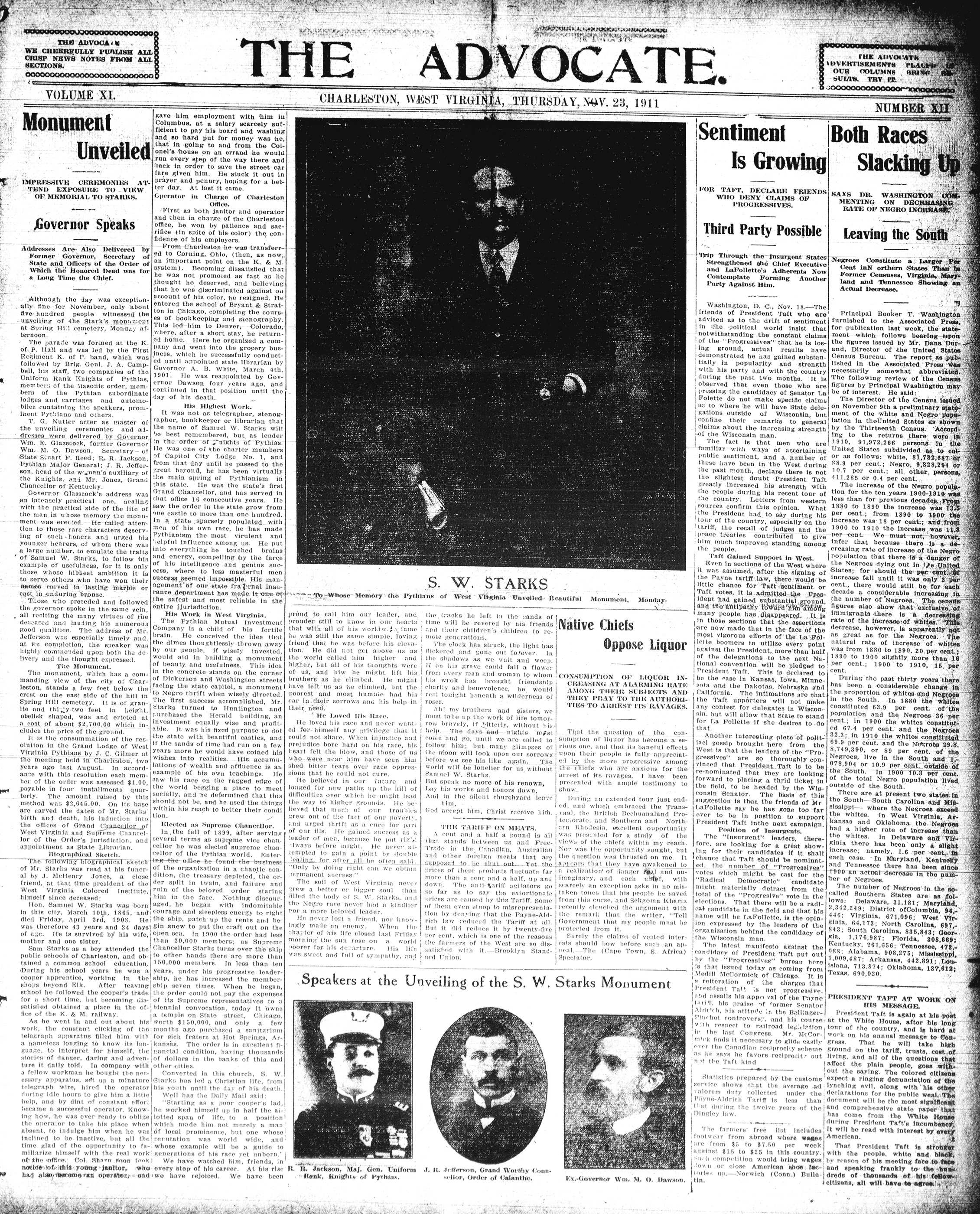
Page text (machine-generated)
VOLUME XI.
IMPRESSIVE CEREMONIES AT TEND EXPOSURE TO VIEW OF MEMORIAL TO STARKS.
Governor Speaks
Addresses Are Also Delivered by Former Governor, Secretary of State and Officers of the Order of Which the Honored Dead was for a Long Time the Chief.
Although the day was exceptionally fine for November, only about five hundred people witnessed the unveiling of the Stark's monument at Spring Hill cemetery, Monday afternoon.
The parade was formed at the K. of P. Hall and was led by the First Regiment K. of P. band, which was followed by Brig. Genl. J. A. Campbell, his staff, two companies of the Uniform Rank Knights of Pythias, members of the Masonic order, members of the Pythian subordinate lodges and carriages and automobiles containing the speakers, prominent Pythians and others.
T. G. Nutter acter as master of the unveiling ceremonies and addresses were delivered by Governor Wm. E. Glasscock, former Governor Wm. M. O. Dawson, Secretary of State Scott F. Reed; R. R. Jackson, Pythian Major General; J. R. Jefferson, head of the wunn's auxiliary of the Knights, and Mr. Jones, Grand Chancellor of Kentucky.
Governor Glasscock's address was an intensely practical one, dealing with the practical side of the life of the man in whose memory the monument was erected. He called attention to those rare characters deserving of such honors and urged his younger hearers, of whom there was a large number, to emulate the traits of Samuel W. Starks, to follow his example of usefulness, for it is only those whose hibbest ambition it is to serve others who have won their names carved in lasting marble or cast in enduring bronze.
Those who preceded and followed the governor spoke in the same vein, all reciting the many virtues of the deceased and lauding his numerous good qualities. The address of Mr. Jefferson was especially timely and, at its completion, the speaker was highly commended upon both the delivery and the thought expressed.
The Monument.
The monument, which has a commanding view of the city of Charleston, stands a few feet below the crest on the east side of the hill in Spring Hill cemetery. It is of granite and thirty-two feet in height, obelisk shaped, was and erupted at a cost of about $2,700.00 which includes the price of the ground.
It is the consummation of the resolution in the Grand Lodge of West Virginia Pythians by J. C. Gilmer at the meeting held in Charleston, two years ago last August. In accordance with this resolution each member of the order was assessed $1.00, payable in four installments quarterly. The amount raised by this method was $2,645.00. On its base are carved the dates of Mr. Starks' birth and death, his induction into the offices of Grand Chancellor of West Virginia and Supreme Chancellor of the Order's jurisdiction, and appointment as State Librarian.
Biographical Sketch.
The following biographical sketch of Mr. Starks was read at his funeral by J. McHenry Jones, a close friend, at that time president of the West Virginia Colored Institute, himself since deceased:
Hon. Samuel W. Starks was born in this city, March 10th, 1865, and died Friday, April 3rd, 1908. He was therefore 43 years and 24 days of age. He is survived by his wife, mother and one sister.
Sam Starks as a boy attended the public schools of Charleston, and obtained a common school education. During his school years he was a cooper apprentice, working in the shops beyond Elk. After leaving school he followed the cooper's trade for a short time, but becoming dissatisfied obtained a place in the office of the K. & M. railway.
As he went in and out about his work, the constant clicking of the telegraph apparatus filled him with a nameless longing to know its language, to interpret for himself, the stories of danger, daring and adventure it daily told. In company with a fellow workman he bought the necessary apparatus, set up a miniature telegraph wire, hired the operator during idle hours to give him a little help, and by dint of constant effort became a successful operator. Knowing how, he was ever ready to oblige the operator to take his place when absent, to indulge him when he was inclined to be inactive, but all the time glad of the opportunity to familiarize himself with the real work of the office. Col. Sharp soon took notice of this young janitor, who had also become an operator and
THE ADVOCATE.
gave him employment with him in Columbus, at a salary scarcely sufficient to pay his board and washing and so hard put for money was he, that in going to and from the Colonel's house on an errand he would run every step of the way there and back in order to save the street car fare given him. He stuck it out in prayer and penury, hoping for a better day. At last it came.
Operator in Charge of Charleston Office.
First as both janitor and operator and then in charge of the Charleston office, he won by patience and sacrifice (in spite of his color) the confidence of his employers.
From Charleston he was transferred to Corning, Ohio, (then, as now, an important point on the K. & M. system). Becoming dissatisfied that he was not promoted as fast as he thought he deserved, and believing that he was discriminated against on account of his color, he resigned. He entered the school of Bryant & Stratton in Chicago, completing the courses of bookkeeping and scenography. This led him to Denver, Colorado, where, after a short stay, he returned home. Here he organized a company and went into the grocery business, which he successfully conducted until appointed state librarian by Governor A. B. White, March 4th, 1901. He was reappointed by Governor Dawson four years ago, and continued in that position until the day of his death.
His Highest Work.
It was not as telegrapher, stenographer, bookkeeper or librarian that the name of Samuel W. Starks will be best remembered, but as leader in the order of Knights of Pythias. He was one of the charter members of Capitol City Lodge No. 1, and from that day until he passed to the great beyond, he has been virtually the main spring of Pythianism in this state. He was the state's first Grand Chancellor, and has served in that office 16 consecutive years. He saw the order in the state grow from one castle to more than one hundred. In a state sparsely populated with men of his own race, he has made Pythianism the most virulent and helpful influence among us. He put into everything he touched brains and energy, compelling by the force of his intelligence and genius success, where to less masterful men success seemed impossible. His management of our state fraternal insurance department has made it one of the safest and most reliable in the entire jurisdiction.
His Work in West Virginia.
The Pythian Mutual Investment Company is a child of his fertile brain. He conceived the idea that the dimes thoughtlessly thrown away by our people, if wisely invested, would aid in building a monument of beauty and usefulness. This idea in the concrete stands on the corner of Dickerson and Washington streets facing the state capitol, a monument to Negro thrift when wisely directed. The first success accomplished, Mr. Starks turned to Huntington and purchased the Herald building, an investment equally wise and profitable. It was his fixed purpose to dot the state with beautiful castles, and if the sands of time had run on a few years more he would have coined his wishes into realities. His accumulations of wealth and affluence is an example of his own teachings. He saw his race on the ragged edge of the world begging a place to meet socially, and he determined that this should not be, and he used the things within his reach to better their condition.
Elected as Supreme Chancellor. In the fall of 1899, after serving several terms as supreme vice chancellor he was elected supreme chancellor of the Pythian world. Entering the office he found the business of the organization in a chaotic condition, the treasury depleted, the order split in twain, and failure and ruin of the beloved order staring him in the face. Nothing discouraged, he began with indomitable courage and sleepless energy to right the ship, patch up the rents and begin anew to put the craft out on the open sea. In 1900 the order had less than 20,000 members; as Supreme Chancellor Starks turns over the ship to other hands there are more than 150,000 members. In less than ten years, under his progressive leadership, he has increased the membership seven times. When he began, the order could not pay the expenses of its Supreme representatives to a biennial convocation, today it owns a temple on State street, Chicago, worth $150,000, and only a few months ago purchased a sanitarium for sick fraters at Hot Springs, Arkansas. The order is in excellent financial condition, having thousands of dollars in the banks of this and other cities.
Converted in this church, S. W. Starks has led a Christian life, from his youth until the day of his death. Well has the Daily Mail said: "Starting as a poor cooper's lad, he worked himself up in half the ailotted span of life, to a position which made him not merely a man of local prominence, but one whose reputation was world wide, and whose example will be a guide to generations of his race yet unborn." We have watched him, friends, in every step of his career. At his rise we have rejoiced. We have been
1
Speakers at the Unveiling of the S. W. Starks Monument
proud to call him our leader, and
prouder still to know in our hearts
that with all of his world, fame
he was still the same simple, loving
friend that he was before his elevation:
He did not get above us as
the world called him higher and
higher, but all of his thoughts were
of us, and hiw he might lift his
brothers as he climbed. He might
have left us as he climbed, but the
poorest and most humble had his
ear in their sorrows and his help in
their need.
He Loved His Race.
He loved his race and never wanted for himself any privilege that it could not share. When injustice and prejudice bore hard on his race, his heart felt the blow, and those of us who were near him have seen him shed bitter tears over race oppressions that he could not cure.
He believed in our future and longed for new paths up the hill of difficulties over which he might lead the way to higher grounds. He believed that much of our troubles grew out of the fact of our poverty, and urged thrift as a cure for part of our ills. He gained success as a leader of men, because he put right always before might. He never attempted to gain a point by double healing, for after all he often said: "Only by doing right can we obtain permanent success."
The soil of West Virginia never grew a better or bigger soul than filled the body of S. W. Starks, and the Negro race never had a kindlier por a more beloved leader.
He never lost a friend, nor knowingly made an enemy. When the chapter of his life closed last Friday morning the sun rose on a world poorer for his departure. His life was sweet and full of sympathy, and
SALVATORE
R. R. Jackson, Maj. Gen. Uniform
Rank, Knights of Pythias.
R. R. Jackson, Maj. Gen. Uniform
Rank, Knights of Pythias.
the tracks he left in the sands of time will be revered by his friends and their children's children to remote generations.
The clock has struck, the light has flickered and gone out forever. In the shadows as we wait and weep. If on his grave could fall a flower from every man and woman to whom his wrok has brought friendship charity and benevolence, he would rest tonight beneath a wilderness of roses.
Ah! my brothers and sisters, we must take up the work of life tomorrow bravely, if bitterly, without his help. The days and nights must come and go, until we are called to follow him; but many glimpses of the nfoon will look upon our sorrows before we see his like again. The world will be lonelier for us without Samuel W. Starks.
But speak no more of his renown,
Lay his works and honors down,
And in the silent churchyard leave him.
God accept him, Christ receive him
THE TARIFE ON MEATS
A cent and a half a pound is all that stands between us and Free-Trade in the Canadian, Australian and other foreign meats that are supposed to be shut out. Yet the prices of these products fluctuate far more than a cent and a half, up and down. The anti-ariff agitators go so far as to say the extortionate prices are caused by this Tariff. Some of them even stoop to misrepresentation by denying that the Payne-Aldrich law reduced the Tariff at all. But it did reduce it by twenty-five per cent, which is one of the reasons the farmers of the West are so dissatisfied with it.—Brooklyn Stand-ard Union.
C
J. R. Jefferson, Grand Worthy Counsellor, Order of Calandic.
CONSUMPTION OF LIQUOR INCREASING AT ALARMING RATE AMONG THEIR SUBJECTS AND THEY PRAY TO THE AUTHORITIES TO ARREST ITS RAVAGES.
That the question of the consumption of liquor has become a serious one, and that its baneful effects upon their people is fully appreciated by the more progressive among the chiefs who are anxious for the arrest of its ravages, I have been presented with ample testimony to show.
During an extended tour just ended, and which embraced the Transvaal, the British Bechuanaland Protectorate, and Southern and Northern Rhodesia, excellent opportunity was presented for a study of the views of the chiefs within my reach. Nor was the opportunity sought, but the question was thrusted on me. It appears that they have awakened to a realization of danger real and imaginary, and each chief, with scarcely an exception asks in no mistaken tones that his people be saved from this curse, and Sekgoma Khama recently clenched the argument with the remark that the writer, "Tell Government that my people must be protected from it.
Surely the claims of vested interests should bow before such an appeal.—The (Cape Town, S. Africa) Speeator.
Starks Monument
Ex.-Governor Wm. M. O. Dawson
Sentiment Is Growing
FOR TAFT, DECLARE FRIENDS WHO DENY CLAIMS OF PROGRESSIVES.
Trip Through the Insurgent States Strengthened the Chief Executive and LaFollette's Adherents Now Contemplate Forming Another Party Against Him.
```markdown
```
Washington, D. C., Nov. 18.—The friends of President Taft who are advised as to the drift of sentiment in the political world insist that notwithstanding the constant claims of the "Progressives" that he is losing ground, actual results have demonstrated he has gained substantially in popularity and strength with his party and with the country during the past two months. It is observed that even those who are pressing the candidacy of Senator La Folette do not make specific claims as to where he will have State delegations outside of Wisconsin, but confine their remarks to general claims about the increasing strength of the Wisconsin man.
The fact is that men who are familiar with ways of ascertaining public sentiment, and a number of these have been in the West during the past month, declare there is not the slightest doubt President Taft greatly increased his strength with the people during his recent tour of the country. Letters from western sources confirm this opinion. What the President had to say during his tour of the country, especially on the tariff, the recall of judges and the peace treaties contributed to give him much improved standing among the people.
Taft Gained Support in West. Even in sections of the West where it was assumed, after the signing of the Payne tariff law, there would be little chance for Taft sentiment or Taft votes, it is admitted the President had gained substantial ground, and the antipathy toward him among many people has disappeared. It is in those sections that the assertions are now made that in the face of the most vigorous efforts of the La Follette boomers to utilize every point against the President, more than half of the delegations to the next National convention will be pledged to President Taft. This is declared to be the case in Kansas, Iowa, Minnesota and the Dakotas, Nebraska and California. The intimations are that the Taft supporters will not make any contest for delegates in Wisconsin, but will allow that State to stand for La Follette if she desires to do that.
Another interesting piece of political gossip brought here from the West is that the leaders of the "Progressives" are so thoroughly convinced that President Taft is to be re-nominated that they are looking forward to placing a thrid ticket in the field, to be headed by the Wisconsin Senator. The basis of this suggestion is that the friends of Mr. LaFollette say he has gone too far ever to be in position to support President Taft in the next campaign.
Position of Insurgents.
The "Insurgent" leaders, therefore, are looking for a great showing for their candidates if it shall chance that Taft should be nominated, the number of "Progressives" votes which might be cast for the "Radical Democratic" candidate might materially detract from the total of the "Progressive" vote in the elections. That there will be a radical candidate in the field and that his name will be LaFollette, the opinion expressed by the leaders of the organization behind the candidacy of the Wisconsin man.
The latest manifesto against the candidacy of President Taft put out by the "Progressives" bureau here is that issued today as coming from Medill McCormick of Chicago. It is a reiteration of the charges that President Taft is not progressive, and assails his approval of the Payne turf, his praise of former Senator Aldrich, his attitude in the Ballinger-Pinchot controversy, and his course with respect to railroad legislation in the last Congress. Mr. McCormick finds it necessary to glide easily over the Canadian reciprocity scheme as he says he favors reciprocity out not the Taft kind
Statistics prepared by the customs service shows that the average ad valorem duty collected under the Payne-Aldrich Tariff is less than that during the twelve years of the Dingley law.
The farmers' free list includes footwear from abroad where wages are from $5 to $7.50 per week against $15 to $25 in this country. Such competition would bring wages down or close American shoe factories up. Norwich (Conn.) Bulletin.
SAXS DR. WASHINGTON COM
MENTING ON DECREASING
RATE OF NEGRO INCREASES
Negroes Constitute a Larger Per Cent inN northern States Than in Former Censuses, Virginia, Maryland and Tennessee Showing an Actual Decrease.
Principal Booker T. Washington furnished to the Associated Press, for publication last week, the statement which follows bearing upon the figures issued by Mr. Dana Durand, Director of the United States Census Bureau. The report as published in the Associated Press was necessarily somewhat abbreviated. The following review of the Census figures by Principal Washington may be of interest. He said:
The Director of the Census issued on November 9th a preliminary statement of the white and Negro population in the United States as shown by the Thirteenth Census. According to the returns there were in 1910, 91,972,266 persons in the United States subdivided as to color as follows: white, 81,732,687 or 88.9 per cent.; Negro, 9,828,294 or 10.7 per cent.; all other persons, 411,285 or 0.4 per cent.
The increase of the Negro population for the ten years 1900-1910 was less than for previous decades. From 1880 to 1890 the increase was 13.5 per cent.; from 1890 to 1900 the increase was 18 per cent.; and from 1900 to 1910 the increase was 11.3 per cent. We must not, however, infer that because there is a decreasing rate of increase of the Negro population that there is a danger of the Negroes dying out in the United States; for should the per cent. of increase fall until it was only 2 per cent., there would still be for each decade a considerable increasing in the number of Negroes. The census figures also show that exclusive of immigrants there is a decreasing rate of the increase of whites. This decrease, however, is apparently not as great as for the Negroes. The natural rate of increase of whites was from 1880 to 1890, 20 per cent.; 1890 to 1900 slightly more than 16 per cent.; 1900 to 1910, 15 per cent.
During the past thirty years there has been a considerable change in the proportion of whites and Negroes in the South. In 1880 the whites constituted 63.9 per cent. of the population and the Negroes 36 per cent.; in 1900 the whites constituted 67.4 per cent. and the Negroes 32.3; in 1910 the whites constituted 69.9 per cent. and the Negroes 29.3, 3,749,390, or 89 per cent. of the Negroes, live in the South and 1,078,904 or 10.9 per cent. outside of the South. In 1900 10.3 per cent. of the total Negro population lived outside of the South.
There are at present two states in the South—South Carolina and Mississippi—where the Negroes exceed the whites. In West Virginia, Arkansas and Oklahoma the Negroes had a higher rate of increase than the whites. In Delaware and Virginia there has been only a slight increase; namely, 1.6 per cent, in each case. In Maryland, Kentucky and Tennessee there has been since 1900 an actual decrease in the number of Negroes.
The number of Negroes in the so-called Southern States are as follows: Delaware, 31,181; Maryland, 2,342,249; District of Columbia, 94,446; Virginia, 671,987; West Virginia, 64,173; North Carolina, 697,843; South Carolina, 835,843; Georgia, 1,176,987; Florida, 308,669; Kentucky, 261,656; Tennessee, 473,088; Alabama, 908,275; Mississippi, 1,009,487; Arkansas, 442,891; Louisiana, 713,874; Oklahoma, 137,612; Texas, 690,020.
PRESIDENT TAFT AT WORK ON
HIS MESSAGE.
President Taft is again at his post at the White House, after his long tour of the country, and is hard at work on his annual message to Congress. That he will take high ground on the tariff, trusts, cost of living, and all of the questions that affect the plain people, goes without the saying. The colored citizens expect a ringing denunciation of the lynching evil, along with his other declarations for the public weal. The document will be the most significant and comprehensive state paper that has come from the White House during President Taft's incumbency. It will be read with interest by every American.
That President Taft is stronger with the people, white and black, by reason of his meeting face to face and speaking frankly to the hundreds of thousands of his fellow citizens, all will have to agree.
CORRESPONDENCE
THURSDAY, NOVEMBER 23, 1911
PLYMOUTH
Mrs. Lenora Stevens was shopping in Charleston Wednesday. Dr. M. T. Sinclair, who was seriously hurt several weeks ago, is improving. The Willing Workers Club rendered a program Monday night, after which refreshments were served. Mrs. Geo. Brooks and Messrs. Wm. Mickens and Pride Dickerson made a business trip to Charleston Saturday. Mrs. M. T. Sinclair entertained the Women's Improvement League Saturday. Mrs. Hale Dickerson and Miss Ruth V. Anderson visited the sick at Raymond City Saturday. Mrs. Homer Phillips, who has been visiting friends in Ohio, has returned home. Howard Jackson has returned home after a several weeks' visit in Ohio.
Miss Mithue Colston was visiting her parents at Point Pleasant the latter part of the week.
W. M. Brooks, of Galipolis, Ohio, is visiting his daughter, Mrs. Mae Jones.
Mr. and Mrs. Brown and children, of Rocky Mount, Va., are visiting the former's brother, Joe Brown.
Mrs. Sarah F. Smith, Lenora Stevens and Mae Jones were guests of Mrs. Sawyers, of Black Betsey, Monday
The supper given for the benefit of the Mount Zion Baptist Church was a success.
Mrs Geo. Reed and son, Elmer, were called to the bed-side of her mother, Mrs. Mary Jackson, Thursday, at Cedar Grove.
John Thompson, of Columbus, O. who was seriously hurt in the Plymouth mines, Thursday, was taken to the General Hospital for treatment.
HOLDEN.
Mrs. Bettle Hawkins, of St. Albans, is here the guest of Mrs. Gillie Carey.
Rev. R. P. Kenny preached a very instructive sermon Sunday night and, though the weather was inclement, a large audience was present.
Miss Cornelia Spears was a business visitor in Logan Saturday.
Mrs. Fannie Smith and Miss Lelia Bailey were shopping in Logan Thursday.
John Fossett, of Huntington, was here two days last week selling medicine.
J. R. Benton, the Bible agent, who has been here for several weeks, was a caller at the school Thursday.
The Helping Hand Club is alive and doing excellent work. The following program was rendered Friday night:
Invocation—Rev. J. E. Bigsby.
Song—Children
Recitation—Evella Johnson.
Recitation—Elizabeth Carey.
Quartette—Four girls.
The program was enjoyed by a large and appreciative audience.
HARPER'S FERRY
Dr. George F. Musher and wife are spending a few days at the College with their daughter, Mrs. McDonald. Dr. Mosher addressed the student body at Sunday evening service in the Curtis Memorial Church. The subject of the address was, "Promptness, Diligence and Obedience." Dr. Mosher gave some very practical points.
On Monday morning, at Chapel, Dr. and Mrs. Mosher addressed the students of Storer College. Mrs. Mosher has been personally connected with the school for over forty years. The students never tire of hearing her lectures.
The Conradi Brothers gave a rare musical concert last Friday night.
The College football team has learned one valuable lesson, viz. that over-confidence is a mental condition which spells defeat. The fei-joys had considered the M. St. game to come one. Last year they had beaten their ancient rivals 21-0, and as the Screwers team was practically the same as one year ago and the College team has lost nothing In strength, they figured out the game, their own, of course. But a soggy field and some smart playing by the Washingtonions turned the trick in jig time. The first half ended the scoring. In the second half the College boys got together but could not command power enough to score and so they lost, 19-0.
Workmen are hard at work getting the water system installed.
MONTGOMERY
The Teachers' Reading Circle met with Miss H. M. James Friday evening. After the routine of business Mr. and Mrs. S. B. Morgan surprised the Circle by serving delicious refreshments.
Rev. J. C. Jones is holding revival services at Snow Hill this week.
James and Samuel Shepherd, of Carbon, visited their parents here Saturday.
Mrs. F. D. Huskins and daughter, of Charleston, are here the guests of Mrs. Mayne Jackson.
H. H. Hundley, of McDonald, was a business visitor here Monday.
Thomas Johnson went to Charleston Sunday to spend a few days with relatives.
B. M. Howard, of Institute, was the first of his brother, N. C. Howard, a few days this week.
Rev. R. D. W. Meadows, of Hunt-
ington, was here several days this week on business.
The Improvement League and Ladies' Council entertained Mrs. S. A. Washington, of Hill Top, president of the federation, Friday evening at the home of Mrs. S. E. Marks.
Mr. and Mrs. H. H. Railry, Miss Ada Wright, Mrs. L. Saunders, P. W. Wright, M. D. Buster, George Jackson, Thomas Johnson, Samuel Rollings, James Buster and Thomas Hanna attended the unveiling of the Starks monument in Charleston, Monday.
Miss Mary Page, teacher at Longacre, spent the week-end here the guest of relatives.
The Reading Circle will meet Friday, with Miss Ethel Brown at her home, on Fourth Avenue.
Men's day services were held at the M. E. Church Sunday, the program being as follows:
4 A. M.
Prayer meeting, led by Erastus Brown.
Singing—Choir.
Hymn No. 354—Lewis Brinkley.
Paper—Wm. Green.
Singing. Choir.
Hymn 492—F. B. Brackenridge.
Prayer—Boston Haynes.
Paper—Rev. E W. Hester
Address, "Duty of the Parent to School and Teacher"—R D. Riddle, Special Mens' Day Sermon—Rev. B. B. Martin.
Henry Miller, Master of Ceremonies.
Misses Alice Banks, Susie Freeman, Mrs. Lee, Mrs. Allice Banks and Mr. Cary Carter, of Alderson, attended services at the M. E. Church Sunday.
Mrs. Wm. Twine, of Claremont, is visiting friends and relatives here.
Miss Brunett A. Brown, who has been attending W. V. I., was called home on account of the serious illness of her mother, Mrs. Randall Brown, Sunday.
Mrs. D. R. Hickman and Mrs Wm. Twine lunched with Mrs. Bessie Lewis Sunday.
Mr. and Mrs. Wm. M. Green served dinner in honor of Rev. D. D. Martin, of Mt. Hope, Sunday. Those present were: Rev. and Mrs. J. A. Reld, Mr. Patterson and Rev. Rufus Reid, of Union, Mr. and Mrs. Brinkly, Mrs. L. B. Johnson and others. Phillip Smith, who has been sick for some time, is able to be out.
Mr. and Mrs. Alex Brown and baby visited Marlinton last week.
SMITHERS AND LONGACRE.
Rev. D. Stratton, of St. Albans, preached an able sermon Tuesday night.
Mr. and Mrs. Stratton were entertained in the home of Mr. and Mrs. T. J. Sparr.
Rev. C. Payne, of Ohio, preached an able sermon Friday night.
Mrs. Ellen Hayden, of Eagle, was calling on friends here Sunday. Miss Henrietta James, teacher in the Montgomery public school, was entertained at dinner at the home of Mr. and Mrs. B. B. Daulton, Sunday. Watt Smith and his aunt are visiting relatives in Fayetteville this week.
MORGANTOWN
Miss Louise Jenkins, who has been visiting friends in Winchester, Va., and Cumberland, Md., has returned home.
J. Madison has returned to the city after spending the summer in Cumberland, Md.
Miss Ethel Hunt left Monday for Institute where she will enter school.
Ashby Grayson was the guest of Miss Lillian Hinshaw, Sunday and Monday.
Mr. and Mrs. Shanklin are the proud parents of a son, born on the eighteenth.
Miss Bertha Dixon has been confined to her room for the past two weeks with a badly sprained ankle.
Miss Mabel Saunders, who has been very sick for some time, is able to be out again.
Rev. Gibbons has returned to Morgantown from the conference at Huntington.
The Baptist church has organized a league for the winter with Miss Lillian Hinshaw as its president. Much interest is being shown, as Miss Hinshaw was president of the A. M. E. Church Improvement League last winter.
Mrs. Ella Shanklin, of Alexandria, Va., is here visiting her son, Norman Shanklin, and brother, Burgess Hinshaw.
Mrs. Emma Nash is very ill at her home in Green, Mont.
STARTS MUCH TROUBLE
If all people knew that neglect of constipation would result in severe indigestion, yellow jaundice or virulent liver trouble they would soon take Dr. King's New Life Pills, and end it. Its the only safe way. Beau for billiousness, headache, dyspepsia, chills and debility. 25c at all druggists. 11-2-58
Charleston
CHARLESTON
Death of J. S. Gilmer. After having been confined to his bed about a week followling an illness of over a year, Jesse S. Gilmer died early Sunday morning at the home of his sister, Mrs. Annie F. Davis, Jacobs St., of tuberculosis. For ten years prior to his illness the decedent resided in Chicago and other western cities. He is survived by his father, two sisters and three brothers in the immediate family. The funeral services were conducted at the late residence Tuesday afternoon by Rev. B. R. Reed and Rev. J. S. Carroll.
Elk Memorial Services.—Kanawha Lodge No. 180 I. B. P. O. E. W. will hold a lodge of sorrow at the K. of P. Hall, Sunday Dec. 3rd. An elaborate program in keeping with the occasion is being prepared and the officers of the organization are participating a large attendance of the members and friends of the order. Prof. S. Hamlin Guss, head of the Normal Department of the West Virginia Colored Institute, will deliver the address.
Hotel Brown Arrivals.—J. H. Campbell, Moundsville; Rev. N. A. Smith, Indianapollo, Ind.; Robert Patterson, London; C. Diggs, Harewood; J. Jackson, Longacre; E. L. Morton, Fairmont; D. R. Williams, T. C. Carter, George Moore, H. N. Lewis, Columbus, O.; Miss Fannie Robinson, Clarksburg; Miss Cora Jackson, Clarksburg; H. A. Woods, Raymond City; A. H. Brown, Ronceverte; J. W. Thompson, Marlinton; George Jeter, Sun; J. A. Mack, Ennis; W. J. Carrington, Thurmond; C. R. Comedy, J. R. Thompson, Parkersburg; Rev. J. W. Robinson, St. Albans; W. C. Keystone; Mr. and Mrs. Ernest Jones, Huntington; Wm. Sadler, Elkhorn; J. S. Noel, Montgomery; J. K. Smith, Keystone; Dan Rucker, Taylor Howard, Bluefield.
Two Physicians for the State. Drs. Louis Hilton and Charles Herlot, recent graduates of the medical department of Howard University, spent several days here this week, returning from Clarksburg where they took the examination to practice their profession in the State. The former will locate at Princeton, the latter at Wheeling. Dr. Hilton, while here, was the guest of Dr. Ellis Dr. Herriot was entertained by Edward James.
Simpson Church Notes.—Rev. W. C. Florain delivered a very instructive address on the origin and object of the Men and Religion Forward Movement, at the morning service Sunday. The partor preached a strong sermon at night from a text suggested by a member. The Lifters were entertained, Tuesday night, by Miss Mary McGhee at her home on Elmwood Ave. The Thursday Night Aid will be guests this evening of Mr. Helm at the home of Mrs. Amanda Taylor, Court St. The Willing Workers will meet with Mrs. Carrie Jennings tonight, and the Friday Night Aid with Mrs. Mattie Ward, tomorrow night.
Revival Meeting With Success. In recent years there has not been so much interest manifested in a revival as in the services now being conducted at the First Baptist church by Rev. E. W. B. Curry, of Urbana, O., whose reputation as a temperance orator and revivalist is well known in adjoining as well as his own state. At the close of the meeting, Tuesday night, there had been 109 persons converted and re-claimed and many have nightly asked for the prayers of the church. The meetings will close tomorrow night, when Rev. Curry will be presented with a purse in appreciation of the good work he has accomplished. The converts will be baptized Sunday.
Witnesses of the Unveiling.—Prominent among those witnessing the unveiling of the Starks Monument were: J. M. Ellis, former member of the House of Delegates, Oak Hill: H. H. Railey, former member of the House of Delegates, and wife, Montgomery: W. J. Thompson, former Grand Chancellor, Thomas; J. L. Jones, Supreme Vice Chancellor, Cincinnati, O.; H. B. Hundley, Grand Master of the Masons, McDonald; Drs. G. L. Marshall, of Keystone, and N. L. Edwards, Bluefield; E. L. Morton, Fairmont; T. R. Jenkins, Huntington; Rev. J. W. Robinson, St. Albans, Rev. J. J. Turner, Mt. Carbon; Prof. Byrd Prillerman, Institute; and L. O. Wilson, Grand Chancellor of the Knights of Pythias, Weston.
PERSONALS AND LOCALS
The six-months-old son of Mr. and Mrs. Claude Lowry died early Monday morning at their residence on Bradford St. The remains were taken to Pomeroy, O., for interment. Mrs. J. M. Hazlewood, Mrs. Thomas Whittaker, Mrs. F. H. Huskins and Mrs. C. C. Campbell were members of a house party entertained the first of the week by Mrs. Mayme Jackson, of Montgomery. S. H. Denson, of Covington, Va., is in the city on business. Mrs. E. V. Seams, Miss Washington and Miss Slash, of Parkersburg, were honor guests at a reception tendered by Mrs. Chas. Stevenson, Monday night. An informal dance was tendered the visitors to the city at the K. of P. hall, Tuesday night. Miss Gertrude Ednw and Mr. Harry Brown were married. Tues-
THE ADVOCATE.
day of last week.
Mrs. May Land has returned from Wake Forest, S. C., where she spent several weeks.
No improvement is reported in the condition of Mrs. Mary Brooks whose illness has been reported in these columns from time to time.
Little Julia Reaveley celebrated her seventh birth-day anniversary at the home of her uncle, Albert Jefferson, Sontz St., Wednesday afternoon.
J. M. Ellis, a former member of the House of Delegates from Fayette county, spent several days here this week on legal business.
Mr. and Mrs. E. C. Berry and Miss Minnie Bell, of Athens, O., attended the unveiling of the Starks monument. They were house guests of Mrs. Lillian Starks.
Miss Bessie Taylor leaves Monday for Jackson, Mich., to spend Thanksgiving with friends.
Alex Brown, of Ronceverte, A. Slaughter and J. W. Thompson, of Marlinton, were visitors at The Advocate office this week.
J. B. Gilmer, who was called here by the death of his brother, returns to his home in Chicago, today.
Mrs. J. R. Jefferson, of Parkersburg, who spent a few days here with friends, left yesterday for institute for a few days' visit.
Nogro A. & M. Schools Form Separate Body
"JIM CROW" ORGANIZATION IS PERFECTED BY NEGRO PRESIDENTS. ATTENDING CONVENTION OF GOVERNMENT-SUPPORTED INDUSTRIAL INSTITUTIONS.
Columbus, Ohio, Nov. 18.—The presidents and instructors who represented the Negro agricultural schools at the Twenty-fifth Annual Convention of the Association of American Agricultural Colleges and Experimental Stations, which met here, hailed from Alabama, Florida, Delaware, Mississippi, North Carolina, Georgia, Virginia and West Virginia.
Thursday and Friday afternoons the representatives held a special conference in Townsend Hall, at the Ohio State University. The meeting was called to order by A. C. Monahan, Specialist of Land Grant College Statistics, U. S. Burcau of Education. Byrd Prillerman, President of the West Virginia Colored Institute, was made chairman, and Walter S. Buchanon, President of Normal, Ala., A. and M. College, was made secretary.
The representatives were welcomed by W. O. Thompson, President of The Ohio State University. Nathan B. Young, President of the A. and M. College, Tallahassee, Fla., responded. An address was delivered by P. P. Claxton, U. S. Commissioner of ducation. He was followed by R. W. Stimson, Special Agent for Agricultural Education for the State Board of Education of Mass., who delivered an address on "Cultural and Vocational Education." Each representative of the schools present then gave a brief synopsis of what his school is doing. The chairman took part in the discussion on behalf of the West Virginia Colored Institute. A. W. Curtis, head of the Agricultural Department of the West Virginia Colored Institute, discussed Correlation of Acedemic and Industrial Courses. Pres. Byrd Prillerman was made permanent chairman of the Conference to make arrangements for the ensuing year.
The Tuskegee Negro Conference Jan. 17
FIRST DAY TO BE DEVOTED TO
A MASS MEETING OF NEGRO
PEOPLE. ANNUAL WORKER'S
CONFERENCE TO BE HELD ON
THE SECOND DAY.
On Wednesday and Thursday, January
17 and 18, 1912, the twenty-
first annual session of the Tuskegee
Negro Conference will convene at
Tuskegee Institute.
Wednesday, the first day, will be devoted to a mass meeting of the Negro people. Thursday, the second day, the annual Workers' Conference will be held. In the civil for this Conference the statement is more that its purpose is "less to teach than to inspire." The first day will be taken up for the most part with informal reports and personal experiences of representative men among the farmer and laboring classes from all over the South. The purpose of these reports is to afford a broad view of actual conditions and of what the people themselves, either as individuals or through their churches and schools, are doing to improve them. The second day will be devoted to a conference of the teachers and others who are engaged in some definite form of work to improve the masses of the colored people.
The purpose of the Workers' Conference is to bring the work of the school, the churches and other institutions into closer touch with the practical and every-day life of the people. The principal topic for discussion at the Workers' Conference will be: "How may we Encourage the Practice of Saving among Negroes?" This subject will be divided into five sub-topics, affording opportunity for a full, free and helpful discussion.
Gold Flaked
Rose Gold Finish
Two Brilliantis
1 Amethyst Doublet
Free to Girls
This fine Ring or Sterling Silver Chased Lock and Key Bracelet for sell only One Dozen Childs Red Cross Salve (at 25c per box). Send no money. We trust you until goods are sold. Your name on a postal will do, and goods will be promptly sent. Write today as you may not see this ad again.
CRANFORD, - NEW JERSEY
Department A.
Institute Undefeated
FOOTBALL TEAM FROM WILBER
FORCE UNABLE TO CROSS
GOAL LINES.
Evenly Matched
Were the Two Teams and They Battled Back and Forth Without Either Scoring a Point, Though Brawn of the Ohio Boys Carried Them Dangerously Near Victory.
Institute, Nov. 18.—Wilberforce University and the West Virginia foot-ball teams divided honors on the institute athletic field today. In weight the Ohio boys were burdened with the heavier end. Institute played the open game while Wilberforce used the battering ram with tolling effect. Had it not been for the careful training of the Institute boys by Dr. J. B. Brown, "Billy" Williams' "braves" from Wilberforce would have scaled the last of them.
The game was opened by Wilberforce kicking to Institute's fifteen-yard line. The first scrimmage took place on the institute fifteen-yard line. H. Davis skirted right for five yards. Harris added three more yards. Wilberforce linemen became nervous and lost five yards for illegally treading upon Institute territory. When the thrid down was declared, Institute was camping on Wilberforce's forty-five yard line. Wilberforce carried the ball back into Institute territory. Clark tackled a runner after he had raced out of bounds and fifteen yards of Institute's ground were donated to Wilberforce. An incomplete forward pass placed Wilberforce in an awkward position. Robinson signaled for a kick, Kincald could not resist the temptation and tackled him right in the act. Another donation of Institute territory was announced for Wilberforce. Institute settled down and Wilberforce compromised by kicking out of bounds. It was Institute's ball on her thirty-yard line. A right shift beat down Wilberforce's left end. Jones failed to secure a forward pass. Wilberforce spoiled another good one and Hunter punted. The quarter ended in Wilberforce's territory.
The second period was fought out in mid-field, and neither team making any material gain.
Harris opened the third period by kicking to Wilberforce's five-yard line. Robinson returned the kick and gave Institute early possession of the ball. Harris punted over Wilberforce's goal line and a touch-back was the result. Wilberforce lined up on the twenty-five yard line and Robinson kicked to H. Davis. Harris punted again and H. Davis recovered it on Wilberforce's fifteen yard line. Harris dropped back and signaled for a place kick. Hunter through mistake converted it into a fake and thereby robbing Institute of her first and only chance to score. A second attempt, was smothered by Wilberforce breaking through the line. H. Davis circled, Wilberforce left end and Harris was humbled on Wilberforce territory just three yards from the goal line.
It was Wilberforce's ball on her own three yard line. Robinson signaled from behind the goal line for a fake kick and ran thirty yards before Harris and Hunter were able to bring him down. West pulled down a forward pass. Kineaid and Cooper fell into the fond embrace in open field and Institute was penalized for holding. A fumble gave institute the ball on her own forty-five yard line. The ball became wet and muddy, and for the first time the game was marred by fumbles by both teams. Institute could not make her open plays "go" in the muddy portion of the field and for the balance of the quarter was at the mercy of Wilberforce, whose backs hammered the line and almost caused a complete rout. Time save Institute. The fourth period opened in Institute's territory by Allen piercing Institute's left side for eight yards. G. Moore was sent around Institute's left end and was hurled back by Jones. West made good around right end. Another attempt to go around Institute's end proved fatal and Harris
THE BAUER MEAT & FISH CO.
28 AND 30 CAPITOL ST.
Beef, Veal, Mutton, Pork, Fresh Pork Sausage OUR OWN MAKE.
Try our machine sliced Hams and Bacon
OYSTERS, FISH, POULTRY
The best qualities in all the popular kinds of
We want your patronage for we have complete stock in our lines and you an get it when you want more.
punted out of danger. Wilberforce received the ball on her forty-yard line. Patterson broke through the line and blocked a kick. Lockett fell on the ball. Wilberforce held for downs. Wilberforce hit Institute's sore left side and went through without any resistance. Wheeler, Gaines and David were sent in by Wilberforce to relieve Simpson, Robinson and G. Moore. These stalwart warriors fell upon Institute's left wing, plowed the field for six to eight yards at a down. Harris raced up and down, beating his linemen on the backs and begging them to stay in the line. It was too late, Wilberforce had found a weak spot and would not change her course. Lewis Wilberforce's big guard smote Marshall. Institute's left guard, asunder at will, and had it not been for Harris and H. Davis who fell upon him and checked his onward march. Institute's colors would have gone down in an inglorious defeat. It was Institute's ball on her own five-yard line. Harris was too exhausted to kick out of Institute's territory. Again Wilberforce set her batteringram to work on Institute's heart. The cheering ceased and Wheeler could be heard calling upon his braves to hit the line, and only the cry of the timekeeper halted. Wilberforce on the Institute twelve-yard line. The line up:
Institute, 0.
Jones Wilberforce, 0.
Cooper
L. E.
Clark
L. T.
Pruittte
Marshall
L. G.
B. Moore
Clarkson
C.
Patterson
WHAT IS IT?
Ten and twenty year combination distribution certificate of membership as devised by the American Workmen Fraternal Insurance Company, of Washington, D.C., one of the most liberal, strongest and reliable fraternal institutions in the field. For further particulars see
D. E. V. JORDAN
General Agent for West Va.
Office: Room 2, K. of P. Bldg.
Charleston, W. Va.
100 AGENTS WANTED.
to handle the very best proposition. Liberal commission allowed. Wage pleasant and profitable. For formation write Mr. A. R. Stewart. Tuskegee Institute, Alabama. Wages in the United States are $2.30 for every $1 in England. The slash and drive tariff bills of the last Congress would have reduced New England wages to the level of Old England.
SHIRLEY PRESIDENT SUSPENDERS
Suspenders
The kind that most men wear. Notice the cord back and the front ends. They slide in frictionless tubes and move as you move. You will quickly see why Shilray President Suspenders are comfortable and economical for the working man or businessman. Light, Medium or Extra Heavy Weights Extra Lengths for Tall Men. Price 50 Cents from your local dealer or by mail from the factory.
THE C. A. EDGARTON MFG. CO.
334 MAIN STREET, SHINLEY, MASS.
---
POLLUTION OF THE KANAWHA TO BE ENDED BY THE GOVERNMENT
War Department Will Make the Ore-Washers In Virginia Use Settling Pools
Final relief is now promised from the pollution of the Kanawha and New rivers and that relief is coming through the department of war. Governor Glasscock this morning received a letter from Robert Shaw Oliver, assistant secretary of war, with the following contents:
War Department, Washington.
My Dear Sir: Referring to the matter of pollution of the Kanawha and New Rivers, and replying further to your telegram of September 17th last, I beg to inform you that the Secretary of War has approved the recommendations of the Chief of Engineers, U. S. Army, as follows:
their equivalents outside the river, so arranged that their overflow or output reaching the river shall be in liquid state, practically free from solid mater of any kind, the construction of such basins or equivalents to be commenced within six months and be completed and effective to the satisfaction of the War Department within twelve months of date of issue of notice to that effect; and that he require the same limitations to be placed upon the deposit in this river of similar material by any other parties whenever such deposit be found in progress whether with
"That the Secretary of War modify the permission given by War Department letter of February 26, 1896, allowing deposit of ore washings in New River, Va., and W. Va., so that the deposit be allowed only within or behind settling basins or
FEDERAL COURT
Indictments to the number of six were returned yesterday afternoon by the grand jury in the Federal court against the Norfolk and Western Railway Company. The charge is rebating, or in other words departing from the regular schedule prescribed by the company to its patrons.
The same number of indictments were found against James C. Cassell and H. C. Elliott, of Roanoke, Va. those being joint indictments found in conjunction with those against the railway company on the information adduced by Joseph W. Coxe, comptroller of the railway company, who was summoned to appear before the grand jury at the instance of United States District Attorney Harold W. Ritz. The information given by Mr. Coxe was sufficient for the return of the indictments against the company and the same number against the two individuals.
The minimum penalty against the two men and against the company is $36,000 and the maximum penalty against them is $720,000. The former is likely to apply as this is the first time in the history of the state that the question has been raised as to the limits that are to be recognized by the concerns dealing with corporations and the limits by which the corporations are to be regulated.
Messrs. Cassell and Elliott were identified with the railroad company in the connection termed "boarding bosses." It is held by the retailers of Bluefield, who were affected by their operations that Cassell and Elliott were operating in restraint of the trade of the regularly conducted retail establishment when they supplied the hands on the road with supplies such as are on sale in the regular retail places. No complaint was made when the goods were supplied to and from the regularly established warehouses along the railroad and the attention of the Interstate Commerce Commission was called to the alleged violations of the law when the general public was supplied therefrom. The investigation which followed caused a change in the methods employed and then Cassell and Elliott retired as agents interfering with the trade of regular retailers and some delay was caused in bringing about the indictments. The retail merchants of Bluefield were the ones most affected and they brought about the investigation which induced the indictments reported at this term of the United States Court. Cassell and Elliott are alleged to have not been satisfied with maintaining warehouses in which to store the goods shipped gratuitously over the Norfolk and Western, but later became engaged in the retail business which permitted them to sell to all comers their goods at a rate similar to that which the ordinary retailer had to pay for his goods bought at wholesale and shipped over the lines of the Norfolk and Western at the regular rates as are shown on the schedule.
Stopped the Practice.
The practice was stopped some time ago and the Bluefield merchants became satisfied with conditions, but the commerce commission had been working on the matter and had Mr Coxe summoned as a witness before the present grand jury. The indictments were found on the strength of his testimony and it was shown, it is said, to the jury that both the railroad company and the two men, jointly, were entitled to indictments to the number of six. The evidence adduced brought out only eighteen instances of where the violations of the interstate law had not been adhered to and the assumption is that the court will impose only the minimum penalty for both the company and for Cassell and Elliott, but such is only conjecture. The cases will be of wide interest for they will decide some of their indictments that have
their equivalents outside the river, so arranged that their overflow or output reaching the river shall be in liquid state, practically free from solid matter of any kind, the construction of such basins or equivalents to be commenced within six months and be completed and effective to the satisfaction of the War Department within twelve months of date of issue of notice to that effect; and that he require the same limitations to be placed upon the deposit in this river of similar material by any other parties whenever such deposit be found in progress whether with or without State or Federal authority; and that in either case any failure to comply with the above named requirements shall be treated as a violation of sections 10 and 13 act of March 3, 1899, and subject to the penalties of sections 12 and 16 of the same act."
arisen in the last few years where such conditions have existed as have been suggested in the evidence of the comproller of the Norolk and Western. The contractors were given some leeway and they took a great deal more than was originally provided for according to the evidence show. They were not satisfied with what they were doing at the start, but are allied to have established retail stores which were supplied with goods without cost of shipment from the places of purchase, by the railroad company.
The operations of the court on the minor matters of this morning and yesterday afternoon are as follows, the majority of the cases being those of men and women charged with illegally retailing liquor:
Edward C. Lambert, Herbert Butcher and W. A. Fink, demurrier to each count overruled. Plea of not guilty to each count by each defendant.
George A. Atkins, amended, fined $50 and costs and sent back to Boone county jail to complete sentence.
Falmon Vinson et al, continued and recognized.
Charles Justice, Kanawha county, recognizance forfeited, capains served, $100 fine and 30 days in jail.
C. O. Baar, nolled; defendant dead.
Joe Vinson, Wayne county, nolled, defendant dead.
Charles Harris, Raleigh county, plea of guilty, $100 fine and 30 days Summers county jail.
John Stiff, McDonald county, plea of guilty, $100 fine and 30 days/in McDowell county jail.
John H. Taylor, alias "Shine" McDowell county, plea of guilty, $100 and 30 days in McDowell county jail. Robert Estep, alias "Bob," of Kanawha county; plea not guilty. James Fields, McDowell county, plea of guilty, 100 fine and 30 days in McDowell county jail. Frances Pannell, Kanawha county, recognition forfeited, caplas issued. C. H. Mooney, Kanawha county, motion to quash overruled in two cases. Francis Brown, Kanawha county, motion to quash overruled. Howard Ellis, to appear for sentence. Joe Meadows, Kanawha county, recognition forfeited and caplas issued. W. A. Massey, Raleigh county, recognition forfeited and caplas issued.
Andrew Tabit, Kanawha county, motion to quash indictment, sustained and case dismissed. The grand jury is comprised of the following men, and the foreman is W. H. Bishop:
J. A. Murphy, J. S. Bailes, B. H Hager, J. S. Ratliff, J. W. Ball Joseph S. Harper, E. E. Miller, W. W. Wright, John W. Honiker, B. H Webb, James Reed, Alex Miller, J. A. Pierson, M. C. Staats, P. M. Buckland, Miner Gillespie, W. H. Bishop Wm. Steele, Summerfield Thomas.
Six times a wife is the record of a woman who is known before the United States District Court as Mrs Frances Brown, née Mooney. She's several years past the age of seventy and this morning in Federal Court confessed to the charge of perjury as did two of her brothers. Judge Kellar continued the matter until next term of court, that being a formality which indicates that no sentence will be imposed, although the statutes permit of either a fine or a penitentiary sentence in such cases.
Mrs. Brown has caused a great deal of trouble to the pension authorities and for the past year and a half Capt. Wayne W. Cordell has been identified with it to the extent that he was expected to solve-the mystery which surrounded the application of the woman for a pension. He finally unraveled the matter and the end of the case is likely to have been the work of the court this morning and nothing further will probably be done in the matter and that probability is due entirely to the age of the detainees,
each of the three of whom confessed to the charge and thus ended the work of Capt. Cordell, who is one of the active men, in the service of the pension department.
Native of Kanawha County. Heretofore Mrs. Brown has been referred to as a native of Ohio, but the fact is that she was born in Kanawha county and her matrimonial manipulations have been many. She applied for a pension as the widow of her first husband, who was Charles W. Brown, claiming not to have been married since. He is alleged to have deserted her for a more beautiful woman at a time in her age when the real wife was especially attractive from a physical and facial viewpoint. It was while he had headquarters in Catlettsburg, Ky., that Capt. Cordall was assigned to the case and he has devoted the greater part of his time during the past year and a half to getting a solution. He found, in the first place that Mrs. Brown, was married several times after she had become the widow of Charles Brown, and learned also that she, was not an Ohioan but a native of Kanawha county, West Virginia, and that her two brothers, who were indicted with her, are residents of this county. One of them lives within a few miles of this city and is one of the three who this morning confessed to having sworn falsely in the case.
At Close of War.
It has been shown that at about the close of the Civil War Frances Moore, of Kanawha county, then a young and handsome woman, married Charles W. Brown at Gallipolis, O. Brown was a veteran of the war but was not satisfied to settle down and live peaceably with the woman of his choice, so left her and is said to have married another soon after the act of desertion. The deserted wife also found congenial partnership with another man, this one happening to be one Elias Estep. Soon after that nuptial event, Estep got in the way of a railway train and was relegated to the realms of memory. Then it is alleged to have been a third marriage which Mrs. Brown-Estep became a Mrs. Larrison, but the husband soon died, and the woman became a three time widow. Then Cupid got busy again and a man named Clark is alleged to have become the husband. But Clark didn't last long and Mrs. Brown-Estep-Larrison-Clark had but little difficulty in finding the fifth man to become her husband. He was of the name of Congleton. She got a divorce from him and in the long history of the case it was intimated that she became identified in an unenviable manner with the questionable district of Gallipolis.
Then Comes Sixth:
Then came the sixth husband, who is said to have been a New Yorker who bore a name that is not even recalled by those interested in the case unless it be by the old woman herself and she does not care to discuss her matrimonial escapades. After the separation from the sixth husband, Mrs. Brown and hyphenated so forths, came back to Charleston and made her home here for some time. She made application for a pension as Mrs. Brown and had the affidavit of her two brothers to substantiate the claims she set forth. Almost two years ago, Capt. Cordell was put on the case and he has been busy ever since in getting the evidence together which brought about the plea of guilty on the part of each of the three
ROCKEFELLER'S ACQUISITION
OF THE MESABE PROPERTIES
Washington, Nov. 22—Chairman
Stanley, of the Steel Corporation
Investigation committee announced today
that the hearing would be dis-
continued after Lonidas Merritt had
given his testimony relating to the
Rockefeller loan on the Mesaba ore
properties.
Yesterday Alfred Merritt, first
president of the Duluth, Misabe and
Northern railroad told the committee
that John D. Rockefeller accommodated him with a call loan of less than $1,000,000, then suddenly
given him 24 hours in which to pay
the money and in default of prompt
payment, took from him property
worth $700,000,000. He admitted
that Mr. Rockefeller, after taking
the property, gave him a year in
which to redeem it but declared that
Rockefeller in the meantime had
poisoned the minds of the money
loaners against him and thus pre-
vented his raising the necessary
funds.
Leonidas Merritt reiterated today before the Stanley Investigating committee many of the details of the family loss of valuable ore property to John D.. Rockefeller as told by his brother yesterday. He further testified that among the men he tried to interest in the development of the properties were H. C. Frick and Andrew Carnegie, saying that Frick "buildozed me, cut me off short and ridiculed me."
Chairman Stanley said Mr. Rockefeller would be called as a witness. During his testimony, at times, Merritt was almost beside himself with rage. He declared that after he had turned down a proposition made by Rockefeller that the latter called on him to pay a loan of a million dollars which brought about his downfall.
The Rockefeller proposition which he said he rejected meant the throwing out of a number of men and their stock taken. The proposition was made by Rev. Dr. Gates. "I turned to Gates and said," declared Merritt, "Mr. Gates, you go back to John D. Rockefeller and tell him that when I steal for a living I will steal for myself." At one time during Merritt's recital, an encounter between him and Attorney George W. Murray, Rockefeller's counsel was narrowly averted.
THE ADVOCATE
Howard University
WASHINGTON, D. C.
Wilton H. L. LEE
Wilbur P. Thirkeld, L. L. D., Press.
Located in Capital of the Nation.
Campus of over twenty acres. Advantages unsurpassed. Modern, scientific and general equipment. New Carnegie Library. New Scholl Hall. Faculty of over one hundred, 1382 students from 37 states and 10 other countries. Unusual opportunities for self-government. No young manences. Graduates helped to postor woman of energy or capacity need be deprived of its advantages.
COLLEGE OF ARTS AND SCIENCE
COLLEGE OF ARTS AND SCIENCES
Devoted to Liberal studies. Courses
In English, Mathematics, Latin
Greek, French, German, Physics,
Chemistry Biology, History, Philosophy,
and the Social Sciences, such as
are given in the best approved
colleges. Sixteen Professors. Kelly
Miller, A. M. Dean
THE TEACHERS' COLLEGE
THE TEACHERS COLLEGE
Special opportunities for teachers.
Regular college courses in Psychology,
Pedagogy, Education, etc., with
degree of A. B., Pedagogical course
leading to degree of Ph. B., High-
grade courses in Normal training
Music, Manual Arts, Domestic Sci-
tions.
Lewis B. Moore, A. M., Ph.
D., Dean.
THE ACADEMY.
Faculty of 13. Three courses of four years each. High-grade preparatory school. George J. Cummings, A. M., Dean.
THE COMMERCIAL COLLEGE.
Courses in Bookkeeping, Stenography, Commercial Law, History, Civies, Etc., Business and High School education combined. George Wm. Cook, A. M., Dean.
SCHOOL OF MANAGEMENT.
SCHOLL OF MANUAL ARTS AND
APPLIED SCIENCES
Furnished thorough courses. Six instructors. Offers four year courses in Mechanical and Civil Engineering and Architecture.
PROFESSIONAL SCHOOLS
PROFESSIONAL SCHOOLS.
The School of Theology—Interdenominational. Five professors Broad and thorough courses. Advantages of connection with a great university. Students Aid. Low expenses. Isaac Clark, D. D., Dean.
The School of Medicine.—Medical Dental and Pharmaceutical Colleges. Forty-nine professors. Modern laboratories and equipment. Connected with new Freedmen's Hospital, costing half million dollars. Clinical facilities not pursued in America. Pre-graduate School in Polyclinic. Edward A. Balloch, M. D., Dean, 5th and W Streets, N. W., W. C. McNeill, M. D., Secretary, 901 R Street, N. W.
The School of Law.—Faculty of eight. Courses of three years, giving a thorough knowledge of theory and practice of law. Occupies own building opposite court house. Benjamin F. Leighton, L. L. B., Dean, 420 5th St. N. W.
8-2-12
WEEKLY MEETING TO BE HELD BEGINNING FROM NEXT FRIDAY.
To Collect the Initiation Fees and to Have Addresses at Each Meeting of the Club is Plan for the Future.
The Kanaha County Republican Club held an interesting meeting in the Club rooms in I. O. O. F. building, last evening, which was attended by about fifty members. In the absence of the president, Hon. J. W. Dawson, Judge Phillips, of the Auditor's office was called to the chair. A meeting of the trustees had been called prior to the meeting, but a quorum not being present the business that would regularly have come before the trustees was carried up to the general meeting. A change of location of the Club's headquarters was discussed, some of the members expressing the opinion that cheaper quarters should be secured, but upon the question be threshed out by the membership the motion to change was laid on the table, and in all probability the Club will remain quartered as it is, in the commodious third floor of the Old Fellows building. On motion it was decided to bereather, beginning Friday evening of next week to hold meetings weekly, the secretary, Mr. Whitney, and a committee of the vice-presidents, was instructed to weekly select a subject for discussion and choose from among the members three speakers to address each meeting on the subject selected. The report of I' financial condition of the Club, as briefly stated by the secretary, was discussed to considerable length and some substantial contributions were preffered. Also, a number paid in their membership fees. It appearing that several of the trustees and vice-presidents have not yet become active in the Club's interests, the secretary was instructed to write them or see them personally, and invite them to immediate activity. A number of short speeches were made during the evening and some enjoyable jokes were cracked at the expense of numerous members. Additional interest was loaned the meeting by the pres-
ence of Governor Glasscock and State Auditor Darst, both of whom are active members of the Club. Because of the Discussions of timely political questions that will now follow, future meetings of the Club are being looked forward to with renewed interest by the membership, and it is believed that the weekly meetings to begin on Friday vening, Dec. 1st, and every Friday thereafter, will be largely attended. Every Republica in Charleson should now become active in the Club's interests. Come with us, brethren, we will do you good.
The National Democratic Mentor Rescued from Perilous Position on Rock out in Ocean.
New York, Nov. 23—William J. Bryan, his family and the other passengers on board the stranded steamer Prinz Joachim on Atwood Key were taken off by the steamer Seuranca and they aren ow on their way to Nassau.
OFFICE OF COMMISSIONER OF AGRICULTURE IS THE DISPUTED POINT.
And Whether Its Creation Abolished the State Board of Agriculture and the Agricultural Experiment Station.
Attorney General Conley has just given an opinion on the powers of the legislature to create a State officer, and his opinion, in the case of the Commission of Agriculture coincides with the recent one of the State Supreme Court as to the creation of the State Tax Commission, that it can. The attorney general also expresses the opinion that the creation of the office of Commissioner of Agriculture does not abolish the Department of Agricultural Experiment Station. His opinion, which speaks for itself, follows in tell:
Your letter of the 3d instant received, asking whether chapter 35 of the Acts of the Legislature of 1911 creating the office of Commissioner of Agriculture and prescribing his duties was constitutional; and if so, whether said act abolished the State Board of Agriculture and the Agricultural Experiment Station.
The legislatures of the several states have large legislative powers. The decisions of the courts are practically uniform in holding that the state legislature has jurisdiction of all subjects not prohibited by the state constitution.
Cooley's Const. Lim., 173;
Bridges 1. Shall cross, 6 W. Va.
562-573.
I search in vain for any constitutional prohibition on the legislature of this state against creating the office of Commissioner of Agriculture. It is true section 1 of article VII, of the Constitution provides that "the executive department shall consist of a governor, secretary of state, state superintendent of free schools, auditor, treasurer and attorney general," but it nowhere prohibits the creation of new offices and the appointment or election of officers to assist in performing' varied and exacting duties of the executive department of the state government. On the other hand, section 8 of said article VII, provides:
"The governor shall nominate, and by and with the advice and consent of the Senate, (a majority of all the Scoutors elected concurring by yeas and nays) appoint all officers whose offices are established by this Constitution, or shall be created by law, and whose appointment or election is not otherwise provided for; and no such officers shall be appointed or elected by the Legislature."
From said section 8 it will be noted it provides that the governor, with the advice and consent of the senate, shall "appoint all officers whose offices are established by this constitution, or shall be created by law, and whose appointment or election is not otherwise provided for."
This, it seems to me, gives constitutional authority for the legislature to establish other o ces in the state government, independently of the inherent right of the legislature to do so if no constitutional prohibition intervened. Whether the o ce is elective or apportative does not, in my opinion change the right of the legislature of this state to create the same. Section 12 of article XII of our state constitution commands the legislature to "foster and encourage, moral, intellectual, scientific and agricultural improvement." This command the legislature has obeyed from time to time, as will be disclosed by examination of the several acts of the legislature on that subject. It will be noted that the constitution does not provide how agricultural improvement is to be fostered and encouraged; it leaves that to the discretion of the legislature.
For a full and recent exposition of the power of the legislature to create new o ces to aid the executive department, see the able opinions of the Supreme Court of Appeals of this State, handed down November 7, 1911, in the cases of Blue, Tax Commissioner v. Tetrick, Clerk, and Blue, Tax Commissioner v. S. P. Smith, Sheriff. Some of the duties conferred upon the Commissioner of Agriculture in the act creating that office are also part of the duties conferred upon the State Board of Agriculture and the Agricultural Experiment Station, but said chapter 35 nowhere attempts to abolish said Board of Agriculture or the Agricultural Experiment Station. That some of the duties are required to be performed by each of these three arms or aids of the state government is not so sient to abolish either of the other two. It would at most, under the well established rules of statutory construction, authorize the Commissioner of Agriculture alone to perform those duties that
are in direct conflict with the duties required of the State Board of Agriculture and the Agricultural Experiment Station. But I am not disposed to hold at this time that the legislation under consideration goes that far. That question is not now before me and I do not pass upon it. I am of the opinion, therefore, that the legislature had the constitution right to create the office of Commissioner of Agriculture and to make salt office elective, and that said chapter 35 does not abolish the State Board of Agriculture or the Agricultural Experiment Station.
Respectfully submitted
GEORGE W. CONLEY,
Attorney General.
Successful Exhibition
Continued from Page Four.
run; several automobile races, and a football game between Paine College, of Augusta, and Morris Brown College, of Atlanta, furnished the larger part of the amusement, while the people were not slow by any means in taking inall the attractions on the Midway.
An unusually fine line of exhibits were seen in the Woman's Building, the Agricultural building, the Government building and the building for schools and colleges. The Central of Georgia Railroad offered a cash prize of one hundred dollars to the boy or man who produced the largest yield of corn per acre in territory traversed by the Central of Georgia Railroad, and a year's expenses at the Georgia State Industrial College to the boy making the largest yield.
The special prize for the cooking contest attracted a great deal of attention. Sixteen women cooks entered this contest. From two to four dinners each day were prepared by the contestants, the judges being three prominent white women of the city of Macon. The cooks were judged on cleanliness, economy and taste. In agriculture, in domestic arts, in the Hall of Fame, having pictures, books and relics of Negroes of prominence in this and other countries, in education, and in live stock, the exhibits were all of the high water mark. For the first time samples of money, real money, bearing the signatures of four Negro registers of the treasury, were gathered together, together with the pictures of each.
No liquors were sold at any place on the grounds, ar1 all the sporting events were conducted with becoming ease and decorum. The educational congress, the woman's congress and the religious congress proved each to be an interesting feature.
While it is a difficult thing to make an affair of this sort become a paying institution, some attention might be called to the large number of people employed by the Fair management during the ten days of the fair. Besides the two bands, there were on the payrolls of the Fair Association more than 90 people, all of whom were given better salaries and wages than they received at their regular employment. The attendance was very good and showed marked appreciation of the effort on the part of the colored people of Georgia.
First in importance and interest is the exhibit loaned by the United States government. Some idea of its importance can be had from the fact that to insure its safety the fair management is under a $17,000 bond for its safe and sure return to the government.
Of interest to Negroes in this exhibit, of course, will be the real money bearing the signatures of the four Negro registers of the treasury, B. K. Bruce, of Mississippi; Judson Lyons, of Georgia; W. T. Vernon, of Kansas, and J. C. Napier, of Tennessee. Three denominations are shown bearing the signature of each, one, two and five dollars in paper. There are guns of all descriptions ever used by the army, pistols, swords, flags, medals of each president of the United States. Large life-sized pictures of several of the revenue cutters in action, and exact models of the revenue cutters "Fessenden," "Mohawk," "Dobbin," and No. 16." One of the large life-sized pictures shows the revenue cutter "Bear" caught in the ice in the Arctic ocean, on a relief expedition; another shows a cutter assisting a vessel in distress, while still another "The Hudson," is rescuing the torpedo boat destroyer, Winslow.
In Other Departments
In the art building, the home of the woman's display, Macon has the largest exhibit and the greatest variety. There is to be found fruit cakes, and all kinds of cookery; fancy work, shawls, hand-embroidered goods, sofa pillows, all grades of plain sewing, and handiwork from the children of Pleasant Hill school. One family exhibits pitcheers, buckets and a sugar bowl that have been in the family seventy-five years. Monroe Roland, the negro florist, makes an attractive exhibit, though there is not much as to variety. The canned goods and home-made wines exhibited by Macon Negroes make a good showing, the latter particularly arguing against the wisdom of prohibition.
From the Eleventh congressional district practically the same materials are exhibited by the women, though the variety is not near so marked. This display is attractively made up. All the officials in charge answer all questions courteously and readily and volunteer much information.
Savannah, leading the First Tristrict, approaches Macon in the days of its exhibits. The first to be born is the hair dressing and beauty culture parlors of the young women from Savannah. In the main exhibit from Savannah there are stenciled curtains, beaded walsts and about the same variety of goods as seen in the other booths.
The English district leads in beauty by presenting a class of eight little girls who make very beautiful artificial flowers. One little girl of three years of age attracts particular attention. Thomas Lee Roberty, a lad of twelve years, exhibits an exact model of a locomotive, made of wood. The Atlanta exhibit approaches Macon in every respect. Here the hand-laundry work proves the efficiency of ante-bellum Negro women in the days when steam laundries were an unknown quantity.
From the Fourth district, Columbus has the nicest display of fancy work. They exhibit a large amount of Confederate money, and the usual line of articles exhibited by women, Unadilla, Americus and Codeha, from the Third district, present novelties some very old books, one catechism ninety-two years old, a Bible 150 years old and another 110 years old. They too show some excellent hand-laudery work, drawwork and embroidery, and a miniature bedroom set made by a small boy, by the name of Milton Ellis, of Albany.
Albany, in the Second district, also makes a creditable showing in plain and fancy sewing, and shows the only tailor made suits. In the art building the millinery department of Central City College has its exhibit.
In the agricultural building the real interest of the colored people is centered. On first entering the building, one approaches the office of President Wright on the one side and the booth occupied by the North Carolina Mutual and Provident Association, of Durham, N. C., which is doing business in this State. This particular company deserves special mention by reason of its sound business methods and its phenomenal growth. It was begun several years ago by a man, John Merrick, of scant education, who got his start "shaving Brodie Duke." He was long the personal barber of the two Duke boys, or rather men, and yet owns the barber shop in Durham, N. C., which they frequent.
Other insurance companies doing business in the State have attractive booths, among them being the Atlanta Mutual Association, of Atlanta, and Pilgrim Life and Health Association, of Augusta.
Agricultural Exhibits
The Twiggs county exhibit is the largest of any county in this building. Here flour, meal, graham flour, cotton and cotton seed, cotton in stalk and in bales, collards, corn, peanuts, cushaws, watermelons, turnip salad, potatoes, turnips, syrups and walnuts are to be soon.
The contestants for the corn prizes have the next booth and have arranged a very attractive exhibition. E. D. Ashley, Bullards Station; J. T. Stephens, Dry Branch; R. D. Harless, Dry Branch, and T. J. Reddick, of Swift Creek, have arranged this exhibit with an eye to attractiveness as much as to prizes.
Lawrence county has an exhibit that approaches Twiggs county as to products, though not in such variety nor in large quantities.
Henry Land, of Bibb county, has as large an individual display as any two counties. As to variety and quantities, he has the best exhibit to the layman. He shows several varieties of peas, hay baled on his own land, sweet potatoes, peanuts, corn, cotton seed, meal, popcorn, hams and bacons, oats threshed and in stalk, butter beans, eggs, melons, citrons, pepper, canned goods and jelly (though he professes this was prepared by his wife), bales of cotton, cotton in boll, sugar cane and what-not. He states that on very poor land he made 1,578 pounds of cotton to one acre, though his average is about two acres for a bale.
The reformatory exhibit attracts a great deal of attention and much favorable comment. They exhibit about the same materials as are grown by the other farmers, and have entered some of their boys in the corn contest. Aside from these products they have made some good brooms and door mats which are on exhibition. Dodge county has the next county exhibit in size and variety, showing hay, potatoes, corn cane, fruits, cotton, oats, peanuts, peas of variety and nuts.
In building number eleven are shown the exhibits of the Negro schools. Georgia State College, Atlanta University, Central City College and the county school of Bibb have very creditable industrial exhibits. The Georgia State College leads in this class of work while the children of Bibb county reflect great credit upon their teachers-in manual labor and in the character of their examination papers. James Hicks exhibits some very fine Berkshire hogs and W. A. Hines a first-class Poland China sow and four pigs crossed with Berkshire and Poland China stock. The poultry exhibit is small, but of first quality.
AN OPPORTUNITY.
I can start any honest or energetic boy or girl in a profitable and pleasant business if they are willing to do a little work after school hours.
For information write Mr. A. R. Stewart, Tuskegee Inst., Alabama.
PAGE FOUR.
PUBLISHED EVERY THURSDAY BY THE ADVOCATE PUB. CO.
The Advocate is entered in the Post-office at Charleston, W. Va., and second class matter.
SUBSCRIPTION RATES
BEHIND THE VEIL
Whether the formation of a separate organization by the colored presidents, at the Columbus, O. meeting of educators last week, followed an intimation that the move was advisable, or whether they did it of their own free will and accord, without outside suggestion, deponent saith not; but i. is not altogether clear just why the step was taken.
According to another version of the meeting which has been received at this office, the whole truth is not given in the report which is published elsewhere in this issue. It appears from this source that the scheme was engineered by some person who did not have half as much at heart of the welfare of the institutions participating as their own personal aggrandizement.
The card "buried" is said to be the proposed position, general overseer for the Negro schools receiving government support. With this position is to go a salary of $3,000.00 per annum. It would be unfair to say that all of the promoters of the "Jim Crow" organization were cognizant of what was behind the veil. It may be they saw in the scheme only an opportunity to get out of an unpleasant position; but whatever the motive actuating them, they have placed themselves in the light of cat's paws.
The Advocate quite agrees with the attitude said to have been taken by President Dudley of the North Carolina A. & M. College. He opposed the separation on any pretext or under any name. The Negro is so loud in his protests against segregation of all kinds, that he is never consistent in withdrawing himself from any organization unless he finds his position untenable through his being silently ignored or openly opposed. The separation of the races in all things may have its advantages but it is questionable whether the disadvantages are not greater to the Negro in most instances. True, where there is a division is created another set of offices, but only a few can thus satisfy their ambition while all suffer from the loss of contact with minds having superior advantages if not superior in fact.
CORRUPTING THE NATIVES.
The appeal of the native South African chiefs to the authorities to suppress the liquor traffic among their subjects is a terrible indictment against civilization, but it is the old, old story of rum following the missionary wherever he goes. Since time began, in the contact of a superior with an inferior people the latter have assimilated most of the vices but few of the virtues of the former. Right here in our own country the indians furnish an example.
In their primitive state, drunkenness and its attendant results are unknown. Then came the missionary with his bible and close behind him the trader with his rum, one in search of souls, the other seeking gold. Is it any wonder that the red men, debauched and cheated, succeeded to the evil passions aroused in them by intoxicants and furnished a pretext to the whites to take by force of arms their heart's desire. If there is anything in the plaint of the South African chiefs, the same tragedy is being enacted on the Dark Continent. The natives, unused to the drinking vice of civilization, are becoming worse than they were before the whites came among them. It is the scheme of things that as mankind nears perfection only the fittest survive, but it cannot be denied that the weaker brother is certainly deserving of pity.
"Now is the time for all good men to come to the aid of the party."
The Advocate is addicted to the habit of forming its opinions, without awaiting the advice or consent of so-called "leaders" in Washington or New York. We cannot, at our advanced age, break ourselves of that habit.
EXERCISEING OUR RIGHTS.
We all agree that the next chairman of the Republican National committee will be elected by the committee. It is also agreed by all good republicans that each element of the party has a perfect right to express itself with reference to the man it prefers to have in charge of next year's campaign, if it chooses to do so. The Negro republicans are entitled to have a voice in the business of their party, and they are very properly exercising their rights through their newspapers. It is a foolish editor who will rise in his place and try to make it appear that Negro newspaper and Negro citizens are shutting in" when they venture to note the trend of public sentiment in regard to the chairmanship and the general conduct of the campaign. Any man has an idea that he thinks will embellish republican success or adversity within race lines, it is up to him to offer that suggestion.
It is hoped by the colored press that the Jeanes Fund Board at its December meeting in Washington will see the wisdom and propensity in electing Bishop George Wylie Clinton to the vacancy created by the death of Bishop Grant. This is the first time the press of the race has ever expressed a preference, touching the personnel of the Jeanes Fund Board and it is believed the members will cheerfully give ear to the request now made through this potent exemplar of the popular feeling.
The National Union, which seems to be doing the sober thinking for newspaperdom in Washington, carried a fine editorial a week or so ago on "The Problem of Leadership," in which it intimated that "there is an abundance of work for all; there is ample room for all. Real leaders will have followers if they show that they know how to lead and can get where they are trying to go."
If we cannot have a Negro on the Republican National Committee, we must have a member of the advisory committee anyhow. It is expected that the meeting of December 12 will take up this important subject.
HILLES FOR CHAIRMAN
HILLESS FOR CHAIRMAN.
The Advocate takes issue with those papers who believe that Negro newspaper should keep quiet on the matter of the national chairmanship. It concerns us deeply who is to run the campaign of 1912, in which the Negro race has such a large stake. It means everything to us to get the right man at the helm, and if a word from us can influence the election of such a man, it is not only our privilege, but our bounden duty, to speak that word. We may not be in a position to dictate, but we have a right to suggest, and suggest we will, even if it gives pain to such eminent autocrats of Negro thought as the New York Age and the Washington Bee. In our opinion, the most available man for national chairman, and under whom the Negro is likely to fare best, is the Hon. Charles D. Hilless, the level-headed secretary to the President.
IN DAYS OF OLD
If our memory serves us right, Fred R. Moore served for a number of years as messenger to that stalwart democrat, Daniel Manning, President. Cleveland's Secretary of the Treasury. If our memory does not go astray, "Tim" Fortune, now back on The Age, edited The Afro-American at Cincinnati in the campaign of 1888, in support of Grover Cleveland. These gentlemen today assume to lead the forces of Presider: Taft and read lectures to others who have been loyal all along to the administration. The Age should be as familiar with the ethics of common decency as it pretends to be with its Bible.
Is there to be a scramble for the trough?
West Virgil must not be overlooked when the good things are passed around.
Now for the President's Mesasge!
We hope he will give the lynchers what ought to be coming to them.
Some lively times are in prospect.
If we may be permitted to rise for a privileged statement, we would say that the Hon. Charles D. Hilles, the affable secretary to the President, would make a mighty good chairman of the republican national committee.
With the publication of the rules to govern the primary election, giving assurance that the assessment on candidates for state committeemen at large will not be prohibitive, come announcements and rumors of announcements of candidates from various parts of the state.
McDowell county is pretty certain to get into the running. Fayette is expected to nave at least one candidate, and the northern part of the state is grooming one or two entries far the race. Kanawha is get on the fence.
Before the fight gets too hot for the several candidates and their adherents to listen to admonition, it might be well to caution them now not to let friendship or ambition run way with judgment.
The chief qualification of the two men who are to represent the race in the highest council of the republican party should be loyalty to the race. They should be men who will be certain to place the interests of the people they represent above their own. Education, too, is essential, but not to the extent of race loyalty.
We have suffered too much already at the hands of unscrupulous "leaders" to further jeopardize what little we have left. The political history of the Negro of this country is blackened by the acts of treachery of those who have assumed or had the lead thrust upon them. Demagogues and peanut politicians have exploited their race to a point where every man, guilty or innocent of boodling, is looked upon with suspicion by the leaders of both parties.
There are men in this state, active in politics, who are known to be free from this taint. Some of them have had greater educational advantages than the others, but all of those we have in mind have been true to the every trust placed in them. This is the class of men The Advocate will support at the prop
er time and it will urge its clientele to do likewise.
Our representatives must be clean and able. To those not possessing these qualities, The Advocate is opposed.
A CLOSE SHAVE
While the fears of The Advocate as to the weather Monday were not realized, the comparatively small number witnessing the unveiling of the Starks monument justified its contention for the postponement of the ceremony until spring or early summer. Every circumstance which tended to detract from an event of such great significance should have been guarded against to the full extent of human wisdom. The occasion, it is true and The Advocate rejoices, was not marred by rain or snow, but the narrow margin by which it escaped both these constructs us to admire the work though we condemn the judgment of those who insisted upon adjoining to the original date.
Union Thanksgiving Services at Simpson
ALL THE COLORED CHURCHES UNITE TO RETURN THANKS AND MEMBERS AND FRIENDS ARE ASKED TO CONTRIBUTE TO DONATION FOR THE POOR.
Following the practice begun last year, the colored churches of this city will hold a union Thanksgiving service, Thursday of next week. The services will be held this year at Simpson M. E. church at 11:00 a.m. and the following churches and pastors will participate:
Ebenezer Baptist church, J. W. Coleman, pastor; First Baptist church, B. R. Reed, pastor; St. Paul African Methodist church, E. Fort, pastor; Second Baptist church, R. M. Mayhew, pastor; Simpson Methodist Episcopal church, J. S. Carroll, pastor.
A general invitation has been extended to the invitationetaoaintaom tended to the members and trenants of these churches to take part in the services and to contribute to the donation which will be made to the poor of the city.
The program for the occasion is: First Hymn—Rev. J. W. Coleman. Prayer—Rev. R. M. Mayhew. Anthem—the Union Choir. Scripture reading—Rev. E. Fort.
President W. H. Taft's and Gov.
W. E. Glasscock's Thanksgiving
Proclamation.—Rev. J. S. Carroll.
Hymn—"America".
Sermon—Rev. B. R. Reed.
Anthem.
Collection.
Doxology.
Benediction.
J.
ASSISTANT REGISTER OF THE
TREASURY, REPORTED
SERIOUSLY ILL.
Trying to Revive Fishermen Order
PROMINENT MEMBERS GET OUT
SECOND LOT OF CORPORATION
PAPERS AND ELECT TRUSTEES
—PASTOR RAISES $300.00 IN
THREE MONTHS.
Baltimore, Md., November 22.
Efforts for the-rehabilitation of the Grand United Order of Gallilean Fishermen are being made by prominent members of the order. Looking to that e! the order has recently been re-incorporated. The trustees for the first year are: Columbus Gordon, national grand ruler; Joseph P. Evans, former grand treasurer; Mrs. Annie G. Heath, grand secretary; John F. Hill, Columbus, O.; W J. Russets, Hampton, Va.; Charles E. Holmes, George W. Marshall, M. L. Fairfax, W. H. Gashins, George W. Meade and John H. Johnson.
Special collection will be taken in the various city churches for the bench of Provident Hospital at the coming Sunday. The institution is controlled by the race.
Rev. L. Z. Johnson read an interesting paper on "Some Racial Demands of the Hour" before the monthly meeting of the Ministerial Alliance Monday.
Dr. Lucy E. Moten, of Washington as the principal speaker at the woman's day services at Grace Presbyterian church Sunday.
William L. Houston, of Washington delivered an address to Success lodge of Knights of Pythias Sunday night.
THE ADVOCATE.
The quarterly conference of the Pennsylvania avenue A. M. E. Zion church was held last Friday night. Reports showed that the pastor, Rev. E. D. W. Jones raised $300 during the past three months.
The initial meeting of the Baltimore Historical and Literary Association will be held at Bethel A. M. E. church this Friday night. Attorney Warner T. McGuinn will read a paper on "Woman Suffrage."
Spectre of Roosevelt
IS SAID TO BE DISTURBING THE DREAMS OF PRESIDENT TAFT'S BACKERS.
Will Be Started in Earnest and They Will Be Instructed, Riveted and Iron-bound, Lest They Be Rushed Off Their Feet at the Next Convention to Choose Candidate.
---
Washington, Nov. 21.—The Star today prints the following:
"Taft delegates to the next national convention are to be instructed, rivited, and iron bound. That is virtually the decision of the Taft leaders today, and it means that within a month the campaign for the renomination of the president will take on organized proportions.
"Orders will go out immediately after the meeting of the republican national committee here next month, at which the time and place for the next national convention will be fixed, that wherever Taft delegates are selected by the oldtime convention system, the instructions for the president will be such that overly enthusiastic gentlemen may not be swept off their feet by any flanking movement."
"The truth is that Taft people see the 'T. R.' ghost in the distance. Like the jack-o'-lantern of childhood days it flits about the political marshes and bottom lands, a constant source of wonderment, and awe and warning to be careful and step with deliberation.
Weak-Kneed Shiver.
"Of course the T.R.' bugaboo was expected about this time of the year. It is due to have quite an airing, according to the political seers today. In the next month or two it is to be flaunted in all parts of the country; made to do all sorts of weird dances and the weak-kneed Taft people will have the shivers. Only the stout of heart among the friends of the president will remain tranquil through it all.
"The Taft manager will take no chances in the next convention. Their careful survey of the situation convinces them that the great majority of the republicans want the president for another term and they do not propose that at the last minute any hurrah business shall rob them of the work they have done.
"So, beginning with the meeting of the national committee, which is overwhelmingly for Taft, genuine politics will be played. Hitchcock's old steam roller will give way to the suit of iron, padlocked and the key in the possession of Taft managers.
"The Taft people, too, are to wake up. They have been going easy, satisfied with an improvement in the situation as to the president. But they are now going to meet aggression, loyalty with loyalty, issue with issue. They are going to fight in the primaries and in the conventions.
"They look for a big rise in Roosevelt stock in the next month or so. The Roosevelt bulls will rush to the political stock market and then the bears will take hold and it will be up and down until the market steadies along toward convention time."
Point to California.
"The Taft people today called attention to the statement from California that Governor Hiram Johnson, the LaFollette leader there, has come out for a state-wide primary select delegates to the national convention. They say this is a distinct acknowledgment of Taft sentiment in the state. The Taft people claim they will get every delegate.
"The Taft claims are also strong as to North Dakota and other states where delegates will be elected early by the primary plan. North Dakota has been regarded as one of the certain LaFollette states, but when the president was in the northwest a short while ago, he and his friends heard many encouraging things.
"Representative Martin, of South Dakota, another alleged Insurgent state, has come out flat-footed for Taft, and will aid in the fight for Taft delegates. Senator Gamble, of South Dakota, has been for President Taft for a long time. Senator Crawford, of the same state, is out for LaFollette, and the state leaders generally are about evenly divided. "Close friends of the President today expressed confidence that Theo dore Roosevelt will not be opposed to Mr. Taft at any stage of the game from now on, and probably will come out for him at the proper minute. They say they do not believe he could afford to allow, himself to be used against Taft next year, as it would mean the splitting of the republican party from stem to stern."
WWW
Successful Exhibition
WAS THE FIFTH ANNUAL GEORGIA STATE NEGRO FAIR AT MACON.
Ex-Slaves Gather
On Day Specifically Allotted to Them and Listen to an Able Address, by an Old Friend—Educational Day and Agricultural Exhibits Were Features.
---
Macon, Ga., Nov. 18.—The fifth annual Georgia State Negro Fair, which in many respects is the greatest organization of its kind in the country among colored people, closed a successful exhibition here to night. The Fair had been in progress ten days and had been witnessed by a large crowd of people from all sections of the State.
In every respect, the fair is declared to have been a record breaker. On opening, bad weather was countered, but even the most disagreeable weather did not prevent the people from Georgia from showing their appreciation for the remarkable work done by the management in making this mammoth fair possible.
The exhibits can be said to be greater and larger than any former collection of Negro exhibits, whether at State fairs or at world expositions, and the presence of the mammoth U. S. government exhibit lent color and dignity to the occasion. The success of the Georgia State Negro Fair in its five years' history will ever stand to the credit of President R. R. Wright, who more than any other one factor, is responsible for its high character.
Although disappointed in several ways by men who had promised to be present, and who had been advertised as features of the Fair, none of these things served to discourage attendance at the Fair. President Wright left no stone unturned to carry out his word. When C. Wesley Peters, the Negro aviator held out for cash advances approximating more than $3,000 above his contract; when the colored balloonist, F. H. Bradford, utterly failed to put in appearance without any explanation; and when a white aviator, Dr. Henry E. Walden, from New York, who put in appearance and received a cash advance of $250, refused to carry out his contract and left town, President Wright kept the wires busy, until he located another man by the name of Peters, in Atlanta, who came to Macon and made three pretty successful flights before big crowds.
Opening day was stormy and wet, and yet the people of the State went manfully on with their parade. The address by the Register of the Treasury, J. C. Napier, was well received and appreciated, as were later addresses by W. T. Vernon, Supervisor of Schools under the Department of the Interior, Dr. J. D. Hammond, President Paine College, Augusta, Ga., Dr. John E. White, Pastor of the First Baptist Church (white) Atlanta, Dr. P. James Bryant, Pastor Wheat Street Baptist Church, Atlanta, and Hon. George Hillyer, member Georgia Railroad Commission, Atlanta, Ga.
J. E. Johnson Co., Funeral Directors and Embalmers.
Of particular interest was education day, when addresses were made by Dr. J. H. Dillard, of New Orleans, secretary of the Jeanes and Slater Funds, and Dr. J. W. E. Bowen, of Gammon Theological Seminary; and "ex-slave day" when all the old ex-slaves of Georgia who could come had gathered to enjoy a huge harbecued dinner and to listen to an address by a well-known friend, Judge Hillyer. A peculiar kind of sentiment was attached to this day. Like the army veterans, these old heroes were found to be fast dying out. Their lines were getting thinner and thinner, their steps less elastic and bouyant.
It was perhaps this feeling, more than anything else, that prompted President Wright in his introductory address on "Ex-Slave Day," to give vent to eloquent and "forceful" remarks with reference to the celebration of the fifteenth anniversary or the emancipation of the Negro. He had just read a telegram of regrets from Mr. Roosevelt, who had referred to Ex-Slave Day as a unique celebration. "Mr. Roosevelt is right," he exclaimed. "Ours is indeed a unique celebration. In fact, the situation in the South is unique; and the Southern people, white and black, will, working together, be able to handle it. We mean to show the country that during the past fifty years that the black people and white people are getting together in the development of the resources of the Southland.
"I want a semi-centennial celebration that will show to the country the progress the black people have made since freedom. I want it to celebration in the South, where the black man has made his progress. I believe the white people all over the South will aid us, just as the white people of Georgia have helped us to make the Georgia State Fair a success. I believe there is no place in the world where the Negro will receive greater consideration than he will receive right here in his own home, among the people with whom he has lived and wrought during these more than 300 years." Judge Hillyer, of Atlanta, was the principal speaker at the celebration in honor of the "Ex-Slaves." This was, perhaps, the most noteworthy occasion of the Fair. About 200 ex-slaves attended the Fair on Friday, were given free admission to the grounds, the liberty of all the attractions and exhibits, and were treated to a barbecue after the speaking.
Judge Hillyer, who spoke to them.
combine three important qualities, all of which no other one thing possesses:
1 Beauty
2 Durability
3 Investment
You can use them without decreasing their value. They have charm of beauty which no other gem possesses.
As evidence of success in life they give prestige.
They steadily increase in market value.
We are offering attractive prices on choice diamonds.
ERNST
The Jeweler & Mfg. Opticians
208 Capitol Street.
was himself thirty years old at the close of the war and in his own way gave some remarkable experiences and impressions he had gained from slavery. He denounced the tardiness, injustice and prejudice in the courts and prayed for the time to come when the law would be administered impartially so that no guilty man would escapé, and no innocent man be punished, no matter what his color.
Several of the older ex-slaves present gave some experiences of their own during slavery and recited, in their peculiar manner, the progress the Negro people had made in their immediate localities.
Several good horse races were
Continued on Page Five.
THURSDAY, NOVEMBER 28, 1911
At the Nation
FOUNDER OF "THE TUSKEGEE CAMPAIGN ON THE ATLANTIC FUNDS FOR HIS
Amphion Glee Club's Song Recital
dent Thirkield's Masterly Address—President Taft at Work on the Meet at the White House.
At the Nation's Capital
FOUNDER OF "THE TUSKEGEE OF NORTH CAROLINA" OPENS A CAMPAIGN ON THE ATLANTIC SEABOARD TO RAISE FUNDS FOR HIS INSTITUTION.
Amphion Glee Club's Song Recital"Howard University" Night-President Thirkield's Masterly Address—All Ready for the Lewis Reception President Taft at Work on the Message-Jeanes Fund Board to Meet at the White House.
(Thompson's National News Bureau
Washington, Nov. 23.—"The Tuskegee of North Carolina" has occupied the spotlight in the District during the past ten days. Rev. A. L. E. Weeks, president and founder of The New Bern Collegiate Industrial Institute, which has come to be known by the foregoing title, has been in the city for several days, telling our people of note about his school and emphasizing the influence of the thorough courses of instruction in agriculture, industries, domestic science, theology and the various branches that make for the practical uplift of the young colored women of the South. Dr. Weeks was accompanied by his wife, assistant principal and teacher, who has spoken at several of our leading churches in behalf of the institution: They are opening what is to be a vigorous campaign of the Atlantic Seaboard, to raise within the next month a much-needed sum of money to insure the erection of three buildings at the school for dormitories and class-rooms. The institution is now crowded to its fullest capacity and additional space is required to accommodate many students who would like to take advantage of the liberal opportunities it has to offer. From here Dr. and Mrs. Weeks go to Philadelphia, New York and Boston, and they expect the Thanksgiving period to be one of harvest for the New Bern Collegiate Institute.
The Institute's Solledid Showing.
The Industrial Collegiate Institute is located at a new Negro settlement, established by Dr. Weeks, called Booker, in honor of Dr. Booker 1. Washington, after whose marvelous Alabama municipality it is modelled, and it is surrounded by 1,000 acres of rich land, much of it in timber. About half of it is cleared. Booker is three miles west of Newbern, finely situated on the Neuse river, with an advantageous water front.
"Our school has a great future," said Dr. Weeks. "We have in view, not only the development of a big school, but it is our purpose to build a settlement of comfortable homes, where our young people can make permanent opportunities for themselves in the various industries which we teach. With the Institute as a nucleus, a manufacturing and industrial center can be developed, furnishing an independent living for hundreds and thousands of thrifty Negroes. For instance, we have made this year over 400,000 brick in our brickyard, and have contracts for 250,000 more, that will be delivered by December 1. For lack of facilities, we were compelled to refuse a contract calling for 450,000 brick in addition to the above. We are now booking orders for the spring delivery, and the firms we have supplied say the brick is of a superior grade."
"We have a sawmill also, that is bringing excellent returns, and the receipts from our lumber have reached a gratifying figure. Our sixty-two boarding students hail from North Carolina and neighboring states, and are combining a literary training with a solid experience in the fundamentals of the art of making a living. The land is worth not less than $50,000. We have raised $13,275 in North Carolina alone, and assurances of increased
W.B.
B. NUFORM CORSETS
THE Nuform is a popular priced corset, modeled on lines that perfect your figure. It defines graceful bust, waist and hip lines and fits at the back.
W.B. NUFORM CORSETS
The range of shapes is so varied, every figure can be fitted with charming result.
All Nuform Corsets are made of serviceable fabrics—both heavy and light weight—daintily trimmed and well tailored.
Your dealer will supply you with the model best suited to your figure.
Nuform, Style 478. (As pictured). For average figures. Medium low bust, extra skirt length over abdomen and hips. Made of durable coutil and light weight batiste. Hose supporters. Sizes 18 to 30. Price, $1.00.
Nuform, Style 485. For average and well developed figures. Medium bust, extra length over hips, back and abdomen. Coutil and batiste. Hose supporters. Sizes 18 to 30. Price, $1.50.
form, Style 488. For average and well developed fig-
uine coat construction over hips, back and abdomen,
comfort with modish lines. Made of excellent coutil
se supporters. Sizes 19 to 30. Price, $2.00.
Sold At All Stores
H BROS., Makers, 34th St. & Broadway, New York
Nuform, Style 488. For average and well developed figures. Unique coat construction over hips, back and abdomen, insuring comfort with modish lines. Made of excellent couil and batiste. Hose supporters. Sizes 19 to 30. Price, $2.00. Sold At All Stores
Nutform, Style 488.
ures. Unique coat constr
insuring comfort with modi
and batiste. Hose supporters.
Sold A
WEINGARTEN BROS., Maker
WEINGARTEN BROS., Makers, 34th St. & Broadway, New York
N.
aid from state and county sources are coming in all the time. On this campaign we are trying to raise an immediate $5,000, which is needed to push the work on three dormitory and class-room buildings, each costing $15,000. When completed, our work will go on with a boom. In the next month, we shall visit the strong friends of the race in Philadelphia, New,York and Boston. At New York, Rev. J. T. Kerr, our northern financial agent, has made an excellent impression, and is meeting with success in securing cash donations from substantial business men.
"Our faculty embraces a number of thoroughly equipped instructors. The instructor in brickmaking is Thomas M. Mbreland; in bricklaying, we have Julius F. Freeman; at the head of the farm is that skilled agriculturist, W. W. Hayes. All three of these are graduates of Tuskegee Institute, and come highly recommended by Dr. Washington. Mrs. Nina B. Hayes, a graduate of the North Carolina State Normal School, G. R. Whitfield and Rev. J. T. Kerr, both graduates of Lincoln University; Mrs. Allce B. Kerr, from Scotia Seminary, and Mrs. Weeks and myself, are members of the faculty. Mrs. Weeks teaches domestic science when not in the field lecturing for the school.
"When we return home for the Christmas holidays, we shall have some good news for all lovers of race progress."
AMPHION GLEE CLUB'S SONG
RECITAL
An audience that almost filled the spacious Metropolitan A. M. E. Church greeted the popular Amphion Glee Club last Thursday on the occasion of the club's annual "Song Recital." Prof. J. Henry Lewis, noted for his able direction of "The Pirates of Penzance" and other standard operas, wielded the baton with characteristic grace and effectiveness. Throughout the club's twenty years of existence, Prof. Lewis has been director and business manager, and they have sung before Presidents of the United States, members of the Supreme Court, the Cabinet, Senate and House and of the diplomatic corps. The program on Thursday evening was remarkably well-balanced, and was of a high order of merit. Mrs. Emma Lee Williams, a new star in Washington's dramatic firmament, scored a hit in her artistic reading of "Gineva," and was compelled to respond to an encore. Prof. Lewis is proud of his "discovery," and Mrs. Williams is already in great demand for recitals. Mrs. Lucy A. Blagburn sang Arditi's "Magnetic Waltz," and Mrs. Eva Belle Height rendered "Sing, Sweet Bird." "The Elf," with obligato by Mr. E. N. Broadnax; "M! Hero," from "The Chocolate Soldier," led by Mr. Carey A. Robinson; and the Amphion Quartette, Messrs. Walker, Morton, Brown and Dean, in "Until the Dawn," and "While I Have You," gave a finished rendition. The concerted numbers were especially fine. "Good Night Beloved" closed one of the very best programs the Amphions have ever presented in this city. Mr. William Braxton was accompanist, and Miss Marie A. D. Madre was
---
chairman of the committee representing the church.
THE TUSKEGEEN NEGRO FARMERS' CONFERENCE
There is deep interest manifested in this neck of the woods in the Tuskegee Negro Farmers' and Workers' Conference, and this year will be no exception to the rule. The sessions open January 17 and continue two days. The simple stories of the manner in which the colored farmers acquired their lands and developed their crops is encouraging to every one who knows the value of industry, thrift and persistence in well-dolng, and the Workers' exchange of views on the second day, when representatives of the schools, churches and business forces get together for practical discussion, is a highly profitable affair. A goodly contingent will go to Tuskegee Institute from the East, and they invariably return enthusiastic over all they have seen and heard. Visitors to the conference are entertained as the guests of the school. Dr. Booker T. Washington will give them a warm welcome in person, as he makes it a rule to be present at these meetings each year.
With the Sunday School Congress to come to Tuskegee next June and the National Medical Association to follow in August, 1912, promises to be a banner year at this great institution.
JEANES FUND BOARD TO MEET:
It is definitely announced that the Board in charge of the million-dollar fund set apart by Miss T. Jeanes for the benefit of the rural schools of the South will meet at the White House, December 14. The report of the year's work will be heard and many recommendations will be considered. Dr. Washington will be here. President Taft is a member of the Board, and has evinced a constant interest in the progress of the work the Board is carrying on. The vacancy caused by the death of Bishop Grant will be filled. Bishop G. W. Clinton, of the A. M. E. Zion Church, Bishop Elias Cottrell, of the C. M. E. Church, and Prof. H. T. Kealing, president of the Western University at Quindare, Kansas, are mentioned as possibilities for the place. The colored members of the oard, besides Dr. Washington, are I. C. Napier, Major R. R. Morton, and R. L. Smith, of Texas.
AT BETHEL LITERARY SOCIETY.
Joseph C. Manning, of Birmingham, Ala., was the speaker at the meeting of the Bethel Literary and Historical Association Tuesday evening, dwelling at length on the race questions of the day. He contended for manhood suffrage, for civic equality, and kept entirely away from the reference which laid him open to criticism on the occasion of his visit to the Society last spring. Mrs. Emma Lee Williams, the elocutionist, gave a reading, which was well received. Prof. J. Henry Lewis conducted the music. Tuesday evening, November 28, Miss Nannie Burroughs will be the speaker. Muen interest is being manifested in the coming of Dr. James E. Shepard, who is announced for January 23. He will outline the plan of the National Religious Training School, which he founded at Durham, N. C., and present the details of his proposed Ministerial Conference, called for next July, when the ministers of the country will go to Durham as the guests of the Dr. Shepard's unique school. President D. J. Jordan of Kittrell College, Kittrell, N. C., and Bishop L. J. Coppin are among the early attractions at Bethel. A. D. Washington is having a successful administration.
NO VACANCY IN OFFICE OF ASSISTANT REGISTER.
Although Mr. Cyrus Field Adams, Assistant Register of the Treasury, is ill, and is now on an indefinite leave of absence from Washington, it is understood that no vacancy will be declared for the present, and Mr. Adams will be continued in office. If the place should eventually become open, applications from well-known colored men in Indiana, West Virginia, Illinois and New York will be pressed. The office pays $2,500 per annum. It is a presidential appointment, and subject to confirmation by the Senate.
An invitation has been extended to President Taft to attend the charity ball at Convention Hall December 8, for the benefit of the Social Settlement House. The President has also been invited to attend the celebration of the 46th anniversary of the adoption of the 13th amendment, December 18, at the Cosmopolitan Baptist Church.
DOINGS OF THE THEATRICAL FOLKS.
The Howard Theater continues to prosper under the painstaking management of Andrew J. Thomas. In Rufus G. Byars he has a valuable and energetic assistant. The beautiful play-house is crowded very night, and the shows are of a high order of merit. Last week the famous Griffin Sisters, Effie and Sadie, carried all before them with their catchy songs, infectious humor and dazzling costumes. They will play a return engagement in the near future. Albert Bowers, female impersonator, the Carolina Four, Prof Scarf's dog, monkey and goat show, and the Princess Rajah were the others on the bill. For the current week, Manager Thomas is offering Merriwether and Brown, a sket team, the Rainey Trio, Cheers and Jones and the Six Gum Drops. For Thanksgiving, week, comes the celebrated Alda Overton Walker, with
PRESIDENT TAFT INVITED
her company of ten 'classy' artists, including Creighton Thompson, James Reese Europe and others. Reserved seats are selling like hot cakes. Following Mine. Walker will come the perennial favorite, Billy Kersands. Abble Mitchell will be here early in Decemer, and for Xmas it is expected that Rosamond Johnson's "Samso Girls" will be presented. The Howard is an assured success and has captured the people.
ALL IN READINESS FOR THE LEWIS RECEPTION
The executive committee, in charge of the reception and banquet in honor of William H. Lewis, Assistant Attorney-General of the United States, announces that all is in readiness for the function, which is to be held next Monday evening at True Reformers' Hall. The decorations will be superb, the menu will be all that Epicurus could ask, the music will be divine, and the speeches and "gridiron features" will be new and original. The ladies will have reserved seats in the gallery. The committee on reception is made up of T. H. R. Clarke, L. M. Hershaw, Charles E. Hall and C. J. Pickett, who constitute the executive committee, together with Messrs. Henry Lincoln Johnson, Dr. C. Sumner Wormley, Dr. Henry W. Freeman, Roscoe C. Bruce, Dr. A. M. Curtis, Kelly Miller, R. W. Thompson, Oliver Randolph, W. Calvin Chase, W. T. S. Jackson, E. C. Williams, Major Charles R. Douglass, F. H. M. Murray, Daniel Murray, D. G. W. Cabaniss, Joseph H. Stewart, E. M. Hewlett, Dr. W. L. Board, J. C. Napier, Robert H. Terrell, James A. Cobb, and Ralph W. Tyler. The guests will number about 250. The promoters say it will be the "best ever."
ALEXANDER CRUMMELL SCHOOL
DEDICATED.
The Alexander Crummell School at Ivy City was dedicated Tuesday in the presence of the officials of the city schools and a large crowd of citizens. Addresses weer delivered by President J. F. Oyster and other members of the Board of Education; Supt. W. M. Davidson, Assistant Supt. R. C. Bruce, and J. W. Cromwell. Mr. Cromwell presented an oil painting as the gift of the Negro Society of Historical Research of New York. The school building, one of the finest in the District, is named in honor of the scholarly Dr. Alexander Crummell, for many years rector of St. Luke's P. E. Cherch of Washington.
THE NEWS IN A. NUTSHELL
Your correspondent acknowledges with thanks an invitation from Editor Nick Chiles, of the Topeka Plaindealer, to attend the banquet of the Western Press Association, which meets at Topeka, Kansas, November 30.
Register J. C. Napier has returned from the Georgia State Fair at Macon. He paid a visit to Nashville while away. His speech at Macon is highly praised by the daily press and the masses who heard it.
At the regular monthly meeting of the Mu-So-Lit Club Friday evening six new members were elected. They were William H. Lewis, Tally Holmes, D. G. Houston, James L. Chestnut, Dr. A. J. Gawthney and Frank A. Byron. Vacancies are created automatically by the failure of a member to pay dues for two consecutive months or by reason of his leaving the city. The membership is limited to seventy-five, and no new members can be admitted until lapses occur.
The corner-stone of the new $7,000 dormitory of the National Training School for Women and Girls at Lincoln Heights, D. C., was laid last Sunday, with appropriate exercises. Miss Nannie H. Burroughs A. M., founder of the ininstitution, presided. Dr. L. G. Jordan, chairman of the building committee, delivered an address, and several local pastors. Mrs. Julia Mason, Layton, Miss Henrletta Vinton Davis and others participated. The school is doing a wonderful work for the practical training of women and girls. It is under the general auspices of the Woman's Ancillary of the National Baptist Convention.
J. Finley Wilson, associate editor of the Journal and Guide, Norfolk, Va., and traveling deputy for the B.P. O. E. of the World, was in the city this week on business.
Gen. Andrew S. Burt, formerly commander of the 25th Infantry, has announced himself as a candidate for delegate to the next republican national convention. He has a host of friends among the colored people because of his generous treatment of the colored soldiers under his command, and because of his willingness to visit the churches, schools and other institutions conducted by the race.
Representatives of the Young Mens Colored Republican League, the First Ward Club and the West End McKinley Club met Saturday evening in the Lewis Building, and voted to consolidate their respective organizations. The new organization will be known as the Union League of the District of Columbia. J. L. Keith was elected as temporary chairman and M. Lewis Robinson as temporary secretary.
Dr. W. P. Thirkfield, president of Howard University, will speak at the 19th Street Baptist Church on Thanksgiving evening. Music will be furnished by a select chorus from
Miss Nannie H. Burroughs' National Training School. The Howard students will be out in force to give their beloved "prexy" a "glad hand."
The Black Pen is out, and the first number is quite an attractive volume—neat typographically and full of well-written literary matter.
Mattie Lomax, who was to have been hanged November 20, has been reprieved until February. In the meantime, her attorneys are expecting the President to commute her sentence to life imprisonment. It is pretty certain that no woman will ever be executed in the District of Columbia.
Personal letters from Secretary MacVeagh and Public Printer Donnelly express the thanks of those officials for the kind words of the colored press touching their generous treatment of the colored men R. W. THOMPSON.
Domingo President Shot By Assassins
GENERAL CARCERES, THE MURDERED EXECUTIVE, AVENGED EXECUTION OF HIS FATHER BY ASSASSINATING PRESIDENT HEREUX TWELVE YEARS AGO.
Puerto Plata, Santo Domingo, November 20.—General Ramon Caceres President of Santo Domingo, was assassinated today in the principal street of the capitol by a group of young men headed by General Luis Tejera, former Governor of San Domingo City. The wounded president was carried to the American legation where he expired.
The presidential party was riding along the boulevard when they were met by a fullisade of shots fired from a side street. General Caceres fell at the first volley. His guard returned the fire and General Tejerra paid with his life the penalty of the crime.
The cabinet has temporarily assumed the executive power and will call together the electoral college at once and elect a new president. Business interest feel no alarm, as it is assumed that the governmental party will unite for the election of General Horatio Vasquez, the old leader of the party.
Dominicans of all shades of political opinion are convinced that the United States will not permit a revolution here.
The political career of General Ramon Caceres may be said to have begun when he avenged the execution of his father by assassinating President Heureux of Moca on July 28,1899. He was a partisan of General Jiminez, and by killing Heureux also made it possible for Jiminez to obtain the presidency.
Later Cacerez became minister of war and took a prominent part in suppressing the rebellion of Jiminez after the latter had been driven from the presidency. He became vice president under President Morales, and later, when Morales was at odds with his own party, and unable to control his cabinet, fled from the country, Cacerez was installed in the presidency. This was in December, 1905, and two years later an arrangement was made between the Dominican republic and the United States by which the American government appointed a receiver-general of the customs for Santo Domingo, through which the public debt is still being discharged.
Thirteenth Victim of "Jack The Ripper"
LIKE THE OTHERS, IS A COMELY MULATTO GIRL AND POLICE AUTHORITIES ARE AS MUCH AT SEA AS EVER AS TO IDENTITY OR MOTIVE OF THE MURDERER.
Atlanta, Ga., November 21.—The body of a comely yellow girl was found about noon in an alley leading on one of the principal streets of this city. She is the thirteenth victim of Atlanta's "Jack, the Ripper," and the second within a week
The Ripper's twelfth victim was found a week ago not far from the scene of the latest crime. The Ripper has been operating in Atlanta for several months, and in every case he has selected a comely Negro girl, usually a mulatto. All the victims have been mutilated in a similar manner, by one shash up the abdomen and one across, and in some cases the index finger of the right hand has been removed. So far the detectives are without a clew.
Several theories are advanced, but the prevailing opinion is that the Ripper is a fanatic of some kind or the agent of some organized society. "I am satisfied this murderer is a fanatic, incited to murder by some weird belief," is the theory of Captain Mayo, of the Detective Department. The Negroes of Atlanta are in a state of terror.
BALKED AT COLD STREET
EMERGED AT COLD STEEL
"I wouldn't let a doctor cut my foot off," said H. D. Ely, Banatm, Ohio, "although a horrible uicor had been the plague of my life for four years. Instead I used Bucklen's Arnica Salve, and my foot was soon completely cured." Heals, Burns, Bellis, Sorex, Bruises, Eczema, Pimples, Corns, Sures, Dile cure, 25c at all druggists.
A man pointing at a four-wheel carriage.
A Value Unequaled. Sold on $1.00 Profit Margin.
FROM FACTORY TO USER
Writes for prices and other styles. Send for Catalogue
C. R. PATTERSON & SONS,
GREENFIELD, OHIO.
LARGEST NEGRO CARRIAGE CONCERN IN THE
HENRY T. M'DONALD,
President
STORER COL
Harper's Ferry, W.
STORER COLLEG Harper's Ferry, W. Va
STORER COLLEGE Harper's Ferry, W. Va
Founded in 1867
More than 400 men and women have graduated here. The oldest school in the state for Colored students. Magnificent location. Elevation high. Remarkably healthful. Ample buildings. THREE NEW BUILDINGS BEING ADDED TO OUR PLANT THIS YEAR. The regular faculty of sixteen highly educated, earnest teachers does not include assistants.
More than 400 men and women have graduate school in the state for Colored students. Migration high. Remarkably healthful. Ample buildingings being added to our plant. Our faculty of sixteen highly educated, earnest assistants.
Our Library catalogued according to the largest in the state.
FIRST GRADE CERTIFICATES ARE GRADED OF THE GRADUATING CLASSES WHICH TO THE STATE BOARD OF EDUCATION. Stocks in its faculty and student body. Its whole infiltrating. Literary Societies, Christian Organizations and Sane Athletics.
COURSES: Academic, State Normal, Indian For illustrated catalogue and other print.
Have You Any Mantle Troubles?
USE BLOCK INNERLIN MANTLE AND YOUR TROUBLES ARE OVER.
Block Innerlin Lined Mantles give 50 per cent. more light mantles. This means a saving of 75 per cent. on COMPLETE GAS MANTLES IN ONE. Price: 2.
GET ONE TO TRY!
Save the box covers from 12 Blocks, 10 and 15-cent grade of mantles so or send them to us, and get a Block Block Vy-tal-ty and Block Innerlin Lined China, Plumbing, Grocery and Dealers Write for Our Descriptive The Block Light Company (Sole Manufacturer) for Incandescent Mantles description, Gas, Gasoline, Kerchief.
PATENT
Prize Offers from Leading Mantles
Book on patents. "Hints to inventors."
"Why some inventors fail." Send rough search of Patent Office records. Our Mr. Acting Commissioner of Patents, and as s the U. S. Patent Office.
GREELEY & M.C.
PATENT ATTORNEY
WASHINGTON, D.
man 400 men and women have graduated here. The state for Colored students. Magnificent local Remarkably healthful. Ample buildings. THE BEING ADDED TO OUR PLANT THIS YEAR of sixteen highly educated, earnest teachers do library catalogued according to the Dewey System in the state.
GRADE CERTIFICATES ARE GRANTED TO THE GRADUATING CLASSES WHO ARE REFERRED TO THE BOARD OF EDUCATION. Storeer is interested and student body. Its whole influence is to library Societies, Christian Organizations, Masonic Athletics.
SES: Academic, State Normal, Industrial, Musical illustrated catalogue and other printed matter will
You Any Mantle Troubles?
INNERLIN LINED MANTLES
PATENTED-REGISTERED
AND YOUR TROUBLES ARE OVER.
Inner Lined Mantles give 50 per cent. more light and will outlast this means a saving of 75 per cent. on your mantle e GAS MANTLES IN ONE. Price, 25 cents
GET ONE TO TRY WITHOUT
Save the box covers from 12 Block Vy-tal-ty Mantle 10 and 15-cent grade of mantles sold—take them or send them to us, and get a Block Innerlin Lined Block Vy-tal-ty and Block Innerlin Lined Mantles are for China, Plumbing, Grocery and Department S.
Dealers Write for Our Descriptive Circular and New The Block Light Co., Youngstown (Sole Manufacturers)
Headquarters for Intended Mantles, Burners and S description, Gas, Gasoline, Kerosene, High Press
PATENT
Size Offers from Leading Manufacturers
Look on patents. “Hints to inventors.” “Invention some inventors fail.” Send rough sketch or copy of Patent Office records. Our Mr. Greeley was Commissioner of Patents, and as such had full S. Patent Office.
GREELEY & McINTIRE
PATENT ATTORNEYS
WASHINGTON, D. C:
women have graduated here. The oldest
ad students. Magnificent location. Eleva-
fiful. Ample buildings. THREE NEW
TO OUR PLANT THIS YEAR. The regu-
educated, earnest teachers does not include
according to the Dewey System, is one of
MICATES ARE GRANTED TO THOSE MEM-
G CLASSES WHO ARE RECOMMENDED
EDUCATION. Storer is interdenominational.
Its whole influence is toward Christian
Christian Organizations, Musical Clubs,
State Normal, Industrial, Music,
e and other printed matter write to
Our Library catalogued according to the Dewey System, is one of the largest in the state.
FIRST GRADE CERTIFICATES ARE GRANTED TO THOSE MEMBERS OF THE GRADUATING CLASSES WHO ARE RECOMMENDED TO THE STATE BOARD OF EDUCATION. Storeer is interdenominational in its faculty and student body. Its whole influence is toward Christian living. Literary Societies, Christian Organizations, Musical Clubs, Bands and Sane Athletics.
COURSES: Academic, State Normal, Industrial, Music.
For illustrated catalogue and other printed matter write to
Mantle Troubles?
ARLIN LINED MANTLES
REGISTERED
TROUBLES ARE OVER
50 per cent. more light and will outlast six ordinary
of 75 per cent. on your mantle expense. TWO
ARLIN ONE. Price, 25 cents
E TO TRY WITHOUT COST
Mantles from 12 Block Vy-tal-ty Mantles—the best
grade of mantles sold—take them to your dealer,
us, and get a Block Innerlin Lined Mantle free.
Block Innerlin Lined Mantles are for sale at Hardware,
Plumbing, Grocery and Department Stores.
Note for Our Descriptive Circular and New Catalogue
Block Light Co., Youngstown, Ohio
(Sole Manufacturers)
For Incandescent Mantles, Burners and Supplies of every
Gas, Gasoline, Korosene, High Pressure, etc.
TENTS
from Leading Manufacturers
Points to inventors." "Inventions needed."
Mail." Send rough sketch or model for
records. Our Mr. Greeley was formerly.
Patents, and as such had full charge of
EY & McINTIRE
ATTORNEYS
WINGTON, D. C:
Have You Any Mantle Troubles?
USE INNERLIN LINED BLOCK MANTLES
PATENTED-REGISTERED
AND YOUR TROUBLES ARE OVER
Block Innerlin Lined Mantles give 50 per cent, more light and will outlast six ordinary mantles. This means a saving of 75 per cent, on your mantle expense. TWO COMPLETE GAS MANTLES IN ONE. Price, 25 cents
GET ONE TO TRY WITHOUT COST
Save the box covers from 12 Block Vy-tal-ty Mantles—the best 10 and 15-cent grade of mantles sold—take them to your dealer, or send them to us, and get a Block Innerlin Lined Mantle free.
Block Vy-tal-ty and Block Innerlin Lined Mantles are for sale at Hardware, China, Plumbing, Grocery and Department Stores.
Dealers Write for Our Descriptive Circular and New Catalogue
The Block Light Co., Youngstown, Ohio
(Sole Manufacturers)
Headquarters for Inundated Mantles, Burners and Supplies of every description, Gas, Gasoline, Korosane, High Pressure, etc.
PATENTS
Prize Offers from Leading Manufacturers
Book on patents. "Hints to inventors." "Inventions needed."
"Why some inventors fail." Send rough sketch or model for search of Patent Office records. Our Mr. Greeley was formerly Acting Commissioner of Patents, and as such had full charge of the U. S. Patent Office.
GREELEY & McINTIRE
PATENT ATTORNEYS
WASHINGTON, D. C:
CROWN AND BRIDGE WORK
HOURS: 8:30 TO
A SPECIALTY
2:00 TO 4
Dr. James B. Brown
Dental Surgeon
Office: Room 1, K. of P. Bldg.
Home
THE CRYSTAL BAT
Owned and controlled by the Knight
America, South America, Europe, Asia
The only
the United
receiving it
CRYSTAL BATH H and controlled by the Knights of Pythi South America, Europe, Asia, Africa an
AL BATH HOUSE by the Knights of Pythias of North Europe, Asia, Africa and Australia
THE CRYSTAL BATH HOUSE
Owned and controlled by the Knights of Pythias of North America, South America, Europe, Asia, Africa and Australia The only bath house of its kind in the United States for Colored People, receiving its hot water direct from the United States Government. Equipped with all the latest improvements. Experienced attendants. Steam heated throughout.
```markdown
```
25 cents per single bath.
Knights of Pythias and members of the Court of Calantho with certificates of good standing in their respective lodges are entitled to half the above rates.
Attendants' Fees
$3.00 per course of 21 Baths
$1.50 per course of 10 Baths
Dr. C. M. Wade, Surgeon-in-Chief
J. T. T. Warren, Auditor
Call on or Address
J. R. SMITH, Mgr.
CRYSTAL BATH HOUSE.
HOT SPRINGS
SEE THE LINING?
Gear
N. C. BRACKETT
Treasurer.
The President
HOUÑS: 8:30 TO 1:30 P.M.
2:00 TO 6:00 P.M.
PRICE OF BATHS:
$4.00 per course of 21 baths.
$2.00 per half course of 10 baths.
25 cerus per single bath.
J. R. SMITH, Mgr. HOT SPRINGS, AKR
UNITED
STATES
OF
AMERICA
Gear
Home Phone 429.
Is splendidly equipped to tthe everyihing in the Job Printing line. Special Ruling a
specialty. We rule, print and bind Blank Books of all kinds. No job of ruling too
difficult for our machines. , ;
of every description, including books, pamphlets, brochures, posters, dodgers, invitations,
letter heads, note heads, bill heads, shipping cards and tags. Special facilities for .
printing posters in one or more colors.
e e r 1
There Is No Job of Printing That We Cannot D
and do satisfactorily. We are prompt with all our work. Our prices ore reasona- '
ble---a little more so than these of other establishments in the city. A trial will con-
vince you that our work and prices cannot be beaten in Charleston.
THE NEWS-MAIL COMPANY
No. 803 Kanawha Street NEWSPAPER, BOOK AND JOB PRINTE!
y'PAGr Sr
—_—_———— SE
HELL HOUNDS OF THE POOR.
(echnical World) Magazine.)
Enormous sums of money are ex
torted annually from the poor—ex
Jorted trom the poverty — stricker
class that can least afford to pay
Mrrnai loan societies, philanthropic
organizations, employers’ associ.
tions and individuals have warred
against the exploitation, But de-
spite many determined crusades suc-
cess has only flirted with the scras-
gle. Toe loan shark has continued
to fourish and his system of usury
has bevorse more remorseless. To-
day the poor man pays twenty times
as mura for borrowed money as the
Desiness man. No wonder righi-
cons indiznation is arewsed when a
person is \iecmized hy eireamstan-
ces over which he has little contror,
and someone else profits by his mis-
Fortine.
Verhaps the greatest evil done by
these hinderers larks in their peste~
tice of salary grabbing. ‘The salary
assignment business thrives upon
secrecy. Much of i is secured
throug misicading advertisements
of which the following is the stereo-
typed moet
Money for salaried people —If you
hold g permiancnt satariet position
we Will loan any reasonable sum
from $10 upwards without security
or knowledge of employer or
friends. Qur rates are low: pay-
ments easy; rebacc if paid before
due. Quick service, long ime if de-
sired: no red tape: no extra charge:
nothing then out of loan in advance
Will receive courteous treatment
whether you borrow oF not
easionally broueht into court on!
charges of usury, (hey find a legal
defense i the loop-hole tear they)
are not loaning money on salaries
Dut are buying salaries in advance|
Just as gq broker dea! in futures in|
the grain market So people con-|
tinue to pay their toll through the,
farred windows of loan ofices.
Perhaps no better flustration or
the relentiess grip of the loan shark,
when a victim is once in his vower,|
van be cited than the case of Harry
‘H. Tower, of Chicago. Vowe:!
signed 2 $15 note for a friend in|
1900, and in the ten years that fol-|
Jowed paid interest to the amowit of |
$2,152. Here is his own story:
Thad married, | sizned a note for ¢
frend and assigned my salary as se-
evrity” he sari vi was a clotaing
selesmaa and my salary wes oniy
Blin week —not very mech for a
inarried man,
“The friend failed to pay tie note
when It came due, and 1 was forced
to borrow money to pay the interest.
After | had paid $16.50 1 fell bekiat
and bad to borrow $29.50 to set
started again, ! had paid most of
this when | was foreed to increase
the loan until it amounted to over
$100
Then my baby was born and
was unable to pay tie loan. was
seut from one loan shark to another,
all of them apparently in collusion
with each other Wen my note
fell due with one of those fellows
he would give me qventy-four hours
to borrow enoazh money to pay the
indebredness, and recommend a cor-
tain Joan shark for me to visit
‘They always charsed me $10 for
making out the papers and loaning
me enough money to pay my eld
lebt
Thewomy: second Mabe Gore aa
ied within a few days. ‘The fw)
eral east the a Tot of money and my:
wife Was séck for montis. They,
kept after me until 1’ was deeper
in deb: each month, in alld pail!
S2.152 and interest, besides the!
principal. 1 was about to give wp;
and would have lost ail hope years!
defore had it not been for my fam-!
ine |
Yower was rescued by the Legal!
Aid Society of Chicago. Wien he|
went to the Socieiy he was indedre. |
to three loan sharks. Of one he!
had borrowed $50, paid $72.75, and!
stl owed $42.75, The other two
notes were for $59 eacn ror whic |
he had agreed to pay fifty per cent.
interest. He is now a railroad]
lerk, living a peaceful, contente 1
life of treedom.—From “Borrow-|
ing Ruin” December ‘Technical!
World Mazazine |
SAVED MANY FROM DEATH.
W. L. Mock, 6f Mock, Ark.. be:
Heves he as saved many Hives in
his 25 years of expericnce in the
drug business. "What 1 alway:
like 10 do," he writes, “is lo recon
mend Dr. King's New Discovery for
weak, sore lungs, hard © olds, hoars-
hess, Obstinate coughs, la xrippe,
croup, astima og otker bronchial af-
fection, for 1 feel sure that a num-
ber of my neighbors are alive and
well today because they took my ad-
vice to use it. T honestly believe its
the best throat and lung inedicine
that’s made.” Easy to prove he’s
sight Get a trial bottle £ ree, of
rexular 50c¢ © r $1.00 bottle, Guar.
anteed by all druggists. 11-2-5t
A PATHERS VEXGANCE
would have fallen on anyone who
stitaeked the soa of Peter Rondy, of
South Rockwood, Mich., ut he was
Lowerless before attacks of kidney
irouble “Doctors could not hety
him.” he write, * so at List we gave
tim Elvetrie Bitters and he improves
wonderfully from taking sis bottles
Hts the best kidney medicine 1 ever
saw.” Backache, Tired feeling, Ner-
vousness, Loss of Appetite, warn of
Kidney trouble that) may end tn
dropsy, d iabetis or Bright's disease.
| Office Phone 573 Bell Residence Phone 1493 Home
Physician :
CHARESTON, WEST VIRGINIA
Ofiice Room 5 K. of P. Building
5 eee co Cor. Washington & Dickinson Sts.
2 % ° Residence 413 Shrewsbury: St,
SERGEANT WHEELFR
MADE AN IMPORTANT
PAPTIRE IW IROWTON
| At police headquarters yesterday
afternoon a telegram, addressed to
the Chief of police, “was received
which read as follows: “Db. W.
Wheeler and Bride coming on No. 2:
lay for them.” Members of the force
were getting ready to take the patrol
wagon over to the train and give
them a royal welcome, but some of
tive conservatives prevailed on the
rays not 10 resort to such extremes,
so the happy couple entered the city
Janmotestcd, bat Sergeant. Wheeler
has been getting his since putting in
his appearance at headquarters. All
his friends can say and do can’t re-
move that pleased smile from his
face, though at times it is necessary
to penetrate the rising color to be
sure that it is still there. Mr. and
Mrs, Wheeler are temporarily keep-
ing house in the second story of the
new building, opposite the Court
House. ‘The following from The
Irontonian tells the story of the
Romance:
“Mrs. Mary A. Burgess, daughter
of Mr. and Mrs. Henry Pirrung, of
Railroad street, will be quietly mar-
ried this morning to D. Juan Wheel-
er, police sergeant of Charleston.
The ceremony will be performed at
nine o'clock at St. Lawrence church
by Rev. Dr. Gotter and will be a
very quiet affair. Behind the wedd-
ing lies a story that proves that true
love never dies and that perserver-
ance wins in love affairs as well as
in others. When the bride was Miss
Dirruny she met Mr. Wheeler, and
they became close friends, and) Mr.
Wheeler soon fell in love with the
young lady’and offered her his hand
and heart. She declined the same,
however, and married Mr. Burgess,
to whom she had lost her heart.
Mr. and Mrs. Burgess and = Mr.
oR ee ee pei On SANUS OGRE A ae a 2 ans ol a gs Od alc ose Cala ey
a © CES OES EEL RE Re ee ADR Regen AVEO Rea rg eee oe :
es gu eget ayy RE RIRESY 7G CB RE Sau 9 7 mRNA “hy
THR.ADVOOATR 7 \ ¥ ©HURSDAY, NOVEMBER 28, ‘011
ann i SAUER mative eel ania 5 = —_ ~ en ie
q {
Te you aro working and saving your money and putting it in a bank where you get no interest, keep-
ing It tn a trunk or hiding tt some whore about your house—You Are Working for Money.
| If you are working and saving your money and investing it in a safe way, whero it will b> working
| day and night whether you are working or not, and makirg you e least six per cent, interest — Your
| Money is Working For You.
: The Pythian Mutual Invesyment Association was orgaylzed in c-der to give us an opportunity to put
the moncy we could save together and then put it to work, ‘The above is a picture of our building on
the Capitol Square In Charleston. We have just purchased a splendid three story brick building 09 one
of the main business streets In the city of Huntington, The first floor is occupied by the Huntington
Herald, the largest daily newspaper published in that section of the state, the second flac. ts used tor
omce rooms, while the third floor ts a large assembly and lodge hall. This building is sure to pay us
well. After the Charleston building had been occu~ied only eight months ourystockholders ware paid a
dividend or six per cent. 4
Stock is stilt on sale at $10.00 per share, either pald np or or on the Installment plan, As* your
agent In your locality about it or write to this office, >
| Wheeler remained close frignds, and
after Mr. Burgess died, Mr. Wheel-
er renewed his suit, and finally won
‘the prize Yor which he had so long
wished, making what he pronounces
the “greatest catch” in his exper-
jence, and the brave sergeant — has
made some important captures in
his time. Mrs. Burgess is one of
Ironton's most estimable ladies, and
her host of friends will join the
Jrontonian in wishiing her and Mr.
Wheeler much joy and happiness.”
BIG BUSINESS BUIL? UP
ST a ee
The youngest industry of its size
in the United States is that of the
felectric railways. Twenty-five rear:
faso it was a dream. Now the com-
panies running electric railways are
capitalized at a total of $4,000,000,.
800, employ 250,000 persons sud
pay the m$150,000,000 a year. Ti:
is an average of $600 for each em-
ploye. There is ‘not a sane man in
the United States who will claim
that that could have been possible
in a Free-Trede country. containing
no more than 90,000,000 peopic,
even though it were admitted that
the jeople as a whole would have
been fairly prosperous under Free-
Trace: for instance, as progre'pnts
es the pcople of England are now
There is nothing on which to base
an estimate that that iremendous
Pew business would have been de-
veloped in this country ander an in-
dustrial system different from Pro-
tective Tariff. No other country has
anywhere near aproximated that de-
velopment in pronortion to its popu-
lation, More than 10,000,000,000
fares are taken on the trolley cars
in a year. ‘That means a gross in-
come of $140,000,000 a year on
1250 railways, which run 750,000
cars on 350,000 miles of track, And
that is all new business in a quarter
of a century. ‘The estimate of men
in the industry is that the carrying
apacity of the electric roads will be
more than goubled in the next 25
sears, provided the conntry goes on
With its prosperity ang docs not have
to haul up on the sidings and wait
for the Free-Trade “rozession to ex
send its hot air enersy.—Worcester
‘Telegram,
| LET YOUR MONEY WoRK FOR YOU—
PYTHIAN WIUTUAL INVESTMENT
LO. WILSON FOOT WESTON i YP
Subscribe for
THE ADVOCATE