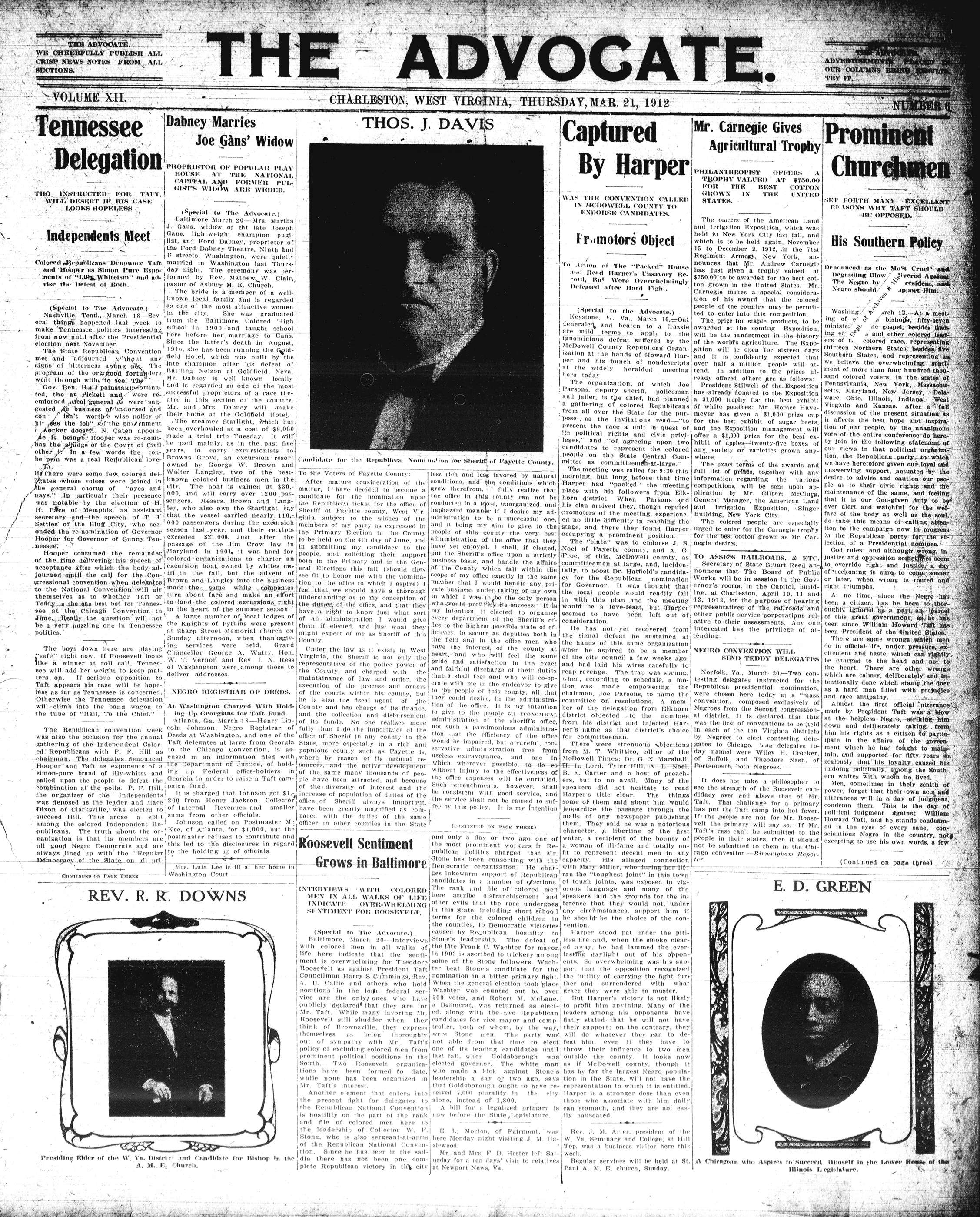
The Advocate
Thursday, March 21, 1912
Charleston, West Virginia
Page text (machine-generated)
REV. R. R. DOWNS
Presiding Elder of the W. Va. District and Candidate for Bishop in the A. M. E. Church.
THE ADVOCATE.
WE CHEERFULLY PUBLISH ALL
CRISP NEWS NOTES FROM ALL
SECTIONS.
VOLUME XII.
Tennessee Delegation
THE INSTRUCTED FOR TAFT,
WILL DESERT IF HIS CASE
LOOKS HOPELESS
Independents Meet
Colored Republicans Denounce Taft
and Hooper as Simon Pure Exponents of "Lily Whiteism" and advise the Defeat of Both.
Nashville, Tenn., March 18—Several things happened last week to make Tennessee politics interesting from now until after the Presidential election next November.
The State Republican Convention met and adjourned without any signs of bitterness among the. Program of the org good fortuners went through with to see. The Gov. Ben. Hake painstakingly dominated, the at. Dickett and, were re-endorsed official general of were suggested he business of endorsed and con' isn't worth the wise policy of his does the job" of the government worker doesnt. N. Caten appointe is being or Hooper was re-nomhas the bridge of the Court of Civil other it. In a few words the conbe pain was a real Republican love-Tr.
H. There were some few colored delegates whose voices were joined in the general chorus of "ayes and nays." In particular their presence was notable by the election of H. H. Price of Memphis, as assistant secretary and the speech of T. J. Settles of the Bluff City, who seconded the re-nomination of Governor Hooper for Governor of Sunny Tennessee.
Hooper consumed the remainder of the time delivering his speech of acceptance after which the body adjourned until the call for the Congressional convention when delegates to the National Convention will air themselves as to whether Taft or Teddy is the one best bet for Tennessee at the Chicago Convention in June. Really the question will not be a very puzzling one in Tennessee politics.
The boys down here are playing "safe" right now. If Roosevelt looks like a winner at roll call, Tennessee will add her weight to keep matters on. If serious opposition to Taft appears his case will be hopeless as far as Tennessee is concerned. Otherwise the Tennessee delegation will climb into the band wagon to the tune of "Hall, To the Chief."
The Republican convention week was also the occasion for the annual gathering of the Independent Colored Republicans with P. F. Hill as chairman. The delegates denounced Hooper and Taft as exponents of a simon-pure brand of Hily-whitees and called upon the people to defeat the combination at the polls. P. F. Hill, the organizer of the Independents was deposed as the leader and Mace Dixon of Clarksville, was elected to succeed Hill. Thus arose a split among the colored Independent Republicans. The truth about the organization is that its members are all good Negro Democrats and are always lined up with the "Regular Democracy of the State on all prii
CONTINUED ON PAGE THREE
REV. R. R
THE ADVOCATE.
PROREFERENCE OF POPULAR PLAY HOUSE AT THE NATIONAL CAPITAL AND FORMER PULGISTS WIDOW ARE WEDED.
(Special to The Advocate.)
Baltimore March 20—Mrs. Martha J. Gaus, widow of the late Joseph Gans, lightweight champion pugilist, and Ford Dabney, proprietor of the Ford Dabney Theatre, Ninth and U streets, Washington, were quietly married in Washington last Thursday night. The ceremony was performed by Rev. Mathew W. Clair, pastor of Asbury M. E. Church.
The bride is a member of a well-known local family and is regarded as one of the most attractive women in the city. She was graduated from the Baltimore Colored High school in 1900 and taught school here before her marriage to Gans. Since the latter's death in August, 1910, she has been running the Goldfield Hotel, which was built by the late champion after his defeat of Battling Nelson at Goldfield, Neva. Mr. Dabney is well known locally and is regarded as one of the most successful proprietors of a race theatre in this section of the country. Mr. and Mrs. Dabney will make their home at the Goldfield Hotel.
The steamer Starlight, which has been overhauled at a cost of $8,000 made a trial trip Tuesday. It will be used mainly, as in the past five years, to carry excursionists to Brown's Grove, an excursion resort owned by George W. Brown and Walter Langley, two of the best-known colored business men in the city. The boat is valued at $30,000, and will carry over 1200 passengers. Messrs. Brown and Langley, who also own the Starlight, say that the vessel carried nearly 110,000 passengers during the excursion season last year, and their receipts exceeded $21,000. Just after the passage of the Jim Crow law in Maryland, in 1901, it was hard for colored organizations to charter an excursion boat, owned by whites until in the fall, but the advent of Brown and Langley into the business made the same white companies turn about face and make an effort to land the colored excursions, right in the heart of the summer season.
A large number of local lodges of the Knights of Pythians were present at Sharp Street Memorial church on Sunday afternoon, when thanksgiving services were held. Grand Chancellor George A. Watty, Hon. W. T. Vernon and Rev. I. N. Ress of Washington were, among those to deliver addresses.
NEGRO REGISTRAR OF DEEDS.
At Washington Charged With Holding Up Georgians for Taft Fund.
Atlanta, Ga. March 18—Henry Lincoln Johnson, Negro Registrar of Deeds at Washington, and one of the Taft delegates at large from Georgia to the Chicago Convention, is accused in an information filed with the Department of Justice, of holding up Federal office-holders in Georgia in order to raise a Taft campaign fund.
It is charged that Johnson got $1,200 from Henry Jackson, Collector of Internal Revenues and smaller sums from other officials.
Johnson called on Postmaster McKee, of Atlanta, for $1,000, but the postmaster refused to contribute and this led to the disclosures in regard to the holding up of officials.
Mrs. Lula Lee is ill at her home in Washington Court.
CHARLESTON, WEST VIRGINIA, THURSDAY, MAR. 21, 1912
1
Candidate for the Republican Nomination for Sheriff of Fayette County.
To the Voters of Fayette County:
After mature consideration of the matter, I have decided to become a candidate for the nomination upon the Republican ticket for the office of Sheriff of Fayette county, West Virginia, subject to the wishes of the members of my party as expressed in the Primary Election in the County to be held on the 4th day of June, and in submitting my candidacy to the people, and soliciting their support both in the Primary and in the General Elections this fall (should they see fit to honor me with the nomination to the office to which I aspire) I feel that, we should have a thorough understanding as to my conception of the duties, of the office, and that they have a right to know just what sort of an administration I would give them if elected, and just what they might expect of me as Sheriff of this County.
Under the law as it exists in West Virginia, the Sheriff is not only the representative of the police power of the County, and charged with the maintenance of law and order, the execution of the process and orders of the courts within his county, but he is also the fiscal agent of the County and has charge of its finance, and the collection and disbursement of its funds. No one realizes more fully than I do the importance of the office of Sheriff in any county in the State, more especially in a rich and populous county such as Fayette is, where by reason of its natural resources, and the active development of the same many thousands of people have been attracted, and because of the diversity of interest and the increase of population of duties of the office of Sheriff always important, have been greatly magnified as compared with the duties of the same officer in other counties in the State
INTERVIEWS · WITH COLORED
MEN IN ALL WALKS OF LIFE
INDICATE OVER-WHELMING
SENTIMENT FOR ROOSEVELT
(Special to The Advocate.)
Baltimore, March 20—Interviews with colored men in all walks of life here indicate that the sentiment is overwhelming for Theodore Roosevelt as against President Taft Councilman Harry S Cummings, Rev. A. B. Callie and others who hold positions in the local federal service are the only ones who have publicly declared that they are for Mr. Taft. While many favoring Mr. Roosevelt still shudder when they think of Brownsville, they express themselves as being thoroughly out of sympathy with Mr. Taft's policy of excluding colored men from prominent political positions in the South. Two Roosevelt organizations have been formed to date, while none has been organized in Mr. Taft's interest.
Another element that enters into the present fight for delegates to the Republican National Convention is hostility on the part of the rank and file of colored men here to the leadership of Collector W. F. Stone, who is also sergeant-at-arms of the Republican National Convention. Since he has been in the saddle there has not been one complete Republican victory in the city
less rich and less favored by natural conditions, and the conditions which grow therefrom. I fully realize that the office in this county can not be conducted in a loose, unorganized, and haphazard manner if I desire my administration to be a successful one, and it being my aim to give to the people of this county the very best administration of the office that they have yet enjoyed. I shall, if elected, put the Sheriff's office upon a strictly business basis, and handle the affairs of the County which fall within the scope of my office exactly in the same manner that I would handle any private business under taking of my own in which I was to be the only person who would profific its success. It is my intention, if elected to organize every department of the Sheriff's office to the highest possible state of efficiency, to secure as deputies both in the field and in the office men who have the interest of the county at heart, and who will feel the same pride and satisfaction in the exact and faithful discharge of their duties that I shall feel and who will co-operate with me in the endeavor to give to the people of this county, all that they could desire, in the administration of the office. It is my intention to give to the people an ECONOMIC administration of the Sheriff's office, not such a parsimonious administration that the efficiency of the office would be impaired, but a careful, conservative administration free from useless extravagance, and one in which wherever possible, to do so without injury to the effectiveness of the office expenses will be curtailed. Such retrenchments, however, shall be consistent with good service, and the service shall not be caused to suffer by this policy. It is my intention
and only a day or two ago one of the most prominent workers in Republican politics charged that Mr. Stone has been consorting with the Democratic organization. He charges lukwarm support of Republican candidates in a number of sections. The rank and file of colored men here ascribe disfranchisement and other evils that the race undergoes in this state, including short school terms for the colored children in the counties, to Democratic victories caused by Republican hostility to Stone's leadership. The defeat of the Mte Frank C. Wachter for mayor in 1903 is ascribed to trickery among some of the Stone followers, Wachter beat Stone's candidate for the nomination in a bitter primary fight. When the general election took place Wachter was counted out by over 500 votes, and Robert M. McLane, a Democrat, was returned as elected, along with the two Republican candidates for vice mayor and controller, both of whom, by the way, were Stone men. The party was not able from that time to elect one of its leading candidates until last fall, when Goldsborough was elected governor. The white man who made a kick against Stone's leadership a day or two ago, says that Goldsborough ought to have received 7,000 plurality in the city alone, instead of 1,800.
A bill for a legalized primary is now before the State, Legislature.
E. L. Morton, of Fairmont, was here Monday night visiting J. M. Hazewood.
Mr. and Mrs. F. D. Hester left Saturday for a ten days' visit to relatives at Newport News, Va.
Captured By Harper
WAS THE CONVENTION CALLED IN MCDOWELL COUNTY TO ENDORSE CANDIDATES.
Promotors Object
To Action of The "Packed" House and Read Harper's Usasavory Record, But Were Overwhelmingly Defeated after Hard Fight.
(Special to the Advocate,)
Keystone, W. Va., March 16.—Out generalled and beaten to a frazzle are mild terms to apply to the ignominious defeat suffered by the McDowell County Republican Organization at the hands of Howard Harper and his bunch of nondescripts at the widely heralded meeting here today.
The organization, of which Joe Parsons, deputy sheriff, policeman and jailer, is the chief, had planned a gathering of colored Republicans from all over the State for the purpose—as the invitations read—"to present the race a unit in quest of its political rights and civic privileges," and "of agreeing upon two candidates to represent the colored people on the State Central Committee as committeemer-at-large."
The meeting was called for 9:30 this morning, but long before that time Harper had "packed" the meeting place with his followers from Elkhorn district. When Parsons and his clan arrived they, though reputed promoters of the meeting, experienced no little difficulty in reaching the stage, and there they found Harper occupying a prominent position. The "slate" was to endorse J. S. Noel of Fayette county, and A. G. Froe, of this, McDowell county, as committeemen at large, and incidentally, to boost Dr. Hatfield's candidacy for the Republican nomination for Governor. It was thought that the local people would readily fall in with this plan and the meeting would be a love-feast, but Harper seemed to have been left out of consideration.
He has not yet recovered from the signal defeat he sustained at the hands of this same organization when he aspired to be a member of the city council a few weeks ago, and had laid his wires carefully to reap revenge. The trap was sprung, when, according to schedule, a motion was made empowering the chairman, Joe Parsons, to name the committee on resolutions. A member of the delegation from Elkhorn district objected to the nominee from his district and injected Harper's name as that district's choice for committeeman.
There were strenuous objections from M. T. Whittlec, editor of the McDowell Times; Dr. G. N. Marshall, H. L. Lord, Tyler Hill, A. L. Noel, B. E. Carter and a host of preachers, but to no avail. Many of the speakers did not hesitate to read Harper's title clear. The things some of them said about him would jeopardize the passage through the mails of any newspaper publishing them. They said he was a notorious character, a libertine of the first water, a recipient of the bounty of a woman of ill-fame and totally unfit to represent decent men in any capacity. His alleged connection with Mary Milter, who during her life ran the "toughest joint" in this town of tough joints, was exposed in vigorous language and many of the speakers laid the grounds for the inference that they would not, under any circumstances, support him if he should be the choice of the convention.
Harper stood pat under the pitiless fire and, when the smoke cleared away, he had lammed the everlasting daylight out of his opponents. So overwhelming was his support that the opposition recognized the futility of carrying the fight further and surrendered with what grace they were able to muster.
But Harper's victory is not likely to profit him anything. Many of the leaders among his opponents have flatly stated: that he will not have their support; on the contrary, they will do whatever they can to defeat him, even if they have to throw their influence to two men outside the county. It looks now as if McDowell county, though it has by far the largest Negro population in the State, will not have the representation to which it is entitled. Harper is a stronger dose than even those who associate with him daily can stomach, and they are not easily nauseated.
Rev. J. M. Arter, president of the W. Va. Seminary and College, at Hill Top, was a business visitor here this week.
Regular services will be held at St. Paul A. M. E. church, Sunday.
21
A Chicagoan who Aspires to Succeed Himself in the Lower House of the Illinois Legislature.
Mr. Carnegie Gives Agricultural Trophy
Mr. Carnegie Gives Agricultural Trophy
PHILANTHROPIST OFFERS A TROPHY VALUED AT $750.00 FOR THE BEST COTTON GROWN IN THE UNITED STATES.
The officers of the American Land and Irrigation Exposition, which was held in New York City last fall, and which is to be held again, November 15 to December 2, 1912, in the 71st Regiment Armory, New York, announces that Mr. Andrew Carnegie has just given a trophy valued at $750.00 to be awarded for the best cotton grown in the United States. Mr. Carnegie makes a special consideration of his award that the colored people of the country may be permitted to enter into this competition
The prize for staple products, to be awarded at the coming Exposition, will be the handsome in the history of the world's agriculture. The Exposition will be open for sixteen days and it is confidently expected that over half a million people will attend. In addition to the prizes already offered, others are as follows: President Stilwell of the Exposition has already donated to the Exposition a $1,000 trophy for the best exhibit of white potatoes; Mr. Horace Havemeyer has given a $1,000 prize cup for the best exhibit of sugar beets, and the Exposition management will offer a $1,000 prize for the best exhibit of apples—twenty-five boxes of any variety or varieties grown anywhere.
The exact terms of the awards and full list of prizes, together with any information regarding the various competitions, will be sent upon application by Mr. Gilbert McClughs General Manager, the American Land and Irrigation Exposition, Singer Building, New York City. The colored people are especially urged to enter for the Carnegie trophy for the best cotton grown as Mr. Carnegie desires.
TO ASSESS RAILROADS. & ETC
Secretary of State Stuart Reed announces that The Board of Public Works will be in session in the Governor's rooms, in the Capitol, building, at Charleston, April 10, 11 and 12, 1912, for the purpose of hearing representatives of the railroads and other public service corporations relative to their assessments. Any one interested has the privilege of attending.
NEGRO CONVENTION WILL
SEND TEDDY DELEGATES
Norfolk, Va., March 20.—Two contesting delegates instructed for the Republican presidential nomination, were chosen here today at a "mass convention, composed exclusively of Negroes from the Second congressional district. It is declared that this was the first of conventions to be held in each of the ten Virginia districts by Negroes to elect contesting delegates to Chicago. "The delegates today named were Wiley H. Crocker, of Suffolk, and Theodore Nash, of Portsmouth, both Negroes.
It does not take a philosopher to see the strength of the Roosevelt candidacy over and above that of Mr. Taft. That challenge for a primary has put the Taft camp into hot fever. If the people are not for Mr. Roosevelt the primary will say so. If Mr. Taft's case can't be submitted to the people in their states, then it should not be submitted to them in the Chicago convention.—Birmingham Reporter.
SET FORTH MANY EXCELLENT REASONS WHY TAFT SHOULD BE OPPOSED.
Denounced as the Most Cruel and Degrading Blow His Livered Against The Negro by resident, and Negro should support Him.
Washington, March 12. At a meeting of 6 of 8 bishops, fifty-seven minister Dept. of a bishop, besides leading ed. of a bishop and other colored leaders of t. colored race, representing thirteen Northern States, besides five Southern States, and representing as we believe the overwhelming sentiment of more than four hundred thousand colored voters, in the states of Pennsylvania, New York, Massachusetts, Maryland, New Jersey, Delaware, Ohio, Illinois, Indiana, West Virginia and Kansas. After a full discussion of the present situation as it affects the best hope and inspiration of our people, by the unanimous vote of the entire conference do hereby join in the following statement of our views in that political organization, the Republican party, to which we have heretofore given our loyal and unswerving support, actuated by the desire to advise and caution our people as to their civic rights and the maintenance of the same, and feeling that it is our God-given duty to be ever alert and watchful for the welfare of the body as well as the soul, do take this means of calling attention, to the campaign now in progress in the Republican party for the selection of a Presidential nominee.
God rules; and although wrong, injustice and oppression sometimes seem to override right and justice; a day of reckoning is sure to come sooner or later, when wrong is routed and right triumphs. At no time, since the Negro has been a citizen, has he been so thoroughly ignored as a part an- (parcel of this great government, as he has been since William Howard Taft has been President of the United States. There are some wrongs which men do in official life, under pressure, excitement and haste, which can rightly be charged to the head and not to the heart. There are other wrongs which are calmly, deliberately and intentionally done which stamp the doer as a hard man filled with prejudice and race antipathy.
Almost the first official utterance made by President Taft was a blow at the helpless Negro, striking him down and deliberately taking from him his rights as a citizen to participate in the affairs of the government which he had folight to maintain, and supported for fifty years so zealously that his loyalty caused his undoing politically, among the Southern whites with whom he fled.
Men, sometimes in their zenith of power, forget that their own acts and utterances will in a day of judgment, condemn them. This is the day of political judgment against William Howard Taft, and he stands condemned in the eyes of every sane, conscientious Negro in the country, not excepting to use his own words, a few
(Continued on page three)
PAGE TWO.
CORRESPONDENCE
Sandy Saunders and George King were calling in Montgomery, Sunday afternoon.
James Russ who was seriously ill a few days ago, is able to be out.
Mrs. D. S. Saunders was visiting her mother, Mrs. T. W. Wade, in Montgomery, Saturday.
Mrs. E. M. Hayden remains quite ill.
Misses Leona and Nellie Hayden were shopping in Montgomery last week.
D. S. Saunders was visiting relatives in Montgomery Sunday.
Mrs. Eva Russ is indisposed at this writing.
Luther Brown was a business visitor to Montgomery Wednesday.
E. W. Mantz of Montgomery, was calling on Mrs. Emma Teague, Sunday.
HARPERS FERRY.
On Sunday last the choir of Storer college made their first appearance in vestments. Many friends and strangers were present.
Miss Ella V. Smith and Miss Lizzie Sims, gave a very pretty St. Patrick day party Saturday evening. It was held in Myrtle Hall sitting room and Miss Smith's apartments. The rooms were beautifully decorated with crepe paper, green and white. The menu was rich with all the good things. Saint Patrick's Day affords.
The Declamatory contest, preliminary to the annual contest with Morgan College, Baltimore, Md., was held this week and last week. Out of the eight boy contestants, Horace R. Helms, Franford, Del., was awarded first prize and Wm. M. Reddiz, Bluefield, W. Va., second. The two young ladies that are to represent Storer are Miss Dell Douglas, first place and Miss Roy Johnston second. Miss Young, one of Storer's faculty spent Saturday and Sunday with friends in Charles Town.
Mrs. Woodson Jones was hostess to the ladies Council last Thursday.
Rev. N. J. Jones of the M. E. church, left Monday for Washington to attend conference.
Mrs. Z. T. Brown, of Institute, is here visiting her daughters, Mrs. Page and Mrs. Railey.
Mrs. Floyd Rogers, who has been sick, is reported better.
Samuel Buster who has been sick at the home of his daughter, Mrs. George Jackson, was taken to his home at Lawton, Thursday by his son M. D. Buster.
John Borwn continues sick at his home on College st.
Miss Bertha Redd is out again after being sick several months.
A. W. Slaughter and H. H. Railey, were business visitors to Keystone, Saturday.
Mrs. Charles Henderson entertained the Ladies Aid of the M. E. church.
Miss Bessie Hunter, teacher at Beurry, was the week end guest of Mrs. F. D. Railey.
Horatia Holmes is sick at the home of his mother, Mrs. Hary Holmes.
Mr. and Mrs. T. W. Wade have moved from Eagle into their new home on Fourth avenue.
Mrs. Nettle Dower of Boomer, spent the week-end here the guest of Mrs. Thursday Saunders.
J. F. Henderson of Pt. Pleasant, visited the West Virginia Colored Institute, Thursday.
Alonzo Ellis, secretary to the President of the West Virginia Colored Institute was called as stenographer for the coroner's inquest held at the county infirmary Thursday, and according to the high compliments paid him, filled the place with credit. He is a graduate of the Commercial Department of the West Virginia Colored Institute.
State Superintendent, M. P. Shawkey and City Superintendent George Laidley, members of the State Board of Regents, visited the West Virginia Colored Institute Monday evening.
Lillian Shepherd left for her home in Montgomery, Saturday to receive medical attention.
Lillian Guess has just recovered From a slight touch of dyspheria.
Mrs. Jacob Johnson is slightly improved at this writing.
The Home Makers Club gave an entertainment Friday evening for charitable purposes and realized a neat sum of money from the sales.
Miss Lizzie Hopkins visited her sister Mrs. Connor, Sunday.
Roy Wade returned to school, on Monday morning.
The officers of the Y. W. C. A. were installed Sunday afternoon at 2 o'clock. About seventy-five members were present and listened to a very interesting address delivered by Miss Amanda Gamble. The following are the officers for the ensuing year:
Misses Joe Willis Morgan, President; Cornelia Gray, Vice-president; Jenora Strothers, secretary; Josie Guerant, Treasurer.
Fire played havoc with George Hurt's house and furniture. Monday morning, rendering the entire outfit a total loss. The alarm was given
MONTGOMERY
INSTITUTE
at 9:20 and the boys of the West Virginia Colored Institute seized buckets and rushed to the scene, but by the time they reached the spot the fire had complete possession of the house. Attention was immediately turned to the house not fifteen feet away, occupied by Prof. S. H. Guss. By heroic effort this was saved, being damaged only by a severe scorching. Percy Friend was slightly injured by a fall from the roof. There was a light insurance upon Hurt's house but this by no means covered the loss. Mrs. Blanche Tyler and Miss Hattie Peters were the guest of President and Mrs. Byrd Prillerman, on Sunday. The following program was rendered by the school chorus and others, under the direction of Mrs. C. E. Mitchell, Sunday evening:
My Lord what a morning, Folk Song
Nobody knows de trouble I've
Seen ..... Folk Song
School chorus.
Little Brown baby ..... Dunbar
Lillian Guss
Run, Mary, Run ..... Folk song
School chorus
An easy going fellow, Accounta-
bility, ..... Dunbar
Hugheston Brown
Walking in de light ..... Folk song
School Chorus
Ode to Ethiopia, After a visit.
..... Dunbar
Clifford Gore
Jacob's Ladder ..... Folk song
School Chorus
African Dance, op. 58, II (Violin)
..... C. Coleridge Taylor
Dex W. Jones
Reign Massa Jesus ..... Folk song
The School Chorus
Deacon Jones' Grievance ..... Dunbar
Lafayette Campbell
I Couldn't Hear nobody pray...
..... Folk song
The school chorus
African dance, op. 58, No. (violin)
..... J. Coleridge Taylor
Don W. Jones.
Ere Sleep comes down to soothe
the weary eye ..... Dunbar
Elizabeth Evans
Steal away ..... Dunbar
The school chorus
PARKERSBURG.
Clarence Lacy and Pearl Boyer, of Clarksburg, were in the city Sunday.
Mrs. Lizie Jackson of Pittsburg, Pa., is the guest of Miss Rebecca Brown.
Mrs. Grace Seams entertained on Monday evening in honor of Mrs. Jackson. Cards were the diversion of the evening.
Thursday afternoon Mrs Elizabeth Simpson entertained for Mrs. Jackson.
Mudams Loving and Fletcher of Marietta, O., were the guests of Venetta Court, at their meeting, Thursday night.
A number of the prominent young men are planning to give a grand Easter ball April ninth. A number of out of town guests are expected to be present. The music will be furnished by Williams Saxaphone Trio one of the best organizations of its kind in the State. The K. of P. annual sermon will be preached Sunday at Logan Memorial church by Rev. Williams, pastor of Zion Baptist church. Friday night Blannerhasset Lodge will celebrate their fifth anniversary with a ball. Mr. and Mrs. E. V. Seams spent Sunday in Belpre, O., the guests of friends. Mrs. H. D. F.zelwood is visiting her parents in Buckhannon.
Rev. J. T. Givens of Morgantown was the guest of friends Monday. The Phoenix Literary Society met Tuesday evening at the Ann street church. The following program was rendered: "How will the Panama Canal benefit the east? Discussion opened by Wm. Ferguson; solo, Mrs. Clora Williams; Selection, Mrs. Mary Stout; recitation, Mrs. Margaret Smith; recitation, Mrs. Joseph Saunders; Budget, Mrs. Bernie Washington.
Rev. E. S. Bedford, a native of Jamaica, will conduct a series of meetings at the A. M. E. church.
Mrs. Sylvia Jonkins, of Wheeling, is ill at the residence of her mother, Mrs. Mary Diggs.
Mrs. Clora Williams entertained Wednesday afternoon in honor of Mrs. Lizzie Jackson, of Pittsburgh.
Tuesday afternoon Mrs. LaEmma Custis entertained for Mrs. Jackson.
HUNTINGTON
Phil Waters, of Charleston, passed through the city Friday en route to Keystone.
Prof. Walter Jaicees of the Kentucky State Normal School is spending his vacation with his parents on 8th st.
G. W. Fitzgerald was made treasurer of the Y. M. C. A. The following trustees were elected at the Y. M. C. A. Sunday; Rev. L. V. Bryant, G. W. Winston, Dr. E. J. Smith, Prof. J. H. Hatcher, Dr. C. C. Barnett, T. R. Jenkins, E. M. Johnson and W. R. Johnson.
Dr. Barnett's hospital is nearing completion.
WINIFREDE.
Mrs. B. B. Allen is able to be out after a short illness.
Miss M. S. Walker spent Friday and Saturday on Palnt Creek- visiting friends.
Misses Eva and Dora Smoot, of Madison, are spending a few weeks here the guests of their grand-parents, Mr. and Mrs. J. F. Smoot.
Jas. R. Randolph and G. W. Perkins spent Saturday at Lewiston on business.
H. H. Allen is spending a few days in St. Albans, visiting his son, R. H. Allen.
Rev. F. E. Smith filled his regular appointment here Sunday and preached two very good sermons.
ELKHORN.
Mr. and Mrs. Flood, of Northfork, were in town Sunday, the guest of Mr. and Mrs. James White. B. D. Patterson, chief of Bluefield division, G. U. O. T. R., spoke in Graham, Va., Sunday in interest of the Order.
Miss Williams and Mr., Mills of Kyle, were visiting friends at Ennis, Sunday.
Miss Mary Hairston is much improved.
Our populace turned out in force to attend the meeting of the McDowell County Club at Keystone, on Saturday. All report a most enjoyable time.
Miss Lavender was the guest of Mr. and Mrs. R. C. Simpson, of Simmons, Sunday.
Rev. McKoy filled his regular appointment at Upland, Sunday.
Mrs. Smithers and daughter, Agatha, of Mayhuery, spent Sunday with friends at Ennis.
The teachers of Northfork and Elkhorn districts held their last district Institute of the term at the Elkhorn graded school. The following program was rendered: "Should morals be considered in hiring a teacher"—Round table; "treatment of children in school—Rev. F. C. Price; paper, "The school and the child's morals, Miss Anna George; Solo, Miss Mary Williams; lecture, "Mentality of the child", Dr. Roscoe Harrison; "Hygiene" Dr., S. A. Viney. Visitors from Brown's Creek District; Misses Georgia Lockett, Nannie Cobbs, Georgia Whittigo, Estelle Lee, Myrtle Brown and Dr. Hylton. Mrs. Edna Whisler, of Jed, was visiting friends here Saturday.
W. C. Morris of Anawalt, spent Sunday with friends here.
Mrs. C. S. Arter, of Keystone, was calling on friends, Sunday.
Rev. J. W. Shelton is her from Gulf.
Rev. A. P. Price is very much improved at this writing.
Misses Jones, George, Maynard, Carter and Lavender attended the social given by the "Bachelors" to the "Bachelor Maids" at Calhoun's auditorium, Keystone, Friday night.
All report a most enjoyable time.
FAYETTESVILLE.
S. H. Guss, principal of the normal department of the West Virginia Colored Institute, delivered the address at the closing exercises of the Wolf Creek school, of which Dewitt Meadows is teacher. Prior to the exercises, Mr. Guss Mr. Meadows and Rev. C. N. Harris were dinner guests of Mr. and Mrs.. J. R. Viars, and later visited the school here of which Miss Amelia McDaniels is principal. Mr. Guss' address at the closing exercises was heard by a crowded house and made a deep impression. Both he and Rev. Harris spoke in complimentary terms of the teacher and the school. Miss Eva Parker, who has been visiting her sister, Mrs. Hunter, has returned to her home at Charleston. Rev. C. N. Harris is conducting a revival at Winona.
The Tribe of Benjamin met at the Second Baptist church, Wednesday night. A program is being prepared for Easter by the Willing Workers club of the Second Baptist church.
MACDONALD
H. B. Hundley has returned from his trip along the N. & W. and reports things flourishing. Dewitt Meadows was in town last week on business incident to finishing up his school work of the year. Rev. R. S. Gordon, of Red Star, was down Thursday to attend the regular communication of Acacia Lodge No. 18 of which he is a member. Mesdames Hundley and Bridgewater spent Saturday in Whiteoak, visiting sick members of the Golden Rule Society. Robert Martin, a popular young man, left Monday for Winding Gulf where he has secured employment. H. B. Hundley was in Fayetteville Saturday to attend a meeting of the Republican County Committee.
Rev. R. S. Gordon preached a very interesting sermon at the First Baptist church of Mt. Hope, Sunday evening. Rev. B. B. Martin has gone to attend the Washington conference which meets in Washington, D. C. this week. Mr. Martin has made many friends while here and they are hoping that he will be sent back another year. On Friday evening.
THE ADVOCATE.
the members of the church and also friends gave a balquet in his honor. Stephen Spears, who has been working at Ansted for some time, spent a few days here this week visiting friends and relatives.
Mrs. Hattie Pettijohn, of Claremont, spent the week end here the guest of Mrs., Jennie Allen.
Wm. Cowherd has, gone to Winding Gulf to work.
The school of this place closed Thursday. There was an indoor picnic in the afternoon and a first class entertainment at night. Too much cannot be said in praise of the work of Miss Abbie O. Chandler the teacher.
Born to Mr. and Mrs. Scruggs a girl.
Mrs. Alonzo Hester continues ill, she has been sick for two months.
Rev. Yaney preached two sermons here Sunday.
CLARKSBURG
The W. C. T. U. held a very interesting meeting at Mt. Zlon Baptist church, Sunday afternoon. Rev. W. H. Thomas delivered a most excellent address on "the force of Habit."
The L. W. W. Club has prepared an excellent entertainment for Friday night at the A. M. E. church.
Mrs. Robert Sedwick and Mrs. Katherine Coleman are sick.
Rev. J. H. Jenkins and wife were tendered an elaborate reception Friday night by the members, of the church. The following program was carried out; Anthem—choir; prayer; Aaron Wilson; Anthem, Choir; address, Loyalty to leadership, L. R. Jordan; Solo, Miss Amelia Lowry; Address, Rev. W. I. Kennedy; address, Rev. W. H. Thomas; Solo, Miss Willa Lee; address, Miletus Walker; address, Rev. J. H. Jenkins. After this the guests repaired to the lecture room where a special table was provided for the honor guests. D. H. Kyle acted as toastmaster. The entire affair proved a decided success both socially and financially.
Rev. J. T. Gibbons of Morgantown, passed through the city Monday en route to Huntington on business.
Rev. S. P. West former pastor of Pride A. M. E. church, passed thru the city Saturday en route to Chillicothe, O., from Buckhannon where he spent two days lecturing.
Mrs. Maria Littleton and grandchildren will leave this week for Buckhannon to visit her daughter, Mrs. James Davis.
Rev. W. H. Thomas left Monday for Huntington.
Henderson Martin left Saturday for Washington, D. C., after attending the funeral of his brother, John Martin.
Mrs. Nellie Ogden was hostess to the Women's Mite Missionary Society, Wednesday afternoon at her home on Mechanic street.
D. H. Kyle was a business visitor in Fairmont last week.
CHARLESTON
Beating the Bushes—The Rev. J. T. Gibbons, an A. M. E. preacher, located at morgantown, spent Tuesday night here in the furtherance of his candidacy for member at large of the Republican State Committee. Rev. Gibbons talked with a number of persons more or less interested in local politics, but he was silent as to the amount of encouragement he received.
Dr. Barnett a Visitor.—Dr. C. C. Barnett, assistant city physician of Huntington, was a business visitor to the city Tuesday night. Speaking of the political situation at Huntington, the doctor said the trend of sentiment there was Swisher for Governor and that the Kanawha candidate would poll a good vote in Cabel county. Dr. Barnett is remodeling his home into a hospital in which several charitable organizations have already contracted for beds.
Rev. Downs Visits Family.—Rev. R. R. Downs, presiding elder of the A. M. E. church for this district, spent Tuesday here with his family. Rev. Downs has just completed his tour of inspection in the southern part of the State and is en route to the northern section where his denomination is especially strong. Discussing his candidacy for the bishopric, Rev. Downs expressed himself as confident of making a good showing at the general conference.
Waters at Keystone.—Phil Waters, deputy clerk of the Supreme Court of Appeals, was the Charleston representative at the meeting Saturday, of the McDowell County Colored Republican organization held at Keystone. The meeting, according to Mr. Waters, lacked nothing in numbers and enthusiasm but was a great disappointment to its originators whose plan was to endorse A. G. Froe as that county's candidate for committeeman at large.
"Tribe of Judah"—Thirty-six members and visitors attended the meeting of the "Tribe of Judah" of the First Baptist church, Thursday evening at the home of Mrs. Ida Brown. Shelton Ave. Devotional exercises were conducted, by Miss Virginia Rayford and Prof. H. B. Rice. Three new members were enrolled and three dollars were subscribed to the West Virginia Seminary and College. After the collection, had been taken up, the hostess served lunch, for which, on behalf of the society, she was thanked
by Miss Alice Yunning, Rev. and Mrs. Reed are hosts to this organisation at the parsonage, this evening.
Church Society Entertained.—Misses Emma and Julia Johnson very pleasantly entertained the Minister's Social Helpers, Monday evening, at the home of Mrs. E, D. Humbles, Sentz street. Bible quotations and music were the divertissements of the evening. The next meeting will be held with Mrs. Julius Thomas. Donnally street, Monday evening of next week.
Hotel Brown Arrivals.—C. A. Rogers, Columbus, Ohio; William Smiley, Alken, S. C.; J. W. Young, Clexton, J. and G. Alston, Raymond City; Lee Morton, Pittsburgh, Pa.; B. Drummond, Dressmont; R. H. Stevenson, Page; W. L. Chambers, F. Tautton, Roanoke, Va.; L. Gordon, St. Albans; W. J. Napper, Institute; J. M. Arter, Hill Top; Mr. and Mrs. Canas, Hickleen, Miss Anna Reed, South Carbon; J. H. King, Cedar Grove; S. Lee, Morgantown; D. Lankford, Birmingham, Ala.; Mr. and Mrs. Watts, Huntington; W. M. Kelly, Chattanooga, Tehn.; C. H. Williams, Longacre; J. D. Halston Harewood; J. L. Williams, Kenosha; Jos. Harrls, Beckley, and C. W. Kingsley, Raymond City.
Missionary Section No. 3. Missionary Section No. 3 of the First Baptist church held a very interesting session with Mrs. Mariah Alexander, Sentz street, Friday evening, when the devotional services were conducted by Mrs. M. A. Parker and R. C. Moiver. The hostess, assisted by Miss Alice Tunning, served lunch. The collection for the evening was $1.30.
The Athens Club.—Miss Willie May Ford was hostess to the Athens Club-Monday evening at her home on Morris street. Among the visitors present were Rev. J. M. Arter, former president of the West Virginia Seminary and College, lev. R. D. W. Meadows, State Missionary, and Rev. E. J. Woodard, all of whom contributed to the evening's entertainment. Miss Sarah Williams and Miss Georgia Bryant will entertain the club Monday evening at the former's residence, 923 Morris street.
Missionary Section No. 2.—This society was largely attended, Tuesday evening at the home of Mr. and Mrs. Frank Henley, 606 Pemberton avenue. The opening exercises were conducted by Miss Willie Brown and R.C. Mclver. Twenty-six members and visitors were present and were served with a dainty lunch by Mrs. Augusta Bradley and Mrs. Martha Lovely.
A St. Patrick's Party.—Mr. and Mrs. Robert Simpson entertained Thursday evening of last week at their home on Washington street, with a St. Patrick's party. The color scheme—pink and green—was carried out in the decorations and refreshments. Their guests were: Mr. and Mrs. Russell Forney, Mrs. Sallie Campbell, Mrs. Lenora Cowser, Misses Estella James, Maude Viney, Daisy Jordan, Virginia Gilmer, Cordelia Wanzer, Esther Fulkus, and Messrs. J. A. Jackson, Joseph Layne, J. C. Ellis and A. H. Brown. Emerald salad, cheese wafers, strawberry ice cream with maraschino cherries, novelty cake, cocoa and mints were served.
Contribute to School.—Eight new members were enrolled and $3.60 collected by the Tribe of Joseph at its meeting Friday evening, with Mrs. Lizzie Nash, 405 O'Connor avenue, president J. P. Caul made a strong plea for the W. Va. Seminary and College and the society subscribed $11.00 to the institution. Refreshments were served to eighty-four members and visitors by Miss Minnie Wright and Miss Jamima White. The society's thanks were expressed by Rev. R. B. Reed in a short speech. William Wright will be the club's host at his home on Piedmont street Friday evening.
Called Away Suddenly.—Miss Sissie Chambers, who came to the city Tuesday, was called very suddenly to Claremont, Sunday, to see her mother, Mrs. Annie Hicks, who is now undergoing the third operation within the past four months at McKendree Hospital.
"For Love or Money."—For Love or Money," a drama, was presented by the Ladies Aid Society at the First Baptist church before a crowded house, Tuesday night. It will be repeated at the St. Paul A. M. E. church Tuesday evening of next week.
Personals and Locals:
Miss, Mary Burks is spending the week-end with Mrs. J. R. Chambers, Washington, D.
Mrs. Lillian Grant Moore, of Chicago, Ill.. is visiting her mother, Mrs. Cornelia Washington.
Mrs. William Jones, of Montgomery, is the guest of Mrs. A. Smith, Goshorn street.
Mrs. Abner Hill, of Ironton, Ohio, is visiting her parents, Mr. and Mrs. James Campbell, Lee street.
Miss Nan Tompkins and Miss Leach of Institute, were guests last week of Mrs. Lillian Hamilton, Donnally street.
F. A. Morris, who has been teaching at Parker, has closed his school and will go to Harper's Ferry for a special course after having spent a few days here with his parents.
W. M. Kelley, representing H. Thea,
Calloway, tailor, of Cincolnatt, is here
solliciting orders for his house.
Mrs. Lula Thompson is ill at her
home on North Rand street.
Mr. and Mrs. Van Randolph have
returned from North Carolina.
Miss Inez Johnson, of Institute, is the guest of Mrs. Mollie Parker, Jacob street.
Mr. and Mrs. Thomas Flagg have moved from Dixie street to Elizabeth street.
Noble Mitchell was operated on at the General Hospital Tuesday.
Miss Hattie Peters spent the weekend at Institute.
Mrs. B. F. Clark will entertain the league Friday afternoon.
The Loyal Union held its public meeting Monday evening at the home of Mrs. Mary Mason, Bullitt street.
Miss Rhoda Wilson spent Saturday and Sunday in St. Albans.
1. M. Carper and Mrs. Jas. Page left Monday for-Washington, D. C., to attend conference.
Miss Bess Taylor is lll at her home on Washington street.
Colored Catholic Priest Breaks Down
FATHER PLANTIVIGNE IS OVERCOME IN HIS EFFORTS TO WIPE OUT PREJUDICED CONDITIONS IN THE CATHOLIC CHURCH.
(Special to The Advocate)
Baltimore, March 20—Rv. J. J.
Plantevinge, assistant pastor of St.
Francis Xavier Catholic church, is
ill at St. Agnes Hospital. His
trouble is said to be a nervous break-
down. Father Plantevigne has been
outspoken against prejudiced condi-
tions in the Catholic church, and
recently delivered a speech at the
Catholic University, Washington, in
which he argued for the opening of
the seminaries and colleges for the
preparation of colored men for the
priesthood and urged that colored
Catholics be treated as are other
Catholics.
Cardinal Gibbons has always been
liberal in the matter of offering opportu-
nities for the education of colo-
red men who desired to enter the
Catholic priesthood. From St. Joseph's Seminary, this city, have gone
Rev. C. R. Uncles, a teacher in the
CROWN AND BRIDGE
HOURS: 8:30 A. M. to 1:
Dr. JAMES
Dental
Office: Room 1, K. of P. Bldg.
J. E. JOHN
FUNERAL DIRECTORS
All Calls Prom
Our Prices are the Most
For Promptness and Care
Our Ambulance Service
600 SUMMERS STREET, CHARLESTON
SPECIAL ATTENTION
CAL
CROWN AND BRIDGE WORK A SPECIALTY
HOURS: 8:30 A.M. to 1:30 P.M., 2:00 to 6:00 P.M.
Dr. JAMES B. BROWN
Dental Surgeon
Office: Room 1, K. of P. Bldg.
Home Phone 429
J. E. JOHNSON CO.
FUNERAL DIRECTORS AND EMBALMERS
All Calls Promptly Attended.
Our Prices are the Most Reasonable.
For Promptness and Care Try
Our Ambulance Service.
Open' DAY and NIGHT
Phone 2472
600 SUMMERS STREET, CHARLESTON, W. VA.
SPECIAL ATTENTION GIVEN OUT OF TOWN
CALLS.
HENRY T. M'DONALD,
President.
STORER O
Harper's Fe
Founded in
More than 400 men and women ha
in the state for Colored students. Mar
Remarkably healthful. Ample buildi
ING ADDED TO OUR PLANT THIS
teen highly educated, earnest teachers.
Our Library catalogued according
largest in the State.
FIRST GRADE CERTIFICATES A
BERS OF THE GRADUATING CLAS
THE STATE BOARD OF EDUCATION
its faculty and student body. Its wh
ing. Literary Societies, Christian Org
STORER COLLEGE
Founded in 1867
More than 400 men and women have graduated here. The oldest school in the state for Colored students. Magnificent location. Elevation high. Remarkably healthful. Ample buildings. THREE NEW BUILDINGS BEING ADDED TO OUR PLANT THIS YEAR. The regular faculty of sixteen highly educated, earnest teachers does not include assistants.
Our Library catalogued according to the Dewey System, is one of the largest in the State.
FIRST GRADE CERTIFICATES ARE GRANTED TO THOSE MEMBERS OF THE GRADUATING CLASSES WHO ARE RECOMMENDED TO THE STATE BOARD OF EDUCATION. Storer is interdenominational in its faculty and student body. Its whole influence is toward Christian living. Literary Societies, Christian Organizations, Musical Clubs, Bands and Sane Athletics.
COURSES: Academic, State Normal, Industrial, Music.
For illustrated catalogue and other printed matter write to
```markdown
```
THURSDAY, MARCH 21, 1912.
Epiphany Apostolic College; Rev. J. Henry Dorsey, who is connected with a Catholic school at Montgomery, Ala.; and Father Plantevignes. The first two are natives of this city, while the last named halls from Loulahana. Father Theobald was ordained several years ago at St. Paul, Minn., which is in Archbishop Ireland's diocese. Rev. J. H. Burgess, who was ordained in Paris, is the only other colored priest in this country. He is stationed in Philadelphia. Father Augustus Telton, who was ordained abbrad, died of sunstroke in 1891.
Rev. W. P. Hays, pastor of Mt. Olivet Baptist. church, New York City, preached twice in local colored churches. Sunday
Bishops J. Albert Johnson and Levl J. Coplin, of the A. M. E. church, were in the city Tuesday. Prof I. Garland Penn, assistant secretary of the Epworth League of the M. E. church and Dr. C. C. Jacobs, field agent of the Sunday school Union of the same denomination, occupied local pulpits, Sunday.
A lengthy discussion about the policy of a local race journal which has been making a campaign against ministers followed the introduction of a resolution by Rev. D. D. Turpean at the monthly meeting of the Ministerial Alliance Monday, in which the paper's attitude was criticized.
The Maryland Voice, a paper published by the local Baptists, made its initial appearance last Saturday.
Every Negro—rich and poor, high and low—should see for himself a w here he can help in giving sup- a worthy enterprise of his
Try the it should take no argument we are some things which we to own, and which we owe in earth. All races, saving oms, do to their own busi- price $100 SMALL, they would have and booklet free the firms to do them. In fact we get us take for our example men and gave us our first lessons nug. Sold a building.—People's Record
The Nashville Negro W. W. of Trade completed its organization week and is now in a fair n to start the stream of Negroventions and annual meetings way. The members are already ping for the Centennial Exposition come this way.
The Board of Trade is composed of some of the most substantial and influential of the Nashville body of colored citizens. They have mapped out an unusually useful course of action and if held to the organization will be a force for good among the colored people of Nashville.
E WORK A SPECIALTY
:30 P. M., 2:00 to 6:00 P. M.
B. BROWN
Surgeon
Home Phone 429
INSON CO.
S AND EMBALMERS
Imptly Attended.
Not Reasonable.
Are Try
Open' DAY and NIGHT
Phone 2472
ON, W. VA.
GIVEN OUT OF TOWN
LLS.
COLLEGE
Berry, W. Va.
in 1867
have graduated here. The oldest school
significant location. Elevation high.
ings. THREE NEW BUILDINGS BEYEAR. The regular faculty of six-
s does not include assistants.
to the Dewey System, is one of the
ARE GRANTED TO THOSE MEM-
SES WHO ARE RECOMMENDED TO
N. Storer is interdenominational in
role influence is toward Christian liv-
organizations, Musical Clubs, Bands and
mal, Industrial, Music.
er printed matter write to
N. C. BRACKETT,
Treasurer.
The President
ES le apita
-18, PHOUD.OF 08 TAKE. COLDBUD,
RENOMINATION « BUREAU
io RUN. BY POCKET 0:
‘ oy f
Conner Hopes to “Land”
oy a
Claims (to “Be thy Second Choice of
“Mote Delegates: Than any Other
“SOapeldaté. ” Vernon Likes Mis Job.
“eNews In Briet,”
Wisbinigton, D. Ge March 13th—
vl ie Us ee aaegpity sig
Prom} getion-of Charles J.: Pickelf,
a bemtn: pf, tie! Patt, Renorlnstion
Burpan: hasbeen: established. th ty
rooins :@f\the' Macle Building, {74h
and» Gy atvedts northwest)! 5 os.
“Herd: frontotwentyto-thinty colored
bet tit’ Women are wey entploy-
f Nplate: ew foasés: of yo:
ters'dh ‘the various’ states and mail-
Jngout_to_thom- literature - setting
forth the helpful things: the coun-
try has experienced In. ‘Three years
of Taft.” Most of the cles arc
women, and neater or more busi-
ness Ike group of young people. It
hag never been the good fortune of
Yollr correspondent to seo. ‘They arc
worktiig under the painstaking direc-
tion of Mr. Pickett and what this
astute political ‘general doesn't know
about og aula of reaching the
public {m’t worth knowing. He
“bosses the job" so pleasantly that
a worker doesn’t realize that le’ or
she fs being “hosed” at all, He
has the eituation well in hand, and
other ‘important documents are ‘to
be pushed out rapidly.
.The entire credit for the éstab-
Ushment of this bureau belongs to
Mr." Plekett. “We perceived that the
bureau at large was giving lucrative
‘employment to: scores of white wo-
men, and the {dea stfuck him that
the pirls-of his own: race onght: to
liaveSa. qharo in'the rewards ‘thal
were being: Qispensed.. He lal ils
plan before’ alin eat wl
wilt hebas ‘labored for ydars in
theRepublican Congressional Cam.
paign Committee, and that ‘generous
andushroad-gayged. gentleman, quick
torsee: the weight of Mf, Pickétt’s
‘argument, said, ‘without hesitation:
“Go. ghead! .~ Get, your. people. to
gwether-gnd send the payroll toime!"
This clever coup has attractedwide.
spread attention to Mr; Pickett @nd
his praises aro. being sung by ever}
vace-loving Negro from LeDroit tc
Foggy Bottom. And he deserves all
the “good things that are:being said
of him, too. -
“Charlie Pickett” 1s a Chicago boy.
Wor'whany years he haa been the
right-hand man of Senator. Cullom,
Miinois', “grand. old faan.” He has
had splendid opportunities to embark
in buginess for himself in bis wes:
tern home, but gratitude to his bene:
factor; has sJmpelled him to decline
all-offers and remain at the side of
the aged Senator. He enjoys the
fullest confidence of Chairman W. B.
M¢Kinley, as this Incident demon.
‘strates, and no colored man at the
Capitol has as many friend’ in both
‘branches of Congress as genial “Chaz
He" Pickett. Some great _posstbill-
‘les await him in the future. He
belfeves In his race—and hig race be-
Heves in bim.
Former Register Vernon in ‘town.
Former Register of the Treasury,
W. T.*ernon, is in town, going over
somo business with his new post at
Supervisor’ of Indian schools. His
dutles have carried him all over
the South and West, and he makes
no contediment of the fact that he
ikes.nté work tmmensoly. It certain-
ly sgrees with him, for he Is look-
ing the’ picture of health and is as
happy a@ the proverbial lark, He has
vepn royally received by the people
wherever. he has gone, and his ‘lec-
tures on “The Future of the Negro”
have, hean highly praised by the
leadhig: éitzens of both races. ‘The
dats peers have commedted favor-
ably.” Dr. Vernon, Is keeping closely
In toyel with tho A.M. B, church,
of whidh he 1a a conspicuous member
and there are hints that high honors
may be showered upon him by. the
GengratConterenco at Kansas City
in Sfay. Dr. Vernon is recelving a
multitude ‘of soclal courtesios at the
hamds of his Washington friends, all
of whom are glad to noto his contin-
ned prosperity.
President to Address Howard Alutnn:
President Taft 1s to speak for the
Howard Alumnt_Agrocfation at. the
Metropolitan A.M. 1B. church, April
9. Pho Aasoclation Is pledged td
ralse $10,000 towards a gymnastam,
to Wo aréeted on the Howard Univer:
sity campus, and this mags moeting
Jn being held to arouse the frlends
of the school to the “giving point.”
The work ia In, the -hands of Prot,
Kelly Miler, olfajrman, of the eom-
milleo;,Robort A. Pelham, secretary
and manager; and Shelby J. David-
son, finariclal agent.
Much pleasure i felt over the
coming of tHe Prosident to help this
worthy caude, and ail Washington
mitten out to. hear him, It is 6x-
pected that he will make a speech
of nidual ‘etgabeaoe at this time.
Dr. Ja M. Conner in the TAmelight.
age. Romper. tn the: Amelighe.
J.-M. Conner to the A. M. B. Bish:
opric Js, regarded iby -his friends as
a oortuinty, he ts uot relaxing bis
wotehfnlnesé. over the situatiotn.
With the great Southwest as. bis
foundatlon,..Dr.-Conner has spread
all over the country aid.-will have
votes. from Savery pep@piignt. contat,
goles Ttafa a Uuntgue” elrgumatance
that while having enough votes
Digdged: ta put ‘him throwgh on the
‘flrat=ballot, ‘he igs a host! of. admlr-
ers, who, ate dosjrous of sharing {1
‘bie wucoggs, but axe obligated to’ cast
a compl{mentary. yote for a, loci :t4:
Vorite, -wiio “Is: expected sto drop out
of the puniting whon the Yight comes
‘on In cdrnest. - Thus,’ Dr, Connor ft
Shei saGond Siblae at nity: Galegato
than any other candidate, and. should
the’ contest be toq close to elect
anyone on the fifst) ballot, .thls sur.
plus strength will rally to him when
thelr hands “are trod. trom thet
conference -Ingtructions.’ “His allies
are loyal to ‘the core, and as. sonio:
ingidato, with a following Targol
nergaset ‘over his fine showing ‘al
PNorfolk, no cannot fall to win a
Kandas ‘City.
“sWhile in Atlanta recently, he ad.
\Sreysad, eu: appregiative audience al
Morris Brown Collese, and. had as
Aia.coheague on thé platform, Bisho;
‘J, 8/Fitpper. Dr. Vv. M. Townsend, 0:
tArkansas,’ President.W. A. FP. Foun.
tain, of- the Collegé, and other lead
ers of the A.M. W. church.” In Balt
Imore, -at- the Bishop's “Council, “he
was especially welcomed by)Dr. A
L. Gaines and his hospitable peo
ple. Optimists declare that the Kan
sas City General ‘Conference wil
elect five Bishops. Conner, Hurst anc
Rose are guessed 28 three of them:
News in Bricf
Ford Thompson Dabney, ma
known in musteal and theatrical eff:
cles, was married Thursday” evening
of last week to Mrs. Martha Davis
Gans, of Baltimore, widow, of the
late Joe Gans, the celebrated pust-
Ust. Mr. Dabney will take charge
of the Goldfield Hotel at Baltimore,
and rumor has It that he may open
a theatre there.
‘Kormer recorder John C. Daney is
on a lecture tour through North
Cagolina, under the pllotage of J.
Finley Wilson.
‘This week the “Dixie Players" are
doiyg well at the Howard Theatre,
Frauk Montgomery - and Florence
MeClain, in leading roles in the com.
edy, “In Bthiopla,” make an excel:
jent Impression. | N. R. Harper's
sterling drame, “Tallaboo,"! plays 4
return engagement next week. Be
ginning April 8, and covering Eas-
ter week, “The Smart Set,” with S.
H. Dudley In. “Dr. Beans of Boston,”
will-be.on the-oarda..- —., ,
(WILL A. Cooke, the acrobatic and
eccentric tramp detective, with
‘Black Pat's ‘in the Jungles,” 1s at
work on a musteal comedy that will
bo “something different” from. the
‘general run, It will probably deal
With the compligations between the
ItaNans and the Turks.over the pos:
Session of Tripoli. Mr. Cook is the
author of the rewritten first act ot
Black Patti's play. this season,
Base ball will be played by col
red talent this summen at the Union
League Park. ‘The Cuban Giants, the
‘Lincoln Giants, the ‘Royal Giants
and all of the various colored ball
tossers will be here.
Despite the sporadic agitation for
“jim-crow” -street cars in* the -Dis-
trict by bourbon Congressmen ani
{rrespohsible quill-drivers who card
the daily press,-there Is no real senti-
ment for separation on the "poor
man’s auto" and there will be none,
The hurry-up people do not wish
to be bothered with the innovation,
and the companies do not wish to
be saddled with the extra expense
of providing cars.
ere Pe es cette eine
signed from the faculty of Howard
University last year under” elreum:
stances that caused much embarrass.
ing publicity, has been reinstated b3
President Thirkfield. He Is a splend-
1d teacher, an excellent young man
and his vindleation is pleasing to
his many, friends in all parts of the
cowatry. President ‘Thirkleld can al-
ways'be relled upon to do the gener-
ous thing, when the opportunity pre-
sents” Itself.
“It ts genarly understood that W.
Sidndy Pittman, Ikmself a Mason of
High standing, wil” be the suporvis.
Ing architect of the new —$100,00
tomple to be erected by the order at
the corner of 10th and U_ streets
northwest in the near future. Mr.
‘Pittman, who'is thesson-In-law of Dr.
Booker ‘T. Washington, was the first
to make the suggestion that led to
the great_ mass. meeting here on
February B, at whieh the Wizard”
was tho principal speaker, and
‘which placed the project so happily
before thy order and the people at
large. Mr. Pittman ina graduate of
tho Drexel Institute of Art at Phil-
adgiphia and of Tuskegee Institute.
He* has designed and supervised tho
construction: of -many notable stritc-
Cures, including the Negro Building
at tho Jamestown Exposition; — the
Y¥. M. C. A. building and the Gar-
field school of this city. He 1s easily
the foremost colored architect 1a the
land. A
Attorney Robert L. Waring of this
city, ‘and Milsé Emma Belle Parks, of
Chicago, until recently connected
with the census Bureau, were united
in marriage last week by Rov. ¥.
J. Grimke. Their “honeymoon” tour
‘inelitded visits to ‘Ohioago, and Pitts-
burgh,
Bishop Alfred Harding confirmed
twonty-four candidates. last’ Wednes-
Mdayrevening at St. Luko's P. B.
ghutely of whlch. Rev. ‘f. J. Brown
te rector, The services were. quite
Impressive, ss
‘Assocjate, Justice Mahign Pitney
(Was confirmed -by a vote of 60 to
alte. the United States Senate. The
fLabor’, Unions protested vigorously,
becatise-He had: made’ a decision some
tfng:-a80; which protected property
ana ftoWped upon the boyeatt. und
disorter< but: the efforts of tpese re-
actionaridy availed nothing ‘against
the arguments of the bound lawyers
jot the’ Senate. Justice Pitney will
havb'a brilliant career on the bench
of the nation’s: highest tribunal,
Col. Henry Lincoln Johnson, Re-
corder of Deeds, at the’ White House
last’ Week. joinéd with B. W. Ss. Dan-
leles and L. F. Williams, colored
leaders of Savannah, Ga., in urging
President Taft to name Joseph F.
Day a¥ postmaster at Savannah, It
fe velleved that Mr. Day will be
appointed.
Tennessee Delegation
» (Continued from Page One.)
Meuounced -thoDemocratic: party -ns
mary elections.” Governor Hooper
at present constituted: “a wiilskey-
ring -and Doodle, gang.”, Aid these
in dependent colored “Republicans
are supposed to he a part of the
crowd: whether they got auy-of the
“boodle” or not:
Dr. R. H. Boyd,. secretary. of the
Nation Baptist Publishing /oard’ has
returned from Panama, where’ he
Went “recontly “ona missionary. n-
spection tour. He was warmly greet
ped by his friends, and admirers.
T. J. Settles and J. C."Napfr vis.
{ted Fisk University, after the ad.
Journment of the-Siate Convention.
Lawyer Settles made a strong talk
to the Fisk student body and —an
Impression on those who heard hin.
The colored, Mpiscopallans of ‘Ten.
nesseo are congratulating themsel-
yes “on the appointment of a col
ored “Archdeacon to supervise the
jeolored work in this diocese, ‘The
Rev. Thomas Denby, of Memphis,
has received the appointment and it
is reported will assume charge of
the work at a very early date. ‘The
chureh ia growing materially and
the ccngregations are Increasing
rapidly in Tennessce,
‘The Nashville teachers have tak-
eu upon themselves the task of put-
Ung one Pearle High School gradu-
ate through ‘a college course. The
idea originat@l with Prof. F. G.
‘Smith of the city high school. The
graduate of Pearl now completing
fis sophomore yoar at Fok Geiser
brightest and best all around stu-
dents in the University.
of uplift. ‘He is organizing corn
elubs among the colored boys of the
aad
Second District
S. S. Union Meets
EXCHLLENT PROGRAM WAS CAR-
RIED OUT BY THE DELEGATES
OF. hit, SUNDAY. SCHOOLS. IN
DHEA RRGOR Cates.
‘Beckley, March 19—The Second
District Union comprising the Sun
day schools from ‘Thurmond to Hin
ton met in its second semi-annua
session with the Central St, Baptist
}Sunday School here Feb. 25,
‘The executive poard, with presi
dentR. L. Wrench. presiding, conven:
ed at 1 p.m. followed by the regu-
lar session of the Unio at3p.m.
After remarks by the president
appointing the various committees
reading of the letters, adjournment
was taken Ul 7 p.m, when a’ most
excellent: program was carried out.
Of special mention was the talic by
R. E. Peters on “The necessity of
the Union" and two excellent papers
‘on “the benefits of a Sunday school
to @ community,” by Mra. R.L. Mit,
chel and’ Mrs, Mf, 1. Mosby. Sunday
morning a model Sanday Schoo! con-
ueted by Supt. Ro L. French and
his corps of teachers, followed by 11
o'elocks services.
Afier some excellent music by the
choir, Rev. Ro W. D. Meadows of
Huntington, preached the Introdue-
tory sermon from Rev. 22:17. ‘The
xermon wan full of syod and. help-
ful things presented in a manner in-
toresting to all
Afternoon session wae taken up
with the addrews of welcome by Mist
S. R. Powell, response by Rev. J.
J. Turner, the president's address,
report. of ‘committees, ofe. In the
evening Rev. J. J. Turner preach:
ed_an excellent. sermon from John
8:32
This was by far the best session
the Union has had. President French
and the good people of Sylvia spar-
ed no pains to make thé meeting a
success. ‘The enrollment committee
reported 42 members; the finance
committee reported $69.03. taken
up during the ~Union, and* eleven
school Fepresented by letter or dele-
gate.
SS
THOS. J. DAVIS
(Continued’ from Page Ove!)
to administer the affairs of tho omce
of Sheri honestly, without fear or
favor to dny one but giving to every
Person exact fustice, und no. special
favor or privilege to gny. one, but
showlig to every person? with’ whont
the -offlce shall come, Ato business
relation every. courtesy ‘ind considera-
tlon consistent with an honest and
falr discharge of its duties?The of:
fice of Sheriff Will not belong to any
person, class or faction, nok foy the
few as against the many, nor for the
many as against the few, but shall
be admiulsterod for aff the people
without regard to thei wealth: or po-
sition, or thelr standing in Jife, I
expect to perform my duties’ exactly
ag the law and my oath requires me
to do, in fulk accord with the letter
and’ the spirit of the Iaw ‘which de-
fines them; may be personally, repus.
nant to me, but the personal opinions
and feelings -of Tom Davis. will not
Interfere with the discharge of his
duties as Sheriff, aad it they did, my
sworn duly as I see tt must super-
sede them. It Is my intention dur-
ing my-term of office to be-""The Sher:
if," and as*sueh to perform my du:
Wes exactly as laid down in the law,
without swerving to the right or left
{n-thelydischarge. I want-the. whole
people to feel that in the office of
Sheriff they have a public servant and
hot an owner of the perogatives with
which ¢hey have intrusted him. I be.
Neve that a public office is a private
trust, and -I shall at all Umes en
déavor to so discharge the duties of
my office that tine who have honored
me with Jtheir ‘support shall. have
cause or reason to regret or to b
ashamed of having done so. _
If elected, it 1s my dutention to pro.
vide for the convenience .of tle peo
ple living: in’ the lower end of thi
Comnty, an“office in the towmof Mont
fgomery, with a courteous and com
potent depiity always in charge anc
ready to serve them where ,they maj
transact any business, whieh they ma}
have with the Sherifs.oMee with: th
same celerity and dispateh that the;
could in the main office at Fayetteville
witout the expense, discomfort anc
loss of time entailed by a visit to th
County seat.
It Is my Intention to give. the af
fairs of the office my close persona
attention and superintendance, go tha
T shai at all times be thoroughly con
versant and In touch with the affair
of the office and while ‘the detail o
so extensive Wn. flice must Nécessarl
be carried out “by deputies the super
Intendance shall'be porsonal, and th
leputies shall be strictly accountabl
}10 me for their aets in the same man
mer that I shall.,be accountable t
the people of tho County.
Such in brief are my intentions i
1 am nominated ‘and elected Sheri
of this County, to give to the peopl
an honest, economical, fearless an
business-like administration, one fre
from favoritism, or partizan feeling
If Tam nominated and elected 1 shal
have no bitter feeling against thos
who deemed it proper to oppose me
but shalt be their Sheriff as weil a
those who honored me with thet
voles.. If in the wisdom of the ma
Jority of the voters of my party, the
shall deem the best interests of th
party ave better conserved by the nom
ination of some person other thar my
self, and the nominatfon for Sheri
shall go to some other person I shal
ave uo bitterness In my heart to
ward them or to my successful op
ponent, but shall take off my coa
and go into. the feht and work fo
him just as hard as 1 would hav
worked for my own election. Whit
Tam a candidate, T arp aiso a Repub
lican and if my party feels that
should not be nominated, I am. to
good a Republican to let my persona
wishes stand in the way of tho wel
fare of the party, and If T can not
a aominee I can be a good, hard fight
er for who ever the nominee may’ be
All Task at the hands of my party
is a falr and just consideration o
my purposes and my candidaey, an
IC-atter having that, I shalt go dows
in defeat, T shall g@ In. the manne
befitting a man, or if succoes shal
crown my candidacy, 1 shall conduc
my campaign for election in a man
ner befitting a man,
Respecttuny,
caine e esccn
Prominent (hurchmen
(Continued from Page One.)
“well equipped Negroes," holdiiys
sarge omiees.
President Taft's Southern policy ts
tie inmost cruel and degrading blow
the Negro had helped to elect him.
IL was degrading because {1 struck
down the Negro leaders ail over the
South and left him without power
to Join hands and send William How-
WHI you do it? WII you help?
The man who made William How-
ard Taft President 48 now a recep-
tive candidate; and {t should be the
bounded duty of every Negro in the
United States, male and female, old
lift his voice dn behalf of Col. Theo-
dore Roosevelt, the only man, we be-
love, in the Republican party who
The WEST: ARGIWIA GOLORED INSTITUTE
OFFERS THREE LIPERARY COURSES _ 4
ENGLISH, ACADEMIC, NORMAL.
Various Industrial Cousees are Offered. Climate Health-
ful, Surroundings Good.
CATALOGUE FREE
ADDRESS
BYRD PRILLERMAN, President
| Institute, West Virginia
ws revive the-principies of Lincoln,
firant and Stevens from thelr shat
fered and disorganized state, from al-
ost certain defeat to another .glo-
Hous victory, in the interest of hu-
man “Hberty, \
«, Brownsville. Wei simply ask that
You give Col, Roosevelt a chance to
Might a hasty act, based upon the, rec-
‘Smmendations of others. We can look
‘with much tess bitterness upon the
Act wilich drove one hundred. and six-
ty-two men out of the United States
Army without honor than we can
pon the policy whtch drove’ iaearly
‘every siugle Negro out of office in the
Souta, fo the tl-judsed attempt to
ake white Republican votes in the
}South. ‘For Brownsville there might
dave been possible cause and provo-
cation; for Taft's Southern policy
[there was nelther rtiyme nor reason,
luagment nor cause.
And, therefore, men and brethren,
We -beseech you, ‘one and all, (0 give
your time, energy and means in every
| Possible and honorable way to bring
bout the nomination of Col. “Theo-
ore Roosevelt, trustworthy and re-
Mable, and do all you can to encom-
pass the defeat of President William
powara ‘Taft, who thinks that ten or
nore millions of Negroes should ac-
eept bis appointment-of aa. Assistant
Attorney General and a ‘Collector of
Customs as a panacea for ais, degrad-
Jug Southern policy.
.. In_addition to this Mr, Taft's policy
‘as wrecked the reputation of a party
hat has stood for fifty years.
|. He came into power with a splendid
working majority in both branches of
Congress; in thre” years’ time/ hi
fvolicy. has turned twelve strong. Re-
Dublicaa states into Democratte states,
Jand the House from a Republican ma:
Jority of seventy odd to a Democratic
majority of seventy odd,
“Taft Closes the Door of Hope it
the Faco of the Young Negro.”
4 President ‘Igft's declared intention:
ot to Fecoguize the-worthy *Negrocs
gf the Squth renders it impossible fo
FAny God-fearing, self-respecting Neste
to support him, and we desire to wart
the lenders at the Republtean. party
that If our prayers and rights ave ig
‘Yored, we will not support him,
In addition to signatures which xp
jpear below, out of inquiries sent
Urree hundred and ninety-cight othe
prominent ministers. and. professiona
men of our race three hundred an
‘sixty-sixhave declared to us that thes
are opposed to the nomination of Mr
Taft, aad Velieve that tho nomination
of Col. Theoilore Roosevelt is neces
sary if the party.of Lincoln, Gran
and Stevens is 10 be successful in Uh
comiug campaign.
J Signed: Bishops J. 8. Caldwell
Philadelphia, Pa.; Bishop A. J. War
ner, Tenhessee: bishop G. L. Black
well, Indianapolis, Ind.; Bishop B. ‘Ty
Jee, Nashvilte, “Tenn. Bishop GW
| Clinton, Charlotte, N.C. Rev. Dr. G
Wi Jolrason, Boston, Mass.; Rev. Dr
J. 8. Jackson, Philadelphia, Pa.; Ken
eral financial secretary A. M. 13, Zioi
Chureh; Rev. G. W. Gaines, St. Louis
Mo.; Rev. Dr. B, G, Shaw, St. Louis
ito; Rev. Dr. A, J. Calls, Chicago
UL; Rey. Dr. T. H. Tipton, Detrolt
Mich.; Rey. Dr. J. H. Bachlor, Atlan
[tie Clty, No: Rev, Ir. J. W. Regis
fiers (Kansas, City, Kan.; Rev. Dr. W
WY. "Matthews, California; Rev, Dv, W
'P. Beck, Mayyland; Rev. Dr. G. M
‘Oliver, Pennsylvania;~Rey. Dr. H.W
Hendricks, Cincinnati, Ohio; Rev, 1
P. B, Moore, Cleveland, Ohio; Rev. Di
AW. D. Jolmson, Sprinigheld, Ml: Rev
Dr, M.S. Kell, Evansville, Ind.: Rev
Dr, I. N. Rowan, Indianapolis, Ind.
Rev, Dr. W. 1. Lee, Pittsburg, Pa.
Rev, 6. W. D. Clinton, M. D., Pitts
burg, Pa,; Rey, Dr, J. 3. Colbert, Lou
isville, Ky.; Rev, A, Hannum,’ Lou
isville, Ky.; Rev. Dr. R. J, Buckner
Louisville; Rev. Dr. Ww. H+ Coffey
Philadelphia, Pa.; Rev, Dr. John F.
Moreland, Birwwingham, ala.;~ Rev.
Dro. wW. Kyles, Moblie, Ala; Rev.
Dr. CW. Adains, Birmingham, Ala:
Rev. Dr, J. H. MeMillan, New. York,
N.Y Rey. Dr.°J, a4, ‘Taylor, Tarry=
town, N, is; Rey. Dr. J. W. Brown,
Rochester, N. ¥.: Rev, Dr. M.D. Lee,
Rockhill, 8, C.; Rev. Dr. J, ‘T. Mop-
‘plo, Chattanooga, Tema.; Rev. Dr.
Wwatinm Anderson, W. Va.: Rev, Dr.
©. 8. Whitteil, Providence, R. 1.; Rev.
Dr. W. D. Swain, Hartford, R. 1;
Rev, Dr. Ro F.. Fisher, Worcester,
Mass.
District of Columbia: Rev. Dr. G.
M, Oliver, Rey. Dr. C. C. Alleyne, Rev.
Dr. W. 1 Barton, Mr. J. Lewis Taylor,
JBu, Dr) J Aniterson Taylor. Res
Sylvester L. Corrothers, Chairman of
the Committee on Arrangements, 117
0 Sticet N. W,
National
| Committee
a
Hs askin WOR: NOTHING Moi
[THAN a setae pea
| BY Col. ROOSEVELT.
Three Weeks’ Tour
In "The West Is Planued by: ‘The Cot-
ancl whe WAL "Take ‘the Fight to
mis ‘People Dine, nud Beate th
Several West Virginia ‘Towns.
Opster Bay, Mareh 20—"All 1 ask
of the Republican National Coumit-
(we is a suuare deal."
‘This was Colonel Roosevelt's ut-
terances to-night in discussing — the
Dilter contests over Southern dele-
gates which the Natioml Committee
will be asked to determine before
the Chicago. National Convention.
Roosevelt is urging his Washing-
aa managers in their fight against
the “rotten borough” delegates, He
wants the dispute to be thrashed out
before the National Committee, hop-
ing, as he says, there to ;Kel “fair
play.” ‘
“Have you any idea that you will
be able to coitrol the committee?”
he was asked.
“1am nol trying lo control the
committee," was the response. “Ag
to whether a majority of the commil-
tec will be, for or against me 1 am
not prepared to say.. 1 only want a
square deal. ‘The committee — will
have the contest, before It, and upon
the committee's decision will depend
the seating of the disputed delegates,
“1 am not asking the commitec
to declare themsclyes on one side
or the other in this campaign.” the
Coloncl went on. “Pwo of the com:
mitteemen, among others, informed
me some days ago that they wer:
for me, and this reached the leaders
on the other side. Immediately .the
two committeemen were denounced
as traitors. So 1 am not asking any
one how. he stands.’
'Roosvelt’ will depend entirely ot
the contests before the committed
and the work his leaders do in the
South to overcome the influence o!
the Taft patronage bludgeon, He in
tends to keep severely out of the
Southern situation so far as personal
activity goes. The ex-President has
‘Deen advised by his managers to ge
into the South and “rip. things’ up,"
but he will take his own counsel and
stay away. No speeches will be
mado Ia the: BOHie GTA te
precoitvention contest. ©9505"
‘As the. Colonel's * sposetf-mak
iUnerary has-been made upp, he
be on the go for at least three Ww
Mis “speech” at -Carnegio” Halt ne
Wednesday, when he sounds the slar
kan of iis campaign, will be, follows
col up, he oxngcte, by a apaeoh elt
on Thursday r Friday nfght\on the!
ast Side in New York. ‘Barly next
Week, probably on= Monday, Roose:
velt will start for tho West, speaking
on the way from thg back ‘splattorm:
of his train in West Virginia towninite
He will go to. Chicago, ‘St. Loujs aid
either ‘Minneapolis or St. Paul, aid’
on the way may-pop {nto Ohio, Hie;
pext trip during.the week after tatJ
Wil be at Boston and Concord, *7
Colonel Roosevelt in his, talk;
With the newspaper men today alluds”
cd to reports that ‘misleading infor”
mation in regard. to the eampalgg!
was disseminated in news dispatehes.
Me said some of his supporters Had?
told him In certain news reports
facts regarding the ¥elative strengtty
of the Taft and’ Roosevelt forces hid
been misreprekented. Forme? Senad
tor Beveridge, he sald, had told tata
|the situation In Indianapolis had.
been misrepresented In “dispatches
saying the primaries’ there had. ¥9=
sulted in favor of Taft, hereas, Mr,
Veveridge. said, they were two -to
lone in favor of Colonel Roosevelt:
[geverner. Hadley, of Missoitri, told)
him, Colonel Roosevelt’ continued,
\that a similar situation had ‘arisen
on the day of the Republican prl-
maries in Kansas City, 3
Replying to a statement aytribus
ted to Samuel 8. Keening, Chatrajan
-|or the New York county Republean
'|Committee, that Colonel Roosevelt
‘fwwould not haye more than four ‘or
five delegates from Ney York Stato,
the Colonel said: “I expect we will
[ret at least 20 delerates, ana if It
{were not for the bad primary syatem
in this state we would break even
_lor better.”
‘
combine three important qualis j
1 Beauty
2 Durability
3 Investment
Value F
You can use them without de-
charm of beauty which no othe}
They steadily inerease $a
See.
Published every Thursday by The Advocate Printing and Publishing Co., Inc.
J. C. GILMER, Editor.
J. M. HAZLEWOOD, Business. Mgr.
Entered as second class matter at the Post Office at Charleston, W. Va., under Act of Congress of March 30, 1879.
Office: Room 11 K. of P. Building.
Phone 2185.
RATES BY SUBSCRIPTION.
By mail, one year..... $1.50
By mail, six months..... $1.00
By Mail, three months..... .50
A REBUKE TO DECENCY.
If The Advocate had had the gift of divination, it would have protested with even greater force, if not with greater effect, against the holding of the convention at Keystone, Saturday, by the McDowell County Colored Republican Organization.
In results the meeting was productive of greater evils than we anticipated, but we derive no pleasure in telling it; nor do we feel any sense of elation because the unwise—though well-intentioned—plans of its promoters were tawarded by the unbridled ambition of a man, whose neighbors say, has no decent respect for the opinions of mankind.
Howard Harper, representing the Negro people of West Virginia on the Republican State Committee'ee! Angels and ministers of grace defend us! To what a pass are we coming, to what depths of infamy have we sunk when we would sit mute while every instinct of decency is rebuked by his endorsement and hardened men turn their heads in shame.
If Harper is to represent the Negro people on the Committee, it would be better by far that they had no representation, for, in the minds of those who know him best, he would reflect no credit on the race by his elevation. They said at Keystone out in the open and without contradiction that they could not stomach him, and they have stomachs not easily turned. The remarks of some might be attributed to political differences, to chagrin at their apparent defeat, but there were many who were actuated by no such motives, men who honestly and earnestly are striving to lift up the race
One and all except the nondescripts with which he had "packed" the convention, they protested, but to no avail. Attention was called to his close intimacy with Mary Miller while she liver and to the fact that he was the chief recipient of, her generosity dead. And memory is shocked when it recalls the name of Mary Miller, the proprietress of the most notorious dive in the Flat Top coal fields. Doubtless it was with her money, tainted by the fingers of countless numbers of her sisters whom she assisted to degredation, that his endorsement was purchased and with which he hopes to secure his election.
But The Advocate does not believe that the Negro people of the State will suffer this body of death to be placed upon them. It believes they will arise in their might and exact the full penalty for this insult to their intelligence and manhood. It does not advocate the election of any man, but it will protest against Harper, though it be left to tread the wine press alone.
WHY DEMOCRATS OPPOSE
ROOSEVELT
There is a phase of the fight for the nomination of the Republican candidate for President which is not receiving the attention its importance demands—the unanimity with which the Democratic press is opposing the nomination of Col. Roosevelt. If Col. Roosevelt is the dangerous character the Democratic press says he is; if his nomination would end in the signal defeat at the polls they tell us it would, why, pray, do they strain every nerve and sinne to the end that he not be nominated?
Here is food for reflection for the thoughtful Republican. Let him read the editorial columns of any Democratic newspaper and compare its opinions of Taft and Roosevelt. Of the former they will see little or nothing; of the latter there will be denunciations in terms most bitter. Sneers at initiative, referendum and recall; false constructions placed upon Washington's attitude toward a third term; the danger of the erection of an empire if Roosevelt is re-elected occupy their attention to the exclusion of discussions on the fitness and availability of their own candidates.
The answer is their fear of Col. Roosevelt which they tacitly acknowledge by their opposition to his election. They know of the two men—President Taft and Col. Roosevelt—the former is the easier to defeat, else they would be just as much concerned in stirring up discontent among the Republicans over his nomination as
they are solicitous that the latter is not made the standard bearer of his party.
A NATURAL RESULT.
The American public is appalled at the atrocity of those Virginia outlaws who resented the sentencing of one of their number to penal servitude by murdering the judge, the sheriff and the prosecuting attorney. And, truly, it was a deed most horrible, one calculated to shock the most callous mind.
But is an outbreak of this kind not to be expected in most of the states at the South and many of those at the north? Can the close student of political and social affairs of the nation say honestly that he did not anticipate somewhere in this country any such occurrence as that at Hillsville, Va.? The Advocate gives a negative answer to this question.
It, along with all the other Negro papers in the country and many of the well-balanced white papers, has long since predicted that the indifference of the officers of the law and the white public to the lynchings of Negroes would eventually lead to the indiscriminate killing of whites by whites; that the rapidly growing disrespect for law, expressed in the illegal execution of Negroes for the commission of the most trivial crimes, would re-act upon those tolerating such practices.
Virginia is shamed by this tragedy, and well she may be, for it has no parallel in the annals of American history. Never before were law and order so openly scorned and justice set at naught. But out of this evil great good may come, if the whole people of Virginia are brought to a full realization of the peril that lies in condoning offenses committed against any part of her citizens; if they are brought to see that safety for all lies only in equal and swift justice to all wrong-doers, be they black or be they white.
THE CANDIDACY FOR DAVIS FOR SHERFF.
Mr. Thos. J. Davls, of Montgomery, announces through the columns of The Advocate, this week, his candidacy for the Republican nomination for sheriff of Fayette county. For the past seven terms Mr. Davis has been mayor of his home city and was twice justice of the peace for Kanawha district. His record in both offices speaks for itself. So faithfully was every duty performed that all recognize in him that true worth which qualifies one for any office of public trust.
He brought to the office of secretary of the board of education for his district the same probity and activity which characterized his tenure of the offices of mayor and justice of the peace, and soon elevated the educational work in that section to a very high standard. So highly did the teachers in the district esteem his labors that in their institute held in December last they unanimously codorsed his candidacy for sheriff, knowing that in that office they would be accorded the same courtesies and receive the same careful consideration for which they had always commended him.
In his home town and wherever else in the county he is known, Mr. Davis has the people's respect. He is especially admired by his, colored fellow citizens who are cathusliastic in their support of him, because in his every official capacity he has always given them a square deal. They say he is the type of man that will reflect credit upon the office of sheriff, to which he will surely be elected if he receives the nomination.
The Advocate commends Mr. Davis' candidacy to the voters of Fayette county with the guarantee that they could not find a better man to fill the office to which he aspires.
LAY ON. MACDUEE
If reports emenating from Chicago are reliable, the Davis-Johnson-Houston faction in the Grand United Order of Odd Fellows, will not have everything their way when it comes to electing a successor to Ed. Morris as grand master of that organization.
The Windy City friends of the present incumbent of that office resent the delegation to himself of the powers of the grand master by Deputy Grand Master Henry Lincoln Johnson and the bitter attack in the columns of the Atlanta Independent on Morris. They regard these actions as traitorous and are lining up for a bitter fight at Atlanta next summer.
How Asbury, of Pennsylvania, and Jones, of Mississippi must chuckle with delight at the prospects of a fight within the combine, when they think, as they must frequently do, of the bitter dose administered to them by this same combine. For Jones can hardly have forgotten how he was mauled out of the Grand Mastership, at Richmond, by the delay of the election, manipulated by his opponents till after the date of the expiration of the railroad tickets held by his delegates.
And poor, old Asbury, and Judge Torrell and Fred Moore! This news is, indeed, a pleasing bit of intelligence to them and their followers who were treated with actual riddeness by Morris and Davis at the Baltimore convention.
Go to it, boys! Fight till the last armed foe expires! The shade of J. McHenry Jones, whom you robbed J. deserved honors, looks down upate you.
ADVOCATE-NINETEEN
THE WHY OF THE WHEREFORE
"Negro leaders at Washington all for Taft," says an exchange. Certainly they are and no one expects them to be for anybody else. But it is not
because they love the President so much that they actually slop over in the expression of their high regard for him, but because—to use a homely saying—they know on which side their bread is buttered.
and just as they are, so are the Negroes hereabouts who look to the city or national government for their pay. The Negro city employees appointed by the Republicans jump whichever way Mr. Petty pulls the strings. Those, or most of them, who work about the postoffice must obey the postmaster's bidding, or walk the plank.
The why of the whencefore, the reason why the "Negro leaders at Washington are all for Taft," is purely a matter of dollars and cents.
A. PLAIN DETY
The attention of our readers is again called to the duty they owe to themselves and their children to support Negro enterprises. The more business any Negro concern does, the larger will become its demand for employees, and these employees will be Negroes. For the dollar spout with a white business house, you get the goods and, possibly a trading stamp or a coupon. That same dollar expended with a Negro firm may create an opening for some Negro boy or girl, who is now, driving a delivery wagon or is in domestic service getting three dollars a week.
Think this over carefully and decide for yourself whether or not you have been impeding your own progress.
Inquiry is threatened by Congress into the use by Secretary of State Knox of a colored man on the department payroll as a body servant. If anything should come of it, there would be rejoicing among many of the understrappers at Washington, who are now required by their chiefs to perform personal services after office hours.
Elsewhere in this paper will be found a clear and simple explanation of the initiative, the referendum and the recall. The article might be read with profit by those who do not understand these doctrines of the progressive people of the nation.
"Why drink intoxicating liquors?" asks a young lady in an article running in the boiler-plate newspaper. Many a man has often asked himself the same question the morning after the night before.
In Virginia, the Negroes barred from the Taft Republican conventions are holding conventions of their own and electing delegates. And yet it is said all the "illy-whitees" are supporting Roosevelt.
It begins to look as if Swisher were the one best bet.
JOHN FOX, JR'S, NEW NOVEL
"THE HEART OF THE HILLS"
WILL BEGIN IN THE
APRIL SCRIBNER
Two of the most widely read stories published in Scribner's Magazine during the past twenty-five years were "The Little Shepherd of Kingdom Come" and "The Trail of the Lonesome Pine" by John Fox, Jr. In book form they were long listed among the "best sellers," and their popularity goes on year after year. Mr. Fox's new story, which will run nearly through the year, will commence in the April number. It has a most attractive title, "The Heart of the Hills," and its title is fair promise of the charm of the story. This is a story of vivid contrasts. The people of the mountains are brought in contact with the people of the Blue Glass. The main interest of the plot revolves about a boy and girl of the hills and a boy and girl of the plains. It is their development from a crude childhood to wiser maturity that enchains the reader. They are real people, as appealing and lovable as Chad or June of Fox's previous stories. There are dramatic action, humor, sentiment and pathos, and something of political turmoil. It is a story near at hand in its people and interest—a picture of modern Kentucky. Illustrations by F. C. Yohn.
When our "leaders" fail to encourage and patronize enterprises which are run by our young men and are doing real good in the community, what think ye of them? Can they do say real good in their profession. No.—The Forum.
What a miserable creature "the Southern member" is, in the legislature, in the Congress, in the Bar Association, in the saloon union; wherever he is, he is a miserable member, striving always to make others as miserable, as much of a nuisance, as himself.—N. Y. Age.
Can the Negroes of the South or elsewhere support Lily-whitism? There is not a Lily-white organization in this country that is favorable to any colored Republicans. Why then, should the Negroes of the South support Lily-white Republicans? Down with Lily-whitism!—The Bee.
Dr. Booker T. Washington will ably represent the thought and morals of the Negro race at the Christian Conservation Congress of the Men and Religion Forward Movement, to be held in New York City, April 19-24. If religion, plus industry and intelligence, cannot solve the so-called race problem, there is disaster ahead. Florida Sentiment.
Announcements
You are authorized to announce through the columns of the Advocate that I am a candidate for the Republican nomination for Governor subject to the will of the Republican, voters in the State primary.
I hereby announce my candidacy for the nomination for Governor of West Virginia, subject to the decision of the Republican voters of the State as may be recorded in the State-wide Primary called for June 4th, 1912.
Respectfully,
CHAS. W. SWISHER.
Charleston, W. Va.
FOR STATE AUDITOR
To the Republicans of West Virginia:
I hereby declare my candidacy for re-nomination and election to the office of State Auditor, subject to the decision of State-wide primary election to be held June 4th, 1912.
Respectfully,
J. S. DARST.
Charleston, W. Va., Feb. 12, 1912.
FOR STATE TREASURER.
Editor The Advocate:—
I hereby announce my candidacy to the office of State Treasurer, subject to the action of the Republican. Primary to be held June 4th.
C. F. RATHBONE
STATE TREASURER
I hereby announce my candidacy for re-nomination and election to the once of State Treasurer of West Virginia, subject to the approval or rejection of the Republican Primary Election, June 4th, 1912.
Respectfully,
E. L. LONG.
Charleston, Feb. 1st, 1912.
I hereby announce my candidacy for the nomination for State Superintendent of Free Schools of West Virginia, subject to the decision of the Republican Primary Election.
Respectfully,
M. P. SHAWKEY.
Charleston, W. Va., Feb. 2, 1912.
FOR SUPREME COURT JUDGE.
I hereby announce my candidacy for Supreme Court Judge, subject to the action of the Republican State convention at Huntington on May 16.
Respectfully,
H. M. WILLIS.
New Martinsville.
FOR SHERIFF
To the Republicans of Kanawha County:
I hereby beg to announce my candidacy for the Republican nomination for Sheriff of the County, my candidacy being subject to the decision of the voters as may be recorded in the primary election for nomination of county candidates.
Respectfully.
U. G. YOUNG.
Charleston, W. Va., Feb. 12, 1912.
COMMISSIONER COUNTY COURT
I hereby announce my candidacy for the Republican nomination for Commissioner of the Kanawha County Court, subject to the decision of the voters in primary election or by such other method as may be decided upon.
M. P. MALCOLM
FOR JUSTICE OF THE PEACE I announce myself a candidate for Justice of the Peace of Charleston District, subject to the Republican primary, when held. I earnestly sofelt the support of my friends.
Subject to the approval of my par- tier, I am herewith announcing my candidacy for the Republican nomination for Justice of the Peace in Charleston district, and solicit the support of my friends. If elected I shall be on the square. Yours in earnest,
I hereby announce to the voters of Charleston Magisterial District that I am a candidate for the Republican nomination for Justice of the Peace of said district, subject to the decision of the voters as may be rendered in primary election.
Respectfully,
Charleston, Feb. 13, 1912.
C. W. DERING.
For Committeeman At-Large.
To the Republican Voters of West Virginia:
I hereby nannounce my candidacy for Committeeman at large, subject to the approval or rejection of the Republican voters of the state, in the primary election to be held. June the 4th, 1912.
I will heartily appreciate the support of my many friends and Republican voters of the party generally.
I hereby announce my candidacy for nomination of Justice of the Peace of Charleston Magisterial District, subject to the Republican Primary when held. Your support is earnestly solicited.
E. R. CARTER.
ARE YOU WORKING FOR MONEY? OR IS YOUR MONEY WORKING FOR YOU?
If you are working and saving your money and putting it in a bank where you get no interest, keeping it in a trunk or hiding it somewhere about your house—You Are Working for Money.
If you are working and saving your money and investing it in a safe way, where it will be working day and night whether you are working or not, and making you at least six per cent. Interest—Your Money is Working For You.
The Pythian Mutual Investment Association was organized in order to give us an opportunity to put the money we could save together and then put it to work. The above is a picture of our building on the Capitol Square in Charleston. We have just purchased a splendid three story brick building on one of the main business streets in the city of Huntington. The first door is occupied by the Huntington Herald, the largest daily newspaper published in that section of the state, the second floor is used for office rooms, while the third floor is a large assembly and lodge hall. This building is sure to pay us well. After the Charleston building had been occupied only eight months our stockholders were paid a dividend of six per cent.
Stock is still on sale at $10.00 per share, either paid up or on the installment plan. Ask your agent in your locality about it or write to this office.
PYTHIAN MUTUAL INVESTMENT ASSOCIATION
State Summer School for Colored Teachers.
State Summer School for Colored Teachers.
Third Session, June 17th, to July 26th, 1912, Institute, W. Va.
Two Distinct departments will be maintained: 1. The Academic, which will be devoted to thorough work on the branches of the school course, for which credit may be had in the various institutions. Also in this connection thorough drill classes for persons expecting to pass the examinations will be maintained. 2. The Professional, which is designed for principals, high school teachers, and other advanced students. Some of the best talent in the country has been secured for this school. Three of the most distinguished educators in this country have accepted places on the Summer School Faculty, viz: KELLY MILLER, A. M., W. E. B. Du BOIS, Ph. D., BOOKER WASHINGTON, LLD.
This is to be the Biggest and Best School Yet. Prepare now to enroll. For particulars address: Byrd Prillerman, Institute, W. Va., R. P. Sims, Bluefield, W. Va.; H. T. McDonald, Harper's Ferry, W. Va.; or M. P. Shawkey, Charleston, W. Va.
FOR SHERIFF
To the Republican Voters of Kana- waha County:
I herewith announce myself a candidate for the nomination for Sheriff of Kana- waha County, subject to the approval or rejection of the voters in primary election. My record of three years service as County Commissioner is offered in evidence of my ability to administer the affairs of the office of Sheriff, if nominated and elected. Your support is earnestly solicited.
Respectfully:
I hereby announce my candidacy for nomination for Justice of the Peace of Charleston District, subject to the Republican primary when held. I solicit the support of all Republicans, pledging the faithful administration of the duties of the office if elected.
Respectfully
MARION GILCHRIST.
February 20, 1912.
To the Republicans of Charleston
District:
I am a candidate for the nomination
by the Republican, party for Justice
of the Peace for Charleston District.
If nominated and elected I shall,
to the best of my ability, discharge the
duties of the office in an honest and
efficient manner. Your support will
be appreciated.
FOR SHERIFF OF FAYETTE CO.
Editor The Advocate:
Please announce through the columns of your paper, that I am a candidate for the nomination for the office of Sheriff of Fayette county, subject to the action of the Republican primary to be held June 4th, 1912.
To my friends I promise that they will have the honor of being with a winner, or loser, but no quitter, as I now promise that I will stay until I am elected or defeated.
I further promise, if nominated and elected, that I will conduct myself and the business affairs of the office in a way that will bring no discredit to those who have honored me with their
support, and will do all in my power to administer the affairs of the office in a safe, conservative, fair and business-like manner, treating all in an impartial manner.
Very truly yours.
T. J. DAVIS.
Montgomery, W. Va., March 7, 1912.
ORDER OF PUBLICATION
State of West Virginia, Kanawha
County, ss:
At Rules held in the Clerk's Office
of the Circuit Court of Kanawha County
on the first Monday in the Month
of March, 1912.
Julia Williams, Plaintiff.
vs. (In Chancery, No. 2013.
George Williams, Defendall.
George Williams. Defendant.
(The object of this suit is to obtain a divorce from the bonds of matrimony.)
This day came the plaintiff by her attorney, and on his motion and it appearing by affidavit filed, that the defendant is a non-resident of this State, it is ordered that he do appear within one month after the date of the first publication hereof, and do what is necessary to protect his interest in this suit.
Notice to Take Depositions
To George Williams:
Take Notice! That on the 6th day of April. A. D. 1912, between the hours of 9 o'clock A. M. and 4 o'clock P. M., at the law office of Emery R. Carter, 604 1-2 Kanawha street, Charleston, W. Va., I will take the deposition of myself and others to be read in evidence in my behalf of a certain suit in chancery how pending in the Circuit Court for the County of Kanawha and State of West Virginia, in which I am plaintiff and you are defendant.
If from any cause the taking of said depositions shall not be commenced or completed on the day aforesaid, the same shall be continued from day to day, or from time to time, at the same place, and between the same hours, until the same shall be completed.
JULIA WILLIAMS.
By Counsel
E. R. CARTER. Sollicitor. 3-7-41
THURSDAY, MARCH 21, 1912.
FOR MONEY?
ING FOR YOU?
where you get no interest, keeping it for Money.
way, where it will be working day and interest—Your Money is Working
give us an opoprtunity to put the future of our building on the Capitol ck building on one of the main bus-Huntington Herald, the largest daily for office rooms, while the third floor After the Charleston building had six per cent. Allment plan. Ask your agent in your
.FOR YOU
INVESTMENT
WESTON, W. VA.
Fine Results From Truck Experiments
AGRICULTURAL AND MECHANICAL COLLEGE OF NORTH CAROLINA ENCOURAGES CLASSES IN FRIENDLY TRUCK COMPETITION.
---
Greensboro, N C., March 19.—Last spring the Agricultural department of A. & M. college decided to give to each class in the college a plot of ground and see which class could make the greatest amount of truck on a definite amount of land, each class having the same conditions as far as possible. Each class was given threetenths of an acre of land with the same amount of manure and fertilizer. These classes sold from their plots $11.24 worth of truck. The largest amount was sold from the Junior class $61.23 from three-tenths of an acre of land or $204.10 per acre. The next highest amount was sold from the Senior three-tenths, $57.54 or $191.80 per acre. The Freshman class sold $39.77 from their three-tenths or $132.90 per acre. The lowest amount was sold by the Preparatory students $4.80 for the three-tenths or $16.00 per acre.
The students grew every kind of crop that could be grown in this section of the state. The greatest amount of money from a single crop was gotten by the Junior class $24.20 from one twentieth of an acre of tomatoes or $484 per acre, the next highest was from squash, then followed cabbage. It is interesting to note that the highest yields were gotten by the higher classes. A. B. Klimball of this city gave a prize of $25 to the class that had the best plot. It was awarded by a committee from the board of trustees to the Junior class before anything had seen sold. The classes are enthusiastic over their venture of last spring students and they are now preparing to beat their records of last year and are eagerly awaiting the coming of planting weather. The classes grew two crops on each plot.
Dr. Mayo, the distinguished surgeon, visited Vanderbilt University and delivered a lecture last week. Afterwards he visited Meharry and met its student body.
Misses Emma and Julia Johnson delightfully entertained twenty-six members and visitors of the Ministers' Social Helpers, Monday evening at the residence of Rev. and Mrs. E. D. Humbles on Sentz street. Bible quotations, music, and a general social chat constituted the evening's program. The next meeting will be held Monday evening with Mrs. Julius Thomas, Donnally and Court streets.
Mrs. Lula Lee is ill at her residence on Washington court.
J. M. Arter, President of the West Virginia Seminary and College at Hill Top, was a visitor to the city this week.
Attorney T. G. Nutter returned yesterday from Atlantic City, N. J.
Miss Mary Burke is spending the week end with Mrs. J. R. Chambers, at Washington, D. C.
LET PEOPLE RULE, SAYS ROOSEVELT
PEOPLE'S VOICE MUST PREVAIL
Cheered For Speech In Opening Abtive Campaign For Nomination - Quotes Taft as Opposed to the Majority. Stands Squarely on His Columbus (O.) Address.
New York, March 21. - Last night in Carnegie hall Colonel Roosevelt delivered a forceful campaign speech. It is in part as follows:
The great fundamental issue now before the Republican party and before our people can be stated briefly. It is, Are the American people fit to govern themselves, to rule themselves, to control themselves? I believe they are. My opponents do not. I believe in the right of the people to rule. I believe that the majority of the plain people of the United States, will day in and day out, make fewer mistakes in governing themselves than any smaller class or body of men, no matter what their training, will make in trying to govern them. I believe, again, that the American people are, as a whole, capable of self-control and of learning by their mistakes.
Tyranny of Minorities.
I have scant patience with this talk of the tyranny of the majority. Whenever there is tyranny of the majority I shall protest against it with all my heart and soul. But we are today suffering from the tyranny of minorities. It is a small minority that is grabbing our coal deposits, our water powers and our harbor fronts. A small minority is fattening on the sale of adulterated foods and drugs. It is a small minority that lies behind monopolies and trusts. It is a small minority that stands behind the present law of master and servant, the swatshops and the whole calendar of social and industrial injustice. It is a small minority that is today using our convention system to defeat the will of a majority of the people in the choice of delegates to the Chicago convention.
If the majority of the American people were in fact tyrannous over the minority, if democracy had no greater self control than empire, then indeed no written words which our forefathers put into the constitution could stay that tyranny.
No sane man who has been familiar with the government of this country for the last twenty years will complain that we have had too much of the rule of the majority. The trouble has been a far different one—that, at many times and in many localities, there have held public office in the states and in the nation men who have in fact served not the whole people, but some special class or special interest. I am not thinking only of those special interests which by grosser methods, by bribery and crime, have stolen from the people. I am thinking as much of their respectable allies and figureheads, who have ruled and legislated and decided as if in some way the vested rights of privilege had a first mortgage on the whole United States, while the rights of all the people were merely an unsecured debt. Am I overstating the case? Have our political leaders always or generally recognized their duty to the people as anything more than a duty to disperse the mob, see that the ashes are taken away and distribute patronage? Have our leaders always or generally worked for the benefit of human beings, to increase the prosperity of all the people, to give to each some opportunity of living decently and bringing up his children well? The questions need no answer.
New "Checks and Balances."
Now there has sprung up a feeling deep in the hearts of the people, not of the bosses and professional politicians, not of the beneficiaries of special privilege—a pervading belief of thinking men that when the majority of the people do in fact as well as theory rule then the servants of the people will come more quickly to answer and obey not the commands of the special interests, but those of the whole people. To reach toward that end the progressives of the Republican party in certain states have formulated certain proposals for change in the form of the state government—certain may check and balance" which may check and balance the special interests and their allies. That is their purpose. Now turn for a moment to their proposed methods.
First there are the "initiative and referendum," which are so framed that if the legislatures obey the command of some special interest and obstinately refuse the will of the majority the majority may step in and legislate directly. No man would say that it was best to conduct all legislation by direct vote of the people. If would mean the loss of deliberation, of patient consideration—but, on the other hand, one whose mental arteries have not long since hardened can doubt that the proposed changes are needed when the legislatures refuse to carry out the will of the people. The proposal is a method to reach an undeniable evil. Then there is the recall of public officers, the principle that an officer chosen by the people who is unfaithful may be recalled by vote of the majority before the finishes his term. I will speak of
the recall of judges in a moment—leave that aside—but, as to the other officers. I have heard no argument advanced against the proposition save that it will make the public officer timid and always currying favor with the mob. That argument means that you can fool all the people all the time and is an avowal of disbelief in democracy. If it be true—and I believe it is not—it is less important than to stop those public officers from currying favor with the interest.
Then there is the direct primary—the real one, not the New York one—and that, too, the progressives offer as a check on the special interests. Most clearly of all does it seem to me that this change is wholly good for every state. The system of party government is not written in our constitutions, but it is none the less a vital and essential part of our form of government. In that system the party leaders should serve and carry out the will of their own party. There is no need to show how far that theory is from the facts, or to rehearse the vulgar thieving partnerships of the corporations and the bosses, or to show how many times the real government lies in the hands of the boss, protected from the commands and the revenge of the voters by his puppets in office and the power of patronage. The direct primary will give the voters a method ever ready to use by which the party leader shall be made to obey their command. The direct primary, if accompanied by a stringent corrupt practices act, will help break up the corrupt partnership of corporations and politicians.
Recall of Judges.
My opponents charge that two things in my program are wrong because they intrude into the sanctuary of the judiciary. The first is the recall of judges and the second the review by the people of judicial decisions on certain constitutional questions. I have said again and again that I do not advocate the recall of judges in all states and in all communities. The integrity of our judges from Marshall to White and Holmes—and to Cullen and many others in our own state—is a fine page of American history. But—I say it so liberly—democracy has the right to approach the sanctuary of the courts when a special interest has corruptly found sanctuary there.
I have stated that the courts of the several states—not always, but often—have construed the "due process" clause of the state constitutions as if it prohibited the whole people of the state from adopting methods of regulating the use of property so that human life, particularly the lives of the workmen, shall be safer, freer and happler. No one can successfully impeach this statement. I have insisted that the true construction of "due process" is that pronounced by Justice Holmes in delivering the unanimous opinion of the supreme court of the United States, when he said:
"The police power extends to all the great public needs. It may be put forth in aid of what is sanctioned by usage or held by the prevailing morality or strong and preponderant opinion to be greatly and immediately necessary to the public welfare."
I insist that the decision of the New York court of appeals in the Ives case, which set aside the will of the majority of the people as to the compensation of injured workmen in dangerous trades, was intolerable and based on a wrong political philosophy. I urge that in such cases where the courts construe the due process clause as if property rights, to the exclusion of human rights, had a first mortgage on the constitution, the people may, after sober deliberation, vote and finally determine whether the law which the court set aside shall be valid or not. By this method can be clearly and finally ascertained the preponderant opinion of the people which Justice Holmes makes the test of due process in the case of laws enacted in the exercise of the police power. The ordinary methods now in vogue of amending the constitution have in actual practice proved wholly inadequate to secure justice in such cases with reasonable speed and cause intolerable delay and injustice, and those who stand against the changes I propose are champions of wrong and injustice and of tyranny by the wealthy and the strong over the weak and the helpless.
Limitations of the Recall
So that no man may misunderstand me; let me recapitulate:
First.—I am not proposing anything in connection with the supreme court of the United States or with the federal constitution.
Second.—I am not proposing anything having any connection with ordinary suits, civil or criminal, as between individuals.
Third.—I am not speaking of the recall of judges.
Fourth. I am proposing merely that in a certain class of cases involving the police power, when a state court has set aside as unconstitutional a law passed by the legislature for the general welfare, the question of the validity of the law—which should depend, as Justice Holmes so well phrases it, upon the prevailing morality or preponderant opinion—be submitted for final determination to a vote of the people, taken after due time for consideration. And I contend that the people, in the nature of things, must be better judges of what is the preponderant opinion than the courts and that the courts should not be allowed to reverse the political philosophy of the people. My point is well illustrated by a recent decision of the supreme court holding that the court would not take jurisdiction of a case involving the constitutionality of the initiative and referendum laws of Oregon.
The president of the United States.
Mr. Taft, devoted most of a recent
speech to criticise of this proposition.
He says that it "is bitter without merit or utility and instead of being * * * in the interest of all the people and of the stability of popular government is sowing the seeds of confusion and tyranny." (By this he, of course, means the tyranny of the majority—that is, the tyranny of the American people as a whible). He also says that my proposal (which, as he rightly sees, is merely a proposal to give the people a real instead of only a nominal chance to construe and amend a state constitution with reasonable capacity) would make such amendment and interpretation "depend on the reversal, uncertain and unstable determination of successive votes on different laws by temporary and changing majorities" and that "it lays the ax at the roof of the tree of well ordered freedom and subjects the guarantees of life, liberty and property without remedy to the fultil impulse of a temporary majority of an electorate."
This criticism is really less a criticism of my proposal than a criticism of all popular government. It is wholly unfounded unless it is founded on the belief that the people are fundamentally untrustworthy. If the supreme court's definition of due process in relation to the police power is sound, then an act of the legislature to promote the collective interests of the community must be, valid if it embodies a policy held by the prevailing morality or a preponderant opinion to be necessary to the public welfare. This is the question that I propose to submit to the people. How can the prevailing morality or a preponderant opinion be better and more exactly ascertained than by a vote of the people? The people must know better than the court what their own morality and their own opinion are.
The object I have in view could probably be accomplished by an amendment of the state constitutions taking away from the courts the power to review the legislature's determination of a policy of social justice, by defining due process of law in accordance with the views expressed by Justice Holmes for the supreme court. But my proposal seems to me more democratic and, I may add, less radical, for under the method I suggest the people may sustain the court as against the legislature, whereas if process were defined in the constitution the decision of the legislature would be final.
Distrust of Popular Government. Mr. Taft's position is the position that has been held from the beginning of our government, although not always so openly held, by a large number of reputable and honorable men who down at bottom distrust popular government and, when they must accept it, accept it with reluctance and hedge it around with every species of restriction and check, and balance, so as to make the power of the people as limited and as ineffective as possible. Mr. Taft fairly defines the issue when he says that our government is and should be a government of all the people. This is an excellent and modern description of an oligarchy. It defines our government as a government of all the people by a few, of the people. Mr. Taft in his able speech has made what is probably the best possible presentation of the case for those who feel in this manner. Essentially this view differs only in its expression from the view nakedly, set forth by one of his supporters, Congressman Campbell, in public speech in New Hampshire, in opposing the proposition to give the people real and effective control over all their servants, including the judges, stated that this was equivalent to allowing an appeal from the umpire to the bleachers. Doubless Congressman Campbell was not himself aware of the cynical truthfulness with which he was putting the real attitude of those for whom he spoke. But it unquestionably is their real attitude. Mr. Campbell's conception of the part the American people should play in self government is that they should sit on the bleachers and pay the price of admission, but should have nothing to say as to the contest which is waged in the arena by the professional politicians.
I am not speaking jokingly nor do I mean to be unkind, for I repeat that many honorable and well meaning men of high character take this view and have taken it from the time of the formation of the nation. Essentially this view is that the constitution is a strat-jacket to be used for the control of an unruly patient—the people. Now, I hold that this view is not only false, but mischievous; that our constitutions are instruments designed to secure justice by securing the deliberate but effective expression of the popular will, that the checks and balances are valuable as far and only so far as they accomplish that deliberation and that it is a warped and unworthy and improper construction of our form of government to see in it only a means of thwarting the popular will and of preventing justice. Mr. Taft says that "every class" should have a "voice" in the government. That seems to me a very serious misconception of the American political situation. The real trouble with us is that some classes have had too much voice. One of the most important of all the lessons to be taught and to be learned is that a man should vote not as a representative of a class, but merely as a good citizen.
Thwarting People's Will
whose the judge is ascertaining the presponderant opinion of the people (as Judge Holmes states that. When he exercises that function he has no right to let his political philosophy reverse and thwart the will of the majority. In that function the judge must represent the people or he falls in the test the supreme court has laid down. Take the workmen's compensation act here in New York. The legislators gave us a law in the interest of humanity and decency and fair dealing. In so doing they represented the people and represented them well. Several judges declared that law constitutional in our state, and several courts in other states declared similar laws, constitutional, and the supreme court of the nation declared a similar law affecting men in interstate business constitutional, but the highest court in the state of New York, the court of appeals, declared that we, the people of New York, could not have such a law. I hold that in this case the legislators and the judges alike occupied representative positions. The difference was merely that the former represented us well and the latter represented us ill. Remember that the people should and were returned by the people partly in consequence of such promise. That judgment of the people should not have been set aside unless it were irrational.
Disbelief In the People.
Mr. Taft again and again, in quotations I have given and elsewhere through his speech, expresses his disbelief in the people when they vote at the polls. In one sentence he says that the proposition gives "powerful effect to the momentary impulse of a majority of an electorate and prepares the way for the possible exercise of the grossest tyranny." Elsewhere he speaks of the "feverish uncertainty" and "unstable determination" of laws by "temporary and changing majorities," and again he says that the system I propose "would result in suspension or application of constitutional guarantees according to popular whim," which would destroy "all possible consistency." In constitutional interpretation, I should much like to know the exact distinction that is to be made between what Mr. Taft calls "the fitful impulse of a temporary majority" when applied to a question such as that I raise and any other question. Remember that under my proposal to review a rule of decision by, popular vote, amending or construing, to that extent, the constitution, would certainly take at least two years from the time of the election of the legislature which passed the act. Now, only four months elapse between the nomination and the election of a man as president to fill for four years the most important office in the land. In one of Mr. Taft's speeches he speaks of "the voice of the people as coming next to the voice of God." Apparently, then, the decision of the people about the presidency, after four months' deliberation, is to be treated as "next to the voice of God," but if after two years of sober thought they decide that women and children shall be protected in industry, or men protected from excessive hours of labor under unhygienic conditions, or wageworkers compensated when they lose life or limb in the service of others, then their decision forthwith becomes a "whim" and "feverish" and "unstable" and an exercise of the "grossest tyranny" and the "laying of the ax to the root of the tree of freedom."
Bulwark of Privilege.
It seems absurd to speak of a conclusion reached by the people after two years' deliberation, after thrashing the matter out before the legislature, after thrashing it out before the governor, after thrashing it out before the court and by the court, and then, after full debate for four or six months, as "the fitful impulse of a temporary majority." If Mr. Taft's language correctly describes such action by the people then he himself and all other presidents have been elected by "the fitful impulse of a temporary majority." then the constitution of each state and the constitution of the nation have been adopted, and all amendments thereto have been adopted, by "the fitful impulse of a temporary majority." If he is right it was "the fitful impulse of a temporary majority" which founded and another fitful impulse which perpetuated this nation. Mr. Taft's position is perfectly clear. It is that we have in this country a special class of persons wisher than the people, who are above the people, who cannot be reached by the people, but who govern them and ought to govern them, and who protect various classes of the people from the whole people. That is the old, old doctrine which has been acted for thousands of years abroad and which here in America has been acted upon sometimes openly, sometimes secretly, for forty years by many men in public and in private life and I am sorry to say by many judges; a doctrine which has in fact tended to create a bulwark of privilege, a bulwark unjustly protecting special interests against the rights of the people as a whole. This doctrine is to me a dreadful doctrine, for its effect is and can only be to make the courts the shield of privilege against popular rights. Naturally every upholder and beneficiary of crooked privilege loudly applauds the doctrine. It is behind the shield of that doctrine that crooked clauses creep into laws, that men of wealth and power control legislation.
Mr. Taft is very much afraid of the tyranny of majorities. For twenty-five years here in New York state in our efforts to get social and industrial justice we have suffered from the tyranny of a small minority. We have been denied now by one court, now by another, as in the bakeshop case, where the courts set aside the law limiting the hours of labor in bakeries—the
e not a subscriber to th
"due process" clause again—as in the workmen's compensation act, as in the tenement house cigar factory case—in all these and many other cases we have been denied by small minorities, by a few worthy men of wrong political philosophy on the bench, the right to protect our people in their lives, their liberty and their pursuit of happiness. As for "consistency"—why, the record of the courts in such a case as the income tax, for instance, is so full of inconsistencies as to make the fear expressed of "inconsistency" on the part of the people seem childish.
Well meaning, short sighted persons have held up their hands in horror at my proposal to allow the people themselves to construe the constitution which they themselves made. Yet this is precisely what the Association of the Bar of the City of New York proposed to do in the concurrent resolution which was introduced at their request into our legislature on Jan. 16 last proposing to amend the state constitution by a section reading as follows: "Nothing contained in this constitution shall be construed to limit the powers of the legislature to enact laws" such as the workmen's compensation act. In other words, the New York Bar association is proposing to appeal to the people to construe the constitution in such a way as will directly reverse the court. They are proposing to appeal from the highest court of the state to the people. That is just what I propose to do.
The Columbus Speech.
Remember, I am not discussing the recall of judges, although I wish it distinctly understood that the recall is a mere piece of machinery to take the place of the unworkable impeachment which Mr. Taft in effect defends and that if the days of Maynard ever come back again in the state of New York I should favor it, I have no wish to come to it, but our opponents, when they object to all efforts to secure real justice from the courts, are strengthening the hands of those who demand the recall.
I stand on the Columbus speech. The principles there asserted are not new, but I believe that they are necessary to the maintenance of free democratic government. The part of my speech in which I advocated the right of the people to be the final arbiters of what is due process of law in the case of statutes enacted for the general welfare will ultimately, I am confident, be recognized as giving strength and support to the courts instead of being revolutionary and subversive. The courts today owe the country no greater or clearer duty than to keep their hands off such statutes when they have any reasonably permissible relation to the public good.
My remedy is not the result of a library study of constitutional law, but of actual and long continued experience in the use of governmental power to redress social and industrial evils. Again and again earnest workers for social justice have said to me that the most serious obstacles that they have encountered during the many years that they have 'been trying' to save American women and children from destruction in American industry have been the courts. That is the judgment of almost all the social workers I know and of dozens of parish priests and clergymen and of every executive and legislator who has, been seriously attempting to use government as an agency for social and industrial betterment. What is the result of this system of judicial nullification? It was accurately stated by the court of appeals of New York in the employers' liability case, where it was calmly and judicially declared that the people under our republican government are less free to correct, the evils that oppress them than are the people of the monarchies of Europe. To any man with vision, to any man with broad and real social sympathies, to any man who believes with all his heart in this great democratic republic of ours, such a condition is intolerable. It is not government by the people, but mere sham government, in which the will of the people is defeated. I regard it as monstrous that a bench of judges shall then say to the people, "You must begin constitution [which will take four years]; second, secure the passage of a new law [which will take two years more]; third, carry that new law over the weary course of litigation [which will take no human being knows how long]; fourth, submit the whole matter over again to the very same judges who have rendered the decision to which you object. Then, if your patience holds out and you finally prevail, the will of the majority of the people may have its way." Such a system is not popular government, but a mere mockery of popular government. It is a system framed to maintain and perpetuate social injustice, and it can be defended only by those who disbelieve in the people, who do not trust them and, I am afraid I must add, who have no real and living sympathy with them as they struggle for better things. In lieu of it I propose a practice by which the will of a majority of the people, when they have determined upon a remedy, shall. If their will persists for a minimum period of two years, go straight forward until it becomes a ruling force of life. I expressly propose to provide that sufficient time be taken to make sure that the remedy expresses the will, the sober and well thought out judgment and not the whim of the people, but when that has been ascertained I am not willing that the will of the people shall be frustrated.
"Life, Liberty and Property" The decisions of which we complain are, as a rule, based upon the constitutional provision that no person shall be deprived of life, liberty or property without due process of law. The term "life, liberty and property" have been used in the constitutions of the Eng.
ish speaking peoples since Magna Charta. Until within the last sixty years they were treated as having specific meanings. "Property" meant tangible property; "liberty" meant freedom from personal restraint or, in other words, from imprisonment in its largest definition. About 1870 our courts began to attach to these terms new meanings. Now "property" has come to mean every right of value which a person could enjoy, and "liberty" has been made to include the right to make contracts. As a result, when the state limits the hours for which women may labor it is told by the courts that this law deprives them of their "liberty," and when it restricts the manufacture of tobacco in a tenement it is told that the law deprives the landlord of his "property." Now, I do not believe that any people, and especially our free American people, will long consent for the term "liberty" shall be defined for them by a bench of judges. Every people has defined that term for itself in the course of its historic development. Of course it is plain enough to see that, in a large way, the political history of man may be grouped about these three terms, "life, liberty and property." There is no act of government which cannot be brought within their definition, and, if the courts are to cease to treat them as words having a limited, specific meaning, then our whole government is brought under the practically irresponsible supervision of judges. Against that kind of government I insist that the people have the right and can be trusted to govern themselves. This our opponents deny, and the issue is sharply drawn between us.
People Cannot Turn Back.
People Cannot Turn Back.
I prefer to work with moderate, with rational conservatives, provided only, that they do in good faith strive forward toward the light. But when they halt and turn their backs to the light and sit with the scoorners on the seats of reaction then I must part company with them. We the people cannot turn back. Our aim must be steady, wise progress. It would be well if our people would study the history of a sister republic. The alloes of France for a century and a quarter have been due to the folly of her people in splitting into the two camps of unreasonable conservatism and unreasonable radicalism. Had prerevolutionary France listened to men like Turgot and backed them up all would have gone well. But the beneficiaries of privilege, the Bourbon reactionaries, the shortsighted ultra conservatives, turned down Turgot and then found that instead of him they had obtained Robespierre. They gained twenty years' freedom from all restraint and reform at the cost of the whirlwind of the red terror, and in their turn the unbridled extremists of the terror induced a blind reaction, and so, with convulsion and oscillation from one extreme to another, with alternations of violent radicalism and violent Bourbonism, the French people went through misery toward a shattered goal. There is no danger of a revolution in this country, but there are grave discontent and unrest, and in order to remove them there is need of all the wisdom and probity and deep seated faith in and purpose to uplift humanity we have at our command.
Social and Industrial Justice.
Friends, our task as Americans is to strive for social and industrial justice, achieved through the genuine rule of the people. In order to succeed we need leaders of inspired idealism, leaders to whom are granted great visions, who dream greatly and strive to make their dreams come true, who can kindle the people with the fire from their own burning souls. The leader for the time being, whoever he may be, is but an instrument, to be used until broken and then to be cast aside, and if he is worth his salt he will care no more when he is broken than a soldier cares when he is sent where his life is forselt in order that the victory may be won. In the long fight for righteousness the watchword for all of us is spend and be spent. It is of little matter whether any one man falls or succeeds, but the cause shall not fall, for it is the cause of mankind. We here in America hold in our hands the hope of the world, the fate of the coming years, and shame and disgrace will be ours if in our eyes the light of high resolve is dimmed, if we trail in the dust the golden hopes of men. If on this new continent we merely build another country of great but unjustly divided material prosperity we shall have done nothing, and we shall do as little if we merely set the greed of envy against the greed of arrogance and thereby destroy the material well being of all of us.
Against All Tyranny.
We stand against all tyranny, by the few or by the many. We stand for the rule of the many in the interest of all us, for, the rule of the many in a spirit of courage, of common sense, of high purpose—above all, in a spirit of kindly justice toward every man and every woman. We not merely admit, but insist, that there must be self control on the part of the people, that they must keenly perceive their own duties as well as the rights of others, but we also insist that the people can do nothing unless they not merely have but exercise to the full their own rights. The worth of our great experiment depends upon its being in good faith and experiment—the first that has. ever been tried—in true democracy on the scale of a continent, on a scale as vast as that of the mightiest empires of the old world. Surely this is a noble ideal, an ideal for which it is worth while to strive, an ideal for which at need it is worth while to sacrifice much, for our ideal is the rule of all the people in a spirit of friendliest brotherhood toward each and every one of the people.
time to start.
Ten and twenty year com-
munication distribution certificate
membership as devised by the
American Workman Federal
Insurance Company, of Wash-
ington, D. C., one of the most
p liberal, strongest and relati
feralnal institutions in the
field. For further particulare
D. E. V. JORDAN
General Agent for West Va.
Office: Room 2, K. of P. Bldg.
Charleston, W. Va.
100 AGENTS WANTED.
DISCOUNTS
IN DOUBT
Roncoverte, W. Va., March 21
Immediately following the filing of
the report of the audit in Marlion
county, Tax Commissioner Fred D.
Blue filed one covering the accounts
of A. P. McClung, ex-Sheriff of
Greenbrier county, covering the add-
tlements made for the taxes of 1808,
1906, 1907 and 1908; and also the
payments made from the county treas-
ury to Sheriff McClung.
The summary of the finding of
auditors under Chief Accountant B.
A. Dover, shows the following:
Due to Sheriff McClung. $2,282.58
Due State of West Virginia
from Sheriff McClung. 446.51
Due Greenbrier county
From Sherif McClung. 4,747.45
This would show that ex-Sherif owes the county funds and the State of West Virginia $2,910.34, but some of the items have since been cleared as will be found by the notations the auditors have made following the recapitulation of the accounts. An item of $834.50 found to be due Sherif McClung and included in the above figures, who paid to McClung at the levy term 1911, after attention had been called to the matter. On November 1911, the county court, received from Sherif McClung $302.26, then collected from justice of the pence, which had not previously been refunded and whica is included in the above findings. On February 31, 1912, Sherif McClung also carried over $173.16 as money received from commissioner of school lands. This had also been included in the findings of the auditors.
With the exception of interest needed to taxes collected after the first of January, which amounted to taxes collected after the first of January, which amounted, to $48,018.06 for the county and $277.23 for the State, the bulk of the amounts found to be due both from Sheriff McClung and to him, are the result of discrepancies. In 1907 the discrepancies in the tax charges alone were $95.01 to the State and $1,017.95 to the county, while in 1908 Mr. McClung was the lesser himself to the extent of $425.00. The discrepancy in accounting for public service taxes received from the State Auditor on May 15, 1908, was $697.41. In receiving the public service taxes in April 1907, another mistake was made in wileh Sheriff McClung $106.96.
In the audit, however, he is given credit for all the mistakes against himself, and after having been given credit for them, and after having paid over about $475.00, or Sharkey McClung still owes the State of West Virginia $455.51, and the various funds of Greenbrier county about $2,000.
The auditors also find that M. A. Jackson, commissioner of school lands, is indebted to the State of West Virginia $120.70, the sum represents the amount remaining in the hands of the Commissioner and not turned over as requested, representing the amount approved by the county court at the April term, 1907.
As in all audits the discounts are not made a part of the findings, but they are ascertained and noted, to be paid if the Supreme court holds the money should go back into the various funds of the county. In McClung's case this item amounts to $6,132.83, so that if the decision of the court is that sheriffs are not entitled to this money, McClung will have that additional amount to pay. The audit covers the period between July 1, 1905, and August 1, 1909, and the findings are made on the principle that no public officer is entitled to compensation out of the public treasury unless the law specifically authorizes its allowance.
Missionary section No. 3 held a very interesting session with Mrs. Mariah Alexander on Gentz street Friday evening. Mrs. M. A. Parker and Mrs. R. C. Melver, conducted the devotionals. Eighteen members responded to the roll call, and 11.30 collected. At the conclusion Mrs. Annie F. Davis in behalf of the society thanked Mrs. Mariah Alexander and Miss Alice Tunning, who served such an enjoyable luncheon.
THE BAUER MEAT AND FISH CO. 28 and 30 Capitol St.
Beef, Veal Mutton, Pork Fresh Pork Sausage, Our Own Make
Try Our Machine Sliced Hams and Bacon
The best qualities in all the popular kinds of
We want your patronage for we have complete stock in our lines and you can get it when you want more.
Bluefield Colored Institute
A school in a healthful locality, with the best of school comforts and conveniences at the lowest possible cost.
Regular Normal and Academic Courses, vocal and instrumental music, sewing, cooking, aundering and dressmaking. Libraries and laboratories well equipped for the purposes for which they were planned.
A Training Department with a Model School in which graduates who are to become applicants for certificates get actual experience in teaching.
Located at Bluefield, W. Va., on the main line of the Norfolk & Western Railway and easy of access from the Virginian.
What I. and R. and Recall Are
MEASURES IN OPERATION IN THIS COUNTRY AND ADOPTED BY SOME STATES IN THIS COUNTRY.
What are the initiative, the referendum and the recall?
They are words in everybody's mouths just now, but a pretty fair proportion of those who talk about them have a vague idea of what they mean.
Summing them up, they may be said to be three instruments whereby the representative system of government so long in use in this country will be considerably enfeebled and the people will obtain a more direct control and management of the Government than they have ever had. State after state is adopting one or all of these new measures; when the nineteenth century closed only one state had the initiative and referendum, now many states have it. The recall did not come into existence in America until 1965, but now the country is dotted with communities where it is in force and is actively used.
All these three propositions are importations from Switzerland, where the initiative and referendum have been in force for half a century, the recall not so long.
The states and cities that have adopted these Swiss innovations have varied and altered them to suit the local taste, so that a definition of the referendum as it exists in one state does not always describe the same law in another. But the fundamental principles are usually the same, and may be summed up as follows:
and Recall Are
IS COUNTRY AND ADOPTED BY
N THIS COUNTRY.
1. THE INITIATIVE.—If a certain percentage of voters wish a certain law adopted they can submit it to the Legislature, which must, in turn, submit it to a referendum.
2. THE REFERendum.—If a certain number of voters demand an opportunity to vote upon a bill, the Legislature must submit it to them, and the people decide by vote whether it shall or shall not become law, just as in New York State they vote upon an amendment to the state constitution. The referendum can be demanded, not only on bills previously proposed by the initiative, but upon bills which have their origin in the Legislature itself.
3. THE HCACT.—If a certain percentage of voters demand the right to decide whether a public official shall continue to hold office or must retire to private life, the questica must be submitted to the people at an election. If they vote against him he must give up his office, whether the term for which he was elected is anywhere near its end or is just beginning.
"The Initiative," said Henry James Ford, of Princeton University, in an address before the Economic Club of Boston, "means simply this—that sections of the people themselves shall have the right to initiate legislation and to solicit for it the approval of their fellow-citizens. The referendum means that if the Legislature passes a
measure, that measure shall be referred to the people before it becomes a law."
The operation and purpose of the initiative and referendum were explained in a clear and lucid manner by the highest Court in Oregon in a case known as Oregon vs. Pacific States Telegraph and Telephone Company. 53 Ore. 162. Said the Court:
"By the adoption of the initiative and referendum into our constitution the legislative department of the state is divided into two separate and distinct law-making bodies. There remains, however, as formerly, but one legislative department of the state. It operates, it is true, differently than before—one method by the enactment of laws directly through that source of all legislative power, the people and the other, as formerly, by their Representatives—but the change thus wrought neither gives, to nor takes from the Legislative Assembly the power to enact or repeal any law, except in such manner and to such extent as may therein be expressly stated. * * * The powers thus received to the people merely, took from the Legislature the exclusive right to enact laws, at the same time leaving it a co-ordinate legislative body with them. This dual system of making and unmaking laws has become the settled policy of the state, and so recognized by decisions upon the subject."
South Dakota was the first state to adopt the initiative and referendum, and its laws on the subject are regarded as models of the kind. The South Dakota Constitution originally provided that "the legislative power shall be vested in a Legislature, which shall consist of a Senate and a House of Representatives." This was amended by adding a provision that "the people expressly reserve to themselves, the right to propose measures, which measures the Legislature shall enact and submit to a vote of the electors of the state, and also the right to require that any laws which the Legislature may have enacted shall be submitted to a vote of the electors of the state before going into effect, except such laws as may be necessary for the immediate preservation of the public peace, health or safety, support of the state government, and its existing public institutions; provided that not more than 5 per centum of the qualified electors of the state shall be required to invoke either the initiative or the referendum."
When the 5 per cent or more of the voters wish to use the referendum on any law passed by the Legislature in that state they file a petition with the Secretary of State within 90 days after the adjournment of the Legislature. The law must then be submitted to the people. As will be seen from the quotation just given from the constitution, this 5 per cent can also propose legislation through the initiative, which they do through a petition to the Legislature. That body has no choice; it must submit to a referendum the law thus proposed through the initiative. If the result of the referendum is favorable to the proposed law it goes into effect at once.
Besides this state-wide referendum local laws and ordinances in the cities and towns of South Dakota are submitted to the vote of the communities affected by them. In San Francisco the initiative and referendum are in force, but it takes 15 per cent of the voters to invoke the initiative.
It is generally assumed that the adoption of the initiative and referendum would lead to more radical legislation. However, Dr Edwin E. Slosson, writing to the Independcat from Switzerland, where he has been a spectator at a referendum election, expressed the opinion, based on what he has observed, that the electorate was more likely to err in the direction of conservatism than of radicalism. He wrote after seeing the referendum wipe an old-age pension law off the statute books three months after it had been enacted.
The recall had its American beginnings in Los Angeles, where it was inserted in the city charter in 1903. The clause providing for it announces: "The holder of any elective office may be removed at any time by the electors qualified to vote for a successor of that incumbent." It 25 per cent of the voters petition for the removal of such an officer the petition is filed with the city clerk. It must contain a statement of the reasons for which the offidal's removal is sought
The city clerk has 10 days in which to ascertain if the petition contains the requisite number of signatures, and upon his certificate to that effect the city council must order an election within from 20 to 40 days. Unless the accused official requests otherwise in writing, his name must be put upon the ballot as a candidate to succeed himself. The candidate receiving the highest number of votes, whether it is he or another, takes the office.
The other cities that have followed Los Angeles' lead have modeled their recall laws after hers, as a rule, though some of them require as high a percentage of voters as 30, or 40 to make the demand. Oregon in 1908 adopted a constitutional amendment, making every elective officer in the state from Constable to Governor," and, of course, including judges, subject to the recall. In that state the reasons for the recall of the official must be stated within 200 words, and he is allowed the same space in which to defend himself.
THURSDAY, MARCH 21, 1912.
TOPEKA
Words by
JAMES O'DEA
Moderato.
Music by
HENRY W. JONES
1. Westward a far where the cat-tle ranges are. Once dwelt a girl-ie of the golden West.
2. Barren and bare is the prairie country where The buff-fa-lo in days a-gone would roam.
Fair as could be was this little Cher-o-kee, Young Indian in buck-skins dressed. A Gone is the brave who'd be willingly a slave To peek a-round Topeka's home. He
cross the divide just to lin-ger at her side. There'd nightly come a copper-colored brave, fell to the might of the pale, face in the fight. And oft-en in the misty shad-ows where
Yow-ing to love her by all a-bove her. Singing where the corn flow'rs wave, sun-flow'rs a-host dance, high o'er the ghost dance. Still the maid-en seems to hear:
Copyright, McMviii, by JEROME H. REMICK & Co., New York.
Used by permission, MURRAY MUSIC CO., New York.
CHORUS.
My own Topeka,…… I've come to seek her,…… Who'll be for-ev-er,…… My hope and pride,…… You'll be that one, dear,…… If you'll be come, dear,…… My own Topeka, my sun-flow'r bride…… My own Topeka, I've come to seek her,……
Who'll be for-ev-er,…… My hope and pride,…… You'll be that one, dear,…… If you'll be come, dear,…… My own Topeka, my sun-flow'r bride……