The Afro-American Advance
Saturday, February 3, 1900
Minneapolis, Minnesota
Page text (machine-generated)
Minnesota Historical
TWIN CITY NEWS.
VOL. I. NO. 50. TWIN CIT
MINNEAPOLIS.
CHURCH
under the auspices of the Wayman Home Circle, will be given on or about April 2nd, 1900, at some prominent place down town. Watch this paper for the exact time and place. The committee in charge has arranged to make the fair the red letter event in the church's history, and to this end they offer the following prizes to those selling tickets for the fair, or otherwise raising money to apply on the church mortgage fund. 1st prize, a fine upright grand Kimball piano, retailed at $350; 2nd prize, lady's writing desk or its equivalent in value, at the opening chair, or its equivalent in value, at the option of the winner. The giving of the first prize is upon the condition that the aggregate amount turned in from all the contestants exceeds $200. All persons desiring to enter the contest will hand their names in to W. W. Tucker, secretary of the committee, or at the office of this paper, 603 Northwestern building, on or before Feb. 10.
Mrs. S. R. Brooks celebrated her birthday at a 2' o'clock last Monday. A large number of Scandinavians of South Minneapolis called and brought several tokens of substantial worth. Among them were two beautiful hand-made plush rugs.
Mrs. Lena Mason arrived in the city last Monday and will conduct service at St. Peter's next Sunday. She graced the meeting of the A. M. E. Wednesday night with her presence.
Mrs. Mary Johnson is still very ill at St. Barnabas Hospital.
On Feb. 18th inst., at 3 o'clock p. m., Mrs. Lena Mason will preach the annual sermon of the A. M. E. O. C.
Mrs. Sadie Williams is able to be up again.
Go to Miller's, Fifth street and Nicollet avenue, for your photographs.
For good cigars call at W. S. Conrad's, corner of first avenue south and Fourth hstreet. He will suit you.
The Advance Restaurant, 214 Washington avenue south, is up to date in service and equipment. If you want a good meal in a clean place don't go to the Advance Restaurant.
Go to John L. Neal, Real Estate, Loans and Insurance, 622 Boston Block.
THE GROOMS-RILEY NUPTIALS
The wedding of Mr. Wm. Grooms and Mrs. Frances A. Riley was celebrated last Tuesday evening at 915 Seventh avenue south, at the residence of Mrs. Jno. Mumroe, Rev W. S. Brooks, officer. An orchestra played the wedding music the bridal couple unattended entering to the Mendelssohn march. The bride wore an imported heliotrope broadcloth with a trimming of stitched silk of the same delicate shade. She carried a white bouquet of roses with a profusion of green and white carnations massed amid iers and vina vines.
Among the guests present: Mrs. Sarah Monroe, Mr. H. W. Monroe, Galesburg, Ill.; Messrs. W. E. Mallock, H. Ewing, W. Rivers, J. Touler, J. E. Roberts, N. Carlyle, L. Gordon, P. F. Hale, Hale Allison; Mrs. A. Gorvie, Mrs. Sarah Benton, Mrs. Mary Cooper, Annie Phelps, Mrs. Miss Cora Hall, St. Paul; Mr. and Mrs. Ed Loer, Mrs. Mrs. S. Davis, Mr. and Mrs. M. Kytler, Mr. and Mrs. M. J. Lloyd, Mrs. Sadie Gordon, Mrs. J. M. Allen, Misses Fannie McIntosh, Belle Buchner, Belle Willis.
Professor Howardzes to meet all ex-brass band musicians of the Twin Cities, for the purpose of organizing a brass band, on Monday evening, Feb. 5th at 423 Second avenue south, at 9 p.m.
Every pleasant dancing party was given at Plummer Post Hall on Wednesday evening under the direction of Prof. F. L. Douglass. In the prize waltz the first prize was awarded to Mr. Edward Stewart and Mrs. Merchant.
(405 Fifth avenue south.)
Rev. J. Will King has returned from a ten day trip to Chicago, Ill., where he has engaged in a revival meeting at Rev. I. N. Daniel's church. The meeting was a success.
Rev. J. Will King was selected as one of the program committee at the ministers' meeting of the Fourth Episcopal district, which met at Bethel church, Chicago, Ill., to make arrangements to give Bishop B. W. Arnett, D. D., LLL, d a farewell reception, March 6th, 1900, at Quinn Chapel.
There will be a sacred 'concert at the Mission Sunday night in the regular service in order as appears below:
Invocation.
Pastor Organ Voluntary. Mrs. P. F. Hale Bunthen, Marching. Choir Cornet Select. J. T. Monroe Cornet Solo. Prof. Engligh Duet. Mesdames Monroe and Watson Male Quartet, Monroe Bros., Blair and Watson.
Mixed Quartet, Mr. and Mrs. Monroe and Mr. and Mrs. Watson.
Chorus. Mrs. G. W. Lillard is confined to her bed with a severe attack of quinny.
The ministers of Chicago. Ill., send greetings to Rev. J. C. Anderson, of St. Paul, and Rev. Wm. S. Brooks, of Minneapolis, also Rev. Hart. An apron and box entertainment will be given Wednesday evening, Feb. 14 at the Mission. The ladies will spare no pains to make it a grand affair. Boxes 15c each. Mr. and Mrs. Isaac Newton entertained Mrs. Lou Thomas, Miss Nellie King and Mrs. J. Will King at their residence Tuesday evening. Preaching at St. James chapel, East Side, by the pastor Sunday, 11 a. m. General class, 12 m.
Verdant.
The city girl, who spent her vacation on a farm, imagined she had solved the meaning of "Pasteurized milk." She saw the cows feeding from the pasture. What could be simpler?—St. Louis Star.
The Afro-American Advance.
ST. PAUL.
given by Minnesota Lodge No. 2, A. F. and A. M., on Feb. 12. On account of the great number of tickets that have been sold and the immense crowd expected the place of holding the entertainment has been changed to Twin City Hall, corner Rice street and University avenue. An excellent program will be rendered as follows:
1. Opening Address...N. M. of Minn. Lodge.
2. Solo .....Mrs. Bertha Wilson
3. Quartet, Mr. Chas. Charleston and Three Others.
4. "Lincoln's Favorite Poem," Miss Ella Charleston.
5. "Masonic Unity," Gr. Master J. L. Neal.
6. "Black and White," Master Freddie Parker.
7. "How Papa Was Initiated," Miss Clara Howard.
8. "Lincoln".....Hon. W. R. Morris
9. Solo.....Mrs. R. C. Minor
10. Presentation of the diamond stud to the lucky winner, after which willow the German, led by a prominent society and gentleman, which will last until 1 o'clock. Please take note that this is a departure from the usual entertainments, and the managers beg that all who participate in the German will appear in full dress.
The committee having this splendid affair in hand are leaving no stone unturned to make it a signal success. All they ask of you is to come out, and they will do the rest.
The committee consists of H. B. Howard, Daniel Roy, Howard William, H. Vinein, G. J. Charleston, J. S. Strong, Wm. Collins, Wm. Lawrence, S. G. Fabor, J. H. Dillingham, chairman
Mrs. L. A. Smith, of Chicago, who has been the guest of Mrs. J. B. Johnson for the past ten days, returned to her home on Wednesday. Mrs. Smith's sad errand to the city was to attend the funeral of her sister, Mrs. H. J. Shelton. The "Advance" is prepared to do your job printing of all kinds at reasonable rates. Remember the place, 395 Thomas street. Keep in mind that you wish to publish wise, that you wish to publish will receive attention at 395 Thomas street also. Eddie Henry is sick again.
Mrs. H. A. Kirtley has been confined in the house for the last week with tonsillitis, but is out again.
Mr. J. H. Towles, of Chicago, is in the city, the guest of his sister, Mrs. H. A. Kirtley, on woodbridge street. The name Towles brings to memory the very charming Miss Osie Towles who visited here last summer from Zenia, O. Mr. J. H. Towles is a brother of Miss Osie Towles.
Mrs. J. H. Merry, of Duluth, is the guest of Mrs. J. C. Garner this week. Mrs. Merry is on her way to Chicago, her future home.
Miss Anna B. Smith, of Robert street, was the hostess at a charming birthday party on the evening of Jan. 20th. The smiling lady made it convenient not to tell her age.
The beautiful parlors were ablaze from front to back with good cheer and hospitality. The refreshment table in the dining room was a dream, in American beauty roses and smilax. A splendid silver candelabra lit up the center with many colored lights. Added to this, damy sweetmeats, delicious salads, sparkling wines and delightful music made up a scene long to be remembered. Over fifty friends called during the evening, bringing messages of good cheer and costly gifts.
Miss Smith has the congratulations of the "Advance woman." We happened to be born on Jan. 20th ourselves.
Mr. D. E. Brasley returned from a pleasant and extended visit down in Old Virginia on Monday, Jan. 28. Mr. D. E. speaks in glowing terms of the mother state and the prosperity among his people.
Mr. Thomas McCauly lies quite helpless at the City Hospital with sore eyes.
OLEOMARGARINE USED.
Secretary Gage Transamits Figures Which Show the Increased Quantity Used by This Country.
Secretary Gage has transmitted a letter to the house giving the total amount of eleomargarine shipped during the last year. The total amount was 79,695,774 pounds, and Illinois distributed more than any other state in the union, the number of pounds being 18,638,921. Pennsylvania is next to Illinois, with only 11,433,341 pounds, while Ohio distributed 8,830,696 pounds and New Jersey 5,875,975 pounds. New York shows only 222,784 pounds, while West Virginia received 1,203,865 pounds. Other distributions—in pounds—are as follows:
Indiana ..... 2,922,128 Georgia ..... 495,044
Colorado ..... 1,123,527 Idaho ..... 58,224
Kansas ..... 1,400,371 Idaho Ter. ..... 152,378
Kansas City ..... 1,400,371 Idaho Ter. ..... 152,378
Louisiana ..... 1,400,371 Maine ..... 102,744
Mass. ch's sts ..... 2,638,888 Mississippi ..... 104,522
Michigan ..... 1,443,858 Mississippi ..... 104,522
Michigan ..... 1,443,858 Mississippi ..... 104,522
Missouri ..... 3,133,138 New Mexico ..... 115,804
Nebraska ..... 1,624,895 N. Carolina ..... 115,804
Nebraska 'da in' sts ..... 1,624,895 N. Carolina ..... 115,804
Tennessee ..... 1,518,294 Oklahoma ..... 117,288
Nevada ..... 625 Oregon ..... 41,290
Alaska ..... 18,080 S. Carolina ..... 228,152
Alaska ..... 18,080 S. Carolina ..... 228,152
Arkansas ..... 380,299 Tennessee ..... 714,690
Arizona ..... 78,787 Utah ..... 8,450
California ..... 74,927 Vermont ..... 2,996
Connecticut ..... 40,475 Connecticut ..... 714,742
Florida ..... 590,235 Wisconsin ..... 714,742
Florida ..... 590,235 Wisconsin ..... 714,742
Scraping Up Trouble
It is now up to the sentimentalists suggests the New York Press, to insinuate a movement against the vaccination of the long-guering army mule.
Their One Great Fault.
The great difficulty about voting machines, declares the Philadelphia Ledger, is that they will not turn out a machine vote.
MINNEAPOLIS AND ST. PAUL, MINN., SATURDAY, FEB. 3, 1900.
CONDITION MOST CRITICAL
Goebel's Physicians Hold Out Very Slight Hope That He Will Get Well.
SOLDIERS HOLD BALANCE OF POWER.
Are in Doubt as to Which Governor to Recognize—Legislators Try to Meet in Capitol Building, But Are Barred by Soldiers—No Federal Troops to Be Sent.
Frankfort, Ky., Feb. 2.—Two governors, and armed soldiers holding the balance of power between them. That is the situation in Frankfort. Whoever the soldiers decide is the proper official for them to obey will be seated in the gubernatorial chair. The soldiers themselves are in a quandary as to what they should do, and they are awaiting developments.
While all the officers are republicans, many of them said that they had no intention of resisting the legal governor of Kentucky, provided they were once satisfied who the individual is. All things being equal, they will stand by Taylor.
Boxes of Ammunition.
Boxes of ammunition are being delivered to Adjt. Gen. Collier. The hall of his office is packed ceiling-high with cartridges. The greatest activity prevails on the capitol grounds. Blankets for the soldiers are arriving and every
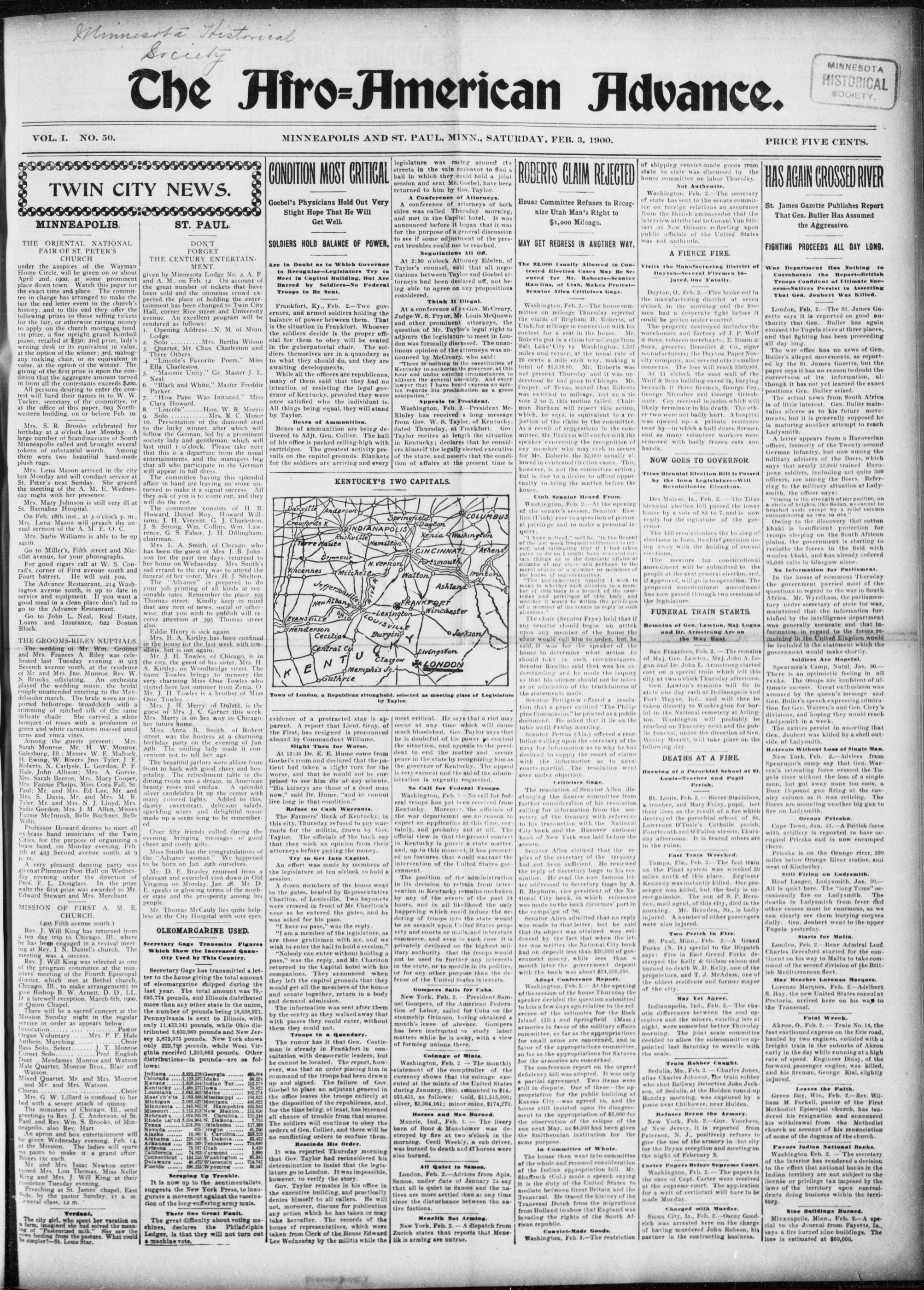
KENTUCKY'S TWO CAPITALS.
Danville Anderson
Crawfords K
INDIANAPOLIS
Rushville
Namib
Terre Haute
Simmons
N. Vernon
Vincennes
Mitcheler
Jeffersonville
New Albany
OHIO
EYANSVILLE
Henderson
Cecilia
Central Cu
KENTUCKY
Memphis J
Guthrie
Town of London, a Republican stronghold by T
Danville Anderson
Crawfords K
INDIANAPOLIS
Rushville
Hamilton
Hamilton
CINCINNAT
Athens
Terre Haute
Smyrna
N. Vernon
Portsmouth
Vincennes
Mitchelt
Walton
Ironton
Jeffersonville
New Albany
OHIO
FRANKPORT
Lexington
WINCHESTER
EVANSVILLE
Henderson
Cecilia
Burgin
Jackson
Central Cu
Clasgow
Memphis J. E.
Guthrie
COLUMBUS
Dayton
Xenia Washington
Athens
Portsmouth
Ironton
Ashtand
FRANKPORT
WINCHESTER
LOUISVILLE
Livingston
LONDON
Town of London, a Republican stronghold, selected as meeting place of Legislature by Taylor.
evidence of a protracted stay is apparent. A report that Lieut. Gray, of the First, has resigned is pronounced absurd by Commandant Williams.
most critical. He says that a riot may occur at any time which will cause much bloodshed. Gov. Taylor says that he is doubtful of his power control
Slight Turn for Worse.
At 12:30 Dr. E. H. Hume came from Goebel's room and declared that the patient had taken a slight turn for the worse, and that he would not be surprised to see him die at any minute. "His kidneys are those of a dead man now," said Dr. Hume, "and he cannot live long in that condition."
**Refuse to Cash Warrants.**
The Farmers' Bank of Kentucky, in this city, Thursday refused to pay warrants for the militin, drawn by Gov. Taylor. The officials of the bank say that they wish an opinion from their attorneys before paying the money.
Try to Get Into Capitol.
An effort was made by members of the legislature at ten o'clock to hold a session.
A dozen members of the house went to the gates, headed by Representative Chariton, of Louisville. Two bayonets were crossed in front of Mr. Chariton's nose as he entered the gates, and he was asked for his pass.
"I have no pass," was the reply.
"I am a member of the legislature, as are these gentlemen with me, and we wish to enter the hail to hold a session."
"Nobody can enter without holding a pass," was the reply, and Mr. Chariton returned to the Capital hotel with his companions. They announced when they left the capitol grounds that they would get all the members of the house and senate together, return in a body and demand admission.
The information was sent after them by the sentry as they walked away that with passes they could enter, without them they could not.
Troops in a Quandary.
The rumor has it that Gen. Casteleman is already in Frankfurt in consultation with democratic leaders, but he cannot be located. The report, however, was that an order placing him in command of the troops had been drawn up and signed. The failure of Gov. Goebel to place an adjutant general in the office leaves the troops entirely at the disposition of the republicans, and, for the time being, at least, has lessened all chance of trouble from that source. The soldiers will continue to obey the orders of Gen. Collier, and there will be no conflicting orders to confuse them.
Rescinda His Order.
It was reported Thursday morning that Gov. Taylor had reconsidered his determination to insist that the legislature go to London. It was impossible, however, to verify the story.
Gov. Taylor remains in his office in the executive building, and practically denies himself to all callers. He will not, moreover, discuss for publication any action which he has taken or may take herafter. The records of the house of representatives, which were taken from Clerk of the House Edward Lee Wednesday by the militia while the
legislature was racing around the streets in the vain endeavor to find a hall in which they could hold a joint session and seat Mr. Goebel, have been returned to him by Gov. Taylor.
A Conference of Attorneys.
A conference of attorneys of both sides was called Thursday morning, and met in the Capital hotel. It was announced before it began that it was for the purpose of a general discussion to see if some adjustment of the press troubles could not be reached.
Negotiations All Off.
At 2:50 o'clock Attorney Edenel, of Taylor's counsel, said that all negotiations between Taylor and Goebel attorneys had been declared off, not being able to agree on any propositions considered.
Think It Illegal.
At a conference of ex-Gov. McCreary, Judge W. S. Pryor, Mr. Louis McQuinn and other prominent attorneys, the question of Mr. Taylor's legal right to adjourn the legislature to meet in London was formally discussed. The unanimous opinion of the attorneys was announced by McCreary, who said: "There is nothing in the constitution of Kentucky to authorise the governor, at this hour and under existing circumstances, to adjourn the general assembly. And every lawyer that I have heard express an opinion regards his proclamation as a gross
Appeals to President.
Washington, Feb. 2.—President McKinley has received a long message from Gov. W. S. Taylor, of Kentucky, dated Thursday, at Frankfort. Gov Taylor recites at length the situation in Kentucky; declares that he considers himself the legally elected executive of the state, and asserts that the condition of affairs at the present time is
Springfield Dayton COLUMBUS COLIS Xenia Washington CINCINNATI Athens Portsmouth Watton Ironton Ashland FRANKFORT WINCHESTER VILLE Jackson Livingston LONDON d. selected as meeting place of Legislature Taylor.
most critical. He says that a riot may occur at any time which will cause much bloodshed. Go. Taylor says that he is doubtful of his power to control the situation, and appeals to the president to end the matter and secure peace in the state by recognizing him as the governor of Kentucky. The appeal is very earnest and the aid of the administration is urgently requested.
No Call for Federal Troops.
Washington, Feb. 2. - No call for federal troops has yet been received from Kentucky. Moreover, the officials of the war department see no reason to expect an application at this time, certainly, and probably not at all. The official view is that the present contest in Kentucky is purely a state matter, and, up to this moment, it has presented no features that would warrant the intervention of the United States government.
The position of the administration in its decision to refrain from intervention in Kentucky remains unshaken by any of the events of the past 24 hours, and in all likelihood the only happening which could induce the ordering of troops into the state would be an assault upon United States property and courts or mails, and interstate commerce, and even in such case it is privately declared on the highest military authority that the troops would not be used to further any interests in the state, or to middle in its politics, or for any other purpose than the defense of the United States interests.
Gompers Sails for Cuba
New York, Feb. 2. — President Samuel Gompers, of the American Federation of Labor, sailed for Cuba on the steamship Orinoco, having obtained a month's leave of absence. Gompers has been instructed to study labor matters while he is away, with a view of forming unions there.
Colnage of Mints.
Washington, Feb. 2. — The monthly statement of the comptroller of the currency shows that the coinage executed at the mints of the United States during January, 1900, amounted to $14, 053,431, as follows: Gold, $11,515,000 silver, $2,364,161; minor coins, $174,270
Horse and Man Burned
Muncie, Ind., Feb. 2. — The livery barn of Boor & Munshower was destroyed by fire at two o'clock in the morning. Cecil Weekly, a cab driver was burned to death and 47 horses were also burned.
All Quiet in Samoa.
London, Feb. 2.—Advices from Apla, Samoa, under date of January 24 say that all is quiet in Samoa and the natives are more settled than at any time since the disturbance between the native factions.
Meelik Not Arming
New York, Feb. 2. — A dispatch from Zurich states that reports that Menelik is arming are untrue.
ROBERTS CLAIM REJECTED
House Committee Refuses to Recognize Utah Man's Right to $1,000 Mileage.
MAY GET REDRESS IN ANOTHER WAY.
The $2,000 Usually Allowed in Contested Election Cases May Be Secured for Mr. Roberts—Senator Hawkins, of Utah, Makes Protest—Senator Allen Criticizes Gage.
Washington, Feb. 2. The house committee on mileage Thursday rejected the claim of Brigham H. Roberts, of Utah, for mileage in connection with his contest for a seat in the house. Mr. Roberts put in a claim for mileage from Salt Lake City to Washington, 2,597 miles and return, at the usual rate of 20 cents a mile each way, making a total of $1,638.80. Mr. Roberts was not present Thursday and it was understood he had gone to Chicago. Mr. Cooper, of Texas, moved that Roberts was entitled to mileage, but on a tie vote 2 to 2, this motion failed. Chairman Barham will report this action, which, he says, is equivalent to a rejection of the claim by the committee. As a result of suggestions in the committee, Mr. Barham will confer with the speaker concerning the recognition of any member who may seek to secure for Mr. Roberts the $2,000 usually allowed in contested election cases. This, however, is not the committee action; but is due to a desire to afford opportunity to bring the matter before the house.
Utah Senator Heard From.
Washington, Feb. 2.—At the opening of the senate's session, Senator Rawlins (Utah) rose to a question of personal privilege and to make a personal inquiry.
"I have musted," and he, "in the Record of the last week frequent references to myself, and intimating that if I had taken pains to do so I might have revealed certain things as to the domestic affairs of citizens of my state, and perhaps, to the moral status of a member or members of the government of representatives.
"The parliamentary inquiry I wish to make is whether such allusion to a member of this body is a breach of the courtesies and privileges of this body, and whether it would be within the privileges of the senate to reply to such allusions."
The chair (Senator Frye) held that if any senator should begin an attack upon any member of the house the chair would call him to order, but, he said, it was for the speaker of the house to determine what action he should take in such circumstances. Senator Rawlin said that his understanding and he made the inquiry so that his silence should not be taken as an admission of the truthfulness of the statements made.
Senator Pettigrew offered a resolution that a paper entitled "The Philippine Commission" be printed as a public document. He asked that it lie on the table until Friday morning.
Senator Pettus (Ala.) offered a resolution calling upon the secretary of the navy for information as to why he had declined to supply the court of claims with the information as to naval courts-martial. The resolution went over under objection.
Criticises Gage.
The resolution of Senator Allen discharging the finance committee from further consideration of his resolution calling for information from the secretary of the treasury with reference to his transaction with the National City bank and the Hanover national bank of New York was laid before the senate.
Senator Allen claimed that the replies of the secretary of the treasury had not been sufficient. He reviewed the reply of Secretary Gage to his resolution. He read the now famous letter addressed to Secretary Gage by A. B. Hephur, vice president of the National City bank, in which reference was made to the bark directors' part in the campaign of '96.
Senator Allen admitted that no reply was made to that letter, but he said that its object was attained was evidenced by the fact that when the letter was written the National City bank had on deposit less than $20,000 of government money, while less than a month later the government deposit with the bank was about $24,000,000.
Adopt Conference Report.
Washington, Feb. 2. At the opening of the session of the house Thursday the speaker decided the question submitted to him a few days ago relative to the reference of the estimates for the Rock Island (II.) and Springfield (Mass.) armies in favor of the military affairs committee, so far as the appropriations for small arms are concerned, and in favor of the appropriations committee, so far as the appropriations for fixtures for the armies are concerned.
The conference report on the urgent deficiency bill was adopted. It was only a partial agreement. Two items were still in dispute. One of these—the appropriation for the public building at Kansas City—was agreed to, and the house still insisted upon its disagreement to the appropriation of $5,000 for the observation of the eclipse of the sun next May, as $4,000 had been given the Smithsonian institution for the same purpose.
In Committee of Whole.
The house then went into committee of the whole and resumed consideration of the Indian appropriation bill. Mr. Shaafroth (Col.) made a speech saying it is the duty of the United States to mediate between Great Britain and the Transavail. He traced the history of the Transavail Dutch from the migrations from Holland to show that England was invading the rights of the South African republic.
Convict-Made Goods.
Convict-Made Goods. Washington. Feb. 2. The restriction
of shipping convict-made goods from state to state was discussed by the house committee on labor Thursday.
Not Authentic.
Washington, Feb. 2. —The secretary of state has sent to the senate committee on foreign relations an assurance from the British ambassador that the interview attributed to Consul Van Stittart at New Orleans reflecting upon public officials of the United States was not authentic.
A FIERCE FIRE
Visits the Manufacturing District of Dayton-Several Firemen Injured, One Fatally.
Daytor, O., Feb. 2.—Fire broke out in the manufacturing district at seven o'clock in the morning and the firemen had a desperate fight before it could be gotten under control. The property destroyed includes the warehouses and factory of J. P. Wolf & Sons, tobacco merchants; E. Bimm & Sons, grocers; Benedict & Co., oligar manufacturers; the Dayton Paper Novel company, and several other smaller concerns. The loss will reach $500,000. At 11 o'clock the east wall of the Wolf & Sons building caved in, burying beneath it three firemen, George Coy, George Nicunaber and George Griesheim. Coy received injuries which will likely terminate in his death. The other two were not badly hurt. A hospital was opened up—a private residence near by—in which a half dozen firemen and as many volunteer workers were removed with badly frozen ears and hands.
NOW GOES TO GOVERNOR.
Titus Biennial Election Bill is Passed
by the Iowa Legislature—Will
be Signed into Law
Des Moines, 1a., Feb. 2. — The Titus biennial election bill passed the lower house by a vote of 83 to 7, and is now ready for the signature of the governor.
The bill revolutionizes the holding of elections in Iowa, its chief provision doing away with the holding of annual elections.
The measure for constitutional amendment will be submitted to the people at the next general election, and, if approved, will go into operation. The proposed constitutional amendment has now passed through two sessions of the legislature.
FUNERAL TRAIN STARTS
Reminis of Gen. Lawton, Mj. Logan
and Dr. Armstrong Are on
the Way Enst.
San Francisco, Feb. 2. — The remains of
Mj. Lawton, Lawton, Mj. John A. Logan
and Dr. John L. Armstrong started
east on a special train which left this
city at two o'clock Thursday afternoon.
Gen. Lawton's remains will lie in
state one day each at Indianapolis
and Fort Wayne, Ind., and will then be
taken directly to Washington for burial in the National cemetery at Arlington. Washington will probably be reached on Thursday next and the public
funeral, under the direction of Gen.
Wesley Merritt, will take place on the
following day.
DEATHS AT A FIRE.
St. Louis, Feb. 2. — Sister Stanislaus, a teacher, and Mary Foley, pupil, lost their lives as the result of a fire which destroyed the parochial school of St. Lawrence O'Toole's Catholic parish, Fourteenth and O'Failon streets, Thursday afternoon. It is feared others are in the rains.
Fast Train Wrecked.
Tampa, Fla. Feb. 2. -The fast train on the Plant system was wrecked 20 miles north of this place. Engineer Kennedy was instantly killed. One passenger was killed, but the body is unrecognizable. The son of S. P. Hernden, mail agent, of this city, died in the morning. Mr. Hernden, Sr., is badly injured. A number of other passengers were also injured.
Two Perish in Fire.
St. Paul, Minn., Feb. 2—A Grand Forks (N, D.) special to the Dispatch says: Fire in East Grand Forks destroyed the Kelly & Gilliam saloon and burned to death W, D. Kelly, one of the proprietors, and T. J. McAdam, one of the oldest residents and former mayor of the city.
May Yet Agree.
Indianapolis, Ind., Feb. 2.—The chaotic differences between the coal operators and the miners, existing late at night, were somewhat better Thursday morning. The joint scale committee decided to allow the subcommittee appointed last Saturday to wrestle with the scale.
Train Robber Caught
Sedalia, Mo., Feb. 2. — Charles Jones, alias Charles Johnson, the train robber who shot Railway Detective John Jackson, of Sedalia, at the Holden round-up Monday morning, was captured by a nose near Chihowee, near Holden.
Refuses Bryan the Armory.
New York, Feb. 2.—Gov. Voorhees, of New Jersey, it is reported from Paterson, N. J., positively refuses to give the use of the armory in that city for the Bryan reception and meeting on the night of February 3.
Carter Papers Before Supreme Court.
Washington, Feb. 2. — The papers in the case of Capt. Carter were received at the supreme court. The application for a writ of certiorari will have to be made Monday.
Charged with Murder.
Sioux City, Ia. Feb. 2.—Oscar Goodrich was arrested on the charge of having murdered John Robinson, his partner in the contracting business.
MINNESOTA HISTORICAL SOCIETY.
PRICE FIVE CENTS.
HAS AGAIN GROSSED RIVER
HAS AGAIN GROSSED RIVER
St. James Gazette Publishes Report That Gen. Buller Has Assumed the Aggressive.
FIGHTING PROCEEDS ALL DAY LONG.
War Department Has Nothing to Corroborate the Report-British Troops Confident of Ultimate Success-Natives Persist in Asserting That Gen. Joubert Was Killed.
London, Feb. 2.——The St. James Gazette says it is reported on good authority that Gen. Buller has again crossed the Tugela river at three places, and that fighting has been proceeding all day long.
The war office has no news of Gen. Buller's alleged movements, as reported by the St. James Gazette, but the paper says it has no reason to doubt the correctness of its information, although it has not yet learned the exact positions Gen. Buller seized.
The actual news from South Africa is of little interest. Gen. Buller maintains silence as to his future movements, but it is generally supposed he is maturing another attempt to reach Ladysmith.
A letter appears from a Hanoverian officer, formerly of the Twenty-second German infantry, but now among the military advisers of the Iboes, which says that nearly 10,000 trained European soldiers, including not quite 300 officers, are among the Boers. Referring to the military situation at Lady-smith the officer says: "Return to the strength of our position, on a circle of heights, like Sedan, we cannot be brushed aside except by a relief column outnumbering us two to one." Owing to the discovery that cotton khaki is insufficient protection for troops sleeping on the South African plains, the government is starting to recothe the forces in the field with woolen khaki, and has already ordered 93,000 suits in Glasgow alone.
No Information for Parliament.
In the house of commons Thursday the government parried most of the questions in regard to the war in South Africa. Mr. Wyndham, the parliamentary under secretary of state for war, maintained that the information furnished by the intelligence department was generally accurate and that information in regard to the forces remaining in the United Kingdom would be included in the statement which the government would make shortly.
Soldiers Are Hopeful.
Spearman's Camp, Natalh, Jan. 30.—There is an optimistic feeling in all ranks. The troops are confident of ultimate success. Great enthusiasm was aroused by the queen's message and Gen. Buller's speech expressing admiration for Gen. Warren's and Gen. Clery's divisions, and hoping they would reach Ladysmith in a week. The natives persist in asserting that Gen. Joubert was killed by a shell outside of Ladysmith.
Retreats Without Loss of Single Man,
New York, Feb. 2.—Advices from Spearman's camp say that Gen. Warren's retreating force crossed the Tugela river without the loss of a single man, but got away none too soon, a Boer 15-pound gun firing at the cavalry column as it was retiring. The Boers are mounting another big gun to fire on Ladysmith.
Occupy Prieksn.
Cape Town, Jan, 31.—A British force with artillery is reported to have occupied Prieska and is now encamped there.
Prieska is on the Orange river, 100 miles below Orange River station, and west of Kimberley.
(iii) Firing on Ladysmith.
Hoof Langer, Ladysmith, Jan. 30.—All is quiet here, the "long Tons" occasionally fire on Ladysmith. The deaths in Ladysmith from fever and other causes must be enormous, as we can clearly see them burying corpses daily. Gen. Joubert went to the upper Tugela yesterday.
Starts for Malta.
London, Feb. 2.—Rear Admiral Lord Charles Bereford started for the continent on his way to Malta to take command of the second division of the British Mediterranean fleet.
Hay Renches Lorenzo Marques.
Lorenzo Marques, Feb. 2.—Adelbert S. Hay, the new United States consul at Pretoria, arrived here on his way to the Transvaal.
Fatal Wreck.
Akron, O., Feb. 2. — Train No. 14, the fast eastbound express on the Erie road, hauled by two engines, collided with a freight train in the suburbs of Akron early in the day while running at a high rate of speed. Engineer Diday, of the forward passenger engine, was killed, and his fireman, George Kial, slightly injured.
Leaves the Faith
Green Bay, Wis., Feb. 2.—Rev. William M. Forkell, pastor of the First Methodist Episcopal church, has tendered his resignation and announced his withdrawal from the Methodist church on account of his renunciation of some of the dogmas of the church.
Vavors Indian National Banks
Washington Feb. 2. — The secretary of the interior has rendered a decision to the effect that national banks in the Indian territory are not subject to the license or privilege tax imposed by the laws of the territory upon nonresidents doing business within the territory.
Nine Buildings Burned.
Minneapolis, Minn., Feb. 2.—A special to the Journal from Fayette, Ia., says a fire burned nine buildings. The logs is estimated at $60,000.
Published every Saturday by the
Tel. Main 2460-L-1.
Minneapolis, - - - - - - Minnesota.
Entered at the Post Office, at Minneapolis, Minn., as second-class matter.
Subscription Rates:
One Year ..... $1.00
Six Months ..... .60
Three Months ..... .20
Subscription Always Payable in Advance.
Advertising Rates
Local Reading Notices, 10c per line
each insertion.
Religious Notices (not over five lines)
free.
"Want" and "To Let" advertisements
$ cents per line for each insertion. Disp.
to cents per inch each insertion.
Special rates will be given for space by the
space.
Editorial Announcements:
To secure the return of unsolicited manuscript postage should be enclosed. Communications must reach the office by Wednesday morning, preceding the issue in which they are to appear. All communications, enclosing news matter for publication, must bear the writer's name, not for publication, but as an evidence of good faith. Contributions and items of news concerning the progress of the colored race are requested from our readers. We reserve the right to reject any communication unavailable for publication. Subscribers ordering addresses of their paper changed are required to give their address. Address all communications and make all remittances to THE AFRO-AMERICAN ADVANCE. 605 Northwestern Building.
JAMES L. CURTIS, Esq., EDITOR
MRS. GROE, DUCKETT, Associate Editor
EDITORIAL
Beginning next week, we shall have our collector to call personally on each delinquent subscriber and we hope that they will evince their good wishes for the future of the "Advance" by paying up. With the assistance and encouragement of the subscribers and the public generally we promise in the near future a paper of which the Twin Cities may be justly pround.
We were the recipient of a letter this week from Prof. Booker T. Washington, in which among other things, he wishes the Advance Godspeed, and enclosed his interview in the Atlanta Constitution on the Hardwick Bill and his address before the Southern Industrial Convention.
TWO REPORTS.
Chief Constructor Hiechborn Favors Accepting the Holland, the Submarine Craft.
Secretary Long received from the board on naval construction two reports on the Holland submarine bote. The Holland company had offered to sell the Holland to the government for $165,000, to embody certain improvements in her and sell her for $170,000, or, finally, to build two new and larger boats for $170,000 each. Four of the members of the board united in a majority report favoring the rejection of the propositions, based on the fact that the company is now a delinquent in the case of the submarine boat Plunger, on account of which the government has already paid $99,716, with no likelihood of her completion in the near future. If the company makes satisfactory settlement for the Plunger, then the board will be willing to build one of the larger boats, but not to purchase the Holland.
The chief constructor, Admiral Hieborn, submits a minority report declaring that the majority did not give sufficient credit and encouragement to the enterprise of the company. He declares that the results obtained with the Holland were very satisfactory, and that in view of the small cost of submarine boats the government should accept the Holland and order two larger boats. The immediate possession of the bopt in an emergency would be an advantage, and her possession in the spring of 1808 (just before the Spanish war) would have been very marked in its effect.
MAY TAKE A WIFE.
Rumor to the Effect That the Head of the Vanderbilt House Is to Be Married.
Alfred Gwynne Vanderbilt did not sail for Europe on the Campania the other day, although there was a report that he intended to do so. Instead, he was looking at cottages in Newport, where the rumor was that he intended to be married. To this, however, denials were made from the most authoritative sources. It was supposed that Mr. Vanderbilt would resume his journey around the world and rejoin his friends, who are now traveling in Asia. Nearly a score of acquaintances of the young man were at the Cunard line pier for the purpose of bidding him bon voyage. Not seeing his name upon the passenger list, they made inquiries of the purser, who told Mr. Vanderbilt had not engaged passage.
Mr. Vanderhilt, when told of the report that he was about to be married, said that the house hunting, which was evidently the origin of the rumor, had no such significance. He explained that he expected to be alone next summer and that in the absence of the family he would take a house instead of opening "The Breakers."
Many a writer has made a goose of himself by taking a quill in his hand.—Elliott's Magazine.
A Case Wherein a Man Elopes with His Own Wife.
Sigurally Romantic Experience of Arthur K. Lee-Wife Forced to Choose Between Mother and Husband.
Three years ago Arthur K. Lee, of New York, and Miss Tessie Brown, daughter of Charles Brown, a rich contractor, met in Chicago. With them it was the old, old story of love at first sight, but the girl's parents objected to the marriage, and there was an elopement, and now Mr. Lee, after a separation of several months, eloped with his own wife. There is much romance in the story of these lovers. After the hasty marriage the parents of Mrs. Lee received the husband and happiness reigned supreme for a time. Then Mrs. Lee, who is a handsome but rather delicate young woman, came to Utica, N. Y., to receive treatment at St. Luke's hospital. Her husband accompanied her, and soon afterward her mother, Mrs. Brown, came to visit her daughter. An entanglement between husband and the mother-in-law followed, and finally Mrs. Lee left the hospital with her husband. She was not fully recovered, and about a year ago returned to Utica to undergo a surgical operation.
Th husband and mother-in-law met again, and history repeated itself. Then Mrs. Lee was requested to choose between her husband and her family and preferred the latter. Mr. Lee immediately met to his ranch in Deming, N. M., and his wife returned to Chicago and brought suit for divorce. In October last she again came to Utica, and after a conversation with a friend formal letters were exchanged by wife and husband. They met in Utica in December and matrimonial differences were satisfactorily settled. An elopement was then decided upon and the event was to take place a week ago, but the maternal eye was bright. It was not until Mrs. Lee obtained a letter from a Chicago attorney stating that she would have to appear in Chicago before February 1 that she obtained permission to leave her mother, who is ill at her summer home near Utica. The letter was received Tuesday, and Thursday morning Mr. and Mrs. Lee eloped for the second time.
Mr. Lee is a wealthy young New Yorker and a brother of Charles H. Lee, of the hide and leather trust. His grandfather, Gideon Lee, was mayor of New York. The father of Mrs. Lee lives in Chicago and they are now en route to that city.
GOES TO HIS DOOM
Fox Squirrel Digs Its Way Into Eagle's Cage at Lincoln Park and Is Killed.
A fox squirrel, which had trumped down from Niles Center district, wandered into Lincoln park, Chicago, the other forenoon. It skipped around until it came to the cage of the eagles and hawks, near the animal house. It thought the eagle's house would be a fine place to get into, and it began digging under the wire netting at the side of the cage.
Born in the idea that only work conquers, it scratched under the cage and came up inside. Scarceely had its head appeared within the house when a great golden eagle, which was roosting at the top of the cage, closed its wings and dropped like a shot. The squirrel fell within the clutches of the powerful talons. The eagle flew to the top of the cage with its prey. The rest of the winged inmates of the house began a flight for the carcass.
The golden eagle tore a piece from the head of the squirrel, and then, in the stress of the combat, dropped the carcass. The victor recovered it and flew to the highest perch again. Hawks and eagles flew about and fought hard for a bite of the little red body, but the conqueror held his prey and ended by devouring the squirrel. A hundred men and women stood about and watched the struggle.
COLONISTS RETURN.
Hard-Luck Experiences of Men Who Went to Seek Their Fortunes in Cuba.
Among the passengers who arrived at New York the other day on the Munson line steamship Curityba from Nuevita, Cuba, were returning colonists from La Gloria, all apparently discouraged with their experiences in Cuba. Among the number were B. S. Childworth, Ohio; Albert Schauk, Mansfield, O; W. T. Gould and J. W. Rhodes, Illinois, and J. W. Welding, Chicago.
Mr. Schauk stated that he had started to reach La Gloria from Nuevitas, but he could not stand the harriships, and after going half the distance turned back. The land, he said, after one had paid six prices for it, could not be cleared for less than $40 an acre, and several years would be required to make it productive, and even then, unless new facilities were constructed, there would be no way of getting the product to a market without paying many times its actual value for freight.
Grounds for Grumbling
A Syracuse paper refers editorially to a man who had "to rise at five a. m. in the morning." Still, his case wasn't so bad, thinks the Chicago Times-Herald. If he had been called upon to get up at five a. m. in the evening he might well have grumbled.
Evidently on the Bias.
In Mexico it is proposed to create a fund for the widows of condemned criminals by charging the public for admission to the executions. The Mexican philanthropist, says the New York Press, evidently has a Chinese mind.
Protection at Both Ends.
A nervous drummer, who carries with him wherever he travels a coil of rope, was asked by the landlord of a small hotel up in Shaatta county what the rope was for. "That a fire escape," explained the drummer, "and I always have it with me so in case of fire I can let myself down from the window." He landlord, "but guests with fire escapes趣 in advance at this hotel." -San Francisco Wave.
A Bad Case.
Doctor - You are troubled with insomnia
during a terrible trip can even sleep
when you are tired.
CO-ED'S PLIGHT.
Her Calloused Neck Necessitates
Wearing Street Gown to Party
and It Causes Talk.
Northwestern university social circles at Evanston, Ill., were stirred the other day over the reported appearance of one of the college belles at a dancing party Tuesday night in an ordinary street costume. The young woman in question is a member of the ruling set at Northwestern, and since her first appearance has attracted widespread attention because of her gorgeous gowns.
On the street she has worn high collars which produced a callous on her neck. She did not realize this until the evening for the party arrived. When she attempted to wash the dark mark off it clung as fiercely as a rubber band. Then she remembered having seen pictures in the street cars representing Little Eva turning Uclef Tom into a white man by the use of a certain burnisher. She secured a cake and began to rub desperately. The mark grew redder as little particles of cuticle were peeled from her neck, and when she realized that she could not appear in evening dress, did the only thing possible under the circumstances—wore a street gown.
GIVES ADVICE TO HER SEX.
Mrs. Hetty Green Thinks Every Woman Should Have Business Education.
Mrs. Hetty Green, the richest business woman in the world, has a thoroughly characteristic article of advice to women in the Woman's Home Companion. Mrs. Green thinks every woman, be she maid, wife, mother or widow, should have a business training. In Mrs. Green's opinion every girl who enters upon her womanhood with her mind fully equipped with a business education will be saved from a great deal of pain and will find much more happiness in everyday life than the girl who becomes a woman with only the conventional sort of schooling—the schooling that teaches her how to read, write, sing, cook and sew.
As the English Boy saw it.
An English weekly recently asked for short essays by boys on current topics and printed them without editing. Hereina specimen: "Kruger and Kannerbulum is one. He is a man of blud. Mr. Chamberlain has wrote to him saying come out and sit give up the blud of the English you have took. he is a boar-dutchman and a wickled heehin. lord Kitehener has sent for his goary blud and to bring back his scanderlus head den or alive."
On Sights and Scenes of the Campaign in the...
Philippine Islands
BY BENJ. OHRMAN.
Of the 13th Regiment, Friday night
January 26, at St. PETERS CHURCH.
Admission 15c. Children 19c
3030 STATE ST..
LIQUORS AND CIGARS. Chicago.
BIJOU TRUNK FACTORY
WM. LORENZ, Prop.
Trnunks & Traveling Bags
Sample Trunks and Cases
Made to Order.
18-20-22 Wash. Av. N., Minneapolis, Minn.
Branch: Fifth and Nicollet.
Cutting, Fitting and Making Over a Specialty. New York and Paris Fashions Always on Hand. Parts, 628 Fourteenth Ave. South.
DR. R. S. BROWN
Office: 405-6 Reeve Bldg., 408 Nicollet Av.
Telephone 23743-J-5.
Office Hours: 9:30 to 12:30; 2:00 to 4:00
p. m.; 1:30 to 7:00 p. m. Sundays: 9:30
to 11:00; 12:30 to 2:30.
Evidence, Baltimore Ave. Telephone:
516-255-5277 South
Richelieu Restaurant,
311 Everett Street (North).
PORTLAND, - OREGON.
H. PERRY, Manager.
Meals at all Hours, Night or Day
The Very Best Coffee a Specialty.
MR. L. A. JOHNSON.
The gentlemenly and obliging Porter
at R. De Leo's Barber Shop, 200 Washington Av. South, is
Always Ready to Dress Your Shoes
in a thoroughly artistic manner, that is sure to win.
JAMES L. CURTIS,
—LAWYER—
603 Northwestern Bldg., Minneapolis.
Cor. 4th St. and Heinepin Av.
Telephone, Main 2400-L-1.
MRS. W. F. HALL,
Furnished Rooms
TABLE BOARD IF DESIRED.
Prices Reasonable.
240 East Seventh St.
Up-Stairs.
St. Paul. Minn.
BUY THE BEST OF CHAS. E. BATTLES UNIVERSAL STEEL RANGES AND HEATING STOVES.
370 JACKSON. ST. PAUL.
THE ADVANCE CAFE
214 WASHINGTON AV. SOUTH.
Restaurant and Lunch Counter
MANN & KOGER. Proprietors.
SOCIETY DIRECTORY.
Officers and Standing Committees of the Most Worshipful Grand Lodge A. F. and A. G. Grand Master-John L. Neak, Minneapolis
Deputy Grand Master-Wade H. Hampton, West Superior.
Grand Senior Warden-H. B. Howard, Grand Junior Warden-J. C. Garner, St. Paul.
Grand Treasurer-Daniel Roy, St. Paul.
Grand Secretary-William R. Morris, Minneapolis.
Grand Lecturer—G. W. Day (7), Minneapolis
Grand Secretary—O. D. Howard (4), St. Paul
Grand Chaplain—Isaac Crawford (6), Minneapolis
Senior Deacon—John Martin (1), St. Paul
Junior Deacon—R. De Leo (7), Minneapolis
Grand Steward—J. H. Dillingham (2), St. Paul
Grand Steward-Wm. Stevens (2), St. Paul
Grand Tyler—T, Bush (3), St. Paul.
Grand Marshal—C, H. McDonald (4).
Grand Marshall—H. McDonald (4).
Grand Pursuivant—G, W. Duckett (4).
St. Paul.
Grand Sword-Bearer—J. Adams (1), St.
Paul.
Grand Standard-Bearer—J. Charles-
ton (2), St. Paul.
Grand Register—J. St. Strett (6),
Minneapolis.
District Deputy Grand Master—First
District Deputy Woodford (5).
District Deputy Grand Master—Second
District—E. H. Hamilton (6), Minneapolis.
District Deputy Grand Master—Third
District Deputy
MINNEAPOLIS
G. U. O. O. O. F.
St. Anthony Lodge, No. 2877.
Meets the first and third Wednesday in
the school year. In absence, 1st avenue N. and Washington,
2nd avenue N. and Washington.
M. MYRICK, G.
JAMES A. SCOTT, Rp. 23
KNIGHTS OF PYTHIAS
Nt. Turner Lodge, No. 2, K. of P.
Meets the second and fourth Thursdays in
standing welcome. At Labor Temple, south
and Eighth avenue south.
RALPH WATSON, K. R. and S. C.
Pride of Minnesota Lodge, No. 1, K.
Meets the first and third Thursdays in
each month. All brothers in good stand-
ing welcome. First avenue north and Washington.
JAMES ROBERTS, C. C.
G. W. LILLARD, W. M.
JASPER CHIBBS, Sec. Guaranty Loan
Restaurant.
Anchor Lodge, No. 7, A. F. and A. M.
Meets the first and second Monday in
each month at Windom Block, Second
South and Washington. Masons in
good standing welcome.
SCOTT, W. M.
A. B. LEE, 701 Aldrich Avenue South.
ODD FELLOWS.
Mars Lodge, No. 2202.
Meets second and fourth Wednesdays in each month. Old Fellows Hall, 323 Wabasha street
T. R. HICKMAN, P. S., 422 Amt. F. D. PARKER, N. G., 395 Edmund St.
Household of Ruth, N. G., 535 G. U. O. of F. F.
Meets first and third Monday in each month for business second Monday for at Old Fellows Hall, 323 Wabasha.
MRS. SARAH C. KIRTLEY, M.N.G. MRS. SARAH A. JACKSON, W. R. 374 Summit place.
MOST WORSHIPFUL GRAND LODGE OF MINNESOTA, A. F. and A. M. H. B. HOUSTON, Grand Master. WM. H. B. HOUSTON, Grand Master. 87 Guaranty Loan Bridge, Minneapolis.
ST. PETER CLAYER'S SODALITY.
Meets the first and third Mondays of each month. W. J. Gardner, Pres. J. S. Harper, Pres. J. S. Harper.
Pioneer Lodge, No. 1, A. F. and A. M. Meets the first Monday in each month at Masonic Hall, southwest corner Fifth and Robert streets. Master Masons in good standing always. H. S. HADLEY, W. M. W. A. HILYXARD, Sec. 124 Atwater.
Minnesota Lodge, No. 2, A. F. and
Meets on the first and third Tuesday in each month at Masonic Hall, southwest corner of Fifth and Robert streets. Mason Masons in good standing always welcome.
H. W. BOWMAN, Y. M.
J. S. STRONG, 12th and Robert at.
Perfect Ashler Lodge, No. 4. A. F. and A. M.
Meets second and fourth Tuesday in each month at Masonic Hall, southwest corner Fifth and Robert streets. Master Masons in good standing always welcome.
ANDREW JACKSON, W. M.
D. E. BEASLEY, Sec. Ryan Hotel.
Perfect Ashler Lodge, No. 4. A. F.
Meets the second and fourth Tuesday in each month at Masonic Hall, southwest corner Fifth and Robert street. Master Masons in good standing always welcome.
E. W. CRANUM, Sec. § Cedar.
Bethel Chapter, No. 28, R. A. M.
Meets first and third Tuesday in each month at Masonic Hall, southwest corner of Fifth and Robert streets. Royal Arch Masons in good standing always welcome.
DANIEL ROY, H. P.
W. T. GASSAWY, Sec. State Capitol.
CHURCH DIRECTORY.
ST. PETER A. M. E. CHURCH.
Rev. W. S. Brooks, Pastor.
For 251 st, 9th ave. South
Sunday school, 3:00 p.m. 11:30 a.m.
; Sunday School, 3:00 p.m. ; evening
services, 8:00 p.m. General prayer meet-
ing, Thursday evening, 8:00 p.m. Way-
ward service, Friday evening, 8:00 p.m.
different residences. Parsonage, 2200
Ninth avenue South
Bethlehem JUSTIST CHURCH.
Between Eleventh and Twelfth avenues.
Sunday services; Preaching, 11:00 a.m.
; Sunday School, 12:30 p.m. Christian
behavior, Wednesday evening, service,
8:00 p.m.
Wednesday evening, prayer meet-
ing, 8:00 p.m. Parsonage, 1130
Eighth street South
JUSTIST CHURCH.
Rev. John J. Faude, in Charge,
615 Sixth avenue South.
Sunday service: 4:00 p.m. ; Sunday
School, 8:00 p.m.
ST. JAMES A. M. E. CHURCH.
Rev. J. W. King, Pastor.
Between First avenue and Second street
Sunday services. Preaching at 11:00 a.m.
; Sunday School, 3:00 p.m. ; evening
services, 8:00 p.m. General prayer meet-
ing. Weekly meetings of the Debating Club.
ST. PAUL.
# OTHER PRINTING
Cor. Fartington, 8 a.m. avenues.
Sunday services: Mass, 8:00 a.m. High
mass, 10:30 a.m. m. Evening service at 7
o'clock.
**PLIGRM BAPTIST CHURCH.**
Rev. D. S. O'erer, Pastor,
Cor. Fartington, 8 a.m.
Sunday services: Preaching at 11:30 a.m.
and 14:30 p.m. m. Sunday School at 12:30
o'clock. Wednesday evening general
service.
ST. PHILLIPS' EPISCOPAL MISSION.
463 Rice street, bet. Aurora and University.
Sunday services: Morning prayer, Lit-
any and Sermon. 11:00 a.m. p. Sunday School and Children's Vespers 3:00 p. m. Eveningong and Prayer 8:00 p. m. Tuesday School and Children's Vespers 4:00 p. m. Friday; Choir Rehearsal and Brotherhood of St. Andrew. 8:00 p. m. All are cordially invited. Seats free.
NOTICE—Changes and corrections will be made upon notifying the office. If we have requested to place a notice of any society in the above directory it is because we do not know of it or have not seen its officers. Send notice of any lodge place, time of meeting name of officers and it will be inserted.
OLSON EARL,
..UNDERTAKER...
Funeral Director and Embalmer.
Open Day and Night. Satisfaction Guaranteed.
1503 S. Franklin Ave. Minneapolis.
PATRONIZE THE BEST!
Free Delivery to All Parts of the City and Lake Minnetonka.
Our Motto: First-class Work and Moderate
Prices
Crayon, Pastel and Water Colors a Specialty.
251-253 Cedar Avenue.
MINNEAPOLIS, MINNESOTA.
SEEDS OF FLOWERS Plants and Cut
of Palm Flower On telegraphic or mail
orders any time, day or night. Budding or
House Plants in their section. Cut Flowers.
Fresh cut flowers. Fresh and sweet and
honest, at five cents per packet. Our catalogue
is FREE. Send for it.
MENDENHALL, FLORIST.
414 Nicollet Av., Minneapolis, Minn.
KLAFFKE'S
WHITE SEAL
FLOUR.
119 Central Ave., Minneapolis.
TEL 2701-J-3. NEXT TO YERXA'S.
WONDERFUL
DISCOVERY
Curly Hair Made Straight By
```markdown
```
This wonderful hair pomade is the only safe preparation in the world that makes kinky hair straight as shown above. It nourishes the scalp, prevents the hair from falling out and makes it grow. Sold over 40 years and used by thousands. Advanced healthiness. Testimonials free on request. It is the first preparation ever sold for straightening kinky hair. Beware of limitations. Get the Original Ozonized Ox Marrow, as the genuine never fails to keep the hair pliable and beautiful. A toilet necessity for ladies and gentlemen. Elegantly perfumed. The great advantage of this wonderful pomade is that by its use you can straighten your own hair at home. Owing to its superior and lasting quality it is the most economical. It is not possible for anybody to produce a preparation equal to it. Full directions with every bottle. Only 50 cents. Sold by dealers or send us: $40 Postal or Express Money Order for $3 bottles, express paid. Write your name and address plainly to OZONIZED OX MARROW CO., 76 Wabash Ave., Chicago, Ill.
Magic Seeds
Magic Seeds
A wonderful Nerve
Remedy, that
has no superior and
is guaranteed to
cure all such nervous
diseases as Nervous
Humanism,
Lack of Confidence,
Wakefulness,
Headache,
Nervousness, Lost
Manhood, and all
drains and loss of
power in genera
A wonderful Nerve Remedy, that has no superior and is guaranteed to cure all such nerve diseases. Nervous Prostation, Weak Memory, Lack of Confidence, Wakefulness, Headache, Nervousness, Lost Manhood, and all drains and loss of power in genera of either sex, caused by Overreverition, Youthful Error, Excessive use of Tobacco, Opium, or Stimulants, which lead to Infirmity, Consumption, and Insanity.
Magic Seeds restore the nerve and vigor of youth. Easily carried in the vest pocket. Sent prepaid in plain box by mail to any address, for $1,000, six boxes for $1,000, with a written guarantee to cure or money refunded. Write for free circular.
MAGIC MEDICINE CO.,
MANSFIELD, OHIO.
VICTORINE
THE WONDERFUL NEW
WASHING GOMPOUND
VICTORINE
TRADE MARK
REGISTERED
THE GREATEST BLESSING TO
WOMANKIND
NO BOILING, NO RUBBING
OF CLOTHES REQUIRED.
PREVENTS SHRINKAGE OF WOOLENS.
5c. a Package—Two Week's Washing.
BARBEAU & CALLAHAN,
SOLE MANUFACTURERS, CHICAGO U. S. A.
AGENTS WANTED WHERE NOT REPRESENTED.
Special Reduced Terms During May, June, July and August.
Piano, Organ, Violin, Elocution, Vocal, Chorus, Singing, Theory.
Thorough, Practical, Progressive Methods of Instruction for Beginners as well as Advanced Pupils.
LESSONS GIVEN DAY AND EVENING.
ANDREAS ROHNE, Musical Director.
WILL J. PARKY, Manager and Secretary.
D. H. BOONE, Pres.
N. JOSEPH LLOYD, Sec.
SPEND A PLEASANT EVENING AT THE NORTH STAR SOCIAL CLUB
BILLIARD AND POOL TABLES.
Rooms, Second Floor, 202 Hennepin Avenue.
SONS GIVEN DAY AND EVENING.
HNE, Musical Director.
WILL J. PARRY, Manager and Secretary.
res. N. JOSEPH LLOYD, Sec'y.
PEND A PLEASANT EVENING AT THE
H STAR SOCIAL CLUB
BILLIARD AND POOL TABLES.
Ims, Second Floor, 202 Hennepin Avenue.
D. H. BOONE, Pres. N. JOSEPH LLOYD, Sec'y.
SPEND A PLEASANT EVENING AT THE
NORTH STAR SOCIAL CLUB
BILLIARD AND POOL TABLES.
Rooms, Second Floor, 202 Hennepin Avenue.
DR. THOS. S. COOK.
OFFICE HOURS:
10 TO 12 A. M.; 2 TO 4 P. M.; 7 TO 8 P. M.
TELEPHONE 386.
12TH AND ROBERT STS., S.
Office Telephone 1498-4.
VAL DO TUR
PHYSICIAN A
Office Hours: 8 to 10 a.m.; 12 to 2 p.m.; 4 to
Office, 27 E. 7th St., Kendrick Blk. Res. 35
25 YEARS' EXPERIENCE.
JAS. AMC
Practical Undertake
122 Washington Ave. S.
All our goods are first-class, and the pr
ROBERT STS., ST. PAUL, OVER DRUG STORE
1498-4. Residence Telephone Dale 410-5.
AL DO TURNER, M. D.,
PHYSICIAN AND SURGEON.
40 a. m., 12 to 2 p. m., 4 to 6 p. m.
Kendrick Blk. Res. 333 Sherburn Ave. ST. PAUL, MINN.
EXPERIENCE. TELEPHONE 755.
AS. AMOR & CO.,
General Undertakers and Embalmers.
22 Washington Ave. South, Minneapolis, Minn.
Are first-class, and the prices we guarantee will defy competition.
12TH AND ROBERT STS., ST. PAUL, OVER DRUG STORE
25 YEARS' EXPERIENCE. TELEPHONE 755. JAS. AMOR & CO. Practical Undertakers and Embalmers. 122 Washington Ave. South, Minneapolis, Minn. All our goods are first class, and the prices we guarantee will defy competition.
S. Kierski
COR. FIFTH STREET AND CENTRAL AVENUE
MINNEAPOLIS, MINN.
Smoke "SUN
"BUCKIN
AND "PRIM
CHEW "PEACH AN
STRICTLY UNION
MANUFACTURED BY J. J. BA
PIPE FREE FOR "SUN
e "SUN CURED" Cut Plug,
BUCKINGHAM" Cut Plug,
"PRIME MESS" Granu-
lated.
EACH AND HONEY" FINE CUT
TRICTLY UNION LABEL TOBACCOS.
URED BY J. J. BAGLEY & CO., DETROIT, MICH.
FREE FOR "SUN CURED" LABELS.
MANUFACTURED BY J. J. BAGLEY & CO., DETROIT, MICH. PIPE FREE FOR "SUN CURED" LABELS.
Miller
ST. PAUL, 171-173 E. 7th St.,
Opposite Olympie.
SMOKE THE SIGHT I
W. S. CONRA
400 FIRST AVE
COX & HARRIS,
The Climax I
FOR DISPLAYING GOODS
Any desired angle is quickly obtained
itself in thirty days.
THE SIGHT DRAFT 5-CENT CIGAR.
S. CONRAD, Distributor,
400 FIRST AVENUE SOUTH.
ERRIS, AGENTS.
Climax Display Table
PLAYING GOODS TO BEST ADVANTAGE
This is quickly obtained by turning a thumbscrew. Will pay for
itself in thirty days. Valuable addition to any store. Neatly
SMOKE THE SIGHT DRAFT 5-CENT CIGAR. W. S. CONRAD, Distributor, 400 FIRST AVENUE SOUTH. COX & HARRIS. AGENTS.
The Climax Display Table
FOR DISPLAYING GOODS TO BEST ADVANTAGE
Any desired angle is quickly obtained by turning a thumbscrew. Will pay for itself in thirty days. Valuable addition to any store. Neatly and well finished.
```markdown
```
Twin City Club and
FURNISH
With the Most M
BARBER SHOP A
Where Meals are S
126 Hennepin Ave.
Artistic Monument
Cost No More than Plain Ones in
y Club and Employment Bureau FURNISHED ROOMS With the Most Modern Conveniences. BER SHOP AND RESTAURANT Where Meals are Served at All Hours.
Twin City Club and Employment Bureau
BARBER SHOP AND RESTAURANT Where Meals are Served at All Hours.
Marble is entirely out of date, granite soon gets mossgrown, discolored, required constant exposure, required care, and eventually crumbles back to Mother Birth. Besides it is very expensive.
White Bronze is strictly everlasting. It cannot crumble with the action of frost. Mossgrowth is an impossibility. It is more artistic than a statue of one hundred public monuments, and by thousands of delighted customers in all parts of the country. It has been on the market over twenty years, in establishments across the country. We have designs from $4.00 to $4,000. Were at once for free designs and information. It puts you under no obligations. We deal direct and deliver everywhere.
The Monumental Bronze Co., 360 Howard Avenue, Bridgeport, Conn.
---
J. E. STEWART, SEC'Y.
DR. J. E. PORTER.
OFFICE HOURS:
9 TO 10 A. M.; 1 TO 3 P. M.; 6 TO 7 P. M.
AND NIGHTS.
PHOTOGRAPHER...
UP-TO-DATE PHOTOS.
Copying and Enlarging a Specialty.
PRICES REASONABLE.
PHOTOGRAPHER
Finest Work. Prices Right.
MINNEAPOLIS, 427-429 Nicollet Ave.
Over Yexa's.
T
HENRY MOSLEY, PRES.
Minneapolis, Minn.
Joseph A. B.
EBEN BREWER.
("Eben Brewer, the first United States castmaster in Cuba, was a hero and a martyr.")
Hear the story of Eben Brewer,
Never a bear, soul and truer
In the plunge of the shot and shell!
Never a nobler mercy-doer
When Santiago fell!
Not against the proud Castilian
Went this citizen-civilian
With the dreams of a conqueror;
He was simply a man of the million
Caught in the net of war.
To and fro from grim Balquiri,
Over the treacherous trail and trellain,
Bearing news from the motherland,
The treacherous trail and cheery,
Lending a lifting hand.
Holding the tropic heat a trifle
Where the troops strain and stifle,
In the rush of the forward track,
Out of the range of the deadly rife
Bore he the wounded back.
Then, while the weary soldiers slumbered,
He, where the crowding cots were cumbered,
Cesseless, followed his high behest;
And through the days and nights he num-
Never an hour of rest.
Is it strange that the mortal reaver Swiftly swept him—the fatal fever—to the brains his self-forgetful part? To the breast his receiver Receiver Hastened his hero heart.
Such as he, with no thought of booty, Draining the stirrup-cup of duty. Though the dregs be as bitter gall, Hastened the cup of beauty; Let us honor them all!
Miss Thorne's Will
LAWYER NORTHBROoke had just driven away from Glenthorne, and Elizabeth Everill stood still a moment on the broad terrace, and then, with a sigh, turned and entered the house. Only that day her aunt, Miss Matilda Thorne, had been buried, and Mr. Northbrooke had come down from London to read the dead woman's will. It was simple enough, and those who had known Miss Thorne intimately hardly wondered at its wording:
"To my niece, Elizabeth Everill, provided she marry a man of title, I will and bequeath all my worldly possessions."
"And if I do not marry?" Miss Everill had asked.
"You retain your inheritance," the lawyer answered, with a smile. "Miss Thorne drew up the will herself, and it is deficient on that point."
Elizabeth's mother, Miss Thorne's sister, had run off with Paul Everill, the organist of the church, before she was 18. Her father had forbidden her name to be mentioned in his hearing, and at his death Glenthorne had passed to Matilda unconditionally. She had held no communication with the married sister till she read in a newspaper of the death of Paul Everill, and then she had paid one visit to the dianal London lodging where Mrs. Everill lay dying. There had never been much love between the sisters, but Miss Thorne was willing to take her sister's daughter under her care. So, when the organist's wife was laid beside him, their only daughter had been brought to her mother's home. Masters and governesses had been employed to perfect her education, and her aunt had never wearied of instilling a love of wealth and power and a horror of poverty into the girl's mind. That her words had not fallen on barren ground she would have understood could she have known her niece's thoughts that evening.
She was thinking of a scene that had taken place there just five years before.
Some old paintings had been sadly in need of the attention that only a skillful hand could give, and Miss Thorne had heard Ralph Crosby favorably spoken of, and had asked him to do the work. Elizabeth had been much in the long portrait gallery while Ralph Crosby talked and painted, and at length he had forgotten that he was only a struggling artist and she the niece of the wealthiest woman in the county and had spoken his love. Miss Everill could still remember the haughty stare and mocking smile of her aunt when she spoke of her love for Ralph.
"Love! Your mother loved Paul Everill, I suppose, and you know something of her life. But make your own choice. Marry this young man if you will, but not one farthing of mine will be yours."
And the girl had lain awake till daybreak thinking of the sordid surroundings amid which her childhood had been passed, and of the poverty for which she had such a horror, till at last she was resolved to answer "No" to her lover's pleading.
She winceed even now as she recalled the grief that struggled with a contemptuous pity for her reasoning when she told him the next day that she could not be a poor man's wife, and remembered the few bitter words that fell from his lips as he turned away without seeming to see her out-stretched hand. In the last few days she had thought once or twice, in a vague way, that if Glenthorne should chance to be hers she would find a way of letting him know that she loved him still, that she had loved him always.
"And now—and now," she said to herself, while the shadows grew deeper in the corners of the wide Library, "an insurmountable barrier divides us." She clasped her hands tightly, and, with eyes that were dimmed by tears, gazed into the glowing embers. "Oh, Aunt Matilda, your very kindness is but cruelty. I wonder where Ralph is now? Oh, I almost wish I were a poor girl to-day. And yet, no I couldn't bear that!" And the latter reflection was constantly passing through the girl's mind as time wore on. It was very pleasant to be mistress of the great house and to have money at command. Under her rule Glenthorne became a very pleasant place indeed; and before the year was ended it was whispered that Lord Arthur Kendal was very much in love with her.
Elizabeth heard Ralph Crosby's name mentioned several times later, when she went to London. He was occupied upon a work that was to make a name for him, some said. Others hainted that he was ill, and Miss Everill wondered that her heart should beat so quickly at the sound of his name. She had resolved to accept Lord Arthur. He was rich—much
richer than she—and quite at the top of the social ladder. Certainly she did not love him; he was hardly a man whom any woman could respect. Anyhow, she did not respect him, and yet she would marry him. They were uncongenial spirits, she knew, but what of that?
In such a mood she was going on night to a great ball given by one of the most fashionable women in London. Lord Arthur would be there, and probably she would say "Yes to his pleadings that night. She rather thought she would as she stood before a mirror when her maid had given the finishing touches to her toilet. She had on a white dress, and pearls were on her neck and amid her dusky hair; she was radiantly beautiful.
"Six years ago!" she muttered.
"Six years and more since the day Ralph Crosby said—"
She turned away. Now and again a feeling came over her that she could not understand — a feeling that her wealth and her beauty were not to bring her happiness; and she had grown impatient with herself for feeling so. Generally at such times she was even gayer than usual, and when, some hours later, Lord Arthur sat by her side in a convenient recess in Lady Javeneil's conservatory, he felt that he could almost die for her. There was something in her beauty that night—a sadness in the dark eyes behind their mirth—that he could not understand, "Elizabeth," he whispered, "say Yes!!" and just then the sound of voices reached them.
"And Crosby, the artist, you know, is blind."
"Blind!"
"Quite. He consulted Reynolds yesterday, his case is hopeless."
"Poor beggar! What will he do?"
"I don't know. He hasn't a penny.
He has never steadied himself to work for years. Somebody told me of a girl who jilted him, or something."
Miss Everill rose.
"Lord Arthur, I hope you will never speak to me like this again!"
Lord Arthur bowed. He knew that further pleading would be useless.
Very early on the following morning Miss Everill's carriage stopped at Ralph Crosby's chambers, and Elizabeth was informed that he was at home. She gave no name, but entered the room where he was.
"Ralph!"
It was a voice that he had not heard for six long years, but he recognized it at once, and turned his sightless eyes toward her.
"Elizabeth!" he cried, rapturously, opening his arms, and in an instant she was folded in them.
"But you must not, Elizabeth," he said later, "you must not sacrifice all for me."
"It is no sacrifice," she replied, composedly; "but I am dreadfully afraid that I had to ask you to marry me! I wonder what Mr. Northbrooke will say when he hears of this?" and she laughed.
"What fools women are!" was what the old lawyer said on being apprised of it, and he drew a large envelope from among a number of papers that were in a large box before him.
It was addressed in Miss Thorne's very masculine calligraphy, to himself, and written in one corner were the words:
"To be opened in the event of my niece's marriage."
Inside was a will, properly signed and witnessed, and the old lawyer's face cleared as he glanced at it. There was also an open letter addressed to Miss Everill.
"If you have sold yourself, my niece, take the price of your slavery. If you have been honest enough to marry for love, take your reward. In either case Glenthorne is yours."
"Heaven bless me!" the lawyer exclaimed, "Heaven bless me! There's no understanding a woman! I'm heartily glad, anyhow; and now I must go and tell these two that they won't be beggars after all." -Chicago Herald.
Lucid!
A famous verdict rendered many years ago by a coroner's jury in a case of mysterious death ran thus: "We, the jury of 12 good men and true, duly impaneled and responsible on our consciences, do hereby return the following verdict on the demise of the deceased, namely: That said corpse came to its death through the abrupt ceasing of his heart to perform its natural office, for no reason whatever discernable by man, but solely an act of Providence." If this was not altogether explicit, at least the public knew that there had been no foul play; but what meaning could possibly be attached to the verdict which a legal magazine assures us was rendered, much more recently, by a Missouri court? "We, the jury impaneled, sworn and charged to inquire into the insanguinity of Hezeikiah Jones, do occur in the affirmative." This leaves the matter still shrouded in mystery. Was Hezeikiah, dead, an ensanguined corpse? Was he living, accused of homicide, or merely of insanity? Insanguinity is a resonant and mysterious multisyllable that must leave the every-day jurman in a very uncertain frame of mind. Youth's Companion.
Too Obliging.
The ameer of Afghanistan must surely be a very obliging man, if a story told of him be true. Not many years ago a queen's messenger, or some other official, was on his way to Cabul, when he had the misfortune to be robbed. He was in no way injured by the robbers, but the British government preferred a complaint, which came duly to the knowledge of the ameer. No reply was received, and the months passed. At last the ameer wrote, and his letter showed the earnestness of his desire to oblige the queen. "The matter you mention," said the letter, "has been thoroughly investigated, and not only have the robbers of your messenger been put to death, but all their children, as well as their fathers and grandfathers. I hope this will give satisfaction to her majesty the queen." Nevertheless, it is doubtful if it did. Youth's Companion.
Significance of the Cypress.
The cypress, which is regarded by us as an emblem of mourning and death, has been from ancient times associated with births, marriages and rejoicing in the east. In the Grecian arhipelage when a daughter was born a grove of cypress trees was planted by her father as her future portion, a dowry which increased with the years.
Needs of South America
Some of the Things the Industrial Development of the Country Demands.
SOUTH AMERICA'S PRIMITIVE METHOD OF TRANSPORTATION.
WITH the capital of the world seeking remunerative fields, South America is coming to the front as a place in which profitable investments may be found. Our great sister continent is sharing in the general advance of industry and development which characterizes the closing years of the present century, and from the ice-clad mountains of Terra del Fuego to the tropical forests of the Orinoco river the resources of the continent are attracting the attention of prospective investors and of settlers and prospectors. The ice-clad mountains of the extreme south are yielding gold for the hardy prospectors who have braved the extreme cold with the same zeal shown by miners of Alaska; the tropical forests of the Orinoco are ringing with the echoes of the woodman's ax and the buzz of the sawmill as the magnificent forests are worked into lumber.
But of all the countries of South America that are attracting the attention of investors at the present time there are none that are looked upon more favorably than western and northwestern Brazil. Argentine has passed Brazil in the matter of public improvements and transportation facilities. The smaller republic is fairly well lined with railroads that carry her agricultural products to the seaports, to be transported to the markets of the world. But the larger neighbor on the north, with as great or even greater possibilities, has taken second place in the development of the continent because of the lack of transportation facilities.
While nature has given to Brazil a wonderful system of navigable waterways up which the greatest of the world's ships travel for thousands of
SOUTH AMERICA'S PRIMITIVE
miles, yet the country lacks the system of rail transportation needed to bring her products within reach of the ships. The great plains of western and northwestern Brazil are among the richest agricultural and grazing lands in the world, but their full value will never be realized so long as the primitive ox cart forms the best method of transportation to the waterways.
Just as the Pacific railroads opened up and made possible the development of our western states, so it will be with Brazil, and without these lines development is almost impossible.
Not alone are railroads needed, but storage houses and dry docks along the navigable rivers. United States Consul Kenneday at Para, Brazil, says that at the city of Manaoas, where the Rio Negro empties into the Amazon, ships from this country and Europe have to wait for ten days and two weeks before they can find dock room at which to load and unload cargoes, and all because of a lack of dockage and storage facilities which would be a profitable investment if a builder could be found.
In a recent communication to the state department at Washington Consul Kenneday outlines a number of improvements that are needed by Brazil, all of which, he predicts, will prove profitable investments for the men who undertake them.
Among these one of the greatest immediate needs that he sees is for a short line of railroad on the upper Madura river. One hundred miles of rails would be all that is needed to give an outlet for the products of Bolivia through the waterways of Brazil. Of this Conaul Kennedy gave:
In the upper part of the Madeira river, "one of the principal affluents of the Amazon, there is a most excellent opportunity for the investment of capital. I refer to the building of a railway from San Antonio do Madeira to Marmore. This road was first projected some 30 years ago, and is to be only 100 miles long. Its principal object is to avoid the falls of the Madeira river, which interfere with navigation, and its importance can be understood when it is considered that the Madeira river, which can be navigated for 1,204 miles, is the natural exit for Bolivian products. Bolivia has no seaport; it lost Cobija, in the Pacific, during the war with Chill, and all its export and import trade would be done by this railway. The Madeira river is quite deep, and vessels of any draft can navigate it. Once the road is built, direct navigation with Europe and the United States can be established."
Another railway project which Brazil needs for the development of her natural resources is a line to connect the Amazon with British Guiana, Colombia and Venezuela. Consul Kenneday has investigated the subject and says of it: "The building of a railway to British Guiana, with branches to Colombia, and Venezuela, would open new and most important markets for United States goods. The region through which this road would pass is inhabited and is filled with cattle ranches.
This industry is, however, paralyzed by the lack of transportation facilities. Both in Para and Manaos there is quite often great scarcity of beef, and it brings high prices. The road would cross a dense belt of rubber trees; also a region containing rich woods, cocoa and other products of value, all of which find easy markets. The land is almost level, and no difficult work, such as the opening of tunnels, would be required. The country is filled with wood—some as hard as iron—which would facilitate work."
There are many other projects aside from the railroads which are needed for the development of the resources of Brazil, and especially that portion of it so well suited to agriculture. In a country so sparsely populated as western Brazil there is bound to be a great surplus of products, and to get these products to a profitable market needs other things besides railroads. Of the docks and storage facilities at Manao mention has already been made. Here all vessels on the Rio Negro must touch to secure permission from the authorities to pass either up or down the Amazon, and this makes the town one of the most important ports in the republic. To build docks and storage facilities at this point it is estimated would necessitate an outlay of not over $2,500,000, and a remunerative return on such an investment would be almost certain.
Another of the natural resources of Brazil that offers opportunity for profitable investment is the vast forests of rich timber, for which sawmills are needed. Of this opportunity Consul Kennedy says: "The establishment of steam sawmills on the upper Amazon would be
METHOD OF TRANSPORTATION.
a good investment. In spite of the thousands of miles of dense forests containing rich and strong lumber the steamers running between here and New York bring pine from the United States on every trip. The reason for this state of affairs can be very easily traced to the lack of sawmills and inland means of transportation. In some parts of the Amazon it is not necessary to wait for the establishment of railways to carry the lumber down the river. Nature is doing the work free of charge by sending down with the current a large number of trees. Two mills are kept busy all the year around with the logs floating down the river. They often come so fast and with such terrible force that they are a serious danger to navigation." But these opportunities will lack neither the men or the means for a long period, and in a few years South America will take its rightful place in the sisterhood of continents.
DANIEL CLEVERTON
NEW TEN DOLLAR NOTES.
The Picture of the Battleship Maine Will Be an Artistic Feature of the Bill.
The new ten-dollar silver note soon to be issued will bear a handsome tribute to the American navy. The central feature of the certificates, says the Syracuse Herald, will be a steel engraving of the battleship Maine, plowing the seas under full steam, as she left the United States for Havanna, under Capt. Sigby, nearly two years ago. The engraving is unusually fine in workmanship and spirited in conception. The white hull stands out conspicuously on the water, with the dark caption of the turrets and heavy armament. Two heavy guns point over the bow, which cuts the water as gracefully as that of a yacht. The other features of the certificate are medallions of two of the naval heroes who made the flag respected early in the century by their victories over the British and the pirates of the Mediterranean. The uniform of that time, with its gold lace and fringed epaulets, gives a picturesque historical character to the portraits. Over each medallion is inclined the partly draped figure of a goddess, holding a branch of laurel.
These are the essentially artistic features of the new note. They do not interfere with the general plan of all new notes, to leave a considerable expense of white paper, in which the silk threads add to the facility for detecting counterfeits. The figure "10" appears in large plain type in each corner, while the Roman numerals, in pale blue, on the left side of the note, balance the seal in the same color on the right. The words "United States of America" run straight across the top of the note in a graceful style of type.
A Deadlock.
Thorne—Do you think there will ever be such a thing as universal peace?
Bramble—I am sure there will not be. My wife would never agree to it.
—N. Y. Journal.
WITH THE
FUNNY
FELLOWS
Trying to Please Employers.
Mistress I am surprised. You say you were married six months ago, divorced three months ago, and married to your husband last night.
Domestic? Yes'm. You see, at the first place he had they wanted a married man, so we got married; but the next place they wanted a single man to we got divorced, and I came here. Now he's found a place where they want a man for gardening and wife to cook, so we got married again, and I'm going there with him. N. Y. Weekly.
For Fatherly Consideration.
You may find the fount of knowledge. Yet not know how to drink.
You may drive your son to college, or you may not make him think.
- Philadelphia Press.
Lotta Coyne—Clara is a puzzle.
Cuttine Hintz—Yes. I know three men who have given her up.—Chicago Chronicle.
An Inquiry.
'Tis on warmth, so we are told,
That friendship oft depends;
Why is it, then, though cash is cold.
It has so many friends?
No, that's not right.
Exil Associations.
"I understand," said Mrs. Kostique,
"that you have been seen promenading
with my husband; is that true?" The
governess drew herself up defiantly.
"Yes, it is," she replied. "Well, Miss
Primer," the other continued, calmly,
"if you wish to remain here you'll have
to keep better company."—Catholic
Standard and Times.
She and Revenge
"Do you know," he said, "that every time I look at you I have thoughts of revenge?"
"Why?" she gasped.
"Because," he answered, "revenge is sweet."
Then she told him she thought tomorrow would be as good a time as any to see papa. —Chicago Times Herald.
Putting Him Next
Bunco Steerer—Ah! isn't this my old friend, Joshua Squanch, of Kuack?
Farmer Hornbeak—Wa-al, no; not exactly. But all the same, young man, you've struck a good thing in me if you jest work it up right.—Puck.
Roses for Jokers
Mr. Funniman—I see a kind of paper is now being made from seaweed which is transparent.
Mrs. Funniman—Why don't you get some of it to write your jokes on, so that people could see through them?—Yonkers Statesman.
Hereditary Garments.
Tommy—Pop, what is the meaning of "heredity?" Tommy's Father—Anything that descends from father to son. Tommy—Then your old clothes that ma makes over for me are hereditary, isn't they? - Philadelphia Record.
What to Think About
What to Think About.
When bleak winds howl about your door
And winter weds his wild outures over,
Think of last summer's bathing suit,
And then about the cold be mute.
—Chicago Record.
AMBIGUOUS OLD MISCREANT.
"How charming you are, Miss Serele leaf!" If I were 20 years older now I might be tempted to make a fool of myself!"—Ally Sloper.
A Secret.
Did you rise high, oh man of note,
because of your superior migh?
"Nay, nay, quoth he, I simply float
away," she said, "to light."
-Washington star
Light.
Mrs. Crowley - My husband always tries to make light of things.
Mrs. Ainsley - And yet it is common gossip that he manages to keep you in the dark - Chicago Times-Herald.
Would Talk Too Much
Yeast—Won't you and your wife join
our Whist club?
Crimsonbeak—No; the doctor says I
must keep my wife as quiet as possible.
—Yonkers Statesman.
The world's production of lead
amounted in 1895 to 777,000 tons.
Prefudiced Against It
Friend—Pat, what do you think of this new-fangled "absent treatment" that we hear so much about nowadays?
Pat—Begorry, Oi don't think much of it. Oi was absint only one night recently and the treatment Oi received from the woife of me buzum upon me return was a discredit to the family. It cured me all reight, but Oi Don't care fer no more absint treatment in moine, tank ye—N. Y. World.
Good News for News
"Henry," whispered the maiden, in some embarrassment, as they stood in the hallway, where the young and handsome reporter was preparing to say good-night. "It's dreadful of me, I know, but I've been eating onions." "Great Scott, Fannie!" he exclaimed. "You don't think that's a scoop on me, do you? I knew that as soon as I came in."—Chicago Tribune.
Drop-Letters.
Some drop their h's and some their g's.
But few until forced will drop their e's.
You drop an "O!" when you meet surprise
And when embarrassed may drop your l's.
When you are stung you will drop a b.
And possibly with it a great big d.
But with one drop-letter, oh, never fail!
But your wife gives you to mal.
-Judge
Not Hunting Trouble.
Popleigh—Say, old man, come up to the house to night; we are going to have a little time—going to name the baby. My mother-in-law and baby's uncles and aunts are going to be there I wish you would come. Bentheme—You must excuse me, Popleigh; I never mix in family quarrels—Puck.
His Warm Retort.
Several women entered the car to
together.
"Get up," said the fat man to the
thin man, "and give a lady your seat."
Fat men always think they are privi-
leged to remain seated.
"Get up yourself," retorted the thin
man, "and give two ladies your seat."
—Chicago Post.
A Glorious Example.
Ab. he bravely went nondisheard when
He bravely started out.
But well he won his way with me.
And died, at last, of gout.
—Chicago Times-Herald.
AFTER THE FIRST QUARREL
He—So our engagement is off, to it?
She—Yes.
He—Then gimme back me chewing gum—Chicago Inter Ocean.
Life's Misfits
Our wisdom comes too late to fill
Our needs with joy complete;
We seldom find the mustard 'till
We've eaten all our meat.
We've eaten all our bread.
How to Be Beautiful
"You advertised, I believe, that you would tell women how to be beautiful." "I did." "Well, I'd like to know how."
"Certainly, certainly. Two dollars Thank you. The surest way is to be born beautiful. Call again some time." -N. Y. World.
Her Point of View
"Darling," exclaimed the happy husband, after the minister had pronounced them one, "I am not worthy of your love."
"Of course you're not," she replied "but at my age a girl can't afford to let even an opportunity like this go by."—Chicago Journal.
It Would Scre So
"It's a long lane that has no turning," remarked the man who owns a book of popular quotations.
"Now I should think," said the other fellow, "that a long lane would be more likely to have turnings than a short one."—N. Y. Journal.
And George Said "Xee."
Maud (earnestly)—I want to ask you a question, George.
George (also earnestly)—What is it, dearest?
Maud (still earnestly)—If you had never met me, would you have loved me just the same?—N. Y, Herald.
Alack! Alack!
As they skated they looked at the stars.
There were a million or more.
Their feet flow up- and they observed
them before.
-Chicago, Daily News
* Heroic Remedy
Dr. Squillis. How did you cure that man of fits?
Dr. Pillis. I had nothing to do with the cure. He moved into a flat, and now he hasn't room to have a fit.—N. Y. Journal.
To Be Expected.
When his dear Anna said she'd his bride, he fell elated.
He couldn't help it, for you see that woman Animated.
—Elliotte Magazine.
Artificial Sight.
A Russian inventor has perfected an electrical appliance, which he claims will enable the blind to see. This will bring much happiness to those who have defective eyesight. Another great discovery which will bring much happiness to those whose stomachs have become deranged is Hostetter's Stomach Tape, a device that can be used for itself as a certain cure for such niliments as indigestion, dyspepsia, constipation, biliousness and malaria, fever and ague.
Undoubtedly
Giles—And the monkey, I suppose, descended from a tree—Chicago Evening News.
To Cure a Cold in One Day
Take Laxative Bromo Quinine Tablets. All druggists refund money if they cure. Tue.
Don't wait until sickness overtakes you. When that tired feeling, the first rheumatic pain, the first warnings of impure blood are manifest, take Hood's Sarsaparilla and you will rescue your health and probably save a serious sickness. Be sure to get Hood's, because Hood's Sarsaparilla Never Disappoints
SALZER'S
3 EARED
CORN
This new, earliest, corn will revolve
in warm, growing, yielding in
180s, in kilometers, with more
BIG FOUR OATS
placed in the per acre, and you
can beat that!
80 bus. per acre. greatest grain and buy food this store of the most quality, YEARBLAIRS, joins the MAPE 2022. A TON AWESOME shop, awake, pitying, at the shop. We will list lengths of the BRIOMUS NEUMENS perfection in a american everywhere THE MILLION DOLLAR potato is the most tasted of potatoes Week 1 will make you rich. Week 2, grown of Fennesse and a greater growth of Fennesse and a greater growth of Fennesse.
JOHNASALZERSEED CO.
LA CROSSE WIS.
"I have gone 14 days at a time without a
movement of the breast, not being able to
move them except by using hot water infections.
Cathartic configuration for breasts placed in
this terrible condition during that time I did
everything I had but never found any relief; such
was my case until I began using CANCARACT,
I now have from our own care a CPF and I,
was rich I would give $100.00 for each movement; it
is such a relief."
AYMELLE H. HUNT.
109 Russell St., Detroit, Mich.
CANDY
CATHARTIC
ascaretta
TRADE MARK REGISTERED
REGULATE THE LINE!
Plasman, Fiatabale, Taste, Good, Do
Good, Never sicken, Weaken, or kuren, 20c, 30c,
CURE CONSTIPATION.
Stirling Remedy Company, Chicago, New York, 828
Better Than Ever To Omaha And Kansas City.
The old established and well traveled line is via Sioux City, and by it you will navigate all the most scenic and beautiful locations. Lighted, steam heated, with the best Pulaski Sleepers on night trains, and Observation Parcels on day trips. Decision in fact all the little things that go to make travel comfortable are found on trains of the Northwestern line from Minnesota and St. Paul, and on road trains to West Virginia and the Illinois line from Minnesota and St. Paul, either to Sioux City and Omaha or to Chicago. By the North Western Line time and distance are given for each station. Hills country. In detail or for descriptive circles, address T. W. TEASIDALE, Gen'l Passenger Agent, Bt. Paul.
Planting in February.
The Farmer in the Southwest does his planting at a time when the North is covered with snow and ice.
If you are interested in securing a home in a country where outdoor work is done the year around, write for a free copy of the handsomely illustrated pamphlet "Homes in the Southwest, Climbers, and others". They describe the country along the St. L. S. W. Ry. in Arkansas and Texas, and will help you find a better place to locate.
Address E. W. L. B. E. A. U. M. E. 62, P. & T. A., St. L. S. W. Ry. 208 Equitable Building St. L. E.
MILLIONS OF ACRES
echo agricultural lands
Here it grows the cereal
which brings the highest
price in the markets of
the world. Bounties of
the market are
market without being fed
fed, and without any
mation and secure a free
mation.
FARMS™
WESTERN CANADA FREE
Here it grows the celebrated No. 1 Hard Wheat of the North American price in the markets of the world. The canadians for market without being fed a great and without a first shelter.
Dr. Bull's Failure: Contribution. Trial, so for.
Cough Consumption. Cures Coughs, Colds, Grippes, Bronchitis, Hoarseness. Asthma. Whooping cough, Croup, Similacess, quick-breast Tumor.
2 Step
Bend at once for this TWO-STEP MARCH It has the full swing and the air in catchy and equal to the other. The catchy and equal to the other is catchy and equal to George C. J. Johnston, Allen Bldg., Cincinnati, O.
MONEY
HENRY N. COPP of Washington, D.C. wants the stands entry of less than one hundred and sixty acres before June 14, 1943, provided the soldier has a vehicle and a license plate and lights. Addressee as above giving full particulars.
CARTER'S INK
is made to give satisfaction—and it does. Have you used it?
CAPT. JACK'S UNIQUE WIGWAM AT DAWSON CITY.
KLONDIKE PICTURES.
Some Peculiar Phases of Every-Day Life at Dawson City.
Capt. Jack Crawford, the Poet-Secut,
Now Sells Ice Cream and Puts
Up Lunches—The Cape
Nome Fever.
[Society Correspondence]
Stories of the real life and condition of things in the Klondike mining district drift through with about the same reliability and directness as news from the seat of war in South Africa. The Klondike fever is radically exterminated, it is true, and no galvanic battery on earth is strong enough to resuscitate its germs. Like other fevers, it has run its course. It claimed thousands of victims. Battalions of ventursome and plucky fellows braved the dangers of arctic seas and northern cold to hive riches out of the bowels of the frozen earth or dredge yellow nuggets from the depths of ugly rivers and creeks. And other battalions staked all they had on mining stocks floated by unscrupulous managers of fraudulent stock companies. Out of the huge army of prospectors and investors a few struck it rich; the rest fell, metaphorically speaking, by the wayide of greed—impoverished in money, but enriched in experience. They all learned the lesson, old as mankind itself, that by the law of average the multitude acquires wealth only by industry, not by speculation or adventures.
But, however true this axiom may be, mankind is ever too young to be heed it; and even now the goldseekers of Dawson are preparing to emigrate en masse to the Cape Nome district, on the Alaskan gold coast, where a number of prospectors have within the past six months succeeded in digging remunerative quantities of yellow dust out of the sand on the sea beach. By the middle of May the exodus from Dawson is expected to begin, and if common report tells the truth that city will be
CAPT. JACK'S UNIQUE WI
something like a deserted village be-
fore the mosquitoes bite again.
Claims for which vast sums have been paid and which have yielded favorable returns, will be disposed of for a song by their owners, who expect to become the golden sands of Nome. Old-timers say that the men who will stay at Dawson will have unlimited opportunities to pick up fortunes, and that good claims can even now be bought for a song; a statement which reminds me of the old fellow who said that way back in the fifties he could have bought what are now choice corner lots in the heart of Chicago for a song. "Why didn't you buy them?" asked one of his cronies. "Because I couldn't sing," replied the venerable philosopher. And that will be the condition of affairs up at Dawson. There will be many fine properties offered for sale for a song, but the singers are few. Most of them spent all they had to reach the Klondike and have ever since had a hard time to keep soul and body together.
Among the most picturesque characters of Dawson is Capt. Jack Crawford, famed as one of the ablest scouts who ever served in the nation's army, distinguished as a writer of verse and well-known as a popular entertainer. Capt Jack went to the Klondike at the head of an expedition sent out by one of the numerous "trading and mining corporations," organized in New York and elsewhere. Before he reached the promised land the concern, in which he
CAPT. JACK CRAWFORD.
had invested all his savings, went to pieces, and when he finally arrived at Dawson he had but $200 left—a mere drop in the bucket in a country where gold nuggets are used as a circulating medium.
Instead of bemoaning his fate and sitting idly by to see ill fortune rob him of hope and enterprise, the gallant captain, who for so many years had catered to the intellect of large audiences, concluded to cater to the stomachs of hungry miners and established an eating house and general trading place which are as unique and characteristic as their owner.
He bought a Dawson town lot on time, erected upon it an edifice of wonderful architecture, and at once proceeded to advertise his "wigwam" in the following manner: "When in town stop at Capt. Jack's Wigwam. Warmest stable in Dawson. Grain and hay always on hand. Cigars and tobacco. Good comfortable beds. Drinks of all kinds (soft). Warm and cold storage. Groceries and general merchandise. Special attention given to orders from the erecks.Goods shipped promptly and satisfaction guaranteed. Agency for compressed air washers. One tubful of clothes costs more to launder than the price of the machine. Clothes can be washed in 15 minutes. Good canvasser wanted. Lady or gentleman." The Wigwam is located just above the
---
court house, and to attract attention to its precious contents Capt. Jack paid liberal snares to a sign painter, who, in letters well formed and executed in gaudy colors, temps the passer-by to indulge in the following Klondike luxuries: "Ham and eggs, $1; coffee and pie or cake, 25 cents; coffee and sand-wiches, 25 cents; figs, dates and candies; fresh cow's milk, 25 cents per glass." A special feature of the culinary department of the wigwam is ice cream, the price of which, unfortunately, is omitted from the signs. The artist in letters further informs us that in addition to the numerous commercial pursuits already mentioned Capt. Jack buys gold dust and manages the letting and sale of claims in all parts of the gold country.
That this Pooh-Bahic enterprise has brought rich reward to a good man is evidenced by Capt. Jack himself, who informs his friends in the effete Mississippi valley that he has not only paid for the lot on which his wigwam is reared, but that in addition he has acquired a number of promising claims and some ready cash, the whole exceeding $5,500 in actual cash value. He furthermore ventures the assertion that in the spring he shall have glittering opportunities to invest some of his spare cash in gilt-egde mining properties and that early in the twentieth century he will return to his friends in the states a rich and prosperous man, but in sunshine, as he was in clouds, ever faithfully the plain, unassuming Capt. Jack of yore.
His success not only pleases his friends, but it forms a pleasing contrast to the harrowing hard-luck stories which have come from the Klondike region. It proves that well-directed industry and perseverance lead to prosperity everywhere. And it also demonstrates that sobriety is the keystone of happiness. Many of those who lost their lives and money in the far north were the victims of their appetite. Capt. Jack, true to the conviction of a lifetime, never touched whisky, and while others sacrificed their manhood to the demen of drink he pursued the noiseless tenor of his way and laid the foundation of his fortune, all
TRACKING
MINES
AND
SWAM
SWAM
of every
DAWSON CITY.
the while extending a helping hand to
the sick and unfortunate.
Another cause of his well-being may be found in his ability to adapt himself to conditions and circumstances. Instead of waiting for something to turn up, he boldly engaged in a business of which he knew nothing, but for which, his judgment told him, there was a demand. No man is so entirely lost in a primitive community as he who seeks to force things to come his way or clings to one idea. He will not only lose all he has, but degenerate into a slave. Many young men who went to the gold country persisted in delving for the yellow metal until despair possessed them who, had they made use of their natural abilities in other directions, might at least have earned enough money to return to their homes and friends.
The scenes which made the early days of Dawson notorious will, no doubt, be repeated directly in the mining camps of Nome, the new Eldotato; and the failures which make the very name of Klondike a hideous sound to hundreds of once ambitious young men will be duplicated.
Human nature is a mystery. No lesson of the past, however potent or cruel, will prevent men from making the mistakes "their fathers have made." No warning will be heeded until experience has impressed it upon minds otherwise rational. But perhaps it is well that it should be so, for if we were all to profit from the misfortunes of others life might become a burden by reason of its monotony, and the spirit of romance and adventure supplemented by a selfishness more repulsive than that which now mars our social conditions.
G. W. WIIPPERT
EXHIBIT BY THE NEGRO
It Will Have a Place in the United States Sociological Department at Paris.
Under the auspices of the United States government, the American negro is to have a distinctive exhibit at the Paris exposition. Thomas J. Calloway, of Washington, a prominent colored man, has been appointed to prepare this exhibit.
A limited space has been set aside in the United States exhibit in sociology for this feature. It is aimed to show that "the people of African descent in America are civilized, Christianized, possessors of vast educational privileges. They are owners of perhaps half a billion dollars' worth of property. They are engaged in every industry and pursuit common to white Americans, and universally accredited with rapid progress. America can therefore furnish Europe with much evidence of the negro's value as a laborer, a producer and a citizen, that the statecraft of the old world will be wiser in the shaping of its African policies."
The leading colored intercolonial institutions of the United States are arranging for creditable exhibits. There are more than a dozen other features of the negro exhibit under way. Every New England state will be called upon to contribute toward the exhibit.
Unprejudiced.
Critic-That last sonnet of yours is a beauty.
Poet-I am aware of that. I can appreciate a good thing, even when it happens to be my own.-Town Topica.
DARK SIDE OF LIFE.
Strange Hospital Incident Which Furnishes Food for Thought.
Leroy Mason, Heened by an Old Colored Servant, After Mammy's Death Becomes His Real Mother's "Adopted Son."
[Special Washington Letter.]
Very many strange things happen in large cities, and the telling of them all would fill vast libraries with stories of real life, and "of the making of books there would be no end."
The foundling asylums are interesting places to those who are inclined to reflection and contemplation, because therein we see the beginnings of the lives of men and women who are to take their places in the affairs of the immediate future. No matter how well the waffles may be reared, they never know the real meaning of the word "home." They see other children with fathers and mothers, but they must live in ignorance of their own ancestry. That one thought alone incites the mind to pity and compassion.
Men forget their children and desert their wives in the mad race of life. Women cling to their offspring as long as they can hold them to their breasts. They also cling to their husbands "for better or for worse," even after they have found them to be much worse than they could have anticipated. Therefore it is that we have such deep sympathy for both mother and child when they are deserted. But no human being can fully realize the condition of a little one bereft of both father and mother.
Not long ago there came to one of the hospitals of this city a negro woman of middle age, bearing in her arms a white child only a few weeks old, begging shelter for the child and for herself because she was sick and threatened with malarial fever. The negro woman was given a cot in the free ward and the white child was taken in charge by one of the nurses. The woman soon became delirious and was seriously ill with typhoid fever. Two months passed away before she was able to leave the hospital. She said that the baby had been given to her to care for, but she would not tell the name of its parents.
When she was able to leave the hospital she asked permission to go to her rooms to get new clothing for the white baby, saying that she would return within an hour. She was permitted to go. Two weeks have passed away and she has not returned. The little waif was finally turned over to the care of sisters of charity in charge of an orphan asylum. It will grow to manhood and never know who were its father and mother. Of course the child will never know the true meaning of the word "home," and what the future portends for it nobody can dare to foretell.
The average reader will say that there are thousands of such cases, and that is true. This incident is narrated simply to point a moral and adorn a tale. Those who sin forget the effects of their wrong-doing. They forget that there is a time coming when everything will be laid bare before the awful tribunal of conscience, when "the rich and the poor shall be gathered together, for the Lord is the Maker of us all." The little baby referred to may have a life of goodness or the reverse. Its parents cannot tell. But this little one has had many predecessors
TAKEN WHEN SIX WEEKS OLD
like unto itself ushered into the mystery of life; and of one of them this story is told to show the effects of the abandonment of children.
Leroy Mason is a white boy nine years of age, who attends one of our public schools. He is a handsome little tellow, always standing well in his classes, and always punctual in attendance upon the school sessions. He never invited any of the children to his home, and the teacher never saw his father or mother. A few days ago he was found begging on the streets, begging food for his mother, who, he said, was very sick and probably dying.
The case was reported to the police department, and was investigated by the board of children's guardians. The boy led an inspector to an armie with two rooms in the heart of the city, opposite the patent office building. There, upon a little straw pallet, lay the suffering "mother" of this little boy. She was a negro woman, upwards of 80 years old, and was manifestly in a dying condition. She was taken to a hospital, and the boy was given to one of the ladies in charge of home missionary work. This lady gave him a comfortable room and attended to his wants with maternal care. She learned from the boy that he had written letters to certain parties for his "mother," but he would not give any further information.
The old negro woman when taken to the hospital declined to tell anything of her parentage. Her name is Lucy Mason, and the little white boy took her name. This faithful old negro "mammy" had worked and coiled for the boy, until she broke down in health. Then the little fellow neglected his school, stayed away from his Sunday school, and took care of her, until he was obliged to go upon the streets and beg for aid. Woman and child were apparently devotedly attached to each other, and both of them grieed when they were separated.
The officers of the police force and the ladies of the missionary society shook their heads and admitted that in all of their experience with fallen and suffering humanity they had never known nor heard of such a case. The old negro woman said that the child was given to her to keep, that she knew its parents, but she would not give their names nor say anything which would enlighten the authorities. She said that she knew she was dying, and she would die contented if she could only be assured that some kind person would care for "her boy." She said that when Leroy Mason was only six weeks old he was given to her, and that she had promised to never tell anyone anything about his origin.
"I was a slave," she said, "and I lived with the family until after the war. Then I came to Washington because the family was scattered, and I was free. But I always loved the family, for all of them were kind to me. I will never tell anything about them, for they were good people always, and I loved my little mistress."
That was all, save that she said she belonged to the Mason family, took her name from that family, and that Mason was the correct name of the boy She also said that she had lived in Virginia. Inasmuch as the Mason family of Virginia is a large family, it was, of course, well-night impossible to ascertain to which branch of that family
RECEIVING HER "ADOPTED SON." little Leroy belonged. The mystery was not solved by these slight admissions.
But the boy was in the hands of a good kind woman, who soon gained his confidence. She told him that his "mother" would not live, and that his parents must be found, in order that some one might be required to care for him. Finally he said that his "mother" used to receive letters, which were read to her by colored girls and sometimes by white gentlemen who were called in to her attic rooms for that purpose. His "mother" had urged him to study hard at school, in order that some day he might read letters for her, and write letters for her. Within the last two years he has been able to read her letters for her, and write letters in reply. But he would not tell anything unless his "mother" gave him permission to do so. He was taken to the hospital several times to see her, but the old woman adjured him never to tell. He persisted in his silence, saying that he would never disobey her.
He had not only been sent to school, but he was one of the beloved little attendants of Calvary Baptist Sunday school, and his teachers were all interested in him; particularly when they ascertained, through the daily papers, that there was a mystery concerning his birth and parentage. He was well bred, well mannered and manifested the refinement of gentle breeding. His old guardian had been reared as a house servant in a Virginia family, and those house servants in the old Virginia families well knew how to bring up children.
At last old Lucy Mason died in the hospital, carrying with her to the grave the mystery of Leroy Mason's parental. But fortunately she had lived long enough to have the little fellow read her letters and answer them for her, and he knew his mother's name and address. The lady who had taken him into her home then convinced him that, inasmuch as his "mother" was gone, and what he might say could do her no harm, but would benefit himself, he gave the desired information, and himself wrote a letter to his real mother, telling her that he was alone, helpless and in charge of strangers. The letter was addressed to Buffalo, N. Y.
An answer came quickly. His mother is married; happily married. She has a family, and will take Leroy as her "adopted son" with the consent of her husband. How this matter will be cleared up in the domestic atmosphere is not known. But the little fellow is to have a home at last, with his real mother.
But what of his future? Poor little fellow! He is to be the "adopted son" of his own mother. Truly truth is stranger than fiction. SMITH D. FRY.
OFFICIAL BATHTUBS
From This Account We Learn How the Legislators Indulge in
their Abuse.
Away down in the basement of the capitol, in the midst of the winding and mysterious passages of this subterranean section, are located the congressional bathrooms, where the statesmen cleanse their cuticles at the expense of Uncle Sam. There are about 13 tubs on the house side, and when congress is in session they are patronized at all hours of the day. The representatives who take their periodic tubbings in the capitol bathrooms are not bound by any particular hour or rule of bathing. They start in at any hour of the day (or night, if the house sits late), and are scrubbed and rubbed down by strong-armed attendants at government expense. The fact that the tubs are almost constantly occupied indicates the extent to which the privilege of a free bath is appreciated. In many of the hotels of the city patronized by congressmen a charge is made for the use of the bath, and the thrifty representative can get around this expense by making his ablutions at the capitol, says the Washington Star.
In both the senate and house wings of the capitol there are barber shops, where statesmen are shaved, and hair tonics, perfumes and soaps furnished by the government, so that if one was a mind to, the usual expenses of the barber shop can be avoided.
One of the Choice Spots on the Continent Open for Settlement.
The following extracts from an interesting letter to the Mason City (Iowa) Republican, written by Mrs. S. A. Brigham, late of that place, but now of Ross Creek, Alberta, Canada, so nearly describes most of the districts of Western Canada that we take pleasure in presenting same to the attention of our readers:
WESTERN CANADA.
Crop Prospects and Climate About Edmonton, N. W. T.
[Interesting letter from Mrs. S. A. Brigham, late of Mason City Hall]
Editor Mason City Republican.
Ross Creek, Alberta, N. W. T,
Canada, Aug. 7, 1899.
Dear Sir:
We are located in the Beaver Hills, 30 miles from Ft. Saskatchewan and 50 miles from Edmonton. To the east of these is an immense area of bottom lands, which furnishes贮藏 of hay for the settlers. It is dotted with small lakes, the largest of which is called Beaver Lake, 16 miles in length.
There is shelter for the cattle and horses now feeding there.
The Beaver Hills are covered with small green willows which are easily gotten rid of before breaking up the land. Here and there poplar, birch and tamarack trees abound. Small meadows are numerous. The soil in these hills is much richer than the bottom lands, being a kind of black leaf mould. There is no tough sod to break and it is very productive. Wheat, oats and barley do finely, and vegetables are the finest that can be grown. Potatoes especially are large and solid, easily producing from 200 to 300 bushels per acre, and of all never a "taty bug" to wrestle with. Wild fruit—strawberries, gooseberries, saskatoons (or pine berries), raspberries and cranberries—are found in the hills. Small tame fruit does finely; the red and white currants in my garden are as large again as common sized ones.
We have long days during the months of June and July, one can see to read many evenings until 10 o'clock in the twilight. Some nights less than 3 hours of darkness and the birds are singing at 2 o'clock. Then again, it rains so easily. You look toward the west and see a little cloud coming up, a gentle shower follows, the sun shines forth again, and in a little while you forget it has rained. Cyclones are unknown here and the thunder and lightning is very light. We bad two storms this summer accompanied with wind and hail, but nothing to lodge the grain. The average heat is about 78 degrees. We had three or four days in July at 90. The nights are always cool.
The winter season is one of great activity. All the fencing is gotten out then and logs for the farm buildings. By paying 25 cents you are granted a permit at the land office to cut logs upon vacant lands. The roads are good and smooth, for the snow never drifts, not even around the buildings, and this is a great saving of time to the farmer. Hay is hauled from the bottom lands all winter long, and a man can work outside every day as far as the weather is concerned. There are cold snaps when it reaches 40 and 48 below zero, but the lack of wind prevents one realizing it and the mountains 150 miles west of us are a great protection.
Our neighbors are mostly Canadian, Scotch, Swede, and we have a nice sprinkling of people from the States.
The creeks around small fish
the creeks wobble in sand hay.
We are now in the midst of hay-
making (Aug. 7th). Wheat will not be
cut until early September, this being
a little later season than common, but
the crop will be immense. I send you
a sample of wheat and barley-its
height is almost even with my shoulders, average 50 inches. Newcomers lacking binders can hire their grain cut for 75 cents per acre. Prairie chickens are here by the thousands.
The water is good. We have a fine
well 15 feet deep. In the creeks the
water is soft and of a yellowish colour.
Then again we are surrounded with bachelors; we have no less than 18 single men in this neighbourhood, on matrimony bent. When a feminine gender of any age between 14 and 40 visits these hills we pity her, so great is the demand for her company.
In conclusion, if the remainder of cur loved ones were here with us, we should better enjoy life on Ross Creek, and unless the unexpected develops, consider this will be a pretty fair place to end our days.
MRS. S. A. BRIGHAM.
In Another District
Politics are absorbing; so the gushing young woman who had been talking to a coworker, "See those distant stars!" she said, in a soulful tone. "Did you ever pause to think that they may be wonders?" she thought of it," was the somewhat dubious rebuke.
"And that they may be inhabited by human beings that hope and struggle as we do," continued the young woman, earnestly. "They are the people to those people so far away, unknown to us."
"No," was the unhesitating answer, "I've never thought of them at all."
"Why not?" demanded his questioner, with sudden briskness of manner.
"I suppose one reason may be that they don't vote in my district." "Youth's Companion."
Unconscious Plagiarism.
Crimsonbeak—How history does repeat itself, don't it?
Yeast—What now?
"Why, in our town we had a piano concert the other night and the artist's name was ready to start the show he shouted: 'You may bang away when ready, Gridley!' — Yonkera Statesman.
It is good to know we cannot give happiness without receiving it. — Elliott's Magazine.
History has to repeat itself because people are so forgetful. — Chicago Daily News.
DROPSY NEW DISCOVERY; gives quick relief and cures worst cases. Book of testimonials and 10 days treatment Press. H. H. R. GREEN'S BONN, los d. Atlanta, ga.
A. N. K.-G 1798
WHEN WRITING TO ADVERTISEERS please state that you saw the Advertisement in this paper.
FISO S.CURE OF CURSE WHEN ALL THE CALLS Best Buy's New Unus In time. Sold by druggers.
CONSUMPTION
40 YEARS OF SUFFERING!
NEURALGIA Gentleman: I have been sending to you for your "5 DROPS" for several parties who have used it and who say it is the best they ever used. One old lady has had NEURALGIA for 40 YEARS, has tried nearly everything she could hear of without relief until she commenced using it and now she is not troubled with the disease. She has used it says it is extremely, and all join in praise of "5 DROPS." For the enclosed money she send me three large bottles of "5 DROPS," one package of Pills and one Plaster, and hurry them forward without delay.
Jan. 11, 1900. SAMUEL SPEEGLE, Falkville, Ala.
Gentlemen: My mother, Mrs. Eliza Austin, of Fremont, Wis., has been almost an invalid for years with RHEUMATISM and for the past five years has not been able to walk 40 rods until she began to use "5 DROPS," about two
mother's Day, Dec. 27, 1979. Mrs. C. H. POKDY, Wadapack, gives almost instantaneous relief and is a positive aid for Rheumatism, sciatica, Neuralgia, Dyspnepia, Backache, Aarthm, Hay Fever, Chronic Pain, Neuralgia, Neuralgia, Neuralgia, Neuralgia, Headache, Earache, Toothache, Heart Weakness, Dropsy, Malaria, Creeping Numbness, etc., etc.
30 DAYS to enable sufferers to give "D $ BROPS" at least a trial wi
30 DAYS to enable sufferers to give *5 DROPS* at least a trial衣
will send a 256 sample bottle, prepaid by mail for 10c.
a sample bottle will contain a blank label, and kept in a
Sold by us and agents. AGENTS WANTED in New Territory. Write us to day.
SWANSON RUMEATIC CURE CO. 160 to 164 Lake St., CHICAGO, UL.
Cuticura
SOAP
And light dressings with CUTICURA, purest of emollient skin cures. This treatment at once stops falling hair, removes crusts, scales, and dandruff, soothes irritated, itching surfaces, stimulates the hair follicles, supplies the roots with energy and nourishment, and makes the hair grow upon a sweet, wholesome, healthy scalp when all else fails.
Millions of Women
Use CUTICURA SOAP exclusively for preserving, purifying, and beautifying the skin, for cleansing the skin of crusts, scales, and dandruff, and the stopping of falling hair, for softening, whitening, and healing red, rough, and sore hands, in the form of baths for annoying irritations, inflammations, and chandings, or too free or offensive perspiration, in the form of washes for ulcerative weaknesses, and for many sensitive antiseptic purposes which readily suggest themselves to women, and especially mothers, and for all the purposes of the toilet, bath, and nursery. No amount of persuasion can induce those who have once used it to use any other, especially for preserving and purifying the skin, scalp, and hair of infants and children. CUTICURA SOAP combines delicate emollient properties derived from CUTICURA, the great skin cure, with the purse of cleaning ingredients and the most refreshing of flower odors. No other medicated soap ever compounded is to be compared with it for preserving, purifying, and beautifying the skin, scalp, hair, and hands. No other foreign or domestic toilet soap, however expensive, is to be compared with it for all the purposes of the toilet, bath, and nursery. Thus it combines in ONE SOAP at ONE PRICE, VIZ., TWENTY-FIVE CENTS, the BEST skin and complexion soap the BEST toilet and BEST baby soap in the world.
Cuticura. Complete External and Internal Treatment for Every Humor, consisting of CUTICURA SOAP (250.), to cleanse the skin of crease and scales and soften the thickened cuticle, CUTICURA OINTMENT (500.), to treat the skin of the face and neck, bead, and CUTICURA RESOLVENT (500.), to cool and cleanse the blood. A SINGLE SET is often sufficient to cure the most torturing, disfiguring and humiliating skin, scalp, and dandruff. "How to Cleanse the Skin, Hair, and Skin," from
$100 Reward $100.
The readers of this paper will be pleased to learn that there is at least one dreaded disease that science has been able to cure in all its stages, and that is Catarrh. Hall's Catarrh Cure is the only positive cure known to the medical fraternity. Catarrh being a constitutional disease, requires a cure. The disease is taken internally, acting directly upon the blood and mucous surfaces of the system, thereby destroying the foundation of the disease, and giving the patient strength by building up the constitution and assisting nature in doing its work. The disease is a serious power that they offer One Hundred Dollars for any case that it fails to cure. Send for list of testimonials.
Address F. J. Cheney & Co., Toledo, O
dled by猾猛sugs, 75c
The best
Creatures of Habit.
Many a man now, when he starts to date
a woman, he uses 0-y or 0-words. "Philosophia Record"
uses 0-y.
The Pacific and Oriental Mail
The Pacific and Oriental Mall
Leaves Grand Central Station, New York, by York Central. You can walk there in the year at 9:15, and the fourth night there after this mail is at San Francisco, ready for delivery or transfer to the steamers for Hawaii, Australia, Philippines, Japan and Guatemala.
See the new "Round the World" folder just issued by the New York Central Lines. A copy will be sent free, post-paid, on receipt of three cents in stamps, by George H. Daniels, General Passenger Agent, Grand Central Station, New York.
The follow whom you think wears his hair too long is quite as sure you wear yours too short.—Elliott's Magazine.
Pice's Cure for Consumption is an A No. 1 Asthma medicine.—W. R. Williams, Antioch, Ill., April 11, 1894.
Every man thinks that only those whom he owes want to settle.—Washington (la.) Democrat.
PUTNAM FADELESS DYES are fast to sunlight, washing and rubbing. Sold by all drummers.
Not need, but pride, keeps us poor.—Ram's Horn.
40 YEARS OF NEURALGIA
Gentlemen: I DROPS" for se
say it is the be
NEURALGIA FOR 40 YEARS, has tr
without relief until she commenced
troubled with the disease. Each one
dy, and all join in praise of "5 D
send me three large bottles of "5 D
Plaster, and hurry them forward with
Ja-ja.
Gentlemen: My mother, Mrs. Eli
Fremont, Wis., has been almost an inv
with RHEUMATISM and for the past
not been able to walk 40 rods until she
months ago. She now walks a mile at
the house, a thing of liberty to publish
my mother's. De
Is the most powerful spee
gives almost instantaneous
attention. Newbury. By
turch. La Gripe. Gr
Dropsy. Headache
Mallard. 30 DAYS to en
sample bottle will convive
SWANSON RHEUMATIC CURE CO Pre
THE NERVES OF WOMEN
Lydia E. Pinkham's Vegetable Compound
Relieves the Suffering from Orem-
wrought Nerves.
"DEAR MRS. PINKHAM:—I am so
grateful for the benefit derived from
the use of Lydia E. Pinkham's Veget-
table Compound that I wish you to
publish this testimonial that others
may know the value of your medicine.
I was suffering such tortures from
nervous prostration that
life was a burden. I could
not sleep at all and
was too weak to
walk across the floor
without aid. The
disease had
reached a
condition
where my heart was
affected by it, so that
often I could not lie
down at all without
almost suffocating.
I took Lydia E.
Pinkham's Vegeta-
table Compound.
nervous prostration that life was a burden. I could not sleep at all and was too weak to walk across the floor without aid. The disease had reached a condition where my heart was affected by it, so that often I could not lie down at all without almost suffocating. I took Lydia E. Pinkham's Vegetable Compound and it worked like magic. I feel that your medicine has been of inestimable benefit to me."—MISS ADELE WILLIAMSON, 196 N. Boulevard, Atlanta, Ga. Thin, Sallow and Nervous
"DEAR MRS. PINKHAM: I was thin, sallow and nervous. I had not had my menses for over a year and a half. Doctored with several physicians in town and one specialist, but did not get any better. I finally decided to try your medicine, and wrote to you. After I had taken three bottles of Lydia E. Pinkham's Vegetable Compound and three of Blood Purifier, my menses returned, and I feel as well and strong as I ever did, and am gaining flesh."—MISS LENA GAINES, Visalia, Tulare Cal., Co.