The Afro-American Advance
Saturday, June 16, 1900
Minneapolis, Minnesota
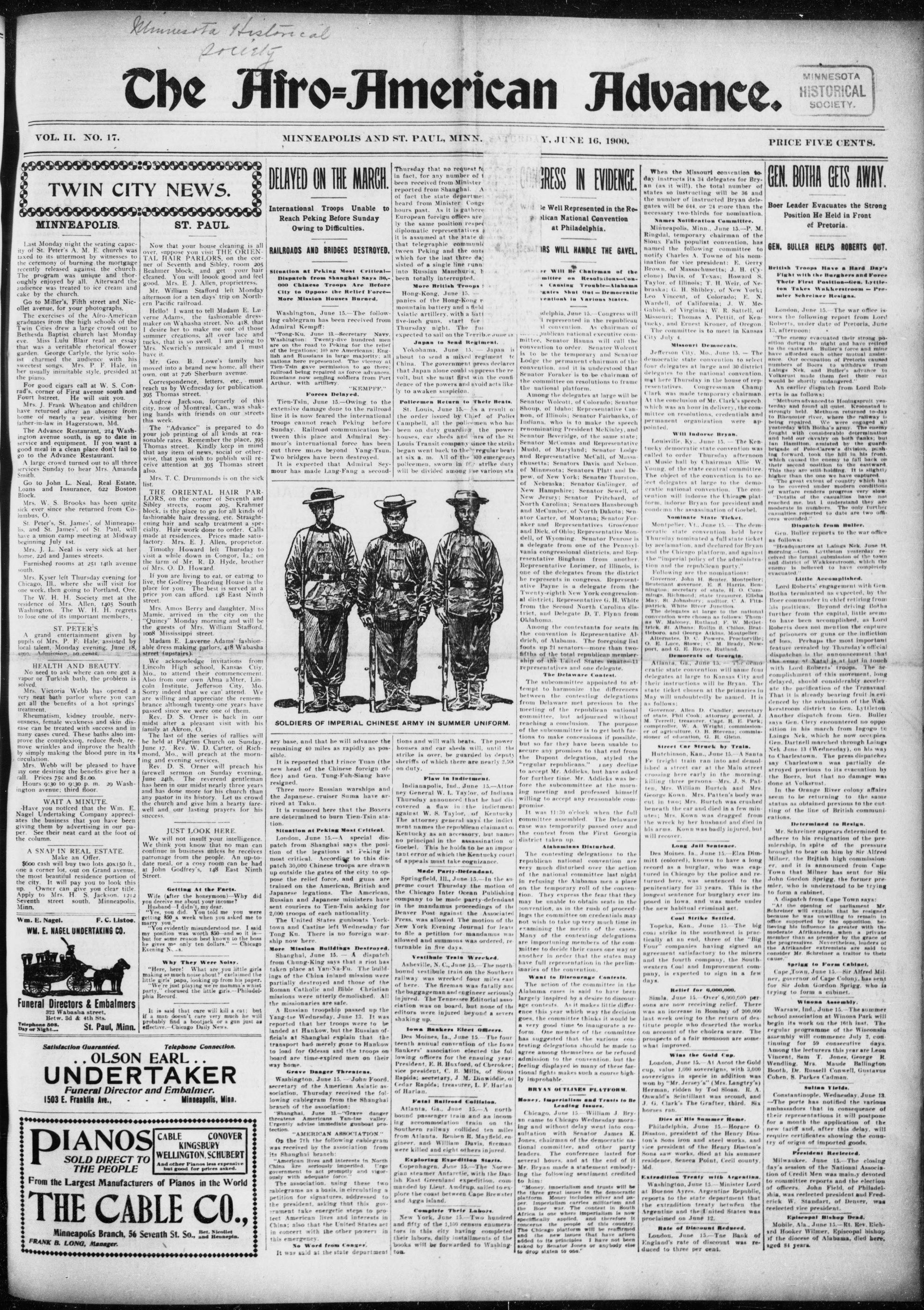
Page text (machine-generated)
TWIN CITY NEWS. MINNEAPOLIS ST. PAUL.
PIANOS
SOLD DIRECT TO
THE PEOPLE
CABLE CONOVER
KINGSBURY
WELLINGTON, SCHUBERT
And other Pianos less expensive
but good for prices asked.
From the Largest Manufacturers of Pianos in the World
THE CABLE CO..
Minneapolis Branch, 56 Seventh St. So., Bet. Nicollet
and Heinepin.
FRANK B. LONG, Manager.
VOL. II. NO. 17.
TWIN CIT
MINNEAPOLIS.
Last Monday night the seating capacity of St. Peter's A. M. E. church was taxed to its uttermost by witnesses to the ceremony of burning the mortgage recently released against the church. The program was unique and thoroughly enjoyed by all. Afterward the audience was treated to ice cream and cake by the church.
Go to Miller's, Fifth street and Nicollet avenue, for your photographs.
The exercises of the Afro-American graduates from the high schools of the Twin Cities drew a large crowd out to Bethesda Baptist church last Monday eve. Miss Lulu Blair read an essay that was a veritable rhetorical flower garden. George Carlyle, the lyric soloist charmed the audience with his sweetest songs. Mrs. P. P. Hale, in her usually imminent style, presided at the piano.
For good cigars call at W. S. Conrad's corner of First avenue south and Port bstreet. He will suit you.
Mrs. J. Frank Wheaton and children have returned after an absence from home or nearly a year, visiting her father-in-law Hagerstown, Md.
The Advance Restaurant in Washington avenue south, is up to date in service and equipment. If you want a good meal in a clean place don't fail to go to the Advance Restaurant.
A large crowd turned out to all three services Sunday to hear Mrs. Amanda Smith.
Go to John L. Neal, Real Estate, Loans and Insurance, 622 Boston Block.
Mrs. W. S. Brooks has been quite sick ever since she returned from Columbus, O.
St. Peter's, St. James', of Minneapolis, and St. James', of St. Paul, will have a union camp meeting at Midway beginning July 1st.
Mrs. J. L. Neal is very sick at her home, 22d and James streets.
Furnished rooms at 251 14th avenue south.
Mrs. Kyser left Thursday evening for Chicago, Ill., where she will visit for one week, then going to Portland, Ore.
The W. H. H. Society met at the residence of Mrs. Allen, 1405 South Washington. The W. H. H. regrets to lose one of its important members.
ST PETER'S
A grand entertainment given by pupils of Mrs. P. F. Hale, assisted by local talent, Monday evening, June 18, 1990. Admission, 10 cents.
HEALTH AND BEAUTY
No need to ask where can one get a vapor or Turkish bath, the problem is solved.
Mrs. Victoria Webb has opened a very neat bath parlor where you can get all the benefits of a hot spring's treatment.
Rheumatism, kidney trouble, nervousness, female weakness and skin disease can be treated with success and in many cases cured. These baths also improve the complexion, reduce flesh, remove wrinkles and improve the health by simply making the blood pure in its circulation.
Mrs. Webb will be pleased to have any one desiring the benefits give her a bath. Price: 75.00 and $4.00.
9:30 to 9:30 p.m. 29 Washington avenue; third floor.
WAIT A MINUTE
- Have you noticed that the Wm. E. Nagel Undertaking Company appreciates the business that you have been giving them by advertising in our paper. See their neat card at the foot of the column.
A SNAP IN REAL ESTATE.
Make an Offer.
$600 cash will buy two lots 40x150 lt
one a corner lot, on out Grand avenue,
the most beautiful residence portion of
the city. It will pay you to look this
up. Owner can give you clear title.
Apply to Mrs. H. S. Jackson. 1212
Seventh street south, Minneapolis,
Minn.
Funeral Directors & Embalmers
322 Wabasha street.
Betw. 3d & 4th Sts.
Telephone 508.
Day or Night.... St. Paul, Minn.
Satisfaction Guaranteed.
.. OLSON
UNDER
Funeral Director
1503 E. Franklin Ave.,
The Afro-American Advance.
Now that your house cleaning is all over, suppose you visit THE ORIENTAL HAIR PARLORS, on the corner of Seventh and Sibley, room 205 Beahmer block, and get your hair cleaned. You will look good and feel good. Mrs. E. J. Allen, proprietress. Mr. William Stafford left Monday afternoon for a ten days' trip on Northern Pacific railroad.
Hello! I want to tell Madam E. Luverne Adams, the fashionable dressmaker on Wabasha street. No. 418, that I desire her to make me one of those summer creations, all over lace and tucks, that is so swell. I am going to Mrs. Newrich's musical and I must have it.
Mr. Geo. B. Lowe's family has moved into a brand new home, all their own, out at 726 Sherburn avenue.
Correspondence, letters, etc., must reach us by Wednesday for publication. 305 Thomas street.
Andrew Jackson, formerly of this city, now of Montreal, Can, was shaking hands with friends on our streets this week.
The "Advance" is prepared to do your job printing of all kinds at reasonable rates. Remember the place, 395 Thomas street. Kindly keep in mind that any item of news, social or otherwise, that you wish to publish will receive attention at 395 Thomas street also.
Mrs. T. C. Drummonds is on the sick list.
THE ORIENTAL HAIR PAR-LORS, on the corner of Seventh and Sibleth streets, room 205, Krahm block, is the place to go for all kinds of fashionable hair dressing, etc. Straightening hair and scalp treatment a specialty. Hair work done to order. Calls made at residences. Prices made satisfactory. Mrs. E. J. Allen, proprietor.
Timothy Howard left Thursday to visit a while down in Congor, La.; on the farm of Mr. R. D. Hydie, brother of Mrs. O. D. Howard.
If you are living to eat, or eating to live, the Godfrey Boarding House is the place for you. The best is served at a price you can afford. 148 East Ninth street.
Mrs. Amos Berry and daughter, Miss Mamie, arrived in the city on the "Quincy" Monday morning and will be the guests of Mrs. William Stafford, 1008 Mississippi street.
Madam E. Lauverne Adams' fashionable dress making parlor, 418 Wabasha street (upstairs).
We acknowledge invitations from Lincoln High school, Kansas City, Mo. to attend their commencement. Also from our own Ama aMter, Lincoln Institute, Jefferson City, Mo. Sorry indeed that we can attend. We are willing and appreciate the remembrance although twenty-one years have passed since we were one of them.
Rev. D. S. Orner is back in our midst after a pleasant visit with his atkron. Atkron.
The last of the series of rallies will be held at the Ama Church on Sunday, June 17. Rev. W. D. Carter, of Richmond, will preach at the morning and evening services
Rev. D. S. Orner will preach his farewell餐 on Sunday evening, June 24th. The reverend gentleman has been in our midst nearly three years and has done more for his church than any pastor in its history. Let us crowd church and give him a hearty farewell and our last prayers for his success.
JUST LOOK HERE
We will not insult your intelligence. We think you know that no man can confine in business unless he receives patronage from the people. An up-to-date meal, or a cosy room can be had in John Godfrey's, 148 East Ninth Street.
Getting At the Facts
Wife (after the honeymoon)—Why did you decide me about your income?
You did.
"Yes, you did. You told me you were getting $50 a week when you asked me to
"You evidently misunderstood me. I said my position was worth $30—and so it is—but for some reason best known to the boss are ten dollars." — Chicago Evening N..s.
Why They Were Noisy.
"Here, here! What are you little girls making so much noise about?" exclaimed the little girls' papa, looking up from his paper. "We're just playing we mamma a whistle paper, recorded the little girls—Philadelphia Record."
It is said that care will kill a cat; but if a man doesn't care very much he will probably find a bootjack or a gun just as effective—Chicago Daily News.
MINNEAPOLIS AND ST. PAUL, MINN. Y, JUNE 16, 1900.
SOLDIERS OF IMPERIAL CHINESE ARMY IN SUMMER UNIFORM.
DELAYED ON THE MARCH
International Troops Unable to Reach Peking Before Sunday Owing to Difficulties.
RAILROADS AND BRIDGES DESTROYED.
Situation at Peking Most Criticized—Dispatch from Shanghai Says 30-000 Chinese Troops Are Before City to Oppose the Relief Force—More Mission Houses Burned.
Washington, June 15.—The following cablegram has been received from Admiral Kempff:
"Tong-Ku, June 13—Secretary Navy, Washington: Twenty-five hundred men are on the road to Peking for the relief of the Persian 100, American English and Russians in large majority; all nations here represented. The victory at Tien-Tsin gave permission to go there; railroad being repaired as force advances, Russians now sending soldiers from Port
Forces Delayed.
Tien-Tsin, June 15—Owing to the extensive damage done to the railroad line it is now feared the international troops cannot reach Peking before Sunday. Railroad communication between this place and Admiral Seymour's international force has been cut three miles beyond Yang-Tsun. Two bridges have been destroyed. It is expected that Admiral Seymour has made Lang-Fang a second-
SOLDIERS OF IMPERIAL CHINE
ary base, and that he will advance the remaining 40 miles as rapidly as possible.
It is reported that Prince Tuan (the new head of the Chinese foreign office) and Gen. Tung-Fuh-Siang have resigned.
Three more Russian warships and the Japanese cruiser Suma have arrived at Taku.
It is rumored here that the Boxers are determined to burn Tien-Tsin station.
Situation at Peking Most Critical.
London, June 15. A special dispatch from Shanghai says the position of the legations at Teking is most critical. According to this dispatch 30,000 Chinese troops are drawn up outside the gates of the city to oppose the relief force, and guns are trained on the American, British and Japanese legations. The American, Russian and Japanese ministers have sent couriers to Tien-Tsin asking for 2,000 troops of each nationality.
The United States gunbonts Yorktown and Castine left Wednesday for Tong Ku. There is no foreign warship now here.
More Mission Buildings Destroyed.
Shanghai, June 15. — A dispatch from Chung-King says that a riot has taken place at Yan-Na-Fu. The buildings of the China inland mission were partially destroyed and those of the Roman Catholic and Bible Christian missions were utterly demolished. All the missionaries are safe.
A Russian troopship passed up the Yang-tse Wednesday, June 12. It was reported that her troops were to be landed at Hankow, but the Russian officials at Shanghai explain that the transport had merely gone to Hankow to load for Odessa and the troops on board are time-expired men on their way home.
Grave Danger Threatens.
Washington, June 15. — John Foord,
secretary of the American Asiatic association,
Thursday received the following cablegram from the Shanghai branch of the association:
"Shanghai, June 13. — 'Grave danger
threatens Americans Yan-tse valley.
Urgently advise immediate gunboat protection.
"AMERICAN ASSOCIATION"
On the 7th the following cablegram was received by the association from its Shanghai branch:
"American lives and interests in North
China are seriously imperiled. Urge
government to act promptly and vigorously.
The association, using these two
cablegrams as a basis, in circulating a petition for signatures, addressed to the president, asking that this government take energetic steps to protect American lives and interests in China; also that the United States act in concert with the other powers in this emergency.
No Word from Conger."
It was asked at the state department
---
Thursday that no request for in fact, for any number of t been received from Minister reported from Shanghai. A of fact the state department heard from Minister Cong hours past. As it is gather European foreign offices are ly the same position respect diplomatic representatives it is assumed at the state d that telegraphic communic tween Peking and the oute which for the last three day sisted of a single line run into Russian Manchuria, h been totally interrupted.
More British Troops Hong-Kong, June 15. panies of the Hong-Kong r mountain battery and a field Asiatic artillery, with a batt five-inch guns, start for Thursday night. The fun expected to sail on the Terrible June is Japan to send Hartment
Yokohama, June 15. — Japan is about to send a mixed regiment to China. The government press declares that Japan alone could suppress the revolt, but she must first win the confidence of the powers and avoid acts likely to awaken suspicion.
Policemen Return to Their Beats.
St. Louis, June 15. — As a result of the order issued by Chief of Police Campbell, all the policemen who have been on duty guarding the power houses, car sheds and cars of the St. Louis Transit company since the strike began went back to the regular beat at six a. m. All of the 300 emergency policemen, sworn in for the strike duty will be divided among the various sta
SE ARMY IN SUMMER UNIFORM.
tions and will walk beats. The power houses and car sheds will, until the strike is over, be guarded by deputy sheriffs of which there are nearly 2,500 on duty.
Flow in Indictment
Indianapolis, Ind., June 15.—Attorney General W. L. Taylor, of Indiana Thursday announced that he had discovered a flaw in the indictment against W. S. Taylor, of Kentucky. The attorney general says the indictment names the republican claimant of Kentucky as an accessory, but name no principal in the assassination or Goebel. This he holds to be an important error of which the Kentucky court of appeals must take cognizance.
Mode Party-Defendant.
Springfield, IL., June 15.—In the supreme court Thursday the motion of the Chicago Inter Ocean Publishing company to be made party-defendant in the mandamus proceedings of the Denver Post against the Associated Press, was allowed. The motion of the New York Evening Journal for leave to file a petition for mandamus was allowed and summons was ordered, returnable in five days.
Vestibule Train Wrecked
Asheville, N.C., June 13. The north bound vestibule train on the Southern railway was wrecked four miles east of here. The fireman was fatally and the baggageman and engineer seriously injured. The Tennessee Editorial association was on board, but none of the editors were injured beyond a severe shaking up.
Iowa Bankers Elect Officers
Des Moines, In., June 15.—The four
seventh annual convention of the Iowa
Bankers' association elected the follo-
wing officers for the ensuing year.
President, E. B. Huxford, of Cherokee
vice president, C. B. Mills, of Sioux
Rapids; secretary, J. M. Dinwiddie, of
Cedar Rapids; treasurer, L. F. Harlan
of Harlan.
Fatal Railroad Collision.
Atlanta, Ga., June 15.—A north bound passenger train and an incoming accommodation train on the Southern railway collided ten miles from Atlanta. Reuben M. Mayfield, engineer, and William Davis, fireman were killed and eight others injured.
Exploring Exercition Stairs
Copenhagen, June 15. The Norwegian steamer Antarctic, with the Danish East Greenland expedition, commanded by Lieut. Amdrup, sailed to explore the coast between Cape Brewster and Agga island.
Complete Their Labs
New York, June 15.—Two hundred and fifty of the 2,100 census enumerators in this city having completed their labors, daily installments of the books will be forwarded to Washington.
GRESS IN EVIDENCE
The Well Represented in the Republican National Convention at Philadelphia.
IRS WILL HANDLE THE GAVEL
er Will Be Chairman of the
committee on Resolutions—Coun-
sults Causing Trouble—Alabama
Gates Shut Out—Democratic
events in Various States.
Philadelphia, June 15.—Congress will
will represent in the republican
convention. As chairman of
publican national executive com-
mittee, Senator Ranna will call the
convention to order. Senator Woolcott
is to be the temporary and Senator
Lodge the permanent chairman of the
convention, and it is understood that
Senator Foraker is to be chairman of the committee on resolutions to frame
the national platform.
Among the delegates at large will be Senator Wolett, of Colorado; Senator Shoup, of Idaho; Representative Cannon, of Illinois; Senator Fairbanks, of Indiana, who is to make the speech renominating President McKinley, and Senator Beveridge, of the same state; Senator McComas and Representative Mudd, of Maryland; Senator Lodge and Representative McCall, of Massachusetts; Senators Davis and Nelson, of Minnesota; Senators Platt and Depew, of New York; Senator Thurston, of Nebraska; Senator Gallinger, of New Hampshire; Senator Sewell, of New Jersey; Senator Pritchard, of North Carolina; Senators Hansbrough and McCumber, of North Dakota; Senator Carter, of Montana; Senator Foraker and Representatives Grosvenor and Dick, of Ohio; Representative Mendell, of Wyoming. Senator Penrose is a delegate from one of the Pennsylvania congressional districts, and Representative Bingham from another Representative Lorimer, of Illinois, is one of the delegates from the district he represents in congress. Representative Payne is a delegate from the Twenty-eighth New York congressional district; Representative G. H. White from the second North Carolina district, and Delegate D. T. Flynn from Oklahoma.
Among the contestants for seats in the convention is Representative Aldrich, of Alabama. The foregoing list foots up 21 senators—more than two-fifths of the total republican membership of the United States senate—11 representatives and one delegate.
The Delaware Content.
The subcommittee appointed to attempt to harmonize the differences between the contesting delegations from Delaware met previous to the meeting of the republican national committee, but adjourned without reaching a conclusion. The purpose of the subcommittee is to get both factions to make concessions if possible, but so far they have been unable to secure any promises to that end from the Dupont delegation, styled the "regular republicans." They decline to accept Mr. Addicks, but have asked for further time. Mr. Addicks was before the subcommittee at the morning meeting and professed himself willing to accept any reasonable compromise.
It was 11:30 o'clock when the full committee assembled. The Delaware case was temporarily passed over and the context from the First Georgia district taken up.
Alabamaians Disturbed.
The contesting delegations to the republican national convention are very much disturbed over the action of the national committee last night in refusing the Alabama men a place on the temporary roll of the convention. They express the fear that they may be unable to obtain seats in the convention, as in the rush of proceedings the committee on credentials may not wish to take up very much time in examining the merits of the cases. Many of the contesting delegations are importing members of the committee to decide their cases one way or another in order that the states may have full representation in the preliminaries of the convention.
Want to Discourage Contests
The action of the committee in the Alabama cases is said to have been largely inspired by a desire to discourage contests. As it makes little difference this year which way the decision goes, the committee thinks it would be a very good time to inaugurate a reform. One member of the committee has suggested that the various contesting delegations should be made to agree among themselves or be refused admission to the convention, but the feeling displayed in many of these factional fights makes such a course highly improbable.
BRYAN OUTLINES PLATFORM
Money, Imperialism and Trusts to Be Leading Issues.
Chicago, June 15. William J. Bryan came to Chicago Wednesday morning and without delay went into consultation with Senator James K. Jones, chairman of the democratic national committee, and other party leaders. The conference lasted for several hours, and at the end of it Mr. Bryan made a statement embodying the following sentiment credited to him: "Money, imperialism and trust will be the three great issues in the democratic platform. Money includes silver and paper. Imperialism carries militarism and the Boer war. The contest in south Africa is not a battle that is specifically applied, and therefore it concerns the people of this country. The Chicago platform will be reaffirmed and the new issues that have arisen added to its principles I have not been able to drop states to oops."
When the Missouri convention today instructs its 34 delegates for Bryan (as it will), the total number of states so instructing will be 36 and the number of instructed Bryan delegates will be 644, or 24 more than the necessary two-thirds for nomination.
Names Notification Committee.
Milneapolis, Minn., June 15, P.-M. Ringdal, temporary chairman of the Sioux Falls populist convention, has named the following committee to notify Charles A. Towne of his nomination for vice president: E. Gerry Brown, of Massachusetts; J. H. (Cyclone) Davis, of Texas; Howard S. Taylor, of Illinois; T. H. Weir, of Nebraska; G. H. Shibley, of New York; Leo Vincent, of Colorado; E. N. Wardell, of California; J. W. Me Gabick, of Virginia; W. R. Sattell, of Missouri; Thomas A. Pettit, of Kentucky, and Ernest Kroner, of Oregon. The committee is to meet in Kansas City July 4.
Missouri Democrais.
Jefferson City, Mo., June 15. — The democratic state convention to select four delegates at large and 30 district delegates to the national convention, met here Thursday in the house of representatives. Congressman Champ Clark was made temporary chairman. At the conclusion of Mr. Clark's speech, which was an hour in delivery, the committee on resolutions, credentials and permanent organization were appointed.
Will Indorse Bryan.
Louisville, Ky., June 15. — The Kentucky democratic state convention was called to order Thursday afternoon at Music hall by Chairman Allie W. Young, of the state central committee. The object of the convention is to select delegates at large to the democratic national convention. The convention will indorse the Chicago platform, indorse Bryan for president and condemn the assassination of Goebel.
Nominate State Ticket
Montpelier, VT, June 15. — The democratic state convention held here Thursday nominated a full state ticket by acclamation, and declared for Bryan and the Chicago platform, and against the "imperial policy of the administration and the republican party."
Following are the nominations:
Governor, John H. Seuter, Montpelier, Beutlen governor, E. S. Harrington, Bennington, secretary of state, H. O. Cummings, Richmond; state treasurer, E. Lisha May, St. Johnsbury, auditor, C. A. Fitzpatrick, Richmond; state delegate, The delegates at large to the national convention were chosen as follows: Thomas w. Maboney, Rutland, F. W. McGetrick, St. Albans, Rollin B. Chiles, Brattleboro, and George Atkins, Montpelier, O. A. Lance, Stowe; C. M. Brady, Newport, and G. E. Royce, Rutland.
Democrats of Georgia.
Atlanta, GA, June 15. — The democratic state convention will name four delegates at large to Kansas City and their instructions will be Bryan. The state ticket chosen at the primaries in May will undoubtedly be named. It is as follows:
Governor, Allen D. Candler; secretary of state, Phil Cook; attorney general, J. M. Terrell; treasurer, Capt. R. E. Park; comptroller, W. A. Wright; commissioner of agriculture, O. B. Stevens; commissioner of education, G. R. Glenn.
Street Car Struck by Train.
Hutchinson, Kan., June 15.—A Santa Fe freight train ran into and demolished a street car at the Main street crossing here early in the morning, killing three persons—Mrs. J. S. Patten, Mrs. William Burchell and Mrs. George Kown, Mrs. Patten's body was cut in two; Mrs. Burchell was crushed beneath the car and died in a few minutes; Mrs. Kown was dragged from the wreck by her husband and died in his arms. Kown was badly injured, but will recover.
Long Jail Sentence.
Des Moines. In., June 15. -Eliza Dummitt (colored), known to have a long record as a burglar, who was captured in Chicago by the police and returned here, was sentenced to the penitentiary for 33 years. This is the longest sentence for burglary ever imposed in Iowa, and was made under the new habitual criminal act.
Coul Strike Settled.
Toppea, Kan, June 15. The big cone strike in the southwest is practically at an end, three of the "Big Four" companies having signed an agreement satisfactory to the miners and the fourth company, the Southwestern Coal and Improvement company, is expected to sign in a few days.
Relief for 6,000,000.
Simla, June 15. Over 6,000,000 persons are now receiving relief. There was an increase in Bombay of 200,000 last week owing to the return of desitute people who deserted the works on account of the cholera scare. The prospects of a fair monsoon are somewhat improved.
Wins the Gold Cup.
London, June 15.—At Ascot the Gold cup, value 1,000 sovereigns, with 3,000 sovereigns in specie in addition was won by "Mr. Jersey's" (Mrs. Langtry's) Herman, ridden by Tod Sloan. R. A. Oswald's Seillantine was second, and J. G. Clark's The Grafter, third. Six horses ran.
Dies at His Summer Home.
Philadelphia, June 15—Horace O. Diaston, president of the Henry Diaston's Sons iron and steel works, and vice president of the Henry Diaston's Sons saw works, died at his summer residence, Seneca Point, Cecil county, Md.
Extraedition Trenty with Argentina.
Washington, June 15—Minister Lord at Buenos Ayres, Argentine Republic, reports to the state department that the extraedition treaty between the Argentine and the United States was proclaimed on June 12.
Rate of Discount Reduced.
London, June 15.—The Bank of England's rate of discount was reduced to three per cent.
MINNESOTA HISTORICAL SOCIETY.
PRICE FIVE CENTS.
GEN. BOTHA GETS AWAY.
GEN. BOTHA GETS AWAY.
Boer Leader Evacuates the Strong Position He Held in Front of Pretoria.
GEN. BULLER HELPS ROBERTS OUT
British Troops Have a Hard Day's
Fight with the Burgers and Force
Their First Position—Gen. Lytton
Takes Wukkestroom — Premier
Schreiner Resigns.
London, June 15.—The war office
issues the following report from Lord
Roberts, under date of Pretoria, June
15, afternoon:
"The enemy evacuated their strong position
during the night and have retreated to
Village east the bulldoor; they have
afforded each other mutual assistance. Our occupation of Pretoria caused
numbers of Boers to withdraw from
Llangus Nek, and Buller's advance to
Village west the rear would be shortly endangered.
An earlier dispatch from Lord Rob
berts is as follows:
"Methuen advanced to Honingspruit yesterday and found all quiet. Kroenstad is strongly held. Methuen returned to-day and was being repaired. We were engaged all yesterday with Botha's army. The enemy fought with considerable determination and held our cavalry on both banks, but we were not able to break the brigade of Pole-Carew's division, pushing forward, took the hill in his front, which caused the enemy to fall back on us. This they are still holding. It is slightly higher than the one we have captured. The great extent of country which has to be covered under modern conditions is not known. 'Dettatia of the casualties have not reached me, but I understand they are moderate in numbers. The only further casualties reported to date are two offi-
Dispatch from Buller.
Gen. Buller reports to the war office as follows:
"Headquarters at Lattig Nike, June 14, received a notification yesterday received the formal submission of the town and district of Wekkerkroatroom, which the enemy is believed to have completely
Little Accomplished.
Lord Roberts' engagement with Gen. Rotha terminated as expected, by the Boer commander in chief retiring from his positions. Beyond driving Rotha further from the capital, little seems to have been accomplished, as Lord Roberts does not mention the capture of prisoners or guns or the infliction of loss. Perhaps the most important feature revealed by Thursday's official dispatches is the announcement that the cause of Natal is at last in touch with Lord Roberts' troops. The accomplishment of this movement, long delayed, should considerably accelerate the pacification of the Transvaal. That it is already bearing fruit is evidenced by the submission of the Wakkerstroom district to Gen. Lyttleton. Another dispatch from Gen. Buller says Gen. Clery encountered no opposition in his march from Ingogo to Laings Nek, which he now occupies. Gen. Dartnell marched through Laings Nek June 13 (Wednesday), on his way to Charlestown. The press dispatches say Charlestown was partially destroyed previous to its evacuation by the Boers, but that no damage was done at Volkskrust.
In the Orange River colony affairs seem to be returning to the same status as obtained previous to the cutting of the line of British communi-
Determined to Resign.
Mr. Schreiner appears determined to adhere to his resignation of the pre-eminence, in spite of the pressure brought to bear on him by Sir Alfred Milner, the British high commissioner, and it is announced from Cape Town that Milner has sent for Sir John Gordon Sprigg, the former premier, who is understood to be trying to form a cabinet.
A dispatch from Cape Town says:
"At the opening of parliament, Mr. Schreiner will explain that he resigned because he was unwilling to remain in office supported by the opposition, because he was not a moderate Afrikaner when a private member than as premier by the grace of the progressives. Nevertheless, leaders of the Afrikaner extremists are said to be Mr. Schreiner a traitor to their cause."
Sprigg to Form Cabinet.
Cape Town, June 15. - Sir Alfred Miller, governor of Cape Colony, has sent for Sir John Gordon Sprigg, who is trying to form a cabinet.
Winona Assembly.
Warsaw, Ind., June 15. The summer school association at Winona Park will begin its work on the 16th inst. The regular programme of the Wisconsin assembly will commence July 2, continuing for 59 consecutive days. Among the lecturers this year are Leon Vincent, Sam T. Jones, George R Wendling, Mrs. Maude Ballington Booth, Dr. Russell Conwell, Gustavus Cohen, S. Parkes Caden.
Sulfonic Yields
Constantinople, Wednesday, June 13
—The porte has notified the various ambassadors that in consequence of their representations it will postpone for a month the application of the new tariff and, after this delay, will require certificates showing the country of origin of imported goods.
President Reelected
Milwaukee. June 15.—The closing day's session of the National Association of Credit Men was mainly devoted to committee reports and the election of officers. John Field, of Philadelphia, was reelected president and Frederick W. Standart, of Denver, was reelected vice president.
Episcopal Bishop Dead.
Mobile, Ala., June 15.—Rt. Rev. Richard Hooker Wilmer, Episcopal bishop of the diocese of Alabama, died here; aged 84 years.
Published every Saturday by the
ADVANCE PUBLISHING COOPANY
Minneapolis, - - - - - - Minnesota.
Entered at the Post, Office, at Minneapolis, Minn., as second-class matter.
Subscription Rates:
One Year $1.00
Six Months $0.60
Three Months $0.25
Subscription Always Payable in Advance.
Special rates if ordered by the dozen. Orders for current issue should reach the office by Wednesday evening.
Advertising Rates.
Local Reading Notices, 10c per line, each insertion.
Religious Notices (not over five lines), free.
"Want" and "To Let" advertisements, 5 cents per line for each insertion. Display, 40 cents per inch each insertion.
Special rates will be given for space by the year.
Editorial Announcements.
To secure the return of unsolicited manuscript postage should be enclosed.
Communications must reach the office by Wednesday morning, preceding the issue in which they are to appear.
All communications, enclosing news matter for publication, must bear the writer's name, not for publication, but as an evidence of good faith.
Contributions and items of news concerning the progress of the colored race are requested. We reserve the right to reject any communication unsuitable for publication. Numbers of orders requested to give their former as well as their present address. Address all communications and make all requests to THE AFRO-AMERICAN ADVANCE. 214 Washington Ave., South, Minneapolis, Minn.
MRS. GEO. DUCKETT.
PUBLISHER AND MANAGER
MRS. J. B. KOGER, City Collector.
Lord Roberts is one of the best swordmen in the British army. He is also an expert with the lance and in earlier days won several prizes through these accomplishments.
Guatillin Poplea, who died in Constantinople recently at the age of 84 years, was for over half a century director of military music of the sublime porte. He was a native of Parma. His predecessor in office was Giuseppe Donizetti, the brother of the great composer.
If heredity counts for anything, the son just born to Neville Lyton, heir presumptive to the earldom of Lyton, ought to develop into one of the greatest literary men of his time. On his father side he is a great-grandson of Bulwer Lyton and a grandson of "Owen Meredith," and on his mother's side he is a great-great-grandson of Lord Byron.
An Iowa young man not long ago proposed marriage to a young woman, but, hearing that her hair was false, he declined to fulfill his engagement. She brought suit against him for breach of promise, but she was nonsuited on the ground that she had won the young man's affections under false pretenses.
First Lieut. Hugh A. Drum, of the 28th infantry, now serving on the island of Luzon, is said to be the youngest officer in the American army. His father, Capt. Drum, was killed on San Juan hill. The son fought in the same battle, and has been in several engagements in the Philippines. He has been mentioned in the dispatches several times.
The working men's insurance laws have had a very good effect in German cities in diminishing tuberculosis, by compelling the wage-earning classes to join sick clubs and thereby putting them in the way of taking better care of their health and providing them with medical attendance and nursing at an early stage when tuberculosis is not yet incurable.
Because she gazed too long at the eclipse of the sun the other day, Mrs. H. C. McAllister, of Constatago Center, Pa. has been stricken blind. Mrs. McAllister was deeply interested in the solar phenomenon, and watched it steadily for a long time, both with the naked eye and through a smoked glass. Her sight became dim the following day and gradually grew worse until she became blind.
Ernest Kruger, a compositor employed in a printing office in Leipzig, Germany, has just completed his fifteenth year of service and has been occupied in setting type for one book nearly all that time. The book is Grimm's German dictionary, and the first batch of manuscript was turned over to the compositor in 1831. Thus far 32,000 pages have been printed, and the work is not yet half done.
It is not believed that any part of Capt. Oberlin M. Carter's punishment will be harder to bear than the wearing of prison garb at Leavenworth. A more fastidious dresser never lived. During his stay at Savannah he had all his civilian clothes made in London, and a leading New York haberdasher used to send him at times a trunk full of cravata, gloves, collara, etc, from which to make selections.
The printers' strike at Amsterdam has had a peculiar result in the journalistic world. From April 28 to April 30 no Amsterdam newspapers appeared, but from that date the managers of nine newspapers agreed to print a single sheet, calling it the "Extraordinary Journal," which is now being printed for a circulation of 200,000. All the subscribers of the nine papers are thus served with the news in abridged form.
What is thought to be an antiepileous shrub is now under test in Honolulu. It is reputed to have cured a number of natives of this dread disease. Surgeon Carmichael, of the marine hospital service in Honolulu, has received some vials of the extract of this shrub, sent by the surgeon general at Washington for experiment. It will be a wonderful thing if it is ascertained that nature has provided a prophylactic or cure for the scourge of leprosy
THE WIFE'S WAY.
Luck of a Husband Who Tried to Prepare for an Impending Water Famine.
The man with the red mustache happened to be in the neighborhood of his own home at one o'clock the other day, to he concluded to go in and get a bite to eat. His wife and the maid were both out, but the icebox had a supply of cold and uncooked vands and he helped himself and sat down to a meal of his own preparing, says the New York Sun. While he was drinking a second cup of coffee, he heard a man in the lower hall bawling out some information which might have been a trainman's statement of incoining and outgoing trains, or a crier's call to court, or any other unintelligible warning. Trice was this strange cry repeated and then the man with the red mustache went out to see what was the matter. When he stepped into the hall the man who had been raising all the rumpus appeared at the top of the stairway.
"Oh—oh, ah—ah—ee—ee," he shouted, vigorously.
"Hello," said the man with the red mustache, "What's the matter?"
"Hello," returned the strong-hunged individual, in to-all whom-it may-concern tones. "You live here? I was just going to ring you up. Water main's broken in this street. Water will be turned off at three o'clock to allow of repairs. Won't be turned on again until to-morrow evening. We've sent men around all through this neighborhood to tell everybody, so's you can draw off enough to last you for the next 24 hours."
The bearer of evil tidings passed on up to the floor above to notify the tenants there of the impending water famine, and the man with the red mustache returned to his luncheon. When he had finished eating he made a calculation as to the amount of water that would be required to tide a family of three over 24 hours of absolute drought. As a result of his reckoning he made stupendous preparations for the approaching dry spell. He filled the bathtub with water, likewise the wash boiler, four pitchers, the dishpan, the stew kettles and the teakettle. He then went back downtown thanking his lucky star that he chanced to be home in that particular hour of need. When the man with the red mustache got home in the evening he found his wife fretting and fussing around hysterically.
"I'm glad you've come at last," she said. "I've had the most terrible time. Everything has gone wrong. Patty hasn't come home yet and to make matters worse she went away leaving the luncheon dishes unwashed. Besides that she left the bathroom and kitchen all stopped over as if we had been going through a spring deluge, And now I can't get any water to cook supper with. I've pounded on the pipes till my hands are sore and called down the tube to the janitor till I'm noose. The water pipes only respond with a dull, hollow echo and the janitor doesn't give me even that much satisfaction. Whatever I shall do I don't know for there isn't a drop of water to be had for love or money." The man with the red mustache stopped on the threshold and peered cautiously into the kitchen.
"No water?" he said. "Why, you might not have any trouble on that score. I happened to be here when the man came around to notify us that it would be shut off, and I filled everything about the place so we'd have plenty to do us." His wife looked back at the teakettle and the dishpan and the row of pitchers with a despairing glance. "Oh," she said, weakly, "tempted all that out when I first came home."
THE VOGUE OF PLAITS.
This Season's Clothes Are Well Suited
to This Style of Mak-
ing.
Three-fourths of the new costumes show plaits in one form or another, Plaits and tucks are not at all suitable for heavyweight clothes, but there are this season clothes in so many different weights that it is not difficult to choose one that is suitable. The fashion, however, is seen at its best in the thinner and more flexible materials and in silks, and a model gown that will be seen a great deal is of taffeta made without any trimming whatever, but tucked sleeves, skirt and waist. In a dark color this makes an exceedingly smart gown and is delightfully dainty in the lightcolors. The belt and collar can be either jeweled or plain, with a jeweled buckle. Much depends on how the belt and collar are treated, says the Washington Star.
But even when lightweight fabrics are employed it is rather difficult for the dressmakers to follow out satisfactorily the new fashions of the plaited skirts and at the same time the close-fitting ones. To do away with the clumsy appearance that plaited skirts are apt to have requires no end of trouble and a thorough knowledge of skirtmaking as well. The best skirts are those that have the plains caught down—not merely tacked down, but caught through far down on the skirt and with the extra material, if there is extra material, cut away beneath. There is a certain extravagance about this which will, of course, prevent the skirt ever being made over in another fashion, but then it is most unfashionable to wear madeover clothes.
Apple Gems.
Put into the sieve one-half pint of flour, two-thirds of a cupful of sugar, one teaspoonful of soda and two teaspoonful of cream of tartar, and sift into a pan. Rub into the flour thus prepared one-third of a cupful of butter, and add enough water or milk to make a rather stiff dough. Roll out into a sheet one-third of an inch thick, and cut into cakes half of an inch in diameter. Drop each cake upside down into a saucer of granulated sugar, pressing down a little so as to give an even coating of sugar, and put the cakes into a tin with plenty of space between. When they are wanted split each cake through the center with a sharp knife and spread with apple jelly.—Farm and Fireside.
Dire Vengeance
She—I heard about the cloepment. Has her mother forgiven them? He—I think not. I understand she has gone to live with them.—Collier's Weekly.
POWER FROM WATERFALLS.
The Cotaracts of the Great West May Be Turned to Good Account.
One of the natural resources of the great west which will in the future make for its greatest advancement in the undeveloped water power. The melting snows on the summits of the lofty mountains rushing downward with resistless force in the spring form the headwaters of our mighty rivers. To-day, says the Minneapolis Times, the tourist views these cataracts and waterfalls amid scenes of primeval grandeur and wildness. In the to-morrow of western progress the tourist may seq these mighty forces chainsed and harnessed, moving the wheels of industry and promoting the good of new commonwealths. It is only in the east that anything like substantial utilization of the water powers is apparent. In the west there are but few rivers which do not offer a cheap and practical water supply. But the far west is almost an unknown country yet, and capital, except in a few isolated cases, has invested little in enterprises of this sort. The first utilization of this vast water supply for power has almost invariably been made by mining corporations, but this represents only an infinitesimal portion of the latent forces. A few western cities like Minneapolis, St. Paul, Great Falls and Spokane have harnessed their rivers and are forging to the front.
The dweller in the west, inhaling the ozone atmosphere of that glorious region, is naturally an optimist. He cannot help it. But his optimism is justified by the past records of that region, which reveal no halting in its onward progress. He travels on the finest railroads, he lives amid scenes of the greatest and grandest natural beauty; he views the settlement and growth of new territories. In fact, all that he sees and hears and breathes tend to make him optimistic. Therefore to him the vision readily comes of a transformation in this. He sees, in a future not distant, a new field for his efforts. All this power, now wasted and valueless, will be made useful and will materially conduce to the wealth of thousands of new citizens.
The Deschutes falls, 30 miles west of Prineville, Ore., are wildly beautiful, though the sheer fall does not compare with that of many other western cataracts. A peculiarity of the Deschutes river is the very slight yearly variation of only 16 inches in its height. In some places the variation is not more than ten inches. Cyrus C. Babb, of the United States geological survey, gives as the accepted explanation of this that the winter snow of the Cascade mountains, which supplies the water of this river, owing to the peculiar formation of the soil, percolates into the ground, and later finds its way into the river through springs. Rainbow falls are six miles below Great falls and three miles below Black Engle falls, on the head waters of the Missouri in Montana. These falls are 25 feet in height, and will afford many thousand horse-power when utilized.
Twin falls, in Idaho, are just above the great Shoshone falls, in the Snake river. The rugged aspect of the country in this vicinity, its wildness and the tremendous force of the twin cataracts make this a very impressive scene. Owing to the inaccessibility of these falls of the Snake, they are not often visited by the tourist, although the Oregon Short Line runs within 30 miles of this spot.
The Nevada falls of the Yosemite valley are among the most beautiful of the numerous waterfalls of the western part of our continent. The water springs outward from the edge of the precipitous cliff and drops down 617 feet with a mighty roar. The flow over the falls is 35,100 gallons per minute.
The Wonderful West
"Is this a healthy town?" Inquired the man who was in search of a balmy climate.
"Healthy!" echoed the land agent. "Why, man, the only undertaker in town had to blow out the gas to give himself a job." Chicago Evening News.
Making Spres.
Cook (entertaining a caller)—What?
You pretend you've bad enough? You just sit there and eat that whole roast and then I have a pudding for you. Do you think I am going/to have you go and eat in every other young lady's kitchen, you Don Juan?—N. Y. World.
PATRONIZE
WM. JENKINS,
ROOMS FOR RENT
We Guarantee Superb Service. Prices
moderate. Tel. 237-7-L-3 Main.
No. 9 Second St. No. Minneapolis.
J. GARNER. W. H. WELLER.
The Elite Buffet
3030 STATE ST.,
FINE WINES,
LUNCH,
AND CHAIRS.
Chicago.
Cutting, Fitting and Making Over a Specialty. New York and Paris Fashions Always on Hand. Fartors, 628 Fourteenth Av. South.
Office: 405-6 Reeve Bldg., 408 Nicollet Av.
Telephone 2734-J-5.
Residence, 2839 Portland Ave. Telephone 317-L-South.
CARTER'S INK
Is what the largest and best school systems use.
$20 A hundred for your neighbors' addresses. Good Place for Learning and Learning Romance, Magazine, New York.
GET RICH QUICKLY. Read for Each "Hibernation Wanted." PULAR TAPE & CO., 244 Broadway, New York.
THE ADVANCE CAFE 214 WASHINGTON AV. SOUTH. Restaurant and Lunch Counter
MANN & KOGER, Proprietors.
SOCIETY DIRECTORY.
Officers and Standing Committees of the Most Worshipful Grand Lodge A. F. and A. M. of Minnesota and jurisdiction: Grand Master-John L. Neal, Minneapolis.
Deputy Grand Master-Wade H. Hampton West Superior.
St. Paul Senior Warden-H. B. Howard, St. Paul Junior Warden-J. C. Garner, St. Paul.
Grand Treasurer-Daniel Roy, St. Paul.
Grand Secretary-William R. Morris, Minneapolis.
Grand Lecturer-G. W. Day (7), Minneapolis.
Deputy Grand Secretary-O. D. Howard (4); St. Paul Grand Chaplain-Isaac Crawford (6).
Minneapolis.
St. Paul Senior Deacon-John Martin (1).
St. Paul.
Grand Junior Deacon-R. De Leo (7).
Minneapolis.
St. Paul.
Grand Senior Steward-J. H. Dillingham (2).
St. Paul.
Grand Junior Steward-Wm. Stevens (3).
St. Paul.
Tyler-T. Bush (2), St. Paul.
Grand Marshall-C. H. McDonald (5).
Junuth.
Grand Pursuant-G. W. Duckett (4).
St. Paul.
Grand Sword-Bearer-J. Adams (1), St. Paul.
Grand Standard-Bearer-G. J. Charleston (2).
Grand Registrer-J. G. Sterett (6).
Minneapolis.
District Deputy Grand Master-First
District Deputy Grand Master-Second
District Deputy Grand Master-Second
District-E. H. Hamilton (6). Minneapolis.
District-First Third
District-J. K. Gulph. Gulph.
MINNEAPOLIS.
G. U. O. O. O. F.
St. Anthony Lodge, No. 2877.
Meets the first and third Wednesday in each month for the transaction of business, 1st avenue at the corner.
A. H. MYHICK, N. G.
JAMES A. SCOTT, P. S. P. O. Box 33.
KNIGHTS OF PYTHIAS.
Nat. Turner Lodge, No. 2, K. of P.
Meets the second and fourth Thursdays in each month. Brothers in good standing welcome. At Labor T-mple, Fourth and Eighth avenue south.
RALPH WATSON, K. R. and S.
Pride of Minnesota Lodge, No. 1, K. of P.
Meets the first and third Thursdays in each month. All brothers in good standing welcome. At Plummer Post Hall, First avenue north and Washington.
JAMES ROBERTS, C. C.
W. C. JEFFREY, K. R. and S.
J. K. Hilyard Lodge.
Meets first Tuesday in each month at
Windom Block, Second avenue South and
Washington. Masons in good standing always welcome.
G. W. LILLARD, W. M.
JASPER GIBBS, Sec. Guaranty Loan Restaurant.
Anchor Lodge, No. 7, A. F. and A. M.
Meets the first and second Monday in each month at Windom Block, Second avenue South and Washington. Masons in good standing welcome.
ODD FELLOWS.
Meets first and third Monday in each month at Odd Fellows Hall, 325 Wabasha street.
T. R. HICKMANN, P. S., 422 St. Antoine.
F. D. PARKER, N. G., 395 Edmund St. Household of Ruth, No. 355 G. U. O. of G. F.
Meets first and third Monday in each month for business, second Monday for instruction, at Odd Fellows Hall, 325
MRS. SARAH C, KIRLLEY, M.N.G.
A JACKSON, W. R., 754
8ammit place.
MOST WORSHIPFUL GRAND LODGE OF MINNESOTA, A. F. and A. M.
J. L. NEAL, Grand Master.
WM. R. MORRIS, Grand Secretary.
11 Guaranty Loan Bldg., Minneapolis.
ST. PETER CLAYER'S SODALITY.
Meets the first and third Mondays of each month. Sec. J. S. Harris, Sec. A. Davis, Treas.
DANIEL ROY, H. P.
W. T. GASSAWAY, Sec., State Capitol.
CHURCH DIRECTORY.
MINNEAPOLIS.
**ST. PETER A. M. E. CHURCH.**
Rev. W. S. Brooks, Pastor.
Cor. 22d B, 9th ave. South
Sunday school, 11:30 a.m.
; Sunday School, 3:00 p.m.
evening services, 8:00 p.m. General prayer meeting,
Tuesday evening, 8:00 p.m. Way-
ward Church Club evening meeting
different residents. Parsonage, 2200
Ninth avenue South.
BETHESIA BISTH CHURCH.
Rundown and Twelfth avenues.
Rundown services: Preaching, 11:00 a.m.
; Sunday School, 12:30 p.m. Christian
services, 8:00 p.m. Grace lessons,
8:00 p.m. Wednesday evening prayer
meeting, 8:00 p.m. Parsonage,
1120 Eighth street South.
BETHESIA JOHNSON.
Rev. John J. Faude, in Charge.
615 Sixth avenue South.
Sunday service, 4:00 p.m.; Sunday
School, 2:00 p.m.
**ST. JAMES A. M. E. CHURCH.**
Rev. J. W. King, Pastor.
Between First avenue and Second street
Southeast, near Exposition Bldg.
Sunday school, 3:00 p.m. evening
services, 8:00 p.m. General prayer meet-
ing, 8:00 p.m. Weekly meetings of
the Debating Club.
Rev. A. Anderson, Pastor.
Cor. Fulcher and Joy streets.
Sunday service: 12:10 a. m.; 7:30 p. m.
Wednesday prayer meeting: 8:00 p. m.
ST. PETER CLAYER'S
Pastor.
Cor. Partington and Aurora avenues.
Sunday service: Mass: 8:00 a. m. High
mass: 10:30 a. m. Evening service at 7
o'clock.
PILGRIM BAPTIST CHURCH.
Rev. D. S. Owner, Pastor.
Cor. 17th and Cedar.
Sunday service: Wednesday at 12:30
a. m. and 7:45 p. m. Sunday School at 12:30
o'clock. Wednesday evening general
prayer meeting.
ST. PHILIPPE'S EPISCOPAL MISSION.
65 Rice street, Bet. Aurora and Uni-
sity.
Sunday services: Morning prayer, Lit-
ST. PAUL.
ST. PAUL.
any and Sermon, 11:0 a. m.; M. Sunday School and Children's Vespers 2:0 p. m.; M. Sunday School and Children's Evening Prayer and Lecture, 8:0 p. m.; Friday; Choir Rehearsal and Brotherhood of St. Andrew, 8:0 p. m. All are cordially invited. Seats free.
NOTICE.—Changes and corrections will be made upon notice thereof. You have repledged to place a notice of any society in the above directory it is because you not know of it or have not made up a notice of it. Lodge, place and time of meeting name of officers and it will be inserted.
JAMES L. CURTIS
LAWYER
603 Northwestern Bldg., Minneapolis
Cor. 4th St. and Hennepin Av.
Telephone, Main 2460-L. L.
PATRONIZE THE BEST!
Free Delivery to All Parts of the City and Lake Minnetonka.
Our Motto: First-class Work and Moderate Prices.
Telephone 2700-J-5-1
S. P. EGGAN,
PHOTOGRAPHER.
Crayon, Pastel and Water Colors a Specialty.
281-253 Cedar Avenue.
MINNEAPOLIS, MINNESOTA.
SEEDS OF FLOWERS Plants and Cut Flowers.
We ship Universal Flowers on telegraph or mail orders any time, day or night.
Budding or House Plants in their season.
Cut Flowers, fresh and fragrant. Needs that are good and honest, at five cents per packet. Our catalogue is FREE, send for it.
MENDENHALL, FLORIST,
37 S. 60th St. Minneapolis, Minn.
KLAFFKE'S WHITE SEAL
119 Central Ave., Minneapolis.
TEL. 2701-J-3. NEXT TO YERKA'S.
WONDERFUL
DISCOVERY
Curly Hair Made Straight By
This wonderful hair pomade is the only safe hair pomade that is straight as shown above. It is nourishes the scalp, prevents the hair from falling out and makes it look straight. Warranted harmless. Testimonial free on warranted harmless. Straightening kinky hair. Beware of imitation. Straightening kinky hair. Beware of imitation. The genuine never fails to keep the hair pliable and beautiful. A toilet necessary for ladies and men. A wonderful pomade is that by its unique design, it is the most suitable to its superior and lasting quality. It anybody can produce a preparation equal to it. Fully directed dealers or send us $1.49 • Postal or Express. Please write your name and address plainly to
OZONIZED OX MARROW CO.,
76 Wabash Ave., Chicago, Ill.
Magic Seeds
A wonderful Nerve Remedy, that has no superior and is guaranteed to cure all such nerve disorders. Nervous Prostration, Weak Memory, Lack of Confidence, Wakefulness, Headache, Nervousness, Lost Manhood, and all drains and loss of power in general, either sex, caused by Overexertion, Youthful Errors, Excessive use of Tobacco, Opium, or Stimulants, which lead to Infirmity, Consumption, and Insanity.
Magic Seeds restore the nerve and vigor of youth. Easily carried in the vest pocket. Sent prepaid in plain box by mail to any address, for $1,000 six boxes for $3,000 with a written guarantee to cure or money refunded. Write for free circular.
MANSFIELD, OHIO.
VICTORINE
THE WONDERFUL NEW
WASHING GOMPOUND
VICTORINE
TRADE MARK
THE GREATEST BLESSING TO WOMANKIND
NO BOILING, NO RUBBING
OF CLOTHES REQUIRED,
PREVENTS SHRINKAGE OF WOOLENB.
5c. a Package—Two Week's Washing.
BARBEAU & CALLAHAN.
SOIL MANUFACTURERS, CHICAGO U. B. A.
AGENTS WANTED WHERE NOT REPRESENTED.
A wonderful Nerve
Remedy, that has no superior and
is guaranteed to cure all such nervous diseases as
the weakness of motion. Weak Memory, Lack of Confidence, Wakefulness, Headache, Nervousness, Lost Manhood, and all drains and loss of power in genera-
D. H. BOONE, Pres. N. JOSEPH LLOYD, Sec'y
SPEND A PLEASANT EVENING AT THE
NORTH STAR SOCIAL CLUB
BILLLIARD AND POOL TABLES.
Rooms, Second Floor, 202 Hennepin Avenue.
RESIDENCE TELEPHONE Dale 410-5
O TURNER, M. D.,
MUSICIAN AND SURGEON.
2 to 2 p. m.; 4 to 6 p. m.
kirk Blk. Res. 833 Shortburn Ave. ST. PAUL, MINN.
ENCE.
TELEPHONE 755.
AMOR & CO.,
Undertakers and Embalmers.
Bingham Ave. South, Minneapolis, Minn.
ass. and the prices we guarantee will defy competition.
SIGHT DRAFT 5-CENT CIGAR.
ONRAD, Distributor,
FIRST AVENUE SOUTH.
AGENTS.
12TH AND ROBERT STS., ST. PAUL, OVER DRUG STORE
25 YEARS' EXPERIENCE. TELEPHONE 755. JAS. AMOR & CO., Practical Undertakers and Embalmers. 123 Washington Ave. South, Minneapolis, Minn.
SMOKE THE SIGHT DRAFT 5-CENT CIGAR.
W. S. CONRAD, Distributor,
400 FIRST AVENUE SOUTH.
Twin City Club and
FURNISH
With the Most M
BARBER SHOP A
Where Meals are
126 Hennepin Ave.
Club and Employment Bureau
FURNISHED ROOMS
The Most Modern Conveniences.
SHOP AND RESTAURANT
The Meals are Served at All Hours.
Ave. Minneapolis, Minn.
Twin City Club and Employment Bureau
Miller
ST. PAUL, 171-173 E. 7th St.,
Opposite Olympic.
FOX $2.00 RAZOR is the
FOX for RAZOR or more
your express contact, or mo-
tgage satisfaction or money
State whether wide or
horn boned, stripped and
a Fox CUTLERY Co
for the 2015 Main St.
FOX $2.00 RAZOR is the best that experience and skill can provide. FOX Your Express Agent, with instructions to allow you to take it home, if you send full amount with your order, we send Razor personal satisfaction or money back, and if FOX STYPTIC PENE. E. State whether wide or narrow blade, square round or horned, stropped and set ready for use.
FOX CUTLERY Co., Mfrs, 48 Center St, New York City, or the West: 892 Main St, Dubuque, Iowa.
The FOX $2.00 RAZOR is the best that experience and skill can provide. FREE TRIAL AT YOUR HOME. For 23c we will send a Fox Razor to your Express Agent, with instructions to allow you to take it to try. Or, if you send full amount with your order, we send Razor prepal, guaranteeing satisfaction or money back, and a FOX STYPTIC PEN. You can also order a Fox Razor or round or square Fox Razor, stopped and set ready for use.
The Take it B
NO ROPES
Strong and
Finished In Red
and Fancy S
MANUFACT
The Cli
$3.50
each.
Artistic Monument
Cost No More than Plain Ones in
be it Ezy
ROPES TO BE
Strong and Durable
Finished In Red and Nat-
and Fancy Striped O
MANUFACTURED BY
The ClimaxT
$3.50
each.
DAYTO
conuments
on Plain Ones in
White Bronze
it Ezy Swing
ROPES TO BREAK!
Strong and Durable!
Published In Red and Natural Wood
and Fancy Striped Canvas.
MANUFACTURED BY
The Climax Tag Co.
63.50
each.
DAYTON, O.
The Take it Ezy Swing
NO ROPES TO BREAK!
Strong and Durable!
Finished in Red and Natural Wood
and Fancy Striped Canvas.
MANUFACTURED BY
The Climax Tag Co.
£3.50
each.
DAYTON, O.
Marble is entirely out of date, granite soon gets mossgrown, discolored, requires constant care, pence and care, and eventually crumbles back to Mother Earth. Besides it is very expensive.
White Bronze is strictly everlasting. Reasoned crouble with the action of fresh Mossgrowth is an impossibility. It is more artistic than any stones from granite not investigate it. It has been adopted as a medium for movement, and by those desirous of delighted customers in all parts of the country. It has been on the market over twenty years and is an established success. We have design from 600 to 8000. Write us for free designs and information. It puts you under no obligations. We direct delivery everywhere.
The Monumental Bronze Co., 360 Howard Avenue, Bridgeport, Conn.
HEALTH AND PLEASURE RESORT
Inns,RENT
HEALTH AND PLEASURE RESORT
Inns,RENT
Floridaubs, Porto Rico and Sasau, are be most easily reached via the Nashville, Chattanooga & St. Louis
Over which line and its connections the
HEALTH AND PLEASURE RESORTS
In Tennessee, North and South Carolina, Georgia
Florida, Cuba, Nico Rio and Sassau, are best and
most easily reached via the
Nashville, Chattanooga & St. Louis Ry.,
Over which lines and its connections the
FAMOUS DIXIE ELYER.
PATRONIZE . . .
W.M. JENKINS,
ROOMS FOR RENT
FIRST CLASS.
We Guarantee Superb Service. Prices
moderate. Tel. 2737-L-3 Main.
No. 9 Second St. No. Minneapolis.
J. GARNER. W. H. WELLER.
The Elite Buffet
3030 STATE ST.,
FINE WINES,
BARORES,
AND CIGARS.
Chicago.
MRS. J. B. WATSON Fashionable Dressmaker.
Cutting, Fitting and Making Over a Specialty. New York and Paris Fashions Always on Hand. Parlors, 628 Fourteenth A. South.
DR. R. S. BROWN
Office Hours: 9:30 to 12:30; 2:00 to 4:00
p.m.; 5:30 to 7:00 p.m. Sundays: 9:30
to 11:00; 12:30 to 2:30.
Residence: 2839 Portland Ave. Tele-
phone 317-L-South.
CARTER'S INK
In what the largest and best
school systems use.
$20 A hundred for your neighbors' addresses.
ROHAN CAMPAIGN. NEW YORK
---
---
---
J. E. STEWART, SEC'Y.
THE FOX RAZOR
THE
MARTY MARTY
MARTY NEW
BOO
THE
FOX RAZOR
THE STATUE OF THE
MARTYR OF THE
WESTERN STATUE
OF THE
WESTERN STATUE
FIRST CLASS
DR. J. E. PORTER.
OFFICE HOURS:
6 TO 10 A. M.; 1 TO 3 M.; 6 TO 7 P. M.
AND NIGHTS.
PHOTOGRAPHER
Finest Work. Prices Right.
MINNEAPOLIS. 427-429 Nicollet Ave.
Over Yeran's.
"The Fox Cutlery is perfectly reliable.' Editor."
with through 19-section Puliman Palace, Buffet Sleeping Cars are run daily the year round, between St Louis and Jacksonville, Florida. Close connections are made at Nashville from Chicago, Cincinnati and Louisville, affording a delightful daylight ride between Nashville and Atlanta, passing through the most Historical and picturesque section of the South via Lookout Mountain. Cheap Homeseekers' round trip tickets are sold on the 1st and 3rd Tuesday of each month. For full information, maps, holders and matter pertaining to Tourist Rates to these resources.
DROPSY Treated free. Positively free. Cured with Tequila. Cured many times with corn. Cured many times with corn. Cured many times with corn. From first dose symptoms rapidly decrease. Days at least two of all antiemphemal treatments. FREE. TEN DAYS TREATMENT FURNISHED FREE by mail. DR. H. L. GREEN & DONS, Specialties, Atlanta, GA. GRANT TEE PAPER every two weeks. Weeks Scale Works, HAY COAL STOCK GRAIN, BUFFALO, N. Y. AND COTTON SCALES.
LAMB'S Throat Candy, one of the best Confections for Vowels to LABS MFG. CO., Ontario, Canada. For pain relief.
RHEUMATISM Cured for RGC Tablets. Not used by dealers. Wits. 5 boxes. $1.00.
DROPSY NEW DISCOVERY: gives quick relief and cure warts. Treatment Free. Dr. H. L. GREEN, Atlanta, GA.
FREE A BOOK TREATING ON CANCER AND TUBERA by association at home. Dr. H. L. GREEN, Atlanta, GA.
HENRY MOSLEY, PRES.
DENVER CATHEDRAL
B. C. WARDIN, W. P. A.,
118 Merchants Exchange Building, St. Louis.
B. C. WARDIN, W. P. A.,
29 West 41st Street, Cincinnati, O.
BRIARD F. HILL, N. P. A.,
23 Marquette Bldg. Chicago, Ill. or
W. L. DANLEY, T. & T. A.
THE MEETING TIME.
Oh, bitter is the sorrow
When here we part in tears,
And heavy is the burden
Of long and lonely years!
But what we must be the
The life's sad journey's past,
Within the Father's keeping
We find our own at last!
As mists that cloud the morning—
As shadows of the night—
Forgotten in the glory,
Of moonlight's radiant light,
The weary years of waiting
As nothing then shall seem,
The pain, the loss, the sorrow—
Remembered as a dream.
Oh, what will be the meeting!
No words its joy may frame!
When face to face we see them,
Immortal—the same;
When we hear voices
Shall speak our names once more,
And smiles of welcome greet us
As fondly as of yore!
Oh, blessed thought of comfort,
When these we love have gone
To seek a better country,
And we are left alone!
Shall we not wait in patience
A little longer here.
The meeting time draws near?
-Mr. J. E. Lyman, in N. Y. Observer
(From the New Orleans Times-Democrat,
by Permission.)
THE young mother had been into the dim shadows where Death and Life struggle, and win or lose, just at the happiest, sweetest, fullest hour which had been hers, when love took on a new and tender unselfishness, when its lifting, dancing measures broke into the deep melody of an anthem, and as she drifted back into the light again, thus it was that she half wished and half prayed in her still childish way that Death would never take this woman-child of hers as long as Life held Happiness—that love of Life should be a tallism to stay the hand of Death.
Thrice in the woman's threecore years Death had come to woo her from his brother Life out into the far beyond, that unknown land, that hereafter which he called Paradise, and of which he spoke with a wondrous eloquence and a great witchery.
When first he came it was just at the dawn of day, just as the east was flushing in the faint rays of the rising sun and the birds twittered in the trees; shod with silence he glided through the quiet hails and still hushed household, among the watchers with wet faces and terror-touched eyes. All unseen though they looked for his coming, he went in the gray of the spring morning into the sweet sanctity of the girl's chamber. Pausing on the threshold, as if loth to enter an unbidden guest, he noted all its whiteness and its dainty simplicity; noted, too, on the muslin-draped dressing table a tiny silver frame, with the pictured face of a youth, an earnest, grave face; and Death smiled at the story it told. But he went to the bed where she lay as one asele, until she seemed to be already Death's own. He stood beside her and looked with sad eyes and cold, impassive brow at the child who was his for the taking, and it was in tenderness and with a love and pity surpassing the human that he gazed on the fair young face, like an untouched lily leaf, the unwritten brow, the sweet childish mouth, upon which the kisses of love had left neither song nor sigh, the slender little hands, so weak and fragile, and he stooped and touched her with his pulseless fingers as he said: "My child, you are ready, you are willing to come with me" for I am your friend, and will give you eternal calm and a gift, a gift which human love and care cannot bestow. I will take you to a and where you will never lose your youth; I will save you from Life. Look into the faces of the aged, my little maid, and read there of all that Life writes upon faces once as fresh and fair as yours; all that love entails; all that lengthened years give to those who wait too long for me; the fever that is ambition; the delirium that is love; the chill that is regret; the ceaseless anguish of sorrow and disappointment that dims the eyes fixed upon the things of this world."
His voice had almost the wooing and the pleading of a lover, as he saw in her awakened eyes the cloudless, untroubled soul of a child.
"From all this I will save you. Come with me now before Life has taught you to yearn for me, for I come not at your call, however sorrowing and loud."
The girl gazed upon him with a great wonder in her gentle, dove-like eyes; she quietly unclasped his hold and laid her fingers caressingly upon some faded roses on the bed beside her, and she said, as one repeats words of a foreign tongue, all unlearned in their meaning: "Regret, sorrow, disappointment—what are these?"
"Death went on: "Come, my child; come with me to Paradise, to the land where all is serenity, all is joy and content; where the days are all one as another in their changeless, tranquil happiness." And then, as Death became the more imperative, as he again touched her with his ice fingers, she looked across the room until she met the pictured face, and something like firmness gathered and settled upon her childish features. "That is not Paradise of which you tell me." Then she hesitated, but, looking straight and direct into the close, stern face of Death, a little faint flush creeping into her cheeks and a sweet, unfaired womanliness growing upon her as she spoke: "That is not Paradise, Paradise is here, because John is here."
And Death went his way with empty arms, and when she waked the watchers said that she wandered, still she was feverish and distraught, although her eyes were placid and clear and her voice even and sweet, for she said: "No, I will not go with you; Paradise is here."
It was noon, a still summer noon when Death came again, meeting, as he glided through the solemn quiet of the waiting, praying, desolate home, a man whose face was as pale and set as Death's own; whose eyes were heavy with unshred tears; children with a strange grief upon their hearts. But heeless, unpitying Death passed them by, and went once again for the one who was brought into the shadow of
his wing. But it was a different scene that met his eyes as he paused for an instant at the door; it was a mother's room now, wide and spacious. Over the mantel the pictured face of a man, a scholarly face, pure of outline and direct and firm of expression, seemed to dominate the room, and the groups of children's portraits, little shoes upon the floor, little stockings in the great, wide workbasket, schoolbooks and slates on the desk by the window, all typified her life, with its broad, unselfish, womanly interests, its loves and its cares, its duties and its pleasures. Once again she listened to Death's pleadings, and as he looked upon her, he almost envied Life the beauty he had written upon her face. Youth and freshness were gone, spent as a generous giver does mere gold, in loving service, glad to be the poorer; but there was grace and loveliness passing that of form or color in the quiet. Madonna-like eyes, the tightly brow, the mouth kept sweet and mellow by sunshine and rain, the words of love and the crooning of cradle songs; all was there, all the Life from which he had warned her—tears and laughter, moments of joy, hours of sorrow and grief, years of sweet, calm, even-paced content, hope, patience, anxiety, realization—the story was all written there, and it was gain, not loss; beauty, strength and all lovesome womanliness, but Death despaired not, even though he saw more of happiness than of sorrow.
"Now you are ready to come with me to Paradise; you who have known grief and loss, for I have taken your children from your arms, and they bloom there. You have seen all that Life imposes; you have known weariness; you have felt the thorns and brails along the path. Life has not spared you labor or care. To you, and such as you, I come as a deliverer; one who bestows rest after long toil. All Life's burdens will be lifted, and you will forever fold your hands in eternal pence. Come with me, you who should greet the coming of a friend who will give you Paradise."
But she looked up into his face, into the passion-pure, marble-like features of Death, and, as the glow of the Northern Lights flushes into rocaille hue even fields of ice and snow, so the face of Death became illumined with all but human beauty and expression, as she said, her voice not the timid, faltering tones of the blushful maid who had once answered his plen, but the full-rounded, melodious accents of a woman: "Go your way, Death. I know all that life means, all that love gives and takes, and again will I say, after all these years, Paradise is not with you. Paradise is here, happiness is here, for John is here!" And Death trailed his ghostly garments through the house and went alone, with almost a bitterness against his brother Life, who could so hold out and so charm. When she waked she said, as one who had routed and conquered a foe: "What does he know of Paradise? Paradise is here, for you, my beloved, are here."
Evening shadows were gathering when Death came again. The room was all in half lights; a mother's room still, but no longer that happy mother of little children. No little shoes upon the floor, no little stockings in the work basket; the low rocker where so many lullabies had been sung was gone; the little pile of school books and slates was put away; the lessons to be learned in mother's room were not to be conned from books, or written upon slates. The man's face still looked down from the mantel, but the pictures around it were no longer of children, but of men and women. All was changed, all the childish life was folded away, but the anxious ones as he passed them looked with eyes that stirred his memory, the fathomless, ages-old memory of Death, with a recollection of two other faces—the child and the woman, neither of whom would go with him in these buried years.
But now he had scarcely paused by her side when she said to him as one who greets and welcomes and half chides a friend who has tarried too long: "Why have you waited such a weary time to come for me? I have been watching and praying for you—oh, so long! and you let me linger." And, as he gazed upon her out of the depths of the past he remembered her, although it was an old and worn face that was lifted so wistfully to his, white and lined, framed in snowy hair, tired and grief-stricken, but the voice was the same, though all its vibrant tones were stilled, that voice that always took on a softer measure at one name. So it was that when they found her, the men and woman who called her Mother, on her face was a strange, sweet peace, and a smile all of triumph and much of youth; for it came when she placed her hand in that of Death, and said: "Yes, I will go with you to Paradise, for John is there."
Instructed the Queen.
A hitherto unrecorded anecdote of the queen is the following, says the Scottish American: One autumn afternoon, many years ago, her majesty was going to sit on a billside and watch some of her relatives fishing in the river below her, when she found that she had no thimble in her pocket, so could not work, as she had intended, at the sewing she was carrying. Turning out of her way to Mrs. Symond's shop, she bought the smallest thimble there, which was, however, many sizes too big for her. There was an old Scotch game at the counter, impatiently waiting to make her own purchases. Not recognizing the queen, she broke into the conversation with as: "Hoots, but it's a rare foss an' faddle you're makin' Blow intea wee an' weel it' will stick." That phrase, the latter part of the sentence, amused her majesty immeasely, and became quite a proverb in the royal family.
Where the Paint Went.
"I thought you were working on Jay Krank's new house," said the house-painter's friend.
"I was going to," replied the house-painter, "but I had a quarrel with him, and he said he'd put the paint on himself."
"And did he do it?"
"Xiao ho he do it?"
"Yes, that is where he put most of it."—Philadelphia Press.
Chinese in New Zealand.
Of the 3,700 Chinese in New Zealand only 26 are females.
GERMANY IN PALESTINE
WHEN Emperor William ascended the German throne in 1888 he gained for himself the reputation of a bothead and mischief-maker. His utterances seemed to lack judgment, and his acts appeared ill-considered and eccentric. The world expected that he would be the harlequin among princes, the clown in the international Punch and Judy show. His dismissal of the headstrong Bismarck and his passion for the capital "I" were set down as the vagaries of a disordered mind. Subsequent events have demonstrated that there was method in the young ruler's madness. The Bismarck episode was used by him to impress upon his people and the world at large that during his reign there should be none greater in Germany than the emperor. His bellicose speeches, in which he referred to
GERMAN CATHOLIC CH
GERMAN CATHOLIC CHURCH FOR JERUSALEM
himself as the "war lord," were intended to convey to jealous rivals and supercilious diplomats unmistakable information that the empire must be left alone. What seemed "deranged mentality" to many was in reality exquisite statesmanship, whose truly marvelous success was marred occasionally by intemperate sentences, such as any youthful person suddenly placed in power might use.
The years have softened the emperor's tongue, but the great mind behind that unruly member is as active as ever. His most commendable ambition—to make Germany a great manufacturing and trading nation has already been realized. From a purely agricultural country the German empire has within the insignificant period of 30 years developed into a commercial power, second only to Great Britain among the nations of Europe. A merchant marine has been built up which, as far as quality of ships is concerned, is without a rival. The German flag, unknown a few decades since, is seen waving from statey vessels in almost every harbor of the world, and the legend "Made in Germany" can be read upon packages
FILIPINO EVI
An AMERICAN SOLDIER
M R. A. A. LORBER, company M.
Fourth United States infantry,
stationed at Cavite Viejo, is
land of Luzon, in the Philippines, sends
to this paper the following bill of fare
of a Filipino table d'hote, such as the
natives sell on the street corners and
in the markets;
Every evening about six o'clock the
natives that live out of town bring in
P
A FILIPINO MARKET STALL AT MANILA
their produce, such as rice, melons, bananas, fish, coconut, mangoes, and all gather on a street corner and wait for customers. The "chow corner" woman comes also and seems to do more business than all the rest combined. Her stock in trade consists of a bamboo table loaded with pots and bowls and bottles full of different kinds of native food.
When she gets a customer she takes a handful of macaroni, puts it in a small saucer, where she puts a big spoonful of brown batter. On this goes about a thimbleful of yellow sprouts, a pinch of sliced limes, a bit of something that looks like saudum, a half dozen of very small shrimp, a bit of greens, bits of fried pork rind, a small
Her Revengeful Nature.
"I wish I had a voice like yours," said her rival, flatteringly.
"Do you really?" said the singer.
"Yes, indeed. I do; I know some people I'd sing to every chance I had."
—Chicago Post.
Behind the Sensor.
Cholly (in cheap beanie) —I say, wait! There's a fly in this soup, ye know!
Waiter—Say, fellers! Here's a guy still dreamin' its winter!—Puck.
May-No; but she'll have no objections if you are with me-Harlem Life.
The Price of Fads
The Price of Pads.
Jane buys old things continually;
On new ones, too, she's bent;
And 'twixit these craze, as you see,
She never has a cent.
—Chicago Record.
of merchandise quite as often in England itself as in the warehouses of the antipodes.
For this development the empire is indebted to the "clown" who verily has become a rage.
Instead of allowing himself to become entangled in the settlement of the Turkish question, Emperor William has declined steadfastly to interfere with the sultan's government, wisely contenting himself with extending German commercial influence in Asia Minor, Palestine and Arabia. Without blowing of trumpets he pursued his course. Statesmen wondered when he visited the sultan a year or so ago and spent money like water, to "make a show," as his critics put it. They know now that in the course of that brilliant visit he secured for German capital a concession to build a railroad from Damascus to Mecca; that he obtained
URCH FOR JERUSALEM
valuable rights for German merchants in Asiatic Turkey, and that by the seemingly disinterested project of building a Catholic church on Mount Zion in Jerusalem he became the recognized protector of the Christians residing in Palestine, an honor which, from time immemorial, had been claimed by France. And in order to make these diplomatic victories more complete he resumed friendly relations with Great Britain, embodying his statesmanship in a treaty whose existence has been admitted by Lord Salisbury, but whose terms have never been made public, Certain it is, however, that the emperor's espousal of the British cause at the beginning of the Boer war was rewarded by the English government's sanction of the extension of German influence in Asia Minor and other Turkish provinces.
Thus far Emperor William's reign has indeed been a succession of triumphs. His only mistake was when he attempted to antagonize the United States in the Pacific. Happily he has already seen the absurdity of that action, and by acts and words is trying to convince our government of his sincere friendship and admiration for America. G. W. WEIPPIERT.
ENING MEAL
R Tells How It Is Prepared
piece of a crab, spinking of horseradish, a few kernels of corn, two spoons of soup, one of vinegar and a pinch of black pepper. The customer mixes the mess with his fingers and, as it is the custom of his people, eats with the same also. The price of this grand repast is uno centavos, equal to a half cent in our money. Although it looks very palatable, our soldiers, who often
STALL AT MANILA.
watch the natives eating, never care to indulge.
Another luxury the natives like is prepared as follows:
They put a handful of rice in a piece of banana leaf, wrap it up tight and tie it, then boil it. When done they wrap it, put some grated coconut on the rice and a bit of brown sugar over that.
They also sell rice pancakes and weak tea, but the latter is bought only by the aristocracy on account of its high price, quatro centavos. A native can buy four bananas for one cent, but a soldier is getting a bargain when he gets eight for a nickel. In fact, he generally has to pay three or four times as much for an article as a native does.
Mamma—I was surprised, May, at your lack of cordiality in greeting Mrs. Longstay.
Daughter—And I, mamma, was surprised at the effusive way in which you said goodbye. Philadelphia Record.
Applying the Old Sam
"You talk too much," said the father. You should cultivate the habit of listening."
"But you told me the other day that listeners hear no good of themselves," replied the son—Philadelphia North American.
Changed Situation
"One can never tell," said the fallen political idol. "A short time ago I had the mob at my feet. Now they are at my throat."—Philadelphia North American.
The clever woman always laughs at a man's jokes, even if she has heard them before.
Do Your Feet Ache and Burn?
Shake into your shoes, Allen's Foot-Ease, a powder for the feet. It makes tight or new Feet Feel Ease, Cures Corns, Irching, Swollen, Hot, Callous, Smarting, Sore and Swolting Feet, Druggists and Shoe Faces, Allen S. Olmsted, RIFE, Address, Allen S. Olmsted, Le Roy, N. Y.
A Feminine Butter.
"And now, children," said the teacher, who had been talking about military fortifications, "can any of you tell me what is a buttress?
"Please, ma'am," cried little Willie, snapping his fingers, "it's a nanny goat." -Philadelphia Press.
Binder' wine at Low Prices.
If you want a special inside price on binder twine, either Snail, Standard or Manila, this cut out notice and out mail it to Sears, Rosewood, and Walmart, and you can chagge, stating about how much twine you will require and how soon you will want it, and they will save you money by quoting you a price that will either secure your order or compel the party who supplies you to sell it to a lower price than he otherwise would.
Evangeline—Have you bee me acquainted with many of the young men in our social circle?
Angelina—Oh, yes; I know a “thing” or two—Philadelphia Bulletin.
Free Government Lands.
There are still thousands of acres of government lands in the states of Washington and Oregon, also prairie and timber lands near railroad or water communication that can be bought for $5.00 per acre and upwards. No failure of crops. If you wish to raise grain or the finest stock on earth, you will find locations in these two states where you can do this to perfection. Take your hands and want information where it is to locate, call on me when in St. Paul, or write at me or third and Rosabel St. St. Paul, Minn. R. E. Werkman.
Persistence in doing one's duty ends in liking it, something like acquiring a taste for olives.—Atchison Globe.
A Blessing—Topeka has a deaf mute barber.
A
Shipped C. O. D. east of the Rocky Mountains on pay postage on our free Buggy T. M. ROBB
and Harness Catalogue.
WINCHESTER GUN CAL
Tells all about Win
Send name and address on a postal WinCHESTER REE
110 WINCHESTER AVENUE
AN OPPORTUNITY TO
Pleasantly and economically is afforded via the Lake Shore & Michigan Southern
Chautauqua Lake, Niagara the St. Lawrence River and the Atlantic Ocean
are among the more important specimens your trip. Sent free on application to Street, Chicago.
THE NEW TWENTY-SH
Is now
CHEAP NEWS II
A news ink that IS CHEAP
The Queen City
Cincinnati
Who have had 40 years' TO MEET THE
Such as, the Speed of the Temperature of the Press Room to the look of a paper—CAL, which is THE TEST T
This is p
BILE
BILE BLOAT
```markdown
```
you naturally and easily and without gr
a week and help the liver clean up the
face look clean, eyes bright. Get a 10c
cured or satisfied you get your money b
CANDY
BEST FOR
poisons out of the without gripe or pain. Start to-nip in up the bowels, and you will feel. Get a 10c box of CASCARETS, take money back. Bile bloat is quickly CURED BY ocar NDY CATHART
you naturally and easily and without gripe or pain. Start to-night—one tablet—keep it up for a week and help the liver clean up the bowels, and you will feel right, your blood will be rich, face look clean, eyes bright. Get a 10c box of CASCARETS, take as directed. If you are not cured or satisfied you get your money back. Bike bloat is quickly and permanently
CURED BY
CASCARETS
CANDY CATHARTIC
BEST FOR THE BOWELS
10c.
25c. 50c.
ALL
DRUGGISTS
To any needy mortal suffering from bowel troubles and too poor to buy CASCARETS we will send a box free. Address
Sterling Ramedy Company, Chicago or New York, mentioning advertisement and paper.
Experiments have shown that vessels, fitted with propellers which whirl a fin, develop a remarkable propelling power. It will cause a revolution in water travel. Men gradually learn that Nature's ways are best. One cause of the remarkable success of Hostetter's Stomach Batter's springs from the medicine is a harmless, natural medicine, made of Nature's own strengthening herbs. It is a sure cure for constipation, dyspepsia, biliousness or weak kidneys.
Sambo and the Freshman.
An American day tells a good story of his college days. It relates to a negro gardener, a jolly fellow, with whom the boys were playing. He would come home when he would floor them with his reprispee. One day in spring Sambo had been burning the college green in order to get rid of the old withered grass. A freshman came along, and he was able to put it down. "Say, there, Sambo you ought not to burn
"Say, there, Sambo, you ought not to burn that stuff."
"Why?" inquired Sambo.
"Because," replied the freshman, "it'll make that grass as black as you are."
Well, massa," retorted Sambo," dat's all right.
"Because," he answered you feel; dat "ere grass'll come up and be as green as you are!" London Answers.
Lewis and Clark
A mighty team were these two. Truly their works live after them.
It is nearly 100 years since they started on that great exploration fathered by Thos. Jefferson, up the Missouri and down the mountains between, and the result of it and the deep interest in it still lives.
Their first winter 1804-5 was spent among the Mandan Indians; the winter of 1805 they passed near the mouth of the Colorado River at Tatop Indian. They crossed the Rocky Mountains in different places and traveled sometimes in canoes, sometimes on horseback sometimes afloat, and covered about 10,000 miles in all. Their adventures proved truth to be as swift and popular and reliable narrative of that great discovery as of the greatest importance.
Wonderland 1900 just issued by the Northern Pacific Railway Co. is largely devoted to Lewis and Clark's exploration, and it is popular and reliable narrative of that great discovery. The writer visited the important places on the explorer's route and photographs were taken for specially illustrating the article. The book will be sent to any address upon receipt of six cents in stamps by chas S. B. Fee, Gen Fass Agent, St Paul Mennon.
A. Baseball Enthusiast
Teacher—Now, Sammy, please tell me what you know about the nine Muset.
Sammy — I never saw 'em play, miss but
I'm willin' to bet that the "Bluebirds" km beat 'em out every time — Richmond Dupas
$18 Per Week.
A salary of $18 per week and expenses to man with rig to introduce our Foultry Compound and Lie Killer among Farmers. Ads with stamp, Active MG Co., Des Moines. "George says he doesn't know the taste of liquor." "Pours it on so fast, I suppose, that his palate doesn't get a chance." Cleveland Flam Dealer.
If you want to be content and prosperous, sell ice in summer, cool in winter, seeds in spring, and loaf in the fall. — Atchison Globe.
To Cure a Cold in One Day
Take Laketra Bromo Quinine Tablets. All druggists refund money if it fails to cure 250.
It is just as easy to look pleasant as it is to wear a long face and look as though you had dined on crabapples. — Chicago Daily News.
Thirty minutes is all the time required to dye with PUTNAM FABELLESS DYES. Sold by all druggists.
A good many failures are due to the fact that the so-called opportunities in a man's life are not labeled. — Atchison Globe.
Carter's Ink is Lued Exclusively by the schools of New York, Boston and many other places, and they won't use any other.
Lots of people standing up inside a crowd, ed street car simply means so many riders are strapped for room. - Buffalo News.
A sure way to attract people who want to talk is to have a book you want to read—Washington (Ia.) Democrat.
Happiness cannot be bought, but one of the great hindrances to its attainment can be removed by Adams' Peepin Tutt Frutti.
"Did he prove to be a strong candidate?" "No, the second assessment broke him."—Detroit Journal.
Pino's Cure cannot be too highly spoken of as a cough cure—J. W. O Brien, 322 Third Ave., N, Minneapolis, Minn., Jan 6, 1900.
It is good to know we cannot give happiness without receiving it.—Elliott's Magazine.
Hall's Catnatch Is a Constitutional Cure. Price, 75c.
True courtesy is of the heart. — Ram's Horn.
Not the Cheapesf But the Best—Ruggy our factory can build for.
buggy here illustrated, fully equipped with heavy rubber or drill top.
End springs. Painting, gear, dark Brewster green, body black, with very fine finish. Kerotel leather trimmed. The best hickory screwed rim wheels, 1-inch tread. Full-length Brussels carpet. Boot, storm apron, whip socket, full drop back, toe nail, nickel line rail, leather trimmed shafts. We have vehicles from $86 up, including Road Carts, Road Wagons, Surreys, Phaetons, Traps, Spring Wagons and Business Rigs, the Rocky Mountains on receipt of $5 subject to examination. Send 2 to:
Ruggy T. M. ROBERTS' SUPPLY HOUSE. Minneapolis, Minnesota
Pleasantly and economically is afforded by the tourist tickets on sale via the Lake Shore & Michigan Southern Ry. on and June rat.
are among the more important points reached. Summer edition of "Book of Trains" showing specimen tours will be of interest in arranging for your trip. Sent free on application to F. M. BYRON, G. W. A., 144 Van Buren Street, Chicago.
THE NEW TWENTY-SIX HOUR BOSTON TRAIN
Is now in service.
Who have had 40 years' experience in making NEWS INK TO MEET THE REQUIREMENTS Such as, the Speed of the Press—the Texture of the Paper—the Temperature of the Press Room, etc. it goes FARTHER—ADDS to the look of a paper—and IS CHEAP or at least ECONOMICAL, which is THE TEST for the word CHEAP.
NEWS INK Makes a Paper LOOK THE PART
Puffs under the eyes; red nose; pimple-blotched, greasy face don't mean hard drinking always as much as it shows that there is BILE IN THE BLOOD. It is true, drinking and over-eating overloads the stomach, but failure to assist nature in regularly disposing of the partially digested lumps of food that are dumped into the bowels and allowed to rot there, is what causes all the trouble. CASCARETS will help nature help you, and will keep the system from filling with poisons, will clean out the sores that tell of the system's rottenness. Bloated by bile the figure becomes unshapely, the breath foul, eyes and skin yellow; in fact the whole body kind of fills up with filth. Every time you neglect to help nature you lay the foundation for just such troubles. CASCARETS will carry the poisons out of the system and will regulate
A Feminine Butter.
Blinder : wine at Low Prices
Meaning: Dudes.
Free Government Lands
The Turn of Life
This is a critical period in the life of every woman and no mistakes should be made.
The one recognized and reliable help for women who are approaching and passing through this wonderful change is
Lydia E. Pinkham's Vegetable Compound
That the utmost reliance can be placed upon this great medicine is testified to by an army of grateful women who have been helped by it.
Mrs. Pinkham, who has the greatest and most successful experience in the world to qualify her, will advise you free of charge. Her address is Lynn, Mass. Write to her
eashest But the Best. Buggy our factory can build for the money. $34.47 buys the fully equipped, with heavy iron or drill top, fanning gent, ink liner, wavy green, body back, with Kroetel leather trimmed. The best bickory screwed tail, full-length Braised carpet. The best storm apron, fall drop back, to mat, nickel line nail, leather trimmed, vehicle clips, Traps, Sping Wagons and Business Rigs, contain on receipt of $5 subject to examination. Send 2 to ROBERTS SUPPLY HOUSE. Minneapolis, MN.
MICHESTER
IN CATALOGUE FREE
About Winchester Riffles, Shotguns, and Ammunition
postal now. Don't delay if you are interested.
RER REPEATING ARMS CO.
NEW HAVEN, CONN.
TO VISIT THE EAST
afforded by the tourist tickets on sale Southern Ry. on and after June 1st.
Niagara Falls,
River, White Mountains
Ooost Resorts
points reached. Summer edition of specimen tour will be of interest in arranging for mention to F. M. BYRON, G. W. A., 144 Van Buren
TY-SIX HOUR BOSTON TRAIN
is now in service.
S CHEAP is manufactured by
City Printing Ink Co.,
Cincinnati, Ohio
years' experience in making NEWS INK
THE REQUIREMENTS
of the Press—the Texture of the Paper—the Press Room, etc. it goes FARTHER—ADDS paper—and IS CHEAP or at least ECONOMI-TEST for the word CHEAP.
INK Makes a Paper LOOK THE PART
THE STORY TELLER
AFTER THE HAPPY DREAMS.
With money that he earned
By easy brow
She purchased cloth that cost
Four dollars not a yard:
And sixty dollars more
She planked serenely down
To have the costly stuff
Put in a dainty gown.
He labored at his desk
By day and over night:
He had to think and scheme
To keep this going right.
She met him at the door,
All radiant and fair,
And kissed the brow that bore
A many a mark of care.
He sat and thought and planned,
With many a sigh and frown.
Not noticed that she wore
Her new and costly gown!
She left him angrily.
His love had cooled, she dried,
What wretches men can be!
How women's souls are tried!
-S. E. Kiser, in Chicago Times-Herald.
```markdown
```
WHEN John Trumbull fell in love with vivacious and sprightly girdle Moore no one would ever have suspected that he was a scholar, a thinker and a settled man of 40. His general actions were those of a youth of 18 undergoing his first case of love. The upshot of it was that when these two became engaged Miss Moore pulled Mr. Trumbull around by his philosophical nose and made him dance to her Giddling as suited her capricious and changing moods. Matrimony found the same condition of affairs. Every domestic question was decided by Mrs. Trumbull, no matter whether it was the choice of an apartment or the selection of a new coffee grinder. Mr. Trumbull being still in a state of blinding affection and admiration for the girl of 20 whom he had wooed and won, let her have her way, with the result that he was being heppecked to the queen's taste.
But as the years went by, as the years have a way of doing, Mr. Trumbull gradually awakened to the one-sided state of affairs. Mrs. Trumbull being selfish and possessing a thirsty-down intellect, fancied that it would not do to let Mr. Trumbull know that she was at all fond of him. Some old lady had told her once that when a man knows a woman loves him his affection becomes chilled like whipped cream in an ice chest. So she stuck up her nose—it stuck up of its own accord, by the way—and went her usual use of bullyragging and worrying him. She would do this, she would do that—what John thought didn't matter.
But, as said before, a change finally came over John's heart. He still considered that dainty wife of his quite the smartest, cleverest woman in the world, but, strange to say, he was becoming awure of her powers of dictating and laying down the law, John was quiet and inoffensive, and just the kind of a man that offers splendid opportunities for a woman with a will of her own. For a long time Mrs. John did not observe that her husband's substantial admiration was growing thin almost to a shadow. But when she did realize it, the blow was something fearful. It had been her opinion that even though she were to sell his best clothes to the rag man or burn the house up or turn his hair white with her ever-lasting criticisms John would ever remain the same—faithful, adoring, enduring.
One morning John didn't kiss his wife when he went downtown to business. She moped and went and scolded the baby and the kitchen maid, and then decided she didn't care. From that time on things went from bad to worse and from worse to even worse than that. Once in a great while when John's old time vision of love for his wife came up he would take her in his arms and tell her that she was the prettiest thing in the world. Following her old-time taceties, Mrs. John would in return comment on his bad choice of a necktie or let loose the pleasant information that his collar was solled on the edge. John's heart would sink and he'd trump off to work feeling like an orphan asylum in a derby hat and creased trousers.
As it was not John's nature to war against anyone, he simply kept out of Mrs. John's way. Sunday afternoons he went out for a walk. Sometimes he went over to the North side to see an old college chum of his. Those trips were his only dissipations.
One Sunday afternoon, when he and his old friend were discussing some particularly exciting college scrimmage that had taken place 15 years back, the telephone bell rang and a woman's voice begged to speak to Mr. Trumbull. He went to the 'phone. "Is that you, Gertrude?" "Yes, John. And won't you come home, please. I let Sadle take baby over to your mother's, and everybody in the building is out and I'm having the fidgets. I don't know what I'm scared about, but I'm just nervous." "All right, dear," said John, and home he went, not stopping bang enough to finish up the recollections of the college fight.
At home he found his wife sitting curled up on a little settee looking very much as she had looked when five years before he had begged and entreated and kissed her into saying "Yes." She was twisting her handkerchief into little wads and ropes, and he knew by that that she was distracted about something.
"I know you think I'm a silly to feel this way when it's not even twilight yet. But I know positively that somebody tried the kitchen windows while I was lying down, and I just couldn't get over it. I always was afraid of burglaries and ghosts." And then she had a nervous chill.
John said nothing. He took out a copy of Spencer and lighted a cigar. After a time the baby was brought home and put to bed, Mrs. Trumbull had recovered from her nervous
neasa and was peeking out from behind a window shade listening to a conversation that was going on in the court. The servant employed by the family in the apartment just below the Trumbulls' abode was in the flat opposite telling the occupants of that place that she was unable to get into the house. "I can't turn the key, and if you don't mind, ma'am, I'll go through your window." The people didn't mind at all. They even held the girl's parasol and pocket-book while she clambered from one window sill to the other.
Then came a crash. It was a terrific crash. Had the girl fallen into the court? No. The sounds that came from the floor below were unlike those heard when Hendrick Hudson played ninepins in the Adirondacks. At that point came a shriek, such as the stage heroine gives vent to what the villain gets after her with a butcher knife. It was sickening. Mrs. Trumbull waited half a second, then stuck her head out of the window, and with the help of half a dozen other feminine voices called: "Mary! Mary! What's the matter?"
The reply was a volley of sobs and squeals winding up with: "The flat's been robbed!"
Mr. Trumbull was surprised to see his wife, with hair streaming down her back and hands clutching the folds of a bath robe, go scooting through the library out into the hall and down the stairs.
In ten minutes she returned. Her eyes were big and black and scared. Her teeth were chattering, and her hands were busy with each other. She curled up on the divan and looked at her husband.
"John, what do you think? The Smiths' flat has been robbed and there's hardly a scrap of anything left. They even took some Persian rugs and Mrs. Smith's seskinl. And the silver's all gone, and the house—oh, you just should see it! It's knee deep with the things that they've pulled out of the dressers and wardrobes."
John continued to read his Spencer. "That's too bad," he said.
Silence of five minutes.
"John," she spoke very softly.
"Yes? he asked, not looking up from Spencer.
"John, do you know I'd just be seared stiff if you weren't here."
John smiled sadly.
"You won't go off on that hunting trip, will you?"
"Well—11—11," he drawled, uncertain.
"I just won't let you, now. They might come in and take my old candlestick, or the baby, or my grandmother-
THEN HE SAT DOWN BESIDE THAT LITTLE TYRANT.
er's set of china. And—I'm not a bit afraid when you're up. Honest, I'm not!" John's chest *awelled up*. This was something new. He threw Spencer on the floor and went and looked at his revolver. Then he tried the dining-room windows. After that he threw his arms out and doubled them up to see if his muscle swelled up as it did when he was a lad at school. He walked back and forth through their bit of a flat and held his head up high. Then he sat down beside that little tyrant of a wife and looked her in the eyes. She giggled hysterically and ran her fingers across his mustache, just as she used to do when poor John was so crazy with love for her that she could have pulled out every hair of his head and he'd never have known it.
"Dear," John said, softly, "I never knew before that there was any place for me in this house, that I filled any want here. But now I find that I am useful, that I am a burglar-scorer. God bless that man that stole those downstairs. I'll be hard on the Smiths, but it's a mighty fine thing for me."
And they lived happy ever after. Or had for a week, as the burglary only took place that far back—Chicago Herald.
Most Wonderful of All.
The broomstick train, as Dr. Holmes called it, the electric car operated by the overhead trolley system, had just been introduced to Aberdeen when two farm servants came to the Scottish city to spend a holiday. They made their way at once to the terminus of the street railway, and looked with much wonder at the new creation. Finally they resolved to leave a ride. At the end of the ride one of them expressed their united opinion. "Wull," he said, "this is a graun' invention. In Edinburgh I saw them drive the cars wi' an iron rape aneth street; in Dundee they pu' them wi' an engine; but, michty man, wha wd 'a thoe't they could ca' them wi' a fishing-rod!" — Youth's Companion.
A Cat and Dog Time
Fudge—We came pretty near having a quarrel at our house. It was all along of a cat and a dog. We had a cat that my wife thought everything of, and when I brought home a dog she said it couldn't stay, and I said that the cat must go.
Budge—And how did you settle the dispute?
"Oh, we didn't settle it at all. The dog did that. He killed the cat."—Boston Transcript.
The Savage Bachelor
"They say," said the Sweet Young Thing, "that a postponed wedding is unlucky."
"Who are 'they'?" asked the Savage Bachelor. "The women and the furniture dealers?" — Indianapolis Press.
COSTLY UMBRELLAS.
A Great Variety of Them, Ranging in Price Up to Hundreds of Dollars Each.
You can buy an umbrella for 50 cents or you may pay $50 or a great deal more for one if you wish to. One retail stock in the city the umbrella range in price from $5 up to hundreds of dollars apiece. Here for $5 may be bought a silk umbrella with a natural wood handle. Umbrellas of this sort for men and women range in price up to $12.50. Above that price the value of the umbrella depends upon the mountings, which are made of many materials and in very great variety. Some of them are comparatively inexpensive and some very costly, says the New York Sun.
Of the more costly umbrellas some are made for men's use, the greater number of them for women's use. There are, of course, handles in many forms of gold and silver, and these at all sorts of prices—$15, $20, $25 and $30, and on up. For instance, one mounting with gold top might cost $24; mountings of gold or silver enamel might cost $19. One gold mounting with platinum ornamentation cost $73. In fact, umbrellas with mountings of gold or silver may be bought in one form and another at practically any price. A man's umbrella with a handle of stained ivory, carved, is valued at $50. Another umbrella with a Malacca handle and mounting of silver and stained ivory costs $14.
A woman's umbrella, the handle mounted with gold and enamel and set with a large garnet, costs $150. The price of one mounted with a head of gold set with a large amethyst is $340. The amethyst in this handle is set in a rim of gold which is hinged on one side and held down by a spring catch on the other. The end of the gold handle is hollowed out, forming a box of which the amethyst serves as the lid, in which might be carried bon-bons, or whatever else might be desired.
Umbrella mountings are now made in very considerable variety of gun metal and many of these heads are set with diamonds. A gun-metal umbrella handle may be in the form of a little ball, or globe, with a belt formed of a single line of small diamonds running around it. this belt encircling the globe in some cases in a horizontal line and in others diagonally. Some of these gun-metal heads are sprinkled over with diamonds, more or less closely set, these diamonds being sometimes of uniform size, and sometimes of different sizes. Sometimes the diamonds are set in the metal in some sort of design; as a little horsehoe made of tiny diamonds, this being the handle's only ornament. Gun-metal mountings are made in various other shapes as well as in the spherical form. It might seem that a diamond-studded umbrella handle would be a very elaborate-appearing affair, but as a matter of fact many of them are at once simple and beautiful. Umbrellas with gun-metal mountings, most of them, if not all, with some sort of diamond ornamentation, sell from $14.50 to $240 each.
There are umbrellas with handles of rock crystal, cut in various forms; there are mountings of jade; there are mountings of rhinoceros horn; and the combinations of materials used are many. Here, for example, is an umbrella mounting that presents a handle of shark skin and gold, with a sapphire in the end of it, this umbrella costing $275; here is an umbrella with a handle of jade, with diamond and amethyst ornamentation, price $165; and here with a Malacca stick, mounted with stained ivory and jade with a band of Russian enamel, for $62.
Whatever their means may be, not very many people pay more than $30 for an umbrella for ordinary use; by far the greater number of those sold at higher prices are bought to give away. The sale of these costly umbrellas is of course comparatively limited, but they are in demand, and they may be found in stock in mountings of hundreds of varieties, with new things all the time being added.
AN ENGLISH CITY'S CARS
A Car Every Ten Minutes, and No Transfers—Queer Old-Fashioned Rates of Fare.
While exaggerated and enthusiastically written accounts of the municipal millennium of Glasgow, Huddersfield, Nottingham and other English cities appear in nearly every paper throughout the United States, the United States consul at Nottingham, in a report to the state department dated March 14, 1900, thus lays bare the facts as to the "rapid transit" system of Nottingham:
"The present system (horse cars) is probably as antiquated as any in England. There are, in fact, three main systems or lines, each extending from near the central portion of the business section to the railway depots or outskirts, the whole comprising only about six miles of track, but there is no central depot, the downtown terminals being several blocks distant from each other. No transfers are given, each line being conducted independently. The fares vary in a peculiar manner. On one of the three lines, which is about one mile in length over level ground, the fare is 1d. (two cents). The other two lines have each one steep and long hill on their routes. If you aspire to travel the full length of one of these lines 2d. (four cents) will be charged. If, however, you happen to be on the top of one of these hills and desire to ride down either way, the fare is only 1d (two cents). This variation of charge is made, as the authorities explain, because a third horse is necessary to pull the heavy trams, which are modeled after the London "bus pattern, with seats on top, up the hills. This tram service is supplemented by a number of buses, which carry patrons not only along the regular routes but to suburbs beyond the limits of the tram Lines. Upon these similar fares are charged. Double tracks for the trams exist only on portions of the-routes, and trams run about every ten minutes. When once the seats are full, inside and out, not another passenger is annulled."
Fire Flour the Best
German authorities made a test of the nutritive value of bread for soldiers, using 24 different kinds. From fine flour to coarse meal, and found the coarser bread much inferior in results.
HUMOROUS.
The Point of View—Biggs—"Figgs has the clearest head of any man I know." Biggs "That's right; there is absolutely nothing in it."—N. O. Times-Democrat.
A Question of Livelihood—"Sure, Terence, if yez go to the front, kape at the back, or ye'll be kilt. Oi know ut!." Terence—"Faith, an' isn't that the way Oi get my livin'?"—Punch.
Worthy of a Question—"She's a remarkable actress, isn't she?"—"Very. Why she's been on the stage 11 years, and never lost a diamond nor a husband yet."—Philadelphia Bulletin.
Ritem—"I'm doing a great story, old man. Scene laid in Kentucky. Been down there for a month to get plenty of local color." Bittem—"You seem to have brought most of it home on your nose."—Baltimore American.
"What do you think of a man who would sell his vote for two dollars?" said the indignant citizen. "It depends on where he lives," said the cold-blooded politician. "In some parts of the country two dollars a vote is downright cheap."—N. Y. Press.
Hungry Hawkes—"Gee whizz! I wish I wuz as rich as I look." Hitheron On Thither—"Aw, g'on! Wat kind of bluff is dat?" Hungry Hawkes—"But's straight talk. A feller down de road here told me I looked like thyio cents."—Catholic Standard and Times.
A Yorkshire clergyman the other day visiting a poor man who had just lost his little boy endeavored to console him. The man burst into tears, and in the midst of his sobs explained: "If 'twarna ag'n' tlaw A should ha' liked to have t little beggar stoofed."—San Francisco Argonaut.
"You can't get something for nothing in this life," said the philosophic man. "O, I don't know," answered the practical politician. "It was only the other day a man told me he was going to help elect me because he believed I was on the right side. His vote isn't going to cost me a cent."—Ohio State Journal.
ANCIENT AMERICAN PIPES.
The Varied Forms of Bowls Found in Indian Mounds and Elsewhere.
The custom of smoking tobacco, which Columbus and other European pioneers in the invasion of America found well established here, imparts a peculiarly American interest to the pipes which antiquarians have collected. A special report on the smoking customs and pipes of the aborigines of this continent has been published by the Smithsonian institution. It was written by Joseph D. McGuire, of Elliott City, Md., and is copiously illustrated.
The pictures, as one might expect, afford a good idea of the richest and most curious finds of sandry tribes, partly of stone or wood, partly of terra cotta and clay, a large number of them having been found in the mounds of the Ohio and Mississippi valleys. The shapes of the bowls are of all descriptions; some represent birds, heads of birds, mice and other rodents, toads, frogs, lizards, men in a recumbent, sitting or squatting posture, and human hands and faces. The tubular shape was widely in use in ancient America. Mr. McGuire shows stone tubes with bone mouthpieces, sandstone tubes, pottery tube pipes, red pottery tube and bowl pipes, steatite tubular pipes, copper tubes, bone pipes and others. There are also stone urn shaped bowls, stone bowls with thong holes, antler pipes, fossil pipes, various kinds of trade pipes, brazed iron pipes, tomahawk and monitor pipes. The feathered calumet pipe of the west looks artistic and attractive, and the vase shaped Micmac pipe has at least the merit of curiosity.
A contributor to Science, who sup-
pends some of the foregoing informa-
tions.
"The author has with consummate industry collected passages referring to pipes and smoking in the historians of past centuries and given his ideas about the formation of types in smoking implements. There are but few articles of Indian manufacture that will give a clearer idea of the artistic sense or genius in fashioning ruder material than pipes, although they all manifest that they originated in the stage of barbarianism. Probably the oldest instance, historically traceable, is the richly-dressed shaman or chief represented upon the Palenque tabler of Chiapas state, Guatemala, who makes use of a long tubular pipe to produce huge clouds of smoke issuing at the wider end, and seems to enjoy the smoking intensely, to judge from his very characteristic grimace. This-basel relief is reproduced in Mr. McGuire's publication; he thinks that the use of tobacco for snuffing was peculiar to South America, and the habit of chewing is but seldom and indistinctly referred to in any part of this western world."
Four Hundred Pounds of Gold.
"The monthly clean-up of our mine," said a gentleman, who, according to the New York Sun, is connected with the Caribou Hydraulic Mining company's mines on the Quesnelle river, British Columbia, "is about 400 pounds of gold, which is made into one brick and carried by stage to Ashcroft on the Canadian Pacific, 235 miles away. It may not occur to you what that little brick of gold, for 400 pounds of gold isn't as big as a bale of hay, represents in bulk of material handled to obtain it, but it means a lot. For instance, the pay streak in the mine runs 20 cents to the cubic yard, which means that 400,000 cubic yards of gravel — 400 pounds of our gold being worth about $100,000—must be washed out by our big hydraulics to get it. As the pay streak is about one-third of the whole quantity to be blasted and washed, it would give the enormous mass of 1,200,000 cubic yards of earth and rock to be handled. This bulk weighs nearly 1,300,000 tons—and all this for a bit of yellow metal that could be covered by a peck measure. If we had to carry it away in the same kind of six-horse stages that we send the gold out in, it would take 750,000 of them with as many men to drive them, and 4,300,000 horses to haul them."
Inscribble.
Doctor (to a new patient)—Well, my good man, what's the trouble?
Patient (angrily)—Sir, I am an al
derman!
"Really? Well, I cannot do any thing for that."-X, Y. World.
DROWNING A BUFFALO.
A Texan Cowboy's Most Brilliant and
Difficult Feat of Roping
a Wild Bull.
A group of cattlemen at the live stock convention at El Reno were talking about the skill of the Oklahoma cowboys in throwing the lariat, in R. E. Word, Sr., whose home is at Higgins, Tex., but whose cattle are mostly in Oklahoma, according to an Oklahoma correspondence of the Kansas City Star, said: "I had an experience roping when I was a young man which put me through a lively gait. As a Texan who had followed the range all his life, I felt that there was not a bronco on top of the ground that could throw me, and nothing on four legs that I couldn't rope and tie. In the summer of 1871 I was on the Little Arkansas river, about five miles south of Wichita, Kan. I had a splendid horse, trained for the range and almost as intelligent as a man. One afternoon a came suddenly upon five big bulls that had wandered away from the main herd. I pulled my pistol, killed one of them, and not having time to reload decided to rope one. Shortly afterward I found myself with a big job on my hands.
"At the first throw my rope dropped around the old bull's horns. Now, when a buffalo makes up his mind to go anywhere in a rush he travels in a straight line. You may be able to turn him a little, but in the main he will keep his course. That was what this bull did. He headed toward the Little Arkansas, with the evident intention of crossing it. My horse, always fearless when handling cattle, was timid when in close quarters with a buffalo, and I was unable to check the bull, who soon had me going south at a lively clip. I was becoming of the opinion that the only way out of my trouble was to cut my rope and let the bull carry it off.
"The Little Arkansas is narrow in places, while at no great distance away will be found pools four and five feet deep and from 25 to 40 feet wide. The bull rushed headlong into one of these pools. The opposite bank was perpendicular and about a foot and a half above the water. Taking in the situation quickly, I saw that I could run out my rope far enough to enable my horse to cross at a narrow, shallow place. He jumped across in fact ahead of the bull which had to wade. My horse had to keep going, and jerked the rope taut just as the bull started to climb the bank. The jerk pulled the bull's nose into the water and his shaggy head against the perpendicular bank. He made a great uprout, but my horse held him there as in a vise. Strange as it may seem, I succeeded in keeping that bull's nose under water until he drowned. I always regarded this as my most brilliant feat in roping.
COLT AFRAID OF HORSES
Was Brought Up by Human Beings
And Is Weighted by His
Strengths
This is a biography of a colt who was afraid of horses, says the Animal World.
He was born on an Iowa farm, and when only a day old lost his mother by death. The farmer determined to save the life of the babe if possible, so the whole family turned to in an effort to accomplish this and make of the colt a good and useful horse.
The problem of food was the first thing to be overcome. As a result the colt was taught to drink. A basin of warm milk was placed before him, the farmer thrust a finger into the fluid so that the tip projected slightly above the surface. Prompted by instinct the infant seized this tip between his lips and sucked vigorously. Gradually the finger-tip was lowered until the colt was actually drinking. After a few lessons he ascertained that this was a fine way by which to get nourishment. He waxed in bulk and strength. Constantly thrown in close association with human beings, he regarded them as his natural mates. He followed the men and the children about the farm, from place to place, trending right on their heels, and often on their toes. He was bound to take up quarters in the same house; soon he was wise enough to lift the latch of the back door with his nose, and would walk into the kitchen, creating havoc with his tail and his ungainly hoofs. He was very awkward.
And he was afraid of a horse! He seemed not to know that he himself was but a horse, and that all his relatives were horses. Just as quick as a horse approached him he would run in fright and seek protection.
Hoping that he would realize his folly, the farmer put him in a pasture with another colt. But, instead of picking a friendship with this companion, colt No.1 stayed as far as possible from him, and if colt No.2 came near, would show his teeth and chatter in rage and fear.
The last heard of him he was still afraid of horses, and almost useless for anything but a pet.
Senseless Spreaks of Skin
Most people have doubled their eyes when at some conjuring performance they have seen a man run needles and pins through both cheeks, evincing no pain as he does so. In reality, every person has hundreds of senseless specks of skin all over his body, through which he could run pins, or even cut them out, without feeling any pain, says the New York World. These dead spots are caused by the minute nerves which convey every sensation to the brain being either absent in these particular places or dead and senseless. But should any one allow himself to be blim-folded, and then get one of his friends to proid him very gently with a clean needle, say all on one arm, out of every hundred pricks he will feel only about 60 or 70 at the most.
She Was a Dream.
Dick - I used to, but I don't any more.
"Not as superstitious as you were,
eh?"
"O! It wasn't a question of superstition.
I was in love with one once
and she jilted me." — Philadelphia Press.
Salman In Irish Rivers
There has been within the last few years a great decrease in the number of salmon in Irish rivers, and a vice-regal commission, under the chairmanship of Lord Justice Walker, a noted sportsman with the rood and line, is now sitting to inquire into the cause of it.
SCHOOL AND CHURCH.
Women's colleges in England are said to be filled to overflowing.
The best teachers of humanity are the lives of great men.—C. H. Fowler.
The state department of the United States government spends nearly $1,000,000 a year to protect American missionaries in foreign lands.
Every year a number of boys are sent from Siam by the king to England to learn different things. One learns upholstery, one learns typewriting, one learns languages, one learns science, and so on.
Sir William Muir, the principal of Edinburgh university, announces his approaching resignation. His tenure of office will be chiefly memorable for his strenuous and successful efforts to obtain for women full privileges in the university.
the sexton of a church in Denver the other night found that all the movable property had been carried off. He traced it to a pawn shop, where it had been left by burglaries who represented themselves as deacons eager to raise funds for the church.
A church bell cracked in ringing at the village of Schlaihein, near Schaflhausen, Germany, a few days ago. When taken down it was found to be of the year 1452. Accordingly it is older than the Schaflhausen bell which inspired Schiller's poem.
A monumental statue of the late Cardinal Lavigerie was recently dedicated at Biskra, on the confines of the Sahara Desert. The cardinal is represented standing, his eyes turned toward the desert, holding in his right hand his pastoral cross, he seems to be planting in that desert land toward which went forth all his aspirations as bishop and colonizer.
PROUD TILLERS OF THE SOIL
Something About the Membership of the Old-Time Farmers' Club of Pennsylvania.
One of the most interesting clubs in the world is the Farmers' club of Pennsylvania, which was founded in 1785 by Gen. John Cadvalader, Robert Morris, the financier of the revolution, Benjamin Rush and others equally eminent. Its membership is limited to 12 persons, and it meets once a month at the residence of each in turn to enjoy the hospitality and talk about farming, says the Chicago Record.
The present members of the Farmers' club are such horny-handled sons of toil as Clement A. Griscom, president of the American steamline ship; Alexander J. Cassatt, president of the Pennsylvania railroad; Elisha Packer Wilbur, ex-Senator J. Donald Cameron; Justice Henry Green, of the supreme court of Pennsylvania, who has one of the finest country places in the world near Easton, Pa.; Judge Craig Biddle, of the same court, who lives in Philadelphia; Frederick Fraley, president of the national board of trade, who is 96 years old, but in perfect possession of all his faculties, with an excellent appetite and digestion; James Logan Fisher and Rudolpin Ellis. The latest accession to the club is Edward DeV. Morrell, who married Miss Drevel, of Philadelphia, and $20,000,000. He expects to go to congress pretty soon as the successor of the late Mr. Harmer, the father of the house of representatives.
Each member of the club has his month assigned to him, and his dinner is always given on the evening of Thursday previous to the full moon. Mr. Fraley entertains at his country place near Ogontz every January. Mr. Cameron gives his party at his farm "Lochiel" on the Susquehanna river near Harrisburg in February. Mr. Fisher in March. Mr. Griscom in April at his lovely place called "Dolobran" near Haverford. In June the club always goes to Chesterbrook farm, where Mr. Cassatt breeds carriage horses; in July the dinner is given at Judge Biddle's residence at Torresdale on the Delaware; in August Mr. MacVegh invites them to Brookfield farm, near Bryn Mawr; in September they visit Mr. Ellis at Mauch Chunk; in November Mr. Wilbur is the host at his stately home near South Bethlehem; and in December Mr. Morrell gives the dinner at Bryn Mawr.
All of these gentlemen are actual farmers, although they do not literally follow the plow. They do their manual labor by power of attorney. Each owns a farm and a lot of cattle and horses and has an opportunity to brag about them at the monthly dinner.
IAPANESE TOY FROG.
An Amusing Device for Children
That May Be Readily Made
Out of Paper.
The little folks in Japan make some very interesting paper toys, and none is more interesting than the frog manufactured out of green paper, says an eastern exchange. First cut a piece of paper into a square much larger than you expect the frog to be. Draw lines from the four corners of the square and from the middle of the sides. First fold the paper along the diagonal lines, then turn it over on the other side and fold it along the lines from the sides. It will then form a kind of box which can be pressed together along the folds in the shape of an unequal diamond. Now seizing the paper below the ends of the cones, fold it backward so as to have two more regular points. When this has been done to each of the eight cones the result will be a perfect diamond with a smaller diamond in the center. Then each one of the cones must be folded again so as to get all the points around the center. Care must be taken to get the points as even and equal as possible.
To finish the frog turn the upper points out so that they spread and form the forelegs, and the lower points so that they form the hind legs. When it is finished a fine thread may be attached to the frog's body, and by careful jerks it almost seems to leap around on the floor or table. The paper used should be stiff enough to retain the folds as given to it, but not so brittle as to break under the handling. Do not be discouraged if the first frog you make is lame, for then it is certain that the points have not been folded evenly.
A Poor Trame.
It's a mighty poor trump that hasn't got a scent.-Chicago Daily News.
TOO LITTLE DEBATE
Senator Green's Opinion of the Sesv
ices Held in an Episcopal
院
Senator Benton, of Missouri, one of the most conspicuous figures of the century in either house of congress, had a formidable antagonist in Senator James Stephen Green, Congressman Hitt, according to the Chicago paper. He relates this anecdote of the two gandotters:
"Senator Green was not only a man of splendid genius, but of charming man. He boarded at the National hotel, where he was popular with men and women. The latter found out that the senator was not much of a churchgoer and insisted that he should make his ways in that regard. One day he was made for dinner. The woman asked him why.
"I have been attending divine worship, replied the senator, gravely."
"To what church did you go, senator? asked a woman.
"I don't know," answered the courtyard Missouri. "I walked up the avenue, turned up Fourth street and entered a church on the hand side." This was an Episcopal church.
"How did you like the services?" asked another woman. "Could you tell me," answered the senator, "that there was too much reading of the journal and too little debate."
AN UNEXPECTED RESULT
It Was the Mother and Not the Daughter.Who Accepted His Compliments.
"Say," said the man with a worried look. "do you remember giving me a lot of advice on how to conduct my own love affair about two months ago?" Yes, replied the man with the wise ex-president, "I know more, more, more." To told me I wanted to win the girl I should make love to her mother? "Uh-huh." "Said if I could get the old lady on my side all I had to do was to toddle with a ring and say: 'When?' to the girl. "Said for me to compliment the mother on her youthful appearance," continued the worried man, "and give her a jolly about how sad I was that the young ladies of the present were not, to be compared with those of the girl." I won the girl, I suppose. "Yes, I did—not. The old lady has said her n-band for divorce and me for breach of promise."
The State of Washington
is known as the Evergreen State because of its vast forests. Outside of the limited areas of big trees in California, there are spruce, cedar, etc., as are found here. Their arms long and straight, and the massive timbers and fine shingles made from them are shipped all over the world. The product of great value. Its flavor and color are unsuspecting. East of the Cascade mountains, the climate is dry and warm, and irrigation is necessary. This makes the farmer independent of rain. West of the mountains irrigation is available for all purposes. Canneries and fruit drying establishments can be operated profitably in this state. Grain, hops and alfalfa are very profitable crops, and best sugar is rye. Washington is a coming empire. Brains are in demand in all professions, and labor is wanted and is paid remunerative price. Fuel, coal as well as wood, is abundant and cheap. Cotton and churches abound the state is well served. Varied attitudes and climates render the country a desirable place of residence and all can be suited. For further information, rates, etc., direct Cars S Fee, Gen P Ass, Agent Northern Pacific R. v. St. Paul, Minn.
Book Agent with an Inspiration.
Irate Gentleman (angry at being disturbed) - You book canvassers make me angry with your confounded nerve and impudence that I cannot find words to express my indignation. Canvassers (jumping with enthusiasm) - Then, sir, I am a great help to you. I have here the very thing you need - a dictionary of the English language, containing all the words and slang phrases known, and only two and six. Take it, and you will never be ous to express yourself again. Cusa rette.
Too Anxious.
It was at a wedding, and as the soon to be wedded couple walked down the aisle of the little church embarrassment was plainly written on the face of both; but when, in response to the question by the minister, either of them knew of any reason why they should not lawwily be joined together, there came boldly from each the answer "do," the evident embarrassment on their part was changed to one of real on the part of the clergyman—Harper's Monthly.
Man's liberty has been threatened in numerous ways throughout history, but he has always been free to make a fool of himself.—Chicago Democrat.
Straight Road To Health
Is by the way of purifying the blood. Gems and impurities in the blood cause disease and sickness. Expelling these impurities moves the disease. Hood's *Saraparia* dills this and it does more. It makes the blood rich by increasing its volume, the red globules and giving it power to transmit to the organs, nerves and muscles the nutrient contained in diseased food.
Hood's Sarsaparilla
18 The Best Medicine Money Can Buy
LOOK OUT!
For your family's comfort
and your own.
HIRES Rootbeer
will contribute more to it than
tons of ice and a groom of fawn.
Lavishly sweet.
Write for list of premiums offered
free for labels.
CHARLEE BRIES CO.
Malvern, Pa.
Delicious Desserts.
Burnham's Hasty Jellycon makes
the finest dessert jellies, clear and sparking
and deliciously flavored. Prepared in a
minute. It is only necessary to dissolve in
hot water and set away to cool. Flavors
orange, lemon, strawberry, raspberry, peach
wild cherry and sauced "walnut" for
making wine and coffee jellies. All grocers
sell it.
ALLEN S IRON
TONIC BITTERS
Blood Purifier, Liver Navigator, Tonic Appetite
Blood Purifier, Liver Navigator, Tonic Appetite
ALLEN MEDICINE CO. ST. PAUL MINN
$5.00 A DAY! We pay $1 a day to Man or Woman
Write Intensive Manufac. Co. to Kansas
Write Intensive Manufac. Co. to Kansas
FISO'S CURE FOR
COLD WATER ALL THE FALLS
Bust Cough Syrup. Thanx Good. Use
CONSUMPTION