The American Citizen
Friday, August 24, 1900
Topeka, Kansas
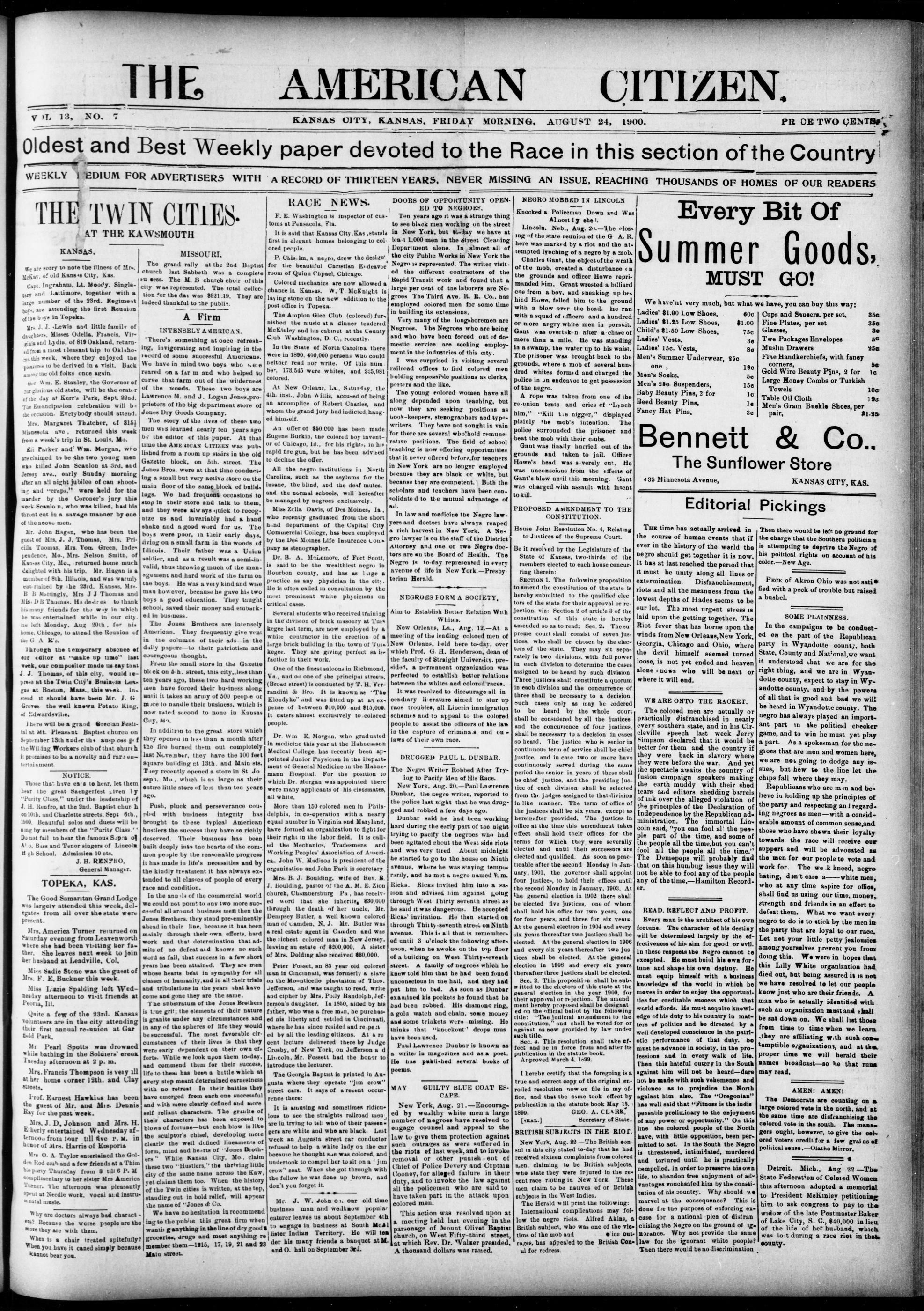
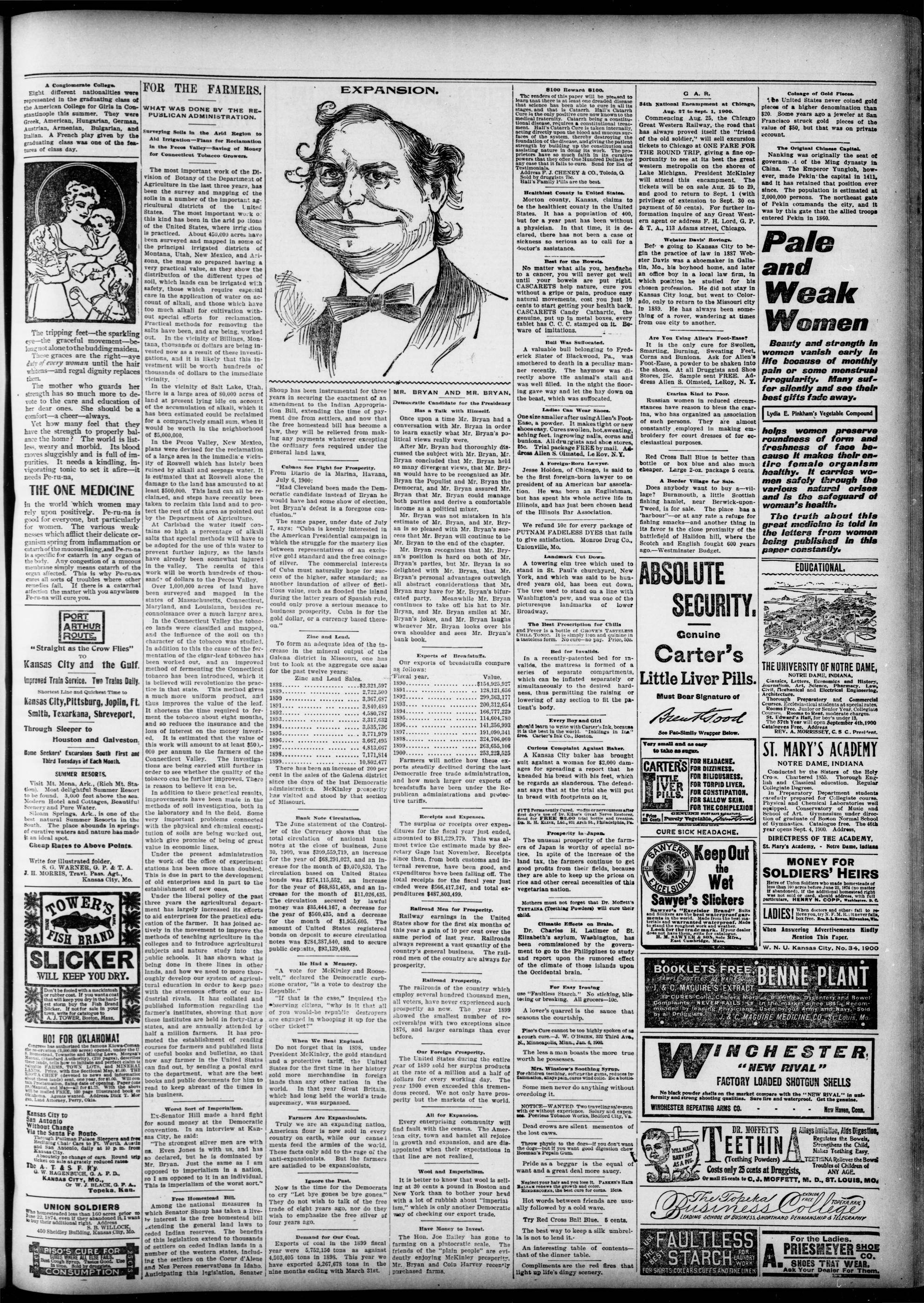
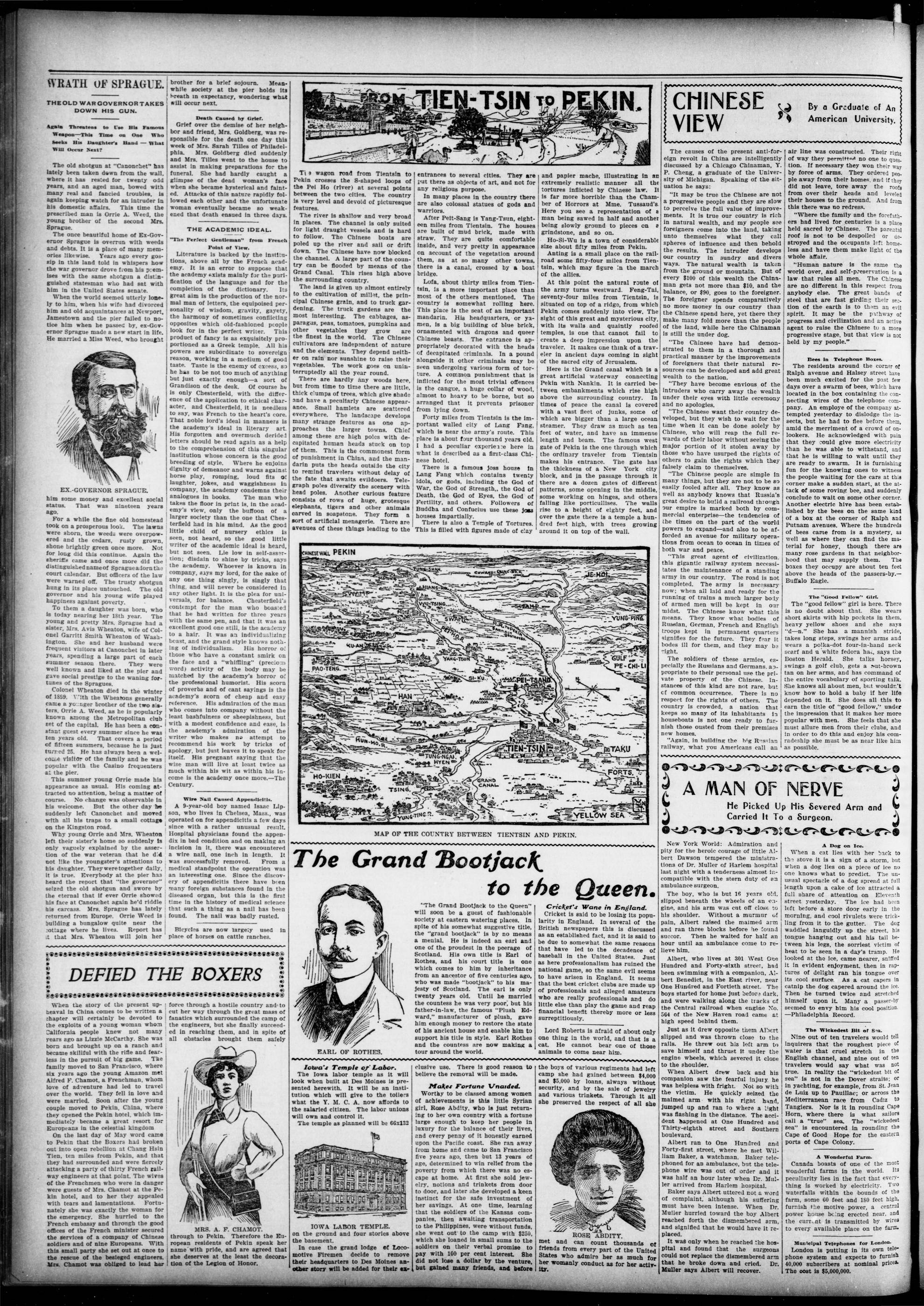
Page text (machine-generated)
Oldest and Best Weekly paper devoted to the Race in this section of the Country
THE TWIN CITIES AT THE KAWSMOUTH
VOL 13, NO. 7
Oldest and
WEEKLY MEDIUM FOR
THE TWI
AT THE KA
KANSAS.
We are sorry to note the illness of Mr.
W. Kay, of old Kansas City, Kas.
Capt. Ingraham, Lt. Moody, Single-terry and Lattimore, together with a large number of the 23rd. Regiment burs, are attending the first Reunion of the burs in Topeka.
Mrs. J. J. Lewis and little family of daughters, Misses Odelia, Francis, Virginia and Lyda, of 519 Oakland, returned from a most leasant trip to Oklahoma this week, where they enjoyed the pleasures to be derived in a visit. Back among the old folks once again.
Gov Wm. E. Stanley, the Governor of our glorious old state, will be the orator of the day at Kerr's Park, Sept. 22nd. The Encapitation celebration will be the occasion. Everybody should attend.
Mrs. Margaret Thatcher, of $151 Minnesota ave., returned this week from a week's trip in St. Louis, Mo.
Eli Parker and' Wm. Morgan, who are claimed to be the two young men who killed John Scanlon at 3rd, and Jersey ave., early Sunday morning after an all night jubilee of can shooting and 'crap,' were held for the murder by the Coroner's jury this week Scanlon, who was killed, had his throat cut in a savage manner by one of the above men.
Mr. John Hagan, who has been the guest of Mrs. J. J. Thomas, Mrs. Priciola Thomas, Mrs. Tom. Green, Independence, Mo. Mrs. Nelson Smith, of Kansas City, Mo., returned home much delighted with his trip. Mr. Hagan is a member of 8th. Illinois, and was warmly entailed by the 23rd. Kansas, Mrs. B B Mattingly, Mrs J J Thomas and Miss DB Thomas. He desires to thank his many friends for the way in which he was entertained while in our city, the left Monday, Aug 20th, for his home, Chicago, to attend the Reunion of the G A K's.
Through the temporary absence of our editor at "make up time" last week, our composer made us say that J. J. Thomas, of this city, would repress at the Twin City's Business League at Boston, Mass., this week. Insead it should have been Mr. J. G. Groves, the well known Petato King of Edwardsville.
There will be a grand @creian Festival at Mt. Pleasant Baptist church on September 13th under the auspices of the Willing Workers club of that church it promises to be a novelty and rars entertainment.
NOTICE.
Those that have ears to hear, let them hear the great Saengerfest given by "Purity Class," under the leadership of J. H. Renfro, at the 2nd, Baptist churst on 10th, and Charlotte streets, Sept 6th, 1900. Beautiful solos and duets will be sung by members of the "Purity Class." Do not fail to hear the famous Sopra of Alto, Bass and Tenor singers of Lincoln high school. Admission 10 cts. J. H. RENFRO, General Manager.
TOPEKA, KAS.
The Good Samartan Grand Lodge was largey attended this week, delegates from all over the state were present.
Mrs. America Turner returned on Saturday evening from Leavenworth where she had been visiting her father. She leaves next week to join her husband at Leadville, Col.
Miss Sadie Stone was the guest of Mrs. F. E. Buckner this week.
Miss Lizzie Spalding left Wednesday afternoon to vii-friends at Peoria, Ill.
Quite a few of the 23rd. Kansas volunteers are in the city attending their first annual re-union at Gar field Park.
Mr Pearl Spotts was drowned while bathing in the Soldiers' creeks Tuesday afternoon at 2 p. m.
Mrs. Francis Thompson is very ill at her home corner 12th. and Clay streets.
Prof. Earnest Hawkins has been the guest of Mr. and Mrs. Dennis Ray for the past week.
Mrs. J. D. Johnson and Mrs. H. Etherly entertained Wednesday afternoon from four till five P. M. in honor of Mrs. Harris of Emporia
Mrs. O. A. Taylor entertained the Golden Rod club and a few friends at a Thim party Thursday from 8 till 6 P. M. complimentary to her sister Mrs America Turner. The afternoon was pleasantly spent at Needle work, vocal and instrumental music.
Why are doctors always bad characters? Because the worse people are the more they are with them.
When is a chair treated spitefully? When you have it caned simply because cannot bear you.
THE
Best Weekly
FOR ADVERTISERS WITH
IN CITIES.
KAWSMOUTH
MISSOURI.
The grand rally at the 2nd Baptist church last Sabbath was a complete su cess. The M. B church choir of this city was represented. The total collection for the day was $921.19. They are indeed thankful to the public.
A Firm
INTENSELY AMERICAN
There's something at once refreshing, invigorating and inspiring in the record of some successful Americans. We have in mind two boys who were reared on a far m and who helped to carve that turn out of the widerness of the woods. These two boys are Lawrence M. and J. Logan Jones, proprietors of the big department store of Jones Dry Goods Company.
The story of the lives of these two men was learned nearly ten years ago by the editor of this paper. At that time the AMERICAN CITIZEN was published from a room up stairs in the old Gazette block, on 5th street. The Jones Bros. were at that time conducting a small but very active store on the main floor of the same block of buildings. We had frequent occasions to stop in their store and talk to them, and they were always quick to recognize us and invariably had a hand shake and a good word for us. The boys were poor, in their early days, living on a small farm in the woods of Illinois. Their father was a Union soldier, and as a result was a semi-valid, thus throwing much of the management and hard work of the farm on the boys. He was a very kind and wise man however, because he gave his two boys a good education. They taught school, saved their money and embarked in business.
The Jones Brothers are intensely American. They frequently give vents in the columns of their ads—in the daily papers—to their patriotism and courageous thought.
From the small store in the Gazette block on 5th. street, this city, less than ten years ago, these two hard working men have forced their business along until it takes an army of 500 people or more to handle their business, which is now rated second to none in Kansas City, Mo.
In addition to the great store which they opened in less than a month after the fire burned them out completely last November, they have the 100 feet square building at 13th. and Main sts. They recently opened a store in St Joseph. Mo., which is as large as their entire little store of less than ten years ago.
Push, pluck and perseverance coupled with business integrity has brought to these typical American hustlers the success they have so richly deserved. Their business has been built deeply into the hearts of the common people by the reasonable progress it has made in life's necessities and by the kindly treatment it has always extended to all classes of people of every race and condition.
In the annals of the commercial world we could not point to any two more successful all around business men then the Jones Brothers, they stand pre-eminently ahead in their line, because it has been mainly through their own efforts, hard work and that determination that admits of no defeat and knows no such word as fail, that success in a few short years has been attained. They are men whose hearts beat in sympathy for all classes of humanity, and in all their trials and tribulations in the years that have come and gone they are the same.
The subserviatum of the Jones Brothers is true grit; the elements of their nature is granite under any circumstances and in any of the spheres of life they would be successful. The most favorable circumstances of their lives is that they were early dependent on their own efforts. While we look upon them to-day, and commend them for their success, life to them has been a battle which at every step meant determined earnestness with no retreat. In their battles they have emerged from each one successful and with more clearly defined and more self reliant characters. The granite of their characters has been exposed to blows of fortune—but each blow is like the sculptor's chisel, developing more clearly the well defined linesaments of form, mind and hearts of "Jones Brothers". While Kansas City, Mo. claim these two "Hustlers", the thriving little city of the same name across the Kaw yet claims them too. When the history of the Twin cities is written, at the top standing out in bold relief, will appear the name of "Jones & Co."
aract- are the
feasibly?
because
We have no hesitation in recommend ing to the pubbie this great firm when wanti g anything in the line of dry good groceries, drugs and most anything re member them—1215, 17, 19, 21 and 23 Main street.
AMERICAN
KANSAS CITY, KANSAS, FRIDAY MORNING, AUGUST 24, 1900.
RACE NEWS.
F. E. Washington is inspector of customs at Pensacola, Fla.
It is said that Kansas City, Kas, stands first in elegant homes belonging to colored people.
P. Chishlm, a negro, drew the design for the beautiful Christian Endeavor room of Quinn Cipac, Chicago.
Colored mechanics are now allowed a chance in Kansas. W. T. McKnight is laying stone on the new addition to the post office in Topeka.
The Amplion Glee Club (colored) furnished the music at a dinner tendered McKinley and his cabinet at the County Club Washington, D. C., recently.
In the State of North Carolina there were in 1890, 400,000 persons who could neither read nor write. Of this number, 173,545 were whites, and 235,981 colored.
At New Orleans, La., Saturday, the 4th inst., John Willis, accused of being an accomplice of Robert Charles, and whom the grand jury had indicted, hanged himself.
An offer of $50,000 has been made Eugene Burkin, the colored boy inventor of Chicago, Ill., for his rights, in his rapid fire gun, but he has been advised to decline the offer.
All the negro institutions in North Carolina, such as the syllums for the insane, the blind, and the deaf mutes, and the normal schools, will hereafter be managed by negroes exclusively.
Miss Zella Davis, of Des Moines, Ia., who recently graduated from the short hand department of the Capital City Commercial College, has been employed by the Des Moines Life Insurance Company as stenographer.
Dr. B. A. McLemore, of Fort Scott, is said to be the wealthiest negro in Bourbon county, and has as large a practice as any physician in the city. He is often called in consultation by the most prominent white physicians on critical cases.
Several students who received training in the division of brick masonry at Tuskegee last term, are now employed by a white contractor in the erection of a large brick building in the town of Tuskegee. They are giving perfect saffaction in their work.
One of the finest saloons in Richmond, Va., and on one of the principal streets, Broad street) is conducted by T. H. Ferrandini & Bro. It is known as "The Klondyke" and was fitted up at an expense of between $0,000 and $15,000. It caters almost exclusively to colored people.
Dr. Wm E. Morgan, who graduated in medicine this year at the Hahnemann Medical College, has recently been appointed Junior Physician in the Department of General Medicine in the Hahnemann Hospital. For the position to which Dr. Morgan was appointed there were many applicants of his classmates, all white.
More than 150 colored men in Philadelphia, in co-operation with a nearly equal number in Virginia and Maryland, have formed an organization to fight for their right in the labor field. It is called the Mechanics, Tradesmens and Working People's Association of America. John W. Madison is president of the organization and John Park is secretary. Mrs. B. J. Boulding, wife of Rev. B. J. Boulding, pastor of the A. M. E. Zion church, Chambersburg Pa., has received word that she inherits $30,000 through the death of her uncle, Mr. Dempsey Butler, a well known colored man of Camden, N. J. Mr. Butler was a real estate agent in Camden and was the richest colored man in New Jersey, leaving an estate of $300,000. A sister of Mrs. Dolding also received $300,000.
Peter Fosset, an 85 year old colored man in Cincinnati, was formerly a slave on the Mounticello plantation of Thos. Jefferson, and was taught to read, write and cipher by Mrs. Polly Randolph, Jefferson's daughter. In 1850, aided by his father, who was a free man, he purchased his liberty and settled in Cincinnati, where he has since resided and reaped by all the leading citizens. At a recent lecture delivered there by Judge Crosby, of New York, on Jefferson a d Lincoln, Mr. Fosset had the honor to introduce the lecturer.
The Georgia Baptist is printed in Augusta where they operate "jim crow" street cars. It says of a recent occurrence there:
It is amusing and sometimes ridiculous to see the straightts railroad men are in trying to tell who of their passengers are white and who are black. Last week an Augusts street car conductor refused to help a white lady on the car because he thought she was colored, and undertook to compel her to sit on a 'jim crow' seat. When she got through with the fellow he was done up brown, and don't you forget it.
Mr. J. W. John on our old time business man and wellknown popular caterer leaves us about September 4th to engage in business at South McLister Indian Territory. He will ten der his many friends a banquet at M. and O. hall on September 3rd.
DOORS OF OPPORTUNITY OPENED TO NEGROES.
Ten years ago it was a strange thing to see black men working on the street in New York, but 10-day we have at least 1,000 men in the Street Cleaning Department alone. In almost all of the city Public Works in New York the Negro is represented. The writer visited the different contractors of the Rapid Transit work and found that a large per cent of the laborers are Negroes. The Third Ave. R. R. Co. has employed soiled men for some time in building its extensions.
Very many of the longshoremen are Negroes. The Negroes who are being and who have been forced out of domestic service are seeking employment in the industries of this city.
I was surprised in visiting several railroad offices to find colored men holding responsible positions as clerks, porters and the like.
The young colored women have all along depended upon teaching, but now they are seeking positions as book-keepers, stenogranbars and typewriters. They have not sought in vain for there are several who hold remunerature positions. The field of school teaching is now offering opportunities that it never offered before, for teachers in New York are no longer employed because they are black or white, but because they are competent. Both the scholars and teachers have been consolidated to the mutual advantage of all.
In law and medicine the Negro lawyers and doctors have always reaped a rich harvest in New York. A Negro lawyer is on the staff of the District Attorney and one or two Negro doctors are on the Board of Health. The Negro is to-day represented in every avenue of life in New York.—Presbyterian Herald.
NEGROES FORM A SOCIETY.
Aim to Establish Better Relation With Whites.
New Orleans, La., Aug. 12.—At a meeting of the leading colored men of New Orleans, held here to-day, over which Prof. G. H. Henderson, dean of the faculty of Straight University, presidet, a permanent organization was perfected to establish better relations between the whites and colored races. It was resolved to discourage all incendiary illiterature aimed to star up race troubles, all Liberia immigration schemes and to appeal to the colored people to assist the officers of the law in the capture of criminals and outlaws of their own race.
DRUGGER PAUL L. DUNBAR.
The Negro Writer Robbed After Try-
ing to Pacify Men of His Race.
New York, Aug, 20,—Paul Lawrence Dunbar, the nego writer, reported to the police last night that he was drugged and robbed a few days ago.
Dunbar said he had been working hard during the early part of tae night trying to pacify the negroes who had been agitated about the West side riots and was very tired. About midnight he started to go to the house on Ninth avenue, where he was staying temporarily, and he met a negro named W. M. Ricks. Ricks invited him into a sauna and advised him against going through West Thirty seventh street as he said it was dangerous. He accepted Ricks' invitation. He then started on through Thirty-seventh street on Ninth avenue. This is all that is remembered until 3 o'clock the following afternoon, when he awoke on the top floor of a building on West Thirty-seventh street. A family of negroes which he knew told him that he had been found unconscious in the hall, and they had put him to bed. As soon as Dunbar examined his pockets he found that he had been robbed. His diamond ring, a gold watch and chain, some money and some trinkets were missing. He thinks that "knockout" drops must have been used.
Paul Lawrence Dunbar is known as a writer in magazines and as a poet. He has published several books of poems.
MAY GUILTY BLUE COAT ES
CAPE.
New York, Aug. 21.—Encouraged by wealthy white men a large number of negroes have resolved to engage counsel and appeal to the law to give them protection against such outrages as were suffered in the riots of last week, and to invoke removal or other punishent of Chief of Police Devery and Captain Cooney, for alleged failure in their duty, and to invoke the law against all the policemen who are said to have taken part in the attack upon colored men.
This action was resolved upon at a meeting held last evening in the parsonage of Mount Olivet Baptist church, on West Fifty-third street, at which Rev. Dr. Walker presided. A thousand dollars was raised.
CITIZEN.
Lincoln, Neb., Aug. 20.—The closing of the state reunion of the G A.R. here was marked by a riot and the attempted lynching of a negro by a mob. Charles Gant, the object of the wrath of the mob, created a disturbance on the grounds and officer Howe reprimanded him. Grant wrested a billiard one from a boy, and sneaking up behind Howe, felled him to the ground with a blow over the head. He ran with a squad of officers and a hundred or more argy white men in pursuit. Gant was overtaken after a chase of more than a mile. He was standing in a swamp, the water up to his waist. The prisoner was brought back to the grounds, where a mob of several hundred whites formed and charged the police in an endeavor to get possession of the negro.
A rope was taken from one of the re-union tents and cries of "Lynch him," "Kill the nigger," displayed plainly the mob's intention. The police surrounded the prisoner and beat the mob with their cubs. Gant was finally hurried out of the grounds and taken to jail. Officer Howe's head was s-verely cut. He was unconscious from the effects of Gant's blow until this morning. Gant was charged with assault with intent to kill.
PROPOSED ASSEMBLEMENT TO THE
CONSTITUTION.
House Joint Resolution No. 4, Relating to Justices of the Supreme Court.
Be it resolved by the Legislature of the State of Kansas, two-thirds of the members elected to each house concurring therein:
SECTION 1. The following proposition to amend the constitution of the state is hereby submitted to the qualified electors of the state for their approval or rejection, viz: Section 2 of article 3 of the constitution of this state is hereby amended so as to read: Sec. 2. The supreme court shall consist of seven justices, who shall be chosen by the electors of the state. They may sit separately in two divisions, with full power in each division to determine the cases assigned to be heard by such division. Three justices shall constitute a quorum in each division and the concurrence of three shall be necessary to a decision, such cases only as may be ordered to be heard by the whole court shall be considered by all the justices and the concurrence of four justices, shall be necessary to a decision in cases so heard. The justice who is senior in continuous term of service shall be chief justice, and in case two or more have continuously served during the same period the senior in years of the shall be chief justice, and in the presiding justice of each division shall be selected from the judges assigned to that division in like manner. The term of office of the justices shall be six years, except as hereinafter provided. The justices in office at the time this amendment takes effect shall hold their offices for the terms for which they were severally elected and until their successors are elected and qualified. As soon as practicable after the second Monday in January, 1901, the governor shall appoint four justices, to hold their offices until the second Monday in January, 1903. At the general election in 1902 there shall be elected five justices, one of whom shall hold his office for two years, one for four years, and three for six years. At the general election in 1904 and every six years thereafter two justices shall be elected. At the general election in 1906 and every six years thereafter two justices shall be elected. At the general election in 1908 and every six years thereafter three justices shall be elected.
Sec. 2. This proposition shall be submitted to the electors of this state at the general election in the year 1900, for their approval or rejection. The amendment hereby proposed shall be designated on the official ballot by the following title: "The judicial amendment to the constitution," and shall be voted for or against as now provided by law under such title.
Sec. 4. This resolution shall take effect and be in force from and after its publication in the statute book.
Approved March 4, 1899.
I hereby certify that the foregoing is a true and correct copy of the original enrolled resolution on file in my office, and that the same took effect by publication in the statute book May 15, 1899.
GEO. A. CLARK.
[SEAL] Secretary of State.
BRITISH SUBJECTS IN THE RIDGE.
New York, Aug. 22 — The British consul in this city stated to-day that he had received sixteen complaints from colored men, claiming to be British subjects, who state they were injured in the recent race rioting in New York. These men claim to be natives of or British subjects in the West Indies.
The Herald will print the following: International complications may follow the negro riots. Alfred Akins, a British subject, who was one of the vices of the mob and ■ ice outrages, has appealed to the British Consul for redress.
Every Bit Of Summer Goods, MUST GO!
We have 'n't very much, but what we have, you can buy this way:
Ladies' $1.00 Low Shoes, 60c
Ladies' $1.25 Low Shoes, $1.00
Child's $1.50 Low Shoes, 75c
Ladies' Vests, 3e
Ladies' 15c. Vests, 8c
Men's Summer Underwear, 25c
one, 19c
Men's Socks, 5e
Men's 25c. Suspenders, 15c
Baby Beauty Pins, 2 for 1c
Beed Beauty Pins, 1c
Fancy Hat Pins, 3c
Cups and Saucers, per set, 35c
Fine Plates, per set 35c
Glasses, 3c
Twe Packages Envelopes 5c
Musem Drawers 25c
Fine Handkerchiefs, with fancy
corners, 5c
Gold Wire Beauty Pins, 2 for 1c
Large Honey Combs or Turkish
Towels 10c
Table Oil Cloth 19c
Men's Grain Buekle Shoes, per
pair, $1.25
Bennett & Co. The Sunflower Store
435 Minnesota Avenue.
Editorial Pickings
The time has actaally arrived in the course of human events that if ever in the history of the world the negro should get together it is now. It has at last reached the period that it must be unity along all lines or extermination. Disfranchisement, riots and all the meanness from the lowest depths of Hades seems to be our lot. The most urgent stress is laid upon the getting together. The Riot fever that has borne upon the winds from New Orleans, New York, Georgia, Chicago and Ohio, where the devil himself seemed turned loose, is not yet ended and heaven alone now who will be next or where it will end.
WE ARE ONTO THE BACKET.
The colored men are actually on practically distranchised in nearly every southern state, and in his Circleville speech last week Jerry Simpson declared that it would be better for them and the country if they were back in slavery where they were before the war. And yet the spectacle awaits the country of fusion campaign speakers making the earth muddy with their shoel tears and editors shedding barrels of ink over the alleged violation of the principles of the Declaration of Independence by the Republican administration. The immortal Lincoln said, "you can fool all the people part of the time, and some of the people all the time, but you can't fool all the people all the time." The Demepops will probably find that on this humbug issue they will not be able to foot any of the people any of the time.—Hamilton Recorder.
READ, REFLECT AND PROFIT.
Every man is the architect of his own fortune. The character of his destiny will be determined largely by the effectiveness of his aim for good or evil. In these respects the Negro cannot be excepted. He must build his own fortune and shape his own destiny. He must equip himself with a business knowledge of the world in which he moves in order to enjoy the opportunities for creditable success which that world affords. He must acquire knowledge of his duty to his country in matters of politics and be directed by a well developed conscience in the patriotic performance of that duty. no must he advance in society, in the professions and in every walk of life. Then this hateful outcry in the South against him will not be heard—dare not be made with such vexence and violence as to prejudice the North against him also. The "Oregonian" has well said that "Fitness is the indispensable preliminary to the enjoyment of any power or opportunity." On this line the colored people of the North have, with little opposition, been permitted to act. In the South the Negro is threatened, intimidated, murdered and tortured until he is practically compelled, in order to preserve his own life, to abandon tree enjoyment of advantages vouchaşed him by the constitution of his country. Why should we marvel at the consequence? This is done for the purpose of enforcing excuse for a national ples of disfuracing the Negro on the ground of ignorance. Why not provide the same law for the ignorant white people. Then there would be no discrimination
PR CE TWO CENTS
the Country
TIMES OF OUR READERS
Bit Of
Goods,
T GO!
we have, you can buy this way:
Cups and Saucers, per set, 35c
Fine Plates, per set 35c
Glasses, 3c
Two Packages Envelopes 5c
Muslin Drawers 25c
Fine Handkerchiefs, with fancy
corners, 5c
Gold Wire Beauty Pins, 2 for 1c
Large Honey Combs or Turkish
Towels 10c
Table Oil Cloth 19c
Men's Gram Buckle Shoes, per
pair, $1.25
& Co..
Power Store
KANSAS CITY, KAS.
Then there would be left no ground for the charge that the Southera politician is attempting to deprive the Negro of his political rights on account of his color.—New Age.
PECK of Akron Ohio was not sati fied with a peck of trouble but raised a bushel.
SOME PLAINNESS
In the campaigns to be conducted on the part of the Republican party in Wyandotte county, both State, County and National, we want it understood that we are for the right thing, and we are in Wyandotte county, expect to stay in Wyandotte county, and by the powers of all that is good and bad we will be heard in Wyandotte county. The negro has always played an important part in the political checker game, and to win he must yet play a part. As a spokesman for the negroes that are men and women here, we are not going to dodge any issues, but hew to the line let the chips fall where they may.
Republicans who are men and believe in holding up the principles of the party and respecting and regarding negroes as men—with a considerable amount of common sense, and those who have shown their loyalty towards the race will receive our support and will be advocated as the men for our people to vote and work for. The wek kneed, negro hating, don't care a—white men, who at any time aspire for offices, shall find us using our time, money, strength and friends in an effort to defeat them. What we want negro to do is to stick by the men in the party that are loyal to our race. Let not your little petty jealousies among yourselves prevent you from doing this. We were in hopes that this Lilly White organization had died out, but being assured it is not we have resolved to let our people know just who are their friends. A man who is actually identified with such an organization must and shall be sat down on. We shall list those from time to time when we learn they are affiliating with such contemptible organization, and at the proper time we will herald their names broadcast—so he that runs may read.
AMEN! AMEN!
The Democrats are counting on a large colored vote in the north, and at the same time are disfranchising the colored vote in the south. The managers ought, however, to give the colored voters credit for a few grains of political sense. —Olathe Mirror.
Detroit, Mich., Aug 22 —The State Federation of Colored Women this afternoon adopted a memorial to President McKinley petitioning him to ask congress to pay to the widow of the late Postmaster Baker of Lake City, S. C., $40,000 in lieu of the life of her husband, which was lost during a race riot in that county.
---
AMERICAN CITIZEN PUBLISHING
AND PRINTING CO.
Daily and Weekly 417 Minnesota Ave.
KANSAS CITY KANSAS
TERMS OF SUBSCRIPTION
Daily delivered by carrier per week. 10c.
Weekly one year..... $1 50
Entered at the postoffice at Kansas City
Kans., as second class matter.
WILLIAM McKINLEY,
For President.
THEODORE ROOSEVELT,
Vice President.
STATE TICKET.
For Governor.
W. E. STANLEY.
For Lieutenant Governor,
H. E. RICHER.
For Associate Justice,
W. A. JOHNSTON.
For Secretary of State,
GEO. A. CLARK.
For Treasury,
FRANK GRIMES.
For Auditor,
GEORGE E. COLE.
For Attorney General,
A. A. GODARD.
For Supt. of Public Instructions.
FRANK NELSON.
For Insurance Commissioner,
W. V. CHURCH.
For Congressman at Large.
CHARLES F. SCOTT.
For Congressman First District.
CHARLES CURTIS.
For Congressman Fifth District,
W. A. CALDERHEAD.
For Congressman Sixth District,
W. A. REEDER.
For Congressman Seventh District,
CHESTER I. LONG
COUNTY TICKET.
Senator, 4th. District.
JAMES K. CUBBISON.
Representative 9th. District,
H. A. BAILEY.
10th. District,
G. L. COATES
11th. District,
DAVID D. HOAG.
County Attorney,
E. A. ENRIGHT.
Clerk District Court,
ALEX. GUNNING.
Probate Judge,
K. P. SNYDER.
Superintendent Public Instruction,
HENRY MEADE.
County Commissioner,
First District—J. S. PERKINS.
WORK IS ENOBLING.
Accomplishments are good in their place, but if half the girls who spend hours every day trumping the piano, with no taste or capacity for music would invest the same time and money in learning how to sew and trim hats, they would realize a much better profit in their capital, and would never come to be regarded as incumbrances by their friends and relatives.
The higher education and many accomplishments of the poor Negro girl only add to her embarrassments and leave her but one profession—that of a teacher. School it fluences are all good, and a teacher is fitted to appear in the best society, as a result of association with the cultured and refined educators of youth. But all cannot be teachers.
We must have women who cannot only teach schoo, but who can sew,trim hats, cook, superintend a heennery or carry on any other business enterprise. It is not necessary that she lose that essential charm of womanhood because she stands behind the counter and sells vegetables and weighs flour. She need not shake a particle of her dignity of character because she conducts a cigar stand. If she is a true woman the very tendency of her being will sustain her womanly strength.
A woman working for her daily bread need feel no shame or embarrassment; the day has gone by when the woman who enters say pursuit of industry leses caste. The great majority of our women are in need of money making tale t and it is a grave mistake to educate the boys to become self-helpers while the girls are left to be mere ornamental members of society. The Standard.
At the last meeting of the Mississippi Press Association (white) a resolution was passed denying further membership to white news,apers which employed negro compositors; still there are negroes who say they will not read those papers owned and managed by the race. God pity the fools.
AN EPITAPH.
Full in the public view—
He asked the wrong mas, "Say,!"
Is it hot enough for you?
—Philadelphia North American.
Gov. Stanley's administration will go
down in history as the most economical
in the history of Karsas. There was
money left in the contugent fund,—
Tonkea Plaindealer
KANSAS CITY, MO.
Church Directory.
BAPTIST CHURCHES.
African 3914 East 15th. street.
Greenwood, 2005 Maderson Avenue.
Highland Avenue, 1119 Highland Ave.
Macedonian }
Mission { 216 East 21st. street.
Missionary, 2005 Madison Avenue.
Mt. Calvary, 15 northeast cor. Norton
Avenue.
Mount Gay, 2100 Wyoming Avenue.
Mount Norlah, 933 Bluff Street.
Mount Olive, Villa, s. e. cor. Garnett.
Mount Zion, 908 Hickory Avenue.
Mount Zion. Primitive, 2815 Garnett
street.
Pilgrim, 705 Charlott. street.
Pilgrim, Charlott between 6th and 7th
Pleasant Green, East Forest.
Round Top, Norton near 28th street.
St James, 1411 East 18th street.
St James Chapel, 518 High street.
St, Marks, 1019 East 4th street.
St. Pauls, 510 East 4th street.
Second Baptist, Charlott, cor. 10th.
Vine Street, 1825 Vine street.
CHRISTIAN CHURCH
21st between Summit and Madison,
s. Augus' ine Mission, 1025 Troost ave.
METHODIST EPISCOFAL
Absbury Chapel, 1620 Cherry street Burns, 11th S W. W. Cor, Highland ave Clark's Chapel, 819 S. W. Boulvard Westport W, Prospect Place Cor. 23rd King Solomon Mission 4th and Locust
Colored Schools.
Attucks 2108 East 18th street.
Bruce 3914 East 15th street.
Douglass 27th N. E. Cor. N. Prospect
Place.
Garrison Forest S. W Cor. 4th street.
Lincoln School 11th N. W. Cor Camp-
bell street.
Lincoln High School 816 East 11th st.
Page Rochester N.E. Cor. Prospect
Avenue.
Penn 4241 Shawne.
Business Directory.
J. A. Wilson Jeweller 1016 W. 9th st.
Chandler's Barber shop, Samuel Chandler Prop. S LClencens Mgr 112 East 6th street.
Restaurant Amus Prop. 114 East 6th street.
Field's Barber Shop 102 East 6th street
Miller's Barber Shop 113 East 6th
Midland Barber Shop Harsy Patson Prorietor 115 East 6th street.
Pace Barber Shop Oarth & Warfield Proprietors 550 Grand Avenue.
O' Bannon' Barber Shop W.T. O Bannon Proprietor 560 Grand Avenue.
Manila Barber Shop Madison Bros. Proprietors 709 Independence avenue.
McRay's Barber shop Ben McRay Proprietor 819 Independence avenue.
Maupin's Barber Shop 1382 E 18th st.
Brown's Barber Shop 1329 E 18th st.
Berry's Barber Shop 1432 E. 18th st
Grocer, George Grear, Prop. 1211 E.
18th st.
D. M. Mitchell, Barber Shop, 576
Grand ave.
Langton' Barber Shop 718 East 8th s
Walker's Barber Shop 806 East 12th s
H. J. George, barber shop, 1307 w
9th st.
Cowden's Barber Shop 704 East 12th st
Restaurant J. W, Gordon Prop. 554
Grand avenue.
Restaurant H Powel Proprietor 572
Grand avenue.
Restaurant Andrew Clark Proprietor
723 Independence ave.
Saratoga Cafe L. Mason I proprietor
805 Independence ave.
Chicago Cafe H Compton Proprietor
706 est 12th street
Physicians and Surgeons
Drs. Shannon and Lambright 1215 E.
18th st.
Dr. J.N. Birch 1339 E. 18th st.
Dr. T. C. Unthank 1233 Independence
Ave.
Dr. L.J. Holly 1112 Campbell st.
Grocery, A. Webb, Proj. 90th and Holmes.
ADMINISTRATOR'S NOTICE.
In the matter of the estate of Taylor McDonald, deceased. In the Probate Court in and for said County
Notice is hereby given that letters of administration have been granted to the undersigned, on the estate of Taylor McDonald, late of said county, deceased, by the Honorable, the Probate Court of the County and State aforesaid, dated the 3rd. day of March.A.D., 1900. Now, all persons having claims against the said estate, are hereby notified that they must present the same to the undersigned for allowance within one year from the date of said letters or they may be precluded from any benefit of such estate, and that if such claims be not exhibited within three years after the date of said letters, they shall be forever barred.
I. F. BRADLEY.
Administrator of the estate of Taylor McDonald, deceased.
Kansas City, Kas., March 20th, 1900.
In witness whereof the undersigned, Probate Judge in and for the County of Wyandotte, State of Kansas, have hereto set my hand, and affixed the seal of the said Probate Court, this 18th day of March, A. D., 1900. K. P. SNYDER,
Probate Judg
KANSAS CITY, KANSAS
Enterprises.
A.C.L. Coal Co. Main Office 492 Minn.
Ave. E.F. Henderson, Mgr.
D. W White Furniturestore, 420 Minn.
Ave.
J. W Jones Grocery 401 Oakland Ave
M. Gordon Department store 1405 N
0th
Clark & Lee, junk store, 1104 north
3rd, st.
Kansas City Kansas Soap Works, 4th
st., between Oakland and Freeman.
J. R. McClain, Grocer, 1700 n 5th, st.
J. R. Rucker, Butcher, 1600 n 16th, st.
Douglass Hospital, 312 Washington
ave., Mias L. V. Ashton, Maaron.
CHURCHES.
St. James A. M. E., cor. 7th. and Ann.
St. James M. E., Freeman ave., between 9th and 10th.
C. M. E. Oakland ave., bet. 4th. and 5th.
CHRISTIAN.
8th. St. Christian, cor. Everett and 8th.
9th. St. Christian, cor. 9th. and Nebraska.
BAPTIST.
1st. Baptist, corner 5 h. and Nebraska avenue.
Metropolitan Baptist, cor. 9th. and Washington.
Mt. Zion Baptist, Virginia ave., between 4th. and 5 h.
Pleasant Green, Wood St. and Split-
log ave.
King Solomon Baptist, 3rd. and State
avenue.
HOTELS.
Dyson House 440 Minnesota Ave.
Dyson House 40 Minnesota Ave.
Restaurant's.
J. W. Johnson's 6th and State.
Mrs. Hall 507 Mint. Ave.
Mrs. Sarah Thurston 1414 5th st.
Mc Gee 448 Mint. Ave.
E. Stoakes 1510 N. 3rd st.
BARBERS
J. T. Roberts & Tucker, 507 Minnesota avenue.
J. Gross, 412 Minnesota avenue.
G. McLellan, 613 Minnesota ave.
M.T. Comer, 608 Minnesota ave.
Robt. Keith, 315 Minnesota ave.
M. Pattison, 1603 north 3rd. st.
SHOEMAKER.
Lon McAdams, 348 Minnesota ave.
D.W. Wynne, 369 Minnesota ave.
Lewis Blanchard, North 6th., State Line.
Wilson, 5th. st. be'ween Nebraska and State.
J. W. Ready, No. 1609 $ n 10th. st.
HALLS.
M & O.,1306 north 8th. street.
Sons on Protection, State and 6th.
DRUGS.
Wyandotte Drug Store, 1512 north 5th. street.
S. H. Thompson, 151- north 5th, st.
G. H Brown, 1010 Freeman ave.
Jordan, 610 Minnesota ave.
ARTISTS.
O. J, Brooks, 70, New York Life
Building.
TEACHERS OF FRENCH AND ELOCUTION
Arthur A. Anderson, 541 State Ave.
UNION
PACIFIC
THE
OVERLAND
ROUTE
WORLD'S PICTORIAL LINE.
SHORTFST LINE ACROSS THE CONTINENT
The Union Pacific 'The Original Overland Route' always was, and is to-day, the shortest and best Line to the west. Two splendid fast trains leave Kansas City daily over this old established line. No change of cars between Kansas City and Denver, Ogden or San Francisco. All trains solidly vestibled and fully equipped with latest improved Recycling Chair Cars free and Pullman Palace sleeping cars. Meals served in Pullman Palace dining cars on the restaurant pian at prices most reasonable. All cars lightened with the celebrated Pintsch Ligtt. Only line running two trains without charge from KansasCity to Denver Low excursion rates on sale to Colorado-Utah Idaho, Oregon. Washington and California. Don't complete your ars rangelings for a trip until you have learned all about special inducements and attractions offered by the Union Pacific. For full information in regard to low. rates time. etc., call on or address
Gen. Agt., Union Pacific, 1000 Main street, Kansas City, Mo
Publication Notice.
State of Kansas.
Wyandotte County, Ks. **ss**
In the District Court of said County,
Joseph Law, Plaintiff, v. Maria Law,
Defendant.
The above named defendant, Maria
Law, will take notice that she has been
sued by the above named plaintiff, Jose
Law, in the above named court, where
the petition of the said plaintiff is now
on file, praying for a divorce against
you, the above named defendant, for
causes set out in said petition, and that
unless you answer petition on or be-
fore the 7th day of August. A. D. 1900,
the same will be taken as true and judgment
thereon rendered accordingly, di-
greeing that the above named plaintiff, and
dissolving the bonds of matrimony now
existing between you
B. S. SMITH
Attorney for Plaintiff
WELL OWN THE EARTH.
Let us g ther up the sun beams,
Lying all around our path,
Get a trust on wheat and rushes,
Give the poor the thorns and chaff.
Let us find our eifhteest pleasures
Bosting bounties for to-day.
So the poor shall have scant measure
And two prices have to pay.
Yes, we'll reservoir our rivers,
And we'll levy on the lakes,
And we'll lay a trifling poll tax
On each poor man who partakes—
We will brand his number on him
That he'll carry through life—
We'll apprentice all his children,
Get a mortgage on his wife.
We'll capture e'en the wind god
And confine him in a cave.
We will syndicate the starlight,
And monopolize the moon—
Claim royalty on rest days,
A proprietary noon—
For right of way through ocean's spray,
We'll charge just what it's worth—
We'll drive our stakes around the lakes,
In fact, we'll own the earth.
Great men are as rare in politics as they are elsewhere, and are no more needed there than elsewhere. The main part of the government is plain, practical business, and requires the same traits, facilities and methods as a great manufacturing or commercial enterprise. But the field is broader and the opportunities are more alluring. Government affairs concern every citizen, and the legislator with novel and foresight ideas, which he expresses in original and striking language, has an assured audience of as many millions as are voters in the republic. The bulk of our legislators and magistrates are men of fair, average, everyday capacity, who would be content with the revenues of the leading attorney at the county seat or the teacher of languages or the principal tradesman in a country town.
It would, perhaps, be within bounds to say that the speaker and twenty representatives in each congress have been the responsible architects and builders of our legislative fabric since the war. In the senate, for obvious reasons, the proportion of influential participants is greater, but even here it is less than the majority—Ex-Senator Ingalls, in the Saturday Evening Post.
MACHINE VS. MEN
New York's white wings are doomed. Street sweepers, teamsters, snow shovellers all are to be put out of business by a big machine, and one that can do three times the work of Jercy Nagles whole brigade. This machine sprinkles, sweeps and cleans at the same time. Already it has been placed on trial by Commissioner Nagle. There is no mystery about the invention. It was first tried in Wheeler g, W. V., in which state the company which exploits it was incorporated with a capital stock of $5,0,0,000. Wagons of the air will be operated by compressed air. Electricity also can be used. The wagons a e called "par parts." They are so constructed as to be able to sweep the streets under all conditions. Dust, dirt and slush disappear before their onslaught. In winter an attachment is arranged by which snow shoveling can be done
Publication Notice.
State of Kansas.
29th Judicial District,
County of Wyandotte.
(NO. 14049.)
Jacob Ricketts, Plaintiff, v. Esureta M. Alexander, E.S. Griggsby, William J. Fuller and Bille C. Fuller, Defendaat.
Under and by virtue of an order of sale issued by the Clerk of the District Court, in and for said County of Wyandotte, in a certain cause in said court, numbered 14049, wherein the parties above named were respectively plaintiff and defendants, and to me, the undergrown plaintiff said county directed, I will offer for sale a public auction, and sell to the highest bidder, for cash in hand, at the front door of the Court House, in the city of Kansas City, in said county, on Monday, the 10th day of Sep ember, A.D. 1900, at 10 o'clock a.m., of said day, the following described real estate situated in the County of Wyandotte and State of Kansas, to-wit:
All the right, title, interest and estate of the said Belle C. Fuller and William J. Fuller, in and to lot forty-six (46) in block one hundred and nine, (109) in the former City of Wyandotte, according to the plan of Wyandotte City, made by John H. Miller and published by the Wyandotte City Co., and now o file in Register of Deeds office of Wyandotte County, Kansas
H A. MENDENHALL,
Sheriff of Wyandotte County.
WHAT TO TRY.
Try a sun bait for mosquitoes.
Try a wet towel; to the back of the neck when sleepless.
Try swallowing saliva when troubled with sour stomach.
Try utermilk for removal of freckles, tan and bu terunt stains.
Try taking your cod-liver oil in tomato sauce if you want to make it palatable.
Try a hot dry flannel over the seat of neuralgic pain, and renew it frequently.
Try a cloth wrung out from cold water put about the neck at night, for sore throat.
Try walking with your hands behind you, if you find yourself becoming bent forward.
Try planting sunflowers in your garden, if compelled to live in a malarial neighborhood.
A rich man's secret. Save a nickel! e each day until you have a dollar; the dollar will take care of itself:—Progress.
RAILROAD NOTICES.
MISSOURI PACIFIC RAILWAY, SUM
MER EXCURSIONS.
—West and North.
To Pueblo, Colo. radio Springs and Den-
ver and return, special summer excursions
June 21, July 8, 9, 10, 18, and
August 2, final return limit October 31,
$19 for the round trip.
summer tickets on sale every day
from June 1 to September 15, in
closure, final return limit Oct. 31, round
trip $25.
Tickets to St. Paul and Minneapolis at $21 for the round trip, good g ing any day, returning any time up to October 1. Very low rates to other northern points.
Special excursions June 21, July 7, 8, 9 and 10 at and August 2 to St. Paul, Minneapolis. Round trip at $1.95. Duluth, Superiors at $9.55. Wesville, Minn. $14.40. Good to return October 31, 1960.
From July 1 special round trip excursions to Ogden and Salt Lake City at $50.00. Liberal stop owners. Good to return until October 31.
June 20 to 25 Winfield and return $6.60
July 7 to 20. Ottawa and return $1.65. For particular calls on 200-230-2300. JEWETT.
Passenger and Ticket Agent.
City ticket office No. 901 Main street, Kansas City, Mo.
Secure Tickets
...VIA THE....
Chicago, Milwaukee
& St. Paul Ry
...AND YOU GET....
Sleepers: & Ghair
Cars
...10....
CHICAGO
and all intermedsite points. The shortest,
quickest and bes tine to Chilcothe, Ot
tumwa, Cedar Rapids, Eubnque, and La
Crosse and Cedar Rapids, Rockford and
Freeport:
...Passenger Station at...
22nd St. and Grand Ave.
Take Westport Cable.
F. J. LER'CHpassenger Agent.
Office 915Main St.. Kansas Cit
MONEY
FOR OLD SOLDIERS
I WILL BUY
The additional Homestead Claims of all Soldiers or Sailors who served in the Union army or navy, their widows or minor heirs.
Who filed a Homestead claim of less than 160 acres of land prior to June 22nd, 1874?
Such persons are entitled to enough more land, including the number of acres embraced in their original entry, without living upon it, to make 160 acres. If they homesteaded 80 acres, they are entitled to 80 more, if 40 acres 120 more, if 159 acres, one scarce more, or any other number as it may appear.
By late rulings and decisions its not necessary that final proof should have been made on their original entry, that is, they are now entitled to such additional rights if their homestead was abandoned, canceled or relinquished, and all transfers can be made at their homes, before a Notary Public. All such claims I am prepared to buy and will pay the highest market price in cash, AT ONCE. Will buy fractional claims even if not more than one acre each. If you did not make a homestead thing you have no claim to sell. This kind of business is not but come to this office a once and go full particulars concerning this land. It is to your own interest to do so.
AMERICAN CITIZEN OFFICE,
41 Minnesota Avenue.
THE AMERICAN Citizen,
The oldest, one of the best and most reliable Weekly papers for the ace in the State An unexcelled Advertising Medium, office at 417 Minnesota avenue, Kansas City, Kansas.
Job Work, Bills, Programms, and all kinds of printing done. Satiss faction guaranteed or no go.
Correspondence solicited from all parts of the country,
KANSAS CITY, KANSAS
Publication Notice
In the District Court of Wyandotte County, Kansas,
Florence Toles, Plaintiffiff,
vs.
John Toles, Defendant.
To the above defendant you are here by notified that you have been sued in the above named court by the above named plaintiff, and that unless you appear and answer on or before the 14th day of September, 1900, the pittition will be taken as true and a judgment rendered against you, the nature of which will be a decree divorcing this plaintiff from said defendant, and awarding to her maiden name, Florence Borsu, and for costs of this suit. I. F. BRADLEY. Attorney for Pisintiff.
You Are Earnestly Requested to Call at The C. F. WILLNER, Furniture AND Carpet Co.
Looated at 618 and 620 Minnesota Avenue, To inspect the largest and most complete line of
In the city, at prices that will convince you that your money will go further here than elsewhere. We make it an especial effort to please and thereby retain your patronage and also your recommendation for your friends patronage.
WE SELL ON TIME PAYMENTS and know that OUR TERMS WILL SUIT YOU, and will be glad to show you OUR STOCK. We carry everything in the line of
FURNITURE, CARPETS, DRAPERIES, OIL CLOTH.
LINOLEUMS, SHADES, LAMPS, DINNER and TOILET SETS, also a complete tine of RANGES and GASO LINE SHOVES.
Don't forget the number and name.
We sell the Celebrated Kroeger Piano.
THE C. F. WILLNER
Furniture and Carpet to
618. 620 MINNEES OTLA AVENUE.
1009. ST. LOUIS AVENUE. 1009. Kansas City. Missouri. It is the swellest place in the city A. C. L. COAL CO., - IS HEADQUARTERS FOR-
THE CHEAPEST PRICES
The Best Goods, the Quickest Sales, the Smallest Profits and the promptest deliveries.
GET THEIR PRICES ON
COAL, WOOD, FEED, FLOUR, AND BUILDING
STONE,
Wholesale and Retail. Office 402, Minnesota Ave. Tel. 152 West.
Yard and Storage 917 and 919 North 3rd. St.
E F. HENDERSON Manager.
J. W. JOHNSON'S ICE CREAM PARLOR
The only Ice Cream Parlors in the two Kansas Cities where you can get the BestIce Cream Soda, and Ice Creams, Fine lunch, Pies, Cakes AND Confectionaries
Special attention paid to Churches, Lodges and parties. Ice Cream, wholesale, 75 to 90 cts. per gallon. Don't fail to give us a call. Corner 6th, and State streets, KANSAS CITY
W. B. RAYMOND
W. B. RAYMOND
Manufacturer of and Wholesale dealer in
UNDERTAKERS * SUPP
FIRST-CLASS CARRIAGES FOR ALL PURPOSES AT ALL
AMBULANCE FOR THE CONVEYANCE OF THE SICK A
Undertaking Krooms, 431 Minnesota ave. Tetepnone W
Factory Corst St., and Riverview Ave.
KANSAS CITY.
EAGERS
Gem Drug St
UNDERTAKERS * SUPPLIES FIRST-CLASS CARRIAGES FOR ALL PURPOSES AT ALL HOURS AMBULANCE FOR THE CONVEYANCE OF THE SICK AND WOUNDED Undertaking Rooms, 431 Minnesota ave. Telephone West 32.
EAGERS Gem DrugStore
MINNESOTA AVENUE
DEALER IN.
DRUGS, MEDICINES, CHE
Fine Toilet Soaps, Brushes, Combs
PERFUMERY AND FANCY TOILET
DRUGS, MEDICINES, CHEMICALS. Fine Toilet Soaps, Brushes, Combs, Etc., PERFUMERY AND FANCY TOILET ARTICLES.
Lewis Blandchard
No. 6, Sta e Line, K.C. K
Does all kinds of Boot and Shoe work. He does first class hand work, and also has one of the very latest and best Shoemaker's machine and guarantees the best and the cheapest work in the quickest time
Give him a trial and see for you eif.
If You Didn't Die.
Eating twelve mince pies between Christmas day and Twelfth day is said to insure the eater twelve lucky or happy months during the following year.
SUPPLIES
ALL PURPOSES AT ALL HOURS
ENCE OF THE SICK AND WOUNDED
ave. Telephone West 32.
and Riverview Ave. Telephone 28
KANSAS.
ERS
ug Store
LER IN.
NES, CHEMICALS.
nes, Combs, Etc.,
Y TOILET ARTICLES.
Half Rate Excursion.
Plus two dollars) twice a month via Union Pacific to points in Colorado, Wyoming, Utah, Idaho, Montana and Washington. Call us up: Phone 1100, or call at office 1,000 Main street, and let us te you all about these excursions.
Short line to Salt Like. The Union Pacific of course; hours quicker time. All the comforts of home Ticket of office 1,000 Main street, Telephone 1109.
Remember Dining Cars on the Union Pacific that now starts from Kansas City daily. Unexcelled service, restaurant plan Ticket office 1,000 Main street, Kansas City, Mo.
THE CELEBRATED SACK SOAP.
Go to C. W. Cloflesters grocery. No.
68 Central Ave., and purchase a bar of
his wonderful soap and give it a trial and
you will use no other. No housekeeper
should be without it
KANSAS.
A Conglomerate College
Eight different nationalities were represented in the graduating class of the American College for Girls in Constantinople this summer. They were Greek, American, Hungarian, German, Austrian, Armenian, Bulgarian, and Italian. A French play given by the graduating class was one of the features of class day.
Mother with children
The tripping feet—the sparkling eye—the graceful movement—be long not alone to the budding maiden. These graces are the right—aye duty of every woman until the hair whitens—and regal dignity replaces them.
The mother who guards her strength has so much more to devote to the care and education of her dear ones. She should be a comfort—a cheer—always.
Yet how many feel that they have the strength to properly balance the home? The world is listless, weary and morbid. Its blood moves sluggishly and is full of impurities. It needs a kindling, invigorating tonic to set it afire—it needs Pe-ru-na.
THE ONE MEDICINE
in the world which women may rely upon positively. Pe-ru-na is good for everyone, but particularly for women. The various weaknesses which afflict their delicate organism spring from inflammation or catarrh of the mucous lining, and Pe-ru-na is a specific for catarrh in any organ of the body. Any congestion of a mucous membrane simply means catarrh of the organ affected. This is why Pe-ru-na cures all sorts of troubles where other remedies fail. If there is a catarrh affection the matter with you anywhere Pe-ru-na will cure you.
"Straight as the Crow Flies"
TO
Kansas City and the Gulf.
Improved Train Service. Two Trains Daily.
Shortest Line and Quickest Time to
Kansas City,Pittsburg, Joplin, Ft.
Smith, Texarkana, Shreveport.
Home Seekers' Excursions South First and
Third Tuesdays of Each Month.
SUMMER RESORTS.
Visit Mt. Meena, Ark. (Rich Mt. Station). Most delightful Summer Resort to be found. 3,000 feet above the sea. Modern Hotel and Cottages, Beautiful Scenery and Pure Water. Siloam Springs, Ark., is one of the best natural Summer Resorts in the South. The place abounds in springs of curative waters and nature has made it an ideal spot. Cheap Eates to Above Points.
Write for illustrated folder,
S. G. WARNER, G. P. & T. A.
J. H. MORRIS, Travl. Pass. Agt.
Kansas City, Mo.
TOWER'S
FISH BRAND
SLICKER
WILL KEEP YOU DRY.
Don't be fooled with a mackintosh or rubber coat. If you want a coat that keeps you dry, you must est storm buy the Fish Brand Slicker. If not for sale in your town, write for catalogue to A. J. TOWER, Boston, Mass.
HO! FOR OKLAHOMA!
Congress has authorized the famous Klowa-Comana the re-servation (9,000,000 acres) opened, under the U.S. National, Townsite and Mining Laws. Morrow's Manual, and the Abovartty), (210 pages), describes these lands, tells how to initiate and perfect claim to the FALMS, TOWN LOTS, and MINERALS LAYS. Further, with these Sectional Map, $1.00. THIS KLOWA CHIEF (devested to news and information about these lands) sent one year, for $1.00. Will come to Proclamation fixing date of opening. Paper (consecutive) and Map-all for $1.75. With the above will be mailed FREE, 100 page illustrated book or Oklahoma. Agents wanted. Address Dick T. Moran, Land Attorney, Perry, Okia.
Kansas City to San Antonio
Without Change
Via the Santa Fe Route.
Through Pullman Palace Sleepers and free Reckling Chail Car's to Ft. Worth, Austin and San Antonio, daily at 10 p.m. from Kansas City.
A absolutely no change of cars. Round trip ticket on sale is gratefully reduced rates.
The A. T. & S. F. R'y.
G. W. HAGENBUCH, G.A. P.D.
KANSAS CITY, MO.,
Or W. J. BLACK, G.P. A.
Topeka, Kan.
UNION SOLDIERS
Who homesteaded less than 160 acres prior to June 22, 1874, even if they abandoned it, I want to buy their additional right. S. B. WILLLOCK
450 Shelday Building, Kansas City, Mo.
PISO'S CURE FOR BURNS WHERE ALL THE FAILS.
Best Cough Syrup. Tastes Good. Use in Insects. Sold by druggers.
CONSUMPTION
FOR THE FARMERS.
FOR THE FARMERS.
WHAT WAS DONE BY THE REPUBLICAN ADMINISTRATION.
Surveying Soils in the Arid Region to Aid Irrigation—Pians for Reclamation in the Pecos Valley—Saving of Money for Connecticut Tobacco Growers.
The most important work of the Division of Botany of the Department of Agriculture in the last three years, has been the survey and mapping of the soils in a number of the important agricultural districts of the United States. The most important work of this kind has been in the arid portions of the United States, where irrigation is practiced. About 450,000 acres have been surveyed and mapped in some of the principal irrigated districts of Montana, Utah, New Mexico, and Arizona, the maps so prepared having a very practical value, as they show the distribution of the different types of soil, which lands can be irrigated with safety, those which require especial care in the application of water on account of alkali, and those which have too much alkali for cultivation without special efforts for reclamation. Practical methods for removing the salts have been, and are being, worked out. In the vicinity of Billings, Montana, thousands or dollars are being invested now as a result of these investigations, and it is likely that this investment will be worth hundreds of thousands of dollars to the immediate vicinity.
In the vicinity of Salt Lake, Utah, there is a large area of 80,000 acres of land at present lying idle on account of the accumulation of alkali, which it has been estimated could be reclaimed for a compactively small sum, when it would be worth in the neighborhood of $5,000,000.
In the Pecos Valley, New Mexico, plans were devised for the reclamation of a large area in the immediate vicinity of Roswell which has lately been ruined by alkali and seepage water. It is estimated that at Roswell alone the damage to the land has amounted to at least $500,000. This land can all be reclaimed, and steps have recently been taken to reclaim this land and to protect the rest of this area as pointed out by the Department of Agriculture.
At Carlsbad the water itself contains so high a percentage of alkali salts that special methods will have to be adopted for the use of this water to prevent further injury, as the lands have already been somewhat injured in the valley. The results of this work will be worth hundreds of thousands of dollars to the Pecos Valley. Over 1,000,000 acres of land have been surveyed and mapped in the states of Massachusetts, Connecticut, Maryland, and Louisiana, besides reconnaissance over a much larger area.
In the Connecticut Valley the tobacco lands were classified and mapped, and the influence of the soil on the character of the tobacco was studied. In addition to this the cause of the fermentation of the cigar-leaf tobacco has been worked out, and an improved method of fermenting the Connecticut tobacco has been introduced, which it is believed will revolutionize the practice in that state. This method gives a much more uniform product, and thus improves the value of the leaf. It shortens the time required to ferment the tobacco about eight months, and so reduces the insurance and the loss of interest on the money invested. It is estimated that the value of this work will amount to at least $500-000 per annum to the farmers of the Connecticut Valley. The investigations are being carried still further in order to see whether the quality of the tobacco can be further improved. There is reason to believe it can be.
In addition to these practical results, improvements have been made in the methods of soil investigation, both in the laboratory and in the field. Some very important problems connected with the physical and chemical constitution of soils are being worked out, which give promise of being of great value in economic lines. Under the present administration the work of the office of experiment stations has been more than doubled. This is due in part to the development of old enterprises and in part to the establishment of new ones.
Under the liberal policy of the past three years the agricultural department has largely increased its efforts to aid enterprises for the practical education of the farmer. It has joined actively in the movement to improve the methods of teaching agriculture in the colleges and to introduce agricultural subjects and nature study into the public schools. It has shown what is being done in these lines in other lands, and how we need to more thoroughly develop our system of agricultural education in order to keep paces with the strenuous efforts of our industrial rivals. It has collated and published information regarding the farmer's institutes, showing that now these institutes are held in forty-thr a states, and are annually attended by half a million farmers. It has promoted the establishment of reading courses for farmers and published lists of useful books and bulletins, so that now any farmer in the United States can find out, by sending a postal card to the department, what are the best books and public documents for him to read to keep abreast of the times in his business.
Worst Sort of Imperialism
Ex-Senator Hill made a hard fight for sound money at the Democratic convention. In an interview at Kansas City, he said: "The strongest silver men are with us. Even Jones is with us, and has so declared, but he is dominated by Mr. Bryan. Just the same as I am opposed to imperialism in a nation, so I am opposed to it in an individual. This is imperialism of the worst sort."
Free Homestead Bill.
Among the national measures in which Senator Shoup has taken a live-interest is the free homestead bill extending the general land laws to ceded Indian reserves. The benefits of this legislation extend to thousands of settlers on ceded Indian lands in a number of the western states, including the settlers on the Coeur d'Alene and Nez Perces reservations in Idaho. Anticipating this legislation, Senator
EXPANSION.
Shoup has been instrumental for three years in securing the enactment of an amendment to the Indian Appropriation Bill, extending the time of payment due from settlers, and now that the free homestead bill has become a law, they will be relieved from making any payments whatever excepting the ordinary fees required under the general land laws.
MR. BRYAN AND MR. BRYAN,
Democratic Candidate for the Presidency
Has a Talk with Himself.
Once upon a time Mr. Bryan had a conversation with Mr. Bryan in order to learn exactly what Mr. Bryan's political views really were.
After Mr. Bryan had thoroughly discussed the subject with Mr. Bryan, Mr.
Cnbans See Fight for Freedom
From Diario de la Marina, Havana, July 6, 1900: "Had Cleveland been made the Democratic candidate instead of Bryan he would have had some show of election, but Bryan's defeat is a foregone conclusion."
The same paper, under date of July 7, says: "Cuba is keenly interested in the American Presidential campaign in which the struggle for the mastery lies between representatives of an exclusive gold standard and the free coinage of silver. The commercial interests of Cuba must naturally hope for success of the higher, safer standard; as another inundation of silver of fictitious value, such as flooded the island during the latter years of Spanish rule, could only prove a serious menace to business prosperity. Cuba is for the gold dollar, or a currency based thereon."
Zine and Lead.
To form an adequate idea of the increase in the mineral output of the Galena district in Missouri, one has but to look at the aggregate ore sales for the past twelve years:
Zinc and Lead Sales.
1888 ..... $2,321,597
1889 ..... 2,722,500
1890 ..... 3,367,687
1891 ..... 3,340,450
1892 ..... 4,580,787
1893 ..... 3,317,632
1894 ..... 3,358,736
1895 ..... 3,771,979
1896 ..... 3,667,495
1897 ..... 4,812,667
1898 ..... 7,771,814
1899 ..... 10,802,477
There has been an increase of 200 per cent in the sales of the Galena district since the days of the last Democratic administration. McKinley prosperity has visited and stood by that section of Missouri.
Bank Note Circulation
The June statement of the Controller of the Currency shows that the total circulation of national bank notes at the close of business, June 30, 1900, was $309,559,719, an increase for the year of $68,291,023, and an increase for the month of $9,070,530. The circulation based on United States bonds was $274,115,552, an increase for the year of $68,851,458, and an increase for the month of $11,026,455. The circulation secured by lawful money was $35,441,167, a decrease for the year of $560,435, and a decrease for the month of $1,955,605. The amount of United States registered bonds on deposit to secure circulation notes was $284,387,540, and to secure public deposits $92,129,480.
He Had a Memory.
"A vote for McKinley and Roosevelt," declared the Democratic curbstone orator, "is a vote to destroy the Republic.
"If that is the case," inquired the observing citizen, "why is it that all of you would-be republic destroyers are engaged in whooping it up for the other ticket?"
When We Reat England
Do not forget that in 1898, under President McKinley, the gold standard and a protective tariff, the United States for the first time in her history sold more merchandise in foreign lands than any other nation in the world. In that year Great Britain, which had long held the world's trade supremacy, was surpassed.
Farmers Are Expansionists
Truly we are an expanding nation. American flour is now sold in every country on earth, while our cannell meats the armies of the world. These facts only add to the rage of the anti-expansionists. But the farmers are satisfied to be expansionists.
Ignore the Past.
Now is the time for the Democrats to cry "Let bye gones be bye gones." They do not wish to talk of the free trade of eight years ago, nor do they wish to emphasize the free silver of four years ago.
Demand for Our Coal.
Exports of coal in the 1899 fiscal year were 5,752,150 tons as against 4,503,405 tons in 1898. This year we have exported 5,267,678 tons in the nine months ending with March 31st.
MR. BRYAN AND MR. BRYAN,
Democratic Candidate for the Presidency
Has a Talk with Himself.
Once upon a time Mr. Bryan had a conversation with Mr. Bryan in order to learn exactly what Mr. Bryan's political views really were.
After Mr. Bryan had thoroughly discussed the subject with Mr. Bryan, Mr. Bryan concluded that Mr. Bryan held so many divergent views, that Mr. Bryan would be recognized as Mr. Bryan the Populist and Mr. Bryan the Democrat, and Mr. Bryan assured Mr. Bryan that Mr. Bryan could manage both parties and derive a comfortable income as a political mixer.
Mr. Bryan was not mistaken in his estimate of Mr. Bryan, and Mr. Bryan is so pleased with Mr. Bryan's success that Mr. Bryan will continue to be Mr. Bryan to the end of the chapter.
Mr. Bryan recognizes that Mr. Bryan's position is hard on both of Mr. Bryan's parties, but Mr. Bryan is so delighted with Mr. Bryan, that Mr. Bryan's personal advantages outweigh all abstract considerations that Mr. Bryan may have for Mr. Bryan's bifurcated party. Meanwhile Mr. Bryan continues to take off his hat to Mr. Bryan, and Mr. Bryan smiles at Mr. Bryan's jokes, and Mr. Bryan laughs whenever Mr. Bryan looks over his own shoulder and sees Mr. Bryan's bank book.
Exports of Breadstuffs
Our exports of breadstuffs compare as follows:
Fiscal year. Value.
1890 . . . $154,925,927
1891 . . . 128,121,656
1892 . . . 299,363,177
1893 . . . 200,312,654
1894 . . . 166,777,229
1895 . . . 114,604,780
1896 . . . 114,356,993
1897 . . . 191,090,341
1898 . . . 324,706,060
1899 . . . 263,655,106
1900 . . . 253,223,525
Farmers will notice how these exports steadily declined during the last Democratic free trade administration, and how much larger our exports of breadstuffs have been under the Republican administrations and protective tariffs.
Receivals and Expenses
The surplus or receipts over expenditures for the fiscal year just ended, amounted to $81,229,779. This was almost twice the estimate made by Secretary Gage last November. Receipts since then, from both customs and internal revenue, have been good, and expenditures have been falling off. The total receipts for the fiscal year just ended were $566,417,347, and total expenditures $487,803,499.
Railroad Men for Prosperity
Railway earnings in the United States show for the first six months of this year a gain of 10 per cent over the same period of last year. Railroads always represent a vast quantity of the country's general business. The railroad men of the country are always for prosperity.
Railroad Prosperity
The railroads of the country which employ several hundred thousand men, all voters, have never experienced such prosperity as now. The year 1899 showed the smallest number of receiverships with two exceptions since 1875, and larger earnings than ever before.
Our Foreign Prosperity
The United States during the entire year of 1899 sold her surplus products at the rate of a million and a half of dollars for every working day. The year 1900 even exceeded this tremendous record. We not only have prosperity but the markets of the world.
All for Expansion.
Every enterprise community will find fault with the census. The American city, town and hamlet all rejoice in growth and expansion, and are disappointed when their expectations in that line are not realized.
Wool and Imperialism.
It is better to know that wool is selling at 30 cents a pound in Boston and New York than to bother your head with a lot of rubbish about "imperialism," which is only another Democratic way of checking our export trade.
Have Money to Invest.
The Hon. Joe Bailey has gone to farming on a plurocratic scale. The friends of the "plain people" are evidently enjoying McKinley prosperity. Mr. Bryan and Coin Harvey recently purchased farms.
$100 Reward $100.
The renders of this paper will be pleased to learn that there is at least one dreaded disease that causes it. It is Catarachn. Hall's Catarachn Cure is the only positive cure now known to the national disease, requires a constitutional treatment. Hall's Catarachn Cure is taken internally, and faces of the system, thereby destroying the foundation of the disease, and giving the patient the constitution and assisting nature in doing its cure. Presisting nature in doing its cure. One Hundred Dollars for any case that it fails to cure. Send for list of Testimonials.
CHENEY & CO., Toledo, O.
Sold by druggists K.
Hall's Family Pills are the best.
Healthiest County in United States.
Morton county, Kansas, claims to be the healthiest county in the United States. It has a population of 400, but for a year past has been without a physician. In that time, it is declared, there has not been a case of sickness so serious as to call for a doctor's assistance.
Beat for the Bowels
No matter what all asks, headache to a cancer, you will never get well until your bowels are put right. CASCARETS help nature, cure you without a gripe or pain, produce easy natural movements, cost you just 10 cents to start getting your health back. C. C. C. stamped on it. Genuine, put up in metal boxes, every tablet has C. C. C. stamped on it. Beware of imitations.
Roll Was Sugorated
A valuable bull belonging to Frederick Slater of Blackwood, Pa., was smothered to death in a peculiar manner recently. The haymow was directly above the animal's stall and was well filled. In the night the flooring gave way and let the hay down on the beast, which was suffocated.
Ladies Can Wear Socks
One size smaller after using Allen's Foot-Ease, a powder. It makes tight or new shoes easy. Cures swollen, hot, sweating, aching feet. Ingrowing nails, corns and bunions. All druggists and shoe stores, 25c. Trial package FREE by mail. Address Allen S. Olmsted, Le Roy, N.Y.
A Foreign-Born Lawyer.
Jesse Holden, of Chicago, is said to be the first foreign-born lawyer to be president of an American bar association. He was born an Englishman, but has spent his whole active life in Illinois, and has just been chosen head of the Illinois Bar Association.
We refund 10c for every package of PUTNAM FADELE DYES that fails to give satisfaction. Monroe Drug Co., Unionville, Mo.
Landmark Cut Down.
A towering elm tree which used to stand in St. Paul's churchyard, New York, and which was said to be hundred years old, has been cut down. The tree used to stand on a line with Washington's pew, and was one of the picturesque landmarks of lower Broadway.
The Best Preservation for Chill
and Pever is a bottle of GLOVE'S TASTELESS
and Pever is a bottle of GLOVE'S TASTELESS
Bed for Invalids.
In a recently-patented bed for invalids, the mattress is formed of a series of separate compartments, which can be inflated separately or simultaneously to the desired hardness, thus permitting the raising or lowering of any section to fit the patient's body.
Every Boy and Girl
should learn to write with Carter's ink, because
it's not as thick as the ink in 'In flare.'
Carter's ink Co., Boston
Curlons Complaint Against Baker
A Kansas City baker has brought suit against a woman for $2,000 damages for spreading a report that he kneaded his bread with his feet, which he regards as slanderous. The defendant says that at the trial she will put in bread with footprints on it.
FITS Permanently Cured. wits or nervousness after first day's use of Dr. Kline's Great Nerve Restore. Dr. B. H. Kraus, KLK, 511 St. Arth. Philadelphia, Pa.
Prosperity in Japan
The unusual prosperity of the farmers of Japan is worthy of special notice. In spite of the increase of the land tax, the farmers continue to get good profits from their fields, because they are able to keep up the prices on rice and other cereal necessities of this vegetarian nation.
Mothers must not forget that Dr. Moffett's TEETAINA (Teething Powders) will cure their child.
Climatic Effects on Brain
Dr. Charles H. Latimer of St. Elizabeth's asylum, Washington, has been commissioned by the government to go to the Philippines to study and report upon the rumored effect of the climate of those islands upon the Occidental brain.
For Easy Ironing
BOOKLETS FREE
SAMPLE BOULETS BY MALE WORK
J. & C. MAGUIRE'S EXTRACT
To CURES Colic, Cholera Morbus, Bristolia, Dysentery and Bowel
Complaints—NEVER FAILS! In the market since 1884. Recom-
mended by leading Physicians. Used by our Army and Navy. Sold
by all Druggists.
J. & C. MAGUIRE MEDICINE CO. ST. Louis, Mo.
WINCHESTER
"NEW RIVAL"
FACTORY LOADED SHOTGUN SHELLS
No black powder shells on the market compare with the "NEW RIVAL" in uni-
formity and strong shooting qualities. Sure fire and waterproof. Get the genuine.
WINCHESTER REPEATING ARMS CO. - - - - New Haven, Conn.
MILL MAKE BABY FAT AS A PIG.
DR. MOFFETT'S TEETHINA
(Teething Powders)
Costs only 25 cents at Druggists.
Or mail 25 cents to C. J. MOFFETT, M. D., ST. LOUIS, MO.
Allays irritation, Aids Digestion.
Regulates the Bowels,
Strengthens the Child,
Makes Teething Easy.
TEETHINA Relieves the Bowels
Troubles of Children of
ANY AGE.
The Topeka Business College
LEADING SCHOOL OF BUSINESS, SHOURTH AND PENMANSHIP & TELEGRAPHY
USE THE BEST
FAULTLESS STARCH
FOR LAUNDRY WORK
FOR SHIRTS, COLLARS, CUFFS AND FINE LIMEN
For the Ladies.
PRIESMEYER SHOE
CO.
SHOES THAT WEAR.
Ask Your Dealer For Them.
G A. R.
34th National Encompass at Chicago
Aug. 27 to Sept. 1, 1900.
Commencing Aug. 25, the Chicago Great Western Railway, the road that has always proved itself the "friend of the old soldier," will sell excursion tickets to Chicago at ONE FARE FOR THE ROUND TRIP, giving a fine opportunity to see at its best the great western metropolis on the shores of Lake Michigan. President McKinley will attend this encampment. The tickets will be on sale Aug. 25 to 29, and good to return to Sept. 1 (with privilege of extension to Sept. 30 on payment of 50 cents). For further information inquire of any Great Western agent or address F. H. Lord, G. P. & T. A., 113 Adams street, Chicago.
Webster Davis' Boxings
Before going to Kansas City to begin the practice of law in 1887 Webster Davis was a shoemaker in Gallatin, Mo., his boyhood home, and later an office boy in a local law firm, in which position he studied for his chosen profession. He did not stay in Kansas City long, but went to Colorado, only to return to the Missouri city in 1889. He has always been something of a rover, wandering at times from one city to another.
Are You Easing Allen's Foot-Face?
Are You Using Allen's Foot-Ease?
It is the only cure for Swollen,
Smarting, Burning, Sweating Feet,
Corns and Bunions. Ask for Allen's
Foot-Ease, a powder to be shaken into
the shoes. At all Druggists and Shoe
Stores, 25c. Sample sent FREE. Address
Allen S, Olmsted, LR. Noy, R. Y.
Czarina Kind to Poor
Russian women in reduced circumstances have reason to bless the czarina, who has organized an association of such persons. They are almost constantly employed in making embroidery for court dresses of for ecclesiastical purposes.
Red Cross Ball Blue is better than bottle or box blue and also much cheaper. Large 2-oz. package 5 cents.
A Border Village for Sale.
Does anybody want to buy a *v*-litage? Burmouth, a little Scottish fishing hamlet, near Berwick-upon-Tweed, is for sale. The place has a 'harbour' or at any rate a refuge for fishing smacks—and another thing in its favor is the close proximity of the battlefield of Halidon hill, where the Scotch and English fought 600 years ago—Westminster Budget.
ABSOLUTE
SECURITY.
Genuine
Carter's
Little Liver Pills.
Must Boar Signature of
Carter's
See Fac-Similly Wrapper Below.
Very small and as easy
to take as sugar.
CARTER'S
LITTLE
LIVER
PILLS.
FOR HEADACHE.
FOR DIZZINESS.
FOR BILLOUSNESS.
FOR TORPID LIVER.
FOR CONSTIPATION.
FOR SALLOW SKIN.
FOR THE COMPLEXION
* Price
25 Cents
PURELY Vegetable. MADE SIGNATURE.
CURE SICK HEADACHE.
Keep Out
the Wet
Sawyer's Slickers
Sawyer's "Excelsior Brand" Salts
and slickers are old best waterproof gar-
ment and are made for the most
materials and warranted waterproof. Made
for the washroom ware and furniture.
Look for the trade mark. If your dealer
does not have them, write for catalogue.
H. M. Hill & Co. 600 W. 47th Ave.
East Cambridge, Mass.
BOOKLETS FREE
SAMPLE BOTTLES AT MAIL OR
J. & C. MAGUIRE'S EXTRACT
TO CURES Coll. Choices More
Complaints - NEVER FAILS
measured by leading Physicians
by all Drs. bottles
J. & C. MAGUIRE
Colnage of Gold Pieces
1 The United States never coined gold pieces of a higher denomination than $20. Some years ago a jeweler at San Francisco struck gold pieces of the value of $50, but that was on private account.
The Original Chinese Capital
Nanking was originally the seat of government of the Ming dynasty in China. The Emperor Yungloh, however, made Pekin' the capital in 1411, and it has retained that position ever since. The population is estimated at 2,000,000 persons. The northeast gate of Pekin commands the city, and it was by this gate that the allied troops entered Pekin in 1860.
Pale and Weak Women
Beauty and strength in women vanish early in life because of monthly pain or some menstrual irregularity. Many suffer silently and see their best gifts fade away. Lydia E. Pinkham's Vegetable Compound helps women preserve roundness of form and freshness of face because it makes their entire female organism healthy. It carries women safely through the various natural crises and is the safeguard of woman's health.
The truth about this great medicine is told in the letters from women being published in this paper constantly.
EDUCATIONAL,
THE UNIVERSITY OF NOTRE DAME,
NOTRE DAME, INDIANA,
Classics, Letters, Economics and History,
Journalism, Art, Science, Pharmacy, Law,
Civil Mechanical and Electrical Engineering,
Architectures.
Through Preparatory and Commercial Courses. Ecclesiastical students at special rates. Room 101. Ecclesiastical University Courses. Rooms to Rent, moderate charges. St. Edward's Hall, for boys under 13.
Catalogues Free. Address
REY, A. MORRISSEY C. S. C. President
ST. MARY'S ACADEMY
NOTRE DAME, INDIANA
Conducted by the Sisters of the Holy Cross, Chartered 1555. Thorough English and Classical education. Regular Collegiate Degrees.
In Preparatory Department students can attend the General College course, Physical and Chemical Laboratories well equipped. Conservatory of Music and School of Art. Gymnastium under direction of graduate of Boston Normal School of Gymnastics. Catalogue free. The 46th year opens Sept. 4, 1900. Address.
DIRECTRESS OF THE ACADEMY,
St. Mary's Academy, - Notre Dame, Indiana
MONEY FOR SOLDIERS' HEIRS
Herts of Union Soldiers who made homeswalls of less than 19° before June 22, 1944 (no matter if abandoned). If the additional homestead right was not sold, should address, with full particular, HENRY M. COPP, Nashville, B. G.
LADIES!
When doctors and other fail to recover from injury, a box free. Mr. B. R. Brown, Milwaukee, WI.
When Answering Advertisements Kindly Mention This Paper.
W. N. U. Kansas City, No. 34, 1900
BENNE PLANT
Uses Brenne Dysentery and Bowel
in the market since 1847. Recom-
mised by our Army and Navy. Sold
DIRE MEDICINE CO. St. Louis, Mo.
HESTER;
NEW RIVAL"
ORDER QUOTIN CHELSEA
DEFIED THE BOXERS
---
WRATH OF SPRAGUE.
THE OLD WAR GOVERNOR TAKES DOWN HIS GUN.
Again Threatens to Use His Famous Weapon—This Time on One Who Seeks His Daughter's Hand —What Will Occur Next?
The old shotgun at "Canonchet" has lately been taken down from the wall, where it has rested for twenty old years, and an aged man, bowed with many real and fancied troubles, is again keeping watch for an intruder in his domestic affairs. This time the prescribed man is Orrie A. Weed, the young brother of the second Mrs. Sprague.
The once beautiful home of Ex-Governor Sprague is overrun with weeds and debts. It is a place of many memories likewise. Years ago every gossip in this land told in whispers how the war governor drove from his premises with the same shotgun a distinguished statesman who had sat with him in the United States senate. When the world seemed utterly lonely to him, when his wife had divorced him and old acquaintances at Newport, Jamestown and the pier failed to notice him when he passed by, ex-Governor Sprague made a new start in life. He married a Miss Weed, who brought
EX.-GOVERNOR SPRAGUE.
him some money and excellent social status. That was nineteen years ago.
For a while the fine old homestead took on a prosperous look. The lawns were shorn, the weeds were overpowered and the cedars, rusty grown, shone brightly green once more. Not for long did this continue. Again the sheriffs came and once more did the distinguished name of Sprague adorn the court calendar. But officers of the law were warned off. The trusty shotgun hung in its place untouched. The old governor and his young wife played happiness against poverty.
To them a daughter was born, who is today nearing her 18th year. The young and pretty Mrs. Sprague had a sister, Mrs. Avis Wheaton, wife of Colonel Garritt Smith Wheaton of Washington. She and her husband were frequent visitors at Canonet in later years, spending a large part of each summer season there. They were well known and liked at the pier and gave social prestige to the waning fortunes of the Spragues.
Colonel Wheaton died in the winter of 1859. With the Wheaton generally came a younger brother of the two sisters, Orrie A. Weed, as he is popularly known among the Metropolitan club set of the capital. He has been a constant guest every summer since he was ten years old. That covers a period of fifteen summers, because he is just turned 25. He has always been a welcome visitor of the family and he was popular with the Casino frequenters at the pier.
This summer young Orrie made his appearance as usual. His coming attracted no attention, being a matter of course. No change was observable in his welcome. But the other day he suddenly left Canonchet and moved with all his traps to a small cottage on the Kingston road.
Why young Orrie and Mrs. Wheaton left their sister's home so suddenly is only vaguely explained by the assertion of the war veteran that he did not like the youngster's attentions to his daughter. They were together daily, it is true. Everybody at the pier has heard the report that "the governor" selzed the old shotgun and swore by the eternal that if ever Orrie showed his face at Canonchet again he'd riddle his carcass. Mrs. Sprague has lately returned from Europe. Orrie Weed is building a bungalow quite near the cottage where he lives. Report has it that Mrs. Wheaton will join her
When the story of the present upheaval in China comes to be written a chapter will certainly be devoted to the exploits of a young woman whom California people knew not many years ago as Lizzie McCarthy. She was born and brought up on a ranch and became skillful with the rifle and fearless in the pursuit of big game. The family moved to San Francisco, where six years ago the young Amazon met Alfred F. Chamot, a Frenchman, whom love of adventure had led to travel over the world. They fell in love and were married. Soon after the young couple moved to Pekin, China, where they opened the Pekin hotel, which immediately became a great resort for Europeans in the celestial kingdom
On the last day of May word came to Pekin that the Boxers had broken out into open rebellion at Chang Hsin Tien, ten miles from Pekin, and that they had surrounded and were fiercely attacking a party of thirty French railway engineers at that point. The wives of the Frenchmen who were in danger were guests of Mrs. Chamat at the Pekin hotel, and to her they appealed with tears and lamentations. Fortunately she was exactly the woman for the emergency. She hurried to the French embassy and through the good offices of the French minister secured the services of a company of Chinese soldiers and of nine Europeans. With this small party she set out at once to the rescue of the besieged engineers. Mrs. Chamat was obliged to lead her
brother for a brief sojourn. Mean-
while society at the pier holds its
breath in expectancy, wondering what
will occur next.
Death Caused by Grief
Grief over the demise of her neighbor and friend, Mrs. Goldberg, was responsible for the death one day this week of Mrs. Sarah Tilles of Philadelphia. Mrs. Goldberg died suddenly and Mrs. Tilles went to the house to assist in making preparations for the funeral. She had hardly caught a glimpse of the dead woman's face when she became hysterical and fainted. Attacks of this nature rapidly followed each other and the unfortunate woman eventually became so weakened that death ensued in three days.
THE ACADEMIC IDEAL.
"The Perfect Gentleman" from French
Point of View
Literature is backed by the institutions, above all by the French academy. It is an error to suppose that the academy exists mainly for the purification of the language and for the completion of the dictionary. Its great aim is the production of the normal man of letters, the equipped personality of wisdom, gravity, gayety, the harmony of sometimes conflicting opposites which old-fashioned people look for in the perfect writer. This product of fancy is as exquisitely proportioned as a Greek temple. All his powers are subordinate to sovereign reason, working in a medium of good taste. Taste is the enemy of excess, so he has to be not too much of anything but just exactly enough—a sort of Grandison of the desk. Of course he is only Chesterfield, with the difference of the application to ethical character, and Chesterfield, it is needless to say, was French to the heart's core. That noble lord's ideal in manners is the academy's ideal in literary art. His forgotten and overmuch derelict letters should be read again as a help to the comprehension of this singular institution whose concern is the good breeding of style. Where he enjoins dignity of demeanor and warns against horse play, romping, loud fits of laughter, jokes, and waggishness in company, the academy condemns their analogues in books. The man who takes the floor in print is, in the academy's view, only the buffoon of a larger society than the one that Chesterfield had in his mind. As the good little child of nursery ethics is seen, not heard, so the good little writer of the academic ideal is heard, but not seen. Lie low in self-assurance; disdain to shine by tricks, says the academy. Whoever is known in society, says lord, for the sake of any one thing singly, is singly that thing, and will never be considered in any other light. It is the plea for universals, for balance. Chesterfield's contempt for the man who boasted that he had written for three years with the same pen, and that it was an excellent good one still, is the academy to a hair. It was an individualizing boast, and the grand style knows nothing of individualism. His horror of those who have a constant smirk on the face and a "whifling" (precious word) activity of the body may be matched by the academy's horror of the professional humorist. His scorn of proverbs and of cant sayings is the academy's scorn of cheap and easy reference. His admiration of the man who comes into company without the least bashfulness or sheepshiness, but with a modest confidence and ease, is the academy's admiration of the writer who makes no attempt to recommend his work by tricks of apology, but just leaves it to speak for itself. His pregnant saying that the wise man will live at least twice as much within his wit as within his income is the academy once more.-The Century.
Wire Nail Capsed Appendicitis
Wire Nail Caused Appendicitis.
A 9-year-old boy named Isaac Lipson, who lives in Chelsea, Mass., was operated on for appendicitis a few days since with a rather unusual result. Hospital physicians found the appendix in bad condition and on making an inclusion in it, there was encountered a wire nail, one inch in length. It was successfully removed. From a medical standpoint the operation was an interesting one. Since the discovery of appendicitis there have been many foreign substances found in the diseased organ, but this is the first time in the history of medical science that such a thing as a nail has been found. The nail was badly rusted.
Bicycles are now largely used in place of horses on cattle ranches.
force through a hostile country and to cut her way through the great mass of fanatics which surrounded the camp of the engineers, but she finally succeeded in reaching them, and in spite of all obstacles brought them safely
MRS. A. E. CHAMOT
through to Pekin. Therefore the European residents of Pekin speak her name with pride, and are agreed that she deserves at the least the decoration of the Legion of Honor.
FROM TIEN-TSIN TO PEKIN.
CHINESE WALL PEKIN
YUNG-SHAN
CHWANG-CHUN-HO.
JE-HOI
SWEIF
HANG-HO.
YU-TSING
SWAIF
STAMP
YUNG-PING
KU-AN
YANG-TUN
GULF OF PE-CHI-LI
PAO-TENG.
SI-KU.
HAN
HUN-HO.R.
TIEN-TSIN
TAKU
HO-KIEN
TSING.
GRAND CANAL
FORTS.
YUNG-TING.R.
YELLOW SEA
MAP OF THE COUNTRY BETWEEN TIENTSIN AND PEKIN.
The Grand Bootjack
Ti 9 wagon road from Tientsin to Pekin crosses the S-shaped loops of the Pel Ho (river) at several points between the two cities. The country is very level and devoid of picturesque features. The river is shallow and very broad in places. The channel is only suited for light draught vessels and is hard to follow. The Chinese boats are poled up the river and sail or drift down. The Chinese have now blocked the channel. A large part of the country can be flooded by means of the Grand Canal. This rises high above the surrounding country.
The land is given up almost entirely to the cultivation of millet, the principal Chinese grain, and to truck gardening. The truck gardens are the most interesting. The cabbages, asparagus, peas, tomatoes, pumpkins and other vegetables they grow are the finest in the world. The Chinese cultivators are independent of nature and the elements. They depend neither on rain nor sunshine to raise their vegetables. The work goes on uninterrupted all the year round.
There are hardly any woods here, but from time to time there are little, thick clumps of trees, which give shade and have a peculiarly Chinese appearance. Small hamlets are scattered everywhere. The landscape develops many strange features as one approaches the larger towns. Chief among these are high poles with decapitated human heads stuck on top of them. This is the commonest form of punishment in China, and the mandarin puts the heads outside the city to remind travelers without delay of the fate that awaits evildoers. Telegraph poles diversity the scenery with head poles. Another curious feature consists of rows of huge, grotesque elephants, tigers and other animals carved in soapstone. They form a sort of artificial menagerie. There are avenues of these things leading to the
CHINESE WALL PEKIN
SWEETP
KU-AN
PAO-TENG
HAN
HUN-HO.R.
HO-KIEN
TSING.
YUNG
MAP OF THE
The Gran
EARL OF ROTHES.
Iowa's Temple of Labor.
The Iowa labor temple as it will look when built at Des Moines is presented herewith. It will be an institution which will give to the toilers what the Y. M. C. A. now affords to the salaried citizen. The labor unions will own and control it.
The temple as planned will be 66x132
IOWA LABOR TEMPLE.
on the ground and four stories above the basement.
In case the grand lodge of Locomotive Firemen decide to remove their headquarters to Des Molines another story will be added for their ex-
to the Queen.
entrances to several cities. They are put there as objects of art, and not for any religious purpose.
In many places in the country there are also colossal statues of gods and warriors.
After Pelt-Sang is Yang-Tsun, eighteen miles from Tlentisn. The houses are built of mud brick, made with straw. They are quite comfortable inside, and very pretty in appearance on account of the vegetation around them, as at so many other towns, there is a canal, crossed by a boat bridge.
Lofa, about thirty miles from Tientsin, is a more important place than most of the others mentioned. The country is somewhat rolling here. This place is the seat of an important mandarin. His headquarters, or yamen, is a big building of blue brick, ornamented with dragons and queer Chinese beasts. The entrance is appropriately decorated with the heads of decapitated criminals. In a pound alongside it other criminals may be seen undergoing various form of torture. A common punishment that is inflicted for the most trivial offences is the cague, a huge collar of wood, almost to heavy to be borne, but so arranged that it prevents prisoner from lying down. Forty miles from Tientsin is the important walled city of Lang Fang, which is near the army's route. This place is about four thousand years old. I had a peculiar experience here in what is described as a first-class Chinese hotel.
There is a famous joss house in Lang Fang which contains twenty idols, or gods, including the God of War, the God of Strength, the God of Death, the God of Eyes, the God of Fertility, and others. Followers of Budda and Confucius use these joss houses impartially.
There is also a Temple of Tortures. This is filled with figures made of clay.
TUNG-SHAI
CHWANG-CHUN-NEW
HIANG-HO
AIR
WAI-TSING
SWAPER
PEI-HOR
YANG-TUN
SI-KU
PEI-T
TIEN-TSIN
TUNG-NGAI
HYEN
GRAND
CANAL
TING R.
THE COUNTRY BETWEEN TIENTSIN A
d Bootjack
to th
"The Grand Bootjack to the Queen" will soon be a guest of fashionable society at eastern watering places. In spite of his somewhat suggestive title, the "grand bootjack" is by no means a menial. He is indeed an earl and one of the proudest in the peerage of Scotland. His own title is Earl of Rothes, and his court title is one which comes to him by inheritance from an ancestor of five centuries ago, who was made "bootjack" to his majesty of Scotland. The earl is only twenty years old. Until he married the countess he was very poor, but his father-in-law, the famous "Plush Edward," manufacturer of plush, gave him enough money to restore the state of his ancient house and enable him to support his title in style. Earl Rothes and the countess are now making a tour around the world.
clusive use. There is good reason to believe the removal will be made.
Makes Fortune Unpaided.
Worthy to be classed among women of achievements is this little Syrian girl, Rose Abdity, who is just returning to her own country with a fortune large enough to keep her people in luxury for the balance of their lives, and every penny of it honestly earned upon the Pacific coast. She ran away from home and came to San Francisco five years ago, then but 13 years of age, determined to win relief from the poverty from which there was no escape at home. At first she sold jewelry, notions and trinkets from door to door, and later she developed a keen instinct for the safe investment of her savings. At one time, learning that the soldiers of the Kansas companies, then awaiting transportation to the Philippines, were without funds, she went out to the camp with $250, which she loaded in small sums to the soldiers on their verbal promise to pay with 100 per cent interest. She did not lose a dollar by the venture, but gained many friends, and before
and papier mache, illustrating in an extremely realistic manner all the tortures inflicted by Chinese law. It is far more horrible than the Chamber of Horrors at Mme. Tussaud's. Here you see a representation of a man being sawed in half and another being slowly ground to pieces on a grindstone, and so on. Ho-Si-Wu is a town of considerable size about fifty miles from Pekin. Anting is a small place on the railroad some fifty-four miles from Tientsin, which may figure in the march of the allies.
At this point the natural route of the army turns westward. Feng-Tal, seventy-four miles from Tientsin, is situated on top of a ridge, from which Pekin comes suddenly into view. The sight of this great and mysterious city, with its walls and quaintly roofed temples, is one that cannot fail to create a deep impression upon the traveler. It makes one think of a traveler in ancient days coming in sight of the sacred city of Jerusalem.
Here is the Grand canal which is a great artificial waterway connecting Pekin with Nankin. It is carried between embankments which rise high above the surrounding country. In times of peace the canal is covered with a vast fleet of junks, some of which are bigger than a large ocean steamer. They draw as much as ten feet of water, and have an immense length and beam. The famous west gate of Pekin is the one through which the ordinary traveler from Tientsin makes his entrance. The gate has the thickness of a New York city block, and in the passage through it there are a dozen gates of different patterns, some opening in the middle, some working on hinges, and others falling like porticulises. The walls rise to a height of eight feet, and over the gate there is a temple a hundred feet high, with trees growing around it on top of the wall.
JE-HOL
YUNG-PING
GULF OF
PE-CHI-LU
TAKU
FORTS
YELLOW SEA
AND PEKIN.
the Queen.
Cricket's Wane in England. Cricket is said to be losing its popularity in England. In several of the British newspapers this is discussed as an established fact, and it is said to be due to somewhat the same reasons that have led to the decadence of baseball in the United States. Just as here professionalism has ruined the national game, so the same evil seems to have arisen in England. It seems that the best cricket clubs are made up of professionals and alleged amateurs who are really professionals and do little else than play the game and reap financial benefit thereby more or less surreptitiously.
Lord Roberts is afraid of about only one thing in the world, and that is a cat. He cannot bear one of those animals to come near him.
the boys of various regiments had left camp she had gained between $4,000 and $5,000 by loans, always without security, and by the sale of jewelry and various trinkets. Through it all she preserved the respect of all she
ROSE ABDITY.
met and can count thousands of friends from every part of the United States who admire her as much for her womanly conduct as for her activity.
A MAN OF NERVE He Picked Up His Severed Arm and Carried It To a Surgeon.
המשתמש
The causes of the present anti-for- foreign revolt in China are intelligently discussed by a Chicago Chinaman, Y. P. Cheng, a graduate of the University of Michigan. Speaking of the situation he says:
"It may be true the Chinese are not a progressive people and they are slow to perceive the full value of improvements. It is true our country is rich in natural wealth, and my people see foreigners come into the land, taking unto themselves what they call spheres of influence and then behold the results. The intruder develops our country in sundry and divers ways. The natural wealth is taken from the ground or mountain. But of every $100 of this wealth the Chinaman gets not more than $10, and the balance, or $0, goes to the foreigner. The foreigner spends comparatively no more money in our country than the Chinese spend here, yet there they make many fold more than the people of the land, while here the Chinaman is still the under dog.
"The Chinese have had demonstrated to them in a thorough and practical manner by the improvements of foreigners that their natural resources can be developed and add great wealth to the nation.
"They have become envious of the intruders who carry away the wealth under their eyes with little ceremony and no apologies.
"The Chinese want their country developed, but they wish to wait for the time when it can be done solely by Chinese, who will reap the full rewards of their labor without seeing the major portion of it stolen away by those who have usurped the rights of others to gain the rights which they falsely claim to themselves.
"The Chinese people are simple in many things, but they are not to be so easily fooled after all. They know as well as anybody knows that Russia's great desire to build a railroad through our empire is marked both by commercial enterprise—the tendencies of the times on the part of the world powers to expand—and also to be afforded an avenue for military operations from ocean to ocean in times of both war and peace.
"This great agent of civilization, this gigantic railway system necessitates the maintenance of a standing army in our country. The road is not completed. The army is necessary now; when all laid and ready for the running of trains a much larger body of armed men will be kept in our midst. The Chinese know what this means. They know what bodies of Russian, German, French and English troops kept in permanent quarters signifies for the future. They fear it bodes ill for them, and they may be right.
The soldiers of these armies, especially the Russians and Germans, appropriate to their personal use the private property of the Chinese. Instances of this kind are not rare, but of common occurrence. There is no respect for the rights of others. The country is crowded, a nation that keeps so many of its inhabitants in houseboats is not one ready to furnish those ousted from their premises new homes. "Again, in building the big Russian railway, what you Americans call an
New York World: Admiration and pity for the heroic courage of little Albert Dawson tempered the ministrations of Dr. Muller of Harlem hospital last night with a tenderness almost incompatible with the stern duty of an ambulance surgeon.
The boy, who is but 16 years old, slipped beneath the wheels of an engine, and his arm was cut off close to his shoulder. Without a murmur of pain, Albert raised the maimed arm and ran three blocks before he found succor. Then he waited for half an hour until an ambulance come to relieve him.
Albert, who lives at 301 West One Hundred and Forty-sixth street, had been swimming with a companion, Albert Benedict, in the East river, near One Hundred and Fortieth street. The boys started for home just before dark, and were walking along the tracks of the Central railroad when engine No. 564 of the New Haven road came at high speed behind them.
Just as it drew opposite them Albert slipped and was thrown close to the ralls. He threw out his left arm to save himself and thrust it under the engine wheels, which severed it close to the shoulder.
When Albert drew back and his companion saw the fearful injury he was helpless with fright. Not so with the victim. He quickly seized the malmed arm with his right hand, jumped up and ran to where a light was flashing in the distance. The accident happened at One Hundred and Thirty-eighth street and Southern boulevard.
Albert ran to One Hundred and Forty-first street, where he met William Baker, a watchman. Baker telephoned for an ambulance, but the telephone wire was out of order and it was half an hour later when Dr. Muller arrived from Harlem hospital.
Baker says Albert uttered not a word of complaint, although his suffering must have been intense. When Dr. Muller hurried toward the boy Albert reached forth the dismembered arm, and signified that he would have it replaced.
It was only when he reached the hospital and found that the surgeons could not replace the dismembered arm that he broke down and cried. Dr. Muller says Albert will recover.
By a Graduate of An American University.
air line was constructed. Their right of way they permitted no one to question. If necessary they won their way by force of arms. They ordered people away from their homes, and if they did not leave, tore away the roofs from over their heads and levelled their houses to the ground. And from this there was no redress.
"Where the family and the forefathers had lived for centuries is a place held sacred by Chinese. The parental roof is not to be despoiled or destroyed and the occupants left homeless and have them make light of the whole affair.
"Human nature is the same the world over, and self-preservation is a law that rules all men. The Chinese are no different in this respect from anybody else. The great bands of steel that are fast girding their section of the earth is to them an evil spirit. It may be the pathway of progress and civilization and an active agent to raise the Chinese to a more progressive stage, but that view is not held by my people."
Bees in Telephone Boxes.
The residents around the corner of Ralph avenue and Halsey street have been much excited for the past few days over a swarm of bees, which have located in the box containing the connecting wires of the telephone company. An employee of the company attempted yesterday to dislodge the insects, but he had to flee before them, amid the merriment of a crowd of onlookers. He acknowledged with pain that they could give more electricity than he was able to withstand, and that he is willing to wait until they are ready to swarm. It is furnishing fun for the knowing ones to witness the people waiting for the cars at this corner make a sudden start, at the attack of some roving bee, and suddenly conclude to wait on some other corner. Another electric hive has been established by the bees on the same kind of a box at the corner of Ralph and Putnam avenues. Where the hundreds of bees came from is a mystery, as well as where they can find the material for honey, though there are many rose gardens in that neighborhood that may supply them. The boxes they occupy are about ten feet above the heads of the passers-by.—Buffalo Eagle.
The "Good Fellow" Girl.
The "good fellow" girl is here. There is no doubt about that. She wears short skirts with hip pockets in them, heavy yellow shoes and she says "d-n-" She has a mannish stride, takes long steps, swings her arms and wears a polka-dot four-in-hand neck scarf and a white fedora ha, says the Boston Herald. She talks horse, swings a golf club, gets a nut-brown tan on her arms, and has command of the entire vocabulary of sporting talk. She knows all about men, but wouldn't know how to hold a baby if her life depended on it. She does all this to earn the title of "good fellow," under the impression that it makes her more popular with men. She feels that she must allure men from their clubs, and in order to do this and enjoy his comradeship she must be as near like him as possible.
A Dog on Ice.
When a cat lies with her back to the stove it is a sign of a storm, but when a dog lies on a piece of ice no one knows what to predict. The unusual spectacle of a dog spread at full length upon a cake of ice attracted a full share of attention on Eleventh street yesterday. The ice had been left before a store door early in the morning, and cool rivals were trickling from it to the gutter. The dog waddled languidly up the street, his tongue hanging out and his tail between his legs, the sorrist victim of heat to be seen in a day's tramp. He looked at the ice, came nearer, sniffed it in evident enjoyment, then in raptures of delight ran his tongue over its cool surface. As a cat capers in catnip the dog caped around the ice. Then he turned twice and stretched himself upon it. Many a passer-by seemed to envy him his cool position—Philadelphia Record.
The Wickedest Bit of Sag
Nine out of ten travelers would tell inquirers that the roughest piece of water is that cruel stretch in the English channel, and nine out of ten travelers would say what was not true. In reality the "wickedest bit of sea" is not in the Dover straits; or in yachting, for example, from St Jean de Luiz up to Paillac; or across the Mediterranean race from Cadiz to Tangiers. Nor is it in rounding Cape Horn, where there is what sailors call a "true" sea. The "wickedest sea" is encountered in rounding the Cape of Good Hope for the eastern ports of Colony Colony.
A Wonderful Farm.
Canada boasts of one of the most wonderful farms in the world. Its peculiarity lies in the fact that everything is worked by electricity. Two waterfalls within the bounds of the farm, some 60 feet and 180 feet high, furnish the motive power, a central power house being erected near, and the current is transmitted by wires to every available place on the farm.
Munleipal Telephones for London.
London is putting in its own telephone system and expects to furnish 40,000 subscribers at nominal prices. The cost is $5,000,000.
AMERICAN WEEKLY CITIZEN
ECKELSTELLSWHYHE'SAGAINST THE NEBRASKAN.
Ex-Comptroller of the Currency Under President Cleveland Will Vigorously Oppose the Election of the Democratic Candidate.
I did not support Mr. Bryan in 1896, and I do not intend to now. I shall oppose his election this year with all the vigor and ability I possess. I do not feel that I could stand to my convictions by remaining merely passive and contenting myself with simply voting against him.
Bryan the Issue.
No issue set forth in any platform, no matter how cunningly devised and arranged, in this campaign can be made paramount to the issue of Mr. Bryan himself, his erroneous views of public questions, his numerous vagaries and his demonstrated desire to find popularity and votes in a never-absent appeal to class prejudices and supposed race hatreds.
I am still a Democrat, if believing in Democratic principles correctly interpreted and properly enforced as an agency for good constitutes true Democracy; but I am not one if the utterances of the platform adopted at Chicago four years since and just reaffirmed and re-emphasized at Kansas City are the rightful expressions of what modern Democracy stands for.
Isms of Populism.
The many isms of Populism were abarent four years since to my sense of what is safe and sound in the operations of government and the general well-being of the people, because I viewed them as being fundamentally wrong, and, being so, neither lapse of time nor errors of the party in power reconcile me to their adoption or make it possible that I should support a candidate who not only approves of them, but is their best embodiment and most vigorous champion. I have not read all of Mr. Bryan's utterances during the past four years, but I have taken note of enough of them to know that his views have not changed on any important question since 1896, and his determination to stir up class strife is not less manifest. Throughout all his addresses, public and private, is shown uniformly an apparent pleasure in preaching the desirability of discord between employee and employer, class and class. No appeal ever comes from him which is not tinged with advice to those who must work to distrust those who must employ.
Harmful to Labor.
All this is not only un-American, but it is unjust, unfair and harmful, most of all to the laborer, for whose well-being beyond all others it is necessary that complete harmony between capital and labor and not continual antagonism should exist. The interests of labor are never in such great jeopardy as when intrusted to a man who has the gift of oratory coupled with unbounded political ambition and no business judgment or训iee.
No man is fitted for the presidency who day in and day out proclaims, in the midst of a demonstrated better condition of affairs, the reverse to be true in order to foment a discontent, which will gain to himself and party a political advantage.
Ignorant or Blind.
Mr. Bryan, without the statesmanship to analyze the conditions as they exist, and find a remedy therefor, gives utterance to nothing that would improve them, but only to that which would make them worse and cause greater injury to the great mass of the people, whose fate he constantly bewaits. I do not believe in the public value of any man who is, under any and all circumstances, a faultfinder and mere protester against all existing order of things.
Mr. Bryan's friends insist that he is nothing if not intellectually honest and fearless. Granted that their contention is true, the inquiring public must then be forced to conclude that he is either woefully ignorant or willfully blind. At no time since his coming into political power has he made an economic prediction which has not failed of fulfillment, or laid down as truth an economic doctrine which has not in the course of quick events been demonstrated to be an economic faller.
Dictation of Platform:
If he does not study grave public questions in the light of past history and present facts and human experiences, but only views them in the glare of his own preconceived notions and flame of his own fiery political oratory, he is unsuited either to advise the public as a teacher or guide them as a leader. If he was unfit because of his erroneous views and economic heresies, he be elected to the presidency in 1806, he is equally an unfit man now, for he boasts, with triumphant self-satisfaction, that he stands to-day on all these questions exactly where he stood then, and to make more manifest and clearly defined his position he compels his party to blazon such fact in a platform so constructed as to accord with his views and wishes.
Alliance with Croker
I can conceive of nothing more pittable than the sight of accredited delegates of a once great political party in a national convention supinely surrendering their own views in a vitally important economic question at the behest of a once defeated presidential candidate, who only had brought that party into disgrace and disrepute, unless it be the sight of that presidential candidate and to be nominee, appealing through his confidential agent, Richard Croker, Tammany dictator, to be his chief aid, trusted friend and lieutenant in the emergency which controverted him.
Heteroforem Democratic presidential candidates have gained public respect and strength by having the open enmity of Tammany, Mr. Bryan, who more than any of them has boasted of his stand for principle and his integrity of character, has done what Mr. Seymour, Mr. Tilden and Mr. Cleveland would not do. He has formed an open alliance, offensive and defensive, with Tammany, and that at a time when that organization is
H
THE NEGRO DISFRANCHISED
THE FIRST STEP INTO A NEW SLAVERY
CAROLINA
BALLOT
BOX
'SENATOR TILLMAN IN CONGRESS-"We do our best to keep every negro in our State from voting".
known to be thoroughly corrupt, and a constant menace to all the best interests of good government.
Unity with Populists.
Mr. Bryan hardly appeals to the thoughtful citizen, with whom political parties are only agencies for public good to the extent that they stand for fundamentally right principles and honest administration, when upon the one hand he is presented by the Poplitts and on the other by Tammany. The joining hands with one constitutes an offense against safety in governmental administration, the alliance with the other an offense against political decency, making it doubtful as to his ability, no matter how strenuously he might try, to secure honesty in the conduct of public affairs in an administration over which he presided.
pressed. It is not difficult to predict what would be the outcome of any administration based upon the socialism of Populism and the rapacity of Tammany.
Reaffirming of 16 to 1.
I am told that not a few Democrats who refused to sanction the nominee and platform of the Chicago convention will aid the nominee presented at Kansas City. I doubt if there are many who will do so. Why should they? The same candidate has been named, the same doctrines announced, only in a more offensive war.
It must not be forgotten that the reaffirming of the principles of the Chicago platform was the repledging of an intention, when opportunity is afforded, to debase the country's currency. It was reassaulting the Supreme Court of the country. It means a realliance with the elements of disorder, as against the properly constituted authorities of peace, integrity of property and person. It is the announcing once more of a desire to get into power that the sacred right of private contract under the guaranty of law may be abrogated. It is the acceptance of those elements of socialism which work injury to both government and people.
In fine, the reaffirmation at Kansas City was the re-asserting of the utterances made at Chicago, which, revolutionary then, are none the less so now. A source of menace to the country then, they are equally so now; and every man
'SENATOR TILLMAN IN CONGRESS-
who stood out against them then ought not on some new issue, which does not in any degree lessen the danger of these for harm, fail to denounce and defeat them. I do not think that the fact that here and there may be some elements more conservative in the party than seemed to be the case in 180G, makes any difference. Mr. Bryan still gives official voice to the party's views, maps out its campaigns and writes its platforms. Mr. Bryan's intimates and advisers are still Populists and self-seekers, with the added contingent of Tammany bosses. He has neither use nor care for any man who is conservative in his views or careful in his utterances.
Effect on Gold Basis.
If elected President the public must be prepared to see Mr. Bryan as chief executive and those associated with him as cabinet counsellors construe every law bearing upon the currency and the powers of the Treasury Department in such a manner as to nullify as best they can its provisions in so far as they bear upon the question of the maintenance of the gold standard. His Populist allies boast that they seek power that they may bring about the repeal of the existing laws and to this end they are Mr. Bryan's champions and defenders.
He can and will keep the country in a state of ferment and uncertainty in an attempt to bring about the larger use of silver as a redemptive money. The experiment is too dangerous a one to be entered upon by any on the grounds that the gold standard is so fixed in law that it cannot be disturbed, no matter who may be President or Secretary of the Treasury. The law ought to be executed with a construction favorable to it to fully carry out its provisions and not in a manner antagonistic to them. It is not a perfect law, but can be made so by its friends. It can be made abortive by its enemies once firmly entrenched in power.
Bryan and Recent War.
It will hardly do for any sound money Democrat or Republican to support Mr. Bryan because of a supposed better position he occupies than Mr. McKinley on the question of colonial possessions despite his worst position on the question of the monetary standard, the Supreme Court, the enforcement of law and the right of private contract. Mr. Bryan's position can hardly be as satisfactory a one on an analysis growing out of the Spanish war.
He and his friends, in order to put the administration to a political disadvantage, urged on the declaration of war with Spain, and when it was over Mr. Bryan, personally at Washington, through personal advice and solicitation, brought into line a sufficient number of Democratic Senators to ratify the treaty of Paris, despite the fact that it provided for the purchase and taking sovereign possession of Porto Rico, and the Philippines, without any provision for giving them any home government whatsoever.
---
The evils and burdens of the present moment growing out of the Spanish war are to be laid as much at the door of Mr. Bryan and his party as at that of Mr. McKinley and his. His explanation of his reason for wishing the treaty ratified is wholly superficial and does not bear analysis.
and protesting against any debase the country's coin, will aid such a proceeding because of a any injustice done by Great B some affiliated race ten thousand away.
If Mr. Bryan was a statesman a more deities, and does in
Policy on Philippines.
I imagine that self-government will come quite as readily through the administration of Mr. McKinley as through that of Mr. Bryan. It will not come under either until the Philippines are fitted for it, property rights safe and personal ones protected. I hardly believe Mr. Bryan could do more than send a commission there, as the President has done, in order to take steps looking to supplant the military government with a civil one.
The country will not sanction the immediate abandonment of those islands to disorder and pillage. When a time comes that there is safety in a constitutional home government, only remaining within the sphere of the influence of the United States, and public sentiment is to this end, it can be put down that Mr. McKinley's administration will readily grant it, for I believe it is generally admitted that no one is more ready to put himself in touch with public sentiment than the President, or act in accordance therewith with more alacrity. If Mr. Bryan means an immediate abandonment of our control in the islands he must certainly fail of support, for no thoughtful person will sanction a policy which will make the country ridiculous in the eyes of the world.
Would Not Trust Him:
If Mr. Bryan and his party had stood out as they should have against the Spanish war and had opposed instead of assisted in ratifying the Paris treaty, they would be in a better position to confront Republican plans and purposes, for they would at least be consistent with their action. As it is now, they urged the war, but now wish to avoid the consequences in order to gain political power by so doing. As it is, I don't see that Mr. Bryan is less of an expansionist, through force of circumstances which he assisted in creating, than is Mr. McKinley. The
NEGRO DISFRANCHIS
FIRST STEP INTO A NEW SLAVE
KLU KLU
VOTE
BALLOT
BOX
"We do our best to keep every negro
difference is certainly not great enough to make any man surrender his convictions on other great questions to accept him upon one. It may also be fairly doubted whether a man with so many erroneous ideas as to the conduct of the domestic affairs of the nation can be trusted to have right ones when it comes to managing our foreign properties.
As to Porto Rico.
As to the question growing out of the Porto Rican tariff, I believe the administration made a most egregious error, but as Democracy is now constituted and controlled it stands for nothing so far as a tariff policy is concerned. It has abandoned all the advantages of its position on the question, by advocating in its silver policy the very worst kind of protection. Mr. Bryan stands responsible for making it a party unable to manfully advocate a Democratic tariff doctrine. It is to-day under Mr. Bryan's leadership, a party emphasizing a desire for special privileges and class legislation, appealing for the support of every element of discontent by falling in with and advocating the particularly special legislation which such element stands for. Its demagogy is manifest on every hand.
Raising the Boer Issue.
What thoughtful and inquiring person can possibly believe that either Mr. Bryan or the delegates at Kansas City are really deeply solicitous to the extent which it is made to appear that they are as to the alleged wrongs of the Boers in South Africa? Is it not manifest, through the thin disguise of a love of human freedom, rights and republican form of government, that Mr. Bryan and his followers hope for the German and Dutch vote as a determining factor in the election because of racial affiliations with the Boers and a supposed race prejudice against Great Britain, and not because the question or the integrity of the Boer republics is so dear to them?
It is absurd that the great questions with which we have to do affecting the vital interests of the United States shall be overlooked in a debate upon how Great Britain shall conduct its own affairs, especially in the face of a proclaimed reaffirmation of the Monroe doctrine, which means, properly interpreted, that the people of the United States shall attend to their own affairs and let European nations look after theirs.
Confidence in Germans.
Having voiced such a sentiment, the Kansas City convention, under the inspiration of Mr. Bryan, immediately proceeds, for political effect, to express a wish to interfere with a European government in a matter strictly its own. I think such politics cheap, and unstatesmanlike, quite beneath the dignity of any great party or leader.
I shall be surprised if any German voter, heretofore the bulwark of the country, against every assault upon the integrity of the country's currency system
and protesting against any debasement of the country's coin, will aid and abet such a proceeding because of a belief in any injustice done by Great Britain to some affiliated race ten thousand miles away.
If Mr. Bryan was a statesman and not a mere declaimer, and dealt in a statesman-like manner with American problems, we would not be treated to the floods of petulant fault-finding and appeals to prejudice which are manifest in all that he says, but would have instead suggested solutions, grounded upon principles, and in accord with the facts of national history and national experience.
Distrust Hia Wisdom
I am sure the American people rightly distrust the wisdom of one who thus far in life has been a living expression, in every address made of that best definition of the essential elements of stump speech, namely, to claim everything and denounce well.
I am not unmindful of the fact that there are many conditions in this country requiring careful, thoughtful and statemanlike dealing with. There are many evils to which labor is subject that need to be remedied. Likewise there are many prejudices unjustly entertained against capital, but in neither instance can they be dealt with to the good of all by any one who brings to them none of the elements of a statesman and all of those which wholly make up the successful stump speaker and campaign orator.
Where Remedies Lie.
I believe that more of the remedy lies without the pale of enacted legislation than within it, and that neither labor nor capital is benefited by public utterances on the platform, in legislative halls and through the columns of the press to the effect that there is an irrepressible conflict between them.
I do not believe any man benefits his country by being a preacher of discontent, strife between classes, social and political pessimism, financial disorder and continuous financial gloom, despite surroundings and widespread prosperity, and therefore I do not believe in Mr. Bryan.
There are some things in President McKinley's administration and official acts I am not in accord with. I do not accent
SED
RY
INA
to in our State from voting".
Republican doctrines as against pure Democratic ones, rightly interpreted and incorporated into the administration of public affairs. But as between Republicanism and Populism, filtered through the channel of Bryanism, I prefer Republicanism.
Denies His Democracy.
There is no Democratic doctrine presented this year and no Democratic candidate. Mr. Bryan was first named by the Populists because he best stood for Populistic doctrines. He was only indorsed by the convention at Kansas City, called under alleged Democratic auspices, because Bryanism, Populism and Democracy as made up now are synonymous terms.
The combined forces of the elements of discontent of the country having gathered in one fold and found without a dissenting voice a candidate so many stars as to respond with an equal degree of satisfaction to each one's peculiar ism, it seems to me the part of wisdom to meet them in another election, and again demonstrate that the electorate of this country in every critical time always stands ready to do that which is wise, putting down the wrong thing and putting up the right.
To Vote for McKinley.
I am going to vote for President McKinley, and do whatever I consistently can to aid in his election, not because I favor all his policies or approve of all his political nets, but because under all existing conditions I believe the affairs of the country will be better off in his hands than in those of Mr. Bryan.
I hope some time to see the Democratic party re-created, advocating Democratic candidates and Democratic principles, but it cannot be more than a disturbing force in the country's daily history until it rids itself of a leadership which has brought it to its present low estate and ceases making itself the lying-in asylum of those elements of discontent which, if once entrusted with governmental power would work injury at home and loss of standing abroad.
Advice to Democrat.
It can live under defeat without complete and ultimate destruction, but a victory gained by it with a candidate holding the views of Mr. Bryan and a platform pledging the party to carry out the things advocated at Chicago in 1806, and in Kansas City this year, would work such results to the country that it would pass out of political power at a recurring election, without the smallest minorities to do it honor.
"Unwent, unhonored and unsung."
The Democrat who wishes to save his party's future will only aid that end by defeating Mr. Bryan and burying his platform. Its ultimate recurrence to power and prestige lies in the independence of Democrats who are such on principle, and not through expediency.
JAMES H. ECKELS.
ASSENT OF GOVERNED
ARMY OF A MILLION VOTERS
DISFRANCHISED IN SOUTH.
Government by Force Imposed by the Democrats at Home, While They Denounce Republican Administration in Our Colonie.
(From the New York Times)
Four years ago, in the so-called Democratic convention at Chicago, Senator Benjamin R. Tillman of South Carolina, in offering a resolution to denounce the administration of President Cleveland, made an attempt to convert the convention to his view that the campaign about to begin was a sectional one, in which the South and West were to be combined by a common sentiment against the North and East, to overthrow those sections and make their financial opinions odious, and to destroy their domination in future national financial legislation and operations.
Tillman has learned something since that day, when he was deservedly hissed and hooted in a convention otherwise none too sane or sensible, and the merited rebuke administered by Senator J. K. Jones possibly convinced him that sectionalism is as hopeless an issue as secession to divide the country. But he was still a man of impulse at Kansas City. Restored to favor after a civilizing ordeal of four years of service in the Senate, he helped to prepare a platform exposing his party to the charge of gross inconsistency or insincerity.
To Tillman was assigned the task of reading the platform. He does not lack dramatic sense, and he has a large voice. With prodigious volume and vehemence he rolled forth the references, in the opening phrases to "the inalienable rights" of men guaranteed by the Declaration of Independence and the Constitution. As a sweet morsel he mouthed the language of the declaration that governments must "derive their just powers from the consent of the governed." "Any other government," he shouted with sonorous intensity, "is tyranny, and to impose upon any people a government of force is to sustain the methods of imperialism." The case of the Porto Ricans was described as appealing "with peculiar force to our justice and magnanimity."
These sentiments were prepared and emitted by Mr. Tillman for application solely to the question of imperialism and the conduct of the administration in endeavoring to deal with the new problems that vex the country. But they seem to have a more interesting meaning, as applied to Southern States, than they would as interpreted only to denounce and embarrass the administration in its effort to establish free governments in the Philippines, Cuba and Porto Rico.
Alabama's population in 1800 was 1,513,017. There were upon the common calculation of one voter in five, 302,263 voters in that State in 1896. Alabama gave to all candidates for President 193,653 votes. Bryan receiving 130,307. Louisiana's population in 1800 was 1,118,597. The State was entitled in 1896 to at least 223,000 votes. It cast 102,046, and Bryan had 77,000 of these. Mississippi had 1,289,600 population in 1890, and presumably 257,920 males of voting age. In 1896 there were cast for President in Mississippi 70,545 votes, Bryan getting 53,850. North Carolina was reported in 1890, in the census of that year, as having 1,617,947 population. The State cast 331,210 votes in the presidential contest of 1896, or a little more than the reasonable ratio for 1890. South Carolina, with a reported population in 1890 of 1,151,149, and with not less than 230,000 voters, cast for all candidates in 1896 68,907 votes, and 58,798 of them went to Mr. Tillman's man Bryan.
What became of the 600,000 votes that appear to have been missing from the election returns of Alabama, Louisiana, Mississippi and South Carolina? Were these 600,000 voters to be governed, in case Mr. Bryan was chosen or defeated, without their consent, thus subjecting them to the "tyranny" referred to by the Democratic platform? Have those missing voters been since found and required to give their consent to the election of Representatives in Congress in order that they should not be taxed without national representation fairly secured? Or has their consent been obtained to new restrictions of the suffrage? Has there been shown any tendency in any of those States to exchange "the methods of imperialism for those of a republic?"
How have Alabama, Louisiana, Mississippi, North Carolina and South Carolina qualified themselves to reproach the administration for imperialism? Have not three of those States formally and completely and the two others by progressive steps undertaken to deprive some 600,000 of "the governed" of the opportunity to give or withhold that consent guaranteed as a right according to the Democratic application of the Declaration of Independence, and secured by the Constitution?
Why waste hypocritical platform sentiment on the people of Porto Rico because they have "a government without their consent and taxation without representation," when 600,000 voters in four States, all Democratic States, are deprived of the right to consent, and about 1,000,000 altogether, if we consider Virginia, Georgia, Florida and Tennessee, are in like manner subjected to "tyranny." Mr. Tillman's platform also declares its opposition to "militarism" for the reason that "it means conquest abroad and intimidation and oppression at home. It means the standing army that has always been fatal to free institutions." What apology does Senator Tillman offer to the standing army of 1,000,000 voters disfranchised in Southern States? Were "intimidation and oppression at home" practiced to bring about that result, peculiarly only to one section of the country? Does not the condition of these silenced voters "appeal with peculiar force to our justice and magnanimity?"
Labor Prosperous in New York.
In New York State the Bureau of Labor Statistics shows that the number of employees in 3,553 of the largest factories in the State has increased in the last three years by 56,321, or 18.7 per cent, while the increase in wages is $21,460,894, or 15.2 per cent.
Wages on the Great Lakes.
Wages of employees connected with the shipping on the Great Lakes have been generally advanced.
BRYAN'S SOLILOOUY.
(Dedicated to soft citizens.)
I favor Free Silver and paper,
I honor Free Trade and Free Gold,
In fact shall pay any paper
That brings me a vote, young or old.
I preach "the consent of the governed,"
And practice "Imperial sway."
I'll promise all things to the voter
Who stands on my platform to-day.
I know I'm a talker from Way Back.
It makes grief with "gall" and with "mouth."
It makes grief how I maneuver.
I'm sure of the Red, Solid South!
I favor "Expansion" and taxes,
But don't wish to justify wrong.
And believe in the "Red shirt"
If they vote for me often and strong.
I'll promise all things if elected.
And will vote when I'm in;
I favor all virtue in office.
But wink at tough Tammany sin.
I know I'm a Blower and Actor,
By hiding all vices to vote"
Behind Anti-Imperial humbling,
That soon, like Free Silver, is gone.
I know I'm a Howler and Hoodoo,
But the Farmer doesn't see
That my Anti-Imperial clap trap
Is a Paramount Fraud, just per se.
A Dictator, I'm bold to my party;
I force them to do what I think.
And still to the trough I can lead them,
But can I induce them to drink?
And when the election is over,
If I should the White House attain,
I'll turn and wait with the Palace—
Bamboozie and fool them again!
JOHN A. JOYCE, Washington. D. C.
"Dear Boy" Letters
My Dear Boy—In your last letter you say that old man Skinner, your employer, says that he "doesn't see what a farmer can be thinking of to vote for McKinley when the trusts are squeezing the life out of the farmers and the country is drifting right into imperialism every day."
You want to know how to answer him,
Well, I will tell you what to say to him
and then I have a few words to say to you.
Ask Mr. Skinner if he remembers that in 1896 he sold that sorrel mare that used to work on the nigh side with old Jim for $45. Ask him whether the sorrel wasn't a better horse than that bay that he sold to Crawford the other day for $80. Remind him that he sold his wool in 1896 for 14 cents and that he sold this year at 27 cents, and kicked like a steer because he didn't get 30.
Gently suggest that he sold a couple of steers in 1896 for $3.25 per hundred, and that they were as good as those splendid fellows that he sold last week for $5.10.
The old man runs a huckster wagon into Nelsonville and sells produce to the miners' wives. Ask him if he remembers that four years ago a woman would come out to the wagon and say:
"Can you let me have a peck of potatoes and trust me till John gets work?"
Remind him that the same woman comes out now and says: "Give me three-dozen of eggs and two pounds of butter. What are those peaches worth? I'll take a basketful of them. Give me a peck of those tomatoes. How much does it all come to? Here's your money. When are you going to bring in some veal? John likes veal for breakfast."
Ask him if he doesn't know that more money has been paid out as wages to working men during the past year than in any other year in the history of the Hocking Valley. Ask him whether a considerable part of this money hasn't found its way into his capacious pocketbook.
Remind him that he told me that whenever the Mayhew farm is put up for sale he intends to bid on that upper eighty that joins his, and that he has made enough money in the last two years to pay for it.
And then gently suggest that he does not appear to be suffering much from imperialism or trusts either. Tell him that perhaps he had better let well enough alone. Tell him not to vote for what he doesn't want. Tell him that when trade is good and business confidence strong and healthful, it is not wise to tear the whole thing down by giving the administration into untried hands.
I think that this is the only kind of argument that will touch old man Skinner, but you, my boy, have a larger soul. I want to say some other things to you.
My boy, thank God that you live in a country prosperous at home and honored abroad, and never so prosperous and honored as now.
When you come to vote this fall, remember that the national credit has reached its highest point, that the work of American laborers has gained its highest reward, and that the glory of American arms on land and sea has been most widely maintained under the wise, thoughtful, patriotic administration of William McKinley.
Remember that his administration is carrying out the principles and policy of the Republican party.
Remember that the blood of four generations of American soldiers runs in your veins, and then vote so that you will not be ashamed of your vote on the day after election. YOUR FATHER.
Farm Mortgages and Interest
In 1890 the farm mortgages of the State of Kansas amounted to the vast sum of $240,000,000, much of it bearing the exorbitant interest of 12 per cent, was reduced in 1890 to less than $41,000,000, certainly a remarkable evidence of the prosperity of the farmer. The present rates of interest on Kansas farm loans are the lowest ever known.
Prosperity Proof in Money Orders
Labor in Michigan.
Labor Commissioner Cox. of Michigan, says in his 1899 report: "Wages show a decided increase over those of 1898, and an average of more than 10 per cent increase over 1897. The greatest gain is in the fact that all idle labor is now steadily employed at remunerative wages."
Sheep Worth Money Now.
Sheep are higher than for twenty years and worth about double what they were four years ago.
What Cows Are Worth.
The total value of the farmer's and dairyman's milch cows is 53 per cent greater than in 1800.
PROSPERITY EVERYWHERE.
How Republican Policies Have Caused the Greatest Good to the Greatest Number.
EXPENSIVENESS OF BRYANISM.
Reasons Why the Nation Could Better Afford to Give the Democratic Candidate a Royal Pension than to Suffer Him to Be President.
Dividends to Labor, Wealth to Farmers, and Rich Strike to Miners.
C THE American business man, as W. J. Bryan four years ago defined him, including the "Man who's employed for wages," the "Merchant at the cross roads store," the "Farmer who goes forth in the morning and toils all day, and begins in the spring and toils all summer," the "Miners who go a thousand feet into the earth," the "Attorney in the country town," etc., the act four years of Republican rule have wrought remarkable benefits.
workmen, a general lowering of the wages of those still kept at work, and the loss of profitable markets to the farmers who supply the workmen's "dinner pail."
Secondly, the Wilson law, though intended to be "a tariff for revenue only," was drawn up on such grossly erroneous fiscal estimates by Secretary Carlisle that it even failed to produce the revenue necessary to pay the current expenses of the Government.
Revenue Producing Protection. The total deficiency caused by the four
The Prosperity Chapter Interesting.
The Republican platform of 1896 professed "full assurance that the election would bring victory to the Republican party and prosperity to the people of the United States." How prosperity followed in sequence to the Republican victory in 1896 constitutes indeed a remarkably interesting chapter of American history; a chapter which must always bring home to the hearts of the American people, with grateful force, the truth that "peace hath its victories no less renowned than war."
"Lest we forget" the causes, and become ungrateful for the prosperity which during the last four years has become the all important incident of our happy existence as a people the reading in black and white of the record of prosperity is at this time very timely. Future success must always be based on the lessons of past experience. If the American people are to continue in the prosperity which they have been enjoying the last four years, it is by considering with serious earnestness the data of such prosperity, making thereon the one possible decision, and expressing such decision with salutary emphasis at the polls this next November.
The "Masses" the Foundation.
In the remarkable speech four years ago by which Mr. Bryan sprang into fame and into the nomination for the presidency, he expressed the "Democratic idea that if you make the masses prosperous their prosperity will find its way up and through every class and rest upon it." Literally indeed has this general expression of an old idea been fulfilled by the Republican party under President McKinley. It is one thing to have a rather indefinite idea as to what a desirable result would be. It is another thing to successfully accomplish such a result. Both the Republican and the Democratic parties made their promises in 1886 to restore prosperity to the people. The masses saw through the quackery of the Democratic plan of being more prosperous by the payment of wages in 48-cent dollars, so they turned down Bryan and elected McKinley President.
Mr. McKinley had somewhat facetiously been termed "the advance agent of prosperity." So soon as he was elected Democratic organs got themselves ready for steering interrogatories of "Why don't the show come?" It come, however, with such startling promptness as to produce the bewilderment of despair among the new whose own prosperity was dependent on unrestful despair among the masses. The prosperity "show" was soon found to be no humbug. The people had indeed not been deceived by the "advance agent." They were soon getting more than they had really dared to expect.
The Unlocking of Money.
The first manifestation of the prosperity movement was the unlocking of vast sums of money from hoarding, and the placing of it on deposit at the banks. The statements or barks during the autumn and winter months of 1866-7 showed heavy and steady increases in deposits. There were also striking gains in clearings indicating a greater rapidity in the movement's at mosey. While the first Republican measure positively conducive to the present prosperity was the Dingley tariff bill, which did not become a until July 24, 1867, yet general business waited not for its passage before "discounting." It was great improvement in general conditions which it was obvious would soon ensue.
When 1897 began the gloom of four years of Democratic hard times was still hanging over the country, discouraging enterprise and lightning such industries as tried to exist. With the inauguration of President McKinley, the vast institution or business credit, on which is vitally dependent the industrial prosperity of all classes of people, began at once to recover from the destructive effects of the four years of panic-breeding silver agitation, and from the general loss of confidence caused by the fiscal blunders of the Cleveland administration.
The overwhelming defeat of Bryan the preceding November had given the country the idea that free silver was a "dead" issue, and that the Democratic party would not have the inconceivable temerity to revive it four years later, and incidentally Bryan, whose chief god was the silver idol.
The free trade policy of President Cleveland had done harm in two ways. Primarily it had resulted in the closing of mills the country over, the driving out of employment of thousands of American
workmen, a general lowering of the wages of those still kept at work, and the loss of profitable markets, to the farmers who supply the workmen's "dinner pill"
Secondly, the Wilson law, though intended to be "a tariff for revenue only," was drawn up on such grossly erroneous fiscal estimates by Secretary Carlisle that it even failed to produce the revenue necessary to pay the current expenses of the Government.
Revenue Producing Protection.
The total deficiency caused by the four years' operation of the Democratic tariff law was $155,184,183. It was this lack of revenue which forced President Cleveland into the burdening of the country with $242,330,692 of new debt. The only way by which the Government could fully pay its current expenses was by drawing on its gold reserve. The only way by which President Cleveland could enforce his commendable resolve to protect the gold reserve, and thus prevent his administration from going out with the country hopelessly "busted" through free silver, was by the issuing of bonds. The Dingley act was, as expected, a success both as a revenue producing and as a protective measure. Within a few months from its passage all predictions were verified, and the receipts for November and December, 1897, and January, February and March, 1898, exceeded the monthly disbursements of the treasury.
The Circulation of Gold.
An interesting phenomenon noticeable in 1897 was the appearance of gold in even the channels of common circulation. Anybody who wanted gold coin, perhaps for the novelty of seeing what had become a rare sight, could go to a bank and exchange paper or silver for gold, and find that the banker made the exchange not reluctantly but very gladly. Bryan had pointed to the apparent scarcity of gold coin, and to the difficulty that had been attendant on keeping up the gold reserve, as proof of his theory that the volume of gold was too small to form a sufficient basis for the money circulation of the country. But after Bryan was given leisure to write up "The First Battle," gold ceased to be scarce, for it had come from hiding, and nobody especially wanted it. Since doubt had been so completely removed, and our own people as well as the whole world had been given so thoroughly to know that all kinds of American money were just as good as gold, every bit, then why should gold be especially wanted when other kinds of money were not only just as good, but were more handy to carry?
The Full Dinner Pai'.
In the autumn of 1897 there was an enormous crop of wheat in the United States. Other years, however, have seen bumper crops, but mighty poor prices and no prosperity. Kansas has seen corn through heavy crops become so cheap that it was used for fuel. But in 1897 there was a demand for wheat, corn and other grains. The "dull dinner paill" of the American workman was becoming a new factor in the ratio of wheat to corn for farm products. The mills were grain mills, and the passage of the Dingley bill. Capital was becoming more aggressive in enterprise and saw profits, not losses, in business expansion.
With the American workingman in such a position that his dinner pail had to be filled first, the foreigner was put into an excited, impatient, worrisome mood. America, despite its enormous crop, contrary to precedents, was not selling liberally. Consequently prices went booming upward. The average price per bushel on the farm reached nearly 81 cents. In 1894 it had been 49 cents, in 1895 less than 51 cents, and in 1896 it was 73 cents.
Foreign money and the money of the populated centers of the East began pouring into the great agricultural area of the Middle West.
The farmers who had been barely able to keep the wolf from the door and prevent loss of mortgaged homesteads, now felt themselves flushed with wealth. They began to spend money for clothing, food, farming tools, and to pay off their mortgages. A great debtor class, to whom Bryan had vainly hinted the saving that could come to them by the cheating of their creditors through 42-cent dollars, fast became a creditor class. Accounts were started at country banks, and farmers who had been borrowers of money became lenders of money.
Of course this great prosperity of the farmer began at once to increase the prosperity of the city laborer who had furnished the initial cue given him through the victory of the Republican party. There are upwards of $5,000,000 farmers in the United States, as against 5,000,000 industrial workers.
Farmers Make Work for Wage Earners
The enormous expansion is the value of exports from the United States, from
$793,302,592 for the year ended June 30, 1895, to $1,334,187,371 for the year ended June 30, 1900, constitutes one of the most significant features of the prosperity movement. During the three years of Republican rule the balance of trade grew to be $1,483,537,094 favoring this country.
This expansion deserves to be studied, not only because of its plain showing of millions and millions of dollars increased wealth to this country during the last four years, but also because of its instructive relation to the many and diverse political theories which have been loose from time to time among the American people, especially among some college professors who in the seclusion of their studies think too much, and know by actual experience of the world too little, and by men like Bryan, who think too little.
The free trade school of thought theorizes on the equilibrium of international exchanges. It reasons that if one nation adopts a protective tariff, it will cut down imports, but that this will be balanced by loss in volume of exports on the clear enough principle that nations, like individuals, cannot long continue to buy from customers to whom they cannot sell.
If exports of merchandise do not fall off with imports, the reasoning concludes, then there must at least be a balancing outward movement of gold which may disorder home money markets. Some free traders also indulge in the peculiar theorizing that by hindering imports we hinder property wealth from coming to us, and that by not also hindering it from being exported from us, we steadily grow poorer.
Protection's Part in Prosperity.
The prosperity experience of the last four years has shown that a protective tariff, wisely applied, can without question be a means of enriching a great nation like our own. The passage of the Dingley bill was the direct means of restoring prosperity to a large number of industries in this country, which, under the Wilson law, could not compete in the home markets with Europe. Given protection in their home market, these industries were enabled to pay attention to foreign markets. The protected iron and steel industry gained so vastly in power and strength that it became the astonishing wonder and dread of the industrial communities of the world. How American engines became used on the railroads of England because they were better, cheaper and be made quicker than English built engines; how an American firm got the contract over English firms for the Athbara bridge in the Soudan; how American air brakes, locomotives and rails were almost exclusively ordered for the great new railroad of Siberia, were a few instances of many which surprised and dazed the whole industrial world.
Luxuries from the Other Side.
The prosperity that came to our workers in these protected industries was the means of spreading prosperity to all home workers, whether or not they belonged to pursuits or callings of the kind which needed to be protected.
Nor did so much prosperity at home work to the harm of those other countries which must continue prosperous, if they are to continue to be our good customers. While American exports this last year were $1,394,186,371, the largest in our history, and were more widely distributed throughout the world than ever before, yet in some directions there were great increases in imports. Our imports of manufacturers' materials this last year were valued at $302,140,106, which is about 40 per cent greater than for any preceding year in our history.
By being protected in his opportunities to make at home the articles that ought to be made at home, the American industrial worker has more than well utilized and justified such opportunity given him. He has done his work so increasingly well the last four years that all the nations of the world have become his customers. The whole outside world, instead of selling him the things he can just as well make himself, now sells him the material which his increased work requires and which it is not worth his own busy while to prepare, and the silks, the satins, the perfumes, the wines, the gloves, the jewelry, the artistic fancy notions, the toys, the tropical fruits, the tea, coffee, sugar, spices, etc., which he could not very well if ever afford to buy for himself, wife and children, before the Republican party gave him prosperity.
PROSPERITY IN IDAHO
Report of State Bureau of Immigration Labor Statistics Proves It.
"There are few, if any, States in the Union where laboring men are better treated, get better wages and have more opportunities to acquire homes and secure a competence than in Idaho.
"The relations between laboring men and their employers in this State are unusually pleasant. With the single exception of one county in the State there have been no strikes for years in the State and no labor troubles of any kind. In this county labor troubles are now in a fair way of being satisfactorily settled. The mines are being worked by a good set of men, who are paid from $3 to $5 per day, and every citizen is satisfied with the conditions. In other parts of the State the relations between laborers and their employers are harmonious and pleasant.
"All labor organizations that are based on law and order are welcomed not only by the employers of labor, but by all classes of citizens, and all such organizations are in a flourishing condition. Nearly all, if not all, of the labor unions have a hospital fund and many of them have halls where the meetings of the union are held, while in some instances there are libraries in connection with the unions that contain the best books on literary, philosophical and scientific subjects. As a class the laboring men of Idaho are sober, industrious, frugal, well educated and intelligent."
Prosperity for Miners.
Coke, a product of coal, is used exclusively in manufacturing. Its consumption is one of the best evidences of the prosperity and increase of our manufacturing industries. In the year 1899, under McKinley, prosperity and "the opening of the factories," was a great year for coke. More new coke ovens were established than ever before and the product was greater. The price more than double, and even then the demand caused by the growth of the iron and steel industries of the country could not be supplied. In 1894 coke was selling at $1 per ton, early in 1900 it touched $3 a ton.
PROSPERITY FOR ZINC MINERS.
Four Years of McKinley and Protection Have Enriched Missouri.
McKinley prosperity and the protective tariff on zinc and lead ores have, in four years, added millions of wealth to Missouri and Kansas. They have made a comparatively little strip of territory in southwest Missouri and southeast Kansas the greatest zinc mining section in the world, producing seven-eighths of the American zinc ore and about one-fourth of the entire world's supply.
For years this district, which centers about Joplin, Mo., and Galena, Kan., consisted of several little mining camps struggling along and yielding very little product. Mining was done in a crude and primitive way, and lack of capital to operate in a manner befitting a country so bountifully blessed by nature was a check to development and a barrier to progress.
Three years ago a change began. The factories of the East, which had been alarmed over the Wilson bill and shut down their plants entirely or in part, had their confidence restored and resumed operations to their full capacity. This created a demand for more zinc, which is used extensively in many industries. New uses for zinc for various purposes were constantly being found, and additional demands for zinc ore were thereby created. As a consequence, the attention of Eastern and foreign capital became attracted to America's great undeveloped zinc fields, whose only need was financial aid. Money, which had been tied up by cautious capitalists, sought investment.
Wonderful were the changes wrought. Mining, mining leases and mineral lands doubled and quadrupled in value, crude and antiquated methods of mining gave way to modern methods. The old hand windlass and horse booster were supplanted by modern machinery. Old abandoned mines which had been left with their timbers to rot and tools to rust were opened up again and new mining camps sprang up all over the district. An era of prosperity had dawned and the increased demand for zinc had advanced the price to a point undreamed of four years before. The following table is concise history:
| Year. | Quantity produced in tons. | Average price paid per ton at mine. | Total value. |
| :--- | :--- | :--- | :--- |
| 1890 | 100,248 | $22.51 | $2,256,583 |
| 1891 | 125,752 | 21.60 | 2,673,083 |
| 1892 | 132,988 | 21.76 | 2,867,457 |
| 1893 | 108,591 | 20.57 | 2,245,928 |
| 1894 | 89,150 | 15.00 | 1,337,910 |
| 1895 | 101,294 | 16.86 | 1,707,650 |
| 1896 | 92,754 | 16.75 | 1,831,850 |
| 1897 | 92,948 | 16.92 | 1,921,857 |
| 1898 | 130,698 | 20.96 | 2,927,321 |
| 1899 | 181,430 | 32.93 | 5,974,321 |
A few of the above figures are particularly instructive. In 1892, at the close of the Harrison administration, the Joplin zinc field produced 131,488 tons, the average price of which at the mine was $21.76 per ton and the total value of which was $2,844,475. In 1894, under the Wilson bill depression, the production of this same field had fallen to $9,150 tons, with an average price at the mine of $15 per ton, a total value of $1,337,910.
In 1898 the quickening influence of McKinley prosperity was fairly under way, the production rose to 139,698 tons, with an average price at the mine of $20.96 per ton and a total value of $2,927,321. Last year, 1890, the full tide of prosperity promised by the Republican party was flowing in on the Joplin and Kansas district and the production reached high water mark in 181,430 tons, with an average value at the mines of $32.33 per ton and a total value of $5,974,624, or over four times as much as it was in 1894. The year 1900 figures, when all in, will show a still further increase. Yet it is probable that the Missouri section of this prosperous region will utterly ignore this wonderful object lesson and vote for Bryan, free trade and rotten money. Vote to again close up the factories and bring disaster to their country.
Windfall to Railroad Labor
For the fiscal year ended June 30, 1890, gross railroad receipts were larger by $266,149,623 than for the year ended June 30, 1895. Such increase mostly represents larger dividends (in the form of increased wages) to labor. Similarly there was a gain over 1895 of $28,858,458 in net earnings. This has gone partly into the strengthening of cash accounts, but the greater part of it into increased dividends to stockholders. It must not be forgotten in this connection that railroad securities are owned very largely by people of all classes. They are recommended to widows for safe investment. They form the basis, next to government bonds, for the investments of insurance companies, and for the trust funds of charitable and philanthropic institutions.
In 1898 there was paid in compensation to employees of railroads the total sum of $495,055,610, as against $445,508,261 in 1895, a gain of $494,547,357. When in addition we consider the increased wages indirectly paid in new construction of track and bridges, in new cars, etc., which absorbed the greater part of the increases in gross earnings, it will be more evident what a windfall just one year of prosperity has been to the people who work on the railroads.
The number of new miles of road built during the year ended June 30, 1899, was 4,500, as against only 1,650 for the corresponding period ended in 1895. Of course this is significant, not merely because it has meant increased work and more money paid in wages, but because it increased the facilities of commerce, and because it made it that much easier for the farmer to get his products into the city to fill the dinner pail of the city workman.
Prosperity on the Pacific
Secretary of Agriculture Wilson, in an interview the other day, said:
"Anything produced in the United States will now permanently find its way into all parts of the celestial empire. Our trade relations there in the future are secured. The trade in cotton goods has been very heavy in Manchuria and other northern provinces. Our interests generally, our dairy, poultry and other products from the farms of the United States, now have assurance of permanent markets in all the provinces throughout the Chinese Empire where such things are in demand, and this demand is growing and will continue to grow.
"The work of Secretary Hay in this regard supplements and compliments the work of our army and navy. A year ago no nation would have listened to a proposition of this kind (the open door policy), but the whole world listens to the United States now. The 'white man's burden' came with the islands. Secretary Hay's work brings the reward for lifting the burden. Some idea of the vastness of the interests involved may be gained from
the fact that while ten years ago our exports from the Pacific coast to all countries aggregated $26,000,000 and five years ago $42,000,000, the steady increase in Pacific coast exports has raised the aggregate to $78,000,000 a year ago."
Preparity Dividends to Farmers.
Crop. 1893. 1899.
Total value. Total value.
$444,985,354 $629,210,110
Wheat 237,688,988 313,088,988
Oats 163,655,988 182,167,975
Rye 119,944,825 122,214,154
Bray 29,312,413 29,354,254
Potatoes 78,984,901 89,328,852
Cotton 323,038,086 332,000,802
Hay 383,185,615 411,928,187
Tobacco 35,744,229 45,000,800
Flax 12,000,000 24,000,000
Total. $1,767,929,671 $2,091,900,753
Prosperity Among Miners.
Prosperity Amount
The prosperity of the American miner the last four years has been remarkable. The activity of the hills and of the railroads has boomed the price of coal, copper, zinc and other metals. These have better returns in wages to those "who go a thousand feet into the earth" than they would have done had Mr. Bryan been elected President in 1896. The opening up of the mints to the free coinage of silver would never have really boomed the price of silver, for the silver of the whole world would have poured into America, the nations of the earth being only too glad for us to pull their chestnuts out of the fire for them.
In the mining of gold in a gold standard country, miners have profited far more than they would have ever profited by the mining of silver in a silver standard country. The lone, poor prospector, and the "grub staker" have had a chance to "come in" on the production of gold, whereas silver mining has always been under the control of wealthy syndicates, and of individuals like Mr. Clark of Montana, whose wealth enabled him to buy a Democratic Legislature to elect him Senator, and to contribute $100,000 to the present fund to elect Bryan President.
Story of the Clearings
The best gauge of the volume of business of the country is the bank clearing statistics. They prove, as no other figures can, the trade movement. Never in the history of the country have they shown such a vast aggregate of business, such an immense increase as during the years of the McKinley administration. The following figures are from Bradstreet's and are accepted as official. The comparison is made with the year 1894, as that is the year the Democratic policy of handling the finances of the country was in full sway.
The grand total of the bank clearings of the United States, as given by Bradstreet's, for the first six months of 1894, were $2,855,071,196. For the first six months of 1900 they were $42,857,201,316, an increase of $20,772,130,120. For the month of June, 1894, the grand total was $3,575,153,339. For the month of June, 1900, it was $6,621,068,707, an increase of $3,044,733,468.
Better Prices for Farmers.
The following table shows the current market price of different staple crops on June 1, 1896, and June 1, 1900:
| Farm products. | June 1, 1896 | June 1, 1900 | Adv. p.c. |
| :--- | :--- | :--- | :--- |
| Corn | $0.27% | $0.31% | 37 |
| Wheat | .77 | .62 | 19 |
| Oats | .17% | .21% | 23 |
| Rye | .31 | .53 | 51 |
| Rye | .28 | .40 | 43 |
| Potatoes | .28 | .40 | 43 |
| Hay | .92.5 | 11.50 | 110 |
| Flaxseed | .82 | 1.80 | 110 |
| Beans | .14% | .18 | 14 |
| Cheese | .06% | .18 | 14 |
| Live hogs | 3.25 | 5.12% | 58 |
| Live cattle | 3.55 | 4.32% | 52 |
| Sheep | 3.25 | 4.97% | 53 |
| Cloverseed | 7.40 | 7.50 | 1 |
| Cotton | .67% | .00 | 20 |
| Wool | .16% | .20 | 76 |
| Broom corn | 32.50 | 150.00 | 454 |
| Horticulture | .97 | .10 | 4 |
| Millet seed | .80 | 1.20 | 50 |
| Eggs | .09% | 1.0% | 8 |
**Corn, Cattle and Contentment.**
"Gentlemen," shouted an orator in Kansas in 1890, "from the beginning of Indiana to the end of Nebraska there is nothing but corn, cattle and contentment."
And he added a little later: "The joyful sound of the mortgager paying off his indebtedness has even pierced the dense ears of the money changers of the East." Nothing can exceed the breezy joy, the piano and top-buggy buy enthusiasm of the Kansan in the year of his prosperity under the gold standard.
Cigars Smoke | Over Preservation
Probably nothing demonstrates prosperity more clearly than the consumption of cigars. W. C. Hollister of Chicago, who prints the blue labels for the Cigarmakers' International Union and is required to make affidavit to the number turned out, has made the following report to President G. W. Perkins of the union of the labels printed during recent years: 1895, 47, 815,000; 1896, 46,440,000; 1897, 46,546,000; 1898, 46,609,000; 1899, 55,140,000. During the first six months of 1900 the number jumped to 36,855,000. Men cannot afford to buy cigars unless they are prosperous and earning good wages.
Money Earned and Spent
In 1899 the savings banks deposits of the United States advanced to $2,230,363,954. That brought them up more than the combined savings banks deposits of any two other nations in the world; and to half the deposits of Austria, Hungary, Bavaria, Belgium, Denmark, France, Italy, the Netherlands, Norway, Prussia, Sweden, Switzerland, the United Kingdom, Australasia, Canada, Cape Colony, India, Natal and the Crown colonies all put together, their combined deposits being, in 1899, but $4,533,949,450.
Nebraska's Prosperity
The Secretary of State of Nebraska has compiled a list showing that the excess of mortgages paid off and released during 1898 over those filed for the same period amounted to more than $10,000,000. The most of these were paid in cash, the foreclosures were comparatively few. It will be hard for Mr. Bryan to convince the farmers of his own State that they are not prosperous.
PROSPERITY AND GLORY
PROSPERITYFORWAGE-EARNERS
Proven by the History of the American Federation of Labor.
That the laboring men of the country are in a more prosperous condition than ever known before is proven beyond any chance of contradiction by the statistics of the American Federation of Labor, sent out over the signature of the president, Mr. Samuel Gumpers, who is a Democrat.
We compare the disastrous years of the Wilson bill and Democratic rule—1883, 1894 and 1895—with 1890, under McKinley and prosperity.
In 1893 the American Federation of Labor met at Chicago. There were 35 delegates present, 38 national trade unions represented, 18 local trade unions, 15 city central unions and one State branch. The receipts for the year were $20,844.62, and the expenditures $21,383.
In 1894 the American Federation of Labor met at Denver, Colo. There were 7 delegates present, 30 national trade unions represented, 12 local trade unions, 11 city central unions and three State branches. The receipts for the year were $15,346.43, and the expenditures $17,302.08.
In 1895 the American Federation of Labor met at New York City. There were 96 delegates present, 34 national trade unions represented, 23 local trade unions, 15 city central unions and three State branches. The receipts were $13,751.75, and the expenditures $15,612.42. In 1899 the American Federation of Labor met at Detroit. There were 189 delegates present, 55 national trades unions, 65 local trade unions, 31 central unions and five State branches. The receipts were $30,757.13, and the expenditures $30,599.22.
Surely labor prospers when the members of this great organized body contribute to the cause, as shown by the above receipts, over $16,000 more in 1899 than they did in 1893, and several thousands more than double what they did in each of the years 1893, 1894 and 1895.
Under date of Aug. 9, 1900, Mr. Gompers stated the number of independent unions to be 1,154, city central unions 191, State branches 14.
It is evident from these figures that when the American Federation of Labor meets in December next there will be a showing of progress made and increase of membership, all accomplished under labor's prosperous conditions, such as no labor organization has ever been made
Larger Exports of Farm Products.
The agricultural reports show that our sale of agricultural products abound during the past three years, 1877-1898, were more than $500,000,000 greater than in the preceding three years, 1894-1896
Exports of butter were worth, in 1895, $915,533; in 1899, $2,326,951.
Exports of butter were worth, in 1895, $425,352,187 pounds of bacon exported in 1896 and 562,154,800 pounds in 1899. This was an increase of 137,000,000 pounds.
The following are some interesting comparative wool prices, furnished by a prominent Boston commission house:
JANUARY
Year. Fine. Medium. Course.
1895. $17½. 21¾. 19
1896. 19. 21. 19
1897. 19. 21. 19
1898. 30. 29. 24
1899. 20¾. 26. 24
1900. 35. 36. 24
During Harrison's administration there was an approximate gain of $154,000,000 in the value of live stock. During Cleveland's administration there was an approximate loss of $820,000,000. During the first three years of McKinley's administration an approximate gain of $557,000,000.
Adlai Stevenson's Prosperity
The city of Bloomington, IL, which is the home of the Democratic vice-presidential candidate, Adalyn E. Stevenson, but recently sold its bonds on a basis which makes the interest paid by the city on the loan only 3.40 per cent. This rate is lower than any municipality in the United States could get in 1866. As a citizen of Bloomington Mr. Stevenson will be able to save some money in taxes, because of the good credit and prosperity that has come to his town as a share in the beneficial results of Republican policies during the last four years. The remarkable apprehension in the credits of American municipalities since McKinley's election in 1865, meaning great savings to taxpayers, has been one of the most interesting features of the great prosperity that has come to the people of this country.
No Room for Calamity Howling.
Large sums of money are being offered in the financial columns of the Chicago daily papers to loan at 3% per cent as city property, 4% per cent on farm property. When money is offered at these rates it behooves the calamity bowers to take a back seat. Such interest rates indicate such prosperous times as the country has never seen before.
Men Wanted in the Vills
Many manufacturers of wooden and cotton goods in Connecticut state that lots of looms are idle because men to work them cannot be found. Wages have advanced in cotton mills from 12 to 20 per cent.