The American Citizen
Friday, June 1, 1906
Topeka, Kansas
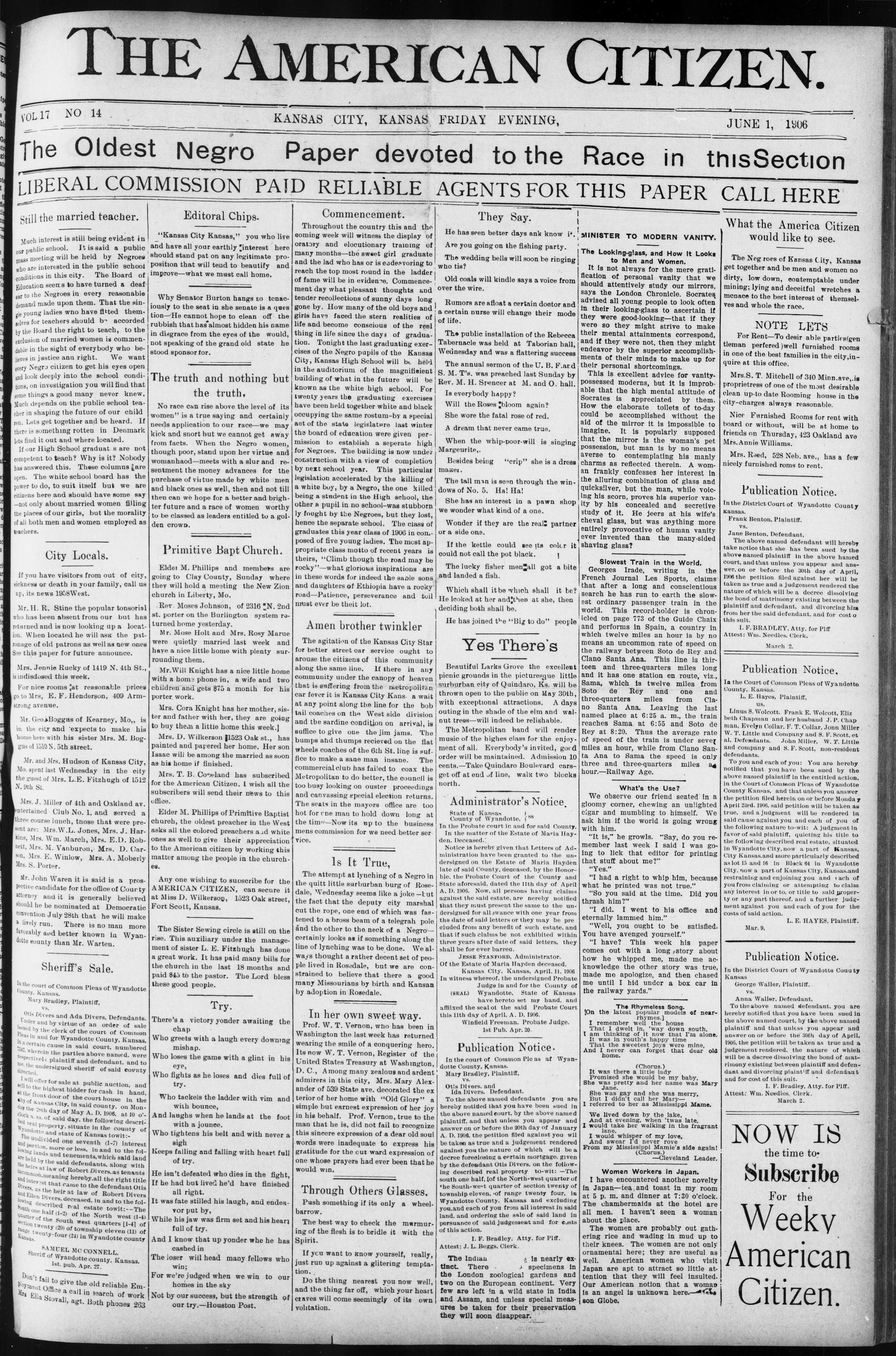
Page text (machine-generated)
THE AMERICAN CITIZEN.
The Oldest Negro Paper devoted to the Race in thisSection
LIBERAL COMMISSION PAID RELIABLE AGENTS FOR THIS PAPER CALL HERE Still the married teacher. Editoral Chips. Commencement. They Say. What the Actions St
Much interest is still being evident in our public school. It is said a public mass meeting will be held by Negroes who are interested in the public school conditions in this city. The Board of Education seems to have turned a deaf ear to the Negroes in every reasonable demand made upon them. That the single young ladies who have fitted themselves for teachers should be accorded by the Board the right to teach, to the exclusion of married women is commendable in the sight of everybody who believes in justice ann right. We want every Negro citizen to get his eyes open and look deeply into the school conditions, on investigation you will find that some things a good many never knew. Much depends on the public school teacher in shaping the future of our children. Lots get together and be heard. If there is something rotten in Denmark lets find it out and where located.
If our High School graduate are not competent to teach? Why is it? Nobody has answered this. These columns are open. The white school board has the power to do, to suit itself but we are citizens here and should have some say—not only about married women filling the places of our girls, but the morality of all both men and women employed as teachers.
City Locals.
If you have visitors from out of city, sickness or death in your family, call us up, its news 1958 West.
Mr. H. R. Stine the popular tonsorial who has been absent from our but has returned and is now looking up a location. When located he will ask the patronage of old patrons as well as new ones See this paper for future announce.
Mrs. Jennie Rucky of 1419 N. 4th St., is indisposed this week.
For nice rooms at reasonable prices go to Mrs. E. F. Henderson, 409 Arm-strong avenue.
Mr. Geo. Boggus of Kearney, Mo., is in the city and expects to make his home here with his sister Mrs. M. Boggus of 1510 N. 5th street.
Mr. and Mrs. Hudson of Kansas City,
Mo. spent last Wednesday in the city
the guest of Mrs. L.E. Fitzhugh of 1512
N. 9th St.
Mrs. J. Miller of 4th and Oakland av.
entertained Club No. 1, and served a
three course lunch, those that were present are: Mrs.W.L. Jones, Mrs. J. Harkins, Mrs. Wm. March, Mrs. E.D. Robnett, Mrs. M. Vanburon, Mrs. D. Carson, Mrs. E. Winlow, Mrs. A. Moberly
Mrs. S. Porter.
Mr. John Waren it is said is a prospective candidate for the office of Courty attorney and it is generally believed should he be nominated at Democratic convention July 28th that he will make a likely run. There is no man more favorably and better known in Wyandotte county than Mr. Warten
Sheriff's Sale.
in the court of Common Pleas of Wyandotte County, Kansas.
Mary Bradley, Plaintiff,
vs.
Otis Divers and Ada Divers, Defendants.
Under and by virtue of an order of sale issued by the clerk of the court of Common Pleas in and for Wyandotte County, Kansas,
in a certain cause in said court, numbered 1742, wherein the parties above named, were respectively, plaintiff and defendant, and to me, the undersigned sheriff of said county directed.
I will offer for sale at public auction, and sell to the highest bidder for cash in hand, at the front door of the court house in the city of Kansas City, in said county, on Monday the 28th day of May A. D. 1906, at 10 o'clock, m. of said day, the following described real property, situate in the county of Wyandotte and state of Kansas towrt.
The undivided one ninth (1-7) interest and portion, more or less, in and to the following lands and tenements, which said land are held by the said defendants, along with the heirs at law of Robert Divers, as tenants incommon, meaning hereby, all the right title and interest that came to the defendant Otis Divers, as the heir at law of Robert Divers and Ellen Divers, deceased, in and to the following described real estate towit:--The South one half (1-2) of the North west (1-4) quarter of the South west quarters [1-4] of section twenty (20) of township eleven (11) of range twenty-four (24) in Wyandotte county Kansas.
Fall to give the old reliable Employment Office a call in search of work Mrs Ella Stovall, agt. Both phones 263
Editoral Chips.
"Kansas City Kansas," you who live and have all your earthly interest here should stand pat on any legitimate proposition that will tend to beautify and improve—what we must call home.
Why Senator Burton hangs so tenaciously to the seat in she senate is a question—He cannot hope to clean off the rubbish that has almost hidden his name in disgrace from the eyes of the would, not speaking of the grand old state he stood sponsor for.
The truth and nothing but the truth.
No race can rise above the level of its women" is a true saying and certainly needs application to our race—we may kick and snort but we cannot get away from facts. When the Negro women, though poor, stand upon her virtue and womanhood—meets with a slur and resentment the money advances for the purchase of virtue made by white men and black ones as well, then and not till then can we hope for a better and brighter future and a race of women worthy to be classed as leaders entitled to a golden crowd.
Primitive Bapt Church.
Elden M. Phillips and members are going to Clay County, Sunday where they will hold a meeting the New Zion church in Liberty, Mo.
Rev. Moses Johnson, of 2316 N. 2nd st. porter on the Burlington system returned home yesterday.
Mrs. Moise Holt and Mrs. Rosy Marue were quietly married last week and have a nice little home with plenty surrounding them.
Mr. Will Knight has a nice little home with a home phone in, a wife and two children and gets $75 a month for his porter work.
Mrs. Cora Knight has her mother, sister and father with her, they are going to buy them a little house this week.
Mrs. D. Wilkerson 1523 Oak st., has painted and papered her home. Her son Isaac will be among the married as soon as his home if finished.
Mrs. T. B. Copeland has subscribed for the American Citizen. I wish all the subscribers will send their news to this office.
Elder M. Phillips of Primitive Baptist church, the oldest preacher in the West asks all the colored preachers ad aad white ones as well to give their appreciation to the American citizen by working this matter among the people in the churches.
Any one wishing to subscribe for the AMERICAN CITIZEN, can secure it at Miss D. Wilkerson, 1523 Oak street, Fort Scott, Kansas.
The Sister Sewing circle is still on the rise. This auxiliary under the management of sister L. E. Fitzhugh has done a great work. It has paid many bills for the church in the last 18 months and paid $45 to the pastor. The Lord bless these good people.
Try.
There's a victory yonder awaiting the chap
Who greets with a laugh every downing mishap.
Who loses the game with a glint in his eye,
Who fights as he loses and dies full of try.
Who tackels the ladder with vim and with bounce,
And laughs when he lands at the foot with a jounce.
Who tightens his belt and with never a sigh
Keeps falling and falling with heart full of try.
He isn't defeated who dies in the fight,
If he had but lived he'd have finished all right.
It was fate stilled his laugh, and endeavor put by.
While his jaw was firm set and his heart full of try.
And I know that up yonder whe he has cashed in
The loser will head many fellows who win;
For we're judged when we win to our homes in the sky
Not by our success, but the strength of our try.—Houston Post
KANSAS CITY, KANSAS FRIDAY EVENING,
Throughout the country this and the coming week will witness the display of oratory and elocutionary training of many months—the sweet girl graduate and the lad who has or is eavesworing to reach the top most round in the ladder of fame will be in evidence. Commencement day what pleasant thoughts and tender recollections of sunny days long gone by. How many of the old boys and girls have faced the stern realities of life and become conscious of the real thing in life since the days of graduation. Tonight the last graduating exercises of the Negro pupils of the Kansas City, Kansas High School will be held in the auditorium of the magnificent building of what in the future will be known as the white high school. For twenty years the graduating exercises have been held together white and black occupying the same rostum-by a special act of the state legislature last winter the board of education were given permission to establish a separate high for Negroes. The building is now under construction with a view of completion by next school year. This particular legislation accelerated by the killing of a white boy, by a Negro, the one killed being a student in the High school, the other a pupil in no school-was stubbornly fought by the Negroes, but they lost, hence the separate school. The class of graduates this year class of 1906 in composed of five young ladies. The most appropriate class motto of recent years is theirs, "Climb though the road may be rocky"—what glorious inspirations are in these words for indeed the sable sons and daughters of Ethiopia have a rocky road—Patience, perseverance and toil must ever be theit lot.
Amen brother twinkler
The agitation of the Kansas City Star for better street car service ought to arouse the citizens of this community along the same line. If there in any community under the canopy of heaven that is suffering from the metropolitan car fever it is Kansas City Kans. a wait at any point along the line for the bobtail coaches on the West side division and the sardine condition on arrival, is suffice to give one the jim jams. The bumps and thumps recieved on the flat wheels coaches of the 6th St. line is suffice to make a sane man insane. The commercial club has failed to coax the Metropolitan to do better, the council is too busy looking on ouster proceedings and canvassing special election returns. The seats in the mayors office are too hot for one man to hold down long at the time—Now its up to the business mens commission for we need better service.
Is It True.
The attempt at lynching of a Negro in the quitt little surburban burg of Rosedale, Wednesday seems like a joke—but the fact that the deputy city marshal cut the rope, one end of which was fastened to a bross beam of a telegraph pole and the other to the neck of a Negro—certainly looks as if something along the line of lynching was to be done. We always thought a rather decent set of people lived in Rosedale, but we are constrained to believe that there a good many Missourians by birth and Kansan by adoption in Rosedale.
In her own sweet way.
In her own sweet way.
Prof. W. T. Vernon, who has been in Washington the last week has returned wearing the smile of a conquering hero. Its now W. T. Vernon, Register of the United States Treasury at Washington, D. C., Among many zealous and ardent admirers in this city, Mrs. Mary Alexander of 539 State ave. decorated the exterior of her home with "Old Glory" a simple but earnest expression of her joy in his behalf. Prof. Vernon, true to the man that he is, did not fail to recognize this sincere expression of a dear old soul words were inadequate to express his gratitude for the cut ward expression of one whose prayers had ever been that he would win.
Through Others Glasses.
Push something if its only a wheelbarrow.
The best way to check the marmuring of the flesh is to bridle it with the Spirit.
If you want to know yourself, really, just run up against a glittering temptation.
Do the thing nearest you now well, and the thing far off, which your heart craves will come seemingly of its own volatition.
They Say.
He has seen better days ank know it.
Are you going on the fishing party.
The wedding bells will soon be ringing who tis?
Old coals will kindle says a voice from over the wire.
Rumors are afloat a certain doctor and a certain nurse will change their mode of life.
The public installation of the Rebecca Tabernacle was held at Taborian hall, Wednesday and was a flattering success.
The annual sermon of the U. B. F. ard S. M. T's. was preached last Sunday by Rev. M. H. Spencer at M. and O. hall.
Is everybody happy?
Will the Roses bloom again?
She wore the fatal rose of red.
A dream that never came true.
When the whip-poor-will is singing Margeurite,.
Besides being "crip" she is a dress maker.
The tall man is seen through the windows of No. 5. Ha! Ha!
She has an interest in a pawn shop we wonder what kind of a one.
Wonder if they are the real partner or a side one.
If the kettle could see its color it could not call the pot black.
The lucky fisher men all got a bite and landed a fish.
Which shall it be which shall it be?
He looked at her and then at she, then deciding both shall be.
He has joined the "Big to do" people
Yes There's
Beautiful Larks Grove the excellent picnic grounds in the picturesque little sururban city of Quindaro, Ks. will be thrown open to the public on May 30th, with exceptional attractions. A days outing in the shade of the elm and walnut trees—will indeed be relishable. The Metropolitan band will render music of the higher class for the enjoyment of all. Everybody's invited, good order will be maintained. Admission 10 cents.—Take Quindaro Boulevard carget off at end of line, walk two blocks north.
Administrator's Notice
State of Kansas
County of Wyandotte.
In the Probate court in and for said County.
In the matter of the Estate of Maria Hayden.
Deceased.
Notice is hereby given that Letters of Administration have been granted to the undersigned on the Estate of Maria Hayden late of said County, deceased, by the Honorable, the Probate Court of the County and State aforesaid, dated the 11th day of April A. D. 1906. Now, all persons having claims against the said estate, are hereby notified that they must present the same to the undersigned for all alliance with one year from the date of said letters or they may be precluded from any benefit of such estate, and that if such claims be not exhibited within three years after date of said letters, they shall be for ever barred.
JESSE STANFORD, Administrator.
Of the Estate of Maria Hayden deceased.
Kansas City, Kansas, April. 11. 1906
In witness whereof, the undersigned Probate
Judge in and for the County of
(SEAL) Wyandotte, State of Kansas
have hereto set my hand, and
affixed the seal of the said Probate Court
this 11th day of April, A. D. 1906.
Winfield Freeman, Probate Judge.
1st Pub. Apr. 20.
Publication Notice
In the court of Common Pleas as if Wyan
dotte County, Kansas.
Mary Bradley, Plaintiff,
vs.
Otis Divers, and
Otis Divers, and Ida Divers, Defendant.
To the above named defendants you are hereby notified that you have been sued in the above named court, by the above named plaintiff, and that unless you appear and answer on or before the 20th day of January A. D. 1906, the petition filed against you will be taken as true and a judgement rendered against you the nature of which will be a decree forelosing a certain mortgage, given by the defendant Otis Divers, on the following described real property to-wit: —The south one half, of the North-west quarter of the South-west quarter of section twenty of township eleven, of range twenty four, in Wyandotte County, Kansas and excluding you, and each of you from all interest in said land, and ordering the sale of said land in persuance of said judgement and for costs of this action.
I. F. Bradley, Atty. for Pliff.
Attest: J. L. Boggs, Clerk.
The Indian is nearly extinct. There specimens in the London zoological gardens and two on the European continent. Very few are left in a wild state in India and Assam, and unless special measures be taken for their preservation they will soon disappear.
MINISTER TO MODERN VANITY.
The Looking-glass, and How It Looks to Men and Women.
It is not always for the mere gratification of personal vanity that we should attentively study our mirrors, says the London Chronicle. Socrates advised all young people to look often in their looking-glass to ascertain if they were good-looking—if they were so they might strive to make their mental attainments correspond, and if they were not, then they might endeavor by the superior accomplishments of their minds to make up for their personal shortcomings.
This is excellent advice for vanity-possessed moderns, but it is improbable that the high mental attitude of Socrates is appreciated by them. How the elaborate toilets of to-day could be accomplished without the aid of the mirror it is impossible to imagine. It is popularly supposed that the mirror is the woman's pet possession, but man is by no means averse to contemplating his many charms as reflected therein. A woman frankly confesses her interest in the alluring combination of glass and quicksilver, but the man, while voicing his scorn, proves his superior vanity by his concealed and secretive study of it. He jeers at his wife's cheval glass, but was anything more entirely provocative of human vanity ever invented than the many-sided shaving glass?
Slowest Train in the World
Slowest Train in the World. Georges Irade, writing in the French Journal Les Sports, claims that after a long and conscientious search he has run to earth the slowest ordinary passenger train in the world. This record-holder is chronicle on page 773 of the Guide Chaix and performs in Spain, a country in which twelve miles an hour is by no means an uncommon rate of speed on the railway between Soto de Rey and Clano Santa Ana. This line is thirteen and three-quarters miles long and it has one station en route, viz. Sama, which is twelve miles from Soto de Rey and one and three-quarters miles from Clano Santa Ana. Leaving the last named place at 6:25 a. m., the train reaches Sama at 6:55 and Soto de Rey at 8:20. Thus the average rate of speed of the train is under seven miles an hour, while from Clano Santa Ana to Sama the speed is only three and three-quarters miles an hour.—Railway Age.
What's the Use?
We observe our friend seated in a gloomy corner, chewing an unlighted cigar and mumbling to himself. We ask him if the world is going wrong with him.
"It is," he growls. "Say, do you remember last week I said I was going to lick that editor for printing that stuff about me?"
"Yes."
"I had a right to whip him, because what he printed was not true."
"So you said at the time. Did you thrash him?"
"I did. I went to his office and eternally lammed him."
"Well, you ought to be satisfied. You have avenged yourself."
"I have? This week his paper comes out with a long story about how he whipped me, made me acknowledge the other story was true, made me apologize, and then chased me until I hid under a box car in the railway vards."
The Rhymeless Song.
[On the latest popular models of near-
rhymes.]
I remember well the house
That I dwell in 'way down south,
I am thinking of what I'm alone.
It was in youth's happy time
That the sweetest joys were mine
And I never can forget that dear old
home.
(Chorus.)
It was there a little lady
Promised she would be my baby.
She was pretty and her name was Mary
She was gay and she was merry,
But I didn't call her Mary—
I referred to her as Mississippi Mame.
We lived down by the lake,
And at evening, when 'twas late,
I would take her walking in the fragrant
lane.
I would whisper of my love,
And swear I'd never rove
From my Mississippi Mame's side again!
(Chorus.)
—Cleveland Leader.
I have encountered another novelty in Japan—tea, and toast in my room at 5 p. m. and dinner at 7:30 o'clock. The chambermaids at the hotel are all men. I haven't seen a woman about the place.
The women are probably out gathering rice and wading in mud up to their knees. The women are not only ornamental here; they are useful as well. American women who visit Japan are apt to attract so little attention that they will feel insulted. Our American notion that a woman is an angel is unknown here.—son Globe.
JUNE 1, 1906
thisSection
CALL HERE
What the America Citizen would like to see.
The Neg roes of Kansas City, Kansas get together and be men and women no dirty, low down, contemptable under mining; lying and deceitful wretches a monace to the best interest of themselves and whole the race.
NOTE LETS
For Rent-To desir able parties(gen
tleman perfered)well furnished rooms
in one of the best families in the city,inquire at this office.
Mrs.S. T. Mitchell of 340 Minn.ave.,is
proprietress of one of the most desirable
clean up-to date Rooming house in the
city-charges always reasonable.
Nice Furnished Rooms for rent with
board or without, will be at home to
friends on Thursday, 423 Oakland ave
Mrs.Annie Williams.
Mrs. Reed, 528 Neb. ave., has a few
nicely furnished roms to rent.
Publication Notice
In the District Court of Wyandotte County kansas.
Frank Benton, Plaintiff.
vs.
Jane Benton, Defendant.
The above named defendant will hereby take notice that she has been sued by the above named plaintiff in the above hamed court, and that unless you appear and answer, on or before the 30th day of April, 1906 the petition filed against her will be taken as true and a judgement rendered the nature of which will be a decree dissolving the bond of matrimony existing between the plaintiff and defendant, and divorcing him from her said defendant, and for cost o this suit.
I. F. BRADLEY, Atty, for Pflf
Attest: Wm. Needles, Clerk.
Publication Notice.
la the Court of Common Pleas of Wyandotte
County, Kansas.
L. E. Hayes, Plaintiff,
us.
Linus S. Wolcott. Frank E. Wolcott, Eliz
beth Chapman and her husband J. P. Chap
man, Evelyn Collar, F. T. Collar, John Miller
W. T. Little and Company and S. F. Scott, et
al. Defendants. John Miller, W. T. Little
and company and S. F. Scott, non-resident
defendants.
To you and each of you: You are hereby notified that you have been sued by the above named plaintiff in the entitled action, in the Court of Common Pleas of Wyandotte County Kansas, and that unless you answer the petition filed herein on or before Monday April 23rd. 1906, said petition will be taken as true, and a judgment will be rendered in said cause against you and each of you of the following nature to-wit: A judgment in favor of said plaintiff, quieting his title to the following described real estate, situated in Wyandotte City, now a part of Kansas, City Kansas, and more particularly described as lot 15 and 16 in Black 64 in Wyandotte City, now a part of Kansas City, Kansas, and restraining and enjoining you and (each of you from claiming or attempting to claim any interest in or to, or title to said property or any part thereof, and a further judgment against you and each of you for the costs of said action.
L. E. HAYES, Plaintiff.
Mar. 9.
Publication Notice.
In the District Court of Wyandotte County Kansas
George Waller, Plaintiff.
vs.
Anna Waller, Defendant.
To the above named defendant, you are hereby notified that you have been sued in the above named court, by the above named plaintiff and that unless you appear and answer on or before the 30th day of April, 1906, the petition will be taken as true and a judgement rendered, the nature of which will be a decree dissolving the bond of matrimony existing between plaintiff and defendant and divorcing plaintiff and defendant and for cost of this suit.
I. F. Bradley, Atty. for Pliff.
Attest: Wm. Needles, Clerk.
March 2.
NOW IS
the time to
Subscribe
For the
Weeky
American Citizen
‘The Oldest Negro Journal Published
Weekly in this part of the Country.
Published Weekly
at 1510 North 3rd Street
KANSAS CITY - - - - - KANSAS.
W. C. Martin, Editor,
Geo. A. Dudley, Publisher and
Business Manager.
‘Terms of Subscription in Advance.
One Year.....ceeeeeeeceeesee ee 1$100
Six Months........seeeeeeeeeeees G5
Three, Months.......s.ceeeeeeee + -40€
One Month..........ceeeeeeeeeeee-L5C
Advertising 25 cents per inch First
Insertion.
Grangemouth is the name of a Mos-
cow editor, Evidently a farmer on
the side,
Waldorf Astor has become so thor-
eughly anglicized that he is going to
marry an American girl.
A clergyman says that bridge whist
leads to mental decline. Why doesn’t
he try poker for a change?
Senator Pettus is declared to be a
poor man and fond of poker. The
last explains the first, possibly.
Perhaps boys should be thankful for
whippings, as somebody declares, but
*hey seldom are before they are 45.
Sweet Spring {s now approaching,
and Summer with the rose, so poetry's
encroaching upon the field of prose.
King Edward was “warmly re-
ceived” in Paris, but not in the same
Way as when he used to be prince of
‘Wales.
The czar will reserve the right to
wield the big stick over the Douma.
according to the latest advices from
St. Petersburg.
‘We learn from the New York Mail
that women are using garters to keep.
those long, arm-length gloves in place.
But do they hold?
Manchuria will be finally evacuated
by the Japanese in a few days. It
has taken them longer to get out.
than It did to get in.
ae
It 1s now belleved that Anna Gould |
1s going to give Boni one more chance,
in spité of the fact that he has taken
@ great pany already,
Uruguay should not be blamed for
having a revolution. A review of re-
eent South American history shows
that it 1s Uruguay's turn.
Asks “the editor of the Pittsfield
Journal: “Are there four girls with
gray eyes in Pittsfield?” Apparently
ye scribe means to get busy.
Queen Maud of Norway 1s losing
her health because she fears her hus-
band will be killed. This queen bust-
ness {s not all pickles and pie,
Tt was not long ago that all the
“success” magazines were pointing to
the Pittsburg millionaires as ex-
amples to the youth of the land.
‘With 10,000 doctors in convention in
Boston next summer, the rest of the
country ought to have a good oppor-
tunity to get well—Boston Globe.
It {s a pity that the great romancers
of the sea did not live in a generation
which affords such thrilling material
‘as the log of the dry dock Dewey.
A Minnesota man says he has dis-
covered the cause of the aurora
borealis. But what bearing will this
have on the price of coal this year?
ee
Much to the surprise of everybody,
some of the phenomenal ball players
added to the leading nines as marvel-
ous discoveries will probably make
good.
Cheer up, mister! The president of
the Dressmakers’ National Protective
Association says that women’s dress
will be less expensive this year than
ever before,
The Japanese, says one of their
statesmen, should adopt chaire and
develop their legs. Well, short legs
did not prevent them from “getting
there” in the late war.
Portia, as quoted by the editor of
@ kind of society paper, is made ta
say: “How far that little scandal
throws his beams! So shines a bao
Geed in this haughty world.”
News comes from the east that the
geventeen-year locusts will devastate
the land this year. How many times
in the course of a decade do the sev-
‘enteen-year locusts come, anyhow?
As the last suffragist was detatched
from the doorknob and put into the
police wagon, the premier of the great
British Empire crawled out from un-
der his bed and sighed a sigh of re-
let
An actor has become a soldier in
‘order to escape the adulation of
matinee girls. We know several ac-
tors who should be driven from the
stage with a club instead of soft
giaences.
GREAT SINGER IS UNGRATEFUL.
Mme. Patti Criticises America, Which
Made Her Wealthy.
Confirmation of the report that
Mme. Adelina Patti has made her
final tour in the United States is
found in her recent criticisms of the
American people. This lady, who once
lived down on Grand street West,
but now dwells in a castle in Wales,
largely owing to the generosity of the
sitizens of this city, has lately dis-
covered that we haven’t any appre-
ciation of art, cookery, music or good
manners. This is an ill return for all
the complimentary words we have ut-
tered about her, not to mention the
dollars we have paid to hear her
voice. Altaough she was born in Mad-
rid in February, 1843, she came here
with her parents as a child and grew
up among the people of New York.
Her brother, Carol, used to lead the
orchestra at the Grand Opera House,
during the Jim Fisk era of French
opera-boutfe.
Mme. Patti’s last tour of this coun-
try was not financially successful—a
circumstance that may account for her
change of heart. The lady, however,
insisted upon receiving her contract
money to the last dollar. The im
presario was almost ruined, although
the fault was the diva’s own. She
couldn’t sing! “ Her voice had lost its
fine quality. She wasn’t a “diva” any
longer. The: American people found
this out and refused to assist in main-
taining Craig y Nos castle.—Brooklyn
Eagle,
Famous Actors as Negro Minstrel:
Jefferson said he thought he was
one of the first men to black his face
after the appearance and success of
“Jim Crow” (T. D.) Rice.
| “I suppose,” said Mrs. Drew, “there
are very few men in this company
‘who have not at one time or another
been associated with minstrel per-
formances,””
“I played Brudder Jones,” said
Mr. Jefferson.
“Everybody knows I was in the
minstrel business,” Goodwin exclaim-
ed. “Yes,” I remarked, “because we
were there together. “Well,” joined
in Crane, “I was on the tambourine
end with Campbell’s minstrels.” 1
remember telling this at Lawrence
Barrett's house at Cohasset, where
the rest of the party consisted of
Edwin Booth and Stuart Robson.
Booth then told how he and J. S.
Clarke were minstrels in their young.
er days, and he followed this up by
declaring that he used to “pick a lit-
tle on the banjo.” I laughed, and
Booth inqiired the reason, and I
added, “Oh, nothing much, only Booth
and the banjo seemed such an odd
combination.”—Francis Wilson in
Scribner’s Magazine.
O Thou Comnacelanata
How deeply comforting the tender phrase,
‘Thy, greater attribute seem merged I
i
Through all life's long and dark and
Weary maze,
‘Thou art ‘Compessionate.
To God of Justice and of Power we turn
‘When wrong or devastating blow cuts
lee;
And yet in daily struggle needs must
yearn
For one Compassionate,
In limits of our souls we live, alone,
‘And e'en our mearest- may’ not “under-
stan
But ail “the household jar within” ts
nown,
‘To thee, Compassionate,
Thou Know’st the many sorrows of the
ay;
wide Tonging, narrow opportunity—
We bring life's broken toys, as children
MAY,
‘T0 one Compassionate.
We may have blundered grievously an?
lone,
Darkened Thy, world we might have
made so bright,
Stl! Thou dost heal the heartache and
the ‘wrong
© Thou Compassionate!
—May Ethelyn ‘Bourne, in’ Overland
‘Monthly.
‘Ct the baewien”
Two men were standing together on
an East River ferryboat when one
pointed out a third man with the re-
mark:
“I can’t recall his name at this mo-
ment, but he writes for a number of
the magazines.”
His friend looked at the stranger
with much interest.
“Oh, one of our frenzied finance
captains, is he?” he asked.
“No, he—"
“Writes up trusts and things,
then?” -
| “Oh, then he’s a prizefighter or an
actor—he {s rather husky looking.”
“No, no! He's just a plain author—
writes stories.”
“Oh!” the friend exclaimed, the
look of interest suddenly dying out
of his face—New York Journal.
| True to Mia Promine,
‘The other boy had called Tommy a
lar, an’ a fightin’ liar, and told him
he dassen’t take it up.
Tommy’s fists were clinched and
his eyes were blazing, but he stood
there rapidly repeating something to
himself, in accordance with a long
standing promise he had made to his
mother.
“If you'll jist walt till I've finished
sayin’ it,” he said, “I'll knock the tar
out o' you, Dick Bunker, you pie faced
slob! ‘But children, you should nev-
er let your angry passions—'””
‘The other boy, however, disappear-
ed around the corser while Tommy's
lips were still moving.
ee
| Flying Wedge.
“Great Scott!” exclaimed the drum-
mer who had put up in the old farm
house over night. “What was that
noise down below? Football rush?”
“Worse than that, stranger,” chuck.
led the old farmer, as he snuffed out
the candle. “Yeou see, I have eight
Garters an’ each one of them has a
beau who calls on Thursday nights,
Wall, the first couple that pets the
parlor can have it. That's why they
are running.”
LACE SCARF AS EAR TRUMPET.
Elderly Lady Has Discovered It Acts
as Sounding Board.
With advancing years a dear old
lady has found that her hearing has
become somewhat affeeted. She has
‘not found it necessary to use an ear
trumpet as yet, but it is difficult at
times to catch all that fricnds say.
Anything said in an undertone is com-
pletely lost to her—that is, it was un-
til she hit upon a nove! idea.
While visiting a friend recently the
hostess had pitched her voice almost
to the straining point and her vocal
organs were getting tired, when “Aunt
Sis,” as she is affectionately termed,
interrupted her by saying: “Please,
dearie, hand me my lace head scarf.”
“Do you feel a draught?” anxiously
inguired the hostess, handing over the
manta
“Not the slightest,” said “Aunt Sis”
as she adjusted the head covering.
_ “Then why do you wear it? It will
‘make your head tender.”
“Oh, I think not. You see, the scart
acts as a sort of sounding board. It
Keeps out all other sounds except
those of the human voice. When I
wear this I can hear even a whisper
I can’t explain why it is, but it is so.
nevertheless, I have had lots of fuy
over it, too. My boys have been tak
ing advantage of my infirmity to whis
per to each other. I didn’t hear them
defore I began to wear this scarf, but
now I know lots of their secrets ané
they don’t know it. It’s a good joke
‘on them.”
Fish Know Colors,
“Fish know colors,” said a keeper
at the New York Aquarium the other
day. “They can distinguish between
red and blue, or white and green, as
well as you and I. Wait and I'll prove
ihe
He led the way to a tank in which
Were some red and some yellow and
some green fish, and in it were arti-
ficial grottoes painted respectively red
and yellow and green, The keeper
roiled the water with his hand, and
the fish fled, the red ones to the red
grotto, the yellow ones to the yellow
grotto, and the green ones to the green
grotto.
“They know which color shields
them from observation best,” said he.
“Now I'll change the grottoes, so as to
Prove my statement a second time.”
He moved the grottoes to different
places in the tanks and again roiled
tho water.
The same thing followed as before.
Each fish darted Ike a shot to the
grotto of its own color, where it knew
it would be best concealed,
mae © cine ee
Everything that I made I used to bring
you,
Was {°2' song, why, then ‘twas song
to sing to you,
Was it a story, to you I was telling my
story.
Ah, my dear, could you hear ‘mid the
bliss and the glory?
Did any one praise me, to you I sald it
ail over:
‘My laughter for you: how we laughed in
the days past recover?
‘My tears and my troubles were yours;
did any one grieve me,
I carried it straight to the love that was
sure to relieve me,
© my dear, when aught happens, to you
1am ‘turning.
Forgetting how far you have traveled
this day from my yearning.
‘There is nobody now io tell things to;
your house is so lonely;
And still I'm forgetting and bringing my
tale to you only.
The old days are over; how pleasant they
‘were, the fine weather,
When youth and my darling and I were
at home and together!
And still I'm forgetting, ochone, that no
longer you're neat me,
And turn to you still with my tale, and
there's no one to hear me.
—Pall Mall Gazette,
Fate of the Old Presidents.
In the autumn of 1901 Mrs. W. of
Roxbury spent a few weeks with her
daughter in Nova Scotia, returning
home shortly before President McKin-
ley was shot, bringing her niece, Bes-
sie F., aged 6 years, home with her.
Of course the child heard a good deal
of talk in the house about the shoot-
ing of the president.
One day Bessie said to her aunt:
“Aunt Minnie, who is king of the
United States?” Her aunt replied:
“We have no kings in the United
States like you do in your British
country, We have presidents. We
have an election every four years and
elect a new one.”
“Oh, yes,” the child replied; “and
then they shoot the old ones, don't
they?”—Boston Herald,
New City for Eavnt
Suakin, on the Red sea, has proved
an unsatisfactory port and is to be
superseded by a brand-new rival
which has been built up out of coral
work and desert sand by the Egyptian
authorities. The rival is Port Sudan,
the latest addition to the cities of the
British empire, and an enthusiast says
that it is destined to be a place of
magnitude and importance in the days
when cotton shall have made it the
New Orleans of the east. The place
has hitherto been called Mersa Sheikh
Barud. It is about 680 miles south of
Suez and is capable of holding a
dozen vessels of moderate size, The
entrance is 600 feet across, and the
land around is six feet above sea
level.
Posers for Scholars.
‘Twenty words submitted to a spell-
ing bee in Springfield, Mass,, in 1845
were given to the high school class at
East Liverpool by Supt. Rayman, and
it is reported not one in the class cor-
rectly spelled every word. Only ten
had averages of over 90 per cent. The
average of the 124 pupils was 731% per
cent.
The words submitted were accident-
al, accessible, baptism, chirography,
characteristic, deceitful, descendant,
eccentric evanescent, fiercenavs, feign.
edly, ghastliness, gnawed, helress,
hysterics, imbecility, inconceivable.
inconvenience inefficient, irresistible.
—Pittsburg Dispatch. 3
SHIELDS FOR TROOPS IN WAR.
Their Use Urged by a German Mili-
tary Writer,
Semana tet ec
A writer in the Militar-Wochenblatt
raises anew the question of the use
of portable shields for the protection
of infantry in the attack, says the
Broad Arrow. He writes approvingly
ot the Japanese spade work in the
offensive, the more so because he
mentions incidentally, as a matter re-
garding which there can be no dis-
pute, that the German authorities
have long since advocated the use of
artificial cover in the attack, and
points out that when the ground was
frozen or rocky, and the spade could
make no impression upon it, the at-
tacking Japanese infantry not infre-
quently went forward, carrying with
them filled sandbags weighing as
much as forty pounds. He remarks
that if the undoubtedly brave Japa-
nese soldier found it necessary to
load himself with so bulky and bur-
densome a protection when advancing
in the open against an intrenched en-
emy it would seem far better to equip
the infantry with a light, handy shield.
Furnished with a handle by which
to carry it, a loophole to fire through
and some arrangement to prevent its
falling down, the infantryman would
then find himself, like his gunner
comrade, protected by a bullet-proof
shield. The writer in the Wochenblatt
suggests that on the march the shield
should be carried on the back, when
going into action on the chest, and
when advancing to the attack in the
left hand, so as to be at once available
for use when lying down to fire, both
as head cover and rifle rest.
YOUR HAIR SHOULD BE DRAB.
‘That is the Fashionable Color, So an
Authority Savs.
i Se ee ee
“Deep auburn and the drab shades
are the fashionable colors in hair this
season,” said the woman who makes
hair coloring a speciality, as placidly
as though she were commenting on
the state of the weather or the ad-
vance style in dress goods.
“One of my customers has to my
knowledge worn five. different colors
or shades eu her wavy tresses. Hay-
ing been blessed with medium brown
hair by nature she became a ravish-
ing blonde when the fashion for
bleaching first came in.
“Next she took to titian red after a
trip to the art galleries of Europe.
‘Tnen she thought she would be more
attractive as a brunette, and now her
hair is drab.
“The last is by far the most popu-
lar of all for the reason that is most
dificult to obtain, and then it is pret-
ty generally becoming, and it happens
that women who are born with this
particular color of hair are almost al-
ways clever.
“How is it done? Well, in case of a
woman whose hair is dark a bleach
must first be used before the dye is
applied. With women whose hair has
turned gray it is a still simpler prob-
lem. The color lasts a year, while
the head can be washed and even salt
water bathing does not affect it.’”—
New York Sun.
What-Money Will Do,
They say that money can not buy
‘The sweetest things In Iife
Health, heaven, friends, respect, content,
Or e’en a loving wife.
They say that money can not buy
These things for me, alas! But f—
elt don't’ know!
What bought my private car? Just wealth,
What bought my lovely yacht,
Which sails me to lands where Health
Je found in every spot’
What pays my speciallst, dear Jim,
To keep me in such perfect trim?
‘WellT don’t’ know!
What bought the most delightful wife
A'man could hope, to win?
What buys her evefy wish in life—
‘The clothes “she dazzles. in?
And it ‘her heart beats not for me,
And Fam net adored. you see,
‘Well—I don’t know!
And heaven? Oh. of ‘course, I don't
Txpect to get, In free:
But if the Lord meant’ what he said
Concerning” charity.
Tih aber tiere tas
slip me throug! e needle's eye,
Or—I don't know!
For happiness? Well, money bought
Enis minety-cent. cigars ;
It bought this chair in which I loll,
It“bought this private ‘car;
It Somat ‘this Somnao- and, T guess,
If all this 1s not happiness,
‘Well don't ‘know!
—New York Press,
Slut a Gace Advattiowas
A Welsh judge had before him a
ease in which a printer sued a pork
butcher for the value of a large par-
cel of paper bags with the butcher's
advertisement printed thereon,
‘The printer, having no suitable {l-
lustration to embellish the work,
thought he improved the occasion by
putting an elaborate royal arms above
the man’s name and address, but ulti-
mately the latter refused to pay.
‘The judge, looking over a specimen,
observed that for his part he thought
the lion and the unicorn were much
nicer than an old fat pig.
“O well,” answered the butcher,
“perhaps your honor likes to eat ani-
male like that, but my customer's
don't. I don’t Kill lions and unicorns
—I only kill fat pigs!” *
Verdict for defendant—New York
World.
Building Up to Requirements.
A Kansas City man purchased a
city lot with the restriction that he
should not build a house on it to cost
less than $2,500. After having paid
tor the lot he decided to build a $1,500
cottage.
Before he had completed it the real
estate man from whom he had bought
the lot threatened to sue him for
breach of contract. “This little shack
you are building,” said the real estate
man, “lacks a whole lot of beitg a
$2,500 house such as you agreed to
ouild.”
“Gon’t form too hasty judgment,”
teplied the ‘owner. “True, it Lasn’t
cost that much yet, but I intend to
put @ solid ,old brick in the cnimney.”
—Kansas City Times,
Telephone Bell W. 32. Telephone Home Wx
W. B. Raymond
and Embalmer. The very best of Service, Fine Carriage,
for alll Purposes, at all Hours.
The Best Equipped White Enameled Ambulance fy
sick and wounded
on Short Notice. Charges Reasonable, Cail at 43! Minng
sota Ave., Kansas City, Kansay.
——
West. Uni it
THE GREAT EDUCATIONAL INSTITUTION
FOR KANSAS AND THE WEST - - - - -
DEPARTMENTS:—Theological, College, Normal, Sub-Normal and Stay
Industrial.
| COURSES:—Classical, College, Preparatory, Normal, Sub-Normal, fy
sical (Instrumental and Vocal), including piano, organ and hay
mony, Drawing (Fine Arts and Mechanical), Carpentry, Printing
and Book-Binding, Business Course, Stenography and Typewritiug
Tailoring, Dressmaking and Plain’ Sewing, Cooking, Laundering
Farming and Gardening.
ADVANTAGES:—Splendid Location, Healthful Climate, Good Intl
ences and Thorough Teachers.
INFORMATION:—For terms, prices and all inducements offered
write to
WILLIAM T. VERNON, A. M., D. D.
PRESIDENT,
QUINDARO, - - - - - : KANSAS,
‘Office—Bell—“White” 4302,
Phones.
Residence—Bell—“West” 15.
Die tae noe a eee eT eer tn
Why does colored people as well as uncolored peoplet set in the dark or
by a smoky poor light and drink muddy bad
water full of disease germs,
se they can get a first-class
Bi :,
Bright Gas Burner Light =
For 35 to 75 cents. And a
Self Cleaner Water Eilter
that makes the water clear as a Crystal and Healthy.
For 50 to 75 cents.
A. J. SHERIDAN
ROOM 8,
530 MINNESOTA AVE. KANSAS CITY, KANSAS
| “In the shade of the Old Apple Tree” is a very popular song—Why
not you be popular by trading at a popular store?
L. J. MADDUX,
Staple and Fancy Groceries |
Meats and all Kinds of Produce.
HOME PHONE 784 WEST.
852 FREEMAN AVE. KANSAS CITY, KANSAS.
In an Excuse Book. ES zt
Because its employes were late a
London house provided a book in which
the tardy ones were to write excuses.
Reasons for lateness were not much
varied. At the top of the page one
would write “Train delayed,” or “Om-
nibus horse died,” as the case might
be, and the rest fell into the habit
of making ditto marks and letting it
go at that. But not long ago one
man had a new excuse. He wrote
with pride: “Wife had twins.” The
second slow person that morning was
in a great hurry, and did not notice
the innovation, but made his custo-
maty ditto marks, and the rest. of
the men on that page followed suit.
The excuse book was abolished.
: Example of the Postace Stanp.
The late Judge Andrew Wylie, of
Virginia, had a happy gift of illustra-
tion. The judge cast in 1860 the only
vote for Lincoln that was given in
Alexandria, Va. In an address on
Lincoln he once illustrated in an odd
way the power of perseverance. “Lin-
coln persevered,” he said, “and it is
only those who persevere, they who
concentrate their energies, who suc-
ceed. Don’t give three years to jour-
nalism and then, discouraged, try the
law awhile. Don't learn the grocery
business and in a little while take up
placer mining or plumbing. Consider,
egies the postage stamp, whose use-
fl depends on its ability to stick to
one thing until it gets there.”
Think What a Family Then!
“Well,” said the fist policyholder,
throwing aside his paper, “there is at
least one thing we can be thankful
for concerning our Mutual friend, Mr.
McCurdy.”
“What's that?” inquired the second
policyholder.
“That he isn’t a Mormon.” =
Res, 420 Nebraska ave. Tel. 383 White
SOUTH AMERICAN
MEDICAL INSTITUTE
Office Hours: From 10 a. m., till 4 p.™
and from 6 till 9 p.m,
C,H, C. JORDAN, M. M., M. D.
ee are
Here is the Place
J. T. Roberts
TONSORIAL PARLOR
All the Latest Style Hair Cuts, Clea
Shave strictly Up-to-Date
438 MINNESOTA AVE.
eS
An Old French Sailor.
French seamen have a dozen in thY
Person of a centenarian, The ol!
sailor belongs alike to the navy 2!
to the merchant service, for he serve!
in both, and it would be difficult '?
‘say in which of the two his adventurs
were the most thrilling, His recor!
includes three shipwrecks, the batt!?
of Navarino, in which he won me
tion in orders, the blockade of Alsie"®
one capture by brigands, followed bY
himself and his companions seizing th?
Spanish ship which captured the ©”
sair which haq captured them. After
serving many years before the mst
he became a master and small shi?
owner on his own account. His nam?
is Pierre Loirat, He was born |
November, 1805, and at 12 he went (0
sea, t
UPTON SINCLAIR STRIKES BACK
Author of "The Jungle" Faces Prince of Packers With Awful Array of Facts Calculated to Destroy the Infamous Industry.
In a recent issue of the Saturday Evening Post Mr. J. Ogden Armour makes the assertion that the government inspection of the beef trust daughter-houses is an immanable wall protecting the public from impure meat, and that not an atom of diseased meat finds its way into the products of the Armours. Mr. Upman Sinclair, author of "The Jungle" a terrific statement of packing house conditions), studied the meat industry for two years, including much time spent in the Chicago stockyards as a workman; he is the best equipped outside authority on stockyard conditions. In Everybody's Magazine for May Mr. Sinclair makes a startling and convincing answer to Mr. Armour's assertion. Commencing with the statement that J. Ogden Armour is the absolute and not the nominal head of the great packing house industry which bears his name Mr. Sinclair says: "I know that in the statements quoted, Mr. Armour willfully and deliberately state what he absolutely and positively knows to be households."
That he might be properly equipped to describe conditions in "Packing-down" Mr. Sinclair worked for a period as a laborer in the plant of Armour & Co., and he tells of sights of fifth and horror such as he hopes never to see again, but the strongest coincidence of the truth of the claim that meat unfit for human food is put in the market comes from a man for years superintendent at Armour & Co.'s Chicago plant, Thomas F. Dolan, of Boston. Mr. Sinclair in his article says:
"At the time of the embalmed-beef scandal at the conclusion of the Spanish war, when the whole country was convulsed with fury, over the revelations made by soldiers and officers (including Gen. Miles and President Roosevelt) concerning the quality of meat which Armour & Co. had furnished to the troops, and concerning the death-rate which it had caused, the enormity of the 'condemned-meat industry' became suddenly clear to one man who had formerly supervised it. Mr. Thomas F. Dolan, then residing in Boston, had, up to a short time previous, been a superintendent in Armour & Co.'s, and one of Mr. Philip D. Armour's most capable and trusted men. When he read of the death-rate in the army, he made an affidavit concerning the things which were done in the establishment of Armour & Co., and this affidavit he took to the New York Journal, which published it on March 4, 1899. Here are some extracts from it:
"There were many ways of getting around the inspectors—so many, in fact, that not more than two or three cattle out of 1,000 were condemned. I know exactly what I am writing of in this connection, as my particular instructions from Mr. W. E. Pierce, superintendent of the beef houses for Armour & Co., were very explicit and definite.
"Whenever a beef got past the yard inspectors with a case of lumpy jaw and came into the slaughterhouse or the 'killing-bed,' I was authorized by Mr. Pierce to take his head off, thus removing the evidences of lumpy jaw, and after casting the smitten portion into the tank where refuse goes, to send the rest of the carcass on its way to market.
"I have seen as much as 40 pounds of flesh afflicted with gangrene cut from the carcass of a beef, in order that the rest of the animal might be utilized in trade.
"One of the most important regulations of the bureau of animal industry is that no cows in calf are to be placed on the market. Out of a daughter of 2,000 cows, or a day's killing, perhaps one-half are with calves. My instructions from Mr. Pierce were to dispose of the calves by hiding them until night, or until the inspectors left off duty. The little carcasses were then brought from all over the packing-house and skinned by boys, who received two cents for removing each pelt. The pelts were sold for 50 cents each to the kid-glove manufacturers. This occurs every night at Mr. Armour's concern at Chicago, or after each killing of cows. "I now propose to state here exactly what I myself have witnessed in Philip D. Armour's packing-house with cattle that have been condemned by the government inspectors.
A workman, one Nicholas Newson during my time, informs the inspector that the tanks are prepared for the reception of the condemned cattle and that his presence is required to see the beef cast into the steam-tank. Mr. Inspector proceeds at once to the place indicated, and the condemned cattle, having been brought up to the tank-
A Stone Barometer
in northern Finland, so a native paper informs us, is a large stone which serves the inhabitants as an inattilable barometer. At the approach of rain, this stone turns black or blackish gray, while in fine weather it is of a light color and covered with white spots. Probably it is a fossil mixed with clay, and containing rock salt, nitter, or ammonia, which according to a greater or less degree of dampness in the atmosphere, attracts it or otherwise—Sunday Magazine.
room on trucks, are forthwith cast into the hissing steam-boilers and disappear.
"But the condemned steer does not stay in the tank any longer than the time required for his remains to drop through the boiler down to the floor below, where he is caught on a truck and hauled back again to the cutting-room. The bottom of the tank was open, and the steer passed through the aperture.
"I have witnessed the fards many times. I have seen the beef dropped into the vat in which a steam-pipe was exhausting with a great noise so that the thud of the beef striking the truck below could not be heard, and in a short time I have witnessed Nicholas bringing it back to be prepared for the market.
"I have even marked beef with my knife so as to distinguish it, and watched it return to the point where it started. . . . "
"Of all the evils of the stockyards, the canning department is perhaps the worst. It is there that the cattle from all parts of the United States are prepared for canning. No matter how scrawny or debilitated canners are, they must go the route of their brothers and arrive ultimately at the great boiling vats, where they are steamed until they are reasonably tender. Bundles of gristle and bone melt into pulpy masses and are stirred up for the canning department.
"I have seen cattle come into Armour's stockyards so weak and exhausted that they expired in the corrals, where they lay for an hour or two, dead, until they were afterward hauled in, skinned, and put on the market for beef or into the canning department for cans.
"In other words, the Armour establishment was selling carrion.
"There are hundreds of other men in the employ of Mr. Armour who could verify every line I have written. They have known of these things ever since packing has been an industry. But I do not ask them to come to the front in this matter. I stand on my oath, word for word, sentence for sentence, and statement for statement.
"I write this story of my own free will and volition, and no one is responsible for it but myself. It is the product of ten years of experience. It is the truth, the whole truth, and nothing but the truth, so help me God.
"THOMAS F. DOLAN
"Sworn to and subscribed before me this first day of March, 1899.
"ORVILLE F. PURDY,
"Notary Public, Kings County, N. Y.
"Certificate filed in New York county."
The significance of this statement, as Mr. Sinclair notes, is heightened by the fact that, published as it was in a newspaper of prominence, whose proprietor is a man of immense wealth and could be reached by the courts, Mr. Armour made no move to institute suit for libel, practically admit ing that the statement was true.
Mr. Sinclair makes the assertion, and gives abundant proof, that the worry incidental to the "embalmed beef" scandal during the war with Spain caused the death of Philip D. Armour, and that millions of dollars were spent by the packing interests in the effort to keep concealed the truth about the matter. The awful mortality from disease among the soldiers during that few weeks' campaign was distinctly attributable to the meat rations supplied to the army. There seems small reason to doubt that meat as little fit for human food is still being placed on the market. How much disease and death has been the outcome may be imagined. Summing up the entire facts of the situation. Mr. Sinclair concludes:
"Writing in a magazine of large circulation and influence, and having the floor all to himself, Mr. Armour spoke serenely and boastfully of the quality of his meat products, and challenged the world to impeach his integrity, but when he was brought into court charged with crime by the commonwealth of Pennsylvania, he spoke in a different tone, and to a different purport; he said 'guilty.' He pleaded this to a criminal indictment for selling 'preserved' minced ham in Greenburg, and paid the fine of $50 and costs. He pleaded guilty again in Shenandoah, Pa., on June 16, 1905, to the criminal charge of selling adulterated 'blockweirst;' and again he paid the fine of $50 and costs. Why should Mr. Armour be let off with fines which are of less consequence to him than the price of a postage stamp to you or me, instead of going to jail like other convicted criminals who do not happen to be millionaires?"
The Many Virtues of Salt.
Salt puts out a fire in the chimney. Salt in the oven under baking tins will prevent scorching on the bottom. Salt and vinegar will remove stains from discolored teacups. Salt and soda are excellent for bee stings and spider bites. Salt thrown on soot which has fallen on the carpet will prevent stains. Salt put on ink when freshly spilled on a carpet will remove the spot. Salt thrown on a coal fire which is low will revive it. Salt used in sweeping carpets keeps out moths.
IN CONSTANT AGONY.
A West Virginian's Awful Distress Through Kidney Troubles. W. L. Jackson, merchant of Park-
W. L. Jackson, merchant, of Parkersburg, W. Va., says: "Driving about in bad weather brought kidney troubles on me, and I suffered twenty years with sharp, cramping pains in the back and urinary disorders. I often had to get up a dozen times at night to urinate. Retention set in, and I was
in bad weather brought kidney troubles on me, and I suffered twenty years with sharp, cramping pains in the back and urinary disorders. I often had to get up a dozen times at night to urinate. Retention set in, and I was obliged to use the catheter. I took to my bed, and the doctors falling to help, began using Doan's Kidney Pills. The urine soon came freely again, and the pain gradually disappeared. I have been cured eight years, and though over 70, am as active as a boy."
Sold by all dealers. 50 cents a box Foster-Milburn Co., Buffalo, N. Y.
DIFFERENCE OF DEGREE.
Both Parted Their Hair in the Middle, But One's Part Was Much the Wider.
One of the veteran lawyers of Burlington, Vt., is A. V. Spalding, writes F. H. Kelsey of Lowell, in the Boston Globe. One day when he was trying a case in the Chittenden county court he called as a witness a stylishly dressed young man who parted his hair in the middle, a practice that used to be regarded as indicative of a "dude." The young man, however, gave his testimony in a plain, straight-forward manner and resumed his seat. When the argument came to be made by the counsel opposed to Mr. Spalding, reference was made in a peculiarly cutting manner to the foppish looking witness who parted his hair in the middle.
On rising to reply, Mr. Spalding said: "I fail to see how the fact that this young man parts his hair in the middle has any bearing in this case. He certainly has a right to part his hair in the middle, and he parts it exactly as my brother on the other side does his, only." he added, pointing to the perfectly bald head of the opposing lawyer, "he doesn't part it quite so wide."
TORTURED WITH ECZEMA
Tremendous Itching Over Whole Body
—Scratched Until Bled—Wonderful Cure by Cuticura.
"Last year I suffered with a tremendous itching on my back, which grew worse and worse, until it spread over the whole body, and only my face and hands were free. For four months or so I suffered torments, and I had to scratch, scratch, scratch, until I bled. At night when I went to bed things got worse, and I had at times to get up and scratch my body all over, until I was as sore as could be, and until I suffered excruciating pains. They told me that I was suffering from eczema. Then I made up my mind that I would use the Cuticura Remedies. I used them according to instructions, and very soon in deed I was greatly relieved. I continued until well, and now I am ready to recommend the Cuticura Remedies to any one. Mrs. Mary Metzger, Sweetwater, Okla., June 28, 1905."
Just a Tip.
Miss Country Maid—I was reading in a magazine that in the city hotels one often sees palms about the dining rooms. What kind of palm is the most prominent?
Mr. Dineout—The waiter's.'—Chicago Daily News.
Important to Mothers.
Examine carefully every bottle of CASTORIA, a safe and sure remedy for infants and children, and see that it
Bears the Signature of
Charles H. Hitchcock
The Dominine—Are you your moth er's little darling?
Baby Ethel—Only half the time. You see the court decided that papa was to have me for six months every year.—The Wasp.
Try One Package
If "Defiance Starch" does not please you, return it to your dealer. If it does you get one-third more for the same money. It will give you satisfaction, and will not stick to the iron.
No Whiskers.
"How immaculate everything is kept around that soda fountain."
"Yes, even the ice is freshly shaved every hour."—Louisville Courier-Journal.
Concrete Definition.
Tommy—Paw, what is pessimism?
Mr. Tucker—It's—it's something like rheumatism, Tommy—Chicago Tribune.
No chromos or cheap premiums, but a better quality and one-third more of Defiance Starch for the same price of other starches.
If you don't like your job, don't worry—some other fellow will soon have it—Indianapolis Star.
Don't spoil your clothes. Use Red Cross Ball blue and keep them white as snow. All grocers, 5 cents a package.
Lewis' Single Binder straight 5e cigar—made of rich, mellow tobacco. Your dealer or Lewis' Factory, Peoria, Ill.
He who laughs last misses the next joke.
MISSOURI STATE NEWS
Dick Dutton, of Callaway county is a fine specimen of physical manhood himself, and has seven sons that are built like him, each of them standing over six feet high. He also has five daughters, and all 12 of the children are of robust make-up and make a creditable showing for the kingdom. At the Montgomery City street fair, last fall, Mr. Dutton and his family entered the contest for the largest family on the grounds, but were beaten by a gentlemen who had 13 children, and the Calloway opponent of race suicide straightway informed the victor that while he had beaten in numbers he could not cope with him on what the family weighed and measured. Besides being large physically, the Dutton family are also creditable citizens of eastern Callaway in every other particular, and the idea of good goods always being done up in small packages fails to hold its own in this one particular.
A Rap at Crooks
A certain class of crooks who live by their wits got a hard rap in an opinion filed by Judge Fox, in division No. 2 of the supreme court, and concurred in by other members of that division. A man may lie in a business deal, and if his lie is so absurd that common sense would readily disclose the false representations, he may escape the penitentiary. But if he misrepresents facts and obtains money through methods not readily comprehended he is guilty of a felony, and will have to serve a sentence in prison. He cannot plead that if the person defrauded had thoroughly investigated the manner of parting the victim from his money he would not have been deceived. A representation, made with a design to cheat, is a felony.
State's Binder Twine Output.
Shipments of binder twine have already been begun from the state manufactory, located in the penitentiary. The first orders received came from the extreme southeastern section of the state, where the wheat harvest is some weeks earlier than in other portions of the state. Warden Hall stated that he on hand 1,000,000 pounds of this twine, now ready for shipment, an amount double that had at the same period last year. He estimates that about 3,000,000 pounds of twine will be required for the wheat crop of the state. The twine is sold for cash, and at the cost of production, as required by the law which established the prison factory, and is sold only to Missourians. The price now asking is 8% cents per pound.
Promotion for Hawkins.
At a meeting of the board of regents they elected W. J. Hawkins, superintendent of the Columbian school in St. Louis, president of the Warrenburg normal. Professor Hawkins is one of Missouri's best known school men. He is a graduate of the Missouri Valley college, and stratified his educational career as president of the Ozark college at Greenfield. He was afterwards superintendent of schools at Nevada, Mo., for 14 years. From this position he was elected principal of the Humboldt school at Kansas City, which position he held four years, going from there to the Columbian school at St. Louis. Professor Hawkins will begin his work as president at the beginning of the summer school, June 7.
Hot Summer Predicted.
A pair of goldfinches made their appearance in the court house yard at Liberty recently, and the "prophets" are unanimous in the opinion that they are the forerunners of an extra hot and dry summer. It is the first time in about 20 years that any birds of this species have been seen here. The birds get their name from the large patch of yellow on their wings. The front of the head and throat are bright red, the nape, with part of the wings, and tail, black.
General Shelby's Consin Won:
In the company competitive drill at Wentworth Military academy, Company B, captained by Andrew Little of Davenport, Ia., was the winner. The individual drill medal was awarded to Bert Shelby, of Lexington, who is a cousin of the late Gen. Joe Shelby. The second contestant was Robert Shelby, of Chickasha, I. T. Lieut. D. D. Gregory, of the Fifth cavalry, stationed at Jefferson barracks, was judge of the competitions.
Liberty to Get New Depot.
After years of waiting, Liberty is to receive handsome new depot from the Burlington railway. Agent Hoffman has received a letter telling him to ascertain if the Liberty contractors desired to bid on the work. The present structure was built so long ago that the oldest inhabitant has forgotten the date, and but few of the present generation expected to see it replaced during their lifetime.
Relic of Former Days.
There are two ancient millstones in front of a Jefferson City physician's office as souvenirs of pioneers days in Missouri when it was deemed nothing unusual to travel 40 or 50 miles to a mill and then, perhaps have to wait a week to get a grist ground. Such relics of pioneer days are now very scarcce, none of this kind even being in the collection of the Missouri Historical society at St. Louis, and unless supplied quite recently, none is to be found in the collection at the state university.
More Converts
Every Year
Every day in every year
that comes, more housewives
are giving up their exhorbitant
priced Baking Powders and
turning to K C, the honest and
reliable, which has stood so well
the test of years. They are find-
ing out that
K C BAKING
POWDER
costs one-third the price of
powder anywhere near K C
quality, and makes better, purer, more
healthful baking. 25 ounces for 25c.
Send postal for "Book of Presents."
JAQUES MFG. CO.
Chicago, Ill.
All Up-to-Date Housekeepers use Defiance Cold Water Starch, because it is better, and 4 oz. more of it for same money.
The original chauffeurs, it seems, were robbers. Which is another instance showing the descent of man.
Lewis' Single Binder straight 5c. Many smokers preter them to 10c cigars. Your dealer or Lewis' Factory, Peoria, Ill.
The man who talks about civic righteousness ought to keep his own backyard clean.
Good housekeepers use the best. That's why they buy Red Cross Ball Blue. At leading grocers, 5 cents.
Cash is the cold cream that can beautify even the plainest face.
Mrs. Winslow's Soothing Syrup. For children teething, softens the gums, reduces inflammation, allays pain, cures wind colds. 20c bottle.
Love of graft also laughs at locksmiths.—Puck.
A WOMAN'S ORDEAL
DREADS DOCTOR'S QUESTIONS
Thousands Write to Mrs. Pinkham, Lynn,
Mass., and Receive Valuable Advice
Absolutely Confidential and Free
There can be no more terrible ordeal
to a delicate, sensitive, refined woman
than to be obliged to answer certain
questions in regard to her private ills,
even when those questions are asked
by her family physician, and many
Mrs T.C.Willadsen continue to suffer rather than submit to examinations which so many physicians propose in order to intelligently treat the disease; and this is the reason why so many physicians fail to cure female disease.
This is also the reason why thousands upon thousands of women are corresponding with Mrs. Pinkham, daughter-in-law of Lydia E. Pinkham, at Lynn, Mass. To her they can confide every detail of their illness, and from her great knowledge, obtained from years of experience in treating female ills, Mrs. Pinkham can advise sick women more wisely than the local physician. Read how Mrs. Pinkham helped Mrs.T. C.Willadsen of Manning, Ia. She writes: Dear Mrs. Pinkham:
"I can truly say that you have saved my life, and not express my gratitude in words. Before you, you telling you how I felt, I had doctored for me, steamed, and spent lots of money in medicines besides, but it all failed to do some good. I had female trouble and would daily have fainting spells, backache, bearing-down pains, and my monthly periods were very irregular and finally ceased. I wrote to you for your advice and received a letter full of instructions just what to do, and commenced to take Mrs. Pinkham's Vegetable Compound, and I have been forced to perfect health. Had it not been for you I would have been in my grave-to-day."
Mountains of proof establish the fact that no medicine in the world equals Lydia E. Pinkham's Vegetable Compound for restoring women's health.
SICK HEADACHE
Positively cured by these Little Pills. They also relieve Dizziness from Dyspepsia, Indigestion and Too Heavy Eating. A perfect remedy for Dizziness, Nausea, Drowsiness, Bad Taste in the Mouth, Coated Tongue, Pain in the Side, TORPID LINK. They
CARTER'S
LITTLE
LIVER
PILLS.
Regulate the Bowen. Purely Vegetable.
SMALL PILL. SMALL DOSE. SMALL PRICE.
CARTERS
LITTLE
LIVER
PILLS.
Genuine Must Bear
Fac-Simile Signature
Great Food
REFUSE SUBSTITUTES.
DEFIANCE STARCH—18 ounces to
the package
—other starches only 12 ounces—same price and
"DEFIANCE" IS SUPERIOR QUALITY.
If afflicted with {
sore eyes, use} Thompson's Eye Water
ALLEN'S FOOT-EASE
A Certain Cure for Tired, Not, Aching Feet.
DO NOT ACCEPT A SUBSTITUTE.
More Co
Every
KG
25 OUNCES FOR
25¢
W. L. DOUGLAS
$3.50 & $3.00 SHOES FOR MEN
W. L. Douglas $4.00 Clit Edge Line
cannot be equalled at any price.
W.L.DOUGLAS
SHOES
ALL
PRICES
BEST
IN THE
WORLD
THE WORLD'S GREATEST SHOESMEN
SOLE AGENTS FOR
W.L.DOUGLAS SHOES
ESTABLISHED
JULY 6, 1878
CAPITAL $2,500,000
W. L. DOUGLAS MAKES & SELLS MORE
MEN'S $3,50 SHOES THAN ANY OTHER
MANUFACTURER IN THE WORLD.
If I could take you into my three large factories at Brockton, Mass., and show you the infinite care with which every pair of shoes is made, you could realize why W.L. Douglass New shoes cost more to make, why they hold their shape fit better, wear longer, and are of greater ininsic value than any other $3.50 shoe. W.L. Douglass Boyel Schools for Men, $2.50, $2.00, Boyel Schools & Dress Shoes, $2.50, $2, $1.75, $1.50 Catalog. — Insist upon having W.L.Douglas shoes. Take your name and price stamped on bottom. Fast Color Eyellets used; they will not wear brassy. Write for Illustrated Catalog. W.L. DOUGLAS, Brockton, Mass.
MKT
MARKETING TECHNOLOGY
Travel Right to Oklahoma
The Missouri, Kansas & Texas R'y has recently inaugurated additional daily train for Oklahoma City, Guthrie, Cleveland, Bartlesville, Coffeyville, etc. With this added service the M. K. & T. R'y is the logical line between St. Louis and Kansas City and all principal points in Oklahoma.
Change of cars is one of the greatest inconveniences of travel. You don't have to change cars if you travel via the train. Through trains (over its own rail) run between St. Louis and Kansas City and O.ahoma City, Dallas, Ft. Worth, San Antonio and Galveston. All through train have Chair Cars and Pullman Sleepers.
How to Go
When you have occasion to travel, use the same discrimination in buying a ticket that you would in buying anything else. Assure yourself in advance of what you may expect in the way of comfort and convenience en route. If there is any information you want about a prospective trip, write me. I will gladly give you the information. Address
W. S. ST. GEORGE
General Passenger Agent, M. K. & T. R'
St. Louis, Missouri
G. A. McNUTT,
Blossom House, Kansas City, Mo.
WE PAY YOUR FARE
TO CALIFORNIA
If you buy from us, California homes on small monthly payments, from $5.00 up, without interruption. If you buy from us, embowered homes, orchard tracts, in an earthly paradise, where there is no frost, snow, excessive rain, a June day. At San Diego, the first American port north of the Panama Canal, and the metropolitan area, is a sunny, sunny, sunny unity. Seize it. Write to day. Investigate us. HOMELOL IMPROVEMENT PROPERTY, San Diego, California
TO persons Clean, neat and will not
nature anything. Try them once and
will will not without them. If not kept by de-
sign, give for 20c. Haskell
Avenue, St. Paul, L.A.
PATENTS
INVENTOR'S Primer' and
WIDE PENSIONS
30414th St., Washington St.
Branches at Chicago, Cleveland, Detroit
PATENTS 48-page book free, highest reference. FITZGERALD & CO., Box K, Washington, D. C.
W. N. U., Kansas City, NO. 22, 1906.
This signature
on every box.
For FREE
Trial Package,
Address, Allen
S. Olimated,
Le Roy, N. Y.
NEWS OF THE WEEK
Most Important Happenings of the Past Seven Days.
Interesting Items Gathered from All parts of the World Condensed Into Small Space for the Benefit of Our Readers.
Personal.
Dr. Mary K. Benedict, formerly connected with the Warrensburg, Mo., state normal, has been appointed president of the new women's college at Amherst, Va., at a salary of $3,000 a year.
Gov. Hoch of Kansas will deliver an address before the National Editorial association at Indianapolis, Ind.
It is reported General Nogi has wired asking Russia if it is true that Gen. Stoessel, who commanded Port Arthur has been sentenced to death for surrendering the fortress adding that in his opinion the capitulation was justifiable.
James E. Scripps, founder and for many years publisher of the Detroit Evening News, is dead at his home in that city.
President Roosevelt delivered the Decoration day address before the Army and Navy union at Portsmouth, Va.
A rumor gained currency in Panama that Chairman Shouts of the canal commission was to resign. Mr. Shouts, who is now in this country, has registered an emphatic denial of the report.
Michael Davitt, the noted Irish parliamentary leader, died recently in a Dublin hospital of blood poisoning.
Secretary Wilson, of the agricultural department, after a conference at the White house, announced in positive terms that the president would not sanction amendments radically changing the meat inspection bill, nor would he tolerate a new measure.
In a telegram to the Associated press A. J. Cassatt denies that he intends resigning as president of the Pennsylvania railroad company.
George W. Sikes, manager of the Butte, Mont., Miner, formerly of the St. Paul Globe, is dead at his home in Butte.
Miscellaneous
A Tokio dispatch states that a fire at the Kubari colliery on the island of Hokkaido 418 buildings were destroyed and nine miners perished.
Dr. J. L. Force, former president of the Northwestern Life Insurance company of Minneapolis, has been convicted of embezzlement.
The 118th Presbyterian general assembly has concluded its business at Des Moines, Ia., and adjourned to meet next year at Columbus, O.
Lightning struck in a crowd of spectators at the ball grounds at Mobile, Ala., killed five people and injured about 25 others.
A bench warrant has been issued for Webb Covington, president of the last state senate who is charged with boodling during the last session of the legislature of Arkansas.
Secretary of Agriculture Wilson is again under fire. This time he is accused of an absolute disregard of the law authorizing the construction of a new building for his department.
The level of Lake Michigan varied as much as four feet in one day at Chicago recently. The sudden change was thought to have been caused by the wind.
Two bombs were recently thrown into a party of Cossacks escorting Gen. Alkhanoff at Borjon, Transcaucasia. The general and several members of the escort were seriously injured. The Cossacks fired indiscriminately into the crowd killing many persons.
The Missouri supreme court has affirmed the sentence of death in the case of "Lord" Barington, convicted of murder at St. Louis. He will be hung on July 26.
General Greely has made arrangements to the gradual withdrawal of troops from San Francisco.
A number of persons were injured in Tulsa, I. T., and vicinity recently during a wind storm which broke plate glass fronts, uprooted trees and leveled small buildings.
John H. Tennent, Jr., formerly secretary of the Tennent Shoe company, which failed recently at St. Louis, committed suicide at his home in that city recently.
The warden of the city prison at St. Petersburg was shot and mortally wounded by an 18-year-old youth.
Memorial day ceremonies at Arlington cemetery at Washington were on an elaborate scale. Representative Birdsall, of Iowa, delivered an address. The orator of the day was Rev. D. J. Stafford, of the Roman Catholic church.
In an address to Atlanta, Ga., business men recently Chairman Shonts, of the Panama canal commission, took strong grounds in advocacy of the lock canal system.
The Guatemalan revolutionists, who attacked Ocos, have been driven back across the Mexican border.
The first permanent leper colony in the Philippines has been established on Culion island and 200 lepers have been removed there from Cebu.
Armour & Co.'s elevator "A," in Chicago was recently destroyed by fire causing a loss of $500,000.
The indictments recently found against the officials of Oklahoma City, Ok., have been annulled by the district court.
A jeweled decoration worn by King Alfonso was shattered by a splinter of the bomb which killed 20 persons and wounded 60 others on his wedding day.
A new information has been drawn by St. Louis officials against R. M. Snyder the Kansas City capitalist, charging him with bribery in connection with the St. Louis city council. In a baseball game at Kansas City, Howard Newton, 17 years old, one of the players, was struck over the heart by a pitched ball and died almost instantly. A fraud order has been issued against the National Bond company of St. Louis, with branch offices at various other cities, denying it the use of the mails. A saloon keeper of Fort Smith, Ark., recently offered Mrs. Carrie Nation a drink when she entered his saloon. The result was that a large mirror and most of his glassware was smashed by the frate old lady.
More than half of Gov. Folk's mail each day now consists of letters concerning the hanging of Mrs. Aggle Myers, the Kansas City woman convicted of having murdered her husband.
Almon Clarence Abel, formerly a prominent minister of the Methodist Episcopal church in Chicago, pleaded guilty in that city recently to a charge of bigamy and was sentenced to an indefinite term in the penitentiary.
George W. Layne, president of the Joplin Savings bank, which failed recently, has been arrested on warrants charging him with offenses against the state banking laws. He was released on bonds amounting to $8,000.
The Associated press has received a dispatch from President Cabrera, of Guatamala, saying that the revolution in that country had been crushed out.
Nine men were burned, two of them seriously, in a gas explosion in a mine at Monongahela, Pa.
The work of rebuilding the ruined portion of San Francisco has come to a standstill owing to the dillatory tactics of the insurance companies.
Harry Simmons and Franklin Evarhart, Americans, charged with selling fraudulent mining stock in England, have been convicted in London.
Two street cars and an automobile were entirely destroyed and several persons injured in a collision at Cincinnati recently.
The federal grand jury at Las Vegas, N.M. has returned indictments against the Santa Fe railroad company and the Colorado Fuel & Iron company for granting and receiving rebates on coal shipments.
The lower house of the Russian parliament was indignant at the recent execution of eight revolutionists of Riga, and after several revolutionary speeches were made ordered a bill submitted within five days abolishing capital punishment. Afonso XIII, King of Spain and Princess Ena of Battenberg, a grand daughter of Queen Victoria, were recently married in Madrid, amid scenes of oriental pomp and ceremony. The king is 20 years of age and his bride is 18. Three children, eight, six and two years old, named Van Stet, of Kankakee, Ill., were found smothered to death in an old trunk in their home.
The public rejoicing over the marriage of King Alfonso and Princess Ena at Madrid was marred by the explosion of a bomb which was thrown at the royal carriage as the newly wedded couple were returning from the church to the palace. An electric wire deflected the missile which probably saved the lives of the royal pair. Sixteen persons immediately surrounding the carriage were killed and several injured.
The Missouri republican state convention at Excelsior Springs nominated B. U. White, of Brookfield for superintendent of schools and William Flentge of Cape Girardean, for railroad commissioner.
The United States circuit court for the eastern district of Wisconsin has handed down a decision against the Milwaukee Refrigerator company and six railroads. The defendants were convicted of giving and receiving rebates on shipments of beer.
The South McAlester, I. T. Daily Capital has been sold to a corporation of 20 influential citizens.
The steamer Erin was run into and cut in two by the steamer Cowle recently in the St. Clair river and five members of the Erin's crew were drowned. The collision occurred in fog.
Receiver Bradley, of the defunct First National bank of Topeka, promises a 15 per cent dividend to depositors by the first of July.
The supreme court of Missouri has made an order ousting the Delmar Jockey Club of St. Louis, ordering the corporation dissolved and its affairs wound up. A fine of $5,000 was also imposed. This is a victory for the state against the St. Louis race track gamblers.
Representative Robert Adams, of the Second Pennsylvania district committed suicide by shooting in his apartments at the Metropolitan club at Washington. It was Mr. Adams who drafted, introduced, reported and passed through the house of representatives in one hour the declaration of war against Spain.
Congressional.
Both houses of congress adjourned over Decoration day. The statehood conferees have agreed to fix the capital of the new state of Oklahoma at Guthrie until 1915. The sundry civil appropriation bill has been completed and reported to the house. It is the largest sundry civil bill ever reported, carrying $94,-346,573, of which $25,460,991 is for work on the Panama canal, which will be returned to the treasury when the canal bonds, already authorized, are sold.
NEXT PRESIDENT OF MEXICO
A comparatively new member of the Mexican government is Ramon Corral, vice president and at the same time minister of the interior. It is assumed that President Diaz is mortal. It is admitted that he cannot live forever. His term of office will not expire until 1910, when he will be nearly 80 years old. It is expected that Gen. Corral will succeed him in office at that time, and is being educated by him for the responsibility. There is no rivalry, however. Corral is a disciple of Diaz and his master is supposed to have selected him from among all the rising young statesmen of Mexico as the best qualified to carry on his work and continue the policy of progress that he has pursued for 30 years. Hence everyone expects that the mantle of Elijah will fall upon Elisha in 1910.
M. B.
Corral is a native of the state of Sonora, 52 years old. He was born in a village, was the son of a
educated in the public schools, and, at
engaged in his father's profession. In 18
lution, the same which made Diaz press
and made secretary of state for Sonora.
as a politician and administrator was
governor and kept conducting the affairs
in 1900, when his term expired, Diaz br
him governor of the federal district. Ha
took him into the cabinet as minister o
last December had hm elected vice pres
of succession.
educated in the public schools, and, at the age of 20, was himself actively engaged in his father's profession. In 1875 he engaged in a successful revolution, the same which made Diaz president, was elected to the legislature and made secretary of state for Sonora. He made a good record; his ability as a politician and administrator was demonstrated; he was promoted to governor and kept conducting the affairs of Sonora so wisely and ably that in 1900, when his term expired, Diaz brought him to the capital and made him governor of the federal district. Having given him a thorough trial, he took him into the cabinet as minister of the interior in January, 1903, and last December had him elected vice president and placed in the direct line of succession.
A DISTINGUISHED WOMAN SCIENTIST
MARY B.
The names of Monsieur and Madam Currie are known the world over, for to these two the world owes the discovery of radium. M. Currie's sad, untimely death has but lately been chronicled, this news followed by the announcement that Madame Currie has been invited to the chair of the University of Paris lately occupied by her husband.
Madame Currie may have been influenced to the adoption of a scientific career through an inherited taste in this direction, or because of an early environment of laboratory work—or perhaps because of both. Her father was professor of physics, and the daughter as a little girl became accustomed to watch her father at his work, in time became his helper. Then the desire for advanced study led her to go to Paris, and here she met M. Currie; the two worked side by side in the laboratory. And presently they decided to work side by side as husband.
a union that was to mean much more that was to result in a wonderful discovery. Madame Currie is a native of Poland, dowska. She was born in Warsaw in 181 school in her native city. At the age of her scientific education abroad, it being procure an "advanced" education in Russia by the minister of public instruction to the and the council of the faculty of science hitherto unheard of thing. And all the for her part in the discovery that has re
—a union that was to mean much more than the setting up of a new home, that was to result in a wonderful discovery.
Madame Currie is a native of Poland, her maiden name was Marie Sklowdowska. She was born in Warsaw in 1868, and was graduated from a high school in her native city. At the age of 20 she left her home to continue her scientific education abroad, it being a difficult matter for a woman to procure an "advanced" education in Russia. To-day we find her appointed by the minister of public instruction to the chair in the University of Paris, and the council of the faculty of sciences confirming the appointment, a hitherto unheard of thing. And all the world honoring the woman student for her part in the discovery that has revolutionized chemistry.
THE CAREER OF FRANK A. MUNSEY
Twenty some years ago the editor of Munsey's Magazine entered New York with less than $40 in his pocket; come, like numberless others, up from the country to the big town to make his fortune. This one, unlike myriad others, succeeded. Even in these days, when it takes so much money to be accounted a man of fortune, Mr. Munsey is counted among the financially successful.
M.
In the trite language of the superficial: Sunday school literature, one might say the success is the reward of hard work; and even the more careful writers can but say yea, verily, this is so, for Frank Munsey has been a tremendous worker, one of those tireless persons who know what they want and add to the courage of their convictions ability to stand great outlay of energy. He knows the newspaper business from the ground up, and also the "magazine business." He is at home in the composing room.
ground up, and
in the home of the
foreman in the technical language in
tration properly illustrates—and when it
will reproduce well and what would be
And he seems to have known pretty well
Frank Andrew Munsey was born in M
left the public school he worked for awhile
teaching we looked for, it is always one o
manager of the Western Union telegraph
in his twenty-ninth year, he went to New
weekly, the Golden Argosy. In 1889 he
was shortly converted into Munsey's Mag
destined to have many followers.
Mr. Munsey is unmarried, apparently
care to be divorced therefrom.
THE NEW ARCHBISHOP
the foreman in the technical language in use there; he knows when an illustration properly illustrates—and when it doesn't; he knows what pictures will reproduce well and what would be weak; he knows the business end. And he seems to have known pretty well what the public wanted.
Frank Andrew Munsey was born in Mercer, Me., 62 years ago. When he left the public school he worked for awhile in a country store (this, or school-teaching we looked for, it is always one or the other), and next we find him manager of the Western Union telegraph office in Augusta. When he was in his twenty-ninth year, he went to New York and there started a juvenile weekly, the Golden Argosy. In 1889 he put forth Munsey's Weekly, which was shortly converted into Munsey's Magazine, the pioneer cheap magazine, destined to have many followers.
Mr. Munsey is unmarried, apparently is wedded to his work and does not care to be divorced therefrom.
THE NEW ARCHBISHOP OF NEW ORLEANS
P. R.
When Archbishop Chappelle fell a victim to yellow fever last year, the name of the bishop of Porto Rico was presently suggested as probably that of the one who would be chosen to take up the archbishop's work. And the bishop of Porto Rico recently received the appointment.
It was in 1889 Right Rev. James H. Blenke was raised to the episcopate and placed in charge of Porto Rico. He has made a record in Porto Rico, in the trying changes that have been in progress in the islands the last few years his various talents have been called actively into play.
Archbishop Blenke is a man of strong personality, possessor of rare executive ability, a man of superior intellect. Cardinal Gibbons is a close friend of his; he was held in the highest esteem by the archbishop whose vacant post he takes.
He was be and received his primary education in this and in the Catholic university of Ireland; matics in St. Mary's college, Dundalk. Dublin he completed his theological educ al priesthood. He returned to Louisiana, an of Jefferson college. Following this service Algiers, La., subsequently assumed the resp
RICHARD MANSFIELD, WHO PLAY
and received his primary education in that city. He later studied in France and in the Catholic university of Ireland; for a time was professor of mathematics in St. Mary's college, Dundalk. In the Marist House of Studies at Dublin he completed his theological education, in 1885 was ordained to the priesthood. He returned to Louisiana, and for a season served as president of Jefferson college. Following this service Dr. Blenkte held a pastorate at Algiers, La., subsequently assumed the responsibilities of bishop of Porto Rico.
RICHARD MANSFIELD, WHO PLANS AN EARLY RETIREMENT
Richard Mansfield declares he will continue on the stage three more seasons, and then retire. As Mr. Mansfield is not yet quite 50 years old, one asks why the artist cuts off his career so soon. And the answer comes: "All my life I have looked forward to the day when I could lay down my wander-staff and exchange the excitement and strenuous work of my profession for the more deliberate and natural pleasures which are all about us, but are abandoned for the money rush."
PETER HENRY
The "money rush" is a good phrase, and in the few words of explanation—these vouchsafed by Mr. Mansfield to a representative of the New York Times—we seem to see the reason for the early retirement of the foremost actor on the American stage. Yes, there are other things, things neglected in the money rush; and these the weary actor longs for, and knows they cannot be had in the feverish life led by those that it appears to us, is probably the most
follow the stage. Time, it appears to u
blessing.
Twenty-five work-full years Richard
fession—he certainly has earned a vaca
all actors put so much of themselves into
field, who gives himself up utterly to
the intensity must be very wearing, leave a m
rung down. Mr. Mansfield confesses he reu
with the reeling as if years had been cut
to "exchange the excitement and strenuou
follow the stage. Time, it appears to us, is probably the most longed-for blessing.
Twenty-five work-full years Richard Mansfield has devoted to his profession—he certainly has earned a vacation. It goes without saying, not all actors put so much of themselves into their work as does Richard Mansfield, who gives himself up utterly to the part he is portraying. And this intensity must be very wearing, leave a limp as a ring when the curtain's rung down. Mr. Mansfield confesses he returns to his dressing-room exhausted, with the reeling as if years had been cut off his life. No wonder he desires to "exchange the excitement and strenuous work."
THE BOMBTHROWER DEAD.
Manuel Morales Suspected of Attack Upon King Alfonso.
When an Attempt Was Made to Arrest Him He Shot Himself—Idiolied as Man Wanted.
Madrid, Spain. — The capture and suicide Saturday night at Toorejon De Ardos of Manuei Morales, the chief suspect on the bomb outrage against King Alfonso and Queen Victoria, adds another dramatic chapter to the events surrounding the royal wedding.
Morales was recognized in the little town of Toorejon de Ardos, midway between Madrid and Alacula. A guard shot to detain him but Morales, drawing a revolver, shot the guard dead. Then he turned to flee, but a number of the inhabitants of the town were upon him and turning the revolver upon himself he sent a shot in the region of his heart, expiring a few minutes later. Senor Cuesta, proprietor of the hotel from the balcony of which Morales threw the bomb, viewed the body Sunday morning and completely identified it as that of his recent guest.
It was 8 o'clock Saturday evening when Morales disguised in the garb of a workingman, entered the station at Toorejon de Ardos. He asked a child who was in charge of the office the time the next train would depart for Barcelona. He then sought food in a nearby shop. His Catalonian accent first attracted attention to him. It was then noticed that his workmen's suit was entirely new and did not correspond in texture to that usually work by a person of his station in life, his face and manners showing him to be a man of some distinction.
A private watchman from a neighboring estate chanced to be present and he noticed the facial resemblance of Morales to the description given out of the man seen on the balcony from which the bomb was thrown, particularly the long, thin and deeply serious face and the closely cropped moustache. He then observed that a finger on the man's left hand which the stranger was trying to conceal, was badly hurt and that there was also a small fresh scar on his forehead. The stranger started out a road leading into the country but the watchman intercepted him and demanded to know his identity. Morales declined to give this, whereupon a guard arrested him. Instantly Morales drew a revolver from his pocket and fired, the guard falling dead. Morales started up the road, but a small group of villagers barred his passage. Then turning around, he deliberately pointed the weapon to his heart, fired and pitched forward in the roadway.
TABLET TO A FLOOD HERO.
Memory of Edward Grafstrom, Who Lost His Life Rescuing Others at Topeka, Kan., Honored.
Topeka, Kan. — Saturday afternoon the Grafstrom memorial tablet was presented to the state of Kansas. The presentation speech was made by James A Troutman and the speech of acceptance on behalf of the state by Governor E. W. Hoch.
Edward Grafstrom was the chief mechanical engineer of the Atchison, Topeka & Santa Fe railway. During the flood of 1803 he designed and built a small steamer in which, he rescued many hundreds of people from North Topeka. While making the last trip on the night of June 2, 1903, the boat capsized and Grafstrom was drowned.
More Fighting in Natal.
Durban, Natal. - The colonial forces have had another brush with rebels in the vicinity of Nkandhla, in which they lost four men killed and seven wounded. Sixty of the rebels were killed.
Smashup on Northwestern.
Missouri Valley, Iowa. — Northwestern passenger train No. 76 for Minnesota points, due here at 9:30 p. m., collided head on with a freight engine standing on the main track at California Junction, just west of this place Sunday night. Engineer John Murphy of Council Bluffs was killed. Mail clerk Rogers was badly bruised. The fireman saved himself by jumping. None of the passengers was hurt although the baggage and mail cars and two coaches were badly smashed and both engines were demolished. The responsibility for the accident has not been determined.
How Our Trade with China Grew.
Washington, D. C. — The trade of the United States with China, says a bulletin issued by the department of commerce and labor, shows a very rapid growth during the past decade, especially in exports to that country, though the imports from China also show an increase. Total exports to China in the calendar year 1895 were $3,703,922 and in 1905, $68,574,793. The total imports from China were, in 1895, $21,842,860 and in 1905, $28,113,811.
May Abolish Death Penalty.
St. Petersburg, Russia. — The possibility of a conflict between the lower house of parliament and the government over the abolition of the death penalty, according to the Rech has been obviated by the decision of the ministry to support such a measure, due to the initiative of Minister of Justice Chtcheglovitoff. It is doubtful, however, the paper says, whether this will extend to cases under martial law, which is exactly the point desired by the house.
At a hearing before the Committee on Public Health, of the Massachusetts Legislature, on a bill designed to prevent this wholesale dosing of the public, the following eminent Boston physicians testified against the healthfulness of Rochelle Salts, and strongly recommended the passage of a law which would prohibit the sale of baking powders which left this dangerous drug in food.
Dr. Hartung Dr. F. B. Fosse
Dr. C. O. Kepler Dr. G. M. Pal
Calumet Baking Powde
leaves the food free from Roche Salts, Alum or any injurious substance. Therefore, recommends by leading physicians and chemists
USED IN MILLIONS OF HOMES.
ALMOST A CATASTROPHE.
Exuberance of Love Spasmodically Manifested Results in Mortification.
She was seated in the glooming happy smile on her pretty, pensive face, when her elderly adult entered. Then, as she looked upon the kind of face, a feeling rushed upon her the she must share her wonderful new with somebody—she must let someone into the secret which till then he been the sole possession of herself as Harold. She sprang up and flung the arms about her aunt's neck.
"Oh, auntie," she cried impulsively "you do love me, don't you? Kiss me auntie, and tell me you do—kiss me. But only an alarming gurgle can from the old lady for a moment. The she said, gasping indignantly:
"Kiss you, if you ain't careful to shake the life out of you. You're nearly made me swallow my teeth."
STATE OF OHIO, OHIO TOLEDO, **§ 8.**
LUCAS COUTY.
FLANK J. CHENY makes oath that he is a partner in the business in the City of Toledo. County and so affords, and that said firm will pay the sum of $10,000. The case of CATARRH that cannot be cured by HALL'S CATARRH CURE.
FRANK J. CHENY sworn to before me and subscribed in my present this sixth day of December, A.D. 1886.
**REAL**
A. W. GLEASON.
NOTARY PAPER
Hall's CATARRH Cure is taken internally and directly on the blood and mucous surfaces of a system. Send request to CATARRH.
F. J. CHENY & CO., Toledo
Sold by all Drugslaft, 75c.
Take Hall's Family Pills for constipation.
Laconic.
She wrote:
"Circumstances over which I have no control compel me to reject you offer of marriage. Yours, etc."
He wired:
"What circumstances? Reply per paid."
She wired:
"Yours. Collect."—Cleveland Leader
Insist on Getting It.
Some grocers say they don't have Defiance Starch. This is because they have a stock on hand of other brands containing only 12 oz. in a package which they won't be able to sell for because Defiance contains 16 oz. for the same money.
Bum Restaurant
"Paw, what's that orchestra playing here for?"
"Money, Tommy. They couldn't possibly be playing for the kind of music they would get here."—Chicago The bune
Perplexing.
"Vot a kever langviches!" exclaimed the foreigner, who was trying to learn the American tongue. "You say a man is 'all in' ven you mean he is a owl!"—Chicago Tribune.
Easier to Do
"Some o' de gloomy conversation," said Uncle Eben, "is caused by de fast dat it's easier to talk hard times than it is to do hard work."—Washington Star.
Position Filled
Sweet Singer—Sir, I already have press agent.—Chicago ally News.
When you see a man reading "How to Make Easy Money in Wall Street," it's time to collect that quarter he owes you.—Puck.
DODD'S
KIDNEY
PILLS
FOR ALL KIDNEY DISEASES
CURES RHEUMATISM
BRIGHT'S DISEASE
DIABETES BACKCUT
Please discontinue the use of our medicine. The public may rely on our advice of limitations, sold only in houses.