The American Citizen
Friday, July 27, 1906
Topeka, Kansas
Page text (machine-generated)
THE AMERICAN CITIZEN.
City Locals.
Mrs. Bessie Chripwell of 143 Stewart
one who spent the past two months in
Momes, In. has returned heme.
The grand court of calantne in session
here was honored by a visit from Hon.
Bower T. Washington and Bishop A.
coat.
The rules were suspended and all the
members of the grand lodge K. P. came
session with the grand court. Grand
ancestor J. E. Lewis presiding J. H.
Sir of Topeka acted as master of ceram-
ies, introducing the visitors to G.C.
who presented them to assembled
arts and Ludies.
Mr. Washington made an address urging the Negroes in a most earnest man to be more progressive and become able to depend themselves. He was honored by Bishop Grant who made a spring talk. Both were recieved with enthusiasm. The Grand Prelade-elect, S. W. Batchellor of Lawrence was produced and expressed the thanks of two bodies to the speakers for their marks. Sunflower grand court Jurisdiction of mass convened in Kansas City, Kansas 24 to 28 and was called to order by W. C. M. E. Matley of Topeka.
Indianapolis Riot
The northern race not spirit has again taken out—this time in Indianapolis, Sunday night when a band of officers assaulted the colored people who are in Riverside park in that city, from accounts of the affair there was abruptly no provocation on the part or the hired people for the assault and they are caught unaware and entirely, by prise. The colored people, men, women and children were pelted with clubs, bats and stones and several color people were severely injured. Being Sunday night they were unarmed entirely unprepared to meet such an attack. These unprovoked race affairs are getting entirely too frequent and something must be done—and that soon bring them to an end.
New Negro Bank Opens
The Solent Bank and Trust Company threw open its doors to the public Mon-
day. Long before the hour of opening the people had began to gather in the
miding waiting for the clock to strike
one, at which time the bank opened.
At Grant was the first to make a de-
tat. There was over 3,000 people, white
dressed, present, and nearly $10,000
is deposited. President Church and
Sheriff Warz should be commended for
the manner and order with which they
produced the opening.—Memphis Col-
lege Citizen.
GREW LAKE, ARK
Dear Publisher and Editor, please give me space in your white mingled messenger to chronicle the death of Sister Mollie Garth and Mr. David Garth the wife he started this life June 2, and her husband followed her 1 month and 18 days, being members of the Primitive Baptist church and reliable citizens of this community, also leaving six boys and three girls and a host of friends to mourn their lost. Mr. Garth said just before his death to his children, what time is it and it was near midday, he must have worked at his dear wife by faith he said, "Mollie I will be there this evening' sure enough he was called to go by the 'cap' pooling of the monster death. Sleep on our friends I hope to meet you all in heaven where we can join ourselves to gather and pick up our crowns and dash them at the feet of Jesus and cry Holy. By Prof. A. Smith
This men are learning by sad experience. Freedom is a personal matter. It is something within you. It is for you and you can't exercise it if you do not want to every other individual in the universe. —Thomas J. Sheldon.
Taborian Baptist church will give a Grand Kally on the 4th Sun lay in this month. A cordial invitation is extended to all churches and well wishers to be with us on that day.
Tabernac Baptist Church, Armourdale at 208 Berger ave., regular services 1 a.m. and 8 p., m. Sunday school at 1 p.m. Prayer meeting every Tuesday night, preaching every Thursday night.
Rev. J. L. Gordon, Pastor
Dr. P. Holmes the noted divine healer
and man of mystery still holds forth at
M. N. James St., and 1617 Cottage ave.
In trouble better see him. Many testim-
nials of service rendered
They Say.
If you have visitors from out of city, sickness or death in your family, call us up, its news 1958 West.
Milwaukee, Wis., July Miss Mae Coleman, an Afro-American girl, defeated her classmates in the annual commencement contest for the East Division high school of this city, held at the Plymouth Congregational Church.
The prize was a medal, offered by the Milwaukee Sentinel for the best oration and was won by Miss Coleman, the only Afro-American girl in her class. Her oration related to various phases of the race problem.
Dr. A J. DeArcey, better known as "Doctor Sweet" is meeting with much success with extra high class articles consisting of perfumery, toilet articles and chemical preparations. He is also introducing a special brand of fine soap. Goods delivered anywhere, call at 610 E 6th St. Kansas City, Mo. Miss Effie Gant and Stella Saunders of 614 State ave., are visiting Capt. and Mrs. Reynolds of Topeka, Kas.
The Wit of Woman.
Women are the inheritors of the oldest, most universal human wisdom. They have more sense than men, for the simple reason that a man has to be a specialist, and a specialist has to be a fanatic. The normal man all over the world is a hunter or a fisher or a banker or a man of letters or some silly thing. If so, he has to be a wise hunter or a wise banker. But nobody with the smallest knowledge of professional life would ever expect him to be a wise man. But his wife has to be a wise woman. She has to have an eye on everything.—G. K. Chesterton in the London Daily News.
Indian Remedy for Coughs.
A decoction of cherry bark and spruce bark, boiled and strained, is an old Indian remedy for coughs, which has been largely sold under various names for years by vendors of patent medicines. The white trapper nowadays dissolves spruce gum in alcohol, adds a certain proportion of the spirits to the bark mixture and sweetens the whole with maple sugar. Perhaps the most experienced chemist could not prepare a better cough syrup than this makes.
Shylock's Prized Turquoise
We all remember reading of poor Shylock's despair and indignation upon learning that his turquoise ring had been exchanged by the gay young Jessica for a chattering monkey, when he tells us: "It was my turquoise; I had it of Leah when I was a bachelor; I would not have given it for a wilderness of monkeys." Which passage shows the antiquity of the turquoise as a bye-pledge.
First Paper Made in England.
The first English paper maker was John Tate, who founded a mill at Hertford at the close of the fifteenth century. Tate made a fine thin paper, having for a watermark an eight pointed star within a double circle. White coarse paper was made by Sir John Speilman, a German at Dartford in 1580, and here the first English paper mills on a large scale were erected. Till 1690, however, when William III, passed an act to encourage the home manufacture of white paper, all the best paper for writing and printing was imported from Holland and France.
Wardrobe for an Ocean Trip
The day was not very long ago when the wardrobe necessary for crossing over to England was discussed with as great earnestness as to the preparation of a trousseau. Now with a couple of business suits, a heavy coat, a soft hat and a steamer trunk full of linen the regular traveler is ready for the voyage. There is always one man who wears his evening clothes at dinner and the curious thing about him is that he always looks as if he had never worn them before. But there is usually only one of this type, just as there is one of the man who appears on deck the last day out with a silk hat. Outing.
Why Du Chailu Wins a Bachelor.
The late Paul Du Chailu was on one occasion asked why he had never married. "Well, once upon a time," he answered, without a smile, "an old African king who was very fond of me offered me my choice of 853 women as a wife. 'Your majesty,' I replied, 'if I should marry one of these beauties of yours there would be 852 jealous women here.' 'Well,' replied the king, 'that is easily settled. Take them all.' That was a little too strong for me, however, and, as I have never had such a field to choose from since, I am still a bachelor.'
KANSAS CITY, KANSAS FRIDAY EVENING.
Clean Up Needed.
The frequency of murder in the vicinity of 3rd and Oakland makes it urgently that the police department put a ban on the rowdy isir and gun-toting element that find favored camping ground in this vicinity. A house cleaning as well as a street cleaning is necessary. Bad Negroes are disliked as much by their own people as anybody else.
In the Court of Common Pleas of Wyandotte County, Kansas.
H. S. Sykes, Plaintiff. vs. No. 7574.
J. E. Bernheimer, Defendant.
Tde State of Kansas to J. E. Bernheimer Greeting:
You are hereby notified that you have been sued in the above named court, on the 2nd day of June 1906, by the above named plaintiff, and unless you answer on or before the 4th day of August, 1906. Judgment will be taken against you as prayed for.
The relief plaintiff is asking, is to quiet your title or claim, if any you have, in and to lots 32 and 33, in block 70, in Wyandotte City, for cost and such other relief that plaintiff is entitled to.
H. S. Sykes, by Chas. W. Frye. Atty.
Attest: J. L. Beggs. Clerk.
By F. L. Kenny. Deputy.
1st Pub. June 29, 1906.
Sheriff's Sale.
In the court of Common Pleas of Wyandotte County, Kansas.
Mary Bradley, Plaintiff,
vs.
Otis Divers and Ada Divers, Defendants.
Under and by virtue of an order of sale
issued by the clerk of the court of Common
Pleas in and for Wyandotte County, Kansas,
in a certain cause in said court, numbered
7142, wherein the parties above named, were
respectively plaintiff and defendant, and to
me, the undersigned sheriff of said county
directed.
I will offer for sale at public auction, and
sell to the highest bidder for cash in hand,
at the front door of the court house in the
city of Kansas City, in said county, on Monday the 28th day of May A. D. 1006, at 10 o'clock a. m., of said day, the following described real property, situate in the county of Wyandotte and state of Kansas towit-
The undivided one seventh (1-7) interest and portion, more or less, in and to the following lands and tenements, which land lands are held by the said defendants, along with the heirs at law of Robert Divers, as tenants incommon, meaning hereby, all the right title and interest that came to the defendant Otis Divers, as the heir at law of Robert Divers and Ellen Divers, deceased, in and to the following described real estate towit: - The South one half (1-2) of the North west (1-4) quarter of the South west quarters [1-4] of section twenty (20) of township eleven (11) of range twenty-four (23) in Wyandotte county Kansas.
SAMUEL MC CONNELL.
Sheriff of Wyandotte county, Kansas.
1st. pub. Apr. 27.
DR. P. THOMAS.
Regular medical physician with 30 years of experience in the United States. A great divine hea'er, you should see him. 348 James St. K.C.K. and 1613 Cottage St. K. C. Mo.
A BARGAIN.
For Sale—A No. one upright piano at the most reasonable figures. This is an exceptionable chance to secure one of the best "make" and highclass instrument of today. Call and examine and get terms. No. 411 Neb. ave. K. C. K.
Whenever a new typewriter girl is employed in one of the departments she names the machine and it is purchased for her.
AN ARSENT MINDED ARTIST.
Remarkable Act of Assertion Credited to Edward L. Henry.
Edward L. Henry, the Academician, is considerably over sixty years old, but his youthful smooth face, aside from his gray hair, has deserved many persons. He is an inveterate joker, and also exceedingly absent minded. This is an actual experience he had at the Century club not long ago. It was a reception, and Mr. Henry was very busy talking to a fellow artist, when something irritated his ankle. He stooped down, lifted the edge of the bottom of one of the other man's trouser legs, calmly scratched the other man's ankle just above the patent leather tie, and replacing the garment, went on talking, wholly oblivious of his action and apparently perfectly satisfied.
Time of Stoppage a Train.
At a recent convention of airbrake men an interesting report was presented showing how the distance required for the stopping of trains had been reduced by the new high-speed brake. A train running, eighty miles an hour was stopped in 2,240 feet by the high-speed brake at 110 pounds, where ordinary pressure of seventy pounds took exactly half a mile to bring it to a stand. Other train speeds and reductions in stopping distances were these: Fifty miles an hour, from 840 to 700 feet; fifty-five miles, 1,030 feet; sixty-five miles, 1,635 to 1,300 feet; seventy miles, 2,010 to 1,530 feet; seventy miles, 2,295 to 1,840 feet.
Administrator's Notice.
State of Kansas
County of Wyandotte.
In the Probate court in and for said County.
In the matter of the Estate of Maria Hayden, Deceased.
Notice is hereby given that Letters of Administration have been granted to the undersigned on the Estate of Maria Hayden late of said County, deceased, by the Honorable, the Probate Court of the County and State aforesaid, dated the 11th day of April A.D. 1906. Now, all persons having claims against the said estate, are hereby notified that they must present the same to the undersigned for allowance with one year from the date of said letters or they may be precluded from any benefit of such estate, and that if such claims be not exhibited within three years after date of said letters, they shall be for ever barred.
JESSE STANFORD. Administrator.
Of the Estate of Maria Hayden deceased.
Kansas City, Kansas, April, 11, 1906.
In witness whereof, the undersigned Probate Judge in and for the County of (SEAL) Wyandotte, State of Kansas have hereto set my hand, and affixed the seal of the said Probate Court this 11th day of April, A. D, 1906.
Winfield Freeman, Probate Judge.
1st Pub. Apr. 20.
Publication Notice
In the court of Common Pleas af Wyandotte County, Kansas.
Mary Bradley, Plaintiff,
vs.
Otis Divers, and
Ida Divers, Defendant
To the above named defendants you are hereby notified that you have been sued in the above named court, by the above named plaintiff, and that unless you appear and answer on or before the 20th day of January A. D. 1906, the petition filed against you will be taken as true and a judgement rendered against you the nature of which will be a decree foreclosing a certain mortgage, given by the defendant Otis Divers, on the following described real property to-wit: The south one half, of the North-west quarter of the South-west quarter of section twenty of township eleven, of range twenty four, in Wyandotte County, Kansas and excluding you, and each of you from all interest in said land, and ordering the sale of said land in persuance of said judgement and for costs of this action.
I. F. Bradley, Atty for Piff.
Attest: J. L. Beggs, Clerk.
Yes There's
Beautiful Larks Grove the excellent picnic grounds in the picturesque little surburban city of Quindaro, Ks. will be thrown open to the public on May 30th, with exceptional attractions. A days outing in the shade of the elm and walnut trees—will indeed be relishable. The Metropolitan band will render music of the highest class for the enjoyment of all. Everybody's invited, good order will be maintained. Admission 10 cents.—Take Quindaro Boulevard carset off at end of line, walk two blocks north.
Final Settlement
In the Probate Court of Wyandotte county
Kansas.
In the matter of the Estate of Isaac Hatton,
Deceased.
Notice of Fidal Settlement.
Notice of Punishment.
To whom it may concern, This is to notify all persons, that, I will on Monday the 4th day of Dec. 1905, make final settlement in the above entitled estate, or as soon thereafter as shall be contentent, all persons interested take notice and govern yourselves accordingly.
JOHN BARNETT,
Administrator with will annexed.
1st Pub Nov. 1905.
Primitive Bapt Church
Elder M. Phillips and members are going to Clay County, Sunday where they will hold a meeting the New Zion church in Liberty, Mo.
Rev Moses Johnson, of 2316 N. 2nd st. porter on the Burlington system returned home yesterday
Mr. Mose Holt and Mrs. Rosy Marue were quietly married last week and have a nice little home with plenty surrounding them.
Mr. Will Knight has a nice little home with a home phone in, a wife and two children and gets $75 a month for his porter work.
Mrs. Cora Knight has her mother, sister and father with her, they are going to buy them a little home this week.
Mrs. D. Wilkerson 1523 Oak st., has painted and papered her home. Her son Isaac will be among the married as soon as his home if finished.
Mrs. T. B Cordell has subscribed for the American Citizen. I wish all the subscribers will send their news to this office.
Elder M. Phillips of Primitive Baptist church, the oldest preacher in the West asks all the colored preachers ad white ones as well to give their appreciation to the American citizen by working this matter among the people in the churches.
Any one wishing to subscribe for the AMERICAN CITIZEN, can secure it at Miss D. Wilkerson, 1523 Oak street, Fort Scott, Kansas.
Sugar a Universal Need.
Sugar a Universal Need.
"Sugar has modified the history of Europe and of the world in more ways than one," says a writer. "Used four centuries ago, almost exclusively in the preparation of medicines, and long afterward an article of luxury only accessible to the rich, it has by enlarged production and cheapened manufacture been brought within the reach of all. The universal use of this practically pure carbohydrate, which is not only a freely burning fuel and proteid sparer, but a muscle food, increasing the power of doing work and lessening fatigue, must have had widespread and beneficial effects on the general health. Especially in the ease of children, whose greed of sugar is the expression of a physiological want, has that food been valuable in conducting to growth, contentment and well-being."
Ancient Babylon was not such a great city as some have supposed, according to H. Valentine Gee, the archaeologist. He says: "The idea of Babylon's vastness and magnificence, to which we have become customed, has been practically exploded. Dr. Kodgey told me that the site of the city was larger than that of any other ancient city; but even so, the idea that it could be compared with London and its suburbs, which has been very generally held, is entirely erroneous. In point of fact, it appears that its walls were not more than eight miles in circumference. Moreover, the great palaces are shown to have been poor attires after all, with wretchedly cramped apartments, and next to no pretensions to architectural style, and the temples were exceedingly crude buildings."
W R. Tramberger **I** Killed and His Son
by w. B. M. Reed
W. M. Reed; about 23 years of age, son of D. M. Reed, a prominent farmer living northeast of Parsons, Kan. shot and killed W. A. Tramberger, a neighbor, and severely wounded his son Frank.
Reed and his father were driving home from Parsons when they met Tramberger and his son as they were emerging from a cornfield, where they had been cutting corn. The Reeds claim that they were about to attack them with the corn knives which they had been using when young Reed shot and killed the elder Tramberger and seriously wounded his son, with a Winchester rifle which they had in the wagon. Trouble had been brewing between the Reeds and the Tramberger for several years. Reed had Tramberger arrested for asault and battery, from which charge was appertitted.
Reed came to Parsons at a late hour last right and surrendered. He was held without ball until his preliminary hearing.
BANDIT IS IDENTIFIED
Texas Officers Have the Murderous Mice loan Beyond Doubt.
Sheriffs Avant of Atascosa county. Mitsef of Trio and Deputy Sheriff Choate of Karnes county, Texas, with several members of their various posses, have arrived at Laredo, Texas to identify the man captured by Captain Regers and J. P. Marriam about forty miles above Laredo.
Among the men who arrived were two who knew the prisoner. One of them, William Loueary, of Bastrop county, has known Cortez since 1892, and Deputy Sheriff Choate of Karnes county has known him for several years.
They both positively identified the prisoner, and said there is absolutely no doubt that he is the man whom they have known all these years as Gregory Cortez, and who killed Sheriff James of Kansas county and Sheriff Glover of Gonzales county. The identification is complete and the alleged murderer will be surrendered to the officers from the interior.
WOMAN LEAPS INTO LAKE.
Suicide of Excursion Boat Passenger Neal Milwaukee.
According to a story told by Richard Silver, a passenger on the Goodrich line steamer Virginia, a woman, supposed to be Mrs. Rosa Richter of Chicaco, committed suicide jumping overboard from the Virginia when the steamer was about a mile from Milwaukee, Wis.
It is said Mrs. Richter became violent shortly after the steamer left Chicago and attempted to end her life by leaping overboard, but was prevented. After the first attempt it is said she was placed in one of the state rooms and a guard placed over her. On the steamer nearing Milwaukee the guard used vigilance, with the result that the woman is reported to have carried out her threat.
The woman is reported to have had
insiderable money in her possession,
as life-saving crew are searching
... body.
```markdown
```
JULY 27, 1906
thisSection
CALL HERE
What the America Citizen would like to see.
The Negroes of Kansas City, Kansas get together and be men and women no dirty, low down, contemptable under mining; lying and deceitful wretches a menace to the best interest of themselves and whole the race.
NOTE LETS
For Rent-To desir able parties(gent
tleman perfered)well furnished rooms
in one of the best families in the city,in
quire at this office.
Mrs.S. T. Mitchell of 340 Minn.ave.,is
proprietress of one of the most desirable
clean up-to date Rooming house in the
city-charges always reasonable.
Nice Furnished Rooms for rent with
board or without, will be at home to
friends on Thursday, 423 Oakland ave
Mrs.Annie Williams.
Mrs. Reed, 528 Neb. ave., has a few
nicely furnished roms to rent.
Publication Notice
In the District Court of Wyandotte County kansas.
Frank Benton, Plaintiff.
vs.
Jane Benton, Defendant.
The above named defendant will hereby take notice that she has been sued by the above named plaintiff in the above hamed court, and that unless you appear and answer on or before the 30th day of April, 1906 the petition filed against her will be taken as true and a judgement rendered the nature of which will be a decree dissolving the bond of matrimony existing between the plaintiff and defendant, and divorcing him from her the said defendant, and for cost o this suit.
I. F. BRADLEY, Atty. for Piff
Attest: Wm. Needles, Clerk.
Publication Notice.
In the Court of Common Pleas of Wyandette County, Kansas.
L. E. Hayes, Plaintiff,
us.
Linus S. Wolcott. Frank E. Wolcott, Eliz
beth Chapman and her husband J. P. Chap
man, Evelyn Collar. F. T. Collar, John Miller
W. T. Little and Company and S. F. Scott, et
al, Defendants. John Miller, W. T. Little
and company and S. F. Scott, non-resident
defendants.
To you and each of you: You are hereby notified that you have been sued by the above named plaintiff in the entitled action, in the Court of Common Pleas of Wyandotte County Kansas, and that unless you answer the petition filed herein on or before Monday a April 23rd, 1906, salutation will be taken as true, and a judgment will be rendered in said cause against you and each of you of the following nature to-wit: A judgment in favor of said plaintiff, quieting his title to the following described real estate, situated in Wyandotte City, now a part of Kansas, City Kansas, and more particularly described as lot 15 and 16 in Black 64 in Wyandotte City, now a part of Kansas City, Kansas, and restraining and enjoining you, and each of you from claiming or attempting to claim any interest in or to, or title to said property or any part thereof, and a further judgment against you and each of you for the costs of said action.
L. E. HAYES, Plaintiff.
Mar. 9.
Publication Notice
In the District Court of Wyandotte County Kansas
George Waller, Plaintiff.
vs.
Anna Waller, Defendant.
To the above named defendant, you are hereby notified that you have been sued in the above named court, by the above named plaintiff and that unless you appear and answer on or before the 30th day of April, the petition will be taken as true and a judgement rendered, the nature of which will be a decree dissolving the bond of matrimony existing between plaintiff and defendant and divorcing plaintiff and defendant and for cost of this suit.
I. F. Bradley, Atty. for Pliff.
Attest: Wm. Needles, Clerk.
NOW IS
the time to
Subscribe
For the
Weeky
ABOUT WOMEN.
```markdown
```
When summer days come, ye forsake
My settles for the greenwood's sake.
But soon, ashamed, for auid lang syne
Ye bring me oak boles, knots of pine.
And heap my arms with gifts, and I
Crackle forgiveness merrily.
And on my settles young and old
Gather to hear old tales retold.
Old tongues rehearse them staid and slow
The younger lisp and prattle so
The tale's half lost in laugh and shout,
And are I know it I'm half out.
And soon they bring the night log in,
And in the dim light I begin
To tell my story, old and wise;
So you may dress it, Sleepy Eyes,
When Moth tucks you into the
And smoothes the pillow for your head.
-Richard Kirk.
Ella Wheeler Wilcox Points Out Their Responsibilities in Preventing Graft.
The women of America are astonished at and ashamed of the disclosures made in high places of dishonesty and graft.
Mothers, wives, daughters and friends feel the disgrace which has fallen upon those they supposed to be souls of honor; and those who are in no way closely connected with the exposed "grafters" still feel the shadow which has fallen upon the body politic.
Yet to a large degree the women of America stand guilty of being an incentive to the crime known today as "graft."
The desire of woman to shine socially, to wear beautiful garments and jewels, to entertain brilliantly and to do and have what other women of their acquaintance do and have, lies at the root of many a man's downfall.
Besides this fact woman's neglect to talk earnestly of absolute honesty and integrity in all dealings with the world to her men folks, whether sons, fathers, brothers or lovers, stands as a crime of omission at her door, and now today, as never before, she should realize how great her influence is, for good or ill, and begin to exert it.
At the root of every man's heart, however selfish he may be, there lies a weak spot.
He likes to believe that he is making some woman happy.
When a man fails to do this, and knows that he has failed, no matter in what other lines he has achieved great things, he feels a certain sense of humiliation and defeat.
However he may hide this fact from those who believe they understand him, however indifferent he may seem to the dissatisfaction of 'the woman he has failed to make happy; yet down under his exterior of indifference and perhaps selfishness lies a heartache which he endeavors to hide even from himself.
He knows that to make some woman (if not all who are under his roof) happy and contented is man's chief pride. And when he fails in this he knows he has missed his purpose.
It would be far better for the world if men talked this plainly and earnestly to the women of their household. I have seen a man's face change from peace to pain at the thoughtless words of discontent uttered by a woman; and I have seen him cover the pain with anger and take his hat and leave the room with a disagreeable remark, which caused the woman to believe herself the injured party, and
GROSS BANK
HOW·IT LOOKED.
Gladys—The count says Edith is pure gold.
Jack—That means another gold shipment to Europe, I suppose.
The True Story of Joan of Arc.
Probably but few of the readers who have noted Justin Huntly McCarthy's statement, that in his latest novel, The Flower of France, he has departed somewhat from the authentic version of the career of Joan of Arc, know that there exists a sworn narrative of the private and public life of the maid or Domremy. Twenty years after the burning at the stake,
left her utterly unconscious of the effect her words produced.
Far better would it have been for the man to have said quietly: "The desire of my heart is to make you happy and to see you contented. Do not let me believe that I am failing. I am doing the best I can. Try and be happy with the home I provide and give me courage to work on. There is no pleasure in work if it fails to give you happiness."
There are few women who would fail to realize their influence in the lives of mankind if they were talked to in this manner. Once realizing it there are fewer still who would misuse that influence.
I wish every mother and every young woman who hopes to become a wife and mother would read Luther Burbank's article on "Plant and Child Life" in the Century.
This article should be printed in pamphlet form and sent by the government to every woman in America. It should be read from pulpits and discussed at women's clubs and talked to young women in seminaries and colleges.
Mr. Burbank gives scientific proofs of many statements (made many times) in these columns of the power of mothers and teachers to develop in the children under their charge whatever qualities they desire them to possess.
This very subject of "graft" is mentioned by Mr. Burbank and its prevention given.
Of course the influence exerted upon a child is more lasting and more easily bestowed than the same efforts given an adult, but there is no time in a man's life when he is beyond the influence of a loving and tactful woman with whom he associates.
The women who talk and act and live their respect for absolute integrity in a man and do not counteract it by envying the daughters and wives of the greater are doing their part toward keeping the world honest and clean.
It is not the woman lecturer, not the woman writer, not the woman preacher who has the great power of moulding public thought. It is the large body of mothers, wives, daughters, sisters and sweethearts in every community.
Each one of them is wielding her influence with one or more men daily, and unconsciously helping to make men honest or dishonest.
Every word you say, every comment you make upon the conditions surrounding your own neighborhood has its effect.
Be careful—realize your own responsibilities—Houston Chronicle.
WOMEN IN POLITICS
An Analysis of Their Influence by Mrs. John A. Logan.
From recent reports it seems that the women of England are becoming really more prominent in politics than our American women, and it is to be hoped that they will be able to institute many reforms seriously needed in England.
I do not know what our American men would think of the wife of any candidate for office who would appear on a platform advocating her husband's election to any position for which he might be a candidate. I was told by the lamented Senator Hanna that an experiment he tried in accepting a proposition to organize a woman's republican club was not at all the success that had been anticipated—which, after all, emphasizes the real opposition there is to women's suffrage in this country.
By this I do not mean that our women are without influence; happily they have a very great influence for the betterment of politics. Perhaps this is explained by the fact that woman's activity in the political field in this country is to secure for herself the right of suffrage, while in England it is understood that her interest is purely and simply for her husband, she being satisfied to enjoy the reflected glory which she may have aided him in acquiring, and is not expected to attempt to influence him to advocate any particular measure after his election. On this point it is said an Englishman is especially sensitive and would not for the world have it under-
King Charles VII., at the instigation of his advisers, ordered an investigation to be made. The leading lawyers declared the trial of the martyr void, but on account of the opposition of the clergy no judgment was pronounced. Two years later, Joan's mother appealed to the pope. The case dragged along until 1456, when an exhaustive inquiry was held. More than a hundred witnesses were exam-
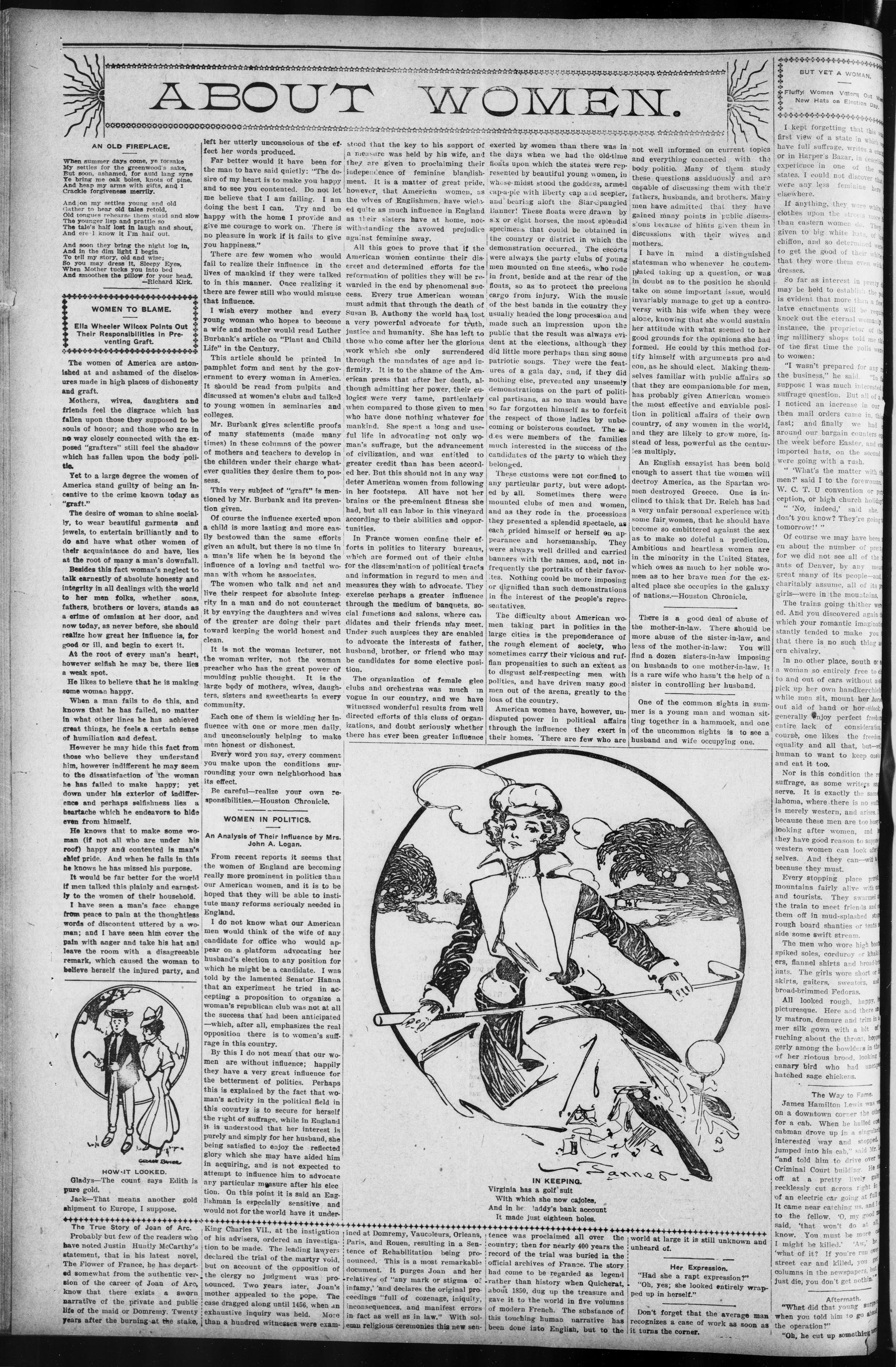
IN KEEPING.
Virginia has a golf suit
With which she now cajoles,
And in her laddy's bank account
It made just eighteen holes.
stood that the key to his support of a measure was held by his wife, and they are given to proclaiming their independence of feminine blandishment. It is a matter of great pride, however, that American women, as the wives of Englishmen, have wielded quite as much influence in England as their sisters have at home, notwithstanding the avowed prejudice against feminine sway.
All this goes to prove that if the American women continue their discreet and determined efforts for the reformation of politics they will be rewarded in the end by phenomenal success. Every true American woman must admit that through the death of Susan B. Anthony the world has lost a very powerful advocate for truth, justice and humanity. She has left to those who come after her the glorious work which she only surrendered through the mandates of age and infirmity. It is to the shame of the American press that after her death, although admitting her power, their eulogies were very tame, particularly when compared to those given to men who have done nothing whatever for mankind. She spent a long and useful life in advocating not only woman's suffrage, but the advancement of civilization, and was entitled to greater credit than has been accorded her. But this should not in any way deter American women from following in her footsteps. All have not her brains or the pre-eminent fitness she had, but all can labor in this vineyard according to their abilities and opportunities.
In France women confine their efforts in politics to literary bureaus, which are formed out of their clubs for the dissemination of political tracts and information in regard to men and measures they wish to advocate. They exercise perhaps a greater influence through the medium of banquets, social functions and salons, where candidates and their friends may meet. Under such auspices they are enabled to advocate the interests of father, husband, brother, or friend who may be candidates for some elective position.
The organization of female glee clubs and orchestras was much in vogue in our country, and we have witnessed wonderful results from well directed efforts of this class of organizations, and doubt seriously whether there has ever been greater influence
```markdown
```
ined at Domremy, Vaucoleur, Orleans, Paris, and Rouen, resulting in a Sentence of Rehabilitation being pronounced. This is a most remarkable document. It purges Joan and her relatives of "any mark or stigma of infamy," and declares the original proceedings "full of cozenage, iniquity, inconsequences, and manifest errors in fact as well as in law." With solemn religious ceremonies this new sen-
ence was proclaimed all over the world at large it is still unknown and country; then for nearly 400 years the unheard of.
exerted by women than there was in the days when we had the old-time floats upon which the states were represented by beautiful young women, in whose midst stood the goddess, armed capa-pie with liberty cap and scepter, and bearing aloft the Star-spangled banner! These floats were drawn by six or eight horses, the most splendid specimens that could be obtained in the country or district in which the demonstration occurred. The escorts were always the party clubs of young men mounted on fine steeds, who rode in front, beside and at the rear of the floats, so as to protect the precious cargo from injury. With the music of the best bands in the country they usually headed the long procession and made such an impression upon the public that the result was always evident at the elections, although they did little more perhaps than sing some patriotic songs. They were the features of a gala day, and, if they did nothing else, prevented any unseemly demonstrations on the part of political partisans, as no man would have so far forgotten himself as to forfeit the respect of those ladies by unbecoming or boisterous conduct. The aides were members of the families much interested in the success of the candidates of the party to which they belonged.
These customs were not confined to any particular party, but were adopted by all. Sometimes there were mounted clubs of men and women, and as they rode in the processions they presented a splendid spectacle, as each prided himself or herself on appearance and horsemanship. They were always well drilled and carried banners with the names, and, not infrequently the portraits of their favorites. Nothing could be more imposing or dignified than such demonstrations in the interest of the people's representatives.
The difficulty about American women taking part in politics in the large cities is the preponderance of the rough element of society, who sometimes carry their vicious and ruffian propensities to such an extent as to disgust self-respecting men with politics, and have driven many good men out of the arena, greatly to the loss of the country.
American women have, however, undisputed power in political affairs through the influence they exert in their homes. 'There are few who are
IN KEEPING.
Virginia has a golf suit
With which she now cajoles.
And in her laddy's bank account
It made just eighteen holes.
ence was proclaimed all over the country; then for nearly 400 years the record of the trial was buried in the official archives of France. The story had come to be regarded as legend rather than history when Quicherat, about 1850, dug up the treasure and gave it to the world in five volumes of modern French. The substance of this touching human narrative has been done into English, but to the
N.
not well informed on current topics and everything connected with the body politic. Many of them study these questions assiduously and are capable of discussing them with their fathers, husbands, and brothers. Many men have admitted that they have gained many points in public discussions because of hints given them in discussions with their wives and mothers.
I have in mind a distinguished statesman who whenever he contemplated taking up a question, or was in doubt as to the position he should take on some important issue, would invariably manage to get up a controversy with his wife when they were alone, knowing that she would sustain her attitude with what seemed to her good grounds for the opinions she had formed. He could by this method fortify himself with arguments pro and con, as he should elect. Making themselves familiar with public affairs so that they are companionable for men, has probably given American women the most effective and enviable position in political affairs of their own country, of any women in the world, and they are likely to grow more, instead of less, powerful as the centuries multiply.
An English essayist has been bold enough to assert that the women will destroy America, as the Spartan women destroyed Greece. One is inclined to think that Dr. Reich has had a very unfair personal experience with some fair women, that he should have become so embittered against the sex as to make so doleful a prediction. Ambitious and heartless women are in the minority in the United States, which owes as much to her noble women as to her brave men for the exalted place she occupies in the galaxy of nations.—Houston Chronicle.
There is a good deal of abuse of the mother-in-law. There should be more abuse of the sister-in-law, and less of the mother-in-law: You will find a dozen sisters-in-law imposing on husbands to one mother-in-law. It is a rare wife who hasn't the help of a sister in controlling her husband.
One of the common sights in summer is a young man and woman sitting together in a hammock, and one of the uncommon sights is to see a husband and wife occupying one.
world at large it is still unknown and unheard of.
Her Expression.
"Had she a rapt expression?"
"Oh, yes; she looked entirely wrapped up in herself."
Don't forget that the average man recognizes a case of work as soon as it turns the corner.
BUT YET A WOMAN.
Fluffy Women Vdtera Out W
New Hats on Election Day.
I kept forgetting that this was
first view of a state in which
have full suffrage, writes a coor-
or in Harper's Bazar, in descrip-
experience in one of the new
states. I could not discover that
were any less feminine here
elsewhere.
If anything, they wore white clothes upon the streets more than eastern women do. They given to big white hats, of la chiffon, and so determined were to get the good of their white that they wore them even with dresses.
So far as interest in pretty may be held to establish the po is evident that more than a few latex enactments will be required knock out the eternal woman instance, the proprietor of the ing millinery shops told me that of the first time the polls went to women:
"I wasn't prepared for any of the business," he said. "In the suppose I was much interested in suffrage question. But all of all I noticed an increase in our then mail orders came in, the fast; and finally we had around our bargain counters on the week before Easter, and em imported hats, on the second were going with a rush.
"What's the matter with the men?" said I to the forewoman, W. C. T. U convention or reception, or high church holiday.
"No, indeed," said she, don't you know? They're going tomorrow!"
Of course we may have been en about the number of prey for we did not see all of the ants of Denver, by any great many of its people—and charitably assume, all of its girls—were in the mountains.
The trains going thither were ed. And you discovered again which your romantic imagines stantly tended to make you that there is no such thing ern chivalry.
In no other place, south or a woman so entirely free to to and out of cars without as pick up her own handkerchief while men sit, mount her horse out aid of hand or hor-eblock generally enjoy perfect freedom entire lack of consideration course, one likes the freedom equality and all that, but—human to want to keep ocel and eat it too.
Nor is this condition the r
suffrage, as some writers s
serve. It is exactly the same
lahoma, where there is no suf
is merely western, and arises
because these men are too bus
looking after women, and
they have good reason to sup
western women can look after
selves. And they can—wis
because they must.
Every stopping place pro
mountains fairly alive with
and tourists. They swarmed
the train to meet friends and
them off in mud-splashed st
rough board shanties or tents
side some swift stream
The men who wore high boots spiked soles, corduroy or khakiers, flannel shirts and broad-breasted hats. The girls wore short or skirts, gaiters, sweaters, and broad-brimmed Fedoras. All looked rough, happy, and picturesque. Here and there is a matron, demure and trim in her silk gown with a bit of ruching about the throat, hopperly among the bowdens in the of her riotous brood, looking canary bird who had unpeaked hats sage chickens.
The Way to Fame.
James Hamilton Lewis was on a downtown corner the other for a cab. When he hailed cabman drove up in a singular interested way and stopped, jumped into his cab," said Mr. "and told him to drive over Criminal Court building. He off at a pretty lively gain recklessly cut across right is of an electric car going at full It came near catching us, and I to the fellow. 'O, my good said, 'that won't do at all know. You must be more of I might be killed.' 'Aw, he 'what of it? If you're run over street car and killed, you get columns in the newspapers, but just die, you don't get nothin'"
Aftermath.
"What did that young surgeon when you told him to go ahead the operation?"
The Evening Story.
O you know why I have sent for you, Henry?" said the Earl of Seacomb to his son, Lord Tranmere, who had just come home in response to a parental telegram.
"I am in complete ignorance as yet," returned the young man.
He did suspect the reason, but it was his policy to let his father make the first move in the struggle which he felt immending.
"If you read that letter," said the Earl, "it will explain."
Lord Tranmere took the letter and read—
"St. Mura's County Fermanagh.
"To the Right Hon. the Earl of Seacomb.
"My Lord—I venture to address you on a subject that is of the greatest importance to both of us. Your son, Lord Tranmere, who is quartered with his regiment at Enniskillen, has lately been paying a great deal of attention to my daughter. I am aware that your lordship has other designs for your son, and that he will not be allowed to marry a poor Irish girl who belongs to a broken family. As I feel that my daughter's happiness will suffer seriously if this hopeless affair is permitted to proceed, I beg that you will use your powerful influence to have Lord Tranmere transferred from the neighborhood and thus end the matter. I have the honor to remain, your lordship's humble servant.
"HUGH O'NEILL."
"Is that true?" demanded the Earl, when his son had finished.
"Is what true?"
"That you have been paying marked attention to Miss O'Neill?"
"Quite true, father."
"Then you are doing grave injustice to the young lady by leading her to entertain expectations that can never be realized."
"I will be perfectly frani. with you, father. I love Miss O'Neill, and I believe she loves me."
"Then all I can say is you had better dismiss her from your thoughts at once," said the Earl coldly.
"It is impossible!" answered the young man, in firm but respectful tone. "She is the most beautiful girl I have ever seen. She comes of a good family. Her only misfortune is that she has no money."
"And a very serious misfortune it is" observed the Earl drily. "Come, Henry, be reasonable. You are not yet twenty-one. The world is before you to choose where you like. Don't allow the pretty face of a country girl to spoil your future."
The father's remonstrances however proved futile. Lord Tranmere would not promise to give up Miss O'Neill; but under strong pressure he finally consented to go abroad for a year, and in the meantime to hold no correspondence whatever with the young lady.
"That is so much gained," thought the Earl, as he resolved on the best way to arrange for his son's absence from duty. "Many things may happen in the interval. Time is on our side."
After this interview Lord Seacomb wrote to Mr. O'Neill, conveying his warmest thanks for the timely warning. He had, he continued, immediately obtained long leave for his son, and had sent him to travel on
BRAVADO.
Sambo—So Mistuh Erasus Jones is gwine to git married, eh?
Powell—Yes, somebody done tol' him dat marriage was a lottery, and he's such a spoft dat he's boun' to take a chance.
Delights of a House-Wagon.
weights of a House-Wagon.
Living in a house-wagon, combining as it does the delight of camping with the pleasure of traveling, is one of the finest ways in the world of having fun in the summer, and is within the reach of most boys. Of course, there will be necessarily some expenditure, but if economy and forethought are used, and the expenses divided up among the crowd,
the continent; and he truste dthat of a foolish attachment really existed between the young people it would speedily pass away. In conclusion he said that he had commissioned a friend of his—Colonel Montgomery—who was passing through the neighborhood, to call and express his thanks personally to Mr. O'Neill. In due course Colonel Montgomery called at St. Mura's. He was a tall, soldierly man of about fifty, with most engaging manners. "My dear sir," he said to Mr. O'Neill, "Lord Seacomb is exceedingly grateful for your honorable conduct in this affair.
"I am told he is hard and proud," replied Mr. O'Neill, "but I am as proud as he is. His family is quite as good—the blood of the Princess of Ulster flows in our veins in a direct line. Unfortunately, my little place is mortgaged up to the hilt, so that when I die my poor Kathleen will be poor indeed."
"I am sorry for that," said the visitor sympathically. "But I must do my friend the justice to say that he did not look at the matter solely in a pecuniary aspect. He thought both parties were too young to know their own minds fully; and as you justly observed, he has other designs for his son."
"Naturally, naturally," said Mr. O'Neill, his usual good-humor returning. "I don't blame him at all, it's the way of the world. Poverty, as Earl Fitzwilliam used to say, is the great crime of the Irish—but here's my daughter."
Miss O'Neill entered with that elastic grace of motion which is so characteristic of Irish gtrls. She was somewhat above the middle height; her figure was perfect, her forehead wide and not too high; her large, dark-blue eyes were shaded with long lashes; her eye-brows were exquisitely pencilled, and her shapely head was crowned with an abundance of the true Irish blue-black hair. The Colonel had seen many beautiful women in his time, but he could not recollect a finer specimen than the one who stood before him; and he secretly congratulated Lord Tranmere on his good taste.
"You must stay with us for a few days," said the old gentleman, with the hospitality of his race. "Come, now, we will try to make you comfortable. St. Mura's isn't such a bad place, after all—is it Kathleen?"
Kathleen joined her father in pressing the stranger to remain. Her voice was perfectly modulated, and the faintest brogue lent it a singular piquancy.
"Really," said the visitor, hesitating, "you are very kind; but, although I am enjoying the privileges of half-pay, I fear that my duties in connection with matters—"
"Nonsense!" interposed the host
VOKES
VOKES
A DIFFERENCE OF OPINION.
Mr. Porke Packe—What the paper
meats is all rot. We give the peo
Mr. C. Moore—That's strange! TH
the worst you can.
Mr. Porke Packe—What the papers are printing about my preserved meats is all rot. We give the people the best we can.
Mr. C. Moore—That's strange! They seem to have the idea that they get the worst you can.
it will make a cheap outing, and the longer you stay the cheaper will be the rate per day, because practically all expense occurs in the original outlay. After you are on the road or in camp there is little opportunity to spend money, even if you so desire.
For the boys who cannot go on the road there is still plenty of fun. It is not even necessary to spend a cent in order that a small boy may have fun camping in a wagon. Neither is it necessary to own or hire a horse, because the camp need not be movable.
If you have an old wagon in the back lot, a text may be made over it by erecting a pole at each end, fastening a line across and then throwing across it a piece of canvas, carpet, oilcloth or any "old thing" which will serve for a protection
gain. "Duty is a word for Sisson ears only. In this country we don't take life so seriously—pleasure before duty is our motto. Come, I will show you the horses while Kathleen orders luncheon."
So the Colonel remained, not one day but several, and seemed to find something very attractive in the society of Miss O'Neill.
Lord Trammere, wandering about among strange scenes and strange people, began to grow less disconsolate. A year would soon pass, and then? What then? There was the rub. Still it was not necessary to think much about it yet.
Suddenly, however, a letter arrived which spelled whatever little complacency he had acquired. The letter was from Charlie Santo, a young officer at Enniskillen. It began—"Dear Harry—I am not much of a scribe, but I promised to let you know how things are going on. Well, things are not going on; they are at a standstill. Everything is as dull as ditchwater. There isn't a row even between the Orangemen and the Nationalists to bring us out of bed in the middle of the night. Of course the fine scenery is here—Lake of the Thousand Isles and all that—but the dear girls are all away at the seaside, and I am as lonely as a sparrow upon the hausetop.
"Speaking of girls, I fancy you and that charming Miss O'Neill were a little sweet upon each other. If so, she hasn't mourned long over your absence; she is consoling herself with a visitor. His name is Colonel Montgomery. He has a military air and the manner of a gentleman; I don't think he is an importer, but I can't find this particular Montgomery in the Army List. He's elderly certainly, but young enough to be dangerous. Anyhow, papa has taken to him amazingly. The Princess too rides about with him everywhere, and won't bestow a wink of her beautiful eye on one of the unfortunate garrison."
The remainder of the letter concerned mutual acquaintances, and had little interest for Lord Tramere. Was it possible, he asked himself, that Kathleen could be so fickle? Of course she did not know of his promise and his absence must seem unaccountable. Still she might have waited. Should he risk everything and return? No. If she really loved him she would be true; if not—what matter?
Six weeks or so later more discomposing news arrived from Charlie—
"The Colonel is at St. Mura's yet. He is having a good innings, but he was nearly bowled out about a week after he arrived. He was mounted on one of papa's horses—a wild thing, not properly broken—and it bolted with him in the direction of Rorke's Quarry. Miss O'Neill saw the danger, put spurs to her bob, took hedges and ditches in splendid style—you know what a rider she is—and cut in just in time to save the Colonel and
O
s are printing about my preserved
be the best we can.
they seem to have the idea that they get
fun camping in a wagon. Neither is
it necessary to own or hire a horse,
because the camp need not be mov-
able.
If you have an old wagon in the
back lot, a test may be made over it
by erecting a pole at each end, fast-
ening a line across and then throw-
ing across it a piece of canvas, car-
pet, oilcloth or any "old thing"
which will serve for a protection
his fury steed from going over the precipice. As it was, however, the horse fell, and the bold Colonel unshipped his collarbone and dislocated some other parts of his anatomy, rendering it necessary for him to lie up a month or so at St. Mura's for repairs. Of course Miss O'Neill nursed him all the time—that sort of thing is in her line."
Charlie added a P. S.—
"The Colonel has gone at last. It is said that he has a pot of money and is coming back soon to marry the Princess."
"Confound the Colonel!" exclaimed Lord Trannere, throwing the letter angrily on the fire. "Let her take him and welcome if she likes."
Colonel Montgomery's visit had indeed been greatly prolonged owing to his accident. On the day of his departure he said to his host— "I must again thank you for all your kindness. You have given me one of the pleasantest holidays of my life. I have already expressed my thanks to your daughter for the lasting debt of gratitude which I owe her." "Colonel," said the old gentleman heartily, "it has been a real delight to have you with us. My only regret is that your stay has been so short. But you will come again—you must come again."
"Most certainly I will. But I am sorry to see that your daughter's health is not so good as it ought to be—she needs a change."
"No, no, it's not that. Let me tell you in confidence, Colonel, she is still grieving for that young fellow, Lord Tranmere. I wish they had sent his regiment to Jamaica or Jericho instead of to Enniskillen."
"Are you sure that is the cause?"
"Sure?" echoed Mr. O'Neill. "Why, she has refused two of the best men in the country for no other reason!"
"Well," said the other, "if Lord Seacomb saw Miss O'Neill I really don't think he would object to his son marrying her. He is an intimate friend of mine. I will tell him about her."
"It's no use," answered the host, with a sigh. Then, straightening himself, he added, "Colonel Montgomery, you are very kind; but please do not say a word to Lord Seacomb. The descendant of Hugh O'Neill may well be as proud as an English earl, and I will not throw my daughter at the head of any man."
"Mr. O'Neill," said the Colonel, taking his host's hand, "I know Lord Seacomb well, and I am sure he would be proud and glad to receive Miss O'Neill as his daughter-in-law I can speak with confidence on the subject!"
Not long after the Colonel's departure from St. Mura's Lord Tranmere received a brief letter from his father. It ran thus—
"If you wish to marry Kathleen O'Neill, pack up your traps, come home at once, and pop the question. If you are not here, within three weeks from this date, I shall immediately use my best endeavors to make Miss O'Neill the Countess of Seacomb. I would perfer that she became Lady Tranmere. Make your choice. I have left you the pleasure of telling her that you ask her to be your wife with the full consent and at the earnest wish of your father, knokn to the world as the Earl of Seacomb, but to her as Colonel Montgomery."
Three months later there was a biddiliant wedding as St. Mura's. Lord Tranmere is still without a stepmother.
NICE MAN.
Softly—Won't you give me another dance?
Miss Charming—Really, Mr. Softly, you've had nearly all so far and—
Softly—Yes; you know, it's just to spite Miss Lovely. We've had a quarrel.
from the sun. A box under the wagon seat can be used to conceal your camp "duffle" when you are not at home.—Woman's Home Companion.
You have your weak spots; it is not surprising that other people have theirs.
In the cheese-makers' union there is strength.
J.
Mr. Nocoyne—Did you make a return call upon Mrs. De Style?
Mrs. Nocoyne—Why, no. It isn't fashionable to make return calls.
Mr. Nocoyne—I wish all bill collectors were fashionable.
A
THE PROVOKING JOBBERERS.
"Don't you despise people who talk behind your back?"
"I should say so, especially at a concert or during an interesting play."
AMONG THE STARS.
The Humorist of the Atchison Globe Has More To Say.
Dying is not so bad as giving up good things to eat years before you die.
If a man knows you, and speaks to you, and you do not know him, he will hate you.
You never know when a woman will begin crying, or an automobile stop running.
A mother of sons may not have to sew as much as the mother of daughters, but she has to cook more.
When a western young man chases chorus girls he hasn't any valet around to squeal on him afterwards.
After a woman passes sixty, she seems to think that any dress is good enough for any occasion, providing it is black.
So far as we can see, the only advantage a man has over a woman is that he can turn the key on his work at six o'clock.
A woman was on the street today wearing a peekaboo waist with such large meshes that a baby could nurse through them.
It becomes necessary occasionally for every man to take punishment. When your time comes, don't annoy others with your screams.
There should be more in the friendship of women of exchanging cooking recipes, and less of the exchanging of stories of domestic trouble.
As an argument favoring the marriage of a man, it is said he never saves money when he is single anyway, and usually it holds good.
Death looks thin, and white and clammy and cold, and hasn't any of the marks of a humorist about him, but how he does love a little joke!
Isn't it a fact that the most successful men you know, are polite men? Then doesn't it follow that if you hope to succeed you must be polite?
Notice to girls: The young man who is absorbed in the murder trials in the newspapers, to the exclusion of all other news, is not a good man to tie up with.
When we hear a man abused behind his back, we do not think: "How unpopular other people are!" but "How we all catch it when we are not around!"
When a jay takes a seat in an automobile he invariably throws one leg over the other. After a man gets to know the machine he keeps both legs ready to jump.
DR.COE'S SANITARIUM.
SANITARIUM.
LOCATED AT 60TH
AND WYNDHAM.
BEST INVALID'S HOME IN THE WEST.
Organized with a full staff of physicians and
surgicians for treatment of all Chronic Diseases.
THIRTY ROOMS for accommodation of patients.
Difficult Surgery Operations Performed with
Skill and Success when Surgery is necessary.
DISEASES OF WOMEN Wear Equipment to treat Disease of
women. Many who have suffered for years
cured at home. Special book for women FREE
PILES PERMANENT CURE
POSITIVELY GUARANTEED
Without knife, ligature, or surgical
accepted until patient is well. Special Book FREE
VARIOGECLE Radically Cured in Ten
Days, under a Positive
Guarantee. Many who have suffered for Vital
Power, Hydrocele, Rupture.
GRIPPLED CHILDREN CURED by improved methods. Trained attendants.
WRITE FOR FREE BOOK ON
Club Fect, Curvature of Lungs, Eye, Skin
Kidney, Bladder,
Epilepsy, Collar,
Stemach Troubles,
Nervous Diseases.
Patients successfully treated at home by
mail. Consultation Free and confidential, as
office or by letter. Thirty years' experience.
170 page illustrated Book Free, giving much
valuable information. Call at offices or write to
DR. C. M. COE, KANSAS CITY, MO.
VARICOCELE
A Sato, Painless, Permanent Curve GUARANTEE,
30 years' experience. No money accepted until
patient is well. CONSULTATION and valu-
able Book Free, by mail or at office.
DR. C. M. COE, 1915 Walnut St., Kansas City, MO.
TAPE-WORM
Expelled with
bachelor's degree. Large pamphlet or scrapbook.
DR. M. NEY Smith, Specialist, SIR Pinet, St. Louis, MO.
PRIVATE HOME for confinement
Adoption.
Beautiful grounds and buildings. Locally owned.
roddings very exclusive. Ethical. For
full particuliers' address.
Offices: 15.16.124 Main St.
U.S. S. G. Hughes, M.D., KANSAS CITY, MO.
13 WEEKS FREE
The Kansas Farmer
The "old reliable" KANSASI EMERALDS established in 1863, the best geminiate agricultural weekly paper in the West. It solves the problems for the busy farmer. It helps and interests every member of the farmer's family. It has 12 regular departments. Its contractors are expert authorities. It contains 24 to 32 pages each week. Send an original three months free. Test it. Clicks the coupon below.
THE KANSAS FARMER €0,
Topeka, Kansas.
I accept your trial offer to new subscribers to send me the KANSAS) FARMER three months free. At the end of the three months I will either send $1.00 for a full year from that date or write you to stop the paper, and you are to make no charge for the three months' trial.
Name.
P. O.
The Publishers Newspaper Union, Kansas City, Mo.—Vol. 7. No. 9.
How to Prevent Coughing.
Coughing is the worst thing for a cough, and in most instances of cough, there is more coughing than is necessary to subserve the purpose of the cough, i.e., to remove offending material.
The following directions will help one minimize coughing in all instances while in the milder cases it may stop the cough altogether after a little perseverance: When tempted to cough take a deep breath, filling if possible every air cell, holding it until the warming, soothing effect comes or so long as it is reasonable, and mark the mollifying result on the cough, which, even when the latter seems unavoidable, will often be found under control.
Repeat if necessary. The explanation of this is that there is a liberation of nitrogen in the air cells which has a quieting, sedative effect on the irritated mucous membrane.—Dr. A. P. Reed in National Magazine.
Beware of Ointments for Catarrh that
Contain Mercury.
as mercury will surely destroy the sense of smell and completely derange the whole system when entering it through the mucous surfaces. Such articles should never be used except on prescriptions from reputable physicians, as the damage they will do is ten fold to the good you can possibly derive from them. Hall's Catarrh Cure manufactured by F. J. Cheney & Co., Toledo, O., contains no mercury, and is taken internally, acting directly upon the blood and mucous surfaces of the system. In buying Hall's Catarrh Cure be sure you get the genuine. It is taken internally and made in To-do, Ohio, by F. J. Cheney & Co. Testimonials free. Sold by Druggists. Price 75c per bottle. Take Hall's Family Pills for constipation
Where Was the Tick?
Little Willie was seated upon the sitting room floor, with the works of his nice new watch spread about him, when his mother entered and, seeing the wheels, pivots, screws and springs, exclaimed: "Why, my son, have you broken your pretty watch?" "Mamma," said Willie, "I was just trying to see where the tick came from."
American Citizen
The Oldest Negro Journal Published Weekly in this part of the Country
Published Weekly
at 1510 North 3rd Street
KANSAS CITY . . . . . KANSAS.
W. C. Martin, Editor,
Geo. A Dudley, Publisher and
Business Manager.
Terms of Subscription in Advance.
One Year.....$1.00
Six Months.....65c
Three Months.....40c
One Month.....15c
Advertising 25 cents per inch First
Insertion.
A Standing Display 'Ad' for 3 Months
or longer 15c per inch, each insertion.
Grangemouth is the name of a Moscow editor. Evidently a farmer on the side.
Waldorf Astor has become so thoroughly anglicized that he is going to marry an American girl.
A clergyman says that bridge whistle leads to mental decline. Why doesn't he try poker for a change?
Senator Pettus is declared to be a poor man and fond of poker. The last explains the first, possibly.
Perhaps boys should be thankful for whippings, as somebody declares, but 'they seldom are before they are 45.
Sweet Spring is now approaching, and Summer with the rose, so poetry's encroaching upon the field of prose.
King Edward was "warmly received" in Paris, but not in the same way as when he used to be prince of Wales.
The czar will reserve the right to wield the big stick over the Douma, according to the latest advices from St. Petersburg.
We learn from the New York Mail that women are using garters to keep those long, arm-length gloves in place. But do they hold?
Manchuria will be finally evacuated by the Japanese in a few days. It has taken them longer to get out than it did to get in.
It is now believed that Anna Gould is going to give Boni one more chance, in spite of the fact that he has taken a great many already.
Uruguay should not be blamed for having a revolution. A review of recent South American history shows that it is Uruguay's turn.
Asks the editor of the Pittsfield Journal: "Are there four girls with gray eyes in Pittsfield?" Apparently ye scribe means to get busy.
Queen Maud of Norway is losing her health because she fears her husband will be killed. This queen business is not all pickles and ple.
It was not long ago that all the "success" magazines were pointing to the Pittsburg millionaires as examples to the youth of the land.
With 10,000 doctors in convention in Boston next summer, the rest of the country ought to have a good opportunity to get well.—Boston Globe.
It is a pity that the great romancers of the sea did not live in a generation which affords such thrilling material as the log of the dry dock Dewey.
A Minnesota man says he has discovered the cause of the aurora borealis. But what bearing will this have on the price of coal this year?
Much to the surprise of everybody, some of the phenomenal ball players added to the leading nines as marvelous discoveries will probably make good.
Cheer up, mister! The president of the Dressmakers' National Protective Association says that women's dress will be less expensive this year than ever before.
The Japanese, says one of their statesmen, should adopt chairs and develop their legs. Well, short legs did not prevent them from "getting there" in the late war.
Portia, as quoted by the editor of a kind of society paper, is made to say: "How far that little scandal throws his beams! So shines a bad deed in this haughty world."
News comes from the east that the seventeen-year locusts will devastate the land this year. How many times in the course of a decade do the seventeen-year locusts come, anyhow?
As the last suffragist was detatched from the doorknob and put into the police wagon, the premier of the great British Empire crawled out from under his bed and sighed a sigh of relief
An actor has become a soldier in order to escape the adulation of matinee girls. We know several actors who should be driven from the stage with a club instead of soft
GREAT SINGER IS UNGRATEFUL.
Mme. Patti Criticises America, While Made Her Wealthy.
Confirmation of the report that Mme. Adelina Patti has made her final tour in the United States is found in her recent criticisms of the American people. This lady, who once lived down on Grand street West, but now dwells in a castle in Wales, largely owing to the generosity of the citizens of this city, has lately discovered that we haven't any appreciation of art, cookery, music or good manners. This is an ill return for all the complimentary words we have uttered about her, not to mention the dollars we have paid to hear her voice. Although she was born in Madrid in February, 1843, she came here with her parents as a child and grew up among the people of New York. Her brother, Carol, used to lead the orchestra at the Grand Opera House, during the Jim Fisk era of French opera-bouffe.
Mme. Patti's last tour of this country was not financially successful—a circumstance that may account for her change of heart. The lady, however, insisted upon receiving her contract money to the last dollar. The im presario was almost ruined, although the fault was the diva's own. She couldn't sing! Her voice had lost its fine quality. She wasn't a "diva" any longer. The American people found this out and refused to assist in maintaining Craig y Nos castle—Brooklyn Eagle.
Famous Actors as Negro Minstrels.
Jefferson said he thought he was one of the first men to black his face after the appearance and success of "Jim Crow" (T. D.) Rice.
"I suppose," said Mrs. Drew, "there are very few men in this company who have not at one time or another been associated with minstrel performances."
"I played Brudder Jones," said Mr. Jefferson.
"Everybody knows I was in the minstrel business," Goodwin exclaimed. "Yes," I remarked, "because we were there together. "Well," joined in Crane, "I was on the tambourine end with Campbell's minstrels." I remember telling this at Lawrence Barrett's house at Cohasset, where the rest of the party consisted of Edwin Booth and Stuart Robson, Booth then told how he and J. S. Clarke were minstrels in their younger days, and he followed this up by declaring that he used to "pick a little on the banjo." I laughed, and Booth inquired the reason, and I added, "Oh, nothing much, only Booth and the banjo seemed such an odd combination."—Franeis Wilson in Scrubbins' Magazine.
$\textcircled{1}$ Thou Compassionate
© Thou Compassionate.
How deeply comforting the tender phrase,
Thy greater attribute seem merged in the
hear.
Through all life's long and dark and
weary maze,
Thou art Compassionate.
To God of Justice and of Power we turn
When wrong or devastating blow cuts
deep;
And yet in daily struggle needs must
yearn
For one Compassionate.
In limits of our souls we live, alone,
And e'en our nearest may not under-
stand
But all "the household jar within" is
known
To thee, Compassionate.
Thou know'st the many sorrows of the
day;
Wide longing, narrow opportunity—
We bring life's broken toys, as children
may,
To one Compassionate.
We may have blundered grievously and
ang.
Darkened Thy world we might have
made so bright.
Still Thou dost heal the heartache and
the wrong
O thou Compassionate!
—May Ethelyn Bourne, in Overland
Monthly.
Of No Importance.
Two men were standing together on an East River ferryboat when one pointed out a third man with the remark:
"I can't recall his name at this moment, but he writes for a number of the magazines."
His friend looked at the stranger with much interest.
"Oh, one of our frenzied finance captains, is he?" he asked.
"No, he—"
"Writes up trusts and things, then?"
"Oh, then he's a prizefighter or an actor—he is rather husky looking."
"No, no! He's just a plain author—writes stories."
"Oh!" the friend exclaimed, the look of interest suddenly dying out of his face—New York Journal.
True to His Promise.
The other boy had called Tommy a liar, an 'a fightin' liar, and told him he dassen't take it up.
Tommy's fists were clinched and his eyes were blazing, but he stood there rapidly repeating something to himself, in accordance with a long standing promise he had made to his mother.
"If you'll jist wait till I've finished sayin' it," he said, "I'll knock the tar out o' you, Dick Bunker, you ple faced slob! 'But children, you should never let your angry passions—'"
The other boy, however, disappeared around the corner while Tommy's lips were still moving.
Flying Wedge.
"Great Scott!" exclaimed the drummer who had put up in the old farm house over night. "What was that noise down below? Football rush?" "Worse than that, stranger," chuckled the old farmer, as he snuffed out the candle. "Yeou see, I have eight starters on' each one of them has a beau who calls on Thursday nights. Wall, the first couple that gets the parlor can have it. That's why they are running."
LACE SCARF AS EAR TRUMPET.
Elderly Lady Has Discovered It Acts as Sounding Board.
With advancing years a, dear old lady has found that her hearing has become somewhat affected. She has not found it necessary to use an ear trumpet as yet, but it is difficult at times to catch all that friends say. Anything said in an undertone is completely lost to her—that is, it was until she hit upon a novel idea.
While visiting a friend recently the hostess had pitched her voice almost to the straining point and her vocal organs were getting tired, when "Aunt Sis," as she is affectionately termed, interrupted her by saying: "Please, dearie, hand me my lace head scarf." "Do you feel a draught?" anxiously inquired the hostess, handing over the mantilla.
"Not the slightest," said "Aunt Sis" as she adjusted the head covering. "Then why do you wear it? It will make your head tender."
"Oh, I think not. You see, the scarf acts as a sort of sounding board. It keeps out all other sounds except those of the human voice. When I wear this I can hear even a whisper I can't explain why it is, but it is so, nevertheless. I have had lots of fun over it, too. My boys have been taking advantage of my infirmity to whisper per to each other. I didn't hear them before I began to wear this scarf, but now I know lots of their secrets and they don't know it. It's a good joke on them."
Fish Know Colors.
"Fish know colors," said a keeper at the New York Aquarium the other day. "They can distinguish between red and blue, or white and green, as well as you and I. Wait and I'll prove it."
He led the way to a tank in which were some red and some yellow and some green fish, and in it were artificial grottoes painted respectively red and yellow and green. The keeper rolled the water with his hand, and the fish fled, the red ones to the red grotto, the yellow ones to the yellow grotto, and the green ones to the green grotto.
"They know which color shields them from observation best," said he. "Now I'll change the grottoes, so as to prove my statement a second time."
He moved the grottoes to different places in the tanks and again rolled the water.
The same thing followed as before. Each fish darted like a shot to the grotto of its own color, where it knew it would be best concealed.
To the Beloved.
To the Beloved.
Everything that I made I used to bring you,
Was it a song, why, then 'twas a song to sing to you.
Was it a story, to you I was telling my Ah, my dear, could you hear 'mid the bliss and the glory?
Did any one praise me, to you I said it all over my day the days past recover?
My tears and my troubles were yours; did any one grieve me.
I carried it straight to the love that was sure to relieve me.
O my dear, when aught happens, to you I am turning.
Forgetting how far you have traveled There is nobody now to tell things to; your house is so lonely;
And still I'm forgetting and bringing my tale to you only.
The old days are over; how pleasant they were, the fine weather.
When youth and my darling and I were home and together!
And still I am sitting on a phone, that no longer you're near me.
And turn to you still with my tale, and there's no one to hear me.
—Pall Mall Gazette.
Fate of the Old Presidents:
In the autumn of 1901 Mrs. W. of Roxbury spent a few weeks with her daughter in Nova Scotia, returning home shortly before President McKinley was shot, bringing her niece, Bessie F., aged 6 years, home with her. Of course the child heard a good deal of talk in the house about the shooting of the president.
One day Bessie said to her aunt: "Aunt Minnie, who is king of the United States?" Her aunt replied: "We have no kings in the United States like you do in your British country. We have presidents. We have an election every four years and elect a new one."
"Oh, yes," the child replied; "and then they shoot the old ones, don't they?"—Boston Herald.
New City for Egypt.
Suakin, on the red sea, has proved an unsatisfactory port and is to be superseded by a brand-new rival which has been built up out of coral work and desert sand by the Egyptian authorities. The rival is Port Sudan, the latest addition to the cities of the British empire, and an enthusiast says that it is destined to be a place of magnitude and importance in the days when cotton shall have made it the New Orleans of the east. The place has hitherto been called Mersa Sheikh Burud. It is about 680 miles south of Suez and is capable of holding a dozen vessels of moderate size. The entrance is 600 feet across, and the land around is six feet above sea level.
Posers for Scholars.
Twenty words submitted to a spelling bee in Springfield, Mass., in 1846 were given to the high school class at East Liverpool by Supt. Rayman, and it is reported not one in the class correctly spelled every word. Only ten had averages of over 90 per cent. The average of the 124 pupils was $73\frac{1}{2}$ per cent.
The words submitted were accidental, accessible, baptism, chirography, characteristic, deceitful, descendant, eccentric evanescent, fierce$^{a,b,c}$, feigned, ghastliness, gnawed, heiress, hysterics, imbecility, inconceivable, inconvenience inefficient, irresistible.
—Pittsburgh Dispatch.
SHIELDS FOR TROOPS IN WAR.
Their Use Urged by a German Military Writer.
A writer in the Militar-Wochenblatt raises anew the question of the use of portable shields for the protection of infantry in the attack, says the Broad Arrow. He writes approvingly of the Japanese spade work in the offensive, the more so because he mentions incidentally, as a matter regarding which there can be no dispute, that the German authorities have long since advocated the use of artificial cover in the attack, and points out that when the ground was frozen or rocky, and the spade could make no impression upon it, the attacking Japanese infantry not infrequently went forward, carrying with them filled sandbags weighing as much as forty pounds. He remarks that if the undoubtedly brave Japanese soldier found it necessary to load himself with so bulky and burdensome a protection when advancing in the open against an intrenched enemy it would seem far better to equip the infantry with a light, handy shield.
Furnished with a handle by which to carry it, a loophole to fire through and some arrangement to prevent its falling down, the infantryman would then find himself, like his gunner comrade, protected by a bullet-proof shield. The writer in the Wochenblatt suggests that on the march the shield should be carried on the back, when going into action on the chest, and when advancing to the attack in the left hand, so as to be at once available for use when lying down to fire, both as head cover and rifle rest.
YOUR HAIR SHOULD BE DRAB:
That is the Fashionable Color, So an Authority Says.
"Deep auburn and the drab shades are the fashionable colors in hair this season," said the woman who makes hair coloring a speciality, as placidly as though she were commenting on the state of the weather or the advance style in dress goods.
"One of my customers has to my knowledge worn five different colors or shades on her wavy tresses. Having been blessed with medium brown hair by nature she became a ravishing blonde when the fashion for bleaching first came in.
"Next she took to titian red after a trip to the art galleries of Europe. Then she thought she would be more attractive as a brunette, and now her hair is drab.
"The last is by far the most popular of all for the reason that is most difficult to obtain, and then it is pretty generally becoming, and it happens that women who are born with this particular color of hair are almost always clever.
"How is it done? Well, in case of a woman whose hair is dark a bleach must first be used before the dye is applied. With women whose hair has turned gray it is a still simpler problem. The color lasts a year, while the head can be washed and even salt water bathing does not affect it."—New York Sun.
What Money Will Do.
What bought my private car? Just wealth
What bought my lovely yacht.
Which sails me to lands where health
Is worth it?
What pays my specialist, dear Jim.
To keep me in such perfect trim?
Well—I don't know!
What bought the most delightful wife
A man could hope to win?
What buys her every wish in life—
The clothes she dazzles in?
And if her heart beats not for me,
And I am glad you see,
Well—I don't know!
And heaven. Oh, of course, I don't
Expect to get in for it.
But if the Lord meant what he said
Concerning charity,
The title I'll give before I die.
Will slip me through the needle's eye.
Or—I don't know!
For happiness? Well, money bought
it. No cigar;
It bought this chair, which I toil,
It bought this private car;
It bought this cognac—and, I guess,
If all this is not happiness,
I won't believe!
A Welsh judge had before him a case in which a printer sued a pork butcher for the value of a large parcel of paper bags with the butcher's advertisement printed thereon.
The printer, having no suitable illustration to embellish the work, thought he improved the occasion by putting an elaborate royal arms above the man's name and address, but ultimately the latter refused to pay.
The judge, looking over a specimen, observed that for his part he thought the lion and the unicorn were much nicer than an old fat pig.
"O well," answered the butcher, "perhaps your honor likes to eat animal like that, but my customer's don't. I don't kill lions and unicorns—I only kill fat pigs!"
Verdict for defendant.—New York World.
Building Up to Requirements
A Kansas City man purchased a city lot with the restriction that he should not build a house on it to cost less than $2,500. After having paid for the lot he decided to build a $1,500 cottage.
Before he had completed it the real estate man from whom he had bought the lot threatened to sue him for breach of contract. "This little shack you are building," said the real estate man, "lacks a whole lot of being a $2,500 house such as you agreed to build."
"Don't form too hasty judgment," replied the owner. "True, it hasn't cost that much yet, but I intend to put a solid gold brick in the chimney."
-Kansas City Times
Telephone Bell W. 32.
W. B. R
FUNERAL
and Embalmer. The very best
for all Purpos
The Best Equipped White
sick and
on Short Notice. Charges R
sota Ave., Kansas
Western
B. Raymon
GENERAL DIRECTOR
her. The very best of Service, Fine
for all Purposes, at all Hours.
Equipped White Enameled Ambul
sick and wounded
Notice. Charges Reasonable. Call at
sota Ave., Kansas City, Kansay.
W. B. Raymond FUNERAL DIRECTOR
and Embalmer. The very best of Service, Fine Carriages for alll Purposes, at all Hours. The Best Equipped White Enameled Ambulance for sick and wounded on Short Notice. Charges Reasonable. Call at 431 Minne sota Ave., Kansas City, Kansay.
THE GREAT EDUCATIONAL INSTITUTION
FOR KANSAS AND THE WEST
DEPARTMENTS:—Theological, College, Normal, Sub-Norm
Industrial.
COURSES:—Classical, College, Preparatory, Normal, Sub-
sical (Instrumental and Vocal), including piano, or
mony, Drawing (Fine Arts and Mechanical), Carpe-
and Book-Binding, Business Course, Stenography and
Tailoring, Dressmaking and Plain Sewing, Cooking,
Farming and Gardening.
ADVANTAGES:—Splendid Location, Healthful Climate,
ences and Thorough Teachers.
INFORMATION:—For terms, prices and all inducem-
write to
WILLIAM T. VERNON, A. M.,
PRESIDENT,
QUINDARO,
MENTS:—Theological, College, Normal, Sub-Normal.
—Classical, College, Preparatory, Normal, Sub-
Instrumental and Vocal), including piano, or
Drawing (Fine Arts and Mechanical), Carpe-
ook-Binding, Business Course, Stenography and
log, Dressmaking and Plain Sewing, Cooking
and Gardening.
GES:—Splendid Location, Healthful Climate,
and Thorough Teachers.
ION:—For terms, prices and all induceme-
to
IAM T. VERNON, A. M., B
PRESIDENT,
DEPARTMENTS:—Theological, College, Normal, Sub-Normal and State Industrial.
COURSES:—Classical, College, Preparatory, Normal, Sub-Normal, Musical (Instrumental and Vocal), including piano, organ and harp mony, Drawing (Fine Arts and Mechanical), Carpentry, Printing and Book-Binding, Business Course, Stenography and Typewriting, Talloring, Dressmaking and Plain Sewing, Cooking, Laundering, Farming and Gardening.
INFORMATION:For terms, prices and all inducements offer write to WILLIAM T. VERNON. A. M.. D. D.
Phones {Office—Bell—"White" 4302.
Residence—Bell—"West" 15.
Why does colored people as well as uncolored peo
by a smoky poor light and drink mu
water full of disease germs.
red people as well as uncolored people set in by a smoky poor light and drink muddy bad water full of disease germs.
Why does colored people as well as uncolored people set in the dark by a smoky poor light and drink muddy bad water full of disease germs.
When they can get a first-class
Bright Gas Burner Light
Bright Gas Burner Light
For 35 to 75 cents. And a
Self Cleaner Water
that makes the water clear as a Crystal and Health
For 50 to 75 cents.
A. J. SHERIDAN
ROOM 8,
Self Cleaner Water
makes the water clear as a Crystal and Health
For 50 to 75 cents.
A. J. SHERIDAN
ROOM 8,
TA AVE. KANSAS CITY
Shade of the Old Apple Tree" is a very popular
regular by trading at a popular store?
A. J. MADDUX
Fruit and Fancy Grocer
Meats and all Kinds of Produce
that makes the water clear as a Crystal and Healthy. For 50 to 75 cents.
"In the shade of the Old Apple not you be popular by trading at a p
L. J. M
Staple and Fa
Meats and all K
"In the shade of the Old Apple Tree" is a very popular song not you be popular by trading at a popular store?
L. J. MADDUX, Staple and Fancy Groceries Meats and all Kinds of Produce.
HOME PHONE 784 WEST.
In an Excuse Book.
Because its employees were late a London house provided a book in which the tardy ones were to write excuses. Reasons for lateness were not much varied. At the top of the page one would write "Train delayed," or "Qmibus horse died," as the case might be, and the rest fell into the habit of making ditto marks and letting it go at that. But not long ago one man had a new excuse. He wrote with pride: "Wife had twins." The second slow person that morning was in a great hurry, and did not notice the innovation, but made his customary ditto marks, and the rest of the men on that page followed suit. The excuse book was abolished.
Example of the Postage Stamp
The late Judge Andrew Wylie, of Virginia, had a happy gift of illustration. The judge cast in 1860 the only vote for Lincoln that was given in Alexandria, Va. In an address on Lincoln he once illustrated in an odd way the power of perseverance. "Lincoln persevered," he said, "and it is only those who persevere, they who concentrate their energies, who succeed. Don't give three years to journalism and then, discouraged, try the law awhile. Don't learn the grocery business and in a little while take up placer mining or plumbing. Consider, rather, the postage stamp, whose useful depends on its ability to stick to one thing until it gets there."
"Well," said the first policyholder, throwing aside his paper, "there is at least one thing we can be thankful for concerning our Mutual friend, Mr McCurdy." "What's that?" inquired the second policyholder.
530 MINNESOTA AVE
852 FREEMAN AVE.
Telephone Home W.3
Raymond DIRECTOR
of Service, Fine Carriage
s, at all Hours.
Enameled Ambulance for
wounded
reasonable. Call at 431 Minn
as City, Kansay.
University
College, Normal, Sub-Normal and Stu-
preparatory, Normal, Sub-Normal, M.
al), including piano, organ and t
and Mechanical), Carpentry, Print
Course, Stenography and Typewriti
Plain Sewing, Cooking, Launderin
on, Healthful Climate, Good Indu-
ces and all inducements offer
NON, A. M., D. D.
DENT,
KANSAS
uncolored people set in the dark and drink muddy bad disease germs.
ner Water Eilt
as a Crystal and Healthy.
75 cents.
ERIDAN
M 8,
KANSAS CITY, KANS
Tree" is a very popular song popular store?
ADDUX,
ency Groceries
inds of Produce.
Res. 420 Nebraska ave. Tel. 383 W
SOUTH AMERICAN
MEDICAL INSTITUTE
Office Hours: From 10 a. m., till 4 p.
and from 6 till 9 p. m.
C. H., C. JORDAN, M. M., M. D
Here is the Place
J. T. Roberts
TONSORIAL PARLOR
All the Latest Style Hair Cuts,
Shave strictly Up-to-Date
438 MINNESOTA AVE.
An Old French Sailor.
French seamen have a dozen in person of a centenarian. The sailor belongs alike to the navy to the merchant service, for he served in both, and it would be difficult say in which of the two his adventures were the most thrilling. His reel includes three shipwrecks, the hat of Navarino, in which he won motion in orders, the blockade of Algeria one capture by brigands, followed himself and his companions seizing Spanish ship which captured the sail which had captured them. He serving many years before the man he became a master and small owner on his own account. His ship is Pierre Loirat. He was born November, 1805, and at 12 he was
ROOM 8.