The American Citizen
Friday, September 7, 1906
Topeka, Kansas
Page text (machine-generated)
THE AMERICAN CITIZEN.
sorrow
ned;
rs;
brief
den
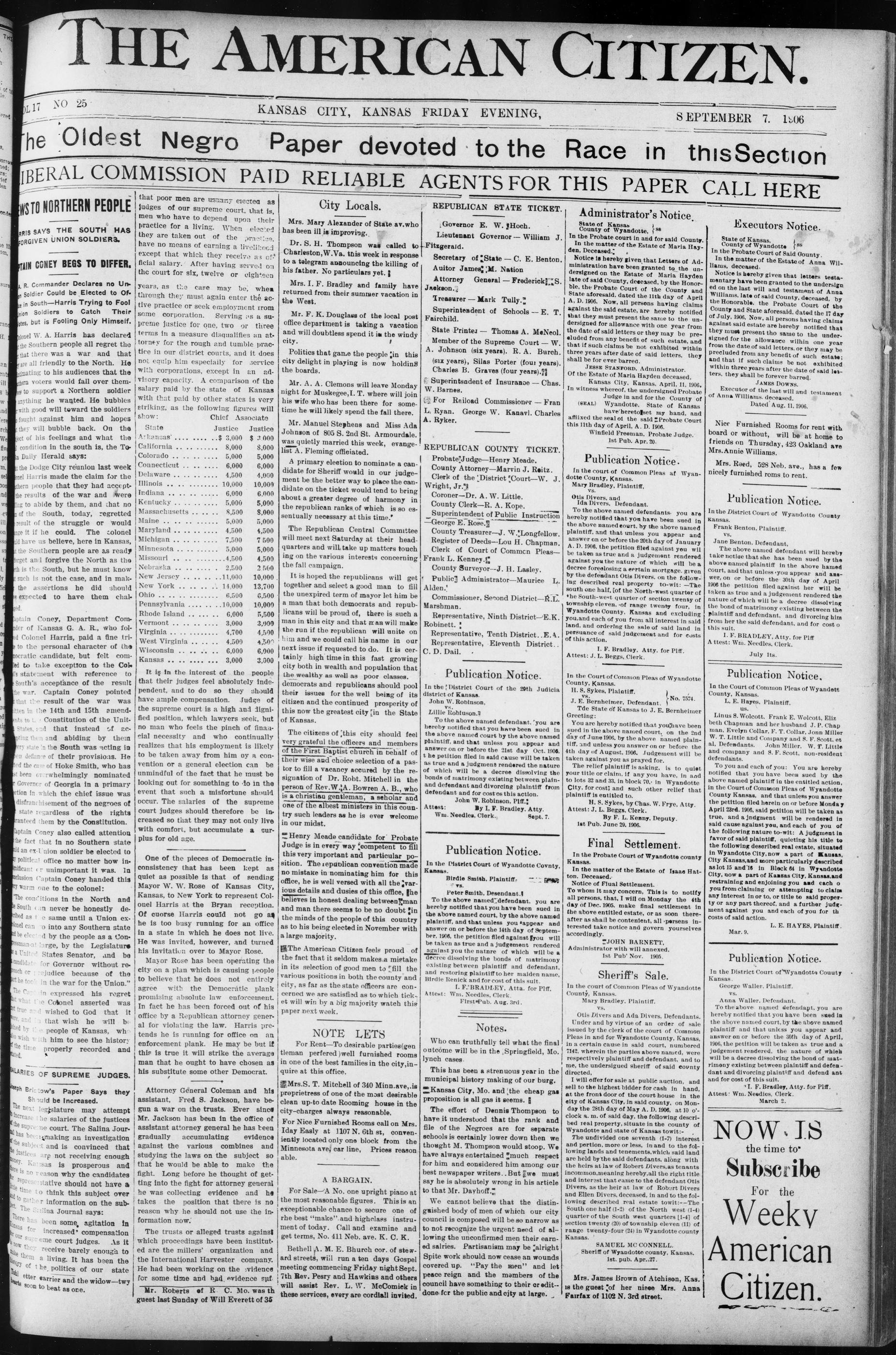
EWSTO NORTHERN PEOPLE
RRIS SAYS THE SOUTH HAS FORGIVEN UNION SOLDIERS.
STAIN CONEY BEGS TO DIFFER.
A. R. Commander Declares no Union Soldier Could be Elected to Office in South—Harris Trying to Fool Union Soldiers to Catch Their Notes, but is Fooling Only Himself.
Colonel W. A. Harris has declared that the Southern people all regret the fact that there was a war and that we are all friendly to the North. He animating to his audiences that the southern voters would fall over themselves to support a Northern soldier anything he wanted. He bubbles with good will toward the soldiers to fought against him and hopes they will bubble back. On the object of his feelings and what the condition in the south is, the Toa Daily Herald says:
at the Dodge City reunion last week
Louel Harris made the claim for the
northern people that they had accept-
the results of the war and were
going to abide by them, and that no
of the South, today, regretted
result of the struggle or would
agree it if he could. The colonel
did have us believe, here in Kansas,
at the Southern people are as ready
to forget and forgive the North as the
nth is the South, but he must know
such is not the case, and in make
the assertions he did should
be expected to have them chal-
ked.
Captain Coney, Department Commander of Kansas G. A. R., who folded Colonel Harris, paid a fine triumph to the personal character of the democratic candidate, but felt compelled to take exception to the Cohill's statement with reference to South's acceptance of the result of the war. Captain Coney pointed that the result of the war was written in the 14th and 15th amendments to the Constitution of the United States, and that instead of accepting them and abiding by them every state in the South was acting in open defiance of their provisions. He noted the case of Hoke Smith, who has just been overwhelmingly nominated Governor of Georgia in a primary election in which the chief issue was disfranchisement of the negroes of the state regardless of the rights guaranteed them by the Constitution. Captain Coney also called attention the fact that in no Southern state did an ex-union soldier be elected to the political office no matter how significant or unimportant it was. In conclusion Captain Coney handed this very warm one to the colonel:
The conditions in the North and the South can never be honestly described as the same until a Union ex-colonel can go into any Southern state and be elected by the people as a Congressman at large, by the Legislature as a United States Senator, and be candidate for Governor without re-search or prejudice because of the fact he took in the war for the Union." The Captain expressed his regret that what the Colonel asserted was not true and wished to God that it were, and in that wish he will be assisted by the people of Kansas, who also wish with him to see the history of the time properly recorded and learned.
BALARIES OF SUPREME JUDGES.
Joseph Brittow's Paper Says they Should be Increased.
The next legislature may attempt to increase the salaries of the justices and the supreme court. The Salina Journal has been making an investigation of the subject and is convinced that the justices are not receiving enough money. Kansas is prosperous and there is no reason why the candidates for representative should not have a little time to think this subject over and to gather information on the subject. The Salina Journal says:
There has been some agitation in Kansas for increased compensation for our supreme court judges. As it is now they receive barely enough to make them a living. It has been the history of the politics of our state. Tulli etter carrier and the widow—twy hearts soon to beat as one.
that poor men are usually elected as judges of our supreme court, that is, men who have to depend upon their practice for a living. When elected they are taken out of the practice, have no means of earning a livelihood except that which they receive as official salary. After having served on the court for six, twelve or eighteen
years, as the case may be, when through they must again enter the active practice or seek employment from some corporation. Serving as a supreme justice for one, two or three terms in a measure disqualifies an attorney for the rough and tumble practice in our district courts, and it does not equip him especially for service with corporations, except in an advisory capacity. A comparison of the salary paid by the state of Kansas with that paid by other states is very striking, as the following figures will show: Chief Associate
State Justice Justice
Arkansas' $ 3,000 $ 3,000
California 8,000 8,000
Colorado 5,000 5,000
Connecticut 6,000 6,000
Delaware 4,500 4,000
Illinois 10,000 10,000
Indiana 6,000 6,000
Kentucky 5,000 5,000
Massachusetts 8,500 8,000
Maine 5,000 5,000
Maryland 4,500 4,500
Michigan 7,500 7,500
Minnesota 5,000 5,000
Missouri 4,500 4,500
Nebraska 2,500 2,500
New Jersey 11,000 10,000
New York 14,000 13,700
Ohio 6,500 6,500
Pennsylvania 10,000 10,000
Rhode Island 6,000 5,500
Vermont 3,000 3,000
Virginia 4,700 4,500
West Virginia 4,500 4,500
Wisconsin 6,000 6,000
Kansas 3,000 3,000
It is in the interest of the people that their judges feel absolutely independent, and to do so they should have ample compensation. Judge of the supreme court is a high and dignified position, which lawyers seek, but no man who feels the pinch of financial necessity and who continually realizes that his employment is likely to be taken away from him by a convention or a general election can be unmindful of the fact that he must be looking out for something to do in the event that such a misfortune should occur. The salaries of the supreme court judges should therefore be increased so that they may not only live with comfort, but accumulate a surplus for old age.
One of the pieces of Democratic inconsistency that has been kept as quiet as possible is that of sending Mayor W. W. Rose of Kansas City, Kansas, to New York to represent Colonel Harris at the Bryan reception. Of cuorse Harris could not go as he is too busy running for an office in a state in which he does not live. He was invited, however, and turned his invitation over to Mayor Rose.
Mayor Rose has been operating the city on a plan which is causing people to believe that he does not entirely agree with the Democratic plank promising absolute law enforcement. In fact he has been forced out of his office by a Republican attorney general for violating the law. Harris pretends he is running for office on an enforcement plank. He may be but if this is true it will strike the average man that he ought to have chosen as his substitute some other Democrat.
Attorney General Coleman and his assistant, Fred S. Jackson, have begun a war on the trusts. Ever since Mr. Jackson has been in the office of assistant attorney general he has been gradually accumulating evidence against the various combines and studying the laws on the subject so that he would be able to make the fight. Long before he thought of getting into the fight for attorney general he was collecting evidence and he takes the position that there is no reason why he should not use the information now.
The trusts or alleged trusts against which proceedings have been instituted are the millers' organization and the International Harvester company. He had been working on the evidence for some time and had evidence suf. Mr. Roberts of R. C. Mo. was th guest last Sunday of Will Everett of 35
KANSAS CITY, KANSAS FRIDAY EVENING,
City Locals.
Mrs. Mary Alexander of State av. who has been ill is improving.
Dr. S. H. Thompson was called to Charleston, W.Va. this week in response to a telegram announcing the killing of his father. No particulars yet.
Mrs. I. F. Bradley and family have returned from their summer vacation in the West.
Mr. F. K. Douglass of the local post office department is taking a vacation and will doubtless spend it in the windy city.
Politics that game the people in this city delight in playing is now holding the boards.
Mr. A. A. Clemons will leave Monday night for Muskegee, I.T. where will join his wife who has been there for sometime he will likely spend the fall there.
Mr. Manuel Stephens and Miss Ada Johnson of 805 S. 2nd St. Armourdale. was quietly married this week, evangelist A. Fleming officiated.
A primary election to nominate a candidate for Sheriff would in our judgment be the better way to place the candidate on the ticket would tend to bring about a greater degree of harmony in the republican ranks of which is so essentially necessary at this time."
The Republican Central Committee will meet next Saturday at their headquarters and will take up matters touching on the various interests concerning the fall campaign.
It is hoped the republicans will get together and select a good man to fill the unexpired term of mayor let him be a man that both democrats and republicans will be proud of, there is such a man in this city and that man will make the run if the republican will unite on him and we could call his name in our next issue if requested to do. It is certainly high time in this fast growing city both in wealth and population that the wealthy as well as poor classes, democrats and republicans should pool their issues for the well being of its citizen and the continued prosperity of this now the greatest city [in the State of Kansas.
The citizens of this city should feel very grateful the officers and members of the First Baptist church in behalf of their wise and choice selection of a pastor to fill a vacancy accured by the resignation of Dr. Robt. Mitchell in the person of Rev.W.A. Bowren A.B., who is a christian gentleman, a scholar and one of the albeit ministers in this country such leaders as he is ever welcome in our midst.
Henry Meade candidate for Probate Judge is in every way competent to fill this very important and particular position. The republican convention made no mistake in nominating him for this office, he is well versed with all the various details and dusies of this office, he believes in honest dealing between man and man there seems to be no doubt in the minds of the people of this country as to his being elected in November with a large majority.
The American Citizen feels proud of the fact that it seldom makes a mistake in its selection of good men to fill the various positions in both the county and city, as far as the state officers are concerned we are satisfied as to which ticket will win by a big majority watch this paper next week.
NOTE LETS
For Rent-To desirable parties(gentleman perfered)well furnished rooms in one of the best families in the city,inquire at this office.
Mrs.S. T. Mitchell of 340 Minn.ave.,is proprietress of one of the most desirable clean up-to-date Rooming house in the city-charges always reasonable.
For Nice Furnished Rooms call on Mrs. Iday Easily at 1107 N. 6th st, conveniently located only one block from the Minnesota ave. car line. Prices reason able.
A BARGAIN
For Sale—A No. one upright piano at the most reasonable figures. This is an exceptionable chance to secure one of the best "make" and highclass instrument of today. Call and examine and get terms, No. 411 Neb. ave. K. C. K.
Bethell A. M. E. Bhurch cor. of steward streets, will run a ten days Gospel meeting commencing Friday night Sept. 7th Rev. Pesry and Hawkins and others will assist Rev. L. W. McComiek in these services, every are cordial invited.
REPUBLICAN COUNTY TICKET.
Probate Judge—Henry Meade.
County Attorney—Marvin J. Reitz.
Clerk of the District Court—W. J.
Wright, Jr.
Coroner—Dr. A. W. Little.
County Clerk—R. A. Kope.
Superintendent of Public Instruction
George E. Rose.
County Treasurer—J. W. Longfellow.
Register of Deeds—Lou H. Chapman.
Clerk of Court of Commn Pleas—
Frank L. Kenney.
County Surveyor—J. H. Lasley.
Public Administrator—Maurice L.
Alden.
Commissioner, Second District—R.L.
Marshman.
Representative, Ninth District—E.K.
Robinett.
Representative, Tenth District.. E.A.
Representative, Eleventh District..
C. D. Dail.
Publication Notice
In the 'District Court of the 29th Judicia
district of Kansas.
John W. Robinson,
vs.
Lillie Roblinson,§
To the above named defendant, 'you are
hereby notified that you have been sued in
the above named court by the above named
plaintiff, and that unless you appear
and answer on or before the 21st day Oct. 1908,
the petition filed in said cause will be taken
as true and a judgment rendered the nature
of which will be a decree dissolving the
bonds of matrimony existing between plain-
and defendant and divorcing plaintiff from
defendant and for costos this action.
John W. Robinson, Piff.§
Attest: By I. F. Bradley. Atty.
Wn. Needles. Clerk. Sept. 7.
Publication Notice.
In the District Court of Wyandotte Covnty,
Kansas.
Birdie Smith, Plaintiff.
vs.
Peter Smith, Desendant.
To the above named defendant, you are hereby notified that you have been sued in the above named court, by the above named plaintiff, and that unless you appear and answer on or before the 14th day of September, 1906, the petition filed against you will be taken as true and a judgement rendered against you the natre of which will be a decree dissolving the bonds of matrimony existing between plaintiff and defendant, and restoring plaintiff to her maiden name, Birdie Renick and for cost of this suit.
I. F. BRADLEY, Atta, for Pliff.
Attest: Wm. Needles, Clerk.
First Pub. Aug. 3rd.
Notes.
Notes.
Who can truthfully tell what the final outcome will be in the Springfield, Mo. lynch cases.
This has been a strenuous year in the municipal history making of our burg.
Kansas City, Mo. and the cheap gas proposition is all gas it seems.
The effort of Dennis Thompson to have it understood that the rank and file of the Negroes are for separate schools is certainly lower down then we thought M. Thompson would stoop. We have always entertained much respect for him and considered him among our best newspaper writers.. But we must say he is absolutely wrong in his article to that Mr. Dayhoff.
We cannot believe that the distinguished body of men of which our city council is composed will be so narrow as to not recognize the urgent need of allowing the unconfirmed men their earned salaries. Partisanism may be a right Spite work should now cease an wounds covered up. "Pay the men" and let peace reign and the members of the council have something to their credit-done for the public and cjty at large.
SEPTEMBER 7. 1906 thisSection R CALL HERE
NOW IS
the time to
Subscribe
For the
Weeky
Administrator's Notice.
State of Kansas
County of Wyandotte
In the Probate court in and for said County.
In the matter of the Estate of Maria Hayden.
Deceased.
Notice is hereby given that Letters of Administration have been granted to the undersigned on the Estate of Maria Hayden late of said County, deceased, by the Honorable, the Probate Court of the County and State aforesaid, dated the 11th day of April A. D. 1906. Now, all persons having claims against the said estate, are hereby notified that they must present the same to the undersigned for allowance with one year from the date of said letters or they may be precluded from any benefit of such estate, and that if such claims be not exhibited within three years after date of said letters, they shall be for ever barred.
JESSE STANFORD, Administrator.
Of the Estate of Maria Hayden deceased.
Kansas City, Kansas, April, II. 1906.
In witness whereof, the undersigned Probate
Judge in and for the County of
(SEAL) Wyandotte, State of Kansas
have'hereto set my hand, and
affixed the seal of the said Probate Court
this 11th day of April, A. D. 1906.
Winfield Freeman, Probate Judge.
1st Pub. Apr. 20.
Publication Notice.
In the court of Common Pleas af Wyandotte County, Kansas.
Mary Bradley, Plaintiff,
vs.
Otis Divers, and
Ida Divers, Defendant.
To the above named defendants, you are hereby notified that you have been sued in the above named court, by the above named plaintiff, and that unless you appear and answer on or before the 20th day of January A. D. 1906, the petition filed against you will be taken as true and a judgement rendered against you the nature of which will be a decree forecasing a certain mortgage, given by the defendant Otis Divers, on the following described real property to-wit: The south one half, of the North-west quarter of the South-west quarter of section twenty of township eleven, of range twenty four, in Wyandotte County, Kansas and excluding you and each of you from all interest in said land, and ordering the sale of said land in persuance of said judgement and for costs of this action.
I. F. Bradley, Atty. for Pliff.
Attest: J. L. Beggs, Clerk.
In the Court of Common Pleas of Wyandotte County, Kansas.
H. S. Sykes, Plaintiff.
vs.
J. E. Bernheimer, Defendant. No. 7574.
Tde State of Kansas to J. E. Bernheimer
Greeting
You are hereby notified that you have been
sued in the above named court, on the 2nd
day of June 1966, by the above named plaint-
iff, and unless you answer on or before the
4th day of August, 1966. Judgement will be
taken against you as prayed for.
The relief plaintiff is asking, is to quiet
your title or claim, if any you have, in and
to lots 32 and 33, in block 70. in Wyandotte
City, for cost; and such other relief that
plaintiff is entitled to.
H. S. Sykes, by Chas. W. Frye, Atty.
Attest: J. L. Beggs, Clerk.
By F. L. Kenny, Deputy.
1st Pub. June 29, 1966.
Final Settlement
In the Probate Court of Wyandotte county Kansas.
In the matter of the Estate of Isaac Hatton. Deceased.
Notice of Flual Settlement.
To whom it may concern, This is to notify all persons, that, I will on Monday the 4th day of Dec. 1905, make final settlement in the above entitled estate, or as soon thereafter as shall be contentent, all persons interested take notice and govern yourselves accordingly.
JOHN BARNETT.
Administrator with will annexed.
Ist. Pub' Nov. 1905.
Sheriff's Sale
In the court of Common Pleas of Wyandotte County, Kansas.
Mary Bradley, Plaintiff.
vs.
Otis Divers and Ada Divers. Defendants.
Under and by virtue of an order of sale issued by the clerk of the court of Common Pleas in and for Wyandotte County, Kansas, in a certain cause in said court, numbered 7142, wherein the parties above named, were respectively plaintiff and defendant, and to me, the undersigned sheriff of said county directed.
I will offer for sale at public auction, and sell to the highest bidder for cash in hand, at the front door of the court house in the city of Kansas City, in said county, on Monday the 28th day of May A. D. 1906, at 19 o'clock a.m. of said day. the following described real property, situate in the county of Wyandotte and state of Kansas towti-
The undivided one seventh (1-7) interest and portion, more or less, in and to the following lands and tenements, which land are held by the said defendants, along with the heirs at law of Robert Divers, as tenants incommon, meaning hereby, all the right title and interest that came to the defendant Otis Divers, as the heir at law of Robert Divers and Ellen Divers, deceased, in and to the following described real estate towit:--The South one half (1-2) of the North west (1-4) quarter of the South west quarters [1-4] of section twenty (20) of township eleven (11) of range twenty-four (24) in Wyandotte county Kansas.
SAMUEL MC CONNELL.
Sheriff of Wyandotte county, Kansas.
1st. pub. Apr.27.
Mrs. James Brown of Atchison, Kas. is the guest of her niece Mrs. Anna Farfarf of 1102 N. 3rd street.
Executors Notice.
In the matter of Said County.
In the matter of the Estate of Anna Williams,
deceased.
Notice is hereby given that letters testamentary have been granted to the undersigned on the last will and testament of Anna Williams, late of said County, deceased, by the Honorable, the Probate Court of the County and State aforesaid, dated the 17 day of July, 1906. Now, all persons having claims against said estate are hereby notified that they must present the same to the undersigned for the allowance within one year from the date of said letters, or they may be precluded from any benefit of such estate; and that if such claims be not exhibited within three years after the date of said letters, they shall be forever barred.
JAMES DOWNS.
Executor of the last will and testament of Anna Williams, deceased.
Dated Aug. 11, 1906.
Nice Furnished Rooms for rent with board or without, will be at home to friends on Thursday, 423 Oakland ave Mrs.Annie Williams.
Mrs. Reed, 528 Neb. ave., has a few nicely furnished rooms to rent.
Publication Notice.
In the District Court of Wyandotte County kansas.
Frank Benton, Pialtiff.
vs.
Jane Benton, Defendant.
The above named defendant will hereby take notice that she has been sued by the above named plaintiff in the above hamed court, and that unless you appear and answer, on or before the 30th day of April 1906 the petition filed against her will be taken as true and a judgement rendered the nature of which will be a decree dissolving the bond of matrimony existing between the plaintiff and defendant, and divorcing him from her the said defendant, and for cost of this suit.
I. F. BRADLEY, Atty, for Pifl
Atestt: Wm. Needles, Clock.
Publication Notice.
In the Court of Common Pleas of Wyandett County, Kansas.
L. E. Hayes, Plaintiff, us.
Linus S. Wolcott. Frank E. Wolcott, Elizbeth Chapman and her husband J. P. Chapman. Evelyn Collar, F. T. Collar, John Miller W. T. Little and Company and S. F. Scott, et al, Defendants. John Miller, W. T. Little and company and S. F. Scott, non-resident defendants.
To you and each of you. You are hereby notified that you have been sued by the above named plaintiff in the entitled action, in the Court of Common Pleas of Wyandotte County Kansas, and that unless you answer the petition filed herein on or before Monday April 23rd, 1906, said petition will be taken as true, and a judgment will be rendered in said cause against you, and each of you of the following nature to-wit: A judgment in favor of said plaintiff, quieting his title to the following described real estate, situated in Wyandotte City, now a part of Kansas, City Kansas, and more particularly described aslot 15 and 16 in Block 64 in Wyandotte City, now a part of Kansas City, Kansas, and restraining and enjoining you and each of you from claiming or attempting to claim any interest in or to, or title to said property or any part thereof, and a further judgment against you and each of you for the costs of said action.
L. E. HAYES, Plaintiff.
Mar. 9.
Publication Notice.
In the District Court of Wyandotte County Kansas.
George Waller, Plaintiff.
vs.
Anna Waller, Defendant
To the above named defendant, you are hereby notified that you have been sued in the above named court, by the above named plaintiff and that unless you appear and answer on or before the 300th day of April, 1906, the petition will be taken as true and a judgement rendered, the nature of which will be a decree dissolving the bond of matrimony existing between plaintiff and defendant and divorcing plaintiff and defend ant and for cost of this suit.
*I. F. Bradley, Atty. for Pliff.
Attest: Wm. Needies, Clerk.
March 2.
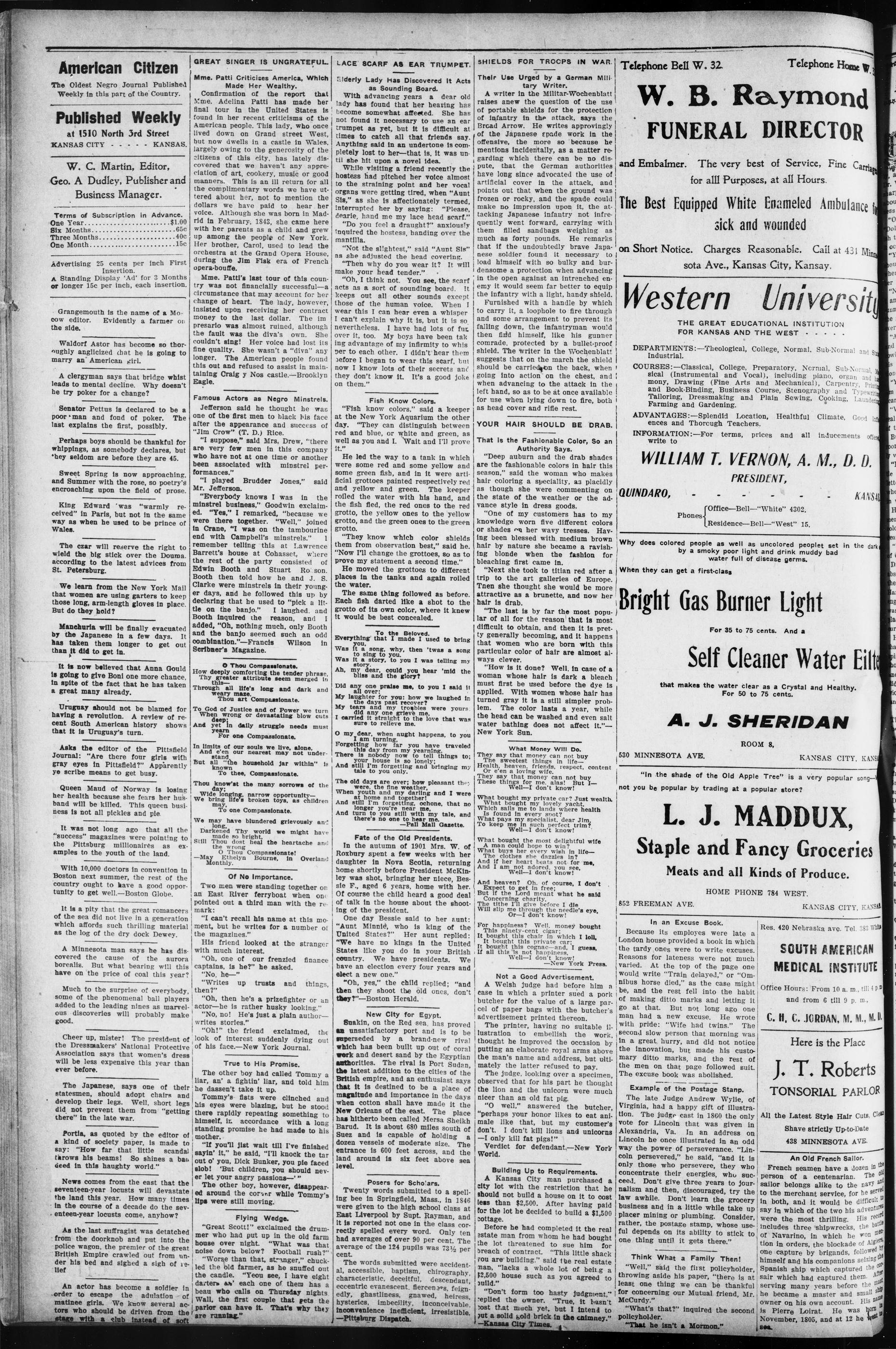
The Oldest Negro Journal Published Weekly in this part of the Country.
Published Weekly
at 1510 North 3rd Street
KANSAS CITY . . . . . KANSAS.
W. C. Martin, Editor,
Geo. A Dudley, Publisher and
Business Manager.
Terms of Subscription in Advance.
One Year. $1.00
Six Months. 65c
Three Months. 40c
One Month. 15c
Advertising 25 cents per inch First Insertion.
A Standing Display 'Ad' for 3 Months or longer 15c per inch, each insertion.
Grangemouth is the name of a Moscow editor. Evidently a farmer on the side.
Waldorf Astor has become so thoroughly anglicized that he is going to marry an American girl.
A clergyman says that bridge whistle leads to mental decline. Why doesn't he try poker for a change?
Senator Pettus is declared to be a poor man and fond of poker. The last explains the first, possibly.
Perhaps boys should be thankful for whippings, as somebody declares, but they seldom are before they are 45.
Sweet Spring is now approaching, and Summer with the rose, so poetry's encroaching upon the field of prose.
King Edward 'was "warmly received" in Paris, but not in the same way as when he used to be prince of Wales.
The czar will reserve the right to wield the big stick over the Douma, according to the latest advices from St. Petersburg.
We learn from the New York Mail that women are using garters to keep those long, arm-length gloves in place. But do they hold?
Manchuria will be finally evacuated by the Japanese in a few days. It has taken them longer to get out than it did to get in.
It is now believed that Anna Gould is going to give Boni one more chance, in spite of the fact that he has taken a great many already.
Uruguay should not be blamed for having a revolution. A review of recent South American history shows that it is Uruguay's turn.
Asks the editor of the Pittsfield Journal: "Are there four girls with gray eyes in Pittsfield?" Apparently ye scribe means to get busy.
Queen Maud of Norway is losing her health because she fears her husband will be killed. This queen business is not all pickles and pie.
It was not long ago that all the "success" magazines were pointing to the Pittsburg millionaires as examples to the youth of the land.
With 10,000 doctors in convention in Boston next summer, the rest of the country ought to have a good opportunity to get well.—Boston Globe.
It is a pity that the great romancers of the sea did not live in a generation which affords such thrilling material as the log of the dry dock Dewey.
A Minnesota man says he has discovered the cause of the aurora borealis. But what bearing will this have on the price of coal this year?
Much to the surprise of everybody, some of the phenomenal ball players added to the leading nines as marvelous discoveries will probably make good.
Cheer up, mister! The president of the Dressmakers' National Protective Association says that women's dress will be less expensive this year than ever before.
The Japanese, says one of their statesmen, should adopt chairs and develop their legs. Well, short legs did not prevent them from "getting there" in the late war.
Portla, as quoted by the editor of a kind of society paper, is made to say: "How far that little scandal farws his beams! So shines a bad deed in this haughty world."
News comes from the east that the seventeen-year locusts will devastate the land this year. How many times in the course of a decade do the seventeen-year locusts come, anyhow?
As the last suffragist was detatched from the doorknob and put into the police wagon, the premier of the great British Empire crawled out from under his bed and sighed a sigh of relief
An actor has become a soldier in order to escape the adulation of matinee girls. We know several actors who should be driven from the stage with a club instead of soft
GREAT SINGER IS UNGRATEFUL.
Mme. Patti Criticizes America, Which
Made Her Wealthy.
Confirmation of the report that Mme. Adelina Patti has made her final tour in the United States is found in her recent criticisms of the American people. This lady, who once lived down on Grand street West, but now dwells in a castle in Wales, largely owing to the generosity of the citizens of this city, has lately discovered that we haven't any appreciation of art, cookery, music or good manners. This is an ill return for all the complimentary words we have uttered about her, not to mention the dollars we have paid to hear her voice. Although she was born in Madrid in February, 1843, she came here with her parents as a child and grew up among the people of New York. Her brother, Carol, used to lead the orchestra at the Grand Opera House, during the Jim Fisk era of French opera-bouffe.
Mme. Patti's last tour of this country was not financially successful—a circumstance that may account for her change of heart. The lady, however, insisted upon receiving her contract money to the last dollar. The im presarlo was almost ruined, although the fault was the diva's own. She couldn't sing! Her voice had lost its fine quality. She wasn't a "diva" any longer. The American people found this out and refused to assist in maintaining Craig y Nos castle.—Brooklyn Eagle.
Famous Actors as Negro Minstrels.
Jefferson said he thought he was one of the first men to black his face after the appearance and success of "Jim Crow" (T. D.) Rice.
"I suppose," said Mrs. Drew, "there are very few men in this company who have not at one time or another been associated with minstrel performances."
"I played Brudder Jones," said Mr. Jefferson.
"Everybody knows I was in the minstrel business." Goodwin exclaimed. "Yes," I remarked, "because we were there together. "Well," joined in Crane, "I was on the tambourine end with Campbell's minstrels." I remember telling this at Lawrence Barrett's house at Cohasset, where the rest of the party consisted of Edwin Booth and Stuart Rolson. Booth then told how he and J. S. Clarke were minstrels in their younger days, and he followed this up by declaring that he used to "pick a little on the banjo." I laughed. and Booth inquired the reason, and I added, "Oh, nothing much, only Booth and the banjo seemed such an odd combination."—Francis Wilson in Scribner's Magazine.
O Thou Compassionate.
How deeply comforting the tender phrase,
Thy greater attribute seem merged in this-
Through all life's long and dark and weary maze,
Thou art Compassionate.
To God of Justice and of Power we turn
When wrong or devastating blow cuts deep;
And yet in daily struggle needs must yearn
For one Compassionate.
In limits of our souls we live, alone,
And e'en our nearest may not understand
But all "the household jar within" is known
To thee, Compassionate.
Thou know'st the many sorrows of the day;
Wide longing, narrow opportunity—
We bring life's broken toys, as children may,
To one Compassionate.
We may have blundered grievously and long,
Darkened Thy world we might have made so bright,
Still Thou dost heal the heartache and the wrong
O Thou Compassionate!
—May Ethidyn Bourne, in Overland Monthly.
Of No Importance.
Two men were standing together on an East River ferryboat when one pointed out a third man with the remark:
"I can't recall his name at this moment, but he writes for a number of the magazines."
His friend looked at the stranger with much interest.
"Oh, one of our frenzied finance captains, is he?" he asked.
"No, he—"
"Writes up trusts and things, then?"
"Oh, then he's a prizefighter or an actor—he is rather husky looking."
"No, no! He's just a plain author—writes stories."
"Oh!" the friend exclaimed, the look of interest suddenly dying out of his face—New York Journal.
True to His Promise
The other boy had called Tommy a liar, an' a fightin' liar, and told him he dassen't take it up.
Tommy's fists were clinched and his eyes were blazing, but he stood there rapidly repeating something to himself, in accordance with a long standing promise he had made to his mother.
"If you'll jist wait till I've finished sayin' it," he said, "I'll knock the tar out o' you, Dick Bunker, you ple faced slob! 'But children, you should never let your angry passions—'"
The other boy, however, disappeared around the corner while Tommy's lips were still moving.
Flying Wedge.
"Great Scott!" exclaimed the drummer who had put up in the old farm house over night. "What was that noise down below? Football rush?" "Worse than that, stranger," chuckled the old farmer, as he snuffed out the candle. "Yeou see, I have eight darters on' each one of them has a beau who calls on Thursday nights. Wall, the first couple that gets the parlor can have it. That's why they are running."
LACE SCARF AS EAR TRUMPET.
Elderly Lady Has Discovered It Acts as Sounding Board.
With advancing years a dear old lady has found that her hearing has become somewhat affected. She has not found it necessary to use an ear trumpet as yet, but it is difficult at times to catch all that friends say. Anything said in an undertone is completely lost to her—that is, it was until she hit upon a novel idea.
While visiting a friend recently the hostess had pitched her voice almost to the straining point and her vocal organs were getting tired, when "Aunt Sls," as she is affectionately termed, interrupted her by saying: "Please, dearie, hand me my lace head scarf."
"Do you feel a draught?" anxiously inquired the hostess, handing over the mantilla.
"Not the slightest," said "Aunt Sis" as she adjusted the head covering. "Then why do you wear it? It will make your head tender." "Oh, I think not. You see, the scarf acts as a sort of sounding board. It keeps out all other sounds except those of the human voice. When I wear this I can hear even a whisper I can't explain why it is, but it is so nevertheless. I have had lots of fur over it, too. My boys have been taking advantage of my infirmity to whisper per to each other. I didn't hear them before I began to wear this scarf, but now I know lots of their secrets and they don't know it. It's a good joke on them."
Fish Know Colors.
"Fish know colors," said a keeper at the New York Aquarium the other day. "They can distinguish between red and blue, or white and green, as well as you and I. Wait and I'll prove it."
He led the way to a tank in which were some red and some yellow and some green fish, and in it were artificial grottoes painted respectively red and yellow and green. The keeper rolled the water with his hand, and the fish fled, the red ones to the red grotto, the yellow ones to the yellow grotto, and the green ones to the green grotto.
"They know which color shields them from observation best," said he. "Now I'll change the grottoes, so as to prove my statement a second time."
He moved the grottoes to different places in the tanks and again rolled the water.
The same thing followed as before. Each fish darted like a shot to the grotto of its own color, where it knew it would be best concealed.
To the Beloved.
Everything that I made I used to bring you.
Was it a song, why, then 'twas a song to sing to you.
Was it a story, to you I was telling my story.
Ah, my dear, could you hear 'mid the bliss and the glory?
Did any one praise me, to you I said it all over?
My laughter for you: how we laughed in the days past recover?
My tears and my troubles were yours, did any one grieve me.
I carried it straight to the love that was sure to relieve me.
O my dear, when aught happens, to you I am turning.
Forgetting how far you have traveled that no longer from my yearning.
There is nobody else things to; your house is so lonely;
And still I'm forgetting and bringing my tale to you only.
The old days are over; how pleasant they were, the fine weather.
When youth and my darling and I were at home and together!
And still I'm forgetting, ochone, that no longer I have me.
And turn to you still with my tale, and there's no one to hear me.
—Pall Mall Gazette.
Fate of the Old Presidents
In the autumn of 1901 Mrs. W. of Roxbury spent a few weeks with her daughter in Nova Scotia, returning home shortly before President McKinley was shot, bringing her niece, Bessie F., aged 6 years, home with her. Of course the child heard a good deal of talk in the house about the shooting of the president.
One day Bessie said to her aunt: "Aunt Minnelle, who is king of the United States?" Her aunt replied: "We have no kings in the United States like you do in your British country. We have presidents. We have an election every four years and elect a new one."
"Oh, yes," the child replied; "and then they shoot the old ones, don't they?"—Boston Herald.
New City for Egypt.
Suakin, on the Red sea, has proved an unsatisfactory port and is to be superseded by a brand-new rival which has been built up out of coral work and desert sand by the Egyptian authorities. The rival is Port Sudan, the latest addition to the cities of the British empire, and an enthusiast says that it is destined to be a place of magnitude and importance in the days when cotton shall have made it the New Orleans of the east. The place has hitherto been called Mersa Sheikh Barud. It is about 680 miles south of Suez and is capable of holding a dozen vessels of moderate size. The entrance is 600 feet across, and the land around is six feet above sea level.
Posers for Scholars.
Twenty words submitted to a spelling bee in Springfield, Mass., in 1846 were given to the high school class at East Liverpool by Supt. Rayman, and it is reported not one in the class correctly spelled every word. Only ten had averages of over 90 per cent. The average of the 124 pupils was $73\frac{1}{2}$ per cent.
The words submitted were accidental, accessible, baptism, chirography, characteristic, deceitful, descendant, eccentric evanescent, fiercen$^{3,4}$s, feignedly, ghastliness, gnawed, heless, hysteries, imbecility, inconceivable, inconvenience inefficient, irresistible.
—Pittsburg Dispatch.
SHIELDS FOR TROCPS IN WAR
Their Use Urged by a German Milli-
tary Writer.
A writer in the Militar-Woenchlatt raises anew the question of the use of portable shields for the protection of infantry in the attack, says the Brcad Arrow. He writes approvingly of the Japanese spade work in the offensive, the more so because he mentions incidentally, as a matter regarding which there can be no dispute, that the German authorities have long since advocated the use of artificial cover in the attack, and points out that when the ground was frozen or rocky, and the spade could make no impression upon it, the attacking Japanese infantry not infrequently went forward, carrying with them filled sandbags weighing as much as forty pounds. He remarks that if the undoubtedly brave Japanese soldier found it necessary to load himself with so bulky and burdensome a protection when advancing in the open against an intrenched enemy it would seem far better to equip the infantry with a light, handy shield.
Furnished with a handle by which to carry it, a loophole to fire through and some arrangement to prevent its falling down, the infantryman would then find himself, like his gunner comrade, protected by a bullet-proof shield. The writer in the Wochenblatt suggests that on the march the shield should be carried on the back, when going into action on the chest, and when advancing to the attack in the left hand, so as to be at once available for use when lying down to fire, both as head cover and rifle rest.
YOUR HAIR SHOULD BE DRAB.
That is the Fashionable Color, So an Authority Says.
"Deep auburn and the drab shades are the fashionable colors in hair this season," said the woman who makes hair coloring a speciality, as placidly as though she were commenting on the state of the weather or the advance style in dress goods.
"One of my customers has to my knowledge worn five different colors or shades on her wavy tresses. Having been blessed with medium brown hair by nature she became a ravishing blonde when the fashion for bleaching first came in.
"Next she took to titian red after a trip to the art galleries of Europe. Tnen she thought she would be more attractive as a brunette, and now her hair is drab.
"The last is by far the most popular of all for the reason that is most difficult to obtain, and then it is pretty generally becoming, and it happens that women who are born with this particular color of hair are almost always clever.
"How is it done? Well, in case of a woman whose hair is dark a bleach must first be used before the dye is applied. With women whose hair has turned gray it is a still simpler problem. The color lasts a year, while the head can be washed and even salt water bathing does not affect it."—New York Sun.
What Money Will Do.
They say that money can not buy
The sweetest things in life—
Health, heaven, friends, respect, content or e'en a loving wife.
They say that money can not buy
These things for me alas! But I—
Well—I don't know!
What bought my private car? Just wealth
What bought my lovely yacht,
What calls me to lands where health
Is found. What calls me to your specialist, dear Jim,
To keep me in such perfect trim?
Well—I don't know!
What bought the most delightful wife
A man could hope to win?
What buys her every wish in life—
That she wishes dazzles in?
And if he not be for me,
And if he not adored, you see,
Well—I don't know!
And heaven? Oh, of course, I don't
Expect to get in free;
But if the Lord meant what he said
Concerning charity.
That he not be for me I die
Will slip me through the needle's eye,
Or—I don't know!
For happiness? Well, money bought
This ninety-cent cigar;
It bought this chair in which I loll,
It bought this private car;
It bought this cognac—and, I guess,
If all this is not happiness,
Well, I don't know!
Not a Good Advertisement
A Welsh judge had before him a case in which a printer sued a pork butcher for the value of a large parcel of paper bags with the butcher's advertisement printed thereon. The printer, having no suitable illustration to embellish the work, thought he improved the occasion by putting an elaborate royal arms above the man's name and address, but ultimately the latter refused to pay. The judge, looking over a specimen, observed that for his part he thought the lion and the unicorn were much nicer than an old fat pig. "O well," answered the butcher, "perhaps your honor likes to eat animal like that, but my customer's don't. I don't kill lions and unicorns—I only kill fat pigs!" Verdict for defendant.—New York World.
Building Up to Requireme
Bringing Up to Requirements.
A Kansas City man purchased a city lot with the restriction that he should not build a house on it to cost less than $2,500. After having paid for the lot he decided to build a $1,500 cottage.
Before he had completed it the real estate man from whom he had bought the lot threatened to sue him for breach of contract. "This little shack you are building." said the real estate man, "lacks a whole lot of being a $2,500 house such as you agreed to build."
"Don't form too hasty judgment," replied the owner. "True, it hasn't cost that much yet, but I intend to put a solid gold brick in the chimney."
-Kansas City Times
Telephone Bell W. 32
W. B. R
FUNERAL
and Embalmer. The very best
for all Purpos
The Best Equipped White
sick and
on Short Notice. Charges R
sota Ave., Kansas
Western
B. Raymon
GENERAL DIRECTOR
er. The very best of Service, Fine
for all Purposes, at all Hours.
Equipped White Enameled Ambu
sick and wounded
tice. Charges Reasonable. Call at
sota Ave., Kansas City, Kansay.
tern Univer
W. B. Raymond FUNERAL DIRECTOR
and Embalmer. The very best of Service, Fine Carriage for alll Purposes, at all Hours.
The Best Equipped White Enameled Ambulance for sick and wounded on Short Notice. Charges Reasonable. Call at 431 Minnesota sota Ave., Kansas City, Kansay.
Western Universit
THE GREAT EDUCATIONAL INSTITUTION
FOR KANSAS AND THE WEST
DEPARTMENTS:—Theological, College, Normal. Sub-Norm
Industrial.
COURSES:—Classical, College, Preparatory, Normal, Su-
sical (Instrumental and Vocal), including piano, on-
mony, Drawing (Fine Arts and Mechanical), Carpe-
and Book-Binding, Business Course, Stenography and
Tailoring, Dressmaking and Plain Sewing, Cooking,
Farming and Gardening.
ADVANTAGES:—Splendid Location, Healthful Climate,
ences and Thorough Teachers.
INFORMATION:—For terms, prices and all inducem-
write to
WILLIAM T. VERNON, A. M.,
PRESIDENT,
QUINDARO,
MENTS:—Theological, College, Normal. Sub-Norm.
al.
—Classical, College, Preparatory, Normal, Sub-
instrumental and Vocal), including piano, on
Drawing (Fine Arts and Mechanical), Carpe-
ok-Binding, Business Course, Stenography and
ing, Dressmaking and Plain Sewing, Cooking
g and Gardening.
IES:—Splendid Location, Healthful Climate,
and Thorough Teachers.
ION:—For terms, prices and all induceme
O
IAM T. VERNON, A. M., I
PRESIDENT,
DEPARTMENTS:—Theological, College, Normal, Sub-Normal and State Industrial.
COURSES:—Classical, College, Preparatory, Normal, Sub-Normal, Musical (Instrumental and Vocal), including piano, organ and harmony, Drawing (Fine Arts and Mechanical), Carpentry, Printing and Book-Binding, Business Course, Stenography and Typewriting, Tailoring, Dressmaking and Plain Sewing, Cooking, Laundering, Farming and Gardening.
ADVANTAGES:—Splendid Location, Healthful Climate, Good influences and Thorough Teachers.
INFORMATION:—For terms, prices and all inducements offered write to
QUINDARO, KANSAS
Phones {Office—Bell—"White" 4302.
Residence—Bell—"West" 15.
Why does colored people as well as uncolored people set in the dark
by a smoky poor light and drink muddy bad
water full of disease germs.
When they can get a first-class
Bright Gas Burner Light
Gas Burner Light
Bright Gas Burner Light
For 35 to 75 cents. And a
Self Clean
that makes the water clean
For 50 to
A. J. SH
ROC
Self Cleaner Water
makes the water clear as a Crystal and Health
For 50 to 75 cents.
A. J. SHERIDAN
ROOM 8,
TA AVE.
KANSAS CITY
shade of the Old Apple Tree" is a very popular
by trading at a popular store?
J. J. MADDUX
梨 and Fancy Grocer
Meats and all Kinds of Produce
that makes the water clear as a Crystal and Healthy. For 50 to 75 cents,
"In the shade of the Old Apple not you be popular by trading at a p
L. J. M
Staple and Fa
Meats and all K
"In the shade of the Old Apple Tree" is a very popular song—not you be popular by trading at a popular store?
L. J. MADDUX, Staple and Fancy Groceries Meats and all Kinds of Produce.
HOME PHONE 784 WEST
In an Excuse Book.
Because its employees were late a London house provided a book in which the tardy ones were to write excuses. Reasons for lateness were not much varied. At the top of the page one would write "Train delayed," or "Omnibus horse died," as the case might be, and the rest fell into the habit of making ditto marks and letting it go at that. But not long ago one man had a new excuse. He wrote with pride: "Wife had twins." The second slow person that morning was in a great hurry, and did not notice the innovation, but made his customary ditto marks, and the rest of the men on that page followed suit. The excuse book was abolished.
Example of the Postage Stamp
The late Judge Andrew Wylie, of Virginia, had a happy gift of illustration. The judge cast in 1860 the only vote for Lincoln that was given in Alexandria, Va. In an address on Lincoln he once illustrated in an odd way the power of perseverance. "Lincoln persevered," he said, "and it is only those who persevere, they who concentrate their energies, who succeed. Don't give three years to journalism and then, discouraged, try the law awhile. Don't learn the grocery business and in a little while take up placer mining or plumbing. Consider, rather, the postage stamp, whose useful depends on its ability to stick to one thing until it gets there."
Think What a Family Then!
"Well," said the first policyholder, throwing aside his paper, "there is at least one thing we can be thankful for concerning our Mutual friend, Mr. McCurdy."
"What's that?" inquired the second policyholder.
"That he isn't a Mormon."
530 MINNESOTA AVE.
852 FREEMAN AVE
Telephone Home
Raymond DIRECTOR
st of Service, Fine Carriage
es, at all Hours.
Enameled Ambulance for
wounded
reasonable. Call at 431 Minn
as City, Kansay.
University
College, Normal, Sub-Normal and Su-
preparatory, Normal, Sub-Normal, Ma-
nal), including piano, organ and la-
nd Mechanical), Carpentry, Printi-
Course, Stenography and Typewriting,
Plain Sewing, Cooking, Launderin-
ton, Healthful Climate, Good Infai-
ces and all inducements offered
NON, A. M., D. D.
PRESENT,
KANSAS
uncolored people set in the dark and drink muddy bad disease germs.
aner Water Eilte
as a Crystal and Healthy.
75 cents.
ERIDAN
M 8,
KANSAS CITY, KANS
Tree" is a very popular song-popular store?
ADDUX,
ency Groceries
inds of Produce.
KANSAS CITY, KANSAS
Res. 420 Nebraska ave. Tel. 383 White
SOUTH AMERICAN MEDICAL INSTITUTE
Office Hours: From 10 a. m., till 4 p.m.
and from 6 till 9 p. m.
C. H. C. JORDAN, M. M., M. D.
Here is the Place
J. T. Roberts
TONSORIAL PARLOR
All the Latest Style Hair Cuts, Clear
Shave strictly Up-to-Date
438 MINNESOTA AVE.
An Old French Sailor.
French seamen have a dozen in the person of a centenarian. The old sailor belongs alike to the navy and to the merchant service, for he served in both, and it would be difficult to say in which of the two his adventures were the most thrilling. His record includes three shipwrecks, the battle of Navarino, in which he won mention in orders, the blockade of Algiers, one capture by brigands, followed by himself and his companions seizing the Spanish ship which captured the convair which had captured them. After serving many years before the most he became a master and small ship owner on his own account. His name is Pierre Loirat. He was born in November, 1805, and at 12 he went to
ROOM 8.
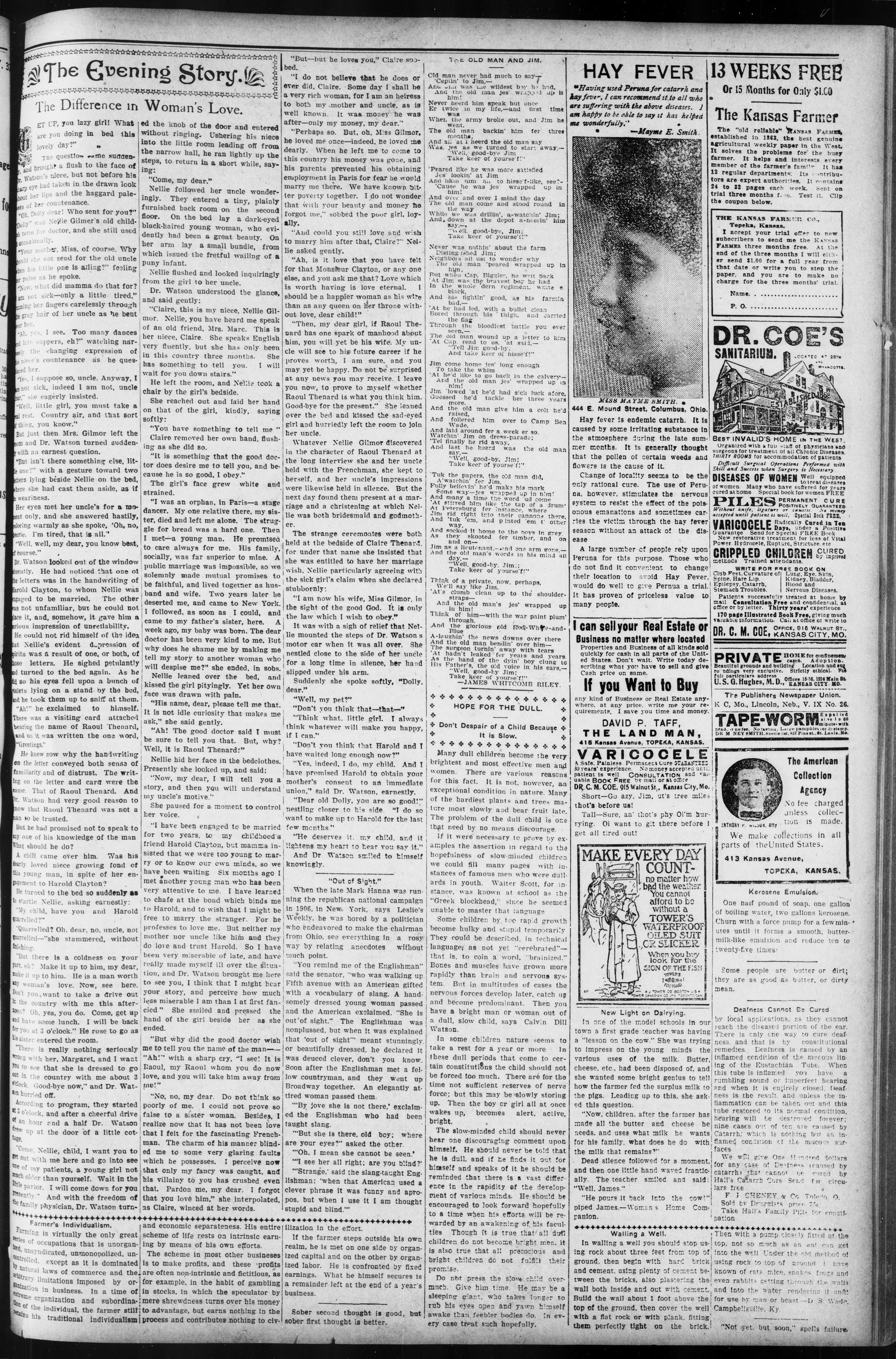
The Evening Story.
ET UP, you lazy girl! What are you doing in bed this lovely day?"
The question came suddenly, and brought a flush to the face of Dr. Watson's niece, but not before his ear eye had taken in the drawn look about her lips and the haggard paleess of her countenance.
"Oh, Dolly dear! Who sent for you?" Dolly" was Nellie Gilmer's old child's term for doctor, and she still used occasionally.
"Your mother, Miss, of course. Why should she not send for the old uncle when his little pne is ailing?" feeling up as he spoke.
"Now, what did mamma do that for? I am not sick—only a little tired," running her fingers carelessly through the gray hair of her uncle as he bent over her.
"Ah, yes, I see. Too many dances and late suppers, eh?" watching narrowly the changing expression of his niece's countenance as he questioned her.
"Yes, I suppose so, uncle. Anyway, I am not sick, indeed I am not, uncle ears," she eagerly insisted.
"Well, little girl, you must take a real rest. Country air, and that sort of thing, you know."
But just then Mrs. Gilmor left the room and Dr. Watson turned suddenly with an earnest question.
"But isn't there something else, little one?" with a gesture toward two letters lying beside Nellie on the bed, where she had cast them aside, as if in weariness.
Her eyes met her uncle's for a moment only, and she answered hastily, coloring warmly as she spoke, "Oh, no, darie. I'm tired, that is all."
"Well, well, my dear, you know best, of course."
Dr. Watson looked out of the window instantly. He had noticed that one of the letters was in the handwriting of Harold Clayton, to whom Nellie was engaged to be married. The other was not unfamiliar, but he could not since it, and, somehow, it gave him a serious impression of unreliability.
He could not rid himself of the idea that Nellie's evident depression of spirits was a result of one, or both, of those letters. He sighed petulantly and turned to the bed again. As he did so his eyes fell upon a bunch of roses lying on a stand by the bed, and he took them up to sniff at them. "Ah!" he exclaimed to himself. There was a visiting card attached bearing the name of Raoul Thenard, and on it was written the one word, "Greetings."
He knew now why the handwriting on the letter conveyed both sense of familiarity and of distrust. The writing on the letter and card were the same. That of Raoul Thenard. And Dr. Watson had very good reason to now that Raoul Thenard was not a man to be trusted.
But he had promised not to speak to any one of his knowledge of the man What should he do? A chill came over him. Was his early loved niece growing fond of this young man, in spite of her engagement to Harold Clayton? He turned to the bed so suddenly to startle Nellie, asking earnestly: "My child, have you and Harold quarrelled?" "Quarrelled? Oh, dear, no, uncle, not quarrelled—"she stammered, without finishing.
"But there is a coldness on your part, eh? Make it up to him, my dear, make it up to him. He is a man worth any woman's love. Now, see here. Don't you want to take a drive out in the country with me this afternoon? Oh, yes, you do. Come, get up and have some lunch. I will be back for you at 3 o'clock." He rose to go as his sister entered the room.
"There is really nothing seriously wrong with her, Margaret, and I want you to see that she is dressed to go out in the country with me about 3 o'clock. Good-bye now," and Dr. Watson hurried off.
According to program, they started at 3 o'clock, and after a cheerful drive of an hour end a half Dr. Watson drew up at the door of a little cottage.
"Come, Nellie, child, I want you to get out with me here and go into see one of my patients, a young girl not much older than yourself. Wait in the Little parlor. I will come down for you presently." And with the freedom of the family physician, Dr. Watson turn-
Farmer's Individualism.
Farming is virtually the only great series of occupations that is unorganized, unsyndicated, unmonopolized, uncontrolled, except as it is dominated by natural laws of commerce and the arbitrary limitations imposed by organization in business. In a time of extreme organization and subordination of the individual, the farmer still retains his traditional individualism
ed the knob of the door and entered without ringing. Ushering his nice into the little room leading off from the narrow hall, he ran lightly up the steps, to return in a short while, saying:
"Come, my dear."
Nellie followed her uncle wonderingly. They entered a tiny, plainly furnished back room on the second floor. On the bed lay a dark-eyed black-haired young woman, who evidently had been a great beauty. On her arm lay a small bundle, from which issued the fretful wailing of a pungy infant.
Nellie flushed and looked inquiringly from the girl to her uncle.
Dr. Watson understood the glance, and said gently:
"Claire, this is my niece, Nellie Gilmor. Nellie, you have heard me speak of an old friend, Mrs. Marc. This is her niece, Claire. She speaks English very fluently, but she has only been in this country three months. She has something to tell you. I will wait for you down stairs."
He left the room, and Nellie took a chair by the girl's bedside.
She reached out and laid her hand on that of the girl, kindly, saying softly:
"You have something to tell me."
Claire removed her own hand, flushing as she did so.
"It is something that the good doctor does desire me to tell you, and because he is so good, I obey."
The girl's face grew white and strained.
"I was an orphan, in Paris—a stage dancer. My one relative there, my sister, died and left me alone. The struggle for bread was a hard one. Then I met—a young man. He promised to care always for me. His family, socially, was far superior to mine. A public marriage was impossible, so we solemnly made mutual promises to be faithful, and lived together as husband and wife. Two years later he deserted me, and came to New York. I followed, as soon as I could, and came to my father's sister, here. A week ago, my baby was born. The dear doctor has been very kind to me. But why does he shame me by making me tell my story to another woman who will desiise me?" she ended in sohe
Nellie leaned over the bed, and kissed the girl pityingly. Yet her own face was drawn with pain.
"His name, dear, please tell me that. It is not idle curiosity that makes me ask," she said gently.
"Ah! The good doctor said I must be sure to tell you that. But, why? Well, it is Raoul Thenard:"
Nellie hid her face in the bedclothes. Presently she looked up, and said:
She paused for a moment to control her voice.
"I have been engaged to be married for two years, to my childhood's friend Harold Clayton, but mamma insisted that we were too young to marry or to know our own minds, so we have been waiting. Six months ago I met another young man who has been very attentive to me. I have learned to chafe at the bond which binds me to Harold, and to wish that I might be free to marry the stranger. For he professes to love me. But neither my mother nor uncle like him and they do love and trust Harold. So I have been very miserable of late, and have really made myself ill over the situation, and Dr. Watson brought me here to see you, I think that I might hear your story, and perceive how much less miserable I am than I at first fancied." She smiled and pressed the hand of the girl beside her as she ended.
"But why did the good doctor wish me to tell you the name of the man—" "Ah!" with a sharp cry, "I see! It is Raoul, my Raoul whom you do now love, and you will take him away from me!" "No, no, my dear. Do not think so poorly of me. I could not prove so false to a sister woman. Besides, I realize now that it has not been love that I felt for the fascinating Frenchman. The charm of his manner blinded me to some very glaring faults which he possesses. I perceive now that only my fancy was caught, and his villainy to you has crushed even that. Pardon me, my dear. I forgot that you love him," she interpolated, as Claire, winced at her words.
and economic separateness. His entire scheme of life rests on intrinsic earning by means of his own efforts. The scheme in most other businesses is to make profits, and these profits are often non-intrinsic and fictitious, as for example, in the habit of gambling in stocks, in which the speculator by mere shrewdness turns over his money to advantage, but earns nothing in the process and contributes nothing to civ-
"But—but he loves you," Claire sobed.
"I do not believe that he does or ever did, Claire. Some day I shall be a very rich woman, for I am an heiress to both my mother and uncle, as is well known. It was money he was after—only my money, my dear."
"Perhaps so. But, oh, Miss Gilmor, he loved me once—indeed, he loved me dearly. When he left me to come to this country his money was gone, and his parents prevented his obtaining employment in Paris for fear he would marry me there. We have known bitter poverty together. I do not wonder that with your beauty and money he forgot me," sobbed the poor girl, loyally.
"And could you still love and wish to marry him after that, Claire?" Nellie asked gently.
"Ah, is it love that you have felt for that Monsieur Clayton, or any one else, and you ask me that? Love which is worth having is love eternal. I should be a happier woman as his wife than as any queen on her throne without love, dear child!"
"Then, my dear girl, if Raoul Thenard has one spark of manhood about him, you will yet be his wife. My uncle will see to his future career if he proves worth, I am sure, and you may yet be happy. Do not be surprised at any news you may receive. I leave you now, to prove to myself whether Raoul Thenard is what you think him. Good-bye for the present." She leaned over the bed and kissed the sad-eyed girl and hurriedly left the room to join her uncle.
Whatever Nellie Gilmor discovered in the character of Raoul Thenard at the long interview she and her uncle held with the Frenchman, she kept to herself, and her uncle's impressions were likewise held in silence. But the next day found them present at a marriage and a christening at which Nellie was both bridesmaid and godmother.
The strange ceremonies were both held at the bedside of Claire Thenard, for under that name she insisted that she was entitled to have her marriage wish. Nellie particularly agreeing with the sick girl's claim when she declared stubbornly:
"I am now his wife, Miss Gilmor, in the sight of the good God. It is only the law which I wish to obey."
It was with a sigh of relief that Nellie mounted the steps of Dr. Watson's motor car when it was all over. She nestled close to the side of her uncle for a long time in silence, her hand slipped under his arm.
Suddenly she spoke softly, "Dolly, dear."
"Well, my pet?"
"Don't you think that—that—"
"Think what, little girl. I always think whatever will make you happy, if I can."
"Don't you think that Harold and I have waited long enough now?"
"Yes, indeed, I do, my child. And I have promised Harold to obtain your mother's consent to an immediate union," said Dr. Watson, earnestly.
"Dear old Dolly, you are so good!" nestling closer to his side "I do so want to make up to Harold for the last few months." "He deserves it. my child, and it lightens my heart to hear you say it." And Dr Watson smiled to himself knowingly.
"Out of Sight."
When the late Mark Hanna was running the republican national campaign in 1906, in New York, says Leslie's Weekly, he was bored by a politician who endeavored to make the chairman from Ohio, see everything in a rosy way by relating anecdotes without much point.
"You remind me of the Englishman" said the senator, "who was walking up Fifth avenue with an American gifted with a vocabulary of slang. A handsomely dressed young woman passed and the American exclaimed. "She is out of sight." The Englishman was nonplussed, but when it was explained that 'out of sight' meant stunningly or beautifully dressed, he declared it was deuced clever, don't you know. Soon after the Englishman met a fellow countryman, and they went up Broadway together. An elegantly attired woman passed them.
"By jove she is not there," exclaimed the Englishman who had been taught slang.
"But she is there, old boy; where are your eyes?" asked the other.
On I mean she cannot be seen.
"I see her all right; are you blind?"
"Strange,' said the slang-taught Englishman: 'when that American used a clever phrase it was funny and apropos, but when I use it I am thought stupid and blind."
illization in the effort.
If the farmer steps outside his own realm, he is met on one side by organized capital and on the other by organized labor. He is confronted by fixed earnings. What he himself secures is a remainder left at the end of a year's business.
Sober second thought is good, but sober first thought is better.
THE OLD MAN AND JIM.
Old man never had much to say
"Cepitin" to Jim.
Arconia was the wildest boy he had.
And the old man jes' wrapped up in him!
Never heard him speak but once
Er twice in my life, and first time
was
When the army broke out, and Jim he went.
The old man backin' him for three months.
And a kid he deerd the old man say
Was. jes is we turned to star away.—
"Well, good-bye Jim
Take keer of yourself!""
"Pearsed like he was more satisfied
Jes lookin' at Jim
And liken num num to hissef-like, see?"
"Cause he was jes wrapped up in him!
While we was drillin', a-watchin', Jim;
And, down at the depot a-neerin' him
**say:**
"well, good-bye, Jim;
Take keer of yourse!"
Never was nothin' about the farm
Diping a seed in
Neighbors all ust to wonder why
The old man 'peared wrapped up in
him.
But, when Cap, Biggler, he writt back
'At Jim was the bravest boy he had
In the whole dern regiment, white e
black.
And his lightin' good, as his farmin'
bad.—
'At he had led, with a bullet clean
Bored through his thigh, and carried
the flame
Through the bloodiest battle you ever
seen.—
The old man wound up a letter to him
At Cap, read to us, 'at sui,—
the old man wound up a letter to him
And take keer of hissef!"
Jim come home jes' long enough
I take the whim
'At he like to go back in the calvery
And the old man jes' wrapped up in him!
Jim, 'towed 'at he'd had sich luck afore,
GuesSED he'd tackle he three years
more.
And the old man give him a colt he'd
raised,
And follored him over to Camp Ben
Wade.
And litley saved from
"Wen, good-by, Jim! Take keer of yoursef!"
'Tuk the papers, the old man did, A'watchin' fer Jim.
Fully believin' he'd makes his mark Some way—jes wrapped up in him! And many a time the word ud come 'tirreir him like the tap of a drum! At待reir instance, where Jim rid right into their cannons there, and 'tuk 'em, and printed em 't other way.
And socked it home to the boys in grey As they skooted fer timber, and on and on—
cute-nant —and one arm gone,
and the old man's words in his mind
day,
"Well, good-by, Jim;:
Take keer of yourself!"
Think of a private, now, perhaps,
We'll say like Jim,
'At's clump clean up to the shoulder-
straps—
And the old man's Jes' wrapped up in him!
Think of him—with the war paint plum" through.
And the glorious old Red-White-and-
Blue, the news downs over there
And the old man bendin' over there
The surgeon turnin' away, with tears
-JAMES WHITCOMB RILEY.
* Don't Despair of a Child Because *
* It is Slow. *
Many dull children become the very brightest and most effective men and women. There are various reasons for this fact. It is not, however, an exceptional condition in nature. Many of the hardiest plants and trees mature most slowly and bear fruit late. The problem of the dull child is one that need by no means discourage.
If it were necessary to prove by examples the assertion in regard to the hopefulness of slow-minded children we could fill many pages with instances of famous men who were dullards in youth. Walter Scott, for instance, was known at school as the "Greek blockhead," since he seemed unable to master that language.
Some children by too rapid growth become hulky and stupid temporarily. They could be described, in technical language, as not yet "cerebrated"—that is, to coin a word, "brainized." Bones and muscles have grown more rapidly than brain and nervous system. But in multitudes of cases the nervous forces develop later, catch up and become predominant. Then you have a bright man or woman out of a dull, slow child, says Calvin Dill Watson.
In some children nature seems to take a rest for a year or more. In these dull periods that come to certain constitutions the child should not be forced too much. There are for the time not sufficient reserves of nerve force; but this may be slowly storing up. Then the boy or girl all at once wakes up, becomes alert, active, bright.
The slow-minded child should never hear one discouraging comment upon himself. He should never be told that he is dull, and if he finds it out for himself and speaks of it he should be reminded that there is a vast difference in the rapidity of the development of various minds. He should be encouraged to look forward hopefully to a time when his efforts will be rewarded by an awakening of his faculties. Though it is true that/ all dull children do not become bright men, it is also true that all precocious and bright children do not fulfill their promise.
Do not press the slow child over much. Give him time. He may be a sleeping giant, who takes longer to rub his eyes open and yawn himself awake than feebler bodies do. In every case treat such hopefully.
HAY FEVER
*Having used Peruna for catarrh and hay fever. I can recommend it to all who are suffering with the above diseases. I am happy to be able to say it has helped me wonderfully.*
Mayme E. Smith.
444 E. Mound Street, Columbus, Ohio
Hay fever is endemic catarrh. It is caused by some irritating substance in the atmosphere during the late summer months. It is generally thought that the pollen of certain weeds and flowers is the cause of it. Change of locality seems to be the only rational cure. The use of Peruna, however, stimulates the nervous system to resist the effect of the poisonous emanations and sometimes carries the victim through the hay fever season without an attack of the disease.
A large number of people rely upon Peruna for this purpose. Those who do not find it convenient to change their location to avoid Hay Fever, would do well to give Pernua a trial. It has proven of priceless value to many people.
I can sell your Real Estate or
Business no matter where located
Properties and Business of all kinds sold
quickly for cash in all parts of the Un-
ited States. Don't wait. Write today
describing what you have to sell and give
Cash price on same.
If you Want to Buy
any kind of Business or Real Estate anywhere, at any price. write me your requirements, I save you time and money.
DAVID P. TAFF.
THE LAND MAN,
415 Kansas Avenue, TOPEKA, KANSAS
VARICOCELE
A Safe, Painless Permanent Care SURROUNDED
30 years' experience. Non money accepted until patient is well. CONSULTATION and van
able BOOK FREE by mail or at office
503-826-0111 Mo.
DR. C. M. COE. 915 Walnut St., Kansas City, Mo.
Short—Go azy, Jim, ut's tree miles
that's before us!
Tall—Sure, an' thats phy Oi'm hurrying.
Oi want to git there before I
get all tired out!
MAKE EVERY DAY
COUNT-
no matter how
bad the weather
You cannot
afford to be
without a
TOWER'S
WATERPROOF
OILED SUIT
CR SLICKER
When you buy
look for the
SIGN OF THE FISH
TOWER'S
ADVERTISING
ADVERTISING IS A
TOWER CANADA CO., LTD.
In one of the model schools in our town a first grade teacher was having a "lesson on the cow." She was trying to impress on the young minds the various uses of the milk. Butter, cheese, etc., had been disposed of, and she wanted some bright genius to tell how the farmer fed the surplus milk to the pigs. Leading up to this, she asked this question.
"Now, children, after the farmer has made all the butter and cheese he needs, and uses what milk he wants for his family, what does he do with the milk that remains?"
Dead silence followed for a moment, and then one little hand waved frantically. The teacher smiled and said: "Well, James."
"He pours it back into the cow!" piped James.—Woman's Home Companion.
**Wailing a Well.**
In walling a well you should stop using rock about three feet from top of ground, then begin with hard brick and cement, using plenty of cement between the bricks, also plastering the wall both inside and out with cement. Build the wall about 1 foot above the top of the ground, then cover the well with a flat rock or with plank, fitting them perfectly tight on the brick.
13 WEEKS FREE
Or 15 Months for Only $1.00
The Kansas Farmer
The "old reliable" RANSA FARMER,
established in 1862, the best genuine
agricultural weekly paper in the West.
It solves the problems for the busy
farmer. It helps and interests every
member of the farmer's family. It has
12 regular departments. Its contributors are expert authorities. It contains
24 to 32 pages each week. Sent on
triple three months free. Test it. Clip
the coupon below.
THE KANSAS FARMER CO.
Topeka, Kansas.
I accept your trial offer to new subscribers to send me the KANSAS FARMER three months free. At the end of the three months I will either send $1.00 for a full year from that date or write you to step the paper, and you are to make no charge for the three months' trial.
P. O. .....
DR. COE'S SANITARIUM.
BEST INVALID'S HOME IN THE WEST
Organized with a full staff of physicians and surgeons for treatment of all diseases.
THIRTY ROOMS for accommodation of patients.
Difficult Surgical Operations Performed with Skill and Success when Surgery is Necessary
DISEASES OF WOMEN well equipped to treat diseases of women. Many who have suffered for years cured at home. Special book for women FREE
PILES PERMANENT CURE POSITively Guaranteed Without knife, signature. New edition accepted until patient is well. Special Book FREE
VARIGOCELE Radically Cured in Ten Guarantee Send for Special FREE Book New appropriate treatment for loss of Vital Power Hardware
CRIPPLED CHILDREN CURED
mothers. Trained Nurses by impaired
WRITE FOR FREE BOOK ON
Club Feet. Curvature of Lung, Eye, Skin
Spine, Hare Lip, Kidney, Bladder,
Epilepsy, Catarrh, Blood and
Somnol Troubles.
Patients successfully treated at home by
mail Consultation Free and confidential, at
office or by letter. Thirty years' experience
170 page illustrated Book Free, giving much
vuable information. Call at office or write to
DR. C. M. COE, KANSAS CITY, MO.
PRIVATE HOME for confinement
cases. Adoption.
Beautiful grounds and building. Location and
roddings very exclusive. Strictly ethical. For
full participation address. Office 15.16.1214 Main D.
U.S. G. Hughes, M.D., KANSAS CITY, MO.
The Publishers Newspaper Union.
K C, Mo., Lincoln, Neb., V. IX No. 26.
TAPE-WORM Expelled in 60
months with no proof. No testing. Laceration pamphlets with
DR M NEYMH. Boarding. 812 First Street, Louis Mo.
[Name]
The American Collection Agency
No fee charged unless collection is made. ANTHONY P. WILSON, ALLY We make collections in all parts of the United States.
Kerosene Emulsion
One half pound of soap, one gallon of boiling water, two gallons kerosene. Churn with a force pump for a few minutes until it forms a smooth, butter-milk-like emulsion and reduce ten to twenty-five times:
Some people are butter or dirt; they are as good as butter, or dirty mean.
Deafness Cannot Be Cured
by local applications, as they cannot reach the diseased portion of the ear. There is only one way to cure deafness, and that is by constitutional remedies. Deafness is caused by an inflamed condition of the mucous lining of the Eustachian Tube. When this tube is inflamed you have a rumbling sound or imperfect hearing and when it is engleily closed. Deafness is the result, and unless the inflammation can be taken out and this tube restored to its normal condition, hearing will be destroyed forever; nine cases out of ten are caused by Catarrh, which is nothing but an inflamed condition of the mucous surfaces.
We will give One Hundred dollars for any case of Deafness (caused by catarrh) that cannot be cured by Hall's Catarrh Cure Send for circulars free
F J CHENEY & Co. Toile to O.
Sold by Druggists, press O.
Take Hall's Family Pills for constipation
Then with a pump closely fitted at the top, not so much as an ant can get into the well Under the old method of using rock to top of ground I have known of rats mice, snakes frogs and even rabbits getting through the walls and into the water rendering it unfit for use by man or beast—D S Wade Campbellsville, Ky.
"Not yet, but soon," spells failure.
Speaker Jos. G. Cannon has been stumping the state of Maine. His audiences have been large.
The increase in drinking among Chicago women is causing alarm. Cocktails and wine are the preferred drinks.
The entire route of the line of the San Francisco, Idaho & Montana railroad, which is to shorten the distance between Boise, Idaho, and San Francisco by 625 miles, is already cross sectioned and construction out of Caldwell, Idaho, will begin within twenty days. The company is now looking after bridges and structural steel.
The Dowager Empress of China has appointed a committee to consider the reports of the Chinese commissioners who recently returned from abroad, and to make recommendations to the throne concerning the question of the organization of an upper house of parliament from among the Chinese officials, as the beginning of a parliamentary government.
The government receipts for the month of August, 1906 were $56,007, 596, and the expenditures $47,848,449 leaving a surplus for the month of $8,155,147. For the month of August, 1905, there was a deficit of $4,660,061. The receipts for August, 1906, were: Customs, $29,012,059; increase over August, 1905, nearly 3 millions; internal revenue, $21,855,189; increase, $3,990,000. The expenditures for the month show a decrease as compared with August 1905, of $4,302,044. The principal decrease was $2,758,000 in the navy expenditures.
It is remarkable that amid all the crime, bloodshed and horror with which Russia is filled, the music halls and cafes of the capital are thronged nightly by gay crowds. A brother of Premier Stolypin, writing in the Novoe Vremya, calls attention to the weakness of his countrymen, who in the presence of the greatest crisis, he says think only of pleasure. M. Stolypin says it was always thus in Russia that officers on the eve of a battle carouse and spend money that would feed starving peasants' families. He calls it the spirit which inspired the orgies of the middle ages while thousands were dying of the plague.
The feeling against the Jews in official circles at St. Petersburg has been greatly intensified by the terrorist outbreaks of the last two weeks. The Jews, it is believed by government agents, are furnishing the brains of the revolutionary movement. Official reports of assassinations and lawlessness never omit to mention very promptly the part played by the Jews. The last week saw the launching of two parties, the National in St. Petersburg and the Russian Popular party in Moscow. The principal planks in both platforms are for the exclusion of Jews from all political activity and from service in the army, the latter to be commuted, as in the case of the Tartars and Finns, for money considerations. The Moscow organization purposes to rid he country of Jews by indorsing the Zionist movement and urging the government to assist it.
Up to twenty years ago John E. McCann was the confidential clerk of the late Russell Sage. Mr. McCann had a love for poetry and he quit the service of the multi-millionaire to pursue his tastes. Mr. McCann says that after he left Mr. Sage in 1890, he only saw him three times. The last time, Mr. Sage complained that Mr. McCann had left him alone, and he was indignant when he: former clerk explained that because of Mr. Sage's great wealth the visits would have been misconstrued. These men were friends, of great ability and having mutual respect and personal liking. But they were separated because one of them possessed $80,000,600 and the other did not and it was the poor man who considered these millions a bar to friendship. How often is this the case in the more retired walks of life. Oftener than will ever be told. Self-denial is a hand maid of self-respect, and to the property poor but sensitive, high-minded man it is preferable to the associations and glamour of wealth, which only yield discontent and humiliation. Service and sacrifice have again found reward in a well sustained manhood and an approving conscience.
Emmet Turpin, the only prisoner in the log jail at Nashville, Brown county, Ind., since last fall is serving a sentence of 250 days for selling liquor illegally. He carries the key to the jail and acts in the triple capacity of jailer, janitor and prisoner. When he wants anything, he unlocks the door, goes out and gets it and returning, again locks himself in. He is threatening to sue the county for services as janitor.
It is Priscilla's first visit to the country; she has heard the cackling of the hens, and connected it with the laying of the eggs; she hears the cow moo, and calls to her mother. "Mamma, come quickly," the cow has laid some more milk." -Harper's Weekly.
Sir Thomas Lipton will sail for the United States September 21.
Bryan and Folk have been engaged for two addresses each in Kansas.
Mrs. William Astor, of New York, is ill at her apartments in the Hotel Somerset, Boston.
☆
The American Pharmaceutical Association will work for compulsory special education and national examination for druggists.
☆
The Realty Trust company which did a small banking business at Memphis, Tenn., has failed. Assets $60,000, liabilities, $50,000.
A group of French bankers has offered the Chilean government a loan of $2,000,000 for reconstruction purposes exclusively. The Chilean congress is considering the proposition.
☆
The.controller of the currency has issued a call for a statement of the condition of national banks at the close of business Tuesday, September 4.
☆
The interstate legislative committee of the Southern Cotton Association, in session at Hot Springs, Ark., is making an effort to fix a minimum price at which cotton should be sold.
☆
Ex-Governor David R. Francis, of Missouri, has reached Vienna for the purpose of presenting to Emperor Francis Joseph the gold medal commemorative of the St. Louis exposition.
☆
The strained relations between Spain and the Vatican are occupying the attention of the entire Spanish press and public, the liberal papers demanding the immediate denunciation of the concordat.
☆
The seventh annual convention of the National Association of Postoffice Clerks, at Indianapolis, adjourned to meet next year in Peoria, Ill. Frank T. Rogers, of Chicago, being elected president.
The attorney general of Kansas has been investigating the International Harvesting company, and as its organization is obnoxious to the Kansas anti-Trust laws, he proposes to drive it from the state.
☆
The comptroller of the currency has approved the application of E. T. Guymon, K. E. Santney, A. E. Asher, E. N Sapp and L. A. Bunker to organize the Commercial National bank of Hutchinson, Kansas, with $10,000 capital.
☆
It is reported that the Pennsylvania Railroad company had concluded a deal by which it expects to turn over to the United States Steel Corporation its control of the Cambria Steel Company, but all efforts to confirm the report were unsuccessful.
☆
Paul O. Stensland, the absconding president of the Milwaukee Avenue Bank, Chicago, has been arrested at Tangler, Morocco. His crookedness involves a million dollars, and the distress caused by his acts has affected thousands of workingmen and their families.
☆
The agitation for Missouri river freight steamers grows apace. The steamer Gunther has just brought 100 tons from Omaha to Kansas City, and had no trouble from the river. The merchants of Kansas City are determined to break the railroad freight charges with a line of river steamers.
A stage driver named B. Gillespie, who took President Roosevelt and party through Yosemite three years ago, was held up by a lone bandit three miles from Ahwanee, Cal., and the passengers relieved of their valuables. One of the victims took a snap shot of the robber.
☆
"The largest death roll since the month of the Iroquois theater fire," summarises the report of Coroner Hoffman for the month of August. There were 390 deaths in Cook county as against 338 for July and 356 for April, the next largest month. The increase in the death rate is attributed to the excessive heat. There were twenty-seven deaths by heat as against one for the month of July. Sulcides also increased with the hot weather. There were thirty-nine during August.
Needless Precaution
Reporter—Perhaps you will not object to telling me where you got the money to buy up all those fine apartment houses you own."
Former Officeholder (under suspicion)—I would rather not commit myself as to that.
Reporter—That will not be necessary in any event. The judge and jury will commit you, all right."
Bear Admiral Prince Louis of Battenberg, commander of the British second schooner squadron, now at Gibraltar, is preparing to entertain on his flagship) the armoured cruiser Drake, Real Admiral Brownson and the officers of the United States second cruiser squadron, bound for the F.1 East.
A terrorist organization among the troops, aiming at the extermination of all the authorities has been discovered at Odessa, Russia. Extensive correspondence with other revolutionary bodies was seized, and fourteen officers and one army surgeon were arrested on the charge of having conducted secret meetings of soldiers.
☆
Fletcher D. Proctor, son of United States Senator Redfield Proctor, was elected governor of Vermont, Sept. 4. by a large majority. The Republican organization claimed that his plurality over Periclval W. Clement, of Rutland, the Independent-Democratic candidate, would exceed 15,000. The normal Republican plurality in Vermont is about 21,000.
☆
A new banking institution, which will be entitled the American bank, to be organized in Berlin under the auspices of the Darmstadter bank with a capital of $6,250,000, will introduce American securities and co-operate in large financial transactions in the United States, Canada and Mexico, the first operation to be the reorganization of the Mexican Central railroad.
☆
Incomplete returns indicate that Representative John S. Little, Democratic nominee for governor of Arkansas, will have a majority of 50,000 over John I. Worthington, Republican. The vote for John G. Adams, Prohibition nominee for governor, may not exceed 3,000 and that of Daniel Hogan, Socialist, probably will reach 2,000. Estimates are that of the 135 members of the senate and house at least 125 will be Democrats. The Democratic state nominees other than for governor had no opposition.
☆
At the National Irrigation congress held at Boise, Idaho, some startling statistics were presented by Professor Samuel Fortier, of the University of California, in his discussion of the "Value of a High Duty of Water and the Means of Obtaining It." He made the assertion that in the Western states $50,000,000 was expended annually in securing and distributing water for irrigation and that of the water thus distributed, fully 75 per cent was wasted casuing a net loss to the people of the Western states of more than $35,000,000.
☆
Miss Nan Bryant, a pretty girl of Graniteville, S. C., is dying at a hospital at Augusta, Ga., in consequence of having been kissed with undue force by her lover, Theodore Brown. A week ago Miss Bryant and Bryown went walking, and when she returned her cheek was bleeding. She said that she had scratched a pimple. Blood poison developed and she was taken to Atlanta for treatment The girl confessed that the wound was inflicted by her lover while he was kissing her. "Theodore kissed me," said the girl, "and once playfully bit my cheek. He bit harder than he intended and caused the wound."
☆
The local health department of San Francisco has completed its report of the deaths from the earthquake of April 18 and the total is 452. Of the victims 266 were killed by the falling walls, 177 perished by fire, seven were shot and two died as the result of ptomaine poisoning, due to eating "emergency" canned goods of poor quality; 351 were men and seventy-seven women. Four hundred and twenty are believed to have been white, eighteen Chinese and four Japanese. Eleven were less than a year old. The figures given relate to the deaths proved to have occurred.
☆
A large body of workmen assembled at Rudoguzewka, near St. Petersburg, to attend the funeral of a comrade when some one unfurled a red flag which was placed at the head of the procession. Orders for its removal issued by the commander of the troops in the town were ignored and troops were sent to seize the flag. The workmen crowded about for the purpose of defending it when the Cossacks were ordered to charge with drawn sabers. In a moment they were in the midst of the throng slashing right and left. Six persons were killed and from twenty to twenty-five wounded.
That Terrible Youngster
"Tommy," said his elder sister, severely, "you had no business to come into the parlor when Mr. Lovett was calling on me."
"That's all right, sis," answered Tommy, "I could see that you were only playing telephone. He was ringing you up—O, you needn't hide your left hand behind you—but he had his lips entirely too close to the receiver."
CUBAN REVOLUTIONIST
APPOINTMENT
TO
OFFICE
TREASURY
APPOINTMENT
AS
GENERAL IN
THE ARMY
ALWAYS PEACE THEN!
To prevent any more revolutions in Cuba let the Cuban government follow out the above suggestion.
To prevent any more revolutions in Cuba let the Cuban government follow out the above suggestion.
Pensions for everybody at the age of bly, his only opponent, by a majority 60 years was among the proposals that may run as high as 20,000. Davidopted at a session of the Trades Union congress in Liverpool, the advocates of the resolution contending that the money necessary for the pensions could easily be raised from among the wealthy by taxing land values. Davidson won the nomination in spite of the fact that United States
The Galveston-Dallas News, in its third cotton crop report for the current season, shows that the crop has deteriorated and is further threatened by rains, intermittent showers and fogs and the depredations of insect pests. Nevertheless, the condition in Texas on August 24 was 8.1 per cent better than on the same day last year, Indian Territory 4.5 per cent better; Oklahoma 12 per cent better. The crop averages about two weeks late in point of maturity. Labor is scarce for all industries.
Secretary Wilson assured the representatives of the meat packing interests of the country with whom he held a conference at Washington that he had no authority to extend beyond the first of October, next, the placing of labels on canned or other meat products. He told the packers flatly that they must be prepared on that date properly to label their goods, or they would not be permitted to send them through the channels of interstate commerce. The question was raised as to the status of the goods now on themselves of the wholesale and retail-m merchants of the country. The secretary said it was manifestly impossible for the government to inspect them. The owners or holders of the foods he suggested, would have to take their chances on selling them. One thing was certain: They could not be shipped from one state to another.
Governor James O. Davidson has been nominated to head the Wisconsin republican state ticket, having defeated Speaker Irwin L. Lenroot, of the last assem-
A COLLEGE FAVORITE
HOW TO PLAY POOT BALL
POPULAR AT THE YOUNG LAWYER SCHOOL
CONQUEST OF MAN
POPULAR WITH THE YOUNG MAN
1000 WAYS TO PLAY TRUMP
HOW TO HAZE
VERY POPULAR
POPULAR WITH JOHNIE CRAM
POPULAR HERE
DICTIONARY OF CHELSEA LAWYER
HIGH SCHOOL FAVORITE
HOW TO MAKE FUDGE
POPULAR WITH THE TEACHERS
SCHOOL PAY ROLL
Books that will be popular with the pupils during the new term of school.
On the waters of Long Island sound within view of Sagamore hill, on September 3d, the president of the United States reviewed the greatest fleet of American warships ever assembled. There was a war ship for every state, forty-five in all, ranging in size from the magnificent 16,000-ton Louisiana, just completed, to the fleet torpedo boats and the submarines. There were also one troopship and colliers. In three columns there stretched along the sound twelve battle ships, four armoured cruisers, four protected cruisers, four monitors, six destroyers, six torpedo boats, three submarines, a troopship and five auxiliaries. In peace paint of spotless white, wreathed in rainbows of flags, ship rails manned "close aboard," the splendid fleet underwent the ceremony of inspection by the President of the United States
☆
★
☆
bly, his only opponent, by a majority that may run as high as 20,000. Davidson carries with him his running mate, W. D. Conner, of Marshfield, for lieutenant governor, who defeats John S. Strang, of Oshkosh, for second place. Davidson won the nomination in spite of the fact that United States Senator La Follette canvassed the state for Lenroot, making speeches for his candidate in nearly every portion of the state. Davidson and several of his adherents also made an active canvass.
"Neither side can whip the other," is the concise statement now heard everywhere in Havana, and it may also be fairly construed to be the growing conviction of thoughtful persons throughout the island of Cuba. In Havana, at least, this conviction has led, among unprejudiced persons, to expressions of an ardent hope that the prerogative of the Platt amendment will soon be utilized by the United States for the purpose of effectually putting an end to a condition that everybody believes is otherwise bound to grow more and more intolerable. Nobody appears to believe that the insurgents will take Havana, although this is not regarded as impossible, especially when it is considered that cooperation in such a movement assuredly would come from within. Everybody concedes that the government troops can continue their record of victories in almost all open fights with the insurgents, but how the government, with the forces now at its command, and in view of the small number of enlistments, ever can prevail against its enemies who fight in the same old method of guerrilla warfare, is a conundrum which nobody pretends to solve. That the insurrection is growing constantly is undeniably evidenced every day and the decree of pardon recently extended by the government has brought no appreciable change in the situation.
☆
Battfing. Neison deliberately fouled Joe Gans in the forty-second round on the best and longest fight seen at Goldfield, Nevada in many years. Both men were tired when the first ended, but Gans was apparently the stronger. He was away ahead on points and had smashed and cut Nelson all through the fight without being badly hurt himself. Shortly after the forty-second round commenced the men were in their usual clinch. Nelson had his head on Gans' shoulder and his arm down. Several times he hit Gans below the belt, apparently feeling a vital spot. At last he drew him his right arm and hit Gans a victorious blow square in the groin. The colour boy sank to his knees and rolled over on his back. Referee Siler without hesitation ordered Nelson to his corner and awarded the fight to Gans a foul. Siler's decision received almost unanimous approval. The foul was obvious that not even men who had bet on Nelson could say that it had not been committed. All through the long contest Nelson had employed rough tactics. He repeatedly butted Gans and had to have his head hauled away by the referee.
THE NEW RATE LAW.
The Inter-State Commerce Commission Besieged with Petitions
Shippers of the country are taking advantage of the new railroad freight rate law to seek relief from the inter-state commerce commission for which they regard as unreasonable or unjust conditions imposed upon them by the railroad companies. Petitions are being received by the commission from shippers, involving not only questions that are raised directly by the recent enacted law, but including some questions into which an endeavor being made to breathe a new life.
A series of petitions was filed with the commission, presenting a question which has been, at various times, fore the commission for many years and on which the commission has is deed at least four decisions.
The Texas Cattle Raisers' Association of Texas entered a complaint against the Missouri, Kansas & Texas railway and many other railway corporations because of a charge of $1 car on live stock made by the Texas railway at Chicago. The complaint maintains that the charge is excess and unreasonable and that it ought be included in the through rate on loads of live stock from Texas to cage.
Intervening in this petition as plaintiffs are the American Nation Live Stock Association and the Corp. Belt Meat Association.
The interstate commerce commission decided several years ago the charge of $2 a car, as a trans or terminal rate in Chicago, wascessive. It fixed $1 a car as the per ar tariff. The case was taken to supreme court of the United S and the order of the commission for $1 a car as the rate of terminal charge in Chicago was overthrown on a ground of lack of authority. Now, under the new law, the com plainants again appear before the interstate commerce commission and that the case be reopened and that the commission decide in the light of the new act.
Dovetailing into this case is another complaint filed with the commission. It is that of the American Live Stock Association and the Cattle Raisers Association of Texas, against the Texas & Pacific Railway company and particularly all of the other railroad lines west of the Mississippi river. It is urged by the complainants that the defendant company refuses to make a joint through rate on live stock in carload lots, shipped from points Texas to the market centers such as Chicago, St. Louis, Omaha and Kansas City.
In 1904 the defendant company canceled its joint rates on live stock and now will accept such traffic only on the understanding that the stock is to be transhipped at junction points in the Texas & Pacific Railroad Company with other lines. This, it is urged by the complainants, is unjust and unreasonable and subjects them to great inconvenience and damage. They are therefore that the commission compel the railroads defendant in the action to quote to them a joint rate on live stock as formerly.
The Old Soldier's Logic
"The Old Soldier's Logue
"Such reasoning," said Gen. P. Grant, in a military argument, "minds me of the reasoning of old Corp Sandhurst. Corp. Sandhurst was on day drilling a batch or raw recruit. 'Why is it,' he said to a bright looking chap, 'that the blade of your saber is curved instead of straight?"
"The blade is curved,' the recruiter answered, 'in order to give more force to the blow.'
"Nonsense," said the corporal. "The blade is curved so as to fit the seel hard. If it was straight, how would you get it into the curved scabhard you idiot."