The Broad Ax
Saturday, July 13, 1901
Chicago, Illinois
Page text (machine-generated)
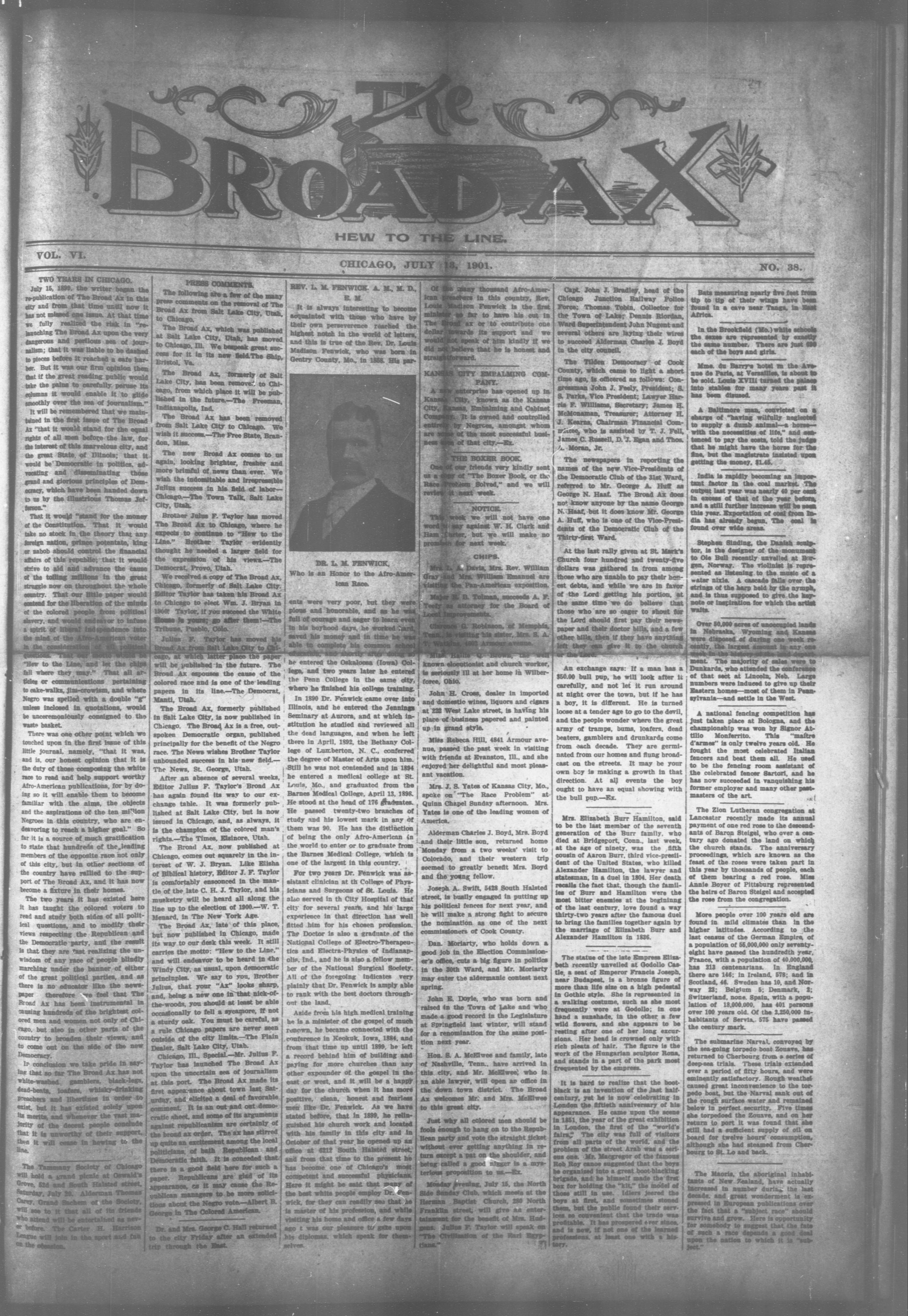
TWO YEARS IN CHICAGO.
July 15, 1899, the writer began the re-publication of The Broad Ax in this city and from that time until now it has not missed one issue. At that time we fully realized the risk in "re-launching The Broad Ax upon the very dangerous and perilous sea of journalism; that it was liable to be dashed to pieces before it reached a safe harbor. But it was our firm opinion then that if the great reading public would take the pain to carefully peruse its columns it would enable it to glide smoothly over the sea of journalism."
It will be remembered that we maintained in the first issue of The Broad Ax "that it would stand for the equal rights of all men before the law, for the interest of this marvelous city, and the great State, of Illinois; that it would be Democratic in politics, advocating and disseminating those grand and glorious principles of Democracy, which have been handed down to us by the illustrious Thomas Jefferson."
That it would "stand for the money of the Constitution. That it would take no stock in the theory that any foreign nation, prince potentate, king or nabob should control the financial affairs of this republic; that it would strive to aid and advance the cause of the tolling millions in the great struggle now on throughout the whole country. That our little paper would contend for the liberation of the minds of the colored people from political slavery, and would endeavor to infuse a spirit of liberal independence into the mind of the Afro-American voter in the consideration of all political
"Hew to the Line, and let the chips fall where they may." That all articles or communications pertaining to cake-walks, jizn-crowlism, and where Negro was spelled with a double "g" unless inclosed in quotations, would be unceremoniously consigned to the waste basket.
There was one other point which we touched upon in the first issue of this little journal, namely, "that it was, and is, our honest opinion that it is the duty of those composing the white race to read and help support worthy Afro-American publications, for by doing so it will enable them to become familiar with the aims, the objects and the aspirations of the ten million Negroes in this country, who are endeavoring to reach a higher goal." So far it is a source of much gratification to state that hundreds of the leading members of the opposite race not only of this city, but in other sections of the country have rallied to the support of The Broad Ax, and it has now become a fixture in their homes.
The two years it has existed here it has taught the colored voters to read and study both sides of all political questions, and to modify their views respecting the Republican and the Democratic party, and the result is that they are fast realizing the unwisdom of any race of people blindly marching under the banner of either of the great political parties, and as there is no educator like the newspaper therefore we feel that The Broad Ax has been instrumental in causing hundreds of the brightest colored men and women not only of Chicago, but also in other parts of the country to broaden their views, and to come out on the side of the new Democracy.
In conclusion we take pride in saying that so far The Broad Ax has not white-washed, gamblers, black-legs, dead-beats, loafers, whisky-drinking preachers and libertines in order to exist, but it has existed solely upon its merits, and whenever the vast majority of the decent people conclude that it is unworthy of their support, then it will cease in hewing to the line.
The Tammany Society of Chicago will hold a grand picnic at Oswald's Grove, 52d and South Halsted street, Saturday, July 29. Alderman Thomas Carey, Grand Sachem of the Society, will see to it that all of its friends who attend will be entertained as never before. The Carter H. Harrison League will join in the sport and fun on the occasion.
PRESS COMMENTS. The following are a few of the many press comments on the removal of The Broad Ax from Salt Lake City, Utah, to Chicago.
The Broad Ax, which was published at Salt Lake City, Utah, has moved to Chicago, Ill. We bespeak great success for it in its new field.The Ship, Bristol, Va.
The Broad Ax, formerly of Salt Lake City, has been removed to Chicago, from which place it will be published in the future.—The Freeman, Indianapolis, Ind.
The Broad Ax has been removed from Salt Lake City to Chicago. We wish it success.—The Free State, Brandon, Miss.
The new Broad Ax comes to us again, looking brighter, fresher and more brimful of news than ever. We wish the indomitable and irrepressible Julius success in his field of labor—Chicago.—The Town Talk, Salt Lake City, Utah.
Brother Julius F. Taylor has moved The Broad Ax to Chicago, where he expects to continue to "Hew to the Line." Brother Taylor evidently thought he needed a larger field for the expression of his views.—The Democrat, Provo, Utah.
We received a copy of The Broad Ax, Chicago, formerly of Salt Lake City. Editor Taylor has taken his Broad Ax to Chicago to elect Wm. J. Bryan in 1860. Taylor, if you succeed the White House is yours; go after them!—The Tribune, Pueblo, Colo.
cago, at which latter place the paper will be published in the future. The Broad Ax espouses the cause of the colored race and is one of the leading papers in its line.—The Democrat, Manti, Utah.
The Broad Ax, formerly published in Salt Lake City, is now published in Chicago. The Broad Ax is a free, outspoken Democratic organ, published principally for the benefit of the Negro race. The News wishes Brother Taylor unbounded success in his new field.—The News, St. George, Utah.
After an absence of several weeks, Editor Julius F. Taylor's Broad Ax has again found its way to our exchange table. It was formerly published at Salt Lake City, but is now issued in Chicago, and, as always, it is the champion of the colored man's rights.—The Times, Elsinore, Utah.
The Broad Ax, now published at Chicago, comes out squarely in the interest of W. J. Bryan. Like Elisha of Biblical history, Editor J. F. Taylor is comfortably ensoonced in the mantle of the late C. H. J. Taylor, and his musketry will be heard all along the line up to the election of 1900.—W. T. Menard, in The New York Age.
The Broad Ax, late of this place, but now published in Chicago, made its way to our desk this week. It still carries the motto: "Hew to the Line," and will endeavor to be heard in the Windy City, as usual, upon democratic principles. We say to you, Brother Julius, that your "Ax" looks sharp, and, being a new one in that nick-of-the-woods, you should at least be able occasionally to fell a sycamore, if not a sturdy oak. You must be careful, as a rule Chicago papers are never seen outside of the city limits.—The Plain Dealer, Salt Lake City, Utah.
Chicago, Ill., Special.—Mr. Julius F. Taylor has launched The Broad Ax upon the uncertain sea of journalism at this port. The Broad Ax made its first appearance about town last Saturday, and elicited a deal of favorable comment. It is an out and out democratic sheet, and some of its arguments against republicanism are certainly of the broad ax order. The ax has stirred up quite an excitement among the local politicians, of bath Republican and Democratic faith. It is conceded that there is a good field here for such a paper. Republicans are glad of its appearance, as it may cause the Republican managers to be more solicitous about the Negro vote.—Albert B. George in The Colored American.
Dr. and Mrs. George C. Hall returned to the city Friday after an extended trip through the East.
REV. L. M. FENWICK. A. M., M. D. E. M. It is always interesting to become acquainted with those who have by their own perseverence reached the highest notch in the world of letters, and this is true of the Rev. Dr. Louis Madison Fenwick, who was born in Gentry County, Mo., in 1858. His par-
[Name]
he entered the Oskaloosa (Iowa) College, and two years later he entered the Penn College in the same city, where he finished his college training. In 1890 Dr. Fenwick came over into Illinois, and he entered the Jennings Seminary at Aurora, and at which institution he studied and reviewed all the dead languages, and when he left there in April, 1892, the Bethany College of Lumberton, N. C., conferred the degree of Master of Arts upon him. Still he was not contended and in 1894 he entered a medical college at St. Louis, Mo., and graduated from the Barnes Medical College, April 13, 1898. He stood at the head of 176 graduates. He passed twenty-two branches of study and his lowest mark in any of them was 90. He has the distinction of being the only Afro-American in the world to enter or to graduate from the Barnes Medical College, which is one of the largest in this country.
For two years Dr. Fenwick was assistant clinician at th College of Physicians and Surgeons of St. Louis. He also served in th City Hospital of that city for several years, and his large experience in that direction has well fitted him for his chosen profession. The Doctor is also a graduate of the National College of Electro-Therapeutics and Electra-Physics of Indianapolis, Ind., and he is also a fellow member of the National Surgical Society. All of the foregoing indicates very plainly that Dr. Fenwick is amply able to rank with the best doctors throughout the land.
Aside from his high medical training he is a minister of the gospel of much renown, he became connected with the conference in Keokuk, Iowa, 1884, and from that time up until 1899, he left a record behind him of building and paying for more churches than any other expounder of the gospel in the east or west, and it will be a happy day for the church when it has more positive, clean, honest and fearless men like Dr. Fenwick. As we have stated before, that in 1899, he relinquished his church work and located with his family in this city and in October of that year he opened up an office at 6212 South Halsted street, and from that time to the present he has become one of Chicago's most competent and successful physicians. Here it might be said that many of the best whites people employ Dr. Fenwick, for they can readily see that he is master of his profession, and while visiting his home and office a few days ago t was our pleasure to gake upon his diplomas, which speak for themselves.
Of the many thousand Afro-American preachers in this country, Rev. Louis Madison Fenwick is the first minister so far to have his cut in The Broad ax or to contribute one dollar towards its support and we would not speak of him kindly if we did not believe that he is honest and straightforward.
KANSAS CITY EMPALMING COMPANY.
A new enterprise has opened up in Kansas City, known as the Kansas City, Kansas, Embalming and Cabinet Company. It is owned and controlled entirely by Negrces, amongst whom are some of the most successful business men of that city.—Ex.
THE BOXER BOOK
One of our friends very kindly sent us a copy of "The Boxer Book, or the Race Problem Solved," and we will review it next week.
NOTICE.
This week we will not have one word to say against W. H. Clark and Ham Charter, but we will make no promise for next week.
CHIPS.
Mrs. L. A. Davis, Mrs. Rev. William Gray and Mrs. William Emanuel are visiting the Pan-American exposition.
Major H. B. Tolman, succeeds A. F. Teety as attorney for the Board of Local Improvements.
Clarence G. Robinson, of Memphis, Tenn., is visiting his sister, Mrs. S. A. T. Watkins, 4003 Armour avenue.
known elocutionist and church worker, is seriously ill at her home in Wilberforce, Ohio.
John H. Cross, dealer in imported and domestic wines, liquors and cigars at 222 West Lake street, is having his place of business papered and painted up in grand style.
Miss Rebeca Hill, 4841 Armour avenue, passed the past week in visiting with friends at Evanston, Ill., and she enjoyed her delightful and most pleasant vacation.
Mrs. J. S. Yates of Kansas City, Mo., spoke on "The Race Problem" at Quinn Chapel Sunday afternoon. Mrs. Yates is one of the leading women of America.
Alderman Charles J. Boyd, Mrs. Boyd and their little son, returned home Monday from a two weeks' visit to Colorado, and their western trip seemed to greatly benefit Mrs. Boyd and the young fellow.
Joseph A. Swift, 5428 South Halsted street, is busily engaged in putting up his political fences for next year, and he will make a strong fight to secure the nomination as one of the next commissioners of Cook County. Dan. Moriarty, who holds down a good job in the Election Commissioner's office, cuts a big figure in politics in the 30th Ward, and Mr. Moriarty may enter the aldermanic contest next spring.
John E. Doyle, who was born and raised in the Town of Lake and who made a good record in the Legislature at Springfield last winter, will stand for a renomination for the same position next year.
Hon. S. A. McElwee and family, late of Nashville, Tenn., have arrived in this city, and Mr. McElwee, who is an able lawyer, will open an office in the down town district. The Broad Ax welcomes Mr. and Mrs. McElwee to this great city.
Just why all colored men should be fools enough to hang on to the Republican party and vote the straight ticket without ever getting anything in return except a pat on the shoulder, and being called a good nigger is a mysterious proposition to us.—Ex.
Monday evening, July 15, the North Side Sunday Club, which meets at the Herman Baptist Church, 280 North Franklin street, will give an entertainment for the benefit of Mrs. Hudgens. Julius F. Taylor will speak on "The Civilization of the Karl Egyptians."
```markdown
```
Capt. John J. Bradley, head of the Chicago Junction Railway Police Force; Thomas Tobin, Collector for the Town of Lake; Dennis Riordan, Ward Superintendent John Nugent and several others are laying their wires to succeed Alderman Charles J. Boyd in the city council.
The Tilden Democracy of Cook County, which came to light a short time ago, is officered as follows: Congressman John J. Feely, President; S. S. Parks, Vice President; Lawyer Harris F. Williams, Secretary; James H. McMonaman, Treasurer; Attorney H. J. Kearns, Chairman Financial Committee, who is assisted by T. J. Fell, James C. Russell, D. J. Egan and Thos. L. Moran, Jr.
The newspapers in reporting the names of the new Vice-Presidents of the Democratic Club of the 31st Ward, referred to Mr. George A. Huff as George N. Haaf. The Broad Ax does not know anyone by the name George N. Haaf, but it does know Mr. George A. Huff, who is one of the Vice-Presidents of the Democratic Club of the Thirty-first Ward.
At the last rally given at St. Mark's Church four hundred and twenty-five dollars was gathered in from among those who are unable to pay their honest debts, and while we are in favor of the Lord getting his portion, at the same time we do believe that those who are so eager to shout for the Lord should first pay their newspaper and their doctor bills, and a few other bills, then if they have anything left they can give it to the church
An exchange says: If a man has a $50.00 bull pup, he will look after it carefully, and not let it run around at night over the town, but if he has a boy, it is different. He is turned loose at a tender age to go to the devil, and the people wonder where the great army of tramps, bums, loafers, dead beaters, gamblers and drunkards come from each decade. They are germinated from our homes and flung broadcast on the streets. It may be your own boy is making a growth in that direction. At all events the boy ought to have an equal showing with the bull pup.—Ex.
Mrs. Elizabeth Burr Hamilton, said to be the last member of the seventh generation of the Burr family, who died at Bridgeport, Conn., last week, at the age of ninety, was the fifth cousin of Aaron Burr, third vice-president of the United States, who killed Alexander Hamilton, the lawyer and statesman, in a duel in 1804. Her death recalls the fact that, though the families of Burr and Hamilton were the most bitter enemies at the beginning of the last century, love found a way thirty-two years after the famous duel to bring the families together again by the marriage of Elizabeth Burr and Alexander Hamilton in 1836.
The statue of the late Empress Elizabeth recently unveiled at Godollo Castle, a seat of Emperor Francis Joseph, near Budapest, is a bronze figure of more than life size on a high pedestal in Gothic style. She is represented in a walking costume, such as she most frequently wore at Godollo; in one hand a sunshade, in the other a few wild flowers, and she appears to be resting after one of her long excursions. Her head is crowned only with rich pleats of hair. The figure is the work of the Hungarian sculptor Rona, and stands in a part of the park most frequented by the empress.
It is hard to realize that the boot-black is an invention of the last half-century, yet he is now celebrating in London the fiftieth anniversary of his appearance. He came upon the scene in 1851, the year of the great exhibition in London, the first of the "world's fairs." The city was full of visitors from all parts of the world, and the problem of the street Arab was a serious one. Mr. Macgregor of the famous Rob Roy canoe suggested that the boys be organized into a great boot-blacking brigade, and he himself made the first box for holding the "kit," the model of those still in use. Idlers jeered the boys at first, and sometimes stoned them, but the public found their services so convenient that the trade was profitable. It has prospered ever since, and is now, if not one of the learned professions, at least one with a history.
Bats measuring nearly five feet from tip to tip of their wings have been found in a cave near Tanga, in East Africa.
In the Brookfield (Mo.) white schools the sexes are represented by exactly the same number. There are just 000 each of the boys and girls.
Mme. du Barry's hotel in the Avenue de Paris, at Versailles, is about to be sold. Louis XVIII turned the palace into stables for many years past it has been disused.
A Baltimore man, convicted on a charge of "having wilfully neglected to supply a dumb animal—a horse—with the necessities of life," and sentenced to pay the costs, told the judge that he might have the horse for the fine, but the magistrate insisted upon getting the money, $1.45.
India is rapidly becoming an important factor in the coal market. The output last year was nearly 40 per cent in excess of that of the year before, and a still further increase will be seen this year. Exportation of coal from India has already begun. The coal is found over wide areas.
Stephen Sinding, the Danish sculptor, is the designer of the monument to Ole Bull recently unveiled at Bergen, Norway. The violinist is represented as listening to the music of a water nixie. A cascade falls over the strings of the harp held by the nymph, and is thus supposed to give the keynote or inspiration for which the artist waits.
Over 50,000 acres of unoccupied lands in Nebraska, Wyoming and Kansas were disposed of during one week recently, the largest amount in any one week in the history of the land department. The majority of sales were to Dunkards, who attended the conference of that sect at Lincoln, Neb. Large numbers were induced to give up their Eastern homes—most of them in Pennsylvania—and settle in the West.
A national fencing competition has just taken place at Bologna, and the championship was won by Signor Attilio Monferrito. This "maitre d'armes" is only twelve years old. He fought the most celebrated Italian fencers and beat them all. He used to be the fencing room assistant of the celebrated fencer Sartori, and he has now succeeded in vanquishing his former employer and many other past-masters of the art.
The Zion Lutheran congregation at Lancaster recently made its annual payment of one red rose to the descendants of Baron Steigel, who over a century ago donated the land on which the church stands. The anniversary proceedings, which are known as the feast of the roses were taken part in this year by thousands of people, each of them bearing a red rose. Miss Annie Boyer of Pittsburg represented the heirs of Baron Steigel and accepted the rose from the congregation.
More people over 100 years old are found in mild climates than in the higher latitudes. According to the last census of the German Empire, of a population of 55,000,000 only seventy-eight have passed the hundredth year, France, with a population of 40,000,000, has 213 centenarians. In England there are 146; in Ireland, 578; and in Scotland, 46. Sweden has 10, and Norway 23; Belgium 5; Denmark, 2; Switzerland, none. Spain, with a population of 18,000,000, has 401 persons over 100 years old. Of the 2,250,000 inhabitants of Servia, 575 have passed the century mark.
The submarine Narval, conveyed by the sea-going torpedo boat Zouave, has returned to Cherbourg from a series of deep-sea trials. These trials extended over a period of fifty hours, and were eminently satisfactory. Rough weather caused great inconvenience to the torpedo boat, but the Narval sank out of the rough surface water and remained below in perfect security. Five times she torpeded the Zouave, and on her return to port it was found that she still had a sufficient supply of oil on board for twelve hours' consumption, although she had steamed from Cherbourg to St. Lo and back.
The Maoris, the aboriginal inhabitants of New Zealand, have actually increased in number during the last decade, and great wonderment is expressed in European publications over the fact that a "subject race" should survive and grow. Here is opportunity for somebody to suggest that the fate of such a race depends a good deal upon the nation to which it is "subject."
will prescalege and of all times uphold the two principles of Democracy, but Farmers, Soldiers, Protestants, Knights of Lobos, Indians, Mormons, Republicans, Priests, or any other can have their say, so long as their language is proper and responsibility is fixed.
The Broad AX is a newspaper whose platform is broad enough for all, ever claiming the editorial right to speak its own mind.
Local communication will have attention; the only on the side of the paper.
Bats measuring nearly five feet from tip to tip of their wings have been found in a cave near Tanga, in East Africa.
Mme. du Barry's hotel in the Avenue de Paris, at Versailles, is about to be sold. Louis XVIII turned the palace into stables for many years past It has been disused.
India is rapidly becoming an important factor in the coal market. The output last year was nearly 40 per cent in excess of that of the year before, and a still further increase will be seen this year. Exportation of coal from India has already begun. The coal is found over wide areas.
Over 50,000 acres of unoccupied lands in Nebraska, Wyoming and Kansas were disposed of during one week recently, the largest amount in any one week in the history of the land department. The majority of sales were to Dunkards, who attended the conference of that sect at Lincoln, Neb. Large numbers were induced to give up their Eastern homes—most of them in Pennsylvania—and settle in the West.
A national fencing competition has just taken place at Bologna, and the championship was won by Signor Attilio Monferrito. This "maitre d'armes" is only twelve years old. He fought the most celebrated Italian fencers and beat them all. He used to be the fencing room assistant of the celebrated fencer Sartori, and he has now succeeded in vanquishing his former employer and many other past-masters of the art.
The Zion Lutheran congregation at Lancaster recently made its annual payment of one red rose to the descendants of Baron Steigel, who over a century ago donated the land on which the church stands. The anniversary proceedings, which are known as the feast of the roses were taken part in this year by thousands of people, each of them bearing a red rose. Miss Annie Boyer of Pittsburg represented the heirs of Baron Steigel and accepted the rose from the congregation.
More people over 100 years old are found in mild climates than in the higher latitudes. According to the last census of the German Empire, of a population of 55,000,000 only seventeight have passed the hundredth year, France, with a population of 40,000,000, has 213 centenarians. In England there are 146; in Ireland, 578; and in Scotland, 46. Sweden has 10, and Norway 23; Belgium 5; Denmark, 2; Switzerland, none. Spain, with a population of 18,000,000, has 401 persons over 100 years old. Of the 2,250,000 inhabitants of Servia, 575 have passed the century mark.
The submarine Narval, convoyed by the sea-going torpedo boat Zouave, has returned to Cherbourg from a series of deep-sea trials. These trials extended over a period of fifty hours, and were eminently satisfactory. Rough weather caused great inconvenience to the torpedo boat, but the Narval sank out of the rough surface water and remained below in perfect security. Five times she torpedoed the Zouave, and on her return to port it was found that she still had a sufficient supply of oil on board for twelve hours' consumption, although she had steamed from Cherbourg to St. Lo and back.
The statue of the late Empress Elizabeth recently unveiled at Godollo Castle, a seat of Emperor Francis Joseph, near Budapest, is a bronze figure of more than life size on a high pedestal in Gothic style. She is represented in a walking costume, such as she most frequently wore at Godollo; in one hand a sunshade, in the other a few wild flowers, and she appears to be resting after one of her long excursions. Her head is crowned only with rich pleats of hair. The figure is the work of the Hungarian sculptor Rona, and stands in a part of the park most frequented by the empress.
It is hard to realize that the boot-black is an invention of the last half-century, yet he is now celebrating in London the fiftieth anniversary of his appearance. He came upon the scene in 1851, the year of the great exhibition in London, the first of the "world's fairs." The city was full of visitors from all parts of the world, and the problem of the street Arab was a serious one. Mr. Macgregor of the famous Rob Roy canoe suggested that the boys be organized into a great boot-blacking brigade, and he himself made the first box for holding the "kit," the model of those still in use. Idlers jeered the boys at first, and sometimes stoned them, but the public found their services so convenient that the trade was profitable. It has prospered ever since, and is now, if not one of the learned professors, at least one with a history.
Some Rocky Years Old Taken from No
Give Soil to City.
When Andrew Carnegie sailed for Europe he said he expected to return in the fall and to find waiting for him his magnificent new home on Fifth avenue in the block surrounded by Ninetieth and Ninety-first stroets. In the grounds surrounding the building there will be at that time a large grove of trees growing just as confidently and prosperously as if they had furnished the shade for the place for many a year. These trees have been brought from Westchester county and from the border of Connecticut. They have been selected with the greatest care, all with a view to harmonizing with a distinctive artistic design. They have been taken up, root and branch, and hauled in huge trucks from their native spots to adorn Mr. Carnegie's Fifth avenue park. In moving these trees care was taken not to injure the smallest of their twigs. There was no paring, no cutting anywhere. Mr. Carnegie is getting old, and he wanted these stately growths, now in all their native glory. They were to grow in Fifth avenue just as they had done in the woods and forests for 20, 30 and 40 years. Modern science and inventive genius have made it possible to transplant trees now without the loss of any of their vitality or any of their beauty. This is done by means of a complicated trucking system. Attached to the axle joining two heavy iron wheels is a long wooden pole, at right angles to the axle, and forming a sort of cross with it. The axle is covered in the middle by a sort of felt saddle. This apparatus is moved against the tree, the saddle against its side. Two large hooks, like fishhooks are then placed under the two main roots of the trees. These hooks are suspended by a cable stretching over the top of the pole attached to the axle. This cable is now pulled over the top of the pole by a machine, and the hooks pull the tree up without injuring it, bringing the small fibrous roots and the earth that surrounds them.
MINER IN PARLIAMENT.
Highest Ambition to Serve Interests of Fellow Workers.
Having spent 18 years under ground, wielding a miner's pick when he was 10 years old, the member of parliament for Morepeth, Thomas Burt, might be expected to know a little on mining matters and the wages of the black toilers. Burt's history affords a grand example of that ennobling principle of "self-help" which Smiles has advocated and Abraham Lincoln exploited. The son of Peter Burt, a miner, born at the beginning of the Victorian era in a tiny cottage adjoining the coal line which runs from Blackworth to the Northumberland docks, Thomas had to rush his village schooling and assimilate his wisdom with the aid of stray books and a digger's lamp. No astrologer could have foretold that this rough Northumbrian lad was destined to be an officer of state in the Victorian reign. The youngster went down into the pit, the mental companion of Shakespeare, Milton, Scott and John Stuart Mill. As young Burt grew up he was always on good terms of fellowship with associates without deeming it necessary to accompany them to the public house. He has always been an abstainer. He also became a Primitive Methodist and a man of peace. He had no ambition save to serve the interest of his fellow-miners. They have ever respected him, and given him a choice of official positions in their unions. Since 1874 he has enjoyed the by no means slight distinction of having sat in the house without losing those good qualities which caused him to be sent there by his companions in toil.
Motion of Solar System
Professor Newcomb, the astronomer, discussing the advance made in that science during the last century, says that mankind is only beginning to learn something of the truth, and that the greatest victory of the astronomers in the nineteenth century was the determination of the exact motion of the solar system, which is moving in space at the rate of 40,000 miles an hour, but no one can tell whence it came or whither it goeth. Another important improvement is the application of mechanical methods for recording astronomical phenomena. An astronomer of a few years ago was compelled to keep his eyes upon the stars and sketch inaccurately and imperfectly the objects that passed before his violor. The introduction of automatic photography gives him an exact record of every event among the heavenly bodies, although he may see nothing of it himself.—Chicago Record-Herald.
First Elecric Suburban Road
First Electric Suburban Road.
The first electric suburban railroad in Russia was opened for traffic this year. It connects the manufacturing city of Lodz, in Russian Poland, with the neighboring towns of Zgierz and Pabianice, and is thirteen and one-half miles in length. The Thompson-Houston motors used were furnished by the Russian Electricity union. The road is owned by a company of Polish merchants and manufacturers, and was built at a cost of $560,000. The charter provides that the government shall receive a share of the profits, and shall have the right to purchase after twenty years; and that the road and all equipment shall become the property of the government at the expiration of twenty-eight years.
No odds how high a bird or a fool may fly, they have got to come back to earth at the dictates of their stomachs.
Whose Tragle Death Is Recalled by the Finding in Ottawa of the Stone Dyed with His Blood When He Fell Under an Assassin's Bullet.
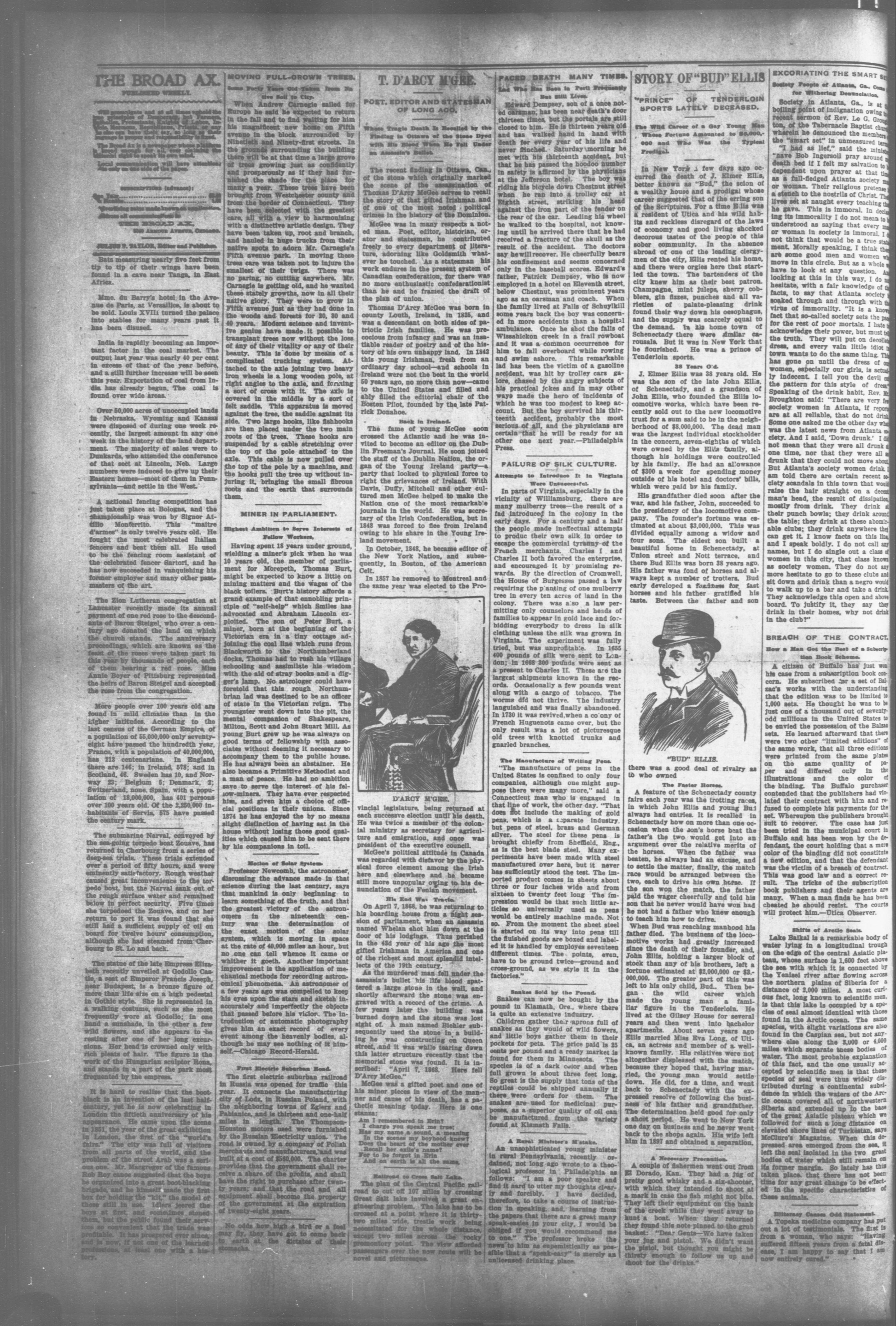
The recent finding in Ottawa, Can., of the stone which originally marked the scene of the assassination of Thomas D'Arcy McGee serves to recall the story of that gifted Irishman and of one of the most noted political crimes in the history of the Dominion.
McGee was in many respects a noted man. Poet, editor, historian, orator and statesman, he contributed freely to every department of literature, adorning like Goldsmith whatever he touched. As a statesman his work endures in the present system of Canadian confederation, for there was no more enthusiastic confederationist than he and he framed the draft of the plan of union.
Thomas D'Arcy McGee was born in county Louth, Ireland, in 1825, and was a descendant on both sides of patriotic Irish families. He was precocious from infancy and was an insatiable reader of poetry and of the history of his own unhappy land. In 1842 this young Irishman, fresh from an ordinary day school—and schools in Ireland were not the best in the world 50 years ago, no more than now—came to the United States and filled and ably filled the editorial chair of the Boston Pilot, founded by the late Patrick Donahoe.
Back in Ireland.
The fame of young McGee soon crossed the Atlantic and he was invited to become an editor on the Dublin Freeman's Journal. He soon joined the staff of the Dublin Nation, the organ of the Young Ireland party—a party that looked to physical force to right the grievances of Ireland. With Davis, Duffy, Mitchell and other cultured men McGee helped to make the Nation one of the most remarkable journals in the world. He was secretary of the Irish Confederation, but in 1848 was forced to flee from Ireland owing to his share in the Young Ireland movement.
In October, 1848, he became editor of the New York Nation, and subsequently, in Boston, of the American Celt. In 1857 he removed to Montreal and the same year was elected to the Pro-
Mary Ann
D'ARCY M'GEE. vincial legislature, being returned at each successive election until his death. He was twice a member of the colonial ministry as secretary for agriculture and emigration, and once was president of the executive council. McGee's political attitude in Canada was regarded with disfavor by the physical force element among the Irish here and elsewhere and he became still more unpopular owing to his denunciation of the Fenian movement.
His End Was Travis.
On April 7, 1868, he was returning to his boarding house from a night session of parliament, when an assassin named Whelan shot him down at the door of his lodgings. Thus perished in the 43d year of his age the most gifted Irishman in America and one of the richest and most splendid intellects of the 19th century.
As the murdered man fell under the assassin's bullet his life blood spattered a large stone in the wall, and shortly afterward the stone was engraved with a record of the crime. A few years later the building was burned down and the stone was lost sight of. A man named Biehler subsequently used the stone in a building he was constructing on Queen street, and it was while tearing down this latter structure recently that the memorial stone was found. It is inscribed: "April 7, 1868. Here fell D'Arcy McGee."
McGee was a gifted poet and one of his minor pieces in view of the manner and cause of his death, has a pathetic meaning today. Here is one stanza:
Has my name a sound, a meaning
In the scenes my boyhood knew?
Does the heart of the mother ever
Recall her exile's name?
For to be forgot in Erin
The plan of the Central Pacific railroad to cut off 107 miles by crossing Great Salt lake involves a great engineering problem. The lake has to be crossed at a point where it is thirty two miles wide, treatle work being necessitated for the whole distance, except two miles across the rocky promontory point. The view afforded passengers over the new route will be novel and picturesque.
FACED DEATH MANY TIMES. Led Who Has Been In Peril Frequently
Edward Dempsey, son of a once not ed carman, has been near death's door thirteen times, but the portals are still closed to him. He is thirteen years old and has walked hand in hand with death for every year of his life and never finched. Saturday morning he met with his thirteenth accident, but that he has passed the hoodoo number in safety is affirmed by the physicians at the Jefferson hotel. The boy was riding his bicycle down Chestnut street when he ran into a trolley car at Eighth street, striking his head against the iron part of the fender on the rear of the car. Leading his wheel he walked to the hospital, not knowing until he arrived there that he had received a fracture of the skull as the result of the accident. The doctors say he will recover. He cheerfully bears his confinement and seems concerned only in the baseball scores. Edward's father, Patrick Dempsey, who is now employed in a hotel on Eleventh street, below Chestnut, was prominent years ago as an oarsman and coach. When the family lived at Falls of Schuylkill some years back the boy was concerned in more accidents than a hospital ambulance. Once he shot the falls of Wissahickon creek in a frail rowboat and it was a common occurrence for him to fall overboard while rowing and swim ashore. This remarkable lad has been the victim of a gasoline accident, was hit by trolley cars galore, chased by the angry subjects of his practical jckes and in may other ways made the hero of incidents of which he was too modest to keep account. But the boy survived his thirteenth accident, probably the most serious of all, and the physicians are certain that he will be ready for an other one next year.—Philadelphia Press.
FAILURE OF SILK CULTURE.
In parts of Virginia, especially in the vicinity of Williamsburg, there are many mulberry trees—the result of a fad introduced in the colony in the early days. For a century and a half the people made ineffectual attempts to produce their own silk in order to escape the commercial tyranny of the French merchants. Charles I and Charles II both favored the enterprise, and encouraged it by promising rewards. By the direction of Cromwell, the House of Burgesses passed a law requiring the planting of one mulberry tree in every ten acres of land in the colony. There was also a law permitting only counselors and heads of families to appear in gold lace and forbidding everybody to dress in silk clothing unless the silk was grown in Virginia. The experiment was fully tried, but was unprofitable. In 1655 400 pounds of silk were sent to London; in 1668 300 pounds were sent as a present to Charles II. These are the largest shipments known in the records. Occasionally a few pounds went along with a cargo of tobacco. The worms dfd not thrive. The industry languished and was finally abandoned. In 1730 it was revived, when a co'ony of French Huguenots came over, but the only result was a lot of picturesque old trees with knotted trunks and gnarled branches.
"The manufacture of pens in the United States is confined to only four companies, although one might suppose there were many more," said a Connecticut man who is engaged in that line of work, the other day. "That does not include the making of gold pens, which is a separate industry, but pens of steel, brass and German silver. The steel for these pens is brought chiefly from Sheffield, Eng., as is the best blade steel. Many experiments have been made with steel manufactured over here, but it never has sufficiently stood the test. The imported product comes in sheets about three or four inches wide and from sixteen to twenty feet long. The impression would be that such little articles so universally used as pens would be entirely machine made. Not so. From the moment the sheet steel is started on its way into pens till the finished goods are boxed and labeled it is handled by employes seventeen different times. The points, even, have to be ground twice—ground and cross-ground, as we style it in the factories."
Snakes Sold by the Pound.
Snakes can now be bought by the pound in Klamath, Ore., where there is quite an extensive industry.
Children gather their aprons full of snakes as they would of wild flowers, and little boys gather them in their pockets for pets. The price paid is 25 cents per pound and a ready market is found for them in Minnesota. The species is of a dark color and when full grown is about three feet long. So great is the supply that tons of the reptiles could be shipped annually if there were orders for them. The snakes are used for medicinal purposes, as a superior quality of oil can be manufactured from the variety found at Klamath Falls.
A Rural Minister's Mistake. An unsophisticated young minister in rural Pennsylvania, recently ordained, not long ago wrote to a theological professor in Philadelphia as follows: "I am a poor speaker and find it hard to utter my thoughts clearly and forcibly. I have decided, therefore, to take a course of instruction in speaking, and, learning from the papers that there are a great many speak-easles in your city, I would be obliged if you would recommend me to one." The professor broke the news to him as euphemistically as possible that a "speak-easy" is merely an unlicensed drinking place.
The Wild Career of a Gay Young Man
Whose Fortune Amounted to $6,000,
000 and Who Was the Typical
Predigal.
In New York few days ago occurred the death of J. Elmer Ellis, better known as "Bud," the son of a wealthy house and a prodigal whose career suggested that of the erring son of the Scriptures. For a time Ellis was a resident of Utica and his wild habits and reckless disregard of the laws of economy and good living shocked decorous tastes of the people of this sober community. In the absence abroad of one of the leading clergymen of the city, Ellis rented his home, and there were orgies here that startled the town. The bartenders of the city knew him as their best patron. Champagne, mint juleps, sherry cobblers, gin fizzes, punches and all varieties of palate-pleasing drink found their way down his oesophagus, and the supply was scarcely equal to the demand. In his home town of Schenectady there were similar carousals. But it was in New York that he flourished. He was a prince of Tenderloin sports.
38 Years O:d.
J. Elmer Ellis was 38 years old. He was the son of the late John Ellis, of Schenectady, and a grandson of John Ellis, who founded the Ellis locomotive works, which have been recently sold out to the new locomotive trust for a sum said to be in the neighborhood of $8,000,000. The dead man was the largest individual stockholder in the concern, seven-eighths of which were owned by the Ellis family, although his holdings were controlled by his family. He had an allowance of $300 a week for spending money outside of his hotel and doctors' bills, which were paid by his family.
His grandfather died soon after the war, and his father, John, succeeded to the presidency of the locomotive company. The founder's fortune was estimated at about $3,000,000. This was divided equally among a widow and four sons. The eldest son built a beautiful home in Schenectady, at Union street and Nott terrace, and there Bud Ellis was born $8 years ago. His father was fond of horses and always kept a number of trotters. Bud early developed a fondness for fast horses and his father gratified his taste. Between the father and son
A.
"BUD" ELLIS. there was a good deal of rivalry as to who owned
The Foster Horses.
A feature of the Schenectady county fairs each year was the trotting races, in which John Ellis and young Buil always had entries. It is recalled in Schenectady how on more than one occasion when the son's horse beat the father's the two would get into an argument over the relative merits of the horses. When the father was beaten, he always had an excuse, and to settle the matter, finally, the match race would be arranged between the two, each to drive his own horse. If the son won the match, the father pald the wager cheerfully and told his son that he never would have won had he not had a father who knew enough to teach him how to drive.
When Bud was reaching manhood his father died. The business of the locomotive works had greatly increased since the death of their founder, and, John Ellis, holding a larger block of stock than any of his brothers, left a fortune estimated at $2,000,000 or $3,000,000. The greater part of this was left to his only child, Bud.. Then began the wild career which made the young man a familiar figure in the Tenderloin. He lived at the Gilsey House for several years and then went into bachelor apartments. About seven years ago Ellis married Miss Eva Long, of Utica, an actress and member of a well-known family. His relatives were not altogether displeased with the match, because they hoped that, having married, the young man would settle down. He did, for a time, and went back to Schenectady with the expressed resolve of following the business of his father and grandfather. The determination held good for only a short period. He went to New York one day on business and he never went back to the shops again. His wife left him in 1897 and obtained a separation.
A Necessary Precaution
A couple of fishermen went out from El Dorado, Kan. They had a jug of pretty good whisky and a six-shooter, with which they intended to shoot at a mark in case the fish might not bite. They left their equipment on the bank of the creek while they went away to hunt a boat. When they returned they found this note pinned to the grub basket: "Dear Gents—We have taken your jug and pistol. We didn't want the pistol, but thought you might be thirsty enough to follow us up and shoot for the drinks."
EXCORIATING THE SMART SET Society People of Atlanta, Ga., Comes for Withering Denunciation. Society in Atlanta, Ga., is at the boiling point of indignation owing to recent sermon of Rev. Le G. Groupton, of the Tabernacle Baptist church wherein he denounced the members the "smart set" in unmeasured tor
"I had as lief," said the minister "nave Bob Ingersoll pray around me death bed if I felt my salvation to be dependent upon prayer at that time as a full-fledged Atlanta society man or woman. Their religious pretense is a stench to the nostrils of Christ. Their lives set at naught every teaching that he gave. This is immoral. In declaring its immorality I do not mean to be understood as saying that every man or woman in society is immoral. I do not think that would be a true statement. Morally speaking, I think there are some good men and women who move in this circle. But as a whole we have to look at any question. And looking at this in this way, I do not hesitate, with a fair knowledge of the facts, to say that Atlanta society is soaked through and through with the virus of immorality. "It is a known fact that so-called society sets the pace for the rest of poor mortals. I hate to acknowledge their power, but must tell the truth. They will put on decollected dress, and every vain little idiot in town wants to do the same thing. This has gone on until the dress of our women, especially our girls, is actually indecent. I tell you the devil out the pattern for this style of dress. Speaking of the drink habit, Rev. Mr. Broughton said: "There are very few society women in Atlanta, if reports are at all reliable, that do not drink. Some one asked me the other day what was the latest news from Atlanta society. And I said, 'Down drunk.' I did not mean that they were all drunk at one time, nor that they were all as drunk that they could not move about. But Atlanta's society women drink. I am told there are certain recent society scandals in this town that would raise the hair straight on a decent man's head, the result of dissipation, mostly from drink. They drink at their punch bowls; they drink around the table; they drink at these abominable clubs; they drink anywhere they can get it. I know facts on this line, and I speak boldly. I do not call any names, but I do single out a class of women in this city, that class known as society women. They do not any more hesitate to go to these clubs and sit down and drink than a negro would to walk up to a bar and take a drink. They acknowledge this open and above board. To justify it, they say they drink in their homes, why not drink in the club?"
A citizen of Buffalo has just won his case from a subscription book concern. He subscribed for a set of Balzac's works with the understanding that the edition was to be limited to 1,000 sets. He thought he was to be just one of a thousand out of seventy-odd millions in the United States to be envied the possession of the Balzac sets. He learned afterward that there were two other "limited editions" of the same work, that all three editions were printed from the same plates on the same quality of paper and differed only in the illustrations and the color of the binding. The Buffalo purchaser contended that the publishers had violated their contract with him and refused to complete his payments for the set. Whereupon the publishers brought suit to recover. The case has just been tried in the municipal court in Buffalo and has been won by the defendant, the court holding that a mere color of the binding did not constitute a new edition, and that the defendant was the victim of a breach of contract. This was good law and a correct result. The tricks of the subscription book publishers and their agents are many. When a man finds he has been cheated he should resist. The courts will protect him.—Utica Observer.
Shifts of Arctic Seals
Lake Baikal is a remarkable body of water lying in a longitudinal trough on the edge of the central Asiatic plateau, whose surface is 1,600 feet above the sea with which it is connected by the Yenisel river after flowing across the northern plains of Siberia for a distance of 2,000 miles. A most curious fact, long known to scientific men, is that this lake is occupied by a species of seal almost identical with those found in the Arctic ocean. The same species, with slight variations are also found in the Caspian sea, but not anywhere else along the 3,000 or 4,000 miles which separate these bodies of water. The most probable explanation of this fact, and the one usually accepted by scientific men is that these species of seal were thus widely distributed during a continental subsidence in which the waters of the Arctic ocean covered all of northwestern Siberia and extended up to the base of the great Asiatic plateau which we followed for such a long distance on elevated shore lines of Turkestan, says McClure's Magazine. When this depressed area emerged from the sea, it left the seal isolated in the two great bodies of water which still remain on its former margin. So lately has this taken place, that there has not been time for any great change to be effected in the specific characteristics of these animals.
---
A Topeka medicine company has put out a lot of testimonials. The first is from a woman, who says: "Having suffered fifteen years from a fatal disease, I am happy to say that I am now entirely cured."
= oe
Bey rtertat-2
Sera eal £ eee a wt
idl dines
a , $26.20, and ther -
er d ther 2
simian of the ring-tail spec Sina
: oped sen 2 “
a: eee oe
chief, yet w “wond ca at
cording to the story told by the ag-
Sas wt oa og Si
or» 00 Somers dies eine
all parties were amicable. Then, as the
spring drew nigh, the family moved to
their country home, taking Sim with
fhem. About a week ago the family
came into town to spend Sunday, and
then the question as to what disposi-
tion to make of the monkey during
their absence mp, It was finally
decided to tether bata to file box in the
Kitchen, and leave kim with enough
orn, Medah sibtenine We thee Ge
turn, , ar
rived, and went to see how Sim had
fared. It @i@ not take them long to
find out. The dining room looked like
ft bad been the scene of a bull-fight.
4 sofa had all the stuffing pulled out
of it and arranged in tasteful bunches
about the room, ¢hina pitchers and
plates lay smashed on the floor, and
the small bronze clock on the mantel
was upside down in the freplace. Ruin
greeted the explorers on every hand,
but the greatest chaos was found in
the kitchen. Simbad piled everything
portable up im a heap in the esnter of
the room, Gusted the whole copiously
with salt and four, and after pouring a
kettle of water on to finish the job, sat
on top of the pile and greeted the
master’s family with squeaks of sim-
fan pride It was later discovered
that he bad gmawed the string that
kept him ‘near bis bor, and had ifi-
Coouglhip te rats tals abomaibet
accomplishing the ruin told
2 great deal more besides. As has-been
hinted, he is mot im favor days.
He is bound with a chain, and f.good
monkey with @ keen sense of agd skil)
in practical jéking is for sale. .
WHEN SMOKING WAS A’CRIME.
Oc,onial Legistature Was Severe on the
‘Users of Tobacco. -
It ig one of; the curiosities of old-
time legislation that the use of tobac-
oe eee ee ee
as far more injurious, and
sinful than intexicating liquors. Both
ee ee ee eee en aes
were forbidden, the cultt of it
Deing permitted only in small quanti-
ties, “for Recessitie, for phisick,
for x of the wealth, ang
that the De°taken pfivately by
anncient ” But the “creature cally
eee nea’
ns ee } were
ed not to ‘ERY “tobacco tobe
taken into their houses” on penalty of
to “the SURE nEn wee toe
to “the party that taker i” The laws
were constantly altered and enforced,
and still tobaceo was grqggn and was
smoked. No one could take it “public-
Where slse bafore Strangers, Two Mes
where else before Two men
were forbidden to smoke together. No
oe coe ee ee
So net eee er:
ere were wicked
piven ma! genes + oh
ner of the meeting house and otheps on
the street, and they. were fined ang set
in the stocks and in cages. Until with-
in few years there were New England
streets was prohibited, tnnocent
clgarette loving r agon-
eg eaters
ing. Mr. Drake that be
knew mon, then Bad had
eS Be in a Bos-
ton polies for ing ip the
wri cares nl eS
early was
mited np could
smoke ones during a jomrney of -10
miles. bY Ph
Homer sang the . Achilles into
thirty centuries of The deeds
of many a Aexce] _ the
Greek’s, David @idrhis own singing
Yet 1 goake aut the omeseals gana
Yet I doubt not the gang
Would have made Goliath look like an
amateur. Ivanhoe, in“ his iren kettle
With his long lance Killing the neigh-
bors for love of God and f, never
Bil cca‘, soa Bet, the Sime
Bill and bis. cot s. Bat the dime
Rovelist bas been their biographer,
and cheap notoriety is their resward.
They deserve & statelier history and
& eweeter requiem. With all their
faults they wers bravé and gallant
‘tbat Ametioss Senses 68.
establish Amie 3 the
plains and in the mountains. Wild Bil
Hickok's aft us care should
have come to tie kn of that
fine oid mar o fated in
the blare es, the clash of arms,
the tale of chivalry... Walter Scott
Peace hero of pos and 2
Prince of the borier.E.’C. Little in
se Baron neta Taneas
Conte Sis Wy eaidiainins Of 2
horse famine. aoe pee ore SS
too ready 30 sell their horses to
ligh army pur gad now
the farmers are from
is © er es a ft
oe Fat eee re tee $
“A2é abe actually fall in Jowo with
the Qret baseman. W! mt a ler
poe coos RRS
wan oF a Dame.
wee
penne ay HL. the | attention of _
—Sppears tm another column of
See ‘Those of our readers who
may have occasion to look up a college
tor their sons during the coming year
Rouig do well to correspond with the
President, who will send them @ cata-
logue free of charge, as well as all par-
Sadie Seeing terms, courses of
There is a. thorough
school in connection with the univer
Sey in hich students of all grades
. ve every opportunity of prepar.
tng themselves for higher studies. The
Commercial “Course, intended for
young men. preparing for business,
‘May be Gnished in one or two years
Secording to the ability of the student.
St. Edward's Hall, tor boys under thir-
teen, ts am unique department of the
institution. The higher courses are
dente can Bay ene st
dents will every opportunity
Derfecting themselyes in any line of
work they may choose to select, Thor-
oughness in class work, exactness in
the Give of students, and devotion to
interests of all, are the dis-
tinguishing qlgracteristics of Notre
Dame University.
Fifty-seven years of active work in
the of education have made this
NG ton a.
try.
-€PWORTH LEAGUE CONVENTION.
an #rancisco, Cal., 18-21, 1901.
‘When planning your trip do not for-
get that the Chicago, Milwaukee & St.
Paul railway is the most popular, best
equipped and safest railroad in the
Northwest. On all of its through lines
of travel this railway runs the most
perfectly equipped trains of sleeping
\parjor, dining, free reclining chair cars
and coaches. It is the only line with
electric reading lights im each berth
i the siosping cars rus bebwedh Chi-
cago, St. Paul and Minneapolis, and be-
tween Chicago and Omsha. .
All regular travelers kuow and ap-
Preciate the merits of the - Chicago,
Milwaukee & St. Paul In pur-
chasing your tickets see ti read
via this line, and you ar the
very best of service. _
For rates, descriptive ete.,
inquire of‘your local agent, or
address F. A. Miller, Passen-
on Chicago.
“ COLORA
New daily limited via Great
Rock Island Route, one out Chi-
cago to Colorado. Peek ee tan
Iie saa Gis tot. negrink best
and 4 in Denver and
Colorado” =z oy at the
to Cheap summer excursions
@ally to -and Utah with es-
rates on certain days. For
‘write John Sebastian, G. P. A,
» j
™ Bievaters for Palaces.
An American company is construct-
ing tw elevators orfered for King
Bdward, to be placed’ in Buckingham
vator cars will be the most costly
@ver mide, it is said. Another eleva-
tor has ‘just been ordered for Clar-
‘ence house, St. James street, London,
whick is to be the hoffe af the duke
of York when he from his
—_—_—_—_—
° & Unique Rewaré
Mrs. Nancy B. Irving of Chicago,
who has published a book intended to
prove that under the present social
conditions business cannot be conduct-
ed honestly, offers a reward of $1,000
to the business = ee ee
who proves that he done work
for a month without lying.
ae
OLD SOLDIERS!
pe pe wn SoS
Pegler tad fe by anes, ‘send o2 and
Bea bee ea
esnt of ‘the claim wil) be charged for
Dice 7. MONG ok
rated foremost Coors.
Beaver become so numerous in
the southern part of Colorado that the
ranchmen want them killed off to save
their property :
eggs. SS
The Jewish" population. of London
has more than doubled within twenty
years. Pa
) ie se a
aE get a
Sad y pe WS.
AT Ems.
Sere at ba Bre
¥ ima ww @ Po
—3 Ss CS
— ae ——
THE URIVERSITY OF BOTRE ;
DAME, SNDUANA.
U rR Classics, Letters, E
= Oe, Macnan: Z
Pan <<
edt E g,_ Architect :
SSeS es a ere ee
soem Seer rary expats Oat
a a a eee uate sosents
iad eatiate Centar es Sa
Set ale fe re Scr es
et ey a
ie paren
—_ Ri :
| \Seezen-¢ Pan AMERICAN EXPOSITION,
: SPRING <invrur,2e52815 OF e~
| is a5 as eae ns, rmaZEY YORK ~*» NEWENGEAND,. yet”
a Z = . 1D EXCELLENT SERVICE ON mdi rgp nett eae TH 3 ; yf
Ie pe! ange
Wy im. age
Ps 2 er
ef ih 4 4 3 os Wa we, ry s
en id SAS ae Sse Soe aa ™
al Se eu, aN
le ea 3 ey et | =a) Ske a °
ss tS pera eet — ee 77
“Se Ge — Kea ; VY 5 pare Y s
ie Tee ie et °F mf Hy
Agee 9 Mfr 7:
cys Sty Ze
\ Fe ‘wae i ip
C cor 5 R= ap Sree fst x yf / ae |
\ t(D Meee cence) Se
eo
6 {/——_ 3 pe - * | — FR : ; eae ee
Rew Charch Hemter Aget en
| ag ny wee yy er =
can Saas fey
from the chlureh as if she were =
aa ereeee
and sleeps well. In honor of bees
a church member she has had phon
Tseb taken Sor the Sret time in her
Sa ee ee
Burlington, Ceger Rapiis &
piectiacs mateey Soren ont bak
Dooklet descriptive of the beautiful
Lakes in mn A ee Free
copies will be mailed upon application
to Jno, G. Farmer, Assistant General
Passeliger Agent, Cedar Rapids, la.
‘ Many Ovreters Near Mabie j
A big oyster bed nedr Mobile, Als,
Se ne Tt ts esti-
mated there are worth
at. cotta tu the tents tte ae
When in doubt see, on &
pain; Toth sutethe cea eee ‘&
vanish. Your doctor and druggist
know it.
“How does it come that new barber
does euch a rushing business?” “Deaf
and Gumb.” a
Sry Fecmesintty Corns. SoGn crnaveeiasaiee
Bret day's ‘Dr. Kitne’s Great Restores.
RIES Sse
Rt fe @ peculiar fact that simon
every anlomobilist is a evelist es well
Ae eee ee
‘equal for couchs ne tend
Soran, Sunhy irinen tet on th ‘
When the wolf is at 2 man’s deor be
ten't troubled with book agents,
| ‘Hall's Catarrh Cure
is a constitutional cure. Price, Toe.
It takes more than a wooden head
to-produce thoughts that burn.
0k MEABSOER AND Commrerasaay
FONG TABLETS Mil both. boo a box
A person who tells you the faults of
others will tell others of yours,
Mrs. Winslow's Soothing
pS
A prudent enemy is preferable to
an indiscreet friend.
Coe's Cough Balsam t
ee ee
An adage that cuts all around must
be a circular saw. NS ‘
A
Lj
£2;
( ¥ i
TIRE i
Tee Ts aa your wheel
seee ee
0 @4.TIRE COMPANY,
‘txdtanapotts, bed, ae
iD dk.
Serene owed
PRECIOUS
HERBAL
GIITMERT
8 Cores Throag’*
Se PeLps shows a, Week Beet, Speak
HERBAL |eereReee|
oman Feng |
23 Z she
a ee
este’ of She Grecian.
‘The. st etrugeios cf the Co
= s many pretty
tnvited to some sort of
function at the Longfellow
house on Brattle street. It happened
that shortly before the hour for the as-
sembly some ladies who were in front
of that house were politely approached
by & group of male Cuban teachers,
‘who, with their hats in their hands,
stood Bowing. “If you please, dear
madams,” said their spokesman, “we
‘are invited at this house tonight. We
‘wish to attend. We were been on an
excursion to the distance, and have not
‘the time te go to oar house, So that
‘we Wear, as you ses, our day dress.
Perbaps you can tell us if it would be
Dermiltted to us to go to the reception
our day dress? If it would mot, then
‘certainly shall we take the time to go
to our home and put on our night
aa The ladies assured them that
‘would do much better to go as
‘they were than to pw on their night
‘dress, and they bowe. gravely and
gratefully and withdrew.—Boston Post.
‘ A Bieye's Wedding.
A Bicycle wedding took place in
Norfolk, England; the other day. The
‘bride and bridegroom, pridesmaids and
‘guests, making a party of about twen-
ty, all rode to the church on gaily dec-
rated machines. The bride was in
‘spotless white, nor were the orange
Blossoms and the veil left out. The
Cridesmaids, also in white, were
‘crowned with wreaths of pink roses.
Fortunately Dame Nature smiled on
the scene.
‘Thetr Financial Advice
Bvery local banking institution in
oer eee mernemnete the tered
as,much spirit and enter-
BS ts tgdrecatas tore The Mer
chants’ bank (one of the oldest and
most conservative im fhe state)
changes its “ads” every day, and, be-
Sides telling what it can do for people,
gives good advice which leads them to
gave money.
From Small Shop to Fame.
George Hitchcock, the artist, though
now living handsomely on the pro-
ceeds of his art in Holland, once made
‘@ living by running a small br‘c-a-brac
shop in Chicago.
—_z_zz*&&&&{ii——&_—
Tooth Powder 25¢
iL Ae
Be cocoate
ME BEAUMONT Sc Eres
Baad a
Why Delay?
er es ea ng Sr Taal
Spas eee
Serer orn MOB BH
WW. BU. CHICAGO, NO. 26, 1901.
oo he oa : Kindly
a eet
PISO'S CURE FOR
ee
- eM :
. 1SUMPTION
he te ae:
Seen ee as
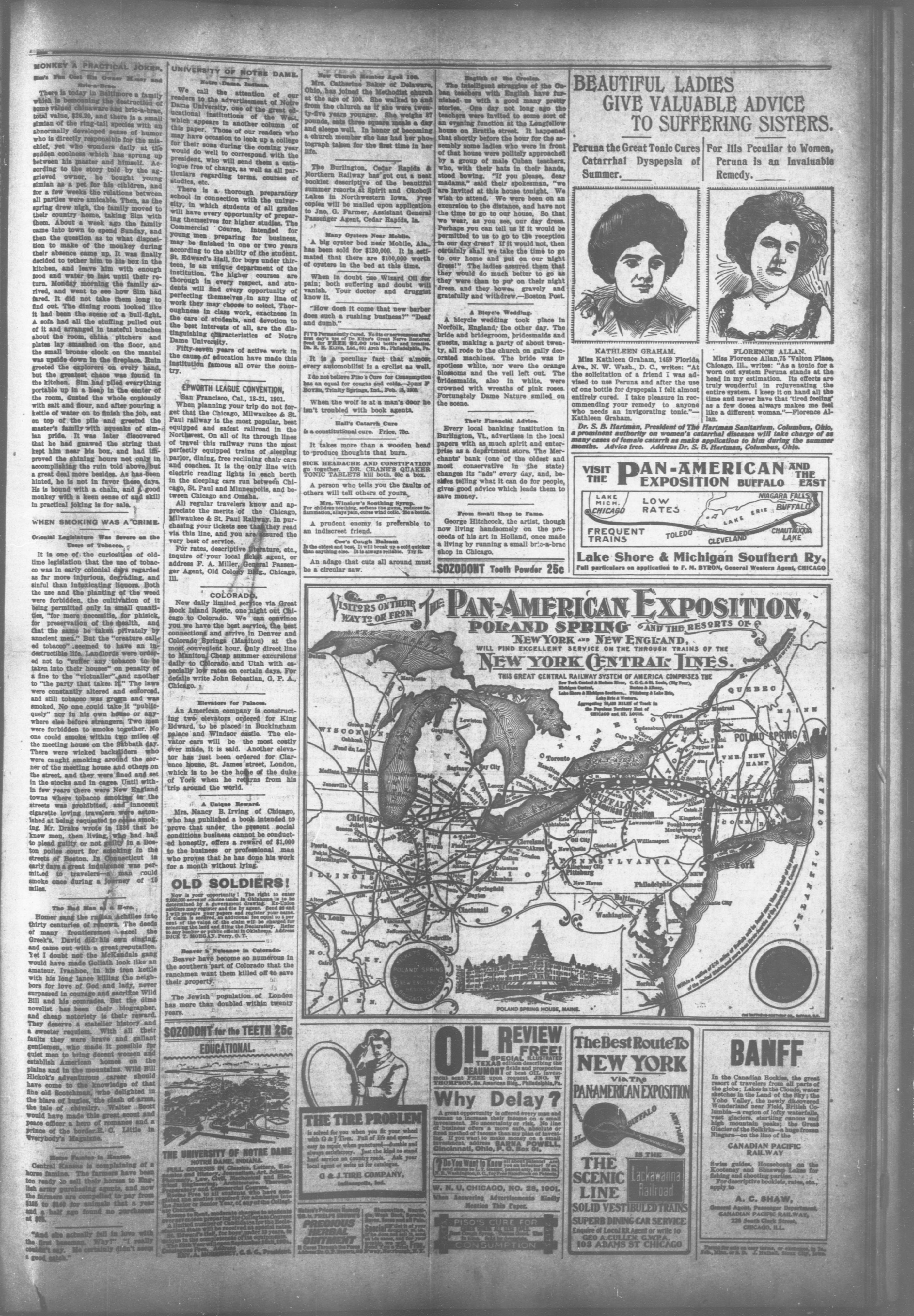
BEAUTIFUL LADIES =>
GIVE VALUABLE ADVICE
TO SUFFERING SISTERS.
vst PRAN -AMERICAN “3h,
— EXPOSITION BUFFALO EAST
MAGARA FALLS
glk. fone
TRAINS = EVEL TAKE
Lake Shore & Michigan Southern Ry.
Fall particulars on application to F. M. BYRON, General Western Agent, CH!
Peruna the Great Tonic Cures
Catarrhalt Dyspepsia of
Summer.
@
A 2 Gf NS S SS
be y
Wy CA
POET E LTE TET TTT TTT ETE T Ty rrr TTT Trey TT
KATHLEEN GRAHAM.
Miss Kathleen Graham, 1459 Florida
Ave., N. W. Wash., D. C., writes: “At
the solicitation of a friend I was ad-
‘vised to use Peruna and after the use
of one bottle for dyspepsia I felt almost
entirely cured. I take pleasure in rec-
ee see nents to anyone
needs an invigorating tonic.”"—
‘Kathleen Graham.
_ De. S. B. Hartman, President of Thé
@ prominent authority on women’s ca
many cases of femaie catarrh as make
moaths. Advice free. Address Dr. S.
theBest RouteTo
NEW YORK
PANAMERICAN EXPOSITI
y ee
SCENIC (ee.ci.
408 ADAMS ST CHi a
For Iiis Peculiar to Women,
Peruna is an Invaluable
Remedy.
ey
a
= 2 \
he
RS rs
EUV OLTTTTTTY . .TUYTECTEPUVEVYTENTY EYED TET T YY Terr er eS
: FLORENCE ALLAN.
Miss Florence Allan,75 “Valton Place,
Chicago, IIL, writes: “As a tonic for a
worn out system Peruna stands at the
head in my estimation. Its effects are
truly wonderful in rejuvenating the
entire system. I keep it on hand all the
time and never have that ‘tired feeling’
as a few doses always makes me feel
eS
Sanitarium, Columbus, Ohio,
Sviial dinasee OO take cneup> of on
application to him during the summer
Soooet of cetion eal eee
the globe; Takeo Cpe waar
sketches in the Land of the Sky; the
Yobo Mey. one Pian discovered
eee hs ae =
Ses
mas aintee
ee
oe e
72 ORS 7
spply.to Je ae
Ae S, SHAM,
Seeene
RNR MT
Pn ht ho gne -5 —
It is truth that makes a man angry. Bad grass does not make good hay. He who knows nothing never doubts. For a web begun God sends thread. A voluntary burthen is no burthen. What is bought is cheaper than a gift.
The eye is blind if the mind is absent.
God heals and the doctor has the thanks.
He who blows upon dust fills his eyes with it.
Who has never done thinking never begins doing.
Who is in the right fears, who is in the wrong hopes.
He who would relish his food must not see it cooked.
He who would be long an old man must begin betimes.
Who throws a stone at the sky, it falls back on his head.
He who eats pears with his master should not chose the best.
Speak well of your friend; of your enemy neither well nor ill.
He who would have clear water should go to the fountain head.
He who gives bread to others' dogs is often barked at by his own.
From the same flower the bee extracts honey and the wasp gall.
He who tells his own affairs will hardly keep secret those of others.
Who wishes for a short Lent let him contract debts to be paid at Easter. He who has money to throw away, let him employe workmen, and not stand by.
Don't ask God to forgive you until you have paid your debts.
If you are not a friend to labor, you are no friend to God or man.
The reign of money is here; other events will come with the years.
It is a sad, sad thing that most of the world's true reformers are driven out of the church.
It puzzles me sometimes to decide whether Christian nations have become pagans, or vice versa.
To love and be loved is all there is of life, no odds whether you work for that love, or work for money to buy it.
If God heeds the curses of the common people against the oppressions of the rich, the prayers of plutocracy must make a discord in heaven.
Some people go to the hospital to be operated on, and some go into business for the same purpose. However, the hospital rates are cheapest.
What can be plainer than this: If one man has got 500 times more wealth than he needs, there must surely be 500 who have less than they need.
The mission of the world is to work. If you are not working you are a traitor to creation, a sponge in the tub of toll, a blank shell in God's box of ammunition.
The political party that has back of it the churches, banks, saloons, money, guns, and a majority of the slimest politicians can still have the gall to declare that even God belongs to the happy combination.
Whenever we have an over-production of food and clothing the poor must go hungry and ragged. Suppose now that when God has an over-production of blessings, would he let the world go to the devil?
I don't like these people with velve hands; they get their money so easy that it makes it all the harder for the rest of us.—Finnickey Finnukin in Pennsylvania Grit.
LITERARY NOTES.
Miss Lilavait Singh of India, who visited this country last year and spoke at many religious gatherings, is translating the autobiography of Booker T. Washington into Hindoostanee.
Go with mean people and you think life is mean. Then read Plutarch, and the world is a proud place, peopled with men of positive quality, with heroes and demigods standing around us who will not let us sleep—Books.
If we explore the literature of heroism, we shall quickly come to Plutarch, who is its doctor and historian. To him we owe the Brasidas, the Dion, the Epiminondas, the Selpio of old, and I must think we are more deeply indebted to him than to all the ancient writers. Each of his "Lives" is a refutation to the despondency and cowardice of our religious and political theorists. A wild courage, a stoicism not of the schools, but of the blood, shines in every anecdote.—Heroism.
A fleet of thirty-six steamers is to run hereafter on the Thames between Battersea and London bridge. In Italy every commune with more than 800 inhabitants must have separate schools for boys and girls. The English railways cost on an average of £50,000 per mile; the German, £20,000, and the American, £11,000. Queensland assists its tobacco growers by the importation of American seed of first quality suited to the Queensland climate.
The unhealthiness of Liverpool is marked and persistent despite the great natural advantage it has in a tidal river and fresh air from the sea.
THOUGHTS FROM EMERSON.
Not only things familiar and stale, but even the tragic and terrible, are comely, as they take their places in pictures of memory. The river bank, the weed at the water side, the old house, the foolish person,—however neglected in the passing—have a grace in the past—Spiritual Laws.
In poetry we say we require the miracle. The bee flies among the flowers, and gets mint and marjoram, and generates a new product, which is not mint and marjoram, but honey; the chemist mixes hydrogen and oxygen to yield a new product, which is not these, but water; and the poet listens to conversation, and beholds all objects in nature, to give back, not them, but a new and transcendent whole. Poetry and Imagination.
No greater men are now than ever were. A singular equality may be observed between the great men of the first and of the last ages. * * * The arts and inventions of each period are only its costume, and do not invigorate men. * * * Galileo with an opera- glass discovered a more splendid series of celestial phenomena than any one since. Columbus found the New World in an undecked boat. It is curious to see the periodical disuse and perishing of means and machinery. The great genius returns to essential man.—Self-Reliance.
Remember what befalls a city boy who goes for the first time into the October woods. He is suddenly initiated into the pomp and glory that brings to pass for him the dreams of romance. He is the king he dreamed he was; he walks through tents of gold, through bowers of crimson, porphyry, and topaz, pavilion on pavilion garlanded with vines, flowers, and sunbeams, with incense and music; the leaves twinkle and pique and flatter him, and his eye and step are tempted on by what hazier distances to happier scilicitudes. All this happiness he owes only to its finer perception. The owner of the wood-lot finds only a number of discolored trees.—Success.
The best rule of reading will be a method from nature, and not a mechanical one of hours and pages. * * * Let the student read what is proper to him, and not waste his memory on a crowd of mediocrities. As the whole nations have derived their culture from a single book—as the Bible has been the literature as well as the religion of large portions of Europe—as Hafiz was the eminent genius of the Persians, Confucius of the Chinese, Cervantes of the Spaniards; so, perhaps, the human mind would be a gainer if all the secondary writers were lost—say, in England, all but Shakespeare, Milton and Bacon—through the profounder study so drawn to those wonderful minds—Books.
PRETTY THINGS TO WEAR.
The most appropriate trimming for sailor hats this season is a puffing of silk, which hides nearly the entire brim, as well as the crown. The silk may be set off to best advantage, by a buckle or a long sweeping plume, laid on flat.
A novel idea for trimming boleros is to edge the lower hem with long pendant loops of ribbon or gold braid. Through these loops the waistband is passed. A waistband of a color different from that of the ribbon trimming is preferable.
Gold effects on white are much fancied now for either day or evening wear. Ceintures of gilt are always pleasing, but a decidedly new idea is a boa of gold tissue, edged with fingerwidth white mousseline de sole or with tiny ostrich plumes.
Something extremely practical to keep erect the dainty muslin and pique stocks now so much worn is a perforated neckband of celluloid. It is easily fastened inside the stock, and may be purchased at almost any notion or neckwear counter.
Among the fancy hose of the season a variation from the usual lace patterns has been seen in some pairs of black silk, embroidered with jet paillettes. One pretty design consists of three bowknots of closely-set paillettes on the instep. Another has lines of paillettes running up and down the instep. Some of the latest patterns also contain gold thread, in stripes, alternating with openwork.
The life of our Lord has value to us only as he is the Lord of our life.
Religion without conviction is like lean-to shed, without foundation.
If we are not humble toward God, we are not forgiving toward our brother.
The man who packs water on both shoulders is liable to stand in the mud.
You cannot take the road without the end, nor the end without the road.
Probably the story of this earth will be but a chapter in the history of heaven.
He who times his efforts by his inclinations is pretty sure to miss both opportunity and blessing.
The man who is most conscious of coming from God will be most likely to return to Him.—Ram's Horn.
Fools multiply folly.
In success be moderate.
Hope of gain lessens pain.
What one relishes, nourishes.
Who pleasure gives shall joy receive.
Be neither ally nor cunning, but wise.
Be not sick too late, nor well too soon.
Don't think to hunt two hares with one dog.
No man o'er was glorious who was not laborious.
RENFROE BROS. Dealers in WOOD, COAL, FEED AND ICE. 137 West Forty-Seventh St. CHICAGO.
DR. H. C. FAULKNER,
Physician and Surgeon,
OFFICE: 6258 HALSTED STREET,
CHICAGO.
Office Hours: Phone 818 Went.
10 to 12 a. m., 2 to 4 p. m
6 to 7:30 p. m.
TELEPHONE EXPRESS 672.
PROF. W. E. DORSEY,
1868 La Salle St.
Leader and Manager
K. P. Military Band and Orchestra
Music Furnished for Balls and Receptions. Prices Reasonable. Call and see me.
DR. L. M. FENWICK.
(A. M., M. D., E. M.)
PHYSICIAN AND SURGEON.
6212 S. Halsted St., 2nd Floor.
HOURS: 8 to 10 a. m., 12 to 2 p. m., 7 to 8 p. m.
Sunday, by appointment.
Tel. Wentworth 627. CHICAGO, ILL.
Estimates and Specifications Purnished ... Prompt Attention Given to Jobbing
C. J. BOYD,
Practical Plumber and Gas-fitter
Steam and Hot Water Heating,
Iron and Tile Drainage .....
Telephone Yards Mk.
709 WEST 47TH STREET.
Telephone No. Yard.
DR. JOSEPH JEFFREY,
Physician and Surgeon,
486 Dearborn Street. CHICAGO.
Hours: 8-10 a. m., 2-4, 6-8 p. m.
JAMES T. CRAIG,
Coal, Wood & Ice
General Expressing and Moving.
1001 ARMOUR AVE. CHICAGO, ILL
VALUE OF A SPECIALTY.
Woman Becomes Egyptologist Through
Acknowledgment of Ignorance.
Many a Sunday school teacher has found herself in straits because of an inquiring scholar who puts a fusilade of questions that she is quite unable to answer, and ashamed to acknowledge her ignorance she takes refuges in the useful cyclopaedia if she is hurried, and if not, seeks in the town library the facts needed. An episode of this nature was the occasion of Mrs. Marie N. Buckman of Boston, becoming an Egyptologist. It is fifteen years ago since she was teaching a class of half-grown boys in Tremont temple and when her class embarrassed her with questions, she began to read Egyptian history for the necessary answers. From this she went to the study of hieroglyphics. Constantly attending the Boston museum of Fine Arts for the purpose of poring over the treasures brought there by the Egypt Exploration Society, she attracted the attention of many, not only the museum authorities, but all sorts of persons, who wished information on Egypt, and at last it became a matter of course that Mrs. Buckman should act as guide to small parties who wished to go through the Egyptian department, and she was also often invited to write papers and give lectures on the recent discoveries of the exploration society. Naturally, when the business of the society proved to be too much for the honorary secretary, Mrs. Buckman was appointed secretary, and does a great deal of work in the Boston office, in answering queries and supplying all possible information, and also securing subscriptions from interested Americans, which funds are sent to the headquarters of the society in London. She distributes annual reports and other literature, of which the society is very liberal, to its subscribers; every one who gives $5 a year receives the annual report, an illustrated archaeological report and a handsomely bound book, illustrated with many plates, some of then colored ones, giving a complete account of the year's discoveries. Mrs. Buckman continues her labors as an Egyptologist.
Read and subscribe for The Broad Ax, the only newspaper in Chicago which "news to the Idle."
A. D. GASH,
Attorney at Law.
61 and 80 La Salle St., Suite 615 to 619,
Telephone, Main 8577. Chicago.
JOHN E. OWENS
Attorney at Law,
SUITE 621 ASHLAND BLOCK,
60 R. Clark Street. . . CHICAGO
TEL. HARRISON 51.
Thomas F. Soully,
Attorney at Law,
79 Clark Street, . . . CHICAGO.
Room 14
JOSEPH A. McINERNEY
LAWYER
Beauregard F. Moseley,
LAWYER.
Practice in all Courts.
Main Office 6256 Haisted St,
Down Town Office 260 S. Clark St., Room 431
Hours from 12 to 2 P. M.
Phone: 2533 Harrison.
JOHN FITZGERALD
JUSTICE OF THE PEACE
4787 S. HALSTED STREET,
....CHICAGO
ALBERT B. GEORGE
LAWYER.
423 Ashland Block, Chicago.
— Tel. M. 2625. —
EDWARD H. WRIGHT
LAWYER
Suite 421, 200 S. Clark St.
Telephone, Harrison 2533. CHICAGO.
GEO. W. W. LYTLE,
Attorney and Counselor at Law
Telephone Central 3558.
Suits 60, Grand Opera House,
Notary Public 87 & 89 S. Clark St.
Chicago.
Lawrence M. Ennis,
Advocate and Counselor at Law,
Sulte 726 Opera House Block.
S. W. Corner Clark and Washington St.
TELEPHONE MAIN 1782.
G. E. EVANS
Design in All Kinds of
HARD AND SOFT COAL,
Wood, Charcoal, Coke and Ice,
Expressing and Moving a Specialty.
332 29th St. Chicago, Ill.
SEA IS UNSYMPATHETIC. The Sea Shore and the Mountains Con- trasted by a mountain.
I have lived by the sea shore and by the mountains. No, I am not going to say which is the best. The one where your place is is the best for you. But this difference there is: You can domesticate mountains, but the sea is feroe naturoe. You may have a hut, or know the owner of one, on the mountain side; you see a light halfway up, its ascent in the evening, and you know there is a home, and you might share it. You have noted certain trees, perhaps; you know the particular zone where the hemlocks look so black in October, when the maples and beeches have faded. All its reliefs and intaglios have electrotyped themselves in the medallions that hang round the walls of your memory's chamber. The sea remembers nothing. It is feline. It licks your feet, its huge flanks purr very pleasantly for you; but it will crack your bones and eat you for all that, and wipe the crimsoned foam from its jaws as if nothing had happened; the mountains give their lost children berries and water; the sea mocks their thirst and lets them die. The mountains have a grand, stupid, lovable tranquility; the sea has a fascinating, treacherous intelligence. The mountains lie about like huge ruminants, their broad backs awful to look upon, but safe to handle. The sea smooths its silver scales until you cannot see their joints—but their shining is that of a snake's belly, after all. In deeper suggestiveness I find as great a difference. The mountains dwarf mankind and foreshorten the procession of its long generations. The sea drowns out humanity and time; it has no sympathy with either, for it belongs to eternity, and of that it sings its monotonous song forever and ever.—Oliver Wendell Holmes, the "Professor at the Breakfast Table."
Gustav Korn,' a New York brushmaker, has made a life-size portrait of George Washington in bristles of various colors, taking Stuart's celebrated painting for a model. The bristle picture is said to be quite a work of art. It is on exhibition in the window of a Pearl street store.
```markdown
```
HEAVY MACHINERY. Smoke Stacks, Cupolas and Monuments Erected. Hoisting and Placing of all kinds of Beams and Girders for architectural work. Office, 31 South Canal St.. Chicago TELEPHONE MAIN 4029
...The Mutual Reserve
Fund Life or New York...
OVER $41,000,000 PAID IN LOSSES.
Insurance for the Protection of the family at actual cost
E. P. BARRY, M'g'r. JULIUS F. TAYLOR, Special Agt.
410 Roanoke Bldg., 145 La Salle St. 5040 Armor Ava.
POOL AND BILLIARDS
BRAXTON'S ....PLACE
SAMPLE ROOM
Fine Wines and Liquors
Imported and Domestic Cigars
260 West Lake St.
JIM GEORGE
Jas. J. McCormick, SAMPLE ROOM
IMPORTED AND DOMESTIG WINES, LIQUORS AND CIGARS
Driving, Draft and General Business Horses Always on Hand
He was the conductor of one of those big trucks that transfer immigrants who are simply passing through New York from South ferry to the dock or train that they are scheduled to board. He was very officious, feeling his authority as well as his superiority over the young men and women consigned to his care. They, with that half-startled and altogether conciliatory smile which characterizes the newly landed, were taking his abuse and perhaps congratulating themselves that they didn't understand the language, although his meaning was perfectly clear. "Here, there!" he shouted to a very pretty Swedish girl. "Sit down, you!" At the same time he caught her by the shoulders and brutally pushed, almost knocked, her over on a basket filled with immigrant effects. Her offense had been to take an interest in one of the tall buildings on lower Broadway. She didn't protest—but someone did. It may have been simply a fellow-countryman or it may have been a big brother who had come on to New York to greet the newcomer. At all events, he was not a "greenhorn." He had the easy air, the substantial clothes and the self-reliance that comes from several years' residence in the country. Besides he had the shoulders of an athlete and a fist like a sledge hammer. Stepping from the walk into the street, he caught the offender exactly as the fellow had handled the girl, and, thundering in excellent English, "Sit down, you!" he brought him sprawling to the sidewalk. "How you like it?" he asked innocently. The immigrants looked on and smiled.
The excess of births over deaths in New York is, on an average, about 5,000 a year, and if there were not constant immigration into New York from foreign countries and from other divisions of the United States, the growth of the city would be 50,000 in ten years, or less than 1 1/2 per cent in a decade. Actually, the increase in population is at the rate of 38 per cent. The territory of New York, which had 2,493,000 population in 1890, had 3,437,000 in 1900.
CHICAGO, IL
CURLY HAIR
MADE STRAIGHT
BY THE
TAKEN FROM LIFE.
BEFORE AND AFTER TREATMENT.
WONDERFUL DISCOVERY
ORIGINAL
OZONIZED OX MARROW
[COPYRIGHTED.]
Will straighten your hair, quickly and easily so that you can do its purpose more耐水 how kinky or curly it is. This wonderful hair pomade has been made and sold many years giving perfect satisfaction to everybody. It is the only safe preparation in the world that straightens kinky hair as shown above. Nourishes the scalp, cures dandruff, prevents falling, and makes the hair grow. Sold over forty years. Warranted harmless. Testimonials free exist. It is the first preparation ever sold for straightenments kinky hair. Beware of imitations. Get the Original OX Marrow as the genuine never fails to keep the hair pliable and beautiful. A toilet necessity for ladies and gentlemen. Elegantly perfumed. Owing to its superior and lasting quality it is the most economical. It is not possible for anybody to produce a preparation equal to it. Full directions with every bottle. Only $0 cents. Sold by dealers or we will ship you on behalf of one bottle for $8 cents or three for $1.40. Send postal or express money order, as we do not accept goods O. D. Write your name and address plainly to OZONIZED OX MARROW CO., 76 Wabash Ave., Chicago, IL.
NEWSPAPER LAW.
Any person who takes the paper regularly from the postoffice, whether he is a subscriber or not, is responsible for the pay.
The courts have decided that refusing to take newspapers and periodicals from the postoffice, or removing and leaving them unscalled for is prima facie evidence of intentional fraud.
The Broad Ax desires to engage the services of one or two popular young women as collectors, subscription and advertising solicitors. Good salary paid to active workers. Call or address JULIUS F. TAYLOR. 5040 Armour avenue.