The Broad Ax
Saturday, July 27, 1901
Chicago, Illinois
Page text (machine-generated)
THE BROAD AX
HEW TO THE LINE.
It was in the spring of 1896 that trouble entered the Temple of Democracy in Cook County. The first round in this political battle to a finish occurred one very warm evening in their old headquarters at 75 Randolph street, where the militant democracy assembled behind closed doors. It was a toss up which was the hottest, the session or the weather; it was so warm, however, those who were fortunate in having the password, have a strong impression of what happened. Such stalwarts as A. S. Trude, John McGillen, Roger Sullivan, John P. Hopkins, James McAndrews and the "Oliver Cromwell of Democracy" Robt, E. Burke, crossed swords with each other. John Colvin in those days always had an easy money delegation at his command, they were very much in evidence upon this occasion and anyone that was present that night will remember the little tilt which occurred upon the arrival of Colvin's cohorts, when Trude arose and inquired if that was a committee on easy money? John McGillen replied that if anyone was familiar with the methods of getting easy money Mr. Trude was and thus it was a brief round ended with each man going to his own corner without a scratch. At that time Altgeld was governor. He held the State patronage, which gave his side the advantage, the bone of contention then as it is now, whether we should have home rule or "boss rule." The condition would be just the same as it matters little who is in control, however, the machine was at stake, hence it was decided to hold "soap box" primaries, as Altgeld had sent word to Burke by his official messenger, Joe. Martin, not to allow the Hopkins Democrats even "a messenger boy," and his instructions were carried out to the letter by Tom Gahan and Robert E. Burke. Gahan at that time was railroad and warehouse commissioner under Altgeld, at any rate the Altgeld-Burke-Gahan forces won the delegates that went to the state and national conventions and nominated the governor for the second time and also aided at the national convention in nominating Wm. J. Bryan. In the meantime ex-Mayor John P. Hopkins marshalled under his banner some old warriors, who had earned their spurs on more than one occasion. His advisers and chief lieutenants were John McGillen, Roger Sullivan, Tim Ryan, Billy Asay and a long list of old players, who knew how to deal from the bottom as well as the top of the political deck, though defeated at the primaries they came up with flying colors and went along the line like so many "Marshalls of France," and with the aid of Frank Peabody, MacVeagh, Robbins and the eastern following he had in James H. Eckels, Whitney, Lamont and John G. Carlisle and others whose confidence Hopkins always enjoyed, organized the Indianapolis convention, and it was upon this occasion Colonel John S. Cooper, one of the finest looking Democrats in Chicago, created consternation in the ranks of the County Democracy by mustering several of its members under his banner and took a marching club to Indianapolis to boom things. Among his lieutenants were Naturalization O'Brien, Billy Asay, Billy Legner and Steve Griffin. Well, the November election occurred, Bryan and Altgeld were defeated, the following spring a mayor was to be elected. Altgeld still held the reins, at one time Trude could have had the nomination but he hesitated, like the dog, and the "rabbit got away," so the nomination fell to Harrison, who was elected. After he was installed into office he proceeded to fill his offices with Gold Democrats, much to the chagrin of Altgeld, which precipitated a breach between the two that has widened from that day to this. This is a long story, but those who can remember the trend of events will notice that these two gladiators, who are fighting each other, Hopkins and Burke, have lost and gained, as the case may be, some able lieutenants. As the saying goes (next year there will be "something doing," and in the language of
that "Chesterfield of Democracy" Fred Eldred: "Just wait."
To the editor of The Broad Ax:
Dear Sir—The Negro race is face to face with a crisis. From east, west north and south reports are coming in that tell of the growing prejudice against our race.
The ballot has been stricken from the hands of nearly half of our people and the other half are threatened with the same fate.
The individual boycott is daily pressing harder upon us.
Murder's lynchings and burnings are increasing at a frightful rate. Our people are being crushed to the wall by a force that knows not the name of mercy. The situation calls for action all along the line. And it devolves upon the Negro press to take the lead. Our line of action lies plain before us, we are part of the world of labor and the labor world is in a state of revolt against the tyranny of the masters who own the land and tools. The fight between the workers and the owners of the land and tools is world wide. And here in the States it has reached its highest point.
In this land we have the ballot and with this weapon in our hands and combined at the ballot box we could disarm the enemy by declaring for the national ownership of all the means of production and distribution to be conducted of, for and by the working class, for the general good of all.
The intelligent people among the poor whites have come to see that the interest of all labor is one and the same, regardless of race, creed or color and they have banded together under the banner of Socialism.
The capitalists see the danger in this move and consequently seek in every way to keep the workers at each others throats.
In the heat of the contest the Negro presents the easiest mark for their clubs and they strike the ballot from his hand and to prevent him from making an effective protest they urge the poor whites to make him a mark to spend their anger on, because of his competition with them in the labor market. The honest and intelligent leaders among the poor whites are maknig advances to the Negro and it is our duty to meet them in council. For aside from Socialism there is no hope held out to the Negro. It is the great question that is agitating the civilized world today.
Many of the greatest men and women of the age have indorsed it and Herbert Spencer himself has declared that "Socialism is inevitable". So we owe it to ourselves and our children to take the question up and consider it and see if it will relieve us in our dire need and after ten years of observation and association with socialists in different parts of the globe. I unhesitatingly declare that it is our only hope in the world, as it is the only hope of the poor whites, who are nearly as deep in the swamp of poverty and misery as we are. United we stand, divided we fall. Combine and rule or divide and perish. The time has arrived for action, action, ACTION.
36 North Clark St., City.
AT PHILADELPHIA.
The twenty-second annual meeting of the National Afro-American Press Association will be held in Bethel A. M. E. Church,Philadelphia, Pa., Tuesday, Aug. 6th. 1901. The meeting will be on the ground where the first Afro-American Church in America, where the bones of the great founder now rest in a tomb, but recently made for him.
but recently made All editors or publishers of bona fide news papers and periodicals published in the interests of the Afro-American race are entitled to membership in this Association. Each publication has but
The time selected for the meeting is one day prior to the meeting of the National Afro-American Council, so that it will be convenient for editors who attend that meeting to be present at the Press Association. A special rate of a fare and a third on the certificate plan has been granted on all railroads to persons attending the National Afro-American Council, and editors may take advantage of that and attend both meetings.
It is hoped that the session will be lengthy, attended.
largely attended.
Cyrus Field Adams, President.
Geo. L. Knox, Vice-President.
Wm. H. Steward, Treasurer.
A. L. Manley, Secretary.
T. Thos. Fortune, Chm. Ex. Com.
Take your vacation so as to visit the
Old Folks' Picnic.
IDOLATARY.
And now since in the progress of ages mankind have come to the point where the employment of the invisible, intangible powers of nature are adapted as the basis of all motor power—steam, electricity and even still more sublimated poteneries taking the place of mere animal power—why not adopt the invisible, intangible but omnipotent power of public credit as the basis of all monetary circulation preferable to the use of mere commodity such as rare metals af wasting nature and monopolable quantity—things were worthy of service in primitive people among whom the idea of credit has never developed.
But 'tis hard to turn people from their accustomed idols toward the worship of a pre-abstraction invisible supreme being. It may be well doubted whether any person born in the worship of idols and brought up therein till the age of reflection, ever truly come to the simple unadorned worship of Prosestantism. The idea of an invisible, intangible god is of impossible conception to such and in their hearts they are still idolaters. Can they really believe an image fashioned by their own hands is God? That a dumb idol has power? What a wonderful creation is man! It is impossible that the lowest savage can so believe and yet the cannibals of one kind have bowed interior before such images. And in other countries, millions rejecting the idol have come to pray to, dictate and treat familiarly the infinite Being of our universe as though he were the man in the next street." Thus from one extreme to another we are precipitated. And yet man has a sure guide if he will listen to it—his reason.
How few of our government institutions are founded on reason. HOLT.
NOW A REAL THING
The Negro Democratic Jefferson Club Association is now a real thing. It is now a permanent organization with an adopted constitution and by-laws, and officers elected for one year. Mrs. C. C. Rankin is president, Mr. Geo. B. Jones, secretary; Mr. W. H. Fields, vice-president, and Mr. James Schafnear, treasurer. The association will have permanent headquarters in a few days, and the facts will be given in detail.—The Eagle St. Louis, Mo.
No dodging goes, so get your tickets for the old folks' home picnic at Gardiner Park, August 14.
State's senator Mr. J. Butler loomed up at the Tammany picnic and he looked like four time winner.
The Western Negro Press Association convenes at Colorado Springs, Colo. August 5th, 6th, and 7th.
W. L. Gahan late of the city attorney's office will become connected with the law firm of congressman Geo. P. Foster Jorman, 100 Washington St.
Two thousand and eight hundred railroad men residing in the 30th ward have decided to honor Capt. John J. Bradley for Alderman net spring.
The chickens were raised at the old Folks' Home and aunt Sophie will cook them at the old Folks' Home Pienic, Aug. 14.
George L. Braxton. 260 West Lake street, continues to sell the best wet goods on the west side and his sample room is up-to-date.
A man's whole duty in this world is to get his living without robbing his neighbor of a living, or an opportunity to live and be happy.
The hot season has kept Green E. Evans, 332 Twenty-ninth St., dealer in coal, wood and ice on the jump in order to supply his many customer with ice so that they can keep cool.
E. Allen Frost, who always acts very frosty and stiff-necked with colored people is now serving as city comptroller in the place of Lawrence E. McGann, who is indisposed.
Abdule Hamid Woolomol, Sultan of Sulu, saluted the flag on the morning of the Fourth by signing another salary voucher. Abdule is ready to repeat the salute at monthly intervals.
Almost one hundred thousand steel workers throughout the east are striking for more pay and we often wonder what has become of old Mark Hanna, and his full dinner pail.
Renfroe Bros., 137 West 47th St., are doing a rushing business these warm days. This enterprising Afro-American firm use two, or three wagons in delivering coal, wood, feed and ice.
Ohio republicans inserted into their platform a plank demanding justice for the Negro. The number of Negro postmasters in Ohio has not been in creased to any noticeable extent since the adoption of the Commoner.
The fellow on top of the mountain seldom thinks of the fellows, far at sea when the stormy winds blow. The mountain of wealth makes men just as forgetful of the millions down in the sea of poverty and toil.
At the time of the emancipation the gas company of New Orleans owned slave property conservatively valued at $51,650. The slaves were used in all of the departments of the gas company from a clerk's desk to the lowest position in the company.
Arthur McLaughlin, Secretary 30th Ward Democratic Club began working for Armour & Co. when he was nothing but a small boy. but he is now time keeper and he has many friends who would like to see him become a candidate for alderman next year.
During the Spanish-American war the Negroes had 266 officers, average of salaries at $1,600, total $425,600; 14,784 privates at $207, total $,075,472; 5,000 men employed as drivers, cooks, servants and laborers. at $250 per year, total $1,250,000. Grand total, $4,751,072.
The colored woman called "Big Mary," who resides in Lake county, Tennessee, is the champion cotton picker of the United States. She cooks for herself and seven other hands and picks 500 pounds of cotton a day. Recently in order to test her capacity, she picked 748 pounds in one day, from sun to sun.
An exchange gets off the following: A couple were recently married and the bride invited an old maiden aunt to the wedding. The cards were swell and in one corner bore inscription; "Children not expected." After scanning the inscription closely over her specs, the old lady said: "That's all right but they'll have them just the same."
From now on Daniel Sullivan who resides out in the country will drop into this big town every week or so for the purpose of keeping tab on the boys who are mixed up in the Hopkins, Sullivan, Gahan, Legner, Powers, McGillen, Griffin, Burke, Harrison and Eldred fight. So we would advise all the members of the smart set who want to play at the game of politics to kee ptheir eyes on The Broad Ax.
An exchange edited by a Colored man is of the opinion that the "colored gentleman" is a very hard'headed individual owing to the fact that out of a hundred cases of sunstroke during the past few days, not a single one was reported marked "colored." In other words, this exchange would have its reader understand that the cranium of the Negro is too thick for the burning rays of old Sol to penetrate.
Mrs. Booker T. Washington, while attending the meeting of the colored Women's Clubs at Buffalo, attended a reception given by white women, while at the same time the colored women were holding a reception. This incident made the Colored women so mad that in order to rebuke Mrs. Washington those broad minded colored women refused to elect Mrs. Washington president of the National Association of Colored Women's Clubs.
Wm. E. Costley, who is the leading and the best informed colored socialist in this country is in the city and for the next month he will do missionary work among the colored people. Sunday afternoon at 4:00 o'clock. Mr. Costley speaks at Bethel Church, 30th and Dearborn St., on "Socialism and the Race Problem." This is a new movement among the colored people and they should fill Bethel Church from end to end and listen to whatever Mr. Costley has to say.
Lawyer J. Douglas Wetmore of Jacksonville, Fla., who is a friend of attorney Albert B. George, arrived in this city, Monday morning Mr. Wetmore is stopping at the Auditorium. He is on legal business, and will remain for some time. He is the only Afro-American member of the city council of Jacksonville, and he was chairman of the relief committee which was formed for the object of lessening the burdens of the colored people who lost their belongings during the great fire which swept over Jacksonville a short time ago.
Robert T. Sims bid farewell to the Democratic Party last Tuesday night and joined the Socialist Party. He is the first Afro-American in Chicago to become connected to Socialism through the efforts of Wm. E. Costley. Mr. Sims presided at a meeting Tuesday night held at 51st and Wentworth Ave., and which were addressed by Mr. Costley and when he concluded speaking, J. B. Hart, Dr. W. H. Davis, Mrs. A. E. Taylor, Mrs. R. T. Sims, James H. Harris and Julius P. Taylor signed the call to hold the meeting at Bethel Church, Sunday, July 28th at 4 o'clock.
George J. Terrell, who has never paid us the three dollars which he owes us as Supt to The Broad Ax has at last got his Hy Henry gambling club running in full blast. It is located on 47th St., near Armour Ave., and up to the present time some of Terrell's tough friends have endulged in a good old fashioned fight. But it matters not if ten or twenty victims get cut up and beat up in Terrell's ratty joint each day for his uncle and pal.
Sam. Watkins, who runs the police force of the Town of Lake will not permit anyone to lay their hands upon his friend, Geo. Terrell.
Alderman Charles Werno, who evolved the idea of providing public bathing beaches will henceforth receive the praise of all the boys of Chicago. Mr. Henry E. Weaver, the extensive wholesale coal merchant has not only stood by Alderman Werno but Mr. Weaver, has also contributed fifteen hundred dollars out of his own pocket towards helping to brighten the lives of all who delight to swim in the lake. Through the efforts of Mr. Weaver and Alderman Werno they have now succeeded in establishing free bathing beaches at the foot of Oakdale Avenue and Lincoln Park on the North Side and at the foot of 25th, 50th and 79th Sts. on the South Side. Many public spirited citizens are also becoming interested in this noble project and they are donating money to help it along.
The Tammanyites held their picnic at Oswald's Grove last Saturday. It was well attended. Grand Sachem Alderman Thomas Carey was in his glory from start to finish, and he looked very sweet while he was engaged in overseeing the large crowd which was present. Congressman George P. Foster was the first speaker and acted as chairman of the speaking. Samuel Alschuler, Congressman John J. Feely, ex-Judge William Prentiss, James F. O'Donnell, Bloomington; Thomas F. Donavan, J. Nick Perin, Capt. William P. Black, Miles J. Devine, Alderman William F. Brennan, J. M. Hess and John J. Coburn were among the speakers, and the majority of them put themselves on record in favor of Mayor Carter H. Harrison for President in 1904.
According to a Cairo correspondent the directors of the great French company enjoying the practical monopoly of the Egyptian sugar and molasses industry have just completed arrangements by which they become concessionalaires for a number of years of some 40,000 acres of land in the vicinity of their great works at NagHamadi, in upper Egypt. These lands will be devoted principally to the culture of beetroot. The company already possesses extensive fields of canes. Egypt is now not only able to cater for herself as far as sugar is concerned, but has begun to successfully compete with French and Austrian sugar in the Levant markets.
Jewelry stealing under cover of accomplished skill in dentistry is the latest device of Parisian rascaldom. Its practitioner is an ingenious and elegant young man of 26 named Pasteur, who operated by preference among ladies of a certain class. One of these whom he met some weeks ago complained of toothache, which he undertook to cure, and did so effectually. This cure obtained him many patients, upon whom he operated at their own residences. After his visits articles of jewelry were missed, and complaints were made to the police, but they were quite unable to obtain any clue to the culprit, until the other day one of his victims accidentally saw him in a cafe and promptly gave information which secured his arrest.
A case was recently before Judge Case of Hartford, in which a bicycle rider brought suit to recover damages for injuries sustained by being thrown from his machine by the attack of the defendant's dog. Judge Case found for the plaintiff, but, as the latter had been riding on the sidewalk at the time of the injury, he had this to say in his memorandum: "The question here is whether the dog was really responsible for the mischief and directly caused it. I think he was and did, and that under our statute, which throws a considerable responsibility upon dog owners, the defendant is liable. My personal sympathies are with any self-respecting dog in his efforts to keep bicycle riders where they belong, in the street, and I believe he should be accorded some latitude in his methods, but Mr. Hulburt's dog weak too far."
The women of the German city of Magdeburg will honor the memory of Queen Louise by the erection of a statue of the venerated queen. Johannes Goetz was intrusted with the task of creating in Carrara marble the figure of the beautiful queen. The figure stands on a massive cubical base, bearing on one side the inscription: "Louise, Queen of Prussia," and on the opposite side: "Dedicated by the women of Magdeburg."
State Geologist Dumble of Texas has disclosed sources of mineral wealth that are astounding. He says that in one county alone, that of Cherokee, there are 600,000,000 tons of rich iron ore in sight, and that in east Texas, as a whole, there are 3,000,000,000 tons. And by the side of this ore lies all the coal necessary to work the ore into shape. The geologist makes the flat statement that "no country in the world has cheaper material for smelting iron than east Texas."
It cannot be too often repeated that the secret of German success in so many branches of human activity is specialization. And it may fairly be asked whether in many cases they do not "pay too much for their whistle." The days are long gone by when Schiller could venture to condemn the exclusive pursuit of what he called "bread-and-butter" studies. Nowadays nearly every one in Germany keeps "bread and butter" steadily in view. The next generation of Germans will be even more specialized than their fathers.
In order to appreciate the extreme democracy of the people in the southeast of Europe, it may be mentioned that Mme. Karaveloff, wife of the prime minister of Bulgaria, continues to pursue her avocation as school teacher, and every morning when her husband leaves home to attend to his duties as premier she takes her departure for the public grammar school to fulfill her duties as one of the teachers. She is a very remarkable woman, and has been imprisoned and tried on charges of treason and of lese majeste while the political foes of her husband were in office.
Now that Rostand's play, "L'Aiglion," has aroused so much interest in the melancholy story of Napoleon's son, there will be some interest in the death of the last considerable actor in the abortive conspiracy to restore the empire with the Duke of Reichstadt in his father's place. This person was Varabowski, a Pole, who was a lieutenant in the grand army and fought at Waterloo. The conspirators in 1822 took possession of several towns in the west of France in the name of Napoleon II., but at Saumur the movement was stopped and the small force they had gathered rapidly scattered, Varabowski escaped and returned to Poland, where he has just died at Warsaw, at the age of 105 years.
The "brown-tailed" caterpillar has been officially considered by the Boston board of health, whose members are ready to acknowledge that this pest can produce the skin irritation complained of by some residents in the suburbs of that city. The insect is destructive of fruit trees. The hair of the worm is brittle and barbed, and its action on the skin is regarded as purely mechanical, rather than poisonous. It is yet to be determined whether actual contact with the worm is necessary to cause the irritation, or whether this may result through the blowing about of the hair or fur by the winds. The doctors incline to the latter belief. However produced, the irritation and resultant sickness are described as being severe.
King Carlos of Portugal has become passionately devoted to yacht racing, and has announced his decision to have a racing yacht built for the express purpose of enabling him to win back from the English Royal Yacht Squadron the Vasco de Gama Cup in the third international race, which takes place next year over a course extending from Southampton to Lisbon, that is across the dangerous Bay of Biscay. The king is now in consultation with naval architects with regard to the designs for his new racing yacht, and is disposed to have the latter built in the United States, rather than in England, the victories of the American defenders of the America Cup and the recent mishaps to the Shamrock inclining him to the belief that boats built on this side of the Atlantic unite a greater degree of strength, with lightness and delicacy of lines, than those of English construction and design.
Will promulgate and at all times uphold the two principles of Democracy, but Farmers, Bishops, Protestants, Knights of Labor, Indians, Mormons, Republicans, Priests, or any else can have their say, so long as their language is proper and responsibility is fixed.
The Broad Axiom is a newspaper whose platform is broad enough for all, ever claiming the editorial right to speak its own mind.
Local communication will have attention; the only on one side of the paper.
One Year.....$2.00
Two Months.....1.00
Providing made roads known on application,
affording all communications to
France's new prison at Fresnes, some eight miles from Paris, is the largest in the world.
Andrew Carnegie intends to erect a monument to James G. Blaine at Pittsburg, probably in Schenley Park, near the Carnegie Institute.
A memorial of Rosa Bonheur, presented by Senor Gambart, the Spanish consul at Nice, has been unveiled at Fontainebleau, near which town she dwelt for many years. The memorial consists of a bronze bull, an enlarged fac-simile of one of her sculptures; the bas-reliefs of the pedestal give her portrait and representations of three of her principal paintings.
The women of the German city of Magdeburg will honor the memory of Queen Louise by the erection of a statue of the venerated queen. Johannes Goetz was intrusted with the task of creating in Carrara marble the figure of the beautiful queen. The figure stands on a massive cubical base, bearing on one side the inscription: "Louise, Queen of Prussia," and on the opposite side: "Dedicated by the women of Magdeburg."
State Geologist Dumble of Texas has disclosed sources of mineral wealth that are astounding. He says that in one county alone, that of Cherokee, there are 600,000,000 tons of rich iron ore in sight, and that in east Texas, as a whole, there are 3,000,000,000 tons. And by the side of this ore lies all the coal necessary to work the ore into shape. The geologist makes the flat statement that "no country in the world has cheaper material for smelting iron thru east Texas."
In order to appreciate the extreme democracy of the people in the southeast of Europe, it may be mentioned that Mme. Karaveloff, wife of the prime minister of Bulgaria, continues to pursue her avocation as school teacher, and every morning when her husband leaves home to attend to his duties as premier she takes her departure for the public grammar school to fulfill her duties as one of the teachers. She is a very remarkable woman, and has been imprisoned and tried on charges of treason and of lese majeste while the political foes of her husband were in office.
Now that Rostand's play, "L'Aiglon," has aroused so much interest in the melancholy story of Napoleon's son, there will be some interest in the death of the last considerable actor in the abortive conspiracy to restore the empire with the Duke of Reichstadt in his father's place. This person was Varabowski, a Pole, who was a lieutenant in the grand army and fought at Waterloo. The conspirators in 1822 took possession of several towns in the west of France in this name of Napoleon II., but at Saumur the movement was stopped and the small force they had gathered rapidly scattered, Varabowski escaped and returned to Poland, where he has just died at Warsaw, at the age of 105 years.
The "brown-tailed" caterpillar has been officially considered by the Boston board of health, whose members are ready to acknowledge that this pest can produce the skin irritation complained of by some residents in the suburbs of that city. The insect is destructive of fruit trees. The hair of the worm is brittle and barbed, and its action on the skin is regarded as purely mechanical, rather than poisonous. It is yet to be determined whether actual contact with the worm is necessary to cause the irritation, or whether this may result through the blowing about of the hair or fur by the winds. The doctors incline to the latter belief. However produced, the irritation and resultant sickness are described as being severe.
King Carlos of Portugal has become passionately devoted to yacht racing, and has announced his decision to have a racing yacht built for the express purpose of enabling him to win back from the English Royal Yacht Squadron the Vasco de Gama Cup in the third international race, which takes place next year over a course extending from Southampton to Lisbon, that is across the dangerous Bay of Biscay. The king is now in consultation with naval architects with regard to the designs for his new racing yacht, and is disposed to have the latter built in the United States, rather than in England, the victories of the American defenders of the America Cup and the recent mishaps to the Shamrock inclining him to the belief that boats built on this side of the Atlantic unite a greater degree of strength, with lightness and delicacy of lines, than those of English construction and design.
A STRUCTURE BUILT SIXTY YEARS AGO.
Indians Were Taught—All Trace of the Attar and the Large Fireplace Long Mace Obliterated—Communicants Were
(Seattle Letter.)
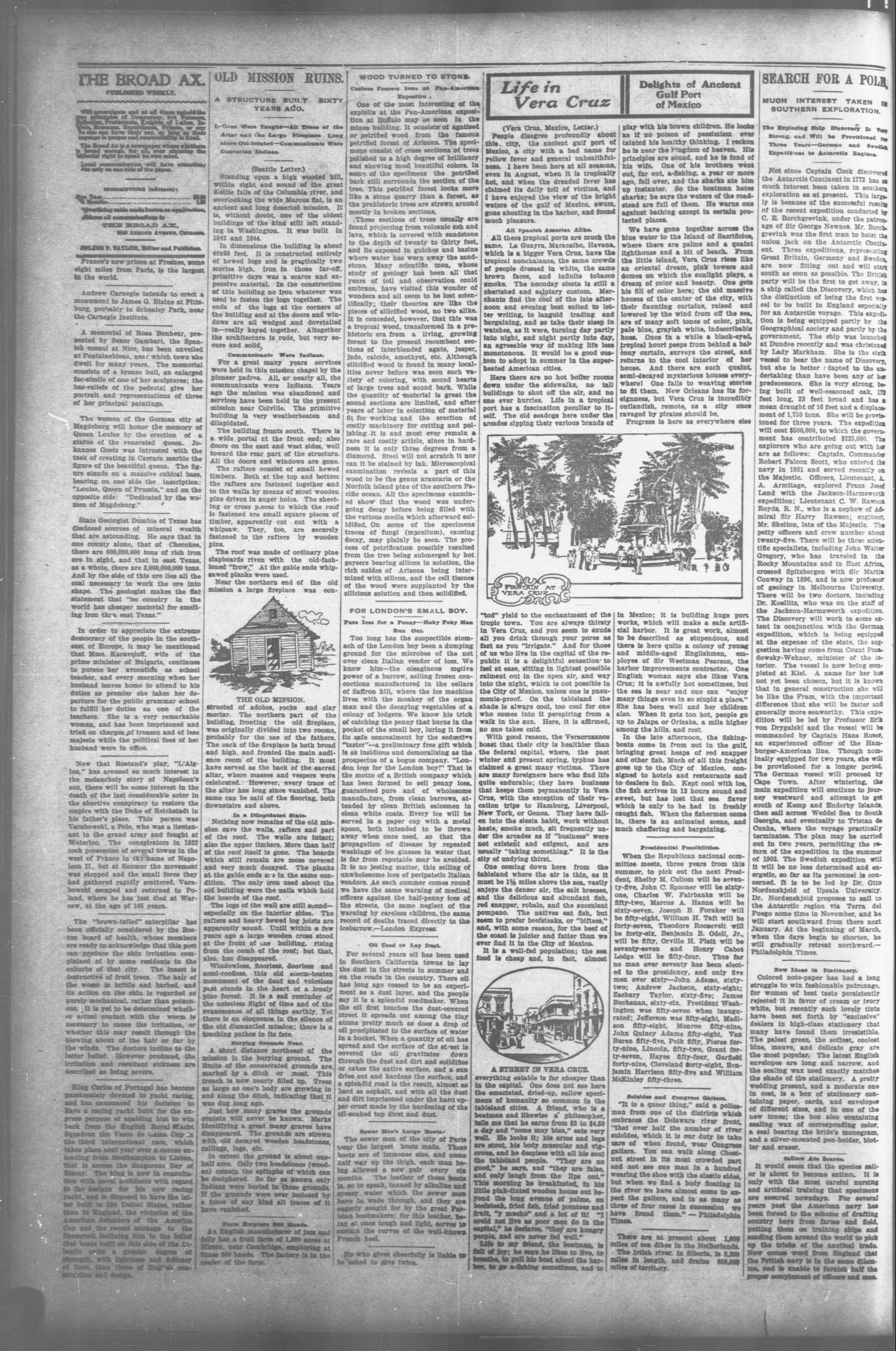
Standing upon a high wooded hill, within sight and sound of the great Kettle falls of the Columbia river, and overlooking the wide Marcus flat, is an ancient and long deserted mission. It is, without doubt, one of the oldest buildings of the kind still left standing in Washington. It was built in 1843 and 1844.
In dimensions the building is about 40x60 feet. It is constructed entirely of hewed logs and is practically two stories high. Iron in those far-off, primitive days was a scarce and expensive material. In the construction of this building no iron whatever was used to fasten the logs together. The ends of the logs at the corners of the building and at the doors and windows are all wedged and dovetailed in—really keyed together. Altogether the architecture is rude, but very secure and solid.
Communicants Were Indians.
For a great many years services were held in this mission chapel by the pioneer padres. All, or nearly all, the communicants were Indians. Years ago the mission was abandoned and services have been held in the present mission near Colville. The primitive building is very weatherbeaten and dilapidated. The building fronts south. There is a wide portal at the front end; also doors on the east and west sides, well toward the rear part of the structure. All the doors and windows are gone
The rafters consist of small hewed timbers. Both at the top and bottom the rafters are fastened together and to the walls by means of stout wooden pins driven in auger holes. The sheeting or cross pieces to which the roof is fastened are small square pieces of timber, apparently cut out with a whipsaw. They, too, are securely fastened to the rafters by wooden pins.
The roof was made of ordinary pine clapboards riven with the old-fashioned "frow." At the gable ends whipsawed planks were used.
Near the northern end of the old mission a large fireplace was con-
THE OLD MISSION
structed of adobes, rocks and clay mortar. The northern part of the building, fronting the old fireplace, was originally divided into two rooms, probably for the use of the fathers. The oak of the fireplace is both broad and high, and fronted the main audience room of the building. It must have served as the back of the sacred altar, where masses and vespers were celebrated. However, every trace of the altar has long since vanished. The same can be said of the flooring, both downstairs and above.
In a Dilapidated State-
Nothing now remains of the old mission save the walls, rafters and part of the roof. The walls are intact; also the upper timbers. More than half of the roof itself is gone. The boards which still remain are moss covered and very much decayed. The planks at the gable ends are in the same condition. The only iron used about the old building were the nails which held the boards of the roof.
The logs of the wall are still sound especially on the interior sides. The rafters and heavy hewed log joists are apparently sound. Until within a few years ago a large wooden cross stood at the front of the building, rising from the comb of the roof; but that, also, has disappeared.
Windowless, floorless, doorless and semi-roofless, this old storm-beaten monument of the dead and voiceless past stands in the heart of a lonely pine forest. It is a sad reminder of the noiseless flight of time and of the evanescence of all things earthly. Yet there is an eloquence in the silence of the old dismantled mission; there is a touching pathos in its fate.
Burying Grounds Near.
A short distance northeast of the mission is the burying ground. The limits of the consecrated grounds are marked by a ditch or moat. This trench is now nearly filled up. Trees as large as one's body are growing in and along the ditch, indicating that it was dug long ago.
Just how many graves the grounds contain will never be known. Marks identifying a great many graves have disappeared. The grounds are strewn with old decayed wooden headstones, railings, logs, etc.
In extent the ground is about onehalf acre. Only two headstones (wooden) remain the epitaphs of which can be deciphered. So far as known only Indians were buried in those grounds. If the grounds were ever inclosed by a fence of any kind all traces of it have vanished.
An English manufacturer of jam and jelly has a fruit farm of 1,000 acres at Histon, near Cambridge, employing at times 800 hands. The factory is in the center of the farm.
WOOD TURNED TO STONE.
One of the most interesting of the exploits at the Pan-American exposition at Buffalo may be seen in the mines building. It consists of agatized or petrified wood from the famous petrified forest of Arizona. The specimens consist of cross sections of trees polished to a high degree of brilliancy and showing most beautiful colors. In some of the specimens the petrified bark still surrounds the section of the tree. This petrified forest looks more like a stone quarry than a forest, as the prehistoric trees are strewn around mostly in broken sections.
These sections of trees usually are found projecting from volcanic ash and lava, which is covered with sandstone to the depth of twenty to thirty feet, and lie exposed in gulches and basins where water has worn away the sandstone. Many scientific men, whose study of geology has been all that years of toil and observation could embrace, have visited this wonder of wonders and all seem to be lost scientifically; their theories are like the pieces of silicified wood, no two alike. It is conceded, however, that this was a tropical wood, transformed in a prehistoric era from a living, growing forest to the present recumbent sections of interblended agate, jasper, jade, calcide, amethyst, etc. Although silicified wood is found in many localities never before was seen such variety of coloring, with sound hearts of large trees and sound bark. While the quantity of material is great the sound sections are limited, and after years of labor in selection of material fit for working and the erection of costly machinery for cutting and polishing it is and must ever remain a rare and costly article, since in hardness it is only three degrees from a diamond. Steel will not scratch it nor can it be stained by ink. Microscopical examination reveals a part of this wood to be the genus araucaria or the Norfolk island pine of the southern Pacific ocean. All the specimens examined show that the wood was undergoing decay before being filled with the various media which afterward solidified. On some of the specimens traces of fungi (mycelium), causing decay, may plainly be seen. The process of petrification possibly resulted from the tree being submerged by hot geysers bearing silicon in solution, the rich oxides of Arizona being intermixed with silicon, and the cell tissues of the wood were supplanted by the silicious solution and then solidified.
FOR LONDON'S SMALL BOY.
Pure Ices for a Penny—Hoky Poky Man Run Out
Too long has the suspectible stomach of the London boy been a dumping ground for the microbes of the not over clean Italian vendor of ices. We know him—the oleaginous motive power of a barrow, selling frozen concoctions manufactured in the cellars of Saffron hill, where the ice machine lives with the monkey of the organ man and the decaying vegetables of a colony of lodgers. We know his trick of catching the penny that burns in the pocket of the small boy, luring it from its safe concealment by the seductive "taster"—a preliminary free gift which is as insidious and demoralizing as the prospectus of a bogus company. "London ices for the London boy!" That is the motto of a British company which has been formed to sell penny ices, guaranteed pure and of wholesome manufacture, from clean barrows, attended by clean British salesmen in clean white coats. Every ice will be served in a paper cup with a metal spoon, both intended to be thrown away when once used, so that the propagation of disease by repeated washings of ice glasses in water that is far from reputable may be avoided. It is no jesting matter, this selling of unwholesome ices of peripatetic Italian vendors. As each summer comes round we have the same warning of medical officers against the half-penny ices of the streets, the same neglect of the warning by careless children, the same record of deaths traced directly to the icebarrow.—London Express.
Oil Used to Lay Dust.
For several years oil has been used in Southern California towns to lay the dust in the streets in summer and on the roads in the country. There oil has long ago ceased to be an experiment as a dust layer, and the people say it is a splendid roadmaker. When the oil first touches the dust-covered street it spreads out among the tiny atoms pretty much as does a drop of oil precipitated to the surface of water in a bucket. When a quantity of oil has spread and the surface of the street is covered the oil gravitates down through the dust and dirt and solidifies or cakes the entire surface, and a sun dries out and hardens the surface, and a splendid road is the result, almost as hard as asphalt, and with all the dust and dirt imprisoned under the harri upper crust made by the hardening of the oil-soaked top dirst and dust.
The sewer men of the city of Paris wear the largest boots made. These boots are of immense size, and come half way up the thigh, each man being allowed a new pair every six months. The leather of these boots is, so to speak, tanned by alkaline and greasy water which the sewer men have to wade through, and they are eagerly sought for by the great Parisian bootmakers; for this leather, being at once tough and light, serves to sustain the curves of the well-known French heal.
He who gives cheerfully is liable to be asked to give twice.
FOUNTAIN AT
VERA CRUZ
Life in Vera Cruz
(Vera Cruz, Mexico, Letter.) People disagree profoundly about this city, the ancient gulf port of Mexico, a city with a bad name for yellow fever and general unhealthfulness. I have been here at all seasons, even in August, when it is tropically hot, and when the dreaded fever has claimed its daily toll of victims, and I have enjoyed the view of the bright waters of the gulf of Mexico, swum, gone aboating in the harbor, and found much pleasure.
All Spanish America Alike.
All these tropical ports are much the same. La Guayra, Maracaibo, Havana, which is a bigger Vera Cruz, have the tropical nonchalance, the same crowds of people dressed in white, the same brown faces, and infinite tobacco smoke. The noonday siesta is still a cherished and salutary custom. Merchants find the cool of the late afternoon and evening best suited to letter writing, to languid trading and bargaining, and so take their sleep in watches, as it were, turning day partly into night, and night partly into day, an agreeable way of making life less monotonous. It would be a good custom to adopt in summer in the superheated American cities.
Here there are no hot boiler rooms down under the sidewalks, no tall buildings to shut off the air, and no one ever hurries. Life in a tropical port has a fascination peculiar to itself. The old seadogs here under the arcades sipping their various brands of
FOUNTAIN AT
VERA CRUZ
"tod" yield to the enchantment of the tropic town. You are always thirsty in Vera Cruz, and you seem to exude all you drink through your pores as fast as you "irrigate." And for those of us who live in the capital of the republic it is a delightful sensation to feel at ease, sitting in lightest possible raiment out in the open air, and way into the night, which is not possible in the City of Mexico, unless one is pneumonia-proof. On the tableland the shade is always cool, too cool for one who comes into it perspiring from a walk in the sun. Here, it is affirmed, no one takes cold.
With good reason, the Veracruzanos boast that their city is healthier than the federal capital, where, the past winter and present spring, typhus has claimed a great many victims. There are many foreigners here who find life quite endurable; they have business that keeps them permanently in Vera Cruz, with the exception of their vacation trips to Hamburg, Liverpool, New York, or Genoa. They have fallen into the siesta habit, work without haste; smoke much, sit frequently under the arcades as if "business" were not existent and exigent, and are usually "taking something." It is the city of undying thirst.
One coming down here from the tableland where the air is thin, as it must be $1 \frac{1}{2}$ miles above the sea, vastly enjoys the denser air, the salt breezes, and the delicious and abundant fish, red snapper, robalo, and the succulent pompano. The natives eat fish, but seem to prefer beefsteaks, or "biftecs," and, with some reason, for the beef of the coast is juicier and fatter than we ever find it in the City of Mexico. It is a well-fed population; the sea food is cheap and, in fact, almost
A STREET IN VERA CRUZ
everything eatable is far cheaper than in the capital. One does not see here the emaciated, dried-up, sallow specimens of humanity so common in the tableland cities. A friend, who is a boatman and likewise a philosopher, tells me that he earns from $3 to $4.50 a day and "come muy bien," eats very well. He looks it; his arms and legs are stout, his body muscular and vigorous, and he despaises with all his soul the tableland people. "They are no good," he says, and "they are false, and only laugh from the lips out." This morning he breakfasted, in his little pink-tinted wooden house out beyond the long avenue of palms, on beefsteak, fried fish, fried potatoes and fruit, "y mucho" and a lot of it! "I could not live as poor men do in the capital," he declares, "they are hungry people, and are never fed well."
Life to my friend, the boatman, is full of joy; he says he likes to live, to breathe, to pull his boat about the harbor, to go a-fishing sometimes, and to
play with his brown children. He looks as if no poison of pessimism ever tainted his healthy thinking. I reckon he is near the kingdom of heaven. His principles are sound, and he is fond of his wife. One of his brothers went out, far out, a-fishing, a year or more ago, fell over, and the sharks ate him up instanter. So the boatman hates sharks; he says the waters of the roadstead are full of them. He warns one against bathing except in certain protected places.
We have gone together across the blue water to the Island of Sacrificios, where there are palms and a quaint lighthouse and a bit of beach. From the little island, Vera Cruz rises like an oriental dream, pink towers and domes on which the sunlight plays, a dream of color and beauty. One gets his fill of color here; the old massive houses of the center of the city, with their flaunting curtains, raised and lowered by the wind from off the sea, are of many soft tones of color, pink, pale blue, grayish white, indescribable hues. Once in a while a black-eyed, tropical hourl peeps from behind a balcony curtain, surveys the street, and returns to the cool interior of her house. And there are such quaint, semi-decayed mysterious houses everywhere! One falls to weaving stories to fit them. New Orleans has its foreignness, but Vera Cruz is incredibly outlandish, remote, as a city once ravaged by pirates should be.
Progress is here as everywhere else
50
in Mexico; it is building huge port works, which will make a safe artificial harbor. It is great work, almost to be described as stupendous, and there is here quite a colony of young and middle-aged Englishmen, employes of Sir Weetman Pearson, the harbor improvements contractor. One English woman says she likes Vera Cruz; it is awfully hot sometimes, but the sea is near and one can "enjoy many things even in so stupid a place." She has been well and her children also. When it gets too hot, people go up to Jalapa or Orizaba, a mile higher among the hills, and rest.
In the late afternoon, the fishing-boats come in from out in the gulf, bringing great heaps of red snapper and other fish. Much of all this freight goes up to the City of Mexico, consigned to hotels and restaurants and to dealers in fish. Kept cool with ice, the fish arrives in 12 hours sound and sweet, but has lost that sea flavor which is only to be had in freshly caught fish. When the fishermen come in, there is an animated scene, and much chaffering and bargaining.
Presidential Possibilities.
When the Republican national committee meets, three years from this summer, to pick out the next President, Shelby M. Cullom will be seventy-five, John C. Spooner will be sixty-one, Charles W. Fairbanks will be fifty-two, Marcus A. Hanna will be sixty-seven, Joseph B. Foraker will be fifty-eight, William H. Taft will be forty-seven, Theodore Roosevelt will be forty-six, Benjamin B. Odell, Jr., will be fifty, Orville H. Platt will be seventy-seven and Henry Cabot Lodge will be fifty-four. Thus far no man over seventy has been elected to the presidency, and only five men over sixty—John Adams, sixty-two; Andrew Jackson, sixty-eight; Zachary Taylor, sixty-five; James Buchanan, sixty-six. President Washington was fifty-seven when inaugurated; Jefferson was fifty-eight, Madison fifty-eight, Monroe fifty-nine, John Quincy Adams fifty-eight, Van Buren fifty-five, Polk fifty, Pierce forty-nine, Lincoln fifty-two, Grant forty-seven, Hayes fifty-four, Garfield forty-nine, Cleveland forty-eight, Benjamin Harrison fifty-five and William McKinley fifty-three.
Splices and Connectors
"It is a queer thing," said a policeman from one of the districts which embraces the Delaware river front, "that over half the number of river suicides, which it is our duty to take care of when found, wear Congress gaiters. You can walk along Chestnut street in its most crowded part and not see one man in a hundred wearing the shoe with the elastic sides, but when we find a body floating in the river we have almost come to expect the gaiters, and in as many as three of four cases in succession we have found them." — Philadelphia Times.
There are at present about 1,000 miles of sea dikes in the Netherlands. The Irtish river, in Siberia, is 2,200 miles in length, and drains 600,000 miles of territory.
SEARCH FOR A POLR
MUCH INTEREST TAKEN IN SOUTHERN EXPLORATION.
The Exploring Ship Discovery Is Very Strong, and Will be Provisioned for Three Years—German and Swedish Expeditions to Antarctic Regions.
Not since Captain Cook discovered the Antarctic Continent in 1772 has so much interest been taken in southern exploration as at present. This largely is because of the successful results of the recent expedition conducted by C. E. Borchgrevink, under the patronage of Sir George Newnes. Mr. Borchgrevink was the first man to hoist the union jack on the Antarctic Continent. Three expeditions, representing Great Britain, Germany and Sweden, are now fitting out and will start south as soon as possible. The British party will be the first to get away, in a ship called the Discovery, which has the distinction of being the first vessel to be built in England especially for an Antarctic voyage. This expedition is being equipped partly by the Geographical society and partly by the government. The ship was launched at Dundee recently and was christened by Lady Markham. She is the sixth vessel to bear the name of Discovery, but she is better adapted to the undertaking than have been any of her predecessors. She is very strong, being built of well-seasoned oak, 172 feet long, 33 feet broad and has a mean draught of 16 feet and a displacement of 1,750 tons. She will be provisioned for three years. The expedition will cost $500,000, to which the government has contributed $225,000. The explorers who are going out with her are as follows: Captain, Commander Robert Falcon Scott, who entered the navy in 1881 and served recently on the Majestic. Officers, Lieutenant, A. A. Armitage, explored Franz Josef Land with the Jackson-Harmsworth expedition; Lieutenant C. W. Rawson Royds, R. N., who is a nephew of Admiral Sir Harry Rawson; engineer, Mr. Skelton, late of the Majestic. The petty officers and crew number about twenty-five. There will be three scientific specialists, including John Walter Gregory, who has traveled in the Rocky Mountains and in East Africa, crossed Spitzbergen with Sir Martin Conway in 1896, and is now professor of geology in Melbourne University. There will be two doctors, including Dr. Koellitz, who was on the staff of the Jackson-Harmsworth expedition. The Discovery will work to some extent in conjunction with the German expedition, which is being equipped at the expense of the state, the suggestion having come from Count Posedowsky-Wehner, minister of the interior. The vessel is now being completed at Kiel. A name for her has not yet been chosen, but it is known that in general construction she will be like the Fram, with the important difference that she will be faster and generally more seaworthy. This expedition will be led by Professor Erik von Drygalski and the vessel will be commanded by Captain Hans Ruser, an experienced officer of the Hamburger-American line. Though nominally equipped for two years, she will be provisioned for a longer period. The German vessel will proceed by Cape Town. After wintering, the main expedition will continue to journey westward and attempt to get south of Kemp and Enderby Islands, then sail across Weddel Sea to South Georgia, and eventually to Tristan de Cunha, where the voyage practically terminates. The plan may be carried out in two years, permitting the return of the expedition in the summer of 1903. The Swedish expedition will it will be no less determined and energetic, so far as its personnel is concerned. It is to be led by Dr. Otto Nordenskjold of Upsala University. Dr. Nordenskjold proposes to sail to the Antarctic region via Terra del Fuego some time in November, and he will start southward from there next January. At the beginning of March, when the days begin to shorten, he will gradually retreat northward.—Philadelphia Times.
New Ideas in Stationery
Colored note-paper has had a long struggle to win fashionable patronage, for women of best taste persistently rejected it in favor of cream or ivory white, but recently such lovely tints have been set forth by "exclusive" dealers in high-class stationery that many have found them irresistible. The palest green, the softest, coolest blue, mauve, and delicate gray are the most popular. The latest English envelopes are long and narrow, and the sealing wax used exactly matches the shade of the stationery. A pretty wedding present, and a moderate one in cost, is a box of stationery containing paper, cards, and envelopes of different sizes, and in one of the new tones; the box also containing sealing wax of corresponding color, a seal bearing the bride's monogram, and a silver-mounted pen-holder, blotter and eraser.
Sailors Are Sources.
It would seem that the species sailor is about to become extinct. It is only with the most careful nursing and artificial training that specimens are secured nowadays. For several years past the American navy has been forced to the scheme of drafting country boys from farms and field, putting them on training ships and sending them around the world to pick up the tricks of the nautical trade. Now comes word from England that the British navy is in the same dilemma, and is unable to furnish half the proper complement of officers and men.
```markdown
```
(Special Letter.)
The system of fighting hall clouds by means of specially constructed cannon has now been adopted with great success throughout the north of Italy, and is gradually becoming known and appreciated even in the less up-to-date provinces of the south. In the south of France also these cannon are coming into extensive use.
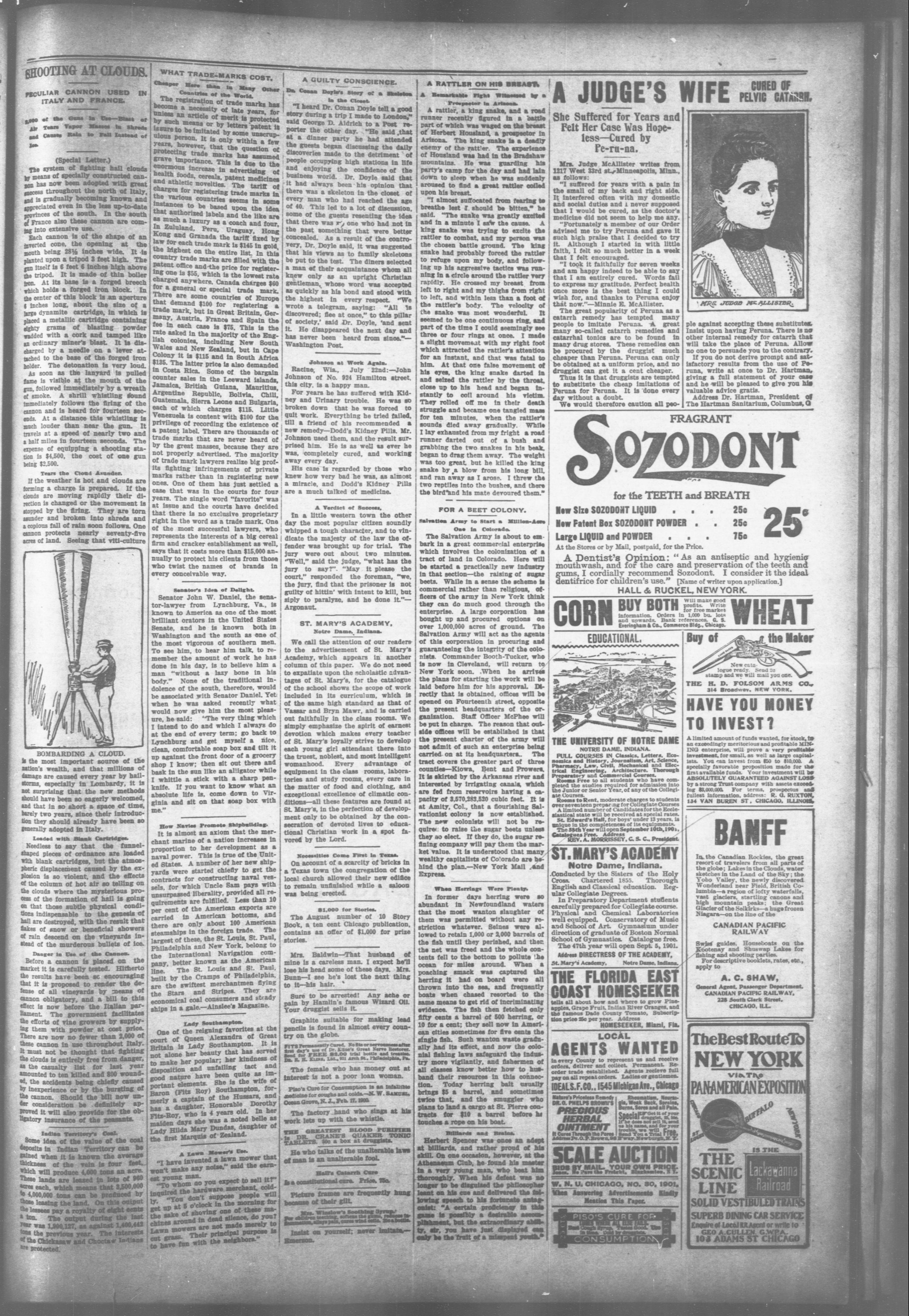
Each cannon is of the shape of an inverted cone, the opening at the mouth being 28½ inches wide. It is planted upon a tripod 3 feet high. The gun itself is 6 feet 6 inches high above the tripod. It is made of thin boiler iron. At its base is a forged breech which holds a forged iron block. In the center of this block is an aperture 6 inches long, about the size of a large dynamite cartridge, in which is placed a metallic cartridge containing eighty grams of blasting powder wadded with a cork and tamped like an ordinary miner's blast. It is discharged by a needle on a lever attached to the base of the forged iron holder. The detonation is very loud. As soon as the lanyard is pulled flame is visible at the mouth of the gun, followed immediately by a wreath of smoke. A shrill whistling sound immediately follows the firing of the cannon and is heard for fourteen seconds. At a distance this whistling is much louder than near the gun. It travels at a speed of nearly two and a half miles in fourteen seconds. The expense of equipping a shooting station is $4,500, the cost of one gun being $2,500.
If the weather is hot and clouds are forming a charge is prepared. If the clouds are moving rapidly their direction is changed or the movement is stopped by the firing. They are torn asunder and broken into shreds and a copious fall of rain soon follows. One cannon protects nearly seventy-five acres of land. Seeing that viti-culture
A man operating a tripod-mounted sound pressure meter.
BOMBARDING A CLOUD.
is the most important source of the nation's wealth, and that millions of damage are caused every year by hailstorms, especially in Lombardy, it is not surprising that the new methods should have been so eagerly welcomed, and that in so short a space of time, barely two years, since their introduction they should already have been so generally adopted in Italy.
Loaded with Blank Cartridges
Loaded with Blank Cartridges.
Needless to say that the funnel-shaped pieces of ordnance are loaded with blank cartridges, but the atmospheric displacement caused by the explosion is so violent, and the effects of the column of hot air so telling on the clouds where the mysterious process of the formation of hall is going on that those subtle physical conditions indispensable to the genesis of hall are destroyed, with the result that flakes of snow or beneficial showers of rain descend on the vineyards instead of the murderous bullets of ice.
Danger in Use of the Cannon. Before a cannon is placed on the market it is carefully tested. Hitherto the results have been so encouraging that it is proposed to render the defense of all vineyards by means of cannon obligatory, and a bill to this effect is now before the Italian parliament. The government facilitates the efforts of vine growers by supplying them with powder at cost price. There are now no fewer than 2,000 of these cannon in use throughout Italy. It must not be thought that fighting the clouds is entirely free from danger, as the casualty list for last year amounted to ten killed and 800 wounded, the accidents being chiefly caused by inexperience or by the bursting of the cannon. Should the bill now under consideration be definitely approved it will also provide for the obligatory insurance of the peasants.
Indian Territory's Coal. Some idea of the value of the coal deposits in Indian Territory can be gained when it is known the average thickness of the vein is four feet, which will produce 4,000 tons an acre. These lands are leased in lots of 960 acres each, which means that 3,500,000 to 4,000,000 tons can be produced by those leasing the land. On this output the lessees pay a royalty of eight cents a ton. The output during the last year was 1,900,127, as against 1,400,442 tons the previous year. The interests of the Chickasaw and Choctaw Indians are protected.
The registration of trade marks has become a necessity of late years, for unless an article of merit is protected by such means or by letters patent it is sure to be imitated by some unscrupulous person. It is only within a few years, however, that the question of protecting trade marks has assumed grave importance. This is due to the enormous increase in advertising of health foods, cereals, patent medicines and athletic novelties. The tariff of charges for registering trade marks in the various countries seems in some instances to be based upon the idea that authorized labels and the like are as much a luxury as a coach and four, In Zululand, Peru, Uraguay, Hong Kong and Granada the tariff fixed by law for each trade mark is $145 in gold, the highest on the entire list. In this country trade marks are filled with the patent office and the price for registering one is $55, which is the lowest rate charged anywhere. Canada charges $60 for a general or special trade mark. There are some countries of Europe that demand $100 for registering a trade mark, but in Great Britain, Germany, Austria, France and Spain the fee in each case is $75. This is the rate asked in the majority of the English colonies, including New South Wales and New Zealand, but in Cape Colony it is $115 and in South Africa $135. The latter price is also demanded in Costa Rica. Some of the bargain counter sales in the Leeward islands, Jamaica, British Guiana, Mauritius, Argentine Republic, Bolivia, Chill, Guatemala, Sierra Leone and Bulgaria, each of which charges $115. Little Venezuela is content with $100 for the privilege of recording the existence of a patent label. There are thousands of trade marks that are never heard of by the great masses, because they are not properly advertised. The majority of trade mark lawyers realize big profits fighting infringements of private marks rather than in registering new ones. One of them has just settled a case that was in the courts for four years. The single word "favorite" was at issue and the courts have decided that there is no exclusive proprietary right in the word as a trade mark. One of the most successful lawyers, who represents the interests of a big cereal firm and cracker establishment as well, says that it costs more than $15,000 annually to protect his clients from those who twist the names of brands in every conceivable way.
Senator's Idea of Delight
Senator John W. Daniel, the senator-lawyer from Lynchburg, Va., is known to America as one of the most brilliant orators in the United States Senate, and he is known both in Washington and the south as one of the most vigorous of southern men. To see him, to hear him talk, to remember the amount of work he has done in his day, is to believe him a man "without a lazy bone in his body." None of the traditional indolence of the south, therefore, would be associated with Senator Daniel. Yet when he was asked recently what would now give him the most pleasure, he said: "The very thing which I intend to do and which I always do at the end of every term; go back to Lynchburg and get myself a nice, clean, comfortable soap box and tilt it up against the front door of a grocery shop I know; then sit out there and bask in the sun like an alligator while I whittle a stick with a sharp penknife. If you want to know what an absolute life is, come down to Virginia and sit on that soap box with me."
---
How Navies Promote Shipbuilding. It is almost an axiom that the merchant marine of a nation increases in proportion to her development as a naval power. This is true of the United States. A number of her new shipyards were started chiefly to get the contracts for constructing naval vessels, for which Uncle Sam pays with unsurpassed liberality, provided all requirements are fulfilled. Less than 10 per cent of the American exports are carried in American bottoms, and there are only about 100 American steamships in the foreign trade. The largest of these, the St. Louis, St. Paul, Philadelphia and New York, belong to the International Navigation company, better known as the American line. The St. Louis and St. Paul, built by the Cramps of Philadelphia, are the swiftest merchantmen flying the Stars and Stripes. They are economical coal consumers and steady ships in a gale.—Ainslee's Magazine.
Lady Southampton.
One of the reigning favorites at the court of Queen Alexandra of Great Britain is Lady Southampton. It is not alone her beauty that has served to make her popular; her kindness of disposition and unfailing tact and good nature have been quite as important elements. She is the wife of Baron (Fitz Roy) Southampton, formerly a captain of the Hussars, and has a daughter, Honorable Dorothy Fitz-Roy, who is 4 years old. In her malden days she was a noted belle as Lady Hilda Mary Dundas, daughter of the first Marquis of Zealand.
A Lawn Mower's Use.
"I have invented a lawn mower that won't make any noise," said the earn- ing young man.
"To whom do you expect to sell it?" inquired the hardware merchant, coldly. "You don't suppose people will get up at 5 o'clock in the morning for the sake of shoving one of these machines around in dead silence, do you? Lawn mowers are not made merely to cut grass. Their principal purpose is to have fun with the neighbors."
"I heard Dr. Conan Doyle tell a good story during a trip I made to London," said George D. Aldrich to a Post reporter the other day. "He said that at a dinner party he had attended the guests began discussing the daily discoveries made to the detriment of people occupying high stations in life and enjoying the confidence of the business world. Dr. Doyle said that it had always been his opinion that there was a skeleton in the closet of every man who had reached the age of 40. This led to a lot of discussion, some of the guests resenting the idea that there was one who had not in the past something that were better concealed. As a result of the controversy, Dr. Doyle said, it was suggested that his views as to family skeletons be put to the test. The diners selected a man of their acquaintance whom all knew only as an upright Christian gentleman, whose word was accepted as quickly as his bond and stood with the highest in every respect. "We wrote a telegram, saying: "All is discovered; flee at once," to this pillar of society,' said Dr. Doyle, 'and sent it. He disappeared the next day and has never been heard from since."—Washington Post.
Johnson at Work Again
Racine, Wis., July 22nd:—John Johnson of No. 924 Hamilton street, this city, is a happy man.
For years he has suffered with Kidney and Urinary trouble. He was so broken down that he was forced to quit work. Everything he tried failed, till a friend of his recommended a new remedy—Dodd's Kidney Pills. Mr. Johnson used them, and the result surprised him. He is as well as ever he was, completely cured, and working away every day.
His case is regarded by those who knew how very bad he was, as almost a miracle, and Dodd's Kidney Pills are a much talked of medicine.
A Verdict of Success.
In a little western town the other day the most popular citizen soundly whipped a tough character, and to vindicate the majesty of the law the offender was brought up for trial. The jury were out about two minutes. "Well," said the judge, "what has the jury to say?" "May it please the court," responded the foreman, "we, the jury, find that the prisoner is not guilty of hittin' with intent to kill, but siply to paralyze, and he done it."—Argonaut.
ST. MARY'S ACADEMY, Notre Dame, Indiana.
We call the attention of our readers to the advertisement of St. Mary's Academy, which appears in another column of this paper. We do not need to expatiate upon the scholastic advantages of St. Mary's, for the catalogue of the school shows the scope of work included in its curriculum, which is of the same high standard as that of Vassar and Bryn Mawr, and is carried out faithfully in the class rooms. We simply emphasize the spirit of earnest devotion which makes every teacher of St. Mary's loyally strive to develop each young girl attendant there into the truest, noblest, and most intelligent womanhood. Every advantage of equipment in the class rooms, laboratories and study rooms, every care in the matter of food and clothing, and exceptional excellence of climatic conditions—all these features are found at St. Mary's, in the perfection of development only to be obtained by the consecration of devoted lives to educational Christian work in a spot favored by the Lord.
On account of a scarcity of bricks in a Texas town the congregation of the local church allowed their new edifice to remain unfinished while a saloon was being erected.
$1,000 for Stories
The August number of 10 Story Book, a ten cent Chicago publication, contains an offer of $1,000 for prize stories.
Mrs. Baldwin—That husband of mine is a careless man. I expect he'll lose his head some of these days. Mrs. Bunn—I see he's lost the next thing to it—his hair.
Sure to be arrested! Any ache or pain by Hamlin's famous Wizard. Oll. Your druggist sells it.
Graphite suitable for making lead pencils is found in almost every country on the globe.
A rattler, a king snake, and a road runner recently figured in a battle part of which was waged on the breast of Herbert Housland, a prospector in Arizona. The king snake is a deadly enemy of the rattler. The experience of Housland was had in the Bradshaw mountains. He was guarding his party's camp for the day and had lain down to sleep when he was suddenly arcused to find a great rattler coiled upon his breast.
"I almost suffocated from fearing to breathe lest I should be bitten," he said. "The snake was greatly excited and in a minute I saw the cause. A king snake was trying to excite the rattler to combat, and my person was the chosen battle ground. The king snake had probably forced the rattler to refuge upon my body, and following up his aggressive tactics was running in a circle around the rattler very rapidly. He crossed my breast from left to right and my thighs from right to left, and within less than a foot of the rattler's body. The velocity of the snake was most wonderful. It seemed to be one continuous ring, and part of the time I could seemingly see three or four rings at once. I made a slight movement with my right foot which attracted the rattler's attention for an instant, and that was fatal to him. At that one false movement of his eyes, the king snake darted in and seized the rattler by the throat, close up to his head and began instantly to coll around his victim. They rolled off me in their death struggle and became one tangled mass for ten minutes, when the rattler's sounds died away gradually. While I lay exhausted from my fright a road runner darted out of a bush and grabbing the two snakes in his beak, began to drag them away. The weight was too great, but he killed the king snake by a blow from his long bill, and ran away as I arose. I threw the two reptiles into the bushes, and there the bird and his mate devoured them."
FOR A BEET COLONY.
Salvation Army to Start a Million-Acre
One in Colorado
The Salvation Army is about to embark in a great commercial enterprise which involves the colonization of a tract of land in Colorado. Here will be started a practically new industry in that section—the raising of sugar beets. While in a sense the scheme is commercial rather than religious, officers of the army in New York think they can do much good through the enterprise. A large corporation has bought up and procured options on over 1,000,000 acres of ground. The Salvation Army will act as the agents of this corporation in procuring and guaranteeing the integrity of the colonists. Commander Booth-Tucker, who is now in Cleveland, will return to New York soon. When he arrives the plans for starting the work will be laid before him for his approval. Directly that is obtained, offices will be opened on Fourteenth street, opposite the present headquarters of the organization. Staff Officer McPhee will be put in charge. The reason that outside offices will be established is that the present charter of the army will not admit of such an enterprise being carried on at its headquarters. The tract covers the greater part of three counties—Kiowa, Bent and Prowers. It is skirted by the Arkansas river and interested by irrigating canals, which are fed from reservoirs having a capacity of 3,570,283,520 cubic feet. It is at Amity, Col., that a flourishing Salvationist colony is now established. The new colonists will not be required to raise the sugar beets unless they so elect. If they do, the sugar refining company will pay them the market value. It is understood that many wealthy capitalists of Colorado are behind the plan.—New York Mall and Express.
When Herrings Were Pientry.
In former days herring were so abundant in Newfoundland waters that the most wanton slaughter of them was permitted without any restriction whatever. Seines were allowed to retain 1,000 or 2,000 barrels of the fish until they perished, and then the net was freed and the whole contents fell to the bottom to pollute the ocean for miles around. When a poaching smack was captured the herring it had on board were all thrown into the sea, and frequently boats when chased resorted to the same means to get rid of incriminating evidence. The fish then fetched only fifty cents a barrel of 500 herring, or 10 for a cent; they sell now in American cities sometimes for five cents the single fish. Such wanton waste gradually had its effect, and now the colonial fishing laws safeguard the industry more vigilantly, and fishermen of all classes know better how to husband their resources in this connection. Today herring bait usually brings $5 a barrel, and sometimes twice that, and the smuggler who plans to land a cargo at St. Pierre contracts for $10 a barrel before he touches a rope on his boat.
Herbert Spencer was once an adept at billiards, and rather proud of his skill. On one occasion, however, at the Athenaeum Club, he found his master in a very young man, who beat him thoroughly. When his defeat was no longer to be disguised the philosopher leant on his cue and delivered the following speech to his fortunate antagonist: "A certain proficiency in this game is possibly a desirable accomplishment, but the extraordinary ability, air, you have just displayed can only be the fruit of a misspent youth."
A JUDGE'S WIFE CURED OF PELVIC CATARRH.
Mrs. Judge McAllister writes from 1217 West 33rd st., Minneapolis, Minn., as follows:
"I suffered for years with a pain in the small of my back and right side. It interfered often with my domestic and social duties and I never supposed that I would be cured, as the doctor's medicine did not seem to help me any.
"Fortunately a member of our Order advised me to try Peruna and gave it such high praise that I decided to try it. Although I started in with little faith, I felt so much better in a week that I felt encouraged."
"I took it faithfully for seven weeks and am happy indeed to be able to say that I am entirely cured. Words fail to express my gratitude. Perfect health once more is the best thing I could wish for, and thanks to Peruna enjoy that now."—Minnie E. McAllister.
The great popularity of Peruna as a catarrh remedy has tempted many people to imitate Peruna. A great many so-called catarrh remedies and catarrhal tonics are to be found in many drug stores. These remedies can be procured by the druggist much cheaper than Peruna. Peruna can only be obtained at a uniform price, and no druggist can get it a cent cheaper.
Thus it is that druggists are tempted to substitute the cheap imitations of Peruna for Peruna. It is done every day without a doubt. We would therefore caution all peo-
Sozo
for the TEETH
New Size SOZODONT LIQUID
New Patent Box SOZODONT POWDER
Large LIQUID and POWDER
At the Stores or by Mail, postpaid, for th
A Dentist's Opinion: "mouthwash, and for the care a
gums, I cordially recommend S dentifrice for children's use."
HALL & RUCK
FRAGRANT
SOZODONT
New Size SOZODONT LIQUID 25c New Patent Box SOZODONT POWDER 25c Large LIQUID and POWDER 75c At the Stores or by Mail, postpaid, for the Price. A Dentist's Opinion: "As an antiseptic and hygienic mouthwash, and for the care and preservation of the teeth and gums, I cordially recommend Sozodont. I consider it the ideal dentifrice for children's use." [Name of writer upon application.]
BUY BOTH Will make good profits. Write for free market information. Orders in 1,000 bu. lots and upwards. Bank references. G. S. Everingham & Co., Commerce Blvd., Chicago.
EDUCATIONAL.
THE UNIVERSITY OF NOTRE DAME NOTRE DAME, INDIANA.
PULL COURSES IN Classics, Letters, Economics and History, Journalism, Art, Science, Pharmacy, Law, Civil, Mechanical and Electrical Engineering, Architecture, Thorough Preparatory and Commercial Courses.
Rooms Free to all students who have completed the studies required for admission into the Junior or Senior Year, of any of the Collegiate Courses.
Rooms to Rent, moderate charges to students over seventeen preparing for Collegiate Courses
A limited number of Candidates for the Ecoleinstal state will be received at special rates.
St. Edward's Hall, for boys' under 13 years, is unique in the completeness of its equipments.
The 58th Year will open September 10th, 1901.
Catalogues Free. Address
REV. A. MORRISSEY, C. S. C., President.
ST. MARY'S ACADEMY
Notre Dame. Indiana.
Conducted by the Sisters of the Holy Cross. Chartered 1855. Thorough English and Classical education. Regular Collegiate Degrees.
In Preparatory Department students carefully prepared for Collegiate course. Physical and Chemical Laboratories well equipped. Conservatory of Music and School of Art. Gymnasium under direction of graduate of Boston Normal School of Gymnastics. Catalogue free. The 47th year will open Sept. 5, 1901.
Address DIRECTRESS OF THE ACADEMY,
St. Mary's Academy, Notre Dame, Indiana.
THE FLORIDA EAST COAST HOMESEEKER tells all about how and where to grow Pine-apples, Grape Fruit, Indian River Oranges, and the famous Dade County Tomato, Subscription price 25c per year. Address
HOMESEEKER, Miami, Fla.
LOCAL AGENTS WANTED
in every County to represent us and receive orders, deliver and collect. Permanent. Re-
Pe-ru-na.
MRS. JUDGD MRS. ALLISTER
ple against accepting these substitutes. Insist upon having Peruna. There is no other internal remedy for catarrh that will take the place of Peruna. Allow no one to persuade you to the contrary. If you do not derive prompt and satisfactory results from the use of Peruna, write at once to Dr. Hartman, giving a full statement of your case and he will be pleased to give you his valuable advice gratis.
Address Dr. Hartman, President of The Hartman Sanitarium, Columbus, O
RAGRANT
ODONT
and BREATH
. . 25c
R . . 25c
. . 75c
25¢
Price.
As an antiseptic and hygienic
and preservation of the teeth and
ozodont. I consider it the ideal
[name of writer upon application.]
EL, NEW YORK.
Buy of the Maker
New catalog ready. Send 20 stamp and we will mail you one.
THE H. D. FOLSOM ARMS CO.,
314 Broadway. NEW YORK.
HAVE YOU MONEY
TO INVEST?
A limited amount of funds wanted, for stock, is an exceedingly meritorious and profitable MINING enterprise, will prove a very profitable investment, for small, as well as large capitalists. You can invest from $50 to $10,000. A specially favorable proposition made for the first available funds. Your investment will be ABSOLUTELY GUARANTEED AGAINST LOSS by a strong Trust company with assets exceeding $8,000,000. For terms, prospectus and fullest information, address: R. G. RUXTON, 134 VAN BUREN ST, CHICAGO, ILLINOIS.
BANFF
In the Canadian Rockies, the great resort of travelers from all parts of the globe; Lakes in the Clouds, water sketches in the Land of the Sky; the Yoho Valley, the newly discovered Wonderland near Field, British Columbia—a region of lofty waterfalls, vast glaciers, startling canons and high mountain peaks; the Great Glacier of the Selkirks—a huge frozen Niagara—on the line of the
Swiss guides. Houseboats on the Kootenay and Shuswap Lakes for fishing and shooting parties. For descriptive booklets, rates, etc., apply to
A. C. SHAW,
General Agent, Passenger Department,
CANADIAN PACIFIC RAILWAY,
228 South Clark Street,
CHICAGO, ILL.
TheBestRouteTo
NEW YORK
VIA THE
PA AMERICAN EXPOSITION
CHICAGO
ST LOUIS
BUFFALO
NEW YORK
IS THE
THE
SCENIC
LINE
Lackawanna
Railroad
SOLID VESTIBULED TRAINS
SUPERB DINING CAR SERVICE
Enquire of Local RR Agent or write to
GEO A. CULLEN. G.W.P.A.
103 ADAMS ST CHICAGO
```markdown
```
CANADIAN PACIFIC RAILWAY
A Pair of Postmen.
BY KATE M. CLEARY. (Copyright, 1931, by Daily Story Pub. Co.) It was a knock for Kennedy. He had almost completed sorting out the letters to be delivered along his beat when he came on that one addressed to Nora Dillon. He recognized the chirography instantly. He had seen it many times. The letter had been written by Bertram Ryder. Ryder was not only a fellow-postman, but his warmest and most intimate friend. Why, he had not known that Ryder was even acquainted with Nora—the girl whom he had come to love with a passion quite incommensurate with his pay and his prospects.
Not that this latter fact would matter if they really loved each other. So far Kennedy had not dared to put his affection to the test of a declaration. But he had been screwing his courage up to that point for weeks, and—although he was far from being a conceited fello- he had felt that he was being encouraged by the pretty daughter of the prosperous contractor on Elm avenue.
If only she would come to the door for the mail today! He would watch her—would notice her acceptance of the envelope addressed by Ryder. The thought spurred him to activity. He hastened through with his work as rapidly as possible, and went trudging off on his afternoon delivery, his well-packed bag slung over his shoulder.
The glare of early summer lay hot and yellow on the city streets. Crowds of well-dressed people were coming and going. The laughter of children mingled with the silver dripping of a fountain in a little green square. But Jim Kennedy could only think of one opening door, which framed a straight, young, girlish form in a gay little gown. That was one of the things which had first attracted him to Nora Dillon—the fact that her pretty, bright garments, pink and heliotrope, and azure seemed somehow to suit well her swift, sunny smile and laughing blue eyes.
Kennedy's bag was considerably lighter by the time he turned into Him street. His heart was beating hard when he reached the comfortable home of the Dillons. He rang the bell, and stood waiting, the letter in his hand. He could hear the light, familiar step he had learned to know and listen for coming along the hall within, and suddenly the door had swung back, and she was standing there, fair and radiant in her crisp white gown, her slim, erect young figure clearly cut as a cameo against the soft green gloom of the interior.
"Good afternoon, Miss Nora!" He snatched off his cap, and stood looking down upon her. "A letter for you this time."
"For me?" she laughed, and held out her hand. "I don't get many letters."
Jim did not offer to go at once. Instead he stood in the same attitude, his keen grey eyes striving to read her thoughts—her every motion. He was conscious of a sharp tightening in his throat at sight of the blush that wavered instantly over her soft cheeks at sight of the superscription.
"Oh," she said in a low voice—her tone, surprised but comprehensive. "Oh." she put the missive hastily in her pocket. He fancied some embargassment lingered in her blue eyes—ordinarily frank as a child's as she—glanced up at him.
"You look dreadfully warm!" she exclaimed. "It is a hot day, isn't it? Won't you wait a moment until I bring you a glass of lemonade? Mamma and I were just drinking some." She vanished before he could refuse, and was quickly back, a goblet containing an ice-tinkling beverage in her hand.
"Thank you," he said, and drank it as well as he could for that dreadful constriction in his throat. Then he had returned the glass, bowed, and was gone. Ah, with what a heavy heart,
PRIMAL
"A Letter for You." with what leaden footsteps was the rest of his route covered that radiant summer day! How could he know that a disappointed little face with puckered brows, was gazing after him with eyes grown suddenly misty and mystified. He had not acted like himself at all! What was the matter with him? She had thought—she had fancied—
There was no mail for the Dillon household the next day—nor still the next. So Jim had no excuse for stopping. But on the evening of the second day he found himself driven to Elm street. At least he could look at the house which held her. He might even muster up courage to ask her to go to the contemplated picnic at Garfield Park with him. He had been made welcome in their home. More than once Mrs. Dillon had permitted her
daughter to go out with him. He had every right to invite her. Just because Bertram Ryder had written her a letter, and that she had ccolored confusedly at sight of it, was no reason why she would consider his attentions welcome.
A soft, warm, dark, rainy night it was. Kennedy, about to cross over to the lighted home of the Dillions, suddenly stopped—drew back into the shadow of a tree. For the door opposite had opened, and two people were distinctly revealed in the lighted vestibule. He recognized Nora. And that man with spare form, and slightly stooping shoulders—of course that was Bertram Ryder.
He could hear the clear voice of the girl speaking with cordiality. "Don't you worry, Bert!" she was saying. "You can trust me to arrange affairs so that no one will suspect. What's that? I'm an angel? Oh, no, I'm not." There was a ripple of laughter, "Good-bye. Till Tuesday, then!"
Jim Kennedy turned on his heel, and went home, sick at heart. It was the little maid of all work who opened the door to Jim when next day duty forced him to ring the door bell of the Dillon domicile. And on the day following he found himself waiting there rebellious and miserable, with another letter from
A
Bertram Ryder in his hand. This time, although it was Nora who eagerly opened the door, and stood as if waiting for him to speak, he only lifted his cap formally, handed her the letter, and turned away without a word. And as he strode angrily off, his smouldering jealousy was fanned to fresh flame by the sight of Bertram himself coming jauntily up the street. It was evident that he had received leave of absence, for he was in his best civilian attire, and looked particularly sanguine and joyous.
"Hallo, old fellow!" he cried, and would have stopped Kennedy, but that individual jerked free from the friendly hand laid on his arm, and strode on. Ryder looked after him in dismay, but the next instant he had caught sight of Nora. He sprang up the steps.
"There was no need to send that last letter, but I was afraid they would not let me off. The old man was very kind though, when I explained the situation. Heavens, Nora, what's the matter? You're white as a ghost."
She sank down, and burst into tears. By the time he had succeeded in wresting from the girl the story of her sorrow, he began to divine the reason of Jim Kennedy's sudden coolness towards himself. "I'll fix that," he assured her. "Just as soon as this little affair is over—before we even leave town, I'll fix that!" He was as good as his word. That very evening he hunted up Jim Kennedy sitting moody and dejected in his lodging house.
"Look here, Jim," he said, "things have got into a snarl, and I'm here to untwist them. I was married this afternoon—"
"Married," echoed Jim. He started to his feet as though stung. "Married!"
"Yes, to Cleely Barstow, as nice a girl as ever drew breath. We've been as good as engaged for a year, but her father objected to the wedding as she has some money in her own right he wanted to hold on to. My cousin, Nora Dillon, has helped us out by giving Cleely my letters which went under cover to Nora—at least the few last ones I had to send that way, as the old people were becoming suspicious. By the way, Nora is feeling pretty badly on account of your manner to her lately. Suppose you go up to the house and explain—eh?"
Jim grabbed his friend's hand, and wrung it energetically.
"I will—right off. Congratulations, Bert! Good luck to you—and my best wishes to Mrs. Ryder!"
Then a beaming-faced young man hurriedly furbished up his toilet, and made his way to Elm street at a pace which would undoubtedly have won him first prize in a sprinting contest!
Painty Prices for Speedy Motors.
King Edward's motor is not by any means the most costly in the world, any more than his yacht is the most luxurious of floating palaces. It is nothing for a rabid automobileist like young Vanderblit to pay $5,000 for a machine. More than a score of horeless carriages could be described that have cost their owners considerably over that sum. Mr. Charon, the famous French motorist, has a vehicle that cost $7,500. In the race from Paris to Bordeaux he drove it at the rate of 800 miles a day, equaling the speed of our fastest express trains.
RENFROE BROS.
Dealers in
WOOD, COAL, FEED AND ICE.
137 West Forty-Seventh St.
OHIOAGO.
DR. H. C. FAULKNER,
Physician and Surgeon,
OFFICE: 6258 HALSTED STREET,
CHICAGO.
Office Hours: Phone #18 Went
10 to 12 a. m., 2 to 4 p. m
6 to 7:30 p. m.
TELPHONE EXPRESS 422
PROF. W. E. DORSEY,
1958 La Salle St.
Leader and Manager
K. P. Military Band and Orchestra
Music Furnished for Balls and Receptions. Prices Reasonable. Call and see me.
DR. L. M. FENWICK.
(A. M., M. D., E. M.)
PHYSICIAN AND SURGEON.
6212 S. Halsted St., 2nd Floor.
HOURS: 8 to 10 a. m., 12 to 2 p. m., 7 to 8 p. m.
Sunday, by appointment.
Tel. Wentworth 627. CHICAGO, ILL.
Estimates and Specif-
cations Furnished ... Prompt Attention
Given to Jobbing
C. J. BOYD,
Practical Plumber and Gas-fitter
Steam and Hot Water Heating,
Iron and Tile Drainage . . .
Telephone Yards 814.
709 WEST 47TH STREET.
DR. JOSEPH JEFFREY,
Physician and Surgeon,
4898 Dearborn Street. CHICAGO
Hours: 6-10 a. m., 2-4, 6-8 p. m.
JAMES T. CRAIG, Coal, Wood & Ice
General Expressing and Moving
5001 ARMOUR AVE. CHICAGO, ILL
GOT EVEN WITH JOKER. Paris Man Gets Thorough Thrashing for Joke of Years Before.
The world always laughs when the practical joker is "come up with," even if many years have elapsed since the joker had his inning. It was in 1890 or thereabouts that a Paris drummer boarded a train in Bordeaux for home. He had made a good sale in Bordeaux and was feeling ripe for anything. It occurred to him what a good joke it would be to lean out of the window of the car and slap some one's face as the train rolled out. He did the act, pulled his head in and chuckled all the way to Paris as he pictured what the victim of his joke was saying to himself and to others. Years passed and the drummer prospered. He went into business for himself, and consequently grew staid and sober. A little while ago as he was walking along one of the boulevards in Paris a man stepped up to him and asked him if he had ever lived in Bordeaux. The staid and sober business man said he never had, but when he used to be a commercial traveler he frequently had been in the town. Whereupon the stranger recalled the face-slapping episode and said he was it, and begged permission to return the compliment, which he proceeded to do vigorously. The staid and sober business man regained his lost youth marvelously quick, and it was a lively scrimmage when the police stepped in and ran both men off to the station house. There upon reflection the business man refused to enter a complaint against the man with a memory, and decided to call the affair even.
If your nearest druggest does not have the Original Ozonized Ox-Marrow he can get it for you from any wholesale druggist in the city. It straightens kinky hair. Warranted harmless. Only 50 cents a bottle. The Ozonized Ox-Marrow Co., 76 Wabash Ave., Chicago, Ill.
Read and subscribe for The Broad Ax, the only newspaper in Chicago which "hews to the Lions."
```markdown
```
HEAVY MACHINERY. Smoke Stacks, Cupolas and Monuments Erected. Hoisting and Placing of all kinds of Beams and Girders for architectural work. Office, 31 South Canal St.. Chicago TELEPHONE MAIN 4229
OVER $41,000,000 PAID IN LOSSES.
Insurance for the Protection of the family at actual cost
E. P. BARRY, M'g'r. JULIUS F. TAYLOR, Special Agt.
410 Roanoke Bldg., 145 La Salle St. 5040 Armor Ave.
Citizens Brewing
COMPANY
ARCHER AVE. AND MAIN STREET.
CHICAGO
Telephone Canal 373
POOL AND BILLIARDS
BRAXTON'S ....PLACE
SAMPLE ROOM
Fine Wines and Liquors
Imported and Domestic Cigars
260 West Lake St.
JIM GEORGE
IMPORTED AND DOMESTIG WINES, LIQUORS AND CIGARS 8462 SOUTH HALSTED STREET,
Thomas F. Scully,
Attorney at Law,
79 Clark Street, . . . CHICAGO.
Room 14.
JOSEPH A. McINERNEY
LAWYER
SUITE 706—708
CHICAGO OPERA HOUSE CHICAGO
Beauregard F. Moseley,
LAWYER.
Practice in all Courts.
Main Office 6256 Halsted St,
Down Town Office 260 S. Clark St., Room 421
Hours from 12 to 2 P. M.
Phone: 2538 Harrison.
Telephone Yorks 707 Residence, 110 Garfield Dd,
JOHN FITZGERALD
JUSTICE OF THE PEACE
4787 S. HALSTED STREET,
CHICAGO
ALBERT B. GEORGE LAWYER.
423 Ashland Block, Chicago.
Tel. M. 2025.
EDWARD H. WRIGHT
LAWYER
Suite 421, 260 S. Clark St.
Telephone, Harrison 2523. CHICAGO.
GEO. W. W. LYTLE,
Attorney and Counselor at Law
Telephone Central 3558.
Quite 60, Grand Opera House,
Notary Public
87 & 89 S. Clark St.
Chicago.
Lawrence M. Ennis,
Advocate and Counselor at Law,
Suite 728 Opera House Block.
S. W. Corner Clark and Washington Sts.
TELEPHONE MAIN 1782.
G. E. EVANS.
Dealer in All Kinds of
HARD AND SOFT COAL,
Wood, Charcoal, Coke and Ice, Expressing and Moving a Specialty. 332 29th St. Chicago, Ill.
Aug. 14th, Gardner
SAY PEOPLE ATTEN
It Will Be Old Folks
BASKET PIC
at
GARDNER'S PARK, WEST PUL
WEDNESDAY, AUG. 14th
Benefit Home for Aged and
Colored People
Armant's Orchestra. . . Admiss
Twenty Trains to Park, via Illinois Central Railroad. Stre
Calumet Electric Lines at 63rd and So. Park and t
PRIZES TO THE WIN
Bicycle Race, Sack Race and Shoe
Base Ball Game at 3:3
COMMITTEE:
Aug. 14th, Gardner's Park SAY PEOPLE ATTENTION! It Will Be Old Folks Home Day BASKET PIC-NIC
GARDNER'S PARK, WEST PULLMAN, WEDNESDAY, AUG. 14th, 1901. Benefit Home for Aged and Infirm Colored People.
Twenty Trains to Park, via Illinois Central Railroad. Street and Elevated Cars to Calumet Electric Lines at 63rd and So. Park and thence to Park.
Bicycle Race, Sack Race and Shoe String Race. Base Ball Game at 3:30.
Mrs. Jerry P. Stewart, Mrs. R'chard Jefferson,
Hon. John G. Jones, Mrs. Kate Allen,
James W. Camp, Samuel R. Johnson,
Mrs. Gabriella Smith, Mrs. Eva Phelps,
Frinchie R. Bell, J. H. Porter.
Bernard F. Rogers
B. F. ROGERS & CO
INSURANCE
TELEPHONE MAIN 3292
154
B. F. ROGERS & COMPANY INSURANCE
...The Mutual Reserve Fund Life or New York...
ET, CHICAGO.
JOSEPH STRAUSS
NORTHERN CHANGE STABLE.
General Business Horses
on Hand
TABLE.
SALE AND EXCHANGE STABLE.
Driving, Draft and General Business Horses Always on Hand
OHICAGO, III.
HAID
CURLY HAIR MADE STRAIGHT
BY THE
TAKEN FROM LIFE
BEFORE AND AFTER TREATMENT.
WONDERFUL DISCOVERY
ORIGINAL
OZONIZED OX MARROW
[COPYRIGHTED.]
Will straighten your hair, quickly and easily so that you can do it yourself as home no matter how kinky it is. This wonderful hair pomade has been made and sold many years giving perfect satisfaction to everybody. It is the only safe preparation in the world that straightens kinky hair as shown above. Nourishes the scalp, cures dandruff, prevents falling, and makes the hair grow. Sold over forty years. Warranted harmless. Testimonials free on request. It was the first preparation ever sold for straightening kinky hair. Beware of imitations. Get the Original Ozonized Ox Marrow as the genuine ever falls to keep the hair pliable and beautiful. A solitary necessity for ladies and gentlemen. Exclusively purified. Owing to its superior and lasting quality it is the most economical. It is not possible for anybody to produce a preparation equal to it. Full directions with every bottle. Only 50 cents. Sold by dealers or we will ship your own. Paid one bottle for 65 cents or three for 61.40. Send postal or express money order to us, do not send goods C. O. D. Write your name and plainly to OZONIZED OX MARROW CO., 76 Wabash Ave., Chicago, IL.
Any person who takes the paper regularly from the postoffice, whether he is a subscriber or not, is responsible for the pay. The courts have decided that refusing to take newspapers and periodicals from the postoffice, or removing and leaving them uncalled for is prima facie evidence of intentional fraud.
The Broad Ax desires to engage the services of one or two popular young women as collectors, subscription and advertising solicitors. Good salary paid to active workers. Call or address JULIUS F. TAYLOR, 5040 Armour
---
```markdown
```