The Broad Ax
Saturday, September 7, 1901
Chicago, Illinois
Page text (machine-generated)
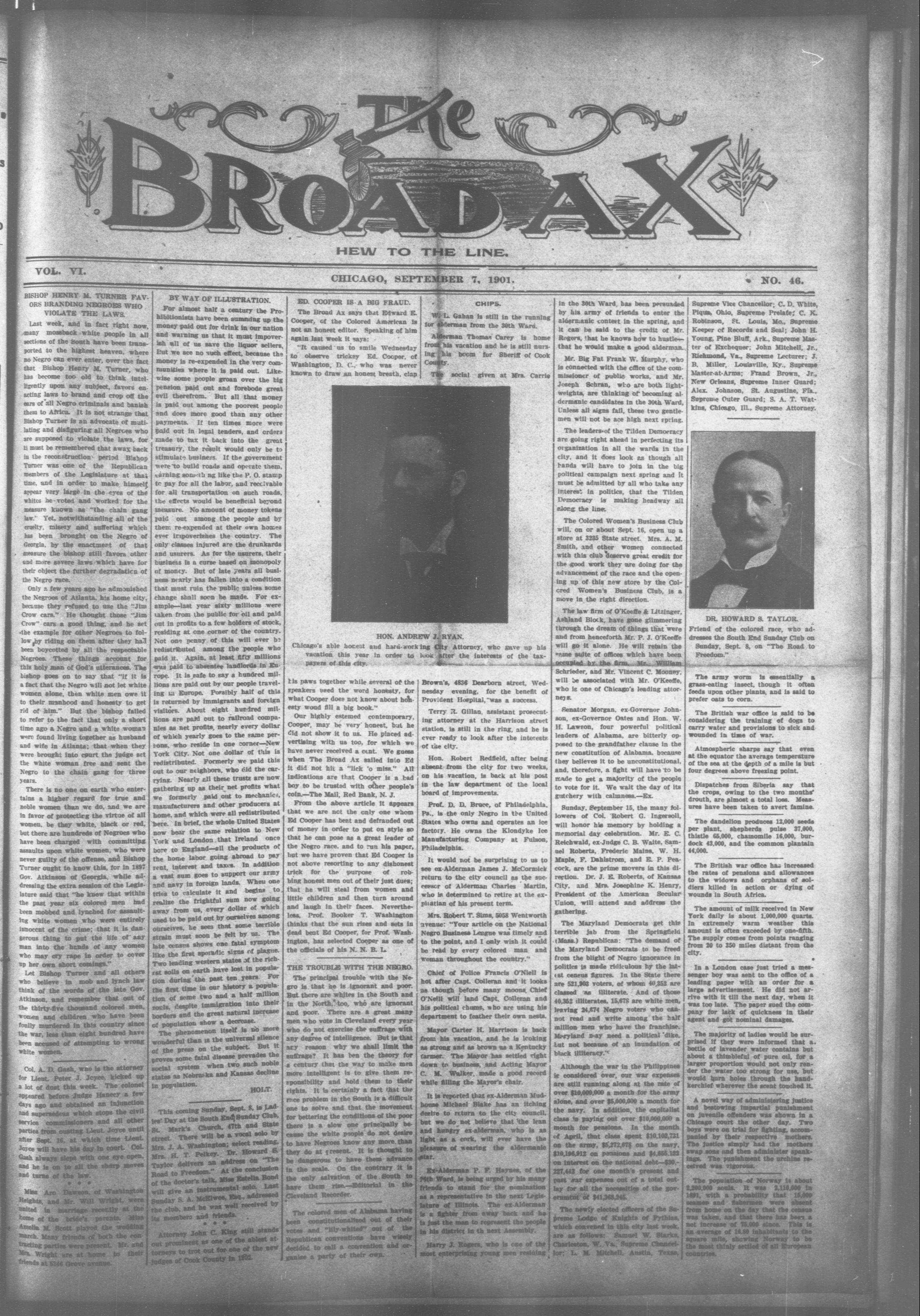
THE BROAD AX
HEW TO THE LINE.
BISHOP HENRY M. TURNER FAVORS BRANDING NEGROES WHO VIOLATE THE LAWS.
Last week, and in fact right now, many mossback white people in all sections of the South have been transported to the highest heaven, where no Negro can ever enter, over the fact that Bishop Henry M. Turner, who has become too old to think intelligently upon any subject, favors enacting laws to brand and crop off the ears of all Negro criminals and banish them to Africa. It is not strange that Bishop Turner is an advocate of mutilating and disfiguring all Negroes who are supposed to violate the laws, for ti must be remembered that away back in the reconstruction period Bishop Turner was one of the Republican members of the Legislature at that time, and in order to make himself appear very large in the eyes of the whites he voted and worked for the measure known as "the chain gang law." Yet, notwithstanding all of the cruelty, misery and suffering which has been brought on the Negro of Georgia, by the enactment of that measure the bishop still favors other and more severe laws which have for their object the further degradation of the Negro race.
Only a few years ago he admonished the Negroes of Atlanta, his home city, because they refused to use the "Jim Crow cars." He thought those "Jim Crow" cars a good thing, and he set the example for other Negroes to follow by riding on them after they had been boycotted by all the respectable Negroes. These things account for this holy man of God's utterances. The bishop goes on to say that "if it is a fact that the Negro will not let white women alone, then white men owe it to their manhood and honesty to get rid of him." But the bishop failed to refer to the fact that only a short time ago a Negro and a white woman were found living together as husband and wife in Atlanta; that when they were brought into court the judge set the white woman free and sent the Negro to the chain gang for three years.
There is no one on earth who entertains a higher regard for true and noble women than we do, and we are in favor of protecting the virtue of all women, be they white, black or red, but there are hundreds of Negroes who have been charged with committing assaults upon white women, who were never guilty of the offense, and Bishop Turner ought to know this, for in 1897 Gov. Atkinson of Georgia, while addressing the extra session of the Legislature said that "he knew that within the past year six colored men had been mobbed and lynched for assaulting white women who were entirely innocent of the crime; that it is dangerous thing to put the life of any man into the hands of any women who may cry rape in order to cover up her own short comings."
Let Bishop Turner and all others who believe in mob and lynch law think of the words of the late Gov. Atkinson, and remember that out of the thirty-five thousand colored men, women and children who have been foully murdered in this country since the war, less than eight hundred have been accused of attempting to wrong white women.
Col. A. D. Gash, who is the attorney for Lient. Peter J. Joyce, kicked up a lot of dust this week. The colonel appeared before Judge Hanecy a few days ago and obtained an injunction and supersedeas which stops the civil service commissioners and all other parties from ousting Lient. Joyce until after Sept. 16, at which time Lient. Joyce will have his day in court. Col. Gash always sleeps with one eye open, and he is on to all the sharp moves and turns of the law.
Miss Aro Dawson, of Washington Heights, and Mr. Will Wright, were united in marriage recently at the home of the bride's parents. Miss Amelia M. Scott played the wedding march. Many friends of both the contracting parties were present. Mr. and Mrs. Wright are at home to their friends at 5346 Grove avenue.
For almost half a century the Prohibitionists have been summing up the money paid out for drink in our nation and warning us that it must impoverish all of us save the liquor sellers. But we see no such effect, because the money is re-expended in the very communities where it is paid out. Likewise some people groan over the big pension paid out and forebode great evil therefrom. But all that money is paid out among the poorest people and does more good than any other payments. If ten times more were paid out in legal tenders, and orders made to tax it back into the great treasury, the result would only be to stimulate business. If the government were to build roads and operate them, earning something like the P. O. stamp to pay for all the labor, and receivable for all transportation on such roads, the effects would be beneficial beyond measure. No amount of money tokens paid out among the people and by them re-expended at their own homes ever irrapoverishes the country. The only classes injured are the drunkards and usurers. As for the usurers, their business is a curse based on monopoly of money. But of late years all business nearly has fallen into a condition that must ruin the public unless some change shall soon be made. For example—last year sixty millions were taken from the public for oil and paid out in profits to a few holders of stock, residing at one corner of the country. Not one penny of this will ever be redistributed among the people who paid it. Again, at least fifty millions was paid to absentee landlords in Europe. It is safe to say a hundred millions are paid out by our people traveling in Europe. Possibly half of this is returned by immigrants and foreign visitors. About eight hundred millions are paid out to railroad companies as net profits, nearly every dollar of which yearly goes to the same persons, who reside in one corner—New York City. Not one dollar of this is redistributed. Formerly we paid this out to our neighbors, who did the carrying. Nearly all these trusts are now gathering up as their net profits what we formerly paid out to mechanics, manufacturers and other producers at home, and which were all redistributed here. In brief, the whole United States now bear the same relation to New York and London that Ireland once bore to England—all the products of the home labor going abroad to pay rent, interest and taxes. In addition a vast sum goes to support our army and navy in foreign lands. When one tries to calculate it and begins to realize the frightful sum now going away from us, every dollar of which used to be paid out by ourselves among ourselves, he sees that some terrible strain must soon be felt by us. The late census shows one fatal symptom like the first sporadic signs of plague. Two leading western states of the richest soils on earth have lost in population during the past ten years. For the first time in our history a population of some two and a half million souls, despite immigration into their borders and the great natural increase of population show a decrease.
The phenomenon itself is no more wonderful than is the universal silence of the press on the subject. But it proves some fatal disease prevades the social system when two such noble states as Nebraska and Kansas decline in population.
HOLT.
This coming Sunday, Sept. 8, is Ladies' Day at the South End Sunday Club, St. Mark's Church, 47th and State street. There will be a vocal solo by Mrs. J. A. Washington; select reading, Mrs. H. T. Pelkey. Dr. Howard S. Taylor delivers an address on "The Road to Freedom." At the conclusion of the doctor's talk, Miss Estella Bond will give an instrumental solo. Last Sunday S. A. McElwee, Esq., addressed the club, and he was well received by its members and friends.
Attorney John C. King still stands out prominent as one of the ablest attorneys to trot out for one of the new judges of Cook County in 1802.
1
"It caused us to smile Wednesday to observe trickey Ed. Cooper, of Washington, D. C., who was never known to draw an honest breath, clap
HON. ANDR.
Chicago's able honest and hard-work vacation this year in order to payers of this city.
His paws together while several of the speakers used the word honesty, for what Cooper does not know about honesty woud fill a big book."
Our highly estemed contemporary, Cooper, may be very honest, but he did not show it to us. He placed advertising with us too, for which we have never received a cent. We guess when The Broad Ax sailed into Ed it did not hit a "lick 'o miss." All indications are that Cooper is a bad boy to be trusted with other people's coin.—The Mail, Red Bank, N. J.
From the above article it appears that we are not the only one whom Ed Cooper has beat and defrauded out of money in order to put on style so that he can pose as a great leader of the Negro race, and to run his paper, but we have proven that Ed Cooper is not above resorting to any dishonest trick for the purpose of robbing honest men out of their just dues; that he will steal from women and little children and then turn around and laugh in their faces. Nevertheless, Prof. Booker T. Washington thinks that the sun rises and sets in dead beat Ed Cooper, for Prof. Washington, has selected Cooper as one of the officials of his N. N. B. L.
THE TROUBLE WITH THE NEGRO.
The principal trouble with the Negro is that he is ignorant and poor. But there are whites in the South and in the North; too, who are ignorant and poor. There are a great many men who vote in Cleveland every year who do not exercise the suffrage with any degree of intelligence. But is that any reason why we shall limit the suffrage? It has ben the theory for a century that the way to make men more intelligent is to give them responsibility and hold them to their rights. It is certainly a fact that the race problem in the South is a difficult one to solve and that the movement for bettering the conditions of the poor there is a slow one principally because the white people do not desire to have Negroes know any more than they do at present. It is thought to be dangerous to have them advance in the scale. On the contrary it is the only salvation of the South to have them rise.—Editorial in the Cleveland Recorder.
The colored men of Alabama having been constitutionalized out of their votes and "lily-whited" out of the Republican conventions have wisely decided to call a convention and organize a party of their own.
---
W. L. Gahan is still in the running for alderman from the 30th Ward.
Alderman Thomas Carey is home from his vacation and he is still nursing his boom for Sheriff of Cook County.
The social given at Mrs. Carrie
EW J. RYAN.
ing City Attorney, who gave up his look after the interests of the tax-
Brown's, 4836 Dearborn street, Wednesday evening, for the benefit of Provident Hospital, was a success.
Terry R. Gillan, assistant prosecuting attorney at the Harrison street station, is still in the ring, and he is ever ready to look after the interests of the city.
Hon. Robert Redfield, after being absent from the city for two weeks, on his vacation, is back at his post in the law department of the local board of improvements.
Prof. D. D. Bruce, of Philadelphia, Pa., is the only Negro in the United States who owns and operates an ice factory. He owns the Klondyke Ice Manufacturing Company at Fulson, Philadelphia.
It would not be surprising to us to see ex-Alderman James J. McCormick return to the city council as the successor of Alderman Charles Martin, who is determined to retire at the expiatian of his present term.
Mrs. Robert T. Sims, 5058 Wentworth avenue: "Your article on the National Negro Business League was timely and to the point, and I only wish it could be read by every colored man and woman throughout the country."
Chief of Police Francis O'Nell is hot after Capt. Colleran and it looks as though before many moons Chief O'Nell will land Capt. Colleran and his political chums, who are using his department to feather their own nests.
Mayor Carter H. Harrison is back from his vacation, and he is looking as strong and as brown as a Kentucky farmer. The Mayor has settled right down to business, and Acting Mayor C. M. Walker, made a good record while filling the Mayor's chair.
It is reported that ex-Alderman Mudhouse Michael Blake has an itching desire to return to the city council, but we do not believe that the lean and hungry ex-alderman, who is as light as a cork, will ever have the pleasure of wearing the aldermanic star.
Ex-Alderman P. F. Haynes, of the 56th Ward, is being urged by his many friends to stand for the nomination as a representative in the next Legislature of Illinois. The ex-Alderman is a fighter from away back and he is just the man to represent the people in his district in th next Assembly.
Harry J. Rogers, who is one of the most enterprising young men residing
---
in the 30th Ward, has been persuaded by his army of friends to enter the aldermanic contest in the spring, and it can be said to the credit of Mr. Rogers, that he knows how to hustle that he would make a good alderman. Mr. Big Fat Frank W. Murphy, who is connected with the office of the commissioner of public works, and Mr. Joseph Schran, who are both lightweight, are thinking of becoming aldermanic candidates in the 30th Ward, Unless all signs fall, these two gentlemen will not be ace high next spring.
The leaders of the Tilden Democracy are going right ahead in perfecting its organization in all the wards in the city, and it does look as though all bands will have to join in the big political campaign next spring and it must be admitted by all who take any interest in politics, that the Tilden Democracy is making headway all along the line.
The Colored Women's Business Club will, on or about Sept. 16, open up a store at 3235 State street. Mrs. A. M. Smith, and other women connected with this club deserve great credit for the good work they are doing for the advancement of the race and the opening up of this new store by the Colored Women's Business Club, is a move in the right direction.
The law firm of O'Keeffe & Litzinger, Ashland Block, have gone glimmering through the dream of things that were and from henceforth Mr. P. J. O'Keeffe will go it alone. He will retain the same suite of offices which have been occupied by the firm. Mr. William Schrieder, and Mr. Vincent C. Mooney, will be associated with Mr. O'Keeffe, who is one of Chicago's leading attorneys.
Senator Morgan, ex-Governor Johnson, ex-Governor Oates and Hon. W. H. Lawson, four powerful political leaders of Alabama, are bitterly opposed to the grandfather clause in the new constitution of Alabama, because they believes it to be unconstitutional, and, therefore, a fight will have to be made to get a majority of the people to vote for it. We wait the day of its gutchery with calmness.—Ex.
Sunday, September 15, the many followers of Col. Robert G. Ingersoll, will honor his memory by holding a memorial day celebration. Mr. E. C. Reichwald, ex-Judge C. B. Waite, Samuel Roberts, Frederic Mains, W. H. Maple, F. Dahlstrom, and E. P. Peacock, are the prime movers in this direction. Dr. J. E. Roberts, of Kansas City, and Mrs. Josephine K. Henry, President of the American Secular Union, will attend and address the gathering.
The Maryland Democrats get this terrible jab from the Springfield (Mass.) Republican: "The demand of the Maryland Democrats to be freed from the blight of Negro ignorance in politics is made ridiculous by the latest census figures. In the State there are 521,903 voters, of whom 40,352 are classed as illiterate. And of those 40,352 illiterates, 15,678 are white men, leaving 24,674 Negro voters who cannot read and write among the half million men who have the franchise. Maryland may need a political 'dike, but not because of an inundation of black illiteracy."
Although the war in the Philippines is considered over, our war expenses are still running along at the rate of over $10,000,000 a month for the army alone, and over $5,000,000 a month for the navy. In addition, the capitalist class is paying out over $10,000,000 a month for pensions. In the month of April, that class spent $10,102,731 on the army, $5,272,675 on the navy, $10,196,912 on pensions and $4,655.122 on interest on the national debt—$30,227,443 for one month's present and past war expenses out of a total outlay for all the necessities of the government of $41,968,245.
The newly elected officers of the Supreme Lodge of Knights of Pythias, which convened in this city last week, are as follows: Samuel W. Starks, Charleston, W., Va., Supreme Chancellor; L. M. Mitchell, Austin, Texas,
Supreme Vice Chancellor; C. D. White, Piqua, Ohio, Supreme Prelate; C. K. Robinson, St. Louis, Mo., Supreme Keeper of Records and Seal; John H. Young, Pine Bluff, Ark., Supreme Master of Exchequer; John Mitchell, Jr., Richmond, Va., Supreme Lecturer; J. B. Miller, Louisville, Ky., Supreme Master-at-Arms; Frand Brown, Jr., New Orleans, Supreme Inner Guard; Alex. Johnson, St. Augustine, Fla., Supreme Outer Guard; S. A. T. Watkins, Chicago, Ill., Supreme Attorney.
M.
DR. HOWARD S. TAYLOR.
Friend of the colored race, who addresses the South End Sunday Club on Sunday, Sept. 8, on "The Road to Freedom."
The army worm is essentially a grass-eating insect, though it often feeds upon other plants, and is said to prefer oats to corn.
The British war office is said to be considering the training of dogs to carry water and provisions to sick and wounded in time of war.
Atmospheric sharps say that even at the equator the average temperature of the sea at the depth of a mile is but four degrees above freezing point.
Dispatches from Siberia say that the crops, owing to the two months' drouth, are almost a total loss. Measures have been taken to avert famine.
The dandelion produces 12,000 seeds per plant, shepherds pulse 37,000, thistle 65,000, chamomile 16,000, burdock 43,000, and the common plantain 44,000.
The British war office has increased the rates of pensions and allowances to the widows and orphans of soldiers killed in action or dying of wounds in South Africa.
The amount of milk received in New York daily is about 1,000,000 quarts. In extremely warm weather this amount is often exceeded by one-fifth. The supply comes from points ranging from 20 to 350 miles distant from the city.
In a London case just tried a messenger boy was sent to the office of a leading paper with an order for a large advertisement. He did not arrive with it till the next day, when it was too late. The paper sued the company for lack of quickness in their agent and got nominal damages.
The majority of ladies would be surprised if they were informed that a bottle of lavender water contains but about a thimbleful of pure oil, for a larger proportion would not only render the water too strong for use, but would burn holes through the handkerchief wherever the scent touched it.
A novel way of administering justice and bestowing impartial punishment on juvenile offenders was shown in a Chicago court the other day. Two boys were on trial for fighting, accompanied by their respective mothers. The justice simply had the mothers swap sons and then administer spankings. The punishment the urchins received was vigorous.
The population of Norway is about 2,200,000 souls. It was 2,110,000 in 1891, with a probability that 15,000 seamen and fishermen were absent from home on the day that the census was taken, and that there has been a net increase of 75,000 since. This is an average of 16.80 inhabitants to the square mile, showing Norway to be the most thinly settled of all European countries.
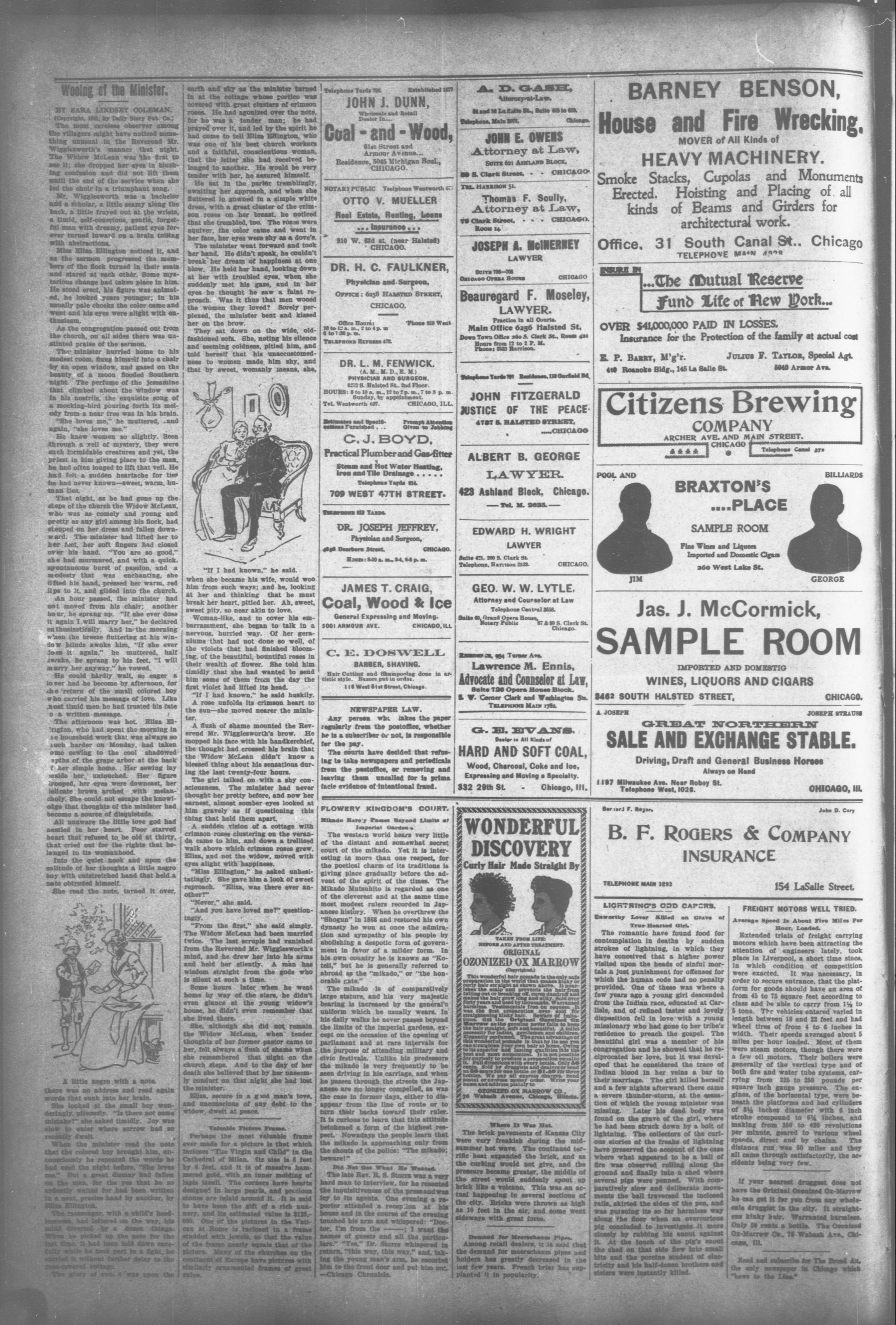
BY SARA LINDSEY COLEMAN. (Copyright, 1901, by Daily Story Pub. Co.) The most careless observer among the villagers might have noticed something unusual in the Reverend Mr. Wigglesworth's manner that night. The Widow McLean was the first to see it; she dropped her eyes in blushing confusion and did not lift them until the end of the service when she led the choir in a triumphant song. Mr. Wigglesworth was a bachelor and a scholar, a little seamy along the back, a little frayed out at the wrists, a timid, self-conscious, gentle, forgetful man with dreamy, patient eyes forever turned inward on a brain tolling with abstractions.
As the congregation passed out from the church, on all sides there was unstinted praise of the sermon.
The minister hurried home to his modest room, flung himself into a chair by an open window, and gazed on the beauty of a moon flooded Southern night. The perfume of the Jessamine that climbed about the window was in his nostrils, the exquisite song of a mocking-bird pouring forth its melody from a near tree was in his brain.
"She loves me," he muttered, and again, "she loves me."
He knew women so slightly. Seen through a vell of mystery, they were such formidable creatures and yet, the priest in him giving place to the man, he had often longed to lift that vell. He had felt a sudden heartache for ties he had never known—sweet, warm, human ties.
That night, as he had gone up the steps of the church the Widow McLean, who was as comely and young and pretty as any girl among his flock, had stepped on her dress and fallen downward. The minister had lifted her to her feet, her soft fingers had closed over his hand. "You are so good," she had murmured, and with a quick, spontaneous burst of passion, and a modesty that was enchanting, she lifted his hand, pressed her warm, red lips to it, and glided into the church.
An hour passed, the minister had not moved from his chair; another hour, he sprang up. "If she ever does it again I will marry her," he declared enthusiastically. And in the morning when the breeze fluttering at his window blinds awoke him, "If she ever does it again," he muttered, half awake, he sprang to his feet, "I will marry her anyway," he vowed.
He could hardly wait, so eager a lover had he become by afternoon, for the return of the small colored boy who carried his message of love. Like most timid men he had trusted his fate o a written message.
The afternoon was hot. Eliza Elrigton, who had spent the morning in the household work that was always so much harder on Monday, had taken some sewing to the cool shadowed depths of the grape arbor at the back of her simple home. Her sewing lay beside her, untouched. Her figure trooped, her eyes were downcast, her delicate brows arched with melancholy. She could not escape the knowledge that thoughts of the minister had become a source of disquietude.
All unaware the little love god had nestled in her heart. Poor starved heart that refused to be old at thirty, that cried out for the rights that belonged to its womanhood.
Into the quiet nook and upon the solitude of her thoughts a little negro boy with outstretched hand that held a note obtruded himself.
She read the note, turned it over,
```markdown
```
A little negro with a note. there was no address and read again words that sunk into her brain.
She looked at the small boy wonderingly, piteously. "Is there not some mistake?" she asked timidly. Joy was slow to enter where sorrow had so recently dwelt.
When the minister read the note that the colored boy brought him, unconsciously he repeated the words he had used the night before, "She loves me." But a great dismay had fallen on the man, for the yes that he so ardently waited for had been written in a neat, precise hand by another, by Eliza Ellington.
The messenger, with a child's heedlessness, had lettered on the way, his mind diverted by a dozen things. When he picked up the note for the last time, it had been inid down carefully while he took part in a fight, he carried it without further delay to the case-covered cottage.
earth and sky as the minister turned in at the cottage whose portico was covered with great clusters of crimson roses. He had agonized over the note, for he was a tender man; he had prayed over it, and led by the spirit he had come to tell Eliza Ellington, who was one of his best church workers and a faithful, conscientious woman, that the letter she had received belonged to another. He would be very tender with her, he assured himself.
He sat in the parlor tremblingly, awaiting her approach, and when she fluttered in gowned in a simple white dress, with a great cluster of the crimson roses on her breast, he noticed that she trembled, too. The roses were aquiver, the color came and went in her face, her eyes were shy as a dove's.
The minister went forward and took her hand. He didn't speak, he couldn't break her dream of happiness at one blow. He held her hand, looking down at her with troubled eyes, when she suddenly met his gaze, and in her eyes he thought he saw a faint reproach. Was it thus that men wooed the women they loved? Sorely perplexed, the minister bent and kissed her on the brow.
They sat down on the wide, old-fashioned sofa. She, noting his silence and seeming coldness, pitied him, and told herself that his unaccustomedness to women made him shy, and that by sweet, womanly means, she,
```markdown
```
"If I had known," he said, when she became his wife, would woo him from such ways; and he, looking at her and thinking that he must break her heart, pitied her. Ah, sweet, sweet pity, so near akin to love. Woman-like, and to cover his embarrassment, she began to talk in a nervous, hurried way. Of her geraniums that had not done so well, of the violets that had finished blooming, of the beautiful, bountiful roses in their wealth of flower. She told him timidly that she had wanted to send him some of them from the day the first violet had lifted its head.
"If I had known," he said huskily. A rose unfolds its crimson heart to the sun—she moved nearer the minister. A flush of shame mounted the Reverend Mr. Wigglesworth's brow. He mopped his face with his handkerchief, the thought had crossed his brain that the Widow McLean didn't know a blessed thing about his sensations during the last twenty-four hours.
The girl talked on with a shy consciousness. The minister had never thought her pretty before, and now her earnest, almost somber eyes looked at him gravely as if questioning this thing that held them apart.
A sudden vision of a cottage with crimson roses clustering on the veranda came to him, and down a trellised walk above which crimson roses grew, Eliza, and not the widow, moved with eyes alight with happiness.
"Miss Ellington," he asked unhesitatingly. She gave him a look of sweet reproach. "Eliza, was there ever another?"
"Never," she said.
"And you have loved me?" questioningly.
"From the first," she said simply. The Widow McLean had been married twice. The last scruple had vanished from the Reverend Mr. Wigglesworth's mind, and he drew her into his arms and held her silently. A man has wisdom straight from the gods who is silent at such a time. Some hours later when he went home by way of the stars, he didn't even glance at the young widow's house, he didn't even remember that she lived there.
Eliza, secure in a good man's love, and unconscious of any debt to the widow, dwelt at peace.
Perhaps the most valuable frame ever made for a picture is that which incloses "The Virgin and Child" in the Cathedral of Milan. Its size is 8 feet by 6 feet, and it is of massive hammered gold, with an inner molding of lapis lazuli. The corners have hearts designed in large pearls, and precious stones are inlaid around it. It is said to have been the gift of a rich nunnery, and its estimated value is $125,-005. One of the pictures in the Vatican at Rome is inclosed in a frame studded with jewels, so that the value of the frame nearly equals that of the picture. Many of the churches on the continent of Europe have pictures with similarly ornamented frames of great value.
DR. H. C. FAULKNER,
Physician and Surgeon,
OFFICE: 6258 HALSTED STREET,
CHICAGO.
Office Hours: Phone 818 Went
10 to 12 a. m., 2 to 4 p. m.
6 to 7:30 p. m.
TELEPHONE EXPRESS 472.
DR. L. M. FENWICK.
(A. M., M. D., E. M.)
PHYSICIAN AND SURGEON.
6212 S. Halsted St., 2nd Floor.
HOURS: 8 to 10 a. m., 12 to 2 p. m., 7 to 8 p. m.
Sunday, by appointment.
Tel. Wentworth 627. CHICAGO, ILL.
Estimates and Specifi-
cations Furnished ... Prompt Attention
Given to Jobbing
C. J. BOYD,
Practical Plumber and Gas-fitter
Steam and Hot Water Heating,
Iron and Tile Drainage . . .
Telephone Yards 914.
709 WEST 47TH STREET.
TELEPHONE 813 YARDS.
DR. JOSEPH JEFFREY,
Physician and Surgeon,
498 Dearborn Street. CHICAGO.
Hours: 8-10 a. m., 2-4, 6-8 p. m.
JAMES T. CRAIG,
Coal, Wood & Ice
General Expressing and Moving.
5001 ARMOUR AVE. CHICAGO, ILL
C. E. DOSWELL
BARBER, SHAVING.
Hair Cutting and Shampooing done in artistic style. Bans put in order.
116 West 51st Street, Chicago.
Any person who takes the paper regularly from the postoffice, whether he is a subscriber or not, is responsible for the pay. The courts have decided that refusing to take newspapers and periodicals from the postoffice, or removing and leaving them uncalled for is prima facie evidence of intentional fraud.
Mikado Rare'y Passes Beyond Limits of Imperial Garden.
The western world hears very little of the distant and somewhat secret court of the mikado. Yet it is interesting in more than one respect, for the poetical charm of its traditions is giving place gradually before the advent of the spirit of the times. The Mikado Mutsuhito is regarded as one of the cleverest and at the same time most modest rulers recorded in Japanese history. When he overthrew the "Shogun" in 1868 and restored his own dynasty he won at once the admiration and sympathy of his people by abolishing a despotic form of government in favor of a milder form. In his own country he is known as "Koteli," but he is generally referred to abroad as the "mikado," or "the honorable rate."
The mikado is of comparatively large stature, and his very majestic bearing is increased by the general's uniform which he usually wears. In his daily walks he never passes beyond the limits of the imperial gardens, except on the occasion of the opening of parliament and at rare intervals for the purpose of attending military and civic festivals. Unlike his predessors the mikado is very frequently to be seen driving in his carriage, and when he passes through the streets the Japanese are no longer compelled, as was the case in former days, either to disappear from the line of route or to turn their backs toward their ruler. It is curious to learn that this attitude betokened a form of the highest respect. Nowadays the people learn that the mikado is approaching only from the shouts of the police: "The mikado; beware!"
Did Not Get What He Wanted.
The late Rev. R. S. Storrs was a very hard man to interview, for he resented the inquisitiveness of the press and was fcy to its agents. One evening a reporter attended a reception at his house and in the course of the evening touched his arm and whispered: "Doctor, I'm from the ——; I want the names of guests and all the particulars." "Yes," Dr. Storrs whispered in return, "this way, this way," and, taking the young man's arm, he cocorted him to the front door and put him on. —Chicago Chronicle.
---
JOHN FITZGERALD
JUSTICE OF THE PEACE
4787 S. HALSTED STREET,
.....CHICAGO
ALBERT B. GEORGE
LAWYER.
423 Ashland Block, Chicago.
Tel. M. 2025.
EDWARD H. WRIGHT
LAWYER
Suite 421, 200 S. Clark St.
Telephone, Harrison 2538. CHICAGO.
GEO. W. W. LYTLE,
Attorney and Counselor at Law
Telephone Central 3558.
Suite 60, Grand Opera House,
Notary Public 87 & 89 S. Clark St.
Chicago.
Lawrence M. Ennis,
Advocate and Counselor at Law,
Suite 726 Opera House Block.
S. W. Corner Clark and Washington Sts.
TELEPHONE MAIN 1782.
G. E. EVANS Dealer in All Kinds of
Wood, Charcoal, Coke and Ice,
Expressing and Moving a Specialty.
832 29th St. Chicago, Ill.
WONDERFUL
DISCOVERY
Curly Hair Made Straight By
TAKEN FROM LIFE:
BEFORE AND AFTER TREATMENT.
ORIGINAL.
This wonderful hair pomade is the only safe preparation in the world that makes kinky or curly hair straight as shown above. It nourishes the scalp and prevents the hair from falling out or breaking off, cures dandruff and makes the hair grow long and silky. Sold over forty years and used by thousands. Warranted harmless. Testimonials free on request. It is the only pomade ever sold for straightening kinky hair. The same qualities. Get the Original Organized On Marrow as the genuine never fails to keep the hair straight, soft and beautiful. A toilet necessity for ladies, gentlemen and children. Elegantly perfumed. The great advantage of this wonderful pomade is that by its use you can straighten your own hair at home. Owing to its superior and lasting qualities it is the best and most economical. It is not possible for anybody to produce a preparation equal to it. Full directions with every bottle. Only 60 cents. Sold by druggists and dealers or send us 60 cents for one bottle or $1.40 for three bottles. We pay all express charges. Send your name and address plainly to
OZONIZED OX MARROW CO.
76 Wabash Avenue, Chicago, Illinois.
Where It Was Hot. The brick pavements of Kansas City were very freakish during the midsummer hot wave. The continued terrific heat expanded the brick, and as the curbing would not give, and the pressure became greater, the middle of the street would suddenly spout up brick like a volcano. This was an actual happening in several sections of the city. Bricks were thrown as high as 10 feet in the air, and some went sideways with great force.
Demand for Meerschaum Pipes. Among retail dealers, it is said that the demand for meerschaum pipes and holders has greatly decreased in the last few years. French briar has supplanted it in popularity.
HEAVY MACHINERY. Smoke Stacks, Cupolas and Monuments Erected. Hoisting and Placing of all kinds of Beams and Girders for architectural work. Office, 31 South Canal St., Chicago TELEPHONE MAIN 4028
...The Mutual Reserve
Fund Life or New York...
OVER $41,000,000 PAID IN LOSSES.
Insurance for the Protection of the family at actual cost
E. P. BARRY, M'g'r. JULIUS F. TAYLOR, Special Agt.
410 Roanoke Bldg., 145 La Salle St. 5040 Armor Ave.
POOL AND
BRAXTON'S
....PLACE
SAMPLE ROOM
Fine Wines and Liquors
Imported and Domestic Cigars
260 West Lake St.
JIM
GEORGE
Jas. J. McCormick,
IMPORTED AND DOMESTIG WINES, LIQUORS AND CIGARS 8462 SOUTH HALSTED STREET. CHICAGO.
B. F. ROGERS & COMPANY INSURANCE
1197 Milwaukee Ave. Near Robey St.
Telephone West, 1028.
B. F. ROGERS
INSU
TELEPHONE MAIN 3292
LIGHTRING'S ODD CAPERS.
Unworthy Lover Killed on Grave of
True Hunted Girl
The romantic have found food for contemplation in deaths by sudden strokes of lightning, in which they have conceived that a higher power visited upon the heads of sinful mortals a just punishment for offenses for which the human code had no penalty provided. One of these was where a few years ago a young girl descended from the Indian race, educated at Carlisle, and of refined tastes and lovely disposition fell in love with a young missionary who had gone to her tribe's residence to preach the gospel. The beautiful girl was a member of his congregation and he showed that he reciprocated her love, but it was developed that he considered the trace of Indian blood in her veins a bar to their marriage. The girl killed herself and a few nights afterward there came a severe thunder-storm, at the suggestion of which the young minister was missing. Later his dead body was found on the grave of the girl, where he had been struck down by a bolt of lightning. The collectors of the curious stories of the freaks of lightning have preserved the account of the case where what appeared to be a ball of fire was observed rolling along the ground and finally into a shed where several pigs were penned. With comparatively slow and deliberate movements the ball traversed the inclosed rails, skirted the sides of the pen, and was pursuing its so far harmless way along the floor when an overcurious pig concluded to investigate it more closely by rubbing his snout against it. At the touch of the pig's snout the shed on that side flew into small bits and the porcine student of electricity and his half-dozen brothers and sisters were instantly killed.
```markdown
```
John D. Cory
154 LaSalle Street.
FREIGHT MOTORS WELL TRIED. Average Speed Is About Five Miles Per Hour. Loaded.
Extended trials of freight carrying motors which have been attracting the attention of engineers lately, took place in Liverpool, a short time since, in which condition of competition were exacted. It was necessary, in order to secure entrance, that the platform for goods should have an area of from 45 to 75 square feet according to class and be able to carry from 1½ to 5 tons. The vehicles entered varied in length between 18 and 22 feet and had wheel tires of from 4 to 6 inches in width. Their speeds averaged about 5 miles per hour loaded. Most of them were steam motors, though there were a few oil motors. Their boilers were generally of the vertical type and of both fire and water tube systems, carrying from 225 to 250 pounds per square inch gauge pressure. The engines, of the horizontal type, were beneath the platforms and had cylinders of 3½ inches diameter with 6 inch stroke compound to 6¼ inches, and making from 350 to 420 revolutions per minute, geared to various wheel speeds, direct and by chains. The distance run was 50 miles and they all came through satisfactorily, the accidents being very few.
If your nearest druggest does not have the Original Ox-Marrow he can get it for you from any wholesale druggist in the city. It straightens kinky hair. Warranted harmless. Only 50 cents a bottle. The Oxonized Ox-Marrow Co., 74 Wahash Ave., Chicago, Ill.
Read and subscribe for The Broad Ax, the only newspaper in Chicago which "hews to the Line."