The Broad Ax
Saturday, January 4, 1902
Chicago, Illinois
Page text (machine-generated)
VOL. VII.
A MALICIOUS FALSEHOOD. The Washington Bee goes out of its way to quote the following editorial from The Chicago Broad Ax, a Negro Democratic newspaper, without reputation, at home or abroad, and whose editor notoriously lives on his wits:
"It must be remembered that Prof. Booker T. Washington was a delegate to the Republican National Convention held at St. Louis in 1896, that during the proceedings of the convention he was selected to second the nomination of Thomas B. Reed, but Mark Hanna bought up most of the colored delegates who came up from the South shouting for Reed, and free silver, and the result was that Reed's Presidential boom collapsed and Prof. Washington was not called upon to second his nomination, but after Major McKinley's election to the Presidency, T. Thomas Fortune, who is the bosom friend of Prof. Washington, says that 'Prof. Washington was very anxious to become a member of President McKinley's cabinet,' and from that time to the present Prof. Washington has assumed the responsibility of advising the President how to shape his Southern policy, how to fill the appointive offices in the South, etc. Yet Prof. Washington would like to make the ignorant believe he is not in politics."
There is not a statement contained in this editorial which is not false. Mr. Washington was not a delegate to the National Convention at St. Louis in 1896; he was not within 2,000 miles of St. Louis; he therefore could not have been selected to second the nomination of Thomas B. Reed. The editor of The Age did not nominate Mr. Washington for a Cabinet position; that was done by the malignant and malicious Washington Post.
Mr. Washington has never offered any advice to any President, to our personal knowledge. When he has called upon either President McKinley or President Roosevelt it has been upon direct invitation from them. Mr. Washington is not seeking to make it appear that he is not in politics. Every good citizen is in politics. When his advice is sought he has a right to give it. So far the rage has no cause to regret any advice which Mr. Washington has given.
The Washington Bee should be careful in quoting from its contemporaries to weigh the facts which they state before giving the weight of its sanction to them. Standing on their own merits The Chicago Broad Ax and Editor Julius Taylor should learn fairness and truthfulness in dealing with men and measures.-The New York Age.
Right at the outset we are perfectly willing to plead guilty to the charge that our reputation has not spread all over the world like unto T. Thomas Fortune's. For the last 30 or 40 years he has been the greatest political harlot, trickster, clown or monkey, that has ever disgraced the name of man. Not many years ago T. Thomas Fortune ran his paper in the interest of the Republican party in New York City, right up to the eve of the city election, then he sold out to the Democrats for three thousand dollars, and after the election was over and the leaders of the Democratic party would not permit him to boss them, he very easily swung back to the Republican party, so he could milk its leaders, but the picking in the Republican camp was not very good for Fortune, so he jumped out of it, and landed over in the Democratic party long enough to rake in some fore money for supporting Grover Cleveland for President of the United States. This is really not a fair sample of Fortune's political rascality, for the half of it can never be told. Yet this old brazen-faced political brat would like to (if he could) chastice or belittle us for being honest and consistent in our political course.
One more word along this line, then we are done. So far we have never been thrown nor kicked out of the low whisky-joints of Chicago, but that is more than T. Thomas Fortune can say, for we learn that on more than one occasion he has been elected from the ratty saloons of New York City; neither did we stagger on nor off the
stage or platform during the sessions of the National Negro Business League like Thomas Fortune. But we presume that all these things ad to Mr. Fortune's reputation, and makes him quite popular with Prof. Booker T. Washington and the masses.
In relation to Prof. Booker T. Washington not being a delegate to the St. Louis Convention in 1896, all we have to say is, that at that time two or three white Republican newspapers published in the West, where the writer resided at that time contained Prof. Washington's cut and also announced that he was an alternate delegate to the St. Louis Convention; that he was slated to second the nomination of T. B. Reed; now, if the daily newspapers sent out false reports in regard to Prof. Washington and the St. Louis Convention, we are not to blame for that, and as long as Prof. Washington never thought it necessary to refute or deny those reports we naturally concluded that they were true. Do you savie, Mr. Fortune. Prior to the inauguration of Major McKinley as President of the United States, many of the leading Negro Republican newspapers devoted much space to booming Prof. Washington for a place in the new cabinet, and at that time, according to all reports which came to us through the Afro-American press, T. Thomas Fortune was howling and shouting longer and louder than all the small fry in favor of Prof. Washington as a member of President McKinley's cabinet or kitchen cabinet; but since the cock has crowed three times Fortune seems ready and willing to deny his Lord and master.
Shortly after William E. Curtis sent out the report from Washington, D. C., last fall, to the effect that Prof. Washington was hobnobbing with President Roosevelt, E. J. Scott, Prof. Washington's private secretary, sent us a letter, which we inserted in The Broad Ax, Oct. 5, which stated that "Mr. Washington is not in politics, and will not permit himself to be drawn into political activity by any influence whatever." But Fortune claims that Prof. Washington is in politics good and strong, and Fortune ought to know what he is talking aboue, for it appears that he is Prof. Washington's wet nurse or God-father.
NEW YEAR CALLS.
HEW TO THE LINE.
DOWN WITH MUD SLINGING.
Editor Taylor of The Broad Ax, has made a bad mistake. We don't know from what source he gets his information, but we do know that his information is not very correct. He says in his last issue: "Editors Fortune, Cooper and some few of the other boys may be saying mighty mean things about us, for we never see their papers." Well, we get the New York Age, and happen to know what Mr. Fortune says in every issue. He has not wasted a drop of ink in saying anything mean about Editor Taylor, and we doubt if he ever dreamed of such extraordinary low class writing. Mr. Fortune is not in the mud-slinging business, never has been, and never will be. The facts in the matter are that Editor Taylor said some very ugly things in his paper about Mr. Fortune without any cause, which Mr. Fortune considered so far beneath his notice that he would not entertain the idea of letting a reply to such dirty rot go into the columns of a clean newspaper like the New York Age. And now Editor Taylor suspicions that Mr. Fortune has been saying mean things about him.
Mr. Fortune is too good-natured and kind-hearted. He has spent too much time and money on, and done too many favors for, a large number of low-lifted Negro editors, politicians, and the like, who have always given him the "cold shoulder" after he has helped them out of a hole. Because he has brains where they have water, they think the only way to down him is to play Judas Iscariot, and "do'em" behind his back. If every Negro editor and politician were a Tim Fortune the race would stand higher in the estimation of the peoples of the world, and its members would enjoy and air of Freedom which they have not been able to breathe; and those who are now mean and narrow, begrudgeful, hateful and prejudiced, would grow broad-minded and liberal, and our race would be a thinking people and their sons and daughters would live in clover and be educated and refined. Down with slinging mud at bright men and women of the race!—The Mail, Red Bank, N. J.
We want it distinctly understood. Mr. Mail, that we are fully prepared to prove what was said in the columns of The Broad Ax respecting the actions or the conduct of T. Thomas Fortune, while he was attending the sessions of the National Negro Business League. Moreover, it was freely admitted by many of those who were delegates, and those who were supposed to be extremely close and friendly to T. Thomas Fortune, that on that occasion his conduct was not that of a gentleman, nor of a great leader; that his actions were such as to bring reproach and disgrace upon all the bright men and women who participated in the deliberations of the League.
It is unnecessary to rehearse or to again repeat what we formerly said in reference to Mr. Fortune, who delights in being known as the "fire-eating editor," and we want our contemporary, The Mail, not to lose sight of one fact: that we have never in all our life asked any favor of Thomas Fortune, to the extent of one five-cent piece; therefore, we are not under the slightest obligations to him nor to any of the other so-called leaders of the Negro race who train with Mr. Fortune. In the estimation of the weak-minded or the watery-brained editor of The Mail, T. Thomas Fortune may be the old or the new Moses of the Negro, but we think not, for in the last forty years he has acted the part of the "Weather-cock" and has attempted to mount every political horse so far trotted out. He has unsuccessfully ridden the Democratic, the Republican, the Populist, the Greenback, the Anarchist and several other political horses, and if there is one Negro in the United States, outside of Ed. Cooper, who is devoid of all political honor or principle, that man is T. Thomas Fortune.
THE NEGRO: OPINION OF A HIGH AUTHORITY.
William Gifford Palgrave, author of "Central Arabia," "Herman Agha," a highly cultured Englishman and the only European who ever lived in Central Arabia, says that "if all races of mankind he ever knew the Arab of Central Arabia stands first for generosity of friendship, warmth of love and constancy above all. In these respects they stand alone; none can compare with them. In war, counsel, poetry, eloquence, enterprise and courtesy of manners, in beauty of life, as companions, friends, lovers, I have tried them in all and found them never wanting."
"And who next after the Arabs? You ought to know, if any one?" asked a friend.
"You may think it strange, but the race I have found most like the Arab in constancy, and the best sympathizing with the Arab in many other ways, is one very unlike in several respects. both of mind and body: I mean the Negro. I sometimes think they must have a common origin, yet the difference seems too great for that."
Our Europeans were rude, boisterous, mannerless savages until after the crusades (except Spain under the Saraeens) after the armies of Europe had been in the East they came home well trained in the courtesies and manners of Oriental politeness. For centuries after, a constant intercourse was kept up between Syria and Western Europe while the high culture and civility of the Saraeens of Spain were extending an influence over France and Italy. But for these influences Europe today must have been barbarous, and yet these Moors of Spain and Arabs of Syria were nothing but "niggers," according to our narrow provincialism. If the white man is first today, it must be on the principle established by Christ —"the last shall be first," "the least shall be greatest."
THE SLAUGHTER-PARKS WEDDING.
As it was announced in the last issue of The Broad Ax that Miss Grace May Slaughter, of Detroit, Mich., was united in marriage to Mr. Jacob L. Parks, who is one of Chicago's most prominent undertakers, in that city, Monday, Dec. 23, 1901, and all in all it was a very brilliant affair.
The bride was beautifully attired in white ivory satin with a conventional veil and wreath of orange blossoms. The only ornament worn was a diamond engagement ring, a gift from the groom. Mr. Parks was dressed up in a brand new black Prince Albert suit. The wedding occurred at 5 o'clock in the afternoon, Rev. Seymour officiating. Miss Fannie Barnes, of Detroit, acted as bridesmaid and was bewitchingly gowned in white mousselin de sole; she carried a shower bouquet of white carnations, and the bride's bouquet was composed of white hyacinths. The event was witnessed only by the family and a few intimate friends.
But later in the evening a very elaborate reception was held, which was attended by all the members of Detroit's exclusive set of 400. The bride and groom received many telegrams of congratulations from friends residing in Chicago and other sections of the country. At the conclusion of the reception the newly made bride rearranged her tiolet and other preparations were made by the happy pair to begin their journey to Chicago. The bride wore a handsome traveling suit of pearl gray broad-cloth, hat and gloves to match. Hundreds of friends escorted Mr. and Mrs. Parks to the depot to bid them farewell and wish them a pleasant journey through life. Mrs. Lough, the bride's sister, returned to this city with the newly made couple, who are now at home to their friends at 3518 Dearborn street.
New Year's Day we called to pay our respects to Mr. and Mrs. Parks, and had the pleasure of inspecting the numerous wedding presents received by them and we must say that they are costly and very beautiful. During our visit the bride served us with a piece of the wedding-cake. She is highly
accomplished and is as pretty as a rose in June. The Broad Ax not only welcomes one of the leaders of Detroit's 400 to Chicago, but it also wishes Mr. and Mrs. Parks a long and prosperous life and pleasant dreams.
HOLIDAY PRESENTS.
It is a very cold day when we get left during the holiday season, and as usual a few of our good friends remembered us Christmas and New Year's Day. The following are a few of the many presents presented to us: One bottle of Port Wine, Keatling & Mahony, 164 South Clark street; one bottle of Red Clover Pure Rye Whisky and one bottle of Claret Wine, James J. McNarney, 848 West 42d street; one large bottle of soda water and a bottle of Claret Wine, Frank J. Lehr, 5212 South Halsted street; two pounds of fine coffee, James H. Harris, 4764 Armour avenue. We also received some lovely presents in dry goods as well as the wet goods; these little tokens from friends always makes one feel that after all life is worth living. Up to the present time we have not gone up against the wine and the Old Clover whisky very strong, but it will disappear more rapidly when the cold weather fastens itself upon Chicago.
CHIPS.
The Democratic State Committee of Illinois meets at Springfield Monday, Jan. 6.
Addison Blakely succeeds Mr. Fitzgerald as assistant corporation counsel of Chicago.
The largest, saddlery, and harness store in Natchez, Miss., is run by a colored man. Three-furths of his customers are white.—Ex.
Roosevelt is still President and George R. Koester, the Negro lyncher and anarchist, is yet the collector of internal revenues at Charleston, South Carolina.—Ex. Mrs. Addic V. Conway, of Peoria, Ill., was in the city making New Year's calls Wednesday last. While here she was the guest of Mrs. B. F. Moseley, 6113 Morgan street.
Alderman Charles J. Boyd stands well with the best class of colored people throughout the 30th ward, and if he is re-nominated many of them will take pleasure in voting for him. L. W. Washington, who is connected with the city attorney's office is writing a "History of Negro Democracy in Chicago." He expects to have it completed by spring.
Thomas Vaughan, who superintends the Town of Lake High School building, sold his home on Garfield boulevard, lately, for $11,500; in the near future Mr. Vaughan will build a new house at 54th and Morgan streets.
Patrick McInerney, of McInerney Bros., undertakers, 743 West 43d street, is constructing a new two-story stone front building, which he will use as his place of business as well as his home.
Lawyer William Howard Fitzgerald has resigned as assistant corporation counsel, and Mr. Fitzgerald is now the senior members of the law firm of Fitzgerald & Orr, whose offices are in Room 402, Reaper Block.
Congressman John J. Feely, resigned Monday night last, as president of the Tilden Democracy, and Mr. Walter S. Bogle was made president, and he and his associates propose to keep up the fight against Robert E. Burke, or one man power in politics.
Mayor Carter H. Harrison says that at the end of his third term he is willing to step aside in favor of Charles M. Walker, the able corporation counsel of Chicago. But many express the opinion that Mayor Harrison is simply playing slick politics.
Alderman Charles Alling, 2d ward, is coming to the front as the nominee of the Republican party for Mayor of Chicago, in 1903. Alderman Alling is a first-class gentleman in every respect and he would be alright if he was only a good Democrat.
NO. 11.
A civil service examination for mail carriers and clerks was held in Atlanta, Ga., recently, and out of 125 applicants, 26 were colored. Only 14 of the whole number passed, and 12 of these were colored.—Ex.
A number of the leading colored men of Kentucky will go to Washington soon after the holidays to protest to President Roosevelt against the unjust treatment given the Negro by the Federal officeholders in the distribution of patronage.—Ex.
Alderman Charles Werno, who is serving his second term in the city council from the 23rd ward, is unceasing in his toil and labor in behalf of the interests of not only all of the people living in his ward, but also of all the people of Chicago.
Mrs. Frank Miller, 4630 Dearborn street, entertained at dinner Thursday evening, Dec. 26, Mr. and Mrs. Fitzgerald and Mr. and Mrs. Julius F. Taylor. As a dainty cook Mrs. Miller stands at the top notch, and her repast was greatly relished by those present.
Alderman Nicholas R. Finn, 20th ward, has proven himself to be one of the best members of the city council, and the people residing in that ward will make a great mistake if they fail to re-elect Alderman Finn to the same body next spring.
Alderman Manning T. Hackley, who is creditably representing his constituents, may have a hard fight on his hands to secure the re-nomination, but The Broad Ax would like to see Alderman Hackley lay out his political enemies for he is O. K., and is deserving of further political honors.
For one Negro to abuse another because the latter prefers to run a Democratic paper to that of a Republican paper shows how weak and narrow-minded the accusing Negro really is. Such a man is unworthy to run any kind of a paper for any race or any class of citizens. This is a free country, where every one has the right to run any kind of paper he likes. The Republican, Seattle, Wash.
Alderman Honore Palmer, who ran away ahead of his competitor last spring, is a splendid type of the young Democracy. Alderman Palmer is always approachable and he seems to experience much pleasure in conversing with the representatives of the press; it is safe to say that the majority of the newspapers of this city would gladly support Alderman Palmer for any position within the gift of the people.
No right-thinking Negro will congratulate President Roosevelt on his recent cabinet selection for the postmaster-general portfolio in the person of H. C. Payne of Wisconsin. The Negro press and everybody else who is honest and brave are opposed to Mr. Payne on account of his opposition to full representation from the Southern states in the national Republican conventions some time since.—The Times, Denver, Colo.
The progress of the war in South Africa recalls the utter absence of Christian sentiment in the moulding of human events. Peace on earth, to men of good will—is the highest ideal of Christion brotherhood—yet even at this enlightened day, when the olive branch of peace should supercede the banners of victory, war is actually raging. After several thousand years of proselyting—humanity is no nearer to the lofty realization of Christian principles—than when people groped in the darkness and walked in the shadow of death.—The Forum, Fargo, N. D.
The Buffalo Whist Club was entertained by Mrs. R. A. Smith, 361 30th street, Thursday evening, Jan. 2, and if there are any ladies in Chicago who excell Mrs. Smith in entertaining, it has not been our good fortune to meet them. The luncheon and the other refreshments which she so lavishly served were simply elegant. Those who enjoyed her hospitalities were Mesdames McKnight, Wilkerson, Lyons, Lapsley, Shelton, Akins, and Miss Eva Robinson, of Minneapolis. Minn.; and Messrs. Spriggs, Holiday. Reed, McKnight, Fletcher, Smith and Taylor.
Will promulgate and at all times uphold the pure principles of Democracy, but Farmers, Judithen, Protestants, Knights of Labor, Indians, Mormons, Republicans, Priests, or any he also can have their say, so long as their language is proper and responsibility is fixed.
The Broad Ax is a newspaper whose platform is broad enough for all, ever claiming the intellectual right to speak its own mind.
Local communication will have attention; also on one side of the paper.
One Year.....$1,648
Months.....1,491
Giving rates made known on application.
Address all communications to
Norway is the latest to score anarchy through its legislature. The returns are not all in.
Strange to say, the nickel mines purchased by Americans in New Caledonia are not street-car lines.
Doubtless some of the North Dakota divorce lawyers have already sent their business cards to Queen Wilhelmina.
Although King Edward's coronation is to take place in June the confident expectation is that it will be an august ceremony.
There is nothing inconsistent in the proposal to make more compact the various concerns that manufacture compressed air tools.
A roast pig that had been fattened on potatoes is about the daintiest dish of the Christmas season, and certainly the most expensive one.
Why should a woman fiercely scold a man for smoking on the street car platform. He is really doing homage; he is burning incense to the sex.
Cities and towns are glad to accept Mr. Carnegie's gifts just as they are offered, but the United States can afford to make stipulations in such matters.
Russia is abolishing part of what little local government its cities had. The czar is laying up trouble for himself against the time when the people get aroused.
It would be a great thing for New York if that German inventor were to destroy the London fogs. Then New York would not have to be at the trouble of cultivating them.
A Brooklyn jury has awarded $8,500 to a woman who incurred a stiff finger as the result of a railway collision. The company ought to be thankful her whole hand wasn't stiffened.
Emperor William has not only interdicted dueling in the German colleges, but has ordered the children in the subordinate schools to discontinue the practice of writing letters to him.
The Yale football management has netted thirty thousand dollars from this year's games, but doubtless it would give every dollar of it to have reversed the figures of the score on Soldiers' Field.
A musical paper in London is indignant because only one carriage attended the funeral of Manager Mapleson. But just think how many times in his long operatic career, Col. Mapleson announced substitutions in the cast.
And now the Bulgarian brigands have a grievance. They complain that Miss Stone, their captive, is trying to convert them to Christianity. As this is Miss Stone's business she may succeed in gaining her freedom without the payment of a cent of ransom. All she needs to do is to persuade her captors to apply the golden rule in her case.
Like a great many other men of genius who have lived in this world, the late Eugene Field was generally hard up for money. Nevertheless, tails is no infallible token of genius, and his latest biographer goes to the limit of indelicacy in retailing episodes in the career of his subject illustrating his impecuniosity. These are among the things that are better left unsaid, except as they serve to illumine character.
The plan for a penal colony for anarchists, proposed or suggested by Senator Vest, seems to meet the anarchist situation the most thoroughly; besides there is a poetical side to the idea of letting the anarchists work out their theories on themselves. A fertile island, capable of yielding its inhabitants a bountiful living with an average amount of labor, should be chosen, and the anarchists should be deported there and left to themselves and their theories. In order that no doubts might be raised as to their having a fair show, the government might support them for a year or two and supply them with all the implements of industry and the comforts of a high civilization. After such a period, let them work out their own destiny, the government only taking care that no one should escape from the island. It is a safe conjecture that under such conditions the anarchists would have their theories changed by close experience with practical affairs; they would come to learn respect for government and to know that a government by a majority is much preferable to a government by any one possessed of the greatest physical force.
Club Formed at Berlin Will Endeavor
Under the leadership of Prof. Herman Widner, a number of noted men of artistic taste have formed at Berlin the only male dress reform club in the world, says the St. Louis Post-Dispatch.
A great crusade has been inaugurated against the severe cut of the present day attire which forces one of the sterner sex to put aside his own individuality and follow a fashion reflected upon every man he meets. While the members of the German Male Dress Reform club do not favor the ruffles and laces of Louis XIV, they would compromise between that mode of dress and the twentleth century fashion.
Prof. Widner has issued a call for suggestions, and many hundreds of designs, some practical and others very grotesque, have been submitted to these organized revolters against the laws of fashion. The idea first selected is a design worked out at a mass meeting by the artists of the club. It is a modified form of the uniform worn by a German Hussar regiment.
The short coat or jacket fits snugly at the waist and suggests the use of stays, though these reformers are after solid comfort. Rows of braid, silver or gold, to match the cloth, as the fancy dictates, outline the graceful curves of the spinal column, the sleeves are a trifle fuller than men usually wear and the shoulders have that long, graceful slope so much desired by the society "belle" and so strenuously avoided by men until these artists changed the fashion.
American "Beau Brummels" scoff at the idea of wearing a coat the shoulder seam of which commences about two inches down the arm, for, besides being in their eyes effeminate—that awful word which stands for everything man should avoid—and ugly, they must be uncomfortable, or it seems to the poor, unenlightened fashion's slaves and followers of long established custom on this side of the water. The German Male Dress Reform Club trousers fit tight, loosening somewhat below the knee, and they are trimmed with buttons from the knee down.
The waistcoat is thickly padded, showing to good advantage the chest formation. With the thermometer at zero, this is comfort. But is the combination of the broad and manly chests with the slender, willowy form artistic? As the chief aim and object of these reformers is to be beautiful as well as comfortable, the question is a reflection on the good judgment of the club.
The garments are to be manufactured of gay-colored cloths, varied in tones, this being intended to give the portrait painters a relief from the dull monotony of the present colors. The club has written to artist fraternities all over Europe soliciting further designs, and whole volumes of drawings and suggestions have been received in reply. All the members are wearing the attire first selected until something else is decided upon.
Heat of Volcanoes.
The Maoris of New Zealand cook their potatoes and other vegetables in volcanic heat. There are a few volcanoes in New Zealand, and some of the Maoris live up in the mountains near them. They make the volcanoes do several useful things for them, but the queerest is the cooking. A few of the volcanoes have a sort of periodic action. They heat up the ground in the fall and then lie idle the remainder of the year. Those volcanoes are of a quiet disposition and never break loose, but they heat the ground just enough to do the native cooking. The plan of the Maoris is to dig a pit about five or six feet deep and bed it with straw. Then they put in their vegetables, filling up the pit quite full, and then cover it over with more straw and then a layer of earth. And then then they go away and lie low. Then the volcano begins to heat up and gets in its fine work and the potatoes and mangoes cook. The natives let them stay there for a long time after the heat departs from the earth, take them out whenever they want them, and eat them. So the earth is at once a stove and a storehouse.—Detroit Free Press.
Eastern Farm Land
In the eastern states prices of agricultural land have generally fallen in recent years, in some cases about 50 per cent of the figures asked during the time of high prices. One of the chief causes for the decline in the value of land in the east appears to be a loss of fertility in the land itself, due, perhaps, to careless farming. In the central and western states there appears to be no such marked decline in farm values as in the east. In the northwest land seems to have been increasing in value, and in some localities to a very marked degree. Farm laborers seem to have profited more in the past few years than their employers, or, since the fall in the prices of farm products, even better off than some of the farmers who employ them. It is also said that there is a greater opportunity for laborers to rise to independent positions in agriculture than ever before.—Detroit Free Press.
California Raises Big Things.
California raises the largest of everything except pea beans. Her pea beans are the smallest, but they are higher priced than any that grow this side of that state.
The late Empress Frederick left seventeen grandsons and only three granddaughters. No man finds his work till he loses himself in it.
CHRONOLOGY
of THE YEAR
Events of Importance That Have
Marked the Past Twelve Months.
Two events overshadowed all others in the first year of the new century. One was the assassination of William McKinley, president of the United States, and the other the death of Queen Victoria, bringing to a close the longest and in many respects the most remarkable reign in British history. Each of the two great English-speaking nations of the world was thus called upon to mourn for its highest representative of authority and to face what at one time might have been a serious crisis in its affairs; but in neither case was there even the semblance of political or industrial disturbance or of governmental instability. Theodore Roosevelt became president and Edward VII, king precisely in the manner prescribed by law and the close of 1901 finds each country as tranquil and secure as it was twelve months ago.
In the United States the affairs of greatest importance before the public, aside from the murder of the president, were the new Hay-Pauncefote canal treaty, the Schley inquiry, the Supreme court decisions in the insular cases, the formation of the United States Steel corporation and other gigantic combinations of capital, the panic in the New York stock market, and the princely gifts to educational institutions by Andrew Carnegie, John D. Rockefeller, D. K. Pearson and others.
The Year Politically.
Politically, the year in the United States was a rather eventful one. William McKinley began his second term as president of the United States on the 4th of March, when he was inaugurated with Theodore Roosevelt as vice-president. In September he was 'stricken down by an assassin and Mr. Roosevelt became the chief executive. No other changes took place at the time, but in December the postmaster-general, Charles E. Smith, and the secretary of the treasury, Lyman J. Gage, resigned. Henry C. Payne of Milwaukee was chosen to succeed the former and Leslie M. Shaw, governor of Iowa, the latter.
Work of 56th Congress.
Among the important laws enacted at the second session of the 56th congress were these: Reorganizing the army on the basis of a force of from 60,000 to 100,000 men; materially reducing the war revenue taxes; increasing the membership of the house of representatives from 357 to 386 by reapportioning the congressional districts; abolishing the army canteen. The river and harbor bill, the Nicaragua canal bill and the ship subsidy bill were measures that failed to pass.
Our Insular Problems.
Considerable progress toward the settlement of the insular problems was made. The greater portion of the Philippine islands had been brought under complete control early in the year and the capture of Aguinaldo by Gen. Funston March 23 did a great deal to hasten the work of pacification. On the 14th of July civil government was established with William H. Taft as the first civil governor. At the same time the military authority in the islands was transferred from Gen. Arthur MacArthur to Gen. A. R. Chaffee. Opposition to United States rule it not entirely at an end. In Samar bolzenet attacked a detachment of the 9th infantry Oct. 18, killing ten and wounding six men. Other less disastrous encounters have occurred.
Trade with New Possessions.
Under a decision of the United States Supreme court rendered Dec. 2 it was held that the Philippines became domestic territory immediately upon the ratification of the treaty of peace and that in the absence of legislation by congress duties levied upon the products of the islands were illegal. It was further held that the right of congress to pass laws for the regulation of the islands was unrestricted, coming from the constitution itself. In substance it was held the collection of duties on products coming from Porto Rico between the time the treaty of Paris went into effect and the date when the Foraker tariff act became a law was illegal; that the island of Porto Rico is a territory appurtenant and belonging to the United States but not a part of the United States within the revenue clause of the constitution, and that the Foraker act is constitutional.
Relations with Cuba.
The relations to exist between the United States and Cuba were determined, at least temporarily, by the adoption of the Platt resolutions by congress in June. Briefly, these provide that the government of the island shall retain its independence of all foreign countries, that the United States may intervene to preserve such independence, that the acts of the United States during the period of military occupancy shall be ratified, that sanitary plans for the prevention of epidemics shall be carried out and that this country shall be permitted to buy or lease naval or coaling stations at points to be agreed upon.
On the 21st of February the constitution as agreed to by the members of the Cuban convention was signed, by the members of that body. It is based largely upon that of the United States. Dec. 21 Gen. Tomasq Estrada Palma was elected the first president of Cuba. Free trade between Porto Rico and the United States went into effect July 25, the anniversary of the landing of the American troops on the island in 1889. Civil government under the provisions of the Foraker act was established in May, 1900, and the first governor was Charles H. Allen. He was succeeded this year by William H. Hunt.
President McKinley's Wonder
President McKinley's Murder.
The facts in the assassination of President William McKinley are still too vividly remembered to require extended mention. He had entered upon his second term under the most favorable auspices. Everything pertaining to the future seemed bright with promise when, without a moment's warning, he was shot down by an anarchist. The fatal bullet was fired by Leon Czolgossz while the president was receiving the public in the Temple of Music at the Pan-American exposition in Buffalo on the afternoon of Friday, Sept. 6. He lingered until early on the morning of the 11th of the same month, when he passed away, with the words; "God's will, not ours, be done." The grief of the people was as deep and sincere as it was widespread. Telegrams of condolence came from all parts of the civilized world and from persons in all stations of life.
The assassin was speedily tried, convicted and the sentence of death executed. Czolgossz died in the electric chair.
in Auburn prison on the morning of Oct. 29.
Roosevelt Becomes President.
Theodore Roosevelt assumed the office of president Sept. 14, the day on which McKinley died, taking the oath of office in Buffalo. One of his first public announcements was that the policy of his predecessor would be faithfully executed.
Sebley-Sampson Controversy
The Schley-Sampson controversy as to which commander was entitled to the credit for the destruction of Cervera's fleet at Santiago reached its culmination in July when the third volume of Edgar S. Maclay's "History of the United States Navy" was published. In this book the conduct of Winfield S. Schley as commander of the flying squadron was censured in the severest terms. The author declared that the admiral was guilty of disbedience of orders in failing to proceed to Santiago when ordered to do so and that the Brooklyn's famous "loop" was the result of his cowardice.
As the historian was connected with the navy department as an employee Admiral Schley could not overlook the charges and on the 22d of July wrote a letter to Secretary Long asking for an investigation. His request was compiled with and a court of three, with Admiral Dewey president, listened to the testimony and the arguments of counsel from Sept. 20 until Nov. 7, when the court took the case under advisement. Dec. 18 the verdict was announced. It was in two parts, the first signed by all the members of the court and the second by Admiral Dewey alone. Rear-Admirals Benjam and Ramsay, comprising a majority of the court, condemned Admiral Schley in general terms, but Admiral Dewey in a minority report declared Schley was entitled to the credit for the victory of Santiago.
Secretary Long approved the majority finding and declared that the opinion added by Admiral Dewey was not proper. President Roosevelt ordered the immediate discharge from the employ of the navy department of Maclay and the order was carried into effect.
Isthmian Canal Treaty Signed.
The outlook for the building of an isthman canal in the near future became much more promising when on Nov. 18 Lord Pauncefote and Secretary Hay signed a new treaty on behalf of their respective governments. This agreement superseded the old Clayton-Bulwer treaty and did not contain the objectionable features of the document which was so amended by the United States senate as to be unacceptable to Great Britain. Its most salient feature was the implied right of this country to fortify the canal whenever it is built. The agreement was laid before the senate and was ratified by that body Dec. 16 by a vote of 72 to 6. The canal commission appointed to investigate the two available routes—the Nicaragua and the Panama—reported in favor of the former, and a bill authorizing the building of a ship canal at Nicaragua was at once introduced in the house of representatives. Late in December it was reported from Paris that the French Panama company was willing to sell its property and rights for $40,000,000, and it is, therefore, possible that the claims of the Panama route will receive serious consideration at the hands of congress.
DISASTERS OF THE YEAR.
Record Is Long, and the Number of Deaths Involved Excessive.
Jacksonville, Fla., was the scene of the most disastrous fire of the year in America. The greater part of the city was laid in ashes May 3, causing a total loss of about $11,000,000. Another serious fire was that in Montreal, Jan. 23. The loss was $2,500,000. Twenty-eight lives were lost by the burning of the Rochester (N. Y.) orphan asylum Jan. 8; nineteen persons were killed in a furniture-house fire in Philadelphia, Oct. 25, and 100 or more were lost in a great oil fire at Baku, Russia, Feb. 5.
Tornadoes, cyclones and floods were fortunately few in number compared to other years. The worst disaster of this sort was a storm and flood in the Elkhorn valley of West Virginia June 23. Between fifty and sixty lives were lost and property to the value of about $1,000,-000 was destroyed.
The following is a list of the most prominent disasters in 1901:
In January 10 were killed by an explosion at Lei-Tung, China; 8 by a fire at Minneapolis; 6 by a railroad accident at Mikala, Austria; 20 by a panic at Tokyo, Japan; 120 by a blizzard in south Russia; 50 by the capsizing of a barge off the coast of Madagascar; 400 by a storm on the coast of Japan; 70 by an explosion at Hang Chow, China; 10 by a boiler explosion at Recklinghauser, Bohemia; and 35 by a hurricane at Trondjhem, Norway.
In February 87 persons perished in a mine accident at Durango, Mexico; 392 by a storm on the coast of China; 6 by an explosion at Guilford, England; 7 by railroad accident in New South Wales; 60 by a mine accident in Cumberland, B.C., and 5 at Hermosillo, Mexico; 21 by fire at Tokyo, Japan; 40 by storm at Odessa, Russia; 6 by fire at Birmingham, England; and 32 by a mine accident at Kemmerer, Wyo.
In March 50 persons were killed by an explosion in China; 7 by explosion in Spain; 30 by a railroad accident at Walovo, Russia; 17 by a mine accident at Yabori, Japan; 10 by mine accident at Gilsenkirche, Prussia; 8 by cyclone in Texas; 16 by a cyclone in Arkansas; 10 by boiler explosion in Chicago; 8 by an avalanche at Lake Como; 20 by flood in Bolivia; 11 by bursting of a dam at Bologna, Italy; 9 by a railroad accident in New South Wales; 18 by cyclone at Birmingham, Ala., and 6 by a mine accident in Fayette Co., Ala.
In April 28 lost their lives by a mine accident in the Transvaal; 6 by a hotel fire at St. Mary's, W. Va.; 12 by cyclone in the Canary Islands; 25 by an explosion at Griesheim, Germany; 18 by a mine accident at Hornu, Belgium; 20 by a snow slide in Alaska; 1 by a railroad accident in Pekin; 8 by fire at St. Jean, France; 6 by a railroad accident at Caledon, South Africa, and 15 by the fall of a church in Albania.
In May 35 perished by fire at Amreell, India; 100 by a ferryboat disaster on the Duftep River; 7 by fire in Chicago; 6 by an avalanche in Alaska; 120 by a boiler explosion in China; 8 by an avalanche in Switzerland; 7 by a mine accident in Fairmont, W. Va.; 18 by an avalanche at Avacenza, Italy; 28 by fire at Sohendorf, Bohemia; 14 by floods in Tennessee; 30 by an explosion at Cape Town; 78 by a mine accident at Langhewydd, Wales; 21 by a mine accident at Wolsenburg.
Prussia; 181 by volcanic eruption in Java; 7 by a trolley car accident in Albany, N. Y.; 21 by a mine accident in Dayton, Tenn.; 29 by drowning at Manana Island, and 7 by drowning in Schuylkill River. In June 70 lives were lost by fire on the Tehuantepec Isthmus; 8 by a mine accident at Iron Mountain, Mich.; 9 by a railroad accident in Pretoria; 9 by dynamic explosion at Binghamton, N. Y.; 7 by a cyclone in Oklahoma; 16 by a mine accident at Jacob's Creek, Pa.; 12 by fire at St. Petersburg; 15 by explosion in cartridge factory, Paris; 9 by a cyclone at Naper, Neb.; 24 by explosion at Paterson, N. J.; and 10 by flood in Elkhorn Valley, W. Va.
In July 11 were killed by a lightning stroke in Chicago; 4,000 by a flood at Klang So, China; 300 by earthquake at Lung King, China; 7 by drowning accident in Baden; 4 by a storm at Haiti; 9 by collapse of a bridge at Springfield, Pa.; 6 by drowning at Savannah, Ga.; 700 by volcanic eruption in Java; 16 by oil explosion at Stockholm; 26 by flood in the Danube River; 40 by oil explosion at Batoume, and 7 by fire at Louisville, Ky.
In August 17 perished by collapse of a wharf at Tampico, Mexico; 8 by a gasoline explosion in Philadelphia; 20,000 by flood in China; 100 by fire at Witebsk, Russla; 10 by fire at Cleveland, O.; 6 by floods in Louisiana; 7 by explosion at steel works, Youngstown, O.; 5 by fire in Philadelphia, Pa.; 6 by a dynamite explosion in Herkimer, N. Y.; 6 by a hurricane at Vilfarego-Jliota, Spain, and 6 by fire in Brooklyn, N. Y.
In September 10 were killed by a mine explosion at Caerphilly, Wales; 5 by a boiler explosion at Oakland, N. J.; 17 by drowning off coast of Brittany; 6 by mine accident at Newcastle, Colo.; 23 by drowning in the Kulpa River, Croatia; 11 by powder explosion at Ripault, France; 32 by a railroad accident near Bucharest; 7 by fire at Naples; 8 by gas explosion at Newark, N. J.; 13 by a cloudburst in Presidio County, Tex.; 50 by a powder explosion in Cozena, Italy, and 15 by a mine accident at Nanaimo, B. C.
In October 74 were lost in a gale on the Japan coast; 20 by a typhoon at Manila; 80 by a tidal wave in the Sea of Marmora, and 11 by flood in Sicily.
In November 170 perished by a storm at Lake Balkal, Siberia; 9 by fire at Hurley, Wis.; 7 by an explosion at Athens, Greece; 9 by mine accident at Pocahontns, W. Va.; 22 by earthquake at Erzeroml; 29 by mine accident at Telluride, Colo.; 8 by a mine accident at Bluefields, W. Va.; 7 by a mine accident at Wilkesbarre, Pa.; 30 by boiler explosion at Detroit, Mich.; 76 by railroad disaster at Seneca, Mich., and 15 by drowning in the Hawaiian Islands.
In December 25 were killed by a railroad accident at Kabron, Russia; 20 lost their lives by drowning in Japan; 140 by drowning at Goa, India; 11 by gas explosion at Pittsburg, Pa.; 6 by boiler explosion at Pittsburg, Pa.; 38 by railroad accident at Altenbrechen, Germany; 6 by railroad accident at Melegnano, Italy; 45 by fire at Zacatecas, Mexico; 37 by railroad accident at Liverpool, England; by mine accident, Hartshorn, I. T., 6; by waterspout at Saffee, Morocco, 200. The loss of life by railroad accidents reported by mail and telegraph for 1901 was 3,669, as compared with 4,169 in 1900 and 3,696 in 1899. The number of seriously injured was 3,265, as compared with 3,870 in 1900 and 3,385 in 1899.
THE FINANCIAL REVIEW.
United States Has Sustained Position of Leader of the World.
A review of the financial history of the past year should make every American's heart thrill with pride. For if in 1900 the United States fought its way to a position as the financial leader of the world, the last year saw this country so fortify itself in the first place that its pre-eminence in the financial matters of the world is assured for an indefinite period to come.
Not only was the money center of the world made permanent in Wall street during the year, but the invasion of the markets of the world by this country that had been gathering in strength for ten years was likewise pushed during 1901 with such success that this country may now fairly lay claim to the industrial supremacy of the globe.
The extent of our invasion of foreign markets during 1901 may be judged from the figures contained in the annual report of the Secretary of the Treasury. The foreign commerce in merchandise for the fiscal year 1901 showed a decrease of $28,769,019 in imports and an increase of $92,281,909 in exports when compared with the preceding year. Comparing the figures of 1901 with those of 1891, there is a decrease of $21,744,031 in imports and an increase of $603,284,181 in exports. The imports of the year 1901 were $823,172,165 and the exports $1,487,764,991, making the excess of exports over imports $864,592,828. Both the total exports and the excess of exports over imports were greater in 1901 than in any preceding year in the history of our commerce.
To say that the country has prospered during 1901 is a weak statement of the facts. The floodtide of prosperity has rolled ahead for the past twelvemonth with ever-increasing strength, and with no indications that the ebb is to come. The government's finances have profited much during the past year. Revenues of the government from all sources for the last fiscal year were $899,316,530.92, and the expenditures for the same period were $821,598,546.54, showing a surplus of $77,717,984.38. Compared with the fiscal year 1900, the receipts for 1901 increased $29,721,099.74. There was an increase of $22,253,561.44 in expenditures.
The private moneyed interests, as gauged by the condition of the New York associated banks, have an equally happy story to tell. During the year the New York banks gained in deposits $56,680,600 and in loans $61,507,000.
LARGE SUMS GIVEN AWAY.
Liberal Donations Made to Charitable and Educational Institutions.
The year 1899 was a record-breaker in donations and bequests made educational institutions, libraries and art museums, charities, churches and religious enterprises, and to towns and cities for the public benefit and entertainment, the total reaching the colossal sum of $79,749,956, while the year 1900 was a close second, the total being $62,461,304. Both these years must now give way to 1901, which is the record-breaker of the centuries. The total of its gifts reaches $123,888,732, an amount which may properly be called "colossal." The world has never before known such generosity as this in a single year. The century has opened well for education, art culture, religion and humanity.
Of the total amount stated above there has been given to educational institutions the princely sum of $68,850,361, to charities, $22,217,470; to churches, $8,298,489; to museums and art galleries, $11,133,112; and to libraries, $15,388,732
Andrew Carnegie, John D. Rockefeller, J. P. Morgan, Jane L. Stanford and others contributed sums running up into the millions. The greatest single contribution was that of Mrs. Stanford, who gave the Stanford university property to the value of $30,000,000. Mr. Carnegie founded scores of libraries throughout the United States, gave $10,000,000 to the Scotch universities and offered the same sum to the United States for the cause of higher education. In the west Dr. D. K. Pearson's of Chicago continued his liberal giving to the smaller colleges. The total contributions made for libraries during the year outside of those made by Mr. Carnegie amount to $2,874,000. Including his, the total is the extraordinary sum of $15,227,700.
THE BEET SUGAR INDUSTRY. A most important article, giving Messrs. Oxnard's and Cutting's views on the Beet Sugar industry in this country, appeared on the editorial page of the New York Evening Post of December 12th, 1901, and as every household in the land is interested in sugar the article will be of universal interest
"The Evening Post bids the heartiest welcome to every American industry that can stand on its own bottom and make its way without leaning on the poor rates. Among these self-supporting industries, we are glad to know, is the production of beet sugar. At all events, it was such two years ago. We publish elsewhere a letter written in 1899, and signed by Mr. Oxnard and Mr. Cutting, the chiefs of this industry on the eastern side of the Rocky Mountains, showing that this was the happy condition of the trade at that time. If parties masquerading as beet sugar producers are besieging the President and Congress at this moment, and pretending that they will be ruined if Cuban sugar is admitted for six months at half the present rates of duty, their false pretences ought to be exposed.
"The letter of Messrs. Oxnard and Cutting was probably written for the purpose of inducing the farmers of the Mississippi valley to go more largely into the cultivation of beets for the sugar factories. This was a laudable motive for telling the truth and showing the large profits which awaited both the beet-grower and the manufacturer if the industry were perseveringly and intelligently prosecuted. To this end it was pointed out that farmers could clear $65 per acre by cultivating beets, and might even make $100. But in order to assure the cultivator that he would not be exposed to reverses by possible changes in the tariff, they proceeded to show that the industry stood in no need of protection.
"The beet sugar industry, these gentlemen say, "stands on as firm a basis as any business in the country." They point out the fact—a very important one—that their product comes out as a finished article, refined and granulated. It is not, like cane-sugar grown in the West India Islands, a black and offensive paste, which must be carried in wagons to the seaboard and thence by ships to the United States, where, after another handling, it is put through a costly refinery, and then shipped by rail to the consumer, who may possibly be in Nebraska alongside a beet sugar factory which turns out the refined and granulated article at one fell swoop. Indeed, the advantages of the producer of beet sugar for supplying the domestic consumption are very great. We have no doubt that Messrs. Oxnard and Cutting are within bounds when they say that 'sugar can be produced here cheaper than it can be in Europe.' The reasons for this are that—
"The sugar industry is, after all, merely an agricultural one. We can undersell Europe in all other crops, and sugar is no exception."
"It follows as naturally as the making of flour from wheat. If we can produce wheat cheaper than Europe, then naturally we can produce flour cheaper, as we do.
But the writers of the letter do not depend upon a-priori reasoning to prove that they can make sugar at a profit without tariff protection. They point to the fact that under the McKinley tariff of 1890, when sugar was free of duty, the price of the article was 4 cents per pound. Yet a net profit of $3 per ton was made by the beet-sugar factories under those conditions, not counting any bounty on the home production of sugar. They boast that they made this profit while working under absolute free trade, and they have a right to be proud of this result of their skill and industry. Many beet-sugar factories had been started in bygone years, back in the sixties and seventies of the nineteenth century, and had failed because the projectors did not understand the business. Since then great progress has been made, both here and abroad, in the cultivation and manipulation of the beet. What was impossible thirty years ago is now entirely feasible. The industry is already on a solid and enduring basis. There are factories in the United States, these gentlemen tell us in their letter, capable of using 350,000 tons of beets per annum at a profit of $3 per ton, and this would make a profit of $1,050,000 as the income to be earned under absolute free trade.
"It must be plain to readers of this letter, signed by the captains of the beet-sugar industry, that the people in Washington who are declaiming against the temporary measure which the President of the United States urges for the relief of the Cuban people, are either grossly ignorant of the subject, or are practising gross deception. The tenable ground for them is to say: 'Other people are having protection that they do not need, and therefore we ought to have more than we need.' This would be consistent with the letter of Messrs. Oxnard and Cutting, but nothing else is so."
Learned Trio
Only three women have taken degrees at the University of Berlin. Two are Americans and one a Jewess. The latter was one of the first women to enter the university and the first to win a degree. Her name is Bertha Neumann. The family formerly lived in Posen. She is a phenomenal mathematician, and can calculate an eclipse without using pencil or paper and can recite pages of logarithms from memory. The American girls are Caroline T. Stewart of Texas and Mary W. Montgomery of New Haven, Conn.
There are forty counties in Texas which have to seek legal advice outside their limits, as they have not a single attorney of their own.
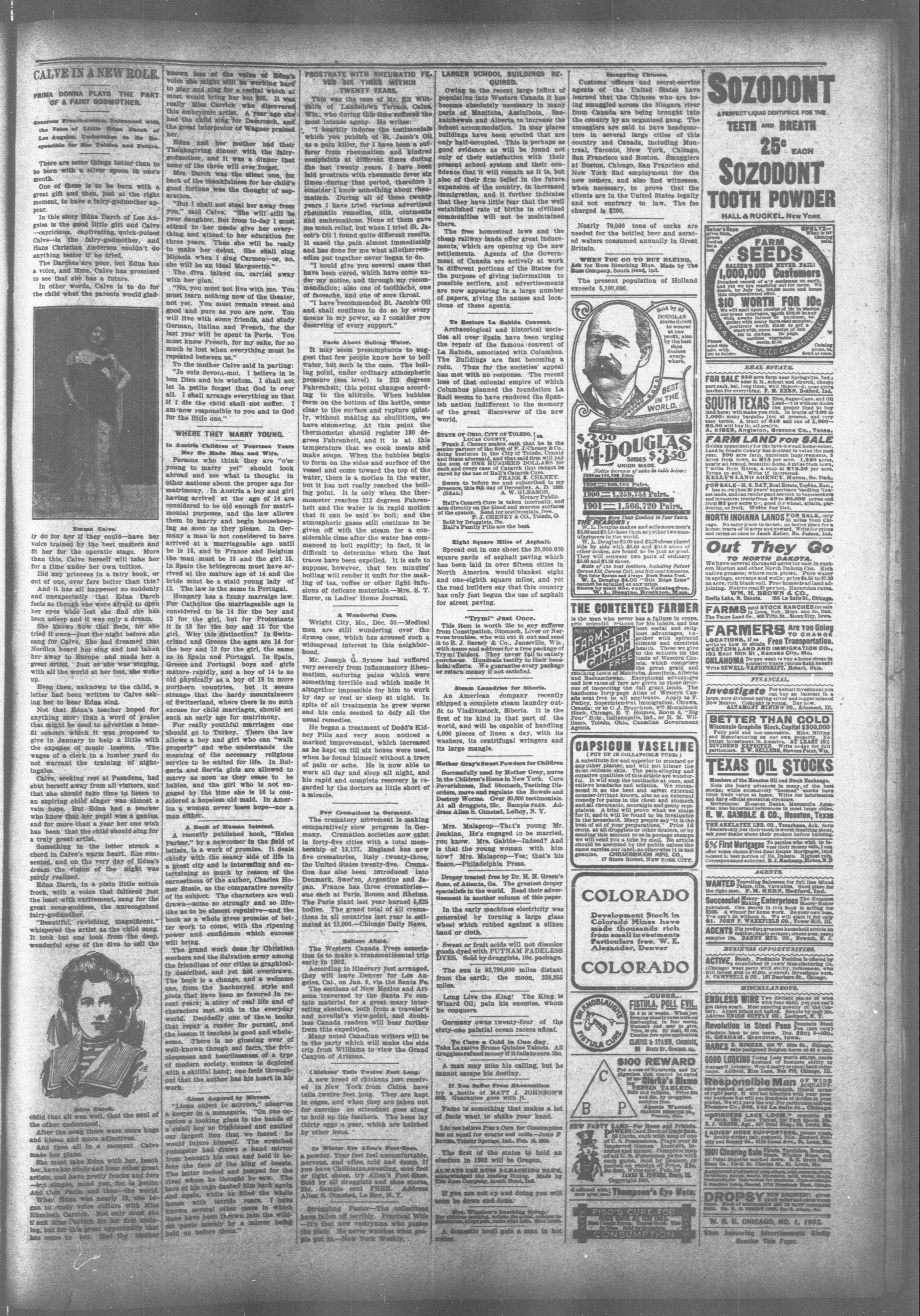
PRIMA DONNA PLAYS THE PART OF A FAIRY GODMOTHER.
Generous Frenchwoman, Entranced with the Voice of Little Edna Darch of Los Angeles, Undertakes to Be Responsible for Her Tultien and Future.
There are some things better than to be born with a silver spoon in one's mouth.
In this story Edna Darch of Los Angeles is the good little girl and Calve—capricious, captivating, quick-pulsed Calve—is the fairy-godmother, and Hans Christian Andersen couldn't do anything better if he tried.
The Darches are poor, but Edna has a voice, and Mme. Calve has promised to see that she has a future.
In other words, Calve is to do for the child what the parents would glad-
VIVA
Emma Calve.
ly do for her if they could—have her voice trained by the best masters and fit her for the operatic stage. More than this, Calve herself will take her for a time under her own tuition. Did any princess in a fairy book, or out of one, ever fare better than this? And it has all happened so suddenly and unexpectedly that Edna Darch feels as though she were afraid to open her eyes wide lest she find she has been asleep and it was only a dream.
She knows how feels, for she tried it once—just the night before she sang for Calve. She had dreamed that Nordica heard her sing and had taken her away to Europe and made her a great artist. Just as she was singing, with all the world at her feet, she woke up. Even then, unknown to the child, a letter had been written to Calve asking her to hear Edna sing.
Not that Edna's teacher hoped for anything more than a word of praise that might be used to advertise a benefit concert which it was proposed to give in January to help a little with the expense of music lessons. The wages of a clerk in a lumber yard do not warrant the training of nightingales.
Calve, seeking rest at Pasadena, had shut herself away from all visitors, and that she should take time to listen to an aspiring child singer was almost a vain hope. But Edna had a teacher who knew that her pupil was a genius, and for more than a year her one wish has been that the child should sing for a truly great artist.
Something in the letter struck a chord in Calve's warm heart. She consented, and on the very day of Edna's dream the vision of the night was partly realized.
Edna Darch, in a plain little cotton frock, with a voice that faltered just the least with excitement, sang for the great song-goddess, the unrecognized fairy-godmother. "Beautiful, ravishing, magnificent," whispered the artist as the child sang. It took but one look from the deep, wonderful eyes of the diva to tell the
1
She must take Edna with her, teach her, have her study and hear other great artists, and have pretty frocks and furs—but simple, mind you, for la petite. And then Paris, and then—the world. When Edna was nearly 12, she began to study voice culture with Miss Elizabeth Carrick. Not only must she thank Miss Carrick for her first training, but for this great opportunity that has come to her. Had the teacher
known less of the value of Edna's voice she might still be working hard to play and sing for a recital which at most would bring her but $25. It was really Miss Carrick who discovered this embryonic artist. A year ago she had the child sing for Damrosch, and the great interpreter of Wagner praised her. Edna and her mother had their Thanksgiving dinner with the fairy-godmother, and it was a dinner that none of the three will ever forget.
Mrs. Darch was the silent one, for back of the thankfulness for her child's good fortune was the thought of separation.
"But I shall not steal her away from you," said Calve. "She will still be your daughter. But from to-day I must attend to her needs give her everything and attend to her education for three years. Then she will be ready to make her debut. She shall sing Miccaela when I sing Carmen—or, no, she will be an ideal Marguerite."
The diva talked on, carried away with her plan.
"No, you must not live with me. You must learn nothing now of the theater, not yet. You must remain sweet and good and pure as you are now. You will live with some friends, and study German, Italian and French, for the last year will be spent in Paris. You must know French, for my sake, for so much is lost when everything must be repeated between us."
To the mother Calve said in parting: "Je suis devout-moi. I believe in le bon Dieu and his wisdom. I shall not let la petite forget that God is over all. I shall arrange everything so that if I die the child shall not suffer. I am now responsible to you and to God for the little one."
WHERE THEY MARRY YOUNG
May Be Made Man and Wife. Persons who think they are "o'er young to marry yet" should look abroad and see what is thought in other nations about the proper age for matrimony. In Austria a boy and girl having arrived at the age of 14 are considered to be old enough for matrimonial purposes, and the law allows them to marry and begin housekeeping as soon as they please. In Germany a man is not considered to have arrived at a marriageable age until he is 18, and in France and Belgium the man must be 18 and the girl 15. In Spain the bridegroom must have arrived at the mature age of 14 and the bride must be a staid young lady of 12. The law is the same in Portugal.
Hungary has a funny marraige law. For Catholics the marriageable age is considered to be 14 for the boy and 12 for the girl, but for Protestants it is 18 for the boy and 15 for the girl. Why this distinction? In Switzerland and Greece the ages are 14 for the boy and 12 for the girl, the same as in Spain and Portugal. In Spain, Greece and Portugal boys and girls mature-rapidly, and a boy of 14 is as old physically as a boy of 18 in more northern countries, but it seems strange that the hardy mountaineers of Switzerland, where there is no such excuse for child marriages, should set such an early age for matrimony.
For really youthful marriages one should go to Turkey. There the law allows a boy and girl who can "walk properly" and who understands the meaning of the necessary religious service to be united for life. In Bulgaria and Servia girls are allowed to marry as soon as they cease to be babies, and the girl who is not engaged by the time she is 16 is considered a hopeless old maid. In America a woman never loses hope—nor a man either.
A Book of Human Interest.
A recently published book, "Helen Parker," by a newcomer in the field of letters, is a work of promise. It deals chiefly with the seamy side of life in a great city and is interesting and entertaining as much by reason of the earnestness of the author, Charles Homer Steele, as the comparative novelty of its subject. The characters are well drawn—some so strongly and so life-like as to be almost repulsive—and the book as a whole gives promise of better work to come, with the ripening power and confidence which success will bring.
The grand work done by Christian workers and the Salvation army among the friendless of our cities is graphically described, and yet not overdrawn. The book is a change, and a welcome one, from the hackneyed style and plots that have been so favored in recent years; a story of real life and of characters met with in the everyday world. Decidedly one of these books that repay a reader for perusal, and the lesson it teaches is good and wholesome. There is no glossing over of well-known though sad facts, the frivolousness and heartlessness of a type of modern society, woman is depicted with a skillful hand; one feels throughout that the author has his heart in his work.
"Lions object to mirrors," observes a keeper in a menagerie. "On one occasion a looking glass in the hands of a small boy so frightened and excited our largest lion that we feared he would injure himself. The wretched youngster had drawn a hand mirror from beneath his coat and held it before the face of the king of beasts. The latter looked and jumped for the rival whom he thought he saw. The bars of his cage dashed him back again and again, while he filled the whole house with terrific roars. I have known several other cases in which lions have been thrown into the wildest panic merely by a mirror being held up before them."
PROSTRATE WITH RHEUMATIC FE
VER SIX TIMES WITHIN TWENTY YEARS.
This was the case of Mr. Ell Wiltshire of Landsdown Terrace, Calne, Wis., who during this time suffered the most intense agony. He writes:
"I heartily indorse the testimonials which you publish of St. Jacob's Oil as a pain killer, for I have been a sufferer from rheumatism and kindred complaints at different times during the last twenty years. I have been laid prostrate with rheumatic fever six times during that period, therefore I consider I know something about rheumatism. During all of these twenty years I have tried various advertised rheumatic remedies, oils, ointments and embrocations. None of them gave me much relief, but when I tried St. Jacob's Oil I found quite different results. It eased the pain almost immediately and has done for me what all other remedies put together never bean to do.
"I could give you several cases that have been cured, which have come under my notice, and through my recommendation; also one of toothache, one of faceache, and one of sore throat. "I have recommended St. Jacob's Oll and shall continue to do so by every means in my power, as I consider you deserving of every support."
Facts About Rolling Water
It may seem presumptuous to suggest that few people know how to boil water, but such is the case. The boiling point, under ordinary atmospheric pressure (sea level) is 212 degrees Fahrenheit; this point changes according to the altitude. When bubbles form on the bottom of the kettle, come clear to the surface and rupture quietly, without making an ebullition, we have simmering. At this point the thermometer should register 180 degrees Fahrenheit, and it is at this temperature that we cook meats and make soups. When the bubbles begin to form on the sides and surface of the vessel and come toward the top of the water, there is a motion in the water, but it has not really reached the boiling point. It is only when the thermometer reaches 212 degrees Fahrenheit and the water is in rapid motion that it can be said to boil; and the atmospheric gases still continue to be given off with the steam for a considerable time after the water has commenced to boil rapidly; in fact, it is difficult to determine when the last traces have been expelled. It is safe to suppose, however, that ten minutes' boiling will render it unfit for the making of tea, coffee or other light infusions of delicate materials.—Mrs. S. T. Rorer, in Ladies' Home Journal.
A Wonderful Curse.
Wright City, Mo., Dec. 30.—Medical men are still wondering over the Symes case, which has aroused such a widespread interest in this neighborhood.
Mr. Joseph G. Symes had suffered very severely from Inflammatory Rheumatism, enduring pains which were something terrible and which made it altogether impossible for him to work by day or rest or sleep at night. In spite of all treatments he grew worse and his case seemed to defy all the usual remedies.
He began a treatment of Dodd's Kidney Pills and very soon noticed a marked improvement, which increased as he kept on till six boxes were used, when he found himself without a trace of pain or ache. He is now able to work all day and sleep all night, and his rapid and complete recovery is regarded by the doctors as little short of a miracle.
Few Cremations in Germany.
The crematory movement is making comparatively slow progress in Germany. Cremation societies now exist in forty-five cities with a total membership of 13,177. England has now five crematories, Italy twenty-three, the United States twenty-five. Cremation has also been introduced into Denmark, Sweden, Argentine and Japan. France has three crematories one each at Paris, Rouen and Rheims. The Paris plant last year burned 5,825 bodies. The grand total of all cremations in all countries last year is estimated at 13,000.—Chicago Daily News.
Editors Afield.
The Western Canada Press association is to make a transcontinental trip early in 1902.
According to itinerary just arranged, they will leave Denver for Los Angeles, Cal., on Jan. 9, via the Santa Fe.
The sections of New Mexico and Arizona traversed by the Santa Fe contain material for a great many interesting sketches, both from a traveler's and novelist's view-point, and doubtless Canada readers will hear further from this expedition.
Many noted Canadian writers will be in the party which will make the side trip from Williams to view the Grand Canyon of Arizona.
Chlekeng' Tails Twelve Feet Long.
A new breed of chickens just received in New York from China have tails twelve feet long. They are kept in cages, and when they are taken out for exercise an attendant goes along to hold up the feathers. The hens lay thirty eggs a year, which are hatched by other hens.
In Winter Use Allen's Foot-Ease, a powder. Your feet feel uncomfortable, nervous, and often cold and damp. If you have Chilblains, sweating, sore feet or tight shoes, try Allen's Foot-Ease. Sold by all druggists and shoe stores, 25c. Sample sent FREE. Address Allen S. Olmsted, Le Roy, N. Y.
Struggling Pastor—The collections have fallen off terribly. Practical Wife It's that new vestryman who passes the plate. He never watches what people put in.—New York Weekly.
LARGER SCHOOL BUILDINGS REQUIRED
Owing to the recent large influx of population into Western Canada it has become absolutely necessary in many parts of Manitoba, Assinibola, Saskatchewan and Alberta to increase the school accommodation. In may places buildings have been erected that are only half-occupied. This is perhaps as good evidence as will be found not only of their satisfaction with their present school system and their confidence that it will remain as it is, but also of their firm belief in the future expansion of the country, in increased immigration, and it further indicates that they have little fear that the well established rate of births in civilized communities will not be maintained there.
The free homestead laws and the cheap railway lands offer great inducements, which are opening up the new settlements. Agents of the Government of Canada are actively at work in different portions of the States for the purpose of giving information to possible settlers, and advertisements are now appearing in a large number of papers, giving the names and locations of these agents.
To Restore Le Robide, Convent
Archaeological and historical societies all over Spain have been urging the repair of the famous convent of La Rabida, associated with Columbus. The Buildings are fast becoming a ruin. Thus far the societies' appeal has met with no response. The recent loss of that colonial empire of which Columbus planned the foundation La Radi seems to have rendered the Spanish nation indifferent to the memory of the great discoverer of the new world.
STATE OF OHIO, CITY OF TOLEDO, }
Frank J. Cheney makes oath that he is the senior partner of the firm of F. J. Cheney & Co., doing business in the City of Toledo, County and State aforesaid, and that said firm will pay the sum of ONE HUNDRED DOLLARS for each and every case of Catarrch that cannot be cured by the use of Hall's Catarrch Cure.
FRANK G. CHENEY.
Sworn to before me and subscribed in my presence, this 6th day of December, A. D. 1886.
(SEAL)
A. W. GLEASON,
Notary Public.
Hall's Catarrh Cure is taken internally, and acts directly on the blood and mucous surfaces of the system. Send for testimonials, free.
F. J. CHENEY & CO., Toledo, O.
Sold by Druggists, 75c.
Hall's Family Pills are the best.
Eight Square Miles of Asphalt.
Spread out in one sheet the 26,000,000 square yards of asphalt paving which has been laid in over fifteen cities in North America would blanket eight and one-eighth square miles, and yet the road builders say that this country has only just begun the use of asphalt for street paving.
"Trymi" Just Once.
This item is worth 25c to any sufferer from Constipation, Stomach, Liver or Nervous troubles, who will cut it out and send it to R. J. Sarasy & Co., Janesville, Wis., with name and address for a free package of Trymi Tablets. They never fail to satisfy purchaser. Hundreds testify to their beneficial effects. We guarantee every package or return money if not satisfied.
Steam Laundries for Siberia.
An American company recently shipped a complete steam laundry outfit to Vladivostock, Siberia. It is the first of its kind in that part of the world, and will be capable of handling 4,000 pieces of linen a day, with its washers, its centrifugal wringers and its large mangle.
Successfully used by Mother Gray, nurse in the Children's Home in New York. Cure Feverishness, Bad Stomach, Teething Disorders, move and regulate the Bowels and Destroy Worms. Over 80,000 testimonials. At all druggists, 25c. Sample FREE. Address Allen S. Olmsted, LeRoy, N. Y.
Mrs. Malaprop—That's young Mr. Jenkins. He's engaged to be married, you know. Mrs. Gabble—Indeed? And is that the young woman with him now? Mrs. Malaprop—Yes; that's his flasco.—Philadelphia Press.
Dropsy treated free by Dr. H. H. Green's Sons, of Atlanta, Ga. The greatest dropsy specialists in the world. Read their advertisement in another column of this paper.
In the early machines electricity was generated by turning a large glass wheel which rubbed against a silken band or cloth.
Sweat or fruit acids will not discolor goods dyed with PUTNAM FADELESS DYES. Sold by druggists, 10c. package.
The sun is 92,790,000 miles distant from the earth; the moon, 238,855 miles.
Long Live the King! The King is Wizard Oil; pain his enemies, whom he conquers.
Germany owns twenty-four of the sixty-one palatial ocean racers afloat.
To Cure a Cold in One day,
Take Lazative Bromo Quinine Tablets. All druggists refund money if it fails to cure. 25c.
A man may miss his calling, but he cannot escape his destiny.
If You Suffer From Rheumatism try a bottle of MATT J. JOHNSON'S 003. Guarantee goes with it.
Fame is something that makes a lot of fools want to shake your hand.
I do not believe Piso's Cure for Consumption has an equal for coughs and colds.—John P Boyer, Trinity Springs, Ind., Feb. 18, 1900.
The first of the states to hold an election in 1902 will be Oregon.
ALWAYS USE RUSS BLEACHING BLUE, acknowledged the leading bluing. Made by The Russ Company, South Bend, Ind.
If you are not rp and doing you will soon be down and done.
Mrs. Winstow's Soothing Syrup.
A domestic broil gets a man in hot water.
Customs officers and secret-service agents of the United States have learned that the Chinese who are being smuggled across the Niagara river from Canada are being brought into the country by an organized gang. The smugglers are said to have headquarters in several large cities of this country and Canada, including Montreal, Toronto, New York, Chicago, San Francisco and Boston. Smugglers at Boston, Chicago, San Francisco and New York find employment for the new comers, and also find witnesses, when necessary, to prove that the clients are in the United States legally and not contrary to law. The fee charged is $200.
Nearly 70,000 tons of corks are needed for the bottled beer and aerated waters consumed annually in Great Britain.
WHEN YOU GO TO BUY BLUING,
Ask for Russ Bleaching Blue. Made by The Russ Company, South Bend, Ind.
The present population of Holland exceeds 5,100,000.
Sold by 63
DOUGLAS
stores direct
to wearer
at one
profit; also
by the best
shoe
dealers
every-
where.
BEST
IN THE
WORLD.
$3.00
W.L.DOUGLAS
SHOES $3.50
UNION MADE
Notice increase of sales in tables below:
1899 = 146,708 Palrs.
1899 = 898,182 Palrs.
1900 = 1,259,754 Palrs.
1901 = 1,566,720 Palrs.
Business More Than Doubled in Four Years.
THE REASONS:
W. L. Douglas makes and sells more men's $3.00 and $3.50 shoes than any other two manufacturers in the world.
W. L. Douglas $3.00 and $3.50 shoes placed side by side with $5.00 and $6.00 shoes of other makes, are found to be just as good. They will outwear two pairs of ordinary $3.00 and $3.50 shoes.
Made of the best leather. Including Patent Corona Kid, Corona Colt, and National Kangaroo. First Color Epoxides and Always Black Books Used. W. L. Douglas $4.00 "Gilt Edge Line" cannot be equalled at any price. Sheets by mail 25c. extra. Catalog free.
THE CONTENTED FARMER
has a failure in crops, for his labors, and has best social and religious advantages, together with splendid climate and excellent health. These we give to the settlers on the lands of Western Canada, which comprises the great grain and
FARMS IN WESTERN CANADA
the great grain and
ranching lands of Manitoba, Ansbibia, Alberta
and Saskatchewan. Exceptional advantages
and low rates of fare are given to those desirous of inspecting the fall grant lands. The handsome forty page Atlas of Western Canada sent free to all applicants. Apply to F. Pedley, Superintendent Immigration, Ottawa, Canada; or to C. J. Brouchton, 977 Monadnock Block, Chicago, E. T. Holmes, Room & "Big Four" Bidg., Indianapolis, Ind., or H. M. Williams, Toledo, Ohio, Canadian Government Agents.
CAPSICUM VASELINE
(PUT UP IN COLLAPSIBLE TUBES)
A substitute for and superior to mustard or any other plaster, and will not blister the most delicate skin. The pain-allaying and curative qualities of this article are wonderful. It will stop the toothache at once, and relieve headache and sclatica. We recommend it as the best and safest external counter-irritant known, also as an external remedy for pains in the chest and stomach and all rheumatic, neuralgic and gouty complaints. A trial will prove what we claim for it, and it will be found to be invaluable in the household. Many people say "it is the best of all of your preparations." Price 15 cents, at all druggists or other dealers, or by sending this amount to us in postage stamps we will send you a tube by mail. No article should be accepted by the public unless the same carries our label, as otherwise it is not genuine.
CHESEBROUGH MFG. CO.
17 State Street New York, NY
COLORADO
Development Stock in
Colorado Mines have
made thousands rich
from small investments
Particulars free. W. E.
Alexander, Denver
COLORADO
...CURES...
FISTULA, POLL EVIL,
In 4 to 16 weeks. When just
discharging, in four weeks.
Humane and easy to give
price, 50 cts. By mail, 60 cts.
Treatise free upon application
CLOUSE & STAMM, Chemists,
28 STATE ST. GENEBER, AL.
...CURES...
FISTULA, POLL EVIL,
In 4 to 16 weeks. When just forming usually curses without discharging, in four weeks. Humane and easy to give. Price, 50 cts. By mail, 60 cts. Treatise free upon application
CLOUSE & STAMN, Chemists,
28 STATE ST., GENERAL, M.L.
$100 REWARD
For a case of dyspepsia and in digestion that cannot be cured by un-
ing Clarke's Bismo
PEPSIN TABLET.
Safe and reifiable. Price 25c
and 50c. by druggists.
samples free.
Agents Wanted.
CLARKES MEDICINE CO.,
Watson, Ohio.
NEW PARTY GAME-For Home and Friends.
POWERS Card Book of Uncle Sam.
53 Cards, each with map of one of U. S. Possessions. Plays over 50 Improved Games. Instruct, interest and amuse. Complete map of all U. S. Possessions extra with each game. Sold by Dealers, or mailed on receipt of Price. 25c. Be first. Write now. Pub. by
JAMES M. POWERS, Emery, Ill.
Copyright 190L.
Afflicted with I more acre, use! Thompson's Eye Water:
PISO'S CURE FOR
CURE WHILE ALL THE TAILS
Bust Cough Syrups. Tastes Good. Use
In Cure. Sooth by drumming.
CONSUMPTION
SOZODONT
A PERFECT LIQUID DENTIFRICE FOR THE
TEETH AND BREATH
25c EACH
SOZODONT
TOOTH POWDER
HALL & RUCKEL NEW YORK
BUY NORTHERN GROWN SEEDS
FARM
SEEDS
SALZER'S SEEDS NEVER FAIL!
1,000,000 Customers
Proudest record of any seedman on earth,
and we are reaching out for more. We
desire, by July 1st, 300,000 more and hence
this unprecedented offer.
$10 WORTH FOR 10c
We will mail upon receipt of 10c in stamps
outset, we catalog, worth $100.00 to any
ide, awake farmer or gardener, to
gather with many farm seed samples,
positively worth $10.00 to get a
start with, upon receipt of but
10c in stamps. 35c phga.
earliest vegetable
seeds, $1.00
Please
send this
adv. with
10c to Salzer.
Catalog
alone, 5e.
Send at once.
REAL ESTATE
FOR SALE $250 acre farm near Springville, Ind.; near R. R., school and church, cheap; part cash, bal. long time; well improved; near extra market for everything. F. M. KERN, Bedford, Ind.
SOUTH TEXAS Rice, Sugar-Cane, and Oil Land—it is without doubt the proper time to buy land here; will make you rich. In tracts of 100 to 1,000; many bargains just at present, and very easy terms. A tract of 640 and one of 1,000—$6.00 will buy it; all prairie.
A. KIBER, Angleton, Brazona Co., Texas
FARM LAND FOR SALE
Golden opportunity for the live-in and home-seeker. Land in Beadle County has doubled in value the past year. 200 acre farm, excellent improvements, 5 miles from town, at $15 per acre. 1,280 acres, nearly all fenced, beautiful home. 8 miles from town, 7 miles from Huron, a snap at $12.50 per acre. Terms to suit. Write if interested.
KELLY'S LAND AGENCY. Huron, So. Dak.
FOR SALE—H. S. DAY, Real Estate, Topka, Kan., has more than 30 years' experience handling Kansas lands, and can render good service to home seekers and investors; tracts from 40 to 20,000 acres and from $2 per acre up; good for wheat, alfalfa, gardening, or fruit. Write for list.
NORTH INDIANA LANDS FOR SALE, only 50 miles from Chicago. No safer place to invest; no better place for a home; tracts of 10 acres and upward. Write for prices and terms at once to Jacob Keller, No. Judson, Ind.
Out They Go
TO NORTH DAKOTA.
We have several thousand acres for sale in eastern Morton and other North Dakota Cos. Rich native grasses; where corn grows. Pure water in springs, streams and wells; price $4.50 to $7.50 an acre, rich black soil. Free homeestead land adjoining. Native coal $1 per ton. Excursion rates. WM. H. BROWN & CO., Devils Lake, N. Dakota. 155 La Salle St., Chicago.
FARMS and STOCK RANCHES for sale in Iowa, Neb. Minn. and so. Dak. The Union Land Co., 403 Fifth St., Sioux City, Iowa.
FARMERS Are You Going TO CHANGE LOCATIONS, if so. Free Transportation. WESTERN LAND AND IMMIGRATION CO., 103 East 10th St, Kansas City, Mo.
OKLAHOMA Do you want to buy a home cheap in a country where you can MAKE MONEY! Write SEWELL-VANDEGRIFF, Hobart, Okin.
FINANCIAL
Investigate For a small investment you can buy an interest in a large, sure dividend-paying silver and copper mine of New Mexico. Company is young. Buy now. ALTAMONT MINING CO., Altamont, III.
BETTER THAN GOLD Wisconsin Graphite Stock, Capital $300,000 Fully paid and non-assessable. Mine, Milling and Manufacturing on our own property. No better investment in America. AT LEAST 10% DIVIDEND EXPECTED. Write to-day for full particulars. E. W. SELLERS, Stevens Point, Wis.
TEXAS OIL STOCKS
Members of the Houston Oil and Stock Exchange.
Note the heavy advances in many, of the best stocks; while extensively "boomed" stocks have little trade value at home. Write for information and daily official quotation circulators.
References: Houston Banks, Mercantile Agencies; also important references in most large cities.
R. W. GAMBLE & CO., Houston, Texas
THE ARKLATEX LBR. CO., Texarkana, Ark. Sells dealers only, but their stock is worth inquiring about, ask your dealer about their product before building.
6% First Mortigages To parties who wish to invest their money safe, I can offer some choice First-Real Estate Mortgages, land located in best portion of No. Dakota. Highest refo. Correspondence solicited. H. J. Haskamp, Blissoe, N.D.
AGENTS.
WANTED Traveling Salesmen for full line Mixed
Paints, Oils, Varnishes, Good place for
the right man. F. M. KERN, Bedford, Ind.
Successful Money-Enterprises The Greatest
Making Making Money-Maker
published. One secret in this book is selling for
$100. A winner for home work. Be your own boss.
You can't do without it. We will start it for only
$1. JOHN P. WAKEFIELD CO., Tower Hill, III.
AGENTS Big profits; greatest household article on
market; dandy scraper; cleans pots, panas
samples 100. DANDY MPG. 00., Newark, N. J.
BUSINESS OPPORTUNITIES
ACTIVE Abready, Profitable Position is offered by
ACTIVE, established 10 years' Manufacturing Co.
(Chicago) want party with ability, references, who
will invest $00 to $200, secured; investigate sure.
A. CAMPELL & CO. 167 Dearborn St., Chicago.
MISCELLANEOUS
ENDLESS WIRE Two distinct places of wire get them apart. Most puzzling novelty of the Century. Ablest minds are baffled. Sample by mail 100. Address UMION SUPPLY CO., Lockport, N. Y.
Revolution in Steel Pens Fountain Steel Pen (pen only) absolute boon to pen users. Dox. 25c; 3-100. H. GRAHAM, Grandview, Iowa.
HARES B. MOSHER, 830 W. 58th St., Chicago, sells pedigree Belgian hares at 63 a pair.
GOOD LOOKING Young Lady worth $30,000, needs husband of business ability to manage it Is lonely. Would marry at once; bank references. Address, Miss Lena, Box 675, Chicago, Ill.
Responsible Man OF WIDE ACQUAINTANCE wanted as our correspondent. Liberal terms to right party. It will not interfere with present business but will put hundreds of dollars in your pocket. We will pave the way. For particular address Finance Co., 308, 145 La Salle St., Chicago.
GRINCESS LACE LOOM.10 complete 84
Book, 10e; Lace Thread, 500 Yard Spools, 10e.
K. J. GROTE, Agt., 507 Oriel Bldg., St. Louis, Mo.
LADIES' NOSE SUPPORTERS, patent clear,
double straps; pair, postpaid, 25c. Howard New-
city and Supply Co., 514 Laus Ave., St. Louis, Mo.
1901 Clearing Sale Paints, Varnishes, Brushes,
Glass, Window Glass, and
all Paint Supplies marked down. K. E. Grote Paint
Stone Co., 515-21 St. Charles St. St. Louis, Mo.
Ansys and Analysts of corn, alloyz, coal, cement, glays,
fertilizers, paints, marts, limestone, willow, dugge,
food stalks, etc. Instruction for students. Open enquiries.
J. Bunniew Young, Chemist, 1172 Main Street Block, Chicago.
DROPSY NEW DISCOVERY; given
quick relief and cure worms
cases. Book of testimonials and 10 BAYP treatments
BREAK. Dr. N. M. GREEN'S FOUS. Bae N. Allende, Co.
W. N. U. OHIOAGO, NO. 1, 1902.
When Answering Advertisements Kindly
Hention This Paper.
---
Citizens Brewing
COMPANY
ARCHER AVE. AND MAIN STREET.
CHICAGO
Telephone Canal 272
BARNEY BENSON,
House and Fire Wrecking.
MOVER of All Kinds of
HEAVY MACHINERY.
Smoke Stacks, Cupolas and Monuments
Erected. Hoisting and Placing of all
kinds of Beams and Girders for
architectural work.
Office, 31 South Canal St., Chicago
TELEPHONE MAIN 4928:
QUEER FAOS OF THE AGED.
Mary McDonnell, a vigorous old woman of Magheratempany, Ireland, in 1784, when 117, walked 14 miles. Col. George Perkins of Norwich, Ct., who died 13 years ago, aged 100, made a practice of walking four miles a day until within a few years of his death. Peter Mestanea, who died in Marcia, in 1743, aged 130, bathed in the river Segura every morning from the beginning of spring until the stream froze.
Sally Morris, who recently died near Parkersburg, W. Va., at the age of 113, had up to two years previous to her death walked 20 miles to town and back, one day in each week.
Mary Wilkinson of Yorkshire, England, who in 1788 died at 109, walked to London when she was past 90. The distance was 290 miles. She made it in five days and three hours.
The great age of Appolonius, a Pythagorean philosopher, alleged to have been 130, was attributed to the fact that from youth he never drank wine, ate meat, wore shoes or cut his hair, and that he dressed only in linen. He lived five years without speaking.
"I have used olive oil for 30 years, and feel younger today than I did when I began, though I am now in my 102d year," writes G. E. D. Diamond of San Francisco. "The description given in the bible of the anointing of the chosen king of Israel with olive oil for the purpose of increasing his number of years first suggested the idea to me," he adds.
Walking appears to be the form of physical exercise most favored by centenarians. It is related of one MacDonald, who died in Highlands, Scotland, in 1791, aged 101: "He was a great pedestrian, and the year before he died, at the age of 100, undertook a wager to walk 10 miles in two hours and a half, which he performed. He was accordingly presented to the king at Windsor."
William Hotchkiss, known as "the color doctor," who died in St. Louis in 1895, and whose Masonic record was traced back 100 years, "showing conclusively that he was at least 121 years old," attributed his long life to hobbies, described as follows: "He is said by those nearest to him to have not taken a bath for over 25 years, but scoured himself with sand. He claimed to have discovered the elixir of life. At regular intervals he stood over a smoking brazier and allowed the smoke to envelop his body."
"It was his frequent custom to promote perspiration and then change his linen, particularly as he advanced in life," recounts a biographer of Charles Mackla, the English playwright, who died at 107. It was this genius' further custom "not to sleep on a feather bed, but on a mattress, which was a couch without curtains, placed in the center of the room. He usually lay with his head high," it is further stated, "but for the last 20 years never took off his clothes unless to change them or his linen, or to be rubbed all over with warm brandy or gin."
One Block Contains 8,700 Persons.
The most populous block in the world is said to be that in New York, extending from Amsterdam to West End avenue and from Sixty-first street to Sixty-second street. Eighty-seven hundred human beings, of twenty-six different nationalities, of every race, color and creed, are huddled together in five and six-story tenements.
Africans Play on the Zanger
The western Africans have a musical instrument called the zanze. It is a board in which are fastened from twenty to thirty bits of iron wire of different lengths and sizes; the wires are plucked with the fingers, and the tone produced is not unpleasing.
Champion Speller's Challenge
David Jones, a district school teacher of Missouri, has issued his annual challenge to any person or group of persons in the world to spell against him. One of Mr. Jones' conditions is that all the words presented shall be English.
Bacteria in School Inks.
The authorities at Minden, Germany, have made a bacteriological examination of school inks. They have found that most of them contain bacteria which, if animals are inoculated with them, often prove fatal.
Meat Eaters.
Shakespeare makes somebody say, "I am a great eater of beef, and I believe it does harm to my wit." But are the beef-eaters so stupid? The Italians consume twenty-four pounds pen annum per capita, the Spaniards, twenty-seven pounds, Bohemians and Hungarians thirty-one pounds, Germans fifty-six pounds, English 126 pounds and the American 145 pounds. Are Americans and Englishmen prepared to deny that beef, brains and brawn go together, and to put the Italian on the top?—Portland Oregonian.
The Arctic Sammer.
The Arctic summer is brief, and for weeks together there is nothing to distinguish day and night. Once, at Dvornik, two naturalists had left their ships at different hours. When later they met, one said "Good morning," the other, "Good evening." Both agreed that the hour was 7, and while one traveler held that it was 7 o'clock tomorrow morning, the other maintained that it was 7 o'clock last night. On returning to the ship they settled that it was last night, so they dined and went to bed again.
Consistent Melancholy Her Ideal.
A Quakeress of revolutionary times, Ann Whitall, kept a little diary or book of "meditations," as she quaintly phrased it. She was a very earnest and devout woman, full of good works, but like many of later date, she regarded consistent melancholy as her ideal of conduct. She writes in her diary: "I often thinks if I could be so fixt as never to laugh nor to smil I shud be won step better; it fills me with sorrow when I see people so ful of laf and of prate."
Decline of the White Lawn Tie.
Decline of the White Lawn Tie. An interesting chapter might be written of the decline of the white lawn tie in congress. The Virginia congressman never did effect it to any great extent, and only occasionally was it visible around the neck of a North Carolinian. Farther south, however, the white tie and statesmanship used to go hand-in-hand. Even the stald and solemn Catchings of Mississippi, was a victim of the habit. But nowadays the custom is dying out.
Profits from Berlin's Gas-Works.
Last year the municipality of Berlin derived a profit of more than $3,- 000,000 from the city gas works, which represent an investment of about $15,- 000,000. Much of the profit came from such by-products as coke, tar, ammonia—in fact it may be said that the entire expense of maintaining the gas works was paid from the manufacture and sale of these articles, so that the direct receipts from gas were almost clear gain.
Couldn't Escape Collection Plate.
Rev. Father McGuire, pastor of a Roman Catholic church in Long Island City, finding that a number of persons habitually left, the church after mass and just before the collection was taken up, caused the doors of the edifice to be locked last Sunday until service was over, and more than twenty people who tried to escape before the plate came around were conspicuously unable to do so.
Electrical Enterprises Are Great. The amount of capital invested in electrical enterprises reaches stupendous totals-$250,000,000 in telegraphy, $400,000,000 in telephones, $750,000,000 in electric lighting, and $2,000,000,000 in electric railways, or a grand total of not less than $4,000,000,000 in electrical industries in this country alone, and an employment roll of 500,000 people.
Irrigation Would Increase Population. It is officially estimated that if the waters in our western states now unused were utilized for irrigation purposes, a population of 80,000,000 more could be sustained in those states.
Ask your dealer for
Sunday Creek No. 18
HOCKING
The best for domestic use.
For Sale by
THE JONES & ADAMS CO.
Anthracite and Bituminous Coal
47th St. and Webash Railroad,
Strictly dealers' yards.
HALL & RAWLINS
Undertakers and Embalmers AND LIVERY 4938 State Street CHICAGO Bathmates and Specif- onious Pursuit Prompt Attention Storm to Jobbing
C.J. BOYD,
Practical Plumber and Gas-fitter
Steam and Hot Water Heating,
Iron and Tile Drainage . . .
Telephone Yards NL.
709 WEST 47TH STREET.
BERNARD J..MAGUIRE,
BUFFET.
430 STATE ST., Cor Polk.
IMPORTED WINES, LIQUORS
AND CIGARS A SPECIALTY,
TEL. 973 Harrison, CHICAGO.
MRS. LIZZIE N. RANDELL
Dressmaking and
Plain Sewing.....
4836 State St. CHICAGO
FOR BARGAINS IN
Dry Goods, Gents' Furnishings and Shoes
GO TO
THOMAS & HARRIS
TWO BIG STORES
8101-3 Wentworth Ave.
5650-4 S. Halsted Street
GUS GEBHARDT
Boots, Shoes and Rubbers
Gentlemen's Furnishing Goods
No. 5046 SO. STATE STREET
CHICAGO
NEWSPAPER SUBSCRIPTIONS.
The decisions of the United States Court on these subjects are interesting.
1. Subscribers who do not give express notice to the contrary are considered as wishing to renew their subscriptions.
2. If subscribers order the discontinuance of their periodicals, the publisher may continue to send them until all arrearages are paid.
3. If subscribers neglect or refuse to take their periodicals from the postoffice to which they are directed, they are responsible until they have settled their bills and ordered them discontinued.
4. If subscribers move to other places without informing the publisher, and the papers are sent to the former address, they are held responsible.
5. The courts have decided that refusing to take periodicals from the office or removing and leaving them uncalled for, is prima facie evidence of intentional fraud.
6. If subscribers pay in advance they are bound to give notice at the end of the time if they do not wish to continue taking it; otherwise the publisher is authorized to send it, and the subscriber will be responsible until an express notice, with payment for all arrearages, is sent to the publisher.
Don't imagine that all hair preparations are alike. Quite the contrary. Some never do what is claimed for them. The Original Ozonized Ox Marrow has been on the market for so long that there is no doubt it will do everything we claim for it. It is the most genteel preparation that any one can use on their hair. It is most delicately perfumed and when thoroughly rubbed into the scalp and well brushed through the hair it cannot fail to cure dandruff and make the hair straight, soft and beautiful. It invigorates the scalp producing new growth and stops the hair from falling out. Try a bottle and you will be sure to be pleased. Only 50 cents, express paid, to any address in the United States. Druggists also sell it. Address: Ozonized Ox Marrow Co., 76 Wabash Ave., Chicago, Illinois.
```markdown
```
Waiting for Business
Is very poor business. The only way to do business in a business-like way is to make business. If you are in business and are not satisfied with the volume of business you have been doing, we would suggest that you take the business advice of one who makes it his business to make business for others. Your announcements in the columns of this paper will bring you increased business. We can easily demonstrate to your satisfaction that waiting for business
Is Not Good Business
JOHN FITZGERALD
JUSTICE OF THE PEACE
4787 S. HALSTED STRMET,
....CHICAGO
SAVE MONEY BY BUYING YOUR PROVISIONS FROM
William Howard Fitzgerald
LAWYER
Room 402 Reaper Block, CHICAGO
S. A. McELWEE
A. E. HANSEN,
Staple and Fancy Groceries, Meats Best Brands of Flour, Teas, Coffees Baking Powder, Spices, Butter Eggs, and Canned Goods, Etc. All Goods Guaranteed to be Fresh, 5060 DEARBORN ST., COR. 51ST ST. CHICAGO.
...LAWYER...
36 S. Clark St., CHICAGO.
Room 706 Ogden Building
Residence, 3153 Forest Av.
ALBERT B. GEORGE
LAWYER.
428 Ashland Block, Chicago.
— Tel. M. 2025. —
Robert M. Mitchell
SAMPLE ROOM
Attorney at Law
Suite 9, No. 77 South Clark St.
CHICAGO
IMPORTED AND DOMESTIG
WINES, LIQUORS AND CIGARS
8462 SOUTH HALSTED STREET, CHICAGO.
A. JOSEPH JOSEPH STRAUSS
EDWARD H. WRIGHT
LAWYER
Suite 621, 200 S. Clark St.
Telephone, Harrison 2533. CHICAGO.
SALE AND EXCHANGE STABLE.
Thomas F. Soully,
Attorney at Law,
79 Clark Street, CHICAGO.
Room 14.
Driving, Draft and General Business Horses
Always on Hand
1197 Milwaukee Ave. Near Robay St.
Telephone West, 1028. OHIOAGO, IN.
Lawrence M. Ennis,
Advocate and Counsel at Law,
Suite 720 Opera House Block.
S. W. Corner Clark and Washington Sta.
TELEPHONE MAIN 1782.
PRODUCE COMMISSION Butter, Poultry, Eggs, Game, Veal, Eto. 217 SOUTH WATER STREET, CHICAGO.
G. E. EVANS. Designer in All Kinds of HARD AND SOFT COAL,
WILLIAM LOEFFLER
Wood, Charcoal, Coke and Ice, Expressing and Moving a Specialty. 332 29th St. Chicago, III.
WONDERFUL DISCOVERY
Curly Hair Made Straight By
TAKEN FROM LIFE:
BEFORE AND AFTER TREATMENT.
ORIGINAL
OZONIZED OX MARROW
(Copyrighted.)
This wonderful hair pomade is the only safe preparation in the world that makes kinky or curly hair straight as shown above. It nourishes the scalp and prevents the hair from falling post or breaking off, causes dandruff and makes the hair grow long and silky. Sold over forty years and used by thousands. Warranted harmless. Testimonials free on request. It was the first preparation ever sold for straightening kinky hair. Beware of imitations. Get the Original Opened Ox Marrow as the genuine never fails to keep the hair straight, soft and beautiful. A totof necessity for ladies, gentlemen and children. Elegantly perfumed. The great advantage of this wonderful pomade is that by its use you can straighten your own hair at home. Owing to its superior and lasting qualities it is the best and most economical. It is not possible everybody to produce a preparation equal to it. Full directions with every bottle. Only 40 cents. Sold by drugstores and dealers or send us $0 cents for one bottle or $1.40 for three bottles. We pay all express charges. Send postal or express money order. Write your name and address plainly to
OZONIZED OX MARROW CO.,
76 Wabash Avenue, Chicago, Illinois.
Read and subscribe for The Broad An,
the only newspaper in Chicago which
"hews to the Idea."
Telephone 565 South 31st and State Streets CHICAGO
YOU CAN SAVE MONEY
Made to your measure in Any Style. Guaranteed to Fit and Satisfy You. Better Grades up to $25 Pantaloons from $4.00 Up! The Largest, Oldest and Most Extensive Tailoring Establishment in Chicago Our Fall Line is Now Complete. The Best in the City. EVERYTHING GUARANTEED.
THE MOSSLER BROS. Successors to ARNHEIM, THE TAILOR. CORNER CLARK AND MONROE STS.
---