The Broad Ax
Saturday, October 18, 1902
Chicago, Illinois
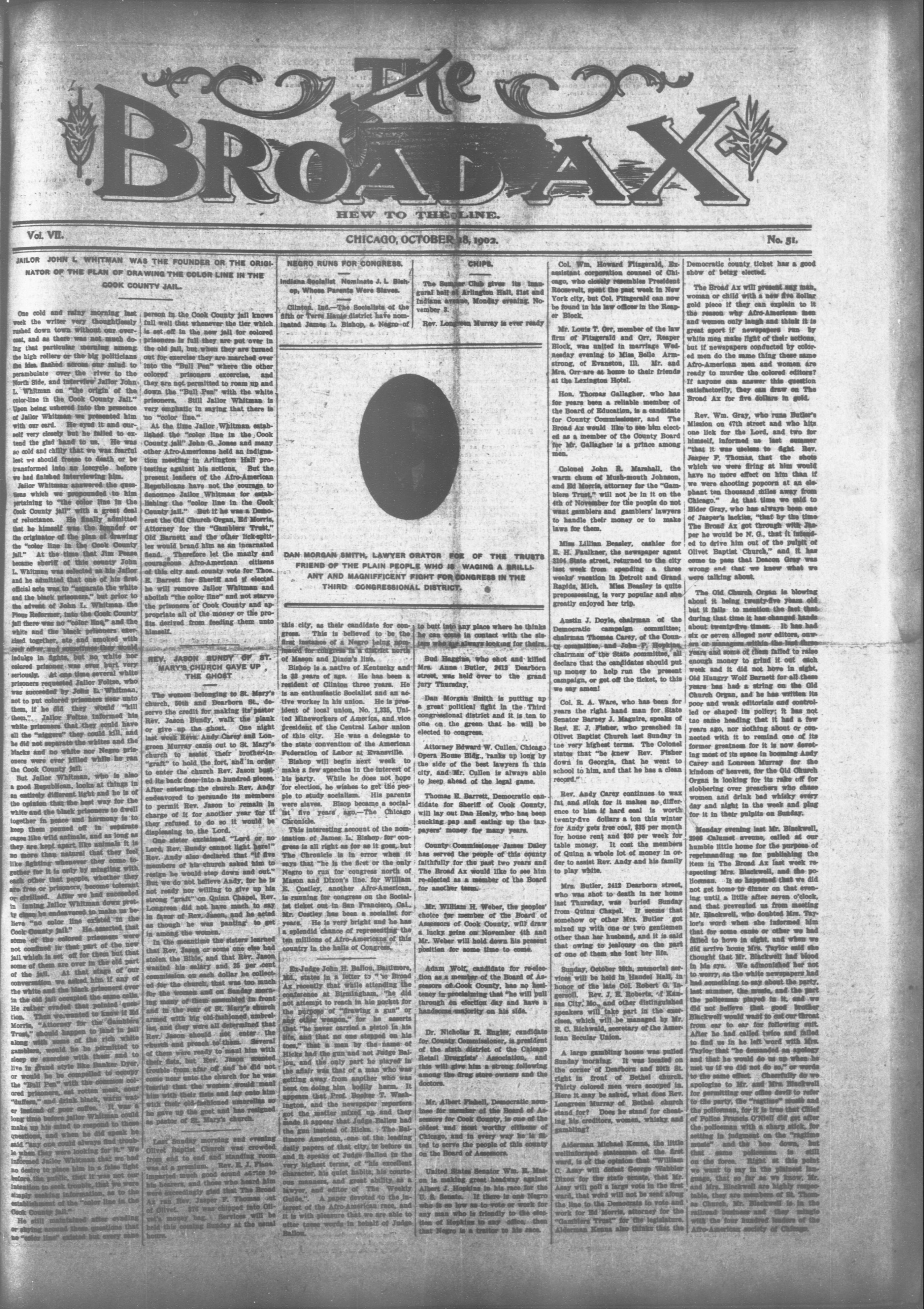
Page text (machine-generated)
5 eaieenaes ]
S a
a. eS BROAD a
: all
eee iy tie a
SS oe,
Gubseriptions mrst be pald 10 advance.
Pee
Sobers
-woLrus ¥. ‘TAYLOR, Beti~e and Pebttener:
Ramet kr the Post Office er Chteago,
_. TL, as Second-class Matter. |
‘Tt Bzeeods the Carrying Power of ax
Blectric Piant of 40,000 Volts
= ‘Gée Tinkés Over. ~
: ‘Pew people have any understanding
rot the disruptive -power of 8 severe
- bolt-of lightning. .The figures quoted
that st the present time the of
_earrying power of an electric plant is
electricity ¢t 40,000 volts, one-tenth
‘of that of s heavy lightuing bolt, says
an electrical authority. ."
' Perhaps s truer conception is to be
- gained from the story of ap old Long
Island resident, who admite being
very fond of squirrel bunting, and
says: “In s piece of clear woods near
where I lived al years ago was
“an enormous ‘oak tree several
feet through at the stump, and spread-
‘ing over half an acre of ground. Under
‘eertain- conditions I. could always
-eount on finding s fox squirrel in that
‘ tree, and I knew every limb of it.
. “One morning, after s tremendous
thunder storm, in which we all had no-
-tieed a mighty thunder bolt, I visited
‘this tree. Only a pile of broken brush-
‘wood and thousands of little splinters
‘peattered all over the ground for the
distance of several hundred feet all
- ground marked where thie-giant of the
forest had.stood. Some explosive
foree had torn the roots out until there
was & hole in the ground éight feet
deep and ten feet across.”
“That ov bolt of electricity ‘had
‘torn.that tree to pieces in a way that.
ten woodsmen: working an: entire |
week*could not have accomplished. _
_Sates Present-Day Practice of
” (: ) @werPee@ing the Aged,
~_dllit Henry. Thempqcn Spungpetes im
rene cee
, Yaneing in yesrs, and particularly o!
jects to the repeated and general use
of concentrated forms of anima! nour-
ment in old age is apt to lead to pains
and aches cue to the impairment of ex-
wetion and.a long protracted course
of overfeeding will end in an attack of
gout. Even artificial teeth are not to
be considered an unmixed blessing.
for by a provision of nature the teeth
‘Begin to decay and becomé useless
just when the system begins to thrive
‘without much animal food of céaree
‘fiber. - Indigestion, says Sir Henry
Thompson, is mostly not a disease,
but an “It is the lan-
oro iatcnonanineare
ynknown tongue to those who aread-
dreesed.” It means that the indi-
viddal has not yet found his appropri-
ate diet. “There is no food whatever
‘which is wholesome in iteeif; thet food
“only is wholesome which is so to the
4ndigiineL” - - ,
’ STORIES OF SNAKEBITES.
‘Stetistios Regarding Fatelities tn in-
- @im Ave Unceliable and the
a ae Siaaaae
from Indis seys that the stories about
the great umber of deaths from
snske-bités in Indid ‘ere tos grest
extent umrelisble, as statistics, when
carefully anslysed, show. He ac-
counts, morgover, for the extreme ex-
-aggerations in Sgures on very pleusi-
ore In India, be pn
requires that when there *
den death a detailed Seemesiaain
be made to the civic surgeons, and as
‘permede, tbe tnder diame pertore
trouble... To save the annoyance of
gene, ond. as of ak hen
‘op -étherwise—a report of death
\“qnakebite” is, made. This sort of re-
pert is very convenient and makes in-
temettion ctaticticn. .. ._
- -NKeesing a Recater @utet.
> An English artist recently was sum-
moned to appear in court for allowing
@ rooster to crow in the morning to
the annoyance of his neighbors. The
Seenet tegen Hpeiotet: oe tet
lowing: ‘“It is Quite possible to keep
tha nash peda oem: Sadi: ree
ing. AR that is needed is a alight
strisig. over the neck and fastened to
sen Deel Pe a he ek chara
‘to throw back his head when crowing.
my
REESE
RO ; bs
of the eames ee
and » hermlane jerk brings him to or-
Ousious Notes by = Swiss Scicntict |
vations Among the Alps.
| {A well-known Swiss naturalist, H. M.
writes from Arolla, Canton
: cee be fading into
: seem to
oan moraines. They:
a . Ng
. er in July, Prof. ¥.
coy bee eoote ‘St Arolle. Wé
were ‘able to walk there without dif-
‘fieulty as in anicecorridor. Now not
only has the grotto disappeared, but
it takes an hour and's quarter fo reach
‘the glacier from the hotel.”
“During the first days of ‘October 25
yeare-ago-t teavdiesa wits po guides
the glacier. of Berbo] from Zermatt to
‘Arolla; it then readied deep down into
Sota ani ctonl
ay we m up
ee conten ron ce
eae a hs bes ubibed as
lieves firmly ‘that the glacier} which
separate this territory from I! will
disappear as the years go by. and that
the cattle of the Valasian peasants
‘will be sent 4o merket to Aosta (Italy)
across the passes which are now cov-
ered with fen
“The one curious afvantage in this
diminution of the glaciers is that the
moraines of Arolla are now producing
veritable forests, the seede of which
mnst heve been blown up by the wind
from the valley.
. ARGENTINE CATTLE. .
May Be Largely Purchased by Great
Beltain to Restock the Pastures
et Sewth Africa,
Tt may be said thet Great Britain will
naturally favor her own colonies in
making such purchases of cattle to re-
@tock the South African pasture lands,
and, other things being equal, this
would be natural, says the Buenos
Ayres Herald. But Canedian aiid New
Zealand beef brings a better price in
the British market then Argentine.
and this because in those colonies more
attention has been given to the breed-
‘ing of cattle for prime beef, and in con-
Sequence both Caveda and New Zea-
Jand, and the United States as a prob-
able bidder, are not likely to offer
their stock as cheaply as will the Ar-
gentine estanciero, and this difference
in ‘price is likely to secure for this
country a generous elice, at least, of
the business. Where else: in, the
world can the requisite number of cat-
tle-be found et such prices as can be
made here? We believe it ante to staic
that A: ina stands alone and in »
cominanding penton tn thle Tepect
et least, we have good reason for the
hope that is in us that in this direction
lies a prompt, large and profitable busi-
ness for us. Great Britain will be-
come a buyer of hundreds of thousands
of cattle for the South African plains
in making purchases of such magni-
cae That Argentine cattle at Argen-
prices and proximity
semeuadentaidings aaiaetaes,
bly looked upon seems to be reason-
abie, hence our belief and thet of the
Pere en cones Coat tea easing of
peace means an especie] good of great
magnitude to this country.
JUROR HAD RED HAIR.
Ané Reosented Remark of Freeh Le w-
yer by Refusing to Come to
em Agreement.
It bebooves « lawyer to be careful
of what he says while arguing before
@ jery. John C. Kinnear, a practiticn
er in New York, realizes this faci
oughly, saya the Albany Argue. anc s//
because of @ remark he mi. « not Jon:
ago in thé Yorkville municipal coust.
He appeered on behalf of anot} er law-
yer who wes suing 2 corpors,i o {
$500 for services alleged to bave Le
performed. The .evidence adda:
made out quite a strong)cace for t°
plaintiff, whose counse! made a te!!i-
speech. He reviewed the facts in cle
@r fashion, and toward the close of hi:
Pemarkés said thet the corporaticn
‘would have paid but for the fact thata
“red-heeded Jobster of a junior partner
had objected, and thus precinitated
legal proceedings. The court rebuked
a sery reaplogioed: Bet behead
and the lawyer apologized.
=e tittered, Rees red hair.
dndge arge stro:
ye ser gt r intiff and ihe
Bict in- dow te eeemsonhi
ipa bu. ia
Ss there waeno Brogpect = sue
fan agree.
(wae agreed op.a verdict for plaintif’
2 Reet soe
. Pear: “The court
Bncle Sam's Hew Seal,
‘The state department is to indulge
iteelf with s new great seal of the
United States, as the old one iz so worn
that it. will mot make a clean-cut im-
pression om the documents ft is used
Seni ateaal ents but the old de-
sign, of course, will be followed faith-
de ; thew ition Te be ae
Sore mee deena
‘At one time in and Scotland
were to wear 5
ieee tape: a result of
“Geotland from the yegr 1606 to 1686,
‘The Edinburgh court speci-
en or
‘half yellow and the « some-
Soe Sagush prices eg te wet
worn in ws worst
class of pr who have at-
tempted to escape or been guilty of
qmurderous assaults on The en-
ectment slso provitied that the bank-
rupt should be publicly in
the market place of Bis | for a
period of two hours, und then sent
away, condemned to wear the dress
until such time ss be had paid his debts
or some one clue had ‘ft for him.
Although this was a of laws
which can only be described as fero-
cious, this lew was ah outrage on
public sentiment that ih 1685 it was so
far repealed that the Weari: ok
dress was compulsory in cases L
‘which Tried tad been rove. or
riously enough, if the bankrupt bad
been convicted of saiiggling . The
same practice was legtl, not gen-
@rally in force in England down to the
year 1636. The ides was, of course,
to warn persons who nilght have given
eredit that the bankrupt was not able
to pay, but popular sentiment soon
recognized that it was wholly unfair
So cemntes Seth ceeseup eee
& man who might have bank-
rupt through no fault of bis own, and,
as usual, when the law became con
trary to public feeling, it ceased to be
operative. _
PATRIOT WAS IW ‘A PICKLE.
‘s age ~
Eaglish Consul at Sam Diego, Cal.
Was Mistaken for § Marauder
‘Whee Raising Flag.
Maj. Allen, the British vice consul et
Sen Diego, Cal., is a patriotic man and
on the day preceding the coronation of
King Edwerd desired % see the flag
of his country floating ‘over the lega-
tion offices bright ‘early. So be
decided to hoist the on Friday
night before retiring. The consul’
office fe in one of the largest lodging
houses in the business part of thecity.
and whemhe had made his way throught
‘the dark corridors and up the ladder ta
the’ roof he accidentally knocked over
several chairs and e few boxes, slerm-
ote
rang in a burgfir slerm aj Bequados
officers responded. A erence was
held with the after
which a quick advance was made on
the fiat roof, reports a local exchenge.
on the Links of the fag.
‘hands be'refased.~ 2° Gemand
mation that challénging party
were police officers. The eoneul re-
plied thet he was the local represente-
tive of Great Britain and he dared them
to arrest him. Of course when he ex-
plained his midnight to the
departed and allowed the consul to
finieh his flag raising in peace.
4 CONDUCTOR’S PLAINT.
Be Terne@ « Woman Passenger
Around to Fees the Car When
Alightiag an€ Made Trouble.
“If the powers that be,” said « con-
@uctor on a Madison avenue car, ac-
cording to the New York Commercial
Advertiser, “would make it a misde-
meénor for 6 woman te get off a mov-
ing car backward, fewer people would
be injured, the company would seve
money and we conductors wouldn't get
gray so quickly. We alltry our best to
teach women how to get off « car, but
many of them seem to‘ be unable to
learn such 4 simple thing as that,
“When they fall and are burt they
‘blame us for it 6f course. But what
waddens me is the wey they resent your
efforts to teach them how to insure
may cvonnl cas Gap ta dh cart toget
‘way around one day in
her ‘to step off in the difection in
whieh the car was going. She slapped
my face, ‘sacsed’ me good and reported
scoundrel. who ought to be in It
I a anne I did she
would have « Encourag-
ne io it? What Gi the company
do? Ob, they understed euch things
all right.” - hota
: Ancient Skyserapers.
Numerour r have
been mace of the hi of the tower
of Nabel, but one fact Hever has been
denied, and that is thet it was a sky-
scraper. St. Jerome, ip his commen-
tary on Isaiah, says the tower
was already 4,000 paces high when God
came down to stop ‘work. A pace
is about 2% feet; 4.000 paces
must be 10,000 feet; pare Ba-
bel 20 times an is the Pyra-
suids twhieh are. only 500 feet).
tects were an
to ahead. Moreover, it i
wo eisiaaty ao alae
wa ange -
_ Si tweteas, Poetesuastia aa ~ ~~
While searching through old
isttht: the’ Gtheer. dary. thgcager: of ton:
Remo discovered some documents
which show that a system of wireléss
telegrephy was invented as far beck
OS 1860, Sears 1 c
Sub-Pest OfGces im Great Britain.
gon 0 Ge Uchel Manco ete
‘Ateten Chamberlin. ~ <<
Pp — 5 > In 7%
~Selanine, It ls Celled, and It Causes
Hees 214 Sometimes Beinge
Ca Dewth,
Potatoes contain s poisonous alke-
loid known as solanine. Little of this
ee ee ea kane
even fresh potatoes which
grown above the surface of the soil
and heve a green ukin are generally
known to be paisonous, says a scien-
tific authority. When potstoes ere
kept © long time they contain s large
emount of this poison, and many cases
of serious poisoning have occurred in
late summer from eating old potatoes.
About ten years sgo many soldiers in
the German army were ill from an un-
known cause. They suffered with head-
ache, colic, diurrhea, vomiting, weak-
ness, and slight stupor, and ‘in some
cases dilatation of the pupils. The
matter was investigated and it was dis-
eovered thet the men had been eating
potatoes which hed been kept for a
long time in s damp place until they
had begun to sprout. Chemical ex-
amination revealed the fact that these
potatoes contained 24 times as much
solanine as is found in new fu tatoes.
CMY SAFER THAN COUNTRY.
More People Killed by Lightning tn
the Open Than in the Wiee-
Bound Houses,
Tt fs in the country that most of the
fatel accidents from lightning occur,
and they are about evenly divided be-
tween pedple who are struck in houses
and those who are killed in the open
or while seseking refuge under a tree,
says an article on lightning, in Frank
Leslie's Popular Monthly. To stand
under s tree in a thunder storm is per-
haps, next to clinging to a lightning
rod, the most dangerous position that
ean be Chosen. The comparative safe-
ty of the modern city from lightning
fs due to the network of wires which
covers it, and the number of tall
buildings with iron points, tin roofs,
metallic gutters and steel frames con-
Bected with the water, sewer and gas
pipes, which form an excellent system
of conductors. Still the city is not by
any means ebsolutely protected, for
when a cloud with a tremendous store
of energy approaches quickly, all the
wires and pipes in ten cities cannot
prevent it from discharging recklessly
right and left,
‘The HNamber of Persons Whe Com-
mitted Self-Destruction in
Umited States in 1901,
The number of suicides in the United
States during the year 1901, as com-
| aay with former years, was as fol-
s- 3901, 7.245; 1900, 6,755; 1899,
5,340; 1894, 5,920; 1897, 6,600; 1896,
eas: 5,759; 1894, 4,912. A con-
increase is apperent in re-
cent years. Of'the total number in 1901,
5,850 were males and 1,395 females,
showing the same proportion as for
several years past. The causes of self-
murder were reported as follows: De-
spondency, 2,980; unknown, 1,643; in-
sanity, 674; ill-health. 618; domestic
infelicity, 541; liquor. 439; disappoint-
ment in love, 283; business losses, 67.
The agencies used in committing gui-
cide, with the number of persons em-
ploying each. were as follows: Poison,
3,106; shooting, 2,476; hanging, 614;
drowning. 613; cutting throat, 356;
jumping from roofs and windows, 58;
throwing themselves in front of lo-
eomotive engines, 27; stabbing, 23;
fire, 33; dynamite, 11: starvation, 6
PANAMA HATS.
Why This Style of Hendgear Sot)
Wiest im Front in Our Large
Cities.
“Not being in the city every day,”
suid an cecasional visitor to town,
“qmay make me more observant of emall
things than you folk who are here all
the time. I have noticed, for instance,
that most men who wear panamas
are the possessors of dirty headgear.
“This doesn't apply to the whole
hat, but only to the front. The front
may be quite dark, while the back is
nice and clean. I suppose it happens
#0, because there is. much soft-coal
smoke in the air and they are walking
or riding against it every day, Ihave
mever seen such a thing here before.
“It aaeamteet however,” con-
eluded itor, aceording to the
New. York Mail and Express, “that the
use of soft coal should so change con-
ditions pare eA you get a better
impression of a man when seeing him
from behind than when you meet him
face to face.”
Buseetieoncr Bxcectest = .-
‘The official executioner of Tolls is
dead. His death was curious in iteelf,
and considering his profession, was
little short of remarkable: -He was
crossing a railway track sear Tokio
when he was run dowa by a fast ex-
press. The body was found by the
track with the head as neatly decapi-
tated as any which had been cut off
by the official executione? himself.
Otherwise there was not s mark om his
Bxpreesionless Faces.
_ ‘The Japanese physiognomy is com-
monly thought expressioniess by
ioe ‘The reason is that
a seen in repose. This iso
Ee meee education, It is,
2 mark of the underbred
the Tare to expeeee any
«Wisconsin's Lumber Preduct.
Se en Jat other states te himw
Production 1899, with 3,400,-
900,000 feet of sawed lumber, valued
at $41,800,000.
, inereséed § importation in
praeen.t Atentican earhseeh) lo-Gan
PRIMEVAL NORTH AMERI-A-
> —_—
Pegaistion Spread Norfhward as the
lee Beit Receded, an Indicaced
by Signs of Progress.
~ fhe primeval people of both North
‘snd South Americs originated from a
‘civilization of high degree which oc-
Wee cqvskn- casguens some
10,000 ago while the glacial sheet
‘was still on, says Harper's Magazine.
Population spread ‘northward as the
fee receded. Routes of exodus diverg-
tay nantes re.
are plainly marked by ruins and rec-
ords. The subsequent settlements in
Mexico, Arizona, New Mexico, Colo-
tedo, Utah and Californis indicate the
successive stages of advance, as well
as the persistent struggle to maintain
the ancient civilization against re-
version and catastrophes of nature.
The varying architecture of the valleys,
cliffs and messs is an intelligible ex-
Pression of the exigencies which stim-
ulated the builders. The gradual dis-
tribution of population over the high-
er latitudes in after years was supple-
mented by accretions from Europe and
northern Asia centuries. before the
coming of Columbus. Wars and re-
prisals were the natural and inevitable
restlts of a mixed and degenerating
population with different dialects. The
mounds which cover the mid-conti-
nental sreas, isolated and in groups,
tell the story thereof. The Coreanim-
migration of the year 544, historically
cited, which led to the founding of
the Mexican empire in 1325, waa but an
incidental contribution to the growing
population of North America. So, also,
were the very much earlier migrations
from Central America across the Gulf
of Mexico.
HER SMILE IS CRITICISED.
im Mogern Engiishwomen K Has
Come te Be Regarded as Seme-
thémg Meaningless.
Mhe smile of a modern English wom-
an, according to a leading London pe-
per, is fast becoming a meaningless
thing and the reason for this, critics
allege, is thet it is used 60 indiscrim-
imately that it lacks feeling. ‘There is
truth in the statement, the critics
maintein, for, when one comes to
think of it, almost any remark one
makes to the merest acqusintence,
even on @ first introduction, is met by
acmile. There is no mirth in it—it ix
only, @ muscular movement, made
seemingly, to show polite ingerest. It
reminds one of the Japanese woman,
who must always smile, even in deepest
sorrow or distress of mind, and who
must never on any account show a de-
pressed countenance in public, or even
in the family circle should she be ad-
dressed by # relative to whom she owes
respect
The effort to imitate the vivacity of
their American sisters is supposed to
be at the root of the continual
emile to be seem on the counte-
mances of modern Women, bil a smile
alone will never make @ countenance
pleasing, unless it expresses some
lively interest or feeling. Too many
sweets clog the appetite and smiles al-
ways in evidence become valueless and
unmeaning. Repose is needed nowe-
Gaye in nearly every direction and no-
wheres more than om the faces of
Gime:
LEAP-YEAR BIRTHDAYS. .
CVatque Society im Beri, Germany,
te Bold o Big Celebration
@ 1906,
Herr Montour, a wealthy resident of
Berlin, ie over 70 years old, but will
celebrate his eighteenth birthday on
February 29, 1904. He is president of
the Berlin society of leap year chi!
dren, the one organization of its kind
in the world. The members have had
no birthday celebration for eight
years, the extra February day baving
been omitted in 1900 according to the
rules of the reformed calendar. There-
fore the society is planning a great
celebration on February .29, 1904. A
committee of arrangements is already
st work, and eomething extraordinary
may be expected, as on account of the
society's curious ofigin many prom-
iment persons have interested them-
selves in the matter, reporte a London
paper.
sane ae gs Retanasy, fo, 2008, Se
way, wee even more interesting
than thet which will be marked by the
unique Berlin celebration. It had no
fall moon, and in thet was the most re-
sierkable in the world’s history, for
ngger before had such a thing occurred.
January of thet year had two full
5 ae pal seplmsp se but Feb-
ruary mone. How extraordinary
ee eins ter
according to compute-
tion of astronomers it will sot cecur
again for 2,500,000 years.
HANDY BOOK OF INSULTS.
Taeveas & of Fight-Onasing Eptthets
Pet Inte 6 Special Dictionazy
be a Gecmcta, ~~
Seat Ries eet
compiled a dictionary of 2,500 insulting
expressions, carefully tabulated, in-
Gexed and classified. The work, on
which Herr Schuch has spent years of
labor, is called the Schimpfworter
Lexikon and is divided into five general
hesds—insults for men, inéults for
women, insults for either sex, insults
cdbenas ga gues he re gedenee hag
ites, corporetions.
taacannotenene
ment of the searching German, has
subdivided these classes into smaller
ones, so that when one wishes to call
bie friend or enemy a name it needs
‘uta short consultation with the book
SG Sat the comet anita: oe. Spease
which will Gt the case. This work
sissippi river days,
abeev ate Ub cater nek
is 88 8 welcome addition to his library.
- & COSTLY cicaRetre,
The Cenfding Youre may
Smoked M Was Loser by « Ver
- Rewwe Amount.
Constantin Kardax, » young
| going to the Imperial dank,
Wa » Recently, with the in
‘et depositing a roll of rubies
ine soy Seldenly Le
trot an elegantly dreaseg
politely asked him if he
show him the way to the baak,
London exchange.
“I am going there,” replied
tin, “and we may os well walk
or.”
‘The stranger thanked him ang
fered him a cigarette, which he
and began to smoke. A few min
keg Aly par very sick and
companion's arms.
he recovered consciousness he 1,
himself h_ 9 drug store, and soon,
that his elegantly dressed
and his roll of rubles had disa
While he was wondering what had
come of them, the druggist toig
that he had certainly been robes
“Your companion vanished us
aa he brought you here,” he said,
of course, he took the money
bim. I suspected nothing at the
but I soon noticed a peculiar odor:
the half-burnt cigarette, which
held between your fingers. and
I examined it I saw plainly
that you hed been drugged.”
FUTURE OP THE PANAMA ti
enon ot ere em
Goament of It as 5 Summer
Headgear.
The future of the panama 4
subject for speculation. Each
bas his own method of curingy
and preserving a panama, state,
Chicago Tribune. Some declare tig
8 careful course of kerosene fo!
by the use of « quart bottle of
water is the only method worthy
being followed, while others 4)
that the true student of economy
this year wind whole yards of bath
towel fringes around the straw, an
hand over the white elephent to the
negro who attends to the furnace.
-As @ matter of fact the indica
erat non
mént of the panama by society
during the next year or two. Ttisex
pected that « return to the do
straw with the addition of bands
quiet colors will be noted during
late days at Newport and Lake Fo:
It may be that the panamas will
brought out two years hence for
first of the presidential election
rades, but one thing is almost ce
which is that the linoleum imita!
at'$2.98 has done much to di
the of the genuine artick
any pin anny Soh next season.
RAILROAD SIGN LANGUAGE
Signals Communicate What Needs
Be Said as Perfectly as It Could
Be Told tan Words.
It is not deaf mutes alone who
ploy the sign language. Rail
have a tongue of this sort that,
railroading began, hes been
until now anything that needs'td
said in it ean be'expressed as perf
as in words, says the Philadelphia
ord. “The signals of railroaders
made with the hands and arms in
daytime, and with « lantern in
dark, the lantern signals, by the
being comprehensible at a far grea
distance than the daytime ones.
latter ate made with one armor
both, at the brakeman’s option. To,
ahead, to stop and to back are
leading ones. The arms moved
zontally and vertically make the
first signals; the back turned and
arms pushed out makes the last
The main lantern signals are an
and-down, a crosswise and » ci
movement. There are, of course
hundred other minor signals,
these vary slightly in different
of the country. But the main
are as common and as intel
everywhere among American rai
ers as the English language itself.
EW SPORT WITH A BULL
Am Innovation of the Areas
Sa Net Welt Received by the
Peegie of Spain
Weary. of ordinary bull-fights. som
young men in Madrid recent!s inven'e
& novel sport, reports a London pst |
Procuring a wild bull, they mane
to saddle and bridle it in the sare ™*"
ner a¢° a horse and then drove ito
into a:large arena, where » popelt!
jockey. was waiting with the intentiet
‘of trying to. mount the infuriated «#
The seats around the arena wet
Gilled with spectators, and great ™
the excitement as the jockey _
——_ the bull and dexterously
to vault on its pack. For
few minutes the animal foiled
aucetsatully, but finally the jockey
nt the saddle as ate there was |
-_Datortu ly, ome of the
ie fost as the boll was
to gros tired and the jockey
Sesowate the grow
“he the 5 who have charge
e ball 7 have expressed
poroval of this novel sport #
eearcely Wey that 1s will become
% A Versatile Gentes.
ee
e nt
Fees wi pe your Domes
Mee. Aine, wi soa
yen Sorc aree
e to B.C. Dore
tthe oldest of a
i 5 saced 1
TEEN
The majority of people can scarcely remember the time when there was no revolver, yet the fact is that it is a modern weapon and in its form of real efficiency is less than half a century old, says an eastern exchange. It was the invention of Joseph Shirk, a citizen of Lancaster county, Pennsylvanis, a county which also boasts of Robert Fulton, who, if not the inventor of the steamboat, was certainly the man who introduced the art of steam navigation successfully and is largely to be credited with the wonderful results which have followed and its revolutionary effects on commerce and civilization.
Before the civil war there were the old-fashioned pepper-boxes, which were dangerous to the user; then dame the "navy," which had to be loaded like a musket, each barrel requiring separate attention, and usually being ineffective except at point-blank range. Then followed the present weapon of destruction, which is much more effective than the muskets of our fathers. Out of the revolver was evolved the repeating rifle of to-day, which has so far changed the whole tactics and strategy of war that Jean De Bloch felt that a great war could never again take place. Had he lived to see the end of the late war in South Africa he would have been confirmed in his views.
TURKEYS ARE NOT STUPID.
"People generally think turkeys have the least sense of all the domestic fowls," said Frank Wilkinson, a Virginia farmer, the other day, relates the Washington Star, "but I've got some that seem to have more gray matter than a great many human beings I know.
"One night a short time ago my wife and I and some visitors were out driving in the evening. As I was putting up the horses after returning home I noticed my turkeys were not roosting as usual in the big buttonwood tree by the barn. Instead they were perched on the fence posts and in the limbs of other trees.
"It struck me as mighty funny, as turkeys on the place had roosted in that tree ever since I could remember. I mentioned it to my wife when I went in the house, and she said she had noticed it when we drove in and thought it peculiar.
"That night about midnight a hard wind and rainstorm came up and the old buttonwood blew down. Now, how did those turkeys know that tree was doomed? At sundown there was no sign of a storm, and the buttonwood was fully 30 years old and apparently as stanch as ever. I tell you, I've had great respect for the judgment of turkeys since then."
SOCIAL WASP AND HER PREY.
The wasp does not uting her prey. Her habit is to seize the squirming caterpillar in her fore legs, pass it back several times between her mandibles until it is quite limp and dead, and then to roll it deftly into a ball and hold it between the fore legs while she flies to the next. There the operation is continued three or four minutes longer until the malaxation is complete, says Popular Science Monthly. In distributing the food the mass is held firmly against the ventral side of the thorax by means of the femora of the first pair of legs and a bit partly pinched off with the mandibles. Next, the wasp inserts her head into a cell, lightly touches the larvae with her antennae, causing it to stir and open its mouth, and then pushes the bit of food into the mouth with the tarsal joints of the fore legs. With the remainder the wasp now passes to another cell, and the process is repeated until the ball of food is used up.
A Singular Iron Meteorite. The University of Wisconsin has come into possession of a unique piece of meteoric iron. The date of its fall is not known, but it was plowed up near Algona, Wis., in 1857, and until last March remained in the hands of the farmer who discovered it. It is shaped like a shield, ten inches long by six broad, and an inch thick in the center. The convex surface is smooth, while the concave side is rough and encrusted with oxide. It is believed that it moved broadside through the air, the convex surface in front. On this surface are strongly marked lines, radiating from a nearly flat elliptical boss in the center. The lines deepen as they approach the periphery.
Political Superiors of Women.
The immigration statistics say that during the past year, of the adults who landed in New York 62 per cent. of the Syrians, 56 per cent. of the Italians, 31 per cent. of the Poles, and 21 per cent. of the Greeks could neither read nor write. It is inspiring, writes Ida Husted Harper, for American women to contemplate that in five years, or less, the vast majority of these, being males, will be casting their ballots for every official and every public question that go before the electorate, while educated, taxpaying, native-born women are absolutely barred from voice or vote. But, then, of course, it insures us a much wiser and better government to have the steerage vote.
London Street Troughs.
London is introducing water troughs for thirty horses, at which the water can be run off by touching a push-button and fresh water run in.
Ice cream has been brought to its present state of perfection by a gradual process of evolution from the original idea which dates back to the beginning of the seventeenth century, says What to Eat. At that time iced fruits and cups made of ice first appeared at banquets. Like many other good things for the table, ice cream claims Paris for its birthplace, and yet it was not a Frenchman but an Italian named Precope Couteaux who first thought out the idea of icing lemonades and liquors. From this was gradually evolved over 100 years later ice cream, or iced butter, as it was then called, from its resemblance to that article of food.
While all civilized nations serve ice in great variety, we are apt to think of ice cream as an essentially American dish, probably because frozen desserts of all kinds are more generally used in this country than in any other. Ice cream first made its appearance in America in Philadelphia at the end of the eighteenth century. It was then considered a great luxury, and, consequently, was rarely seen except on state occasions. It was not within the reach of ordinary mortals until 1800, when an Italian confectioner established an ice cream house, as it was then called, at Germantown, a suburb of Philadelphia.
NORTH CREEK TALE.
Being the Truthful Narrative of a Wonderful Hunting Experience by a Truthful Man.
The following narrative was written by the veracious North Creek correspondent of the Troy Press:
George Little has lived all his life in the Adirondacks and the fish and game stories he tells are worth traveling many miles to hear. Some years ago when he had charge of a camp for the late Speaker Husted and Dr. Hayes he was out hunting and fishing on Raquette lake. He discovered a flock of wild geese flying in the shape of a V. He was in the act of loading his gun which was of the muzzle-loading pattern, and not having time to withdraw the ramrod, fired, and then waded across Alder brook to bag them. On going through the water a brass button on his pantaloons flew off and as he reached shore he found 70 pounds of trout in his pants, which was the cause of the button disappearing, and about four rods away lay a fine deer dead. He then went to secure his geese, and on his ramrod sticking in a tree hung 17 of the birds pierced through the neck. He then brought his game safely to camp, and when he dressed the deer he found the brass button imbedded in his heart. If anyone doubts this story he has the brass button to show.
The Timely Suggestion That Was Offered an Absent-Minded Automobilist.
A prominent Washington physician furnished considerable amusement to pedestrians on Pennsylvania avenue one afternoon recently. The eminent, but upon this occasion absent-minded, physician endeavored to leave the Raleigh hotel in his automobile. He had ridden from some distance with a party of friends whom he entertained at luncheon at the hotel. When the party was ready to resume the trip the machine refused to go, and the physician labored for a long time in the fruitless effort to induce it to move, relates the Washington Post.
By this time a large crowd had collected, and the party seemed to wonder how it was possible for such a mob to form in such a little while.
Then some rude man in that collection called out at the top of his voice: "Why don't you turn on the gasoline?"
The doctor's facial expression might have meant anything, although he said not a word. But he quietly laid down his tools, his quick eye sought out the man who had made the suggestion, and, in a manner that was Chesterfieldian to the limit, he said: "I thank you."
Then he turned on the power, and the machine went sailing off as smoothly as a cup defender.
Good Machinery.
The official report of the Russian foreign trade for the first four months of 1902 shows the American importations to be virtually the same as in 1900, apparently indicating that Russian buyers have become fully convinced it is better to buy American machinery in spite of the discriminating duty against it. The comparative figures for 1900, 1901 and 1902 are respectively $8,990,000, $7,158,000, and $8,913,500. In the meantime German and British imports have fallen, their figures being $34,061,500, $32,216,500, and $30,297,000, and $15,064,000, $14,317,000 and $10,394,000. The whole import has continued falling, so that the share of America is relatively larger than in 1900. The exportations continue to increase.
One morning not long ago there was an odd sight in the eastern section of the city of Reading, Pa. The lid of a large kettle, containing several thou sand stockings, at a local dye works, was lifted off under a too heavy pressure of steam, and the hosiery scattered in every direction. Stocking hung from trees and telegraph wires and neighboring roofs were littered with them. Several employees jumped from upper windows during the excitement.
Indian schools all over the southwest have recently adjourned for the summer, and the students are being employed very rapidly by those who keep servants. The Indian boys make excellent cooks, while an Indian girl, once trained, is a fine maid of all work, a modish hairdresser and endowed with an inborn taste which becomes picturesque when combined with a few civilized touches. The system of training now bestowed upon the red children at school teaches them to become servile to their superior—the paleface, and the present generation in training have become so accustomed to serving their paleface teachers that they are more than willing to enter the household as servants. Herein may lie the solution of the servant-girl question—for a time, at least, says a western exchange.
Indian youths are strong, agile, and if brought up by the right kind of methods, are perfectly willing to work. They are healthy and quick of limb. This makes an excellent combination for a servant. Statistics of the Indian taken recently show that of the 45,000 workers among the various tribes, 3,000 of them are employed as helpers in the houses of palefaces. You never see the Indian servant at his or her beat until you visit the home of an old Indian agent on one of the reservations.
QUESTION OF CONSCIENCE.
The View Taken of It by a Clerk to
Whem an Honest Customer Me-
turned Two Cents.
"Some folks," said a store clerk,
according to the New York Sun, "are
too honest. Now I've had somebody
come in to me when the boss was
standing by, somebody that had
bought something of me the day be-
fore, and hand over two cents and
say:
"'You gave me two cents too much
change yesterday, and I've brought
it back.'
"He couldn't rest, you see, that man, until he'd got that two cents off his conscience and returned it. But in getting rid of that load himself he simply shifted it onto me. Here's the boss standing by when that two cents is returned; and the boss says to himself, with his eye on me:
"Hm! If you make a mistake of two cents, you'd make one of two dollars,' and so, you see, that super-honest man's return of that two cents may do me a lot of harm.
"The meaning of which is, if I can make myself clear, that we don't want to be too blamed honest. A man can be too honest and worry himself over trifles that he ought not to bother over.
"I should say that if the honest man must bring two cents back let him turn it in some time when the boss wasn't 'round."
BETRAYED BY GOLDEN LOCKS.
A prominent public official began to show signs of baldness, and then rather surprised his friends by appearing with a sleek, well-groomed crop of dark hair, relates the Philadelphia Record. For some time no one suspected a wig. But a few days ago he appeared with the top of his head covered with the usual dark brown hair, but a sharp line from the tips of the ears marked a strange contrast, for the hair below the line was of the bright golden hue which is the pride of the "chemical blonde."
It was found out that the man found his natural hair was turning gray and desired to make it match the wig, so he invested in a preparation warranted to darken the hair, and in the secret of his own room applied it. But, owing to some strange chemical combination, instead of making the silvered hair dark it made the dark hair golden, and so far the unfortunate man has found nothing that will counteract the striking contrast, so he is compelled to endure no small amount of chaffing from his friends.
During his recent tour in the Rhenish industrial district the kaiser was extremely pleased at seeing so many signs of progress. He was in high good humor when at the close of the Crefeld visit he thanked the maids of honor for their attendance, says a Boston report.
He complimented them on their graceful figures, spoke of the charming Crefeld faces, and asked if the lieutenants often danced with them. When the ladies replied that Crefeld possessed no lieutenants the kaiser laughed heartily and said: "Then I must send you some."
As he was leaving he added: "I will keep my word." Next day the chief burgomaster of Crefeld received the following telegram from Lieut. Gen. von Bissing, commander of the Seventh army corps: "By order of his majesty the kaiser and king, Crefeld is to receive a garrison. Kindly forward proposals for the accommodation of a husar regiment in the town."
A Love-Sick Indian.
Insane because a white woman had refused to marry him Evans Brady, a full blooded Indian, died in Bellevue hospital, New York, recently.
BUNDLES IN WASHINGTON.
They May Be Taken Into the Treasury Building, But May Not Be Taken Out.
Among all the departments in Washington the most strict is the treasury. A citizen may carry anything that he likes into the treasury building, but when he undertakes to carry anything bulky out of the building he is apt to get into trouble if he does not explain with readiness, says the New York Mail and Express.
A visitor to Washington the other day carried a fairly large package into the building. Nobody said a word to him about it when he was going in, but when he started out with the package he was held up, made to open it, and to explain all about himself and his business.
The good sense of the rule is apparent. At the capitol it is against the rules to carry any sort of a bundle into the building. The fear is that somebody will carry in a bomb. The rule was never enforced rigorously until the senate took up the Sherman repeal bill. At that time the public mind became so influenced against the delay in the senate that violence was feared, and the rule was put into active operation and continued for some years.
Then it dropped out of sight until the Spanish war excitement came on, when it was again enforced, and it is still enforced rather strongly, although during the last session of congress a few cameras were allowed in the building.
QUEER CUSTOMS OF CHINESE.
In Their Country Liquids Are Sold by the Found and Cloth by the Foot,
In China liquids are sold by weight and grain by measure. John buys soup by the pound and cloth by the foot. A Chinaman never puts his name outside of his shop, but paints inside a motto, or a list of his goods on his vertical signboard. Some reassuring remark is frequently added, such as "One word hall," "A child two feet high would not be cheated," says Modes and Fabrie.
Every single article has to be bargained for, and it is usual for the customer to take his own measure and scales with him. A strong man has difficulty in carrying on his back two pounds' worth of the coppered cash which is the common currency, so it is necessary to take a servant to carry one's purse. The sycee of silver is the only other form of money besides the copper tael. As it weighs about 87 ounces, a hammer and cold chisel are indispensable for making change.
When you engage a servant or make a bargain it is not considered binding until "the fastening penny" has been paid. Although his bad faith is notorious in some matters, yet, to do him justice, when once this coin has been paid by you the Chinaman, coolie or shopman, will generally stick to his bargain, even if the result to him be oss.
KING A TYPICAL BRITON.
The late queen was on many sides typically British, and when she thought and acted most individually and unconsciously she was often most in sympathy with her people. So with the king, says the Saturday Review. Given some great and sudden event, we believe that the king's first thought and impulse in regard to it would be almost certainly that of the majority of his people. In the king, that is, his ministers, we find a very typical Englishman, and in many cases we do not doubt that they can judge of what public opinion is likely to be in regard to a proposed course of action by noting the first impact on the mind of the king. More knowledge, more explanation, further consideration of the difficulties attending other courses of action, may alter and change his mind, but the king's first view is more than likely to be the first view of the nation also. It will always be a straightforward and courageous view, and one free from undue subtlety and finesse. We have of course no means of knowing what the prince of Wales thought during the crisis of the late war, but we should be indeed surprised if his view was not that of the vast majority of the British people, i.e., one of dogged optimism.
WARNS ON AMERICAN FINANCE
In an editorial article discussing the present economic situation in the United States the London Times says it considers that, although the commercial credit of the United States is perhaps not quite so good as it was a year ago and the actual situation not entirely free from disquieting features, yet, being favored with good harvests and a promising cotton crop, business prospects appear to be healthy for another year.
"For the next few months, at least, the big harvests of the United States will probably secure the business world against the collapse of credit in New York, but," the paper continues, "unless we are to accept the new fangled doctrine that in some mysterious way economic laws need not be taken into account where America is concerned, the present state of things and the present fashion of finance cannot continue forever.
"Mere magnitude of resources, however dazzling to the unthinking, will not save their owner from embarrassment, or worse, if he allows his liabilities to grow in excess of them."
LAST KENTUCKY DUEL.
Scaled by the Recent Death of One of the Participants in the "Affair of Honor."
The death of Capt. Jo. Desha at Cynthiana a few days ago recalls a duel which was fought in Scott county soon after the close of the civil war—a cold day in March, 1866—in which Capt. Desha and Lieut. Kimbrough, of Cynthiana, were the participants, reports the Leadville Herzld-Democrat. Capt. Desha had served in the confederate army and Lieut. Kimbrough was in the federal service. The duel was fought on the line dividing Fayette and Scott counties, on the James K. Duke farm Lieut. Kimbrough was the challenging party. Two shots were exchanged. At the second shot Kimbrough was shot through the upper part of the thigh, the ball passing through the body. He recovered from the wound, but always limped afterward. He died a few years ago in Texas. At the time of the duel Capt. Desha's left arm was useless in consequence of a serious wound received during the war.
Desha, and Kimbrough were neighbor boys and schoolmates, and the trouble began between them when at school. It was renewed after the war, the duel resulting. Maj. Harvey McDowell, of Cynthiana, was Desha's second, and Maj. Long acted for Kimbrough. Dr. Benedict Keene, then a primiment physician of Georgetown, was surgeon to the latter. The duel was witnessed by Warren Smith and George W. Downing, of Georgetown. This was probably the last duel ever fought in Kentucky.
LIGHTING FOR PICTURES.
A London Scientist Promotes the Innocence of Mantel the Best for the Purpose,
What mode of lighting is least injurious to pictures? This question, which concerns not merely public art galleries, but also private collections, has been experimentally examined by Prof. Percy Frankland, F. R. S., of Mason college, Birmingham. His tests were applied to electric arc lamps and incandescent gas lights, and his decision, to the surprise of the electricians, is in favor of the incandescent mantle, says a London paper.
It is charged against the are lamp that it generates a small quantity of ozone and nitrogen oxide; but the gasburning mantle gives off carbon dioxide, and to some extent sulphur compounds, however perfect the combustion. The very best mantle light will blacken a ceiling. No combustion of gas, where the products of combustion mix with the air, can be otherwise than deleterious either to man or picture. If the burning is within a chimney and the fumes are led out into the open, the gas mantle is perfect; otherwise its products are and must be poisonous, only diminished in mischief by the amount of ventilation.
DEATH-ROLL OF THE ALPS.
Over Three Hundred Lives Have Been Lost in Last Ten Years in Perilous Assent.
Recent fatal accidents to Alpine climbers recall the gloomy fact that in the last ten years 275 accidents, involving 301 deaths, have occurred to people climbing the Alps. Yet for every death recorded between 3,000 and 4,000 persons make the journey in safety.
The eastern Alps account for fully half the accidents; the central Alps, including Switzerland, claiming 37 per cent., and the western Alps the remainder. Germany and Austria have paid the heaviest toll in lives, 190 deaths having occurred as the result of the expeditions; the Swiss coma next with 48; Italians follow in order, with 23, and England with 18. Seven women are numbered among the victims, not a surprisingly large number, considering how many women risk the climbs nowadays. Over 70 guides and close upon 30 porters have sacrificed their lives in ministering to the pleasures of those who braved the peril of the mountains.
EMANCIPATION OF THE HORSE.
Introduction of Electricity Has Lightened the Animal's Burden But Not Indicated Him.
Although the prediction freely made a few years ago that the development of electric traction would quickly drive horses from the field of labor have not been fulfilled, yet the Electrical Review cites statistics to prove that the disappearance of the horse is actually taking place, although so slowly as not to attract much attention. In Paris the number of horses fell off about six per cent, between 1901 and 1902. In London the decrease in the same time was ten per cent. In Berlin, Vienna and St. Petersburg a similar falling off is shown by the census of horses. In New York it is estimated that the number of horses has decreased 23 per cent. in the last 20 years. But although horses may be relieved of the burden of hard labor, it is not likely that man will ever banish his ancient friend and servant wholly from the circle of his pleasures.
In spite of the fact that the typewriter has displaced the pen in many business offices, the demand for pens and pencils still continues. During the year covered by the census report, one gold pen, ten steel pens and 15 lead pencils were made in the United States for each family of five persons.
Sleeping After Bedding.
Sleeping after eating is condemned by a German physician who has shown experimentally that stomach movements are lessened and acidity is induced.
The Ways of Government and Legislative Affairs Are Bewildering to Women Visitors.
Two ladies from Massachusetts were in the senate gallery one day recently when their escort, who was showing them various objects of interest, pointed out the desks of Senators Hoar and Lodge, says the Washington Star.
"The desks, you see," said the impromptu guide, "are next to each other."
"Oh," exclaimd one of the ladies, "I know now what it means when it is said that senators are paired."
Stories of the mistakes which woman make concerning public matters are always current at the capitol. The other day an eastern congressman received a letter from a lady in his district who asked him to look after her nephew. "He is a secretary in the cabinet or something of the sort," wrote the lady, and the congressman finally found him acting as clerk to a very subordinate official in the treasury department. The capitol guides tell the story of the woman who, when told the vice president presided over the senate, said that she always wanted to see Bryan.
"But Bryan is not vice president," explained the guide.
"I thought he was," replied the lady, "because he got almost as many votes as McKinley."
And there is still another story of the woman visitor to the capitol who asked the name of the secretary of state.
"Mr. Hay," was the reply.
"Mr. Hay?" queried the woman, in surprise. "That can't be, because Mr. Hay is a member of the cabinet!"
DEA OF THE CASH REGISTER
It Came to an Ohio Man White He Was Watching the Machinery of an Ocean Steamer,
"A hotel keeper watching the machinery of a big ocean steamer working in midocean received a mental suggestion that resulted in the modern cash register," said C. G. Eakin, of Dayton, O. "The inventor of the first cash register was 'Jake' Rittie, a hotel keeper, of Dayton, O., according to the Kansas City Times. He was on the way to Europe several years ago, when he was invited to look at the machinery that propelled the steamer that was conveying him across the sea. The chief engineer showed the hotel man the apparatus that registered the number of revolutions of the propeller.
"Why wouldn't the same idea be a good thing to keep track of a cash account?' the hotel man asked. 'I am on my way to Europe, and some of my employees might be robbing me back in Dayton. If I could invent a machine to keep a cash account I would make a fortune.' The hotel man hurried home to begin work on a cash register. He did not take his trip through Europe, but took an early steamer homeward bound.
"The modern cash register is the result of the idea the Dayton hotel man caught while watching the machinery of an ocean steamer. Of course, improvements in cash registers are made every month, but the principle of all of them is the same."
PATS THE FARMERS WELL.
The Importance of Fruit and Vegetable Eating is Increasing Every Yogan.
Gardeners and fruit growers, especially those residing near the larger cities of the country, have been enjoying a profitable business of late years and the demand for their products is still on the increase, says the Chicago Chronicle. The handling of these articles, too, has developed and is a great business enterprise, commanding millions of dollars of capital. Already North America is the greatest fruit-growing country in the world, practicing the most scientific and progressive methods. The flower-growing interest is itself an important source of national wealth. Where once we grow tomatoes in an amateurish way as a garden product, we now grow them in blocks of hundreds of acres. So great have become the horticultural interests in this country that departments of horticulture have been established even in many small as well as the large schools. The generation to come will see the different branches of horticulture, each in itself a department of the institution. The extent to which these special industries are singled out and emphasized measures the increasing importance of agriculture as a whole.
"When Gen. Louis Botha passed through Vryheid a few weeks ago," says the London Chronicle, "the impression given by his good spirits was that he was pleased with the 'terms.' The English commanding officer went out to exchange courtesies with Botha, and our infantry gave him a guard of honor until he joined his own burghers a few miles out of Vryheid. All this is as might be expected, but a strange incident occurred. The English officer in charge of the escort was presented to Gen. Botha's secretary, Jacobus De Wet, who had been three years at Oxford, and to his aid-de-camp, Louis Ealom, also a 'varsity man. They were evidently anxious to get speech with our lieutenant, and their first words were: 'Who won the boat race?'
The following notice appears on a signboard near Port Clinton, Pa.1 "Notis. Take this roat to Port clinton. You cant trive over the Pinte-creek Bridge. She is too Poore, and she is fentsup. Surowiser."
STORY OF A MODERN RUTH.
esha ee
Remerkabls Feats Perfermeé by &
Pemnsyivania Gist Working as
e@ Farm Bané
ees ap. er + >
oS homes ee odin and com ‘coun
eae sp rg YI > ae
ae ee i elie 7
rm dai ; Mary
all the eee
‘gm aneonquerpbile delight in working
fegm.handa, reports an eastern x
aerate,
the proprietor of ¢
ee ie tae a I
Rages steht Oe as aains
dng in ‘the harvest field end: doing
‘other manual labor about the place
‘Miss Swanger declares that she doe
‘the work, not from necessity, but fron
ehoice. She believes that eli womer
should do outdoor work of this charac
te for their own physical develop
meat, and that if they did, the Amer
jean women would be stronger end hap
Suiting her belief to ection, Mis
Swanger has performed two feat
whith the neighbors consider marvel
ous. One of these was to shovel 150%
Jushels of corn-into s sheller with o:
interval. of but 15 minutes for rest
The other was to unload 15 wagor
Joads of grain in the sheaf and pitct
it into the loft of Mr. Phillips’ barn
Miss Swanger is highly educatec
young woman, and her fests are"th
talk of the neighborhood.
BEFLECTION OR THE JUDGE
Rew as Ulta Piens Lawyer Drew
< ‘Upen Bimsel! the Wrath of
a Jastice Gray.
* Justice Gray, of the United States
supreme court, who bas just retired
jad s long experjence on the bench
before going to Washington. Many
years ago, when he was s member o/
the supreme court of Massachusetts
relates a Washington exchange, he had
an amusing experience with a certain
Boston lawyer, an exceedingly pious
man with a taste for evangelization
who had hic letterheads printed with
@ verse from Scripture in large type
following the name and address. On
“one occasion, having to make an ex:
parte preliminary argument> before
Justice Gray in chambers, in which i
would be necessary to discuss certain
parts’ of his client's case which he
desired not to make generally public
matil-the trial vhe wrote the judge s
note asking that he be allowed an op
portunity to speak to him in private.
He’ was somewhat chagrined when hi>
note came back to him with s.scraw)
scross the bottom: “Request denied
with « suggestion from the court that
eden re &
more citation.”
- For e moment he could not make out
the_mesning of this, as he was not
g@ware that be had quoted any law, but
glancing up the page he discovered that
Ane had written his pege on « letter.
head bearing this text:
- “Ye are bought with e price.” -
ESVER TRUST A HORSE.
Oenehasion of o Man Who Has Trained
@@@ Studied the Anumals for
. VYeass, .
ee ne a ot eee ae
the observation of horses. have
veered them, broker them, treined
them, ridden them, and ériyen them
4 every Worm from the plow to the
fourta-bend. The result of these
yeare of study is summed up in one
wentence, says 3 writer in Harper's
Weekly. >T believe the horse to be part
manise a Bvrery horse at
some time in his life develops info a
homicade!l manise. I believe any man
who trusts himself or his family tc
the bower of 2 horss, stronger than
‘himself, to be laclting in common sense
and wholly devoid of ordinary prv-
@ence. Ihave driven one commonplace
‘horse every other day for six years
go erazy and try to Eilf himself end
caw 8 leaf fluttered down in
‘Stra appar creatures of tou-
ware generations of children
ievcgeat ona he tie que ond
Stiveh ssincterorebebebuaguibecss
men me of one goodres-
“g6u why man should trust's borse I
‘boul be gied to knows =
AGENTS. FOR THE BROAD. AX.
“Prom on’ and ‘after. tile "ante: Ths
‘Breed Ax can de found op sale at the
“RH Bavikner, dealer in eigars anu
_) AB. Weewslon’s Cigar Etore anc
“Bech street, ater fee
Swe
zee egy et abe ho
Bian DHS Armonr Ave
erie Meo 9 Heme Doge ‘290
Pe ee iit ae - sae eas wis 38
i Tiered 2 pemigtiny ar te
ier te tees «tie Reet bs
CHARLESL.WEBE
S11 Ogden Bidg- S4 Clar . “t.
‘Prom on and after this date gf} Afro
Americans, who are confined im the
institutions, of this county, who have
veen tricked or defrauded out of their
money by scheming and unscrupulous
white and black lawyers or. alleged
lawyers under the pretense of sign
ing thetr bonds or éécufing thetr’ re-
lease or freedom are. requested [0
communicate with Jullas F. Taylor,
éditor of The Broad Ax, 5040 Armour
av, City. pe. aie
“getting éri ep
The Tuseareras Are Giving Up Their
Customs and Leokiag Forward
te Citisoushiz.
‘¢ is many years since the Tuscarora
Indians have heid « “condolence,” a
esremony which to the red men is
similar to the insuguration of @ presi-
dent by the whites, says s Niagers
Ealle correspondent of the Chicago
Inter Ocean. In explanation of this
an old chéef says that the Indians no
longer look upon the ceremony of «
“condolence” with the reverence of
old. ‘The Tuscaroras are the adopted
‘children of the Six Nations, and they
way that the Onondagas, the frekeép-
ers of the nation, practically heve dis-
qualified themselves for this honor-
able position, and thet the Tuscsroras
no longer look up to them as children
sre wont to do to & parent for advice
and help.
From these feelings between the
adopted children and the leading tribe
of the Six Nations, it is evident tet
the Indians ere clinging closer to eiv-
‘Hization and the white man's customs,
and that ea chasm fe opening between
the Indian tribes ofthe state. Asare-
sult of this severazice of tribs! rela-
tions the Indians of western New York
ere looking forward to citizenship.
TRICKS OF PHYSICIANS.
Practice of Completing Thotr Eés-
ection Abroad Proves Aimesi
Abways Preaitabia
ghar ay ay a eae or eur-
geon can to go off abopt six
‘months every two or three yegre and
give patients @ chance to miss him.
They will flock back to him in swarms
—providing, of course, he has estab-
‘Behed a reputation and gained their
complete.confidence.” So ssyas lead-
ing and eminently successful surgeon.
_ Here is o physisian living in « city
of 56,000 inhabitants, with a practice
of $20,000 a year, of which he.collects
$12,000. “The most successful practi-
tioners in my town,” be mys, “are
two young men who spenta year each
in Vienna and Paris, apperently stady-
ing the latest methods and cures... Ali
‘that they knew they lesrned right in
New York, but the mere fact of their
beving taken & course or two in
‘Europe, or having pretended to, has
given them s vogue which no one who
has never been abroad can appreciate.
A foreign reputation is worth 10000
® year to a $5,000 doctor.”
USES OF A BANARA.
Many Seurees of Revenues ta Which
Thies Pepular Pratt is
_-_
Immense fortunes have been made
out of the banana business. Revenues
do not accrue alone from the sale of
meow agi alge Eoagy wkend
packing; $uice, being strong in
shoe blacking; the wax found om the
under side of the leaves is a valuable
article of commetee; ‘manila hemip is
meade from the stems, end of thishemp
pak are 5
moreover, p into
satses © teeter eaves oegren
i th
dens be yee mange
Places in which it ie kept, and care
has to be taken to prevent softesing
or tea ‘The island of Je-
maica great crops of this use
ful and money-making fruit.
.. Seeeetewetiem thccdentess
_ Immigretion statistics fer the lest
feeal year are of interest, because
of the great increase in the number
ofnew arrivals. Of the-totsl of 494,-
saya
most, $2,054; and in the pest four
mosths the srrivals numbered 265,-
6M, or considerably ever one-half.
Italy, Germany and
Bussis sent the most immigrants. It
is of interest to note that only one
newer
of the country, bat Bow York. Fea
ayivenis and ‘New Jersey were the
Seonean igs patie tae oe
imcomers. Many went far west, even
to California,
eta 2
ssieal ch r the destrnetion of
Jesia, Ree ate fe ge 8 = i
ees, >
Se ene ae
cage 2ribune. is 4 boiled down
NR ———
- A, D. GASH.
sciée' icouk otek Chicage.
Butte $35 20 659,
Telephone wie
(JOR E. OWERS
Attorney at Law, |
Soree te: AsmLane Broce, |
=e 6 Curt Bret. - © GhICAGo
FREDERICK W. JOB
artonmey Tis
PE
<r c Gacago
LAWRENCE A. NEWBY
_ _KTTORNEY-AT-LAW
Room 6, '28 LaSalle St.,
CHICAGO 4
RESIDENCE 2623 WABASH AVE
AAD SERPS RA SERRE
Wilia» Hhoward Fitzgerald
LAWYER °
Reem 402 Reaper tack, ~ ome
SSI
JOSEPH A Me’HERNEY
LAWYER
Gurre SS "
@Gurese0 Uresa Hoosen; Onica
Beauregard F. Moseley,
| LAWYER.’
Main Otice 6256 Halsted st St,
Down Town Ofice 200 S. Clark $0. Reem es:
eset * =
| =
| ISRAEL COWEN |
ATTORNEY, pee sine
618 TACON v
"Phone Mam 717. 3
| WILLIAM RITCHIE
| ATTORNEY AND COUNSELOR.
‘Suit $19-699 Oxtord Building
84 LASALLE ST., CHICAGO
Yotephens Main 1046.
‘@Qulephons Tarde 1% Residences U3 Gasheld Be
JOHN FITZGERALD
WSTiCE OF THE PEACE
6787 & RALOTED STREET,
ONI0RGO
Sh
J. GRAY LUCAS
ATTORNEY-AT-LAW
sul.. 412 He 1 Bstate Board Bidg
59 Dearborn St. Cor Randelph
_ eMoaga. ©
“hove Ra rsoiph 55 =
S. A. MCELWEE
«a. AWYERi.. |
36. S..Clark St., CHICAGO.
i Saen see Hates eens 4
Robert M. Mitchell
Attorney at Law
" Satta. 9, Mo, 77 South Caett se,
Peiephons voter re | enabled
alte JUNNE
ae
Ui = and - Wood,
+ 5 Sie Strest and
. terme Svenws
eee eae
amatns lp. tainty Imarennes.
Geraghty [fg. Co.
Maeavtacturers of
CAMPAION BUTTONS
AND BADGES...
63 La Salle St., CHICAGO
Telephon: Men 6008
RG BELL
Sone & 3
Coal, Wood, Feed 8 Ice
“Terms Strictty Cash on Delivery
137 W. 47th St.. “+ CHICAGO
Tetephone Sine 184
rere ewe rs, |
‘ ~ © PT#Clat |
Venvlecturee of
PTY CAND tEFRADTIVG 290u5
._ W chee ant Jewelry Repawed. Prigse -=
Wacoinble Byes fested Pree. ---.
nS *_*f seer Coeds Chicago
‘> ¢ BERNARD J. MAGUIRE,
BUFFET.
430 STATE ST., Cor Poik,
‘PORTED WINE". LIQUORS
M0 ARS 5.ES Ty,
PRES re eee, 2h ado
» «) FOR BARGAINS IN
Bry Goods, Gents’ Furnishings
~ and Shoes
THOMAS & HARRIS
« Two mG >Te &
8201-3 “Yentvorth Ave.
5050-4 ~. Mal.ted Str et
DISCOVERY |
art “nha roma
eam ae ammo
ae,
See ae
ees fas
a
ESoie eee ey
We renee, Chicas, nts §
(qum'l imagine that al) bair prepara-
tions are alike. Quite the contrary.
Some never do what is claimed for
them. The Origins) Osonized Ox Mar-
row bas been on the market for so
tong that there is no doubt it will do
everything we claini‘for tt It is the
ost gentee! preparation that any one
cua nse of thelr hair, Tt ts tdst Gell-
cately perfumed and when thoroughly
rubbed tuto the scalp and well brushed
Unrongh the bair it eannot fail to cure
dandruff and make the hair straight
eoft and beautiful [t invigorates the
sealp producing new growth and stop:
the hair from falling out ‘Try @ bottle
and you will be sure to be plesesi.
pandind, aphmeywwompgrended
@rens te the United Staten Druggizts
ateo sell t «Adéreas: Osoniseg Ox
Marrow On. 76 Wabagh Ave. Chitago,
POR GALE.
‘Three story brick bullding, tot 952
1298, vacant lot adjoiring same length,
brisk cottage rear of corner lot. Rent
$80 per month. This property & lo
ented on Halsted sreet near Sith and
2 & © great tergain at $13,000. For
farther perticulars call on or ad¢rese
ee a sarge
r - Poor Mapes
ILLINOIS BRICK CO,
ate a | WILLIAM C. KVESTER,
1994 N. Western Ave., Chicago,
; : Télephone Lake View 270.
HOHENADEL BROS.
21-313. Madicon Street
ton UNIFORM CAPS
no a
és GEO. C. CALLAHAN & co.
PRODUCE CO«. SS'ON
? sours as aie ; i C:11CAG0
JACOB FEINBERG
Market and Grocery
| ; f Telephone 565 South
81st and State Sts. * CHICAGO
8 8 Mason and
JM. Higginbothan ==
Tn Contractor
MEER
226 East'25th Steet’ - - - CHICAGO
F. W. BOYD DEALER IN
- - COAL, WOOD AND ICE
MOVING AND.EXPRESSING :
All Orders Promptly Attended to | cash on Delivery
- Bete 4656 Armour Aventie, CHICAGO:
| Jas. J. McCormick, .
SAMPLE ROOM
wenn oC
SALE AND EXCHANGE STABLE.
BARNEY BENSON,
mene: ee, Fie, Mrackes
HEAVY Sen
Smoke Stacks, Cupolas and Monumend
omen. 31 South Canal St. ‘Chicago
pa ¥ er E TELEPHONE MAIR 4°79. t
AGENTS AND CORRESPONDENTS
WANTED. ;
‘The Broad Ax desires to sdgage
agents and regular correspondents in
all the leading cities and towns in 1-
tinols and throughout the other sec-
SiS mee
peee eee See ee,
HOUSE AND LOT WANTED.
Aspens. having.» gost howe 504
Jot for sale 0% cay payments locsiet
Between Sth And 69 Halsted snd Ash
teed arene, Will nd: tt to their
So ,