The Broad Ax
Saturday, December 27, 1902
Chicago, Illinois
Page text (machine-generated)
THE BROAD AX
THE SEVENTH ANNIVERSARY OR THE .CHRISTMAS .EDITION .OF THE BFOAD AX.
Still Looking Backward.
November 1st, 1902. The Broad Ax completed its seventh year in the journalise world. Seven years ago or more properly speaking, the 31st of August, 1895, we began its publication in Salt Lake City, Utah, and continued to do so each week until June 1st, 1899, then we discontinued its publication there and removed to this great metropolis, which we had formerly resided in for seven years prior to 1895, and began its publication here in this city. July 15, 1899, and from that time to the present it has made its appearance each week. At the time our little journal made its first appearance in that far away western city, which is located midway between Denver and San Francisco, it had no subscription list, nor friends. But it gradually found its way into the homes of many of the noblest and the brightest men and women, residing in the grand and magnificent valleys of Utah, and today its bright and sparkling editorials are eagerly read by United States senators, congressmen, governors, judges and many other eminent personages, and copies of it have been sent to England, Germany, France, and other European countries.
Here at this point we must again pause for a few moments to re-express our everlasting gratitude to those warm or generous hearted white men and women of Utah who first rallied to the support of The Broad Ax. and made it possible for it to "hew to the line," and we shall ever or always hold them in greatful remembrance.
Many members of our race living in this city freely predicted at the time we began republishing The Broad Ax in Chicago "that is was only a campaign sheet gotten up with no other object in view but to skin the politicians—to rob green-horns and suckers," although these short-sighed prophets failed to take into consideration the fact that at the time The Broad Ax made its appearance here the spring campaign of 1899 had just closed, that almost one year would have to elapse before another election occurred. But in spite of their predictions, in spite of the many obstacles which the obstructionists have endeavored to throw in its pathway, in spite of our je-june and envious rivals, The Broad Ax has gone or marched steadily forward, never looking to the right nor to the left, but straight ahead, and by persistently pursuing this policy or course for the past seven years, it is now recognized in all parts of this grand commonwealth as one of the greatest champions of the rights of man.
From its inception to the present time it has heroically nad courageously advocated and contended for the rights of the common people regardless of their color, nationality or complexion, and for the equality of all men before the law. It has been fearless and outspoken on all the leading topics or questions of the day. It has never hesitated in denouncing those who have attempted to rough-shod over the rights and the liberties of the toiling millions. It has been the earnest champion of the restoration of the money of the constitution, which would divest the bakers, the money changers, or guarders of the right to regulate and control the people, the finances and the government itself. In two of the greatest political battles ever waged in its republic The Broad Ax valiantly fought on the side of the masses, as against the interests of the blood-suicing trusts, the gigantic monopolies the money power, and the plutocratic classes.
is true The Broad Ax is not very or rather insignificant in its but it has assisted in helping to the legislation of this great na. This can be verified by refer to the United States senate docu No. 182, 54th Congress, second on, page 76, which contains an artif from The Broad Ax in favor the present national bankruptcy Within the past seven years of the leading daily news papers all sections of the country have
freely quoted from its columns an commented upon its bright appearance.
Our little journal is perused by hundreds and hundreds of politicians, but there is not one politician or would-be politician, statesman or would-be statesman on earth, white or black, who can crack their whip over us and compel us to fall down upon our hands and knees in their presence or to dance to their music or to write to suit them.
The Broad Ax so far has not published "Coon Songs" nor "cake walks" in order to make a little money like so many other so-called leading Afro-American newspapers. Neither has it been guilty of white-washing gamblers, dead beats, cheap Jack or black-leg preachers for the purpose of making money, which is much more than can be said in favor of the vast majority of our race papers. Its motto has ever been that a dishonest, low-bred crap-shooting,immoral Negro is not one whit better than an ignorant, bull-headed, uncouth, vicious, law-defying white person. They both look and act alike to us, and there is no desire on our part to become contaminated with such creatures.
In conclusion we again desire to thank our many thousand friends and readers of The Broad Ax, who are scattered throughout Utah, Alabama, North Carolina, Colorado, Illinois, Wisconsin and the great city of Chicago, for so manfully and heroically standing by The Broad Ax in its effort to "hew to the line and let the chips fall where they may." to broaden or enlighten the minds of the Afro-Americans -those which have been for many years enshrouded in darkness, respecting the imperishable or the fundamental principles of Democracy, which have been handed down to us by the author of the Declaration of Independence—the immortal Thomas Jefferson.
M. & F. COLLEGE NOTES, HOP KINSVILLE, KY.
We are glad to say to the readers of The Broad Ax, that our work is progressing nicely. We have a school for a location second to none in the state. Our enrollment, this year exceeds that of any former year with an able and competent corps of teachers. We close for the holidays, Dec. 23rd and reopen, Dec. 29th. We have the following departments in operation, Model School, Select or Teachers Course, Preparatory Department, College Department, Dressmaking, Musical, Business and Ministerial Departments. Board and Tuition, $8.00 per month.
The school is controlled by the first district and Little River and Cumberland Valley Associations. Our main building is a beautiful frame, two stories, 40x90 feet, containing 27 rooms for dormitory purposes, with a neat office and recitation rooms, and a chapel, 40 x50. The following are the members of our faculty, Prof. P. T. Frazer, Pres., Mrs. Laura T. Frazer, Matron Prof. Horace D. Slatter, Business Department, Prof. J. E. Howser, English Department.
Rev. James L. Allensworth, Chr Board of Education, Rev. E. Williams Chr. Board of Trustees.
The grounds comprize about five acres, the most elevated, healthful and quiet location in the city where students may pursue their studies unmolested. We are glad to say that this has been one of our most prosperous years, in the way of donations, the largest personal donation, was given by Prof. E. O. Excell, Chicago, Ill., who donated $60 and is one among our best friends and one of the greatest music writers of the age.—F.
Miss Marguerite A. Britton, public stenographer, Real Estate Board Bldg. 59 Dearborn street, is one of the many energetic and ambitious young Afro-American women of Chicago, who are making a success in "paddling their own canoe," and if Miss Britton sticks to her work early and late she is bound to become one of the best public stenographers in this city.
HEW TO THE LINE.
HEW TO THE LINE.
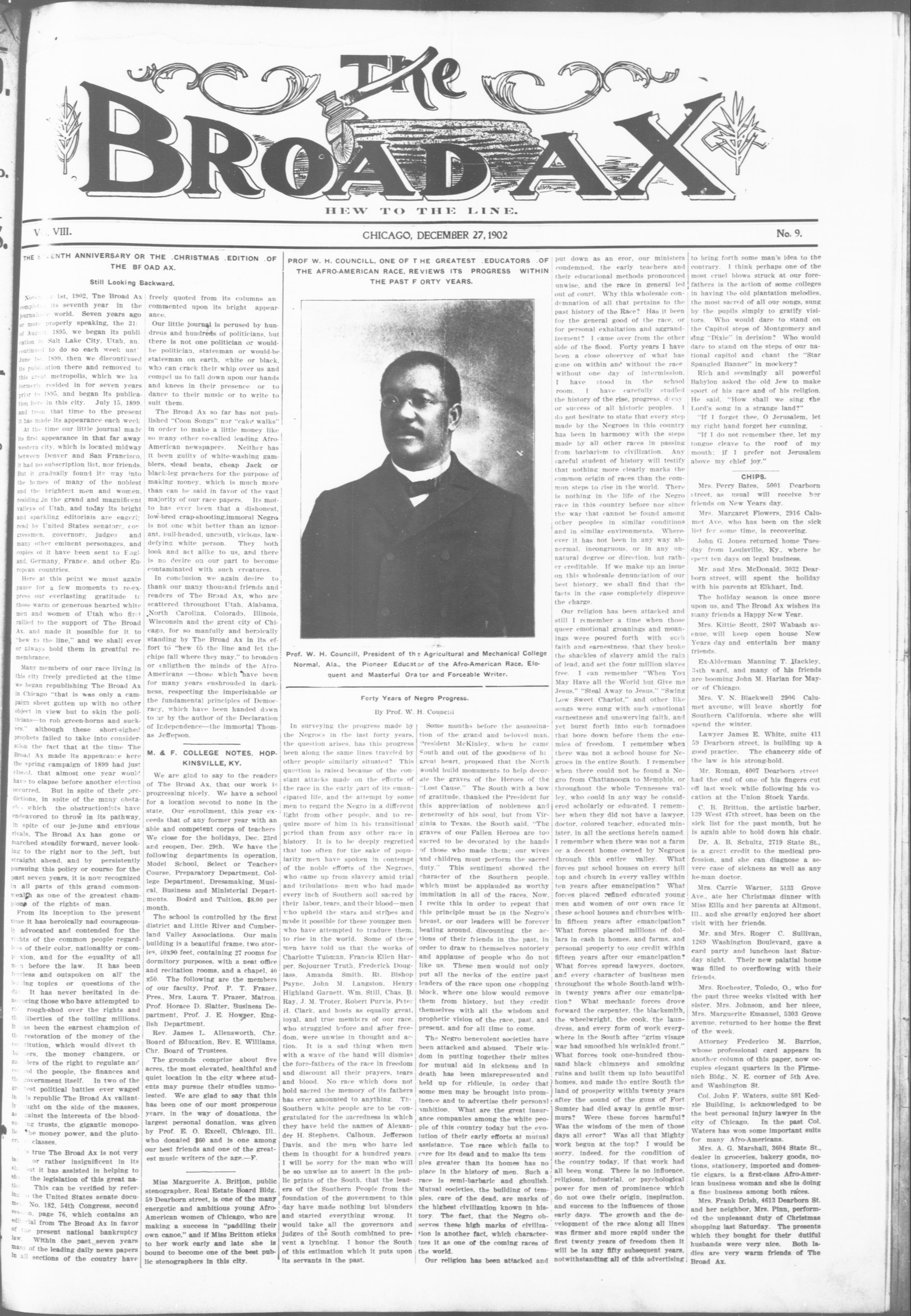
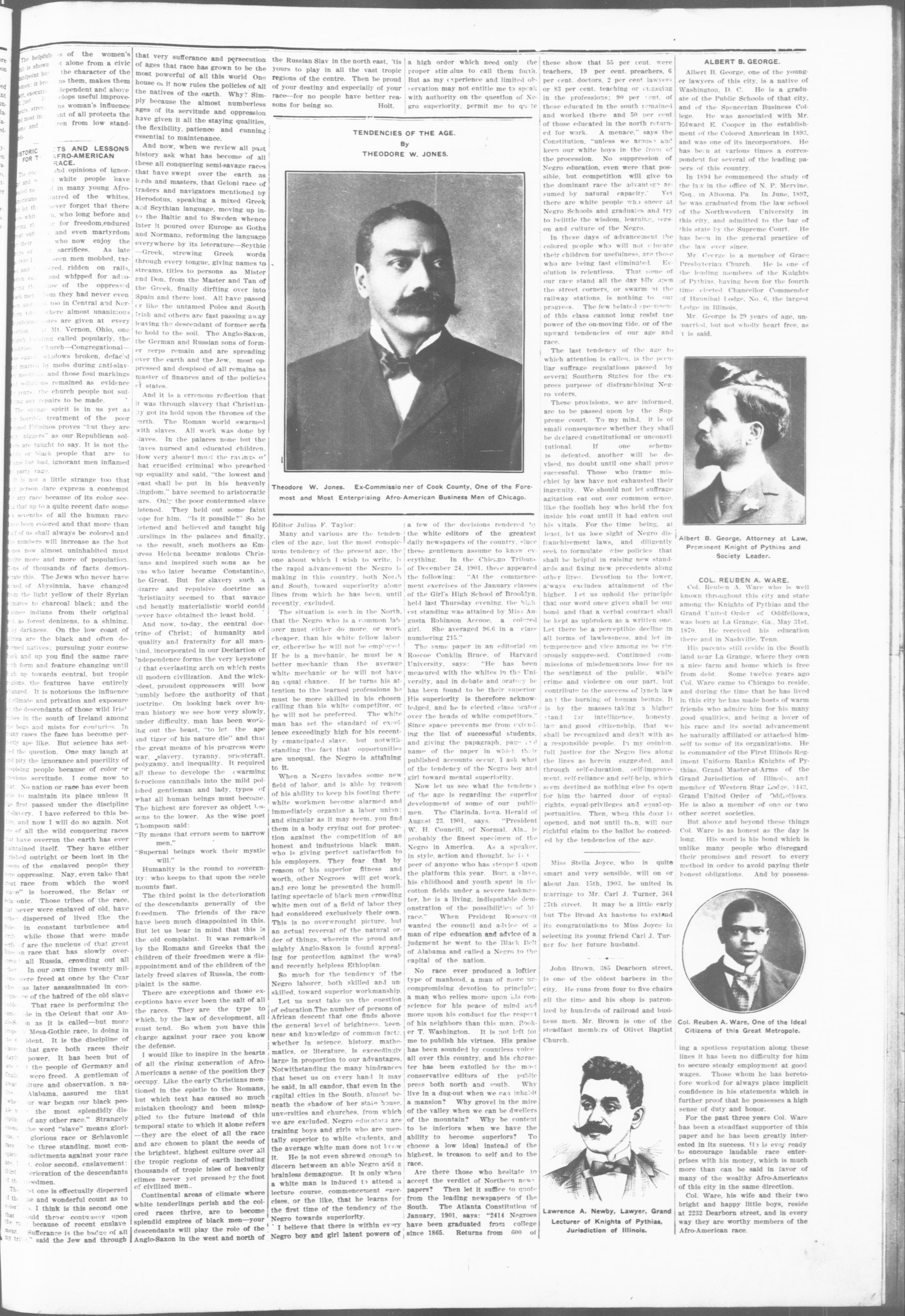
PROF W. H. COUNCILL, ONE OF THE GREATEST .EDUCATORS .OF THE AFRO-AMERICAN RACE, REVIEWS ITS PROGRESS WITHIN THE PAST FORTY YEARS.
[Name]
Prof. W. H. Councill, President of the Agricultural and Mechanical College Normal, Ala., the Pioneer Educator of the Afro-American Race, Eloquent and Masterful Orator and Forceable Writer.
Forty Years of Negro Progress.
By Prof. W. H. Council
In surveying the progress made by the Negroes in the last forty years, the question arises, has this progress been along the same lines traveled by other people similarly situated? This question is raised because of the constant attacks made on the efforts of the race in the early part of its emancipated life, and the attempt by some men to regard the Negro in a different light from other people, and to require more of him in his transitional period than from any other race in history. It is to be deeply regretted that too often for the sake of popularity men have spoken in contempt of the noble efforts of the Negroes, who came up from slavery amid trial and tribulations—men who had made every inch of Southern soil sacred by their labor, tears, and their blood—men who upheld the stars and stripes and made it possible for these younger men who have attempted to traduce them, to rise in the world. Some of these men have told us that the works of Charlotte Tubman, Francis Ellen Harper, Sojourner Truth, Frederick Douglass, Amanda Smith, Rt. Bishop Payne, John M. Langston, Henry Highland Garnett, Wm. Still, Chas, B. Ray, J. M. Troter, Robert Purvis, Peter H. Clark, and hosts as equally great, loyal, and true members of our race, who struggled before and after freedom, were unwise in thought and action. It is a sad thing when men with a wave of the hand will dismiss the fore-fathers of the race in freedom and discount all their prayers, tears and blood. No race which does not hold sacred the memory of its fathers has ever amounted to anything. The Southern white people are to be congratulated for the sacredness in which they have held the names of Alexander H. Stephens, Calhoun, Jefferson Davis, and the men who have led them in thought for a hundred years. I will be sorry for the man who will be so unwise as to assert in the public prints of the South, that the leaders of the Southern People from the foundation of the government to this day have made nothing but blunders and started everything wrong. It would take all the governors and judges of the South combined to prevent a lynching. I honor the South of this estimation which it puts upon its servants in the past.
Some months before the assassination of the grand and beloved man, President McKinley, when he came South and out of the goodness of his great heart, proposed that the North would build monuments to help decorate the graves of the Heroes of the "Lost Cause." The South with a bow of gratitude, thanked the President for this appreciation of nobleness and generosity of his soul, but from Virginia to Texas, the South said, "The graves of our Fallen Heroes are too sacred to be decorated by the hands of those who made them; our wives and children must perform the sacred duty." This sentiment showed the character of the Southern people, which must be applauded as worthy immitation in all of the races. Now, I recite this in order to repeat that this principle must be in the Negro's breast, or our leaders will be forever beating around, discounting the actions of their friends in the past, in order to draw to themselves notoriety and applause of people who do not like us. These men would not only put all the necks of the entire past leaders of the race upon one chopping block, where one blow would remove them from history, but they credit themselves with all the wisdom and prophetic vision of the race, past, and present, and for all time to come.
The Negro benevolent societies have been attacked and abused. Their wisdom in putting together their mites for mutual aid in sickness and in death has been misrepresented and held up for ridicule, in order that some men may be brought into prominence and to advertise their personal ambition. What are the great insurance companies among the white people of this country today but the evolution of their early efforts at mutual assistance. The race which fails to care for its dead and to make its temples greater than its homes has no place in the history of men. Such a race is semi-barbaric and ghoulish. Mutual societies, the building of temples, care of the dead, are marks of the highest civilization known in history. The fact, that the Negro observes these high marks of civilization is another fact, which characterizes it as one of the coming races of the world.
Our religion has been attacked and
put down as an eror, our ministers condemned, the early teachers and their educational methods pronounced unwise, and the race in general led out of court. Why this wholesale condemnation of all that pertains to the past history of the Race? Has it been for the general good of the race, or for personal exhaltation and aggrandizement? I came over from the other side of the flood. Forty years I have been a close observer of what has gone on within and without the race without one day of intermission. I have stood in the school room. I have carefully studied the history of the rise, progress, decay or success of all historic peoples. I do not hesitate to state that every step made by the Negroes in this country has been in harmony with the steps made by all other races in passing from barbarism to civilization. Any careful student of history will testify that nothing more clearly marks the common origin of races than the common steps to rise in the world. There is nothing in the life of the Negro race in this country before nor since the war that cannot be found among other peoples in similar conditions and in similar environments. Wherever it has not been in any way abnormal, incongruous, or in any unnatural degree or direction, but rather creditable. If we make up an issue on this wholesale denunciation of our best history, we shall find that the facts in the case completely disprove the charge.
Our religion has been attacked and still I remember a time when those queer emotional groanings and moanings were poured forth with such faith and earnestness, that they broke the shackles of slavery amid the rain of lead, and set the four million slaves free. I can remember "When You May Have all the World but Give me Jesus," "Steal Away to Jesus," "Swing Low Sweet Chariot," and other like songs were sung with such emotional earnestness and unswerving faith, and yet burst forth into such tornadoes that bore down before them the enemies of freedom. I remember when there was not a school house for Negroes in the entire South. I remember when there could not be found a Negro from Chattanooga to Memphis, or throughout the whole Tennessee valley, who could in any way be considered scholarly or educated. I remember when they did not have a lawyer, doctor, colored teacher, educated minister, in all the sections herein named. I remember when there was not a farm or a decent home owned by Negroes through this entire valley. What forces put school houses on every hill top and church in every valley within ten years after emancipation? What forces placed refined educated young men and women of our own race in these school houses and churches within fifteen years after emancipation? What forces placed millions of dollars in cash in homes, and farms, and personal property to our credit within fifteen years after our emancipation? What forces spread lawyers, doctors, and every character of business men throughout the whole South-land within twenty years after our emancipation? What mechanic forces drove forward the carpenter, the blacksmith, the wheelwright, the cook, the laundress, and every form of work everywhere in the South after "grim visage war had smoothed his wrinkled front." What forces took one-hundred thousand black chimneys and smoking ruins and built them up into beautiful homes, and made the entire South the land of prosperity within twenty years after the sound of the guns of Fort Sumter had died away in gentle murmurs? Were these forces harmful? Was the wisdom of the men of those days all error? Was all that Mighty work begun at the top? I would be sorry, indeed, for the condition of the country today, if that work had all been wong. There is no influence, religious, industrial, or psychological power for men of prominence which do not owe their origin, inspiration, and success to the influences of those early days. The growth and the development of the race along all lines was firmer and more rapid under the first twenty years of freedom then it will be in any fifty subsequent years, notwithstanding all of this advertising
No. 9.
to bring forth some man's idea to the contrary. I think perhaps one of the most cruel blows struck at our forefathers is the action of some colleges in having the old plantation melodies, the most sacred of all our songs, sung by the pupils simply to gratify visitors. Who would dare to stand on the Capitol steps of Montgomery and sing "Dixie" in derision? Who would dare to stand on the steps of our national capitol and chant the "Star Spangled Banner" in mockery?
Rich and seemingly all powerful Babylon asked the old Jew to make sport of his race and of his religion. He said, "How shall we sing the Lord's song in a strange land?" "If I forget thee, O Jerusalem, let my right hand forget her cunning. "If I do not remember thee, let my tongue cleave to the roof of my mouth: if I prefer not Jerusalem above my chief joy."
CHIPS
Mrs. Perry Bates, 5001 Dearborn street, as usual will receive her friends on New Years day.
Mrs. Margaret Flowers, 2916 Calumet Ave. who has been on the sick list for some time, is recovering.
John G. Jones returned home Tuesday from Louisville, Ky., where he spent ten days on legal business.
Mr. and Mrs. McDonald, 3032 Dearborn street, will spent the holiday with his parents at Elkhart, Ind.
The holiday season is once more upon us, and The Broad Ax wishes its many friends a Happy New Year. Mrs. Kittie Scott, 2807 Wabash avenue, will keep open house New Years day and entertain her many friends. Ex-Alderman Manning T. Hackley, 34th ward, and many of his friends are booming John M. Harlan for Mayor of Chicago.
Mrs. V. N. Blackwell 2906 Calumet aveune, will leave shortly for Southern California, where she will spend the winter.
Lawyer James E. White, suite 411 59 Dearborn street, is building up a good practice. The chancery side of the law is his strong-hold.
Mr. Roman, 4007 Dearborn street had the end of one of his fingers cut off last week while following his vocation at the Union Stock Yards.
C. B. Britton, the artistic barber, 139 West 47th street, has been on the sick list for the past month, but he is again able to hold down his chair. Dr. A. B. Schultz, 2719 State St., is a great credit to the medical profession, and she can diagnose a severe case of sickness as well as any he-man doctor. Mrs. Carrie Warner, 5133 Grove Ave., ate her Christmas dinner with Miss Ellis and her parents at Altmont, Ill., and she greatly enjoyed her short visit with her friends.
Mr. and Mrs. Roger C. Sullivan, 1269 Washington Boulevard, gave a card party and luncheon last Saturday night. Their new palatial home was filled to overflowing with their friends. Mrs. Rochester, Toledo, O., who for the past three weeks visited with her sister, Mrs. Johnson, and her niece, Mrs. Marguerite Emanuel, 5303 Grove avenue, returned to her home the first of the week.
Attorney Frederico M. Barrios, whose professional card appears in another column of this paper, now occupies elegant quarters in the Firmenich Bldg., N. E. corner of 5th Ave. and Washington St. Col. John F. Waters, suite 801 Kedzie Building, is acknowledged to be the best personal injury lawyer in the city of Chicago. In the past Col. Waters has won some important suits for many Afro-Americans.
Mrs. A. G. Marshall, 3604 State St., dealer in groceries, bakery goods, notions, stationery, imported and domestic cigars, is a first-class Afro-American business woman and she is doing a fine business among both races. Mrs. Frank Drish, 4613 Dearborn St. and her neighbor, Mrs. Pinn, performed the unpleasant duty of Christmas shopping last Saturday. The presents which they bought for their dutiful husbands were very nice. Both ladies are very warm friends of The Broad Ax.
POSER FOR MOTHERS.
Eminent Student of Human Nature Claima Children Are Educated at Home to Be Liars. An eminent pessimist observes that lying is the one common characteristic of all mankind. From his earliest infancy a child learns to lie. His parents and his companions teach him to do so, and so do nearly all the grown-up persons about him.
At first the lying may be innocent and without any bad intention. The little girl pretends that her doll is talking, that it is ill, that it is catching cold. This may be regarded as a form of lying, however innocent the intention.
Nearly all families, however respectable, make use of various conventional lies in daily life. The child notices this and follows the example set him. He hears his parents tell the servants to say that they are not at home when they are. He hears them compliment people to their faces and criticise them after them are gone. He hears them tell visitors how delighted they are to see them, and as soon as they are gone he learns that they were a dreadful nuisance.
Grown-up people lie when children ask them questions, either because they cannot answer the questions or do not want to, or are ashamed to do so.
By and by he finds out that his elders were in the habit of lying to him, and he adopts the habit himself. The child who tells all he knows in public is naturally considered a source of great embarrassment. His parents tell him that he must not tell all he knows; even that he must pretend things are not what they are. In order to force this behavior on the boy for the sake of keeping up appearances he is often punished, and this of course impresses the lesson of lying upon him very strongly. He learns that it is impossible to live without lying.—Chicago American.
MILLION-DOLLAR BABY.
Its Advent Caused Great Excitement in the Clark Household in Butte, Montana.
Great was the stir created by his advent into the world of William A. Clark, third, in the circle that awaited his coming on December 1. The telegraph wires from Butte to New York, San Francisco and Los Angeles and the cable to Paris were kept busy conveying bulletins of the intense anxiety of the friends and members of the family of Senator Clark, of Butte, Mont. When Dr. Donald Campbell announced that all was well and that a male heir had been born to the house of Clark, the wires again sputtered with exclamations of joy and congratulation.
The senator's eldest son, Charles W., had disappointed him, as no children have been born to him.
The intense concern and interest of the senator was shown when, a year ago, he proposed to give $1,000,000 to his first grandson, the proposition being extended to his two daughters as well as his sons. A daughter has since
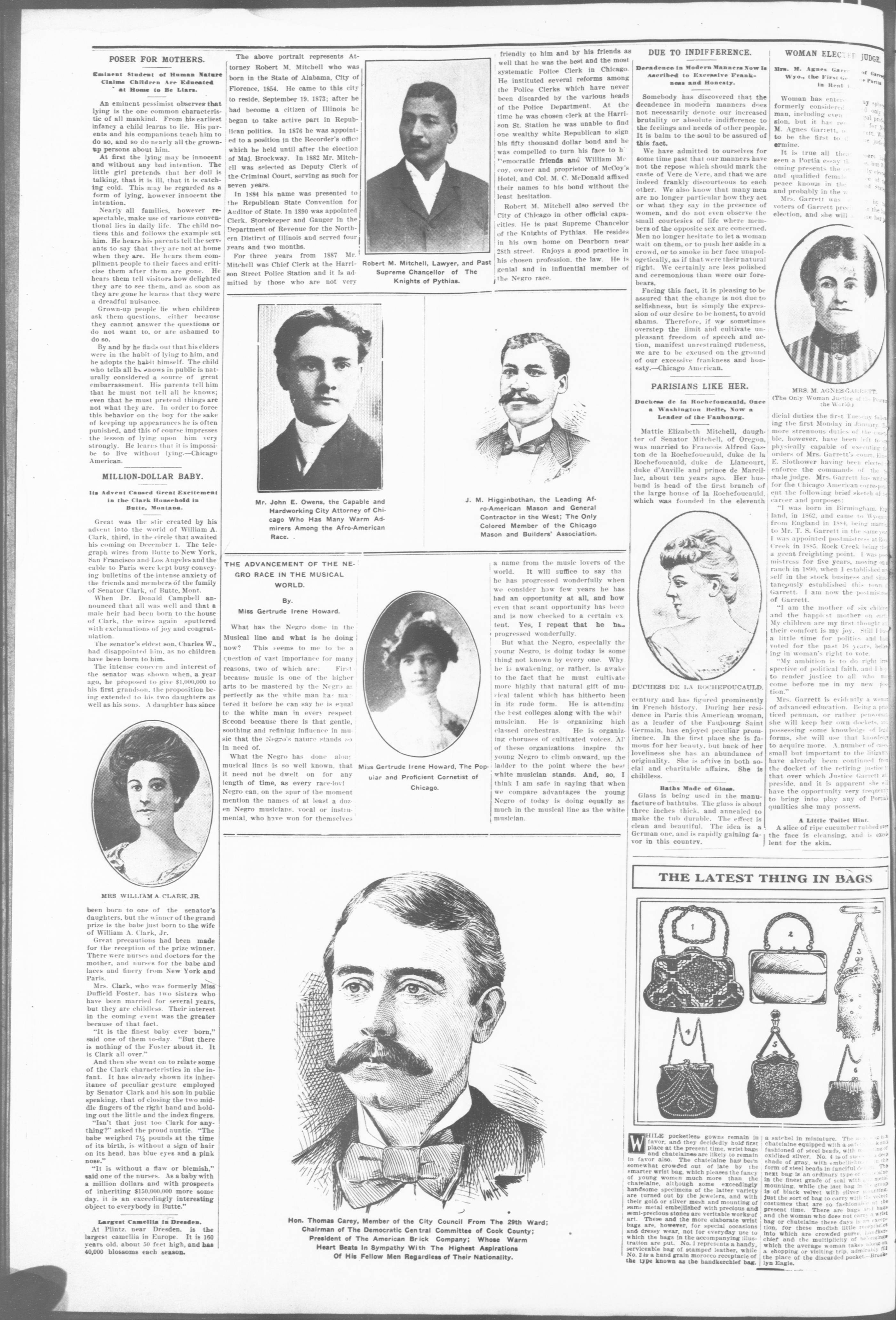
[Picture of a woman with a high hairstyle and a necklace. She is wearing a light-colored dress with a high collar.]
MRS WILLIAM A. CLARK, JR. been born to one of the senator's daughters, but the winner of the grand prize is the babe just born to the wife of William A. Clark, Jr. Great precautions had been made for the reception of the prize winner. There were nurses and doctors for the mother, and nurses for the babe and laces and finery from New York and Paris.
Mrs. Clark, who was formerly Miss Duffield Foster, has two sisters who have been married for several years, but they are childless. Their interest in the coming event was the greater because of that fact. "It is the finest baby ever born," said one of them to-day. "But there is nothing of the Foster about it. It is Clark all over."
And then she went on to relate some of the Clark characteristics in the infant. It has already shown its inheritance of peculiar gesture employed by Senator Clark and his son in public speaking, that of closing the two middle fingers of the right hand and holding out the little and the index fingers. "Isn't that just too Clark for anything?" asked the proud auntie. "The babe weighed $7\frac{1}{2}$ pounds at the time of its birth, is without a sign of hair on its head, has blue eyes and a pink nose."
"It is without a flaw or blemish," said one of the nurses. As a baby with a million dollars and with prospects of inheriting $150,000,000 more some day, it is an exceedingly interesting object to everybody in Butte."
Largest Camellia in Dresden. At Plintz, near Dresden, is the largest camellia in Europe. It is 160 years old, about 50 feet high, and has 40,000 blossoms each season.
Mr. John E. Owens, the Capable and Hardworking City Attorney of Chicago Who Has Many Warm Admirers Among the Afro-American Race.
Mr. John E. Owens, the Capable and Hardworking City Attorney of Chicago Who Has Many Warm Admirers Among the Afro-American Race.
VAN H
Hon. Thomas Carey, Member of the City Council From The 29th Ward; Chairman of The Democratic Central Committee of Cook County; President of The American Brick Company; Whose Warm Heart Beats In Sympathy With The Highest Aspirations Of His Fellow Men Regardless of Their Nationality.
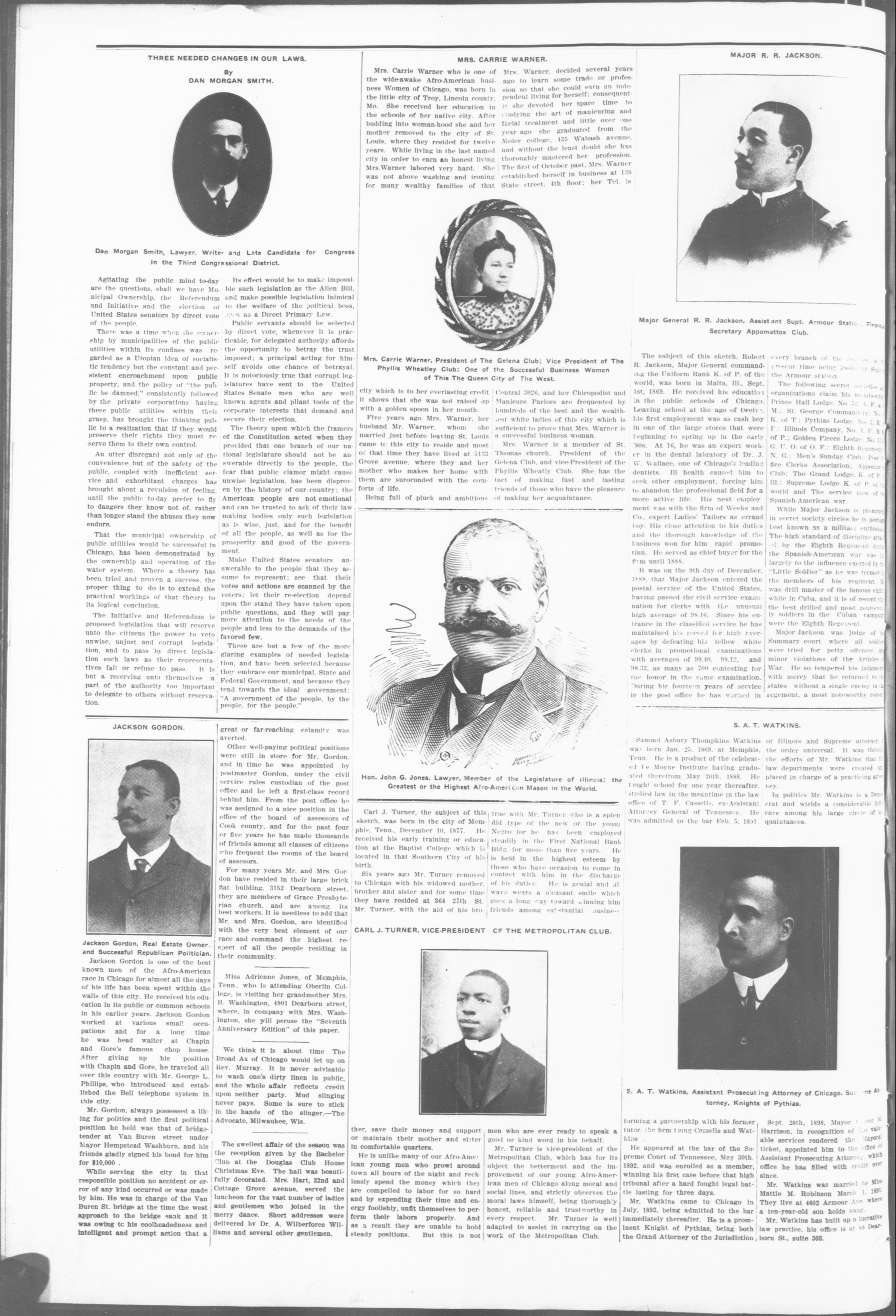
The above portrait represents Attorney Robert M. Mitchell who was born in the State of Alabama, City of Florence, 1854. He came to this city to reside, September 19. 1873; after he had become a citizen of Illinois he began to take active part in Republican politics. In 1876 he was appointed to a position in the Recorder's office which he held until after the election of Maj. Brockway. In 1882 Mr. Mitchell was selected as Deputy Clerk of the Criminal Court, serving as such for seven years.
In 1884 his name was presented to the Republican State Convention for Auditor of State. In 1890 was appointed Clerk, Storekeeper and Gauger in the Department of Revenue for the Northern District of Illinois and served four years and two months. For three years from 1887 Mr. Mitchell was Chief Clerk at the Harrison Street Police Station and it is admitted by those who are not very
JOHN B. HARRIS
THE ADVANCEMENT OF THE NEGRO RACE IN THE MUSICAL WORLD.
What has the Negro done in the Musical line and what is he doing now? This seems to me to be a question of vast importance for many reasons, two of which are: First because music is one of the higher arts to be mastered by the Negro as perfectly as the white man has mastered it before he can say he is equal to the white man in every respect Second because there is that gentle, soothing and refining influence in music that the Negro's nature stands so in need of.
What the Negro has done along musical lines is so well known, that it need not be dwelt on for any length of time, as every race-love Negro can, on the spur of the moment mention the names of at least a dozen Negro musicians, vocal or instrumental, who have won for themselves
M. R. S.
Robert M. Mitchell, Lawyer, and Past Supreme Chancellor of The Knights of Pythias.
table and
history of Chi-
arm Ad-
merican
J. M. H.
ro-A
Cou
Col
Ma
[Picture of a woman with a hat and a necklace.]
Miss Gertrude Irene Howard, The Popular and Proficient Cornetist of Chicago.
---
friendly to him and by his friends as well that he was the best and the most systematic Police Clerk in Chicago. He instituted several reforms among the Police Clerks which have never been discarded by the various heads of the Police Department. At the time he was chosen clerk at the Harrison St. Station he was unable to find one wealthy white Republican to sign his fifty thousand dollar bond and he was compelled to turn his face to his Democratic friends and William McCoy, owner and proprietor of McCoy's Hotel, and Col. M. C. McDonald affixed their names to his bond without the least hesitation.
Robert M. Mitchell also served the City of Chicago in other official capacities. He is past Supreme Chancelor of the Knights of Pythias. He resides in his own home on Dearborn near 28th street. Enjoys a good practice in his chosen profession, the law. He is genial and in influential member of the Negro race.
J. M. Higginbothan, the Leading Afro-American Mason and General Contractor in the West; The Only Colored Member of the Chicago Mason and Builders' Association.
a name from the music lovers of the world. It will suffice to say that he has progressed wonderfully when we consider how few years he has had an opportunity at all, and how even that scant opportunity has been and is now checked to a certain extent. Yes, I repeat that he has progressed wonderfully.
But what the Negro, especially the young Negro, is doing today is something not known by every one. Why he is awakening, or rather, is awake to the fact that he must cultivate more highly that natural gift of musical talent which has hitherto been in its rude form. He is attending the best colleges along with the white musician. He is organizing high classed orchestras. He is organizing choruses of cultivated voices. All of these organizations inspire the young Negro to climb onward, up the ladder to the point where the best white musician stands. And, so, I think I am safe in saying that when we compare advantages the young Negro of today is doing equally as much in the musical line as the white musician.
THE LATEST THING IN BAGS
1
2
3
4
5
6
DUE TO INDIFFERENCE.
Decadence in Modern Manners Now Is Ascribed to Excessive Frankness and Honesty.
Somebody has discovered that the decadence in modern manners does not necessarily denote our increased brutality or absolute indifference to the feelings and needs of other people. It is balm to the soul to be assured of this fact.
We have admitted to ourselves for some time past that our manners have not the repose which should mark the caste of Vere de Vere, and that we are indeed frankly discourteous to each other. We also know that many men are no longer particular how they act or what they say in the presence of women, and do not even observe the small courtesies of life where members of the opposite sex are concerned. Men no longer hesitate to let a woman wait on them, or to push her aside in a crowd, or to smoke in her face unapologetically, as if that were their natural right. We certainly are less polished and ceremonious than were our forebears.
Facing this fact, it is pleasing to be assured that the change is not due to selfishness, but is simply the expression of our desire to be honest, to avoid shams. Therefore, if we sometimes overstep the limit and cultivate unpleasant freedom of speech and action, manifest unrestrained rudeness, we are to be excused on the ground of our excessive frankness and honesty.—Chicago American.
PARISIANS LIKE HER.
Duchess de la Rochefoucauld, Once a Washington Belle, Now a Leader of the Faubourg.
Mattie Elizabeth Mitchell, daughter of Senator Mitchell, of Oregon, was married to Francois Alfred Gaston de la Rochefoucauld, duke de la Rochefoucauld, duke de Liancourt, duke d'Anville and prince de Marcillac, about ten years ago. Her husband is head of the first branch of the large house of la Rochefoucauld, which was founded in the eleventh
---
DUCHESS DE LA ROCHEFOUCAULD. century and has figured prominently in French history. During her residence in Paris this American woman, as a leader of the Faubourg Saint Germain, has enjoyed peculiar prominence. In the first place she is famous for her beauty, but back of her loveliness she has an abundance of originality. She is active in both social and charitable affairs. She is childless.
Baths Made of Glass.
Glass is being used in the manufacture of bathtubs. The glass is about three inches thick, and annealed to make the tub durable. The effect is clean and beautiful. The idea is a German one, and is rapidly gaining favor in this country.
THE LATEST T
WHILE pocketlese gowns remain in favor, and they decidedly hold first place at the present time, wrist bags and chatelaines are likely to remain in favor also. The chatelaine has been somewhat crowded out of late by the smarter wrist bag, which pleases the fancy of young women much more than the chatelaine, although some exceedingly handsome specimens of the latter variety are turned out by the jewelers, and with their gold or silver mesh and mounting of same metal embellished with precious and semi-precious stones are veritable works of art. These and the more elaborate wrist bags are, however, for special occasions and dressy wear, not for everyday use to which the bags in the accompanying illustration are put. No.1 represents a handy, serviceable bag of stamped leather, while No.2 is a hand grain morocco receptacle of the type known as the handkerchief bag.
---
WOMAN ELECTED
Mrs. M. Agnes Garrett Wyo., the First Ge in Real Woman has entered formerly considered man, including evasion, but it has re M. Agnes Garrett, o to be the first to dermine.
It is true all thea seen a Portia essay thoming presents the or and qualified female peace known in the and probably in the Mrs. Garrett was voters of Garrett pre election, and she will
[Name]
MRS. M. AGNES GARRETT.
(The Only Woman Justice of the Pe
the World)
MRS. M. AGNES GARRETT.
(The Only Woman Justice of the Peace
the World)
dicial duties the first Tuesday fol-
ing the first Monday in January. I
more strenuous duties of the conso-
ble, however, have been left to a
physically capable of executing
orders of Mrs. Garrett's court. El-
E. Slothower having been elected
enforce the commands of the
male judge. Mrs. Garrett has writ-
for the Chicago American correspon-
ent the following brief sketch of
career and purposes:
"I was born in Birmingham, England, in 1862, and came to Wyoming from England in 1884, being married to Mr. T. S. Garrett in the same year. I was appointed postmistress at Rock Creek in 1885. Rock Creek being the great freighting point. I was postmistress for five years, moving on ranch in 1890, when I established myself in the stock business and simultaneously established this town Garrett. I am now the postmistress of Garrett.
"I am the mother of six children and the happiest mother on earth. My children are my first thought as their comfort is my joy. Still I have a little time for politics and have voted for the past 16 years, believing in woman's right to vote.
"My ambition is to do right irrespective of political faith, and I hope to render justice to all who may come before me in my new position."
Mrs. Garrett is evidently a woman of advanced education. Being a practiced penman, or rather penwomen she will keep her own dockets, and possessing some knowledge of legal forms, she will use that knowledge to acquire more. A number of cases small but important to the litigants have already been continued from the docket of the retiring justice to that over which Justice Garrett will preside, and it is apparent she will have the opportunity very frequently to bring into play any of Portial qualities she may possess.
A slice of ripe cucumber rubbed over the face is cleansing, and is excellent for the skin.
THING IN BAGS
a satchel in miniature. The new bag is a chatelaine equipped with a safety band and fashioned of steel beads, with mounting of oxidized silver. No. 4 is of success in the shade of gray, with embellishment in the form of steel beads in fanciful design. The next bag is an ordinary type of chatelaine in the finest grade of seal with metal mounting, while the last bag in the group is of black velvet with silver mounting, just the sort of bag to carry with the velvet costumes that are so fashionable at the present time. There are bags and bags and the woman who does not carry a wrist bag or chatelaine these days is an exception, for these modish little receptacles into which are crowded purse, handkerchief and the multiplicity of belongings which the average woman takes along on a shopping or visiting trip, admirably fill the place of the discarded pocket.—Brooklyn Eagle.
---
1
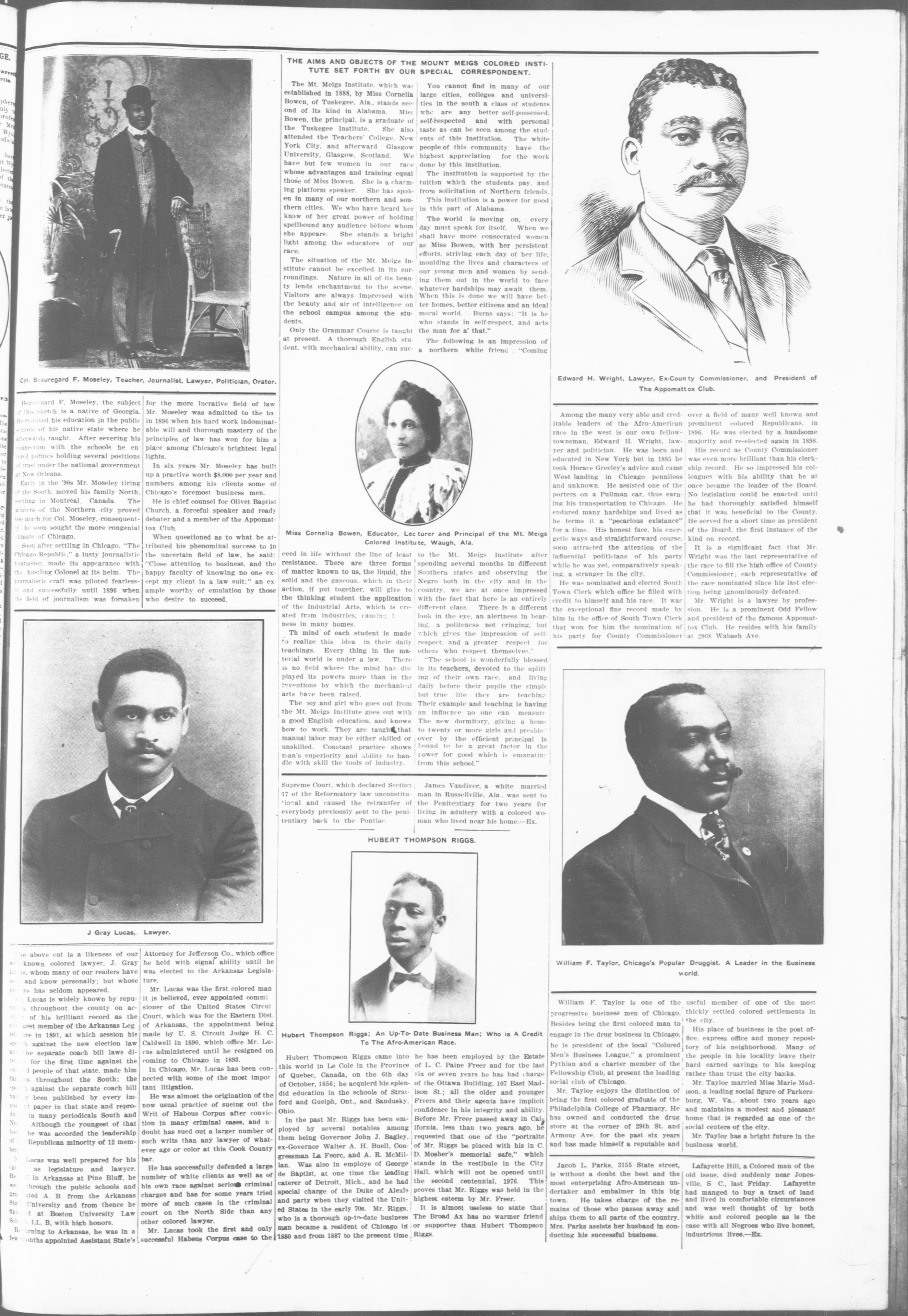
Col. Beauregard F. Moseley, Teacher, Journalist, Lawyer, Politician, Orator
Beauregard F. Moseley, the subject of this sketch is a native of Georgian. He received his education in the public schools of his native state where he afterwards taught. After severing his connection with the schools he entered politics holding several positions of trust under the national government at New Orleans.
Early in the '90s Mr. Moseley tiring of the South, moved his family North, settling in Montreal, Canada. The winters of the Northern city proved too much for Col. Moseley, consequently he soon sought the more congenial climate of Chicago. Soon after settling in Chicago, "The Chicago Republic," a lusty journalistic youngster, made its appearance with the hustling Colonel at its helm. The journalistic craft was piloted fearlessly and successfully until 1896 when the field of journalism was forsaken
[Name]
J Gray Lucas.. Lawyer.
he above cut is a likeness of our known colored lawyer, J. Gray is, whom many of our readers have and know personally; but whose re has seldom appeared.
Lucas is widely known by repu n throughout the county on act of his brilliant record as the best member of the Arkansas Legi ture in 1891, at which session his h against the new election law the separate coach bill laws did for the first time against the old people of that state, made him is throughout the South; the h against the separate coach bill has been published by every imit paper in that state and repro in many periodicals South and Although the youngest of that he was accorded the leadership Republican minority of 12 mem-
Lucas was well prepared for his as legislature and lawyer. in Arkansas at Pine Bluff, he through the public schools and rated A. B. from the Arkansas University and from thence he d at Boston University Law. L. LL. B, with high honors. turning to Arkansas, he was in a months appointed Assistant State's
---
we
Lu
Seo
pi
A
tat
eu
you
isl
spe
an
re
co
fai
sp
ha
por
du
No
boo
of
ber
N
ca
Re
we
gra
Sta
fini
S
R
few
for the more lucrative field of law Mr. Moseley was admitted to the bar in 1896 when his hard work indominatable will and thorough mastery of the principles of law has won for him a place among Chicago's brightest legal lights. In six years Mr. Moseley has built up a practive worth $8,000 per year and numbers among his clients some of Chicago's foremost business men.
He is chief counsel for Olivet Baptist Church, a forceful speaker and ready debater and a member of the Appomattox Club. When questioned as to what he attributed his phenominal success to in the uncertain field of law, he said: "Close attention to business, and the happy faculty of knowing no one except my client in a law suit;" an example worthy of emulation by those who desire to succeed.
Lawyer.
Attorney for Jefferson Co., which office he held with signal ability until he was elected to the Arkansas Legislature. Mr. Lucas was the first colored man it is believed, ever appointed commissioner of the United States Circuit Court, which was for the Eastern Dist. of Arkansas, the appointment being made by U. S. Circuit Judge H. C. Caldwell in 1890, which office Mr. Lucas administered until he resigned on coming to Chicago in 1893.
In Chicago, Mr. Lucas has been connected with some of the most important litigation. He was almost the origination of the now usual practice of sueing out the Writ of Habeus Corpus after conviction in many criminal cases, and no doubt has sued out a larger number of such writs than any lawyer of whatever age or color at this Cook County bar.
He has successfully defended a large number of white clients as well as of his own race against serious criminal charges and has for some years tried more of such cases in the criminal court on the North Side than any other colored lawyer. Mr. Lucas took the first and only successful Habeus Corpus case to the
---
THE AIMS AND OBJECTS OF THE MOUNT MEIGS COLORED INSTITUTE SET FORTH BY OUR SPECIAL CORRESPONDENT.
The Mt. Meigs Institute, which was established in 1888, by Miss Cornelia Bowen, of Tuskegee, Ala., stands second of its kind in Alabama. Miss Bowen, the principal, is a graduate of the Tuskegee Institute. She also attended the Teachers' College, New York City, and afterward Glasgow University, Glasgow, Scotland. We have but few women in our race whose advantages and training equal those of Miss Bowen. She is a charming platform speaker. She has spoken in many of our northern and southern cities. We who have heard her know of her great power of holding spellbound any audience before whom she appears. She stands a bright light among the educators of our race.
The situation of the Mt. Meigs Institute cannot be excelled in its surroundings. Nature in all of its beauty lends enchantment to the scene. Visitors are always impressed with the beauty and air of intelligence on the school campus among the students. Only the Grammar Course is taught at present. A thorough English student, with mechanical ability, can suc-
[Picture of a woman with a high collar and a headband, wearing a dark dress with a white collar. The background is a light, neutral color.]]
Miss Cornelia Bowen, Educator, Lecturer and Principal of the Mt. Meigs Colored Institute, Waugh, Ala. ceed in life without the line of least resistance. There are three forms of matter known to us, the liquid, the solid and the gaseous, which in their action, if put together, will give to the thinking student the application of the Industrial Arts, which is created from industries, causing lness in many homes to the Mt. Meigs Institute after spending several months in different Southern states and observing the Negro both in the city and in the country, we are at once impressed with the fact that here is an entirely different class. There is a different look in the eye, an alertness in bearing a politeness not cringing but
Th mind of each student is made to realize this idea in their daily teachings. Every thing in the material world is under a law. There is no field where the mind has displayed its powers more than in the inventions by which the mechanical arts have been raised.
The boy and girl who goes out from the Mt. Meigs Institute goes out with a good English education, and knows how to work. They are taught that manual labor may be either skilled or unskilled. Constant practice shows man's superiority and ability to handle with skill the tools of industry.
Supreme Court, which declared Section 17 of the Reformatory law unconstitutional and caused the retransfer of everybody previously sent to the penitentiary back to the Pontiac.
[Name]
Hubert Thompson Riggs; An Up-To-Date Business Man; Who is A Credit To The Afro-American Race.
Hubert Thompson Riggs came into this world in Le Cole in the Province of Quebec, Canada, on the 6th day of October, 1856; he acquiert his splendid education in the schools of Stratford and Guelph, Ont., and Sandusky, Ohio. he has been employed by the Estate of L. C. Paine Freer and for the last six or seven years he has had charge of the Ottawa Building, 107 East Madison St.; all the older and younger Freers and their agents have implicit confidence in his integrity and ability.
In the past Mr. Riggs has been employed by several notables among them being Governor John J. Bagley, ex-Governor Walter A. H. Buell, Congressman La Feorc, and A. R. McMillan. Was also in employe of George de Baptist, at one time the leading caterer of Detroit, Mich., and he had special charge of the Duke of Alexis and party when they visited the United States in the early 70s. Mr. Riggs who is a thorough up-to-date business man became a resident of Chicago in 1880 and from 1887 to the present time
You cannot find in many of our large cities, colleges and universities in the south a class of students who are any better self-possessed, self-respected and with personal taste as can be seen among the students of this Institution. The white people of this community haye the highest appreciation for the work done by this institution. The institution is supported by the tuition which the students pay. and from solicitation of Northern friends.
This institution is a power for good in this part of Alabama.
The world is moving on, every day must speak for itself. When we shall have more consecrated women as Miss Bowen, with her persistent efforts, striving each day of her life, moulding the lives and characters of our young men and women by sending them out in the world to face whatever hardships may await them. When this is done we will have better homes, better citizens and an ideal moral world. Burns says: "It is he who stands in self-respect, and acts the man for a' that."
The following is an impression of a northern white friend : "Coming
to the Mt. Meigs Institute after spending several months in different Southern states and observing the Negro both in the city and in the country, we are at once impressed with the fact that here is an entirely different class. There is a different look in the eye, an alertness in bearing, a politeness not cringing, but which gives the impression of self-respect, and a greater respect for others who respect themselves."
"The school is wonderfully blessed in its teachers, devoted to the uplifting of their own race, and living daily before their pupils the simple but true life they are teaching. Their example and teaching is having an influence no one can measure. The new dormitory, giving a home to twenty or more girls and preside over by the efficient principal is bound to be a great factor in the power for good which is emanating from this school."
James Vandiver, a white married man in Russellville, Ala, was sent to the Penitentiary for two years for living in adultery with a colored woman who lived near his home.—Ex.
he has been employed by the Estate of L. C. Paine Freer and for the last six or seven years he has had charge of the Ottawa Building, 107 East Madison St.; all the older and younger Freers and their agents have implicit confidence in his integrity and ability. Before Mr. Freer passed away in California, less than two years ago, he requested that one of the "portraits of Mr. Riggs be placed with his in C. D. Mosher's memorial safe," which stands in the vestibule in the City Hall, which will not be opened until the second centennial, 1976. This proves that Mr. Riggs was held in the highest esteem by Mr. Freer.
It is almost useless to state that The Broad Ax has no warmer friend or supporter than Hubert Thompson Riggs.
Edward H. Wright, Lawyer, Ex-County Commissioner, and President of The Appomattox Club.
[Portrait of a man in a suit with a tie and a badge on his lapel].
William F. Taylor, Chicago's Popular Druggist. A Leader in the Business world.
Among the many very able and creditable leaders of the Afro-American race in the west is our own fellow-townsman, Edward H. Wright, lawyer and politician. He was born and educated in New York but in 1885 he took Horace Greeley's advice and came West landing in Chicago penniless and unknown. He assisted one of the porters on a Pullman car, thus earning his transportation to Chicago. He endured many hardships and lived as he terms it a "pecarious existence" for a time. His honest face, his energetic ways and straightforward course, soon attracted the attention of the influential politicians of his party while he was yet, comparatively speaking, a stranger in the city.
He was nominated and elected South Town Clerk which office he filled with credit to himself and his race. It was the exceptional fine record made by him in the office of South Town Clerk that won for him the nomination of his party for County Commissioner
William F. Taylor, Chicago's Popul
William F. Taylor is one of the progressive business men of Chicago. Besides being the first colored man to engage in the drug business in Chicago, he is president of the local "Colored Men's Business League," a prominent Pythian and a charter member of the Fellowship Club, at present the leading social club of Chicago.
Mr. Taylor enjoys the distinction of being the first colored graduate of the Philadelphia College of Pharmacy. He has owned and conducted the drug store at the corner of 29th St. and Armour Ave. for the past six years and has made himself a reputable and
Jacob L. Parks, 3155 State street, is without a doubt the best and the most enterprising Afro-American undertaker and embalmer in this big town. He takes charge of the remains of those who passes away and ships them to all parts of the country. Mrs. Parks assists her husband in conducting his successful business.
---
over a field of many well known and prominent colored Republicans, in 1896. He was elected by a handsome majority and re-elected again in 1898.
His record as County Commissioner was even more brilliant than his clerkship record. He so impressed his colleagues with his ability that he at once became the leader of the Board. No legislation could be enacted until he had thoroughly satisfied himself that it was beneficial to the County. He served for a short time as president of the Board, the first instance of the kind on record.
It is a significant fact that Mr. Wright was the last representative of the race to fill the high office of County Commissioner; each representative of the race nominated since his last election being ignominously defeated. Mr. Wright is a lawyer by profession. He is a prominent Odd Fellow and president of the famous Appomattox Club. He resides with his family at 2968 Wabash Ave.
r Druggist. A Leader in the Business World.
useful member of one of the most thickly settled colored settlements in the city. His place of business is the post office. express office and money repository of his neighborhood. Many of the people in his locality leave their hard earned savings to his keeping rather than trust the city banks.
Mr. Taylor married Miss Marie Madison, a leading social figure of Parkersburg, W. Va., about two years ago and maintains a modest and pleasant home that is regarded as one of the social centers of the city. Mr. Taylor has a bright future in the business world.
Lafayette Hill, a Colored man of the old issue, died suddenly near Jonesville, S C., last Friday. Lafayette had manged to buy a tract of land and lived in comfortable circumstances and was well thought of by both white and colored people as is the case with all Negroes who live honest, industrious lives.—Ex.
---
THE BROAD AX.
PUBLISHED WEEKLY.
Will promulgate and at all times uphold the true principles of Democracy, but Catholics, Protestants, Priests, Infidels, Farmers, Single Taxes, Republicans, Knights of Labor, or any one else can have their say, so long as their language is proper and responsibility is fixed.
The Broad Ax is a newspaper whose platform is broad enough for all, ever claiming the editorial right to speak its own mind.
Local communications will receive attention. Write only on one side of the paper.
One Year ..... $2.00
Six Months ..... 1.00
JULIUS F. TAYLOR, Editor and Publisher.
Entered at the Post Office at Chicago, Ill., as Second-class Matter.
JUDGE SPEER ON THE RACE PROBLEM.
Judge Emory Speer of the United States court for the southern district of Georgia in an address before a club in Buffalo has declared that the fear of an impossible Negro supramacy is the cause of southern political solidity.
He admits that the impossibility of Negro domination makes no difference with the fear of it. Yet in the same breath he says: "The remedy seems to be as obvious as just. It is to be found in the enactment of impartial laws for white and black alike, which will admit to the franchise the intelligent, the upright and the responsible of both races and exclude the venal, the ignorant and the worthless."
How does Judge Speer expect to persuade people who are so mortally afraid of impossible "nigger rule that they band together solidly against that impossibility, though they are widely at variance on other political questions, to pass such laws?
He must know that the thing cannot be done. He must know that the southern whites can no more be induced to pass impartial laws denying the ballot to the worthless of both races alike than they can be induced to give the ballot to all whites and blacks alike.
The plain truth of the matter is that most of the southern whites are determined that no man with a drop of African blood in his veins shall vote no matter how intelligent and worthy he may be, and that no white man shall be denied the ballot no matter how ignorant and worthless he may be.
According to Judge Speer so passionately hostile are the southern whites to the participation of any Negro in political affairs that multitudes of them have parted with their honesty. It was once supposed that while the southron might be wrong-headed and hot-headed he was at least politically honest.
But Judge Speer assures us that "multitudes of southern men of the most forceful character are in full accord with those policies" (meaning the protective tariff) and know that if they were reversed "a wave of bankruptcy would overwhelm our every interest, yet they vote with mechanical iteration against every interest."
So intense and irrational is their hostility to Negro participation in politics in any degree that they persist in voting for the ruin of every interest. And the men who do this are "men of the most forceful character." To some minds this may seem to be a pretty good reason for insisting that those men shall not continue to represent in congress and the electoral congress a race which they completely disfranchise and bar from all participation in political affairs.
Judge Speer thinks this will never do. It would "startle the country as nothing has done since the reconstruction era." It would "engender the universal hostility of a resolute people." Why should it? Upon what conceivable principle can the southern whites claim the right to represent those who are denied all voice in choosing representatives? That is a mockery of representation.
The northern people have as good a right to demand representation for their horses and oxen. If the southern whites want to represent the Negroes let them admit the Negroes to the exercise of political rights on the same basis as they admit the whites. Until they are willing to do that they will have no right to utter a word of complaint if the fourteenth amendment is applied to their case.—The Chicago Chronicle.
If all the great newspapers of this country possessed the courage to utter the truth in relation to the attitude which the southern whites have assumed in disfranchising the Negroes, and permitting ignorant white men to vote the same as The Chicago Chronicle it would not be long before the whites of the south would either be compelled to restore the voting privileges to the Negroes or to submit to having their representation in Congress and in th electorial college cut down or reduced to the actual vote cast at each national election.
THE ROAD OUT OR THE WAY TO POLITICAL FREEDOM FOR THE NEGRO.
By DOCTOR HOWARD S. TAYLOR.
In the old slavery days it would occasionally happen that some slave, a trifle wiser or more daring than his fellows, would make a desperate break for freedom by running away. Accumulating, as best he could, a little
Doctor Howard S. Taylor Prosecuting
Champion of the Right
[Name]
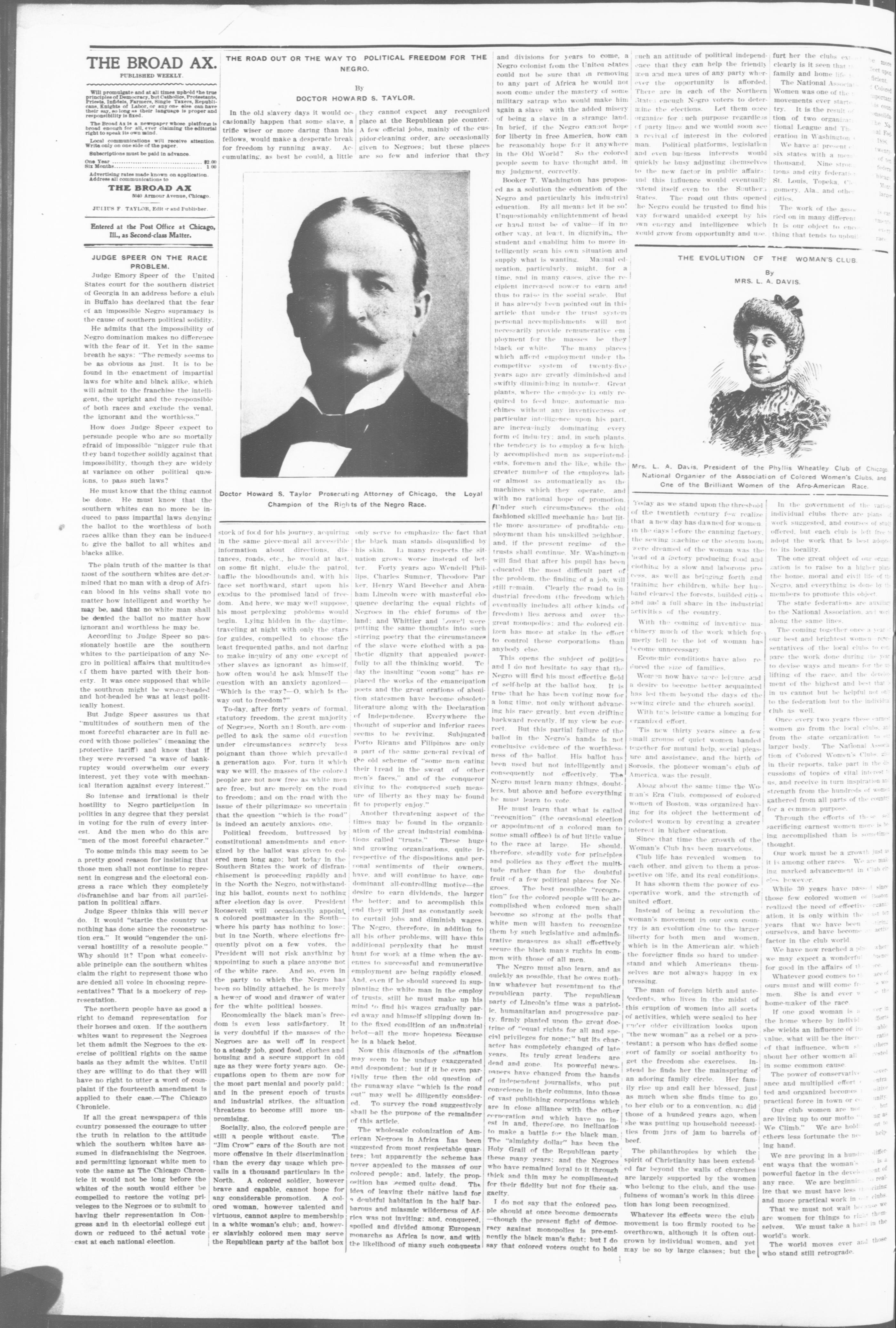
Doctor Howard S. Taylor Prosecuting Attorney of Chicago, the Loyal Champion of the Rights of the Negro Race.
stock of food for his journey, acquiring in the same piece-meal all accessible information about directions, distances, roads, etc., he would at last, on some fit night, elude the patrol, baffle the bloodhounds and, with his face set northward, start upon his exodus to the promised land of freedom. And here, we may well suppose, his most perplexing problems would begin. Lying hidden in the daytime, traveling at night with only the stars for guides, compelled to choose the least frequented paths, and not daring to make inquiry of any one except of other slaves as ignorant as himself, how often would he ask himself the question with an anxiety agonized—"Which is the way?—O, which is the way out to freedom?"
To-day, after forty years of formal, statutory freedom, the great majority of Negroes, North and South, are compelled to ask the same old question under circumstances scarcely less poignant than those which prevailed a generation ago. For, turn it which way we will, the masses of the colored people are not now free as white men are free, but are merely on the road to freedom; and on the road with the issue of their pilgrimage so uncertain that the question "which is the road" is indeed an acutely anxious one.
Political freedom, buttressed by constitutional amendments and energized by the ballot was given to colored men long ago; but today in the Southern States the work of disfranchisement is proceeding rapidly and in the North the Negro, notwithstanding his ballot, counts next to nothing after election day is over. President Roosevelt will occasionally appoint a colored postmaster in the South where his party has nothing to lose; but in the North, where elections frequently pivot on a few votes, the President will not risk anything by appointing to such a place anyone not of the white race. And so, even in the party to which the Negro has been so blindly attached, he is merely a hewer of wood and drawer of water for the white political bosses.
Economically the black man's freedom is even less satisfactory. It is very doubtful if the masses of the Negroes are as well off in respect to a steady job, good food, clothes and housing and a secure support in old age as they were forty years ago. Occupations open to them are now for the most part menial and poorly paid; and in the present epoch of trusts and industrial strikes, the situation threatens to become still more unpromising.
Socially, also, the colored people are still a people without caste. The "Jim Crow" cars of the South are not more offensive in their discrimination than the every day usage which prevails in a thousand particulars in the North. A colored soldier, however brave and capable, cannot hope for any considerable promotion. A colored woman, however talented and virtuous, cannot aspire to membership in a white woman's club; and, however slavishly colored men may serve the Republican party at the ballot box
---
they cannot expect any recognized place at the Republican pie counter. A few official jobs, mainly of the cuspidor-cleaning order, are occasionally given to Negroes; but these places are so few and inferior that they
ing Attorney of Chicago, the Loyal
nts of the Negro Race.
only serve to emphasize the fact that the black man stands disqualified by his skin. In many respects the situation grows worse instead of better. Forty years ago Wendell Phillips, Charles Sumner, Theodore Parker, Henry Ward Beecher and Abraham Lincoln were with masterful eloquence declaring the equal rights of Negroes in the chief forums of the land; and Whittier and Lowe'l were putting the same thoughts into such stirring poetry that the circumstances of the slave were clothed with a pathetic dignity that appealed powerfully to all the thinking world. Today the insulting "coon song" has replaced the works of the emancipation poets and the great orations of abolition statesmen have become obsolete literature along with the Declaration of Independence. Everywhere the thought of superior and inferior races seems to be reviving. Subjugated Porto Ricans and Filipinos are only a part of the same general revival of the old scheme of "some men eating their bread in the sweat of other men's faces," and of the conqueror giving to the conquered such measure of liberty as they may be found fit to properly enjoy."
Another threatening aspect of the times may be found in the organization of the great industrial combinations called "trusts." These huge and growing organizations, quite irrespective of the dispositions and personal sentiments of their owners, have, and will continue to have, one dominant all-controlling motive—the desire to earn dividends, the larger the better; and to accomplish this end they will just as constantly seek to curtail jobs and diminish wages. The Negro, therefore, in addition to all his other problems, will have this additional perplexity that he must hunt for work at a time when the avenues to successful and remunerative employment are being rapidly closed. And, even if he should succeed in supplanting the white man in the employ of trusts, still he must make up his mind to find his wages gradually pared away and himself slipping down into the fixed condition of an industrial helot—all the more hopeless because he is a black helot.
Now this diagnosis of the situation may seem to be unduly exaggerated and despondent; but if it be even partially true then the old question of the runaway slave "which is the road out" may well be diligently considered. To survey the road suggestively shall be the purpose of the remainder of this article.
The wholesale colonization of American Negroes in Africa has been suggested from most respectable quarters; but apparently the scheme has never appealed to the masses of our colored people; and, lately, the proposition has seemed quite dead. The idea of leaving their native land for a doubtful habitation in the half barbarous and miasmic wilderness of Africa was not inviting: and, conquered, spoiled and divided among European monarchs as Africa is now, and with the likelihood of many such conquests
---
and divisions for years to come, a Negro colonist from the United States could not be sure that in removing to any part of Africa he would not soon come under the mastery of some military satrap who would make him again a slave with the added misery of being a slave in a strange land. In brief, if the Negro cannot hope for liberty in free America, how can he reasonably hope for it anywhere in the Old World? So the colored people seem to have thought and, in my judgment, correctly.
Booker T. Washington has proposed as a solution the education of the Negro and particularly his industrial education. By all means let it be so! Unquestionably enlightenment of head or hand must be of value—if in no other way, at least, in dignifying the student and enabling him to more intelligently scan his own situation and supply what is wanting. Manual education, particularly, might, for a time, and in many cases, give the recipient increased power to earn and thus to raise in the social scale. But it has already been pointed out in this article that under the trust system personal accomplishments will not necessarily provide remunerative employment for the masses be they black or white. The many places which afford employment under the competitive system of twenty-five years ago are greatly diminished and swiftly diminishing in number. Great plants, where the employe in only required to feed huge, automatic machines without any inventiveness or particular intelligence upon his part, are increasingly dominating every form of industry; and, in such plants, the tendency is to employ a few highly accomplished men as superintendents, foremen and the like, while the greater number of the employes labor almost as automatically as the machines which they operate, and with no rational hope of promotion. Under such circumstances the old fashioned skilled mechanic has but little more assurance of profitable employment than his unskilled neighbor, and, if the present regime of the trusts shall continue, Mr. Washington will find that after his pupil has been educated the most difficult part of the problem, the finding of a job, will still remain. Clearly the road to industrial freedom (the freedom which eventually includes all other kinds of freedom) lies across and over the great monopolies; and the colored citizen has more at stake in the effort to control these corporations than anybody else.
This opens the subject of politics and I do not hesitate to say that the Negro will find his most effective field of self-help at the ballot box. It is true that he has been voting now for a long time, not only without advancing his race greatly, but even drifting backward recently, if my view be correct. But this partial failure of the ballot in the Negro's hands is not conclusive evidence of the worthlessness of the ballot. His ballot has been used but not intelligently and consequently not effectively. The Negro must learn many things, doubtless, but above and before everything he must learn to vote.
He must learn that what is called "recognition" (the occasional election or appointment of a colored man to some small office) is of but little value to the race at large. He should, therefore, steadily vote for principles and policies as they effect the multitude rather than for the doubtful fruit of a few political places for Negroes. The best possible "recognition" for the colored people will be accomplished when colored men shall become so strong at the polls that white men will hasten to recognize them by such legislative and administrative measures as shall effectively secure the black man's rights in common with those of all men.
The Negro must also learn, and as quickly as possible, that he owes nothinw whatever but resentment to the republican party. The republican party of Lincoln's time was a patriotic, humanitarian and progressive party, firmly planted upon the great doctrine of "equal rights for all and special privileges for none;" but its character has completely changed of late years. Its truly great leaders are dead and gone. Its powerful newspapers have changed from the hands of independent journalists, who put conscience in their columns, into those of vast publishing corporations which are in close alliance with the other corporation and which have no inest in and, therefore, no inclination to make a battle for the black man. The "almighty dollar" has been the Holy Grail of the Republican party these many years; and the Negroes who have remained loyal to it through thick and thin may be complimented for their fidelity but not for their sagacity.
I do not say that the colored people should at once become democrats —though the present fight of democracy against monopolies is pre-eminently the black man's fight; but I do say that colored voters ought to hold
such an attitude of political independence that they can help the friendly men and measures of any party wherever the opportunity is afforded. There are in each of the Northern States enough Negro voters to determine the elections. Let them once organize for such purpose regardless of party lines and we would soon see a revival of interest in the colored man. Political platforms, legislation and even business interests would quickly be busy adjusting themselves to the new factor in public affairs; and this influence would eventually extend itself even to the Southern States. The road out thus opened the Negro could be trusted to find his way forward unaided except by his own energy and intelligence which would grow from opportunity and use.
THE EVOLUTION OF THE WOMAN'S CLUB
By
MRS. L. A. DAVIS.
Mrs. L. A. Davis, President of the Phyllis Wheatley Club of Chicago National Organier of the Association of Colored Women's Clubs, and One of the Brilliant Women of the Afro-American Race.
Today as we stand upon the threshold of the twentieth century few realize that a new day has dawned for women in the days before the canning factory, the sewing machine or the steam loom were dreamed of the woman was the head of a factory producing food and clothing by a slow and laborous process, as well as bringing forth and training her children, while her husband cleared the forests, builted cities and had a full share in the industrial activities of the country.
With the coming of inventive machinery much of the work which formerly fell to the lot of woman has become unnecessary. Economic conditions have also reduced the size of families. Women now have more leisure and a desire to become better acquainted has led them beyond the days of the sewing circle and the church social. With tn's leisure came a longing for organized effort.
Tis new thirty years since a few small groups of quiet women banded together for mutual help, social pleasure and assistance, and the birth of Sorosis, the pioneer woman's club of America, was the result.
Aloag about the same time the Woman's Era Club, composed of colored women of Boston, was organized having for its object the betterment of colored women by creating a greater interest in higher education.
Since that time the growth of the Woman's Club has been marvelous.
Club life has revealed women to each other, and given to them a prospective on life, and its real conditions. It has shown them the power of cooperative work, and the strength of united effort.
Instead of being a revolution the woman's movement in our own country is an evolution due to the larger liberty for both men and women, which is in the American air, which the foreigner finds so hard to understand and which Americans themselves are not always happy in expressing.
The man of foreign birth and antecedents, who lives in the midst of this eruption of women into all sorts of activities, which were sealed to her under older civilization looks upon "the new woman" as a rebel or a protestant: a person who has defied some sort of family or social authority to get the freedom she exercises. Instead he finds her the mainspring of an adoring family circle. Her family rise up and call her blessed, just as much when she finds time to go to her club or to a convention, as did those of a hundred years ago, when she was putting up household necessities from jars of jam to barrels of beef.
The philanthropies by which the spirit of Christianity has been extended far beyond the walls of churches are largely supported by the women who belong to the club, and the usefulness of woman's work in this direction has long been recognized. Whatever its effects were the club movement is too firmly rooted to be overthrown, although it is often outgrown by individual women, and yet may be so by large classes; but the
furt her the clubs exte clearly is it seen that the family and home life The National Association Women was one of the movements ever start try. It is the result of tion of two organizat ional League and The eration in Washington
We have at present six states with a mem thousand. Nine stron tions and city federation St. Louis, Topeka, Cle gomery, Ala., and other cities. The work of the asso cried on in many different It is our object to ence thing that tends to unhui
In the government of the various individual clubs there are plans a work suggested, and courses of study offered, but each club is left free to adopt the work that is best adopted to its locality. The one great object of our organization is to raise to a higher plan the home, moral and civil life of the Negro, and everything is done by the members to promote this object. The state federations are auxiliaries to the National Association, and work along the same lines.
The coming together once a year our best and brightest women—representatives of the local clubs to compare the work done during the year to devise ways and means for the u lifting of the race, and the development of the highest and best that in us cannot but be helpful not on to the federation but to the individual club as well.
Once every two years these earns women go from the local clubs, and from the state organization to a larger body. The National Association of Colored Women's Clubs, give in their reports, take part in the discussions of topics of vital interest to us, and receive in turn inspiration and strength from the hundreds of women gathered from all parts of the country for a common purpose.
Through the efforts of these se sacrificing earnest women more is be ing accomplished than is sometime thought. Our work must be a growth just as it is among other races. We are making marked advancement in Club circles, however.
While 30 years have passed those few colored women of realized the need of effectiveation, it is only within the years that we have been ourselves, and have become a factor in the club world. We have now reached a place we may expect a wonderful for good in the affairs of the Whatever good comes to ours must and will come from men. She is and ever w home-maker of the race.
If one good woman is at the home where by individ she wields an influence of in value, what will be the incre of that influence, when she about her other women all in some common cause. The power of conservative ance and multiplied effort cted and organized becomes a practical force in town or co
Our club women are not are living up to our motto "We Climb." We are holdi others less fortunate the nee ing hand.
We are proving in a hundrent ways that the woman's powerful factor in the develop any race. We are beginninize that we must have less and more practical work in
That we must not wait because we are women for things to right themselves. We must take a hand in the world's work. The world moves ever and those who stand still retrograde.
the more effect upon efficient Colored important his counc consolida The Naural Fed 1896. twenty of ten federa chicago Mont larger is car ents every race
s since Boston organi ast ten stirring active where influence face of its we be the over in efforts unable ratio others rested sever centra positive unity but as out to help differ is a point of realizing clubs use we them in the
ss of the women's ot alone from a civic the character of the ns them, makes them dependent and above develops useful improvens woman's influence ant of all protects the ren from low stand-
CTS AND LESSONS
AFRO-AMERICAN
RACE
The con-
sider and opinions of ignor-
ment and wield white people have
attended to and in many young Afro-
Americans hatred of the whites,
but let the never forget that there
more white men, who long before and
bringing the war for freedom, endured
great suffering and even martyrdom
for their who now enjoy the
points of their sacrifices. As late
in 1840 I have seen men mobbed, tar-
ted and thieved, ridden on rails,
woken eg, and whipped for advo-
cing the use of the oppressed
back men whom they had never even
and that too in Central and Nor-
thern Ohio where almost unanimous
public votes are given at every
action. At Mt. Vernon, Ohio, one
church building called popularly, the
political Church—Congregational—
is egged, windows broken, defacéd
and marred by mobs during anti-slave
meetings, and those foul markings
of pollutions remained as evidence
years, the church people not suf-
ing any repairs to be made.
The savage spirit is in us yet as or horrible treatment of the poor coped Filipinos proves "but they are niggers" as our Republican solers are taught to say. It is not the white or black people that are to come but bad, ignorant men inflamed a party rage.
It is not a little strange too that any person dare express a contempt for any race because of its color seeing that up to a quite recent date some six sevenths of all the human race have been colored and that more than half of us shall always be colored and the numbers will increase as the hot bones now almost uninhabited must invite more and more of population. Tens of thousands of facts demonstrate this. The Jews who never have mixed of Abysinnia, have changed from the light yellow of their Syrian primates to charcoal black; and the Jaunee indians from their original red, as forest denizens, to a shining, darkness. On the low coast of Africa are the black and often deformed natives; pursuing your course black and up you find the same race with form and feature changing until high up towards central, but tropic regions, the features have entirely changed. It is notorious the influence of climate and privation and exposure to the descendants of those wild Iris¹ tribes in the south of Ireland among the bogs and mists for centuries. In many cases the face has become perfectly ape like. But science has set the question. One may laugh at and pity the ignorance and puerility of despising people because of color or previous servitude. I come now to that. No nation or race has ever been able to maintain its place unless it has first passed under the discipline of slavery. I have referred to this before, and now I will do so again. Not one of all the wild conquering races that have overrun the earth has ever maintained itself. They have either frished outright or been lost in the bosom of the enslaved people they were oppressing. Nay, even take that great race from which the word slave" is borrowed, the Sclav or clavonic. Those tribes of the race, that never were enslaved of old, have other dispersed of lived like the wolves in constant turbulence and trifle while those that were made serfs of are the nucleus of that great Russian race that has slowly overcame all Russia, crowding out all others. In our own times twenty millions were freed at once by the Czar who as later assassinated in consequence of the hatred of the old slave soldier. That race is performing the same role in the Orient that our Anio-Sion as it is called—but more properly Mesa-Gothic race, is doing in the Cisident. It is the discipline of slave that gave both races their stay in power. It has been but of late that the people of Germany and England were freed. A gentleman of great culture and observation, a native Alabama, assured me that when our war began our black people were the most splendidly disciplined any other race." Strangely enough the word "slave" means glorious, glorious race or Schlavonic race. The three standing, most conspicuous indictments against your race are, first, color second, enslavement; third, deterioration of the descendants of the freedmen.
just one is effectually dispersed me and wonderful count as to. I think is this second one could throw continuity upon because of recent enslave Sufferance is the badge of all said the Jew and through
that very sufferance and persecution of ages that race has grown to be the most powerful of all this world One house or it now rules the policies of all the natives of the earth. Why? Simply because the almost numberless ages of its servitude and oppression have given it all the staying qualities, the flexibility, patience and cunning essential to maintenance.
And now, when we review all past history ask what has become of all these all conquering semi-savage races that have swept over the earth as lords and masters, that Geloni race of traders and navigators mentioned by Herodotus, speaking a mixed Greek and Scythian language, moving up into the Baltic and to Sweden whence later it poured over Europe as Goths and Normans, reforming the language everywhere by its literature—Scythic—Greek, strewing Greek words through every tongue, giving names to streams, titles to persons as Mister and Don, from the Master and Tan of the Greek, finally dirfting over into Spain and there lost. All have passed or like the untamed Poles and South Irish and others are fast passing away leaving the descendant of former serfs to hold to the soil. The Anglo-Saxon, the German and Russian sons of former serps remain and are spreading over the earth and the Jew, most oppressed and despised of all remains as master of finances and of the policies of states.
And it is a errenous reflection that it was through slavery that Christianity got its hold upon the thrones of the earth. The Roman world swarmed with slaves. All work was done by slaves. In the palaces none but the slaves nursed and educated children. How very absurd must the ravings of that crucified criminal who preached up equality and said, "the lowest and least shall be put in his heavenly kingdom," have seemed to aristocratic ears. Only the poor contermined slave distened. They held out some faint hope for him. "Is it possible?" So he listened and believed and taught his curslings in the palaces and finally, as the result, such mothers as Empress Helena became zealous Christians and inspired such sons as he was who later became Constantine, the Great. But for slavery such a bizarre and repulsive doctrine as Christianity seemed to that savage and beastly materialistic world could never have obtained the least hold.
And now, to-day, the central doctrine of Christ; of humanity and equality and fraternity for all mankind, incorporated in our Declaration of Independence forms the very keystone of that everlasting arch on which rests all modern civilization. And the wickedest, proudest oppressers will bow humbly before the authority of that doctrine. On looking back over human history we see how very slowly, under difficulty, man has been working out the beast, "to let the ape and tiger of his nature die" and that the great means of his progress were war, slavery, tyranny, priestcraft, polygamy, and inequality. It required all these to develop the swarming ferocious cannibals into the mild polished gentleman and lady, types of what all human beings must become. The highest are forever as object lessons to the lower. As the wise poet Thompson said:
"By means that errors seem to narrow men."
"Supernal beings work their mystic will."
Humanity is the round to sovergnity: who keeps to that upon the scale mounts fast.
The third point is the deterioration of the descendants generally of the freedmen. The friends of the race have been much disappointed in this. But let us bear in mind that this is the old complaint. It was remarked by the Romans and Greeks that the children of their freedmen were a disappointment and of the children of the lately freed slaves of Russia, the complaint is the same.
There are exceptions and those exceptions have ever been the salt of all the races. They are the type to which, by the law of development, all must tend. So when you have this charge against your race you know the defense.
I would like to inspire in the hearts of all the rising generation of Afro-Americans a sense of the position they occupy. Like the early Christians mentioned in the epistle to the Romans, but which text has caused so much mistaken theology and been misapplied to the future instead of this temporal state to which it alone refers—they are the elect of all the race and are chosen to plant the seeds of the brightest, highest culture over all the tropic regions of earth including thousands of tropic isles of heavenly climes never yet pressed by the foot of civilized men..
Continental areas of climate where white tenderlings perish and the colored races thrive, are to become splendid empires of black men-your descendants will play the role of the Anglo-Saxon in the west and north of
Theodore W. Jones. Ex-Commissioner of Cook County, One of the Fore most and Most Enterprising Afro-American Business Men of Chicago.
the Russian Slav in the north east, 'tis yours to play in all the vast tropic regions of the centre. Then be proud of your destiny and especially of your race—for no people have better reasons for being so. Holt.
Theodore W. Jones. Ex-Commission most and Most Enterprising Afro-
Editor Julius F. Taylor: Many and various are the tendencies of the age, but the most conspicuous tendency of the present age, the one about which I wish to write, is the rapid advancement the Negro is making in this country, both North and South, toward superiority along lines from which he has been, until recently, excluded.
The situation is such in the North, that the Negro who is a common laborer must either do more, or work cheaper, than his white fellow laborer, otherwise he will not be employed. If he is a mechanic, he must be a better mechanic than the average white mechanic or he will not have an equal chance. If he turns his attention to the learned professions he must be more skilled in his chosen calling than his white competitor, or he will not be preferred. The white man has set the standard of excellence exceedingly high for his recently emancipated slave, but notwithstanding the fact that opportunities are unequal, the Negro is attaining to it.
When a Negro invades some new field of labor, and is able by reason of his ability to keep his footing there, white workmen become alarmed and immediately organize a labor union; and singular as it may seem, you find them in a body crying out for protection against the competition of an honest and industrious black man, who is giving perfect satisfaction to his employers. They fear that by reason of his superior fitness and worth, other Negroes will get work, and ere long be presented the humiliating spectacle of black men crowding white men out of a field of labor they had considered exclusively their own. This is no overwrought picture, but an actual reversal of the natural order of things, wherein the proud and mighty Anglo-Saxon is found appealing for protection against the weak and recently helpless Ethiopian.
So much for the tendency of the Negro laborer, both skilled and unskilled, toward superior workmanship. Let us next take up the question of education. The number of persons of African descent that one finds above the general level of brightness, keenness and knowledge of common facts, whether in science, history, mathematics, or literature, is exceedingly large in proportion to our advantages. Notwithstanding the many hindrances that beset us on every hand it may be said, in all candor, that even in the capital cities in the South, almost beneath the shadow of her state house, universities and churches, from which we are excluded. Negro educators are training boys and girls who are mentally superior to white students, and the average white man does not know it. He is not even shrewd enough to discern between an able Negro and a brainless demagogue. It is only when a white man is induced to attend a lecture course, commencement exercises, or the like, that he learns for the first time of the tendency of the Negro towards superiority.
I believe that there is within every Negro boy and girl latent powers of
a high order which need only the proper stimulus to call them forth. But as my experience and limited observation may not entitle me to speak with authority on the question of Negro superiority, permit me to quote
OF THE AGE.
By
E. W. JONES.
mer of Cook County, One of the Fore-
American Business Men of Chicago.
a few of the decisions rendered by the white editors of the greatest daily newspapers of the country, since these gentlemen assume to know everything. In the Chicago Tribune of December 24, 1901, there appeared the following: "At the commencement exercises of the January classes of the Girl's High School of Brooklyn, held last Thursday evening, the highest standing was attained by Miss Augusta Robinson Accooe, a colored girl. She averaged 96.6 in a class numbering 215."
The same paper in an editorial on Roscoe Conklin Bruce, of Harvard University, says: "He has been measured with the whites in the University, and in debate and oratory he has been found to be their superior. His superiority is therefore acknowledged, and he is elected class orator over the heads of white competitors." Since space prevents me from extending the list of successful students, and giving the papagraph, page and name of the paper in which their published accounts occur, I ask what of the tendency of the Negro boy and girl toward mental superiority.
Now let us see what the tendency of the age is regarding the superior development of some of our public men. The Clarinda, Iowa. Herald of August 23, 1901, says. "President W. H. Councill, of Normal, Ala., is probably the finest specimen of the Negro in America. As a speaker, in style, action and thought, he is a peer of anyone who has stepped upon the platform this year. Born a slave, his childhood and youth spent in the cotton fields under a severe taskmaster, he is a living, indisputable demonstration of the possibilities of his race." When Prident Roosevelt wanted the council and advice of a man of ripe education and advice of a judgment he went to the Black Belt of Alabama and called a Negro to the capital of the nation.
No race ever produced a loftier type of manhood, a man of more uncompromising devotion to principle; a man who relies more upon his conscience for his peace of mind and more upon his conduct for the respect of his neighbors than this man. Booker T. Washington. It is not left for me to publish his virtues. His praise has been sounded by countless voice all over this country, and his character has been extolled by the most conservative editors of the public press both north and south. Why live in a dug-out when we can inhabit a mansion? Why grovel in the mire of the valley when we can be dwellers of the mountain? Why be content to be inferiors when we have the ability to become superiors? To choose a low ideal instead of the highest, is treason to self and to the race.
Are there those who hesitate to accept the verdict of Northern news papers? Then let it suffice to quote from the leading newspapers of the South. The Atlanta Constitution of January, 1901, says: "2414 Negroes have been graduated from college since 1865. Returns from 600 of
---
.
these show that 55 per cent. were teachers, 19 per cent. preachers, 6 per cent. doctors, 2 per cent lawyers or 83 per cent. teaching or engaging in the professions; 90 per cent. of those educated in the south remained and worked there and 50 per cent of those educated in the north returned for work. A menace," says the Constitution, "unless we arouse and keep our white boys in the front of the procession. No suppression of Negro education, even were that possible, but competition will give to the dominant race the advantage assumed by natural capacity.' Yet there are white people who sneer at Negro Schools and graduates and try to belittle the wisdom, learning, reason and culture of the Negro.
In these days of advancement the colored people who will not educate their children for usefulness, are those who are being fast eliminated. Evolution is relentless. That some of our race stand all the day tell upon the street corners, or swarm at the railway stations, is nothing to our progress. The few belated specimens of this class cannot long resist the power of the on-moving tide, or of the upward tendencies of our age and race.
The last tendency of the age to which attention is called, is the peculiar suffrage regulations passed by several Southern States for the express purpose of disfranchising Negro voters.
These provisions, we are informed, are to be passed upon by the Supreme court. To my mind, it is of small consequence whether they shall be declared constitutional or unconstitutional. If one scheme is defeated, another will be devised, no doubt until one shall prove successful. Those who frame mischief by law have not exhausted their ingenuity. We should not let suffrage agitation eat out our common sense, like the foolish boy who held the fox inside his coat until it had eaten out his vitals. For the time being, at least, let us lose sight of Negro disfranchisement laws, and diligently seek to formulate wise policies that shall be helpful in raising new standards and fixing new precedents along other lines. Devotion to the lower, always excludes attainment of the higher. Let us uphold the principle that our word once given shall be our bond and that a verbal contract shall be kept as upbroken as a written one. Let there be a perceptible decline in all forms of lawlessness, and let intemperence and vice among us be rigorously suppressed. Continued commissions of misdemeanors lose for us the sentiment of the public, while crime and violence on our part, but contribute to the success of lynch law and the burning of human beings. It is by the masses taking a higher stand for intelligence, honesty, law and good citizenship, that we shall be recognized and dealt with as a responsible people. In my opinion, full justice for the Negro lies along the lines as herein suggested, and through self-education, self-improvement, self-reliance and self-help, which seem destined as nothing else to open for him the barred door of equal-rights, equal-privileges and equal-opportunities. Then, when this door is opened, and not until then, will our rightful claim to the ballot be conceded by the tendencies of the age.
Miss Stella Joyce, who is quite smart and very sensible, will on or about Jan. 15th, 1903, be united in marriage to Mr. Carl J. Turner, 364 27th street. It may be a little early but The Broad Ax hastens to extend its congratulations to Miss Joyce in selecting its young friend Carl J. Turner for her future husband.
---
John Brown, 385 Dearborn street, is one of the oldest barbers in the city. He runs from four to five chairs all the time and his shop is patronized by hundreds of railroad and business men. Mr. Brown is one of the steadfast members of Olivet Baptist Church.
Lawrence A. Newby, Lawyer, Grand Lecturer of Knights of Pythias, Jurisdiction of Illinois.
ALBERT B. GEORGE.
Albert B. George, one of the younger lawyers of this city, is a native of Washington, D. C. He is a graduate of the Public Schools of that city, and of the Spencerian Business College. He was associated with Mr. Edward E. Cooper in the establishment of the Colored American in 1893, and was one of its incorporators. He has been at various times a correspondent for several of the leading papers of this country.
In 1894 he commenced the study of the law in the office of N. P. Mervine, Esq., in Altoona, Pa. In June, 1897, he was graduated from the law school of the Northwestern University in this city, and admitted to the bar of this state by the Supreme Court. He has been in the general practice of the law ever since.
Mr. George is a member of Grace Presbyterian Church. He is one of the leading members of the Knights of Pythias, having been for the fourth time elected Chancellor Commender of Hannibal Lodge, No. 6, the largest Lodge in Illinois. Mr. George is 29 years of age, unmarried, but not wholly heart free, as it is said.
[Name]
Albert B. George, Attorney at Law, Prominent Knight of Pythias and Society Leader.
COL. REUBEN A. WARE
Col. Reuben A. Ware who is well known throughout this city and state among the Knights of Pythias and the Grand United Order of Oddfellows, was born at La Grange, Ga., May 31st, 1870. He received his education there and in Nashville, Tenn.
His parents still reside in the South land near La Grange, where they own a nice farm and home which is free from debt. Some twelve years ago Col. Ware came to Chicago to reside, and during the time that he has lived in this city he has made hosts of warm friends who admire him for his many good qualities, and being a lover of his race and its social advancement he naturally affiliated or attached himself to some of its organizations. He is commander of the First Illinois Regiment Uniform Ranks Knights of Pythias, Grand Master-at-Arms of the Grand Jurisdiction of Illinois, and member of Western Star Lodge, 1443, Grand United Order of Oddwells. He is also a member of one or two other secret societies.
But above and beyond these things Col. Ware is as honest as the day is long. His word is his bond which is unlike many people who disregard their promises and resort to every method in order to avoid paying their honest obligations. And by possess-
[Image of a black man in a suit and tie].
Col. Reuben A. Ware, One of the Ideal Citizens of this Great Metropole. ing a spotless reputation along these lines it has been no difficulty for him to secure steady employment at good wages. Those whom he has heretofore worked for always place implicit confidence in his statements which is further proof that he possesses a high sense of duty and honor.
For the past three years Col. Ware has been a steadfast supporter of this paper and he has been greatly interested in its success. He is ever ready to encourage laudable race enterprises with his money, which is much more than can be said in favor of many of the wealthy Afro-Americans of this city in the same direction.
Col. Ware, his wife and their two bright and happy little boys, reside at 2232 Dearborn street, and in every way they are worthy members of the Afro-American race.
By
DAN MORGAN SMITH.
Dan Morgan Smith, Lawyer, Writer and Late Candidate for Congress In the Third Congressional District.
Agitating the public mind to-day are the questions, shall we have Municipal Ownership, the Referendum and Initiative and the election of United States senators by direct vote of the people.
Its effect would be to make impossible such legislation as the Allen Bill, and make possible legislation inimical to the welfare of the political boss, such as a Direct Primary Law.
Public servants should be selected
There was a time when the ownership by municipalities of the public utilities within its confines was regarded as a Utopian idea of socialistic tendency but the constant and persistent encroachment upon public property, and the policy of "the public be damned," consistently followed by the private corporations having these public utilities within their grasp, has brought the thinking public to a realization that if they would preserve their rights they must reserve them to their own control.
An utter disregard not only of the convenience but of the safety of the public, coupled with inefficient service and exhorbitant charges has brought about a revulsion of feeling, until the public to-day prefer to fly to dangers they know not of, rather than longer stand the abuses they now endure.
That the municipal ownership of public utilities would be successful in Chicago, has been demonstrated by the ownership and operation of the water system. Where a theory has been tried and proven a success, the proper thing to do is to extend the practical workings of that theory to its logical conclusion.
The Initiative and Referendum is proposed legislation that will reserve unto the citizens the power to veto unwise, unjust and corrupt legislation, and to pass by direct legislation such laws as their representatives fail or refuse to pass. It is but a reserving unto themselves a part of the authority too important to delegate to others without reservation.
```markdown
```
Jackson Gordon, Real Estate Owner and Successful Republican Politician
Jackson Gordon is one of the best known men of the Afro-American race in Chicago for almost all the days of his life has been spent within the walls of this city. He received his education in its public or common schools in his earlier years. Jackson Gordon worked at various small occupations and for a long time he was head waiter at Chapin and Gore's famous chop house. After giving up his position with Chapin and Gore, he traveled all over this country with Mr. George L. Phillips, who introduced and established the Bell telephone system in this city.
Mr. Gordon, always possessed a liking for politics and the first political position he held was that of bridgetender at Van Buren street under Mayor Hempstead Washburn, and his friends gladly signed his bond for him for $10,000.
While serving the city in that responsible position no accident or error of any kind occurred or was made by him. He was in charge of the Van Buren St. bridge at the time the west approach to the bridge sank and it was owing to his coolheadedness and intelligent and prompt action that a
Its effect would be to make impossible such legislation as the Allen Bill, and make possible legislation inimical to the welfare of the political boss, such as a Direct Primary Law.
Public servants should be selected by direct vote, whenever it is practicable, for delegated authority affords the opportunity to betray the trust imposed; a principal acting for himself avoids one chance of betrayal. It is notoriously true that corrupt legislatures have sent to the United States Senate men who are well known agents and pliant tools of the corporate interests that demand and secure their election.
The theory upon which the framers of the Constitution acted when they provided that one branch of our national legislature should not be answerable directly to the people, the fear that public clamor might cause unwise legislation, has been disproven by the history of our country; the American people are not emotional and can be trusted to ask of their law making bodies only such legislation as is wise, just, and for the benefit of all the people, as well as for the prosperity and good of the government.
Make United States senators answerable to the people that they assume to represent; see that their votes and actions are scanned by the voters; let their re-election depend upon the stand they have taken upon public questions, and they will pay more attention to the needs of the people and less to the demands of the favored few.
These are but a few of the more glaring examples of needed legislation, and have been selected because they embrace our municipal, State and Federal Government, and because they tend towards the ideal government: "A government of the people, by the people, for the people."
great or far-reaching calamity was averted.
Other well-paying political positions were still in store for Mr. Gordon, and in time he was appointed by postmaster Gordon, under the civil service rules custodian of the post office and he left a first-class record behind him. From the post office he was assigned to a nice position in the office of the board of assessors of Cook county, and for the past four or five years he has made thousands of friends among all classes of citizens who frequent the rooms of the board of assesors.
For many years Mr. and Mrs. Gordon have resided in their large brick flat building, 3152 Dearborn street, they are members of Grace Presbyterian church, and are among its best workers. It is needless to add that Mr. and Mrs. Gordon, are identified with the very best element of our race and command the highest respect of all the people residing in their community.
Miss Adrienne Jones, of Memphis, Tenn., who is attending Oberlin College, is visiting her grandmother Mrs. B. Washington, 4901 Dearborn street, where, in company with Mrs. Washington, she will peruse the "Seventh Anniversary Edition" of this paper.
We think it is about time The Broad Ax of Chicago would let up on Rev. Murray. It is never advisable to wash one's dirty linen in public, and the whole affair reflects credit upon neither party. Mud slinging never pays. Some is sure to stick in the hands of the slinger.—The Advocate, Milwaukee, Wis.
The swellest affair of the season was the reception given by the Bachelor Club at the Douglas Club House Christmas Eve. The hall was beautifully decorated. Mrs. Hart, 32nd and Cottage Grove avenue, served the luncheon for the vast number of ladies and gentlemen who joined in the merry dance. Short addresses were delivered by Dr. A. Wilberforce Williams and several other gentlemen.
MRS. CARRIE WARNER.
Mrs. Carrie Warner who is one of the wide-awake Afro-American business Women of Chicago, was born in the little city of Troy, Lincoln county, Mo. She received her education in the schools of her native city. After budding into woman-hood she and her mother removed to the city of St. Louis, where they resided for twelve years. While living in the last named city in order to earn an honest living Mrs.Warner labored very hard. She was not above washing and ironing for many wealthy families of that
---
Mrs. Carrie Warner, President of The Phyllis Wheatley Club; One of the of This The Queen C
Mrs. Carrie Warner, President of The Gelena Club; Vice President of The Phyllis Wheatley Club; One of the Successful Business Women of This The Queen City of The West. city which is to her everlasting credit it shows that she was not raised up with a golden spoon in her mouth Central 3026, and her Chiropodist and Manicure Parlors are frequented by hundreds of the host and the wealth
Five years ago Mrs. Warner, her husband Mr. Warner, whom she married just before leaving St. Louis came to this city to reside and most of that time they have lived at 5133 Grove avenue, where they and her mother who makes her home with them are surorunded with the comforts of life. Being full of pluck and ambitious
Hon. John G. Jones, Lawyer, Member
Greatest or the Highest Afro-A
BLOOMSBURY
Hon. John G. Jones, Lawyer, Member of the Legislature of Illinois; the Greatest or the Highest Afro-American Mason in the World.
Carl J. Turner, the subject of this sketch, was born in the city of Memphis, Tenn., December 10, 1877. He received his early training or education at the Baptist College which is located in that Southern City of his birth. Six years ago Mr. Turner removed to Chicago with his widowed mother, brother and sister and for some time they have resided at 364 27th St. Mr. Turner, with the aid of his bro
CARL J. TURNER, VICE-PRESIDENT
[Name]
ther, save their money and support or maintain their mother and sister in comfortable quarters. He is unlike many of our Afro-American young men who prowl around town all hours of the night and recklessly spend the money which they are compelled to labor for so hard and by expending their time and energy foolishly, unfit themselves to perform their labors properly. And as a result they are unable to hold steady positions. But this is not
---
Mrs. Warner, decided several years ago to learn some trade or profession so that she could earn an independent living for herself; consequently she devoted her spare time to studying the art of manicuring and facial treatment and little over one year ago she graduated from the Moler college, 435 Wabash avenue, and without the least doubt she has thoroughly mastered her profession. The first of October past, Mrs. Warner established herself in business at 138 State street, 4th floor; her Tel. is
the Gelena Club; Vice President of The of the Successful Business Women in City of The West.
Central 3026, and her Chiropodist and Manicure Parlors are frequented by hundreds of the best and the wealthiest white ladies of this city which is sufficient to prove that Mrs. Warner is a successful business woman.
Mrs. Warner is a member of St. Thomas church. President of the Gelena Club, and vice-President of the Phyllis Wheatly Club. She has the tact of making fast and lasting friends of those who have the pleasure of making her acquaintance.
er of the Legislature of Illinois; the
o-American Mason in the World.
true with Mr. Turner who is a splendid type of the new or the young Negro for he has been employed steadily in the First National Bank Bldg. for more than five years. He is held in the highest esteem by those who have occasion to come in contact with him in the discharge of his duties. He is genial and always wears a pleasant smile which goes a long way toward winning him friends among substantial business
CF THE METROPOLITAN CLUB.
men who are ever ready to speak a good or kind word in his behalf. Mr. Turner is vice-president of the Metropolitan Club, which has for its object the betterment and the improvement of our young Afro-American men of Chicago along moral and social lines, and strictly observes the moral laws himself, being thoroughly honest, reliable and trustworthy in every respect. Mr. Turner is well adapted to assist in carrying on the work of the Metropolitan Club.
---
INC
Major General R. R. Jackson, Assistant Supt. Armour Station. Financial Secretary Appomattox Club.
The subject of this sketch, Robert R. Jackson, Major General commanding the Uniform Rank K. of P. of the world, was born in Malta, Ill., Sept. 1st, 1869. He received his education in the public schools of Chicago. Leaving school at the age of twelve, his first employment was as cash boy in one of the large stores that were beginning to spring up in the early '80s. At 16, he was an expert worker in the dental laboratory of Dr. J. W. Wallace, one of Chicago's leading dentists. Ill health caused him to seek other employment, forcing him to abandon the professional field for a more active life. His next employment was with the firm of Weeks and Co., expert Ladies' Tailors as errand boy. His close attention to his duties and the thorough knowledge of the business won for him rapid promotin. He served as chief buyer for the firm until 1888.
It was on the 9th day of December, 1888, that Major Jackson entered the postal service of the United States, having passed the civil service examination for clerks with the unusual high average of 98.16. Since his entrance in the classified service he has maintained his record for high averages by defeating his fellow white clerks in promotional examinations with averages of 99.40, 98.12, and 98.32, as many as 700 contesting for the honor in the same examination. During his fourteen years of service in the post office he has worked in
S. A. T. WATKINS
Samuel Asbury Thompkins Watkins was born Jan. 25, 1869, at Memphis, Tenn. He is a product of the celebrated Le Moyne Institute having graduated therefrom May 30th, 1888. He taught school for one year thereafter, studied law in the meantime in the law office of T. F. Cassells, ex-Assistant Attorney General of Tennessee. He was admitted to the bar Feb. 5, 1891.
S. A. T. Watkins, Assistant Prosecuting Attorney of Chicago. Succine Attorney, Knights of Pythias.
forming a partnership with his former tutor. the firm being Cassells and Watkins.
He appeared at the bar of the Supreme Court of Tennessee, May 30th. 1892. and was enrolled as a member, winning his first case before that high tribunal after a hard fought legal battle lasting for three days.
Mr. Watkins came to Chicago in July, 1892, being admitted to the bar immediately thereafter. He is a prominent Knight of Pythias, being both the Grand Attorney of the Jurisdiction
every branch of the service are present time being assist at Supt the Armour station.
The following secret societies and organizations claim his membership Prince Hall Lodge, No. 52 A. F. & M.; St. George Commandery, No. K. of T.; Pythias Lodge, No. 2, K. F.; Illinois Company, No. 4, U. R. of P.; Golden Fleece Lodge, No. 1, G. U. O. of O. F.; Eighth Regiment N. G.; Men's Sunday Club; Post office Clerks Association; Appointment Club; The Grand Lodge, K. of P. Ill.; Supreme Lodge K. of P. of the world and The service men of the Spanish-American war.
While Major Jackson is prominent in secret society circles he is perhaps best known as a military enthusiast. The high standard of discipline attained by the Eighth Regiment during the Spanish-American war was largely to the influence exerted by the "Little Soldier" as he was termed by the members of his regiment. He was drill master of the famous eight while in Cuba, and it is of record that the best drilled and most gentlemenly soldiers in the Cuban campain were the Eighth Regiment.
Major Jackson was judge of the Summary court where all soldiers were tried for petty offences and minor violations of the Articles of War. He so tempered his judgment with mercy that he returned to the states without a single enemy in the regement, a most noteworthy record
of Illinois and Supreme attorney in the order universal. It was through the efforts of Mr. Watkins that the law departments were created and placed in charge of a practicing attorney. In politics Mr. Watkins is a Democrat and wields a considerable influence among his large circle of acquaintances.
Sept. 28th, 1898. Mayor Carter H Harrison, in recognition of the valuable services rendered the Mayoral ticket, appointed him to the office of Assistant Prosecuting Attorney, which office he has filled with credit ever since.
Mr. Watkins was married to Miss Mattie M. Robinson March 1. 1891. They live at 4603 Armour Ave. where a ten-year-old son holds sway.
Mr. Watkins has built up a lucrative law practice, his office is at 80 Dearborn St., suite 303.
A REVIEW OF 1902
The Most Important Happenings in All Departments of the World's Activity Briefly Noted.
coal miners begin conven-
mokin. Pa., to force recogni-
tion of union.
May 9-United Mine
workers executive
committee orders
big strike involving
147,000 men in
anthracite coal regi-
on.
PETER H.
12-Strike begins,
closing 357 collieries
in Pa. anthracite
fields.
Jul. 8 - American Federation of Labor offers financial aid to miners as long as strike lasts.
Oct. 1-10s. Roosevelt invites operators and Pres. Mitchell to discuss at the white house means of ending strike.
4-At white house conference Mitchell's offer to accept arbitration by Pres. Roosevelt rejected by operators, who demand troops to enable reopening of mines.
6-Gov. Stone (Pa.) orders out entire military force for service in anthracite coal fields.
10-At conference in New York between Gov. Odell, U. S. Senators Platt, Quay and Penrose, operators refuse to concede 5 cents a ton advance and recognition of union.
13-J. P. Morgan proposes to Pres. Roosevelt on behalf of operators to submit differences to arbitration commission to be named by president.
15-Strike ends. President Roosevelt names arbitration commission: Brig. Gen. John M. Wilson. Judge Geo. Cray, E. E. Clark, Rt. Rev. John L. Spalding, Thos. H. Watkins and Carroll D. Wright.
12-Miners' convention at Wilkesbarre, Pa. unanimously voted to end strike.
14-Strike commission organizes with Judge Gray chairman.
- Coal operators file answer to demands of miners, and reiterate that there will be no recognition of United Mine Workers of America.
5-Attempt to reach agreement outside of arbitration commission blocked by independent operators.
Dec. 5-Commission resumes investigation after 10 days' recess to allow disputants to get together.
Jan. 24—Pres. Mitchell, of United Mine Workers of America reelected...Ohio supreme court decided in "blacklist" case that right of employer to employ or discharge men cannot be questioned, and that his motives cannot be considered.
Feb. 7—Miners' delegates at Indianapolis adopted wage-scale already in force in bituminous fields.
14—Big combine of transatlantic steamship lines formed.
- Strike in woolen mills in Mass. and other states paralyzes wool market.
- Firemen and dockhands of tugs on great lakes strike.
May 1-Amalgamated association in session at Wheeling, W. Va., reelects Thedore Shaffer president...Ind. supreme court decides 3-cent-fare law invalid.
N-Temporary injunction against packers granted by U. S. court in Chicago preventing operations under alleged trust agreements.
June 4-Strike of Chicago packing house and department store drivers compromise latter several serious riots...Chicago packers enjoined from doing business in New York state in violation of antitrust law.
N-Strike of Allis-Chalmers employees, which had lasted a year, settled.
N-Troops guard silk mills at Paterson, N. J., to prevent riots by strikers.
Jul 1-International Order of Machinists serve notice on 8 western railroads to pay union scale and observe 9-hour day.
I2-In Chicago 9,000 teamsters sympathizing with 8,000 striking freight handlers quit work.
Aug. 1-Several funerals turned back from a Chicago cemetery on account of strike of grave diggers for more pay .....120 Chicago boilermakers strike for higher wages.
12-International Typographical union in session at Cincinnati makes maximum working hours per week 54. Golden jubilee of union celebrated. observed at
ga and is made an honorary member.
2-Union girl clerks at St. Paul pledge
themselves to marry only members of
labor unions...Lead manufacturers
combine at New York; capital, $60,000,-
600
12-New Orleans street railway strikers accept ultimatum of 20 cents an hour with 10 hours maximum work.
inneapolis flour mills change from 12-hour shifts to 8-hour schedule.
S. Packing Co. (understood to be beef combine) incorporated at TrenN. J.
—Pres. Gompers, at New Orleans
mention of Am. Federation of Labor.
rated of charges of infidelity to union principles.
—Notice served by 8.000 Pullman
car shop employees of refusal to work
us hereafter.
CRIMES
At Robbins, N. C., 3 killed in fight with night party.
Hard and John Biddle, escaping hers from Pittsburg, and Mrs. warden's wife who assisted them in prison, shot themselves upon beended up by posse near Butler, Pa.; died brothers die February 2.
Near Middlesboro 6 killed in fight
os. Wright (negro) killed 5 of posse county, Va.
elcester Ford killed by his brother in New York; quarrel over matters
Hastings, Fla., William Austin
persons and himself, because of
on for 13-yr-old girl.
le Morrison sentenced to 25 yrs. for killing of Mrs. Olin Eldorado Kan. in June, 1900.
Arry Tracy, escaped Oregon committed suicide near Creston, when on the point of being cap-He had been hunted since Jun. killed in that time six per-Anderson drowned his 4 children,ina, Kan., and shot himself; ncy. body of Wm. Bartholin, who is mother and Minnie Mitchell in found near Riceville, Ia., having unself.
10—Crazed by overstudy, a 17-yr.-old boy at Homestead, Pa., killed his mother and 2 sisters.
18—In race riot at Littleton, Ala., 3 white men and 8 negroes killed....City Marshal Benjamin Hill killed trying to quell riot at negro festival, at Blossom, Tex.
Nov. 11—Roland B. Mollineaux acquitted in New York of murder of Mrs. Katharine Adams; he had been in fall 4 yrs. and condemned to death.
22—C. J. Horton, commissioner of Runnels county, Tex., kills Earl Moore, Mrs. Horton and self.
Dec. 1-Barry Johnstone, famous actor, kills Kate Hassett, actress, in Philadelphia; jealousy.
LUNCHINGS
Jan. 11—Jim Mays (negro) near Springfield, Ky.; assault.
19—John Yellow Wolf (Indian) near Deadwood, S. D., horse stealing.
Feb. 6—Tom Brown (colored) at Nicholasville, Ky., assault....Euless Whittaker (negro) at Lynchburg, Tenn., murder.
Mar. 9—Foreman, Ark., a negro for assault.
19—John Woodward, (negro) at Vidalla, La.; murder.
20—Madrid, Ky., 4 negroes killed, 1 fatally beaten by whites for chicken-stealing.
25—W. H. Wallace (negro), at La Junta, for attacking aged woman....James Walker (negro), near Washington, N. C.; polsoned family of Dr. David T. Taylor.
29—C. F. Woodward, condemned murderer, at Caspar, Wyo....Richard Young (colored) near Savannah, Ga.; assault.
Apr. 1—Walter Allen (negro), at Rome, Ga.; assault.
5—Negro at Tuscumbia, Ala., after killing
2 of sheriff's posse.
30—Ernest Dewley (negro), at Guston, Ky.;
murder.
May 12—"Jim" Underwood (nergo), at Decatur, Tenn., for threatening murder.
22—Dudley Morgan (colored), at Lansing,
Tex.; assault.
24—Abe Withrop (white), at Paris, Mo.;
murder.
11-Jas, and Harrison Gillespie (negro boys
14 and 16 yrs. old), at Salisbury, N. C.;
charged with murder.
22-Horace Shipman, at Jefferson, Ia.; for
killing City Marshal Swearingen.
Jul. 15-Wm. Ody. (negro), at Claxton
28-John Wise (negro), near Pembroke, Ga.; assault...Arthur McCauley (colored) at Chinley, Ga.
12-Chas, Salyers (white) and Harry Gates (colored), at Lexington, Mo.; for murder of which they were later found innocent
8—Wm. Mobley (negro), near Wenona, Ga.; assault.
18—Alonza Tucker (colored), near Libby.
Ore.; assault.
20—Negro near Estabautchie, Miss.; attempted assault...Chas. Young (colored), at Forest City, Ark.; charged with murder.
21-Jim Wesley and Reddick Barton (negroes), at Hempstead, Tex.; had been found guilty of assault and murder.
13-John Davis (negro), at Lewisburg.
Tenn.; murder.
20—Lige Wells (negro), near Wayne, Ark.; charged with assault...Jas. Dillard (negro), near Sullivan, Ind.; assault.
BUSINESS FAILURES.
11—Painesville, O., People's bank; $173,000.
14—Chicago, Geo. H. Phillips, "corn king," fails for second time in 7 months.
17—Albany, Ga., Commercial bank; $123,000.
28—Bellwood, Neb., Platte Valley state bank.
25—Burnett, Tex., private bank of W. H.
Westfall & Co.
Mar. 3—Elkhart, Ill., State bank.
15—Wanatah, Ind., Julius Conitz, banker.
20—Americus, Ga., People's bank; $30,000.
Apr. 4—St. Paul, U. S. Saving & Loan
Co.; $800,000.
24—Algonac (Mich.) Banking Co.'s bank;
$22,000.
Jun. 3—Chicago, John A. & Alexander
Davidson, marble contractors; $1,391,838.
13—Charleston (S. C.) Exposition Co.,
placed in receivers' hands; $450,000.
30—Murdock, Neb., German state bank;
$37,000.
Jul. 3—New York city, M. P. Anderson,
real estate operator; $1,535,212.
20-Cleveland, O., Forward Reduction Co., booming Texas oil; $500,000.
24-Elnora (Ind.) bank; $10,000.
Sep. 2-New York, American bicycle trust.
Oct. 7-Oto, Ia., bank of F. H. Cutting & J. T. Willett; $20,000.
16-New York, Gillman, Son & Co's banking house; $200,000.
Nov. 5-Richmond, Va., Leon L. Strause, leaf tobacco; $300,500.
13-Boston, Central national bank.
Dec. 8-Omaha, W. H. Bennett Co.'s department store.
FOREIGN.
Jan. 7-Emperor, empress dowager and Chinese royal family return to Peking with imposing ceremonies
with imposing ceremonies.
10—Paraguayan revolutionists depose Pres. Aeeval and put Hector Carvallo in his seat.
16—Parliament opened by King Edward in presence of nation's great dignitaries .... Chilpancingo, Mexico, shaken by e a r t h q uake killing 300 people. Gen. Ting Fuh Siang, who led attacks on Peking legations executed by order of empress dowager.
28—Santos-Dumont made successful excursion over Mediterranean at Monte Carlo in airship.
Feb. 2—J. Santos Zelaya inaugurated pres. Nicaragua.
Mar. 10-Venezuela yields to demands of Germany for payment of claims due halger's subjects
7- St. Pierre, Martinique, totally destroyed by volcano eruption of Mt. Pelee and earthquake; 30,000 lives lost and 10,000 others in neighboring parishes.
7- Jiminez government in San Domingo overthrown, capital surrenders to revolution.sts, and Vice Pres. Valquez heads new government.
10- Island of St. Vincent partly depopulated by eruption of Soufriere volcano.
17- Coronation of King Alphonso in Madrid.
Jun. 1- New boxer outbreak in Chi Li, China.
24-King Edward in critical condition as result of operation for pratyphlitis, and coronation is postponed.
Jul. 7—Pres. Castro, of Venezuela, takes personal command of army against revolutionists.
18-Hamud Bin Mahomed Said, sultan of Zanzibar, is dead...Whitlaw Reid, American envoy to Kind Edward's coronation, decides not to remain for event.
Aug. 9-King Edward and Queen Alexandra crowned amld great pomp in Westminster abbey in London.
30—Morne Rouge, Martinique, destroyed by eruption of Mt. Pelee; 1,060 lives lost.
Sep. 1—In Algoa bay, Cape Town, 38 ships are wrecked.
19—Queen Marie Henriette, of Belgium, dies suddenly at Spa.
26—Russia begins evacuation of Manchuria.
29—Emile Zola, French novelist, asphyxiated in Paris.
Oct. 5 — Typhoon causes wreck of 600 fishing smacks off Japanese coast; 1,500 lives lost.
O
8-Strike begun by 600,000 French coal miners.
14-Pres. Castro defeats rebels and prevents seizure of Caracas; Colombian capital moved to Gualcalipuro.
19-Mad Mullah surprises British African expedition, killing 2 officers and 50 native soldiers. Mullah's troops said to number 40,000.
28-Gen. Uribe-Uribe surrenders with all his revolutionary forces to Colombian government army....In Kamchatka region 10,000 people died of measles, some villages being nearly wiped out.
Nov. 4-Wm. Redmond, Irish leader, sentenced at Kingston, Ireland, to 6 mos. in prison for a speech said to be incendiary.
10—Pres. Castro of Venezuela makes triumphal entry into Caracas, having crushed the rebellion....Senor Sagasta and Spanish cabinet resign.
15—Anarchist attempts assassination of King Leopold of Belgium; all three shots miss him.
22—Friedrich A. Krupp, famous gunmaker, dies in Germany; aged 46.
28—Dr. Joseph Parker, London preacher, dies
Dec. 3—Great Britain and Germany order warships to Venezuela to enforce payment of claims.
8—England and Germany issue ultimatum to Venezuela.
9—English and German fleet seize La Guayra harbor and 4 Venezuelan warships.
10—Pres. Castro, of Venezuela, issues appeal to arms and adopts policy of reprisal....Great dam across Nile at Assouam. Egypt, making reservoir 111 miles long with storage capacity of 1,000,000,000 cubic meters dedicated.
15- Italy joins Germany and England in attempt to force payment of Venezuelan claims....Floets bombard forts at Puerto Cabello.
3—Most Rev. Frederick Temple, archbishop of Canterbury and primate of all England. dies...American ship Caracas excluded from Venezuelan ports by allies
FIRES
Jan. 15—Manchester, N. H., Kenard block destroyed; $500,000 loss.
30—Norfolk, Va., Atlantic hotel, $600,000.
Feb. 2—Waterbury, Conn., 30 acres of business buildings, homes, etc., aggregate loss $4,000,000.
9—Paterson, N. J., fire destroys business portion and 500 dwellings, loss $8,000,000.
10—Springfield, O., manufacturing plants, $500,000.
21—New York, Park Avenue hotel, 21 killed, property loss $750,000.
Mar. 6—Marble Falls, Tex., great tract of valuable timber.
18—Pier of Phoenix steamship line at Hoboken, N. J.; $1,000,000.
Apr. 3—Hotels at Atlantic City, N. J.; $750,000.
24—Forest fires in Pennsylvania destroy 160 buildings at Marienville; loss there and elsewhere $1,500,000.
May 21—At New York, Bradbury plano factory; $600,000.
Jun. 21—Portland, Ore., 6 acres of property; $500,000.
Jul. 5—Chicago stock yards, Swift & Co.'s market and offices; $100,000.
25—Albany, N. Y., $200,000 blaze.
Aug. 5—Washington, La., opera house and 34 other buildings.
11—Forest fires in Cascade mountains along the Columbia in Ore.
Oct. 7—Beaumont (Tex.) oil fields swept; 55 derricks burned.
8—Forest fires north of Marlinette, Wis.
Nov. 10—New York, new East river bridge; $1,500,000.
16—Sioux City, Ia., Armour & Co.'s packing plant; $870,000.
19—Monongahela City, Pa., chief business block.
Dec. 9—Atlanta, Ga., a block of buildings in heart of city; $500,000.
13—Canal Dover, O., Am. Sheet Steel Co.'s plant; $1,000,000.
CASVALTIES
3—Steamer Walla Walla sunk in collision off Mendocino, Cal.; 41 persons missing.
7—Negaunee, Mich., 5 through caving in of mine.
8—In New York city trains collide in tunnel; 15 killed, 30 injured....Steamer Bristol sinks off Alaskan coast, 7 lives lost.
20—Wolsenburg, Col., 6 killed, 10 injured in mine explosion.
27—Explosion in tunnel of New York Rapid Transit Co., kills 100 and caused property loss of $1,000,000.
28—Boston, 10 in tenement fire.
Feb. 4—Between Newport News and Boston, 13 drowned by sinking coal barges .... 7 killed, 6 injured in a fire at St. Louis....Pittsburg, boiler explosion kills 6.
10—Empire hotel of St. Louis burns, killing 11, injuring 8.
14—Bowlder wrecks train near Little Rock, Ark., killing 7, injuring 14.
Mar. 1—Snow slide at Liberty Bell mine near Telluride, Col., kills 17; 30 others missing.
kills 5.
7—Macon, Tex., Southern Pacific train wreck kills 15, injures 28.
11—Shinhopple, N. Y., 5 in a fire.
13—Lone Landing, Miss., steamer capsized; 21 drowned.
23—Kosciusko, Miss., 5 negroes cremated while trying to burn their way out of prison.
25—Cleveland, O., 7 lives lost by cave-in of gas tank excavation.
31—At Dayton, Tenn., 22 killed in mine explosion.
Apr. 1—Philip B. Mitchel and 5 children meet death in burning home, at Prosser Hollow, Pa.
80—At Philadelphia, 8 killed, 42 injured by panic in cigar factory caused by "fake" cry of fire.
May 7—At Toledo, O., 7 members of First Baptist S. S. drowned in sinking naphtha launch.
12—At Sheridan, Pa., 25 killed, between 200 and 300 badly burned in naphtha.
18—In Atlanta, Ga., fire started by half-breed Indian, destroys business block, kills 8 and injures 5.
19—At Coal Creek, Tenn., over 100 lives lost by explosion in Fraterville shaft.
Jun. 7—New York harbor, 7 in gale.
9—Chicago, 10 in burning sanitarium.
20—Near Staples, Minn., 6 in railway collision....Near Wanatah, Ind., family of 5 drowned.
Jul. 4—Celebration accidents due to gunpowder kills 21 and injures 2,172 throughout country....Gloversville, N. Y., 12 in trolley car collision.
---
6—Near Rhodes, Ia., 15 in railway collision.
7—Near Trinidad, Col., 15 by explosion in coal mine.
10—San Angelo, Tex., 7 in burning hotel.
20—Wilmington, Del., 11 by explosion in pulp works.
26—Gehring, Neb., 6 as result of starting fire with kerosene.
27—Near Illinois Station, I. T., 6 in railway wreck.
Sep. 1—Near Berry, Ala., 21 in railway wreck.
3—Williamsburg, N. Y., 5 by collapse of steel tank.
19—Witmer station, Pa., 6 in railway collision.
25—Princeton, Ill., 5 in railway collision.
Oct. 1—Rocky Hills, Ky., 5 by boiler explosion.
way to way off. 14-Off Ashtabula, O., 10 by foundering of steamer. Nov. 4-New York, 15 by premature explosion of fireworks. 14-Lebanon, Pa., 8 by boiler explosion. 27-Steamer Sylvanus J. Macy, with 18 men, sunk in Lake Erie.
4-Chicago, 14 in fire that destroyed Lincoln hotel.
8-Baker's Hill, Tenn., 5 by explosion.
9-In navigation season, just closed, 140 seamen lost on great lakes, greatest number in history of lake traffic.
21-Byron, Cal., 25 in railway collision.
22-In Massachusetts Bay, 11 sailors in collision of 2 schooners.
METEOROLOGICAL
Mar. 5-Owingsville, Ky., earthquake shock.
12-Tornado in Houston, Rosenberg, Tyler and New Boston, Tex., kills several and wrecks 68 buildings...Cyclone in Copiah and Lincoln counties, Miss., kills 7 and deserts much property.
13-Tornado in Louisiana and Mississippi destroys 100 houses and kills 50 persons.
17-Snowdrifts 15 feet deep block trains for 12 hrs. in Black Hills country.
31-Flood losses in Tennessee $4,000,000; about 25 lives lost.
May 1-Destructive cyclone at Bayard, Adazan, Van Wert and Weldon, Ia.; 16 injured, property loss, $50,000.
20—Schoolhouse demolished by tornado at Brandon, Minn.; teacher killed, several injured.... Waterspout kills 6 in Covington, Ky., and caused great property damage in Miami river valley.
25—Tornado at Union, S. C., kills 6.
Jun 2—Destructive tornado at La Crosse, Wis.
3—Cloudburst near Jollet floods city, drowns 3 and cause property loss of $750,000.
10—Tornado sweeps Becker and Clay counties, Minn.; 15 lives lost....Tornado in Central Illinois sweeps through Bloomington, Lincoln, Champaign, Peoria and Urbana; $1,000,000 damage.
Jul. 2—Cyclone in Racine county, Wis.
14—Snow falls 24 hrs. at Evanston, Wyo.; thermometer at freezing point.
10—High water in Woodbury county, Ia.; $1,000,000 damage.
11—Hundreds of people driven from their
11—Hundreds of people driven from their homes by floods in Des Molines, Ia.
15—Tornadoes in Minn. and N. D. cause loss of $2,000,000 in crops.
17—Plattsmouth, Neb., nearly wrecked by cloudburst.
31- Floods in San Marcos valley, Tex., 6 killed, and $1,000,000 damage...Earthquakes in Los Alamas, Cal., and vicinity. Aug. 7- Raton, N. M., 9 drowned by cloudburst. Dec. 5- Blizzard sweeps along Atlantic coast. 7- Dally earthquakes have been felt in southern Utah since Nov. 17.
NECROLOGY.
Jan. 28--Rear Admiral Lewis A. Kimberly, at West Newport, Mass.
12-Ex-Gov. John P. Altgeld, of Chicago, at Joliet; 55.
Apr. 1-J. S. Fowler, ex-sen. (Pa.), at Washington; 89.
11-Wade Hampton, ex-gov. and U. S. sen.; 84.
13-Rev. Dr. T. DeWitt Tallman, noted Presbyterian clergyman, in Washington; 70.
20-Frank R. Stockton, novelist, in Washington.
C
27-J. Sterling Morton. ex-sec'y of agriculture, at Lake Forest, Ill.; 70.
23-Sol Smith Russell, comedian, at Washington: 54
T. DeWit Talmage. Cummings, cong. from New York city, in Baltimore; 60. from New York city, in Baltimore; 60. 5—Rt. Rev. Michael Augustine Corrigan, archbishop at New York; 62. 6—Cong. J. S. Salmon, at his home, Boonton, N. J.; 56....Bret Harte, author, at Camberley, Eng.; 62....Rear Admiral W. T. Sampson, U. S., in Washington; 62. 21—Edwin L. Godkin, former editor N. Y. Post, at Brixham, Eng.; 71. 25—Lord Pauncefote, British ambassador to U. S., at Washington; 74. Jun. 2—Dr. John H. Barrows, pres. Oberlin college, at Oberlin, O. 23—B. F. Jacobs, noted Sunday school worker, in Chicago; 68. Jul. 20—John W. Mackay, millionaire and one of original "forty-niners," in London.
27—Dr. Chas, Kendall Adams, former pres. Wis. university, at Redlands, Cal.; 67.
Aug. 10—U. S. Senator Jas. H. MacMillan (Mich.) at Manchester-by-the-Sea, Mass.; 64.
21—Gen. Franz Sigel, in New York; 78.
Sep. 3—Edward Eggleston, novelist and historian, at Lake George, N. Y.; 65.
7—Ex-U. S. Senator Wm. N. Roach (N. D.), in New York; 62.
15—Ex-Associate Justice Horace Gray of U. S. supreme court, in Nahant, Mass; 74.
23—Maj. J. W. Powell, director Smithsonian institute bureau of ethnology, at Haven, Me.
Oct. 6—Ex-Gov. J. B. Nell (Idaho), in Columbus, O.; 60.
13—Cong. John L. Sheppard (Tex.), at Eureka Springs, Ark.; 48.
15—Rear Admiral Thos. A. Selfridge 'retired', at Waverly, Mass.; 66.
23—Congressman Chas. A. Russell, at Danielson, Conn.; 50.
25—Frank Norris, novelist, at San Francisco.
26—Elizabeth Cady Stanton, woman suffragist, in New York; 87.
Dec. 4—U. S. Minister A. E. Buck to Japan, near Tokio.
7—Thos. B. Reed, ex-speaker of congress, in Washington; 63...Thos. Nast, famous cartoonist and recently appointed U. S. consul general at Guayaquil, Equador; 62.
14 Mrs. Julla Dent Grant, widow of Gen.
U. S. Grant, at Washington; 76.
NEW RECORDS
Jan. 15—Geo. Bothner of N. Y. defeats Jack Harvey of New Haven in wrestling match for lightweight championship of the world.
24—Fred Strong of Chicago wins bowling championship of U. S. at Buffalo, N. Y.
Feb. 19—W. P. Voss, of Haverstraw, N. Y., won amateur billiard championship of America at New York.
21—Swimmer H. F. Brewer breaks all records for 500 and 1000 yds. at Chicago....H.
J. Avery makes 50 in 51 innings in three cushion billiard tourney at Chicago, es tablishing record.
27-Capt. Grossman walks 100 miles up the Danube river on newly-invented waterwalking shoes. Mar. 20-Jerome Magee of University of Chicago breaks record for indoor pole vaulting; 11 ft. 5 in.
oros: 14.3 miles in 9 minutes.
26-J. E. Wing makes auto record at Long
Island: 105 miles in 2 hrs. 22 min.
24-Record-breaking run on Wabash road from Montpelier, O., to Detroit, Mich.; 97 m. in 88 min.
Jun. 22—Wyeth (a 12 to 1 entry) wins American Derby in Chicago; Lucian Appleby 2d, and Alladin 3d.
23—Automobile race Paris to Vienna (825 m.) won by Marcel Renault; 15 hrs. 22 min.
Jul. 6—Pigeons fly from Holly Springs, Miss., to Mishawaka (500 m.) in 11 hrs.
8—B. & O. Southwestern train makes Washington, Ind., to East St. Louis (165 m.) in 158 min.
25—Jeffries defeats Fitzsimmons in 8 rounds at San Francisco and retains heavweight championship.
26—N. Y. Central train makes Syracuse to Albany (147 m.) in 129 min.
Aug. 13—Lake Shore train breaks previous records, going 91 m. in 75 min.
28—E. R. Parsons and Jas. Wallace reach New York, having paddled 13-ft. canoe from Chicago; started July 22.
29—Carlisle D. Grantam swims from whirlpool below Niagara falls through lower rapids at Lewiston.
23—Dan Patch at Reading, Mass., goes mile in 1:591...Mrs. Bullock Workman, American authorities and traveler, breaks Himalaya mountain climbing record by ascending Loongma glacier.
Oct. 4—Nat. Baseball league season closes: Pittsburg wins championship; Brooklyn, 2d; Boston, 3d; Cincinnati, 4th; Chicago, 5th; St. Louis, 6th; Philadelphia, 7th; New York, 8th.
15—Onward Silver breaks 2-m. racing record; 4:29½.
16—Sir Thos. Lipton's 2d challenge for America's cup accepted by N. Y. yacht club, 1st race to be run Aug. 20, 1905.
27—Prince Alert paced ½ m. at Memphis, Tenn., in 6:57¾.
31—Cresceus trots 2 m. in 4:17 at Memphis.
Nov. 1—Heatherbloom cleared in high jump at Chicago horse show 7 ft. 8 in.
5—Ben Stell made bowling score in Chicago of 300.
14—Princeton (Ill.) football team won championship of athletic club teams of U. S.
22-Yale wins title to American football championship, scoring 23 to 0 against Harvard.
23—Army wins over navy in annual football game bet. West Point and Annapolis; 22 to 8.
Dec. 13—Geo. Leander wins 6-day team cycle race in New York; 2.733 miles.
22—Lake Shore train makes 134 m. in 127 min.
Jan. 26—Gen. Viljoen captured by British near Lydenburg.
Mar. 5-Pres. Roosevelt receives Boer envoys as private citizens and tells them U. S. cannot interfere in the struggle.
A. H.
9—Gen. Methuen wounded and captured by Boers in night attack under Delarey, but was later liberated by the Boers.
22—First rumors of peace negotiations between Boer generals and Gen. Kitchener.
26—Cecil Rhodes dies at Cape Town; aged 49.
May 31—Boer war ends at 10:30 p. m., peace being concluded at Pretoria; terms include return of prisoners to Africa without punishment, exemption of Boers from war tax and stocking of farms at British expense.
Jun. 4-Schalk Burger and Commander-in-Chief Botha in open letter urge loyalty to the new government.
21-Lord Milner takes oath as gov. of Transvaal at Pretoria.
30-Gen. Cronje takes oath of allegiance to King Edward on island of St. Helena.
Jul. 10-Estimates place number of Boers in field during the war at 75,000; 3,700 were killed, and 32,000 became prisoners of war.
Aug. 16-Gens. Dewet, Botha and Delarey visit King Edward on board royal yacht at Cowes, and are highly pleased at their reception.
MISCELLANEOUS
Jan. 4-National university (endowed by Carnegie for $10,000,000 incorporated in Washington as "The Carnegie Institution."
17—Carrie Chapman Catt elected pres. Nat. Woman's Suffrage ass'n in Washington.
24—Prince Henry of Germany formally welcomed to U. S. by Pres. Roosevelt at white house.
Feb. 23—Miss Ellen M. Stone, the American missionary, and Mme. Tailka, her companion, are released by their captors.
27—Mrs. Frederick Schoff elected pres. Congress of Mothers, in Washington.
Mar. 5—Centennial of incorporation of Cincinnati.
27—Ex-Alderman E. A. Meysenburg convicted of accepting bribe in St. Louis street car franchise case.
Apr. 16—Archbishop Falconier (Canada) selected by pope as papal delegate to U. S.
20—Dr. Nicholas M. Butler installed a pres. Columbia university.
May 8-Federation of Women's clubs in convention at Los Angeles elects Mrs. Dimles Denison (N. Y.) pres.
24—Marshal of Rochambeau statue unveiled in Washington.
Jun 9—Dr. Patton resigns presidency of Princeton university; Prof. Woodrow Wilson elected.
25—Pres. Roosevelt given LL. D degree by Harvard.
26—At Denver, 10th triennial international Sunday school convention.
28—Seven men found guilty of jury bribing in Chicago.
24—Trans-Mississippi commercial congress at St. Paul denounces combinations.
Sep. 3—Pres. Roosevelt narrowly escapes death in collision between his carriage and a trolley car at Pittsfield, Mass. Secret Service Agent Craig, riding with him, is killed.
23—Pres. Roosevelt's northwestern trip cut short at Indianapolis by necessity of operation for abscess occasioned by Pittsfield accident.
6—G. A. R. encampment in Washington.
—Farmers' Nat. congress, at Macon, Ga.
21—Mrs. Lillian M. Stevens reelected pres
nat. W. C. T. U., at Portland, Me.
25-Capt. Edward Williams and Luke Wheeler, of Chicago, found guilty of conspiring to defraud county of $36,770.17 taxes.
Nov. 8—Doukhober fanatics forcibly entrained and sent back to their northern villages after one of the most exciting incidents in history of northwest
Dec. 4—U. S. navy begins war game in Caribbean sea.
5—Chas. J. Denny, millionaire St. Louis brewer, sent to penitentiary for 2 yrs. for perjury.
12-Nat. Civil Service Reform league, meeting in Philadelphia, elects Daniel C. Gilman president.
Jan. 1—Seth Low takes office as mayor of New York.
2—Gov. W. Murray ray Crane (Mass.) inaugurated, 3 rd term.
7—Pres. Roosevelt consents to review findings of Schley court of inquiry.
8—Leslie M. Shaw (Ia.) nominated by Pres. for secretary of treasury, and Henry C. Payne (Wis.) for postmaster general.
7 — Pres. Roosevelt consents to review findings of Schley court of inquiry.
8 — Leslie M. Shaw (Ia.) nominated by Pres. for secretary of treasury, and Henry C. Payne (Wis.) for postmaster g eneral.
14—Joseph Foraker (rep., O.), A. P. Gor man (dem., Md.), Jas. B. McCreary (dem., Ky.) elected U. S. senators.
16—Gov. Cummins (la.) inaugurated.
18—Isthmian canal commission reports to Pres. favoring acceptance of offer of Panama canal property and franchises for $40,000,000.
21—Gov. Franklin Murphy (N. J.) inaugurated...U. S. Senators Allison and
19—Pres. Roosevelt in Schley case decision blames Schley for retrograde movement and the loop, and holds that Sampson was in technical command, but that it was really a captain's right ....Large band of insurgents surrender at Batangas, P. I.
21—Final ratification of Hay-Pauncefote Nicaragua canal treaty at Washington.
22—U. S. Senators Tillman and McLaurin (S. C.), during course of heated debate over Philippine tariff bill, come to blows; both held in contempt and deprived of right to vote pending further action.
27-Memorial services for William McKinley held by congress, oration delivered by Sec'y Hay.
Mar. 8—Pres. signs Philippine tariff bill.
15—Frank P. Sargent (chief of Brotherhood of Locomotive Firemen) appointed commission general of immigration ....Pres. nominates Capt. A. S. Crowninshield to be rear admiral.
19—Filipino rebellion in Samar island ended by surrender of 400 rebels....Turkey refuses to repay U. S. $72,500. amount of Miss Stone's ransom.
24-Havana court sentences Neely, Rathbone and Reeves to 10 years' imprisonment and a heavy fine for frauds in postal service. Apr. 3-Allied people's party, composed of reform elements opposed to old political parties, formed in Louisville.
16-Gen. Malvar, Filipino insurgent leader and dictator, surrenders himself and command. 18-Columbian canal protocol, asking $7.000,000 rental for 14 yrs, to be paid in advance, made public....House of representatives passes bill granting reduction of 20 per cent. from Dingle rates
15—Cuban congress meets in Havana and declares Gen. Palma elected pres. and Estevez vice pres.
16—Lord Pauncefote resigns as British ambassador to U. S.
17—Gonzales de Quesada named by Pres. Palma to be Cuban minister to Washington.
20—Gen. Wood hands over Cuban government to Cubans; the new constitution is promulgated and President Palma formally inaugurated.
Jun. 3-Geo. Chamberlain (dem.) elected gov. of Ore.; republicans elected for all other offices.
4-England announces M. H. Herbert as Lord Pauncefote's successor, and Spain names Senor de Ojeda as Spanish minister to U. S.
5-American Philippine commission received by pope with special honors; Gov. Taft explains church and state must be separate in islands.
11-C. F. W. Neely, serving 10 yrs' sentence for Cuban postal frauds, released from prison in Havana under amnesty bill....West Point military academy celebrates centennial of its establishment, Pres. Roosevelt making the address.
16-Pres. nominates Capt. Chas. E. Clark to be rear admiral.
20-Johann Most (N. Y.) sent to prison for 1 yr for publishing incendiary article at time Pres. McKinley was shot.
24-Tim, for ratification of treaty between U. S. and Denmark for sale of Danish West Indies extended 1 yr.
26—Conference report on isthmian canal bill adopted by congress...Virginia constitutional convention adjourns after session lasting 1 yr 14 days.
28—Pres. signs isthmian canal bill.
30—Senator Bailey (Tex.), on floor of senate, after adjournment, assaults Senator Beveridge (Ind.).
4-Civil government established in Mindanao and Paragua islands and Batangas province, P. I....Amnesty proclamation read, setting free 600 prisoners in Philippines.
9-Vatican's reply to Gov. Taft declares recall of friars within time specified impossible.
14-Maj. Gen. Chaffee relieved from duty in Philippines at his own request.... Pres. commissions Director Merriam under permanent census law.
16-Gen. Jacob H. Smith retired from army by president's order, having been found guilty by court-martial in Manila of conduct prejudicial to good order and military discipline.
Aug. 5—U. S. Ambassador White, to Germany resigns.
12—Chief Justice O. W. Holmes, of Mass. supreme court, appointed associate justice of U. S. supreme court, vice Justice Gray, resigned.
20—Militic naval war off New England between feets under Admiral Higginson and Commander Pillsbury.
Sep. 2—Jefferson Davis (d. e.
12-Chief Justice O. W. Holmes, of Mass. supreme court, appointed associate justice of U. S. supreme court, vice Justice Gray, resigned.
20-Mimic naval war off New England between fleets under Admiral Higginson and Commander Pillsbury
9-Cuban congress passes $5,000,00 loan bill.
16—Speaker Henderson withdraws from race for reelection to congress.
24—Judge G. H. Durand, dem. candidate for gov. (Mich.), withdraws because of illness.
29—Gen. R. A. Alger (Mich.) appointed to fill unexpired term in U. S. senate.
Oct. 1—Jos. M. Terrill (dem., Ga.), elected gov.
7—U. S. circuit court in N. Y. holds Porto Ricans to be allens.
14—Hague arbitration court condemns Mexico to pay U. S. $1,420,682.67 in settlement of Plus fund case.
21—Samar controversy between U. S., England and Germany decided in favor of Germany by King Oscar, of Sweden, as arbitrator...Ohio legislature adopts new municipal code.
27—Minister Wu Ting Fang ordered to return to China.
Nov. 4—Republicans elect 20. congressmen and democrats 178. N. Y. N. J. Penn., Del. all New England states except R. I. O., Ind., Ill. Mich. Wis. Ia. Minn. N. D. S. D. Col. Nev. Utah, Wyo., and Cal. go republican Mo., Ky. and all southern states go democratic...U. S. Senator A. S. Clay (Ga.) reelected...Republican party of
2- President's message read in congress.
4- Nomination of Oliver Wendell Holmes for associate justice of supreme court confirmed by senate.
18- Admiral Dewey cables he has assigned warships to positions near Venezuelan coast.
Dr. Joseph A. Kelly
Hours: Until 9 a. m. 1:30 to 3:30, 6:30
to 8 p. m Phone 243 Green
430 Thirty-Fifth St.
Hours 9 to 11 a. m., 8:30 to 10:30 p. m.
By appointment Phone 12 South
3455 Cottage Grove Ave
Free Telephone 194 South
Dr. A. B. Schultz
Physician and Surgeon.
Hours: 9 to 12 a. m. 3 to 5 and after
6 p. m. 2719 State St
Dr. A. Wilberforce Williams
Physician and Surgeon.
Office: 2840 State Street
Hours: 9 to 11 a.m. 2 to 5 p.m. 6:30
to 8:30 p.m. Phone Wentworth 362
Residence 6510 Langley
Ass't. County Physician Cook County
Hours: 10 to 12 a. m. 2 to 4 p. m. 7 to 9 p. m
Office Co. 29th & State St
Residence: 3530 Dearborn St
Phone Oakland II65 Hours: until 9 a. m.
and after 9 p. m. Tel. I85 South
A. F. Tervalon
Manufacturer of Fine Cuban Hand
Made Cigars, Box Trade a Specialty
2826 STATE STREET
Phone 561 Brown Chicago
J. L. PARKS
UNDERTAKER AND EMBALMER
Embalming a Specialty
Private Ambulance to all Hospitals. The remains of persons who die with contagious diseases shipped to all parts of the country. Call us by 'Phone Calumet
3833. No distance too long to answer.
3155 State St Chicago
JOHN BROWN, Proprietor "THE 400"
Railroad Barber Shop.
385 DEARBORN STREFT
In Front of Dearborn Station.
Fine Cigars Tobacco Etc,
Telephone Main 751
CHARLES L. WEBB
Court Reporter,
311 Ogden Bldg. 34 Clark St.,
General Stenographer Chicago.
T. W. JONES,
Furniture Trans
Main Office,
2209 Cottage Grove Ave.
Tel. South 473
Furniture and Pianos Pack
Trunks 25c.
500 Separate Rooms for
Main Office, Warehouse,
2209 Cottage Grove Ave. 428-430 29th Street.
Tel. South 473 Tel. So. 454.
Furniture and Pianos Packed, Shipped and Moved.
Trunks 25c. Parcels 10c.
500 Separate Rooms for Storing Furniture.
SIEGEL COOPER & "THE BIG STORE"
American Brick Co.
President and Treasurer, THOMAS CAREY. Vice-President, JOHN SHELHAMER. Secretary, WILLIAM SULLIVAN.
Common and Sewer Brick
45th and Robey Sts.
Yards running winter and summer, equipped with the latest improved Wolf Dryer.
Output of Winter Yards ..... 140,000 per day
Output of Summer Yards..... 300,000 per day
Telephone Yards 128.
Read and Subscribe for THE BROAD AX, the only live newspaper for the Afro-American
J. E. JONES
LAWYER
79 Clark Street
Room 9 Chicago
LAWYER
Residence 4232 Wabash Ave
Suite 411-59 Dearborn St.
Tel Main 1690 Chicago
Robert M. Mitchell
Attorney at Law
Suite 9, No. 77 South Clark St
CHICAGO
From on and after this date The Broad Ax can be found on sale at the following places:
E. H. Faulkner, dealer in cigars and tobacco, 3104 State street.
A. G. Marshall, news stand and book store, 3604 State street.
A. F. Tervalon's Cigar Store and News Stand, 2826 State street.
Edward Felix's Cigar Store, 30s 30th street, N. E. Corner Armour Ave.
J. A. Geary's Confectionery and Cigar Store, 4800 State St.
T. B. Hall's Cigar Store and Laundry office, 281 29th St.
Mrs. H. Hart, Cigar and Confectionery Store, 417 E. 35th St.
C. E. Hunter's News Stand and Cigar Store, 134 W. 51st St., near Dearborn.
J. E. Webb's Cigar Store, 280, 29th Street.
Turner William's Cigar and News Stand, 2903 Armour Ave.
J. F. Bradbury's News Depot, 2970 State Street.
William Goetz, dealer in cigars and tobacco, 411 E. 36th street.
Corrigan's Cigar Store and News Stand, 3304 State street.
C. C. McLain, R. R. ticket broker and News Stand, 428 Dearborn Street.
M. H. Watts, dealer in cigars and tobacco, 3742 State street.
J. C. Campbell, 145 W. 47th street., Cigars, Tobacco, Staple Groceries.
News items and advertisements left at these places will find their way into the columns of The Broad Ax.
nsit Company.
Warehouse.
428-430 29th Street.
Tel. So. 454.
Packed, Shipped and Moved.
Parcels 10c.
For Storing Furniture.
COOPER
THE BIG STORE"
Headquarters for Toys and Holiday Goods.
Brick Co. --
THOMAS CAREY.
JOHN SHELHAMER,
WILLIAM SULLIVAN.
URERS OF
Sewer Brick
ATTORNEYS AT LAW
SUITE 318-320 REAPER BLOCK
Clark and Washington Sts.
Telephone, Main 940. CHICA00
A. D. GASH
Attorney at Law,
84-86 La Salle Street, Chicago.
Suite 615 to 619,
Telephone Main 3077.
JOHN E. OWENS
Attorney at Law,
LUITE 621 ASHLAND BLOCK.
50 S. Clark Street. CHICAGO
FREDERICK W. JOB
ATTORNEY AT LAW
832 MARQUETTE BUILDING
Telephone 2310 Central
CHICAGO
TELEPHONE MAIN 2804
FEDERICO M. BARRIOS
Attorney & Counsellor at Law
Suite 501 Firmenich Bldg.
N. E. Cor. Fifth Avenue
and Washington Street
Chicago.
ATTORNEY-AT-LAW
Room 6,128 LaSalle St.,
CHICAGO
RESIDENCE 2623 WABASH AVE
William Howard Fitzgerald
LAWYER
Room 402 Reaper Block, - CHICAGO
JOSEPH A. McINERNEY
LAWYER
SUITE 706-708
OHICAGO OPERA HOUSE
CHICAGO
Beauregard F. Moseley,
LAWYER.
Practice in all Courta.
Main Office 6256 Halsted St,
Down Town Office 260 S. Clark St., Room 421
Hours from 12 to 2 P. M.
Phone: 2533 Harrison.
ISRAEL COWEN
ATTORNEY AT LAW
613 TACOMA BUILDING
'Phone Main 717. 9 CHICAGO
WILLIAM RITCHIE
ATTORNEY AND COUNSELOR.
Suite 519-520 Oxford Building
84 LA SALLE ST., CHICAGO
Telephone Main 1646.
JOHN F. WATERS. C. H. JOHNSON
WATERS & JOHNSON
Lawyers
Practice Limited to the Trial of Personal Injury Cases
Suite 801 Kedzle Building
120 E. Randolph St.
Telephone Central 4293 CHICAGO
Telephone Yards 797 Residence, 113 Garfield Bd.
JOHN FITZGERALD
JUSTICE OF THE PEACE
4787 S. HALSTED STREET,
.....CHICAGO
J. GRAY LUCAS
ATTORNEY-AT-LAW
Suite 412 Real Estate Board Bldg
59 Dearborn St. Cor. Randolph
CHICAGO.
...LAWYER...
36 S. Clark St., CHICAGO.
Room 706 Ogden Building
Residence, 3153 Forest Av.
ALBERT B. GEORGE
LAWYER.
423 Ashland Block, Chicago.
— Tel. M. 2025. —
EDWARD H. WRIGHT
LAWYER
Suite 421, 260 S. Clark St.
Telephone, Harrison 2533 CHICAGO.
John J. Dunn
COAL &
WOOD
Wholesale
and Retail
Dealer in..
Fifty-First St. and Armour Ave.
RAIL YARDS: 51st St. & L. S. & M. S. Ry.
52nd St. and Armour Ave.
CHICAGO
Established 1893. Capacity 200,000 per day.
Geraghty Mfg. Co.
Manufacturers of
CAMPAIGN BUTTONS
AND BADGES.....
61 La Salle St., CHICAGO
Telephone Main 4495
ALEX I. WYATT,
JEWELER AND OPTICIAN
Manufacturer of
OPTICAL AND REFRAOTING GOODS
Watches and Jewelry Repaired, Prices
Reasonable. Eyes Tested Free. ----
98 E. Madison St. near Dearborn Chicago
BERNARD J. MAGUIRE,
BUFFET.
430 STATE ST., Cor Polk.
IMPORTED WINES, LIQUORS
AND CIGARS A SPECIALTY,
TEL. 973 Harrison, CHICAGO
MRS. A. G. MARSHALL
BAKERY, Confectionery, Groceries, Notions and Stationery, Imported and Domestic Cigars, Tobaccos, Etc. Milk, Cream, Butter and Eggs.
OPEN EVENINGS
UNTIL 9:00 P.M.
3604 State Street. CHICAGO
Telephone Blue 5123 Work Called for and Delivered.
A. HOFFMAN,
CLEANER, DYER
AND PRESSER.
WONDERFUL DISCOVERY Curly Hair Made Straight By
TAKEN FROM LIFE;
BEFORE AND AFTER TREATMENT.
ORIGINAL
OZONIZED OX MARROW
(Copyrighted.)
This wonderful hair pomade is the only safe preparation in the world that makes kink early hair straight as shown above. It nourishes the scalp and prevents the hair from falling out or breaking off, cures dandruff and makes the hair grow long and silky. Sold over forty years and used by thousands. Warranted harmless. Testimonials free on request. It was the first preparation ever sold for straightening kinky hair. Beware of imitations. Get the Original Ozonized Ox Marrow as the genuine never fails to keep the hair straight, soft and beautiful. A toilet necessity for ladies, gentlemen and children. Elegantly perfumed. The great advantage of this wonderful pomade is that by its use you can'sraighten your own hair at home. Owing to its strength and lasting qualities it is the best and most commercial. It is not possible for anybody to produce preparation equal to it. Full directions with every bottle. Only 50 cents. Sold by druggists and dealers. Use us 50 cents. For one bottle or $1.40 for three bottles. We pay all express charges. Send postal or express money order. Write your name and address plainly to
OZONIZED OX MARROW CO.
70 Wabash Avenue, Chicago, Illinois.
Don't imagine that all hair preparations are alike. Quite the contrary. Some never do what is claimed for them. The Original Ozonized Ox Marrow has been on the market for so long that there is no doubt it will do everything we claim for it. It is the most genteel preparation that any one can use on their hair. It is most delicately perfumed and when thoroughly rubbed into the scalp and well brushed through the hair it cannot fail to cure dandruff and make the hair straight, soft and beautiful. It invigorates the scalp producing new growth and stops the hair from falling out. Try a bottle and you will be sure to be pleased. Only 50 cents, express paid, to any address in the United States. Druggists also sell it. Address: Ozonized Ox Marrow Co., 76 Wakash Ave., Chicago, Illinois
MRS. A. WILSON.
Nicely furnished rooms to rent for gentlemen. Reasonable rates, 2252 Indiana aveune.
Mrs. Kittie Scott.
Choice furnished rooms to rent to ladies and gentlemen. 2807 Wabast Ave.
Rooms for Rent.
Elegantly furnished rooms for rent with bath and gas at 3232 Wabast avenue
ROOMS FOR RENT.
Two comodious nicely furnished rooms for rent to gentlemen only. Inquire at 2623 Wabash avenue.
ILLINOIS BRICK CO.
WILLIAM C. KUESTER SUPERINTENDENT. 1994 N. Western Ave., C
N. Western Ave., Ch
1994 N. Western Ave., Chicago.
Telephone Lake View 270. HOHENADEL BF
HENADEL BK
211-213 Madison Street
CHICAGO
Telephone Main 3300
Manufacturers
of ... UNIF
Policemen, Firemen,
Letter Carriers.
Elevatormen,
Janitors, Wagonmen
GEO. C. CAL
PRODUCE C
Butter, Poultry, Eg
217 SOUTH WATER STREET,
JACOB F
Market an
UNIFORM CAR
FOR
Firemen,
Barriers.
Astormen,
Janitors, Wagonmen,
Street Car Employes,
Telegraph Messens,
Railroad Employ
Bellboys, Wat
GEO. C. CALLAHAN & CO.
PRODUCE COMMISSION
Butter, Poultry, Eggs, Game, Veal, Eto.
WATER STREET,
COB FEINBER
market and Grocer
Manufacturers of... UNIFORM CAPS
Pollcemen, Firemen, Street Car Employes,
Letter Carriers. Telegraph Messengers,
Elevatormen, Railroad Employes,
Janitors, Wagonmen, Bellboys, Watchmen.
PRODUCE COMMISSION Butter, Poultry, Eggs, Game, Veal, Eto. 217 SOUTH WATER STREET, CHICAGO
JACOB FEINBERG
Telephone 565 South
J.M.Higginb
J.M.Higginbothan Maso Gene Co 226 East 25th Street CHI
F. W. BOYD
COAL, WO
MOVING AND EXPRESSING
All Orders Promptly Attended
Telephone
Blue 285
4656 Arme
Jas. J. Mc
SAMPLE
IMPORTED A
WINES, LIQUOR
8462 SOUTH HALSTED STREET
A. JOSEPH
GREAT NO
SALE AND EXCH
Driving, Draft and Gen
Always on
1197 Millwaukee Ave. Near Robey St.
Telephone West, 1028.
BARNEY
House and Fire
MOVER of A
HEAVY MAK
Smoke Stacks, Cupol
Erected. Hoisting
kinds of Beams
architectu
Office, 31 South
TELEPHONE
T. BOYD DEALER
GOAL, WOOD AND
EXPRESSING
promptly Attended to Cash on Deliver
4656 Armour Avenue, CHIC
as. J. McCormick,
IMPORTED AND DOMESTIC
WINES, LIQUORS AND CIGARS
HALSTED STREET.
JOB
GREAT NORTHERN
AND EXCHANGE STA
ing, Draft and General Business Horses
Always on Hand
Ave. Near Robey St.
West, 1028.
RNEY BENSON
and Fire Wreck
MOVER of All Kinds of
HEAVY MACHINERY.
stacks, Cupolas and Mon
Hoisting and Placing
of Beams and Girders
architectural work.
31 South Canal St., C
TELEPHONE MAIN 4928
F. W. BOYD DEALER IN COAL, WOOD AND ICE MOVING AND EXPRESSING Cash on Delivery All Orders Promptly Attended to Telephone Blue 285 4656 Armour Avenue, CHICAGO.
Jas. J. McCormick,
SAMPLE ROOM
IMPORTED AND DOMESTIG
WINES, LIQUORS AND CIGARS
8462 SOUTH HALSTED STREET. CHICAGO
Driving, Draft and General Business Horses
Always on Hand
1197 Millwaukee Ave. Near Robey St.
Telephone West, 1028. OHICAGO,
HEAVY MACHINERY. Smoke Stacks, Cupolas and Monuments Erected. Hoisting and Placing of all kinds of Beams and Girders for architectural work. Office. 31 South Canal St., Chicago TELEPHONE MAIN 4928
AGENTS AND CORRESPONDENTS WANTED.
The Broad Ax desires to engage agents and regular correspondents in all the leading cities and towns in Illinois and throughout the other sections of the country. The highest commissions paid to live hustlers. Sample copies furnished. For further information address Julius F. Taylor 5040 Armour avenue, Chicago, Ill.
---
---
rn Ave., Chicago
DEL BROS
FORM CAPS
FOR
Street Car Employes,
Telegraph Messengers,
Railroad Employes,
en, Bellboys, Watchmen, B
LLAHAN & CO.
COMMISSION
Eggs, Game, Veal, Eto.
CHICAGO
EINBERG
nd Grocery
DEALER IN
FOOD AND ICE
and to Cash on Delivery
mour Avenue, CHICAGO.
McCormick,
THE ROOM
AND DOMESTIG
CARS AND CIGARS
T. OHICAGO
JOSEPH STRAUT
NORTHERN
CHANGE STABLE.
General Business Horses
on Hand
OHICAGO, I
BENSON,
Fire Wrecking.
All Kinds of
MACHINERY.
Dolas and Monuments
and Placing of all
and Girders for
natural work.
Canal St., Chicago
MAIN 4928
HOUSE AND LOT WANTED.
Anyone having a good house and lot for sale on easy payments located between 59th and 69 Halsted and Ashland avenue, will find it to their advantage to address Julius F. Taylor. 5040 Armour aveune, Chicago.
---
CHICAG0
Mason and General Contractor
CHICAGO