The Broad Ax
Saturday, January 17, 1903
Chicago, Illinois
Page text (machine-generated)
THE BROAD AX
Vol. VIII.
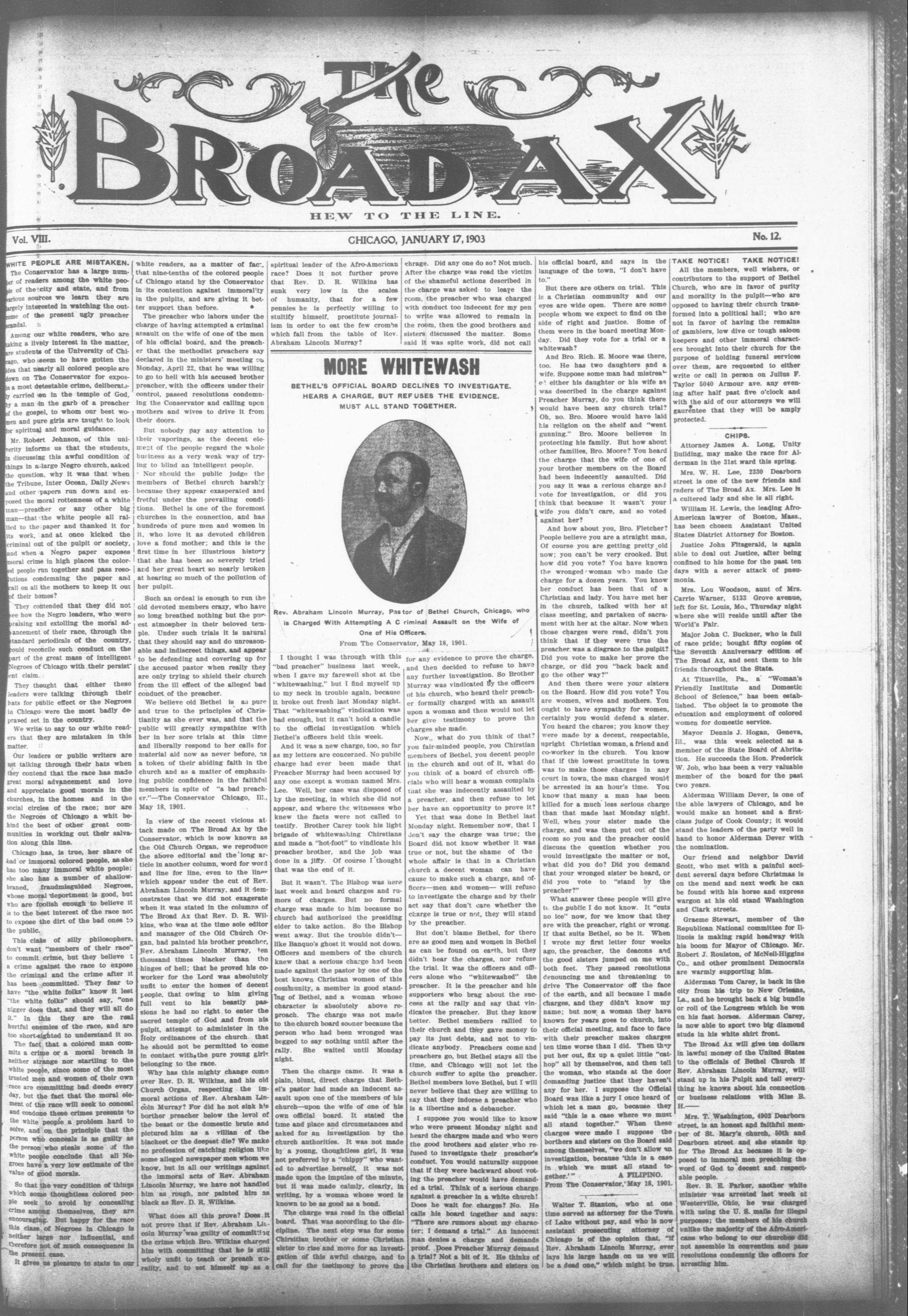
WHITE PEOPLE ARE MISTAKEN. The Conservator has a large number of readers among the white people of the city and state, and from various sources we learn they are largely interested in watching the outcome of the present ugly preacher scandal.
Among our white readers, who are taking a lively interest in the matter, are students of the University of Chicago, who seem to have gotten the idea that nearly all colored people are down on The Conservator for exposing a most detestable crime, deliberately carried on in the temple of God, by a man in the garb of a preacher of the gospel, to whom our best women and pure girls are taught to look for spiritual and moral guidance.
Mr. Robert Johnson, of this university informs us that the students, in discussing this awful condition of things in a large Negro church, asked the question, why it was that when the Tribune, Inter Ocean, Daily News and other papers run down and exposed the moral rottenness of a white man—preacher or any other big man—that the white people all rallied to the paper and thanked it for its work, and at once kicked the criminal out of the pulpit or society, and when a Negro paper exposes moral crime in high places the colored people run together and pass resolutions condemning the paper and call on all the mothers to keep it out of their homes?
They contended that they did not see how the Negro leaders, who were praising and extolling the moral advancement of their race, through the standard periodicals of the country, could reconcile such conduct on the part of the great mass of intelligent Negroes of Chicago with their persistent claim. They thought that either these leaders were talking through their hats for public effect or the Negroes in Chicago were the most badly depraved set in the country.
We write to say to our white readers that they are mistaken in this matter. Our leaders or public writers are not talking through their hats when they contend that the race has made great moral advancement and love and appreciate good morals in the churches, in the homes and in the social circles of the race; nor are the Negroes of Chicago a whit behind the best of other great communities in working out their salvation along this line.
Chicago has, is true, her share of bad or immoral colored people, as she has too many immoral white people: she also has a number of shallowbraned, fraudmisguided Negroes, whose moral deportment is good, but who are foolish enough to believe it is to the best interest of the race not to expose the dirt of the bad ones to the public.
This class of silly philosophers, don't want "members of their race" to commit crime, but they believe it a crime against the race to expose the criminal and the crime after it has been committed. They fear to have "the white folks" know it lest "the white folks" should say, "one nigger does that, and they will all do it." In this they are the real hurtful enemies of the race, and are too short-sighted to understand it so.
The fact that a colored man commits a crime or a moral breach is neither strange nor startling to the white people, since some of the most trusted men and women of their own race are committing bad deeds every day, but the fact that the moral element of the race will seek to conceal and condone these crimes presents to the white people a problem hard to solve, and on the principle that the person who conceals is as guilty as the person who steals some of the white people conclude that all Negroes have a very low estimate of the value of good morals.
So that the very condition of things which some thoughtless colored people seek to avoid by concealing crime among themselves, they are encouraging. But happy for the race this class of Negroes in Chicago is neither large nor influential, and therefore not of much consequence in the present case.
It gives us pleasure to state to our
white readers, as a matter of fact, that nine-tenths of the colored people of Chicago stand by the Conservator in its contention against immorality in the pulpits, and are giving it better support than before.
The preacher who labors under the charge of having attempted a criminal assault on the wife of one of the men of his official board, and the preacher that the methodist preachers say declared in the ministers' meeting on Monday, April 22, that he was willing to go to hell with his accused brother preacher, with the officers under their control, passed resolutions condemning the Conservator and calling upon mothers and wives to drive it from their doors.
But nobody pay any attention to their vaporings, as the decent element of the people regard the whole business as a very weak way of trying to blind an intelligent people.
Nor should the public judge the members of Bethel church harshly because they appear exasperated and fretful under the prevailing conditions. Bethel is one of the foremost churches in the connection, and has hundreds of pure men and women in it, who love it as devoted children love a fond mother; and this is the first time in her illustrious history that she has been so severely tried and her great heart so nearly broken at hearing so much of the pollution of her pulpit.
Such an ordeal is enough to run the old devoted members crazy, who have so long breathed nothing but the purest atmospher in their beloved temple. Under such trials it is natural that they should say and do unreasonable and indiscreet things, and appear to be defending and covering up for the accused pastor when really they are only trying to shield their church from the ill effect of the alleged bad conduct of the preacher.
We believe old Bethel is as pure and true to the principles of Christianity as she ever was, and that the public will greatly sympathize with her in her sore trials at this time and liberally respond to her calls for material aid now as never before, as a token of their abiding faith in the church and as a matter of emphasizing public confidence in the faithful members in spite of "a bad preacher."—The Conservator Chicago, Ill. May 18, 1901.
In view of the recent vicious attack made on The Broad Ax by the Conservator, which is now known as the Old Church Organ, we reproduce the above editorial and the long article in another column, word for word and line for line, even to the lines which appear under the cut of Rev. Abraham Lincoln Murray, and it demonstrates that we did not exagerate when it was stated in the columns of The Broad Ax that Rev. D. R. Wilkins, who was at the time sole editor and manager of the Old Church Organ, had painted his brother preacher, Rev. Abraham Lincoln Murray, ten thousand times blacker than the hinges of hell; that he proved his coworker for the Lord was absolutely unfit to enter the homes of decent people, that owing to him giving full vent to his beastly passions he had no right to enter the sacred temple of God and from his pulpit, attempt to administer in the Holy ordinances of the church that he should not be permitted to come in contact with the pure young girls belonging to the race.
Why has this mighty change come over Rev. D. R. Wilkins, and his old Church Organ, respecting the immoral actions of Rev. Abraham Lincoln Murray? For did he not sink his borer preacher below the level of the beast or the domestic brute and pictured him as a villian of the blackest or the deepest die? We make no profession of catching religion like some alleged newspaper men whom we know, but in all our writings against the immoral acts of Rev. Abraham Lincoln Murray, we have not handled him as rough, nor painted him as black as Rev. D. R. Wilkins.
What does all this prove? Does it not prove that if Rev. Abraham Lincoln Murray was guilty of committing the crime which Bro. Wilkins charged him with committing that he is still wholy unfit to teach or preach morality, and to set himself up as a
spiritual leader of the Afro-American race? Does it not further prove that Rev. D. R. Wilkins has sunk very low in the scales of humanity, that for a few pennies he is perfectly willing to stultify himself, prostitute journalism in order to eat the few crombs which fall from the table of Rev. Abraham Lincoln Murray?
MORE WHITEWASH
MORE WHITEWASH
BETHEL'S OFFICIAL BOARD DECLINES TO INVESTIGATE. HEARS A CHARGE, BUT REFUSES THE EVIDENCE. MUST ALL STAND TOGETHER.
[Image of a man in a suit with a mustache].
Rev. Abraham Lincoln Murray, Pastor of Bethel Church, Chicago, who is Charged With Attempting A Criminal Assault on the Wife of One of His Officers. From The Conservator, May 18, 1901.
I thought I was through with this "bad preacher" business last week, when I gave my farewell shot at the 'whitewashing," but I find myself up to my neck in trouble again, because it broke out fresh last Monday night. That "whitewashing" vindication was bad enough, but it can't hold a candle to the official investigation which Bethel's officers held this week.
And it was a new charge, too, so far as my letters are concerned. No public charge had ever been made that Preacher Murray had been accused by any one except a woman named Mrs. Lee. Well, her case was disposed of by the meeting, in which she did not appear, and where the witnesses who knew the facts were not called to testify. Brother Carey took his light brigade of whitewashing Chirstians and made a "hot-foot" to vindicate his preacher brother, and the job was done in a jiffy. Of course I thought that was the end of it.
But it wasn't. The Bishop was here last week and heard charges and rumors of charges. But no formal charge was made to him because no church had authorized the presiding elder to take action. So the Bishop went away. But the trouble didn't—like Banquo's ghost it would not down. Officers and members of the church knew that a serious charge had been made against the pastor by one of the best known Christian women of this community, a member in good standing of Bethel, and a woman whose character is absolutely above reproach. The charge was not made to the church board sooner because the person who had been wronged was begged to say nothing until after the rally. She waited until Monday night.
Then the charge came. It was a plain, blunt, direct charge that Bethel's pastor had made an indecent assault upon one of the members of his church—upon the wife of one of his own official board. It stated the time and place and circumstances and asked for an investigation by the church authorities. It was not made by a young, thoughtless girl, it was not preferred by a "chippy" who wanted to advertise herself, it was not made upon the impulse of the minute, but it was made calmly, clearly, in writing, by a woman whose word is known to be as good as a bond.
The charge was read in the official board. That was according to the discipline. The next step was for some Chirsitian brother or some Christian sister to rise and move for an investigation of this awful charge, and to call for the testimony to prove the
chrage. Did any one do so? Not much. After the charge was read the victim of the shameful actions described in the charge was asked to leaye the room, the preacher who was charged with conduct too indecent for my pen to write was allowed to remain in the room, then the good brothers and sisters discussed the matter. Some said it was spite work, did not call
for any evidence to prove the charge, and then decided to refuse to have any further investigation. So Brother Murray was vindicated by the officers of his church, who heard their preacher formally charged with an assault upon a woman and then would not let her give testimony to prove the charges she made.
Now., what do you think of that? you fair-minded people, you Chirstian members of Bethel, you decent people in the church and out of it, what do you think of a board of church officials who will hear a woman complain that she was indecently assaulted by a preacher, and then refuse to let her have an opportunity to prove it?
Yet that was done in Bethel last Monday night. Remember now, that I don't say the charge was true; the Board did not know whether it was true or not, but the shame of the whole affair is that in a Christian church a decent woman can have cause to make such a charge, and officers—men and women—will refuse to investigate the charge and by their act say that don't care whether the charge is true or not, they will stand by the preacher.
But don't blame Bethel, for there are as good men and women in Bethel as can be found on earth, but they didn't hear the charges, nor refuse the trial. It was the officers and officers alone who "whitewashed" the preacher. It is the preacher and his supporters who brag about the success at the rally and say that vindicates the preacher. But they know better. Bethel members rallied to their church and they gave money to pay its just debts, and not to vindicate anybody. Preachers come and preachers go, but Bethel stays all the time, and Chicago will not let the church suffer to spite the preacher. Bethel members love Bethel, but I will never believe that they are willing to say that they indorse a preacher who is a libertine and a debaucher.
I suppose you would like to know who were present Monday night and heard the charges made and who were the good brothers and sister who refused to investigate their preacher's conduct. You would naturally suppose that if they were backward about voting the preacher would have demanded a trial. Think of a serious charge against a preacher in a white church! Does he wait for charges? No. He calls his board together and says: "There are rumors about my character; I demand a trial." An innocent man denies a charge and demands proof. Does Preacher Murray demand a trial? Not a bit of it. He thinks of the Christian brothers and sisters on
his official board, and says in the language of the town, "I don't have to."
But there are others on trial. This is a Christian community and our eyes are wide open. There are some people whom we expect to find on the side of right and justice. Some of them were in the board meeting Monday. Did they vote for a trial or a whitewash?
And Bro. Rich. E. Moore was there, too. He has two daughters and a wife. Suppose some man had mistreated either his daughter or his wife as was described in the charge against Preacher Murray, do you think there would have been any church trial? Oh, no. Bro. Moore would have laid his religion on the shelf and "went gunning." Bro. Moore believes in protecting his family. But how about other families, Bro. Moore? You heard the charge that the wife of one of your brother members on the Board had been indecently assaulted. Did you say it was a serious charge and vote for investigation, or did you think that because it wasn't your wife you didn't care, and so voted against her?
And how about you, Bro. Fletcher? People believe you are a straight man, Of course you are getting pretty old now; you can't be very crooked. But how did you vote? You have known the wronged woman who made the charge for a dozen years. You know her conduct has been that of a Christian and lady. You have met her in the church, talked with her at class meeting, and partaken of sacrament with her at the altar. Now when those charges were read, didn't you think that if they were true the preacher was a disgrace to the pulpit? Did you vote to make her prove the charge, or did you "back back and go the other way?"
And then there were your sisters on the Board. How did you vote? You are women, wives and mothers. You ought to have sympathy for women, certainly you would defend a sister. You heard the chares; you know they were made by a decent, respectable, upright Christian woman, a friend and co-worker in the church. You know that if the lowest prostitute in town was to make those charges in any court in town, the man charged would be arrested in an hour's time. You know that many a man has been killed for a much less serious charge than that made last Monday night. Well, when your sister made the charge, and was then put out of the room so you and the preacher could discuss the question whether you would investigate the matter or not, what did you do? Did you demand that your wronged sister be heard, or did you vote to "stand by the preacher?"
What answer these people will give to the public I do not know. It "cuts no ice" now, for we know that they are with the preacher, right or wrong. If that suits Bethel, so be it. When I wrote my first letter four weeks ago, the preacher, the deacons and the good sisters jumped on me with both feet. They passed resolutions denouncing me and threatening to drive The Conservator off the face of the earth, and all because I made charges, and they didn't know my name; but now a woman they have known for years goes to church, into their official meeting, and face to face with their preacher makes charges ten time worse than I did. Then they put her out, fix up a quiet little "cathop" all by themselves, and then tell the woman, who stands at the door demanding justice that they haven't any for her. I suppose the Official Board was like a jury I once heard of which let a man go, because they said "this is a case where we must all stand together." When these charges were made I suppose the borthers and sisters on the Board said among themselves, "we don't allow an investigation, because 'this is a case in which we must all stand together.'" A FILIPINO. From The Conservator, May 18, 1901
Walter T. Stanton, who at one time served as attorney for the Town of Lake without pay, and who is now assistant prosecuting attorney of Chicago is of the opinion that, "If Rev. Abraham Lincoln Murray, ever lays his large hands on us we will be a dead one," which might be true.
---
No.12.
TAKE NOTICE! TAKE NOTICE! All the members, well wishers, or contributors to the support of Bethel Church, who are in favor of purity and morality in the pulpit—who are opposed to having their church transformed into a political hall; who are not in favor of having the remains of gamblers, low dive or tough saloon keepers and other immoral characters brought into their church for the purpose of holding funeral services over them, are requested to either write or call in person on Julius F. Taylor 5040 Armour ave. any evening after half past five o'clock and with the aid of our attorneys we will gaurentee that they will be amply protected.
CHIPS.
Attorney James A. Long, Unity Building, may make the race for Alderman in the 31st ward this spring. Mrs. W. H. Lee, 2330 Dearborn street is one of the new friends and raders of The Broad Ax. Mrs. Lee is a cultered lady and she is all right. William H. Lewis, the leading AfroAmerican lawyer of Boston, Mass., has been chosen Assistant United States District Attorney for Boston.
Justice John Fitzgerald, is again able to deal out Justice, after being confined to his home for the past ten days with a sever attack of pneumonia.
Mrs. Lou Woodson, aunt of Mrs. Carrie Warner, 5133 Grove avenue, left for St. Louis, Mo., Thursday night where she will reside until after the World's Fair.
Major John C. Buckner, who is full of race pride; bought fifty copies of the Seventh Anniversary edition of The Broad Ax, and sent them to his friends throughout the State. At Titusville, Pa., a "Woman's Friendly Institute and Domestic School of Science," has been established. The object is to promote the education and employment of colored women for domestic service.
Mayor Dennis J. Hogan, Geneva, Iil., was this week selected as a member of the State Board of Abritation. He succeeds the Hon. Frederick W. Job, who has been a very valuable member of the board for the past two years. Alderman William Dever, is one of the able lawyers of Chicago, and he would make an honest and a firstclass judge of Cook County; it would stand the leaders of the party well in hand to honor Alderman Dever with the nomination.
Our friend and neighbor David Scott, who met with a painful accident several days before Christmas is on the mend and next week he can be found with his horse and express wargon at his old stand Washington and Clark streets. Graeme Stewart, member of the Republican National committee for Illinois is making rapid headway with his boom for Mayor of Chicago. Mr. Robert J. Roulston, of McNeil-Higgins Co., and other prominent Democrats are warmly supporting him.
Alderman Tom Carey, is back in the city from his trip to New Orleans, La., and he brought back a big bundle or roll of the Longreen which he won on his fast horses. Alderman Carey, is now able to sport two big diamond studs in his white shirt front.
The Broad Ax will give ten dollars in lawful money of the United States to the officials of Bethel Church if Rev. Abraham Lincoln Murray, will stand up in his Pulpit and tell everything he knows about his connection or business relations with Miss B. H.——
Mrs. T. Washington, 4902 Dearborn street, is an honest and faithful member of St. Mary's church, 50th and Dearborn street and she stands up for The Broad Ax because it is opposed to immoral men preaching the word of God to decent and respectable people.
Rev. B. E. Parker, another white minister was arrested last week at Westerville, Ohio, he was charged with using the U. S. mails for illegal purposes; the members of his church unlike the majority of the Afro-Americans who belong to our churches did not assemble in convention and pass resolutions condemnig the officers for arresting him.
THE BROAD AX.
Will promulgate and at all times uphold the true principles of Democracy, but Catholics, Protestants, Priests, Infidels, Farmers, Single Taxes, Republicans, Knights of Labor, or any one else can have their say, so long as their language is proper and responsibility is fixed.
The Broad Ax is a newspaper whose platform is broad enough for all, ever claiming the editorial right to speak its own mind.
Local communications will receive attention. Write only on one side of the paper.
Subscriptions must be paid in advance.
One Year..... $2.00
Six Months..... 1.00
JULIUS P. TAYLOR, Editor and Publisher. Entered at the Post Office at Chicago, Ill., as Second-class Matter.
Talking Too Much.
Many stories are told to illustrate the folly of a tongue that wags too freely, and the point is one which needs to be emphasized to the attention of humanity. Not long ago a neat and well-dressed girl was arrested in New York on a charge of shoplifting, and her appearance was so greatly in her favor that the police were about to release her, believing that a mistake had been made. Then she opened her mouth and spoke, saying: "I s'pose my mug will have to go into de picture book for dis." Whereupon her captors held her tightly in the iron grasp of the law, and shortly thereafter secured her commitment to jail, and put her "mug" in the "picture book" as that of a thief. And all because she talked too much.
Sensitive Plants.
Patrick McCabe, lately a section hand on the 'Frisco road at Wichita, is suing that corporation for damages for injuries received while in its employ. His plea is that while working the foreman spoke to him "in a loud, profane and very boisterous manner, thereby causing the plaintiff to be nervous and excited, and thereby causing him to place himself in a position of great bodily danger, and to a greater degree than he otherwise would have done." The orders were given "in a very loud and boisterous manner backed up by many oaths, such as 'Be smart,' 'Be quick,' and 'Move yourself,' etc." Kansas section hands seem to be sensitive plants.—Detroit Free Press.
He Knows "Jack Frost."
It was the first bitter cold day of the winter, and the kindergarten was animatedly discussing the advent of "Jack Frost." Finally the teacher said, with an air of mystery:
"I wonder if anyone can tell us what 'Jack Frost' really is?"
Silence for a moment; then Louis' black eyes began to twinkle, and he gave a little wriggle of joy.
"Sure!" he said. "Sure, I know what's Jack Frost. He's the iceman!"
—N. Y. Tribune.
King Edward's Private Mall
No public document bearing King Edward's signature is ever carried by postmen, though the king's private letters are usually entrusted to the ordinary post. Wherever the king may be two king's messengers or more leave London every day bearing official papers that his majesty must deal with immediately. Thus the king is kept busy, and sometimes overworked, even on his holiday trips.—N. Y. Sun.
Compromise.
"Want the trousers creased?" asked the tailor.
"That's the style, isn't it?"
"Well, not so much, perhaps, as it used to be. Some of my customers won't have it done now at all." "O, well, I'm not particular," replied the customer. "Suppose you crease one of the legs and leave the other baggy."—Chicago Tribune.
Meanness of Brown.
Green—Brown told an acquaintance of mine that he could have beat my time and married you himself if he had wanted to.
Mrs. Green—The ideal I wonder why he didn't do it, then?
"Oh, I can readily understand why he didn't. He had a grudge against me."—Chicago Daily News.
Chance to Get Evan.
Small Boy—Give me a large bottle of the worst medicine you've got in your shop.
Druggist—What's the matter?
"Well, I've been left all alone with grandma, and she's suddenly been taken ill, and I'm going to get even with her!"—Stray Stories.
Growth of Islam
At the present day, on the best authorities, there are 250,000,000 Mussulmans in the world. The Christian population is put at 447,000,000, but the increase of Islam is more rapid than that of its sister religion.—Religious Journal.
Where Age Has a Chance
The new president of Hayti is 85 years old. It is evident, says the Chicago Record-Herald, that the young men have not as yet assumed charge in Hayti.
As Explained.
and then as a medicine. Naggs-Yes, of course. Your wife told me you hadn't seen a well day for years.—Chicago Daily News.
Fortunately.
Fortunately for a man's peace of mind he seldom hears other people's real opinion of himself.—Chicago Daily News
Ironing Without Fire.
Every house has its tinder-box, but starting a flame with flint and steel was a tedious process at the best, and "borrowing fire" was usual among neighbors when one had the mischance to lose his over night. I am unable to say how long this custom continued, but I must have been seven or eight years old when a vagabondish neighbor came to our house one morning with his wife's foot stove to get some coals. He was a reckless liar, of whom it was proverbially said that he would "lie for the fun of it" when the truth would have been more to his advantage. As we had had our breakfast, my mother said to him: "Your folks must have slept late this morning, Mr. Davis" "Bless you, no!" he replied; "we were up at daylight, and my wife has done a large ironing." I remember with what good-natured effrontery he joined in the laugh against him when my mother said she would like their receipt for doing an ironing without fire.—J. T. Trowbridge, in Atlantic.
Nothin' Doin'.
"My word, Fitznoodle," said a war office clerk to a colleague who sat at the next desk, "just look at that workman on the roof of that building over the way!"
"What's the matter with him?" inquired Fitz, glancing through the window at the individual indicated.
"Matter," retorted the other, "why, I've been watching the lazy beggar for the last 25 minutes and he hasn't done a stroke of work all the time."
At the precise moment at which the above conversation occurred a British workingman was addressing his "mate."
"S'y, Bill," he remarked in a tone of deep disgust, "d'ye see that 'ere loafin' war offis clurk in that room down there? S'help me, if Hi ain't bin a-watchin' 'im fur nigh on arf a hower, an' the bloomer's done nothin' but stare hout o' th' winder the 'ole blessed tyme. That's the sort o' chap as we pys taxes ter keep!"—London Express.
Dangerous Acquiescence
"What was the cause of Vawdvill going to the hospital?" asked Futilities.
"An Irish friend was telling him that the Hibernians of the country were going to put a stop to actors impersonating them on the stage. Vawdvill agreed with him."
"But that didn't cause the fight, did it?"
"Yes. The Irishman said that the actors didn't do the Hibernians justice—and Vawdvill said no comedian could. When he came to he was in the ambulance."—Cincinnati Commercial Tribune.
New Kind of Cheese.
Making Italian cheese is a new industry which is attracting attention in New Jersey. Many cheese factories have sprung up, and tomato canners have turned to cheese making to utilize the oversupply of tomatoes. The latter are collected and mashed and then mixed with salt and spices in a large box like a mortar bed. They are then stirred and mixed by hoes to a proper consistency, but thereafter the process is known only to a select few. Science and Industry.
Merely a Hint.
"Thunder and guns!" exclaimed the old gentleman, as he was given the bill for his only daughter's last gown, "but you cost a pile of money."
"Well, papa," she replied, demurely, "if you wouldn't sit in the back parlor with the door open when I am entertaining Mr. Binkley in the front parlor, you'd stand a better chance of getting rid of the expense."—Chicago Evening Post.
Imitation Butter.
The first artificial butter was "margarine," made in Poissy, France, in 1869. It was made from the fat of the loins and kidneys of cattle, which, when melted, is sometimes called "oileo oil." This oil, tallow, lard, olive and cottonseed oil are used, combined with dairy butter, in making the various butterines. Cocoanut butter is largely used in northern Europe.—Indianapolis News.
His Wife's Whereabouts
"Bridget," said the doctor, as he returned to the house in haste, "can you tell me anything of my wife's whereabouts?" "Shure, an' Oi don't know, sor'r, but Oi think they're in the wash," replied Bridget with deep sincerity.—N. Y. Press.
About the Size of It
Little Willie—What's a philosopher, pa?
Pa—A philosopher, my son, is a man who can point out a dozen reasons why other people should be content with their lot.—Chicago Daily News.
One Small Pair.
"Well, Mr. Hart," said the doctor, "I congratulate you. You are the father of—" "Ah!" exclaimed the proud man. "A Hart turns up, eh? I hope it's the Jack—that is, a boy." "Two boys. Twins, in fact." "The duce."—Philadelphia Record.
A. Substitute.
Customer—Have you any problem novels?
Bookseller—No, but here is a treatise on integral calculus which is said to contain some novel problems.
—Rocky Mountain News.
Jerrold-I took Dolly out in my auto yesterday.
Harold—Of course you proposed to her?
"No! Every time I started to I broke down."-Puck.
The Weeping Willow.
The weeping-willow tree came to America through the medium of Alexander Pope, the poet, who planted a willow twig on the banks of the Thames, at his Twickenham villa. The twig came to him in a box of figs sent from Smyrna by a friend who had lost all in the South Sea bubble, and had gone to that distant land to recoup his fortunes. Harper's Encyclopedia tells the story of the willow's arrival in America. A young British officer, who came to Boston with the army to crush the rebellion of the American colonies, brought with him a twig from Pope's now beautiful willow, tree, intending to plant it in America when he should comfortably settle down on lands confiscated from the conquered Americans. The young officer, disappointed in these expectations, gave his willow twig, wrapped in oil-silk, to John Parke Custis, Mrs. Washington's son, who planted it on his Abingdon estate in Virginia. It thrived, and became the progenitor of all American willow trees.—Indianapolis News.
A Milk Epidemic.
Of the typhoid epidemics traced to milk, one of the most typical was that at Springfield, Mass., where, in July and August of 1892, 150 cases occurred concentrated in one of the most beautiful suburban districts of that city. The investigation, by Prof. W. T. Sedgwick, showed that the path of the pestilence was coincident with the route of a certain milkman. It was next found that a portion of his product came from a farm where several cases of typhoid fever had occurred during the preceding summer. Shortly before the outbreak of the epidemic the discharges from the patients were spread upon a tobacco field. Manure from this field, carried on the boots of the farm hands, was obvious about and in a well near by. On the bottom of this well, and submerged—in leaky cans—stood the milk to be cooled before it was sent to Springfield. The chain of evidence was thus complete.—C. E. A. Winslow, in Atlantic.
The Colt and Its Rider.
Once upon a time a man tried to ride on the back of a young colt, which objected very much to his doing so, and there was quite a struggle between the two, with plunging by the colt and clinging by the man.
Finally the colt threw the man over his head, depositing him on the ground without injury; but the man, determined not to be defeated, pursued the colt and, capturing him, proceeded to again mount, with some difficulty.
There was another struggle, which ended as before, but this time he received severe injuries.
Moral:—Some persons don't know when they are well off.—N. Y. Herald.
Microbes in Money.
Medical men say that books and paper money carry the microbes of disease, and yet the employes of public libraries, who handle hundreds of books daily, and bank officials, who handle thousands of notes, do not "catch" the diseases. The reason is that library people do not wet their fingers with their lips to turn over the leaves of books, and bank officials do not wet their fingers in the same way to count money.—Medical Journal.
Overheard in Gun Store
Desperate-Looking Party-I want to buy a revolver. Dealer-Yes, sir; here's the three latest styles; this plain, substantial arm is much used for self-defense; this silver-mounted one with pearl handle is used for shooting sweethearts, and this cheap, common affair is usually used to shoot wives. It's very popular just now.—Baltimore American.
Thistledown in China.
This country is not the only one where unconsidered trifles are snapped up by the manufacturers and put to practical use. In China the down of the thistle is gathered and mixed with raw silk so ingeniously that even experts are deceived when the fabric is woven. It is also used to stuff cushions as a substitute for eiderdown, and a very good substitute it makes.
Slow Boy.
Ascum—And what profession is your son to follow?
Pater—I don't know yet, but that's about all he'll do, I guess.
"What? How do you mean?"
"He'll follow some profession; he never seems able to catch up to anything."—Philadelphia Press.
Last Resort.
"Oh, I suppose there is nothing left now but to ask the girl."—Chicago Daily News.
Natural Sequence
Miss Thirtyodd—Softleigh had the audacity to propose to me last evening.
Miss Twentyeven — Indeed! And when is the wedding to take place?
—Chicago Daily News.
Better Left Unsaid.
Witless—Who is that handsome girl standing near the piano?
Mrs. Homer—That is my daughter.
Witless—Indeed! She doesn't resemble you in the least.—Chicago Daily News.
First Past the Post
Client-How about that account I left with you to collect on shares? Collection Agent-Oh, I collected my half all right, but it's simply impossible to collect yours.-Chicago Daily News.
Insanity Among Women.
A German scientist, Prof. Zimmer, of Berlin, has of late devoted considerable time to the investigation of the causes of insanity among women, and has come to the conclusion that if women are admitted into competition with men the inevitable will be a tremendous increase of insanity among the women. He finds that the percentage of women teachers who become insane is almost double that of the men teachers. Inquiries were also made about women employed as telegraph, sales clerks and in the telephone service, and, furthermore, with regard to women engaged in the Swiss watchmaking trade. These inquiries showed that in the occupations mentioned a far larger proportion of women than men succumb to mental disorders.—Chicago Chronicle.
A Perpetual Light.
The government maintains one "perpetual light." It shines in one of the dreariest places in the world, out in the Mississippi swamps, and has not failed to shine for many years. It is located between Lake Borgne and the Mississippi sound, and is seldom neared by any mariner or wayfarer. It stands out in the marsh, and is visible from some of the railroads. Without any cheerful prospects, overhung with miasmatic mist, compassed by filthy arms of the sea, among matted weeds and rank mud, the light goes on perpetually. The winds do not blow it out and it never explodes. Every three months James Young, a government employe, goes out in a small boat and fights his way to the lighthouse and loads up the lone sentinel with oil. Its name is "Perpetual Light."—Philadelphia Ledger.
Difficulties in Language.
A Frenchman came to England to learn English and the following sentence was given him:
"The rough cough and hiccough plough me through." The teacher told him the first word was pronounced ruff. He thereupon said this: "The ruff cuff and hiccuff pluff me thruff."
"No, no; the second word is pronounced 'koff.'"
"Then," said the Frenchman, "it must be the roff coff and hiccoff ploff me throff."
The third, fourth and fifth words were explained with the same result, which the reader may repeat to himself.—London Express.
Ordnance Survey Map.
The idea of the ordnance survey map is to be improved upon by a piece of "geographic sculpture." The whole surface of the states is to be reproduced in a model to a scale of two and a half inches to the linear mile. Railway lines, swamps, forests, everything will be shown in this model, which will be in sections, to admit of easy alteration when required. Duplicates of these sections will be sold at a cheap rate, so that professional and business men can have maps.—Scientific American.
Turkish Monk Settlement.
On the east point of the sacred Mount Athos, on the Turkish peninsula, Chalkidike, is a settlement of 6,000 monks, scattered among 220 monasteries, the whole forming a monastic republic in the dominions of the sultan, to whom they are tributary. The yearly tribute they pay is by no means a small one, but the sum is easily met by the republic, which is very rich and counts many millionaires among its members.—N. Y. Sun.
The Wrong Place
Mrs. Casey—O! but I losht a foine little chiny vase that Mike brung me whin he come home late from the dimmecratic rally. "Twas jist his own carelissniss, too.
Mrs. Cassidy—Did he drop it an' break it?
"He carried it home in his hat. Shure, he might a' knowed that'd be the furst place I'd soak him."—Philadelphia Press.
Entirely Peaceable.
Lady (not liking the look of her new servant)—Did you have any words with your late mistress as you were leaving your lastplace?
The domestic (encouragingly)—Not in the least, mum. I locked her in the bathroom, and took all my things and slipped out as quiet as you please!—Stray Stories.
Our Great Ice Rivers
One hears a great deal about the glaciers of Alaska, and it is satisfactory to know that Uncle Sam possesses a few more important ice rivers of his own. But few people are aware that there are in Montana some of the finest glaciers in the world, even rivaling those of the Alps.-N. Y. Sun.
A Doubter.
"And do you never wish to experience love's young dream?" asked the romantic young married woman of her bachelor brother.
"No, sir," replied he, "for, you know, dreams go by contraries."—Detroit Free Press.
Bing. Cut from Diamond
One of the most skilful lapidaries of Antwerp, has succeeded, after several unsuccessful attempts and three years of patient work, in cutting a perfect finger ring out of a single diamond.—Jewelers' Journal.
Kicked at the Poet.
Penman—Well, he kicked all right, but not at the verses exactly.—Yonkers Statesman.
Awfully Common.
Mrs. Rittenhouse Squeers—Are they fashionable people?
Mrs. De Lancey Place—Oh, no. They have children.—Philadelphia Record.
"Do Lancey's Ancient Pine."
There is an interesting pine tree in Bronx Park, close to the entrance of the Geological gardens, that is worthy of greater honor than is usually accorded it. To few old-timers who remember the locality before it ever became a part of New York this old tree goes by the name of De Lancey's pine. A poem has been written about it, setting forth the virtues of "De Lancey's ancient pine." The tree is by far the tallest for miles around, and although its lower branches have been badly treated, a towering mass of green boughs surmounts the majestic survivor of the days when the old De Lancey family owned a large portion of the estate now in the Bronx park domain. The old De Lancey house, that was the scene of many gay parties in pre-revolutionary days, was burned down about 30 years ago. The tall pine is supposed to be close to 150 years old at the least, and its present condition is favorable for at least another century of life.—N. Y. Times.
The Telephone Girl Secure.
"Women have to fight for an even chance with men in other lines," said one of the officials of the New York Telephone company the other day, "but in our business they are in no danger from male competition. It would be simply impossible to run a telephone exchange with male operators. Who ever heard of a 'hello boy'? There is trouble enough with boys answering the 'phone in offices, and there is no danger of their being used in place of girls in the telephone exchanges. It is not chiefly because girls are steadier, more attentive and more polite, but it is because a girl's voice carries better over the wire than a boy's, being higher, clearer and more penetrating. But there is a still more important reason. A girl can tell what the fellow on the other end of the wire is trying to say, when a boy would be shouting hopelessly: 'What did you say?' "—N. Y. Times.
The Whaler's Fine Voyage.
"That reminds me," said Congressman Littlefield, of Maine, "of a story they tell on an old whaler of New Bedford. He was gone for a two years' cruise after whales in the South Atlantic. Finally one day the ship was seen coming up the bay, and the owner rushed down to the pier to be the first to greet the captain and ascertain the result of his venture.
"‘How many whales did you get?' shouted the owner.
"‘Narry a whale,' was the reply. 'but we had an awful fine sail.'"—Philadelphia Press.
Very Peculiar.
The class in geography in one of the Brooklyn schools was undergoing examination when the teacher asked: "What are some of the natural peculiarities of Long Island?" The pupils indulged in some hard thinking, but none responded. Suddenly a fat boy with a red face, who had been shifting uneasily about in his seat, raised his hand. "I know," said he. "Well, what are they?" asked the teacher. "Why," said the fat boy, with a triumphant look, "on the south side you see the sea, and on the north side you hear the sound."—N. Y. Times.
Hated to Undo His Work.
He was wandering in Ireland and came upon a couple of men "in holts" rolling on the road. The man on top was pommeling the other within an inch of his life. The traveler intervened.
"It's an infernal shame to strike a man when he's down," said he.
"If you knew all the trouble I had to get him down," was the reply, "you wouldn't be talking like that."—Philadelphia Inquirer.
The Ils of Vice Verma.
Happy-Go-Lucky—The fellow hit it right when he said a pessimist is one who is always looking for worms in chestnuts.
Down-in-the-Mouth—And I suppose an optimist is one who likes to eat the worms without going to the trouble of looking for them.—Rum Punch Bowl.
Knew It All.
Binks—You're putting your boy early to work.
Jinks—Yes; he's a clever lad, for he's learned everything the teacher knows.
"He has?"
"He has that. The teacher said: 'I can't hammer anything more into that head of his.'"—Stray Stories.
What Uncle Renben Says.
When yo' see a new moon shinin' in yo'r face ober a blue gum tree, it am a sign dat de old woman am gwine to strike a pose an' ax yo' why dar ain't any 'taters in de house. Mebbe yo' am gwine to strike a pose, too, but it won't be de ekal o' hers.—Detroit Free Press.
A Monster Bird.
Freddie—Ma, the bat is the biggest bird that flies, ain't it?
Ma—By no means, Freddie.
"Well, anyway, some of 'em must be mighty big, 'cause I heard father say he was out on one last night."—Richmond Telegraph.
Knew the Sex.
Mrs. Shapeleigh-I am looking for something that will enable me to keep my skirts out of the mud. Floorwalker-Yes, ma'am. You will find the fancy hosiery in the basement.-Chicago Daily News.
A Lawyer's Foresight
"John," said the retired lawyer to his coachman, "aren't the horses trying to run away?"
"They be, sir!"
"Then drive into something cheap."
—Electrical Review.
Indian Servant Girl.
A new solution of the servant girl problem is being discussed in the large cities of the west. Indian girls, from special training schools, are being employed as servant girls. It is said that the Indian girls who have been properly trained are found to be perfect embodiments of satisfactory domestic service. Five thousand or more Indian girls have been engaged from the various Indian schools of the southwest to act as domestics in the homes of wealthy people in Kansas City, Chicago, St. Louis and Denver. Most of these girls are from the Chilacco and Haskell Indian schools. The Indian girls are physically strong. They are, as a rule, faithful, polite and unobtrusive.—Buffalo Enquirer.
The Vicar's Instruction.
Religious examination papers are an ancient and unfailing source of joy. The latest one to be put in evidence comes from an English church training college. Candidates for admission are required to give some account of the religious instruction they have received, and a recent answer to the first two formal questions ran as follows:
Question—What instruction have you had in religious knowledge?
Answer—None.
Question—By whom was it given?
"By the vicar."
The thing might have been expressed more logically, but not much more clearly.—N. Y. Post.
Cupid and His Humor.
Once upon a time an old maid went to Cupid and chided him.
"You have forgotten me," she said. And then, lowering her voice, she continued: "Remember that my fortieth birthday is next month. I will expect a present from you."
"You shall have it," answered Cupid.
When the birthday came a package from the little god came with it, and it was found to contain one of Cupid's worn-out last generation bows.
The woman threw it angrily to the floor.
Morel.—There are bows and beaux
—N. Y. Herald.
Business Regulations in Germany. Business methods are largely regulated by law in Germany, and there is not the individual liberty in such matters as there is in this country. For example, if a manufacturer makes false statements of any kind about his products, any business man may bring suit against him, the penalty being fine or imprisonment. Nor can a dealer advertise a "removal sale," and then restock his store and continue business at the "old stand." Such phrases as "the best in the world" and "superior to all others," are not allowed in advertisements, as they are considered detractions of competitors.—Cleveland Leader.
A Linguistic Quandary.
The Boston girl took off her glasses and wiped them tenderly, reflectively, on a piece of chamois skin. Then she tapped her foot decorously on the hardwood floor. Anon she moved uneasily, almost petulantly, in her chair.
Hist! She was thinking. At length she murmured moodily to herself: "I cannot determine whether the plural of hoodlum should be hoodlums or hoodla."—Baltimore American.
One or the Other.
"I wouldn't hurt Henrietta's feelings for the world," said Mr. Meekton, "but I must say that wives are a little difficult to please."
"Have you just found that out?"
"I am not announcing it as a discovery; only as a suspicion. But, from observation, it seems to me that they either say: 'Oh, he's like all the rest,' or else they wonder 'Why he can't be like other men.'"—Washington Star.
Pledges in Paris.
At the Paris pawn house about 350,000 watches and 60,000 wedding rings are deposited every year. The oldest object there in 1900 was a suit of clothes on which five francs had been advanced in 1869. It belonged to a soldier who fell in the war of 1870, and whose widow paid her annual due on it for over 30 years in the hope of being able some day to redeem it.—N. Y. Sun.
Proof Against Such Argument.
She—He didn't succeed in convincing her, after all his argument.
He—No; he merely made her mad. "But his explanation was clear." "Yes, and that's where he made his mistake. He told her it was as 'plain as the nose on her face.'"—Stray Stories.
As the Stork Sees It
First Stork-I just left a baby at that millionaire's house.
Second Stork—Funny things these human beings. I've just. delivered three to one woman in a tenement, and her husband's out of work and they haven't a cent.—Brooklyn Life.
Sarcophagus of Cassius.
Cassius, after the battle of Philippi, killed himself and was buried in the island of Thasos. A sarcophagus, which is believed to hold his remains has been recently discovered there. — N. Y. Sun.
Her Main Wish.
He—You will never want for anything if you marry me.
She—What! Will you supply some one that I can love, also? — Stray Stories.
Spanish Girls Fight Bulls.
It is becoming quite usual for girls to take part in the bull fights in Spanish cities.—N. Y. Sun.
MEMBERS OF CONGRESS
Senator Hoar is well-to-do. His family has been in comfortable circumstances for generations. He has lived carefully, though well, and his possessions have increased moderately with time. Billiard experts in congress yield the palm to Senator Mallory, of Florida, whose work with the cue is of the highest order. Only Congressman Cochran, of Missouri, and Congressman Lanham, of Texas, are supposed to be in his class, and both concede the Florida man's superior skill.
The roll call of millionaire senators in the Fifty-eighth congress will stand about as follows: Clark, Hanna, Depew, Platt, Kean, Dryden, Elkins, Bard, Kerens, Perkins, Wetmore, Proctor, Scott, Quay, Alger, and Addicks. Perhaps about one senator in every six is a real live millionaire.
Senator Dubois was feeling a bit out of sorts and on the advice of his physician went to Atlantic City for some sea air. "How did you make out?" the senator was asked on his return. "Not very well," Dubois replied. "You see, I went for sea air and every minute of the four days I stayed there was nothing but a land breeze."
A reporter saw Senator Hoar coming out of the white house and said: "Can I say that you have been talking with the president on the trust problem?" Mr. Hoar beamed through his spectacles as he replied slowly: "Let me see. Yes, you could say that." "Then, senator," began the reporter, but the venerable Yankee interrupted: "Yes, you can say that, but it wouldn't be true," and he walked away chuckling.
The national house of representatives has concluded that Congressman Sheppard, of Texas, has the most delicately balanced conscience in the entire body. When he started back from his holiday he had through tickets from Washington, but he found that by coming on the route he had selected he would be four hours late for the opening of congress. This discovery was made in St. Louis. Mr. Sheppard promptly threw away his tickets and bought another which landed him in Washington just in time. He wondered why more seasoned statesmen laughed when he told of this experience. The Texan is only 27 years old, which may go a long way toward accounting for his extreme fidelity to duty.
BY WAY OF VARIETY.
Germany's tallest soldier is a noncommissioned officer six feet eight inches in height.
A chain of banks to be conducted by a central institution is to be organized in San Francisco as soon as the details can be completed.
Canada's trade increased in the fiscal year to June 30,1902, $35,188,058, having been in the aggregate $414,431,831, according to the department of trade and commerce.
Many German railways stations have tunnels by means of which the different tracks are safely reached. It is now proposed to have such tunnels at important street crossings in Berlin. In the United States and Canada the telegraph poles are usually spaced 55 yards apart, and on the average the number of rail lengths passed over in 20 seconds gives very nearly the train speed in miles per hour.
A novel scheme has recently been evolved by which a train will not only be lighted by electricity, but the power will be obtained by a rotary fan attached to the front end of the locomotive. Tests have shown that on an ordinary train five cars can be illuminated in a night and that the battery in the morning will have nearly its maximum charge of electricity.
IN SOME OF OUR CITIES.
The report of Coroner Dugan, of Philadelphia, showed that in the last year 3,709 deaths were reported and 2,804 inquests held. Milwaukee's police trials are but few. Only nine policemen were tried on charges last year out of a force of 281. This represents a great improvement in the past ten years, as there were 42 trials in 1889.
Residents and property holders on Thirteenth street, in Atlanta, Ga., have petitioned the authorities to change its name to Piedmont place, explaining that the name "Thirteenth" is somewhat in the nature of a stigma because of popular superstition and is detrimental to their interests.
City Engineer Ericson, of Chicago, says that there is a waste of 76 per cent. of all the water pumped and, his plea for the introduction of many more water meters having been unheeded, he will be compelled to ask for an additional appropriation of $200,000 or more for the city pumping stations.
NOVELTIES FOR THE DESK.
A charming desk set of brass is shown, every article of which curls up in the form of a water lily.
Moire letter paper looks like the real thing. Another fancy paper shows stitching effect around the edges.
Small waste-paper baskets have the effect of wood on the outside with pretty hand-painted designs. They are lined inside with pale-colored silk.
And now there is a novelty in the way of correspondence paper, in which the letter sheet is much longer than it is wide, so that the sheet must be folded twice instead of once to fit in the envelope.
BEAUTY HINTS AND HELPS.
To whiten the finger nails and remove all stains cut a lemon in half and rub the finger tips well with it at night. Wash off in warm water the next morning.
The juice of a lemon, half an ounce of glycerin and a teaspoonful of sugar is an excellent remedy for hoarseness and is within the reach of everybody. Take a teaspoonful every few hours.
For red hands use a little chloride of lime—dropping a few grains into the water used for washing the hands. Be careful to remove all rings and bracelets first, for chloride of lime will tarnish them.
A singular new contrivance is guaranteed to rid the complexion of disfigurements in this wise: There is a rubber cup which is clapped to the face, and through a rubber tube hot or cold water, as the case requires, is sprayed upon the spot to be treated. The suction and forcible spraying are said to have beneficent effect.
Gritty tooth powders destroy the enamel of the teeth and lead to decay. Essentially a tooth powder is a mechanically acting detergent. It cleanses teeth just as powdered brick or sand will cleanse metal. The source of danger is in the particles of the powder being so coarse as to scratch the enamel. Chalk, charcoal, pumice stone and cuttle fish bone are the four chief bases of ordinary tooth powders.
Six drops of olive oil used every third night to massage the lower face and throat will long keep off the first throat and chin wrinkles that all women dread. Use the tips of the fingers, and stroke the oil in gently, yet firmly. Leave it on over night, washing it off in the morning with hot water and without soap. If it is found that every third night keeps the skin a bit too oily, the interval may be a little lengthened.
FOR THE HOUSEKEEPER
A teaspoonful of sugar in the stove blacking will add to the luster of the stove.
To remove mud stains from dresses wash them with a little carbonate of soda dissolved in water.
Tinware may quickly be cleaned by rubbing it with a damp cloth, dipped in soda. Rub briskly and wipe dry.
Sour milk should be used for adding to the water with which linoleum and oilcloth are washed, for it will make them like new.
A tablespoonful of turpentine put into the copper will whiten the clothes boiled in it and will prove an economy both of soap and labor.
Gold lace may be cleaned by rubbing it with a flannel well dusted with powdered ammonia, and then polishing it with a soft handkerchief.
When soot falls upon the carpet it may be removed by sprinkling on plenty of finely powdered salt and sweeping off in the direction of the fireplace. Repeat until the marks are gone.
To clean white silk ties, rub them over with French chalk, and afterward hold to the fire. The heat will cause the chalk to absorb the grease, and a shaking or brushing will render the tie quite clean.
MODES OF THE SEASON.
A jeweled girdle forms the striking finish of many house gowns. Shawl shapes and shawl collars are the prominent features of the neckwear this season. Many of the latest blouses seem to be especially designed to effectually disguise any waistline. Exquisite gowns are made of white panne with incrustations of black chantilly on skirt and bodice. Very smart women are wearing wide ribbon bows beneath the chin and some of velvet is always pretty, mixed with lace and tulle.
Black lace gowns, profusely trimmed with lace medallions and jet, over a white foundation, are one of the smartest evening gowns of the winter. The use of white satin, fur, gold braid, laces and Russian guipure medallions is again the feature of cloth and velvet gowns and handsome coats of various kinds for afternoon calls, receptions and matinees.
The best veils are of fine mesh, with chenille spots of various sizes thereon. The disfiguring spots of abnormal size have become demode. It was but the whim of a moment, and a very foolish one, for it was certain that a spot would get over one's eye or nose.
SCIENCE SIFTINGS.
The ants of South America have been known to construct a tunnel three miles in length.
That natural sleep is due to the drugging effect of accumulated carbonic acid in the body, is the view taken by a French physiologist, Dr. Raphael Dubois.
A piece of skin cut from a human body will show signs of life for ten days after separation. This discovery is important in connection with the grafting of new skin over a damaged part of the body.
Dr. J. Colling Warren, of Boston, has in his museum the most perfect example in the world of the osseous formation of the extinct mastodon. It only lacks a couple of toes or so of being absolutely complete. Prof. Koch, the noted bacteriologist, declares that typhoid fever can be stamped out through proper treatment of each case. He urges that every case of typhoid fever be as strictly isolated as a case of cholera, and by such isolation the disease could be wholly exterminated.
MEN AND AFFAIRS.
Dr. T. G. Simpson, of West Fairlee, Vt., owns the musket from which was fired the first shot at the battle of Bunker Hill. It belonged to his grandfather, Maj. John Simpson. Lord Amherst, of London, collects crowns, and has a cabinet with a number of fine specimens of discarded skypieces, including the crown worn by Charles II. at his coronation, the crown worn by George IV. and the one made for Queen Adelaide.
Following the example of some other scions of wealthy families, Henry K. McHarg, whose father is president of the Virginia Iron, Coal and Coke company, has entered the offices of that corporation in Radford, Tenn., and will begin a practical study of the mining business. Young McHarg is 20 years old and is an only son, his father being many times a millionaire.
Quite a youthful reporter asked Mark Twain for an interview on the coal situation. The newspaper man began by saying: "Mr. Clemens, I have been instructed to interview you on the humors of the coal famine." The New York Times says that the veteran humorist gasped feebly for a moment and then replied: "Young man, you go back to your editor and tell him if he emptied all the short and long dashes in his composing rooms into the forms he would then only be able to set up a prelude to my opinion on the coal situation."
Mr. and Mrs. James Brazis, living near Kingfisher, Okla., were married three times in the same day, and probably hold the record. They came to Kingfisher to get married and after getting a license were united by the old probate judge, S. E. Sanders. The groom thought that perhaps it might be well if J. M. Graham, probate judge elect, should also perform the ceremony, so Mr. Graham tightened up the nuptial knot. The bride still had a lingering doubt as to the legality of either marriage and the services of a clergyman were called into requisition. After the third ceremony Mr. and Mrs. Brazis went home.
IN FOREIGN CITIES.
The number of marriages recorded in Berlin in 1901 was 19,838. Outdoor musical performances are not permitted in St. Petersburg. The street passenger traffic of London gives employment to 50,000 persons. There are 102 centenarians in Connaught, Ireland, and 1,160 persons over 90 years old. It is estimated that about 3,000 women and girls are employed in flower selling in the streets of London. As a precaution against infection small silver currency is now being disinfected by the municipal authorities at St. Petersburg.
Swarms of plague-infected rats which infest the stone wall along the sea shore at Yokohama have been entombed alive, the authorities having had every hole and crevice in the wall filled with cement and pebbles. St. Petersburg is fighting a rat plague of tremendous proportions. For three successive days rats wandering to the river to drink stopped early morning trains on the suburban Newski railway. The police are distributing rat poison to all householders free of charge, and soldiers armed with sticks watch the road to the river where rats procure their morning drink.
INDUSTRIAL AND MECHANICAL
The oat and sugar crop of the United States have each increased sixfold in 50 years. The most economical processes are used in the lake region for the recovery of copper, so that it is found that ore yielding $ 1 \frac{1}{2} $ per cent. will pay costs. A French industry is the conversion of old shoes in a paste which is transformed into morocco like imitation leather. This is used for wall papers, trunk coverings, etc.
A gigantic shoe trust exists in Russia. Nearly all the shoes sold in that country are manufactured by one firm in St. Petersburg, which is one of the most prosperous stock companies in the world.
Screw propellers, it is pointed out, have not followed the usual course of improvement from accumulated experience, and, while great numbers of new blades have been brought out, there has been no tendency to evolve an accurate theory on scientific design. Such anomalies are the variable running of duplicate propellers are still unexplained. The lack of progress is attributed to the reticence of sea-going engineers, whose practical observations seldom reach constructors.
IN SUNNY ITALY.
The International Historical Congress, which had to be postponed last year, will open its sittings in Rome on April 2.
When the last fragments of the ruined campanile in Venice were removed 30 bottles of wine were found unbroken in the custodian's room.
Two arctic dogs brought back by the duke of Abruzzi from the polar regions, have been bitten by a mad dog and are being treated for hydrophobia.
A beautiful villa on Lago Maggiore is one of the prizes offered by a Milan newspaper to regular subscribers. Many Italian journals have organized regular lotteries, with prizes of $100 to $5,000. The Messagero, of Rome, sends out men who distribute money prizes to persons whom they meet with a copy of that newspaper in hand.
THE EDUCATIONAL WORLD.
Sir Frederick Trevea, the famous English surgeon, says that he was very lazy as a student. He never won a prize; indeed, according to his own account, he never had the audacity to try for any. Eskimo children at Cape Prince of Wales are taught to read and write by missionary women. The schoolhouse in winter is a large igloo, while in summer the work is conducted on the sea beach, with the sand for a floor and the blue canopy of heaven for a covering.
William Tecumseh Scott, president of Franklin (Ind.) college, and William Henry Harrison McCoy, the janitor of the institution, were in the same graduating class of 1861, the present janitor proudly carrying the honors of the class, while the president went trailing in the intellectual dust.
Ian Maclaren has come out against what he calls "over education." In a recent address before a teachers' association in England the writer said no one ought to be educated beyond his measure and thus rendered useless for his natural work. On the other hand, no one should fail to receive that education, however advanced or costly, what his talents deserve.
President Woodrow Wilson, of Princeton, who has taken a stand against the shortening of college courses, made an interesting address before the Twentieth Century club, of Boston, in which he defined a sophomore as follows: "I can't for the life of me see how a man can expect to graduate a sophomore who ever saw a sophomore. They are lovable fellows. The sap of manhood is flowing in them, but it hasn't reached their heads."
ALL ENGLISH.
Between 900 and 1,000 ships go up and down the English channel every day.
Liverpool has just received its first consignment of mahogany from Australia.
The exchequer benefits by about £12,000 a year from fines levied at the metropolitan police courts.
Part of the mane of a charger ridden by the duke of Wellington at the battle of Waterloo has been sold in London.
English elergymen were prohibited from marrying for rather more than four centuries, beginning from the reign of Ethelred. As it was apparently suffering from indigestion, a bullock was slaughtered near Spalding, England, when its illness was found to have been caused by a tennis ball it had swallowed.
Tell-tale tattoo marks recording their constancy in love identified two prisoners in North London recently as deserters. "I love Lottie Barton," confessed the left arm of one, while the other man bore the initial letters of the name of the beloved object.
ELECTRICAL GLIMMERINGS.
Electricity is to be used for lighting the bow, masthead and compass lamps of the British torpedo boat destroyers now being built.
The electrical roads of the country have a nominal capital of $1,600,000,000, employ 300,000 persons, who are paid $250,000,000 a year, and run 60,000 cars over 20,000 miles of track. Ten miles of electrical road are building to one of steam road.
During recent experiments in Berlin, by the aid of the invention of Dr. Pupin an American, for lessening the resistance in long-distance telegraph and telephone wires, messages sent by telephone were audible to persons standing 30 feet or more away from the receiver.
A sublime spectacle was witnessed a few days ago in a Tyrolean valley near Tanneheim. A violent storm arose suddenly and many globes of lightning rolled over the surface of the lake. Then a column of water arose 30 feet high from the middle of the lake and from its top small flashes darted. The spectacle lasted three minutes.
SPARKS AND FLASHES.
In 1866 horse cars were a curiosity in Berlin. Now they are all displaced by electricity.
Switzerland is to have still another connection with Italy—an electric railway from Coire to Arosa.
"Etherogram" is said to be Mr. Marconi's preference for a name of dispatches sent by his wireless method. He disapproves of "Marconi-grams," because, he says, it savors too much of self-advertisement.
Prof. Mason, of the Smithsonian Institution, says that the most needed achievement of 1903 is the discovery of a satisfactory method of economizing electricity. Some day, he says, in the not distant future, the rivers will make all the electricity we want. We shall harness the streams and they will heat every house, run every wheel and light every lamp.
IN THE JEWELRY LINE.
Daintily pretty is a gun-metal pencil, set with turquoise.
A novel jewel box contains a number of small boxes that swing out at the side.
A pretty belt clasp shows two large turquoises surrounded with double rows of pearls.
One of the favorite designs in coral is in carved roses, the deep red predominating over the pink shades.
In one of the jewelry shops is to be seen a novelty in horn coifure combs studded with small diamonds.
MEN IN PUBLIC LIFE.
Dr. Daniel Elmer Salmon, chief of the bureau of animal industry of the agricultural department, has held that office since 1884, and has been in that department of the government since 1879.
L. S. Elmer, assistant chief clerk of the post office department, is known as an authority on postal laws and regulations both of this country and of foreign countries. He compiled the postal manual, which enables clerks and business men to learn quickly the rates of postage on all articles. It is in concise form and gives briefly the salient points of the postal laws. Mr. Elmer has been in the service about 20 years.
Hugh McLaughlin, the veteran democratic leader of Brooklyn, has been suffering from insomnia, so he called in a doctor. "You are smoking too much," said the medical man after making an examination, and he began to write a prescription, doubtless thinking that Mr. McLaughlin was too old to drop a long-established habit. "Will stopping tobacco have the same effect as this medicine you prescribe?" asked the old gentleman and on receiving an affirmative answer he said: "Then you may keep your prescription. I will use no more tobacco." And he has kept his word, though up to that time he had both smoked and chewed the weed for many years.
Secretary Shaw went over to the treasury department one morning accompanied by a friend from Iowa. While the pair were seated in Mr. Shaw's private office the secretary found a letter which particularly interested him. Leaning back in his chair, he put one foot on the corner of his desk. In half a minute a man dashed in, revolver in hand, and, covering the visitor, said: "Is this man trying to rob you, Mr. Shaw?" "No, no," shouted the secretary. "He is my friend." After some further excitement it developed that when he put his foot on the desk Mr. Shaw had pressed a button that calls a watchman. The man came in a hurry, just as he had been ordered to do.
President Roosevelt has decided to bar lighted cigars out of the white house and with the view of making known his desires regarding the matter has hung over a mantel in the public reception room the familiar sign: "No Smoking Allowed." Some time ago Arthur Simmons the colored doorkeeper who has been at the white house for many years, was made smoke inspector, but he found that his efforts to put a stop to the nuisance provoked a good deal of tall language among offenders. Mr. Simmons is of a pious turn and naturally that sort of talk shocked him exceedingly. Therefore he begged to be relieved from the task and so Mr. Roosevelt has hung up the sign.
HINTS FOR THE COOK.
To scale a fish more readily let it lie for a little time in salt water before scraping.
Never put warm food of any kind away in a covered dish if you want it to keep well.
To boil cream the day before enhances the richness of the coffee into which it is poured.
To remove the smell of onions from a saucepan fill it with water and drop into it a red-hot cinder.
The remnant of stewed or preserved fruit left from tea will improve tapioca pudding the next day.
Milk is better for being kept over night in small tins than if a large quantity is kept over in one vessel.
If roasted potatoes are burst with a fork they will be found much lighter and more digestible than is cut with a knife.
Bake custards by setting the cups in a pan of water. This cooks them very evenly and makes them less liable to become watery.
When boiling a cracked egg, add a teaspoonful of salt to the water, and you will find that it cooks without any of the white part leaving the shell.
To remove a hot cake or pudding from a tin or mold turn upside down and cover with a cloth wrung out of cold water. The contents will slip out in a minute or two. To remove anything cold or frozen, reverse the process and wring the cloth out of hot water.
ECHOES FROM AFAR.
Pilgrimages to Mecca have been forbidden in Tunis during 1903 because of the prevalence of cholera in Egypt.
There is but one dentist in Madagascar, and he is a native. The United States consul at Tamatave says there is a good opening there for an American dentist.
In a bog on the Island of Zeeland, Denmark, a votive bronze chariot has been found with the image of a horse ten inches high in front and with an inlaid gold sun on one side.
A through train service from Paris to Peking was arranged some days ago by the directors of the Nord, Quest and Orleans railway companies of France and representatives of Belgian, Dutch, German and Austrian railways.
The necessity of having banks which will advance money on crops, either in the field or in storage, or will loan on real estate or chattels, has become so manifest throughout Brazil, particularly in states that rely upon agriculture, that the state of Bahaia has taken the matter in hand and, by recent legislation, has granted special privileges for the establishment of such a concern.
---
IN THE REALM OF POETRY.
When Pa Says Grace.
When Pa says grace
He looks up like the world to him
Was full of good things to the brim.
His eyes are like an angel's, while
The sweetest, most forgiving smile
Is on his face.
He takes his place
Before the goodies Ma has spread
As if upon each dish he read
Some plous message from above.
An' every glance seems full of love
When Pa says grace.
An' yet he'll chase
The cat downstairs an' slam the door,
An' growl at everyone before
The meal time comes, an' often jar
The air with words not like they are
When he says grace.
Ma says the trace
Of that sweet spirit which reveals
Itself in thankfulness at meals
Is everywhere, an' ought to be
At all times present as when we
Are sayin' grace.
An' in that case
I'm 'clined to think, rememberin' how
Pa frets and ruffles up his brow
When he sifts ashes or saws wood,
It's appetite makes him feel good
When he says grace.
—Boston Courier.
Time's Sea.
Like barks that cleave the billows of the main,
And score with furrows white the mighty deep,
Some gliding onward with majestic sweep,
And others idly lagging in their train,
Like ships deep laden with a wealth of gain,
That slowly mount the towering surges steep,
Or like the light-rigged crafts that swiftly creep
Acrose the reaches of the trackless plain—
The days across Time's ocean take their way,
And each morn finds, within the port of Past,
One ship forever anchored—Yesterday;
While in the Future's offing, flying fast
Or plodding slow, the Present sails for aye,
To mingle with the fleet of ages vast.
—William Tyler Olcott, in S. S. Times.
They've tossed me aside: I am frayed and torn
And like the man who has done his best
And can do no more, I am left to rest
In the spot where they flung me, old and worn:
The world has forgotten the joys I've borne,
I have lost the charm that I once possessed
For the smiling host and the parting guest,
And am only a thing that they pass in scorn.
Yet, like the old man who is worn and gray,
I, too, am useful—the same as he;
The busy ones push him out of the way,
Pursuing their fortunes anxiously:
Like the poor old man, though I've had my
day,
The children are glad to play with me.
-S. E. Kiser, in Chicago Record-Herald.
The Critical Kangaroo.
'Twas a growly, spotted Leopard,
On the plains of Timbutcoo,
Who met one sunny morning
With a happy Kangaroo.
"Your suit is really startling,"
Said the latter, with a smile,
"For polka-dots no longer
Are thought the proper style;
And though no criticism
On your tailor I would cast,
I have a strong suspicion that
The color isn't fast,
For—" But here an interruption
Most sudden did occur,
Which filled the air around them
With what resembled fur;
And the Leopard sometime later,
Much larger round the waist,
Mused long in pensive manner
On that Kangaroo's "good taste."
—Samuel Scoville, Jr., in St. Nicholas,
"Sometimes."
Sometime—ah, be it far away!—
We two must say good by;
And one shall cold and silent lie,
Grief mute, the other stay.
Like meshes of a worn-out glove
Must sometimes rend apart—
Why whisper thus, foreboding heart?—
The strong links of our love.
In dreary day or darksome night,
Deaf to heart-breaking sighs
And blind to anguished eyes,
One soul shall take its flight.
Sometime such shall be our sure fate!
And yet a Whisper saith:
"Still shall ye, conquering Death,
Each for the other wait!"
—William Struthers, in Boston Transcript.
Keep a-Singin'.
All the world goes wrong some days,
But just keep a-singin'.
Brambles all along the ways,
But just keep a-singin'.
Clouds are dark an' dank an' cold,
Pleasure's dirge seems bein' tolled,
An' yeh feel yeh're gittin' old,
But jest keep a-singin'.
Don't let nothin' mar yer front,
But just keep a-singin'.
Don't back down fer any stunt,
But just keep a-singin'.
Don't let nothin' stop yer song,
Just go jiggin' right along—
Things can't keep a-goin' wrong,
If yeh keep a-singin'!
—J. M. Lewis, in Houston Post.
The Waif.
I met a threadbare waif below the town.
Sad were his eyes, and from his dusty coat
Roses no longer crimson dangled down.
Pebbles that had been kisses decked his throat.
He held a cup, and listlessly and slow
Drank wine, as one who had no joy thereof.
And when I asked his name, he answered low:
"My name is Habit—once they called me Love."
—Agnes Lee, in the Atlantic.
A Maiden on Time.
Men claim that women are tardy—in fact, that they're never on time,
That among their thousand sweet virtues promptness you never will find.
But I know of a dear little woman, quite worthy of praises in rhyme,
Who is pretty and gracious and charming, and always, yes, always on time.
She never is fretful and furried, nor given to dumps nor to tears;
She's a beautiful Grecian maiden who has posed on my clock for years!
—Emma C. Dowd, in Ladies' Home Journal.
The Foolish Big Word.
The foolish think big words are splendid,
And that within them wisdom lies,
But big words never were intended
To form the language of the wise;
Through smallest words that he may find
The sage reveals his depth of mind.
The speeches of the fool are freighted
With words he chooses for their length;
When sense is with a big word mated
It dwindles, robbed of half its strength;
The world needs no Big words at all,
Since Love and Hope Do are small.
—S. E. Kiser, in Chicago Record-Herald.
---
American BrickCo.
President and Treasurer, THOMAS CAREY. Vice-President, JOHN SHELHAMER. Secretary, WILLIAM SULLIVAN.
Edward M. Lahiff, says, "that Mayor Carter H. Harrison, will be renominated and re-elected chief executive of this city for the fourth time, that so far no one has appeared above the horizon who is strong enough with the masses of the people to lay out the man of "Destiny."
Mike J. Walsh, who made the race twice for Alderman in the 30th ward may again this spring go up against Alderman M. McInerney, or whoever receives the nomination from the hands of the leaders of the Democratic party. Mike Walsh is not a dead one by a long shot.
Alexander Dumas Watkins, the first and only Afro-American to teach or instruct to students at the Princeton University, died recently. He was very proficient in the science of histology, and for the past two years Mr. Watkins, was an assistant in the biological department where he made many clever experiments.
James A. Quinn, City Sealer of Chicago is leaving no stone unturned in an honest effort to apprehend and bring to the bar of justice all the short weight coal dealers in this city which is very commendable on the part of Mr. Quinn, and we hope he will land all the short weight coal dealers behind the prison walls.
Mrs. Louise Montgomery, 4743 Shields avenue, is one of the strong women of the Afro-American race. She is a popular member of St. Mark's church, 47th and State streets, and she is prominently connected with the Grand United Order of Oddfellows and Mrs. Montgomery is doing much good in the world in her quite and unassuming way.
Mrs. Florence Lenos, 4632 Dearborn st., is one of the good Sunday School teachers and workers in Bethel Church. Last Sunday Mrs. Lenos wore a beautiful red dress trimed in white buttons and she looked very bewitching in her neat costume while instructing her class of young boys, and she is greatly admired by the members of Bethel and its pastor.
Three colored men Ralph W. Tyler Wilbur Jones and George A. Weaver, have acquired a tract of land in Ohio, embracing seventy-five acres, pronounced by experts to be the finest oilproducing territory in the state. The deal promises to be the most gigantic ever swung by a set of colored men in this country, and while the purchase price was quite a handsome sum the investors are sure to realize thousands of dollars when the tract is capitalized and developed.—Ex.
Rev. Abraham Lincoln Murray, claims that he has the "names of fifty of his flock or members who have been talking about him that he intends to compel all of them to go into court and be punished for discussing his immoral acts." If Rev. Abraham Lincoln Murray, proposes to plug up the mouths of all the People who have sit in judgement on his immoral acts he will have to employ two hundred thousand officers of the Law to assist him to do so.
Mrs. Lydia G. Swayze wife of Mr. Eugene Swayze died at their residence, 5047 Princeton avenue, last week, after a short illness. Her funeral took place Sunday, Jan. 11, at St. Mary's A. M. E. church of which she was a faithful worker. The services were conducted by Rev. Jesse Woods. She leaves to mourn her loss a mother, Mrs. Hannah Walker, a bother and sister Mrs Jennie Gaston. We desire to thank the minister and many friends for their many acts of kindness shown us in our bereavement.—S.
President Roosevelt, is endeavoring to become czar of the United States;
Court Reporter,
311 Ogden Bldg. 34 Clark St.,
General Stenographer Chicago.
he has the audacity to dictate to the people of Utah, whom they shall or shall not elect to the United States senate. It is just as plain as your nose on your face that this country is drifting into Imperialism when its imperialist President assumes the right or the power to interfear in local politics in the various states of the Union. There is only one way for the people of Utah to display their political independence and true Americanism and that is by electing Reed Smoot to the United States senate.
Congressman Albert J. Hopkins, will, if all signs do not fail, be elected United States senator instead of the Hon. William E. Mason. We earnestly hope that no Democrat can be found in the State Legislature who will record his vote in favor of Hopkins; every Negro in this state who assisted in any way to further the election of Albert J. Hopkins, ought to hang his unthinking head in shame and in disgrace, and the outcome of the senatorial contest in Illinois simply shows that the vast majority of them are ungreatful that they are willing to indirectly vote and work for their rank enemies like Hopkins and turn down their tried and true friends like William E. Mason.
Miss Anna Bruce, who with her sister Miss Mamie Bruce, left their home with their Aunt, Mrs. Gills, 39th st. and Cottage Grove ave. and went to housekeeping on their own account on the top floor of the new home of Rev. Abraham Lincoln Murray, 2806 Wabash ave., and its claimed that the same wagon that moved Rev. Abraham Lincoln Murray from 2974 Dearborn st. over on Wabash ave. last Spring also moved the traps belonging to the Young Ladies; that many of the women members of Bethel Church did not think it was the proper thing for two single young ladies to keep house on their own hook in the same house occupied by their pastor; that finally Miss Anna Bruce went to LaGrange to work and that she is now one of the lovely singers in the choir of Bethel Church.
Rev. Archibald James Carey, is not bothering his ministerial head about the high Price of hard nor soft coal these terrible cold days: it is no concern of his if many poor people have froze to death in this city lately for the lack of fuel, for the Rev. gentleman can burn all the coal he wants to for he gets it free without saying anything about $30 per week as table money and $35 per month for house rent, and two or three thousand dollars per year on the side; its a mighty long step from feasting on sow—belly and hominy down in Ga. to eating turkey, chicken, quail-on-toast and all the other good things the market can afford and drinking rich and rare wines in an elegant home among the whites on Forest ave., Chicago.
AGENTS FOR THE BROAD AX.
From on and after this date The Broad Ax can be found on sale at the following places:
E. H. Faulkner, dealer in cigars and tobacco, 3104 State street.
A. G. Marshall, news stand and book store, 3604 State street.
A. F. Tervalon's Cigar Store and News Stand, 2826 State street.
Edward Felix's Cigar Store, 368 30th street, N. E. Corner Armour Ave.
J. A. Geary's Confectionery and Cigar Store, 4800 State St.
T. B. Hall's Cigar Store and Laundry office, 281 29th St.
Mrs. H. Hart. Cigar and Confectionery Store, 417 E. 35th St.
C. E. Hunter's News Stand and Cigar Store, 134 W. 51st St., near Dearborn.
J. E. Webb's Cigar Store, 280, 29th Street.
Turner William's Cigar and News Stand, 2903 Armour Ave.
J. F. Bradbury's News Depot, 2970 State Street.
William Goetz, dealer in cigars and tobacco, 411 E. 36th street.
ATTORNEYS AT LAW
SUITE 318-320 REAPER BLOCK
Clark and Washington S's
Telephone Main 940 CHICAGO
A. D. GASH
Attorney at Law,
84-86 La Salle Street, Chicago.
Suite 615 to 619,
Telephone Main 3077.
JOHN E. OWENS
Attorney at Law,
CUTTE 621 ASHLAND BLOCK,
60 S. Clark Street, CHICAGO
FREDERICK W. JOB
ATTORNEY AT LAW
882 MARQUETTE BUILDING
Telephone 2310 Central CHICAGO
TELEPHONE MAIN 2804
FEDERICO M. BARRIOS
Attorney & Counsellor at Law
Suite 501 Firmentch Bldg.
N. E. Cor. Fifth Avenue
and Washington Street
Chicago.
ATTORNEY-AT-LAW
Room 6, 128 LaSalle St.,
CHICAGO
RESIDENCE 2623 WABASH AVE
William Howard Fitzgerald
LAWYER
Room 402 Reaper Block, CHICAGO
JOSEPH A. McINERNEY
LAWYER
SUITE 706-708
CHICAGO OPERA HOUSE CHICAGO
Beauregard F. Moseley,
LAWYER.
Practice in all Courts.
Main Office 6256 Halsted St,
Down Town Office 260 S. Clark St., Room 401
Hours from 12 to 2 P. M.
Phone: 2538 Harrison.
WILLIAM RITCHIE
ATTORNEY AND COUNSELOR.
Suite 519-520 Oxford Building
84 LA SALLE ST., CHICAGO
Telephone Main 1646.
Robert M. Mitchell
Attorney at Law
Suite 9, No. 77 South Clark St.
CHICAGO
JOHN F. WATERS. C. H. JOHNSON
WATERS & JOHNSON
Lawyers
Practice Limited to the Trial of Personal Injury Cases
Suite 801 Kedzie Building
120 E. Randolph St.
Telephone Central 4283 CHICAGO
Telephone Yard WI Residence, 128 Garfield Bd,
JOHN FITZGERALD
JUSTICE OF THE PEACE
4707 S. HALVED STREET,
....CHICAGO
J. GRAY LUCAS
ATTORNEY-AT-LAW
Suite 412 Real Estate Board Bldg
59 Dearborn St. Cor. Randolph
CHICAGO.
J. E. JONES
LAWYER
79 Clark Street
Room 9 Chicago
JAMES E. WHITE
LAWYER
Residence 4232 Wabash Ave
Suite 411-59 Dearborn St.
Tel Main 1690 Chicago
S. A. McELWEE
...LAWYER...
36 S. Clark St., CHICAGO.
Room 706 Ogden Building
Residence, 3153 Forest Av.
ALBERT B. GEORGE
LAWYER.
423 Ashland Block, Chicago.
— 9th, 11, 2005. —
Fifty-First St. and Armour Ave.
RAIL YARDS: 51st St. & L. S. & M. S. Ry.
52nd St. and Armour Ave.
CHICAGO
ALEX I. WYATT,
JEWELER AND OPTICIAN
Manufacturer of
OPTICAL AND REFRAOTING GOODS
Watches and Jewelry Repaired, Prices
Reasonable. Eyes Tested Free. .....
98 E. Madson St. near Dearborn Chicago
Established 1893. Capacity 200,000 per day.
Geraghty Mfg. Co.
Manufacturers of
CAMPAIGN BUTTONS
AND BADGES.....
61 La Salle St., CHICAGO
Telephone Main 4498
MRS. A. G. MARSHALL
BAKERY, Confectionery, Groceries, Notions and Stationery, Imported and Domestic Cigars, Tobaccos, Etc. Milk, Cream, Butter and Eggs.
{ OPEN EVENINGS }
UNTIL 9:30 P.M.
3604 State Street, CHICAGO.
Telephone Blue 4632 Work Called for and Delivered...
A. HOFFMAN,
CLEANER, DYER
AND PRESSER.
5125 State St. Expert Workmanship
Moderate Prices.
WONDERFUL DISCOVERY Curly Hair Made Straight By
TAKEN FROM LIFE:
BEFORE AND AFTER TREATMENT.
ORIGINAL
OZONIZED OX MARROW
(CopyrightsL.)
This wonderful hair pomade is the only safe preparation in the world that makes kinky or curly hair straight as shown above. It nourishes the scalp and outposts the hair from falling out or breaking off, cures dandruff and makes the hair grow long and silky. Sold over forty years and used by thousands. Warranted harmless. Testimonials free on request. It was the first preparation ever sold for straightening kinky hair. Beware of imitations. Got the Original Ozonized Ox Marrow as the genuine never fails to keep the hair straight, soft and beautiful. A toilet necessity for ladies, gentlemen and children. Elegantly perfumed. The great advantage of this wonderful pomade is that by its use you can straighten your own hair at home. Owing to its superior and lasting qualities it is the best and most economical. It is not possible for anybody to produce a preparation equal to it. Full directions with every bottle. Only 50 Sold by druggists and dealers or send us 50 copies. 750 400 400 bottles. We pay all express charges. Send postal or express money order. Write your name and address plainly to
OZONIZED OX MARROW CO.,
76 Wabash Avenue, Chicago, Illinois.
Don't imagine that all hair preparations are alike. Quite the contrary. Some never do what is claimed for them. The Original Ozonized Ox Marrow has been on the market for so long that there is no doubt it will do everything we claim for it. It is the most genteel preparation that any one can use on their hair. It is most delicately perfumed and when thoroughly rubbed into the scalp and well brushed through the hair it cannot fail to cure dandruff and make the hair straight, soft and beautiful. It invigorates the scalp producing new growth and stops the hair from falling out. Try a bottle and you will be sure to be pleased. Only 50 cents, express paid, to any address in the United States. Druggists also sell it. Address: Ozonized Ox Marrow Co., 76 Wabash Ave., Chicago, Illinois.
MRS. A. WILSON.
Nicely furnished rooms to rent for gentlemen. Reasonable rates, 2252 Indiana aveune.
Mrs. Kittle Scott.
Choice furnished rooms to rent to ladies and gentlemen. 2807 Wabash Ave.
Rooms for Rent.
Elegantly furnished rooms for rent with bath and gas at 2232 Wabash avenue.
ROOMS FOR RENT.
Two comodious nicely furnished rooms for rent to gentlemen only. Inquire at 2623 Wabash avenue.
ILLINOIS BRICK CO.
ILLINOIS BRICK CO.
WILLIAM C. KUESTER,
SUPERINTENDENT.
1994 N. Western Ave., C
N. Western Ave., Ch
1994 N. Western Ave., Chicago.
Telephone Lake View 270. HOHENADEL B
HENADEL BR
HOHENADEL BROS.
211-213 Madison Street
CHICAGO
Telephone Main 3300
Manufacturers
of ... UNIF
Policemen, Firemen,
Letter Carriers,
Elevatormen,
Janitors, Wagonmen
GEO. C. CAL
PRODUCE C
Butter, Poultry, Eg
217 SOUTH WATER STREET,
JACOB F
Market an
UNIFORM CAR
FOR
Firemen,
Barriers,
Astormen,
Janitors, Wagonmen,
Street Car Employees,
Telegraph Messens,
Railroad Emp,
Bellboys, War
GEO. C. CALLAHAN & CO.
PRODUCE COMMISSION
Butter, Poultry, Eggs, Game, Veal, Eto.
WATER STREET,
COB FEINBER
market and Grocer
Manufacturers of... UNIFORM CAPS
Policemen, Firemen, Street Car Employes,
Latter Carriers, Telegraph Messengers,
Elevatormen, Railroad Employes,
Janitors, Wagonmen, Bellboys, Watchmen, Etc.
GEO. C. CALLAHAN & CO.
PRODUCE COMMISSION
Butter, Poultry, Eggs, Game, Veal, Eto.
217 SOUTH WATER STREET, CHIOAGO
JACOB FEINBERG
Market and Grocery
Telephone 565 South
31st and State Sts.
J.M. Higginb
226 East 25th Street
F. W. BOYD
COAL, WO
MOVING AND EXPRESSING
All Orders Promptly Attended
Telephone
Blue 289
4656 Arme
Jas. J. Mc
SAMPLE
IMPORTED A
WINES, LIQUOR
8402 SOUTH HALSTED STREET
A. JOSEPH
GREAT NO
SALE AND EXC
Driving, Draft and Gen
Always
Higginbothan
Mason
General
Co.
25th Street - - - CH
W. BOYD DEALER
WOAL, WOOD AND
EXPRESSING
Promptly Attended to Cash on Delivery
4656 Armour Avenue, CHI
as. J. McCormick
IMPORTED AND DOMESTIG
WINES, LIQUORS AND CIGARS
HALSTED STREET.
GREAT NORTHERN
AND EXCHANGE STA
Living, Draft and General Business Horses
Always on Hand
COAL, WOOD AND ICE MOVING AND EXPRESSING All Orders Promptly Attended to Cash on Delivery Telephone Blue 289 4656 Armour Avenue, CHICAGO.
IMPORTED AND DOMESTIG WINES, LIQUORS AND CIGARS 8402 SOUTH HALSTED STREET.
Driving, Draft and General Business Horses
Always on Hand
1197 Milwaukee Ave. Near Robey St.
Telephone West, 1028.
BARNEY
House and F
MOVER of A
HEAVY MA
Smoke Stacks, Cupo
Erected. Hoisting
kinds of Beams
architectu
Office. 31 South
TELEPHONE
BARNEY BENSO
Fire and Fire Wrecc
MOVER of All Kinds of
HEAVY MACHINERY
Stacks, Cupolas and Mo
l. Hoisting and Placing
s of Beams and Girders
architectural work.
31 South Canal St. C
TELEPHONE MAIN 4009
BARNEY BENSON,
Smoke Stacks, Cupolas and Monuments Erected. Hoisting and Placing of all kinds of Beams and Girders for architectural work. Office. 31 South Canal St. Chicago TELEPHONE MAIN 4009
Corrigan's Cigar Store and News Stand, 3304 State street.
C. C. McLain, R. R. ticket broker and News Stand, 428 Dearborn Street.
M. H. Watts, dealer in cigars and tobacco, 3742 State street.
J. C. Campbell, 145 W. 47th street., Cigars, Tobacco, Staple Groceries.
Wm. H. Monroe, cigar and newsstand, 486 State street.
News items and advertisements left at these places will find their way into the columns of The Broad Ax.
---
---
n Ave., Chicago.
DEL BROS.
FORM CAPS
FOR
Street Car Employees,
Telegraph Messengers,
Railroad Employees,
Bellboys, Watchmen, Eto.
LAHAN & CO.
COMMISSION
Games, Game, Veal, Eto.
CHICAGO
EINBERG
and Grocery
DEALER IN
FOOD AND ICE
to Cash on Delivery
our Avenue, CHICAGO.
Cormick,
E ROOM
AND DOMESTIG
RS AND CIGARS
T. CHICAGO
JOSEPH SHEAUM
NORTHERN
CHANGE STABLE.
General Business Heres
on Hand
BENSON,
Fire Wrecking.
All Kinds of
MACHINERY.
Colas and Monuments
and Placing of all
and Girders for
natural work.
Canal St.. Chicago
MAIN 4039
AGENTS AND CORRESPONDENTS
WANTED.
The Broad Ax desires to engage agents and regular correspondents in all the leading cities and towns in Illinois and throughout the other sections of the country. The highest commissions paid to live hustlers Sample copies furnished. For further information address Julius F. Taylor 5040 Armour avenue, Chicago, Ill.
---
CHICAGO
Mason and General Contractor
CHICAGO
CHICAGO, IL