The Broad Ax
Saturday, April 25, 1903
Chicago, Illinois
Page text (machine-generated)
THE BROAD AX
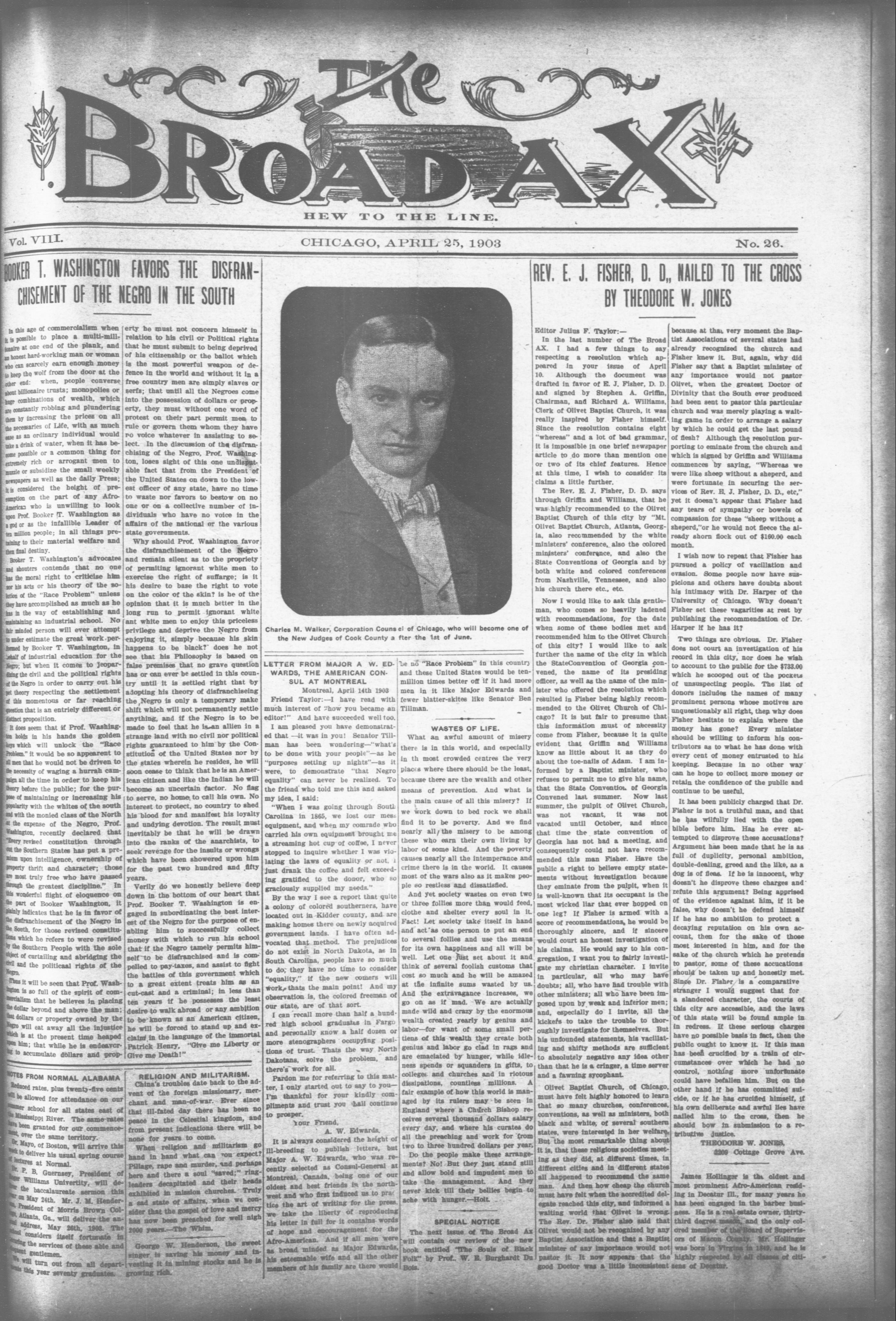
BOOKER T. WASHINGTON FAVORS THE DISFRANCHISEMENT OF THE NEGRO IN THE SOUTH
In this age of commercialism when it is possible to place a multi-millionaire at one end of the plank, and an honest hard-working man or woman who can scarcely earn enough money to keep the wolf from the door at the other end: when, people converse about billionaire trusts; monopolies or huge combinations of wealth, which are constantly robbing and plundering them by increasing the prices on all the necessaries of Life, with as much ease as an ordinary individual would take a drink of water, when it has become possible or a common thing for extremely rich or arrogant men to muzzle or subsidize the small weekly newspapers as well as the daily Press; it is considered the height of presumption on the part of any Afro-American who is unwilling to look upon Prof. Booker [T. Washington as a god or as the infallible Leader of ten million people; in all things pretaining to their material welfare and then final destiny.
Booker T. Washington's advocate and shouters contends that no one has the moral right to criticise him nor his acts or his theory of the solution of the "Race Problem" unless they have accomplished as much as he has in the way of establishing and maintaining an industrial school. No fair minded person will ever attempt to under estimate the great work performed by Booker T. Washington, in behalf of industrial education for the Negro; but when it comes to jeopardizing the civil and the political rights of the Negro in order to carry out his pet theory respecting the settlement of this momentous or far reaching question that is an entriely different or distinct proposition.
It does seem that if Prof. Washington holds in his hands the golden keys which will unlock the "Race Problem." it would be so appearent to all men that he would not be driven to the necessity of waging a hurrah campaign all the time in order to keep his theory before the public; for the purpose of maintaining or increasing his popularity with the whites of the south and with the monied class of the North at the expense of the Negro, Prof. Washington, recently declared that "Every revised constitution through out the Southern States has put a premium upon intelligence, ownership of property thrift and character; those are most truly free who have passed through the greatest discipline." In this wonderful flight of eloquence on the part of Booker Washington, it plainly indicates that he is in favor of the disfranchisement of the Negro in the South, for those revised constitutions which he refers to were revised by the Southern People with the sole object of curtailing and abridging the civil and the politicaal rights of the Negro.
Thus it will be seen that Prof. Washington is so full of the spirit of commercialism that he believes in placing the dollar beyond and above the man; that dollars or property owned by the Negro will eat away all the injustice which is at the present time heaped upon him; that while he is endeavoring to accumulate dollars and prop-
NOTES FROM NORMAL ALABAMA
Reduced rates, plus twenty-five cents will be allowed for attendance on our summer school for all states east of the Mississippi River. The same-rates have been granted for our commencement, over the same territory.
Dr. Mayo, of Boston, will arrive this week to deliver his usual spring course of lectures at Normal.
Dr. P. B. Guernsey, President of Roger Williams University, will deliver the baccalaureate sermon this year on May 24th. Mr. J. M. Henderson, President of Morris Brown College, Atlanta, Ga., will deliver the annual address, May 26th, 1903. The school considers itself fortunate in incurring the services of these able and frequent gentlemen.
We will turn out from all departments this year seventy graduates.
erty he must not concern himself in relation to his civil or Political rights that he must submit to being deprived of his citizenship or the ballot which is the most powerful weapon of defence in the world and without it in a free country men are simply slaves or serfs; that until all the Negroes come into the possession of dollars or property, they must without one word of protest on their part permit men to rule or govern them whom they have no voice whatever in assisting to select. In the discussion of the disfranchising of the Negro, Prof. Washington, loses sight of this one undisputable fact that from the President of the United States on down to the lowest officer of any state, have no time to waste nor favors to bestow on no one or on a collective number of individuals who have no voice in the affairs of the national or the various state governments.
Why should Prof. Washington favor the disfranchisement of the Negro and remain silent as to the propriety of permitting ignorant white men to exercise the right of suffarge; is it his desire to base the right to vote on the color of the skin? is he of the opinion that it is much better in the long run to permit ignorant white ant white men to enjoy this priceless privilege and deprive the Negro from enjoying it, simply because his skin happens to be black? does he not see that his Philosophy is based on false premises that no grave question has or can ever be settled in this country until it is settled right that by adopting his theory of disfranchiseing the Negro is only a temporary make shift which will not permanently settle anything, and if the Negro is to be made to feel that he is an allien in a strange land with no civil nor political rights guaranteed to him by the Constitution of the United States nor by the states wherein he resides, he will soon cease to think that he is an American citizen and like the Indian he will become an uncertain factor. No flag to serve, no home to call his own. No interest to protect, no country to shed his blood for and manifest his loyalty and undying devotion. The result must inevitably be that he will be drawn into the ranks of the anarchists, to seek revenge for the insults or wrongs which have been showered upon him for the past two hundred and fifty years.
Verily do we honestly believe deep down in the bottom of our heart that Prof. Booker T. Washington is engaged in subordinating the best interest of the Negro for the purpose of enabling him to successfully collect money with which to run his school that if the Negro tamely permits himself to be disfranchised and is compelled to pay-taxes, and assist to fight the battles of this government which to a great extent treats him as an cut-cast and a criminal; in less than ten years if he possesses the least desire to walk abroad or any ambition to be known as an American citizen, he will be forced to stand up and exclaim in the language of the immortal Patrick Henry, "Give me Liberty or Give me Death!"
RELIGION AND MILITARISM. China's troubles date back to the advent of the foreign missionary, merchant and man-of-war. Ever since that ill-fated day there has been no peace in the Celestial kingdom, and from present indications there will be none for years to come.
When religion and militarism go hand in hand what can you expect? Pillage, rape and murder, and perhaps here and there a soul "saved;" ringleaders decapitated and their heads exhibited in mission churches. Truly a sad state of affairs, when we consider that the gospel of love and mercy has now been preached for well nigh 2000 years.—The Whim.
George W. Henderson, the sweet singer is saving his money and investing it in mining stocks and he is growing rich.
CHICAGO, APRIL 25, 1903
Charles M. Walker, Corporation Counsel of Chicago, who will become one of the New Judges of Cook County after the 1st of June.
LETTER FROM MAJOR A W. ED WARDS, THE AMERICAN CONSUL AT MONTREAL
Montreal, April 14th 1903 Friend Taylor:—I have read with much interest of "how you became an editor!" And have succeeded well too. I am pleased you have demonstrated that—it was in you! Senator Tillman has been wondering—"what's to be done with your people"—as he "purposes setting up nights"—as it were, to demonstrate "that Negro equality" can never be realized. To the friend who told me this and asked my idea, I said:
"When I was going through South Carolina in 1865, we lost our mess equipment, and when my comrade who carried his own equipment brought me a streaming hot cup of coffee, I never stopped to inquire whether I was violating the laws of equality or not, I just drank the coffee and felt exceeding gratified to the donor, who so graciously supplied my needs."
By the way I see a report that quite a colony of colored southerners, have located out in Kidder county, and are making homes there on newly acquired government lands. I have often advocated that method. The prejudices do not exist in North Dakota, as in South Carolina, people have so much to do; they have no time to consider "equality," if the new comers will work, thats the main point! And my observation is, the colored freeman of our state, are of that sort.
I can recall more than half a hundred high school graduates in Fargo and personally know a half dozen or more stenographers occupying positions of trust. Thats the way North Dakotans, solve the problem, and there's work for all. Pardon me for referring to this matter, I only started out to say to you I'm thankful for your kindly compliments and trust you hall continue to prosper.
It is always considered the height of ill-breeding to publish letters, but Major A. W. Edwards, who was recently selected as Consul-General at Montreal, Canada, being one of our oldest and best friends in the northwest and who first induced us to practice the art of writing for the press, we take the liberty of reproducing his letter in full for it contains words of hope and encouragement for the Afro-American. And if all men were as broad minded as Major Edwards, his esteemable wife and all the other members of his family are there would
be no "Race Problem" in this country and these United States would be tenmillion times better off if it had more men in it like Major Edwards and fewer blatter-skites like Senator Ben Tillman.
WASTES OF LIFE
What an awful amount of misery there is in this world, and especially in th most crowded centres the very places where there should be the least, because there are the wealth and other means of prevention. And what is the main cause of all this misery? If we work down to bed rock we shall find it to be poverty. And we find nearly all the misery to be among these who earn their own living by labor of some kind. And the poverty causes nearly all the intemperance and crime there is in the world. It causes most of the wars also as it makes people so restless and dissatisfied.
And yet society wastes on even two or three follies more than would feed, clothe and shelter every soul in it. Fact! Let society take itself in hand and act as one person to put an end to several follies and use the means for its own happiness and all will be well. Let one just set about it and think of several foolish customs that cost so much and he will be amazed at the infinite sums wasted by us. And the extravagance increases, we go on as if mad. We are actually made wild and crazy by the enormous wealth created yearly by genius and labor—for want of some small pertiens of this wealth they create both genius and labor go clad in rags and are emaciated by hunger, while idleness spends or squanders in gifts, to colleges and churches and in riotous dissipations, countless millions. A fair example of how this world is managed by its rulers may be seen in England where a Church Bishop receives several thousand dollars salary every day, and where his curates do all the preaching and work for from two to three hundred dollars per year,
Do the people make these arrangements? No! But they just stand still and allow bold and impudent men to take the management. And they never kick till their bellies begin to ache with hunger.—Holt.
SPECIAL NOTICE
The next issue of The Broad Ax will contain our review of the new book entitled "The Souls of Black Folk" by Prof.. W. E. Burghardt Du Bois
REV. E. J. FISHER, D. D., NAILED TO THE CROSS BY THEODORE W. JONES
Editor Julius F. Taylor:—
In the last number of The Broad AX. I had a few things to say respecting a resolution which appeared in your issue of April 10. Although the document was drafted in favor of E. J. Fisher, D. D. and signed by Stephen A. Griffin, Chairman, and Richard A. Williams, Clerk of Olivet Baptist Church, it was really inspired by Fisher himself. Since the resolution contains eight "whereas" and a lot of bad grammar, it is impossible in one brief newspaper article to do more than mention one or two of its chief features. Hence at this time, I wish to consider its claims a little further.
The Rev. E. J. Fisher, D. D. says through Griffin and Williams, that he was highly recommended to the Olivet Baptist Church of this city by "Mt. Olivet Baptist Church, Atlanta, Georgia, also recommended by the white ministers' conference, also the colored ministers' conference, and also the State Conventions of Georgia and by both white and colored conferences from Nashville, Tennessee, and also his church there etc., etc.
Now I would like to ask this gentleman, who comes so heavily ladened with recommendations, for the date when some of these bodies met and recommended him to the Olivet Church of this city? I would like to ask further the name of the city in which the State Convention of Georgia convened, the name of its presiding officer, as well as the name of the minister who offered the resolution which resulted in Fisher being highly recommended to the Olivet Church of Chicago? It is but fair to presume that this information must of necessity come from Fisher, because it is quite evident that Griffin and Williams know as little about it as they do about the toe-nails of Adam. I am informed by a Baptist minister, who refuses to permit me to give his name, that the State Convention of Georgia Convened last summer. Now last summer, the pulpit of Olivet Church, was not vacant, it was not vacated until October, and since that time the state convention of Georgia has not had a meeting, and consequently could not have recommended this man Fisher. Have the public a right to believe empty statements without investigation because they eminate from the pulpit, when it is well-known that its occupant is the most wicked liar that ever hopped on one leg? If Fisher is armed with a score of recommendations, he would be thoroughly sincere, and if sincere would court an honest investigation of his claims. He would say to his congregation, I want you to fairly investigate my christian character. I invite in particular, all who may have doubts; all, who have had trouble with other ministers; all who have been imposed upon by weak and inferior men; and, especially do I invite, all the kickers to take the trouble to thoroughly investigate for themselves. But his unfounded statements, his vacillating and shifty methods are sufficient to absolutely negative any idea other than that he is a cringer, a time server and a fawning sycophant.
Olivet Baptist Church, of Chicago, must have felt highly honored to learn that so many churches, conferences, conventions, as well as ministers, both black and white, of several southern states, were interested in her welfare. But the most remarkable thing about it is, that these religious societies meeting as they did, at different times, in different cities and in different states all happened to recommend the same man. And then how cheap the church must have felt when the accredited delegate reached this city, and informed a waiting world that Olivet is wrong. The Rev. Dr. Fisher also said that Olivet would not be recognized by any Baptist Association and that a Baptist minister of any importance would not pastor it. It now appears that the good Doctor was a little inconsistent
No.26.
because at that very moment the Baptist Associations of several states had already recognized the church and Fisher knew it. But, again, why did Fisher say that a Baptist minister of any importance would not pastor Olivet, when the greatest Doctor of Divinity that the South ever produced had been sent to pastor this particular church and was merely playing a waiting game in order to arrange a salary by which he could get the last pound of flesh? Although the resolution purporting to eminate from the church and which is signed by Griffin and Williams commences by saying, "Whereas we were like sheep without a sheperd, and were fortunate in securing the services of Rev. H. J. Fisher, D. D., etc," yet it doesn't appear that Fisher had any tears of sympathy or bowels of compassion for these "sheep without a sheperd,"or he would not fleece the already shorn flock out of $160.00 each month.
I wish now to repeat that Fisher has pursued a policy of vacillation and evasion. Some people now have suspicions and others have doubts about his intimacy with Dr. Harper of the University of Chicago. Why doesn't Fisher set these vagarities at rest by publishing the recommendation of Dr. Harper if he has it?
Two things are obvious. Dr. Fisher does not court an investigation of his record in this city, nor does he wish to account to the public for the $733.00 which he scooped out of the pockets of unsuspecting people. The list of donors includes the names of many prominent persons whose motives are unquestionably all right, then why does Fisher hesitate to explain where the money has gone? Every minister should be willing to inform his contributors as to what he has done with every cent of money entrusted to his keeping. Because in no other way can he hope to collect more money or retain the confidence of the public and continue to be useful.
It has been publicly charged that Dr. Fisher is not a truthful man, and that he has wilfully lied with the open bible before him. Has he ever attempted to disprove these accusations? Argument has been made that he is as full of duplicity, personal ambition, double-dealing, greed and the like, as a dog is of fleas. If he is innocent, why doesn't he disprove these charges and refute this argument? Being apprised of the evidence against him, if it be false, why doesn't he defend himself If he has no ambition to protect a decaying reputation on his own account, then for the sake of those most interested in him, and for the sake of the church which he pretends to pastor, some of these accusations should be taken up and honestly met. Since Dr. Fisher is a comparative stranger I would suggest that for a slandered character, the courts of this city are accessible, and the laws of this state will be found ample in redress. If these serious charges have no possible basis in fact, then the public ought to know it. If this man has been crucified by a train of circumstances over which he had no control, nothing more unforgunate could have befallen him. But on the other hand if he has committed suicide, or if he has crucified himself, if his own deliberate and awful lies have nailed him to the cross, then he should bow in submission to a retributive justice.
THEODORE W. JONES,
2209 Cottage Grove Ave.
James Hollinger is the oldest and most prominent Afro-American residing in Decatur Ill., for many years he has been engaged in the barber business. He is a real estate owner, thirty-third degree mason, and the only colored member of the Board of Supervisors of Macon County. Mr. Hollinger was born in Virginia in 1849, and he is highly respected by all classes of citizens of Decatur
Will promulgate and at all times uphold the true principles of Democracy, but Catholics, Protestants, Priests, Infidels, Farmers, Single Taxes, Republicans, Knights of Labor, or any one else can have their say, so long as their language is proper and responsibility is fixed.
The Broad Ax is a newspaper whose platform is broad enough for all, ever claiming the editorial right to speak its own mind.
Local communications will receive attention. Write only on one side of the paper.
JULIUS-F. TAYLOR, Editor and Publisher. Entered at the Post Office at Chicago Ill., as Second-class Matter.
Rev. P. Anderson and wife of the Pleaseht Green Baptist Church, 34th and State st., Mrs. C. Vincent and about fifty other members of the church were all in Justice Hurley's 35th st. Police court Monday morning. It seems that Mrs. Vincent and some of the other members wanted to get rid of Rev. Anderson and permit Rev. W. Emory to get up to the chicken eating trough and that brought on the fight between the two factions. All the parties connected with this church fight belong to the Afro-American race. In the melee Mrs. Vincent was attacked and beat over the head by Rev. and Mrs. Anderson, hence their appearance in the police court with fifty other church members.
Many of the old members of the County Democracy have pulled out from that famous organization and formed the new Chicago Democratic Club. Its officers are as follows: President—Lawrence E. McGann Vice-president—Henry Schurz Northside; Herbert Hart, South side: V. E. Cerveny, West side. Recording Secretary—George L. Mc Connell. Financial Secretary—James E. Quan. Treasurer—Oscar F. Mayer. Sergeant-at arms and Marshal—Adrian C. Anson.
Board of Directors—West side, Michael Zimmer, O. S. Oliver, J. E. Owens, J. P. Tansey, Silas Leachman, [T. F. Scully, P. Knohler; North side James J. Gray, William Ehemann, J. A. Quinn, William Lyman, E. M. Lahiff, Peter Reinberg, A. J. Ford; South side, William O'Connell, D. R. Levy Will B. Moak, Ed. Cummings, R. Redfeld, John Treager, John R. Caverly. This new Club will boom Carter H. Harrison for President of the United States in 1904 and Alderman Thomas Carey for Gov. of Ill.
HYDE PARK NEWS.
Five visitors attended the Hyde Park Chapel Sunday School last Sabbath. On account of the rain the attendance of the children was very small. Rev. Slater preached thoughtful and uplifting sermons morning and evening. The evening services were made very attractive by the beautiful singing of Mrs. Mattle Robinson, the sweet recitation of little Ethel Worthington, whom we all love to hear, and the artistic cornet playing of Miss Irene Howard.
Rev. Slater, wife and a number of his congregation attended the First Anniversary of the St. Paul Baptist Church last Wednesday night. The Rev. Seemed to be in a very happy mood and made a very felicitious speech which was received with pronounced applause. Mr. and Mrs. Arthur Johnson, the tailors, are expecting soon to move to Harvey, Ill., and occupy their beautiful little cottage there.
Rev. and Mrs. Speese, Newton, Iowa, were visiting Rev. Slater and family this week. Mrs. Speese is Rev. Slater's sister. Are you going? Where? To the Hyde Park Chapel next Tuesday night to see "Ten Nights In a Bar Room." Yes; Because all Hyde Park will be there, and I am not going to be behind the excitement. Dr. Murray with his fine stereoptian will be there.
Men Teachers Searers
The number of men employed as teachers in the public schools of this country is slowly but steadily decreasing. According to William T. Harris, United States commissioner of education, the percentage of male teachers in the public schools in 1870 was 41 per cent. In 1900 the percentage was only 29. The reasons for this decrease are easily found. The work does not offer as great inducements to men as it once did. Teachers in secondary schools are now required to be specialists, and the salaries are not enough to attract men to make a life career in this field. Women in increasing numbers have gradually taken their places. In point of training they are as well fitted for the work, and in point of temperament better adapted to handle children.
Forty thousand birds, mostly sandpipers, are reported to have been killed recently on the North Carolina coast for millinery purposes:
STICKS TO OLD CUSTOMS:
The Supreme Court of the United States Is Wedded to Its Traditions.
The supreme court of the United States does business on an antiquated plan. While it undoubtedly is the most dignified body of men in this country, if not in the world, it has its peculiarities, and they are striking ones, says the Indianapolis Sentinel. One of the traditions of the court prevents newspaper correspondents from attending the sessions of the court in their professional capacity. Provision is made for a representative of each of the great press associations, but the correspondents have to push and crowd in behind the rear railing with the hundreds of other spectators. Usually they have to stand up, and if they are seen taking notes an attendant escorts them to the door. The result is that the 200 or more correspondents have to depend on their memory for their reports of proceedings in the supreme courtroom.
There is another custom of the court which prevents correspondents from seeing the opinions handed down until they have secured authority from the judges who severally deliver them from the bench. This authority is not always given, the judge exercising his own discretion about it. Not infrequently the correspondent has to go to the home of the judge to get the written authority, and perhaps by the time he gets back to the capitol the office of the clerk of the court is closed.
PLACED DUTY BEFORE WORK.
Man in Need of Employment Refused Job to March with the Unemployed.
A London preacher had an interesting experience not long ago with a hungry man. The mendicant explained that he had found it absolutely impossible to get work. He had applied everywhere, always to be turned away, and at last nothing remained for him but to beg from door to door for the food that was necessary to keep life in his body.
The clergyman's heart was filled with pity. The poor man seemed to be honest, and after being furnished with a good meal he was asked where a message would reach him. He gave an address and went away.
Then the preacher sat down to think the matter over. He knew of no work that he could find for the man, but he decided to invent a job.
Accordingly the next day the preacher sent a message to the luckless man, saying:
"Come at once. I have a position for you. We need a man to clean our school house and keep it in order."
He received an immediate reply as follows:
"Sorry I can't come. I have to march with the unemployed to-day. Would to-morrow do?"
PITTSBURG WITHOUT THE "H."
Variation in Spelling the City's Name Is Often Puzzling to Rail-
Is it Pittsburg or Pittsburgh, anyway? Of 23 companies indexed in the official guide with the names of that city forming a part of their title, five say "burg" and 18 say "burgh." The aitches, or old-stylers, appear to have it, supposing the official guide to be as inerrant as usual, says the Railway Age. The city papers differ, the majority aspiring to the aspirate—to which the progressive Post seems in its title to say Gee! But referring again to the guide, it appears that 16 cities named in railway titles, which have the disputed final syllable, those beginning with New, Pratts and Middle call themselves burghs, where Fitch, Blooms, Rose, Flemings, Gettys, Harris, Ham, Lords, Ogden, Stras, Philips, Vick and Waynes are plain burgs—13 against three. So the Gees appear to have it here. But aggregating the Pitts and other burgs and burghs in the 39 railway titles examined it is found that the burghs have a majority of three. Nevertheless the Railway Age votes for the commonsense burg, and demure to wasting paper and ink on the superfluous h.
MOONSHINERS OF FRANCE
The recent agitation of the bouilleurs da eru, or private distillers, of France, against the proposals of M. Rouvier, the minister of finance, to tax their franchise has disclosed the immense power of this vested interest among the peasantry. It is estimated that no fewer than 1,000,000 to 1,800,000 families avail themselves of the privilege to distill from the pears, apples, damsons and cherries of their orchards spiritualious liquors for household consumption, says a London paper. But as every hectoliter of nonexempt liquor—worth, perhaps, some $10—is taxed to the tune of $44, there is every inducement to the enterprising peasant to distill more than his household can consume, in order to do an illicit business with his neighbor, and in this way some $30,000,000 to $40,000,000 per annum escapes the treasury. In the orchard land of Normandy the privately distilled liquor is, indeed, quite a recognized medium of exchange, and the bouilleur de eru often pays his workmen, his tailor, his butcher, and his land in terms of alcohol.
It costs almost twice as much to send boxed goods from New York to San Francisco by rail direct as it does via London, the Suez canal, Hong-Kong and Yokohama by steamer.
MINT IN THEIR COFFEE.
Mistake of a Society Leader Takes for the Real Thing by Ambitious Emulators.
That the advice, "Watch how others do and then do likewise," is not always good to social aspirants, was illustrated the other evening at a dinner given by a young masron in honor of a guest of acknowledged social standing, relates the Chicago Tribune.
When coffee was served, and with it the indispensable chocolate mints, the guest was seen to take one of the sweets and toy with it gracefully over her coffee cup. Instantly every woman at the table did likewise. Evidently some new wrinkle of fashion was about to be exhibited. Every eye was on the guest and on the mint drop. Determination to follow the leader and give no sign that they were not in the habit of doing this new trick every day was written on every face. The sudden calm caused the guest to look up, and as she did so she inadvertently dropped her mint into the tiny cup. To her surprise a series of clinks ran around the table as each of the rural ones followed her mistake.
Appreciating the situation, the guest hastily gulped down her coffee to hide her mirth.
Later in the evening she heard one woman remark to another:
"I don't care if it is swell, I don't like mint in my coffee."
"Oh, dear," replied the other, loftily, "it is really delicious. I never think of taking my demitasse without it."
THE COUNTRY NEGRO.
Some of the Advantages He Enjoys Which Are Denied to His City Brother.
The average city negro grows up in the shade. He is completely overshadowed by his overtowering environment. As one walks along the streets of our great cities and views the massive buildings and sky-seeking structures, he finds no status for the negro above the cellar floor. The city negro of education and culture is forced into menial employment because higher forms of occupation are preempted by the more favored class. There are a dozen competitors for every dollar in sight, and in the great majority of cases, the negro is handicapped by his color, says the Southern Workman.
The country negro, on the contrary, is on terms of equality with his environment. He is not confronted by suggestions of inequality at every turn. Nature is a mother who is equally kind and beneficent to all of her children. An acre of ground will yield as much for the black as for the white tiller. The markets are colorblind. No one inquires into the color of the producer of the best produce in the market, except as a matter of idle curiosity. No labor organization has yet placed a boycott upon negro farm labor. The farm offers for the negro the only really unhampered field which is open to him on an unlimited scale.
DOG WITH GOLD TOOTH.
Philadelphia Canine of the "Bull" Breed Has Remarkable Mouth Adornment.
A well-known Philadelphia pet stock dealer some years ago hit upon a very odd and effective way to identify a dog, says the Philadelphia Record. The owner of this dog called on him and said: "Jack, my valuable bull, is running away all the time. So far he has been traced and found in each of his flights, but it has been amatter of difficulty, and I am afraid that some day he will be irretrievably lost because of the lack of some positive and striking mark of identification."
"You want," said the dealer: "a good identifying mark? Well, I'll tell you what to do. Go to a dentist and have a gold crown put on one of the dog's front teeth. The crown won't hurt the tooth; on the contray, it will preserve it; and always it will be a mark whereby your dog will be readily known."
The other did as the dealer advised. and since then there have appeared from time to time advertisements in the newspapers that began:
"Lost—A bulldog with a gold front tooth."
Cradle of American Genius.
Eight governors, three United States senators, three generals of the civil war, one of the world's greatest engineers, a distinguished painter and sculptor, two novelists who are read wherever the English language is known, a poet whose songs have thrilled millions of hearts, a rear admiral and a gallant commander whose heroic and tragic death is known to everyone, together with almost innumerable state legislators and a number of financial magnates, constitute Brookville's (Ind.) contribution to the genius of the world, writes Landon Knight, in National. Of the eight governors, James B. Ray was the first.
About the Pepper Plant.
The pepper plant—piper nigrum which produces the white and black pepper of commerce, is a climbing vine-like shrub, found growing wild in the forests of Travancore and the Malabar coast of India. Pepper is entirely tropical in its requirements. The white pepper is the black pepper decorated by maceration and rubbing.
New X-Ray Machine.
A nickel-in-the-slot X-ray machine has been invented. The observer places a coin in the slot, moves a lever, puts his hand, or whatever he wishes to examine, into a box without any sides, and looks down at it through a lourescent screen which forms the top of the box.
MILITARY AND NAVAL.
Great Britain is this year providing for the construction of three great vessels of 18,000 tons displacement, or 2,000 tons more than the large vessels congress has just authorized. The San Francisco Dry Dock company has just completed at Hunters Point one of the finest dry docks in the world. It is large enough for two battleships at one time and can be pumped out in two hours.
It is as well understood in the navy as it is in the merchant marine that the larger the ship the greater efficiency per ton of ship. Each ton of the 16,000 tons of the Connecticut represents vastly more fighting power than each ton of a 12,000-ton Alabama.
The only ex-officer of the confederate army who clings to his uniform is Gen. George F. Alford, of Dallas, Tex. He has never discarded his colors since he donned them to go into the army in the early '60s. Pedestrians turn to look at him, peering at his badges, scanning his gold belt and trying to decipher the letters on his old army hat. Gen. Alford has been a judge, a legislator and a congressman.
In a test of the electro-magnetic cannon of Prof. Birkland, the Norwegian physicist, a 22-pound projectile from a $2\frac{1}{2}$-inch bore was made to penetrate to a depth of 16 inches; and it is claimed that a projectile of 1,100 pounds could be discharged from a 12-inch gun with a speed of more than 200 yards per second, without flame or explosion. The special advantage is that projectiles can be discharged with a force that would destroy the gun if ordinary explosives were used.
RECENT COURT DECISIONS
The publication of an article advocating the murder of rulers and the destruction of organized society is held, in people vs. Most (N. Y.). 58 L. R. A. 509, not to be protected by a constitutional provision that every citizen may freely publish his sentiments on all subjects, being responsible for the abuse of that right.
A certificate of stock of a corporation, expressed on its face to be transferable only on the books of the company at its office, personally or by attorney, or surrender of the certificate, and transferred in blank upon its back, is held, in Farmers' bank vs. Diebold Safe and Lock company (Ohio), 58 L. R. A. 620, not to be a negotiable instrument.
One who stores water along a stream which is a natural highway for running logs and discharges it for the purposes of aiding a drive, so as to increase the natural volume of the stream and overflow and wash away the banks, is held, in Brewster vs. J. & J. Rogers Co. (N. Y.), 58 L. R. A. 495, to be liable for the injury thereby caused to riparian owners.
If one in charge of an electric car, seeing that a horse is frightened by the approach of the car, and that its driver is in danger, continues to sound the gong or ring the bell, and further frightens the horse and causes it to run away, the car company is held, in, Oates vs. Metropolitan Street Railway company (Mo.) 58. L. R. A. 447, to be liable for the injuries thereby caused to the driver.
THE ANIMAL KINGDOM
There is said to be only one musk-ox in captivity. This is in the zoo at Hamburg.
Cats hate water because their fur has nothing oily about it, and consequently takes a long time to dry.
Wax is not gathered from flowers nor from any other source, but is a natural secretion of the bees and is only produced by them during heavy honey flows.
That mosquitoes are responsible for malaria was apparently known long ago to a certain African hill tribe which gave the same name, "Mbu," to mosquitoes and to malaria.
Wolves can, and often do, run 50 to 60 miles in a night. Foxes travel great distances in search of food. Nansen saw an arctic fox out on the ice 480 miles from the Asiatic coast. When feeding, the stride of an ostrich is from 20 to 22 inches; when walking, but not feeding, 26 inches, and when terrified 11 and a half to 14 feet, or at the rate of about 25 miles an hour.
New kinds of living butterflies can be produced from existing forms by greatly increasing or decreasing the temperature on the place where the butterflies are kept. A difference in coloring and even in form has thus been obtained by Prof. Fischer in recent experiments.
MERELY MENTIONED.
The estimated cost of a bridge over the Straits of Dover is $170,000,000.
Americans are making an effort to establish a steel plant at Flushing, Holland.
An incubator in use in Australia has a capacity of 11,440 ducks' eggs or 14,080 hens' eggs.
Spain's quicksilver mines are falling off. Only 12 tons was got last year, against 23 the year before.
Marseilles, the great market for olive oil, imported in December 2,909 tons of cottonseed oil. Nearly all of it was from the United States.
Casks of corkwood weigh only 30 pounds, and a similar cask of ordinary wood weighs 80 pounds. These casks, which were recently invented by a resident of Algeria, are nonconductors of heat and cold, and the staves do not warp.
CURIOUS BITS OF SCIENCE
Ivygrowing on a house, so far from making the house damp, as is usually supposed, actually extracts all moisture from the walls. That meteors contain gold has been demonstrated before the Royal Society, New South Wales. This suggests that the thousands of tons of meteoric dust which fall upon the earth each year deposit gold everywhere.
The milky sea, as it is known to mariners, is not yet fully understood. It seems to be most common in the tropical waters of the Indian ocean, and is described as weird, ghastly awe-inspiring,and as giving the observer on shipboard the sensation of passing through a sort of luminous fog in which sea and sky seemed to join and all sense of distance is lost. The phenomenon is probably due to some form of phosphorescence.
Non-actinic white light, first made known by a French photographer some years ago, is produced by filtering sunlight through a colorless solution of three parts of nickel chloride and one part of cobalt chloride, ultraviolet rays being absorbed by coating the containing vessel with collodion mixed with sulphate of quinine slightly acidulated with sulphuric acid. Sensitive paper has been exposed to this filtered white light for a week without change.
There was an indoor snowstorm on a very clear, cold evening recently at a party given in Stockholm, Sweden. Many people were gathered in a single room, which became so warm as to be insufferable. The window sashes were found frozen and a pane of glass was smashed out. A coldair current rushed in, and at the same instant flakes of snow were seen to fall to the floor in all parts of the room. The atmosphere was so saturated with moisture that the sudden fall in temperature produced a snowfall indoors.
Many strange forms of the hen's egg have been collected by Clement L. Webster. In one an elongated large egg is connected by a narrow neck to a small egg, both parts being soft-shelled, while only the smaller has a yolk. Another elongated egg is club-shaped, while a similar one has the small end bent up like that of the crookt neck gourd. A triple egg, consisting of three distinct eggs joined, has a hard shell and contained only albumen, with no yolk; while a large normal-shaped egg contained three yolks. In one egg was a second complete egg, including the shell.
IN ASIA
Neither Hindus nor Japanese will ever willingly sleep with their heads to the north.
Very stringent laws have been enacted in Japan in regard to secret proprietary medicines.
The natives of India never allow a fakir—of whom there are three million who live by begging—to starve.
Ceylon now nearly equals India in tea production. It grows over 160,000,000 pounds, against India's 195,000,000 pounds.
350 square miles have been added to the British empire by the rectification of the frontier between India and Thibet.
Tigers did as much damage as usual in India last year, killing 943 persons. Over 17,200 wild beasts were destroyed for which bounties were paid of 104,000 rupees.
A curious railway accident is reported from India by Cosmos. About two kilometers (11-4 miles) from Rampore Hat, says the journal, "a train composed of an engine, 13 passenger cars and three others cars, was seized and overturned by a tornado. The phenomenon was absolutely local, since nothing was noticed at the station just left by the train, and except for the upsetting of a few native huts, there appears to have been no other damage done. The number of the wounded is not exactly known, for the Hindu passengers fled panic-stricken in an instant. Thirteen persons were killed and 15 wounded are known. Some of the cars were turned end for end, indicating a whirlwind."
OUAKER PHILOSOPHY.
You can't measure a genius by the length of his hair.
The man who agrees with nobody things everybody else is wrong.
Some people don't care what happens so long as it doesn't happen to them.
Women who use cosmetics don't believe the devil is as bad as he is painted.
A whitewashed reputation doesn't endure any longer than a whitewashed fence.
The most polite people in the world are those who have gold bricks to sell you.
When a fellow has money to burn he may do it because he is afraid of the microbes.—Philadelphia Record.
WHAT THE SPORTS SAY.
St. Paul and Minneapolis, with twin friendliness, are quarreling again, this time over the state bowling championship.
Sandow, the strong man, is reported as taking great interest in the traction question in Philadelphia. He has an automobile.
Just now Oxford and Cambridge and Yale and Harvard diplomats are endeavoring to decide, without a serious breach in international athletic relations, and at 31 cents per word, which side shall send a challenge for a track meet at London next July. Wouldn't that, asks the Chicago Tribune, separate the buttons from your waistcoat?
Not What He Wanted to Say.
Miss Clara Winterbloom—Mamma, this is Mr. Tutter. I want to introduce him to you. Do you know that he was under the impression that I was the only daughter, and I have just been telling him that I have two sisters.
Mrs. Winterbloom—Oh, yes. You must meet Maude and Estelle, Mr. Tutter. They are both of them older than Clara there.
Young Tutter (wishing to say the right thing)—I didn't suppose it possible, Mrs. Winterbloom, that you could have any daughters older than Miss Clara.—Tit-Bits.
Enthinking Freshman
There once was a freshman named Greening.
The janitor swore as he struck the ground floor:
"Twill take all the afternoon cleaning!"
—Columbia Jester.
```markdown
```
"Mr. Brown made his wife promise that she wouldn't marry again."
Next Improvement.
Dame Nature ought to follow now
The scientific train,
And not omit, before it falls,
To sterilize the rain.
—Puck.
And Called Him "It."
"And what did that howwid tough
say to you, Reggie, after he had taken
youah watch and money away?" asked
Willyboy.
"He added insult to wobbery," spluttered Reggie. "He said his motto was:
'Do it now,' and I was the only it he saw."—Cincinnati Commercial Tribune.
A Remembrance.
"Did he leave you anything when he went away?" they asked of the landlady's grief-stricken daughter, to whom the youth had been most devoted.
"Yes," she sighed; "he left a board bill."—Chicago Post.
The Homely Man's Advantage.
"Why is it that most of the world's great men were homely?"
"The other men wouldn't have turned in and made them great if they had been handsome enough to cause jealousy."—Chicago Record-Herald.
Elephantine.
"Yes, Jones has been awarded the contract for weighing and registering the weight of all the elephants for the new circus." "H'm! He must be doing business on a large scale."—Baltimore News.
A. Sineure.
Bowe Heaux-I'd like to live in a place where there was no such thing as work. Wouldn't you? Hoe Beaux-Yes, and I'd like to have the job of director of public works.—Pennsylvania Punch Bowl.
Nice Sort of Comfort.
"It must be a great comfort to you to own such splendid furniture."
"Comfort? There isn't but one comfortable chair in the whole lot, and my wife invariably wants to sit in that."—Tit-Bits.
Vivid Suggestiveness
Mrs. Slimdiet—No; I don't believe in French cooking. My idea is to have every dish suggest its chief ingredient. New Boarder—Yes; I notice this gelatine tastes like glue.—N. Y. Weekly.
A Reason for It
Visitor at School—What a rapt look that dear little fellow wears!
Dear Little Fellow (overhearing)—Teacher just hit me over the knuckles with a ruler, ma'am.—Princeton Tiger.
Too Eloquent.
"Why keep me in suspense? Why not give me an answer now?"
"Oh, dear, no! You propose so beautifully that I want to give you a chance to do it all over again."—N. Y. Journal.
Ill-Timed.
"You say your playing created great deal of talk?" said the friend. "Yes," answered the pianist, "but, unfortunately, it was mostly during my performance."—Washington Star.
His Choice.
Mother—Only good little boys go to Heaven.
Bobby—Then I guess I'll be bad and go with the rest of the family.—Brooklyn Life.
"The idea of his accusing me of making a lie out of the whole cloth." "Ridiculous! You're too economical for that."—Philadelphia Press.
Matter of Form.
Edith—I wish I knew how to improve the shape of this gown.
Ethel—Suppose you let me wear it awhile.—Cincinnati Enquiger.
Quite Right.
"Tight shoes." remarked the Observer of Events and Things, "have made many a woman ill at teas."—Yonkers Statesman.
---
SCIENCE OF PACKING
Very Few Women Are Familiar with It, Although It Is a Comparatively Easy Task.
Before commencing the actual packing of a trunk it is a very good plan to collect in one room and in plain view everything that is to be placed in the trunk. You will then see exactly what you have to find accommodation for, and nothing will be forgotten.
Something soft and flat should pave the trunk—a warm petticoat, which you may or may not require, is suitable for this purpose. On this anything flat and heavy should be laid, remembering that only necessaries should be taken if weight is a consideration. The writing case also occupies this layer, and any small spaces can be filled up with rolled stockings and other small objects. The boots and shoes, each in a holland bag, may come next, and form a layer of their own, which can be shared with the brush and comb and sponge bag.
Then linen and woolen underwear, between which any jewelry you may be taking can be placed; also your hand glass, scent bottles, or anything else of a breakable nature.
The dress skirts come next, and should be folded at the hips, so as to get as much length as they can. Do not turn them inside out. Jackets and capes follow, the former lying flat on their backs, with the sleeves laid across their fronts. Capes should be spread out as much as possible.
The tray is reserved for hats, dress bodices and skirts, and light, small things such as veils and neckties.
The bodices will repay any trouble spent upon them in the way of stuffing with crumpled paper, by emerging uncrushed at the end of the journey.
Long sash ends, if attached to the bodices, should be rolled up, and bowoops ought to be stuffed with balls of paper.
Gloves are laid flat.
If the hats are trimmed with upstanding feathers it is better to take them out and let them travel flat.
Do not attempt to squeeze your things into a trunk too small for them; out, on the other hand, the trunk should not be too roomy, or the contents will shake about and run great risk of damage.—Chicago American.
MRS. JEFFERSON DAVIS.
Widow of Confederate President Lives in a Modest Way in a New York Family Hotel.
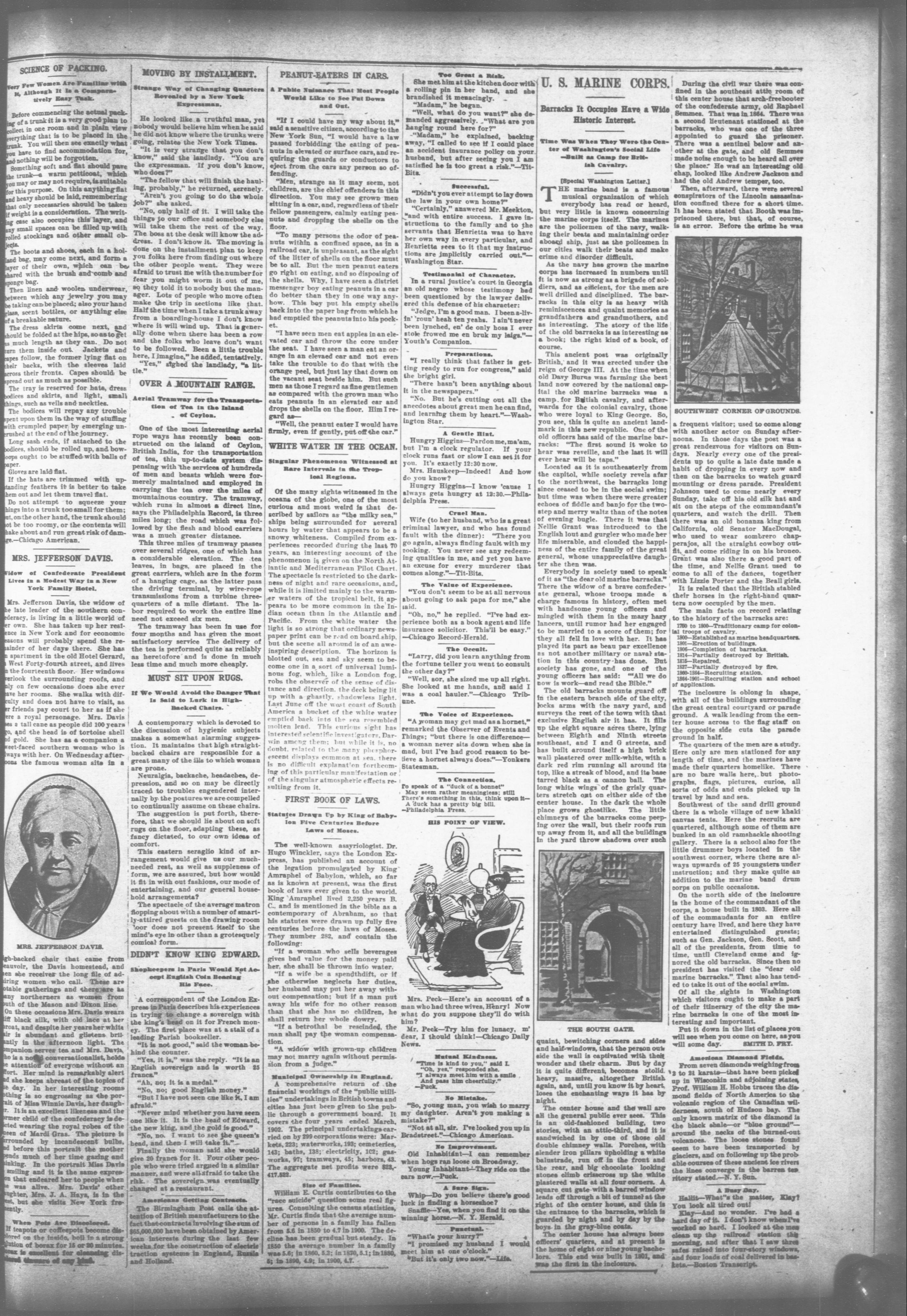
Mrs. Jefferson Davis, the widow of the late leader of the southern conederacy, is living in a little world of her own. She has taken up her residence in New York and for economic reasons will probably spend the remainder of her days there. She has an apartment in the old Hotel Gerard, in West Forty-fourth street, and lives in the fourteenth floor. Her windows overlook the surrounding roofs, and only on few occasions does she ever leave her rooms. She walks with difficulty and does not have to visit, as her friends pay court to her as if she were a royal personage. Mrs. Davis sees a tall cane as people did 100 years ago, and the head is of tortoise shell and gold. She has as a companion a sweet-faced southern woman who is always with her. On Wednesday afteroons the famous woman sits in a
[Image of a woman with white hair and a dark coat, looking directly at the viewer. The background is a plain, light color. The woman's face is centered in the image, and her expression is neutral. The image is oval-shaped with a thin border.]]
MRS. JEFFERSON DAVIS. high-backed chair that came from seauvoir, the Davis homestead, and then she receives the long file of ad-diring women who call. These are notable gatherings and there are as many northerners as women from outh of the Mason and Dixon line.
On these occasions Mrs. Davis wears stiff black silk, with old lace at her throat, and despite her years her white air is abundant and glistens brilliantly in the afternoon light. The companion serves tea and Mrs. Davis, who is a noted conversationalist, holds the attention of everyone without an effort. Her mind is remarkably alert and she keeps abreast of the topics of the day. In her interesting rooms nothing is so engrossing as the portrait of Miss Winnie Davis, her daughter. It is an excellent likeness and the former child of the confederacy is detected wearing the royal robes of the queen of Mardi Gras. The picture is surrounded by incandescent bulbs, and before this portrait the mother spends much of her time gazing and thinking. In the portrait Miss Davis is smiling and it is the same expression that endeared her to people when she was alive. Mrs. Davis' other daughter, Mrs. J. A. Hays, is in the best, but she visits New York frequently.
When Pets Are Discolored.
If teapots or coffeepots become discolored on the inside, boil in a strong solution of borax for 15 or 20 minutes.
borax is excellent for cleansing discolored tinture of any kind.
MOVING BY INSTALLMENT.
He looked like a truthful man, yet nobody would believe him when he said he did not know where the trunks were going, relates the New York Times. "It is very strange that you don't know," said the landlady. "You are the expressman. If you don't know, who does?" "The fellow that will finish the hauling, probably," he returned, serenely. "Aren't you going to do the whole job?" she asked.
"No, only half of it. I will take the things to our office and somebody else will take them the rest of the way. The boss at the desk will know the address. I don't know it. The moving is done on the installment plan to keep you folks here from finding out where the other people went. They were afraid to trust me with the number for fear you might worm it out of me, so they told it to nobody but the manager. Lots of people who move often make the trip in sections like that. Half the time when I take a trunk away from a boarding-house I don't know where it will wind up. That is generally done when there has been a row and the folks who leave don't want to be followed. Been a little trouble here, I imagine," he added, tentatively. "Yes," sighed the landlady, "a little
OVER A MOUNTAIN RANGE.
Aerial Tramway for the Transportation of Tea in the Island of Ceylon.
One of the most interesting aerial rope ways has recently been constructed on the island of Ceylon, British India, for the transportation of tea, this up-to-date system dispensing with the services of hundreds of men and beasts which were formerly maintained and employed in carrying the tea over the miles of mountainous country. The tramway, which runs in almost a direct line, says the Philadelphia Record, is three miles long; the road which was followed by the flesh and blood carriers was a much greater distance.
This three miles of tramway passes over several ridges, one of which has a considerable elevation. The tea leaves, in bags, are placed in the great carriers, which are in the form of a hanging cage, as the latter pass the driving terminal, by wire-rope transmissions from a turbine three-quarters of a mile distant. The labor required to work the entire line need not exceed six men. The tramway has been in use for four months and has given the most satisfactory service The delivery of the tea is performed quite as reliably as heretofore and is done in much less time and much more cheaply.
MUST SIT UPON RUGS.
If We Would Avoid the Danger That Is Said to Lurk in High Backed Chairs.
A contemporary which is devoted to the discussion of hygienic subjects makes a somewhat alarming suggestion. It maintains that high straight-backed chairs are responsible for a great many of the ills to which woman are prone. Neuralgia, backache, headaches, depression, and so on may be directly traced to troubles engendered internally by the postures we are compelled to continually assume on these chairs. The suggestion is put forth, therefore, that we should lie about on soft rugs on the floor, adapting these, as fancy dictated, to our own ideas of comfort.
This eastern seraglio kind of arrangement would give us our much-needed rest, as well as suppleness of form, we are assured, but how would it fit in with out fashions, our mode of entertaining, and our general household arrangements?
The spectacle of the average matron flopping about with a number of smartly-attired guests on the drawing room door does not present itself to the mind's eye in other than a grotesquely comical form.
DIDN'T KNOW KING EDWARD.
Shopkeepers in Paris Would Not Ac-
A correspondent of the London Express in Paris describes his experiences in trying to change a sovereign with the king's head on it for French money. The first place was at a stall of a leading Parish bookseller.
"It is not good," said the woman behind the counter.
"Yes, it is," was the reply. "It is an English sovereign and is worth 25 francs."
"Ah, no; it is a medal."
"No, no; good English money."
No, no, good English money.
"But I have not seen one like it, I am afraid."
"No, no. I want to see the queen's head, and then I will take it." Finally the woman said she would give 20 francs for it. Four other people who were tried argued in a similar manner, and were all afraid to take the risk. The sovereign was eventually changed at a restaurant.
The Birmingham Post calls the attention of British manufacturers to the fact that contracts involving the sum of $65,000,000 have been obtained by American interests during the last few weeks for the construction of electric traction systems in England, Russia and Holland.
PEANUT-EATERS IN CARS.
A Public Nuisance That Most People Would Like to See Put Down and Out.
"If I could have my way about it," said a sensitive citizen, according to the New York Sun, "I would have a law passed forbidding the eating of peanuts in elevated or surface cars, and requiring the guards or conductors to eject from the cars any person so offending.
"Men, strange as it may seem, not children, are the chief offenders in this direction. You may see grown men sitting in a car, and, regardless of their fellow passengers, calmly eating peanuts and dropping the shells on the floor.
"To many persons the odor of peanuts within a confined space, as in a railroad car, is unpleasant, as the sight of the litter of shells on the floor must be to all. But the men peanut eaters go right on eating, and so disposing of the shells. Why, I have seen a district messenger boy eating peanuts in a car do better than they in one way anyhow. This boy put his empty shells back into the paper bag from which he had emptied the peanuts into his pocket.
"I have seen men eat apples in an elevated car and throw the core under the seat. I have seen a man eat an orange in an elevaed car and not even take the trouble to do that with the orange peel, but just lay that down on the vacant seat beside him. But such men as those I regard as fine gentlemen as compared with the grown man who eats peanuts in an elevated car and drops the shells on the floor. Him I regard as—
"Well, the peanut eater I would have firmly, even if gently, put off the car."
WHITE WATER IN THE OCEAN.
Singular Phenomenon Witnessed at Rare Intervals in the Tropical Regions.
Of the many sights witnessed in the oceans of the globe, one of the most curious and most weird is that described by sailors as "the milky sea," ships being surrounded for several hours by water that appears to be a snowy whiteness. Compiled from experiences recorded during the last 70 years, an interesting account of the phenomenon is given on the North Atlantic and Mediterranean Pilot Chart. The spectacle is restricted to the darkness of night and rare occasions, and, while it is limited mainly to the warmer waters of the tropical belt, it appears to be more common in the Indian ocean than in the Atlantic and Pacific. From the white water the light is so strong that ordinary newspaper print can be read on board ship, but the scene all around is of an awe-inspiring description. The horizon is blotted out, sea and sky seem to become one in a sort of universal luminous fog, which, like a London fog, robs the observer of the sense of distance and direction, the deck being lit up with a ghastly, shadowless light. Last June off the west coast of South America a bucket of the white water emptied back into the sea resembled molten lead. This curious sight has interested scientific investigators, Darwin among them; but while it is, no doubt, related to the many phosphorescent displays common at sea, there is no difficult explanation forthcoming of this particular manifestation or of the singular atmospheric effects resulting from it.
FIRST BOOK OF LAWS.
Statutes Drawn Up by King of Babylon Five Centuries Before Laws of Moses.
The well-known assyriologist. Dr. Hugo Winckler, says the London Express, has published an account of the legation promulgated by King Amraphel of Babylon, which, so far as is known at present, was the first book of laws ever given to the world. King Amraphel lived 2,250 years B. C., and is mentioned in the bible as a contemporary of Abraham, so that his statutes were drawn up fully five centuries before the laws of Moses. They number 282, and contain the following: "If a woman who sells beverages gives bad value for the money paid her, she shall be thrown into water.
"If a wife be a spendthdift, or if she otherwise neglects her duties, her husband may put her away without compensation; but if a man put away his wife for no other reason than that she has no children, he shall return her whole dowry.
"If a betrothal be rescinded, the man shall pay the woman compensation.
"A widow with grown-up children may not marry again without permission from a judge."
Municipal Ownership in England. A comprehensive return of the financial workings of the "public utilities" undertakings in British towns and cities has just been given to the public through a government board. It covers the four years ended March, 1902. The principal undertakings carried on by 299 corporations were: Markets, 223; waterworks, 193; cemeteries, 143; baths, 138; electricity, 102; gasworks, 97; tramways, 45; harbors, 43. The aggregate net profits were $23,- 417,522.
William E. Curtis contributes to the "race suicide" question some real figures. Consulting the census statistics, Mr. Curtis finds that the average number of persons in a family has fallen from 5.6 in 1850 to 4.7 in 1900. The decline has been gradual but steady. In 1850 the average number in a family was 5.6; in 1860, 5.3; in 1870, 5.1; in 1880, 5; in 1890, 4.9; in 1900, 4.7.
Too Great a Risk. She met him at the kitchen door with a rolling pin in her hand, and she brandished it menacingly. "Madam," he began. "Well, what do you want?" she demanded aggressively. "What are you hanging round here for?" "Madam," he explained, backing away, "I called to see if I could place an accident insurance policy on your husband, but after seeing you I am satisfied he is too great a risk."—Tit-Bits.
"Didn't you ever attempt to lay down the law in your own home?"
"Certainly," answered Mr. Meekton, and with entire success. I gave instructions to the family and to the servants that Henrietta was to have her own way in every particular, and Henrietta sees to it that my instructions are implicitly carried out."—Washington Star.
Testimonial of Character
In a rural justice's court in Georgia an old negro whose testimony had been questioned by the lawyer delivered this defense of his character:
"Jedge, I'm a good man. I been a-livin' 'roun' heah ten yeahs. I ain't never been lynched, en' de only hoss I ever stoke frowed me en bruk my laigs."—Youth's Companion.
Preparations.
"I really think that father is getting ready to run for congress," said the bright girl.
"There hasn't been anything about it in the newspapers."
"No. But he's cutting out all the anecdotes about great men he can find, and learning them by heart."—Washington Star.
A Gentle Hint.
Hungry Higgins—Pardon me, ma'am, but I'm a clock regulator. If your clock runs fast or slow I can set it for you. It's exactly 12:30 now.
Mrs. Hauskeep—Indeed! And how do you know?
Hungry Higgins—I know 'cause I always gets hungry at 12:30.—Philadelphia Press.
Cruel Man.
Wife (to her husband, who is a great criminal lawyer, and who has found fault with the dinner): "There you go again, always finding fault with my cooking. You never see any redeeming qualities in me, and yet you have an excuse for every murderer that comes along."—Tit-Bits.
The Value of Experience.
"You don't seem to be at all nervous about going to ask papa for me," she said.
"Oh, no," he replied. "I've had experience both as a book agent and life insurance solicitor. This'll be easy."
—Chicago Record-Herald.
The Occult.
"Larry, did you learn anything from the fortune teller you went to consult the other day?"
"Well, sor, she sized me up all right. She looked at me hands, and said I was a coal hauler."—Chicago Tribune.
The Voice of Experience
"A woman may get mad as a hornet," remarked the Observer of Events and Things; "but there is one difference—a woman never sits down when she is mad, but I've had good reason to believe a hornet always does."—Yonkers Statesman.
The Connection
To speak of a "duck of a bonnet"
May seem rather meaningless; still
There's something in this, think upon it—
A duck has a pretty big bill.
-Philadelphia Press.
A woman sitting in a chair reads a newspaper to a man sitting in a chair.
Mrs. Peck—Here's an account of a man who had three wives, Henry! Now what do you suppose they'll do with him?
Mr. Peck—Try him for lunacy, m'dear, I should think!—Chicago Daily News.
Mutual Kindness.
"Time is kind to you," said I.
"Oh, yes," responded she.
"I always meet him with a smile And pass him cheerfully."
—Puck.
No Mistake.
"So, young man, you wish to marry my daughter. Aren't you making a mistake?"
"Not at all, sir. I've looked you up in Bradstreet."—Chicago American.
Young Inhabitant-They ride on the cars now.-Puck.
Snraffle—Yes, when you find it on the winning horse.—N. Y. Herald.
"What's your hurry?
"I promised my husband I would meet him at one o'clock."
"But it's only two now."—Life.
U. S. MARINE CORPS.
Barracks It Occupies Have a Wide Historic Interest.
Time Was When They Were the Center of Washington's Social Life Built as Camp for British Cavalry.
[Special Washington Letter.]
THE marine band is a famous musical organization of which everybody has read or heard, but very little is known concerning the marine corps itself. The marines are the policemen of the navy, walking their beats and maintaining order aboard ship, just as the policemen in our cities walk their beats and make crime and disorder difficult.
As the navy has grown the marine corps has increased in numbers until it is now as strong as a brigade of soldiers, and as efficient, for the men are well drilled and disciplined. The barracks in this city is as heavy with reminiscences and quaint memories as grandfathers and grandmothers, and as interesting. The story of the life of the old barracks is as interesting as a book; the right kind of a book, of course.
This ancient post was originally British, and it was erected under the reign of George III. At the time when old Davy Burus was farming the best land now covered by the national capital the old marine barracks was a camp for British cavalry, and afterwards for the colonial cavalry, those who were loyal to King George. So, you see, this is quite an ancient landmark in this new republic. One of the old officers has said of the marine barracks: "The first sound it woke to hear was reveille, and the last it will ever hear will be taps."
Located as it is southeasterly from the capitol, while society revels afar to the northwest, the barracks long since ceased to be in the social swim; but time was when there were greater echoes of fiddle and banjo for the two-step and merry waltz than of the notes of evening bugle. There it was that Nellie Grant was introduced to the English lout and gurgler who made her life miserable, and clouded the happiness of the entire family of the great general, whose unappreciative daughter she then was.
Everybody in society used to speak of it as "the dear old marine barracks." There the widow of a brave confederate general, whose troops made a charge famous in history, often met with handsome young officers and mingled with them in the mazy hazy lancers, until rumor had her engaged to be married to a score of them; for they all fell in love with her. It has played its part as beau par excellence as not another military or naval station in this country has done. But society has gone, and one of the young officers has said: "All we do now is work—and read the Bible."
The old barracks mounts guard off in the eastern branch side of the city, locks arms with the navy yard, and surveys the rest of the town with that exclusive English air it has. It fills up the eight square acres there, lying between Eighth and Ninth streets southeast, and I and G streets, and has built around itself a high brick wall plastered over milk-white, with a dark red rim running all around its top, like a streak of blood, and its base tarred black as a cannon ball. The long white wings of the grisly quarters stretch out on either side of the center house. In the dark the whole place grows ghostlike. The little chimneys of the barracks come peeping over the wall, but their roofs run up away from it, and all the buildings in the yard throw shadows over such
人
THE SOUTH GATE. quaint, bewitching corners and sides and half-windows, that the person out side the wall is captivated with their wonder and their charm. But by day it is quite different, becomes stolid. heavy, massive, altogether British again, and, until you know it by heart, loses the enchanting ways it has by night.
The center house and the wall are all the general public ever sees. This is an old-fashioned building, two stories, with an attic-third, and it is sandwiched in by one of those old double chimney walls. Porches, with slender iron pillars upholding a white balustrade, run off in the front and the rear, and big chocolate looking stones climb crisscross up the white plastered walls at all four corners. A square cut gate with a barred window leads off through a bit of tunnel at the right of the center house, and this is the entrance to the barracks, which is guarded by night and by day by the boys in the gray-blue coats.
The center house has always been officers' quarters, and at present is the home of eight or nine young bachelors. This end was built in 1801, and was the first in the inclosure.
During the civil war there was confined in the southeast attic room of this center house that arch-freebooter of the confederate army, old Raphael Semmes. That was in 1864. There was a second lieutenant stationed at the barracks, who was one of the three appointed to guard the prisoner. There was a sentinel below and another at the gate, and old Semmes made noise enough to be heard all over the place.' He was an interesting old chap, looked like Andrew Jackson and had the old Andrew temper, too.
Then, afterward, there were several conspirators of the Lincoln assassination confined there for a short time. It has been stated that Booth was imprisoned there, but that, of course, is an error. Before the crime he was
THE TEMPLE
SOUTHWEST CORNER OF GROUNDS
a frequent visitor; used to come along with another actor on Sunday afternoons. In those days the post was a great rendezvous for visitors on Sundays. Nearly every one of the presidents up to quite a late date made a habit of dropping in every now and then on the barracks to watch guard mounting or dress parade. President Johnson used to come nearly every Sunday, take off his old silk hat and sit on the steps of the commandant's quarters, and watch the drill. Then there was an old bonanza king from California, old Senator MacDougal, who used to wear sombrero chaperajos, all the straight cowboy outfit, and come riding in on his bronco. Grant was also there a good part of the time, and Nellie Grant used to come to all of the dances, together with Lizzie Porter and the Beall girls. It is related that the British stabled their horses in the right-hand quarters now occupied by the men.
The main facts on record relating to the history of the barracks are:
1750 to 1800—Traditionary camp for colonial troops of cavalry.
1800—Established as marine headquarters.
1801—Erection of buildings.
1806—Completion of barracks.
1814—Partially destroyed by British.
1815—Repaired.
1837—Partially destroyed by fire. 1860-1864—Recruiting station. 1864-1901—Recruiting station and school of application. The inclosure is oblong in shape, with all of the buildings surrounding the great central courtyard or parade ground. A walk leading from the center house across to the flag staff on the opposite side cuts the parade ground in half.
The quarters of the men are a study. Here only are men stationed for any length of time, and the marines have made their quarters homelike. There are no bare walls here, but photographs, flags, pictures, curios, all sorts of odds and ends picked up in travel by land and sea.
Southwest of the sand drill ground there is a whole village of new khaki canvas tents. Here the recruits are quartered, although some of them are bunked in an old ramshackle shooting gallery. There is a school also for the little drummer boys located in the southwest corner, where there are always upwards of 25 youngsters under instruction; and they make quite an addition to the marine band drum corps on public occasions.
On the north side of the inclosure is the home of the commandant of the corps, a house built in 1803. Here all of the commandants for an entire century have lived, and here they have entertained distinguished guests; such as Gen. Jackson, Gen. Scott, and all of the presidents, from time to time, until Cleveland came and ignored the old barracks. Since then no president has visited the "dear old marine barracks." That also has tended to take it out of the social swim.
Of all the sights in Washington which visitors ought to make a part of their itinerary of the city the marine barracks is one of the most interesting and important. Put it down in the list of places you will see when you come on here, as you will some day. SMITH D. FRY.
American Diamond Fields.
From seven diamonds weighing from 2 to 21 karats—that have been picked up in Wisconsin and adjoining states, Prof. William H. Hobbs traces the diamond fields of North America to the volcanic region of the Canadian wilderness, south of Hudson bay. The only known matrix of the diamond is the black shale—or "blue ground"—around the necks of the burned-out volcanoes. The loose stones found seem to have been transported by glaciers, and on following up the probable courses of these ancient ice rivers the lines converge in the barren territory stated.—N. Y. Sun.
A Busy Gay:
Hallit-What's the matter, Klay? You look all tired out! Klay-And no wonder. I've had a hard day of it. I don't know when I've worked so hard. I looked at the men clean up the railroad station this morning, and after that I saw three safes raised into four-story windows, and four loads of coal delivered in baskets.-Boston Transcript.
American Brick Co.
President and Treasurer, THOMAS CAREY. Vice-President, JOHN SHELHAMER, Secretary, WILLIAM SULLIVAN. MANUFACTURERS OF
45th and Robey Sts.
Yards running winter and summer, equipped with the latest improved Wolf Dryer.
Output of Winter Yards ..... 1440.0 per day
Output of Summer Yards..... 300,00 per day
Telephone Yards 128.
James A. Quinn may be the new city collector of Chicago.
J. H. Cross 222, West Lake St., conducts one of the best sample rcoms on the west side.
Major John C. Buckner made a flying Political trip through southern Ill. the first of the week.
Attorney William Howard Fitzgerald arrived home Monday from New York city, where he spent two weeks on Legal business.
Alderman Thomas Carey, chairman of the Democratic committee of Cook county, is well pleased with the Judicial ticket, and he thinks it is a winner. Mrs. L. A. Davis, 5012 5th ave., President of the Phyllis Wheatly Woman's Club, is home again after spending one week in visiting with her mother and friends at Peoria ill.
Charles L. Webb, court reporter and general stenographer, 77 S. Clark St., Room 9, is kept so busy these days in reporting cases in the courts that he has no time to flirt with the girls.
Judge Hanecy, may not be very popular with some of the Afro-American voters residing in the second ward but he will receive more Democratic votes than any candidate whom the Republicans can nominate, and don't you forget it!
Prof. Booker T. Washington will speak at the Auditorium, Friday, May 8, on the beginning of his educational work in the South, and the "Race Problem." Free tickets can be obtained at the Auditorium box office on and after May 1.
Miss Blanche Wright, who plays the organ each Sunday in St. Thomas Church, and who is a song bird, and very popular, is an expert stenographer: recently she opened an office in the Real Estate Board Building, room 412, and she is getting along quite nicely.
This week Rep. Edward H. Morris, presided over the House of Representatives, he is the first Afro-American in the history of the State to be honored in such a manner. It is freely admitted by many members of the Legislature, that Mr. Morris is the brainest member of that body.
Monday evening the new members of the city council were sworn in the council chamber was filled with rare and beautiful flowers which were contributed to the city fathers by their many friends. Mayor Carter H. Harrison looked mighty happy while presiding over the new body.
Rep. E. M. Cummings, who stands high with the leaders of the Democratic party and the people throughout the town of Lake, says the "present legislation is rotten to the core, that its members are not interested in any legislation which will benefit the people."
The Davies Investment Company, suite 614, First National Bank building, are sending out a circular letter to prospective investors, calling their attention to some of the good dividend paying stocks and bonds which the company has on hand and which are safe investments. It is also announced by the Davies Investment Company, that on May 15th., the stockholders of record of the Phoenix Oil and Mineral Company will receive a dividend of 3 per cent.
Nellie Toler a young Afro-American girl who resides with her parents at 4545 Dearborn st., has developed considerable talent for art, Some very fine sketches of her work adorne the walls of the Coleman school and Miss O'Connor her teacher has become so interested in Miss Tolers artistic ability who is only fourteen years old that she paid for one term for her tuition at the Art Institute out of her own pocket. Miss Toler succeeded in raising money by her own efforts to pay for a second term and the Phyllis Whealty Woman's Club have paid for the third term for her, which is a very commenradble act on the part of its members.
Rev. R. H. Pooley a methodist preacher of Rockford Ill. has declared to the world that he does not believe there is such a thing as "material or physical resurrection after death" that death ends all, that proud and haughty man is no more than the ox or any other animal, that in the end the laws of nature operates on all creatures alike. Rev. Pooley will not make himself very popular by advocating this doctrine which is as old as the hills, nevertheless his ideas or views are correct, for when the breath leaves our body in this world we have nothing to take with us into the next world or heaven which is supposed to be located billions and billions of miles beyond the starry skies.
The Democracy of Cook County have nominated the following judges and lawyers to make the race for judges at the election which will be held in June. Judges Murry F. Tuley, Edward F. Dunne, Frank Baker, Richard W. Clifford, Thomas G. Windes, Francis Adams, Samuel Shaw Parks, Charles M. Walker, Lockwood Honore, George Kersten, William H. Barnum, Julian Mack, Edward O. Brown, William P. Black, Gustavus J. Tatge, Joseph A. O'Donnell, George Mills Rogers, and Thomas M. Hoyne, the last three names were placed on the ticket subject to the acts of the State Legislature in creating three more judges for this county. On the whole it is a strong judicial ticket and if the leaders or the managers of the party wake up and do the right thing it will be elected.
AGENTS FOR THE BROAD AX.
AGENTS FOR THE BROAD AX.
From on and after this date The Broad Ax can be found on sale at the following places:
The Afro-American News Office, 3104 State Street.
A. G. Marshall, news stand and book store, 3604 State street.
A. F. Tervalon's Cigar Store and News Stand, 2826 State street.
Edward Felix's Cigar Store, 368 30th street, N. E. Corner Armour Ave.
T. B. Hall's Cigar Store and Laundry office, 281 29th St.
Mrs. H. Hart, Cigar and Confectionery Store, 417 E. 35th St.
C. E. Hunter's News Stand and Cigar Store, 134 W. 51st St., near Dearborn.
J. E. Webb's Cigar Store, 280, 29th Street.
Turner William's Cigar and News Stand, 2903 Armour Ave.
J. F. Bradbury's News Depot, 2970 State Street.
William Goetz, dealer in cigars and tobacco, 411 E. 36th street.
M. H. Watts, dealer in cigars and tobacco, 3742 State street.
J. C. Campbell, 145 W. 47th street., Cigars, Tobacco, Staple Groceries.
Wm. H. Monroe, cigar and newsstand, 486 State street.
H. N. Drake, 3246 State Street, Cigar Store and News Stand.
L. Levy, 506, 37th Street, dealer in Cigars and Tobacco.
The Chicago Shoe Shining Parlor, 3123 Cottage Grove Ave.
Geo. Blaine, cigars, tobacco and news stand, 3420 Dearborn street.
T. H. Smith, 419 36th street, Cigar store store, News stand and Bakery.
Whiteley Bros., 2724 State street, cigars, and news stand.
Mrs. Florence Granger, 2940 Dearborn Street. Cigars, Laundry Office and News Stand.
Mrs. Stephen Doll, cigars and news stand, 4944 State street.
Harris & Hallock, cigars and news stand, 2960½, State Street.
T. J. Hill, cigars and stationery store., 5220 Lake Ave.
Wm. Dixon 2638 State Street cigars, tobacco, and news stand.
News items and advertisements left at these places will find their way into the columns of The Broad Ax.
SUITE 318-320 REAPER BLOCK
Clark and Washington Sts.
Telephone, Main 940. CHICAGO.
A. D. GASH
Attorney at Law,
84-86 La Salle Street, Chicago.
Suite 615 no 619.
Telephone Main 3077.
JOHN E OWENS
Attorney at Law,
CUTT 621 ASHLAND BLOCK
60 B. Clark St 306. OH CAGO
FREDE RICK W JOB
ATTORNEY ATTORNEY
832 MARQUETTE BUILDING
Telephone 2810 Central CHICAGO
TELEPHONE MAIN 2804
FEDERICO M. BARRIOS
Attorney & Counsellor at Law
Suite 501 Firmenich Bldg.
N. E. Cor. Fifth Avenue
and Washington Street Chicago.
LAWRENCE A. NEWBY ATTORNEY AT LAW Room 55,155 Washington St. CHICAGO
William Howard Fitzgerald
LAWYER
Room 402 Reaper Block, - CHICAGO
PHONES {Office, M i c 1157
Res. Brown 42
STEPHEN A. DOUGLAS
LAWYER
Suite 200, 123 125 Lil Salle Street
CHICAGO
JOSEPH A. McINERNEY
LAWYER
SUITE 706-706
CHICAGO OPERA HOUSE
OHICA
WILLIAM RITCHIE
ATTORNEY AND COUNSELOR.
Suite 819-820 Oxford Building
84 LA SALLE ST., CHICAGO
Telephone Main 1646.
Robert M. Mitchell
Suite 9, No. 77 South Clark St
CHICAGO
JOHN F. WATERS. C. H. JOHNSON
WATERS & JOHNSON
Lawyers
Practice Limited to the Trial of Personal Injury Cases
Suite 801 Kedzie Building
120 E. Randolph St.
Telephone Central 4293 CHICAGO
Telephone Tardo 101 Residence, 118 Garfield Bd,
JOHN FITZGERALD
JUSTICE OF THE PEACE
4707 S. HALSTED STREET,
....CHICAGO
J. GRAY LUCAS
ATTORNEY-AT-LAW
Suite 412 Real Estate Board Bldg
59. Dearborn St. Cor. Randolph
CHICAGO.
J. E: JONES
LAWYER
79 Clark Street
Room 9 Chicago
S. A. McELWEE
...LAWYER...
36 S. Clark St., CHICAGO.
Room 708 Ogden Building
Residence, 3183 Forest Av.
ALBERT B. GEORGE
LAWYER.
428 Ashland Block, Chicago.
— Tel. M. 2038. —
For Sale or Rent.
Houses, flat buildings, and lots in city and suburbs, on easy monthly installments. Fire Insurance and Furniture Loans at lowest rates.
CEO. W. FAULKNER & CO.
Phone 2331 Brown. 2935 State St.
Fifty-First St. and Armour Ave.
RAIL YARDS: 151st St. & L. S. & M. S. Ry.
52nd St. and Armour Ave.
CHICAGO
Phoenix Oil & Mineral Co.
OF ARIZONA
$200,000 CAPITAL
Pays dividends 1 per cent. monthly or
12 per cent per annum.
Stock now selling at 10c per share,
full paid and non-assessable. For
further particulars address
THE DAVIES INVESTMENT COMPANY
614 First National Bank Bldg., Chicago
'Phone Central 3025,
Face Massage, Shampooing, Scalp Treating
Chiropodist and Manicuring Removes Corns Without Pain Medicated Foot Baths and Foot Massage 138 State St, 4th Floor, Chicago
Telephone Blue 4632 Work Called for and Delivered...
A. HOFFMAN,
CLEANER, DYER
AND PRESSER.
Suits Sponged and Pressed 55c
5125 State St. Expert Workmanship
Moderate Prices.
Mrs. Florence Miller
FASHIONABLE DRESSMAKER PERFECT FIT GUARANTEED PRICES REASONABLE 3151 State Street CHICAGO.
COURT REPORTER
77 South Clark St., Room 9
CHICAGO.
General Stenographer
WONDERFUL DISCOVERY Curly Hair Made Straight By
TAKEN FROM LIFE:
BEFORE AND AFTER TREATMENT.
ORIGINAL
OZONIZED OX MARROW
(Copyrighted.)
This wonderful hair pomade is the only safe preparation in the world that makes kinky or oily hair smooth and above it is mournishes the scalp, prevents the hair from pulling out or breaking off, curts dandruff and makes the hair grow long and silky. Sold over forty years and used by thousands. Warranted harmless. It was the first preparation ever sold for straightening kinky hair. Beware of imitations. Get the Original Ozonized Ox Marrow as the genuine never falls to keep the hair straight, soft and beautiful, giving it that healthy, life-like appearance so much desired. A toilet necessity for ladies, gentlemen and children. Elegantly perfumed,wing to its superior and lasting qualities it is not possible for anybody to produce a pomade equal to it. Full directions with every bottle. Only 50 cents. Sold by drugrists and dealers or send us 50 cents for one bottle or $1.40 for three bottles. We pay all express charges. Send postal or express money order. Please mention name of this paper when ordering. Write your name and address plainly to
OZONIZED OX MARROW CO
76 Wabash Ave., Chicago, Illinois.
AGENTS AND CORRESPONDENTS WANTED.
The Broad Ax desires to engage agents and regular correspondents in all the leading cities and towns in Illinois and throughout the other sections of the country. The highest commissions paid to live hustlers Sample copies furnished. For further information address Julius F. Taylor 5040 Armour avenue, Chicago, Ill.
ROOMS FOR RENT.
Two comodious nicely furnished rooms for rent to gentlemen only. Inquire at 2623 Wabash avenue.
MRS. A. WILSON. Nicely furnished rooms to rent for gentlemen. Reasonable rates, 2252 Indiana aveune.
Rooms for Rent. Elegantly furnished rooms for rent with bath and gas at 8232 Wabash avenue.
Mrs. Kittle Scott.
Choice furnished rooms to rent to ladies and gentlemen. 2807 Wabash Ave.
ILLINOIS BRICK CO.
WILLIAM C. KUESTER,
SUPERINTENDENT.
N. Western Ave., Ch
1994 N. Western Ave., Chicago.
Telephone Lake View 270. HENADEL BR
HOHENADEL BROS.
211-213 Madison Street
CHICAGO
Telephone Main 3300
Manufacturers
of... UNIFORM CAPS
Pollicemen, Firemen,
Letter Carriers,
Elevatormen,
Janitors, Wagonmen,
Street Car Employes,
Telegraph Messengers,
Railroad Employes,
Bellboys, Watchmen, Bts
JACOB FEINBERG
81st and State Sts. CHICAGO
John J. Bradley
Real Estate, Insurance and Loans Property managed. Abstracts examined. Renting. Legal papers prepared. 4709 South Halsted Street Chicago
Ladies' and Gents' Clothing
OF ALL KINDS
Fashionable Dressmaking, Ladies' Tailoring, Dress Goods and Trimmings Furnished
JACKETS AND CLOAKS
Phone Calumet 7761 CASH OR FASY TERMS
Open from 8 a. m. till 9 p. m.
8285 State Street Chicago
226 East 25th Street - - - CHICAGO
F. W. BOYD DEALER IN COAL, WOOD AND ICE MOVING AND EXPRESSING All Orders Promptly Attended to Cash on Delivery Telephone Blue 285 4656 Armour Avenue, CHICAGO.
M. JUNK, Proprietor JOS. P. JUNK, Manager 3700-3710 South Halsted Street and 897 to 929 Thirtyseventh Street CHICAGO
Jas. J. McCormick, SAMPLE ROOM
IMPORTED AND DOMESTIG
WINES, LIQUORS AND CIGARS
8402 SOUTH HALSTED STREET. OHICAGO
A. JOSEPH JOSEPH STRAUS
SALE AND EXCHANGE STABLE.
Driving, Draft and General Business Horses
Always on Hand
1197 Milwaukee Ave. Near Robey St.
Telephone West, 1028. OHIOAGO, IL
J.M.Higginbothan
BROSS
sreet
CAPS
Employes,
Messengers,
All Employes,
Banks, Watchmen, B
BERG
cery
CHICAGO
Nota y Public
Hudley
and Loans
regal papers prepared.
Chicago
ER
Clothing
Fammings Furnished.
AKS
ER FASY TERM
Chicago
Mason and General Contractor
ALER IN
ND ICE
Delivery
CHICAGO.
very
ger
enth Street
ck,
DOOM
ARS
OHICAGO
JOHSEPH STRAVEN
TABLE.
Horses
OHICAGO, IA
---