The Broad Ax
Saturday, October 17, 1903
Chicago, Illinois
Page text (machine-generated)
Last Sunday morning Rev. R. A. White, the eloquent pastor of the Stewart Avenue Universalist Church, Sixty-fifth and Stewart avenue, preached a powerful sermon on "The Modern Home." From the very beginning of his discourse to its close Rev. White dealt out many practical ideas pertaining to the "Modern Home."
"You can't bring up men and women in barns and expect them to be refined and cultured," he declared. The "ideal American home must be a fixed place, there can be no ideal home without the family, for out of such ideal homes, which are enlivened by the laughter of beautiful children have come the highe st or the most exalted type of womanhood that the world has ever known."
"The American people are fast becoming like Gipsies, who are continually roving from place to place, thus breaking assunder all family ties, and reafirming that old idea that after all we are nothing more than roving savages." Here in Chicago he maintained that "the ideal or the modern home of the great majority of its citizens are located in furniture vans, that the people are constantly moving from one section of the city to the other. This is ample proof that we have almost outgrown the old American idea of a fixed home, that such ideas are out of date."
But he exclaimed "if a home means anything, it means this: Unity or harmony must exist therein, you cannot have an ideal home where the business life of the day is cutting into its unity," he scored both the men and the women for spending so much of their time at their clubs, and warned them that modern club life tends to break the unity of the home at its most vital points; that the child needs the masculine influence as well as it needs the sweet influence of a good mother, that it is deprived of such wholesome influence when its parents spend their evenings at their clubs, and turn their children over to someone who are not interested in their growth or moral development."
In closeing Rev. White, gave some mighty good advice to married people. "Married life is a co-partnership in which the man and the wife are equal partners, and both of you must never get mad at the same time," and lastly he made an earnest plan for the ideal American home, with its old-time simplicity and freedom.
It was our pleasure for the first time to listen to Rev. White, and we greatly admire him for possessing the courage to cut and slash into all things which tend to destroy the unity or the happiness of the home.
They say that the old side-whiskered preacher who was cut in the jaw and run out of Jacksonville, Ill., for sleeping with another man's wife, lives all alone in a house on Dearborn St., near 22d St., with a kinky-haired widow, that many times this old side-whiskered preacher and the kinky-haired widow fight and quarrel like man and wife; that when the window blinds are drawn down and the doors are locked no one can tell how often they hug and kiss, or how close they rub up against each other, but this fact does not prevent this old rotten or immoral side-whiskered preacher from posing as the greatest moral saint in Chicago.
George Guenther, a highly respectable and wealthy white farmer residing near Sandusky, Ohio, concluded last week to legally marry his colored cook, for he had learned to dearly love her, and shortly after marrying the woman of his choice his neighbors notified him that he could not reside in his own home with his wife, that they must move out of his house with in ten days, but before the expiration of that time a number of bloodthirsty white savages, who pass for civilized gentlemen, surrounded his house in the dark house of the eight and they riddled it with bullets. Mr. and Mrs. Guenther, while lying in bed, were wounded by the shots fired by those midnight murderers. It's too bad that Guenther did not kill on the spot every one of those red-handed assassins, who want to dictate to him whom he shall or shall not marry.
Colored People in South Acquiring Farms and Other Property.
Greatest Need of the Black Race is That Whites Set Good Example
That Whites Set Good Example.
Rev. J. Milton Waldron, of Jacksonville, Fla., spoke as follows last Sunday night in the First Congregational church this city on "The Needs of the Colored People of the South," and his words contain more truth than poetry:
"By contrasting the present condition of the Negroes with that of 1865, their advancement in morals, education, etc., will readily appear and their needs will be obvious.
"In 1865 there were about 4,000,000 colored people in America. Today they number nearly 10,000,000.
'When the colored people were freed they did not own a foot of land or a roof to cover their heads. In forty years they have accumulated 150,000 farms, valued at $350,000,000; 130,000 homes besides these farms, valued at $265,000,000 and $165,000,000 worth of personal property.
"In 1863 not 1 per cent. of the adult colored people in the south could read or write, and none of their children were in school. Today 40 per cent. of the adults can read and write and 50 per cent. of their children are attending school.
Negroes Practically Disfranchised. "The political condition of the colored people in the south is worse than in 1872. Five of the southern states have by constitutional enactments practically disfranchised all of their colored voters and most of the other states in the south, through corrupt election officials, intimidation and fraud, have accomplished the same results.
"In many counties in several southern states neither the life, liberty nor property of black men is safe. The masses of Negroes in the south are morally only a little better off than they were at the close of the war.
"The first need of this race is that the whites of this country shall set before them a proper kind of an example. If the white man carries a pistol and uses it on slight provocation the Negro will do the same. It's white men violate the law and regard manual labor as a disgrace the uneducated black man will do the same. I white men fail to respect and protect colored women the criminal Negro will not respect the person and virtue of women, white or black.
"In the second place, the colored people of the south need to be assured that so long as they are law abiding their Liberty, life and property shall be safe.
Should be Treated Humanely.
"The colored people of the south need that they be looked upon and treated as human beings by their white brethren everywhere.
"The better element among the Negroes need to join hands with the better element among the white in the south in the suppression of vice, crime and lawlessness on the part of both races in all parts of America and for the dignifying of common everyday work.
"Lastly, the colored people need a Christian education, a better class of ministers and a more practical religion."
A Valuable Book.
Why has not some publisher continued the old American Almanac? It was abandoned several years ago. Nothing equal to it, in its line, has ever appeared. All the other almanacs like the worlds are very good, but none are anything like the American. It would be an easy matter to take its last issue and republish it with the additions for the years since. Every conceivable question of statistics is there answered. I suggest that "The Public" take it up. It had a large list of subscribers and purchasers. It is the most perfect Vade Mecum for politicians, editors, lectures ever constructed.
Miss Grace Kington, who stands ace high with The Broad Ax, hade her Chicago friends farewell Friday night and left for New York City, and the first of the week she will sail for Naples, Italy, where she will spend the next two or three years.
HEW TO THE LINE.
```markdown
```
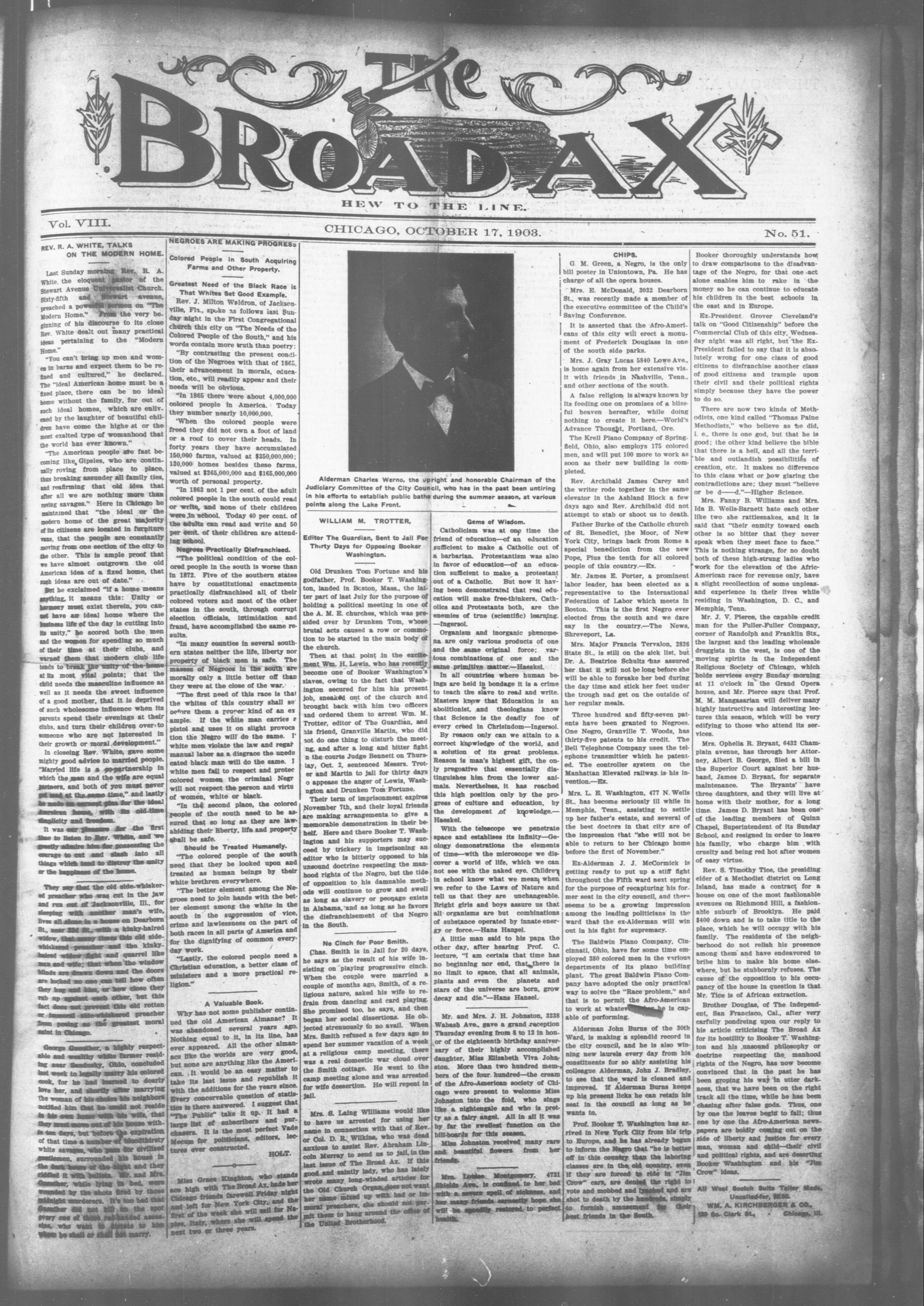
Alderman Charles Werno, the upright and honorable Chairman of the Judiciary Committee of the City Council, who has in the past been untiring in his efforts to establish public baths during the summer season, at various points along the Lake Front.
Editor The Guardian, Sent to Jail For Thirty Days for Opposing Booker Washington.
Old Drunken Tom Fortune and his godfather, Prof. Booker T. Washington, landed in Bcston, Mass., the latter part of last July for the purpose of holding a political meeting in one of the A. M. E. churches, which was presided over by Drunken Tom, whose brutal acts caused a row or commotion to be started in the main body of the church.
Then at that point in the excitement Wm. H. Lewis, who has recently become one of Booker Washington's slaves, owing to the fact that Washington secured for him his present job, sneaked out of the church and brought back with him two officers and ordered them to arrest Wm. M. Trotter, editor of The Guardian, and his friend, Granville Martin, who did not do one thing to disturb the meeting, and after a long and bitter fight in the courts Judge Bennett on Thursday, Oct. 2, sentenced Messrs. Trotter and Martin to jail for thirty days o appease the anger of Lewis, Washington and Drunken Tom Fortune.
Their term of imprisonment expires November 7th, and their loyal friends are making arrangements to give a memorable demonstration in their behalf. Here and there Booker T. Washington and his supporters may succeed by trickery in imprisoning an editor who is bitterly opposed to his unsound doctrine respecting the manhood rights of the Negro, but the tide of opposition to his damnable methods will continue to grow and swell as long as slavery or peonage exists in Alabama, and as long as he favors the disfranchisement of the Negro in the South.
No Cinch for Poor Smith.
Chas. Smith is in Jail for 20 days, he says as the result of his wife insisting on playing progressive cinch. When the couple were married a couple of months ago, Smith, of a religious nature, asked his wife to refrain from dancing and card playing. She promised too, he says, and then began her social dissertions. He objected strenuously to no avail. When Mrs. Smith refused a few days ago to spend her summer vacation of a week at a religious camp meeting, there was a real domestic war cloud over the Smith cottage. He went to the camp meeting alone and was arrested for wife dessertion. He will repent in jail.
Mrs. S. Laing Williams would like to have us arrested for using her name in connection with that of Rev. or Col. D. R. Wilkins, who was dead anxious to assist Rev. Abraham Lincoln Murray to send us to jail, in the last issue of The Broad Ax. If this good and saintly lady, who has lately wrote many long-winded articles for the Old Church Organ, does not want her name mixed up with bad or immoral preachers, she should not permit them to hang around the office of the United Brotherhood.
Gems of Wisdom.
Catholicism was at one time the friend of education—of an education sufficient to make a Catholic out of a barbarian. Protestantism was also in favor of education—of an education sufficient to make a protestant out of a Catholic. But now it having been demonstrated that real education will make free-thinkers, Catholics and Protestants both, are the enemies of true (scientific) learning. Ingersol.
Organism and inorganic phenomena are only various products of one and the same original force; various combinations of one and the same primitive matter.—Haeskel.
In all countries where human beings are held in bondage it is a crime to teach the slave to read and write. Masters know that Education is an abolitionist, and theologians know that Science is the deadly foe of every creed in Chrisindom—Ingersol.
By reason only can we attain to a correct knowledge of the world, and a solution of its great problems. Reason is man's highest gift, the only pregoative that essentially distinguishes him from the lower animals. Nevertheless, it has reached this high position only by the progress of culture and education, by the development of knowledge.—Haeskel.
With the telescope we penetrate space and establishes its infinity—Geology demonstrations the elements of time—with the microscope we discover a world of life, which we can not see with the naked eye. Children in school know what we mean when we refer to the Laws of Nature and tell us that they are unchangeable. Bright girls and boys assure us that all organisms are but combinations of substance operated by innate energy or force.—Hans Hangel.
A little man said to his papa the other day, after hearing Prof. C. lecture, "I am certain that time has no beginning nor end, that there is no limit to space, that all animals, plants and even the planets and stars of the universe are born, grow decay and die."—Hans Hansel.
Mr. and Mrs. J. H. Johnston, 3238 Wabash Ave., gave a grand reception Thursday evening from 8 to 12 in honor of the eighteenth birthday anniversary of their highly accomplished daughter, Miss Elizabeth Viva Johnston. More than two hundred members of the four. hundred—the cream of the Afro-American society of Chicago were present to welcome Miss Johnston into the fold, who sings like a nightengale and who is pretty as a fairy angel. All in all it was by far the swellest function on the bill-boards for this season. Miss Johnston received many rare and beautiful flowers from her friends.
Mrs. Louise. Montgomery, 4731 Shields Ave, is confined to her bed with a severe spell of sickness, and her many friends earnestly hope she will be speedily restored to perfect health.
G. M. Green, a Negro, is the only bill poster in Uniontown, Pa. He has charge of all the opera houses.
Mrs. E. McDonald, 3032 Dearborn St., was recently made a member of the executive committee of the Child's Saving Conference.
It is asserted that the Afro-Americans of this city will erect a monument of Frederick Douglass in one of the south side parks.
Mrs. J. Gray Lucas 5840 Lowe Ave. is home again from her extensive visit with friends in Nashville, Tenn. and other sections of the south.
A false religion is always known by its feeding one on promises of a blissful heaven hereafter, while doing nothing to create it here.—World's Advance Thought, Portland, Ore.
The Krell Piano Company of Springfield, Ohio, also employs 175 colored men, and will put 100 more to work as soon as their new building is completed.
Rev. Archibald James Carey and the writer rode together in the same elevator in the Ashland Block a few days ago and Rev. Archibald did not attempt to stab or shoot us to death.
Father Burke of the Catholic church of St. Benedict, the Moor, of New York City, brings back from Rome a special benediction from the new Pope, Pius the tenth for all colored people of this country.—Ex. Mr. James E. Porter, a prominent labor leader, has been elected as a representative to the International Federation of Labor which meets in Boston. This is the first Negro ever elected from the south and we dare say in the country.—The News, Shreveport, La.
Mrs. Major Francis Tervalon, 2826 State St., is still on the sick list, but Dr. A. Beatrice Schultz has assured her that it will not be long before she will be able to forsake her bed during the day time and stick her feet under the trough nad get on the outside of her regular meals.
Three hundred and fifty-seven patients have been granted to Negroes. One Negro, Granville T. Woods, has thirty-five patents to his credit. The Bell Telephone Company uses the telephone transmitter which he patented. The controller system on the Manhattan Elevated railway is his invention.—Ex.
Mrs. L. E. Washington, 477 N. Wells St., has become seriously ill while in Memphis, Tenn., assisting to settle up her father's estate, and several of the best doctors in that city are of the impression that "she will not be able to return to her Chicago home before the first of November."
Ex-Alderman J. J. McCormick is getting ready to put up a stiff fight throughout the Fifth ward next spring for the purpose of recapturing his former seat in the city council, and there seems to be a growing impression among the leading politicians in the ward that the ex-Alderman will win out in his fight for supremacy.
The Baldwin Piano Company, Cincinnati, Ohio, have for some time employed 380 colored men in the various departments of its piano building plant. The great Baldwin Piano Company have adopted the only practical way to solve the "Race problem," and that is to permit the Afro-American to work at whatever he is capable of performing.
Alderman John Burns of the 30th Ward, is making a splendid record in the city council, and he is also winning new laurels every day from his constituents for so ably assisting his colleague Alderman, John J. Bradley, to see that the ward is cleaned and improved. If Alderman Burns keeps up his present licks he can retain his seat in the council as long as he wants to.
Prof. Booker T. Washington has arrived in New York City from his trip to Europe, and he has already begun to inform the Negro that "he is better off in this country than the laboring classes are in the old country, even if they are forced to ride in "Jim Crow" cars, are denied the right to vote and mobbed and lynched and are shot to death by the hundreds, simply to furnish amusement for their best friends in the South.
No.51.
Booker thoroughly understands how to draw comparisons to the disadvantage of the Negro, for that one act alone enables him to rake in the money so he can continue to educate his children in the best schools in the east and in Europe.
Ex-President Grover Cleveland's talk on "Good Citizenship" before the Commercial Club of this city, Wednesday night was all right, but the Ex-President failed to say that it is absolutely wrong for one class of good citizens to disfranchise another class of good citizens and trample upon their civil and their political rights simply because they have the power to do so.
There are now two kinds of Methodists, one kind called "Thomas Paine Methodists," who believe as he did, i. e., there is one god, but that he is good; the other kind believe the bible that there is a hell, and all the terrible and outlandish possibilities of creation, etc. It makes no difference to this class what or how glaring the contradictions are; they must "believe or be d——d."—Higher Science.
Mrs. Fanny B. Williams and Mrs. Ida B. Wells-Barnett hate each other like two she rattlesnakes, and it is said that "their enmity toward each other is so bitter that they never speak when they meet face to face." This is nothing strange, for no doubt both of these high-strung ladies who work for the elevation of the Afric-American race for revenue only, have a slight recollection of some unpleasant experience in their lives while residing in Washington, D. C., and Memphis, Tenn.
Mr. J. V. Pierce, the capable credit man for the Fuller-Fuller Company, corner of Randolph and Franklin Sts., the largest and the leading wholesale druggists in the west, is one of the moving spirits in the Independent Religious Society of Chicago, which holds services every Sunday morning at 11 o'clock in the Grand Opera house, and Mr. Pierce says that Prof. M. M. Mangasarian will deliver many highly instructive and interesting lectures this season, which will be very edifying to those who attend its services.
Mrs. Ophelia R. Bryant, 6432 Champlain avenue, has through her Attorney, Albert B. George, filed a bill in the Superior Court against her husband, James D. Bryant, for separate maintenance. The Bryants' have three daughters, and they will live at home with their mother, for a long time. James D. Bryant has been one of the leading members of Quinn Chapel, Superintendent of its Sunday School, and resigned in order to leave his family, who charge him with cruelty and being red hot after women of easy virtue.
Rev. S. Timothy Tice, the presiding elder of a Methodist district on Long Island, has made a contract for a house on one of the most fashionable avenues on Richmond Hill, a fashionable suburb of Brooklyn. He paid $400 down and is to take title to the place, which he will occupy with his family. The residents of the neighborhood do not relish his presence among them and have endeavored to bribe him to make his home elsewhere, but he stubbornly refuses. The cause of the opposition to his occupancy of the house in question is that Mr. Tice is of African extraction.
Brother Douglas, of The Independent, San Francisco, Cal., after very carfully pondreing upon our reply to his article criticising The Broad Ax for its hostility to Booker T. Washington and his unsound philosophy or doctrine respecting the manhool rights of the Negro, has now become convinced that in the past he has been groping his way in utter darkness, that we have been on the right track all the time, while he has been chasing after false gods. Thus, one by one the leaves begin to fall; thus one by one the Afro-American newspapers are boldly coming out on the side of liberty and justice for every man, woman and child—their civil and political rights, and are deserting Booker Washington and his "Jim Crow" ideas.
Uncalled-for, $8.50.
WM. A. KIRCHBERGER & CO.,
189 Co. Clark St., Chicago, Ill.
Will promulgate and at all times uphold the true principles of Democracy, but Cesthelion, Protestants, Priests, Laddles, Farmers, Single Taxes, Republicans, Knights of Labor, or any one else can have their say, so long as their language is proper and responsibility is fixed.
The Broad Ax is a newspaper whose platform is broad enough for all, ever claiming the editorial sight to speak its own mind.
Local communications will receive attention.
Write only on one side of the paper.
Subscriptions must be paid in advance.
One Year.....$8.00
Six Months.....1.00
Advertising rates made known on application.
Address all communications to
THE BROAD AX
6000 Armour Avenue, Chicago.
JULIUS F. TAYLOR, Editor and Publisher.
Entered at the Post Office at Chicago,
Ill., as Second-class Matter.
Mistaken Idea
"There goes a man," said the sad-eyed grocer, with a sigh, "that parted me and my wife."
"Is that so?" queried the drummer.
"Why, he doesn't look like a deep-dyed villian."
"Who said anything about a villian?" asked the man behind the counter.
"That man's all right; he's a judge in the divorce court."—Cincinnati Enquirer.
No Doubt of It.
"Rather a clever poem," said the editor, handing back the manuscript; "do you know who is the author of these lines?" "Of course," replied the proud father; "didn't I tell you my son wrote 'em?" "But are you sure he did?"
"Sure! Don't you suppose I know his handwriting?"—Philadelphia Press.
He Was Too Strong.
"My boy tells me you discharged him," said the late office-boy's mother.
"You advertised for a strong boy, and I certainly thought he was strong enough."
"Madam," replied the merchant," he was too strong. He broke all the rules of the office and some of the furniture in the two days he was with us."—Tit-Bits.
Why They Settle
Wife—Who can doubt. the power of woman's love? Think of the thousands of wild youths who have settled down into staid and respectable citizens as soon as they married. Husband—Good lands! they couldn't afford to be anything else after they got married.—N. Y. Weekly.
Not Pretty.
Fred—Of course, she poses a good deal, but she's awfully pretty.
May—Oh, did you hear of the mean trick Mr. Kammerer played on her?
Fred—No. What was it?
May—He took a snapshot of her while she was in the act of eating corn off the cob. Philadelphia Press.
Boees Assured.
"Aren't there some jealousies in your progressive euchre club?"
"No, indeed," answered young Mrs. Torkins; "when we buy prizes we are always careful to select things that no one really wants, so that the winner will not be an object of envy."—Washington Star.
One or the Other
"Gee whizz!" exclaimed the nervy caller, "I haven't another match, and my cigarette has gone out."
"Well," replied the polite young woan, who could stand it no longer, "you would have had to if it hadn't."—Catholic Standard and Times.
Saw His Finish.
Bifkins—So Mrs. Bosswick is going to marry again. ah?
Mifkins—Yes; and her fiance boasts of being a self-made man. Bifkins—Weil, it's droughtnuts to fudge she'll make him over again.—Chicago Daily News. Imprudent Nimrod. Bobby—What's the matter with Jimmy Jones?
Benny—He went out in the farmer's field to shoot birds.
Bobby—Did the farmer kick?
Benny—No, but the gun did.—Chicago Daily News.
The Woman of It.
The girl who keeps her birthday.
When a merry little elf.
Keeps it still when she grows up—
She keeps it to herself.
—Cincinnati Enquirer.
"Papa, I don't like to hurt your feelings, but it always makes me angry when folks say I resemble you so much."
"Don't worry, daughter. I get tolerably mad about it, too."—Chicago Tribune.
He once was making money,
Much more than he could use;
Detectives caught him at it,
And now he's making shoes.
—Philadelphia Press.
"I brought home a friend to dinner last night and there was an awful row."
"Didn't you notify your wife?"
"Oh, yes; but she forgot to notify the cook"—Brooklyn Life.
given your boy?"
"Flyin' Machine," answered Farmer Corntossel. "You see, he's mighty interestin' an' promisin', but he won't work."—Washington Star.
The Masculine Theory.
Wife—I wonder why the fashions for women change so often?
Husband—Probably for the purpose of enabling them to correspond with the feminine mind, my dear—Cincinnati Enquirer.
---
MORE OR LESS PERSONAL.
John P. Fischer, an orchestra leader of Newark, N. J., has recovered a $600 violin stolen a year ago. Thirsty members of congress at the next session will be somewhat incommoded because of the fact that no liquor will be sold in the capitol building. Washington tailors, fully realizing what this inconvenience means, are doing what they can to make large hip pockets popular, so that the legislators may be able to carry with them a reasonable supply of wet goods.
The right or otherwise of a shirtwaist man to enter the dining-room of a hotel is about to be settled in a Philadelphia court. One hot day last July De Wolf Norman, a Quaker city man of social note, entered a dining-room minus coat and waistcoat, but wearing a neat shirtwaist and belt. He was informed that gentleman so attired would not be served there, and despite his protests he was ejected. Mr. Norman consulted his lawyer, who has begun a suit for damages against the hotel man.
The body of Bronson B. Tuttle, a millionaire, who was buried a few days ago at Naugatuck, Conn., was placed in a casket inclosed in a burglar-proof metallic box or vault, so constructed that once the lid was shut and the locks snapped into place the vault could not be opened until after several hours of work unless with dynamite. The lid of the vault is fastened by automatic locks and bars, every one of which must be forced before the coffin can be reached. In addition to all this a watchman keeps guard over the grave by night.
PECULIARITIES
There is a merchant at Nevada, Mo., named Gosh. His friends swear by him.
Congressman Sulzer, of New York, is credited with having uttered this gem of mixed metaphor: "They will keep cutting the wool from the sheep that lays the golden egg until they pump it dry." Gen. James Grant Wilson, of New York, and daughter, Miss K. M. Wilson, have not exchanged a word in several years, thuogh they continue to live under the same roof and eat at the same table. Father and daughter met in a railroad depot the other day and boarded the same train, but neither gave the other even a look. The estrangement is said to flare from the time when the general refused to allow Miss Wilson to marry the man of her choice.
A man who gets intoxicated only on legal holidays does not fall into the drunkard category, according to Judge Harper, of the common pleas court of Stark county, Ohio. In a divorce suit brought by Minnie Rerick against William Rerick, the allegation was made that the husband is a habitual drunkard. The defendant testified that he got drunk on national holidays only and that the wife could prove nothing else. The judge in summing up the case declared the plaintiff had failed to sustain her chief allegation and he refused to grant her separation.
POINTERS ON BUSINESS LAW
It is a fraud to conceal a fraud.
Ignorance of the law excuses no one.
Notes bear interest only when so stated.
The acts of one partner bind all the others.
An agreement without consideration is void.
Contracts made on Sunday cannot be enforced.
Principals are responsible for the acts of their agents.
Signatures made with a lead pencil are good in law.
A note being lost or stolen does not release the maker.
Each individual in a partnership is responsible for the whole amount of the debt of the firm.
It is not legally necessary to say on a note, "for value received," but it should be done in Missouri.
STUDIO NOTES.
The first oil portrait of the pope will be by the Hungarian painter, M. Berthod Lippay.
The French Grand Prix in sculpture provides the successful artist with means of support for four years in Rome or Athens.
A statue of Cervantes is to be erected in Paris as a mark of gratitude towards the Spanish admirers of Victor Hugo, who erected a statue to him in Madrid.
The finest paintings of the late Robert Mols, of Antwerp, decorate the house of his sister, Mme. Osterrieth, in Brussels. He is noted for the minute realism of his pictures of ships.
Alfred Gilbert, the English sculptor, has undertaken an art school of unusual magnitude at Bruges. He has hired an enormous disused factory, which yields, besides great studios, living accommodation for about 300 pupils. He proposes to do all his work in the presence of his classes.
FROM THE FATHERLAND.
During the month of July $39 horses were slaughtered for food in Berlin.
Owing to the Berlin hansoms having India rubber tires complaint was made of danger to the public, and they have now been supplied with bells.
A German Roman Catholic bishop has ordered that couples in his diocese who wish to be married shall be examined in religious knowledge before the ceremony is performed.
Owing to the protest by church organizations in Germany against the use of the word "baptism" in naming ships, the naval department has order that it shall no longer be used.
At Cologne recently a thief chased by the police took refuge in a church and kneeling before the altar sanctuary after the medieval fashion. The police arrested him all the same.
A highly honored name he bore. Although his crimes were rank; He had the dust, and so his name Was honored at the bank. N. Y. Times.
Knew Where He Was.
"Here's a message from your husband," said the medium to the woman who had paid her good dollar.
"Where is he?" asked the widow.
"He doesn't say, but here's a picture he sent you."
"Well, I guess I know where he is, all right; that's a flashlight picture!" Yonkers Statesman.
His Effort
"What I like," said the beautiful creature, "is a man who can do something original."
Whereat he caught her in his arms and kissed her, foolishly thinking no other man had ever done that before.—Chicago Record-Herald.
Has to Do It.
"Quillpoint is a queer chap. He seems to see something that no one else can see in every picture he looks at."
"He can't help it. He makes puzzle pictures for a living."—Cincinnati Commercial Tribune.
A Remedy.
He—The doctor told Jack that he had been studying too hard lately.
She—And what did he recommend?
He—Oh! He advised him to go into society a little more and give his brain a rest—Brooklyn Life.
"How did you come to give your sister the big apple and keep the little one for yourself?"
"'Cause there was a worm in it."—Ally Sloper.
Lon, long, he strove to gain the height And thereby win her heart. Then learned, poor victim, that he might Have had her at the start. Chicago Record-Herald. Too Busy.
Too Busy.
"Were you lonesome while I was in the country, John?"
"Not very. I was so busy writing checks that I didn't have time to be lonesome."—Chicago American.
Two Evils.
"It's hard to have a lot of debts that you simply can't pay."
"O! I don't know. It's worse to have a lot that you simply have to pay."—Philadelphia Ledger.
They Won't Look Pleasant.
"The trouble with the photographer," remarked the observer of events and things, "seems to be that he takes people too seriously."—Yonkers Statesman.
Always Inherited
"I wonder if his eloquence was inherited."
"Certainly. His mother was a woman, of course."—N. Y. Herald.
Up Against It.
The tramp was beginning quite hungry to feel, so he asked the lady to give him a meal, at a farmhouse where he did stop. The kind-hearted female took him to the shed, and, getting the ax, she feelingly said: "Pray, sir, help yourself to a chop."—Cincinnati Enquirer.
More Fun Ahead.
First Crank—Come around to the hall to-night. We are getting up a new league.
Second Crank—What sort?
First Crank—We haven't decided yet, but it's going to be an anti-something or other—N. Y. Weekly.
Industrial Note
"Oo-ooh!" shudders the fair young thing who is going through the iron works. "What makes that awful squeal every time they start the metal through those monster rolls?" "That," explains her guide, "is the pig iron."—Judge.
Small Profits.
Slippery Sam (moodily)—I had a son onct. I trained him up to snatch pocketbooks from ladies out shopping. "Wot became of 'im?" "He starved ter death."—N. Y. Weekly.
He Was Wise.
He—The doctor told Bangs to get an automobile, and that the outdoor exercise would fix him up all right.
She—That doctor is foolish.
He—No, he isn't. He gets double rates for surgical visits.—Chicago Journal.
A Fancy Work Fiend.
"Does your wife do much fancy work?"
"Fancy work? She won't even let a porous plaster come into the house without crocheting a red border round it and running a yellow ribbon through the holes."—Tit-Bits.
Mutual
"I'm satisfied," said the angry tailor, "that you intend to beat me out of this money." "All right," chuckled the happy debtor; "if you are satisfied, I am."—Baltimore News.
She—Do you believe that half the world don't know how the other half lives?
He—Yes; I believe the half that mind their own business don't.—Yonkers Statesman.
Truth in Signs.
Jorks—That's a queer sign for a barber—"Hair cut while you wait."
Knowles—No; I seldom go to the barber's without having to wait while some other fellow's hair is being cut.—Town Topics.
She-I wonder what makes a man nervous when he proposes to a woman?
He-The same thing, no doubt, that makes a woman nervous when he doesn't propose.-Cincinnati Enquirer.
IN CHURCH CIRCLES.
Many churches in the east have carried on summer camps for boys this year.
The ministry is the only one of the learned professions that is now overcrowded.
Of 478 ancient and modern translations of the Bible, 456 have been made by missionaries.
Methodist Episcopal missionaries report signs of a coming turning to Christianity among the Buddhists of Burmah, similar to that seen in Japan.
William Henry Parker, a colored Philadelphia longshoreman, better known as "Diamond Dick," spends his leisure time in evangelistic work among men of his own class, and is said to be singularly eloquent and effective.
Rev. James J. McKeever, a Catholic clergyman of Newark, N. J., announces that hereafter he will give a gold medal to any member of the local fire department who will save a life. Father McKeever decided on this action after learning how a fireman lost his life a short time ago while attempting to save a child.
Cardinal Ferrari, who attended the German Catholic congress, took back with him to Milan as a present the bones of the three kings, Melchior, Gaspar and Balthasar, which were the most famous relics in the Cologne cathedral. The legend is that the relics were taken away from a Milan church by Frederick Bárbarossa's men, and the gift is intended as a restitution.
Rev. F. B. Meyer, a London preacher, who labors among the poor of Westminster, has received the American degree of D. D. and has accepted, though he will not use it. This is because he does not wish to give even the slightest reason for his people to think he is better than they. When he assumed charge in his present pastorate the poor of the district thought the church was only for those who are well off. "This is all changed now," says Mr. Meyer, "and my many friends in the district call me 'Skipper' or 'Guvnor,' as they happen to choose."
LANDLORD AND TENANT.
An occupier of land who undertakes to burn rubbish thereon is held in Paolino versus McKendall (R.I.), 60 L.R.A. 133, to be under no obligation to guard children of tender years who are in the habit of resorting there to play from injury by approaching the fire. Physical injury or disease resulting from fright or nervous shock caused by negligent acts, which such result might with reasonable certainty have been anticipated or the negligence was gross, is held, in Watkins versus Kaolin Manufacturing company (N.C.), 60 L.R.A. 617, to give a right of action for damages.
Fright, though resulting in physical injury, is held, in Sanderson versus Northern Pacific Railroad company (Minn.), 60 L. R. A. 403, to give no right to recovery of damages, in the absence of contemporaneous injury to the plaintiff, unless the fright is the proximate result of a legal wrong against the plaintiff by the defendant.
A railroad company is held, in Euting versus Chicago & Northwestern Railroad company (Wis.), 60 L. R. A. 158, to be liable for the act of its engineer, in whose custody it has placed signal torpedoes, in placing one on the track in dangerous proximity to bystanders, and moving the engine over it for his own amusement, in consequence of which one of the bystanders is injured.
BEFORE THE FOOTLIGHTS.
Katherina Schratt will play for 40 nights in Vienna, during which she will impersonate Empress Maria Theresa, the emperor's great great gradmother.
A London journal figures out that the annual income of J. M. Barrie in royalties from his plays and his books amounts to close on $125,000. There are some things worse than being a successful playwright.
Maxim Gorki's novel, "The Khan and His Son," has served as the material for the text book of a grand opera. The Russian composer and pianist, Sapelinikoff, has just completed the score of a work founded on the Gorki novel.
Out of the 43 metronymic markings, taken straight through from the beginning of the first volume of Beethoven's sonatas, the four-standard editions as a working basis, 19 are set to a rhythm of 72 and 76 to the minute, a rate exactly that of the average normal healthy adult pulse.
Not all who know the English actor, Sir Charles Wyndham by name and fame, know that he is a qualified physician and was a surgeon in our own civil war. After he received his dipolma the good offices of P. T. Barnum secured him an introduction to Gen. Banks and an appointment. Sir Charles still treasures the sword which, as brigade surgeon of the Nineteenth army corps, he carried through the seven days' and Red river campaigns.
A GENTLEMAN.
Talks of other's misfortunes without exultation.
Is particular as to how he talks during the dining hour.
Has no time for gossiping about a woman's family affairs.
Gives way to a woman gracefully in a discussion on home topics.
Never shows ill temper because others choose to differ with him.
Speaks of his sister as though she had all the graces of womankind.
Is careful not to use forcible expressions when talking to a woman.—Chicago Journal.
CORNER AUGUSTA AND PAULINA STREETS.
Monroe 1567—TELEPHONES—Monroe 1573.
A Full Line of Stationery, Cigars and Tobacco
Papers sent by mail to any part of the country. Give us a call and see for yourself if we haven't what
you want. Leave your order and we will get it for you. Remember the name and place.
E. H. FAULKNER, Manager
"Yes," he said, "it will rain next Thursday evening."
"Do you set yourself up as an infallible weather prophet?" some one asked.
"Certainly not," he replied.
"Yet you speak confidently of what the weather will be four or five days from now."
"Oh, well, there are some signs that never fall, and my wife has planned a garden party for that evening."—Chicago Post.
A Practical Dramatist
Friend—Why do you kill off so many people in every act?
Dramatist—The company is small, and that is the only way I can work in all the characters—N. Y. Weekly.
Slow to Answer.
Mrs. Myles—Does your new girl answer all your purposes?
Mrs. Styles—No; she doesn't even answer the bell half the time.—Yonkers Statesman.
Stays There.
Bella—Yes; but papa won't set him on his feet—Puck.
Genuine Envy.
"Why, Johnnie, what's the matter?"
"Boohoo! Willie Simpkins has more warts than me."—Chicago American.
AGENTS FOR THE BROAD AX.
From on and after this date The Broad Ax can be found on sale at the following places:
The Afro-American News Office, 3104 State Street.
The Gem Shoe Shining Parlor, 336 30th, near State street.
A. F. Tervalon's Cigar Store and News Stand, 2826 State street.
Edward Felix's Cigar Store, 368 30th street, N. E. Corner Armour Ave.
Turner William's Cigar and News Stand, 2903 Armour Ave.
M. H. Watts, dealer in cigars and tobacco, 3742 State street.
The Stationery, 2970 State street.
J. C. Campbell, 145 W. 47th street., Cigars, Tobacco, Staple Groceries.
Wm. H. Monroe, cigar and newsstand, 486 State street.
Official figures put the present population of Norway at 2,263,010.
In England and Wales from 16 to 17 per cent. of the women do not marry.
In London the percentage is 20.
Fifty years ago the population of England and Wales was divided equally between city and country; now 77 per cent. of it is urban. In Russia 2,810 men in every million are annually called into the army; in Germany 4,120; in France, 5,620. To get so large a number of Frenchmen weaklings have to be taken. This makes the mortality in the French army $ \frac{3}{4} $ times that of the German army.
JOHN A ORB,
President.
WEST
BREW
COMP.
Whiteley Bros., 2724 State street, cigars, and news stand
J. New 131 W. 51st street, cigars, tobacco and confectionaries.
C. E. Hunter, 4503 Wentworth ave., cigars, tobacco, news stand.
T. J. Hill, cigars and stationery store,, 5220 Lake Ave.
Wm. Dixon 2638 State Street cigars, tobacco, and news stand.
Joseph Haywood, 29601-2 State street, new stand, and confectionary store. Wm. Goetz, News Stand and Laundry Office, 411 E. 36th st. News items and advertisements left at these places will find their way into the columns of The Broad Ax.
O
The Souls of Black Folk
By W. E. B. DuBois
A REMARKABLE BOOK that is provoking much discussion because of the wonderful eloquence with which the author pleads for right and justice to his people. In these days of increasing agitation over the "negro problem" this passionate human document can neither be overlooked nor ignored. Aside from its remarkable presentation of facts it holds the reader—prejudiced or not—by its fascination of style and overpowering pathos.
Some of the Chapter Headings follow:
OF OUR SPIRITUAL STRIVINGS.
OF THE DAWN OF FREEDOM.
OF MR. WASHINGTON AND OTHERS.
OF THE MEANING OF PROGRESS.
OF THE TRAINING OF BLACK MEN.
OF THE BLACK BELT.
OF THE SONS OF MASTER AND MAN.
OF THE FAITH OF THE FATHERS.
OF THE PASSING OF THE FIRST-BORN.
OF ALEXANDER CRUMMELL.
OF THE COMING OF JOHN.
OF THE SORROW SONGS.
3d Edition $1.20 net Published by
A.C. McClurg & Co., Chicago
Not Lamblike.
"I understand that your husband was one of the lambs in Wall street," said the woman who likes to talk things over.
"Whoever said that doesn't know anything about Charley's disposition," said young Mrs. Torkins. "He was more like a raging lion than a lamb."—Washington Star.
Miss Strang—Papa hasn't decided whether to send me to a hospital or a sanitarium—Town Topics.
WILLIAM LEGNER,
Vice Pres. & Treas.
WASHINGTON GOSSIP
Doings of the National Capitol That Are of Timely Interest.
Interesting Figures from the Morgue of the Post Office Department—Stupendous Tasks Performed by Some Government Officials.
Washington.—Over at the post office department there is a place called the Morgue. That is the eminently appropriate name commonly applied to the dead letter office—the destination of all the letters that go astray in the mails.
THE WORLD'S MOST FOLLOWING NEWSPAPER
Few people have an adequate conception of the amount of business that is transacted in this establishment; but the annual report of First Assistant Postmaster General Wynne.
A Race for Life. Assistant Postmaster General Wynne, the official keeper of the Morgue, contains some interesting information. It appears that during the year just closed no less than 10,155,146 pieces of mail found their way into the dead house. That was 854,795 more pieces than were reported during the previous year—35,000 a day year in and year out, and the number constantly increasing. A little over one-thirtieth of this number was delivered unopened. That means that the skilled clerks in the office succeeded in deciphering more than 300,000 apparently unintelligible addresses and starting them safely on their way again.
The clerks found $48,634 in money in misdirected letters which were opened, and drafts, checks and money orders representing a face value of $1,493,563. Some of this money was finally delivered to the persons for whom it was intended, but the larger portion went to swell the postal receipts.
To handle this business there are 135 clerks, and some of them are marvels in the skill with which they can decipher writing that apparently has no meaning. The most skillful of all of them is a woman who draws a salary of $1,800 a year. There are few chirographical enigmas which she cannot master.
Mourns the Loss of Herbert.
In the unexpected death of Sir Michael Herbert Washington loses the most charming diplomat who has ever been detailed to represent a foreign country here as an ambassador.
A. B.
Sir Michael had been in Washington as the British ambassador less than a year, and yet he had won a popularity that amounted to affection. He was gentle, cultured, mag-
netic, and fascinating in manner. Although an Englishman to the finger tips, he had yet an instinctive understanding of American ways and a sympathy with Yankee idiosyncrasies which gained for him a cordial regard everywhere he went.
Perhaps the fact that he was married to an American wife had something to do with it, but that was not all, Sir Michael was genuinely, heartily, spontaneously, sympathetic and kindly. It is hardly conceivable that Great Britain can send another ambassador here who can win so high a place in so short a time. It is only a little more than a year since Sir Julian Pauncefote disappeared from the scene after thirteen years of service in Washington, and there were many men who thought that sturdy old English squire had made a record which could never be equalled; but Sir Michael was already on the road to winning a place in Washington which even Sir Julian never occupied.
The British ambassador in America is a far more important personage now than the British minister was 20 years ago. Great Britain now feels it incumbent upon her to send her very best man, and the Washington embassy is regarded as the prize assignment in the entire diplomatic service. It is not so very long ago that it was regarded as something of a humiliation for a British diplomat to be sent here; but things have changed mightily of late.
Diplomatic Washington is also to lose Count Cassini, the Russian ambassador.
A Diplomat of Distinction.
Count Cassini has been here several years, and he has the reputation of being one of the most accomplished diplomats in Europe; but somehow or other he has always had the ill fortune to be mixed up in a fuss in every capital to which he is assigned. At Peking he is credited with having stirred up the troubles which
Finally resulted in the grievous diplomatic tangle of three years ago in connection with the Roxer uprising. He is held responsible also for much
or use in feeling which grew out of the Kishineff affair last summer.
The count is a man of striking personal appearance and of great accomplishments, but it is no secret that the state department would not grieve greatly if the Russian government were to decide that his services would be of greater value to the empire elsewhere.
It is of great importance that Russia should be represented here during the next few years by an ambassador who thoroughly understands the United States, and who can make himself personally acceptable to the powers with whom he is forced to come in contact. Our relations with Russia are becoming year by year more complicated, and they contain possibilities of international trouble unless they are handled with consummate skill. The Russian ministers of the czar realize this as well as our own secretary of state, and we may expect to see Count Cassini succeeded by somebody of infinite tact and diplomatic astuteness.
One of the most notable things in Washington recently has been the suc
Washington recent cess with which Secretary Cortelyou has managed to get the new department of commerce and labor into effective running order.
J. B.
It was a far more complicated task than it could have seemed to an outsider who was not familiar with the routine of administration in
ministration in Frank H. Hitchcock, government departments, and for that reason Mr. Cortelyou will probably never receive the full credit which belongs to him for what he has done. He has taken a great many bureaus and independent divisions belonging to various departments or perhaps standing by themselves, and he has amalgamated them into the new department, lopping off superfluities, adjusting jurisdictions and fixing relative responsibilities.
It is doubtful whether anybody could have come in from the outside and succeeded in this. It is due to Secretary Cortelyou's intimate acquaintance with all government departments and with administrative routine gained while in the post office department and at the white house that it has been possible to bring order out of chaos. It is doubtful, too, whether he could have done it if he had not been fortunate enough to select at the very beginning a chief clerk who is almost as much a master of administrative detail as Cortelyou himself.
Frank H. Hitchcock, who has been the secretary's right hand man in this preliminary work, and who has been compelled to attend to the greater part of the detail of the reorganization, is a young Harvard graduate, who made a great reputation as a statistician in the agricultural department before Cortelyou picked him up. He is one of the most promising young men in the entire government service to-day.
A quiet, modest, keen-witted army officer who is doing a great work with-
out fuss or feathers is Lieut. Col. Clarence R. Edwards, the chief of the bureau of insular affairs in the war, department.
DWV
Col. Edwards has been at the head of the bureau of insular affairs ever since it was created as an outgrowth of the war with Spain, and under him it has
Col. Edwards. under him it has developed into one of the most important bureaus of the government. There are times when the work that falls to his lot would be worthy of a cabinet officer, and he has never yet failed to meet every emergency as it arose.
Col. Edwards is a young man. He was graduated at West Point in 1883, and he has seen service in Cuba and the Philippines. He has the head of a veteran and the manners of a prince of the blood. To see him at work one would not imagine that he had a serious problem to consider or any task of consequence to complete, and yet he is continually deciding knotty questions and accomplishing important results. He has to be familiar with problems of currency and the tariff as related to the Philippine islands and with every other detail of colonial administration. He is in effect a secretary of the treasury, a secretary of state, a secretary of agriculture and attorney general for the Philippines rolled into one. All the publications for the Philippines pass through his hands. He presides over a bureau of statistics and a general information bureau. He has charge of the records and the archives containing the papers which have been brought from the Philippines from time to time. In short, he is the representative in Washington of the Philippine government, and he goes about it all with the modest unobtrusiveness of a looker on. LOUIS A. COOLIDGE.
Care of Table Idnen.
Look over both table cloth and napkins before they are put to soak. Place the stained portion of the linen over a deep bowl and pour boiling water through it, repeating the operation until the stain disappears. Soap will set stains made by fresh fruit, so it is necessary that they should be taken out before being laundered.—Cincinnati Gasette.
INDIAN TRIBES ARE ALLIED.
From a very early period the Cheyennes and Arapahoes have been more or less associated with each other, says the Arapahoe Bee. They seemed to have lived more or less in the same localities, moving from time to time from the same general causes. Their language is essentially different, so they do not understand each other, except as they have learned each other's language. This, in many cases, they have done, largely through the sign language, which is common to western Indians. These two tribes have largely intermarried. These intermarriages have existed for many years. There are many cases of men 50 years old and more, speaking both languages, who can say that they are half Cheyenne and half Arapahoe.
Like the Cheyennes, the Arapahoes have been divided, a portion of the Arapahoes now being on a reservation in Wyoming, while others associated with the Cheyennes are now in Oklahoma. The Arapahoes are more submissive to the white man's rule and obey more readily the government orders. Under wise and beneficent management on the part of the white man they are capable of being made an industrious and self-supporting people. They are, in their way, a religious people. The Arapahoes have a large number of songs more or less religious. They are also now very much diseased. Tuberculosis in its various forms abounds. The death rate in recent years from various causes is large.
TRUE, BUT NOT BIBLICAL
Many Proverbs Credited to Good Book Which Are Not in It—Some Notable Instances.
There are scores of wise saws, all containing more or less of truth, which are almost universally supposed to be in the Bible which cannot be found in its pages. One of the chief of these sentences is: "He tempers the wind to the shorn lamb." You would search the Bible pretty thoroughly before you would find that sentence in it. Where you would find it would be in Sterne's "Sentimental Journey."
Sterne gets a good deal of praise for the origination of this sentence, says the Chicago Chronicle, but it was originated, as a matter of fact, before he was born. In a collection of French proverbs published in 1594 we find: "Dieu mesure le vent a la brebis tondue." That convicts Sterne of plagiarism.
"In the midst of life we are in death"—everybody thinks that is in the Bible. It isn't, though; it is in the burial service.
"That he who runs may read." This is another sentence supposed, wrongly, to be Biblical. It is not Biblical, though the Bible has something very like it—namely: "That he may run that readeth."
"Prone to sin as the sparks fly upward." The Bible nowhere contains those words.
"A nation shall be born in a day." The nearest thing to that in the good book is: "Shall a nation be born at once?"
OPIUM IN DIVERSE FORMS.
Devotes of Drug Choose Various Ways
Of Obtaining Its Effects, Such
Customers of opium are not all of the same kind. There are slaves of the pipe, slaves of the syringe and slaves of the powder, that is swallowed to give surcease of pain or of mental worry. There are those who take the drug in the form of a medicinal preparation, such as laudanum, paregoric and the extract of laudanum; those who smoke it and inhale the fumes into the lungs, and those who take hypodermic injections of morphia. The second class—the smokers—comprises the largest number of victims.
Dr. Jeliffe, of the New York city hospital, estimates that fully 30,000 people in that city are addicted to the opium habit in some form. The annual sale of opium in Vermont is equivalent, according to the doctor, to a grain for every adult in the state, an amount obviously far greater than can be accounted for by its consumption for medicinal purposes. Some slaves to the drug take it regularly every day; others have periodical sprees similar to those of the alcohol drinker.
A recent sea-serpent story coming from England tells how a marine monster apparently tried to swallow the good ship Glengrant, of Fraserburgh. At the first onslaught it lifted the vessel "at least six feet" as it dived underneath her; but, fortunately, when it came on again the only sailor man who kept his head dashed below and got a gun. It is not known whether he hit it; at any rate, the monster had had enough and cleared off. The sailors say this serpent was nearly 200 feet in length, with a head like a seahorse, a long mane, great green, glistening eyes and an enormous mouth and teeth.
Positions' for Sharphooting.
Standing, kneeling, sitting and lying down are the four positions prescribed for firing by the army regulations. The lying position alone is prescribed for the 800 and 1,000-yard ranges, while at all other ranges up to 200 yards the lying and sitting positions are used. At 100 and 200 yards the sitting and standing positions are prescribed. Wherever the sitting position is prescribed the kneeling may be substituted, but for the majority of persons the sitting is by far the better position of the two.
HOW HE LEARNED TO SHOOT
Baw Kentucky Recruit Could Bear Best of Army Markamen—Secret of His Knack.
"Among a big batch of recruits assigned to my company a while ago," said a captain of infantry stationed at a far western post, according to the Washington Post, "was a gaunt, gawky Kentucky lad, of the mountaineer class, and not much above 20 years of age. He was growing so fast that he was as clumsy as a St. Bernard pup, and he fell all over himself in drill. Notwithstanding his perfect willingness, he was so inapt a soldier that I attached him to my quarters in the capacity of dog-robber or striker. Soon afterward my company was sent out for target practice on the ranges. My striker from Kentucky beat out every man in my company, some of them veterans wearing the 'distinguished marksman' medals, in a common canter. He was as crackerjack a rifle shot as I ever saw in the army and I'd be willing to bet that there's not a shootist in that team that lately won the Palma trophy in England that could outshoot him. The gawky Kentucky boy's performance on the range filled me with amazement, as it did everybody else who watched his marvelous shooting, and when he was through I said to him:
"Look here, boy, where did you ever get a chance to practice such fine shooting?"
"Pinkin' rev'noo officehs, suh,' he replied with a grin. 'Yo' all fuhgits, suh, that Ah'm f'om Kentucky.'"
IMPORTS OF FRUITS.
Vast Quantities of Lemons, Oranges and Bananas Reach New York Each Year.
Mr. Frank W. Hawthorne, in an article on "Feeding a Great City," in Pearson's, gives some surprising statistics. He says that for the first six months in 1903 New York's lemon imports were 72,356,340 pounds, valued at $1,367,074 all from Italy. From all sources New York received in the year from July 1, 1902, to July 1, 1903, 1,875,000 boxes of lemons.
Imports of oranges at New York during 1902 reached 24,412,424 pounds, valued at $411,307. More than half of them came from ports in the British West Indies, the bulk of the remainder from Italy; but in scattering lots Cuba, Mexico and Costa Rica figure, as well as Great Britain, Spain, the Netherlands and Germany, and Hong Hong sent us 3,418 pounds. For the first six months of 1903 New York's imports of oranges aggregated 7,328,074 pounds, valued at $123,264—nearly all from Italy.
New York imported in 1892 a total of 5,329,711 bunches of bananas valued at $1,636,274. The British West Indies sent 2,862,728 bunches, Costa Rica 1,152,100 bunches, Colombia 877,249, San Domingo 82,455, and Cuba 355,179. For the first six months of 1903 the receipts at this port were 2,537,551 bunches, valued at $876,779.
TERM HAD A OUEER ORIGIN.
How a Quarter of a Dollar Came to Be Known as "Two Bits"— The "Thrip."
"Did you ever hear the expression 'two bits' used as an equivalent for a quarter of a dollar?" asked a New Yorker of a reporter for the New York Mail and Express. "The term is commonly used in the south and west. Not one person in 1,000 even of those who habitually use the term knows its origin.
"Even as late as the close of the eighteenth century the silver coinage of the United States had not superseded the Spanish 'milled' dollar in the west and south. Fractional currency was particularly scarce and to obtain this the Spanish 'milled' dollar was cut up to make change. Halves and quarters, of course, suggested their own names, but when the quarters were cut in two the word 'eighth' was discarded for 'bit,' a small slug having the value of 12½ cents. Many curio collectors have these slugs in their possession, although, of course, they have long since gone out of use as currency.
"So with 'thrip,' used in New Orleans and the vicinity as an equivalent for the nickel or five-cent piece. 'Thrip' is merely an abreviation of 'threepence,' the coin of that value once in general use, representing about the same amount of money as a five-cent piece."
BOTH WRONG.
Missing Time Between Greenwich and Paris Found at Last After Painstaking Investigations.
The investigations concerning the longitude differences between Greenwich and Paris have now been completed. The work has been of a particularly arduous and protracted nature, necessitating enormous calculations, says the Scientific American.
Altogether, the English and French observers have carried out 230 observations, equivalent to 80 nights' work each. Two English and two French observers have been engaged upon the task. The observations were made at Greenwich and Paris simultaneously, and, in order to obtain similar results, the instruments were frequently interchanged. The results of these observations have proved both the Greenwich and Paris existent meridians to be erroneous, the calculations finally worked out just between the two. The discrepancy, however, is very minute, being only a small fraction of a second.
Level Stretch of Ocean Bed. The bottom of the Pacific between Hawaii and California is said to be so level that a railway could be laid for 500 miles without any grading whatever.
HEROIC LITTLE WOMAN.
Clara Barton's History Is One of Devotion to Suffering Humanity Everywhere.
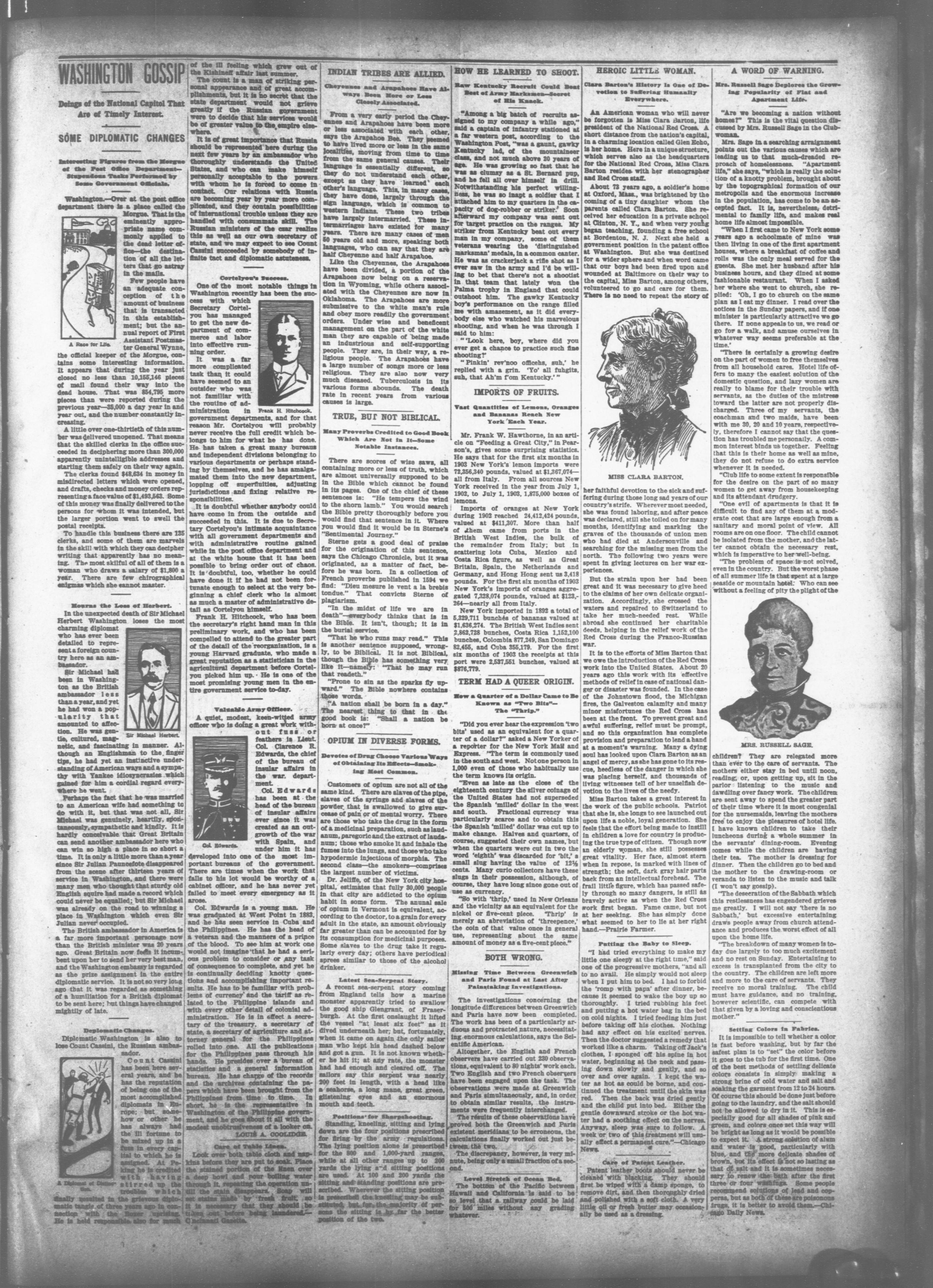
An American woman who will never be forgotten is Miss Clara Barton, life president of the National Red Cross. A short distance from the nation's capital, in a charming location called Glen Echo, is her home. Here in a unique structure, which serves also as the headquarters for the National Red Cross, Miss Clara Barton resides with her stenographer and Red Cross staff.
About 73 years ago, a soldier's home at Oxford, Mass., was brightened by the coming of a tiny daughter whom the parents called Clara Barton. She received her education in a private school at Clinton, N. Y., and when very young began teaching, founding a free school at Bordenton, N. J. Next she held a government position in the patent office at Washington. But she was destined for a wider sphere and when word came that our boys had been fired upon and wounded at Baltimore on their way to the capital, Miss Barton, among others, volunteered to go and care for them. There is no need to repeat the story of
A.
MISS CLARA BARTON. her faithful devotion to the sick and suffering during those long sad years of our country's strife. Wherever most needed, she was found laboring, and after peace was declared, still she toiled on for many months, identifying and marking the graves of the thousands of union men who had died at Andersonville and searching for the missing men from the north. The following two years were spent in giving lectures on her war experiences.
But the strain upon her had been great and it was necessary to give heed to the claims of her own delicate organization. Accordingly, she crossed the waters and repaired to Switzerland to take her much-needed rest. While abroad she continued her charitable deeds, helping in the relief work of the Red Cross during the Franco-Russian war.
It is to the efforts of Miss Barton that we owe the introduction of the Red Cross work into the United States. About 20 years ago this work with its effective methods of relief in case of national danger or disaster was founded. In the case of the Johnstown flood, the Michigan fires, the Galveston calamity and many minor misfortunes the Red Cross has been at the front. To prevent great and awful suffering, relief must be prompt, and so this organization has complete provision and preparation to lend a hand at a moment's warning. Many a dying soul has looked upon Clara Barton as an angel of mercy, as she has gone to its rescue, heedless of the danger in which she was placing herself, and thousands of living witnesses tell of her unselfish devotion to the lives of the needy.
Miss Barton takes a great interest in the work of the public schools. Patriot that she is, she longs to see launched out upon life a noble, loyal generation. She feels that the effort being made to instill in children a love for country is producing the true type of citizen. Though now an elderly woman, she still possesses great vitality. Her face, almost stern when in repose, is marked with lines of strength; the soft, dark gray hair parts back from an intellectual forehead. The frail little figure, which has passed safely through so many dangers, is still as bravely active as when the Red Cross work first began. Fame came, but not at her seeking. She has simply done what seemed to her to lie at her right hand.—Prairie Farmer.
Putting the Baby to Sleep.
"I had tried everything to make my little one sleepy at the right time," said one of the progressive mothers, "and all to no avail. He simply would not sleep when I put him to bed. I had to forbid the 'romp with papa' after dinner, because it seemed to wake the boy up so thoroughly. I tried rubbing his feet and putting a hot water bag in the bed on cold nights. I tried feeding him just before taking off his clothes. Nothing had any effect on his excited nerves. Then the doctor suggested a remedy that worked like a charm. Taking off Jack's clothes, I sponged off his spine in hot water, beginning at the neck and passing down slowly and gently, and so over and over again. I kept the water as hot as could be borne, and continued the treatment until the skin was red. Then the back was dried gently and the child put into bed. Either the gentle downward stroke or the hot water had a soothing effect on the nerves. Anyway, sleep was sure to follow. A week or two of this treatment will usually effect a permanent cure."—Chicago News.
Care of Patent Leather.
Patent leather boots should never be cleaned with blacking. They should first be wiped with a damp sponge, to remove dirt, and then thoroughly dried and polished with a soft cloth. A very little oil or fresh butter may occasionally be used as a dressing.
Mrs. Russell Sage Deplores the Growing Popularity of Flat and Apartment Life.
"Are we becoming a nation without homes?" This is the vital question discussed by Mrs. Russell Sage in the Clubwoman.
Mrs. Sage in a searching arraignment points out the various causes which are leading us to that much-dreaded reproach of homelessness. "Apartment life," she says, "which is really the solution of a knotty problem, brought about by the topographical formation of our metropolis and the enormous increase in the population, has come to be an accepted fact. It is, nevertheless, detrimental to family life, and makes real home life almost impossible.
"When I first came to New York some years ago a schoolmate of mine was then living in one of the first apartment houses, where a breakfast of coffee and rolls was the only meal served for the guests. She met her husband after his business hours, and they dined at some fashionable restaurant. When I asked her where she went to church, she replied: 'Oh, I go to church on the same plan as I eat my dinner. I read over the notices in the Sunday papers, and if one minister is particularly attractive we go there. If none appeals to us, we read or go for a walk, and amuse ourselves in whatever way seems preferable at the time.'
"There is certainly a growing desire on the part of women to free themselves from all household cares. Hotel life offers to many the easiest solution of the domestic question, and lazy women are really to blame for their trouble with servants, as the duties of the mistress toward the latter are not properly discharged. Three of my servants, the coachman and two maids, have been with me 30, 20 and 10 years, respectively, therefore I cannot say that the question has troubled me personally. A common interest blinds us together. Feeling that this is their home as well as mine, they do not refuse to do extra service whenever it is needed.
"Club life to some extent is responsible for the desire on the part of so many women to get away from housekeeping and its attendant drudgery.
"One evil of apartments is that it is difficult to find any of them at a moderate cost that are large enough from a sanitary and moral point of view. All rooms are on one floor. The child cannot be isolated from the mother, and the latter cannot obtain the necessary rest, which is imperative to her well-being.
"The problem of space is not solved, even in the country. But the worst phase of all summer life is that spent at a large seaside or mountain hotel: Who can see without a feeling of pity the plight of the
```markdown
```
MRS. BUSSELL SAGE
children? They are relegated more than ever to the care of servants. The mothers either stay in bed until noon, reading, or, upon getting up, sit in the parlor listening to the music and dawdling over fancy work. The children are sent away to spend the greater part of their time where it is most congenial for the nursemaids, leaving the mothers free to enjoy the pleasures of hotel life. I have known children to take their luncheons during a whole summer in the servants' dining-room. Evening comes while the children are having their tea. The mother is dressing for dinner. Then the children go to bed and the mother to the drawing-room or veranda to listen to the music and talk (I won't say gossip).
"The desecration of the Sabbath which this restlessness has engendered grieves me greatly. I will not say 'there is no Sabbath,' but excessive entertaining draws people away from church attendance and produces the worst effect of all upon the home life.
"The breakdown of many women is today due largely to too much excitement and no rest on Sunday. Entertaining to excess is transplanted from the city to the country. The children are left more and more to the care of servants. They receive no moral training. The child must have guidance, and no training, however scientific, can compete with that given by a loving and conscientious mother."
It is impossible to tell whether a color is fast before washing, but by far the safest plan is to "set" the color before it goes to the tub for the first time. One of the best methods of settling delicate colors consists in simply making a strong brine of cold water and salt and soaking the garment from 12 to 24 hours. Of course this should be done just before going to the laundry, and the salt should not be allowed to dry in it. This is especially good for all shades of pink and green, and colors once set this way will be bright as long as it would be possible to expect it. A strong solution of alum and water is good, particularly with blue, and the more delicate shades of brown, but its effect is not so lasting as that of salt and it is sometimes necessary to renew the bath after the first three or four washings. Some people recommend solutions of lead and copperas, but as both of these are poisonous drugs, it is better to avoid them.—Chicago Daily News.
It was our pleasure to spend a portion of last Saturday evening at the home of Mr. and Mrs. John W. Hardy, $800 Justine St., and in order to make us feel that life is worth living Mrs. Hardy feasted us on cake and homemade wine and the cake tasted mighty good. It may be interesting to state that Mr. Hardy has completed arrangements to erect a two-story pressed brick flat building consisting of six flats with all modern improvements on the front part of his lot, and when it is completed it will be one of the finest flat buildings in the city. This shows thrift and enterprise on the part of friend Hardy and his good wife.
The Afro-American Equal Rights League of Illinois, held its first State convention in Springfield Monday; it passed resolutions condemning Booker T. Washington, for his political activity, while at the same time he urges the Negro to retrain from voting or having anything to do with politics; it praised President Roosevelt, Gov. Yates, and Sheriff Whitlock of Vermilion County, for maintaining law and order during are recent race troubles at Danville after promulgating an able address to the colored people of the United States. The following gentlemen were duly elected officers:
President—John G. Jones, Chicago.
First Vice-President—H. H. Dewitt,
Jacksonville.
Second Vice-President—T. C. Fleming, Braidwood.
Secretary—Louis B. Anderson, Chicago.
Assistant Secretary—Otis B. Duncan, Springfield.
State Organizer—R. A. Byrd, Quincy.
Edward H. Morris, Chicago, chairman of the executive committee.
Genuine Home Spun Suiting to Order $18, Fit Guaranteed. WM. A. KIRCHBERGER & CO., 189 So. Clark St., Chicago, Ill.
Passibly You Have.
"Have you ever noticed," inquired the thoughtful theorist, "that the rich man who says there's no happiness in wealth never seems to be disposed to change places with his poor neighbor?"—Brooklyn Eagle.
"Have you ever made anything on the races?"
"Yes. I went out to the track one day with $10 that I intended to bet and didn't."—Chicago Record-Herald.
Jack—The chump! He has sent her flowers. But I will have revenge. I'll send her candy. Tom—Ah, then, the revenge is sweet. Chicago Daily News.
All There Is.
"What is a bride?" asked the teacher. "A bride," answered the boy, whose sister had been married a short time before. "Is the whole thing on her wedding day."—Chicago Post.
WORKERS AND THEIR WORK
In Germany the annual consumption of iron per capita is 168 pounds and the production just double that amount.
Charles F. McKim, the well-known architect of New York city, has been awarded, with the approval of King Edward, the gold medal for the promotion of architecture, an honor conferred by the Royal Institute of British Engineers. Mr. McKim is the second American to win this distinction.
One of the interesting exhibits that may be seen in the horticultural department of the Louisiana Purchase exposition at St. Louis next year will be the fruits from South America. The managers of fruit farms of the late Cecil Rhodes, at Cape Town, have announced their intention of placing fresh fruits on exhibition each week. Even in London this feat has never been undertaken.
PERTINENT POINTERS.
Any man who speaks nothing but the truth is never garrulous.
The chronic kicker isn't even satisfied with his lot in the cemetery.
The less a man knows the easier it is to convince him that he knows it all.
When a wise man wants to call his wife down he calls her up by telephone.
Lack of originality in some people's conversation displays their good judgment.
Happy is the man who is married to a woman who did not take her cooking lessons at the piano.
The public will stand for almost anything, otherwise many a so-called actor would be looking for a job.
The sweet girl graduate has no use for an escort unless his name is Perry or Jeggie, but later in the game she suffers down as the wife of Tom or Little Chicago Daily News.
Work:
When someone tells here below, the man with sage Gwalt, and only he may stand a place.
Who does that mean well?
— Chicago Journal.
Bronie Bentley Wanted Buits to Order
915. Pay Style.
WM. A. FIRCHBERGER & CO.
TELEPHONE AS WINE-TESTER.
One hears of wonderful new applications or uses for the electric current—some of real value, others nonsensical, but probably one of the latest is the testing of wine by means of the telephone. According to the Paris correspondent of a London daily paper, a M. Maneuvrier, director of the laboratory of researches of the Paris Faculty of Sciences, has discovered an infallible method of ascertaining by means of the telephone how much a given quantity of wine has been watered. The principle on which the invention rests is the variable conductivity of different liquids, notably wine and water. The originality of M. Maneuvrier's ingenious application is his use of the telephone to determine to what degree the liquid under observation is a conductor.
He has constructed an apparatus, the details of which are not given, which is said to achieve this object satisfactorily and accurately.
The apparatus works as follows: Two vessels, one containing wine known to be pure, and the other the same quantity of the wine to be tested, are placed on an instrument outwardly resembling a pair of scales. The telephone is in contact with both liquids. If the sample of wine under observation is as pure as the standard used for comparison no sound is heard; if, on the contrary, it contains water, the tell-tale telephone "speaks," and the greater the proportion of water the louder the instrument complains.
HOW JAPS PLAY KEN.
Old Game Gives Belles of Far East Opportunity to Display Their Beautiful Hands.
In its most widely practiced form the basis of the Japanese game of ken is that the fully outstretched hand signifies paper; the fully closed hand, a stone; and two fingers alone extended, the rest being closed, scissors. Each of the players, says the Japan Mail, counting one, two, three, throws out his hand, at the moment of pronuncing three, and the out whose manual symbol is superior to that of the others, according to the theory of the game, was the trial.
Superiority is determined on the hypothesis that whereas scissors cannot cut a stone, they can cut paper, and whereas paper is cut by scissors, it can wrap up a stone. Consequently scissors is inferior to stone, but conquers paper; stone is inferior to paper, but conquers scissors, and paper is inferior to scissors, but conquers stone. There are innumerable varieties of the game—for it is not a mere method of determining a dispute of priority—and they are constantly added to by ingenious young ladies, the dancing-girl class especially, who play it with exquisite grace and judicious enhancement of beautiful hands and arms.
X-RAY COLORS DIAMONDS.
Chicagoan Discovers Method of Giving Stones Any Color Chosen, Also of Bleaching Them Again.
From Chicago the following dispatch has been received: Predictions of a tim when the brown diamonds in the crown of Edward, the Hope diamond and other famous gems of the kind can be practically duplicated at will were made by W. G. Fuchs at a Chicago X-ray experiment station. Mr. Fuchs announced the discovery of a process by which he is able to change a diamond to any color chosen and make such coloration permanent by the use of the Roentgen days.
The method consists in directing the X-ray through the substances from which the color is to be obtained before the rays touch and penetrate the diamond. Various metals and chemicals have been used to color the diamonds, and it has been found that by reversing the method, the color may also be removed. tI is thought by Mr. Fuchs that when he has completely perfected his experiments he will be able to bleach yellow diamonds with ease.
Puzzling Fact.
A puzzling fact is that the walls of the intestines and the parasites often living on them are never digested by the ferments that attack, destroy and transform the food. Frenzel, in 1891, suggested that protective anti-ferments are secreted by living tissues. In some late experiments M. Weinland, a French physiologist, sought to digest fibrine in trypsine or pepsin after first adding a little juice from intestinal worms, but the ferment had no effect upon the fibrine in the presence of the anti-ferment juice. It is thus proven that the juice secreted by and impregnating living tissues—instead of the tissues themselves—resist digestion. The anti-ferment extract is exceedingly powerful and retains its resisting power for months, but it loses its property on boiling.
Population of Abyssinia.
The population of Abyssinia is about 10,000,000. The products of the country, exclusive of cereals, are ivory, albeth or civet, wax, hides, coffee and gold, the latter abounding in the mountains, where the mines are merely scratched. In cotton, North Americans have captured the market against England, France and Germany. In spite of the high price of labor and the enormous cost of freight for such a distance, Americans have succeeded in capturing the trade by the low prices of their products. Different nations sell these goods, but they are all American made.
Chrysanthus acaura.
Among flowers the chrysanthus is said to live the longest after being
SUITE 318-320 REAPER BLOCK Clark and Washington Sta.
A. D. GASH
Attorney at Law,
84-86 La Salle Street, Chicago.
Suite 615 to 619.
Telephone Main 3077.
FREDERICK W. JOB
ATTORNEY AT LAW
522 MARQUETTE BUILDING
Telephone 2210 Central
CHICAGO
TELEPHONE MAIN 2804
FEDERICO M. BARRIOS
Attorney & Counsellor at Law
Suite 501 Firmenich Bldg.
N. E. Cor. Fifth Avenue
and Washington Street
Chicago.
William Howard Fitzgerald
LAWYER
room 402 Reeper Blvd. - CHICAGO
PHONE: { Office, M i 1157
Rex. Brown 42
STEPHEN A. COUGLAS
LAWYER
Suite 200, 123 125 Lil Saile Street
CHICAGO
Sieghetti Tortoise 20, Bedfordton, 613 Grayfield Bd.
JOHN FITZGERALD
JUSTICE OF THE PEACE
AUTHOR G. HALSTED STRUMB,
....CHICAGO
J. GRAY LUCAS
ATTORNEY-AT-LAW
Suite 412 Real Estate Board Bldg
50 Dearborn St. Cor. Randolph
CHICAGO.
J. J. HENNESSY,
Justice of the Peace,
6301 S. Halsted St.
WILLIAM TREXLER. CLERK.
TELEPHONE WENTWORTH 4403.
Police Magistrate Englewood Police
Court.
Telephone Main 3558.
P. J. O'SHEA
ATTORNEY AT LAW
Suite 1444 Unity Building
79 Dearborn St. Chicago.
Notary Public. 5072 Central.
EDWARD O. ALEXANDER
ATTORNEY AT LAW.
Suite 510,
130 Dearborn Street, CHICAGO.
Robert M. Mitchell
Attorney at Law
Suite 9, No. 77 South Clark St
CHICAGO
WILLIAM RITCHIE
ATTORNEY AND COUNSELOR.
Suite 819-830 Oxford Building
84 LA SALLE ST., CHICAGO
Established city. Phone Oakland 1550-1552
John J. Dunn
COAL &
WOOD
Wholesale
and Retail
Dealer in...
Fifty-First St. and Armour Ave.
RAIL YARDS: 1st St. & L. S. & M. S. Ry.
2nd St. and Armour Ave.
CHJCAGO
Phenix Oil & Mineral Co.
OF ARIZONA
$200,000 CAPITAL
Pays dividends 1 per cent. monthly or
12 per cent per annum.
Stock now selling at 10c per share.
full paid and non assessable. For
further particular a dress
THE DAVIES INVESTMENT COMPANY
614 First National Bank Bldg., Chicago
'Phone Central 3026,
Face Massage, Shampooing, Scalp Treating
Mrs. Warner
Chiropodist and Manicuring
Removes horns Without Pain
Medicated Foot Baths and Foot Massage
138 State St, 4th Floor, Chicago
Telephone Blue 1632 Work Called for and Delivered...
A. HOFFMAN,
CLEANER, DYER
AND PRESSER.
Suits Sponged and Pressed 5c
5125 State St. Expert Workmanship
Moderate Prices.
NOTARY PUBLIC. Office Phone, M. 751 Residence Phone, Blue 5385.
W.G.ANDERSON ATTORNEY AT LAW.
J.Q.GRANT&CO.
Collections, Loans and Insurance,
SUITE 61,119 LA SALLE
Residence, 3232 Wabash Avenue,
CHICAGO.
WONDERFUL
DISCOVERY
Curly Hair Made Straight By
TAKEN FROM LIFE:
BEFORE AND AFTER TREATMENT.
ORIGINAL
OZONIZED OX MARROW
(Copyrighted.)
This wonderful hair pomade is the only safe preparation in the world that makes kinky or justly hair straight as shown above. It nourishes the scalp, prevents the hair from falling out or breaking off, curts dandruff and makes the hair grow long and silky. Sold over fifty years and used by thousands. Warranted annuities. It was the first preparation ever added to the range. Beware of imitations. Get the Original OX Marrow as the genuine never fails to keep the hair straight, soft and beautiful, giving it that healthy, life-like appearance so much desired. A toilet necessity for ladies, gentlemen and children. Elegantly perfumed. Owing to its superior and lasting qualities it is the best and most economical. It is not suitable for anybody to produce a preparative quaternary directions with every bottle. Only 50 cents. Sold by drugging the dealers or send us 50 cents for one bottle or $1.40 for three bottles. We pay all express charges. Send postal or express money order. Please mention name of this paper when ordering. Write your name and address plainly to
OZONIZED OX MARROW CO.,
70 Wabash Ave., Chicago, Illinois.
MRS. A. WILSON.
Nicely furnished rooms to rent for gentlemen. Reasonable rates, 2252 Indiana avenue.
Mrs. Anna L. Newby.
First class furnished rooms, for rent to gentleman and ladies, with bath and gas. 2628 Wabash avenue.
---
MR8. T. P. HILL.
Richly furnished rooms to rent to married couples and single gentlemen; gas, bath, and steam heat; 3017 and 3126 Wahash avenue.
Rooms Not Rent.
Elephant Mountain rooms for rent with both bedrooms with Wabash amenities.
ILLINOIS BRICK CO.
WILLIAM C. KUESTER,
SUPERINTENDENT.
N. Western Ave., Ch
Telephone Lake View 270.
HENADEL BR
HOHENADEL BROS.
211-213 Madison Street
CHICAGO
Telephone Main J300
Pollicemen, Firemen, Street Car Employees,
Letter Carriers, Telegraph Messengers,
Elevatormen, Railroad Employes,
Janitors. Wagonmen, Bellboys, Watchmen,
JACOB FEINBERG
Market and Grocery
Telephone 565 South
John J. Bradley
Real Estate, Insurance and Loans Property managed. Abstracts examined. Renting. Legal papers prepared. 709 South Halsted Street Chicago
JUSTICE OF THE PEACE
Mortgages, Deeds, Notes and Legal Documents Drawn and Acknowledged. Room 22, 27 North Clark Street.
POLICE MAGISTRATE RESIDENCE
East Chicago Ave. Police Court 337 Burling Street
226 East 25th Street CHICAGO
COAL, WOOD AND ICE MOVING AND EXPRESSING All Orders Promptly Attended to Cash on Delivery Telephone Blue 289 4656 Armour Avenue, CHICAGO.
Junk's Brewery
M. JUNK, Proprietor JOS. P. JUNK, Manager 3700-3710 South Halsted Street and 897 to 929 Thirtyseventh Street CHICAGO
-- American Brick Co. --
President and Treasurer, THOMAS CAREY. Vice-President, JOHN SHELHAMER, Secretary, WILLIAM SULLIVAN. MANUFACTURERS OF Common and Sewer Brick Office and Yards:
45th and Robey Sts.
Yards running winter and summer; equipped with the latest improved Wolf Dryer.
Output of Winter Yards ..... 144,000 per day
Output of Summer Yards..... 304,000 per day
Telephone Yards 128.
Chicago
BROSE
Street
CAPS
Employes,
Messengers,
and Employes,
vs., Watchmen, B
BERG
grocery
CHICAGO
Notary Public
Hudley
and Loans
legal papers prepared.
Chicago
Layer
PEACE
Events Drawn
North Clark Street.
RESIDENCE
337 Burling Street
Mason and General Contractor
CHICAGO
ALER IN
ND ICE