The Broad Ax
Saturday, December 19, 1903
Chicago, Illinois
Page text (machine-generated)
Vol. IX
There is always going on in nature a struggle of the male for the females. This is true in all stages of animal life, from the lowest to the highest. The human animal furnishes no exception to the rule. This struggle goes on in all gradations of human development—in the savage and civilized societies. The struggle may differ in the one state from that in the other in matter of form, but at bottom it is the same. In rude stages of development brute strength prevails in such a contest. But as society passes through savagery and barbarism into civilized conditions, strength still counts, but it is no longer mere brute strength. Power now prevails.
In the period before the war in the South the white males had the power, and consequently they obtained possession of the females of both races. They had possession of all the whites and got possession of the pick of the blacks. And, male like, while debauching the females of one race they determined to keep the females of their own race pure, uncontaminated by intercourse with the males of the slave race. But the truth is no society can be kept pure under such circumstances. The very sources of the moral life of the South was defiled, poisoned by the widespread immorality which such conditions engendred.
The white woman of the South who mates with a white man who mates with a black woman, does not raise them an to her level, but sinks downward toward his level. The sinking downward may be and doubtless is very gradual, but given the requisite time, she will reach his level, if not in one generation then in another. If the man does not rise, the woman must eventually sink under such social conditions. And the Southern white man has not risen in this respect. He is to-day the same male animal that he was before the war. He marries the white woman but lives in concubinage with the black woman. The females of both races are still his quarry.
And yet the white woman whose article in "Good Housekeeping" we commented on says in that article: "Behind the Southern adamantine resolve that the Southern white people shall forever be white people, is an instinct which few have analyzed—the instinct for the preservation of species." Now as a matter of fact this "adamantine resolve" on the part of the Southern white people to remain white people, is not for the preservation of the purity of their blood at all, for the intercourse of white men with black women gives the lie direct to such a statement, but in its last analysis is merely the determination on the part of white men to keep all of the women of the South for their own exclusive possession.
"Race aversion," Dr. Ligon goes on to add, "is simply the unconscious recognition of their creative difference, and the normal attitude toward a mingling of the two races should be one of instinctive animal revolt." Yet as a matter of every day fact there is no race aversion between the white men and black women. There is no "instinctive animal revolt" against the mingling of the two races. Otherwise how are we to account for the existence of the very numerous tribe of the mulatto, the quadroon and the Octoroon in the South
It was old Sam Johnson, we think, who refuted Berkeley's philosophy by striking his foot against a rock. The Guardian refutes utterly all this fool talk about "creational difference" between the races in the South, and "race aversion" there by pointing to the ever increasing tribe of the mulatto. As long as the white man of the South feel as they do toward the women of both races, then there will certainly be no diminution in the numbers of this tribe. The white woman and the black woman of the South are "the coveted desire" of the white man—The Guardian, Boston, Mass.
Last Friday night Prof. W. E. B. DuBois, of Atlanta, Ga., lectured at All Souls' Church, Langley avenue and Oakwood Blyd., on "The Development of a Race," and his eloquent and scholarly remarks were well received by the large number of people who turned out to greet the brainy and manly author of "The Souls of Black Folk." His utterances on the final solution of the "Race Problem" in the South made a profound impression on the minds of those who heard him; his theory or idea as to the manhood rights of the Negro are entirely opposite to those entertained by Prof. Booker T. Washington, who believes that the Negro must tamely submit to all the wrongs heaped upon him in order to exist, while Prof. DuBois is equally positive that the Negro cannot survive in this country unless he manfully contends for his civil and his political rights.
While in the city Prof. DuBois was entertained at the new and elegant home of Dr. and Mrs. Charles E. Bentley, 354 E. 41st street, and on Sunday evening from 8 to 11 o'clock many of his admirers had the pleasure of being presented to him. At the conclusion of the handshaking Dr. Bentley induced his distinguished guest to elaborate on the practical benefit of organization which he did very minutely for a considerable length of time without any effort at oratorical flights. When the Prof. DuBois wound up Dr. Bentley spoke on the aims and objects of the Equal Opportunity League. Short speeches were also made by Edward H. Morris, Dr. Daniel H. Williams, F. L. Barnett and S. Laing Williams.
Among some of the most prominent persons present were, Drs. Daniel H. Williams, Allen A. Wesley, A. Wilberforce Williams and Messrs. S. Laing Williams, J. C. Paul, F. L. Barnett, J. E. White, Mark Cowen, Robt. L. Taylor, Edward E. Wilson, R. A. J. Shaw, Julius Avendorph, W. H. Curd, J. S. Madden, John G. Jones, Hale G. Parker, Edward H. Morris, Col. John R. Marshall, Majors R. R. Jackson, Franklin A. 'Denison, and Julius F. Taylor.
Mrs. Bentley, who is the personification of true loveliness received many high compliments on the tasteful arrangement of her new home and on the sumptuous repast which was served under her supervision.
The Best Friends of the Negro
The Best Friends of the Negro. Among those recently indicted by the federal grand jury at Savannah, Ga., for Negro peonage is a member of the legislature of that state.Three others are charged, not only with reducing the Negroes to a state of slavery contrary to the thirteenth amendment, but with applying the lash after the manner of the old days. These men have been said to be the Negro's best friends, and the ones best able to solve the problem. Ex.
Mrs. Geary, 5235 Wabash avenue, the amiable and highly accomplished wife, of John J. Geary, the popular and hardworking assistant sheriff of Cook County, is a warm admirer of The Broad Ax, and every Saturday or Sunday evening Mrs. Geary reads its roasty contents aloud to her husband or the handsome assistant sheriff, and that act on her part induces him to spend his evenings at home and refrain from going alone to balls and parties, in order to flirt with the fine looking ladies.
The Sumner Club will give a Christmas eve party at Arlington Hall, 31st street and Indiana avenue, Thursday evening, Dec. 24. A handsome Christmas present will be given to the best appearing couple in the grand marsh. Grand march 10:30 p. m. Armant's Orchestra will furnish the music. Admission 35 cents.
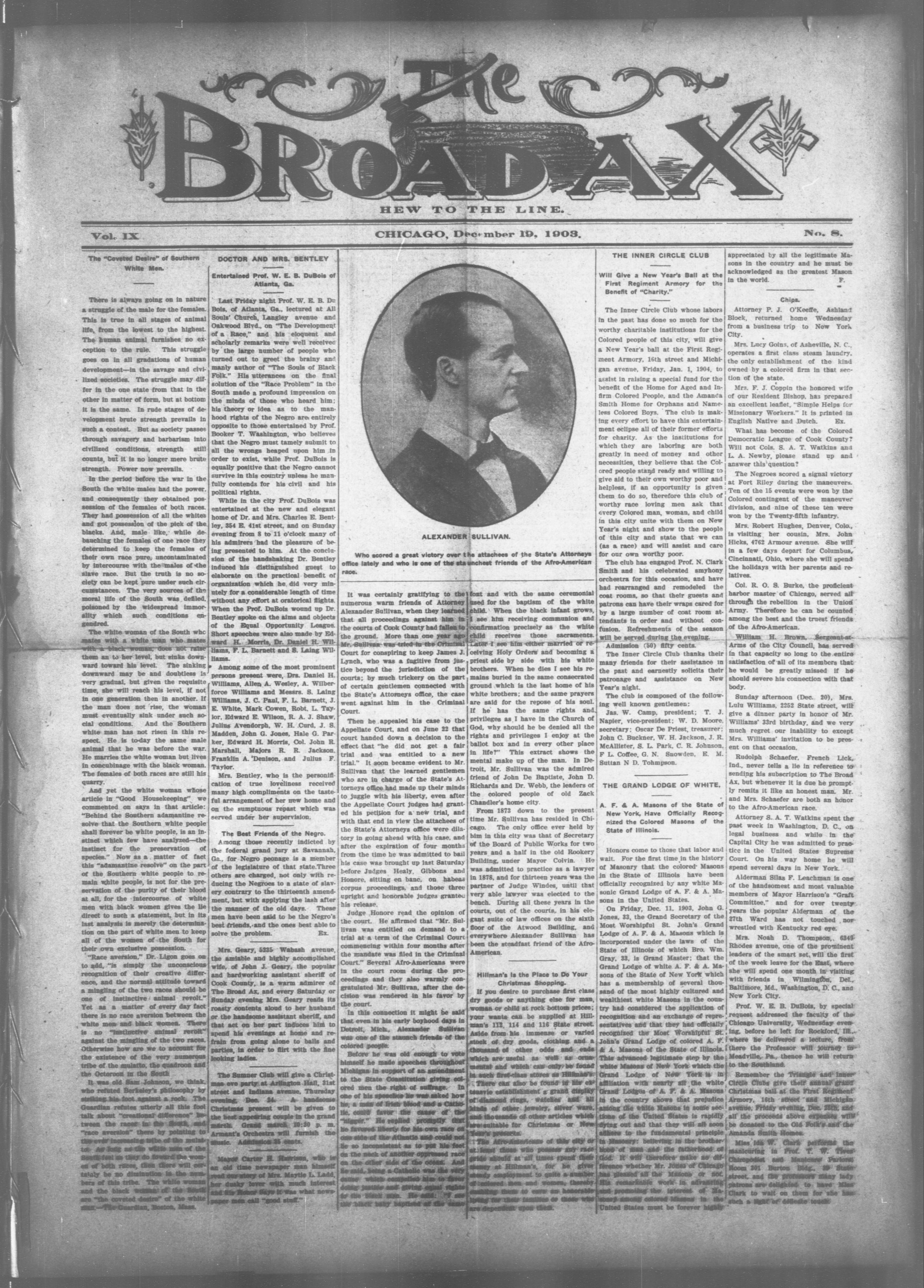
Who scored a great victory over the attachees of the State's Attorneys office lately and who is one of the staunchest friends of the Afro-American race.
It was certainly gratifying to the numerous warm friends of Attorney Alexander Sullivan, when they learned that all proceedings against him in the courts of Cook County had fallen to the ground. More than one year ago Mr. Sullivan was tried in the Criminal Court for conspiring to keep James J. Lynch, who was a fugitive from justice beyond the jurisdiction of the courts; by much trickery on the part of certain gentlemen connected with the State's Attorneys office, the case went against him in the Criminal Court.
Then he appealed his case to the Appellate Court, and on June 22 that court handed down a decision to the effect that "he did not get a fair trial and was entitled to a new trial." It soon became evident to Mr. Sullivan that the learned gentlemen who are in charge of the State's Attorneys office had made up their minds to juggle with his liberty, even after the Appellate Court judges had granted his petition for a new trial, and with that end in view the attachees of the State's Attorneys office were dilatory in going ahead with his case, and after the expiration of four months from the time he was admitted to bail his case was brought up last Saturday before Judges Healy, Gibbons and Honore, sitting en banc, on habeas corpus proceedings, and those three upright and honorable judges granted his release.
Judge Honore read the opinion of the court. He affirmed that "Mr. Sullivan was entitled on demand to a trial at a term of the Criminal Court commencing within four months after the mandate was filed in the Criminal Court." Several Afro-Americans were in the court room during the proceedings and they also warmly congratulated Mr. Sullivan, after the decision was rendered in his favor by the court.
In this connection it might be said that even in his early boyhood days in Detroit, Mich, Alexander Sullivan was one of the staunch friends of the colored people:
Before he was old enough to vote himself he made speeches throughout Michigan in support of an amendment to the State Constitution giving colored men the right of suffrage. In one of his speeches he was asked how he, a man of Irish blood and a Catholic, could favor the cause of the "higher." He replied promptly that he favored liberty for his own race on one side of the Atlantic and could not be so inconsistent as to put his foot on the neck of another oppressed race on the other side of the ocean. And he said, being a Catholic was the very cause which compelled him to favor doing justice and giving equal rights to the black man. He said: "I am the black baby baptised at the same
font and with the same ceremonial used for the baptism of the white child. When the black infant grows, I see him receiving communion and confirmation precisely as the white child receives those sacraments. Later I see him either married or receiving Holy Orders and becoming a priest side by side with his white brothers. When he dies I see his remains buried in the same consecrated ground which is the last home of his white brothers; and the same prayers are said for the repose of his soul. If he has the same rights and privileges as I have in the Church of God, why should he be denied all the rights and privileges I enjoy at the ballot box and in every other place in life?" This extract shows the mental make up of the man. In Detroit, Mr. Sullivan was the admired friend of John De Baptiste, John D. Richards and Dr. Webb, the leaders of the colored people of old Zack Chandler's home city.
From 1873 down to the present time Mr. Sullivan has resided in Chicago. The only office ever held by him in this city was that of Secretary of the Board of Public Works for two years and a half in the old Rookery Building, under Mayor Colvin. He was admitted to practice as a lawyer in 1878, and for thirteen years was the partner of Judge Windes, until that very able lawyer was elected to the bench. During all these years in the courts, out of the courts, in his elegant suite of law offices on the sixth floor of the Atwood Building, and everywhere Alexander Sullivan has been the steadfast friend of the Afro-American.
Hillman's Is the Place to Do Your Christmas Shopping.
If you desire to purchase first class dry goods or anything else for man, woman or child at rock bottom prices; your wants can be supplied at Hillman's 112, 114 and 116 State street. Aside from his immense or varied stock of dry goods, clothing and a thousand of other odds and ends which are useful as well as ornamental and which can only be found in such first-class stores as Hillman's. There can also be found in his extensive establishment a grand display of diamond rings, watches and all kinds of other jewelry, silver ware, and thousands of other articles which are suitable for Christmas or New Year's presents.
The Afro-Americans of this city or at least those who possess any race guide should at all times spend their money at Hillman's, for he gives steady employment to quite a number of colored men and women, thereby enabling them to earn an honorable living for their families or those who are dependent upon them.
THE INNER CIRCLE CLUB
Will Give a New Year's Ball at the First Regiment Armory for the Benefit of "Charity."
The Inner Circle Club whose labors in the past has done so much for the worthy charitable institutions for the Colored people of this city, will give a New Year's ball at the First Regiment Armory, 16th street and Michigan avenue, Friday, Jan. 1, 1904, to assist in raising a special fund for the benefit of the Home for Aged and Infirm Colored People, and the Amanda Smith Home for Orphans and Nameless Colored Boys. The club is making every effort to have this entertainment eclipse all of their former efforts for charity. As the institutions for which they are laboring are both greatly in need of money and other necessities, they believe that the Colored people stand ready and willing to give aid to their own worthy poor and helpless, if an opportunity is given them to do so, therefore this club of worthy race loving men ask that every Colored man, woman, and child in this city unite with them on New Year's night and show to the people of this city and state that we can (as a race) and will assist and care for our own worthy poor.
The club has engaged Prof. N. Clark Smith and his celebrated smyhony orchestra for this occasion, and have had rearranged and remodeled the coat rooms, so that their guests and patrons can have their wraps cared for by a large number of coat room attendants in order and without confusion. Refreshments of the season will be served during the evening.
The Inner Circle Club thanks their many friends for their assistance in the past and earnestly solicits their patronage and assistance on New Year's night.
The club is composed of the following well known gentlemen:
Jas. W. Camp, president; T. J. Napier, vice-president; W. D. Moore, secretary; Oscar De Priest, treasurer; John C. Buckner, W. H. Jackson, J. R. McAllister, S. L. Park, C. R. Johnson, F L. Coffee, G. N. Snowden, E. M. Suttan N D. Tohmpson.
THE GRAND LODGE OF WHITE,
A. F. & A. Masons of the State of New York, Have Officially Recognized the Colored Masons of the State of Illinois.
Honors come to those that labor and wait. For the first time in the history of Masonry that the colored Masons in the State of Illinois have been officially recognized by any white Masonic Grand Lodge of A. F. & A. Masons in the United States.
On Friday, Dec. 11, 1903, John G. Jones, 33, the Grand Secretary of the Most Worshipful St. John's Grand Lodge of A. F. & A. Masons which is incorporated under the laws of the State of Illinois of which Bro. Wm. Gray, 33, is Grand Master; that the Grand Lodge of white A. F. & A. Masons of the State of New York which has a membership of several thousand of the most highly cultured and wealthiest white Masons in the country had considered the application of recognition and an exchange of representatives and that they had officially recognized the Most Worshipful St. John's Grand Lodge of colored A. F. & A. Masons of the State of Illinois. This advanced legitimate step by the white Masons of New York which the Grand Lodge of New York is in affiliation with nearly all the white Grand Lodges of A. F. & A. Masons in the country shows that prejudice among the white Masons in some sections of the United States is rapidly dying out and that they will all soon adhere to the fundamental principle in Masonry: believing in the brotherhood of man and the fatherhood of God. It will therefore make no difference whether Mr. Jones of Chicago has pleased all the Masons or not. His remarkable work in advancing and promoting the interest of Masons among colored Masons in the United States must be forever highly
No. 8.
appreciated by all the legitimate Masons in the country and he must be acknowledged as the greatest Mason in the world. F.
Chips.
Attorney P. J. O'Keeffe, Ashland Block, returned home Wednesday from a business trip to New York City.
Mrs. Lucy Goins, of Asheville, N. C. operates a first class steam laundry, the only establishment of the kind owned by a colored firm in that section of the state.
Mrs. F. J. Coppin the honored wife of our Resident Bishop, has prepared an excellent leaflet, "Simple Helps for Missionary Workers." It is printed in English Native and Dutch. Ex.
What has become of the Colored Democratic League of Cook County? Will not Cols. S. A. T. Watkins and L. A. Newby, please stand up and answer this question?
The Negroes scored a signal victory at Fort Riley during the maneuvers. Ten of the 15 events were won by the Colored contingent of the maneuver division, and nine of these ten were won by the Twenty-fifth infantry.
Mrs. Robert Hughes, Denver, Colo., is visiting her cousin, Mrs. John Hicks, 4762 Armour avenue. She will in a few days depart for Columbus, Cincinnati, Ohio, where she will spend the holidays with her parents and relatives.
Col. R. O. S. Burke, the proficient harbor master of Chicago, served all through the rebellion in the Union Army. Therefore he can be counted among the best and the truest friends of the Afro-American.
William H. Brown, Sergeant-at-Arms of the City Council, has served in that capacity so long to the entire satisfaction of all of its members that he would be greatly missed if he should severe his connection with that body. Sunday afternoon (Dec. 20), Mrs. Lulu Williams, 2252 State street, will give a dinner party in honor of Mr. Williams' 33rd birthday, and we very much regret our inability to except Mrs. Williams' invitation to be present on that occasion.
Rudolph Schaefer, French Lick, Ind., never tells a lie in reference to sending his subscription to The Broad Ax, but whenever it is due he promptly remits it like an honest man. Mr. and Mrs. Schaefer are both an honor to the Afro-American race.
Attorney S. A. T. Watkins spent the past week in Washington, D. C., on legal business and while in the Capital City he was admitted to practice in the United States Supreme Court. On his way home he will spend several days in New York.
Alderman Silas F. Leachman is one of the handsomest and most valuable members of Mayor Harrison's "Graft Committee," and for over twenty years the popular Alderman of the 27th Ward has not touched nor wrestled with Kentucky red eye.
Mrs. Noah D. Thompson, 6348 Rhodes avenue, one of the prominent leaders of the smart set, will the first of the week leave for the East, where she will spend one month in visiting with friends in Wilmington, Del. Baltimore, Md., Washington, D. C., and New York City.
Prof. W. E. B. DuBois, by special request addressed the faculty of the Chicago University, Wednesday evening, before he left for Rockford, Ill., where he delivered a lecture, from there the Professor will journey to Meadville, Pa., thence he will return to the Southland.
Remember the Triangle and Inner Circle Clubs give their annual grand Christmas ball at the First Regiment Armory, 16th street and Michigan avenue; Friday evening, Dec. 26th, and all the proceeds above expenses will be donated to the Old Folk's and the Amanda Smith Homes.
Miss Ida W. Clark performs the manicuring in Prof. T. W. Tives Chiropodist and Manicure Parlors Room 301 Burton Bldg., 39 State street, and the professors many lady patrons are delighted to have Miss Clark to wait on them for she has such a light or delicate touch.
Will promulgate and at all times uphold the true principles of Democracy, but Catholics, Protestants, Priests, Indies, Farmers, Single Taxers, Republicans, Knights of Labor, or any one else can have their say, so long as their language is proper and responsibility is fixed.
The Broad Ax is a newspaper whose platform is broad enough for all, ever claiming the editorial right to speak its own mind.
Local communications will receive attention. Write only on one side of the paper.
Subscriptions must be paid in advance.
One Year..... $2.00
Six Months..... 1.00
Advertising rates made known on application.
Address all communications to
THE BROAD AX
8040 Armour Avenue, Chicago.
JULIUS F. TAYLOR, Editor and Publisher.
Entered at the Post Office at Chicago, Ill., as Second-class Matter.
An Unfortunate Interruption.
"I think," she complained, "that Arthur would have proposed to me last night if you hadn't come in the parlor just when you did."
"What reason have you for believing that?" her mother anxiously returned.
"He had just taken both of my hands in his. He had never held more than one of them at a time before."—Chicago Record-Herald.
Sisterly Solicitude.
"Mr. Spoonamore," asked the little girl, "how long have you been coming to see my sister?"
"O, a month or two, Kitty," replied the young man.
"Well," she said, after a moment of serious reflection, "I suppose it's too soon to ask you if you have any serious intentions."—Chicago Tribune.
"Business."
'Tis now the honest farmer packs
His apples up to town.
'This is the top row in the sacks,
○ ○ ○ ○ ○ ○ ○
And this is lower down.
○ ○ ○ ○ ○ ○ /
—Petoskey (Mich.) Lyre.
seasonable.
Now doth the wind the fleecy cloud
Chase o'er the turquoise sky;
Now doth the youngster cry aloud
For more home-made mince pie.
—Cincinnati Enquirer.
Catering to Dame Fashion.
Man Dressmaker—Well, what now?
Apprentice—I have discovered a way
to make a woman's dress so that she will
look like a hump-backed baboon with
bat's wings.
Man Dressmaker—Glorious! It will become the rage.—N. Y. Weekly.
As Usual.
"Has he any occupation?"
"Well, he has had one."
"What?"
"Trying to be 'a good fellow.'"
"Did he succeed?"
"As long as his money lasted, yes."—Chicago Post.
The Sort of Fellow He Is.
Knippe—What sort of a fellow is Johnson?
Tucque—Oh, he is one of that kind of men who are always remarking: "It looks as though we'd have a little rain before night."—Syracuse Herald.
The Chage of Good Order.
Wife—Dear me, you can never find a thing without asking me where it is. How did you get along before you were married?
Husband—Things stayed where they were put then.—N. Y. Weekly.
Unmasonic.
Sanford—Is your father as enthusiastic upon the subject of free masonry as he used to be?
Merton—Yes, he threw the thermometer out of the window because it got over 23 degrees.—N. Y. Times.
Nothing But the Best.
"Has your husband provided a mausoleum for you?" asked Mrs. Oldcastle.
"Oh, my, no! Josiah was bound to have hard wood floors all through the house."—Chicago Record-Herald.
"Did you have a good time in the city?" they asked when he returned. "Naw!" was his reply. "Why, I was there two days an' there wasn't a bunco steerer come near me."—Chicago Post.
Ready for a Revolution.
"So you believe in rotation in office, so you?" queried the voter.
"Sure thing," replied the officeseeker, "and I'm willing to take my turn."—Chicago Daily News.
An Erroneous Impression.
"The world moves and we've got to move with it."
move with it."
"True, but the trouble is too many of us get the idea that we're moving it."—Chicago Post.
Unquestioning Obedience.
"Oh, Patrick! What has happened to the lawn! There's not a green spot on it!"
"Yez told me to take th' weeds out, mum."—Brooklyn Life.
"A Discriminating Dog.
"Bridget, did the dog eat much when he got into the pantry?"
"Shure, mum, he ate everything but the dog biscuit."—San Francisco Wasp.
Sure Ching.
Pamela—I just dote on a real, real man. The man I marry must, above all, have—courage.
Fitz—I should say so.—Tit-Bits.
Passed Away in Peace.
"Was his wife with him when he died?"
"No; he had a peaceful death."—Town Tolles.
Lady Durand, wife of the new British ambassador of Washington, has long been in delicate health, and her daughter will act as hostess at all the social fuctions given at the embassy during the present season.
Mrs. Marcus Hanna has acquired an air and society manner generally to which she was a comparative stranger when the srnator first became prominent in public life. She has fairly mastered the fine art of dress. In the part she was noted for rather too striking color schemes, but now she has a fondness for black and white. Her hair, which is silver gray and plentiful, is worn in a high knot, and her hair dresser waves it becomingly.
John W. Savage, a prominent member of the Philadelphia bar, was an usher at the wedding of Evelyn Collins and Miss Mildred Thrope in New Brunswick, N.J., last week. The groom is the oldest son of Sir John C. Collins, an English member of parliament. At the wedding breakfast Mr. Savage was called upon for a toast and gave the following: "Here is health, wealth and happiness to the won one, to the one who won one, to the one who was won by one, to the two, too, who now are won ones, to the won two."
Mrs. Ogden Goelet has sent to Police Commissioner Green, of New York, a check for $150 in acknowledgment of her appreciation of the police service on the occasion of her daughter's marriage to the duke of Roxburghe. Mrs. Goelet wished that the money should be given to the officers who were on duty at the wedding, but the police rules did not permit of this, so it was turned over to the riot relief fund. It is understood that some of the women who were in the crush regard this as a proper disposition of the money.
The first "boudoir council" of the Washington social season was held November 30, when Mrs. Roosevelt and the women of the cabinet met and discussed the programme for the winter. It has been decided to curtail the number of white house functions. Last winter Mrs. Roosevelt extended so many hospitalities that several of the cabinet women broke down before the season was half over. This winter Mrs. Roosevelt has reserved Fridays for her personal reception and no entertainments of a private character will be given on any other day.
WOMEN AT WORK
For the first time the board of trustees of the Carnegie institute, of Pittsburg, has elected a woman, Miss Sara E. Weir, to a position in the institute. She has been made assistant secretary. Miss Jennie Phillips, a young woman who lives on the line of the Trenton trolley, between Lawrenceville and Princeton, manages a 750-acre farm, dons bloomers and works in the field with her hired help. Miss Phillips has managed this farm ever since her father died, seven years ago. She is making the farm produce more money than ever before.
Mrs. Amaryllis Perry, of Prairie du Sac, Sauk county, Wis., is approaching her eighty-ninth birthday, but a few days ago went out into the field, and facing an ordinary target put two out of three rifle bullets into a two-inch bull'seye at 100 feet. She used "open sights" and performed the feat unaided by glasses. Mrs. Perry's first husband, David King, was a gunsmith, who was in business 60 years ago in Baraboo. His wife aided him in his work and early in life showed cleverness in handling firearms.
That Mrs. Elizabeth Cady Stanton was a philatelist of many years' standing has just come to light by the discovery of a stamproom in her old home at Woodcliff, N. J. In a recess of one of the rooms more than 18,000 stamps were found hung on the walls. Portions of the walls and the ceiling were covered with stamps of every country, and some of them are of great value, according to the estimates of stamp fanciers. No two are alike. There are indications that most of the stamps were detached from letters received by Mrs. Stanton herself. She carried on a volumnious correspondence with friends whose homes were located in almost every part of the civilized world.
GLEANINGS OF FACT.
Suicide is rare among the aged. The violet was not as conspicuous this year as in former seasons at the New York horse show.
There appears to be some difference of opinion as to who was the first motorist to enter the Yosemite valley in a car. The fact that it has been entered, is of interest to the public as pointing out the fact that but few portions of land surface of the globe may be considered really inaccessible to the enterprising owner of an auto car. Incited thereto by the mysterious disappearance of the young millionaire, Wentz, in southwest Virginia, a bill has been introduced by a member of the legislature of that state making the crime of kidnapping for a ransom punishable with death. The alternative, at the discretion of the jury, is confinement in the penitentiary for not less than eight nor more than 18 years.
He who loves not books before, he comes to 30 years of age will hardly love them enough afterward to understand them—Claredon.
Good books are to the young mind what the warming sun and the refreshing rain of spring are to the seeds which have lain dormant in the frosts of winter—Horace Mann.
Thou mayst as well expect to grow stronger by always eating, as wiser by always reading. It is thought and digestion which makes books serviceable and gives health and vigor to the mind.
THEATRICAL NOTES.
The real name of Gabriele d'Annunzio, whose "Mitta Corta" has been prohibited by the censor, is Gastano Rapagnetto. The dramatist is a son of Duchess Maria Gallese de Roma. He is a musician as well as a playwright, and has a son who has certain celebrity as a mandolinist.
Albert Carre, of the Paris Opera Comique, has begun war on the theater ticket speculators. The fight was brought about by the speculators suing Carre because he refused to accept their tickets at the theater. He has sued them in turn and the chances are favorable that he will win his fight.
Blanche Weaver was playing in "The Lady of Lyons" with E. H. Sothern in a city not far from here some time ago. One of her speeches ended with the words, "No divorce can separate a mother from her son." One evening an absurd transposition suggested itself, and before Miss Weaver could get rld of the notion she had said in her most loving tones: "Ah, Claude, no divorce can separate a Sothern from his mon." The audience smiled, snickered, roared in wild crescendo, and it was some minutes before the play could proceed.
M. Mounet-Sully, the famous tragedian of the Comedie Francaise, is applying for admission to the Academy of Fine Arts. The actor states that he is starting his candidature for a seat in the academy mentioned by way of test. He says that in old times some actors were members of that body, but after Grandmesnil's death, in 1816, no more players were admitted. M. Mounet-Sully now wantsto see if an actor like himself, honorably known, as he thinks, an officer of the Legion of Honor and senior member of the Comedie Francaise, cannot raise a claim to enter the Academie des Beaux Arts division of the French institute as well as painters and composers.
MEN IN PUBLIC LIFE.
The French ambassador and Mme. Jusserand will go to New Orleans soon, when there is to be a celebration of the one hundredth anniversary of the transfer of Louisiana from France to the United States. It has been remarked that few men who come to congress from the Pacific coast are natives of that region. One of the few is John Newton Williamson, of Oregon, whose wife was also born in the thirty-third state of the union.
Very few are aware that William H. Taft, prospective secretary of war and now governor of the Philippines, got his start in life through performing the dangerous feat of whipping an editor. His father, after a distinguished public career, had just formed a law partnership in Cincinnati, when a weekly paper attacked his private life in a scandalous way. The young man, fresh from Yale, at once called at the newspaper office and in a few minutes had polished off his man in fine style.
Sir Mortimer Durand, the new British minister to this country, seems to be somewhat democratically inclined. In New York on Thanksgiving day, he went to a popular "dissenting" church with an American friend, instead of going to Sir Percy Sanderson's stately pew in Trinity. He walked to church across Central park and later joined his friend in a walk to Gen. Grant's tomb. Sir Mortimer impresses one as being a whole-hearted fellow, in many ways resembling Sir Thomas Lipton.
BRAINS AND EXERCISE.
William M. Evarts, who died at a very old age, attributed his long life to the fact that he never exercised. The philosopher, Leibnitz, who lived 70 years, passed most of his days sitting in a chair. He didn't believe in taking exercise, and after a walk of a mile he was unable for two or three days to get his mental powers into proper working order.
Joseph Chamberlain doesn't believe in physical exercise. He never walks when he can ride; he doesn't play golf; there are no Indian clubs or dumb bells in his room and he declares that he never feels well after indulging in physical exertion of any kind. Mr. Chamberlain was born in 1836, and looks to be about 40 years of age.
There is not a more athletic figure in all the senate than that of Mr. Aldrich, of Rhode Island. He is always trained down to fighting weight; his step is as quick and elastic as a boy's; his bearing that of a muscular man. So easily active and unconsciously strong is the Rhode Islander that there is a fascination in watching him on the senate floor. The secret is said to be in his devotion to the ancient game of golf. Near his residence in Providence he possesses expansive acres on which are his own private links. Many a morning during the long summer and autumn months finds him bright and early whacking the elusive ball and chasing it up hill and down dale.
BUNCH OF STACKED CARDS.
"De man dat's game to bet his las' dollar on a hoss race," said Uncle Eben, "is purty sure to git de chance of doin' it sooner or later."
"Are races coming to town?" "I don't know," answered young Mrs. Torkins. "My husband hasn't yet said anything about our having to economize."
"When a man comes roun' tellin' me how easy it is to beat de races," said Uncle Eben; "I allus feels like I had jez read de sus' chapter of a hand' fuck story."
"In de light of human experience," said Uncle Eben, "Lean't understan' how it is dat a man manages to work up such a case of surprise every time he goes broke on de races."
"One man's best friends Is the horse." "Yes," responded the man with the rate track habit. "But did you ever notice what a terrible faculty your best friends have of disappointing you in an emergency?" Washington Star
A REMARKABLE BOOK that is provoking much discussion because of the wonderful eloquence with which the author pleads for right and justice to his people. In these days of increasing agitation over the "negro problem" this passionate human document can neither be overlooked nor ignored. Aside from its remarkable presentation of facts it holds the reader—prejudiced or not—by its fascination of style and overpowering pathos.
Some of the Chapter Headings follow: OF OUR SPIRITUAL STRIVINGS.
3d Edition $1.20 net Published by
A.C. McClurg & Co., Chicago
LAZY MAN'S PARADISE.
In the West Indies the Women Are the Workers While the Men Loaf.
On market day in the West Indies thousands of peasant women and girls can be seen walking along the roads to the town from their palm-thatched huts in the mountains and woods. They carry on their heads immense loads of bananas, oranges, yams, plantains, brown sugar or tobacco, stepping along at the rate of four miles an hour with the gait of a princess, says the Kansas City Star.
Constant carrying of heavy loads gives them a splendid carriage. They will walk 40 miles to market to sell 30 cents' worth of produce. Often they could sell the same stuff for a better price at their homes, but they enjoy the merry company on the road and the fun and gossip of the market place too much to give up their weekly jaunt. Most people think such a tramp hard work, but they regard it as a picnic. Tramping along over rough mountain tracks, fording swift rivers, tugging fractious mules in the way that they should go, these women never let their loads fall. They could dance a jig without dropping them.
Meanwhile the men folk—who have not even taken the trouble to sow or harvest the crops, much less carry them to market—are sleeping in the palm-thatched hut or lying down in the yam patch outside and smoking the strong native tobacco. "On my estate," said a coffee planter to an American friend, "I employ about 600 people in the busy seasons, besides 200 or 300 children. The women outnumber the men by more than two to one, and do far better work, though they are only paid 18 cents a day, as compared with the men's 24 cents. The difference in wages is most unfair, but it is regulated by an iron-bound custom."
BACTERIA EVERYWHERE.
Much Time and Money Wasted in Futile Efforts to Escape the Germs.
Radium destroys germs, but radium costs 3,000 times as much as gold. If a barber puts a fresh towel under the head of each customer he raises the price of a shave, says Collier's Weekly. If he were compelled to sterilize his instruments, to the degree undertaken by one medical barber shop in Paris his fee would approach the dollar mark. Every man who smokes puts a generous allowance of germs between his teeth. Uncooked food, like salads, has the bacteria of the water with which it is prepared. Not only are we unable wholly to avoid the deadly germ, but many undoubted methods of outwitting him cost too much in time, money or abstention. Some there be who avoid cars, and others the public carriage, from dread of exchanging germs with occupants. There are even those who, at the theater, prefer a box because it promises a species of bacteria superior to what is offered in the stalls. At the opposite extreme are thousands who gayly drink from any vessel, and many who by the use of public towels and soap exchange honest soil for insidious beasts. The number of deaths caused by carelessness probably surpasses the number encouraged by worry, but both are great. The best chance belongs to the man who calmly takes what precautions are easy and within his means, and omits the rest without wasting thought. Secure in the knowledge that "death lurks in every flower" and hurts us most in apprehension, he is observant without timidity, and careful without anxiety.
A Probable Cause.
It is suspected that Janesville, Wis., has a suicide club composed of fashionable young ladies. Let us hope, says the Chicago Record Herald, this is not the result of the report that England has run short of titled gentlemen who want American wives.
Woman—Just as She Is.
Dr. Wiley chemist for the department of agriculture, says that woman has long hair because she is still a savage. Well, even so, keep hard as she is, says the New York Telegram. Don't want high civilization and a head that looks like
AGENTS FOR THE BROAD AX.
From on and after this date The Broad Ax can be found on sale at the following places:
The Afro-American News Office, 3104 State Street.
A. F. Tervalon's Cigar Store and News Stand, 2826 State street.
Edward Felix's Cigar Store, 358 80th street, N. E. Corner Armour Ave.
T. B. Hall's Cigar Store and Laundry office, 281 29th St.
Turner William's Cigar and News Stand, 2903 Armour Ave.
The Afro-American News Office, 3104 State Street.
A. F. Tervalon's Cigar Store and News Stand, 2826 State street.
Edward Felix's Cigar Store, 368 30th street, N. E. Corner Armour Ave.
T. B. Hall's Cigar Store and Laundry office, 281 29th St.
Turner William's Cigar and News Stand, 2903 Armour Ave.
Mrs. E. F. Early, groceries and notions, 2933 State St.
H. Winston's Cigar Store and News stand, 280, 29th St.
American
President and Treasurer, THE
Vice-President, JOHN
Secretary
MANUFACT
Common and S
Office an
45th and
Yards running winter
with the latest improv
Output of Winter Yards ...
Output of Summer Yards...
Telephone
American Brick
Treasurer, THOMAS CARL
Tree-President, JOHN SHELLI
Secretary, WILLIAM
MANUFACTURERS
on and Sewer
Office and Yards:
and Robe
running winter and summer,
the latest improved Wolf Dryer
ards:
phone Yard
WILLIAM
TEST SIDE
BREWERY
COMPANY
-- American Brick Co.
President and Treasurer, THOMAS CAREY. Vice-President, JOHN SHELHAMER. Secretary, WILLIAM SULLIVAN.
45th and Robey Sts.
Yards running winter and summer, equipped with the latest improved Wolf Dryer.
Output of Winter Yards ..... 140,0.0 per day
Output of Summer Yards..... 300,0.0 per day
Telephone Yards 128.
WEST SIDE BREWERY COMPANY CHICAGO, U. S. A.
CORNER AUGUSTA ANN
Monroe 1567—T E L E P
AUGUSTA AND PAULINA S
TELEPHONES
If your physician recommends the use of a stimulant, there is no whisky in which so many desirable qualities are contained as in Old Underoof Rye and it has the least reactive effect. Because it is made right and is aged right.
CHAS. DENNEHY & CO.
CHICACO
JOHN A ORB,
President.
News items and advertisements left at these places will find their way into the columns of The Broad Ax.
Brick Co. --
THOMAS CAREY.
JOHN SHELHAMER,
by, WILLIAM SULLIVAN.
TURERS OF
Sewer Brick
d Yards:
Robey Sts.
and summer, equipped
ed Wolf Dryer.
140,000 per day
300,000 per day
Yards 128.
WILLIAM LEGNER,
Vice Pres. & Treas.
PAULINA STREETS.
MONES——Monroe 1573.
Personal Characteristics of Congressman Williams and Senators Aldrich and Gorman-How They Rule Their Parties.
the most efficient leader the democrats in the house have had since the days of Crisp. In some respects he is better than Crisp, for he can keep his temper under provocation and that is what Crisp could never do. Besides, Williams has the faculty of getting a long personally with the leaders of the opposition. He is about as well
Hon. John Sharpe
Williams
liked on the republican side of the house as he is among his own party followers. Williams and Speaker Cannon have become decidedly chummy. Williams appreciates the courtesy shown him when Cannon permitted him to pick out the democratic members of the committees and he doesn't hesitate to show his gratitude on all occasions when a matter of party advantage is not at stake—and there are plenty of opportunities during a session when the legitimate business of the house can be impeded or expedited according as the rival leaders are in a mood of mutual good fellowship or not.
Both Williams and Cannon have an abounding sense of humor. When they are together they call each other "John" and "Joe" and they crack jokes and tell stories with as much gusto as if they had never had a political difference in their lives. The democratic leader likes nothing better than to stroll into the speaker's room and go over the points. But when he gets on the floor in debate he is as spunky as a game cock and nobody would ever imagine that he had a republican friend in the world. There is nobody in the house who can tear passion to tatters more effectively.
One of Williams' predecessors, a democratic leader who was a national figure when Williams was a boy, died only the other day. William M. Springer during the past ten years had not figured in politics; but prior to that time he was regarded as one of the democratic reliabilities in the house for almost a generation.
A. B.
After he left congress Springer was for a time a judge in the Indian terri-
gress Springer was for a time a judge in the Indian territory. Of late years he has been a lawyer here in Washington, scarcely more than a memory of the robust congressman who contested the nomination for the speakership with Crisp and Mills, and who afterwards stirred the economies with his famous series of pop-gun tariff bills carrying out the democratic scheme to revise the tariff one item at a time.
Personally, Springer was a lovable man, without even a remote sense of humor. Probably it was the latter failing that made him one of Tom Reed's pet aversions when the great speaker was the leader of the republicans in the house.
Two of Reed's most famous shafts were thrown at Springer. One was in a debate while Reed was still holding a secondary rank in the house. Springer, who was a rather ponderous speaker, had made the remark that he would rather be right than be president. Reed, standing in the middle aisle, drawled back: "The gentleman need not be alarmed. He will never be either."
The other was a conversational quip: "Springer never opens his mouth that he doesn't subtract from the sum of human knowledge."
It is not to be wondered at that there should not have been any great sympathy between two men of such widely opposed temperaments. It was largely a matter of taste with each of them, and concerning taste there is no use in arguing.
Leadership of the Senate.
The leadership of Senator Aldrich in the senate has been pretty completely
demonstrated more than once in recent years, but never more thoroughly than during the extraordinary session just closed. The republican majority were altogether in Aldrich's hands. What he suggested they did, and sometimes they did it without putting him even to the
A. B.
trouble of suggesting it. He was one who made the arrangement with the democratic minority by which the business of the extraordinary session was brought to a close and an agreement made by unanimous consent
to vote on the Cuban reciprocity bill on the 16th of December.
In fact, he was the only man on the republican side who understood exactly what the terms of the arrangement were, a circumstance which led to a somewhat embarrassing incident one afternoon in executive session. Senator Lodge tried to bring up a matter which was of no particular consequence, but which as it happened did not relate to the Cuban situation. Senator Gorman promptly objected. He said it was contrary to the agreement between the two sides of the chamber. The republicans who were present protested. They had never heard of any such agreement which would put it out of their power to do business of any kind. But Gorman was insistent. And when they pressed him for an explanation, he gave one. He said Senator Aldrich had promised him that if theocrats would consent to the vote on the 16th of December, nothing whatever would be done in the meantime during the extraordinary session except to discuss Cuban reciprocity. Aldrich had left the city without telling anybody on his own side of the chamber about what he had done, but they accepted Gorman's statement, and that was the end of it.
Gorman, on the democratic side, occupies just about the same kind of posi-
ples just about the tion that Aldrich occupies on the republican side of the chamber. It may be that he hasn't quite the same degree of control of the machinery; but whatever he says goes, despite rumors to the contrary. He is the man to do business with, and when he makes a promise as to what the dem-
Senator Gorman
as to what the democrats will do, they feel morally bound to do it. That is what Uncle Joe Cannon calls legislation by unanimous consent, and, of course, it is a very reprehensible way of doing business. But it is likely to continue just as long as the present senate rules live, which, according to present appearances, will be to the end of time.
Gorman and Aldrich are very much the same type of men. They are first of all business men. They understand the currents of trade and appreciate the effect of legislation on commercial interests. They are organizers and deft handlers of men. They can read character and they can keep their own counsel. They understand weaknesses in others to which they can appeal. They are always in the game.
Gorman is more of a public speaker than Aldrich. He is not an orator in any way, but he has a faculty of aggressiveness in debate which Aldrich has never shown. Aldrich when he talks uses a conversational tone, and goes about it as if he were explaining something before the board of directors of a railroad. Gorman is never exactly conversational. There is always some little touch of mystery in everything he says, and his face is Jesuitical in its inscrutability. Aldrich, on the other hand, is seemingly the most frank and confiding of men. One wonders how it can be that this smiling, easy-going, companionable fellow can have so many tricks up his sleeve.
The ways are cleared already for the great Union station, which is to be com-
which is to be completed for the 4th of March,1905,and which will be when completed the finest thing of its kind in the world. By contrast with the present wretched avenues of approach to Washington it will be almost inconceivably splendid.
PALACE
The new station, which will be only a stone's throw
Plares or the New Depot
from the capitol, will be built of white granite—a peculiarly white and dazzling stone, quarried at Bethel, Vt., which will surpass marble in architectural effect. The station will face directly toward the dome of the capitol, and the entire facade will be clearly visible from the capitol steps at the end of the broad avenue. The architectural effects have been drawn from the triumphal arches of Rome. Sloping gently away from the building will be a plaza 500 feet wide and 3,000 feet long, adorned with balustrades and fountains, while there will be a terrace 100 feet wide surrounding the structure.
The station itself will be 620 feet long and from 65 to 120 feet in height. The three entrance arches, each 50 feet in height, will be on a scale far surpassing anything in Roman architecture. The waiting-rooms will be dreams of luxury compared with anything that has ever before been suggested for a railway station, and the dining-room will be equal to anything that can be found in a first-class hotel. There will be all sorts of unusual conveniences. One of these is an invalid's room, easily accessible from the street.
Another is a special entrance for the president of the United States. Besides there will be dressing rooms with baths and a Turkish bath and swimming pool. The entire cost of the station with approaches will be $14,000,000, of which the government pays $3,000,000.
LOUIS A. COOLIDGE.
On graves of Maldene.
The grave of an unmarried woman in Turkey is often indicated by a rose carved in stone.
HOTTEST PLACE ON EARTH.
Islands in Which a Breath of Cool
Air Is a Rare Luxury-No
Relief at Night.
Undoubtedly the hottest place on all the earth, if the testimony of travelers is to be credited, may be found on the Aval islands, which cover a fairly extensive area of the Persian gulf, lying off the southwest coast of Persia. It is the largest of them which enjoys the doubtful distinction of leading all perspiring competitors in the matter of heat. The mean temperature of Bahrein for the entire year is 99 degrees. July, August and September are unendurable save for the natives. Night after night as midnight comes the thermometer shows 100 degrees. By seven in the morning it is 107 or 108 degrees, and by three in the afternoon 140 degrees.
It is stated by veracious travelers that 75,000 Arabs inhabit the Aval group, fully 25,000 living on Bahrein, in which connection Sir Henry Layard adds: "It would seem that a man can accustom himself to anything." The following are the temperatures at some of the hottest places in different countries: Hyderabad, 105 degrees; Lahore, 107 degrees; El Paso, 113 degrees; Mosul, 117 degrees; Agra, 117 degrees; Death Valley, 122 degrees; Algeria, 127 degrees; Fort Yuma, 128 degrees; Jacobobad, 122 degrees; Bahrein, 140 degrees.
DEER AND SLEEP.
Forestera Say Animals Sleep About Five Hours in Daytime—Not at All at Night.
Deer reverse the apparent order of nature, for they sleep in the daytime and feed at night, says the Scottish Field. How much sleep they do take is a matter of contention, even among experienced stalkers—some say little, others much. On the whole, we are inclined to agree with the former, for it has to be remembered that they chew the cud when lying down. Two most experienced and observant foresters, the one in Argyllshire, the other in Aberdeenshire, thus gave their opinions: "Deer sleep or rest from about ten or eleven a. m. to four p. m.;" "Deer sleep from noon to five p. m."
It is not uncommon occurrence to come on deer asleep; a stalker in the Black mount had the rare experience of coming upon a parcel of seven stags, all sound asleep. A herd was seen to move in Glenfeshie, but one stag remained behind, lying motionless. On a careful approach he was found to be asleep. Perhaps, however, the oddest occurrence of this nature happened in Braemore, when a stalking party, on going up to the stag which had just been shot, found a three-year-old close to it fast asleep. In fact, it is by no means rare to get within a yard or two of a sleeping deer.
HABITS AND HEALTH.
Crusades for Sanitation Hard to Carry to Success on Account of Public Indifference.
It is no easy task to carry to success a crucade in the interest of public health. Those who have engaged in such movements, says the Baltimore American, know how many obstacles must be overcome, how many disappointments and discouragements must be borne with equanimity before the goal sought is reached. Public indifference to such matters is one of the chief obstacles, and until that is removed there can be very little hope of results worth having. The large majority of people are fairly healthy, and it is difficult to make such people believe that it is necessary for them to pay any great amount of attention to laws of sanitation or rules of hygiene. They eat well, sleep well, keep strong and hearty, and hence care very little for the sanitary condition of their surroundings. In truth, it is not always the dirtiest places in a city which are the most unhealthy. In one section where the gutters run with filthy water, where the children are thick as hops and as dirty as pigs, the mortality is very low, even less than in sections where cleanliness is counted next to godliness.
CANDIDATES FOR ARMY.
Examinations of Recruits Show Unusually Large Proportion of Physically Perfect Men.
It appears from the report of the surgeon general of the United States army that the total number of candidates examined for enlistment was 45,218, and that of this number about two-thirds, or 30,176, were accepted. This, says the Los Angeles Times, is a large proportion, when the fact is taken into account that the standard of excellence required is very high, none but physically perfect men being accepted. Of the 45,218 applicants for enlistment 42,183 were white men and 3,035 were colored men. Of the white men 37,790 were accepted and of the colored men 2,386.
Out of every 1,000 men accepted 781.05 on the average, were born in the United States, 64.76 in British territory, 45.25 in Germany and 8.79 in Sweden and Norway. Of 18 American Indians examined 14 were enlisted as scouts. It is interesting to note that during the year 736 native Malays were examined for enlistment as Phillipping scouts, and that of these all except 20 were accepted, showing a surprisingly high standard of physique among the Philippines.
The cut of lumber in the Sault Ste Marie district for the season of 1902 was about 160,000,000 feet, and the cut for the season of 1903 is expected to total over 200,000,000 feet. At least 75 per cent of this is cut in mills owned and operated by Americans. Two large sawmills have been shut during the year and a new millering mill has been operating very profitably during the season.
MINES IN CALIFORNIA. Appreciable Mineral Wealth Taken From Ground of All Three of the 57 Counties.
There are only three California counties out of the entire array of 57 that will not make a showing in the statistics of mineral output for the year 1902, says the San Francisco Call. Several of the counties that are discovered to have mineral wealth are not represented by large figures of actual production. That is according to expectation. But, considering the area of the state, its length and breadth, there is probably no other country on earth that can be shown to be as uniformly mineralized throughout practically its entire extent.
Among the surprises contained in the statistics to be submitted by the state mining bureau will be the figures of the value of the total output of petroleum in California for 1902. The production was very large, but when the price at the wells ranges from 15 to 25 cents per barrel for fuel oil it does not, comparatively speaking, require large figures to show what it sold for in total in the market. The total gold output of two counties far surpasses the value in the market of all the oil produced in the state during the year 1902. While the price of oil has continued to be low, the value of silver, which is of great interest in Pacific coast camps, has continued to rise. The government followed the market from 49 cents to 55 cents in its purchases for the Philippine coinage. Then it stopped. Millions of dollars' worth of bullion will be required by the government before the Philippine coinage bill provisions are fully carried out. At the present price of silver many silver camps can produce at a profit.
FORMATION OF GOLD NUGGETS.
Experiments In Laboratory Show How Nature May Have Produced Lump of Precious Metal.
That gold is formed from solution is generally recognized. The miner receives the theory because it explains the making of gold to him, but he often wonders how it is done, so here is what has been seen: Daintree once prepared a solution of gold and left in it a small piece of metallic gold. Accidentally a small piece of wood fell into the solution; the solution decomposed, the gold assumed a metallic state and collected and held to the small piece of undissolved gold, which increased in size. Another investigator, says Mines and Minerals, heard of this and made a dilute gold solution, in which he immersed a piece of iron pyrites and left it there a month. He added also organic matter, and at the month's end the pyrites were covered with a film of metallic gold. Pyrites and galena were next tried, and each was covered with gold. Gold, copper pyrites, arsenical pyrites, galena, wolfram were also tried with similar results. Metallic precipitates were tried, and while they threw down the gold as a metallic powder they did not cause it to cohere nor to plate any of the substances tried. Organic matter thus seemed the necessary chemical agent. Through the wood used in these experiments gold was disseminated in fine particles. imagine those experiments conducted by nature through ages and the result could be a nugget.
CODLIVER OIL FOR STOCK.
Farmer Says It Is Cheaper Than Grain for Fattening Purposes—Has Other Advantages.
"I fatten my stock on codliver oil," a farmer said at the abattoir the other day, according to the Philadelphia Record. "I find that this oil is cheaper than grain and that it produces a finer, firmer quality of fat. It works admirably on pigs. To young pigs I give one ounce a day and to adults I give a quarter of a pint. The porkers like it; you can tell if they are taking too much by a peculiar lassitude that they develop. Killed, their fat has, if they have been overfed with the oil, a yellow instead of a clean white hue. To cattle I give a half pint of oil daily and to sheep about the same quantity as to pigs. Since I adopted the system of oil fattening two years ago I have made more money off my stock than ever before. They eat less grain now by nearly 40 per cent, and at the same time they weigh heavier than they used to. The butchers tell me their flesh is better, too. They say it is firmer, finer and the fat is whiter. Of course, an animal won't take codliver oil raw, so I mix it up with meal. Codliver oil is an excellent thing for broken-winded horses. In fact, I use this fluid for a dozen purposes on my farm, buying it in bulk from the wholesale dealers."
The Happier Man.
A north Missouri paper asks: "Who is the happier, the man who possesses $100,000 or the man who has seven daughters?" To which another exchange replies: "The man with the surplus girls, of course," says the St. Louis Post-Dispatch. "The man with the money is not satisfied, and wants more. The man with the seven daughters is satisfied—he has enough."
In 1900, the value of Boston's products of manufactures, viz., $206,081,769, exceeded by $21,691,263, or 11.7 per cent., the value of its foreign trade. Boston in 1895, according to the state census of that year, was the second agricultural town in the state, owing to the high value of its greenhouse and garden products.
Not So Sleep
During the middle ages gunpowder, clocks, telescopes, parchment, paper and the mariner's compass were invented or adopted.
Crime and Education. More than one-third of the inmates of the Elimira (N. Y.) state prison are well educated.
DAINTY NEEDLS WORK.
"French China". In the Enthopiops Name Given to the Latest Fancy in Embroidery.
New suggestions for embroidery or adoptions of old ideas that pass muster as novelties are always welcomed by the woman skilled with her needle, particularly if she be of an artistic bent of mind, and French china work a new and charming manifestation of needle skill is likely, therefore, to find many admirers. It is comparatively easy of execution, and is as dainty as a bit of Sevres porcelain, this dominant characteristic of delicacy accounting for the name that has been bestowed upon this latest development in needle painting. The same patterns are used and there is the same idea of raised effect as in eighteenth century ribbon work, but the end is achieved through the medium of embroidery silk and stitchery, pure and
FRENCH CHINA TALLE COVER.
simple. Half a dozen threads of filo are employed for the satin stitch which is ingeniously adapted to the rendering of leaves and flowers, while the stalks and finer details are worked out in one or two strands. One advantage of this work is that no frame is required while the patterns may be carried out in washing silk upon linen intended for table covers, dresser scarfs and any of the many accessories of this sort for table and boudoir.
An exceedingly effective example of this work is the table cover of which a corner is here illustrated. Its graceful ribbon-tied festoons of diminutive blossoms, in tones of rose, soft, faint blues and yellows with here and there a touch of purple or orange, are charmingly blended with the greens of the foliage. By a clever arrangement of stitches, the characteristics of the flower forms are indicated, especially in the roses, in which, touched in with three shades of rose color, the satin stitches are worked horizontally and overlapping one another here and there indicate the little crumplings of the folded petals. A couple of stitches are all that is necessary to indicate each of the delicate green leaves in the sprays of foliage. It is this that constitutes one of the charms of the work that, while by no means difficult to carry out, it affords so much opportunity for lightness and variety of touch. Edged with French lace, such a cover is especially adapted for the five o'clock tea table with its equipment of glistening silver and dainty china. Another design that may be successfully carried out on fine white linen shows pink roses incased within an empire frame of laurel leaves and small purple berries.—Brooklyn Eagle.
ENEMY OF GIRLHOOD.
It Ruins the Complexion and Digestion of Sweet Seventeen and Doctors Call It Anemia.
Health controls the complexion throughout the whole course of existence, but perhaps never more palpably than about the age of 17.
Anemia is the greatest enemy of a beautiful complexion that girlhood can encounter. It results in pallor, in blemishes, such as spots and blackheads, and in that general appearance of delicacy that should be a complete stranger to youth. Unfortunately just about the age now under consideration girls are so busy over their books and so eager to excel in their school examinations that instead of aiding and abetting their elders to improve their anemic state, and so to alter their muddy and unattractive complexions, they do all they can to further the inroads of weakness by working indoors too much and staying up too late at nights.
The anemic girl, whether she must work at her books or not, must be dosed with iron for months and months. It is the paucity of iron in her system that makes her lack of color in her cheeks. There are several well-known preparations of iron that will suit the sufferer, but it is always well, if possible, to consult a doctor as to the most efficacious one to be had in pills and in solution. Iron can be taken in pills for the sake of the teeth, and in solution for the sake of the digestion. But while one girl can take three pills a day, and in course of time even eight, nine or ten, another cannot take more than two in 24 hours. That is why a doctor's advice is so necessary.
The more open air the anemic girl gets the more quickly she will overcome her weakness. She must live on fresh air just as much as on milk and fresh meat, and every other kind of nourishing food. Not only must she take exercise in the open air, but her sleeping hours must be supplied with it and her sitting-rooms always have an open window in them. Rich food is not good for the anemic patient; indeed, the simpler the existence the better. Cincinnati Commercial Tribune.
Use of Colored Napery. Colored napery is allowable at breakfast and lunchroom, but never at dinner. Little starch should be used in laundering white linen. A handsome monogram embroidered in white in one corner is all the ornamentation that is permissible on either tablecloth or napkins.
LEMON HAS MANY USES.
It Is Good for the Stomach, the Threat, the Hands, Finger Nails and the Complexion.
The usefulness of the lemon begins in the morning, even before you are out of bed. The juice of half a lemon squeezed into a glass of water and drunk unsweetened the first thing in the moring is an excellent remedy for bilious disorders.
If girls appreciated the lemon's usefulness as a beautifier, they would always have one at hand. The fingers or finger nails may have stains that refuse to yield to soap and water, in which case a little lemon juice will usually prove successful. Before manicuring the nails you should always soak them for at least five minutes in a basin of water in which are a few drops of lemon juice. The skin which grows so offensively around the nails is pushed back by orange wood sticks first dipped in lemon juice; and as for the teeth, no more effective cleanser or purer mouth wash can be found than a half dozen drops of lemon juice in a wineglass of water.
After washing the hands, lemon-juice and water makes a splendid bleach, but one curious thing should be remembered. Lemon juice pure darkens the skin, so do not make the mistake of rubbing in plain lemon-juice, instead of diluting it with water. Lemon juice and glycerine is good for chapped hands. If you have a hoarse voice in the morning, lemon-juice, squeezed on to soft sugar till it is like a sirup, and a few drops of glycerine added, relieves the hoarseness at once, while a cold on the chest, or consumption itself, finds a formidable enemy in the following prescription:
Squeeze the juice of three lemons over three whole eggs, shell and all. In two or three days time the shell will have softened because of the effect of the lemon's acid on the lime composition of the shell. Then add a pint of rum and a pound of pulverized brown sugar candy. You can bottle this, and take a spoonful every morning before rising. It is simply wonderful as a tonic. Chicago American.
THE MISSION LAMP.
Latest Development of a Fad That Seems to Have Taken the Entire Country by Storm.
Mission furniture has become something more than a fad, and its availability for country and city home use has been demonstrated by the many articles modeled on mission lines that have been brought out by the manufacturers during the past year or so, and which have met with the approval of those who seek for chairs, tables, cabinets and the like that differ from conventional productions. The mission lamp is the latest manifestation of the tendency for furniture of this sort, and is portrayed above. In a den or a hall
```markdown
```
ARTISTIC MISSION LAMP. or any room where mission furniture predominates, such a lamp would add to the effect and the original is considerably more attractive than the picture might imply. As a novelty in the lamp line, the mission model calls for recognition, and, as has been said, it is particularly adapted to an apartment wherein the mission idea is the ruling one in furniture.—Brooklyn Eagle.
Hygienic Value of Fruit.
Hygienists all agree in telling us that we do not eat sufficient fruit, which is infinitely more productive of health and beauty than candy and pastry. Ripe apples are especially healthy, and children may eat them without danger. Some doctors say that an apple at bedtime produces sleep. Pears are more tasty than apples, but not so healthy unless cooked. Prunes have medicinal qualities which cannot be denied. They are better cooked, however. Apricots are also more healthy cooked than raw. Peaches are very healthy. The most healthy of all fruit, however, are grapes. Gooseberries and currants are best cooked. Figs are also excellent; they were in great favor with ancient Roman ladies, who always ate them for breakfast. Pineapples are said to be the best cure for dyspepsia yet known. Nuts of all kinds are indigestible. Oranges are also excellent as a cure for dyspepsia. Lemons produce cheerfulness and prolong life.
How to Clean Lace Curtains.
A professional cleaner says that the best method of cleansing lace curtains at home is to make a suds of warm water, white castile soap and a little borax. If the curtains are very dirty, scrub them gently with a soft scrubbing brush. Lace curtains should never be rubbed between the hands. This stretches the mesh and is very likely to tear holes in it. When quite clean, rinse in clear water to which a little borax has been added, squeeze between the hands, but do not wring, and dry in a sheet.
Mrs. Lulu Williams, 2252 State street, and Mrs. Minnie Howard, 3210 State street, have become the possessors of new winter coats, they are made in true military style with brass buttons with long flowing or pumkin sleeves and they fit the well shaped forms of their owners just like the paper on the wall.
Those who delight to dance should attend the annual Christmas ball Friday evening, Dec. 25, at the First Regiment Armory, which will be given by the Triangle and Inner Circle Clubs, for if you patronize the ball you will help to support the Old Folk's Home, which is sadly in need of money to buy coal and provisions for those who have outlived their usefulness.
Miss Hattie L. Osborne, one of the brightest Afro-American young ladies of Salem, Mass., was the latter part of last week united in marriage to a Chinaman by the name of John Thomas Ah Chung, it was a grand wedding, and the reception was attended by more than 150 guests. After their honeymoon trip Mr. and Mrs. Ah Chung, will for a short time reside with her parents.
Alderman John J. Bradley, ex-Alderman Charles J. Boyd, Denney J. Reirdon, Harry J. Rogers, Tim W. Mackey and one or two candidates will make the fur fly in their hot contest for the Aldermanicship of the 30th Ward shortly after Jan. 1, 1904, and most of the politicians in the ward say "that Alderman Bradley will win the jack-pot in the scrap or fight.
One of the members of Olivet Baptist Church, who pretends to be such a good honest Christian, claims "he is unable to pay his indebtedness to The Broan Ax," nevertheless he found plenty of money to present Mr. and Mrs. George C. Jones, with a fine silver cake dish, who were married last week at 2509 Dearborn street. Such Christians who blow their money in for foolishness which they should use to pay their honest debts are no good to themselves nor to their fellowmen.
John J. Fowler died at his residence, 5119 Grove avenue, last Sunday. Interment at Oakwoods Cemetery, Tuesday. The deceased leaves five children to mourn his loss; Stuart D., Mrs. J. C. McKinney and James M. of this city; Thaddeus H. of Philadelphia, Pa., and William D. of Bessemer, Ala. Funeral services were held at the house, the Rev. Moses H. Jackson officiating. The deceased was a member of Grace Presbyterian Church. He was born Sept. 26, 1826, in Virginia, and came to Chicago in 1893, where he has made his home with his children.
As a further improvement in this direction, the United States officials of the post office have just arranged with the American line to change its sailing day so that hereafter its ships leave New York on Saturdays instead of Wednesdays. At the same time the White Star line, which has its sailing on Wednesdays, will establish sea post offices on its ships. As a result the Wednesday malls will be handled as expeditiously as formerly while there will be a decided gain in the Saturday malls. Heretofore these have been sent on the Cunard line via Liverpool and the London letters have not been distributed until a week from the following Monday morning as there is no distribution in London on Sundays. Under the new plan the London-mail will reach its destination Saturday afternoon and there will be a gain of from 30 to 36 hours in delivering a large part of the mail for all British points.
DOGS BLOW THE BELLOWS.
New York Blacksmith Has Trained Three Newfoundlands to Help at the Forge.
On an uptown street, on the east side of the city, says the New York Mall and Express, hundreds of people daily pause at a blacksmith's shop to watch three large Newfoundland dogs, which are employed by the brawny smithy to work the bellows of the forges of his shop. In one corner of the shop is a large wooden wheel, about eight feet in diameter, and wide enough for a dog to stand in. When the wheel is at rest the dog stands in much the same position as the horse in a child's rocker, with its head always turned toward the forge, awaiting orders. When told to "go ahead" the beast on duty at once starts on a brisk trot, which makes the wheel turn around rapidly, and by means of a crank and lever the power is conveyed to the bellows.
The dogs work willingly and with such intelligence that people are never weary of watching the efforts of the animals to keep the smith's fires bright. Each dog works in the wheel for one hour and then rests for two. They cost their owner about two dollars a week for each to feed, and he estimates that they save him $12 a week, as otherwise it would require at least the services of two men or a small engine to do their work.
COREAN OFFICIALS.
In view of the negotiations now being carried on between Russia and Japan, the picture which we give here of Corean government officials is specially interesting. At least 20 per cent. of the whole population of Corea belongs to the official class, for every one wants to live a life of ease at the expense of his fellow countrymen, says Golden Penny. A Corean government official does not think so much of the honor of serving his country as of the opportunities he has for effecting "squeezes," that is to say, the levying of blackmail, the receiving of bribes from pergons having business with his superior, the right to travel everywhere at the public expense, and other "pickings." The government appointments are open to competition, so every one ought to have an equal chance. The successful candidates, however, are usually those who pay the best, or have the most interest. There are eight governors of provinces in Coreo, and 332 prefects, and each official has, according to his rank or wealth, a body of secretaries, seal bearers, tax gatherers, soldiers, police and other servants.
J.Q.GRANT&CO.
Collections, Loans and Insurance,
SUITE 61,119 LA SALLE
Residence, 3232 Wabash Avenue,
CHICAGO.
Telephone Blue 4632 Work Called for
and Delivered...
John J. Bradley
A. HOFFMAN,
CLEANER, DYER
AND PRESSER.
Suits Sponged and Pressed .5c
5125 State St. Expert Workmanship
Moderate Prices.
Real Estate, Insurance and Loans Property managed. Abstracts examined. Renting. Legal papers prepared. 4709 South Halsted Street Chicago
JUSTICE OF THE PEACE