The Broad Ax
Saturday, March 26, 1904
Chicago, Illinois
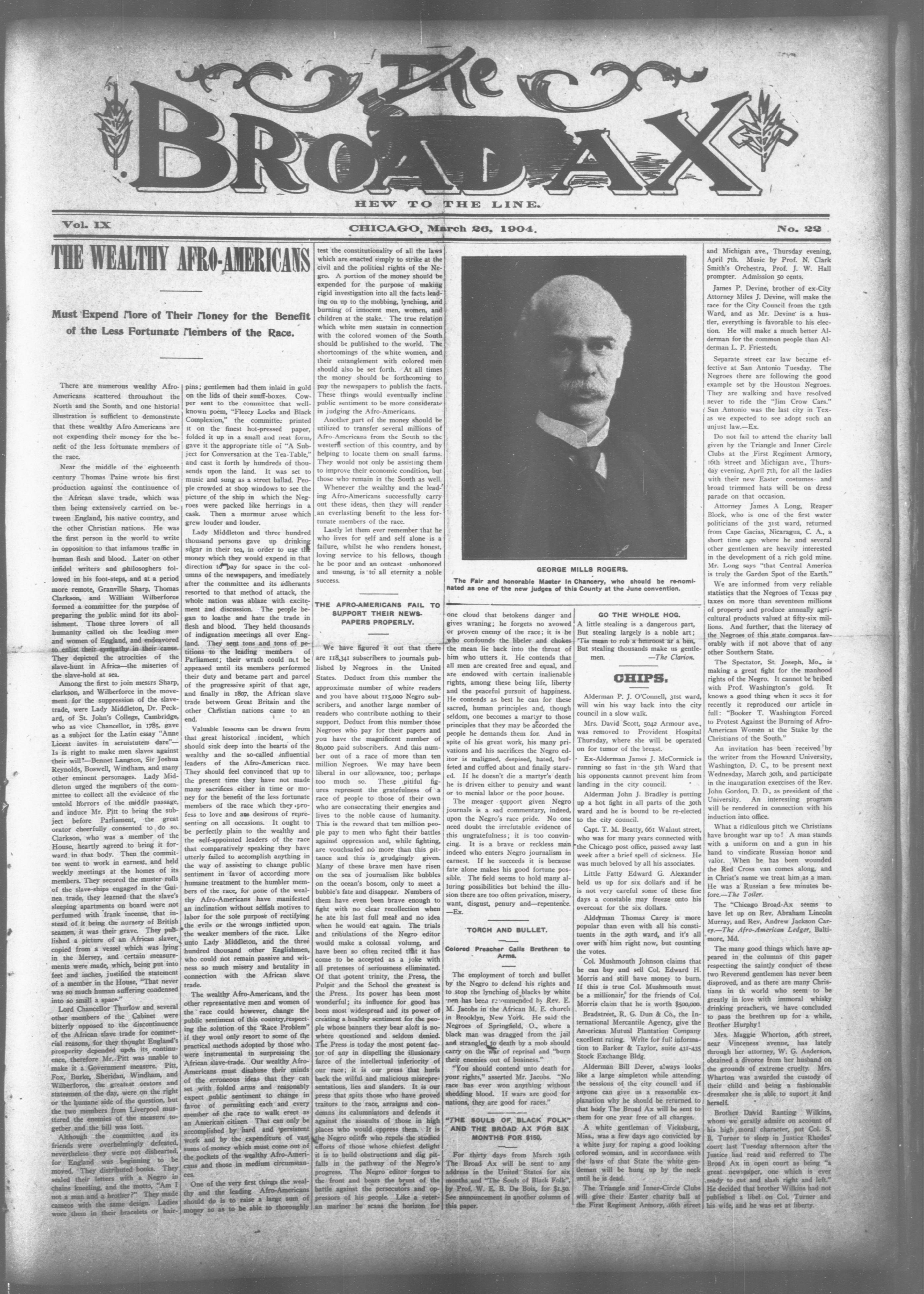
Page text (machine-generated)
THE WEALTHY AFRO-AMERICANS
Must Expend More of Their Money for the Benefit of the Less Fortunate Members of the Race.
There are numerous wealthy AfroAmericans scattered throughout the North and the South, and one historical illustration is sufficient to demonstrate that these wealthy Afro Americans are not expending their money for the benefit of the less fortunate members of the race.
Near the middle of the eighteenth century Thomas Paine wrote his first production against the continuance of the African slave trade, which was then being extensively carried on between England, his native country, and the other Christian nations. He was the first person in the world to write in opposition to that infamous traffic in human flesh and blood. Later on other infidel writers and philosophers followed in his foot-steps, and at a period more remote, Granville Sharp, Thomas Clarkson, and William Wilberforce formed a committee for the purpose of preparing the public mind for its abolishment. Those three lovers of all humanity called on the leading men and women of England, and endeavored to enlist their sympathy in their cause. They depicted the atrocities of the slave-hunt in Africa—the miseries of the slave-hold at sea.
Among the first to join messrs Sharp, clarkson, and Wilberforce in the movement for the suppression of the slave-trade, were Lady Middleton, Dr. Peckard, of St. John's College, Cambridge, who as vice Chancellor, in 1785, gave as a subject for the Latin essay "Anne Liceat invites in seruistutem dare"—Is is right to make men slaves against their will?—Bennet Langton, Sir Joshua Reynolds, Boswell, Windham, and many other eminent personages. Lady Middleton urged the members of the committee to collect all the evidence of the untold horrors of the middle passage, and induce Mr. Pitt to bring the subject before Parliament, the great orator cheerfully consented to do so. Clarkson, who was a member of the House, heartly agreed to bring it forward in that body. Then the committee went to work in earnest, and held weekly meetings at the homes of its members. They secured the muster rolls of the slave-ships engaged in the Guinea trade, they learned that the slave's sleeping apartments on board were not perfumed with frank incense, that instead of it being the nursery of British seamen, it was their grave. They published a picture of an African slaver, copied from a vessel which was lying in the Mersey, and certain measurements were made, which, being put into feet and inches, justified the statement of a member in the House, "That never was so much human suffering condensed into so small a space."
Lord Chancellor Thurlow and several other members of the Cabinet were bitterly opposed to the discontinuance of the African slave trade for commercial reasons, for they thought England's prosperity depended upon its continuance, therefore Mr.Pitt was unable to make it a Government measure. Pitt, Fox, Burke, Sheridan, Windham, and Wilberforce, the greatest orators and statesmen of the day, were on the right or the humane side of the question, but the two members from Liverpool mustered the enemies of the measure together and the bill was lost.
Although the committee and its friends were overhelmingly defeated, nevertheless they were not dishearted, for England was beginning to be moved. They distributed books. They sealed their letters with a Negro in chains kneeling, and the motto, "Am I not a man and a brother?" They made cameos with the same design. Ladies wore them in their bracelets or hair-
pins; gentlemen had them inlaid in gold on the lids of their sunff-boxes. Cowper sent to the committee that well-known poem, "Fleecy Locks and Black Complexion," the committee printed it on the finest hot-pressed paper, folded it up in a small and neat form, gave it the appropriate title of "A Subject for Conversation at the Tea-Table," and cast it forth by hundreds of thousands upon the land. It was set to music and sung as a street ballad. People crowded at shop windows to see the picture of the ship in which the Negroes were packed like herrings in a cask. Then a murmur arose which grew louder and louder.
Lady Middleton and three hundred thousand persons gave up drinking sugar in their tea, in order to use the money which they would expend in that direction to pay for space in the columns of the newspapers, and immediately after the committee and its adherants resorted to that method of attack, the whole nation was ablaze with excitement and discussion. The people began to loathe and hate the trade in flesh and blood. They held thousands of indignation meetings all over England. They sent tons and tons of petitions to the leading members of Parliament; their wrath could not be appeased until its members performed their duty and became part and parcel of the progressive spirit of that age, and finally in 1807, the African slave trade between Great Britain and the other Christian nations came to an end.
Valuable lessons can be drawn from that great historical incident, which should sink deep into the hearts of the wealthy and the so-called influential leaders of the Afro-American race. They should feel convinced that up to the present time they have not made many sacrifices either in time or money for the benefit of the less fortunate members of the race which they profess to love and age desirous of representing on all occasions. It ought to be perfectly plain to the wealthy and the self-appointed leaders of the race that comparatively speaking they have utterly failed to accomplish anything in the way of assisting to change public sentiment in favor of according more humane treatment to the humbler members of the race, for none of the wealthy Afro-Americans have manifested an inclination without selfish motives to labor for the sole purpose of rectifying the evils or the wrongs inflicted upon the weaker members of the race. Like unto Lady Middleton, and the three hundred thousand other Englishmen, who could not remain passive and witness so much misery and brutality in connection with the African slave trade.
The wealthy Afro-Americans, and the other representative men and women of the race could however, change the public sentiment of this country, respecting the solution of the 'Race Problem" if they woul only resort to some of the practical methods adopted by those who were instrumental in surpressing the African slave-trade. Our wealthy Afro-Americans must disabuse their minds of the erroneous ideas that they can set with folded arms and reasonably expect public sentiment to change in favor of permitting each and every member of the race to walk erect as an American citizen. That can only be accomplished by hard and persistent work and by the expenditure of vast sums of money which must come out of the pockets of the wealthy Afro-Americans and those in medium circumstances.
One of the very first things the wealthy and the leading Afro-Americans should do is to raise a large sum of money so as to be able to thoroughly
HEW TO THE LINE.
CHICAGO, March 26. 1904.
test the constitutionality of all the laws which are enacted simply to strike at the civil and the political rights of the Negro. A portion of the money should be expended for the purpose of making rigid investigation into all the facts leading on up to the mobbing, lynching, and burning of innocent men, women, and children at the stake. The true relation which white men sustain in connection with the colored women of the South should be published to the world. The shortcomings of the white women, and their entanglement with colored men should also be set forth. At all times the money should be forthcoming to pay the newspapers to publish the facts. These things would eventually incline public sentiment to be more considerate in judging the Afro-Americans.
Another part of the money should be utilized to transfer several millions of Afro-Americans from the South to the western section of this country, and by helping to locate them on small farms. They would not only be assisting them to improve their economic condition, but those who remain in the South as well. Whenever the wealthy and the leading Afro-Americans successfully carry out these ideas, then they will render an everlasting benefit to the less fortunate members of the race.
Lastly let them ever remember that he who lives for self and self alone is a failure, whilst he who renders honest, loving service to his fellows, though he be poor and an outcast unhonored and unsung, is to all eternity a noble success.
THE AFRO-AMERICANS FAIL TO SUPPORT THEIR NEWS-PAPERS PROPERLY.
We have figured it out that there are 118,341 subscribers to journals published by Negroes in the United States. Deduct from this number the approximate number of white readers and you have about 115,000 Negro subscribers, and another large number of readers who contribute nothing to their support. Deduct from this number those Negroes who pay for their papers and you have the magnificent number of 80,000 paid subscribers. And this number out of a race of more than ten million Negroes. We may have been liberal in our allowance, too; perhaps too much so. These pitiful figures represent the gratefulness of a race of people to those of their own who are consecrating their energies and lives to the noble cause of humanity. This is the reward that ten million people pay to men who fight their battles against oppression and, while fighting, are vouchsafed no more than this pittance and this is grudgingly given. Many of these brave men have risen on the sea of journalism like bubbles on the ocean's bosom, only to meet a bubble's fate and disappear. Numbers of them have even been brave enough to fight with no clear recollection when he ate his last full meal and no idea when he would eat again. The trials and tribulations of the Negro editor would make a colossal volume, and have been so often recited that it has come to be accepted as a joke with all pretenses of seriousness eliminated. Of that potent trinity, the Press, the Pulpit and the School the greatest is the Press. Its power has been most wonderful; its influence for good has been most widespread and its power of creating a healthy sentiment for the people whose banners they bear aloft is nowhere questioned and seldom denied. The Press is today the most potent factor of any in dispelling the illusionary farce of the intellectual inferiority of our race; it is our press that hurls back the wilful and malicious misrepresentations, lies and slanders. It is our press that spits those who have proved traitors to the race, arraigns and condemns its calumniators and defends it against the assaults of those in high places who would oppress them. It is the Negro editor who repels the studied efforts of those whose chiefest delight it is to build obstructions and dig pitfalls in the pathway of the Negro's progress. The Negro editor forges to the front and bears the brunt of the battle against the persecutors and oppressors of his people. Like a veteran mariner he scans the horizon for
GEORGE MILLS ROGERS. The Fair and honorable Master In Chancery, who should be re-nominated as one of the new judges of this County at the June convention.
one cloud that betokens danger and gives wraning; he forgets no avowed or proven enemy of the race; it is he who confounds the libeler and chokes the mean lie back into the throat of him who utters it. He contends that all men are created free and equal, and are endowed with certain inalienable rights, among these being life, liberty and the peaceful pursuit of happiness. He contends as best he can for these sacred, human principles and, though seldom, one becomes a martyr to those principles that they may be accorded the people he demands them for. And in spite of his great work, his many privations and his sacrifices the Negro editor is maligned, despised, hated, buffeted and cuffed about and finally starved. If he doesn't die a martyr's death he is driven either to penury and want or to menial labor or the poor house.
The meager support given Negro journals is a sad commentary, indeed, upon the Negro's race pride. No one need doubt the irrefutable evidence of this ungratefulness; it is too convincing. It is a brave or reckless man indeed who enters Negro journalism in earnest. If he succeeds it is because fate alone makes his good fortune possible. The field seems to hold many alluring possibilities but behind the illusion there are too often privation, misery, want, disgust, penury and—repentence.—Ex.
Colored Preacher Calls Brethren to Arms.
The employment of torch and bullet by the Negro to defend his rights and to stop the lynching of blacks by white men has been recommended by Rev. E. M. Jacobs in the African M. E. church in Brooklyn, New York. He said the Negroes of Springfield, O., where a black man was dragged from the jail and strangled to death by a mob should carry on the war of reprisal and "burn their enemies out of business."
"You should contend unto death for your rights," asserted Mr. Jacobs. "No race has ever won anything without shedding blood. If wars are good for nations, they are good for races."
"THE SOULS OF, BLACK FOLK AND THE BROAD AX FOR SIX MONTHS FOR $150.
For thirty days from March 19th The Broad Ax will be sent to any address in the United States for six months and "The Souls of Black Folk", by Prof. W. E. B. Du Bois, for $1.50. See announcement in another column of this paper.
TORCH AND BULLET.
GO THE WHOLE HOG.
A little stealing is a dangerous part,
But stealing largely is a noble art;
'Tis mean to rob a henroost ar a hen,
But stealing thousands make us gentle
men. —The Clarion.
Alderman P. J. O'Connell, 31st ward, will win his way back into the city council in a slow walk.
Mrs. David Scott, 5042 Armour ave., was removed to Provident Hospital Thursday, where she will be operated on for tumor of the breast.
Ex-Alderman James J. McCormick is running so fast in the 5th Ward that his opponents cannot prevent him from landing in the city council.
Alderman John J. Bradley is putting up a hot fight in all parts of the 30th ward and he is bound to be re-elected to the city council.
Capt. T. M. Beatty, 661 Walnut street, who was for many years connected with the Chicago post office, passed away last week after a brief spell of sickness. He was much beloved by all his associates.
Little Fatty Edward G. Alexander held us up for six dollars and if he is not very careful some of these fine days a constable may freeze onto his overcoat for the six dollars.
Alderman Thomas Carey is more popular than even with all his constituents in the 29th ward, and it's all over with him right now, but counting the votes.
Col. Mushmouth Johnson claims that he can buy and sell Col. Edward H. Morris and still have money to burn. If this is true Col. Mushmouth must be a millionair, for the friends of Col. Morris claim that he is worth $500,000. Bradstreet, R. G. Dun & Co., the International Mercantile Agency, give the American Mutual Plantation Company excellent rating. Write for full information to Barker & Taylor, suite 431-435 Stock Exchange Bldg.
Alderman Bill Dever, always looks like a large simpleton while attending the sessions of the city council and if anyone can give us a reasonable explanation why he should be returned to that body The Broad Ax will be sent to them for one year free of all charges. A white gentleman of Vicksburg, Miss., was a few days ago convicted by a white jury for raping a good looking colored woman, and in accordance with the laws of that State the white gentleman will be hung up by the neck until he is dead.
The Triangle and Inner-Circle Clubs will give their Easter charity ball at the First Regiment Armory, 16th street
CHIPS.
No. 22
and Michigan ave., Thursday evening, April 7th. Music by Prof. N. Clark Smith's Orchestra, Prof. J. W. Hall prompter. Admission 50 cents. James P. Devine, brother of ex-City Attorney Miles J. Devine, will make the race for the City Council from the 13th Ward, and as Mr. Devine is a hustler, everything is favorable to his election. He will make a much better Alderman for the common people than Alderman L. P. Friestedt.
Separate street car law became effective at San Antonio Tuesday. The Negroes there are following the good example set by the Houston Negroes. They are walking and have resolved never to ride the "Jim Crow Cars." San Antonio was the last city in Texas we expected to see adopt such an unjust law.—Ex.
Do not fail to attend the charity ball given by the Triangle and Inner Circle Clubs at the First Regiment Armory, 16th street and Michigan ave., Thursday evening, April 7th, for all the ladies with their new Easter costumes and broad trimmed hats will be on dress parade on that occasion.
Attorney James A Long, Reaper Block, who is one of the first water politicians of the 31st ward, returned from Cape Gacias, Nicaragua, C. A., a short time ago where he and several other gentlemen are heavily interested in the development of a rich gold mine. Mr. Long says "that Central America is truly the Garden Spot of the Earth."
We are informed from very reliable statistics that the Negroes of Texas pay taxes on more than seventeen millions of property and produce annually agricultural products valued at fifty-six millions. And further, that the literacy of the Negroes of this state compares favorably with if not above that of any other Southern State.
The Spectator, St. Joseph, Mo., is making a great fight for the manhood rights of the Negro. It cannot be bribed with Prof. Washington's gold. It knows a good thing when it sees it for recently it reproduced our article in full: "Booker T. Washington Forced to Protest Against the Burning of Afro-American Women at the Stake by the Christians of the South."
An invitation has been received by the writer from the Howard University, Washington, D. C., to be present next Wednesday, March 30th, and participate in the inaugaration exercises of the Rev. John Gordon, D. D., as president of the University. An interesting program will be rendered in connection with his induction into office.
What a ridiculous pitch we Christians have brought war up to! A man stands with a uniform on and a gun in his hand to vindicate Russian honor and valor. When he has been wounded the Red Cross van comes along, and in Christ's name we treat him as a man. He was a Russian a few minutes before.—The Toiler.
The "Chicago Broad-Ax seems to have let up on Rev. Abraham Lincoln Murray, and Rev, Andrew Jackson Carey.—The Afro-American Ledger, Baltimore. Md.
The many good things which have appeared in the columns of this paper respecting the saintly conduct of these two Reverend gentlemen has never been disproved, and as there are many Christians in th world who seem to be greatly in love with immoral whisky drinking preachers, we have concluded to pass the brethren up for a while, Brother Hurphy!
Mrs. Maggie Whorton, 46th street, near Vinceness avenue, has lately through her attorney, W. G. Anderson, obtained a divorce from her husband on the grounds of extreme cruelty. Mrs. Wharton was awarded the custody of their child and being a fashionable dresmaker she is able to support it and herself.
Brother David Ranting Wilkins, whom we geratly admire on account of his high moral character, put Col. S. B. Turner to sleep in Justice Rhodes' court last Tuesday afternoon after the Justice had read and referred to The Broad Ax in open court as being "a great newspaper, one which is ever ready to cut and slash right and left." He decided that brother Wilkins had not published a libel on Col. Turner and his wife, and he was set at liberty.
THE BROAD AX.
Will promulgate and at all times uphold the true principles of Democracy, but Catholism, Protestants, Priests, Inside, Farmers, Stagie Taurois, Republicans, Knights of Labor, or any one else can have their say, so long as their language is proper and responsibility is fixed.
The Broad Ax is a newspaper whose platform is broad enough for all, ever claiming the editorial right to speak its own mind.
Local communications will receive attention. Write only on one side of the paper.
Subscriptions must be paid in advance.
One Year..... $2.00
Six Months..... 1.00
Advertising rates made known on application.
Address all communications to
THE BROAD AX
JULIUS F. TAYLOR, Editor and Publisher.
Entered at the Post Office at Chicago Ill., as Second-class Matter.
Another Libel on the Sex.
"Laura," said Mr. Ferguson, "do you suppose your mother would like to go with us to the concert to-morrow night?"
"I am sure she would."
"You might call her up by telephone and ask her. . . . Now, Ruggles," he said to the friend that had called in, "we'll have a smoke. It takes two women half an hour to finish a talk over a telephone."—Chicago Tribune.
At the War Game
"The hostile colonel was two hours late in marching!"
"Yes, but considering the jag he had last night that's not to be wondered at!"
"He's likely to find himself cashiered for it."
"Nonsense! With his influential relatives the army board will consider the delay a well-planned tactical makeover!"—Simplicissimus.
Cause and Effect.
"John," said Mrs. Goodwin, "we will have to get rid of that parrot."
"Because why?" queried her husband.
"Because his language is getting to be simply awful," she replied.
"Well, it's your own fault, my dear," said John. "I told you not to hang his cage where he could hear the remarks the neighbors made about him."
—Cincinnati Enguirer.
A Way Out.
Wife—Darling, we dined at the Squatson's just one week ago to night. Do you realize that we must make our dinner call?
Husband — Suppose we don't. Wouldn't they like it?
Wife—Why, they never would forgive us—I'm sure they would never ask us again.
Husband—Good! Then we won't go.—Brooklyn Life.
The Usual Way.
"Time is precious," said the moralizer.
"It is," rejoined the demoralizer, "and I've wasted lots of it."
"By indulging in foolish pleasures, eh?" queried the party of the preface.
"No," replied the other, "by being punctual in keeping my appointments with others."—Cincinnati Enguirer.
Ought to Be.
"That pass is no good," said the conductor, handing it back. "It's ten years old." "Well, it ought to be good," grumbled the passenger, paying his fare with great reluctance. "Your old road is ten years behind the times."—Chicago Tribune.
Slipped the Hook
Mamma—Even if he was wealthy you should not worry so. You know there are "just as good fish in the sea as ever were caught." Daugher—Yes, mamma; but you know goldfish are not caught in the sea—Chicago Daily News.
True Deviation:
"What sized letter do you want me to use for the inscription?" asked the marble cutter.
"Oh, use the largest possible," replied the widow. "Poor John was awfully nearsighted."—Cincinnati Enquirer.
After the Honeymoon.
She—You are like an old rooster. You crow over everything you do. You never hear me crow.
He—No, dear; you only cackle.—Yonkers Statesman.
Future Ability.
"We've got a fine new 'talking machine up at our house."
"That so? Run by a spring?"
"No, by air. It's a girl baby."—Cincinnati Times-Star.
Merely a Coincidence.
The candidate's a jolly elf,
He vows he has no thought of self,
Yet when for place he makes his quest
He picks the one that pays the best.
—Washington Star.
Bulldog Scared Away Guests
A writer tells how a bulldog scared away the guests bidden to a lady's reception. The hostess was waiting in her parlor. She heard carriages arrive, heard the front gate open, but no guests appeared. "The situation became puzzling. At last the lady, of the house went out to see if perchance the paving and the steps had suddenly crumbled away and left an aching void. Not at all. On opening the front door she found herself confronted with the cause of the phantom visitors—Rex, in his most amiable and complacent mood, sitting, peaceful and majestic, on the top step, whither he had dragged his kennel, a featherweight to so powerful a creature, after him. No pedestrian visitor, no cardladen delegate of 'carriage folk,' had ventured to affront that lordly presence."
A bell with a remarkable history is to be presented to the state of Illinois by St. Joseph's church, a congregation of Tazewell county. The bell will be a fitting companion in point of historical interest to the famous wooden leg of Gen. Santa Ana, captured during the Mexican war, and which now is the object of such curious interest in company with other relics, In Memorial hall, Springfield.
The prospective companion to the leg is a bell cast in Valladollid, Spain, and captured a few days before the leg and by the same Illinois soldiers. They packed the bell in a hogshead of straw and directed it to Pekin, where it arrived several months later. At that time Pekin had no railroads and its traffic with the outside world was by steamboat. The bell fell into the hands of the captain of the Prairie State. He needed a bell and mounted it upon his boat, where it sounded for several years. Then one day the Prairie State got into a race with another river steamer and blew up near the Pekin landing. A dozen people were killed and the bell blown off into the river. It rested there a couple of years until it was found by youngsters in swimming.
The next heard of the bell it was over a little frame Methodist church. After the lapse of several years the congregation built a new and larger church and the bell was sold to the St. Joseph's parish, which was erecting its first church. Now the latter parish is erecting a fine new church and the bell will go to the state.
LETTER FROM JEFFERSON.
Oklahoma Indians Have Treasured Document Written by President of the United States.
An autograph letter from Thomas Jefferson, written 100 years ago to the Indians of the Louisiana purchase, has recently been unearthed from the archives of the Sac and Fox Indians in Oklahoma, says the Chicago Inter Ocean. The Indians in whose possession the document as been for a century have not known its value, but intuitively they have carefully kept the letter during all their migrations.
The letter, which is quite long, reveals Mr. Jefferson's astuteness in dealing with the Indians. At his invitation several powerful chiefs journeyed from west of the Mississippi river to Washington and were entertained at the nation's capitol. When they started on their journey home they carried the president's letter. In the letter Mr. Jefferson called attention to the long journey they had made through the white man's territory and to how the white men had improved the land during the short while they had been in possession of it. The letter tactfully showed to the Indians how hopeless would be a contest against the whites. Jefferson in the letter called the Indians his children and advised against tribal wars.
THE JAPANESE CURRENCY
Their Yen Corresponds to Our Dollar The Kotzu Is Tiny Fraction of a Mill.
When the public reads that 100,000,-000 yen have provisionally been set apart by Japan for war purposes it may perhaps put an exaggerated estimate on that amount, says the London Chronicle. Although Japan has a gold standard, the yen is a silver currency, and fluctuates with the price of silver, so that at the moment 100,000,000 of them means scarcely more than $50,-000,000. But even this is an immense amount in a country in which the wages of a skillful artisan are often not more than three yen a week. The Japanese currency system is decimal<sup>1</sup>. Thus the yen, or dollar, is divided into 100 sen or cents, the sen into ten rin, the rin into ten mo, the mo into ten shu, and the shu, finally, into ten kotsu. Government accounts do not take account of any value smaller than a rin, but estimates by private tradesmen often descend to mo and shu, which are incredibly minute fractions of a farthing. No coin exists, however, to represent these lilliputian sums.
Great Object Lesson
As a conqueror of obstacles the railway is a great object lesson, says FourTrack News. The youth of the country should learn from the railway the lesson of enterprise and pluck. If, in its prescribed course, a railway encounters a deep ravine it bridges it; it spans seemingly impassable barriers with a trestle or a bridge and goes on its way. If it finds a mountain in its path it does not say: "I can never get over this!" It bores a tunnel through it and comes out on the other side. If it finds cases where trestles and tunnels do not serve its purpose it executes a loop, or inaugurates a cog road, by which it climbs the heights as if to defy every obstacle. If, in our everyday course, we surmount all obstacles with as great a determination as the railroad leaps across canyons, or bores through mountains, the word success would be more in evidence, and the word failure, that is now so overworked, would have a much needed rest.
Port Arthur was named by the English, fortified by the French for the Chinese, captured by the Japanese, "leased" to the Russians, and is preparing again to hang a sign that "This Place Has Changed Hands."
The 25 largest London theaters seat 28,000 people and earn $30,000 a night.
Extraordinary Announcement.
In order to add several thousand new names to our subscription list within the next thirty days The Broad Ax will be sent to any address in the United States each week for six months and "The Souls of Black Folk" by Prof. William E. Burghardt DuBois, for $1.50.
"The Souls of Black Folk" consists of two hundred and sixty-five pages printed on fine Aberdeen book paper in large type and it now sells for $1.50. It is a book that should be read and studied by every person, white or black, who are interested in the settlement of the "Race Problem" in America.
The regular subscription price of The Broad Ax for six months is $1.00, so you are getting "The Souls of Black Folk" at the publishers price and The Broad Ax thrown in free for six months.
The articles which appear in The Broad Ax from time to time on the "Race Problem" cannot be surpassed. It stands at all times for purity in the home, and the highest ideals in human society. It is uncompromisingly opposed to notoriously immoral preachers robbing the people out of their hard earned money which they should expend to improve their moral and social condition.
The old subscribers of The Broad Ax can take advantage of this offer by paying up their back indebtedness and paying $1.50 in advance, which will entitle them to the paper for six months and "The Souls of Black Folk."
Remember this offer only lasts for thirty days. The cash must accompany each and every order. The money can be sent by United States Postal Orders, Registered letters or Express money orders.
No commissions allowed to agents on this proposition.
Address all orders to
JULIUS F. TAYLOR,
5040 ARMOUR AVE.,
Five Room Cottage For Sale. A nice five room cottage on Shields avenue, for sale at a bargain. Will sell to colored people. Lake Real Estate Company, 1122 W. 51st street. Tel. Yards 184. Ask for Mr. Stautz.
MRS. A. WILSON.
Nicely furnished rooms to rent for gentlemen. Reasonable rates, 2252 Indiana aveune.
Mrs. Anna L. Newby.
First class furnished rooms, for rent to gentleman and ladies, with bath and gas. 2628 Wabash avenue.
Mrs. J. J. Manley.
Funeral designs of every description, latest and most stylish decorations, for churches and weddings. Palms to rent for all social functions, 3119 State St., Chicago.
JAPANESE PROVERBS
Good wine brings out the truth.
The error of a minute, the sorrow of a lifetime.
It is easier to find 1,000 recruits than one general.
After having tasted bitterness one becomes a man.
It is more difficult to keep a fortune than to make one.
The life of an old man is like a lighted candle in a draft.
The capital and the fireside have each their own attractions.
Before we can sympathize with others we must have suffered ourselves. Do not be slaves to your children. They will have their happiness later. The wise man shapes himself according to circumstances, as water takes the shape of the vessel into which it is poured.
Old Days of Low Prices for Food and Raiment Are Passing Away Economic Conditions.
During a recent tour in Asia of nearly 16 months (from February, 1901, to June, 1902), in which I visited Japan, Coreas China, the Philippines, Cochin China, Siam and Laos, the Straits Settlements, Burmah, India, Syria and Palestine, says Arthur Judson Brown, in the Century. I found everywhere a deep interest in the changing economic conditions. The common people in Asia care little for politics, but the price of food and raiment touches every man, woman and child at a sensitive point.
Almost everywhere the old days of cheap living are passing away. Steamers, railways, telegraphs, newspapers, labor saving machinery, and the introduction of western ideas are slowly but surely revolutionizing the orient. Shantung wheat, which formerly had no market beyond a radius of a few dozen miles from the wheat field, can now be shipped by railway and steamship to any part of the world, and in consequence every Chinese buyer has to pay more for it. In like manner new facilities, for export have doubled, trebled and in some places quadrupled the price of rice in China, Siam and Japan.
```markdown
```
Florist.
Established 1877. Phone Oakland 1550-1551
John J. Dunn
Wholesale and Retail Dealer in...
COAL &
WOOD
Fifty-First St. and Armour Ave.
RAIL YARDS: { 51st St. & L. S. & M. S. Ry.
52nd St. and Armour Ave.
CHICAGO
A REAL CHANCE ENTERPRISING CANVASSERS The demand for Professor W. E. B. DuBois' great book
The Souls of Black Folk
has been so remarkable, especially among those who do not buy many books, that we have just issued a
This powerful study of the Negro Question stands ahead of all others. Every one who has the future of the colored race at heart will want to buy it and read it. Is one of the easiest books to interest people in that has ever been published, and we are anxious to secure live, intelligent canvassers everywhere. Send to us for information, terms, etc.
A. C. McCLURG & CO., Publishers 215-221 Wabash Avenue, Chicago. WONDERFUL DISCOVERY Curly Hair Made Straight By
TAKEN FROM LIFE:
BEFORE AND AFTER TREATMENT.
ORIGINAL
OZONIZED OX MARROW
(Copyrighted.)
This wonderful hair pomade is the only safe preparation in the world that makes kinky or curly hair straight as shown above. It nourishes the scalp, prevents the hair from falling out or breaking off, curses dandruff and makes the hair grow long and silky. Sold over forty years and used by thousands. Warranted harmless. It was the first preparation ever for neighboring kinky hair. Beware of imitation. Ox Marrow is the genuine hair Ozonized keep the hair straight, soft and beautiful, giving it that healthy, life-like appearance so much desired. A toilet necessity for ladies, gentlemen and children. Elegantly perfumed. Owing to its superior and lasting qualities it is the best and most economical. It is not possible for anybody to produce a preparatory coat. Full directions with every bottle. Only 50¢. Sold by druggists and dealers or send us 50¢. One bottle to the $1.40 for three bottles. We will express charges. Send postal or express money order. Please mention name of this paper when ordering. Write your name and address plainly to us.
OZONIZED OX MARROW CO.,
76 Wabash Ave., Chicago, Illinois.
CHICAGO.
Are You Saving
For a "Ra
For a "Rainy Day?
For a "Rainy Day?"
The rainy day that is sure to come.
There is a time coming when you can have come upon you and your earning power paring for that time?
You, perhaps, have children growing forward to sending them to college. You preparation for life's work than you had. tion will be impossible for you, if you hav tion for it.
WILL YOUR FUTURE NOT BE RECEIVE WITHOUT WORK, AN INC YOUR NEEDS?
time coming when you cannot work, when old age will
in you and your earning power will cease. Are you p
er time?
aps, have children growing up and you may be looke
ding them to college. You wish to give them a bet
er life's work than you had. The expense of that edu
possible for you, if you have not made special prepa
OUR FUTURE NOT BE HAPPIER IF YOU CAN
WITHOUT WORK, AN INCOME SUFFICIENT FOR
S?
There is a time coming when you cannot work, when old age will have come upon you and your earning power will cease. Are you preparing for that time?
You, perhaps, have children growing up and you may be looking forward to sending them to college. You wish to give them a better preparation for life's work than you had. The expense of that education will be impossible for you, if you have not made special preparation for it.
WILL YOUR FUTURE NOT BE HAPPIER IF YOU CAN RECEIVE WITHOUT WORK, AN INCOME SUFFICIENT FOR YOUR NEEDS?
You answer, "I want that income."
Now then, note this well. ANY THE VIDE FOR AN INCOME OF NOT LEVELS A MONTH BY AN INVESTMENT AMERICAN MUTUAL PLANTATION Are you interested in knowing how to the Editor of this paper, or to Rev. J. W. R.
note this well. ANY THRIFTY MAN CAN PREPARE AN INCOME OF NOT LESS THAN FORTY DOLLARS MONTH BY AN INVESTMENT IN BONDS OF THE MUTUAL PLANTATION COMPANY. Interested in knowing how this can be done? Write this paper, or to Rev. J. W. Robinson,
Now then, note this well. ANY THRIFTY MAN CAN PROVIDE FOR AN INCOME OF NOT LESS THAN FORTY DOLLARS A MONTH BY AN INVESTMENT IN BONDS OF THE AMERICAN MUTUAL PLANTATION COMPANY.
Are you interested in knowing how this can be done? Write to the Editor of this paper, or to Rev. J. W. Robinson,
4752 Armour Ave.
or to BARKER & TAYLOR,
Suite 431, 5 Stock Exchange Bldg., Chicago.
- American Br
President and Treasurer, THOMAS
Vice-President, JOHN S
Secretary, W11
American Brick Co.
and Treasurer, THOMAS CAREY.
Vice-President, JOHN SHELHAMER,
Secretary, WILLIAM SULLIVAN.
President and Treasurer, THOMAS CAREY. Vice-President, JOHN SHELHAMER, Secretary, WILLIAM SULLIVAN. MANUFACTURERS OF
Common and Sev
Office and Yards
45th and Ro
Yards running winter and sun
with the latest improved Wol
output of Winter Yards
output of Summer Yards.
Telephone Yards
and Sewer Brick
Office and Yards:
and Robey St
ards running winter and summer, equipped
in the latest improved Wolf Dryer.
Yards ..... 140,0.0 per
er Yards..... 300,0.0 per
phone Yards 128.
Common and Sewer Brick Office and Yards:
45th and Robey Sts.
Yards running winter and summer, equipped with the latest improved Wolf Dryer.
Output of Winter Yards ..... 140,0.0 per day
Output of Summer Yards..... 300,0.0 per day
Telephone Yards 128.
WEST SIDE BREWER COMPANY
WEST SIDE BREWERY COMPANY,
CHICAGO, U. S. A.
CORNER AUGUSTA AND PAUL
Monroe 1567—TELEPHONE
HER AUGUSTA AND PAULINA STREETS.
187—TELEPHONES—Monroe 1573.
CORNER AUGUSTA AND PAULINA STREETS.
Monroe 1567—T E L E P H O N E S—Monroe 1573.
---
Old Underoof Rye
If your physician recommend a stimulant, there is no wi so many desirable qualities a in Old Underoof Rye and i reactive effect. Because it and is aged right.
CHAS. DENNEH
CHICACO
physician recommends the use of plant, there is no whisky in which desirable qualities are contained as Inderooof Rye and it has the least effect. Because it is made right red right.
AS. DENNEHY & CO.
CHICACO
If your physician recommends the use of a stimulant, there is no whisky in which so many desirable qualities are contained as in Old Underoof Rye and it has the least reactive effect. Because it is made right and is aged right.
CHAS. DENNEHY & CO.
CHICACO
JOHN A ORB,
President.
WILLIAM LEGNER,
Vice Pres. & Treas.
WASHINGTON LETTER
SOME TIMELY GOSSIP FROM THE NATIONAL CAPITOL
A TROUBLESOME HEADLINE
It Headed a Report of the Post Office Department and Caused Com-motion in the House— Other Items. Washington.—Members of the house of representatives have been greatly
have been greatly excited by the action of the house post office committee in publishing Fourth Assistant Postmaster General Bristow's response to the committee's demand for information in regard to increases of allowances for clerk hire and for post office rentals granted on the request of members of congress.
Hon. Joseph L. Bris
tow.
The excitement is an indication of the sensitiveness of statesmen at the capitol just now to any development which might seem to connect them, even remotely, with the irregularities in the post office department. It is due largely to the officiousness of somebody in the government printing office who for the lack of any other headline manufactured for the document the title "Charges Concerning Members of Congress," when, in fact, there were no charges whatever and the document consisted simply of a compilation of routine letters, such as any congressman is writing daily to department officials, on all sorts of matters affecting his district.
In the entire list of congressmen whose names were published there is not one who is properly open to criticism for anything that he did, for there is no intimation that any one of them profited directly or indirectly through the advances they secured in the allowances for post offices in their districts. In almost all the cases the sums involved were small, amounting in only two or three instances to more than $100 a year, and in almost every instance all that the congressmen did was to forward with his indorsement the local postmaster's request for an advance.
Congressman Overstreet
Mr. Overstreet, the chairman of the post office committee in the house, is
a man about whom a great deal will be heard before the close of the year. He was made chairman of the committee by Speaker Cannon because the speaker knew him to be able and honest and because a man was needed in that position who could be depended upon to handle post office affairs
Make Pledges to Themselves.
in a clean and intelligent manner. It was all the greater compliment because he had never been connected with the committee before and had no special familiarity with postal affairs He has made a record already for efficiency which gives him a rank among the real leaders of the house. Overstreet is still a young man, only a little over 40, but he is serving his fifth term in congress and he is likely to serve a good many more before he gets through with politics.
In several recent campaigns he has acted as secretary of the republican congressional committee, so that he knows the political end pretty well and understands how to get along with the level-headed statesmen whom he runs up against in the course of his legislative activities. He comes from Indiana, which is a hotbed of politics where some kind of political fighting is going on from one year's end to another. Babcock, of Wisconsin, has been chairman of the congressional committee for the last ten years. He and Overstreet make an efficient pair. At the beginning of every campaign they have got together, solemnly shaken hands and pledged themselves not to have anything more to do with the congressional committee. Then the party leaders come at them and they go back on their promises to each other, take off their coats and settle down to work as usual. This year they got together in the same old way and, after talking the matter over, decided that they would not make any rash pledges about the future.
For the last two or three weeks the senate committee on privileges and elections has had a pretty good opportunity to size up the leaders of the Mormon church, from Smith, the chief revelator, down the list. Of all the men who have appeared before the committee the Prophet Smith is by far the most interesting partly by reason of his off-
A. B.
head of the Mormon church and partly on account of the delightful frankness with which he confessed to the attitude of the church leaders on the question of plural marriages.
Smith does not look like either a prophet or a preacher; he does not even have the appearance of a hard-headed business man which a Mormon leader is very apt to be; in his face and bearing he is more on the order of a pedagogue who has been accustomed to give instruction on elementary subjects without having his statements called in question by anybody. While he was seated at the head of the committee table, replying to the questions showered on him by the investigating senators, one might have imagined that he was an old-fashioned college professor delivering a lecture on the rudiments of the Mormon religion and looking down from a superior height upon the ignorance of the pupils who were unfortunate enough not to understand clearly all the intricacies of the subject of which he was an easy master.
The question of the eligibility of Reed Smoot to a seat in the senate has become so complicated with religion, politics and morals that the committee on privileges and elections are going to have a hard time in coming to a conclusion and the senate may have an equally hard time in acting upon the committee's report. The far western senators, both republican and democrat, are very much stirred up about the business. They say that if Smoot is permitted to retain his seat it will not be many years before every one of the Rocky mountain states will be represented there by a Mormon, so great is the spread of Mormonism through all that part of the country.
New Seat for Beveridge
Senator Beveridge, of Indiana, will occupy a seat in the senate which was
left vacant by the death of Mark Hanna. That will bring him for the first time since he came to Washington over on the republican side of the chamber where he belongs. Ever since Beveridge has been in the senate he has had a place away over on the outer edge of the democratic side. For a
```markdown
```
time he had as his companions there, Foraker and Depew, and he leaves among the democrats a number of republican unfortunates.
The howling for desirable seats in the senate is about as lively as anything that happens in that staid and dignified body. It is always a case of first come first served. Favoritism or influence count for nothing. Whenever a senator is approaching the end of his term and there is any question whatever about his reelection some one of his associates who happens to be less fortunately placed in the chamber is sure to file an application with the sergeant at arms for the seat which may be left vacant. The first man who gets his application in gets the seat. There is never any other outcome.
Instances have been known where senators have filed applications on the seats of venerable or invalid associates whose days on earth were supposed to be numbered. That sort of thing is not apt to make a man popular at the time but nothing succeeds like success and after a little while a break of this kind is pretty sure to be forgotten.
"King Row" in the Senate. The second row from the front on the republican side of the senate is known as the "king row." Here have been established time out of mind the men who have generally controlled the destinies of legislation, and it is to this row that every young senator aspires.
BING TOWNS
Adjoining the middle aisle in the "king row" sits Senator Spooner, of Wisconsin. That is the seat which
Dreams of a Seat in King Row.
was once occupied by Dawes and Conkling and Sumner. It is the most desirable seat in the senate. Next in order are Allison, of Iowa; Proctor, of Vermont; Hale, of Maine; Hoar and Lodge, of Massachusetts, and Burrows, of Michigan. Gorman, of Maryland, occupies the conspicuous seat in the king row on the democratic side. Aldrich, who is usually regarded as the floor manager for the republicans, has never chosen a seat in the king row, but has a place just behind, and Hanna's place adjoined that of Aldrich. Frye, of Maine, and Platt, of Connecticut, are in the very front row, although Frye's place is usually occupied now by John Kean, of New Jersey, while the Maine senator presides over the senate.
So long as the republicans have so pronounced a majority in the senate it will be the fortune of some of them to be isolated in the corner of the democratic section of the chamber. Just now there are enough republicans over there to form quite a respectable group—Dryden and Kean, of New Jersey; Long, of Kansas; Ball and Allen, of Delaware, and Dick, of Ohio.
The section corresponds to what is known in the house as the "Cherokee strip," where in past congresses some of the leading republicans have been forced to choose seats-Hitt, of Illinois, and Hepburn among the others. The Cherokee strip received its name away back in the Fifty-second congress, when the democrats had so big a majority that many of them had to go over on the republican side. That was when the Cherokee strip in Oklahoma was being opened to settlement.
PALACE CARS FOR HORSES
Animals Traveling by Rail Have Fin
Accommodations - Double Deck
American railroads have almost as many different kinds of cars for carrying animals as they have cars for passengers. One kind of car that is used for shipping horses is known technically as a palace horse car, and, excepting for fine woodwork and brasswork, it is a palace car, giving horses fine accommodations. Each horse has his own stateroom, so to speak, for the car is fitted with independent stalls. Each stall has manger and water trough, overhead are racks for holding extra feed.
Sheep and hogs are often carried in cars with two stories. These are known as double-deckers, and the animals are shipped in both stories. They have room to lie down in and water is supplied to them from pipes. Horses and cattle are sidetracked at intervals if the cars are making a long run, and the beasts are led out and allowed to run around for exercise. Then they are driven back to their cars and resume their journey.
Sheep are often unloaded within a few miles of their destination and turned loose to rest and feed until they are in good flesh. This is not done merely from motives of humanity. It has been found that the sheep are so much improved by it that they bring higher prices when they reach the market.
GEMS IN UNITED STATES.
One Regard in Which Our Natural Resources Are Deficient—Fine Stones Scarce.
"It is a little strange," said Irving L. Russell to a Washington Post reporter, "that the United States, so far ahead in national resources of every other part of the globe in all essential things, should be so deficient as a producer of precious stones. I am of the opinion that there will be a big discovery some day of the most valued gems, probably in some out of the way corner of the land.
"I do not mean to intimate that we are exactly destitute of fine stones, but that those found are mostly of inferior quality as compared with the output of the old mines. In North Carolina a good many emeralds and rubies and sapphires are to be had, but they are of not sufficient value to warrant cutting. Some very fine pearls have been taken out of the shells picked up in the streams of Arkansas, and at one time the search for them down there amounted to a craze. Pearls, by the way, have gone up in price from 200 to 300 per cent. in recent years.
"A great many semi-precious stones are mined in California, the turquoise found out there being especially beautiful, but lacking in hardness. Tourmalines also come from California in abundance."
PROSPERITY'S BAROMETER
Salesman Says the Common Paper Bag the Grocers Use Is Reliable Trade Index.
"The paper bag, the kind the grocers use, you know, is the best barometer for registering the rise and fall of general prosperity," said the city salesman the other morning. "I have been selling paper bags for 26 years, and can refer to my old order books and tell you just about how much money there was in general circulation at any time since I have been tooting that old paper case about the city.
"In 26 years I have closely watched the sales, and I want to say that I am selling bigger bags to grocers now than ever before. Along about 1894, and for three or four years afterward one pound and two-pound bags were the most used. I now sell ten times as many eight pound bags as I did even six or seven years ago.
"You see, it stands to reason that when people have little money they will buy their groceries in small amounts. When there is plenty of money people buy more at a time. Of course, when the larger paper bags are sold it means that I won't sell so many of them, for people don't trot to the groceries so often."
Convict's Discovery
Several months ago a man named Kurzpeski, having committed a serious offense, was sentenced to a long term of imprisonment in Germany, and since then the public heard nothing about him until the other day, when the news spread that he had discovered a cure for consumption which he claimed was infallible. In a letter to the minister of the interior, Kurzpeski gave a glowing account of the new remedy, stating that it had worked wonders on himself and others who are imprisoned with him at Luneburg, and requested to be set at liberty for a time in order that he might continue his investigations in a properly equipped laboratory. With this request the minister has not yet seen fit to comply, but he has thought the matter of such importance that he has instructed a committee of scientists to go to Luneburg and make a thorough test of the alleged remedy.
Lighthouse in a Desert
There is at least one lighthouse in the world that is hot placed on any mariner's chart. It is away out on the Arizona desert and marks the spot where a well supplies pure, fresh water to travelers. It is the only place where water may be had for 45 miles to the eastward and for at least 30 miles in any other direction. The "house" consists of a tall cottonwood pole, to the top of which a lantern is holsted every night. The light can be seen for miles across the plain in every direction.
He Found Fault.
"He criticised me for almost nothing!" moaned the wife.
The friends sought to comfort her, but she was not to be soothed. Between her sobs she told how her husband had expressed very unfavorable opinions of her new ball gown.
"But you said he criticised you for almost nothing," argued the sympathizers.
"So he did." Here she gave way to a fresh outburst of sobs. "He—he said I was wearing it."—Judge.
Must Have Been Detained.
"I don't suppose you ever remained in one place for a week!" said the exasperated lady to the girl who was leaving.
"Indeed, I was in my last place four months," replied the girl.
"What hospital were you in, pray!"—Yonkers Statesman.
The Red Flag.
"Now, boys," said the teacher, "can you tell me what it is that follows the flag."
"I can," said one of the bright ones.
"Well, Tommy, what is it follows the flag?"
"An auction, ma'am." — Yonkers Statesman.
Too True.
Yes, "asters by the brookside Make asters in the brook."
But cook books in the kitchen Don't always make a cook.
—N. O. Times-Democrat.
CAN'T AFFORD IT.
A
Cook—I wonder what would happen if tradesmen allers told the truth?
Housemaid—Why, there soon wouldn't be no tradesmen, of course.—Ally Sloper.
Made Some Reservation.
A man who bought stock in a co.
Inquired if its value would jo.
They told him it could,
· And it probably would,
Provided the price didn't slo.
—Life.
She Knew Him.
"We've got to economize," he said.
"Do you mean that literally?" she asked.
"Of course," he replied.
"Well, I'm glad of that," she said, "for you usually mean that I've got to economize when you say 'we.'"—Chicago Post.
Defined.
"Dad," said little Reginald, "what is a bucket shop?"
"A bucket shop, my son," said the father, feelingly, "a bucket shop is a modern cooperage establishment to which a man takes a barrel and brings back the bung-hole."—Town Topics.
A Public Reader
Church-That young man is a public reader.
Gotham-He doesn't look it.
"Well, he is, just the same; he goes around and reads the gas meters every month."-Yonkers Statesman.
War's Horrors.
Mrs. Highmore—Isn't war a dreadful thing?
Mrs. Gaswell—It's perfectly horrid. The papers were so full of it this morning that they only had room for five or six lines about my party last night. Chicago Tribune.
Another Kind of Jam
Haskell—What's Bobby crying for?
Mrs. Haskell—Oh! the poor boy caught his finger in the pantry door.
Haskell—H'm! He evidently didn't get the jam he was looking for that time.
—Tit-Bits.
Asked and Answered.
"Is there any way to make a woman stop talking?" asked the newly married man.
"Yes," answered the home-grown sage, "but somehow a man hates to hit a woman with an axe."—Chicago Daily News.
A Correct Answer
Charles—My wife's handwriting is awful! Just look at that letter. His Friend—How do you manage to read it? "I don't. I just send the check." Detroit Free Press.
"And are you still keeping boarders?" asked Mrs. Flatleigh.
"No," replied Mrs. Hashem. "I've got it down to a point where the boarders are keeping me."—Cincinnati Enquirer.
Danger of a Wreck
"But don't you do it," said her husband. "A vessel might run against it and get wrecked."—What to Eat.
Mike—Phy don't yez wroite to him an' git his address?—Judge.
Graded Affection.
Housekeeper—Do you love children?
Applicant—It all depends on th' wages, mum!—Puck.
ONLY NATION OF HUSTLERS.
No Other People Work with the Fever Industry of Americans-Fact Suggests & Question.
We are the only nation of hustlers, and the idea suggests itself that all the rest of the world cannot be entirely wrong and we alone right in the conduct and object of life, says the Hartford Times. The Germans and the French work for a certain number of hours with a steady but not a feverish industry, and then they enjoy themselves in what we would consider a rather childish way. They gather in their cafes or beer gardens with their families and chat good-humoredly about trivial subjects. Even the English, though abounding in physical energy, take life easily.
They seem to us to make too much of their leisurely game of cricket. But all these nations have accomplished great things, not only in science, art and literature, but in the material advance of civilization. They do not expend nervous energy as rapidly as we do, and in consequence the period of life work among their men is longer. They do not consume life so fast. May it not be that they, in their old-fashioned way, are wiser than we? They have embodied their views of life in proverbs like these: "More haste worse speed." "He who goes slowly goes far." "It's the pace that kills," and others to the same purport, and proverbs are entitled to respect, because they embody the wisdom of humanity. There is no proverb enjoining the necessity of continuous restless activity.
HOW SHELLFISH TALK
Warn One Another of Danger by Weird Clicking Sounds, Says a Distinguished Naturalist.
Most seamen will tell of curious clicking sounds heard on calm nights at sea, and the origin of the noise seems so altogether unaccountable that it has often created some alarm among superstitious fishermen, says the Chicago Tribune.
A distinguished naturalist made a careful study of the sounds on many occasions, and found that it was not a sustained note, but made up of a multitude of tiny ones, each clear and distinct in itself, and ranging from a high treble down to a bass. When the ear was applied to the gunwale of the boat the sound grew more inense, and in some places, as the boat moved on, it could not be heard at all.
On other occasions the sound resembled the tolling of bells, the booming of guns, and the notes of an Aeollan harp. For a long time he was unable to trace the cause, but at length discovered that the sounds were made by shellfish, hundreds of them opening their shells and closing them with sharp snaps. The noise, partly muffled by the water, sounded indescribably weird. He was finally led to the conclusion that, as the shellfish made the sounds, they probably had some meaning, and that the clicks might possibly be a warning of danger when the shallow water was disturbed by the boat.
GAMBLING AND STOCKS.
Stock Speculation Is Outwardly Respectable But Just as Certainly Brings Final Financial Ruin.
The very fact that the professional gambler is to a large extent a social outcast, plying his craft at night and behind steel doors and only then with the purchasable connivance of the authorities, is in itself a warning that not even the stupidest can fail to observe. Stock speculation, on the contrary, says Leslie's Monthly, hangs out the banner of respectability—which a great many unthinking persons have somehow come to confound with morality—and under its protection, carries on its traffic night and day, in city streets and village lanes, in parlor and boudoir, in store and in factory—in short, wherever it can find a single human being possessed of this mania for getting something for nothing. Men who would scorn to cross the threshold of a gambling house, gamble openly in stocks and are not ashamed to discuss their ventures in the presence of their own children. When Wall street ruins a man, it strips him of everything that he possesses—destroys his business, places a mortgage on his home, eats up the trust funds of which he was custodian and leaves him naked to the world.
Fear of Microbes
Fear of microbes seems to have spread to the possessors of old furniture, which during a long life and unknown experiences may have collected the germs of disease. Recently a cautious lady in London who had been studying the medical warnings inherited a Sheraton table. She would not admit it to her house, but sent it off to a cabinet maker's with orders that an exact replica be made, the original table being offered in payment. If this lady's craze for new and innocuous furniture spreads there should be good times in store for the cabinet makers, as well as for collectors who prefer the risk of microbes to the certainty of shoddy.
Settled Old Account
A letter was received at the East Dorset (Vt.) post office a few weeks ago postmarked at Spokane Falls, Wash., and directed to Benjamin Ames or any of his descendants. It proved to be from a man who 60 years ago boarded with Mr. Ames for a time and left without paying his board bill. He said that he was now 83 years old and wanted to pay. The bill was sent him and he sent a check for the amount.
Eligible for the Army.
Only 54 per cent. of Germany's young men are fit for military service. Dr. Stricker finds that heart disease has increased 300 per cent. in a decade.
Silas—By heck! I think the society for the preservation of American forests should get after those city hunters. Cyrus—You mean the society to prevent the extermination of game. Silas—No, they don't hit game. They take all the bark from the trees. Chicago Daily News.
"She claims to be a poet."
"Oh, that's impossible! All poets are males."
"How do you mean?"
"Well, you know the old saying, 'The poet is born, not maid.' "—Philadelphia Ledger.
Miss Howjames (at the opera)—Hasn't she a marvelous technique?
Mr. Cahokia—Yes, but she doesn't—er—seem to know how to manage it gracefully. She gives it a sort of kick when she turns around.—Chicago Tribune.
Title with Marriage
"You say that when she married she got a title?" asked the sweet thing.
"Yes," answered the most popular girl in the neighborhood.
Mabel—Did Gladys have a fashionable wedding?
Maude—Very. Why, her wedding-dress was nearly torn off before she got inside the church.—Judge.
Devotion.
He paid her compliments before,
But now he pays her bills.
Is't just to say that marriage
A man's devotion chills?
-Puck.
A
Edith—Did you speak to papa?
Edward—No use to try; I wouldn't find him in.
Edith—Why not?
Edward—He owes me $10.—Chicago Journal.
Epitaph.
Percy studied chemistry,
Studied long and late.
Percy breathed some chlorine gas,
He'll not graduate.
—Cornell Widow.
Trial by Fire.
Church—You can't tell what's in a man until he's tried by fire.
Gotham—The same thing can be said of a cigar.—Yonkers Statesman.
"Did you ever notice," remarked the Observer of Events and Things, "how busy a woman can keep idle words?" —Yonkers Statesman.
The Kink That Won't Come Back.
You can make your hair just as straight and smooth as you want to by using the Original Ozonized Ox Marrow, and the kink that was there before will not come back. The Ozonized Ox Marrow also keeps the hair from falling out, cures dandruff and makes the hair grow. It never fails. One bottle does it. Sold over forty years to ladies of refinement all over the country, giving perfect satisfaction. Send us 50 cents and we will ship you a bottle express paid. Address Ozonized Ox Marrow Co., 76 Wabash Avenue, Chicago, Ill.
THE BROAD AX.
is for sale at the following news stands:
The Afro-American News Office, 3104 State Street.
A. F. Tervalon's Cigar Store and News Stand, 2826 State street.
Edward Felix's Cigar Store, 358 30th street, N. E. Corner Armour Ave.
T. B. Hall's Cigar Store and Laundry office, 281 29th St.
Turner William's Cigar and News Stand, 2903 Armour Ave.
Mrs. B. Williams, Cigars, Notions and News Stand, 486 1/2 State street.
Frank H. Hart, 354-31st street, cigars, tobacco and Laundry office.
Mrs. E. F. Early, groceries and notions, 2933 State St.
H. Winston's Cigar Store and Newsstand, 280, 29th St.
The Stationery, 2970 State street.
J. C. Campbell, 145 W. 47th street., Cigars, Tobacco, Staple Groceries.
Wm. Dixon 2638 State Street cigars, tobacco, and news stand.
Isidor Jacobson, cigars, togacco and stationery, 3149 State St.
Wm. Goetz, News Stand and Laundry Office, 411 E. 36th st.
News items and advertisements left at these places will find their way into the columns of The Broad Ax.
For first class and up-to-date hats at rock bottom prices, call at Gallagher's new hat store, 250 West Madison st. Ex-Judge William Prentiss has announced his candidacy for the nomination for Governor of Illinois. There is nothing the matter with Judge Prentiss. He possesses the executive ability to preside over or handle the affairs of this state. He believes in the equality of all men before the law and that each and every American citizen regardless of his race or color should be permitted to enjoy his civil and his political rights. His nomination for Governor would be hailed with delight by thousands of Afro-Americans throughout Illinois who would willingly march under his banner to victory.
Col. Edward H. Morris, so it is asserted by the Old Church Rag, pulled in almost thirty thousand dollars last year from his law practice and that he raked in between three and five thousand dollars as rent from his flat buildings; in the same puffing or parading of Col. Morris' wealth and income, the Old Church Rag published the names of some of his gambling and sporting clients which was very nice indeed, but up to the present time Col. Morris has not been accused of coughing up five or ten thousand dollars for the benefit of the less fortunate members of his race.
John B. Stetson & Co., celebrated hats are sold at Gallagher's hat store, 250 West Madison st., for less money than they can be bought for at any other establishment in Chicago.
Henry T. Elby, for many years Treasurer of Olivet Baptist Church and Superintendent of its Sunday School, was found guilty by a jury Tuesday in Judge Chytraus' court for embezzling $6,000 belonging to the church. Sentence will be pronounced on him today or next Saturday. Henry Elby still claims that he never did missappropriate any funds of the church that he simply assisted to circulate the report that he had $6,0000 on hand and $15,000 in sight in order to keep its many creditors quit until the Supreme Court decided who was the lawful owners of the property.
Perhaps the driving of our bishops, preachers, lawyers, doctors and our women from the Pullman cars, may cause some of our big, influential men to recognize the fact that they must suffer with the common people. It may be God's method of calling attention to the fact, that the strong must fight for the weak.
I may be God's plan of telling the bishops' that if they alone would come together in one united band, with one purpose—that political slavery, "jimcrow" cars and many ills would disappear.—The St. Luke Herald, Richmond, Va.
Rev. Mrs. Lena Mason, who has been holding forth in St. Mary's Church, 49th and Dearborn sts., believes in giving full credit where it is due. She exclaimed from the pulpit last Tuesday night, "That The Broad Ax was the best race paper in the west. That it was the only paper in Chicago which had the courage to publish the account of the raping of a young colored girl by three white gentlemen in Texas. She declared that if all the Afro-American editors had the nerve to adhere to the truth like the editor of The Broad Ax the future would be much brighter for the Afro-American race."
Buy your spring hat from Thomas Gallagher, 250 West Madison st., for he carries all the leading styles and shapes at the lowest prices.
Justice John R. Caverly, it appears, exceeded his legal powers by sentencing prisoners to long terms in the Bridewell. According to Judge Cheltain, for when Attorney J. Gray Lucas this week had Frank Hoover brought before Judge Chetlain on a writ of habeas corpus his honor upon patiently listening to all the facts in the case which were ably presented to the Court by Mr. Lucas, who at the same time contended" that there are over 200 persons in the Bridewell by similar processes and that the committing magistrates have no right or power under the laws of this State to impose heavy fines on the prisoners when they sentence them to that institution. At the conclusion of his argument the Court ordered that Frank Hoover should be turned loose from the Bridewell and be permitted to go on his way rejoicing.
Too Much for the Money.
Thank goodness there will be no conflict between France and Siam, where the pepper comes from. Hate to see anybody tangled up with the king of Siam, says the New York Telegram, and then there's so much going on now we can't watch all the rings.
True Name of Corea.
The true name of Corea is "Choson," meaning "land of the morning sun." It is by this name that the country is designated in diplomatic papers at the state department at Washington.
RATS KNEW CAT WAS ABOUT. But They Never Saw the Cat and Were on Another Floor of the House.
"I have observed recently a rather curious thing with respect to the relationship between cats and rats, and it has led to a rather interesting reflection," said a man who takes much interest in animal life, to a New Orleans Times-Democrat reporter. "For awhile the rats overran my place. At night there was no such thing as quiet around the house. They would scamper across the floor, bump up and down the steps and cut all kinds of capers. We secured a cat, and from the very time the cat appeared on the place the rats began to get scarce.
"There is nothing curious about this fact in itself. But to my personal knowledge the rats have never seen the cat. The cat has remained on one floor and the rats on another. There has been no chasing and no conflict between them. Now, I want to know how the rats know the cat is on the place.
"The inquiry has caused me to indulge the more interesting reflection: How far can a rat detect the presence of a cat by the sense of smell? Evidently at considerable distance. Else the rats at my place would not have known of the cat's presence under the circumstances. I'm quite sure that they have never seen the cat. But they know he is there just the same, and they have been awfully cautious since his arrival."
SILENCE NOT ALWAYS BEST.
One Woman Found a Flaw in the Time-Honored Adage—Experience with Swedish Cook.
Misunderstandings sometimes arise from slight causes, and occasionally one occurs which seems to prove that silence is not always golden. In this case trouble was brewed without a word being spoken. Young Mrs. Bond's Swedish cook, says the Youth's Companion, was scrupulously neat about her work, but her figure was so unlovely, and her countenance so unprepossessing that her overfastidious young mistress could never bear to look at her. Instead, whenever the young housekeeper found it necessary to interview her unattractive maid she kept her eyes fixed upon a large black coal scuttle that always stood before the kitchen stove.
One day as Mrs. Bond stood, as usual, in the doorway gazing intently at the coal hod while Matilda was telling what groceries were needed, the handmaiden unexpectedly changed the subject, and proceeded to give vent to the pent-up feelings of many weeks.
"Vat for you all tam luke at my's coal bocket, meesis?" exclaimed Matilda, with evident resentment. "Every day I scrob heem inside and I scrob heem outside, until he has yust so clean as my can vash heem—luke, meesis, I have scrub all she's skeen of heem—but all the tame you luke—luke at heem like you tank I dondt vash heem at all! I never sees no lady so particular about she's coal bocket!"
CHEESE IN WISCONSIN.
In Spite of Seventeen Hundred Factories in State There Is No Over Production.
"You might as well look for an overproduction of children as an over-production of cheese," said U. S. Baer, secretary of the Wisconsin Cheese Makers' association, at the Republican house, to a Milwaukee Sentinel reporter, "The fact that we have upward of 1,700 cheese factories in Wisconsin has raised the cry that the business is being overdone. The people of this country have not yet learned to eat cheese, but they are coming to it. Let me tell you, the consumption per capita in England is nearly 13 pounds a year, whie in Wisconsin it is only about three pounds a year to each person. We are above the average of the states in the consumption of cheese, notwithstanding we are so far behind the Englishmen in this respect. There were produced in Wisconsin during the past year 90,000,000 pounds of cheese, which is more than a quarter of the whole amount produced in the United States. The average price has been ten cents a pound, so that you can see, with possibly the exception of butter, the making of cheese is the first single farm industry in the state. There is no Wisconsin cheese being exported, for the simple reason that the domestic demand takes all the supply."
SHARKS RETURN TO PREY.
Reappearance in Baltic Drives Away Small Fish-Finny Tribe Likes Change of Scene.
As is well known, fish like a change of home, and frequently, without apparent reason, abandon waters in which they have long disported, and are next found in some distant part of the sea. A desire for a change of scene, however, is not the cause of the pilehards suddenly leaving the west coast of France, and the fishermen are unable to discover the reason.
Now it is announced, according to the testimony of fishermen, that the shark has returned to European waters. In the Baltic, where sharks had been extinct since 1759, they have made their reappearance in considerable numbers, and several fishing boats report having whole catches of fish devoured from the nets, which were broken, in the Balt and the Cattegat. A fisherman who fell overboard narrowly escaped with his life. Shoals of sharks, some of them of large size, have been seen off the German coast, and they are even reported as becoming far from rare in the North sea. Their presence is attributed to their pursuit of the herring shoals on the west coast of Norway.
Natural Trotter. Of American animals, the moose, elk and caribou are natural trotters.
PERSIAN GEMS MORE COSTLY. Fine Turquoise Stones from the Mines of Nishapoor Are Becoming Scarcer and Dearer.
The turquoise gems, the finest examples of which are produced from the mines of Nishapoor, are, probably from some change in the fashion of the west, becoming dearer in price and, in Teheran and neighborhood, more difficult to find. According to Vice Consul General Tyler, at Teheran, says the Washington Star, much of the value of the stone depends on its shape, the oblong being considered the most appropriate; on its freedom from spots or discoloration, however small in size; on its age, when the color has settled down into its final hue (not the superficial variations or sympathetic changes, but its really permanent shade); but more than all on its actual color, whether fresh from the hands of the lapidary or sedate from long wear. Choice, taste and fashion largely determine the preference of one shade or another, but the lapis lasuli, or the cloudless sapphire of its native skies, is the highest quality of the turquoise.
The pearls of the Persian gulf, which have formed for a long time past an important branch of the export trade, have likewise, within the last few years, risen greatly in price. Mr. Tyler says he does not think that this means that the supply has seriously diminished, but rather that the demand has increased out of proportion. Ten thousand dollars for a rosary of faultless pearls is not at the present time considered at all excessive, although formerly the same might be bought for a tithe of that amount.
EVERY "S" WAS STOLEN.
Consequently This Publication Was in Great Distress and Compelled to Lisp Out Its Ideas.
"We are thorry to thay," explained the editor of a weekly paper in Texas, "that our compthing-room wath entered latht night by thome unknown thcoundrel, who thtole every eth in the ethtablithment and thucceeded in making hith ethcape undetected.
"It hath been impothible of courthe to procure a new thupply of etheth in time for thith iththue, and we are thuth compelled to go to preth in a tituation motht embarrathing and ditthrething; but we thee no other courthe to purthue than to make the betht thtagger we can to get along without the mithing letter, and we therefore print the 'Newth' on time regardleth of the loth thuthtained.
"The motive of the mitherable mithcreant ith unknown touth, but doubtleth wath revenge for thome thuppothed inthult.
"It thall never be thaid that the petty thpite of the thmall-thouled villain hath dithabled the 'Newth.' If thith meetth the eye of the detetthtable rathcal, we beg to athure him that he undererethimateth the rethourceth of a firtht-clath newthpaper when he thinkth he can cripple it hopelethly by breaking into the alphabet.
"We take occathion to thay to him, furthermore, that before next Thurthday we will have three timeth ath many etheth ath he thtole."
SEEN IN SHOP WINDOWS.
Hatpins having hand-painted china heads are among the pretty things one sees.
A pretty shirt waist suit is made of a dark-red soft silk and is decorated with small silk-covered buttons, tucks and strappings.
Among the prettiest hats shown are those of red chiffon or net that are shirred and puffed in a wonderfully becoming way.
Broad belts of soft leather that fall in folds when placed about the waist are popular and come in red, brown, black deep blue, white and gray leather.
An odd teapot seen in a Japanese department is square in shape and on each side is a grotesque Japanese face, the four sides being all different. The id of this teapot is also a grimacing face.
Commencing June 20th, 1904, Chicago, Illinois.
The object of the Convention is to invoke the aid of the Republican Party in National Convention assembled to the end that Southern Disfranchisement may be broken up.
REPRESENTATION. .....
Each state will be entitled to a representation equal to the number of her Congressional representation.
RATES.
Delegates attending this Convention will be able to avail themselves of the rate to the National Republican Convention, one fare for the round trip.
HEADQUARTERS.
The National Negro Suffrage League operates at Washington, D. C., a Bureau of Publicity and Promotion, from which a campaign will be directed against Southern Disfranchisement. President, James H. Hayes, Va. Cor. Sec'y, Jas. E. Dixon, R. I. Rec. Sec'y, W. T. Ridley, Pa. Treas., Rev. J. A. Taylor, Washington, D. C. Eastern Organizer, Rev. J. A. Churchman, N. J. Western Organizer, J. C. Leftwitch, Oklahoma. For further information address JAS. H. HAYES.
SUITE 318-320 REAPER BLOCK Clark and Washington Sta.
A. D. GASH
Attorney at Law,
84-86 La Salle Street, Chicago,
Suites 615 to 619,
Telephone Main 3077.
FREDERICK W. JOB
ATTORNEY AT LAW
802 MARQUETTE BUILDING
Telephone 2810 Central
CHICAGO
JOHN E. OWENS
ATTORNEY & COUNSELOR AT LAW
323 ASHLAND BLOCK
TELEPHONE CENTNAL 998 CHICAGO
William Howard Fitzgerald
LAWYER
Room 402 Reaper Block, - CHICAGO
PHONES {Office, Main 1157
Res. Brown 42
STEPHEN A. DOUGLAS
LAWYER
Suite 200, 123-125 Lil Salle Street
CHICAGO
Telephone Yards 127 Residence, 133 Garfield Bd.
JOHN FITZGERALD
JUSTICE OF THE PEACE
4787 S. HALFTED STREET.
....CHICAGO
J. GRAY LUCAS
ATTORNEY-AT-LAW
Suite 412 Real Estate Board Bldg
f9 Dearborn St. Cor. Randolph
CHICAGO.
Phone Randolph 55
J. J. HENNESSY,
Justice of the Peace,
6301 S. Halsted St.
WILLIAM TREXLER, CLERK.
TELEPHONE WENTWORTH 4403.
Police Magistrate Englewood Police
Court.
Telephone Main 3558.
P. J. O'SHEA
ATTORNEY AT LAW
Suite 1444 Unity Building
79 Dearborn St. Chicago.
Robert M. Mitchell
Attorney at Law
Suite 9, No. 77 South Clark St.
CHICAGO
WILLIAM RITCHIE
ATTORNEY AND COUNSELOR.
Suite 800-830 Oxford Building
84 LA SALLE ST., CHICAGO
Telephone Main 1646.
J. E. JONES
LAWYER
79 Clark Street
Room 9 Chicago
ALBERT B. GEORGE
LAWYER.
428 Ashland Block, Chicago.
Spiendid Opportunity.
House for sale; two flats. Humboldt street, near Metropolitan R. R. Gbod residence or renting property, 501-171 E. Washington street.
ILLINOIS BRICK CO.
WILLIAM C. KUESTER.
SUPERINTENDENT.
1994 N. Western Ave., C
N. Western Ave., Ch
1994 N. Western Ave., Chicago.
Telephone Lake View 270.
JACOB F
Market a
Telepho
81st and State St
HILL
112-
STATE
Dry Goods an
Wear for L
and
COB FEINBERG
Market and Grocer
Telephone 565 South
and State Sts. CHI
HILLMAN'S
112-114-116
STATE STREET
Goods and Everything
Wear for Man, Woman
and Child
John J. Bradle
Estate, Insurance and
managed. Abstracts examined. Renting. Legal paper
in Halsted Street
Theodore C. May
JUSTICE OF THE PE
Gages, Deeds, Notes and Legal Documents D
Acknowledged. Room 22, 27 North C
JACOB FEINBERG
Market and Grocery Telephone 565 South
HILLMAN'S
112-114-116
STATE STREET.
Dry Goods and Everything to Wear for Man, Woman and Child
John J.
Real Estate, Ins
Property managed. Abstracts exa
4709 South Halsted Street
Theodore
JUSTICE OF
Mortgages, Deeds, Notes
and Acknowledged.
John J. Bradley
Real Estate, Insurance and Loans Property managed. Abstracts examined. Renting. Legal papers prepared. 4709 South Halsted Street Chicago
Theodore C. Mayer
JUSTICE OF THE PEACE
Mortgages, Deeds, Notes and Legal Documents Drawn and Acknowledged. Room 22, 27 North Clark Street.
POLICE MAGISTRATE East Chicago Ave. Police Court
Metropolis
FOR THE
31st St.
Every Tuesday
Under New
Mr. Alex
Mr. Hor
Every Tuesday and
MUSIC BY ARM
PROF. HALL, Dancing Master
CHICAGO
Metropole Hall
FOR THE SEASON 1903-4
31st St. and 5th Ave.
Every Tuesday and Friday
Under New Management
Mr. Alex. Armant and
Mr. Horace Clinton
By Tuesday and Friday Evening
MUSIC BY ARMANT'S ORCHESTRA
HALL, Dancing Master. Admission
Telephone Yards: 718
Junk's M. JUNK JOS. P. JU 3700-3710 South H
nk's Brewe M. JUNK, Proprietor OS. P. JUNK, Manage 10 South Halsted Street
Junk's Brewery
M. JUNK, Proprietor JOS. P. JUNK, Manager 3700-3710 South Halsted Street and 897 to 929 Thirtyseventh Street CHICAGO
IMPORTED AND DOMESTIC WINES, LIQUORS AND CIGARS 8682 SOUTH HALSTED STREET.
Tel. Yards 693
BERG
cery
CHICAGO
N'S thing to woman
Notary Public
Hadley
and Loans
legal papers prepared.
Chicago
Layer
PEACE
ments Drawn
North Clark Street.
RESIDENCE
337 Burling Street
Hall
Friday
Evenings
NESTRA
admission 25c.
wery