The Broad Ax
Saturday, October 15, 1904
Chicago, Illinois
Page text (machine-generated)
The Democratic Party And the Negro
Thomas Jefferson Was the First President to Dine With a Negro in the White House. Vice President Richard M. Johnson's Wife Was a Colored Woman.
Whenever some of the gentlemen who are posing as the leaders of the Democratic party in certain sections of this country will cease their rall ing against the Negro — whenever they and the Negro will take the time to familiarize themselves with the following historical works, namely, Mrs. Sarah Randolph's "Life of Thomas Jefferson," Johnson's "School History of the Negro Race in America," Henry Wilson's "Rise and Fall of the Slave Power," Horace Greeley's "Great American Conflict," James G. Blaine's "Twenty Years in Congress," Cooper's history of the "Political Parties and Their Platforms," George W. Julian's "Political Recollections," James Freeman Clark's history of the "Anti-Slavery Movement," and similar works, they will learn that Thomas Jefferson, the father of true Democracy, was the first President of the United States to dine with a Negro in the White House; that Benjamin Banneka, astronomer, mathmematician, author and publisher of one of the first almanacs in America, who could master the arts and the sciences and could speak five different languages, who assisted the commissioners to survey and map out the District of Columbia, was the Negro whom Mr. Jefferson invited by letter to come and enjoy his hospitality at the White House; that Mr. Banneka accepted the invitation, and he broke bread with the first Democratic President; that on his return to his home near Baltimore, Md., he, according to his promise, sent Mr. Jefferson a copy of his almanac, and a letter pleading for better treatment of the people of African descent in the United States. That Mr. Jefferson prized the almanac so highly that he sent it to Monsieur de Cordorat, secretary of the Academy of Sciences at Paris, and member of the Philanthropic Society. That the original letters which passed between those distinguished men are still in a high state of preservation.
The small-bore politicians—those who are expending much of their energy and precious time in condemning President Roosevelt for informally lunching with a colored man in the White House, must from necessity condemn Thomas Jefferson for doing the same thing, and they and the Negro will also learn that the slavery question did not assume a national aspect until 1835 or 1840. That the leaders of the Federal party, which in time merged into the Whig party, which was finally absorbed or swallowed up by the Republican party, did not regard slavery as an immoral institution. That the Democratic party, under the leadership of Thomas Jefferson, at that time, and for many years thereafter, contained more able leaders and statesmen who were bitterly opposed to the advancement of slavery than any other political party.
It was Thomas Jefferson who declared while speaking against the continuance of slavery in the Continental Congress that "The chief characteristic of this age, as it was the chief characteristic of Plato's, is the struggle for what we call the rights of man. In other times the thing insisted on was that men should do what was right as something due to a higher authority. Now demand is for what is called their rights as some thing due to themselves, and among these is a right to liberty, meaning
the utmost possible freedom of every man consistent with the freedom of others and the abolition of every kind of authority of one man over another. It is with this view that we intend to introduce popular suffrage, that we give every one a vote, or aim at giving it, as the highest political perfection." In conclusion he declared "That nothing is more certainly written in the book of fate than that the Negro shall be free!" George Mason, a Virginian, and one of the great fathers of the Democratic party, followed Thomas Jefferson, and during the course of his speech he exclaimed that "more than four centuries before the Christian era Alcidamas, a pupil of Gorgias, taught that the gods had sent forth all men free." Mr. Mason was very bitterly opposed to slavery. He called the traffic "infernal slavery"; he went on "discourages enterprises of every description, it will bring the judgment of heaven on a country, as nations cannot be rewarded or punished in the next world, they must and will be in this. By an inevitable chain of causes and effects Providence punishes national sins by national calamities."
Richard Henry Lee, who was one of Virginia's noblest and most valiant sons, and who was born and rocked in the cradle of Democracy, solemnly declared "That all men by nature are created equal; that kings and rulers have but delegated authority, which the people may resume; are the revolutionary principles of Arisotle and Plato, of Livy and Cicero, of Sydney Harrington and Locke, of nature and eternal reason." He deprecated the fact that the leaders of the Federal party were in favor of forcing slavery upon the people residing in the colonies. He continued that it is a violation of the equal rights of men, created like ourselves in the image of God; Christianity." Thus he spoke in conclusion by introducing into Europe the truest principles of universal benevolence and brotherly love, happily abolished civil slavery. Let us who profess the same religion practice its precepts, and by agreeing to this duty pay a proper regard to our true interests and to the dictates of justice and humanity."
That all the Democratic Presidents, from Thomas Jefferson down to and including James Buchanan, never hesitated in affixing their signatures to all bills admitting new States and Territories into the Union whose constitutions excluded slavery. That the Democratic party never nationalized slavery; that the "Fugitive Slave Law" was a Whig and not a Democratic measure; that the Democratic form of government as advocated and expounded by Thomas Jefferson became firmly rooted in the minds of the people residing north of the Mason and Dixon line, while the Hamiltonian, or the monocratic, or the aristocratic, idea of government, which fostered and cherished the institution of slavery, became firmly implanted in the minds of the people residing south of the line mentioned; that more than a billion dollars was expended, and almost a million lives were sacrificed, in order to partially shoot Alexander Hamilton's governmental principles out of the minds of the people; that the former slave-holders in the South, and their sympathizers
[Image of a man in a suit with a tie, looking slightly to the right. The background is dark and blurry, making it difficult to discern any details.]
Independent Candidate for the State Senate in the Fourth Senatorial District, who is making a successful race. Years ago Mr. Butler voted in favor of the Civil Rights Bill, and many of the best colored people in the district will fight and vote for him against all his opponents.
in the North, were not Democrats; that they aligned themselves with the Democratic party simply to perpetuate the institution of slavery, which had expanded under the wings of the Whig party which was dominant in the South for many years prior to 1860.
Those who have for many years contended that the Democratic party was always in favor of oppressing the Negro, and that it has always been rightly known as being opposed to his advancement in all things—that it never was in favor of conferring citizenship rights upon him—will further learn that Andrew Jackson assisted to secure the right of suffrage for free Negroes in Tennessee in 1795; that the Democratic party of Alabama gave the Negro the right to vote in that State; that Martin Van Buren, who later was elected President of the United States by the Democratic party, presided over the Democratic State Convention of New York which gave the Negroes the right of suffrage, and a General Assembly purely Democratic concurred or ratified the action of the convention by permitting every colored person owning $200 to become voters; that the Democratic party of Maine, New Hampshire and Massachusetts enacted similar laws and clothed the Negro with his citizenship rights.
Lastly, that Martin Van Buren assumed the duties as President of the United States March 4, 1837, and Richard M. Johnson, of Kentucky, who was lawfully married to a colored woman and the father of three or four mulatto children, was sworn in as Vice-President; and if Mr. Van Buren had passed on over into the next world before he retired from the Presidency, the colored lady, Mrs. Vice-President Johnson, whose husband was not ashamed to own her as his loving wife—the mother of his children—would have become mistress of the White House.
(To be Continued.)
St. Mark Literary, State and Forty-Seventh Streets.
Mr. S. D. Fowler, of the Chicago postoffice, read a paper for discussion at the St. Mark Literary last Sunday afternoon—subject, "The Scepter of Eloquence." Miss Sloan gave a review of the news of the week. The Berean Baptist choir, under the management of Mrs. R. G. Bell, furnished the music. This excellent choir completely charmed their audience by their beautiful singing. Those who took part in the discussion were: Messrs. W. H. A. Moore, L. A. Meek, C. V. Ewing, W.W. Goff, Q. E. Whaley, J. A. Jefferson, N. E. Caldwell, Robert Jackson and Rev. J. W. Robinson, the pastor. The subject was, "Is Oratory Declining?" Next Sunday afternoon the programme will be in the form of a sacred concert, given by the Junior Epworth League. Miss Marguerite Curry will give a review of the news of the week. Good music will be rendered.
5. FANNIE BARRIER BOOKER
WASHINGTON WILLIAMS
SLOPS OVER ON THE
NEGRO QUESTION
Mrs. Fannie Barrier Booker T. Washington Williams had a long article in The Record-Herald last Sunday on the "New Negro," which consisted of slop and slush; to read the article it would appear that Booker Washington formulated it, and simply signed Mrs. Williams name to it, for she went onto say "the public, like the individual, soon loses interest in the man who is always complaining and fails to cultivate strength against adversity and wrong-doing." She contends "that disfranchising the Negro in the South has been a great blessing in disguise; that since he is not permitted to vote, he is acquiring land and money," and paying it into Washington's snide business league. She is of the opinion that "money will carry the Negro farther into the heart of the public good will than a political office; that the Negro must not complain if his wife and he himself are insulted and otherwise mistreated; he must turn the other cheek for the smite of unkindness, for blessed are the meek, for they shall inherit the earth. Of course, many of us do not believe this, but we practice the meekness and leave the blessing to those who insist that they "divinely deserve it."
If that is not in accordance with Booker Washington's ideas respecting the subservient position which the Negro must occupy in this country in order to become a good white man's "nigger," then we are willing to eat our shirt.
Possibly we may be mistaken, but we are of the opinion that Mrs. Williams needed a new fall dress and some other finery, and that Booker Washington was willing to give her several hundred dollars of the money he begs from the public to enable her to obtain the new traps, for booming his business league, and for slapping at the civil and political rights of the Negro.
Judge Thomas G. Jones, of the United States District Court of Alabama, in instructing a jury the first of the week as to its duty in the case of Horace Maples, who was recently taken from jail and mobbed and lynched by a lawless band of Christians, "that if it, the jujry, found that Maples was murdered simply on account of his race and color, then the members of the mob committed an offense against the laws of the United States, and must be punished accordingly." The opinion of Judge Jones, who has been a life-long Democrat, is, to say the least, very remarkable and far-reaching, and it clearly shows that Congress has the power under the thirteenth, fourteenth and fifteenth amendments to act in such cases, and that for many years the leaders of the Republican party, in and out of Congress, have played fast-and-loose with the Negro.
Senator Ben Tillman
Waved the Red Flag of Race Hatred and Lawlesness at the Stock Yards and Made Many Votes for the Republicans.
The Democrats of Joliet Would Not Allow Him to Speak in That City.
Senator Ben Tillman, who is half devil and half beast, arrived at the Sherman House Thursday morning from the swamps of South Carolina. In an interview with him which appeared in the "Evening News" of that date, (Pitchfork) Tillman, who is a red-handed anarchist, and it is more dangerous to permit him to run at large than it is to hug a mad dog or a rattlesnake to your breast, declared "that the race issue is the incomparably paramount issue in this country, to my mind and I shall talk plainly about it on the platform. Up north here you are getting to have lynchings. I imagine that the doctrine of equality will not especially appeal to the stockyards workers whose places were taken by colored men, as I have been informed, while they were out on a strike."
"Will you state your opinion of the race issue's importance on the stump?" "I shall speak plainly. Of course, down South we have always had this question.
"Yes, we keep the colored man under restraint down there. We have too. We want to live. If you, here, in Illinois, had as many colored men as we have in porportion to the white race issue's importance on the We are outnumbered and we are always on the qui vive. Personally, I never expect to see a week go by without some lynching horror.
races. He meant that when that boy got old enough he might marry that white girl and raise a breed of mulattoes."
"I ain't got much senatorial dignity," he exclaimed, as he grasped the card which was handed to him by some of the Socialists, which contained a few of the many cutting questions propounded to him, and after glaring at it, he shouted: "Great God! That card has Socialism on one side and social equality, amalgamation, misegenation, hell and damnation, on the other side. You want to thrust upon us the doctrine that the nigger is as good as the white."
One of the Socialists demanded to know "why is it that in the South you kill every child labor bill, where Democrats are in control?" Like an ignorant bully or bluffer he ordered his questioner to shut up! Then he whiningly stated that "he must be given time to learn the conditions in his State." Here old prize-fighting Ben admitted that he was not familiar with the affairs in his State, where seemingly, the majority of the whites are wild savages; nevertheless, he has the brass and the affrontery to come up North and instruct its people how to boss the "niggers."
"Do Negroes run the cotton mills?" he was asked. "No," he cried out, "they haven't sense enough!" Then he wanted to know "who got the niggers here in your strike?" The response came from all parts of the hall, "The capitalists!" "Then it was the niggers that whipped you into line. They were the club with which your brains were beaten out, if you ever had any!" shouted the South Carolina anarchist, who wanted to know which of the "capitalists were Democrats?" "All of them!" exclaimed the Socialists. The last and the hottest question fired at Ben was, "Whose nigger are you, anyway?" That question floored Ben, and he completely lost his bearings. He was unable to cuss or say one word for a few minutes, and throughout the meeting he answered the last question by his actions, for he clearly demonstrated the fact that he is the very coarsest type of "nigger," for he is unable to discuss grave and irportant questions without dragging the Negro into the discussion; while, on the other hand, there are many colored men who can intelligently elaborate on all the governmental affairs without insulting the Irish, or any other race of people. Tillman hurt the cause of Democracy by coming to Chicago, and made many votes for the Republicans. He was brought here simply at the behest of some of the leaders of the strike and a few cheap skate local politicians, who were anxious to get even with the colored men for taking the places of the "strikers."
Ben was billed to speak at Joliet Saturday evening, but, be it said to the everlasting credit of the leading Democrats of that city, they would not permit him to do so, for they did not want a wild-eyed anarchist to come among them and wave the red flag of race hatred and lawlessness, stir up racial strife, and drive voters away from the Democratic party.
Only a few months ago the Irish were up in arms in all parts of this country over the fact that many theatrical companies delighted to burlesque and hold the typical Irishman (Continued on last page.)
Will pronounce and at all times uphold the true principles of Democracy, but on occasion, Freedoms, Priests, Inididual Pursue, Blind Society, Republics, Knights of Labor, or any one else can have their say, so long as their language is proper and responsibility is fixed.
The Broad Ax is a newspaper whose platform is broad enough for all, ever claiming the editorial right to speak its own mind.
Subscriptions must be paid in a license.
One Year.....$2.00
Six Months.....1.00
THE BROAD AX
870 Armour Avenue, Chicago.
Entered at the Post Office at Chicago III., as Second-class Matter.
BRYAN'S ATTITUDE.
To Master Time For the Triumph of Democratic Principles by Support of Parker.
Persistent reports are being circulated both East and West that Colonel William J. Bryan will not support the Democratic nominees in the coming Presidential election. The latest of these reports is attributed to Chancellor E. Benjamin Andrews, of Nebraska University.
"At the present time," Chancellor Andrews is quoted as saying, "there is every chance that Roosevelt will secure the electoral vote of Nebraska, that the Republican State ticket will be elected, and that the Fusion element will dominate the Legislature and elect W. J. Bryan next Senator from that State."
In complete refutation of the suggestion quoted above, one has only to read Colonel Bryan's attitude to the National ticket as set forth in a ringing speech delivered by him in Missouri in the early part of the campaign, in which he urged all Democrats to support the ticket faithfully. In the course of this speech, Colonel Bryan said:
"I believe in the triumph of every righteous principle and I have such faith in the rightness of our cause that I am not afraid that any policy in which we have confidence can be defeated by the election of a Democratic President, even though he may not agree with us on all questions. If he will help us remove the issues which now distract attention and prevent a consideration of economic questions, we can await the time when the people can again give their attention to the industrial situation. You can hasten the coming of this time by your support of the Democratic ticket."
"Telegram" Not Fooled.
The New York Evening Telegram declines to be fooled by the absurd boastings of the inspired organs of the G. O. P. Not only does this enterprising and wide-awake independent newspaper refuse to credit these improbable yarns, but it actually prints a map showing the political situation as it appears to be to-day to impartial observers. The only absolutely certain Roosevelt territory, according to the Telegram, is New England and a part of the Middle West. Perhaps the Telegram errs in not giving the Republicans a better show on the Pacific Coast, but with this exception, its prognostications may not be so far out of the way.
And Comfortable is to have your hair nicely combed and put up in the latest style. If your hair is kinky and harsh it looks untidy and hurts when you try to comb it. You can easily change all that and make your hair straight, soft, beautiful and easy to comb by using the Original Ozonized Ox Marrow, it also gives that healthy glow to the hair so much desired. One bottle will do it. For over forty years ladies of refinement have been using it with great success. Warranted harmless, and never fails. Only 50 cents a bottle. Sold by durgists, or send us 50 cents for a bottle. We pay all express charges. Address Ozonized Ox Marrow Co., 76 Wabash avenue, Chicago, Ill.
THE BROAD AX.
Is for sale at the following news stands:
The Afro-American News Office, 3104 State Street.
J. C. Campbell, cigars, tobacco and fancy groceries, 4710 State street.
A. F. Tervalon's Cigar Store and News Stand, 2826 State street.
Edward Felix's Cigar Store, 268 20th street, N. E. Corner Armour Ave.
T. B. Hall's Cigar Store and Laundry office, 281 29th St.
Turner William's Cigar and News Stand, 2903 Armour Ave.
Mrs. B. Williams, Cigars, Notions and News Stand, 486½ State street.
Frank H. Hart, 254-31st street, cigars, tobacco and Laundry office.
S. K. King, cigars and news stand, 2010 State St.
B. Davis, cigars, tobacco, and confectionery, 2532 State st.
C. J. Chambers and Company, dealers in fine cigars, 2958 State street.
The Stationery, 2970 State street.
P. S. Hotchkis's Cigars, Notions and News Stand, 131 W. 51st Street.
Woodfolk and Mitchell Cigars, Tobacco and News Stand, 4902 State Street.
News items and advertisements set at these places will find their way into the columns of The Broad Am.
ATTEMPT TO JUSTIFY
President Roosevelt's Pension Order by Commissioner Ware.
Commissioner of Pensions E. P. Ware undertakes to justify President Roosevelt's action in the matter of the age limit pension order, which is declared to have been unconstitutional by the Parker Constitutional Club of New York and in contravention of Section 9 of Article L, which reads as follows:
"No money shall be drawn from the Treasury, but in consequence of appropriations made by law."
In the course of his argument in defense of the President's action, Mr. Ware says: "The passage of the appropriation bill recognizing the validity of the order and voting the money to carry it out ended the consideration of the remedies proposed."
That settles it, according to the reasoning of Mr. Ware, but the fact remains that it was an action which he should not have presumed to take under the power of making regulations for carrying into effect the statute of Congress. Congress had a right to enact that the attainment of a certain age created a presumption of inability. It was besought to do it and it refused. It has been besought to do it at every session since the disability act was passed, and it has not done it. The proper discretion of the Executive in making regulations was limited to carrying out the law as enacted, and did not include a regulation relieving the applicant from the operation of the law which required that actual disability should be established by proof. According to the new regulation, disability needs not to be proved, but must be assumed on an age basis, precisely what Congress has never sanctioned.
J.
TRADE JOURNALS PLEASED.
Journal of Commerce and New York Commercial Gratified by Parker's Letter.
There are two important daily newspapers published in New York that are distinctly devoted to the interests of trade and commerce, and both express hearty approval of Judge Parker's views on political questions, as expressed in his letter of acceptance. These papers are the Journal of Commerce and the New York Commercial. The former is independent in politics, but of Democratic leanings, so that what is has to say of the letter may not be as significant as are the utterances of the Commercial, which also is an independent journal, but with inclinations toward Republicanism. The Commercial expresses its appreciation of the letter, as a whole, calling it "dignified, temperate and conservative, and calculated to win recruits for the cause Judge Parker represents."
Referring to the candidate's handling of the tariff and reciprocity questions, the Commercial declares that "the Judge has dealt a stinging blow at the Republican party."
Sam Levis, famous Jubiles and Pickaninny Band, whose services are greatly in demand at parties and public places of amusement.
AGREES WITH PARKER.
Justice Brewer's Attitude in Accord With That of the Democrat Candidate.
Mr. Justice Brewer, of the Supreme Court, will get into trouble if he keeps on talking as did yesterday at St. Louis about the Constitution vs. the Republican policy in the Philippines. Why, he apparently takes the same view as Judge Parker! This is in fat violation of the only common law that the President knows—the law, namely, that good Republicans must swallow their convictions and support all that he does. Judge Brewer should remember that he was a Republican before he was a jurist. He was not put on the bench to furnish aid and comfort to the Democrats. Imagine a Republican Senate ever confirming his appointment to the Supreme Court if it had imagined that he would balk at finding the law for whatever the party wanted to do! The Justice, we dare say, would draw himself up if any suggestion were made to him that he ought to be a partisan on the bench, and would ruffle in Lord Coke's style about doing "as, becometh a judge;" but he should understand that we are changing all that in these high-flying days when a President announces that he will pay no attention to any Constitutional provision which, in his opinion, would reduce him to "impetence."—New York Evening Post.
Your record in your own words, Mr. President, shows that you began your crusade for the regulation of the great corporations with an insistent appeal for "Publicity in the interests of the public." You seemed determined to vindicate the people's right to "inspect and examine the workings of the great corporations engaged in interstate commerce," even if it were necessary to amend the Constitution of the United States, believing, with many corporation lawyers of your own party—and of the Democratic party, for that matter—that the Sherman law was unconstitutional. You demanded this Publicity "as a right from all corporations affected by the law." and "not as a favor from some corporations."
Your persistence in a good cause finally triumphed. Congress, under the pressure of the public opinion that you had so skillfully directed, enacted the legislation you asked for. It created a Department of Commerce, with a Bureau of Corporations. It extended the scope of the Interstate Commerce law to forbid the giving or receiving of rebates. It passed an act providing for the special advancement in the United States courts of cases arising under the anti-trust laws. It gave you the extraordinary, the unprecedented appropriation of $500,000 to enforce statutes prohibiting combinations and conspiracies in restraint of trade.
```markdown
```
The first thing to do, as you said in your speech at Wheeling, was to "find out the facts." Your initial step was to appoint as your Secretary of Commerce your private secretary, George B. Cortelyou. The Bureau of Corporations was organized February 26, 1903 more than nineteen months, more than eighty weeks—exactly 583 days ago—yes, exactly Five Hundred and Eighty-three Days ago.
Will you kindly tell the country:
1. After these 583 days of supposed activity and official duty, how much more does the public know about the conduct and management of these great corporations than it knew before?
2. After these 583 days of supposed activity and official duty, what single witness has been subpoenaed?
3. After these 583 days of supposed activity and official duty, what single witness has been compelled to testify?
4. After these 583 days of supposed activity and official duty, what documentary evidence has been produced?
5. After these 583 days of sunnosed activity and official duty, what corporation magnate has been compelled to testify under oath as to secret rebates on freight charges or other acts of conspiracy in restraint of trade?
6. After these 583 days of sunnosed activity and official duty, what does the public know about the work of this bureau of publicity?
Is there a corporation in the United States. Mr. President, whose affairs are administered in greater secrecy than are the affairs of your Bureau of Corporations, which was created to afford "Publicity in the interest of the public?"
Does the public know any less about the internal workings of the Standard Oil Company, for example than it does about the internal workings of this Bureau of Corporations?
Yet in your letter of acceptance you have—may I call it the magnificent audacity?—to declare of the act creating this bureau and of the related acts:
The Congress that created the Bureau of Corporations, which, you say, has been administered "with entire efficiency," gave you the unique, the extraordinary appropriation of $500,000 to enforce existing laws against corporations.
What is your record in the expenditure of this money? About $26,000 of it has been spent for the purpose to which it was appropriated. The rest has been lying idle in the Treasury for 583 days.
---
Do you mean to say that you are in possession of all the "data" as to the "organization, conduct and management" of the business of these corporations? It was to collect such data that the bureau was created.
Do you mean to say that this information, or so much thereof as you have required, has been "made public," as the law says it "shall be?" It was to insure such publicity that you asked for this legislation.
On the contrary, Mr. President, is it not true that not one word, not one syllable, not one letter has ever appeared of that proper publicity about which you talk so glibly?
But when your Presidential campaign began and Mr. Cortelyou had learned all he needed to know of the secret business affairs of the great corporations, you made this Grand Inquisitor of Corporations Chairman of your National Committee.
And why? Was Mr. Cortelyou a member of the National Committee? No. Was he a member of any committee, State or local? No. Had he any reputation or experience as a campaign manager? No. Did the veteran politicians of your party desire his appointment? No. Was there—could there be—any reason for his appointment except that he knows from "diligent investigation" the business secrets of these great corporations upon which you depend for your campaign fund?
You will pardon a delicate question, Mr. President, but when the most intelligent Mr. Cortelyou goes out to collect money for your campaign fund, after spending the night in your hospitable home, is it conceivable that these corporations do not assume that he represents in a peculiarly personal manner the President of the United States?
Convincing.
Herman Ridder (New York)—I consider Judge Parker's letter strong and convincing.
Fifty-First St. and Armour Ave.
RAIL YARDS: 1st St. & L. S. & M. S. Ry.
2nd St. and Armour Ave.
CHJCAGO
Phone 194 South
A. B. SCHULTZ. M. D.
PHYSICIAN AND SURGEON.
2719 State Street
Hours: 9 to 12 A. M.
3 to 5 and after 6 P. M. CHICAO
A REAL CHANCE
ENTERPRISING
CANVASSERS
The demand for Professor W. E. B. DuBois' great book
The Souls of Black Folk
has been so remarkable, especially among those who do not buy many books, that we have just issued a
Special Subscription Edition
This powerful study of the
Negro
Question
stands ahead of all others.
Every one who has the future of the colored race at heart will want to buy it and read it.
Is one of the easiest books to interest people in that has ever been published, and we are anxious to secure live, intelligent canvassers everywhere.. Send to us for information, terms, etc. A. C. McCLURG & CO., Publishers, 215-221 Wabash Ave., Chicago.
WONDERFUL DISCOVERY Curly Hair Made Straight By
TAKEN FROM LIFE:
BEFORE AND AFTER TREATMENT.
ORIGINAL
OZONIZED OX MARROW
(Copyrighted.)
This wonderful hair pomade is the only safe preparation in the world that makes kinky or early hair straight as shown above. Is nourishes the scalp, prevents the hair from falling out or breaking off, curse dandruff and makes the hair grow long and silky. Sold over forty years and used by thousands. Warranted harmless. It was the first preparation ever made for hair extensions. Imitations. Get the Original Onsigned OK MARROW as the genuine never fails to keep the hair straight, soft and beautiful, giving it that healthy, life-like appearance so much desired. A toilet necessity for ladies, gentlemen and children. Elegantly perfumed. Owing to its superior and lasting qualities it is so beetle and most economical. It is not subject to the same restrictions as other hair extensions equal to it. Full directions with every bottle. Only 50 cents. Sold by druggists and dealers or send us 50 cents for one bottle or $1.40 for three bottles. We pay all express charges. Send postal or express money order. Please mention name of this paper when ordering. Write your name and address plainly to
ONONIZED OX MARROW CO.,
75 Wabash Ave., Chicago, Illinois.
8. K. KING,
S. K. KING,
Shoes and Furnishing Goods
The Best Goods at the Lowest Prices.
3010 STATE STREET
Mrs. Anna L. Newby. First class furnished roms for rent to gentleman, with bath and gas. 2628 Wabash avenue.
MRS. A. WILSON.
Nicely furnished rooms to rent for gentlemen. Reasonable rates. 2252 Indiana aveune
Shows the Fraud of It.
How the tariff operates and the trusts give our own people the worst of it can hardly be better illustrated than in the case of steel rails sold in Canada and the United States. There is a railway which runs along the border between the two countries, sometimes in its course being on this side and sometimes across the border. It is remarkable that rails for use on the Canadian part of the railway are sold for $21 a ton, while those for use on the American side cost the same road $28 a ton. This is the case of one road. The New York Central is another railway which has to undergo the same experience illustrative of the inequalities of the protective tariff system, and how it operates against the very people it proposes to protect.
Apple Water Ice.
Pare and core some fine apples, cut in pieces into a preserving pan with sufficient water for them to float; boll until reduced to a marmalade and strain. To one pint of apple water add one-half pint of sirup, juice of a lemon and a little water; when cold, freeze.—Boston Budget.
Teeth Extracted Without Pain
THE BAR
OUR LOW PRICES UNTIL OCT. 1.
Set of Teeth ... $2
Bust Set of Teeth ... $3
22k Gold Crown ... $3
Porcelain Crowns ... $2
Gold Fillings, 50c to ... $1
Silver Fillings, ... 25c to 50c
Our plate work is unexcelled. When others fall call on us. We will make a beautiful, substantial and perfectly fitting plate, one with which you may enjoy a good meal. Our gold crowns guaranteed equal to any high-priced dentist's. Ten years' guaranty on all work. Consultation and examination free.
Spacial attention given to pain extraction of children's teeth.
We will give $100.00 Reward for case of bad teeth we cannot e Absolutely without Pain.
We guarantee Positively Pa Opretalons in each and every b Our Original Easy Payment erative Plan with our patients en of Dentistry by our perfected sy anyone to have their work done out delay or pay at your convien
and have gained their Confidence.
Our $3.00 and $3.75 Gold Crowns and Bridge Work per Tooth are what you are paying elsewhere $5.00 and more per tooth. We manufacture nearly all our material and save you time and money.
Dr. Nickerson's Dental Parlors,
248 STATE STREET.
Between Jackson-bd. & Van Buren-st.
Hours—8 a. m. to 9 p. m. Sundays,
10 to 4.
METROPOLE
METROPOLE HALL, 31st
METROPOLE DANCING CLUB
METROPOLE DANCING CLUB
METROPOLE HALL, 31st Street near 5th Avenue. SEASON OF 1904 AND 1905. Every Tuesday and Friday. Dancing and Vaudeville, fire attractions. Excellent service. Good order. Metropolitan and Orchestra. Prof. J. W. Hall, Splendid cafe in connection
Every Tuesday and Friday. Dancing and Vaudeville, first class attractions. Excellent service. Good order. Metropolitan Band and Orchestra. Prof. J. W. Hall, Splendid cafe in connection.
ADMISSION 25 CTS.
-- American
President and Treasurer, THE
Vice-President, JC
Secretary
MANUFACT
Common and S
Office an
45th and P
Yards running winter s
with the latest improv
Output of Winter Yards ...
Output of Summer Yards.
Telephone
-- American Brick Co. --
President and Treasurer, THOMAS CAREY. Vice-President, JOHN SHELHAMER, Secretary, WILLIAM SULLIVAN. MANUFACTURERS OF Common and Sewer Brick Office and Yards:
Yards running winter and summer, equipped
with the latest improved Wolf Dryer.
Output of Winter Yards ..... 1440.0 per day
Output of Summer Yards..... 3040.0 per day
Telephone Yards 128.
FORTUNE
Extraordinary
From now until the close of the five to ten thousands extra copies of a week, which will be scattered broad this city, county and state.
The articles which are appear
Extraordinary Announcement.
From now until the close of the great Presidential contest, from five to ten thousands extra copies of The Broad Ax will be printed each week, which will be scattered broadcast among the colored voters of this city, county and state.
The articles which are appearing in it each week on"The Lily White Republicans and The Negro" and those on other phases of the "Race Problem" and kindred subjects cannot be excelled nor surpassed.
Now is the time to secure write-ups in it, to advertise in it, and to subscribe for it. For The Broad Ax is the fearless champion of the rights of man and it is the best and the leading newspaper published in the interest of the Afro-American race in the middle west.
Remember, it is no mushroom nor campaign paper, but it has been established in this city for more than five years—making its appearance regularly each week—and has thousands of readers in all sections of the country.
$3.00
TEETH WITHOUT PLATES
A SPECIALIST
Who uses the latest scientific methods
SAFE AND HARMLESS
ABSOLUTELY
We will give $100.00 Reward for any case of bad teeth we cannot extract Absolutely without Pain.
We guarantee Positively Painless Opretalons in each and every branch
Our Original Easy Payment Co-operative Plan with our patients enables of Dentistry by our perfected system.
anyone to have their work done without delay or pay at your convenience.
DANCING CLUB Street near 5th Avenue.
Dancing and Vaudeville, first class Good order. Metropolitan Band 1, Splendid cafe in connection.
Brick Co. --
THOMAS CAREY.
JOHN SHELHAMER,
Mary, WILLIAM SULLIVAN.
VENTURERS OF
Sewer Brick
and Yards:
Robey Sts.
and summer, equipped
saved Wolf Dryer.
1440.0 per day
3040.0 per day
Yards 128.
BUY A MAGIC FORTUNE TELLER
and have your fortune told by your own living breath, which ought to convince you that it is reliable. You can ask anything you want to know about business or love affairs, and the machine will answer it. It gives great pleasure to you and your friends. You can entertain and please your lover or sweetheart with it and spend many a pleasant hour, all for a few cents. Sent boxed, prepaid for 50c in postage stamps. Money or express order. Manufacturers' Wholesale Supply House, 401 Ashland block, Chicago, Ill. Dept. No. 6.
Announcement. the great Presidential contest, from of The Broad Ax will be printed each broadcast among the colored voters of ring in it each week on"The Lily
$3.75
TO THE PHILIPINO:
YOU ARE FREE!
DO AS YOU PLEASE
PS
DON'T YOU DARE
CLUMB THIS FENCE!
LAWS OF THE PHILIPPINES
MADE IN THE UNITED STATES
The Commander.
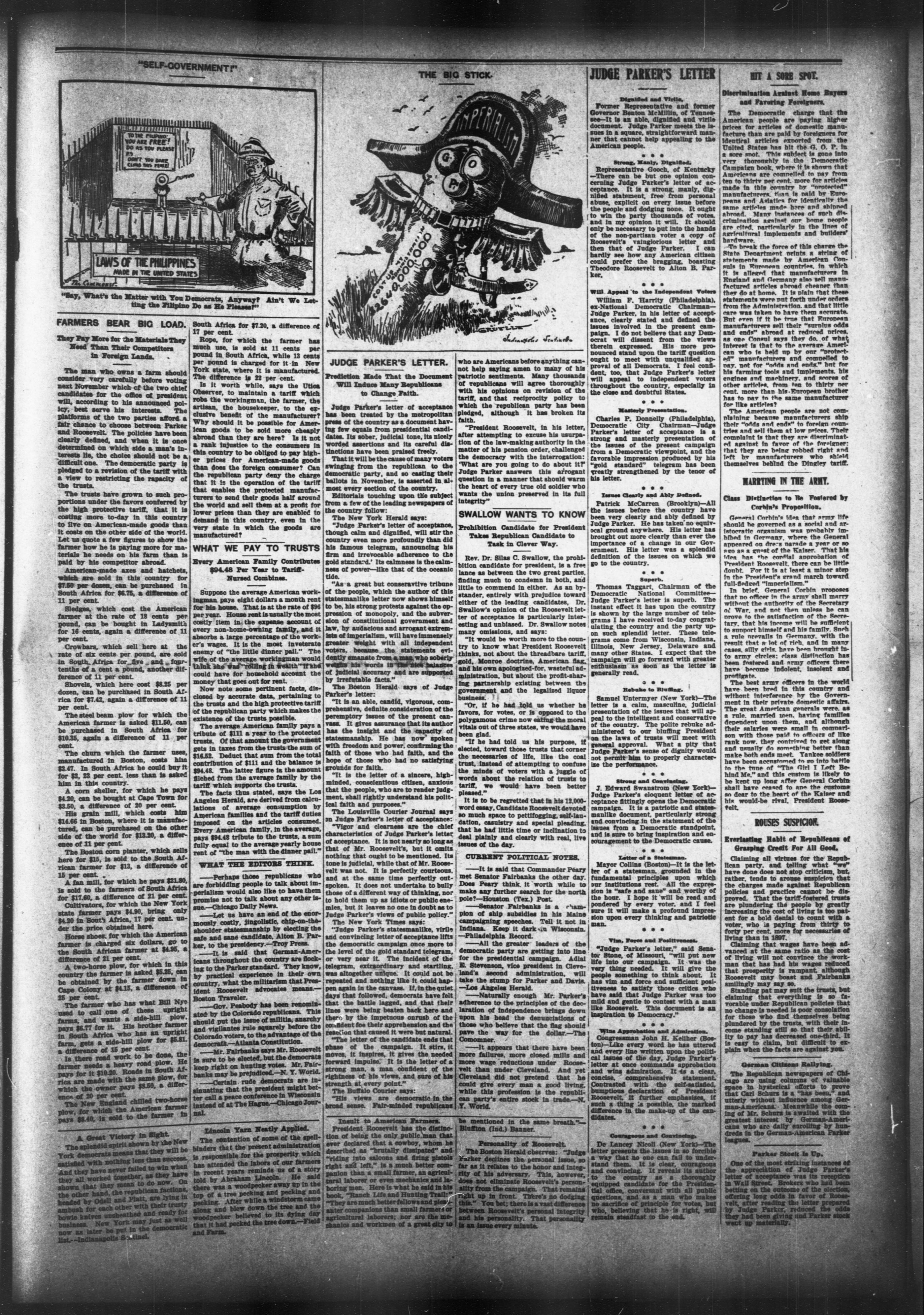
"Say, What's the Matter with You Democrats, Anyway? Ain't We Letting the Filipino Do as He Please?"
They Pay More for the Materials They Need Than Their Competitors in Foreign Lands.
The man who owns a farm should consider very carefully before voting next November which of the two chief candidates for the office of president will, according to his announced policy, best serve his interests. The platforms of the two parties afford a fair chance to choose between Parker and Roosevelt. The policies have been clearly defined, and when it is once determined on which side a man's interests lie, the choice should not be a difficult one. The democratic party is pledged to a revision of the tariff with a view to restricting the rapacity of the trusts.
The trusts have grown to such proportions under the favors conferred by the high protective tariff, that it is costing more to-day in this country to live on American-made goods than it costs on the other side of the world. Let us quote a few figures to show the farmer how he is paying more for materials he needs on his farm than is paid by his competitor abroad. American-made axes and hatchets, which are sold in this country for $7.50 per dozen, can be purchased in South Africa for $6.75, a difference of 11 per cent.
Sledges, which cost the American farmer at the rate of 18 cents per pound, can be bought in Ladysmith for 16 cents, again a difference of 11 per cent. Crowbars, which sell here at the rate of six cents per pound, are sold in South Africa for five and four-tenths of a cent a pound, another difference of 11 per cent. Shovels, which here cost $8.25 per dozen, can be purchased in South Africa for $7.42, again a difference of 11 per cent.
The steel beam plow for which the American farmer is asked $11.50, can be purchased in South Africa for $10.35, again a difference of 11 per cent.
The churn which the farmer uses, manufactured in Boston, costs him $2.47. In South Africa he could buy it for $2, 23 per cent. less than is asked him in this country.
A corn sheller, for which he pays $4.20, can be bought at Cape Town for $3.50, a difference of 20 per cent.
His grain mill, which costs him $14.66 in Boston, where it is manufactured, can be purchased on the other side of the world for $13.20, a difference of 11 per cent.
The Boston corn planter, which sells here for $15, is sold to the South African farmer for $13, a difference of 15 per cent.
A fan mill, for which he pays $21.80, is sold to the farmers of South Africa for $17.60, a difference of 21 per cent.
Cultivators, for which the New York state farmer pays $4.90, bring only $4.20 in South Africa, 17 per cent. under the price obtained here.
Horse shoes, for which the American farmer is charged six dollars, go to the South African farmer at $4.95, a difference of 21 per cent.
A two-horse plow, for which in this country the farmer is asked $5.25, can be obtained by the farmer down in Cape Colony at $4.15, a difference of 25 per cent.
The farmer who has what Bill Nye used to call one of these upright farms, and wants a side-hill plow, pays $6.77 for it. His brother farmer in South Africa who has an upright farm, gets a side-hill plow for $5.81, a difference of 15 per cent.
Is there road work to be done, the farmer needs a heavy road plow. He pays for it $10.20. Roads in South Africa are made with the same plow, for which the owner pays $8.50, a difference of 20 per cent.
The New England chilled two-horse plow, for which the American farmer pays $8.40, is sold to the farmer in
A Great Victory in Sight. The splendid spirit shown by the New York democrats means that they will be satisfied with nothing less than success. And they have never failed to win when they all worked together, as they have shown that they mean to do now. On the other hand, the republican factions, headed by Odell and Platt, are lying in ambush for each other with their trusty bowle knives unsheathed and ready for business. New York may just as well now as later be put in the democratic list. Indianapolis Standard.
South Africa for $7.20, a difference of 17 per cent. Rope, for which the farmer has much use, is sold at 11 cents per pound in South Africa, while 13 cents per pound is charged for it in New York state, where it is manufactured. The difference is 22 per cent.
Is it worth while, says the Utica Observer, to maintain a tariff which robs the workingman, the farmer, the artisan, the housekeeper, to the exclusive benefit of the manufacturer? Why should it be possible for American goods to be sold more cheaply abroad than they are here? Is it not a rank injustice to the consumers in this country to be obliged to pay higher prices for American-made goods than does the foreign consumer? Can the republican party deny the charge that it is the operation of the tariff that enables the protected manufacturers to send their goods half around the world and sell them at a profit for lower prices than they are enabled to demand in this country, even in the very state in which the goods are manufactured?
WHAT WE PAY TO TRUSTS
Every American Family Contributes $94.48 Per Year to Tariff Nursed Combines.
Suppose the average American workingman pays eight dollars a month rent for his house. That is at the rate of $96 per year. House rent is usually the most costly item in the expense account of every non-home-owning family, and it absorbs a large percentage of the worker's wages. It is the most inveterate enemy of "the little dinner pail." The wife of the average workingman would think she was "rolling in wealth" if she could have for household account the money that goes out for rent.
Now note some pertinent facts, disclosed by accurate data, pertaining to the trusts and the high protective tariff of the republican party which makes the existence of the trusts possible.
The average American family pays a tribute of $111 a year to the protected trusts. Of that amount the government gets in taxes from the trusts the sum of $16.52. Deduct that sum from the total contribution of $111 and the balance is $94.48. The latter figure is the amount filched from the average family by the tariff which supports the trusts.
The facts thus stated, says the Los Angeles Herald, are derived from calculations of average consumption by American families and the tariff duties imposed on the articles consumed. Every American family, in the average, pays $94.48 tribute to the trusts, a sum fully equal to the average yearly house rent of "the man with the dinner pail."
WHAT THE EDITORS THINK.
Perhaps those republicans who are forbidding people to talk about imperialism would also like to have them promise not to talk about any other issue. Chicago Daily News.
Let us have an end of the enormously costly, jingolistic, chip-on-the-shoulder statesmanship by electing the safe and sane candidate, Alton B. Parker, to the presidency. Troy Press.
It is said that German-Americans throughout the country are flocking to the Parker standard. They know, by practical experience in their own country, what the militarism that President Roosevelt advocates means. Boston Traveler.
Gov. Peabody has been renominated by the Colorado republicans. This should put the issue of militia, anarchy and vigilantes rule squarely before the Colorado voters, to the advantage of the democrats. Atlanta Constitution. Mr. Fairbanks says Mr. Roosevelt is sure to be elected, but the democrats keep right on hunting votes. Mr. Fairbanks may be prejudiced. N. Y. World. Certain rude democrats are insuing that the president might better call a peace conference in Wisconsin instead of at The Hague. Chicago Journal.
Lincoln Yarn Neatly Applied.
The contention of some of the spellbinders that the present administration is responsible for the prosperity which has attended the labors of our farmers in recent years reminds us of a story told by Abraham Lincoln. He said there was a woodpecker away up in the top of a tree pecking and pecking and pecking. After while a windstorm came along and blew down the tree and the woodpecker believed to its dying day that it had pecked the tree down.—Field and Farm.
THE BIG STICK
IMPERIALISM
COST US $264,000,000
GRUFFLE
Indianapolis Sentinel
JUDGE PARKER'S LETTER.
Prediction Made That the Document Will Induce Many Republicans to Change Faith.
Judge Parker's letter of acceptance has been treated by the metropolitan press of the country as a document having few equals from presidential candidates. Its sober, judicial tone, its nicely worded assertions and its careful distinctions have been praised freely. That it will be the cause of many voters swinging from the republican to the democratic party, and so casting their ballots in November, is asserted in almost every section of the country. Editorials touching upon the subject from a few of the leading newspapers of the country follow:
The New York Herald says:
"Judge Parker's letter of acceptance, though calm and dignified, will stir the country even more profoundly than did his famous telegram, announcing his firm and irrevocable adherence to the gold standard.' Its calmness is the calmness of power—like that of the oceanic tide.
"As a great but conservative tribune of the people, which the author of this statesmanlike letter now shows himself to be, his strong protests against the oppression of monopoly, and the subversion of constitutional government and law, by audacious and arrogant extremists of imperialism, will have immensely greater weight with all independent voters, because the statements evidently smanate from a man who soberly weighs his words in the nice balances of judicial accuracy and are supported by irrefutable facts."
The Boston Herald says of Judge Parker's letter:
"It is an able, candid, vigorous, comprehensive, definite consideration of the peremptory issues of the present canvass. It gives assurance that its author has the insight and the capacity of statesmanship. He has now spoken with freedom and power, confirming the faith of those who had faith, and the hope of those who had no satisfying grounds for faith.
"It is the letter of a sincere, high-minded, conscientious citizen, anxious that the people, who are to render judgment, shall rightly understand his political faith and purposes."
The Louisville Courter Journal says on Judge Parker's letter of acceptance: "Vigor and clearness are the chief characteristics of Judge Parker's letter of acceptance. It is not nearly so long as that of Mr. Roosevelt's, but it omits nothing that ought to be mentioned. Its tone is judicial, while that of Mr. Roosevelt was not. It is perfectly courteous, and at the same time perfectly outspoken. It does not undertake to bully those of a different way of thinking, nor to hold them up as idiots or public enemies, but it leaves no one in doubt as to Judge Parker's views of public policy." The New York Times says:
"Judge Parker's statesmanlike, virile and convincing letter of acceptance lifts the democratic campaign once more to the level of the gold standard telegram, or very near it. The incident of the telegram, extraordinary and startling, was altogether unique. It could not be repeated and nothing like it could happen again in the cavass. If, in the quiet days that followed, democrats have felt that the battle lagged, and that their lines were being beaten back here and there by the impetuous onrush of the confident foe their apprehension and the reaction that caused it were but natural.
"The letter of the candidate ends that phase of the campaign. It stirs, it moves, it inspires, it gives the needed forward impulse. It is the letter of a strong man, a man confident of the rightness of his views, and sure of his strength at every point."
The Buffalo Courier says:
"His views are democratic in the broad sense. Fair-minded republicans
Insult to American Farmers. President Roosevelt has the distinction of being the only public man that ever declared that a cowboy, whom he described as "brutally dissipated" and "riding into saloons and firing pistols right and left," is a much better companion than a small farmer, an agricultural laborer or even mechanics and laboring men. Here is what he said in his book, "Ranch Life and Hunting Trail:" "They are much better fellows and pleaser companions than small farmers or agricultural laborers; nor are the mechanics and workmen of a great city to
who are Americans before anything cannot help saying amen to many of his patriotic sentiments. Many thousands of republicans will agree thoroughly with his opinions on revision of the tariff, and that reciprocity policy to which the republican party has been pledged, although it has broken its faith.
"President Roosevelt, in his letter, after attempting to excuse his usurpation of the law-making authority in the matter of his pension order, challenged the democracy with the interrogation: 'What are you going to do about it?' Judge Parker answers this arrogant question in a manner that should warm the heart of every true old soldier who wants the union preserved in its full integrity"
SWALLOW WANTS TO KNOW
Rev. Dr. Silas C. Swallow, the prohibition candidate for president, is a freelance as between the two great parties, finding much to condemn in both, and little to commend in either. As an bystander, entirely with prejudice toward either of the leading candidates, Dr. Swallow's opinion of the Roosevelt letter of acceptance is particularly interesting and unbiased. Dr. Swallow notes many omissions, and says:
"It would be worth more to the country to know what President Roosevelt thinks, not about the threadbare tariff, gold, Monroe doctrine, American flag, and his own apologized-for, wasteful administration, but about the profit-sharing partnership existing between the government and the legalized liquor business. "Or, if he had told us whether he favors, for votes, or is opposed to the polygamous crime now eating the moral vitals out of three states, we would have been glad.
"If he had told us his purpose, if elected, toward those trusts that corner the necessaries of life, like the coal trust, instead of attempting to confuse the minds of voters with a juggle of words about the relation of trusts to tariff, we would have been better pleased."
It is to be regretted that in his 12,000-word essay, Candidate Roosevelt devoted so much space to pettifogging, self-laudation, casuistry and special pleading, that he had little time or inclination to deal plainly and clearly with real, live issues of the day.
CURRENT POLITICAL NOTES.
—It is said that Commander Peary met Senator Fairbanks the other day. Does Peary think it worth while to make any further search for the north pole?—Houston (Tex.) Post.
—Senator Fairbanks is a champion of ship subsidies in his Maine campaigning speeches. Tell it not in Indiana. Keep it dark in Wisconsin.
—Philadelphia Record.
—All the greater leaders of the democratic party are getting into line for the presidential campaign. Adial E. Stevenson, vice president in Cleveland's second administration, will take the stump for Parker and Davis.
—Los Angeles Herald.
Naturally enough Mr. Parker's adherence to the principles of the declaration of independence brings down upon his head the denunciations of those who believe that the flag should pave the way for the dollar. The Comomner. It appears that there have been more failures, more closed mills and more wage reductions under Roosevelt than under Cleveland. And yet Cleveland did not pretend that he could give every man a good living, while this profession is the republican party's entire stock in trade. N. Y. World.
be mentioned in the same breath." Bluffton (Ind.) Banner.
Personality of Roosevelt.
The Boston Herald observes: "Judge Parker declines the personal issue, so far as it relates to the honor and integrity of his adversary. This, however, does not eliminate Roosevelt's personality from the campaign. That remains right up in front. There's no dodging this." You bet; there is a vast difference between Roosevelt's personal integrity and his personality. That personality is an issue every minute.
JUDGE PARKER'S LETTER
Former Representative and former Governor Benton McMillin, of Tennessee-It is an able, dignified and virile document. Judge Parker meets the issues in a square, straightforward manner that cannot help appealing to the American people.
Representative Gooch, of Kentucky There can be but one opinion concerning Judge Parker's letter of acceptance. It is a strong, manly, dignified statement, free from personal abuse, explicit on every issue before the people and dodging none. It ought to win the party thousands of votes, and in my opinion it will. It should only be necessary to put into the hands of the non-partisan voter a copy of Roosevelt's vainglorious letter and then that of Judge Parker. I can hardly see how any American citizen could prefer the bragging, boasting Theodore Roosevelt to Alton B. Parker.
---
Will. Appeal to the Independent Voters William F. Harrity (Philadelphia), ex-National Democratic Chairman—Judge Parker, in his letter of acceptance, clearly stated and defined the issues involved in the present campaign. I do not believe that any Democrat will dissent from the views therein expressed. His more pronounced stand upon the tariff question ought to meet with unqualified approval of all Democrats. I feel confident, too, that Judge Parker's letter will appeal to independent voters throughout the country, especially in the close and doubtful States.
---
Masterly Presentation:
Charles P. Donnelly (Philadelphia), Democratic City Chairman-Judge Parker's letter of acceptance is a strong and masterly presentation of the issues of the present campaign from a Democratic viewpoint, and the favorable impression produced by his "gold standard" telegram has been greatly strengthened by the tenor of his letter.
Issues Clearly and Ably Resolved.
Patrick McCarren (Brooklyn)—All the issues before the country have been very clearly and ably defined by Judge Parker. He has taken no equivocal ground anywhere. His letter has brought out more clearly than ever the importance of a change in our Government. His letter was a splendid definition of the issues on which we go to the country.
---
Superb.
Thomas Taggart, Chairman of the Democratic National Committee—Judge Parker's letter is superb. The instant effect it has upon the country is shown by the large number of telegrams I have received to-day congratulating the country and the party upon such splendid letter. These telegrams come from Wisconsin, Indiana, Illinois, New Jersey, Delaware and many other States. I expect that the campaign will go forward with greater enthusiasm as soon as the letter is generally read.
Rebuke to Bluffing.
Samuel Untermyer (New York)—The letter is a calm, masculine, judicial presentation of the issues that will appeal to the intelligent and conservative of the country. The polite rebuke administered to our bluffing President on the laws of trusts will meet with general approval. What a pity that Judge Parker's sense of dignity would not permit him to properly characterize the performance.
---
Strong and Convincing.
J. Edward Swanstrom (New York) Judge Parker's eloquent letter of acceptance fittingly opens the Democratic campaign. It is a patriotic and statesmanlike document, particularly strong and convincing in the statement of the issues from a Democratic standpoint, and is sure to bring inspiration and encouragement to the Democratic cause.
Mayor Collins (Boston)—It is the letter of a statesman, grounded in the fundamental principles upon which our institutions rest. All the expression is "safe and sane" and worthy of the hour. I hope it will be read and pondered by every voter, and I feel sure it will make a profound impression upon every thinking and patriotic man.
Vim. Force aud Positiveness.
"Judge Parker's letter," said Senator Stone, of Missouri, "will put new life into our campaign. It was the very thing needed. It will give the people something to think about. It has vim and force and sufficient positiveness to satisfy those critics who have said that Judge Parker was too mild and gentle to content with a man like Roosevelt. This document is an inspiration to Democracy."
Wins Approbation and Admiration.
Congressman John H. Keliher (Boston)—Like every word he has uttered and every line written upon the political issues of the day, Judge Parker's letter at once commands approbation and wins admiration. It is a clear, concise, comprehensive statement. Contrasted with the self-satisfied, bumptious declaration of President Roosevelt, it further emphasizes, if such a thing is possible, the marked difference in the make-up of the candidates.
De Lancey Nicoll (New York)—The letter presents the issues in so forcible a way that no one can fail to understand them. It is clear, courageous and convincing. It reveals its author to the country as a thoroughly equipped candidate for the Presidential office, conversant with all public questions, and as a man who makes no sacrifice of principle for votes, but who, believing that he is right, will remain steadfast to the end.
---
HIT A SORE SPOT.
Discrimination Against Home Buyers and Favoring Foreigners.
The Democratic charge that the American people are paying higher prices for articles of domestic manufacture than are paid by foreigners for identical articles exported from the United States has hit the G. O. P. in a sore spot. This subject is gone into very thoroughly in the Democratic Campaign book, where it is shown that Americans are compelled to pay from ten to thirty per cent, more for articles made in this country by "protected" manufacturers, than is paid by Europeans and Asiatics for identically the same articles made here and shipped abroad. Many instances of such discrimination against our home people are cited, particularly in the lines of agricultural implements and builders' hardware.
To break the force of this charge the State Department prints a string of statements made by American Consuls in European countries, in which it is alleged that manufacturers in England and Germany also sell manufactured articles abroad cheaper than they do at home. It is plain that these statements were put forth under orders from the Administration, and that little care was taken to have them accurate. But even if it be true that European manufacturers sell their "surplus odds and ends" abroad at reduced prices, as one Consul says they do, of what interest is that to the average American who is held up by our "protected" manufacturers and compelled to pay, not for "odds and ends," but for his farming tools and implements, his engines and machinery, and scores of other articles, from ten to thirty per cent. more than his European brother has to pay to the same manufacturer for like articles?
The American people are not complaining because manufacturers ship their "odds and ends" to foreign countries and sell them at low prices. Their complaint is that they are discriminated against in favor of the foreigner: that they are being robbed right and left by manufacturers who shield themselves behind the Dingley tariff.
MARRYING IN THE ARMY.
Class Distinction to Be Fostered by Corbin's Proposition.
General Corbin's idea that army life should be governed as a social and aristocratic organism was probably imbibed in Germany, where the General appeared on dress parade a year or so ago as a guest of the Kaiser. That his idea has the cordial approbation of President Roosevelt, there can be little doubt. For it is at least a minor step in the President's grand march toward full-fledged "imperialism."
In brief, General Corbin proposes that no officer in the army shall marry without the authority of the Secretary of War, and not then unless he can prove to the satisfaction of the Secretary, that his income will be sufficient to support himself and his family. Such a rule prevails in Germany, with the result that a lot of rich, and in many cases, silly girls, have been brought into army circles; class distinction has been fostered and army officers there have become Indolent, Insolent and profligate.
The best army officers in the world have been bred in this country and without interference by the Government in their private domestic affairs. The great American generals were, as a rule, married men, having families dependent upon them, and although their salaries were small in comparison with those paid to officers of like rank now, they contrived to get along and usually do something better than make both ends meet. Yankee soldiers have been accustomed to go into battle to the tune of "The Girl I Left Behind Me," and this custom is likely to be kept up long after General Corbin shall have ceased to ane the customs so dear to the heart of the Kaiser and his would-be rival. President Booseelt
ROUSES SUSPICION
Everlasting Habit of Republicans of Grasping Credit For All Good.
Claiming all virtues for the Republican party, and telling what "we" have done does not stop criticism, but, rather, tends to arouse suspicion that the charges made against Republican policies and practice cannot be disproved. That the tariff-fostered trusts are plundering the people by greatly increasing the cost of living is too patient for a bold denial to count with a voter, who is paying from thirty to forty per cent, more for necessaries of living than in 1897.
Claiming that wages have been advanced at the same ratio as the cost of living will not convince the workman that has had his wages reduced that prosperity is rampant, although Roosevelt may boast and Fairbanks smilingly may say so.
Standing pat may suit the trusts, but claiming that everything is so favorable under Republican policies that no change is needed is poor consolation for those who find themselves being plundered by the trusts, with their income standing still so that their ability to pay has decreased one-third. It is easy to claim, but difficult to explain when the facts are against you.
German Citizens Rallying.
The Republican newspapers of Chicago are using columns of valuable space in hysterical efforts to prove that Carl Schurz is a "has been," and utterly without influence among German-Americans. Meanwhile the coming of Mr. Schurz is awaited with the greatest interest by German-Americans who are daily enrolling by hundreds in the German-American Parker leagues.
One of the most striking instances of the appreciation of Judge Parker's letter of acceptance was its reception in Wall Street. Brokers who had been betting on the outcome of the election, offering long odds in favor of Roosevelt, after reading the letter prepared by Judge Parker, reduced the odds they had been giving and Parker stock went up materially.
SENATOR BEN TILLMAN. (Continued from 1st page.)
up to ridicule, scorn and contempt; they contended that all the Irish were lowered in the estimation of the civilized world by such performances; they were highly insulted because some one named a monkey in Lincoln Park "Miss Dooley," and nothing would suit them but to change the name of the monkey, although the Irish have no patent on the name "Miss Dooley," for there are some colored people by the name of Dooley; but the members of this same sensitive race who were responsible for bringing Ben Tillman here to deliver his tirade against the Negro, entertain the idea that he did not say one thing which would cause any colored person to feel that he had been offended or insulted in the slightest degree; but if Tillman had been a colored man and had referred to the Irish like he did to the Negro he would have been murdered in cold blood before he could have escaped from the hall.
Therefore, it is unfair for the managers or the leaders of the Democratic party to pay Tillman's expenses to enable him to travel over the country with no other object but to insult and abuse the Negro, and if they will persist in doing so, then the Negro will be justified in whacking him over his brainless head with the jawbone of an ass.
In all candor and seriousness Senator Tillman and his kind should forever refrain from having anything to say respecting "social equality, amalgamation, or the mixing of the races in the South," when we take into consideration the fact that 90 per cent. of all the bastard children born to Negro women in the South are the offspring of white men; that many of those so-called white gentlemen will stand for hours in dark alleys and at back doors of log cabins in order to kiss and embrace their colored female lovers, but if a colored man happens to look at a white female strumpet those same white men who spend much of their time with repulsive colored women, are ready to mob and lynch him, which is further proof that whenever any race of people sink so low in the scale of civilization that they experience not the slightest compunction in buying and selling their own flesh and blood, they are amply prepared for the commission of any and all crimes!
Ancient Accepted Scottish Rite.
The rapid growth and continued popularity of the United Supreme Council of the Ancient and Accepted Scottish Rite for the Southern and Western Masonic Jurisdiction, United States of America, its Territories and dependencies, that was organized in Washington, D. C., in the year of 1869, of which the Ill. John G. Jones, 33, of Chicago, Ill., is now the Sovereign Grand Commander, is disturbing and worrying a few little cheap, empty-headed Negroes in Washington, D. C., who belong to a spurious body of their own in the District of Columbia, and the best that this little band of traitors and unmitigated falsifiers and perjurers can do, while smarting under the sting of non-affiliation and ostracism from every regular and legitimate Supreme Council of the Ancient and Accepted Scottish Rite Masons in the world, is now to content themselves with printing and publishing falsehoods of the blackest and deepest dye; but, after all, that is not very strange to see that done and hear it, when you stop for a moment to consider who wrote it and the source from when it came; for those untruthful statements come from the outcast and the slums and the riff-raff of the Masonic Order in the District of Columbia. And to believe anything that they would write and say, or to have the slightest similarity of truth in their statements would be like looking for one grain of wheat in 50,000,000 bushels of chaff, for they are a class of men and so-called Masons who would break their obliquions as Masons a hundred times in one minute.
When the United Supreme Council met in Washington, D. C., on the 17th of October, 1895, it was seen that Thornton A. Jackson, who was a candidate for re-election to the office of Sovereign Grand Commander, had but a few followers in the Supreme Council, and when the time came for election of Grand officers Jackson got only a very few votes, and John G. Jones, of Chicago, received over two-thirds of all the votes cast and was declared to be duly elected. The United Supreme Council has never been interested in any Blue Lodges in Washington, D. C., or any other place in the world, and has nothing to do with the establishing of Blue Lodges or the organizing of Grand Lodges. The establishing of Blue Lodges belongs to a Grand Lodge of A. F. & A. Masons, and when those malcontents in Washington, D. C., says that Blue Lodges were organized in Washington,
D. C., by the United Supreme Council they have simply have stated what is a barefaced, willful and malicious falsehood. The statements made by those enemies of Masonry that John G. Jones, 33, of Chicago, got excused from the annual session while he was Lieutenant Grand Commander and that the annual session was held October 21st, 1895, and that he and others had organized a Supreme Council is characterized as a foul a falsehood as was ever written or uttered since the world began. The unwarranted attacks of these malcontents and disturbers of the Masonic peace in Washington, D. C., after having waited ten years and remained silent, is now unmistakable for its purpose. It discloses the fact that they are fast losing ground, and have given up their efforts to maintain their bogus organization any longer in Washington, D. C. The United Supreme Council that was organized in Washington, D. C., in 1869, that John G. Jones is now at the head of, has been recognized by fifteen Supreme Councils in foreign countries and one in the United States of America.
HENRY SEARCHLIGHT
CHIPS.
Miss Lou Hamilton last Sunday returned to her home in Bay City, Mich.
Monday evening the pupils of Prof. I. Lee gave a piano recital at St. Mark's Church, 47th and State streets, which was a very creditable affair.
Mrs. Catherine Wilson, formerly of Galesburg, Ill., but now of Segane, Tex., spent last week with Mrs. J. S. Tandy, 5145 Grove avenue.
Mr. P. B. Kopperl, 4762 Armour avenue, presented his better half with an elegant gold watch, in commemoration of their tenth wedding anniversary.
Attorney Charles H. Mitchell, Unity building, is a highly polished gentleman, and he will make an ideal Superior Court Judge.
Mr. Arthur Wethington, 5149 Grove avenue, is receiving the congratulations of friends on his appointment as a mail carrier.
John E. Traeger will surely be re-elected Coroner of Cook county. For he has proven himself eminently capable of handling all the business in connection with his office.
Let the Afro-Americans who are cussing anarchistic Ben Tillman remember that he dined with President McKinley at the White House, January 1, 1901. Dr. A. Beatrie Schultz, 2719 State street, has taken up the study of law, and within the next few months she will be able to practice in the lower courts.
Miss Victoria Bonds is now at Brinkley Academy, at Brinkley, Ark., teaching in the English department. Her many friends in Chicago miss her bright smile and happy ways.
Mrs. Sadie Scott and Master Dewey Scott, 135 W. 51st street, arrived home Tuesday from a six weeks' visit to Detroit, Mich., and other sections of the East.
A house fair for the benefit of Berean Baptist Church will be given at the home of Mrs. M. A. Bonds, 6652 Wabash avenue, next Monday, October 24.
George Mills Rogers comes from a long line off judges, and by nature he is fitted in every way to serve the people in that capacity, and we believe that he will be elected one of the new judges of Cook county November 8. Alderman John J. Bradley is growing more popular each day with the colored people in the town of Lake, and if he receives the nomination for City Clerk of Chicago next spring they will rally to his support.
Most of the colored doctors in Chicago have been away this week, attending the congress of colored physicians and surgeons at Lexington, Ky. Dr. George C. Hall performed a splendid clinical operation at the congress, and added to his enviable reputation as a surgeon.
Miss Maude French and Mr. James Boling Cooper were united in marriage last Wednesday evening at the residence of the bride's aunt, Mrs. Peter French, 4838 Evans avenue, the Rev. W. S. Brooks officiating. A wedding reception followed, the favorites of society being all present. The happy couple received many handsome presents.
The Hyde Park Colored Republican Club was permanently organized Friday evening, October 7. S. Laing Williams, Sixth ward, was elected president; first vice-president, Robert B. Lewis, Eighth ward; second vice-president, Henry Jones, Seventh ward; third vice-president, Robert Piggott; secretary, A. L. Williams; treasurer, J. B. Barefield.
We would suggest to the Hon. John J. McGillen that he should prevail upon John Temple Graves, Gov. Vardaman of Mississippi, and Gov. Jeff. Davis of Arkansas and Ben Tillman to move on to Chicago and deliver speeches until the close of the campaign, that their presence here, in the interest of the Dmocratic party, would insure the election of the Republican county and State ticket by 200,000 majority.
Charles C. Buell, lawyer, 100 Washington street, is an independent candidate for the Legislature in the First Senatorial District, comprising the First and Second wards. Mr. Buell is a high-class gentleman. He favors the new charter, and stands for everything which is for the best interest of the people of this city and State, and the respectable element in his district, regardless of their political affiliations, should land him in the Legislature.
Five or six colored men are candidates for Congress in several States this year. H. M. Porter is running in the Tenth district of Georgia. Rev. L. R. Dudley is making the race in the Twenty-second district of Illinois. Col. George L. Knox is doing likewise in the Seventh district of Indiana. I. B. Allen is running in Boston, Mass., and one or two are in the race in West Virginia. All of these candidates excepting one are independent, which shows that the Negro is becoming tired of pulling chestnuts out of the fire for the leaders of the grand old Lily White party.
SPECIAL NOTICE.
We find it absolutely impossible to attend all the social functions to which we are invited, consequently we cannot report them as we would like. If you will mail to our address a brief "write up" of your "social doings" so that we may have it not later than Wednesday of each week, our Society Editor will give it the attention it merits. Address The Broad Ax, 5040 Armour Avenue.
According to Consul Daigoro Goh, the Japanese child calls its father "Gempu," which means "strict father," while it addresses its mother as "Jibo," that is, "benevolent mother." Mr. Goh quotes a Japanese lad who classified the Japanese father as one among the "four fearful things of the world," these four terrors being "earthquake, thunder, conflagration and father."
Java's Wonderful Lake.
One of the greatest wonders of Java is a large lake of boiling mud, two miles in circumference, in the center of which immense columns of soft, hot mud may be seen continually rising and falling. Besides these columns there are two gigantic bubbles near the edge, which fills up like huge balloons and explode on an average three times per minute.
Modern Novel.
The modern novel is often little more than an enlarged anecdote, in which two or three, or perhaps half a dozen, persons keep the drama moving. A story of Dickens' is not an anecdote, but a history. The actors and personages in it are numbered by the score. His stage has not a few, but a throng of actors on it.—Great Thoughts.
Iceland "Bottle Post."
The "bottle post" is an old institution of the south coast of Iceland. Letters are put into corked bottles, which are wafted by the winds to the opposite coast. At times they also contain a small present, as an inducement for the finder to deliver the letter as addressed.
Putting Off the Evil Day.
Milley—You know, dear, we've been engaged for two years, and I think it's time we were getting married.
Tilly—Oh, I don't know, dear. If you really love him you'll let him be happy for a little longer yet.—Stray Stories.
The Ship We Sail In
Remember that "every ship is a romantic object, except that we sail in." From being at close range we fail to see our own life work in its true aspect. Get into "another ship" for awhile and view your work at a distance; you will then see it at its right valuation.—Commoner.
Baked Corn.
Cut the grains off nine ears of corn. Put in a buttered baking dish, with a scant quart of milk, two tablespoonfuls of cream, a teaspoonful of salt, a tablespoonful of butter and one well-beaten egg. Bake for an hour and a half. Washington Star.
In the Flat.
Visitor—What is that horrible grinding noise I heard this morning about eight?
Flatdweller—The folks in the flat below had toast for breakfast—Baltimore American.
Joseph A. O'Donnell Henry D. Coghlan
O'Donnell & Cogh in
Attorneys at Law
Phone 264 Main Metropolitan Block
N. W. Cor. LaSalle & Randolph Sts.
Chicago
MILES J. DEVINE JEREMIAH B. O'CONNELL
DEVINE & O'CONNELL
ATTORNEYS AT LAW
SUITE 318-320 REAPER BLOCK
Clark and Washington Sts.
Telephone, Main 940. CHICAGO.
A. D. GASH
Attorney at Law,
84-86 La Salle Street, Chicago,
Suite 615 to 619,
Telephone Main 3077.
FREDERICK W. JOB
ATTORNEY AT LAW
822 MARQUETTE BUILDING
Telephone 8209 Central
CHICAGO
JOHN E. OWENS
ATTORNEY & COUNSELOR
AT LAW
323 ASHLAND BLOCK
TELEPHONE CENTNAL 998 CHICAGO
PHONES {Office, M in 1157
Res. Brown 42
STEPHEN A. DOUGLAS
LAWYER
Suite 200. 123-125 La Salle Street
CHICAGO
Siphone Yards WI Bedderson, K2 Garfield Bd.
JOHN FITZGERALD
JUSTICE OF THE PEACE
4787 & HALSTED STRIKE,
....CHICAGO
JOHN G ONES
LAWYER
185 Dearborn Street
Adams Express Building
Room 607
Res. 3717 Armour Ave. CHICAGO
J. GRAY LUCAS
Attorney at Law
Suite 611 167 Dearborn St., Cor. Monroe.
Chicago.
Tel. Cent. 5768. Res. Tel. Went. 4892.
J. I. HENNESSY,
Justice of the Peace,
6301 S. Halsted St.
WILLIAM TREXLER, CLERK.
TELEPHONE WENTWORTH 4403.
Police Magistrate Englewood Police
Court.
P. J. O'SHEA
ATTORNEY AT LAW
Suite 1444 Unity Building
79 Dearborn St. Chicago
Robert M. Mitchell
Attorney at Law
Suite 9, No. 77 South Clark St.
CHICAGO
ALBERT B. GEORGE
LAWYER.
122 Ashland Block, Chicago.
— 2d. M. 1900. —
MARCUS RUBEN,
(Incorporated)
Manufacturer of
Outfits for Waiters and Cooks,
BARBERS, :: DENTISTS,
BARKEEPERS AND BUTCHERS,
390 State St., - - - Chicago.
Phone Harrison 417.
```markdown
```
HILLMAN'S
112-114-116
STATE STREET
Special Sales in New Fall Goods
Throughout the Store.
John J. Bradley
Real Estate, Insurance and Loans Property managed. Abstracts examined. Renting. Legal papers prepared. 4709 South Halsted Street Chicago
Solves the financial problem of clothes-buying for yourself or your family
AUTUMN HATS
In rich tints and picturesque shapes, completely under the spell of this new autumn season.
LADIES' SUITS, FALL COATS, GENTS' SUITS AND OVERCOATS.
Complete fall and winter outfits for youths misses and children,
ALL SOLD ON EASY WEEKLY OR MONTHLY PAYMENTS.
Get your garments when you like and pay when you please.
Theodore C. Mayer
JUSTICE OF THE PEACE
Mortgages, Deeds, Notes and Legal Documents Drawn and Acknowledged. Room 22, 27 North Clark Street.
POLICE MAGISTRATE RESIDENCE
East Chicago Ave. Police Court 337 Burling Street
ILLINOIS BRICK CO.
WILLIAM C. KUESTER. SUPERINTENDENT. N. Western Ave., Ch
1994 N. Western Ave., Chicago.
Telephone Lake View 270.
M. JUNK, Proprietor JOS. P. JUNK, Manager 3700-3710 South Halsted Street and 897 to 929 Thirtyseventh Street CHICAGO
IMPORTED AND DOMESTIC WINES, LIQUORS AND CIGARS 8462 SOUTH HALSTED STREET.
CHICAGO
CHICAGO
N'S
all Goods
ore.
Notary Public
Hudley
and Loans
legal papers prepared.
Chicago
Pay Plan
yourself or your family
for the spell of this new
AND OVERCOATS.
and children,
MENTS.
please.
Company
Elevator
Layer
PEACE
ments Drawn
North Clark Street.
RESIDENCE
337 Burling Street
K CO.
ER.
Chicago.
718 wery