The Broad Ax
Saturday, February 10, 1906
Chicago, Illinois
Page text (machine-generated)
BRUNO AND
That Eminent S
Burned At
For Proclaimin
Of The Plural
BRUNO AND THE CHURCH
That Eminent Scientific Author Burned At the Stake.
For Proclaiming "The Doctrine Of The Plurality Of Worlds."
Whenever we have any occasion to pass strictly orthodox churches it always causes the warm blood which courses through our veins to become cold as ice water, and our sympathetic heart to become sad and weary, when we think of the vast number of liberty-loving men and women who have been put to death by its leaders because they refused to believe all of their nonsensical ideas and childish theories, and not among the least of that great number who felt the strong arm of the church was Glordano Bruno, who was one of the greatest scientific men that the world has so far produced, yet he was very cruely tortured and foully put to death by the church simply because he could not and would not remain silent concerning the false doctrine which the church was teaching respecting the construction of the universe.
Bruno was also one of the most eminent scientific authors of his time or generation. His master or most valuable works are entitled "The Infinity of the Universe," "Evening Conversation on Ash Wednesday," an apology for "The Copernion System," and of "The One Sole Cause of Things." To these may be added an allegory published in 1584, "The Expulsion of the Triumphant Beast," He also collected for the use of future astronomers all the observations he could find respecting the new star which so suddenly appeared in the heavens in Cassinela, A. D. 1572
Originally Bruno was intended for the church, but he was led into doubt by his meditations on the subject of transubstantiation and the immaculate conception. Not caring to conceal his opinion he soon fell under censure of the spiritual authorities, and it became necessary for him to seek refuge in Switzerland, France, England and Germany: But his tormentors followed his tracks remorselessly, and they eventually hunted him back to Sunny Italy, where he was arrested while residing in Venice, and he was confined in the Plombl for six years without books, or paper, or friends
In his "Evening Conversations" he insisted that "the Scriptures were never intended to teach science, but morals only; that they cannot be received as of any authority on astronomical and physical subjects; especially must we reject the view they reveal to us of the construction of the world, that the earth is a flat surface supported on pillars; that the sky is a firmament, the floor of heaven. On the contrary we must believe that the universe is infinite, that it is filled with self-luminous and cpaque worlds, many of them inhabited; that there is nothing above or around us but space and bright twinkling stars."
His meditations on these subjects had forced him to the conclusion that "there is an intellect which animates the universe, and of this intellect the visible world is only an emanation or manifestation, originated and sustained by force derived from it, and if that would be withdrawn all things would disappear. That every thing is ready to become organized and to bust into life; that the gods are there
---
Vol. XI
---
fore "the one soul of things, the all in all."
On the advice of the spiritual fathers Bruno was removed from Venice to the beautiful city of Rome, and confined in the Prison of the Inquisition, accused not only of being a heretic, but also a hereslarch who had written things unseemly concerning religion, the special charge preferred against him being that "he had taught the plurality of worlds," a doctrine which will ever be considered repugnant to the teachings of the Scriptures," and after being imprisoned for another period of two years he was bought before his Judges and declared guilty of the act alleged, and he was excommunicated, and on his nobly refusing to recant he was delivered over to the secular authorities to be punished "as mercifully as possible, without the shedding of his blood," the horrible formula for burning a prosaist at the stake, knowing well that though his tormentors might or could destroy his body, his thoughts would still live in the hearts of those who have from ancient times to the present endeavored to hold aloft the torch of reason and of love. He said to his judges, "Perhaps it is with greater fear that you pass the sentence upon me than I receive it." The sentence was carried into effect, and Bruno was burned at the stake in the great city of Rome, Feb. 16, 1600.
No one can recall without sentiments of pity the sufferings of all those countless martys, both men and women, who have surrendered their lives for the sake of their religious opinions, but the great majority of them always had a powerful and an unfailing support. The passage from this life to the next through the dark valley of death, though a hard trial, was the passage from transient trouble to eternal happiness, an escape from the cruelty of this hard and unfeeling world to the charity of heaven on their way through the dismal valley, the martyrs firmly believed there was an invisible hand that led them, a friend that would guide them all the more gently and firmly because of the terrors of the flames. But for our highly esteemed and valiant friend there was no such support. The philosophical opinions, for the sake of which Brulo surrendered his life, could give him no consolation, for he was compelled to fight his last great battle single-handed and alone.
On next Friday, Feb. 16, three hundred and six years shall have elapsed since Giordano Bruno was burned to death at the stake and his ashes scattered to the four corners of the earth, as it were, therefore on that day let our orthodox theologians, their followers, the enemies of science and progress, rejoice with those who have always kept well to the front in the onward march of the human race and civilization, that the theories and teachings which were advanced by the immortal Bruno are acknowledged to be correct by all the most enlightened nations on the face of the earth.
Mrs. J. Hockley Smiley is able to be up again after a week's confinement to her bed.
CHICAGO, FEBRUARY 10, 1906
[Name not visible]
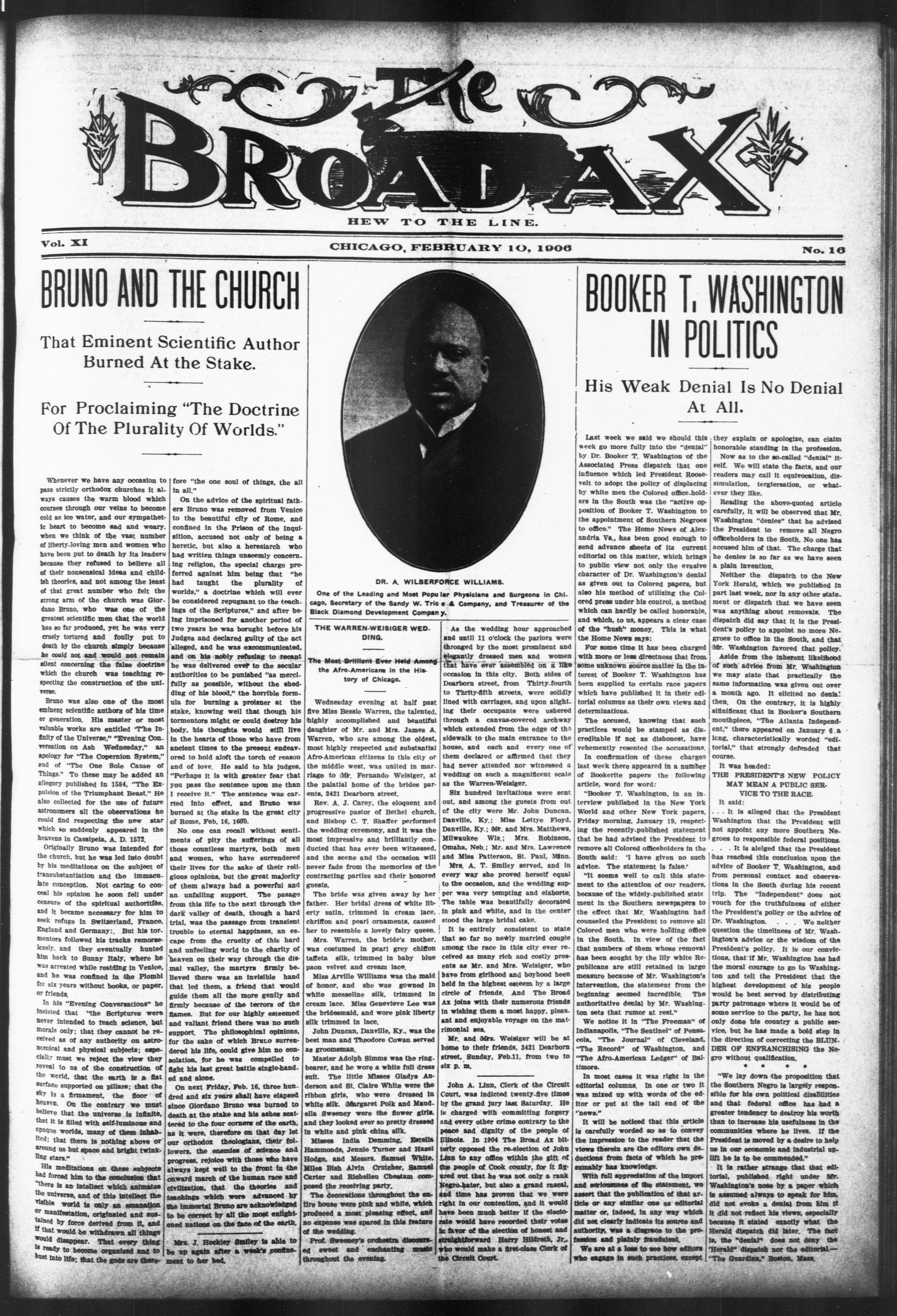
DR. A. WILBERFORCE WILLIAMS.
One of the Leading and Most Popular Physicians and Surgeons in Chicago, Secretary of the Sandy W. Tric e & Company, and Treasurer of the Black Diamond Development Company.
THE WARREN-WEISIGER WED-DING.
The Most Brilliant Ever Held Among the Afro-Americans in the History of Chicago.
Wednesday evening at half past five Miss Bessle Warren, the talented, highly accomplished and beautiful daughter of Mr. and Mrs. James A. Warren, who are among the oldest, most highly respected and substantial Afro-American citizens in this city or the middle west, was united in marriage to Mr. Fernando Weisiger, at the palatial home of the brides parents. 3421 Dearborn street.
As the wedding hour approached and until 11 o'clock the parliors were thronged by the most prominent and elegantly dressed men and women that have ever assembled on a like occasion in this city. Both sides of Dearborn street, from Thirty-fourth to Thirty-fifth streets, were solidly lined with carriages, and upon alighting their occupants were ushered through a canvas-covered archway which extended from the edge of the sidewalk to the main entrance to the house, and each and every one of them declared or affirmed that they had never attended nor witnessed a wedding on such a magnificent scale as the Warren-Weisiger.
Six hundred invitations were sent
Rev. A. J. Carey, the eloquent and progressive pastor of Bethel church, and Bishop C. T. Shaffer performed the wedding ceremony, and it was the most impressive and brilliantly conducted that has ever been witnessed, and the scene and the occasion will never fade from the memories of the contracting parties and their honored guests.
The bride was given away by her father. Her bridal dress of white liberty satin, trimmed in cream lace, chiffon and pearl ornaments, caused her to resemble a lovely fairy queen.
Mrs. Warren, the bride's mother, was costumed in pearl grey chiffon taffeta silk, trimmed in baby blue paon velvet and cream lace.
Miss Arville Williams was the maid of honor, and she was gowned in white messeline silk, trimmed in cream lace. Miss Genevieve Lee was the bridesmaid, and wore pink liberty silk trimmed in lace.
John Duncan, Danville, Ky., was the best man and Theodore Cowan served as groomsman.
Master Adolph Simms was the ring-bearer, and he wore a white full dress suit. The little Misses Gladys Anderson and St. Claire White were the ribbon girls, who were dressed in white silk. Margaret Polk and Maudella Sweeney were the flower girls, and they looked ever so pretty dressed in white and pink china silk.
Misses India Demming, Estella Hammonds, Jennie Turner and Hazel Hodge, and Messrs. Samuel White, Miles Bish Alvin Crutcher, Samuel Carter and Richelieu Cheatam composed the receiving party.
The decorations throughout the entire house were pink and white, which produced a most pleasing effect, and no expense was spared in this feature of the wedding.
Prof. Sweeney's orchestra discoursed sweet and enchanting music throughout the evening.
As the wedding hour approached and until 11 o'clock the parlors were thronged by the most prominent and elegantly dressed men and women that have ever assembled on a like occasion in this city. Both sides of Dearborn street, from Thirty-fourth to Thirty-fifth streets, were solidly lined with carriages, and upon alighting their occupants were ushered through a canvas-covered archway which extended from the edge of the sidewalk to the main entrance to the house, and each and every one of them declared or affirmed that they had never attended nor witnessed a wedding on such a magnificent scale as the Warren-Welsiger.
Six hundred invitations were sent out, and among the guests from out of the city were Mr. John Duncan, Danville, Ky.; Miss Letty Floyd, Danville, Ky.; Mr. and Mrs. Matthews, Milwaukee Wis.; Mrs. Robinson, Omaha, Neb.; Mr. and Mrs. Lawrence and Miss Patterson, St. Paul, Minn.
Mrs. A. T. Smiley served, and in every way she proved herself equal to the occasion, and the wedding supper was very tempting and elaborate. The table was beautifully decorated in pink and white, and in the center stood the large bridal cake.
It is entirely consistent to state that so far no newly married couple among the race in this city ever received as many rich and costly presents as Mr. and Mrs. Weisiger, who have from girlhood and boyhood been held in the highest esteem by a large circle of friends. And The Broad Ax joins with their numerous friends in wishing them a most happy, pleasant and enjoyable voyage on the matrimonial sea.
Mr. and Mrs. Weisiger will be at home to their friends, 3421 Dearborn street, Sunday, Feb.11, from two to six p. m.
John A. Linn, Clerk of the Circuit Court, was indicted twenty-five times by the grand jury last Saturday. He is charged with committing forgery and every other crime contrary to the peace and dignity of the people of Illinois. In 1904 The Broad Ax bitterly opposed the re-election of John Linn to any office within the gift of the people of Cook county, for it figured out that he was not only a rank Negro-hater, but also a grand rascal, and time has proven that we were right in our contention, and it would have been much better if the electorate would have recorded their votes in favor of the election of honest and straightforward Harry Hildreth, Jr., who would make a first-class Clerk of the Circuit Court.
BOOKER T. WASHINGTON IN POLITICS
His Weak Denial Is No Denial At All.
Last week we said we should this week go more fully into the "denial" by Dr. Booker T. Washington of the Associated Press dispatch that one influence which led President Roosevelt to adopt the policy of displacing by white men the Colored office.holders in the South was the "active opposition of Booker T. Washington to the appointment of Southern Negroes to office." The Home News of Alexandra Va., has been good enough to send advance sheets of its current editorial on this matter, which brings to public view not only the evasive character of Dr. Washington's denial as given out to Colored papers, but also his method of utilizing the Colored press under his control, a method which can hardly be called honorable, and which, to us, appears a clear case of the "hush" money. This is what the Home News says:
For some time it has been charged with more or less directness that from some unknown source matter in the interest of Booker T. Washington has been supplied to certain race papers which have published it in their editorial columns as their own views and determinations.
The accused, knowing that such practices would be stamped as discreditable if not as dishonest, have vehemently resented the accusations. In confirmation of these charges last week there appeared in a number of Bookerite papers the following article, word for word: "Booker T. Washington, in an interview published in the New York World and other New York papers, Friday morning, January 19, respecting the recently-published statement that he had advised the President to remove all Colored officeholders in the South said: 'I have given no such advice. The statement is false.'
"It seems well to call this statement to the attention of our readers, because of the widely-published statement in the Southern newspapers to the effect that Mr. Washington had counseled the President to remove all Colored men who were holding office in the South. In view of the fact that numbers of them whose removal has been sought by the illy white Republicans are still retained in large measure because of Mr. Washington's intervention, the statement from the beginning seemed incredible. The authoritative denial by Mr. Washington sets that rumor at rest."
We notice it in "The Freeman" of Indianapolis, "The Sentinel" of Pensacola, "The Journal" of Cleveland, "The Record" of Washington, and "The Afro-American Ledger" of Baltimore.
In most cases it was right in the editorial columns. In one or two it was mixed up with words of the editor or put at the tail end of the "news."
It will be noticed that this article is carefully worded so as to convey the impression to the reader that the views therein are the editors own deductions from facts of which he presumably has knowledge.
With full appreciation of the import and seriousness of the statement, we assert that the publication of that article or any similar one as editorial matter or, indeed, in any way which did not clearly indicate its source and authority, was a disgrace to the profession and plainly fraudulent.
We are at a loss to see how editors who engage in such practices, except
WASHINGTON POLITICS
nial Is No Denial All.
they explain or apologize, can claim honorable standing in the profession. Now as to the so-called "denial" itself. We will state the facts, and our readers may call it equivocation, dissimulation, tergiersation, or whatever they like.
Reading the above-quoted article carefully, it will be observed that Mr. Washington "denies" that he advised the President to remove all Negro officeholders in the South. No one has accused him of that. The charge that he denies is so far as we have seen a plain invention.
Neither the dispatch to the New York Herald, which we published in part last week, nor in any other statement or dispatch that we have seen was anything about removals. The dispatch did say that it is the President's policy to appoint no more Negroes to office in the South, and that Mr. Washington favored that policy. Aside from the inherent likelihood of such advice from Mr. Washington we may state that practically the same information was given out over a month ago. It elicited no denial then. On the contrary, it is highly sifificant that in Booker's Southern mouthpiece, "The Atlanta Independent," there appeared on January 6 a long, characteristically worded "editorial," that strongly defended that course.
It was headed:
THE PRESIDENT'S NEW POLICY
MAY MEAN A PUBLIC SER-
It is alleged that the President Washington that the President will not appoint any more Southern Negroes to responsible federal positions. It is alledged that the President has reached this conclusion upon the advice of Booker T. Washington, and from personal contact and observations in the South during his recent trip. The "Independent" does not vouch for the truthfulness of either the President's policy or the advice of Dr. Washington. We neither question the timeliness of Mr. Washington's advice or the wisdom of the President's policy. It is our convictions, that if Mr. Washington has had the moral courage to go to Washington and tell the President that the highest development of his people would be best served by distributing party patronage where it would be of some service to the party, he has not only done his country a public service, but he has made a bold step in the direction of correcting the BLUNDER OF ENFRANCHISING the Negro without qualification.
"We lay down the proposition that the Southern Negro is largely responsible for his own political disabilities and that federal office has had a greater tendency to destroy his worth than to increase his usefulness in the communities where he lives. If the President is moved by a desire to help us in our economic and industrial uplift he is to be commended."
It is rather strange that that editorial, published right under Mr. Washington's nose by a paper which is assumed always to speak for him, did not evoke a denial from him if it did not reflect his views, especially because it stated exactly what the Herald dispatch did later. The fact is, the "denial" does not deny the "Herald" dispatch nor the editorial—'The Guardian,' Boston, Mass.
Will promulgate and at all times uphold the true principles of Democracy, but Catholic, Protestant, and Christian, and will not oppose any one, Knights of Lobos, or any one else can have their say, no longer as their language is proper and responsibility is fixed.
The Broad AX is a newspaper whose platform is to promote the rights of the编辑 right to speak its own mind.
Local communications will receive attention.
Write only on one side of the paper.
Subscriptions must be paid in advance.
One Year.....$2.00
Six Months.....1.00
Advertising rates made known on application.
Address all communications to
THE BROAD AX
500 Armour Avenue, Chicago.
JULIUS F. TAYLOR, Editor and Publisher.
Entered at the Post Office at Chicago,
IL, as second-class Matter.
CHIPS
Alderman Thomas Carey arrived home from California this week, and he looks like a four-time winner.
Father Massiah, the new Rector of St. Thomas' Episcopal church, is the guest of the Smiley's during the preparation of the rectory.
Mrs. E. P. Harper, Detroit, Mich., arrived in the city Thursday morning, and will spend one month in visiting with her daughter, Mrs. Charles E. Webb, 4733 Dearborn street.
John Nuggent, one of the old-time politicians in the Town of Lake, who conducted a buffet at the corner of Fifty-third street and Union avenue, died last Sunday morning.
The Prairie State Club will give a dancing party Wednesday evening. Feb. 21st, at the Douglas Club House, 3518 Ellis avenue. Music by Prof. N. Clark Smith's orchestra.
Miss Sarah Roberts, who has been the guest of Mr. and Mrs. Dempsey, 3716 Dearborn street, for the past month, left for Columbus, Ohio, Wednesday morning.
Mr. and Mrs. Chas, Webb, 4733 Dearborn street lost their baby boy Wednesday morning. The little fellow was put to bed Tuesday night in apparent good health. The parents were shocked upon finding him dead next morning.
Mrs. A. T. Smiley, 2111 Indiana avenue entertained at an elaborate dinner Friday evening, Feb 2d, in honor of Mr. and Mrs. Henry Hart, of Indianapolis. At a late hour the guests departed, declaring Mrs. Smiley an ideal hostess.
On Sunday morning last Mrs. Powell, beloved mother of Mrs. David Lawrence and Mrs. J. Bundy, was laid to rest after many months of suffering. The funeral services took place at Jackson's morgue, after which the remains were carried to Jacksonville for burial.
Bishop Grant will on Monday evening be the guest of the Bethel Literary and Historical Club, which holds forth in Bethel church, Thirtieth and Dearborn streets, and on that evening he will deliver an oration on "Abraham Lincoln," and assist to celebrate the anniversary of his birth.
John A. Haney and his followers, under the leadership of ex-Alderman Michael McInerney, are endeavoring to put Alderman John J. Bradley to sleep at the primaries February 24th, but they will never be able to do that, as the popular Alderman has the people at his back, and when the time comes he will deal his would-be opponents an everlasting knockout blow.
The Afro-American Municipal Ownership League of the Second ward holds largely attended meetings every Wednesday evening at 2950 State street, and Charles A. Gaskin, its head and front, and the popular manager of the Eureka Club and cafe 2940 State street, and its members are working night and day to boost the candidacy of A. B. Perrigo for Alderman of the Second ward.
John Moonshine Moore, who at one time owned the whole State of Texas and was its head deacon in the church and leader of its Sunday school, who later on went to New York City to live, where he has successfully conducted one of the largest gambling houses in the East, may come to Chicago to reside in 1920, for we are of the opinion that this would be a mighty good field for his line of business.
The Ideal Club of Berean Baptist church, 4888 Dearborn street, under the leadership of Mr. C. H. Davis, will furnish quite a musical treat for the
---
people in that vicinity by giving a grand sacred concert at the church Sunday evening, Feb. 11, 1906, consisting of some of Chicago's best musical talent. Program: Miss Beulah Medley, contralto; Prof. N. Clark Smith, tenor; Miss Gertrude Irene Howard, cornetist; Mr. W. Kemper Harreld, violinist, assisted by Prof. N. Clark Smith, Symphony Orchestra. Program commences on 8 o'clock sharp. A silver offering will be lifted by several of the young ladies of the church. The friends are cordially invited to be present.
Wednesday morning St. Monica's Catholic church, Thirty-sixth and Dearborn streets, was the scene of a brilliant wedding. The crowd began to gather as early as 7:45, and remained until after 10 o'clock, during which high mass and all the other functions of the Catholic services was carried out in order to make Miss Carrie Weeks and Mr. C. W. White "one." The bride is an adopted daughter of Mrs. "Pop" Wilson, one of Chicago's oldest settlers, hence the vast attendance. The reception, which was held at 2616 Wabash avenue from 8 to 11 p. m., was attended by Chicago's most representative citizens, many of whom sent handsome and useful presents.
The Record-Herald and the Other Daily Papers Failed to Refer to
Banquet
One or two members of the committee which had charge of the banquet which was tendered to Col. Robert T. Motts recently expressed their great surprise to the writer last Saturday evening over the fact that the Record-Herald and the other daily papers failed to contain the slightest account or reference to the banquet which had been tendered Col. Robert T. Motts.
In replying to one of the members we stated that possibly the committee had treated the daily papers with the same utter contempt as they bestowed upon the Afro-American newspapers by refusing to send their editors or representatives an invitation to the affair, and that it was unreasonable to expect the daily papers or any first-class weekly paper to send representatives there to stand around and look like monkeys while listening to the speakers comparing Col. Robert T. Miotts, who is an elegant gentleman, "to a prince! a king! and a God!"
The Negro in Literature.
But in the arts, in literature, what can he do there? There have been white men in the South who have not scrupled to affirm that the Negro was only an animal, soulless and incapable of real progress. Perhaps they regard industrial achievement as mere "training of animals." Perhaps they look upon his religious enthusiasm as excess of animal emotion. Perhaps they would bring the same accusation against the Negro music, the only real American music we have produced. But they can hardly pretend that Brutes could bring forth such work in literary lines as the Negro is showing himself capable of. We refer to the writings of Prof. Dubois and Paul Laurence Dunbar. Mr. Dunbar's latest book of poems illustrated by Negro artists is a gem which the writer has not seen surpassed by the work of any white poets this year.
It is about time for us to wake up to the fact that in the field of literature, even as in other fields, the Negro is working side by side with his white brother. There is no use in talking about the inferior races any more than here is in talking about the inferiority of women. Difference is not inferiority. And even the difference has been greatly exaggerated. By the sign of the book the Negro is showing a mental capacity which places him on a level.—Chicago Advance (white).
LYONS ENTERS DENIAL.
Says He Did Not Say Negroes Would
be Ousted from Office.
Judson W. Lyons, Register of the Treasury, in a formal statement declares that an article published in a weekly newspaper in New York yesterday, written from Washington under date of January 28, which says that he gave out or inspired the statement published some two weeks ago that the President would replace all Negroes holding offices in the South by white men, "is untrue and without one lota of foundation so far as it makes me the author or inspirer of that statement."
Mr. Lyons adds: "No such policy as this was ever made known to me by the President or any one authorized to speak for him."
St. Mark Literary.
"Education as Related to Civic Prosperity" was the subject of Mr. R. M. Harvey's paper last Sunday afternoon at the St. Mary Literary, State street near Forty-seventh street. The paper was well received and freely discussed. Next Sunday afternoon will be the Lincoln annicersary. Dr. M. C. B. Mason, of Cincinnati, will be the orator. Dr. Mason is the senior Secretary of the Freedman Aid and Southern Educational Society of the M. E. church. He receives a salary of $4,500, and is recognized as being one of the greatest orators the race has ever produced. The Garfield Boulevard M. E. church orchestra will furnish the music next Sunday. The program begins at 3:30 p. m. Mr. Richard A. Crolley will preside.
Frederick Douglass Center.
Tuesday afternoon the Douglass Center Womans Club, 3032 Wabash avenue, overflowed the assembly room to hear an instructive program. Two musical selections were given. The paper, "Why I am a Vegetarian," was read by Mrs. Sarah F. Cane. She gave many valuable suggestions concerning the vegetable diet. A demonstration of the hay-box cooking stove, in charge of Mrs. Redfield, added very much to the interest of the program. Last Thursday afternoon more than one hundred girls were in attendance for the organization of a Girls' Club. Prof. Joseph Garner met them, and arranged the club in sections, which will meet at stated times. The Boys' Club is getting ready for work.
Sunday at 3 p. m. the regular meeting will be held. Prof. N. Clark Smith will sing one of his own compositions, the words being written by Mrs. Sarah Stewart.
Thursday at 2 p. m. the I. B. W. Club meets. At 8 p. m. the fiction class. The paper, "The Schoolmaster in English Literature," will be read by Mr. Edwin C. Wentworth. All are invited.
Friday at 8 p. m. the Young People's Lyceum will meet. A Frederick Douglass anniversary program, with exercises suitable for the occasion, will be given.
Saturday at 10 a. m. the girls' sewing class meets, and at 8 p. m. the class in English literature. "D."
Adam Not the First Man.
According to the Bible, Adam and Eve were created and placed somewhere in a garden called "Eden." It appears that this is figurative because no one has ever attempted to locate this garden. They don't say whether it was in Asia, Palestine, Judea, or where—hence it seems to be a figure which is reasonable—for instance, the forbidden fruit was, and furthermore "the serpent beguiled me and I did eat." The Lord said in the same chapter to old serpent, in substance: "For your disobedience or transgression thou shalt crawl on thy belly all thy days." But was Adam the first man? It seems not. Cain and Abel were the first born—two boys, Cain went into the land of Nod, says the Bible, and found his wife. Unless we just presume something not natural, there were people save the direct offspring of Adam and Eve. We do not aim to dispute the Bible, nor theologists: but simply there are. It seems, misrepresentations. If Cain went out into the land of Nod and found his wife, there must have been other people save Adam and Eve. And suppose they argue that his wife was the daughter of Adam, then the Bible only gives account of two children, Cain and Abel, prior to Cain's leaving for Nod, and even if it was Adam and Eve's daughter, when did she leave for Nod, before or after Cain left? As soon as Cain reached Nod, says the Bible, he found his wife—and would Cain have married his sister, not unaware? Scientists also discover that the world was peopled 50,000 years ago, and according to some scientists the world began in a crude state 1,000,000 years ago. According to this theory, the world always has been and always will be.—Ex.
Card of Thanks
I wish to thank the many firends of Chicago and other cities for their kindness and sympathy during the illness and at the death of my beloved wife, Lydia B. Paul. My loss is very great, but the sympathy of kind friends makes it easier to bear.
S. S. PAUL,
3605 Forest Avenue.
Furnished Room To Rent.
Modern furnished front room to rent. Steam heat, Telephone service.
3634 Calumet ave.
Owing to the emigration of 1,000 persons during the past three months from St. Pierre and Miquelon-islands immediately south of Newfoundland—out of a total population of 6,500, the French authorities are beginning to fear that the colony is threatened with extinction. The rush of emigration is likely to continue. The poorer inhabitants advocate the transfer of St. Pierre by France to Newfoundland.
Entitled to Honorable Mention
"You believe in old-age pensions, do you?" said the passenger with the skull cap. "Well, that depends. Take your case, for instance. What claim have you on the country? What have you ever done or suffered for it?" "I've got the tobacco heart from contributing to its internal revenue department," said the passenger with the sandy goatte, "and I've raised 14 boys, b'goah!"—Chicago Tribune.
Insecure Security.
James Richardson, of Rodger Mills county, tendered a mule the other day as a chattel to a Cheyenne money lender in order to get funds with which to get a marriage license and pay the preacher. He had ridden the mule in -18 miles—and expected to walk back home in time for the wedding. -Guthrie (Okla.) Gazette.
Fortune Made Miser.
Father Aeby, a noted miser, has died at Berne, age 70. When he was 22 a fortune was bequeathed him, and from being a spendthrift he at once became a miser. He lived on bread and water at a cost of three cents a day, and left $750,000. The sum of $100,000 in gold and silver was found under his bedroom floor.
Getting Her Logacious.
"My daughter is so taciturn," complained Mrs. Blankton-Black. "What ought I to do? Consult some specialist?" "Not at all, but at all," replied Mr. Wurldly-Wiseguy. "Have her given instruction in whist and take her frequently to the opera."
Silver from Volcanoes
Silver has been thrown out by volcanoes in two instances recorded by J. W. Malet. Ash from an eruption of Cotopaxi in 1885 showed one part of silver in 83,000 and that ejected in 1886 by Tungurague, in the Andes of Ecuador, contained one part of silver in 107,200.
Skeleton Scare
The shadow of a dangling skeleton on a window shade created great excitement in a London street the other night. An inquiring policeman learned that an ambulance doctor was delivering a lecture on first aid to a roomful of railway employees.
Oldest Government Clerk.
J. J. Miller is the oldest clerk in the service of the national government. For more than 60 years he has been connected with the life saving service. He was born in Philadelphia in 1821, and educated in the private schools of that city.
Up-to-Date Indians
The Indians of Elko, Nev., have abandoned the dances of their forefathers, have built a dance hall, and recently gave a ball, at which they and their squaws and many invited pale faces waltzed in the most modern fashion.
Cross-Breeding Plants
It is only within a century that hybridization or the cross-breeding of plants has been practiced. Yet it seems to have been in Lord Bacon's mind, as a thing to be achieved, more than 300 years ago.
Garibaldi's Gaiter
According to La Tribuna di Roma one of the gaiters worn by Garibaldi when he was wounded in the battle of Aspromonte, August 28, 1862, has been presented to the mayor of Rome.
What's the Answer?
Johnny—Isn't a tin horn made of tin,
mamma?
Mamma—Certainly it is.
"Then how is it that a fog horn isn't
made of for?"—N. Y. Times.
Same Old Eve.
Asked in a London court the other day where he got his black eye, the skipper of a coasting schooner replied: "Oh, that's an old one. I've had it for two years."
In the Tyrol the government still pays for the extermination of poisonous snakes. It is the one European government which now does.
London's lord mayors have during the past decade collected more than $100,000,000 for charitable and benevolent purposes.
Between Togopah and Manhattan, Nev. 50 miles, there is an automobile service. Round trip. $25.
The meanest thing about the average mother-in-law is her son-in-law.—N. O. Picayune.
Japan is 50 times smaller than Russia, and her population one-third that of the latter.
PIANOS WINTER KILLED.
More Susceptible to Extreme Heat or Cold Than Human
"Winter killing of pianos," says an expert tuner who has done work for Paderewski, Hoffman, Arthur Whiting and a host of other celebrated musicians, "is something that most owners of musical instruments take no account of. Yet it is as serious as the winter kining of shrubbery and needs to be as carefully guarded against.
"Especially since all the world has come to live in steam-heated houses and flats the business that the piano tuner ought to get, and often doesn't, has increased immensely. A piano is really more susceptible to excess of heat and lack of moisture than human beings are.
"It is bad enough, of course, that men and women will live all winter long in rooms at 80 degrees, with every particle of moisture baked out of the air. They naturally get colds and pneumonia from the experience. Meantime it's just as fatal to the piano, which cannot properly stand more than 72 degrees of the artificial heat. "During the American closed season, as our English cousins like to call it, hundreds of thousands of musical instruments go to rack and ruin. The moisture is dried out of the sounding board and all the other wooden parts, which warp and twist and disastrously affect the action.
"It is surprising, anyway, how negligent people are in their treatment of instruments for which they pay a great deal of money. There's a lesson for the amateurs in the firmness with which professionals insist that their pianos shall be kept right up to the mark and not allowed to get out of or der in the slightest particular.
"In a music school, too, the teachers have to be particular in having the instruments frequently attended to. The pianos in the New England Conservatory of Music, for example, are all tuned at least every five weeks."
IS TWO ANIMALS IN ONE.
One' Half of a Chameleon May Be Wide Awake and the Other Asleep.
To all appearances and according to the researches of those best capable of forming an opinion on the subject the nervous centers in one lateral half of the chameleon go on independently of those on the other, and it has two lateral centers of perception—sensation and motion—besides the common one in which must reside the faculty of concentration, says the Scientific American. The eyes move independently of one another and convey separate impressions to their respective centers of perception. The consequence is that when the animal is agitated its movements resemble those of two animals or rather perhaps two halves of animals glued together. Each half wishes to go its own way and there is no concordance of action.
The chameleon, therefore, is the only four-legged vertebrate that is unable to swim; it becomes so frightened when dropped into water that all faculty of concentration is lost and the creature tumbles about as if in a state of intoxication.
When a chameleon is undisturbed every impulse to motion is referred to the proper tribunal and the whole organism acts in accordance with its decrees.
The chameleon, moreover, may be fast asleep on one side and wide awake on the other. Cautiously approached at night with a candle so as not to awaken the whole animal at once, the eye turned toward the light will open, begin to move and the corresponding side to change color, whereas the other side will remain for a longer or shorter time in a torpid, motionless and unchanged state, with its eye fast shut.
HE GOT A. WARMER SEAT.
Clever Buse of Tavern Guest Cleared the Crowd from Around ' the Stove.
One bitter cold night recently a solemn-faced man drove up to a tavern near Westchester and made his way to the sitting-room after seeing that his horse was taken to the stable, relates the New York Press. There was a large crowd of guests huddled around the stove and he had to take a distant seat where it was not much warmer than outside. As soon as a waiter appeared the man said:
"Get two dozen oysters on the half shell and take them out to my horse."
When the waiter passed through the room on his way to the stable everybody but the new guest followed him to see the remarkable horse feed on raw oysters. In a few moments the disgusted crowd, headed by the waiter, returned to the room to find the owner of the horse comfortably seated by the stove.
"The horse wouldn't look at the oysters." said the waiter.
"I didn't think he would," replied the man. "Hand them to me and bring me a bottle of ale."
Envy.
Mr. Billus—No dinner ready? What on earth is the matter with you, any-how?
Mrs. Billus—Oh, John! Mrs. Binks, who lives next door, has the loveliest new set of furs I ever saw, and I have no appetite. Cleveland Plain Dealer.
Joel is a profiteer writer?
"Prolific! Say, I'd like to have the money he pays as return postage."—Philadphila Ledger.
RARE ORCHID AGAIN FOUND
Plant Long-Sought Has Been Rediscovered on Recent Thibet Expedition.
An orchid which for 50 years has baffled all the attempts of collectors to find its native haunts has been rediscovered. This orchid is the cyprypedium Fairieanum, which is one of a random collection made in Assam in 1857, sent to London in the same year and bought by a Mr. Fairie, of Liverpool, in whose possession it bloomed and was daily hailed and described in orchid literature as one of the most beautiful orchids hitherto known. Several other plants of the same orchid came with it, and the species was at once named Fairieanum, after Mr. Fairie.
From the day of its first discovery, in spite of scores of expeditions and perilous journeys by collectors, not a single plant was found until some member of the Thibet expedition, a few months ago, discovered a whole bunch of the plants. He sent them along to Calcutta, whence two were dispatched to Kew, and others are gradually coming through to England. "Probably another 50 years will elapse ere more Fairleanum are found," said a British specialist, "for no private collecting expedition is likely to venture into such a country. My own belief is that unless another military expedition traverses the same ground there will never again be a chance of getting plants."
The plant flowering at Kew has five growths and two flowers. The second plant is developing five blooms. The flower has a slender, hairy scape about ten inches in height, a prominent and charming dorsal sepal, one and three-quarters inches in length by one and one-quarter inches in breadth, with a white ground beautifully veined with violet purple and with brownish green veins near the center and whitish hairs around the margins. The petals droop and have an upward curve at the tips; they are one and one-half inches in length, with a white ground streaked with purple and yellow. The upper margin of the petals is much undulated and covered with prominent purple hairs. The pouch is rather small, greenish-brown in color, veined with brownish red and covered with short hairs.
GOT HER MONEY'S WORTH.
Drug Store Customer Took Postage Stamps Instead of Hair Bleach
The pretty girl whom the drug clerk recognized as a customer entered the store rather diffidently and approached the clerk with the air of one about to ask a favor, relates the Rehoboth Sunday Herald. "Do you ever exchange things?" she asked, appealingly. "Well, it depends. We try to be accommodated," he replied. "What do you want to exchange?" She brought forth a bottle, which she handed him. "I-I decided not to use this," she said, "and I'd like to return it." "This" was a bottle of peroxide of hydrogen, and the girl's hair was still brown. "Certainly we'll take it back," said the clerk. "What do you want instead?"
She thought a minute and looked around at all the mysterious glass bottles and jars. Then an inspiration lit up her pretty face.
"You are so kind," she said. "I'll take it out in postage stamps."
AMERICAN WOMAN GUIDE.
Touring Parties in Ancient Athena
Shown the Sights by
Young Lady.
There is in Athens, Greece, a young American girl, Miss Florence Stone, who makes a good living as a professional guide. Some time ago, while traveling in Europe with her mother, Miss Stone received word that their fortune had suddenly been lost. Happening to be in Athens, she determined to remain there and do what she could toward their support. She tried teaching English for a while, but was not particularly successful in getting pupils.
Then, at the suggestion of a prominent American woman whom she had accompanied on one or two sightseeing expeditions, she offered her services to parties of tourists as a professional guide and has made a success of it. With education and culture as well as a perfect knowledge of modern Greek, she is better able to impart interesting historical information than the ordinary foreign guide.
Our Friends
"Well, I'll tell you the trouble with Sterling. I admit that he's a fairly good business man, but there's a pretty big element of luck in his success. He's insufferably conceited, too, and then it's merely his hyperclist that—" "You seem to know him pretty well." "Oh, yes, we're great friends."—Philadelphia Press.
Fuddle—You know Stocks, don't you?
Doctor—I should say so. I'm treating him for insomnia—Stray Stories.
Uncle Jerry.
"They say there's graftin' goin' on even in some of the penitentiaries," observed Uncle Jerry Peebles. "Well, that's the right place for grafters."—Chicago Tribune.
WASHINGTON GOSSIP
ODOR OF MOTH-BALLS CLINGS BOUND THE UNIFORMS.
White House Offices Uncomfortable,
Unhealthful and Ugly—Representative Longworth Laboring
for Needed Reform.
WASHINGTON.—The scent of the
moth ball will soon be out of
Washington atmosphere. There
is only one more reception at the
White House and after that the ma-
jority of the young officers,
and old ones too.
A S H I N G T O N. The scent of the moth ball will soon be out of Washington atmosphere. There is only one more reception at the White House and after that the majority of the young officers, and old ones, too.
for that matter, in the army, navy and marine corps can put away their dress uniforms in cedar closets and chests and fortify them with camphor and moth balls. The odor of these moth destroyers and preventers is first noticed on New Year's day, when every officer of the army and navy and revenut cutter service within the city is expected to put on his finest dress uniform and repair to the White House to greet the president and his wife.
During the Spanish-American war an order was issued requiring officers to wear their uniforms while on duty, and they all became so accustomed to doing so that their official clothing was in use most of the time. Gradually the order came to be ignored, and to-day army and navy officers holding positions in Washington go about their duties in civilian dress and the blue and drab uniforms which are costly affairs are kept safe from moth and rust. When the New Year's reception is on it is no exaggeration to state that the odor of moth balls can be detected a square away from the White House. Then come the official evening receptions, which are given fortnightly, and again the officers must turn out in full regalia, so that the sweet odor of the flowers decorating the executive mansion and the delicate perfumery affected by the ladies must contend with the sharper and more insistent smell of camphor.
These official receptions are now over, and the thrifty officers can once more don civilian dress and attend evening functions in the formal black dress suit. Officers as a rule very tired of the color of their uniforms and are very glad to lay them aside for civilian dress.
Reforms at the White House.
P
RÉSIDENT
ROOSEVELT
has worked a reform in the matter of evening receptions at the White House. In the old days the invitations issued for each reception would fill the executive mansion with such a
throng as to ruin gowns and tempers. Since the Roosevelts came to the White House a different system has been in force, under which there is a judicious division of invitations, so that everybody who ought to be invited will get at least one invitation to each reception. The capacity of the old mansion is limited, despite the wide-famed East room, which is supposed to accommodate thousands. Every function at the White House proclaims loudly the necessity of an executive building where the presidential offices could be located and a large hall be provided for official receptions, leaving the present mansion exclusively for the private use of the president and his family.
The idea of a grand executive building is at present kept in the background, although the insignificant executive offices where the president does his work were erected as temporary quarters in expectation that congress would take up the matter and provide a proper place for executive headquarters. There is not a day passes that the inadequacy of the White House offices is not emphasized. There is no more beauty about the building than there is about the average country railroad station. The rooms are uncomfortable, ugly and not very healthful.
The worst feature about these temporary quarters is that the president is separated from the public by only one or two doors, and noises in the outer offices penetrate easily into the cabinet room or into his own office. The deplorable Mrs. Morris incident could not have occurred in a building that had been constructed for protection as well as use of the president. She raised a row within ten feet of the president's room, something she could not have done in a properly constructed building.
R
E PRESENT A TIVE NICHOLAS LONG WORTH does not propose to go down into history merely as the husband of A 11 ce Roosevelt. The young man has political ambition and landable desire to accomplish a me of the house. He
that he is capable of taking good care of himself in debate and he can make an interesting and informative speech. His experience on his Philippine tour last summer was not altogether that of love-making. He studied intelligently conditions in the islands, and when the Philippine tariff bill was up in the house he had an opportunity to display his knowledge of the whole subject. He does not hesitate to speak plainly about the Philippines, and declares that the United States will be well rid of them when they can be properly governed by their own people.
Mr. Longworth is now advocating a very important measure which, if it becomes a law, will distinguish him as a man who has accomplished a real reform. His bill provides for the purchase of land and the erection of embassies and legation buildings for our representatives in foreign lands. His own travel abroad in Europe and in the orient has impressed him with the very shabby showing the United States makes in the matter of homes for her diplomats. For posts in Europe very wealthy men have to be selected as ambassadors in order to do credit to the government in the matter of embassies and in entertaining. Whitelau Reid, at London, pays $35,000 a year merely for the rental of a mansion, or twice the salary he receives from his government.
Compared with the generous salaries paid foreign ambassadors in Washington and the liberality of their home governments in purchasing for them permanent quarters here, the United States cuts a very sorry figure abroad.
A Canadian Yankee
O
NE of Canada's bright railroad men was observed in Washington recently, and the capital city is all the better for his visit. This is George H. Ham, a special agent of the Canadian Pacific railway, who has left a trail of "glad hands" all
the way across the continent and wherever his big system of railroad goes, and who is a Canadian Yankee in with, humor and enterprise. Mr. Ham is one of those rare characters that a big corporation gets hold of sometimes, whose personality counts for more than the name of the company. He has made 29 trips from Montreal to Victoria in the interest of the Canadian Pacific railroad, and they have resulted in a wider diffusion of knowledge regarding the wonderful territory this system serves than has been accomplished by any other means.
Mr. Ham personally conducts tours of homeseekers, investigators and investors, with an occasional party of newspaper men, across the continent, and there is scarcely a mile of the 3,000-mile trip with which he is unacquainted. He can give the depths of soil in every section, and the acre of the big 1,000-mile square wheat farm in northwestern Canada, and can tell within a thousand feet of the output of the lumber in eastern Canada as well as on the Pacific slope. Wherever he goes a bright light is shown for the Canadian Pacific railroad, or, as many of the natives in Canada are in the habit of calling it, the "C. P. R. railway." While Mr. Ham was in Washington he did not neglect to call attention to the advantages of his home country of Canada as a winter resort as well as summer.
Intoxicants.
S Cheap In
ELECT and common council for the District of Columbia are now in session. In other words, congress is assembled in the national capital and is for a large part of the time engaged in managing the affairs of the district. As the peo
ple in this ten-mile square territory have no franchise, they are the wards of congress. The two district committees of the house and senate look after affairs in Washington just as the branches of councils or boards of aldermen would do in any other municipality. It seems to be a rather trifling business for bodies representing the entire country to have their time occupied in discussing the opening of streets, the laying of pavements, building schoolhouses, etc. The system, however, cannot well be changed, the sad experience of a territorial form of government 20 or 25 years ago precluding the thought of changing back to that form.
Just now there is a good deal of talk concerning the prohibition of the sale of intoxicating liquors in the district or the imposition of an extremely high license. The great capital of the nation, supposed to be the center of statemanship, art and literature, is no better off in the matter of common drunkenness than a manufacturing center. A United States official has written to the excise board stating that conditions are deplorable on account of cheap beer and the bucket trade. He declares that most of the alley lights, assaults and other violations of the law are traceable to cheap beer and to the habit of "rushing the growler." The matter will be brought up before congress and an attempt made to cut off the trade in cheap intoxicants and to do away with a multitude of low groggers where the colored element of the city get their inspiration for all sorts of misdoings.
CHILD'S FIRST TEETH.
Of Utmost Importance That They Are Carefully Looked After—Dentist's Aid Is Often Required.
Letting baby suck and chew on a stale crust or a stale piece of corn pone will do a great deal to assist in bringing the teeth through; and the teeth that have arrived will also be benefited by this very simple means. In stale bread all of the gas which might create disturbance in the little stomach has evaporated, the starch granules have ripened and burst, and the bread itself is in the best condition to be digested and absorbed into the system. Just a little lime water in the milk will often aid in establishing good teeth, and where the little princess' first teeth have not been especially good, either as to color, shape or arrangement, the matter can readily be corrected by careful attention, first to the cleanliness of the mouth and teeth, and next by diet.
Upon the care of the first teeth will depend the quality and the beauty of the second or permanent set. Only too often do even the wisest of mothers imagine that the first teeth do not require dentists' care, arguing that as they are but temporary it were money thrown away to see to their filling and the like.
If the first set be in any way irregular or faulty the defect must be corrected immediately, for "as the twig is bent, so is the tree inclined;" and as the first teeth are faulty or perfect so will the teeth that the little beauty carry with her through life be affected.
The habit of letting the baby suck its thumb or its fist is a fruitful source of irregularities of the gums and teeth. It is bad enough when only the thumb is constantly sucked; but when the whole of the little fist is thrust into the tiny mouth the gums are drawn out of shape and the teeth grow outward in a painfully projecting fashion. The use of those so-called pacifiers, too, is another source of dental troubles, and this scribe would joyfully see their manufacture and sale prohibited by act of legislature. They are seldom or never properly cleansed, the rubber of which they are made is porous and absorbs all sorts of germs and bacteria, and their use is almost invariably attended by sore mouth, bad breath and digestive and intestinal troubles.
When the little girl has reached, say, two years old, she may be taught to use her little toothbrush herself under due supervision, of course. Small brushes now come especially for the little folk, the edges of the bristles carefully serrated so that they penetrate into the interstices between the teeth and remove every particle of detritus that may lodge there.
Little miladi must be taught to use her small brush after each meal, before going to bed at night and the first thing on rising in the morning. She must learn to rinse the mouth thoroughly and often, and she must be taught to gargle, too, for the faucial tonsils are often traps for the catching and holding of unmasticated particles of food, and this gives rise to an unpleasant odor on the breath.
HANDSOME HANDMADE LACE
Pattern Here Given Very Good One Piece of Lace May Be Used Variously.
The design given here will serve for various purposes. Four joined together to form a square will make a pretty dolly; repeated cornerwise it will make a handsome border for a tablecloth, the upper part to be fixed on the material by buttonholing the
POINT LACE.
braid. In this case the material lying under the lace would be carefully cut away. Our pattern will also make a very pretty end for a silk or mualin tie. Linen braid and thread No. 50 are used.
Materials required for one pattern:
One and one-half yards braid, one skein of thread.
Quaint Evening Dress.
It is the time of quaint effects in fabrics, as well as cut in evening dresses—and dresses are seen of moire, thick and braidlike and also of white pannne. A gown of ivory pannne had trimmings of gold lace and cream lace, with a piping of mahogany velvet, and buttons of red enamel and gold.
A Simple Skin Bleach
A good bleach for the skin is made by infusing two tablespoonfuls of finely grated horseradish in one pint of scalding sweet milk, stirring frequently while cooling; strain and bottle. Dab a little of this on the face several times a day with a soft cloth, letting dry on the skin.
Good for the Gums.
Get your druggist to fill a half-ounce bottle with equal parts of tincture of myrrh and alcohol, and apply this to the gums three times a day on going to bed at night. This is claimed to heal the gums and tighten the teeth.
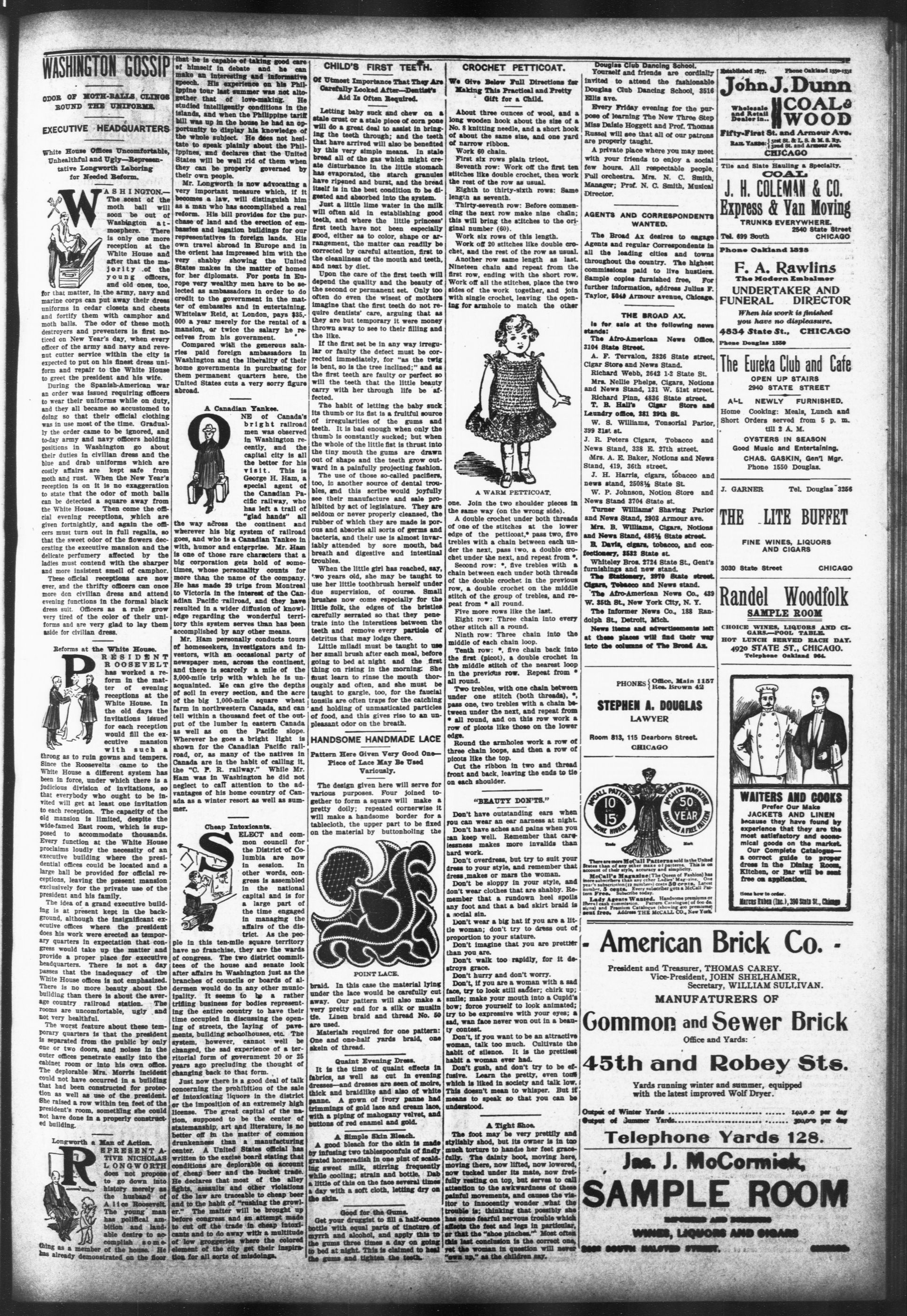
CROCHET PETTICOAT.
We Give Below Full Directions for Making This Practical and Pretty Gift for a Child.
About three ounces of wool, and a long wooden hook about the size of a No.8 knitting needle, and a short hook of about the same size, and one yard of narrow ribbon.
Work 60 chain.
First six rows plain tricot.
Seventh row: Work off the first ten stitches like double crochet, then work the rest of the row as usual.
Eighth to thirty-sixth rows: Same length as seventh.
Thirty-seventh row: Before commencing the next row make nine chain; this will bring the stitches to the original number (60).
Work six rows of this length.
Work off 20 stitches like double crochet, and the rest of the row as usual.
Another row same length as last.
Nineteen chain and repeat from the first row, ending with the short row.
Work off all the stitches, place the two sides of the work together, and join with single crochet, leaving the opening for armhole to match the other
A WARM PETTICOAT
one. Join the two shoulder pieces in the same way (on the wrong side).
A double crochet under both threads of one of the stitches at the lower edge of the petticoat,* pass two, five trebles with a chain between each under the next, pass two, a double crochet under the next, and repeat from *.
Second row: *, five trebles with a chain between each under both threads of the double crochet in the previous row, a double crochet on the middle stitch of the group of trebles, and repeat from * all round.
Five more rows like the last.
Eight row: Three chain into every other chain all a round.
Ninth row: Three chain into the middle of each chain loop.
Tenth row: * five chain back into the first (picot), a double crochet in the middle stitch of the nearest loop in the previous row. Repeat from * all round.
Two trebles, with one chain between under one stitch (both threads), * pass one, two trebles with a chain between under the next, and repeat from * all round, and on this row work a row of picots like those on the lower edge.
Round the armholes work a row of three chain loops, and then a row of picots like the top.
Cut the ribbon in two and thread front and back, leaving the ends to tie on each shoulder.
"BEAUTY DON'TS."
Don't have outstanding ears when you can wear an ear narness at night.
Don't have aches and pains when you can keep well. Remember that carelessness makes more invalids than hard work.
Don't overdress, but try to suit your dress to your style, and remember that dress makes or mars the woman.
Don't be sloppy in your style, and don't wear clothes that are shabby. Remember that a rundown heel spoils any foot and that a bad skirt braid is a social sin.
Don't wear a big hat if you are a little woman; don't try to dress out of proportion to your stature.
Don't imagine that you are prettier than you are.
Don't walk too rapidly, for it destroys grace.
Don't hurry and don't worry.
Don't, if you are a woman with a sad face, try to look still sadder; chirk up; smile; make your mouth into a Cupid's bow; force yourself to look animated; try to be expressive with your eyes; a sad, wan face never won out in a beauty contest.
Don't, if you want to be an attractive woman, talk too much. Cultivate the habit of silence. It is the prettiest habit a woman ever had.
Don't gush, and don't try to be effusive. Learn the pretty, even tone which is liked in society and talk low. This doesn't mean to whisper. But if means to speak so that you can be understood.
A Tight Shoe.
The foot may be very prettily and stylishly shod, but its owner is in too much torture to handle her feet gracefully. The dainty boot, moving her, moving there, now lifted, now lowered, now tucked under its mate, now freely resting on top, but serves to call attention to the awkwardness of these painful movements, and causes the visitor to innocently wonder what the trouble is; thinking that possibly she has some fearful nervous trouble which affects the feet and legs in particular, or that the "shoe pinches." Most often this last conclusion is the correct one, ret the woman in question will never "own up" as the children say.
American Brick Co.
Yards running winter and summer, equipped with the latest improved Wolf Dryer.
Douglas Club Dancing School
Yourself and friends are cordially invited to attend the fashionable Douglas Club Dancing School, 3516 Ellis ave.
Every Friday evening for the purpose of learning The New Three Step Miss Daisie Hoggett and Prof. Thomas Russel will see that all of our patrons are properly taught.
A private place where you may meet with your friends to enjoy a social few hours. All respectable people, Full orchestra. Mrs. N. C. Smith, Manager; Prof. N. C. Smith, Musical Director.
AGENTS AND CORRESPONDENTS WANTED.
The Broad Ax desires to engage Agents and regular Correspondents in all the leading cities and towns throughout the country. The highest commissions paid to live hustlers. Sample copies furnished free. For further information, address Julus F. Taylor, 5049 Armour avenue, Chicago.
THE BROAD AX.
Is for sale at the following news stands:
The Afro-American News Office, 3104 State Street.
A. F. Tervalon, 2826 State street, Cigar Store and News Stand.
Richard Webb, 2642 1-2 State St.
Mrs. Nellie Phelps, Cigars, Notions and News Stand, 131 W. 51st street.
Richard Pinn, 4836 State street.
T. B. Hall's Cigar Store and Laundry office, 281 29th St.
W. S. Williams, Tonsorial Parlor, 399 21st st.
J. R. Peters Cigars, Tobacco and News Stand, 338 E. 27th street.
Mrs. A. E. Baker, Notions and News Stand, 419, 36th street.
J. H. Harris, cigars, tobacco and news stand, 2508½ State St.
W. P. Johnson, Notion Store and News Stand 2704 State st.
Turner Williame' Shaving Parlor and News Stand, 2903 Armour ave.
Mrs. B. Williams, Cigars, Notions and News Stand, 486½ State street.
R. Davis, cigars, tobacco, and confectionery, 3832 State st.
Whitley Bros. 2724 State St, Gent's furnishings and new stand.
The Stationery, 2970 State street. Cigars, Tobacco and News stand.
The Afro-American News Co., 439 W. 35th St, New York City, N. Y.
The Informer News Co., 183 Randolph St, Detroit, Mich.
News items and advertisements left at these places will find their way into the columns of The Broad Ack.
PHONES { Office, Main 1157
Res. Brown 42
STEPHEN A. DOUGLAS LAWYER
Room 813, 115 Dearborn Street.
CHICAGO
McCall PATTERNS
10
AN
15
NONE HIGHER
McCall'S MAGAZINE
50
AN
YEAR
INCLUDING A FREE PATTERN
Mark
There are more McCall Patterns sold in the United
States than any other magazine. This is on
account of their style, accuracy and simplicity.
McCall's Magazine (The Queen of fashion) has more subscribers than any other company, latest number, $ cents. Subscribe today. Every subscriber gets McCall's Pattern Free. Subscribe today. Handmade premiums or liberal cash commission. Pattern Catalogue of 600 book signs. ADDRESS: TSHIRT McCall, CO. New York
Established 1877. Phone Oakland 1530-1531
John J. Dunn
COAL &
WOOD
Wholesale
and Retail
Dealer in...
Fifty-First St. and Armour Ave.
RAIL YARDS: 52nd St. & L. S. & M. S. Rd.
123rd St. and Armour Ave.
CHICAGO
J. H. COLEMAN & CO.
Express & Van Moving
TRUNKS EVERYWHERE.
2540 State Street
Tel. 699 South
CHICAGO
Phone Oakland 1838
F. A. Rawlins
The Modern Embalmer
UNDERTAKER AND
FUNERAL DIRECTOR
When his work is finished
you have no displeasure.
4834 State St., CHICAGO
Phone Douglas 1550
The Eureka Club and Cafe
OPEN UP STAIRS
2940 STATE STREET
ALL NEWLY FURNISHED.
Home Cooking: Meals, Lunch and
Short Orders served from 5 p. m.
till 2 A. M.
OYSTERS IN SEASON
Good Music and Entertaining.
CHAS. GASKIN, Gen'l Mgr.
Phone 1550 Douglas.
J. GARNER Tel. Douglas 3256
THE LITE BUFFET
FINE WINES, LIQUORS AND CIGARS
3030 State Street CHICAGO
Randel Woodfolk
CHOICE WINES, LIQUORS AND CIGARS—POOL TABLE.
HOT LUNCH SERVED EACH DAY.
4920 STATE ST., CHICAGO.
Telephone Oakland 964.
COOK
Prefer Our Make JACKETS AND LINEN because they have found by experience that they are the most satisfactory and economical goods on the market.
Our Complete Catalogue—a correct guide to proper dress in the Dhing Room, Kitchen, or Bar will be sent free on application.
tions how to order.
Marcus Ruben (Inc.), 390 State St., Chicago
Brick Co. -
THOMAS CAREY.
JOHN SHELHAMER.
BY, WILLIAM SULLIVAN.
URERS OF
Sewer Brick
The first man to stereotype a newspaper was Charles Craske, formerly of St. Marks avenue who died the other day in Woodbridge, N. J., at the age of 63. He did this great thing in 1852, at the suggestion of Horace Greeley, and the result, of course, was a great though gradual change in newspaper printing, for it was years before it was the general practice. Mr. Craske had carried on the craft of stereotyping and electrotyping in New York for more than 50 years, his company being in Pearl street.
History of Coal
The history of coal is comparatively modern. It seems to have been used first in England in the ninth century. London has no record of it until the thirteenth century and that is in the form of opposition. Parliament in 1318 petitioned the king, the second of the Edwards, to prohibit the burning of an article claimed to be injurious to health and a royal proclamation was issued forbidding it. But the high price of wood compelled the Londoners to resort to it again.
Channel Tunnel Schema
According to the London Graphic, the present year will witness a revival, on the part of French engineers and commercial men, of the channel tunnel scheme. The engineers and their scientific friends in the Institute of France have just given the first symptom of it, in celebrating the memory of M. Potier, the engineer who initiated the project, now more than 30 years ago.
Rightful King of Poland.
Though an American citizen now, Col. John Sobleski, once Prohibition candidate for governor of Missouri, indisputably is rightful king of Poland. He lives at present in California. He was born in Poland in 1842 and he and his daughter are the only known direct descendants of the warrior king of Poland, John Sobleski.
Thickness of Human Skin.
The skin of the men and women of some nations is much thicker than that of others, particularly in hot countries. The Central African negro has a skin about half as thick again as that of a European. That of a negro is thickest over the head and back—evidently to form a protection against the sun.
Football Did It.
A young man of Gloucester, England, received such a shock on hearing of his father's death that he lost the power of speech. Recently he went to a football game. In his excitement he tried to cheer and succeeded in doing so. He can speak as fluently as ever now.
Contact
"As a poet and literary man," said the grasping publisher with enthusiasm, "I'll put you against the world." "That isn't necessary," muttered the struggling author. "I'm up against it already, good and hard."—Chicago Tribune.
Absent-Minded.
"How's the market to-day?" inquired the senior partner, who hadn't been down town.
"Bullish on violets," answered the junior partner, who was in love. "On theater tickets and candies, normal."
"Does de white fok's dat lib in youah neighborhood keep eny chickens, Brother Rastus?"
"Well, Brother Johnsung," after considerable deliberation, "dey does keep a few."
Cordelia—How is it that Mrs. Crush always has so many people at her functions?
Amelia—Because her functions are so exclusive.—N. Y. World.
Famine in Japan.
A grievous famine is reported in Japan, in three of the northern provinces. A population of nearly 3,000,000 has been reduced to the necessity of living on shrubs, roots and bark.
Playing a Return.
"What! Drunk again? I thought on New Year's day you said farewell to the flowing bowl."
"I did, but it was a Patti farewell."
Great Apple Country.
British Columbia promises to become a dangerous rival of Oregon an apple-growing region. During last season 600,000 trees were planted.
Dr. Laurence I. Flick, an expert on tuberculosis, is planning an international convention, to be held in Washington, in 1908.
A ray of light, it is said, could move eight times around the globe between the ticks of a watch.
Popularity of Dias.
Out of 1,548,654 votes polled in the recent election in Mexico only 32,173 were against Dias.
Theories Don't Count.
The woman that raises children to respect her does it without any theories.
—N. Y. Press.
Coal for Coke.
Coke calls for 40,000,000 tons of coal this year.
Trouble Coming.
"May I ask what you call these?" asked the british visitor, turning to the man sitting next to him at the hotel table.
"The cook, I believe," answered the other, "calls them buckwheat cakes." The visitor tasted them and took out his notebook.
He had found material for a whole chapter in his forthcoming work on America—Chicago Tribune.
Necessary Preparation
"Laura," said Mr. Ferguson, "what kind of a looking girl is this Miss Wilmerson who is coming to visit you next week?" "She's the handsomest girl of my acquaintance," answered Mrs. Ferguson. "Well that means that I've got to take that cracked mirror off the bureau and put a new one in its place." —Chicago Tribune.
The Coming Aristocracy
Visitor (in penitentiary)—Who is that distinguished looking convict? Warden—He is known here as No. 1,147. "He seems to hold himself aloof from his fellows." "Yes; you can hardly expect him to associate with the common herd. His trial cost the state $200,000."—Chicago Tribune.
Establishing a Basis
Tuffold Knutt (at the kitchen door)
—Hev ye got a pipe organ that needs tunin,' ma'am?
Woman of the House—Pipe organ?
Of course not!
"Well, ma'am, seein' I hain't got no chanst to earn a meal, would ye mind jest givin' me a bite of something to eat?"—Chicago Tribune.
Obituary Slander
Wilhelm Schmied, of Unternalb, Germany, who instructed a stonemason to Inseribe on his wife's tombstone the words: "Here rests the body of Marie Schmied, who died, after much suffering, from the effects of unscrupulous treatment," has been sentenced to a month's imprisonment for slandering the doctor in the case.
How a Woman Reasons
A woman never loses interest in the man she might have married, says the Council Grove (Kan.) Guard. If he succeeds she prides herself on the fact that she could have had him. If he fails she is equally proud of the fact that she had foresight enough to turn him down.
Returned to Punishment
A man of Cardiff, Wales, was accused of stealing lead from a roof, and broke jail and fled. After he had traveled 26,000 miles he surrendered and was tried on the charge of theft and acquitted. But he was held for trial for escaping from prison.
Oldest Woman Author.
Mrs. Francis Alexander, of Florence, Italy, is one of, the oldest women, if not the oldest, writing to-day. Mrs. Alexander is in her ninety-third year, and has just translated from the Italian more than 120 miracle stories and sacred legends.
Automobilitis
At Geelong, New South Wales, a man has been committed to an insane asylum who thinks he is a runaway automobile. When he was arrested he was black and blue from colliding with trees, fences and walls.
Not So Blind.
"Dis here Cupid chile may be blind," said Uncle Eben, "but it do seem to me dat he kin manage to spy out a heap o' beauty an' lovableness dat ain' visible to de disinterested bystander."—Washington Star.
Died for Doll.
Marie Favre, five years old, dropped her doll into Lake Neufchatel, and at once plunged in to rescue it. The doll was clasped in her arms when her body was recovered.
Unique Distinction
The late Jacob Litt, who acquired a large fortune in a short time, had the unique distinction in the theatrical business of never having paid a royalty to an author.
Russia in Asia.
Russian Asiatic possessions are three times the size of Great Britain's, but hold only 23,000,000 inhabitants, as compared with England's 297,000,000 subjects.
Nurse—The baby has your hair, sir.
Scantlocks—Do you think so? Well,
I'm glad some one in the family has
it—N. Y. Telegram.
An Amateur Juliet.
We thought that the citizens of Athens respected and desired freedom of the press. Apparently they do not, says the Athens (Kan.) Eagle. James B. Parker, whose wife is taking the part of Juliet in the charity series, objected to our calling her skinny, and waited for us at the theater last night. Fortunately we caught him one on the eye, which destroyed some of the effect his objection might otherwise have borne. J. Parker is a danger to the community. She is skinny, anyhow.
"Animalness" of Dovle.
Here is a pen portrait of Sir Arthur Conan Doyle as drawn by a spectator at a recent London meeting, in which the author took a prominent part: The massive figure, the sun-scorched, crimson cheeks and the entire healthy animalness of the man were unavoidably conspicuous, giving the lie in stentorian tones to the oft-repeated fabrication that brains can only be cultivated at the expense of the body.
Readened Him.
To an official of the Sudan railway in Africa there came a telegram from an outlying station: "Stationmaster has died. Shall I bury him?" The reply was sent as follows: "Yes, bury stationmaster, but please make sure he is really dead before you do so." In due time back came the message: "Have buried stationmaster. Made sure he was dead by hitting him twice on the head with a fishplate."
A Firm Stand.
"Young ladies," said the presidentess of Wassar college, severely, "it has come to my knowledge that upper classwomen have refused to give recipes for making fudge to lower classwomen. This must be stopped. Hazing will positively not be tolerated at this institution."—Chicago Sun.
Murdered Missionaries.
It now appears that the recent murder of the five American missionaries at Lienchou, China, was due to the anti-American sentiment which exists strongly in southern China. Two of the missionaries, bride and groom, had been on the field only three days.
Wolf in Town.
A girl aged five was seated on the doorstep of her mother's home at Victor, Col., the other day and was about to eat a piece of bread and butter, covered with sugar, when a large gray wolf dashed up, snatched the bread out of her hand and went off with it.
Canada's Immigrants.
According to E. B. Osborne, who lectured recently at the Royal Colonial Institute, London, Canada's immigrants are best in the following order: Scotsmen, Americans, Englishmen, Scandinavians, Germans and Doukhobors.
Missionary Honored.
A high honor has been paid by the British government in India to an American missionary, Rev. J. C. R. Ewing, of Lahore, in making him chairman of the relief work among the sufferers from the recent earthquake.
Long Time in Debt.
An English debtor has been allowed to pay off a debt of about $80 at the rate of one penny a month. It will require 209 years to complete the payments. The sum was due a money lender, which explains the decision.
Odd Coincidence
Bables arrived last Good Friday in the homes of twin sisters, living within a block of each other on Colgan street, Louisville, Ky. There was but 56 minutes difference in the time of the births.
Ban on Suicides.
In view of the frequency of suicide at Dover, England, the local clergy have agreed not to use the prayer book order of burial at the funerals of those who have taken their own lives.
All that is best you will
O
Unde
Ry
All that is best in whiskes you will find in
It is thoroughly matured,
soft and rich.
CHAS. DENNEHY & COMP
Chicago.
J. A. O'Donnell, H. D. Coghlin,
O'Donnell & Coghlin
Attorneys at Law
Phone 264 Main Metropolitan Block
N. W. Cor. LaSalle & Randolph Sts.
Chicago
GRAY & MORAN
ATTORNEYS AT LAW
Suite 1114 Ashland Block, Clark and Randolph Sts. Tel. Central 569.
CHICAGO.
Residence 57 Macallister Place
Telephone Ashland 383
Office Telephones
Central 1239 Automatic 5940
MILES J. DEVINE
ATTORNEY AT LAW
Suite 315-320 Reeper Block
CLARK AND WASHINGTON STS.
CHICAGO.
A. D. GASH
Attorney at Law,
84-86 La Salle Street, Chicago,
Suite 615 to 619,
Telephone Male 3077.
JOHN E. OWENS
ATTORNEY & COUNSELOR
AT LAW
323 AGHLAND BLOCK
TELEPHONE CENTRAL 6008 CHICAGO
Telephone Yards 6016.
John Fitzgerald
JUSTICE OF THE PEACE
4737 SOUTH HALSTED STREET.
Residence
113 W. Garfield Boul.
CHICAGO
J. GRAY LUCAS
Attorney at Law
Suite 611 167 Dearborn St., Cor. Monroe.
Chicago.
Tel. Cant. 5709. Ben. Tel. Went. 6500.
Phone 194 South
A. B. SCHULTZ, M. D.
PHYSICIAN AND SURGEON.
2719 State Street
Hours: 9 to 12 A.M.
3 to 5 and after 6 P. M.
CHICAO
W. Kemper Harreld
TEACHER OF
VIOLIN
6626 CHAMPLAIN AVE.
Tel. Went. 2821.
Hall's Laundry
2975-77 STATE ST.
Phone, Douglas 1235
CHICAGO
t in whiskes
find in
ld
eroof
ye
Y & COMPANY, go.
HILLMAN'S STATE & WASHINGTON STS. Chicago's Most Modern, Most Complete and Most Convenient Department Store
Jacob Feinberg
81st and State Streets
BRADLEY & FIELDS REAL ESTATE, LOANS AND INSURANCE
4709 S. Halsted Street
Theodore
JUSTICE OF
Flortgages, Deeds, Notes
and Acknowledged.
Theodore C. Mayer
JUSTICE OF THE PEACE
Mortgages, Deds, Notes and Legal Documents Drawn
and Acknowledged. Room 22, 27 North Clark Street.
POLICE MAGISTRATE RESIDENCE
East Chicago Ave. Police Court 337 Burling Street
C. H. Smiley, Pres. and Treas.
76 E. TWENTY
Two Phones, South 584.
Phone M
SANDY W. TR
INCORPORATED UNDER
2918 STATE S
Now is your chance.
The Company will open a Depar-
State St. Namely Sandy W. Trice,
complete line of Men and Womens L
tions. Shares ten dollars. A limi-
Company's Sec'y. office.
CHICAGO
Press, and Treas.
J. Heckley
Smith Car
76 E. TWENTY-SECOND STREET,
South 584.
C. H. Smiley, Press, and Treas.
J. Hookley Smiley, Bee'y.
Smiley
Caterer
76 E. TWENTY-SECOND STREET,
Two Phones, South 584.
CHICAGO.
Phone Douglas 6581.
Y W. TRICE & COMP
CAPORATED UNDER THE LAWS OF ILLINOIS
2918 STATE STREET, CHICAGO.
Is your chance. A joint stock con
y will open a Department Store in the near-
ely Sandy W. Trice & Company. The compa-
men and Womens Furnishing Goods Shoes,
men dollars. A limited number of shares are
y. office.
SANDY W. TRICE & COMPANY
INCORPORATED UNDER THE LAWS OF ILLINOIS. 2918 STATE STREET, CHICAGO.
Now is your chance. A joint stock company.
The Company will open a Department Store in the near future at 2918 State St. Namely Sandy W. Trice & Company. The company will carry a complete line of Men and Womens Furnishing Goods Shoes, Hats and Notions. Shares ten dollars. A limited number of shares are on sale at the Company's Sec'y. office.
DIRECTORS:
Sandy W. Trice, Pres.
Milton J. Trice, Vice Pres.
A. T. Henry, 2nd Vice Pres.
R. R. Wright, 3rd Vice Pres.
Dee Parker, Trustee.
A. J. Carey, D. D. Treas.
2151 Forest Ave.
A. W. Williams, M. D.
Sec'y Office 2840 State St. Phone South 1028, Chicago.
NOIS BRICK
ILLINOIS BRICK CO.
WILLIAM C. KUESTER.
SUPERINTENDENT.
1994 N. Western Ave., CH
Telephone Lake View 270
Telephone Yards 718
N. Western Ave., CH Telephone Lake View 270
M. JUNK, Proprietor JOS. P. JUNK, Manager 3700-3710 South Halsted Street and 897 to 929 Thirtyseventh Street CHICAGO
FIELDS LOANS NCE
Mayer
E PEACE
Documents Drawn
2, 27 North Clark Street.
J. Hookley Smiley, Sec'y.
Smiley
Caterer
STREET,
CHICAGO.
COMPANY
OF ILLINOIS.
CHICAGO.
stock company.
In the near future at 2918
The company will carry a
goods Shoes, Hats and No-
f shares are on sale at the
A. J. Carey, D. D., Treas.
3151 Forest Ave.
A. W. Williams, M. D.
Sec'y Office, 2840 State
St. Phone South 1632,
Chicago.
e., Chicago.
new 278.
is: 718
CHICAGO
J. M. Fields
CHICAGO
RESIDENCE
337 Burling Street