The Broad Ax
Saturday, March 10, 1906
Chicago, Illinois
Page text (machine-generated)
THE BROAD AX
HEW TO THE LINE.
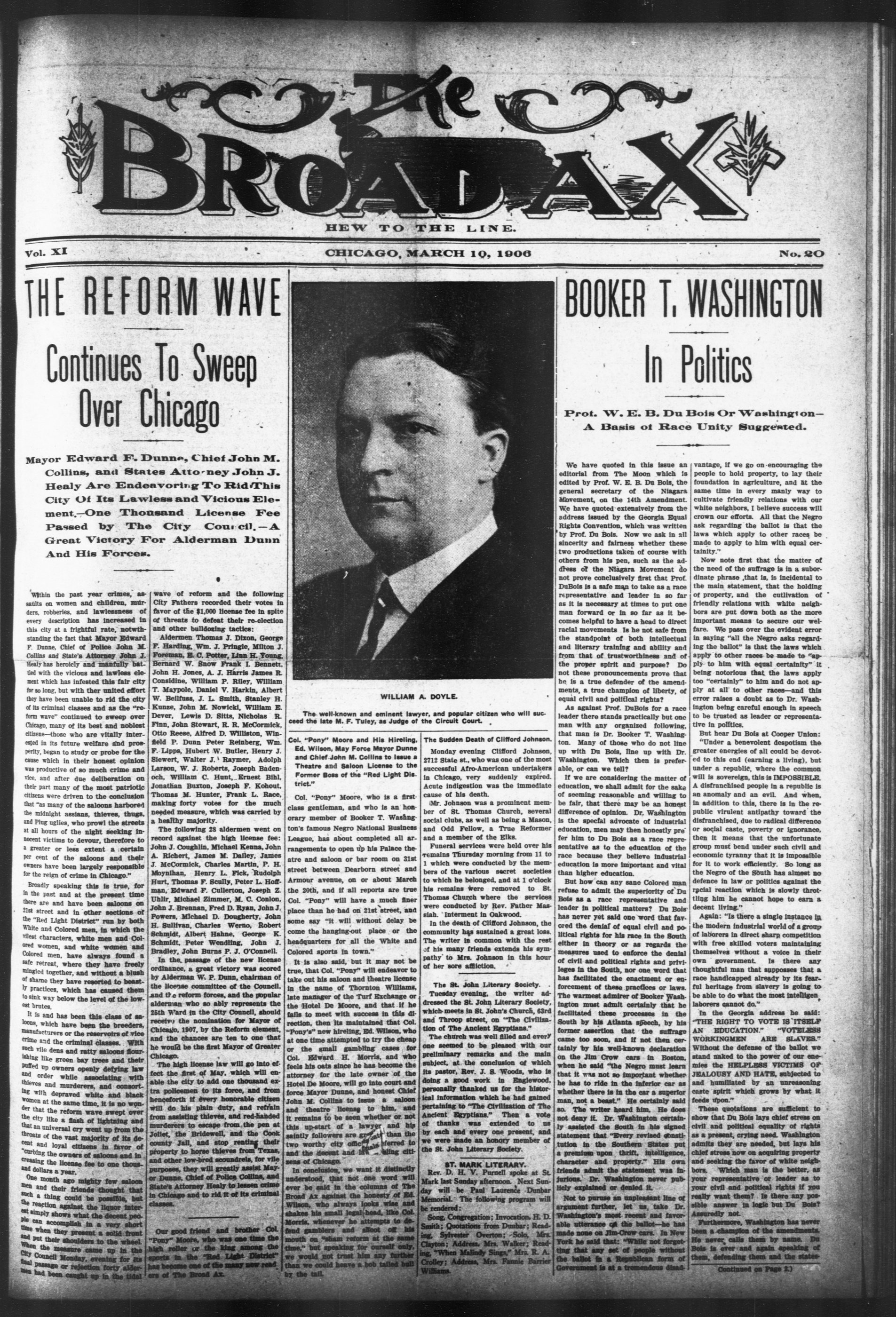
THE REFORM WAVE Continues To Sweep Over Chicago
Mayor Edward F. Dunne, Chief John M. Collins, and States Attorney John J. Healy Are Endeavoring To Rid This City Of Its Lawless and Vicious Element. One Thousand License Fee Passed by The City Council. A Great Victory For Alderman Dunn And His Forces.
Within the past year crimes, as saults on women and children, murders, robberies, and lawlessness of every description has increased in this city at a frightful rate, notwithstanding the fact that Mayor Edward F. Dunne, Chief of Police John M. Collins and State's Attorney John J. Healy has heroically and manfully battled with the vicious and lawless element which has infested this fair city for so long, but with their united effort they have been unable to rid the city of its criminal classes and as the "reform wave" continued to sweep over Chicago, many of its best and noblest citizens—those who are vitally interested in its future welfare and prosperity, began to study or probe for the cause which in their honest opinion was productive of so much crime and vice, and after due deliberation on their part many of the most patriotic citizens were driven to the conclusion that "as many of the saloons harbored the midnight assists, thieves, thugs, and Plug uglies, who prowl the streets at all hours of the night seeking innocent victims to devour, therefore to a greater or less extent a certain per cent of the saloons and their owners have been largely responsible for the reign of crime in Chicago."
Broadly speaking this is true, for in the past and at the present time there are and have been saloons on 21st street and in other sections of the "Red Light District" run by both White and Colored men, in which the vilest characters, white men and Colored women, and white women and Colored men, have always found a safe retreat, where they have freely mingled together, and without a blush of shame they have resorted to beastly practices, which has caused them to sink way below the level of the lowest brutes.
It is and has been this class of saloons, which have been the breeders, manufacturers or the reservoirs of vice crime and the criminal classes. With such vile dens and ratty saloons flourishing like green bay trees and their puffed up owners openly defying law and order while associating with thieves and murderers, and consorting with depraved white and black women at the same time, it is no wonder that the reform wave swept over the city like a flash of lightning and that an universal cry went up from the throats of the vast majority of its decent and loyal citizens in favor of "curbing the owners of saloons and in increasing the license fee to one thousand and dollars a year.
One month ago mighty few saloon men and their friends thought that such a thing could be possible, but the reaction against the liquor interest simply shows what the decent people can accomplish in a very short time when they present a solid front and put their shoulders to the wheel. When the measure came up in the City Council Monday, evening for its final passage or rejection forty aldermen had been caught up in the tidel
wave of reform and the following City Fathers recorded their votes in favor of the $1,000 license fee in spite of threats to defeat their re-election and other bulldozing tactics:
Aldermen Thomas J. Dixon, George F. Harding, Wm. J. Pringle, Milton J. Foreman, E. C. Potter, Ldn H. Young, Bernard W. Snow Frank I. Bennett, John H. Jones, A. J. Harris James R. Considine, William P. Riley, William T. Maypole, Daniel V. Harkin, Albert W. Belifuss, J. L. Smith, Stanley H. Kunze, John M. Nowicki, William E. Dever, Lewis D. Sitts, Nicholas R. Finn, John Stewart, R. R. McCormick, Otto Reese, Alfred D. Williston, Winfield P. Dunn Peter Reinberg, Wm. F. Lipps, Hubert W. Butler, Henry J. Slewert, Walter J.' Raymer, Adolph Larson, W. J. Roberts, Joseph Badenoch, William C. Hunt, Ernest Bihl, Jonathan Buxton, Joseph F. Kohout, Thomas M. Hunter, Frank L. Race, making forty votes for the much needed measure, which was carried by a healthy majority.
The following 28 aldermen went on record against the high license fee: John J. Coughlin, Michael Kenna, John A. Richert, James M. Dailey, James J. McCormick, Charles Martin, P. H. Moynihan, Henry L. Flick, Rudolph Hurt, Thomas F. Scully, Peter L. Hoffman, Edward F. Cullerton, Joseph Z. Uhlir, Michael Zimmer, M. C. Conlon, John J. Brennan, Fred D. Ryan, John J. Powers, Michael D. Dougherty, John H. Sullivan, Charles Werno, Robert Schmidt, Albert Hahne, George K. Schmidt, Peter Wendling, John J. Bradley, John Burns P. J. O'Connell.
In the passage of the new license ordinance, a great victory was scored by Alderman W. P. Dunn, chairman of the license committee of the Council, and the reform forces, and the popular alderman who so ably represents the 25th Ward in the City Council, should receive the nomination for Mayor of Chicago, 1807, by the Reform element, and the chances are ten to one that he would be the first Mayor of Greater Chicago.
The high license law will go into effect the first of May, which will enable the city to add one thousand extra policemen to its force, and from henceforth if every honorable citizen will do his plain duty, and refrain from assisting thieves, and red-handed murderers to escape from the pen at Jollet, the Bridewell, and the Cook county Jail, and stop renting their property to horse thieves from Texas, and other low-bred scoundrels, for vile purposes, they will greatly assist Mayor Dunne, Chief of Police Collins, and State's Attorney Healy to lessen crime in Chicago and to rid it of its criminal classes.
Our good friend and brother Col. "Pony" Moore, who was one time the high roller or the king among the sports in the "Red Light District" has become one of the many new readers of The Broad Ax.
CHICAGO, MARCH 10, 1906
M. B.
The well-known and eminent lawyer, and popular citizen who will succeed the late M. F. Tuley, as Judge of the Circuit Court.
Col. "Pony" Moore and His Hireling, Ed. Wilson, May Force Mayor Dunne and Chief John M. Collins to issue a Theatre and Saloon License to the Former Boss of the "Red Light District."
Col. "Pony" Moore, who is a first-class gentleman, and who is an honorary member of Booker T. Washington's famous Negro National Business League, has about completed all arrangements to open up his Palace theatre and saloon or bar room on 31st street between Dearborn street and Armour avenue, on or about March the 20th, and if all reports are true Col. "Pony" will have a much finer place than he had on 21st street, and some say "it will without delay be come the hanging-out place or the headquarters for all the White and Colored sports in town."
The Sudden Death of Clifford Johnson
Monday evening Clifford Johnson 2712 State st., who was one of the most successful Afro-American undertakers in Chicago, very suddenly expire. Acute indigestion was the immediate cause of his death.
Mr. Johnson was a prominent member of St. Thomas Church, several social clubs, as well as being a Mason and Odd Fellow, a True Reformer and a member of the Elks.
Funeral services were held over his remains Thursday morning from 11 a. 1 which were conducted by the members of the various secret societies to which he belonged, and at 1 o'clock his remains were removed to St. Thomas Church where the service were conducted by Rev. Father Marshall. Interment in Oakwood.
In the death of Clifford Johnson, the community has sustained a great loss. The writer in common with the rest of his many friends extends his sym
It is also said, but it may not be true, that Col. "Pony" will endeavor to take out his saloon and theatre license in the name of Thornton Williams, late manager of the Turf Exchange or the Hotel De Moore, and that if he falls to meet with success in this direction, then its maintained that Col. "Pony's" new hireing, Ed. Wilson, who at one time attempted to try the cheap or the small gambling cases for Col. Edward H. Morris, and who feels his oats since he has become the attorney for the late owner of the Hotel De Moore, will go into court and force Mayor Dunne, and honest Chief John M. Collins to issue a saloon and theatre license to him, and it remains to be seen whether or not this up-start of a lawyer and his saintly followers are greater than the two worthy city offices referred to and the decent and law-lying citizens of Chicago.
In conclusion, we want it distinctly understood, that not one word will ever be said in the columns of The Broad Ax against the honesty of Ed. Wilson, who always looks wise and shakes his small legal head, like Col. Morris, whenever he attempts to defend gamblers and aloot off his mouth on "sham reform at the same time," but speaking for itself only, we would not trust him any further than we could heave a bob tailed bull by the tail.
The Sudden Death of Clifford Johnson.
Monday evening Clifford Johnson, 2712 State st., who was one of the most successful Afro-American undertakers in Chicago, very suddenly expired. Acute indigestion was the immediate cause of his death.
Mr. Johnson was a prominent member of St. Thomas Church, several social clubs, as well as being a Mason, and Odd Fellow, a True Reformer and a member of the Elks.
Funeral services were held over his remains Thursday morning from 11 to 1 which were conducted by the members of the various secret societies to which he belonged, and at 1 o'clock his remains were removed to St. Thomas Church where the services were conducted by Rev. Father Massiah. Interment in Oakwood.
In the death of Clifford Johnson, the community has sustained a great loss. The writer in common with the rest of his many friends extends his sympathy to Mrs. Johnson in this hour of her sorrow affection.
The St. John Literary Society. Tuesday evening, the writer addressed the St. John Literary Society, which meets in St. John's Church, 63rd and Throop street, on "The Civilization of The Ancient Egyptians." The church was well filled and every one seemed to be pleased with our preliminary remarks and the main subject, at the conclusion of which its pastor, Rev. J. S. Woods, who is doing a good work in Englewood, personally thanked us for the historical information which he had gained pertaining to "The Civilization of The Ancient Egyptians." Then a vote of thanks was extended to us by each and every one present, and we were made an honor member of the St. John Literary Society.
ST. MARK LITERARY.
Rev. D. H. V. Purnell spoke at St. Mark last Sunday afternoon. Next Sunday will be Paul Laurence Dunbar Memorial. The following program will be rendered:
Song, Congregation; Invocation, H. D. Smith; Quotations from Dunbar; Reading, Sylvester Overton; Solo, Mrs. Clayton; Address, Mrs. Walker; Reading, "When Malindy Sings" Mrs. R. A. Crolley; Address, Mrs. Fannie Barrier Williams.
BOOKER T. WASHINGTON In Politics
Prof. W. E. B. Du Bois Or Washington A Basis of Race Unity Suggested.
We have quoted in this issue an editorial from The Moon which is edited by Prof. W. E. B. Du Bois, the general secretary of the Niagara Movement, on the 14th Amendment. We have quoted extensively from the address issued by the Georgia Equal Rights Convention, which was written by Prof. Du Bois. Now we ask in all sincerity and fairness whether these two productions taken of course with others from his pen, such as the address of the Niagara Movement do not prove conclusively first that Prof. DuBois is a safe man to take as a race representative and leader in so far as it is necessary at times to put one man forward or in so far as it becomes helpful to have a head to direct racial movements. Is he not safe from the standpoint of both intellectual and literary training and ability and from that of trustworthiness and of the proper spirit and purpose? Do not these pronouncements prove that he is a true defender of the amendments, a true champion of liberty, of equal civil and political rights?
As against Prof. DuBois for a race leader there stands practically but one man with any organized following, that man is Dr. Booker T. Washington. Many of those who do not line up with Du Bois, line up with Dr. Washington. Which then is preferable, or can we tell?
If we are considering the matter of education, we shall admit for the sake of seeming reasonable and willing to be fair, that there may be an honest difference of opinion. Dr. Washington is the special advocate of industrial education, men may then honestly prefer him to Du Bois as a race representative as to the education of the race because they believe industrial education is more important and vital than higher education.
But how can any sane Colored man refuse to admit the superiority of Du Bois as a race representative and leader in political matters? Du Bois has never yet said one word that favored the denial of equal civil and political rights for his race in the South either in theory or as regards the measures used to enforce the denial of civil and political rights and privileges in the South, nor one word that has facilitated the enactment or enforcement of these practices or laws. The warmest admirer of Booker Washington must admit certainly that he facilitated these processes in the South by his Atlanta speech, by his former assertion that the suffrage came too soon, and if not then certainly by his well-known declaration on the Jim Crow cars in Boston, when he said "the Negro must learn that it was not so important whether he has to ride in the inferior car as whether there is in the car a superior man, not a beast." He certainly said so. The writer heard him. He does not deny it. Dr. Washington certainly assisted the South in his signed statement that "Every revised constitution in the Southern States put a premium upon thrift, intelligence, character and property." His own friends admit the statement was injurious. Dr. Washington never publicly explained or denied it.
Not to pursue an unpleasant line of argument further, let us, take Dr. Washington's most recent and favorable utterance of this ballot—he has made none of Jim-Crow cars. In New York he said that: "While not forgetting that any set of people without the ballot in a Republican form of Government is at a tremendous disadvantage."
WASHINGTON Politics Bois Or Washington— the Unity Suggested.
vantage, if we go on-encouraging the people to hold property, to lay their foundation in agriculture, and at the same time in every manly way to cultivate friendly relations with our white neighbors, I believe success will crown our efforts. All that the Negro ask regarding the ballot is that the laws which apply to other races be made to apply to him with equal certainty."
Now note first that the matter of the need of the suffrage is in a subordinate phrase, that is, is incidental to the main statement, that the holding of property, and the cultivation of friendly relations with white neighbors are put down both as the more important means to secure our welfare. We pass over the evident error in saying "all the Negro asks regarding the ballot" is that the laws which apply to other races be made to "apply to him with equal certainty" it being notorious that the laws apply too "certainly" to him and do not apply at all to other races—and this error raises a doubt as to Dr. Washington being careful enough in speech to be trusted as leader or representative in politics.
But hear Du Bois at Cooper Union: "Under a benevolent despotism the greater energies of all could be devoted to this end (earning a living), but under a republic, where the common will is sovereign, this is IMPOSSIBLE. A disfranchised people in a republic is an anomaly and an evil. And when, in addition to this, there is in the republic virulent antipathy toward the disfranchised, due to radical difference or social caste, poverty or ignorance, then it means that the unfortunate group must bend under such civil and economic tyranny that it is impossible for it to work efficiently. So long as the Negro of the South has almost no defence in law or politics against the racial reaction which is slowly throttling him he cannot hope to earn a decent living."
Again: "Is there a single instance in the modern industrial world of a group of laborers in direct sharp competition with free skilled voters maintaining themselves without a voice in their own government. Is there any thoughtful man that supposes that a race handicapped already by its fearful heritage from slavery is going to be able to do what the most intelligent laborers cannot do."
In the Georgia address he said: "THE RIGHT TO VOTE IS ITSELF AN EDUCATION." "VOTELESS WORKINGMEN ARE SLAVES." Without the defense of the ballot we stand maked to the power of our enemies the HELPLESS VICTIMS OF JEALOUSY AND HATE, subjected to and humiliated by an unreasoning caste spirit which grows by what it feeds upon."
These quotations are sufficient to show that Du Bois lays chief stress on civil and political equality of rights as a present, crying need. Washington admits they are needed, but lays his chief stress now on acquiring property and seeking the favor of white neighbors. Which man is the better, as your representative or leader as to your civil and political rights if you really want them? Is there any possible answer in logic but Du Bois? Assuredly not.
Furthermore, Washington has never been a champion of the amendments. He never calls them by name. Du Bois is ever and again speaking of them, defending them and the states.
Continued on Page 2.)
THE BROAD AX.
Will promulgate and at all times uphold the true principles of Democracy, but Caution, Prostatae, Freud, Indicae, Farmers, Protestants, one can also have their way, so long as their language is proper and responsibility is fixed. The Broad, *m* is a newspaper whose platform is broad enough for all, ever claiming the editorial right to speak its own mind. Local communications will receive attention. Write only on one side of the paper.
Subscriptions must be paid in advance.
One Year.....
Six Months.....
Advertising rates made known on application.
Address all communications to
THE BROAD AX
500 Armour Avenue, Chicago.
JULIUS F. TAYLOR, Editor and Publisher.
Entered v the Post Office at Chicago, II, as Second-class Matter.
Mrs. Ophelia R. Bryant 6432 Champlain Ave., has been confined to her house with a bad cold.
Miss Dolly Scott, 5042 Armour Ave., has been extremely ill for some time, and the doctors are fearful of her recovery.
Prof. and Mrs. Levi, 5046 Armour Ave., and their band have returned home from a four weeks' trip through Wisconsin.
Mrs. J. H. Johnson, 436 35th Street, returned home last Saturday from a six weeks' visit with friends in Hot Springs, Ark., and Memphis, Tenn.
Mrs. Madison, mother of Mrs. Wm. F. Taylor, Mrs. L. N. Jones and Mrs. R. A. J. Shaw, is visiting her grandson. Master R. A. J. Shaw, Jr.
Sunday March 11th Rev. A. J. Carey, pastor of Bethel church will preach the annual sermon for the Elks who will march to the church in a body in their uniforms and regallas.
Mrs. J. C. Stewart 5434 Normal ave. who is a prominent worker in Olivet Baptist church says, that The Broad Ax is growing brighter and better each week.
Dr. D. Herbert Anderson is busy these days arranging for his coming marriage to Miss Condace Parker, who was the guest of Mrs. Dr. Bentley until recently while studying music.
Mr. and Mrs. W. J. DeLacy, 2450 Dearborn st., who are active members of Quinn chapel, will on Wednesday evening March 14th give a party in honor of the 14th birthday of their son Master Cassius Othello DeLacy.
Last Sunday evening a very enjoyable program of music was rendered at Grace Church, under the direction of Mrs. Shelly Parker. Similar programs are to be given each month on the first Sunday evening.
Mrs. Elizabeth McDonald, 6130 Ada street, left Friday evening for Keokuk, Iowa, where she will spend three weeks, and during her absence she will lecture on her work in the Juvenile Court.
The H. C. Haynes Razor Strop Company, manufacturers of high grade razor strops and leather novelties, have leased the large store 3538 State street which they will fit up for a barber supply house, which will open on or about the 20th of the month.
Rev. Charles A. Harris Norfolk, Va brother of W. R. Harris, chief clerk for Sandy W. Trice and Company, departed this life in that city last Friday. He leaves two daughters and one son and many friends, and relatives to regret his untimely death.
Mr. Melville G. Holding who is well known throughout the Town of Lake and who is a thorough business man in every way has become the general manager of the American window Plate Glass Company with temporary offices at 16th and Canal street.
Mrs. Neillie Collins has started divorce proceeding in the Circuit court against Charles L. Collins, the barber t 5024 State St., who is also secretary of the Beneficiary Board of the Knights of Pythias and an active member in the Foresters. Hon. S. A. McElwee is attorney for Mrs. Collins.
It is said that Dr. Booker T. Washington, the president of the Tuskegee Institute, together with his family, chipped in and presented Miss Roosevelt with a costly wedding gift—but then, Booker's money comes easy: beg it—The Advocate, Portland, Ore.
In Austin, Texas, the seat of the democratic household of Texas three Colored men served on the jury in the case of a white man's trial. Such is justice, and coming as recognition from such source is astonishing, when we think of the way Republican bosse in Texas are acting.-The Times, Galveston, Texas.
The troubles between John H. Phillips and Charles L. Collins, growing out of some lurid remarks made by the former reflecting on the character of the latter's landlady, Mrs. J. B. Cartwright, 2306 Dearborn St., will be heard before Justice Everett Monday morning. Phillips is now under peace bonds, but is anxious to have Collins change his residence to Joliet.
Mrs. Roberts 5416 Monroe ave. passed away the latter part of last week, and on Sunday funeral services were held over her remains at the Hyde Park chapel Rev. Clarence C Goggins officiating. Interment at Oakwood, F. A. Rawlins the popular undertaker 4834 State street had charge of the funeral. The many beautiful floral offerings were executed and furnished by Mrs. J. J. Manley.
[Name not visible in the image]
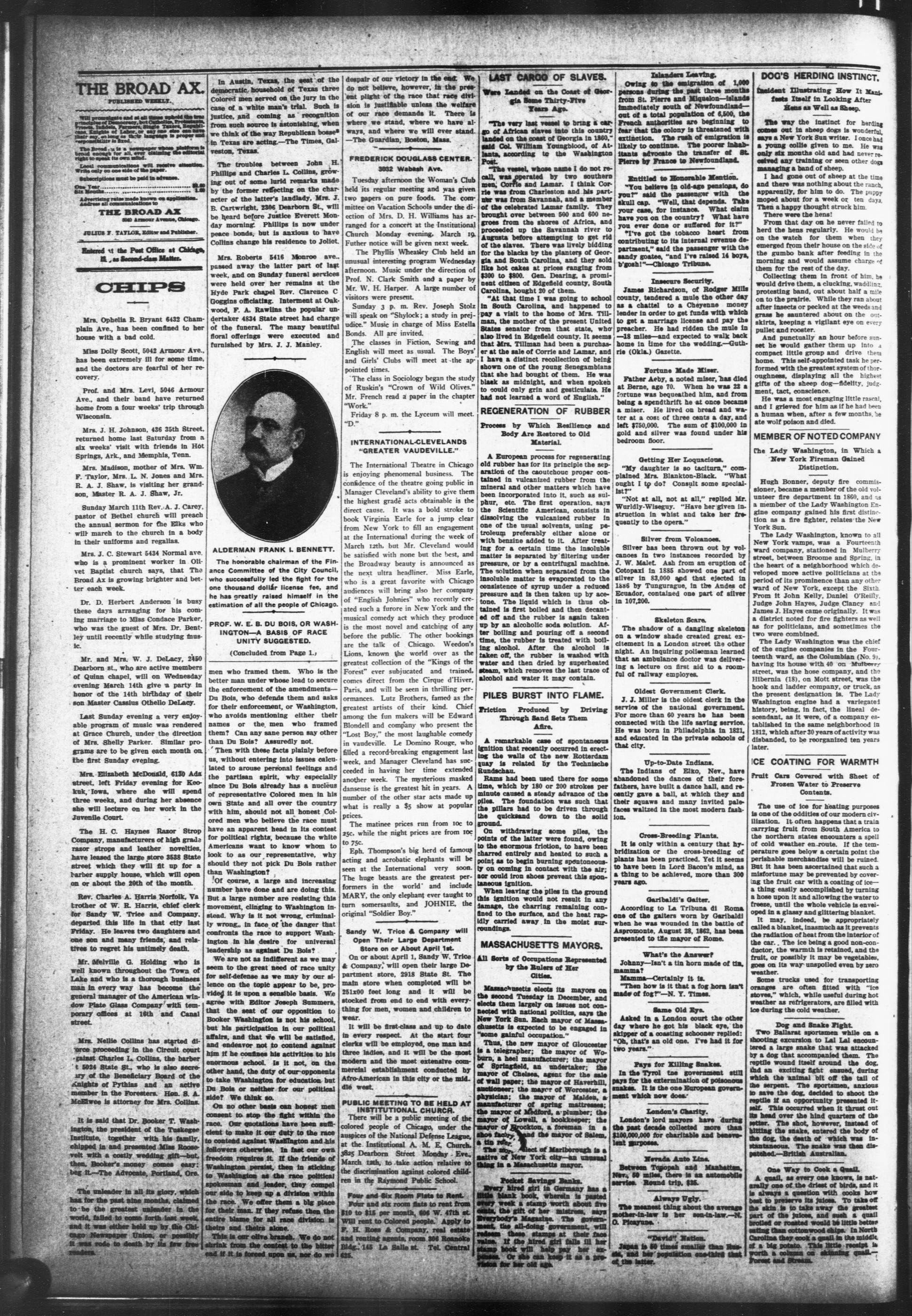
ALDERMAN FRANK I. BENNETT. The honorable chairman of the Finance Committee of the City Council, who successfully led the fight for the one thousand dollar license fee, and he has greatly raised himself in the estimation of all the people of Chicago.
PROF. W. E. B. DU BOIS, OR WASH.
INGTON—A BASIS OF RACE
UNITY SUGGESTED.
(Concluded from Page 1.)
men who framed them. Who is the better man under whose lead to secure the enforcement of the amendments—Du Bols, who defends them and asks for their enforcement, or Washington, who avoids mentioning either their names or the men who framed them? Can any sane person say other than Du Bols? Assuredly not.
Then with these facts plainly before us, without entering into issues calculated to arouse personal feelings and the partisan spirit, why especially since Du Bois already has a nucleus of representative Colored men in his own State and all over the country with him, should not all honest Colored men who believe the race must have an apparent head in its contest for political rights, because the white Americans want to know whom to look to as our representative, why should they not pick Du Bois rather than Washington?
Of course, a large and increasing number have done and are doing this. But a large number are resisting this movement, clinging to Washington instead. Why is it not wrong, criminally wrong., in face of the danger that confronts the race to support Washington in his desire for universal leadership as against Du Bois?
We are not as indifferent as we may seem to the great need of race unity for self-defense as we may by our silence on the topic appear to be, provided it is upon a sensible basis. We agree with Editor Joseph Summers, that the seat of our opposition to Booker Washington is not his school, but his participation in our political affairs, and that we will be satisfied, and endeavor not to contend against him if he confines his activities to his enormous school. Is it not, on the other hand, the duty of our opponents to take Washington for education but Du Bols or neither for our political side? We think so.
On no other basis can honest men consent to stop the fight within the race. Our quotations have been sufficient to make it our duty to the race to contend against Washington and his followers otherwise. In fast our own freedom requires it. If the friends of Washington persist, then in sticking to Washington as the race political spokesman and leader, they compel our side to keep up a division within the race. We offer them a big place for their man. If they refuse then the entire blame for all race division is theirs and theirs alone. This is our olive branch. We do not shrink from the contest to the bitter end if it is forced upon us nor do we
despair of our victory in the end. We do not believe, however, in the present plight of the race that race division is justifiable unless the welfare of our race demands it. There is where we stand, where we have always, and where we will ever stand.—The Guardian, Boston, Mass.
FREDERICK DOUGLASS CENTER.
3832 Wabash Ave.
Tuesday afternoon the Woman's Club held its regular meeting and was given two papers on pure foods. The committee on Vacation Schools under the direction of Mrs. D. H. Williams has arranged for a concert at the Institutional Church Monday evening, March 19. Further notice will be given next week. The Phyllis Wheatey Club held an unusual interesting program Wednesday afternoon. Music under the direction of Prof. N. Clark Smith and a paper by Mr. W. H. Harper. A large number of visitors were present. Sunday 3 p. m. Rev. Joseph Stolz will speak on "Shylock; a study in prejudice." Music in charge of Miss Estella Bonds. All are invited.
The classes in Fiction, Sewing and English will meet as usual. The Boys' and Girls' Clubs will meet at the appointed times.
The class in Sociology began the study of Ruskin's "Crown of Wild Olives." Mr. French read a paper in the chapter "Work."
Friday 8 p. m. the Lyceum will meet. "D."
INTERNATIONAL-CLEVELANDS
“GREATER VAUDEVILLE.”
The International Theatre in Chicago is enjoying phenomenal business. The confidence of the theatre going public in Manager Cleveland's ability to give them the highest grade acts obtainable is the direct cause. It was a bold stroke to book Virginia Earle for a jump clear from New York to fill an engagement at the International during the week of March 12th, but Mr. Cleveland would be satisfied with none but the best, and the Broadway beauty is announced as the next ultra headliner. Miss Earle, who is a great favorite with Chicago audiences will bring also her company of "English Johnies" who recently created such a furore in New York and the musical comedy act which they produce is the most novel and catching of any before the public. The other bookings are the talk of Chicago. Weedon's Lions, known the world over as the greatest collection of the "Kings of the Forest" ever subjacated and trained, comes direct from the Cirque d'Hiver, Paris, and will be seen in thrilling performances. Lutz Brothers, famed as the greatest artists of their kind. Chief among the fun makers will be Edward Blondell and company who present the "Lost Boy," the most laughable comedy in vaudeville. Le Domino Rouge, who filled a record-breaking engagement last week, and Manager Cleveland has succeeded in having her time extended another week. The mysterious masked danseuse is the greatest hit in years. A number of the other star acts made up what is really a $5 show at popular prices.
The matinee prices run from 10c to 25c. while the night prices are from 10c to 75c. Eph. Thompson's big herd of famous acting and acrobatic elephants will be seen at the International very soon. The huge beasts are the greatest performers in the world' and include MARY, the only elephant ever taught to turn somersaults, and JOHNIE, the original "Soldier Boy."
Store on or about April 1st
On or about April 1, Sandy W. Trice
& Company, will open their large
Department store, 2918 State St. The
main store when completed will be
251x00 feet long and it will be
stocked from end to end with everything
for men, women and children to wear.
It will be first-class and up to date
in every respect. At the start four
clerks will be employed, one man and
three ladies, and it will be the most
modern and the most extensive commercial establishment conducted by Afro-American in this city or the middle west.
INSTITUTIONAL CHURCH.
There will be a public meeting of the colored people of Chicago, under the auspices of the National Defense League, at the. Institutional A. M. E. Church, 3825 Dearborn Street Monday. Eve. March 12th, to take action relative to the discrimination against colored children in the Raymond Public School.
Four and Six Room Flats to Rent. Four and six room flats to rent from $10 to $15 per month, 606 W. 47th st. Will rent to Colored people. Apply to F. H. Ross & Company, real estate and renting agents, room 306 Roanoke Bldg. 145 La Salle st. Tel. Central
Were Landed on the Coast of Geor
gin Some Thirty-Five
Years Ago.
"The very last vessel to bring a cargo of African slaves into this country landed on the coast of Georgia in 1860," said Col. William Youngblood, of Atlanta, according to the Washington Post.
"The vessel, whose name I do not recall, was operated by two southern men; Corrie and Lamar. I think Corrie was from Charleston and his partner was from Savannah, and a member of the celebrated Lamar family. They brought over between 500 and 600 negroes from the shores of Africa, and proceeded up the Savannah river to Augusta before attempting to get rid of the slaves. There was lively bidding for the blacks by the planters of Georgia and South Carolina, and they sold like hot cakes at prices ranging from $300 to $800. Gen. Dearing, a prominent citizen of Edgefield county, South Carolina, bought 20 of them.
"At that time I was going to school in South Carolina, and happened to pay a visit to the home of Mrs. Tillman, the mother of the present United States senator from that state, who also lived in Edgefield county. It seems that Mrs. Tillman had been a purchaser at the sale of Corrie and Lamar, and I have a distinct recollection of being shown one of the young Senegambians that she had bought of them. He was blask as midnight, and when spoken to could only grin and gesticulate. He had not learned a word of English."
REGENERATION OF RUBBER
Process by Which Resilience and Body Are Restored to Old Material.
A European process for regenerating old rubber has for its principle the separation of the caoutchouc proper contained in vulcanized rubber from the mineral and other matters which have been incorporated into it, such as sulphur, etc. The first operation, says the Scientific American, consists in dissolving the vulcanized rubber in one of the usual solvents, using petroleum preferably either alone or with benzine added to it. After treating for a certain time the insoluble matter is separated by filtering under pressure, or by a centrifugal machine. The solution when separated from the insoluble matter is evaporated to the consistence of syrup under a reduced pressure and is then taken up by acetone. The liquid which is thus obtained is first boiled and then decanted off and the rubber is again taken up by an alcoholic soda solution. After boiling and pouring off a second time, the rubber is treated with boiling alcohol. After the alcohol is taken off, the rubber is washed with water and then dried by superheated steam, which removes the last trace of alcohol and water it may contain.
PILES BURST INTO FLAME.
A remarkable case of spontaneous ignition that recently occurred in erecting the walls of the new Rotterdam quay is related by the Technische Rundschau. Rams had been used there for some time, which by 180 or 200 strokes per minute caused a steady advance of the piles. The foundation was such that the pillars had to be driven through the quicksand down to the solid ground.
On withdrawing some piles, the points of the latter were found, owing to the enormous friction, to have been charred entirely and heated to such a point as to begin burning spontaneously on coming in contact with the air; nor could iron shoes prevent this spontaneous ignition.
When leaving the piles in the ground this ignition would not result in any damage, the charring remaining confined to the surface, and the heat rapidly carried away in the moist surroundings.
MASSACHUSETTS MAYORS.
All Sorts of Occupations Represented by the Eulers of Her Cities.
Massachusetts elects its mayors on the second Tuesday in December, and elects them largely on issues not connected with national politics, says the New York Sun. Each mayor of Massachusetts is expected to be engaged in "some gainful occupation."
Thus, the new mayor of Gloucester is a telegrapher; the mayor of Woburn, a heel manufacturer; the mayor of Springfield, an undertaker; the mayor of Chelsea, agent for the sale of wall paper; the mayor of Haverhill, auctioneer; the mayor of Worcester, a physician; the mayor of Malden, a manufacturer of spring mattresses; the mayor of Medford, a plumber; the mayor of Lowell, a bookkeeper; the mayor of Brockton, a foreman in a shoe factory; and the mayor of Salem, a tin rector.
The mayor. Select of Mariborough is a native of New York city—an unusual thing in a Massachusetts mayor.
Every hired girl in Germany has a little blank book, wherein is pasted every week a stamp worth about five cents, the gift of her mistress, says Everybody's Magazine. The government, the all-doing government, will redeem these stamps at their face value. If the hired girl falls ill her stamp book will help pay her expenses. Or she can keep it as a provision for her old age.
Islanders Leaving
Owing to the emigration of 1,000 persons during the past three months from St. Pierre and Miquelon—islands immediately south of Newfoundland—out of a total population of 6,500, the French authorities are beginning to fear that the colony is threatened with extinction. The rush of emigration is likely to continue. The poorer inhabitants advocate the transfer of St. Pierre by France to Newfoundland.
Entitled to Honorable Mention.
"You believe in old-age pensiuna, do you?" said the passenger with the skull cap. "Well, that depends. Take your case, for instance. What claim have you on the country? What have you ever done or suffered for it?" "I've got the tobacco heart from contributing to its internal revenue department," said the passenger with the sandy goatte, "and I've raised 14 boys, b'gosh!"—Chicago Tribune.
Insecure Security.
James Richardson, of Rodger Mills county, tendered a mule the other day as a chattel to a Cheyenne money lender in order to get funds with which to get a marriage license and pay the preacher. He had ridden the mule in 18 miles—and expected to walk back home in time for the wedding—Guthrie (Okla.) Gazette.
Fortune Made Miser.
Father Aeby, a noted miser, has died at Berne, age 70. When he was 22 a fortune was bequeathed him, and from being a spendthrift he at once became a miser. He lived on bread and water at a cost of three cents a day, and left $750,000. The sum of $100,000 in gold and silver was found under his bedroom floor.
Getting Her Loquacious.
"My daughter is so taciturn." complained Mrs. Blankton-Black. "What ought I to do? Consult some specialist?" "Not at all, not at all," replied Mr. Wurldly-Wiseguy. "Have her given instruction in whist and take her frequently to the opera."
Silver from Volcanoes
Silver has been thrown out by volcanoes in two instances recorded by J. W. Malet. Ash from an eruption of Cotopaxi in 1885 showed one part of silver in 83,000 and that ejected in 1886 by Tungurague, in the Andes of Ecuador, contained one part of silver in 107,200.
Skeleton Scare
The shadow of a dangling skeleton on a window shade created great excitement in a London street the other night. An inquiring policeman learned that an ambulance doctor was delivering a lecture on first aid to a roomful of railway employees.
Oldest Government Clerk.
J. J. Miller is the oldest clerk in the service of the national government. For more than 60 years he has been connected with the life saving service. He was born in Philadelphia in 1821, and educated in the private schools of that city.
Up-to-Date Indiana
The Indians of Elko, Nev., have abandoned the dances of their forefathers, have built a dance hall, and recently gave a ball, at which they and their squaws and many invited palefaces waltzed in the most modern fashion.
Cross-Breeding Plants
It is only within a century that hybridization or the cross-breeding of plants has been practiced. Yet it seems to have been in Lord Bacon's mind, as a thing to be achieved, more than 300 years ago.
Garibaldi's Gaiter
According to La Tribuna di Roma one of the gaiters worn by Garibaldi when he was wounded in the battle of Aspromonte, August 28, 1862, has been presented to the mayor of Rome.
What's the Answer?
Johnny—Isn't a tin horn made of tin,
mamma?
Mamma—Certainly it is.
"Then how is it that a fog horn isn't
made of fog?"—N. Y. Times.
Same Old Eva
Asked in a London court the other day where he got his black eye, the skipper of a coasting schooner replied: "Oh, that's an old one. I've had it for two years."
In the Tyrol the government still pays for the extermination of poisonous snakes. It is the one European government which now does.
London's lord mayors have during the past decade collected more than $100,000,000 for charitable and benevolent purposes.
Nevada Auto Line.
Between Tupogah and Manhattan.
New, 50 miles, there is an automobile service. Round trip, $25.
Always Ugly.
The meanest thing about the average mother-in-law is her son-in-law.—N.
O. Picayanne.
"David!" Nation.
Japan to 60 times smaller than Rus-
sia, and her population one-third that
of the latter.
DOG'S HERDING INSTING.
Incident Illustrating How It Manifests Itself in Looking After Hens as Well as Sheep.
The way the instinct for herding comes out in sheep dog is wonderful, says a New York Sun writer. I once had a young collie given to me. He was only six months old and had never received any training or seen other dogs managing a band of sheep.
I had gone out of sheep at the time and there was nothing about the ranch, apparently, for him to do. The puppy moped about for a week or ten days. Then a happy thought struck him.
There were the hens!
From that day on he never failed to herd the hens regularly. He would be on the watch for them when they emerged from their house on the side of the gumbo bank after feeding in the morning and would assume charge of them for the rest of the day.
Collecting them in front of him, he would drive them, a clucking, waddling, protesting band, out about half a mile on to the prairie. While they ran about after insects or pecked at the weeds and grass he sauntered about on the outskirts, keeping a vigilant eye on every pullet and rooster.
And punctually an hour before sunset he would gather them up into a compact little group and drive them home. This self-appointed task he performed with the greatest system of thoroughness, displaying all the highest gifts of the sheep dog—fidelity, judgment, tact, conscience.
He was a most engaging little rascal, and I grieved for him as if he had been a human when, after a few months, he ate wolf poison and died.
MEMBER OF NOTED COMPANY
The Lady Washington, in Which a New York Fireman Gained Distinction.
Hugh Bonner, deputy fire commissioner, became a member of the old volunteer fire department in 1860, and as a member of the Lady Washington Engine company gained his first distinction as a fire fighter, relates the New York Sun.
The Lady Washington, known to all New York vamps, was a Fourteenth ward company, stationed in Mulberry street, between Broome and Spring, in the heart of a neighborhood which developed more active politicians at the period of its prominence than any other ward of New York, except the Sixth. From it John Kelly, Daniel O'Reilly, Judge John Hayes, Judge Clancy and James J. Hayes came originally. It was a district noted for fire fighters as well as for politicians, and sometimes the two were combined.
The Lady Washington was the chief of the engine companies in the Fourteenth ward, as the Columbian (No. 9), having its house with 40 on Mulberry street, was the hose company, and the Hibernia (18), on Mott street, was the hook and ladder company, or truck, as the present designation is. The Lady Washington engine had a variegated history, being, in fact, the lineal descendant, as it were, of a company established in the same neighborhood in 1812, which after 30 years of activity was disbanded, to be reorganized ten years later.
ICE COATING FOR WARMTH
Fruit Cars Covered with Sheet of Frozen Water to Preserve Contents
The use of ice for heating purposes is one of the oddities of our modern civilization. It often happens that a train carrying fruit from South America to the northern states encounters a spell of cold weather en route. If the temperature goes below a certain point the perishable merchandise will be ruined. But it has been ascertained that such a misfortune may be prevented by covering the fruit car with a coating of ice—a thing easily accomplished by turning a hose upon it and allowing the water to freeze, until the whole vehicle is enveloped in a glassy and glittering blanket. It may, indeed, be appropriately called a blanket, inasmuch as it prevents the radiation of heat from the interior of the car. The ice being a good non-conductor, the warmth is retained, and the fruit, or possibly it may be vegetables, goes on its way unspoiled even by zero weather.
Some trucks used for transporting oranges are often fitted with "ice stoves," which, while useful during hot weather as refrigerators, are filled with ice during the cold weather.
Dog and Snake Fight
Two Ballarat sportmen while on a shooting excursion to Lal Lal encountered a large snake that was attacked by a dog that accompanied them. The reptile wound itself around the dog, and an exciting fight ensued, during which the animal bit off the tail of the serpent. The sportsmen, anxious to save the dog, decided to shoot the reptile if an opportunity presented itself. This occurred when it thrust its head over the hind quarters of the settter. The shot, however, instead of hitting the snake, entered the body of the dog, the death of which was instantaneous. The snake was then dispatched—British Australian.
One Way to Cook a Quail
A quail, as every one knows, is naturally one of the driest of birds, and it is always a question with cooks how best to preserve its juices. To take off the skin is to take away the greatest part of the juices, and such a quail broiled or roasted would be little better eating than cottonwood shags. In North Caroline they cook a quail in the middle of a big potato. This little receipt is worth a column on skimming quail—Forest and Stream.
RARE ORCHID AGAIN FOUND
Plant Long-Sought Has Been Rediscovered on Recent Thibet Expedition.
An orchid which for 50 years has hailed all the attempts of collectors to find its native haunts has been rediscovered. This orchid is the cypridium Fairieanum, which is one of a random collection made in Assam in 1857, sent to London in the same year and bought by a Mr. Fairie, of Liverpool, in whose possession it bloomed and was daily hailed and described in orchid literature as one of the most beautiful orchids hitherto known. Several other plants of the same orchid came with it, and the species was at once named Fairieanum, after Mr.
From the day of its first discovery, in spite of scores of expeditions and perilous journeys by collectors, not a single plant was found until some member of the Thibet expedition, a few months ago, discovered a whole bunch of the plants. He sent them along to Calcutta, whence two were dispatched to Kew, and others are gradually coming through to England. "Probably another 50 years will shape are more Fairieanum are found," said a British specialist, "for no private collecting expedition is likely to enter into such a country. My own belief is that unless another military expedition traverses the same ground there will never again be a chance of putting plants."
getting the plant flowering at Kew has five growths and two flowers. The second plant is developing five blooms. The flower has a slender, hairy scape about ten inches in height, a prominent and charming dorsal sepal, one and three quarters inches in length by one and one-quarter inches in breadth, with a white ground beautifully veined with violet purple and with brownish green veins near the center and whitish hairs around the margins. The petals droop and have an upward curve at the tips; they are one and one-half inches in length, with a white ground streaked with purple and yellow. The upper margin of the petals is much undulated and covered with prominent purple hairs. The pouch is rather small, greenish-brown in color, veined with brownish red and covered with short hairs.
GOT HER MONEY'S WORTH:
Drug Store Customer Took Postage
Stamps Instead of Hair
Bleach.
The pretty girl whom the drug
clerk recognized as a customer en-
tered the store rather diffidently and
approached the clerk with the air
of one about to ask a favor, relatea
the Rebohoth Sunday Herald.
"Do you ever exchange things?" she
makes, appealingly.
"Well, it depends. We try to be
accommodating," he replied. "What
do you want to exchange?"
She brought forth a bottle, which
she handed him.
"I—I decided not to use this," she
said, "and I like to return it."
"Certainly we'll take it back," said the clerk. "What do you want instead?"
She thought a minute and looked around at all the mysterious glass bottles and jars. Then an inspiration lit up her pretty face.
"You are so kind," she said. "I'll take it out in postage stamps."
AMERICAN WOMAN GUIDE.
Touring Parties in Ancient Athens
Shown the Sights by
Young Lady.
There is in Athens, Greece, a young American girl, Miss Florence Stone, who makes a good living as a professional guide. Some time ago, while traveling in Europe with her mother, Miss Stone received word that their fortune had suddenly been lost. Happening to be in Athens, she determined to remain there and do what she could toward their support. She-tried teaching English for a while, but was not particularly successful in getting pupils.
Then, at the suggestion of a prominent American woman whom she had accompanied on one or two sightseeing expeditions, she offered her services to parties of tourists as a professional guide and has made a success of it. With education and culture as well as a perfect knowledge of modern Greek, she is better able to impart interesting historical information than the ordinary foreign guide.
Our Friends
"Well, I'll tell you the trouble with Sterling. I admit that he's a fairly good business man, but there's a pretty big insurer of luck in his success. He's insufferably conceited, too, and then it's merely his hypercyrize that—" "You seem to know him pretty well." "Oh, yes, we're great friends."—Philadelphia Press
Too Much So.
Uncle Serry,
"They say there's graffiti' gain' on
even in some of the penitentiaries," observed
Uncle Jerry Peebles. "Well,
that's the right place for graffiti."
Chicago Tribune
"Winter killing of pianos," says an expert tuner who has done work for Paderewski, Hoffman, Arthur Whiting and a host of other celebrated musicians. "is something that most owners of musical instruments take no account of. Yet it is as serious as the winter kining of shrubbery and needs to be as carefully guarded against.
"Especially since all the world has come to live in steam-heated houses and flats the business that the piano tuner ought to get, and often doesn't, has increased immensely. A piano is really more susceptible to excess of heat and lack of mois. are than human beings are.
"It is bad enough, of course, that men and women will live all winter long in rooms at 80 degrees, with every particle of moisture baked out of the alr. They naturally get colds and pneumonia from the experience. Meantime it's just as fatal to the piano, which cannot properly stand more than 72 degrees of the artificial heat. "During the American closed season, as our English cousins like to call it, hundreds of thousands of musical instruments go to rack and ruin. The moisture is dried out of the sounding board and all the other wooden parts, which warp and twist and disastrously affect the action.
"It is surprising, anyway, how negligent people are in their treatment of instruments for which they pay a great deal of money. There's a lesson for the amateurs in the firmness with which professionals insist that their pianos shall be kept right up to the mark and not allowed to get out of order in the slightest particular. "In a music school, too, the teachers have to be particular in having the instruments frequently attended to. The pianos in the New England Conservatory of Music, for example, are all tuned at least every five weeks."
IS TWO ANIMALS IN ONE.
One Half of a Chameleon May Be Wide Awake. and the Other Asleep.
To all appearances and according to the researches of those best capable of forming an opinion on the subject the nervous centers in one lateral half of the chameleon go on independently of those on the other, and it has two lateral centers of perception—sensation and motion—besides the common one in which must reside the faculty of concentration, says the Scientific American. The eyes move independently of one another and convey separate impressions to their respective centers of perception. The consequence is that when the animal is agitated its movements resemble those of two animals or rather perhaps two halves of animals glued together. Each half wishes to go its own way and there is no concordance of action.
The chameleon, therefore, is the only four-legged vertebrate that is unable to swim; it becomes so frightened when dropped into water that all faculty of concentration is lost and the creature tumbles about as if in a state of intoxication.
When a chameleon is undisturbed every impulse to motion is referred to the proper tribunal and the whole organism acts in accordance with its decrees.
The chameleon, moreover, may be fast asleep on one side and wide awake on the other. Cautiously approached at night with a candle so as not to awaken the whole animal at once, the eye turned toward the light will open, begin to move and the corresponding side to change color, whereas the other side will remain for a longer or shorter time in a torpid, motionless and unchanged state, with its eye fast shut.
One bitter cold night recently a solen-em-faced man drove up to a tavern near Westchester and made his way to the sitting-room after seeing that his horse was taken to the stable, relates the New York Press. There was a large crowd of guests huddled around the stove and he had to take a distant seat where it was not much warmer than outside. As soon as a waiter appeared the man said:
"Get two dozen oysters on the half shell and take them out to my horse."
When the waiter passed through the room on his way to the stable everybody but the new guest followed him to see the remarkable horse feed on raw oysters. In a few moments the disgusted crowd, headed by the waiter, returned to the room to find the owner of the horse comfortably seated by the stove.
"The horse wouldn't look at the oyster." said the waiter.
tors," said the whaler.
"I didn't think he would," replied the man. "Hand them to me and bring me a bottle of ale."
Envy.
Mr. Billus—No dinner ready? What on earth is the matter with you, anyhow?
Mrs. Billus—Oh, John! Mrs. Binks, who lives next door, has the loveliest new set of furs I ever saw, and I have no appetite—Cleveland Plain Dealer.
Proof Positive.
"So Jones is a prolific writer?"
"Prolific! Say, I'd like to have the money he pays as return postage"—Philadelphia Ladder.
NEW KIND OF MAINE SLATE
A new variety of slate has been discovered by Prof. T. Nelson Dale, of the United States geological survey, in the town of Forks, Somerset county, in central Maine, between the Kennebec and Piscataquai rivers.
The slate crops out in the bed of Holly Brook, where it is exposed for a thickness of 30 feet or more across the cleavage. The nearest railroad is the Somerset railway extension at Mosquito Narrows, six miles distant.
The slate is bluish black and fine of texture, with a cleavage surface which shows less luster than that of the Brownville slate, but is still bright. It is graphitic, contains a very small amount of magnetite, has no argillaceous odor, does not effervesce in cold dilute hydrochloric acid, is sonorous and is readily perforated. The ledge does not show coloration nor do fragments that have been exposed for 15 years.
The constituents of this slate, arranged in the order of their abundance, appear to be muscovite, quartz, chlorite, pyrite and graphite, with accessory tourmaline, zircon and rutile. This Pleasant Pond slate, to name it after the nearest topographic feature, would prove suitable either for roofing or mill stock purposes. Another ledge of similar slate has been exposed by trenching about a third of a mile away, but this slate shows some false cleavage, at least at the surface. Should that feature continue into the mass the slate would have little or no commercial value. The slate of the Holly Brook outcrop is free from that undesirable characteristic.
SUNDAY LAWS IN VIRGINIA.
Liquid Refreshments Not to Be Had
Unless One "Knows the
"Down in the quaint seaport of Norfolk a few days ago I saw a beautiful example of the workings of a strict Sunday law," said W. L. Rodgers, of Baltimore, according to the Washington Post.
"It was not possible to get any liquid refreshments in the hotels and the saloons were hermetically sealed.
"Strolling along one of the principal streets my attention was attracted to a crowd of men who swarmed in and out of a place as if it possessed a magnet. Sure enough it did, as I found by joining the crowd. The place was dingy and unattractive, but it had a bar in full blast and the man behind the counter couldn't dish out the liquor fast enough. I called for a drink, too, but the bartender, instead of waiting on me, asked me for my ticket. I told him I had done and he proceeded to explain:
"This is a clubroom and we don't serve drinks to any except members. However, there is the secretary and you might ask him."
"At this the person pointed out as secretary came up and repeated what the other had told me.
"We have to comply with the Virginia law," said he, "or risk going to jail. But you look all right and I can make you a member of the club. The fee is 20 cents."
"I paid it without a murmur and thought it a pretty cute mode of selling a drink for $3 cents."
TREASURE-LADEN BURROS.
Train of Donkeys Loaded with Gold Fall Into Mexican River and Are Lost.
The American owners of the Guadalupe de los Reyes mines, situated in the state of Sinaloa, are still mourning the loss of $100,000 of gold and silver bullion which was lost several months ago in a remarkable manner, relates the Mexican Herald. The train of donkeys, loaded with bullion, were on their way to Mazatlán, at which point the precious carcoses were to be shipped to San Francisco by water.
The animals were going along a narrow trail bordering high above the Plaxtla river, when the roadway, softened by the rains, suddenly caved into the river, the animals and bullion and a number of the Mexican drivers disappeared in the current.
As soon as the news of the heavy loss reached the owners of the mines, a large force of men was sent out to search for the treasure, a search that has been in progress for some time, but not a single bar of the bullion has been recovered. It is supposed that the animals with their freight were swept down the river into the Pacific ocean. The hunt for the bullion is still on, and a group of employees of the mines are patrolling the river day and night for a distance of more than 100 miles, to keep outsiders from searching and getting away with the treasure.
Leaves as Medicine
Grape leaves are the sovereign remedy in Switzerland for cuts and fresh wounds. Decoctions of the juice of the leaves are used in poultices. An agreeable tea is also made from the leaves, which is said greatly to strengthen the nerves. The leaves are also excellent food for cown, hogs and sheep. The "tears" of the wine (used medicinally) are a limpid exudation of the sap at the time the plant begins budding, and are found on the vine where the slightest wound occurs to the plant. The liquid is collected b cutting off the ends of the canes, bending them down, and sticking the ends into the neck of the bottle, which will be filled in a few days. The wood and branches are used in the manufacture of baskets, furniture, rustle work; bark for tying material, etc., and, when burned, potash and salts.
Trouble Coming
"May I ask what you call these?" asked the british visitor, turning to the man sitting next to him at the hotel table.
"The cook, I believe," answered the other, "calls them buckwheat cakes." The visitor tasted them and took out his notebook.
He had found material for a whole chapter in his forthcoming work on America.—Chicago Tribune.
Necessary Preparation
"Laura," said Mr. Ferguson, "what kind of a looking girl is this Miss Wilmerson who is coming to visit you next week?" "She's the handsomest girl of my acquaintance," answered Mrs. Ferguson. "Well that means that I've got to take that cracked mirror off the bureau and put a new one in its place." —Chicago Tribune.
The Coming Aristocracy
Warden—He is known here as No. 1,147.
"He seems to hold himself aloof from his fellows."
"Yes; you can hardly expect him to associate with the common herd. His trial cost the state $200,000."—Chicago Tribune.
Establishing a Basis
Tuffold Knutt (at the kitchen door)
—Hev ye got a pipe organ that needs
tunin,' ma'am?
Woman of the House—Pipe organ?
Of course not!
"Well, ma'am, seein' I hain't got
no chanst to earn a meal, would ye
mind jest givin' me a bite of some-
thin' to eat?"—Chicago Tribune.
Obituary Slander.
Wilhelm Schmied, of Unternalb, Germany, who instructed a stonemason to inscribe on his wife's tombstone the words: "Here rests the body of Marie Schmied, who died, after much suffering, from the effects of unscrupulous treatment," has been sentenced to a month's imprisonment for slandering the doctor in the case.
How a Woman Reasons
A woman never loses interest in the man she might have married, says the Council Grove (Kan.) Guard. If he succeeds she prides herself on the fact that she could have had him. If he falls she is equally proud of the fact that she had foresight enough to turn him down.
Returned to Punishment
A man of Cardiff, Wales, was accused of stealing lead from a roof, and broke jail and fled. After he had traveled 26,000 miles he surrendered and was tled on the charge of theft and acquitted. But he was held for trial for escaping from prison.
Oldest Woman Author.
Mrs. Francis Alexander, of Florence, Italy, is one of the oldest women, if not the oldest, writing to-day. Mrs. Alexander is in her ninety-third year, and has just translated from the Italian more than 120 miracle stories and sacred legends.
Automobilitis
At Geelong, New South Wales, a man has been committed to an insane asylum who thinks he is a runaway automobile. When he was arrested he was black and blue from colliding with trees, fences and walls.
Not So Blind.
"Dis here Cupid chile may be blind," said Uncle Eben, "but it do seem to me dat he kin manage to spy out a heap o' beauty an' lovableness dat ain' visible to de disinterested bystander."—Washington Star.
Died for Doll.
Marie Favre, five years old, dropped her doll into Lake Neufchatel, and at once plunged in to rescue it. The doll was clasped in her arms when her body was recovered.
Unique Distinction
The late Jacob Litt, who acquired a large fortune in a short time, had the unique distinction in the theatrical business of never having paid a royalty to an author.
Russia in Asia.
Russian Asiatic Possessions are three times the size of Great Britain's, but hold only 28,000,000 inhabitants, as compared with England's 297,000,000 subjects.
Still in the Family.
Nurses—The baby has your hair, sir.
Scantlocks—Do you think so? Well, I'm glad some one in the family has it—N. Y. Telegram.
Soup in Saaks.
Frozen soup, in small leather sacks, is carried by travelers in eastern Siberia. Frozen milk is also carried in the same way.
Autos in Africa.
"Steam or" and "steam camel" are the names given to automobiles by the natives of German Southwest Africa.
Our Coal Output.
The United States this year has mined more coal than was produced in the world in 1880.
Hereism.
A here is a man who has met the psychological moment and embraced it.
American Brick Co.
President and Treasurer, THOMAS CAREY. Vice-President, JOHN SHELHAMER, Secretary, WILLIAM SULLIVAN.
Yards running winter and summer, equipped with the latest improved Wolf Dryer.
AGENTS AND CORRESPONDENTS WANTED.
The Broad Ax desires to engage Agents and regular Correspondents in all the leading cities and towns throughout the country. The highest commissions paid to live hustlers. Sample copies furnished free. For further information, address Julius F. Taylor, 5644 Armour avenue, Chicago.
THE BROAD AX
is for sale at the following news
stands:
The Afro-American News Office,
3104 State Street.
O. S. Smith News stand, and Barber
Shop 3700 Dearborn st.
A. F. Tervalon, 2826 State street,
Cigar Store and News Stand.
Mrs. Nellie Phelps, Cigars, Notions
and News Stand, 131 W. 51st street.
W. S. Williams, Tonsorial Parlor 399 31st st.
J. R. Peters Cigars, Tobacco and News Stand, 338 E. 27th street.
J. H. Harris, cigars, tobacco and news stand, 2508 $ \frac{1}{2} $ State St.
W. P. Johnson, Notion Store and News Stand 3704 State st.
Turner Williams' Shaving Parlor and News Stand, 2903 Armour ave.
Mrs. B. Williams, Cigars, Notions and News Stand, 488 $ \frac{1}{2} $ State street.
B. Davia, cigars, tobacco, and confectionery, 3532 State st.
Whitley Bros. 2724 State St., Gent's furnishings and new stand.
The Stationery, 2970 State street.
Cigars, Tobacco and News stand.
The Afro-American News Co., 439 W. 35th St, New York City, N. Y.
The Informer News Co., 183 Randolph St, Detroit, Mich.
News items and advertisements left at these places will find their way into the columns of The Broad Ax.
Built on Ganes.
In Lima, Peru, there are still many buildings which on account of earthquakes are constructed of canes set upright and liberally plastered with clay, then painted over.
Loguacious.
Lawson—What did your wife say to you when you got home last night? Dawson—Say? She said an 18-volume encyclopedia.—Somerville Journal.
Modern furnished front room to rent. Steam heat, Telephone service. 3634 Calumet ave.
PHONES { Office, Main 1157
Hen, Brown 42
STEPHEN A. DOUGLAS
LAWYER
Room 813, 115 Dearborn Street.
CHICAGO
McCall PATTERN
10
15
NONE NUMBER
McCall'S MAGAZINE
50
YEAR
INCLUDING A FREE PATTERN
Mark
There are more McCall Patterns sold in the United
States than any other type of pattern. This is on
account of their style, accuracy and simplicity.
Lady Agents Wanted. Handsome premiums or
liberal cash commission. Pattern Catalogue (of the de-
sign and Premium Catalogue (sharing 60 premiums)
sents free). Address THE McCALL CO., New York
American
President and Treasurer, THE
Vice-President, J.
Secreta
MANUFAT
Common and
Fifty-First St. and Armour Ave.
RAIL YARD: SIX St. & L. S. & M. S. R.
SUND St. and Armour Ave.
CHICAGO
Tile and State Hauling a Specialty.
COAL.
J. H. COLEMAN & CO.
Express & Van Moving
TRUNKS EVERYWHERE.
2540 State Street
Tel. 699 South
CHICAGO
Phone Oakland 1328
F. A. Rawlins
The Modern Embalmer
UNDERTAKER AND
FUNERAL DIRECTOR
When his work is finished
you have no displeasure.
4834 tate St., CHICAGO
Phone Douglas 1550
The Eureka Club and Cafe
OPEN UP STAIRS
2940 STATE STREET
ALL NEWLY FURNISHED.
Home Cooking: Meals, Lunch and
Short Orders served from 5 p. m.
till 2 A. M.
OYSTERS IN SEASON
Good Music and Entertaining.
CHAS. GASKIN, Gen'l Mgr.
Phone 1550 Douglas.
J. GARNER Tel. Douglas 3256
THE LITE BUFFET
FINE WINES, LIQUORS AND CIGARS
3030 State Street CHICAGO
Randel Woodfolk
CHOICE WINES, LIQUORS AND CI-
GARS—POOL TABLE.
HOT LUNCH SERVED EACH DAY.
4920 STATE ST., CHICAGO.
Telephone Oakland 064.
WAITERS AND COOKS
Prefer Our Make
JACKETS AND LINEN
because they have found by
experience that they are the
most satisfactory and econom-
ical goods on the market.
Our Complete Catalogue—a correct guide to proper dress in the Dining Room, Kitchen, or Bar will be sent free on application.
times here to order.
Marcus Kuban (Inc.), 300 State St., Chicago
Brick Co. -
THOMAS CAREY.
OJHN SHELHAMER,
ry, WILLIAM SULLIVAN.
URERS OF
Sewon Brick
When Strong Words Come Ready.
In America we will fight the swearing habit. We will admit that it is immoral and unwise to cuss, but there is a heap of comfort in the fact that when the jelly refuses to jell and the stepladder falls and the door closes on two fingers and a boll finds its resting place on the end of one's nose, there are words, oodles of them, in this good English language that might be used if a victim was so minded. There is nothing like having a thing handy, even if you do not want it.—Mobile (Ala.) Herald.
Last Advice from Wife:
William Brookfield, the English churchman, used to tell this story: "The new bishop of New Zealand, in a farewell and pathetic interview with his mother after his appointment, was thus addressed by her in such sequence as sobs and tears would permit: 'I suppose they will eat you, my dear—I try to think otherwise, but I suppose they will. Well! We will leave it in the hands of Providence. But if they do—mind, my dear, and disagree with them.'"
Pathetic Devotion.
A touching case of learning to write with the left hand is that of Mrs. J. R. Green, widow of the late author of "A Short History of the English People." She had acted as his amanuensis for long years, and so hard did she work, often writing to his dictation eleven hours a day, that her right hand became paralyzed. Shortly before he died she had begun to be able to write quite easily with her left hand.
* Perilous Position
A story is told of a man who, crossing a distant used coal field late at night, fell into an apparently bottomless pit and saved himself only by grasping a projecting beam. There he clung with great difficulty all night, only to find when day dawned that his feet were only four inches from the bottom.
Handicapped.
"Yes," said the beginner at golf, telling his troubles, "the caddy was so sarcastic and impertinent. I felt like hitting him over the head." "Well, why didn't you?" asked his friend. "I would have done so, but I didn't know the proper club to use for that purpose."
Musical Bed.
A native ruler owns a musical bed. The weight of the body sets the works in motion, and it plays half an hour, while site-sized figures of Grecian maidens at its head and foot finger stringed instruments. Fans are waved by a concealed motor, which keeps them going the whole night long.
Biggest Soldier.
Sergt. Fred Calhoun Fagan, of the Thirty-finth coast artillery, now stationed at Ft. McHenry, is the largest man in either army or navy and is one of the best gunners in the former. He weighs 289 pounds and is serving his fifth enlistment.
Irish Goods from Japan
"Erin-go-Bragh" was stamped on a cup purchased by a patriotic member of the Clonmel (Tipperary) Industrial association. He was surprised on examining the cup to find that it had been made in Japan.
A Color Change.
"Did you ever notice what queer effects in color the air of society can produce?"
"In what respect?"
"It makes a green man turn red."—Baltimore American.
Wicked Only in Church
It is funny how a man will get up in church and confess that he is the chief of sinners and deny it at home if anyone accuses him of simply being an outside guard at the sinners' club.—Atchison Globe.
An Insinuation.
"Step lively!" said the conductor. "Not on your life," responded the grouchy passenger. "If I felt like doing that I'd walk and beat your old car/"—Philadelphia Ledger.
Double-Eved Fishes
Fishes have been discovered at Guatemala with two pairs of eyes. One pair does duty above the water, the other below, the fish thus being able to see in two elements at once.
Boat-Sled
A Halifax carman has invented a machine for keeping in trim in the winter. It is a sled with a rowing seat. With the aid of steel-edged cars he rows over the ice at great speed.
Earliest Election.
The earliest election of which the numbers polled have been preserved is that at Lincoln, England, in 1547. At this 54 "volcans" were cast.
It is stated that ten persons have left the orthodox church of Russia and united with the Swedish Lutheran St. Catharine's congregation in St. Petersburg. When the new members were received by the pastor of the congregation, the church was filled to its utmost capacity. These ten persons were the first who took advantage of the czar's late ukase giving religious freedom.
Swiss Canals.
Zurich newspapers are discussing a great scheme proposed by a Swiss engineer to unite Switzerland with the North sea and the Mediterranean by two great canal systems. The first system would connect Lake Constance with Rotterdam by means of the Rhine and the second would join Lake Como and the Mediterranean by means of the river Po.
Long Distance Lecture.
A pretentious person recently said to Colonel Green, of Woodbury, N. J.: "How would a lecture by me on Mount Vesuvius the inhabitants of your town?" "Very well, sir; very well, indeed," answered the colonel. "A lecture by you on Mount Vesuvius would suit them a great deal better than a lecture by you in this town." The lecture never came off—Tatler.
Put in His Class.
"What's this man arrested for?" "He's a keyhole expert, transom artist and closet specialist." "Put him in the cell with that porch-climber." The prisoner declared that he was merely a contributor to Weekly Banterings, and no burglar, but this didn't help his case—Philadelphia Ledger.
"Learnt 'Em."
It was a lecture on health, delivered before a roomful of working girls. The word oxygen had been used. Immediately one of the girls rattled out glibly: "I know—oxygen, hydrogen, nitrogen." "Well, what do you know about them?" asked the nurse. "Oh, I dunno 'nothin' about 'em, but we learnt 'em at school," was the answer.
Very Flattering.
Mrs. Julia Ward Howe, who at 86 is still addressing audiences with unabated vigor, was recently presented in a most flattering way by an enthusiastic presiding officer. "Dear me," said Mrs. Howe, as she rose to her feet, "it is lucky my name was mentioned, for I never should have recognized myself from that description."
Fruitful Soil.
The soil of Cuba is extremely fruitful. Cabbages there are so large that heads weighing 20 pounds each are common. All vegetables do well. Radishes may be eaten from 14 to 18 days after sowing, lettuce in five weeks after sowing, while corn produces three crops per year. Sweet potatoes grow all the year.
Dangers of Humor.
"This is queer. I have just been reading where a yarn mul was seized by the sheriff and a squib factory exploded."
"That ought to convince people it is no joke to be in the funny business."—Baltimore American.
That's the Boston lecturer on higher criticism of the Bible as literature. She conducts the 'beliefs without pain' classes here in town"—Life.
Wealth from Farms.
The products of American farms in 1905 were of the value of $6,415,000,000. Every working day of the year Uncle Sam's farms earned $21,000,000, or $2,100,000 for each hour of ten hours a day.
So 'Tis Said.
There are two things a girl does every night; one is to say her prayers and the other is to wish she knew what color eyes the man she marries is going to have.—N. Y. Press.
Negro Legialator.
Dr. Shadd, a negro, has been returned to parliament for the new province of Saskatchewan. He is the first negro elected to the Canadian legislature.
American Perilla.
China might regret that she sent those commissioners over here if they conclude to introduce English comic opera and American breakfast food into China—Baltimore Sun.
As Others See Us.
Mabel—During the excitement Sap-leish completely lost his head.
Stella—Oh, well, the poor fellow will probably never miss it—Chicago Daily News.
Keen of Scent.
Blind horses never err in choosing their diet when grazing. Their sense of smell guides them infallibly in the selection of food.
Too Late.
When a bachelor meets the right girl he is apt to discover that he's the wrong man.
Tree That Shoots.
When the lofty palm tree of Tellean puts forth its flowers, the sheath bursts with a report like a pistol.
We thought that the citizens of Athens respected and desired freedom of the press. Apparently they do not, says the Athens (Kan.) Eagle. James B. Parker, whose wife is taking the part of Juliet in the charity series, objected to our calling her skinny, and waited for us at the theater last night. Fortunately we caught him one on the eye, which destroyed some of the effect his objection might otherwise have borne. J. Parker is a danger to the community. She is skinny, anyhow.
"Animalness" of Dorie.
Here is a pen portrait of Sir Arthur Conan Doyle as drawn by a spectator at a recent London meeting, in which the author took a prominent part: The massive figure, the sun-scorched, crimson cheeks and the entire healthy animalness of the man were unavoidably conspicuous, giving the lie in stentorian tones to the oft-repeated fabrication that brains can only be cultivated at the expense of the body.
Deadened Him.
To an official of the Sudan railway in Africa there came a telegram from an outlying station: "Stationmaster has died. Shall I bury him?" The reply was sent as follows: "Yes, bury stationmaster, but please make sure he is really dead before you do so." In due time back came the message: "Have buried stationmaster. Made sure he was dead by hitting him twice on the head with a fishplate."
A Firm Stand.
"Young ladies," said the presidentess of Wassar college, severely, "it has come to my knowledge that upper classwomen have refused to give recipes for making fudge to lower classwomen. This must be stopped. Hazing will positively not be tolerated at this institution."—Chicago Sun.
Murdered Missionaries.
It now appears that the recent murder of the five American missionaries at Lienchou, China, was due to the anti-American sentiment which exists strongly in southern China. Two of the missionaries, bride and groom, had been on the field only three days.
Wolf in Town.
A girl aged five was seated on the doorstep of her mother's home at Victor, Col., the other day and was about to eat a piece of bread and butter, covered with sugar, when a large gray wolf dashed up, snatched the bread out of her hand and went off with it.
Canada's Immigrants.
According to E. B. Osborne, who lectured recently at the Royal Colonial Institute, London, Canada's immigrants are best in the following order: Scotsmen, Americans, Englishmen, Scandi-mavians, Germans and Doukhobors.
Missionary Honored
A high honor has been paid by the British government in India to an American missionary, Rev.Dr.J.C.R.Ewing, of Lahore, in making him chairman of the relief work among the sufferers from the recent earthquake.
Long Time in Debt
An English debtor has been allowed to pay off a debt of about $80 at the rate of one penny a month. It will require 209 years to complete the payments. The sum was due a money lender, which explains the decision.
Odd Coincidence
Babies arrived last Good Friday in the homes of twin sisters, living within a block of each other on Colgan street, Louisville, Ky. There was but 65 minutes difference in the time of the births.
Ban on Suicides.
In view of the frequency of suicide at Dover, England, the local clergy have agreed not to use the prayer book order of burial at the funerals of those who have taken their own lives.
O
Unde
R
It is thorough
J. A. O'Donnell, H. D. Coghlin,
O'Donnell & Coghlin
Attorneys at Law
Phone 264 Main Metropolitan Block
N. W. Cor. LaSalle & Randolph Sts.
Chicago
GRAY & MORAN
ATTORNEYS AT LAW
Suite 1114 Ashland Block, Clark and Randolph Sts. Tel. Central 569.
CHICAGO.
Residence 57 Macallister Place
Telephone Ashland 363
Office Telephones
Central 1239 Automatic 5940
MILES J. DEVINE
ATTORNEY AT LAW
Suite 81S-320 Reaper Block
CLARK AND WASHINGTON STS.
CHICAGO.
A. D. GASH
Attorney at Law,
84-86 La Salle Street, Chicago,
Suite 615 to 619,
Telephone Main 3077.
JOHN E. OWENS
ATTORNEY & COUNSELOR
AT LAW
323 ASHLAND BLOCK
TELEPHONE CENTRAL 908 CHICAGO
Telephone Yards 6016.
John Fitzgerald
JUSTICE OF THE PEACE
4737 SOUTH HALSTED STREET.
Residence
118 W. Garfield Boul, CHICAGO
J. GRAY LUCAS
Attorney at Law
Suite 611 167 Dearborn St., Cor. Monroe.
Chicago.
Tel. Cent. 5709. Res. Tel. Went. 4839.
Phone 194 South
A. B. SCHULTZ, M. D.
PHYSICIAN AND SURGEON.
2719 State Street
Hours: 9 to 12 A.M.
3 to 5 and after 5 P. M.
CHICAO
W. Kemper Harreld
TEACHER OF
VIOLIN
6626 CHAMPLAIN AVE.
Tel. Went. 2821.
Hall's Laundry
2975-77 STATE ST.
Phone, Douglas 1235
CHICAGO
d
eroof
ye
ly matured,
HILLMAN'S STATE & WASHINGTON STS. Chicago's Most Modern, Most Complete and Most Convenient Department Store
Jacob Feinberg
81st and State Streets
BRADLEY & FIELDS REAL ESTATE, LOANS AND INSURANCE
Theodore C. Mayer
JUSTICE OF THE PEACE
Flortgages, Deeds, Notes and Legal Documents Drawn and Acknowledged. Room 22, 27 North Clark Street.
C. H. Smiley, Pres, and Treas. J. Heckley Smiley, See'y.
Smiley
Caterer
78 E. TWENTY-SECOND STREET,
Two Phones, South 584. CHICAGO.
SANDY W. TRICE & COMPANY
INCORPORATED UNDER THE LAWS OF ILLINOIS.
2918 STATE STREET, CHICAGO.
Now is your chance. A joint stock company.
The Company will open a Department Store in the near future at 2918 State St. Namely Sandy W. Trice & Company. The company will carry a complete line of Men and Womens Furnishing Goods Shoes, Hats and Notions. Shares ten dollars. A limited number of shares are on sale at the Company's Secy. office.
ILLINOIS BRICK CO.
M. JUNK, Proprietor JOS. P. JUNK, Manager 3700-3710 South Halsted Street and 897 to 929 Thirtyseventh Street
Sandy W. Trice, Pres. 4
Milton J. Trice, Vice Pres.
B. R. Wright, 3rd Vice Pres.
R. R. Wright, 3rd Vice Pres.
Dee Parker, Trustee.
Telephone Yards 693
LEY & B
ESTATE, L
D IN$URAN
ore C.
OF THE
, Notes and Legal D
ed. Room 22
TE
e Court
CHICAGO
Treas.
TWENTY-SECOND STREET
Phone Douglas 6581.
TRICE & UNDER THE LAWS C STATE STREET, CHI
J. M. Fields
ELDS
ANS
E
CHICAGO
Mayer
PEACE
Events Drawn
North Clark Street.
RESIDENCE
337 Burling Street