The Broad Ax
Saturday, May 12, 1906
Chicago, Illinois
Page text (machine-generated)
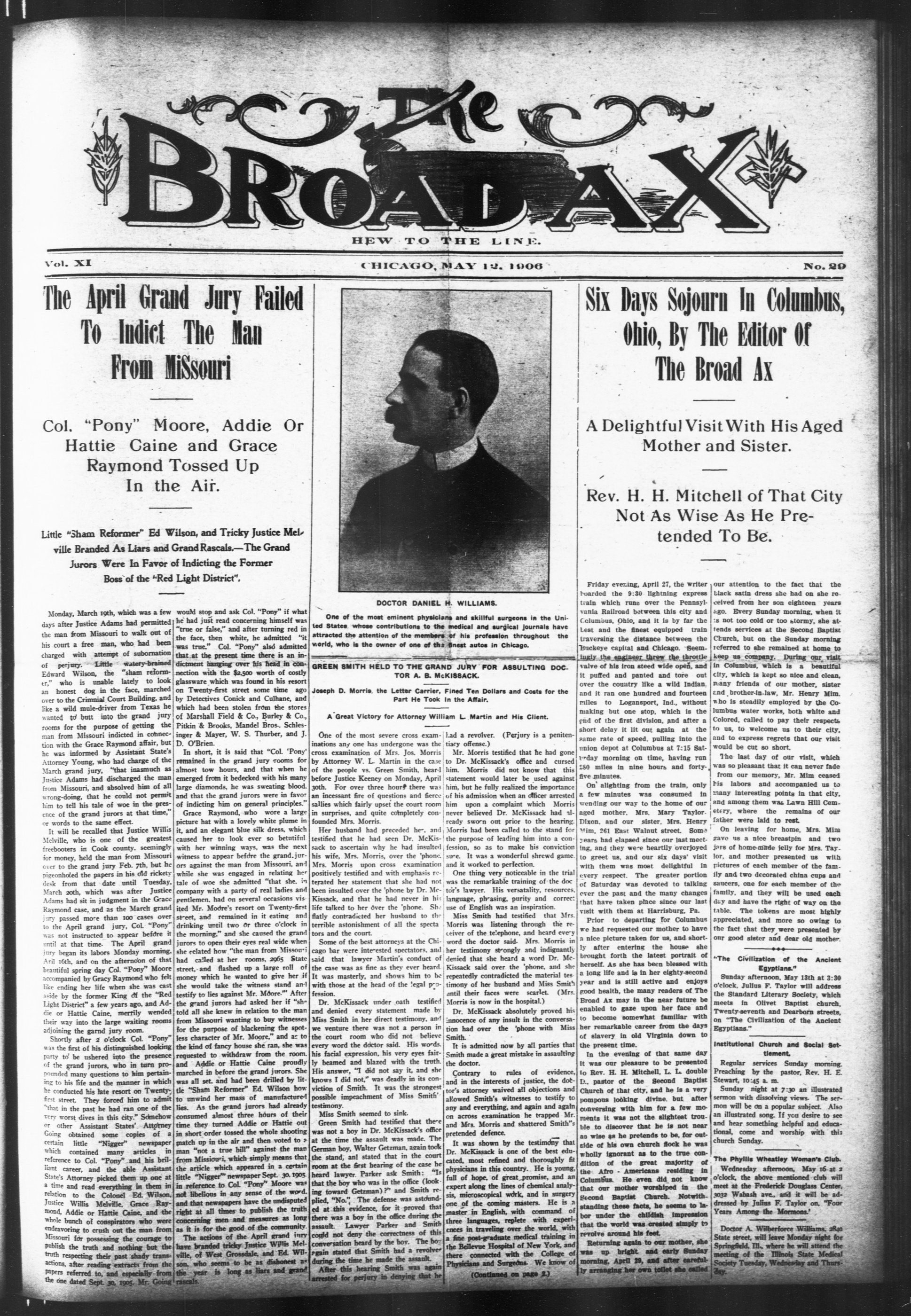
The April Grand Jury Failed To Indict The Man From Missouri
Col. "Pony" Moore, Addie Or Hattie Gaine and Grace Raymond Tossed Up In the Air.
Little "Sham Reformer" Ed Wilson, and Tricky Justice Melville Branded As Liars and Grand Rascals.—The Grand Jurors Were In Favor of Indicting the Former Boss of the "Red Light District".
Vol. XI
The April Grant
To Indict
From M
Col. "Pony" Mc
Hattie Caine
Raymond T
In the
Little "Sham Reformer" Ed W
ville Branded As Liars and
Jurors Were In Favor
Boss of the "Red
Monday, March 19th, which was a few days after Justice Adams had permitted the man from Missouri to walk out of his court a free man, who had been charged with attempt of subnation of perjury. Little watery-brained Edward Wilson, the "sham reformer," who is unable lately to look an honest dog in the face, marched over to the Criminal Court Building, and like a wild mule-driver from Texas he wanted to butt into the grand jury rooms for the purpose of getting the man from Missouri indicted in connection with the Grace Raymond affair, but he was informed by Assistant State's Attorney Young, who had charge of the March grand jury, "that inasmuch as Justice Adams had discharged the man from Missouri, and absolved him of all wrong-doing, that he could not permit him to tell his tale of woe in the presence of the grand jurors at that time," or words to the same effect.
It will be recalled that Justice Willis Melville, who is one of the greatest freebooters in Cook county, seemingly for money, held the man from Missouri over to the grand jury Feb. 7th, but he pigeonholed the papers in his old rickety desk from that date until Tuesday, March 20th, which was after Justice Adams had sit in judgment in the Grace Raymond case, and as the March grand jury passed more than 100 cases over to the April grand jury, Col. "Pony" was not instructed to appear before it until at that time. The April grand jury began its labors Monday morning, Aril 16th, and on the afternoon of that beautiful spring day Col. "Pony" Moore accompanied by Gracy Raymond who felt like ending her life when she was cast aside by the former King of the "Red Light District" a few years ago, and Addie or Hattie Caine, merrily wended their way into the large waiting rooms adjoining the garnd jury room.
Shortly after 2 o'clock Col. "Pony" was the first of his distinguished looking party to be ushered into the presence of the grand jurors, who in turn propounded many questions to him pertaining to his life and the manner in which he conducted his late resort on Twenty-first street. They forced him to admit "that in the past he had ran one of the very worst dives in this city." Somehow or other Assistant States' Attorney Going obtained some copies of a certain little "Nigger" newspaper which contained many articles in reference to Col. "Pony" and his brilliant career, and the able Assistant State's Attorney picked them up one at a time and read everything in them in relation to the Colonel Ed. Wilson, Justice Willis Melville, Grace Raymond, Addie or Hattie Caine, and the whole bunch of conspirators who were endeavoring to crush out the man from Missouri for possessing the courage to publish the truth and nothing but the truth respecting their past shady transactions, after reading extracts from the papers referred to, and especially from the one dated Sept. 30, 1905. Mr. Going
would stop and ask Col. "Pony" if what he had just read concerning himself was "true or false," and after turning red in the face, then white, he admitted "it was true." Col. "Pony" also admitted that at the present time there is an indictment hanging over his head in connection with the $2,500 worth of costly glassware, which was found in his resort on Twenty-first street some time ago by Detectives Conick and Culhane, and which had been stolen from the stores of Marshall Field & Co., Burley & Co., Pitkin & Brooks, Mandel Bros., Schlesinger & Mayer, W. S. Thurber, and J. D. O'Brien. In short, it is said that "Col. 'Pony' remained in the grand jury rooms for almost tow hours, and that when he emerged from it bedded with his many large diamonds, he was sweating blood, and that the grand jurors were in favor of indicting him on general principles."
Grace Raymond, who wore a large picture hat with a lovely white plume in it, and an elegant blue silk dress, which caused her to look ever so betutiful with her winning ways, was the next witness to appear before the grand, jurors against the man from Missouri, and while she was engaged in relating her tale of woe she admitted "that she. in company with a party of real ladies and gentlemen, had on several occasions visited Mr. Moore's resort on Twenty-first street, and remained in it eating and drinking until two o'r three o'clock in the morning," and she caused the grand jurors to open their eyes real wide when she related how "the man from Missouri had called at her rooms, 2965 State street, and flashed up a large roll of money which he wanted to give her if she would take the witness stand and testify to lies against Mr. Moore." After the grand jurors had asked her if "shtold all she knew in relation to the man from Missouri wanting to buy witnesses for the purpose of blackening the spotless character of Mr. Moore," and as to the kind of fancy house she ran, she was requested to withdraw from the room, and Addie or Hattie Caine proudly marched in before the grand jurors. She was all set, and had been drilled by little "Sham Reformer" Ed. Wilson how to unwind her mass of manufactured lies. As the grand jurors had already consumed almost three hours of their time they turned Addie or Hattie out in short order tossed the whole shooting match up in the air and then voted to a man "not a true bill" against the man from Missouri, which simply means that the article which appeared in a certain little "Nigger" newspaper Sept. 30, 1905 in reference to Col. "Pony" Moore was not libellous in any sense of the word, and that newspapers have the undisputed right at all times to publish the truth concerning men and measures as long as it is for the good of the community.
The actions of the April grand jury have branded tricky Justice Willis Melville, of West Grossdale, and Ed. Wilson, who seems to be as dishonest as the year is long as liars and grand racauds.
HEW TO THE LINE.
CHICAGO, MAY 12, 1906
DOCTOR DANIEL H. WILLIAMS.
One of the most eminent physicians and skillful United States, whose contributions to the medical and sus attracted the attention of the members of his profess world, who is the owner of one of the finest autos in
GREEN SMITH HELD TO THE GRAND JURY FOR TOR A. B. McKISSACK.
Joseph D. Morris, the Letter Carrier, Fined Ten Dollar Part He Took In the Affair.
A Great Victory for Attorney William L. Martin a
One of the most eminent physicians and skillful surgeons in the United States, whose contributions to the medical and surgical journals have attracted the attention of the members of his profession throughout the world, who is the owner of one of the finest autos in Chicago.
GREEN SMITH HELD TO THE GRAND JURY FOR ASSULTING DOCTOR A. B. McKISSACK.
Joseph D. Morris, the Letter Carrier, Fined Ten Dollars and Costs for the Part He Took in the Affair.
A Great Victory for Attorney William L. Martin and His Client.
One of the most severe cross examinations any one has undergone was the cross examination of Mrs. Jos. Morris by Attorney W. L. Martin in the case of the people vs. Green Smith, heard before Justice Keeney on Monday, April 30th. For over three hours there was an incessant fire of questions and fierce sallies which fairly upset the court room in surprises, and quite completely confounded Mrs. Morris.
Lad a revolver. (Perjury is a penitentiary offense.)
Mr. Morris testified that he had gone to Dr. McKissack's office and curse him. Morris did not know that the statement would later be used against him, but he fully realized the importance of his admission when an officer arrest him upon a complaint which Morris never believed Dr. McKissack had ready sworn out prior to the hearing.
Her husband had preceded her, and testified that he had seen Dr. McKissack to ascertain why he had insulted his wife, Mrs. Morris, over the 'phone Mrs. Morris upon cross examination positively testified and with emphasis reiterated her statement that she had not been insulted over the 'phone by Dr. McKissack, and that he had never in his life talked to her over the 'phone. She flatly contradicted her husband to the terrible astonishment of all the spectators and the court.
Some of the best attorneys at the Chicago bar were interested spectators, and said that lawyer Martin's conduct of the case was as fine as they ever heard. It was masterly, and shows him to be with those at the head of the legal profession
Dr. McKissack under oath testified and denied every statement made by Miss Smith in her direct testimony, and we venture there was not a person in the court room who did not believe every word the doctor said. His words his facial expression, his very eyes fairly beamed and blazed with the truth His answer, "I did not say it, and she knows I did not," was deadly in its conviction of Smith. It was the strongest possible impeachment of Miss Smith's testimony. Miss Smith seemed to sink.
Miss Smith seemed to sink. Green Smith had testified that there was not a boy in Dr. McKissack's office at the time the assault was made. The German boy, Walter Getzman, again took the stand, and stated that in the court room at the first hearing of the case he heard lawyer, Parker ask Smith: "Is that the boy who was in the office (looking toward Getzman)?" and Smith replied, "No." The defense was astounded at this evidence, for it proved that there was a boy in the office during the assault. Lawyer Parker and Smith could not deny the correctness of this conversation heard by the boy. The boy again stated that Smith had a revolver during the time he made the assault. After this hearing Smith was again arrested for perjury in denying that he
and skillful surgeons in the Uni-
medical and surgical journals have
of his profession throughout the
finest autos in Chicago.
AND JURY FOR ASSULTING DOC-
KISSACK.
Fined Ten Dollars and Costs for the
In the Affair.
Iam L. Martin and His Client.
Lad a revolver. (Perjury is a penitentiary offense.)
Mr. Morris testified that he had gone to Dr. McKissack's office and cursed him. Morris did not know that this statement would later be used against him, but he fully realized the importance of his admission when an officer arrested him upon a complaint which Morris never believed Dr. McKissack had already sworn out prior to the hearing. Morris had been called to the stand for the purpose of leading him into a confession, so as to make his conviction sure. It was a wonderful shrewd game, and it worked to perfection.
One thing very noticeable in the trial was the remarkable training of the doctor's lawyer. His versatility, resources, language, phrasing, purity and correct use of English was an inspiration.
Miss Smith had testified that Mrs. Morris was listening through the receiver of the telephone, and heard every word the doctor said. Mrs. Morris in her testimony strongly and indignantly denied that she heard a word Dr. McKissack said over the 'phone, and she repeatedly contradicted the material testimony of her husband and Miss Smith until their faces were scarlet. (Mrs. Morris is now in the hospital.)
Dr. McKissack absolutely proved his innocence of any insult in the conversation had over the 'phone with Miss Smith.
It is admitted now by all parties that Smith made a great mistake in assaulting the doctor.
Contrary to rules of evidence, and in the interests of justice, the doctor's attorney waived all objections and allowed Smith's witnesses to testify to any and everything, and again and again on across examination he trapped Mr. and Mrs. Morris and shattered Smith"s pretended defence.
It was shown by the testimony that Dr. McKissack is one of the best educated, most refined and thoroughly fit physicians in this country. He is young, full of hope, of great promise, and an expert along the lines of chemical analysis, microscopical work, and in surgery one of the coming masters. He is a master in English, with command of three languages, replete with experiences in traveling over the world, with a fine post-graduate medical training in the Bellevue Hospital of New York, and there connected with the College of Physicians and Surgeons. We know of
Six Days Sojourn In Columbus, Ohio, By The Editor Of The Broad Ax
A Delightful Visit With His Aged Mother and Sister.
Rev. H. H. Mitchell of That City Not As Wise As He Pre tended To Be.
Friday evening, April 27, the writer boarded the 9:30 lightning express train which runs over the Pennsylvania Railroad between this city and Columbus, Ohio, and it is by far the best and the finest equipped train traversing the distance between the Buckeye capital and Chicago. Seemingly the engineer threw the throttle valve of his iron steed wide open, and it puffed and panted and tore out over the country like a wild Indian, and it ran one hundred and fourteen miles to Logansport, Ind., without making but one stop, which is the end of the first division, and after a short delay it lit out again at the same rate of speed, pulling into the union depot at Columbus at 7:15 Saturday morning on time, having run 250 miles in nine hours and forty-five minutes.
On alighting from the train, only a few minutes was consumed in wending our way to the home of our aged mother, Mrs. Mary Taylor-Dixon, and our sister, Mrs. Henry Mim, 261 East Walnut street. Some years had elapsed since our last meeting, and they were heartily overjoyed to greet us, and our six days' visit with them was most delightful in every respect. The greater portion of Saturday was devoted to talking over the past and the many changes that have taken place since our last visit with them at Harrisburg, Pa.
Prior to departing for Columbus we had requested our mother to have a nice picture taken for us, and shortly after entering the house she brought forth the latest portrait of herself. As she has been blessed with a long life and is in her eighty-second year and is still active and enjoys good health, the many readers of The Broad Ax may in the near future be enabled to gaze upon her face and to become somewhat familiar with her remarkable career from the days of slavery in old Virginia down to the present time.
In the evening of that same day it was our pleasure to be presented to Rev. H. H. Mitchell, L. L. double D., pastor of the Second Baptist Church of that city, and he is a very pompous looking divine, but after conversing with him for a few moments it was not the slighter trouble to discover that he is not near as wise as he pretends to be, for outside of his own church flock he was wholly ignorant as to the true condition of the great majority of the Afro - Americans residing in Columbus. He even did not know that our mother worshiped in the Second Baptist Church. Notwithstanding these facts, he seems to labor under the childish impression that the world was created simply to revolve around his feet.
Returning again to our mother, she was up bright and early Sunday morning, April 29, and after carefully arranging her own toilet she called
our attention to the fact that the black satin dress she had on she received from her son eighteen years ago. Every Sunday morning, when it is not too cold or too stormy, she attends services at the Second Baptist Church, but on the Sunday mornings referred to she remained at home to keep us company. During our visit in Columbus, which is a beautiful city, which is kept so nice and clean, many friends of our mother, sister and brother-in-law, Mr. Henry Mim, who is steadily employed by the Columbus water works, both white and Colored, called to pay their respects to us, to welcome us to their city, and to express regrets that our visit would be cut so short.
The last day of our visit, which was so pleasant that it can never fade from our memory, Mr. Mim ceased his labors and accompanied us to many interesting points in that city, and among them was Lawn Hill Cemetery, where the remains of our father were laid to rest.
On leaving for home, Mrs. Mim gave us a nice breastpin and two jors of home-made jelly for Mrs. Taylor, and mother presented us with pictures of each member of the family and two decorated china cups and saucers, one for each member of the family, and they will be used each day and have the right of way on the table. The tokens are most highly appreciated, and more so owing to the fact that they were presented by our good sister and dear old mother.
"The Civilization of the Ancient Egyptians."
Sunday afternoon, May 13th at 3:30 o'clock, Julius F. Taylor will address the Standard Literary Society, which meets in Olivet Baptist church, Twenty-seventh and Dearborn streets, on "The Civilization of the Ancient Egyptians."
Institutional Church and Social Settlement.
Regular services Sunday morning. Preaching by the pastor, Rev. H. E. Stewart. 10:45 a.m.
Sunday night at 7:30 an illustrated sermon with dissolving views. The sermon will be on a popular subject. Also an illustrated song. If you desire to see and hear something helpful and educational, come and worship with this church Sunday.
The Phyllis Wheatley Woman's Club.
Wednesday afternoon, May 16 at 2 o'clock, the above mentioned club will meet at the Frederick Douglass Center, 3032 Wabash ave., and it will be addressed by Julius F. Taylor on, "Four Years Among the Mormons."
Doctor A. Wilberforce Williams, 2840 State street, will leave Monday night for Springfield, Ill., where he will attend the meeting of the Illinois State Medical Society Tuesday, Wednesday and Thursday.
THE BROAD AX.
THE BROAD AX.
Will promulgate and at all times uphold the true principles of Democracy, but Catholicism, Protestants, Protestants, Infidels, Farmers, Single men, and one else can have their say, so long as their language is proper and responsibility is fixed.
The Broad is a newspaper whose platform is broad enough for all, ever claiming the editorial right to speak its own mind.
Local communications will receive attention. Write only on one side of the paper.
THE BROAD AX
8004 Armour Avenue, Chicago.
JULIUS F. TAYLOR, Editor and Publisher.
Entered at the Post Office at Chicago
IL as Second-class Matter.
CHIPS
Mrs. Wm. Emanuel is busy rehearsing a number of our young folks. "Cinderella" is the play they will put on very soon.
The Negroes of South Carolina pay into the State Treasury $25,000 more taxes for education than is expended on their children.
Miss Mamie Seldon, 6416 Evans avenue, entertained a number of friends Saturday evening in honor of Mr. Julius Fields, of Denver, Col.
Mrs. Richard Pinn and her little daughter, 4836 State street, left Thursday evening for Omaha. Neb. They will be absent until fall.
Doctor George C. Hall, and Mrs S. Laing Williams, have been selected as the new directors of the Frederick Douglass Centre.
Mr. and Mrs. Thomas Carey, and the children, 4201 Western ave. boul, returned home Tuesday, after spending the winter in Southern California.
Attorneys William W. Johnson and Edw. G. Alexander have removed their law offices from 167 Dearborn street to the Imperial Bldg., 260 S. Clark street.
Hon. William A. Doyle, who is one of the most eminent lawyers in Chicago will at the Judicial election, Monday June 4th, succeed the late Murray F. Tuley as Judge of the Circuit Court.
The K. P. ball given at the First Regiment Armory, 16th street and Michigan ave., Thursday evening was very dargely attended and in every way it was a grand success.
Miss Helen, the bright and talented daughter of Dr. and Mrs. A. F. Perry, 4810 Langley avenue, celebrated her eleventh birthday Wednesday, May 9th. Among the many presents received was $250 in gold from her father.
The Odd Fellows will have their "turn-out" next Sunday, the occasion being their annual Thanksgiving day. They will march from their new home to Quinn chapel.
John A. Linn, former clerk of the circuit court, and one of the leading Republican politicians in Cook County who robbed the taxpayers of more than $60,000, was transferred to the pen at Joliet Monday, where he will rusticate for some time to come.
Attorney J. Gray Lucas, left for Washington, D. C., last evening, where he will appear in the United States Supreme Court, in behalf of Doctor E. R. Robinson and his ten million dollar patent car wheel case. Mr. Lucas will be absent one week.
One of Robert T. Lincoln's colored servants, who wants to be a dude and the leader of the four hundred, and his pretty light wife rode to and from the big doings at the Pekin Theatre, Monday evening, on common street cars, which was evident that some one must have been troubled, with the shorts.
Mrs. Carrie Warner, who is one of the best Afro-American business women in Chicago, has removed her Chiropodist and Manicure Parlors at 182 State street from the fourth floor to the seventh floor of the same building, where she has better light and more commodious quarters, and she will be delighted to meet her old customers and friends.
James J. Gray, the new popular clerk of the Circuit Court, has been weeding out some of the inefficient clerks which fed at the public crib under John A.Linn, and the following have been selected as Mr. Gray's assistants: Charles Center Case, Jr., as chief deputy clerk; Thomas T. Callanb, B. H. Pegram, James S. Flainnigan, Patrick S. Dunne and Paul L. Vogel was retained as assistant cashier and assistant chief deputy, positions which have been held by him for many years. Mr. Gray deserved to be highly commended for selecting such a popular chief deputy clerk in the person of Charles Center Case.
```markdown
```
[Name]
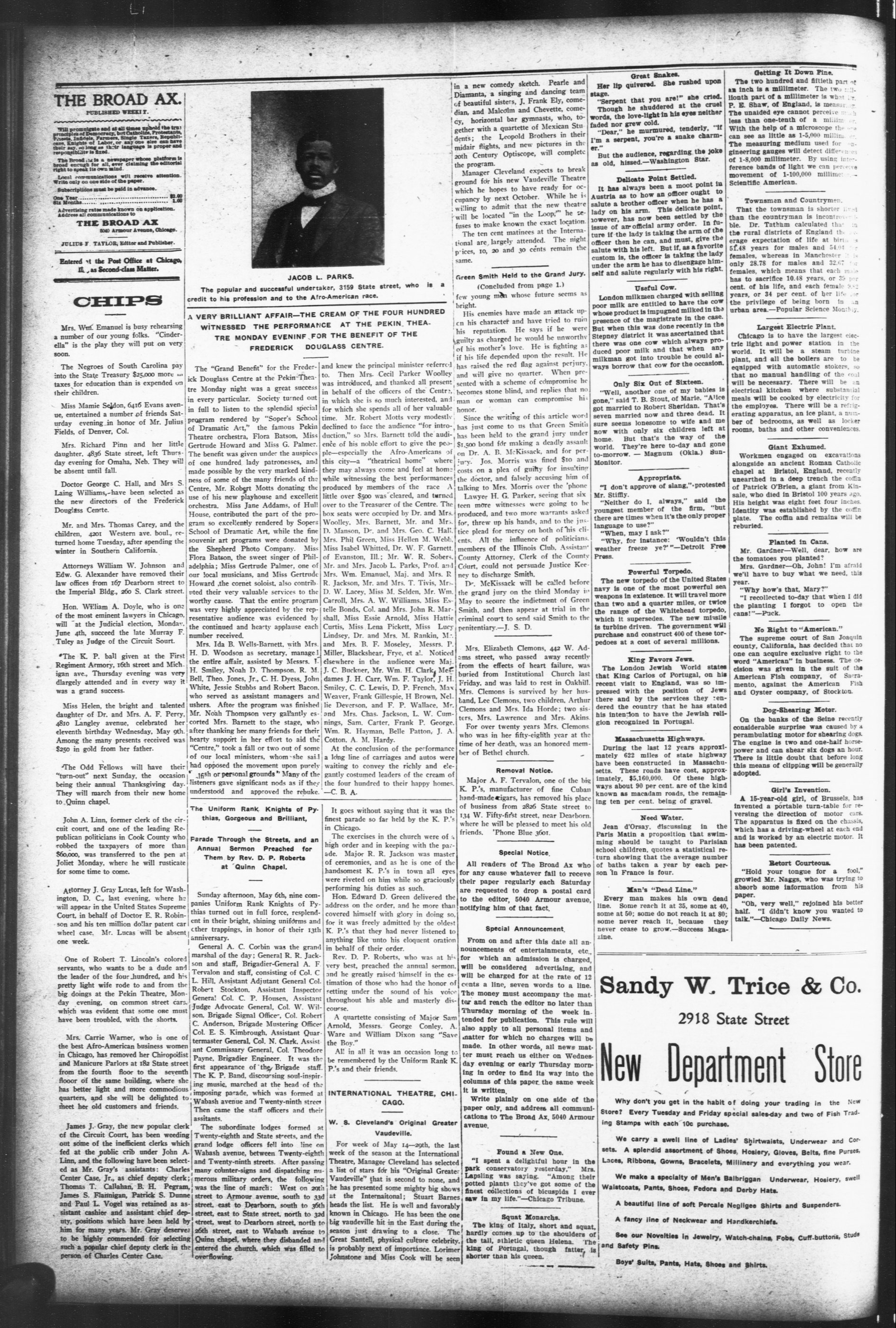
JACOB L. PARKS.
The popular and successful undertaker, 3159 State street, who is a credit to his profession and to the Afro-American race.
A VERY BRILLIANT AFFAIR—THE CREAM OF THE FOUR HUNDRED WITNESSED THE PERFORMANCE AT THE PEKIN THEA-TRE MONDAY EVENINF FOR THE BENEFIT OF THE FREDERICK DOUGLASS CENTRE.
The "Grand Benefit" for the Frederick Douglass Centre at the Pekin Theatre Monday night was a great success in every particular. Society turned out in full to listen to the splendid special program rendered by "Soper's School of Dramatic Art," the famous Pekin Theatre orchestra, Flora Batson, Miss Gertrude Howard and Miss G. Palmer. The benefit was given under the auspices of one hundred lady patronesses, and made possible by the very marked kindness of some of the many friends of the Centre, Mr. Robert Motts donating the use of his new playhouse and excellent orchestra. Miss Jane Addams, of Hull House, contributed the part of the program so excellently rendered by Sopera School of Dramatic Art, while the fine souvenir art programs were donated by the Shepherd Photo Company. Miss Flora Batson, the sweet singer of Philadelphia; Miss Gertrude Palmer, one of our local musicians, and Miss Gertrude Howard the cornet soloist, also contributed their very valuable services to the worthy cause. That the entire program was very highly appreciated by the representative audience was evidenced by the continued and hearty applause each number received.
Mrs. Ida B. Wells-Barnett, with Mrs. H. D. Woodson as secretary, manage the entire affair, assisted by Messrs. H. Smiley, Noah D. Thompson, R. M. Bell, Theo. Jones, Jr., C. H. Dyess, John White, Jessie Stubbs and Robert Bacon who served as assistant managers and ushers. After the program was finished Mr. Noah Thompson very gallantly escorted Mrs. Barnett to the stage, who after thanking her many friends for their hearty support in her effort to aid the "Centre," took a fall or two out of some of our local ministers, whom she said had opposed the movement upon purely "fish or personal grounds" Many of the listeners gave significant nods as if they understood and approved the rebuke.
The Uniform Rank, Knights of Pythias, Gorgeous and Brilliant.
Parade Through the Streets, and an Annual Sermon Preached for Them by Rev. D. P. Roberts at Quinn Chapel.
Sunday afternoon, May 6th, nine companies Uniform Rank Knights of Pythias turned out in full force, resplendent in their bright, shining uniforms and other trappings, in honor of their 13th anniversary.
General A. C. Corbin was the grand marshal of the day: General R. R. Jackson and staff, Brigadier-General A. F. Tervalon and staff, consisting of Col. C. L. Hill, Assistant Adjutant General Col. Robert Stockton, Assistant Inspector General Col. C. P. Housen, Assistant Judge Advocate General, Col. W. Wilson, Brigade Signal Office*, Col. Robert C. Anderson, Brigade Mustering Office* Col. E. S. Kimbrough, Assistant Quartermaster General, Col. N. Clark, Assistant Commissary General, Col. Thecodore Payne, Brigadier Engineer. It was the first appearance of 'the Brigade staff' The K. P. Band, discussing soul-inspiring music, marched at the head of the imposing parade, which was formed at Wabash avenue and Twenty-ninth street Then came the staff officers and their assistants.
The subordinate lodges formed at Twenty-eighth and State streets, and the grand lodge officers fell into line on Wabash avenue, between Twenty-eighth and Twenty-ninth streets. After passing many counter-signs and dispatching numerous military orders, the following was the line of march: West on 20th street to Armour avenue, south to 33d street, east to Dearborn, south to 36th street, east to State street, north to 32d street, west to Dearborn street, north to 26th street, east to Wabash avenue to Quinn chapel, where they disbanded and entered the church, which was filled to overflowing.
and knew the principal minister referred to. Then Mrs. Cecil Parker Woolley was introduced, and thanked all present in behalf of the officers of the Centr; in which she is so much interested, and for which she spends all of her valuable time. Mr. Robert Motts very modestly declined to face the audience "for introduction," so Mrs. Barnett told the audience of his noble effort to give the people—especially the Afro-Americans of this city—a "theatral home" where they may always come and feel at home while witnessing the best performances produced by members of the race. A little over $500 was cleared, and turned over to the Treasurer of the Centre. The box seats were occupied by Dr. and Mrs. Woolley, Mrs. Barnett, Mr. and Mrs. D. Manson, Dr. and Mrs. Geo. C. Hall Mrs. Phil Green, Miss Hellen M. Webb Miss Isabel Whitted, Dr. W. F. Garnett of Evanston, Ill.; Mr. W. R. Sobers Mr. and Mrs. Jacob L. Parks, Prof. and Mrs. Wm. Emanuel, Maj. and Mrs. R. R. Jackson, Mr. and Mrs. T. Tivis, Mrs. D. W. Lacey, Miss M. Selden, Mr. Wm Carroll, Mrs. A. W. Williams, Miss Estelle Bonds, Col. and Mrs. John R. Marshall, Miss Essie Arnold, Miss Hattie Curtis, Miss Lena Pickett, Miss Lucy Lindisey, Dr. and Mrs. M. Rankin, Mr. and Mrs. B. F. Moseley, Messrs. P. Miller, Blackshear, Frye, et al. Noticed elsewhere in the audience were Maj. J. C. Buckner, Mr. Wm. H. Clark, Messdames J. H. Carr, Wm. F. Taylor, J. H. Smiley, C. C. Lewis, D. P. French, Maw Weaver, Frank Gillespie, H Brown, Nellie Deverson, and F. P. Wallace, Mr. and Mrs. Chas. Jackson, L. W. Cummings, Sam. Carter, Frank P. George Wm. R. Hayman, Belle Patton, J. A. Cotton, A. M. Hardy.
At the conclusion of the performance a long line of carriages and autos were waiting to convey the richly and elegantly costumed leaders of the cream of the four hundred to their happy homes. C. B. A.
It goes without saying that it was the finest parade so far held by the K. P.'s in Chicago.
The exercises in the church were of a high order and in keeping with the parade. Major R. R. Jackson was master of ceremonies, and as he is one of the handsomest K. P.'s in town all eyes were riveted on him while so graciously performing his duties as such.
Hon. Edward D. Green delivered the address on the order, and he more than covered himself with glory in doing so, for it was freely admitted by the oldest K. P.'s that they had never listened to anything like unto his eloquent oration in behalf of their order.
Rev. D. P. Roberts, who was at his very best, preached the annual sermon, and he greatly raised himself in the estimation of those who had the honor of setting under the sound of his voice throughout his able and masterly discourse.
A quartette consisting of Major Sam Arnold, Messrs. George Conley, A. Ware and William Dixon sang "Save the Boy."
All in all it was an occasion long to be remembered by the Uniform Rank K. P.'s and their friends.
INTERNATIONAL THEATRE, CHI
CAGO.
W. S. Cleveland's Original Greater
Vaudeville
For week of May 14-20th, the last week of the season at the International Theatre, Manager Cleveland has selected a list of stars for his "Original Greater Vaudeville" that is second to none, and he has presented some mighty big shows at the Internaitonal; Stuart Barnes heads the list. He is well and favorably known in Chicago. He has been the one big vaudeville hit in the East during the season just drawing to a close. The Great Santell, physical culture celebrity, is probably next of importance. Lorimer Johnstone and Miss Cook will be seen
in a new comedy sketch. Pearle and Diamanta, a singing and dancing team of beautiful sisters, J. Frank Ely, comedian, and Malcolm and Chevette, comedy, horizontal bar gymnasts, who, together with a quartette of Mexican Students; the Leopold Brothers in their midair flights, and new pictures in the 20th Century Optiscope, will complete the program.
Manager Cleveland expects to break ground for his new Vaudeville Theatre which he hopes to have ready for occupancy by next October. While he is willing to admit that the new theatre will be located "in the Loop," he refuses to make known the exact location. The ten cent matinees at the International are, largely attended. The night prices, 10, 20 and 30 cents remain the same.
Green Smith Held to the Grand Jury.
(Consolidated from page 1.)
few young men whose future seems as bright.
His enemies have made an attack upon his character and have tried to ruin his reputation. He says if he were guilty as charged he would be unworthy of his mother's love. He is fighting as if his life depended upon the result. He has raised the red flag against perjury, and will give no quarter. When presented with a scheme of compromise he becomes stone blind, and replies that no man or woman can compromise his honor.
Since the writing of this article word has just come to us that Green Smith has been held to the grand jury under $1,500 bond for making a deadly assault on Dr. A. B. McKissack, and for perjury. Jos. Morris was fined $10 and costs on a plea of guilty for insulting the doctor, and falsely accusing him of talking to Mrs. Morris over the 'phone. Lawyer H. G. Parker, seeing that sixteen more witnesses were going to be produced, and two more warrants asked for, threw up his hands, and to the justice plead for mercy on both of his clients. All the influence of politicians members of the Illinois Club. Assistant County Attorney, Clerk of the County Court, could not persuade Justice Keeney to discharge Smith.
Dr. McKissack will be called before the grand jury on the third Monday in May to secure the indictment of Green Smith, and then appear at trial in the criminal court to send said Smith to the penitentiary.—J. S. D.
Mrs. Elizabeth Clemons, 442 W. Adams street, who passed away recently from the effects of heart failure, was buried from Institutional Church last Friday, and was laid to rest in Oakhill Mrs. Clemons is survived by her husband, Lee Clemons, two children, Arthur Clemons and Mrs. Ida Horde; two sisters, Mrs. Lawrence and Mrs. Akins. For over twenty years Mrs. Clemons who was in her fifty-eighth year at the time of her death, was an honored member of Bethel church.
Removal Notice.
Major A. F. Tervalon, one of the big K. P.'s, manufacturer of fine Cuban hand-made cigars, has removed his place of business from 2826 State street to 134 W. Fifty-first street, near Dearborn, where he will be pleased to meet his old friends, 'Phone Blue 3601.
Special Notice
All readers of The Broad Ax who for any cause whatever fail to receive their paper regularly each Saturday are requested to drop a postal card to the editor, 5040 Armour avenue, notifying him of that fact.
Special Announcement
From on and after this date all announcements of entertainments, etc., for which an admission is charged, will be considered advertising, and will be charged for at the rate of 12 cents a line, seven words to a line. The money must accompany the matter and reach the editor no later than Thursday morning of the week intended for publication. This rule will also apply to all personal items and matter for which no charges will be made. In other words, all news matter must reach us either on Wednesday evening or early Thursday morning in order to find its way into the columns of this paper the same week it is written
Write plainly on one side of the paper only, and address all communications to The Broad Ax, 5040 Armour avenue.
Found a New One.
"I spent a delightful hour in the park conservatory yesterday." Mrs. Lapsling was saying. "Among their potted plants they've got some of the finest collections of bicplusids I ever saw in my life."—Chicago Tribune.
Souat Monarchs.
The king of Italy, short and squat, hardly comes up to the shoulders of the tall, athletic queen Helena. The king of Portugal, though fatter, is shorter than his queen.
The two hundred and fiftieth part of an inch is a millimeter. The two millilionth part of a millimeter is what is P. E. Shaw, of England, is measuring. The unaided eye cannot perceive much less than one-tenth of a millimeter. With the help of a microscope the eye can see as little as 1-5,000 millimeters. The measuring medium used for engineering gauges will detect differences of 1-8,000 millimeter. By using interference bands of light we can perceive movement of 1-100,000 millimeters. Scientific American.
That the townman is shorter than the countryman is incontrovertible. Dr. Tatham calculated that in the rural districts of England the average expectation of life at birth is 51.48 years for males and 54.04 for females, whereas in Manchester it is only 28.78 for males and 32.67 for females, which means that each male has to sacrifice 10.48 years, or 39 per cent. of his life, and each female 9.82 years, or 34 per cent. of her life for the privilege of being born in an urban area—Popular Science Monthly.
Chicago is to have the largest electric light and power station in the world. It will be a steam turbine plant, and all the boilers are to be equipped with automatic stokers, so that no manual handling of the coal will be necessary. There will be an electrical kitchen where substantial meals will be cooked by electricity for the employees. There will be a refrigerating apparatus, an ice plant, a number of bedrooms, as well as locker rooms, baths and other conveniences.
Workmen engaged on excavations alongside an ancient Roman Catholic chapel at Bristol, England, recently unearthed in a deep trench the coffin of Patrick O'Brien, a giant from Kinsale, who died in Bristol 100 years ago. His height was eight feet four inches. Identity was established by the coffin plate. The coffin and remains will be reburied.
Mr. Gardner—Well, dear, how are the tomatoes you planted?
Mrs. Gardner—Oh, John! I'm afraid we'll have to buy what we need, this year.
"Why how's that, Mary?"
"I recollected to-day when I did the planting I forgot to open the can!"—Puck.
The supreme court of San Joaquin county, California, has decided that no one can acquire exclusive right to the word "American" in business. The decision was given in the suit of the American Fish company, of Sacramento, against the American Fish and Oyster company, of Stockton.
On the banks of the Seine recently considerable surprise was caused by a perambulating motor for shearing dogs. The engine is two and one-half horsepower and can shear six dogs an hour. There is little doubt that before long this means of clipping will be generally adopted.
A 15-year-old girl, of Brussels, has invented a portable turn-table for reversing the direction of motor cars. The apparatus is fixed on the chassis, which has a driving-wheel at each end and is worked by an electric motor. It has been patented.
"Hold your tongue for a fool," growled Mr. Naggs, who was trying to absorb some information from his paper.
"Oh, very well," rejoined his better half. "I didn't know you wanted to talk."—Chicago Daily News.
Trice & Co.
State Street
Petment Store
of doing your trading in the New
special sales-day and two of Fish Trad-
ties' Shirtwaists, Underwear and Cor-
oes, Hosiery, Gloves, Belts, fine Purses,
Millinery and everything you wear.
Balbriggan Underwear, Hosiery, swell
and Derby Hats.
Negligee Shirts and Suspenders.
Sandy W. Trice
2918 State Street
New Department
Why don't you get in the habit of doing your
Store? Every Tuesday and Friday special sales-day
ing Stamps with each 10c purchase.
We carry a swell line of Ladies' Shirtwaist
sets. A splendid assortment of Shoes, Hosiery, G
Laces, Ribbons, Gowns, Bracelets, Millinery and
We make a specialty of Men's Balbriggan Un
Waistcoats, Pants, Shoes, Fedora and Derby Hats.
A beautiful line of soft Percale Negligee Shirts
Sandy W. Trice & Co.
2918 State Street
New Department Store
Why don't you get in the habit of doing your trading in the New Store? Every Tuesday and Friday special sales-day and two of Fish Trading Stamps with each 10c purchase.
We carry a swell line of Ladies' Shirtwaists, Underwear and Corsets. A splendid assortment of Shoes, Hosiery, Gloves, Belts, fine Purses, Laces, Ribbons, Gowns, Bracelets, Millinery and everything you wear.
We make a specialty of Men's Baibriggan Underwear, Hosiery, swell Waistcoats, Pants, Shoes, Fedora and Derby Hats.
A beautiful line of soft Percale Negligee Shirts and Suspenders.
A fancy line of Neckwear and Handkerchiefs.
Watch-chains, Fobs, Cuff-buttons, Studs and Shirts.
See our Novelties in Jewelry, Watch-chains, Fobs, Cuff-buttons, Studs and Safety Pins.
Boys' Suits, Pants, Hats, Shoes and Shirts.
Great Snakes.
Her lip quivered. She rushed upon stam.
"Serpent that you are!" she cried.
Though he shuddered at the cruel
words, the love-light in his eyes neither
faded, nor grew cold.
faded nor grew color.
"Dear," he murmured, tenderly, "If I'm a serpent, you're a snake charmer."
But the audience, regarding the joke as old, hissed.—Washington Star.
Delicate Point Settled.
It has always been a moot point in Austria as to how an officer ought to salute a brother officer when he has a lady on his arm. This delicate point, however, has now been settled by the issue of an official army order. In future if the lady is taking the arm of the officer then he can, and must, give the salute with his left. But if, as a favorite custom is, the officer is taking the lady under the arm he has to disengage himself and salute regularly with his right.
Useful Cow.
London milkmen charged with selling poor milk are entitled to have the cow whose product is impugned milked in the presence of the magistrate in the case. But when this was done recently in the Stepney district it was ascertained that there was one cow which always produced poor milk and that when any milkman got into trouble he could always borrow that cow for the occasion.
Only Six Out of Sixteen
"Well, another one of my babies is gone," said T. B. Stout, of Marle. "Alice got married to Robert Sheridan. That's seven married now and three dead. It sure seems lonesome to wife and me now with only six children left at home. But that's the way of the world. They're here to-day and gone to-morrow. — Magnum (Okla.) Sun-Monitor.
Appropriate
"I don't approve of slang."-protested
Mr. Stiffly.
"Neither do I, always," said the youngest member of the firm, "but there are times when it's the proper language to use?"
"When may I ask?"
When, may I ask?
"Why, for instance: 'Wouldn't this weather freeze ye?'"—Detroit Free Press.
Powerful Torpedo.
The new torpedo of the United States navy is one of the most powerful sea weapons in existence. It will travel more than two and a quarter miles, or twice the range of the Whitehead torpedo, which it supersedes. The new missile is turbine driven. The government will purchase and construct 400 of these torpedoes at a cost of several millions.
King Favors Jews.
The London Jewish World states that King Carlos of Portugal, on his recent visit to England, was so impressed with the position of Jews there and by the services they rendered the country that he has stated his intention to have the Jewish religion recognized in Portugal.
Massachusetts Highways.
During the last 12 years approximately 622 miles of state highway have been constructed in Massachusetts. These roads have cost, approximately, $5,160,000. Of these highways about 90 per cent. are of the kind known as macadam roads, the remaining ten per cent. being of gravel.
Need Water.
Jean d'Orsay, discussing in the Paris Matin a proposition that swimming should be taught to Parisian school children, quotes a statistical return showing that the average number of baths taken a year by each person in France is four.
Man's "Dead Line"
Every man makes his own dead line. Some reach it at 35, some at 40, some at 50; some do not reach it at 80; some never reach it, because they never cease to grow.—Success Magazine.
Getting It Down Fine
Townsman and Countrymen
Largest Electric Plant
Giant Exhumed.
Planted in Cans.
No Right to "American."
Dog-Shearing Motor.
Girl's Invention.
Retort Courteous
WASHINGTON GOSSIP
AFTER PRESIDENT ROOSEVELT
LEAVES OFFICE IN 1909.
President and His Associates in Their Fondness for Athletics — The American Soldier in San Francisco.
ASHINGTON.—Political prophets in Washington are trying to find a place for President Roosevelt after he goes out of office in 1909. One ingenious writer has predicted the election of Secretary of War Taft
ASHINGTON.—Political prophets in Washington are trying to find a place for President Roosevelt after he goes out of office in 1909. One ingenious writer has predicted the election of Secretary of War Taft to the presidency, and declares that Theodore Roosevelt would be Mr. Taft's secretary of state. This arrangement has caused President Roosevelt considerable amusement and has excited the risibilities of men in public life generally.
The most frequently expressed opinion in political circles is that Mr. Roosevelt is more likely to come to the senate from New York than he is to fill any other position. Senator Platt's term will expire on March 3, 1909, the date on which Mr. Roosevelt will cease to be president of the United States. Mr. Platt is not a candidate for reelection, and if Mr. Roosevelt enters the field it is admitted that no one will oppose him. The senate would be a congenial field after two terms in the White House. Some of the older members of the senate who have not had the most pleasant relations with Mr. Roosevelt as president are already grinning in anticipation of the fun they will have in hazing the new senator from New York. Those who know the president do not doubt that he will be able to take good care of himself when the hazing begins.
After Mr. Roosevelt retires from the presidency even though he is elected a senator from New York it is believed that his plans contemplate a tour of the world. He could start at once and do this tour before the beginning of the regular session of congress following. It is admitted that no one, not even Grant, has received greater honors than would be accorded to Mr. Roosevelt by all the great foreign nations he would visit. His reputation as the great peacemaker of the world would insure him a triumphal tour.
Martha Washington's Bible.
HERE was recently restored to its rightful owner one of the most interesting relics of colonial and revolutionary times. The long lost Bible of Martha Washington, which was taken from the home of the Lee
T
family at Arlington during the civil war was a few days ago restored by G. W. Kendricks, of Philadelphia, to Miss Mary Custis Lee, daughter of Gen. Robert E. Lee, the commander of the confederacy. The wanderings of this old volume will never be known. Mr. Kendricks, who is a book collector, bought the Bibie many years ago from a man named Stein. It was probably stolen, as were many other treasures from the Lee mansion, by the servants and soldiers, and pawned for a trifling sum by persons ignorant of its value.
The book has been kept with great care and is in fine condition. Its black leather cover shows few scratches. A few pages are torn, but the ink is still unfaded, and many leaves and flowers pressed by members of the Lee family are still in it. The Bible was printed in London in 1702 by "Charles Bill and the Executrix of Thomas Newcomb, deceased, printers to the King's most excellent Majesty." It contains the "Order for Morning Prayer Throughout the Year," including the communion service, the articles of religion, the Old and New Testaments, with the Apocrypha, the metrical version of the Psalms and the table of binded affinity.
The Bible does not contain the record of the marriage of Martha Custis to George Washington. The earliest birth reported is that of Fannie Park Custis, in 1716. The marriage of Daniel Parke Custis to Martha Dandridge, afterward Martha Washington, is recorded as having occurred in 1750.
Good Athletes.
I
THE
MUSEUM
OF
ART
&
COLLECTION
N PRESIDENT Roosevelt's cabinet there are several men who can hold him level in certain lines of athletics, although the president has the reputation of being the greatest all-round athlete among public
men in Washington. He does not boast of particular skill in any sport except wrestling. In that he has quite a record. He is a very good rider, a good boxer, a fairly good shot, and a very fair tennis player. He gets most of his exercise, however, in wrestling and boxing, and if he cannot persuade any of his friends to stand up against him he will have some athletic instructor come to the White House and try a few rounds with him with the gloves.
Two of his cabinet have fine athletic
records. They are Attorney General Moody and Secretary of Commerce and Labor Metcalf. Moody is one of the most enthusiastic baseball cranks in the country. When he was at college he was a crack player himself. He was captain of the Andover baseball team in 1872, and played with the 'Varsity nine at Harvard for four years. If he gets the opportunity he still likes to play the game, but just now he takes most of his exercise in horseback riding.
Secretary Metcalf made quite a record as an carsmaker on the Yale crew away back in 1875-6. When he went to California in 1880 he became a member of the Olympic club, of San Francisco. He was one of the crack boxers of the club, and at one time held the middleweight amateur championship of San Francisco for wrestling. He does not indulge in any of this violent exercise now, as he has not been in good health for some time, and he, like Moody, confines himself to riding and walking. First Assistant Postmaster General Hitchcock is one of the greatest athletes in public life. He has a fine record as a baseball player, but his specialty is boxing. He is more than six feet tall, very quick, and has an unusually long reach.
Confidence Restored.
HE United States army has won new laurels by the part it has played in San Francisco. The authorities at the war department, however, are of the opinion that it has about completed its work there. Secretary
T
Taft is opposed to the policy of retaining any number of troops in San Francisco engaged in the work of relief and restoration. He believes that these duties should be taken up by the citizens of San Francisco themselves. The longer the army stays there the more danger there is of conflict of authority between the municipal officials and the officers of the army. It is also felt that the people of San Francisco would be much more self-respecting if they are shouldered with the responsibility of maintaining order and relieving the suffering.
The conduct of the army officers and men in the great disaster in San Francisco has done much to restore to the army the confidence and respect of the people, and particularly of members of congress. It had become the habit of some congressmen and senators on all occasions to decry the American soldier. When the news came of the wiping out of the Moros at Mount Dajo in the Philippines there was a renewal of the criticism of the army and an outcry against the brutality and cruelty of the soldiers. This has all been hushed. When the same soldier, because those stationed on the Pacific coast are of the same army that has occupied the Philippines, went into the burning city, rescued men, women and children, went hungry that others might eat, and neither slept nor rested night nor day there was nothing heard about the brutal soldiers.
The employment of the army in this work was without warrant of law, but no violation of red tapeism ever met with so hearty approval or commanded so much respect in congressional and administration circles where the welfare of the soldier is supposed to be in charge.
A New Fertilizer
ECRETARY WILSON's department of agriculture is constantly discovering something that is destined to be of benefit to the farmer. Just now the scientists in that department are somewhat excited over
ECRETARY WILSON's department of agriculture is constantly discovering something that is destined to be of benefit to the farmer. Just now the scientists in that department are somewhat excited over the supposed discovery of a new supply of fertilizer which can be furnished cheaper than the same material has ever been before secured. Heretofore the whole supply of carbonate of potash fertilizer has come from Germany, but Dr. Cushman, of the roads' office in the agricultural department, believes that he has found something in this country that will completely suppliant the German fertilizer.
Last summer when Dr. Cushman was experimenting on some granite road material in his laboratory he extracted from some very finely powdered rock a large percentage of potash. He extracted this potash by electricity, but he concluded that as ground rock is very cheap, it might be worth while to try the experiment of letting the plants do their own extracting. He tried it on his own farm, and found that the powdered rock did actually act as a fertilizer.
The commercial value of imported fertilizer is about $100 a ton. It is necessary in the tobacco fields and a number of other crops require it. The ground rock, on the other hand, can be produced for about three dollars a ton, and there is so much of it in the country that runs high in potash, and is available for use that the supply could never be cornered. It takes about twice as much of the ground rock to accomplish the same results as the imported fertilizer, but even then the difference in the price of $6 and $100 is evidently a great card in favor of the native material. The scientists at the agricultural department regard this as a very important discovery.
Burmese Inch.
The pulgat, a Burmese measurement, is the only foreign measure exactly corresponding to our inch.
ON SUPERSTITIONS
SCHOOLGIRLS DO NOT ESCAFE
FASCINATION.
Many Girls Still Obey Silly Traditions That Destroy One's Peace of Mind —Presenting Edged Tools, Spilling Salt and Thirteen at the Table —Some Superstitions Cause More Fun Than Fear—Illusions of the "Peter Pan" Sort Are Good for Schoolgirls—The Practical Fairies That Fight for One in Daily Life Are Order, Promptness, Obedience, Courage and Love.
BY MARGARET E. SANGSTER.
Superstition is almost as old as the human race, and even schoolgirls do not entirely escape its fascination. No matter how strong most of us may be in our resistance to foolish fears and fancies, we have somewhere in the back of our minds little feelings about certain signs and we begin very early in life to shape our conduct by them.
For instance, very few of us care to make a present to a friend of an edged tool. I know several otherwise sensible people who tell me that some of their most prized friendships have been cut in two because they gave or received a knife. I myself would not object to receiving a knife as a gift, whether it were intended for carving a roast, or dividing the leaves of a book. All sorts of knives from those of finely tempered steel, intended for the table, to dainty little pearl-handled affairs that may be carried in the pocketbook, appeal to me as particularly desirable possessions. Yet I know very few persons who do not like to add a bit of silver or copper to such an exchange, that it may seem to be a matter of barter and sale, rather than of gift-making.
"Don't give Mabel a knife on her birthday," I heard Priscilla's mother gravely say, to her daughter, "for as surely as you do you and Mabel will quarrel."
The same superstition about spoiling friendship clings to the spilling of salt on the tablecloth. It is held to be most unlucky to do this, and it is supposed that it forebodes friction between those who are sitting nearest the spilled salt. Of course, this superstition and the other date a long way back to those primitive times when men settled everything speedily by knife thrust or blow, so that knives were dreaded weapons instead of useful tools. This superstition harks back to the period when a man pulled off his glove in greeting a friend or neighbor in token that he had nothing concealed, and so gave the naked hand. The other about the salt has an oriental origin. In the tent of the Arab, though he might be a robber, there was hospitality for the wayfaring guest, and if the latter shared bread and salt with his host, his life and property were sacred. So you may easily read between the lines that salt is an emblem of friendship, and that its spilling signifies a breach of friendship.
I should be sorry to think that the girls of to-day, who will be the women of to-morrow, were in the least under the bondage of silly traditions in which there is very little common sense.
Why should anyone dread to pass under a ladder except for the reason that the ladder may fall? Why should the howling of a dog give one uneasiness or there be any meaning attached to the dropping of spoons and forks? Why do some people hesitate to sit down at the table when the company numbers 13? If the family should happen to consist of father and mother and 11 children, would there always be one who had to wait for the second table? This latter superstition is supposed to recall the last supper of Jesus with His disciples, when one of the group proved to be a trafitor.
Nearly everything we do, say or think, strikes deep roots into the past, if we can find and trace them out.
In my school days girls put themselves to an immense amount of trouble when walking on the street that they might avoid stepping on a crack in the pavement. It was sure to cause trouble in the schoolroom in the way of imperfect recitations and badly-drawn maps if one unfortunately touched a crack with the toe of her boot. Older persons were sometimes surprised at the erratic progress of children who were bending their energies to this careful sort of walking. A school friend of mine had a theory that nothing would prosper with Helen if she did not put her shoes at night in a particular spot, and set them precisely side by side. It took her a long time to get settled in bed, as she had to jump out a number of times in order to be sure that her shoes were standing exactly as they should to a hair's breadth.
There used to be, too, a proverb regarding Indian givers. These were generous in making presents, but they regretted them afterwards and wanted them back, a sorry thing in itself and rather mean. Bargains once concluded should stand fast, as we all know. Some of us had delicious fears that we greatly enjoyed about passing a certain place in a forest not far from the school. Here there was a tumble-down cottage falling into ruins, the haunt of bats, rats and spiders. We scurried past it with frantic haste, lost something we knew not what should spring forth and seize us. You remember James Whitcomb Riley's poem with the line,
"The goblins will catch you if you don't watch out."
That was what we dreaded and yet we had great fun in running races past
the enchanted corner and eluding the witches and elves who were hidden behind those broken window panes. Superstition of every kind is a sort of poetry. This is why unlettered races deal so much in beautiful folk lore. As we become learned in mathematics and science we cease to believe in fairies and elves. For my part, I am glad that a great throng of schoolgirls have gone to see the pretty drama of "Peter Pan." There are some illusions that never ought to be destroyed. Whether you agree with me or not, I must tell you that it does you no harm to believe in the fairies. Perhaps you may never have the good fortune that befell a dear little Irish maid who used to work in my kitchen. She told me in good faith that she had often seen the good people, as she called the fairies, dancing in the moonlight on a green knoll behind her father's house in the land across the sea.
We so soon leave the morning mists and the poetry behind us that we refuse to see the beauty that is tucked away in myths and dreams. Study folk lore and you will be studying poetry, and a little poetry sweetens life's prose, and is like honey on one's bread.
Your fairies, when you descend to the practical, will be named Order, System, Promptness, Application, Obedience, Hope, Courage and Love.
These are forever the good fairies who fight and conquer in the battles of life, and drive away the baleful influences that menace our peace and usefulness, as we study, work and play.
(Copyright, 1806, by Joseph B. Bowles.)
INEXPENSIVE FROCKS.
In the Summer One Can Get Up Very Fetching Dresses at Small Outlay of Money.
One may buy such delectable summer fabrics at any price from ten cents to three dollars that it seems as if only a lack of taste can prevent even the most impecunious of summer girls from being a radiant vision in the coming season.
We have seen a lawn freck made of ten-cent material which would do credit to the most fastidious of Dresden china shepherdess—a lawn of white ground with at wide intervals a single pink rosebud and leaves. The pink is a soft,lovely shade, the leaves are of delicate green and the material washes perfectly, as the buver discov-
J. K.
ered by washing a sample before buying her frock. At 12½ cents there are other pretty lawns in small flower design or dot or interwoven circles, or in the very finest of flower stripes alternating with white stripes, along which pin dots of color are thickly set. Twenty-five cents 'opens up an embarrassment of choice — dimities, organdies, lawns, swisses. To be sure, one may find exquisite embroidered swisses running up in price to two or three dollars, but there are very effective dotted swisses with printed flower design at 25 cents.
Of the figured dimities we have spoken before, but they grow daintier and more desirable each week, with their tiny flower designs overruning the varied checks and stripes. Organdies, too, have followed suit, and though beautiful large designs are shown there are newer things which tend to large bar effects of white ground and small scattered single blossoms or sprays.
Embroidered Pique Coats
Embroidered pique coats are much worn by little children, and if you buy a good pique with a rather fine cord it will launder and wear very well. One charming little coat that I saw recently had a wide shoulder cape with an embroidered scallop on the edge, and with several rows of large round dots worked above it. The turnover collar and cuffs were embroidered in the same manner. The best way to make the dots is to work them in the over and oversitch from side to side, and then, using the same stitch, work them from top to bottom. This pads them thoroughly, and makes them stand out most effectively.
Handwork
Drawn work as a trimming for towels offers numerous possibilities to the woman who can do it well, and so does embroidery work. Both Irish and German embroidery are popular. All embroidery is of the variety known as blind and the designs are not too elab-
AGENTS AND CORRESPONDENTS WANTED.
The Broad Ax desires to engage Agents and regular Correspondents in all the leading cities and towns throughout the country. The highest commissions paid to live hustlers. Sample copies furnished free. For further information, address Julius F. Taylor, 5014 Armour avenue, Chicago.
THE BROAD AX.
is for sale at the following news stands:
The Afro-American News Office.
3104 State Street.
O. S. Smith News stand, and Barber Shop 3700 Dearborn st.
A. F. Tervalon, 134 W. 51st street
Cigar Store and News Stand.
Mrs. Nellie Phelps, Cigars, Notions and News Stand, 131 W. 51st street.
Richard Pinn, 4836 State street.
T. B. Hall's Cigar Store and Laundry office, 281 29th St.
W. S. Cole, 354 Thirty-first street,
cigars, tobacco and news stand.
W. S. Williams, Tonsoral Parlor,
399 21st st.
J. R. Peters Cigars, Tobacco and News Stand, 338 E. 27th street.
Mrs. A. E. Baker, Notions and News Stand, 419, 36th street.
J. H. Harris, cigars, tobacco and news stand, 2508$^{\textcircled{1}}$ State St.
Turner Williams' Shaving Parlor and News Stand, 2903 Armour ave.
L. Klawans, 118 W. Forty-seventh street, corner Armour avenue, cigars notions and news stand.
B. Davis, cigars, tobacco, and confectionery, 3532 State st.
Whitley Bros. 2724 State St. Gent's furnishings and new stand.
The Stationery, 2970 State street. Cigars, Tobacco and News stand.
The Afro-American News Co., 439 W. 35th St, New York City, N. Y.
The Informer News Co., 188 Randolph St., Detroit, Mich.
News items and advertisements left at these places will find their way into the columns of The Broad Ax.
Hall's Laundry
2975-77 STATE ST.
Phone, Douglas 1235
CHICAGO
CHICAGO
PHONES {Office, Main 1157
Rea. Brown 42
STEPHEN A. DOUGLAS
LAWYER
Room 813, 115 Dearborn Street.
CHICAGO
McCALL PATTERN
10
15
NONE HOURS
McCALL MAGAZINE
50
YEAR
INCLUDING A FREE PATTERN
There are more McCall Patterns sold in the United States than of any other magazine. This is on account of its accuracy and simplicity.
McCall's Magazine (The Queen of Fashion) has more subscribers than any other Ladies' Magazine. One year, description (x) matches 65 of 65 latest hammers. 5夸特. Every subscriber gets a McCall Pattern Free. Subscribe today.
Lady Agents Wanted. Handmade premium erie leather and embellishment catalogues (of 600 designs) and Premium Catalogues (showing 400 premiums) free. Address THE McCALL CO., New York
- American
President and Treasurer, TH
Vice-President, JO
Secretar
American Brick Co.
President and Treasurer, THOMAS CAREY.
Vice-President, JOHN SHELHAMER,
Secretary, WILLIAM SULLIVAN.
MANUFATURERS OF
Common and Sewer Brid
Office and Yards:
45th and Robey St
Yards running winter and summer, equipped
with the latest improved Wolf Dryer.
Output of Winter Yards ..... 1,400.0 p
Output of Summer Yards..... 300,000 p
Telephone Yards 128.
Common and Sewer Brick Office and Yards:
Yards running winter and summer, equipped with the latest improved Wolf Dryer.
Fifty-First St. and Armour Ave.
RAIL YARDS: 151st St. & L. B. & M. S. RY.
52nd St. and Armour Ave.
CHICAGO
Tile and State Hauling a Specialty.
COAL
J. H. COLEMAN & CO.
Express & Van Moving
TRUNKS EVERYWHERE.
2540 State Street
Tel. 699 South
CHICAGO
Phone Oakland 1328
F. A. Rawlins
The Modern Embalmer
UNDERTAKER AND
FUNERAL DIRECTOR
When his work is finished
you have no displeasure.
4834 State St., CHICAGO
Phone Douglas 1550
The Eureka Club and Cafe
OPEN UP STAIRS
2940 STATE STREET
A-L L NEWLY FURNISHED.
Home Cooking: Meals, Lunch and
Short Orders served from 5 p. m.
till 2 A. M.
OYSTERS IN SEASON
Good Music and Entertaining.
CHAS. GASKIN, Gen'l Mgr.
Phone 1550 Douglas.
J. GARNER Tel. Douglas 3256
THE ELITE BUFFET
FINE WINES, LIQUORS AND CIGARS
3030 State Street CHICAGO
Randel Woodfolk
SAMPLE ROOM
CHOICE WINES, LIQUORS AND CIGARS—POOL TABLE.
HOT LUNCH SERVED EACH DAY.
4920 STATE ST., CHICAGO.
Telephone Oakland 864.
CHEF
WAITERS AND COOKS
Prefer Our Make
JACKETS AND LINEN
because they have found by
experience that they are the
most satisfactory and economical goods on the market.
Our Complete Catalogue—a correct guide to proper dress in the Dining Room, Kitchen, or Bar will be sent free on application.
tions how to order.
Marcus Ruben (Inc.), 390 State St., Chicago
Brick Co. -
OMAS CAREY.
JHN SHELHAMER,
y, WILLIAM SULLIVAN.
Sewer Brick
Yards:
Robey Sts.
and summer, equipped
and Wolf Dryer.
144,00 per day
304,00 per day
The Great Ambition.
This ambition not to be satisfied with little things is characteristic of men of great hber, and it had a great deal to do in shaping Beecher's career. If he had had an ordinary ambition, he never would have been the power in the world that he was—he never would have become one of the first preachers in the world. A steady stream cannot rise higher than its fourin-hand—Success Magazine.
Effective Remedy.
It is said that a candidate for parliament at the recent English elections, while justifying flogging in the army, remarked: "There is no necessary disgrace in being flogged. I was once flogged myself, and it was for telling the truth, too." "It seems to have cured ye," said a voice from the back of the hall. This story was also first told about Prof. Mahaffy, of Dublin, Father Healy, of Bray, making the retort.
How About Defeat?
Art has its charms for the illiterate. A copy of "The Winged Victory" was placed last summer in the library of the University of Rochester. A workman assisting in the operation surveyed the headless and armless status with interest. "An' what may ye call that fellow?" he asked. "That's the statue of Victory," said the librarian. "Victory is it?" said the man; begorra, I'd like to see the other fellow, thin."
Needed Revision.
A bill is before parliament for the revision of certain ancient Scottish laws. Among them are: "That na Scottishism bring in the realme ony Inglismen." "That all persons sall cum to Couris in sobry and quiet man." "That na Inglisman have benefice within Scotland." Also the statute of "wapynaschawingis ridaris and gangaris throuh the center."
Just as We Think.
Of course there is no future for atale brains, or for a man who stands still and ceases to grow. He is old who thinks he is old, and useless who thinks he is useless. When a man has ceased to grow he begins to die, and many people are half dead at 50, not because of their age, but because of their mental attitude, because of the way they face life.—Success Magazine.
Statues with Top-Hats.
Some of the London newspapers are arguing over the number of statues with "top hats" there are in existence. One is a statue of the late President Krueger that never reached Pretoria and lies in a yard at Durban. Mrs. Krueger stipulated that the top of the hat should be left open so as to hold rainwater for the birds.
McKinley's Optimism.
President McKinley once said:
"Always peril, and always after them safety always darkness and clouds, but always shining through them the light and the sunshine; always cost and sacrifice, but always after them the fruition of liberty, education and civilization"
* Need No Rocking
In Alaska the papoose is placed in a kind of waving cradle, into which it is securely tied, the whole being fastened to a young sapling fir planted in the ground in a slanting direction; it moves up and down at the slightest provocation. In summer the baby is left for hours together outside.
Got His Dates Mixed.
At a christening in the wilds of Missouri, while the minister was recording the event, he happened to say: "Let me see—isn't this the 27th?" "I should say not," retorted the indignant mother, "it's only the ninth."—Chicago Daily News.
Prefer the Money.
"Richley's children are all quarrelling over his estate."
"Why? To see who'll get his valuable art collection?" "No; to see who won't get it."—Detroit Free Press.
Speaking of Women.
"One peculiarity about the feminine sex seems to be the impossibility of discussing it with moderation; critics are either violently antagonistic or falsely complimentary," says Lady Violet Greville, in the London Graphic.
Ambulance for Dogs
The Bristol (Eng.) home for lost and starving dogs has provided an ambulance on cycle wheels for the conveyance of injured dogs to the institution
Sailor's Wish.
An English sailor on the battleship Albion expressed, when dying in port, a wish to be buried at sea. The Albion went to sea expressly to carry out the wish.
Iron Ore in Sight
The world has only 10,000,000,000 tons of iron ore available, and the supply is likely to run short inside of a century.
No Trouble.
You can generally come to a square understanding with an honorable man.
Consul Goldschmidt, of Nautes, contributes an extended article on industrial art education in France and its influence upon French industries. He says in part:
"There are at present in France, aside from the national art schools, 300 provincial and municipal schools of fine arts, which are free to young men and women. While leaving to each school the development of the line of art suited to local needs, the state gives direction by annual visits of inspectors of drawing. The application to trade is practical and complete. The 'administration of fine arts' selects and sends the greater part of the models useful to instruction, gives prizes, scholarships, purses and encouragement to pupils who have distinguished themselves during their course of studies. The influence of artistic training upon the industries of France is paramount, and the ordinary observer is struck at once when examining an article in the French shops of home manufacture of its superiority over similar goods made in other countries. If one visits an art gallery or a museum in France on Sunday, the great interest of the working people may be witnessed in the arts and sciences. A conversation with these workers reveals a general interest of the masses in matters of art and its general application."
CATHEDRAL IN ICE AT SEA
Marvelous Spectacle Witnessed by Sailors Off the Bank of Newfoundland.
An iceberg that resembled a huge cathedral dazzled the passengers of the Scandinavian-American steamship Hellig Olav when that vessel was passing the Bank of Newfoundland recently, reports the New York American.
The Hellig Olav at the time was cutting her way through a calm sea under a cloudless sky. The sun shining on the domes, spires and pinnacles of the iceberg rendered it a marvelous spectacle. It appeared off the starboard bow, not more than a mile away. It was fully 200 feet long, but the main body of the great mass of crystal was not more than 50 feet high. Above this rose what resembled a dome of ice, what might be termed the roof of the berg. There were scores of spires and needle-like points pointing upward.
So greatly did the form of the berg resemble a cathedral that one passenger remarked that he almost expected to hear the chimes sound. The berg reflecting the rays of the setting sun in a thousand glittering points remained in sight until nightfall, fading astern to a small dot that was brought into relief through marine glasses.
ROMANS AS SHOW^CGERS.
Something of Interest for Modern Lovers of the Drama to Ponder
Just how the ancient Romans went to the theater and what kind of shows were billed in the days of Augustus and Nero was explained by Prof. Walton B. McDaniel in a free public lecture at the University Museum of Science and Art yesterday afternoon.
The audience heard with some surprise that the political lights of Rome, the senators, got the choice seats, the aristocrats sat next, then came the husbands and wives and last of all, way up in the "peanut" gallery, sat the women who came without escorts. The lecturer also told that married men got better seats than single men and that boys were seated under the view of their pedagogues.
In describing the big theater built by Pompey the Great he startled his hearers by declaring that in the fine art of handling the masses "Dick" Croker was a child compared to the late Pompey. The lecture was illustrated with numerous lantern slides.
SAXONY TRAINS OFFICIALS.
Practical Methods Employed in Germany to Give Leaders Educational Training.
Consul Harris, of Chemnitz, develops another of the great practical methods Germany is using to give her future helmsmen the most thorough educational training. He writes:
"A number of young assessors, who have practically completed their law studies, have been delegated to spend from six months to a year in some of the large business and manufacturing establishments in Chemnitz, Leipzig and Plauen. The manufacturers are satisfied at the step and gladly welcome the young men, for the reason that they are interested directly and indirectly in improving the state service, so that affairs pertaining to trade and industries will receive more appreciative attention in the future. My informant has one of these young men in his office now: His duties are to learn the routine of trade work. The methods of manufacture will be taken up later on, and thereafter the manner in which goods are exported to foreign countries."
Sidewalks of France.
Huge stone slabs suitable for sidewalk construction are seldom encountered in France, and asphalt walks are equally rare. The popular material 1 is a cement block, which is cheap, durable and satisfactory. These blocks are made in a variety of shapes an colors, and in their more expensive forms are much used in interior work.
WOMEN WHO LIKE TO STAND
Street Car Conductor Says They Do It to Keep Their Clothes Unwrinkled.
By the time the car reached Fortish street there were no fewer than a dozen vacant seats, but the girl in the new tailor-made gown refused to avail herself of their hospitality, relates the New York Press. The messenger boy pointed them out to her. So did the woman in blue and the man with the red beard, but to all invitations to make herself comfortable the tailored girl said: "No, I thank you. I get off soon," and continued to lurch backward and forward in the middle of the car.
The conductor watched her grimly. "I could have told those folks it was no use to try to make that girl sit down," he said to a passenger on the platform. "She never does. I used to try to get her to rest herself for a minute or two, just for a change, but I never could do it. She has been riding in my car pretty regularly for about a year, and no matter whether the passengers are many or few seldom have I seen her sit down. I used to wonder why she chose to stand up and flop around that way, but I have come to the conclusion that she does it because her clothes fit so well. "I have seen lots of other people with the same trick. When I find a woman who insists upon standing in a car where there are vacant seats, I look at her clothes, and it turns out, nine times in ten that she has a good figure and a dress that wouldn't show a wrinkle under a microscope."
OLDEST BODY OF HUMAN.
Remains of a Man Who Is Thought to Have Lived at Least 5,000 B. C.
The oldest body of any human being now reposes in the Egyptian gallery of the British museum, says the American Antiquarian. It is the body of a man who was buried in a shallow grave hollowed out of the sandstone on the west bank of the Nile in Upper Egypt. This man must have hunted along the banks of the Nile before the time of the earliest mummied king which the museum possesses—before the time of Menes, who was supposed to have ruled Egypt at least 5,000 B. C. There were previous to that time two prehistoric races, one the conquerors, and the other the conquered, from which sprang the Egyptian race of the earliest dynasties. It is with these remote stocks that this man has to do.
Considering the condition in which he was found, it is evident that he was associated with the late period of the new stone age of Egypt. He was buried in a characteristic neolithic grave, with his neolithic pots and instruments of flint about him. There is, of course, no inscription of any kind on the pots, knives or grave, all having been made long before the invention of any written language.
SKILL IN TYPEWRITING
Speed That Exceeds That of Many of the Most Expert Stemog-
The astonishing dexterity which the modern virtuosi of the typewriter possess was shown in the Chicago contest in which the winner wrote 4,627 words in 30 minutes, an average speed of 154 words a minute, says the Springfield Republican. This is a brisk pace even for shorthand work, and many professional stenographers have worked years without attaining a 150-word speed. But the character of the test makes a great difference, for it is one thing to rattle off a repeated sentence on a memorized passage and quite another to deal with new matter, especially if the vocabulary is not very simple.
There are many kinds of type writing where the fastest expert would have to feel his way along at a paltry 40 words a minute or so. It must be remembered, too, that the second half-hour must be slower than the first, and the second hour slower still. Racing speeds must not be taken as a basis for steady work.
Moreover, the matter of accuracy is even more important than that of speed. There should have been a special medal for the young woman who, though she finished but fourth, made only 52 errors in 4,085 words.
Valuable Glass
When is glass worth more than gold? When it is the ensa of a microscope. The record increases in value of the manufactured article over the raw material is probably made by this variety of glass, which multiplies itself 51,000,000 timer. The front lens of a micro-objective costing about $5 weighs no more than about .0017 of a gramme, hence the value of such lenses to the weight of a kilogramme would be about $3,000,000. The cost of making this weight of glass is three to six cents, and thus when worked up into the shape of a lens the glass has increased in value about 50,000,000 times.
His Periodical
They stood on the old porch watching the red full moon climbing over the water.
"Dear me!" said the girl. "I wonder why the moon is always red when it is full."
"Sh!'" whispered the tall young chap at her side. "That is just the man in the moon's nose that we see."
-Columbus Dispatch-
Length 7 Painting
When the effects of the Olympics, London, were sold by auction the other day, the auctioneer could get for a panorama of the Mediterranean, a m² long, which had cost more than $25. 000, an offer of only $105.
J. A. O'Donnell, H. D. Coghlin,
O'Donnell & Coghlin
Attorneys at Law
Phone 264 Main Metropolitan Block
N. W. Cor. LaSalle & Randolph Sts.
Chicago
GRAY & MORAN
ATTORNEYS AT LAW
Suite 1114 Ashland Block, Clark and Randolph Sts. Tel. Central 569.
CHICAGO.
Residence 57 Macallister Place
Telephone Ashland 363
Office Telephones
Central 1239 Automatic 5940
MILES J. DEVINE
ATTORNEY AT LAW
Suite 31S-320 Reaper Block
CLARK AND WASHINGTON STS.
CHICAGO.
A. D. GASH
Attorney at Law,
84-86 La Salle Street, Chicago,
Suite 615 to 619,
Telephone Main 3077.
JOHN E. OWENS
ATTORNEY & COUNSELOR
AT LAW
322 ASHLAND BLOCK
CHICAGO
TELEPHONE CENTRAL 908 CHICAGO
Telephone Yards 6016.
John Fitzgerald
JUSTICE OF THE PEACE
4737 SOUTH HALSTED STREET.
Residence
112 W. Garfield Beul, CHICAGO
J. GRAY LUCAS
Suite 611 167 Dearborn St., Cor. Monroe.
Chicago.
Tel. Cond. 5768. Res. Tel. Went. 4582.
Phone 194 South
A. B. SCHULTZ, M. D.
PHYSICIAN AND SURGEON.
2719 State Street
Hours: 9 to 12 A. M.
3 to 5 and after 6 P. M.
CHICAO
W. Kemper Harreld
TEACHER OF
VIOLIN
6626 CHAMPLAIN AVE.
Tel. Went. 2821.
When Ambition Wanes
It is the perpetual effort to attain the ideal that enlarges the whole life. The moment the ambition begins to wane or tends to become sordid or selfish the individual begins to shrivel.—Success Magazine.
The Orange Crop.
Last year's production of oranges in this country was 10,000,000 boxes, or probably 1,600,000,000 oranges. That is an allowance of 20 to each inhabitant.
Mistakes of Matrimony.
Many a man who thinks he is marrying an angel may find that she is equipped with a pair of asbestos wings a few months later.
Reform our spelling. Cut out the silent letters. Then cut out the ones that make a noise. After that we can have some peace.—N. Y. Mall.
Keeping Young.
As long as the heart is young and the thought is youthful, old age cannot touch you.—Success Magazine.
Not Necessary.
Mr. Will Crooks, M. P., speaking at East Ham, said the labor party did not spell "Empire" with a big "H."
Britain's Camels.
The British government owns more than 25,000 camels.
What He Don't Know.
Most of us at times feel the need of a post-graduate course in the school of experience.
So's You Needn't Care.
It must be fine to be so rich that you don't have to think about keeping up appearances.
HILLMAN'S STATE & WASHINGTON STS. Chicago's Most Modern, Most Complete and Most Convenient Department Store
MARKET AND GROCERY TELEPHONE DOUGLAS 565 81st and State Streets
Telephone Yards 693
BRADLEY REAL ESTATE AND IN
BADLEY & FIELD
REAL ESTATE, LOANS
AND INSURANCE
Led Street
BRADLEY & FIELDS REAL ESTATE, LOANS AND INSURANCE 4709 S. Halsted Street CHI
POLICE MAGISTRATE Hyde Park. Tele South Cl Charles H. Callahan JUSTICE OF THE PEACE
EVIDENCE:
Greenwood Ave.
9206 Commune
CHICAGO
Theodore C. May
VICE OF THE P
Images, Deeds, Notes and Legal Documents
Knowledged. Room 22, 27 North
MAGISTRATE R
Ave. Police Court 337
CHICAGO
RESIDENCE:
6448 Greenwood Ave.
Theodore
JUSTICE OF
Mortgages, Debts, Notes
and Acknowledged.
POLICE MAGISTRATE
East Chicago Ave. Police Court
Phone
SANDY W. TR
INCORPORATED UNDER
MEN AND WOMEN
DRY GOODS
2918 STATE S
Here is your chance.
We carry a complete line of Men
Hats and Notions. A limited
at the Se
Theodore C. Mayer
JUSTICE OF THE PEACE
Flortgages, Deeds, Notes and Legal Documents Drawn and Acknowledged. Room 22, 27 North Clark Street.
Phone Douglas 6581.
RY W. TRICE & COM
CORPORATED UNDER THE LAWS OF ILLINOIS
MEN AND WOMEN'S FURNISHERS
DRY GOODS AND NOTIONS
2918 STATE STREET, CHICAGO.
is your chance. A joint stock com
complete line of Men's and Women's Furni
and Notions. A limited number of shares are
at the Secretary's office.
SANDY W. TRICE & COMPANY
INCORPORATED UNDER THE LAWS OF ILLINOIS
MEN AND WOMEN'S FURNISHERS
DRY GOODS AND NOTIONS
2918 STATE STREET, CHICAGO.
Here is your chance. A joint stock company.
We carry a complete line of Men's and Women's Furnishings, Shoes, Hats and Notions. A limited number of shares are on sale at the Secretary's office.
DIRECTORS:
Sandy W. Trice, President. C. C. Watson, Trustee.
Milton J. Trice, Vice President. Dee Parker, Trustee.
H. T. Henry, 2nd Vice President. A. J. Carey, Treasurer.
James M. Lee, 3rd Vice President. A. W. Williams, Secretary.
NOIS BRICK
ILLINOIS BRICK CO.
WILLIAM C. KUESTER.
SUPERINTENDENT.
1994 N. Western Ave., C
1994 N. Western Ave., Ch
Telephone Lake View 270.
Telephone Yards: 718
Junk's Brew
Telephone Yards: 718
Telephone Yards: 718
M. JUNK, Proprietor JOS. P. JUNK, Manager 3700-3710 South Halsted Street and 897 to 929 Thirtyseventh Street CHICAGO
J. J. Bradley
FIELDS
LOANS
NCE
Telephone
South Chicago 2582
9206 Commercial Ave.
CHICAGO.
Mayer
E PEACE
Documents Drawn
27 North Clark Street.
COMPANY
OF ILLINOIS.
FINISHERS
MOTIONS
CHICAGO.
stock company.
men's Furnishings, Shoes.
shares are on sale.
C. C. Watson, Trustee.
Dee Parker, Trustee.
A. J. Carey, Treasurer.
A. W. Williams, Secretary
CK CO.
o., Chicago.
w 270.
1s 718
ewery
J. M. Fields
CHICAGO
RESIDENCE
337 Burling Street