The Broad Ax
Saturday, July 21, 1906
Chicago, Illinois
Page text (machine-generated)
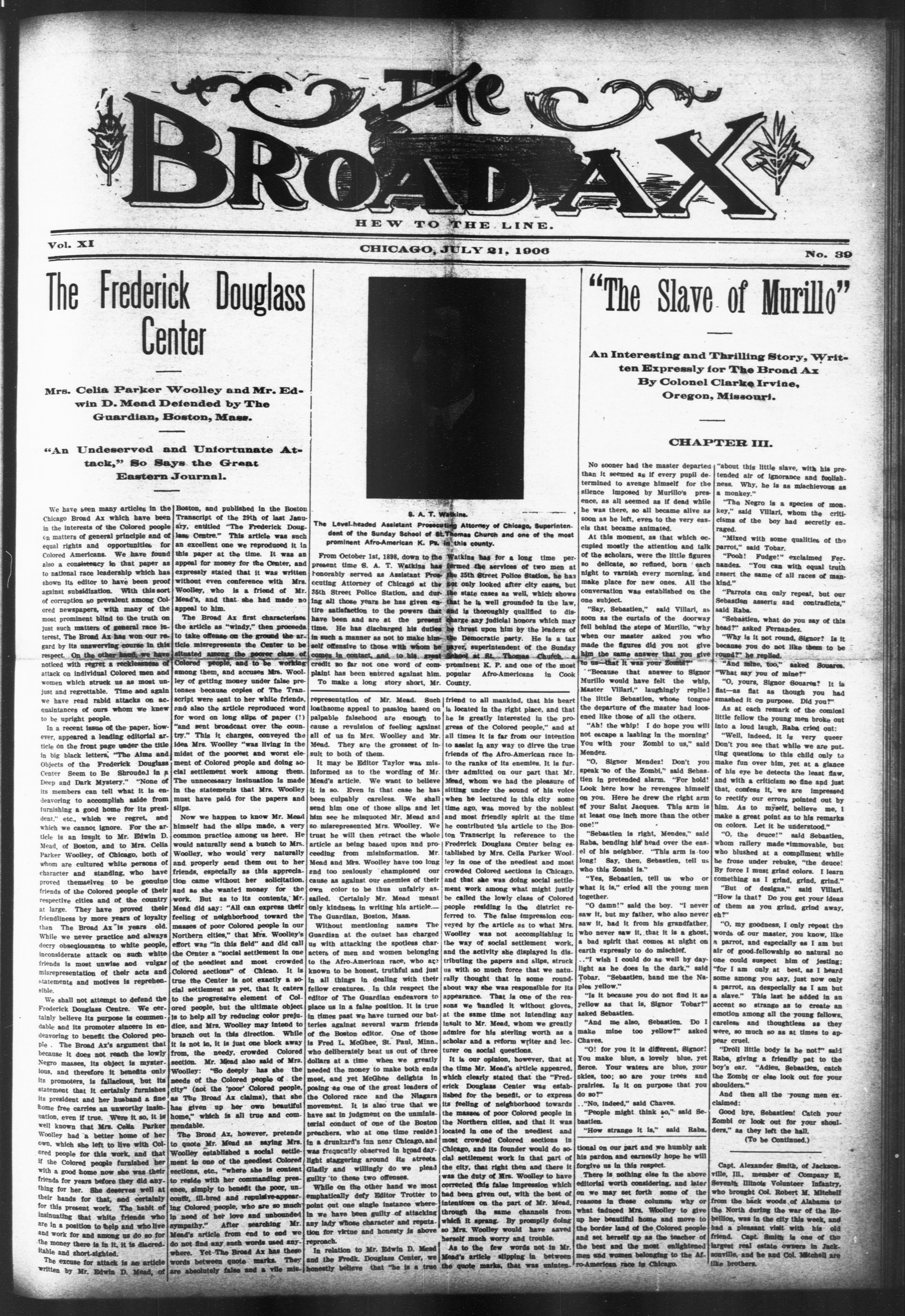
The Frederick Douglass Center
Mrs. Celia Parker Woolley and Mr. Edwin D. Mead Defended by The Guardian, Boston, Mass.
"An Undeserved and Unfortunate Attack," So Says the Great Eastern Journal.
Vol. XI
The Frederick Cen
Mrs. Celia Parker W
win D. Mead D
Guardian, B
"An Undeserved a
tack," So Sa
Eastern
We have seen many articles in the Chicago Broad Ax which have been in the interests of the Colored people on matters of general principle and of equal rights and opportunities for Colored Americans. We have found also a consistency in that paper as to national race leadership which has shown its editor to have been proof against subsidization. With this sort of corruption so prevalent among Colored newspapers, with many of the most prominent blind to the truth on just such matters of general race interest, The Broad Ax has won our regard by its unswerving course in this respect. On the other hand, we have noticed with regret a recklessness of attack on individual Colored men and women which struck us as most unjust and regrettable. Time and again we have read rabid attacks on acquaintances of ours whom we knew to be upright people.
In a recent issue of the paper, however, appeared a leading editorial article on the front page under the title in big black letters, "The Alms and Objects of the Frederick Douglass Center Seem to Be Shroudel in a Deep and Dark Mystery." "None of its members can tell what it is endeavoring to accomplish aside from furnishing a good home for its president," etc., which we regret, and which we cannot ignore. For the article is an insult to Mr. Edwin D. Mead, of Boston, and to Mrs. Cella Parker Woolley, of Chicago, both of whom are cultured white persons of character and standing, who have proved themselves to be genuine friends of the Colored people of their respective cities and of the country at large. They have proved their friendliness by more years of loyalty than The Broad Ax "is years old. While we never practice and always decry obsequiousness to white people, inconsiderate attack on such white friends is most unwise and vulgar misrepresentation of their acts and statements and motives is reprehensible.
We shall not attempt to defend the Frederick Douglass Centre. We certainly believe its purpose is commendable and its promoter sincere in endeavoring to benefit the Colored people. The Broad Ax's argument that because it does not reach the lowly Negro masses, its object is mysterious, and therefore it benefits only its promoters, is fallacious, but its statement that it certainly furnishes its president and her husband a fine home free carries an unworthy insination, even if true. Were it so, it is well known that Mrs. Celia Parker Woolley had a better home of her own, which she left to live with Colored people for this work, and that if the Colored people furnished her with a good home now she was their friends for years before they did anything for her. She deserves well at their hands for that, and certainly for this present work. The habit of insinuating that white friends who are in a position to help and who live and work for and among us do so for the money there is in it, it is discreditable and short-sighted.
The excuse for attack is an article written by Mr. Edwin D. Mead, of
Boston, and published in the Boston Transcript of the 29th of last January, entitled "The Frederick Douglass Centre." This article was such an excellent one we reproduced it in this paper at the time. It was an appeal for money for the Center, and expressly stated that it was written without even conference with Mrs. Woolley, who is a friend of Mr. Mead's, and that she had made no appeal to him.
The Broad Ax first characterizes the article as "windy," then proceeds to take offense on the ground the article misrepresents the Center to be situated among the poorer class of Colored people, and to be working among them, and accuses Mrs. Woolley of getting money under false pretenses because copies of The Transcript were sent to her white friends, and also the article reproduced word for word on long slips of paper (!) "and sent broadcast over the country." This it charges, conveyed the idea Mrs. Woolley "was living in the midst of the poorest and worst element of Colored people and doing social settlement work among them. The unnecessary insinuation is made in the statements that Mrs. Woolley must have paid for the papers and slips.
Now we happen to know Mr. Mead himself had the slips made, a very common practice among us here. He would naturally send a bunch to Mrs. Woolley, who would very naturally and properly send them out to her friends, especially as this appreciation came without her solicitation, and as she wanted money for the work. But as to its contents, Mr. Mead did say: "All can express their feeling of neighborhood toward the masses of poor Colored people in our Northern cities," that Mrs. Woolley's effort was "in this field" and did call the Center a "social settlement In one of the neediest and most crowded Colored sections" of Chicao. It is true the Center is not exactly a social settlement as yet, that it caters to the progressive element of Colored people, but the ultimate object is to help all by reducing color prejudice, and Mrs. Woolley may intend to branch out in this direction. While it is not in, it is just one block away from, the needy, crowded Colored section. Mr. Mead also said of Mrs. Woolley: "So deeply has she the needs of the Colored people of the city" (not the 'poor' Colored people, as The Broad Ax claims), that she has given up her own beautiful home," which is all true and commendable.
The Broad Ax, however, pretends to quote Mr. Mead as saying Mrs. Woolley established a social settlement in one of the neediest Colored sections, etc., "where she is content to reside with her commanding presence, simply to benefit the poor, uncount, ill-bred and repulsive-appearing Colored people, who are so much in need of her love and unbounded sympathy." After searching Mr. Mead's article from end to end we do not find any such words used anywhere. Yet The Broad Ax has these words between quote marks. They are absolutely false and a vile mis-
CHICAGO, JULY 21, 1906
The Level-headed Assistant Prosecuting Attorney of Chicago, Superintendent of the Sunday School of St. Thomas Church and one of the most prominent Afro-American K. Ps. in this county.
From October 1st, 1898, down to the Watkins has for a long time per present time S. A. T. Watkins has formed the services of two men and honorably served as Assistant Prosecutor, the 35th Street Police Station, he has executing Attorney of Chicago at the not only looked after city cases, but 35th Street Police Station, and during the state cases as well, which showing all those years he has given en- that he is well grounded in the law tire satisfaction to the powers that and is thoroughly qualified to dis have been and are at the present charge any judicial honors which may time. He has discharged his duties he thrust upon him by the leaders of in such a manner as not to make him the Democratic party. He is a tax self offensive to those with whom he payer, superintendent of the Sunday comes in contact, and to his great School at St. Thomas Church, a credit so far not one word of prominent K. P. and one of the most plaint has been entered against him. popular Afro-Americans in Cool To make a long story short, Mr. County.
representation of Mr. Mead. Such loathsome appeal to passion based on palpable falsehood are enough to cause a revulsion of feeling against all of us in Mrs. Woolley and Mr. Mead. They are the gossiest of insult to both of them.
friend to all mankind, that his heart is located in the right place, and that he is greatly interested in the progress of the Colored people," and at all times it is far from our intention to assist in any way to drive the true friends of the Afro-American race in
It may be Editor Taylor was mis-informed as to the wording of Mr. Mead's article. We want to believe it is so. Even in that case he has been culpably careless. We shall send him one of those slips and let him see he misquoted Mr. Mead and so misrepresented Mrs. Woolley. We trust he will then retract the whole article as being based upon and proceeding from misinformation. Mr. Mead and Mrs. Woolley have too long end too zealously championed our cause as against our enemies of their own color to be thus unfairly assailed. Certainly Mr. Mead meant only kindness in writing his article. The Guardian, Boston, Mass.
Without mentioning names The Guardian at the outset has charged us with attacking the spotless characters of men and women belonging to the Afro-American race, who are known to be honest, truthful and just in all things in dealing with their fellow creatures. In this respect the editor of The Guardian endeavors to place us in a false position. It is true in times past we have turned our batteries against several warm friends of the Boston editor. One of those is Fred L. McGhee, St. Paul, Minn., who deliberately beat us out of three dollars at a time when we greatly needed the money to make both ends meet, and yet McGhee delights in posing as one of the great leaders of the Colored race and the Niagara movement. It is also true that we have sat in judgment on the unministerial conduct of one of the Boston preachers, who at one time reside in a drunkard's inn near Chicago, and was frequently observed in broad daylight staggering around its streets. Gladly and willingly do we plead guilty to these two offenses.
While on the other hand we most emphatically defy Editor Trotter to point out one single instance wherein we have been guilty of attacking any lady whose character and reputation for virtue and honesty is above reproach.
In relation to Mr. Edwin D. Mead and the Fredk. Douglass Center, we honestly believe that "he is a true
Watkins has for a long time performed the services of two men at the 35th Street Police Station, he has not only looked after city cases, but the state cases as well, which shows that he is well grounded in the law, and is thoroughly qualified to discharge any judicial honors which may be thrust upon him by the leaders of the Democratic party. He is a tax payer, superintendent of the Sunday School at St. Thomas Church, a prominent K. P. and one of the most popular Afro-Americans in Cook County.
friend to all mankind, that his heart is located in the right place, and that he is greatly interested in the progress of the Colored people," and at all times it is far from our intention to assist in any way to drive the true friends of the Afro-American race in to the ranks of its enemies. It is further admitted on our part that Mr. Mead, whom we had the pleasure of sitting under the sound of his voice when he lectured in this city some time ago, was moved by the noblest and most friendly spirit at the time he contributed his article to the Boston Transcript in reference to the Frederick Douglass Center being established by Mrs. Cella Parker Woolley in one of the neediest and most crowded Colored sections in Chicago and that she was doing social settlement work among what might justly be called the lowly class of Colored people residing in the district referred to. The false impression conveyed by the article as to what Mrs. Woolley was not accomplishing in the way of social settlement work, and the activity she displayed in distributing the papers and slips, struck us with so much force that we naturally thought that in some roundabout way she was responsible for its appearance. That is one of the reasons we handled it without gloves, at the same time not intending any insult to Mr. Mead, whom we greatly admire for his sterling worth as a scholar and a reform writer and lecturer on social questions.
It is our opinion, however, that at the time Mr. Mead's article appeared, which clearly stated that the "Fredrick Douglas Center was established for the benefit, or to express its feeling of neighborhood towards the masses of poor Colored people in the Northern cities, and that it was located in one of the neediest and most crowded Colored sections in Chicago, and its founder would do social settlement work in that part of the city, that right then and there it was the duty of Mrs. Woolley to have corrected this false impression which had been given out, with the best of intentions on the part of Mr. Mead, through the same channels from which it sprang. By promptly doing so Mrs. Woolley would have saved herself much worry and trouble.
As to the few words not in Mr. Mead's article slipping in between the quote marks, that was uninten-
"The Slave of Murillo"
An Interesting and Thrilling Story, Written Expressly for The Broad Ax By Colonel Clarke Irvine, Oregon, Missouri.
CHAPTER III
No sooner had the master departed than it seemed as if every pupil determined to avenge himself for the silence imposed by Murillo's presence, as all seemed as if dead while he was there, so all became alive as soon as he left, even to the very easels that became animated.
At this moment, as that which occupied mostly the attention and talk of the scholars, were the little figures so delicate, so refined, born each night to varish every morning, and make place for new ones. All the conversation was established on the one subject.
"Say, Sebastien," said Villari, as soon as the curtain of the doorway fell behind the steps of Murillo, "why when our master asked you who made the figures did you not give him the same answer that you give to us—that it was your Zombi?"
"Because that answer to Signor Murillo would have felt the whip, Master Villari," laughingly replied the little Sebastien, whose tongue the departure of the master had loosened like those of all the others.
"Ah! the whip! I do hope you will not escape a lashing in the morning' You with your Zombi to us," said Mendez.
"O, Signor Mendez! Don't you speak so of the Zombi," said Sebastien in pretended alarm. "For hold! Look here how he revenges himself on you. Here he drew the right arm of your Saint Jacques. This arm is at least one inch more than the other one!"
"Sebastien is right, Mendes," said Raba, bending his head over the easel of his neighbor. "This arm is too long! Say, then, Sebastien, tell us who this Zombi is."
"Yes, Sebastien, tell us who or what it is," cried all the young men together.
"O damn!" said the boy. "I never saw it, but my father, who also never saw it, had it from his grandfather, who never saw it, that it is a ghost, a bad spirit that comes at night on earth expressly to do mischief.
...I wish I could do as well by daylight as he does in the dark," said Tobar. "Sebastien, hand me the Naples yellow."
"Is it because you do not find it as yellow as that is, Signor Tobar?" asked Sebastien.
"And me also, Sebastien. Do I make mine too yellow?" asked Chaves.
"O! for you it is different, Signor! You make blue, a lovely blue, yet fierce. Your waters are blue, your skies, too; so are your trees and prairies. Is it on purpose that you do so?"
tional on our part and we humbly ask his pardon and earnestly hope he will forgive us in this respect. There is nothing else in the above editorial worth considering, and later on we may set forth some of the reasons in these columns why or what induced Mrs. Woolley to give up her beautiful home and move to the border land of the Colored people and set herself up as the teacher of the best and the most enlightened men and women belonging to the Afro-American race in Chicago.
of Murillo"
Thrilling Story, Writ-
for The Broad Ax
Clarke Irvine,
Missouri.
"about this little slave, with his pretended air of ignorance and foolishness. Why, he is as mischievous as a monkey."
"The Negro is a species of monkey," said Villari, whom the criticisms of the boy had secretly enraged.
"Mixed with some qualities of the parrot," said Tobar.
"Pooch! Fudge!" exclaimed Fernandez. "You can with equal truth assert the same of all races of mankind."
"Parrots can only repeat, but our Sebastlen asserts and contradicts," said Raba.
"Sebastlen, what do you say of this head?" asked Fernandez.
"Why is it not round, Signor? Is it because you do not like them to be round?" he replied.
"And mine, too," asked Souares.
"What say you of mine?"
"O, yours, Signor Souares? It is flat—as flat as though you had smashed it on purpose. Did you?"
As at each remark of the comical little fellow the young men broke out into a loud laugh. Raba cried out:
"Well, indeed, it is very queer. Don't you see that while we are putting questions to this child only to make fun over him, yet at a glance of his eye he detects the least flaw, and with a criticism so fine and just that, confess it, we are impressed to rectify our errors pointed out by him. As to myself, believe me, I make a great point as to his remarks on colors. Let it be understood."
"O, the deuce!" said Sebastien, whom railery made *immovable, but who blushed at a compliment while he froze under rebuke, "the deuce! By force I must grind colors. I learn something as I grind, grind, grind."
"But of designs," said Villarl.
"How is that? Do you get your ideas of them as you grind, grind away, eh?"
"O, my goodness, I only repeat the words of our master, you know, like a parrot, and especially as I am but air of good-fellowship so natural no one could suspect him of jesting; "for I am only at best, as I heard some among you say, just now only a parrot, an despecially as I am but a slave." This last he added in an accent so strange as to create an emotion among all the young fellows, careless and thoughtless as they were, so much so as at times to appear cruel.
"Droll little body is he not?" said Raba, giving a friendly pat to the boy's ear. "Adieu, Sebastien, catch the Zombi or else look out for your shoulders."
And then all the young men exclaimed:
Good bye, Sebastien! Catch your Zombi or look out for your shoulders," as they left the hall.
Capt. Alexander Smith, of Jacksonville, Ill., member of Company E, Seventh Illinois Volunteer Infantry, who brought Col. Robert M. Mitchell from the back woods of Alabama to the North during the war of the Rebellion, was in the city this week, and had a pleasant visit with his old friend. Capt. Smith is one of the largest real estate owners in Jacksonville, and he and Col. Mitchell are like brothers.
No. 39
THE BROAD AX
Will promulgate and at all times uphold the true principles of Democracy, but Catholic, Protestant, Pikean, Indian, Native American single, Indian, Indian, Native American also can also have their say, so long as their language is proper and responsibility is fixed.
The Broad Act is a newspaper whose platform is broad enough for all, ever claiming the editorial independence of the newspaper, will receive attention. Local communications, will receive attention. Write only on one side of the paper.
Subscriptions must be paid in advance.
JULIUS F. TAYLOR, Editor and Publisher.
Entered at the Post Office at Chicago
II, as Second class Mail.
L. W. Washington, General Agent for The Broad Ax in the Hyde Park District.
From on and after this date until further notice to the contrary, L. W. Washington, 5613 Jefferson avenue, will act as the general agent for The Broad Ax, and news items and advertisements left with him not later than Wednesday evening or early Thursday morning prior to the day of publication, will find their way into its columns.
THE FUNERAL OF THE LATE DR.
A. F. PERRY WAS LARGELY
ATTENDED.
Many Loud Mouthed and Ill Mannered Women in and Around Quinn Chapel.
Last Sunday afternoon the last sad rites were held over the remains of Dr. A. F. Perry, at Quinn Chapel, and it was one of the largest funerals ever held among the Afro-Americans in this city. The church was so crowded that hundreds and hundreds of people were turned away long before the services began.
Awaiting the arrival of the funeral cortege, many of the ladies connected with Quinn Chapel tackled every man who entered it and they would not let up until they had unloaded one or two tickets, the money from the sale of these tickets was to be set aside for the fund which will be in evidence when Quinn celebrates her 59th anniversary, which will take place in a very short time. Many of the ladies selling tickets were very loud-mouthed and illmannered in their conduct while counting their money, which was evident that they had not the least respect for the memory of Dr. Perry, nor his friends, nor Mrs. Perry, nor for the sad surroundings.
It was a little after one o'clock when the services began which were conducted by Revs. D. P. Roberts, A. J. Carey and Moses M. Jackson, and these divines eloquently spoke of his worth as a citizen, as a good husband and as a kind father, and they freely proclaimed the community in which he resided and the city at large lost one of its best and brightest stars in the death of Dr. Perry.
Mr. Anderson in behalf of the Foresters paid a high and a glowing tribute to the memory of their dead brother. Mr. Sims very fittingly voiced the sentiments of the order of Odd Fellows. William L. Martin was at his very best in representing the Fellowship Club, of which Dr. Perry was an active and honored member. He read the resolutions drafted by Mr. Alfred Anderson, with much feeling and effect, and from beginning to end Mr. Martin conducted himself like an old time Methodist minister. Dr. A. Wilberforce Williams read the resolutions in behalf of the medical profession, and he was so overcome with grief and sorrow over the sudden death of his bosom friend, that he was compelled to pause several times and wipe away the tears before he reached the end, and all told, the secular exercises surpassed the religious services. Dr. Daniel H. Williams, M. M. Roam, R. H. Hardin, R. W. Lacy, Dr. J. A. Kelly, S. A. McElwee, F. A. Denison, and Mr. Boman served as the active pall-bearers.
Major John C. Buckner, Louis B. Anderson, Dr. A. Wilberforce Williams, L. W. Lewis, Edward H. Wright, R. A. J. Shaw, Noah D. Thompson and Julius F. Taylor were honorary pall-bearers.
The floral pieces presented by the Foresters, 7895, the Fellowship Club, the medical profession and by the Odd Fellows, Western Star Lodge, No. 1443, were very beautiful and the other flowers displayed were also very fine.
Frank W. King had charge of the funeral, and conducted everything in connection with it in first-class shape. and Dr. Perry now sleeps beneath the sod in Oakwoods, and the warm sym-
pathy of his thousands of friends goes out to his widow, Mrs. Perry, and his three little daughters over the great loss of the head of their household.
The National Association of Colleges
The National Association of Colored Women concluded their interesting session at Detroit, Mich., last Friday evening, and all of that day was consumed in the election of the following officers: Mrs. Lucy Thurman, Jackson, Mich., President; Miss Elizabeth C. Carter, New Bedford, Miss., Vice-President at large; Miss J. Holmes, Atlanta, Ga., First Recording Secretary; Mrs. M. E. Steward, Louisville, Ky., Second Recording Secretary, Mrs. Ella Clark, Zenia, O. Third Recording Secretary; Mrs. Libbie C. Anthony, Jefferson City, Mo., Treasurer, Mrs. Booker T. Washington, Tuskegee, Ala., Chairman of the Executive Board; Mrs. Ida George Jackson, Colorado Springs, Colo., Chairman of the Ways and Means Committee; Mrs. Addie Hunton, Atlanta, Ga., National Organizer.
Many of the members of the various clubs joined in presenting their former President, Mrs. Josephine Yates with a handsome silver loving cup, as a token of their esteem and friendship for her.
Mrs. L. A. Davis of this city, the ex-National Organizer, was honored by the ladies of Indiana in the presentation of a solid gold heart and chain as an appreciation of her valuable services to the association in the past.
Aside from the bitter fight over the election of officers, and the raising of the color line in order to defeat the election of Mrs. Josephine Bruce as President after Mrs. Thurman had pledged to support her two years ago for this position, with all of the Michigan delegates, providing they would hold the convention in Detroit, much good was accomplished by the association.
The delegates from Chicago got into a hot scrap among themselves and they failed to capture any of the national offices for Illinois.
THE ARGYLES SOCIAL CLUB.
Of Hyde Park deserves much credit for the manner in which it entertained its invited guests at Prof. Buckner's studio, 5309 Lake avenue, Monday, July 16th. The entertainment was unique because of its varied program. On the first floor was dancing, the second a concert, and on the third floor of the building refreshments were served in abundance, making the affair one of pleasure and pomp. All this was given in honor of their host and hostess, Mr. and Mrs. Printis Bryson, who was united in matrimony Thursday, July 12th. The following named persons were the invited guests: Mr. J. P. Hardin, Mr. and Mrs. W. B Stokes, Mr. Arthur Owmsby, Mr. H. H. Haley, Miss Jeanetta Wilson, Mr. John A. Lewis, Miss Etta G. Taley, Mr. Berry, Mr. J. Edward Turner, Miss D. P. Deboe, Rev. Clarence Goggins, Mr. & Mrs. C. S. Thornton, Mrs. H. I. Caleb, Miss Ida McKenny, Mr. and Mrs. M. E. Cobb, Mr. C. Dickson, Miss Littia, E. Cole of Lexington, Ky., Miss Anna B. Shotwell, of Cincinnati, Ohio, and Mrs. Printis Bryson, Mrs. Henry Sherman and daughter, Miss Helen Buckner, Mr. C. Reed, Mr. and Mrs. Julius Leach, Mr. and Mrs. Robert Seolmon, Mr. and Mrs. L. W. Washington, Mr. and Mrs. Jessie Curry, Mrs. Charles Waters, Mr. Robert Cortwell, Mr. W. M. Hopkins, Miss Lizzle Scott, Mr. A. L. Scott, Mrs. E. Whittaker, Mr. and Mrs. Emmet Simpson, Mr. and Mrs. Augustus Hendricks, Mr. E. L. Waters, Mr. H. A. Long, Mr. L. W. Cummings, attorney Miss Hattle Lewis, Mr. E. J. Madison, Mr. J. W. Williams, Mr. H. A. Longton, Mr. J. A. Jefferson, Mr. and Mrs. Bailey, Mr. and Mrs. Cardwell Miss Bertle Waters. Everybody departed for their homes at the hour of 12 m.-L. W. W.
THE SAYINGS AND DOINGS OF
THOSE WHO HAVE NO AMBI-
TION IN HYDE PARK.
Mr. Julius F. Taylor, Editor of The
Broad Ax:
Broad Ax:
Dear Sir:—In Hyde Park, as in other suburban places, there will be found loafers, tramps, vagabonds, beer canners, alley floaters, etc. So it is the likes of these individuals I wish to speak. Now and then you can see men and women with their shawls over their heads and buckets carting home the sting of the viper. In the evenings the streets are disgaced with hangers-on. standing across the sidewalks, ready to insult every woman that brushes by, using profane language, becoming very loud and indiscreet in their
manners and habits. These young men and women pass by the church and missions to visit the saloons. They are uncouth and untidy. These persons make it very hard for the Negro to succeed in any community. It is a very common thing to see our young girls from 9 to 14 years of age running the streets in a bold and defiant manner.
The parents should see to it that this kind of affairs be stopped, taking them off the streets by giving them something to do. They should be taught to wash and iron and cook and sew, which would demand resu for them all night instead of a jollification on the corners at 11 and 12 o'clock in the evening. It is a shame to see so many of our girls and boys so lazy to attend to business becomes a burden for them. There is no excuse for any Negro here to be lazy and to go in want if he is willing to work, for you can always find something to do.
Keep your boys and girls off the streets at night. Teach them the lessons of duty and right living. Take them to church, the Sunday schools and literary. Give them during their vacation a father's and mother's care, a home training. They are yours. None but you will suffer for their mistakes. Let some young woman of Hyde Park organize an industrious class for girls, take them daily to Jackson Park for three hours, and you will be doing God's services. May I suggest to either one of the two pastors of our Hyde Park churches do likewise with the boys, and make them ambitious. Fire their ambition with a desire for knowledge and advancement, and the race will rise in this vicinity in proportion.
ANNIVERSARY SERVICE AT THE
INSTITUTIONAL CHURCH, 3825
DEARBORN ST.
Sunday morning, 10:45, special ser-
mon by pastor, "The Great Need of
the Church." Musical selections will
be appropriate to the occasion.
Sunday evening of same day, July
22d, song service.
1. Organ Voluntary.
2. Doxology.
3. Hymn. "Cornation."
Hath Passed Away. Woodward.
6. Sermonette, Rev. H. E. Stewart,
minister.
7. Solo, "Plains of Peace," Mrs.
Senora Yerby.
8. Announcements.
9. Anthem solo and chorus, "The
Marvelous Work" (Hayden), Mrs.
Riley.
10. Violin Solo, Miss Gertrude I.
Palmer.
11. "Chorus of Returning Pilgrims,"
male voles. Wagner.
12. Reading, "King Robert of Sicily," by Longfellow, Mrs. Fannie Hall
Clint.
13. Solo, "By and By," Ashton, Mr.
P. T. Tinsley.
14. Anthem, "Praise the Lord."
Randegger.
15. Offering.
16. Closing Hmyn, "Nearer My God to Thee."
W. Alphonso Johnston, Organist and Director; H. E. Stewart, Minister.
On this occasion the choir will consist of 30 well trained voices. It will be accompanied by the piano, Mrs. Yarbrough playing. Prof. Johnston at the organ. Orchestra, Prof. James Johnson, first violin; Miss G. I. Palmer, second violin; Mr. Hilton Joseph, cello; Mr. Herbert Calverley, double bass, and Miss Irene Howard cornet.
WHAT MANNER OF PEOPLE ARE THESE.
Rev. Charles Johnson, pastor of the largest Negro Baptist church in the North, situated in Indianapolis, was recently found guilty of bastardy, the complaining witness being a member of his church of very tender years. Imagine our surprise upon reading the following in The Recorder:
Johnson Still Pastor.
"At a call meeting of the members of Second Baptist church, held last Monday night, the pastor, Rev. Charles Johnson, in view of the fact that he was found guilty by the courts on the charge of bastardy, preferred by the "little star of the church," tendered his resignation. By a vote of 210 to 160 the members present refused to accept the resignation. The church is the largest Baptist church in the State, with a membership of 2,500, and the majority refuse to attend any services on account of the present disrace."—Ex
CHIPS
John G. Jones, the big Mason returned from a pleasant trip to Boston, Monday.
Mrs. Sandy W. Trice has gone on a long visit to Detroit, Mich., and points through Canada.
Mrs. E. B. Ennals, 6618 - Vernon avenue, returned from her visit to Detroit, Mich., the first of the week.
Mrs. Mason, Milwaukee, Wis., made a pleasant visit last week with her sister, Mrs. Marshall Drish, 4613 Dearborn st.
W. P. Lundy, who is well and favorably known in the Town of Lake, would make a dandy candidate for County Commissioner.
J. A. Scott is getting ready to put up a red-hot fight in behalf of Col. Edward H. Morris in the Second ward.
Rev. W. S. Braddan visited the Eighth Regiment Illinois National Guards at Camp Lincoln, Springfield, this week.
Miss Willian Hart, of Indianapolis, Ind., is visiting Chicago. While her Miss Hart will stop with Mrs. Rufus Williams, 6508 Langley avenue.
Doctors Mackey and Marshall are candidates to succeed the late Doctor A. F. Perry as Court Physician and Examiner for the Foresters.
Mrs. M. E. Kelley, Atlanta, Ga., is visiting Mr. and Mrs. Walker, Evanson, Ill., and her half sister, Mrs. Nelson Williams, 4830 Armour avenue.
Mrs. Millie Jefferson, 89 Dawson avenue, Avondale, owns and occupies one of the finest homes in that section of the city, and she is a warm supporter and admirer of The Broad Ax.
Mr. Titus Alexander, of Oklahoma, I. T., passed through Chicago the first of the week en route to points South, with a view to selecting a suitable place to enter the undertaking business
Dr. and Mrs. George C. Hall, 5736 Rosalie ct., entertained a small number of their young friends at tea Tuesday evening in honor of their guest of the week, Mrs. Lottie Meredith Cooper, of New York.
Mr. W. R. Sobers entertained a number of friends at dinner Friday evening. Dancing in Mr. Sobers spacious apartments was a later feature of the event, and his guest voted him a prince of entertainers.
Mr. Chas. Pickett, of Washington, D. C., is in town, and will remain here throughout the political campaign which is being inaugurated. Mrs. Pickett and her sister, Miss Smallwood, will arrive here later on.
Mrs. William Hayman, 3236 Wabash avenue, received her prize the first of the week for selling the largest number of tickets for the Choral Study Club. It consisted of a rustic gold shirt waist set and set with small diamonds.
Dr. Robert Hardin celebrated his 38th birthday Saturday evening by entertaining at a box party at the Pekin Theatre and supper Prof. Wm. Emanuel, Mr. Clarence Mayo and Noah D. Thompson.
Mr. and Mrs. Jacob Demby celebrated their 5th marriage anniversary Monday evening, July 16th, at their home, 6450 Cramplain avenue. A good dinner was enjoyed by a few of their many friends.
Mrs. Elizabeth McDonald, 6130 Ada street, is on a visit with relatives and friends in LaFayette, Indianapolis, Bridgeport and Arcadia, Ind. While absent she will deliver lectures on her work in the Juvenile Court.
Justice Theo. C. Mayer, who has made a splendid record as Police Magistrate at the East Chicago Avenue Station, will become one of the new judges of the Municipal Court.
William Carroll has so far proven himself the best city electrician Chicago ever had, for Mr. Carroll has got all branches of the electrical department thoroughly systematized which reflects credit on his executive ability.
The Sisters of the Household of Ruth, No. 44, G. U. O. O. F., initiated into their order last Tuesday evening Hon Oscar DePriest, County Commissioner, and Mr. Noah D. Thompson. Such great preparations were made for their reception into this household that some of the members of the other households are calling No. 44 the "society household" of the order
The Appomattox Club will give its sixth anniversary outing Monday, July 23d, at Fox River Grove, on the Northwestern Road. Train leaves 9:30 a. m. sharp from depot, Wells and Kinzle streets. If it is a nice day a large crowd will be present, and something is liable to come off.
Ex-Governor Richard Yates has began his senatorial campaign in Chicago and Cook County, and being one of the best orators in the State, his friends predict that he will make it mighty warm for Senators Cullom and Hopkins, William Lorimer and the other members of the Federal gang.
George Wilson, aged 21 years, a clerk in the city division of the Chicago postoffice, died suddenly Wednesday, July 18th, at the home of his parents, corner State and 15th streets. It is said that for a long while young Wilson was being treated by a doctor for consumption, but it later developed that his aliment was not of the lungs, but of the heart.
A. Good Home for Children.
Wanted children, either White or Colored to board and room, they will receive the care of a good mother; charges reasonable. Mrs. L. Coleman, 289 Armour Ave., 2d flat.
Special Announcement
From on and after this date all announcements of entertainments, etc., for which an admission is charged, will be considered advertising, and will be charged for at the rate of 12 cents a line, seven words to a line. The money must accompany the matter and reach the editor no later than Thursday morning of the week intended for publication. This rule will also apply to all personal items and matter for which no charges will be made. In other words, all news matter must reach us either on Wednesday evening or early Thursday morning in order to find its way into the columns of this paper the same week it is written. Write plainly on one side of the paper only, and address all communications to The Broad Ax, 5040 Armour avenue.
THE STAY AT HOME.
Let others go
For pomp and show
Where ocean beats or mountain towers.
I'm glad I've got
A homelike spot
To rest in after working hours.
My wife and I.
Contented, sigh
For nothing that the haunts of pleasure
By sea or lake
Could add to make
Our joy in life of greater measure.
Good food to eat
(Despite the heat,
I love my meals, and so does Kitty)
And not a care
What clothes to wear!
We're quite contented in the city.
Although to stick
Where walls of brick
Encompass one in all directions
Is hard, we've got!
A cinch. That's what!
We're sponging on my wife's connections!
T. A. Daly in Catholic Standard and Times.
He Never Tumbled.
"Whew! This is a tough bit-oak,
A Shattered Romance.
"Yes, we were at the play this afternoon. All the girls think Lester Scraggs is just too lovely for anything. What was the play about? I don't know. We were too much absorbed in watching Lester to pay any attention to the play. He looked just too killing in a yellow wlg, with a blue plush cloak hanging over his arm. And he had the sweetest jeweled sword! "After the play we all went around to the stage door and waited for him to come out. And, say, he isn't the least bit handsome when you see him close. His face is awfully slabby, and his hair is short and thin and kind of sandy. There was a fat woman in a freak hat came up just as he started away and took hold of his arm, and they walked along together. I wonder who that woman is? I said to Jane Snooply. A coarse looking man near the door heard me. "That's his wife," he said. "Then we all went home."—Cleveland Plain Dealer.
Bound to Be Comfortable.
A Philadelphia man went to Maine on his vacation, and he found the nights very cold and bedclothes scarce.
"Are these all the bedclothes you give?" he inquired of the chambermalrd.
"This is all that goes with one room," she replied.
"Then give me a couple of rooms," she told—Philadelphia Press.
BREVITIES
THE HALL OF FAME
Emerson G. Taylor, an instructor at Yale, has resigned to devote himself to literary work.
Edward Blackwell of St. Andrew's Golf club of Great Britain is said to have driven a ball 366 yards some years ago.
Earl Cromer is one of the most thorough students of the Bible whom the English public have among their prominent men.
Professor James P. Whyte has resigned as a professor at Lake Forest university to enter the packing business of Swift & Co.
The Empress Eugenie at one time owned a wardrobe valued at $1,000,000. Today she spends as little as possible on herself and dresses invariably in black.
Fritz von Ostini, editor of Jugend, is one of the most popular writers in Germany. He is one of the group of young writers known as the "Munich school."
Secretary Shaw is quite the best story teller of any member of the cabinet, and following all of his numerous trips his official friends are sure of many hearty laughs.
Lord Roberts is said to be rather superstitious, and he strongly believes in "lucky days." "Bobs" lucky day, on which he has experienced most of his good fortune, is Tuesday.
Pennsylvania's junior United States senator, P. C. Knox, burns the midnight oil the year around, except for one month—March—when he goes fishing to Miami, Fla., with his friend, Henry C. Frick of Pittsburg.
One of the quaint characters of Central Village, Conn., is Thomas Ford, one of the few Indians left in that part of the state, now in his eightieth year. He is one of the most peaceful residents of the county. He belongs to the Mobilican tribe.
Bedros Kazanjan, a rich Armenian merchant of New York, has authorized the American board of foreign missions to send an able educator to the Euphrates college, Karput, Turkey, for five years, and he will provide the salary and traveling expenses.
Professor H. P. Williamson of the University of Chicago, who will shortly marry a Frenchwoman, Mile. Azelline de Vlisme, will assume her family name and will be known hereafter to the students as M. de Vlisme. For generations the De Vlisme family has been one of the proudest in France.
SHORT STORIES.
An effort is being made to have the likeness of John Paul Jones, the naval hero, appear upon one of the next series of postage stamps.
A Sheffield (England) manufacturer of razors declares that more razors are bought in America for each man than any country in the world.
The Massachusetts Society of the Sons of the Revolution has presented to Governor Guild a replica of the flag of Bunker Hill, hoisted by the colonists June 17, 1775.
California, Oregon and Washington produce 200,000,000 pounds of prunes annually, more than all the rest of the world. The French product is about 80,000,000 pounds.
Among some old coins in the collection of Fred Fifield of Manchester, N. H., is a three cent piece used by George Washington in paying toll at a bridge just outside Valley Forge.
It is asserted by a statistician that the majority of persons who attain old age keep late hours. Eight out of ten who reach the age of eighty never go to bed until after 12 o'clock at night.
EDITORIAL FLINGS.
Mr. Rockefeller says that he has to look at a balance sheet to find out how rich he is. That is somewhat different from counting the change in one's pocket—New York World.
According to English physicians, "slence will cure nervous women and delay the coming wrinkles." So will suicide. Why not suggest something practical?—Kansas City Journal.
Just as if poor Boston isn't having trouble with two tail end baseball teams, it now turns out that her packing houses are no better than those at Chicago.—Washington Post.
The torch of the statue of Liberty in New York harbor burns so dimly that it can scarcely be seen from passing vessels. This probably typifies liberty extinguished by graft in the lightning contract.—Atlanta Constitution.
Eighteen of this year's Harvard senators, according to the list of their probable occupations, are going into journalism. This will relieve the anxiety of any who have been worrying about the permanence of the institution.—Boston Herald.
PITH AND POINT
To be rich means to own a lot of dangerous toys.
Few men are big enough to keep their mouths shut.
Are you light on the trigger when it comes to speaking ill of people?
A man is always willing to admit that a woman can milk better than he can in order to fatter her into taking the work off his hands.
There isn't any distinction that can come to a man later in life as great as that he enjoyed as a boy because he was once almost drowned.
Giving parties is like washing dishes. By the time a woman thinks she has every one paid up she is invited again and has it all to do over again.
Atchison Globe
HUMOR
HE DIDN'T BUY.
Experience of a Man In Search of a Present For His Girl.
"A fellow never realizes what a woman's articles of wear cost until he is engaged to be married," observed a young business man. "This fact was impressed on me with particular emphasis. I happened to meet on lower Broadway a college chum, now in business and in moderate circumstances, who has just become engaged to a nice girl also without an independent fortune.
"Come in here with me, Jack," he said, stopping in front of a well known shop. "Tomorrow is Minnie's birthday, and I want to get her a remembrance." "What is it going to be? I asked as we made our way in. "Well, he replied, 'I've sent her so much candy and flowers and stuff of that sort that I think I'll vary it with something useful this time. I've been thinking of some nice handkerchiefs.' "I agreed that handkerchiefs were always a satisfactory possession, and we wended our way to the proper counter. "I want to look at women's handkerchiefs—something rather nice, suitable for a gift,' said Jim, my companion. "The saleswoman produced a box of filmy affairs about the size of the palm of your hand, with a narrow border of lace and some kind of fancy business in each corner.
"Those are neat and simple looking,' said Jim approvingly. 'How much are they?' "When the answer came, 'Twelve dollars,' Jim thought, and so did I, that the price named was for the entire box. "Very well, I'll take a dozen,' he answered, with a care free tone which made the saleswoman look at us a little curiously. "Excuse me, but how many did you say? she asked. "One dozen. There are a dozen in the box, are there not?' "Yes, sir,' returned the young woman, with an impressed air. 'One hundred and forty-four dollars, please,' she said, making out the slip. "It was our turn to stare. "I-I don't understand you,' said Jim, gasping. I thought you were quoting the price by the dozen.'
"You'll hardly get linen and real valenciennes with those hand worked corners for a dollar aplece," sniffed the saleswoman superciliously.
"I don't know hand work from fish net myself," retorted Jim crossly. "But I do know I'm not going to pay $12 for a lot of rag three inches square. Come away, Jack; I'll get some kind of a bangle at the jeweler's."
"When we had escaped from the withering glance of the damsel behind the counter Jim mopped the perspiration from his brow.
"And then they say modern young men are too selfish to marry," he groaned."-New York Press.
Opinions.
Tess—I've a perfect right to firt if I want to.
Jess—I know, but there are some people who don't approve of that sort of thing.
Tess—Yes, and there are some other people who don't approve of the people who don't approve of that sort of thing. -Philadelphia Press.
The Silent Message
"What kind of a time is Jack having on his trip across the Atlantic?"
"Awful."
"How do you know?"
"He promised to send me a wireless every six hours unless he was too sick to hold his head up, and I haven't heard from him since he left New York harbor."-Detroit Free Press.
Best He Could Do
Eva-I saw Charlie Cogger yesterday.
Edna-You don't say. And did he tip
his hat?
Eva-No, he wagged his foot.
Eva-No, he wagged his root.
Edna-Wagged his foot? Why, that
is a strange way to greet a lady.
Ewell-Well, you see the poor fellow
was under his automobile mending a
break-Chicago News.
Eyeding the Question
"Have you ever put aside anything for a rainy day?"
"Mister," answered the native, "we don't have to worry about rain in this part of the country. What we're afraid of is droughts."—Washington Star.
Distinguished Customer.
Village Barber (to summer visitor)—
Last year we had a cabinet minister
staying here, and I shaved him several
times. Look here, and you will see
the marks of his blood on this chair.
Meggendorfer Blatter.
Just Like a Woman
The Man—I am surprised to see you reading a historical novel. Don't you find it rather dull?
The Maid—Oh, no. You see, there is so much in it one can skip.—Columbus Dispatch.
FACTS IN FEW LINES
A Russian woman may not enter a university unless she is married.
The ratio of married couples living to celebrate to the golden anniversary is 1 to 11,000.
Paris soon will have hansom cabs the fronts of which will be opened or shut by the "fare" pressing the button.
The hypodermic injection of sea water in twenty-four tuberculosis patients at a Paris hospital is said to have been followed by remarkably favorable results.
The first order received from San Francisco after the earthquake by a New York publisher was for "Successful Houses" and "One Hundred Best Houses."
A Kansas man claims to have made the discovery that water below a dam is much softer than that above it. He says that falling over the dam breaks the water.
A beautiful green shade of gold which is often used in making fine jewelry is the result of an alloy consisting of five parts of silver and nineteen parts of pure gold.
An Italian has invented a machine for printing railroad tickets as they are needed. The apparatus can print and register 400 different kinds of tickets, with station, date and fare.
Several old Liverpool tram cars have just been purchased by a hospital for consumptives. It is proposed to place the cars in the grounds of the institution and use them as bedrooms for the consumptive patients.
An English newspaper published recently an advertisement reading thus: "Widower, living retired, without incumbrance, would like to correspond with lady about forty, with small means, with one leg preferred, with a view to early marriage."
When Edouard de Reszke comes to this country next fall to sing he will begin again to make his fortune, it is said. Most of the money that he made here has been lost, so the basso finds himself, near the end of his career, compelled to start over again.
A farmer in McPherson county, Kan., makes his automobile do double duty. He uses it in the daytime to run errands and to oversee things on the farm. At night he jacks it up off the ground, connects it with a small dynamo and supplies his home with electric lights.
Every department of labor is united in Holland with all other departments. So the other night the spectacle was seen at the Amsterdam Opera House of a crowd of bootmakers and cobblers wrecking the performance of an opera for which nonunion choristers had been enlisted.
A heroic equestrian statue of George Washington, to be erected at the Brooklyn terminal of the new Williamsburg bridge, has been cast in bronze. It was modeled by Henry Merwin Shrady, and Washington is represented in Continental uniform and as he appeared at Valley Forge.
A man who was arrested for breaking into a house in Berlin explained that he only wished a pair of shoes belonging to a celebrated Russian woman pianist who was staying in the house. A collection of women's shoes, all decketed and catalogued, was found in his room.
A negro went into a Brooklyn drug store the other day to get a glass of ice cream soda. The proprietor said that he would ask $1 for the soda. The negro said that was all right if the druggist would give him a receipt. Then the druggist saw his danger and came down.
The priests of the various parishes in Spain had a busy time on Alfonso's wedding day. There was a rush of betrothed couples of the poorer classes to be married on the same day as the king. In one parish alone forty couples were united. This is typical of the other parishes.
The crown prince of Sweden when he was first married took his young bride into the headquarters of his regiment and said, "Gentlemen, the colonel in command of the regiment desires to introduce his wife to the regiment." She was received with applause, and the name has stuck.
The evidence before the British army stores commissioners as to graft during the Boer war shows that there was only one regiment the contractors were unable to cheat. That proud distinction belongs to the Seventh hussars. They weighed everything and checked the quality of everything supplied them.
Denmark's kings for 384 years have all been named Christian or Frederick. It is the law of Denmark that Christian must be succeeded by Frederick and Frederick by Christian. To attain this every Danish prince, no matter what other names he may receive, always has Christian and Frederick among them.
Ole Janson, for whom the town of Osburg, Kan., was named, has asked the district court of Pottawatomie county to change his name to Ole Johnson. His name when he came to America was Johnson, but when he took out his naturalization papers the clerk understood him to say Janson, and Janson has been his legal name, if not his actual name, ever since he became a citizen.
To supply fresh flowers for the spirit of his mother, whom he declares visits his garden nightly, Horace Melvin of Waterville, Mass., has planted 2,200 feet of fragrant sweet peas. He has not planted the new varieties because the flowers his mother liked best before her death five years ago were the common pink and white ones. Mr. Melvin says his mother visits the garden every fair night, sometimes alone and sometimes with other spirits. He has several times caught glimpse of white robed figures in his garden.
NEW SHORT STORIES
A Bishop on the Plains.
Reaching Clayton about 1 o'clock, I was met cordially by my host, who bade me alight and partake of his hospitality. I was somewhat late for dinner, but the dining room was still open, and I soon found myself seated at the table. Scarcely had I begun my dinner when a man in the far corner of the room halted me in a loud voice: "Hello, bishop," said he. "Is that you?"
"Yes," I replied.
"Bishop, come over this way and eat with a feller," beckoning to me. By this time I had easily discovered that my friend was far from sober. I declined the invitation to join him by reminding him that I had already been served and that it would be inconvenient to have my dishes carried over
J
"BIBHOP, ARE YOU GOING TO TALK TO THE
BOTS HERE TONIGHT?"
"BISHOP, ARE YOU GOING TO TALK TO THE BOYS HERE TONIGHT?" to his table. I added that I would see him after dinner. That suggestion did not at all satisfy him. He said: "Bishop, are you going to talk to the boys here tonight?" I told him that was my object in coming to the camp. "Well," he added, "I am glad, for God knows these fellers here need it. You see, bishop, the trouble with the boys here is that they drink too much." He was obviously the last person to complain of his brethren. So I ventured to say, "Well, my friend, I am very sorry to hear that, but, if you will pardon me, it seems to me that you are suffering from that same trouble yourself just now."
He saw my point, but was ready for my sally and quickly rejoined, "You are right, blishop, but, don't you see, when the blishop comes a feller just has to celebrate."—Right Rev. E. Talbot in Harper's Magazine.
Both In the Same Boat.
At a recent dinner which was attended by a number of clergymen President Buckham of the University of Vermont told the following of Bishop Hall of the Episcopal diocese of Vermont, in response to some good natured chaff about the liberal views of the Congregational church and the ease with which almost anybody could join it.
He said he had heard of a negro who had many times applied for membership in St. Paul's church at Burlington, but had not been able to satisfy the bishop that his state of mind entitled him to admission. The negro had been advised to pray that his spiritual condition might improve.
After doing so he made a new application. The bishop said to him:
"Well, Erastus, have you prayed as I told you to?"
"Yas, indeedy, suh; I done prayed an'
I done tole de Lawd I wants to jine
St. Paul's church, an' de Lawd he say
to me:
"Good luck, Rastus; I been tryin'
to jine dat church fo' twenty years.'"
—Pittsburg Post.
Too Apprehensive.
Some Oklahoma people were low in their minds about an outrage or two perpetrated on that territory by the statehood bill. One of them was making quite a fuss about it, claiming things would be all wrong when the territory became a state.
"Reminds me," said Racouteur Oulahan, "of a thing that happened in my school days. We used to have a lecture every Friday afternoon, and one day the lecturer was a geological sharp and chose Niagara falls for his topic. He told us all about the geological formation of the falls, described the different periods that could be traced in the gorge and then went on to say that the falls were slowly wearing back toward Buffalo and that in the course of some 200,000 years they would have worn back to Erie, Pa., and that town would be left high and dry.
"Just then one of the girls in the class began to sob wildly."
"What's the matter?' asked the teacher in alarm.
"Oh,' she wailed, 'I've got a sister living in Erie!'—Kansas City Star.
A. Poser.
Professor Palmer of Harvard says that the masculine habit of rigid, logical reasoning is contracted very early in life, and in illustration he tells the following story, repeated in the New York Observer:
"A little boy and girl of my acquaintance were tucked up snug in bed when their mother heard them talking.
"I wonder what we are here for?" asked the little boy. The girl remembered the lesson that had been taught her and replied sweetly:
CHOICE MISCELLANY
Telephone and Language.
To obtain the best results from the telephone a well modulated voice and a crisp, distinct enunciation are necessary. The soft drawl and the dropping of the R's which characterize the south would make any such change first perceptible there. The telephone should have a tendency also to cause the western drawl to disappear.
Talking over the wire naturally is accompanied by the feeling that it must be brief and businesslike. This not only on account of the tols charged if the distance is considerable, but because the person who "calls up" is bound to remember that the one to whom he is speaking may be busy.
Long distance telephoning, which is daily coming into greater use, must also have a certain effect in bringing the breaking of the language nearer to a common level. This also has been noticed in the south, where the recent business and industrial awakening has suddenly increased the necessity for communication with other sections of the country.
Any change in the talking of English made by the telephone is sure to be for the better. It will mean tens neither too high nor too low and terse, clear sentences, distinctly articulated.—Cleveland Leader.
Dewey and the Cables.
Admiral Dewey grew reminiscent as the 1st of May rolled around this year. He narrated to a number of friends the manner in which he learned that there were two cables instead of one, as he supposed, in Manila bay.
"I had found and cut one cable," said the admiral, "and thought that ended the whole business, as far as communication went, when a captain of a small boat to whom I had given permission to carry out some refugees from Manila came on board to thank me for the privilege accorded him. He had made several hundred dollars out of the deal I learned incidentally. While on board he casually remarked: "Tengo entendido que usted ha cortado un cable telegrafo, almirante?" (I understand you have cut a cable, admiral?)
"I informed him that I had, and when he innocently asked, 'Which one?' I began to get busy, and it was not a half hour until I had the other wire located and cut."—Harper's Weekly.
A Famous Old Company.
Hudson Bay company's stock of a nominal value of £10 is selling at £80 per share in London and paying a dividend of 80 shillings. This venerable corporation is now in its two hundred and thirty-seventh year. The company still deals in furs and does a large general trade, but its great profits are derived from its land sales. Thirty-six years ago it gave up its territorial rights to the Canadian government in consideration of $1,500,000 in cash and the right to claim one-twentieth of the land in any township or district surveyed for settlement in fifty years after 1870.
It is now estimated that the land to which it will be entitled will amount to about 7,000,000 acres. It has already received more than 4,000,000 acres and has disposed of about 1,600,000 acres. Its trading profit last year approximated $950,000, while it netted $1,110,000 from its land department. Its total net profits aggregated $2,060,000.-Boston Transcript.
Clasp Knives Cause Ocean Disasters. Off the coast of a fishing station in England there have been numerous wrecks for some time past owing to the inexplicable errors of the compass. This led the underwriters to make an investigation, with the result that they discovered deflections of the compass were due to a special type of large clasp knife that is popular with the local fishermen there for use in their work. The method of tempering the knife in the course of manufacture confers upon it magnetic properties that are so powerful that when it is in a wheelman's pocket it deflects the needle two or three points and as the man moves the needle gyrates in the oldest manner. The knives are now recognized as dangerous, and the skippers are forbidding everybody to enter the bridge house with one of them.
Buddhist Panheon Found.
According to a report in the Berliner Tageblatt, the Prussian expedition to Chinese Turkestan has unearthed a Buddhist Pantheon. Remains were found of persons belonging to a red haired, blue eyed race, evidently the founders of the temple in the Mingol caves, and bearing garments of unmistakably Iranian origin. A number of great iron swords were also discovered. Search revealed the existence of further numerous Buddhist frescoes containing many figures.
Absinth Bombons.
Recently the cantonal government of Vaud, Switzerland, passed a law prohibiting the sale of absinth. As the people of Vaud were the best customers of the Neuchatel distilleries these were badly hit by the law and set about outmaneuvering it. The result is "absinth bonbons," which are now being placed on the market. Four of them will make a drink when broken into a glass, and a special law will be required to prevent their sale.
Autolate' Problem.
"What would you do if the power gave out while you were climbing a hill and the brake broke?" was one of the questions recently asked of applicants for licenses to run motor cars. Strange to say, this simple proposition stumped many of the men. The answer, of course, is that the only thing to be done is to steer the machine as it runs back down the hill to the side of the road.
President and Treasurer, THOMAS CAREY.
Vice-President, JOHN SHELHAMER,
Secretary, WILLIAM SULLIVAN.
Yards running winter and summer, equipped with the latest improved Wolf Dryer.
AGENTS AND CORRESPONDENTS WANTED.
The Broad Ax desires to engage Agents and regular Correspondents in all the leading cities and towns throughout the country. The highest commissions paid to live hustlers. Sample copies furnished free. For further information, address Julius P. Taylor, 5644 Armour avenue, Chicago.
THE BROAD AX.
The Afro-American News Office,
3104 State Street.
O. S. Smith News stand, and Barber
Shop 3700 Dearborn st.
A. F. Tervalon, 134 W. 51st street
Cigar Store and News Stand.
Mrs. Nellie Phelpe, Cigars, Notions
and News Stand, 131 W. 51st street.
Richard Pinn, 4836 State street.
T. B. Hall's Cigar Store and
Laundry office, 281 29th St.
W. S. Cole, 354 Thirty-first street,
cigars, tobacco and news stand.
W. S. Williams, Tonsorial Parlor,
399 21st st.
J. R. Peters Cigars, Tobacco and
News Stand, 338 E. 27th street.
Mrs. A. E. Baker, Notions and News
Stand, 419, 36th street.
Mrs. Kathyine Hamlet, 5028 Armour Ave., cigars, tobacco, fancy groceries and news stand. W. P. Johnson, Notion Store and News Stand 3704 State st.
Turner Williams' Shaving Parlor and News Stand, 2903 Armour ave.
Thompson Bros., Cigars, Tobacco and News Stand, 2636½ State street.
R. Davis, cigars, tobacco, and confectionery, 8833 State st.
Whitley Bros. 2724 State St., Gent's furnishings and new stand.
The Stationery, 2970 State street.
Cigars, Tobacco and News stand.
The Afro-American News Co., 439 W. 35th St., New York City, N. Y.
The Informer News Co., 188 Randolph St., Detroit, Mich.
News items and advertisements left at these places will find their way into the columns of The Broad Ax.
ICE CREAM CIGARS, TOBACCO SHIRT WAISTS KIMONAS
MRS. A. E. BAKER
NOTIONS
419-36TH STREET
Underwear a
Specialty CHICAGO
PHONES {Office, Main 1157
Ree. Brown 42
STEPHEN A. DOUGLAS
LAWYER
Room 813, 115 Dearborn Street.
CHICAGO
WORLD PATENTS
10
15
WORLD PATENTS
50
YEAR
WORLD PATENTS
They are now McCall Postman said to be the United States president of the day, since last 60 years. This is an important fact that, according to a press report, McCall is now the 1st president of the United States.
McCall's Marathon (The Group of Postman) has been promoting that any other Leverage Magazine, One of its subsciptions (at number 60) each year, is a member. Every volunteer goes to McCall for 15 days.
Lady Annela Wadford, Headman of the Journal and American Journal of the Journal of the Journal and Freedom Magazine (including one postman and free, address THE McCALL CO., Inc., York,
- American
President and Treasurer, T.V.
Established 1877. Phone Oakland 1330-1828
John J. Dunn
COAL &
WOOD
Wholesale and Retail Dealer In...
Fifty-First St. and Armour Ave.
RAIL VARDS: 21st St. & L. S. & M. S. Bg.
32nd St. and Armour Ave.
CHICAGO
Tile and State Hauling a Specialty.
COAL
J. H. COLEMAN & CO.
Express & Van Moving
TRUNKS EVERYWHERE.
2540 State Street
Tel. 699 South
CHICAGO
Phone Oakland 1828
F. A. Rawlin's
The Modern Embal or
UNDERTAKER AND
FUNERAL DIRECTOR
When his work is finished
you have no displeasure.
4834 State St., CHICAGO
Phone Douglas 1550
J. GARNER Tel. Douglas 3256
THE ELITE BUFFET
FINE WINES, LIQUORS
AND CIGARS
3030 State Street CHICAGO
R. Woodfolk S. C. Tyler
SAMPLE ROOM
WOODFOL & TYLER
PHONE 964 OAKLAND
4920 STATE ST. CHICAGO
Pool and
Billiards
Cigars and
Tobaccos
WILLIAM LEWIS
THE FRONTENAC
CLUB
UP STAIRS
TEL. CALUMET 2940
289 E. 22ND ST.
CHICAGO
CHEF
WAITERS AND COOKS
Prefer Our Make
JACKETS AND LINEN
because they have found by
experience that they are the
most satisfactory and econom-
ical goods on the market.
Our Complete Catalogue—a
a correct guide to proper
dress in the Dining Room,
Kitchen, or Bar will be sent
free on application.
items how to order.
Marcus Rubin (Inc.), 390 State St., Chicago
Brick Co. -
THOMAS CARBY.
JOHN SHELHAMER,
by, WILLIAM SULLIVAN.
URERS OF
Sewer Brick
FEASTING IN TIBET.
Description of a Banquet In the Lama's Palace.
A correspondent of the London Times who accompanied the grand lama of Tibet on his recent return to that country after an absence of some months thus describes the feasting in the lama's palace in honor of the occasion:
"Proceedings began with what had all the appearance of a blessing, except that each person brought a present, which the lama touched and an attendant took possession of. The presents consisted of silver shoes worth about $50, vessels of various precious metals, rolls of silk, cloth and similar articles. When all the gifts had been handed over the inevitable tea was brought in. The lama had a golden pot, studded with turquoses, all to himself. Attendants passed among the seated lamas and filled the wooden cups which the latter produced from the bosoms of their capacious robes. For us four there were a special teapot and Chinese bowls. But as for drinking, we knew better. We took a blow at the surface to slide the rancid butter off the top, made a sucking noise with our mouths and then handed back the cups, sufficiently nauseated, without drinking, by the smell of the tea alone. Next came the distribution of the fruit and sweetmeats, of which we received an ample share.
"Then the great doors of the hall were thrown open and there poured in a horde of struggling humanity that rushed at great stacks of Tibetan bread—a crisp, brown substance, fried in butter and very palatable in a cold climate. The bread was on tables in broad plies six feet high. With desperate fury the poor of the city fell on this provision of the gods and crammed the brittle stacks into sacks and bosoms, punching their receptacles when full to make room for more. They fought like cannibals for the bread and stole from each other when they could. And all the while the lictors of the road were among them, lashing with their whips, prodding with the heavy butts and striking with their fists. One man had two sacks, and, though beaten unmercifully, he continued until both were full and then retired under a rain of blows.
"Next came a religious controversy between two monks. These hitched up their clothes, slapped their hands together, stamped their feet, looking for a verbal opening just as a pugilist looks for a chance to get in with his left. One represented Satan and the other some sacred personage, the discussion dealing with the birth of Buddha. Satan said Buddha was born with red trousers, after which sally he went into loud roars of laughter, which drowned the indignant reply of his opponent. The saint then declared that Satan had a tail, whereat every monk in the room laughed delightedly. And so the two kept at it for about half an hour. When Satan looked a winner all over the controversy was declared closed and the saint the victor—another injustice to the devil."
How Dies Escaped.
Portfollio Díaz, seven times president of Mexico, has had some wonderful adventures. Most amazing of all was his escape from his opponents' clutches on the steamship City of Havana. A splash as of a man overboard was heard by the ship's watch at night, and Díaz was at once sought for and missed, while a ship's life buoy was missing also. As it was found a little later thrown up on shore, there was little doubt that Díaz had made good his escape. Nevertheless the stéamer on its arrival at Vera Cruz was rigorously, minutely searched—in vain. Still the commandant of the port surrounded the vessel while in harbor with boats manned by soldiers to preclude all possibility of his escape. But he escaped nevertheless. After having been for seven days and nights sewn up, half suffocated, in a sofa seat in the pursurer's cabin, where he had again and been sat upon by the officers who were searching for him, he contrived, in the disguise of a sailor, to pass undetected through the cordon of blockading boats.
Lava Plant Cured Cough.
"Professor Rigga, I see, advises people to chew lava as a panacea for all ills," remarked a Providence woman who travels widely. "I cannot vouch for the theory that lava would be a panacea for all ills, but I can vouch that it possesses a plant or shrub which grows very near or in the lava that has a curative property in it for a cough. A few years since, while returning from Vesuvius to our hotel in Naples, I was annoyed and afflicted with a constant cough which nothing seemed to relieve. The coachman, a native, in our employ, seeing the dilemma, stopped his carriage and, picking a few stems from the shrub, gave it to me as a sure remedy for my cough. It certainly did prove a panacea and worked like magic. Perhaps this same plant, grown by the lava, may possess some of the constitutents that Professor Riggs claims for the lava. The hated lava may yet become a friend of the physician and a benefit to the human race."—Providence Journal.
The Demand For Aluminium
The Demand for Aluminium. There is a great scarcity of aluminium in the world today. The reason given is that the automobile manufacturers use this metal in the machinery of the cars, thus increasing the amount used far more than any other single industry. The supply of aluminium comes from only four sources in the world; hence the amount is limited to a very great extent. The chief of these sources is represented by the Pittsburg Reduction company at Niagara Falls. In Great Britain there is the British Aluminium company, whose plant is at the Falls of Foyers, and on the continent of Europe there are the Neuthaus works in Switzerland and works in Germany.
PLAYS AND PLAYERS.
Julia Neilson, the English actress, is to be starred in this country next season.
"His Honor the Mayor" is a hit at the New York theater, where it may remain all summer if the weather man turns out to be favorably disposed.
There is a possibility that Sarah Bernhardt may appear in "Tess of the d'Urbervilles," in which Mrs. Fiske won one of her most notable triumphs.
George A. Stone and Frederick James Nice have been engaged for the parts of the Scarecrow and the Tin Woodman in "The Wizard of Oz" for next season.
Joe Weber has engaged to appear next season at his New York music hall Lillian Blauvelt, the concert and operatic singer, whose name is known to music lovers all over the world.
Cyril, Maude and Winifred Emery, the English players recently engaged for an American tour next season, will bring a new play that is to be written especially for them by a leading London dramatist.
Lena Ashwell, one of the most popular of the younger English actresses, has been engaged by the Shuberts to bring her entire company to America next season for a tour of the independent theaters in "The Shulamite."
MODES OF THE MOMENT.
Mercerized cotton volles come in black and white checks and look like silk.
Sporting blouses of white flannel, polka dotted in color, have turndown collar and cuffs of solid color to match.
Deep yellow, with a shot of flame red in its lights and shades, is the latest fashionable color, known as Vesuvius.
Lingerie belts of insertion are much in favor for morning wear; also the broad belts of loosely woven basket weave braid, which washes splendidly.
One of the newest methods of garniture is the application of large colored flowers and scroll patterns cut from different material—lawn, linen or wash silk.
For coat and skirt or cloth or silk gown girdles to match or in black and white are used. While many of these are shaped, they are not so high in the back as last season.
FISH TALES.
A sturgeon caught on one occasion in the Volga weighed 1,700 pounds and was valued altogether at $400.
A goldfish craze has grasped a large number of wealthy New Yorkers. Single specimens often bring $25 and $50 to the dealer. One wealthy bachelor paid $10,000 for a marble receptacle in which to hold his pets.
An enormous man eating shark was caught in San Pedro, Cal., the other day. It was harpooned by some fishermen outside the harbor and towed in. The shark was thirty-two feet long and weighed over 5,000 pounds.
The shad is doomed to extermination, according to John Titcomb, in charge of the hatching service of the United States fish commission. The greed of fishermen in scooping them up by thousands as they enter fresh water is responsible for this condition, he says.
ENGLISH ETCHINGS
London has 1,028 postoffices and 2,435 public telephone stations.
Dartmoor, which occupies one-fifth of the area of the county of Devon, is the largest tract of uncultivated land in England.
Neither male nor female convicts in English prisons are permitted to see a mirror during the period of their incarceration.
The new regulations in the British army that "no relaxation of the eyesight test can ever be allowed" is regarded as marking the disappearance of the eyeglass among the officers.
A widow living in the Brightlingsea almshouse, England, celebrated her nineteenth birthday by inviting to tea two old sweethearts. One of them was ninety, the other ninety-three years of age.
FACTS FROM FRANCE.
While scratching his nose with the end of a loaded revolver a man in Paris accidentally pulled the trigger and blew off the tip of his nose.
Special bins are to be placed in the Paris suburbs for the reception of the dead bodies of pet animals, which have hitherto been thrown on rubbish heaps.
The Paris police have ordered that cafe keepers must use only artificial ice in the future, some natural ice used in the cafes having been found to be contaminated with sewage.
A man in Paris who had an ugly wife brushed his groom to run away with her, so that he could get a divorce.
The groom did so, but took with him all the woman's jewels and several thousand dollars of the husband's money.
FRUITS AS MEDICINE.
Bananas are beneficial to sufferers from chest complaints. Dates are exceedingly nourishing and also prevent constipation. Apples, carrots and Brazil nuts are excellent for sufferers from constipation. The juice of grapes is laxative, but the skin and seeds are likely to cause constipation. The juice of a lemon is excellent as a gargle for sore throat, but should not be swallowed. Cranberries are astringent and correct the liver when it is suffering from inaction caused by overeating.
POETRY AND ROSE
Bum Books for Me!
LARGEST LIBRARY LIKE IT
FREAK BOOKS
BOUGHT, SOLD, RENTED AND EXCHANGED
Many authors owe their success and popularity to my refusal to admit their books into my library.
Bernard Shaw owes his fame to me.
I return good books and only keep the rotten stuff.
It is the right way to test your books.
Only autograph copies considered.
Do not try to deceive.
ALWAYS ADDRESS
SERCOMBE HIMSELF
2238 Calumet Avenue
CHICAGO
KNOW
GOOD BOOKS
SELECTIONS
CHINA'S AWAKENING.
Wonderful Improvements In Peking
In the Past Two Years.
A competent authority on things Chinese states that during the last two years China has made more real advancement than in the previous millennium. That his judgment is sound is apparent to those who enjoy the vantage point of a residence in Peking. It has long been predicted that changes would be surprising in their speed, but the most sanguine had not hoped for what is taking place.
In passing through Peking the streets seem to be the most striking phenomenon. Three years ago there seemed little hope that the black mud and the disgusting sights and stenches would ever give place to anything better. The board that had been appointed to repair the streets was considered to have an Augean task and was the butt of many facetious remarks. Now the broad thoroughfares are fast being converted into handsome avenues. The central portion, a strip of about seven yards in width, is being well macha-amized with the aid of steam rollers. This is flanked on each side by shallow drains of brickwork, a row of trees, an unpaved strip of five yards in good repair, then a curbed sidewalk of varying width, cheaply cemented with pounded lime and earth. The building line has been straightened, necessitating the rebuilding of many sewers the rehabilitation of which is in keeping with the rest. Long forgotten sewers have been reopened and places of conveniences erected, the use of which is made compulsory. Innumerable unsightly sheds which have occupied half the roadway are being removed, forever, it is hoped, and the squatters have sought other fields in which to ply their trades. The new roadways are guarded by uniformed police in their sentry boxes and kept in order by numerous laborers. Fine telephone poles, strung with countless copper wires, replace the topsy turvy line of the last few years. The telephone is no longer a curiosity, but is fast becoming a necessity to progressive business men—Joseph Franklin Griggs in Century.
The Underground Era
A subterranean age, when theaters will be built underground and the busy hum of factories will resound from far beneath the sidewalk, was forecast by Engineer John M. Ewen in an address before the Men's club of St. Peter's Episcopal church. Ewen's subject was "Erecting a Chicago Skyscraper." While he pointed out that the erection of buildings fifty stories high is perfectly feasible, he said it is also probable that in future more attention will be paid to digging habitable holes beneath the street level. Ewen declared that the San Francisco earthquake proved the superiority of modern fireproof steel construction over all other methods of building. He advocated the use of glass with metal frame and sash in place of plate glass and wooden frame and sash as a measure of fire protection. He outlined a new method of construction. Stated briefly, it contemplates leaving the earth unexcavated until the superstructure is well along, the exact reverse of the other method. Ewen said the advantage of the method lies in the fact that it insures against the sinking of streets and adjoining buildings. — San Francisco Chronicle.
Dining Room In an Apple Tree.
Dining Room is in an Apple Tree.
An ingenious family of East Aurora,
N. Y., certainly deserves honorable
mention in a "keep cool" symposium.
Close by the house is a wide branching
apple tree, and in this, with the aid of
simple carpentry, has been constructed
a novel dining room. A roomy plat-
form, easily reached by a short flight
of steps, has been built among the
apple boughs and surrounded by a low
rolling. When the round dining table
is placed on this platform there is am-
ple space for the chairs and their occupants and also for the passing to and
fro of the maid. A pulley line is run
from the pantry window to one of the
apple boughs, and by this means linen,
dishes and food are trolleyed back and
forth in a huge basket, thus simplifi-
ing and hastening the getting and
clearing away of meals. Under the
leaf canopy with the spicy fragrance
of ripening apples everywhere mealtime becomes a delight even on the
hottest day.-Good Housekeeping
J. A. O'Donnell, H. D. Coghlin,
O'Donnell & Coghlin
Attorneys at Law
Phone 264 Main Metropolitan Block
N. W. Cor. LaSalle & Randolph St.
Chicago
GRAY & MORAN
ATTORNEYS AT LAW
Suite 1114 Ashland Block, Clark and Randolph Sta. Tel. Central 569.
CHICAGO.
Residence 57 Macallister Place
Telephone Ashland 388
Office Telephones
Central 1339 Automatic 5940
MILES J. DEVINE
ATTORNEY AT LAW
Suite 318-320 Renper Block
CLARK AND WASHINGTON STS.
CHICAGO.
A. D. GASH
Attorney at Law,
84-86 La Salle Street, Chicago,
Suite 615 to 619,
Telephone Main 3077.
JOHN E. OWENS
ATTORNEY & COUNSELOR
AT LAW
320 ASHLAND BLOCK
Telephone Yards 6016.
John Fitzgerald
JUSTICE OF THE PEACE
4737 SOUTH HALSTED STREET.
Telephone Main 4839
Residence, 6626 Champlain Ave.
Tel. Wentworth 2821
J. GRAY LUCAS Attorney At Law
SUITE 51, 119-121 LA SALLE ST.
CHICAGO
Tel. Douglas 1565 Notary Public
REAL ESTATE, LOANS AND
RENTING
Bates Building
3637 STATE STREET CHICAGO
Over Montgomery's
Drug Store.
DR. J. ARTHUR COTTON
PHYSICIAN AND
SURGEON
Hours: Office:
9 to 11 a. m. 233-22ND ST.
2 to 4 p. m. Tel. 8243 Calumet
7 to 9 p. m. CHICAGO
Phone 194 South
A. B. SCHULTZ, M. D.
PHYSICIAN AND SURGEON.
2719 State Street
Hours: 9 to 12 A.M.
3 to 5 and after 6 P.M.
CHICAG
holds free clinics at Provident Hospital free dispensary eye, ear, nose and throat department, Monday, Wednesday and Friday. Hours 2 to 4.
s for Me! LARGEST LIBRARY IKE IT
BOOKS
ED AND EXCHANGED
access and popularity to my
onto my library.
HILLMAN'S
STATE & WASHINGTON STS.
WHERE EVERY PATRON
Saves
ON EVERY PURCHASE
Jacob Feinberg
MARKET AND GROCERY TELEPHONE DOUGLAS 565 81st and State Streets
BRADLEY & FIELDS
REAL ESTATE, LOANS
AND INSURANCE
4709 S. Halsted Street CHI
POLICE MAGISTRATE
Hyde Park.
Tele
South Ch
Charles H. Callahan
JUSTICE OF THE PEACE
RESIDENCE:
6448 Greenwood Ave.
Theodore C.
JUSTICE OF THE
Hortgages, Debts, Notes and Legal
and Acknowledged. Room 1
EDENCE:
Benwood Ave.
9206 Comm
CHIC
eodore C. May
CE OF THE P
ages, Dads, Notes and Legal Documents
knowledged. Room 22, 27 North
RESIDENCE:
6448 Greenwood Ave.
9206 Commercial Ave.,
CHICAGO.
Theodore C. Mayer
JUSTICE OF THE PEACE
Mortgages, Debts, Notes and Legal Documents Drawn and Acknowledged. Room 22, 27 North Clark Street.
POLICE MAGISTRATE RESIDENCE
East Chicago Ave. Police Court 127 Burling Street
CHICAGO
Sandy W. Trick
2918 State St
New Department
Why don't you get in the habit of doing y
Store? Every Tuesday and Friday special sales
ing Stamps with each 10c purchase.
We carry a swell line of Ladlee' Shirtwa
sets. A spendid assortment of Shoes, Hosiery
Laces, Ribbons, Gowns, Bracelets, Millinery and
We make a specialty of Men's Balbriggan
Waistcoats, Pants, Shoes, Fedora and Derby H
A beautiful line of soft Percale Negligee Sh
A fancy line of Neckwear and Hardkerchie
See our Novelties in Jewelry, Watch-chain
and Safety Pins.
CHICAGO
Lily W. Trice &
2918 State Street
Department
you get in the habit of doing your trading
Tuesday and Friday special sales-day and two
each 10c purchase.
a swell line of Ladies' Shirtwaists, Underw
and assortment of Shoes, Hosiery, Gloves, Belts
Gowns, Bracelets, Millinery and everything
specialty of Men's Balbriggan Underwear, H
tats, Shoes, Fedora and Derby Hats.
line of soft Percale Negligee Shirts and Susp
se of Neckwear and Handkerchiefs.
velties In Jewelry, Watch-chains, Fobs, Cuff-
Why don't you get in the habit of doing your trading in the New Store? Every Tuesday and Friday special sales-day and two of Fish Trading Stamps with each 10c purchase.
We carry a swell line of Ladies' Shirtwaists, Underwear and Corsets. A spendid assortment of Shoes, Hosiery, Gloves, Belts, fine Purses, Laces, Ribbons, Gowns, Bracelets, Millinery and everything you wear.
We make a specialty of Men's Baibriggan Underwear, Hosiery, swell Waistcoats, Pants, Shoes, Fedora and Derby Hats.
A beautiful line of soft Percale Negligee Shirts and Suspenders.
A fancy line of Neckwear and Handkerchiefs.
See our Novelties in Jewelry, Watch-chains, Fobs, Cuff-buttons, Studs and Safety Pins.
Boys' Suits, Pants, Hats, Shoes and Shirts.
ILLINOIS BR
NOIS BRICK
ILLINOIS BRICK CO.
WILLIAM C. KUESTER.
SUPERINTENDENT.
1994 N. Western Ave., CH
Telephone Lake View 270
I. Western Ave., Ch
Telephone Lake View 270.
M. JUNK, Proprietor JOS. P. JUNK, Manager 3700-3710 South Halsted Street and 897 to 929 Thirtyseventh Street CHICAGO
CHICAGO
Telephone
North Chicago 2582
an
Commercial Ave.,
CHICAGO.
ayer
PEACE
Students Drawn
North Clark Street.
RESIDENCE
337 Burling Street
& Co.