The Broad Ax
Saturday, June 22, 1907
Chicago, Illinois
Page text (machine-generated)
THE BROAD AX
HEW TO THE LINE.
Praises Ousted Soldiers
Negroes Were Best Soldiers In the United States Army, says General Andrew S. Burt.
CALLS SERGEANT MINGO SANDERS MODEL OF EFFICIENCY AND VERACITY AND GIVES REGIMENT HIGH CHARACTER.
MAJOR PENROSE CLAIMS THAT MEMBERS OF THE 25TH REGIMENT DIDN'T "SHOOT UP" BROWNSVILLE TEXAS.
Vol. XII
Praises Oust
Negroes Were B
the United Sta
General Andre
CALLS SERGEANT MINGO S
CIENCY AND VERACITY
HIGH CHARACTER.
MAJOR PENROSE CLAIMS T
25TH REGIMENT DIDN'
VILLE, TEXAS.
Brigadier General Andrew S. Burt, the retired, renowned Indian fighter, who was Colonel of the Twenty-Fifth regiment, at the time of his promotion and retirement, appeared before the Senate committee on military affairs, which is still investigating the shooting up of Brownsville, Texas, last August, last Friday and he willingly and cheerfully testified as follows in behalf of the former members of the Twenty-Fifth regiment.
General Burt declared that "this regiment of Negro soldiers was one of the best in the United States army, or, in fact, any army of the world." He further said: he had served with as many regiments as any man in the United States army, and with no troops of higher character than the Twenty-Fifth. He said that, of course, there were some bad men in the organization, as in every organization; that he did not mean that all of the men "were angels with wings sprouting, but they were very near it."
High Paires for Sergeant.
Concerning Mingo Sanders, the sergeant of company B, with twenty-six years continuous service, he said there was no better first sergeant in the army; that his veracity was beyond question, and that he could be depended upon under all circumstances.
He said that Sergeant Sanders told him that if he knew anything about it he would, tell, but that, so far as he knew, none of his men had anything to do with the shooting, and he said he had tried his best to find out all about the affair.
Believes Soldiers Trustworthy.
General Burt testified as to a number of the men that he remembered, and gave incidents to show the confidence he had placed in them he declared that all of the men were to be believed on oath, and said:
"I would believe them if I were sitting on a court-martial, even if they were testifying in their own defense."
There are very few commanding or ex-commanding officers who have ever spoken so highly of any soldiers as General Burt, has of the members of the Twenty-Fifth regiment. Recently Major Penrose, who commanded the regiment at Brownsville on the night of August 13, was recalled by the Senate committee on military affairs and after Senator Foraker had indicated to him the distances at which witnesses had stated that they identified Negro soldiers on that night and in practically every instance he declared that the night was so dark that they could not have recognized them. He latter modified the statement by saying that artificial lights might have changed the case. His attention was called to the statement by Captain Kelly to the effect that when the captain called on him a few days before the "shooting up" of the town he wore a dirty uniform and was without coat or collar; also that his men were careless in dress and unsoldierly in conduct.
He replied that he had never seen Captain Kelly until August 14 and that he was sure no one had ever seen him in the condition described.
Referring to the testimony of Mrs. Leahy to the effect that she saw five or six Negro soldiers cleaning guns on the upper porch of B barracks at 5:30 o'clock on the morning of Aug-
ust 14 Major Penrose said that he did believe that it was possible that this statement was correct because he inspected the porches at about the time and the cleaning of the guns could not have taken place without his knowledge.
Senator Hemenway was the next to question Major Penrose concerning the efforts made by the military authorities to fix the responsibility for the Brownsville shooting. The witness reasserted his opinion that the Negro troops were innocent and that citizens had done the shooting. He believed the shells of Springfield cartridges were scattered in the streets in order to place the blame on the soldiers. He was satisfied that the reports of the experts of the Springfield arsenal, by which firing of many of the shells had been traced to rifles in possession of the battalion was trustworthy, but he believed that those shells had been fired at Fort Niobara, Neb., at target practice just before the battalion went to Brownsville, where the shells were taken in a box and placed on the rear porch of B barracks. He supposed some of them were purloined by citizens."
Captain Macklin of Company C. was also among the witnesses who seemed to be in favor of fairness, and he denied having made statements at Brownsville before the affray to the effect that if the people did not look out the Negroes would jump over the barracks wall some time and shoot the town up. He was questioned by Senator Foraker as to the possibility of seeing at a considerable distance on the night of August 13. He declared he could not have told if a man had on a uniform at a distance of more than ten or fifteen feet. The white citizens of Brownsville, Texas" have had their day before the committee referred to and after all that they have said and done, in order to fasten the crime of "shooting up" their town onto the backs of the Negro solders, when as a matter of fact the whites, did all the shooting themselves, and it is clearly evident to all who have closely followed the testimony in the Brownsville affair that President Roosevelt, lost his head and went off half cocked, when he dishonorably discharged the three companies of the Twenty-Fifth Regiment, upon the alleged charge of "shooting up," Brownsville, Texas.
Hon. Samuel Alschuler, member of the eminent legal firm, of Kraus, Alschuler and Holden, which occupy elegant offices on the twelfth floor of The Tribune Bldg., has been a constant reader of The Broad Ax for more than seven years says that "his paper arrives at his home 160 Lincoln ave, Aurora, Ill., every Saturday afternoon.
That of the many papers received by him, he always turns his attention first, to The Broad Ax, for it always contains interesting reading matter.
Geo. I. Hutchinson, formerly of Chicago, is now located in Mt. Clemens, Michigan, where he has fitted up a first class hotel and Mineral Bath House. Mr. Hutchinson, is ready to accommodate all who are looking for such a resort in a manner that will equal the hotels that will not accommodate a Colored person.
HEW TO THE LINE.
CHICAGO, JUNE 22, 1907.
[Name not visible in the image]
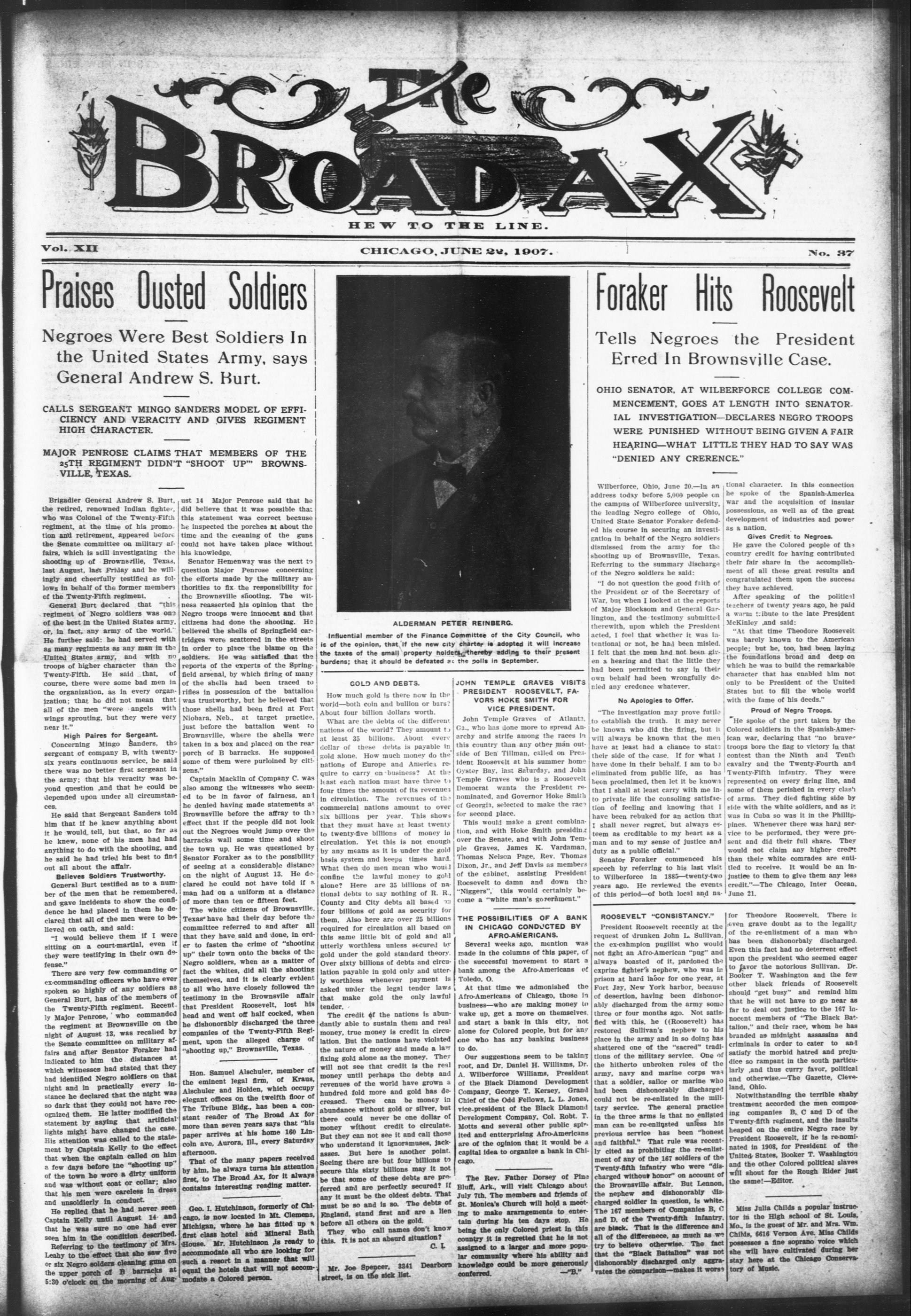
ALDERMAN PETER REINBERG.
Influential member of the Finance Committee of the City Council, who is of the opinion, that if the new city charter is adopted it will increase the taxes of the small property holders, thereby adding to their present burdens; that it should be defeated at the polls in September.
GOLD AND DEBTS.
How much gold is there now in the world—both coin and bullion or bars? About four billion dollars worth.
What are the debts of the different nations of the world? They amount to at least 35 billions. About every dollar of these debts is payable in gold alone. How much money do the nations of Europe and America require to carry on business? At the least each nation must have three to four times the amount of its revenues in circulation. The revenues of the commercial nations amount to over six billions per year. This shows that they must have at least twenty to twenty-five billions of money in circulation. Yet this is not enough by any means as it is under the gold basis system and keeps times hard. What then do men mean who would confine the lawful money to gold alone? Here are 35 billions of national debts to say nothing of R. R. County and City debts all based on four billions of gold as security for them. Also here are over 25 billions required for circulation all based on this same little bit of gold and all utterly worthless unless secured by gold under the gold standard theory. Over sixty billions of debts and circulation payable in gold only and utterly worthless whenever payment is asked under the legal tender law that make gold the only lawful tender.
The credit of the nations is abundantly able to sustain them and real money, true money is credit in circulation. But the nations have violated the nature of money and made a law fixing gold alone as the money. They will not see that credit is the real money until perhaps the debts and revenues of the world have grown a hundred fold more and gold has decreased. There can be money in abundance without gold or silver, but there could never be one dollar of money without credit to circulate. But they can not see it and call those who understand it ignoramuses, jack-asses. But here is another point. Seeing there are but four billions to secure this sixty billions may it not be that some of these debts are preferred and are perfectly secured? If any it must be the oldest debts. That must be so and is so. The debts of England, stand first and are a lien before all others on the gold. They who call names don't know this. It is not an absurd situation?
Mr. Joe Spencer, 3341 Dearborn street, is on the sick list.
JOHN TEMPLE GRAVES VISITS PRESIDENT ROOSEVELT, FAVORS HOKE SMITH FOR VICE PRESIDENT.
John Temple Graves of Atlanta, Ga., who has done more to spread Anarchy and strife among the races in this country than any other man outside of Ben Tillman, called on President Roosevelt at his summer home Oyster Bay, last Saturday, and John Temple Graves who is a Roosevelt Democrat wants the President nominated, and Governor Hoke Smith of Georgia, selected to make the race for second place.
This would make a great combination, and with Hoke Smith presiding over the Senate, and with John Temple Graves, James K. Vardaman, Thomas Nelson Page, Rev. Thomas Dixon, Jr., and Jeff Davis as members of the cabinet, assisting President Roosevelt to damn and down the "Niggers", this would certainly become a "white man's government."
THE POSSIBILITIES OF A BANK IN CHICAGO CONDUCTED BY AFRO AMERICANS.
Several weeks ago, mention was made in the columns of this paper, of the successful movement to start a bank among the Afro-Americans of Toledo, O. At that time we admonished the Afro-Americans of Chicago, those in business—who are making money to wake up, get a move on themselves, and start a bank in this city, not alone for Colored people, but for any one who has any banking business to do.
Our suggestions seem to be taking root, and Dr. Daniel H. Williams, Dr. A. Wilberforce Williams, President of the Black Diamond Development Company, George T. Kersey, Grand Chief of the Odd Fellows, L. L. Jones, vice-president of the Black Diamond Development Company, Col. Robt. T. Motts and several other public spirited and entertprising Afro-Americans are of the opinion that it would be a capital idea to organize a bank in Chicago.
The Rev. Father Dorsey of Pha Bluff, Ark., will visit Chicago about July 7th. The members and friends of St. Monica's Church will hold a meeting to make ararngements to entertain during his ten days stop. He being the only Colored priest in this country it is regretted that he is not assigned to a larger and more popular community where his ability and knowledge could be more generously conferred. "B."
Foraker Hits Roosevelt
Tells Negroes the President Erred In Brownsville Case.
OHIO SENATOR, AT WILBERFORCE COLLEGE COMMENCEMENT, GOES AT LENGTH INTO SENATORIAL INVESTIGATION—DECLARES NEGRO TROOPS WERE PUNISHED WITHOUT BEING GIVEN A FAIR HEARING—WHAT LITTLE THEY HAD TO SAY WAS "DENIED ANY CRERENCE."
Wilberforce, Ohio, June 20.—In an address today before 5,000 people on the campus of Wilberforce university, the leading Negro college of Ohio, United State Senator Foraker defended his course in securing an investigation in behalf of the Negro soldiers dismissed from the army for the shooting up of Brownsville, Texas. Referring to the summary discharge of the Negro soldiers he said:
"I do not question the good faith of the President or of the Secretary of War, but when I looked at the reports of Major Blocksom and General Garlington, and the testimony submitted therewith, upon which the President acted, I feel that whether it was intentional or not, he had been misled. I felt that the men had not been given a hearing and that the little they had been permitted to say in their own behalf had been wrongfully denied any credence whatever.
No Apologies to Offer.
"The investigation may prove futile to establish the truth. It may never be known who did the firing, but it will always be known that the men have at least had a chance to state their side of the case. If for what I have done in their behalf, I am to be eliminated from public life, as has been proclaimed, then let it be known that I shall at least carry with me to private life the consoling satisfaction of feeling and knowing that I have been rebuked for an action that I shall never regret, but always esteem as creditable to my heart as a man and to my sense of justice and duty as a public official."
Senator Foraker commenced his speech by referring to his last visit to Wilberforce in 1885—twenty-two years ago. He reviewed the events of this period—of both local and na-
BOOSEVELT "CONSISTANCY."
President Roosevelt recently at the request of drunken John L. Sullivan, the ex-cahmpion pugilist who would not fight an Afro-American "pug" and always boasted of it, pardoned the exprize fighter's nephew, who was in prison at hard labor for one year, at Fort Jay, New York harbor, because of desertion, having been dishonorably discharged from the army some three or four months ago. Not satisfied with this, he ((Roosevelt) has restored Sullivan's nephew to his place in the army and in so doing has shattered one of the "sacred" traditions of the military service. One of the hitherto unbroken rules of the army, navy and marine corps was that a soldier, sailor or marine who had been dishonorably discharged could not be enlisted in the military service. The general practice in the three arms is that no enlisted man can be enlisted unless his previous service has been "honest and faithful." That rule was recently cited as prohibiting the re-enlistment of any of the 167 soldiers of the Twenty-fifth infantry who were "discharged without honor" on account of the Brownsville affair. But Lennon, the nephew and dishonorably discharged soldier in question, is white. The 167 members of Companies B, C and D, of the Twenty-fifth infantry are black. That is the difference and all of the difference, as much as wry to believe otherwise. The fact that the "Black Battalion" was not dishonorably discharged only aggravates the comparison—makes it worse.
s Roosevelt
the President
ownsville Case.
BERFORCE COLLEGE COM-
M LENGTH INTO SENATOR-
DECLARES NEGRO TROOPS
WITHOUT BEING GIVEN A FAIR
TLE THEY HAD TO SAY WAS
FACE."
national character. In this connection he spoke of the Spanish-America war and the acquisition of insular possessions, as well as of the great development of industries and power as a nation.
Gives Credit to Negroes.
He gave the Colored people of the country credit for having contributed their fair share in the accomplishment of all these great results and congratulated them upon the success they have achieved.
After speaking of the political teachers of twenty years ago, he paid a warm tribute to the late President McKinley and said:
"At that time Theodore Roosevelt was barely known to the American people; but he, too, had been laying the foundations broad and deep on which he was to build the remarkable character that has enabled him not only to be President of the United States but to fill the whole world with the fame of his deeds."
Proud of Negro Troops.
He spoke of the part taken by the Colored soldiers in the Spanish-American war, declaring that "no brave troops bore the flag to victory in that contest than the Ninth and Tenth cavalry and the Twenty-Fourth and Twenty-Fifth infantry. They were represented on every firing line, and some of them perished in every class of arms. They died fighting side by side with the white soldiers, and as it was in Cuba so was it in the Philippines. Whenever there was hard service to be performed, they were present and did their full share. They would not claim any higher credit than their white comrades are entitled to receive. It would be an injustice to them to give them any less credit."—The Chicago, Inter Ocean, June 21.
for Theodore Roosevelt. There is even grave doubt as to the legality of the re-enlistment of a man who has been dishonorably discharged. Even this fact had no deterrent effect upon the president who seemed eager to favor the notorious Sullivan. Dr. Booker T. Washington and the few other black friends of Roosevelt should "get busy" and remind him that he will not have to go near as far to deal out justice to the 167 innocent members of "The Black Battalion," and their race, whom he has branded as midnight assassins and criminals in order to cater to and satisfy the morbid hatred and prejudice so rampant in the south particularly and thus curry favor, political and otherwise.—The Gazette, Cleveland, Ohio.
Notwithstanding the terrible shaby treatment accorded the men composing companies B, C and D of the Twenty-fifth regiment, and the insults heaped on the entire Negro race by President Roosevelt, if he is re-nominated in 1908, for President of the United States, Booker T. Washington and the other Colored political slaves will shout for the Rough Rider just the same!—Editor.
Miss Julia Childs a popular instructor in the High school of St. Louis, Mo., is the guest of Mr. and Mrs. Wm. Childs, 6616 Vernon Ave. Miss Childs possesses a fine soprano voice which she will have cultivated during her stay here at the Chicago Conservatory of Music.
THE BROAD AX
PUBLISHED WEEKI Y.
Will promulgate and at all times uphold the true principles, Indelible, Farmers, Single Taxes, Republicans, Knights of Labor, or any one else can have their say, so long as their language is proper and responsibility is fixed.
The Broad M is a newspaper whose platform is to promote the rights of claiming the editorial right to speak its own mind.
Subscriptions must be paid in advance.
One Year.....$2.0
Six Months.....1.0
Advertising rates made known on application.
JULIUS F. TAYLOR, Editor and Publisher.
Entered at the Post Office at Chicago
IL, as Second-class Mail.
A STEP BACKWARDS.
We are of the opinion that a grave mistake has been made in the selection of Dr. Booker T. Washington as one of the trustees of Howard University, for it is well known that the large amount of money, praise and flattery that has come to Dr. Washington has been on account of his industrial ideas and work. And no one knows this better than he. And in order to add to his already popularity in that line, he will use his influence to Tuskegeeize Howard University. The appointment of Mr. Washington should not be allowed to stand. The Colored people of this country should rise up to a man and protest this appointment and demand his resignation forthwith.The Advocate. Portland, Oregon.
The writer is with you on that proposition brother Cannady, and we would like to see the Colored people—those who are capable of reasoning from cause to effect, start a movement in favor of compelling the great beger of Tuskegee, to sever his connection with Howard University, but as the vast majority of the Colored people are still abject slaves to the Southern white man's idea of industrial education for all Negroes—they are too cowardly to utter the slightest protest against the appointment of Booker T. Washington as one of the officials of the university referred to—Editor.
ATHLETIC AND DRAMATIC.
The Douglass Centre Athletic Association benefit will be given at the New Pekin Theatre, State st., cor. Twenty-seventh, June 27, 1907, 8 p. m. On this occasion nwill be presented the Beautiful Serio-Comic Drama entitled "A Sister's Love," by members of the Athletic Association, assisted by Harrison Stewart, Chicago's inimitable Dramatic Artist. Excellent vocal and instrumental numbers by Chicago favorites.
The third act will introduce the entire Douglass Centre Athletic Association in a Series of Athletic Contests, Fencing contests, Vaulting, Tumbling, Wrestling match, 4-round Boxing match and a Tug of war in which the Douglass Centre Sampson will pull against 20 men.
Entire proceeds of benefit to be applied: First—To pay last $500 due on Douglass Centre Debt.
Second—To stabilish Sinking fund for building a gymnasium.
General admission, 50 cents; Reserved seats, $1.00, $1.50, $2.00; Boxes $15.00, $20.00 and $25.00.
WEST SIDE ITEMS.
Last Saturday night while returning home from the South side, Mr. Gady a well known contractor lost his footing in trying to catch a car and was killed instantly, considerable money which he carried was missing.
Mr. Earnest McGowan has finally taken on a life partner. Mr. Samuel McGowan a brother tendered them a royal reception.
Quite a sum of money was raised for Providence Baptist church in a recent rally.
The West Side Sunday Club closes for the summer season the last Sunday in June.
Prof. A. L. Simpson after spending quite a bit of time and money in fitting up his spacious Chiropody and Manicuring Parlors is now ready to do business. Your money is good. Room 51 Eureka Building, 155 W. Maulison St., Phone Monroe 3692. Mrs. Fred Washington has moved from her Robey street home, to 71 N. Leavitt street. West side Co-operation meets every Monday night at 915 W. Lake street. I. Harris, President.
U. OF C. SOUTHERN STUDENTS REFUSE TO EAT WITH NEGROES.
Race Feeling Displays Itself at Hutchinson Commons—Authorities Re-Force to Make Distinction.
Southern students at the University of Chicago yesterday raised objections to the practice of allowing Negro students to eat in Hutchinson commons, the university dining hall. While there was no demonstration, several of the summer students from
Texas and Alabama refused to eat at the same tables with the Negroes, and declared that they will not patronize the university commons unless the Negro students are excluded. Every summer a large number of students from the Southern states, particularly Texas, Alabama, and Georgia, come to the university to attend the summer school. There are several Negro students, both men and women, in attendance this summer, and their presence caused the dissension. University authorities declare that no action will be taken, as the Negroes, as students of the university, are entitled to the same privileges in the classroom and in the dining hall as are the white students.
Both men and women eat at Hutchinson commons during the summer quarter.—The Inter Ocean, Wednesday day morning, June 19. L. L. JONES STARTS FOR THE OIL
AND GAS FIELDS OF KANSAS.
L. L. Jones vice-president of the Black Diamond, Development Company, and head of the new firm of Penn-Jones Co., 188 Madison street, manufacturers of the best skin and scalp food on the market, left last evening for Kansas City, Mo., and the Oil and Gas Fields of Kansas, while in Kansas City Mr. Jones will transact some business for the Penn-Jones Co., and the first of the week he will continue his business trip on Chanute, Kansas where he will inspect the property of the Black Diamond Development Company, and see the gas from the eight wells belonging to it pumped through the pipe line, a hundred and twenty-six miles to Kansas city.
Mr. Jones will be absent for ten or 15 days, and after he has beheld everything that can be seen with his own eyes in connection with the gas wells, he will return and boom the stock of the Black Diamond Development Company.
THE PEKIN.
"In Zululand" at the Pekin, State & 27th sts., despite the warm weather is playing to big business. The many humorous situations and bright crisp dialogue of Charles Adelman's three—act musical African comedy and the tuneful music of the three Colored composers, Joe Jordan, J. T. Brymn and Will Marion Cook are meeting with the favor of the clientele of this house on this, the second appearance in les sthan six months, Harrison Stewart, than whom there is no better comedian in town, has an ideal part in this production and absolutely extracts every ounce of fun that the lines call for and then some. He is a born fun-maker and is an illuminating credit to his race. Jerry Mills, whose experience in the theatrical line dates back to an unknown period is having the time of his life in the part of Crowe, the scheming lawyer. Lawrence Chenault, as Prince Marso wears some becoming costumes and sings his songs with much gusto. Don Wormley impersonates the High Priest and it is by far the best thing he has ever done. The music is all tuneful and catchy as to the sole numbers and the ensembles and finales are elaborate and pretentious and particularly pleasing. J. Ed. Green staged the show and the musical numbers and evolutions were put on by Billy Johnson of the original Cole and Johnson.
Beginning July 1st, Manager Motts will attempt something in the spectacular summer production line. The bill beginning that date is a three-act musical comedy drama with many special features, entitled "Captain Rufus." The book is by J. Ed. Green and Alfred Anderson and the music by H. Lawrence Freeman, Joe Jordan and J. T. Brymn. This show will be a big patriotic production and it is expected that it will create somewhat of a sensation on south State street.
"M."
Special Notice.
Next Lord's Day, June 23, 2:30 p.m., I will deliver an address at No. 26 Van Buren street 2nd floor on: 1st. Why I withdrew from the A. M. E. Church. 2nd. Why I joined the Christian Catholic Apostolic Church in Zion. I should be very much pleased to see you present to get a full understanding of my motives. Subject continued same evening at 5522 Lake ave., Hyde Park, 8:00 p.m. Your brothers in Jesus the Christ. Dr. D A. Graham.
Horatio W. Seymour, late editor and publisher of The Chicago Chronicle, who is one of the best and most widely known newspaper men in the United States, and who has been connected with newspapers in Chicago since 1875, will on the first of July, become editor-in-chief of The St. Louis Post-Dispatch. Mr. Seymour is a broad-minded humanitarian, a highly cultivated gentleman and always very courtious, and we wish him the greatest success in his new field of journalism.
CHIPS
Mr. and Mrs. Fletcher have moved into their new home 3442 Wabash ave.
Mr.' James Harris, of Louisville, Ky., will spend the summer in Chicago.
Mr. Ed Alexander one of our local attorneys is improving in Provident Hospital.
Mrs. Spencer Irving of Philadelphia is the guest of Mrs. Wm. Phillips, 5801 Wabash Ave.
Lloyd English, of Fish University, is the guest of his aunt, Mrs. Clara Belle Barley, 4157 Ellis ave.
Dr. Fields, of St. Louis, Mo., well known in Chicago, underwent an operation last week and is in a critical condition.
mrs. Rosa Lively will leave Chicago the first of the week for Berrrian Springs, Mich., where she will spend the summer.
Mr. Claud Bell, druggist at Provident Hospital, was given the degree of M. D., from the Dearborn Medical school this week.
Invitations are out announcing the coming marriage of Mr. Chas, A. Jordan and Miss Helen McKenney, both of this city, June 27th.
Dr. F. L. Etter, of Paris, Tex., is spending the simmer in Chicago, doing post graduate work. The guest of Mr. Trice, 2627 Wabash ave.
Arthur A. Wells, will spend the larger portion of this summer in the city. He will leave about the 1st of August for Longbranch, N. J.
A. C. Harris, who has been confined to Provident Hospital for several weeks, is doing nicely, and will be at home to his friends, Sunday, June 23rd.
Dr. Antwine and Geo. Walker graduated from Northwestern University Thursday night. The former took the degree of M. D. and the latter Ph. G.
Jesse Binga, the hustling real estate dealer, 3637 State street, and Percy Turner, a popular young man around town, leave this evening for Detroit, Mich., where they will spend a ten days vacation.
Portland, Maine, has the distinction of having a Negro Methodist pastor who is a clerk regularly employed in the office of an old line life insurance company. The pastor mentioned is the Rev. G. F. Green—Ex.
Prof. H. T. Kealing, Philadelphia, Pa., one of the directors of the Black Diamond Development Company spent several days in the city last week, and departed for home Saturday evening by way of Wilberforce, Ohio.
Mrs. Edward H. Morris, Miss Elizabeth Slaughter and Miss Annie Phillips, will leave Chicago about midweek to attend the wedding of Miss Dora Needham in Philadelphia on the twenty-ninth of the month.
Among the South side society folks who will entertain visitors this summer are, Mmes. Rush Yerby, Wm. Childs, James Parker, Wm. Emanuel, Virgil Cook, Delbert Lee, Robert Davis, Robert L. Taylor and Hostle Johnston.
Prof. Wm. Emanuel has presented to his wife an electric automobile of the very swellest type for a birthday present. Mrs. Emanuel required but a few lessons to learn to run it and now her many friends will become better acquainted with the many beautiful driveways for which Chicago is noted. For being a woman of leasure, nothing gives her greater pleasure than the giving of pleasure to others.—"T."
Mrs. Booker T. Washington and Ernest Davidson Washington, the youngest son of Dr. Washington sailed from New York last Thursday, son Berlin, Germany, where they will join Miss Potrila Washington, who has been spending two years in a conservatory there. And Booker T. Washton, continues to travel around over the country, for the purpose of begging money, at the expense of the Negro in order to enable him to maintain his family in grand style in this country and in the old world.
The Grace Presbyterian Church base ball team, under the Captaincy of Julius C. Green, and The Emergencies under the Captaincy of Julius N. Avendorph, will play their first game of ball Thursday afternoon, July 4th, at Washington Park, at 3 p. m. sharp. Both teams are practicing hard, in order to make this the greatest game of the season, as both teams are anxious to win. The colors are as follows: Grace "white and blue Emergencies, White and Orange". Watch for the names of the players in next issue.
With the passing away of Senator John J. Morgan, of Alabama, last week, the ranks of the enemies of the Negro in the United States Senate thinned out a little bit. No one has ever doubted the honestly of Senator Morgan, and if he would have used his great influence which he exerted over the Southern people in favor of bringing about more harmonious relations between the races, and would have refrained from contending, that the Negro is not a human being, and is only a beast or a baboon at the very best he could have accomplished much good before passing away, but as it is, he will only be remembered as the advocate of a lost cause and of a dying civilization.
The special edition of The Seattle Republican of recent date entitled, "The Northwest Negro Progress Number," was in every respect the greatest effort put forth in the journalistic field in this country among Afro-American newspaper men. It contained cuts of more than one hundred of the most substancial Colored men and women throughout the state of Washington. The number of homes and other real estate owned by them, also illustrations of many of their lovely homes. Editor Cayton deserves great credit for the effort he put forth and this number of The Republican should find its way into the home of every intelligent and race-loving Negro in this country.
The Physicians, Dentists and Pharmacists Club, gave their second annual banquet at the New England Cafe, 2922 State street, last Friday evening. Dr. George C. Hall presided as toastmaster. Doctors Edward S. Miller, A. Wilberforce Williams, M. J. Brown, W. H. Marshall, M. A. Majors, Anna R. Cooper, Alvesta York, A. L. Smith and W. T. Bowlen, Ph. G., were.among those who elucidated on interesting medical subjects for the edification of those present. More than 40 M. D's and their invited guests, gathered around the banquet table and enjoyed the splendid menu while listening to the strains of sweet music. It was the most elaborate affair so far ever held among the physicians in this city.
SHORT STORIES
In the sixteenth century it was unlawful to marry during Lent.
The average man needs 1,600 pounds weight of food to sustain him for a year.
Alaskan Indians in the absence of tobacco will smoke shavings soaked in oil and pepper.
The Sargent lumber mill at South Brewer is the oldest mill on the Penobscot river and possibly the oldest in Maine. It was built in 1820.
In Europe 290 acres of land are cultivated by every hundred inhabitants, but in the United States a hundred inhabitants cultivate 890 acres.
While tearing out an old fireplace a few days ago Clarence Boyce of Windsor, Vt., found a United States cent coined in 1796. The cent is in excellent condition.
A Turkish peddler with fifty chameleons was arrested in New York, and during the night all the chameleons escaped. Every policeman in city hall station went lizard hunting and recovered them.
MODES OF·THE MOMENT.
To be especially in vogue one must have the belt to match the collar and cuff set. Braid and cord are widely used on the underskirts now, which really are quite as much a part of the gown as the bodice. Rich Indian and Russian designs are greatly in vogue not only for the linen suit, but for the soft linen costumes, kimonos, house gowns and evening wraps. Not all of the latest models in linen are of plain materials by any means. In fact, there is a very conspicuous showing of fancy weaves, stripes, checks and figures, but none of them is aggressive, and only delicate colors are seen.
The linen sunshade has blossomed out in new designs and beauty, one of the fads being a border of brown suede or patent kid to match the belt and shoes, and another is the very plain top or center, with billows of mull, net or linen frills around the edge.—New York Post.
PLAYS AND PLAYERS.
Della Stacey is to star in a new musical piece.
A crusade for grand opera in English has been started in London.
"The Prince of Pilsen" is soon to be introduced in France and Australia.
The Prince of Pilsen is soon to be introduced in France and Australia.
George M. Cohen has been playing his old role of the little jockey in a big revival of "Little Johnny Jones."
It is said that Louise Gunning is to be starred next season in a comic opera by Edward Paulton, the author of "The Princess Beggar."
Henry B. Harris has engaged Grace Elliston for the leading role in Martha Morton's new play of American life called "The Movers," which he is to bring out in the fall.
Cohan & Harris will have Thomas E. Shea under their management next season. They will also produce a new play by Channing Pollock entitled "Frances Baird, Detective."
WASHINGTON LETTER
[Special Correspondence.]
The locality of squares 726, 727 and 728, east of the capitol grounds and north of the Congressional library, possesses much historical interest from a national as well as local viewpoint. With the library and the office buildings for the senate and house of representatives the area known as the capitol grounds is inclosed by marble walls, with the exception of that portion fronting on First street between East Capitol and B streets, northeast. Doubtless at no distant day the government will take the squares first named as the site of a temple of justice for the accommodation of the supreme court of the United States.
Historic Ground.
Should a building be erected there for the highest judicial body it would be peculiarly appropriate, for after the burning of the capitol in 1814 the head of the judicial system sat for a number of years in the building at First and A streets. The quarters mentioned were thus occupied from 1816 to 1820. The old circuit court of the District was also in this building from 1816 to 1825. when quarters were provided in the city hall for the local court, together with offices for the clerk, the marshal and other officials.
During the civil war it became, under the name of the old capitol prison, a noted place, and here not a few executions, some by gallows, others by shooting, occurred. Captain Wirz of Andersonville was hanged there. All traces of it are now obliterated, and instead is a block of fine residences, in one of which the late Justice Field long resided.
The New Railway Station.
Washington's new Union station erected jointly by the Pennsylvania and the Baltimore and Ohio under certain concessions granted by the government, is now more than three-fourths completed, and Baltimore and Ohio trains will run into the new structure within a short time. Architecturally the building will be one of the most magnificent in the city. Its dimensions are truly stupendous. Altogether 100 acres will be occupied by the new terminal facilities. The north approach includes a train yard of thirty-three tracks, power plant, express building, coach yard having a capacity for about 750 cars, engine and repair yards, with engine house and shop facilities.
Finest Building of Ita Kind.
The tunnel under Capitol hill is the feature of the south approach. The station site when the work began was on ground less than twenty-five feet above the tide of the Potomac. More than 2,500,000 cubic yards of material were excavated and deposited to transform it into an eminence nearly sixty feet above tide, with gently sloping approaches. If this material were deposited on an average size city block it would form a shaft higher than the Washington monument. To move all this material would require about 60,000 standard gauge commercial cars, which, if coupled together in a single line, would extend 600 miles, a greater distance than from Washington to Columbus.
The general waiting room of the new depot will of itself cover 130 by 220 feet, or two-thirds of an acre, a greater area than is occupied by the average city station. The roundhouse, shops and engine yards will cover fifty-five acres, the coach yard sixty acres, the train yard thirty-one acres, the station proper and a portion of the plaza nine acres.
Professional opinion has it that it will be the most beautiful station building in the world.
A Remarkable Structure
Within a few weeks the Connecticut avenue bridge will be completed and opened to the public. In fact, there remains unfinished little more than the decoration of the bridge. The bridge itself is a remarkable structure. It is 1,421 feet long, 53 feet wide and consists of five 150-foot arches and two 82-foot arches. It is built of unreenforced concrete throughout. The stone for the concrete work was taken from a quarry about 400 feet from the site of the bridge, which saved a haul of 80,000 cubic yards of stone.
Largest Concrete Bridge.
This is the largest concrete bridge in the world and is unique, in that it is not re-enforced with steel. The bridge is apparently trimmed with granite. These trimmings are made of concrete, cast in blocks on the ground, and instead of using sand for the mortar stone dust was used, which, when dressed down, gives an appearance of granite. The main false work of the structure, which consisted mostly of Georgia pine lumber, cost the District $54,000. It required 1,500,000 board feet of lumber for this work alone. It is probable that the entire amount of lumber required to complete the bridge was in the neighborhood of 2,000,000 board feet.
Street Signs.
The commissioners will not be able to erect signs on the public thoroughfares throughout the city as contemplated because of lack of an appropriation. They have appreciated the necessity of such signs as "drive slow," "keep to the right," "walk your horses," etc., particularly so when a pedestrian meets with an accident due to careless driving. Several months ago at the suggestion of the superintendent of police they asked for samples of signs of various shapes and sizes, and the superintendent of police furnished a list of streets and street intersections most in need of posted instructions to drivers.
It was decided to erect about 200 signs, but when the question of purchasing and erecting the same was investigated it was found that there were no funds. CARL SCHOFFIELD.
American tourists spent $1,110,000 in the Swiss city of Lucerne last year. Twenty-seven thousand vessels enter the port of London in the course of a year. The smoking of dried colt's foot leaves antedated the introduction of tobacco in England. Probably the oldest dog in the state of Maine is Jack, owned by C. E. Freeman of Norway. Mr. Freeman claims that the dog is thirty-two years old. There were 35,918 emigrants from Ireland to England last year, an increase of 4,764 over the previous year, this being the first time in five years that an increase has been recorded. Cocoa importations into the United States are now averaging more than $1,000,000 a month against $250,000 per month a decade ago. Meantime importations of both tea and coffee show a decline.
In his "Queens of Spain" Major Hume says that Isabella L authorized the burning of 700 persons in Sestville alone and condemned 5,000 more to life imprisonment and the confiscation of their property.
Mayor Fitzgerald observed Arbor day by planting an elm tree on Boston Common. The tree is an offspring of the Washington elm at Cambridge, which was presented to the city by Jackson Dawson of the Arnold arboretum.
William Blount of Bayonne, N. J., is only fourteen years old, but has run away from home 100 times. He has been publicly spanked in court and threatened with hanging, but these methods of correction have no effect.
Dr. Paul Prager, an army surgeon of Vienna, suggests that molds of the mouths of prisoners would be much better than finger prints for identification purposes, as the palate remains absolutely unchanged throughout life.
A complete set of the signatures of the signers of the Declaration of Independence recently sold in New York for $2,850. A Portsmouth (N. H.) man has a nearly complete set and which includes that of Button Gwinnett, which is very rare.
Northeast Australia develops very slowly. Farmers grow maize in the old fashioned way. The maize crop in Queensland this year is a record one. Canning pineapples is becoming an important industry in Queensland. Opal mining is growing steadily.
The lack of railroad transportation has been the main cause of keeping the state of Sinaloa from taking her position as one of the leading and largest states of Mexico, it having 35,000 square miles of spendid farming land and thousands of rich undeveloped mines.
A little bit of land, not too far from the city, if intelligently cultivated, declares Bolton Hall, author of "Three Acres anderty," will support a family and they a life far more wholesome in they could ever have in the crowd of city Intensive cultivation is the password now.
Charles Doolittle Lucott, the new head of the Smithsonian institution For Scientific Research, was state geologist of New York and in 1888 attended the international geological congress in London, where he won much praise for his addresses. Since 1902 he had been secretary of the Carnegie institute. He lives in Washington.
The home of the poet Keats in the Plazza di Spagni, Rome, which is to be preserved as a memorial to Keats and Shelley, will be overhauled, and the floor on which Keats lived will be made into a memorial museum. A fund for the purchase of furniture has been started by Nelson Gay of Boston, secretary of the local committee.
Baron d'Estournelles de Constant, one of the prominent figures at the peace congress in New York, is a member of the French senate, an officer of the Legion of Honor, author, lecturer and champion of international arbitration. He came to this country as head of the French section at the congress, and his motto is, "My country's good through the peace of the world."
A New York woman who has employed several Japanese male servants declares that she will have no more of them. "I do not care," she says, "to have a butler or waiter who, however humble he may appear, carries with him the air of knowing more about everything than I do. A Japanese servant will do as he is told, but his manner of doing it suggests that he knows a better way."
According to a Shelbyville correspondent, Combs P. Parrish of that city claims the stump removing championship of Indiana. Parrish has been in the business of stump blowing for twenty-eight years. A few months ago on the Adams farm, near Shelbyville, he removed 2,900 stumps. His record for fast work was in March, when in five days, with the assistance of several men, he blew 2,875 stumps from the ground.
Not only does Henry Vanness of Rockville, Conn., enjoy the distinction of being the only negro railroad conductor in the world, but he has also the honor of being one of the men who have been longest in continuous railroad service in the country, having been employed as a conductor for forty-three years without a break. He has been employed on the New York, New Haven and Hartford railroad since it was opened to traffic in 1863.
Mrs. Anna F. Coston has on Staten Island the oddest laboratory and factory known. It is where the distress signals, her own invention, used in the army and navy, the revenue service and the life saving and lighthouse bureaus, are manufactured. The signal burns with a strong red, white red flame for two minutes and is visible twenty miles away. The formula for the signal light is kept a secret, but a copy is deposited in a vault, and there is no danger of its being lost.
HUMOR
HE WANTED MORE
One Million Not Enough For the Workman Seeking a Good Time.
A man of extreme wealth, tired of taking care of his money, went to a secluded spot on a river bridge and jumped off. He was not aware that life savers always frequent secluded spots and that the best place to commit suicide is on Broadway at noon. And, sure enough, a poor workman leaped in after him and pulled him out, cold and shivering.
As he stood there, dripping, it occurred to the wealthy man that what he had needed was not eternity, but just a cold bath. And he waxed grateful.
"I am rich beyond telling," he said.
"I will grant any wish. I will make real your wildest hopes."
The poor workman replied instantly.
"Then give me a million dollars."
"A million dollars!" suered he whose life had been saved. "That is the easiest thing in the world. But stop a moment-consider. It was money that made me try to kill myself. You had better go slow."
"A million dollars," repeated the poor workman stolidly.
"Very well; you shall have it. But since you have saved my life I will make this further offer: If at the end of three years you are not satisfied with your bargain come to me and I will do whatever else you wish."
Three years passed, and the former poor workman came to his benefactor's door.
"Aha, I thought so!" exclaimed the man of great wealth. "I knew you would come back. You know now how little mere money means. Now, what can I do for you?"
"Alas, I have found how little happiness can be got with a million," was the sad reply.
"Aha, I knew it!" exclaimed the man of extreme wealth. "And since you have found how little happiness can be got with a million, what will you have me do for you next?"
"Give me another million," replied the former poor workman—Freeman Tilden in Judge.
How He Gets Relief
The Rev. E. W. Webber, a Maine minister, who was located for awhile in a Georgia town as pastor of a Universalist church, occasionally relates this story:
He was talking with William Dodson, ex-president of the Georgia senate.
"I suppose you feel the heat greatly down here in the summer, don't you?" queried Mr. Webber of the southern man.
"Well, it does get pretty warm here sometimes," admitted Mr. Dodson, "but every time I feel too warm I think of the visit I once made to Boston, and it sends the cold shivers all over me."
A. Mean Man.
"George," chirped the young wife at breakfast, "I read where some loving and poetical husband actually wrote a poem on his wife's biscuits. Now, dear, if you want to pay me a pretty compliment, why don't you write a poem on the biscuits that I bake?"
"It would be impossible," laughed the cruel husband.
"And why, George?"
"Because the biscuits you make are so hard they wouldn't take the ink."
Just a Leason.
"I wonder if the Bimbles are getting poor!"
"I should say not! What makes you think so?"
"Why, I saw Bimble turning the wringer yesterday morning. They always used to have a washerwoman."
"Oh, I understand that."
"Then please explain."
"Well, Bimble told me he expected to buy an auto, and he's taking lessons in cranking."—Cleveland Plain Dealer.
He Was Fired.
The railroad president was hearing complaints.
"What is the charge against this breakman?" he inquired.
"This is a direct violation or one of our chief rules," observed the president warmly. "Fire him."—Bohemian.
Unless He Is Cremated.
"He wants the earth."
"Well, he'll be right in it when he dies."—Cleveland Leader.
Exhausting the Supply.
"I hate a gossiping woman like Mrs. Talkative."
"She does seem to know everybody else's business."
"Yes, she never leaves anything for another single soul to tell."—Baltimore American.
NEW SHORT STORIES
T. V. Powderly at the informal conference of capital and labor that Andrew Carnegie held in his Fifth avenue mansion recently told a story about contentment.
"Contentment is a good thing," Mr. Powderly began, "but it should never be carried too far. It is discontent, we must always remember, that brings about improvement.
"Let me tell you a story about a too contented Scranton farmer.
"This old man might have had a good modern shotgun, but he was con-
3
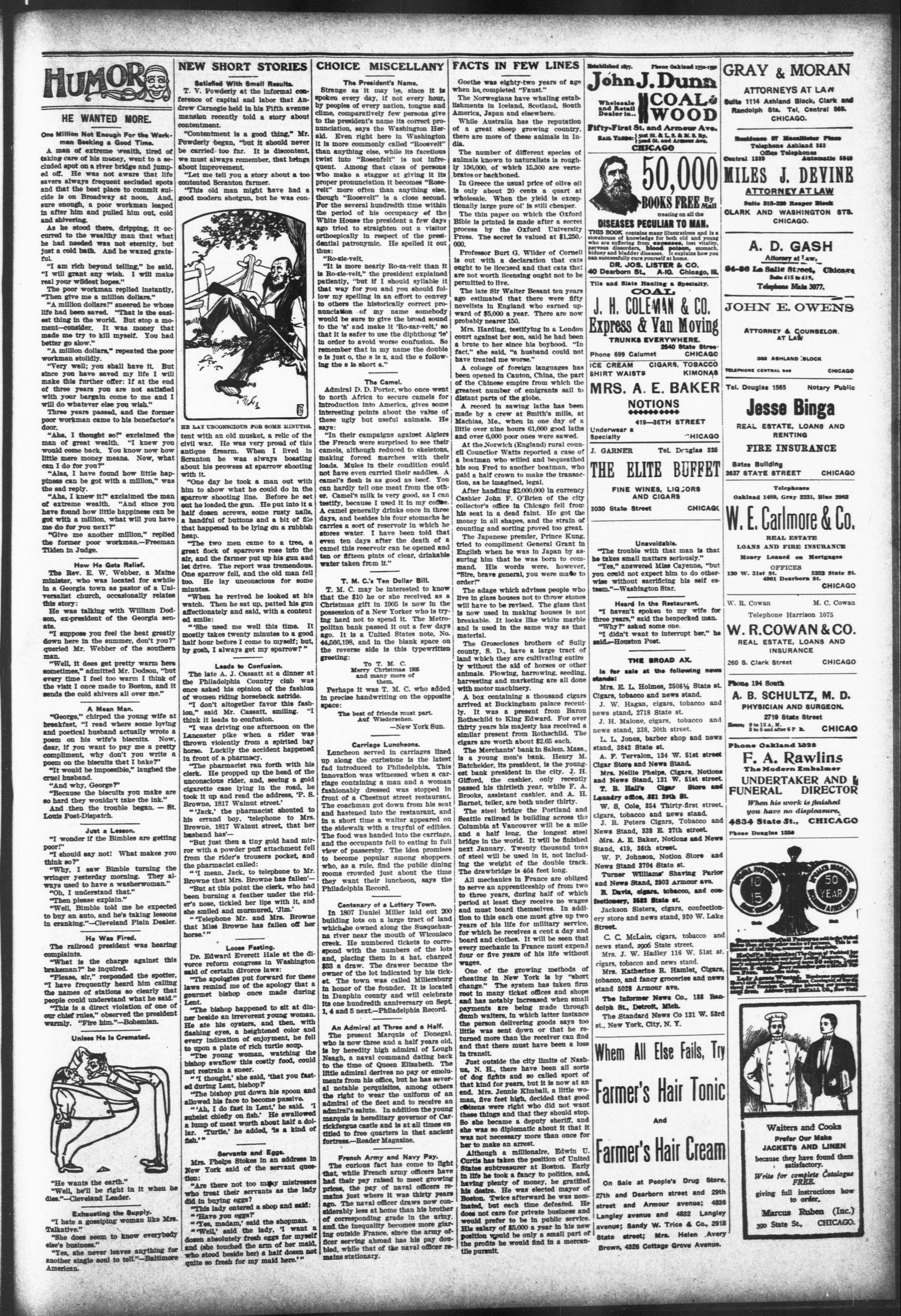
HE LAY UNCONSCIOUS FOR SOME MINUTES.
tent with an old musket, a relic of the civil war. He was very proud of this antique firearm. When I lived in Scranton he was always boasting about his prowess at sparrow shooting with it.
"One day he took a man out with him to show what he could do in the sparrow shooting line. Before he set out he loaded the gun. He put into it a half dozen screws, some rusty nails, a handful of buttons and a bit of file that happened to be lying on a rubbish heap.
"The two men came to a tree, a great flock of sparrows rose into the air, and the farmer put up his gun and let drive. The report was tremendous.
One sparrow fell, and the old man fell too. He lay unconscious for some minutes.
"When he revived he looked at his watch. Then he sat up, patted his gun affectionately and said, with a content ed smile: "She used me well this time. It mostly takes twenty minutes to a good half hour before I come to myself; but, by gosh, I always get my sparrow!"
Leads to Confusion.
The late A. J. Cassatt at a dinner at the Philadelphia Country club was once asked his opinion of the fashion of women riding horseback astride. "I don't altogether favor this fashion," said Mr. Cassatt, smiling. "I think it leads to confusion.
"I was driving one afternoon on the Lancaster pike when a rider was thrown violently from a spirited bay horse. Luckily the accident happened in front of a pharmacy.
"The pharmacist ran forth with his clerk. He propped up the head of the unconscious rider, and, seeing a gold cigarette case lying in the road, he took it up and read the address, 'P. S. Browne, 1817 Walnut street.'"
"Jack,' the pharmacist shouted to his errand boy, 'telephone to Mrs. Browne, 1817 Walnut street, that her husband has'-
"But just then a tiny gold hand mirror with a powder puff attachment fell from the rider's trousers pocket, and the pharmacist called:
"I mean, Jack, to telephone to Mr. Browne that Mrs. Browne has fallen"—
"But at this point the clerk, who had been burning a feather under the rider's nose, tickled her lips with it, and she smiled and murmured, 'Jim.'"
"Telephone Mr. and Mrs. Browne that Miss Browne has fallen off her horse."
Loose Eating
Dr. Edward Everett Hale at the divorce reform congress in Washington said of certain divorce laws:
"The apologies put forward for these laws remind me of the apology that a gourmet bishop once made during Lent.
"The bishop happened to sit at dinner beside an irreverent young woman. He ate his oysters, and then, with flashing eyes, a heightened color and every indication of enjoyment, he fell to upon a plate of rich turtle soup.
"The young woman, watching the bishop swallow this costly food, could not restrain a sneer.
"I thought," she said, "that you fasted during Lent, bishop?"
"The bishop put down his spoon and allowed his face to become passive."
"Ah, I do fast in Lent," he said. "I subsist chiefly on fish.' He swallowed a lump of meat worth about half a dollar. 'Turtle,' he added, 'is a kind of fish.'
Servants and Eggs.
Mrs. Phelps Stokes in an address in New York said of the servant question:
"Are there not too many mistresses who treat their servants as the lady DM in buying eggs?
in buying it.
"This lady entered a shop and said:
"Have you eggs?"
"Yes, madam," said the shopman.
"Well,' said the lady, 'I want a dozen absolutely fresh eggs for myself and (she touched the arm of her maid, who stood beside her) a half dozen not quite so fresh for my maid."
CHOICE MISCELLANY
The President's Name.
Strange as it may be, since it is spoken every day, if not every hour, by peoples of every nation, tongue and clime, comparatively few persons give to the president's name its correct pronunciation, says the Washington Herald. Even right here in Washington it is more commonly called "Roosvelt" than anything else, while its facetious twist into "Rosenfelt" is not infrequent. Among that class of persons who make a stagger at giving it its proper pronunciation it becomes "Rosevelt" more often than anything else, though "Roosvelt" is a close second. For the several hundredth time within the period of his occupancy of the White House the president a few days ago tried to straighten out a visitor orthoepically in respect of the presidential patronymic. He spelled it out thus:
"Ro-zle-velt
"It is more nearly Ro-za-velt than it is Ro-zie-velt," the president explained patiently, "but if I should syllable it that way for you and you should follow my spelling in an effort to convey to others the historically correct pronunciation of my name somebody would be sure to give the broad sound to the 'a' and make it 'Ro-zar-velt,' so that it is safer to use the diphthong "e" in order to avoid worse confusion. So remember that in my name the double o is just u, the s is z, and the e following the s is short a."
The Camel.
Admiral D. D. Porter, who once went to north Africa to secure camels for introduction into America, gives some interesting points about the value of these ugly but useful animals. He says:
"In their campaigns against Algiers the French were surprised to see their camels, although reduced to skeletons, making forced marches with their loads. Mules in their condition could not have even carried their saddles. A camel's flesh is as good as beef. You can hardly tell one meat from the other. Camel's milk is very good, as I can testify, because I used it in my coffee. A camel generally drinks once in three days, and besides his four stomachs he carries a sort of reservoir in which he stores water. I have been told that even ten days after the death of a camel this reservoir can be opened and ten or fifteen pints of clear, drinkable water taken from it."
T. M. C.'s Ten Dollar Bill.
T. M. C. may be interested to know that the $10 he or she received as a Christmas gift in 1905 is now in the possession of a New Yorker who is trying hard not to spend it. The Metropolitan bank passed it out a few days ago. It is a United States note, No. 44,566,198, and in the blank space on the reverse side is this typewritten greeting:
To T. M. C.
Merry Christmas 1905
and many more of
them.
Perhaps it was T. M. C. who added in precise handwriting on the opposite space:
The best of friends must part.
Carriage Luncheons.
Luncheon served in carriages lined up along the curbstone is the latest fad introduced to Philadelphia. This innovation was witnessed when a carriage containing a man and a woman fashionably dressed was stopped in front of a Chestnut street restaurant. The coachman got down from his seat and hastened into the restaurant, and in a short time a waiter appeared on the sidewalk with a trayful of edibles. The food was handed into the carriage, and the occupants fell to eating in full view of passersby. The idea promises to become popular among shoppers, who, as a rule, find the public dining rooms crowded just about the time they want their luncheon, says the Philadelphia Record.
Centenary of a Lottery Town.
In 1807 Daniel Miller laud out 200 building lots on a large tract of land which she owned along the Susquehanna river near the mouth of Wilsonico Creek. He numbered tickets to correspond with the numbers of the lots and, placing them in a hat, charged $33 a draw. The drawer became the owner of the lot indicated by his ticket. The town was called Millersburg in honor of the founder. It is located in Dauphin county and will celebrate its one hundredth anniversary on Sept. 1 4 and 5 next—Philadelphia Record.
The present Marquis of Donegal, who is now three and a half years old, is by heredity high admiral of Lough Neagh, a naval command dating back to the time of Queen Elizabeth. The little admiral derives no pay or emoluments from his office, but he has several notable perquisites, among others the right to wear the uniform of an admiral of the fleet and to receive an admiral's salute. In addition the young marquis is hereditary governor of Carrickfergus castle and is at all times entitled to free quarters in that ancient fortress—Reader Magazine.
French Army and Navy Pay
The curious fact has come to light that, while French army officers have had their pay raised to meet growing prices, the pay of naval officers remains just where it was thirty years ago. The naval officer draws now considerably less at home than his brother of corresponding grade in the army, and the inequality becomes more glaring outside France, since the army officer serving abroad has his pay doubled, while that of the naval officer remains stationary.
FACTS IN FEW LINES
Goethe was eighty-two years of age when he completed "Faust."
The Norwegians have whaling establishments in Iceland, Scotland, South America, Japan and elsewhere.
While Australia has the reputation of a great sheep growing country, there are more of these animals in India.
The number of different species of animals known to naturalists is roughly 150,000, of which 15,300 are vertebrates or backboned.
In Greece the usual price of olive oil is only about 20 cents a quart at wholesale. When the yield is exceptionally large pure oil is still cheaper.
The thin paper on which the Oxford Bible is printed is made after a secret process by the Oxford University Press. The secret is valued at $1,250,000.
Professor Burt G. Wilder of Cornell is out with a declaration that cats ought to be licensed and that cats that are not worth licensing ought not to be permitted to live.
The late Sir Walter Besant ten years ago estimated that there were fifty novelists in England who earned upward of $5,000 a year. There are now probably nearer 150.
Mrs. Harding, testifying in a London court against her son, said he had been a brute to her since his boyhood. "In fact," she said, "a husband could not have treated me worse."
A college of foreign languages has been opened in Canton, China, the part of the Chinese empire from which the greatest number of emigrants sail to distant parts of the globe.
A record in sawing laths has been made by a crew at Smith's mills, at Machias, Me., when in one day of a little over nine hours 61,000 good laths and over 6,000 poor ones were sawed.
At the Norwich (England) rural council Councilor Watts reported a case of a boatman who willed and bequeathed his son Fred to another boatman, who paid a half crown to make the transaction, as he imagined, legal.
After handling $2,000,000 in currency Cashier John F. O'Brien of the city collector's office in Chicago fell from his seat in a dead faint. He got the money in all shapes, and the strain of counting and sorting proved too great.
The Japanese premier, Prince Kung, tried to compliment General Grant in English when he was in Japan by assuring him that he was born to command. His words were, however, "Sire, brave general, you were made to order."
The adage which advises people who live in glass houses not to throw stones will have to be revised. The glass that is now used in making houses is not breakable. It looks like white marble and is used in the same way as that material.
The Grossecloses brothers of Sully county, S. D., have a large tract of land which they are cultivating entirely without the aid of horses or other animals. Plowing, harrowing, seeding, harvesting and marketing are all done with motor machinery.
A box containing a thousand cigars arrived at Buckingham palace recently. It was a present from Baron Rothschild to King Edward. For over thirty years his majesty has received a similar present from Rothschild. The cigars are worth about $2.65 each.
The Merchants' bank in Salem, Mass. is a young men's bank. Henry M. Batchelder, its president, is the youngest bank president in the city. J. H. Gifford, the cashier, only recently passed his thirtieth year, while F. A. Brooks, assistant cashier, and A. H. Barnet, teller, are both under thirty.
The steel bridge the Portland and Seattle railroad is building across the Columbia at Vancouver will be a mile and a half long, the longest steel bridge in the world. It will be finished next January. Twenty thousand tons of steel will be used in it, not including the weight of the double track.
The drawbridge is 464 feet long.
All mechanics in France are obliged to serve an apprenticeship of from two to three years, during half of which period at least they receive no wages and must board themselves. In addition to this each one must give up two years of his life for military service, for which he receives a cent a day and board and clothes. It will be seen that every mechanic in France must expend four or five years of his life without wages.
One of the growing methods of cheating in New York is by "short change." The system has taken firm root in many ticket offices and shops and has notably increased when small payments are being made through dumb waiters, in which latter instance the person delivering goods says too little was sent down or that he returned more than the receiver can find and that there must have been a loss in transit.
Just outside the city limits of Nashus, N. H., there have been all sorts of dog fights and so called sport of that kind for years, but it is now at an end. Mrs. Jennie Kimball, a little woman, five feet high, decided that good citizens were right who did not want these things and that they should stop. So she became a deputy sheriff, and she was so diplomatic about it that it was not necessary more than once for her to make an arrest.
Although a millionaire, Edwin U. Curtis has taken the position of United States subtreasurer at Boston. Early in life he took a fancy to politics, and, having plenty of money, he gratified his desire. He was elected mayor of Boston. Twice afterward he was nominated, but each time defeated. He does not care for private business and would prefer to be in public service. His salary of $5,000 a year in his new position would be only a small part of the profits he would find in a mercantile pursuit.
Fifty-First St. and Armour Ave.
RAIL YARDS: 121st St. & L. & N. & R. R.
123rd St. and Armour Ave.
CHICAGO
50,000
BOOKS FREE By Mail
50,000
BOOKS FREE By
Mail
THIS BOOK contains many illustrations and is a storehouse of knowledge for both old and young who are suffering from excesses, lost vitality, nervous disorders, blood poison, stomach, kidney and bladder diseases. It explains how you can successfully cure yourself at home.
DR. JOS. LISTER & CO.
40 Dearborn St., A-10, Chicago, IL.
J. H. COLEMAN & CO.
Express & Van Moving
TRUNKS EVERYWHERE.
2540 State Street
Phone 699 Calumet CHICAGO
ICE CREAM CIGARS, TOBACCO
SHIRT WAISTS KIMONAS
MRS. A. E. BAKER
NOTIONS
419-36TH STREET
Underwear a
Specialty HICAGO
J. GARNER Tel. Douglas 325
THE ELITE BUFFET
FINE WINES, LIQUORS
AND CIGARS
3030 State Street CHICAGO
Unavoidable.
"The trouble with that man is that he takes small matters seriously."
"The trouble with that man is that he takes small matters seriously." "Yes," answered Miss Cayenne, "but you could not expect him to do otherwise without sacrificing his self esteem." -Washington Star.
"I didn't want to interrupt her," he said-Houston Post.
THE BROAD AX.
is for sale at the following news stands:
Mrs. E. L. Holmes, 2508½ State st.
Cigars, tobacco and news stand.
J. W. Hagan, cigars, tobacco and news stand, 2718 State st.
J. H. Malone, cigars, tobacco and news stand, 338, 30th street.
L. L. Jones, barber shop and news stand, 3842 State st.
A. F. Tervalon, 134 W. 51st street
Cigar Store and News Stand.
Mra. Nellie Phelps, Cigars, Notions and News Stand, 131 W. 51st street.
T. B. Hall's Cigar Store and Laundry office, 381 59th St.
Mrs. A. E. Baker, Notions and News Stand, 419, 36th street. W. P. Johnson, Notion Store and News Stand 3704 State st. 'Turner Williams' Shaving Parlor and News Stand, 2903 Armour ave.
Jackson Sisters, cigars, confectionery store and news stand, 920 W. Lake Street.
C. C. McLain, cigars, tobacco and news stand, 2006 State street.
Mrs. J. W. Hadley 116 W. 51st st. cigars, tobacco and news stand.
Mrs. Katherine R. Hamlet, Cigars, tobacco, and fancy groceries and news stand 5028 Armour ave.
The Informer News Co., 188 Bandolph St., Detroit, Mich.
The Standard News Co 131 W. 53rd st. New York, City, N. Y.
Whem All Else Fails, Try Farmer's Hair Tonic
Farmer's Hair Cream
On Sale at People's Drug Store, 27th and Dearborn street and 29th street and Armour avenue; 4836 Langley avenue and 4832 Langley avenue; Sandy W. Trice & Co., 2918 State street; Mrs. Helen Avery Brown, 4326 Cottage Grove Avenue.
ATTORNEYS AT LAW
Suite 1114 Ashland Block, Clark and
Randolph Sts. Tel. Central 569.
CHICAGO.
Residence 87 Macallister Place
Telephone Ashland 363
Office Telephones
Central 1239 Automatic 5649
MILES J. DEVINE
ATTORNEY AT LAW
Suite 315-330 Reaper Block
CLARK AND WASHINGTON STS.
CHICAGO.
A. D. GASH
Attorney at Law,
84-86 La Salle Street, Chicago
Suite 615 to 619.
Telephone Main 3077.
JOHN E. OWENS
ATTORNEY & COUNSELOR.
AT LAW
333 ASHLAND .BLOCK
TELEPHONE CENTRAL 908 CHICAGO
Tel. Douglas 1565 Notary Public
REAL ESTATE, LOANS AND
RENTING
FIRE INSURANCE
Bates Building
3637 STATE STREET CHICAGO
Telephones
Onkland 1489, Gray 3331, Blue 3963
W. E. Carlmore & Co.
OFFICES
120 W. 51st St. 5252 State St.
4901 Dearborn St.
CHICAGO
W.R.COWAN & CO.
REAL ESTATE, LOANS AND
INSURANCE
260 S. Clark Street CHICAGO
Phone 194 South
A. B. SCHULTZ, M. D.
PHYSICIAN AND SURGEON.
2719 State Street
Hours: 9 to 12 A. M.
3 to 5 and after 6 P. M.
CHICAO
F. A. Rawlins The Modern Embalmer
When his work is finished
you have no displeasure.
4834 State St., CHICAGO
Phone Douglas 1550
REAL MINT
10
15
MINTED MINT
50
YEAR
MINTED MINT
Please enquire MacCall Photographs to the Public
office of our office of patent. This is an
amount of time to be spent.
MacCall Photographs [The Queen of Punish] garr
the patent of our office [Lake Michigan].
We are proud to patent our office of patent. We
are proud to patent our office of patent. We are proud to patent our office of patent.
Lady Agent Wanted. Kensington, p. 18. Burial and funeral services. Chelsea and Westminster. For the Society. Chelsea (having not passed away since). Adden the McCall Co., New York.
Waiters and Cooks
Prefer Our Make
JACKETS AND LINEN
because they have found them
satisfactory.
Write for complete Catalogue
FREE.
giving full instructions how
to order.
Marcus Ruben (Inc.)
390 State St., CHICAGO.
PASSPORTS.
The Strict Regulations That Are Enforced in Russia. There are very few countries where travelers now require passports in order to promote their convenience and security. In Brazil and Venezuela a passport must be shown to the officials before one is allowed to leave the country for a foreign port—a vexatious measure, enforced apparently for the sake of enabling a few officials to collect small fees.
In Russia, as is well known, passport regulations are enforced with the greatest stringency. No traveler, indeed, is permitted to enter the empire until he has obtained a passport and convinced the Russian consular officers at the port from which he sails that he is neither a Roman Catholic priest nor a Hebrew. The question ordinarily asked is, "What is your religion?" but it is designed to provide against the entry of either of these two classes.
When the traveler arrives at a Russian port with a passport that has been properly vised and countersigned at a consular office, it is critically examined by a police officer and duly registered. At the entrance of the hotel another police officer takes possession of the document and in the course of twenty-four hours returns it with a permit for a limited residence in the country.
It has been said with but little exaggeration that it is as difficult for one to leave Russia as it is to enter it. When the traveler departs for another city in the empire, he must have the passport countersigned by the police. This process continues until he reaches the frontier, which he cannot cross unless the passport has been vised and stamped by the police. Not infrequently tourists are stopped at the frontier and subjected to serious inconvenience because they have neglected to comply with the police regulations respecting passports. All this red tape causes annoyances and irritation among tourists, who are apt to overlook the fact that Russians as well as foreigners are compelled to observe these police regulations. It is the business of the police to know everywhere bolges.
The same system prevails in Turkey, where it is not practicable for a foreigner to travel without a passport. Elsewhere in Europe passports are not required. They are relics of a bygone period when communication between countries was slow and infrequent—San Francisco Chronicle.
Skin Like Armor Plate
When she is in a freakish mood, nature seems to revel in making human belings who are a constant mystery to their fellow creatures. Such a man is Herr Schwartz, the "armor plated man," who is such a puzzle to the doctors of Europe. Herr Schwartz has for some years been un-going an ossification of the whole his body and is rapidly developing the hardness and immobility of a tu. His back has now become rigid, muscles standing out hard and im-able. In fact, he seems to be en-amped in a kind of armor plating, consisting of surface bone as hard as stone. He is no longer able to move his jaws and is compelled to take food in a liquid form through a tube, some of his teeth having been removed for the purpose. And yet this osseous man enjoys excellent health and not long ago was married to a charming young Berlin woman—Boston Post.
Boston's First Building Law.
Two hundred and twenty-six years ago a house was burned in Boston, which led to the promulgation of the first building law. The fact developed at a legislative hearing recently, and when told by Assistant Solicitor Child aroused great interest. The order passed on March 16, 1681, was as follows:
"About noon the chimney of Mr. Thomas Sharp's house in Boston took fire. The wind drove the fire to Mr. Colburn's house and burned that down also. For the prevention whereof in our new town indended this somer to bee build we have ordered that no man there shall build his chimney with wood nor cover his house with thach, which was readily asseted unto."—Boston Herald.
Bagging the Smoke
At nearly all of the large dinners this year a flashlight photograph has been taken of the feast, photographs being developed and ready for the dinners by the time the dinner has been over. Such a thing has not been allowed before by the places where the big dinners are held. That such photographs have been taken this year has been due to an ingenious contrivance which the flashlight man now has for collecting his smoke. This is a large inverted baglile arrangement into which the smoke ascends and is caught so successfully that not a vestige can be detected afterward. Now the flashlight man, instead of being taboed, seems to be one of the adjuncts of the large public dinners—New York Sum.
Comic Neutrality.
International law can sometimes develop a situation that is not devoid of humor. Something of the kind has just happened in Luxembourg. A man who had been arrested in German Lorraine had to be conveyed to Saverne through Luxembourg. On reaching Battembourg, the first station in Luxembourg, he managed to get the carriage door open and, leaping to the platform, refused to re-enter the carriage on the ground that, as the country was neutral, he could neither be compelled nor arrested. He was detained, but the Luxembourg government by telephone ordered his release, while the jaller returned to Lorraine crestfallen—London Globe.
---
SELECTIONS
A BASEBALL SUPPER.
How a College Team's Captain Entertained Eight "Fans."
"Out on the first!" "That's a hot one!" "Willie scores one!" "Home run for Arthur!" These were the familiar terms that greeted each joke or attempted joke. The occasion was a novel entertainment recently given in a college town at which the captain of the college team entertained eight of the most enthusiastic "fans" among his friends at a baseball dinner. Counting the host, the party numbered nine. Dinner was announced at 9 o'clock in the evening.
With the assistance of his mother and sister the young man carried out the whole arrangement with brilliant success. Before going into the dining room each man was given a place on the "team" and by this means found his proper place at the table. The dining table, which was square, was turned and spread in such a manner as to represent the diamond of a baseball field. Instead of the usual cards there was at each cover a miniature fan bearing the word pitcher, catcher, first base, second base, third base, right shortstop, left shortstop, right field, left field. The menu cards were diamond shaped and had "Official Score" printed on one side, and on the other side was the menu, consisting of nine courses, or "innings," as they were termed on the cards. They read, leaving out the interpolations, as follows:
FIRST INNING.
First strike.....Oyster Cocktails
SECOND INNING.
In which the Losing Team Lands...Soup
THIRD INNING.
Caught on the Fly.
Mountain Trout on Diamond Shaped Toast
FOURTH INNING.
A Sacrifice
.....Lamb Chops with Potato Balls
FIFTH INNING.
A Foul Ball.
.....Turkey Croquettes, Green Peas
SIXTH INNING.
The Umpire, When We Lose.
.....Lobster Salad, Cheese Wafers
SEVENTH INNING.
What We Were Handed...Lemon Cream
in Diamond Shaped Slices and Maccarons.
EIGHTH INNING.
Essential for Good Playing.
.....Preserved Ginger, Wafers, Coffee
NINTH INNING.
Where They All Score.
.....Distribution of Favors
The favors were tiny horns, with
which, at the suggestion of one of the
boys, they rooted for the clever host
and the unique way in which they had
been entertained.—What to Eat.
The "Drago Doctrine."
What is the "Drago doctrine," which is to be excluded from the deliberations of The Hague conference? It has nothing to do with the late Queen Drago of Servia, but derives its name from Dr. Drago, foreign minister of the Argentine Republic, who, imitating the example of President Monroe, enunciated the convenient theory that debts owed to the citizens of one government by those of another may not be "collected" by force. This was when the combined fleets of England, Germany and Italy in 1902 appeared off Venezuela and caused Mr. Kipling to write his "Rowers." This "Drago doctrine" was naturally hailed with enthusiasm by all the money borrowing republics of South America, but they were told from Washington that it could not be regarded as a subclause of the Monroe doctrine.-Chicago News.
The Postoffice and Crime Detection.
The Postoffice and Crime Detection.
Discussing "Frauds In the Mall" in the North American Review, George B. Cortelyou, secretary of the treasury, says: It will be readily understood that the guarding of the mails for the purpose of keeping at the minimum the manifold abuses to which they are inherently subject is a task of great magnitude. But it is being better and more efficiently done every year, affording much justification for the remark which was made not long ago that "the postoffice department of the United States is the most effective agency in the world for the detection and prevention of crime and the apprehension of the criminal."
The Phonograph as a Witness
In Brussels lives a lawyer who recently made good use of a phonograph in a lawsuit. He had been continually annoyed by the noises of hammering at an iron foundry in his near neighborhood. Finding that complaints were unavailing, he brought the matter into court. But before doing so he placed a phonograph in his library for one whole day. When the case came before the court he produced the phonograph and set going the specially prepared cylinder. An uproar and din as from the forge of Vulcan was the result, and the ingenious lawyer won his case.
The Shock on the Dreadnought
In the simultaneous discharge of eight of the ten twelve-inch guns of the Dreadnought a shock was given that vessel of 400,000 tons, more than double that of any broadside ever before fired. The vessel of 18,500 tons skidded sideways several yards, listing many degrees. The guns are fifty-three feet long, and each shell of 850 pounds is discharged by 265 pounds of cordite, with a muzzle velocity of 2,000 miles an hour.
France's Lost Provinces.
The Germans are by no means content with the state of affairs in Alsace-Lorraine, for in spite of the six and thirty years which have passed since the annexation the sentiments of the majority of the population are as anti-German as ever-London Globe.
WOMAN AND FASHION
The New Cape Coat.
Cape wraps are seen on many of the most attractive. Paris spring gowns. One model carried out in pastel blue cloth has a becoming little cape of the same material, with velvet collar and square fronts, trimmed with broad blas bands and silk tassels. The novel feature of this coat is the manner in which it is fastened. There
TWO SMART MODELS.
is no opening in front or back. The large buttons on the shoulders are for use as well as ornamentation. Those on the left shoulder can be easily unbuttoned and the coat removed in that way. This is a striking and new style, but not altogether practical, though many of them are worn.
The second model is made of light tan broadcloth and worn with a princess dress of tan chiffon velvet trimmed with straps of cloth.
One desirable feature of these coats is that they look quite as well worn with one dress as another and make splendid wraps for the warmer weather.
How to Wear Necklaces.
As though milliners had not put the woman who is no loager young suitlessly at a disadvantage by decreeing modes in hats that are becoming only to the ingeneer, now the jewelers must prescribe a new method of wearing the pearl necklace that, alas, none but the young may venture. It is a coquettish mode of arrangement that is properly suited only to the unlined face. Doubly less many women who have long passed their youthful charms will be tempted to essay it. A long rope of pearls is necessary, and the evening gown which accompanies it should be of empire type. The necklace is caught up to the collarf at either side of the head with circular clasps, pearl set and with tasseled pendants of the pearls. Beautiful clasps in interesting antique patterns come specially for the purpose. Of the two loops of the pearl rope which hang down in front from the clasps one should reach to the base of the neck, beneath the chin; the other should fall to the waist. These sway and quiver in lines of delightful grace with each movement of the wearer's head. No jeweled dog collar is worn with the necklace when it is arranged in this way.
Motoring Headgear.
Many women prefer for all ordinary motoring to wear a separate veil tied over the hat and covering all of the head save the face and select their veils with a view to their becoming qualities as well as to their relation to the costume. If one can afford to sacrifice a veil often, white chiffon is desirable, for nothing is more becoming, and the white motor veils with dotted or striped borders of black or of color are very charming. They succumb to the dust quickly, of course, as do the light blue veils, in which many motor women now look particularly well, but extravagance in the interest of vanity is no new thing.
Suits For Small Boys.
The small boys are going to be comfortable this summer. If they are not it will not be the fault of the shopkeepers, who are ready with an almost unlimited supply of jaunty, cool suits. The accompanying cut shows one of the most popular models. White linen is the material used for the suit, while
J.
the broad collar, cuffs and belt are of red, trimmed with white. The upper part of the blouse is cut in sailor fashion, but the lower part falls straight down and is worn with a loose belt more after the manner of the Russian blouse. This makes a more childish garment than the regulation Russian model, or the sailor suit which blouses at the waist line. Other suits of this model are made of blue linen, chambray and checked gingham.
A
Wifey—Be to my faults a little blind. Hubby—I'll be a little blind if you'll keep your mouth a little shutter.
Wifey—Be to my faults a little blind. Hubby—I'll be a little blind if you'll keep your mouth a little shutter.
No Chance.
"Do you think his interest in art will ever amount to anything?"
"No," answered Miss Cayenne. "He is too well off to become an artist himself and not rich enough to become a connoisseur."—Washington Star.
Not In Her Estimation.
"I suppose you regard marriage as a failure."
"No," replied the lady who had secured three divorces. "I've succeeded in getting a fair bunch of allmany each time."—Chicago Record-Herald.
"Jennson's widow threatens to break his will."
"I thought she approved of it?"
"Yes, but she can't forgive him for dying during housecleaning time."—Cleveland Plain Dealer.
Delays Are Dangerous.
Miss Gotrox — George, dear, I'm afraid our wedding will have to be postponed.
Mr. Owings — Impossible, darling.
My creditors won't stand for it—St. Louis Post-Dispatch.
"Well, they're afraid of thunder, and they can't dodge lightning."—Atlanta Constitution.
Both Happy.
Roundebout—By the way, old man, how are you getting along with your wife now?
The Absentminded Magnate.
Gunbusta—Will you pass the butter,
please?
Railroad Magnate (absentmindedly)
—No, sr; you'll get no pass— Oh, excuse me! Certainly!—Judge.
His Only Chance.
Dreamer—I wish I had an airship.
Dreamer—What for?
Dreamer—I'd like to visit some of my castles in the air—Detroit Tribune.
Went a-Whizn.
George held her hand and she held hisn;
Soon they hugged and went to kizn!
Ignorant, her pa had rizn—
Madder'n hops and simply sizzin—
* * * * ( ) ( ) ( )
Gee, but George went out whizn!
—Princeton Tiger.
BRIGHT BOYS AND GIRLS WANT
Bright boys and girls can make money in every community by selling The Broad Ax. It will cost you nothing to begin, as we will send you a supply of papers for the first week free. If there are any bright boys and girls in any section of the country who want to start in business for themselves, make money and be independent, write to us at once, and we will send you ten papers free of charge. You can sell them for five cents each, this will give you the capital which you can buy more papers at the newsdealers' rate, allowing you a good profit.
Thinking and progressive people read the Broad Ax. Your father, brothers, uncles and friends will buy the paper from you. If you mean business write to Julius F. Taylor, 5040 Armour avenue, Chicago.
Special Announcement
From on and after this date all anouncements of entertainments, etc. for which an admission is charged, will be considered advertising, and will be charged for at the rate of 12 cents a line, seven words to a line. The money must accompany the matter and reach the editor no later than Thursday morning of the week intended for publication. This rule will also apply to all personal items and matter for which no charges will be made. In other words, all news matter must reach us either on Wednesday evening or early Thursday morning in order to find its way into the columns of this paper the same week it is written.
Write plainly on one side of the paper only, and address all communications to The Broad Ax, 5040 Armour avenue.
HILLMANS
STATE & WASHINGTON STS.
WHERE EVERY PATRON
Saves
ON EVERY PURCHASE
Jacob Feinberg
81st and State Streets
Telephone Yards 693
BRADLEY & CO.
REAL ESTATE,
AND INSURA
6709 S. Halsted Street
Sandy W. Triple
2918 State St
New Department
Why don't you get in the habit of doing you
here? Every Tuesday and Friday special sales
Stamps with each 10c purchase.
We carry a swell line of Ladies' Shirtw
s. A spendiid assortment of Shoes. Hosiery
Jees, Ribbons, Gowns, Bracelets, Millinery and
We make a specialty of Men's Balbriggan
Histcoats, Pants, Shoes, Fedora and Derby H
A beautiful line of soft Percale Negligee Sh
A fancy line of Neckwear and Handkerchie
See our Novelties in Jewelry, Watch-chain
Safety Pins.
RADLEY & FIELDS
REAL ESTATE, LOANS
AND INSURANCE
Listed Street CHICAGO
Dy W. Trice & Co.
2918 State Street
Department Store
Don't you get in the habit of doing your trading in the New
York Tuesday and Friday special sales-day and two of Fish Trad-
with each 10c purchase.
By a swell line of Ladies' Shirtwaists, Underwear and Cor-
nidid assortment of Shoes. Hosiery, Gloves, Belts, fine Purses.
Ins, Gowns, Bracelets, Millinery and everything you wear.
Is a specialty of Men's Balbriggan Underwear, Hosiery, swell
Pants, Shoes, Fedora and Derby Hats.
A swell line of soft Percale Negligee Shirts and Suspenders.
Line of Neckwear and Handkerchiefs.
Novelties in Jewelry, Watch-chains, Fobs, Cuff-buttons, Studs
Ins.
BRADLEY & FIELDS REAL ESTATE, LOANS AND INSURANCE
Sandy W. Trice & Co. 2918 State Street
Why don't you get in the habit of doing your trading in the New Store? Every Tuesday and Friday special sales-day and two of Fish Trading Stamps with each 10c purchase.
We carry a swell line of Ladies' Shirtwaists, Underwear and Corrects. A spendiid assortment of Shoes. Hosiery, Gloves, Belts, fine Purses. Laces, Ribbons, Gowns, Bracelets, Millinery and everything you wear.
See our Novelties in Jewelry, Watch-chains, Fobs, Cuff-buttons, Studs and Safety Pins.
Boys' Suits, Pants, Hats, Shoes and Shirts.
American Br
President and Treasurer, THOMAS S.
Vice-President, JOHN SE
Secretary, WILA
MANUFATURED
Common and Sev
Office and Yards:
45th and Rol
Yards running winter and sum
with the latest improved Wolf
output of Winter Yards
output of Summer Yards
Telephone Yar
ILLINOIS BR
American Brick Co..
President and Treasurer, THOMAS CAREY.
Vice-President, JOHN SHELHAMER,
Secretary, WILLIAM SULLIVAN.
MANUFATURERS OF
Lemon and Sewer Brick
Office and Yards:
H and Robey Sts.
Yards running winter and summer, equipped
with the latest improved Wolf Dryer.
Water Yards ..... 14,40.0 per day
Summer Yards ..... 30,40.0 per day
Telephone Yards 128.
NOIS BRICK CO.
President and Treasurer, THOMAS CAREY.
Vice-President, JOHN SHELHAMER,
Secretary, WILLIAM SULLIVAN.
Common and Sewer Brick Office and Yards:
Yards running winter and summer, equipped with the latest improved Wolf Dryer.
Telephone Yards 128.
ILLINOIS BRICK CO.
WILLIAM G. KUESTER.
SUPERINTENDENT.
1994 N. Western Ave., C
N. Western Ave., Chicago.
1994 N. Western Ave., Chicago.
Telephone Lake View 270 Telephone Yards: 718 unk's Brew
Telephone Yards: 718 k's Brewery
M. JUNK, Proprietor JOS. P. JUNK, Manager 3700-3710 South Halsted Street and 897 to 929 Thirtyseventh Street CHICAGO
J. M. Fields
CHICAGO