The Broad Ax
Saturday, January 11, 1908
Chicago, Illinois
Page text (machine-generated)
THE BROAD AX HEW TO THE LINE
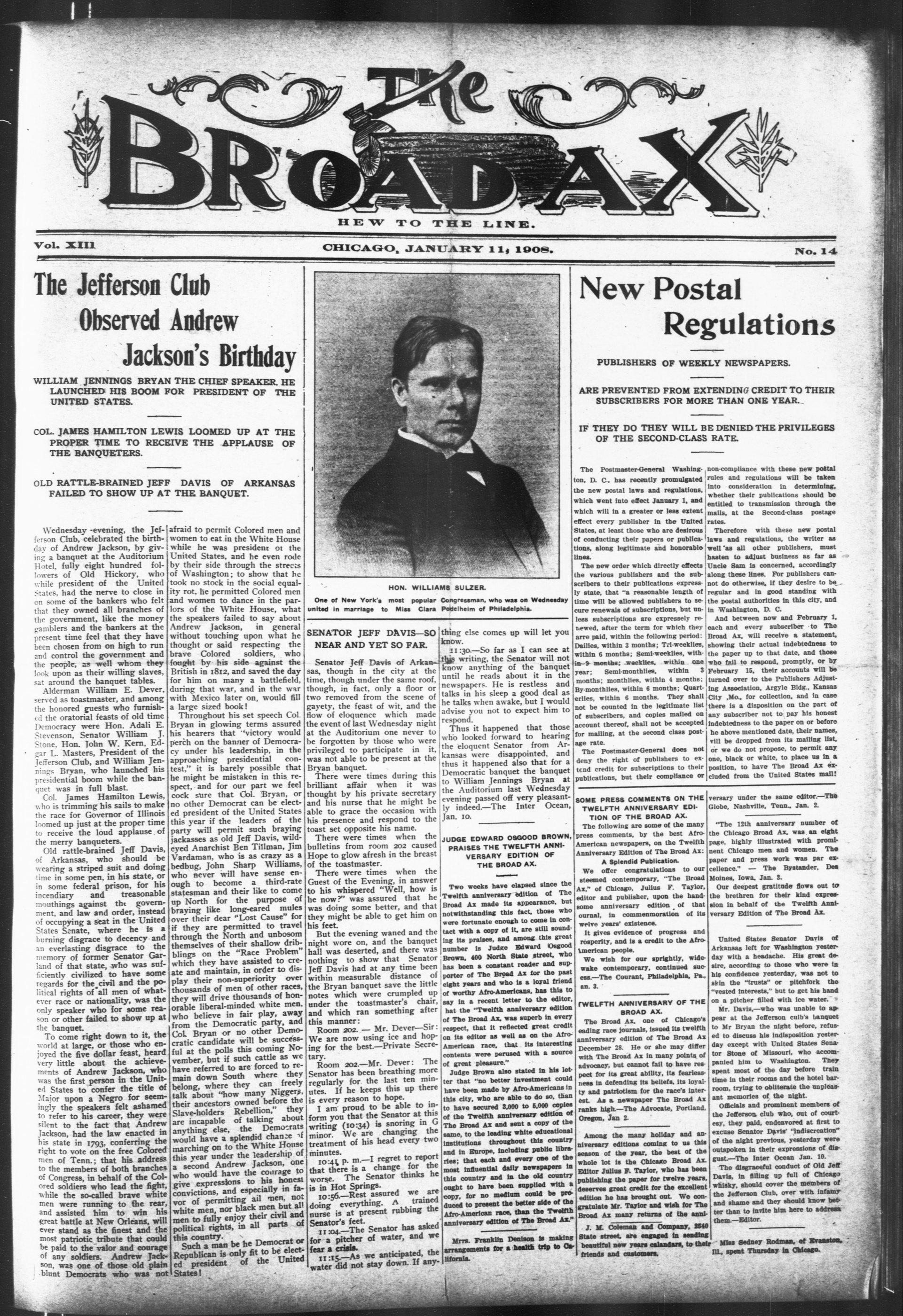
The Jefferson Club Observed Andrew Jackson's Birthday
WILLIAM JENNINGS BRYAN THE CHIEF SPEAKER. HE LAUNCHED HIS BOOM FOR PRESIDENT OF THE UNITED STATES.
COL. JAMES HAMILTON LEWIS LOOMED UP AT THE PROPER TIME TO RECEIVE THE APPLAUSE OF THE BANOUETERS.
OLD RATTLE-BRAINED JEFF DAVIS OF ARKANSAS FAILED TO SHOW UP AT THE BANQUET.
Vol. XIII
The Jefferson
Observed
Jack
WILLIAM JENNINGS BRYAN
LAUNCHED HIS BOOM IN
UNITED STATES.
COL. JAMES HAMILTON LEW
PROPER TIME TO REC
THE BANQUETERS.
OLD RATTLE-BRAINED JEFF
FAILED TO SHOW UP AT
Wednesday -evening, the Jefferson Club, celebrated the birthday of Andrew Jackson, by giving a banquet at the Auditorium Hotel, fully eight hundred followers of Old Hickory, who while president of the United States, had the nerve to close in on some of the bankers who felt that they owned all branches of the government, like the money gamblers and the bankers at the present time feel that they have been chosen from on high to run and control the government and the people, as well whom they look upon as their willing slaves, sat around the banquet tables.
Alderman William E. Dever, served as toastmaster, and among the honored guests who furnished the oratorial feasts of old time Democracy were Hon. Adali E. Stevenson, Senator William J. Stone, Hon. John W. Kern, Edgar L. Masters, President of the Jefferson Club, and William Jennings Bryan, who launched his presidential boom while the banquet was in full blast.
Col. James Hamilton Lewis, who is trimming his sails to make the race for Governor of Illinois loomed up just at the proper time to receive the loud applause of the merry banqueters.
Old rattle-brained Jeff Davis, of Arkansas, who should be wearing a striped suit and doing time in some pen, in his state, or in some federal prison, for his incendiary and treasonable mouthings against the government, and law and order, instead of occupying a seat in the United States Senate, where he is a burning disgrace to decency and an everlasting disgrace to the memory of former Senator Garland of that state, who was sufficiently civilized to have some regards for the civil and the political rights of all men of whatever race or nationality, was the only speaker who for some reason or other failed to show up at the banquet.
To come right down to it, the world at large, or those who enjoyed the five dollar feast, heard very little about the achievements of Andrew Jackson, who was the first person in the United States to confer the title of Major upon a Negro for seemingly the speakers felt ashamed to refer to his career, they were silent to the fact that Andrew Jackson, had the law enacted in his state in 1793, conferring the right to vote on the free Colored men of Tenn.; that his address to the members of both branches of Congress, in behalf of the Colored soldiers who lead the fight, while the so-called brave white men were running to the rear, and assisted him to win his great battle at New Orleans, will ever stand as the finest and the most patriotic tribute that could be paid to the valor and courage of any soldiers. Andrew Jackson, was one of those old plain blunt Democrats who was not
afraid to permit Colored men and women to eat in the White House while he was president of the United States, and he even rode by their side through the streets of Washington; to show that he took no stock in the social equality rot, he permitted Colored men and women to dance in the parlors of the White House, what the speakers failed to say about Andrew Jackson, in general without touching upon what he thought or said respecting the brave Colored soldiers, who fought by his side against the British in 1812, and saved the day for him on many a battlefield, during that war, and in the war with Mexico later on, would fill a large sized book!
Throughout his set speech Col. Bryan in glowing terms assured his hearers that "victory would perch on the banner of Democracy under his leadership, in the approaching presidential contest," it is barely possible that he might be mistaken in this respect, and for our part we feel cock sure that Col. Bryan, or no other Democrat can be elected president of the United States this year if the leaders of the party will permit such braying jackasses as old Jeff Davis, wildeyed Anarchist Ben Tillman, Jim Vardaman, who is as crazy as a bedbug, John Sharp Williams, who never will have sense enough to become a third-rate statesman and their like to come up North for the purpose of braying like long-eared mules over their dear "Lost Cause" for if they are permitted to travel through the North and unbosom themselves of their shallow driblings on the "Race Problem" which they have assisted to create and maintain, in order to display their non-superiority over thousands of men of other races, they will drive thousands of honorable liberal-minded white men, who believe in fair play, away from the Democratic party, and Col. Bryan or no other Democratic candidate will be successful at the polls this coming November, but if such cattle as we have referred to are forced to remain down South where they belong, where they can freely talk about "how many Niggers their ancestors owned before the Slave-holders Rebellion," they are incapable of talking about anything else, the Democrats would have a splendid change in marching on to the White House this year under the leadership of a second Andrew Jackson, one who would have the courage to give expressions to his honest convictions, and especially in favor of permitting ail men, nor white men, nor black men but all men to fully enjoy their civil and political rights, in all parts of this country.
Such a man be he Democrat or Republican is only fit to be elected president of the United States!
HEW TO THE LINE.
[Picture of a man in a suit with a bow tie].
HON. WILLIAMS SULZER.
One of New York's most popular Congressman, who was on Wednesday united in marriage to Miss Clara Podelheim of Philadelphia.
SENATOR JEFF DAVIS—SO NEAR AND YET SO FAR.
Senator Jeff Davis of Arkansas, though in the city at the time, though under the same roof, though, in fact, only a floor or two removed from the scene of gayety, the feast of wit, and the flow of eloquence which made the event of last Wednesday night at the Auditorium one never to be forgotten by those who were privileged to participate in it, was not able to be present at the Bryan banquet.
There were times during this brilliant affair when it was thought by his private secretary and his nurse that he might be able to grace the occasion with his presence and respond to the toast set opposite his name.
There were times when the bulletins from room 202 caused Hope to glow afresh in the breast of the toastmaster.
There were times when the Guest of the Evening, in answer to his whispered "Well, how is he now?" was assured that he was doing some better, and that they might be able to get him on his feet.
But the evening waned and the night wore on, and the banquet hall was deserted, and there was nothing to show that Senator Jeff Davis had at any time been within measurable distance of the Bryan banquet save the little notes which were crumpled up under the toastmaster's chair, and which ran something after this manner:
Room 202. Mr. Dever—Sir: We are now using ice and hoping for the best.—Private Secretary.
Room 202—Mr. Dever: The Senator has been breathing more regularly for the last ten minutes. If he keeps this up there is every reason to hope.
I am proud to be able to inform you that the Senator at this writing (10:34) is snoring in G minor. We are changing the treatment of his head every two minutes.
10:41 p. m.—I regret to report that there is a change for the worse. The Senator thinks he is in Hot Springs.
is in Hot Spring
10:56.—Rest assured we are
doing everything. A trained
nurse is at present rubbing the
Senator's feet.
Senator's feet.
11:04.-The Senator has asked
for a pitcher of water, and we
for a peltie
fear a crisis.
11:15.—As we anticipated, the water did not stay down. If any-
thing else comes up will let you know.
11:30.—So far as I can see at this writing, the Senator will not know anything of the banquet until he reads about it in the newspapers. He is restless and talks in his sleep a good deal as he talks when awake, but I would advise you not to expect him to respond.
Thus it happened that those who looked forward to hearing the eloquent Senator from Arkansas were disappointed, and thus it happened also that for a Democratic banquet the banquet to William Jennings Bryan at the Auditorium last Wednesday evening passed off very pleasantly indeed.—The Inter Ocean, Jan. 10.
JUDGE EDWARD OSGOOD BROWN
PRAISES THE TWELFTH ANNIVERSARY EDITION OF
THE BROAD AX.
Two weeks have elapsed since the Twelfth anniversary edition of The Broad Ax made its appearance, but notwithstanding this fact, those who were fortunate enough to come in contact with a copy of it, are still sounding its praises, and among this great number is Judge Edward Osgood Brown, 400 North State street, who has been a constant reader and supporter of The Broad Ax for the past eight years and who is a loyal friend of worthy Afro-Americans, has this to say in a recent letter to the editor, that the "Twelfth anniversary edition of The Broad Ax, was superb in every respect, that it reflected great credit on its editor as well as on the Afro-American race, that its interesting contents were perused with a source of great pleasure."
Judge Brown also stated in his letter that "no better investment could have been made by Afro-Americans in this city, who are able to do so, than to have secured 3,000 to 5,000 copies of the Twelfth anniversary edition of The Broad Ax and sent a copy of the same, to the leading white educational institutions throughout this country and in Europe, including public libraries; that each and every one of the most influential daily newspapers in this country and in the old country ought to have been supplied with a copy, for no medium could be produced to present the better side of the Afro-American race, than the Twelfth anniversary edition of The Broad Ax."
Mrs. Franklin Denison is making arrangements for a health trip to California.
New Postal Regulations
PUBLISHERS OF WEEKLY NEWSPAPERS.
ARE PREVENTED FROM EXTENDING CREDIT TO THEIR SUBSCRIBERS FOR MORE THAN ONE YEAR.
IF THEY DO THEY WILL BE DENIED THE PRIVILEGES OF THE SECOND-CLASS RATE.
The Postmaster-General Washington, D. C., has recently promulgated the new postal laws and regulations, which went into effect January 1, and which will in a greater or less extent effect every publisher in the United States, at least those who are desirous of conducting their papers or publications, along legitimate and honorable lines.
The new order which directly effects the various publishers and the subscribers to their publications expressly state, that "a reasonable length of time will be allowed publishers to secure renewals of subscriptions, but unless subscriptions are expressly renewed, after the term for which they arre paid, within the following period: Dallies, within 3 months; Tri-weeklies, within 6 months; Semi-weeklies, within in-9 months; weeklies, within one year; Semi-monthlies, within 3 months; monthlies, within 4 months; By-monthlies, within 6 months; Quartierlies, within 6 months. They shall not be counted in the legitimate list of subscribers, and copies mailed on account thereof, shall not be accepted for mailing, at the second class postage rate.
The Postmaster-General does not deny the right of publishers to extend credit for subscriptions to their publications, but their compliance or
SOME PRESS COMMENTS ON THE TWELFTH ANNIVERSARY EDITION OF THE BROAD AX.
The following are some of the many press comments, by the best Afro-American newspapers, on the Twelfth Anniversary Edition of The Broad Ax: A Splendid Publication.
We offer congratulations to our steemed contemporary, "The Broad Ax," of Chicago, Julius F. Taylor, editor and publisher, upon the handsome anniversary edition of that journal, in commemoration of its twelve years' existence.
It gives evidence of progress and prosperity, and is a credit to the Afro-American people.
We wish for our sprightly, wide-wake contemporary, continued success.—The Courant, Philadelphia, Pa., an. 3.
[WELFTH ANNIVIERSARY OF THE
BROAD AX.
The Broad Ax. one of Chicago's leading race journals, issued its twelfth anniversary edition of The Broad Ax December 28. He or she may differ with The Broad Ax in many points of advocacy, but cannot fail to have respect for its great ability, its fearlessness in defending its beliefs, its loyalty and patriotism for the race's interest. As a newspaper The Broad Ax ranks high—The Advocate, Portland, Oregon, Jan 2.
Among the many holiday and anniversary editions coming to us this season of the year, the best of the whole lot is the Chicago Broad Ax. Editor Julius F. Taylor, who has been publishing the paper for twelve years, deserves great credit for the excellent edition he has brought out. We congratulate Mr. Taylor and wish for The Broad Ax many returns of the anil.
J. M. Coleman and Company, 2840 State street, are engaged in sending beautiful new years calandars, to their friends and customers.
total regulations
KLY NEWSPAPERS.
ATTENDING CREDIT TO THEIR
BE THAN ONE YEAR.
BE DENIED THE PRIVILEGES
S RATE.
non-compliance with these new postal
rules and regulations will be taken
into consideration in determining,
whether their publications should be
entitled to transmission through the
malls, at the Second-class postage
rates.
Therefore with these new postal laws and regulations, the writer as well as all other publishers, must hasten to adjust business as far as Uncle Sam is concerned, accordingly along these lines. For publishers cannot do otherwise, if they desire to be regular and in good standing with the postal authorities in this city, and in Washington, D. C.
And between now and February 1, each and every subscriber to The Broad Ax, will receive a statement, showing their actual indebtedness to the paper up to that date, and those who fail to respond, promptly, or by February 15, their accounts will be turned over to the Publishers Adjusting Association, Argyle Bldg., Kansas City, Mo., for collection, and in case there is a disposition on the part of any subscriber not to pay his honest indebtedness to the paper on or before he above mentioned date, their names, will be dropped from its mailing list, or we do not propose, to permit any, one, black or white, to place us in a position, to have The Broad Ax excluded from the United States mall!
versary under the same editor.—The Globe, Nashville, Tenn., Jan. 2.
"The 12th anniversary number of the Chicago Broad Ax, was an eight page, highly illustrated with prominent Chicago men and women. The paper and press work was par excellence." — The Bystander, Des Moines, Iowa, Jan. 3.
Our deepest gratitude flows out to the brethren for their kind expression in behalf of the Twelfth Anniversary Edition of The Broad Ax.
United States Senator Davis of Arkansas left for Washington yesterday with a headache. His great desire, according to those who were in his confidence yesterday, was not to skin the "trusts" or pitchfork the "vested interests," but to get his hand on a pitcher filled with ice water. Mr. Davis,—who was unable to appear at the Jefferson cub's banquet to Mr Bryan the night before, refused to discuss his indisposition yesterday except with United States Senator Stone of Missouri, who accompanied him to Washington. They spent most of the day before train time in their rooms and the hotel barroom, trying to obliterate the unpleasant memories of the night.
Officials and prominent members of the Jefferson club who, out of courtesy, they paid, endeavored at first to excuse Senator Davis' "Indiscreation" of the night previous, yesterday were outspoken in their expressions of disgust.—The Inter Ocean Jan. 10.
The disgraceful conduct of Old Jeff Davis, in filling up full of Chicago whisky, should cover the members of the Jefferson Club, over with infamy and shame and they should know better than to invite him here to address them.—Editor.
Miss Sedney Rodman, of Evanston, Ill., spent Thursday in Chicago.
THE BROAD AXI
Will promulgate and at all times uphold the true principles of Democracy, but Catholicism, Protestantism, Freedoms of Labor, Single Taxes, Republican Fights of Labor, or any one else can have their say, so long as their language is proper and responsibility is fixed.
The Broad *i*<sub>2</sub> is a newspaper whose platform is true, even claiming the editorial to be its own mind.
Local communications will receive attention
within one side of the paper.
Entered at the Post Office at Chicago
M. as Second-clear Matter.
TIME IS CALLED ON GEORGE
DIXON.
Greatest Negro Fighter of His Day
Dies in New York Hospital.
Falls Prey to Alcohol.
Winner of Several Hundred Fistic En-
counters, Pennless and Friends.
New York, Jan. 6.—The greatest fighter of his time and the winner of several hundred fistic encounters, George Dixon, the Negro pugilist, familiarly called "Little Chocolate," died to day at Bellevue hospital, the victim of a long fight with drink. Iolized in his prime by thousands as a pugilistic hero, George Dixon passed away practically penniless and without friends. Dixon was 37 years old, and for many years held the title of featherweight champion.
George Dixon fought several hundred ring battles, his first being in 1886, when he whipped a boy named Johnson in Halifax, N. S. From that time until Terry McGovern knocked him out in 1900 and broke his heart, no man of his weight ever whipped him. He won the featherweight title in 1891, by whipping the champion, Cal McCarthy. Dixon was a perfect fighting machine as far as attack and defense was concerned, and his peculiar ability to strike a blow from any position made him a formidable opponent. Dixon won thousand of dollars in the prize ring, which he spent with convival companions.
A wasted, wan figure was brought to Bellevue hospital two days ago and ticketed in the alcoholic ward as George Dixon. To the doctor he said that he had "fought his last fight with John Barleycorn, and had been beaten." He told the physicians that he had no friends except John L. Sullivan. His condition grew rapidly worse, and late to-day the former champion died. Through his honesty in the ring and out of it, Dixon gained the esteem of all classes. Never in any of his many battles had there been even a hint of double dealing, and he disarmed the bitterest prejudice wherever he appeared. Through his popularity he did much to uplift his race.
The noted fighter appeared three times in Chicago rings and he was a great favorite with the local fight fans. On July 14, 1900, he fought and beat Eddie Santry in six rounds and the next year in June he was matched with Benny Yanger and Terry McGovern. Terry was at his best then, while Dixon was on the down grade. A grand display of all known ring tactics was not enough to save "Little Chocolate" from defeat at the hands of the "Terrible Terry," and the decision was awarded against him at the end of the sixth round. After this battle Dixon tried the saloon business here, but the venture was not a successful one and he drifted back east—The Chicago Tribune Jan. 7.
The sad ending of the career of little George Dixon, should be a warning to other prize fighters, in fact to all men not to put in all of their time in an endeavor to dring up all the beer and whisky in the United States!—Editor.
FENCE POSTS MADE DURABLE.
Woods Given Sixteen Years' Additional Service by Preservative Treatment.
Fence posts of many kinds of cheap woods which ordinarily would soon decay if set in the ground can be made to last for twenty years by a simple treatment with creosote. Most of the so-called "inferior" woods are well adapted to the treatment, and this is especially true of cottonwood, aspen, willow, sycamore, low-grade pines, and some of the gums. When properly treated, these woods outlast untreated cedar and oak, which are becoming too scarce and too much in demand for other uses to allow of their meeting the demand for fence posts.
Impregnation with creosote has been greatly cheapened by the introduction of the "open tank," which can be installed at a cost of from $30 to $45, or much less if an old hollow
is used. A tank with a bottom 12 square feet in area will suffice for treating 40 or 50 6-inch posts a day, or double this number when two runs per day can be made. The absorption of creosote per post is about as follows: Eucalyptus, one-tenth gallon; willow, two-tenthhs gallon; sassafras, ash, hickory, red oak, water oak, elm, and maple, fourtenthhs gallon; Douglas fir, quaking aspen, and black walnut, six-tenthhs gallon; sycamore, cottonwood, and lodgepole pine, sevententhhs gallon. The price of creosote is about 10 cents per gallon in the East and Middle West, 16 cents per gallon on the Pacific coast, and 27 cents per gallon in the Rock Mountain States. The cost of treating a post will therefore vary from 4 to cents. Properly treated, it should give service for at least twenty years. Experiments of the Forest Service show that with preservative treatment the durability of lodgepole pine in Idaho is increased sixteen years. The cost of creosote is there relatively high, yet by treating posts there is a saving, with interest at 6 per cent, of 2 cents per post yearly. More important than the saving, however, is the fact that through preservative treatment other woods are fitted to take the place of cedar, of which the supply is rapidly becoming exhausted. A detailed description of experiments in preserving fence posts, together with practical suggestions for treating them on a commercial scale, are contained in Circular 117 of the Forest Service. This publication can be obtained upon application to the Forester at Washington.
WORKING THE NEWSPAPERS.
Inconsistencies of People Who Look For Free Advertising.
There are two ways of getting into a newspaper—purchasing an interest and purchasing an interview. There is still another way—pulling the wool over the editor's eyes and getting in for nothing. This is a very popular form with entertainment committees. They will come round "all so nice" and want the play "advertised" in the paper, but when the printing is given out they feel like "dividing the business." The newspaper office gets the "items," and the "cash business" must go elsewhere.—Old Town Enterprise.
Every newspaper publisher knows how it is to be "worked" as indicated above. Good people who are absolutely fair and honest in other relations and who are not in the habit of trying to get something for nothing at the stores forget too often their business principles and their idea of a square deal when they "work" the newspapers for free advertising in behalf of something in which they are interested. This is usually an entertainment or fair or sale which comes into direct competition in a small way with the merchants who publish advertisements and pay for them. It is not a matter of great importance, but small nuisances are often the most annoying, and this is one with which all newspapers constantly have to contend.—Augusta (Me.) Journal.
The past four or five years we have been worked to a dead standstill by all kinds of slick tounged individuals, but this coming year free advertising for balls, parties and entertainments, for which admission is charged to enter the same, will be cut out, for nothing will go but the cash, and no more long winded resolutions, relating to the death of anyone who may happen to be the grand mogul of all the secret societies in town, and on dying not leaving enough money on hand to pay one month's rent for his wife and children, will be published these columns, unless the cash accompanies such resolutions at the rate of 15 cents per line.
Henry Golings of Shreveport, La., is evidently, full of race pride and enterprise, for without the least soliciting, or any duning whatever on our part, and without looking for a lot of free advertising in advance, he has forwarded his subscription to The Broad Ax, which shows, that he fully realizes, that the best way, to keep newspapers alive, those that are well established, is to pay his subscription to The Broad Ax in advance.
The Municipal Voters League in its report Wednesday January 8th, on the outgoing members of the city council, deals the city daddies, some hard blows, and it recommends, that 23 of the present 35 aldermen whose terms, expire April 1st, have been weighed in the balance, and found waning and that they should not be re-elected to the city council.
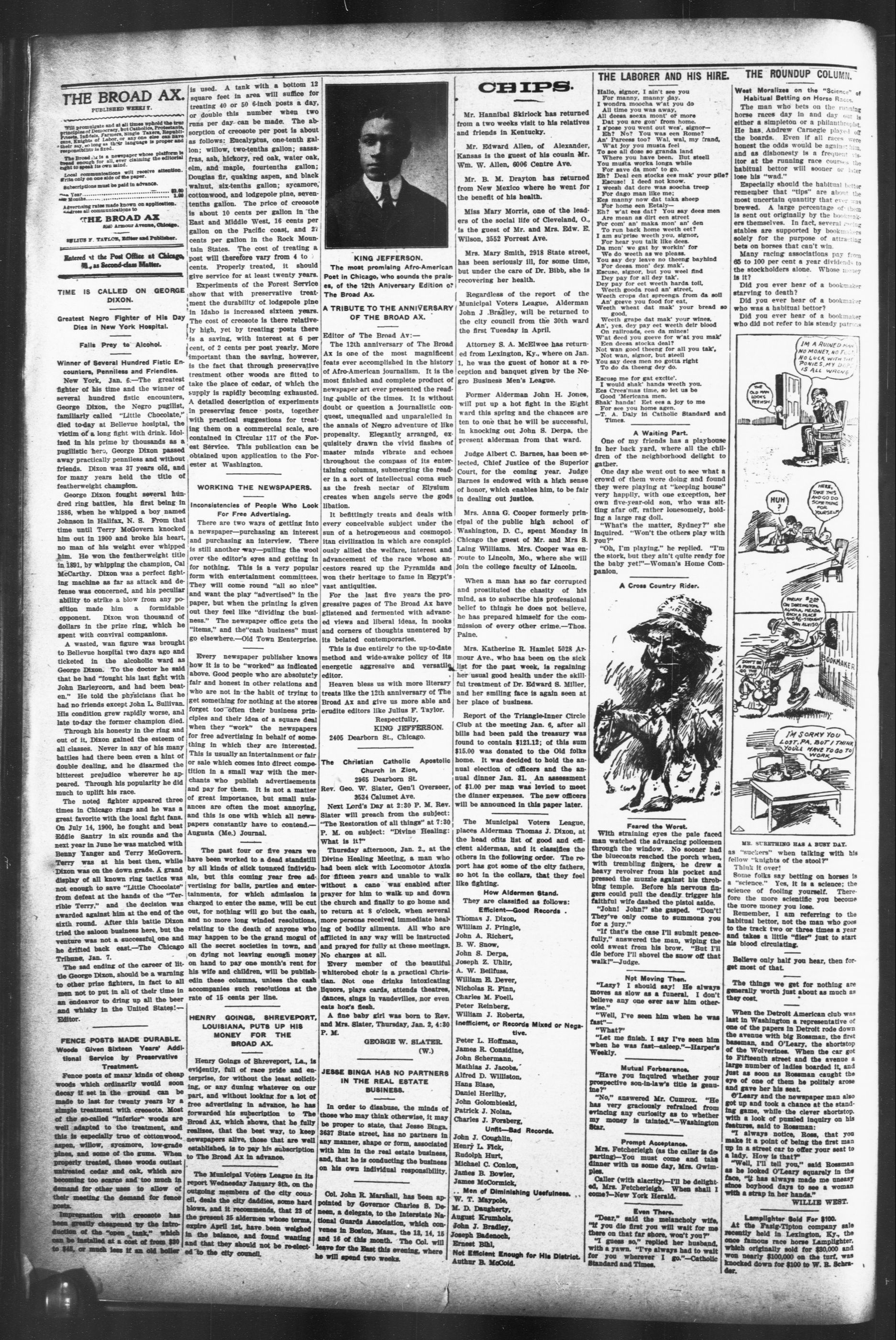
KING JEFFERSON.
The most promising Afro-American Poet in Chicago, who sounds the praises, of the 12th Anniversary Edition of The Broad Ax.
A TRIBUTE TO THE ANNIVERSARY OF THE BROAD AX.
Editor of The Broad Av:—
The 12th anniversary of The Broad Ax is one of the most magnificent feats ever accomplished in the history of Afro-American journalism. It is the most finished and complete product of newspaper art ever presented the reading public of the times. It is without doubt or question a journalistic conquest, unequalled and unparalleled in the annals of Negro adventure of like propensity. Elegantly arranged, exquisitely drawn the vivid flashes of master minds vibrate and echoes throughout the compass of its entertaining columns, submerging the reader in a sort of intellectual coma such as the fresh nectar of Elysium creates when angels serve the gods libation.
It befittingly treats and deals with every conceivable subject under the sun of a heterogeneous and cosmopolitan civilization in which are conspicuously allied the welfare, interest and advancement of the race whose ancestors reared up the Pyramids and won their heritage to fame in Egypt's vast antiquities.
For the last five years the progressive pages of The Broad Ax have glistened and fermented with advanced views and liberal ideas, in nooks and corners of thoughts unentered by its belated contemporaries.
This is due entirely to the up-to-date method and wide-awake policy of its energetic aggressive and versatile editor.
Heaven bless us with more literary treats like the 12th anniversary of The Broad Ax and give us more able and erudite editors like Julius F. Taylor.
Respectfully,
KING JEFFERSON.
2405 Dearborn St., Chicago.
The Christian Catholic Apostolic Church in Zion,
2965 Dearborn St.
Rev. Geo. W. Slater, Gen'l Overseer,
3534 Calumet Ave.
Next Lord's Day at 2:30 P. M. Rev.
Slater will preach from the subject:
"The Restoration of all things" at 7:30
P. M. on subject: "Divine Healing:
What is it?"
Thursday afternoon, Jan. 2., at the Divine Healing Meeting, a man who had been sick with Locomotor Atoxia for fifteen years and unable to walk without a cane was enabled after prayer for him to walk up and down the church and finally to go home and to return at 8 o'clock, when several more persons received immediate healing of bodily ailments. All who are afflicted in any way will be instructed and prayed for fully at these meetings. No charges at all.
Every member of the beautiful whiterobed choir is a practical Christian. Not one drinks intoxicating liquors, plays cards, attends theatres, dances, sings in vaudevilles, nor even eats hog's flesh.
A fine baby girl was born to Rev. and Mrs. Slater, Thursday, Jan. 2, 4:30 P. M.
GEORGE W. SLATER. (W.)
JESSE BINGA HAS NO PARTNERS IN THE REAL ESTATE BUSINESS
In order to disabuse, the minds of those who may think otherwise, it may be proper to state, that Jesse Binga, 3637 State street, has no partners in any manner, shape or form, associated with him in the real estate business, and, that he is conducting the business on his own individual responsibility.
Col. John R. Marshall, has been appointed by Governor Charles S. Deneen, a delegate, to the Interstate National Guards Association, which convenes in Boston, Mass., the 13, 14, 15 and 16 of this month. The Col. will leave for the East this evening, where he will spend two weeks
CHIPS
Mr. Hannibal Skirlock has returned from a two weeks visit to his relatives and friends in Kentucky.
Mr. Edward Allen, of Alexander, Kansas is the guest of his cousin Mr. Wm. W. Allen, 6006 Centre Ave.
Mr. B. M. Drayton has returned from New Mexico where he went for the benefit of his health.
Miss Mary Morris, one of the leaders of the social life of Cleveland, O., is the guest of Mr. and Mrs. Edw. E. Wilson, 3552 Forrest Ave.
Mrs. Mary Smith, 2918 State street, has been seriously ill, for some time, but under the care of Dr. Bibb, she is recovering her health.
Regardless of the report of the Municipal Voters League, Alderman John J. Bradley, will be returned to the city council from the 30th ward the first Tuesday in April.
Attorney S. A. McElwee has returned from Lexington, Ky., where on Jan. 1, he was the guest of honor at a reception and banquet given by the Negro Business Men's League.
Former Alderman John H. Jones, will put up a hot fight in the Eight ward this spring and the chances are ten to one that he will be successful, in knocking out John S. Derpa, the present alderman from that ward.
Judge Albert C. Barnes, has been selected, Chief Justice of the Superior Court, for the coming year. Judge Barnes is endowed with a high sense of honor, which enables him, to be fair in dealing out justice.
Mrs. Anna G. Cooper formerly principal of the public high school of Washington, D. C., spent Monday in Chicago the guest of Mr. and Mrs S. Laing Williams. Mrs. Cooper was enroute to Lincoln, Mo., where she will join the college faculty of Lincoln.
When a man has so far corrupted and prostituted the chasity of his mind, as to subscribe his professional belief to things he does not believe, he has prepared himself for the commission of every other crime.—Thos. Paine.
Mrs. Katherine R. Hamlet 5028 Armour Ave., who has been on the sick list for the past week, is regaining her usual good health under the skillful treatment of Dr. Edward S. Miller, and her smiling face is again seen at her place of business.
Report of the Triangle-Inner Circle Club at the meeting Jan. 6, after all bills had been paid the treasury was found to contain $121.12; of this sum $15.00 was donated to the Old folks home. It was decided to hold the annual election of officers and the annual dinner Jan. 31. An assessment of $1.00 per man was levied to meet the dinner expenses. The new officers will be announced in this paper later.
The Municipal Voters League, places Alderman Thomas J. Dixon, at the head ofits list of good and efficient alderman, and it classifies the others in the following order. The report has got some of the city fathers, so hot in the collars, that they feel like fighting.
How Aldermen Stand.
They are classified as follows:
Efficient—Good Records.
Thomas J. Dixon,
William J. Pringle,
John A. Richert,
B. W. Snow,
John S. Derpa,
Joseph Z. Uhlir,
A. W. Bellfuss,
William E. Dever,
Nicholas R. Finn,
Charles M. Foell,
Peter Reinberg,
William J. Roberts,
inefficient, or Records Mixed or Nega-
tive.
Peter L. Hoffman,
James R. Considine,
John Schermann,
Mathias J. Jacobs,
Alfred D. Williston,
Hans Blase,
Daniel Herlhy,
John Golombleski,
Patrick J. Nolan,
Charles J. Forsberg,
Unfit—Bad Records.
John J. Coughlin,
Henry L. Fick,
Rudolph Hurt,
Michael C. Conlon,
James B. Bowler,
James McCormick,
... Men of Diminishing Usefulness.
W. T. Maypole,
M. D. Daugherty,
August Krumholz,
John J. Bradley,
Joseph Badenoch,
Ernest Bhll,
Not Efficient Enough for His District.
Authur B. McCold.
THE LABORER AND HIS HIRE
Hallo, I nint' iaint you
For manny, manny day.
I wondra mocha w'at you do
All time you was away.
All deea sexa mont' or more
Dat you are gon' from home.
Eh? No? You was een Rome?
An' Parecess too? Wal, wal, my frand,
Wat joy you musta feel
To see all dose so granda land
Where you have been. But steell
You musta worka longa while
For save da mon' you gon'
Eh? Pauss locks ees mak' your pile?
Escuse! I deed not know.
I weesh d dere was soocha treep
For dago man like me;
Ees manny now d taka sheep
For home een Eetaly—
Eh? w'at ees dat? You say dees man
Are mean saw eeet street
For save da mon' maka mon' an' den
To run back home weeth cet?
I am suprise weeth you, signor,
For hear you talk like dees.
Da mon' we gat by workin' for
We do weeth as we pleas.
You say dey leave no theeing bayhind
For deees mon' dey mak'.
Eschach deeps find deey pay for all deey tak'.
Dey pay for eet weeth hardt toll,
Weeth gooda road an' street,
Weeth crops d spreenea from da soll
An' geeve you food for eat,
Weeth wheat dat mak' your bread so
good.
Weeth grape dat mak' your wines,
An' yes, dey pay eet weeth deir blood
On railroads, ene da mines!
Wat deed you geeve for w'at you mak'
Een deees stocka deal?
Not wan good theeng for all you tak',
Not wan, signor, but steell
You say dees men no gotta right
To do da theeng dey do.
Escuse me for gat excite!
I would shak' hands weeth you.
Ees Cees'mas time, so let us be
Good 'Mericana men.
Shak' hands! Eet ees a joy to me
Ees manny
-T. A. Daly in Catholic Standard and Times.
A Waiting Part.
One of my friends has a playhouse in her back yard, where all the children of the neighborhood delight to gather.
One day she went out to see what a crowd of them were doing and found they were playing at "keeping house" very happily, with one exception, her own five-year-old son, who was sitting afar off, rather lonesomely, holding a large rag doll.
"What's the matter, Sydney?" she inquired. "Won't the others play with you?"
"Oh, I'm playing," he replied. "I'm the stork, but they ain't quite ready for the baby yet!"—Woman's Home Companion.
A Cross Country Rider.
With straining eyes the pale faced man watched the advancing policemen through the window. No sooner had the bluecoats reached the porch when, with trembling fingers, he drew a heavy revolver from his pocket and pressed the muzzle against his throbbing temple. Before his nervous fingers could pull the deadly trigger his faithful wife dashed the pistol aside. "John! John!" she gasped. "Don't! They've only come to summons you for a jury." "If that's the case I'll submit peacefully," answered the man, wiping the cold sweat from his brow. "But I'll die before I'll shovel the snow off that walk!"-Judge.
Not Moving Then
"Lazy? I should say! He always moves as slow as a funeral. I don't believe any one ever saw him otherwise."
"Well, I've seen him when he was fast"—
"What?"
"Let me finish. I say I've seen him when he was fast—asleep."—Harper's Weekly.
"Have you inquired whether your prospective son-in-law's title is genuine?"
"No," answered Mr. Cumrox. "He has very graciously refrained from evincing any curiosity as to whether my money is tainted."—Washington Star.
Prompt Acceptance
Mrs. Fetcherleigh (as the caller is departing) - You must come and take dinner with us some day, Mrs. Gwimples.
Caller (with alacrity) - I'll be delighted, Mrs. Fetcherleigh. When shall I come? - New York Herald.
Even There.
"Dear," said the melancholy wife, "if you die first you will wait for me there on that far shore, won't you?" "I guess so," replied her husband, with a yawn. "I've always had to wait for you wherever I go."—Catholic Standard and Times.
West Moralizes on the "Science" of Habitual Betting on Horse Races.
The man who bets on the running horse races day in and day out is either a simpleton or a philanthropist. He has, Andrew Carnegie played on the boards. Even if all races were honest the odds would be against him, and as dishonesty is a frequent visitor at the running race courses the habitual bettor will sooner or later lose his "wad."
Especially should the habitual better remember that "tips" are about the most uncertain quantity that ever was brewed. A large percentage of them is sent out originally by the bookmakers themselves. In fact, several rookies stables are supported by bookmakers solely for the purpose of attracting bets on horses that can't win.
Many racing associations pay from 65 to 100 per cent a year dividends to the stockholders alone. Whose money is it?
Did you ever hear of a bookmaker
starving to death?
Did you ever hear of a bookmaker
who was a habitual better?
Did you ever hear of a bookmaker
who did not refer to his steady patron
IM A RUINED MAN
NO MONEY, NO FUCK
NO LUCK WITH THE
PONIES, MY DOG
IS ALL WHONG
THE CLOWN MAN
LOOKS PREWISH!
HERE,
TIME THIS
MOROCO DO
SOMETHING
FOR
YOURSELF
PINLAY #200
ON DRECING TOM,
MARILLA, WELCOME
BACK A PLACE
AND 26-STUDENT
SUN ALNISO
DON'T BE
A PINTER, GO
MY LET!
BOOKMAKER
IM SORRY YOU
LOST, PA. BUT I THINK
YOU'LL HAVE TO GO TO
WORK
MR. SURETHING HAS A BUSY DAY.
as "suckers" when talking with his
fellow "knights of the stool?"
Think it over!
Some folks say betting on horses is
a "science." Yes, it is a science; the
science of fooling yourself. Therefore the more scientific you become the more money you lose.
Remember, I am referring to the habitual better, not the man who goes to the track two or three times a year and takes a little "diler" just to start his blood circulating.
Belleve only half you hear, then forget most of that.
The things we get for nothing are generally worth just about as much as they cost.
When the Detroit American club was last in Washington a representative of one of the papers in Detroit rode down the avenue with big Rossman, the first baseman, and O'Leary, the shortstop of the Wolverines. When the car got to Fifthenth street and the avenue a large number of ladies boarded it, and just as soon as Rossman caught the eye of one of them he politely arose and gave her his seat.
O'Leary and the newspaper man also got up and took a chance at the standing game, while the clever shortstop, with a look of puzzled inquiry on his features, said to Rossman:
"I always notice, Ross, that you make it a point of being the first man up in a street car to offer your seat to a lady. How is that?
"Well, I'll tell you," said Rossman as he looked O'Leary squately in the face, "it has always made me uneasy since boyhood days to see a woman with a strap in her hands."
WILLIE WEST.
Lamplighter Sold For $100.
At the Fasig-Tipton company sale recently held in Lexington, Ky, the once famous race horse Lamplighter, which originally sold for $30,000 and won nearly $100,000 on the turf, was knocked down for $100 to W. B. Schraeder.
Writes Play and Urges Manager to Put It on the Stage.
BALKS AT GIVING UP $1,000.
Barrel of Prunes and the Mammoth Cave of Kentucky Are Features of the Production—Talks It Over In a Saloon.
[Copyright, 1907, by the McClure Newspaper Syndicate.]
From 8 o'clock the other afternoon, when Mrs. Bowser received a telephone message from Mr. Bowser to have dinner half an hour ahead of the usual time, to half past 5, when he came home, she was fretting and worrying as to the reason. He had refused to make any explanations over the wire. He might be going to invest in a travelling side show for the winter or have decided to head an expedition to the north pole in person. Some one might have sold him a new thing in folding beds or he might be going to invest in somebody's headache cure. She must simply wait his arrival to find out. He was home at the minute he said he would be, and instead of keeping her on the anxious seat he led right off with:
"I suppose my message mystified you somewhat, but I could not give things away over the phone. Mrs. Bowser, be prepared to be astonished." "I am always prepared," she replied. "I think I have struck the biggest thing of a lifetime. In fact, I know I
A
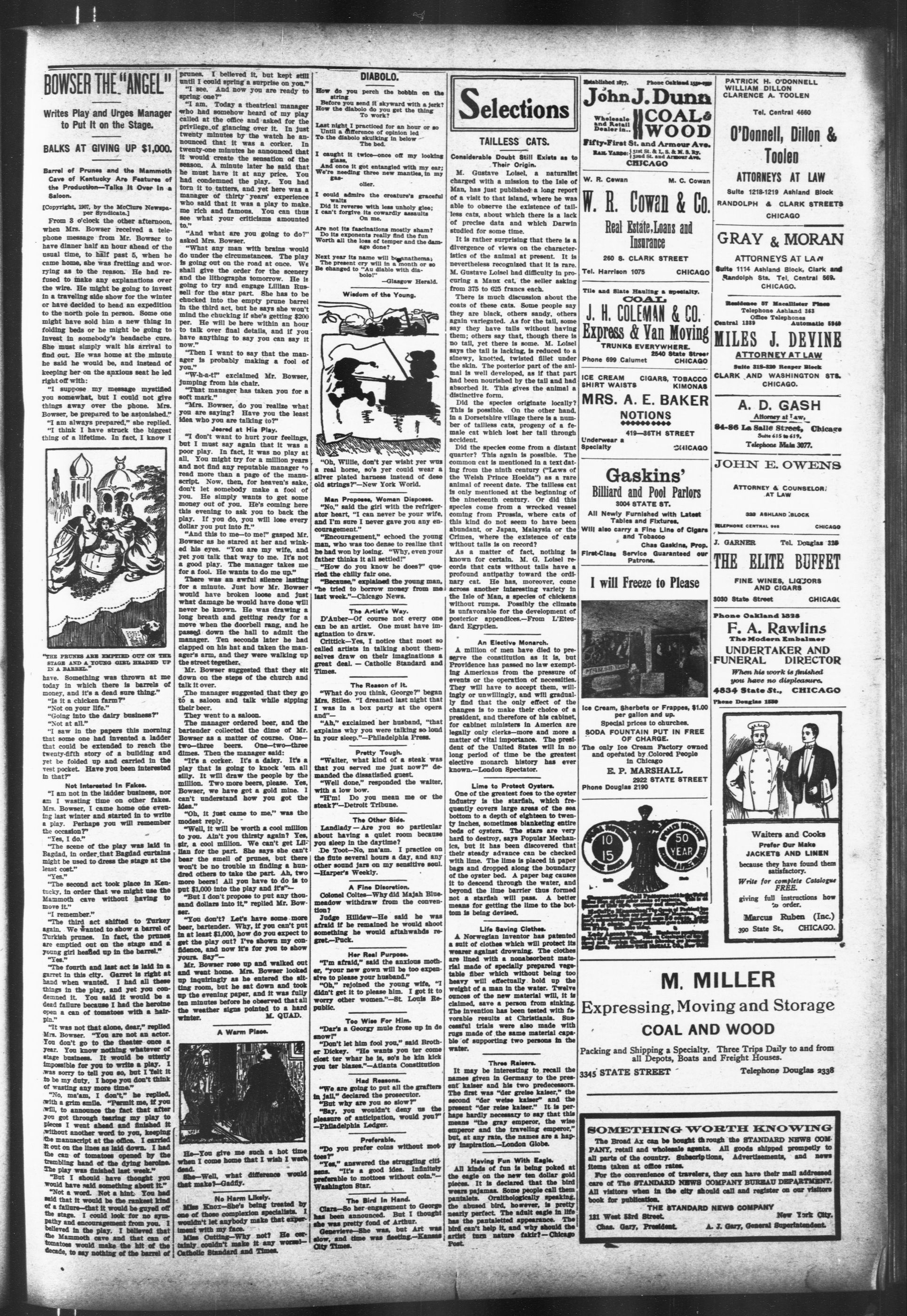
"THE PRUNES ARE EXPTED OUT ON THE STAGE AND A YOUNG GIRL HEADED UP IN A BARREL"
have. Something was thrown at me today in which there is barrels of money, and it's a dead sure thing."
"Is it a chicken farm?"
"Not on your life."
"Going into the dairy business?"
"Not at all."
"I saw in the papers this morning that some one had invented a ladder that could be extended to reach the twenty-fifth story of a building and yet be folded up and carried in the vest pocket. Have you been interested in that?"
Not Interested In Fakes.
"I am not in the ladder business, nor am I wasting time on other fakes. Mrs. Bowser, I came home one evening last winter and started in to write a play. Perhaps you will remember the occasion?"
"Yes, I do."
"The scene of the play was laid in Bagdad, in order that Bagdad curtains might be used to dress the stage at the least cost."
"Yes."
"The second act took place in Kentucky, in order that we might use the Mammoth cave without having to move it."
"I remember"
"The third act shifted to Turkey again. We wanted to show a barrel of Turkish prunes. In fact, the prunes are emptied out on the stage and a young girl headed up in the barrel." "Yes." "The fourth and last act is laid in a garret in this city. Garret is right at hand when wanted. I had all these things in the play, and yet you condemned it. You said it would be a dead failure because I had the heroine open a can of tomatoes with a hairpin." "It was not that alone, dear," replied Mrs. Bowser. "You are not an actor. You don't go to the theater once a year. You know nothing whatever of stage business. It would be utterly impossible for you to write a play. I was sorry to tell you so, but I Telt it to be my duty. I hope you don't think of wasting any more time."
"No, me'am, I don't," he replied, with a grim smile. "Permit me, if you will, to announce the fact that after you got through tearing my play to pieces I went ahead and finished it without another word to you, keeping the manuscript at the office. I carried it out on the lines as laid down. I had the can of tomatoes opened by the trembling hand of the dying heron. The play was finished last week." "But I should have thought you would have said something about it." "Not a word. Not a hint. You had said that it would be the rankest kind of a failure—that it would be guyed off the stage. I could look for no sympathy and encouragement from you. I believed in the play. I believed that the Mammoth cave and that can of tomatoes would make the hit of the decade, to say nothing of the barrel of
prunes. I believed it, but kept still until I could spring a surprise on you." "I see. And now you are ready to spring one?" "I am. Today a theatrical manager who had somehow heard of my play called at the office and asked for the privilege of glancing over it. In just twenty minutes by the watch he announced that it was a corker. In twenty-one minutes he announced that it would create the sensation of the season. A minute later he said that he must have it at any price. You had condemned the play. You had torn it to tatters, and yet here was a manager of thirty years' experience who said that it was a play to make me rich and famous. You can thus see what your criticisms amounted to." "And what are you going to do?" asked Mrs. Bowser.
"What any man with brains would do under the circumstances. The play is going out on the road at once. We shall give the order for the scenery and the lithographs tomorrow. He is going to try and engage Lillian Russell for the star part. She has to be chucked into the empty prune barrel in the third act, but he says she won't mind the chucking if she's getting $200 per. He will be here within an hour to talk over final details, and if you have anything to say you can say it now."
"Then I want to say that the manager is probably making a fool of you."
"W-h-a-t!" exclaimed Mr. Bowser, jumping from his chair.
"That manager has taken you for a soft mark."
"Mrs. Bowser, do you realize what you are saying? Have you the least idea who you are talking to?"
Jeered at His Play.
"I don't want to hurt your feelings, but I must say again that it was a poor play. In fact, it was no play at all. You might try for a million years and not find any reputable manager to read more than a page of the manuscript. Now, then, for heaven's sake, don't let somebody make a fool of you. He simply wants to get some money out of you. He's coming here this evening to ask you to back the play. If you do, you will lose every dollar you put into it."
"And this to me—to me!" gasped Mr. Bowser as he stared at her and winked his eyes. "You are my wife, and yet you talk that way to me. It's not a good play. The manager takes me for a fool. He wants to do me un."
There was an awful silence lasting for a minute. Just how Mr. Bowser would have broken loose and just what damage he would have done will never be known. He was drawing a long breath and getting ready for a move when the doorbell rang, and he passed down the hall to admit the manager. Ten seconds later he had clapped on his hat and taken the manager's arm, and they were walking up the street together.
Mr. Bowser suggested that they sit down on the steps of the church and talk it over.
The manager suggested that they go to a saloon and talk while sipping their beer.
They went to a saloon.
The manager ordered beer, and the bartender collected the dime of Mr. Bowser as a matter of course. One-two-three beers. One-two-three dimes. Then the manager said:
"It's a corker. It's a daisy. It's a play that is going to knock 'em all silly. It will draw the people by the million. Two more beers, please. Yes, Bowser, we have got a gold mine. I can't understand how you got the idea."
"Oh, it just came to me," was the modest reply.
"Well, it will be worth a cool million to you. Ain't you thirsty again? Yes, sir, a cool million. We can't get Lillian for the part. She says she can't bear the smell of prunes, but there won't be no trouble in finding a hundred others to take the part. Ah, two more beers! All you have to do is to put $1,000 into the play and it's—" "But I don't propose to put any thousand dollars into it," replied Mr. Bowser.
"You don't? Let's have some more bear, bartender. Why, if you can't put in at least $1,000, how do you expect to get the play out? I've shown my confidence, and now it's for you to show yours. Say"—Mr. Bower rose up and walked out and went home. Mrs. Bower looked up inquiringly as he entered the sitting room, but he sat down and took up the evening paper, and it was fully ten minutes before he observed that all the weather signs pointed to a hard winter. M. QUAD.
A Warm Place.
He—You give me such a hot time when I come home that I wish I were dead. She—Well, what difference would that make?—Gadfly.
No Harm Likely.
No Harm Likely.
Miss Knox--She's being treated by one of those complexion specialists. I wouldn't let anybody make that experiment with my face.
Miss Cutting—Why not? He certainly couldn't make it any worse—
Catholic Standard and Times.
DIABOLO.
How do you perch the bobbin on the string
Before you send it skyward with a jerk?
How the diabolo you do get the thing
To work?
Last night I practiced for an hour or so
Until a difference of opinion led
To the diabolo skulking in below
The bed.
I caught it twice—once off my looking glass
And once it got entangled with my ear;
We're needing three new mantles, in my gas-oller.
I could admire the creature's graceful waits
Did it reverse with less unholy glee;
I can't forgive its cowardly assaults
On me.
Are not its fascinations mostly sham?
Do its exponents really find the fun
Worth all the loss of temper and the damage done?
Next year its name will be anathema;
The present cry will in a month or so
Be changed to "Au disable with dia-
-Glasgow Herald.
"Oh, Willle, don't yer wlsht yer wun a real horse, so's yer could wear a silver plated harness instead of dese old strings?"—New York World.
Man Proposes. Woman Disposes
"No," said the girl with the refrigerator heart, "I can never be your wife, and I'm sure I never gave you any encouragement."
"Encouragement," echoed the young man, who was too dense to realize that he had won by losing. "Why, even your father thinks it all settled!
"How do you know he does?" queried the chilly fair one.
"Because," explained the young man, "he tried to borrow money from me last week."—Chicago News.
The Artist's Way.
D'Auber-Of course not every one can be an artist. One must have imagination to draw.
Crittick-Yes, I notice that most so called artists in talking about themselves draw on their imaginations a great deal. — Catholic Standard and Times.
The Reason of It.
"What do you think, George?" began Mrs. Stiles. "I dreamed last night that I was in a box party at the opera and"— "Ah," exclaimed her husband, "that explains why you were talking so loud in your sleep."—Philadelphia Press.
Pretty Tough.
"Walter, what kind of a steak was that you served me just now?" demanded the dissatisfied guest. "Well done," responded the waiter, with a low bow.
"H'm! Do you mean me or the steak?"—Detroit Tribune.
The Other Side.
Landlady — Are you so particular about having a quiet room because you sleep in the daytime?
De Toot—No, ma'am. I practice on the flute several hours a day, and any other sound jars on my sensitive soul.
-Harper's Weekly.
A Fine Discretion.
Colonel Coltes—Why did Majah Blue-meadow withdraw from the convention?
Judge Hilldew—He said he was afraid if he remained he would shoot something he would aftahwahds regret—Puck.
Her Real Purpose.
"I'm afraid," said the anxious mother, "your new gown will be too expensive to please your husband."
"Oh," rejoined the young wife, "I didn't get it to please him. I got it to worry other women."—St. Louis Republic.
Too Wise For Him.
"Dar's a Georgy mule froze up in de snow!"
"Don't let him fool you," said Brother Dickey. "He wants you ter come closest ter what he is, so's he kin kick you ter blazes." -Atlanta Constitution
Had Reasons.
"We are going to put all the grafters in jail," declared the prosecutor.
"But why are you so slow?"
"Say, you wouldn't deny us the pleasure of anticipation, would you?" Philadelphia Ledger.
Preferable.
"Do you prefer coins without mot
tress?"
"Yes," answered the struggling citizens. "It's a good idea. Infinitely preferable to mottoes without coin."—Washington Star.
The Bird In Hand.
Clara—So her engagement to George has been announced. But I thought she was pretty fond of Arthur. Genevieve—She was, but Art was slow, and time was fleeting. Kansas City Times.
Selections
TAILLESS CATS.
Considerable Doubt Still Exists as to Their Origin.
M. Gustave Lolsel, a naturalist charged with a mission to the Isle of Man, has just published a long report of a visit to that island, where he was able to observe the existence of tailless cats, about which there is a lack of precise data and which Darwin studied for some time.
It is rather surprising that there is a divergence of views on the characteristics of the animal at present. It is nevertheless recognized that it is rare.
M. Gustave Lolsel had difficulty in procuring a Manx cat, the seller asking from 375 to 625 francs each.
There is much discussion about the coats of these cats. Some people say they are black, others sandy, others again variegated. As for the tall, some say they have tails without having them; others say that, though there is no tail, yet there is some. M. Loisel says the tail is lacking, is reduced to a snewy, knotted, twisted fillet under the skin. The posterior part of the animal is well developed, as if that part had been nourished by the tail and had absorbed it. This gives the animal a distinctive form.
Did the species originate locally? This is possible. On the other hand, in a Dorsetshire village there is a number of tallless cats, progeny of a female cat which lost her tail through accident.
Did the species come from a distant quarter? This again is possible. The common cat is mentioned in a text dating from the ninth century ("Laws of the Welsh Prince Hoelda") as a rare animal of recent date. The tailless cat is only mentioned at the beginning of the nineteenth century. Or did this species come from a wrecked vessel coming from Prussia, where cats of this kind do not seem to have been abundant, or Japan, Malaysia or the Crimea, where the existence of cats without tails is on record?
As a matter of fact, nothing is known for certain. M. G. Loisel records that cats without tails have a profound antipathy toward the ordinary cat. He has, moreover, come across another interesting variety in the Isle of Man, a species of chickens without rumps. Possibly the climate is unfavorable for the development of posterior appendices.—From L'Etuded Egyptien.
An Elective Monarch.
A million of men have died to preserve the constitution as it is, but Providence has passed no law exempting Americans from the pressure of events or the operation of necessities. They will have to accept them, willingly or unwillingly, and will gradually find that the only effect of the changes is to make their choice of a president, and therefore of his cabinet, for cabinet ministers in America are legally only clerks—more and more a matter of vital importance. The president of the United States will in no long period of time be the greatest elective monarch history has ever known.—London Spectator.
Lime to Protect Oysters
One of the greatest foes to the oyster industry is the starfish, which frequently covers large areas of the sea bottom to a depth of eighteen to twenty inches, sometimes blanketing entire beds of oysters. The stars are very hard to destroy, says Popular Mechanics, but it has been discovered that their steady advance can be checked with lime. The lime is placed in paper bags and dropped along the boundary of the oyster bed. A paper bag causes it to descend through the water, and beyond the lime barrier thus formed not a starfish will pass. A better means for getting the lime to the bottom is being devised.
Life Saving Clothes
A Norwegian inventor has patented a suit of clothes which will protect its wearer against drowning. The clothes are lined with a nonabsorbent material made of specially prepared vegetable fiber which without being too heavy will effectually hold up the weight of a man in the water. Twelve ounces of the new material will, it is claimed, save a person from sinking. The invention has been tested with favorable results at Christiaania. Successful trials were also made with rugs made of the same material capable of supporting two persons in the water.
Three Raisers.
It may be interesting to recall the names given in Germany to the present kaiser and his two predecessors. The first was "der greise kaiser," the second "der weise kaiser" and the present "der reise kaiser." It is perhaps hardly necessary to say that this means "the gray emperor, the wise emperor and the traveling emperor," but at any rate, the names are a happy inspiration—London Globe.
Having Fun With Eagle.
All kinds of fun is being poked at the eagle on the new ten dollar gold pieces. It is declared that the bird wears pajamas. Some people call them pantalets. Ornithologically speaking, the abused bird, however, is pretty nearly perfect. The adult eagle in life has the pantaleted appearance. The bird can't help it, and why should the artist turn nature fakir?—Chicago Post.
Expressing, Moving and Storage
COAL AND WOOD
Packing and Shipping a Specialty. Three Trips Daily to and from
all Depots, Boats and Freight Houses.
3345 STATE STREET Telephone Douglas 2338
SOMETHING WORTH KNOWING
The Broad Ax can be bought through the STANDARD NEWS COMPANY, retail and wholesale agents. All goods shipped promptly to all parts of the country. Subscriptions, Advertisements, and news items taken at office rates.
For the convenience of travelers, they can have their mail addressed care of The STANDARD NEWS COMPANY BUREAU DEPARTMENT. All visitors when in the city should call and register on our visitors book for publication.
Fifty-First St. and Armour Ave.
Rail Yard. 51st St. & L. S. & N. S. RY.
52nd St. and Armour Ave.
CHICAGO
W. R. Cewan M. C. Cewan
W. R. Cowan & Co.
Real Estate,Loans and
Insurance
260 S. CLARK STREET
Tel. Harrison 1075 CHICAGO
Tile and Slate Hauling a specialty.
COAL.
J. H. COLEMAN & CO.
Express & Van Moving
TRUNKS EVERYWHERE.
2540 State Street
Phone 699 Calumet CHICAGO
ICE CREAM CIGARS, TOBACCO
SHIRT WAISTS KIMONAS
NOTIONS
419-36TH STREET
Underwear a
Specialty CHICAGO
Gaskins'
Billiard and Pool Parlors
3004 STATE ST.
All Newly Furnished with Latest
Tables and Fixtures.
Will also carry a Fine Line of Cigars
and Tobacco
Chas Gaskins, Prop.
First-Class Service Guaranteed our
Patron.
I will Freeze to Please
MARSH WAS
Ice Cream, Sherbetts or Frappes, $1.00
per gallon and up.
Special prices to churches.
SODA FOUNTAIN PUT IN FREE
OF CHARGE.
The only Ice Cream Factory owned
and operated by Colored People
in Chicago
E. P. MARSHALL
2922 STATE STREET
Phone Douglas 2190
10
15
50
YEAR
M. M
Expressing, Moving
COAL AND
Packing and Shipping a Specialty.
all Depots, Boats an
PATRICK H. O'DONNELL
WILLIAM DILLON
CLARENCE A. TOOLEN
Tel. Central 4660
O'Donnell, Dillon &
Toolen
ATTORNEYS AT LAW
Suite 1218-1219 Ashland Block
RANDOLPH & CLARK STREETS
CHICAGO
GRAY & MORAN
ATTORNEYS AT LAW
Suite 1114 Ashland Block, Clark and
Randolph Sts. Tel. Central 569.
CHICAGO.
Residence 57 Macallister Place
Telephone Ashland 363
Office Telephones
Central 1114 Ashland Block, Clark and
ATTORNEY AT LAW
Suite 318-330 Reaper Block
CLARK AND WASHINGTON STS.
CHICAGO.
A. D. GASH
Attorney at law,
94-86 La Salle Street, Chicago
Suite 615 to 619.
Telephone Main 3077.
JOHN E. OWENS
ATTORNEY & COUNSELOR
AT LAW
323 ASHLAND BLOCK
TELEPHONE CENTRAL 968 CHICAGO
J. GARNER Tel. Douglas 328
THE ELITE BUFFET
FINE WINES, LIQJORS
AND CIGARS
3030 State Street CHICAGO
F. A. Rawlins
The Modern Embaler
UNDERTAKER AND
FUNERAL DIRECTOR
When his work is finished
you have no displeasure.
4834 State St., CHICAGO
Phone Douglas 1520
COOK
Waiters and Cooks
Prefer Our Make
JACKETS AND LINEN
because they have found them
satisfactory.
Write for complete Catalogue
FREE.
giving full instructions how
to order.
Marcus Ruben (Inc.)
390 State St., CHICAGO.
ILLER
ing and Storage
D WOOD
Three Trips Daily to and from
d Freight Houses.
DANGEROUS FREIGHT.
Cargoes That Are a Source of Danger to Vessels.
Exhaustive experiments by the New South Wales government have now proved—what has all along been suspected—that wool will under certain conditions ignite spontaneously and that consequently it is a dangerous cargo to carry.
Probably, therefore, it will be added to the list of commodities which the board of trade decrees must be stowed with extra care, commodities which include such diverse articles as matches, acids, gunpowder, coal, wheat and timber. This, however, will be but poor consolation to the harassed sea captain, since all these things have to be carried anyhow, somehow. Besides, the danger frequently lies not so much in cargoes known to be dangerous as in those supposed to be safe. Thus a cargo of glass bottles came within an ace of wrecking the sailing ship Camel off the Isle of Wight a short time ago, and a patent paint drying preparation suffaced to send to the bottom of the strait of Magellan the Dotelel and the 148 souls aboard her.
Potatoes that decayed into a putrid pulp engendered a pestilence that a couple of years ago killed eleven out of twenty-seven of the crew of one of the finest vessels in the American mercantile marine and nearly caused her total loss of Tenerife. This year in one of the Liverpool docks the emanations from a cargo of soap blew a ship well nigh to blits and killed a number of men who were working in her hold. The other day a bark put out from Cadiz with a huge block of granite poised near her after hatch. This through some mismanagement fell into the hold, broke through her bottom and sank her there and then. Three huge vans filled with furniture caused the Marie Roze to capsize and founder in Marselles harbor.
Finally there is the extraordinary case of the Southern Belle, lost last spring between Tahiti and the New Hebrides, the cause of the wreck being officially described as due to "monkeys gnawing cordage." — Bermuda Royal Gazette.
Excitement on the Sun.
There is now visible upon the sun's disk a remarkable array of spots in which rapid changes are taking place. The activity to which they are due is no doubt connected with the great sun flame, shooting up to an elevation of 325,000 miles, which was recently observed at the Radcliffe observatory, Oxford. The entire length of the disturbed area, which lies practically parallel with the sun's equator, is not less than 350,000 miles. Recent spectroscopic studies of great sun spots have stimulated interest in these wonderful phenomena by showing that in the nature of the light given forth from them they bear a resemblance to certain red stars which appear to be in a more or less advanced stage of decadence. Thus they serve as indications of the existence of a tendency in our sun toward a change of state which will probably end in its ultimate extinction. Garrett P. Servill in New York American
Pacific Coast Halibut
That a large part of the eastern fresh halibut comes from the Pacific coast will probably surprise many of the lovers of that huge fish. The business of western halibut is growing constantly, and the supply going to Boston comprises about all of the 25,000,000 pounds a year taken by the fishermen in Seattle and Alaska. The fish is carefully boxed and iceed down and then rushed to Boston by express freight and sold back again to New York, Chicago and other large centers for distribution. Comparatively little halibut is taken to Boston in vessels. ~San Francisco Argonaut.
New Drowning Theory
An Illinois physician has revived the idea of resuscitating drowned people by first immersing them in a hot bath for twenty minutes or longer and then resorting to the old and ordinary methods of restoration. He says the lungs of a drowned person do not contain water, a spasm of the larynx occurring which prevents the entrance of water for a period of nine days Drowning, so called, is merely suspended animation and not death. By this process life may be saved if the body has not been submerged more than six hours.
A Year's Crops.
According to the eleventh annual report of the secretary of agriculture made public recently, the main crops of the country are valued as follows
Corn, $860,000,000; hay, $675,000,000;
cotton, $675,000,000; wheat, $500,000;
000; oats, $390,000,000; potatoes, $190,
000,000; barley, $115,000,000; tobacco
$67,000,000; rice, $19,500,000; poultry
and eggs, $600,000,000; dairy products
$800,000,000.
The Blue and the Gray.
Missouri boasts a new society, the United Veterans of the Civil War, made up of Union and Confederate soldiers. Missouri was on the borderland between north and south, and "brother against brother" was more than a figure of speech. The Missouri society may lead to a united grand army of blue and gray.—Youth's Companion
English Not Wanted
It is an exceedingly significant and a by no means infrequent experience to read advertisements in Canadian papers that end up, "No English need apply." Silney Brooks in Harper's
5059 STATE STREET
N. E. Cor. 51st St. CHICAGO
Telephones:
Oakland 246 and Oakland 245
Dr.J. William McDowell
OFFICE: 3102 STATE STREET.
Hours, 8-10 a. m., 2-4 & 6-8.30 p. m.
Sundays by appointment.
Phones Residence, 4792 Douglas.
" Office, 4796 Douglas.
Dr. W. E. MACKEY
3111 STATE STREET
Phone Dour. 4101
HOURS: 9 to 11 A. M. 2 to 4 and 7 to
9 P. M.
RESIDENCE: 6842 ARMOUR AVENUE
Phone Bline 6871
HOURS: 7 to 9 A. M. and Nights
CHICAGO.
City Office, 500 Burton Bidg.
39 State Street
Hours 4-7 P. M. Phone Central 3207
W.D.Langford, M. .
PHYSICIAN AND SURGEON
Home Office, 2353 State Street
HOURS—9:12 m. 1:30 p. m. After
7:30 p. m. Phone Calumet 264
Phone Douglas 2888
T. A. CLARK & CO.
Real Estate & Renting
Loans & Insurance
3345 STATE STREET CHIGAGO, ILL.
Telephone Calumet 185
E. A. STACK
DRUGGIST AND CHEMIST
2842 South State Street
Cor. Twenty-Ninth
CHICAGO
GRAND
ROLLER
SKATING
EVERY AFTERNOON and EVENING
—At—
CHATEAU de la PLAISANCE
5324—26 State Street
BEST RESTAURANT IN THE CITY
IN CONNECTION
MUSIC BY ARMANT
ADMISSION 15 CENTS
Leland Giants B. B. & A. Assn.
6258 Halsted Street
THE BROAD AX.
! for sale at the following news stands:
A. F. Tervalon, 124 W. 51st street
Cigar Store and News Stand.
C. H. Green, cigars, tobacco and
news stand, 2718 State st.
Mrs. Nellie Phelpa, Cigars, Notions
and News Stand, 131 W. 51st street.
T. B. Hall's Cigar Store and
Laundry office, 281 29th St.
Mrs. Alma A. Simpson, news agent,
1255 State street.
W. S. Cole, 354. Thirty-first street,
cigars, tobacco and news stand.
J. R. Peters Cigars, 'robacco and
News Stand, 338 E. 27th street.
Mrs. A. E. Baker, Notions and News
Stand, 419, 36th street.
W. P. Johnson, Notion Store and
News Stand 2704 State st.
Turner Williams' Shaving Parlor
and News Stand, 2903 Armour ave.
R. Davis, cigars, tobacco, and con-
fessionary, 3522 State st.
C. C. McLain, cigars, tobacco and
news stand, 2906 State street.
Mrs. J. W. Hadley 116 W. 51st st.
cigars, tobacco and news stand.
Mrs. Katherine R. Hamlet, Cigars,
tobacco, and fancy groceries and news
stand 5029 Armour ave.
M. A. Johnson, news stand, cigars
and tobacco, 3812 State Street.
The Informer News Co., 153 Bancolph St., Detroit, Mick.
The Standard News Co 181 W. 58rd
st., New York, City, N. Y.
Standard News Company, 49 W.
185th street, New York City, N. Y.
---
$9.000—3444-3446 Wabash Ave., 2-9 room stone front residences; will sell separate. Make terms.
The Central Bureau
Imported and Domestic Wines LIQUOR'S & CIGARS Cafe in Connection N. E. Corner Fifty-first and Armour Avenue, Chicago, Ill.
The Stock-Holders of the Leland Giants Base-Ball Association, has concluded to dissolve that Association in order to give room for the former, with its increased Capital for the purpose of buying a Permanent Home For The Leland Giants Base-Ball Club and Establishing For All The People, The Only First Class, Up-To-Date Amusement Park, With Its Theater (Light Opera), Figure Eight, Shoot The Chutes, Miniature Ry, Electric Theater, Dance Pavilion, Roller Skating, Hurley Burley, Double Swing, Boating, Auto Riding, and all the latest fun making devices and laugh producing concessions, together with a First Class Summer Hotel, large enough to accommodate 1000 guests, at its present location, 79th and Wentworth Ave., twenty (20) minutes ride on the Electric Cars to the Loop District in Chicago.
The Public is Base-Ball mad, and amusement Crazy. Stocks have doubled in value in a single season. Millions can be made by those Who Take Stock In This New Enterprise.
Are You In Favor Of The Race Owning And Operating This Immense and Well Paying Plant, Where More Than 1,000 Persons Will Be Employed, between May and October of each year, where you can come without fear and Enjoy The Life and Freedom of a Citizen unmolested or annoyed? The Answer can only be effectively given by subscribing for Stock in this Corporation. It has been made purposely low so that all Loyal Members of the Race can have a Share and Interest in the Twentieth Century Enterprise. Think of it, Shares Only Ten (10.00) Dollars Each. You Squander More than this amount Any Holiday around Amusement Parks and Public Places, where you are not wanted and never welcome. Come! buy and build one of your by filling out the attached Coupon and mail with Ten Dollars to the Leland Giants Base-Ball and Amusement Association. Do it to-day so that we may commence to build
which I am sending as Part (or infill) as subscription fee for
shares of the Capital Stock of the Leland Giants Base Ball and Amusement
Association.
I agree to pay $.....per month until the full amount
$.....has been paid, at which time I am to recieve my stock
certificate.
FOR SALE.
JESSE BINGA, 3637 STATE ST. Phone Douglas 1565.
Call
Frank H. Lewis, Prop.
Phone Oakland 178
THE RAILROAD
Imported and Dome
Liquors & Gin
Cafe in Connec
N. E. Corner Fifty-first and Armour
POOL AND
BILLIARDS
WILLIAM I
THE FRONT
CLU
Phone Calicut 2940
Leland Giants Base-Ball and Now Organizing—Cars $100,00
The Stock-Holders of the Leland Giants included to dissolve that Association in order to give increased Capital for the purpose of buying a Pet Giants Base-Ball Club and Establishing For A Class, Up-To-Date Amusement Park, With Figure Eight, Shoot The Chutes, Miniature Pavilion, Roller Skating, Hurley Burley, Riding, and all the latest fun making devices and gether with a First Class Summer Hotel, last guests, at it’s present location, 79th and Wentv ride on the Electric Cars to the Loop District in.
The Public is Base-Ball mad, and amusement value in a single season. Millions can be made. This New Enterprise.
Are You In Favor Of The Race Owners And Well Paying Plant, Where Most Be Employed, between May and October of each out fear and Enjoy The Life and Freedom of the Answer can only be effectively given by substitution. It has been made purposefully low so that all have a Share and Interest in this Twentieth Club Shares Only Ten (10.00) Dollars Each. Your Any Holiday around Amusement Parks and you wanted and never welcome. Comel buy and buy the attached Coupon and mail with Ten Dollars and Amusement Association. Do it to-day so that
Leland Giants Base Ball & Amusement Assn.
Mr Beauregard F. Moseley; Treas:-
which I am sending as Part (or infall) as subscrip-
tions of the Capital Stock of the Leland Giant
Association.
I agree to pay $___ p.
$___ has been paid, at whi-
certificate.
N. B.
All payments on Stock Ac-
counts must be made to the order of
Beauregard F. Moseley,
Treasury of St. Louis,
Chicago, Illinois. All Stock-
holders are entitled to prefer-
ence as employees and should
inform the Trustee of their final remittance of their inten-
tions to apply for employment.
For further information ad-
ress Leland Giants Base-Ball
and Amusement Assn. 6268
Halsted St. Chicago, Ill.
Name ___
Address ___
City ___
State ___
J
Telephone
DOUOLAR ...1565
INSURANCE
MANS
CHICAGO.
Y MANAGED.
residences; will see
the foundations, 6
station.
5 rooms.
modern improvements
$500 cash. Terma
Pureau
Loans
Phone Central 5337
message to call on us,
most reasonable prices
and rooms.
5. Clark St.
Central 5837
County Building
Lou Seldon, Mgr.
ANN
The Wines
Chicago, Ill.
CIGARS AND
TOBACCOS
VIS
NAC
22ND STREET
CHICAGO
HILLMAN'S STATE & WASHINGTON STS. WHERE EVERY PATRON
Jacob Feinberg
Wholesale and Retail
MARKET AND GROCERY
TELEPHONE DOUGLAS 565
81st and State Streets
J. M. Fields
J. J. Bradley Telephone Yards 693 J. M. Fields BRADLEY & FIELDS REAL ESTATE, LOANS AND INSURANCE 6700 S. Halsted Street CHICAGO
We Sell Real Estate
And Write
That's All
Neighbors, Merriweather & Co. 3910 State St. Phone 4965 Douglas
Why don't you get in the habit of doing your trading in the New Store? Every Tuesday and Friday special sales-day and two of Fish Trading Stamps with each 10c purchase.
We carry a swell line of Ladlee' Shirtwaists, Underwear and Corsets. A spendiid assortment of Shoes, Hooliery, Gloves, Belts, fine Purses, Laces, Ribbons, Gowns, Bracelets, Millinery and everything you wear.
See our Novelties in Jewelry, Watch-chains, Fobs, Cuff-buttons, Studs and Safety Pins.
- American Brick Co.