The Broad Ax
Thursday, December 17, 1908
Chicago, Illinois
Page text (machine-generated)
THE BROAD AX
HEW TO THE LINE.
120,000 Unemployed Working Men and Women in Chicago
MUCH SUFFERING IS EXPECTED AMONG THE POOR THE UNFORTUNATE AND THOSE SEEKING EMPLOYMENT THE REMAINDER OF THE WINTER.
REPUBLICAN PROSPERITY, THE FULL DINNER PAIL AND THE FULL COAL BIN PROMISED THE PEOPLE DURING THE LATE PRESIDENTIAL ELECTION. FAILS TO HOVE IN SIGHT.
EVEN WITH THE PRESENT MILD WEATHER, THE HEADS OF THE CHARITABLE ORGANIZATIONS ARE TAXED TO THEIR FULLEST CAPACITY IN RELIEVING THE SUFFERING OF THE POOR.
FREE SOUP HOUSES WILL BE ESTABLISHED IN THIS CITY BEFORE THE EXPIRATION OF THE WINTER.
Vol. XIV
120,000 Unem
Working,
Women
MUCH SUFFERING IS EXP
THE UNFORTUNATE
PLOYMENT THE REMA
REPUBLICAN PROSPERITY,
AND THE FULL COAL
DURING THE LATE PR
FAILS TO HOVE IN S
EVEN WITH THE PRESEN
HEADS OF THE CHA
ARE TAXED TO THE
RELIEVING THE SUFF
FREE SOUP HOUSES WILL
CITY BEFORE THE EXI
According to the Chicago Inter Ocean of Sunday morning December 13 there is untold suffering among the unemployed in this city, and at the present time more than 121,000 men and women are idle, the unemployed men are classified as follows: Teamsters, 6,000; Restaurant workers, 12,000; Iron workers, 7,000; Building trades, 25,000; Engineers and Firemen (stationary) 3,000; Woodworkers, 8,000; Unskilled labor, 60,000.
It is stated that these figures, of course, tell only a part of the true story of the unemployed, for according to those who are in a position to know, at least 50,000 of those out of work have families depending upon them, with this bad or dark situation confronting the people in Chicago, it is expected that much suffering will prevail among the poor, the unfortunate and those seeking employment the remainder of the winter.
It seems that for some reason or other Republican prosperity, the full dinner pail and the full coal bin, promised the laboring people during the late presidential election falls to hove in sight.
So far the organs and the advance guards of this promised prosperity are silent in relation to its long delay in bringing relief to the tolling millions.
Even with the present mild weather, the heads of the various charitable organizations and relief societies, are taxed to their fullest capacity, in relieving want and suffering among the poor and the unemployed.
The headquarters of the county agent, 142 Peoria street, are constant
TAFT'S SPEECH.
Taft's speech on "Closer Union with the South" ought to open the Negro's eyes to the fact it is the policy of the leaders of the republican party to assist the Southern white man in disfranchising the Negro of the South and to reduce him to a state of industrial Serfdom. The leaders of the "grand old party" have deserted its lofty principles of human and manhood rights in a grand scramble after material progress and material wealth. Taft's idea is that the South can obey the letter of the fifteenth amendment and still disfranchise the great majority of the black men, that the masses should be kept in ignorance of their true condition by giving them only a primary and industrial education. He even favors a property clause in addition to an edu-
ly crowded every day, with honest and hard-working, looking men and women who are seeking a little coal, to keep them warm, and a few rations to prevent them from starving.
Every night, the Salvation Army headquarters throughout the city, are crowded with homeless individuals and provided with a nights lodging. The Municipal Lodging House, on the West side, is filled to overflowing each night, and it is far from being large enough, to accommodate, half of those who seek shelter under its roof.
In several sections of the city, many of those who are unable to raise, 5 or 10 cents, to pay for a nights lodging; are permitted to sleep on the hard cold floors, of the police stations, and they are thankful, for such wretched accommodations.
It will be recalled, that last winter, free soup houses were established in many parts of the city, and if this winter the weather becomes real severe, they will have to be established again, in order to provide the great hungry and penniless army of unemployed men, women and children, with something to eat.
In the midst of all this; the holiday season, when every creature, should be happy and contented with his lot in life, and relieved of the horror, of freezing or starving too death, it is the duty of every one who can afford to do so; to seek out some poor and unfortunate human being, and in a quiet way, humbly assist to relieve their want and suffer's, and infuse, if only for a short while, a little sunshine and happiness, into their dark and gloomy lives!
cational clause to help deprive the black man of the citizenship given him by Charles Sumner and the early republicans. He does not favor deportation because "the South needs the Negroes to have proper labor." And this great laboring class Taft prays for strength to assist in robbing it of its ballot, of its right to vote, of its manhood, of its education—a higher education that would the mind of its shackles and the scales from its eyes and makes it see its condition, the danger that threatens it and the treachery of the party it has so blindly clung to and supported. If this is the party's future policy toward the black man—if this is Republicanism—then the Negro must look elsewhere for a party to fight his cause in common with that of the masses of the American nation. The one party in the field whose platform favors the working class and
```markdown
```
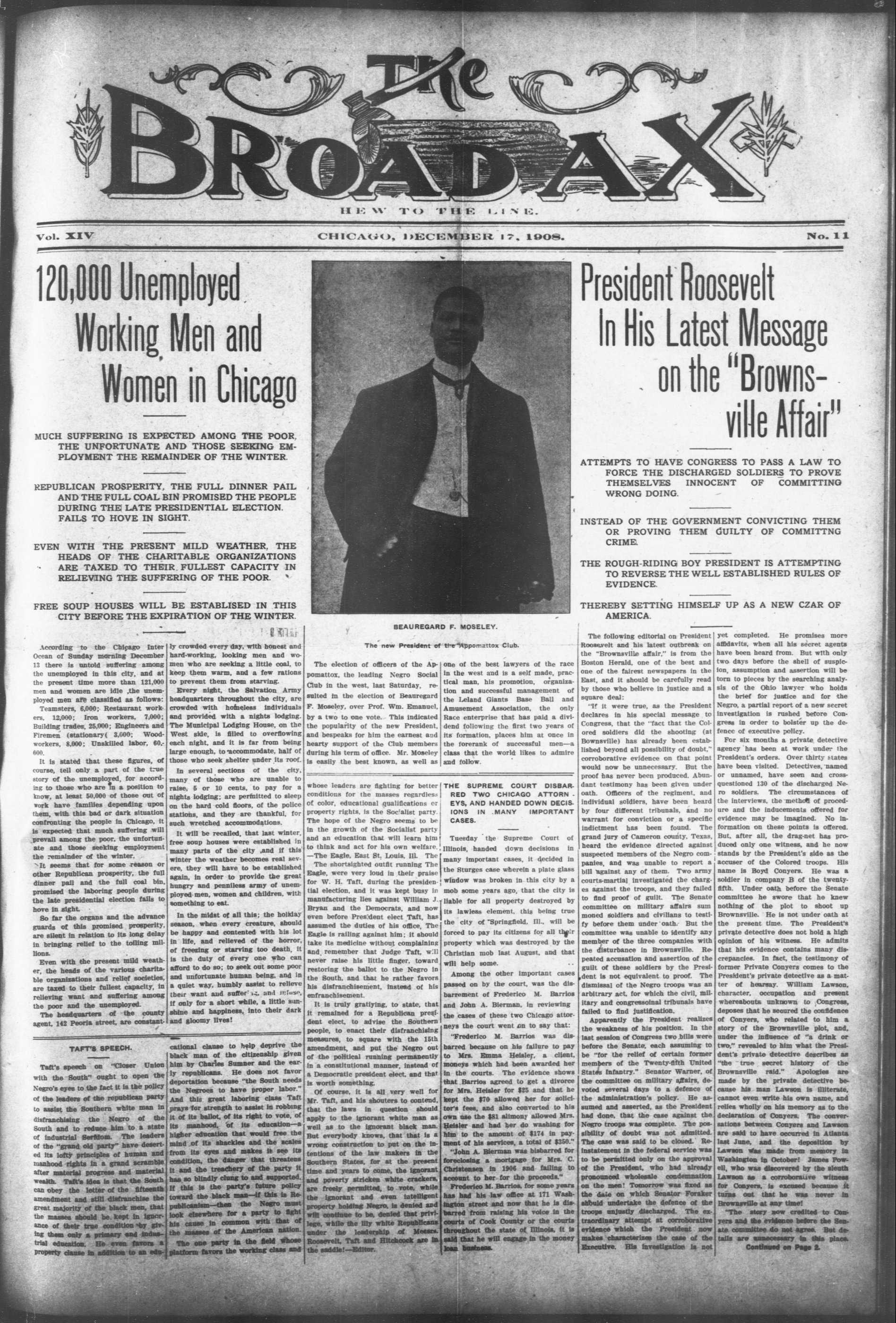
The election of officers of the Appomattox, the leading Negro Social Club in the west, last Saturday, resulted in the election of Beauregard F. Moseley, over Prof. Wm. Emanuel, by a two to one vote. This indicated the popularity of the new President, and bespeaks for him the carnest and hearty support of the Club members during his term of office. Mr. Moseley is easily the best known, as well as
whose leaders are fighting for better conditions for the masses regardless of color, educational qualifications or property rights, is the Socialist party. The hope of the Negro seems to be in the growth of the Socialist party and an education that will learn him to think and act for his own welfare. The Forts St. Louis, Mo.
—The Eagle, East St. Louis, Ill. The shortsighted outfit running The Eagle, were very loud in their praise for W. H. Taft, during the presidential election, and it was kept busy in manufacturing lies against William J. Bryan and the Democrats, and now even before President elect Taft, has assumed the duties of his office. The Eagle is railing against him; it should take its medicine without complaining and remember that Judge Taft, will never raise his little finger, toward restoring the ballot to the Negro in the South, and that he rather favors his disfranchisement, instead of his enfranchisement.
It is truly gratifying, to state, that it remained for a Republican president elect, to advise the Southern people, to enact their disfranchising measures, to square with the 15th amendment, and put the Negro out of the political running permanently in a constitutional manner, instead of a Democratic president elect, and that is worth something.
Of course, it is all very well for Mr. Taft, and his shouters to contend, that the laws in question should apply to the ignorant white man as well as to the ignorant black man. But everybody knows, that that is a wrong construction to put on the intentions of the law makers in the Southern States, for at the present time and years to come, the ignorant and poverty stricken white crackers, are freely permitted, to vote, while the ignorant and even intelligent property holding Negro, is denied and will continue to be, denied that privilege, while the illy white Republicans under the leadership of Messrs. Roosevelt, Taft and Hitchcock are in the saddle!—Editor.
one of the best lawyers of the race in the west and is a self made, practical man, his promotion, organization and successful management of the Leland Giants Base Ball and Amusement Association, the only Race enterprise that has paid a dividend following the first two years of its formation, places him at once in the forerank of successful men—a class that the world likes to admire and follow.
THE SUPREME COURT DISBARRED TWO CHICAGO ATTORNEYS, AND HANDED DOWN DECISIONS IN MANY IMPORTANT CASES.
Tuesday the Supreme Court of Illinois, handed down decisions in many important cases, it decided in the Sturges case wherein a plate glass window was broken in this city by a mob some years ago, that the city is liable for all property destroyed by its lawless element, this being true the city of "Springfield, Ill., will be forced to pay its citizens for all their property which was destroyed by the Christian mob last August, and that will help some.
Among the other important cases passed on by the court, was the disbarment of Frederico M. Barrios and John A. Bierman, in reviewing the cases of these two Chicago attorneys the court went on to say that:
"Frederico M. Barrios was disbarred because on his failure to pay to Mrs. Emma Heisler, a client, moneys which had been awarded her in the courts. The evidence shows that Barrios agreed to get a divorce for Mrs. Heisler for $25 and that he kept the $70 allowed her for solicitor's fees, and also converted to his own use the $81 alimony allowed Mrs. Heisler and had her do washing for him to the amount of $174 in payment of his services, a total of $350." "John A. Bierman was disbarred for foreclosing a mortgage for Mrs. C. Christensen in 1906 and failing to account to her for the proceeds." Frederico M. Barrios, for some years has had his law office at 171 Washington street and now that he is disbarred from raising his voice in the courts of Cook County or the courts throughout the state of Illinois, it is said that he will engage in the money loan business.
President Roosevelt In His Latest Message on the "Brownsville Affair"
ATTEMPTS TO HAVE CONGRESS TO PASS A LAW TO FORCE THE DISCHARGED SOLDIERS TO PROVE THEMSELVES INNOCENT OF COMMITTING WRONG DOING.
INSTEAD OF THE GOVERNMENT CONVICTING THEM OR PROVING THEM GUILTY OF COMMITTING CRIME.
THE ROUGH-RIDING BOY PRESIDENT IS ATTEMPTING TO REVERSE THE WELL ESTABLISHED RULES OF EVIDENCE.
THEREBY SETTING HIMSELF UP AS A NEW CZAR OF AMERICA.
The following editorial on President Roosevelt and his latest outbreak on the "Brownsville affair," is from the Boston Herald, one of the best and one of the fairest newspapers in the East, and it should be carefully read by those who believe in justice and a square deal: yet completed. He promises most affidavits, when all his secret agents have been heard from. But with only two days before the shell of suspicion, assumption and assertion will turn to pieces by the searching analysis of the Ohio lawyer who holds the brief for justice and for the
"If it were true, as the President declares in his special message to Congress, that the "fact that the Colored soldiers did the shooting (at Bownsville) has already been established beyond all possibility of doubt," corroborative evidence on that point would now be unnecessary. But the proof has never been produced. Abundant testimony has been given under oath. Officers of the regiment, and individual soldiers, have been heard by four different tribunals, and no warrant for conviction or a specific indictment has been found. The grand jury of Cameron county, Texas, heard the evidence directed against suspected members of the Negro companies, and was unable to report a bill against any of them. Two army courts-martial investigated the charges against the troops, and they failed to find proof of guilt. The Senate committee on military affairs summoned soldiers and civilians to testify before them under oath. But the committee was unable to identify any member of the three companies with the disturbance in Brownsville. Repeated accusation and assertion of the guilt of these soldiers by the President is not equivalent to proof. The dismissal of the Negro troops was an arbitrary act, for which the civil, military and congressional tribunals have failed to find justification.
Apparently the President realizes the weakness of his position. In the last session of Congress two bills were before the Senate, each assuming to be "for the relief of certain former members of the Twenty-fifth United States Infantry." Senator Warner, of the committee on military affairs, devoted several days to a defence of the administration's policy. He assumed and asserted, as the President had done, that the case against the Negro troops was complete. The possibility of doubt was not admitted. The case was said to be closed. Reinstatement in the federal service was to be permitted only on the approval of the President, who had already pronounced wholesale condemnation on the men! Tomorrow was fixed as the date on which Senator Foraker should undertake the defence of the troops unjustly discharged. The extraordinary attempt at corroborative evidence which the President now makes characterizes the case of the Executive. His investigation is not
No.11
osevelt
st Message
the "Browns-
ville Affair"
PRESS TO PASS A LAW TO
GED SOLDIERS TO PROVE
CENT OF COMMITTING
MENT CONVICTING THEM
GUILTY OF COMMITTING
RESIDENT IS ATTEMPTING
L ESTABLISHED RULES OF
F UP AS A NEW CZAR OF
yet completed. He promises more affidavits, when all his secret agents have been heard from. But with only two days before the shell of suspicion, assumption and assertion will be torn to pieces by the searching analysis of the Ohio lawyer who holds the brief for justice and for the Negro, a partial report of a new secret investigation is rushed before Congress in order to bolster up the defence of executive policy.
For six months a private detective agency has been at work under the President's orders. Over thirty states have been visited. Detectives, named or unnamed, have seen and cross-questioned 130 of the discharged Nero soldiers. The circumstances of the interviews, the method of procedure and the inducements offered for evidence may be imagined. No information on these points is offered. But, after all, the drag-net has produced only one witness, and he now stands by the President's side as the accuser of the Colored troops. His name is Boyd Conyers. He was a soldier in company B of the twenty-fifth. Under oath before the Senate committee he swore that he knew nothing of the plot to shoot up Brownsville. He is not under oath at the present time. The President's private detective does not hold a high opinion of his witness. He admits that his evidence contains many discrepancies. In fact, the testimony of former Private Conyers comes to the President's private detective as a matter of hearsay. William Lawson, character, occupation and present whereabouts unknown to Congress, deposes that he secured the confidence of Conyers, who related to him a story of the Brownsville plot, and, under the influence of "a drink or two," revealed to him what the President's private detective describes as "the true secret history of the Brownsville raid." Apologies are made by the private detective because his man Lawson is illiterate, cannot even write his own name, and relies wholly on his memory as to the declaration of Conyers. The conversations between Conyers and Lawson are said to have occurred in Atlanta last June, and the deposition by Lawson was made from memory in Washington in October! James Powell, who was discovered by the sleuth Lawson as a corroborative witness for Conyers, is excused because it turns out that he was never in Brownsville at any time!
"The story now credited to Conyers and the evidence before the Senate committee do not agree. But details are unnecessary in this place.
Continued on Page 2.
THE BROADAX
Will promulgate and at all times uphold the true principles of Democracy, but Catholics, Protestants, Priests, Inclides, Single Taxers, Republicans, or anyone else can have their say, as long as their language is proper and responsibility is fixed.
The Broad Ax is a newspaper whose platform is broad enough for all, ever claiming the editorial right to speak its own mind.
Local communications will receive attention. Write only on one side of the paper.
Subscriptions must be paid in advance.
One Year.....$2.00
Six Months.....1.00
Advertising rates made known on application.
Address all communications to
THE BROAD AX
5023 Armour Avenue, Chicago.
JULIUS F. TAYLOR, Editor and Publisher.
Entered as Second-Class Matter, Aug. 19, 1902 at the Post Office at Chicago, Illinois, under Act of March 3, 1879.
Startling Revelation of the Lack of Accommodations for Consum-
Fifteen thousand beds and 600,000 patients, or 400 consumptives for every bed, is a statement made today by the National Association for the Study and Prevention of Tuberculosis in its investigation as to the need of beds for destitute consumptives in the United States.
Gathering statistics from every State in the country and from every hospital in which any provision whatever is made for tuberculosis patients, it has been found that the total number of beds provided, both by public and private resources, is less than 15,000. Over against these figures, the National Association for the Study and Prevention of Tuberculosis has placed the fact that there are, according to the estimate of the United States Bureau of the Census, at least 600,000 living cases of tuberculosis in this country and that at least 200,000 persons die from this disease every year.
When analyzed as to their geographical distribution, New York State leads the list with 3,556 beds, while Pennsylvania comes next with over 1,500. Colorado and Massachusetts each have over 1,250, while New Mexico, the next in order, has 915 beds for consumptives. Several states provide less than 20 beds, among these being, Delaware, Kansas and South Carolina, while some of the States, such as Idaho, Wyoming, Utah and Nevada, make no provision whatever for tuberculosis patients, either in private or public hospitals.
The Adirondack region in New York State; Colorado, and particularly the regions about Denver and Colorado Springs; New Mexico, Arizona, and the Southwest; and North Carolina, are the principal resorts for consumptives. The recent demonstrations of experts, however, that tuberculosis can be cured in any climate, has led to a considerable distribution of the bed capacity and has called into existence a large number of small sanatoria, hospitals, and day camps, some of them with a capacity of only six beds. This is shown by the fact that, while the number of sanatoria during the last four years has more than doubled, the increase in the number of beds has been only about 50 per cent.
The most striking fact emphasized by the investigation is that, while the lack of beds for all classes of consumptives is so manifest throughout the country, the number of beds needed for advanced cases is far greater than the number needed for all the other stages put together. Of the 15,000 beds at present available for all classes of consumptives, less than 5,000 are for advanced cases. Computing that there are at least 200,000 living cases in the advanced stages of tuberculosis in the United States at the present time, the need for a large number of additional beds for this most deserving class is evident. Dr. John S. Billinga, of the Health Department of New York City, estimates that about 60 to 70 per cent of the advanced cases are unable to provide for their proper care at home. This means that over 12,000 beds in hospitals for advanced cases should be provided. The need for accommodation for advanced cases is further emphasized by the fact that every expert and specialist has agreed on this conclusion, that consumption will never be eradicated until the advanced cases of the disease are isolated, either in their homes or in institutions. Dr. Koch says, "Every case of tuberculosis should be isolated as long as bacilli are there." Dr. Arthur News
holme, one of the best English specialists on tuberculosis, says that the only way in which the death rate from consumption can be reduced is by segregating all advanced cases, because these are the centers of infection from which the disease spreads. It is not difficult, the National Association affirms, to cure consumption in its early stages, but it is impossible to effect a cure in the latter stages of the disease, and, consequently, these cases should be removed or isolated in their homes in order to prevent the infection of persons living with them. But they cannot be removed or isolated unless hospitals are provided for that purpose; and with this end in view, a campaign to secure more accommodations for advanced cases of tuberculosis is being carried on all over the country. When enough beds are provided, it is estimated that the death rate from consumption will be cut in half and there will be an annual saving to the country of 100,000 lives.
MEETING OF THE STOCKHOLDERS OF THE FOREST PARK AMUSEMENT ASSOCIATION
Election of Officers for the Coming Year.
Tuesday evening the first annual meeting of the stockholders of the Forest Park Amusement Company was held in the parlors of the Grand Pacific hotel.
The meeting was largely attended by its stockholders, and after listening to a glowing report as to the success which attended the company the past year, under the most trying circumstances, and plans outlined for extensive improvements the coming year, in the way of beautifying the grounds and new buildings and so on, the following officers and directors were elected:
John P. Harding, president; Henry F. Malwurm, vice-president; H. T. Bellamy, secretary; James M. Heaney, treasurer; Paul D. Howse, manager; James J. Gray, attorney. Directors: James J. Gray, Ben H. Atwell, James M. Heaney, Henry F. Malwurm, M. A. Bredel, Paul D. Howse, John P. Harding.
James J. Gray, who has been one of the prime movers and promoters of this new amusement company, had the voting of a great majority of the stock, and its new President, Mr. John P. Harding, is a prominent member of the Board of Trade, with plenty of capital behind him, and being a warm friend of Mr. Gray, they will make things hum at Forst Park this coming season.
Black Diamond Development Company
Places a contract for Ten More
Gas Wells on Their Property.
Information has just been received
from Kansas that the contract for ten
more Gas wells on the Black Diamond
properties has been signed and that
the drilling rig had been moved to B.
D. D. Co. No. 11, and that as fast as
the contractor can finish one well he
will start another and so on until No.
20 has been brought in and finished.
This will be good ews for those who are stockholders in this company as this contract means as much more work will be done on their property during the next six months as has been done during the past three years, and no one was asked to buy a dollars worth of stock in order to get this development done.
The Board of Directors have been quietly at work for several weeks on the deal and put it through and had it closed before any one was made aware of the fact that any such gigantic deal was on foot, and they certainly deserve great credit for the hard work that they have done for this company.
At the Stockholders' meeting in October all of the former Board was re-elected and also the officers for another year, and the closing of this deal shows the wisdom of such action, for the deal has been "on the fire" for some time.
The members of the Board of Directors are wearing a broad smile these days and can well afford to do so.
CHATEAU RINK NOTES.
The guests of the Chateau Rink for Sunday dinner were Mr. and Mrs. Bernard W. Fitts, Dr. and Mrs. James R. White, Mrs. Sophia Walker, Mrs. Bell Patton, Mr. and Mrs. J. H. Bolden and Mr. Weir and escort and others.
The attendance at the Rink is improving nightly and all seems to enjoy themselves immensely.
During the Holidays there will be a splendid program each night commencing with the 24th.
Mr. Andrew Payne, James Booker and Nathan Harris will leave on the 1st for Palm Beach, Florida. Their
places at the Rink will be filled by Miss Eva Matthews and Miss Rena Brokenberg, trunstile and check room attendants respectively.
Mr. Andrew Foster, the Captain of the Leland Giants Base Ball & Amusement Association will return about the 1st inst. from his wedding tour and will be at home to friends on and after that date.
Big Program at the Rink tonight and tomorrow night. Don't fail to attend.
The Menu for Dec. 20th, 1908 Sunday's Dinner is as follows: Baked Lake Trout, Sauce Supreme, Potatoes a La Duchess, Masquerading Mutton, Garden Peas; Choice Cut of Beef, Demi Glace, Creamed Hashed Potatoes; Roast Turkey Stuffed, Cranberry Sauce; Banna Fritter, An Rum; Lemon Sherbet and Cake; American and Swiss Cheese; Cream de Mente, Cafe Nofr.
President Roosevelt and the Browns
villle Affair
Concluded from Page 1.
The President's special message submitted to Congress yesterday is an extraordinary climax of an extraordinary course of unwarranted accusation, and of disregard of justice and the rules of evidence. It adds no evidence against the discharged soldiers. Its savor of manufactured evidence discredits the case of the administration. The public, little concerned in the cause of justice for the Negro troops in the first place, and influenced by prejudice which has been incited against the senatorial champion of these soldiers, may not be inclined to consider the case on its merits. But if prejudice is laid aside, and if justice is recognized, the President's latest witness, Conyers and Lawson the detective, are likely to be effective witnesses for the defence."
NEGRO WHO SAVED THE FLAG
DEAD.
Boston, Dec. 9.—William H. Carney, color sergeant of the Fifty-fourth Massachusetts Volunteers in the civil war, composed of Colored men under Col. Robert Gould Shaw died to-day following an elevator accident Carney was at the side of Col. Shaw when that commander fell, and afterward was badly wounded. As he crawled off the battlefield he held the flag aloft until comrades came to his assistance, and he greeted them with the words often quoted in Massachusetts: "The old flag never touched the ground."
The Negroes in general have lost one of their oldest and most renowned soldiers. He was the link between the old regime and the new condition, and Boston feels it keener than any other part of the country the loss of such an eminent man. A character such as William H. Carney adds more to Negro's contribution to militarism than half of the speeches that might be made, relating their exploits.
INSTITUTIONAL CHURCH, 3825
DEARBORN STREET.
Special Mission Each Sunday up to the First of the Year.
Sunday, December 13. Bishop C. T. Shaffer, M. D. DD., will consecrate the Deaconess of the Church. Special service will take place at 7:45 P. M. 10:50 A. M. The Pastor, Rev. H. E. Stewart D. D., will preach from the subject. — WOMANS WORK IN THE RDEMPTION OF THE WORLD.
The following question will be answered why the church cannot be a social culture club? Women in club and social life as compared to Church and Christain work.
Sunday, December the 20th. At 10:50 A. M. the Pastor will discuss the following subject, THE REALITY OF LIFE, OR THE MEANING OF THE NEW BIRTH, MODERNIZED. This question will be answered. Why SOME PEOPLE LOOSE FAITH IN CHRISTIANITY? etc, etc.
Subject for the evening service, 7:45 P. M. A STATEMENT OF DOCTRINE. This will be discussed under the following heads, Baptism, Regeneration, Sanctification. The extent of each in human life.
Sunday, December the 27th. Subject 10:50 A. M. AN AFTER CHRISTMAS. THOUGT—ANTHROPOLOGY. THE DIVINE AND HUMAN IN JESUS CHRIST AND WHAT EFFECT IT AS ON ALL LIFE TO DAY. Subject at 7:45 P. M. Review of the past Year. Subject:—DIVINE PROVIDENCE IN HUMAN AFFAIRS. A question will be answered DOES GOD HAVE ANY PREFERENCE AS TO RACES AND INDIVIDUALS. IF NOT WHY NOT? Any one may hear these question discussed and desire to ask a question, will have it answered if they submit the question to writing, and send it up to the pastor in order that it may be read at the same meeting that the
question is asked, the answer will be given the following Sunday. The name of the writer must be given but the name will not be mentioned, unless by the writers consent or wish. —S."
CHIPS
S. A. T. Watkins, Supreme Attorney for the K. P.'s, returned home last Friday morning from Atlanta, Ga., where he went to transact some important business for his order.
A man went to Hell, and was walking about putting on so many airs that the Devil said to him. "Say! You go about here as if you owned the place."
"I do," reflected the man. "My wife gave it to me just before I died."—Lire.
Alderman Albert W. Beilfuss, who ably represents the 1t5h ward in the City Council for many years, may be induced to become the Republican candidate for City Clerk in the spring of 1909.
Mrs. Katherine R. Hamlet, 5036 Armour avenue, will leave Sunday for Sedalia, Mo., and spend Christmas with her father, Mr. J. Adams, who is a large property owner and one of the most enterprising business men of that flourishing city.
Thursday evening a reception and dance was given at Lett's Cafe and Hotel, 3354 Wabash avenue. The affair was in charge of J. Arthur Robinson, Romeo Loving, Frank P. George, R. H. Payne, Walter M. Harris, Wesley Turner and D. Woods, and those attending it had a royal good time.
The Queen Esther Circle, of Olivet Baptist Church, which has raised $1,000 for the benefit of that church, gave its fifth annual banquet last Thursday evening, at the home of Mrs. Elizabeth Hughes, 3$07 Dearborn street. About fifty persons were present, including lawyers and doctors. J. M. Higginbothan served as toastmaster.
Mrs. Maggie Strange, 803 Garing avenue, Pittsburg, Pa., has, for the past three weeks been visiting her brother and sister-in-law, Mr. and Mrs. William Robinson, 3511 Armour avenue, and on Friday evening prior to leaving for her home on Sunday morning last, Mrs. Robinson gave a dinner and delightful social in her honor, at which time many of her old-time friends and schoolmates were present, and enjoyed the tempting repast.
Thomas Carey, at one time the head leader of the City Council from the 29th ward, and Chairman of the Cook County Democratic Committee, and now residing in an elegant home, 4427 Grand boulevard, has been sized with a hankering to re-enter politics, and as he is one of the old Carter H. Harrison leaders, he will put up a stiff fight, to put William L. O'Connell out of the running in the 6th ward, and capture its delegation for Carter Harrison for mayor in 1911.
Never Knew Her Husband's Name. In declaring that she never knew her husband's first name Mrs. Esther Nieman of Monroe street created laughter at the central police court.
"I have always called him 'Pop' from the first day I married him, and as he did not object I never worried myself about his first name," said Mrs. Nieman, who had her husband arrested on the charge of failing to support her.
The accused husband by direction of the magistrate was induced to tell his wife his full name.
"Certainly. I'm glad to do it," remarked the defendant, "but I think my wife has known right along that I am Jacob Nieman."
After telling his name Nieman was held in $300 ball for trial—Philadelphia Inquirer.
Inducements to Drink
In Catanja an enterprising wine dealer has initiated a novel scheme of drinking by the hour a libitum. For 15 cents one may drink for sixty minutes, and the current price of wine is 5 cents a liter. The chances are, however, in favor of the merchant, for it requires a strong stomach to drink three liters of Etna wine in one hour. At a neighboring town the charge is 10 cents for the first hour and 15 cents for two. The fashion seems to have "caught on," and at Bologna, where the wines are better, the charge is 41 cents for the first hour, 31 cents for the second and 20 cents for the third. The result of these inducements to drink is said not to be enchanging.
"the wine or this anonymous scene says it is not prompted by malice, but is written for your own good."
"Sure. That's why he was ashamed to sign it."—Kansas City Times.
Robbie (at the opera)—Mamma, what does papa keep going out between the acts for?
Mother—Sh! He goes out for opera glasses—Judge.
FACTS IN FEW LINES
The British salmon is said to be worth $550 a ton.
Denmark has a population of 2,598,000. Of these 500,000 are in Copenhagen and its suburbs.
There is a great shortage of officers in the Russian army. In the infantry alone it amounts to 3,000.
During each month for the last two years about 21,000 Russian immigrants have entered the port of New York.
Britain, Canada, Australia and New Zealand had to pay a deficiency of $311,810 on last year's working of the Pacific cable.
An air gun of large size, working on the principle of the pneumatic hammer, has been devised for killing animals in a humane manner.
On her preliminary trials the British destroyer Swift maintained for several hours a speed of 38.3 knots, or nearly forty-five miles an hour. She is the fastest vessel ever built.
Seven hundred of the persons who died in Ireland last year were stated to be ninety-five years of age or upward, and no fewer than 145 were reported to be centenarians or upward. The British built but German owned ship Columbia, dismasted by a hurricane off Cape Flattery, has been purchased by Americans and converted into the first six masted barkentine in the world. Lassa, the mysterious capital of Tibet, is beginning to show longings for the amenities of western civilization. It has just placed a contract with a Calcutta firm to supply a large number of European band instruments.
Mme, Poppova is a Russian woman who has invented an airship and has called it the Annulated Dragon, which gives one an idea of its shape. There is a system of hoops that serves to steer it, and the ship is said to adapt itself to every sort of wind very readily.
A Pittsfield (Mass.) business house has adopted the policy of having a young woman bill collector. The girl is meeting with more success than three men, it is said. Her favorite form of salutation is to smile prettily and ask, "Don't you want to pay your bill today?" The answer is nearly always yes.
A few years ago the currency of Austria was changed from gudens and kreutzers to crowns and hellers. To deceive customers figures are still sometimes placed in shop windows in such a way that florins are mistaken for crowns and bills made accordingly. By a recent ordinance this has been made a punishable act.
There has died in the workhouse at Dorchester, England, a woman named Harriet Hammett, a native of Tolpuddle, who was admitted to the workhouse in 1844. As her age at death was sixty-nine, she must have donned workhouse garb when five years old. The only home she ever remembered was "the house."
The beneficial effect of storage on the sanitary quality of water now seems to be well established, and a further contribution to the data on the subject has just been made by one of the experts of the London water board. He has shown that typhoid bacilli put in river water gradually disappear as the water remains longer in storage. Sweden has three factories building imitations of American mowers and reapers. The largest of these built 6,000 to 7,000 machines for the season of 1908, copying almost exclusively one of the best selling American mowers. Their reaper is an exact copy of the American original, Swedish made parts fitting American built machines.
The new Turkish minister of education says: "We have compulsory education at present, but we lack primary schools. We shall establish them. We shall develop the existing higher education. The study of history will now be allowed. We want a regime of liberty of the press, even with all the evils it means, for it is a necessary evil."
There has been opened in Mannheim, Germany, a tuberculosis museum, the object of which is to educate the public as to the causes, cure and prevention of consumption. The museum is opened three times a week for a period of two hours, and during that time physicians are present, who instruct visitors in the manner of fighting the disease.
While the clock industry of the Black forest has held its place in the markets of Europe and America for over two centuries, the introduction of modern methods has given it so great an impulse that within six years France has more than doubled her import of Black forest clocks, the Argentine Republic has tripled her imports, and the United States has more than quadrupled hers.
It has been found that underlying the plain of Sharon, in Palestine, at various depths, ranging from eighteen to eighty feet, there is an inexhaustible supply of good water for all purposes. For ages the inhabitants have utilized this knowledge, pumping up the water with primitive arrangements. Now, however, these methods are being supplanted by modern engines and outfits, and a new period of prosperity is at hand.
The maharajah gaekwar of Baroda has melted down and converted into bullion the celebrated gold and silver cannon of Baroda. Of these costly but useless toys the silver guns were the inspiration of a former gaekwar. In order to "go one better" than his predecessor the late gaekwar had the gold guns cast and mounted at a cost, it is said, of £100,000. They reposed in the state armory and were the wonder and admiration of all visitors to the capital.
MRS. JENNIE ELDRIDGE WATTS.
Mrs. Jennie Eldridge Watts, and Mrs. Viola Stewart, have opened up the Yew York and Paris Millinery Parlors, at 2616 Calumet ave. Both ladies are expert artists in this line of work. They will also remodel old hats and make them look like new, and carry in stock the very latest styles in hats and headgear.
Mail orders will receive prompt attention.
HUMOR OF THE HOUR
Obeying Instructions.
A milkman who lives in a town of New England and collects milk from the neighboring farmers had in his employ a boy whom he sent about with a wagon every morning picking up his supply. There is a rather dangerous railroad crossing on the road, and when the boy began work for him the milkman said, "When there's a train coming just stop and sit still in your wagon till it gets by."
The boy went about his task, but instead of collecting the milk in about an hour and a half, as should have been done, he took at least two hours and sometimes more.
The milkman grumbled a little, but the boy said nothing, and as he seemed honest nothing was done.
One evening the milkman went over his route to see some of his customers, "What alls that boy of yours?" asked one of the farmers.
"Why, nothing, only that he's rather slow," was the reply.
"Slow! Well, I guess you'd think he was slow if you saw him resting for half an hour in his wagon down there by the railroad track every morning."
"Is it true that you stop half an hour every morning down at the railroad track?" the boy was asked.
"Yes, sir; I have to," said the boy.
"Have to! What do you mean?"
"Well, sir, you told me to stop when there was a train coming and to wait till it got by. There's a crook in the track there, so 't' I never can see whether there's a train coming down the track or not. So I just stop an' wait till there's one goes by anyway, an' then I just skip over lively!"—Harper's Weekly.
How Johnny Managed It.
"You and that little Wattles boy seem to play very nicely together," said Johnny's mother. "I am glad there is one boy in the neighborhood that you can get along with." "Yes," replied Johnny. "I lick him every morning, and then he's nice to me all day."—Chicago Record-Herald.
Admirable.
"I certainly admire that pianist who gave the recital last night."
"For his compositions or for his performances?"
"Neither. I admire him for his nerve in charging $2 a seat"—New York Herald.
"How fast does a motor car take you?"
"It depends on what you mean," answered Mr. Chuggins. "Over the roads it goes at the same pace as most of them, but when it comes to running into debt it's got 'en all beat.'" — Washington Star.
Woofful Waste.
"The style of wearing tailor made gowns is hard on my business," complained the laundryman.
"Yes," observed his male victim bitterly. "I notice that you are a believer in the shirt wasta"—Cleveland Plain Dealer.
Just Prophecation.
Judge — Why did you strike this man?
Prisoner — What would you do, judge, if you kept a grocery store and a man came in and asked if he could take a moving picture of your cheese?
Rv GARFIELD MACNEAL
Lillian Treadwell awoke on the morning of her thirtieth birthday to the sickening consciousness that she was an old maid. She parted the cretonne curtains of her bed, curtains covered with red roses, suggestive of summer sunshine, and turned her eyes toward the window. Rain beating against the panes and dull gray sky proclaimed a cheerless November day. She sighed. Then, stretching out a shapely arm, she took a silver hand mirror from the nearby dressing table and carefully studied her features. In the language of Shakespeare, she saw "no deeper wrinkles yet," face long and oval, patrician in outline and expression, skin rather olive, eyes brown, deep and luminous, a mouth generously molded and a wealth of brown hair. On the whole, it was a sturdy face and one of character.
Dropping the mirror on the bed, she called "Lois!" A French maid, neat, trim and smiling, appeared with the breakfast tray.
"Ah, ma'melle! A thousand congratulations on your birthday."
"My thirtieth, Lois. But thank you just the same."
"Ma'melle is still young, and already fame has come to you. And when your novel is published the world will be at your feet," said Lois, with a comprehensive sweep indicating the world.
"Oh, yes, the novel!" murmured her mistress, sitting up and starting in on her coffee and rolls, while the maid laid a bundle of letters and manuscripts on the bed.
Miss Treadwell opened the one bulky package and looked at the accompanying letter. It was from a great publishing house formally expressing regret that they were unable to accept her novel.
She gulped down something in her throat. Her novel declined—her first really original work, to which she had given the leisure hours of six years! Truly, this was a most delightful birthday gift,
"Lois," she said, and her voice trembled—"Lois, my novel has been declined."
"Ah, ma'm'selle, I am too sorry"—with quick sympathy—"but some other publisher will accept it."
Her mistress shook her head. "I shall not send it out again. I shall stick to hack work. I can at least make a living at that." Then she added reflectively, "My life has been a failure."
Lois protested. She worshiped her mistress. "Ma'm'selle has been successful. You have a pretty apartment and everything you want."
"Other women, too, have pretty apartments and everything they want."
"Ah, yes, but they did not work for them," said Lois, with a worldly shrug, as she went in response to the electric bell, which at this moment buzzed loudly in the hall.
She reappeared with a huge white box. "Flowers, ma'm' sellle, and a note," she said gayly.
Miss Treadwell cut the ribbon that held the box and disclosed a mass of violets. They seemed to look up at her tenderly, yet shrinkingly, as she bent over them. With a sigh of pleasure she took the note and studied the bold handwriting of the superscription. Her heart jumped. Surely it was Jack's! Dear old Jack had remembered her!
She slit across the end of the envelope while her fingers trembled and eagerly unfolded the paper.
"Dear Lillian," she read, "may I hope that this remembrance of your birthday will prove that I have not forgotten you? I have been in town two days. I secured your address from C.'s Magazine and send these flowers to warn you that I am coming to invade your sanctum sanctorum and talk over old times. Always your friend, Jack Ainsworth."
She started up; scattering letters and manuscripts on the floor. "Lois," she said decidedly. "I want you to lay out my new morning gown, the sea green one with the train."
Sitting down at her dressing table, she began a careful toilet. Her thoughts were busy with the past Jack had been her girlhood friend in the little inland town where they were both born and bred. Again she was twenty-four and he was twenty-six. Why had he never spoken? She knew he loved her, and perhaps she had loved him, too, then. But when her mother's death left her alone in the world she was seized with the desire to come to New York to try her fortune. Jack had advised against it, but a strange perversity made her deaf to his warnings.
At first they had kept up a correspondence. Soon even that link was broken as she was drawn more and more into the absorbing whirl of newspaper and magazine work. For five years no letters had passed between them. To be sure, she had heard of him indirectly—how he gradually forged ahead from clerk in the railroad office to manager of the whole system, and she had been glad for his sake.
And now, after all this time, they were to meet. She wondered what he would be like. Doubtless he had lost the fresh boyish beauty she so well remembered. He was past thirty now, she reflected with a sigh. Doubtless, too, his career as a man of affairs had
made him brusque and cold. She had visions of bearded cheek and chin and perhaps glasses. Horrors! Had it really come to that? Well, she would live in the old days and pay no attention to externals.
When at last Lois announced that Mr. Alnsworth was in the drawing room she swept to her mirror and surveyed the graceful figure reflected there. Her gown of sea green fell in shimmering folds. Her hair was done beautifully, and some of the violets were clasped in the silver girdle at her waist. She could not fall to be satisfied.
This consciousness helped her to enter the drawing room with the perfect self possession of a woman of the world. With outstretched hand she greeted him as if they had parted but yesterday.
"Jack! How good of you to some to see me on my birthday and to send me these lovely 'flowers!" turning to a center table where the violets were displayed.
Jack Ainsworth gasped. Could this elegant woman, with her perfect hair and silvery voice, be his old friend? "Lillian," he said, still grasping her hand, "is it really you?"
She smiled, and it was her old smile,
"Yes, Jack; it is I. You see, I am
going the way of the world."
"Nonsense! You are perfect!" he
cried vehemently.
"Tell me what you have been doing all these years, Jack," she said finally.
"Oh, working hard and following your career!"
"Yes," she said, "you have done well for yourself, and I am proud of you. As for my career, it has not amounted to much."
"Lillian," Ainsworth said, leaning forward eagerly, "do you know that you have not written a line I have not read! You ceased to write to me, but I did not forget, dear."
Miss Treadwell had forgotten the rain and the unfeeling publisher.
"Tell me, Jack, what brings you to New York?" she asked.
"I have been elected vice president of the road and must live here," he replied.
"Then I suppose you will marry and keep up an establishment?" with a pretense of lightness.
"I don't know," he said dubiously. "There never was but one girl for me, and she—she has achieved fame. She would not think of giving up glory to become the wife of a railroad man." A feeling long dead woke in the woman. "But she might be willing, Jack, if you asked her," she said almost wistfully. "She might gladly give up all her false glory to find real happiness."
"If I thought that," said Ainsworth breathlessly, "I'd ask her in a minute." She thought of the novel, of the hack work, of the loneliness of her life which this friend of the past brought sharply before her.
"Jack," she said, "I've decided"—she paused, then went on rapidly, fingering the violets in her belt—"to give up literature for good."
Alnsworth started forward. "Do you really mean it, Lillian?"
"Yes. I do," she replied bravely.
"But why?" he inquired, doubting, puzzled.
She looked up at him, and he read it in her shining eyes.
He leaped forward and folded her in his arms, crushing the violets in his eagerness. "My darling!" was all he could say in trembling tones.
As for Miss Treadwell, with that embrace came the realization that woman was not made to live on mind alone.
"Lois," she called after a little, "bring me the manuscript of my novel!" She took it from the wondering maid and turned to Jack, with a radiant smile. "Come," she cried gaily—"come to my study fire and help me make dust and ashes of my literary pretensions."
Courtesy In Business
The man who solicits your advertisement, the salesman who has samples to exhibit, the life insurance agent whose hair trigger tongue pleads eloquently for your family, even the seductive canvasser who tries to inveigle you into buying a history of the world in twenty-five volumes, can be listened to for a courteous minute or two and politely dismissed without seriously clogging the wheels of business. Perhaps they may really have something worth while to offer. Above all, the tellers and the cashiers of every bank need a course in the art of gracious expression. Why should the depositor of money be regarded with frowning suspicion and why should his mistake in indoring checks wrong side up or his failure to have his books balanced regularly call forth shouts of correction instead of a few words of kindly instruction? After all, he is only ignorant or only forgetful. No dark scheme for defrauding the bank lurks behind his failure to follow the bank's rules. Courtesy is its own reward. It pays in personal satisfaction, in minimizing friction, in making friends and in raising you in the eyes of your business associates.—Scientific American.
Looks Like It.
Howell—Three hundred men attended a dog fight last Sunday, and there were less than fifty at our church.
Powell—It's no wonder they say that the country is going to the dogs—New York Press.
A thousand times listen to the counsel of your friend, but seek it only once—Hardy.
WM. D. NEIGHBORS & CO REAL ESTATE AT LOWEST PRICES
Easiest Terms to be had in Chicago
Loans on first and second Mortgages
Fire Insurance placed in any company
Main Office:
Suite 64, 95 Washington St., CHICAGO, ILL.
Branch Office:
3220 State Street
PHONE 4866 CENTRAL
THE IRISH BIRD CHARMER.
Wid more or less o' tuneful grace,
As fits a Celtic singer.
I've praised the "great bird of our
race."
The stork, the blessin' bringer.
When first to my poor roof he came
How sweetly he was sung to!
How sentimental name
That I could lay my tongue to.
But, glory be, that praise from me
So pleased the simple crayture
His visits here have come to be
A sort o' second nature!
I'm glad to see him now an' then,
But, glory be to heaven.
If here he isn't back again.
An' this is number seven!
Och, though this gift o' song may be
In manny ways a blessin',
It brings some popularity
That gets to be distressin'
No such thing! I fish bird—
We couldn't live without him—
An' shure, I'll not take back a word
I ever said about him,
But now all these mouths to feed
Ate up our little savin'
The birds whose visits most we need
Are ould Etsisha's ravens.
"Begor," if they were round these days
An' I could make them hear me
I'd sing them such a noise of praise
I would keep them always near me!
-T. A Daly in Catholic Standard and
Times.
"Do be careful, Ernest. There won't be any wine left for luncheon."—Pele Mele
"Who are them people livin' next door?" asked Mrs. Gadsby's uncle Hiram.
"I don't know," she replied.
"I 'nose they've just moved in."
"No. I think they have lived there for a good many years."
"Ain't they decent?"
"I really don't know. I have never heard anything about them."
"Hm! Gosh, you people must be mighty well off!"
"What has our financial condition to do with the people who live next door?"
"Why, you don't seem to ever have to borrow anything."—Chicago Record-Herald.
Must Have Meant Him.
"I wish I knew," said Cholly Saphead, "if I have any show of winning Miss Roxie Swellman."
"Well, replied Miss Pepprey, 'from a remark of hers I think you're her choice."
"Aw! Really? What did she say?"
"She said nobody was good enough to be her husband."—Catholic Standard and Times.
A boy was asked to explain the difference between animal instinct and human intelligence. "If we had instinct," he said, "we should know everything we needed to know without learning it, but we've got reason, and so we have to study ourselves most blind or be a fool."
"Well, what do you want?" queried the stereoscopic lecturer as a stranger appeared before him.
"Oh, I merely came to get your views," replied the stranger—who proved to be a constable—as he proceeded to levy on the outfit—Chicago News.
Reverberating.
"Ha, Mrs. Taukaway, I'm not the only one who smores. I just heard you sawing wood."
"You're mistaken again, Mr. Taukaway. That was the echo of your own snoring that didn't die away for some seconds after you woke up."—Kansas City Times.
He started back with indignation. "I am a gentleman, str." he hotly said, "and I never could demean myself by washing windows. But if you'll hold the job open for a half hour I'll see if I can't get my wife to do it." -Cleveland Plain Dealer.
the mercy of the court."
"Never! The only thing I have left now is my reputation for sobriety."—Cleveland Lease.
CHOICE MISCELLANY
Smart Boys of Long Ago.
It is often asserted nowadays that our young men and women attain intellectual maturity much later than did their parents and grandparents, and in support of this theory the precocity of distinguished personages who flourished a generation or two ago is cited. Now, somebody who has probably been bored like the rest of us with this yarn about the phenomenal brightness of the old fashioned boys has looked up the records of eleven leading colleges to see what changes have taken place in the age of graduates. From 1850 to 1860 the average age at graduation was 23 years 1.3 months. From 1890 to 1900 it was 23 years 1.9 months. In 130 years at Dartmouth the average age at graduation has fallen three months. This average age, it appears, has changed as little as the average weather. Thus one or two precocious youths of the long ago are sufficient to endure all their contemporaries with the same qualities. But the fact is the twentieth century boy is smarter than any of his predecessors, and (unfortunately) in nine cases out of ten he knows it.-Pittsburg Gazette-Times.
A Fatal Paraphrase.
General Sheridan, says the Philadelphia Ledger, used to take delight in telling the following:
"A young man seated at dinner one time said to his wife:
"Ellen, if you are good at guessing here is a conundrum for you. If the devil should lose his tail where would he go to get another one?
"After some time spent in guessing she gave it up.
"Well, said he, 'where they retail spirits."
"Enger to get it off, she hastened to a lady friend with:
"Oh, Marian! I have such a nice conundrum. Joe just told me of it. I know you can't guess it. If the devil should lose his tail where would he go to get another one?
"Her friend Marian having given it up, she said:
"Where they sell liquor by the glass."
"Marian couldn't see the point of the joke."
Once Chinaman Always Chinaman.
China is yet a land and a people ruled by ancestors. 'A Chinaman belongs, soul and body, to his home land because his ancestors belong there. The wandering Mogul who dies in a strange land has paid tribute all his tolling years to a brotherhood whose sacred duty is to coffin his bones and send him back to his native land for burial. Not even after death will his country relinquish her claims to him. Why should the Chinese government be interested in keeping American born Chinese familiar with the reading and writing of the old language when it is presumed that they and their children will remain in America henceforth? The answer is that such is never the presumption. The government's theory is that a Chinaman is here only by the accident of birth or to get money, and when it becomes possible he will take his money and go to live and enjoy it in the Flowery Kingdom—Washington Post.
Chicago's Maiden Aunts
Chicago is boasting of its "five malden aunts" and deciding that they have done more toward securing better industrial conditions in that city and in the country at large than any other like number of citizens, men or women, in the world. The "five malden aunts" are Jane Addams of Hull House, Julia Lathrop, a charity expert; Mary McDowell of the University settlement; Margaret Haley, who organized the Teachers' federation, and Dr. Cornellia De Bey, a practicing physician, who secured the settlement of the great stockyard strike by arbitration. Dr. De Bay has also been prominent in investigating factory violations of the child labor law and is a member of the Chicago board of education.
One of the objections urged against turbine engines has been their inability to run backward as well as forward. John Ogg of Aberdeen has invented a form of turbine which avoids this difficulty. The steam enters the machine through a hollow axle and thence acts upon the wings of the rotating disks mounted upon the axle. When it is desired to reverse the motion a new set of disks, having their wings set at a reverse angle, are brought into play, and by means of grooved valves the steam is projected against them, thus producing a backward motion. The reversal of motion can be produced instantaneously.
Branch Office:
3220 State Street
Careless Fellow.
Uncle Hiram's Deduction.
Must Have Mount Him
His Explanation.
What He Wanted
Reverberating.
Providing a Substitute.
Saving the Pieces
PATRICK H. O'DONNELL
WILLIAM DILLON
CLARENCE A. TOOLEN
Tel. Central 4660
O'Donnell, Dillon &
Toolen
ATTORNEYS AT LAW
Suite 1218-1219 Ashland Block
RANDOLPH & CLARK STREETS
CHICAGO
JAMES J. GRAY
ATTORNEY AT LAW
Suite 1518 Ashland Block
RANDOLPH AND CLARK STREETS
CHICAGO
Tel. Central 4728
Residence 57 Macallister Place
Telephone Ashland 363
Office Telephones
Central 1859 Automatic 5840
Suite 318-320 Reaper Block
CLARK AND WASHINGTON STS.
CHICAGO.
Phone Main 4153 NOTARY PUBLIC
Phone residence. Gray 5670
Walter M. Farmer
ATTORNEY AT LAW
Suite 708, 171 Washington St.
Res., 4856 Langley Av. CHICAGO
JOHN E. OWENS
ATTORNEY & COUNSELOR
AT LAW
333 ASHLAND BLOCK
TABLEPHONE CENTRAL 968 CHICAGO
A. D. GASH
Attorney at Law,
84-96 La Salle Street, Chicago
Suites 615 to 619.
Telephone Main 3077.
Musically Expressed.
Musically Expressed.
Westend—What did your wife say
when you got home from the stag the
other night?
Broadway—Nothing at all. She just
sat* down at the piano and played
"Tell Me the Old, Old Story."—Puck
Pertinent Query:
"Man's work is from sun to sun, but woman's work is never done," quoted her husband's wife.
"Well, why doesn't she stay home occasionally and do it?" queried his wife's husband—St. Louis Republic.
Something In Luck
"Do you believe there is anything in luck?" asked the young man.
"Yes," answered the home grown philosopher. "There is a lot of intelligence and perseverance in it."—Detroit Tribune.
A snack House
A fine little shack can be built in the Philippines for about $50, one that will last for seven or eight years and even longer with proper care. Bananas and rice grow while you wait. The law requires a native to wear a certain amount of clothing and no more. It never gets cold, so there is no need to save up and provide for long, hard winters, and the sun shines on the just and the unjust alike over there.—Travel Magazine.
Relative Values In Testimony.
If Split Finney and Dr. Lyman Abbott differed diametrically in their relation of an incident observed on a race track the issue might well be decided in favor of the testimony of Finney upon the presumption that he would be the more accurate observer of an occurrence within his special sphere of knowledge—Law Notes.
The New Topcoat.
Among the smart models shown for a service coat is one of thin tweed in a two toned stripe of gendarme blue. It is not fastened all the way down, but has extra wide fronts and is fastened slightly double breasted from the brooch to within four inches of the waist. Large buttons are used with braid buttonholes for ornament. There are many pockets, two of which are in the sleeves just below the elbow.
A Pleasant Winter Evening.
ARE YOU IN SEARCH OF ONE?
Then Visit the "Chateau," 5324 State Street, Tonight.
There is a fine Picture Show, Roller Skating, Dancing and superb music, refreshments and a jolly good time for good people. No prescription. Special prize program every Saturday and Sunday.
LELAND GIANTS' BASEBALL AND AMUSEMENT ASS'N.
Fifty-First St. and Armour Ave.
RAIL YARD: 1 guest St. & I. S. & N. S. Rp.
1 guest St. and Armour Ave.
CHICAGO
Dr. W. E. MACKEY
4942 Armour Avenue.
Phone, Blue 6571.
CHICAGO.
Hours: 9 to 12 a. m.; 1 to 4 p. m.;
and Nights.
C. E. Kreyssler
Chemist and Druggist
5059 STATE STREET
N. E. Cor. 51st St. CHICAGO
Telephones:
Oakland 246 and Oakland 245
Arthur Johnson
Merchant Tailor
Strictly First Class and Up-to-Date
Work at Reasonable Prices
Special Attention Given to Orders for
Cleaning, Pressing, Dyeing and Repairing
Goods Called for. Orders Delivered.
134 W. 51st Street, Chicago
J. GARNER Tel. Douglas 325
THE ELITE BUFFET
FINE WINES, LIQSORS
AND CIGARS
3030 State Street CHICA@
Phone Oakland 1326
F. A. Rawlins
The Modern Embalmer
UNDERTAKER AND
FUNERAL DIRECTOR
When his work is finished
you have no displeasure.
4817 State Street CHICAGO
Phone Douglas 1539
THE BROAD AX.
!s for sale at the following news stands:
A. F. Tervalon, 134 W. 51st street
Cigar Store and News Stand.
Geo. L Martin, maker of fine cigars,
and news stand. 342 East 31st St.
C. H. Green, cigars, tobacco and
news stand, 2718 State st.
Mrs. Nellie Phelps, Cigars, Notions
and News Stand, 131 W. 51st street.
T. R. Hall's Cigar Store and
Laundry office, 281 29th St.
Mrs. Alma A. Simpson, news agent,
1255 State street.
W. S. Cole, 354 Thirty-first street,
cigars, tobacco and news stand.
J. R. Peters Cigars, 'robacco and
News Stand, 338 E. 27th street.
Mrs. A. E. Baker, Notions and News Stand, 419, 36th street.
W. P. Johnson, Notion Store and News Stand 3704 State st.
Turner Williams' Shaving Parlor and News Stand, 2903 Armour ave.
R. Davis, cigars, tobacco, and confectionery, 3583 State st.
C. C. McLain, cigars, tobacco and news stand, 2905 State street.
Mrs. J. W. Hadley 116 W. 51st st. cigars, tobacco and news stand.
Standard News Company, 49 W. 135th street, New York City, N. Y.
M. A. Johnson, news stand, cigars and tobacco, 3812 State Street.
The Informer News Co., 185 Randolph St. Detroit, Mk.
The Standard News Co 181 W. 80rd st., New York, City, N. Y.
tobacco, and fancy groceries and news stand 5028 Armour ave.
---
Athof's Old Financial Contract WRh
Lyman Jennings.
By the terms of a contract entered into thirty-one years ago between Lyman Jennings, then fifty-nine years old, and the town of Athol, in Massachusetts, he gave the town $9,000 outright on its agreement to pay him interest on it at 6 per cent as long as he lived-$540 a year and then to continue after his death to pay to his widow $180 a year and to each of his three children $120 a year, an amount equal to that which Jennings would receive yearly during his lifetime, as long as each of these four belts might live. The results of the contract are being widely commented upon as a ruinously reckless deal by that thrifty New England town. The selectmen decided to take up with Jennings' offer after applying the figures of a life insurance mortuary table to the five beneficaries. Jennings lived thirty years instead of the fourteen and a half years that they had credited him with. The town meantime had paid out to him $16,200. His wife and one daughter now survive him, and the town is paying them together $300 a year and must continue to pay one $180 a year and the other $120 so long as each lives. In other words, it is now getting the use of $9,000 for only about 3 1-3 per cent interest. If it invested the principal properly there ought to be a good profit in this. But, supposing Jennings had put that $9,000 in a good savings bank back in 1877, he would have drawn $540 a year on it for at least fifteen years or so and after that only 5 per cent or 4 per cent or perhaps as low as 3½ per cent at times, but on an average interest of 4½ per cent for the full period he would have drawn $12,500 in all, and his widow and daughter would now be drawing 4 per cent on it, or $360 a year instead of $300, and, besides this, they, not the town, would own the $9,000. Lyman Jennings wasn't nearly as good a "figgerer" as the town of Athol was, after all—New York Commercial.
A Lucky Investment.
John Roberts of Watkins, Schuyler county, a well driller, recently purchased of Angelo Dupree, a junk dealer, an old pump for 10 cents. It was apparently of no value, but he thought there might be some parts that he could use in his business. When Mr. Roberts and his assistant took the pump to one of the wells they were drilling and started breaking it up, they were greatly surprised to see gold coins drop out of the holes they made. They at once finished the job and found $4,000, nearly all in twenty dollar gold pieces. Whom the pump belonged to at the time the money was hidden or how long it had been there is a mystery. The latest date of any of the coins was 1888. Mr. Roberts at once deposited his find in the Farmers and Merchants' bank at Watkins. Utica (N. Y.) Press.
A King In a Hurry:
Before leaving for France, after his recent visit to England, King Alfonso made a call on a well known firm of jewelers in Regent street, London. After a cursory glance around the showrooms he looked at his watch and exclaimed: "I wish to buy a few things, but am in a great hurry."
He purchased a number of sets of game bird menu holders in silver and enamel, a gold elephant charm, some handsome diamond ornaments and other pieces of jewelry, then, remarking that he had only ten minutes in which to catch his train, suddenly swept up all the articles from the counter and, whilst waiting for them to be put in pocket them into his pockets, he wrote, the visit occupying just a minute.
Garden's Campher Trees.
it is estimated that the planting of between 15,000 and 20,000 acres to camphor trees in Ceylon would develop a production of 8,000,000 pounds, which, according to most authorities, is the quantity of camphor demanded annually at present. The camphor tree naturally grows to a height of forty feet, but in Ceylon it is being kept at the more convenient height of four to five feet.
Japan's Enormous Debt.
Japan's Enormous Debt.
The public debt of Japan amounted on March 31, 1908, to about $1,108,861,375. Her population, exclusive of her island colonies, Formosa, the Pescadores and Sakhalin, is about 48,000,000. The national debt, therefore, amounts to about $24 per capita, the greater part of which is owed abroad, and the cost of her civil and military establishments is enormous.
Eggshell Gas Mantles.
Eggshell Gas Minutes.
Eggshells as gas mantles is an idea from Germany. The contents are drawn or blown out, the ends are neatly cut off, and the body of the shell is fixed in position like the regular article. The light thus obtained is very good, while the new form of mantle is durable.
The New Game.
They say that there is a new game in the academic department. It is called the James game. You read a chapter of Henry James and count one for Mr. James when you can't understand a line and one for yourself when you can-Yale Alumni Weekly.
Europe's "Slick Man"
It has been the custom to refer to the sultan of Turkey as "the sick man of Europe." It has been moved and seconded that the word "slick" be inserted in place of the word "sick."
Are you ready for the question?—Buffalo Timer.
WOMAN AND FASHION
A Hat That Makes a Picture.
The huge hat that settles bandeauless about the head is relieved from any suggestion of heaviness by the upturning side roll which shows the hair. Over the brim of this big hat of satin in the deep electric or Edison blue falls a superb black willow
J.
feather. About the low crown is folded a wide scarf of silver tissue, on which are embroidered motifs in the rich blue color. A hat for ceremonious wear could scarcely be more simple, yet the very simplicity of this lovely model forms its chief distinction.
Feathers and Velvet.
The feathers of last year's chapeau can be freshened up by holding them in the steam from boiling water. This loosens up all the fluffy particles, and if on colored feathers salt is sprinkled it cleans them. They should then be dried with hot air and for this purpose can either be held in front of a register or over a hot stove. When the latter method is used be careful not to singe the ends.
After this each strand should be placed over the back of a silver knife and drawn between it and the thumb of the right hand. Put through this process, they will have a slight curl.
The Popular Moleskin.
The extraordinary popularity of moleskin nowadays sets people wondering how they ever got along without it. In the past it was called iron or elephant gray, and there was a great rage some dozen years ago for suits of mole color in covert coating, a material which, except for covert coats, is seldom thought of in these times. Mole seems to have taken an established place among the colors.
Young Girl's Dancing Frock
Young Girl's Dancing Frock.
A dainty accordion plaited dancing dress for a little girl is fashioned of fine china silk. The skirt is afforded a decorative finish by three graduated tucks and is set on to a tiny decollete yoke of the silk, that is enhanced by a trailing floral embroidery, flanked by delicate feathersitching. For the gulme and elbow length pouf sleeves—an entirely separate affair—a fine spot net is used.
Black and Green.
The dead black coat suit has returned to its own. It will not be left alone, however, as the triple revers and cuffs on it will be of the brightest apple green. Some tailors go so far as to add a three inch band shape of green on the skirt. It is prettier without it.
Jet Ornaments Popular
Every type of ornament imaginable is reproduced in brilliant and dull jet. For the colfurce are coronets, Mercury wings, butterflies, serpents, combs, pins and barettes, some developed wholly of the fascinating composition and others mingled or set with rhinestones, seed and fresh water pearls or opals. Frequently the center of an
B.
ornament is of jet and its border of gems, or the colored stones are set at regular intervals among the black cuttings. When the smooth jet is used pearls and diamonds are sunken into it precisely as in the case of gold or silver settings. Bracelets, dog collars, chains, necklets and plastron decorations of jet repeat all the different types of settings used for hair decorations.
3 per cent allowed on Savings Accounts Safety Deposit Vaults, $3.00 per Year
As agent buy and sell Real Estate on commission, manages estates for non-residents, including payment of taxes and looking after assessments. Money to loan on Chicago Real Estate.
Especially Invites the patronage of Chicago business men.
Office Phone, Douglas 727 Res. Phone, Douglas 5998
E. JACKSON
FUNERAL DIRECTOR
2959-61 STATE ST., CHICAGO
Branch: 1310 Bingham St., Pittsburg, Pa.
Fine Garriages for Hire to Parties and Weddings.
2821-23 Archer Ave. Chicago Telephone Yards 721 FIRST CLASS LIVERY
Old Sol
is at his merriest,
jolliest best right
now in
California
Why not take a trip out
there this Winter? For
booklets on California
write
Union Pacific
SouthernPacific
E. L. LOMAX, Gen. Pass. Agent
Omaha, Neb.
THE MUSEUM
3 per cent allowee
Safety Deposit Va
REAL ESTATE
As agent buy and sell Real Estate on or
dents, including payment of taxes and
on Chicago Real Estate.
Especially Invites the patr
Office Phone, Douglas 727
E. JA
FUNERAL
2959-61 STAT
Branch: 1310 Bingh
Fine Garriages for Hire
ROBERT
FUNERAL
2821-23 Archer A
Telephon
FIRST CLA
A MEMORY OF THE PAST.
"I was wondering the other day what one thing had given me the most pleasure in the world," said the village deacon. "I had to go back a long ways—clear back into the blessed Santa Claus days—but I recalled it. It was a scarf I found in my stocking one bright Christmas morning. I got a red one, and my brother got a blue one. I was a mighty proud boy that morning as I trudged downtown with that red scarf around my neck. I wore it every day until the birds began to sing in the springtime and the kids were hunting up their marbles. I don't now remember who gave it to me nor what became of it, but I do know that the memory of it still elings like a benediction.
"Since the days of that little red scarf I have had things of far more intrinsic value. I have worn lodge emblems of high degree; I have had a gold watch and chain; I once had a pair of shoes that cost $5 and a necktie that cost twice as much as the little red scarf. Nay, more, I once tackled a pling hat. But among these things do I recall none that gave me such genuine and unaltered pleasure, such a swelled up feeling, as did that little red scarf way back in the days when the wool sat out in the road and howled. "Tis the little red scarf days that stir the memory with 'It might have been.'"—Osborn (Kan.) Farmer.
S. E. Cor. State and 36th Place, Chicago Telephone Douglas 1565
HILLMAN'S
STATE & WASHINGTON STS.
WHERE EVERY PATRON
Saves
ON EVERY PURCHASE
Jacob Feinberg
Wholesale and Retail
MARKET AND GROCERY
TELEPHONE DOUGLAS 565
81st and State Streets
JOHN J. BRADLE
Real Estate
Loans
Fire and Plate Glass Insur
4709 S. HALSTED ST
CHICAGO
Fored Tenants Always A
JOHN J. BRADLEY
Real Estate
Loans
Fire and Plate Glass Insurance
4709 S. HALSTED ST
CHICAGO
Good Colored Tenants Always Appreciated AND TREATED ACCORDINGLY
Stove H
TO SUIT ME
I am no Agent. I am
You will save many yea
if you
MONEY TO LOAN ON REAL
Samuel Richard
Telephone Main 2183
(Plea
Heated
TO SUIT EVERY MAN'S INCOME
rent. I Rent only my own
save many a weary step when you want
if you first call on me.
ON REAL ESTATE OR PERSON
Richardson, 142 La
n 2183 CHICAGO Room I, C
(Please cut this out)
Phone Oakland 1787.
RAILROAD IN
ed and Domestic
Liquors & Cigars
Cafe in Connection
Fifty-first and Armour Avenue, C
American Brick
and Treasurer, THOMAS CAREY
Office-President, JOHN SHELHAM
Secretary, WILLIAM S
MANUFATURERS OF
on and Sewer
Office and Yards:
and Robey
running winter and summer, equi
the latest improved Wolf Dryer.
Phone Yards
Stove Heated Flats
I am no Agent. I Rent only my own Property You will save many a weary step when you want a Flat if you first call on me.
THE RAIL
Imported and
Liquor
Cafe
N. E. Corner Fifty-first
American
President and Treasurer
Vice-President
MANU
Common and
45th and
Yards running with the latest i
Output of Winter Yards .....
Output of Summer Yards.....
Telephone
THE RAILROAD INN Imported and Domestic Wines Liquors & Cigars Cafe in Connection N. E. Corner Fifty-first and Armour Avenue, Chicago, M.
American Brick Co.
President and Treasurer, THOMAS CAREY. Vice-President, JOHN SHELHAMER, Secretary, WILLIAM SULLIVAN. MANUFATURERS OF Common and Sewer Brick Office and Yards:
45th and Robey Sts.
Yards running winter and summer, equipped with the latest improved Wolf Dryer.
THE
CONTINENTAL
NATIONAL
BANK
OF
CHICAGO
```markdown
```
With each lend, 2000
Frank H. Lewis, Prop.
Telephone Yards 693
Lou Seldon, 4gr.