The Broad Ax
Saturday, April 17, 1909
Chicago, Illinois
Page text (machine-generated)
THE BROAD AX
HEW TO THE LINE; LET THE WHERE THEY MAY
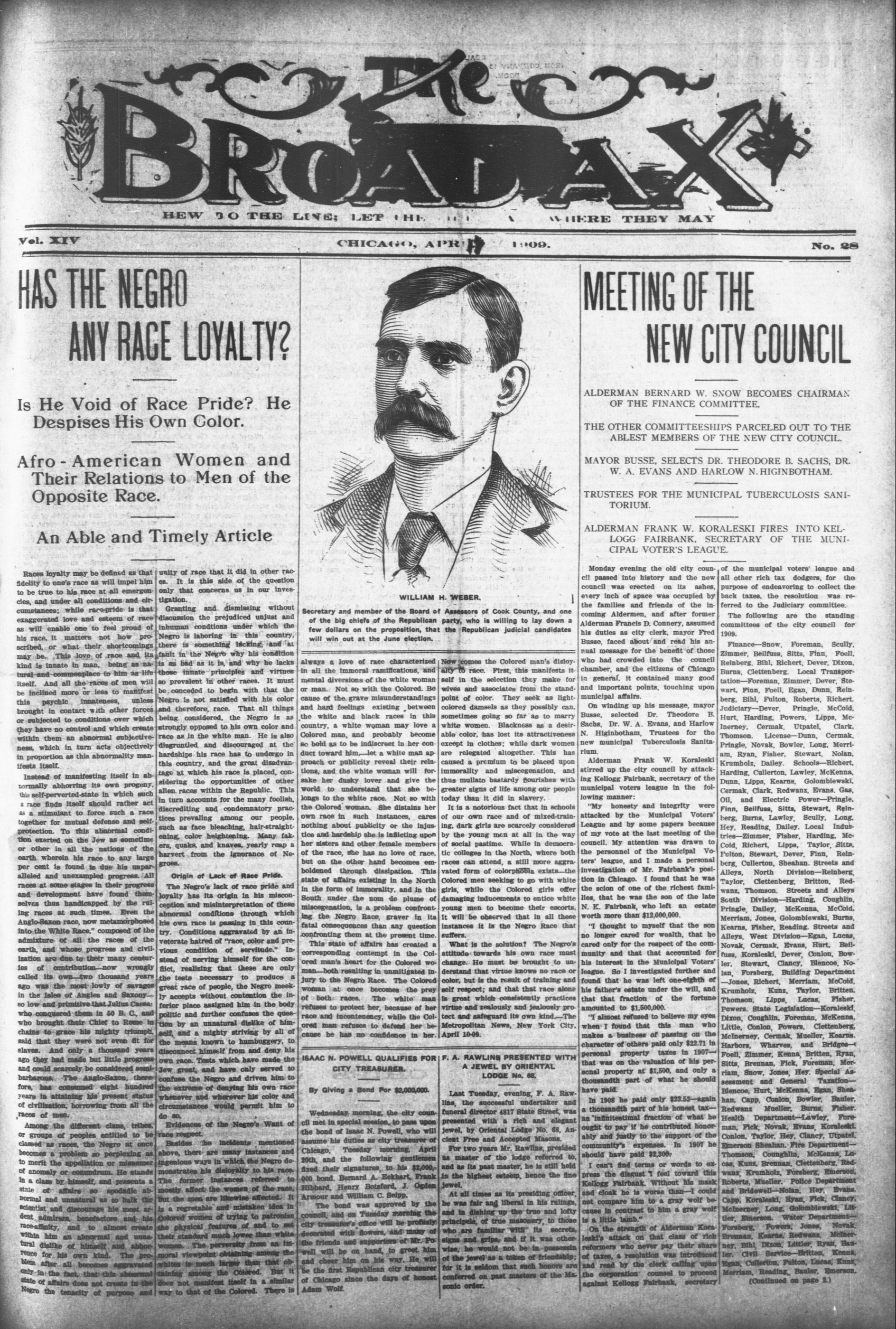
HAS THE NEGRO ANY RAGE LOYALTY?
Is He Void of Race Pride? He Despises His Own Color.
Afro-American Women and Their Relations to Men of the Opposite Race.
An Able and Timely Article
Races loyalty may be defined as that fidelity to one's race as will impel him to be true to his race at all emergencies, and under all conditions and circumstances; while race-pride is that exaggerated love and esteem of race as will enable one to feel proud of his race, it matters not how proscribed, or what their shortcomings may be. This love of race and its kind is innate in man, being as natural and commonplace to him as life itself. And all the races of men will be inclined more or less to manifest this psychic innateness, unless brought in contact with other forces or subjected to conditions over which they have no control and which create within them an abnormal subjectiveness, which in turn acts objectively in proportion as this abnormality manifests itself.
Instead of manifesting itself in abnormally abhorring its own progeny, this self-perverted-state in which such a race finds itself should rather act as a stimulant to force such a race together for mutual defense and self-protection. To this abnormal condition exerted on the Jew as sometime or other in all the nations of the earth wherein his race to any large per cent is found is due his unparalleled and unexamined progress. All races at some stages in their progress and development have found themselves thus handicapped by the ruling races at such times. Even the Anglo-Saxon race, now metamorphosed into the White Race," composed of the admixture of all the races of the earth, and whose progress and civilization are due to their many centuries of contribution—now wrongly called its own—two thousand years ago was the most lowly of savages in the Isles of Angles and Saxony—so low and primitive that Julius Caesar, who conquered them in 50 B. C., and who brought their Chief to Rome in chains to grace his mighty triumph, said that they were not even fit for slaves. And only a thousand years ago they had made but little progress and could scarcely be considered semilbarbarous. The Anglo-Saxon, therefore, has consumed eight hundred years in attaining his present status of civilization, borrowing from all the races of men.
Among the different class, tribes, or groups of peoples entitled to be classed as races, the Negro at once becomes a problem so perplexing as to merit the appellation or mismanner of anomaly or conundrum. He stands in a class by himself, and presents a state of affairs so apodicable abnormal and unnatural as to balk the scientist, and discourage his most ardent, admirers, benefactors and, his race-affinity, and to almost create within him an abnormal and unnatural dislike of himself and abhorrence for his own kind. The problem after all becomes aggravated only in the fact that this abnormal state of affairs does not create in the Negro the tenacity of purpose and
unity of race that it did in other races. It is this side of the question only that concerns us in our investigation.
Granting and dismissing without discussion the prejudiced unjust and inhuman conditions under which the Negro is laboring in this country, there is something lacking, and at fault in the Negro why his condition is as bad as it is, and why he lacks those innate principles and virtues so prevalent in other races. It must be conceded to begin with that the Negro is not satisfied with his color and therefore, race. That all things being considered, the Negro is as strongly opposed to his own color and race as in the white man. He is also disgruntled and discouraged at the hardships his race has to undergo in this country, and the great disadvantage at which his race is placed, considering the opportunities of other allen races within the Republic. This in turn accounts for the many foolish, discrediting and condemnatory practices prevailing among our people, such as face bleaching, hair-straightening, color heightening. Many fakers, quakes, and knaves, yearly reap a harvest from the ignorance of Negroes.
Origin of Lack of Race Pride.
The Negro's lack of race pride and loyalty has its origin in his misconception and misinterpretation of these abnormal conditions through which his own race is passing in this country. Conditions aggravated by an inverteate haired of "race, color and previous condition of servitude." Instead of nerving himself for the conflict, realizing that these are only the tests necessary to produce a great race of people, the Negro meekly accepts without contention the inferior place assigned him in the body politic and further confuses the question by an unnatural dislike of himself, and a mighty striving by all of the means known to humbuggery, to disconnect himself from and deny his own race. Tests which have made the Jew great, and have only served to confuse the Negro and driven him to the extreme of denying his own race whenever and wherever his color and circumstances would permit him to do so.
Evidences of the Negro's Want of race respect.
Besides the incidents mentioned above, there are many instances and ingenious ways in which the Negro demonstrates his disloyalty to his race. The former instances referred to mostly affect the women of the race, but the men are likewise affected. It is a regretable and mistaken idea in Colored women of trying to patronize the physical features of and to set their standard much lower than white women. The perversity from an immoral viewpoint obtaining among the whites is much larger than that obtaining among the Colored. But it does not manifest itself in a similar way to that of the Colored. There is
M.
Secretary and member of the Board of Assessors of Cook County, and one of the big chiefs of the Republican party, who is willing to lay down a few dollars on the proposition, that the Republican judicial candidates will win out at the June election.
always a love of race characterized in all the immoral ramifications, and mental diversions of the white woman or man. Not so with the Colored. Because of the grave misunderstandings and hard feelings existing between the white and black races in this country, a white woman may love a Colored man, and probably become so bold as to be indiscreet in her conduct toward him—let a white man approach or publicity reveal their relations, and the white woman will forsake her dusky lover and give the world to understand that she belongs to the white race. Not so with the Colored woman. She distains her own race in such instances, cares nothing about publicity or the injustice and hardship she is inflicting upon her sisters and other female members of the race, she has no love of race, but on the other hand becomes emboldened through dissipation. This state of affairs existing in the North in the form of immorality, and in the South under the nom de plume of miscegenation, is a problem confronting the Negro Race, graver in its fatal consequences than any question confronting them at the present time.
This state of affairs has created a corresponding contempt in the Colored man's heart for the Colored woman—both resulting in unmitigated injury to the Negro Race. The Colored woman at once becomes the prey of both races. The white man refuses to protect her, because of her race and incontenency, while the Colored man refuses to defend her because he has no confidence in her.
ISAAC N. POWELL QUALIFIES FOR
CITY. TREASURER.
By Giving a Bond For $2,000,000.
Wednesday morning, the city council met in special session, to pass upon the bond of Isaac N. Powell, who will assume his duties as city treasurer of Chicago, Tuesday morning. April 20th, and the following gentlemen fixed their signatures, to his $2,000,000 bond, Bernard A. Eckhart, Frank Hibbard, Henry Botsford, J. Ogden Armour and William C. Seipp.
The bond was approved by the council, and on Tuesday morning the city treasurer's office will be profusely decorated with flowers, and many of the friends and supporters of Mr. Powell will be on hand, to greet him and cheer him on his way. He will be the first Republican city treasurer of Chicago since the days of honest Adam Wolf.
Now comes the Colored man's disloyalty to race. First, this manifests itself in the selection they make for wives and associates from the standpoint of color. They seek as light-colored damsels as they possibly can, sometimes going so far as to marry white women. Blackness as a desirable color, has lost its attractiveness except in clothes; while dark women are relegated altogether. This has caused a premium to be placed upon immorality and miscegenation, and thus mullate bastardy flourishes with greater signs of life among our people today than it did in slavery.
It is a notorious fact that in schools of our own race and of mixed-training, dark girls are scarcely considered by the young men at all in the way of social pastime. While in democratic colleges in the North, where both races can attend, a still more aggravated form of colorphobia exists—the Colored men seeking to go with white girls, while the Colored girls offer damaging inducements to entice white young men to become their escorts. It will be observed that in all these instances it is the Negro Race that suffers.
What is the solution? The Negro's attitude towards his own race must change. He must be brought to understand that virtue knows no race or color, but is the result of training and self respect; and that that race alone is great which consistently practices virtue and zealously and jealously protect and safeguard its own kind. The Metropolitan News, New York City, April 10-09.
Last Tuesday, evening, F. A. Rawlins, the successful undertaker and funeral director 4817 State Street, was presented with a rich and elegant jewel, by Oriental Lodge No. 68, Ancient Free and Accepted Masons. For two years Mr. Rawlins, presided as master of the lodge referred to, and as its past master, he is still held in the highest esteem, hence the fine jewel. At all times as its presiding officer, he was fair and liberal in his rulings, and in dishing up the true and lofty principals, of true masonry, to those who are familiar with its secrets, signs and grips, and if it was otherwise, he would not be in possession of the jewel as a token of friendship; for it is seldom that such honors are conferred on past masters of the Masonic order.
MEETING OF THE NEW CITY COUNCIL
ALDERMAN BERNARD W. SNOW BECOMES CHAIRMAN OF THE FINANCE COMMITTEE.
THE OTHER COMMITTEESHIPS PARCELED OUT TO THE ABLEST MEMBERS OF THE NEW CITY COUNCIL.
MAYOR BUSSE, SELECTS DR. THEODORE B. SACHS, DR. W. A. EVANS AND HARLOW N. HIGINBOTHAM.
TRUSTEES FOR THE MUNICIPAL TUBERCULOSIS SANITORIUM.
ALDERMAN FRANK W. KORALESKI FIRES INTO KELLOGG FAIRBANK, SECRETARY OF THE MUNICIPAL VOTER'S LEAGUE.
Monday evening the old city council passed into history and the new council was erected on its ashes, every inch of space was occupied by the families and friends of the incoming Aldermen, and after former Alderman Francis D. Connery, assumed his duties as city clerk, mayor Fred Busse, faced about and read his annual message for the benefit of those who had crowded into the council chamber, and the citizens of Chicago in general, it contained many good and important points, touching upon municipal affairs.
On winding up his message, mayor Busse, selected Dr. Theodore B. Sachs, Dr. W. A. Evans, and Harlow N. Higinbotham, Trustees for the new municipal Tuberculosis Sanitarium.
Alderman Frank W. Koraleski stirred up the city council by attacking Kellogg Fairbank, secretary of the municipal voters league in the following manner:
'My honesty and integrity were attacked by the Municipal Voters' League and by some papers because of my vote at the last meeting of the council. My attention was drawn to the personnel of the Municipal Voters' league, and I made a personal investigation of Mr. Fairbank's position in Chicago. I found that he was the scion of one of the richest families, that he was the son of the late N. K. Fairbank, who left an estate worth more than $12,000,000.
'I thought to myself that the son no longer cared for wealth, that he cared only for the respect of the community and that that accounted for his interest in the Municipal Voters' league. So I investigated further and found that he was left one-eighth of his father's estate under the will, and that that fraction of the fortune amounted to $1,500,000.
"I almost refused to believe my eyes when I found that this man who makes a business of passing on the character of others paid only $22.71 in personal property taxes in 1907—that was on the valuation of his personal property at $1,500, and only a thousandth part of what he should have paid.
No. 28
THE
CITY COUNCIL
NOW BECOMES CHAIRMAN
SUMMITTEE.
IPS PARCELED OUT TO THE
THE NEW CITY COUNCIL.
R. THEODORE B. SACHS, DR.
BROW N. HIGINBOTHAM.
CIPAL TUBERCULOSIS SANI-
ALESKI FIRES INTO KEL-
CRETARY OF THE MUNI-
TE.
of the municipal voters' league and all other rich tax dodgers, for the purpose of endeavoring to collect the back taxes, the resolution was referred to the Judiciary committee. The following are the standing committees of the city council for 1909.
Finance—Snow, Foreman, Scully, Zimmer, Belifuss, Sitts, Finn, Foell, Reinberg, Bihl, Richter, Dever, Dixon, Burns, Clettenberg. Local Transportation—Foreman, Zimmer, Dever, Stewart, Finn, Foell, Egan, Dunn, Reinberg, Bihl, Fulton, Roberts, Richert. Judiciary—Dever, Pringle, McCold, Hurt, Harding, Powers, Lipps, McInerney, Cermak, Uptatel, Clark, Thomson. License—Dunn, Cermak, Pringle, Novak, Bowler, Long, Merriam, Ryan, Fisher, Stewart, Nolan, Krumholz, Dailley. Schools—Richert, Harding, Cullerton, Lawley, McKenna, Dunn, Lipps, Kearns, Golomblewski, Cermak, Clark, Redwanz, Evans, Gas, Oil, and Electric Power—Pringle, Finn, Belifuss, Sitts, Stewart, Reinberg, Burns, Lawley, Scully, Long, Hey, Reading, Dailley. Local Industries—Zimmer, Fisher, Harding, McCold, Richert, Lipps, Taylor, Sitts, Fulton, Stewart, Dever, Finn, Reinberg, Cullerton, Sheahan, Streets and Alleys, North Division—Reinberg, Taylor, Clettenberg, Britton, Redwanz, Thomson. Streets and Alleys South Division—Harding, Coughlin, Pringle, Dailley, McKenna, McCold, Merriam, Jones, Golomblewski, Burns, Kearns, Fisher, Reading, Streets and Alleys, West Division—Egan, Lucas, Novak, Cermak, Evans, Hurt, Belifuss, Koraleaski, Dever, Conlon, Bowler, Stewart, Clancy, Blencoe, Nolan, Forsberg, Building Department—Jones, Richert, Merriam, McCold, Krumholz, Kunz, Taylor, Britten, Thomson, Lipps, Lucas, Fisher. Powers. State Legislation—Koraleaski, Dixon, Coughlin, Foreman, McKenna, Little, Conlon, Powers, Clettenberg, McInerney, Cermak, Mueller, Kearns, Harbors, Wharves, and Bridgee—Foell, Zimmer, Kenna, Britten, Ryan, Sitts, Brennan, Fick, Foreman, Meriam, Snow, Jones, Hey. Special Assessment and General Taxation—Blencoe, Hurt, McKenna, Egan, Sheahan, Capp, Conlon, Bowler, Bauler, Redwanz, Mueller, Burns, Fisher, Health Department—Lawley, Foreman, Fick, Novak, Evans, Koraleaski, Conlon, Taylor, Hey, Clancy, Uptatel, Emerson Sheahan, Fire Department—Thomson, Coughlin, McKenna, Lucas, Kunz, Brennan, Clettenberg, Redwanz, Krumholz, Forberg, Emerson, Roberts, Mueller. Police Department and Bridewell—Nolan, Hey, Evans, Capp, Koraleaski, Rian, Fick, Clancy, McInerney, Long, Golomblewski, Littler, Emerson. Water Department—Forsberg, Powers, Jones, Novak Brennan, Kearns, Redwanz, McInerney, Bihl, Dixon, Littler, Ryan, Bauler. Civil Services—Britten, Kearns, Cullerton, Fulton, Lucas, Kunz, Meriam, Reading, Bauler, Emerson. (Continued on page 3.)
(Continued on page 12)
Will promulgate and at all times uphold the true principles of Democracy, but Catholics, Protestants, Priests, Insolls, Single Taxes, Republicarians, anyone, as has happened, as anyone, as their language is proper and responsibility is fired.
The Broad Ax is a newspaper whose pages are tough for all, ever claiming the editorial right to speak its own mind.
Local communications will receive attention. Write only on one side of the paper.
Subscriptions must be paid in advance.
One Year.....12.00
Six Months.....11.00
Advertising rates made known on application.
Address all communications to
THE BROAD AX
6888 Armour Avenue, Chicago.
JULIUS F. TAYLOR, Editor and Publisher.
Entered as Second-Class Matter, Aug. 19, 1902 at the Post Office at Chicago, Illinois, under Act of March 3, 1879.
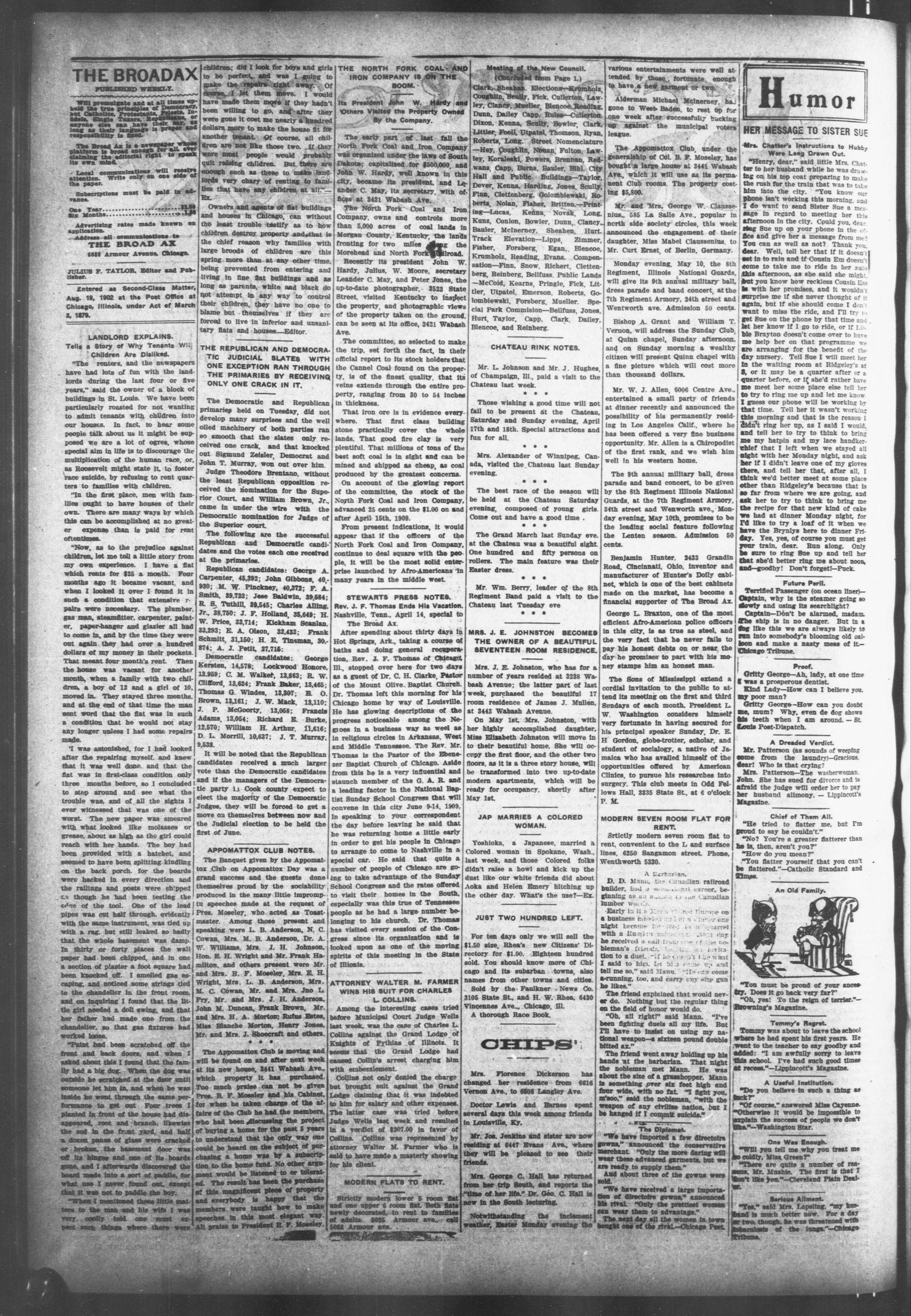
LANDLORD EXPLAINS.
Tells a Story of Why Tenants WI
Children Are Disliked.
"The renters, and the newspapers have had lots of fun with the land, lords during the last four or five years," said the owner of a block of buildings in St. Louis. We have been particularly roasted for not wanting to admit tenants with children into our houses. In fact, to hear some people talk about us it might be supposed we are a lot of ogres, whose special aim in life is to discourage the multiplication of the human race, or, as Roosevelt might state it, to foster race suicide, by refusing to rent quarters to families with children.
"In the first place, men with families ought to have houses of their own. There are many ways by which this can be accomplished at no greater expense than is paid for rent oftentimes.
"Now, as to the prejudice against children, let me tell a little story from my own experience. I have a flat which rents for $25 a month. Four months ago it became vacant, and when I looked it over I found it in such a condition that extensive repairs were necessary. The plumber, gas man, steamfitter, carpenter, painter, paper-hanger and glazier all had to come in, and by the time they were out again they had over a hundred dollars of my money in their pockets. That meant four months' rent. Then the house was vacant for another month, when a family with two children, a boy of 12 and a girl of 10, moved in. They stayed three months, and at the end of that time the man sent word that the flat was in such a condition that he would not stay any longer unless I had some repairs made.
I was astonished, for I had looked after the repairing myself, and knew that it was well done, and that the flat was in first-class condition only three months before, so I concluded to step around and see what the trouble was, and of all the sights I ever witnessed that was one of the worst. The new paper was smeared with what looked like molasses or grease, about as high as the girl could reach with her hands. The boy had been provided with a hatchet, and seemed to have been splitting kindling on the back porch, for the boards were hacked in every direction and the railings and posts were chipped as though he had been testing the edge of the tool. One of the lead pipes was cut half through, evidently with the same instrument, was tied up with a rag, but still leaked so badly that the whole basement was damp. In thirty or forty places the wall paper had been chipped, and in one a section of plaster a foot square had been knocked off. I smelled gas escaping, and noticed some strings tied to the chandelier In the front room, and on inquiring I found that the little girl needed a doll ewing, and that her father had made one from the chandelier, so that gas fixtures had worked loose.
"Paint had been scratched off the front and back doors, and when I asked about this I found that the family had a big dog. When the dog was outside he scratched at the door until someone let him in, and when he was inside he went through the same performance to get out. Four trees I planted in front of the house had disappeared, root and branch, likewise the sod in the front yard, and half a dozen pane of glass were cracked or broken, the basement door was off its hinges and one of its boards gone, and I afterwards discovered the board made into a sort of paddle, for what use I never found out, except that it was not to paddle the boy.
"When I mentioned these little matters to the man and his wife I was very, coolly told one must expect such things where there were
```markdown
```
children; did I look for boys and girls to be perfect, and was I going to make the repairs right away. Of course, I let them move. I would have made them move if they hadn't been willing to go, and after they were gone it cost me nearly a hundred dollars more to make the house fit for another tenant. Of course, all children are not like those two. If they were most people would probably quit raising children. But there are enough such as these to make landlords very chary of renting to families that have any children at all."—Ex.
Owners and agents of flat buildings and houses in Chicago, can without the least trouble testify as to how children destroy property and that is the chief reason why families with large broods of children are this spring more than at any other time, being prevented from entering and living in fine flat buildings and as long as parents, white and black do not attempt in any way to control their children, they have no one to blame but themselves if they are forced to live in inferior and unsanitary flats and houses.—Editor.
THE REPUBLICAN AND DEMOCRATIC JUDICIAL SLATES WITH ONE EXCEPTION RAN THROUGH THE PRIMARIES BY RECEIVING ONLY ONE CRACK IN IT.
The Democratic and Republican primaries held on Tuesday, did not develop many surprises and the well oiled machinery of both parties ran so smooth that the slates only received one crack, and that knocked out Sigmund Zeisler, Democrat and John T. Murray, won out over him. Judge Theodore Brentano, without the least Republican opposition received the nomination for the Superior Court, and William Brown, Jr., came in under the wire with the Democratic nomination for Judge of the Superior court.
The following are the successful Republican and Democratic candidates and the votes each one received at the primaries.
Republican candidates: George A. Carpenter, 45,392; John Gibbons, 40,930; M. W. Pinckney, 40,372; F. A. Smith, 39,723; Jese Baldwin, 39,584; R. S. Tuthill, 39,545; Charles Alling, Jr., 38,750; J. F. Holland, 35,649; H. W. Price, 33,714; Kickham Scanlan, 33,293; E. A. Olson, 32,433; Frank Schmitt, 31,150; H. E. Tinsman, 30,874; A. J. Petit, 27,715;
Democratic candidates: George Kersten, 14,578; Lockwood Homore, 13,959; C. M. Walket, 13,863; R. W. Clifford, 13,624; Frank Baker, 13,465; Thomas G. Windes, 13,307; E. O. Brown, 13,161; J. W. Mack, 13,110; J. P. McGourty, 13,058; Francis Adams, 13,054; Richard E. Burke, 12,570; William H. Arthur, 11,616; D. L. Morrill, 10,637; J. T. Murray, 9,538.
It will be noted that the Republican candidates received a much larger vote than the Democratic candidates and if the managers of the Democratic party in Cook county expect to elect the majority of the Democratic Judges, they will be forced to get a move on themselves between now and the Judicial election to be held the first of June.
APPOMATTOX CLUB NOTES.
APPOMATTOX CLUB NOTES.
The Banquet given by the Appomattox Club on Appomattox Day was a grand success and the guests done themselves proud by the sociability produced in the many little impromptu speeches made at the request of Pres. Moseley, who acted as Toastmaster. Among those present and speaking were L. B. Anderson, N. C. Cowan, Mrs. M. B. Anderson, Dr. A. W. Williams, Mrs. J. H. Johnson, Hon. E. H. Wright and Mr. Frank Hamilton, and others present were Mr. and Mrs. B. F. Moseley, Mrs. E. H. Wright, Mrs. L. B. Anderson, Mrs. M. C. Cowan, Mr. and Mrs. Jno L Fry, Mr. and Mrs. J. H. Anderson, John M. Duncan, Frank Brown, Mr. and Mrs. H. A. Morton Rufus Estes, Miss Blanche Morton, Henry Jones, Mr. and Mrs. J. Shoecraft and others.
The Appomattox Club is moving and will be found on and after next week at its new house, 3441 Wabash Ave. which property it has purchased. Too much praise can not be given. B. F. Moseley and his Cabinet, for when he taken charge of the affairs of the Club he had the members, who had been discussing the project of buying a home for the past 5 years to understand that the only way one could be heard on the subject of purchasing a home was by a subscription to the home fund. No other argument would be listened to or tolerated. The result has been the purchase of this magnificent piece of property and everybody is happy that the members were taught how to make speeches in this most elegant way. Ali praise to President B. F. Moseley.
The early part of last fall the North Fork Coal and Iron Company was organized under the laws of South Dakota; capitalized for $500,000, and John W. Hardy, well known in this city, became its president, and Leander C. May, its secretary, with offices at 3421 Wabash Ave.
The North Fork Coal and Iron Company, owns and controls more than 5,000 acres of coal lands in Morgan County, Kentucky, the lands fronting for two miles along the Morehead and North Fork Railroad.
Recently its president John W. Hardy, Julius, W. Moore, secretary Leander C. May, and Peter Jones, the up-to-date photographer, 3523 State Street, visited Kentucky to inspect the property, and photographic views of the property taken on the ground, can be seen at its office, 3421 Wabash Ave.
The committee, so selected to make the trip, set forth the fact, in their official report to its stock holders that the Cannel Coal found on the property, is of the finest quality, that its veins extends through the entire property, ranging from 30 to 54 inches in thickness.
That iron ore is in evidence everywhere. That first class building stone practically cover the whole lands. That good fire clay is very plentiful. That millions of tons of the best soft coal is in sight and can be mined and shipped as cheap, as coal produced by the greatest concerns. On account of the glowing report of the committee, the stock of the North Fork Coal and Iron Company, advanced 25 cents on the $1.00 on and after April 15th, 1909. From present indications, it would appear that if the officers of the North Fork Coal and Iron Company, continue to deal square with the people, it will be the most solid enterprise launched by Afro-Americans in many years in the middle west.
STEWARTS PRESS NOTES.
Rev. J. F. Thomas Ends His Vacation.
Nashville, Teen, April 14, special to
The Filed. Ar
After spending about thirty days in Hot Springs, Ark., taking a course of baths and doing general recuperation, Rev. J. F. Thomas of Chicago Ill., stopped over here for two days as a guest of Dr. C. H. Clarke, Pastor of the Mount Olive. Baptist Church. Dr. Thomas left this morning for his Chicago home by way of Louisville. He has glowing descriptions of the progress noticeable among the Negroes in a business way as weel as in religious circles in Arkansas, West and Middle Tennessee. The Rev. Mr. Thomas is the Pastor of the Ebenezer Baptist Church of Chicago. Aside from this he is a very influential and staunch member of the G. A. R. and a leading factor in the National Baptist Sunday School Congress that will convene in this city June 9-14, 1909. In speaking to your correspondent the day before leaving he said that he was returning home a little early in order to get his people in Chicago to arrange to come to Nashville in a special car. He said that quite a number of people of Chicago are going to take advantage of the Sunday School Congress and the rates offered to visit their homes in the South, especially was this true of Tennessee people as he had a large number belonging to his church. Dr. Thomas has visited every season of the Congress since its organization and is looked upon as one of the moving spirits of this meeting in the State of Illinois.
ATTORNEY WALTER M. FARMER
WINS HIS SUIT FOR CHARLES
L. COLLINS.
Among the interesting cases tried
before Municipal Court Judge Wells
last week, was the case of Charles L.
Collins against the Grand Lodge of
Knights of Pythias of Illinois. It
seems that the Grand Lodge had
caused Collin's arrest charging him
with enebzzlement.
Collins not only denied the charge but brought suit against the Grand Lodge claiming that it was indebted to him for salary and other expenses. The latter case was tried before Judge Wells last week and resulted in a verdict of $207.00 in favor of Collins. Collins was represented by attorney Walter M. Farmer who is said to have made a masterly showing for his client.
Strictly modern lower 5 room flat and one upper 6 room flat. Both flats newly decorated, to rent to families of adults. 5025 Armour ave., call 5028 Armour ave.
Meeting of the New Council.
(Conscluded from Page 1.)
Clark, Sheahan, Elections—Krumholz, Coughlin, Scully, Fick, Cullerton, Lawley, Clance, Mueller, Blencoe, Reading, Dunn, Dalley Capp, Rules—Cullerton, Dixon, Kenna, Scully, Bowler, Clark Littler, Foell, Uptatel, Thomson, Ryan, Roberts, Long. Street Nomenclature—Hey, Coughlin, Nouan, Fulton, Lawley, Korale硅, Powers, Brennan, Redwanz, Capp, Burns, Beauler, Bihl, City Hall and Public Buildings—Taylor, Dever, Kenna, Harding, Jones, Scully, Finn, Clettenberg, Golomblewski, Roberts, Nolan, Fisher, Britten.—Printing—Lucas, Kenna, Novak, Long, Kunz, Conlon, Bowler, Dunn, Clancy, Bauler, Innerney, Sheahen, Hurt. Track Elevation—Lipps, Zimmer, Fisher, Forsberg, Egan, Blencoe, Krumholz, Reading, Evans. Compensation—Finn, Snow, Richert, Clettenberg, Reinberg, Bellfuss, Public Lands—McCoid, Kearns, Pringle, Fick, Littler, Uptatel, Emerson, Roberts, Golomblewski, Forsberg, Mueller. Special Park Commission—Bellfuss, Jones, Hurt, Taylor, Capp, Clark, Dalley, Blencoe, and Reinberg.
CHATEAU RINK NOTES:
Mr. L. Johnson and Mr. J. Hughes,
of Champaign, Ill., paid a visit to the
Chateau last week.
Those wishing a good time will not
fail to be present at the Chateau,
Saturday and Sunday evening, April
17th and 18th. Special attractions and
fun for all.
Mrs. Alexander of Winnipeg, Canada,
visited the Chateau last Sunday
evening.
The best race of the season will
be held at the Chateau Saturday
evening, composed of young girls.
Come out and have a good time.
The Grand March last Sunday eve,
at the Chateau was a beautiful sight.
One hundred and fifty persons on
rollers. The main feature was their
Easter dress.
Mr. Wm. Berry, leader of the 8th
Regiment Band paid a visit to the
Chateau last Tuesday eve
MRS. J. E. JOHNSTON BECOMES
THE OWNER OF A BEAUTIFUL
SEVENTEEN ROOM RESIDENCE.
Mrs. J. E. Johnston, who has for a
number of years resided at 3238 Wabash Avenue; the latter part of last
week, purchased the beautiful 17
room residence of James J. Mullen,
at 3443 Wabash Avenue.
On May 1st, Mrs. Johnston, with
her highly accomplished daughter,
Miss Elizabeth Johnston will move in
to their beautiful home. She will
occupy the first floor, and the other two
floors, as it is a three story house, will
be transformed into two up-to-date
modern apartments, which will be
ready for occupancy, shortly after
May 1st.
Yoshioka, a Japanese, married a Colored, woman in Spokane, Wash., last week, and those Colored folks didn't raise a howl and kick up the dust like our white friends did about Aoka and Helen Emery hitching up the other day. What's the use?—Ex.
JUST TWO HUNDRED LEFT.
For ten days only we will sell the $1.50 size, Rhea's new Citizens' Directory for $1.00. Eighteen hundred sold. You should know more of Chicago and its suburban towns, also names from other towns and cities. Sold by the Faulkner News Co. 3105 State St. and H. W. Rhea, 6430 Vincennes Ave., Chicago, Ill.
A thorough Race Book.
CHIPS'
Mrs. Florence Dickerson has changed her residence from 6616 Vernon Ave. to 6508 Langley Ave.
Doctor Lewis and Barnes spent several days this week among friends in Louisville, Ky.
Mr. Jos. Jenkins and sister are now residing at 6447 Evans Ave., where they will be pleased to see their friends.
Mrs. George C. Hall has returned from her trip South, and reports the "time of her life." Dr. GEO. C. Hall is now in the South lecturing.
Notwithstanding the inclement weather, Easter Monday evening the
various entertainments were well attended by those, fortunate, enough to have a new garment or two.
Alderman Michael Melnerney, has gone to West Baden, to rest up for one week after successfully backing up against the municipal voters league.
The Appomattox Club, under the generalship of Col. B. F. Moseley, has bought a large house at 3441 Wabash Ave, which it will use as its permanent Club rooms. The property costing $5,800.
Mr. and Mrs. George W. Claussenius, 585 La Salle Ave., popular in north side society circles, this week announced the engagement of their daughter, Miss Mabel Claussenius, to Mr. Curt Ernst, of Berlin, Germany.
Monday evening, May 10, the 8th Regiment, Illinois National Guards, will give its 9th annual military ball, dress parade and band concert, at the 7th Regiment Armory, 34th street and Wentworth ave. Admission 50 cents.
Bishop A. Grant and William T. Vernon, will address the Sunday Club, at Quinn chapel, Sunday afternoon, and on Sunday morning a wealthy citizen will present Quinn chapel with a fine picture which will cost more than thousand dollars.
Mr. W. J. Allen, 6006 Centre Ave., entertained a small party of friends at dinner recently and announced the possibility of his permanently residing in Los Angeles Calif., where he has been offered a very fine business opportunity. Mr. Allen is a Chiropodist of the first rank, and we wish him well in his western home.
The 9th annual military ball, dress parade and band concert, to be given by the 8th Regiment Illinois National Guards, at the 7th Regiment Armory, 34th street and Wenworth ave., Monday evening, May 10th, promises to be the leading social feature following the Lenten season. Admission 50 cents.
Benjamin Hunter, 2433 Grandin Road, Cincinnati, Ohio, inventor and manufacturer of Hunter's Dolly cabinet, which is one of the best cabinets made on the market, has become a financial supporter of The Broad Ax. George L. Braxton, one of the most efficient Afro-American police officers in this city, is as true as steel, and the very fact that he never fails to pay his honest debts on or near the day he promises to part with his money stamps him an honest man.
The Sons of Mississippi extend a cordial invitation to the public to attend its meeting on the first and third Sundays of each month. President L. W. Washington considers himself very fortunate in having secured for his principal speaker Sunday, Dr. E. H Gordon, globe-trotter, scholar, and student of socialogy, a native of Jamaica who has availed himself of the opportunities offered by American Clinics, to pursue his researches into surgery. This club meets in Odd Fellows Hall, 3335 State St., at 6 o'clock P. M.
MODERN SEVEN ROOM FLAT FOR
RENT
Srtictly modern seven room flat to rent, convenient to the L and surface lines, 6250 Sangamon street. Phone, Wenthworth 5330.
A. Ecterian.
D. D. Mann, the Canadian railroad builder, had a sensational career, beginning as an amateur to the Canadian lumber worms.
Early in life Mann visited Europe on a business mission and hit a clown on night became fascinated in a quarrel with a Russian submarine. When day he received a call from one of his nobleman's friends, landing in invitation to a duel. "If he couldn't be what I said to him, let him come up and tell me so," said Manu. "He can come a-running, too, and carry any size gun he likes."
The friend explained that would never do. Nothing but the regular thing on the field of honor would do.
"Oh, all right!" said Mann. "I've been fighting duels all my life. But I'll have to insist on using my national weapon—a sixteen pound double bitten ax."
The friend went away holding up his hands at the barbarian. That night the nobleman met Mann. He was about the size of a grasshopper. Mann is something over six feet high and four wide, with no fat. "I fight you, m'soo," said the nobleman, "with the weapon of any civilize nation, but I be hanged if I commit suicide."
The Diplomat.
"We have imported a few directoire gowns," announced the conservative merchant. "Only the more daring will wear these advanced garments, but we are ready to supply them."
And about three of the gowns were sold.
"We have received a large importation of directive gowns" announced his rival. "Only the prettiest women can wear them to advantage." The next day all the women in town bought one of the rival-Chicago Post.
Humor HER MESSAGE TO SISTER SUE Mrs. Chatter's Instructions to Hubby Were Long Drawn Out.
"Henry, dear," said little Mrs. Chatter to her husband while he was drawing on his top coat preparing to make the rush for the train that was to take him into the city. "You know our phone isn't working this morning, and I do want to send Sister Sue a message in regard to meeting her this afternoon in the city. Could you, dear, sing Sue up on your phone in the office and give her a message from me. You can as well as not? Thank you dear. Well, tell her that if it doesn't set in to rain and if Cousin Em doesn't come to take me to ride in her auto this afternoon, as she said she might but you know how reckless Cousin Em is with her promises, and it wouldn't surprise me if she never thought of it again, but if she should come I don't want to miss the ride, and I'll try to get Sue on the phone by that time and let her know if I go to ride, or if Lily Brayton doesn't come over to have me help her on that programme we are arranging for the benefit of the day nursery. Tell Sue I will meet her in the waiting room at Ridgeley's at S, or it may be a quarter after or a quarter before, or if she'd rather have me meet her some place else tell her to try to ring me up and let me know. I guess our phone will be working by that time. Tell her it wasn't working this morning and that is the reason I didn't ring her up, as I said I would, and tell her to try to think to bring me my hatpin and my lace handkerchief that I left when we stayed all night with her Monday night, and ask her if I didn't leave one of my gloves there, and tell her that, after all, I think we'd better meet at some place other than Ridgeley's because that is so far from where we are going, and ask her to try to think to bring me the recipe for that new kind of cake we had at dinner Monday night, for I'd like to try a loaf of it when we have the Brynlys here to dinner Friday. Yes, yes, of course you must get your train, dear. Run along. Only be sure to ring Sue up and tell her that she'd better ring me about noon, and—good! Don't forget!-Puck.
Future Peril.
Terrified Passenger (on ocean liner)—Captain, why is the steamer going so slowly and using its searchlight?
Captain—Don't be alarmed, madam. The ship is in no danger. But in a dog like this we are always likely to run into somebody's blooming old calfoon and make a nasty mess of it—Chicago Tribune.
Proof.
Gritty George—Ah, lady, at one time
it was a prosperous dentist.
Kind Lady—How can I believe you,
my poor man?
Gritty George—How can you doubt
me, mum? Why, even de dog shows
his teeth when I am around. — St.
Louis Post-Dispatch.
A. Dreaded Vordict
Mr. Patterson (as sounds of weeping come from the laundry)—Gracious, dear! Who is that crying?
Mrs. Patterson—The washerwoman. John. She has sued for divorce and is afraid the judge will order her to pay her husband alimony. — Lippincott's Magazine.
Chief of Them All
"He tried to flatter me, but I'm proud to say he couldn't."
"No? You're a greater flatterer than he is, then, aren't you?"
"How do you mean?"
"You flatter yourself that you can't be flattered."—Catholic Standard and Times.
An Old Family.
"Oh, yes! To the reign of terrier."—Browning's Magazine.
Tommy was about to leave the school where he had spent his first years. He went to the teacher to say goodbye and added: "I am awfully sorry to leave this school. I've had such good times at recess."—Lippincott's Magazine.
A Useful Institution.
"Do you believe in such a thing as luck?"
"Of course," answered Miss Cayenne.
"Otherwise it would be impossible to explain the success of people we don't like."—Washington Star.
One Was Enough.
"Will you tell me why you treat me so coldly, Miss Green?"
"There are quite a number of reasons, Mr. Mushle. The first is that I don't like you."—Cleveland Plain Dealer.
Serious Alliment.
"Yes," said Mrs. Lapelling. "my husband is much better now. For a day or two, though, he was threatened with roboculosis of the lungs."—Chicago Tribune.
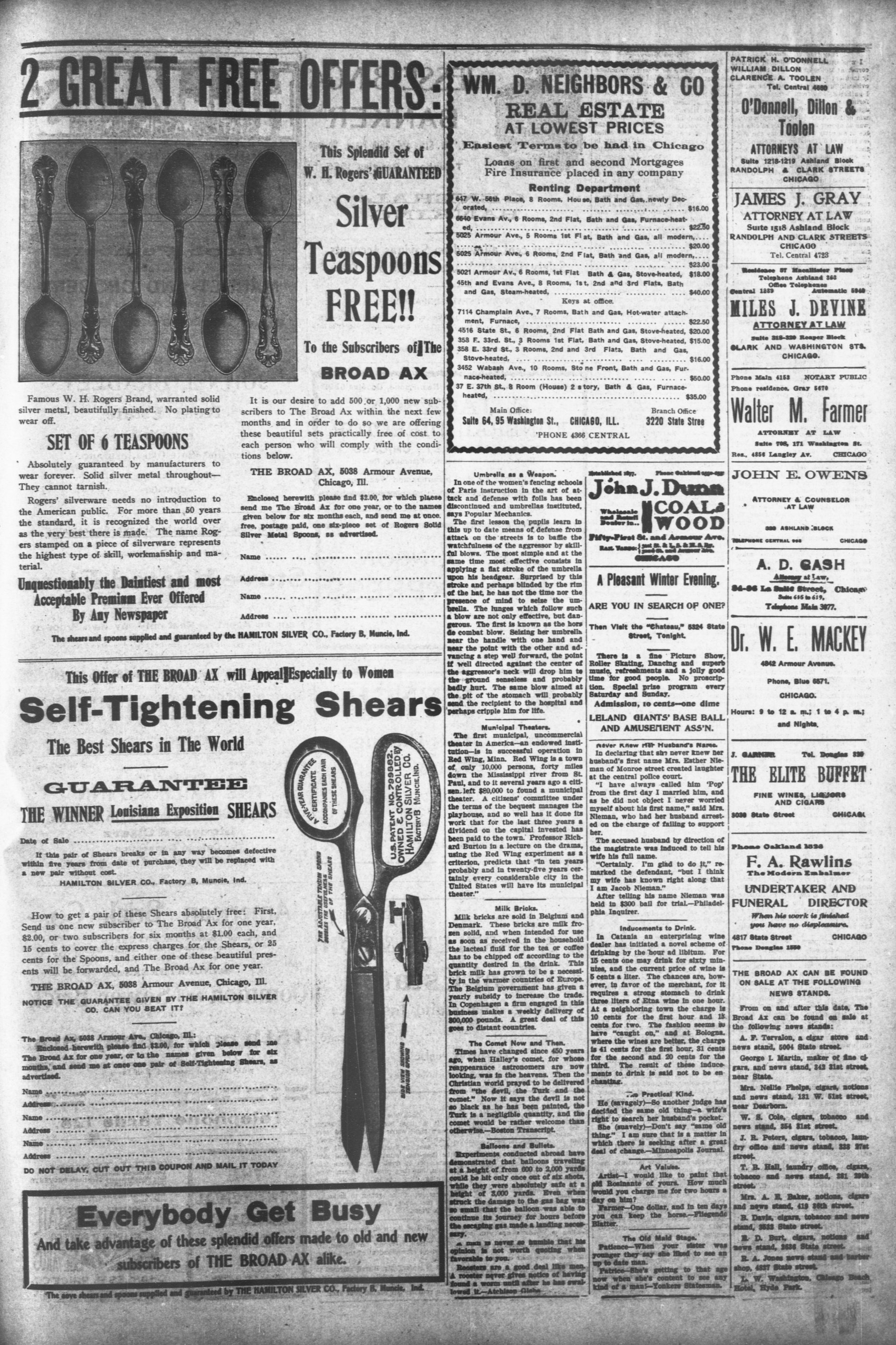
2 GREAT FREE OFFERS:
The shears and spoons supplied and guaranteed by the HAMILTON SILVER CO., Factory B, Muncie, Ind.
Self-Tightening Shears
Everybody Get Busy And take advantage of these splendid offers made to old and new subscribers of THE BROAD AX alike.
```markdown
```
Famous W. H. Rogers Brand, warranted solid silver metal, beautifully finished. No plating to wear off.
SET OF 6 TEASPOONS
Absolutely guaranteed by manufacturers to wear forever. Solid silver metal throughout They cannot tarnish.
Rogers' silverware needs no introduction to the American public. For more than 50 years the standard, it is recognized the world over as the very best there is made. The name Rogers stamped on a piece of silverware represents the highest type of skill, workmanship and material.
Unquestionably the Daintiest and most Acceptable Premium Ever Offered By Any Newspaper
Date of Sale ..... If this pair of Shears breaks or in any way becomes defective within five years from date of purchase, they will be replaced with a new pair without cost.
HAMILTON SILVER CO., Factory B, Muncie, Ind.
How to get a pair of these Shears absolutely free: First, Send us one new subscriber to The Broad Ax for one year, $2.00, or two subscribers for six months at $1.00 each, and 15 cents to cover the express charges for the Shears, or 25 cents for the Spoons, and either one of these beautiful presents will be forwarded, and The Broad Ax for one year.
THE BROAD AX, 5038 Armour Avenue, Chicago, Ill.
NOTICE THE GUARANTEE GIVEN BY THE HAMILTON SILVER CO. CAN YOU BEAT IT?
The Broad Ax, 5088 Armour Ave, Chicago, IL:
Enclosed herewith please find $2.00, for which please send me
The Broad Ax for one year, or to the names given below for six
months, and send me at once one pair of Self-Tightening Shears, as
advertised.
Name
Address
This Splendid Set of
W. H. Rogers' GUARANTEED
Silver Teaspoons FREE!!
To the Subscribers of The BROAD AX
or desire to add 500 or 1,000 new sub-
to The Broad Ax within the next few
and in order to do so we are offering
beautiful sets practically free of cost to
son who will comply with the condi-
tion.
BROAD AX, 5038 Armour Avenue,
Chicago, Ill.
Herewith please find $2.00, for which plaese
the Broad Ax for one year, or to the names
for six months each, and send me at once.
We paid, one six-piece set of Rogers Solid
Spoons, as advertised.
SILVER CO., Factory B, Muncie, Ind.
Especially to Women
g Shears
It is our desire to add 500 or 1,000 new subscribers to The Broad Ax within the next few months and in order to do so we are offering these beautiful sets practically free of cost to each person who will comply with the conditions below.
THE BROAD AX, 5038 Armour Avenue,
Chicago, Ill.
Enclosed herewith please find $2.00, for which please send me The Broad Ax for one year, or to the names given below for six months each, and send me at once, free, postage paid, one six-piece set of Rogers Solid Silver Metal Spoons, as advertised.
Name .....
A FIVE-YEAR GUARANTEE
CERTIFICATE
ACCOMPANIES EACH PAIR
OF THESE SHEARS
THE ADJUSTABLE TENSION SHEAR
SHOULDS THE USEFULNESS
OF THE SHEARS
BIG VIEW SHOWING
TENSION SHEAR
U.S. PATENT NO. 299882.
OWNED & CONTROLLED BY
HAMILTON SILVER CO.
FACTORY B MUNCHCHE, IND.
t Busy
ers made to old and new
AX alike.
WM. D. NEIGHBORS & GO REAL ESTATE AT LOWEST PRICES
Easiest Terms to be had in Chicago Loans on first and second Mortgages Fire Insurance placed in any company
Renting Department
647 W. 56th Place, 8 Rooms, House orated,
6640 Evans Av., 6 Rooms, 2nd Flat, ed,
5025 Armour Ave., 5 Rooms 1st Flat,
5025 Armour Ave., 6 Rooms, 2nd Floor,
5021 Armour Av., 6 Rooms, 1st Flat,
45th and Evans Ave., 8 Rooms, 1st and Gas, Steam-heated,
Keys at
7114 Champlain Ave., 7 Rooms, Bath ment, Furnace,
4516 State St., 6 Rooms, 2nd Flat,
358 E. 33rd. St., 3 Rooms 1st Flat,
358 E. 33rd. St., 3 Rooms, 2nd and 1 Stove-heated,
3452 Wabash Ave., 10 Rooms, Sto nce-heated,
37 E. 37th St., 8 Room (House) 2 st heated,
Main Office:
Suite 64, 95 Washington St., CHIC
'PHONE 4366
7114 Champlain Ave., 7 Rooms, Bath and Gas, Hot-water attachment, Furnace, ..... $22.50
4516 State St., 6 Rooms, 2nd Flat Bath and Gas, Stove-heated, $20.00
358 F. 33rd St., 3 Rooms 1st Flat, Bath and Gas, Stove-heated, $15.00
358 E. 33rd St., 3 Rooms, 2nd and 3rd Flats, Bath and Gas,
Main Office:
Suite 64, 95 Washington St., CHICAGO, ILL.
Branch Office
3220 State Stree
'PHONE 4386 CENTRAL
In one of the women's fencing schools of Paris instruction in the art of attack and defense with folls has been discontinued and umbrellas instituted, says Popular Mechanics.
The first lesson the pupils learn in this up to date means of defense from attack on the streets is to baffle the watchfulness of the aggressor by skillful blows. The most simple and at the same time most effective consists in applying a flat stroke of the umbrella upon his headgear. Surprised by this stroke and perhaps blinded by the rim of the hat, he has not the time nor the presence of mind to seize the umbrella. The lunges which follow such a blow are not only effective, but dangerous. The first is known as the hors de combat blow. Selzing her umbrella near the handle with one hand and near the point with the other and advancing a step well forward, the point if well directed against the center of the aggressor's neck will drop him to the ground senseless and probably badly hurt. The same blow aimed at the pit of the stomach will probably send the recipient to the hospital and perhaps cripple him for life.
The first municipal, uncommercial theater in America—an endowed institution—is in successful operation in Red Wing, Minn. Red Wing is a town of only 10,000 persons, forty miles down the Mississippi river from St. Paul, and to it several years ago a citizen.left $80,000 to found a municipal theater. A citizens' committee under the terms of the bequest manages the playhouse, and so well has it done its work that for the last three years a dividend on the capital invested has been paid to the town. Professor Richard Burton in a lecture on the drama, using the Red Wing experiment as a criterion, predicts that "in ten years probably and in twenty-five years certainly every considerable city in the United States will have its municipal theater."
Milk bricks are sold in Belgium and Denmark. These bricks are milk frozen solid, and when intended for use as soon as received in the household the lactate fluid for the tea or coffee has to be chipped off according to the quantity desired in the drink. This brick milk has grown to be a necessity in the warmer countries of Europe. The Belgium government has given a yearly subsidy to increase the trade. In Copenhagen a firm engaged in this business makes a weekly delivery of 300,000 pounds. A great deal of this goes to distant countries.
The Comet Now and Then.
Times have changed since 450 years ago, when Halley's comet, for whose reappearance astronomers are now looking, was in the heavens. Then the Christian world prayed to be delivered from "the devil, the Turk and the comet." Now it says the devil is not so black as he has been painted, the Turk is a negligible quantity, and the comet would be rather welcome than otherwise—Boston Transcript.
Balloons and Bullets.
Experiments conducted abroad have demonstrated that balloons traveling at a height of from 600 to 2,000 yards could be hit only once out of six shots, while they were absolutely safe at a height of 3,000 yards. Even when struck the damage to the gas bag was so small that the balloon was able to continue its journey for hours before the escaping gas made a landing necessary.
A man is never so humble that his opinion is not worth quoting when favorable to you.
Roosters are a good deal like men. A rooster never gives notice of having found a worm until after he has swallowed it—Atchleop Globa.
Municipal Theaters.
Milk Bricks.
Bath and Gas, newly Dec-
$16.00
Bath and Gas, Furnace-heat-
$22.50
Hot, Bath and Gas, all modern,...
$20.00
Hot, Bath and Gas, all modern,...
$23.00
Bath & Gas, Stove-heated, $18.00
2nd and 3rd Flats, Bath
$40.00
Hot office.
Bath and Gas, Hot-water attach-
$22.50
Bath and Gas, Stove-heated, $20.00
Bath and Gas, Stove-heated, $15.00
3rd Flats, Bath and Gas,
$16.00
One Front, Bath and Gas, Fur-
$50.00
Story, Bath & Gas, Furnace-
$35.00
Branch Office
3220 State Stree
CENTRAL
Established 1877. Phone Oakland 455-6255
John J. Dunn
COAL &
WOOD
Whalepale
and Rattail
Doorer In...
Fifty-First St. and Armour Ave.
Raz. Vargo. jant St. & L. B. & H. B. Rg.
gard St. and Armour Ave.
CHICAGO
A Pleasant Winter Evening.
ARE YOU IN SEARCH OF ONE?
Then Visit the "Chateau," 5324 State Street, Tonight.
There is a fine Picture Show, Roller Skating, Dancing and superb music, refreshments and a jolly good time for good people. No proscription. Special prize program every Saturday and Sunday.
Admission, 10 cents—one dime
LELAND GIANTS' BASE BALL AND AMUSEMENT ASS'N.
Never knew Mr. Husband's Narse. In declaring that she never knew her husband's first name Mrs. Esther Nieman of Monroe street created laughter at the central police court.
"I have always called him 'Pop' from the first day I married him, and as he did not object I never worried myself about his first name," said Mrs. Nieman, who had her husband arrested on the charge of failing to support her.
The accused husband by direction of the magistrate was induced to tell his wife his full name.
"Certainly. I'm glad to do it," remarked the defendant, "but I think my wife has known right along that I am Jacob Nieman."
After telling his name Nieman was held in $300 bail for trial—Philadelphia Inquirer.
Inducements to Drink
In Catania an enterprising wine dealer has initiated a novel scheme of drinking by the hour ad libitum. For 15 cents one may drink for sixty minutes, and the current price of wine is 5 cents a liter. The chances are, however, in favor of the merchant, for it requires a strong stomach to drink three liters of Etna wine in one hour. At a neighboring town the charge is 10 cents for the first hour and 15 cents for two. The fashion seems to have "caught on," and at Bologna, where the wines are better, the charge is 41 cents for the first hour, 31 cents for the second and 20 cents for the third. The result of these inducements to drink is said not to be enchanting.
Practical Kind.
He (savagely)—So another judge has decided the same old thing—a wife's right to search her husband's pocket.
Bbe (suavely)—Don't say "same old thing." I am sure that is a matter in which there is seeking after a great deal of change—Minneapolis Journal.
Art Value.
Artist—I would like to paint that M Rosinante of yours. How much would you charge me for two hours a day on him?
Farmer—One dollar, and in ten days you can keep the horse—Filegende Blatter.
The Old Maid Stage.
Patience—When your sister was younger they say she liked to see an up to date man.
Patrice—She's getting to that age now when she's content to see any kind of a man—Yonkers Statesman.
PATRICK H. O'DONNELL
WILLIAM DILLON
CLARENCE A. TOOLEN
Tel. Central 4680
O'Donnell, Dillon &
Toolen
ATTORNEYS AT LAW
Suite 1218-1219 Ashland Block
RANDOLPH & CLARK STREETS
CHICAGO
JAMES J. GRAY
ATTORNEY AT LAW
Suite 1518 Ashland Block
RANDOLPH AND CLARK STREETS
CHICAGO
Tel. Central 4728
Residence 57 Macallister Place
Telephone Ashland 358
Office Telephones
Central 1839 Automatic 5948
MILES J. DEVINE
ATTORNEY AT LAW
Suite 318-330 Reeper Block
CLARK AND WASHINGTON STS.
CHICAGO.
Phone Main 4153 NOTARY PUBLIC
Phone residence, Gray 5670
Walter M. Farmer
ATTORNEY AT LAW
Suite 708, 171 Washington St.
Res. 4856 Langley Av. CHICAGO
JOHN E. OWENS
ATTORNEY & COUNSELOR
AT LAW
320 ASHLAND BLOCK
TELEPHONE CENTRAL 968 CHICAGO
A. D. GASH
Attorney at Law,
84-06 La Buille Street, Chicago
Suite 615 to 619.
Telephone Main 3077.
Dr. W. E. MACKEY
Phone, Blue 6571.
CHICAGO.
Hours: 9 to 12 a. m.; 1 to 4 p. m.; and Nights.
J. GARNER Tol. Douglas 320
THE ELITE BUFFET
FINE WINES, LICORS
AND CIGARS
3030 State Street CHICAGO
Phone Oakland 1828
UNDERTAKER AND
FUNERAL DIRECTOR
When his work is finished
you have no displeasure.
4817 State Street CHICAGO
Phone Douglas 1850
THE BROAD AX CAN BE FOUND
ON SALE AT THE FOLLOWING
NEWS STANDS.
From on and after this date, The
Broad Ax can be found on sale at
the following news stands:
A. F. Tervalon, a cigar store and
news stand, 5004 State street.
George L. Martin, maker of fine cigars, and news stand, 242 31st street, near State.
Mrs. Nellie Phelps, cigars, notions and news stand, 131 W. 51st street, near Dearborn.
W. S. Cole, cigars, tobacco and news stand, 354 31st street.
J. R. Peters, cigars, tobacco, laundry office and news stand, 338 27st street.
T. B. Hall, laundry office, cigars, tobacco and news stand, 381 29th street.
Mrs. A. E. Baker, notions, cigars and news stand, 419 36th street.
B. Davis, cigars, tobacco and news stand, 8533 State street.
B. D. Burt, cigars, notions and news stand, 2636 State street.
B. A. Jones news stand and barber shop, 4637 State street.
L. W. Washington, Chicago Beach Hotel, Hyde Park.
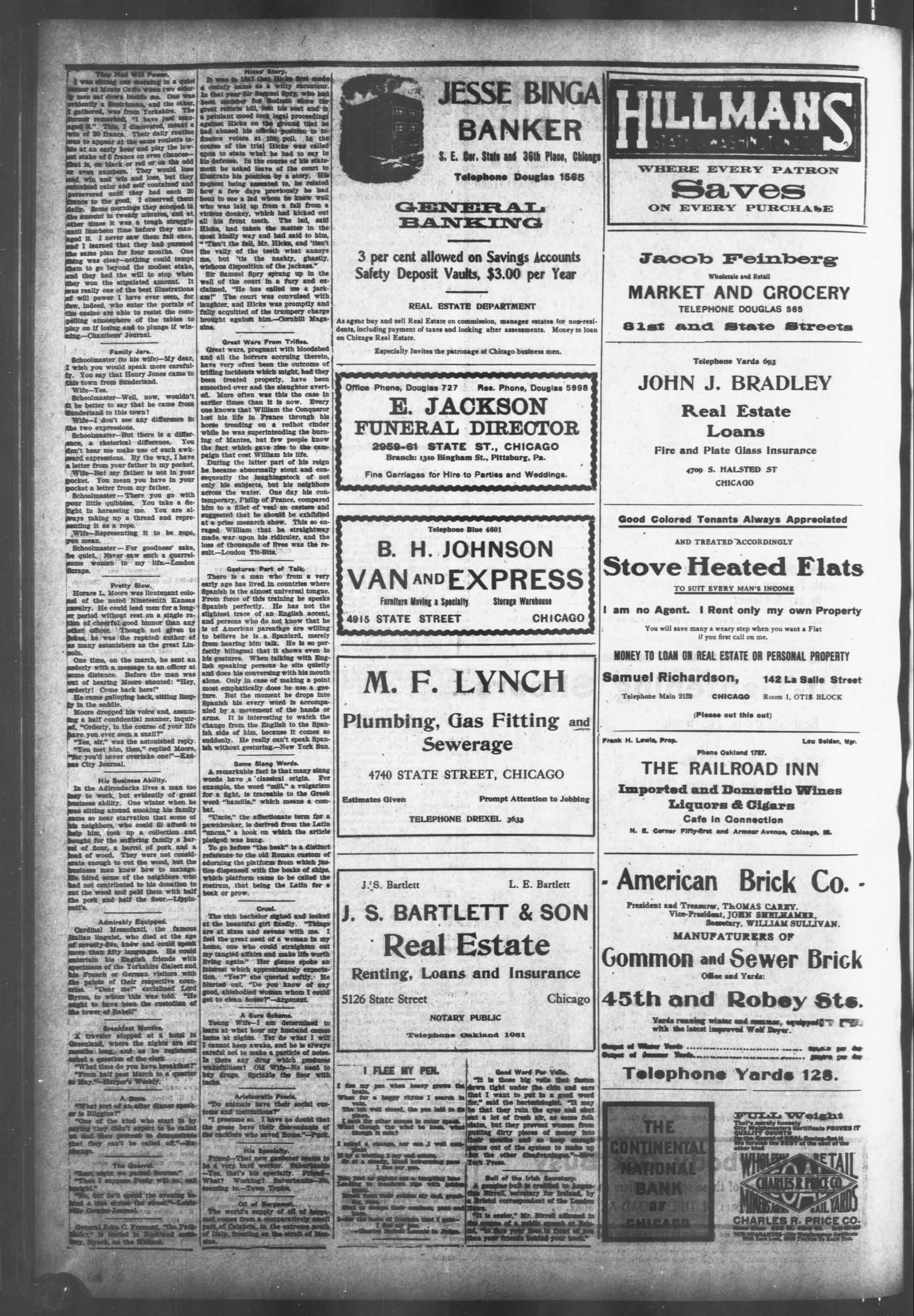
They Had Will Power.
I was sitting one morning in a quiet corner at Monte Carlo when two elderly men sat down beside me. One was evidently a Scotchman, and the other, I gathered, was from Yorkshire. The former remarked, "I have just managed it." This, I discovered, meant a win of 20 francs. Their daily routine was to appear at the same roulette table at an early hour and play the lowest stake of 5 francs on even chances—that is, on black or red or on the odd or even numbers. They would lose and win and win and lose, but they remained calm and self contained and persevered until they had each 20 francs to the good. I observed them daily. Some mornings they scooped in the amount in twenty minutes, and at other times it was a tough struggle until luncheon time before they managed it. I never saw them fall once, and I learned that they had pursued the same plan for four months. One thing was clear—nothing could tempt them to go beyond the modest stake, and they had the will to stop when they won the stipulated amount. It was really one of the best illustrations of will power I have ever seen, for few, indeed, who enter the portals of the casino are able to resist the compelling atmosphere of the tables to play on if losing and to plunge if winning—Chambers' Journal.
Schoolmaster (to his wife)—My dear, I wish you would speak more carefully. You say that Henry Jones came to this town from Sunderland. Wife—Yes. Schoolmaster—Well, now, wouldn't it be better to say that he came from Sunderland to this town? Wife—I don't see any difference in the two expressions.
the two expressions.
Schoolmaster—But there is a difference, a rhetorical difference. You don't hear me make use of such awkward expressions. By the way, I have a letter from your father in my pocket. Wife—But my father is not in your pocket. You mean you have in your pocket a letter from my father.
Schoolmaster—There you go with your little quibbles. You take a delight in harassing me. You are always taking up a thread and representing it as a rope.
Wife—Representing it to be rope, you mean.
Schoolmaster—For goodness' sake, he quiet. Never saw such a quarrelsome woman in my life—London Scraps.
Pretty Slow.
Horace L. Moore was lieutenant colonel of the noted Nineteenth Kansas cavalry. He could lead men for a longer period without rest on a single ration of cheerful good humor than any other officer. Though not given to jokes, he was the reputed author of as many astonishers as the great Lincoln.
One time, on the march, he sent an orderly with a message to an officer at some distance. Before the man was out of hearing Moore shouted: "Hey, orderly! Come back here!" He came galloping back, sitting limply in the saddle.
Moore dropped his voice and, assuming a half confidential manner, inquired, "Orderly, in the course of your life have you ever seen a small?"
"Yes, sir," was the astonished reply. "You met him, then," replied Moore, "for you'd never overtake one!"—Kansas City Journal.
His Business Ability.
In the Adriodracks lives a man too easy to work, but evidently of great business ability. One winter when he was sitting around smoking his family came so near starvation that some of his neighbors, who could ill afford to help him, took up a collection and bought for the suffering family a barrel of flour, a barrel of pork and a load of wood. They were not considerate enough to cut the wood, but the business man knew how to manage. He hired some of the neighbors who had not contributed to his donation to cut the wood and paid them with half the pork and half the flour.—Lippincott's.
Admirably Equipped.
Cardinal Messofanti, the famous Italian linguist, who died at the age of seventy-five, knew and could speak more than fifty languages. He could entertain his English friends with specimens of the Yorkshire dialect and his French or German visitors with the patols of their respective countries. "Dear me!" exclaimed Lord Byron, to whom this was told. "He ought to have been the custodian of the tower of Babel."
It was in 1847 that Hicks first made a county name as a witty raconteur. In that year Sir Samuel Spry, who had been member for Bodmin since the great reform bill, lost his seat and in a petulant mood took legal proceedings against Hicks on the ground that he had abused his official position to influence voters at the poll. In the course of the trial Hicks was called upon to state what he had to say in his defense. In the course of his statement he asked leave of the court to illustrate his position by a story. His request being assented to, he related how a few days previously he had been to see a lad whom he knew well who was laid up from a fall from a vicious donkey, which had kicked out all his front teeth. The lad, said Hicks, had taken the matter in the most kindly way and had said to him, "Tisn't the fall, Mr. Hicks, and 'tisn't the vally of the teeth what annoys me, but 'tis the nashy, ghastly, wishous disposition of the jackass."
Sir Samuel Spry sprang up in the well of the court in a fury and exclaimed, "He has called me a jackass!" The court was convulsed with laughter, and Hicks was promptly and fully acquitted of the trumpery charge brought against him—Cornhill Magazine.
Great Wars From Trifles.
Great wars, pregnant with bloodshed and all the horrors accruing thereto, have very often been the outcome of trifling incidents which might, had they been treated properly, have been smoothed over and the slaughter averted. More often was this the case in earlier times than it is now. Every one knows that William the Conqueror lost his life in France through his horse treading on a redhot cinder while he was superintending the burning of Mantes, but few people know the fact which gave rise to the campaign that cost William his life.
During the latter part of his reign he became abnormally stout and consequently the laughingstock of not only his subjects, but his neighbors across the water. One day his contemporary, Philip of France, compared him to a fillet of veal on casters and suggested that he should be exhibited at a prize monarch show. This so enraged William that he straightway made war upon his ridiculer, and the loss of thousands of lives was the result—London Tit-Bits.
Gestures Part of Talk.
There is a man who from a very early age has lived in countries where Spanish is the almost universal tongue. From force of this training he speaks Spanish perfectly. He has not the slightest trace of an English accent, and persons who do not know that he is of American parentage are willing to believe he is a Spanish, merely from hearing him talk. He is so perfectly bilingual that it shows even in his gestures. When talking with English speaking persons he sits quietly and does his conversing with his mouth alone. Only in case of making a point most emphatically does he use a gesture. But the moment he drops into Spanish his every word is accompanied by a movement of the hands or arms. It is interesting to watch the change from the English to the Spanish side of him, because it comes so suddenly. He really can't speak Spanish without gesturing—New York Sun.
Some Slang Words.
Some Slang Words.
A remarkable fact is that many slang words have a classical origin. For example, the word "mill," a vulgarism for a fight, is traceable to the Greek word "hamilla," which means a combat.
To go before "the beak" is a distinct reference to the old Roman custom of adorning the platform from which justice dispensed with the beaks of ships, which platform came to be called the rostrum, that being the Latin for a beak or prow.
Cruel.
The rich bachelor sighed and looked at the beautiful girl fixedly. "Things are at sixes and sevents with me. I feel the great need of a woman in my home, one who could straighten out my tangled affairs and make life worth living again." Her glance spoke an interest which approximately expectation. "Yes?" she queried softly. He blurted out, "Do you know of any good, ablebodied woman whom I could get to clean house?"—Argonaut.
3 per cent allowed on Savings Accounts Safety Deposit Vaults, $3.00 per Year
As agent buy and sell Real Estate on commission, manages estates for non-residents, including payment of taxes and looking after assessments. Money to loan on Chicago Real Estate.
Especially Invites the patronage of Chicago business men.
Office Phone, Douglas 727 Res. Phone, Douglas 5998
E. JACKSON
FUNERAL DIRECTOR
2959-61 STATE ST., CHICAGO
Branch: 1310 Bingham St., Pittsburg, Pa.
Fine Carriages for Hire to Parties and Weddings.
B. H. JOHNSON
VAN AND EXPRESS
Furniture Moving a Specialty Storage Warehouse
4915 STATE STREET CHICAGO
M. F. LYNCH
J. S. BARTLETT & SON Real Estate
#
S. E. Cor. State and 36th Place, Chicago Telephone Douglas 1565
WHERE EVERY PATRON Saves ON EVERY PURCHASE
Jacob Feinberg
Wholesale and Retail
MARKET AND GROCERY
TELEPHONE DOUGLAS 565
81st and State Streets
Real Estate Loans
Fire and Plate Glass Insurance
4709 S. HALSTED ST
CHICAGO
Stove Heated Flats
I am no Agent. I Rent only my own Property You will save many a weary step when you want a Flat if you first call on me.
THE RAILROAD INN Imported and Domestic Wines Liquors & Cigars Cafe in Connection N. E. Corner Fifty-first and Armour Avenue, Chicago, M.
- American Brick Co. -
President and Treasurer, THOMAS CAREY.
Vice-President, JOHN SHELHAMER,
Secretary, WILLIAM SULLIVAN.
MANUFATURERS OF