The Broad Ax
Saturday, August 21, 1909
Chicago, Illinois
Page text (machine-generated)
Quinn Chapel, After Run ning Sixty-two Years, and Collecting in More Than Five Hundred Thousand Dollars
IS IN BAD FINANCIAL SHAPE FOR THE REASON THAT ITS OFFICERS PAY FORTY-FIVE DOLLARS PER MONTH RENT FOR AN ELEGANT HOUSE ON VERNON AVENUE, WHICH IS OCCUPIED BY ITS PASTOR, REV. D. P. ROBERTS.
ASIDE FROM PAYING FOR THE GAS AND COAL USED BY HIM.
AND ALLOWING HIM TWENTY-FIVE DOLLARS PER WEEK TABLE MONEY IN ADDITION TO HIS SALARY AND OTHER NUBBINGS AND PICKINGS.
BOOKER TAFT WASHINGTON AFTER ALL HIS HURRAHING AND SHOUTING FAILED TO RAISE FIVE HUNDRED DOLLARS.
FROM THE TWENTY-FIVE HUNDRED EMINENT LEADERS OF THE RACE WHO CROWDED INTO QUINN CHAPEL TO LISTEN TO HIM INSTRUCT THEM HOW TO KEEP OUT OF JAIL.
Vol. XIV
Quinn Chapel
ning Sixty-t
Collecting in
Five Hundr
Dollars
IS IN BAD FINANCIAL SHARE
ITS OFFICERS PAY F
MONTH RENT FOR AN
NON AVENUE, WHICH
TOR, REV. D. P. ROBE
ASIDE FROM PAYING FOR
BY HIM.
AND ALLOWING HIM TW
WEEK TABLE MONEY
ARY AND OTHER NUB
BOOKER TAFT WASHINGT
RAHING AND SHOUTI
HUNDRED DOLLARS.
FROM THE TWENTY-FIVE
ERS OF THE RACE WI
CHAPEL TO LISTEN
HOW TO KEEP OUT
It is reasonably safe to state that no class of semi-civilized people in the world, in proportion to their wealth spend as much money foolishly in connection with their churches as the Colored people. This is amply illustrated in relation to Quinn chapel, for it has been established and running in this city for more than sixty-two years and during all those years, at a consecutive estimate its officers have collected from the hard working men and women who belong to it and from its friends more than five hundred thousand dollars.
Notwithstanding this fact Quinn chapel owes a debt of more than twenty thousand dollars and at the present time it is in bad financial shape.
This fact does not seem to worry nor trouble its officers in the least, for they seemingly spend money, which is paid into the church by the washwomen as lavishly as though it could be freely picked up in the streets or grew on trees, as an evidence of this fact its officers pay forty-five dollars per month rent for an elegant house on Vernon ave., which is occupied by its pastor Rev. D. P. Roberts, aside from paying for all the gas and coal used by him. Moreover, they pay him twenty-five dollars per week as table money; this is not all, he must receive his regular salary each week or month, without saying anything about other nubbings and pickings.
As there are no extremely wealthy members belonging to Quinn chapel and as most of the money expended in connection with running it must come out of the pockets of those who labor real hard for small pay, many of its poor women members going out to wash or cook for the whites or taking in washing in order to earn their share of the money which must be dug up to meet the running expenses of the church, in addition to paying the interest on the more than twenty thousand dollar mortgage which has been hanging on or over it for so many years.
HEW TO THE LINE; LET THE CHIPS FALL WHERE THEY MAX
In view of all these facts; it does seem that if the officers of Quinn chapel are really sane men that they should never pay Rev. D. P. Roberts, more than ten or fifteen dollars per week as table money and they should not pay more than twenty to twenty-five dollars rent per month for a house for him and his family to live in and as long as they persist or continue to do otherwise they are dishonest with themselves, with the creditors of the church and with the general public.
Owing to its awful bad financial condition, right now after collecting in hundreds of thousands of dollars as stated before, prior to last Friday evening to all intents and purposes its officers and its pastor, apparently, entered into some kind of a confidence game with Booker, Taft Washington, in a vain effort to raise five hundred dollars at once to temporarily relieve the church in relation to money matters.
It had been announced in the public press for some time that on Friday, August 13th, that Booker Taft Washington, would on that date deliver a free lecture to men only at Quinn chapel, the "Curbstone Politicians" and his other shouters and paid retainers, knowing that there is still much bitter opposition to many of his southern views, by many of the best class of Colored people—that is those who think for themselves, adopted this method to fill the church so that he would not be forced to deliver his so-called lecture to empty benches, and the result was that by handling the men a "gold brick" more than twenty-five hundred eminent leaders of the race tumbled headlong into the trap and filled Quinn chapel to overflowing.
Booker Taft Washington, did not arrive at Quinn chapel, on the evening in question until shortly after nine o'clock, he had spent the afternoon of that day at Aurora, Ill., where he addressed the Chantauqua and picked up $250 for his services, for telling people, nothing new respecting the settlement of his
CHICAGO, AUGUST 21, 1909.
[Name]
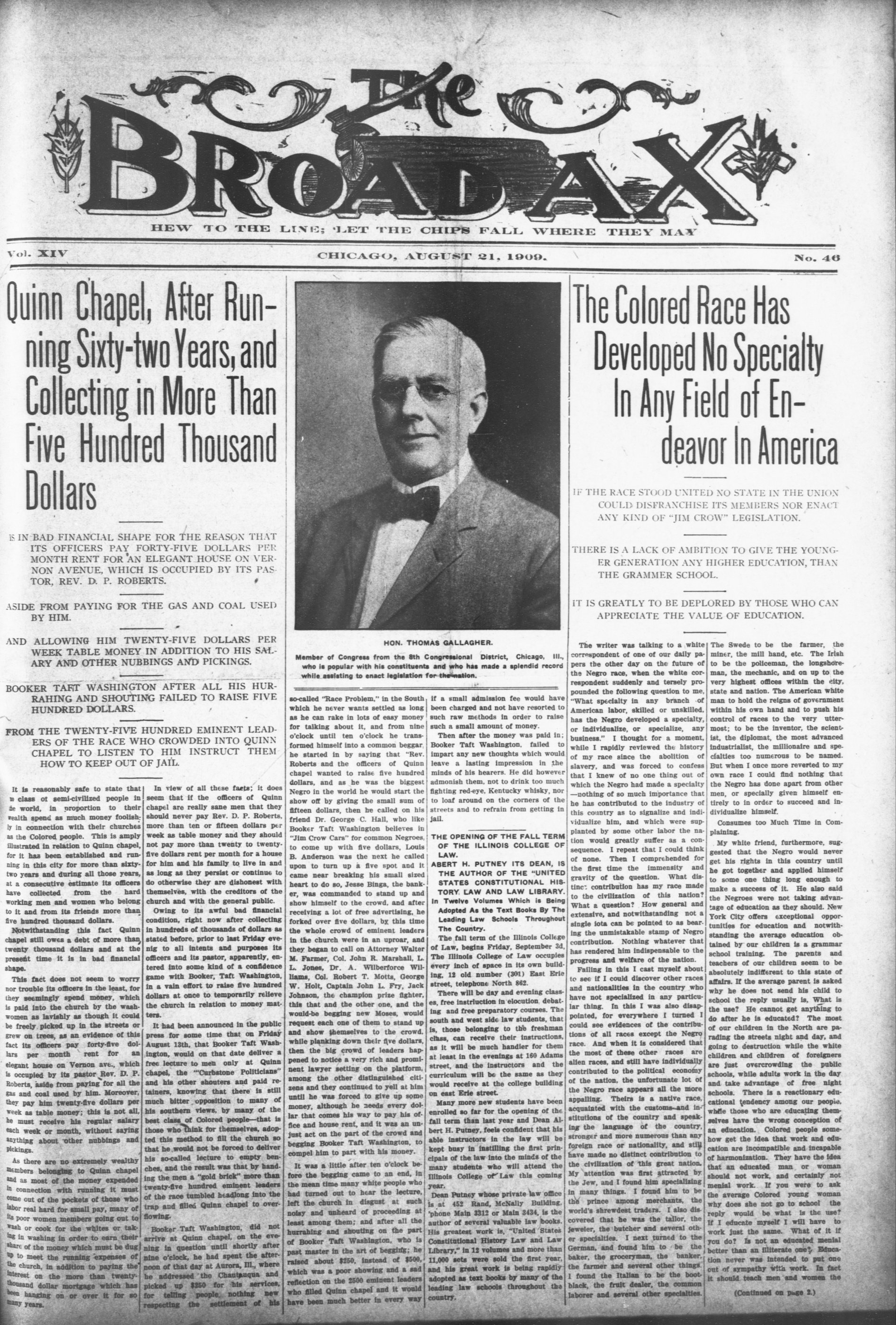
Member of Congress from the 8th Congressional District, Chicago, Ill., who is popular with his constituents and who has made a splendid record while assisting to enact legislation for the nation.
so-called "Race Problem," in the South which he never wants settled as long as he can rake in lots of easy money for talking about it, and from nine o'clock until ten o'clock he transformed himself into a common beggar, he started in by saying that "Rev. Roberts and the officers of Quinn chapel wanted to raise five hundred dollars, and as he was the biggest Negro in the world he would start the show off by giving the small sum of fifteen dollars, then he called on his friend Dr. George C. Hall, who like Booker Taft Washington believes in "Jim Crow Cars" for common Negroes to come up with five dollars, Louis B. Anderson was the next he called upon to turn up a five spot and it came near breaking his small sized heart to do so, Jesse Binga, the banker, was commanded to stand up and show himself to the crowd, and after receiving a lot of free advertising, he forked over five dollars, by this time the whole crowd of eminent leaders in the church were in an uproar, and they began to call on Attorney Walter M. Farmer, Col. John R. Marshall, L. L. Jones, Dr. A. Wilberforce Williams, Col. Robert T. Motts, George W. Holt, Captain John L. Fry, Jack Johnson, the champion prize fighter, this that and the other one, and the would-be begging new Moses, would request each one of them to stand up and show themselves to the crowd, while planking down their five dollars, then the big crowd of leaders happened to notice a very rich and prominent lawyer setting on the platform, among the other distinguished citizens and they continued to yell at him until he was forced to give up some money, although he needs every dollar that comes his way to pay his office and house rent, and it was an unjust act on the part of the crowd and begging Booker Taft Washington, to compel him to part with his money.
It was a little after ten o'clock before the begging came to an end, in the mean time many white people who had turned out to hear the lecture, left the church in disgust at such noisy and unheard of proceeding at least among them; and after all the hurrahing and shouting on the part of Booker Taft Washington, who is past master in the art of begging; he raised about $250, instead of $500, which was a poor showing and a sad reflection on the 2500 eminent leaders who filled Quinn chapel and it would have been much better in every way
if a small admission fee would have been charged and not have resorted to such raw methods in order to raise such a small amount of money.
Then after the money was paid in; Booker Taft Washington, failed to impart any new thoughts which would leave a lasting impression in the minds of his hearers. He did however admonish them, not to drink too much fighting red-eye, Kentucky whisky, nor to loaf around on the corners of the streets and to refrain from getting in jail.
THE OPENING OF THE FALL TERM OF THE ILLINOIS COLLEGE OF LAW.
ABERT H. PUTNEY ITS DEAN, IS THE AUTHOR OF THE "UNITED STATES CONSTITUTIONAL HISTORY. LAW AND LAW LIBRARY.
In Twelve Volumes Which is Being Adopted As the Text Books By The Leading Law Schools Throughout The Country.
The fall term of the Illinois College of Law, begins Friday, September 3d The Illinois College of Law occupies every inch of space in its own building, 12 old number (3041) East Erie street, telephone North 862. There will be day and evening classes, free instruction in elocution debating and free preparatory courses. The south and west side law students, that is, those belonging to the freshman class, can receive their instructions, as it will be much handler for them at least in the evenings at 160 Adams street, and the instructors and the curriculum will be the same as they would receive at the college building on east Erie street. Many more new students have been enrolled so far for the opening of the fall term than last year and Dean Albert H. Putney, feels confident that his able instructors in the law will be kept busy in instilling the first principals of the law into the minds of the many students who will attend the Illinois College of Law this coming year.
Dean Putney whose private law office is at 452 Rand, McNally Building, 'phone Main 3312 or Main 3434, is the author of several valuable law books. His greatest work is, "United States Constitutional History Law and Law Library," in 12 volumes and more than 11,000 sets were sold the first year, and his great work is being rapidly adopted as text books by many of the leading law schools throughout the country.
The Colored Race Has Developed No Specialty In Any Field of Endeavor In America
IF THE RACE STOOD UNITED NO STATE IN THE UNION COULD DISFRANCHISE ITS MEMBERS NOR ENACT ANY KIND OF "JIM CROW" LEGISLATION.
THERE IS A LACK OF AMBITION TO GIVE THE YOUNGER GENERATION ANY HIGHER EDUCATION, THAN THE GRAMMER SCHOOL
IT IS GREATLY TO BE DEPLORED BY THOSE WHO CAN APPRECIATE THE VALUE OF EDUCATION.
The writer was talking to a white correspondent of one of our daily papers the other day on the future of the Negro race, when the white correspondent suddenly and tersely propounded the following question to me, "What specialty in any branch of American labor, skilled or unskilled, has the Negro developed a specialty, or individualize, or specialize, any business." I thought for a moment, while I rapidly reviewed the history of my race since the abolition of slavery, and was forced to confess that I knew of no one thing out of which the Negro had made a specialty—nothing of so much importance that he has contributed to the industry of this country as to signalize and individualize him, and which were supplanted by some other labor the nation would greatly suffer as a consequence. I repeat that I could think of none. Then I comprehended for the first time the immensity and gravity of the question. What distinct contribution has my race made to the civilization of this nation? What a question? How general and extensive, and notwithstanding not a single iota can be pointed to as bearing the unmistakable stamp of Negro contribution. Nothing whatever that has rendered him indispensable to the progress and welfare of the nation.
Failing in this I cast myself about to see if I could discover other races and nationalities in the country who have not specialized in any particular thing. In this I was also disappointed, for everywhere I turned I could see evidences of the contributions of all races except the Negro race. And when it is considered that the most of these other races are alien races, and still have individually contributed to the political economy of the nation, the unfortunate lot of the Negro race appears all the more appalling. Theirs is a native race, acquainted with the customs and institutions of the country and speaking the language of the country, stronger and more numerous than any foreign race or nationality, and still have made no distinct contribution to the civilization of this great nation. My attention was first attracted by the Jew, and I found him specializing in many things. I found him to be the prince among merchants, the world's shrewdest traders. I also discovered that he was the taller, the jeweler, the butcher and several other specialties. I next turned to the German, and found him to be the baker, the groceryman, the banker, the farmer and several other things. I found the Italian to be the bootblack, the fruit dealer, the common laborer and several other specialties.
No.46
Race Has
No Specialty
Field of En-
vor In America
D NO STATE IN THE UNION
E ITS MEMBERS NOR ENACT
ROW" LEGISLATION.
TION TO GIVE THE YOUNG-
HIGHER EDUCATION, THAN
DL.
CORED BY THOSE WHO CAN
LUE OF EDUCATION.
The Swede to be the farmer, the miner, the mill hand, etc. The Irish to be the policeman, the longshoreman, the mechanic, and on up to the very highest offices within the city state and nation. The American white man to hold the reigns of government within his own hand and to push his control of races to the very uttermost; to be the inventor, the scientist, the diplomat, the most advanced industrialist, the millionaire and specialties too numerous to be named. But when I once more reverted to my own race I could find nothing that the Negro has done apart from other men, or specially given himself entirely to in order to succeed and individualize himself. Consumes too Much Time in Complaining.
My white friend, furthermore, suggested that the Negro would never get his rights in this country until he got together and applied himself to some one thing long enough to make a success of it. He also said the Negroes were not taking advantage of education as they should. New York City offers exceptional opportunities for education and notwithstanding the average education obtained by our children is a grammar school training. The parents and teachers of our children seem to be absolutely indifferent to this state of affairs. If the average parent is asked why he does not send his child to school the reply usually is, What is the use? He cannot get anything to do after he is educated? The most of our children in the North are parading the streets night and day, and going to destruction while the white children and children of foreigners are just overcrowding the public schools, while adults work in the day and take advantage of free night schools. There is a reactionary educational tendency among our people, while those who are educating themselves have the wrong conception of an education. Colored people somehow get the idea that work and education are incompatible and incapable of harmonization. They have the idea that an educated man or woman should not work, and certainly not mental work. If you were to ask the average Colored young woman why does she not go to school the reply would be what is the use? If I educate myself I will have to work just the same. What of it if you do? Is not an educated mental better than an illiterate one? Education never was intended to put one out of sympathy with work. In fact it should teach men and women the
PUBLISHED WEEKLY.
Will promulgate and at all times uphold the true principles of Democracy, bus Catholics, Protestantism, Pentecost, Islam, Single Parent, Republicans, or anyone else can have their say, as long as their language is proper and responsibility is fixed.
The Broad Ax is a newspaper whose platform is broad enough for all, ever claiming the editorial right to speak its own mind.
Local communications will receive attention. Write only on one side of the paper.
Subscriptions must be paid in advance.
One Year. $2.00
Six Months. $1.00
Advertising rates made known on application.
Address all communications to
THE BROAD AX
5038 Armour Avenue, Chicago.
JULIUS F. TAYLOR, Editor and Publisher.
Entered as Second-Class Matter,
Aug. 19, 1902 at the Post Office at
Chicago, Illinois, under Act of March
3, 1879.
REVIVING OLD ISSUES
A correspondent in a recent issue of The Star (name forgotten) defends the policy and propriety of placing Gen. Robert E. Lee as Virginia's choice in the Hall of Fame in Washington. These are the fellows who always set up the whine and sometimes the howl that we are waving the bloody shirt—that we refuse to let bygones be bygones. I charge that they are persistently thrusting something under our noses which we are obliged to smell and which is unpleasant and often insulting. Then if we protest they cry that we are reviving the old war feeling. They are the fellows who will not let bygones be bygones.
They talk and write as if the world began with reconstruction of the rebel states. They conveniently forget all that provoked reconstruction, made it necessary and justified it. Bad as it was, it was a bad alternative or a worse one. Who made it necessary? The South was offered a much milder reconstruction than they had to take later and refused it, and time has shown that it ought to have been far more severe than it was. After the rebel armies surrendered the rebels rushed back to Congress and proposed to do with their votes what they had failed to do with their guns. They said if we are not out of the Union, we are in it. If we are in it, we are entitled to representation in Congress.
The North said: "Not so fast. Some guarantees must be given that you will act in good faith."
"We decline to give them. Now let us see you reconstruct us," said the South. I guess they did see it. With their sullen insolence they provoked the patience of the North, and Negro governments were organized which soon did what was necessary. Some rebels who had the good sense to reconstruct themselves advised this and alided in it. The thirteenth, fourteenth and fifteenth amendments were legally adopted, and it was thought that the rebels had been sufficiently reconstructed.
Then the North became divided on the great financial policy. The South, however, did little but pout and sulk about a reconstruction which they had provoked, and took their dirty spite out on the Negroes who had helped to whip them. Of course the Negroes were ignorant. It had long been a penitentiary offense to educate them in the South. But they had been more loyal to a government that had oppressed them than had Robert E. Lee to a government that had educated him and given him all the employment he ever had. Now the rebel spirit looms up in Virginia, and Lee is chosen to fill the space in the Hall of Fame allotted to Virginia. Jefferson Davis is chosen by Mississippi to ornament a great battleship named in honor of that state and built by the United States. Virginia could not honor Thomas Jefferson, who wrote the Declaration of Independence and helped to found a government which Lee tried to destroy. After Virginia became a partisan to slavery the Declaration of Independence, declaring all men free and equal, did not sound well in slave-driving ears. Lee would suit them better and give the man opportunity to offend the North.
Benedict Arnold gave the best part of his life to the American cause, but at last he deserted to the British, and thereby became a traitor, and has been so held ever since. Lee gave the best part of his life to the service of the United States, but deserted to the rebellion; now he is to be rec
-
ognized as a patriot. He was never reconstructed—but it would be more pleasing to Virginia, that he was not. There is as much propriety in Connecticut offering Benedict Arnold to the Hall of Fame as for Virginia to offer Lee. The first battle where Lee commanded was at Harper's Perry, where he fought John Brown. Virginia hanged John Brown for treason. Now she offers Lee, a bigger traitor, as a patriot. Lee was born in Virginia, but he belonged to the nation. He deserted, not to Virginia, to the rebel Confederacy. Gen. Winfield Scott was also born in Virginia, but he belonged to the nation and stayed with it. Virginia does not remember him kindly. Yet we have writers and speakers who assert that the South is as loyal to the government as is the North. Where are their eyes and ears? The monument to the brute Wirz is no greater impropriety than the offering of Lee and Davis in connection with all the circumstances.
The Star editor is eminently right in his comments following the letter in question, and I second his motion.
—John T. Campbell, in The Star, Indianapolis, Ind., August 10, 1909.
The Colored Race Has Developed No Specialty In Any Field of Edgeavor in America
(Concluded from page 1.) value of labor and how to properly husband their resources.
My correspondent furthermore said that in studying the Negro he had come to the conclusion that the Negro has become discouraged. He seemingly has resigned himself to the fates and has lost all interest in everything. The gist of this last observation is this: it shows how keenly and accurately the white man is observing us and diagnosing our situation in this country. The Metropolitan News has already pointed out the danger in the race becoming discouraged. Our children have no inspiration whatever, either from us or any one else. They lose interest in the things about them and simply become epicureans and glutton. Pleasure seeking is their greatest ambition, both of the masses and the classes. And added to this they are hopelessly divided. Probably the like of such an anomaly as the Negro race has never been seen before in the history of races.
He has no ambition and lacks a definite aim. He will not stick at any one thing long enough to make success out of it, especially if it is in any way irksome, confining and grievous. His methods in business are antiquated, spasmodic and backward. He seems to be utterly incapable of improvement; is lazy and slothful in his business, too often untidy, and thinks that people ought to patronize him anyway because he is Colored. He has never yet clearly understood that success in anything means hard work; therefore he purposes through duplicity and chicanery to make up for his indolency and slothfulness. Hence, as a general rule coupled with all these faults, go dishonest, secrecy and incompetency in business. He cannot succeed in aggregate enterprises because of these last-named qualities. The shareholders or partners in the business are distrustful of the directors, and they in turn are distrustful of each other. Hence scheming and parrying constitute their greatest efforts along this line.
Last of all my informant said that the Colored people were always complaining about their maltreatment and deploring the fact that they were Colored instead of uniting themselves, saving their monies, invest it in a way to do business among their own people and thus get on top. In a country such as this there is no place for the man or woman who cannot succeed—certainly not for an entire race of people. "Laugh and the world laughs with you; weep and weep alone." This has been strikingly verified in the case of our race in this country. We have been whining and complaining for so long until even those who were our friends have grown tired and threadbare of us. Think of twelve millions of people in a country literally overrun with opportunities—whining and stewing around. Why not strike out for the Negro instead of following after the white man? Break away from slaverish misconceptions and partly a additions and strike out and party affiliations and strike out boldly for your own race. Suppose twelve millions of Negroes were united in this country, what State could
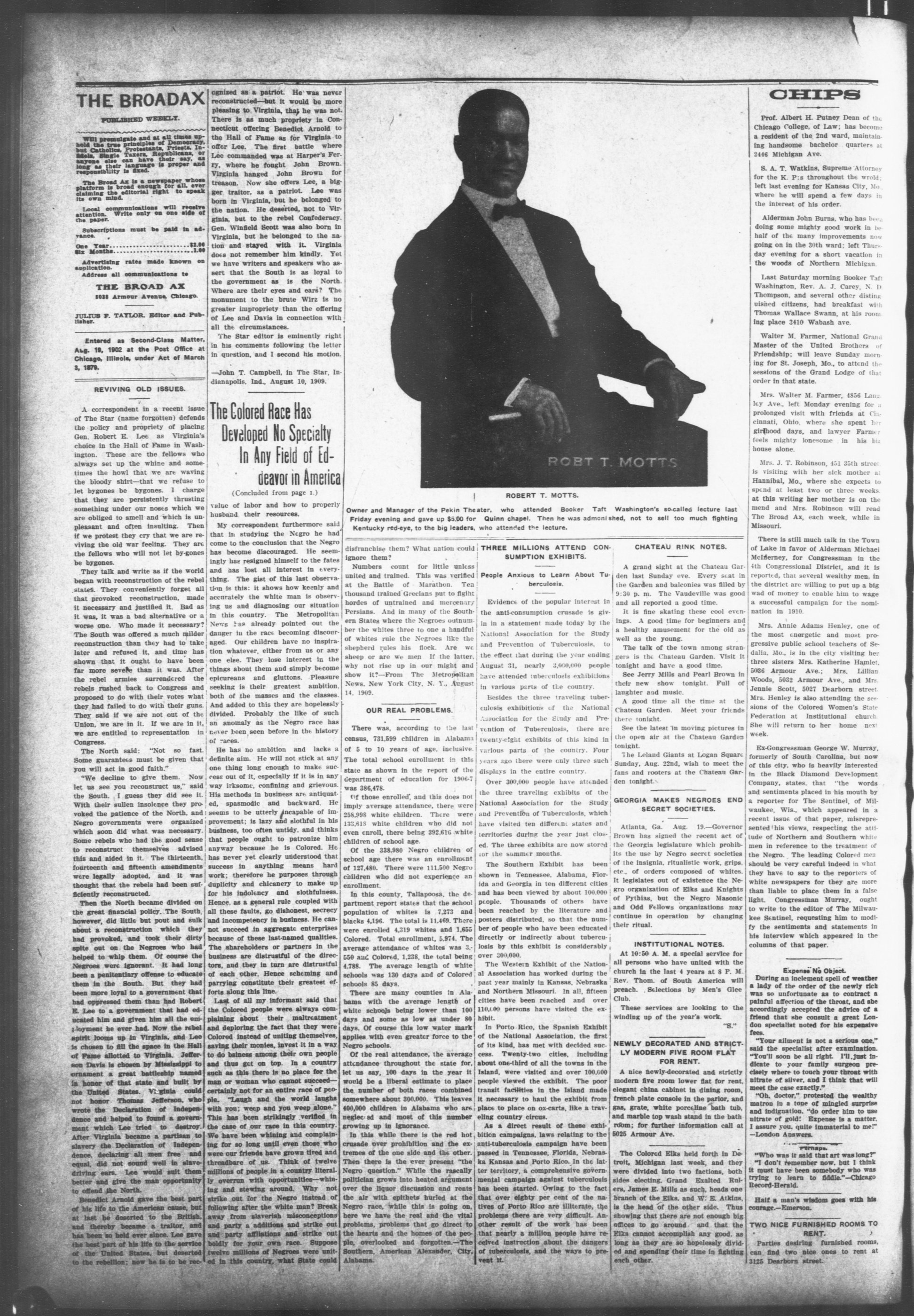
ROBT T. MOTTS
Owner and Manager of the Pekin Theater, who attended Booker Taft Washington's so-called lecture last Friday evening and gave up $5.00 for Quinn chapel. Then he was admonished, not to sell too much fighting Kentucky red-eye, to the big leaders, who attended the lecture.
disfranchise them? What nation could ignore them? THREE MILLIONS ATTEND CON- CHATEAU RINK NOTES. SUMPTION EXHIBITS.
Numbers count for little unless united and trained. This was verified at the Battle of Marathon. Tea thousand trained Greclans put to fight hordes of untrained and mercenary Persians. And in many of the Southern States where the Negroes outnumber the whites three to one a handful of whites rule the Negroes like the shepherd rules his flock. Are we sheep or are we men. If the latter, why not rise up in our might and show it?—From The Metropolitan News, New York City, N. Y., August 14, 1909.
OUR REAL PROBLEMS
There was, according to the last census, 731,599 children in Alabama of 5 to 10 years of age, inclusive. The total school enrollment in this state as shown in the report of the department of education for 1906-7 was 386,478. Of those enrolled, and this does not imply average attendance, there were 258,998 white children. There were 133,618 white children who did not even enroll, there being 392,616 white children of school age. Of the 338,980 Negro children of school age there was an enrollment of 127,480. There were 111,500 Negro children who did not experience an enrollment.
In this county, Tallapoosa, the department report states that the school population of whites is 7,273 and blacks 4,196. The total is 11,469. There were enrolled 4,319 whites and 1,655 Colored. Total enrollment, 5,974. The average attendance of whites was 3.550 and Colored, 1,238, the total being 4,788. The average length of white schools was 130 days and of Colored schools 85 days.
There are many counties in Alabama with the average length of white schools being lower than 100 days and some as low as under 80 days. Of course this low water mark applies with even greater force to the Negro schools.
Of the real attendance, the average attendance throughout the state for, let us say, 100 days in the year it would be a liberal estimate to place the number of both races combined somewhere about 300,000. This leaves 400,000 children in Alabama who are neglected and most of this number growing up in ignorance.
In this while there is the red hot crusade over prohibition and the extremes of the one side and the other. Then there is the ever present "the Negro question." While the rascally politician grows into heated argument over the liquor discussion and rents the air with epithets hurled at the Negro race, while this is going on, here we have the real and the vital problems, problems that go direct to the hearts and the homes of the people, overlooked and forgotten.-The Southern, American Alexander, City, Alabama.
THREE MILLIONS ATTEND CONSUMPTION EXHIBITS.
People Anxious to Learn About Tuberculosis.
Evidence of the popular interest in the anti-consumption crusade is given in a statement made today by the National Association for the Study and Prevention of Tuberculosis, to the effect that during the year ending August 31, nearly 3,000,000 people have attended tuberculosis exhibitions in various parts of the country.
Besides the three traveling tuberculosis exhibitions of the National Association for the Study and Prevention of Tuberculosis, there are twenty-eight exhibits of this kind in various parts of the country. Four years ago there were only three such displays in the entire country. Over 300,000 people have attended the three traveling exhibits of the National Association for the Study and Prevention of Tuberculosis, which have visited ten different states and territories during the year just closed. The three exhibits are now stored for the summer months.
The Southern Exhibit has been shown in Tennessee, Alabama, Florida and Georgia in ten different cities and has been viewed by about 100,000 people. Thousands of others have been reached by the literature and posters distributed, so that the number of people who have been educated directly or indirectly about tuberculosis by this exhibit is considerably over 300,000. The Western Exhibit of the National Association has worked during the past year mainly in Kansas, Nebraska and Northern Missouri. In all, fifteen cities have been reached and over 110,000 persons have visited the exhibit.
In Porto Rico, the Spanish Exhibit of the National Association, the first of its kind, has met with decided success. Twenty-two cities, including about one-third of all the towns in the Island, were visited and over 100,000 people viewed the exhibit. The poor transit facilities in the Island made it necessary to haul the exhibit from place to place on ox-carts, like a traveling country circus.
As a direct result of these exhibition campaigns, laws relating to the anti-tuberculosis campaign have been passed in Tennessee, Florida, Nebraska Kansas and Porto Rico. In the latter territory, a comprehensive governmental campaign against tuberculosis has been started. Owing to the fact that over eighty per cent of the natives of Porto Rico are illiterate, the problems there are very difficult. Another result of the work has been that nearly a million people have received instruction about the dangers of tuberculosis, and the ways to prevent it.
A grand sight at the Chateau Garden last Sunday eve. Every seat in the Garden and balconies was filled by 9:30 p. m. The Vaudeville was good and all reported a good time.
It is fine skating these cool evenings. A good time for beginners and a healthy amusement for the old as well as the young.
The talk of the town among strangers is the Chateau Garden. Visit it tonight and have a good time.
See Jerry Mills and Pearl Brown in their new show tonight. Full of laughter and music.
A good time all the time at the Chateau Garden. Meet your friends there tonight.
See the latest in moving pictures in the open air at the Chateau Garden tonight.
The Leland Giants at Logan Square Sunday, Aug. 22nd, wish to meet the fans and rooters at the Chateau Garden tonight.
GEORGIA MAKES NEGROES END
SECRET SOCIETIES.
Atlanta, Ga. Aug. 19.—Governor Brown has signed the recent act of the Georgia legislature which prohibits the use by Negro secret societies of the insignia, ritualistic work, grips, etc., of orders composed of whites. It legislates out of existence the Negro organization of Elks and Knights of Pythias, but the Negro Masonic and Odd Fellows organizations may continue in operation by changing their ritual.
INSTITUTIONAL NOTES
At 10:50 A. M. a special service for all persons who have united with the church in the last 4 years at 8 P. M. Rev. Thom. of South America will preach. Selections by Men's Glee Club. These services are looking to the winding up of the year's work.
NEWLY DECORATED AND STRICTLY MODERN FIVE ROOM FLAT FOR RENT.
A nice newly-decorated and strictly modern five room lower flat for rent, elegant china cabinet in dining room, french plate console in the parlor, and gas, grate, white porceline bath tub, and marble top wash stand in the bath room; for further information call at 5025 Armour Ave.
The Colored Elks held forth in Detroit, Michigan last week, and they were divided into two factions, both sides electing. Grand Exalted Rulers, James E. Mills as such, heads one branch of the Elks, and W. E. Atkins, is the head of the other side. Thus showing that there are not enough big offices to go around, and that the Elks cannot accomplish any good, as long as they are so hopelessly divided and spending their time in fighting each other.
Prof. Albert H. Putney Dean of the Chicago College, of Law; has become a resident of the 2nd ward, maintaining handsome bachelor quarters at 2446 Michigan Ave.
S. A. T. Watkins, Supreme Attorney for the K. P;s throughout the world; left last evening for Kansas City, Mo where he will spend a few days in the interest of his order.
Alderman John Burns, who has been doing some mighty good work in half of the many improvements now going on in the 30th ward; left Thursday evening for a short vacation in the woods of Northern Michigan
Last Saturday morning Booker Taft Washington, Rev. A. J. Carey, N. D. Thompson, and several other distinguished citizens, had breakfast with Thomas Wallace Swann, at his rooming place 3410 Wabash ave.
Walter M. Farmer, National Grand Master of the United Brothers of Friendship; will leave Sunday morning for St. Joseph, Mo., to attend the sessions of the Grand Lodge of that order in that state.
Mrs. Walter M. Farmer, 4856 Langley Ave., left Monday evening for a prolonged visit with friends at Chicago, Ohio, where she spent her girlhood days, and lawyer Farmer feels mighty lonesome in his big house alone.
Mrs. J. T. Robinson, 451 35th street is visiting with her sick mother at Hannibal, Mo., where she expects to spend at least two or three weeks at this writing her mother is on the mend and Mrs. Robinson will read The Broad Ax, each week, while in Missouri.
There is still much talk in the Town of Lake in favor of Alderman Michael Mcherney, for Congressman in the 4th Congressional District, and it is reported, that several wealthy men, in the district are willing to put up a bigwad of money to enable him to wage a successful campaign for the nomination in 1910.
Mrs. Annie Adams Henley, one of the most energetic and most progressive public school teachers of Sedalia, Mo., is in the city visiting her three sisters Mrs. Katherine Hamlet 5036 Armour Ave.; Mrs. Lillian Woods, 5032 Armour Ave., and Mrs. Jennie Scott, 5027 Dearborn street Mrs. Henley is also attending the sessions of the Colored Women's State Federation at Institutional church She will return to her home next week.
Ex-Gongressman George W. Murray, formerly of South Carolina, but now of this city, who is heavily interested in the Black Diamond Development Company, states, that "the words and sentiments placed in his mouth by a reporter for The Sentinel, of Milwaukee, Wis., which appeared in a recent issue of that paper, misrepresented his views, respecting the attitude of Northern and Southern white men in reference to the treatment of the Negro. The leading Colored men should be very careful indeed in what they have to say to the reporters of white newspapers for they are more than liable to place them in a false light. Congressman Murray, ought to write to the editor of The Milwaukee Sentinel, requesting him to modify the sentiments and statements in his interview which appeared in the columns of that paper.
Expense No Object
During an inclement spell of weather a lady of the order of the newly rich was so unfortunate as to contract a painful affection of the throat, and she accordingly accepted the advice of a friend that she consult a great London specialist noted for his expensive fees.
"Your ailment is not a serious one," said the specialist after examination. "You'll soon be all right. I'll, just indicate to your family surgeon precisely where to touch your throat with nitrate of silver, and I think that will meet the case exactly."
"Oh, doctor," protested the wealthy matron in a tone of mingled surprise and indignation. "do order him to use nitrate of gold! Expense is a matter, I assure you, quite immaterial to me!"
—London Answers.
"Who was it said that art was long?"
"I don't remember now, but I think it must have been somebody who was trying to learn to fiddle."—Chicago Record-Herald.
Half a man's wisdom goes with his courage.—Emerson.
TWO NICE FURNISHED ROOMS TO RENT.
Parties desiring furnished rooms, can find two nice ones to rent at 3125 Dearborn street.
Established 1879. Phone Oakland office.
John J. Dunn
COAL
WOOD
Wholesale
and Retail
Dealer Inc.
Fifty-First St. and Armour Ave.
Bent Vernon.
J. S. DORSEY, R. Ph., proprietor
116 1-2 W. 51st. Street. near Dearborn.
Chicago
TELENPHORE OAKLAND 302
Our Motto is Purity and Accuracy
Dorsey's
WHITE ROSE
Petrolatum
For Chapped Nands, Face and Lips.
KINGSTON PHARMACY
J. S. DORSEY, R. Ph., proprietor
116 1-2 W. 51st. Street. near Dearborn.
Chicago
TELENPHORE OAKLAND 302
Our Motto is Purity and Accuracy
DR. A. WILBERFORCE WILLIAMS
announces the Removal
of his office to
3255 State Street, N. E. cor. 33d Street
Suite A
CHICAGO, ILL.
Hours 10 to 12 m., 2 to 5, 6:30 to 8:30
YOURSELF AND FRIENDS WILL BE GUARDIALLY RECEIVED
Phone Alinee 2208
WORKING THEIR WAY OUT.
Afro-Americans Breaking Away From Crowded City Life.
Without the beating of any tomtoms or the sounding of any loud alarms there is being built up within a few miles of Philadelphia, at Sharon Hill, an Afro-American town which promises to prove an attraction to our people from the crowded city streets.
The pastors of the churches and others of the race are interesting themselves in building up the town, and, besides several tracts of land that already had been purchased, some of our enterprising business men have recently purchased the old Nonsall farm and will parcel it off into building lots.
The members of the First African Baptist church in Sharon Hill, of which the Rev. C. T. Wilcher is pastor, recently purchased two lots on Clifton avenue, which is to be about the center of the village, and upon it is to be built a new church edifice.
In the neighborhood of the proposed church there are springing up many business enterprises, such as grocery stores, restaurants, barber shops, real estate offices, and near by are several large truck farms.
In order to afford employment to the members of the race a brick manufacturing company has been incorporated and has opened up a yard at Sharon Hill.
New Bank Opened at Dallas.
New Bank Opened at Dallas.
The opening of the Penny Savings bank at Dallas, Tex., the other day was an interesting event. The board of directors had previous to the opening day issued invitations to the people of Dallas and vicinity to be present, and they came in large numbers. Each visitor was requested to register his name and address in a book which was provided for that purpose. "Without some money and some property there is but little appreciation for our people. This is the day of accumulation," said the directors to the people. The three ranking officers of the bank are Dr. G. I. Jackson, president; B. R. Bluett, cashier, and M. C. Cooper, vice president.
Successful Religious Bodies.
Much gratification is expressed over the success which attended the annual meetings of the New England Baptist Sunday school convention and the woman's auxiliary to the New England Baptist missionary convention, which were held in Boston recently. The annual financial reports of each showed that a splendid work had been done for home and foreign missions, education and large gains in membership.
An independent Miller
When Frederick built h. famous palace of Sans Souci there h opened to be a mill that greatly hampered him in the execution of his plans, and he asked the miller for how much he would sell it. The miller replied that for a long series of years his family had owned the mill, which had passed from father to son, and that he would not sell it for any price. The king used every solicitation, offered to build him a mill in a better place and pay him, besides, any sum he might demand, but the obstinate miller still persisted in his determination to preserve the inheritance of his ancestors.
Irritated at last by his conduct, the king sent for him and said in an angry tone:
"Why do you refuse to sell your mill notwithstanding all the advantages I have offered you?"
The miller repeated his reasons.
"Do you know," continued the king, "that I could take it without giving you a penny?"
"Yes," returned the miller calmly, "If it were not for the chamber of justice at Berlin."
The king was so flattered by this answer, which showed that he was incapable of an act of injustice, that he dismissed the miller without further entreaty and changed the plan of his garden.
Country Drummer (with cigars)—Pardon me; have you a match? Village Loufer (tenatively)—Yaaa, but I hain't no segar. Country Drummer—Good! In that case you won't need the match!—Chicago News.
Take care of your health. You have no right to become a burden to yourself and perhaps to others—Hall.
Giving the Bride a Tip
"Here's a little pointer for you," said the bride of last year to the bride of this year. "I'll tell you my own experience, and you can judge for yourself what to do. When we returned from our wedding trip and I began to rummake through George's belongings I found six or seven pairs of gloves and at least nine pairs of silk hose, things that he had never had on. They had been tucked away in all sorts of places. Most of them I at once recognized as presents I had given to him from time to time. Besides them, I found a lot of handkerchiefs still unused, handkerchiefs that I had embroidered his initial on with my own hands.
"What do you suppose I did? Foolishly I gathered them all together and spread them out on the bed where he would see them when he came home and feel ashamed of himself for never using my presents. Just think what a lack of forethought I showed! Consider what a saving of pin money it would have been if I had put the things away and then doled them out to him for Christmas presents or birthday presents one by one. It would have served him exactly right too."—Cleveland Plain Dealer.
Are You a Beggar?
All the beggars are not holding out a hand to passersby in the street. You probably know the man who is ever whining for help. If a farmer, he thinks his neighbors should help him get in his grain or do his plowing. If in business, he is always trying to borrow or wanting some one to boost him or drum up customers. He never seems to think of relying on his own efforts. There is a well known fable about the larks in a grainfield. As long as the farmer depended on his neighbors and relations to come and cut his grain the larks felt perfectly safe. When the man determined to cut the grain himself the larks knew it was time to seek safety elsewhere. There are times when every one needs help, but help should be asked only when one has made every possible effort for himself. Too much help given a man weakens his character — Milwaukee Journal.
A Quiet Rebuke.
An "object admonition" like the one described by Warren Lee Goss in his article, "Campaigning to No Purpose," published in Johnson's "Battles and Leaders of the Civil War," is often more efficacious than storms of reproach.
One day the colonel of the regiment noticed a soldier on parade wearing a badly soiled pair of gloves.
"Corporal," said the officer, "why do you set the men such a bad example as appearing before them in dirty gloves? Why is it?"
"I've had no pay, sir, since I entered the service," returned the corporal, "I can't afford to have them done up."
The colonel drew from his pocket a pair of gloves, spotlessly white. Handing them to the corporal, he said quietly: "Put these on. I washed them myself."
It was an unforgotten lesson to the whole regiment.
Von Holstein's Dress Coat.
Prince Bulow once invited Herr von Holstein to dinner, telling him that it was to meet the emperor. "But," replied Holstein. "I don't believe that I have a dress coat at present. I will try, however, to get one made in time, and if I can't perhaps the emperor will take me as I am." This, the Times says, was reported to his majesty, who said that Herr von Holstein was to appear in any garb he pleased.
When the meeting took place Holstein was in his usual frock coat, and the emperor laughingly tapped him on the shoulder and said: "I see that dress coat wasn't ready. It doesn't matter." —London Standard.
Cheering Him Up.
"Bill," said the invalid's friend.
"I've come to cheer yer up a bit like.
I've brought yer a few dahrs. Bill.
I thought if I was too late they'd come in 'andy for a wreaf, yer know. No, don't get down'earted. Bill. Lummy, don't yer look gashly! But, there, keep up yer spirits. ole sport; I've come to see yer an' cheer yer up a bit. Nice room yer 'ave 'ere; but, as I says to meself when I was a'comln' up, wot a orkard stalcrase to get a coffin dahn!"—London Globe.
An Epitaph.
In the churchyard of Leigh, near Bolton, will be found a tombstone bearing the following amazing sentence: "A virtuous woman is 5s. to her husband." The explanation seems to be that space prevented "a crown" being cut in full, and the stonemason argued that a crown equals 5 shillings. -London Notes and Queries.
Musical Note.
"How do you sell your music?" asked the prospective customer.
"It depends on the kind you want," replied the smart clerk. "We sell piano music by the pound and organ music by the choir."
A Blowing Up.
"Now, Willie," said the teacher to a small pupil. "can you tell me what dynamite is used for?"
"Yes, ma'am," answered Willie. "It's used to blaspheme things with."—Chicago News.
Before and After
"A woman is as old as she looks," quoted the wise gray. "Before or after she is dressed to go out?" queried the simple mug. Philadelphia Record.
What you do for an ungrateful man is thrown away. Latin Proverb.
An odd battle between a California vulture and a rattlesnake was witnessed in the Cocopah mountains of Lower California. It was in the early morning. The big bird had seized the snake behind the head and was struggling upward with its writhing, deadly burden. The snake's captor appeared aware that its victim was dangerous. The burden was heavy, as the reptile was nearly five feet long.
The grip of the bird on the snake's body was not of the best. The snake seemed to be squirrining from its captor's falons, at least sufficiently to enable it to strike. Its triangular head was seen to recoil and dart at the mass of feathers.
It did this once or twice, and then with a shriek the vulture dropped its prey. The bird was probably 500 feet or so above the observers. The astonished men were then treated to a spectacle seldom seen. Few birds but a vulture could accomplish such a feat.
The instant the snake escaped from the bird's clutches it dropped earthward like a shot, and like a shot the bird dropped after it, catching it in midair with a grip that caused death.
At any rate, the snake ceased to wriggle, and the vulture soared away to a mountain peak to devour its hard earned meal.
The Distinguished Guest.
The Distinguished Guest.
Captain Raabe was a man whose name had weight in the French cavalry. He was a tall man, belonging to the middle aged trooper type. With military qualities of the highest kind, he had a singular bearing, a savage sort of misanthropy and a cynical tongue, which stood in the way of promotion. When he was in the Sixth lancers, on garrison duty at Commerce, one of his comrades brought his father to dine with him at the officers' mess, a man of humble position and unpretentiously dressed. Captain Raabe, considering that this guest had not been filly received, gave expression to his opinion, saying that if the executioner of Commerce had come in evening dress he would have had a better reception. The officers demurring, he made no rejoinder, but shortly afterward came to mess with a guest whose dress was irreproachable. Every one lavished attention on the unknown. When dinner was over Captain Raabe, raising his glass, proposed the health of "the executioner of Commerce."
A Clever Acrobat
A diverting anecdote is told in "Annals of the Liverpool Stage" of an unrehearsed episode that occurred at the Hop, a cheap but popular place of entertainment. A troupe of acrobats were engaged, and one of their number gave a "single turn" in which he displayed his skill as a champion weight lifter. Somebody, however, on mischief bent, changed one of the fifty-six pound weights for one made of cardboard. The strong man's vision was impaired by the loss of one eye, but in this instance not unfortunately so. He took the first and second weights, and after having manipulated them he took the third, the one made of cardboard. Realizing in an instant what had been done, he as quickly decided to turn it to his own advantage by throwing three "flip-flaps" while holding the dummy weight. He was greeted with a perfect round of applause, and the audience declared it to be the greatest feat they had ever witnessed.
Not Built That Way.
For the first time the old lady was about to make a railway journey, and when she arrived at the station she did not know what to do.
"Young man," she said to a porter, who looked about as old as Methuse-lab. "can you tell me where I can get my ticket?"
"Why, mum," he replied, "you get it at the looking office through the pigeonhole."
Being very stout, she looked at the hole in amazement, and then she burst out in a rage:
"Go away with you, you old idiot! How can I get through there? I ain't no blessed pigeon!"—London Answers.
An Arrangement Approved.
"So they have reduced the number of trains that stop at your station?"
"Yes." answered Mr. Crossiots.
"There are only two a day at present—one to take us to town in the morning and one to bring us back at night."
"It must be a great disappointment."
"Not at all. When we get a servant now she's obliged to stay at least one day."—Exchange.
Hard to Choose.
"Why can't she make a choice between her suitors?"
"Well, one of them is a press agent. His language is very attractive. But the other is a travelling salesman, and he treats her as if she were a big buyer."—Kansas City Journal.
Badly Expressed.
Badly Expressed.
Mabel—I don't believe you really meant it when you said you were anxious to hear me sing. Sam—Oh, I assure you I did! You see, I had never heard you sing before—London Pick-Me-Up.
A Good Example
Father (in a lecturing mood)—You never heard of a man getting into trouble by following a good example. Son (incorrigible)—Yes, sir. I have—the counterfeiter.—Boston Transcript.
Easiest Terms to be had in Chicago Loans on first and second Mortgages Fire Insurance placed in any company
Main Office:
Suite 64, 95 Washington St.. CHICAGO, ILL.
AGENTS WAIT
Can Make From $5.00 to $10.00
It is the Best Seller That Has Ever Been
A NEW BOOK HAS MADE ITS
"The Industrial History of the Negro Race"
By Giles B. Jackson and D. Webster D.
This book is a novelty. It contains matter never before published. It takes up the serious, ethological, domestic, inventive and of the Negro. One of its most important of the Negro, why he is black and why he is black.
Although it contains over 400 pages, variations the price has been placed within the for board back; $1.50, cloth bound and Liberal arrangements will be made with wanted throughout the country. For to Jackson, 602 N. 2nd St., Richmond, Va. secure this book from the home office $1.00, $1.50 or $2.50 to R. T. Hill, Tremont Richmond, Va. Postage 13c extra.
BASE BALL
The Summer Schedule at 79th and West
Leland Gr
vs.
LOGAN SQUARES—May 9th, June 12th, A
WEST ENDS—June 6th, 19th, Aug. 1st and
GUNTHFRS—June 5th, 13th, July 31st, 8th
ANSON COLTS—June 20th, July 18th, Aug.
MILWAUKEE—June 26th, Aug. 8th, 28th a
After the Game Visit the Open Air Musu
5324 State Street. Phone W
PIANO
ALL KINDS OF NEW AND S
PIANOS ON EASY PAYMENTS
... Call Before You Buy
Local Branch Agent for Biss
EASY TERMS AND EASY
FRANK L.
3140 STATE STR
Office Phone, 2445 Aldine Residence
Charles S. Ja
Undertaker and E
3249 State Street, Ch
Fine Funeral Furnishing Goods
Connection. Open Day
AGENTS WANTED
AGENTS WANTED
Can Make From $5.00 to $25.00 a day It is the Best Seller That Has Ever Been Upon the Market A NEW BOOK HAS MADE ITS APPEARANCE
By Giles B. Jackson and D. Webster Davis of Richmond, Va. This book is a novelty. It contains matter concerning the race never before published. It takes up the industrial, social, religious, ethological, domestic, inventive and business advancements of the Negro. One of its most important features is the origin of the Negro, why he is black and why his hair curls.
Although it contains over 400 pages, with about 100 illustrations the price has been placed within the reach of all at $1.00 for board back; $1.50, cloth bound and $2.50, half morocco. Liberal arrangements will be made with agents. 10,000 are wanted throughout the country. For terms write to Giles B. Jackson, 602 N. 2nd St., Richmond, Va. Parties desiring to secure this book from the home office can send the price $1.00, $1.50 or $2.50 to R. T. Hill, Treasurer, 602 N. 2nd St., Richmond, Va. Postage 13c extra.
LOGAN SQUARES—May 9th, 12th, Aug. 7th and 15th.
WEST ENDS—June 6th, 19th, Aug. 1st and 14th.
GUNTHFRS—June 5th, 13th, July 31st, Sept. 12th.
ANSON COLTS—June 20th, July 18th, Aug. 29th, Sept. 19th.
MILWAUKEE—June 26th, Aug. 8th, 2nd and Sept. 26th.
After the Game Visit the Open Air Musical Emporium.
5324 State Street. Phone Went. 215.
ALL KINDS OF NEW AND SECOND HAND PIANOS ON EASY PAYMENTS THIS MONTH . . . Call Before You Buy . . .
Local Branch Agent for Bissell, Cowen Co.
EASY TERMS AND EASY PAYMENTS
FRANK L. GALE
3140 STATE STREET
Charles S. Jackson Undertaker and Embalmer
3249 State Street, Chicago, Ill. Fine Funeral Furnishing Goods and Livery in Connection. Open Day and Night.
Spontaneous combustion can only occur when oxidation causes the temperature to rise to the ignition point of the material. Spontaneous combustion of the human body is impossible on account of the heat regulating effect of the 75 or 80 per cent of water contained. The enormous heat necessary to dry the tissues sufficiently would destroy life long before ignition could take place. An old idea was that the alcohol in a confirmed drunkard might promote combustion, but Lleibg showed that even if the body could give off inflammable vapor and this could become ignited the body itself would not be set on fire.
Man's Superiority
"Woman." exclaimed the suffragette. "Is the equal of man in every respect." "Ob. I don't know," replied a man in the audience; "it takes a man to put an anglerworm on a fishhook."—Detroit Free Press.
Branch Office
3517 State Street
WANTED
200 to $25.00 a day
Ever Been Upon the Market
DE ITS APPEARANCE
"Gro Race of the United States"
Webster Davis of Richmond, Va.
ains matter concerning the race
up the industrial, social, religi-
tive and business advancements
important features is the origin
and why his hair curls.
5 pages, with about 100 illustr-
within the reach of all at $1.00
round and $2.50, half morocco.
made with agents. 10,000 are
For terms write to Giles B.
Richmond, Va. Parties desiring to
home office can send the price
Hill, Treasurer, 602 N. 2nd St.,
ra.
ALL 1909
9th and Wentworth Avenue
Giants
S.
June 12th, Aug. 7th and 15th.
1st and 14th.
31st, 8th, 12th.
18th, Aug. 29th, Sept. 19th.
28th and Sept. 26th.
Air Musical Emporium.
Phone Went. 215.
NOS
AND SECOND HAND
MENTS THIS MONTH
To You Buy ...
for Bissell, Cowen Co.
EASY PAYMENTS
L. GALE
E STREET
Residence Phone 5938 Douglas
S. Jackson
and Embalmer
et, Chicago, Ill.
Goods and Livery in
Day and Night.
Arthur Aull is responsible for this one:
"Folly, Genius and Common Sense once went walking and came to a stream. Genius, having his head in the clouds, naturally started to wade across, paying no attention to the depth. The waters soon went over his head, and he was drowned. Common Sense hunted for a safe way to get across, and finally he found a foot log. As he got out about the center of the stream the log swayed, and he fell into the water and sank to rise no more. Folly stopped at the bank of the stream to amuse himself by throwing pebbles into the water and watching the waves. He sat upon the moist, cold bank until he caught a cold which developed into pneumonia, of which he soon died. Moral.—It doesn't make much difference, after all, whether you are a genius, a sage or a fool. You'll get it sooner or later anyway."
—Exchange
PATRICK H. O'DONNELL
WILLIAM DILLON
CLARENCE A. TOOLEN
Tel. Central 4660
O'Donnell, Dillon &
Toolen
ATTORNEYS AT LAW
Sulte 1218-1219 Ashland Block
RANDOLPH & CLARK STREETS
CHICAGO
JAMES J. GRAY
ATTORNEY AT LAW
Suite 1518 Ashland Block
RANDOLPH AND CLARK STREETS
CHICAGO
Tel. Central 4723
Boudiceau 57 Macallister Place
Telephone Ashland 358
Office Telephones
Central 1889 Automatic 5949
MILES J. DEVINE
Suite 318-320 Reeper Block
CLARK AND WASHINGTON ST&
CHICAGO.
Phone Main 4153 NOTARY PUBLIC
Phone residence, Gray 5670
Walter M. Farmer
ATTORNEY AT LAW
Suite 708, 171 Washington St.
Res., 4856 Langley Av. CHICAGO
JOHN E. OWENS
ATTORNEY & COUNSELOR.
AT LAW.
320 ASHLAND BLOCK
A. D. GASH
Attorney at Law,
84-86 La Suite Street, Chicago
Suite 615 to 619.
Telephone Main 3077.
F. A. Rawlins
The Modern Embalmer
UNDERTAKER AND
FUNERAL DIRECTOR
When his work is finished
you have no displeasure.
4817 State Street CHICAGO
Phone Douglas 1530
A Pleasant Summer Evening
ARE YOU IN SEARCH OF ONE?
Then Visit the "Chateau," 5324 State Street, Tonight.
There is a fine Picture Show, Roller Skating, Dancing and superb music, refreshments and a jolly good time for good people. No prosecution. Special prize program every Saturday and Sunday.
Admission, 10 cents—one dime
LELAND GIANTS' BASE BALL AND AMUSEMENT ASS'N.
THE BROAD AX CAN BE FOUND ON SALE AT THE FOLLOWING NEWS STANDS.
From on and this date, The Broad Ax can be found on sale at the following news stands:
J. S. Dorsey, 116½ W. 51st St.
A. F. Tervalon, a cigar store and news stand, 5004 State street.
R. A. Jones new stand and barber shop, 5264 State Street.
George L. Martin, maker of fine cigars, and news stand, 342 31st street, near State.
Mrs. Nellie Phelps, cigars, actions and news stand, 131 W. 51st street, near Dearborn.
W. S. Cole, cigars, tobacco and news stand, 354 31st street.
J. R. Peters, cigars, tobacco, laundry office and news stand, 338 27st street.
T. B. Hall, laundry office, cigars, tobacco and news stand, 231 29th street.
Mrs. Jas. H. Lewis, nations, cigars and news stand, 419 36th Street.
B. Davis, cigars, tobacco and news stand, 3532 State street.
H. D. Burt, cigars, notions and news stand, 2636 State street.
Wasted All Three Wishes.
An Irish legend has it that a good fairy once visited an old couple and promised them that any three wishes they would make would be granted. After racking their brains for some time in an endeavor to discover what they desired most the couple decided to visit the county fair to see if something there would suggest what they wanted. They did so, and, after rambling around all day and not seeing anything that exactly suited them, toward evening they found themselves before a display of kitchen utensils. Among them was a soup ladle, cheap, but likely to appeal to a woman, so the old woman in an absent moment said, "Oh, I wish I had one of those," and immediately she had it. The old man was so enraged because his wife had thoughtlessly thrown away one valuable wish that he retorted, "I wish that was stuck down your throat," and immediately this was done. Thereupon he was at once sorry at what he wished, and the only thing left to do was to wish the ladle out again. So all three wishes went for naught.
How Snakes Get Over Ground.
How Snakes Get Over Ground.
The snake appears to have no legs or feet, it may be said to be practically supplied with upward of a hundred pairs of them. In fact, each joint of the backbone bears a pair of ribs, which are mobile and have their points attached to the inner surface of one of the large transverse, platelike scales which clothe the undersurface of the body. Thus by the movements of the ribs attached to it each plate can be drawn forward and its margin applied to the ground. By the successive application of these multitudinous plates the body can be drawn forward in a straight line without its being thrown into undulations from side to side. But rapid movements are also effected by such undulations, and serpents can by pressure and appropriate muscular action climb trees and sometimes spring forward. They also swim easily by lateral flexures, but no serpents advance by vertical bendings of the body, though they are so often drawn in such an attitude.
Bolivia's Electrical Storms.
Bolivia's Electrical Storms. Owing to the peculiar topographical formation of Bolivia, electric and other phenomena are of constant occurrence, the principal zone where such disturbances take place being the Altiplanic, or grand plateau. As the atmosphere is heavily charged with electricity both in summer and winter, dry or electric storms are of frequent occurrence both on the plateau and in the valleys. Before the rainy season sets in electrical accumulation becomes considerable on the plateau region, its most violent manifestations taking place toward the eastern section of the tablelands. An electrical storm in these regions is always a most imposing spectacle, as the tremendous force of the wind, almost equal to a hurricane, and the heavy electrical accumulation in the clouds produce terrible atmospheric explosions and violent detonations, while the surface of the ground sparkles and crackles.
Vacation by Think
Make a compact with your soul to take a vacation and the way is simple. There are portions of your time over which you have control. Probably your evenings and your Sundays are your own. Set apart a month or so. Eliminate the self assigned tasks for those hours out of business and give yourself up to the pursuit of pleasure. Get others to join you. Call a vacation club. Adopt a real vacation spirit and go in for a good time. Resolve never to speak of work out of business hours, but to fill to the full that time which is your own with recreations which most appeal to you. Did you ever sing? Sing now. Did you ever paint? Paint now. Remember nature's gifts to you and find occasion to praise nature within as well as without.—Exchange.
He Got It Wrong.
A lady while going downstairs to dinner had the misfortune to step slightly on the dress of a lady in front of her. The man on whose arm the former was leaning said aloud, rudely, so that the couple in front might hear: "Always getting in the way, like Ba-laam's ass."
Upon which the lady whose gown had been trodden on, turning round, replied with a sweet smile:
"Pardon me! It was the angel who stood in the way and the ass which spoke."—Tit-Bits.
Jack—That young Simperly seems such a fragile fellow I should hesitate to touch him for fear he would break.
Sam—He wouldn't hesitate about touching you if he was broke—London Telegraph.
Why Women Are Like Tugboats.
Biggs—Why are the tugs on the Wisconsin river like the co-eds who walk up and down State street? Muggs—And the answer is? Biggs—Some toe out ar.1 some toe In—Wisconsin Sphinx.
WISE REAL ESTATE DEAL
Afro-Americans to Have Industrial School in Bhelly County, Ky.
The educational progress of the race aside from the older and higher institutions of learning in Kentucky is very encouraging. It has been the desire of many of the leaders of our people in educational matters to have a thoroughly equipped industrial training school for young men and women away from the city, where they might combine the trades with the higher literary subjects to better advantage than heretofore. This desire in a great measure has at last been realized. The adjustment fund of $400,000 for the building of Lincoln institute, the proposed industrial and normal training school for Negroes to be run in connection with Berea college, has been completed, according to a statement made recently by W. G. Frost, president of Berea.
Three hundred and fifty thousand dollars of the amount was subscribed by Andrew Carnegie. Mrs. Russell Sage and other philanthropists of the east and north on condition that $50,000 be raised by the officials of the proposed institution. This amount has all been subscribed, and the work of collecting it will begin at once.
It is expected that work on the new buildings will begin shortly. A site of 600 acres has been purchased in Shelby county ten miles from Shelbyville, Ky., where the institution will be located. The ground was purchased by Louisville read estate agents, and it was not until after all deals had been completed that it became known for what purpose the land was intended. It was then that the white people of Shelby county set up a complaint against putting the school in that region. Similar complaints were made in other parts of central Kentucky when efforts were made to purchase a site by representatives of Berea college.
EQUAL PAY FOR BOTH RACES.
Georgia Arbitration Board Against Seniority of White Firemen. The award of the Georgia railroad strike arbitration board, which was announced a few days ago, is against the seniority of white firemen over Negroes and provides that the Georgia railroad when using Negroes as firemen, hostlers or hostlers' helpers shall pay them the same wages as white men in similar positions. Arbitrator Hardwick dissented from this.
Firemen in the line of promotion to the position of engineer must have three years' experience before being promoted to the position of engineer and are to be promoted in the order of their seniority. If they refuse or fail to pass the first examination they will be reduced to freight service without losing their seniority. Falling on the second examination, they will be reduced to the bottom of the extra list or disposed of as the company desires. Firemen now in the service who are physically incapacitated for service will not be subject to this rule. Mr. Hardwick in a dissenting opinion from the proposition fixing Negroes' wages the same as those of whites said:
"In so far as the above finding permits the continued employment of Negro firemen I dissent because I believe from the evidence that such employment is a menace to the safety of the traveling public." The arbitrators, chosen as a result of the recent strike of the white firemen, were ex-Secretary of the Navys Hilary Herbert for the road, Congressman Hardwick for the white firemen and Chancellor Barrow for the Negro firemen.
Bishops' Case Dismissed
Five bishops of the African Methodist Episcopal church, who complained to the interstate commerce commission some time ago that they were discriminated against by southern railroads and by the Pullman company in transportation, dining car and sleeping car facilities, have been informed by the commission that their complaint was not warranted.
The bishops are Wesley J. Gaines, H. M. Turner, Evans Tyre, C. S. Smith and F. W. Lampton. Most of the complainants and their witnesses testified that they actually did ride on sleeping cars.
It is held by the commission in its decision that undue discrimination or prejudice was not shown, and the complaint, therefore, was dismissed.
There is a growing spirit of independence among the younger element of Negroes, which is a hopeful sign of the future for the Negro politically. The tendency of our fathers to pose as martyrs to the cause of the G. O. P. while white demagogues in that party had working agreements with their political opponents which enabled them to swap votes for certain offices, using the Negro as a pawn in their desperate game, will not be so pronounced in the future state and national campaigns. The young Negro is going "to play ball" when the political season opens again, and he will certainly make some political leaders sit up and take notice. Negroes are slow but apt scholars.
The prevailing opinion that President Taft has sidestepped the Negro question seems to be not wholly without foundation. Well, the race that anstand 250 years of the most damnable bondage that ever cursed a world and four years of civil war will survive the peridy of a political party. The Negro is one of the permanent races. He will not disappear, reports of his enemies to the contrary notwithstanding-Dallas Express.
THE MUSEUM OF THE ARTS
GENERAL BANKING
3 per cent allowed
Safety Deposit Vau
REAL ESTATE
As agent buy and sell Real Estate on co-
dents, including payment of taxes and lo-
n on Chicago Real Estate.
Especially Invites the patro
Office Phone, Douglas 727
E. JAC
FUNERAL
2959-61 STATE
Branch: 1310 Bingh
Fine Carriages for Hire
M. F. D
Plumbing, G
Sew
4740 STATE ST
Recent allowed on Savings Acc
Deposit Vaults, $3.00 per
REAL ESTATE DEPARTMENT
R sell Real Estate on commission, manages estate
payment of taxes and looking after assessments.
Estate.'
Finally Invites the patronage of Chicago business m
e, Douglas 727 Res. Phone, Doug
E. JACKSON
GENERAL DIRECTOR
59-61 STATE ST., CHICAGO
Branch: 1310 Bingham St., Pittsburg, Pa.
Marriages for Hire to Parties and Wedd
F. F. LYNCH
Building, Gas Fitting
Sewerage
STATE STREET, CHICAGO
3 per cent allowed on Savings Accounts Safety Deposit Vaults, $3.00 per Year
As agent buy and sell Real Estate on commission, manages estates for non-residents, including payment of taxes and looking after assessments. Money to loan on Chicago Real Estate.
Office Phone, Douglas 727 Res. Phone, Douglas 1856
E. JACKSON
FUNERAL DIRECTOR
2959-61 STATE ST., CHICAGO
Branch: 1310 Bingham St., Pittsburg, Pa.
Fine Carriages for Hire to Parties and Weddings
M. F. LYNCH
Plumbing, Gas Fitting and Sewerage 4740 STATE STREET, CHICAGO
TELEPHONE DREXEL 3633
---
BARTLETT L. E. BARTLETT & S
Real Estate
ng, Loans and Insur
Street
J. S. BARTL Real Renting, Loans
J. S. BARTLETT & SON Real Estate
Renting, Loans and Insurance
5126 State Street Chicago
NOTARY PUBLIC
Telephone Oakland 1061
Commodore Vanderbilt discovered in James H. Butter, then in the employ of the Erie railroad, a man he believed the freight department of the Central needed, says the Baltimore News. It is related that some time after he took charge of the Central's traffic office Butter called on the commodore to submit a plan for improvement. When he had stated the case the president looked at him sharply and asked: "Butter, what does the New York Central pay you $15,000 a year for?" The reply was, "For managing the freight traffic department." And then the commodore said, "Well, you don't expect me to earn your salary for you, do you?" Butter went out and carried through his plan on his own judgment. The result was highly satisfactory. Butter became president of the Central.
Up to Snuff.
A man in workman's garb one day called at a local dentist's, and the door was opened by a maid.
Workman—Is the gent in that draws teeth?
Servant—No, sir, but I expect he will be in shortly.
Workman (pausing on doorstep)—Does he give gas?
"Yes."
"What does he charge?"
"One dollar."
"What—one dollar! Do you mean to say, miss, a fellow's got to swallow over 1,000 feet of gas to have one tooth pulled out? No fear. I reckon I knows a bit about it, for I work down at the gas works myself. I'll
Do Snuff.
Human's garb one day
studist's, and the door
maid.
He gent in that draws
but I expect he will
sing on doorstep)—
charge?"
Ar! Do you mean to
new's got to swallow
of gas to have one
No fear. I reckon
to it, for I work
The same as I am, in
yer."
"Then instead of wast
time on arithmetic, gee
such truck I'd better be
hypothetical question, I
Judge.
Defying Dast
There is no use of read
rules about how to live.
An old lady 100 years old
New England doughnuts
Birmingham Age-Herald.
The Official Go
"Your wife doesn't a
much for that friend of
"No. He's the man I
Estimates Given
J. S. Bartlett
S. E. Cor. State and 36th Place, Chicago Telephone Douglas 1565
owed on Savings Accounts
Vaults, $3.00 per Year
ESTATE DEPARTMENT
State on commission, manages estates for non-resi-
tions and looking after assessments. Money to loan
the patronage of Chicago business men.
727 Res. Phone, Douglas 1856
ACKSON
CAL DIRECTOR
ESTATE ST., CHICAGO
Bingham St., Pittsburg, Pa.
Hire to Parties and Weddings
LYNCH
Gas Fitting and
Beverage
STREET, CHICAGO
Prompt Attention to Jobbing
L. E. Bartlett
BETLETT & SON
Real Estate
Loans and Insurance
Chicago
Not Interested.
"I have called," said the book agent, "to see if I can interest you in a little work"—
"Young man," snapped the woman who answered the door, "just now I am interested in washing my dishes, dusting, cleaning up after the paper-hanger, making six beds, polishing the hardwood floors, ironing my husband's shirts, getting two more meals today, darning nine pairs of stockings and stringing my sweet peas, and I might say that that's more work than you men ever thought of doing. No; you can't interest me in any more."—Detroit Free Press.
through
The re-
Butter
al.
Getting an Early Start.
"Father, what do you wish me to
be when I grow, up?"
"The same as I am, my son—a law-
yer."
"Then instead of wasting any more
time on arithmetic, geography and
such truck I'd better be getting at the
hypothetical question, hadn't it?" —
Judge.
Defying Death.
There is no use of reading any more
rules about how to live a long time.
An old lady 100 years old has eaten
New England doughnuts all her life.
Birmingham Age-Herald.
Chicago
HILLMAN'S
STATE & WASHINGTON STS.
WHERE EVERY PATRON
Saves
ON EVERY PURCHASE
Jacob Feinberg
Wholesale and Retail
MARKET AND GROCERY
TELEPHONE DOUGLAS 565
81st and State Streets
JOHN J. BRADLEY
Real Estate
Loans
Fire and Plate Glass Insurance
4709 S. HALSTED ST
CHICAGO
Good Colored Tenants Always Appreciate
Good Colored Tenants Always Appreciated
Save Heated EL
TO SUIT EVERY MAN'S INCOME
Agent. I Rent only my own F
you will save many a weary step when you want a Flat
if you first call on me.
LOAN ON REAL ESTATE OR PERSONAL PRO
Richardson, 142 La Salle
e Main 2183 CHICAGO Room 1, OTIS B
Stove Heated Flats
I am no Agent. I Rent only my own Property
You will save many a weary step when you want a Flat
if you first call on me.
MONEY TO LOAN ON REAL ESTATE OR PERSONAL PROPERTY
Samuel Richardson, 142 La Salle Street
Telephone Main 2183 CHICAGO Room 1, OT15 BLOCK
e, Prop. Lou 8
Phone Oakland 1787.
THE RAILROAD INN
Supported and Domestic Wine
Liquors & Cigars
Cafe in Connection
Corner Fifty-first and Armour Avenue, Chicago,
American Brick Co.
Agent and Treasurer, THOMAS CAREY.
Vice-President, JOHN SHELHAMER,
Secretary, WILLIAM SULLIVEN
MANUFATURERS OF
Lemon and Sewer B
Office and Yards:
In and Robey S
Yards running winter and summer, equipped
with the latest improved Wolf Dryer.
Phone Yards 12
THE RAILROAD INN
Imported and Domestic Wines
Liquors & Cigars
Cafe in Connection
N. E. Corner Fifty-first and Armour Avenue, Chicago, M.
- American Brick Co. -
President and Treasurer, THOMAS CAREY.
Vice-President, JOHN SHELHAMER,
Secretary, WILLIAM SULLIVAN.
MANUFATURERS OF
Yards running winter and summer, equipped with the latest improved Wolf Dryer.
NATIONAL
BANK
OF
CHICAGO
WHOLESALE
CHARLES R. PRINCIPAL
MINES AGENTS
CHARLES R. PRINCIPAL
General Office: 532 W. 43rd St.
WUR GUARANTEE—City Weighmen
With Each Load, 2000 Pounds
Good Colour
Stove
I am no Agent
You will sa
MONEY TO LOAN
Samuel Rich
Telephone Main
Frank H. Lewis, Prop.
THE
Importe
ored Tenants Always Appreciated AND TREATED ACCORDINGLY
Heated Flats
SUIT EVERY MAN'S INCOME
I Rent only my own Property
many a weary step when you want a Flat
if you first call on me.
REAL ESTATE OR PERSONAL PROPERTY
Hardson, 142 La Salle Street
CHICAGO Room 1, OTIS BLOCK
(Please out this out)
BROAD INN
Domestic Wines
& Cigars
Connection
Armour Avenue, Chicago, Ill.
Brick Co.
THOMAS CAREY.
JOHN SHELHAMER,
BURY, WILLIAM SULLIVAN.
TURERS OF
Sewer Brick
and Yards:
Robey Sts.
and summer, equipped
wired Wolf Dryer.
have o per du
generate per du
Yards 128.
FULL Weight
That's merely honesty
City Weighmasters Certificate PROVES IT
QUALITY COUNTS
Is the Securit of REAL Saving-Get it
We furnish the BEST at the cost of the
other kind.
WHOLESAIL RETAIL
CHARLES R. PRICE CO.
MINES ARENT
RAIL YARDS
CHARLES R. PRICE CO.
General Office: 532 W. 43rd BL. Parks 807-837
*UR GUARANTEE- City Weighmasters Certificate
With Each Load, 2000 Pounds To EACH TON.
Lou Seldon, Mgr.