The Broad Ax
Saturday, February 4, 1911
Chicago, Illinois
Page text (machine-generated)
The BROAD AX
Carter H. Harri
Issues
And Comes Out Squarley In
of Public Utilities
A Great Fight Between Hi
Edward F. Dunne and t
to Bat Each Ot
Mayor Fred A. Busse, Still Han
to Enter th
Alderman Charles R. Merriam
Scully Are Still the Leadi
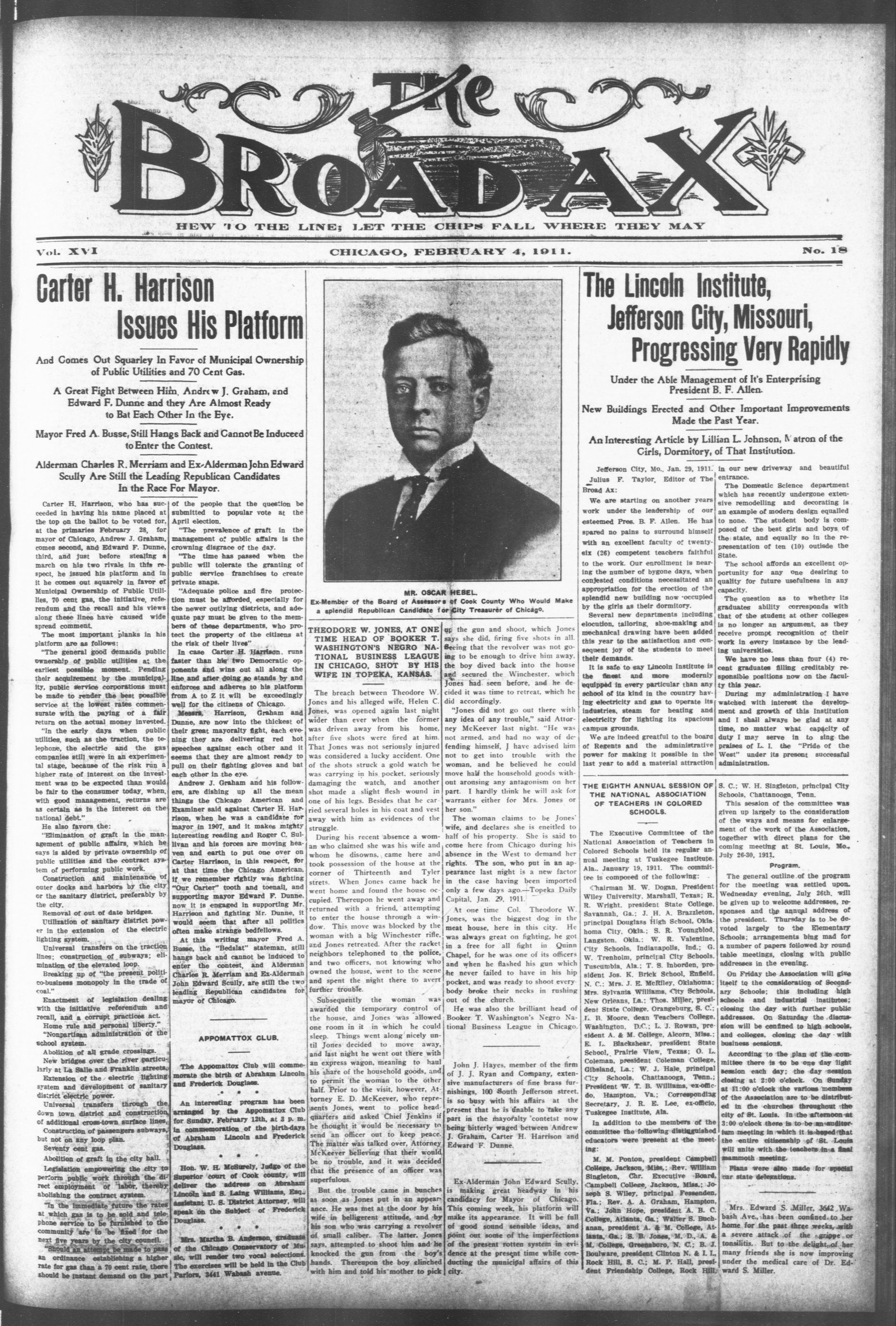
Carter H. Harrison Issues His Platform
And Comes Out Squarley In Favor of Municipal Ownership of Public Utilities and 70 Cent Gas.
A Great Fight Between Him, Andrew J. Graham, and Edward F. Dunne and they Are Almost Ready to Bat Each Other In the Eye.
Mayor Fred A. Busse, Still Hangs Back and Cannot Be Induceed to Enter the Contest.
Alderman Charles R. Merriam and Ex-Alderman John Edward Scully Are Still the Leading Republican Candidates In the Race For Mayor.
Carter H. Harrison, who has succeeded in having his name placed at the top on the ballot to be voted for, at the primaries February 28, for mayor of Chicago, Andrew J. Graham, comes second, and Edward F. Dunne, third, and just before stealing a march on his two rivals in this respect, he issued his platform and in it he comes out squarely in favor of Municipal Ownership of Public Utilities, 70 cent gas, the initiative, referendum and the recall and his views along these lines have caused wide spread comment.
of the people that the question be submitted to popular vote at the April election.
"The prevalence of graft in the management of public affairs is the crowning disgrace of the day.
"The time has passed when the public will tolerate the granting of public service franchises to create private snaps.
"Adequate police and fire protection must be afforded, especially for the newer outlying districts, and adequate pay must be given to the members of these departments, who pro-
The most important planks in his platform are as follows:
"The general good demands public ownership of public utilities at the earliest possible moment. Pending their acquirement by the municipality, public service corporations must be made to render the best possible service at the lowest rates commensurate with the paying of a fair return on the actual money invested.
"In the early days when public utilities, such as the traction, the telephone, the electric and the gas companies still were in an experimental stage, because of the risk run a higher rate of interest on the investment was to be expected than would be fair to the consumer today, when, with good management, returns are as certain as is the interest on the national debt."
He also favors the:
"Elimination of graft in the management of public affairs, which he says is aided by private ownership of public utilities and the contract system of performing public work.
Construction and maintenance of outer docks and harbors by the city or the sanitary district, preferably by the city.
Removal of out of date bridges.
Removal or out of date bridges.
Utilization of sanitary district power in the extension of the electric lighting system.
Universal transfers on the traction lines; construction of subways; elimination of the elevated loop.
Breaking up of "the present politico-business monopoly in the trade of coal."
Enactment of legislation dealing with the initiative referendum and recall, and a corrupt practices act.
Home rule and personal liberty."
"Nonpartisan administration of the school system.
Abolition of all grade crossings. New bridges over the river particularly at La Salle and Franklin streets. Extension of the electric lighting system and development of sanitary district electric power. Universal transfers through the down town district and construction of additional cross-town surface lines.
Abolition of graft in the city hall.
Legislation empowering the city to perform public work through the direct employment of labor, thereby abolishing the contract system.
"In the immediate future the rates at which gas is to be sold and telephone service to be furnished to the community are to be fixed for the next five years by the city council.
"Should an attempt be made to pass an ordinance establishing a higher rate for gas than a 70 cent rate, there should be instant demand on the part
Vol. XVI
He also favors the:
HEW TO THE LINE: LET THE CHIPS FALL WHERE THEY MAY
of the people that the question be submitted to popular vote at the April election.
"The prevalence of graft in the management of public affairs is the crowning disgrace of the day.
"The time has passed when the public will tolerate the granting of public service franchises to create private snaps.
"Adequate police and fire protection must be afforded, especially for the newer outlying districts, and adequate pay must be given to the members of these departments, who protect the property of the citizens at the risk of their lives."
In case Carter H. Harrison, runs faster than his two Democratic opponents and wins out all along the line and after doing so stands by and enforces and adheres to his platform from A to Z it will be exceedingly well for the citizens of Chicago.
Messrs. Harrison, Graham and Dunne, are now into the thickest of their great mayoralty fight, each evening they are delivering red hot speeches against each other and it seems that they are almost ready to pull on their fighting gloves and bat each other in the eye.
Andrew J. Graham and his followers, are dishing up all the mean things the Chicago American and Examiner said against Carter H. Harrison, when he was a candidate for mayor in 1907, and it makes mighty interesting reading and Roger C. Sullivan and his forces are moving heaven and earth to put one over on Carter Harrison, in this respect, for at that time the Chicago American, if we remember rightly was fighting "Our Carter" tooth and toenail, and supporting mayor Edward F. Dunne, now it is engaged in supporting Mr. Harrison and fighting Mr. Dunne, it would seem that after all politics often make strange bedfellows. At this writing mayor Fred A. Busse, the "Bedslat" stateman, still hangs back and cannot be induced to enter the contest, and Alderman Charles R. Merriam and Ex-Alderman John Edward Scully, are still the two leading Republican candidates for mayor of Chicago.
APPOMATTOX CLUB.
The Appomattox Club will commemorate the birth of Abraham Lincoln and Frederick Douglass.
An interesting program has been arranged by the Appomattox Club for Sunday, February 12th, at 3 p.m. in commemoration of the birth-days of Abraham Lincoln and Frederick Douglass.
Hon. W. H. McSurely, Judge of the Superior court of Cook county, will deliver the address on Abraham Lincoln and S. Laing Williams, Esq. assistant U. S. District Attorney, will speak on the Subject of Frederick Douglass.
Mrs. Martha B. Anderson, graduate of the Chicago Conservatory of Music, will render two vocal selections. The exercises will be held in the Club Parlor. 3441 Wabash avenue.
CHICAGO, FEBRUARY 4, 1911.
M.
THEODORE W. JONES, AT ONE TIME HEAD OF BOOKER T. WASHINGTON'S NEGRO NATIONAL BUSINESS LEAGUE IN CHICAGO, SHOT BY HIS WIFE IN TOPEKA, KANSAS.
The breach between Theodore W. Jones and his alleged wife, Helen C. Jones, was opened again last night wider than ever when the former was driven away from his home, after five shots were fired at him. That Jones was not seriously injured was considered a lucky accident. One of the shots struck a gold watch he was carrying in his pocket, seriously damaging the watch, and another shot made a slight flesh wound in one of his legs. Besides that he carried several holes in his coat and vest away with him as evidences of the struggle.
up the gun and shoot, which Jones says she did, firing five shots in all. Seeing that the revolver was not going to be enough to drive him away the boy dived back into the house and secured the Winchester, which Jones had seen before, and he decided it was time to retreat, which he did accordingly.
"Jones did not go out there with any idea of any trouble," said Attorney McKeever last night. "He was not armed, and had no way of defending himself, I have advised him not to get into trouble with the woman, and he believed he could move half the household goods with out arousing any antagonism on her part. I hardly think he will ask for warrants either for Mrs. Jones or her son."
The woman claims to be Jones wife, and declares she is enlisted to
During his recent absence a woman who claimed she was his wife and whom he disowns, came here and took possession of the house at the corner of Thirteenth and Tyler streets. When Jones came back he went home and found the house occupied. Thereupon he went away and returned with a friend, attempting to enter the house through a window. This move was blocked by the woman with a big Winchester rifle, and Jones retreated. After the racket neighbors telephoned to the police, and two officers, not knowing who owned the house, went to the scene and spent the night there to avert further trouble.
Subsequently the woman was awarded the temporary control of the house, and Jones was allowed one room in it in which he could sleep. Things went along nicely until Jones decided to move away, and last night he went out there with an express wagon, meaning to haul his share of the household goods, and to permit the woman to the other half. Prior to the visit, however, Attorney E. D. McKeever, who represents Jones, went to police headquarters and asked Chief Jenkins if he thought it would be necessary to send an officer out to keep peace. The matter was talked over, Attorney McKeever believing that their would be no trouble, and it was decided that the presence of an officer was superfulous.
But the trouble came in bunches as soon as Jones put in an appearance. He was met at the door by his wife in belligerent attitude, and by his son who was carrying a revolver of small caliber. The latter, Jones says, attempted to shoot him and he knocked the gun from the boy's hands. Thereupon the boy elinched with him and told his mother to pick
up the gun and shoot, which Jones says she did, firing five shots in all. Seeing that the revolver was not going to be enough to drive him away, the boy dived back into the house and secured the Winchester, which Jones had seen before, and he decided it was time to retreat, which he did accordingly.
"Jones did not go out there with any idea of any trouble," said Attorney McKeever last night. "He was not armed, and had no way of defending himself. I have advised him not to get into trouble with the woman, and he believed he could move half the household goods without arousing any antagonism on her part. I hardly think he will ask for warrants either for Mrs. Jones or her son."
The woman claims to be Jones' wife, and declares she is eneitled to half of his property. She is said to come here from Chicago during his absence in the West to demand her rights. The son, who put in an appearance last night is a new factor in the case having been imported only a few days ago—Topeka Daily Capital, Jan. 29, 1911.
At one time Col. Theodore W. Jones, was the biggest dog in the meat house, here in this city. He was always great on fighting, he got in a free for all fight in Quinn Chapel, for he was one of its officers and when he flashed his gun which he never failed to have in his hip pocket, and was ready to shoot everybody broke their necks in rushing out of the church. He was also the brilliant head of Booker T. Washington's Negro National Business League in Chicago
John J. Hayes, member of the firm of J. J. Ryan and Company, extensive manufacturers of fine brass furnishings, 100 South Jefferson street, is so busy with his affairs at the present that he is unable to take any part in the mayofalty contest now being bitterly waged between Andrew J. Graham, Carter H. Harrison and Edward F. Dunne.
Ex-Alderman John Edward Scully, is making great headway in his candidacy for Mayor of Chicago. This coming week, his platform will make its appearance. It will be full of good sound sensible ideas, and point out some of the imperfections of the present rotten system in evidence at the present time while conducting the municipal affairs of this city.
The Lincoln Institute, Jefferson City, Missouri, Progressing Very Rapidly
Under the Able Management of It's Enterprising President B. F. Allen.
New Buildings Erected and Other Important Improvements Made the Past Year.
An Interesting Article by Lillian L. Johnson, Matron of the Girls, Dormitory, of That Institution.
Jefferson City, Mo., Jan. 29, 1911.
Julius F. Taylor, Editor of The Broad Ax:
We are starting on another years work under the leadership of our esteemed Pres. B. F. Allen. He has spared no pains to surround himself with an excellent faculty of twenty-six (26) competent teachers faithful to the work. Our enrollment is nearing the number of bygone days, when con焦ted conditions necessitated an appropriation for the erection of the splendid new building now occupied by the girls as their dormitory.
In our new driveway and beautiful entrance.
The Domestic Science department which has recently undergone extensive remodelling and decorating is an example of modern design equalled to none. The student body is composed of the best girls and boys of the state, and equally so in the representation of ten (10) outside the State.
The school affords an excellent opportunity for any one desiring to quality for future usefulness in any capacity.
The question as to whether its graduates ability corresponds with
Several new departments including elocution, tailoring, shoe-making and mechanical drawing have been added this year to the satisfaction and consequent joy of the students to meet their demands. It is safe to say Lincoln Institute is the finest and more modernly equipped in every particular than any school of its kind in the country having electricity and gas to operate its industries, steam for heating and electricity for lighting its spacious campus grounds. We are indeed greatful to the board of Regents and the administrative power for making it possible in the last year to add a material attraction
THE EIGHTH ANNUAL SESSION OF THE NATIONAL ASSOCIATION OF TEACHERS IN COLORED SCHOOLS.
The Executive Committee of the National Association of Teachers in Colored Schools held its regular annual meeting at Tuskegee Institute, Ala.. January 19, 1911. The committee is composed of the following:
Chairman M. W. Dogan, President Wiley University, Marshall, Texas; R. R. Wright, president State College, Savannah, Ga.; J. H. A. Brazzleton, principal Douglass High School, Oklahoma City, Okla.; S. R. Youngblod, Langston, Okla.; W. R. Valentine, City Schools, Indianapolis, Ind.; G. W. Wrenholm, principal City Schools, Tuscumbia, Ala.; T. S. Inborden, president Jos. K. Brick School, Enfield, N. C.; Mrs. J. E. McRiley, Oklahoma; Mrs. Sylvania Williams, City Schools, New Orleans, La.; Thos. Miller, president State College. Orangeburg, S. C.; L. B. Moore, dean Teachers College, Washington, D.C.; L. J. Rowan, president A. & M. College, Alcorn, Miss.; E. L. Blackshear, president School, Prairie View, Texas; O. L. Coleman, president Coleman College, Gibsland, La.; W. J. Hale, principal City Schools, Chattanooga, Tenn.; President W. T. B. Williams, ex-officio, Hampton, Va.; Corresponding Secretary, J. R. E. Lee, ex-officio, Tuskegee Institute, Ala.
In addition to the members of the committee the following distinguished educators were present at the meeting:
M. M. Ponton, president Campbell College, Jackson, Miss.; Rev. William Singleton, Chr. Executive Board, Campbell College, Jackson, Miss.; Joseph S. Wiley, principal Fessenden, Fla.; Rev. A. A. Graham, Hampton, Va.; John Hope, president A. B. C. College, Atlanta, Ga.; Walter S. Buchanan, president A. & M. College, Atlanta, Ga.; S. B. Jones, M. D., A. & M. College, Greenaboro, N. C.; B. J. Boulware, president Clinton N. & I. L., Rock Hill, S. C.; M. P. Hall, president Friendship College, Rock Hill
Institute,
City, Missouri,
ing Very Rapidly
ment of It's Enterprising
B. F. Allen.
Other Important Improvements
Past Year.
Jian L. Johnson, Matron of the
of That Institution.
in our new driveway and beautiful
entrance.
The Domestic Science department which has recently undergone extensive remodelling and decorating is an example of modern design equalled to none. The student body is composed of the best girls and boys of the state, and equally so in the representation of ten (10) outside the State.
The school affords an excellent opportunity for any one desiring to quality for future usefulness in any capacity.
The question as to whether its graduates ability corresponds with that of the student at other colleges is no longer an argument, as they receive prompt recognition of their work in every instance by the leading universities.
We have no less than four (4) recent graduates filling creditably responsible positions now on the faculty this year.
During my administration I have watched with interest the development and growth of this Institution and I shall always be glad at any time, no matter what capacity of duty I may serve in to sing the praises of L. I. the "Pride of the West" under its present successful administration.
S. C.; W. H. Singleton, principal City Schools, Chattanooga, Tenn.
This session of the committee was given up largely to the consideration of the ways and means for enlargement of the work of the Association, together with direct plans for the coming meeting at St. Louis, Mo.
July 26-30, 1911.
Program.
The general outline of the program for the meeting was settled upon. Wednesday evening, July 26th, will be given up to welcome addresses, responses and the annual address of the president. Thursday is to be devoted largely to the Elementary Schools; arrangements bing mad for a number of papers followed by round table meetings, closing with public addresses in the evening.
On Friday the Association will give itself to the consideration of Secondary Schools; this including high schools and industrial institutes; closing the day with further public addresses. On Saturday the discussion will be confined to high schools, and colleges, closing the day with business sessions.
According to the plan of the committee there is to be one day light session each day; the day session closing at 2:00 o'clock. On Sunday at 11:00 o'clock the various members of the Association are to be distributed in the churches throughout the city of St. Louis. In the afternoon at 3:00 o'clock there is to be an auditorium meeting in which it is hoped that the entire citizenship of St. Louis will unite with the teachers in a final mammoth meeting.
Plans were also made for special cur state delegations.
Mrs. Edward S. Miller, 3642 Wabash Ave., has been confined to her home for the past three weeks, with a severe attack of the grippe or tonsilitis. But to the delight, of her many friends she is now improving under the medical care of Dr. Edward S. Miller.
Will promulgate and at all times uphold the true principles of Democracy, but Catholics, Protestants, Priests, Infidels, Single Taxes, Republicans, or anyone else can have their say, as long as their language is proper and responsibility is fixed. The Broad Ax is a newspaper whose platform is broad enough for all, ever claiming the editorial right to speak its own mind: Local communications will receive attention. Write only on one side of the paper.
Subscriptions must be paid in advance.
One Year ..... $2.00
Six Months ..... 1.00
Advertising rates made known on application.
Address all communications to
THE BROAD AX
5027 ARMOUR AVENUE, CHICAGO.
PHONE DREXEL 4590.
JULIUS F. TAYLOR, Editor and Publisher.
Entered as Second-Class Matter
Aug. 19, 1902, at the Post Office at
Chicago, Illinois, under Act of March
3, 1879.
EYES EXAMINED AND TREATED.
Dr. P. J. Scott, ocular specialist. Spectacles and eey glasses made to order. 2636½ State street, Chicago.
THE MOBILE CUP RACE
* By Earl L. Burns.
The cars were slowly coming in and many were already in condition for the race. Eight cars were to compete in it, namely the Nip, Cyclone, Whirlwind, Torrent, Morton Flyer, Belmont, Stoneykar and the Whip. After about an hour's delay when all the cars were seen to be in condition the signal was given and the drivers drove their cars to the starting line. Ralph Bates driver of the "Cyclone" drove around to pick up his mechanic and was a few moments late.
"Win if you can" said Mr. Stone, the President of the Cyclone Co.
"I'll do my best" said Ralph cheerfully.
The crowd cheered him as the timer gave him his number. He took his place and all was ready.
Bang: went the starters pistol. The cars started out, the Morton Flyer in the lead. All went well for the first few miles, when Moriarity, the driver of the Nip car, trying to pass his machine through a small space between the Whip and the Stoneykar, hit the former's left wheel, puncturing the tire. The driver drove around to the pit for repairs and when they were completed, having lost considerable time and having to replace a broken spoke, he did not wish to continue in the race and so dropped out.
The race now consisted of the seven remaining cars, the Cyclone being in the lead. It may be here said that this car was only a email four cylinder, sixty horse-power jack-rabbit, lately selected from stock and was only put in the race because Bates had never driven a car of this make in a race before and wished to acquire a little experience.
"I'm going to make first across that finishing line" said Bates to his mechanic. "I never expected to win this race, but I see I stand some show for the prize just the same."
The cars had already gone the first twenty miles and the remaining thirty, as we shall see, were full of severe hardships and accidents. All though the Cyclone was in the lead by almost four laps, an accident occurred. The rear right tire blew out and while it was being repaired the Whirlwind took the lead; but not for long, for the number two, offset cylinder missed and while it was being repaired the Torrent took the lead and kept it for quite a while, when the right front tire became disemfated and dropped off the wheel, the car running into the ditch, throwing the driver and mechanic against the fence, fracturing the skull of the driver and slightly injuring the mechanic. As the car was totally wrecked, it could not continue in the race and "Torrent" was effaced from the signboard. The Nip having always been the rear for some reason or other, was withdrawn from the track by the president of the company, who had been keenly watching its progress.
The repairs of the Cyclone now being completed it started out to try and regain first place again if possible. Speed was increasing every moment, and on crossing the line of the forty-first, the speedometer is said to have registered eighty-seven miles per hour. The Morton Flyer was now in the lead and all thought Bates the loser; but he had great confidence in himself and also in Stanley, his mechanic. He gradually gained on the big French thundering roadster and on crossing the line of the forty-
---
seventh tape, Parquette, the French driver carried Bates as his "Voisin." A roar of applause arose at this and the American people were dumbfounded. But another surprise awaited the courageous crowd. The engine of the Morton Flyer which had worked so faithfully during the previous forty-seven laps, became disabled. Parquette the French driver, trying to finish the last three laps on a dry water tank, had split the cylinder and water was pouring from the bottom of it as if it were a basket. The Cyclone kept up fast work and all was going well with the Whirlwind and the Stoneykar, following at a short distance behind. Finally the Stoneykar caught and slightly passed the Whirlwind. Another arose. But Shaefer was waiting for a chance that he was long waiting for. He turned on full speed and sent his roadster flying by the Stoneykar at the same time passing the Cyclone. Was Bates to lose after such a gallant effort to carry his car to victory? No! I think not. "Hurrah for Bates," shouted the crowd. "Win old boy win."
Bates was also watching his chance. At the part of the track where the Morton Flyer had been wrecked was a small opening. The remains of the car having been cleared away it left nothing but the open space. A broad ditch bordered the track on all sides. Bates took advantage of this opening and shot his car down the embankment at the rate of ninety miles per hour. But the crowd seeing this thought it an accident and gave up all hope, thinking it an accident. This happened within seventy feet of the finishing tape. The Whirlwind was about to cross the tape when Lo! like a miracle, Bates in his roaring thundering Cyclone with the valves wide open, and the faithful Borden magneto spinning at a red hot clip brought the "World's Famous Cyclone" first across the finishing line at the rate of ninety (90) miles per hour.
The Whirlwind came in second, the Belmont third, and the Stoneykar coming in last. The judge came forth and in a clear ringing voice exclaimed:
"I, Judge Marner, of the automobile club of this country do hereby pronounce Ralph R. Bates, the winner of this race. It was one of the neatest races ever known to be held in this country. The finish of the Cyclone was one which was never before witnessed by spectators. I feel assured that only a heroic, courageous driver like Ralph, could perform such a fete." I do hereby present. Ralph Bates with the Mobile cup."
An applause which will never be forgotten to automobile race followers arose and while Ralph was being presented with his gift, he was showered with bouquets from all sides. Mr. Stone came forth, and congratulated Ralph, at the same time saying:
"I will give you this car which you have so gallantly brought to victory and hope it may prove of use to you."
"Thank you kindly," said Ralph.
"Long live Bates," shouted the crowd.
Three cheers were given with a will. At this period a young girl, tall, slender and beautiful, stepped out of the crowd, walked up to Ralph, whose back was turned and gave him a gentle tap on the shoulder.
"Well done, Ralph. I told papa you would win."
"Why hello Molly. I thought you said you could not see the race as you were to leave the city."
"I was passing in my auto with father when I saw you descend into the ditch." I ordered the car to the track and arrived just in time to see you make your daring finish. I hope—"Excuse me, Ralph, but receive my congratulations." "Oh papa, I told you Ralph would win."
"Yes my dear," said her father.
"And now that the Mobile cup race is over I wish to say a word to you."
"Ralph has asked me for your hand in marriage. I told him I would let him know this evening. I said that if he won he should marry you, and if he lost, he should not. As he has crossed that finishing tape first, he has therefore won your hand. Do you consent to marry Ralph?
"But father, how sudden."
"Molly do you consent to marry Ralph?"
At this, Molly walked over to Ralph and with a cry of joy, fell into his arms.
"I've won you at last, haven't I sweetheart?"
A caressing embrace followed and Ralph had won his sweetheart.
Again he was congratulated by his friends.
"Thank you, Mr. Smith," said Ralph modestly.
"Come to the club after dinner," said Mr. Smith.
SOCIAL DOINGS. AMONG THE AFRO-AMERICANS IN CHICAGO.
The social life is practically quiet at present. Aside from a few whist clubs, there is not much going on socially. One would naturally expect to find society at its height these mild winter days. The Lenten season draws near and things are beginning to assume a more serious nature. Already the spirit of self denial is manifested by various organizations among the ladies. The entertainments during the remaining few days before Lent will be charitable, and will be a brilliant climax to the social season.
Friday afternoon is ladies' day at the Appomattox Club, these informal receptions are largely attended. During the last three weeks the patronesses of the charity benefit have had charge of the program. They will entertain the gentlemen with a mask necktie party to benefit the Phyllis Wheatley Home at the club on the 14th. No admission fee.
The Civic Protective League is the name of a neighborhood organization which meets every Monday night at the residence of Mr. Mitchell, 6544 Vincennes. The membership is made up of Colored property owners and residents of Woodlawn. The officers are Prof. Wm. Emanuel, Pres.; Mr. C. C. Childres, Vice Pres.; Mr. M. Sloan, Sec.; Mr. Ben Williams, Asst. Sec.; M. Furguerson, Treas.
Last Thursday afternoon, Mrs. Hattie Arrant, 11 E. 42nd street, entertained the Ladies' Auxiliary of the Emanuel Settlement. Mrs. Walter M. Farmer, the president, gave a very interesting address, a dainty luncheon was served. The beautiful home of Mrs. Arrant was tastily decorated for the occasion.
The Appomattox Club will give a Lincoln Day Celebration at the Club house on Feb. 12. Mr. Wm. Cowan, the newly elected president is planning great things for the future success of the club.
Mrs. Geo. C. Hall, 3249 Wabash avenue, will leave on Feb. 16th, for an extended visit to Tuskegee, Ala., and the South.
The Minstrel "Boys" are preparing to present some stunning features to benefit the Home for the Aged.
Box parties are being formed for the matinee benefit that is to take place at the Pekin Theatre soon. Mrs. Ophie Wells is chairman of this benefit, which is to be for the Phyllis Wheatley Home.
A number of our girls and boys were among the midwinter graduates. Miss Myrtle Davis, daughter of Mr. and Mrs. Chas. Davis; Miss Mattle Woodard, daughter of Mrs. G. W. Miller, and Master Sylvester Roberts, son of Mr. and Mrs. Roberts of Vernon avenue.
The young ladies of St. Monica's Church have organized a social and literary club. The following are the officers and a few of the members: Pres., Miss Hattle Holiday; Vice Pres., Miss Rosalie Edie; Rec. Sec., Miss Mamie Pettis; Treas., Miss Cora Spriggs; Miss Emma Shaw, Miss Mamie Hancock, Miss Cecelia Arnold, Miss Kathyn Ryan Miss Mable Earl, Mrs. Wm. Emanuel Directress. Mrs. Pettis and Mrs. Springs, Chaperons.
CHATEAU RINK NOTES.
An immense concourse of people witnessed the festivities last Sunday night at the Rink and all promised to return for the exciting contests of tonight and tomorrow night.
There was quite a few new faces at the Rink last week. Miss Park and Chas. Johnson and other notables were among the callers.
On Sunday, February 5th, George Bailey will present a Ladies Brass Band in musical concert from 2 to 5 in the afternoon. Everyone is invited out to this rare musical treat. These ladies will soon strat on a tour around the world and will fill an indelicate engagement at the Rink Sunday afternoons and Friday nights before their departure.
When all else fails use Bittering Hair Tonic and Pomade, Mrs. L. M. Farmer, Proprietor, 4856 Langley ave.
There are still too many children dying from diphtheria in Chicago. We want to repeat what we have said before in these columns, that no child need die from diphtheria provided only antitoxin is administered soon enough. Under such circumstances, antitoxin is a certain cure for diphtheria.
Then why let your child die? Why do you neglect the sore throat? It is a mistake to delay calling a doctor, and often a mistake that is fatal. Remember that 1,000 units on the first day of the attack is worth 5,000 units on the fifth day. Early diagnosis of a case will men that at times 2,000 units will be sufficient. A delay of a few days means that no amount of antitoxin is certain to effect a cure. Antitoxin may be had free by those who are unable to pay for it. The State has provided free distributing stations throughout the city, a list of which is here given.
South Side.
1801 Wabash Ave., Patterson Phar.
2876 Archer Ave., Maree Phar.
259 E. 35th St., Hyman Phar.
45th and Cottage Gr. Ave., Herzog Phar.
55th and Drexel Blvd., McAnany Phar.
59th and Halsted Sts., Pegram Phar.
1800 W. 47th St., Dubsky Phar.
1555 W. 69th St., Stadelman Phar.
71st and Cottage Gr. Av., Schmidt Bros. Phar.
10911 Michigan Ave., Bakker's Phar.
9200 Commercial Ave., Harman. & Fischer Phar.
CARD OF THANKS.
The expressions of sympathy, beautiful tokens and services rendered to me and mine, in my recent bereavement in the death of my devoted wife, being so great, I hereby return my sincere thanks and publicly acknowledge the same from the bottom of my heart.
HARRISON H. FERRELL,
5651 Grove Avenue.
A GOOD LOCATION FOR COLORED DOCTOR.
For Rent-6 room flat on 47th St. near State street, newly remodeled stove heat, every room light, ideal professional and living rooms for Colored physician. Sol. Livingston, 4711 State street. Phone. Oakland 2083.
CHIPS
Dr. W. E. Mackey, 4842 Armour ave., after a severe spell of sickness passed away Thursday evening.
Mrs. Emma Chandler of 6504 St. Lawrence avenue, who has been ill for the past few weeks, is convalescent.
Dr. Danl. Williams, was seen on the streets during the week, quite well again, from his recent attack of bitter grip.
Frank L. Gale, head of the Gale Piano Company, 3159 State St., has been seriously ill for the past week, and it will be a few days yet before he will be able to be out at his place of business.
Dr. A. Wilberforce Williams, 3408 Vernon avenue, celebrated his 48th birthday on Tuesday, and his good wife Mrs. Williams, and Miss Garnette Tibbs, presented him with some very fine gents furnishings.
Post Quartermaster Sergeant Jas. A. Haitman, of the 24th Regiment, now stationed at Madison Barracks, New York, is a financial supporter of The Broad Ax, and likes it very much.
The Methodist Churches of Chicago are preparing through their various pastors to hold a monster memorial service to the memory of Bishop Grant, the first Sunday in March. The services will be held at Quinn Chapel.
George O. Jones, the hustling Anti-Trust funeral director, and undertaker, 1904 West Lake street; phone, West 1761, has risen to the top notch in the undertaking business, and at all times he gives his customers a square deal.
Miss Marie Burton, who recently returned home from a successful singing tour through the south, is the leading feature this week at The Pekin Theater, and her song, "All That I Ask of You, is Love," is well received by the patrons who crowd The Pekin each night.
Monday aftrnoon, February 6th, at 2:30 o'clock, the installation of the newly elected officers of the Town of Lake Charity Club, will be held at the home of Mrs. G. Williams, 3633 Armour avenue. It will be quite a socia' event, and it is expected that
Funeral services over the remains of Mrs. Mary Harris of 3154 Dearborn street, were held at J. L. Park's undertaking establishment last Sunday morning at 10 o'clock. Rev. M. H. Jackson, officiating. She was a member of the I. B. W. Club, and of Princess Hagar Chapter O. E. S.
Bishop Abraham Grant, who died recently in Kansas City, is said to have left an estate valued at $100,000, the greater portion of which was bequeathed to the Payne Theological Seminary of Wilberforce, Ohio, and the Paul Quinn College of Waco, Texas.
News comes over the wires that Federal District Judge Campbell of Muskegee, Okla., in his charge to the federal grand jury, held that the "grandfather clause" election law of Oklahoma is void. He said the clear purpose of the law was to disfranchise Negroes on account of race or color. Note—Hurrah for Judge Campbell.
The Chicago Broad Ax issued a six-column quarto anniversary edition. It was neat mechanically and typographically, printed on book paper. Mr. Julius Taylor, the editor, succeeded in bringing out some of the very best Chicagoans in the illustrations of his drastic and able journal.—From Our Review, Little Rock, Ark., Jan. 26, 1911.
John H. Anderson, Regimental Commissary Sergeant, of the 24th Regiment; brother of Henry S. Anderson, 6450 Champlain avenue, this city; states in a recent letter to the editor, that, "the 15th anniversary edition of The Broad Ax far surpassed anything that he had ever beheld before, that it reflected great credit on the Afro-American race, and that he was highly edified by reading the interesting articles in it.
The much talked of raffle for the benefit of St. Monica's School building fund, took place last Friday, Jan. 27th, at 3615 State street. The raffle was a great success, as $3,000 was the amount collected. Prizes were given, consisting of a diamond ring, gentleman's watch, set of dishes and a gas range. It is hoped soon to be able to open a parochial school in connection with the church.
Funeral services were held over the remains of Mrs. Julia Watson last Saturday morning at 10 o'clock from the residence of her grand daughter, Mrs. Louis B. Anderson. Mrs. Watson was born in Paris, Ill., in 1825 and has the distinction of being the first Colored child born in the State. She was a member of Bethel A. M. E. Church and Dr. D.. P. Roberts officiated at the services, which were very impressive. Only the immediate friends of the family were present. Floral offerings were many, and beautiful. Interment was at Oakwoods.
Miss Hazel Harrison will appear in a piano recital in Music Hall, Fife Arts Building, Sunday afternoon, Feb. 19. Miss Harrison is contemplating a trip abroad in the near future. No one should fall to hear this talented young artist—for artist she really is. She should also be encouraged, for she has worked long and ardouously and has accomplished much under the severe training of her teacher. Mr. Victor Heinze. He has shown very great interest in her talents and speaks of her work in the highest terms. She played before Busoni, the great pianist and composer and was taken in by the leading foreign artists when abroad before.
Christ did not perform miracles; there is no such a thing. There are queer freaks in nature, but if understood they are easy to be accounted for. There is nothing without a cause, no voice without some organ to produce that voice, no sound unless something to produce the sound. You cannot make water run out of a dry rock with a magic staff. Down with superstition, false priesthood and competition, then this life will be worth living. We listen to many false doctrines and they "hold us up" for all they can get. O! that we could be free from monopoly, then super-
stition would flee and the gospel of truth would spread over the land. David S. Thomas, North Platte, Neb.
At a great sacrifice, must be sold at once a magnificent modern residence in the 44th block, on Langley avenue. Price $3,500 on easy terms. $300 down, balance monthly payments.
REVELS & CO.
Phone Douglas 1846.
3748 State Street.
WORK HORSE FOR SALE CHEAP.
For sale cheap, one good blind work mare. The Annex Livery Sable, 4931 Indiana Avenue. Telephone Oakland 983.
SHE BOSSES A BOSS.
A Woman Whom John D. Rockefeller, as a Rule, Meekly Obeys
The only person on earth that John D. Rockefeller takes orders from is a woman, and that woman is not Mrs. John D. Rockefeller. She is his secretary, Miss Adam. She is a clear cut, precise, strong, vigorous woman, like Katherine Harrison, who was I. H. Rogers' secretary for many years.
Miss Adam looks after the oil king's correspondence, makes all of his engagements and is his remembrancer, so that he forgets none of them. She goes through his mail every morning and picks out the letters she thinks worth while for him to see. The rest of them she either mentions to see if he has any special instructions or else she answers them without asking his advice because she knows his wishes so thoroughly.
Sometimes Mr. Rockefeller, who is getting to be quite a mild and tolerant sort of man, is inclined to follow the suggestion of some of his correspondents or to do as he is requested by an acquaintance or a friend. Miss Adam has been with him so long and knows him so well and has his confidence so absolutely that she does not hesitate to take a stand against him if she does not believe in the wisdom of what is suggested. Nine times out of ten the man of $500,000,000 bows to her will.
Before getting an interview with Mr. Rockefeller it is necessary to get past Miss Adam. She is the most coldly critical of any of the guardians of the great, and a man has to have urgent business indeed and something of the highest importance to secure him an audience with the oil king. If there is one thing above all others that Miss Adam regards with peculiar antipathy it is a newspaper man—New York Press.
THE FRENCH DUEL
A Bluff That Won and Averted a Combat With Swords.
Another duel story from Paris. The principals were an actor and a journalist, the latter being the challenger. Now, the actor was a stranger to the sword save as a stage property, but the man of the pen was a proficient in the fencing art, all of which gave the actor pause until he bethought him to enlist the services of a fencing master to repair the deficiency of his education. What he wanted, he explained, was to be taught just enough to enable him to fight.
The fencing master did his best, but soon shook his head and declared the case was hopeless. "But," he said, "you shall not risk your life. I will prevent your duel with our friend, who, as I suppose you know, is one of the most formidable duelsists in France."
And then the actor was presented with a large photograph of the fencing master bearing this legend in starling red ink: "To the best fencer I have ever made and the best pupil I have ever had."
When the journalist's seconds called on the actor the first thing they saw was this warning photograph. Nor was its lesson lost, for, not wishing to risk the life of their friend, they managed to extract a form of apology which the actor seemed somewhat reluctant to grant.
So the climax does not disturb the tradition of the French duel.—Argonaut.
Sheep's Wool Two Feet Long. An Australian sheep raiser while mustering his flocks climbed for fun the summit of a high peak on his estate. On reaching the top he was astonished to find a merino sheep in a grassy sheltered hollow. The animal had apparently lost its gregarious instincts, developed misanthropical tendencies' and led an exalted hermit existence for years. Having never been shorn, its wool was a couple of feet in length. This is said to be the longest staple of wool on record.—London Chronicle.
A play and pleasure ground comprising some 300 square miles of the wildest and most majestic mountain, lake and river scenery in America has just been set apart by the government of British Columbia as a provincial national park. It is in the heart of the Vancouver island Alps. The park surrounds Butte lake, named for its discoverer, a California prospector of very early days, who was the first to penetrate the interior of the island. Collier's.
He will bury cheaper than the trust
P. A.
GEO. C
Funeral Director and Embalm
successful undertaking establishe
of the people's appreciation of
I am the only Undertaker that
the same price as Hearse and o
to One Hundred Dollars on a fu
You are cordially invited to com
making arrangements.
We carry a large stock on ha suit the people. Funerals are conducted in any out extra charges. Large Chapel free to our pat of the United States and fore prices. Phone, West 1761. Lady attes Lake St., near Lincoln St.
We carry a large stock on hand from which to select, that will suit the people. Funerals are conducted in any part of the city or suburbs without extra charges. Large Chapel free to our patrons. Bodies shipped to all parts of the United States and foreign countries at the very lowest prices. Phone, West 1761. Lady attendant. Office and chapel, 1904 W. Lake St., near Lincoln St.
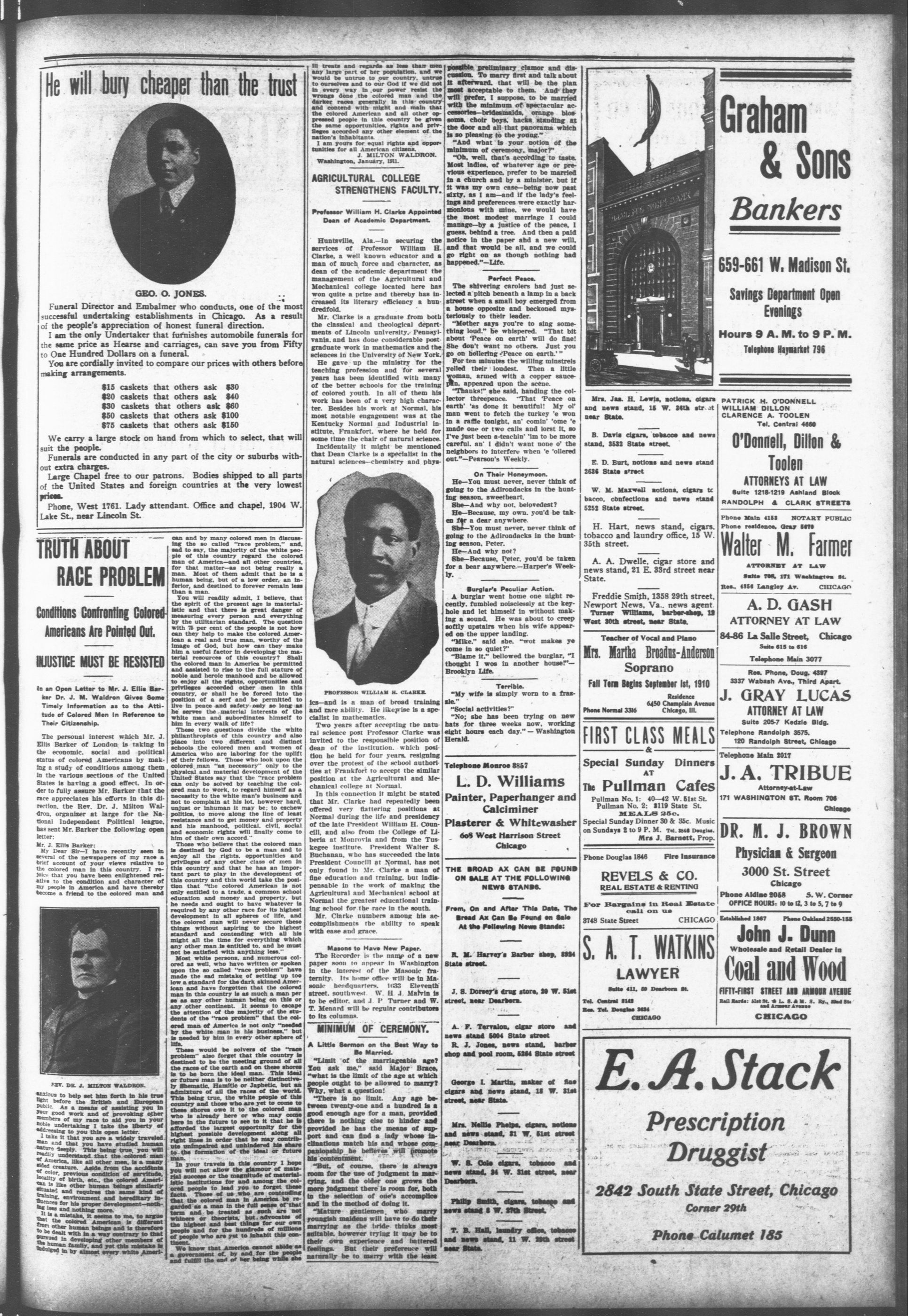
TRUTH ABOUT RACE PROBLEM
Conditions Confronting Colored Americans Are Pointed Out.
INJUSTICE MUST BE RESISTED
In an Open Letter to Mr. J. Ellis Barker Dr. J. M. Waldron Gives Some Timely Information as to the Attitude of Colored Men In Reference to Their Citizenship.
The personal interest which Mr. J. Ellis Barker of London is taking in the economic, social and political status of colored Americans by making a study of conditions among them in the various sections of the United States is having a good effect. In order to fully assure Mr. Barker that the race appreciates his efforts in this direction, the Rev. Dr. J. Milton Waldron, organizer at large for the National Independent Political league, has sent Mr. Barker the following open letter: Mr. J. Ellis Barker: My Dear Sir-I have recently seen in several of the newspapers of my race a brief account of your views relative to the colored man in this country. I refuse that you have been enlightened relative to the condition and character of my people in America and have thereby become a friend to the colored man and
REV. DR. J. MILTON WALDRON.
anxious to help set him forth in his true light before the British and European public. As a means of assisting you in good work and of provoking other members in your race to aid you in your noble understaffing, you are part of addressing to you this open letter.
I take it that you are a widely traveled man and that you have studied human nature deeply. This being true, you will readily understand that the colored man of America, like all other men, is a many sided creature. Aside from the accidents of color of birth, etc., the colored American is like other human beings similarly situated and requires the same kind of training, environment and hereditary influences for his proper development—nothing less and nothing more.
It is a mistake, it seems to me, to argue that the colored American is different from all human beings and is therefore to be dealt with in a way contrary to that pursued in developing other members of the human family, and not this mistake is indulged in by almost every white Ameri-
Mr. J. Ellis Barker;
D. JONES.
Uber who conducts, one of the most
moments in Chicago. As a result
honest funeral direction.
It furnishes automobile funerals for
carriages, can save you from Fifty-
four.
Compare our prices with others before
and from which to select, that will be part of the city or suburbs withrons. Bodies shipped to all parts sign countries at the very lowestendant. Office and chapel, 1904 W. can and by many colored men in discussing the so called "race problem," and, sad to say, the majority of the white people of this country regard the colored man of America—and all other countries, for that matter—as not being really a man. Most of them admit that he is a human being, but of a low order, an inferior, and destined to forever remain less than a man.
You will readily admit, I believe, that the spirit of the present age is materialistic and that there is great danger of measuring every person and everything by the utilitarian standard. The question with 75 per cent of the people is not how can they help to make the colored American a real and true man, worthy of the title of the American hero; they him a useful factor in developing the material resources of this country? Shall the colored man in America be permitted and assisted to rise to the full stature of noble and heroic manhood and be allowed to enjoy all the rights, opportunities and privileges accorded other men in this country, or shall he be forced into the position of a serf and be permitted to live in peace with other men, so long he may enjoy the material interests of the white man and subordinates himself to him in every walk of life?
These two questions divide the white philanthropists of this country and also place into two different and distinct schools the colored men and women of America who are laboring for the uplift of their fellows. Those who look upon the colored man "as necessary" only to the physical and material development of the United States say that the "race problem can only be solved by teaching the colored man to work, to regard himself as a necessity to the white man's business and not to complain at his lot, however hard, that he has to be toewn politics, to move along the line of least resistance and to get money and property and his manhood, political, civil, social and economic rights will finally come to him of their own accord."
Those who believe that the colored man is destined by God to be a man and to enjoy all the rights, opportunities and privileges of any other class of men in this country and that he has an important part to play in the development of this country and this world take the position that "the colored American is not only entitled to a trade, a common school education and money and property, but he needs and ought to have whatever is required by any other race for its highest development and will never secure these things without aspiring to the highest standard and contending with all his might all the time for everything which any other man is entitled to, and he must not be satisfied with anything less."
Most white persons, and numerous colored as well, who have written or spoken upon the so called "race problem" have made the sad mistake of setting up too low a standard for the dark skinned American and have forgotten that the colored man in this country is as much a man per se as any other human being on the other continent. It seems to escape the attention of the majority of the students of the "race problem" that the colored man of America is not only "needed by the white man in his business," but is needed by him in every other sphere of life.
These would be solvers of the "race problem" also forget that this country is destined to be the meeting ground of all the races of the earth and on these shores is to be born the ideal man. This ideal or future man is to be neither distinctively thematic, Hamific or Japhetic, but an admixture of all the races of the world. This being true, the white people of this country and those who are yet to come to these shores owe it to the colored man who is already here or to the colored man in the future who may come in the future to use it that he is indeed the greatest possible development along all right lines in order that he may contribute unimpaired and unhindered his share to the formation of the ideal or future man.
In your travels in this country I hope you will not allow the glamour of material success or the magnitude of materialistic institutions for and among the colored people to lead you into the world who are contending that the colored man in America be regarded as a man in the full sense of that term and be treated as such are not whitners or theorists, but advocates of the highest and best things for people and people who are yet to inhabit this continent.
We know that America cannot abide as a government of, by and for the people and fulfill the end of her being while she
ill treats and regards as less than men any large part of her population, and we would be untrue to our country, untrue to ourselves and to our God if we did not in every way in our power resist the wrongs done the colored man and the darker races generally in this country and contend with might and main that the colored American and all other oppressed races were the same opportunities, rights and privileges accorded any other element of the nation's inhabitants.
I am yours for equal rights and oppor-
tunities for all American citizens.
J. MILTON WALDRON.
Washington, January, 1911.
AGRICULTURAL COLLEGE STRENGTHENS FACULTY.
Professor William H. Clarke Appointed Dean of Academic Department.
Huntsville, Ala.—In securing the services of Professor William H. Clarke, a well known educator and a man of much force and character, as dean of the academic department the management of the Agricultural and Mechanical college located here has won quite a prize and thereby has increased its literary efficiency a hundredfold.
Mr. Clarke is a graduate from both the classical and theological departments of Lincoln university, Pennsylvania, and has done considerable postgraduate work in mathematics and the sciences in the University of New York.
He gave up the ministry for the teaching profession and for several years has been identified with many of the better schools for the training of colored youth. In all of them his work has been of a very high character. Besides his work at Normal, his most notable engagement was at the Kentucky Normal and Industrial institute, Frankfort, where he held for some time the chair of natural science. Incidentally it might be mentioned that Dean Clarke is a specialist in the natural sciences—chemistry and phys-
[Name]
PROFESSOR WILLIAM H. CLARKE
ics—and is a man of broad training
and rare ability. He likewise is a specialist in mathematics.
Two years after accepting the natural science post Professor Clarke was invited to the responsible position of dean of the institution, which position he held for four years, resigning over the protest of the school authorities at Frankfort to accept the similar position at the Agricultural and Mechanical college at Normal.
In this connection it might be stated that Mr. Clarke had repetently been offered very flattering positions at Normal during the life and presidency of the late President William H. Council, and also from the College of Liberia at Monrovia and from the Tuskegee institute. President Walter S. Buchanan, who has succeeded the late President Council at Normal, has not only found in Mr. Clarke a man of fine education and training, but indispensable in the work of making the Agricultural and Mechanical school at Normal the greatest educational training school for the race in the south. Mr. Clarke numbers among his accomplishments the ability to speak with ease and grace.
Masons to Have New Paper
The Recorder is the name of a new paper soon to appear in Washington in the interest of the Masonic fraternity. Its home office will be in Masonic headquarters, 1033 Eleventh street, southwest. W. H. J. Malvin will be to editor, and J. P. Turner and W. T. Menard will be regular contributors to its columns.
MINIMUM OF CEREMONY.
A Little Sermon on the Best Way to Be Married.
"Limit of the marriageable age? You ask me," said Major Bruce, "what is the limit of the age at which people ought to be allowed to marry? Why, what a question!
"There is no limit. Any age between twenty-one and a hundred is a good enough age for a man, provided there is nothing else to hinder and provided he has the means of support and can find a lady whose inclinations match his and whose companionship he will promote his contentment.
"But, of course, there is always room for the use of judgment in marrying, and the older one grows the more judgment there is room for, both in the selection of one's accomplice and in the method of doing it.
"Mature gentlemen, who marry youngish maledicts will have to do their marrying as the bride thinks most suitable, however trying it may be to their own experience and battered feelings. But their preference will naturally be to marry with the least
possible preliminary clamor and discussion. To marry first and talk about it afterward, that will be the plan most acceptable to them. And they will prefer, I suppose, to be married with the minimum of spectacular accessories—bridesmaids, orange blossoms, choir boys, hacks standing at the door and all that panorama which is so pleasing to the young."
"And what is your notion of the minimum of ceremony, major?"
"Oh, well, that's according to taste. Most indies, of whatever age or previous experience, prefer to be married in a church and by a minister, but if it was my own case—being now past sixty, as I am—and if the lady's feelings and preferences were exactly harmonious with mine, we would have the most modest marriage I could manage—by a justice of the peace, I guess, behind a tree. And then a paid notice in the paper and a new will, and that would be all, and we could go right on as though nothing had happened."—Life
Perfect Peace.
The shivering carolers had just selected a pitch beneath a lamp in a back street when a small boy emerged from a house opposite and beckoned mysteriously to their leader.
"Mother says you're to sing something loud." he whispered. "That bit about 'Peace on earth' will do fine! She don't want no others. Just you go on hollering 'Peace on earth.'"
For ten minutes the willing minstrels yelled their loudest. Then a little woman, armed with a copper saucepan, appeared upon the scene.
"Thanks!" she said, handing the collector threepence. "That 'Peace on earth' as done it beautiful! My ol' man went to fetch the turkey 'e won in a raffle tonight, an' comin' ome 'e made one or two calls and lorst it, so I've just been a-teachin' 'im to be more careful, an' I didn't want none o' the neighbors to interfere when e' ollered out."—Pearson's Weekly.
On Their Honeymoon
He—You must never, never think of going to the Adlardacks in the hunting season, sweetheart.
She—You must never, never think of going to the Adirondacks in the hunting season, Peter.
He—And why not?
She—Because, Peter, you'd be taken for a bear anywhere.—Harper's Weekly.
Burglar's Peculiar Action.
A burgiar went home one night recently, fumbled noiselessly at the key-hole and let himself in without making a sound. He was about to creep softly upstairs when his wife appeared on the upper landing.
"Mike," said she. "wot makes ye come in so quiet?"
"Blame it," bellowed the burgiar, "I thought I wos in another house!"—Brooklyn Life.
Terrible.
"My wife is simply worn to a frazale."
"Social activities?"
"No; she has been trying on new hats for three weeks now, working eight hours each day."—Washington Herald.
Telephone Monroe 8857
L. D. Williams
Painter, Paperhanger and
Calciminer
Plasterer & Whitewasher
608 West Harrison Street
Chicago
THE BROAD AX CAN BE FOUND ON SALE AT THE FOLLOWING NEWS STANDS.
From, On and After This Date, The Bread Ax Can Be Found on Sale At the Following News Stands:
R. M. Harvey's Barber shop, 8984
State street.
J. S. Dorsey's drug store, 20 W. 51st street, near Dearborn.
A. F. Tervalon, cigar store and news stand 5004 State street
R. J. Jones, news stand, barber shop and pool room, 5264 State street
George I. Martin, maker of fine cigars and news stand, 18 W. 51st street, near State.
Mrs. Nellie Phelps, cigars, notions and news stand, 21 W. 51st street near Dearborn.
E.A. Stack
Prescription
Druggist
2842 South State Street, Chicago
Corner 29th
Phone Calumet 185
GRAND FLY SONS BANK
Mrs. Jas. H. Lewis, notions, cigars and news stand, 15 W. 34th street near State.
B. Davis cigars, tobacco and news stand, 3532 State street.
E. D. Burt, notions and news stand 2636 State street.
W. M. Maxwell notions, cigars to bacco, confections and news stand 5252 State street.
H. Hart, news stand, cigars, tobacco and laundry office, 15 W. 35th street.
A. A. Dwelle, cigar store and news stand, 21 E. 33rd street near State.
Freddie Smith, 1358 29th street, Newport News, Va.. news agent. Turner Williams, barber-shop, 12 West 30th street, near State.
Teacher of Vocal and Piano
Mrs. Martha Broadus-Anderson Soprano
Fall Term Begins September 1st, 1910
Residence
6450 Champlain Avenue
Chicago, Ill.
Phone Normal 3316
FIRST CLASS MEALS &
Special Sunday Dinners AT
The Pullman Cafes
Pullman No. 1: 40—42 W. 51st St.
Pullman No. 2: 3119 State St.
MEALS 25c.
Special Sunday Dinner 30 & 35c. Music on Sundays 2 to 9 P. M. Tel. 3846 Douglas.
Mrs J. Barnett, Prop.
Phone Douglas 1846 Fire Insurance
REVELS & CO.
REAL ESTATE & RENTING
For Bargains in Real Estate
call on us
8748 State Street CHICAGO
S. A. T. WATKINS
LAWYER
Suite 411, 59 Dearborn St.
Tel. Central 3142
Rec. Tel. Doughns 3634
CHICAGO
Graham & Sons Bankers
659-661 W. Madison St.
Savings Department Open
Evenings
Hours 9 A.M. to 9 P.M.
Telephone Haymarket 796
PATRICK H. O'DONNELL
WILLIAM DILLON
CLARENCE A. TOOLEN
Tel. Central 4660
O'Donnell, Dillon &
Toolen
ATTORNEYS AT LAW
Suite 1218-1219 Ashland Block
RANDOLPH & CLARK STREETS
Phone Main 4153 NOTARY PUBLIC
Phone residence, Gray 8670
Walter M. Farmer
ATTORNEY AT LAW
Suite 708, 171 Washington St.
Res., 4856 Langley Av. CHICAGO
A. D. GASH
ATTORNEY AT LAW
84-86 La Salle Street, Chicago
Suite 615 to 616
Telephone Main 3077
Res. Phone, Doug. 4397
3337 Wabash Ave., Third Apart.
J. GRAY LUCAS
ATTORNEY AT LAW
Suite 205-7 Kedzie Bidg.
Telephone Randolph 3575.
120 Randolph Street, Chicago
Telephone Main 2017
J. A. TRIBUE
Attorney-at-Law
171 WASHINGTON ST. Room 708
Chicago
DR. M. J. BROWN
Physician & Surgeon
3000 St. Street
Chicago
Phone Aldine 8058 S. W. Corner
OFFICE HOURS: 10 to 12, 3 to 5, 7 to 9
Established 1867 Phone Oakland 2850-158
John J. Dunn
Wholesale and Retail Dealer in
Coal and Wood
FIFTY-FIRST STREET AND ARMOUR AVENUE
Rail Rards: 51st St. & L. S. & M. S. Ry., 52nd St.
and Armour Avenue
CHICAGO
Stack
Description
regist
WM. D. NEIGHBORS & CO
REAL ESTATE
AT LOWEST PRICES
Easiest Terms to be had in Chicago
Loans on first and second Mortgages
Fire Insurance placed in any company
3517 State Street CHICAGO, ILL.
Phone Aldine 2532
FARMERS LISTEN TO GOOD ADVICE
Utica(Miss.) Institute Entertains Seventh Annual Conference.
Thrilling Personal Experiences of Men Who Get Their Living Out of the Soil Were, Features of the Meeting, Shiftlessness, Idleness and Debt Slavery Condemned. Utica, Miss.—A strong, common sense address to farmers by William H. Holtzclaw, principal and founder of the Utica Normal and Industrial institute; remarkable stories by individual farmers, who told of their efforts to purchase land and educate their children, and a sane, conservative public address by the farmers and visitors assembled were the principal features of the seventh annual farmers conference, recently held at the institute.
In his address to the farmers, which he began in the exercises, Professor Holtzweig told the object of the conference that an honest effort on the part of the institution to be of service to the people of the community and gave some pointed advice to the people. Shiftlessness, idleness and being always in debt were strongly condemned by the prominent educator, and, on the other hand, he told his hearers that if they wanted to enjoy prosperity they must work for it.
"The price of success is industry, thrift, economy and morality," he said. "With these you must mix a good degree of foresight. For nearly fifty years you have been renting land, and you have worked it until you have literally worked it to death. Yet there are some present today who are not worth one cent more than they were forty-eight years ago. We get into the habit of believing that the world is against us; that the white man is making an effort to keep us down. I have never found one white man; whose opinion was worth anything in the community that was opposed to Negroes being respectable and progressive citizens. On the other hand. I know them by thousands who have helped Negroes to buy homes and attain respectable places as citizens.
The personal experiences of many of the unlettered colored farmers who have been inspired by the institution in its efforts to relieve their condition formed by far the most interesting portion of the conference program. Several hours were taken up in hearing these impromptu speeches, and among the farmers who gave interesting testimony were Pleasant McCadden, Isaiah Marshall, Daniel Lee, Daniel Griffin, Henry Samples and many other farmers who have struggled hard until they are now in comfortable circumstances.
Significant resolutions prepared by a committee composed of Professor T. J. Johnson, F. G. Smith, Mae Dixon. G. S. Keiley and M. B. Anderson were read and adopted unanimously. The resolutions were vigorous and forceful and expressed the real sentiment of the progressive colored man. The Negro was commended in all efforts to be law abiding, to acquire property, to raise the moral status, and industrial education was held up to be of the greatest possible benefit to the masses. A frank statement of the condition of the rural public schools and the lack of law enforcement was one of the noteworthy features of the address, which read in part:
"It cannot be expected that Negroes remain on the farm from year to year, receiving scant wages only once a year, with no educational opportunity, because their teachers are poorly paid. This can be changed to a very great extent. The Negroes of the state of Mississippi make up 58 per cent of the population, yet they receive only 24 per cent of the money for education. We do not even suggest that the white children should receive less than they already receive for education, but the best interests of the state demand that the Negro shall have more." A large number of prominent men from various sections of the state attended the conference.
National Religious Training School
Needs More Room For Students.
At the January meeting of the board of trustees of the National Religious Training school, Durham, N. C., of which Dr. James E. Shepard is president, reports were read which showed that the school was in excellent condition in all departments of its work. The need of greater facilities for the work of the school was a prominent feature of the session of the board.
Bishop George W. Clinton, D. D., offered a resolution, which was unanimously passed by the board, to the effect that the substantial progress of the school demands an increase of buildings and other facilities to meet the needs of the work. The resolution empowers the president to appeal to the public for liberal support for the institution, which is filling a peculiar need for the people for whom it is disseminating a wholesome atmosphere for the greatest uplift.
Owing to the large number of applications that are being received for the many departments of the school two more dermitories, a larger auditorium and a special building for the medical training of missionaries for home and foreign work must be erected as soon as the funds are in hand. It is the consensus of opinion of those working for the bettering of conditions among the race that the missionaries should receive the very best training. The influence of the school is already being felt in a number of states, and students from five states have enrolled. There are nearly 100 boarding students, with a like number of day students. President Shepard was authorized to proceed as soon as funds are available to erect two brick buildings.
The board unanimously and enthusiastically passed a resolution thanking ex-Governor Glenn and Judge Peter C. Pritchard for their great interest in the work, which has been a potent factor in the present success of the institution. The summer school and Chautauqun, which will begin about July 5, with special courses, will be largely attended, and the lectures will be the best of their kind ever given at an institution for the race in the south.
Work of an Institution in Washington Composed of Literary Mon. This statement regarding a well known institution is of interest;
The American Negro academy was formally organized in Washington March 5, 1837, by the action of eighteen men, of whom nine still maintain an active connection. Hence there have been at different times fifty-four enrolled members, representing
[Name]
sixteen states and the District of Columbia. The initial meeting held Dec. 18, 1898, was participated in by Alexander Crumwell, Walter B. Hagen, Kelly Miller, Paul Laurence Dunbar and John W. Crumwell, at whose residence the meeting was held. Dunbar, while he read selections from his poems at more than one of the earlier annual meetings, did not actively connect himself with the organization. There have been numerous alumni of Dunbar and Crumwell, the founder; Dr. William E. B. DuBois and Hon. Archibald H. Grimke. Among the distinguished men residents elected to honorary membership are included Edward Wilmot Elyden of the great count of Africa, Right Rev. James Theodore Holly, bishop of Halit; Anton H. Tanner, the artist; Anton Firmin, the Hawaiian statesman and author, and S. Coleridge-Taylor, the musical composer; the late J. S. Kumrel W. Lewis, knighted by Queen Victoria, and Dr. Louis Joseph Janvier, member of several foreign learned societies.
Though the constitution makes provision for membership of fifty, at no one time
THE BANK OF THE UNITED STATES OF AMERICA
GENERAL BANKING
3 per cent allowed
Safety Deposit Va
REAL ESTATE
As agent buy and sell Real Estate on
dents, including payment of taxes and
on Chicago Real Estate.
Especially Invites the patr
The Cranfor
Building.
The finest building ever open
Steam heat, electric light, tile ba
'Phone Randolph 803
We Furnish
to Protect Your P
Mortgage Banking a
All Business St
Northern Assets R
Office, 3517 State St.
- American
President and Treasurer, T
Vice-President, J
Secret
MANUFAT
Common and
Office a
45th and
per cent allowed on Savings Access
ity Deposit Vaults, $3.00 per
REAL ESTATE DEPARTMENT
and sell Real Estate on commission, manages estates
ing payment of taxes and locking after assessments.
Real Estate.
Especially Invites the patronage of Chicago business m
The Cranford Apartment
Building. 3600 Wabash Ave.
best building ever opened to Colored tenants
electric light, tile baths, marble entrance.
J. W. Casey, Ag
Randolph 803
101 WASHINGTON ST
Furnish You Move
to Protect Your Property or Business
Image Banking and General Broker
All Business Strictly Confidential
Barn Assets Realization Con
ce, 3517 State St. Phone, Aldine 25
American Brick Co
Agent and Treasurer, THOMAS CAREY.
Vice-President, JOHN SHELHAMER,
Secretary, WILLIAM SULLIV
MANUFATURERS OF
Common and Sewer B
Office and Yards:
H and Robey S
3 per cent allowed on Savings Accounts Safety Deposit Vaults, $3.00 per Year
As agent buy and sell Real Estate on commission, manages estates for non-residents, including payment of taxes and locking after assessments. Money to loan on Chicago Real Estate. Especially Invites the patronage of Chicago business men.
THE FORTY-FOURTH STREET
The finest building ever opened to Colored tenants in Chicago. Steam heat, electric light, tile baths, marble entrance.
President and Treasurer, THOMAS CAREY,
Vice-President, JOHN SHELHAMER,
Secretary, WILLIAM SULLIVAN.
Common and Sewer Brick Office and Yards:
Yards running winter and summer, equipped with the latest improved Wolf Dryer.
Telephone Yards 12
It pays to advert in The Broad A
ays to advert The Broad A
It pays to advertise in The Broad Ax.
save there been as many as forty members. The present enrollment is thirty, three of whom are engaged in educational work; seven are active in the Christian ministry, four being blasphews; one is a literary man, one devoted to institutional work, four are editors, one a journalist and four are physicians. Ten are in New Jersey and Pennsylvania, eleven what might be termed the central Atlantic states, eight in the south Atlantic section and three in the central west. From the beginning the administrative officer, its corresponding secretary, has been Mr. John W. Crumwell, also the editor of the American Negro Monographs. As yet its principal work has been the educational publications, of which thirteen have been found in the principal libraries of the country, including those of the representative universities south as well as in the north and west.
---
---
S. E. Cor. State and 36th Place, Chicago
bewed on Savings Accounts
at Vaults, $3.00 per Year
ESTATE DEPARTMENT
state on commission, manages estates for non-resi-
ces and locking after assessments. Money to loan
the patronage of Chicago business men.
Ford Apartment
3600 Wabash Ave.
her opened to Colored tenants in Chicago.
tile baths, marble entrance.
J. W. Casey, Agent,
101 WASHINGTON STREET.
Wish You Money
Your Property or Business
ing and General Brokerage
ness Strictly Confidential
s Realization Company
e St. Phone, Aldine 2532.
In Brick Co. -
er, THOMAS CAREY.
ident, JOHN SHELHAMER,
Secretary, WILLIAM SULLIVAN.
FATURERS OF
and Sewer Brick
office and Yards:
d Robey Sts.
to advertise Broad Ax.
Premiums on Children.
The increased cost of living and the marked tendency toward the "two child standard" in German towns has led the municipality of Schoenberg, which comprises a large part of south and southwest Berlin, to offer premiums to municipal employees with large families. All parents with more than two children are to benefit. Widowers with children are treated equally with those whose wives are alive. The premiums are large enough to make a considerable difference in a workingman's household. Fathers with three children receive about $2.50 monthly, with four children $3.75, with five $4.50 and with more than six $5 monthly.
---
"A STORE FOR EVERYBODY"
HILLMAN'S
STATE & WASHINGTON STS.
WHERE EVERY PATRON
Saves
ON EVERY PURCHASE
Telephone Yards 693
JOHN J. BRADLEY
Real Estate
Loans
Fire and Plate Glass Insurance
4709 S. HALSTED ST
CHICAGO
Convenient to Surface and Elevated Roads. Honest working Colored people always appreciated and treated respectfully.
If you desire to live where you won't be ashamed to have your friends call on you before you rent either on South, West or North Side, cut this Ad out and present it to
Pianos, Organs, Talking Machines and Supplies. Brass and String Instruments. Cash or Easy Payments. Open Evenings till 10.30. Phone Doug. 4558.
5059 Armour Ave. Cor. 51st Street, Chicago
Budweiser Buffet
5050 STATE STREET
CHICAGO, ILL.
Fine Wines, Liquors, Imported
and Domestic Cigars Cafe Up-stairs. Open All Night.
Service First Class.
Hotel Brunswick Geo. W. Holt, Prop. BUFFET, POOL AND BILLIARDS.