The Broad Ax
Saturday, March 15, 1913
Chicago, Illinois
Page text (machine-generated)
Short description of the flying trip of Julius F. Taylor from Chicago to Harrisburg, Pa.,
ON THE PENNSYLVANIA LIMITED, WHICH IS ONE OF THE FINEST AND ONE OF THE PASTEST TRAINS RUNNING TOWARD THE EAST.
Vol. XVIII.
Short descrip
flying trip
Taylor fr
to Harris
ON THE PENNSYLVANIA LIMITED
AND ONE OF THE FASTEST
EAST.
On Thursday evening, February 27, at 5:30 o'clock, the writer, after a hot foot run, loaded down with two suit cases, succeeded in catching onto the last car or the tail end of the Pennsylvania limited just as it was pulling out of the Union Station, Adams and Canal streets, bound for Harrisburg, Pa., Baltimore, Md., Washington, D. C., Philadelphia, Pa., New York City and Albany, N. Y. The Pennsylvania limited is one of the crack trains of the Pennsylvania railroad. It consisted of twelve Pullman parlor or sleeping cars, steel constructed, and no one is permitted to ride or travel on it unless they are able to lay down enough of money for a sleeping car ticket, aside from paying for all other first class accommodations, and from end to end the entire train was in every way a dream of beauty; from the moment the engineer pulled the throttle valve of his giant iron horse wide open, it puffed and panted, lunged forward at one mighty leap and it tore out over the country screaming and snorting like a fleet-footed wild Indian. From the time it left the Union Station in Chicago until it reached Harrisburg, Pa., which is 712 miles from the Windy City, at 12:55 Friday noon, averaged almost fifty miles per hour.
Being a little in advance of our story, we must again return to Chicago in order to make it complete.
Shortly after the first of February, while in conversation with one of our warm Irish-American friends who has a heart in him as big as an elephant, we informed him that we intended to visit our mother at Harrisburg, Pa., and Washington, D. C., March 4th, in a cold matter of fact manner. He looked at us for a moment and said, "Mr. Taylor, be sure and call at my office before you go."
On Tuesday morning, February 26th, according to his request we called on him and in much less time than it takes to write this story he ran his hand in one of the drawers of his flat top desk, pulled out his check book and in a rapid manner he wrote out a check for fifty dollars, folded it up, and in handing it to us he spoke in a sharp voice, and said, "Mr. Taylor, I do not want my name mentioned in the columns of The Broad Ax, in this connection, but this will assist you to travel through the East like a first-class gentleman."
In accepting his token of friendship we distinctly informed him that we had not asked him for the fifty dollar check, that we did not want him to think for one minute that we had ever attempted to sandbag him; that we were no beggar and so on. To this he simply smiled and exclaimed, "I know it and if I did not want you to have the money you never would have been able to lay your hands on it in this world; so I have nothing further to say than to express the hope that you will enjoy your vacation trip through the East and that you will find your mother well."
To return to the beginning of this story, along about 8:00 o'clock, after catching our second wind, and resting up from running to get aboard the train, we broke into the dining car; it was full of ladies and gentlemen who were eating, talking and laughing all at the same time, but not one of them stopped eating and withdrew from it on account of our presence, and while waiting to be served and reflecting over the past, this thought ran through our mind, that it was a very long distance from the little log cabin with its dirt floor, on the banks of the Shandor River in Old Virginia, where we first saw the light of day, in which we spent our boyhood days, during the
old slavery days, to traveling on the Pennsylvania limited at the rate of fifty miles per hour and getting on the outside of our dinner in the dining car in the midst of so much elegance, glare and glitter.
Not long after finishing our repast we entered the lounging room in the sleeper in which our berth was located. Several gentlemen struck up a conversation with us and we talked, and talked on various subjects until near 12:00 o'clock. Then we rolled into bed for the night and slept as sound as a Virginia mule and when the train speeded into Pittsburg, Pa., which is 468 miles from Chicago, at 5:30 Friday morning and rushed out of it we were still dead to the world.
It was bright and clear on Friday when we awoke from our splendid night's rest and sleep, and after getting ourselves together, the long train continued to speed on and on and rush around the sharp mountain curves at a fearful rate; it swung around the famous Horse Shoe bend, which is one of the greatest feats of civil engineering in the world, just as we were enjoying our breakfast and it was a grand sight to behold.
Not even stopping to take water the train continued its onward course through Pennsylvania, hiking through Marysville, the little town where we first started out in the world after we had arrived in it from Virginia, many years ago, and it finally pulled into the depot at Harrisburg on time. It did not take us leng to find our way to the home of our mother and our sister, Mrs. Jennie Frazier, and to say the least they were both overjoyed to see us, six years had passed away since, we had visited our mother, at that time she was visiting with our second sister, Mrs. Amanda Mims, at Columbus, Ohio, and we at that time ran over from Chicago to Columbus to visit with them but twenty-five years had passed away since we had met out other sister, Mrs. Frazier face to face and from the time we arrived in Harrisburg, Friday noon until we departed from it for Washington, D. C., Monday noon, many of those who knew us in our joyhood days called to pay their respects to us, but we endeavored to spend all of our time with our mother who is in her 88th year, and she enjoys splendid health for one so far advanced in years; at the present time, like ourselves, she weighs almost 200 pounds; she is still in full possession of all her faculties; her mind is clear and she can still see at a distance considerable without moving classes.
Saturday noon, March 1, Attorney W. Justin Carter, who is the leading Afro-American lawyer of Harrisburg, and has many White clients, invited us to accompany him to lunch, and it was worth the eating and from henceforth lawyer Carter will become a regular reader of The Broad Ax; Saturday afternoon, Mr. Frank Jefferson, who holds down a good position in the State Treasurer's office, accompanied us through the new state capital of Pennsylvania, and it is an exceedingly large and fine building in every way; Mr. William H. Craighead, editor of the Advocate-Verdict, also assisted to make our visit to Harrisburg very pleasant. On Sunday morning mother, after breakfast appeared in a black satin skirt, which was presented to her by our good wife, and the writer twenty five years ago and with her snow white hair nicely dressed, she looked ever so lovely and we felt real proud of her. She has instructed our sister and her three daughters, Mrs. Marie Ball, Misses Amanda and Pearl Frasier, to bury her in that same black satin skirt, which is covered on this earth.
1890
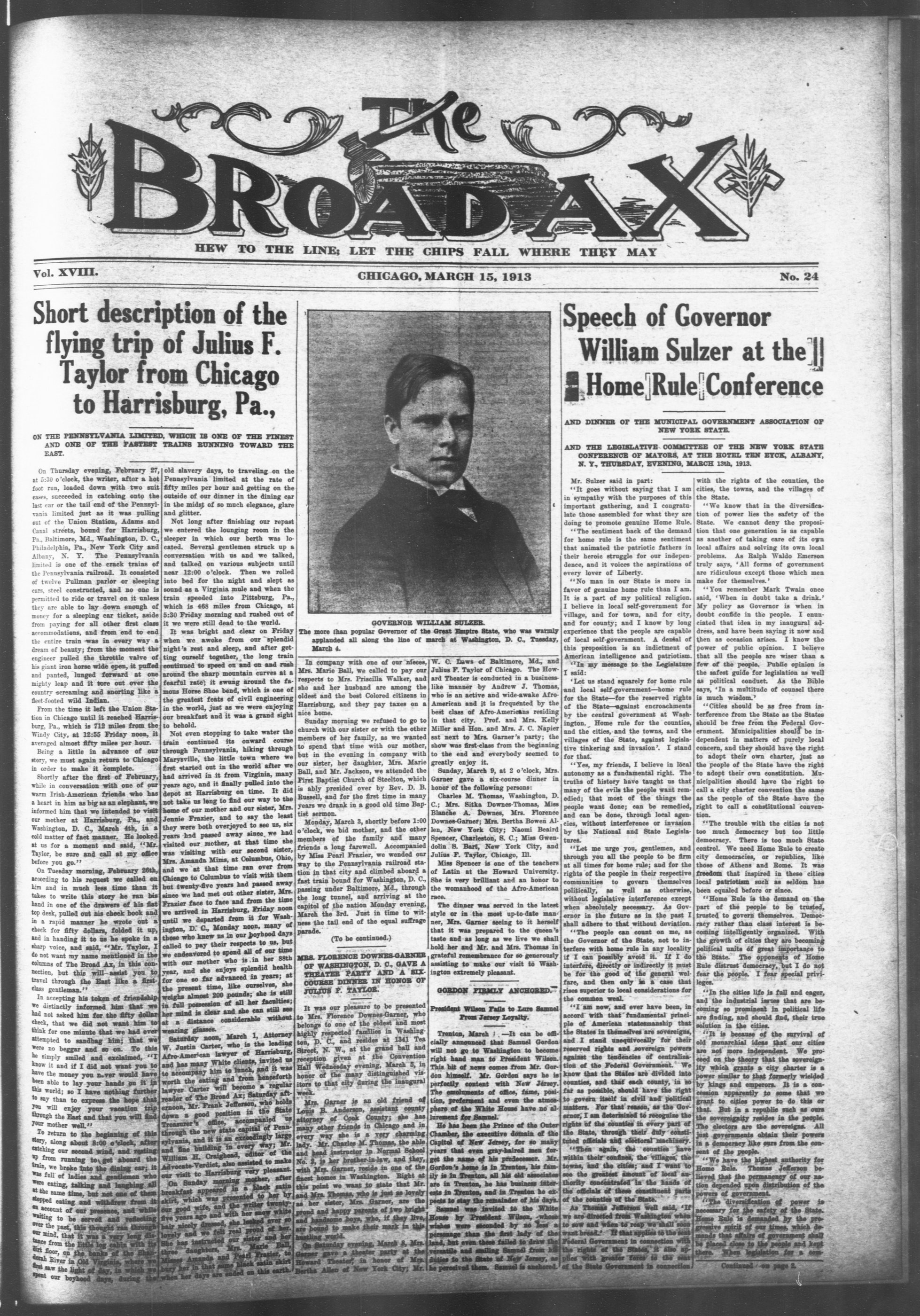
The more than popular Governor of the Great Empire State, who was warmly applauded all along the line of march at Washington, D. C., Tuesday, March 4.
In company with one of our nieces, Mrs. Marie Ball, we called to pay our respects to Mrs. Priscilla Walker, and she and her husband are among the oldest and the best Colored citizens in Harrisburg, and they pay taxes on a nice home.
Sunday morning we refused to go to church with our sister or with the other members of her family, as we wanted to spend that time with our mother, but in the evening in company with our sister, her daughter, Mrs. Marie Ball, and Mr. Jackson, we attended the First Baptist Church of Steelton, which is ably presided over by Rev. D. B. Russell, and for the first time in many years we drank in a good old time Baptist sermon.
W. C. Daws of Baltimore, Md., and Julius F. Taylor of Chicago. The Howard Theater is conducted in a business like manner by Andrew J. Thomas, who is an active and wide-awake Afro-American and it is frequented by the best class of Afro-Americans residing in that city. Prof. and Mrs. Kelly Miller and Hon. and Mrs. J. C. Napier sat next to Mrs. Garner's party; the show was first-class from the beginning to the end and everybody seemed to greatly enjoy it.
Sunday, March 9, at 2 o'clock, Mrs. Garner gave a six-course dinner in honor of the following persons:
Charles M. Thomas, Washington, D. C.; Mrs. Sitka Downes-Thomas, Miss Blanche A. Downes, Mrs. Florence
Monday, March 3, shortly before 1:00 o'clock, we bid mother, and the other members of the family and many friends a long farewell. Accompanied by Miss Pearl Frazier, we wended our way to the Pennsylvania railroad station in that city and climbed aboard a fast train bound for Washington, D.C., passing under Baltimore, Md., through the long tunnel, and arriving at the capitol of the nation Monday evening, March the 3rd. Just in time to witness the tail end of the equal suffrage parade.
(To be continued,)
MRS. FLORENCE DOWNES-GARNER OF WASHINGTON, D. C., GAVE A THEATER PARTY AND A SIX-COURSE DINNER IN HONOR OF JULIUS P. TAYLOR.
It was our pleasure to be presented to Mrs. Florence Downes-Garner, who belongs to one of the oldest and most highly respected families in Washington, D. C., and resides at 1341 Tea Street, N. W., at the grand ball and reception given at the Convention Hall Wednesday evening, March 5, in honor of the many distinguished visitors to that city during the inaugural week.
Mrs. Garner is an old friend of Louis B. Anderson, assistant county attorney of Cook County; she has many other friends in Chicago and in every way she is a very charming lady. Mr. Charles M. Thomas, the able and head instructor in Normal School No. 2, is her brother-in-law, and they, with Mrs. Garner, reside in one of the finest homes in Washington. Right at this point we want to state that Mr. and Mrs. Thomas, who is just as lovely as her sister, Mrs. Garner, are the proud and happy parents of two bright and handsome boys, who, if they live, are bound to make their mark in this huddling world.
On Saturday evening, March 8 Mrs. Garner gave a theater party at the Howard Theater, in honor of Mrs. Bertha Allen of New York City; Mr.
W. C. Laws of Baltimore, Md., and Julius F. Taylor of Chicago. The Howard Theater is conducted in a businesslike manner by Andrew J. Thomas, who is an active and wide-awake Afro-American and it is frequented by the best class of Afro-Americans residing in that city. Prof. and Mrs. Kelly Miller and Hon. and Mrs. J. C. Napier sat next to Mrs. Garner's party; the show was first-class from the beginning to the end and everybody seemed to greatly enjoy it.
Sunday, March 9, at 2 o'clock, Mrs. Garner gave a six-course dinner in honor of the following persons:
Charles M. Thomas, Washington, D.C.; Mrs. Sitka Downes-Thomas, Miss Blanche A. Downes, Mrs. Florence Downes-Garner; Mrs. Bertha Bowen Allen, New York City; Naomi Besidl Spencer, Charleston, S. C.; Miss Gwendolin S. Bart, New York City, and Julius F. Taylor, Chicago, Ill.
Miss Spencer is one of the teachers of Latin at the Howard University. She is very brilliant and an honor to the womanhood of the Afro-American race.
The dinner was served in the latest style or in the most up-to-date manner, Mrs. Garner seeing to it herself that it was prepared to the queen's taste and as long as we live we shall hold her and Mr. and Mrs. Thomas in grateful remembrance for so generously assisting to make our visit to Washington extremely pleasant.
GORDON PIRMLY ANCHORED
President Wilson Falls to Luro Samuel From Jersey Loyalty.
Trenton, March 1 — It can be officially announced that Samuel Gordon will not go to Washington to become right hand man to President Wilson. This bit of news comes from Mr. Gordon himself. Mr. Gordon says he is perfectly content with New Jersey. The enrolments of office, fame, position, preferment and even the atmosphere of the White House have no allurement for Samuel.
He has been the Prince of the Outer Chamber, the executive domain of the Capitol of New Jersey, for so many years that even gray-haired men forget the name of his predecessor. Mr. Gordon's home is in Trenton, his family is in Trenton, all his old associates are in Trenton, he has business interests in Trenton, and in Trenton he expects to stay the remainder of his days.
Samuel was invited to the White House by President Wilson, whose wishes were seconded by no less a personage than the first lady of the land, but even these failed to draw the versatile and smiling Samuel from his duties to the States of New Jersey, as he perceived them. Samuel is anchored.
Speech of Governor William Sulzer at the Home[Rule]Conference
AND DINNER OF THE MUNICIPAL GOVERNMENT ASSOCIATION OF NEW YORK STATE.
AND THE LEGISLATIVE COMMITTEE OF THE NEW YORK STATE CONFERENCE OF MAYORS, AT THE HOTEL TEN EYCK, ALBANY, N. Y., THURSDAY, EVENING, MARCH 13th, 1913.
Mr. Sulzer said in part: with the rights of the counties, the
Mr. Sauer said in parv.
"It goes without saying that I am in sympathy with the purposes of this important gathering, and I congratulate those assembled for what they are doing to promote genuine Home Rule.
"The sentiment back of the demand for home rule is the same sentiment that animated the patriotic fathers in their heroic struggle for our independence, and it voices the aspirations of every lover of Liberty.
"No man in our State is more in favor of genuine home rule than I am. It is a part of my political religion. I believe in local self-government for village, and for town, and for city, and for county; and I know by long experience that the people are capable of local self-government. A denial of this proposition is an indictment of American intelligence and patriotism.
"In my message to the Legislature I said:
"Let us stand squarely for home rule and local self-government—home rule for the State—for the reserved rights of the State—against encroachments by the central government at Washington. Home rule for the counties, and the cities, and the towns, and the villages of the State, against legislative tinkering and invasion'. I stand for that.
"Yes, my friends, I believe in local autonomy as a fundamental right. The truths of history have taught us that many of the evils the people want remedied; that most of the things the people want done; can be remedied, and can be done, through local agencies, without interference or invasion by the National and State Legislatures.
"Let me urge you, gentlemen, and through you all the people to be firm at all times for home rule; and for the rights of the people in their respective communities to govern themselves politically, as well as otherwise, without legislative interference except when absolutely necessary. As Governor in the future as in the past I shall adhere to that without deviation.
"The people can count on me, as the Governor of the State, not to interfere with home rule in any locality if I can possibly avoid it. If I do interfere, directly or indirectly it must be for the good of the general welfare, and them only in a case that rises superior to local considerations for the common weal."
"I am now, and ever have been, in accord with that fundamental principle of American statesmanship that the States in themselves are sovereigns, and I stand unequivocally for their reserved rights and sovereign powers against the tendencies of centralization of the Federal Government. We know that the States are divided into counties, and that each county, in no far as possible, should have the right to govern itself in civil and political matters. For that reason, as the Governor, I am determined to recognize the rights of the counties in every part of the State, through their duly constituted officials and electoral machinery.
"Then again, the counties have within their confines, the villages, the towns, and the cities; and I want to see the greatest amount of local authority concentrated in the hands of the officials of these constituent parts of the counties of the State.
As Thomas Jefferson well said, 'If we are directed from Washington when to sow and when to seep we shall soon want bread.' If that applies to the best Federal Government in connection with the rights of the States, it also applies with greater force to the sent of the State Government in connection
No.24
with the rights of the counties, the cities, the towns, and the villages of the State.
"We know that in the diversification of power lies the safety of the State. We cannot deny the proposition that one generation is as capable as another of taking care of its own local affairs and solving its own local problems. As Ralph Waldo Emerson truly says, 'All forms of government are ridiculous except those which men make for themselves.'
"You remember Mark Twain once said, 'When in doubt take a drink.' My policy as Governor is when in doubt confide in the people. I enunciated that idea in my inaugural address, and have been saying it now and then as occasion arises. I know the power of public opinion. I believe that all the people are wiser than a few of the people. Public opinion is the safest guide for legislation as well as political conduct. As the Bible says, 'In a multitude of counsel there is much wisdom.'
"Cities should be as free from interference from the State as the States should be free from the Federal Government. Municipalities should be independent in matters of purely local concern, and they should have the right to adopt their own charter, just as the people of the State have the right to adopt their own constitution. Municipalities should have the right to call a city charter convention the same as the people of the State have the right to call a constitutional convention.
"The trouble with the cities is not too much democracy but too little democracy. There is too much State control. We need Home Rule to create city democracies, or republics, like those of Athens and Rome. It was freedom that inspired in these cities local patriotism such as seldom has been equaled before or since.
"Home Rule is the demand on the part of the people to be trusted, trusted to govern themselves. Democracy rather than class interest is becoming intelligently organized. With the growth of cities they are becoming political units of great importance to the State. The opponents of Home Rule distrust democracy, but I do not fear the people. I fear special privileges.
"In the cities life is full and eager, and the industrial issues that are becoming so prominent in political life are finding, and should find, their true solution in the cities.
"It is because of the survival of old monarchial ideas that our cities are not more independent. We proceed on the theory that the sovereignty which grants a city charter is a power similar to that formerly wielded by kings and emperors. It is a concession apparently to some that we grant to cities power to do this or that. But in a republic such as ours the sovereignty resides in the people. The electors are the sovereigns. All just governments obtain their powers in a democracy like ours from the consent of the people.
"We have the highest authority for Home Rule. Thomas Jefferson believed that the permanency of our nation depended upon distribution of the powers of government.
"The diversification of power is necessary for the safety of the State. Home Rule is demanded by the progressive spirit of our times, which demands that affairs of government shall be placed close to the people and kept there. When legislation for a com-
THE BROADAX
PUBLISHED WEEKLY.
Will promulgate and at all times uphold the free principles of Democracy, but Catholicism is not the only language Single Taxes, Republics, or anyone else can have their say, as long as their language is proper and responsibility is fixed.
The Broad Ax is a newspaper whose platform is broad enough for all, even claiming the editorial right to speak its own mind.
Local communications will receive attention. Write only on one side of the paper.
Subscriptions must be paid in advance. One Year.....$0.60
Six Months.....1.60
Advertising rates made known on applications. Address all communications to
8087 ARMOUR, AVENUE, CHICAGO, ILL
JULIUS F. TAYLOR, Editor and Publisher
Mattered as Second-Class Matter Aug. 19, Illinois
chicago, Michigan. Under Act of March 8, 1898.
under Act of March 8, 1898.
GOV. WILLIAM SULZER
Concluded from page 1.
munity is carried on at a distance remote public opinion fails to properly influence that legislation.
"Public hearings are efforts to overcome this evil. It is better to have our legislative body close to the community than to take representatives of a community long distances to meet the Legislature.
"Let cities be kept free from the State as the State is kept free from national interference in things local. As states adopt their own constitutions so should cities adopt their own charters. The cure for the evils of democracy is more democracy.
"Home rules trust the people, their opponents fear popular control."
RACE FOR NEGRO MISSIONS
Hottest Diplomatic Contests Are for
Librarian and Haytian Posts.
Washington, March 13.—Quite the liveliest contest for any of the appointments in the Diplomatic Corps to be made by President Wilson is the one now being brought actively to his attention for the Haytian mission. This is one of the two berths sought by Negroes in the foreign legations of the United States; the other being the post of Minister to Liberia. There is an applicant for the Haytian mission from every State in the Union in which there is a large Negro population as well as several from other States. In fact, more of the prominent men of the Negro race are scrambling for the Haytian than for the Liberian post.
There are three candidates from Indiana for Minister to Hayti; New York City has likewise a trio of aspirants for that office. The present American Minister to Hayti is Henry Watson Furniss of Indianapolis, and he has been filling the post since 1906. It is being argued in behalf of some of the candidates from other States that since Minister Furniss is from Indiana that State should not receive the appointment at this time.
Among the score or more candidates, all Negro leaders, for this diplomatic post, those most prominent in the race, and whose claims and qualifications are being most aggressively urged, are James D. Carr of New York City, who has been Assistant Corporation Counsel for New York City since 1904; Rufus L. Perry, and N. B. Marshall, both of New York City; Dr. J. B. Oliver of Brazil, Ind.; Dr. G. W. Buckner of Evansville, Ind., and Thomas J. Turner, another Indianian. Those indorsements appear to be the strongest are Carr and Oliver of Indiana. Carr is the only Negro who was ever graduated from Butgers College, and President Wilson has been informed that Carr was the first Negro prosecuting attorney in the North. Letters of indorsement of him have been laid before the President from William H. Demarest, President of Butgers College; Prof. Austin Scott, ex-President, and Prof. Louis Bevier, Dean of that institution; Judges Warren W. Foster and Otto A. Rosalaky of the Court of General Sessions of New York, Justice Cornelius F. Collins of the New York Court of Special Sessions, Representatives Francis Burton Harrison and John F. Carew of New York City, and George Gordon Battle.
In Carr's behalf it is also stated that he organized the Tammany Hall United Colored Democracy and in 1897 was appointed by Col. Asa Bird Gardner as Assistant District Attorney. Dr. Oliver was born a slave in Nauseamond County, Va. Perry, who is a lawyer, is indorsed by the Regular Colored Democratic Association of Kings County and by John H. McCooy, the leader of the Democratic organization in Brooklyn. Marshall was connected with the headquarters of the Democratic Congressional Campaign Committee last Fall, and has the indorsement of Representative James T. Lloyd of Missouri,
0
Chairman of the Democratic Congressional Committee.
Among the chief candidates for the Liberian post are Freeman Lenore Martin of Oklahoma. He is President of the Negro Chamber of Commerce of Tulsa, Okla., and President of the Negro State Bar Association.
Edward J. Braithwaite, a Negro of the Fourteenth Election District of New York City, has announced himself to the members of the New York delegation in Congress as a candidate for Assistant Register of the Treasury.
HEALTH NOTES.
Of all the people who die in this country each year 27 per cent are babies under five years of age; and of these 200,000 die from the preventable diseases and approximately 150,000 of these die during the first year of life.
It is often asserted that here in the United States people are burning their life candles at both ends. That this is true is borne out by the fact that in the United States the death rate above the age of 40 has increased 27 per cent since 1880. This means that the diseases of old age are reaching down into the younger age periods.
It costs money to carry on public health work that, if properly performed, means the lessening of needless disease and suffering. And in this battle between the dollar and the death rate if only the dollars are provided and wisely used, the victory for human health and happiness can be won. In this day and age good health is a commodity and can be bought, but the people must be willing to pay the cost.
That was a broadminded clergyman who recently in one of his sermons asserted that God does not fix the death rate. There are many agencies that contribute to maintaining a high death rate; and chief among these are those persons who think that disease and death are sent by a Divine Providence as a punishment for our sins. Then come those who flout at all health laws and refuse to even be taught how to do the things that make for community health and safety.
...
Pneumonia, well named the "New Captain of the Men of Death" was busy during the entire month of February having a total of 646 deaths to its credit; an average of 23 deaths each day or practically one death every hour during the month from this disease alone. Taking the estimated cost of each of these 646 funerals at $100.00, pneumonia then netted the undertakers of Chicago $64,800 in just 28 days. And to this may safely be added another $10,000 for doctors' bills, making an active total of $74,800 for the month. Verily, disease and death cost money.
For the week ended March 1st, 189 persons in Chicago were killed with pneumonia, a dirty-nir disease. This means that for every hour of the day and night during the week mentioned some one in Chicago was killed by a preventable disease. As a matter of fact these figures do not quite tell the tale of slaughter; for there were 27 deaths for each of the seven days of the week. Think of it, 189 deaths in seven days from just one disease that people need not have if only they would look more carefully after the purity of their air supply. Think again, 187 funerals in one week, which at an average cost of only $100.00 each, means that for the week named, pneumonia cost the people of this city, $18,000 for undertakers' services alone, saying nothing about other expenses incidental to sickness that must be borne and met.
RESOLUTIONS OF CONFIDENCE IN
PRESIDENT WILSON PASSED BY
THE NATIONAL COLORED DEMOCRATIC LEAGUE.
The following resolutions of confidence in President Woodrow Wilson were adopted by the National Colored Democratic League at its meeting at Washington, D. C., March 5, 1918:
The National Colored Democratic League in national convention assembled, in the City of Washington, District of Columbia, reaffirming its confidence in President Wilson, congratulates its nation upon his happy induction in office. The grave problems of social reform which have hung like a pall over the nation for sixteen years demand a man broad of soul and firm of purpose. We believe that in President Woodrow Wilson the country has an Executor who will apply to all questions the fundamental and eternal precepts of simple justice, regardless of the arrogant assumptions of wealth in the false traditions of privilege.
We believe the President's splendid address to be an inspiration, for it allays the fears and engenders hope in the breasts of all oppressed citizens under our flag; and it admonishes and reminds the dominant race of its responsibilities as citizens in this great republic.
The tone of the inaugural address reassures us as Negroes that our Presi-
dent will carry out all the promises made to us before the election; and we confidently expect the Democratic Congress to answer the President's appeal for help to carry out his humanitarian program by refusing to consider any legislation tended to humiliate or insult any part of the citizenship of this great Republic. We reaffirm our declaration that the National Democratic party offers to the Colored citizenship of the nation an opportunity to conserve their civil and political interests and to win for the race the recognition of all the rights and immunities comprised in that incomparable production of Thomas Jefferson, the Declaration of Independence.
We hereby appeal to the Negro voters of the country for their support and espousal of the cause of Democracy in the exercise of their franchise. All great political and social movements must have a leadership and the National Colored Democratic League is fortunate in having at its head Bishop Alexander Walters, a man who has devoted his entire life to the highest interest of his race and his country.
AURORA NOTES.
Raymond H. Curry of Cleveland, O. is guest at the Bogers this week.
Miss Goldie Harris entertained at luncheon for visiting friends Sunday evening.
Madame Pearl Blake, reader, who for several years has been consulted by Aurora's most prominent men and women, is quite ill at her home in Lincoln Avenue. It may be interesting to know that Madame Pearl was brought into confidence with several politicians before the election and informed them of President Wilson's success, of William Jennings Bryan and Marshall. This alone has placed her foremost among the class that will not make one turn before consulting a seer. Quite a number of Chicago's leading business men come to Aurora weekly and are her clients. Madame Pearl Blake is well loved and highly respected by both races here. She has some good real estate holding in this city.
Miss Goldie Harris has resigned her position with Miss Francis Lightcap and will soon launch into business for herself.
Mrs. Sadie Hayes of N. Broadway, is much improved, after eleven weeks of illness.
It is with deep regret that the "modern pastor" finds so little time to call and have a word of prayer with sick folks, regardless of their faith. So often we come into a home and the sick will say "Neither of the pastors have been to my home," etc. They may not belong to either church, but in olden days the good old fathers brought sunshine into the hearts of the sick, through a word of prayer at their bedside.
Mrs. Albert Williams is entertaining
this week Monday for Evanston
friends.
Mrs. Daisy Russel and Miss Muse
visited friends in Chicago Tuesday.
Miss Eula Wilson of Cairo, Ill., will
return home after spending three
months in Aurora with her uncle, Mr.
Stafford Wilson.
Mr. Wilbur Johnson of Chicago, visi-
ted Aurora friends last week.
Miss Rose Wells entertained twenty-
five friends in honor of her aunt's
birthday, Mrs. Thomas Cooper, (fifty-
first birthday) Sunday.
Walters A. M.E. Zion Church, Cor. 38th and Dearborn Streets. Rev. H. J. Callis, D. D. Porter
Last Sunday was our Third quarterly meeting occasion for this conference year. Our services were largely attended all day. In the morning the Presiding Elder, Rev. R. P. Christian, preached a splendid sermon to the satisfaction of the large audience present. At the Sacramental service in the afternoon all of the five churches in the South Side Union, were well represented. The pastors all being present excepting Rev. Robinson of St. Mark M. E. Church who was attending Quarterly Meeting at Scott Chapel. Quite a number of members from Bethel and other churches were also present. Rev. T. L. Scott, who preached the Sacramental sermon, seemed to be at his best. The audience was moved by the influence of the Holy Spirit in a way that has not been seen in Chicago as was testified to by some of the oldest members and pastors present. It was indeed and in truth a great Spiritual feast.
The evening service was well attended and the Presiding Elder preached another excellent sermon. Fifteen persons were received into the church; $122.00 was raised. The Love feast on Monday evening was the largest that has been held in a long time. The spiritual and devotional atmosphere was at high water mark. A large
number of visitors from sister churches were present. Through the efforts of the Presiding Elder a handsome solid gold cross was presented the pastor, kev. H. J. Callis. The presentation speech was made by Dr. A. J. Carey of the Institution Church. Among other things he said it was the first time he had ever known a Presiding Elder to make a present to a pastor. Dr. Callis responded in a few chosen remarks. It was a delightful ending of the best Quarterly meeting occasion that Zion Church in Chicago has ever seen.
Special preparation is being made for our Easter services. Baptism by immersion will be administered at 6:30 a. m. At 11:00 a. m. Baptism by sprinkling will be administered to both infants and adults. The regular Easter sermon and service will occur at 3 o'clock in the afternoon. Bishop G. L. Blackwell, S. T. D., will preach. The regular Easter Choral service will be held at 7:30 p. m.
On Easter Monday evening a reception will be tendered Bishop G. L. Blackwell by a committee of ladies, admission including refreshments, 25 cents. An invitation has been extended to Bishop Lee, DD., LL.D., to be the guest of Bishop Blackwell at this reception.
The services for Palm Sunday will be as usual, the postor will preach morning and evening.
The general committee in charge of the reception for Easter Monday night will meet at the church Tuesday evening, March 18.
Mrs. Carrie Chambers of 3831 LaSalle Street, is reported on the sick list.
Mrs. Ella Scott, who has been sick for some time, is still very ill, at her home, 2927 Dearborn St., Rear.
The Institutional Church, 3825 Dearborn Street.
Rev. A. J. Carey, D. D., Ph. D., Minister.
The coming week will be an exceptionally busy and interesting one at the Institutional Church. Beginning with tomorrow morning at 11 o'clock when the Pastor will conduct the "Palm Sunday Service" and preach a special sermon on "The Triumphal Entry." At 3 p. m. all the Deaconesses, Stewardesses, Class-leaders, Stewards, Evangelists and Missionaries of the city will gather to hear a sermon on "Lay Workers and Their Relations to the Work," by Bishop B. F. Lee, D. D., Dr. H. E. Stewart alternate. At 8 p. m. Dr. Carey will preach the Annual Sermon to the "Heroines of Jericho."
Monday at 8 o'clock the Mock Congress will convene, followed by the inauguration of the President and Vice President of the United States. Hon. George W. Jackson will be the speaker of the House and Hon. George W. Ellis, President Pro tem of the Senate. Tuesday the District Conference will convene presided over by Bishop B. F. Lee and Dr. T. Reeves. The Conference will be in session two days, closing on Thursday night with a testimonial complimentary to Dr. T. Reeves who is closing his fifth year, and last year as Presiding Elder of the Chicago District.
Bishop B. F. Lee will preach the Easter sermon at 11 a. m. on Easter Sabbath.
Dr. George Burnam Foster of the Chicago University will speak at 8 p. m. and the choir will render a delightful Easter Cantata. A cordial welcome awaits all who come to worship at the Institutional Church.
M. L. D.
TUSKEGEE IN MOVING PICTURES
When Col. John R. Marshall visited Tuskegee Institute, Alabama, a few weeks ago, it was for the express purpose of directing the taking of photographs of Tuskegee Institute for moving pictures. It has now developed that the Anderson-Watkins Film company has been incorporated under the laws of Illinois, obtaining the exclusive rights of taking, developing and exhibiting pictures and scenes of the institution. The subject is "A Day at Tuskegee" and will be shown at Orchestra Hall, April 1, at 8 p.m. During the changing of the reels, and especially trained quartette will render folk-lore songs as preserved and sung at Tuskegee. Those invited to speak are Dr. Washington, Mrs. Ella Flagg Young, Mr. Julius Rosenwald, Mrs. Celia Parker Woolley, Dr. Harry Pratt Jadson, president of the Chicago University, Mayor Carter H. Harrison, Judge John E. Owens, Miss Grace Abbott of the Protective League and others.
PIANO AND FURNITURE FOR SALE
For sale on account of giving up housekeeping: a handsome mahogany, upright piano, bench, cabinet and library table; plain Colonial style, and other furniture. Mrs. M. Archer, 6164 Winthrop Avenue. Phone Eavenswood 1092
Secretary of State Gives $500 to Colored Institution.
One of the unofficial acts recently of Secretary of State Bryan was the transferring of a $500 endowment made some time ago by himself and Mrs. Bryan to the Williams Industrial College, a school for Colored men at Little Rock, Ark., to the Interstate Industrial College, of Texarkana, Ark. Rufus S. Stout, the president of the college, was in Washington to talk over the transfer with Secretary of State Bryan. The Williams Industrial College has recently closed its doors, and for this reason the money has been given to the other institution. Prof. Stout will visit Philadelphia, New York, and Atlantic City in the interests of the school.
THE GOVERNOR'S PLANS
To Attend St. Patrick's Day Dinner and Birthday Dinner in New York.
Governor Sulzer expects to leave for New York Sunday night. He will review the St. Patrick's day parade on Monday and in the evening will make four St. Patrick's day speeches, two at the Waldorf, one at the Astor, and the fourth at Martin's. On Tuesday evening a dinner in honor of his birthday will be given at the Cafe Boulevard in New York by "the citizens without regard to race, religion or previous condition."—From the Evening Journal, Albany, N. Y., March 14, 1913.
CHIPS
Julius F. Taylor returned home Saturday noon from his two weeks' trip through the East.
* * *
Mr. and Mrs. James H. Green have moved from 5759 Lafayette Avenue, to 5753 Lafayette Avenue; where they are now cosily situated and will be pleased to see their many friends.
Mrs. James Green, formerly of 5759 Lafayette Avenue, but now at 5753 Lafayette Avenue, has been seriously ill with a very severe attack of rheumatism for more than ten days. Her many friends wish for her speedy recovery.
Rev. W. C. Forde, pastor of the Seven Day Adventist; will address the Negro Fellowship League, on Sunday, March 16, at 4 p. m., at 2330 State Street. Subject: "Sixty Centuries of Problems, and How to Solve Them." The public are cordially invited.
Mr. Julius F. Taylor, editor of "The Broad Ax" of Chicago, was the guest of his sister Mrs. Frazier of Steelton for several days this week while enroute to Washington, D. C., to attend the inauguration. Mr. Taylor is one of the leading Colored citizens of Chicago.—The Advocate-Verdict, Harrisburg, Pa., March 7, 1913.
ENTERPRISEING.—In a section of the National Capital where there are a number of hotels and cheap restaurants, one enterprising concern has displayed in great illuminated letters: "Open All Night." Next to it was a restaurant bearing with equal prominence the legend: "We Never Close." Third in order was a Chinese laundry in a little low-framed, tumble-down hovel, and upon the front of this building was the sign, in great scrawling letters: "Me wakee, too."—Harper's Monthly.
FLAT FOR RENT.
To Rent.-2424-26 Seminary Ave. 3 and 4 room flats with bath. Excellent location. Convenient to Fullerton Ave. L Express Station. 20 minutes to loop. Rent, $14 to $16. See Dr. T. H. Wilson, 532 Grant Pl. Phone Lincoln 2483.
FOUR PLAT BRICK BUILDING FOR SALE AT A BARGAIN.
For sale, four flat brick building, at a bargain, located on Armour avenue, near 86th Street. Rent $60 per month.
Price, $4,650.
For further information, call on or address Julius F. Taylor, 5027 Armour avenue, Phone Draxel 4590.
This is a good investment and good income property.
FOR RENT
For Rent, 4431-33 South State Street, four (4) room apartments.
4519-23 Evans Avenue, six room apartments.
3308 Rhodes Avenue, House eight rooms in perfect condition.
Inquire, Chicago Real Estate Loan and Trust Company,
117 North Dearborn Street Room 604,
Phone Randolph 5771
DAMES AND DAUGHTERS
Mme. Paquin, the famous Parisian costumer, has been decorated with the Legion of Honor.
Mrs. Dion Boucleault, who is now eighty years of age, was the principal guest at a dialect dinner of the O. P. club in London recently and responded to the toast of "The Irish Drama."
The Wyoming legislature this year has two women in its lower house, Mrs. Anna B. Miller of Laramie, mother of six grownup children, distinguished for her household virtues, and Miss Nettie Truax of Sun Dance, for several years a successful county superintendent of schools.
Mrs. Henry Clews is the wife of a banker, the mother of a poet, the daughter of a gallant soldier, Colonel William Worthington, and a grandniece of a president-namely, James Madison. Apart from her relatives, Mrs. Clews has conquered distinction in her own right as a hostess and social entertainer.
Pen, Chisel and Brush.
Bernard Uhl, once a noted painter, has for twenty years lived as a recluse in Philadelphia with cats as his only companions. Gutzon Borglum, vice president and chairman of the committee on sculpture of the new association of American Painters and Sculptors, has resigned from the association. He declared the works he chose were usually rejected by the other members of the committee. William A. Dunning, newly elected president of the American Historical association, has been Lieber professor of historical and political philosophy at Columbia university since 1904. He is a native of Plainfield, N. J., and a graduate of Columbia, class of eighty-one, as an A. B. He has written several volumes and many magazine articles.
Education Notes.
In Spain public schools, which are supported by indirect taxation, are less numerous than private or semiprivate institutions.
The number of students in the high schools of Wisconsin who take Latin decreased 12 per cent during the past year, while the number of those taking German increased 10 per cent.
Fraternities are to be barred in the high schools of New York city. The board of education recently decided that such organizations will not be allowed among the pupils while in school and will not be recognized by the principals or teachers.
Wild Pitches.
Those violet uniforms of the Giants, be it understood, are not worn out of respect for the memory of Joe Wood.—New York Sun.
The New York National League Baseball club has insured Manager McGraw's life for $100,000. How about the league umpires?—New York World.
The legislature for some reason hasn't yet adopted resolutions congratulating the Red Sox on the happy retention of Tris Speaker.—Boston Journal.
Industrial Items.
Over half of the world's copper is produced in the United States. There are 180,000 dry good stores in the United, States, and of these 27,000 are department stores. The United States has eighty-eight establishments producing gold and silver leaf, which give employment to 1,553 workers. The three big American electrical corporations, according to a trade journal, employ nearly 95,000 persons and have a weekly payroll of nearly $1-300,000.
State Lines.
Tennessee makes $7,393,000 worth of butter yearly. Louisiana is possessed of mineral wealth to an extent that makes its products of this kind amount yearly to $13,000,000. The state leads in the production of sulphur. The chief mineral product of Arizona is copper, in the mining of which, according to the United States geological survey, the new state ranks first among the United States.
The Royal Box.
The Prince of Wales is a good trick bicycle rider. Victor Emmanuel of Italy is said to have the finest coin collection in the world. Emperor William of Germany is very fond of the theater, which he attends frequently. Princess Marie Louise of Schleswig-Holstein is about to make a comprehensive tour through India.
Automobile Runs.
Tokyo now has a taxicab company. New wind shields for automobiles can be adjusted to serve as dining tables for occupants of a car. The government of Wurtemburg, Germany, is taking steps to substitute autobus lines for all the horse traction lines existing in the country. The municipal authorities of Berlin have forbidden men to smoke while driving automobiles, ruling that many accidents have been due to the practice.
THE HAITIAN PORTFOLIO.
Indiana Politicians Indore Dr. J. B.
Oliver. For Important Post.
Brazil, Ind.—White and colored Indians of both parties have given their indorsement to Dr. J. B. Oliver of this city for the United States ministership to Haiti. Dr. Oliver is a native of Virginia. He received his early training in the public schools of Boston and in two institutions for higher learning in Massachusetts. After completing a three years' course in the theological seminary at Howard university, Washington, he went to Mississippi as a representative of the American Missionary society. Later he studied medicine at Howard university. He has built up a
A. B.
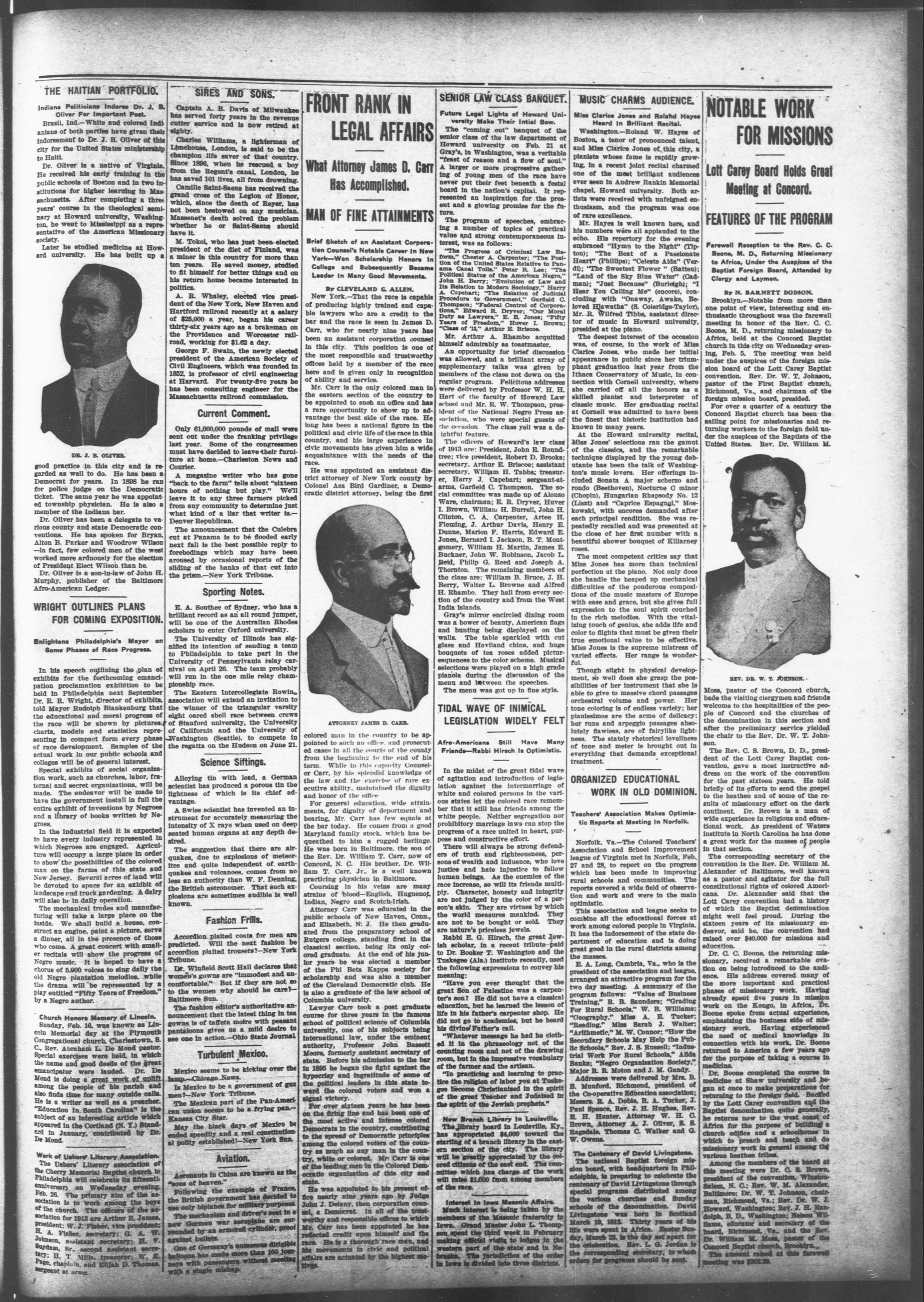
DR. J. B. OLIVER.
good practice in this city and is regarded as well to do. He has been a Democrat for years. In 1898 he ran for police judge on the Democratic ticket. The same year he was appointed township physician. He is also a member of the Indiana bar.
Dr. Oliver has been a delegate to various county and state Democratic conventions. He has spoken for Bryan, Alton B. Parker and Woodrow Wilson—in fact, few colored men of the west worked more ardently for the election of President Elect Wilson than he.
Dr. Oliver is a son-in-law of John H. Murphy, publisher of the Baltimore Afro-American Ledger.
WRIGHT OUTLINES PLANS FOR COMING EXPOSITION
Enlightens Philadelphia's Mayor on Some Phases of Race Progress.
In his speech outlining the plan of exhibits for the forthcoming emancipation proclamation exhibition to be held in Philadelphia next September Dr. R. R. Wright, director of exhibits, told Mayor Rudolph Blankenburg that the educational and moral progress of the race will be shown by pictures, charts, models and statistics representing in compact form every phase of race development. Samples of the actual work in our public schools and colleges will be of general interest.
Special exhibits of social organization work, such as churches, labor, fraternal and secret organizations, will be made. The endeavor will be made to have the government install in full the entire exhibit of inventions by Negroes and a library of books written by Negroes.
In the industrial field it is expected to have every industry represented in which Negroes are engaged. Agriculture will occupy a large place in order to show the possibilities of the colored man on the farms of this state and New Jersey. Several acres of land will be devoted to space for an exhibit of landscape and truck gardening. A dairy will also be in daily operation.
The mechanical trades and manufacturing will take a large place on the inside. We shall build a house, construct an engine, paint a picture, serve a dinner, all in the presence of those who come. A great concert with smaller recitals will show the progress of Negro music. It is hoped to have a chorus of 5,000 voices to sing daily the old Negro plantation melodies, while the drama will be represented by a play entitled "Fifty Years of Freedom," by a Negro author.
Church Honore Memory of Lincoln.
Sunday, Feb. 16, was known as Lincoln Memorial day at the Plymouth Congregational church, Charlestown, S. C., Rev. Abraham L. De Mond pastor. Special exercises were held, in which the name and good deeds of the great emancipator were lauded. Dr. De Mond is doing a great work of uplift among the people of his parish and also finds time for many outside calls. He is a writer as well as a preacher. "Education In South Carolina" is the subject of an interesting article which appeared in the Cortland (N. Y.) Standard in January, contributed by Dr. De Mond.
Work of Ushers' Literary Association.
The Usher's Literary association of the Cherry Memorial Baptist church in Philadelphia will celebrate its fifteenth anniversary on Wednesday evening, Feb. 26. The primary aim of the association is to work among the boys of the church. The officers of the association for 1913 are Arthur R. James, president; W. J. Flasher, vice president; H. A. Fisher, secretary; G. A. W. Johnson, assistant secretary; H. V. Suydam, Sr., second assistant secretary; H. T. Milla, treasurer; W. E. Page, chaplain, and Ellijah D. Thomas, sergeant at arms.
SIRES AND SONS.
Captain A. B. Davis of Milwaukee has served forty years in the revenue cutter service and is now retired at eighty.
Charles Williams, a lightman of Limehouse, London, is said to be the champion life saver of that country. Since 1896, when he rescued a boy from the Regen's canal, London, he has saved 101 lives, all from drowning.
Camille Saint-Saens has received the grand cross of the Legion of Honor, which, since the death of Reyer, has not been bestowed on any musician. Massenet's death solved the problem whether he or Saint-Saens should have it.
M. Tokoi, who has just been elected president of the diet of Finland, was a miner in this country for more than ten years. He saved money, studied to fit himself for better things and on his return home became interested in politics.
A. R. Whaley, elected vice president of the New York, New Haven and Hartford railroad recently at a salary of $25,000 a year, began his career thirty-six years ago as a brakeman on the Providence and Worcester railroad, working for $1.62 a day.
George F. Swain, the newly elected president of the American Society of Civil Engineers, which was founded in 1852, is professor of civil engineering at Harvard. For twenty-five years he has been consulting engineer for the Massachusetts railroad commission.
Current Comment.
Only 61,000,000 pounds of mail were sent out under the franking privilege last year. Some of the congressmen must have decided to leave their furniture at home.—Charleston News and Courler.
A magazine writer who has gone "back to the farm" tells about "sixteen hours of nothing but play." We'll leave it to any three farmers picked from any community to determine just what kind of a liar that writer is.—Denver Republican.
The announcement that the Culebra cut at Panama is to be flooded early next fall is the best possible reply to forebodings which may have been aroused by occasional reports of the sliding of the banks of that cut into the prism.—New York Tribune.
Sporting Notes.
E. A. Southee of Sydney, who has a brilliant record as an all round jumper, will be one of the Australian Rhodes scholars to enter Oxford university. The University of Illinois has signified its intention of sending a team to Philadelphia to take part in the University of Pennsylvania relay carnival on April 26. The team probably will run in the one mile relay championship race. The Eastern Intercollegiate Rowin association will extend an invitation to the winner of the triangular varsity eight oared shell race between crews of Stanford university, the University of California and the University of Washington (Seattle), to compete in the regatta on the Hudson on June 21.
Science Siftings.
Alloying tin with lead, a German scientist has produced a porous tin the lightness of which is its chief advantage. A Swiss scientist has invented an instrument for accurately measuring the intensity of X rays when used on deep seated human organs at any depth desired. The suggestion that there are airquakes, due to explosions of meteorites and quite independent of, earthquakes and volcanoes, comes from no less an authority than W. F. Denning, the British astronomer. That such explosions are sometimes audible is well known.
Fashion Frills.
Accordion plaited coats for men are predicted. Will the next fashion be accordion plaited trousers?—New York Tribune.
Dr. Winfield Scott Hall declares that women's gowns are "immodest and uncomfortable." But if they are not so to the women why should he care?—Baltimore Sun.
The fashion editor's authoritative announcement that the latest thing in tea gowns is of taffeta moire with peasant pantaloues gives us a mild desire to see one in action—Ohio State Journal
Turbulent Mexico.
Mexico seems to be kicking over the lamp-Chicago News. Is Mexico to be a government of gun man?-New York Tribune.
The Mexican part of the Pan-American union seems to be a frying pan-Kansas City Star. May the black days of Mexico be ended speedily and a real constitutional polity established-New York Sun.
Aviation.
Acequants in China are known as the "wors of heaven."
"bons or heaven.
Following the example of France, the British government has decided to use only biplanes for military purposes.
The mechanism and driver's seat in a new German war aeroplane are surrounded by an armored cylinder, proof against bullets.
One of Germany's numerous dirigible balloons has made more than 100 journeys with passengers without meeting with a single mishap.
FRONT RANK IN LEGAL AFFAIRS
MAN OF FINE ATTAINMENTS
Brief Sketch of an Assistant Corporation Counsel's Notable Career In New York—Won Scholarship Honors In College and Subsequently Become Leader In Many Good Movements.
By CLEVELAND G. ALLEN.
New York.—That the race is capable of producing highly trained and capable lawyers who are a credit to the bar and the race is seen in James D. Carr, who for nearly nine years has been an assistant corporation counsel in this city. This position is one of the most responsible and trustworthy offices held by a member of the race here and is given only in recognition of ability and service.
Mr. Carr is the only colored man in the eastern section of the country to be appointed to such an office and has a rare opportunity to show up to advantage the best side of the race. He long has been a national figure in the political and civic life of the race in this country, and his large experience in civic movements has given him a wide acquaintance with the needs of the race.
He was appointed an assistant district attorney of New York county by Colonel Asa Bird Gardiner, a democratic district attorney, being the first
ATTORNEY JAMES D. CARR.
colored man in the country to be appointed to such an office, and prosecuted cases in all the courts of the county from the beginning to the end of his term. While in this capacity Counselor Carr, by his splendid knowledge of the law and the exercise of rare executive ability, maintained the dignity and honor of the office.
For general education, wide attainments, for dignity of deportment and bearing, Mr. Carr has few equals at the bar today. He comes from a good Maryland family stock, which has bequeathed to him a rugged heritage. He was born in Baltimore, the son of the Rev. Dr. William T. Carr, now of Concord, N. C. His brother, Dr. William T. Carr, Jr. is a well known practicing physician in Baltimore.
Coursing in his veins are many strains of blood—English, Huguenot, Indian, Negro and Scotch-Irish.
Attorney Carr was educated in the public schools of New Haven, Conn., and Elizabeth, N: J. He then graduated from the preparatory school of Rutgers college, standing first in the classical section, being its only colored graduate. At the end of his junior years he was elected a member of the Phi Beta Kappa society for scholarship and was also a member of the Cleveland Democratic club. He is also a graduate of the law school of Columbia university.
Lawyer Carr took a post graduate course for three years in the famous school of political science of Columbia university, one of his subjects being international law, under the eminent authority, Professor John Bassett Moore, formerly assistant secretary of state. Before his admission to the bar in 1895 he began the fight against the hypocrisy and ingratiation of some of the political leaders in this state toward the colored voters and won a signal victory. For over sixteen years he has been on the firing line and has been one of the most active and intense colored Democrats in the country, contributing to the spread of Democratic principles among the colored voters of the country as much as any man in the country, white or colored. Mr. Carr is one of the leading men in the Colored Democratic organization of this city and state.
He was appointed to his present office nearly nine years ago by Judge John J. Delany, then corporation counsel, a Democrat. In all of the trustworthy and responsible offices to which Mr. Carr has been appointed he has reflected credit upon himself and the race. He is a thorough race man, and his movements in civic and political affairs are actuated by the highest motives.
SENIOR LAW CLASS BANQUET.
Future Legal Lights of Howard University Make. Make. Initial Row.
Virtify Make Their Initial Bow.
The "coming out" banquet of the senior class of the law department of Howard university on Feb. 21 at Gray's, in Washington, was a veritable "feast of reason and a flow of soul." A larger or more progressive gathering of young men of the race have never put their feet beneath a festal board in the nation's capital. It represented an inspiration for the present and a glowing promise for the future.
The program of speeches, embracing a number of topics of practical value and strong contemporaneous interest, was as follows:
"The Progress of Criminal Law Reform," Chester A. Carpenter; "The Position of the United States Relative to Panama Canal Tolls," Peter R. Lee; "The Political Status of the American Negro," John H. Berry; "Evolution of Law and Its Relation to Modern Sociology," Harry A. Capehart; "The Relation of Judicial Procedure to Government," Garfield C. Thompson; "Federal Control of Corporations," Edward R. Dryer; "Our Moral Duty as Lawyers," E. E. Jones; "Fifty Years of Freedom," Huwer I. Brown; "Class of 13," Arthur E. Briscoe.
Mr. Arthur A. Rhambo acquitted himself admirably as toastmaster.
An opportunity for brief discussion was allowed, and a brilliant array of supplementary talks was given by members of the class not down on the regular program. Felicitous addresses were delivered by Professor W. H. H. Hart of the faculty of Howard Law school and Mr. R. W. Thompson, president of the National Negro Press association, who were special guests of the occasion. The class yell was a delightful feature.
The officers of Howard's law class of 1913 are: President, John E. Roundtree; vice president, Robert D. Brooks; secretary, Arthur E. Briscoe; assistant secretary, William H. Tabbs; treasurer, Harry J. Capehart; sergeant-at-arms, Garfield C. Thompson. The social committee was made up of Alonzo Ware, chairman; E. R. Dryver, Huver I. Brown, William H. Burrell, John H. Clinton, C. A. Carpenter, Artee H. Fleming, J. Arthur Davis, Henry E. Dunne, Marion F. Harris, Edward E. Jones, Bernard I. Jackson, B. T. Montgomery, William H. Martin, James E. Buckner, John W. Robinson, Jacob L. Beld, Philip G. Reed and Joseph A. Thornton. The remaining members of the class are: William B. Bruce, J. H. Berry, Walter L. Browne and Alfred H. Rhambo. They hall from every section of the country and from the West India islands.
Gray's mirror encircled dining room was a bower of beauty, American flags and bunting being displayed on the walls. The table sparkled with cut glass and Haviland china, and huge bouquets of tea roses added picturesqueness to the color scheme. Musical selections were played on a high grade planola during the discussion of the menu and between the speeches. The menu was got up in fine style.
TIDAL WAVE OF INIMICAL LEGISLATION WIDELY FELT
Afro-Americans Still Have Many Friends—Rabbi Hirsch is Optimistic.
In the midst of the great tidal wave of agitation and introduction of legislation against the intermarriage of white and colored persons in the various states let the colored race remember that it still has friends among the white people. Neither segregation nor prohibitory marriage laws can stop the progress of a race united in heart, purpose and constructive effort.
There will always be strong defenders of truth and righteousness, persons of wealth and influence, who love justice and hate injustice to fellow human beings. As the enemies of the race increase, so will its friends multiply. Character, honesty and integrity are not judged by the color of a person's skin. They are virtues by which the world measures mankind. They are not to be bought or sold. They are nature's priceless jewels.
Rabbit E. G. Hirsch, the great Jewish scholar, in a recent tribute paid to Dr. Booker T. Washington and the Tuskegee (Ala.) institute recently, used the following expressions to convey his meaning:
"Have you ever thought that the great Son of Palestine was a carpenter's son? He did not have a classical education, but he learned the lesson of life in his father's carpenter shop. He did not go to academies, but he heard his divine Father's call.
"Whatever message he had he clothed it in the phraseology not of the counting room and not of the drawing room, but in the impressive vocabulary of the farmer and the artisan.
"In practicing and learning to practice the religion of labor you at Tuskegee become Christianised in the spirit of the great Teacher and Judaised in the spirit of the Jewish prophets."
New Branch Library In Louisville.
The library board in Louisville, Ky., has appropriated $4,000 toward the starting of a branch library in the eastern section of the city. The library will be greatly appreciated by the colored citizens of the east end. The committee which has charge of the work will rates $1,000 from among members of the race.
Interest in Iowa Masonic Affairs.
Much interest is being taken by the members of the Masonic fraternity in Iowa. Grand Master John L. Thompson spent the third week in February making official visits to lodges in the western part of the state and in Nebraska. The jurisdiction of the order in Iowa is divided into three districts
MUSIC CHARMS AUDIENCE
Miss Clarice Jones and Rolafd Hayes
Heard in Brilliant Recital.
Washington.-Roland W. Hayes of Boston, a tenor of pronounced talent, and Miss Clarice Jones of this city, a planiste whose fame is rapidly growing, in a recent joint recital charmed one of the most brilliant audiences ever seen in Andrew Rankin Memorial chapel, Howard university. Both artists were received with unfeigned enthusiasm, and the program was one of rare excellence.
Mr. Hayes is well known here, and his numbers were all applauded to the echo. His repertory for the evening embraced "Hymn to the Night" (Tipton); "The Beat of a Passionate Heart" (Phillips); "Celeste Alda" (Verdil); "The Sweetest Flower" (Batten); "Land of the Sky Blue Water" (Cadman); "Just Because" (Burlegh); "I Hear You Calling Me" (encore), concluding with "Onaway, Awake, Beloved Hiawatha" (S. Coleridge-Taylor), Mr. R. Wilfred Tibbs, assistant director of music in Howard university, presided at the piano.
The deepest interest of the occasion was, of course, in the work of Miss Clarice Jones, who made her initial appearance in public since her triumphant graduation last year from the Ithaca Conservatory of Music, in connection with Cornell university, where she carried off all the honors as a skilled pianist and interpreter of classic music. Her graduating recital at Cornell was admitted to have been the finest that historic institution had known in many years.
At the Howard university recital, Miss Jones' selections ran the gamut of the classics, and the remarkable technique displayed by the young debutante has been the talk of Washington's music lovers. Her offerings included Sonata A major scherzo and rondo (Beethoven), Nocturne C minor (Chopin), Hungarian Rhapsody No. 12 (Liszt) and "Caprice Espagnol." Moskowski, with encores demanded after each principal rendition. She was repeatedly recalled and was presented at the close of her first number with a beautiful shower bouquet of Killarney roses.
The most competent critics say that Miss Jones has more than technical perfection at the piano. Not only does she handle the heaped up mechanical difficulties of the ponderous compositions of the music masters of Europe with ease and grace, but she gives full expression to the soul spirit couched in the rich melodies. With the vitalizing touch of genius, she adds life and color to flights that must be given their true emotional value to be effective. Miss Jones is the supreme mistress of varied effects. Her range is wonderful.
Though slight in physical development, so well does she grasp the possibilities of her instrument that she is able to give to massive chord passages orchestral volume and power. Her tone coloring is of endless variety; her planlessisms are the acme of delicacy; her runs and arpeggio passages absolutely flawless, are of fairylike lightness. The stately rhetorical loveliness of tone and meter is brought out in everything that demands exceptional treatment.
ORGANIZED EDUCATIONAL WORK IN OLD DOMINION.
Teachers' Association Makes Optimistic Reports at Meeting in Norfolk.
Norfolk, Va.—The Colored Teachers' Association and School Improvement league of Virginia met in Norfolk, Feb. 27 and 28, to report on the progress which has been made in improving rural schools and communities. The reports covered a wide field of observation and work and were in the main optimistic.
This association and league seeks to combine all the educational forces at work among colored people in Virginia. It has the indorsement of the state department of education and is doing great good in the rural districts among the masses.
E. A. Long, Cambria, Va., who is the president of the association and league, arranged an attractive program for the two day meeting. A summary of the program follows: "Value of Business Training," R. B. Saunders; "Grading For Rural Schools," W. B. Williams; "Geography," Miss A. E. Tucker; "Reading," Miss Sarah J. Walter; "Arithmetic," M. W. Connor; "How the Secondary Schools May Help the Public Schools," Rev. J. S. Russell; "Industrial Work For Rural Schools," Alida Banks; "Negro Organization Society," Major R. B. Moton and J. M. Gandy.
Addresses were delivered by Mrs. B. B. Munford, Richmond, president of the Co-operative Education association; Messrs. R. A. Doble, R. A. Tucker, J. Paul Spence, Rev. J. H. Hughes, Rev. E. H. Hunter, Attorney W. H. C. Brown, Attorney A. J. Oliver, S. S. Bagsdale, Thomas C. Walker and G. W. Owens.
The Centenary of David Livingstone. the national Baptist foreign mission board, with headquarters in Philadelphia, in preparing to celebrate the centenary of David Livingstone through special programs distributed among the various churches and Sunday schools of the denomination. David Livingstone was born in Scotland March 19, 1813. Thirty years of his life were spent in Africa. Easter Sunday, March 23, is the day set apart for the celebration. Rev. L. G. Jordan is the corresponding secretary; to whom orders for programs should be sent.
FEATURES OF THE PROGRAM
Farewell Recognition to the Rev. C. C. Boone, M. D., Returning Missionary to Africa, Under the Auspices of the Baptist Foreign Board, Attended by Clergy and Laymen.
Bv N. BARNETT DODSON.
Brooklyn—Notable from more than one point of view, interesting and enthusiastic throughout was the farewell meeting in honor of the Rev. C. C. Boone, M. D., returning missionary to Africa, held at the Concord Baptist church in this city on Wednesday evening, Feb. 5. The meeting was held under the auspices of the foreign mission board of the Lott Carey Baptist convention. Rev. Dr. W. T. Johnson, pastor of the First Baptist church, Richmond, Va., and chairman of the foreign mission board, presided.
For over a quarter of a century the Concord Baptist church has been the sailing point for missionaries and returning workers to the foreign field under the auspices of the Baptists of the United States. Rev. Dr. William M.
9
REV. DR. W. T. JOHNSON.
Moss, pastor of the Concord church, hade the visiting clergymen and friends welcome to the hospitalities of the people of Concord and the churches of the denation in this section and after the preliminary service yielded the chair to the Rev. Dr. W. T. Johnson.
The Rev. C. S. Brown, D. D., president of the Lott Carey Baptist convention, gave a most instructive address on the work of the convention for the past sixteen years. He told briefly of its efforts to send the gospel to the heathen and of some of the results of missionary effort on the dark continent. Dr. Brown is a man of wide experience in religious and educational work. As president of Waters institute in North Carolina he has done a great work for the masses of people in that section.
The corresponding secretary of the convention is the Rev. Dr. William M. Alexander of Baltimore, well known as a pastor and agitator for the full constitutional rights of colored Americans. Dr. Alexander said that the Lott Carey convention had a history of which the Baptist denomination might well feel proud. During the sixteen years of its missionary endeavor, said he, the convention had raised over $40,000 for missions and education.
Dr. C. C. Boone, the returning missionary, received a remarkable ovation on being introduced to the audience. His address covered many of the more important and practical phases of missionary work. Having already spent five years in mission work on the Kongo, in Africa, Dr. Boone spoke from actual experience, emphasizing the business side of missionary work. Having experienced the need of medical knowledge in connection with his work, Dr. Boone returned to America a few years ago for the purpose of taking a course in medicine.
Dr. Boone completed the course in medicine at Shaw university and began at once to make preparations for returning to the foreign field. Backed by the Lott Carey convention and the Baptist denomination quite generally, he returns now to the west coast of Africa for the purpose of building a church edifice and a schoolhouse in which to preach and teach and do missionary work in general among the various heathen tribes.
Among the members of the board at this meeting were Dr. C. B. Brown, president of the convention, Winston Salem, N. C.; Rev. W. M. Alexander, Baltimore; Dr. W. T. Johnson, chairman, Richmond, Va.; Rev. Dr. W. J. Howard, Washington; Rev. J. H. Randolph, B. D., Washington; Neison Williams, educator and secretary of the board, Richmond, Va., and the Rev. Dr. William M. Moss, pastor of the Concord Baptist church, Brooklyn.
The amount raised at this farewell meeting was $200.20.
$15
Victor-Victrola IV
You never thought of getting a genuine Victor-Victrola for $15—yet here it is. And it is of the same high quality and perfection which characterizes all the products of the Victor Company. Come in and hear it—any time. Other styles $25 to $200.* Victors $10 to $100.
Telephone Douglas 4558 Telephone Automatic F1-788
FRANK L. GALE PIANO CO.
3159 S. State Street : Chicago
George L. Martin, maker of fine cigars and news stand, 18 W. 31st St. near State.
B. M. Harvey's barber shop and news stand, 3924 State street.
Mrs. Nellie Phelps, cigars, notions and news stand, 15 W. 51st St., near Dearborn.
W. S. Cole, cigars, tobacco and news stand, 34 W. 31st St., near Dearborn.
T. B. Hall, laundry office and news stand, 11 W. 29th St., near State.
B. Davis, cigars, tobacco and news stand, 3532 State St.
W. M. Maxwell, notions, cigars, tobacco, confections and news stand, 5244 State St.
Edward Felix, notions, cigars and news stand, 52 W. 30th St.
F. Bishop, cigars, tobacco and news stand, 8 W. 27th St., near State.
Sylvester McGloffen, news stand and laundry office, 4122 State St.
William Gaughan, laundry office, cigars, tobacco and news stand, 2636 State St.
Mrs. L. B. Taylor, notions, cigars and news stand, 15 W. 36th Street, near State.
A. D. Hayes, cigars, tobacco, notions, stationery and news stand, $640 S. State St.
J. H. Roberts, barber shop and news stand, 3308½ S. State St.
Abram Aplin, cigars, tobacco, gents furnishings and news stand, 4780 S. State St.
A. H. Harris, cigars, tobacco and news stand, 2825 S. State St.
White & Bell, toilet articles, cigars, tobacco and news stand, 2942 S. State St.
Fred M. Waterfield, cigars, tobacco and news stand. 1343 W. 61st street, near Ada.
THE AMERICAN LIFE INSURANCE COMPANY OF ILLINOIS.
Old Lines Legal Agent Co.
Under State Government Supervision.
510,000 deposited with the "State." Policies of all kinds, ranging from five cents to ten thousand dollars. Our industrial Contracts give to the colored policy holder more than any other company for the most weekly business.
Oakland James W. Write and Collect Your Business
Information of rates and values at your age will be furnished free, upon giving your age, name and address to
The American Life Insurance Co., of Illinois,
P. Radishd. 5. 72 West Adame Street
Telephone, CALUET 4401-4428
AUTOMATIC 75-655
J. S. DORSEY, Druggist
2701 Dearborn St. CHICAGO
Use Dorsay's fine Pomade for the hair. It
will make it soft and glossy. Prescriptions
carefully compounded. Phone your ORDERS.
Phone Douglas 8800 Room by Day or Week
Room 88-98-60a
The Douglas Hotel
For Men Only
Batha, Steam Heat, Electric Light
8100 S. State Street, CHICAGO
TELEPHONES
Oakland 1609 Rec. Oakland 17601 Auto. 79156
HENRY C. BOMAR & SON
FINE FURNITURE AND PIANO
MOVERS, PACKERS AND SHIPPERS
3 Times Daily to All Depots
4706 Indiana Ave. [CHICAGO]
J. GRAY LUCAS
Attorney at Law
Suite 405, 145 Clark St.
Gret. Randolph St.
Tel. Central 3162
Franklin A. Denison
Attorney at Law
26 W. RANDOLPH STREET
Suite 700
Delaware Building CHICAGO
A. D. GASH
ATTORNEY AT LAW
118 North La Salle St. Chicago
[Suite 615 to 616
Telephone Main 3077
Notary Public
Office Phone Automatic 64-185
Res. Phone Automatic T9-137
W. G. ANDERSON
ATTORNEY-AT-LAW
Suite 5, Methodist Church Block
S. E. Cor. Clark & Washington Sts., CHICAGO
Residence: 3662 Prairie Ave.
HOTEL PULLMAN
THE FINEST AND LARGEST
COLORED HOTEL IN AMERICA
Steam Heat and Bath
Everything New and Up-to-date
Rooms by the Day or Night 50c 75c and $1.00
Including Free Bath. Rates by Week $2.25 up
(EUROPEAN PLAN)
3639-41-43 So. State St. CHICAGO
J. A. JONES, Proprietor
OFFICE HOURS Phone Oakland 4662
From 8 a.m. to 5 p.m. Automatic 73-058
From 7 p.m. to 9 p.m. Sunday by Appointment
DR. THEO. R. MOZEE
DENTIST.
4709 S. State St CHICAGO
CHARITY
FOR
Old Folk Home
Easter-Monday Night 8:30 P.M.
MINSTREL SHOW AND DANCE
BY
AMATEUR MINSTREL CLUB
OAKLAND MUSIC HALL
40th and Cottage Grove Ave.
MARCH 24th Tickets 50c
THE MUSEUM
GENERAL BANKING
3 per cent allowed
Safety Deposit Va
REAL ESTATE
As agent buy and sell Real Estate on
dents, including payment of taxes and
on Chicago Real Estate.
Especially Invites the pat
The Cranfor
Building.
The finest building ever open
Steam heat, electric light, tile b
'Phone Randolph 803
For cent allowed on Savings Account
City Deposit Vaults, $3.00 per W
REAL ESTATE DEPARTMENT
and sell Real Estate on commission, manages estates
ing payment of taxes and looking after assessments. Real Estate.
especially Invites the patronage of Chicago business me
e- Cranford Apartment
Building. 3600 Wabash Ave.
best building ever opened to Colored tenants by
electric light, tile baths, marble entrance.
J. W. Casey, Agn.
Randolph 803
74 W. WASHINGTON ST
3 per cent allowed on Savings Accounts Safety Deposit Vaults, $3.00 per Year REAL ESTATE DEPARTMENT As agent buy and sell Real Estate on commission, manages estates for non-residents, including payment of taxes and looking after assessments. Money to loan on Chicago Real Estate. Especially Invites the patronage of Chicago business men.
The-Cranford Apartment Building. 3600 Wabash Ave.
THE HOTEL
The finest building ever opened to Colored tenants in Chicago. Steam heat, electric light, tile baths, marble entrance.
J. W. Casey, Agent,
74 W. WASHINGTON STREET.
'Phone Randolph 803
Few Won How To Bo
Few Women Know How To Boil Water This statement was made by a noted teacher of the science of cooking. When the bubbles leave bottom and sides of the ke thermometer will register
She said that it was difficult to convince her pupils that there were many ways of "bolling so-called boiled foods."
When water becomes hot enough to force small bubbles to leave the bottom of the kettle its temperature is 180 degrees. At this heat water is just right to cook "boiled meats and soup."
Special ovens for boiling are
Composi
These "boiling ovens" send the
tables up the flue pipe. Besides
many other features which have
new wrinkles in cooking possible,
meat, vegetables, rolls and dessert
which effects a great saving of
"Composite" ranges include 30 at
them—at any of our branches or
The Peoples Gas L
ovens for boiling are featured in some of our
Composite Ranges
"boiling ovens" send the odor of boiled cabbage and other
to the flue pipe. Besides these ovens "Composite" range
other features which have made all sorts of new economi
ties in cooking possible. With a "Composite" you can
vegetables, rolls and dessert all at once with one fire—a
effects a great saving of time and gas. Our complete
also" ranges include 50 styles and shapes—you should
at any of our branches or the big downtown salesroom.
The Peoples Gas Light Coke Company
These "boiling ovens" send the odor of boiled cabbage and other vegetables up the fire pipe. Besides these ovens "Composeis" ranges have many other features which have made all sorts of new economies and new wrinkles in cooking possible. With a "Composeis" you can cook meet, vegetables, rolls and dessert all at once with one fire—a system which affects a great saving of time and gas. Our complete line of "Composeis" ranges include 20 styles and shapes—you should inspect them—at any of our branches or the big downtown salesroom.
The Peoples Gas Light Coke Company
JOHN BLOCKI, Pres. F. W. BLOCKI, Trns.
JOHN BLOCKI & SON
PERFUMERS
S. E. Cor. State and 36th Place, Chicago Telephone Douglas 1565
owed on Savings Accounts
it Vaults, $3.00 per Year
ESTATE DEPARTMENT
state on commission, manages estates for non-resi-
ges and looking after assessments. Money to loan
the patronage of Chicago business men.
Fenford Apartment
y, 3600 Wabash Ave.
ver opened to Colored tenants in Chicago,
tile baths, marble entrance.
J. W. Casey, Agent,
74 W. WASHINGTON STREET.
Omen Know Boil Water"
made by a sense of difficult to find there ing sohes hot bottles to bottle its ass. At right to soupa."
When the bubbles leave the bottom and sides of the kettle the thermometer will register 190 degrees. The water is then just right to cook "boiled eggs" and "boiled cabbage."
And when the heat finally starts the whole mass of water into violent motion—the temperature is then 212 degrees (the technical boiling point). This is the proper temperature for cooking "boiled macaroni" or "boiled rice."
ding are featured in some of our latest
posite Ranges
send the odor of bollied cabbage and other veget-
Besides these ovena "Composite" ranges have
which have made all sorts of new economies and
with. With a "Composite" you can cook
dessert all at once with one fire—a system
ing of time and gas. Our complete line of
de 50 styles and shapes—you should inspect
mches or the big downtown salesroom.
Gas Light Coke Company
"A STORE FOR EVERYBODY"
HILLMAN'S
STATE & WASHINGTON STS.
Everything to eat, to wear and for the home. Ready to
wear attire for man, woman and child at lowest prices,
quality and workmanship considered. Make it a point to
visit this store every day and take advantage of the special
bargain offerings that we give in all departments.
JOHN J. BRADLEY
Real Estate
Loans
Fire and Plate Glass Insurance
4709 S. HALSTED ST
CHICAGO
BELLE MEADE C
Buffet and Cafe
FRANK H. LEWIS, Proprietor
59 Armour A
Cor. 51st Street, Chicago
Douglas 4482
to 73-974
to 74-478
HARRY
P
LA VERDO BUFFET
ED AND DOMESTIC CIGARS AND CIGARS
Street
Phone Aldine 3653
Hotel Brunswick
Geo. W. Holt, Prop.
BUFFET, POOL AND BILLIARDS
Street
Elite Buffet and Cafe
The BELLE MEADE CLUB
Buffet and Cafe
FRANK H. LEWIS, Proprietor
5059 Armour Ave
Cor. 51st Street, Chicago
LA VERDO BUFFET IMPORTED AND DOMESTIC CIGARS AND CIGARETTES 3100 State Street CHICAGO.
Hotel Brunswick Geo. W. Holt, Prop. BUFFET, POOL AND BILLIARDS.
Elite Buffet and Cafe
M LEWIS, Prop. HENRY C. SNEE
WILLIAM LEWIS, Prop. HENRY C. SNEED, M'g'r
[Phone Douglas 3309 Automatic]75-173
MINERAL SPRING CLUB
BUFFET AND CAFE
3517 S. State Street, CHICAGO
HIGH CLASS INTERTAINERS EVERY EVENING
3030 State Street
E CLUB
afe
tor
r Ave
Chicago
HARRY J. KELLY
Prop.
FET
AND CIGARETTES
CHICAGO.
wick
LIARDS.
Chicago
Henry Jones
Cafe
C. SNEED, M'g'r
75-173
CLUB
CA FE
AGO
RY EVENING
TEL. OAKLAND
1850, 1851, 1852
NN
DETAIL
AVENUE
M. S.
CHICAGO
Automatic 71-866
METHEY.
Northwest.
sected which will contain
room.
e and coolest water will
to be constructed during
ements now being made
ick and Accident Insur-