The Broad Ax
Saturday, January 3, 1914
Chicago, Illinois
Page text (machine-generated)
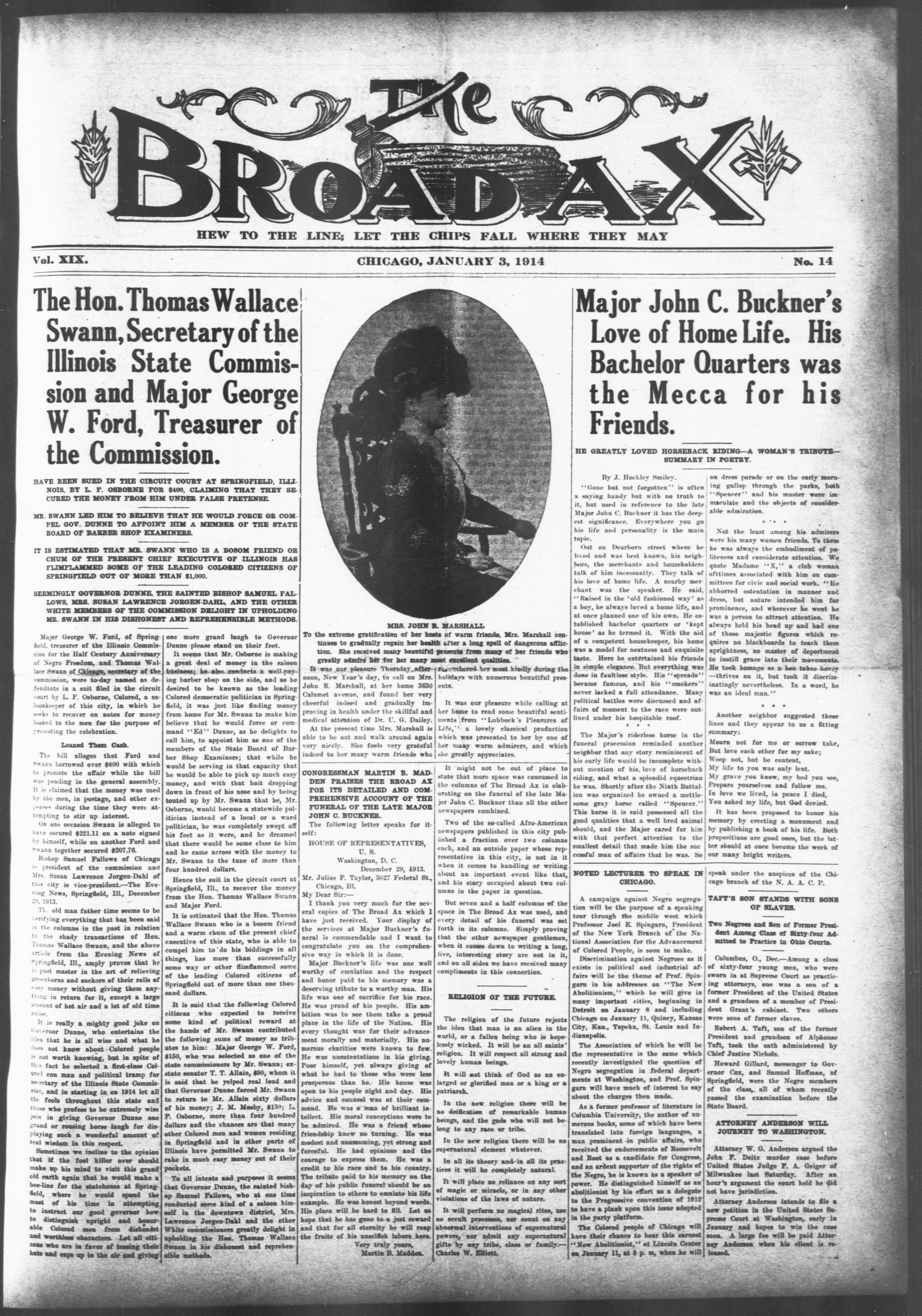
The Hon. Thomas Wallace Swann,Secretary of the Illinois State Commission and Major George W. Ford, Treasurer of the Commission.
HAVE BEEN SUED IN THE CIRCUIT COURT AT SPRINGFIELD, ILLINOIS, BY L. F. OSBORNE FOR $400, CLAIMING THAT THEY SECURED THE MONEY FROM HIM UNDER FALSE PRETENSE.
MR. SWANN LED MIMY TO BELIEVE THAT HE WOULD FORCE OR COMPEL GOV. DUNNE TO APPOINT HIM A MEMBER OF THE STATE BOARD OF BARBER SHOP EXAMINERS.
IT IS ESTIMATED THAT MR. SWANN WHO IS A BOSOM FRIEND OR CHUM OF THE PRESENT CHIEF EXECUTIVE OF ILLINOIS HAS FLIMFLAMMED SOME OF THE LEADING COLORED CITIZENS OF SPRINGFIELD OUT OF MORE THAN $1,000.
SEEMINGLY GOVERNOR DUNNE, THE SAINTED BISHOP SAMUEL FALLOWS, MRS. SUSAN LAWRENCE JORGEN-DAHL, AND THE OTHER WHITE MEMBERS OF THE COMMISSION DELIGHT IN UPHOLDING MR. SWANN IN HIS DISHONEST AND REPREHENSIBLE METHODS.
Vol. XIX.
The Hon. The
Swann, Sec.
Illinois Sta
sion and M.
W. Ford, T
the Commi
HAVE BEEN SUED IN THE CIRCU
NOIS, BY L. F. OSBORNE FO
CURED THE MONEY FROM HI
MR. SWANN LED HIM TO BELIEVE
PEL GOV. DUNNE TO APPOINT
BOARD OF BARBER SHOP EXA
IT IS ESTIMATED THAT MR. SWANN
CHUM OF THE PRESENT CH
FLIMFLAMMED SOME OF THE
SPRINGFIELD OUT OF MORE
SEEMINGLY GOVERNOR DUNNE, T
LOWS, MRS. SUSAN LAWREN
WHITE MEMBERS OF THE CO
MR. SWANN IN HIS DISHONES
Major George W. Ford, of Springfield, treasurer of the Illinois Commission for the Half Century Anniversary of Negro Freedom, and Thomas Walt lace Swann of Chicago, secretary of the commission, were to-day named as defendants in a suit filed in the circuit court by L. F. Osborne, Colored, a sailbooner of this city, in which he seeks to recover on notes for money loaned to the men for the purpose of promoting the celebration.
Loaned Them Cash
The bill alleges that Ford and Swann borrowed over $400 with which to promote the affair while the bill was pending in the general assembly. It is claimed that the money was used by the men, in postage, and other expenses during the time they were attempting to stir up interest.
On one occasion Swann is alleged to have secured $221.11 on a note signed by himself, while on another Ford and Swann together secured $207.76.
Bishop Samuel Fallows of Chicago is president of the commission and Mrs. Susan Lawrence Jorgen-Dahl of this city is vice-president.—The Evening News, Springfield, Ill., December 29, 1913.
The old man father time seems to be verifying everything that has been said in the columns in the past in relation to the shady transactions of Hon. Thomas Wallace Swann, and the above article from the Evening News of Springfield, Ill., amply proves that he is past master in the art of relieving greenhorns and suckers of their rolls of easy money without giving them anything in return for it, except a large amount of hot air and a lot of old time noise.
It is really a mighty good joke on Governor Dunne, who entertains the idea that he is all wise and what he does not know about Colored people is not worth knowing, but in spite of this fact he selected a first-class Colored con man and political tramp for secretary of the Illinois State Commission, and in starting in on 1914 let all the fools throughout this state and those who profess to be extremely wise join in giving Governor Dunne one grand or rousing horse laugh for displaying such a wonderful amount of real wisdom in this respect.
Sometimes we incline to the opinion that if the fool killer ever should make up his mind to visit this grand old earth again that he would make a bee-line for the statehouse at Springfield, where he would spend the most of his time in attempting to instruct our good governor how to distinguish upright and honorable Colored men from honorable and worthless characters. Let all citizens who are in favor of tossing their hats and caps up in the air and giving
---
HEW TO THE LINE: LET THE CHIPS FALL WHERE THEY MAY
one more grand laugh to Governor Dunne please stand on their feet. It seems that Mr. Osborne is making a great deal of money in the saloon business; he also conducts a well paying barber shop on the side, and as he desired to be known as the leading Colored democratic politician in Springfield, it was just like finding money from home for Mr. Swann to make him believe that he would force or command "Ed" Dunne, as he delights to call him, to appoint him as one of the members of the State Board of Barber Shop Examiners; that while he would be serving in that capacity that he would be able to pick up much easy money, and with that bait dropping down in front of his nose and by being touted up by Mr. Swann that he, Mr. Osborne, would become a statewide politician instead of a local or a ward politician, he was completely swept off his feet as it were, and he dreamed that there would be some class to him and he came across with the money to Mr. Swann to the tune of more than four hundred dollars. Hence the suit in the circuit court at Springfield, Ill., to recover the money from the Hon. Thomas Wallace Swann and Major Ford.
It is estimated that the Hon. Thomas Wallace Swann who is a bosom friend and a warm chum of the present chief executive of this state, who is able to compel him to do his biddings in all things, has more than successfully some way or other filmfammed some of the leading Colored citizens of Springfield out of more than one thousand dollars.
It is said that the following Colored citizens who expected to receive some kind of political reward at the hands of Mr. Swann contributed the following sums of money as tributes to him: Major George W. Ford, $150, who was selected as one of the state commissioners by Mr. Swann; ex-state senator T. T. Allain, $90, whom it is said that he yelped real loud and that Governor Dunne forced Mr. Swann to return to Mr. Allain sixty dollars of his money; J. M. Mosby, $150; L. F. Osborne, more than four hundred dollars and the chances are that many other Colored men and women residing in Springfield and in other parts of Illinois have permitted Mr. Swann to rake in much easy money out of their pockets.
To all intents and purposes it seems that Governor Dunne, the sainted bishop Samuel Fallows, who at one time conducted some kind of a saloon himself in the downtown district, Mrs. Lawrence Jorgen-Dahl and the other White commissioners greatly delight in upholding the Hon. Thomas Wallace Swann in his dishonest and reprehensible methods.
1
MRS. JOHN B. MARSHALL
To the extreme gratification of her hosts of warm friends, Mrs. Marshall continues to gradually regain her health after a long spell of dangerous affliction. She received many beautiful presents from many of her friends who greatly admire her for her many most excellent qualities.
It was our pleasure Thursday afternoon, New Year's day, to call on Mrs. John R. Marshall, at her home 3650 Calumet avenue, and found her very cheerful indeed and gradually improving in health under the skillful and medical attention of Dr. U. G. Dailey. At the present time Mrs. Marshall is able to be out and walk around again very nicely. She feels very grateful indeed to her many warm friends who
CONGRESSMAN MARTIN B. MAD-
DEN PRAISES THE BROAD AX
FOR ITS DETAILED AND COM-
PREHENSIVE ACCOUNT OF THE
FUNERAL OF THE LATE MAJOR
JOHN C. BUCKNER
The following letter speaks for it self:
HOUSE OF REPRESENTATIVES,
Mr. Julius F. Tayler, 5027 Federal St.,
Chicago, Ill.
My Dear Sir:—
I thank you very much for the several copies of The Broad Ax which I have just received. Your display of the services at Major Buckner's funeral is commendable and I want to congratulate you on the comprehensive way in which it is done.
Major Buckner's life was one well worthy of emulation and the respect and honor paid to his memory was a deserving tribute to a worthy man. His life was one of sacrifice for his race. He was proud of his people. His ambition was to see them take a proud place in the life of the Nation. His every thought was for their advancement morally and materially. His numerous charities were known to few. He was unostentatious in his giving. Poor himself, yet always giving of what he had to those who were less prosperous than he. His house was open to his people night and day. His advice and counsel was at their command. He was a man of brilliant intellect. His moral conceptions were to be admired. He was a friend whose friendship knew no turning. He was modest and unassuming, yet strong and forceful. He had opinions and the courage to express them. He was a credit to his race and to his country. The tribute paid to his memory on the day of his public funeral should be an inspiration to others to emulate his life example. He was honest beyond words. His place will be hard to fill. Let us hope that he has gone to a just reward and that for all eternity he will reap the fruits of his unselfish labors here.
Very truly yours.
Washington, D. C.
remembered her most kindly during the holidays with numerous beautiful presents.
It was our pleasure while calling at her home to read some beautiful sentiments from "Lubbock's Pleasures of Life," a lovely classical production which was presented to her by one of her many warm admirers, and which she greatly appreciates.
It might not be out of place to state that more space was consumed in the columns of The Broad Ax in elaborating on the funeral of the late Major John C. Buckner than all the other newspapers combined.
Two of the so-called Afro-American newspapers published in this city published a fraction over two columns each, and an outside paper whose representative in this city, is not in it when it comes to handling or writing about an important event like that, and his story occupied about two columns in the paper in question.
But seven and a half columns of the space in The Broad Ax was used, and every detail of his funeral was set forth in its columns. Simply proving that the other newspaper gentlemen, when it comes down to writing a long, live, interesting story are not in it, and on all sides we have received many compliments in this connection.
RELIGION OF THE FUTURE
The religion of the future rejects the idea that man is an alien in the world, or a fallen being who is hopelessly wicked. It will be an all saints' religion. It will respect all strong and lovely human beings.
It will not think of God as an enlarged or glorified man or a king or a patriarch.
In the new religion there will be no deification of remarkable human beings, and the gods who will not belong to any race or tribe.
In the new religion there will be no supernatural element whatever.
In all its theory and in all its practices it will be completely natural.
It will place no reliance on any sort of magic or miracle, or in any other violations of the laws of nature.
It will perform no magical rites, use no occult processes, nor count on any abnormal interventions of supernatural powers, nor admit any supernatural gifts by any tribe, class or family.—Charles W. Elliott.
---
Major John C. Buckner's Love of Home Life. His Bachelor Quarters was the Mecca for his Friends.
HE GREATLY LOVED HORSEBACK RIDING—A WOMAN'S TRIBUTE—SUMMARY IN POETRY.
By J. Hockley Smiley.
"Gone but not forgotten" is often a saying handy but with no truth to it, but used in reference to the late Major John C. Buckner it has the deepest significance. Everywhere you go his life and personality is the main topic.
Out on Dearborn street where he lived and was best known, his neighbors, the merchants and householders talk of him incessantly. They talk of his love of home life. A nearby merchant was the speaker. He said, "Raised in the 'old fashioned way' as a boy, he always loved a home life, and at once planned one of his own. He established bachelor quarters or 'kept house' as he termed it. With the aid of a competent housekeeper, his home was a model for neatness and exquisite taste. Here he entertained his friends in simple elegance. But everything was done in faultless style. His "spreads" became famous, and his "smokers" never lacked a full attendance. Many political battles were discussed and affairs of moment to the race were outlined under his hospitable roof.
on dress parade or on the early morning gallop through the parks, both "Speneer" and his master were immaculate and the objects of considerable admiration.
Not the least among his admirers were his many women friends. To them he was always the embodiment of poiteness and considerate attention. We quote Madame "X," a club woman oftimes associated with him on committees for civic and social work. "He abhorred ostentation in manner and dress, but nature intended him for prominence, and wherever he went he was a person to attract attention. He always held his head up and had one of those majestic figures which requires no blackboards to teach them uprightness, no master of deportment to instil grace into their movements. He took homage as a bee takes honey—thrives on it, but took it discriminatingly nevertheless. In a word, he was an ideal man."
Another neighbor suggested these lines and
The Major's riderless horse in the funeral procession reminded another neighbor that any story reminiscent of his early life would be incomplete without mention of his, love of horseback riding, and what a splendid questrian he was. Shortly after the Ninth Battalion was organized he owned a mettlesome gray horse called "Spencer." This horse it is said possessed all the good qualities that a well bred animal should, and the Major cared for him with that perfect attention to the smallest detail that made him the successful man of affairs that he was. So
NOTED LECTURER TO SPEAK IN CHICAGO.
A campaign against Negro segregation will be the purpose of a speaking tour through the middle west which Professor Joel E. Spingarn, President of the New York Branch of the National Association for the Advancement of Colored People, is soon to make. Discrimination against Negroes as it exists in political and industrial affairs will be the theme of Prof. Spingarn in his addresses on "The New Abolitionism," which he will give in many important cities, beginning in Detroit on January 8 and including Chicago on January 11, Quiney, Kansas City, Kan., Topeka, St. Louis and Indianapolis. The Association of which he will be the representative is the same which recently investigated the question of Negro segregation in federal departments at Washington, and Prof. Spingarn will have much of interest to say about the charges then made.
As a former professor of literature in Columbia University, the author of numerous books, some of which have been translated into foreign languages, a man prominent in public affairs, who received the endorsements of Roosevelt and Root as a candidate for Congress, and an ardent supporter of the rights of the Negro, he is known as a speaker of power. He distinguished himself as an abolitionist by his effort as a delegate to the Progressive convention of 1912 to have a plank upon this issue adopted in the party platform.
The Colored people of Chicago will have their chance to hear this earnest "New Abolitionist," at Lincoln Center on January 11, at 8 p. m. when he will
C. Buckner's Home Life. His Quarters was a for his
K RIDING—A WOMAN'S TRIBUTE—IN POETRY.
on dress parade or on the early morning gallop through the parks, both "Speneer" and his master were immaculate and the objects of considerable admiration.
Not the least among his admirers were his many women friends. To them he was always the embodiment of politeness and considerate attention. We quote Madame "X," a club woman oftimes associated with him on committees for civic and social work. "He abhorred ostentation in manner and dress, but nature intended him for prominence, and wherever he went he was a person to attract attention. He always held his head up and had one of those majestic figures which requires no blackboards to teach them uprightness, no master of deportment to instill grace into their movements. He took homage as a bee takes honey—thrives on it, but took it discriminatingly nevertheless. In a word, he was an ideal man."
. . .
Another neighbor suggested these lines and they appear to us a fitting summary:
Mourn not for me or sorrow take,
But love each other for my sake;
Weep not, but be content,
My life to you was only lent.
My grave you know, my bed you see,
Prepare yourselves and follow me.
In love we lived, in peace I died,
You asked my life, but God denied.
It has been proposed to honor his memory by erecting a monument and by publishing a book of his life. Both propositions are good ones, but the latter should at once become the work of our many bright writers.
speak under the auspices of the Chicago branch of the N. A. A. C. P.
TAFT'S SON STANDS WITH SONS OF SLAVES.
Two Negroes and Son of Former President Among Class of Sixty-four Admitted to Practice in Ohio Courts.
Columbus, O., Dec.—Among a class of sixty-four young men, who were sworn in at Supreme Court as practicing attorneys, one was a son of a former President of the United States and a grandson of a member of President Grant's cabinet. Two others were sons of former slaves.
Robert A. Taft, son of the former President and grandson of Alphonse Taft, took the oath administered by Chief Justice Nichols.
Howard Gillard, messenger to Governor Cox, and Samuel Hoffman, of Springfield, were the Negro members of the class, all of whom recently passed the examination before the State Board.
ATTORNEY ANDEBSON WILL
JOURNEY TO WASHINGTON.
Attorney W. G. Anderson argued the John F. Deitz murder case before United States Judge F. A. Geiger of Milwaukee last Saturday. After an hour's argument the court held he did not have jurisdiction.
Attorney Anderson intends to file a new petition in the United States Supreme Court at Washington, early in January and hopes to win the case soon. A large fee will be paid Attorney Anderson when his client is released.
PUBLISHED WEEKLY.
Will promulgate and at all times uphold the true principles of Democracy, but Cathelices, Protestants, Priests, Infants, Single Taxes, Republicans, or anyone else can have their say, as long as their language is proper and responsibility is fixed.
The Broad Ax is a newspaper whose platform is broad enough for all, ever since the editorial right to speak its own mind.
Local communications will receive attention. Write only on one side of the paper.
Subscriptions must be paid in advance. One Year .....$3.00
Six Months .....1.00
Advertising rates made known on application.
Address all communications to
THE BROAD AX
5027 FEDERAL STREET, CHICAGO, ILL.
PHONE DREXEL 4500.
JULIUS F. TAYLOR, Editor and Publisher
Entered as Second-Class Matter Aug. 19.
Born in Chicago, Illinois,
under Act of March 8, 1879.
NEGRO CONFERENCE NOTES
A program of exceptional interest has been prepared for the Annual Tuskegee Negro Conference which meets on January 21 and 22, 1914. On the first day of the Conference, which is given over to the farmers, the Fiftieth Anniversary celebration of Negro Farming will be held. The subject for the Farmers' Conference is "Fifty Years of Negro Farm Life."
The Conference will open with a parade, showing the improvements that have been made in farming in the past fifty years. Among the features will be the Negro farmer of half a century ago with his cob pipe, ox and wooden plow. The improvement in Negro farming will be shown principally by implements and products. The wooden plow will be followed by another old-time farmer with a small mule and a scooter plow. Then will come a more up-to-date farmer with a good mule, but still a one-horse plow. Next in the parade will be a two-horse plow to be followed by a four-horse gang plow, disc harrow, roller, seed drill, mower, binder, thrasher, gasoline engine, corn harvester, cotton stalk chopper, and other modern farming implements.
Another special feature of the parade will be fine hogs, horses, mules, and cattle. Floats will show girls dressing vegetables, trees being sprayed, fruits and vegetables being canned, milk being separated and tested, and girls making butter. After the parade the farmers will assemble in the Chapel of the Institute and discuss improvement in methods of farming during the past fifty years, how the homes of Negro farmers have been improved, and the improvement in the rural schools and rural churches.
The Conservation of Negro Health.
In order that the Workers' Conference, in contrast to the Farmers' Conference, may have a forward look and that a wide interest may be created among both White and Colored in the South, the subject for the Workers' Conference will be "The Conservation of Negro Health."
1. The annual economic loss to the South because of sickness and disease among Negroes. (a) On the farm. (b) In the town.
2. Some ways of conserving Negro health. (a) On the farm. (b) In the town.
Every Negro organization in Alabama—medical associations, educational association, church organizations, secret societies, etc.—has been invited to send representatives to the Workers' Conference.
The Workers' Conference program is especially appropriate at the present time because of the interest that is being manifested everywhere in the conservation of health. Of particular interest is it to the Negroes of the country, for it is estimated that every year sickness and death cost them $60,000,000, of which it is said that by means of preventable remedies at least $20,000,000 of this amount might be saved.
Dr. Booker T. Washington, Principal of Tuskegee Institute, has invited interested groups of individuals to be present and to participate in making the coming conference one of notable interest and value.
THE MEMBERS OF BEREAN BAPTIST CHURCH WILL HOLD POERTH AT THE FIRST BAPTIST CHURCH, 31ST AND SOUTH PARK AVE.
Every one should go to the First Baptist Church, 31st and South Park Ave., Thursday, 22nd of January, at which time the Edifice will be turned over to the Berean Baptist Church, by the Pastor and Officers, for the purpose of Swelling the Building fund of the Berean Church, that has made such an enviable record during the thirteen years of their existence in that length of time they have bought and paid for two propertys and are now planning to erect a twenty thousand dollar edifice on their new property at 52nd and Dearborn street.
The Pastor and members of Berean feel very grateful to the Pastor and Officers of the Mother Church, the 1st Baptist for the use of their Edifice and urge all friends to be present Thursday, January 22nd.—'B'
PUBLIC INVESTMENT IN TUBER-CULOSIS WAR NEARLY FOURTEEN MILLIONS.
Out of total expenditures of $20,000,000 last year, taxation provides 69.3 per cent.
Out of nearly $20,000,000 spent last year in the treatment and prevention of tuberculosis in the United States, 69.3 per cent of the money was derived from public funds, either federal, state, county or municipal. These are some of the interesting figures given in the annual statistical statement of The National Association for the study and Prevention of Tuberculosis, made public today. The statement is based largely on actual reports received from anti-tuberculosis agencies throughout the country, but where reports were not available, the figures have been estimated.
Treatment of tuberculosis patients in the more than 500 sanatoria and hospitals of the country and the construction of such institutions cost over $18,000,000 of the total expenditure. Care of patients in dispensaries and open-air schools cost about $825,000. Anti-tuberculosis associations and committees spent nearly $675,000 in furthering their work of organization and education, while state and local boards of health and special tuberculosis commissioners spent over $250,000.
More than $13,800,000 or 69.3 per cent of the total expenditures came from public funds. The National Association points to this growing increase in the spending of public money for tuberculosis as one of the most significant facts in the report, as it indicates the shifting of the burden of institutional care of consumptives from the private purse to the general public purse, where it rightly belongs. Since 1909 the percentage of public money spent in tuberculosis work has increased from 53.4 to nearly 70 per cent
New York state spent more money in tuberculosis work than any two other states, due largely to the increased and growing activities of city and county governments in building adequate hospitals for consumptives. The following table shows the estimated public and private expenditures in each of the five leading states:
EXPENDITURES IN 1913.
State Public Private Total
New York, $3,455,638, $1,429,196
$4,884,834; Pennsylvania, $1,629,195
$458,099, $2,087,294; Illinois, $1,341,289
$533,810, $1,875,099; Massachusetts
$1,138,521, $300,158, $1,438,679; California
$330,322, $492,293, $822,615;
HEALTH NOTES
Community conscience conserves community cleanliness.
* * *
Eat slowly and chew your food well. Remember your stomach has no teeth.
* * *
If you are not afraid of cold outdoor air in the daytime, why be afraid of it at night? Moral, don't sleep in a bedroom with the windows closed.
* * *
If you are in favor of having better health conditions in Chicago, use your influence to help the Commissioner of Health to get an adequate appropriation for this Department for the year 1914. Speak to your alderman about it.
There are shops and factories in Chicago where the conditions as to both light and ventilation are bad. It would be economy on the part of the owners to spend money, even liberally, to improve these conditions. The returns for an investment of this kind would come in mere work and of a better quality from the employees. This is why no employer can afford to overlook or ignore these important considerations as factors in business success. Then there are the dirty work places where neither the employees or the employers seem to care how unsightly and dangerous their surroundings may be. Such conditions are only corrected by good team work by all concerned. Begin the fight now for clean, tidy, well lighted and properly ventilated work places. Once you have started it is not at all probable that you will go back to the old order of things.
Last year the medical school inspectors of Boston made physical examinations of 120,000 school children in the schools of that city. Of these about 40,000 or $33\frac{1}{2}\%$ were without defects and 80,000 found with physical defects that required medical attention. The encouraging feature in the report made of the year's work is found in the fact that the parents responded so promptly to the suggestions of the school doctors in seeing to it that the defects pointed out were given medical treatment. The results showed that at the end of the year and after another examination of the same children had been made, $70\%$ of the defective palates has been attended to, $74\%$ of the skin diseases.
Mr. and Mrs. King Jefferson Gave a Brilliant Reception at Their Home,317E.37thStreet in Honor of the Marriage of their Daughter, Miss Ethelyn Jefferson.
Mr. and Mrs. King Jefferson rendered a grand reception in honor of their daughter, Miss Ethellyn Jefferson, who was united in marriage to Mr. Carl A. Thomas of Chicago, Christmas night at 8:30 p. m., by Rev. W. D. Braddan, who officiated.
The house was showered with beautiful gifts and decorations, lit bright from top to bottom.
Seated at the first table with the bride and groom, among the guests, were Rev. D. D. Buck, who delivered a grand address in honor of the bride and groom.
Honorable guests and gifts were as follows: Madam E. Jackson, vocalist; Mr. Young; Mr. and Mrs. G. Sawyer, two large hand painted vases and box of handkerchiefs; Mr. and Mrs. T. B. Banks, set of silverware; Mr. and Mrs. A. Scott, water color parlor picture; Prof. G. W. Winslow, large oil hand painted parlor picture; Sir C. C. Smallwood, $10 in gold and 12 linen sets; Mrs. H. Mayes, beautiful rocker and silver; Mr. J. Write, large box of select chocolates; Mr. Bradshaw and Miss L. White, necklace; Mrs. Taylor, small set of hand painted vases; Mr. and Mrs.
25% of the defective teeth, 43% of the bad tonsils, 66% of the malnutrition, 65% of the nervous diseases. These figures emphasize in a most forceful way the value of medical school inspection, when the parents themselves give to it their willing and intelligent co-operation.
MAN SAME AS OTHER ANIMALS
We are assured that the human soul is a simple substance; but if the soul is such a substance, it ought to be the same in all the individuals of the human race, who all ought to have the same intellectual faculties; however, this is not the case; men differ as much in qualities of mind as in the features of the face. There are in the human race, beings as different from one another as man is from a horse or a dog. What conformity or resemblance do we find between some men? What an infinite distance between the genius of a Locke, of a Newton, and that of a peasant, of a Hottentot, or of a Laplander!
Man differs from other animals but by the difference of his organization, which causes him to produce effects of which they are not capable. The variety which we notice in the organs of individuals of the human race, suffices to explain to us the difference which is often found between them in regard to the intellectual faculties. More or less of delicacy in these organs, of heat in the blood, of promptitude in the fluids, more or less of suppleness or of rigidity in the fibers and the nerves, must necessarily produce the infinite diversities which are noticeable in the minds of men. It is by exercise, by habitude, by education, that the human is developed and succeeds in rising above the beings which surround it; man, without culture and without experience, is a being as devoid of reason and of industry as the brute. A stupid individual is a man whose organs are acted upon with difficulty, whose brain is hard to move, whose blood circulates slowly; a man of mind is he whose organs are supple, who feels very quickly, whose brain moves promptly; a learned man is one whose organs and whose brain have been exercised a long while upon objects which occupy him.
The man without culture, experience, or reason, is he not more despicable and more abominable than the vilest insects, or the most ferocious beasts? Is there a more detestable being in nature than a Tiberius, a Nero, a Caligula? These destroyers of the human race, known by the name of conquerors, have they better souls than those of bears, lions, and panthers? Are there more detestable animals in this world than tyrants?—Ex-Priest Meslier.
M. Luroy B. Hayes, 5015 Dearborn street, had an attack of throat trouble early this week that for a time threatened to become serious. However, the attention of wife and mamma and the medicine of Dr. White brought him out all right.
J. Hughes and son Maurice, hand purse and hand painted dresser set; Miss M. M. Scott, set of hand painted plates; Mr. and Mrs. Green, set of hand work linens; Mr. Bradley and Miss S. Wither, select Battenberg center piece; Mrs. F. Turner, linen; Mrs. Emma Jefferson, gold jewel case; Mr. and Mrs. Lenearc, linens; Mrs. G. Winslow and daughter Louise, linens; Miss H. Holland of Lake Forest, Ill., large hand painted fruit dish; Mr. and Mrs. C. White, silver chocolate set; Mr. N. Jones, gold plated tray; Mr. and Mrs. K. Jefferson, $10 cake, $55 dinner, $5 flowers, assistance of bride and groom; Miss M. Robinson, Mr. Mac Washington, ton from Palmer House, Miss L. White; Miss D. Jefferson, Mr. L. Thomas, Mr. L. Mann.
The bride's dress was of white satin, trimmed with pearls and silver beads, long white veil with wreath of snow-white lilies, bouquet of white narcissus and carnations, white satin pumps with satin bows and pearl beadings, long white silk gloves.
At the close of the reception the bride and groom were showered with rice and best wishes.
THE ORDER OF EASTERN STAR
CLUB DELIGHTFULLY ENTER-
TAINED AT A RECEPTION AT
THE HOME OF MRS. MATTIE
MAYO.
Tuesday afternoon the Order of Eastern Star Club gave a most delightful reception at the home of Mrs. Mattie Mayo, 3343 Vernon avenue, from 4:30 to 7:30 p. m.
Choice refreshments were served by the hostess and Mrs. Louise Webb and other ladies assisting her.
Mrs. Clara Hutchinson and Mrs. R. M. Bell sang beautiful solos. Mrs. Cordelia Yarbourough had charge of the musical program.
The following were among the most prominent ladies who attended the reception:
Mrs. Mattie Mayo, hostess, president; Mrs. C. Dickerson, Mrs. Louise U. Webb, Mrs. Hattie Woolridge, Mrs. Emma McGowan, Mrs. Ida Palmer, Mrs. Dezzie Marmon, Mrs. Margaret Smith, Mrs. J. C. Nelson, Mrs. M. E. Davenport, Mrs. Fannie Brown, Mrs. Sadie Woodford, Mrs. S. E. Bell, Mrs. S. C. Hamilton, Mrs. Sarah Brown, Mrs. Fred Douglas, Mrs. R. M. Bell, Miss Ida Bell, Mrs. M. E. Bragg, Mrs. J. M. Burns, Mrs. Pearl Motley, Mrs. M. L. Skinner, Mrs. J. C. Anderson, Mrs. C. A. Curl, Mrs. Susan McGee, Mrs. Viola Bowman, Mrs. J. D. Holt, Mrs. L. Q. Dean, Mrs. Jessie Fleming, Mrs. B. Anderson, Mrs. W. C. Keets, Mrs. Marie Pierson, Mrs. Clara Harding, Mr. J. C. Mayo, Mrs. Sarah Rawlins, Mrs. Nora Branch, Mrs. A. H. Alfred, Mrs. M. Craig, Mrs. R. E. Reed, Mrs. Jessie Young, Mrs. Louise Scott, Mrs. A. F. Smith, Mrs. W. H. Robinson, Mrs. Cordelia Yarbourgh, Mrs. M. A. Coleman, Mrs. Ellen Lawson, Mrs. Annie White, Mrs. Nathan, Mrs. Pearl Carey, Mrs. Laura Smith, Mrs. Juanita Duncan, Mrs. Maud Yowles, Mrs. Ella Cross, Mrs. Delzora Yowles, Mrs. M. Rutledge, Miss M. Rutledge, Mrs. C. E. Hutchison, Mrs. Rosie Fouche, Mrs. Lillie Foster, Mrs. William Horn, Mrs. B. Gorden, Ida Lukeweis, Mrs. J. Gordon, Mrs. M. Heiser, Mrs. McCantley, Mrs. Smith, Mrs. Fanny Calloway, Mrs. Mary Washington and Julius F. Taylor.
MRS. LOTTIE TUNSTELL WOODS
WILL SELL HER HARDWARE
STORE AT 3638 S. STATE STREET
WHICH IS WORTH $2,000 FOR
$1,000, PART CASH, REST ON
TIME.
Mrs. Lottie Tunstell Woods, who has
had seven years of keen business
experience, and who has successfully
conducted for that length of time, her-
self individually, a hardware store at
3638 S. State street and the stock is
worth $2,000, but owing to ill health
she will sell it for $1,000, part cash,
and the rest on time.
She has worked very hard and has
succeeded in building up a good business and wants to sell for the reason
stated above.
No one else is interested in the store but herself. Phone Douglas 1613; automatic 76-542.
JUDGE WILLIAM FENIMORE
COOPER
is serving his first term as judge of the Superior Court. No man elected to the same bench at the same election has made a better record than has Judge Cooper. Although he has presided over many important criminal cases before that time, he first came prominently before the public when he entertained the motion of Lewis Rinaker and others for a special grand jury and a special state's attorney to investigate the alleged frauds of the election of 1912. This gave him an opportunity to show the kind of stuff that was in him. The motion was bitterly fought by the Hearst-Harrison forces, who construed it as an attack upon State's Attorney Maclay Hoyne. Judge Cooper took the position that Hoyne's integrity was not questioned nor his election called specifically into question. He summoned the special grand jury and appointed John E. Northrup as special state's attorney to investigate the alleged frauds. Although that investigation has gone pretty much the way of all such investigations and has shown nothing in particular, the judge displayed his manhood in refusing to be coerced, and followed the letter of the law in directing the inquiry. For so doing he was made the victim of one of the most bitter and vindictive crudes that Hearst's Chicago Examiner has conducted since it was established in Chicago. That paper sought to make it appear that Judge Cooper had been guilty of showing undue and unusual leniency toward men accused of crimes against women and children—a charge that fell to the ground of its own weight. Not one scintilla of evidence was adduced to support such a charge, and Judge Cooper did the dignified thing in ignoring the attacks. Judge Cooper is a Southern and a Democrat. He has the fine courtesy that is one of the best traditions of the old South, a cultured gentleman, an attorney of attainments, and a fair and honest Judge.—From the Democratic Bulletin, Chicago, Dec. 27, 1913.
"GO TO CHURCH SUNDAY."
Plan to Have Everybody Attend
Worship February 1st.
"Go to Church Sunday," which will be observed February 1st has been the subject discussed at mass meeting of church leaders of all denominations throughout the city this week. Representatives of every religious interest have been present to help make plans for the biggest congregations that ever filled the Chicago churches. The Christian Endeavor Union which issued the call declare through their officials that "all churches will be benefited as a result of the campaign. Get ready for 'Go to Church Sunday,' February 1st."
CHIPS
Mrs. Dora Powell is still confined to her residence 5257 Wabash avenue, but is reported "some better."
Mrs. M. J. White, 3253 Rhodes avenue, has been confined to her home the past week with a severe cold.
Mrs. Lizzie Johnson, who has spent the past four months at Hubbard Woods, has returned to the city and is residing with Mrs. Gaines, 4321 Langley avenue.
Mrs. Alice Green-Jones, 5156 Wabash avenue, is in Louisville, Ky. She left the city Monday night, being summoned there by the illness of a relative.
Mrs. Gabriella Smith, 3004 Wabash avenue, is very ill at her residence. It was thought at first that she would have to submit to an operation, but her condition improved and it was not necessary.
Mrs. Savannah Robinson, who has a large circle of friends on the south side, and her husband do not speak to each other any more as they brush by, and as they have come to the parting of the ways, they lead separate and distinct lives.
A letter from Milwaukee, Wisconsin, tells of the destruction by fire of the A. M. E. church early Monday morning. It burned as the result of a fire which started in the sash and door plant of the Willen Manufacturing Company at Fourth and Cedar streets.
---
A delightful affair was the card party Tuesday night by the Samaritan Club at the residence of Mr. and Mrs. J. H. Oglesby, 3744 Rhodes avenue. There were four tables, and later the participants enjoyed dancing and the dainty refreshments served.
Miss Lillian Vanderberg, of St. Louis, Mo., and Miss Elizabeth Clark were guests on Monday evening at dinner with Mr. and Mrs. David M. Manson, 5816 Michigan avenue, later on in the evening attending the hospital dance at Johnson's hall, 3522 State street.
SPECIAL NOTICE
All parties having social or personal items or other matter for publication. Such social items and so on must reach the editor not later than on Thursday morning, prior to the Saturday the articles are expected to appear.
Write plainly and on one side of the paper only.
Personal or social items and short church notices, will be published free. If you have friends visiting you, or if you are going on a visit out of the city, or move from one section of the city to another, or buy a new house or that building, or if any of your near and dear friends become united in marriage to some one, or join the Heavenly host in the great beyond; or if you give a dancing party or other social functions and so on; all such information plainly and shortly written will be considered news matter.
And as stated before will be published free of all charges.
Remember that all communications along this line must be short and to the point. Address all communications to the editor of The Broad Ax, 5027 Federal street. Phone Drexel, 4590.
The Griffin sisters who are well known to the theater goers along the stroll, returned to the city Monday evening from a successful tour through the South. They are establishing a theatrical agency at 3159 S. State street. Jerry Mills will be in charge of it. They will book first-class acts on short notice.
The administrative council of the O. E. S. was organized Monday evening at Masonic Hall, 3956 State street. Mrs. M. E. Davenport was chosen worthy matron, and A. L. McCoo, worthy patron. A large number of past and present matrons and grand officers, including Capt. W. E. Berry, were present. The next meeting of the council will be held January 27th.
Miss Laura C. French, 4838 Evans avenue, met with a painful street car accident on Christmas day. She and her sister, Mrs. Edward Shanklin, and her father, Mr. French, were on their way to attend a wedding on the west side, and while Mr. French attempted to get on the closed end of the car after it was in motion which caused him to fall away from it, and Miss Laura fearing that her father was being ground to death under the wheels, rushed to the end of it and jumped off while the car was in full speed, against the protest of the conductor and other passengers who attempted to prevent her from doing so, and all the excitement attending the accident to Miss French and her father, Mrs Shanklin remained on the car perfectly cool-headed and escaped without injury.
Spades are no longer trumps at Panama.
What becomes of the things that we forget?
Evidently some royal circles would profit by a course of eugenic marriages.
To call the sleeping porch a "solarium" makes it more habitable in cold weather.
Of the modern safety appliances at sea wireless has thus far made the best showing.
Lightning may not hit twice in the same place, but it is different with the chronic borrower.
Perhaps the real reason why the lady wants to wear the algrette is because the law forbids it.
Russian explorers found a green sun shining over a polar continent. Can't get away from the Irish.
Landlordism is a problem as old as civilization, and is about as near solution as it was in the beginning.
In the opinion of the commandant of West Point, even General Sherman couldn't adequately define football.
According to a French dramatist any dance can be made vulgar. That is no doubt true, but some dances are born vulgar.
A medical journal reports that New York's Broadway is "vulgar, but not vicious." It must take a lot to shock a doctor.
The Russian judge who suspended court to permit a witness to smoke a cigarette may be barbarous, but he is not a despot.
A learned judge rules that "matches are like umbrellas--public property." Rot! We take matches. People steal our umbrellas.
The kaiser has bought a Potsdam restaurant. If he wants to get the full profit out of it he will take the job of head waiter.
The government is to substitute Arabic numerals for Roman on public buildings, thus depriving us of a standard mental exercise.
---
Douglas 73—TELEPHONES—Auto. 72775
"The Chateau"
Frank Hall, Prop.
Mr. Clarence Jones, Symphony Orchestra
Personally conducted by Mr.[Clarence Jones
Grand SUNDAY EVE. Musicale
FROM 5 TO 10:30 P. M., EVERY SUNDAY
346 E. 35th Street, Opposite Grand]Blvd.
JOE SHOECRAFT, MGR.]
Finest Cafe in the City. Service Unexcelled.
SIRES AND SONS
William Hayne Leavell, who will be the next minister to Guatemala, is a Presbyterian clergyman. Edmond Rousset, recently decorated with the Legion of Honor, is a Paris police officer. He has saved twenty-eight lives during his service on the water front and received the distinction for his heroic acts. Lieutenant Charles Svenson, who was recently appointed chief pilot of the canal zone, was for years engaged as a navigator in Alaskan waters and later became a naval pilot for the government in the Puget sound district. F. J. Oulmet, the sensational young golfer who recently won for America the open golf championship agains England's best, is a six foot youngster of twenty years, a native of Brookline Mass. His father is a French Canadian, and his mother is of Irish descent.
Professor A. M. Tozzer, the new president of the International School of American Archaeology and Ethnology, has been a member of the Harvard faculty since 1905 and is one of the most prominent archaeologists in this country. He is a native of Lynn Mass, and a graduate of Harvard.
German Gleanings.
Perambulators are not permitted in the chief shopping streets of Berlin. Germany has met its own requirements for most kinds of machinery, and has ceased to be dependent upon foreign countries. One of the important functions of the government in Germany is the issuing of permits to hunters. The revenue thus obtained is about $1,500,000 annually. In Berlin a prospective customer in a bakery, butcher shop or grocery store is not permitted to handle the bread cake, meat, vegetables, etc. It is a misdemeanor punishable by a fine.
Dress Hints.
When packing a hatbox into a trunk for a long journey sew the hat to the bottom of the box.
To freshen a skirt that has become mussed from packing or otherwise brush carefully so that all dust may be removed and then hang over a tub of hot water.
If after wearing a gown with lace collar or yoke the latter is, upon removing, dusted upon the inside wit. talcum powder or gently rubbed with a cake of magnesia the lace will retain its freshness a much longer time than is usual.
Current Comment.
The price of coal has gone up, not because it had to, but from mere force of habit.—Cleveland Plain Dealer. Knowledge is power. That's why a professor gets $1,000 a year and a concrete brained fighter can get $10,000 for an hour's work.—Cincinnati Enquirer. The "green sunsets" which the Russian arctic explorers witnessed were not akin to Dr. Cook's "purple snows," but were merely a verification of an old belief which was exploited in one of Jules Verne's romances.—New York Tribune
Flippant Flings.
The judge who advises husbands to plan the spending of their wages with their wives doesn't tell how to get their consent.-Cleveland Leader.
Zulu prince says American football is too rough for his people. A good elephant hunt, now, or some light exercise like that.-New York American.
A Chicago man who tried to commit suicide by drinking hair tonic is expected to recover. Hair tonic hardly ever does what people who use it expect it to do for them.-Chicago Record-Herald.
Proverbs.
A thread too fine spun will easily break.—French Proverb.
Keep your mouth and keep your friend.—Danish Proverb.
The best part of repentance is little sinning.—Arabian Proverb.
The king goes as far as he may, not so far as he would!—Spanish Proverb.
A wise man adapts himself to circumstances as water shapes itself to the vessel that contains it.—Chinese Proverb.
The Sun's Light
If the sun were suddenly extinguished we should not be aware of the fact for 8 minutes 18 seconds, the time its light takes to travel to us.
Mexican Stamps
The Mexican stamp bears the coat-of-arms of the country—an eagle on a cactus, holdig a servent in its talons. This device is the outgrowth of a legend that the first Aztec settlers chose the site of their city from seeing an eagle so engaged and situated on that spot.
Killa Bad Odore.
Dried orange peel, allowed to smolder on a piece of red hot iron or an old shovel, will kill any bad odor in existence and leave a fragrant one behind instead.
Hungry Swallow
One swallow will eat at least 6,000
files a day.
What's In a Name.
The original bearer of the name of Legless was so called merely because he was a lawyer. Originally the name was spelled Laegless, the expression signifying "learned in the law." Strangely enough, Lawless is derived from exactly the same source and signifies exactly opposite to its apparent meaning.
Pretty Mean.
Probably the meanest will on record was that of a Pennsylvania man who, upon death, left to his wife $1 and died it be mailed to her in an unaccented letter.
Fel Blood.
The blood of the eel injected into a celin is a deadly poison to man.
Blind Horses
Blind horses are never known to make a mistake in their diet when grazing. Like all other horses, they are guided by the nostrils in the selection of proper food.
Welsh Rabbit
"Welsh rabbit," as the rarebite is known in England, gets its name because of the Welshman's fondness for cheese.
A Dangerous Text
For a feat of dexterity and nerve it would be difficult to surpass that of the Bosjesman of South Africa, who walks quietly up to a puff adder and deliberately sets his bare foot on its neck. In its struggles to escape and attempts to bite its assailant the poison gland secretes a large amount of the venom. This is just what the Bosjesman wants. Killing the snake, he eats the body and uses the poison for his arrows.
Turkish Candy
Large quantities of American starch are being used in British Arabia in the manufacture of sweetmeats and particularly of "Turkish delight," the peculiar candy of the Turks.
Ancient Cheeser
Cheeses 100 years old are said to exist in Switzerland.
Paperhanging.
A good hint for those who do their own paperhanging is to apply the paste to the wall instead of to the paper. Amateurs will find it much easier to match the pattern, and the paper is less liable to tear by following this method, besides saving time and trouble.
Japan's Coal Deposits
There are 1,200,000,000 tons of coal deposits in Japan. This coal is now being mined at the rate of 14,000,000 tons a year.
Snoring.
Snoring is due to air drawn in and expelled through the mouth in such a way as to set the soft palate and uvula vibrating. The reason a person is apt to snore when lying on the back is that in that position the lower jaw is apt to drop down from the pull of gravity, thus opening the mouth and causing the sleeper to breathe through it instead of through the nose. While lying on the side no effort is required to keep the mouth closed.
Tree Hearts.
The "heart wood" of a tree has ceased to take any part in the vegetative economy of the tree. Its only use is to strengthen the trunk.
HONES—Auto. 72775
hateau"
Hall, Prop.
Symphony Orchestra
by Mr.[Clarence Jones
Millet's Difficulties
Two of Millet's famous pictures, the "Sower" and the "Blinders," were produced in a damp studio, ineffectually warmed by a tiny stove. In order to keep warm he would work with his feet in big wooden shoes stuffed with straw, himself enveloped in a heavy horse cloth with a hole in the center, through which he put his head! In these pictures Millet had simply sought to express with all his might one of the phases of man's unceasing combat with nature. But "political" parties drew their conclusions. The "labor" party declared that these pictures protested against the misery of the laborer, while official critics said that the artist sought to set class against class. At this time Millet willingly painted a signboard for a Parisian tradesman. But then he painted it so well in the end it figured in an exhibition of his works in the School of Fine Arts.
Nickel In Soapmaking.
It will probably be news to the average ablutionist that the metal nickel is used in making his soap. And further, perhaps, he will be glad to learn that although the nickel, finely ground, is mixed with the other soap ingredients, the finished product contains none of it. This is so because the nickel acts as what the chemists call a catalyst—that it, its presence causes certain desirable changes to occur, although it takes no part in the chemical reaction. Offensive oils and those too thin for satisfactory use, when mixed with finely divided nickel and subjected to the action of a current of hydrogen, become deodorized and harder and suitable for the soap maker's use. Cottonseed oil, for example, after the nickel-hydrogen treatment, makes a satisfactory soap—New York Post.
"Come Ye to the Waters."
Julian Grande, who recently returned to England from Bible lands, has had some interesting things to say about Damascus. The pride of the district lies still in its rivers, Abana and Pharpar, but this does not hinder the citizens from polluting them with the refuse of the streets, making the water quite undrinkable in summer. Water is brought from a distance and sold in the streets at about a farthing a quart, and to buy a cupful of cold water and give it to "one of those little ones" is a typical act of eastern charity. Pious Moslems will buy water and then gather the thirsty children round them, using almost the very words of Isaiah—"Ho, every one that thirstest, come ye to the waters."—Homiletic Review.
Force of Habit
There is at Princeton an instructor in mathematics who was country bred, a fact that is frequently betrayed by some homely saying of his.
One day an undergraduate had performed some peculiarly useless and complicated process in arriving at the solution of a problem when the instructor said:
"This reminds me of a colt once owned by an old friend of mine down east. This colt was put out to pasture after having been fed from its birth in a box stall and watered at a trough in the yard. The pasture lay across a small river, and in the middle of the day the colt would swim the stream to go up to the barn for a drink of water." - Harper's Magazine.
Oxford Terms
A Rhodes scholar of Denver, speaking of Oxford, said:
"Oxford is a funny place. Magdalen is pronounced Maudlin there. 'Full term' means three quarters of a term. 'General admission' day is the day, not when you enter, but when you leave. An 'ordinary degree' is one obtained by a special examination. An 'inspector of arts' is not an inspector, but a student.
"Confused by these things, a new Rhodes scholar said:
"How queer, by jingo! How queer it all is! And if I go to the Oxford depot and ask for a ticket by train to London will they give me a passage by steamer to Marseilles?" — Exchange.
The Great Violin Makers
Antonio Stradivari, the famous violin maker of Cremona, lived 1649-1737. He was the pupil of Nicholas Amati and carried the Cremona type of violin to its highest perfection. The Amati, Nicholas and his sons, Jerome and Antonio, rank next to Stradivari if not with him. The Tyrolese makers, Jakob Stainer, 1621-83, and Matthias Klotz and his sons made violins that stand very high in the estimation of connoisseurs. Villaume of Paris is the most celebrated modern maker.
Not the Head
"Are you head of the firm?" asked the man with the sample case, who had just come in.
"No, sir." remarked the young man, with a smile. "I'm only the heir of the head."-London Tit-Bits.
No. He Wasn't Excited.
Miss Rose—Was Gilbert excited when he proposed? Miss Violet—Well, we were in his car and he ran it backward for more than a mile without noticing it.—Chicago News.
A Tough Case.
"What's the trouble, old man?"
"I'm in a bad way. I lie awake nights thinking about my work. Then when I'm at work I keep going to sleep."-Pittsburgh Post.
Conscious by Absence
Conspicuous by Absence.
The bridegroom is of little importance in a wedding, but let him fall to show up, and his stock suddenly rises in value. Minneapolis Journal.
EFOCUS IN RACE PROGRESS.
Year Book Tells of Afro-Americans' Achievements Since Emancipation.
What use has the colored race made of its fifty years of freedom? What are the signs of progress? What are the economic and social conditions that have important meaning not only to the race, but also to the white man? What educational agencies are at work for the improvement of the whole southland?
Again, what important role is the race playing in the drama of agricultural development? What does the latest federal census indicate regarding the movement of the Negro from the country to the city and the relative mortality of our people on the land and in the congested districts? What is the extent of the influence of the Negro press?
These vital questions of progress and present day welfare are strikingly answered in the "fiftieth anniversary edition" of the Negro Year Book, which has been compiled by Monroe N. Work, who has charge of research and records at Tuskegee institute. Within 350 pages, bristling with thought provoking facts, there is told a wonderful story of the development of the colored American during fifty years of freedom-years of opportunity, struggle, perseverance and faith in God. While figures cannot adequately convey the real meaning of the advancement of a people who have suffered much and won important victories, nevertheless they do indicate, on the basis of established facts, the present economic, social and religious trend of the race.
The figures quoted in the Year Book should interest those who are giving money to our schools and those who are urging men and women to invest in character building. Publicity should be given to the facts of our progress for the benefit of the average white man, who naturally knows little about the Negro as an individual capable of development. A great many regard him as a "problem" rather than as a factor in national advancement. The facts should also be published as an inspiration to Negro youth who are only too prone to accept their parents' dictum, who too often say, "You never can be nobody, nohow."
MEDICAL ASSOCIATION TO MEET IN RALEIGH IN 1914
Old North State City Will Entertain National Body of Physicians.
The popularity of the National Medical association was strikingly shown at the last annual meeting from the number of invitations received from various sources asking for the convention in 1914. Among the cities which invitations through their representatives were St. Louis, Atlanta, St. Paul and Raleigh, N. C. As the last session was held in Nashville, Tenn., the association decided to accept the invitation from Raleigh and will hold its sixteenth annual meeting in the letter city in 1914.
Dr. W. G. Alexander, secretary of the organization, in a recent open letter paid a high tribute to the local entertainment committee and to the citizens generally of Nashville for the generous hospitality shown at the meeting held in that city. Dr. Alexander also comments liberally on the work of the session performed by individuals in the various sections of the program, such as clinic, dental, surgical and literary. The paper read by Dr. A. W. Dumas of Natchez, Miss., however, on "Vice Disease" was conceded by all to have been the most highly instructive and valuable to the profession of any yet heard on the subject. So pleased were the members that they requested the executive board to have the matter edited and printed for distribution among the laity. The surgical features of the Nashville session without exception were the best conducted since the inception of the association.
The officers for 1913-14 are: President, Dr. A. M. Brown, Birmingham, Ala.; vice president, Dr. J. M. G. Ramsey, Richmond, Va.; second vice president, Dr. E. J. LaBranch, New Orleans; treasurer, Dr. J. R. Levy, Florence, S. C.; secretary, Dr. W. G. Alexander, Orange, N. J.; assistant secretary, Dr. G. R. Ferguson, Charlottesville, Va; dental secretary, Dr. A. T. Landers, Tuskegee, Ala.; pharmaceutical secretary, Dr. H. R. Marble, Yazoo City, Miss, Dr. G. E Cannon was reelected chairman of the executive committee. The new members elected to that body were Dr. A. A. Wyche, Charlotte, N. C. (medical section), and Dr. E. W. Erwin, Memphis, Tenn. (surgical section).
Public interest in Series of Recitals.
Much interest is being taken by lovers of music and those who follow the art as a profession in the series of recitals to be given this fall by Chorister J. R. Walker of the Warren Methodist Episcopal church in Pittsburgh Mrs. Mattie Hawkins Wilson, Mrs. E. W. Thomas, W. T. Miller and Harry Bolden will take part in the first recital of the series on Friday evening Dec. 12. These recitals will be of especial interest and benefit to the people of Pittsburgh. Mr. Walker is well known and capable of giving the public the kind of music it likes to hear.
Young Men's Christian Association. The success of the Carlton avenue branch of the Young Men's Christian association in Brooklyn is cause for genuine satisfaction. Under the able and conservative administration of Secretary Rufus M. Meroney the educational and religious work for the winter will be very large and helpful.
Uses For Old British Uniforms. Black cloth clothes purchased by secondhand dealers, provided they are too far gone to be "revived." are sent to France, Russia and Poland to be made into caps, which the working people of these countries wear. The castoff red coats of the British soldiers almost all go to Holland, for in that damp country the people have a notion that red cloth keeps off rheumatism. Therefore, all careful Dutchmen of the laboring classes wear red cloth waistcoats next their skin. These are made by cutting off the sleeves of the British soldiers' red coats and altering the shape a little. The showy uniforms of the guards and the full dress liverys of the lord mayor's footmen and the royal servants come into the hands of the old clothes dealers and go chiefly to the south coast of Africa, where they are sold to the native chiefs. Travelers are sometimes amused at being received in full state by a swarthy chief on his throne dressed out in footman's livery or a rifleman's uniform. London Answers.
The Country Boy's Creed.
"I believe that the country, which God made, is more beautiful than the city, which man made; that life out of doors and in touch with the earth is the natural life of man. I believe that work is work wherever we find it, but that work with nature is more inspiring than work with the most intricate machinery. I believe that the dignity of labor depends, not on what you do, but on how you do it; that opportunity comes to a boy on the farm as often as to the boy in the city; that life is larger and freer and happier on the farm than in town; that my success depends, not upon my location, but upon myself; not upon my dreams, but upon what I actually do; not upon luck, but upon pluck. I believe in working when you work and in playing when you play and in giving and demanding a square deal in every act of life."—Suburban Life.
Conserve Your Steam
A man who never amounted to much once got a job running the engine of a sawmill. He was greatly impressed with the importance of his position and wanted every one to know that he was the man who made all the wheels go round. The first morning he steamed up the engine he jerked the whistle wide open and made the welkin ring for miles around, saying to himself as the echoes bounced over the hills, "I am certainly the big noise in this part of the country." Just then the foreman started the force on a big day's work and discovered that there was not enough steam left to start the machinery. He of the big noise was promptly canned, and the job was given to a hole. Moral. Moral—You can't saw wood if you use all the steam blowing your whistle.—Exchange.
Poe's Airship Hoax.
Edgar Allen Poe was a pioneer in the art of aerial boaxing. In 1844 the New York Sun announced one morning: "Astounding news! Atlantic crossed in three days! Triumph of Mr. Monck Mason's flying machine!" Folks rushed for the paper, and found therein a long and detailed account of the crossing of the Atlantic in a steerable balloon by Mr. Monck Mason, Harrison Alnsworth and four others. The balloon was minutely described, long extracts were printed from a diary which Harrison Alnsworth was supposed to have kept on the way, and the whole story had such a touch of truth that it took some days for New Yorkers to realize how completely they had been hoaxed—London Chronicle.
Good Sitters.
Turkish women are said to have one accomplishment in which they excel the women of all other nationalities. They know how to sit. Hester Donaldson Jenkins calls attention to the fact that the Turkish verb to sit is used where occidentals would use to live, or stay, or visit. To the question, "Where are you living?" one gets the reply, "I am sitting in Stamboul." Or to the question, "Are you married?" the answer will be, "No, I am sitting at home." And when they sit they sit quietly, "in the perfect repose of a sleeping cat." They don't have to keep their hands busy. They don't crochet or knit. They just sit.
Redeemed Himself.
Sir Charles Napier had an effective method of dealing with cowards. On one occasion a flying soldier was stopped by his fellows, who were about to shoot him when the general intervened. "Give the man another chance," he ordered. "Place him in the front rank, and if he turns again let him be shot." The man eagerly embraced this chance of life, overcame his fears and fought bravely for the rest of the day.
Humbled Her Pride
All Off.
Naturally.
Judge-You said the defendant turned and whistled to the dog. What followed? Witness The dog.-Illinois Siren.
RESIDENCE 1262 MACALISTER PLACE
TELEPHONE, MONROE 2714
MILES J. DEVINE
ATTORNEY AT LAW
SUITE 318-320 REAPER BLOCK
CARK AND WASHINGTON ST3
TELEPHONE
CENTRAL 230
AUTOMATIC 41-916
A. D. GASH
ATTORNEY AT LAW
118 North La Salle St. Chicago
Suite 615 to 616
Telephone Main 3077
PHONES: OFFICE, MAIN 4153
AUTOMATIC 33-736
RESIDENCE, DREXEL 7990
Walter M. Farmer
ATTORNEY AT LAW
SUITE 708, 184 WASHINGTON ST.
NOTARY PUBLIC CHICAGO
Phone Franklin Rea 508 E. 36th St.
2727 Tel. Douglas 4397
J. GRAY LUCAS
Attorney-at-Law
118 N. La Salle Street
Oxford Building
Suite 403 CHICAGO
Franklin A. Denison
ATTORNEY AT LAW
36 W. Randolph Street, CHICAGO
Suite 708 Delaware Bldg. Tel. Central 3142
NOTARY PUBLIC
NOTARY PUBLIC Office Phone
Automatic 44-185
W. G. ANDERSON
ATTORNEY-AT-LAW
Room 40, 143 North Dearborn Street
Cor. Randolph St. CHICAGO McCormick Bldg
Evening Office, 3458 State Street
Phone Automatic 77-574
DE WITT H. HARDIN
LAWER
NOTARY PUBLIC
Suite 8 Johnson Bldg. Phone Douglas 7720
3522 So. State St., Chicago
RESIDENCE 3423 FOREST AVE.
Phone Douglas 6001
Phones Douglas 8078 and Auto. 72-384.
Hours 10 to 12 a. m., 3 to 5 and 7 to
9 P. M.
Dr. MacENRY J. BROWN
Physician and Surgeon Oculist.
Practice limited to Diseases of Eye and Ear.
Office and Residence, 3502 S. State St. Chicago.
OFFICE HOURS Phone Oakland 4662
From 9 a.m. to 5 p.m. Automatic 73-058
From 7 p.m. to 9 p.m.
Sunday by Appointment
DR. THEO. R. MOZEE
DENTIST
4709 S. State St CHICAGO
THE
AMERICAN LIFE INSURANCE
COMPANY OF ILLINOIS.
Old Line Legal Reserve Co.
Under State Government Supervision.
$100,000 deposited with the State. Policies
to be deposited to ten thousand dollars. Our industrial Contracts give to the colored policy holder more than any other company for the same weekly premium. Colored Agents to Write and Collect Your Business. Involves letters and values at your age will be furnished free, upon giving your age, name and address to
The American Life Insurance Co., of Illinois.
Tel. Randled 5.
Home Office—Harris Trust Building.
115 W. Monsieur St.
TELEPHONES
Oakland 1609 Res. Oakland 1760 Auto. 79156
HENRY C. BOMAR & SON
FINE FURNITURE AND PIANO
MOVERS, PACKERS AND SHIPPERS
3 Trips Daily to All Depots
4706 Indiana Ave. CHICAGO
FOR RENT.
Desk Room for business purposes in branch law office of W. G. Anderson & L. A. Newby, 35th and State St. N. W. corner.
C. C. HOTEL & BUFFET
DAVID McGOWAN, Prop.
NEATLY FURNISHED ROOMS WITH BATH
FIRST CLASS BILLIARD PARLORS
3022 STATE STREET
You'll notice that the letter "w"
is found quite often in distress.
And really it deserves to be,
For it is "crooked," don't you see.
—Exchange.
"Have you finished your new house,
Brooks?"
"Well, I have the garage completed."
—Indianapolis Star.
Tell us not in mournful numbers
Life is but an empty dream
For the girl who eats cucumbers
And then tops off with ice cream.
—Chicago Record-Herald.
"When he married the world was all
before him!"
"And now?"
"Now he can't even find ground for
a divorce!" —Judge.
Through boundless space the world whirls
on and on;
Within an hour we pass a thousand
But such small things our minds dwell not upon
"Does your husband often come to the church sociable?"
She—My husband isn't sociable anywhere.—Cornell Widow.
Now, Mrs. Fry is much put out
Because her husband shook her
And asked her if she'd please get up
And start the fireless cooker.
—Yonkers Statesman.
Visitor to Jail—And how did you get here?
Confidence Man—They gave me five years just for attending to my business.—Puck.
Honesty's the best thing ever.
It will bring the metal yellow.
Honesty's the best thing ever—
'Specially in the other fellow.
—Philadelphia Public Ledger.
"My husband thinks I'm the dearest thing in the world."
"He ought to know. He pays your bills."—Fun.
I asked Miranda for her heart
And truly hoped to win it
Her answer therefore made me start.
She said, "You are not in it!"
—Lippincott's.
"What's the matter, old man? You seem to have had a sudden shock."
"A severe one. I asked my barber if I didn't need a hair cut, and he said no."—Louisville Courier-Journal.
Lives of husbands oft remind us
That our very best defense
Is to give in at the outset
Of incipient arguments.
Aunt Alma—So you took your first dancing lesson today. Was it difficult?
Small Louise—No. All I had to do was keep turning around and wiping my feet—Exchange.
She was a militant suffragette;
He is a man who was raised a pet.
The preacher had 'em hold hands across.
Now which of the two do you 'spose is boss?
—Houston Post.
Articus—Here's my latest picture,
"The Battle." I tell you, war's a terrible thing.
Criticus—Oh, I don't think it's as bad as it's painted. Stray Stories.
The nature feminine is prone
To paradoxes sly.
A woman cannot throw a stone.
But she can heave a sigh.
—Town Topics.
"What has become of the orator who used to make such thrilling speeches?" "He had to quit," replied Farmer Corntossel. "He took on so much weight that he couldn't get up on a soap box without smashin' it in."—Washington Star.
A marksman bold was William Tell. One of the stars. He nearly always rang the bell And won cigars.
—Pittsburgh Post.
"Sir, Rudolph, the lion, has just bitten off his trainer's arm."
"In that case Rudolf won't want any dinner," said the heartless proprietor of the show. Kansas City Journal.
Lives of suffragettes remind us That as long as histrises note We have always had some trouble More or less, about the vote.
Wifey - Anyhow a woman's mind is always cleaner than a man's. Hubby it ought to be It changes oftener. Illinois Siren.
The butcher brags of honesty.
But for his gore I thirst.
For when I ask for sausage he Will hand me out his wurst.
-Cincinnati: Enguires.
Phone Douglas 883
THOMAS COLE
PROPR
C. C. HOTEL
3449 So. State St.
Automatic 72-377 Phone
KEYSTONE
DAVID McG
NEATLY FURNISHED
FIRST CLASS BILL
3022 STAT
FLATS TO RENT.
STOVE HEATED FLATS TO SUIT
INCOME.
You will save many tired steps when you want a four or five room flat if you first call on me. Good Tenants Appreciated. Good tenants Pay rent from the first of each month. Please be among the many good tenants paid for renting the same as agents.
2720 Dearborn St., 2nd flat, 7 rooms,
$19.00.
3741 LaSalle St., 2nd flat, front, 5 rooms and bath, $20.00.
2406 LaSalle St., 1st flat, 6 rooms,
$12.00.
If you want a landlord that will do the same to all honest men you wont rent until you see Samuel Richardson,
160 North Fifth Ave., Room 506,
North West corner of Randolph St.,
Owner.
THE BROAD AX CAN BE FOUND ON SALE AT THE FOLLOWING NEWS STANDS:
From on and after this date The Broad Ax, can be found on sale at the following news stands:
A. F. Tervalon, cigar store and news stand, 5004 State street.
George I Martin, maker of fine cigars and news stand, 18 W. 31st St., near State.
R. M. Harvey's barber shop and news stand, 3924 State street.
Mrs. Nellie Phelpe, cigars, notions and news stand, 15 W. 51st St., near Dearborn.
W. S. Cole, cigars, tobacco and news stand, 34 W. 31st St., near Dearborn.
B. Davis, cigars, tobacco and news stand, 3532 State St.
W. M. Maxwell, notions, cigars, tobacco, confections and news stand, 5244 State St.
Edward Felix, notions, cigars and news stand, 52 W. 30th St.
F. Bishop, cigars, tobacco and news stand, 3 W. 27th St., near State.
Sylvester McGlofin, news stand and laundry office, 4122 State St.
William Gaughan, laundry office, cigars, tobacco and news stand, 2636 State St.
Mrs. L. B. Taylor, notions, cigars and news stand, 15 W. 36th Street, near State.
A. D. Hayes, cigars, tobacco, notions, stationery and news stand, 3640 S. State St.
George McFaro, shoe shining parlor and news stand. $3800\frac{1}{2}$ State street. T. B. Hall, Laundry office, cigars, tobacco and news stand. 3618 South State street. Bell & Alford, cigars, tobacco and news stand. $3128\frac{1}{2}$ South State street. T. S. Harris, cigars, tobacco and news stand. 2845 South State street. Fred M. Waterfield, cigars, tobacco, notions and news stand, 5202 South State street. Coleman & Glanton, cigars, tobacco and news stand, 3342 S. State street. J. S. Williams, ladies and gents shoe dressing parlor, laundry office and news stand. 12 E. 34th street. Miss E. M. McClain, hair dressing parlor and news stand. 30 W. 39th street.
Charles A. Murphy, cigars, tobacco, laundry office and news stand. $ 2972 \frac{1}{2} $ S. State street.
F. M. Diffay, cigars, tobacco, notions and news stand. 3605 State street.
C. Cunningham, cigars, song store, news stand, and periodicals. 3242 S. State street.
A. Turpin, cigars, confections and news stand, 3511 S. State street.
Through the gates of dawn is driven
Mighty Phoebe in his car.
And the gloom of night is riven
By his lance hurled afar.
Now the winds of dawn awaken.
With a bugle note they call.
And my resolution's shaken.
But I shan't get up at all!
Now the little birds are singing
Their sweet matins in the trees.
And the cock's shrill cry goes ringing
In defiance down the breeze.
Now the shuffle of duffle,
And repose from all has fed.
And they rise and don their duffle,
But I shall not leave the bed!
I can hear the dishes clatter;
I can hear the housemaid yawn.
Now I hear the children chatter
As they put their garments on.
Now I hear the missus calling,
"Do you mean to sleep all day?"
And—the thought of it is galling—
I shall get up right away!
—Chicago Daily News.
Automatic 72-746
HOWARD F. CATLIN
RETORS
L & BUFFET
Chicago, Ill.
NE HOTEL
OWAN, Prop.
ROOMS WITH BATH
BILLIARD PARLORS
TE STREET
THE BANK OF THE UNITED STATES
JESSE BINGA BANKER
S. E. Cor. State and 36th Place, Chicago
Telephone Douglas 1565
GENERAL
BANKING
3 per cent allowed on Savings Accounts
Safety Deposit Vaults, $3.00 per Year
cent allowed on Savings Acc Deposit Vaults, $3.00 per
owed on Savings Accounts at Vaults, $3.00 per Year
3 per cent allowed on Savings Accounts Safety Deposit Vaults, $3.00 per Year REAL ESTATE DEPARTMENT
As agent buy and sell Real Estate on co
dents, including payment of taxes and le
on Chicago Real Estate.
Especially Invites the patro
The Cranfor
Building.
The finest building ever open
Steam heat, electric light, tile ba
and sell Real Estate on commission, manages estate
payment of taxes and locking after assessments
real Estate.
Specially Invites the patronage of Chicago business
Cranford Apartment
Building. 3600. Wabash A
first building ever opened to Colored tenant
electric light, tile baths, marble entrance
state on commission, manages estates for non-resi-
xes and locking after assessments. Money to loan
the patronage of Chicago business men.
Anford Apartment
No. 3600. Wabash Ave.
ever opened to Colored tenants in Chicago.
, tile baths, marble entrance.
As agent buy and sell Real Estate on commission, manages estates for non-residents, including payment of taxes and locking after assessments. Money to loan on Chicago Real Estate. Especially Invites the patronage of Chicago business men.
THE BROADWAY
The finest building ever opened to Colored tenants in Chicago. Steam heat, electric light, tile baths, marble entrance. J. W. Casey, Agent, Phone Randolph 803 74 W. WASHINGTON STREET.
ing You To Light Your Store
Are You Paying Big Bills
Half Enough Light?
match from photo of gas are installation which saved one Chicago factory $1200 last year.
What Is It Costing You or Factory—Are You for Half E
from photo of gas are
ation which saved
Chicago factory $150
last year.
Is It Costing You To Light Your
Factory—Are You Paying Big
for Half Enough Light?
Sketch from photo of gas are installation which saved one Chicago factory $1200
What Is It Costing You To Light Your Store or Factory—Are You Paying Big Bills for Half Enough Light?
Are you aware that store and factory Gas Arcs have been greatly improved in recent years?
Do you know that these Gas Arcs now yield the tremendous volume of 350 candles for only one cent an hour?
Do you know that the Gas Company maintains these lights—keeps them in order—keeps them burning at their maximum efficiency?
Do you realize how much a Gas Arc lighting installation
The Peoples Gas La Peoples Gas Building
Peoples Gas Light & Coke Company
Gas Building Telephone R
the Pomp
Gas Light & Coke Company
Telephone Randolph 4567
The Peoples Gas Light & Coke Company
Peoples Gas Building Telephone Randolph 4667
The P
Buffet
20-22 East 31st S
Pompei et and Cafe st Street :: CHICAGO Phones,
The Pompei
20-22 East 31st Street :: CHIÇAGO
Thos. McCain
J. W. Casey, Agent, 74 W. WASHINGTON STREET.
would save you each month?
Do you realize that the hundred thousand Gas Arcs in use in Chicago are saving tens of thousands of dollars for your competitors?
If you haven't investigated the matter—and the economy appeals to you—drop us a line or phone us. We will gladly send you our printed Gas Arc data—or, if you wish, we can send an expert to submit specific figures on your particular requirements.
Mort Shoecraft
"A STORE FOR EVERYBODY"
HILLMAN'S
STATE & WASHINGTON STS
Everything to eat, to wear and for the home. Ready to
wear attire for man, woman and child at lowest prices,
quality and workmanship considered. Make it a point to
visit this store every day and take advantage of the special
bargain offerings that we give in all departments.
OHN J. BRADLEY Real Estate Loans Fire and Plate Glass Insurance
JOHN J. BRADLEY
4482
73-974
74-478
HARRY
P
LA VERDO BUFFET
AND DOMESTIC CIGARS AND CIGARS
street
LA VE
IMPORTED AND DON
3100 State Street
Hotel
BUFFET,
3004 State Street
IMPORTED AND DOMESTIC CIGARS AND CIGARETTES
3100 State Street CHICAGO.
Hotel Brunswick
Geo. W. Holt, Prop.
BUFFET, POOL AND BILLIARDS
street
Alias 3256
Autor
Hotel Brunswick Geo. W. Holt, Prop. BUFFET, POOL AND BILLIARDS.
Phone: Douglas 3256
HENRY JONES
THE
CAFÉ
Finest T
4
3030 State Street
WILLIAM LEWIS, F.
Phone Doug
MINERAL
BUFFET
3517 S. S
HIGH CLASS INT
THE ELITE
CAFE and BUFFET
Finest Table d'Hote in the City
4 p. m., to 1 a. m.
Street C
LEWIS, Prop. HENRY C. SNEE
Phone Douglas 3309 Automatic 75-173
GENERAL SPRING CAFE
FET AND CAFE
3517 S. State Street, CHICAGO
ASS INTERTAINERS EVERY EVI
WILLIAM LEWIS, Prop. HENRY C. SNEED, M'g'r
Phone Douglas 3309 Automatic 75-173
MINERAL SPRING CLUB
BUFFET AND CAFE
3517 S. State Street, CHICAGO
HIGH CLASS INTERTAINERS EVERY EVENING
JOHN J. DUNN
WHOLESALE
FIFTY-FIRST
RAILYAIR
81s
WHOLESALE COAL RETAIL
FTV-FIRST STREET and ARMOUR AVENUE
RAILYARDS 51st St. and L. S. & M. S.
51st St. and ARMOUR AVE.
NN
DOCKI, Pres.
F. W. BLOCH
FIFTV-FIRST STREET and ARMOUR AVENUE
RAILYARDS 51st St. and L. S. & M. S.
51st St. and ARMOUR AVE.
FRANK DUNN
JOHN BLOCKI, Prec. F. W. BLOCKI
JOHN BLOCKI & S
PERFUMERS
GO TO
JOHN BLOCKI, Pres. F. W. BLOCKI, Treas.
JOHN BLOCKI & SON
PERFUMERS
GO TO
C. E. Kreyssler, Druggist
5057 S. STATE STREET
NOT ON THE CORNER.
For high grade Drugs, Chemicals, and Medicinal Preparations
All Prescriptions Carefully Compounded
ALSO CARRY A FULL LINE OF
Blocki's Ideal & Blocki's Flower
In Bottle Perfumes
Phones { Denglas 4482
Auto 73-97
Auto 74-478
FRANK DUNN
J. B. MoCAHEY
TRUSTEES
FRANK DUNN
BUFFET
S AND CIGARETTES
CHICAGO.
nswick
BILLIARDS.
Chicago
Automatic 72-379
A. F. CODOZOE
LITE
FFET
in the City
MARY C. SNEED, M'g'r
dynamic 75-173
ING CLUB
D CAFE
CHICAGO
EVERY EVENING
RETAIL
HOUR AVENUE
L. S. & M. S.
R AVE.
CHICAGO
F. W. BLOCKI, Trees.
I & SON
S
Telephone Yards 693
4709 S. HALSTED ST
CHICAGO
Phone Aldine 3653
ESTABLISHED
1877
HARRY J. KELLY
Prop.
Chicago, Ill
TEL. OAKLAND
1880,1881,1882
CHICAGO