The Broad Ax
Saturday, April 17, 1915
Chicago, Illinois
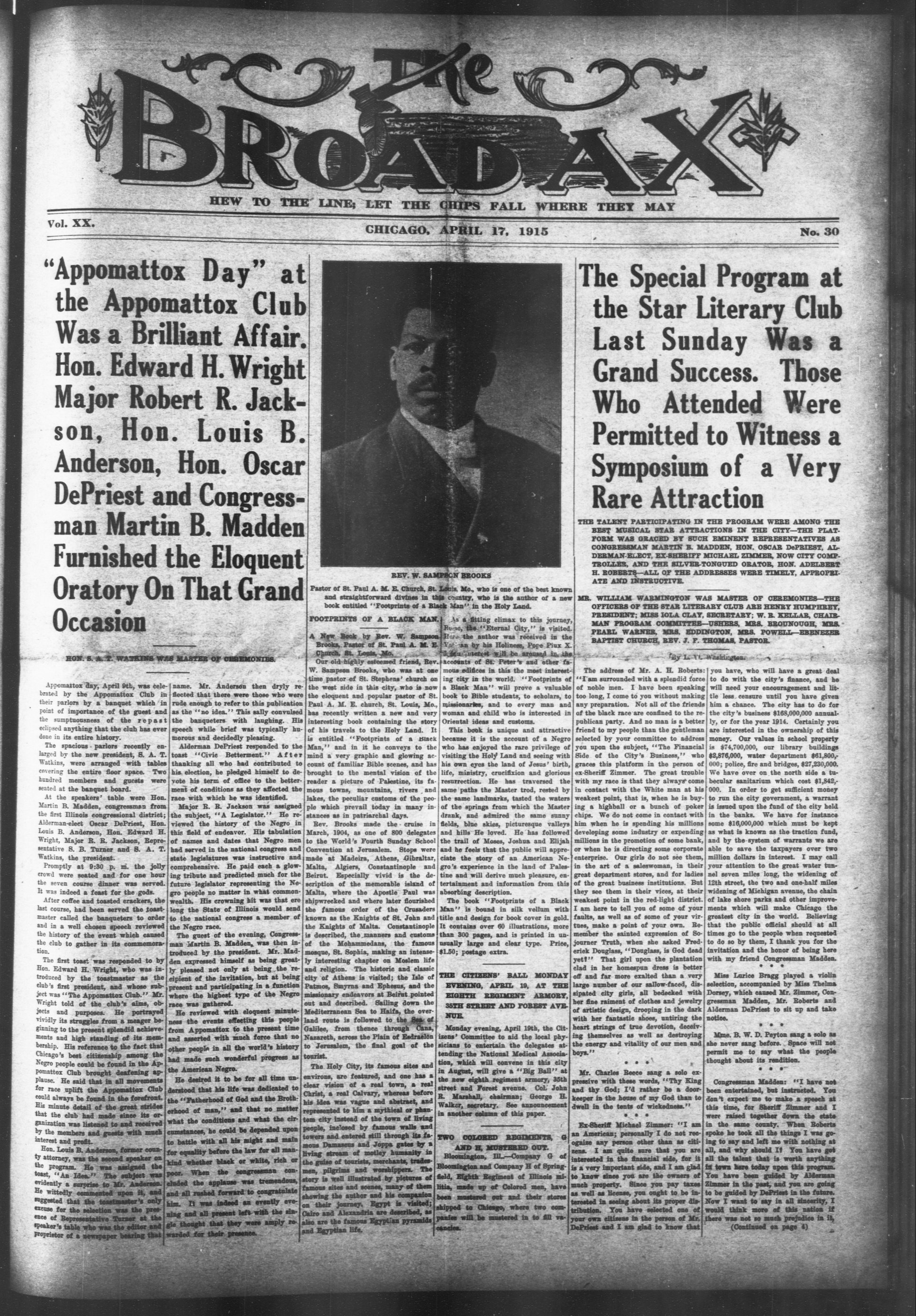
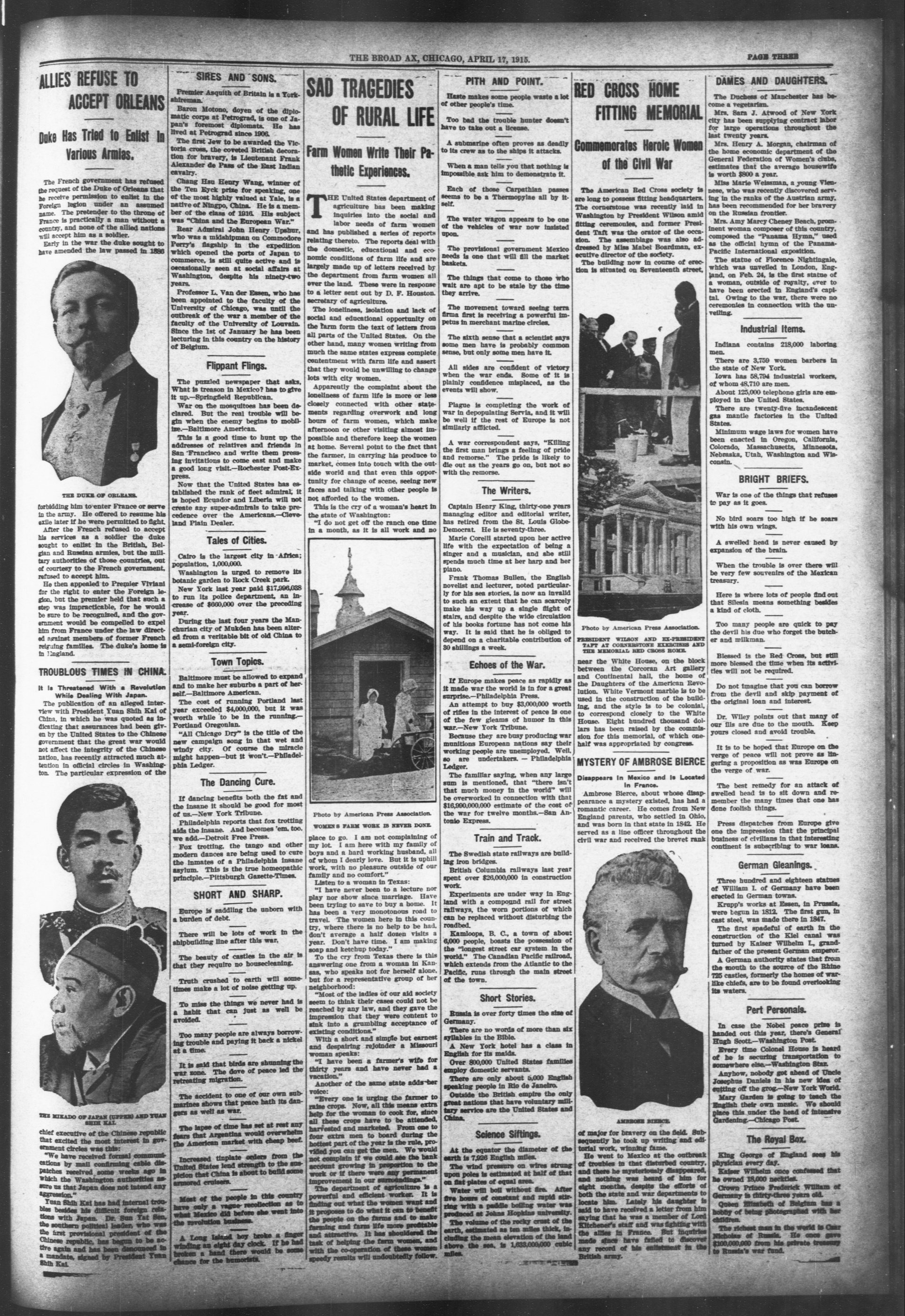
Page text (machine-generated)
THE BROAD AX
"Appomattox Day" at the Appomattox Club Was a Brilliant Affair. Hon. Edward H. Wright Major Robert R. Jackson, Hon. Louis B. Anderson, Hon. Oscar DePriest and Congressman Martin B. Madden Furnished the Eloquent Oratory On That Grand Occasion
Vol. XX.
"Appomattoo the Appon Was a Bril Hon. Edward Major Robson, Hon Anderson, DePriest and man Martin Furnished the Oratory On Occasion
Appomattox day, April 9th, was celebrated by the Appomattox Club in their parlors by a banquet which in point of importance of the guest and the sumptuousness of the repast eclipsed anything that the club has ever done in its entire history.
The spacious parlors recently enlarged by the new president, S. A. T. Watkins, were arranged with tables covering the entire floor space. Two hundred members and guests were seated at the banquet board.
At the speakers' table were Hon. Martin B. Madden, congressman from the first Illinois congressional district; Alderman-elect Oscar DePriest, Hon. Louis B. Anderson, Hon. Edward H. Wright, Major R. R. Jackson, Representative S. B. Turner and S. A. T. Watkins, the president.
Promptly at 9:30 p. m. the jolly crowd were seated and for one hour the seven course dinner was served. It was indeed a feast for the gods.
After coffee and toasted crackers, the last course, had been served the toastmaster called the banqueters to order and in a well chosen speech reviewed the history of the event which caused the club to gather in its commemoration.
The first toast was responded to by Hon. Edward H. Wright, who was introduced by the toastmaster as the club's first president, and whose subject was "The Appattatto Club." Mr Wright told of the club's aims, objects and purposes. He portrayed vividly its struggles from a meager beginning to the present splendid achievements and high standing of its membership. His reference to the fact that Chicago's best citizenship among the Negro people could be found in the Appattatto Club brought deafening aplause. He said that in all movements for race uplift the Appattatto Club could always be found in the forefront. His minute detail of the great strides that the club had made since its organization was listened to and received by the members and guests with much interest and profit.
Hon. Louis B. Anderson, former county attorney, was the second speaker on the program. He was assigned the toast, "An Idea." The subject was evidently a surprise to Mr. Anderson. He wittedly commented upon it, and suggested that the toastmaster's only excuse for the selection was the presence of Representative Torser at the speaker's table who was the editor and proprietor of a newspaper bearing that
name. Mr. Anderson then dryly reflected that there were those who were rude enough to refer to this publication as the "no idea." This sally convulsed the banqueters with laughing. His speech while brief was typically humorous and decidedly pleasing.
Alderman DePriest responded to the toast "Civic Betterment." After thanking all who had contributed to his election, he pledged himself to devote his term of office to the betterment of conditions as they affected the race with which he was identified.
Major R. R. Jackson was assigned the subject, "A Legislator." He reviewed the history of the Negro in this field of endeavor. His tabulation of names and dates that Negro men had served in the national congress and state legislatures was instructive and comprehensive. He paid each a glowing tribute and predicted much for the future legislator representing the Negro people no matter in what commonwealth. His crowning hit was that are long the State of Illinois would send to the national congress a member of the Negro race.
The guest of the evening, Congressman Martin B. Madden, was then introduced by the president. Mr. Madden expressed himself as being greatly pleased not only at being the recipient of the invitation, but at being present and participating in a function where the highest type of the Negro race was gathered.
He reviewed with eloquent minuteness the events effecting this people from Appomattox to the present time and asserted with much force that no other people in all the world's history had made such wonderful progress as the American Negro.
He desired it to be for all time understood that his life was dedicated to the "Fatherhood of God and the Brotherhood of man," and that no matter what the conditions and what the circumstances, he could be depended upon to battle with all his might and main for equality before the law for all mankind whether black or white, rich or poor. When the congressman concluded the applause was tremendous, and all rushed forward to congratulate him. It was indeed an evently evening and all present left with the single thought that they were amply rewarded for their presence.
CHICAGO, APRIL 17, 1915
[Name]
REV. W. SAMPSON BROOKS
Pastor of St. Paul A. M. E. Church, St. Louis, Mo., who is one of the best known and straightforward divines in this country, who is the author of a new book entitled "Footprints of a Black Man" in the Holy Land.
A New Book by Rev. W. Sampson Brooks, Pastor of St. Paul A. M. E. Church, St. Louis, Mo.
Our old highly esteemed friend, Rev. W. Sampson Brooks, who was at one time pastor of St. Stephens' church on the west side in this city, who is now the eloquent and popular pastor of St. Paul A. M. E. church, St. Louis, Mo, has recently written a new and very interesting book containing the story of his travels to the Holy Land. It is entitled "Footprints of a Black Man," and in it he conveys to the mind a very graphic and glowing account of familiar Bible scenes, and has brought to the mental vision of the reader a picture of Palestine, its famous towns, mountains, rivers and lakes, the peculiar customs of the people which prevail today in many instances as in patriarchal days.
Rev. Brooks made the cruise in March, 1904, as one of 800 delegates to the World's Fourth Sunday School Convention at Jerusalem. Stops were made at Madeira, Athens, Gibraltar, Malta, Algiers, Constantinople and Beirut. Especially vivid is the description of the memorable island of Malta, where the Apostle Paul was shipwrecked and where later flourished the famous order of the Crusaders known as the Knights of St. John and the Knights of Malta. Constantinople is described, the manners and customs of the Mohammedans, the famous mosque, St. Sophia, making an intensely interesting chapter on Moslem life and religion. The historic and classic city of Athens is visited; the Isle of Patmos, Smyrna and Ephesus, and the missionary endeavors at Beirut pointed out and described. Sailing down the Mediterranean Sea to Haifa, the overland route is followed to the Sea of Galilee, from thence through Cana, Nazareth, across the Plain of Eudraelon to Jerusalem, the final goal of the tourist.
The Holy City, its famous sites and environs, are featured, and one has a clear vision of a real town, a real Christ, a real Calvary, whereas before his idea was vague and abstract, and represented to him a mythical or phantom city instead of the town of living people, inclosed by famous walls and towers and entered still through its famous Damascus and Joppa gates by a living stream of motley humanity in the guise of tourists, merchants, tradesmen, pilgrims and worshippers. The story is well illustrated by pictures of famous sites and scenes, many of them showing the author and his companion on their journey. Egypt is visited; Cairo and Alexandria are described, as also are the famous Egyptian pyramids and Egyptian life.
As a sitting climax to this journey, Rome, the "Eternal City," is visited. Here the author was received in the Valley by his Holiness, Pope Pius X. A great interest will be around in the accounts of St. Peter's and other famous edifices in this the most interesting city in the world. "Footprints of a Black Man" will prove a valuable book to Bible students, to scholars, to missionaries, and to every man and woman and child who is interested in Oriental ideas and customs.
This book is unique and attractive because it is the account of a Negro who has enjoyed the rare privilege of visiting the Holy Land and seeing with his own eyes the land of Jesus' birth, life, ministry, crucifixion and glorious resurrection. He has traversed the same paths the Master trod, rested by the same landmarks, tasted the waters of the springs from which the Master drank, and admired the same sunny fields, blue skies, picturesque valleys and hills He loved. He has followed the trail of Moses, Joshua and Elijah and he feels that the public will appreciate the story of an American Negro's experience in the land of Palestine and will derive much pleasure, entertainment and information from this absorbing description.
The book "Footprints of a Black Man" is bound in silk vellum with title and design for book cover in gold. It contains over 60 illustrations, more than 300 pages, and is printed in unusually large and clear type. Price, $1.50; postage extra.
THE CITIZENS' BALL MONDAY EVENING, APRIL 19, AT THE HIGHTH REGIMENT ARMORY, 35TH STREET AND FOREST AVENUE.
Monday evening, April 19th, the Citizens' Committee to aid the local physicians to entertain the delegates attending the National Medical Association, which will convene in this city in August, will give a "Big Ball" at the new eighth regiment armory, 35th street and Forest avenue. Col. John R. Marshall, chairman; George H. Walker, secretary. See announcement in another column of this paper.
AND H, MUSTERED OUT.
Bloomington, III.—Company G of Bloomington and Company H of Springfield, Eighth Regiment of Illinois militia, made up of Colored men, have been mustered out and their stores shipped to Chicago, where two companies will be mustered in to fill vacancies.
The Special Program at the Star Literary Club Last Sunday Was a Grand Success. Those Who Attended Were Permitted to Witness a Symposium of a Very Rare Attraction
THE TALENT PARTICIPATING IN THE PROGRAM WERE AMONG THE BEST MUSICAL STAR ATTRACTIONS IN THE CITY—THE PLATFORM WAS GRADED BY SUCH EMINENT REPRESENTATIVES AS CONGRESSMAN MARTIN B. MADDEN, HON. OSCAR DePRIEST, ALDERMAN-ELECT, EX-SHERIFF MICHAEL ZIMMER, NOW CITY COMPROLLER, AND THE SILVER-TONGUED ORATOR, HON. ADELBEBT H. ROBERTS—ALL OF THE ADDRESSES WERE TIMELY, APPROPRIATE AND INSTRUCTIVE.
MR. WILLIAM WARMINGTON WAS MASTER OF CEREMONIES—THE OFFICERS OF THE STAR LITERARY CLUB ARE HENRY HUMPHREY, PRESIDENT; MISS IOLA CLAY, SECRETARY; W. B. KELLAR, CHAIRMAN PROGRAM COMMITTEE—USHERS, MRS. BROUNOUGH, MRS. PEARL WARNER, MRS. EDDINGTON, MRS. POWELL—EBENEZER BAPTIST CHURCH, REV. J. F. THOMAS, PASTOR.
The address of Mr. A. H. Roberts, "I am surrounded with a splendid force of noble men. I have been speaking too long, I come to you without making any preparation. Not all of the friends of the black race are confined to the republican party. And no man is a better friend to my people than the gentleman selected by your committee to address you upon the subject, "The Financial Side of the City's Business," who graces this platform in the person of ex-Sheriff Zimmer. The great trouble with my race is that they always come in contact with the White man at his weakest point, that is, when he is buying a highball or a bunch of poker chips. We do not come in contact with him when he is spending his millions developing some industry or expending millions in the promotion of some bank, or when he is directing some corporate enterprise. Our girls do not see them, in the art of a saleswoman, in their great department stores, and for ladies of the great business institutions. But they see them in their vices, at their weakest point in the red-light district. I am here to tell you of some of your faults, as well as of some of your virtues, make a point of your own. Remember the sainted expression of Sojourner Truth, when she asked Frederick Douglass, "Douglass, is God dead yet?" That girl upon the plantation clad in her homespun dress is better off and far more exalted than a very large number of our sallow-faced, dissipated city girls, all bedecked with her fine raiment of clothes and jewelry of artistic design, drooping in the dark with her fantastic shoes, untiring the heart strings of true devotion, deceiving themselves as well as destroying the energy and vitality of our men and boys."
Mr. Charles Beece sang a solo expressive with these words, "Thy King and thy God; I'd rather be a doorkeeper in the house of my God than to dwell in the tents of wickedness."
Ex-Sheriff Michael Zimmer: "I am an American; personally I do not recognize any person other than as citizens. I am quite sure that you are interested in the financial side, for it is a very important side, and I am glad to know since you are the owners of much property. Since you pay taxes as well as license, you ought to be interested in seeing about its proper distribution. You have selected one of your own citizens in the person of Mr. Dr. Prestiff and I am glad to know that
No.30
All Program at
Literary Club
Sunday Was a
success. Those
appended Were
able to Witness a
chain of a Very
action
IN THE PROGRAM WERE AMONG THE
ACTIONS IN THE CITY—THE PLAT-
TH EMINENT REPRESENTATIVES AS
ADDEN, HON. OSCAR DEPRIEST, AL-
MICHAEL ZIMMER, NOW CITY COMP-
PONGUED ORATOR, HON. ADELBEET
ADDRESSES WERE TIMELY, APPROPRIATE
AS MASTER OF CEREMONIES—THE
LITERARY CLUB ARE HENRY HUMPHEY,
SECRETARY; W. B. KELLAR, CHAIR-
USHERS, MRS. BROUNOUGH, MRS.
INGTON, MRS. POWELL—EBENEZER
THOMAS, PASTOR.
you have, who will have a great deal to do with the city's finance, and he will need your encouragement and little less. ensure until you have given him a chance. The city has to do for the city's business $163,000,000 annually, or for the year 1914. Certainly you are interested in the ownership of this money. Our values in school property is $74,700,000, our library buildings $3,876,000, water department $61,800,000; police, fire and bridges, $27,230,000. We have over on the north side a tubecular sanitarium which cost $1,842,000. In order to get sufficient money to run the city government, a warrant is issued upon the fund of the city held in the banks. We have for instance some $16,000,000 which must be kept as what is known as the traction fund, and by the system of warrants we are able to save the taxpayers over two million dollars in interest. I may call your attention to the great water tunnel seven miles long, the widening of 12th street, the two and one-half miles widening of Michigan avenue, the chain of lake shore parks and other improvements which will make Chicago the greatest city in the world. Believing that the public official should at all times go to the people when requested to do so by them, I thank you for the invitation and the honor of being here with my friend Congressman Madden.
Miss Lurice Bragg played a violin selection, accompanied by Miss Thelma Dorsey, which caused Mr. Zimmer, Congressman Madden, Mr. Roberts and Alderman DePriest to sit up and take notice.
Mme. B. W. D. Peyton sang a solo as she never sang before. Space will not permit me to say what the people thought about its rendition.
Congressman Madden: "I have not been entertained, but instructed. You don't expect me to make a speech at this time, for Sheriff Zimmer and I were raised together down the state in the same county. When Roberts spoke he took all the things I was going to say and left me with nothing at all, and why should I? You have got all the talent that is worth anything in town here today upon this program. You have been guided by Alderman Zimmer in the past, and you are going to be guided by DePriest in the future. Now I want to say in all sincerity, I would think more of this nation if there was not so much prejudice in it. (Continued on page 4)
---
PAGE TWO
Haiti's Old Citadel.
On the summit of a Haitian mountain over 4,000 feet high stand the wonderful ruins of the great citadel La Ferriere, built by the black king Christophe. Some of the walls are eighty feet high and sixteen feet thick, and heavy batteries of old fifty-six and thirty-two pound guns are still in position. They were laid to guard every approach of what was intended to be the last asylum of Haitian independence. Springs of water still exist in the interior, and there were secret subterranean passages and secret chambers for holding his hoarded wealth, much of which is supposed to be still buried there. Although partly destroyed by the earthquake in 1842, which demolished nearly all of the important buildings in the country, the colossal ruins of the citadel still attest the gigantic work of Christophe, and the world still wonders how the work was done and how the material for the construction and armament was ever got to the top of the mountain. Little authentic information has ever been obtained on the subject, and the whole enterprise is clouded in romance and anecdote.—Argonaut.
Dust Clouds Armies Make
Dust Clouds Armies Make.
An army on the march along dry roads naturally throws up very heavy dust clouds. To those who haven't been trained one dust cloud looks very much like another, but to a soldier these dust clouds tell a very clear story.
The dust clouds thrown up by infantry, for example, hang in a low, thick cloud. The longer the cloud the more men underneath it, and a scout can by this means make a fairly accurate guess of the number of men on the march.
Cavalry on the march sends up a dust cloud that is much higher and thinner than that of infantry. The most distinctive of these dust clouds, however, is that made by wagons and heavy guns. The dust rises in little groups of clouds, quite different from the long clouds of cavalry and infantry. So even when unable to see the actual cause of the dust, a scout can tell many miles away what kind of force is passing along a road.-Exchange.
Indifferent Librarians.
The Bodleian library has not always been fortunate in its custodians. When George III. presented a copy of the newly published "Voyages of Captain Cook" to the library the then librarian—we mercifully omit his name—promptly sent it to a friend, with a note asking him to keep it for a twelvemonth or so, as otherwise if the university men knew the book was available he would be pestered to death by applications for it.
The problem of storage for the Bodleian library is no new one and no doubt it will recur from age to age. But Oxford is probably a long way yet from any likelihood of adopting Lord Chancellor Westbury's suggestion as to the proper way of "removing the Bodleian." His proposal was that the books should be wheeled to the parks and burnt there—London Standard.
Strength of a Shark.
Given special advantages, such as that of holding the end of a stout rope at the other extremity of which is a hook fixed in a shark's mouth, man may, with the assistance of a number of his fellows, have the best of the shark. But alone and in the water the advantage is wholly and absolutely the other way, and the strongest swimmer and the bravest heart fail when the tyrant of the sea seeks to make his acquaintance. The shark is gifted with great strength, a savage temper, dogged perseverance and exceptional power of jaw. The lion and tiger may mangle, the crocodile may lacerate, the bulldog may hold fast—the shark alone of living creatures possesses the power of nipping off a human limb at a bite.
Its Own Reward.
Dr. Jones leaped into the air, dropping the evening paper he was reading as the telephone bell split the peaceful atmosphere.
"Who is it? What is it? Where is it? he shouted as he took the receiver down.
"Please come at once, doctor," piped a small voice. "It's Tommy Brown speaking."
"Who's ill at your house?" asked the doctor.
"Everybody, ceptin' me. I was naughty, so mother wouldn't let me have any of the lovely mushrooms father picked yesterday."—Exchange.
Throwing Bice.
Throwing rice at a wedding symbolizes not the expression of good luck, but it is a metaphorical flight of arrows shot at the bridegroom. In uncivilized ages most nations were accustomed to the forcible capture of a bride by her lover, and the attempts on the part of her male relatives to prevent her husband from carrying her away is typified by a volley of rice instead of more fatal miseries.
A Different Love
An odd typographical error once appeared in a criticism of Ellen Terry. The reviewer wrote, "Her love of Portia made acting easy," but the sentence appeared in the paper as "Her love of porter made acting easy." — Detroit Free Press.
He Didn't Do the Running.
Leading Lady—Did he run off the stage when the eggs hit him? Leading Man — No, but he showed a yellow streak—Exchange.
Every person is responsible for all the good within the scope of his abilities—Gall Hamilton.
Mummies of Peru.
Before taking leave of Cuzco, Peru, we went to see the very interesting collection of Inca relics in the private museum of a Peruvian doctor who has devoted many years of his life to Inca research. Ranged round the walls wereummies which had been taken from rock tombs. All had been buried in a sitting posture, and, judging by the horrible expressions of agony on the parchment skin, I should imagine that some of them, prisoners of war, I was told, had been entombed alive. The horror of those mummied faces and the awful contortions of the skeletons haunted me for a long time, nor shall I ever forget the sight.
One or two of the skulls bore evidence of skillful surgery, star shaped pieces of bone having been cleverly fitted in to repair damage done by the star shaped stone weapons of the period. I did not measure those I saw in the museum, but one of the aforesaid stone weapons which we brought back to England from Cuzco measured four inches from point to point across the top—a truly formidable club. Wide World Magazine.
They Feared the Dutch.
In 1673, in the old days of England's wars with the Dutch, the inhabitants of Sheringham, in terror of invasion by the Dutch forces, petitioned the lord lieutenant and deputy lieutenants of Norfolk. "Our Town," they said, "Joynes upon ye Malne sea, and we are afraid every night ye enemy should come ashore and fire Our Towne when we be in our Bedds; for ye Houses stand very close together, and all ye Houses thatched with straw, that in one hours time ye Towne may be burnt, for we have nothing to Resist them But one Gunn, with a broken carriage and four Musquets, which we bought at our Owne cost and charges; which is a very small defence against an enemy; and likewise wee have no powder, nor shot for ye said Gunn, nor Musquets, when we stand in need." They therefore asked for a few more muskets, with powder and bullets. In granting this the authorities stipulated that Sheringham should not "imbocell ye said arms and ammunition."
Oliver Goldsmith and Powders
April 4, 1774, died Oliver Goldsmith, in his forty-seventh year, at the height of his fame, as also of his embarrassments. Goldsmith's death was hastened, as some thought, by his taking against his apothecary's wish the famous specific, Dr. James' fever powders. One should be just to the powders. Goldsmith himself thought he had been given spurious and not the genuine powders, while Mr. Hawkes, his apothecary, declared the sick man had taken the right remedy in a wrong fashion and after Goldsmith's death published, in collaboration with the poet's other two physicians, "An Account of the Late Dr. Goldsmith's Illness So Far as Relates to the Exhibition of Dr. James' Powders." Death pays all debts. In no other way possibly could Goldsmith have cleared himself—London Spectator.
A Costly Quarrel.
Rowley, the English violinist, was hard to beat in his perseverance against one who had incurred his ill will. Rowley had a quarrel with a horse dealer named Brant. It was a trivial matter, but Rowley took the next house to Brant, set up a plano, bought a cornet and proceeded to make insomnia for Brant. After one or two assault cases in court Brant moved. Rowley bought out the next door neighbor and followed with plano and cornet. Brant went to law, but found he could do nothing. Falling, he took a detached house. Then Rowley hired brass bands and organs and assailed him. This was actionable, and Rowley paid $3,000 for his revenge.—London Tatler.
The Gospel Oak
In the village of Polestead, Snofolk, England, stands a famous oak which the rector has proved to be 2,000 years old. The tree has a girth of thirty-six feet and has been known always as the gospel oak, since under it the first Christian missionaries preached to the heathen Saxons thirteen centuries ago. This event is commemorated each year by a special service held under the tree.
Early Superficies
Hosho, a Chinese physician who lived in the third century, gave his patients a preparation of hemp, whereby they were rendered insensible during surgical operations. The soporific effects of mandrake are mentioned by Shakespeare.
Wrong Ether Way.
Isabel—I'll never have another photograph taken. Dorothy—Why not, dear? Isabel-Ob, if it looks like me I don't like it, and if it flatters me my friends don't like it!—Exchange.
THE BROAD AX, CHICAGO, APRIL 17, 1915.
The Englishman Spoky
The Englishman spoke
In a second class railway carriage,
going from Lausanne to Paris, I once
passed a night of conflict. On my side
were a Swiss who spoke English and
an Englishman who didn't speak. Our
opponents were two members of a Latin
in race. They wanted the windows
shut. We wanted at least one window
open. Our common cause drew the
three of us together. At first the Englishman's expression had seemed to
wonder whether the Swiss and the
American were quite worthy to prefer
fresh air. As the night wore on this
expression waned, and I thought I
detected a trace of sympathy in the
glances he sparingly aimed at us.
In answer to my question the Swiss explained his mastery of the English language by saying he had learned without a teacher, just by sitting near an open window in a tub of cold water. At this the Englishman almost spoke. Morning came. He filled his pipe and began to hunt through his pockets for matches. The Swiss offered him a box. "Thank you," he said gravely; "I prefer my own," and went on hunting.-New Republic.
Colors of the Opal.
In judging an opal color is of the greatest importance. Red fire or red in combination with yellow, blue and green is the best. Blue by itself is quite valueless, and the green opal is not of great value unless the color is very vivid and the pattern very good. The color must be true—that is to say, it must not run in streaks or patches, alternating with a colorless or inferior quality. Pattern is an important factor, the several varieties being known as "pim fire" when the grain is very small, "harlequin" when the color is in small squares, the more regular the better, and the "flash fire," or "flash opal," when the color shows as a single flash or in very large pattern. Harlequin is the most common and is also popularly considered the most beautiful. When the squares of color are regular and show as distinct minute checks of red, yellow, blue and green it is considered magnificent. Some stones show better on edge than on top.—Exchange.
Barrele.
A barrel is not always a barrel, for, according to a Massachusetts judge, the matter of state lines has considerable to do with it. Some time since a Boston man purchased 200 barrels of sweet potatoes in the state of Maryland. When the sweet potatoes arrived in Boston the purchaser sold one barrel just as it had come from Maryland, but it appears that the barrel weighed only 129 pounds instead of 150 pounds, the legal weight in Massachusetts. In that state when a person buys a barrel of potatoes the weight must be not less than 150 pounds. The Massachusetts courts ruled that the purchaser of the Maryland sweet potatoes violated the law when he sold the barrel that was underweight, although the barrel was a legal one in Maryland. Therefore a barrel is not a barrel in Massachusetts when it weighs less than 150 pounds—Utica Press.
Penetration of Light.
Experiments show that light can be seen through a clean cut opening of not more than one forty-thousandth of an inch. This fact was determined by taking two thoroughly clean straight edges and placing a piece of paper between the surfaces at one end, the opposite end being allowed to come together. The straight edges being placed between the eye and a strong light in a dark room, a wedge of light was perceived from the ends between which the paper was placed and the opposite, which were brought together. The thickness of the paper being known, the distance apart of the two edges of the small end of the wedge of light was easily calculated.
Irving's Intensity.
The piercing eyes and intense expression of Henry Irving once had the effect of making a fellow actor altogether forget that he was on the stage at all. It occurred in Manchester during a performance of "Macbeth," and in the scene where Macbeth says to one of the murderers, "There's blood upon thy face!" Irving put so much earnestness into his words that the murderer forgot his proper answer ("Tus Banquo's, then") and replied in a startled voice: "Is there? Great Scott!" He fancied, as he afterward said, that he'd broken a blood vessel.
Synthetic Dyes.
The raw materials from which almost all the synthetic dyes are made are only nine or ten direct products of coal tar. These are transformed chemically into from 250 to 300 intermediate products, which in their turn yield about 1,200 chemically distinct dye-stuffs. Among the processes employed are high temperatures, great pressures and low refrigeration.
William Penn's Measurements.
The height of the statue of William Penn on Philadelphia city hall is thirty-seven feet, and it weighs 52,400 pounds. It was cast in Philadelphia in forty-seven pieces and so skilfully joined that the most careful inspection fails to detect the junctures. It was placed in position in sections. The hat is 3 feet in diameter; rhm, 23 feet in circumference; nose, 13 inches long; eyes, 12 inches long and 4 inches wide; mouth from corner to corner, 1 foot; face from hat to chin, 3 feet 3 inches; hair, 4 feet long; shoulders, 28 feet in circumference and 15 feet in diameter; waist, 24 feet in circumference and 8 feet 9 inches in diameter and 4 feet long; fingers, 2 feet 6 inches in diameter; hands, 6 feet 9 inches in circumference, 3 feet in diameter and 4 feet long; fingers, 2 feet 6 inches long; finger nails, 3 inches long, legs from ankle to knee, 10 feet; ankle, 5 feet in circumference; calf of legs, 8 feet 8 inches in circumference; feet, 22 inches wide, 5 feet 4 inches long—Philadelphia Press.
A Vell and a Mirror.
From a feminine source comes a question which is more easily answered at first than at second thought—a question—that is, which is not quite as simple as it seems. It is this: Does a woman wearing a veil see when she looks in a mirror what another person sees who looks at her through her veil? On consideration one realizes that the veiled woman looks through her veil at an image which is itself veiled, and therefore she apparently looks at herself through two veils instead of the one which is all that dims to the vision of the other observer. Then there is the further fact that in a mirror what was right becomes left and vice versa, so that what one sees there is not a picture of oneself, but of somebody who is like oneself only as one of a pair of gloves is like the other.
That, however, has nothing to do with the question as to the veils, and that is quite complicated enough to stand alone.—New York Times.
Difficult to Build.
The great railroad bridge across the Ganges at Sara took six years to build and cost $15,000,000. It consists of fifteen main spans and six land spans, the total length being about a mile and an eighth. It was necessary to sink the foundation to a depth of 200 feet below high flood level because the bed of the river consists of the finest sand, which is carried down from the Himalayas. An obstacle such as a sunken boat or tree causes this fine sand to be disturbed to as great a depth as fifty feet. Another difficulty is the habit of the Ganges to change its course rather whimsically. The point at which the river has been bridged is, so far as could be ascertained from available records, the one place at which these deviations of the river have been at minimum. The river is walled with stone three-quarters of a mile upstream and one-quarter of a mile downstream from the bridge.
When to Propose
The proper time for a man to declare himself is when he sees, by signs that can't be mistaken, that his asking won't be in vain.
The time may be soon or late in the course of a courtship, but it will mark beyond a chance of mistake the moment when he may venture to ask the important question and be certain of winning.
When her eyes begin to wander in search of him if he does not at once seek her side; when she stops talking to other people to listen to his most trivial utterances; when she lingers in his society and shows him she thinks his remarks full of wisdom and his baldest jokes the embodiment of humor—that is the moment for him to come boldly forward with his proposal, for the time for it is ripe—New York Weekly.
Profitable Change
A well-known conjurer one day visited a Scotch village. After performing many astonishing tricks he asked for a halfpenny, which a collier lent him. The conjurer then said he would turn it into a sovereign. He did so, as the people thought, and handed it around for them to see. When it reached the collier he coolly pocketed it and said to the astonished conjurer, "Will ye change me anither?"—London Mall.
The Calculus
The bottom meaning of the word "calculus" is pebble—calculate, calculus, pebble. Thus we are taken back to the very early time when calculating was carried on by the help of the pebbles that preceded the regular numerals.—New York American.
Women.
"Women are dreams!" murmured the sentimentalist, gazing on a group of them in silk attire.
"You can bet they are," the practicalist snapped back at the murmurous one, "and dreams go by contraries, all right!" - Judge.
No man can be both a dreamer and a man of action, and we are called upon to determine what role we shall play in life when we are too young to know what we do.-Richard Middleton.
Ceylon's Cocoanut Trees.
The island of Ceylon has about 60,000,000 trees, yielding 1,200,000,000 coconuts, many of which are used locally for food and drink.
MONDAY EVENING, APRIL 19th
the Citizens Committee, which is assisting to
raise money to help to entertain the delegates attenting the National Medical Association which
will convene in this City August 24, 25 & 26, 1915
Will give a GRAND CITIZENS BALL
at the Eighth Regiment Armory, 35th Street and
Forest Avenue.
Music by the Eighth Regiment Band. Admission 50 c
COL. JOHN R. MARSHALL, Chairman
GEORGE H. WALKER, Secretary
Getting Away From Land. The question has been asked. Is it possible to sail 1,000 miles from land? This can be done at several points. By leaving San Francisco and sailing northwestward into the north Pacific a spot is reached where there is no land, not even an islet, for 1,000 miles in any direction. So, too, sailing from the southern point of Kamchatka southwestward ships reach a point equally distant from land of any kind, the nearest to the north being the Aleutian islands and to the south the outlying members of the Hawaiian group. In the southern Indian ocean it is possible to sail 1,000 miles out from the southern points of Australia and New Zealand and still be as far from any other land, and the same may be done in a westerly direction from Cape Horn. Indeed, from this point a much longer distance might be reached, for the southern Pacific between the Horn and New Zealand covers a space of 80 degrees of longitude and 40 of latitude of absolutely unbroken sea, making its central point over 1,200 miles from anywhere.
Municipal Granaries.
For more than two centuries the authorities of London maintained municipal granaries, the first one having been established by Sir Stephen Brown, lord mayor, in 1438. By means of these city granaries the authorities held the "corn badgers" in check and regulated not only the price of corn, but of bread. The great fire in London destroyed the last of these granaries and also the public mills and ovens in which the city's grain was ground and baked, and the system was not thereafter introduced, chiefly because the general laws against grain speculators were sufficient to restrain undue speculation. Corn markets were held, however, as late as the beginning of the eighteenth century at Bear quay, in Thames street, London, while Queenhithe was the chief market for flour and meal, and later the metropolitan trade centered in the world famous Corn Exchange in Mark lane. - New York Times.
Cold Doesn't Always Contract.
There are many ways of demonstrating the fallacy of the assertion that "heat expands, cold contracts." When water (other liquids as well) freezes to ice it increases in bulk. Sometimes it is said, however, that the volume of the sum of the ice crystals alone is no greater than that of the original liquid, but that the crystals of ice do not fit in well together and leave spaces between them which account for the apparent increase in volume.
Molten metals, as a rule, contract upon solidification, which is nothing but freezing. Some alloys, on the other hand, expand when solidified. Type metal, which is composed chiefly of lead and antimony, is such an alloy. This propensity is of particular advantage in this case because it causes the metal in solidifying to fill up every tiny corner and hair space in the matrix—New York World.
The zebra when wild is a ferocious animal, and an unwary hunter is likely to suffer from its teeth and hoofs. The author of "Kloof and Karroo" says that a Boer in Cape Colony had once forced a zebra to the brink of a precepte, when the desperate creature turned upon him, attacked him with its teeth and actually tore one of his feet from the leg. Another author writes of a soldier who mounted a half domesticated zebra. The creature, after making the most furious attempts to get rid of its rider, plunged over a steep bank into the river and threw the soldier as it emerged. While the man lay half stunned upon the ground the zebra quietly walked up to him and bif off one of his ears.
An Old Time Advertisement
In old newspapers the advertisements make interesting reading. Here is one from the London Chronicle of 1785: "Run Away.—Whereas Thomas Williams, Apprentice to John Clark of Queensborough, in the County of Kent, dredgerman, has run away from his said master's service and not been heard of these three years, if the said Thomas Williams will return to his master's service within three months after the date of this advertisement he will be kindly received, and whover harbours him after this notice will be prosecuted as the law directs."
Wild Zebraa.
Residence, 4630 Evans Avenue
Tel. Kenwood 3466
Dr. H. REGINALD SMITH
EYE GLASSES
SCIENTIFICALLY FITTED
Office, 3401 S. State St., Chicago
Office Hours:
9 A.M. to 5 P.M. 7 to 9 P.M.
Phone Douglas 1248 Auto. 77-810
Starvation.
What is it? What occurs? What part of the human mechanism fails first or last, when a person is deprived of food for a certain period of time? This is what takes place: During starvation the body loses weight, the various functions (walking, sitting up etc.) become weaker, the body temperature first rises, then falls, and death supervenes after the loss of about 40 per cent of the body weight. The loss is not equally distributed among the various tissues, as the muscles and fat lose the most, then the bones, skin and liver, and (geast of all) the heart, brain and spinal cord. Some persons starve without actually being denied food. Certain constitutional diseases bring on conditions which cause loss of weight and great weakness of every portion of the organism; the food eater does not feed the disease ridden tissues and a state of starvation follows. Thus a person may starve even in the midst of plenty. Marked loss of weight while in seeming good health, is a positive indication of some serious systemic disorder, which if treated in time will prevent further loss of weight and avert starvation and death.
Printing a Coin on Linen
The print of a silver coin or metal may be made on silk or linen by diping the fabric in a solution of nitrate of silver and stretching it over the face of the coin until the image is imprinted. The linen is sensitized by diping it into a solution of nitrate of silver, made by dissolving sixty or eighty grains of nitrate of silver in one ounce of water. Wet the portion of the cloth which is to receive the impression in the solution, and when nearly dry draw it over the face of the coin and tie it at the back. Expose to a weak light, and in a few minutes the raised design of the coin will appear on the linen. As soon as the print is dark enough remove and wash in clean water. When nearly dry iron it smooth with a warm iron, placing a piece of tissue paper over the print. In printing from the coin or medal it is advisable to paste a piece of paper on the reverse side, so that the silver will not come in contact with the sensitized fabric.
An Irreverant Goat:
The Welsh fusilews were presented by Queen Victoria with a goat, which after several years of exemplary conduct, fell into bad ways. Its culminating act of insubordination occurred when the regiment was quartered at Wrexham, and one fine summer evening after mess the officers were strolling about smoking and enjoying the fresh air. The colonel stooped down to push in the end of his trousers strap, and the goat, which happened to be close by, found the temptation irresistible. He charged fiercely and butted his commanding officer against an adjacent wall with such force that both his eyes were blacked and his face was otherwise damaged. By this escapade the goat earned the title of "the Rebel," and only the good record of his early years of service saved him from being drummed out—London Ex
An Anecdote of Greeley.
A call was once made by a dozen noted artists of the Academy of Design in 1870 on Horace Greeley. Mr. Clarence Cook, then the art critic of the Tribune, had been saying things about the academy exhibition which caused the venerable chiefs of that establishment to boll with indignation. One day a committee went down to the Tribune to complain. Mr. Greeley, having listened in silence to what these gentlemen had to say, looked up from his desk, a twinkle in his eye, and said, with his peculiar nasal falsetto: "Gentlemen, I judge from your remarks that Mr. Cook's articles are widely read. They will therefore continue to be printed in the Tribune. Good morning."
The French government has refused the request of the Duke of Orleans that he receive permission to enlist in the Foreign legion under an assumed name. The pretender to the throne of France is practically a man without a country, and none of the allied nations will accept him as a soldier. Early in the war the duke sought to have amended the law passed in 1836
[Name]
THE DUKE OF ORLEANS.
forbidding him to enter France or serve in the army. He offered to resume his exile later if he were permitted to fight
He then appealed to Premier Viviani for the right to enter the Foreign legion, but the premier held that such a step was impracticable, for he would be sure to be recognized, and the government would be compelled to expel him from France under the law directed against members of former French reigning families. The duke's home is in England.
TROUBLOUS TIMES IN CHINA
It Is Threatened With a Revolution While Dealing With Japan.
The publication of an alleged interview with President Yuan Shih Kai of China, in which he was quoted as indicating that assurances had been given by the United States to the Chinese government that the great war would not affect the integrity of the Chinese nation, has recently attracted much attention in official circles in Washington. The particular expression of the
[Image of two men in traditional attire, one in a military uniform and the other in a traditional cap and beard].
THE MIKADO OF JAPAN (UPPER) AND YUAN SHIH KAL
chief executive of the Chinese republic that excited the most interest in government circles was this:
"We have received formal communications by mail confirming cable dispatches received some weeks ago in which the Washington authorities assure us that Japan does not intend any aggression."
Yuan Shih Kai has had internal troubles besides his difficult foreign relations with Japan. Dr. Sun Yat Sen, the southern political leader, who was the first provisional president of the Chinese republic, has begun to be active again and has been denounced in a mandate, signed by President Yuan Shih Kai.
SIRES AND SONS
Premier Asquith of Britain is a Yorkshireman.
Baron Motono, doyen of the diplomatic corps at Petrograd, is one of Japan's foremost diplomats. He has lived at Petrograd since 1906.
The first Jew to be awarded the Victoria cross, the coveted British decoration for bravery, is Lieutenant Frank Alexander de Pass of the East Indian cavalry.
Chang Hsu Henry Wang, winner of the Ten Eyck prize for speaking, one of the most highly valued at Yale, is a native of Ningpo, China. He is a member of the class of 1916. His subject was "China and the European War."
Bear Admiral John Henry Upshur, who was a midshipman on Commodore Perry's flagship in the expedition which opened the ports of Japan to commerce, is still quite active and is occasionally seen at social affairs at Washington, despite his ninety-two years.
Professor L. Van der Essen, who has been appointed to the faculty of the University of Chicago, was until the outbreak of the war a member of the faculty of the University of Louvain. Since the 1st of January he has been lecturing in this country on the history of Beldum.
Flippant Flings.
The puzzled newspaper that asks, What is treason in Mexico? has to give it up.-Springfield Republican. War on the mosquitoes has been declared. But the real trouble will begin when the enemy begins to mobilize.-Baltimore American. This is a good time to hunt up the addresses of relatives and friends in San Francisco and write them pressing invitations to come east and make a good long visit.-Rochester Post-Express. Now that the United States has established the rank of fleet admiral, it is hoped Ecuador and Liberia will not create any super-admirals to take precedence over the Americans.-Cleveland Plain Dealer.
Tales of Cities.
Cairo is the largest city in Africa; population, 1,000,000.
Washington is urged to remove its botanic garden to Rock Creek park.
New York last year paid $17,906,038 to run its police department, an increase of $600,000 over the preceding year.
During the last four years the Manchurian city of Mukden has been altered from a veritable bit of old China to a semi-foreign city.
Town Topics.
Baltimore must be allowed to expand and to make her suburbs a part of herself.—Baltimore American. The cost of running Portland last year exceeded $4,000,000, but it was worth while to be in the running.—Portland Oregonian. "All Chicago Dry" is the title of the new campaign song in that wet and windy city. Of course the miracle might happen—but it won't.—Philadelphia Ledger.
The Dancing Cure.
If dancing benefits both the fat and the insane it should be good for most of us—New York Tribune.
Philadelphia reports that fox trotting aids the insane. And becomes 'em, too, we add—Detroit Free Press.
Fox trotting, the tango and other modern dances are being used to cure the inmates of a Philadelphia insane asylum. This is the true homeopathic principle—Pittsburgh Gazette-Times.
SHORT AND SHARP.
Europe is saddling the unborn with a burden of debt.
There will be lots of work in the shipbuilding line after this war.
The beauty of castles in the air is that they require no housecleaning.
Truth crushed to earth will sometimes make a lot of noise getting up.
To miss the things we never had is a habit that can just as well be avoided.
Too many people are always borrowing trouble and paying it back a nickel at a time.
It is said that birds are shunning the war zone. The dove of peace led the retreating migration.
The accident to one of our own submarines shows that peace hath its dangers as well as war.
The lapse of time has set at rest any fears that Argentina would overwhelm the American market with cheap beef.
Increased tinplate orders from the United States lend strength to the suspicion that China is about to build some armored cruisers.
Most of the people in this country have only a vague recollection as to what Mexico did before she went into the revolution business.
A Long island boy broke a finger winding an eight day clock. If he had broken a hand there would be some chance for the humorists.
THE BROAD AX, CHICAGO, APRIL 17, 1915
SAD TRAGEDIES OF RURAL LIFE
Farm Women Write Their Pathetic Experiences.
THE United States department of agriculture has been making inquiries into the social and labor needs of farm women and has published a series of reports relating thereto. The reports deal with the domestic, educational and economic conditions of farm life and are largely made up of letters received by the department from farm women all over the land. These were in response to a letter sent out by D. F. Houston, secretary of agriculture. The loneliness, isolation and lack of social and educational opportunity on the farm form the text of letters from all parts of the United States. On the other hand, many women writing from much the same states express complete contentment with farm life and assert that they would be unwilling to change lots with city women.
Apparently the complaint about the loneliness of farm life is more or less closely connected with other statements regarding overwork and long hours of farm women, which make afternoon or other visiting almost impossible and therefore keep the women at home. Several point to the fact that the farmer, in carrying his produce to market, comes into touch with the outside world and that even this opportunity for change of scene, seeing new faces and talking with other people is not afforded to the women.
This is the cry of a woman's heart in the state of Washington:
"I do not get off the ranch one time in a month, as it is all work and no
THE HOLY TRADITION
WOMEN'S FARM WORK IS NEVER DONE
place to go. I am not complaining of
my lot. I am here with my family of
boys and a hard working husband, all
of whom I dearly love. But it is uphill
work, with no pleasure outside of our
family and no comfort."
Listen to a woman in Texas:
"I have never been to a lecture nor
play nor show since marriage. I
been trying to save to buy a home. It
has been a very monotonous road to
travel. The women here in this country,
where there is no help to be had,
don't average a half dozen visits a
year. Don't have time. I am making
soap and ketchup today."
To the cry from Texas there is this
answering one from a woman in Kansas,
who speaks not for herself alone,
but for a representative group of her
netherhood:
"Most of the ladies of our old society seem to think their cases could not be reached by any law, and they gave the impression that they were content to sink into a grumbling acceptance of existing conditions."
With a short and simple but earnest and despairing rejoinder a Missouri woman speaks:
"I have been a farmer's wife for thirty years and have never had a vacation."
Another of the same state adds her voice:
"Every one is urging the farmer to raise crops. Now, all this means extra help for the woman to cook for, since all these crops have to be attended, harvested and marketed. From one to four extra men to board during the hottest part of the year is the rule, provided you can get the men. We would not complain if we could see the bank account growing in proportion to the work or if there are any permanent improvement in our surroundings."
"The department of agriculture is a powerful and efficient worker. It is finding out what the women want and it proposes to do what it can to benefit the people on the farms and to make farming and farm life more profitable and attractive. It has shouldered the task of helping the farm women, and with the co-operation of these women wealthy results will undoubtedly follow.
PITH AND POINT.
Haste makes some people waste a lot of other people's time.
Too bad the trouble hunter doesn't have to take out a license.
A submarine often proves as deadly to its crew as to the ships it attacks.
When a man tells you that nothing is impossible ask him to demonstrate it.
Each of those Carpathian passes seems to be a Thermopylae all by itself.
The water wagon appears to be one of the vehicles of war now insisted upon.
The provisional government Mexico needs is one that will fill the market baskets.
The things that come to those who wait are apt to be stale by the time they arrive.
The movement toward seeing terra firma first is receiving a powerful impetus in merchant marine circles.
The sixth sense that a scientist says some men have is probably common sense, but only some men have it.
All sides are confident of victory when the war ends. Some of it is plainly confidence misplaced, as the events will show.
Plague is completing the work of war in depopulating Servia, and it will be well if the rest of Europe is not similarly afflicted.
A war correspondent says, "Killing the first man brings a feeling of pride and remorse." The pride is likely to die out as the years go on, but not so with the remorse.
The Writers.
Captain Henry King, thirty-one years managing editor and editorial writer, has retired from the St. Louis Globe-Democrat. He is seventy-three.
Marie Corelli started upon her active life with the expectation of being a singer and a musician, and she still spends much time at her harp and her piano.
Frank Thomas Bullen, the English novelist and lecturer, noted particularly for his sea stories, is now an invalid to such an extent that he can scarcely make his way up a single flight of stairs, and despite the wide circulation of his books fortune has not come his way. It is said that he is obliged to depend on a charitable contribution of 30 shillings a week.
Echoes of the War.
If Europe makes peace as rapidly as it made war the world is in for a great surprise.—Philadelphia Press.
An attempt to buy $3,000,000 worth of rifles in the interest of peace is one of the few gleams of humor in this war.—New York Tribune.
Because they are busy producing war munitions European nations say their working people are unemployed. Well, so are undertakers. — Philadelphia Ledger.
The familiar saying, when any large sum is mentioned, that "there isn't that much money in the world" will be overworked in connection with that $16,900,000,000 estimate of the cost of the war for twelve months.—San Antonio Express.
Train and Track.
The Swedish state railways are building iron bridges.
British Columbia railways last year spent over $26,000,000 in construction work.
Experiments are under way in England with a compound rail for street railways, the worn portions of which can be replaced without disturbing the roadbed.
Kamloops, B. C., a town of about 6,000 people, boasts the possession of the "longest street car system in the world." The Canadian Pacific railroad, which extends from the Atlantic to the Pacific, runs through the main street of the town.
Short Stories.
Russia is over forty times the size of Germany.
There are no words of more than six syllables in the Bible.
A New York hotel has a class in English for its malds.
Over 800,000 United States families employ domestic servants.
There are only about 5,000 English speaking people in Rio de Janeiro.
Outside the British empire the only great nations that have voluntary military service are the United States and China.
Science Siftings.
At the equator the diameter of the earth is 7,926 English miles. The wind pressure on wires strung upon poles is estimated at half of that on flat plates of equal area.
The volume of the rocky crust of the earth, estimated as ten miles thick, including the mean elevation of the land above the sea, is 1,633,000,000 cubic miles.
The American Red Cross society is are long to possess fitting headquarters. The cornerstone was recently laid in Washington by President Wilson amid fitting ceremonies, and former President Taft was the orator of the occasion. The assemblage was also addressed by Miss Mabel Boardman, executive director of the society. The building now in course of erection is situated on Seventeenth street.
THE SUPERIOR CITY OF NEW YORK
Photo by American Press Association.
PRESIDENT WILSON AND EX-PRESIDENT
TAFT AT CORNERSTONE EXERCISES AND
THE MEMORIAL RED CROSS HOME.
near the White House, on the block
between the Corcoran Art gallery
and Continental hall, the home of
the Daughters of the American Revolution.
White Vermont marble is to be
used in the construction of the building, and the style is to be colonial,
to correspond closely to the White
House. Eight hundred thousand dollars
has been raised by the commission
for this memorial, of which one
half was appropriated by congress.
MYSTERY OF AMBROSE BIERCE
Disappear in Mexico and is Located in France.
Ambrose Bierce, about whose disappearance a mystery existed, has had a romantic career. He comes from New England parents, who settled in Ohio, and was born in that state in 1842. He served as a line officer throughout the civil war and received the brevet rank
A. B.
AMBROSE BIRCH.
of major for bravery on the field. Subsequently he took up writing and editorial work, winning fame.
He went to Mexico at the outbreak of troubles in that disturbed country, and there he mysteriously disappeared, and nothing was heard of him for eight months, despite the efforts of both the state and war departments to locate him. Lately his daughter is said to have received a letter from him saying that he was a member of Lord Kitchener's staff and was fighting with the allies in France. But inquiries made since have failed to discover any record of his entitlement in the
PAGE THREE
DAMES AND DAUGHTERS.
The Duchess of Manchester has become a vegetarian.
Mrs. Sara J. Atwood of New York city has been supplying contract labor for large operations throughout the last twenty years.
Mrs. Henry A. Morgan, chairman of the home economic department of the General Federation of Women's clubs, estimates that the average housewife is worth $800 a year.
Miss Marie Welssman, a young Viennese, who was recently discovered serving in the ranks of the Austrian army, has been recommended for her bravery on the Russian frontier.
Mrs. Amy Marcy Cheney Beach, prominent woman composer of this country, composed the "Panama Hymn," used as the official hymn of the Panama-Pacific International exposition.
The statue of Florence Nightingale, which was unveiled in London, England, on Feb. 24, is the first statue of a woman, outside of royalty, ever to have been erected in England's capital. Owing to the war, there were no ceremonies in connection with the unveiling.
Industrial Items
Indiana contains 218,000 laboring men.
There are 3,759 women barbers in the state of New York.
Iowa has 58,794 industrial workers, of whom 48,710 are men.
About 125,000 telephone girls are employed in the United States.
There are twenty-five incandescent gas mantle factories in the United States.
Minimum wage laws for women have been enacted in Oregon, California, Colorado, Massachusetts, Minnesota, Nebraska, Utah, Washington and Wisconsin.
BRIGHT BRIEFS.
War is one of the things that refuses to pay as it goes.
No bird soars too high if he soars with his own wings.
A swelled head is never caused by expansion of the brain.
When the trouble is over there will be very few souvenirs of the Mexican treasury.
Here is where lots of people find out that Silesia means something besides a kind of cloth.
Too many people are quick to pay the devil his due who forget the butcher and milkman.
Blessed is the Red Cross, but still more blessed the time when its activities will not be required.
Do not imagine that you can borrow from the devil and skip payment of the original loan and interest.
Dr. Wiley points out that many of our fills are due to the mouth. Keep yours closed and avoid trouble.
It is to be hoped that Europe on the verge of peace will not prove as lingering a proposition as was Europe on the verge of war.
The best remedy for an attack of swelled head is to sit down and remember the many times that one has done foolish things.
Press dispatches from Europe give one the impression that the principal business of civilians in that interesting continent is subscribing to war loans.
German Gleanings.
Three hundred and eighteen statues of William I. of Germany have been erected in German towns. Krupp's works at Essen, in Prussia, were begun in 1812. The first gun, in cast steel, was made there in 1847.
The first spadeful of earth in the construction of the Kiel canal was turned by Kaiser Wilhelm I, grandfather of the present German emperor. A German authority states that from the mouth to the source of the Rhine 725 castles, formerly the homes of warlike chiefs, are to be found overlooking its waters.
Pert Personals
In case the Nobel peace prize is handed out this year, there's General Hugh Scott—Washington Post. Every time Colonel House is heard of he is securing transportation to somewhere else—Washington Star. Anyhow, nobody got ahead of Uncle Josephus Daniels in his new Mea of eating off the grog—New York World. Mary Garden is going to teach the English their own music. We should place this under the head of intensive Gardening—Chicago Post.
The Royal Box.
King George of England sees his physician every day.
Kaiser Wilhelm once confessed that he owned 18,000 neckties.
Crown Prince Frederick William of Germany is thirty-three years old.
Queen Elizabeth of Belgium has a hobby of being photographed with her children.
The richest man in the world is Omar Nicholas of Russia. He once gave $100,000,000 from his private treasury to Russia's war fund.
PAGE FOUR
THE BROAD AX
PUBLISHED WEEKLY.
Will promulgate and at all times uphold the true principles of Democracy, but Catholics, Protestants, Priests, Indigels, Single Taxes, Republicans, or anyone else can have their say, as long as their language is proper and responsibility is fixed.
The Broad Ax is a newspaper whose platform is broad enough for all, ever claiming the editorial right to speak its own mind.
Subscriptions must be paid in advance.
One Year..............................................$2.00
Six Months..............................................1.00
Advertising rates made known on application.
Address all communications to
THE BROAD AX
5027 FEDERAL STREET, CHICAGO, ILL.
PHONE DREXEL 4500.
JULIUS F. TAYLOR, Editor and Publisher
Entered as Second-Class Matter Aug. 19,
1902, at the Post Office at Chicago, Illinois,
under Act of March 8, 1879.
THE STAR LITERARY CLUB.
(Concluded from page 1)
and I believe the people north of the Mason and Dixon line are reaching out and will continue to reach out until all of its subjects are one in citizenship, one in sovereignty, one in the bonds of sympathy, one in patriotism, one in the recognition of our institutions and the flag, one in national Americanism. Patriotism, a great virtue, is stronger in America than any place upon the globe, because here it is real patriotism, one of the most beautiful things on earth, to guard a people's rights and keep them out of danger. There are times in the life of a nation when patriotism is necessary. Patriotism is as strong as death, and the vital spot of a nation's honor, the wind shield of a nation's prosperity. Shape yourselves by living the life so as to enable you to take a part in the nation's interest. You have friends at court who have been and are fearless in their defense of the defenseless, that are true American citizens. We fought this question out in the civil war, and your people had much to do with it in settling the question. If you don't believe it, look at this man here (pointing to Oscar DePriest) that you have by that freedom extended to you sent him as your representative from the second ward to the city council, and I would to God that that freedom was extended all around to the rest of the ten million of your race. Do you think you are entitled to that kind of justice by your military as well as your intellectual and industrial record in this country? I think so. I am opposed to intermarriage, and I know you are, but I am opposed to enacting a law to make it a crime, for I am in favor of giving the black girl the right to protect her honor just the same as I would my daughter. We all must look upon this life as a struggle. If I should out run you, I should have the prize. If you should out run me, then you should have it. Courage, honor, integrity, energy, morality with the physical, will make a race what it ought to be; not whether you are a lawyer or a banker, but whether the man, which counts, and not the position. What you want now to maintain is your conservatism and your equilibrium. Conservatism is the one thing necessary for good government. We have witnessed the dawn of a new era. We stand for the ideal, liberty. This republic is bound to live forever as an example to all the dark and benighted people of the world. We are going to be so neutral that we will be the means and the instrument of bringing the nation in closer harmony with all of the people when humanity, justice and equality will everywhere be the order of the day.
3—Broad Ax—April 16
Pete
We owe our congratulations to Mr.
Julius P. Taylor and Mr. B. W. Fitts
for the splendid introduction of Mr.
Zimmer to our people.
ALPHA SUFFRAGE CLUB.
The Alpha Suffrange Club enjoyed the proud distinction of being the first organization to give a reception to our alderman, Mr. DePriest. It had a crowded house last Wednesday evening to greet and congratulate him. Mr. DePriest made the most eloquent address of his life, and seemed sensible of the confidence the Colored people had reposed in him, and pledged himself to work for the best interests of the race. Among the many distinguished guests was Mrs. Joslyn, a white lady, teacher in the public schools and a close friend of Mrs. Barnett's, who carried her precinct for Mr. DePriest and was glad to tell the woman how she did it.
```markdown
```
[Image of a man in a suit with a bow tie].
THE LATE CAPTAIN WILLIAM P. CLANCY.
DEATH OF CAPTAIN WILLIAM P.
CLANCY.
The latter part of last week Captain William P. Clancy, who was for a long time inspector of the Stock Yards Station and at the Hyde Park Station, after a long illness very peacefully closed his eyes in death at his home, 5553 South Green street. He was more than 66 years old.
Captain Clancy was by far the best known policeman on the south side, being as stated before in command of the Stock Yards Station for many years. He was born in County Galway, Ireland, and came to this country with his parents at the age of fifteen years. He was for a long time special policeman in the old Packingtown district, and in 1880 he became chief of police for the Town of Lake, and when it was annexed to Chicago in 1889 he entered
NEGROES IN THE UNITED STATES
A Bulletin Containing the Most Recent Statistics Relative to the Race.
Bulletin 129, entitled "Negroes in the United States," presenting statistics derived from the thirteenth census and from other statistical inquiries conducted by the Bureau of the Census, Department of Commerce, has been issued and is now being distributed.
The bulletin, which consists of 207 pages of text and tables, will be followed by a more complete and comprehensive report on the same subject. The Director of the Census in transmitting the report to the Secretary of Commerce states:
"The object in view is to embody in a single publication the principal and most recent census statistics relative to the Negro, arranged and presented in such a way as to contribute as much information as possible regarding the status and progress of the Negro race in the United States.
"A similar publication was issued in 1904 following the completion of the twelfth census, taken in 1900; and there has been a very general demand for a report covering the same field but based upon the more recent statistics of the thirteenth census.
"The need for a monographic presentation arises from the fact that the census statistics relating to the Negro must otherwise be sought for in many different volumes covering population, agriculture, mortality, and other general subjects. The result is that these statistics are not easily accessible to the general public until brought together in a single publication."
The bulletin was prepared in the division of Revision and Results, Bureau of the Census, under the general supervision of Dr. Joseph A. Hill, expert special agent. The statistical tables were planned and arranged by three Negro employees of the bureau—Charles E. Hall, William Jennifer and Robert A. Pelham, or under their direction by other Negro clerks. Mr. Hall's assignment covered population and occupations, Mr. Jennifer's agriculture and religious statistics, and Mr. Pelham's mortality and ownership of homes statistics.
As a government document the bulletin is for free distribution and can be obtained by application to the Director of the Census, Washington, D. C.
Miss Betteola Fortson, 2962 Wabash avenue, and Miss Frances Galloway, leave Monday morning for Des Moines, Iowa, and other points in that state where they will appear in piano recitals and select readings.
THE BROAD AX, CHICAGO, APRIL 17, 1915.
the city police department as a sergeant. In 1897 he was made lieutenant, in 1903 captain, and was promoted to an inspectorship in 1908. He was known far and near as the dean or "the schoolmaster of the police department."
He resigned from the police force in February, 1912, two weeks after the office of inspector had been abolished. He had been ill for two years. He is survived by his constant and devoted wife, Mrs. Clancy, and their eight children. His brother, John Clancy, is a member of the British Parliament from Dublin and a member of the King's counsel.
Captain Clancy was one of our steadfast friends, and from October 1, 1899, down to the day of his death he was a constant supporter of this paper. May he rest in peace throughout eternity.
$5,000
FIVE THOUSAND DOLLARS
MICHIGAN APPROPRIATION.
Passed and Signed April 10th.
Lansing, Mich.
April 6, 1915.
Journal of the Senate.
The following message from the House of Representatives was received and read:
House of Representatives,
April 6, 1915.
To the President of the Senate:
Sir--I am instructed by the House of Representatives to return to the Senate:
Senate Bill No. 206 (file No. 158), entitled care of Michigan exhibit at the National Exhibition to be held in connection with the Half Century Anniversary of Negro Freedom in the city of Chicago, in August and September, 1915; to create a Commission to manage said exhibit; and to make an appropriation therefor.
And to inform the Senate that the House of Representatives has passed the Bill and has ordered it to take immediate effect.
Clerk of the House of Representatives. The above is very encouraging, as financial aid is a necessary feature. Since it has been definitely settled that the Exposition will be held at the Coliseum from August 22d to September 16th, all persons wishing concessions and space, who have not made application, should do so at once. The price of space has been determined upon and made exceedingly low that none may be barred on that account. Where there are no sales in connection with exhibits, arrangements can be made that will be to the advantage of the exhibitor.
CHICAGO HERALD
More than fifty executives and members of the Illinois Commission of the Half Century Anniversary of Negro Freedom met yesterday afternoon in the City Club, 315 Plymouth court, to discuss plans for the Lincoln Jubilee and Half Century Exposition to be held at the Coliseum August 22d to September 16th.
Bishop Samuel Fallows, president of the Commission, presided.
A committee of six was appointed to meet the Illinois house committee on appropriations in Springfield tomorrow in an effort to have the appropriation of two years ago supplemented by an amount sufficient to meet the expenses of the Exposition. A general finance committee of twelve was created.
The governor's proclamation asking that suitable exercises be held in the
---
public schools on the anniversary of Lincoln's death, and that all flags on public buildings should be at half mast on April 15th, shows the attitude of the public toward the great emancipator. Let us put forth more strenuous efforts to commemorate his life in the great Exposition that is to be held in Chicago next summer. As we lament and deplore his death most deeply, yet the things that he did, the work he consummated, and the nobility of his character cannot be revered too highly. EXHIBITS.
The applications for space are being received in great numbers. Many pictorial exhibits have already arrived, and several industrial exhibits. If one third of the applications are verified, the Exposition will be well worth seeing. Do not wait until the last moment to apply for space. The success of the Exposition is already assured.
"JIM GROW" RULE AT SCHOOL
DANCES EXISTS NO MORE.
Color Segregation at Wendell Phillips Functions Ended.
There is no longer a "Jim Crow" rule at the Wendell Phillips High School.
The first of this week Mrs. Ella Flagg Young, superintendent of schools, listened to a delegation of women protesting against the rule which was put into effect in the high school by Miss Fannie R. Smith, dean of girls, segregating Negroes and Whites on social afternoons. She read the letter of Miss Marion Talbot, dean of women at the University of Chicago, who was the first to protest against the plan of having the Colored Students dance alone on one afternoon and the White students on another.
Mrs. Young learned that all of the members of the delegation protesting against the rule who had children, sent them to private schools, but neverless she determined to try out her own idea that the way to the social uplift of the Colored race is through the intellectual uplift.
Dances Are Taboo.
After a consultation with Miss Smith, it was determined to hold intellectual-social afternoons, instead of the purely social ones. No longer are there dances at the high schools. The Negroes and the White students mingle on equal terms. Instead of the tango and the fox trot, the students now listen to a lecture on Mexico, look at stereopticon views of the Yosemite Valley, or debate the question of woman suffrage. They mix the intellectual with the social, and Mrs. Young has found that the scheme is successful, so far as getting both Negroes and White persons together for their amusement and intellectual training.
Women Don't Approve.
"The women in the delegation," said Mrs. Young, "did not approve of my ideas on the subject, but we are trying them out anyway. Mothers of children have objected that the Negro race is not as moral as the White race. In intellectual things, there is no question of morals.
"I believe that the way to raise an inferior race to the same plane as another race is through intellectual training. The social question will take care of itself, when Negro and White man can talk on equal terms.
"I have been visiting the schools in which we have large numbers of Negro children and I find an entirely different attitude then when I was district superintendent, back in 1898. The children are more alert, more interested."
HEALTH NOTES
In most work places the danger from fire is remote compared with that from dirty air.
If that back yard doesn't look good to you, it must look a lot worse to your neighbors.
If your neighborhood is not just as clean and tidy as you would like to see it, perhaps you can do something to make it better.
Why should human beings be compelled to work in fire traps! But because they are so compelled, the road to safety so often lies through danger and death.
As between rotten food and rotten air, it is hard to say which in the worse. Both are bad and no human being should be compelled to eat the one or breathe the other.
As an employer you would not want your employees to eat dirty and unwholesome food. Then why should you be willing that they should breathe dirty and unwholesome air?
The home with neat and tidy surroundings will bring more money than the home with dirty and unattractive environment. In other words, it pays to clean up and keep clean all the time.
People who love clean, tidy and
Talks on
Health,
Cleanliness
Proper Living
Sanitation, Etc.
by
DR. W.A. DRIVER
3300 So. State St.
Phone Douglas 3617
WOMAN'S ILLS.
Woman on account of her complex systemic composition is the victim of diseases which many of them do not attack her more fortunate partner. She begins to feel her inability to cope with the male, physically, at or about the fifteenth year, in the temperate zone. She becomes the delicate half, markedly, at about that period of her life cycle, on this earth. She suffers more or less for about thirty years from that time, on account of disorders or diseases peculiar to her sex. She is often the victim of "false martyrdom," believing that there is no relief or she is the victim of false modesty.
There is happily a new era of education in the world today. The curriculum of the most advanced schools includes studies which inform girls so that they shall not suffer on account of ignorance of the laws of health. The greatest source of general instruction extant is the press or newspapers, if I do not miss my guess. The tendency to bring to the people facts concerning the most valuable possession, namely health, has taken hold of the aforesaid press. The press, then, has begun to give to the gentler sex real power concerning the most vital question of all. Verily knowledge is power. "Ye shall know the truth, and the truth shall make you free" applies here as well as elsewhere. If our wives, mothers, sisters and other female relatives are as dear to us as we would have people believe, why not give them the benefit of the fundamental principles of health?
Why tolerate ignorance in regard to the safety of the better part of humanity? Why not look the facts in the face? Why not teach the women folk, so that they shall enjoy more freedom from misery and pain during the three score and ten years allotted to us in what has been aptly called the battle of life? Every boy gets early instruction, sometimes from false friends who misinform him, but he gets some honest instruction from those who know. We are told that the ones who should have most instruction, those who need it most, the girls, get the least. Woman occupies the place of greatest responsibility; she should be thoroughly informed so that humanity of the future might be stronger physically, morally and mentally. She is
beautiful surroundings and who are willing to work to have them, usually do have them. Most of the dirt and ugliness in this world is due to indifference and ignorance.
Why be content with admiring other people's lawns and flowers? Get busy and have these beautiful and inspiring adjuncts of home life yourself. It is indeed a sorry and God-forsaken plot of ground that cannot be made to yield things of both use and beauty.
If you are proud of Chicago and want to see it one of the biggest, cleanest and most beautiful cities in the world, it is up to you to do your full share in the work of making it both the biggest and the best city of its class. The people make the town, not the town the people.
Now that the snow has disappeared and the winter's accumulation of flth and rubbish is painfully apparent, the department is beginning to receive the usual spring crop of complaints as to dirty vacant lots. How about that vacant lot next door to you? Have you contributed your share during the winter towards putting it in the condition it now is? Has it occurred to you that if so, you should now do your full share towards getting it cleaned up? Also you should get your neighbor to help.
Next Friday afternoon, April 23d, at 2:30, at the old Pekin theater, 27th and State streets, a grand, gala matinee performance will be given for a monster benefit in aid of the invalid actors and street cripples, and to boost or to swell the receipts of the Russell Emergency Fund. Twelve leading stars will participate in the matinee performance, including Miss St. Claire White. Music by the eighth regiment band, Sylvester Russell, manager.
[Picture of a man in a suit and tie].
the first teacher; that teacher should herself be thoroughly taught.
At or about the forty-fifth year of the life of a woman she suffers severely, more so than she can be persuaded to admit. She is inlined to suffer in silence for a multiplicity of reasons. She is more often misunderstood at this time than at any other. Many have been placed in sanitariums and even insane asylums at this time because their relatives and friends did not know of the relief possible from proper medical attention. At this time of her life cycle, woman suffers much mental anguish, needlessly often. If she were properly instructed, she would seek and find relief in the family doctor. Many women, perhaps most women, pass away at or about this time of life; many could be safely carried through but for the misinformation they receive from other women who imagine they are giving proper advice. No two women suffer alike; what helps one will not necessarily help another. The doctor alone can be expected to know the proper treatment for such cases. It is a sad state of affairs that permits many women to die prematurely because they took the advice of an untutored woman who thought she was giving helpful advice to her friend. At this time of life a woman may have any one of the various ailments that flesh is heir to. It is at this time that she is most often attacked by the disease called cancer. She may have many whims and fancies; she may suffer melancholia, suicidal impulse and hysteria. She may have an ardent desire to be alone. She may have hot flushes, dizziness, vertigo pains in the back and in the sides. She may be irregular in her habits.
The unfortunate woman may suffer any or all of the maladies mentioned above. She may suffer others of a different character. Some women have no disturbance at all; others suffer untold agonies, physical or mental or both. If the friends knew the value of treatment in these cases, there would be less suffering to all parties concerned. It is a good plan to have the family physician examine every member of the family periodically, say once a year, but it is imperative that all women should be examined once a year from say the thirty-fifth to the forty-fifth year. "Eternal vigilance is the price of success," especially in the care and treatment of "the flower of flowers, the pearl of pearls, God's latest and best gift to man, woman."
THE AMATEUR MINSTREL CLUB
GAVE ITS ANNUAL SHOW AND
DANCE AT THE EIGHTH BEGIN-
MENT ARMORY MONDAY EVE-
NING, WHICH WAS WELL AT-
TENDED.
Monday evening the Old Time A-
teur Minstrel Club held forth at
the eighth regiment armory in their annual
show and dance. The affair as in the
past was given for the benefit of the
Old Folks' Home, and everything
seemed to indicate that from every
viewpoint it was a grand success seem-
ingly. Between eight hundred to one
thousand people were present who
greatly enjoyed the show and the
dancing which followed it.
The following program was rendered:
Overture, orchestra; opening chorus,
"When it's Night Time in Dixie Land," company (Watson, Berlin, Snyder); "Mississippi Barbecue," M. H. Huggins (M. Witmark & Sons); "When You're a Long, Long Way from Home" (Joe Thomas); "When I Hear a Gun, I'm Going to Run," H. Cornwell (Watson, Berlin, Snyder); "Faded Roses," G. F. Proctor; "It's Too Late Now," Maj. R. R. Jackson; "Roll On Beautiful World, Roll On," D. Goodlee Smith (M Witmark & Sons); "Bufus Johnson's Harmony Band," A. J. Childress; "When the Roses Have Faded Away," I. N. Dunlap (M. Witmark & Sons); "He's a Rag Picker," D. R. Lawrence; "Is it Wrong to Smote Him?" Joe Sheechar; closing,
"Everybody Rag with Me" (Jerome H. Remick Co.), featured by Charles Settles.
Palms for the occasion donated by J.
F. Kidwall & Bros., 3806 Wentworth
avenue.
HYDE PARK NEWS.
Mrs. Ola McCavly of 5485 Kimbark
mvenue, is the proud mother of a fine
boy. Baby and mother are doing well.
Rev. Barry and wife have left for
Indianapolis, Ind., to take charge in
that city. He was the former pastor
of the St. Paul Baptist church of Hyde
Park. The Broad Ax wishes him much
success.
Mr. and Mrs. Merriman Martin, of
5482 Kenwood avenue, was tendered
a surprise party the 13th inst. They
will leave soon for New York City,
New York, to make it their future
home, and their friends are trying to
make it pleasant for them before they
go. If The Broad Ax is not delivered
to them they will walk a mile to get it.
A great charity worker has fallen, and the poor and needy have lost a friend. Mrs. Eva Raymore, of 5606 Lake Park avenue, departed this life the 5th inst., after a long illness of seven months. The funeral service was held at Bethel church, of which she was a deaconess and a faithful worker. The Rev. T. A. Smythe preached the funeral sermon, taking his text from the 14th chapter of the book of Job and the 14th verse. She was a member of the Bethel church for thirty years; also a member of Ester Court H. of F. and a member of the Household of Ruth No. 153, a member of the Federation of Woman's Club, and president of the Hyde Park Charity Club. Dan Jackson conducted the funeral. She was buried in Oakwood cemetery. The Broad Ax wishes peace to her ashes.
The concert given at the Hyde Park A.M. E. church the 18th entitled, "The Millionaire Wedding" was a grand success, as the church was packed to its utmost capacity. It was given by the Willing Workers' Club. Mrs. Mamie Johnson and Mrs. Mathew Coleman deserve great credit for the manner of conducting the whole affair. It looked as if it was the real thing instead of a mock wedding.
Mrs. Belle Piggott, of 5537 Kimbark avenue, departed this life on the 12th of March, after suffering for many months. She leaves to mourn their loss a husband, three boys and a host of relatives and friends. Our sympathy is extended to the dearly bereaved, for this beautiful chain has lost one of its important links.
ST. MARK M. E. CHURCH
50th St. and Wabash Ave.
The Lexington conference in session has brought to our city some of the most eminent divines that have ever held a convention in our midst. The several pulpits of the city will be occupied Sunday by some of these great preachers. St. Mark will be favored with sermons at the morning and evening services by Rev. J. L. Franklin, Mt. Zion M. E. church, Cincinnati, at 11 a. m., and Mrs. Dollie Lewis, the evangelist, will preach at the evening service. Mrs. Dollie Lewis will be remembered as having conducted the wonderful revivals last fall in St. Luke, Fulton Street M. E. church and St. Mark.
The new financial plan was launched last Sunday morning in St. Mark. Rev. J. B. Trimble, D.D., secretary of Commission on Finance of the Methodist Episcopal church, gave a splendid illustrated lecture.
The reports of the committee sent out to canvass was very encouraging, under the leadership of the Rev. Dr. J. W. Robinson, our invaluable pastor. God is wonderfully preparing St. Mark to become a larger and more useful church in this great city to carry forward the work of His kingdom.
The Rev. E. L. Gillium, D.D., 11th Street M. E. church, Columbus, Ohio, will favor St. Mark Lyceum with an address next Sunday afternoon at 4:30. has recently returned from abroad, will Come and hear him. Dr. Prince, who speak also.
The Women's Home Missionary Society will celebrate "Woman's Day" Sunday, April 25th, at St. Mark. A splendid program will be rendered both morning and afternoon. All are cordially invited.
ALDERMAN DEPRIEST.
ALDERMAN DePRIEST.
Detroit Colored Americans and for that matter the Colored people of all over the country should and do congratulate Chicago on the election of a Colored man, in the person of Mr. DePriest, to the city council. This is the first Colored man to be elected to the city council of that city. The Colored race are generally too much divided and inclined to fuss and show their petty enmities on such occasion when a Colored man is a candidate for a high office. Very often they claim that the candidate has no chance and deliberately refuse to work for a Colored man who is a candidate on any ticket. Hurrah for Chicago's Colored citizens and Alderman elect DePriest, whom we shall watch with much interest.—The Leader, Detroit, Mich. April 10, 1915.
NEGRO FELLOWSHIP LEAGUE.
Mr. Lewis Johnson, who for a number of years was the successful head of the Washington City Y. M. C. A. for Colored young men, will address the League at the Reading Room Sunday afternoon, April 18th, at 4 o'clock. His subject will be a continuation of the discussion on "The Boy" and how to help him. All social workers who are interested are cordially urged to attend. Last Sunday Dr. Midian O. Bousfield delivered a most excellent address on "Social Service," an address that brought forth much discussion and many helpful suggestions. Dr. Bousfield was congratulated because even in his short stay in Chicago he has shown more interest in social service for the race than many who have lived here a life time. Mr. J. Thomas Gray, who has taken charge of our boys' department as well as the employment bureau, also made an earnest talk and much enthusiasm resulted. Mrs. Barnett, the president, was called to the Presbyterian church at 41st street, corner Grand boulevard, Wednesday to deliver an address to the ladies of the Home Missionary Society about the work of the Negro Fellowship League, and made many friends for the cause thereby.
CHIPS
S. A. T. Watkins, assistant corporation counsel of Chicago, leaves this evening for Washington, D. C.
Mrs. Myrtle Morris, of Ann Arbor, Mich., is visiting Mrs. Sandy W. Trice, 6438 S. Eberhart avenue.
Mr. and Mrs. Paul Eggleston have removed from 509 E. 36th street to 542 E. 37th street.
Alderman Oscar DePriest has spent a few days this week in hobnobbing with the statesmen and politicians at Springfield, Ill.
Mrs. W. A. Driver, 3536 Prairie avenue, has been confined to her home with illness since her return from Memphis, Tennessee.
A. Steamheated Ocean
A Steamheated Ocean. A fourth year class was beginning the study of ocean currents. "Why is the ocean warmer in some places than it is in others?" asked the teacher. The children were puzzled. Finally Alexander, a bright little lad of seven years, volunteered this original explanation: "Because it is steam heated in some places," said he. "You see, where the big steamships pass through the ocean the water is steam heated and therefor very much warmer than the places where no steamships pass."—New York Tribune.
Playing It Safe.
Hokus—Flubdub has been mixed up in a lot of shady financial transactions, and yet he is never caught. Pokus—That's just like Flubdub. I remember when we were boys and a tin can was to be tied to a dog's tail Flubdub was always the fellow who held the dog.—Life.
Close Quarters.
"Yes, for the past two months I've been positively living within my income."
"Don't you feel rather cramped?"
"Cramped? Say, lend me $10, will you? I want to stretch myself."—New York Times.
Bodily Expressed
Pupil—Teacher, may I be absent this afternoon? My aunt's cousin is dead? Teacher—Well, yes, I suppose so; but really I wish it was some nearer relation—Topeka Journal.
Her Tongue.
Elsie—Clara's got a tongue like a motor. Jane—Like a motor? How's that? Elsie—She's always running people down. Exchange.
Airing Mattresses
If you have a flat roof take every mattress in the house up there once a week and leave them in the hot sun for several hours. They will then be fluffy and sweet smelling. It would be well for the pillows and bedding to receive the same treatment.
A mattress will be easier to handle if straps are attached to the sides, and for this purpose pieces of old suspenders are very satisfactory, or strips made from bed ticking. Sew the straps or handles on firmly, two on each side.
Just So.
"I don't know that I would have the nerve to appear in a monocle. My friends would probably guy me to death. Still, I like to imagine myself with a monocle."
"Sort of wearing it in your mind's eye, so to speak."—Louisville Courler-Journal _____
THE BROAD AX. CHICAGO. APRIL 17. 1915
Sarcasm may make good repartes but it doesn't make friends.
Many a good idea is wasted because the man who has it won't work.
If you have a plan to end the war wait till the others are through.
Heroes have to wade through a job lot of trouble to get a reputation.
Take care of the night before and the morning after will take care of itself.
The man who makes light of other people's troubles usually swears at his own.
Drop the letter "s" from the phrase "shell fire" and you have a good definition of war.
"Laughter," some one has said, "is a smile set to music." That depends on who is laughing.
They say the Zeppelin look so much like clouds it's hard to distinguish them from thunderstorms.
"Will civilization endure?" asks a contemporary. Well, enduring seems to be its long suit just at present.
A missionary states that African natives ask why civilized white men go to war. A big price for an answer that answers.
Some folks with splendid plans for ending the war in Europe have never managed to end a quarrel with the next door neighbor.
A Dream Joke.
Almost every one has dreamed of writing a poem, delivering a speech or making a witty remark that seemed at the time wonderfully brilliant, but that, recalled on waking, proved to be either commonplace or wholly meaningless. That is not always the case, however, as this story, which the Rev. Washington Gladden is fond of telling, proves.
"I dreamed," says Dr. Gladden, "that the old house that formerly stood near my church was still there and that old Mr. Deshler, who has been dead many years, still lived in it. I also knew that his old dog, George, who never failed to bark at me when I passed the house, still lived. In my dream I was passing the house when the door opened and the old gentleman came out, followed by George, who, as usual, rushed barking up to me.
"Now, now, George,' said the old man, 'you ought not to do that. You know that's a friend of ours. That's Dr. Gladden."
"Oh, I have met George before,' I responded to the introduction. 'In fact, George and I have for some time had a bowwowing acquaintance.'"—Exchange.
Riding In a Jinrikisha.
When the European or American tourist first lands in Japan he at once demands a jinjikisha. Having read of it and heard so much of it he wants an immediate experience of it as soon as he finds himself in the land of its birth. Almost any day one may see a procession of men and women, ashore for a day or two from a steamer in port, making their way up the crowded thoroughfares of Tokyo, sitting rather awkwardly in their jinjikishas, trembling unbalanced over the axle, not knowing whether the thing is going to tip backward or fall forward, so loosely does the puller seem to hold the shafts. The first time one gets into a jinjikisha he always feels like a baby, and this gawkish sensation coupled with that of the uncertainty of one's position in balancing it, renders the experience not quite so pleasant as anticipated. But the only way for comfort to be sit back at one's ease and leave the responsibility to the man who pulls it—Japan Magazine.
Health Hints
There is no excuse for a sallow complexion. Exercise and diet are the two things that will cure it.
To cure hysteria wrap mustard plasters on hands, wrist, soles and palms and allow patient to rest.
Apply glycerin to a scald directly the accident occurs and cover it up with stripe of rag soaked in glycerin.
Used in water as a daily gargle borax keeps the throat healthy. Used in water for cleansing the teeth it disinfects them and prevents their decaying.
Current Comment
Mexico continues to illustrate the old saying that nothing is so bad that it cannot be worse—Boston Herald.
Our national "back door" may be open, but anybody taking advantage of it should find plenty of us at home—Wall Street Journal.
It is gratifying that South America is beginning to see the wisdom of looking this way. She still hesitates a little, but curiosity has already given way to confidence, and soon she will be smiling—Philadelphia Ledger.
Recent Inventions.
A machine for stringing beads by centrifugal force has been invented in France.
In Defense of the Mule.
In what is described by Justice Henry Lamm of the supreme court of Missouri as a "celebrated case" the court handed down a decision exonerating the Missouri mule. Some years ago one Lyman sued one Dale for damages done to the plaintiff's buggy by "the aforesaid wild and unruly mule." After being considered by justices of the peace, one circuit judge, three judges of the court of appeals and four supreme court justices the mule is exonerated by Judge Lamm as follows:
"There are sporadic instances of mules behaving badly. That one that Absalom rode and 'went from under' him at a crisis in his fate, for instance. 'The mule don't kick according to no rule,' saith the American negro. His voice has been a matter of derision, and there are those who put their tongue in their cheek when speaking of it.
"However, the faithfulness, surefoot- edness and good sense of the mule, all matters of common knowledge, may be allowed to stand over against his faults and create a preponderance in the scale in his favor." - New York Sun.
Grief of a Rhinoceros
A rhinoceros is capable of grief, according to a Paris writer who wrote this anecdote years ago: "The animal had been in the collection at the Jardin des Plantes for twenty-two years, but was of an unusable and inescapable temper, and not even his keepers ventured to take any liberties with him. One day, however, the little lap dog of the wife of the director got into his house by squeezing in between the bars. Instead of killing the intruder, as expected, the rhinoceros allowed the little creature to play with him, scampering over his back, biting his neck and playing off all manner of sportive tricks. The two became great friends, the 'we doggie' passing several hours each day with his undemonstrative acquaintance, who put up patiently with all its teasings. One day the rhinoceros inadvertently set his foot on his little pet, killing it instantly. The poor brute's grief at the catastrophe was pitiable. For two days he did not eat a particle of food."
Verhaaren's Love of Finery.
Vernerae's Love of Primitry
A love of gorgeous raiment, such as characterized Emile Verhaeren, the noted Belgian author, in his youth, has been common to many famous writers. Disraeli as a young man startled the town by an evening dress comprising green velvet trousers, a canary colored waistcoat and a coat with lace cuffs. Dickens, likewise, was fond of a certain bright green waistcoat, which he wore in accompaniment with a vivid scarlet tie, and he turned up at Frith's studio one day in a sky blue overcoat with red cuffs. Even more fearful and wonderful was Dumas' appearance at an ambassador's reception in "a shirt on which were depicted a number of little red demons disporting themselves amid flames of yellow fire." "My costume was a great success," he wrote. "Every one thronged round and made much of me."—London Graphic.
He'd Change His Wooing
"If you had it to do over again, would you marry?"
"Yes, I think I would."
"The same girl?"
"Yes, the same girl."
"Then you have no regrets what ever?"
"I wouldn't say that exactly. If I had it to do over again, I shouldn't be so reckless during my courtship days with promises of the things I would buy for her after marriage. I'd have more common sense and fewer electric motorcars and fur coats and servants and unlimited charge accounts in my wooing."—Detroit Free Press.
Cynical.
Two actors were discussing their ideas of marriage. At the seventh wedding breakfast of the first actor the other, who had himself been married six times, said: "Well, old man, I thought you had learned by this time that a marriage is nothing but a sentence of hard labor for life." "Yes," said the other actor, "but it's a sentence that you can get commuted by bad behavior."—Exchange.
We Remember:
Bacon—It is said that tin is used to weight silk to such an extent that many a woman's dress would assay as highly as what often is considered good tin ore. Egbert—Yes, and then the women get a lot of "tin" out of our clothes, too, you must remember.—Yonkers Statesman.
Same Power.
"I have tribute to my powers as an actor. I can draw tears from men and women alike any time by working on their feelings."
Wanted Her to Have the Best.
Nell—Rather consulted, isn't she? Belle
—I should say. He said the best was
none too good for me, and then he
proposed—Philadelphia Record.
Innocence is better than repentance,
an unsullied life better than pardon.
Binney.
Patrick Grant, seventy, has just retired after forty-nine years of service as a policeman in New York. Ernest Roume, former governor general of the French province in East Africa, has been appointed governor general of Indo-China by the cabinet. Marshall Morgan, recently appointed secretary of the American and British claims arbitration commission, has been for the last three years managing editor of the Nashville Tennesseean. The Right Hon. Thomas Burt, who rose from pit boy to privy councilor and who is known as "the father of the house of commons," is to retire on account of his age. He is seventy-seven years old.
In recognition of over twenty-five years' service with the Hamburg-American line Julius P. Meyer of New York has been given the decoration of the Red Eagle of the fourth class by the German emperor, through Ambassador Count Bernstorff. John M. Carnahan, the telegraph operator who fashed the news of the Cluster massacre to the world in 1876, retired on New Year's day, after active service of more than fifty years. He has entered upon the enjoyment of the pension which the company granted for long service.
Flippant Flings.
One thing that bother us is what a jitney passenger does with his strap arm—Toledo Blade.
Women have started a movement to conceal their ages when registering. Very few of them look as old as that!—Chicago News.
Adulteration of merchandise has gone so far that rubber is now found in cotton bales and copper in barrels of sugar.—Philadelphia Record.
One of the latter day prophets says the destruction of men by war will ultimately result in a revival of polygamy. Not while the price of bonnets remains at current quotations.—Houston Post.
Town Topics.
Killing bank robbers has become a habit in Cincinnati—Pittsburgh Post. Cleveland police are forbidden to wear wrist watches. But are they permitted spats?—Detroit Free Press. The perfect man is being sought by Chicago tailors. The only joke in this news consists in the fact that they are looking for him in Chicago—Cleveland Plain Dealer. There is some complaint in Boston that baseball is interfering with art. Still baseball has given Boston considerable prominence that would have been impossible to art—Philadelphia Press.
Wireless Whispers.
Test messages of wireless telegraphs sent in Peru with five kilowatt power passed the Andes mountains from 14,000 to 20,000 feet high. Japanese electricians were among the first experimenters with wireless telegraphy and have perfected one of the most efficient systems known. Two German wireless experts have succeeded in sending messages through the earth from mines, 600 feet deep and one and one-half miles apart.
Culinary Capers.
Lamb chops are improved if dipped in lemon juice just before cooking. In making cake always beat the yolks and whites of the eggs separately. Instead of boiling beetroots roast them in the oven. The flavor will be much improved. To successfully bake a pie crust without its filling line it with paraffin paper and fill with uncooked rice.
BRIGHT BRIEFS.
The easiest way to get a living is to earn it.
The more you know the less sure you are.
A stitch in time is worth two needles in a haystack.
A short answer is often followed by a long silence.
Mexico seems to have found the secret of perpetual motion.
Better not try it on the dog—unless you are sure of your dog.
Every time a man picks up a few cents' worth of experience he drops a dollar.
Indeed do we live in a rapid age. A history of the present war is on the market.
It's easier for a young man to make love to a girl than for him to make a living for her.
The income tax doesn't bother the man whose principal holdings consist of castles in the air.
The only way to tell for sure that you don't owe more than you can pay is to go ahead and pay it.
It is all right to speak well of your enemies, but it is better to give your friends the first compliments.
If there is anything you haven't seen now is the time to take a good look. Manufacturers announce a jump in the price of ayglaesmen.
PAGE FIVE
"Look at this, my dear," said Mr. Newwich to his wife, displaying a fine case of jewels.
"Oh, you have bought them for me, haven't you?" she exclaimed. "How sweet of you!"
"No, my love; I have bought them for my grandmother."
for my grandmother:
"Your grandmother?"
"Yeah, dear."
"True, dear. And she need never know anything about them."
"What in the world do you mean?" "Simply this, dear; It is always advisable to have some heirlooms in a family that makes any social pretensions. These jewels now belong to my grandmother. When our daughter Ethel comes out in a year or two she shall have them, and when it is understood that they were once the gems of her great-grandmother just see the antiquity which our family will develop and all on account of my having a great head."
And Mr. Newrich rewild mental bouquets at himself with supreme lavishness.
The Profession of Mayor.
In Germany, where efficiency has become a national passion, the profession of mayor of cities has been established. The people of the German cities reason in this fashion: "We have here a big corporation. It is a big business corporation and more. It is a big social organization as well. On its efficient management much of our comfort, our health, our success depends. Therefore we will get the best manager we can find. If he does not happen to be in the city we will go outside to get him."
The cities pay well and employ the mayor-manager for a long term of years. After a preliminary trial he is retained indefinitely. In the larger Prussian cities his ability is so esteemed that he is usually made a member of the Prussian upper house. If he shows unusual qualifications he may be chosen a minister of state. The mayoralty in Germany really offers a career—Kansas City Star.
Left Over Roast Lamb
To use left over roast lamb take it and cut away all the bone and gristle and grind through a food chopper or chop fine in hash bowl; then mix with six sprigs of parsley and two stalks of celery. Add crumbled soda crackers, one tablespoonful of softened butter, a little salt and pepper, one spoonful of minced onion and enough milk or water to make moist and then beat in one egg and form into a steak. Put in a buttered pan, place in a moderate oven and roast for twenty-five minutes, basting with melted butter or good drippings. Just before the last five minutes is up spread a generous layer of fine breadcrumbs mixed with egg yolk over the top and sides to brown, serve on a hot platter and garnish with sliced lemon or parsley. Cleveland Plain Dealer.
Table Manner.
The good people of the church gave the poor children of the parish a bountiful New Year's dinner, and the delight of the youngsters was much more manifest than their table manners. One little fellow was discovered clutching a doughnut in one fist and a lump of steak in the other. He was reproved for his breach of etiquette and took the reproach very meekly. But a moment later he turned to the dinner next him and remarked regretfully, "The trouble about these here table manners is that they was invented by somebody who wasn't never really hungry!" -Argonaut.
Just Let Her Talk
"How did you happen to marry that man, Imra? Did he please you so well?" "Oh, on the contrary! But when I told him the reasons why I wouldn't marry him he listened to me without interrupting me for two hours, so at last I accepted him."
An Eye to Business
Drummer—And so our friend, your husband, is gone! He dealt with me for twenty years. Weeping Widow—Yes, and if you had come a fortnight earlier you would have found him still among the living. Drummer—Do you think he left any order for me?—Filegende Blatter.
Great Bridges.
The largest suspension bridge in the world is the Manhattan, between New York city and Brooklyn. The longest railroad bridge over navigable water is the one on the Norfolk and Southern line at Edinton, N. C., connecting Edinton with Mackaya—New York Amer-
True to His Profession
Physician—I'm sorry, sir, but we can't quite be sure as to what is wrong with your arterial system unless we put you under the X ray machine. Publisher-That's all right. I never made any secret of my circulation—Judge.
The Remedy.
Doctor—You must go away for a long rest. Overworked Merchant—But, doctor, I'm too busy to go away. Doctor—Well, then, you must stop advertising.—St Louis Times.
PAGE 8LX
Mary
Lady Doyle, whose husband, Sir Arthur Conan Doyle, is a literary expert on crimes and criminals, concurs with him in his idea about Sing Sing. The following is what that noted author said after a five minute voluntary incarceration in one of the cells of the prison:
"It ought to be burned down," he exclaimed indignantly. "The buildings are absolutely antiquated, and it is nothing less than a disgrace for a state so great and wealthy as New York to have a prison which is a hundred years behind the times.
"I am a medical man, and naturally I was interested in the sanitary conditions and the way the buildings were constructed, and I saw enough. No, I have never read or even heard of any of the reports on conditions in Sing Sing which may have been issued. I didn't need any reports; I saw the place."
"I don't wish to pose as an authority on English prisons," the novelist went on, "but I doubt if we have any as insanitary as Sing Sing, except perhaps in very remote districts. Certainly there are none in London or the larger cities.
"The cells ought to be knocked three or four into one. As to the types of prisoners whom I saw there, I should say that it struck me that the great mistake of the penal laws is in their failure to allow freer scope for treatment of the individual.
"But is there such a thing as an American criminal?" he asked. "There in Sing Sing I saw, great numbers of men evidently of foreign birth. Your criminals are like your life—cosmopolitan.
In all of these opinions Lady Doyle echoes her distinguished husband.
Sir Conan Doyle married Miss Jean Leckie Sept. 18, 1907. She is his second wife, and gives her husband much sympathy and inspiration in his profession of story writing. Dr. Doyle has given up entirely the practice of medicine.
LINEN AND LACE CENTERPIECE
Round Pieces Are Much In Vogue This Season.
Linen lace and embroidery are used in the centerpiece pictured here. The embroidery is combined with net from
♦
♥
under which the linen is cut away, leaving the flowers and leaves of the net held to the linen by the embroidery. Linen torchon lace is used as an edging.
White and Black Strips.
White and black stripes are used in almost every fabric, but perhaps no more attractively than in volle or chiffon mounted over a foundation of white taffeta. Often the overdress of stripes is edged with blue or black velvet ribbon, which gives it a stability and charm it would otherwise lack.
Milady's Mirror
How to Massage the Face.
After cleansing the face cover with cold cream and compress the lips.
Massage the sagging lines about the mouth first with the first finger of each hand. Place the thumbs under the chin and with an upward circular stroke smooth out each line. If the mouth has a tendency to turn down at the corners lift with the finger tips at ending of each stroke. Use all the fingers on the throat; raise the elbows well and give long, steady strokes upward to the ears. Remember the throat should never be rubbed downward, but always upward, with gentle pressure. On the fat face the main object of stimulative rotation should be to stimulate relaxed skin and also to dissolve the fat folds.
If the face is very fat it will be found beneficial to lift or pinch up the fat folds between the thumb and finger and give them a rolling, kneading motion. The object of this is to reduce the fat by stimulating absorption. In all these movements care should be taken not to continue them too long if a feeling of irritation is felt.
In applying the powder do not rub it downward and thus force it into the pores. As already explained, it is quite essential to skin health that the pores can be open and pure at all times. Fluff the powder on and smooth gently, and at the same time dust off all that does not cling to the skin.
For Puffiness Under the Eyes
Puffiness under the eyes is often due to inflammation of the lower lid. Pull the lid down, and if it is red and inflamed you will know it needs attention. Purchase a glass eye cup, fill it half full of salt water, about as salty as tears. Lean the head forward, fit the cup to the eye socket, hold it firmly, throw back the head and open and close the eye ten times. Lean the head forward and remove the cup. This will wash the eyes, rest them and reduce the inflammation. Boracic acid, ten grains to the ounce of distilled water, is very good and can be used the same way.
To retain a fresh, youthful color the tiny blood vessels or capillaries which carry the blood to the skin must be kept in a healthy, active condition. The colorless parchment-like skin of the aged is due to the fact that these little capillaries wither away and the skin is not properly nourished. Therefore it is important that the blood should be brought to these tiny blood vessels. This can be accomplished by steaming, facial massage and electricity or the vibrator. When properly given they will strengthen the muscles, clear the skin and stimulate the action of the tiny blood vessels.
Tight Shoes a Menace to Beauty.
Recently long, narrow feet have been the rage, and girls with short fat feet, size 3D, all try to wear 5A, which is just as bad as trying to wear shoes too short for the feet.
No woman who tries to pinch her feet into shoes too short or too narrow for her realizes what infinite harm she is doing to her health and consequently to her appearance. Tight shoes affect the body in two places—the eyes and the digestion.
The girl who habitually squeezes her feet can usually be distinguished by her red lids, red nose and sallow, unhealthy skin. Pinching the feet affects first the digestion, which in turn discolor the nose and spoils the complexion. No girl who suffers from indigestion ever has a clear, rosy complexion. It is generally a muddy color, marred by blotches and specks.
Every one can tell a pinched foot by a single glance, and its owner at once becomes an object for ridicule. So the girl who distorts her feet spoils her complexion, and for what? A vain delusion that she is appearing more beautiful by doing so.
To Keep Hands White.
The home worker can keep her hands in nice condition if she will exercise a little care. When they have been stained by vegetables or fruit the stains should be removed with an acid, lemon, vinegar or sour milk, and then rinsed in contact with soap or scrape water. Always rinse off all soap before wiping the hands, and be sure they are wiped perfectly dry. At night rub in some good cream, powder the hands and keep them in loose gloves all night. The hands will be as white and soft as though they had never done a bit of housework.
For Callouses
When the outline of the foot is affected by callouses the process of removal is simple, but requires time. First soak the feet well in hot water; then after they are dried rub the callouses until the skin peels. If any of this dead skin can be removed by cutting with the scissors do so, but be extremely careful that you do not injure the tender flesh beneath.
Don't Make Faces.
Don't narrow your eyes when you wish to be impressive. If you draw your mouth into a button and allow deep lines to pucker between your eyes you will acquire a habitual cross expression. Is anything more unpleasant than an angry face with its features tied in veritable knots?
THE BROAD AX. CHICAGO, APRIL 17, 1915.
I
SMART FROCK.
That the tunic has not been entirely replaced by the wide skirt is shown quite plainly in many beautiful creations this season. The gown pitted here is of apricot colored pussy willow taffetin, wonderfully draped over an accordion plaited skirt of chiffon to tone. The bodice is simplicity itself, it being a draped affair which ends at the right side under a corsage bouquet of morning glories and foliage.
COTTONS ARE POPULAR.
And Can Be Found In Prices to Suit All Incomes.
Never have there been prettier small patterns in cotton than are found this year, nor are they expensive, since they are found in every material from 25 cent dimities to $2 and $3 embroidered chiffons.
Canton crapes in tiny flower designs, volles of various prices and even our old favorite, dotted swiss and polk-dotted mousselines, may all be used for dainty little frocks, of which every one needs two or three, whether one remains at home or goes away for the hot season. The sensible woman who must consider the laundry selects one that will not soil easily, a well covered design or else plain white. She relies on what will always give her a fresh looking frock, not too elaborate, one that does not need to be laundered more than once.
Some women always send their wash dresses to a cleaner for the first laundering in order to set the colors and keep the shape of the skirt, but any of the materials should stand the home tubbing if the dress is first dipped in salted water and not hung in the sun to dry or sprinkled and folded up until ready to iron.
These sheer cottons and light silks stand much more fullness and flouncing than is possible in heavier fabrics, and milady can revel in billowy ruffles and gathers and puffings to her heart's content when hot days come.
Military Boot.
The severe shoe is the exception except for outing wear, and the military finish has the feminine cast that reminds one of the "fille du regiment" or some other light opera heroine, with its dainty patent leather finishing and high heel and tassel which are found even on the ties of the tennis shoe.
STYLE SPARKS.
---
Three piece costumes were displayed at many of the spring openings. These included usually coat suits of serge and taffetas, gabardines and taffetas and volle and taffetas combined in self colors only.
The frock in one piece was the usual arrangement, with a smartly cut dressy coat to match for wear with the gown.
Sports suits are being made of tweeds, serges and corduroys.
Favored styles are the gored circular skirts of fairly heavy weight materials with a coat designed along English shooting coat lines. This offers an inverted plait at the back and one each side of the front portions. These plaits extend to the waist line only, where the coat finishes with a smoothly fitted circular cut pennum.
Patch pockets of large dimensions are fashion features which distinguish the styles of many of the latest suits. As many as four appear on a coat, with skirts favored in like generosity by the addition of two more.
SIMULATING THE GRECIAN.
The gown shown here is Grecian in its simplicity of lines, but wholly twenteth century in the sumptuousness of its fabric. Ivory liberty is draped to form girdle and tunic, while the bodice and overdrapery are of wonderfully colored sequins. A lace underskirt shows where the gown is draped up in the front.
QUAINT PARASOLS.
Ancient Fashions Are Revived In the New Sunshades.
The quaint styles of parasols used from 1820 to 1830 have again appeared. Shirrings, puffings, pipings, cordings and knife plaitings are used in a variety of ways, to emphasize ribs, to outline gores and to form borders. Many odd shapes and rich color combinations are seen. Paint, severe styles, the most prominent being the sand tones, are seen only with tailored dresses. There is a tendency to combine materials. In dressy, fancy models the sand tones are combined with bright colors. For instance, in one model of brilliant red there is a border and a piping between the shirred gores in a rich sand color verging on gold.
A "smart parasol developed in contrasting colors has a row of shirring between the gores, producing a leaf-like effect. A very pretty parasol has a border of sheer crape in a contrasting color, looped in each section and caught with a flat button effect. Battleship gray is a favorite color, being used alone in tailored designs and in combination with the new reds and blues in elaborate designs.
Many striking shapes are seen. Among these is one with wide gores of richly colored material and narrow portions in stripes or checks. A cluster of shirring appears at the edge. Of special interest is the return of flat Japanese and Chinese effects, both plain and richly embroidered. Japanese prints are in both silk and cotton. Many Japanese designs have dark borders, with here and there a delicate bit of hand embroidery in gold. Sometimes odd looking velvet birds in orange and blue tones are appliqued over the inside surface of the parasol.
POCKETS ARE "IN."
As for pockets, they are "in." Here is a point for all women to consider in connection with the pocket question: Do not be persuaded into permitting them to be placed where they cannot be easily reached.
At present they are boldly placed where every one may see them and are more decorative than practical, but as soon as the polonaise modes really make their presence felt you will miss seeing the pockets. It does not follow they won't be present, for they will be hild, as they were when they were modish before, underneath the polonaise draperies or within the folds of numberless puffs.
For the tailleur of dressy proclivities the pocketed skirt eliminates the possibility of a pocketed coat. And with the plaited skirt, of course, the pockets appear on the coat only.
New vogues for these also introduce braided effects which simulate pockets and this, too, for skirts or suits made of novelty materials.
Points for Mothers
Adornment and Care of Nursery.
Children delight in change, and this applies to pictures as well as to other things. If an expensive picture is in the room and a contagious disease affects the child it is impractical to destroy the picture, and yet that may be desirable. As the child grows in knowledge the pictures, if not expensive, may be changed to suit the child's need.
Boys like good pictures. When a little fellow fills his room with undesirable pictures it is nearly always because others have not been obtainable. They like pictures with life in them, such as the Remington type, and their choice should be followed in this. Until the child is of such age that it can be trusted alone porters or heavy curtains should be dispensed with. At best they are industrious dust collectors and are more of a menace than a necessity. If they are used they should be of rather light material and so placed that there is no possible danger from fire. Hung near to a gas jet, they are a constant source of danger.
The rooms should be frequently and thoroughly cleaned, and in this procedure the child should be early taught to co-operate. All dusting must be done with a slightly dampened cloth or with a lamb's wool duster, both of which will collect the dust and will not simply scatter it. Slightly wet salt or sawdust scattered upon the floor before sweeping will prevent to a great extent the raising of dust. One of the various preparations which are made for this purpose and which are very inexpensive will prove effective, and in addition they bring out the colors of the carpet if the floor has such a covering.
Why Children Tell Untruths.
Why Children Tell Untruths.
Because a child tells an untruth he is not of necessity a liar. An apparent untruth may be told because the child is timid under examination and, losing control of himself, says what he does not mean. Adults commonly do this in courts. To the child questioning is often as much dreaded as the witness chair is to an adult. Other children tell untruths because they are absent minded. It is common for them to do so, because they do not fully understand the question put to them. These facts seem simple enough, and yet if they are not recognized the child may be falsely accused of lying, and his nervous system will suffer thereby.
Romance weaving is not uncommon among children who are blest with vivid imaginations. The difficulty is that the child has not been taught to make distinctions between the truths of allegory and those of fact. The imagination is valuable, but needs early guidance, so that it will not be the master, but the servant of the child.
The desire to appear prominently before others (a dramatic instinct) is often the cause of romance weaving. The best way to treat this latter is to receive the statements of the child without comment and without apparent interest. When he finds that he has not an appreciative audience he will be cured of this habit. In a few instances the fault indicates some impending illness, or it may be due to lack of control, which is marked in nervous children after an acute illness. Parents should show considerable patience toward children who are apparent liars, and every effort should be made to determine whether there is a physical basis for the moral fault.
When Traveling.
When starting on a trip, no matter how short, the farseeing mother or nurse should remember to take along some of the Japanese flower seeds which, when put into water, spring into blossom. A pair of blunt scissors, an assortment of pictures, a blank book and a tube of glue is another suggestion for an inexpensive remembrance. It is most often not the costly toy or trinket that gives the most enjoyment.
Any child starting off on a trip would appreciate a small leather portfolio to fit into the traveling case and would like to find a fountain pen, a book of postage stamps and several postal cards done up in an attractive package, with a box of bonbons. No matter how inexpensive the gift, one must remember that pretty ribbons, paper and general wrappings will play a large part in the pleasure the gift brings to the little traveler.
No Work Before Breakfast
No work which is at all exacting or difficult should be undertaken by the child before breakfast, and this rule applies to mental effort as surely as to physical. If the curriculum of the child's school demands study in the early morning it should be prepared for such mental effort by a suitable meal. There can be no objection to a short walk or to some form of light exercise at this time, but the more serious duties of the day must be delayed until after the morning meal.
Bathtub Toys
If baby is afraid of the water when having his bath buy several prettily colored cork bobbers, such as fishermen use, and throw these in the bathtub. He will be so busy trying to catch them that he will forget to be afraid and, instead, will be highly entertained.
For the Children Miss Alice Tainter and Her Dog of High Degree.
A
Photo by American Press Association
Every year at the Waldorf-Astoria hotel, in New York city, there is held a show of dogs, usually of the pet class. This year the show was held as usual, and it happened that a girl won one of the most coveted prizes with her pet animal. The girl, whose picture is shown above with her pet is Miss Alice Beatrice Tainer. Her dog, a toy bull, was first in his class. The interesting thing about this event is that Alice did not dream that her dog would win a blue ribbon (which means first prize), when she entered him for the contest. She of course he lived that her pet was about the contest and best that ever was seen, but she was also aware that almost many there might possibly be a dog which the judges would prefer over her pet. However, her hopes were illized, as it turned out, for to her dog was awarded the blue ribbon as the best of its breed. She was so overcome at the judges' decision that she was in a solemn mood when the photo graph man took a snapshot.
Portrait In Words.
One of the company having gone out of the room, the rest agree upon a person (man or woman) whose identity the absentee is to guess from the answers to questions which he puts in the company one by one. The only answers allowed being either "yes" or "no," the task of recognizing the chien person is not always easy.
The "portrait" may be that of a private person or a public character. In the former case he or she must be generally known and, of course, to the guesser.
At a signal the questioner enters the room and at once proceeds to business by general questions to settle ser (in I a man?) and distinction ("Does everybody know me?"), and then step by step, by a process of elimination, narrows the range of choice to such an extent that he may be enabled to "spot" the subject.
Sometimes the guesser himself is the chosen person, and it is a long time a rule, before this likelihood draws upon him—if, indeed, it ever does. It simplifies answers and makes for cleanness for the guesser to identify himself with the person selected. "Is it a woman an? Is less pleasing and less business like than "Am I a woman?"—even if the questioner should be a man.
A Cat In a Trunk
A Missouri housewife was cleansing up her garret when by some means the family cat got into an old trunk filled with clothing and was shut in. Just ten days later some one in the garret heard pussy's feeble cry, and when the lid was lifted it had barely strength enough to crawl out. It had torn the clothing in the trunk all to pieces in its clawings and had gnawed the sides nearly through in several places. But perhaps the most singular circumstance was found in the manner in which the cat took care of stool after securing liberty.
Milk and meat and water were before it in liberal quantities, but the cat would not touch the meat and lap ped the water and milk only a little with frequent rests, and this processing it continued through the whole afternoon. If that cat had been a human being it would have swallowed all that was placed before it at one gulp and then died.
A Hint For Boy Scouts. Practically everywhere in the United States can be found scenes and landmarks of interest and importance in the Indian lore of the region. This opens to every boy scout troop a wide field of valuable study and experience.
With a little effort it should
sible for a group of scouts to gather
the whole Indian history of its
tory. There are numerous sources.
Maybe the public or some private
library contains a county history or
a history of the state which gives
the more important general facts. Then
from old inhabitants the local story
can be pieced together.
can be pieced together.
A scout troop will find a lot of fun
and excitement on hiking or camping
expeditions by re-enacting the Indian
stories of the country.—Chicago The
bune.
Enigma.
My first is a dog with a very bad name.
My last is a girl and a very good girl.
My whole endeavor a call at Lockkey's
door.—Cur, Lou, Loo—Cur.
LINCOLN STATE BANK OF CHICAGO
CAPITAL, $200,000.00
This Registering Home Bank FREE to our Savings Depositors; will start you saving and keep you at it. A Savings Account is the first step to wealth. OPEN one with US.
The Christian Era.
The Christian era which we now use was fixed by Dionysius (surnamed The Little), a Roman abbot and one of the most learned men of the sixth century. His epoch, or commencement, is the first day of January, on the fourth year of the one hundred and ninety-fourth olympiad, the seven hundred and fifty-third from the foundation of Rome and four thousand seven hundred and fourteenth of the Julian period. It is usually supposed to begin with the birth of Christ, but there are various opinions with regard to the year in which that event took place. The system accepted by the Christian world is that of Usher, which makes the date of the birth of Christ four years before the Christian era. The time for the Christian era was introduced in Italy in the sixth century and began to be used in Gaul in the eighth century, though it was not generally followed in that country until a century later. From extant charters it is known to have been in use in England before the close of the eighth century. Before its adoption the usual course in Latin countries was to distinguish the years by their number in the cycle of indiction, or tax levying era—Philadelphia Press.
A Pleasant Time.
It was Thursday afternoon, and the households were in great evidence on one of the trolley cars. Presently one of them came in and took her seat and at once discovered an acquaintance sitting opposite her. Leaning across the stile, she said: "Hello, Anniel! Where you livin' now? "Oh, I'm workin' away out in the suburb's now."
"Ah! itt terrible lonesome out there?"
"No, not a bit. You see, the house is on a corner, and there is a church on the next corner and a fire engine house on the opposite corner and a police station on the other corner. Yesterday there was a funeral in the church, and the fire engine was called out three times, and two men was run into the station, all in one day. Then the couple I lives with don't git along very well. So, take it altogether, there's plenty don'l all the time, an' I never git a bit lonesome."—New York Trib
Force of Habit
"Funny things happen, even on street cars," stated old Dad Bing. "Tuther day I got old one that was entirely empty, and at the next corner it stopped and let another gon on. He was a middle aged person with a faraway look in his eye, and instead of taking his choice of seats he grabbed a strap and hung there, swaying and flapping like a fresh caught fish.
"I don't aim to be inquisitive, podine,' says I, 'but if it's a question why don't you set down?
"Why—why,' says he, 'I could do that, couldn't I? But, no, alas! It is too late to change the habits of a lifetime. I never saw an empty seat before."
"So saying, he clung and swung clear downtown, and I went along just, to look at him."—Kansas Ota Star
Hazel Twige
Hazel twigs long have been used as instruments with which to discover water under ground. The twig has at various times been credited with many marvelous powers. Not only could it discover water, but concealed lodes of metal, especially silver, were betrayed by the hazel, which according to tradition, was guided by the plixes who guarded the treasures of the earth. In France the divining rod of hazel was used in the pursuit of criminals, while in many of the methods of investigating the future the burning of hazelnuts played a part.
A Magnetic Island
the Island of Bornholm, in the Baltic sea, may be regarded as a huge magnet. Although the power of attraction is not so great as to draw nails and bolts out of approaching ships, the magnetism works a good deal of damage in that it deflects the needle of the compass so that it cannot be depended upon. The effect is perceptible at a distance of nine and a half miles.
SURPLUS, $20,000.00
Commercial Banking Savings and Checking Foreign Exchange Safety Deposit Vaults Mortgages and Bonds
3 Per Cent Interest on Savings Deposits Your Patronage Solicited
Depository and Correspondent Continental & Commercial National Bank of Chicago, Illinois.
An exchange recommends the reading of a fine, soul felt poem before retiring for the night's rest. It tends to compose the soul and put it in harmony with the truth and goodness of things. A novel will not do that, nor a newspaper, nor anything that sets the mind in a futter. Reading a poem—one of the good old kind that gets into the heart and has a nice time there—is like floating down a quiet stream, past the fragrance of flowers and the songs of the birds. Never had that experience, eh? How very shiftless, indeed.
Did you ever try reading "Snow-bound" on an evening when the snow was piling up the "silence deep and white?" Well, try it. Whittier will give one something for any evening Tennyson's "Idyls" are a little more urgent, but they are as tranquilizing as a gentle arm around you. Wordsworth is great, but takes too much thought; Browning, too, and Lowell, but Longfellow not so much. But as easy as smiling is the humorous kind, like Riley. But there are hundreds of poems floating about as sweet as a bush of roses. Take them in and read them before going to bed. A good one will last a week. Like a song, they improve with age—Columbus Journal
Just Pleasantness
Perhaps just pleasantness has not a very heroic sound, but the human heart that, knowing its own bitterness, can yet carry itself cheerfully is not without heroism. Indeed, if that human heart does no more than hold its tongue about its own aches and pains it has a certain moral value that the world cannot afford to lose. "Pleasantness" does not sound as well as self sacrifice or wisdom or spirituality, but it may include all these great words. And certainly just to start one's husband out to his work cheerly, to make the hobbledeboy of a son feel a gentler and sweeter sentiment toward women because of his own mother's sound, sweet gayety and strength, to help one's servants to put good humor and friendliness into their services—these things make for right cousness in the world.-Margaret De兰
The Panama Canal.
The Panama canal was suggested for the isthmus of Panama as early as 1520 by Angel Saavedra, but for a long time all such suggestions met with determined opposition from Spain, which made it a capital offense to seek or make known any improvement on the existing route from Porto Bello to Panama. More recently Louis Napoleon, when a prisoner at Ham, spent much time considering the practicability of such a scheme. It was not, however, until the California gold rush of 1849 that any accurate knowledge of the topographical conditions was obtained, and even then thirty more years elapsed before the actual site was chosen by an international body and the work begun.
Origin of the Organ:
The date of the invention of the organ is unknown. It is said to have been during the third century previous to the Christian era, and from that period to A. D. 670 the invention has ascribed to various parties. 'At the latter date organs were said to have been introduced into some of the churches of western Europe. This statement, however, is not considered trustworthy, and it is not certain they were used in church service until 755, when one was sent as a present by Coproanymus, the Greek emperor, to King Peplin of France, who placed it in the Church of St. Cornelie at Complegne. Keys were invented about the close of the eleventh century and pedals in the fourteenth.
An Ant Student.
A young woman who went to Columbia to take her degree of doctor of philosophy married her professor in the middle of her second year. When she announced her engagement one of her friends said:
"But, Edith, I thought you came up here to get your Ph. D."
here to get your Pt. D.
"So I did" replied Edith, "but I had no iden I would get him so soon."—New York Post.
THE BROAD AX, CHICAGO, APRIL 17, 1915
"John Bull," a popular epithet for an Englishman, as a personalization of what is supposed to be the English type, is derived from a prose political satire by Dr. John Arbuthnot, who used the name in his "History of John Bull" (1712, reprinted complete in "Pope's Miscellanies" in 1723). The subject of that history is the "Spanish succession during the reigns of Queen Anne and Louis XIV." Queen Anne is "Mrs. Bull."
"John Bull's mother" is the church of England, and "John Bull's sister Peg" is the Scotch nation, represented as in love with Jack (Calvin). The description of Bull is so close to the familiar figure in the pages of Punch that a sentence or two may be quoted: "Bull in the main was an honest and plain dealing fellow, choleric, bold and of a very inconsistent temper. He dreaded not old Lewis (Louis XIV), either at back sword, single falchion or cudgel play, but then he was very apt to quarrel with his best friends, especially if they pretended to govern him. If you flattered him you might lead him as a child."
Literary Controversies
Famous controversies over the authorship of poems include the following:
"Laugh and the World Laughs With You," claimed by four or five different authors, is now credited to Ella Wheeler Wilcox. Her chief opponent was John A. Joyce.
"Rock Me to Sleep" was claimed by two different authors.
John J. Ingalls, the great Kansas statesman and writer, had his authorship of "Opportunity" disputed many times.
Walt Whitman and Mary Mapes Dodge had a stirring dispute about a little poem, "The Two Mysteries."
The authorship of Shakespeare's plays has been ascribed to Francis Bacon (Lord Verulam), Christopher Marlowe, Sir Walter Raleigh and other contemporaries. - St. Louis Republic.
Popular Poverty.
Katie, aged seven, was the only child of Mr. and Mrs. Jones. One day, when the new minister called, Katie, upon her own invitation, went into the parlor to entertain him until her mother came down stairs. As she approached the parlor door, Mrs. Jones heard the minister ask Katie how many children her mother had, and was very much surprised to hear her little daughter reply "six." Her mother wisely made no comment upon the startling reply of the child, but sent her out to play, and when the minister's visit was over she asked Katie why she had told him that her mother had six children, and was more dumfounded than ever when Katie said, "Because, I did not want the strange gentleman to know that you were so poor that you didn't have but one child."-National Monthly.
An Efficiency Recipe.
Be earnest, but be calm, no matter what happens. A man may learn to treble his day's work by systematically shutting out all feeling during office hours. What fatigues and annoys us is not our work, but the mental friction, nervous strain, muscular tension, emotional wear and tear which we allow to accompany our work. A real man is always a machine while on the job, never a machine at any other time. Recipe for efficiency: Be a ploider by day and a poet by night. Do your planning, your dreaming, your resolving, when silence and solitude open the mind for great thoughts and purposes; then appear to the world just as an ordinary business man, with nothing unique about you to rouse the neighbors' suspicions—New York Independent.
The Dramatic In Life
The undying interest which is taken in the theater is explained by the very profound line with which Shakespeare began a very silly speech, "All the world's a stage." People, as a rule, take no interest in anything that is not dramatically or, as in the case of politics, melodramatically formulated. Any creed to be popular must be dramatically stated. Therefore the gospels are preferred to the epistles. Aesop's fables are remembered because they are the truth about things stated dramatically and morally--George Bernard Shaw.
Sense of Humor.
A sense of humor preserves all who have it from extremes. It warns away from the confines of the petty and ridiculous and produces very often the same tolerant effects as magnanimity, revealing through laughter that reasonable line of thought which was obscured by logic.
The Test.
"Do you really believe college education helps a young man in business life?"
"I know it does. At college my boy was the champion sprinter of his class and now he has a job as a bank runner."—Baltimore American.
A Hero.
Muggins—That little shrimp doesn't look like a hero, does he? Bugins—Great Scott, no! What has he ever done? Muggins—He's been married six times—Philadelphia Record.
Crust of the Earth
The volume of the rocky crust of the earth, estimated as ten miles thick, including the mean elevation of the land above the sea, is 1,633,000,000 cubic miles.
The Turks have a proverb which says that the devil tempts all other men, but that idle men tempt the devil—Charles Colton.
"Lonely" and "Lonesome."
Here's the distinction between the words lonely and lonesome, although often they are used in the same sense. "Lonely" means to be deprived of human society and companionship, while "lonesome" is the dejection and sadness due from lack of society. The one is a state of being, the other a state of mind.
To be lonely is entirely physical, while lonesome is exclusively mental and may be the result of actual loneliness or may merely be an imaginary lonesomeness caused by mental depression.
The difference between the words is better illustrated in the following: A man is sitting in the library of his home, both lonely and lonesome. The telephone rings. Friends invite him to join a merry party then in progress a few miles away. In order to reach this party he must mount his horse and traverse a lonely and dangerous road. In this journey he is lonely, for the road is lonely, but he is not the least bit lonesome, for his thoughts are pleasant in anticipation of the enjoyable evening he is about to spend with gay comrades—St. Louis Post-Dispatch.
Lincoln and the Preachers.
I talked once with an old man who heard the Lincoln and Douglas debate at Bloomington, Ill., who said, "I remember Lincoln quoted Scripture like a preacher." Browne, one of his biographers, wrote: "He made frequent use of Bible language and of illustrations drawn from Holy Writ. It is said that when he was preparing his Springfield speech of 1858 he spent hours trying to find language to express the central idea. Finally a Bible passage flashed through his mind, and he explained, "A house divided against itself cannot stand!" (Mark III, 25.) In his second inaugural he quoted twice from Matthew and once from the Psalms. It would seem that in every crisis of his life he sought Bible inspiration and divine guidance. While he was running for congress he declared his religious attitude when, pulling a small Bible from his pocket, he said to a ministerial friend, "If I read this book aright every preacher ought to be with me in this contest."-Christian Herald.
Squeaky Shoes.
The "squeak" in shoes is caused by the inside and outside soles rubbing together in walking. To overcome this disagreeable trouble make an opening at the edge of the inside of the shank of the shoe and work a screwdriver between the soles to the tips, thereby loosening the inner and outer soles. Then work in a little French chalk, soapstone or talcum powder through the opening. By bending the soles back and forth or slightly tapping the edges the powder will work itself between them. The opening can then be closed with one or two tacks, and the squeaking will be permanently stopped. Such an emergency repair is very much better than the soaking and oiling frequently resorted to and yet does no harm to the shoes provided the job is done by a competent shoe repairer.—Technical World.
Where Leaders Stand.
There is one Asiatic idea as to the right place of the commander in warfare which is altogether different from the frigid scientific Japanese principle. Sir Francis Younghusband has told us that when the British expedition to Lhasa first met the armed host of the Tibetans and a fight was provoked, with consequences disastrous to the primitive warriors, the lamas protested against the wickedness of the British attack. The Tibetans, they insisted, had never meant resistance, and for proof they pointed to the presence of the leaders with the troops. If they said, any fighting had been intended all those in authority would of course have moved a day's march to the rearl—Manchester Guardian.
Why He Was Cut Off.
"I thought you were a friend of his?"
"I used to be."
"And now?"
"I had to give him up in self defense."
"Why?"
"To every life insurance and book agent that asked him if he had any friends who might be interested in their propositions he insisted on giving my name."—Detroit Free Press.
Easily Arranged.
"How did you come to get married?" asked a man of a very homely friend.
"Well, you see," he replied, "after I'd vainly tried to win several girls that I wanted I finally turned my attention to one that wanted me, and then it didn't take long to arrange matters."—London Strand Magazine.
Thought He Was Smart
"Oh, dear," grouned the young wife, "I don't know what to use to raise my bread; I've tried everything."
"A derrick and a couple of jack-screws ought to do it," thought her husband, but he didn't say it aloud.—Boston Transcript.
No Fool.
"He's hot headed, but he's no fool." "What do you mean?" "He knows enough not to lose his temper in the presence of a man he can't lick."-Detroit Free Press.
THE MOST COMPLETE OPTICAL ROOMS IN THE CITY
BEST GOODS AT THE LOWEST PRICES
Boys!
Do you want this dandy BICYCLE?
No Money Needed
This is not a Prize Contest. Every boy who fills out and mails the corner coupon can earn this high-grade Bicycle for very little effort during spare time. ASK "The Bicycle Man." Mail this coupon TO-DAY.
FILL OUT AND MAIL THIS COUPON TO DAY
"The Bicycle Man"
% The McCall Co.
236 W. 37th Street
New York City
Dear "Bicycle Man":
Please tell me how to get one of your high-grade Bicycles, without money, and for very little effort.
Name
Address
ATTORNEY AT LAW
118 North La Salle St. Chicago
Suite 615 to 616
Telephone Main 3077
NOTARY PUBLIC Office Phone
NOTARY PUBLIC Office Phone
Automatic 44-185
W. G. ANDERSON
ATTORNEY-AT-LAW
Room 40, 143 North Dearborn Street
Cor. Randleh St. OHICAGO McCormick Ridg
Evening Office, 3458 State Street
Phone Automatic 77-574
NOTARY PUBLIC
Faustin S. Delany
Attorney and Counselor at Law
312 S. Clark St., Suits 422
CHICAGO
COLLECTIONS A SPECIALTY
Res. 4510 St. Lawrence Ave.
Tel. Drexel 5280
Phone FRANKLIN 2717
Louis B. Anderson
LAWYER
Room 508 Firmenich Building
184 W. Washington St. :: CHICAGO
Cor. 5th Ave.
PHONES: OFFICE, MAIN 4188
AUTOMATIC 33-736
RESIDENCE, DREXEL 7990
Walter M. Farmer
ATTORNEY AT LAW
SUITE 708, 184 WASHINGTON ST.
NOTARY PUBLIC CHICAGO
```markdown
```
Consultation or examination FREE. We have 28 different ways of testing the eyes and guarantee to give satisfaction.
No Money Needed
This is not a Prize Contest. Every who fills out and mails the corner coupon can earn this high-grade Bicycle for very little effort during spare time. ASK "The Bicycle Man." Mail this coupon TO-DAY.
The beginning of many family jars comes with the wife trying to jar a little money loose from the husband.
Sermons by phonograph are the latest. They ought to be a boom to the lazy Christian who doesn't like to go to church.
Health inspectors have found that the New York subway is full of germs. They must be very tough germs to live in that atmosphere.
Statisticians some time ago presented figures which went to show that travel on the seas was safer than travel by land. But that was before the war.
e in The B
RESIDENCE 1262 MACALIBRE PLACE
TELEPHONE, MONROE 2714
MILES J. DEVINE
ATTORNEY AT LAW
SUITE 215-220 REAPER BLOCK
CLARK AND WASHINGTON STO.
PHONES
CENTRAL 1299
AUTOMATIC 61-916
CHICAGO
Franklin A. Denison
ATTORNEY AT LAW
36 W. Randolph Street, CHICAGO
Suite 708 Delaware Bldg. Tel. Central 3142
Office Phones: Res. 5133 Ss. Wabash Ave.
Oakland 4082, Auto. 73-058 Phone Drusel 18815
Dr. Theo. R. Mozee
DENTIST
4709 S. STATE STREET
CHICAGO
Hours 9 A. M. to 5 P. M., 7 P. M. to 9 P. M.
Sundays by Appointment
Res. 508 E. 36th St.
Phone Douglas 4397
Phone Res. 508 E. 36th St.
FRANKLIN 2727 Phone Douglas 4397
AUTO. 41-543
J. GRAY LUCAS
ATTORNEY-AT-LAW
25 N. Dearborn St.
Union Bank Building
Suite 311 CHICAGO
Phone Main 2017 Automatic 32-395
A. L. WILLIAMS
ATTORNEY AND COUNSELOR AT LAW
Suite 706 Firmenich Bldg.
184 W. Washington St.
Residence 5548 Jefferson Av.
Phone Midway 5515 Chicago
All Eye Trouble
SEE
DR. LOUIE USSELMANN The Practical Optician
3150 S. STATE ST.
Phone Douglas 5308]
CHICAGO
Boys!
Do you want this dandy BICYCLE?
FILL OUT AND WAIL THIS COUPON TODAY
"The Bicycle Man"
% The McCall Co.
238 W. 37th Street
New York City
Dear "Bicycle Man":
Please tell me how to get one of your high-grade Bicycles, without money, and for very little effort.
Name:
Address:
Silent Trasiedies
It is only the life of violence, the life of bygone days that is perceived by nearly all our tragic writers, and truly one may say that anachronism dominates the stage, and that dramatic art dates back as many years as the art of sculpture. To the tragic author it is only the violence of the anecdote that appeals. And he imagines, forsooth, that we shall delight in witnessing the very same acts that brought joy to the hearts of barbarians, with whom murder, outrage and treachery were matters of daily occurrence, where as it is far away from bloodshed, battlecry and sword thrust that the lives of most of us flow on, and men's tears are silent today, and invisible and almost spiritual—Masterfuck.
Broad Ax
PAGE EIGHT
GENERAL BANKING
3 per cent allowed
Safety Deposit Vault
REAL ESTATE
As agent buy and sell Real Estate on c
dents, including payment of taxes and l
on Chicago Real Estate.
Especially Invites the patr
Phone: Douglas 3256
HENRY JONES
THE
CAFE and
Finest Table d'
4 p. m.,
Recent allowed on Savings Ac-
Deposit Vaults, $3.00 per
REAL ESTATE DEPARTMENT
and sell Real Estate on commission, manages est-
payment of taxes and looking after assessment
Estate.
Specially Invites the patronage of Chicago business
as $256
JONES
A. F. C
THE ELIT
CAFE and BUFFET
Finest Table d'Hote in the City
3 per cent allowed on Savings Accounts Safety Deposit Vaults, $3.00 per Year
As agent buy and sell Real Estate on commission, manages estates for non-residents, including payment of taxes and looking after assessments. Money to loan on Chicago Real Estate.
4 p. m., te 1 a. m.
BLOCKI, Pres. F. W. BLOCK
IN BLOCKI & S
PERFUMERS
GO TO
S. Kreyssler, Drugs
1957 S. STATE STREET
NOT ON THE CORNER
Trade Drugs, Chemicals, and Medicinal Pres
All Prescriptions Carefully Compounded
ALSO CARRY A FULL LINE OF
I's Ideal & Blocki's F
In Bottle Perfumes
a Topics.
Flippant F
JOHN BLOCKI, Pres.
JOHN BLOCK
PERF
GO
C. E. Kreyser
5057 S. STA
NOT ON T
For high grade Drugs, Chemical
All Prescriptions G
ALSO CARRY A
Blocki's Ideal &
In Bottle
For high grade Drugs, Chemicals, and Medicinal Preparations All Prescriptions Carefully Compounded ALSO CARRY A FULL LINE OF
Town Topics.
Having its river terminal system complete, New Orleans is getting all the advertising, to say nothing of the business—St. Louis Republic.
Talk of making St. Paul and Minneapolis one city is liable to precipitate l术necme strife as to which shall stand in front of the hyphen—Washington Post.
It has taken a Detroit man seventeen years to get a divorce. Detroit is not so big as Cleveland, but in some of these little details she has it all over us—Cleveland Plain Dealer.
There is some complaint in Boston that baseball is interfering with art. Still baseball has given Boston considerable prominence that would have been impossible to art—Philadelphia Press.
PITH AND POINT.
The only way to be a neutral is to talk about something else.
An explosive mine has no sense of discrimination or of safety first.
Cotton is vainly waiting for fashionable philanthropy to boom the calico dress.
He who relies on posterity to do him justice will not feel the pain of disappointment.
When a fellow puts on the gloves with old habit he is in for an interesting bout.
All the nations want peace with "honor." The trouble will arise over defining the latter word.
We shall not surely know whose mean it's going to be probably until it is settled who wins the war.
Minus and submarines, it would seem
in posterity to do him
del the pain of disap-
pens
in puts on the gloves
is in for an inter-
want peace with
double will arise over
the word.
surely know whose
to be probably until
in the war.
Some men are so lo-
even fall down when ne-
to see.
Swelled head is the
which the suffering is
people.
The greatest mistake
discouraged because you
mistake.
Kipling insists that t
the only humorous nati-
fhm that joke they s
3030 State Street
S. E. Cor. State and 36th Place, Chicago Telephone Douglas 1565
owed on Savings Accounts
at Vaults, $3.00 per Year
ESTATE DEPARTMENT
State on commission, manages estates for non-resi-
tives and looking after assessments. Money to loan
the patronage of Chicago business men.
Automatic 72-379
A. F. CODOZOE
ELITE and BUFFET able d'Hote in the City
F. W. BLOCKI, Tress.
BLOCKI & SON
PERFUMERS
GO TO
Keyssler, Druggist
STATE STREET
IN THE CORNER
Chemicals, and Medicinal Preparations
Actions Carefully Compounded
BARRY. A FULL LINE OF
Real & Blocki's Flower
Little Perfumes
Flippant Flings.
It will be funny to see dignified office seekers tiptoeing around for fear of waking the baby.—Atlanta Constitution.
George W. Perkins advises consumers to buy in bulk and save on the cost of living. How would you buy liver by the bulk?—Detroit Free Press.
A Kansas man wants a divorce because his wife snores. Goodby marriage if he gets it and a precedent is established.—Atlanta Constitution.
Since the White House is the traditional goal of every American boy, what is now left for President Wilson's grandson to plug for?—New York Sun.
BRIGHT BRIEFS.
A grievance is never improved by secret-nursing.
Mexican generals are spectacular in everything except getting killed off.
When a man writes his autobiography many interesting facts are omitted.
Some men are so lucky that they even fall down when nobody is around to sea.
Swelled head is the only disease in which the suffering is done by other people.
The greatest mistake is to become discouraged because you have made a mistake.
Automatic 72-379
Chicago, Ill
THE BROAD AX CAN BE FOUND ON SALE AT THE FOLLOWING NEWS STANDS:
From on and after this date The Broad Ax, can be found on sale at the following news stands:
N. B. Jones, magazines, cigars, tobacco and news stand, 248 E. 35th St.
N. C. Chalmers, cigars, tobacco, notice store and news stand, 5012 S. State street.
L. E. Chilton, news stand, S. E. corner 51st and State streets.
S. Berenbaum, Cigars, Notions and News Stand; 31 W. 51 Street, near Dearborn.
E. H. Faulkner, news agency; 3109 S. State street.
CONSTANTINI
MAY BE CZA
If Russians Rule The Will Be Changed
NAPOLEON THE CITY said, "Constantin the empire of Western Europe above all, accepted the
R. M. Harvey's barber shop and news stand, 3924 State street.
W. M. Maxwell, notions, cigars, tobacco, confections and news stand, 5244 State St.
Edward Felix, notions, cigars and news stand, 52 W. 30th St.
F. Bishop, cigars, tobacco and news stand, 3 W. 27th St., near State.
Sylvester McGlofin, news stand and laundry office, 4123 State St.
William Gaughan, laundry office cigars, tobacco and news stand, 2636 State St.
E. M. Oliver, notions, cigars and news stand, 15 W. 36th Street, near State.
A. D. Hayes, cigars, tobacco, notions, stationery and news stand, 3640 S. State St.
Fred M. Waterfield, cigars, tobacco notions and news stand, 5202 South State street.
Coleman & Glanton, cigars, tobacco and news stand, 3342 S. State street.
Miss E. M. McClain, hair dressing parlor and news stand. 30 W. 39th street.
F. M. Diffay, cigars, tobacco, notions and news stand. 3605 State street.
Tiny German States.
While it is well known that some of the German states are of illiputian size, few persons are aware that it is quite possible to visit seven of them, including two kingdoms, two duchies and three princepalities in an easy walk of four and a half hours. A good walker, starting from Steinbach, in Bavaria, will arrive in half an hour at Lichtentmann, which is situated in Saxe-Melingen. Thence the road proceeds in one and a half hours to Rauschengesees (Reuss, elder branch), after which in a few minutes Glema, in Schwarzburg-Rudolstadt, is reached. Half an hour's walk brings the pedestrian to Altengesees (Reuss, younger branch). An hour farther on lies Drognitz, on Prussian soil, and the last stage is another hour's stroll, finishing up at Saalihal, Saxe-Altenburg—Washington Star.
Over Their Heads
Lady Southwark, in her "Social and Political Reminiscences," relates this experience of her father, the late Sir Thomas Chamberlain, during an election meeting in 1880, when Gladstone was speaking for him in St Pancras;
"When my father arrived the crowd outside the building was so dense that it seemed physically impossible for him to get in. An inspector, realizing this, suggested that he shoul go over and not through the crowd. This extraordinary idea was carried out. My father was lifted up with a gentle shove and propelled along on the heads of the people on all fours. This, he said, was not so difficult, as most wore bowler hats. Willing hands assisted, and when he reached the inside of the door he was gently lowered to the g. d."
One Exception.
Mrs. Blanc said to her daughter one day:
"I am certainly easy on shoes. Look at this pair of elastic sides. I've worn them three years, and they're as good as new. I'm easy on clothes too. There's my tweed—just as fresh as the day I bought it seven years ago. And heta, gloves, stockings—in fact, I'm easy on everything."
"Except father, oh!" said the daughter.—Detroit Free Press.
Bombe in Warfare.
It is claimed that during the siege of Paris in 1600 the Parisians invented the first bombs ever used. Being short of ammunition with which to reply to the artillery of the Bearnals, they set to fabricating it as best they could. Old nails and bits of wire, copper and other metals were rolled up in leaden envelopes, and the cannons were loaded with these improvised projectiles.
CONSTANTINOPLE MAY BE CZARGRAD
NAPOLEON THE GREAT once said, "Constantinople means the empire of the world." Western Europe, England above all, accepted the dictum for a century and acted upon it. The theory of the supreme importance of Constantinople was the controlling feature of the British foreign policy for generations. Yet ever since the present war broke out British public opinion has been educating itself to an abandonment of Constantinople to Russia, and it seems within the bounds of possibility that the cxar will reign in ancient Byzantium and change its name to Ozaggrad, "fortress of the cxar."
To appreciate conditions in Constantinople it is necessary to understand the place. To come upon it by boat up the sea of Marmora and to catch a first glimpse of St. Sophia over the hill and then, after rounding the Golden Horn, to come upon Stamboul and Pera, white in the sunlight, is to see one of the truly artistic vistas of the world. The black and white shadows of the oriental mosques and their minarets hung upon the cypress covered slopes of the Bosporus pattern a rare picture for the eye of any man.
The Turk always has loved that which is beautiful, and wherever he has builted he has selected the most attractive site for his city. Sloping hillside, blue sky and sun kissed stretch of semi-tropic sea, a silhouette of dark trees against the sky line, the mystic hush which is found only in this land, and you have what should be the true spirit of the place. Under all this there are avarice, passion, stealthy crime, intrigue and cringing servitude. In a place which to the eye is beautiful and in which we expect to find things worth while there are mas-
# 1930年11月28日
南京市鼓楼区东街街道办事处
东街街道办事处
东街街道办事处
acre, disease and filth, due mainly to misgovernment and the corruption of the Ottoman officials of high and low degree.
In Pera, the city on the hill; in Galata, which is reached by the most wonderful bridge in the world, and in Stamboul, the old city, under normal conditions there are more people of different races than in any other place on the globe. Greeks, Germans, English, French, immigrants from the Balkan lands, Jews, wealthy Armenians, orientals from Asia, each with his own religion, each with his own motive, each with his own deep rooted fear, dislike and distrust of the other man, live in fear of their very lives.
Picture to yourself a city with streets so narrow that the bay windows of the overhanging houses fairly touch each other and shut out the sky above the narrow roadway below. Picture this street rising sheer from the sea, sagged with stones centuries old and ending abruptly at its upper extremity in a veritable desert, and you have a fair idea of the thoroughness of the congested section which rise from the water front in old Stamboul. Picture these streets teaming with people so close one upon another that they touch as they pass and you have some idea of the compactness of the place.
The movement of people in Constantinople is as cesseless as the fluttering wavelets of the Bosporus. The flow of humanity back and forth across the Galata bridge has no counterpart on the globe. Across this ancient and historic bridge, touching albauns, are the rich and the bitterly poor, the great and the small of almost every nation of the earth. Beside a Turkish officer in uniform laden with gold lace mummies the ragged, crouching beggar. Trotting behind a Parisian equipage of the latest pattern is a turbaned Arab, hustling and bustling along the countless throng of water vendors, fresh meat vendors, runners, children, walled women, Europeans, sailors of every nation, a weird composition of men who mingle and who yet will not mix.
Picture to yourself a city, if one may call such a quaint group of "Arabian Nights" buildings peopled with such a rainbow people a city, wherein anything is possible, from the tundert set of romance to the most fendish set of brutality, and you have Constantinople.
"A STORE FOR EVERYBODY"
HILLMAN'S
STATE & WASHINGTON STS.
Everything to eat, to wear and for the home. Ready to
wear attire for man, woman and child at lowest prices,
quality and workmanship considered. Make it a point to
visit this store every day and take advantage of the special
bargain offerings that we give in all departments.
THE NEW YORK MUSEUM
The finest building ever opened to Colored tenants in Chicago Steam heat, electric light, tile baths, marble entrance. J. W. Casey, Agent, Phone Randolph 803 74 W. W. WESTON STREET.
FARMER
When Betty Plans a Surprise For Mother
The Cook Book will tell her how to prepare and how long to cook it, but her success and largely on the range she is compelled to makes "some kitchen wizard" to cook on a worn out range, but a school girl a chef if her range is a "COMPOSITE"
Composite Ranges
built to our order by the ten leading man display fifty styles at all of our stores.
Betty Plans a For Mother tell her how to prepare the cook it, but her success will range she is compelled to use. When wizard" to cook a real range, but a school girl can be a "COMPOSITE"—
ite Ranges
by the ten leading makers.
at all of our stores.
When Betty Plans a Surprise For Mother
The Cook Book will tell her how to prepare the food and how long to cook it, but her success will depend largely on the range she is compelled to use.
It takes "some kitchen wizard" to cook a real dinner on a worn out range, but a school girl can rival a chef if her range is a "COMPOSITE"—
Composite Ranges
are built to our order by the ten leading makers. We display fifty styles at all of our stores.
"EASY TERMS"
Monthly Payments
With Your Gas Bills
Peoples Gas Light & Coke Co.
Gas Building Telephone Randolph 4
ESTABLISHED
1877
TEL. 1893
JOHN J. DUNN
HOLESALE COAL RETAIL
TY-FIRST STREET and ARMOUR AVENUE
RAILYARDS 51st St. and L. S. & H. S.
51st St. and ARMOUR AVE.
L Light & Coke Co.
Telephone Randolph 4567
WELCOME
TEL. OAKLAND
1893, 1894, 1893
J. DUNN
DAL RETAIL
and ARMOUR AVENUE
St. and L. B. & M. S.
ARMOUR AVE.
@M16A00
The Peoples Gas Light & Coke Co. Peoples Gas Building Telephone Randolph 4567
Exception.
Never succeeded in busily
watching the clock.
It know. There’s the
Brooklyn Eagle.
Eptical.
A thousand who rolls
tion of the hill can
believe he did it for
a Constitution.
Domestic Harmony.
Louise—Does Howard get along best
pily with his wife? Julia—Yes. Because
of his opinions coincide with hers and
the others he keeps silent about—Life
All Around Him.
"I'm looking for spat."
"You ought to have my job as
awhile," commented the weary foot
walker.—Louisville Courier-Journal.
All Around Him.
"I'm looking for spats."
"You ought to have my job in awhile," commented the weary footwalker.—Louisville Courier-Journal.