The Broad Ax
Saturday, July 31, 1915
Chicago, Illinois
Page text (machine-generated)
THE BROAD AX
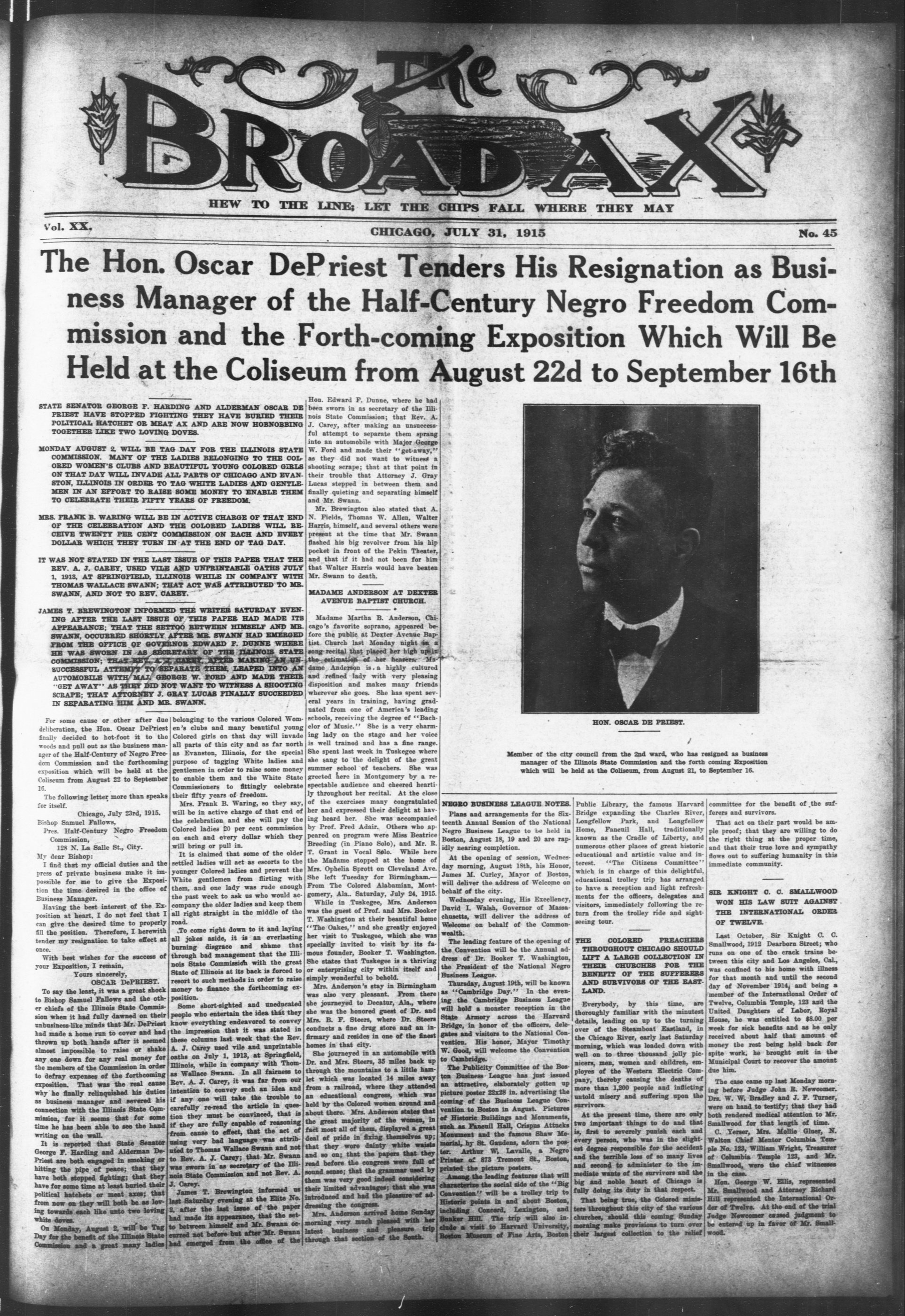
The Hon. Oscar DePriest Tenders His Resignation as Business Manager of the Half-Century Negro Freedom Commission and the Forth-coming Exposition Which Will Be Held at the Coliseum from August 22d to September 16th
STATE SENATOR GEORGE P. HARDING AND ALDERMAN OSCAR DE PRIEST HAVE STOPPED FIGHTING THEY HAVE BURIED THEIR POLITICAL HATCHET OR MEAT AX AND ARE NOW HOBNOBBING TOGETHER LIKE TWO LOVING DOVES.
MONDAY AUGUST 2, WILL BE TAG DAY FOR THE ILLINOIS STATE COMMISSION. MANY OF THE LADIES BELONGING TO THE COLORED WOMEN'S CLUBS AND BEAUTIFUL YOUNG COLORED GIRLS ON THAT DAY WILL INVADE ALL PARTS OF CHICAGO AND EVANSTON, ILLINOIS IN ORDER TO TAG WHITE LADIES AND GENTLEMEN IN AN EFFORT TO RAISE SOME MONEY TO ENABLE THEM TO CELEBRATE THEIR FIFTY YEARS OF FREEDOM.
MRS. PRANK B. WARING WILL BE IN ACTIVE CHARGE OF THAT END OF THE CELEBRATION AND THE COLORED LADIES WILL RECEIVE TWENTY PER CENT COMMISSION ON EACH AND EVERY DOLLAR WHICH THEY TURN IN AT THE END OF TAG DAY.
IT WAS NOT STATED IN THE LAST ISSUE OF THIS PAPER THAT THE REV. A. J. CAREY, USED VILE AND UNPRINTABLE OATHS JULY 1, 1913, AT SPRINGFIELD, ILLINOIS WHILE IN COMPANY WITH THOMAS WALLACE SWANN; THAT ACT WAS ATTRIBUTED TO MR. SWANN, AND NOT TO REV. CAREY.
JAMES T. BREWINGTON INFORMED THE WRITER SATURDAY EVENING AFTER THE LAST ISSUE OF THIS PAPER HAD MADE ITS APPEARANCE; THAT THE SETOO BETWEEN HIMSELF AND MR SWANN, OCCURRED SHORTLY AFTER MR SWANN HAD EMERGED FROM THE OFFICE OF GOVERNOR EDWARD F. DUNNE WHERE HE WAS SWORN IN AS SECRETARY OF THE ILLINOIS STATE COMMISSION; THAT NEW A. T. GARRY AFTER MAKING AN UNSUCCESSFUL ATTEMPT TO SEPARATE THEM, LEAPED INTO AN AUTOMOBILE WITH MAJ. GEORGE W. FORD AND MADE THEIR "GET AWAY" AS THEY DID NOT WANT TO WINNESS A SHOOTING SCRAPE; THAT ATTORNEY J. GRAY LUCAS FINALLY SUCCEEDED IN SEPARATING HIM AND MR. SWANN.
Vol. XX.
The Hon.ness Mass mission Held at
STATE SENATOR GEORGE P. HANE PRIEST HAVE STOPPED FIGHT POLITICAL HATCHET OR MEAN TOGETHER LIKE TWO LOVING
MONDAY AUGUST 2, WILL BE THE COMMISSION. MANY OF THE ORED WOMEN'S CLUBS AND B ON THAT DAY WILL INVade A STON, ILLINOIS IN ORDER TO MEN IN AN EFFORT TO RAIS TO CELEBRATE THEIR FIFTY.
MRS. PRANK B. WARING WILL BE OF THE CELEBRATION AND CEIVE TWENTY PER CENT OF DOLLAR WHICH THEY TURN
IT WAS NOT STATED IN THE LAST REV. A. J. CAREY, USED VILL 1, 1913, AT SPRINGFIELD, IL THOMAS WALLACE SWANN; T SWANN, AND NOT TO REV. C.
JAMES T. BREWINGTON INFORMING AFTER THE LAST ISSUE APPEARANCE; THAT THE SEV SWANN, OCCURRED SHORTLY, FROM THE OFFICE OF GOVER HE WAS SWORN IN AS SEC COMMISSION; THAT REV. A. SUCCESSFUL ATTEMPT TO BE AUTOMOBILE WITH MAJ. GE "GET AWAY" AS THEY DID N SCRAPE; THAT ATTORNEY J. IN SEPARATING HIM AND M
For some cause or other after due
deliberation, the Hon. Oscar DePriest
finally decided to hot-foot it to the
woods and pull out as the business man-
ager of the Half-Century of Negro Freed-
om Commission and the forthcoming
exposition which will be held at the
Coliseum from August 22 to September
16.
The following letter more than speaks
for itself.
Chicago, July 23rd, 1915.
Bishop Samuel Fallows,
Pres. Half-Century Negro Freedom
Commission,
128 N. La Salle St., City.
My dear Bishop:
I find that my official duties and the press of private business make it impossible for me to give the Exposition the time desired in the office of Business Manager.
Having the best interest of the Exposition at heart, I do not feel that I can give the desired time to properly fill the position. Therefore, I herewith tender my resignation to take effect at once.
With best wishes for the success of your Exposition, I remain,
Yours sincerely,
OSCAR DePRIEST.
To say the least, it was a great shock to Bishop Samuel Fallows and the other chiefs of the Illinois State Commission when it had fully dawned on their unbusiness-like minds that Mr. DePriest had made a home run to cover and had thrown up both hands after it seemed almost impossible to raise or shake any one down for any real money for the members of the Commission in order to defray expenses of the forthcoming exposition. That was the real cause why he finally relinquished his duties as business manager and severed his connection with the Illinois State Commission, for it seems that for some time he has been able to see the hand writing on the wall.
It is reported that State Senator George F. Harding and Alderman DePriest are both engaged in smoking or hitting the pipe of peace; that they have both stopped fighting; that they have for some time at least buried their political hatchets or meat axes; that from now on they will both be as loving towards each like unto two loving white doves.
On Monday, August 2, will be Tag Day for the benefit of the Illinois State Commission and a great many ladies
HEW TO THE LINE; LET THE CHIPS FALL WHERE THEY MAX
belonging to the various Colored Women's clubs and many beautiful young Colored girls on that day will invade all parts of this city and as far north as Evanston, Illinois, for the special purpose of tagging White ladies and gentlemen in order to raise some money to enable them and the White State Commissioners to fittingly celebrate their fifty years of freedom.
Mrs. Frank B. Waring, so they say, will be in active charge of that end of the celebration and she will pay the Colored ladies 20 per cent commission on each and every dollar which they will bring or pull in.
It is claimed that some of the older settled ladies will act as escorts to the younger Colored ladies and prevent the White gentlemen from flirting with them, and one lady was rude enough the past week to ask us who would accompany the older ladies and keep them all right straight in the middle of the road.
To come right down to it and laying all jokes aside, it is an everlasting burning disgrace and shame that through bad management that the Illinois State Commission with the great State of Illinois at its back is forced to resort to such methods in order to raise money to finance the forthcoming exposition.
Some short-sighted and uneducated people who entertain the idea that they know everything endeavored to convey the impression that it was stated in these columns last week that the Rev. A. J. Carey used vile and unprintable caths on July 1, 1913, at Springfield, Illinois, while in company with Thomas Wallace Swann. In all fairness to Rev. A. J. Carey, it was far from our intention to convey such an idea and if any one will take the trouble to carefully re-read the article in question they must be convinced, that is if they are fully capable of reasoning from cause to effect, that the act of using very bad language was attributed to Thomas Wallace Swann and not to Rev. A. J. Carey; that Mr. Swann was sworn in as secretary of the Illinois State Commission and not Rev. A. J. Carey.
James T. Brewington informed us last Saturday evening at the Elite No. 2. after the last issue of the paper had made its appearance, that the set to between himself and Mr. Swann occurred not before but after Mr. Swann had emerged from the office of the
CHICAGO, JULY 31, 1915
Hon. Edward F. Dunne, where he had been sworn in as secretary of the Illinois State Commission; that Rev. A. J. Carey, after making an unsuccessful attempt to separate them sprang into an automobile with Major George W. Ford and made their "get-away," as they did not want to witness a shooting scrape; that at that point in their trouble that Attorney J. Gray Lucas stepped in between them and finally quieting and separating himself and Mr. Swann.
Mr. Brewington also stated that A. N. Fields, Thomas W. Allen, Walter Harris, himself, and several others were present at the time that Mr. Swann flashed his big revolver from his hip pocket in front of the Pekin Theater, and that if it had not been for him that Walter Harris would have beaten Mr. Swann to death.
MADAME ANDERSON AT DEXTER
AVENUE BAPSTIST CHURCH.
Madame Martha B. Anderson, Chicago's favorite soprano, appeared before the public at Dexter Avenue Baptist Church last Monday night in a song recital that placed her high up in the estimation of her hearsers. Madame Anderson is, a highly cultured and refined lady with very pleasing disposition and makes many friends wherever she goes. She has spent several years in training, having graduated from one of America's leading schools, receiving the degree of "Bachelor of Music." She is a very charming lady on the stage and her voice is well trained and has a fine range. She spent last week in Tuskegee where she sang to the delight of the great summer school of teachers. She was greeted here in Montgomery by a respectable audience and cheered heartily throughout her recital. At the close of the exercises many congratulated her and expressed their delight at having heard her. She was accompanied by Prof. Fred Adair. Others who appeared on program were Miss Beatrice Breeding (in Piano Solo), and Mr. R. T. Grant in Vocal Solo. While here the Madame stopped at the home of Mrs. Ophelia Sprott on Cleveland Ave. She left Tuesday for Birmingham.—From The Colored Alabamian, Montgomery, Ala., Saturday, July 24, 1915.
While in Tuskegee, Mrs. Anderson was the guest of Prof. and Mrs. Booker T. Washington at their beautiful home "The Oakes," and she greatly enjoyed her visit to Tuskegee, which she was specially invited to visit by its famous founder, Booker T. Washington. She states that Tuskegee is a thriving or enterprising city within itself and simply wonderful to behold.
Mrs. Anderson's stay in Birmingham was also very pleasant. From there she journeyed to Decatur, Ala., where she was the honored guest of Dr. and Mrs. B. F. Steers, where Dr. Steers conducts a fine drug store and an infirmary and resides in one of the finest homes in that city.
She journeyed in an automobile with Dr. and Mrs. Steers, 35 miles back up through the mountains to a little hamlet which was located 14 miles away from a railroad, where they attended an educational congress, which was held by the Colored women around and about there. Mrs. Anderson states that the great majority of the women, in fact most all of them, displayed a great deal of pride in fixing themselves up; that they wore dainty white waists and so on; that the papers that they read before the congress were full of sound sense; that the grammar used by them was very good indeed considering their limited advantages; that she was introduced and had the pleasure of addressing the congress.
Mrs. Anderson arrived home Sunday morning very much pleased with her latest business and pleasure trip through that section of the South.
J.
Member of the city council from the 2nd ward, who has resigned as business manager of the Illinois State Commission and the forth coming Exposition which will be held at the Coliseum, from August 21, to September 16.
Plans and arrangements for the Sixteenth Annual Session of the National Negro Business League to be held in Boston, August 18, 19 and 20 are rapidly nearing completion.
At the opening of session, Wednesday morning, August 18th, his Honor, James M. Curley, Mayor of Boston, will deliver the address of Welcome on behalf of the city.
Wednesday evening, His Excellency, David I. Walsh, Governor of Massachusetts, will deliver the address of Welcome on behalf of the Commonwealth.
The leading feature of the opening of the Convention will be the Annual address of Dr. Booker T. Washington, the President of the National Negro Business League.
Thursday, August 19th, will be known as "Cambridge Day." In the evening the Cambridge Business League will hold a monster reception in the State Armory across the Harvard Bridge, in honor of the officers, delegates and visitors to the National Convention. His honor, Mayor Timothy W. Good, will welcome the Convention to Cambridge.
The Publicity Committee of the Boston Business League has just issued an attractive, elaborately gotten up picture poster 22x28 in. advertising the coming of the Business League Convention to Boston in August. Pictures of Historic Buildings and Monuments, such as Faneuil Hall, Crispus Attacks Monument and the famous Shaw Memorial, by St. Gaudens, adorn the poster. Arthur W. Lavalle, a Negro Printer of 873 Tremont St., Boston, printed the picture posters.
Among the leading features that will characterize the social side of the "Big Convention" will be a trolley trip to Historic points in and about Boston, including Concord, Lexington, and Bunker Hill. The trip will also include a visit to Harvard University, Boston Museum of Fine Arts, Boston
Public Library, the famous Harvard Bridge expanding the Charles River, Longfellow Park, and Longfellow Home, Faneuil Hall, traditionally known as the Cradle of Liberty, and numerous other places of great historic educational and artistic value and interest. "The Citizens Committee" which is in charge of this delightful, educational trolley trip has arranged to have a reception and light refreshments for the officers, delegates and visitors, immediately following the return from the trolley ride and sightseeing tour.
THE COLORED PREACHEES THROUGHOUT CHICAGO SHOULD LIFT A LARGE COLLECTION IN THEIR CHURCHES FOR THE BENEFIT OF THE SUFFERERS AND SURVIVORS OF THE EAST-LAND.
Everybody, by this time, are thoroughly familiar with the minutest details, leading on up to the turning over of the Steamboat Eastland, in the Chicago River, early last Saturday morning, which was loaded down with well on to three thousand jolly picnics, men, women and children, employees of the Western Electric Company, thereby causing the deaths of more than 1,200 people and inflicting untold misery and suffering upon the survivors.
At the present time, there are only two important things to do and that is, first to severely punish each and every person, who was in the slightest degree responsible for the accident and the terrible loss of so many lives and second to administer to the immediate wants of the survivors and the big and noble heart of Chicago is fully doing its duty in that respect.
That being true, the Colored ministers throughout this city of the various churches, should this coming Sunday morning make provisions to turn over their largest collection to the relief
No.45
on as Busi-
dom Com-
h Will Be
mber 16th
resigned as business
coming Exposition
September 16.
committee for the benefit of the sufferers and survivors. That act on their part would be ample proof; that they are willing to do the right thing at the proper time; and that their true love and sympathy flows out to suffering humanity in this immediate community.
SIR KNIGHT C. C. SMALLWOOD
WON HIS LAW SUIT AGAINST
THE INTERNATIONAL ORDER
OF TWELVE.
Last October, Sir Knight C. C. Smallwood, 1912 Dearborn Street; who runs on one of the crack trains between this city and Los Angeles, Cal., was confined to his home with illness for that month and until the second day of November 1914, and being a member of the International Order of Twelve, Columbia Temple, 123 and the United Daughters of Labor, Royal House, he was entitled to $8.00 per week for sick benefits and as he only received about half that amount of money the rest being held back for spite work; he brought suit in the Municipal Court to recover the amount due him.
The case came up last Monday morning before Judge John R. Newcomer. Drs. W. W. Bradley and J. F. Turner, were on hand to testify; that they had both rendered medical attention to Mr. Smallwood for that length of time.
C. Yerser, Mrs. Mollie Gluer, N. Walton Chief Mentor Columbia Temple No. 123, William Wright, Treasurer of Columbia Temple 123, and Mr. Smallwood, were the chief witnesses in the case.
Hon. George W. Ellis, represented Mr. Smallwood and Attorney Richard Hill represented the International Order of Twelve. At the end of the trial Judge Newcomer caused judgment to be entered up in favor of Mr. Smallwood.
PAGE TWO
W.
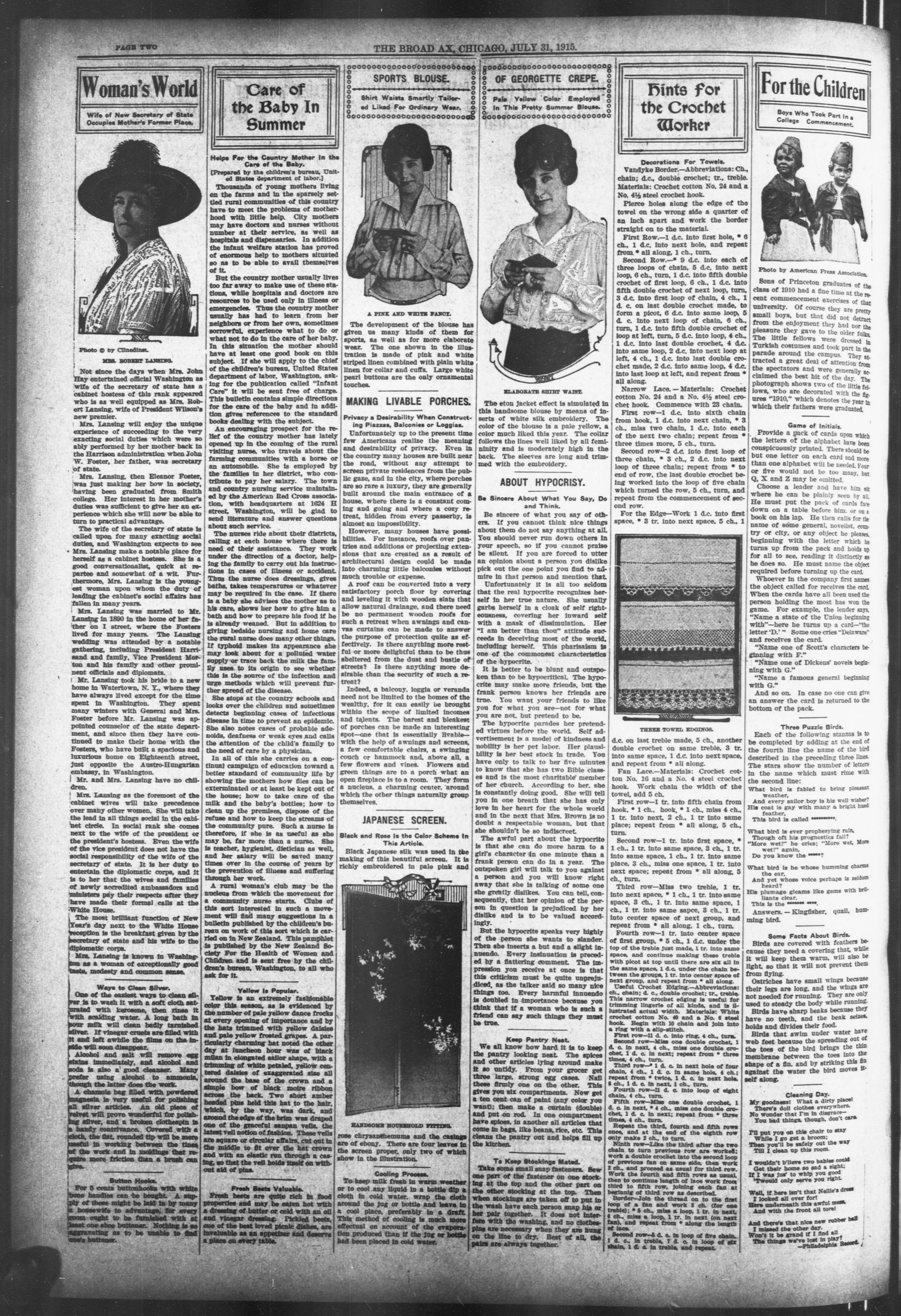
Not since the days when Mrs. John Hay entertained official Washington as wife of the secretary of state has a cabinet hostess of this rank appeared who is as well equipped as Mrs. Robert Lansing, wife of President Wilson's new premier.
Mrs. Lansing will enjoy the unique experience of succeeding to the very exacting social duties which were so ably performed by her mother back in the Harrison administration when John W. Foster, her father, was secretary of state.
Mrs. Lansing, then Eleanor Foster, was just making her bow in society, having been graduated from Smith college. Her interest in her mother's duties was sufficient to give her an experience which she will now be able to turn to practical advantage.
The wife of the secretary of state is called upon for many exacting social duties, and Washington expects to see Mrs. Lansing make a notable place for herself as a cabinet hostess. She is a good conversationist, quick at partee and somewhat of a wit. Furthermore, Mrs. Lansing is the youngest woman upon whom the duty of leading the cabinet's social affairs has fallen in many years.
Mrs. Lansing was married to Mr. Lansing in 1890 in the home of her father on I street, where the Fosters lived for many years. The Lansing wedding was attended by a notable gathering, including President Harris and family, Vice President Morton and his family and other prominent officials and diplomats.
Mr. Lansing took his bride to a new home in Watertown, N. Y., where they have always lived except for the time spent in Washington. They spent many winters with General and Mrs. Foster before Mr. Lansing was appointed counselor of the state department, and since then they have continued to make their home with the Fosters, who have built a spacious and luxurious home on Eighteenth street, just opposite the Austro-Hungarian embassy, in Washington. Mr. and Mrs. Lansing have no children.
Mrs. Lansing as the foremost of the cabinet wives will take precedence over many other women. She will take the lead in all things social in the cabinet circle. In social rank she comes next to the wife of the president or the president's hostess. Even the wife of the vice president does not have the social responsibility of the wife of the secretary of state. It is her duty to entertain the diplomatic corps, and it is to her that the wives and families of newly accredited ambassadors and ministers pay their respects after they have made their formal calls at the White House.
The most brilliant function of New Year's day next to the White House reception is the breakfast given by the secretary of state and his wife to the diplomatic corps.
Mrs. Lansing is known in Washington as a woman of exceptionally good taste, modesty and common sense.
Ways to Clean Silver
Ways to Clean Silver.
One of the easiest ways to clean silver is to wash it with a soft cloth saturated with kerosene, then rinse it with scalding water. A long bath in pour milk will clean badly tarnished silver. If vinegar cruets are filled with it and left awhile the films on the inside will soon disappear.
Alcohol and salt will remove egg stains immediately, and alcohol and soda is also a good cleanser. Many prefer using alcohol to ammonia, though the latter does the work.
A chamois bag filled with powdered magnesia is very useful for polishing all silver articles. An old piece of velvet will prove wonderful for polishing silver, and a broken clothesspin is a handy contrivance. Covered with a cloth, the flat, rounded tip will be more useful in working between the times of the work and in moldings that require more friction than a brush can give.
For 5 cents buttonhooks with white bone handles can be bought. A supply of these might be laid in by many a housewife to advantage, for every room ought to be furnished with at least one shoe buttoner. Nothing is so aggravating as to be unable to find a buttoner.
Care of the Baby In Summer
Helps For the Country Mother In the Care of the Baby.
[Prepared by the children's bureau, United States department of labor.]
Thousands of young mothers living on the farms and in the sparsely settled rural communities of this country have to meet the problems of motherhood with little help. City mothers may have doctors and nurses without number at their service, as well as hospitals and dispensaries. In addition the infant welfare station has proved of enormous help to mothers situated so as to be able to avail themselves of it.
But the country mother usually lives too far away to make use of these stations, while hospitals and doctors are resources to be used only in illness or emergencies. Thus the country mother usually has had to learn from her neighbors or from her own, sometimes sorrowful, experience what to do or what not to do in the care of her baby. In this situation the mother should have at least one good book on this subject. If she will apply to the chief of the children's bureau, United States department of labor, Washington, asking for the publication called "Infant Care" it will be sent free of charge. This bulletin contains simple directions for the care of the baby and in addition gives references to the standard books dealing with the subject.
An encouraging prospect for the relief of the country mother has lately opened up in the coming of the rural visiting nurse, who travels about the farming communities with a horse or an automobile. She is employed by the families in her district, who contribute to pay her salary. The town and country nursing service maintained by the American Red Cross association, with headquarters at 1624 H street, Washington, will be glad to send literature and answer questions about such service.
The nurses ride about their districts, calling at each house where there is need of their assistance. They work under the direction of a doctor, helping the family to carry out his instructions in cases of illness or accident. Thus the nurse does dressings, gives baths, takes temperatures or whatever may be required in the case. If there is a baby she advises the mother as to his care, shows her how to give him a bath and how to prepare his food if he is already weaned. But in addition to giving bedside nursing and home care the rural nurse does many other things. If typhoid makes its appearance she may look about for a polluted water supply or trace back the milk the family uses. to its origin to see whether this is the source of the infection and urge methods which will prevent further spread of the disease.
She stops at the country schools and looks over the children and sometimes detects beginning cases of infectious disease in time to prevent an epidemic. She also notes cases of probable adenoids, deafness or weak eyes and calls the attention of the child's family to the need of care by a physician. In all of this she carries on a continual campaign of education toward a better standard of community life by showing the mothers how flies can be exterminated or at least be kept out of the house; how to take care of the milk and the baby's bottles; how to clean up the premises, dispose of the refuse and how to keep the streams of the community pure. Such a nurse is therefore, if she is as useful as she may be, far more than a nurse. She is teacher, hygienist, dietician as well, and her salary will be saved many times over in the course of years by the prevention of illness and suffering through her work.
A rural woman's club may be the nucleus from which the movement for a community nurse starts. Clubs of this sort interested in such a movement will find many suggestions in a bulletin published by the children's bureau on work of this sort which is carried on in New Zealand. This pamphlet is published by the New Zealand Society For the Health of Women and Children and is sent free by the children's bureau, Washington, to all who ask for it.
Yellow Is Popular.
Yellow is an extremely fashionable color this season, as is evidenced by the number of pale yellow dance frocks at every opening of importance and by the hats trimmed with yellow daisies and pale yellow frosted grapes. A particularly charming hat noted the other day at lunchon hour was of black milan in elongated sailor shape, with a trimming of white petaled, yellow centered daisies of exaggerated size all around the base of the crown and a simple bow of black moire ribbon across the back. Two short amber headed pins held this hat to the hair, which, by the way, was dark, and around the edge of the brim was draped one of the graceful sanpan vells, the latest vell notion of fashion. These vells are square or circular affairs, cut out in the middle to fit over the hat crown and with an elastic run through a casing, so that the vell holds itself on without aid of pins.
Fresh Beets Valuable.
Fresh beets are quite rich in food properties and may be eaten hot with a dressing of butter or cold with an oil and vinegar dressing. Pickled beets, one of the best loved picnic dishes, are invaluable as an appetizer and deserve a place on every table.
THE BROAD AX, CHICAGO, JULY 31, 1915.
SPORTS BLOUSE
Shirt Waists Smartly Tailor-
ed Liked For Ordinary Wear.
A
A PINK AND WHITE FANOY.
The development of the blouse has given us many kinds of them for sports, as well as for more elaborate wear. The one shown in the illustration is made of pink and white striped linen combined with plain white linen for collar and cuffs. Large white pearl buttons are the only ornamental touches.
MAKING LIVABLE PORCHES.
Privacy a Desirability When Constructing Piazzas, Balconies or Loggias.
Unfortunately up to the present time few Americans realize the meaning and desirability of privacy. Even in the country many houses are built near the road, without any attempt to screen private residences from the public gaze, and in the city, where porches are so rare a luxury, they are generally built around the main entrance of a house, where there is a constant coming and going and where a cozy retreat, hidden from every passerby, is almost an impossibility.
However, many houses have possibilities. For instance, roofs over patriies and additions or projecting extensions that are created as a result of architectural design could be made into charming little balconies without much trouble or expense.
A roof can be converted into a very satisfactory porch floor by covering and leveling it with wooden slats that allow natural drainage, and there need be no permanent wooden roofs for such a retreat when awnings and canvas curtains can be made to answer the purpose of protection quite as effectively. Is there anything more restful or more delightful than to be thus sheltered from the dust and bustle of streets? Is there anything more desirable than the security of such a retreat?
Indeed, a balcony, loggia or veranda need not be limited to the homes of the wealthy, for it can easily be brought within the scope of limited incomes and talents. The barest and bleakest of porches can be made an interesting spot—one that is essentially Ivable—with the help of awnings and screens, a few comfortable chairs, a swinging couch or hammock and, above all, a few flowers and vines. Flowers and green things are to a porch what an open fireplace is to a room. They form a nucleus, a charming center, 'around which the other things naturally group themselves.
JAPANESE SCREEN.
Black and Rose Is the Color Scheme In This Article.
Black Japanese silk was used in the making of this beautiful screen. It is richly embroidered in pale pink and
1
HANDSOME HOUSEHOLD PETTING.
rose chrysanchemums and the casings are of ebony. There are four leaves in the screen proper, only two of which show in the illustration.
Cooling Process.
To keep milk fresh in warm weather or to cool any liquid in a bottle dip a cloth in cold water, wrap the cloth around the jug or bottle and leave in a cool place, preferably in a draft.
This method of cooling is much more effectual on account of the evaporation produced than if the jug or bottle had been placed in cold water.
OF GEORGETTE CREPE.
Pale Yellow Color Employed
In This Pretty Summer Blouse.
WEST
ELABORATE SHIRT WAIST
The eton jacket effect is simulated in this handsome blouse by means of inserts of white silk embroidery. The color of the blouse is a pale yellow, a color much liked this year. The collar follows the lines well liked by all femininity and is moderately high in the back. The sleeves are long and trimmed with the embroidery.
ABOUT HYPOCRISY.
Be Sincere About What You Say, Do and Think.
Be sincere of what you say of others. If you cannot think nice things about them do not say anything at all. You should never run down others in your speech, so if you cannot praise be silent. If you are forced to utter an opinion about a person you dislike pick out the one point you find to admire in that person and mention that. Unfortunately it is all too seldom that the real hypocrite recognizes herself in her true nature. She usually garbs herself in a cloak of self righteousness, covering her inward self with a mask of dissimulation. Her "I am better than thou" attitude succeeds in deceiving most of the world, including herself. This pharisaism is one of the commonest characteristics of the hypocrite.
It is better to be blunt and outspoken than to be hypocritical. The hypocrite may make more friends, but the frank person knows her friends are true. You want your friends to like you for what you are—not for what you are not, but pretend to be.
The hypocrite parades her pretended virtues before the world. Self advertisement is a model of kindness and nobility is her pet labor. Her plausibility is her best stock in trade. You have only to talk to her five minutes to know that she has two Bible classes and is the most charitable member of her church. According to her, she is constantly doing good. She will tell you in one breath that she has only love in her heart for the whole world and in the next that Mrs. Brown is no doubt a respectable woman, but that she shouldn't be so indiscreet.
The awful part about the hypocrite is that she can do more harm to a girl's character in one minute than a frank person can do in a year. The outspoken girl will talk to you against a person and you will know right away that she is talking of some one she greatly dislikes. You can tell, consequently, that her opinion of the person in question is prejudiced by her dislike and is to be valued accordingly.
But the hypocrite speaks very highly of the person she wants to slander. Then she inserts a but and a slight inuendo. Every insinuation is preceded by a fattering comment. The impression you receive at once is that this criticism must be quite unprejudiced, as the talker said so many nice things too. Every harmful inuendo is doubled in importance because you think that if a woman who is such a friend can say such things they must be true.
Keep Pantry Neat.
We all know how hard it is to keep the pantry looking neat. The spices and other articles lying around make it so untidy. From your grocer get three large, strong egg cases. Nail these firmly one on the other. This gives you six compartments. Now get a ten cent can of paint (any color you want); then make a curtain (double) and put on rod. In one compartment have spices, in another all articles that come in bags, like beans, rice, etc. This cleans the pantry out and helps fill up the kitchen.
To Keep Stockings Mated.
Take some small snap fasteners. Sew one part of the fastener on one stocking at the top and the other part on the other stocking at the top. Then when stockings are taken off to put in the wash have each person snap his or her pair together. It does not interfere with the washing, and no clothesplains are necessary when they are hung on the line to dry. Best of all, the pairs are always together.
Hints for the Crochet Worker
Decorations For Towels.
Vandyke Border.—Abbreviations: Ch., chain; d.c., double crochet; tr., treble.
Materials: Crochet cotton No. 24 and a No. 4½ steel crochet hook.
Pierce holes along the edge of the towel on the wrong side a quarter of an inch apart and work the border straight on to the material.
First Row.—1 d.c. into first hole, * 6 ch., 1 d.c. into next hole, and repeat from * all along, 1 ch., turn.
Second Row.—* 9 d.c. into each of three loops of chain, 5 d.c. into next loop, 6 ch., turn, 1 d.c. into fifth double crochet of first loop, 6 ch., 1 d.c. into fifth double crochet of next loop, turn, 3 d.c. into first loop of chain, 4 ch., 1 d.c. on last double crochet made, to form a picot, 6 d.c. into same loop, 5 d.c. into next loop of chain, 5 ch., turn, 1 d.c. into fifth double crochet of loop at left, turn, 5 d.c. into loop, 4 ch., 1 d.c. into last double crochet, 4 d.c. into same loop, 2 d.c. into next loop at left, 4 ch., 1 d.c. into last double crochet made, 2 d.c. into same loop, 4 d.c. into last loop at left, and repeat from * all along.
Narrow Lace.—Materials: Crochet cotton No. 24 and a No. 4½ steel crochet hook. Commence with 23 chain.
First row—1 d.c. into sixth chain from hook, 1 d.c. into next chain, * 3 ch., miss two chain, 1 d.c. into each of the next two chain; repeat from * three times more, 5 ch., turn.
Second row—2 d.c. into first loop of three chain, * 3 ch., 2 d.c. into next loop of three chain; repeat from * to end of row, the last double crochet being worked into the loop of five chain which turned the row, 5 ch., turn, and repeat from the commencement of second row.
For the Edge—Work 1 d.c. into first space, * 3 tr. into next space, 5 ch., 1
```markdown
```
THREE TOWEL EDGINGS.
d.c. on last treble made, 5 ch., another double crochet on same treble, 3 tr. into same space, 1 d.c. into next space, and repeat from * all along.
Fan Lace—Materials: Crochet cotton No. 16 and a No. 4 steel crochet hook. Work chain the width of the towel, add 5 ch.
First row—1 tr. into fifth chain from hook, * 1 ch., hook, * 1 ch., miss 4 ch., 1 tr. into next, 2 ch., 1 tr into same place; repeat from * all along, 5 ch., turn.
Second row—1 tr. into first space, * 1 ch., 1 tr. into same space, 3 ch., 1 tr. into same space, 1 ch., 1 tr. into same place, 3 ch., miss one space, 1 tr. into next space; repeat from * all along, 5 ch. turn.
Third row—Miss two treble, 1 tr, into next space, * 1 ch., 1 tr. into same space, 3 ch., 1 tr. into same space, 1 ch., 1 tr. into same space, 3 ch., 1 tr. into center space of next group, and repeat from * all along, 1 ch., turn.
Fourth row—1 tr. into center space of first group, * 5 ch., 1 d.c. under the top of the treble just made, 1 tr. into same top, and continue making these treble with plicat at up until there are six all in the same space, 1 d.c. under the chain between the group, 1 tr. into center space of next group, and repeat from * all along.
Useful Crochet Edging—Abbreviations: ch, chain; d, c, double crochet; tr, treble. This narrow crochet edging is useful for trimming lingerie of all kinds, and is illustrated actual width. Materials: White crochet cotton No. 40 and a No. 6 steel hook. Begin with 10 chain and join into a ring with a slip-stitch.
First row—11 d. c into ring, 4 ch, turn.
Second row—Miss one double crochet, 1 d. c in next; miss one double crochet, 1 d. c in next; repeat from * three times, 4 ch, turn.
Third row—1 d. c in next hole of four chain, 4 ch. 1 d. c in same hole, 4 ch; repeat from * twice, 1 d. c in next hole, 8 ch. 1 d. c in next, 1 ch, turn.
Fourth row—11 d. c into loop of eight chain, 4 ch, turn.
第五 row—Miss one double crochet, 1 d. c in next; * 4 ch, miss one double crochet, 1 d. c in next; repeat from * three times, 4 ch, turn.
Repeat the third, fourth and fifth rows once, and at the end of the eighth row only make 2 ch, to turn.
Ninth row--Like the third after the two chain to turn previous row are worked; work a double crochet into the second loop of previous fan on same side, then work work a double crochet usual for third row. Work the fourth and sixth row, then to continue length of lace work from third to fifth row, joining each fan at beginning of third row as described.
Border--Join the thread on to the first loop of a fan and work 3 ch. (for one treble); * 5 ch., miss a loop, 1 tr. in next, 5 ch., miss a loop, 1 tr. in next (on next and repeat from * along the length of lace).
Second row-5 d. c. in loop of five chain, 1 d. c., in treble, 7 d. c. in loop of six chain, 1 d. c. in treble, and repeat.
For the Children
Boys Who Took Part in a
College Commencement.
Photo by American Press Association.
Sons of Princeton graduates of the class of 1910 had a fine time at the recent commencement exercises of that university. Of course they are pretty small boys, but that did not detract from the enjoyment they had nor the pleasure they gave to the older folks. The little fellows were dressed in Turkish costumes and took part in the parade around the campus. They attracted a great deal of attention from the spectators and were generally acclaimed the best hit of the day. The photograph shows two of the little fellows, who are decorated with the figures "1910," which denotes the year in which their fathers were graduated.
Game of Initials
Provide a pack of cards upon which the letters of the alphabet have been conspicuously printed. There should be but one letter on each card and more than one alphabet will be needed. Four or five would not be too many, but Q, X and Z may be omitted.
Choose a leader and have him sit where he can be plainly seen by all. He must put the pack of cards fare down on a table before him, or on a book on his lap. He then calls for the name of some general, novelist, country or city, or any object he pleases, beginning with the letter which he turns up from the pack and holds up for all to see, reading it distinctly as he does so. He must name the object required before turning up the card.
Whoever in the company first names the object called for receives the card. When the cards have all been used the person holding the most has won the game. For example, the lender says, "Name a state of the Union beginning with"—here he turns up a card—"the letter D.'." Some one cries "Delaware" and receives the card. "Name one of Scott's characters beginning with F." "Name one of Dickens' novels beginning with G." "Name a famous general beginning with G." And so on. In case no one can give an answer the card is returned to the bottom of the pack.
Three Puzzle Birds.
Each of the following stanzas is to be completed by adding at the end of the fourth line the name of the bird described in the preceding three lines. The stars show the number of letters in the name which must rime with the second line: What bird is fabled to bring pleasant weather.
And every sailor boy is his well wisher?
His coat is gay with many a bright bred
feather,
This bird is called ********.
What bird is ever prophesying rain?
Though of his prognostics fail?
"More wet than he cries; "More wet, More
arid."
Do you know the *****?
What bird is he whose humming charms
the car.
And yet whose voice perhaps is seldom heard?
His plumage gleams like gems with brilliants, clear.
This is the ******** ****.
Answers. — Kingfisher, quail, hummingbird.
Birds are covered with feathers because they need a covering that, while it will keep them warm, will also be light so that it will not prevent them from flying. Ostriches have small wings because their legs are long, and the wings are not needed for running. They are only used to steady the body while running. Birds have sharp beaks because they have no teeth, and the beak seizes, holds and divides their food. Birds that swim under water have web feet because the spreading out of the toes of the bird brings the thin membrane between the toes into the shape of a fin, and by striking this fin against the water the bird moves itself along.
My goodness! What a dirty place!
There's doll clothes everywhere.
No wonder that I'm in disgrace—
You bad things, though, don't care
I'll put you on this chair to stay
While I go get a broom;
Then you'll be safety out the way
Till I clean up this room.
I wouldn't b'llieve two bables could
Get their home so a sight a sight;
If I was jus' to whip you good
Twould only serve you right.
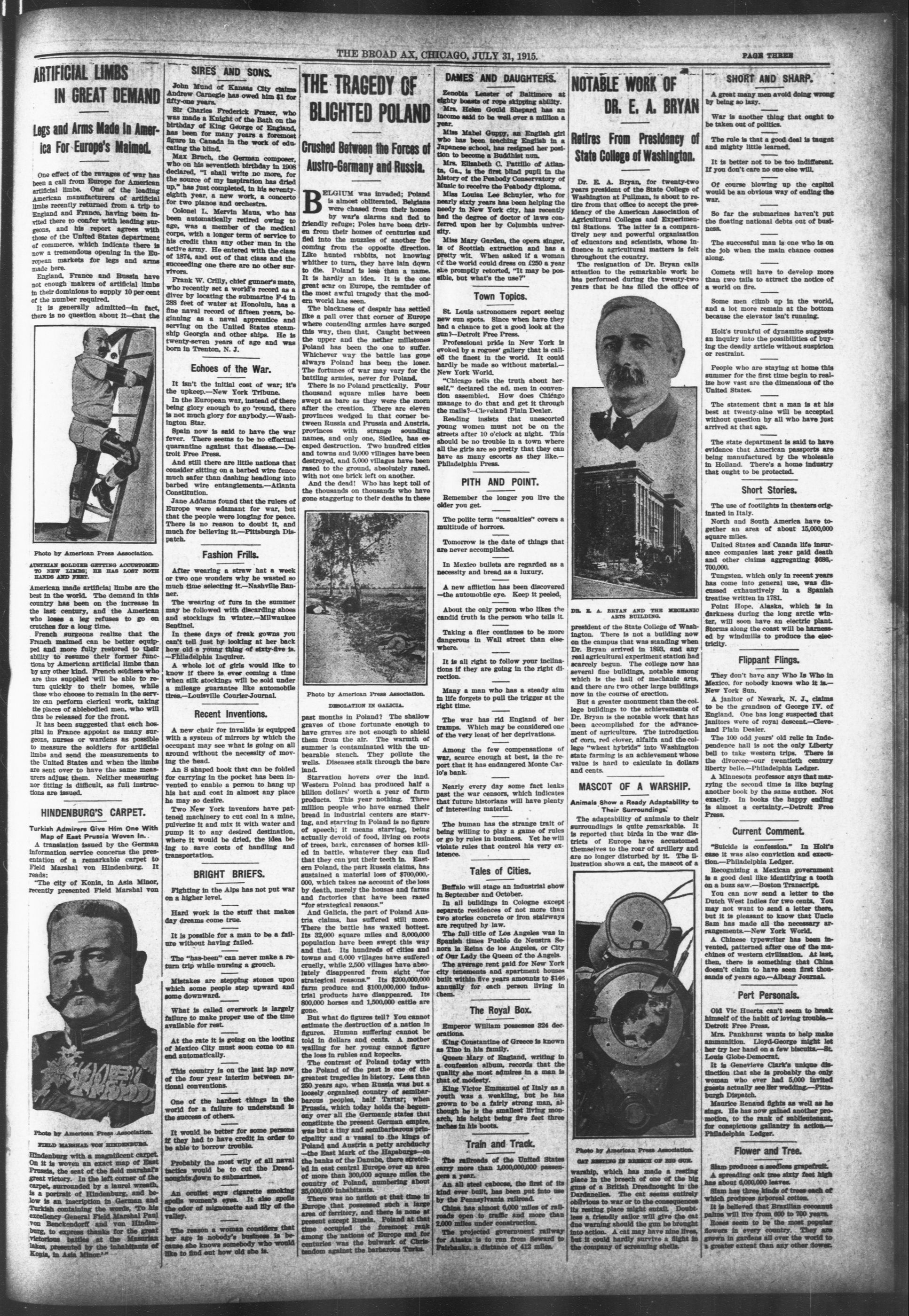
One effect of the ravages of war has been a call from Europe for American artificial limbs. One of the leading American manufacturers of artificial limbs recently returned from a trip to England and France, having been invited there to confer with leading surgeons, and his report agrees with those of the United States department of commerce, which indicate there is now a tremendous opening in the European markets for legs and arms made here. England, France and Russia have not enough makers of artificial limbs in their dominions to supply 10 per cent of the number required. It is generally admitted—in fact, there is no question about it—that the
10
Photo by American Press Association.
AUSTRIAN SOLDIER GETTING ACCUSTOMED TO NEW LIMBS; HE HAS LOST BOTH HANDS AND FEET.
American made artificial limbs are the best in the world. The demand in this country has been on the increase in the last century, and the American who loses a leg refuses to go on crutches for a long time.
French surgeons realize that the French maimed can be better equipped and more fully restored to their ability to resume their former functions by American artificial limbs than by any other kind. French soldiers who are thus supplied will be able to return quickly to their homes, while those who choose to remain in the service can perform clerical work, taking the places of ablebodied men, who will thus be released for the front.
It has been suggested that each hospital in France appoint as many surgeons, nurses or wardens as possible to measure the soldiers for artificial limbs and send the measurements to the United States and when the limbs are sent over to have the same measurers adjust them. Neither measuring nor fitting is difficult, as full instructions are issued.
HINDENBURG'S CARPET.
Turkish Admirals Give Him One Man of East Prussia Waven In.
Map of East Prussia Woven in.
A translation issued by the German information service concerns the presentation of a remarkable carpet to Field Marshal von Hindenburg. It reads:
"The city of Konia, in Asia Minor, recently presented Field Marshal von
Photo by American Press Association
WILD MARSHAL VON HINDENBURG.
Hindenburg with a magnificent carpet.
On it is woven an exact map of East Prussia, the seat of the field marshal's great victory. In the left corner of the carpet, surrounded by a laurel wreath, is a portrait of Hindenburg, and below is an inscription in German and Turkish containing the words, "To his excellency General Field Marshal Paul von Benckendorf and von Hindenburg, to express thanks for the great victorious battles at the Masurian lakes, presented by the inhabitants of Könia, in Asia Minor."
SIRES AND SONS
John Mund of Kansas City claims Andrew Carnegie has owed him $1 for fifty-one years.
Sir Charles Frederick Fraser, who was made a Knight of the Bath on the birthday of King George of England, has been for many years a foremost figure in Canada in the work of educating the blind.
Max Bruch, the German composer, who on his seventieth birthday in 1908 declared, "I shall write no more, for the source of my inspiration has dried up," has just completed, in his seventeenth year, a new work, a concerto for two pianos and orchestra.
Colonel L. Mervin Maus, who has been automatically retired owing to age, was a member of the medical corps, with a longer term of service to his credit than any other man in the active army. He entered with the class of 1874, and out of that class and the succeeding one there are no other survivors.
Frank W. Crilly, chief gunner's mate, who recently set a world's record as a diver by locating the submarine F-4 in 288 feet of water at Honolulu, has a fine naval record of fifteen years, beginning as a naval apprentice and serving on the United States steamship Georgia and other ships. He is twenty-seven years of age and was born in Trenton, N. J.
Echoes of the War.
It isn't the initial cost of war; it's the upkeep.—New York Tribune.
In the European war, instead of there being glory enough to go 'round, there is not much glory for anybody.—Washington Star.
Spain now is said to have the war fever. There seems to be no effectual quarantine against that disease.—Detroit Free Press.
And still there are little nations that consider sitting on a barbed w fence much safer than dashing headlong into barbed wire entanglements.—Atlanta Constitution.
Jane Addams found that the rulers of Europe were adamant for war, but that the people were longing for peace. There is no reason to doubt it, and much for believing it.—Pittsburgh Dispatch.
Fashion Frills.
After wearing a straw hat a week or two one wonders why he wasted so much time selecting it.—Nashville Banner.
The wearing of furs in the summer may be followed with discarding shoes and stockings in winter.—Milwaukee Sentinel.
In these days of freak gowns you can't tell just by looking at her back how old a young thing of sixty-five is.—Philadelphia Inquirer.
A whole lot of girls would like to know if there is ever coming a time when silk stockings will be sold under a mileage guarantee like automobile tires.—Louisville Courrier-Journal.
Recent Inventions.
A new chair for invalids is equipped with a system of mirrors by which the occupant may see what is going on all around without the necessity of moving the head. An S shaped hook that can be folded for carrying in the pocket has been invented to enable a person to hang up his hat and coat in almost any place he may so desire. Two New York inventors have patterned machinery to cut coal in a mine, pulverize it and mix it with water and pump it to any desired destination, where it would be dried, the idea being to save costs of handling and transportation.
BRIGHT BRIEFS.
Fighting in the Alps has not put war on a higher level.
Hard work is the stuff that makes day dreams come true.
It is possible for a man to be a failure without having failed.
The "has-been" can never make a return trip while nursing a grouch.
Mistakes are stepping stones upon which some people step upward and some downward.
What is called overwork is largely failure to make proper use of the time available for rest.
At the rate it is going on the looting of Mexico City must soon come to an end automatically.
This country is on the last lap now of the four year interim between national conventions.
One of the hardest things in the world for a failure to understand is the success of others.
It would be better for some persons if they had to have credit in order to be able to borrow trouble.
Probably the most wily of all naval tactics would be to cut the Dreadnoughts down to submarines.
An oculist says cigarette smoking spoils women's eyes. It also spoils the odor of mignonette and lily of the valley.
The reason a woman considers that her age is nobody's business is because she knows somebody who would like to find out how old she is.
THE BROAD AX, CHICAGO, JULY 31, 1915.
THE TRAGEDY OF BLIGHTED POLAND
Crushed Between the Forces of Austro-Germany and Russia.
BELGIUM was invaded; Poland is almost obliterated. Belgians were chased from their homes by war's alarms and fled to friendly refuge; Poles have been driven from their homes of centuries and fled into the muzzles of another foe coming from the opposite direction. Like hunted rabbits, not knowing whither to turn, they have lain down to die. Poland is less than a name. It is hardly an idea. It is the one great scar on Europe, the reminder of the most awful tragedy that the modern world has seen.
The blackness of despair has settled like a pall over that corner of Europe where contending armies have surged this way, then that. Caught between the upper and the nether millstones Poland has been the one to suffer. Whichever way the battle has gone always Poland has been the loser. The fortunes of war may vary for the battling armies, never for Poland. There is no Poland practically. Four thousand square miles have been swept as bare as they were the morn after the creation. There are eleven provinces wedged in that corner between Russia and Prussia and Austria, provinces with strange sounding names, and only one, Siedlce, has escaped destruction. Two hundred cities and towns and 9,000 villages have been destroyed, and 5,000 villages have been razed to the ground, absolutely razed, with not one brick left on another.
And the dead! Who has kept toll of the thousands on thousands who have gone staggering to their deaths in these
Photo by American Press Association.
DESBOLATION IN GALICIA.
past months in Poland? The shallow graves of those fortunate enough to have graves are not enough to shield them from the air. The warmth of summer is contaminated with the unbearable stench. They pollute the wells. Diseases stalk through the bare land.
Starvation hovers over the land. Western Poland has produced half a billion dollars' worth a year of farm products. This year nothing. Three million people who have earned their bread in industrial centers are starving, and starving in Poland is no figure of speech; it means starving, being actually devoid of food, living on roots of trees, bark, carcasses of horses killed in battle, whatever they can find that they can put their teeth in. Eastern Poland, the part Russia claims, has sustained a material loss of $700,000,000, which takes no account of the loss by death, merely the houses and farms and factories that have been razed "for strategic reasons."
And Galicia, the part of Poland Austria claims, has suffered still more. There the battle has waxed hottest. Its 32,000 square miles and 8,000,000 population have been swept this way and that. Its hundreds of cities and towns and 6,000 villages have suffered cruelly, while 2,500 villages have absolutely disappeared from sight "for strategic reasons." Its $200,000,000 farm produce and $110,000,000 industrial products have disappeared. Its 800,000 horses and 1,500,000 cattle are gone.
But what do figures tell? You cannot estimate the destruction of a nation in figures. Human suffering cannot be told in dollars and cents. A mother wailing for her young cannot figure the loss in rubles and kopecks.
The contrast of Poland today with the Poland of the past is one of the greatest tragedies in history. Less than 250 years ago, when Russia was but a loosely organized country of semibarbarous peoples, half Tartar; when Prussia, which today holds the hegemony over all the Germanic states that constitute the present German empire, was but a tiny and semibarbarous principality and a vassal to the kings of Poland and Anstria a petty archduchy—the East Mark of the Hapaburgs—on the banks of the Danube, there stretched in east central Europe over an area of more than 300,000 square miles the country of Poland, numbering about 35,000,000 inhabitants.
There was no nation at that time in Europe that possessed such a large area of territory, and there is none at present except Rusada. Poland at that time occupied the foremost rank among the nations of Europe and for centuries was the bulwark of Christendom against the barbarous Turks.
DAMES AND DAUGHTERS.
Zenobia Leaster of Baltimore at eighty boasts of rope skipping ability. Mrs. Helen Gould Shepard has an income said to be well over a million a year. Miss Mabel Guppy, an English girl who has been teaching English in a Japanese school, has resigned her position to become a Buddhist nun. Mrs. Elizabeth C. Pattillo of Atlanta, Ga., is the first blind pupil in the history of the Peabody Conservatory of Music to receive the Peabody diploma. Miss Louisa Lee Schuyler, who for nearly sixty years has been helping the needy in New York city, has recently had the degree of doctor of laws conferred upon her by Columbia university.
Miss Mary Garden, the opera singer, is of Scottish extraction and has a pretty wit. When asked if a woman of the world could dress on £250 a year she promptly retorted, "It may be possible, but what's the use?"
Town Topics.
St. Louis astronomers report seeing new sun spots. Since when have they had a chance to get a good look at the sun?—Detroit Free Press.
Professional pride in New York is evoked by a rogues' gallery that is called the finest in the world. It could hardly be made so without material.—New York World.
"Chicago tells the truth about herself," declared the ad. men in convention assembled. How does Chicago manage to do that and get it through the mails?—Cleveland Plain Dealer.
Reading insists that unescorted young women must not be on the streets after 10 o'clock at night. This should be no trouble in a town where all the girls are so pretty that they can have as many escorts as they like.—Philadelphia Press.
PITH AND POINT.
Remember the longer you live the older you get.
The polite term "casualties" covers a multitude of horrors.
Tomorrow is the date of things that are never accomplished.
In Mexico bullets are regarded as a necessity and bread as a luxury.
A new affliction has been discovered—the automobile eye. Keep it peeled.
About the only person who likes the candid truth is the person who tells it.
Taking a flier continues to be more dangerous in Wall street than elsewhere.
It is all right to follow your inclinations if they are going in the right direction.
Many a man who has a steady aim in life forgets to pull the trigger at the right time.
The war has rid England of her tramps. Which may be considered one of the very least of her deprivations.
Among the few compensations of war, scarce enough at best, is the report that it has endangered Monte Carlo's bank.
Nearly every day some fact leaks past the war censors, which indicates that future historians will have plenty of interesting material.
The human has the strange trait of being willing to play a game of rules or go by rules in business. Yet he will violate rules that control his very existence.
Tales of Cities.
Buffalo will stage an industrial show in September and October. In all buildings in Cologne except separate residences of not more than two stories concrete or iron stairways are required by law. The full title of Los Angeles was in Spanish times Pueblo de Neustra Senora la Retina de los Angeles, or City of Our Lady the Queen of the Angels. The average rent paid for New York city tenements and apartment houses built within five years amounts to $146 annually for each person living in them.
The Royal Box.
Emperor William possesses 324 decorations.
King Constantine of Greece is known as Tino in his family.
Queen Mary of England, writing in a confession album, records that the quality she most admires in a man is that of modesty.
King Victor Emmanuel of Italy as a youth was a weakling, but he has grown to be a fairly strong man, although he is the smallest living monarch, his height being five feet three inches in his boots.
Train and Track
The railroads of the United States carry more than 1,000,000,000 passengers a year.
An all steel caboose, the first of its kind ever built, has been put into use by the Pennsylvania railroad.
China has almost 6,000 miles of railroads open to traffic and more than 2,000 miles under construction.
The projected government railway for Alaska is to run from Seward to Fairbanks, a distance of 412 miles.
Retires From Presidency of State College of Washington.
Dr. E. A. Bryan, for twenty-two years president of the State College of Washington at Pullman, is about to retire from that office to accept the presidency of the American Association of Agricultural Colleges and Experimental Stations. The latter is a comparatively new and powerful organization of educators and scientists, whose influence in agricultural matters is felt throughout the country.
The resignation of Dr. Bryan calls attention to the remarkable work he has performed during the twenty-two years that he has filled the office of
THE BANK OF THE UNITED STATES
DR. E. A. BRYAN AND THE MECHANIC ARTS BUILDING.
president of the State College of Washington. There is not a building now on the campus that was standing when Dr. Bryan arrived in 1893, and any real agricultural experiment station had scarcely begun. The college now has several fine buildings, notable among which is the hall of mechanic arts, and there are two other large buildings now in the course of erection.
But a greater monument than the college buildings to the achievements of Dr. Bryan is the notable work that has been accomplished for the advancement of agriculture. The introduction of corn, red clover, alfalfa and the college "wheat hybrids" into Washington state farming is an achievement whose value is hard to calculate in dollars and cents.
MASCOT OF A WARSHIP.
Animals Show a Ready Adaptability to Their Surroundings.
The adaptability of animals to their surroundings is quite remarkable. It is reported that birds in the war districts of Europe have accustomed themselves to the roar of artillery and are no longer disturbed by it. The illustration shows a cat, the mascot of a
1
warship, which has made a resting place in the breech of one of the big guns of a British Dreadnought in the Dardanelles. The cat seems entirely oblivious to war or to the consequences its resting place might entail. Doubtless a friendly sailor will give the cat due warning should the gun be brought into action. A cat may have nine lives, but it could hardly survive a flight in the company of screaming shells.
PAGE THREE
A great many men avoid doing wrong by being so lazy.
War is another thing that ought to be taken out of politics.
The rule is that a good deal is taught and mighty little learned.
It is better not to be too indifferent. If you don't care no one else will.
Of course blowing up the capitol would be an obvious way of ending the war.
So far the submarines haven't put the floating national debts out of business.
The successful man is one who is on the job when the main chance comes along.
Comets will have to develop more than two tails to attract the notice of a world on fire. _____
Some men climb up in the world, and a lot more remain at the bottom because the elevator isn't running. _____
Holt's trunkful of dynamite suggests an inquiry into the possibilities of buying the deadly article without suspicion or restraint. _____
People who are staying at home this summer for the first time begin to realize how vast are the dimensions of the United States. _____
The statement that a man is at his best at twenty-nine will be accepted without question by all who have just arrived at that age. _____
The state department is said to have evidence that American passports are being manufactured by the wholesale in Holland. There's a home industry that ought to be protected.
Short Stories.
The use of footlights in theaters originated in Italy.
North and South America have together an area of about 15,000,000 square miles.
United States and Canada life insurance companies last year paid death and other claims aggregating $686,700,000.
Tungsten, which only in recent years has come into general use, was discussed exhaustively in a Spanish treatise written in 1781.
Point Hope, Alaska, which is in darkness during the long arctic winter, will soon have an electric plant. Storms along the coast will be harnessed by windmills to produce the electricity
Flippant Flings.
They don't have any Who Is Who in Mexico, for nobody knows who it is.—New York Sun.
A janitor of Newark, N. J., claims to be the grandson of George IV. of England. One has long suspected that janitors were of royal descent.—Cleveland Plain Dealer.
The 100 odd years' old relic in Independence hall is not the only Liberty bell to take western trips. There is the divorcee—our twentieth century liberty bell.—Philadelphia Ledger.
A Minnesota professor says that marrying the second time is like buying another book by the same author. Not exactly. In books the happy ending is almost a certainty.—Detroit Free Press.
Current Comment
"Suicide is confession." In Holt's case it was also conviction and execution.—Philadelphia Ledger. Recognizing a Mexican government is a good deal like identifying a tooth on a buzz saw.—Boston Transcript. You can now send a letter to the Dutch West Indies for two cents. You may not want to send a letter there, but it is pleasant to know that Uncle Sam has made all the necessary arrangements.—New York World. A Chinese typewriter has been invented, patterned after one of the machines of western civilization. At last, then, there is something that China doesn't claim to have seen first thousands of years ago.—Albany Journal.
Pert Personals.
Old Vic Huerta can't seem to break himself of the habit of loving trouble.—Detroit Free Press.
Mrs. Pankhurst wants to help make ammunition. Lloyd-George might let her try her hand on a few biscuits.—St. Louis Globe-Democrat.
It is Genevieve Clark's unique distinction that she is probably the only woman who ever had 5,000 invited guests actually see her wedding.—Pittsburgh Dispatch.
Maurice Renaud fights as well as he sings. He has now gained another promotion, to the rank of sublieutenant, for conspicuous gallantry in action.—Philadelphia Ledger.
Flower and Tree
Slam produces a seedless grapefruit. A spreading oak tree sixty feet high has about 6,000,000 leaves. Slam has three kinds of trees each of which produces arboreal cotton. It is believed that Brazilian coconut palms will live from 600 to 700 years. Roses seem to be the most popular flowers in every country. They are grown in gardens all over the world to a greater extent than any other flower.
PAGE FOUR
THE BROAD AX
PUBLISHED WEEKLY.
Will promulgate and at all times uphold the true principles of Democracy, but Catholics, Protestants, Priests, Landlords, Single Taxes, Republicans, or anyone else can have their say, as long as their language is proper and responsibility is fixed.
The Broad Ax is a newspaper whose platform is broad enough for all, even claiming the editorial right to speak its own mind.
Local communications will receive attention. Write only on one side of the paper.
Subscriptions must be paid in advance. One Year.....$8.00
Six Months.....1.00
Advertising rates made known on application.
Address all communications to
THE BROAD AX
6533 ST. LAWRENCE AVE., CHICAGO, ILL.
PHONE WENTWORTH 2597.
JULIUS F. TAYLOR, Editor and Publisher
Entered as Second-Class Matter Aug. 19,
1902, at the Post Office at Chicago, Illinois,
under Act of March 8, 1829.
REMOVAL NOTICE
From on and after this date, all letters or other mail matter intended for Julius F. Taylor or Mrs. Annie E. Taylor or The Broad Ax, should be addressed to 6532 St. Lawrence Ave., Jackson Park station. Phone Wentworth 2597.
THE CRIME WAVE IN CHICAGO;
THE CRIME WAVE, MOVING
ABOUT SILENTLY LIKE THE
DEATH TREAD OF A LEOPARD,
CIRCULARIZING AROUND THE
CITY LIKE THE BRANCHES OF
THE OCTOPUS AMONG THE COLORED FOLKS, IS WORTHY OF
THE BEST THOUGHT OUE CRIMINOLOGIST CAN GIVE TO THE SUBJECT.
Let them get together and find the cause; then it will be time enough to find the remedy. Last Saturday, on 30th and Wabash Ave., a man stabbed his wife in the limb, throwing her into fits of delirium, and she now is lying in the County Hospital under the care of its physicians. The last four murders were not done by drunkards, but by sober, cool and premeditated liberal murderers. The victims were two young women of good standing in the communities in which they lived and the others were young men, hard-working men and industrious. Three of two of these cases were on the account of jealousy, and the other two were for revenge. One of these young women was a hard-working young girl and the support of her mother; the other was a school teacher in Arkansas. One of the young men was a waiter at the Windemere Hotel, and the other was a day laborer. What caused this woman of Hyde Park to get under the bed of her victim, prepare a hatchet, the weapon used, abide the time like a cat after a mouse, until he return to his room, then silently see him disrobe, turn off the light and retire; then silently wait the hour of five in the morning when she knew he slept the sleep of soundness, then come out quietly from under the bed and strike the fatal blow in the face, following it up with 23 more until she satisfied her thirst for blood! What was it that made this man take this woman by the arm, on the public street, in view of hundreds of pedestrians and shoot like a dog four times? What caused this man to walk to the toilet and tell his victim to pull the chain and come out and take his medicine and cut him to death? And yet as serious as this matter seems to me, the churches are silent; the fraternal societies are silent; the professional men are silent; the business men and women are silent; the Y. M. C. A. and other reform associations are silent, and the race is the worse for it. Yes, permit me to repeat what I said two weeks ago: "The ministers are raising money, and the souls of men and women are perishing." The door of the house of prayer is closed, and my brother within is sleeping, and the sin is present.
MISS BLANCHE WRIGHT
Miss Blanche Wright, one of the Home girls is here in our city on the account of illness. She is some better at this writing and expects to return to Washington, D. C., in a few days. Miss Wright is one of the very few young women who is worthy of a very high consideration at the hands of her people. She has made good as an efficient stenographer in the Auditor's department of the U. S. government at Washington. She will graduate next July as an attorney-at-law. We commend her example to those young women of the race who are ambitious.
---
M.
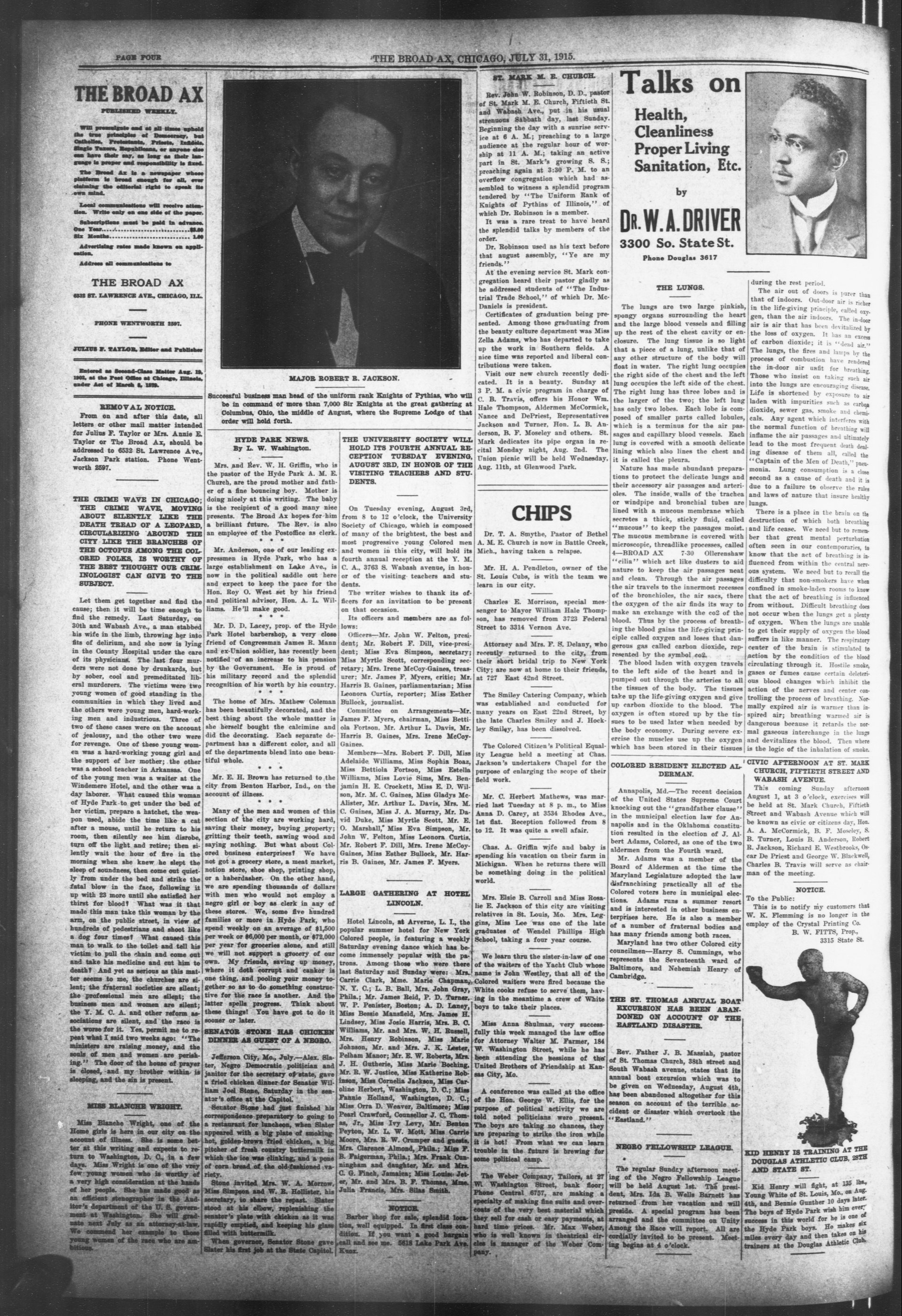
MAJOR ROBERT R. JACKSON.
Successful business man head of the uniform rank Knights of Pythias, who will be in command of more than 7,000 Sir Knights at the great gathering at Columbus, Ohio, the middle of August, where the Supreme Lodge of that order will hold forth.
HYDE PARK NEWS.
By L. W. Washington.
Mrs. and Rev. W. H. Griffin, who is the pastor of the Hyde Park A. M. E. Church, are the proud mother and father of a fine bouncing boy. Mother is doing nicely at this writing. The baby is the recipient of a good many nice presents. The Broad Ax hopes for him a brilliant future. The Rev. is also an employee of the Postoffice as clerk. * * *
Mr. Anderson, one of our leading expressmen in Hyde Park, who has a large establishment on Lake Ave., is now in the political saddle out here and expect to keep the pace for the Hon. Roy O. West set by his friend and political advisor. Hon. A. L. Williams. He'll make good.
Mr. D. D. Lacey, prop. of the Hyde Park Hotel barbershop, a very close friend of Congressman James R. Mann and ex-Union soldier, has recently been notified of an increase to his pension by the Government. He is proud of his military record and the splendid recognition of his worth by his country.
The home of Mrs. Mathew Coleman has been beautifully decorated, and the best thing about the whole matter is she herself bought the calcine and did the decorating. Each separate department has a different color, and all of the departments blend into one beautiful whole.
Mr. E. H. Brown has returned to the city from Benton Harbor, Ind., on the account of illness.
Many of the men and women of this section of the city are working hard, saving their money, buying property; gritting their teeth, sawing wood and saying nothing. But what about Colored business enterprises? We have not got a grocery store, a meat market, notion store, shoe shop, printing shop, or a haberdasher. On the other hand, we are spending thousands of dollars with men who would not employ a negro girl or boy as clerk in any of these stores. We, some five hundred families or more in Hyde Park, who spend weekly on an average of $1,500 per week or $6,000 per month, or $72,000 per year for groceries alone, and still we will not support a grocery of our own. My friends, saving up money, where it doth corrupt and cankor is one thing, and pooling your money together so as to do something constructive for the race is another. And the latter spells progress. Think about these things! You have got to do it sooner or later.
SENATOR STONE HAS CHICKEN DINNER AS GUEST OF A NEGRO.
Jefferson City, Mo., July.—Alex. Slater, Negro Democratic politician and janitor for the secretary of state, gave a fried chicken dinner for Senator William Joel Stone, Saturday in the senator's office at the Capitol.
Senator Stone had just finished his correspondence preparatory to going to a restaurant for luncheon, when Slater appeared with a big plate of smoking-hot, golden-brown fried chicken, a big pitcher of fresh country buttermilk in which the ice was clinking, and a pone of corn bread of the old-fashioned variety.
Stone invited Mra. W. A. Morrow, Miss Simpson and W. B. Hollister, his secretary, to share the repast. Slater stood at his elbow, replenishing the senator's plate with chicken as it was rapidly emptied, and keeping his glass filled with buttermilk.
When governor, Senator Stone gave Slater his first job at the State Capital
THE BROAD AX. CHICAGO: JULY 31, 1915.
THE UNIVERSITY SOCIETY WILL
HOLD ITS FOURTH ANNUAL RECE
CEPTION TUESDAY EVENING,
AUGUST 3RD, IN HONOR OF THE
VISITING TEACHERS AND STUDENTS.
On Tuesday evening, August 3rd, from 8 to 12 o'clock, the University Society of Chicago, which is composed of many of the brightest, the best and most progressive young Colored men and women in this city, will hold its fourth annual reception at the Y. M. C. A., 3763 S. Wabash avenue, in honor of the visiting teachers and students.
The writer wishes to thank its officers for an invitation to be present on that occasion.
Its officers and members are as follows:
Officers—Mr. John W. Felton, president; Mr. Robert F. Dill, vice-president; Miss Eva Simpson, secretary; Miss Myrtle Scott, corresponding secretary; Mrs. Irene McCoy-Gaines, treasurer; Mr. James F. Myers, critic; Mr. Harris B. Gaines, parliamentarian; Miss Leonora Curtis, reporter; Miss Esther Bullock, journalist.
Committee on Arrangements—Mr. James F. Myers, chairman, Miss Bettiola Fortson, Mr. Arthur L. Davis, Mr. Harris B. Gaines, Mrs. Irene McCoy-Gaines.
Members—Mrs. Robert F. Dill, Miss Adelaide Williams, Miss Sophia Boaz, Miss Bettiola Fortson, Miss Estella Williams, Miss Lovie Sims, Mrs. Benjamin H. E. Crockett, Miss E. D. Wilson, Mr. M. C. Gaines, Miss Gladys McAlister, Mr. Arthur L. Davis, Mrs. M. C. Gaines, Miss J. A. Murray, Mr. David Duke, Miss Myrtle Scott, Mr. E. O. Marshall', Miss Eva Simpson, Mr. John W. Felton, Miss Leonora Curtis, Mr. Robert F. Dill, Mrs. Irene McCoy-Gaines, Miss Esther Bullock, Mr. Harris B. Gaines, Mr. James F. Myers.
LARGE GATHERING AT HOTEL
LINCOLN.
Hotel Lincoln, at Arverne, L. L., the popular summer hotel for New York Colored people, is featuring a weekly Saturday evening dance which has become immensely popular with the patrons. Among those who were there last Saturday and Sunday were: Mrs. Carrie Clark, Mme. Marie Chapman, N. Y. C.; L. B. Ball, Mrs. John Gray, Phils.; Mr. James Beid, P. D. Turner, W. P. Penister, Boston; A. D. Laney, Miss Bessie Mansfield, Mrs. James H. Lindsey, Miss Josie Harris, Mrs. B. C. Williams, mrs. and Mrs. W. H. Russell, Mrs. Henry Robinson, Miss Marie Johnson, mrs. and Mrs. J. K. Lester, Pelham Manor; Mr. E. W. Roberts, Mrs. J. H. Gutherie, Miss Marie Boching, mrs. R. W. Justice, Miss Katherine Robinson, Miss Cornelia Jackson, Miss Caroline Herbert, Washington, D. C.; Miss Fannie Holland, Washington, D. C.; Miss Orra D. Weaver, Baltimore; Miss Pearl Crawford, Counsellor J. C. Thomas, Jr., Miss Ivy Levy, Mr. Benton Peyton, mrs. L. W. Mott, Miss Carrie Moore, Mrs. B. W. Crumper and guests, Mrs. Clarence Almond, Phila.; Miss F. B. Faigerman, Phila.; Mrs. Frank Cunningham and daughter, mrs. and Mrs. C. G. Finch, Jamaica; Miss Louise Jeter, mrs. and Mrs. B. F. Thomas, Mme. Julia Francis, Mrs. Silas Smith.
Barber shop for sale, splendid location, well equipped. In first class condition. If you want a good bargain call and see me. 5618 Lake Park Ave. Kueu
Rev. John W. Robinson, D. D., pastor of St. Mark M. E. Church, Fiftieth St. and Wabash Ave., put in his usual strenuous Sabbath day, last Sunday. Beginning the day with a sunrise service at 6 A. M.; preaching to a large audience at the regular hour of worship at 11 A. M.; taking an active part in St. Mark's growing S. S.; preaching again at 3:30 P. M. to an overflow congregation which had assembled to witness a splendid program tendered by "The Uniform Rank of Knights of Pythias of Illinois," of which Dr. Robinson is a member. It was a rare treat to have heard the splendid talks by members of the order. Dr. Robinson used as his text before that august assembly, "Ye are my friends."
At the evening service St. Mark congregation heard their pastor gladly as he addressed students of "The Industrial Trade School," of which Dr. McDaniels is president. Certificates of graduation being presented. Among those graduating from the beauty culture department was Miss Zella Adams, who has departed to take up the work in Southern fields. A nice time was reported and liberal contributions were taken.
Visit our new church recently dedicated. It is a beauty. Sunday at 3 P. M. a civic program in charge of C. B. Travis, offers his Honor Wm. Hale Thompson, Aldermen McCormick, Nance and DePriest, Representatives Jackson and Turner, Hon. L. B. Anderson, B. F. Moseley and others. St. Mark dedicates its pipe organ in recital Monday night, Aug. 2nd. The Union picnic will be held Wednesday, Aug. 11th. at Glenwood Park.
CHIPS
Dr. T. A. Smythe, Pastor of Bethel
A. M. E. Church is now in Battle Creek,
Mich., having taken a relapse.
Mr. H. A. Pendleton, owner of the
St. Louis Cubs, is with the team we
learn in our city.
Charles E. Morrison, special messenger to Mayor William Hale Thompson, has removed from 3723 Federal Street to 3314 Vernon Ave.
Attorney and Mrs. F. S. Delany, who
recently returned to the city, from
their short bridal trip to New York
City; are now at home to their friends,
at 727 East 42nd Street.
The Smiley Catering Company, which was established and conducted for many years on East 22nd Street, by the late Charles Smiley and J. Hockley Smiley, has been dissolved.
The Colored Citizen's Political Equality League held a meeting at Chas. Jackson's undertakers Chapel for the purpose of enlarging the scope of their field work.
Mr. C. Herbert Mathews, was married last Tuesday at 8 p. m., to Miss Anna D. Carey, at 3534 Rhodes Ave., 1st flat. Reception followed from 8 to 12. It was quite a swell affair.
Chas. A. Griffin wife and baby is spending his vacation on their farm in Michigan. When he returns there will be something doing in the political world.
Mrs. Elsie B. Carroll and Miss Rosalie E. Jackson of this city are visiting relatives in St. Louis, Mo. Mrs. Leggins, Miss Lee was one of the late graduates of Wendel Phillips High School, taking a four year course.
We learn thru the sister-in-law of one of the waiters of the Yacht Club whose name is John Westley, that all of the Colored waiters were fired because the White cooks refuse to serve them, having in the meantime a crew of White boys to take their places.
Miss Anna Shulman, very successfully this week managed the law office for Attorney Walter M. Farmer, 184 W. Washington Street, while he has been attending the sessions of the United Brothers of Friendship at Kansas City, Mo.
A conference was called at the office of the Hon. George W. Ellis, for the purpose of political activity we are told noted politicians were present. The boys are taking no chances, they are preparing to strike the iron while it is hot! From what we can learn trouble in the future is brewing for some political camp.
The Weber Company, Tailors, at 27 W. Washington Street, bank floor; Phone Central 8757, are making a specialty of making fine suits and overcoats of the very best material which they sell for cash or easy payments, at hard time prices. Mr. Max Weber, who is well known in the theatrical circles is manager of the Weber Company.
3300 So. State St.
Phone Douglas 3617
THE LUNGS.
The lungs are two large pinkish spongy organs surrounding the heart and the large blood vessels and filling up the rest of the chest cavity or enclosure. The lung tissue is so light that a piece of a lung, unlike that of any other structure of the body will float in water. The right lung occupies the right side of the chest and the left lung occupies the left side of the chest. The right lung has three lobes and is the larger of the two; the left lung has only two lobes. Each lobe is composed of smaller parts called lobules, which is a terminus for the air passages and capillary blood vessels. Each lung is covered with a smooth delicate lining which also lines the chest and it is called the pleura.
Nature has made abundant preparations to protect the delicate lungs and their accessory air passages and arterioles. The inside, walls of the trachea or windpipe and bronchial tubes are lined with a mucous membrane which secretes a thick, sticky fluid, called "mucous" to keep the passages moist. The mucous membrane is covered with microscopie, threadlike processes, called 4-BROAD AX 7-30 Ollerenshaw "cilia" which act like dusters to aid air temperature to keep the air passages neat and clean. Through the air passages the air travels to the innermost recesses of the bronchiales, the air sacs, there the oxygen of the air finds its way to make an exchange with the co2 of the blood. Thus by the process of breathing the blood gains the life-giving principle called oxygen and loses that dangerous gas called carbon dioxide, represented by the symbol co2.
The blood laden with oxygen travels to the left side of the heart and is pumped out through the arteries to all the tissues of the body. The tissues take up the life-giving oxygen and give up carbon dioxide to the blood. The oxygen is often stored up by the tissues to be used later when needed by the body economy. During severe exercise the muscles use up the oxygen which has been stored in their tissues
COLORED RESIDENT ELECTED AL DERMAN
Annapolis, Md.-The recent decision of the United States Supreme Court knocking out the "grandfather clause" in the municipal election law for Annapolis and in the Oklahoma constitution resulted in the election of J. Albert Adams, Colored, as one of the two aldermen from the Fourth ward.
Mr. Adams was a member of the Board of Aldermen at the time the Maryland Legislature adopted the law disfranchising practically all of the Colored voters here in municipal elections. Adams runs a summer resort and is interested in other business enterprises here. He is also a member of a number of fraternal bodies and has many friends among both races.
Maryland has two other Colored city councilmen—Harry S. Cummings, who represents the Seventeenth ward of Baltimore, and Nehemiah Henry of Cambridge.
THE ST. THOMAS ANNUAL BOAT
EXCURSION HAS BEEN ABAN-
DONED ON ACCOUNT OF THE
EASTLAND DISASTER
Rev. Father J. B. Massiah, pastor of St. Thomas Church, 38th street and South Wabash avenue, states that its annual boat excursion which was to be given on Wednesday, August 4th, has been abandoned altogether for this season on account of the terrible accident or disaster which overtook the "Eestland."
NEGEO FELLOWSHIP LEAGUE.
The regular Sunday afternoon meeting of the Negro Fellowship League will be held August 1st. The president, Mrs. Ida B. Wells Barnett has returned from her vacation and will preside. A special program has been arranged and the committee on Unity Among the Race will report. All are cordially invited to be present. Meeting begins at 4 o'clock.
[Name]
during the rest period.
The air out of doors is purer than that of indoors. Out-door air is richer in the life-giving principle, called oxygen, than the air indoors. The in-door air is air that has been devitalized by the loss of oxygen. It has an excess of carbon dioxide; it is "dead air." The lungs, the fires and lamps by the process of combustion have rendered the in-door air unfit for breathing. Those who insist on taking such air into the lungs are encouraging disease. Life is shortened by exposure to air laden with impurities such as carbon dioxide, sewer gas, smoke and chemicals. Any agent which interferes with the normal function of breathing will inflame the air passages and ultimately lead to the most frequent death dealing disease of them all, called the "Captain of the Men of Death," pneumonia. Lung consumption is a close second as a cause of death and it is due to a failure to observe the rules and laws of nature that insure healthy lungs.
There is a place in the brain on the destruction of which both breathing and life cease. We need but to remember that great mental perturbation often seen in our contemporaries, to know that the act of breathing is influenced from within the central nervous system. We need but to recall the difficulty that non-smokers have when confined in smoke-laden rooms to know that the act of breathing is influenced from without. Difficult breathing does not occur when the lungs get a plenty of oxygen. When the lungs are unable to get their supply of oxygen the blood suffers in like manner. The respiratory center of the brain is stimulated to action by the condition of the blood circulating through it. Hostile smoke, or fumes cause certain deleterious blood changes which inhibit the action of the nerves and center controlling the process of breathing. Normally expired air is warmer than inspired air; breathing warmed air is dangerous because it retards the normal gaseous interchange in the lungs and devitalizes the blood. Then where is the logic of the inhalation of smoke.
CIVIC AFTERNOON AT ST. MARK
CHURCH, FIFTIETH STREET AND
WABASH AVENUE.
This coming Sunday afternoon August 1, at 3 o'clock, exercises will be held at St. Mark Church, Fiftieth Street and Wabash Avenue which will be known as civic or citizens day, Hon. A. A. McCormick, B. F. Moseley, S. B. Turner, Louis B. Anderson, Robert R. Jackson, Richard E. Westbrooks, Oscar De Priest and George W. Blackwell, Charles B. Travis will serve as chairman of the meeting.
NOTICE.
This is to notify my customers that W. K. Flemming is no longer in the employ of the Crystal Printing Co. B. W. FITTS, Prop., 3315 State St.
1
KID HENBY IS TRAINING AT THE DOUGLAS ATHLETIC CLUB, 25TH AND STATE ST.
KID HENRY IS TRAINING AT THE DOUGLAS ATHLETIC CLUB, 28TH AND STATE ST.
Kid Henry will fight, at 135 lbs,
Young White of St. Louis, Mo., on Aug.
4th, and Bennie Gunther 10 days later.
The boys of Hyde Park wish him every success in this world for he is one of the Hyde Park boys. He makes six miles every day and then takes on his trainers at the Douglas Athletic Club.
ALPHA SUFFRAGE CLUB.
The Alpha Suffrage Club will meet Wednesday evening, August 4th at 3005 State street. Members and friends are urged to attend. Business of importance to be transacted.
CHIPS
The Colored Democrats have very little encouragement from the vitilis pen of Mr. Geo. W. Ellis, if we have perused the article correctly, written in the Citizen, a magazine published in Philadelphia, by the Citizen Publishing Company. Unless the Colored job holders under the democratic administration are able to stem the tide or answer some of these criticisms as they should be answered, the cause is lost. You who hold the jobs should at least speak up, if not for the principle you represent, you should for the jobs you hold, if you have not the manly courage to do so, you should resign the job and let the men who have the courage of their convictions have them. To sleep until the Colored Brother affiliated with the republican party against the party you are supposed to represent is a political crime to the faithful men, who would do; but have absolutely been ignored, this is a political crime.
Mrs. Laura Jones who until recently resided at 3850 Vincennes Ave., who has been engaged in selling corsets to ladies on the easy payment plan, was arrested last week charged with obtaining money under false pretenses. It appears that she secured five dollars from Mrs. Sarah Harris, 3738 South Dearborn Street, with the understanding that she would deliver the corsets the next day and collect the other five dollars as Mrs. Harris was to pay ten dollars for the corsets, but Mrs. Jones never delivered the corsets to her then Mrs. Harris had her arrested as Mrs. Jones had failed to return the money to her and last Saturday morning Judge Edward T. Wade at the Stockyards Station, after sitting in judgment on Mrs. Jones ordered to refund the five dollars to Mrs. Harris, which she did then he fined her twenty-five dollars and costs and being unable to raise the money she was sent to the bridewell, where she will be compelled to remain for 63 days unless some of her friends obtain her release, only a short time ago Mrs. Jones was very prominent in the best Colored Society on the South Side and her late husband is a successful business man on South State Street.
A number of prominent Prof., men and politicians had a conference Tuesday night at George Holt's 35th and State St. Of course it was politics you know Republican politics. There is an awful rumbling going on and the political manipulators are bumping their heads together, you know that it is Mayor William Hale Thompson v. The Roy O. West for National Committeeman, and Gov. Dunne v. Colonel Frank A. Lowden and our friend Dwight L. Smith, or the Hon. Andy Russell. And the boys are not waiting for 1916, every body is getting busy.
The Job holders, of course, there are exceptions, are like the cows tail always behind, they will sit on the stool of do-nothing, have a good time with their special sets, until the time comes around for another job, then they will make all the White folks in town believe that they are the "Big I Ams, with a capital I," and "I did it." It is very strange how some Negroes can fool some White folks all the time isn't it. The fellow who does nothing politically gets the job, and the fellow who does the real work gets starved or put in jail, or the poor house. Well I guess this adage is true, "To him that hath, to him more shall be given, but to him that hath not, that which he already hath shalt be taken away from him." Cheer up you political gum sheers "old father time" will bring bread to you.
Just Once.
It was Charley's first game of golf. His patient friend had taken him easily around the eighteen holes and watched him hack the ball into small bits and cut up the green as though it had been plowed by shrapnel. After the game Charley and his patient friend were talking to a few of the golfers on the clubhouse veranda.
"That was a beautiful shot you made this afternoon, Charley," said his patient friend.
Charley brightened up and flushed happily, while the young woman looked at him admirably. "Which one?" he asked eagerly.
"Why," said the patient friend, "the time you hit the ball."—Chicago Tribune.
The First Patient on Matches.
Before 1838, when wooden matches with phosphorus were made in Vienna, people were dependent upon flint and steel to secure a light. The first patient for a phosphorus match in the United States was taken out in 1836 by A. D. Phillips of Springfield, Mass. For many years people refused to use them, but by 1845 the flint smelling and clumy old tinder boxes were generally discarded and are preserved, like sandbones, as curtains.
SIRES AND SONS
Mayor William H. Thompson of Chicago is a total abstainer. W. H. Winans fils four public offices in Cleveland. He is twenty-six. C. C. Herron of Philadelphia has completed twenty-five years in rescue mission work. W. M. Smith has spent thirty-five years as a typesetter for the St. Louis Post-Dispatch. The Hon. Austen Chamberlain, the new British secretary for India, is no tyro in public business and is regarded as a fine administrator. In 1902 he was postmaster general and afterward became chancellor of the exchequer. Colonel Rogers Birnle, who recently retired as senior colonel of the ordnance department of the army, having reached the age limit, is one of the foremost ordnance experts in this country. He is a native of Maryland and entered the army in 1872.
General Carlo Caneva, commander in chief of the Italian forces in the field, is a man tried in battle in the war with Turkey. His is the highest rank in the Italian army. He is seventy years of age and was on the retired list until the war threat loomed on the horizon.
The Jitney Bus.
At least the bus of that name has lived long enough to make the jitney famous.—Chicago News.
So far as is known, with all her troubles, as Europe doesn't have to grapple with a jitney bus problem.—Detroit Journal.
One thing the jitney certainly has done—it has enabled the street car motorman to see a prospective passenger sooner than formerly.—Dallas News.
With the coling of the word "jitneur" to denominate the driver of the jitney bus there should no longer be any curbing the demand that this vehicle must go.—New York Post.
Current Comment:
America is now the richest of nations. Can we keep our peace and our ducats?—Louisville Courier-Journal. A rise in the price of beef used to be accompanied by an interesting explanation. Now it simply takes place.—Washington Star. Almost any man with personal magnetism, some guns and a few boxes of soda crackers can get up a revolution in Mexico.—Los Angeles Express. The crank is capable of much worse mischief than the criminal, and the pity of it is that he should be so much harder to detect.—Philadelphia Ledger.
Flippant Flings.
The old Liberty bell, at least, is all that it is cracked up to be.—Boston Record.
"Is any man's love worth $2,000,000?" asks Clara Morris. Well, that's for the courts to decide later on.—Washington Post.
Some ingenious Yankee ought to turn an honest penny during this war by inventing metre for the gas bombs.—Cleveland Plain Dealer.
Officials in the California State Insane asylum assert that baseball cures insanity. One had supposed it caused it, but maybe this is a homeopathic principle.—Exchange.
Facts From France.
Building the best of roads in the world has cost France about $612,000,000.
A hollow wooden ball six feet in diameter, which is moved by the flow of the sewage, is used to remove obstructions from sewers in Paris.
In a billard room in Paris is a table made of glass. It is much more difficult to make a shot on it than on the ordinary balze covered table.
BRIGHT BRIEFS.
Walk fast until you get there—then stand fast.
There is always room at the top of an argument—for more talk.
Courage is the yeast that causes a man to rise to the occasion.
All men are equal the day they are born and the day they are buried.
Theory looks good, but it doesn't always go when you try to crank it.
Every young man should be taught that there is something better than luck to trust to.
Many a man has sense enough to get a good wife, but hasn't sense enough to know it.
An optimist is a man who smiles at kicks, and a pessimist is a man who kicks at smiles.
A Chicago physician says that humans may grow fat by eating hay, thus making it a pleasure to remain skinny.
The respirators make a soldier of the trenches look like a death's head. But that's what war is trying to make of all of them.
Automobiles may have decreased the demand for horses, but military statistics show that the mule is as highly prized as ever.
It is to be hoped that some statistician has been keeping count of the number of times the "world's greatest battle" has been fought since last August.
THE.BROAD AX, CHICAGO, JULY 31, 1915
MODERN WARFARE IN THE TRENCHES
Armies Are Driven Underground to Escape Annihilation.
THE wonderful accuracy and power of modern artillery have driven armies underground as the only salvation from annihilation. At the same time the enormous numbers of men engaged extend the flanks so far that turning movements are often impossible, and battles must be decided by frontal operations.
In the wars up to the Russo-Japanese war in 1904-5 the campaigns consisted largely in maneuvering the armies so as to threaten the enemy's flank. Now the important advantages are gained by maneuvering the heavy artillery so as to bring a preponderance of fire to bear upon a definite length of the enemy's front.
The shattering power of high explosive shells can reduce to a rubble mound any structure on which they are brought to bear. Consequently the military engineer recognizes this physical limitation of the defense and adjusts his structures by utilizing mounds of sand or earth for parapets. The energy of the shell is largely used up in raising a cloud of earth, most of which falls back in place. Instead of the dash and glory of historical warfare the soldier of today has the prosaic task of devoting over ten hours to trench work for every ten minutes spent in firing his rifle. The principle of trench warfare consists in providing a number of lines of trenches so that if one is captured the next succeeding line can be held. By delaying the enemy at each successive trench time is gained to bring up reinforcements of men and artillery.
The artillery is depended upon for bombardment and for action against groups. Its long range and accuracy
THE BATTLE OF THE BAY OF BAY
Photo by American Press Association.
FRENCH SOLDIERS IN A FIRING TRENCH.
permit the batteries to be placed on the reverse slopes of hills from one to six miles in rear of the advance lines.
Here the guns are safe from observation except by aeroplane scouts, and the gun crews are further protected by parapets. So important is concealment that even in these protected locations the guns are screened by being placed in woods or orchards or by being covered with branches or with hay.
The man at the gun does not see his target. Information is telephoned in to the battery and calculation is made of the change in azimuth or elevation needed to correct the landing point of the shots. In this way the objective of the gunfire may be changed from point to point as the action dictates.
The close contact is maintained by the infantry, which depends upon the firing trenches for its effective work. These are deep narrow trenches with a steep bank on the side toward the enemy.
To give the man in the firing trench a still better chance to stop an attacking force the ground in front is covered with obstacles that will delay the enemy without affording any protection. Any device is used, but the best of all is barbed wire. It cannot be shot away. Even if cut it collis up and entangles the feet. As chance offers, barbed wire is crisscrossed between the posts until a formidable entanglement is obtained.
The trench guard cannot stay in the trenches during bombardment as the protection is so slight that the losses would be excessive. This object is secured by having a cover trench close by, a deep narrow trench from which entrance is obtained into underground shelters. In these cellars, or bombproofs, the trench guard sleep, eat and live during their forty-eight hours at the front. New detachments are then brought up to the front line, while the old guard goes back to the reserve for four days' rest.
Troops for assault are gathered in the most advanced trenches during heavy bombardments concentrated in the vicinity of the point selected for attack. When the enemy's infantry and artillery seem to be driven to cover the signal for the advance is given. The attackers scramble up out of their trenches. Selected groups rush forward to cut the enemy's wire entanglements or to blow up the obstacles in front of his parapet. The rest follow close behind with bayonets fixed for the hand to hand struggle with the
DAMES AND DAUGHTERS
Mrs. Cella Stellman of Brooklyn recently found her son, Henry, who disappeared fifteen years ago, a sailor in the United States navy.
Miss Eva Hamstedt, a former pupil of Mme. Curle, the radium expert, has been appointed professor of radiology at the University of Stockholm.
First to win the iron cross from Emperor William in the present war was Franklin Lonny Hertz von Vessen of Berlin, a cousin of the late Mark Twain.
In the fifty years she has been connected with the bureau of engraving and printing in Washington it is estimated that over $100,000,000,000 has passed through the hands of Miss Annie Roe, chief of the numbering division.
Miss Harriet A. Graham has been retired on a pension by the Pittsburgh board of education after having taught for more than fifty-three years in Pittsburgh schools. Miss Graham is said to be the oldest woman public school teacher in point of service in Pennsylvania and one of the oldest in this country.
Echoes of the War.
It seems to be millions for munitions, but not one cent for peace pacts.—Cleveland Plain Dealer.
Even the Swiss are running deeper into dept to pay the cost of their neutrality.—Boston Herald.
Reflections as to the causes of war have lost interest in the contemplation of the effects.—Washington Star.
"No change" in the military situation is beginning to evoke a heartfelt echo from hollow war chests.—Washington Post.
The war will do one thing for the men who die in the trenches. It will relieve them of the burden of helping to pay the war debt. This will be a heritage to their children to the third and fourth generations.—Houston Post.
PITH AND POINT.
The more excuses a man makes the less he gets out of it.
The dictates of conscience are never recorded by a typewriter.
Since getting into the war little San Marino seems to have been lost.
Originality is a thing we constantly clamor for and instantly quarrel with.
Actions may speak louder than words, but most people prefer oratory to pantomime.
Work is terrible to some men and loafing is terrible to others, showing what habit will do.
War dispatches announce another gain of 200 yards, but fall to state who carried the ball.
Don't wait too long for your ship to come in. Better take a canoe and paddle out and meet it.
Speaking of infant industries, that of the home tourist finds better protection in war than in the tariff.
Short steps attained at terrific cost in blood and treasure is the monotonous story of the European hostilities.
One of these days there is going to be a great battle at Szeebrzeszyn, and then half a dozen compositors will commit suicide.
A New York woman aged ninety-nine attributes her longevity to having always had a good appetite. The catless campaigners will please note.
Science Siftings.
It has been estimated that the earth can maintain a population of 6,000,000,000, a total which will be reached about A. D. 2100 at the present rate of increase.
The brain is divided into two parts. If you are right handed you think with the left side of your brain, while if you are left handed you think with the right side of it.
The velocity of a star seems to be a factor of its effective age. Unlike our ordinary human experience, the speed of a star increases with its advancing years, and in the world of spheres above us it is the young who cannot keep the pace.
Town Topics
As a summer resort all that Chicago lacks is an ablebodied sea serpent.—Chicago News.
Baltimore is boasting that the government reports show it costs less to eat in that town. But life is not all eating, except to the gluttons.—Pittsburgh Dispatch.
Minneapolis, too, is making rapid strides as one of our foremost American cities, one of her judges reporting that there is one divorce in that city for every eight marriages.—Detroit News.
Automobile Runs
It is a pity that incomes don't increase in the same ratio as automobile cylinders.—Cleveland Plain Dealer.
Life has many mysteries, one of them being why motorists keep right on taking chances at railroad crossings.—Detroit Free Press.
The Long Island railroad is testing "auto proof" gates to prevent accidents at grade crossings. They must be foot proof too.—New York Sun.
The camps of state militia have attracted unusual attention this year, and naturally so, for the question of national defense is looming large in the public mind. The encampment of the national guard of New York state at Camp Whitman, Fishkill Plains, drew many thousands of spectators. There have been encamped at Fishkill Plains 5,000 guardsmen and 500 regulars. Never before had this particular section of the state witnessed such a scene, and one thing that every officer, regular as well as militiaman, commented upon, was the apparent fact that the people were much more interested than in former years in the military organization that would form the backbone of the land defense in the event of a national crisis. The men were put through the paces of up to date warfare. Trench work was featured, and the pick and shovel
THE MILITARY
played an important part in the drills. There were pontoon building and crossing streams under fire. The men were taught how to advance under artillery fire and were hurled against barbed wire entanglements. The mounted forces were instructed how to perform services of screening and reconnoitering. The hospital units were practiced in the rescue and care of the wounded. Sham battles were fought, and a military airplane participated in the maneuvers.
After fighting a sham battle on the morning of July 22 the national guardsmen and regulars proceeded to the reviewing grounds, where they were reviewed by Governor Whitman, in whose honor the camp was named. The review was the biggest military spectacle ever seen in that part of New York state and was witnessed by about 10,000 persons. Every man in the camp, regulars as well as militia, appeared in the reviewing line.
The national guard of New York state is unusually active this season, and not a day will pass until the end of August without a portion of the guard being engaged in field service. The training has been arranged along new lines adopted from lessons learned from the grim warfare in Europe.
VIVIAN NICKALLS ENLISTS.
Well Known College Rowing Coach to Become an English Soldier. Vivian Nickalls, who is well known as a college coach and who is at present the coach of Pennsylvania university's crews, has declared his intention of abandoning his profession to join the British army. Mr. Nickalls is an
A.
Photo by American Press Association.
VIVIAN NICKALLS.
Englishman and is the brother-of Guy Nickalla, rowing coach of Yale, whose varsity eight won a notable victory over Harvard this year. Vivian Nickalla has accepted a commission in a hussar regiment and will sail for England about the middle of August.
PAGE FIVE
SHORT AND SHARP.
When you undertake to study human nature begin on yourself.
Some people who ask for a crust invariably want it over a ple.
A man can always find time to do a thing if he has the inclination.
Hope is all right in its way, but men who try to live on it are hopeless.
The Liberty bell has a crack in it, but fortunately its ring is no longer needed.
The easiest way to commit suicide involuntarily is to walk upon a railroad track.
"Safety first" is a good motto, but too many people wait until it's too late to be careful.
A lot of men expect the bread they throw on the water to come back to them in the form of cake.
During lulls in the fighting the belligerents ought to be able to think of some good excuse for quitting.
If Uncle Sam ever has occasion to do so he will issue a red, white and blue book, and it is likely to be the final word.
The changed national boundaries announced in Southwest Africa are manifestly subject to confirmation by the treaty of peace.
When one notes how much food has been exported to Europe during the last eleven months one wonders what would have become of it all if there had been no war.
The Royal Box.
Prince Henry of Prussia, brother of the German emperor, has just received a patent for an apparatus for cleaning the wind shields of automobiles.
King George V. must be the most widely traveled monarch in history. Beginning with a trip to Ireland at the age of eight, his majesty has visited Canada, the United States, Palestine, Egypt, the Crimea, Constantinople, Russia, France, Germany, Scandinavia, Australasia, South Africa and India.
The Empress Carlotta, as the Princess Charlotte was known after her husband was made emperor of Mexico, became insane after a mental breakdown in 1866. In 1879 she was pronounced incurable and confined by her family near Brussels, where she has been kept ever since. She is the aunt of King Albert of the Belgians.
Educational Notes.
There are 18,600,040 pupils in United States public schools. A million and a quarter of dollars is on deposit in school savings banks in the United States, according to the national bureau of education. This money is distributed among 217,000 pupils, who thereby learn lessons of thrift for use in later life. Two out of every thousand public high school boys receive military instruction in school as compared with five in every thousand fifteen years ago. While the total number of boys in public high schools has increased since 1900 from 216,207 to 541,486, the number of boys taking military drill has decreased from 10,455 to 9,532.
Wireless Whispers.
Regular wireless business is daily handled between Long Island and Germany and between Boston and Norway.
Massachusetts students of wireless have had good success with experiments in sending and receiving messages with aerials laid on the ground.
The United States navy will establish a wireless station on Cape Cod especially equipped to guide vessels along the Atlantic coast in time of fog.
Within a few months wireless messages have been sent from a station in this country to Paris. They are sent direct and not relayed from ships at sea.
Short Stories.
Biscuit comes from the Latin words "bls coctus" (twice cooked).
Perfect eyebrows are found in no animals other than mankind.
Of the 3,000 or more islands comprising the Philippines only about 400 are inhabited.
Costa Rica is nominally on a $^1$ gold basis, but nearly all its gold has either been collected by a few financiers or shipped out of the country.
The Italian government has made strict regulations concerning the width of wheels on wagons and carriages. The breadth of its wheel depends on the gross weight of the vehicle.
Shot and Shell
German soldiers carry small tin whistles to blow for medical aid should they be wounded.
It is claimed that half an hour of the goose step does as much for the muscles of the legs as half a day's route marching.
When shells are filled with shrapnel bullets there is poured in about a pint of boiling resin, which keeps all fixed until the discharge.
Guns with a bore of twelve inches or more can only fire ninety full charges. They are then considered to be worn out and have to be sent to the foundry to have a new core inserted.
rags ax *
—————
‘wnetiah WOtary Offenses.
eee eee Car
| "mmere are more than a dozen differ
Ot entas tee which ¢ stile may
be sentenced to death on active
service. The first on the list of death
‘offenses applies to & commanding off-
cer and reads, “Shamefully delivering
‘up @ garrison when in command of
tropps, without due mecessity—punish-
ment, death.” A soldier can be shot
for throwing away his rifle or sword
in the presence of the enemy, for cow-
ardice or for leaving his commanding
officer tn order to plunder. If Be forees
his way past a sentry on active serv-
tee be may be sentenced to death or
for assaulting any one bringing up pro-
visions for the troops. A soldier is ex-
pressly forbidden while on active serv-
fce to commit any offense agninst a
resident of the country in which he is
fighting under pain of death, nor may
he break into any house in search of
plunder or discharge his rifte intention-
ally to create a false alarm on the
march. A soldier while acting as sen-
try who is found sleeping at his post
may be shot. Any man causing or
joining in # mutiny is liable to be shot.
‘Desertion or attempt at desertion while
‘on active service is naturally a death
offense—London Opinion.
Dreams.
“ What is the purpose of dreams? Dr.
Isador H. Coriat answers the question
thus in “The Meaning of Dreams.”
It can be shown through dream anal-
yais that dreams subserve a definite
function in our mental life in that they
really act as protectors and not as dis.
turbers of sleep. This guardianship of
sleep by means of dreams is due to the
persistent dynamic action of the cen-
sor. In sleep the censor is exceeding:
ly active, and its function is to protect
sleep from the mass of repressed emo
tions which threaten to overwhelm the
sleeper in the stipe of a dream. This
4s done by means of the dream mechs-
nisms, in which the dream thoughts
are fused and displayed, thus under-
going such disguise and symbolization
‘as to be unrecognizable to the sleeper
and consequently not disturbing to
Aim. When the censor nods or is evad-
ed, when the literal dream thoughts
Dombard and invade consciousness in
an undisguised form, sleep is disturbed
‘and insomnia results.
Bc
“Do you think,” Benjamin Harrison
once asked Louis T. Michener, his
campaign manager, “that I am a cold
man?”
“I don't think #0,” General Michener
answered, emphasizing the pronoun.
“because I am acquainted with you.
but persons do say that I am the only
living man who hdsn’t been chilled by
# Harrison cold blast. I understand
your habits and your moods, and when
you pass me in the street and don’t
‘speak to me I know the reason.”
“Well,” Harrison replied, “I do get
tuto a ‘subject when I am thinking
about it and at such times may seem
a little blind and distant.”
“But Benjamin Harrison,” General
Michener told the writer of this art
de, “was not a cold man. No man ts
cold whom children and dogs love, and
all the children and dogs of Indian-
apolis knew Benjamin Harrison. He
saw them always, and they saw him.”
—New York Sun.
le ee
The distinction between agate and
‘onyx is not apparent to every one, a1
4s indicated by the samples of the tw:
minerals received by the United States
geological survey with requests for in
formation. Onyx marble, or Mexicar
‘onyx, is composed of calcium carbon
ate or banded limestone. True agate
4s a variety of silica. Onyx marble is
much softer than agate and is rarely
used for gems, but when onyx is ob
tained in pieces of sufficient size it i
cut and polished for small ornamentai
objects Uke inkstands and paper
weights, as well as for table tops and
soda water fountains,
“ Trick of the Smugglers.
Russia was once overran with coun
terfelt notes. ‘The police felt certais
that the notes were imported, whict
Broved to be the case. One day ar
‘accident solved the mystery. Some
Packages of lead pencils arrived. then
from England, and, while examining
‘one of the pencils féil out. On sharp
‘ening it to use the customs officer was
surprised to find the lead but a. shor:
gear ee Se ene
low and contained a note.
i hige* eiteetiy eetineretiink ‘tte
“Dubbs and his wife never have any
‘arguments about money matters.”
“How fortunste?”
| “Yes. ‘Mrs, Dubbs says that « mere
triffe like Dubbs’ salary should not be
allowed to come between them, so she
takes ft all."—Birmingham Age-Herald.
j Buying “on Tick.”
' Buying “on tick” is not new slang,
Dut goes back to the seventeenth cen-
fury. It ts stated tn a letter dated
20661, “The Mermaid tavern is lately
broke, our ticks amounting to £1,000.”
And in another document a little later
pe Seal, “mosey snozene wpe
ee
} Jed Oe.”
Capea toeter karen 5 peabengnes
| “Yet first he made ine ‘sniff it, and
mow be has prescribed it as @ lint
ment."—Louisville Courier-Journal,
| Fashion Demand.
“What's become of that new car you
Dene Sat et oa
1 baiji inbeny po
got & new gown, and It doesn ”
ae Leet ER 5
| Dat bs pre Fen i
$8 fhe pris snd, goes to rest, with
“Bidniass te Mebeaska.
‘Many: of the phynical features of
‘eastern Nebraska were produced by
‘sheets of ice that invaded the region
@uring and after the earlier stages of
‘the great ice age. At the opening of
the glacial epoch the great Keewatin
giacler spread southward nd covered
Jarge parts of the Dakotas, Minnesota
and Iowa and extended thence intc
eestern Nebraska, where it was prob-
ably several handred feet thick. ‘This
first stage of glaciation was brought
to a close by the melting of the ice ir
‘@ warmer fntergiacial time or stage—
the Aftonian.
‘A remarkable assembiage of animals
invaded the region after the ice had
disappeared, and the bones and teeth
of many of these animals have been
found in the Aftonian deposits of
western Iowa. The late Professor
Samuel Calvin identified the remains
of horses, camels, stags, elephants,
mastodens, mammoths and sioths.
‘When these animals lived in western
Towa the climate there must have been
comparatively mild and vegetation
very abundant. —Geological Survey Bul-
letin.
Treliendis Ciaarc.
Anthony Trollope prided himself on
having reduced the writing of novels~
‘and good novels—to something like a
mechanical process, devoting to the
‘work so many hours 2 day and timing
himself to an output of so many words
an hour. His advice to the literary
aspirant was to glue himself to his
seat and write, but he himself had an.
other source of inspiration.
One wall of his ibrary was devoted
to rows of little cupboards or bins,
gach with a separate glass door and
filled with. cigars stacked across and
‘across like timber to allow free cir-
culation of air. A pointed stud in the
‘wood above the door indicated the bin
im use, and as soon as any one bin was
emptied the stud was removed to
above the next door and the empty re-
ceptacle refilled from the big chests
which Trollope obtained straight from
Havana.—London Saturday Review.
‘Stetina Rates of Qinnte
‘When Sir Robert Walpole was in-
stalled knight of the garter in 1726 he
‘was the only commoner, with one ex-
ception, to whom the honor had been
given ince the reign of James I. The
honor apparently was regarded as s¢
great that Walpole had to apologize for
his audacity, which he did in this fasb-
fon: “Is ambition imputed to me? Why,
then, do I still continue a commoner—
I who refuse a white staff and a peer-
age? I had, indeed, like to have for-
gotten the little ornament about my
shoulders which gentlemen have 80
Tepeatedly mentioned in terms of sar-
castie obloquy. But, surely, though
this may be regarded with envy or in-
dignation in ‘another place,’ it cannot
De supposed to raise any resentment in
this house, where many may be pleased
to-see those honors which their ances-
tors have worn restored to the com-
mons."—London Chronicle.
lle OE
‘There are many substances which
may be employed to poison or asphyx-
iate an enemy, either by tempering the
wind or by use in projectiles. Hydro-
cyante acid, known-as prussic acid, is
80 poisonous that a mere breath of it
means instant death. Sulphuric an-
hydride when brought in contact with
air combines rapidly with moisture ab-
sorbed from the air, producing sul-
phurie acid. Thrown in a bomb with
just. explosive charge enough to dis-
rupt the bomb and scatter the sul-
phuric anhydride, the air for a large
‘space about the explosion would be at
‘once converted into a dense fog of sul-
phurie acid. Liquid ammonia similer-
ly employed would instantly so fill the
atmosphere with ammonia as tp stran-
gle all persons in the immediate vicin-
ity—Brookiyn Eagle.
‘The Heart of « Mouse.
A tiny mouse who lived near the
house of a magician begged him to
save her from the cat, of whom she
lived in deadly terror. So the magi.
cian changed the mouse into a cat, and
she went away delighted. In a few
days she came back again in- terror.
“Ob, save me, save me now from the
dog,” she begged. And the magician
changed ber to a dog. A few days
more and back she came, this time in
deadly fear of a tiger. “Nonsense,”
said the magician. “You have only the
heart of @ mouse, and afraid you will
always be. It is the heart that tells.”
Our Mica Mines
‘Mica mining in the United States
started early in the nineteenth cen-
tary in New Hampshire, which state
supplied all the domestic production
‘until about 1868, when mining was
started in North Carolina and subse-
quently in other states. At present the
greater part of the sheet mica is used
in the electrical industry, and most of
‘the scrap mica is ground for use in the
decorative trade, especially in wall pa-
MR Neca
"The Heloine Mand.
‘The Married Man—I tell you, it's
‘when a man falls into misfortune that
he: appreciates 2 woman. ‘The Single
‘Man—You bet! It must be « handy.
thing sometimes to put ail your prop-
q@ty in your wife's name.—Pittsbargh
Press.
nates
“I understand be won quota-
ons from Mrs. Browning's sonnets.”
sears meen toe
from, the statutes.’ Age
‘Herald.
tl An Expert.
| Jinks—Is Browh « skilifal surgeon?
Binks—Is 2 Phy, he opersted on
Nd gy a ee ee ee
THE BROAD-AX, CHICAGO, JULY 31, 1915.
‘The Artichoke. «|~---——"ag AtMatic Heart.
‘The artichoke, which originally eame
from Barbary, is not a botanical spe-
‘eles, but a variety of the thistle, which
grows spontaneously all along the Af-
rican coast of the Mediterranean from
Morocco to Palestine. It is now cuiti-
‘Vated extensively in France, where
‘those which come from Brittany and
Algeria are the species most highly es-
teemed. Even of these there are many
varieties, such as the Camus artichoke
of Brittany, the bronzed artichoke of
Roscoff, the big green artichoke of
Laon and the violet artichoke of Pro-
‘vence. There are also varieties which
come from Italy, Spain, India and Can-
ada, to say nothing of the Jerusalem
artichoke, famous for the enormous
size of its leaves. In the south of
France when the crop is abundant the
heads are carefully picked of all thelr
leaves and the hearts dried in the sun,
put up in sacks and stored away for
winter use. These hearts when bolled
fm water or in a rich beef broth be
come soft and recover thelr form, color
and flavor. They are then taken from
the pot, the water and broth strained
away, the center is filled with force
meat, and they are then either fried or
pant
ae
4 native of any part of North or
South America is literally an American
since he is a native of one of the Amer-
fcan continents. Usage, however, has
narrowed the term so that “an Amert-
can” is generally understood to be a
citizen or native of the United States
of America, while a native of Canada,
‘Mexico, Central or South America is
known as a “Canadian,” “Mexican,”
“Brazilian,” “Guatemalan” or the like.
‘The reason for the usage does not le
in any feeling that the United States
pre-empts, stands for or overshadows
the other parts of the western hemis-
phere, but simply in the fact that, while
Canada, Mexico, Brazil, the United
States of Colombia, etc, are words
which admit of adjective formation,
“American” is the only adjective which
can be formed from the name of our
country to denote its citizens or to ap-
ply to its interests, industries, cities,
ete—New York Times,
‘Tea the Swift,
‘While the morning rush was on one
day a young woman followed a trolley
car down Broadway, running two
blocks before she caught it. This she
‘was able to do because of the jam of
the traffic which retarded the car. Her
efforts attracted attention on both sides
of the street, and hurrying shop hands
stopped to cheer her on. At Houston
street, where she came panting up to
‘the side of the car, she gasped to the
‘conductor that she had left her pocket-
‘book on the seat and wanted to get it.
He obligingly held the car while she
made @ search. No pocketbook was
found, but as she stepped off into the
‘street again, her eyes filled with tears,
thefe came a shout from behind. It
‘was the motorman of the succeeding
car, and in his hand as he leaned over
his brake he held the pocketbook.
“Here it is, Indy,” he said. “Don't
ery. You only caught the car ahead.”
—New York Post.
Best In Middle Anes.
Much of the medieval meat, which
Cobbett says was plentiful and cheap,
must have been poor stuff. Until the
introduction of root crops in the eight.
eenth century cattle and sheep did not
Decome even moderately plump till the
end of summer, while Inck of fodder
made it impossible to keep much live
stock during the winter. On St. Mar-
tin's day (Nov. 11) arrangements were
usually made for slaughtering on a
large scale, and for the next six months
fresh meat worth eating was practical-
ly unobtainable. Until the spring grass
Was again ready there was a run on
salted beef and salted mutton. Salt-
ef beef is excellent—for a change. But
have you ever tried salted mutton?—
London Graphic.
Futility of Flattery.
Nothing is ever gained by flattery.
‘To the serious man flattery in the form
of sincere praise makes him more re-
sponsible and only sadder because he
knows how much he falls below what
4s expected of him and what he ex-
pects of himself. Lip flattery makes
2 real man feel as though his sex had
deen mistaken. He feels as though he
bad been given curling tongs instead
of a razor for his morning toilet—New
‘York Telegram.
‘Mie Mame Wie ta it.
Lender—I've been told that Rivers’
name is in old Rocksworthy’s wil.
Friend—Yes, his name is in it He
signed it a8 a witness, that’s all And
—good gracious! What's the matter?
Lender—Nothing, only I've lent him
‘£80 on the strength of it—London Ex-
‘ress,
| Not Necessary.
“When you are at a loss for suit-
able word do you ever apply to your
wife?” ‘
“No,” replied the writer; “I don’t
have to. Her entire vocabulary is com-
ing my way most of the thme.”"—Chica-
go Post.
Safety. First,
The discovery that freckles are
‘eansed by too mach fron in the system
may explain why some girls won't go
within a mile of the Kitchen tange—
Holding Back. x
| “MMe. tramp? No, sir. Tm a meni
eee
“I belong to de reserves.”—Kanans
| SAA Se
_ ne te ake ag
Lg hag tein frm ch ubas
An Athlétic Heart.
‘The use of the term “athletic heart”
has led to more wisunderstandings
than probably any other one expres-
sion. Laymen of parents, provided they
are not of the medical profession, get
a picture from this expression which ts
anything but correct. If they were
told that their boy's thigh bad increas-
ed half an inch in girth under the ex-
ercise that he had been doing in the
gymnasium they would be pleased, but
when they are told that the size of
bis heart is increased they are at once
very much alarmed. Active participa-
tion in almost any sport which causes
the heart to beat more rapidly will
produce an increase of size of that
muscle as in any other muscle, and a
certain amount of this is unquestiona-
bly nature's normal and proper way
of taking care of her economy. Some
people, it is true, believe that any en-
largement {si abnormal, but Dr. Mey-
lan and most of the physicians who
hare followed the athlete closely would
not agree with this.—Outing.
iets amid Os Gale
‘The world's record for unsteadiness
probably goes to a certain California
golfer. There was a team match sched-
uled between two clubs, each elub piek-
ing its five best men. When the mateb
‘started it was discovered that only
four men had reported for one of the
teams. The captain of the team that
had a missing man saw standing by @
club member with a handicap some-
where around sixteen or eighteen
strokes. His average game was about
98. Asa rule he could be counted upon
to go out In 50 and come back in 48.
That day. to his own smazement and
to the confusion of his opponent, he
was out in 34, eleven strokes better
than he had ever played the course be
fore for the first nine holes. This was
‘an upset. but no worse than the upset
that followed. for. after being out in
34, he was back in G3. He got his 97,
but as no 97 was ever got before.—
‘Jerome D. Travers in American Maga-
zine.
Sains asi Aieeadines
Turtle and farina taken together rep-
Tesent to those who live on the Ama-
zon, be they white, negro or Indian or
one of the numerous crossbreeds, what
the salmon does to the Alaska Indian,
the cocoanut to the south sea islander
and rice to the Mongolian. A short
rin of salmon in the Alaska rivers, a
crop failure in the paddy fields of
China, a hurricane in the south sea
islands, all reduce to the same thing—
famine. On the Amazon a shortage of
turtles may be tided over by a plent-
tude of farina, or vice versa. A failure
of both turtles and farina in the same
year brings great and widespread dis-
tress. Farina is a crude, locally made
product of the root of the manioc, a
further refinement of which results in
the taploca of commerce. Faring un-
der a number of different names is
‘more or less of a staple with the na-
tives in all of tropical America from
the West Indies to Paraguay.
SS ery
In an attempt to illustrate graph.
cally the relative values for summet
and winter wear of different colors fn
dress materials an interesting expert
ment was recently conducted, says
Popular Mechanies. Four strips of
cloth made of the sme material and
weight, but of different colors, were
placed on a cake of ice and exposed te
the sun. The fabrics were white. yel
low, red and black. The result show:
ed in a striking way how white re-
flects the sun's rays. while black ab-
sorbs them.
‘The ice covered by the piece of
white cloth was not melted to any ap-
preciable degree during the test. that
under the yellow strip was slightly de
pressed, a deep cut was formed be
neath the red cloth and a groove ap.
proximately twice as deep as that cov.
ered by the Inter was melted under
the black fubric.
Pinched.
Perhaps the origin of our slang term
“pinched,” meaning arrested, is in De-
foe's poem “Hymn to the Pillory.” Im-
mured in 1703 in Newgate, Defoe con-
soled himself with the reflection that,
‘having meant well, he suffered unjust-
ly. This is the passage:
The first intent of laws
‘Was to correct the effect and check the
cause,
(And all the ends of punishment
‘Were only future mischiefs to prevent.
“But justice is inverted when
‘Those engines of the law.
Instead of pinching vicious men,
‘Keep honest ones in awe.”
—Exchange.
Y ‘The Earliest Lens.
‘The earliest known lens is one made
‘of rock crystal unearthed by Layard
at Nineveh. ‘This lens, the age of
which is to be measured by thousands
of years, now lies in the British mu-
seum with its surface as bright as
when it left the maker's hands. By
eink Core ee
of lenses which have been ruined
by exposure to London's fogs and
smoke.
Fellowing Princioies.
“Did you see Bibbies disappear as
S00n as be saw his wife coming with-
ssh ves waking to'sbb What she waa}
“He wasn't taking any chances on
that? You see, he belongs to a ‘safety
first’ society.”—Baltimore American.
Real Reason.
Friend—I suppose the bank exam-
Torhaney” Banker (griniy Nor mre
a ; More
often to find out what's on foot!—Bos-
‘ton Journal.
“It ts diMeult to persuade mankind
‘love of virtue Js the love of
Lencusces.
‘The verse found in Genesis if, “And
the whole earth was of exe language
and of one people,” bas given to
much speculation as to the language
spoken on the earth previous to the
“confusion of tongues.” According to
many authorities, Hebrew was the lan-
guage spoken by Adam, while others
state that Hebrew, Arabic-and Chaldee
are simply dialects of the original
tongue. The Persians assert that there
were three primitive languages. The
Arable, being the most persuasive, was
used by the serpent in addressing Eve;
the Persian, being the most poetic, was
spoken by Adam and Eve, and the
‘Turkish, being the most menacing, was
employed by the angel when driving
the guilty pair from the garden of
Eden.
Herodotus says that Psammetichus,
king of Egypt, wishing to learn the
language that would naturally be spo-
Ken by a person, caused two infants to
be carefully guarded and kept from all
verbal intercourse. When brought be-
fore him the first word the children ut-
tered was bekos, the Phrygian for
bread, whereupon it was at once as-
serted the Phrygian was the primeval
or oldest tongue.—Philadelphia Press.
lien din Wiis Cee
Professor Thomas R. Lounsbury said
at Cambridge in a talk on English:
“But precision can be carried too far
‘The ultra precise, even when logically
right, are really wrong.
“An ultra precise professor went into
a hardware shop and said:
“Show me a shears, please.’
“You mean a pair of shears, don’t
you?’ said the dealer.
“‘No,’ said the professor. ‘I mean
what I say. I mean a shears’
“The dealer took down a box of
shears.
“‘Look here, professor,’ he said.
‘aren't there two bindes here? And
don’t two make a pair?
“Well, you've got two legs. Does
that make you a pair of men? And
the professor smiled at the deater tri-
umphantly through his spectacles.
“He was logically right, but, really,
he was wrong.”—Philadelphia Bulletin.
Nea ae eae ame AN
In “Air Craft In the Great War,” by
Claude Grahame-White and Harry Har-
Per, an answer to the question “What
4a it like to Sy?” is brief:
‘The question has lost novelty, yet it
bas never been answered—never, that
4s to say, in a manner wholly convine-
ing. The reason is that the sensation
1s indescribable—“ke nothing else on
earth,” has a passenger has said. If
you can imagine yourself gliding over
‘@ smooth surface of ice on skates you
cannot feel and which make no noise,
that may convey some faint idea per-
haps of the feelings you experience
after leaving ground. You are support-
ed on something, yet you are not sup-
ported. You look down, and there is
nothing below you but an empty void.
Yet the machine rides firmly and se-
curely, as though you were in @ motor-
car on the smoothest road.
What Is a Placer?
A placer ts an unconsolidated deposit
accumulated by mechanical processes,
carrying one of more minerals in com-
mercial quantities. . All placers are
secondary deposits—that {s, the mate-
rial of which they are composed was
originally derived by erosion of bed-
Tock. Although it is undoubtedly true
that under certain conditions nuggets
of placer gold have been enlarged
through chemical precipitation, yet this
‘action is a negligible quantity in plac-
ers. Placers may be derived solely by
rock weathering without water sort-
ing, but more commonly are the result
of water transportation, sorting and
deposition. Many of the richest plac-
ers are those formed by the erosion
of older placers and the reconcentra-
tion of their gold.
Ae
Augustine Washington, the father of
George Washington, was engaged {1
1782 in making pig tron at Accokeek
furnace, in Stafford county, Va., about
fifteen miles from Fredericksburg,
‘when his famous son was born. This
furnace had been built by the Princip
io company, composed of English cap-
italists, as early as 1726 on land owned
by Augustine Washington, aggregating
about 1,000 acres and containing tron
on Ne aetocten Recring ners
er of one-sixth of the furnac¥ property
in consideration of the transfer of his
land to the company.
A Chinese Gutenberg.
‘There is pretty good evidence of a
Chinese Gutenberg, one Pi Ching, who
in 1041 carved cubes of porcelain paste
with Chinese characters, afterward
baked them and “set” the porcelain
type by help of parallel wires on a
plate of iron in 2 cement bed. It is
certain that the art of printing was
known in the Celestial empire for cen-
turles before it came to light in Eu-
by
Feminine “Ghart and Uelu®
“You say Mrs. Gadders and Mrs.
Plimly exchanged the short and ugly
word?”
eee ane Sea On
“Shocking! Was it i
aX ‘Cat’*—Birmingham AgeHer
| Paradoxical Condition.
Mrs. Exe—Your maid ts too familiar,
eaSenia emcee tats
Wye-It
‘Place she'd quit her job—Boston
‘Transcript.
‘Troe
“Misery loves compaiy.”
“es, and some folks persist in ecb
ing 2s though they were married to it.”
—Detrojt Free Press.
_. _ Delights of Came Riding.
It was my first experience of camel
And therefore interesting if me
Charming. The saddles use
on this Journey were formed of large
pads, one in frout and one behing ie
hump, ‘The driver climbs into past
4m front, with a buge peaked pad
Beep iim from falling off when ie
camel rises. Then the pamenget
mounts behind the hump, and theese
el ts with ditticulty persuaded to rine
This he does hind quarters fin ami
the passenger tinds himself thrust
fo midair as if on a tower. ‘The hag
pad offers no possible support, ang be
can scarcely overcome his desire to
prevent a fall by putting his feet oa
the driver's shoulders. ‘That worty
howerer, soon comes up to join big,
and the expedition starts The ging
sensation is of being astride a tahie,
and as the miles g0 by the table ig
creases alarmingly in width. aud the
tyro om the back seat berzins to despale
of ever getting his lex acquainted
again.—Wide World Mazazine
———
Stein
Success is a disense. if the reasop.
ing of those who sive the identical def.
nition for poverty is to be followed
An excellent preventive is idleness op
inertia; another is satisfaction. Ping
the man who Is satistiel and sou need
look no further for buman putty, Con.
tent breeds Indias and Chinas) Di.
content sends Maytlowers cross oceans
—not the sullen discontent that does
nothing, but the discontent that mani.
fests itself in striving to better con.
{ian the discontent that means ban}
work and plenty of it. Some firms are
so contented with the volume of busi.
ness they have that they dy nothing to
Increase it. But the discontented cum,
petitor fs doing something, as the fst
firm generally finds out Lefore going
into bankruptcy. You go ahead or yor
0 back in this world. You cannot
stand still. Satisfaction too often means
Just that—doing nothing —Philadelphia
Ledger.
Jeune and Matrimony.
‘The first people to adopt the month
of June as sacred to Hymen, the god ot
marriage, were the ancient Roma
who considered June the most pr
tious season of the year for enterisg
upon matrimonial relations. The Roe
mans held that June weddings wee
Mkely to be happier than alliances en.
tracted in any other month of the year,
especially if the day chosen were that
of the full moon or the conjunction of
the sun and moon. They also held
that of all months May was to be most
avoided, as in that month newlyweds
‘would’come under the influence of spt-
fts adverse to happy houseliolds. These
ancient marriage superstitions were re
tained by the Christians in the middle
ages, and even today June is consil-
ered by many to be pre-eminentiy the
month of —nmrriages. — Pittsburgh
Chronicle-Telegraph.
Pretty Thin Milk.
| Old Captain Joshua Ketcham of
“Amityville, N. ¥., was very much be
loved by the summer residents who
‘used to sail with bim on the bay and
catch bluefish. There was always 2
refreshing flavor of the sea in bis talk
‘One day, when a party of city mea
were sailing with him, the convers
tion turned on the difficulty of getting
good milk in Amityville, and they sp
pealed to the captain to know why that
‘was the case.
“Well,” said Captain Joshua, “t's
been that way as long as I can remem
ber. My wife made me buy a cow
once. I bought her from Elbert Haf.
up on the north turnpike, and save
him $40 for her. Elbert said she'd give
twenty quarts of milk a day. and I
guess she did, but you could see bot
tom in six fathoms.”—Youth’s Com
panfon,
th Ride’? Work.
‘The crowded car was overflowing.
“Get off the step,” the conductor
cried. “I've got to close the door.”
“Don't mind me.” replied the man oa
the step. “Close it if you like. Its
true that I have a couple of sample
packages of dynamite in my overcoat
pockets and the windows mizht be
broken and the roof blown of, bet
‘don’t hesitate on my account. ‘i baven't
‘many friends, anyway, and I dont
‘think many would sorrow over BY
early demise. Go ahead and close 500"
door.”
"Then the conductor closed it—Cleve
land Plain Dealer.
Her Reply.
‘A gentleman, for what he called *
lark, advertised for a wife and Te
quested each candidate to inclose her
carte de visite. A spirited young lady
wrote to the advertiser in the follow
ing terms:
“Sir, I do not inciose my carte, for
though there is some authority for pat
ting a cart before a horse, I know of
none for putting one before am as8"—
London Tit Bits.
ape et
aie ie a
“Tt must take a deal of care, ©)
maginn, to arrange baseball sched
“Yea, so many attractions conflict
Now. fn Boston we have 2 lot of i700.
ble avoiding dates on which there #*
symphony concerts."—Puck.
sarc ne
‘Semiofficial.
City Eaitor—What do you mean whet
you wrote “The statement is semi-o®
etal eporter_—Mrs. Blinks woukds’t
falk, 20 I got the story from her BOF
ae
7 It Always Is.
SSyimpathizing Friend—Dido't yoo toe
to lone all your money? HAtaN?
easiest. thing in the worl
. ‘Topics.
3 he eer a
| They serve God went who serve Bi:
“eesitieres —Sin, Norton.
LINCOLN STATE BANK OF CHICAGO
UNDER STATE SUPERVISION
3105-07 SOUTH STATE STREET
CHICAGO, ILL.
Douglas 200
CAPITAL, $200,000.00
SURPLUS, $20,000.00
Commercial Banking
Savings and Checking Accounts
Foreign Exchange
Safety Deposit Vaults
Mortgages and Bonds
3 Per Cent
Interest on Savings
Deposits
Your Patronage Solicited
This Registering Home Bank
FREE to our Savings Depositors; will start you saving and keep you at it. A Savings Account is the first step to wealth. OPEN one with US.
Depository and Correspondent,
Continental & Commercial
National Bank of Chicago,
Illinois.
Farragut's Way.
While preparations were being made for the attack on New Orleans, the navy department came into possession of a complete set of plans of the defenses of that city. Not only were the positions of the forts laid down, but, also, the submarine mines, as well as the system of torpedoes, and the reserve of war vessels which were to cooperate with the land batteries. No time was lost in sending it to Admiral Farragut, but no acknowledgment ever reached the navy department. Meanwhile the passage of the forts was effected. New Orleans captured, Admiral Farragut in due time went north. Proceeding to Washington, he at once called at the navy department, where he received hearty congratulations upon his brilliant successes. While he was in the department a prominent official referred to the plans of the defenses of New Orleans and asked the admiral if he had ever received them. "Tet," he replied, "I received the plans, but on examination I found out that, according to them, New Orleans could never be taken. So I tore them up and threw them into the waste basket."—Argonaut.
The Came!s Stomach.
The stomach of a camel is divided into four compartments, and the walls of these are lined with large cells, every one of which can be opened and closed at will by the means of powerful muscles. When a camel drinks it drinks for such a long time you really think it never meant to leave off. The fact is that it is not satisfying its thirst, but is filling up its cistern as well. One after another the cells of its stomach are filled with water, and as soon as each is quite full it is tightly closed. Then, when a few hours later the animal becomes thirsty, all it has to do is to open one of the cells and allow the water to flow out. Next day it opens one or two more cells, and so it goes on day after day until the whole supply is exhausted. In this curious way a camel can live five or even six days without drinking at all, and so is able to travel quite easily through the desert, where the wells are often hundreds of miles apart—Exchange.
The "First" of a Submarine
The "Pins" or a Submarine
There are few persons outside of the navy who have ever seen a submarine's "fins" in action. The modern submarable craft built for the United States navy are all provided with these lateral rudders, but when the vessels are at the surface or moving in a level plane under water the fins are folded back into recesses in the sides of the hull. The purpose of these plans is to aid the submarine to rise or sink on an even keel. "Porpoising," or rising and diving at an angle, is avoided in submarine practice as much as possible. The lateral fins are attached to the hull by ball and socket joints, so that they may be rotated to give a planing effect either upward or downward at any angle and folded away when not in use—Popular Mechanics.
Live Stock Was Cheap In 1194.
The high cost of living lends an interest to a volume issued by the London Pipe Roll society. From the introduction one gathers an idea of prices in 1194. Certain land was to be stocked and a price for each class of stock was fixed. Ozen figure at four shillings, cows a shilling less. Farm horses were also four shillings a head, pigs were a shilling, and sheep stood at sixpence. Incidentally, the book proves the antiquity of the familiar fine in London of 40 shillings, for it records its imposition as long ago as 1185 on one who had overthrown a pillory.
Good Reply.
The teacher was drilling the class in mental arithmetic.
"Now, boys," he said, "here is an easy one. A man desiring to go into business borrows $1,000,000 at 15 per cent for four years. What's the result? Quick!"
Fifteen hands shot up and fifteen volos shouted in chorus:
"The man goes broke."—St. Louis Post-Dispatch.
Food Values of Cheese. Cheese is wholesome and a very valuable food. It is rich in protein and can be used as a substitute for meat. One pound of cheese is equal in proted to two pounds of beef. Cheese is indigestible if eaten raw. This may be somewhat overcome by cooking it and adding a small amount of bicarbonate of sodium. An admirable way of eating cheese is by combining it with macaroni. It is enjoyable served in the form of Welsh rabbit. To prepare Welsh rabbit use the following ingredients: One tablespoonful of butter, one teaspoonful of cornstarch, half a cupful of thin cream, half a pound of sharp or mild cheese (as may be preferred) cut in small pieces, one-fourth teaspoonful of salt, one-fourth teaspoonful of mustard, a few grains of cayenne and toast. Melt the butter, add the cornstarch, etir until well mixed, then add the cream gradually, cook slowly for ten minutes, season and serve poured over toasted bread.
Ancient Diamonds
The discoverer of diamonds is unknown. From references in Exodus it is apparent that the diamond was a precious stone in Egypt in those early times, and even before that it was known in India, where probably it was first obtained. The name is derived from the Greek word "adamas," meaning "unsubduable."
From Pliny, a writer of the first century, we learn that the diamond was regarded as the most valuable of all things and only a few kings ever could afford to buy them. But as no means of artificial polishing had been discovered the stone depreciated in value, so that the ruby and the emerald became more precious. The discovery by Ludwig van Berquen in 1476 of a mode of polishing and cutting it at once returned this gem to the first place among precious stones.—Chicago Herald.
A Curious Beetle.
The little bombardier beetle because preyed upon by larger beetles of its own family has been armed by nature with what is practically a miniature cannon. When attacked the bombardier beetle turns and makes off, but if overtaken by the larger insect—bang! and an acid fluid is shot from glands situated in the tip of its tail onto the enemy beetle. The acid when elected vaporizes upon reaching the air and thus gives the effect of a puff of smoke from a gun, while at the same time a small but distinct report, like a tiny cannon, is heard. The bombardier beetle is a rapid fireer, too, for the discharge can be repeated in quick succession, and thus the little insect keeps off his larger foes until he can scurry into a convenient hole in the soil or find shelter under a stone—Atlanta Journal.
This Happened In New York.
"No spik English," gesticulated Halz with rising excitement, looking rather wildly about for an interpreter, down at the Seamen's Church institute on South street. Arab translators are not frequent about the institute, and the man behind the desk down in the savings department was distinctly mystified, says the Lookout.
"He won't take this money; it's interest on the gold he deposited with us a year ago," he explained at last to a glittering eyed man from Bagdad who finally came to the rescue.
"On, no, he can't; Mohammedans—they can't—any of them. It is against their religion to take interest. Hafiz he very good, very devout" protested the interpreter. And Hafiz went away, virtually content.
Antimony.
The use of antimony is to harden the softer metals, such as tin and lead, in the manufacture of shrapnel shells, babbitt for machinery bearings, type metal and castings of all kinds. In its pure state it cannot be employed for any useful purpose, owing to its extreme brittleness. Its value in alloying, however, is great, not only because it hardens metal, but because of its low melting point.
A Costly Client Miss Bayley told me that Mr. Phipps, the oculist, told a gentleman, who told her, the following anecdote of the late Duchess of Devonshire: Mr. Phipps was sent for to Chatawth to operate upon the duchess' eye. He stayed there some time and at parting received from the duke a fee of £1,000. Just before he stepped into his carriage a message from the duchess brought him to her chamber. She hoped the duke had done what was handsome by Mr. Phipps. The gentleman protested: "Yes, and more than handsome"
Mrs. Grant's Retort The Grant administration be brilliant throng of military of the capital, and the young p the president's family—he daughter and several sons—White House gay. Mrs. Gr plain in appearance, unpretent manner, but genuinely hospit quicker witted than she was a given credit for being. Addressed in French by a youngat at one of her receptions sponded in English. "Ah!" said the bumptious f attempting to be facetious.
"It is an awful thing," continued her grace, "to ask, but really I am at this moment in immediate want of such a sum, and if you could, Mr. Phipps"—What could the oculist do? He produced his £1,000, took his leave and never heard of his money from that day to this.—From "Recollections of a Long Life," by Lord Broughton.
A Joke on the Lynx.
Frequently during the winter nature plays a joke on the lynx. Mr. Lynx does his hunting at night and lies outstretched on some horizontal limb during the day. Some day, while the lynx is dreaming, the sun comes out bright and warm and softens the surface of the snow to such extent that when the animal climbs down and starts in search of his supper the soft snow collects in great clumsy balls on the long foot hairs. The lynx sits down and with his sharp teeth gnaws away the accumulated snow, gets up and starts on, only to find that the balls have collected again. Again he sits down, a little less patiently this time, and gnaws the snow away. In a short time it has accumulated once more. The infuriated animal tears at the persistent snow with his sharp teeth and wounds his feet until they bleed. You can often track the animal by the bloodstains on the snow—Youth's Companion.
Oldest Bridge In England.
Oldest Bridge in England.
Harold's bridge, said to be the oldest bridge in England, is near Waltham Abbey, which the Saxon King Harold founded. It consists of a single arch of sandstone surmounting stone foundations and spans a little stream, the river Lea. Across this bridge King Harold is said to have been borne to his grave in the abbey churchyard after having been slain by an arrow at the battle of Hastings in 1066. The sides of the arch have crumbled away, but the central portion is intact and seemingly as secure as it was when constructed. more than 850 years ago.
The bridge is not in use today, but stands in a pasture adjoining the grounds of the ancient abbey, of which the chapel, now used as the parish church, and portions of the brick wall surrounding the grounds alone remain.
—Springfield Republican.
A Gramophone Trick
The neatest thing in gramophone tricks is to offer a bet to any member of the company that you can play a record without the machine. It is a perfectly straightforward matter, says the Strand Magazine. Take a lead pencil and a piece of note paper and explain that this is all you are going to use. Then fix the lead pencil into the hole of the disk so that it can be set spinning on the point like a child's teetotum. Fold a piece of paper, which should be thin and crisp, and hold the sharp point of the paper in the groove of the record very lightly, so as not to disturb the equilibrium of the spinning disk. The record will be distinctly played, only very faintly, of course, as you are substituting a somewhat primitive "producer" instead of the patent sound box.
Frehman's Generosity.
Mr. Heyman said to Charles Frohman one day:
"Do you know you are not doing right in sending money to all the people who write and tell you they are in hard luck? They may be imposing on you."
"There may be some that are imposing." Frohman answered, "but I know that there are others in want, so I can't afford to make a mistake."—New York World.
Patriotic James
In some school not located—locate it to please yourself—the teacher was hearing the history lesson. Turning to one of the scholars, she asked: "James, what was Washington's farewell address?" The new boy rose with a promptitude that promised well for his answer. "Heaven, ma'am," he said.—Current Opinion.
Old English Customs
The ladies of Edward IV's time dined at 11 in the morning and were in bed shortly after 8 at night. Perhaps none of the old English customs has undergone such a change as the number of meals taken a day and the times of retiring to rest.
Poisonous Fish.
Poisonous fish are rare here, but common in the tropics. A Japanese fish, fugu, has deadly poisonous roe. Roe of pike and meat of sturgeons are poisonous when spawning. The bile and liver of many fish are poisonous. But most fish poison is due to decay.
Domestic Bliss.
Madame—I don't know where our son gets all his faunts from. I'm sure he doesn't get them from me. Monsieur—No, you're right there; you haven't lost any of yours.
Man's chief wisdom consists in knowing his follies—Rochefoucauld.
Mrs. Grant's Retort.
The Grant administration brought a brilliant throng of military officers to the capital, and the young people of the president's family—he had a daughter and several sons—made the White House gay. Mrs. Grant was plain in appearance, unpretentious in manner, but genuinely hospitable and quicker witted than she was generally given credit for being.
Addressed in French by a young diplomat at one of her receptions, she responded in English.
"Ahl" said the bumptious foreigner, attempting to be facetious. "Madame does not speak French? How surprising! In Europe all the ladies of the upper class speak French and generally two or three other languages besides."
"I know," said Mrs. Grant dryly, "and can understand why this must be on a continent divided into so many small kingdoms, some of them smaller than our smallest states, each speaking a different language, but in our great, united country, one language only is spoken from end to end of it. We need no other." The abashed foreigner retired.—Exchange.
The "Dominion" of Canada.
We are accustomed to take the expression of the "Dominion" of Canada for granted, but the original of that somewhat unusual word is known to very few. When at length the great scheme of Sir John Macdonald was realized, and the nine provinces grouped themselves together into one great confederation, a serious difficulty was presented by the choice of a suitable name. For a time almost a deadlock ensued.
At length one old member of parliament rose from his seat and told his colleagues that he had read in his Bible that very morning the words, "His dominion shall be from the one sea to the other." Accordingly he suggested that Canada should be known as the Dominion, or God's Land. The suggestion seized upon the hearts and imaginations of those present, and it was promptly acted upon—Pall Mall Gazette.
In the Stocks.
In England the punishment of the stocks has been inflicted within the memory of men now living. In the Manchester Guardian of June 14, 1872, there is an account of a man enduring this form of punishment at Newbury. He was a rag and bone dealer of temperate habits and was fixed in the stocks for drunkenness and disorderly conduct. "Twenty-six years had elapsed since the stocks were last used," states this account, "and their reappearance created no little sensation and amusement, several hundreds of persons being attracted to the spot where they were fixed." The "amusement" does not appear to have been shared by the prisoner, who was released after four hours and "seemed anything but pleased with the laughter and derision of the crowd."
Truth Persists.
The prejudices of one age are condemned even by the prejudiced of the succeeding ages. The truth haters of every future generation will call the truth haters of another generation by their true names—for even these the stream of time carries onward. In fine, truth, considered in itself and in the effects natural to it, may be considered as a gentle spring or water course, warm from the genial earth and breathing up into the snowdrift that is plied up and around its outlet. It turns the obstacle into its own form and character and as it makes its way increases its stream. And should it be arrested in its course by a chilling season it suffers delay, not loss, and walts only for a change in the wind to awaken again and roll onward.—Taylor Coleridge.
Painting and Music.
Whereas, while polish, refinement, culture and breeding are in no way arguments for artistic result, it is also no reproach to the most finished scholar or greatest gentleman in the land that he be absolutely without eye for painting or ear for music—that in his heart he prefer the popular print to the scratch of Rembrandt's needle, or the songs of the hall to Beethoven's O minor symphony. — James MacNell Whistler.
Badly Shrunk
The loser of an election bet in Baltimore one time had to wheel the winner several miles in a wheelbarrow, with the provision that every time the man stopped to rest five inches were to be cut off the legs of his trousers. He stopped four times.
Patroon Van der Donck, in the years after 1642, lived such a serene and robust life on his Hudson river estate that the Dutch villagers called his manor farm "De Jonkheer's land"—the gentleman's land, later compressed by the frugal English into Yonkers.
When a 12-inch shell strikes the water it throws up a "splash" higher than a battleship's mast. This "splash" weighs about 2,000 tons, enough to drown a small ship.
Phone FRANKLIN 2717
Louis B. Anderson
LAWYER
]Room 508 Firmenich Building
184 W. Washington St. :: CHICAGO
Cor. 5th Ave.
Phone
FRANKLIN 2727
AUTO. 41-543
J. GRAY
ATTORNEY
'25 N.
Union Bank Building
Suite 311
PHONES: OFFICE, MAIN 4183
AUTOMATIC 33-736
RESIDENCE, DREXEL 7990
Walter M. Farmer
ATTORNEY AT LAW
SUITE 708, 184 WASHINGTON ST.
NOTARY PUBLIC CHICAGO
TELEPHONE DOUGLAS 518
WILLIAM ADAMS
TAILOR
THE MOST COMPLETE OPT
BEST GOODS AT THE
Consultation or examination
FREE. We have 28 different
ways of testing the eyes and
guarantee to give satisfaction.
No
Money
Needed
This is not a Prize Contest. Every
who fills out and mails the corner
pon can earn this high-grade Bicycle
for very little effort during spare
time. ASK "The Bicycle Man."
Mail this coupon TO-DAY.
TE STREET
All Eye
SE
Dr. LOUIE U
The Practice
IT COMPLETE OPTICAL ROOMS IN
BEST GOODS AT THE LOWEST PRICES
or examination
have 28 different
ing the eyes and
give satisfaction.
3150 S. STA
Phone Douglas
CHICAGO
Boys!
Do you want
this dandy
BICYCLE?
A Prize Contest. Every boy
and mails the corner con-
touch this high-grade Bicycle
effort during spare
"The Bicycle Man."
Coupon TO-DAY.
All Eye Trouble
SEE
Dr. LOUIE USSELMANN
The Practical Optician
THE MOST COMPLETE OPTICAL ROOMS IN THE CITY
BEST GOODS AT THE LOWEST PRICES
Consultation or examination
FREE. We have 28 different
ways of testing the eyes and
guarantee to give satisfaction.
3150 S. STATE ST.
Phone Douglas 5308
CHICAGO
Boys!
Do you want this dandy BICYCLE?
No Money Needed
This is not a Prize Contest. Every boy who fills out and mails the corner coupon can earn this high-grade Bicycle for very little effort during spare time. ASK "The Bicycle Man." Mail this coupon TO-DAY.
"The Bicycle Man"
% The McCall Co.
236 W. 37th Street
New York City
Dear "Bicycle Man":
Please tell me how to get one of your high-grade Bicycles, without money, and for very little effort.
Name:
Address:
Why Is the Sky Blue?
When a piece of iron is slowly heated in a flame it at first radiates heat, and as the frequency of the wave motions becomes greater it radiates light—first red rays, then yellow and finally, if the heat is very intense, a white light is emitted. The red rays are longer and of less frequency than the blue. When white light is passed through a prism the waves are acted upon and are separated. The red rays are diverted less from their previous direction than the violet. This is exemplified by light from a clear sky. Refracted by suspended particles in the air, the blue rays are diverted more than the others and give a blue appearance to the otherwise colorless clear sky—Samuel S. Sattler, S. B., in "Chemistry of Familiar Thinners."
e in The
The Broad
Phone FRANKLIN 2717
PAGE SEVEN
RESIDENCE 1262 MACALISTE PLACE
TELPHONE, MONOB 2114
MILES J. DEVINE
ATTORNEY AT LAW
SUITE 818-329 REAPER BLOCK
CLARK AND WASHINGTON STRE.
PHONES
CENTRAL 220
AUTOMATIC 41-016
CHICAGO
Franklin A. Denison
ATTORNEY AT LAW
36 W. Randolph Street, CHICAGO
Suite 708 Delaware Bldg.
Tel. General 3142
Office Phones: Res. 5133 Sq. Webush Ave.
Oakland 4062, Auto. 73-058 Phone Dresel 18815
Dr. Theo. R. Mozee
DENTIST
4709 S. STATE STREET
CHICAGO
Hours 9 A. M. to 5 P. M., 7 P. M. to 9 P. M.
Sundays by Appointment
Phone Res. 508 E. 36th St.
FRANKLIN 2727 Phone Douglas 4397
AUTO. 41-543
J. GRAY LUCAS
ATTORNEY-AT-LAW
'25 N. Dearborn St.
Union Bank Building
Suite 311 CHICAGO
Phone Main 2017 Automatic 32-395
A. L. WILLIAMS
ATTORNEY AND COUNSELOR AT LAW
Suite 706 Firmenich Bldg.
184 W. Washington St.
Residence 5548 Jefferson Av.
Phone Midway 5515 Chicago
All Eye Trouble
SEE
DR. LOUIE USSELMANN
The Practical Optician
MICAL ROOMS IN THE CITY
THE LOWEST PRICES
150 S. STATE ST.
Phone Douglas 5308
CHICAGO
boys!
Do you want this dandy BICYCLE?
FILL OUT AND MAIL THIS DOUPON TO DAY
"The Bicycle Man"
% The McCall Co.
236 W. 37th Street
New York City
Dear "Bicycle Man":
Please tell me how to get one of your high-grade Bicycles, without money, and for very little effort.
Name
Address
On the last day of school prizes were distributed at Peter's school. When the little boy returned home the mother was entertaining callers.
"Well, Peter," asked one of the callers, "did you get a prize?"
"No," replied Peter, "but I got horrible mention."—New York Times.
Bluff.
"Bahl!" sneered the blustery man.
"Bluff is the thing. A man can bluff his way through life."
"But," said the conservative, "if you couldn't swim and fall in you couldn't bluff the river for a second."—Livingston Lance.
CHICAGO
ta ee Tee ae = ss
Peet JESSE BINGA
te $. E. Gor, State and 36th Place, Chicaga
F Telephone Dougias 1565
GENERAL
BANKING
. 3 per cent allowed on Savings Accounts
Safety Deposit Vaults, $3.00 per Year
REAL ESTATE DEPARTMENT
As agent buy and sell Real Estate on commission, manages estates for non-resi-
dents, including payment of taxes and locking after assessments. Money to loam
on Chicago Real Estate.
Especially Invites the patronage of Chicago business men.
THE ELITE NO. 2
3445 SOUTH STATE STREET
Telephone Douglas 4591
The finest and most UP-TO-DATE
BUFFET and CAFE on the South
Side. First-Class Entertainers. 3_ |
_ HENRY§“TEENAN” JONES, Proprietor.j-
JOHN BLOCKI, Pres. F. W. BLOCKI, Treas
JOHN BLOCKI & SON
PERFUMERS
-C. E. Kreyssler, Druggist
5057 S. STATE STREET
NOT ON THE CORNER
pac leat ae wise
In Bottle Perfumes
HOTEL LINCOLNJ
Sto PER Wire SO 1.00 PER WEEK
WEBER COMPANY
a=. TAILORS | #8.
ae ‘aecteee : ‘amass :
Cleaning, Pressing and Réfihjring stv
PAGE EIGHT
UNDER NEW) *
MANAGEMENT
Combines the restful
quiet of the country and
ot te
: .
i
separates New York City
from this delightful spot
Hotel Lincoln is within
three minutes’ walk of. the
ee
em suite. Every conveni-
ence to suit the most
Tecstieat Mod-
= Qetsion,
For information write
C. A. BRECKENRIDGE
Proprietor
"3 ms ae eure WIFELY DEVOTION
See on a ace See OF MRS. El
Broad Ax, can be found om sale at the
following pews stands: | —_—
sete a es any Bk
news St
'N. © Chalmers, cigars, tobacco, no
tion store and news stand, 6012 8
State street.
L E. Chilton, sews stand, 8 B cor
ner Sist and ‘State streets,
8. Berenbaum, Cigars, Notions ané
‘News Stand; 31 W. 51 Street, nes:
‘Dearborn.
E. H. Faulkner, news agency; 3100 8
State street.
George I Martin, maker of fine cig
are and news stand, 18 W. dist St.
near State,
BR. M. Harvey's barber shop and
news stand, 3024 State street.
W, M. Maxwell, notions, cigars, to
bacco, confections and news stand
5244 State Bt.
Edward Felix, notions, cigars and
news stand, 52 W. 30th St.
F. Bishop, cigars, tobacco and new:
stand, 3 W. 27th St, near Btate.
Sylvester MeGlofin, news stand an¢
laundry office, 4122 State St.
William Gaughan, laundry office
cigars, tobacco and news stand, 263¢
Btate Bt. .
E. M. Oliver, notions, cigars and
news stand, 15 W. S6th Street, near
Btate.
A. D. Hayes, cigars, tobaceo, notions
stationery and news stand, 3640 6
State St.
George MeFaro, shoo shining parlors
and news stand. 3800% State street.
T. B. Hall, Laundry office, cigars,
tobacco and news stand. 3618 South
State street.
Fred M. Waterfield, cigars, tobacco,
notions and news stand, 6202 South
State street.
Coleman & Glanton, cigars, tobscco
and news stand, 3342 8. State street.
Miss E. M. McClain, hair dressing
parlor and news stand. 30 W. 39th
street.
F. M. Diffay, cigars, tobsceo, notions
and news stand. 3605 State street.
DAMES AND DAUGHTERS.
Miss Rose A. Gray of Newark, N. J.,
‘bas been employed in one position with
‘the same firm for the last fifty years.
_ In recognition of the devotion of
Lady Ralph Paget the munictpality of
‘Uskub, Servia, has decided to rename
the finest street in that city after her.
‘Much of the credit of the home re
ef work done in Philadelphia during
the last winter is due to the hard work
of Mrs. J. Willis Martin, wife of Judge
ae
‘Miss U. L. Poinkalstky has charge
of the unique school maintained en
‘Hillis island by the United States gov-
ernment to teach immigrant children
‘@uartered there.
‘Miss Helen Losonttch, who has come
te this country to co-operate with the
Gervian agricultural relief committes,
is the daughter of the former secreta-
Ty of agriculture and commerce of Ser-
‘Vin. Sbe was decorated by her country
for heroism and valor as & war nurse
‘Bbe reads and speaks English well
| mnapitants of the Americas have s
‘perfectly good hemisphere with plenty
ins Soees ae ane a eee
to
Hatred tn plants kills men, says a
scientist. A toadstool, then, must be
8 mushroom in a highly peeved state
of mind
/ Burope lingered on the verge of war
for many years; more by far, & is
hoped, than will be necessary to bring
‘about a preparedness for peace,
Train and Track,
‘The International end Great Morth
exn railway, Texas, is about to spend
($1,000,000 for improvements,
In & new type of interurban car the
engine runs at & cmstant rate, the
peed of the car being governed by
‘friction Grive, which ts applied to each
‘@f the eight wheels tndependentty.
‘Without stopping his train an en-
gineer can move a lever tn his cab and
‘Gpen.a newly devised switch to enable
him to enter a siding, the switch suto-
‘matically closing when the last car
‘hae passed over it.
The Royal Box,
‘The Prince of Wales, it is said, after
the war will give his attention te agt-
culture,
‘The kaiser is entitled to wear the
‘uniform af every regiment tn the Ger
man army.
‘Bvery year the King of Siam sends a
contingent of Siamese scholars to Eng-
Jand to be educated at his expense,
King Victor Emmanne! of Italy ten
(great numismatist and possesses @ col-
Jection of over 20,000 coins, which is
said to be the finest tp Barope,
English Etchings.
Hyde perk, in London, comprines
abest 860 acres,
bap Bem deeg ager cs
Great Britain in - al
ee eee
Deve been cwarded since ‘were
first fashioned tn 1808, ray
‘The
Sstime
UPR eee hn ewe ale, ee es
LY DEVOTION
OF MRS, EDISON
Sho Watches Over Him Lest
Ho Overtax Himself.
‘Thomas A. Edison, who has recently
had a new honor thrust upon him by
being selected by Secretary of the Navy
Daniels to head the recently. inaugu-
rated department of invention and de-
‘yelopment for the United States navy,
{s the man above all others whom the
ation, will ook: to for mew inventions
of a defensive nature. Chief among
‘the problems it is hoped this depart-
ment will solve is meeting the danger
of submarine warfare with new de
vices that will assure peace to our
country by their effectiveness.
In announcing his acceptance of Sec-
retary Daniels’ invitation Mr. Edison
said that he believed the proposal 80
important that {t should be attended
to at once, for the war in Europe em-
phasized the need of such a depart-
ment.
Mr. Edison, as is well known, ts
crowded with work, and Mrs. Edison,
who has always been more solicitous
VAs ae west
ve ec unpae
pr ORS Ses.
P te h
> bs
a
LA SPS
fee |]
A My
5 \ ( ee |
Vee os
‘ SF ,
* 4 I 5
fi wae :
© by American Press Association.
‘MR. AND MES. THOMAS 4. EDISON.
for her husband's health than is the
great inventor himself, at first demur
Ted to his accepting the new responsi-
bility, but her scruples have been over-
come.
“I think he has too much to do now,”
said Mrs. Edison in a recent interview,
“straightening out the plant after the
fire, building a new carbolic acid fac-
tory and his other everyday work that
is itself far more exacting than that
‘of most men. He works steadily from
o'clock in the morning until midnight
However, he tells me he would act
only in an advisory capacity in this
Rew position and would have to do llt-
tle or no active work. I suppose that
betng the case I shall have to put aside
my preferences and consent to his ac-
cepting Secretary Daniels’ offer. But.”
‘Mrs. Edison sighed anxiously, “he real
Jy has too much work now.”
Several times Mrs. Edison has “look-
ed after” her famous husband when
sto Raliovel “cha qaee* who seldom
sleeps more than five hours a night,
‘Was overtaxing himself. When the
Edison record plating plant burned
Mareb 8 Mrs. Edison brought out to
him a pair of overshoes and insisted on
‘his putting them on while the fire was
‘at its height. Several times she has
‘refused to permit him to return from
vacations when she feared he had not
got enough rest, and many nights she
goes out to his laboratory and makes
him come in and get a little needed
lee:
CZAR’S NEW WAR MINISTER.
General Polivanov Appointed to Take
the Place of General Soukhomlinoff.
‘The reverses in Galicia brought about
the retirement of General Soukhom-
Mnoff, the Russian minister of war, and
the czar has designated General Poltv-
‘anov to succeed him.
General Polivanov was assistant min-
fester of war during the reorganiza-
Pe ie
hae ee FS
is
era: cr sees
“ay oa -
wee
eee
i
Was od
ee
Se
FD
\
| Photo by American Press Association.
tne. of the Russian army following
‘Russo-Japanese war. He has the
of being an excellent soldier
otganizer and enjoys considerable
on account of his Hberal
Ful{ power has been placed in
pie Donte fo coasinct the: Rumias wes
a ‘im Petrograd.
a TILLMAN’
HILLMAN
a. ss
The: Cranford Apartneit
Building, 3600. Wabash Ave,
ees ss HC]
St 2 EA eer ®
Pia ee oe.
Beri ret el Sec
eee ee |
ee 7 aCHN
ae ee
i ae fh ae NEB }
a is a ocr ihe
= ie a iy
ti a 4 ca e 4
Efe ee oe
bo 1 ee
lH rfl / hi” | | 7%:
i ee: i
Ee “yw ~ i: oo
So eS
Ko See a ee ee
The finest building ever opened to Colored tenants in Chicaga
Steam heat, electric light, tile baths, marble entrance.
J. W. Casey,Agent,
‘Phone Randolph 803 74 W. WAS=ANGTON STREET.
A Prosperity Booster—
Three Car Loads of This Range—
Meee ome TT tes
Ce
a —— are) F | Ss
eS Pananark
HE 4 eas any
‘ LL ¥i5 KS > ty, t
Composite Acorn No. 450 :
One Dollar and a Quarter Down
One Dollar a Month
$21.25 in all
Tex SAME range we WING to the fact that
show on page 42 of our Qe have ordered three
new 1915 Catalog, and car loads of this partic-
ell at $26.00. ular range, we are able to
We never carried amore make this unprecedented
popular style. While it ig 10W price, divided into mist
exceptionally small and gor everybody may enjoy
compact it ga complete the advantages of a modem,
every respect uptodate
—with all the essential tree car loads are for thls
features of thehigher priced sale only, and this aftr
. styles. holds good while they Inst.
Qn display at all our branch stores
and our big salesroom down town.
‘The Peoples Gas Light & Coke Co.
Peoples Gas Building ‘Telephone Randolph 4567
ee een es oo
FRANK DUNE ESTABSLIGHED TEL. OAKLAND
J.B. MoCAHEY 1877 “550, 1591.18
TRUSTEES
JOHN J. DUNN
WHOLESALE COAL ReTAIL
FIPTY-FIRSt STREET 2nd ARMOUR AVENUE
RAILYARDS Gist St. andl. 9.[2 B.S.
‘Gist St. and AR MOUR AVE.
FRANK DUNN enieace
qe
“ rar
PITH AND POINT.
sate hurdle race over the tts
& bint te
aoe ee
zx the way, Just what ts the inter
“guarantee?”
weer
ome men are so far abead of Oe
jimes that the times will never cate
‘up with them.
A. paragraph suggesting the boast
fab the Gave of pence tnds the redbtst
introducing ite claims.
One advantage in talking with 775
sl that you can faly age *=
everything that is said.
se |