The Broad Ax
Saturday, September 4, 1915
Chicago, Illinois
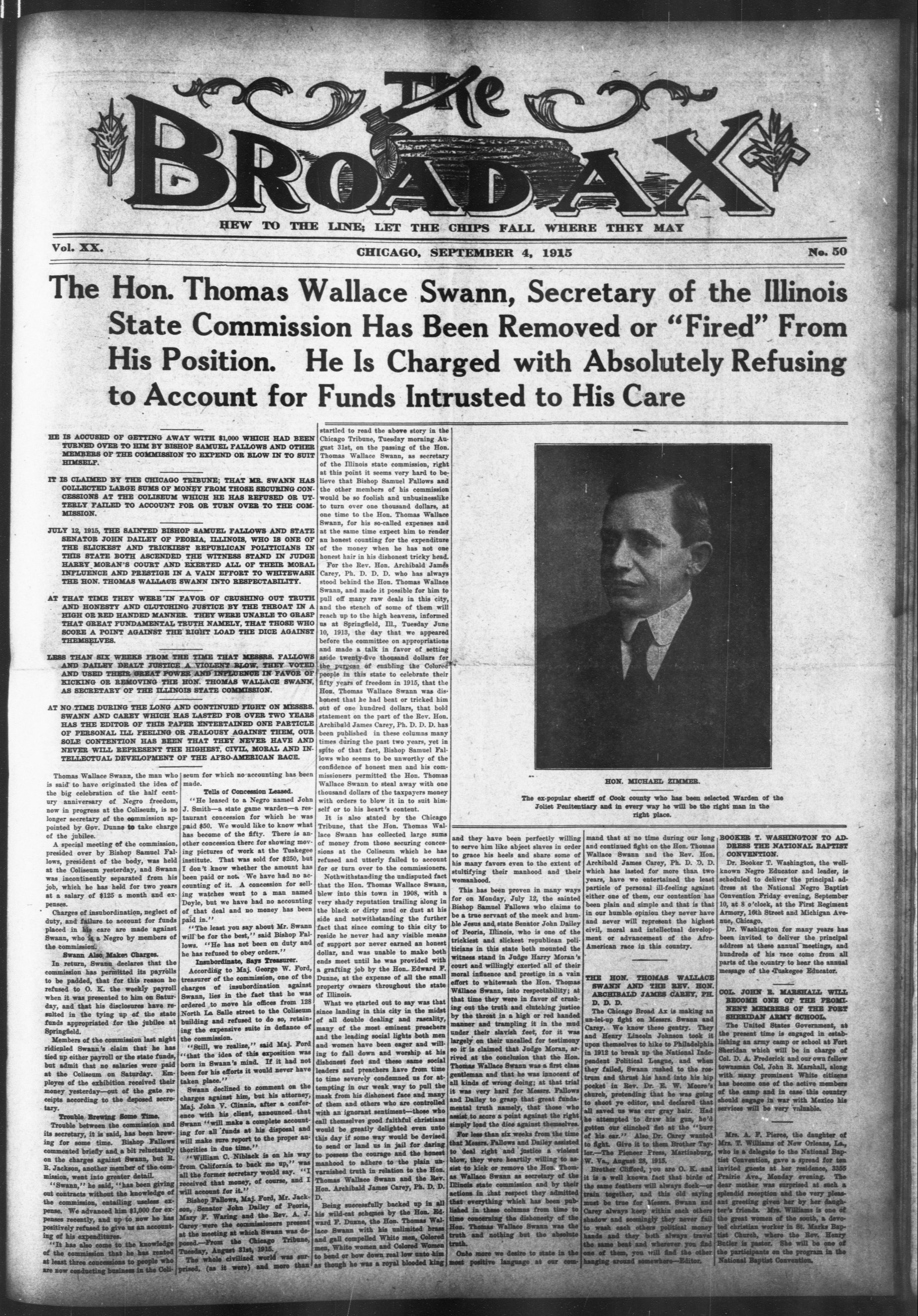
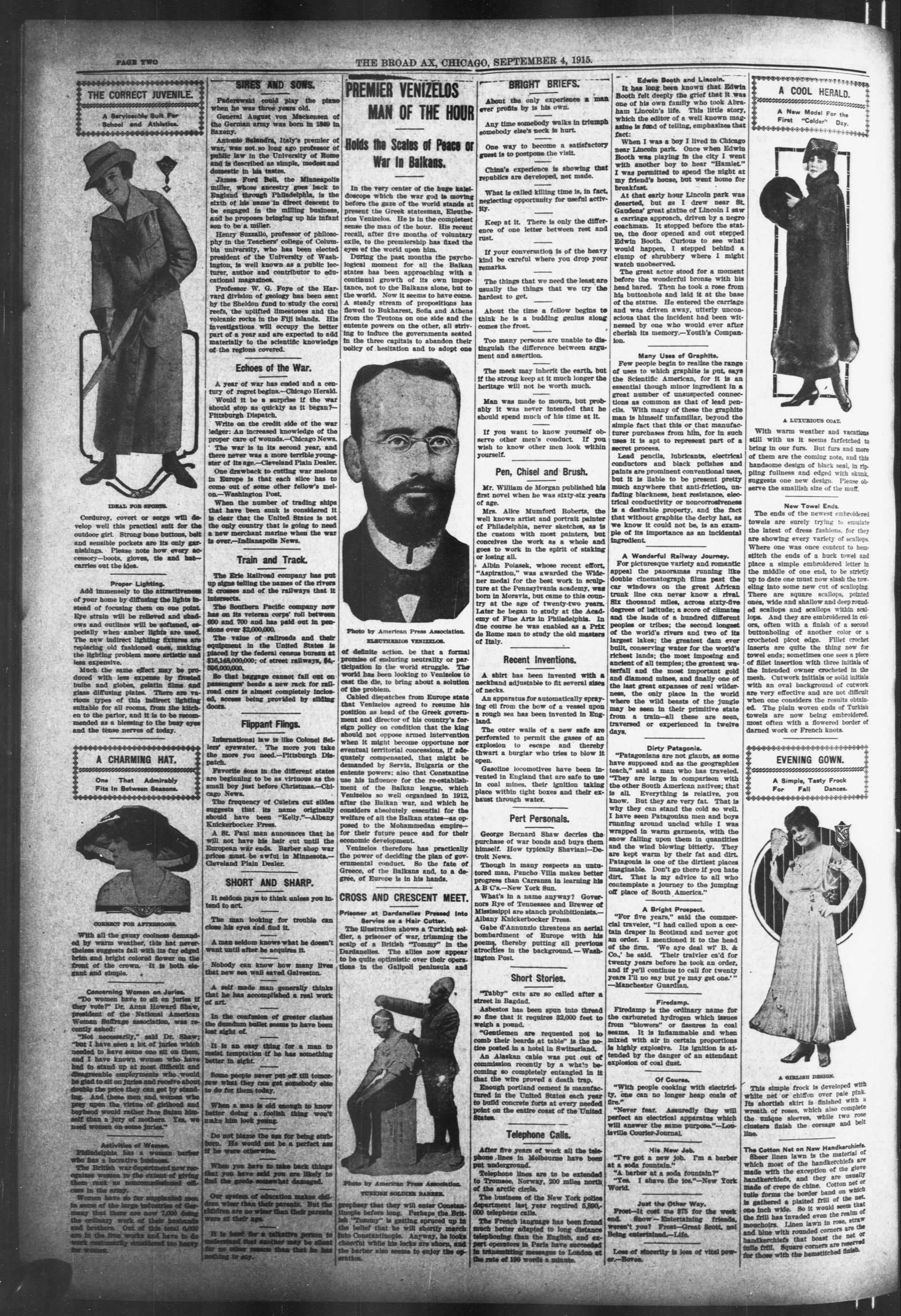
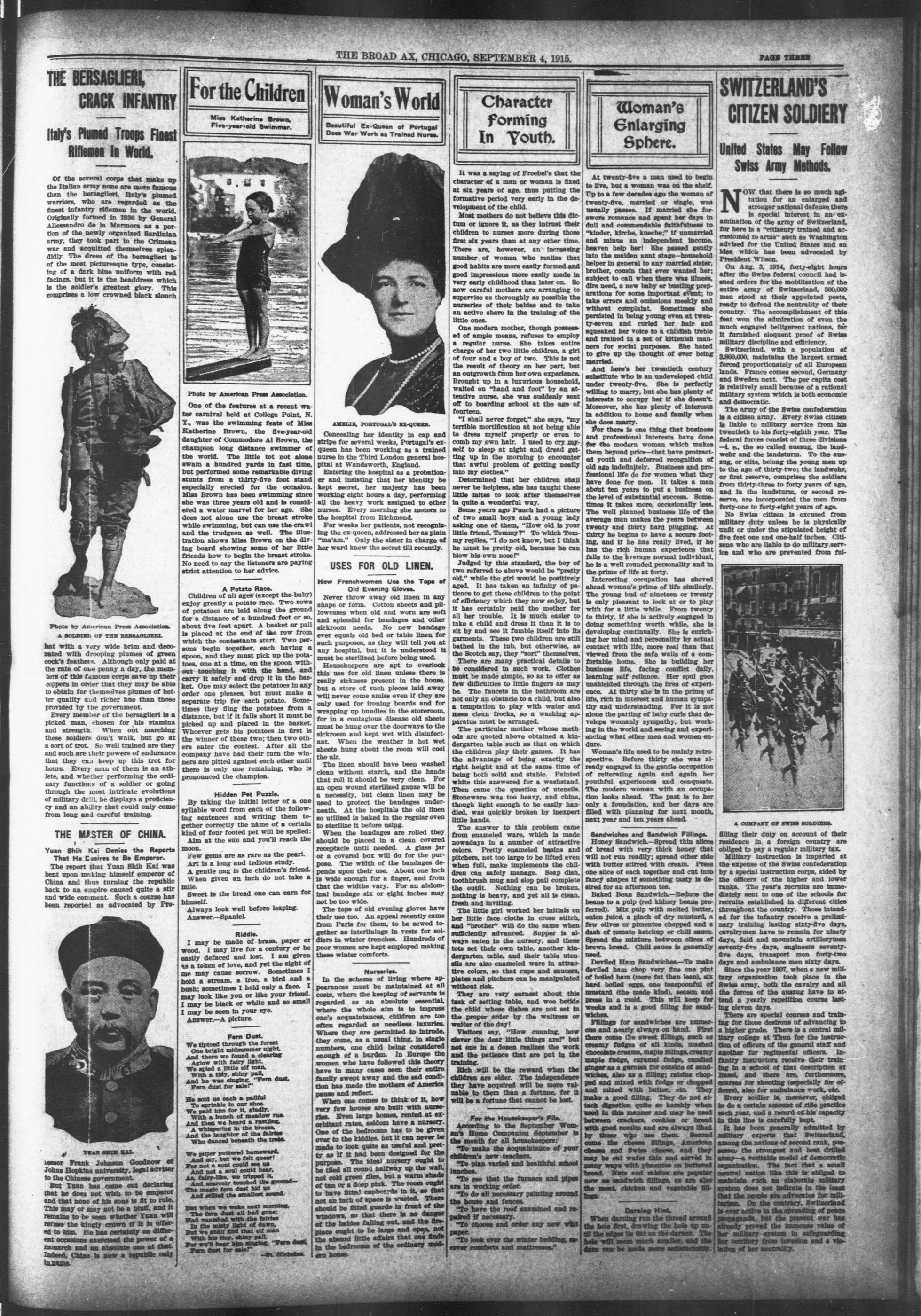
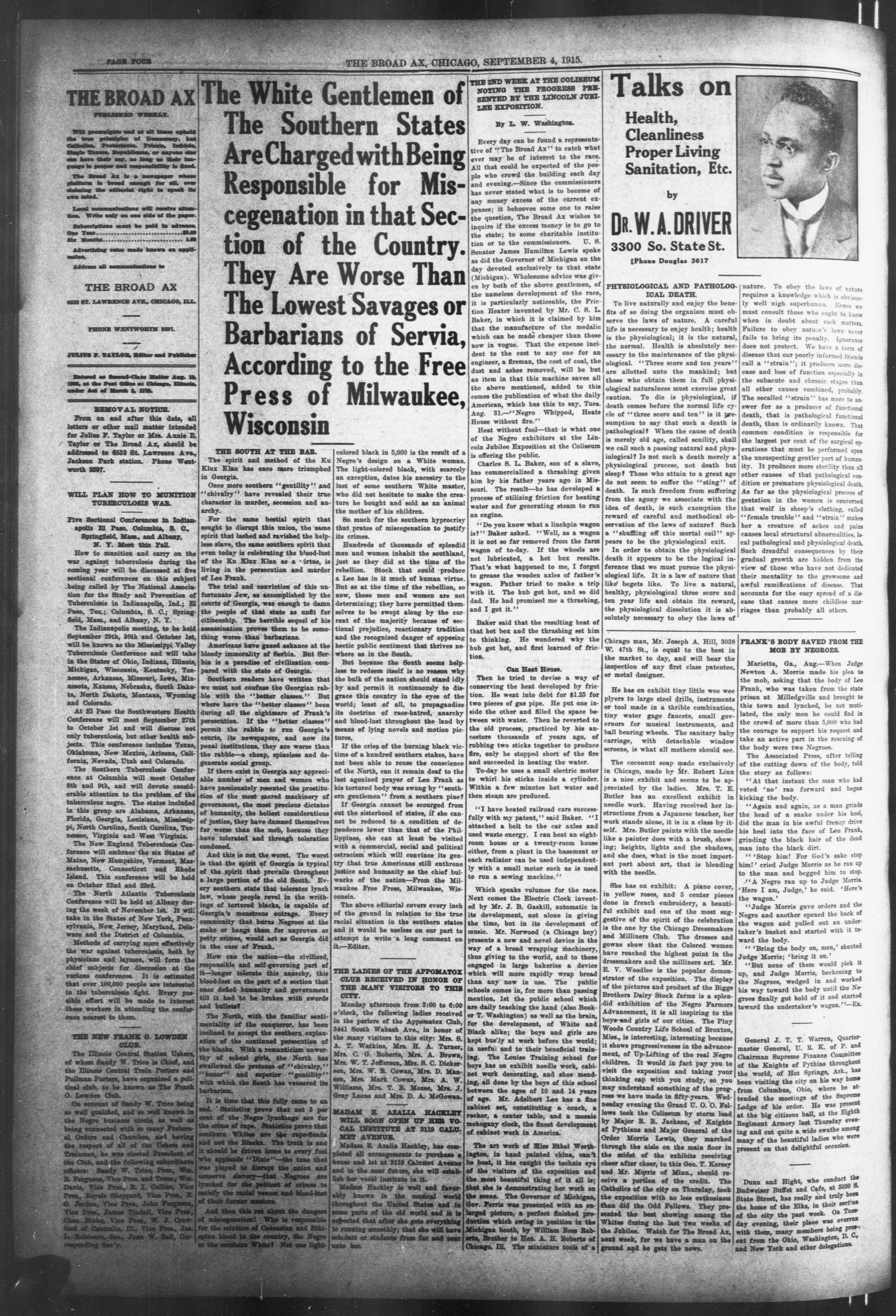
Page text (machine-generated)
THE BROAD AX
The Hon. Thomas Wallace Swann, Secretary of the Illinois State Commission Has Been Removed or "Fired" From His Position. He Is Charged with Absolutely Refusing to Account for Funds Intrusted to His Care
HE IS ACCUSED OF GETTING AWAY WITH $1,000 WHICH HAD BEEN TURNED OVER TO HIM BY BISHOP SAMUEL FALLOWS AND OTHER MEMBERS OF THE COMMISSION TO EXPEND OR BLOW IN TO SUIT HIMSELF.
IT IS CLAIMED BY THE CHICAGO TRIBUNE; THAT MR. SWANN HAS COLLECTED LARGE SUMS OF MONEY FROM THOSE SECURING CONCESSIONS AT THE COLISEUM WHICH HE HAS REFUSED OR UTTERLY FAILED TO ACCOUNT FOR OR TURN OVER TO THE COMMISSION.
JULY 12, 1915, THE SAINTED BISHOP SAMUEL FALLOWS AND STATE SENATOR JOHN DAILEY OF PEORIA, ILLINOIS, WHO IS ONE OF THE SLIKEST AND TRICKIEST REPUBLICAN POLITICIANS IN THIS STATE BOTH ASCENDED THE WITNESS STAND IN JUDGE HARRY MORAN'S COURT AND EXERTED ALL OF THEIR MORAL INFLUENCE AND PRESTIGE IN A VAIN EFFORT TO WHITEWASH THE HON. THOMAS WALLAGE SWANN INTO RESPECTABILITY.
AT THAT TIME THEY WERE IN FAVOR OF CRUSHING OUT TRUTH AND HONESTY AND CLUTCHING JUSTICE BY THE THROAT IN A HIGH OR RED HANDED MANNER. THEY WERE UNABLE TO GRASP THAT GREAT FUNDAMENTAL TRUTH NAMELY, THAT THOSE WHO SCORE A POINT AGAINST THE RIGHT LOAD THE DICE AGAINST THEMSELVES.
LESS THAN SIX WEEKS FROM THE TIME THAT MESSRS. FALLOWS AND DAILEY DEALT JUSTICE A VIOLENT BLOW. THEY VOTED AND USED THEIR GREAT POWER AND INFLUENCE IN FAVOR OF KICKING OR REMOVING THE HON. THOMAS WALLAGE SWANN, AS SECRETARY OF THE ILLINOIS STATE COMMISSION.
AT NO TIME DURING THE LONG AND CONTINUED FIGHT ON MESSERS.
SWANN AND CAREY WHICH HAS LASTED FOR OVER TWO YEARS
HAS THE EDITOR OF THIS PAPER ENTERTAINED ONE PARTICLE
OF PERSONAL ILL FEELING OR JEALOUSY AGAINST THEM, OUR
SOLE CONTENTION HAS BEEN THAT THEY NEVER HAVE AND
NEVER WILL REPRESENT THE HIGHEST, CIVIL, MORAL AND IN-
TELECTUAL DEVELOPMENT OF THE AFRO-AMERICAN BACE.
Vol. XX.
The Hon. State His P to Ac
HE IS ACCUSED OF GETTING AWAY TURNED OVER TO HIM BY BIS MEMBERS OF THE COMMISSION HIMSELF.
IT IS CLAIMED BY THE CHICAGO COLLECTED LARGE SUMS OF MESSIONS AT THE COLISEUM TERLY FAILED TO ACCOUNT MISSION.
JULY 12, 1915, THE SAINTED BISSE SENATOR JOHN DAILEY OF THE SLICKEST AND TRICKIN THIS STATE BOTH ASCENDER HARRY MORAN'S COURT AND INFLUENCE AND PRESTIGE IN THE HON. THOMAS WALLAGE.
AT THAT TIME THEY WERE IN AND HONESTY AND CLUTCH HIGH OR RED HANDED MANN THAT GREAT FUNDAMENTAL SOORE A POINT AGAINST THE THEMSELVES.
LESS THAN SIX WEEKS FROM THE AND DAILEY DEALT JUSTICE AND USED THEIR GREAT POW KICKING OR REMOVING THE AS SECRETARY OF THE ILLINOIS.
AT NO TIME DURING THE LONG A SWANN AND CAREY WHICH B HAS THE EDITOR OF THIS PAP OF PERSONAL ILL PEELING OF SOLE CONTENTION HAS BEEN NEVER WILL REPRESENT THE TELLECTUAL DEVELOPMENT
Thomas Wallace Swann, the man who is said to have originated the idea of the big celebration of the half century anniversary of Negro freedom, now in progress at the Coliseum, is no longer secretary of the commission appointed by Gov. Dunne to take charge of the jubilee.
A special meeting of the commission, presided over by Bishop Samuel Fallow, president of the body, was held at the Coliseum yesterday, and Swann was incontinently separated from his job, which he has held for two years at a salary of $125 a month and expenses.
Charges of insubordination, neglect of duty, and failure to account for funds placed in his care are made against Swann, who is a Negro by members of the commission.
Swann Also Makes Charges.
In return, Swann declares that the commission has permitted its payrolls to be padded, that for this reason he refused to O. K. the weekly payroll when it was presented to him on Saturday, and that his disclosures have resulted in the tying up of the state funds appropriated for the jubilee at Springfield.
Members of the commission last night ridiculed Swann's claim that he has tied up either payroll or the state funds, but admit that no salaries were paid at the Coliseum on Saturday. Employees of the exhibition received their money yesterday—out of the gate receipts according to the deposed secretary.
Trouble Brewing Some Time.
Trouble between the commission and its secretary, it is said, has been brewing for some time. Bishop Fallows commented briefly and a bit reluctantly on the charges against Swann, but R. R. Jackson, another member of the commission, went into greater detail.
"Swann," he said, "has been giving out contracts without the knowledge of the commission, entailing useless expense. We advanced him $1,000 for expenses recently, and up to now he has positively refused to give us an accounting of his expenditures.
"It has also come to the knowledge of the commission that he has rented at least three concessions to people who are now conducting business in the Coli-
seum for which no accounting has been made.
Tells of Concession Leased.
"He leased to a Negro named John J. Smith—a state game warden—a restaurant concession for which he was paid $50. We would like to know what has become of the fifty. There is another concession there for showing moving pictures of work at the Tuskegee institute. That was sold for $250, but I don't know whether the amount has been paid or not. We have had no accounting of it. A concession for selling watches went to a man named Doyle, but we have had no accounting of that deal and no money has been paid in."
"The least you say about Mr. Swann will be for the best," said Bishop Fallow. "He has not been on duty and he has refused to obey orders."
Insubordinate, Says Treasurer.
According to Maj. George W. Ford, treasurer of the commission, one of the charges of insubordination against Swann, lies in the fact that he was ordered to move his offices from 128 North La Salle street to the Coliseum building and refused to do so, retaining the expensive suite in defiance of the commission.
"Still, we realize," said Maj. Ford "that the idea of this exposition was born in Swann's mind. If it had not been for his efforts it would never have taken place."
Swann declined to comment on the charges against him, but his attorney, Maj. John V. Clinnin, after a conference with his client, announced that Swann "will make a complete accounting for all funds at his disposal and will make sure report to the proper authorities in due time."
"William C. Niblack is on his way from California to back me up," was all the former secretary would say. "I received that money, of course, and I will account for it."
Bishop Fallows, Maj. Ford, Mr. Jackson, Senator John Dailey of Peoria, Mary F. Waring and the Rev. A. J. Carey were the commissioners present at the meeting at which Swann was deposed—From the Chicago Tribune, Tuesday, August 31st, 1915.
The whole civilized world was surprised, (as it were) and more than
CHICAGO, SEPTEMBER 4. 1915
startled to read the above story in the Chicago Tribune, Tuesday morning August 31st, on the passing of the Hon. Thomas Wallace Swann, as secretary of the Illinois state commission, right at this point it seems very hard to believe that Bishop Samuel Fallows and the other members of his commission would be so foolish and unbusinesslike to turn over one thousand dollars, at one time to the Hon. Thomas Wallace Swann, for his so-called expenses and at the same time expect him to render an honest counting for the expenditure of the money when he has not one honest hair in his dishonest tricky head. For the Rev. Hon. Archibald Jamés Carey, Ph. D. D. D. who has always stood behind the Hon. Thomas Wallace Swann, and made it possible for him to pull off many raw deals in this city, and the stench of some of them will reach up to the high heavens, informed us at Springfield, Ill., Tuesday June 10, 1913, the day that we appeared before the committee on appropriations and made a talk in favor of setting aside twenty-five thousand dollars for
the purpose or enabling the Colored people in this state to celebrate their fifty years of freedom in 1915, that the Hon. Thomas Wallace Swann was dishonest that he had beat or tricked him out of one hundred dollars, that bold statement on the part of the Rev. Hon. Archibald James Carey, Ph. D. D. D. has been published in these columns many times during the past two years, yet in spite of that fact, Bishop Samuel Fallows who seems to be unworthy of the confidence of honest men and his commissioners permitted the Hon. Thomas Wallace Swann to steal away with one thousand dollars of the taxpayers money with orders to blow it in to suit himself or to his heart's content. It is also stated by the Chicago Tribune, that the Hon. Thomas Wallace Swann has collected large sums of money from those securing concessions at the Coliseum which he has refused and utterly failed to account for or turn over to the commissioners.
Nothwithstanding the undisputed fact that the Hon. Thomas Wallace Swann, blew into this town in 1908, with a very shady reputation trailing along in the black or dirty mud or dust at his side and notwithstanding the further fact that since coming to this city to reside he never had any visible means of support nor never earned an honest dollar, and was unable to make both ends meet until he was provided with a grafting job by the Hon. Edward F. Dunne, at the expense of all the small property owners throughout the state of Illinois.
What we started out to say was that since landing in this city in the midst of all double dealing and rascality, many of the most eminent preachers and the leading social lights both men and women have been eager and willing to fall down and worship at his dishonest feet and these same social leaders and preachers have from time to time severely condemned us for attempting in our weak way to pull the mask from his dishonest face and many of them and others who are controlled with an ignorant sentiment—those who call themselves good faithful christians would be greatly delighted even unto this day if some way would be devised to send or land us in jail for daring to possess the courage and the honest manhood to adhere to the plain unvarnished truth in relation to the Hon. Thomas Wallace Swann and the Rev. Hon. Archibald James Carey, Ph. D. D. D.
Being successfully backed up in all his wild-cat schemes by the Hon. Edward P. Dunne, the Hon. Thomas Wallace Swann with his unlimited brass and gall compelled White men, Colored men, White women and Colored Women to bend or how down real low unto him as though he was a royal blooded king
M.
The ex-popular heriff of Cook county who has been selected Warden of the Joliet Penitentiary and in every way he will be the right man in the right place.
and they have been perfectly willing to serve him like abject slaves in order to grace his heels and share some of his many favors even to the extent of stultifying their manhood and their womanhood.
This has been proven in many ways for on Monday, July 12, the sainted Bishop Samuel Fallows who claims to be a true servant of the meek and humble Jesus and state Senator John Dailey of Peoria, Illinois, who is one of the trickiest and slickest republican politicians in this state both mounted the witness stand in Judge Harry Moran's court and willingly exerted all of their moral influence and prestige in a vain effort to whitewash the Hon. Thomas Wallace Swann, into respectability; at that time they were in favor of crushing out the truth and clutching justice by the threat in a high or red handed manner and trampling it in the mud under their slavish feet, for it was largely on their uncalled for testimony so it is claimed that Judge Moran, arrived at the conclusion that the Hon. Thomas Wallace Swann was a first class gentleman and that he was innocent of all of wrong doing; at that trial it was very hard for Messrs. Fallows and Dailey to grasp that great fundamental truth namely, that those who assist to score a point against the right simply load the dice against themselves.
For less than six weeks from the time that Messrs. Fallows and Dailey assisted to deal right and justice a violent blow, they were heartily willing to assist to kick or remove the Hon. Thomas Wallace Swann as secretary of the Illinois state commission and by their actions in that respect they admitted that everything which has been published in these columns from time to time concerning the dishonesty of the Hon. Thomas Wallace Swann was the truth and nothing but the absolute truth.
Once more we desire to state in the most positive language at our com-
mand that at no time during our long and continued fight on the Hon. Thomas Wallace Swann and the Rev. Hon. Archibald James Carey, Ph. D. D. D. which has lasted for more than two years, have we entertained the least particle of personal ill-feeling against either one of them, our contention has been plain and simple and that is that in our humble opinion they never have and never will represent the highest civil, moral and intellectual development or advancement of the Afro-American race in this country.
THE HON. THOMAS WALLACE SWANN AND THE REV. HON. ARCHIBALD JAMES CAREY, PH. D. D. D.
The Chicago Broad Ax is making an un-leet-up fight on Messrs. Swann and Carey. We know these gentry. They and Henry Lincoln Johnson took it upon themselves to hike to Philadelphia in 1912 to break up the National Independent Political League, and when they failed, Swann rushed to the rostrum and thrust his hand into his hip pocket in Rev. Dr. E. W. Moore's church, pretending that he was going to shoot ye editor, and declared that all saved us was our gray hair. Had he attempted to draw his gun, he'd gotten our clinched flat at the "burr of his ear." Also Dr. Carey wanted to fight. Give it to them Brother Taylor.—The Pioneer Press, Martinsburg, W. Va. August 28, 1915.
Brother Chifford, you are O. K. and it is a well known fact that birds of the same feathers will always flock—or train together, and this old saying must be true for Messrs. Swann and Carey always keep within each others shadow and seemingly they never fail to wash each others political money hands and they both always travel the same beat and wherever you find one of them, you will find the other hanging around somewhere—Editor.
No. 50
the Illinois
red" From
y Refusing
BOOKER T. WASHINGTON TO ADDRESS THE NATIONAL BAPTIST CONVENTION.
Dr. Booker T. Washington, the well-known Negro Educator and leader, is scheduled to deliver the principal address at the National Negro Baptist Convention Friday evening, September 10, at 8 o'clock, at the First Regiment Armory, 16th Street and Michigan Avenue, Chicago.
Dr. Washington for many years has been invited to deliver the principal address at these annual meetings, and hundreds of his race come from all parts of the country to hear the annual message of the Tuskegee Educator.
COL. JOHN E. MARSHALL WILL BECOME ONE OF THE PROMINENT MEMBERS OF THE PORT SHERIDAN ARMY SCHOOL.
The United States Government, at the present time is engaged in establishing an army camp or school at Fort Sheridan which will be in charge of Col. D. A. Frederick and our own fellow townman Col. John R. Marshall, along with many prominent White citizens has become one of the active members of the camp and in case this country should engage in war with Mexico his services will be very valuable.
Mrs. A. F. Pierce, the daughter of Mrs. T. Williams of New Orleans, La., who is a delegate to the National Baptist Convention, gave a spread for ten invited guests at her residence, 3355 Prairie Ave., Monday evening. The dear mother was surprised at such a splendid reception and the very pleasant greeting given her by her daughter's friends. Mrs. Williams is one of the great women of the south, a devoted Christian worker in St. Marks Baptist Church, where the Rev. Henry Butler is pastor. She will be one of the participants on the program in the National Baptist Convention.
THE CORRECT JUVENILE.
A Serviceable Suit For
School and Athletics.
IDEAL FOR SPORTS.
Corduroy, covert or serge will develop well this practical suit for the outdoor girl. Strong bone buttons, belt and sensible pockets are its only garnishings. Please note how every accessory—boots, gloves, tie and hat—carries out the idea.
Proper Lighting
Add immensely to the attractiveness of your home by diffusing the lights instead of focusing them on one point. Eye strain will be relieved and shadows and outlines will be softened, especially when amber lights are used. The new indirect lighting fixures are replacing old fashioned ones, making the lighting problem more artistic and less expensive. Much the same effect may be produced with less expense by frosted bulbs and globes, gelatin films and glass diffusing plates. There are various types of this indirect lighting suitable for all rooms, from the kitchen to the parlor, and it is to be recommended as a blessing to the busy eyes and the tense nerves of today.
CORRECT FOR AFTERNOON.
With all the gaudy coolness demanded by warm weather, this hat nevertheless suggests fall with its fur edged brim and bright colored flower on the front of the crown. It is both elegant and simple.
Concerning Women on Juries.
"Do women have to sit on juries if they vote?" Dr. Anna Howard Shaw, president of the National American Woman Suffrage association, was recently asked:
"Not necessarily," said Dr. Shaw;
"but I have seen a lot of juries which needed to have some one sit on them, and I have known women who have had to stand up at most difficult and disagreeable employers who would be glad to sit on juries and receive about double the price they can get by standing. And these men and women who prey upon the virtue of girlhood and boyhood would rather face Satan himself than a jury of mothers. Yes, we used women on some juries."
Women have so far supplanted men in some of the large industries of Germany that there are now 7,000 doing the ordinary work of their husbands and brothers. Out of this total 6,000 are in the iron works and have to do work customarily considered too heavy for women.
SIRES AND SONS.
Paderewski could play the piano when he was three years old.
General August von Mackensen of the German army was born in 1849 in Saxony.
Antonio Salandra, Italy's premier of war, was not so long ago professor of public law in the University of Rome and is described as simple, modest and domestic in his tastes.
James Ford Bell, the Minneapolis mill, whose ancestry goes back to England through Philadelphia, is the sixth of his name in direct descent to be engaged in the milling business, and he proposes bringing up his infant son to be a miller.
Henry Suzallo, professor of philosophy in the Teachers' college of Columbia university, who has been elected president of the University of Washington, is well known as a public lecturer, author and contributor to educational magazines.
Professor W. G. Foye of the Harvard division of geology has been sent by the Sheldon fund to study the coral reefs, the uplifted limestone and the volcanic rocks in the Fiji islands. His investigations will occupy the better part of a year and are expected to add materially to the scientific knowledge of the regions covered.
Echoes of the War.
A year of war has ended and a century of regret begins.—Chicago Herald. Would it be a surprise if the war should stop as quickly as it began?—Pittsburgh Dispatch. Write on the credit side of the war ledger: An increased knowledge of the proper care of wounds.—Chicago News. The war is in its second year, and there never was a more terrible youngster of its age.—Cleveland Plain Dealer. One drawback to cutting war melons in Europe is that each slice has to come out of some other fellow's melon.—Washington Post. When the number of trading ships that have been sunk is considered it is clear that the United States is not the only country that is going to need a new merchant marine when the war is over.—Indianapolis News.
Train and Track
The Erie Railroad company has put up signs telling the names of the rivers it crosses and of the railways that it intersects.
The Southern Pacific company now has on its veteran corps' roll between 600 and 700 and has paid out in pensions over $2,000,000.
The value of railroads and their equipment in the United States is placed by the federal census bureau at $16,148,000,000; of street railways, $4,098,000,000.
So that baggage cannot fall out on passengers' heads a new rack for railroad cars is almost completely Inclosed, access being provided by sliding doors.
Flippant Flings.
International law is like Colonel Sellers' eyewater. The more you take the more you need.-Pittsburgh Dispatch.
Favorite sons in the different states are beginning to be as virtuous as the small boy just before Christmas.-Chicago News.
The frequency of Culebra cut slides suggests that its name originally should have been "Kelly."-Albany Knickerbocker Press.
A St. Paul man announces that he will not have his hair cut until the European war ends. Barber shop war prices must be awful in Minnesota.-Cleveland Plain Dealer.
SHORT AND SHARP.
It seldom pays to think unless you intend to act.
THE BROAD AX, CHICAGO, SEPTEMBER 4, 1915
PREMIER VENIZELOS MAN OF THE HOUR
In the very center of the huge kaleidoscope which the war god is moving before the gaze of the world stands at present the Greek statesman, Eleutherios Venizelos. He is in the completest sense the man of the hour. His recent recall, after five months of voluntary exile, to the premiership has fixed the eyes of the world upon him.
During the past months the psychological moment for all the Balkan states has been approaching with a continual growth of its own importance, not to the Balkans alone, but to the world. Now it seems to have come. A steady stream of propositions has flowed to Bukharest, Sofia and Athens from the Teutons on one side and the entente powers on the other, all striving to induce the governments seated in the three capitals to abandon their policy of hesitation and to adopt one
P.
Photo by American Press Association.
ELEUTHERIOS VENIZELOS.
of definite action, be that a formal promise of enduring neutrality or participation in the world struggle. The world has been looking to Venizelos to cast the die, to bring about a solution of the problem.
Cabled dispatches from Europe state that Venizelos agreed to resume his position as head of the Greek government and director of his country's foreign policy on condition that the king should not oppose armed intervention when it might become opportune nor eventual territorial concessions, if adequately compensated, that might be demanded by Servia, Bulgaria or the entente powers; also that Constantine use his influence for the re-establishment of the Balkan league, which Venizelos so well organized in 1912, after the Balkan war, and which he considers absolutely essential for the welfare of all the Balkan states—as opposed to the Mohammedan empire—for their future peace and for their economic development.
Venizelos therefore has practically the power of deciding the plan of governmental conduct. So the fate of Greece, of the Balkans and, to a degree, of Europe is in his hands.
CROSS AND CRESCENT MEET.
Prisoner at Dardanelles Pressed Into Service as a Hair Cutter. The illustration shows a Turkish soldier, a prisoner of war, trimming the scalp of a British "Tommy" in the Dardanelles. The allies now appear to be quite optimistic over their operations in the Gallipoli peninsula and
THE HAIR CARE MODEL
prophecy that they will enter Constantinople before long. Perhaps the British "Tommy" is getting spruced up in the belief that he will shortly march into Constantinople. Anyway, he looks chestful while his locks are shorn, and the barber also seems to enjoy the operation.
About the only experience a man ever profits by is his own.
Any time somebody walks in triumph somebody else's neck is hurt.
One way to become a satisfactory guest is to postpone the visit.
China's experience is showing that republics are developed, not made.
What is called killing time is, in fact, neglecting opportunity for useful activity.
Keep at it. There is only the difference of one letter between rest and rust.
If your conversation is of the heavy kind be careful where you drop your remarks.
The things that we need the least are usually the things that we try the hardest to get.
About the time a fellow begins to think he is a budding genius along comes the frost.
Too many persons are unable to distinguish the difference between argument and assertion.
The meek may inherit the earth, but if the strong keep at it much longer the heritage will not be worth much.
Man was made to mourn, but probably it was never intended that he should spend much of his time at it.
If you want to know yourself observe other men's conduct. If you wish to know other men look within yourself.
Pen. Chisel and Brush.
Mr. William de Morgan published his first novel when he was sixty-six years of age.
Mrs. Alice Mumford Roberts, the well known artist and portrait painter of Philadelphia, never sketches, as is the custom with most painters, but conceives the work as a whole and goes to work in the spirit of staking or losing all.
Albin Polasek, whose recent effort, "Aspiration," was awarded the Widener medal for the best work in sculpture at the Pennsylvania academy, was born in Moravia, but came to this country at the age of twenty-two years. Later he began to study at the Academy of Fine Arts in Philadelphia. In due course he was enabled as a Prix de Rome man to study the old masters of Italy.
Recent Inventions.
A shirt has been invented with a neckband adjustable to fit several sizes of necks.
An apparatus for automatically spraying oil from the bow of a vessel upon a rough sea has been invented in England.
The outer walls of a new safe are perforated to permit the gases of an explosion to escape and thereby thwart a burglar who tries to blow it open.
Gasoline locomotives have been invented in England that are safe to use in coal mines, their ignition taking place within tight boxes and their exhaust through water.
Pert Personals.
George Bernard Shaw declies the purchase of war bonds and buys them himself. How typically Shavian—Detroit News.
Though in many respects an untutored man, Pancho Villa makes better progress than Carranza in learning his A B C's.—New York Sun.
What's in a name anyway? Governors Rye of Tennessee and Brewer of Mississippi are stanch prohibitionists.—Albany Knickerbocker Press.
Gabe d'Annunzio threatens an aerial bombardment of Europe with his poems, thereby putting all previous atrocities in the background.—Washington Post.
Short Stories.
"Tabby" cats are so called after a street in Bagdad.
Asbestos has been spun into thread so fine that it requires 23,000 feet to weigh a pound.
"Gentlemen are requested not to comb their beards at table" is the notice posted in a hotel in Switzerland.
An Alaskan cable was put out of commission recently by a whats becoming so completely entangled in it that the wire proved a death trap.
Enough portland cement is manufactured in the United States each year to build concrete forts at every needed point on the entire coast of the United States.
Telephone Calls
After five years of work all the telephone lines in Melbourne have been put underground.
Telephone lines are to be extended to Tromsø, Norway, 200 miles north of the arctic circle.
The business of the New York police department last year required 5,800-000 telephone calls.
The French language has been found much better adapted to long distance telephoning than the English, and expert operators in Paris have succeeded in transmitting messages to London at the rate of 190 words a minute.
Edwin Booth and Lincoln.
It has long been known that Edwin Booth felt deeply the grief that it was one of his own family who took Abraham Lincoln's life. This little story, which the editor of a well known magazine is fond of telling, emphasizes that fact:
When I was a boy I lived in Chicago near Lincoln park. Once when Edwin Booth was playing in the city I went with another boy to hear "Hamlet." I was permitted to spend the night at my friend's house, but went home for breakfast.
At that early hour Lincoln park was deserted, but as I drew near St. Gaudens' great statue of Lincoln I saw a carriage approach, driven by a negro coachman. It stopped before the statue, the door opened and out stepped Edwin Booth. Curious to see what would happen, I stepped behind a clump of shrubbery where I might watch unobserved.
The great actor stood for a moment before the wonderful bronze with his head bared. Then he took a rose from his buttonhole and laid it at the base of the statue. He entered the carriage and was driven away, utterly unconscious that the incident had been witnessed by one who would ever after cherish its memory.—Youth's Companion.
Many Uses of Graphite.
Few people begin to realize the range of uses to which graphite is put, says the Scientific American, for it is an essential though minor ingredient in a great number of unsuspected connections as common as that of lead pencils. With many of these the graphite man is himself unfamiliar, beyond the simple fact that this or that manufacturer purchases from him, for in such uses it is apt to represent part of a secret process.
Lead pencils, lubricants, electrical conductors and black polishes and paints are prominent conventional uses, but it is liable to be present pretty much anywhere that anti-friction, unfading blackness, heat resistance, electrical conductivity or noncorrosiveness is a desirable property, and the fact that without graphite the derby hat, as we know it could not be, is an example of its importance as an incidental ingredient.
A Wonderful Railway Journey.
For picturesque variety and romantic appeal the panoramas running like double cinematograph films past the car windows on the great African trunk line can never know a rival. Six thousand miles, across sixty-five degrees of latitude, a score of climates and the lands of a hundred different peoples or tribes; the second longest of the world's rivers and two of its largest lakes; the greatest dam ever built, conserving water for the world's richest lands; the most imposing and ancient of all temples; the greatest waterfall and the most important gold and diamond mines, and finally one of the last great expanses of real wilderness, the only place in the world where the wild beasts of the jungle may be seen in their primitive state from a train-all these are seen, traversed or experienced in twelve days.
Dirty Patagonia.
"Patagonians are not giants, as some have supposed and as the geographies teach," said a man who has traveled. "They are large in comparison with the other South American natives; that is all. Everything is relative, you know. But they are very fat. That is why they can stand the cold so well. I have seen Patagonian men and boys running around unclad while I was wrapped in warm garments, with the snow falling upon them in quantities and the wind blowing bitterly. They are kept warm by their fat and dirt. Patagonia is one of the driest places imaginable. Don't go there if you hate dirt. That is my advice to all who contemplate a journey to the jumping off place of South America."
A Bright Prospect.
"For five years," said the commercial traveler, "I had called upon a certain draper in Scotland and never got an order. I mentioned it to the head of the firm. 'We aye deal wl' B. & Co,' he said. 'Their travler ca'd for twenty years before he took an order, and if ye'll continue to call for twenty years I'll no say but ye may get one.'"—Manchester Guardian.
Firedamp.
Firedamp is the ordinary name for the carbureted hydrogen which issues from "blowers" or fissures in coal seams. It is infammable and when mixed with air in certain proportions is highly explosive. Its ignition is attended by the danger of an attendant explosion of coal dust.
Of Course.
"With people cooking with electricity, one can no longer heap coals of fire."
"Never fear. Assuredly they will perfect an electrical apparatus which will answer the same purpose."—Louisville Courrier-Journal.
"I've got a new job. I'm a barber at a soda fountain."
"A barber at a soda fountain?"
"Yes. I abave the ice."—New York World.
Frost—it cost me $75 for the week end. Snow—Entertaining friends, weren't you? Frost—Great Scott, not Being entertained. Life
A COOL HERALD.
A New Model For the First "Colder" Day.
A
A LUXURIOUS COAT.
With warm weather and vacations still with us it seems farfetched to bring in our furs. But furs and more of them are the coming note, and this handsome design of black seal, in rippling fullness and edged with skunk, suggests one new design. Please observe the smallish size of the muff.
New Towel Ends.
The ends of the newest embroidered towels are surely trying to emulate the latest of dress fashions, for they are showing every variety of scallops. Where one was content to hemstitch the ends of a huck towel and place a simple embroidered letter in the middle of one end, to be strictly up to date one must now slash the towell into some new cut of scalloping. There are square scallops, pointed ones, wide and shallow and deep rounded scallops and scallops within scallops. And they are embroidered in colors, often with a finish of a second buttonholing of another color or a crocheted pict edge. Fillet crochet inserts are quite the thing now for towel ends; sometimes one sees a piece of fillet insertion with three initials of the intended owner crocheted in the mesh. Cutwork initials or solid initials with an oval background of cutwork are very effective and are not difficult when one considers the results obtained. The plain woven ends of Turkish towels are now being embroidered, most often with a flowered border of darned work or French knots.
```markdown
```
CINEMAS
A GIRLISH DESIGN.
This simple frock is developed with white net or chiffon over pale pink. Its shortish skirt is finished with a wreath of roses, which also complete the unique sleeves, while two rose clusters finish the corsage and belt line.
The Cotton Net on New Handkerchiefs.
Sheer linen lawn is the material of which most of the handkerchiefs are made with the exception of the glove handkerchiefs, and they are usually made of crepe de chine. Cotton net or tulle forms the border band on which is gathered a plaited frill of the net, one inch wide. So it would seem that the frill has invaded even the realm of mouchoirs. Linen lawn in rose, straw and blue with rounded corners are the handkerchiefs that boast the net or tulle frill. Square corners are reserved for those with the hemstitched finish.
Of the several corps that make up the Italian army none are more famous than the bersaglieri, Italy's plumed warriors, who are regarded as the finest infantry riflemen in the world. Originally formed in 1836 by General Allessandro de la Marmora as a portion of the newly organized Sardinian army, they took part in the Crimean war and acquitted themselves splendidly. The dress of the bersaglieri is of the most picturesque type, consisting of a dark blue uniform with red facings, but it is the headdress which is the soldier's greatest glory. This comprises a low crowned black slouch
```markdown
```
Photo by American Press Association.
A SOLDIER OF THE BERSAGLIERI
hat with a very wide brim and decorated with drooping plumes of green cock's feathers. Although only paid at the rate of one penny a day, the members of this famous corps save up their coppers in order that they may be able to obtain for themselves plumes of better quality and richer hue than those provided by the government.
Every member of the bersaglieri is a picked man, chosen for his stamina and strength. When out marching these soldiers don't walk, but go at a sort of trot. So well trained are they and such are their powers of endurance that they can keep up this trot for hours. Every man of them is an athlete, and whether performing the ordinary functions of a soldier or going through the most intricate evolutions of military drill, he displays a proficiency and an ability that could only come from long and careful training.
THE MASTER OF CHINA.
Yuan Shih Kai Denies the Reports
That Seniors to Be Employed
That He Leaves to Be Emperor
The report that Yuan Shih Kai was bent upon making himself emperor of China and thus turning the republic back to an empire caused quite a stir and wide comment. Such a course has been reported as advocated by Pro-
YUAN SHIN KAL
lessor Frank Johnson Goodnow of Johns Hopkins university, legal adviser to the Chinese government. But Yuan has come out declaring that he does not wish to be emperor and that none of his sons is fit to rule. This may or may not be a bluff, and it remains to be seen whether Yuan will refuse the kingly crown if it is offered to him. He has certainly on different occasions exercised the power of a monarch and an absolute one at that. Indeed, China is now a republic only in name.
Miss Katherine Brown. Five-year-old Swimmer.
A young boy stands on a diving board in a lake, arms extended forward. The background features a building and trees.
Photo by American Press Association.
One of the features at a recent water carnival held at College Point, N.Y., was the swimming feats of Miss Katherine Brown, the five-year-old daughter of Commodore Al Brown, the champion long distance swimmer of the world. The little tot not alone swam a hundred yards in fast time, but performed some remarkable diving stunts from a thirty-five foot stand especially erected for the occasion. Miss Brown has been swimming since she was three years old and is considered a water marvel for her age. She does not alone use the breast stroke while swimming, but can use the crawl and the trudgeon as well. The illustration shows Miss Brown on the diving board showing some of her little friends how to begin the breast stroke. No need to say the listeners are paying strict attention to her advice.
A Potato Race.
Children of all ages (except the baby) enjoy greatly a potato race. Two rows of potatoes are laid along the ground for a distance of a hundred feet or so, about five feet apart. A basket or pail is placed at the end of the row from which the contestants start. Two persons begin together, each having a spoon, and they must pick up the potatoes, one at a time, on the spoon without touching it with the hand, and carry it safely and drop it in the basket. One may select the potatoes in any order one pleases, but must make a separate trip for each potato. Sometimes they fling the potatoes from a distance, but if it falls short it must be picked up and placed in the basket. Whoever gets his potatoes in first is the winner of these two; then two others enter the contest. After all the company have had their turn the winners are pitted against each other until there is only one remaining, who is pronounced the champion.
Hidden Pet Puzzle
By taking the initial letter of a one syllable word from each of the following sentences and writing them together correctly the name of a certain kind of four footed pet will be spelled: Aim at the sun and you'll reach the moon.
A gentle nag is the children's friend.
When given an inch do not take a mile.
Sweet is the bread one can earn for himself.
Always look well before leaping.
Answer—Spandel.
Riddle.
I may be made of brass, paper or wood. I may live for a century or be easily defaced and lost. I am given as a token of love, and yet the sight of me may cause sorrow. Sometimes I hold a stream, a tree, a bird and a bush; sometimes I hold only a face. I may look like you or like your friend. I may be black or white and so small I may be seen in your eye.
Fern Dust.
We tipted through the forest
One bright midsummer night,
And there we found a clearing
Aglow with fairy light.
We spied a little elf man,
With a tidy, shiny pall,
And he was singing, "Fern dust,
Fern dust for sale!"
He sold us each a palliful
To sprinkle in our shoe.
We paid him for it, gladly.
With a bunch of meadow rue.
And then we heard a rustling,
A whispering in the breeze.
And the laughter of the fairies
Who danced beneath the trees.
We pitter patterned homeward,
And my, but we fell heart!
For not a soul could see us
And not a soul could hear,
At daffie, we trapped it,
And sensually touched the ground
The magic fern dust hid us
And stilled the smallest sound.
But when we woke next morning,
The fern dust all had gone;
Had vanished, with the fairies
In the misty light of dawn,
But we shall find that elf man
With his tiny, shiny pall,
For we'll hear him singing, "Fern dust,
Even dust for sale!"
THE BROAD AX, CHICAGO, SEPTEMBER 4, 1915
Beautiful Ex-Queen of Portugal Does War Work as Trained Nurse.
Mary
AMELIE, PORTUGAL'S EX-QUEEN.
Concealing her identity in cap and stripe for several weeks, Portugal's ex-queen has been working as a trained nurse in the Third London general hospital at Wandsworth, England.
Entering the hospital as a probationer and insisting that her identity be kept secret, her majesty has been working eight hours a day, performing all the heavy work assigned to other nurses. Every morning she motors to the hospital from Richmond.
For weeks her patients, not recognizing the ex-queen, addressed her as plain "ma'am". Only the sister in charge of her ward knew the secret till recently.
USES FOR OLD LINEN.
How Frenchwomen Use the Tops of Old Evening Gloves.
Never throw away old linen in any shape or form. Cotton sheets and pillowcases when old and worn are soft and splendid for bandages and other sickroom needs. No new bandage ever equals old bed or table linen for such purposes, as they will tell you at any hospital, but it is understood it must be sterilized before being used.
Housekeepers are apt to overlook this use for old linen unless there is really sickness present in the house, but a store of such pieces laid away will never come amiss even if they are only used for ironing boards and for wrapping up bundles in the storeroom, for in a contagious disease old sheets must be hung over the doorways to the sickroom and kept wet with disinfectant. When the weather is hot wet sheets hung about the room will cool the air.
The linen should have been washed clean without starch, and the hands that roll it should be very clean. For an open wound sterilized gauze will be a necessity, but clean linen may be used to protect the bandages underneath. At the hospitals the old linen so utilized is baked in the regular oven to sterilize it before using. When the bandages are rolled they should be placed in a clean covered receptacle until needed. A glass jar or a covered box will do for the purpose. The width of the bandages depends upon their use. About one inch is wide enough for a finger, and from that the widths vary. For an abdominal bandage six or eight inches may not be too wide.
The tops of old evening gloves have their use too. An appeal recently came from Paris for them, to be sewed together as interlinings in vests for soldiers in winter trenches. Hundreds of poor women are kept employed making these winter comforts.
Nurseries.
In the scheme of living where appearances must be maintained at all costs, where the keeping of servants is regarded as an absolute essential, where the whole aim is to impress one's acquaintances, children are too often regarded as needless luxuries. Where they are permitted to intrude, they come, as a usual thing, in single numbers, one child being considered enough of a burden. In Europe the women who have followed this theory have in many cases seen their entire family swept away and the sad condition has made the mothers of America pause and reflect.
When one comes to think of it, how very few houses are built with nurseries. Even large homes, rented at orbitant rates, seldom have a nursery. One of the bedrooms has to be given over to the kiddies, but it can never be made to look quite as useful and pretty as if it had been designed for the purpose. The ideal nursery ought to be fitted all round halfway up the wall, not cold green files, but a warm shade of tan or a deep pink. The room ought to have fitted cupboards in it, so that not an inch of space is wasted. There should be fitted guards in front of the windows, so that there is no danger of the babies falling out, and the fireplace ought to be large and open, not the abused little affairs that one finds in the bedrooms of the ordinary modern house.
Character
forming
In Youth.
It was a saying of Froebel's that the
character of a man or woman is fixed
at six years of age, thus putting the
formative period very early in the de-
velopment of the child.
Most mothers do not believe this dictum or ignore it, as they intrust their children to nurses more during those first six years than at any other time. There are, however, an increasing number of women who realize that good habits are more easily formed and good impressions more easily made in very early childhood than later on. So now careful mothers are arranging to supervise as thoroughly as possible the nurseries of their babies and to take an active share in the training of the little ones.
One modern mother, though possessed of ample means, refuses to employ a regular nurse. She takes entire charge of her two little children, a girl of four and a boy of two. This is not the result of theory on her part, but an outgrowth from her own experience. Brought up in a luxurious household, waited on "hand and foot" by an attentive nurse, she was suddenly sent off to boarding school at the age of fourteen.
"I shall never forget," she says, "my terrible mortification at not being able to dress myself properly or even to comb my own hair. I used to cry myself to sleep at night and dread getting up in the morning to encounter that awful problem of getting neatly into my clothes."
Determined that her children shall never be helpless, she has taught these little mites to look after themselves in quite a wonderful way.
Some years ago Punch had a picture of two small boys and a young lady asking one of them, "How old is your little friend, Tommy?" To which Tommy replies, "I do not know, but I think he must be pretty old, because he can blow his own nose."
Judged by this standard, the boy of two referred to above would be "pretty old," while the girl would be positively aged. It has taken an infinity of patience to get these children to the point of efficiency which they now enjoy, but it has certainly paid the mother for all her trouble. It is much easier to take a child and dress it than it is to sit by and see it fumble itself into its garments. These two children are still bathed in the tub, but otherwise, as the Scotch say, they "sort" themselves.
There are many practical details to be considered in such work. Clothes must be made simple, so as to offer as few difficulties to little fingers as may be. The faucets in the bathroom are not only an obstacle to a child, but also a temptation to play with water and mess clean frocks, so a washing apparatus must be arranged.
The particular mother whose methods are quoted above obtained a kindergarten table such as that on which the children play their games. It has the advantage of being exactly the right height and at the same time of being both solid and stable. Painted white this answered for a washstand. Then came the question of utensils. Stoneware was too heavy, and China, though light enough to be easily handled, was quickly broken by inexpert little hands.
The answer to this problem came from enameled ware, which is made nowadays in a number of attractive colors. Pretty enameled basins and pitchers, not too large to be lifted even when full, make implements the children can safely manage. Soap dish, toothbrush mug and slop pall complete the outfit. Nothing can be broken, nothing is heavy, and yet all is clean, fresh and inviting.
The little girl worked her initials on her little face cloths in cross stitch, and "brother" will do the same when sufficiently advanced. Supper is always eaten in the nursery, and these tots set their own table, another kindergarten table, and their table utensils are also enameled ware in attractive colors, so that cups and saucers, plates and pitchers can be manipulated without risk.
They are very earnest about this task of setting table, and woe betide the child whose dishes are not set in the proper order by the waitress or waiter of the day!
Visitors say, "How cunning, how clever the dear little things are!" but not one in a dozen realizes the work and the patience that are put in the training.
Rich will be the reward when the children are older. The independence they have acquired will be more valuable to them than a fortune, for it will be a fortune that cannot be lost.
For the Housekeeper's File.
According to the September Woman's Home Companion September is the month for all housekeepers:
"To make the acquaintance of your children's new teachers.
"To plan varied and healthful school lunches.
Woman's Enlarging Sphere.
At twenty-five a man used to begin to live, but a woman was on the shelf. Up to a few decades ago the woman of twenty-five, married or single, was usually passee. If married she forswore romance and spent her days in dull and commendable faithfulness to "kinder, kirche, kueche;" if unmarried and minus an independent income, heaven help her! She passed gently into the maiden aunt stage-household helper in general to any married sister, brother, cousin that ever wanted her; subject to call when there was illness, dire need, a new baby or bushing preparations for some important event; to take errors and omissions meekly and without complaint. Sometimes she persisted in being young even at twenty-seven and curled her hair and squeaked her voice to a childish treble and trained in a set of kittenish manners for social purposes. She hated to give up the thought of ever being married.
And here's her twentieth century substitute who is an undeveloped child under twenty-five. She is perfectly willing to marry, but she has plenty of interests to occupy her if she doesn't. Moreover, she has plenty of interests in addition to home and family when she does marry.
For there is one thing that business and professional interests have done for the modern woman which makes them beyond price—that have protracted youth and deferred recognition of old age indefinitely. Business and professional life do for women what they have done for men. It takes a man about ten years to put a business on the level of substantial success. Sometimes it takes more, occasionally less. The well planned business life of the average man makes the years between twenty and thirty hard plugging. At thirty he begins to have a secure footing, and if he has really lived, if he has the rich human experience that falls to the average normal individual, he is a well rounded personality and in the prime of life at forty.
Interesting occupation has shoved ahead woman's prime of life similarly. The young bud of nineteen or twenty is only pleasant to look at or to play with for a little while. From twenty to thirty, if she is actively engaged in doing something worth while, she is developing continually. She is enriching her mind and personality by actual contact with life, more real than that viewed from the safe walls of a comfortable home. She is building her business life, facing conflict daily, learning self reliance. Her soul goes unshielded through the fires of experience. At thirty she is in the prime of life, rich in interest and human sympathy and understanding. For it is not alone the patting of baby curls that develops womanly sympathy, but working in the world and seeing and experiencing what other men and women endure.
Woman's life used to be mainly retrospective. Before thirty she was already engaged in the gentle occupation of reiterating again and again her youthful experiences and conquests. The modern woman with an occupation looks ahead. The past is to her only a foundation, and her days are filled with planning for next month, next year and ten years ahead.
Sandwiches and Sandwich Fillings. Honey Sandwich—Spread thin slices of bread with very thick honey that will not run readily; spread other side with butter stirred with cream. Press one slice of each together and cut into fancy shapes if something tasty is desired for an afternoon tea.
Baked Bean Sandwich—Reduce the beans to a pulp (red kidney beans preferred). Mix pulp with melted butter, onion juice, a pinch of dry mustard, a few olives or pimentos chopped and a dash of tomato ketchup or chili sauce. Spread the mixture between slices of brown bread. Chili sauce is generally used.
Deviled Ham Sandwiches.—To make deviled ham chop very fine one pint of boiled ham (more fat than lean), six hard boiled eggs, one teaspoonful of mustard (the made kind), season and press in a mold. This will keep for weeks and is a good filling for sandwiches.
Fillings for sandwiches are numerous and nearly always on hand. First there come the sweet fillings, such as creamy fudges of all kinds, mashed chocolate creams, maple fillings, creamy maple fudge, caramel fudge, candied ginger as a garnish for outside of sandwiches, also as a filling; raisins chopped and mixed with fudge or chopped and mixed with butter, etc. They make a good filling. They do not attack digestion quite so harshly when used in this manner and may be used between crackers, cookies or bread with good results and are always liked by those who use them. Second come the cheese fillings, American cheese and Swiss cheese, and they may be cut wafer thin and served in many ways with pimentos on buttered bread. Nuts and raisins are popular now as sandwich fillings, as are also the meat, chicken and vegetable fillings.
Darning Hint.
When darning run the thread around the hole first, drawing the hole up until the edges he flat on the darren. The hole will seem much smaller, and the darn can be made more satisfactorily.
PAGE THREE
SWITZERLAND'S CITIZEN SOLDIERY
NOW that there is so much agitation for an enlarged and stronger national defense there is special interest in an examination of the army of Switzerland, for here is a "citizenry trained and accustomed to arms" such as Washington advised for the United States and an idea which has been advocated by President Wilson. On Aug. 3, 1914, forty-eight hours after the Swiss federal council had issued orders for the mobilization of the entire army of Switzerland, 300,000 men stood at their appointed posts, ready to defend the neutrality of their country. The accomplishment of this feat won the admiration of even the much engaged belligerent nations, for it furnished eloquent proof of Swiss military discipline and efficiency.
Switzerland, with a population of 3,800,000, maintains the largest armed forced proportionately of all European lands. France comes second, Germany and Sweden next. The per capita cost is relatively small because of a rational military system which is both economic and democratic.
The army of the Swiss confederation is a citizen army. Every Swiss citizen is liable to military service from his twentieth to his forty-eighth year. The federal forces consist of three divisions -4. e., the so called auszug, the landwehr and the landsturm. To the auszug, or elite, belong the young men up to the age of thirty-two; the landwehr, or first reserve, comprises the soldiers from thirty-three to forty years of age, and in the landsturm, or second reserve, are incorporated the men from forty-one to forty-eight years of age.
No Swiss citizen is excused from military duty unless he is physically unfit or under the stipulated height of five feet one and one-half inches. Citizens who are liable to do military service and who are prevented from ful-
JUSTICE BROADCASTER
A COMPANY OF SWISS SOLDIERS.
filling their duty on account of their residence in a foreign country are obliged to pay a regular military tax.
Military instruction is imparted at the expense of the Swiss confederation by a special instruction corps, aided by the officers of the higher and lower ranks. The year's recruits are immediately sent to one of the schools for recruits established in different cities throughout the country. Those intended for the infantry receive a preliminary training lasting sixty-five days, cavalrymen have to remain for ninety days, field and mountain artillerymen seventy-five days, engineers seventy-five days, transport men forty-two days and ambulance men sixty days.
Since the year 1907, when a new military organization took place in the Swiss army, both the cavalry and all the forces of the aussing have to attend a yearly repetition course lasting eleven days.
There are special courses and training for those dextrous of advancing to a higher grade. There is a central military college at Thun for the instruction of officers of the general staff and another for regimental officers. Infantry instructors receive their training in a school of that description at Basel, and there are, furthermore, courses for shooting (especially for officers), also for ambulance work, etc.
Every soldier is, moreover, obliged to do a certain amount of rifle practice each year, and a record of his capacity in this line is carefully kept.
It has been generally admitted by military experts that Switzerland, among the nations of second rank, possesses the strongest and best drilled army—a veritable model of democratic organization. The fact that a small neutral nation like this is obliged to maintain such an elaborate military system does not indicate in the least that the people are advocates for militarism. On the contrary, Switzerland is ever active in the spreading of peace propaganda, but the present war has already proved the immense value of her military system in safeguarding her territory from invasion and a violation of her neutrality.
Will promulgate and at all times uphold the true principles of Democracy, but Catholics, Protestants, Priests, Indies, Single Titans, Republicans, or anyone else can have their say, as long as their language is proper and responsibility is fixed.
The Broad AX is a newspaper whose platform is broad enough for all, even claiming the editorial right to speak its own mind.
Local communications will receive attention. Write only on one side of the paper.
Subscriptions must be paid in advance. One Year. $2.00
Six Months. 1.00
Advertising rates made known on application.
Address all communications to
THE BROAD AX
6533 ST. LAWRENCE AVE., CHICAGO, ILL.
PHONE WENTWORTH $397.
JULIUS F. TAYLOR, Editor and Publisher
Entered as Second-Class Matter Aug. 18, 1896, at the Post Office at Chicago, Illinois, under Act of March 8, 1879.
REMOVAL NOTICE.
From on and after this date, all letters or other mail matter intended for Julius F. Taylor or Mrs. Annie E. Taylor or The Broad Ax, should be addressed to 6539 St. Lawrence Ave. Jackson Park station. Phone Wentworth 2597.
WILL PLAN HOW TO MUNITION TUBERCULOSIS WAR.
Five Sectional Conferences in Indianapolis El Paso, Columbia, S. C. Springfield, Mass., and Albany,
N. Y. Meet this Fall.
How to munition and carry on the war against tuberculosis during the coming year will be discussed at five sectional conferences on this subject being called by The National Association for the Study and Prevention of Tuberculosis in Indianapolis, Ind.; El Paso, Tex.; Columbia, S. C.; Springfield, Mass., and Albany, N. Y.
The Indianapolis meeting, to be held September 29, 30th and October 1st, will be known as the Mississippi Valley Tuberculosis Conference and will take in the States of Ohio, Indiana, Illinois, Michigan, Wisconsin, Kentucky, Tennessee, Arkansas, Missouri, Iowa, Minnesota, Kansas, Nebraska, South Dakota, North Dakota, Montana, Wyoming and Colorado.
At El Paso the Southwestern Health Conference will meet September 27th to October 1st and will discuss not only tuberculosis, but other health subjects. This conference includes Texas, Oklahoma, New Mexico, Arizona, California, Nevada, Utah and Colorado. The Southern Tuberculosis Conference at Columbia will meet October 8th and 9th, and will devote considerable attention to the problem of the tuberculous negro. The states included in this group are Alabama, Arkansas, Florida, Georgia, Louisiana, Mississippi, North Carolina, South Carolina, Tennessee, Virginia and West Virginia.
The New England Tuberculosis Conference will embrace the six States of Maine, New Hampshire, Vermont, Massachusetts, Connecticut and Rhode Island. This conference will be held on October 22nd and 23rd. The North Atlantic Tuberculosis Conference will be held at Albany during the week of November 1st. It will take in the States of New York, Pennsylvania, New Jersey, Maryland, Delaware and the District of Columbia. Methods of carrying more effectively the war against tuberculosis, both by physicians and laymen, will form the chief subjects for discussion at the various conferences. It is estimated that over 100,000 people are interested in the tuberculosis fight. Every possible effort will be made to interest these workers in attending the conference nearest to them.
CLUB.
The Illinois Central Station Ushers, of whom Sandy W. Trice is Chief, and the Illinois Central Train Porters and Pullman Porters, have organized a political club, to be known as The Frank O. Lowden Club.
On account of Sandy W. Trice being so well qualified, and so well known in the Negro business circle, as well as being connected with so many Fraternal Orders and Churches, and having the respect of all of the Ushers and Trainmen, he was elected President of the Club, and the following subordinate officers: Sandy W. Trice, Pres., Wm. B. Ferguson, Vice Pres., and Treas., Wm. Davia, Vice Pres., B. I. Collins, Vice Pres., Boysie Sheppard, Vice Pres., E. G. Jordan, Vice Pres., John Ferguson, Vice Pres., James Tindall, Vice Pres., Chas Blake, Vice Pres., W. J. Crawford of Centralia, Ill., Vice Pres., Jas. L. Robinson, Seas, Juan W. Bell, Corresponding Seas.
```markdown
```
The White Gentlemen of The Southern States Are Charged with Being Responsible for Miscegenation in that Section of the Country. They Are Worse Than The Lowest Savages or Barbarians of Servia, According to the Free Press of Milwaukee, Wisconsin
THE SOUTH AT THE BAR.
The spirit and method of the Ku Klux Klan has once more triumphed in Georgia.
Once more southern "gentility" and "chivalry" have revealed their true character in murder, secession and anarchy.
For the same bestial spirit that sought to disrupt this union, the same spirit that lashed and ravished the helpless slave, the same southern spirit that even today is celebrating the blood-lust of the Ku Klux Klan as a virtue, is living in the persecution and murder of Leo Frank.
The trial and conviction of this unfortunate Jew, as accomplished by the courts of Georgia, was enough to damn the people of that state as unfit for citizenship. The horrible sequel of his assassination proves them to be something worse than barbarians. Americans have gazed askance at the bloody immorality of Serbia. But Serbia is a paradise of civilization compared with the state of Georgia. Southern readers have written that we must not confuse the Georgian rabble with the "better classes." But where have the "better classes" been during all the nightmare of Frank's persecution. If the "better classes" permit the rabble to run Georgia's courts, its newspapers, and now its penal institutions, they are worse than the rabble—a cheap, spineless and degenerate social group.
If there exist in Georgia any appreciable number of men and women who have passionately recessed the prostitution of the most sacred machinery of government, the most precious dictates of humanity, the holiest considerations of justice, they have damned themselves far worse than the mob, because they have tolerated and through toleration condoned.
And this is not the worst. The worst is that the spirit of Georgia is typical of the spirit that prevails throughout a large portion of the old South. Every southern state that tolerates lynch law, whose people revel in the writings of tortured blacks, is capable of Georgia's monstrous outrage. Every community that buras Negroes at the stake or hangs them for unproven or petty crimes, would act as Georgia did in the case of Frank.
How can the nation—the civilized, responsible and self-governing part of it—longer tolerate this anarchy, this blood-lust on the part of a section that once defied humanity and government till it had to be broken with swords and bullets?
The North, with the familiar sentimentality of the conqueror, has been inclined to accept the southern explanation of the continued persecution of the blacks. With a romanticism unworthy of school girls, the North has swallowed the pretense of "chivalry," "honor" and superior "gentility" with which the South has venerated its barbarism.
THE BROAD AX. CHICAGO. SEPTEMBER 4, 1915.
colored black in 5,000 is the result of a Negro's design on a White woman. The light-colored black, with scarcely an exception, dates his ancestry to the lust of some southern White master, who did not hesitate to make the creature he bought and sold as an animal the mother of his children.
So much for the southern hyprocrisy that prates of miscegenation to justify its crimes.
Hundreds of thousands of splendid men and women inhabit the southland, just as they did at the time of the rebellion. Stock that could produce a Lee has in it much of human virtue. But as at the time of the rebellion, so now, these men and women are not determining; they have permitted themselves to be swept along by the current of the majority because of sectional prejudice, reactionary tradition and the recognized danger of opposing hectic public sentiment that thrives nowhere as in the South.
But because the South seems helpless to redeem itself is no reason why the bulk of the nation should stand idly by and permit it continuously to disgrace this country in the eyes of the world; least of all, to propagandize its doctrine of race-hatred, anarchy and blood-lust throughout the land by means of lying novels and motion pictures.
If the cries of the burning black victims of a hundred southern stakes, have not been able to rouse the conscience of the North, can it remain deaf to the last agonized prayer of Leo Frank as his tortured body was swung by "southern gentlemen" from a southern pine? If Georgia cannot be scourged out from the sisterhood of states, if she cannot be reduced to a condition of dependence lower than that of the Philippines, she can at least be visited with a commercial, social and political ostracism which will convince its gentry that true Americans still enthrone justice and humanity as the chief bulwarks of the nation—From the Milwaukee Free Press, Milwaukee, Wisconsin.
The above editorial covers every inch of the ground in relation to the true racial situation in the southern states and it would be useless on our part to attempt to write a long comment on it—Editor.
THE LADIES OF THE APPOMATOX
CLUB RECEIVED IN HONOR OF
THE MANY VISITORS TO THIS
CITY.
Monday afternoon from 3:00 to 6:00 o'clock, the following ladies received in the parlor of the Appomatox Club, 3441 South Wabash Ave., in honor of the many visitors to this city: Mrs. S. A. T. Watkins, Mrs. H. A. Turner, Mrs. C. G. Roberts, Mrs. A. Brown, Mrs. W. T. Jefferson, Mrs. S. C. Dickerson, Mrs. W. R. Cowan, Mrs. D. Manson, Mrs. Mark Cowan, Mrs. A. W. Williams, Mrs. T. R. Mozee, Mrs. J. Gray Lucas and D. A. McGowan.
MADAM R. AZALIA HACKLEY
WILL SOON OPEN UP HER VOCAL INSTITUTE AT 3119 CALU-MET AVENUE.
Madam E. Azalia Hackley, has completed all arrangements to purchase a house and lot at 3119 Calumet Avenue and in the near future, she will establish her vocal institute in it.
Madam Hackley is well and favorably known in the musical world throughout the United States and in some parts of the old world and it is expected that after she gets everything to running smoothly; that she will have scholars or students from far and near unto her.
THE 2ND WEEK AT THE COLISEUM NOTING THE PROGRESS PRESENTED BY THE LINCOLN JUBILEE EXPOSITION.
By L. W. Washington.
Every day can be found a representative of "The Broad Ax" to catch what ever may be of interest to the race. All that could be expected of the people who crowd the building each day and evening—Since the commissioners has never stated what is to become of any money excess of the current expenses; it behoves some one to raise the question, The Broad Ax wishes to inquire if the excess money is to go to the state; to some charitable institution or to the commissioners. U. S. Senator James Hamilton Lewis spoke as did the Governor of Michigan on the day devoted exclusively to that state (Michigan). Wholesome advice was given by both of the above gentlemen, of the nameless development of the race, it is particularly noticeable, the Friction Heater invented by Mr. C. S. L Baker, in which it is claimed by him that the manufacture of the medalic which can be made cheaper than those now in vogue. That the expense incident to the cost to any one for an engineer, a fireman, the cost of coal, the dust and ashes removed, will be but an item in that this machine saves all the above mentioned, added to this comes the publication of what the daily American, which has this to say, Tues. Aug. 31.—"Negro Whipped, Heats House without fire."
Heat without fuel—that is what one of the Negro exhibitors at the Lincoln Jubilee Exposition at the Coliseum is offering the public.
Charles S. L. Baker, son of a slave, has commercialized a thrashing given him by his father years ago in Missouri. The result—he has developed a process of utilizing friction for heating water and for generating steam to run an engine.
"Do you know what a linchpin wagon is?" Baker asked. "Well, as a wagon it is not so far removed from the farm wagon of to-day. If the wheels are not lubricated, a hot box results. That's what happened to me, I forgot to grease the wooden axles of father's wagon. Father tried to make a trip with it. The hub got hot, and so did dad. He had promised me a thrashing, and I got it."
Baker said that the resulting heat of that hot box and the thrashing set him to thinking. He wondered why the hub got hot, and first learned of friction.
Can Heat House
Then he tried to devise a way of conserving the heat developed by friction. He went into debt for $1.25 for two pieces of gas pipe. He put one inside the other and filled the space between with water. Then he reverted to the old process, practiced by his ancestors thousands of years ago, of rubbing two sticks together to produce fire, only he stopped short of the fire and succeeded in heating the water.
To-day he uses a small electric motor to whirl his sticks inside a cylinder. Within a few minutes hot water and then steam are produced.
"I have heated railroad cars successfully with my patent," said Baker. "I attached a belt to the car axles and used waste energy. I can heat an eight-room house or a twenty-room house either, from a plant in the basement or each radiator can be used independently with a small motor such as is used to run a sewing machine."
Which speaks volumes for the race. Next comes the Electric Clock invented by Mr. J. B. Gaskill, automatic in its development, not alone in giving the time, but in its development of music. Mr. Norwood (a Chicago boy) presents a new and novel device in the way of a bread wrapping machinery, thus giving to the world, and to those engaged in large bakeries a device which will more rapidly wrap bread than any now in use. The public schools come in, for more than passing mention, 1st the public school which are daily teaching the hand (also Booker T. Washington) as well as the brain, for the development, of White and Black alike; the boys and girls are kept bus'ly at work before the world; in useful and to their beneficial training. The Louise Training school for boys has on exhibit needle work, cabinet work decorating, and shoe mending, all done by the boys of this school between the ages of 10 and 14 years of age. Mr. Adelbert Lee has a fine cabinet set, constituting a couch, a rocker, a center table, and a mosaic mohogany clock, the finest development of cabinet work in America.
The art work of Miss Ethel Worthington, in hand painted china, can't be beat, in hand has caught the technic eye of the visitors of the exposition and the most beautiful thing of it all is that she is demonstrating her work on the scene. The Governor of Michigan, Gov. Ferris was presented with an enlarged picture, a perfect finished production which swing in position in the Michigan booth, by William Ross Roberts, Brother to Hon. A. H. Roberts of Chicago, III. The miniature tools of a
PHYSIOLOGICAL AND PATHOLOGICAL DEATH.
To live naturally and enjoy the benefits of so doing the organism must observe the laws of nature. A careful life is necessary to enjoy health; health is the physiological; it is the natural, the normal. Health is absolutely necessary to the maintenance of the physiological. "Three score and ten years" are allotted unto the mankind; but those who obtain them in full physiological naturalness must exercise great caution. To die is physiological, if death comes before the normal life cycle of "three score and ten" is its presumption to say that such a death is pathological? When the cause of death is merely old age, called senility, shall we call such a passing natural and physiological? Is not such a death merely a physiological process, not death but sleep? Those who attain to a great age do not seem to suffer the "sting" of death. Is such freedom from suffering from the agony we associate with the idea of death, is such exemption the reward of careful and methodical observation of the laws of nature? Such a "shuffling off this mortal coil" appears to be the physiological exit.
In order to obtain the physiological death it appears to be the logical inference that we must pursue the physiological life. It is a law of nature that like' begets like. To live a natural, healthy, physiological three score and ten year life and obtain its reward, the physiological dissolution it is absolutely necessary to obey the laws of
Chicago man, Mr. Joseph A. Hill, 3038 W. 47th St., is equal to the best in the market to day, and will bear the inspection of any first class patentee, or metal designer.
He has on exhibit tiny little wee plyers to large steel drills, instruments or tool made in a thrible combination, tiny water gage faucets, small governors for musical instruments, and ball bearing wheels. The sanitary baby carriage, with detachable window screens, is what all mothers should see.
The coconut soap made exclusively in Chicago, made by Mr. Robert Linn is a nice exhibit and seems to be appreciated by the ladies. Mrs. T. E. Butler has an excellent exhibit in needle work. Having received her instructions from a Japanese teacher, her work stands alone, it is in a class by itself. Mrs. Butler paints with the needle like a painter does with a brush, showing; heights, lights and the shadows, and she does, what is the most important part about art, that is blending with the needle.
She has on exhibit: A piano cover, in yellow roses, and 5 center pieces done in french embroidery, a beautiful exhibit and one of the most suggestive of the spirit of the celebration is the one by the Chicago Dressmakers and Milliners Club. The dresses and gowns show that the Colored women have reached the highest point in the dressmakers and the milliners art. Mr. E. V. Woodlee is the popular demonstrator of the exposition. The display of the pictures and product of the Biggs Brothers Dairy Stock farms is a splendid exhibition of the Negro Farmers Advancement, it is all inspiring to the boys-and girls of our cities. The Piny Woods Country Life School of Broxton, Miss., is interesting, interesting because it shows progressiveness in the advancement, of Up-Lifting of the real Negro children. It would in fact pay you to visit the exposition and taking your thinking cap with you study, so you may understand something of the progress we have made in fifty-years. Wednesday evening the Grand U. O. O. Fellows took the Coliseum by storm lead by Major E. E. Jackson, of Knights of Pythians and Major General of the Order Morris Lewis, they marched through the aisle on the main floor in the midst of the exhibits receiving cheer after cheer, to this Geo. T. Kersey and Mr. Morris of Minn., should receive a portion of the credit. The Catholics of the city on Thursday, took the exposition with no less enthusiasm than did the Odd Fellows. They presented the best showing among the Whites during the last two weeks of the Jubilee. Watch for The Broad Ax, next week, for we have a man on the ground and he gets the news.
[Name]
nature. To obey the laws of nature requires a knowledge which is obviously well nigh superhuman. Hence we must consult those who ought to know when in doubt about such matters. Failure to obey nature's laws never fails to bring its penalty. Ignorance does not protect. We have a form of disease that our poorly informed friends call a "strain"; it produces more disease and loss of function especially in the subacute and chronic stages than all other causes combined, probably. The so-called "strain" has more to answer for as a producer of functional death, that is pathological functional death, that is ordinarily known. That common condition is responsible for the largest per cent of the surgical operations that must be performed upon the unsuspecting gentler part of humanity. It produces more sterility than all other causes of that pathological condition or premature physiological death. As far as the physiological process of gestation in the women is concerned that wolf in sheep's clothing, called "female trouble" and "strain" makes her a creature of aches and pains causes local structural abnormalities, local pathological and physiological death. Such dreadful consequences by their gradual growth are hidden from the view of those who have not dedicated their mentality to the grewsome and awful ramifications of disease. That accounts for the easy spread of a disease that causes more childless marriages than probably all others.
FRANK'S BODY SAVED FROM THE
MOB BY NEGROES.
Marietta, Ga., Aug.—When Judge Newton A. Morris made his plea to the mob, asking that the body of Leo Frank, who was taken from the state prison at Milledgville and brought to this town and lynched, be not mutilated, the only men he could find in the crowd of more than 5,000 who had the courage to support his request and take an active part in the rescuing of the body were two Negroes.
The Associated Press, after telling of the cutting down of the body, told the story as follows:
"At that instant the man who had voted 'no' ran forward and began kicking the body.
"Again and again, as a man grinds the head of a snake under his heel, did the man in his awful frenzy drive his heel into the face of Leo Frank, grinding the black hair of the dead man into the black dirt.
"Stop him! For God's sake stop him!" cried Judge Morris as he ran up to the man and begged him to stop.
"A Negro ran up to Judge Morris. 'Here I am, Judge,' he said. 'Here's the wagon.'
"Judge Morris gave orders and the Negro and another opened the back of the wagon and pulled out an undertaker's basket and started with it toward the body.
"Bring the body on, men," shouted Judge Morris: 'bring it on.'
"But none of them would pick it up, and Judge Morris, beckoning to the Negroes, wedged in and worked his way toward the body until the Negroes finally got hold of it and started toward the undertaker's wagon."—Ex.
General J. T. T. Warren, Quartermaster General, U. R. K. of P. and Chairman Supreme Finance Committee of the Knights of Pythias throughout the world, of Hot Springs, Ark., has been visiting the city on his way home from Columbus, Ohio, where he attended the meetings of the Supreme Lodge of his order. He was present at the big citizens ball, at the Eighth Regiment Armory last Thursday evening and cut quite a wide swathe among many of the beautiful ladies who were present on that delightful occasion.
Dunn and Hight, who conduct the Budweiser Buffet and Cafe, at 5050 S. State Street, has really and truly been the home of the Elks, in their section of the city the past week. On Tuesday evening, their place was overrun with them, many members being present from the Ohio, Washington, D.C. and New York and other delegations.
The Following Business Places Are Highly Deserving of the Patronage of the Visiting Elks Who Will Meet in Convention in This City from Sunday, August 29th to Saturday, September 4th
Jackson's Hall, 2959 State St., headquarters of Morning Stär Lodge No. 40, Wash., D. C., 2nd largest lodge numerically operating under our jurisdiction. Donated by the United Negro Voters' League, 2971 State St., Robert Vance Ridley, pres.; headquarters of Ind. Delegation.
The Brunswick, 3004 State St., Geo. W. Holt, prop. Fine wines, liquors and cigars; Hotel (Stag) in connection. Fred Holt, mngr. Calif. Delegation.
The Keystone Hotel, 3022 State St. Fine wines, liquors and cigars. David McGowan, prop; James (Boston) Claxton, mngr. Headquarters of Ky. Delegation.
The Elite Cafe, 3030 State St. Fine wines, liquors and cigars. Codozoe Whiston (Lovie Joe) prop. Cabaret in connection. Headquarters Tenn. Deleg.
Visit the Grand Theatre, State St., near 31st. The coolest and most up-to-date vaudeville house south of the Loop.
The Elite No. 2, 3445 State St., Henry (Tenan) Jones, prop. The most elaborate emporium on the stroll. Fine wines, liquors and cigars; cafe and cabaret in connection. Chas. (Givadarn) Fowler, mngr.
THE STAR AND FORD HOTEL
The Star Hotel, 2901-2903 S. State street, phone Douglas 4560 and the Ford Hotel at 2953-2955 S. State street, phone Douglas 808, are both centrally located, for the visiting Elks. Rooms which are electric lighted, can be obtained for 50-75-$1.00 per day. The street cars on State street pass both hotels and the elevated trains by getting off at 29th street station will land any one seeking rooms, within a few feet of the hotels.
ST. MARK M. E. CHURCH.
Sunday Sept. 5th, is our 2nd Quarterly Communion day. The Rev. Gloster R. Bryant, Superintendent of the Chicago-Indianapolis District will preach at the morning and afternoon services. The Rev. Mr. Jackson an Evangelist, will preach at the Evening service. We shall have with us at the afternoon service, Revs. H. M. Carroll, Fulton St., Rev. H. C. Cooper, St. Luke, Rev. J. A. Winters, St. Paul, Rev. H. J. Callis, Rev. Jas. Higgins, St. Mary and their congregation. Last Sunday the morning sermon was preached by the Rev. J. M. Harris, D. D. Supt. Sedalia Dist., Central Missouri Conference. His sermon was full of practical and spiritual suggestions. There were five additions and one conversion. The Rev. J. L. Walker, D. D. Chicago, preached at the evening service. In spite of the rain a good congregation were present. The bring one Campaign is on for the month of Sept. Have you got a bring one button? Will you get any of the brought one buttons? You must bring some one with you. You are appointed an agent to solicit interest in Church going among your neighbors. The pastor will preach Sunday morning Sept. 12th, hear him.
HYDE PARK NEWS.
Many Hyde Parkers are visiting the exposition.
Mr. Toles is working for the city he is a valuable man to any political party.
Capt. William Thomas of the Chicago Beach Hotel is one of the able assistants of Mr. Steve Griffin, the head-bellman and head-porter.
Miss Birdie Williams of 5528 Engleside Ave., entertained some of her visiting friends by giving quite an elaborate affair.
Mrs. Emma Coleman, gave a very pretty reception, given in honor of Mrs. S. H. Killablebrew last Thursday.
SAM BRAUER, DEALER IN ALL KINDS OF IMPORTED WINES AND CIGARS.
Sam Brauer, 2644 S. State street, corner 27th street, opposite the Pekin Theater, dealer in all kinds of imported and domestic wines, liquors and cigars, with the assistance of Bud Jones and L. Page, will be on hand bright and early from early morning until late at night to greet the visiting Elks.
KAPLAN'S BUFFETS
East 28th street, near Wabash avenue. Phones, Calumet 684; Auto. 74—509. 2900 S. State street, corner 29th street. Phones, Douglas 50; Auto. 72—334. I. S. Kaplan, proprietor; Harry C. Goldstein, manager.
Finest kinds of liquors and cigars on hand and the visiting Elks are welcome at both places.
THE JACKSON PALM GARDEN AND BASEBALL HEADQUARTERS EXTEND A HEARTY WELCOME TO THE VISITING ELKS.
The Jackson Palm Garden and Baseball Headquarters, 2936 S. State street. Mrs. A. Jackson, proprietor; George H. Shaffer, manager, extends a hearty welcome to the visiting Elks, who will be in evidence in this City this coming week from many parts of the country.
WELCOME TO OUR CITY
Visitors to Chicago during the celebration of the Lincoln Jubilee, can profit by inspecting the largest apartment building in the U. S. occupied by Colored people. While in the building don't fail to call on Goodman Bros., dealers in wines, liquors and cigars, The Mecca Bldg., 3360 South State St.
60 guests were present and automobiles lined both sides of the street.
Miss Martha Glover of 4727 Evans Ave., is very sick. We wish for her a speedy recovery.
The writer found Rev. W. H. Griffin, pastor of the Hyde Park A. M. E. Church enjoying the exhibits at the Lincoln Jubilee celebration.
One of the prominent Odd Fellows at the Coliseum, Wednesday night, was the popular young Chicagoan in uniform Chas. H. Griffin.
Prof. Oscar J. Buckner and wife of 3817 State St. entertained at a very fine luncheon last Saturday, Mr. and Mrs. Chas. Barton, Mr. and Mrs. McFedrick of Peoria. Many nice dainties were served and music and select reading added to the pleasure of his guests.
SIX BOOM BRICK COTTAGE FOR SALE AT A BARGAIN ON EASY PAYMENTS.
Beautiful six room and bath, cement basement, furnace heat, hardwood floors and trimmings, one and a half story brick cottage located on St. Lawrence avenue, near Marquette Road, 66th street Boulevard at a bargain, if purchased at once, small amount of money required. For further particulars, address Julius F. Taylor, 6532 St. Lawrence avenue. Phone Wentworth 2597, no agents wanted.
We have for sale a group of five brick houses that are offered at a bargain, they are to be sold all at once, and on easy payments, three to five hundred dollars down and the balance the same as rent, they are located on South Park Boulevard near Thirty fourth street. Do you want to be a member of a syndicate that will purchase these houses! If so address X care this paper.
THE BROAD AX, CHICAGO, SEPTEMBER 4, 1915.
American Possessions.
The "possessions" of the United States are as follows: Alaska, purchased from Russia in 1867, price, $7,200,000, area, 590,884 square miles; the Hawaiian Islands, annexed by the request of the inhabitants in 1898, area, 6,449 square miles; Porto Rico, area, 3,606 square miles; Guam, area, 210 square miles, and the Philippine Islands, area, 115,026 square miles, ceded by Spain in the treaties of 1888 and 1900 on payment of $20,100,000; American Samoa, area, 77 square miles, acquired without money payment in 1890, and the Panama canal zone, which is not actually owned by the United States, but to which the country in consideration of the payment to the Republic of Panama of $10,000,000 and in addition an annual "rental" of $250,000 has acquired perpetual right of occupation, use and control. The canal zone is ten miles wide, and its area is 436 square miles. No payment was made for the territory of Hawaii, but the United States assumed the public debt of that country to the amount of $4,000,000.
The Understood His Profession.
The professor of jurisprudence in a western university was lecturing to a hundred embryo lawyers. He asked whether every one in America could own property. One fellow answered, "No; a criminal can't own property."
But the professor said: "Suppose a man owns a ranch, gets into trouble with his neighbor, assaults him and is put into the penitentiary. Does he still own the ranch?"
The class was unanimous that he did.
"If he did not continue to own it," went on the professor, "what would become of it?"
That was supposed to settle the discussion, but one boy called out, "The lawyer would get it!"
There was a hearty laugh, of course, and the professor added:
"We learn two things from that apt remark—be a lawyer, and don't be a criminal."-Youth's Companion.
Neuralgia.
Severe neuralgia can be cured by injecting alcohol into the nerves, but the cost is terrible, for the price is the death of the nerve, with paralysis as the result. Such, in brief, is the conclusion which Dr. Williams B. Cadwalader reports to the Journal of the American Medical association after experiments made at the laboratory of neuropathology of the University of Pennsylvania. The alcohol kills not only the nerves of sensation, but the motor nerves as well. In a nerve like the sciatic this would be serious. For the nerve may remain paralyzed for a year after the injection of the alcohol. In trifacial neuralgia, which is caused by a purely sensory nerve, this action is of little importance. The cure is not permanent, however, but affords freedom from pain for several months, perhaps as much as a year. The nerves regenerate just as they do when severed.
A Traveling Opinion
Mr. Fazakerly, an eminent counsel, was once stopped by a country gentleman, a neighbor, who asked him about some point then very important to him and got the opinion verbally. Some time after the gentleman called on the counsel and said he had lost £500 by his advice, as it was a wrong opinion. The counsel said he had never given an opinion and, turning to his books, said he was confident of that. Being reminded that it was given during a drive the neighbors had one summer's day near Preston, the lawyer replied: "Oh, I remember now! But that was only my traveling opinion, and, to tell the truth, neighbor, my opinion is never to be relied upon unless the case appears in my fee book." -Case and Comment.
Wood Screws.
Of the many varieties of screws that known as the wood screw (from their exclusive use in wood) is the most common, and it has been made by machinery for many years. At first such screws had blunt points, and therefore it was necessary to bore a hole for their reception, but about 1850 Thomas J. Sloan, a native of the United States, devised the well known gimlet pointed screw and machinery for its manufacture.
Removing Tree Stumps
A German method for removing stumps is simpler and less dangerous than our way. They bore a hole in the stump and pour into it equal parts of nitric and sulphuric acids. After a few weeks the largest stumps of hard wood are eaten by the acid and easily crumbled with a pick.
The Shott Jardid
In southern Tunis lies an extensive salt marah desert called the Shott Jerid, of which the Arabs stand in terror, for many a caravan has been lost in the salt incrusted morsass, which, according to an authority, is as much as 1,200 feet deep in places.
The Game of Golf.
Farmer Barnes — There's one good thing about golf anyhow. Farmer Follows (skeptically)—What's that? Farmer Barnes—Why, ye don't have to play it if ye don't want to—London Scraps.
A Possible Solution.
"How can a man be as stupid as that fellow and live?"
"Some of the men at the club have a theory that he was raised on a vacuum bottle"-Judge
```markdown
```
THE CONVENTION OF THE NATIONAL GRAND LODGE OF ELKS AND LADY ELKS OVER AND THE DELEGATES SAY THAT CHICAGO IS THE GREATEST CONVENTION CITY IN THESE UNITED STATES. Drilled teams competed with each other last Friday, at the American Giants Base Ball Park. After the election of grand officer and a reception and iniation at hall. The Elks band led them forth to the Coliseum, to pay their respects to the Lincoln Jubilee.
Visitors:--Thomas J. Turner, Decatur, Ill, Jesse W. Harris, Pittsburg, Arthur G. Froe, Welch, W. Va., and member of the Board of Education, Grand Exhalted Ruler T. Gillis Nutter, Wheeling, W. Va., Grand See'y, Geo. Bates, New Jersey, Grand Treas, James Carter, Richmond, Va., Grand Esteemed Lecturing Knight, Geo. F. McMichen, Baltimore, Md, Geo. Holbert of Minn., Minn, Grand Loyal Knight, Grand Lecturing Knight, H. A. Howell, Grand Inner Guard. Philadelphia, Penn., is where the next Grand Session will be held.
Mr. and Mrs. Harry A. Duncan, are at home to their friends at 3344 S. Park Avenue.
Mrs. S. J. Carter, who for some years past, resided at 3256 Rhodes Avenue; is now residing at 3344 S. Park Avenue.
J. A. Walden, who has many friends around the South Side, has removed from 4523 Evans Avenue to 5232 S. Wabash Avenue.
The Fountain Theatre of 344 East 35th St. (near Calumet Ave.) has changed hands, and is now directed by Wm. W. B. Clark, one of the most entertaining young Colored men in America.
The appeal to be made to Congress, through the work of Otis Gans Fletcher 3321 State St. He is at the Lincoln Jubilee and the scroll is in charge of Miss Ella Berry.
Mrs. Theo. R. Mozee, with a party of friends, including George Walker, John R. Oter and his sister Miss Oter of Harrisburg, Pa., spent a few days in St. Louis, Mo., the first part of this week.
M. E. B.
GRAND OFFICERB—LADY ELKS.
Mrs. Mamie E. Hodges, G. D. R. Hampton, Va.; Mrs. Lottie C. Kennedy, G. Vice D. R.; Mrs. Hattie Smith, G. Asst. D. R.; Mrs. Mary F. Green, G. Chaplain, Mrs. Hattie Cosby, G. Doorkeeper; Mrs. Emma V. Kelley, G. Secretary; Mrs. Emma Cherry, G. Rec Sec'ty; Mrs. Francis Young, T. Treasurer; Mrs. Elizabeth Kimbrough, G. Escort.
Mamie Mathews, Mary Starr, Jessie C. Corston, Susie B. Williams, Hattie Hubbard, Oetavia Corbin, Gertrude Montgomery, Mary Williams, Rose Cooper, Florence Johnson, Evlyn Williams, Lizzie Newsome, Ethel Bundy, Julia Smith, Maude Bell, Ben Kelley, V. Wise, Leun Brownell, Edith Hopkins, Mattie Alfred, Ella Harris, Daisy Welch, Mary Henry, Minnie Brown, Ella Wave.
#109
L. B. P. O.—White Duit suits and caps., special corp.
Chas. Young Lodge of Elks.
Captain Otis B. Duncan:
1st Lieut., John W. Slaughter; 2nd Lieut., Jesse H. Wormley; 1st Sergt., James C. Adams; Color Sergt., B. J. Johnson; Sergt., John C. Allen; Sergt., Hazel Wallace.
Corporals; Moss, Taylor and Faut. Privates; Bender, Byrd, Cosby, Garrett, Holmes, Johnson, Jones, Lewis, Marshall, Motley, Wells, Wilson, Perkins, Richards and Smith.
Dr. T. L. Griffith of Des Moines, Iowa was in the city attending State Baptist Conference. He is the able pastor of The Corinthian Baptist Church and Pres. of the Western Baptist Convention.
Mr. and Mrs. M. L. Clinkscale, 5652 S. State Street, on last Saturday evening pleasantly entertained in honor of Prof. and Mrs. F. A. MeGinnis, of Wilberforce, Ohio, and Dr. and Mrs. Fears of South Bend, Ind.
Mrs. Alie Croker and her two sons, of Richmond, Ind., are here in the city visiting Mrs. O. J. Buckner of 3817 State St. The children are just wild over the boys at the bench in the exposition.
Mr. E. J. Taylor exemplified the N. T. Degrees at the last session of the Grand Commandery of Knight Templars at Rock Island. He is said to be one of the best in this country performing his duty without a Ritual. He is a Chiegoan.
Prof. J. C. Leftwich, Pres. of an Industrial School for Indian and Colored children in Clearview, Oklahoma, stopped off to visit his friend, B. W. Fitts, proprietor of the Crystal Printing House on his way to Hammond, Ind., where he addressed 5,000 people at a christian convention.
MRS. A. STEPHEN'S CAPE AND RESTAURANT.
There is no better and no more up-to-date business woman in Chicago, who is more widely and favorably known than Mrs. A. Stephens, whose place of business is at 2913 S. State Street.
All of her patrons receive the very best and most courteous treatment and are served with wholesome food, at the lowest and most popular prices. Home cooking a specialty. She also successfully conducts a furnished rooming house for men only at 2927 S. State Street and her places of business are worthy of the patronage of the public.
CHIPS.
Mrs. W. R. Benson and son formerly of Chicago have returned from an extended trip through Canada, after which they made their home in Rupert; she is now stoping at 3355 Prairie Ave.
Anti-Air Craft Shells.
Special shells have to be used in anti-air craft guns, or the ordinary shell fired into the air cannot be seen in its flight, and the gunner would have no idea whether he went near his target or not. So "tracer" shells are used in anti-air craft guns.
This shell leaves a trail of smoke by day and fire by night, so that its flight can clearly be seen, and the gunner is able to observe how far off his target he is.
The "tracer" has in its base an inflammable composition which is fired as the shell leaves the gun. The actual base of the shell has in it a number of holes, through which the smoke streams as the shell makes its way through the air. At night a firework attachment to the base of the shell takes the place of the smoke composition.
The shell itself is a high explosive shrapnel—that is to say, it is a shell with a thick steel high explosive head and a thin steel body filled with bullets. When it bursts the flying fragments of thick steel from the head smash up the aeroplane or Zeppelin, while the flying bullets kill or wound the aviators—Pearson's.
The Greek Language
In ancient times, before the conquest of Alexander the Great, there were many differences in the dialects spoken in different parts of Greece. About 330 B. C. a common dialect, sometimes called Hellenistic Greek, arose. This is the Greek of the New Testament. By 800 A. D. the differences between the spoken and written language had become so great that the literary language was supplanted by the spoken. From this time the language has been further changed in grammar, inflection and by the introduction of loan words from other languages, notably from the Italian and Turkish. Since the Greek kingdom was established in 1830 there has been a movement toward the ancient idiom. This has resulted again in a gap between spoken and written Greek. The new movement has made such progress, however, that it is not too much to say that a modern newspaper would be now intelligible to Plato.
Glaciers of Nebraska.
Many of the physical features of eastern Nebraska were produced by sheets of ice that invaded the region during and after the earlier stages of the great ice age. At the opening of the glacial epoch the great Keewatin glacier spread southward and covered large parts of the Dakotas, Minnesota and Iowa and extended thence into eastern Nebraska, where it was probably several hundred feet tall. This first stage of glaciation was brought to a close by the melting of the ice in a warmer interglacial time or stage—the Aftonian. A remarkable assemblage of animals invaded the region after the ice had disappeared, and the bones and teeth of many of these animals have been found in the Aftonian deposits of western Iowa. The late Professor Samuel Calvin identified the remains of horses, camels, stages, elephants, mastodons, mammoths and sloths.
A curious item in the trade slang of hosters is the term "pope's size," applied to vests. They classify the scale of chest measurements for these as: Small men's, 32 inches; slender men's, 34 inches; men's, 36 inches; pope's, 39 inches; out size, 42 inches.
The origin of this term, which has been current for nearly a century, was discussed some years ago in Notes and Queries, when it was stated on good authority that it had no connection with the successors of St. Peter.
It appears that the head of an old arm of west end hosters, Monsur, Pope & Plante, ordered this size to be made specially for his own personal use, and the manufacturer called it after him for want of a better name.—London Tatler.
PAGE SIX
DAMES AND DAUGHTERS.
Margaret Hill at ninety-three supports herself in Wilmington, Del., by keeping a notion store.
Dr. S. Josephine Baker, director of the department of child hygiene of the New York board of health, has under her over 800 nurses and 100 doctors.
Mrs. Isshella N. Goodwin, a police matron of New York city, has been placed in the honor regiment of the New York police force because of conspicuous bravery in the performance of duty.
Mrs. Thomas S. Roble of New York went to work at the age of sixty-eight as shopper's guide for a monthly magazine. At seventy-seven she started in business for herself as corresponding home decorator.
Dr. Marjorie Kimlau of San Francisco is said to be the youngest woman dentist in America and the second Chinese woman to be graduated from the San Francisco College of Physicians and Surgeons. Though she is a native of the United States, her parents are both Chinese.
Current Comment
Mexico's right to self government is freely conceded. Its right to persecute law abiding foreigners is what is denied.—Chicago News.
It begins to look as if the American dollar were becoming almost as important to the world as it is to the United States.—Indianapolis News.
The eleven cent stamp has entered our postal life. Even the task of putting on stamps is being reduced to a minimum these labor saving days.—Baltimore American.
Worth is to close his London shop because to economize English women are buying no new dresses. America's desire for economy hasn't yet reached that stage.—New York Tribune.
PITH AND POINT.
Envy has torpedoed many a friendship.
Calling a man a liar is never an argument.
A well wisher is good, but a well doer is better.
Good luck and bad habits are very seldom on speaking terms.
If a man got all he wished he'd have more than he knew what to do with.
Wise men are always doubtful about the man who is dead sure of everything.
It is as safe to judge a man by the excuse he makes as by the company he keeps.
There is as much trouble over Macedonia now as there was thousands of years ago.
When it comes to pacifying Mexico the other powers seem willing to let their Uncle Sam do it.
There are two classes of busy people—those who are busy in fact and those who are busy in appearance.
You can't satisfy some people. They are always looking for trouble and are never happy when they find it.
A boy may be proud of his father and still not take much comfort in wearing the old man's castoff clothes.
When you hear a man say that he has never made a mistake just ask him if he has ever made anything else.
German Gleanings
Germany's population has grown 180 per cent in a century.
The goose step of the German soldier was adopted with an object, that of making the peasant conscripts more sure footed in a charge.
In Germany it is said to indicate good luck if a spider spins its web downward toward you. If the operation is reversed that means misfortune.
In Germany the prefix "von" means "count worthy." It is granted by the sovereign, who alone can raise a man from the rank of a citizen to that of a gentleman.
The Royal Box
Prince Yousuf Iseddin, the heir of the sultan of Turkey, is fifty-eight years of age.
Dowager Queen Alexandra draws an annuity from the British government of about $350,000.
King Ferdinand of Bulgaria, like the king of the Belgians and King George of England, belongs to the house of Saxe-Coburg.
The present kaiser of Germany is the twenty-first Hohensollern sovereign and the ninth king of Prussia and the third German emperor.
Aviation Notes.
The air craft industry in France is confined almost entirely to aeroplanes. An English inventor's aeroplane can be converted into a tent wherever its pilot may happen to stop by the addition of curtains between its planes. An aeroplane that its two New Jersey inventors claim is automatically stabilizing has four supporting planes, substantially cross shaped in cross section and tapering to a point at the front.
Sloth and Dillgence.
Sloth said to Dillgence: "You work too hard. For two days now you have been busy plowing that field. I hear Ingenuity has invented a plow driven by steam. Why not get one to plow for you while you sit with me in the shade and enjoy life?"
Dillgence bought the plow which would plow a field in a fraction of the time it had taken him to do it. But instead of sitting in the shade he put more land into cultivation, and it took all his time to attend to the plow and see that it worked properly.
When harvest time came he had more to do than ever on account of the new land he had cultivated.
Harvest over. Sloth want to pay Diligence a visit, saying to himself, "Now he will have a little more time to talk to me." But he found him conferring with Ingenuity in regard to a larger, more powerful plow, that he might next season put still more land in cultivation. Moral—There is no cure for diligence—Boston Journal.
Pigs as Watchdogs
In some parts of Mexico the wild hogs, which the natives call jabals (bah-bah-lee), savage beasts in their natural state, are used at watchdogs. If they are caught young and brought up with goats they will go out into the hills with the herd and fight off coyotes or other wild animals; if they are raised with chickens they will protect them, and round a ranch house at night they are as useful as any dog. Although fierce by nature, they can be tamed until they follow their master round like a dog. The landlord of a hotel in one of the border towns even keeps one of the wild hogs as a playmate for his baby son.
The jabali is only first cousin, however, to the domestic pig. Swine are divided into two main branches. In one line is the farmer's pig, descended from the wild hog of Europe, and in the other is the jabali, which is really a pecary. But the jabali is quite "piggy" enough with his small flexible snout, long mottled bristles and long sharp tusks.
Waves of the Butcher Bird
Ways of the Butcher Bird.
Some call it the butcher bird, but the real name is shrike. It is one of the oldest birds we have, because it represents a creature that is changing its type. Should you happen to walk through the country and come across a thorn tree with a small garter snake or a mouse impaled on a spike you may know that a shrike is around. Originally the bird was insectivorous and spent its time eating grasshoppers and such like. Somehow it got a taste of mouse or perhaps a smaller bird that it killed in a fight. It liked the meal, and naturally the bill of fare was extended to include mice, snakes and lizards. Very foxy is the shrike. It had no talons to tear its prey apart, so it hit on the plan of impaling the victim upon a thorn, where it could dine leisurely and on the installment plan. The butcher bird is about nine inches long and looks something like a mocking bird. — Philadelphia North American.
The Tyranny of Wills.
Many petty tyrants have sought to impose their will on posterity. Henry Budd, who died in 1862, gave proof in his will of a prejudice against mustaches. "In case my son Edward shall wear mustaches," he stipulated, "then the devise hereinbefore contained in favor of him of my estate called Pepper Park shall be void, and I devise the same estate to my son William, his appointees, heirs and assigns. And in case my said son William shall wear mustaches then the devise hereinbefore contained in favor of him of my estate called Twickenham Park shall be void, and I devise the same estate to my son Edward." Presumably the sons accepted that close shave for a fortune—London Spectator.
A Mighty Workman
Mra. McTavish (to neighbor)—Is it true that your Jock startit to work in the pit last Monday? Mrs. Christle (her face glowing with pride)—Quite true, Mrs. M. and, what's mair, I see by the papers that there's been two thousand mair tons o' coal shipped last week than ever has been before! I aye said Jock had the makin's o' a guild collier!—London Globe.
Fires In Holland.
Fires of any size are so scarce in Holland that the city of Rotterdam, with a population of over 400,000, has practically no fire department, while the prevalence of canals offers an ever ready water supply to fight any fires which might occur.
THE BROAD AX, CHICAGO, SEPTEMBER 4, 1915.
The Good Old Times. At one time in Rome political offices were auctioned off in public to the highest bidder. In ancient Greece theft was not considered so much of a disgrace as being caught at it.
Crater Lake's Gamy Trout. Whether it be from the temper or the quality of the water it known, but it is the testimony of perlened anglers that, pound pound, Crater lake trout are l
Our prisons are not ideal, but we have made progress in dealing with crime. There were formerly fourteen offenses in Delaware punishable by hanging. In the early history of Connecticut lying, "that foulle and gross sin," was punishable with five stripes at the whipping post and confinement in stocks; people were imprisoned in awful dungeons for debt. In Rome men were sold into slavery to pay debts; creditors could tear the body of the debtor to pieces, each receiving a piece according to the size of his credit. Today is the best day creation has ever seen. For 2,000 years the Sermon on the Mount, like leaven, has been permeating the hearts of men. At last only that which is good can endure. The fires of time burn out the dross. There is "one farbar divine event, toward which all creation moves." It is perfection—but it is not here—Lesile's.
Setting a Fashion.
Some years ago the coral fishers of Torre del Greco, near Naples, were in hard straits. The value of coral had fallen so low that they were no longer able to find purchasers for their harvest. At last in their despair they besought the queen to come to their aid. At the first great court ball that was held that year at the Quirinal the queen, to the surprise of all beholders, wore about her neck a collar composed of six rows of coral instead of her super collar of pearls, and her black hair was crowned with a diadem of coral and brilliants. From that evening the mode changed. Old coral ornaments that had been hidden away for years and years were again displayed at the jewelers' and were snapped up by eager purchasers. Queen Helena's object was attained, and that court ball marked the beginning of more prosperous days for the coral fishers of Torre del Greco.
The Chinaman's Wardrobe.
In "Home Life In China" Isaac Taylor Headland tells the following story to illustrate the conveniences of the Chinese costume:
A Chinese government representative who was new to American ways came to the home of an eminent New York banker for a week's visit. It was winter, but he came without luggage, and yet every day he appeared at dinner with a change of garments. At first his hostess wondered how he managed it, but soon she discovered that his body was his trunk and that instead of putting his clothes into his trunk he put his trunk into his clothes. His garments were like the layers of an onion, except that any layer might be worn on the outside, and as some of his gowns—for such they might be called—were of silk, lined with fur, or fur, lined with silk, he could wear them either out at will.
A Rare Bird.
The lowest form of bird life which exists is believed to be the kiwi, or Apteryx nantelli, of New Zealand. It is so scarce, however, that scientists consider themselves lucky to get a specimen in any condition. It is without wings or tail; its legs are short, but very strong, and are used for digging. The chief food of the bird is earthworms. The body covering is a cross between hair and feathers. The kiwi develop great speed and make a desperate fight when attacked. A peculiar characteristic is that during the day they conceal themselves under rocks or roots of trees and when at rest resemble to some extent a hedgehog when it is curled up. Efforts to breed them in captivity have utterly failed, and only a few museums can boast of specimens.
Explained.
Charterfield on Press
"When you are once well dressed for the day," wrote Chesterfield, "think no more of it. Always and without any stiffness or fear of discomposing that dress let all your actions be as easy and natural as if you had no clothes on at all."
Crater Lake Gainy Trout Whether it be from the temperature or the quality of the water is not known, but it is the testimony of experienced anglers that, pound for pound, Crater lake trout are harder fighters than trout found elsewhere.
"Around the edges of the lake," said the general superintendent of the park, "there is no foliage to entangle your hook and line, and it is the ideal place for the amateur fisherman. When I was there the lake was so clear that you could see to a depth of forty feet. The first fish I caught I saw take the fly. I saw every motion of his body until I finally landed him on the bank, which I only did with the aid of one of the concessioners in the park. I do not know of any other place in the world where an amateur fisherman can swing his fly in any direction without danger of catching it on some twig and when he books his fish watch every motion as he fights for freedom. I agree with Emerson Hough in every word that he has said about fishing in Crater lake."
District of Columbia
The municipal government of the District of Columbia, including the entire city and adjoining territory, is vested by act of congress in three commissioners, two of whom are appointed by the president from citizens of the district having had three years' residence therein immediately preceding their appointment and confirmed by the senate. The other commissioner is detailed by the president of the United States from the corps of engineers of the United States army and must have lineal rank senior to captain or be a captain who has served at least fifteen years in the corps of engineers of the army. The commissioners appoint nearly all the subordinate official service of said government except the board of education, which is appointed by the supreme court of the District of Columbia. There is not an elective officer in the District, and the people living there have no vote in a presidential or other election.
Legends of the Red Rose.
As to the origin of the rose there is a legend that a Jewish maid of Bethlehem (whom Southey names Zillah) was beloved by one Ham'uill, a brutish solt. Zillah rejected his suit, and Ham'uill vowed vengeance. He gave out that Zillah was a demoniac, and she was condemned to be burned, but God averted the flames, the stake budded, and the maid stood unharmed under a rose tree full of red and white roses, "then first seen on earth since paradise was lost." From other sources it would appear that the rose was first white, and the Turks say it was colored with the blood of Mohammed and will never suffer the flower to lie on the ground, while, contrary to this, the Greeks hold that it derived its color from the blood of Venus when she trod on a thorn of the white thorn when going to the assistance of the dying Adonis.
The Jocose Gods.
What humor could be wider than that of life itself? Franz Schubert on his deathbed read the complete works of J. Feninmore Cooper. John Millington Syne wrote "Riders to the Sea" on a secondhand forty dollar typewriter and wore a celluloid collar. Richard Wagner made a living during four lean years arranging Italian opera arias for the cornet. Thomas Henry Huxley's wife called him "Hal." Herbert Spencer sang bass in a barber shop quartet and was in love with George Eliot. William Shakespeare was a social pusher and bought him a bogus cost of arms. Bismarck was afraid of his mother. The greatest soldier in Hungarian history was named Hungadi Janos.—Owen Hatteras in Smart Set.
Code of a Bellhop.
A New York bellhop who bought a hotel had a code for the art of getting tips which is as follows:
"And what do you expect to be when you grow up, Bobby," asked a minister, "a lawyer, like your father?" "No," Bobby replied. "Mother says I'm too much like papa to make a successful lawyer. I did think I'd be a drum major, but I guess I'll be a lion tamer."—Chicago News.
Egypt's Desert.
It has been discovered that the air of the Egyptian desert is as free from bacterial life as the polar regions or the high seas, and it is an excellent place for people suffering from rheumatism or consumption to take up their abode-London Telegraph.
An angry ostrich is a great fighter.
He strikes out with his feet, and his
legs, being immensely strong, he can
with no great amount of exertion, kill
a man.
Her Prize.
Daughter—Did you have to fish
much, mamma, before you caught
papa? Mother—Fish, my dear—fish! I
was bear hunting—London M. A. P.
Virtue that parleys is near surrender.
-French Proverb.
Self Sacrifice.
No man has ever sacrificed himself in the common meaning of that phrase, which is self sacrifice for another alone. Men make daily sacrifice for others, but it is for their own sake first. They must content their own spirit first. A man must feel better for doing a duty than he would for shirking it.
Take the case of the Berkeley Castle, a British troopship crowded with soldiers and their wives and children. There was room in the boats for the women and children only. The colonel lined up his regiment on the deck and said, "It is our duty to die that they may be saved." There was no murmur, no protest. The boats carried away the women and children. When the death moment was come the colonel and his officers took their several posts, the men stood at "present," and so, as on dress parade, with their flag flying and the drums beating, they went down, a sacrifice to duty for duty's sake. They were soldiers with a soldier's pride—a soldier's self respect. They had to content a soldier's spirit—Mark Twain.
Brush Your Tongue
Brush your teeth. By all means brush your teeth religiously and well, but for pity's sake brush your tongue too. Wield your brush backward and forward, under and over, to the north, to the south, to the east and west, scour it with fervor, for it is in truth a tiny forest of dense foliage wherein lurks the unseen enemy.
Every time you open your mouth a whole regiment of little microbes charge through the aperture and take up quarters somewhere in the confines of your chewing apparatus. Seek them out and annihilate them before sleep enfolds you, for, fortified with an enormous capacity for work, they rest not, neither do they weary, and you may awaken in the morning to find whole companies firmly intrenched in the middle of your tongue. If you can't conceive of your own particular organ being so invaded take a microscope and mirror and get busy.-Philadelphia Ledger.
A Terrible Abyss.
The greatest ocean depth yet sounded is 31,200 feet, near the island of Guam. If Mount Everett, the world's highest mountain, were plucked from its seat and dropped into this spot the waves would roll 2,000 feet about its crest. Into this terrible abyss the waters press down with a force more than 10,000 pounds to the square inch. The stansthech ship ever built would be crumbled under this awful pressure like an egg shell under a steam roller. A pine beam fifteen feet long which held open the mouth of the trawl used in making a cast at a depth of more than 18,000 feet was crushed flat as if it had been passed between rollers. The body of the man who should attempt to venture to such depths would be compressed until the flesh was forced into the interstices of the bone and his trunk was no larger than a rolling pin. Still the body would reach the bottom.—Pearson's Weekly.
How Plants Die.
That plants die like animals we all know, but we do not know the exact moment when they die. For hours a dead plant seems alive. There is no twitch, no death spasm. A scientist has, however, succeeded not only in noting the precise moment when a plant gives up its life, but in recording its death spasm. The plant is heated very gradually so as to avoid all excretion. This is done by placing the plant in a water bath the temperature of which is continuously raised by the application of a gas or spirit flame. At 60 degrees C. a spasmodic extraction takes place. All attempts to obtain response after this fall, even though the plant is cooled down to its normal temperature. This death temperature of 60 degrees is constant for all plants.
Eyes of a Bird.
Fishes and birds have an advantage over human beings in their ability to see on both sides of them. Their eyes are set not for looking straight ahead, but for looking out on each side. That is because they balance their bodies to right or to left, while we balance forward and backward. A bird can watch the tips of both wings at once. The pilot of an airplane has to turn his head from side to side to see his wing tips.
Foreshadowed.
Madge — Why did you throw him over? Mabel—He would have been a very parsimonious husband. Madge—But he fairly lavished money on you during the engagement. Mabel—Yes; but as soon as we began to talk honey-moon the first thing he did was to look up excursion rates.—Judge.
"Yes. Why, he tried to break his boy of being left handed, and he could only punish the little fellow with his left hand." -Yonkers Statesman.
A Great Effort.
"Quiet, children, quiet!" says the German mother in Filegende Blatter. "Father is tired to death. He wrote a letter today that will go so very far—all the way to America."
Take Along a Hammer.
She—Have you been up to break bread with the new bride and groom yet? He—No! I'm not feeling very strong.—Boston Transcript.
The virtue of prosperity is temperance. The virtue of adversity is fortitude.
Harvest Time In Short
The Irish of the Balkans
The Servians are the Irish of southeastern Europe, with all the virtues and some of the weaknesses of the Irish people. They are especially proud of their national poetry, which they possess as no other nation possesses in modern times, for they still have their national bards—men who live by making national song, not highly cultured poets, but men in the street. They do not go to a newspaper to report what they hear, but to the next inn or coffee house, and there take up their instruments to recite what they have to say. Virtually our bards are ancient reporters. The old ones sing. Those of the present day stenograph. The Servian language is the richest and most musical of the Slav dialects. The Russian language has that reputation, but it is not so musical and clear and rich—Miyatovitch, Servian minister to England, in the Manchester Guardian.
Clouded Windows
Many people have a window or a part of one which they would like barred to the too curious gaze of passersby or, possibly, of neighbors.
This can be managed by pretty crystallizing the window glass as follows: Fill a jam pot one-third full of gum arabic and add a little hot water. Let this soak for some hours and when the gum has quite dissolved add the same quantity of epsom salts. Then stand the jam pot in a basin of hot water and stir well until the salt has quite dissolved. Apply the mixture to the glass quickly with a camel's hair brush.
The effect is like crystallized ground glass, and, while light is admitted, no one can see through it. The effect of plain ground glass is obtained by using a linen rag instead of a brush and putting the preparation on thinly.-Ex change.
It Was a Nice Stone.
General Sir John Younghusband, the well known writer on military subjects, was once cleverly victimized by some Indian natives. At a village where he was encamping the dusky inhabitants brought to his tent a number of sapphire-like stones which they stated had been dug up at a spot some distance from the village. Sir John was convinced that he had luckily hit on a treasure mine. He bought every stone the natives possessed.
"I had dreams of boundless wealth," said Sir John when relating the story, "and on my arrival at Calcutta I hastened to have the stones valued "Lovely color, light, perfect, not a flaw worth 50 guinea apiece—if they were not made of Birmingham paste" was the expert's crushing criticism."—London Tatler.
Story of a Postal Card.
Don't despise the badly written postal card, moralizes a writer in Business. He received a card that was written in a scrawl and showed signs of having been in the writer's pocket for some time after he had signed it. But it was answered just as if it had been written by a reputable business man. And it was. It seemed that the card had been hastily written on the cars, put into the merchant's pocket, discovered several days later and then mailed. "We have since," concludes the writer, "done a very nice business with this man."
His Music Room.
"And you call this your music room?"
"Yes."
"But there are no musical instruments in it?"
"No. It's so constructed that I can't hear any of the surrounding music that may be turned on from time to time."
—Violin World.
A. Larson In English.
Teacher—Now, Clarence, can you tell me what "can't" is the abbreviation of? Clarence—It's the abbreviation of "cannot." Teacher—That's right. Now, Edgar, what is "don't" the abbreviation of? Edgar—"Doughnut."—Chicago News.
Try to Deserve it.
Contentment in old age is deserved by him alone who has not lost faith in what is good, his persevering strength of will and his desire for active employment—Turgendieff.
Columbid Scheme
Splendid Sentence
Mother of her son—He has a beautiful voice, and we have had him taught the flute so that he can accompany himself.—Exchange.
LINCOLN STATE BANK OF CHICAGO
This Registering Home Bank FREE to our Savings Depositors: will start you saving and keep you at it. A Savings Account is the first step to wealth. OPEN one with US.
Beautiful Autom
FUNERA
Auto Hearse, Two L
persons, black-broad clo
plush, Grave, Out Side
Beautiful Automobile FUNERALS $65.00
Auto Hearse, Two Limousines carrying twelve persons, black-broad cloth casket, or any color in plush, Grave, Out Side Box and Embalming. Calls answered at any hour, day or night, to any part of city or suburbs
F. A. RAWLINS, Undertaker
JAMES DAUGHER
4821 S. State S
Phone Oakland 1328
TELEPHONE KENWOOD 1233
J. B. Clith
Real
F. A. RAWLINS, Undertaker and Funeral Director
JAMES DAUGHERTY, Assistant Funeral Director.
4821 S. State Street, Chicago
Phone Oakland 1328 Automatic 72-185
RENTING, INSURANCE MORTGAGE LOANS
7 West 51st Street
Flexible Stone.
Itacolumite is a peculiar stone which is found in Brazil. When flexible itacolumite is cut into thin plates, and when examined with a microscope it is found to be composed almost entirely of fine grains of sand of peculiar shape, with indented edges which interlock like the fingers of clasped hands. The flexibility of the material results from this interlocking of the grains of sand, of which it is chiefly composed. Although but few persons know that this stone can be anything but hard, the flexible stone is not so much of a curiosity as it seems, for it is found in North Carolina, and there are specimens of it in a case at the Philadelphia collection. The sensation of handling a piece of stone which bends like a piece of rubber is a strange experience. If handled too roughly the stone breaks—Indianapolis News.
A Museum's Worst Enemy.
One of the worst enemies curators of museums have to contend with is a tiny beetle, which works so neatly that there is no evidence of its woeful work until the specimen is found dismembered or otherwise ruined. Neither in America or England has any effectual remedy been found. The tiny mischief worker is the Anthrenus museorum. The adult measures only or even less than one-eighth of an inch in length and is convex in form. The female lays eggs in specimens, and the larvae feed on them—the valued butterfly and the magnificent beetle—brought from afar. These larvae are small, plump, hairy grubs, and the sole sign of their presence, likely to be overlooked by the amateur, is a few specks of brown dust in the case—Scientific American.
Next Door to It.
An acquaintance of the late Josh Billings was one day talking with him about the remarkable increase of imitations and substitutes for original articles, as oleomargarine for butter, celluloid for ivory, and so forth, "and," said be, "many of the substitutes go ahead of the real thing. I guess in time there will be a substitute for everything, though I don't know about wisdom."
"No," replied the humorist, "up to the present time at least there is no really good substitute for wisdom. But silence is the best that has so far been discovered."
Commercial Banking
Savings and Checking Accounts
Foreign Exchange
Safety Deposit Vaults
Mortgages and Bonds
3 Per Cent Interest on Savings Deposits Your Patronage Solicited
Depository and Correspondent Continental & Commercial National Bank of Chicago, Illinois.
mobile
ALS $65.00
Limousines carrying twelve
both casket, or any color in
Box and Embalming.
er and Funeral Director
RRTY, Assistant Funeral Director.
Street, Chicago
:-- Automatic 72-185
A Disgusted Lover
When James IV. of Scotland went to London to propose for the hand of Margaret, the daughter of Henry VII., he was somewhat disgusted to find her at their first meeting so busily engaged in a game of cards that she was scarcely able to give him any attention.
A Germ Crank
The Author (describing his play)—
And then the villain is made to bite
the dust. The Lady—How very insan-
tary!—Boston Transcript.
For all the disorders of the tongue
the remedy must begin in the heart.
Not For Her.
"Oh, but he is a foreign nobleman, my dear!"
"I don't care." said the other girl. "I'll be jiggered if I'd marry a man who does his courting with a bored air."—Louisville Courier-Journal.
A Detail.
Enthusiastic Aviator (after long explanation of principle and workings of his biplane)—Now you understand it, don't you? Young Lady—All but one thing. Aviator—and that is? Young Lady—What makes it stay up?—New York Times.
Business.
Madge—Why don't you tell him frankly that you don't like him as well as you do Charlie? Marjorie—How can I dear? I'm not just sure that Charlie will propose. Judge.
The Curious Pair
Mrs. Rubba—I wonder why that woman keeps watching me so? Mr. Rubba—Perhaps she's trying to find out why you are staring at her—Philadelphia Press.
Peking Observatory.
It is believed that the observatory at Peking is the oldest in the world, having been founded in 1279 by Kublai Khan, the first emperor of the Mogul dynasty.
Covent Garden.
Covent garden, London's greatest vegetable and fruit market, was once a convent garden owned by the monks of Westminster.
Chicago, Ill.
A Detail.
Business.
The total Russian forces, infantry, cavalry and artillery, at Balaklava has been variously estimated at from 30,000 to 50,000 men, while the English force was much smaller in numbers. The two famous charges of that day were that of the heavy brigade of about 900 men against 3,000 Russians and the still more renowned charge of the light brigade of about 600 men against the Russian guns. No accurate figures seem to be recorded, as those given by various authorities differ greatly. The result of the first charge was the break of the Russian cavalry, which fled back to the protection of their artillery and were not pursued very far by the British. The second charge was unsuccessful as a military measure, for, though the Russian gunners were momentarily driven from their guns, they returned and fired upon friend and foe alike, while a superior force of cavalry engaged the British. It is said that evening parade saw only ten men mounted out of the 600 who had ridden in the charge.
Sights In Italian Cities
Genoa and Rome are the most beautifully lighted cities in Europe because their streets are narrow enough to allow of the slinging of white electric globes across from house to house. There are no disfiguring lampposts, but at intervals down the middle of the street swing the globes of light of the tint of moonlight. Venice, on the contrary, is terribly overlighted and glitters distressingly and inappropriately. Ruskin complained that the gas in the great plaza had grown so dazzling in his day that walking or sitting there he could no longer see moon or stars. What would he have thought of the horrid exaggeration of the clusters of electric lights? Without being a Ruskin one longed to switch off nine out of every ten.—London Globe.
How Very Annoying!
Just as the young man raised his hat in response to a bow and a smile from the beautiful girl who was passing by his foot struck a banana peel and flew out from under him. He landed on the back of his neck, his hat flying in one direction and his cane in another. "Are you hurt?" asked a friendly policeman as the victim of the accident sat up and began to swear volubly. "Hurt!" he exclaimed. "No, I'm not hurt. I'm dead sore; that what I am. That bonehead camera man across the street forgot to turn the crank, and now I've got to do that fall all over again." Then the policeman realized that he had been privileged to see a moving picture comedy in the making.—St. Louis Post-Dispatch.
Putting Off.
When the ship Central America sprung aleak in midocean a steamer, seeing her signal, drew near and asked, "What is amiss?" "We are in bad repair. Lie by till morning," was the answer. "Better let me take your passengers on board now." "No," said the captain; "Lie by till morning." In an hour the lights of the fled lit steamer were not visible. She had gone down, and all had perished. Mr. Moody once closed a meeting in Chicago, saying, "Think this matter over till next Sunday." On their way home from church that evening a light suddenly flashed across the sky. It was the beginning of the great Chicago fire. That congregation never assembled again—Christian Herald.
Hurrying Up
Melancholy Aunt Clara from the country had the habit of listening to the big clock on the town hall in the village where she was visiting and exclaiming every time it struck: "Eternity draws one hour nearer." Clarence was very much impressed with that solemn reflection. One day the big clock got out of order. While repairing it the workmen made it strike every few minutes. Clarence heard it with bulging eyes. "Oh, Aunt Clara," he said excitedly, "eternity has got a move on today!"—New York Times.
His Excuse.
Justice of Peace—Your wife says you
struck her. Have you any excuse to
offer, uncle?
The Prisoner—Ah suttinly has, jedge.
While I wuz prayin' fo' rain fo' mah
gyardin she starts in prayin' fo' fair
wedder 'case she was gwine to wash.—
Boston Journal.
Swise Cowballs.
The cowbells used in Switzerland have a peculiar sound, rather mournful in its droning prolongation. It has been discovered that tigers fear it and run when they hear it. Therefore Swiss cowbells have been introduced into the Himalayas as a protection for cattle.
Her Little Joke.
"Henry," she exclaimed as he came home to dinner, "I heard something early this morning that opened my eyes."
"What's your idea of luck?" "Well, I've noticed that the fellow who works most of the time to earn his way seems to get what Luck there is about"-Detroit Free Press.
All Money Good In Canada
All Money Good in Canada. There is no place in the world where money is under less supervision than in Canada. The coins in circulation there are not confined to the Dominion. British halfpennts and pennies circulate as freely as the cents, and United States coins of all descriptions are accepted as equal in value to the Canadian coins, though the United States refuses to handle the coins of the Dominion on its own side of the border. In the course of a busy day in Canada you are not surprised to meet coinage of many nations. Sometimes you get finds. A correspondent who is an amateur coin collector tells me he got among his change a beautiful specimen of a farthing of the reign of George III, and an hour or two afterward he became the possessor of an old Irish halfpenny over 100 years old with the harp on one side. Probably these two coins had been carefully preserved, but poverty induced the proprietors to part with them.—London Chronicle.
Then There Was a Shakeup.
Some years ago the Italian minister of foreign affairs, Signor Prinetti, asked his majesty King Victor Emmanuel to sign a decree for the augmentation of the staff of the foreign office. The king promised to think the matter over and the next morning set out alone on foot to pay a visit to the office. Arriving at 9 o'clock, he found no one there. A long search unearthed a solitary clerk who was smoking cigarettes. "What are the hours of this office?" asked the king. "From 8 to 12." was the reply.
"And when may I expect to see your colleagues?" "They generally turn up about 11." "Very well. When your chief comes tell him the king has been here." And then his majesty sent for Signor Prinetti and suggested that instead of asking for more clerks he should make it his business to see that those already on the staff attended to their duties.
The Inguisitive Japs.
The Japanese have a lively desire to know all about you. They are actively interested in your health, your business, your habits, your wealth, your personal affairs, how you like your eggs for breakfast, what your clothes cost, where you are going, when you are going and why you are going; what you intend to do after you get there, what your excuse for existing is, how often you get your hair cut, how many children you have or have not and why, what your watch cost, who is your tailor, how often you wash your teeth, how much you owe, whether you have any birthmarks and what was the occupation of your grandfather. These and all other topics that are personal to you they are anxious to discover. Their curiosity is unbounded; but, my sakes, how polite they are about it!-Samuel G. Blythe in Saturday Evening Post.
Hunting Trouble.
When a man just naturally wants trouble it is mighty easy to find an excuse for making it. According to Mike Hogan, Casey and O'Brien were having a personal argument of their own. It had progressed to the extent that each had forgotten what it was about originally, and they were wholly oblivious of the gathering crowd until an urbane and genteel person in a frock coat put in.
"Come, come, my man," be said, gently plucking Casey by the sleeve. "You don't want to fight. I can tell it by your looks. Your face is too benign"—"Two be nine! Two be nine, is it, ye scut?" bellowed Casey. "Me face is two be nine, is it?"
And there was where the real trouble began—Louisville Times.
Longings.
A well known essayist and connoisseur of New York attended recently an artistic tea in Washington square. Near artists of all sorts—near poets, near sculptors, near painters and near novelists—attended the tea. The ladies wore djibbahs of green burlap. The gentlemen wore sandals. The collation was vegetarian. Looking calmly at that mass of freaks, he said, with a smile: "Artistic longings consist invariably, it seems, of long hair, long teeth and long faces—everything but long purses, in fact."-Washington Star.
Tranches In War
The Romans, who were the first to make war a real art (if one forgets a certain Alexander), were in consequence the first to use trenches. Their main line of intrenchment ran across southern Germany from the east bank of the Rhine to near the present Stuttgart.
Cynical.
"But be sure you're right," exclaimed the confident philosopher, "and then go ahead."
"Be sure you're right," protested the married man, "and then get down on your kn^ps and ask to be forgiven."—Puck.
No Truth.
"They say diet has much to do with people's character."
"Nothing of the sort. I saw that your Miss Tart the other day filling up on angel cake"—Baltimore American.
An Outdoor Sport.
"Why do you beat the rugs with a golf club?"
"It looks more like I was debug this for exercise and not under compulsion"—Kansas City Journal.
Discretion of speech is more than eloquence, and to speak agreeably to him with whom we deal is more than to speak in good words and good order.—Francis Bacon.
Room 40, 143 North Dearborn Street
Corr. Randall St. CHIAGO@O McCormick Bldg
Evening Office, 3458 State Street
Phone Automatic 77-574
NOTARY PUBLIC
Faustin S. Delany
Attorney and Counselor at Law
312 S. Clark St., Suite 422
CHICAGO
COLLECTIONS A SPECIALTY
Res. 4510 St. Lawrence Ave.
Tel. Drexel 5200
Louis B. Anderson
LAWYER
Room 508 Firmenich Building
184 W. Washington St. :: CHICAGO
Cor. St. Ave.
PHONES: OFFICE, MAIN 4183
AUTOMATIC 33-736
RESIDENCE, DREXEL 7990
Walter M. Farmer
ATTORNEY AT LAW
SUITE 708, 184 WASHINGTON ST.
NOTARY PUBLIC CHICAGO
TELEPHOÑE DOUGLAS 618
WILLIAM ADAMS
TAILOR
3101 S. STATE STREET
LAS 6807
PHONE DOUGLAS 6807
SUITS TO ORDER
LADIES WORK A SPECIALTY.
JAMES W. LEE, T
CLEANING, DYEING, PRESSING &
Work called for and Delivered
SPECIAL FOR ONE MONTH
Suits to Order with Extra Trouse
$25.00
ES W. LEE, T.
ING, DYEING, PRESSING & RE
Work called for and Delivered.
SPECIAL FOR ONE MONTH,
Suits to Order with Extra Trousers,
$25.00
State St.
Boys!
Do you want
this dandy
BICYCLE?
Prize Contest. Every boy
and mails the corner cou-
this high-grade Bicycle
effort during spare
The Bicycle Man."
upon TO-DAY.
De
get on
Bicycles,
for very little
Name
Address
3313 S. State St.
No Money Needed
This is not a Prize Contest. Every who fills out and mails the corner pon can earn this high-grade Bicycle for very little effort during spare time. ASK "The Bicycle Man." Mail this coupon TO-DAY.
Boys!
Do you want this dandy BICYCLE?
No Money Needed
This is not a Prize Contest. Every boy who fills out and mails the corner coupon can earn this high-grade Bicycle for very little effort during spare time. ASK "The Bicycle Man." Mail this coupon TO-DAY.
"The Bicycle Man"
% The McCall Co.
230 W. 37th Street
New York City
Dear "Bicycle Man": Please tell me how to get one of your high-grade Bicycles, without money, and for very little effort.
Name
Address
NOW READY
Colored People
SHOOT
PEOPLE you ought to
PLACES you
SIGH
25c on News Stand
3640 STATE ST
FORD S. BLACK, Compline
Colored People's Guide Book
SHOWING
PEOPLE you ought to know
PLACES you ought to visit.
SIGHTS you ought to see.
25c on News Stands or at Headquarters,
3640 STATE ST. Phone Douglas 7586
FORD S. BLACK, Compline A. D. HAYES, Associate
Phone FRANKLIN 2717
RESIDENCE 1282 MACALISTE PLACE
TELEPHONE, MONROE 8214
MILES J. DEVINE
ATTORNEY AT LAW
SUITE 218-320 REAPER BLOCK
CLARK AND WASHINGTON STS.
PROGRAM
CENTRAL JRD
AUTOMATIC 61-916
CHICAGO
Franklin A. Denison
ATTORNEY AT LAW
96 W. Randolph Street, CHICAGO
Suite 708 Delaware Bldg. Tel. General 3142
Office Phones: Res. 5133 So. Wabush Ave.
Oakland 4062, Auto. 73-058 Phone Dresel 18815
Dr. Theo. R. Mozee
DENTIST
4709 S. STATE STREET
CHICAGO
Hours 9 A. M. to 5 P. M., 7 P. M. to 9 P. M.
Sundays by Appointment
Phone Res. 508 E. 36th St.
FRANKLIN 2727 Phone Douglas 4397
AUTO. 41-543
J. GRAY LUCAS
ATTORNEY-AT-LAW
25 N. Dearborn St.
Union Bank Building
Suite 311 CHICAGO
Phone Main 2017 Automatic 32-395
A. L. WILLIAMS
ATTORNEY AND COUNSELOR AT LAW
Suite 706 Firmenich Bldg.
184 W. Washington St.
Residence 5548 Jefferson Av.
Phone Midway 5515 Chicago
---
LEE, Tailor
PRESSING & REPAIRING
and Delivered.
ONE MONTH,
In Extra Trousers,
.00
boys!
do you want this dandy BICYCLE?
FILL OUT AND MAIL THIS GOUPOON TODAY
"The Bicycle Man"
% The McCall Co.
238 W. 37th Street
New York City
Dear "Bicycle Man": Please tell me how to get one of your high-grade Bicycles, without money, and for very little effort.
Name
Address
e's Guide Book
know
ought to visit.
ITS you ought to see.
s or at Headquarters,
T. Phone Douglas 7586
A. D. HAYES, Associate
PAGE SEVEN
CHICAGO
Chicago
THE BANK OF NEW YORK
GENERAL BANKING
3 per cent allow
Safety Deposit
REAL
As agent buy and sell Real Estate
students, including payment of tax
on Chicago Real Estate.
Especially Invites t
TEENAN
cent allowed on Savings Acc
y Deposit Vaults, $3.00 per
REAL ESTATE DEPARTMENT
and sell Real Estate on commission, manages estat
payment of taxes and looking after assessments
Real Estate.
Specially Invites the patronage of Chicago business
NAN JONES' PL
3 per cent allowed on Savings Accounts Safety Deposit Vaults, $3.00 per Year
As agent buy and sell Real Estate on commission, manages estates for non-residents, including payment of taxes and looking after assessments. Money to loan on Chicago Real Estate.
TEENAN JONES' PLACE
3445 SOUTH STATE STREET Telephone Douglas '4591
The finest a
BUFFET and
Side. First-Cl
HENRY. "TEEN
Phone Douglas 1360
" 2349
KEYST
BILLIA
NICELY FURNISHED
3022 S.
DAVID McGOWAN, Pr
finest and most UP-TO
ET and CAFE on the
First-Class Entertainers
Y. "TEENAN" JONES,|Prop
1360
2349
KEYSTONE HOTEL
BILLIARD PARLOR
FURNISHED ROOMS FOR GENTLEMEN
3022 S. STATE STREET
McGOWAN, Prop. CHIC
The finest and most UP-TO-DATE BUFFET and CAFE on the South Side. First-Class Entertainers. HENRY "TEENAN" JONES, Proprietor.
KEYSTONE HOTEL
BILLIARD PARLOR
NICELY FURNISHED ROOMS FOR GENTLEMEN ONLY
3022 S. STATE STREET
DAVID McGOWAN, Prop. CHICAGO
A. F. CODOZOE,
J. H. WHISTON, Proprietors
CHAS. HARRIS, Manager
The H
AND
3030 STATE ST
The Elite Cafe
AND BUFFET
3030 STATE STREET CHICAGO
BUDWEISER CAFE AND BUFFET
Entertaining from 7:00 p. m. to 1:00 a. m. every evening CAFE UP-STAIRS
5050 South State Street—Home of the Elks Great Lakes Lodge No. 43, I. B. P. O. E. W. organized by J. R. Dunn -- -- --
SUITS AND COATS MADE TO ORDER AND READY TO WEAR Cleaning, Pressing and Repairing
JESSE BINGA BANKER
S. E. Cor. State and 36th Place, Chicago Telephone Douglas 1565
owed on Savings Accounts
at Vaults, $3.00 per Year
ESTATE DEPARTMENT
state on commission, manages estates for non-resi-
xes and looking after assessments. Money to loan
the patronage of Chicago business men.
JONES' PLACE
and most UP-TO-DATE CAFE on the South class Entertainers. NAN" JONES,|Proprietor.
TONE HOTEL
ARD PARLOR
ROOMS FOR GENTLEMEN ONLY
STATE STREET
rop. CHICAGO
DOUGLAS 5971
Phones DOUGLAS 3256
AUTO. 72-379
Elite Cafe
D BUFFET
REET CHICAGO
Automatic 73-277
THE BROAD AX, CHICAGO, SEPTEMBER 4, 1915
THE BROAD AX CAN BE FOUND ON SALE AT THE POLLOWING NEWS STANDS:
From on and after this date The Broad AX, can be found on sale at the following news stands:
N. B. Jones, magazines, cigars, tobacco and news stand, 248 B. 35th St.
SHORT AND SHARP.
Some men do no wrong and you little that is right.
The man who tries to get rid a hurry usually stubs his toe.
Unfortunately, the safety first ment cannot be made retroactive.
L. E. Chilton, news stand, S. E. corner 51st and State streets.
S. Berenbaum, Cigars, Notions and News Stand; 31 W. 51 Street, near Dearborn.
E. H. Faulkner, news agency; 3109 S. State street.
George I Martin, maker of fine cigars and news stand, 18 W. 31st St., near State.
R. M. Harvey's barber shop and news stand, 3924 State street.
W. M. Maxwell, notions, cigars, to bacco, confections and news stand, 5244 State St.
Edward Felix, notions, cigars and news stand, 52 W. 30th St.
F. Bishop, cigars, tobacco and news stand, 3 W. 27th St., near State.
Sylvester McGlofin, news stand and laundry office, 4122 State St.
William Gaughan, laundry office, cigars, tobacco and news stand, 2636 State St.
E. M. Oliver, notions, cigars and news stand, 15 W. 36th Street, near State.
A. D. Hayes, cigars, tobacco, notions, stationary and news stand, 3640 S. State St.
George McFare, shoe shining parlers and news stand. 3800½ State street.
T. B. Hall, laundry office, cigars, tobacco and news stand. 3618 South State street.
Fred M. Waterfield, cigars, tobacco, notions and news stand, 5202 South State street.
Coleman & Glanton, cigars, tobacco and news stand, 3342 S. State street.
Miss E. M. McClain, hair dressing parlor and news stand. 30 W. 39th street.
F. M. Diffay, cigars, tobacco, notions and news stand. 3605 State street.
Karlsruhe's First Family.
Sleepy Karlsruhe is amusingly depicted by Sir Horace Rumbold, who passed a dull part of his diplomatic career there. He found Karlsruhe society entirely composed of half a dozen families of long descent and small means, who had intermarried for generations. Whoever was not a Gemmingen was a Hardenberg or a Duerckheim or an Amerongen. Talleyrand had a tale of his first visit to the Karlsruhe theater. "Who is that lady in the third box on the first tier?" "That is a Gemmingen," said the young native who accompanied him. "And that general in the stalls?" "Also a Gemmingen." At last Talleyrand exclaimed, "Why, you all seem to be Gemmingens!" "Yes," said the youth in German-French, "but all are not good Gemmingens. I am a good Gemmingen—Gemmingen-Gemmingen-Gutenberg!"—Standard Land.
Ben Franklin's Chair
In his old age Benjamin Franklin's health failed him to a considerable extent. He suffered from gout and the stone, which, with complications, eventually carried him off. But he was always exceedingly cheerful, even when suffering, and, as one of his friends has recorded, "full of anecdotes and learning." Even at this time in his life he added to the already extensive list of his inventions, contriving among other things a most curious chair which, when desired, could be converted into a stepladder for the purpose of reaching the higher shelves in a library. As far as known, only one of these chairs was ever actually constructed for his own particular use, and this is owned at present by the Philosophical society of Philadelphia.
There are so many things worse than rain that we refuse to fret about it. If we had the toothache every other day for two months straight we might growl. If an amateur cornetist lived next door and practiced regularly we should complain; if bills were sent in once a week instead of once a month; if boxes never went home; if all friendship were mercenary and false in adversity; if sickness vultured us offender and stayed longer than health; if malicious people were many and the kind few we might justifiably be miserable and remain so.
But so long as so many worse things that could be don't arrive it can rain every day if it wants to. Most of our joy is weather proof—Detroit Free Press.
Copernicus.
Nicholas Copernicus was the founder of modern astronomy. He was born in Poland in 1473. His father was a Pole, and his mother was a German. He went to the university at Cracow, where he studied medicine, theology, mathematics and astronomy. Later he devoted his whole attention to astronomy and developed the "Copernican" system, which is the one now universally accepted. It regards the sun as the center of the solar system and the planets, of which the earth is one, as revolving around it. While around the majority of these primary, one or more secondary orbits, known as moons, revolve. The first stars are regarded as suns, each with its own planetary system.
Some men do no wrong and yet do little that is right.
The man who tries to get rich in a hurry usually stubs his toe.
Unfortunately, the safety first movement cannot be made retroactive.
There is nothing wrong in being a slave to habits—if they are good habits.
Much unnecessary trouble is made by persons who always say just what they think.
The riskiness of being president of Haiti suffers no abatement as the years roll on.
Always let the other fellow do all the getting excited; thus you hold the advantage.
The man who is stuck on himself seldom sees very much that is good in other people.
A good many real nice men will display murderous instincts when it comes to killing time.
Many a fellow gets the reputation of being fast when his creditors think he is mighty slow.
By the time many a fellow arrives at a conclusion he is so tired he never gets away from it.
There isn't much use in telling a girl you would die for her unless you carry a pretty heavy life insurance.
Don't grumble at the man who talks exclusively about himself. Some people do worse when they talk about others.
An interesting question may arise as to what the United States is going to do with all the gold that European nations keep putting out.
Over in Spain they are said to be hoarding gold. Spain is pretty old to take up the savings habit, but it's never too late to economize.
Town Topics.
Jersey City's population of 270,000 is only another brigade of New York's great army.-Boston Herald.
Milwaukee has emancipated itself from the cabaret, preferring to take its nourishment in comparative peace.-Chicago News.
The greater Baltimore means a greater Maryland, for the city is the heart of the state, and as one beats the other will grow.-Baltimore American.
Newspaper alarmists assert Philadelphia is practically without defenses, but what nation would be so foolish as to bombard such a quiet place?-Albany Knickerbocker Press.
Dress Hints.
When pressing tucks in crepe de chine, thin silks and such materials be sure to use tissue paper between it and the iron, as scorching is easy.
Don't wear brilliant colors if you have red hair and brightly colored cheeks. You will look far better in certain shades of brown, in navy blue and in light colors for evening White and black will also be good choices.
If buttons tear away on woolens, try sewing them on with a small linen button on the under side. The needle may readily be passed through both buttons at the same time. Buttons sewed on this way look well, no matter what the garment.
Household Helps.
If you wish to place a dish directly on the ice put a rubber ring under it to keep it from slipping.
The brush should be removed from the carpet sweeper once in awhile and thoroughly cleaned and scalded.
Cakes should not be placed in a cold place or at an open window to cool. The steam will condense and makes them heavy.
Wear loose chamois gloves for all dirty work whenever possible and occasionally sprinkle a little flour inside, as this prevents the heat from harming the skin.
Train and Track
Australia has 18,331 miles of government railways.
As a rule, one mile of railway in Great Britain takes 270 tons of raills.
Photographic means have been invented for measuring the blows dealt by flat car wheels to tracks under various conditions.
Railway extension work is at present practically paralyzed in Argentina, but there are hopes that a bill authorizing a branch line from Santa Fe to Puerto Reconquista will be introduced at the next legislative session.
Three Reels.
The motion picture business is rated as the fifth largest industry of the United States. This includes merely the making of the films.
A moving picture machine, built to prevent delays, has three reels mounted side by side, and as the end of one is reached the other is thrown into action.
It has been estimated that nearly 500,000,000 feet, or more than 55,000 miles, of film are used up yearly to satisfy the world's demand for moving pictures.
"A STORE FOR EVERYBODY"
HILLMAN'S
STATE & WASHINGTON STS.
Everything to eat, to wear and for the home. Ready to
wear attire for man, woman and child at lowest prices,
quality and workmanship considered. Make it a point to
visit this store every day and take advantage of the special
bargain offerings that we give in all departments.
The Cranford Apartment Building. 3600. Wabash Ave.
THE MIDTOWN MUSEUM
The finest building ever opened to Colored tenants in Chicago Steam heat, electric light, tile baths, marble entrance.
J. W. Casey, Agent,
Phone Randolph 803
74 W. WASINGTON STREET.
Phone Douglas 8629
The Mission
Buffet & Billiards
3504 S. STATE ST.
CHICAGO
LINCOLN
Plan) UNDER NEW
HOTEL LINCO
HOTEL LINCOLN
Arverne, L. I. Phone 1417
Hammel
ESTABLISHED
1877
JOHN J. DUNN
WHOLESALE COAL RETAIL
FIFTY-FIRST STREET and ARMOUR AVENUE
RAILYARDS Slot St. and L. S. & M. S.
Slot St. and ARMOUR AVE.
FRANK DUNN
OAL RETAIL
and ARMOUR AVENUE
St. and L. S. & W. S.
ARMOUR AVE.
CHICAGO
F. W. BLOCKI, Treas.
OCKI & SON
TUMERS
TO TO
Phones Douglas 8653
Auto. 74-292
The Brunswick
Hotel & Buffet
3004 S. STATE STREET
GEO. W. HOLT, Proprietor
(American or European Plan)
FRANK DUNN
J. B. MoCAHEY
TRUSTEES!
Combines the restful quiet of the country and seashore with the gaieties of a great city. Only a few minutes' ride by train separates New York City from this delightful spot. Hotel Lincoln is within three minutes' walk of the Beach, where there is boating, bathing and fishing; 26 magnificently appointed rooms, single or en suite. Every convenience to suit the most exacting. Excellent Cuisine, Moderate Rates, Best of Service. For information write
C. A. BRECKENRIDGE
Proprietor
TEL. OAKLAND
1589, 1591, 16
CHICAGO