The Broad Ax
Saturday, April 1, 1916
Chicago, Illinois
Page text (machine-generated)
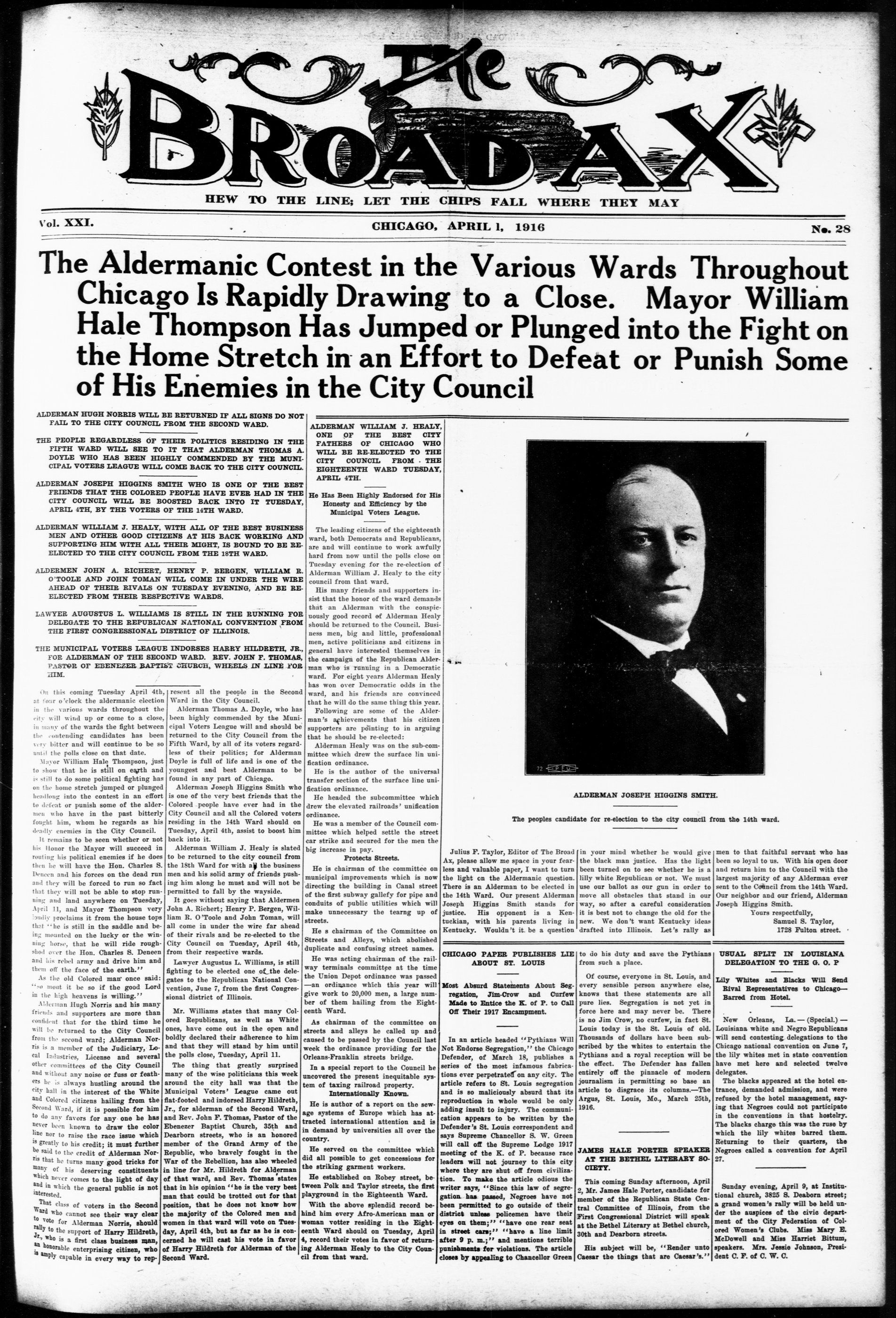
THE BROAD AX
The Aldermanic Contest in the Various Wards Throughout Chicago Is Rapidly Drawing to a Close. Mayor William Hale Thompson Has Jumped or Plunged into the Fight on the Home Stretch in an Effort to Defeat or Punish Some of His Enemies in the City Council
ALDERMAN HUGH NORRIS WILL BE RETURNED IF ALL SIGNS DO NOT PAIL TO THE CITY COUNCIL FROM THE SECOND WARD.
THE PEOPLE REGARDLESS OF THEIR POLITICS RESIDING IN THE FIFTH WARD WILL SEE TO IT THAT ALDERMAN THOMAS A. DOYLE WHO HAS BEEN HIGHLY COMMENDED BY THE MUNICIPAL VOTERS LEAGUE WILL COME BACK TO THE CITY COUNCIL.
ALDERMAN JOSEPH HIGGINS SMITH WHO IS ONE OF THE BEST FRIENDS THAT THE COLORED PEOPLE HAVE EVER HAD IN THE CITY COUNCIL WILL BE BOOSTED BACK INTO IT TUESDAY, APRIL 4TH, BY THE VOTERS OF THE 14TH WARD.
ALDERMAN WILLIAM J. HEALY, WITH ALL OF THE BEST BUSINESS MEN AND OTHER GOOD CITIZENS AT HIS BACK WORKING AND SUPPORTING HIM WITH ALL THEIR MIGHT, IS BOUND TO BE RE-ELECTED TO THE CITY COUNCIL FROM THE 18TH WARD.
ALDERMEN JOHN A. RICHERT, HENRY P. BERGEN, WILLIAM R. O'TOOLE AND JOHN TOMAN WILL COME IN UNDER THE WIRE AHEAD OF THEIR RIVALS ON TUESDAY EVENING, AND BE RE-ELECTED FROM THEIR RESPECTIVE WARDS.
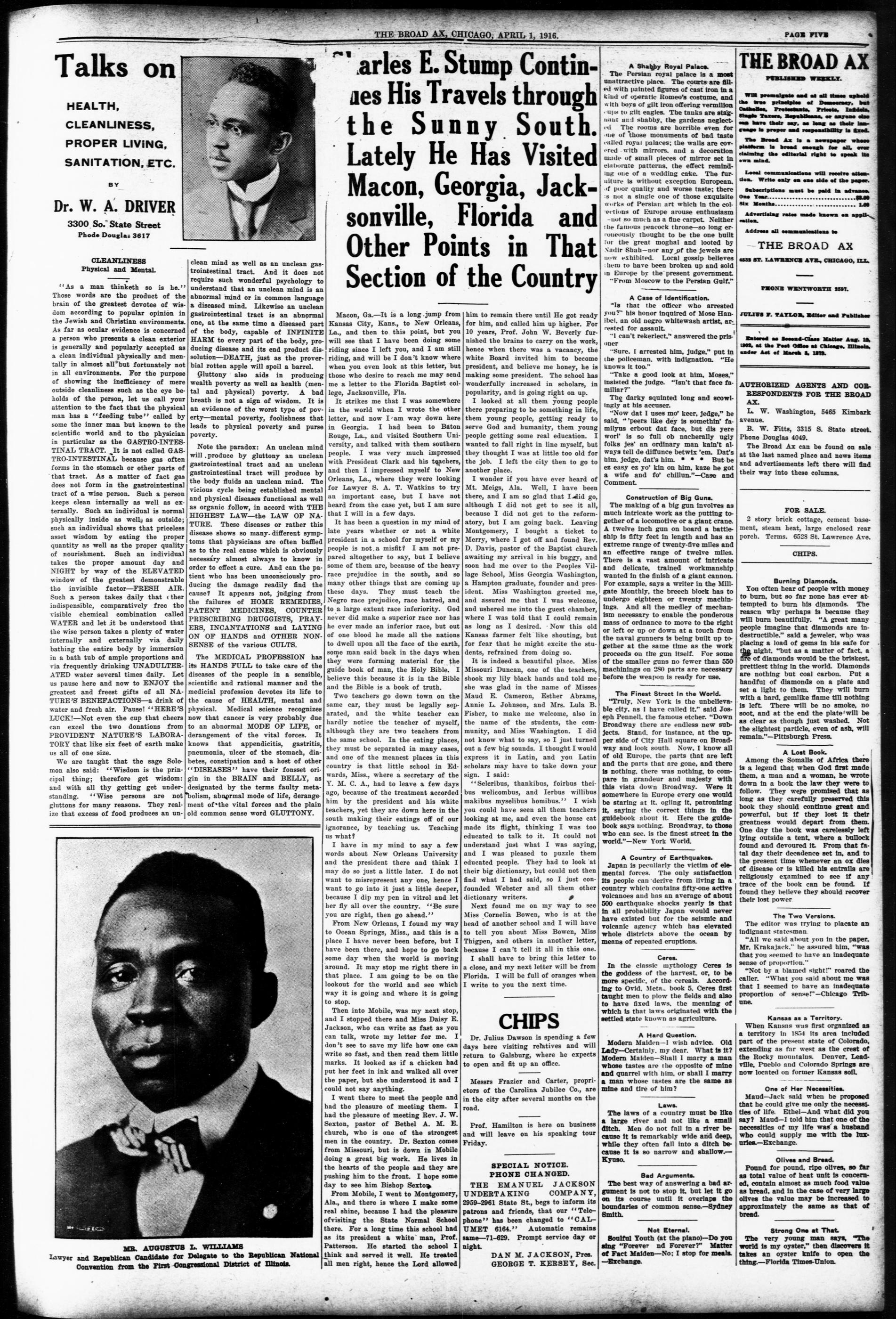
LAWYER AUGUSTUS L. WILLIAMS IS STILL IN THE RUNNING FOR DELEGATE TO THE REPUBLICAN NATIONAL CONVENTION FROM THE FIRST CONGRESSIONAL DISTRICT OF ILLINOIS.
THE MUNICIPAL VOTERS LEAGUE INDORSES HARRY HILDRETH, JR., FOR ALDERMAN OF THE SECOND WARD. REV. JOHN F. THOMAS, PASTOR OF EBENEZER BAPTIST CHURCH, WHEELS IN LINE FOR HIM.
Vol. XXI.
The Alder
Chicago
Hale To
the Ho
of His
ALDERMAN HUGH NORRIS WILL BE
FAIL TO THE CITY COUNCIL
THE PEOPLE REGARDLESS OF THE
FIFTH WARD WILL SEE TO
DOYLE WHO HAS BEEN HIGHER
CIPAL VOTERS LEAGUE WILL
ALDERMAN JOSEPH HIGGINS SENIOR
FRIENDS THAT THE COLORED
CITY COUNCIL WILL BE BORN
APRIL 4TH, BY THE VOTERS
ALDERMAN WILLIAM J. HEALY,
MEN AND OTHER GOOD CITIES
SUPPORTING HIM WITH ALL
ELECTED TO THE CITY COUNCIL
ALDERMEN JOHN A. RICHERT,
O'TOOLE AND JOHN TOMAN
AHEAD OF THEIR RIVALS ON
ELECTED FROM THEIR RESPECT
LAWYER AUGUSTUS L. WILLIAM
DELEGATE TO THE REPUBLIC
THE FIRST CONGRESSIONAL DISTRICT
THE MUNICIPAL VOTERS LEAGUE
FOR ALDERMAN OF THE SECOND
PASTOR OF EBENEZER BAPTIL
HIM.
On this coming Tuesday April 4th, at four o'clock the aldermanic election in the various wards throughout the city will wind up or come to a close, in many of the wards the fight between the contending candidates has been very bitter and will continue to be so until the polls close on that date.
Mayor William Hale Thompson, just to show that he is still on earth and is still to do some political fighting has on the home stretch jumped or plunged headlong into the contest in an effort to defeat or punish some of the aldermen who have in the past bitterly fought him, whom he regards as his deadly enemies in the City Council.
It remains to be seen whether or not his Honor the Mayor will succeed in routing his political enemies if he does then he will have the Hon. Charles S. Deneen and his forces on the dead run and they will be forced to run so fact that they will not be able to stop running and land anywhere on Tuesday, April 11, and Mayor Thompson very loudly proclaims it from the house tops that "he is still in the saddle and being mounted on the lucky or the winning horse, that he will ride roughshod over the Hon. Charles S. Deneen and his rebel army and drive him and them off the face of the earth." As the old Colored man once said: "so mout it be so if the good Lord in the high heavens is willing."
Alderman Hugh Norris and his many friends and supporters are more than confident that for the third time he will be returned to the City Council from the second ward; Alderman Norris is a member of the Judiciary, Local Industries, License and several other committees of the City Council and without any noise or fuss or feathers he is always hustling around the city hall in the interest of the White and Colored citizens hailing from the Second Ward, if it is possible for him to do any favors for any one he has never been known to draw the color line nor to raise the race issue which is greatly to his credit; it must further be said to the credit of Alderman Norris that he turns many good tricks for many of his deserving constituents which never comes to the light of day and in which the general public is not interested.
That class of voters in the Second Ward who cannot see their way clear to vote for Alderman Norris, should rally to the support of Harry Hildreth, Jr., who is a first class business man, an honorable enterprising citizen, who is amply capable in every way to rep-
---
present all the people in the Second Ward in the City Council.
Alderman Thomas A. Doyle, who has been highly commended by the Municipal Voters League will and should be returned to the City Council from the Fifth Ward, by all of its voters regardless of their politics; for Alderman Doyle is full of life and is one of the youngest and best Alderman to be found in any part of Chicago.
Alderman Joseph Higgins Smith who is one of the very best friends that the Colored people have ever had in the City Council and all the Colored voters residing in the 14th Ward should on Tuesday, April 4th, assist to boost him back into it.
Alderman William J. Healy is slated to be returned to the city council from the 18th Ward for with all the business men and his solid army of friends pushing him along he must and will not be permitted to fall by the wayside.
It goes without saying that Aldermen John A. Richert; Henry P. Bergen, William R. O'Toole and John Toman, will all come in under the wire far ahead of their rivals and be re-elected to the City Council on Tuesday, April 4th, from their respective wards.
Lawyer Augustus L. Williams, is still fighting to be elected one of the delegates to the Republican National Convention, June 7, from the first Congressional district of Illinois.
Mr. Williams states that many Colored Republicans, as well as White ones, have come out in the open and boldly declared their adherence to him and that they will stand by him until the polls close, Tuesday, April 11.
The thing that greatly surprised many of the wise politicians this week around the city hall was that the Municipal Voters' League came out flat-footed and indorsed Harry Hildreth, Jr., for alderman of the Second Ward, and Rev. John F. Thomas, Pastor of the Ebenezer Baptist Church, 35th and Dearborn streets, who is an honored member of the Grand Army of the Republic, who bravely fought in the War of the Rebellion, has also wheeled in line for Mr. Hildreth for Alderman of that ward, and Rev. Thomas states that in his opinion "he is the very best man that could be trotted out for that position, that he does not know how the majority of the Colored men and women in that ward will vote on Tuesday, April 4th, but as far as he is concerned he will cast his vote in favor of Harry Hildreth for Alderman of the Second Ward.
CHICAGO, APRIL 1. 1916
ALDERMAN WILLIAM J. HEALY,
ONE OF THE BEST CITY
FATHERS OF CHICAGO WHO
WILL BE RE-ELECTED TO THE
CITY COUNCIL FROM THE
EIGHTEENTH WARD TUESDAY,
APRIL 4TH.
He Has Been Highly Endorsed for His Honesty and Efficiency by the Municipal Voters League.
The leading citizens of the eighteenth ward, both Democrats and Republicans, are and will continue to work awfully hard from now until the polls close on Tuesday evening for the re-election of Alderman William J. Healy to the city council from that ward.
His many friends and supporters insist that the honor of the ward demands that an Alderman with the conspicuously good record of Alderman Healy should be returned to the Council. Business men, big and little, professional men, active politicians and citizens in general have interested themselves in the campaign of the Republican Alderman who is running in a Democratic ward. For eight years Alderman Healy has won over Democratic odds in the ward, and his friends are convinced that he will do the same thing this year.
Following are some of the Alderman's achievements that his citizen supporters are pointing to in arguing that he should be re-elected:
Alderman Healy was on the sub-committee which drew the surface lin unification ordinance.
He is the author of the universal transfer section of the surface line unification ordinance.
He headed the subcommittee which drew the elevated railroads' unification ordinance.
He was a member of the Council committee which helped settle the street car strike and secured for the men the big increase in pay.
Protects Streets.
He is chairman of the committee on municipal improvements which is now directing the building in Canal street of the first subway gallefy for pipe and conduits of public utilities which will make unnecessary the tearing up of streets.
He s chairman of the Committee on Streets and Alleys, which abolished duplicate and confusing street names.
He was acting chairman of the railway terminals committee at the time the Union Depot ordinance was passed—an ordinance which this year will give work to 20,000 men, a large number of them hailing from the Eighteenth Ward.
As chairman of the committee on streets and alleys he called up and caused to be passed by the Council last week the ordinance providing for the Orleans-Franklin streets bridge.
In a special report to the Council he uncovered the present inequitable system of taxing railroad property.
Internationally Known.
He is author of a report on the sewage systems of Europe which has attracted international attention and is in demand by universities all over the country.
He served on the committee which did all possible to get concessions for the striking garment workers.
He established on Robey street, between Polk and Taylor streets, the first playground in the Eighteenth Ward.
With the above splendid record behind him every Afro-American man or woman voter residing in the Eighteenth Ward should on Tuesday, April 4, record their votes in favor of returning Alderman Healy to the City Council from that ward.
72
The peoples candidate for re-election to the city council from the 14th ward.
Julius F. Taylor, Editor of The Broad Ax, please allow me space in your fearless and valuable paper, I want to turn the light on the Aldermanic question. There is an Alderman to be elected in the 14th Ward. Our present Alderman Joseph Higgins Smith stands for justice. His opponent is a Kentuckian, with his parents living in Kentucky. Wouldn't it be a question
CHICAGO PAPER PUBLISHES LIE
ABOUT ST. LOUIS
Most Absurd Statements About Segregation, Jim-Crow and Curfew Made to Entice the K. of P. to Call Off Their 1917 Encampment.
In an article headed "Pythians Will Not Endorse Segregation," the Chicago Defender, of March 18, publishes a series of the most infamous fabrications ever perpetrated on any city. The article refers to St. Louis segregation and is so maliciously absurd that its reproduction in whole would be only adding insult to injury. The communication appears to be written by the Defender's St. Louis correspondent and says Supreme Chancellor S. W. Green will call off the Supreme Lodge 1917 meeting of the K. of P. because race leaders will not journey to this city where they are shut off from civilization. To make the article odious the writer says, "Since this law of segregation has passed, Negroes have not been permitted to go outside of their district unless policemen have their eyes on them;" "have one rear seat in street care;" "have a line limit after 9 p. m.;" and mentions terrible punishments for violations. The article closes by appealing to Chancellor Green
in your mind whether he would give the black man justice. Has the light been turned on to see whether he is a lily white Republican or not. We must use our ballot as our gun in order to move all obstacles that stand in our way, so after a careful consideration it is best not to change the old for the new. We don't want Kentucky ideas drafted into Illinois. Let's rally as
to do his duty and save the Pythians from such a place.
Of course, everyone in St. Louis, and every sensible person anywhere else, knows that these statements are all pure lies. Segregation is not yet in force here and may never be. There is no Jim Crow, no curfew, in fact St. Louis today is the St. Louis of old. Thousands of dollars have been subscribed by the whites to entertain the Pythians and a royal reception will be the effect. The Defender has fallen entirely off the pinnacle of modern journalism in permitting so base an article to disgrace its columns.—The Argus, St. Louis, Mo., March 25th, 1916.
JAMES HALE PORTER SPEAKER AT THE BETHEL LITERARY SOCIETY.
This coming Sunday afternoon, April 2, Mr. James Hale Porter, candidate for member of the Republican State Central Committee of Illinois, from the First Congressional District will speak at the Bethel Literary at Bethel church, 30th and Dearborn streets.
His subject will be, "Render unto Caesar the things that are Caesar's."
No.28
men to that faithful servant who has been so loyal to us. With his open door and return him to the Council with the largest majority of any Alderman ever sent to the Council from the 14th Ward. Our neighbor and our friend, Alderman Joseph Higgins Smith. Yours respectfully, Samuel S. Taylor, 1728 Fulton street.
USUAL SPLIT IN LOUISIANA
DELEGATION TO THE G. O. P
Lily Whites and Blacks Will Send
Rival Representatives to Chicago—
Barred from Hotel.
New Orleans, La. — (Special.) —
Louisiana white and Negro Republicans
will send contesting delegations to the
Chicago national convention on June 7,
the lily whites met in state convention
have met here and selected twelve
delegates.
The blacks appeared at the hotel entrance,
demanded admission, and were
refused by the hotel management, saying
that Negroes could not participate
in the conventions in that hostelry.
The blacks charge this was the ruse by
which the lily whites barred them.
Returning to their quarters, the
Negroes called a convention for April
27.
Sunday evening, April 9, at Institutional church, 3825 S. Deaborn street; a grand women's rally will be held under the auspices of the civic department of the City Federation of Colored Women's Clubs. Miss Mary E. McDowell and Miss Harriet Bittum, speakers. Mrs. Jessie Johnson, President C. F. of C. W. C.
PAGE TWO
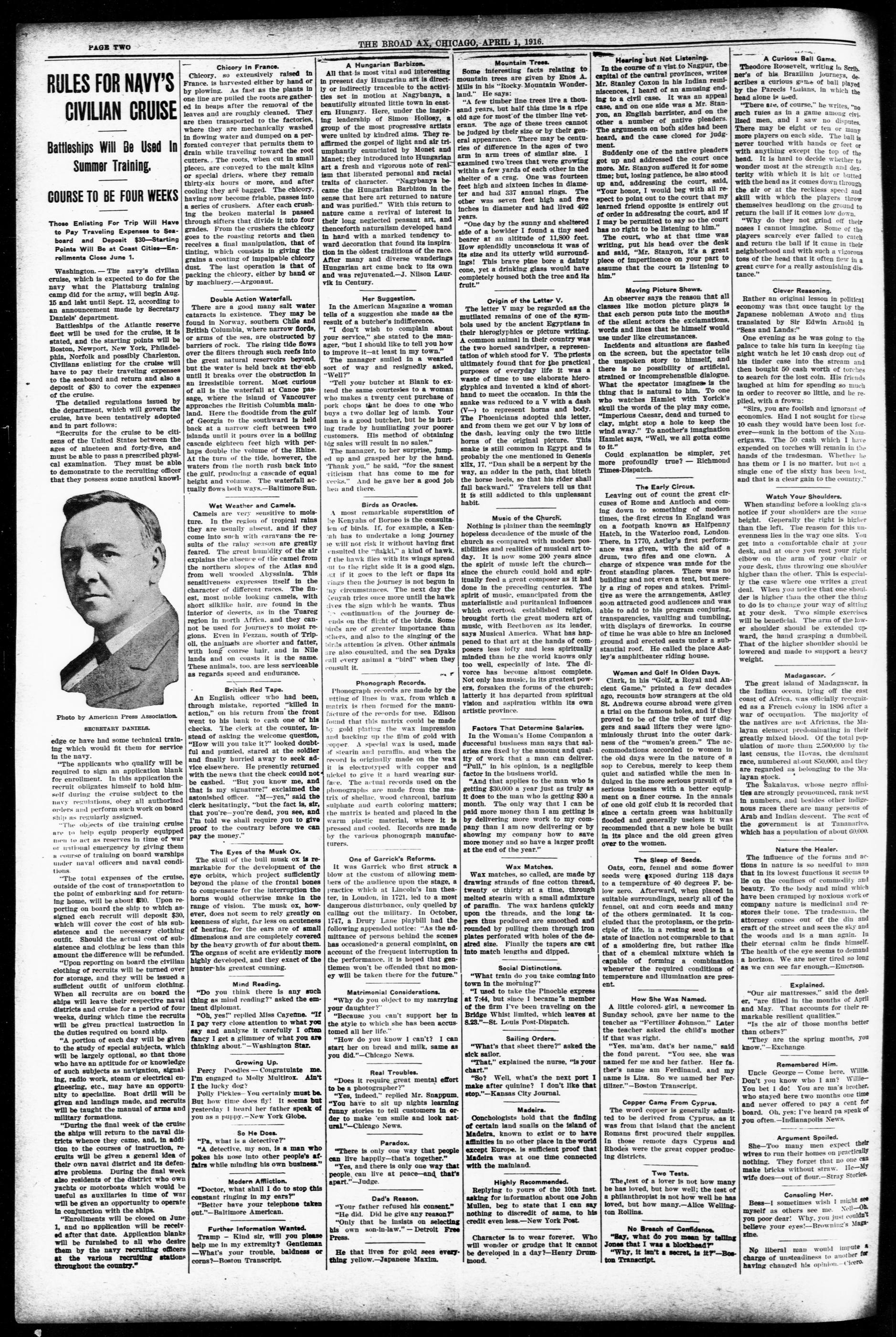
RULES FOR NAVY'S CIVILIAN CRUISE
COURSE TO BE FOUR WEEKS
Those Enlisting For Trip Will Have to Pay Traveling Expenses to Seaboard and Deposit $30—Starting Points Will Be at Coast Cities—Enrollments Close June 1.
Washington.—The navy's civilian cruise, which is expected to do for the navy what the Plattsburg training camp did for the army, will begin Aug. 15 and last until Sept. 12, according to an announcement made by Secretary Daniels' department.
Battleships of the Atlantic reserve fleet will be used for the cruise, it is stated, and the starting points will be Boston, Newport, New York, Philadelphia, Norfolk and possibly Charleston. Civilians enlisting for the cruise will have to pay their traveling expenses to the seaboard and return and also a deposit of $30 to cover the expenses of the cruise.
The detailed regulations issued by the department, which will govern the cruise, have been tentatively adopted and in part follows:
"Recruits for the cruise to be citizens of the United States between the ages of nineteen and forty-five, and must be able to pass a prescribed physical examination. They must be able to demonstrate to the recruiting officer that they possess some nautical knowl-
[Image of a man in a suit with a tie].
Photo by American Press Association.
SECRETARY DANIELS.
edge or have had some technical training which would fit them for service in the navy.
"The applicants who qualify will be required to sign an application blank for enrollment. In this application the recruit obligates himself to hold himself during the cruise subject to the navy regulations, obey all authorized orders and perform such work on board ship as regularly assigned.
"The objects of the training cruise are to help equip properly equipped men to act as reserves in time of war or national emergency by giving them a course of training on board warships under naval officers and naval conditions.
"The total expenses of the cruise, outside of the cost of transportation to the point of embarking and for returning home, will be about $30. Upon reporting on board the ship to which assigned each recruit will deposit $30, which will cover the cost of his subsistence and the necessary clothing outfit. Should the actual cost of subsistence and clothing be less than this amount the difference will be refunded. "Upon reporting on board the civilian clothing of recruits will be turned over for storage, and they will be issued a sufficient outfit of uniform clothing. When all recruits are on board the ships will leave their respective naval districts and cruise for a period of four weeks, during which time the recruits will be given practical instruction in the duties required on board ship.
"A portion of each day will be given to the study of special subjects, which will be largely optional, so that those who have an aptitude for or knowledge of such subjects as navigation, signaling, radio work, steam or electrical engineering, etc., may have an opportunity to specialize. Boat drill will be given and landings made, and recruits will be taught the manual of arms and military formations.
"During the final week of the cruise the ships will return to the naval districts whence they came, and, in addition to the courses of instruction, recruits will be given a general idea of their own naval district and its defensive problems. During the final week also residents of the district who own yachts or motorboats which would be useful as auxiliaries in time of war will be given an opportunity to operate in conjunction with the ships.
"Enrollments will be closed on June 1, and no application will be received after that date. Application blanks will be furnished to all who desire them by the navy recruiting officers at the various recruiting stations throughout the country."
A
Chicory In France.
Chicory in France. Chicory, so extensively raised in France, is harvested either by hand or by plowing. As fast as the plants in one line are pulled the roots are gathered in heaps after the removal of the leaves and are roughly cleaned. They are then transported to the factories, where they are mechanically washed in flowing water and dumped on a perforated conveyer that permits them to drain while traveling toward the root cutters. The roots, when cut in small pieces, are conveyed to the malt kilos or special driers, where they remain thirty-six hours or more, and after cooling they are bagged. The chicory, having now become friable, passes into a series of crushers. After each crushing the broken material is passed through sifters that divide it into four grades. From the crushers the chicory goes to the roasting retorts and then receives a final manipulation, that of tinting, which consists in giving the grains a coating of impalpable chicory dust. The last operation is that of packing the chicory, either by hand or by machinery.—Argonaut.
Double Action Waterfall.
There are a good many salt water cataracts in existence. They may be found in Norway, southern Chile and British Columbia, where narrow flords, or arms of the sea, are obstructed by barriers of rock. The rising tide flows over the filters through such reefs into the great natural reservoirs beyond, but the water is held back at the ebb until it breaks over the obstruction in an irresistible torrent. Most curious of all is the waterfall at Canoe passage, where the island of Vancouver approaches the British Columbia mainland. Here the floodtide from the gulf of Georgia to the southward is held back at a narrow cleft between two islands until it pours over in a boiling cascade eighteen feet high with perhaps double the volume of the Rhine. At the turn of the tide, however, the waters from the north rush back into the gulf, producing a cascade of equal height and volume. The waterfall actually flows both ways.—Baltimore Sun
Wet Weather and Camels.
Camels are very sensitive to moisture. In the region of tropical rains they are usually absent, and if they come into such with caravans the results of the rainy season are greatly feared. The great humidity of the air explains the absence of the camel from the northern slopes of the Atlas and from well wooded Abyssinia. This sensitiveness expresses itself in the character of different races. The finest, most noble looking camels, with short silklike hair, are found in the interior of deserts, as in the Tuareg region in north Africa, and they cannot be used for journeys to moist regions. Even in Fezzan, south of Tripoli, the animals are shorter and fatter, with long course hair, and in Nile lands and on coasts it is the same. These animals, too, are less serviceable as regards speed and endurance.
British Red Tape
An English officer who had been, through mistake, reported "killed in action," on his return from the front went to his bank to cash one of his checks. The clerk at the counter, instead of asking the welcome question, "How will you take it?" looked doubtful and puzzled, stared at the soldier and finally hurried away to seek advice elsewhere. He presently returned with the news that the check could not be cashed. "But you know me, and that is my signature!" exclaimed the astonished officer. "M—yes," said the clerk hesitatingly, "but the fact is, sir, that you're—you're dead, you see, and I told we shall require you to give proof to the contrary before we can pay the money."
The Eyes of the Musk Ox.
The skull of the bull musk ox is remarkable for the development of the eye orbits, which project sufficiently beyond the plane of the frontal bones to compensate for the interruption the horns would otherwise make in the range of vision. The musk ox, however, does not seem to rely greatly on keenness of sight, far less on acuteness of hearing, for the ears are of small dimensions and are completely covered by the heavy growth of fur about them. The organs of scent are evidently more highly developed, and they exact of the hunter his greatest cunning.
Mind Reading.
"Do you think there is any such thing as mind reading?" asked the eminent diplomat.
"Oh, yes!" replied Miss Cayenne. "If I pay very close attention to what you say and analyze it carefully I often fancy I get a glimmer of what you are thinking about."—Washington Star.
Growing Up.
Percy Poodles — Congratulate me. I'm engaged to Molly Multirox. Ain't I the lucky dog? Polly Pickles—You certainly must be. But how time does fly! It seems but yesterday I heard her father speak of you as a puppy.—New York Globe.
So He Does.
"A detective, my son, is a man who pokes his nose into other people's affairs while minding his own business."
Modern Affliction
"Doctor, what shall I do to stop this constant ringing in my ears?"
"Better have your telephone taken out."-Baltimore American.
Further Information Wanted.
Tramp - Kind sir, will you please help me in my extremity? Gentleman —What's your trouble, baldness or corns?- Boston Transcript.
THE BROAD AX, CHICAGO, APRIL 1, 1916
A. Hungarian Barbizon.
A Hungarian Barbizon.
All that is most vital and interesting in present day Hungarian art is directly or indirectly traceable to the activities set in motion at Nagybanya, a beautifully situated little town in eastern Hungary. Here, under the inspiring leadership of Simon Hollosy, a group of the most progressive artists were united by kindred alms. They reaffirmed the gospel of light and air triumphantly enunciated by Monet and Manet; they introduced into Hungarian art a fresh and vigorous note of realism that liberated personal and racial traits of character. "Nagybanya became the Hungarian Barbizon in the sense that here art returned to nature and was purified." With this return to nature came a revival of interest in their long neglected peasant art, and thenceforth naturalism developed hand in hand with a marked tendency to ward decoration that found its inspiration in the oldest traditions of the race. After many and diverse wanderings Hungarian art came back to its own and was rejuvenated.-J. Nilson Laurik in Century.
Her Suggestion.
In the American Magazine a woman tells of a suggestion she made as the result of a butcher's indifference.
"I don't wish to complain about your service," she stated to the manager, "but I should like to tell you how to improve it—at least in my town."
The manager smiled in a weared sort of way and resignedly asked, "Well?"
"Tell your butcher at Blank to extend the same courtesies to a woman who makes a twenty cent purchase of pork chops that he does to one who buys a two dollar leg of lamb. Your man is a good butcher, but he is hurting trade by humiliating your poorer customers. His method of obtaining big sales will result in no sales."
The manager, to her surprise, jumped up and grasped her by the hand. "Thank you," he said, "for the most criticism that has come to me for weeks." And he gave her a good job heen and there.
Birds as Oracles.
A most remarkable superstition of the Kenyahs of Borneo is the consultation of birds. If, for example, a Kenyah has to undertake a long journey, he will not risk it without having first consulted the "flakki," a kind of hawk. If the hawk flies with its wings spread out to the right side it is a good sign, but if it goes to the left or flaps its wings then the journey is not begun in any circumstances. The next day the Kenyah tries once more until the hawk gives the sign which he wants. Thus the continuation of the journey depends on the flight of the birds. Some birds are of greater importance than others, and also to the singing of the birds attention is given. Other animals are also consulted, and the sea Dyaks call every animal a "bird" when they consult it.
Phonograph Records.
Phonograph records are made by the cutting of lines in wax, from which a matrix is then formed for the manufacture of the records for use. Edison found that this matrix could be made by gold plating the wax impression and backing up the film of gold with copper. A special wax is used, made of stearin and paraffin, and when the record is originally made on the wax it is electrotyped with copper and nickel to give it a hard wearing surface. The actual records used on the phonographs are made from the matrix of shellac, wood charcoal, barium sulphate and earth coloring matters; the matrix is heated and placed in the warm plastic material, where it is pressed and cooled. Records are made by the various phonograph manufacturers.
One of Garrick's Reforms.
It was Garrick who first struck a blow at the custom of allowing members of the audience upon the stage, a practice which at Lincoln's Inn theater, in London, in 1721, led to a most dangerous disturbance, only quelled by calling out the military. In October, 1747, a Drury Lane playbill had the following appended notice: "As the admittance of persons behind the scenes has occasioned a general complaint, on account of the frequent interruption in the performance, it is hoped that gentlemen won't be offended that no money will be taken there for the future."
Matrimonial Considerations.
"Why do you object to my marrying your daughter?"
"Because you can't support her in the style to which she has been accustomed all her life."
"How do you know I can't? I can start her on bread and milk, same as you did."—Chicago News.
Real Troubles
"Does it require great mental effort to be a photographer?"
"Yes, indeed." replied Mr. Snappum. "You have to sit up nights learning funny stories to tell customers in order to make 'em smile and look natural."—Chicago News.
Paradox.
"There is only one way that people can live happily—that's together." "Yes, and there is only one way that people, can live at peace—and that's apart."—Judge.
Dad's Reason.
"Your father refused his consent."
"He did. Did he give any reason?"
"Only that he insists on selecting his own son-in-law." —Detroit Free Press.
He that lives for gold sees everything yellow.-Japanese Maxim.
Mountain Trees
Some interesting facts relating to mountain trees are given by Enos A. Mills in his "Rocky Mountain Wonderland." He says:
"A few timber line trees live a thousand years, but half this time is a ripe old age for most of the timber line veterans. The age of these trees cannot be judged by their size or by their general appearance. There may be centuries of difference in the ages of two arm in arm trees of similar size. I examined two trees that were growing within a few yards of each other in the shelter of a crag. One was fourteen feet high and sixteen inches in diameter and had 337 annual rings. The other was seven feet high and five inches in diameter and had lived 492 years.
"One day by the sunny and sheltered side of a bowler I found a tiny seed bearer at an altitude of 11,800 feet. How splendidly unconscious it was of its size and its utterly wild surroundings! This brave pine bore a dainty cone, yet a drinking glass would have completely housed both the tree and its fruit."
Origin of the Letter V.
The letter V may be regarded as the mutilated remains of one of the symbols used by the ancient Egyptians in their hieroglyphics or picture writing. A common animal in their country was the two horned sandviper, a representation of which stood for V. The priests ultimately found that for the practical purposes of everyday life it was a waste of time to use elaborate hieroglyphics and invented a kind of shorthand to meet the occasion. In this the snake was reduced to a V with a dash (V-) to represent horns and body. The Phoenicians adopted this letter, and from them we get our V by loss of the dash, leaving only the two little horns of the original picture. This snake is still common in Egypt and is probably the one mentioned in Genesis xlix, 17. "Dan shall be a serpent by the way, an adder in the path, that biteth the horse heels, so that his rider shall fall backward." Travelers tell us that it is still adducted to this unpleasant habit.
Music of the Church
Nothing is plainer than the seemingly hopeless decadence of the music of the church as compared with modern possibilities and realities of musical art today. It is now some 200 years since the spirit of music left the church—since the church could hold and spiritually feed a great composer as it had done in the preceding centuries. The spirit of music emancipated from the materialistic and puritanical influences which overtook established religion, brought forth the great modern art of music, with Beethoven as its leader, says Musical America. What has happened to that art at the hands of composers less lofty and less spiritually minded than he the world knows only too well, especially of late. The divorce has become almost complete. Not only has music, in its greatest powers, forsaken the forms of the church, latterly it has departed from spiritual vision and aspiration within its own artistic province.
Factors That Determine Salaries
In the Woman's Home Companion a successful business man says that salaries are fixed by the amount and quality of work that a man can deliver. "Pull," in his opinion, is a negligible factor in the business world.
"And that applies to the man who is getting $30,000 a year just as truly it does to the man who is getting $30 a month. The only way that I can be paid more money than I am getting is by delivering more work to my company than I am now delivering or by showing my company how to save more money and so have a larger profit at the end of the year."
Wax Matches.
Wax matches, so called, are made by drawing strands of fine cotton thread, twenty or thirty at a time, through melted stearin with a small admixture of paraffin. The wax hardens quickly upon the threads, and the long tapers thus produced are smoothed and rounded by pulling them through iron plates perforated with holes of the desired size. Finally the tapers are cut into match lengths and dipped.
Social Distinctions
"What train do you take coming into town in the morning?" "I used to take the Pinochle express at 7:44, but since I became a member of the firm I've been travelling on the Bridge Whist limited, which leaves at 8:23"—St. Louis Post-Dispatch.
Sailing Orders.
"What's that sheet there?" asked the sick sailor.
"That," explained the nurse, "is your chart."
"So? Well, what's the next port I make after quinine? I don't like that stop."—Kansas City Journal.
Madeira.
Conchologists hold that the finding of certain land snails on the island of Madeira, known to exist or to have affinities in no other place in the world except Europe, is sufficient proof that Madeira was at one time connected with the mainland.
Highly Recommended
Replying to yours of the 10th inst. asking for information about one John Mullen, beg to state that I can say nothing to discredit of same, to his credit even less.—New York Post.
Character is to wear forever. Who will wonder or grudge that it cannot be developed in a day?—Henry Drummond.
Messing but Not Listening.
In the course of a visit to Nagpur, the capital of the central provinces, writes Mr. Stanley Coxon in his Indian reminiscences, I heard of an amusing ending to a civil case. It was an appeal case, and on one side was a Mr. Stanyon, an English barrister, and on the other a number of native pleaders. The arguments on both sides had been heard, and the case closed for judgment.
Suddenly one of the native pleaders got up and addressed the court once more. Mr. Stanyon suffered it for some time; but, losing patience, he also stood up and, addressing the court, said, "Your honor, I would beg with all respect to point out to the court that my learned friend opposite is entirely out of order in addressing the court, and if I may be permitted to say so the court has no right to be listening to him."
The court, who at that time was writing, put his head over the desk and said, "Mr. Stanyon, it's a great piece of impertinence on your part to assume that the court is listening to him."
Moving Picture Shows
An observer says the reason that all classes like motion picture plays is that each person puts into the mouths of the silent actors the exclamations, words and lines that he himself would use under like circumstances.
Incidents and situations are flashed on the screen, but the spectator tells the unspoken story to himself, and there is no possibility of artificial strained or incomprehensible dialogue. What the spectator imagines is the thing that is natural to him. To one who watches Hamlet with Yorick's skull the words of the play may come, "Imperious Caesar, dead and turned to clay, might stop a hole to keep the wind away." To another's imagination Hamlet says, "Well, we all gotta come to it."
Could explanation be simpler, yet more profoundly true? — Richmond Times-Dispatch.
The Early Circus.
Leaving out of count the great circuses of Rome and Antioch and coming down to something of modern times, the first circus in England was on a footpath known as Halfpenny Hatch, in the Waterloo road, London. There, in 1770, Astley's first performance was given, with the aid of a drum, two fifes and one clown. A charge of sixpence was made for the front standing places. There was no building and not even a tent, but merely a ring of ropes and stakes. Primitive as were the arrangements, Astley soon attracted good audiences and was able to add to his program conjuring, transparencies, vaulting and tumbling with displays of fireworks. In course of time he was able to hire an enclosed ground and erected seats under a substantial roof. He called the place Astley's amphitheater riding house.
Women and Golf In Olden Days.
Clark, in his "Golf, a Royal and Ancient Game," printed a few decades ago, recounts how strangers at the old St. Andrews course abroad were given a trial on the famous holes, and if they proved to be of the tribe of turf diggers and sand lifters they were ignominiously thrust into the outer darkness of the "women's green." The accommodations accorded to women in the old days were in the nature of a sop to Cerebus, merely to keep them quiet and satisfied while the men indulged in the more serious pursuit of a serious business with a better equipment on a finer course. In the annals of one old golf club it is recorded that since a certain green was habitually flooded and generally useless it was recommended that a new hole be built in its place and the old green given over to the women.
The Sleep of Seeds.
Oats, corn, fennel and some flower seeds were exposed during 118 days to a temperature of 40 degrees F. below zero. Afterward, when placed in suitable surroundings, nearly all of the fennel, oat and corn seeds and many of the others germinated. It is concluded that the protoplasm, or the principle of life, in a resting seed is in a state of inaction not comparable to that of a smoldering fire, but rather like that of a chemical mixture which is capable of forming a combination whenever the required conditions of temperature and illumination are present.
How She Was Named
A little colored girl, a newcomer in Sunday school, gave her name to the teacher as "Fertilizer Johnson." Later the teacher asked the child's mother if that was right.
"Yes, ma'am, dat's her name," said the fond parent. "You see, she was named fer me and her father. Her father's name am Ferdinand, and my name is Liza. So we named her Fertilizer."-Boston Transcript.
Copper Came From Cyprus
The word copper is generally admitted to be derived from Cyprus, as it was from that island that the ancient Romans first procured their supplies. In those remote days Cyprus and Rhodes were the great copper producing districts.
Two Tests.
The test of a lover is not how many he has loved, but how well; the test of a philanthropist is not how well he has loved, but how many.—Alice Wellington Rollins.
No Breach of Confidence
"Say, what do you mean by telling Jones that I was a blockhead?" "Why, it isn't a secret, is it?"—Boston Transcript.
A Curious Ball Game
Theodore Roosevelt, writing in Scribner's of his Brazilian Journeys, describes a curious game of ball played by the Parecis Indians, in which the head alone is need.
"There are, of course," he writes, "no such rules as in a game among civilized men, and I saw no disputes. There may be eight or ten or many more players on each side. The ball is never touched with hands or feet or with anything except the top of the head. It is hard to decide whether to wonder most at the strength and dexterity with which it is hit or butted with the head as it comes down through the air or at the reckless speed and skill with which the players throw themselves headlong on the ground to return the ball if it comes low down.
"Why do they not grind off their noses I cannot imagine. Some of the players scarcely ever failed to catch and return the ball if it came in their neighborhood and with such a vigorous toss of the head that it often now in a great curve for a really astonishing distance."
Clever Reasoning
Rather an original lesson in political economy was that once taught by the Japanese nobleman Awoto and thus translated by Sir Edwin Arnold in "Seas and Lands."
One evening as he was going to the palace to take his turn in keeping the night watch he let 10 cash drop out of his tinder case into the stream and then bought 50 cash worth of torches to search for the lost coin. His friends laughed at him for spending so much in order to recover so little, and he replied, with a frown:
"Sirs, you are foolish and ignorant of economics. Had I not sought for these 10 cash they would have been lost forever—sunk in the bottom of the Namergiawa. The 50 cash which I have expended on torches will remain in the hands of the tradesman. Whether he has them or I is no matter, but not a single one of the sixty has been lost and that is a clear gain to the country."
Watch Your Shoulders.
When standing before a looking glass notice if your shoulders are the same height. Generally the right is higher than the left. The reason for this unevenness lies in the way one sits. You get into a comfortable chair at your desk, and at once you rest your right elbow on the arm of your chair or your desk, thus throwing one shoulder higher than the other. This is especially the case where one writes a great deal. When you notice that one shoulder is higher than the other the thing to do is to change your way of sitting at your desk. Two simple exercises will be beneficial. The arm of the lower shoulder should be extended upward, the hand grasping a dumbbell. That of the higher shoulder should be lowered and made to support a heavy weight.
Madagascar.
The great island of Madagascar, in the Indian ocean, lying off the east coast of Africa, was officially recognized as a French colony in 1896 after a war of occupation. The majority of the natives are not Africans, the Malayan element predominating in their greatly mixed blood. Of the total population of more than 2,500,000 by the last census, the Hovas, the dominant race, numbered about 850,000, and they are regarded as belonging to the Malayan stock.
The Sakalavas, whose negro affinities are strongly pronounced, rank next in numbers, and besides other indigenous races there are many persons of Arab and Indian descent. The seat of the government is at Tanamarari which has a population of about 60,000.
Nature the Healer.
The influence of the forms and actions in nature is so needful to man that in its lowest functions it seems to lie on the confines of commodity and beauty. To the body and mind which have been cramped by noxious work or company nature is medicinal and restores their tone. The tradesman, the attorney comes out of the din and craft of the street and sees the sky and the woods and is a man again. In their eternal calm he finds himself. The health of the eye seems to demand a horizon. We are never tired so long as we can see far enough. - Emerson.
Explained.
"Our air mattresses," said the dealer, "are filled in the months of April and May. That accounts for their remarkable resilient qualities."
"Is the air of those months better than others?"
"They are the spring months, you know."—Exchange.
Remembered Him
Uncle George — Come here. Willie.
Don't you know who I am? Willie—
You bet I do! You are ma's brother,
who stayed here two months one time
and never offered to pay a cent for
board. Oh, yes! I've heard pa speech
of you often. — Indianapolis News.
Argument Spoiled
She—Too many men expect their wives to run their homes on practically nothing. They forget that no one can make bricks without straw. He—My wife does—out of flour.—Stray Stories.
Consoling Her
Bess—I sometimes wish I might see myself as others see me. Nell—Oh. you poor dear! Why, you just couldn't believe your eyes!—Browning's Magazine.
No liberal man would impute a charge of unsteadiness to another for having changed his opinion. Cicero.
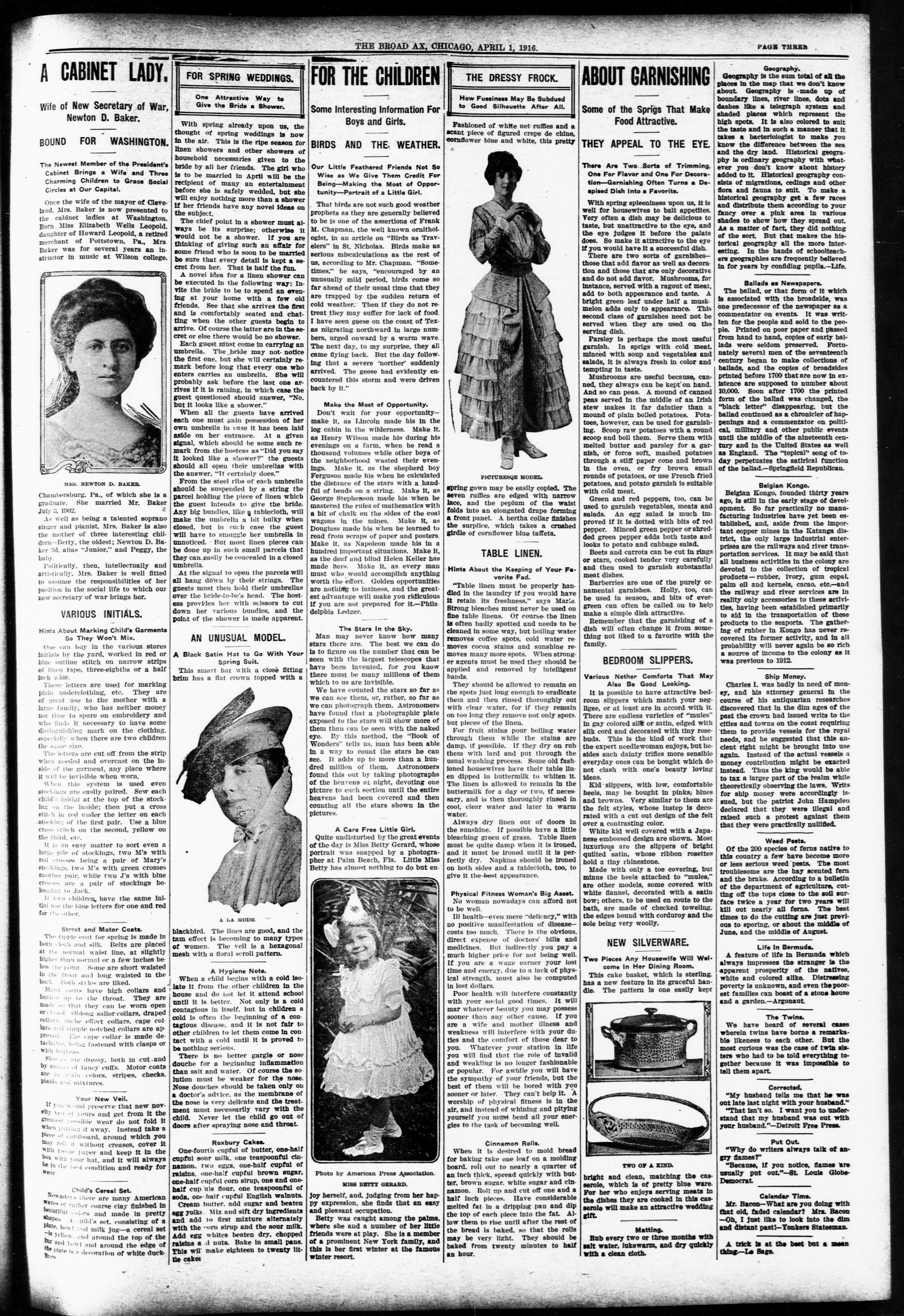
A CABINET LADY.
Wife of New Secretary of War, Newton D. Baker.
The Newest Member of the President's Cabinet Brings a Wife and Three Charming Children to Grace Social Circles at Our Capital.
Once the wife of the mayor of Cleveland, Mrs. Baker is now presented to the cabinet ladies at Washington. Born Miss Elizabeth Wells Leopold, daughter of Howard Leopold, a retired merchant of Pottstown, Pa., Mrs. Baker was for several years an instructor in music at Wilson college.
© 1910
MRS. NEWTON D. BAKER.
Chambersburg, Pa., of which she is a graduate. She married Mr. Baker July 3, 1902.
As well as being a talented soprano singer and pianist, Mrs. Baker is also the mother of three interesting children—Betty, the oldest; Newton D. Baker 3d, alias "Junior," and Peggy, the baby.
Politically, then, intellectually and artistically, Mrs. Baker is well fitted to assume the responsibilities of her position in the social life to which our new secretary of war brings her.
VARIOUS INITIALS.
Hints About Marking Child's Garments So They Won't Mix.
One can buy in the various stores initials by the yard, worked in red or blue outline stitch on narrow strips of linen tape, three-eighths or a half inch wide.
These letters are used for marking plain underclothing, etc. They are of great use to the mother with a large family, who has neither money nor time to spare on embroidery and who finds it necessary to have some distinguishing mark on the clothing, especially when there are two children the same size.
The letters are cut off from the strip when needed and overcast on the inside of the garment, any place where it will be invisible when worn.
When this system is used even stockings are easily paired. Sew each child's initial at the top of the stocking on the inside; then put a cross stitch in red under the letter on each stocking of the first pair. Use a blue cross stitch on the second, yellow on the third, etc.
It is an easy matter to sort even a large pile of stockings, two M's with red crosses being a pair of Mary's stockings, two M's with green crosses another pair, while two J's with blue crosses are a pair of stockings belonging to Jack.
If two children, have the same initial use the blue letters for one and red for the other.
Street and Motor Costs
The ripple coat for spring is made in both cloth and silk. Belts are placed at the normal waist line, at slightly higher than normal or a few inches below the point. Some are short waisted in the front and long waisted in the back. Both styles are liked.
Many coats have high collars and button up to the throat. They are made so that they can be worn open or closed. Olding sailor collars, draped collars, made effect collars, cape collars and simple notched collars are approved. The cape collar is made detachable, being fastened with clasps or with buttons.
Sleeves are dressy, both in cut-and by means of fancy cuffs. Motor coats are in plain colors, stripes, checks, plains and mixtures.
Your New Veil.
If you would preserve that new novelty veil of yours and get from it the greatest possible wear do not fold it when putting it away. Instead take a piece of cardboard, around which you may roll it without creases, cover it with tissue paper and keep it in the box with your hat, and it will always be in the best condition and ready for wear.
Child's Cereal Set
Nowadays there are many American
wares of rather course clay finished in
beautiful colors and made in pretty
shapes. A child's set, consisting of a
plate, beak and milk jug, a cereal set
-is yellow, and around the top of the
jug and bowl and around the edge of
the plate is a decoration of white duck-
birds.
One Attractive Way to Give the Bride a Shower.
With spring already upon us, the thought of spring weddings is now in the air. This is the ripe season for linen showers and other showers of household necessities given to the bride by all her friends. The girl who is to be married in April will be the recipient of many an entertainment before she is safely wedded, but she will enjoy nothing more than a shower if her friends have any novel ideas on the subject.
The chief point in a shower must always be its surprise; otherwise it would not be a shower. If you are thinking of giving such an affair for some friend who is soon to be married be sure that every detail is kept a secret from her. That is half the fun.
A novel idea for a linen shower can be executed in the following way: Invite the bride to be to spend an evening at your home with a few old friends. See that she arrives the first and is comfortably seated and chatting when the other guests begin to arrive. Of course the latter are in the secret or else there must be no shower. Each guest must come in carrying an umbrella. The bride may not notice the first one, but she will certainly remark before long that every one who enters carries an umbrella. She will probably ask before the last one arrives if it is raining, in which case the guest questioned should answer, "No, but it looks like a shower."
When all the guests have arrived each one must gain possession of her own umbrella in case it has been laid aside on her entrance. At a given signal, which should be some such remark from the hostess as "Did you say it looked like a shower?" the guests should all open their umbrellas with the answer, "It certainly does."
From the steel ribs of each umbrella should be suspended by a string the parcel holding the piece of linen which the guest intends to give the bride. Any big bundles, like a tablecloth, will make the umbrella a bit bulky when closed, but in such case the guest will have to smuggle her umbrella in noticed. But most linen pieces can be done up in such small parcels that they can easily be concealed in a closed umbrella.
At the signal to open the parcels will all hang down by their strings. The guests must then hold their umbrellas over the bride-to-be's head. The hostess provides her with scissors to cut down her various bundles, and the point of the shower is made apparent.
AN UNUSUAL MODEL
A Black Satin Hat to Go With Your Spring Suit.
This smart hat with a close fitting brim has a flat crown topped with a
THE FASHION WEEKLY
A LA MODE
blackbird. The lines are good, and the tam effect is becoming to many types of women. The vell is a hexagonal mesh with a floral scroll pattern.
A Hygiene Note.
When a child begins with a cold isolate it from the other children in the house and do not let it attend school until it is better. Not only is a cold contagious in itself, but in children a cold is often the beginning of a contagious disease, and it is not fair to other children to let them come in contact with a cold until it is proved to be nothing serious.
There is no better gargle or nose douche for a beginning inflammation than salt and water. Of course the solution must be weaker for the nose. Nose douches should be taken only on a doctor's advice, as the membrane of the nose is very delicate and the treatment must necessarily vary with the child. Never let the child go out of doors after spraying nose and throat.
Roxbury Cakes.
One-fourth cupful of butter, one-half cupful sour milk, one teaspoonful cinnamon, two eggs, one-half cupful of raisins, one-half cupful brown sugar, one-half cupful corn sirup, one and one-half cupils flour, one teaspoonful of soda, one-half cupful English walnuts. Cream butter, add sugar and beaten egg yolks. Mix and sift dry ingredients and add to first mixture alternately with the corn sirup and the sour milk. Add egg whites beaten dry, chopped raisins and nuts. Bake in small pans. This will make eighteen to twenty little cakes
THE BROAD AX, CHICAGO, APRIL 1, 1916
FOR THE CHILDREN
Some Interesting Information For Boys and Girls.
Our Little Feathered Friends Not So
Wise as We Give Them Credit For
Being—Making the Most of Opportunity—Portrait of a Little Girl,
That birds are not such good weather prophets as they are generally believed to be is one of the assertions of Frank M. Chapman, the well known ornithologist, in an article on "Birds as Travelers" in St. Nicholas. Birds make as serious miscalculations as the rest of us, according to Mr. Chapman. "Sometimes," he says, "encouraged by an unusually mild period, birds come so far ahead of their usual time that they are trapped by the sudden return of cold weather. Then if they do not retreat they may suffer for lack of food. I have seen geese on the coast of Texas migrating northward in large numbers, urged onward by a warm wave. The next day, to my surprise, they all came flying back. But the day following that a severe 'norther' suddenly arrived. The geese had evidently encountered this storm and were driven back by it."
Make the Most of Opportunity:
Make the Most of Opportunity.
Don't wait for your opportunity—make it, as Lincoln made his in the log cabin in the wilderness. Make it, as Henry Wilson made his during his evenings on a farm, when he read a thousand volumes while other boys of the neighborhood wasted their evenings. Make it, as the shepherd boy Ferguson made his when he calculated the distance of the stars with a handful of beads on a string. Make it, as George Stephenson made his when he mastered the rules of mathematics with a bit of chalk on the sides of the coal wagons in the mines. Make it, as Douglass made his when he learned to read from scraps of paper and posters. Make it, as Napoleon made his in a hundred important situations. Make it, as the deaf and blind Helen Keller has made hers. Make it, as every man must who would accomplish anything worth the effort. Golden opportunities are nothing to laziness, and the greatest advantage will make you ridiculous if you are not prepared for it.—Philadelphia Ledger.
The Stars In the Sky.
Man may never know how many stars there are. The best we can do is to figure on the number that can be seen with the largest telescopes that have been invented, for you know there must be many millions of them which to us are invisible.
We have counted the stars so far as we can see them, or, rather, so far as we can photograph them. Astronomers have found that a photographic plate exposed to the stars will show more of them than can be seen with the naked eye. By this method, the "Book of Wonders" tells us, man has been able in a way to count the stars he can see. It adds up to more than a hundred million of them. Astronomers found this out by taking photographs of the heavens at night, devoting one picture to each section until the entire heavens had been covered and then counting all the stars shown in the pictures.
A Care Free Little Girl.
Quite undisturbed by the great events of the day is Miss Betty Gerard, whose portrait was snapped by a photographer at Palm Beach, Fla. Little Miss Betty has almost nothing to do but en-
A
Photo by American Press Association.
MISS BETTY GERARD.
joy herself, and, judging from her happy expression, she finds that an easy and pleasant occupation.
Betty was caught among the palms, where she and a number of her little friends were at play. She is a member of a prominent New York family, and this is her first winter at the famous winter resort.
THE DRESSY FROCK.
How Fusiness May Be Subdued to Good Silhouette After All.
Fashioned of white net ruffles and a scant piece of figured crepe de chine, cornflower blue and white, this pretty
1
PICTURESQE MODEL
spring gown may be easily copied. The seven ruffles are edged with narrow lace, and the peplum of the waist folds into an elongated drape forming a front panel. A bertha collar finishes the surplice, which takes a crushed girdle of cornflower blue taffeta.
TABLE LINEN.
Hints About the Keeping of Your Favorite Fad.
"Table linen must be properly handled in the laundry if you would have it retain its freshness," says Marle. Strong bleaches must never be used on fine table linens. Of course the linen is often badly spotted and needs to be cleaned in some way, but boiling water removes coffee spots, cold water removes cocoa stains and sunshine removes many more spots. When stronger agents must be used they should be applied and removed by intelligent hands.
They should be allowed to remain on the spots just long enough to eradicate them and then rinsed thoroughly out with clear water, for if they remain on too long they remove not only spots, but pieces of the linen.
For fruit stains pour boiling water through them while the stains are damp, if possible. If they dry on rub them with lard and put through the usual washing process. Some old fashioned housewives have their table linen dipped in buttermilk to whiten it. The linen is allowed to remain in the buttermilk for a day or two, if necessary, and is then thoroughly rinsed in cool, clear water and later in warm water.
Always dry linen out of doors in the sunshine. If possible have a little bleaching green of grass. Table linen must be quite damp when it is ironed, and it must be ironed until it is perfectly dry. Napkins should be ironed on both sides and a tablecloth, too, to give it the best appearance.
Physical Fitness Woman's Big Asset.
No woman nowadays can afford not to be well.
Ill health—even mere "delicacy," with no positive manifestation of disease—costs too much. There is the obvious, direct expense of doctors' bills and medicines. But indirectly you pay a much higher price for not being well. If you are a wage earner your lost time and energy, due to a lack of physical strength, must also be computed in lost dollars.
Poor health will interfere constantly with your social good times. It will mar whatever beauty you may possess sooner than any other cause. If you are a wife and mother illness and weakness will interfere with your duties and the comfort of those dear to you. Whatever your station in life you will find that the role of invalid and weakling is no longer fashionable or popular. For awhile you will have the sympathy of your friends, but the best of them will be bored with you sooner or later. They can't help it. A worship of physical fitness is in the air, and instead of whining and pitying yourself you must bend all your energies to the task of becoming well.
Cinnamon Rolls.
When it is desired to mold bread for baking take one loaf on a molding board. roll out to nearly a quarter of an inch thick, spread quickly with butter, brown sugar, white sugar and cinnamon. Roll up and cut off one and a half inch pieces. Have considerable melted fat in a dripping pan and dip the top of each piece into the fat. Allow them to rise until after the rest of the bread is baked, so that the rolls may be very light. They should be baked from twenty minutes to half an hour.
ABOUT GARNISHING
Some of the Sprigs That Make Food Attractive.
There Are Two Sorts of Trimming, One For Flavor and One For Decoration—Garnishing Often Turns a Despised Dish Into a Favorite.
With spring spleeniness upon us, it is well for housewives to bait appetites. Very often a dish may be delicious to taste, but unattractive to the eye, and the eye judges it before the palate does. So make it attractive to the eye if you would have it a successful dish.
There are two sorts of garnishes—those that add flavor as well as decoration and those that are only decorative and do not add flavor. Mushrooms, for instance, served with a ragout of meat, add to both appearance and taste. A bright green leaf under half a muskelon adds only to appearance. This second class of garnishes need not be served when they are used on the serving dish.
Parsley is perhaps the most useful garnish. In sprigs with cold meat, minced with soup and vegetables and salads, it is always fresh in color and tempting in taste. Mushrooms are useful because, canned, they always can be kept on hand. And so can peas. A mound of canned peas served in the middle of an Irish stew makes it far daintier than a mound of plain boiled potatoes. Potatoes, however, can be used for garnishing. Scoop raw potatoes with a round scoop and boll them. Serve them with melted butter and parsley for a garnish, or force soft, mashed potatoes through a stiff paper cone and brown in the oven, or fry brown small rounds of potatoes, or use French fried potatoes, and potato garnish is suitable with cold meat.
Green and red peppers, too, can be used to garnish vegetables, meats and salads. An egg salad is much improved if it is dotted with bits of red pepper. Minced green pepper or shredded green pepper adds both taste and looks to potato and cabbage salad. Beets and carrots can be cut in rings or stars, cooked tender very carefully and then used to garnish substantial meat dishes. Barberries are one of the purely ornamental garnishes. Holly, too, can be used in season, and blots of evergreen can often be called on to help make a simple dish attractive. Remember that the garnishing of a dish will often change it from something not liked to a favorite with the family.
BEDROOM SLIPPERS.
Various Nether Comforts That May Also Be Good Looking.
It is possible to have attractive bedroom slippers which match your negligee, or at least in accord with it. There are endless varieties of "mules" in gay colored silk or satin, edged with silk cord and decorated with thy rosebuds. This is the kind of work that the expert needlewoman enjoys, but besides such dainty trifles more sensible everyday ones can be bought which do not clash with one's beauty loving ideas.
Kid slippers, with low, comfortable heels, may be bought in pinks; blues and browns. Very similar to them are the felt styles, whose instep is decorated with a cut out design of the felt over a contrasting color.
White kid well covered with a Japanese embossed design are shown. Most luxurious are the slippers of bright quilted satin, whose ribbon rosettes hold a tiny rhinestone.
Made with only a toe covering, but minus the heels attached to "mules," are other models, some covered with white fannel, decorated with a satin bow; others, to be used en route to the bath, are made of checked towelling, the edges bound with corduroy and the sole being very woolly.
NEW SILVERWARE.
Two Pieces Any Housewife Will Welcome In Her Dining Room. This cake basket, which is sterling, has a new feature in its graceful handle. The pattern is one easily kept
TWO OF A KIND.
bright and clean, matching the casserele, which is of pretty blue ware. For her who enjoys serving meats in the dishes they are cooked in this casserele will make an attractive wedding gift.
Matting.
Rub every two or three months with salt water, lukewarm, and dry quickly with a clean cloth.
PAGE THREN
Geography.
Geography is the sum total of all the places in the map that we don't know about. Geography is made up of boundary lines, river lines, dots and dashes like a telegraph system and shaded places which represent the high spots. It is also colored to suit the taste and in such a manner that it takes a bacteriologist to make you know the difference between the sea and the dry land. Historical geography is ordinary geography with whatever you don't know about history added to it. Historical geography consists of migrations, ceddings and other flora and fauna to suit. To make a historical geography get a few races and distribute them according to your fancy over a pink area in various shades to show how they spread out. As a matter of fact, they did nothing of the sort. But that makes the historical geography all the more interesting. In the hands of schoolteachers geographies are frequently believed in for years by confiding pupils.-Life.
Ballads as Newspapers.
The ballad, or that form of it which is associated with the broadside, was one predecessor of the newspaper as a commentator on events. It was written for the people and sold to the people. Printed on poor paper and passed from hand to hand, copies of early ballads were seldom preserved. Fortunately several men of the seventeenth century began to make collections of ballads, and the copies of broadsides printed before 1700 that are now in existence are supposed to number about 10,000. Soon after 1700 the printed form of the ballad was changed, the "black letter" disappearing, but the ballad continued as a chronicler of happenings and a commentator on political, military and other public events until the middle of the nineteenth century and in the United States as well as England. The "topical" song of today perpetuates the satirical function of the ballad.—Springfield Republican.
Belgian Kongo.
Belgian Kongo, founded thirty years ago, is still in the early stage of development. So far practically no manufacturing industries have yet been established, and, aside from the important copper mines in the Katanga district, the only large industrial enterprises are the railways and river transportation services. It may be said that all business activities in the colony are devoted to the collection of tropical products—rubber, ivory, gum copal, palm oil and kernels, cacao, etc—and the railway and river services are in reality only accessories to these activities, having been established primarily to aid in the transportation of these products to the seaports. The gathering of rubber in Kongo has never recovered its former activity, and in all probability will never again be so rich a source of income to the colony as it was previous to 1912.
Ship Money.
Charles I. was badly in need of money, and his attorney general in the course of his antiquarian researches discovered that in the dim ages of the past the crown had issued writs to the cities and towns on the coast requiring them to provide vessels for the royal needs, and he suggested that this ancient right might be brought into use again. Instead of the actual vessels a money contribution might be exacted instead. Thus the king would be able to tax a larger part of the realm while theoretically observing the laws. Writes for ship money were accordingly issued, but the patriot John Hampden declared that they were illegal and raised such a protest against them that they were practically nullified.
Weed Pests.
Of the 200 species of ferns native to this country a few have become more or less serious weed pests. The most troublesome are the hay scented fern and the brake. According to a bulletin of the department of agriculture, cutting off the tops close to the soil surface twice a year for two years will kill out nearly all ferns. The best times to do the cutting are just previous to sporing, or about the middle of June, and the middle of August.
Life In Bermuda
A feature of life in Bermuda which always impresses the stranger is the apparent prosperity of the natives, white and colored alike. Distressing poverty is unknown, and even the poorest families can boast of a stone house and a garden.—Argonaut.
The Twins.
We have heard of several cases wherein twins have borne a remarkable likeness to each other. But the most curious was the case of twin sisters who had to be told everything together because it was impossible to tell them apart.
Corrected.
"My husband tells me that he was out late last night with your husband." "That isn't so. I want you to understand that my husband was out with your husband."—Detroit Free Press.
Put Out
"Why do writers always talk of angry flames?"
"Because, if you notice, flames are usually put out."—St. Louis Globe-Democrat
Calendar Time.
Mr. Bacon—What are you doing with that old, faded calendar? Mrs. Bacon—Oh, I just like to look into the dim and distant past!—Yonkers Statesman.
A trick is at the best but a mean thing—Le Sage.
THE NEW YORK TIMES
[Picture of a man in a suit and bow tie].
ALDERMAN HUGH NORRIS.
The regular Republican candidate for second ward who has the united su majority of the Republicans residident that he will be re-elected majority.
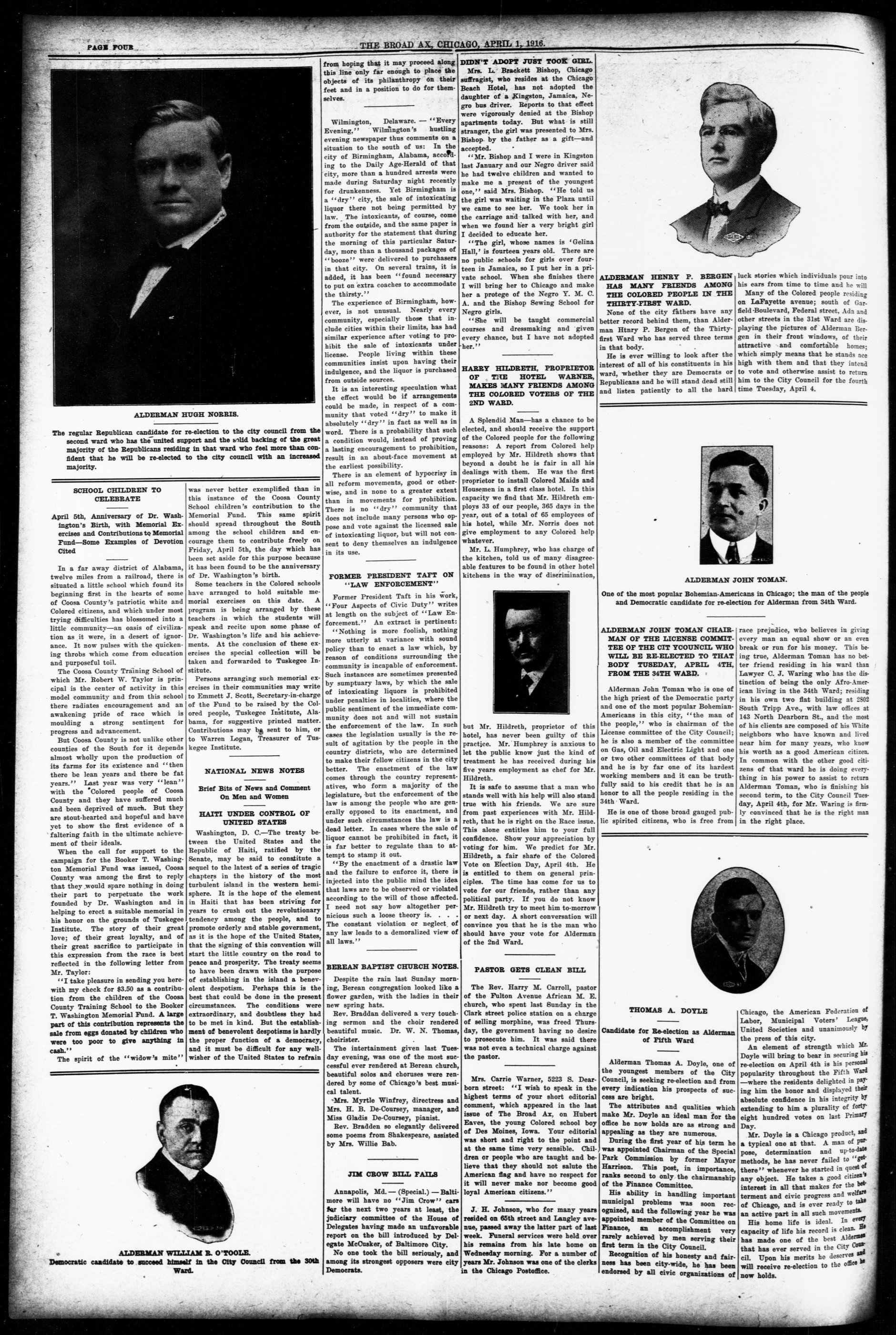
The regular Republican candidate for re-election to the city council from the second ward who has the united support and the solid backing of the great majority of the Republicans residing in that ward who feel more than confident that he will be re-elected to the city council with an increased majority.
The regular Republican candidate for re-election to the city council from the second ward who has the united support and the solid backing of the great majority of the Republicans residing in that ward who feel more than confident that he will be re-elected to the city council with an increased majority.
SCHOOL CHILDREN TO CELEBRATE
April 5th, Anniversary of Dr. Washington's Birth, with Memorial Exercises and Contributions to Memorial Fund—Some Examples of Devotion Cited
In a far away district of Alabama twelve miles from a railroad, there is situated a little school which found its beginning first in the hearts of some of Coosa County's patriotic white and Colored citizens, and which under most trying difficulties has blossomed into a little community—an oasis of civilization as it were, in a desert of ignorance. It now pulses with the quickening throbs which come from education and purposeful toil.
The Coosa County Training School of which Mr. Robert W. Taylor is principal is the center of activity in this model community and from this school there radiates encouragement and an awakening pride of race which is moulding a strong sentiment for progress and advancement.
But Coosa County is not unlike other counties of the South for it depends almost wholly upon the production of its farms for its existence and "then there be lean years and there be fat years." Last year was very "lean" with the Colored people of Coosa County and they have suffered much and been deprived of much. But they are stout-hearted and hopeful and have yet to show the first evidence of a faltering faith in the ultimate achievement of their ideals.
When the call for support to the campaign for the Booker T. Washington Memorial Fund was issued, Coosaa County was among the first to reply that they would spare nothing in doing their part to perpetuate the work founded by Dr. Washington and in helping to erect a suitable memorial in his honor on the grounds of Tuskegee Institute. The story of their great love; of their great loyalty, and of their great sacrifice to participate in this expression from the race is best reflected in the following letter from Mr. Taylor:
"I take pleasure in sending you here with my check for $3.50 as a contribution from the children of the Coosa County Training School to the Booker T. Washington Memorial Fund. A large part of this contribution represents the sale from eggs donated by children who were too poor to give anything in cash." The spirit of the "widow's mite"
L. P. L. S.
ALDERMAN WILL
Democratic candidate to succeed hims
Wa
ALDERMAN WILLIAM B. O'TOOLE.
Democratic candidate to succeed himself in the City Council from the 30th Ward.
PAGE FOUR
was never better exemplified than in this instance of the Coosa County School children's contribution to the Memorial Fund. This same spirit should spread throughout the South among the school children and encourage them to contribute freely on Friday, April 5th, the day which has been set aside for this purpose because it has been found to be the anniversary of Dr. Washington's birth.
Some teachers in the Colored schools have arranged to hold suitable memorial exercises on this date. A program is being arranged by these teachers in which the students will speak and recite upon some phase of Dr. Washington's life and his achievements. At the conclusion of these exercises the special collection will be taken and forwarded to Tuskegee Institute.
Persons arranging such memorial exercises in their communities may write to Emmett J. Scott, Secretary-in-charge of the Fund to be raised by the Colored people, Tuskegee Institute, Alabama, for suggestive printed matter. Contributions may be sent to him, or to Warren Logan, Treasurer of Tuskegee Institute.
NATIONAL NEWS NOTES
Brief Bits of News and Comment
On Men and Women
HAITI UNDER CONTROL OF
UNITED STATES
Washington, D. C.—The treaty between the United States and the Republic of Haiti, ratified by the Senate, may be said to constitute a sequel to the latest of a series of tragic chapters in the history of the most turbulent island in the western hemisphere. It is the hope of the element in Haiti that has been striving for years to crush out the revolutionary tendency among the people, and to promote orderly and stable government, as it is the hope of the United States, that the signing of this convention will start the little country on the road to peace and prosperity. The treaty seems to have been drawn with the purpose of establishing in the island a benevolent despotism. Perhaps this is the best that could be done in the present circumstances. The conditions were extraordinary, and doubtless they had to be met in kind. But the establishment of benevolent despotisms is hardly the proper function of a democracy, and it must be difficult for any well-wisher of the United States to refrain
from hoping that it may proceed along this line only far enough to place the objects of its philanthropy on their feet and in a position to do for themselves.
DIDN'T ADOPT JUST Mrs. L. Brackett Bi suffragist, who resides a Beach Hotel, has not daughter of a Kingston,
Wilmington, Delaware. — "Every Evening," Wilmington's hustling evening newspaper thus comments on a situation to the south of us: In the city of Birmingham, Alabama, according to the Daily Age-Herald of that city, more than a hundred arrests were made during Saturday night recently for drunkenness. Yet Birmingham is a "dry" city, the sale of intoxicating liquor there not being permitted by law. The intoxicants, of course, come from the outside, and the same paper is authority for the statement that during the morning of this particular Saturday, more than a thousand packages of "booze" were delivered to purchasers in that city. On several trains, it is added, it has been "found necessary to put on extra coaches to accommodate the thirst."
The experience of Birmingham, however, is not unusual. Nearly every community, especially those that include cities within their limits, has had similar experience after voting to prohibit the sale of intoxicants under license. People living within these communities insist upon having their indulgence, and the liquor is purchased from outside sources. It is an interesting speculation what the effect would be if arrangements could be made, in respect of a community that voted "dry" to make it absolutely "dry" in fact as well as in word. There is a probability that such a condition would, instead of proving a lasting encouragement to prohibition, result in an about-face movement at the earliest possibility.
There is an element of hypocrisy in all reform movements, good or otherwise, and in none to a greater extent than in movements for prohibition. There is no "dry" community that does not include many persons who oppose and vote against the licensed sale of intoxicating liquor, but will not consent to deny themselves an indulgence in its use.
FORMER PRESIDENT TAFT ON
"LAW ENFORCEMENT"
Former President Taft in his work, "Four Aspects of Civic Duty" writes at length on the subject of "Law Enforcement." An extract is pertinent: "Nothing is more foolish, nothing more utterly at variance with sound policy than to enact a law which, by reason of conditions surrounding the community is incapable of enforcement. Such instances are sometimes presented by sumptuary laws, by which the sale of intoxicating liquors is prohibited under penalties in localities, where the public sentiment of the immediate community does not and will not sustain the enforcement of the law. In such cases the legislation usually is the result of agitation by the people in the country districts, who are determined to make their fellow citizens in the city better. The enactment of the law comes through the country representatives, who form a majority of the legislature, but the enforcement of the law is among the people who are generally opposed to its enactment, and under such circumstances the law is a dead letter. In cases where the sale of liquor cannot be prohibited in fact, it is far better to regulate than to attempt to stamp it out.
"By the enactment of a drastic law and the failure to enforce it, there is injected into the public mind the idea that laws are to be observed or violated according to the will of those affected. I need not say how altogether pernicious such a loose theory is. . . The constant violation or neglect of any law leads to a demoralized view of all laws."
BEREAN BAPTIST CHURCH NOTES
Despite the rain last Sunday morning, Berean congregation looked like a flower garden, with the ladies in their new spring hats.
Rev. Braddan delivered a very touching sermon and the choir rendered beautiful music. Dr. W. N. Thomas, choirister.
The entertainment given last Tuesday evening, was one of the most successful ever rendered at Berean church, beautiful solos and choruses were rendered by some of Chicago's best musical talent.
Mrs. Myrtle Winfrey, directress and Mrs. H. B. De-Coursey, manager, and Miss Gladis De-Coursey, pianist.
Rev. Bradden so elegantly delivered some poems from Shakespeare, assisted by Mrs. Willie Bab.
JIM CROW BILL FAILS
Annapolis, Md. — (Special.) — Baltimore will have no "Jim Crow" cars for the next two years at least, the judiciary committee of the House of Delegates having made an unfavorable report on the bill introduced by Delegate McCusker, of Baltimore City. No one took the bill seriously, and among its strongest opposers were city Democrats.
DIDN'T ADOPT JUST TOOK GIRL
Mrs. L. Brackett Bishop, Chicago suffragist, who resides at the Chicago Beach Hotel, has not adopted the daughter of a Kingston, Jamaica, Negro bus driver. Reports to that effect were vigorously denied at the Bishop apartments today. But what is still stranger, the girl was presented to Mrs. Bishop by the father as a gift—and accepted.
“Mr. Bishop and I were in Kingston last January and our Negro driver said he had twelve children and wanted to make me a present of the youngest one,” said Mrs. Bishop. “He told us the girl was waiting in the Plaza until we came to see her. We took her in the carriage and talked with her, and when we found her a very bright girl I decided to educate her.
"The girl, whose names is 'Gelina Hall,' is fourteen years old. There are no public schools for girls over fourteen in Jamaica, so I put her in a private school. When she finishes there I will bring her to Chicago and make her a protege of the Negro Y. M. C. A. and the Bishop Sewing School for Negro girls.
"She will be taught commercial courses and dressmaking and given every chance, but I have not adopted her."
HARRY HILDRETH, PROPRIETOR OF THE HOTEL WARNER, MAKES MANY FRIENDS AMONG THE COLORED VOTERS OF THE 2ND WARD.
A Splendid Man—has a chance to be elected, and should receive the support of the Colored people for the following reasons: A report from Colored help employed by Mr. Hildreth shows that beyond a doubt he is fair in all his dealings with them. He was the first proprietor to install Colored Maids and Housemen in a first class hotel. In this capacity we find that Mr. Hildreth employs 33 of our people, 365 days in the year, out of a total of 65 employees of his hotel, while Mr. Norris does not give employment to any Colored help whatever.
Mr. L. Humphrey, who has charge of the kitchen, told us of many disagreeable features to be found in other hotel kitchens in the way of discrimination.
PETER H.
but Mr. Hildreth, proprietor of this hotel, has never been guilty of this practice. Mr. Humphrey is anxious to let the public know just the kind of treatment he has received during his five years employment as chef for Mr. Hildreth.
It is safe to assume that a man who stands well with his help will also stand true with his friends. We are sure from past experiences with Mr. Hildreth, that he is right on the Race issue. This alone entitles him to your full confidence. Show your appreciation by voting for him. We predict for Mr. Hildreth, a fair share of the Colored Vote on Election Day, April 4th. He is entitled to them on general principles. The time has come for us to vote for our friends, rather than any political party. If you do not know Mr. Hildreth try to meet him to-morrow or next day. A short conversation will convince you that he is the man who should have your vote for Alderman of the 2nd Ward.
PASTOR GETS CLEAN BILL
The Rev. Harry M. Carroll, pastor of the Fulton Avenue African M. E. church, who spent last Sunday in the Clark street police station on a charge of selling morphine, was freed Thursday, the government having no desire to prosecute him. It was said there was not even a technical charge against the pastor.
Mrs. Carrie Warner, 5223 S. Dearborn street: "I wish to speak in the highest terms of your short editorial comment, which appeared in the last issue of The Broad Ax, on Hubert Eaves, the young Colored school boy of Des Moines, Iowa. Your editorial was short and right to the point and at the same time very sensible. Children or people who are taught and believe that they should not salute the American flag and have no respect for it will never make nor become good loyal American citizens."
J. H. Johnson, who for many years resided on 65th street and Langley avenue, passed away the latter part of last week. Funeral services were held over his remains from his late home on Wednesday morning. For a number of years Mr. Johnson was one of the clerks in the Chicago Postoffice.
CARLIS
ALDERMAN HENBY P. BERGEN
HAS MANY FRIENDS AMONG
THE COLORED PEOPLE IN THE
THIRTY-FIRST WARD.
None of the city fathers have any better record behind them, than Alderman Htnry P. Bergen of the Thirty-first Ward who has served three terms in that body.
He is ever willing to look after the interest of all of his constituents in his ward, whether they are Democrats or Republicans and he will stand dead still and listen patiently to all the hard
THE NEW YORK TIMES
ALDERMAN JOHN TOMAN.
One of the most popular Bohemian-Americans in Chicago and Democratic candidate for re-election for Aldern
One of the most popular Bohemian-Americans in Chicago; the man of the people and Democratic candidate for re-election for Alderman from 34th Ward.
ALDERMAN JOHN TOMAN CHAIRMAN OF THE LICENSE COMMITTEE OF THE CITY COUNCIL WHO WILL BE RE-ELECTED TO THAT BODY TUSEDAY, APRIL 4TH, FROM THE 34TH WARD.
Alderman John Toman who is one of the high priest of the Democratic party and one of the most popular Bohemian Americans in this city, "the man of the people," who is chairman of the License committee of the City Council; he is also a member of the committee on Gas, Oil and Electric Light and one or two other committees of that body and he is by far one of its hardest working members and it can be truthfully said to his credit that he is an honor to all the people residing in the 34th Ward.
He is one of those broad gauged public spirited citizens, who is free from
5
THOMAS A. DOYLE
Candidate for Re-election as Alderman of Fifth Ward
Alderman Thomas A. Doyle, one of the youngest members of the City Council, is seeking re-election and from every indication his prospects of success are bright. The attributes and qualities which make Mr. Doyle an ideal man for the office he now holds are as strong and appealing as they are numerous. During the first year of his term he was appointed Chairman of the Special Park Commission by former Mayor Harrison. This post, in importance, ranks second to only the chairmanship of the Finance Committee.
His ability in handling important municipal problems was soon recognized, and the following year he was appointed member of the Committee on Finance, an accomplishment very rarely achieved by men serving their first term in the City Council. Recognition of his honesty and fairness has been city-wide, he has been endorsed by all civic organizations of
luck stories which individuals pour into his ears from time to time and he will
Many of the Colored people residing on LaFayette avenue; south of Garfield Boulevard, Federal street, Ada and other streets in the 31st Ward are displaying the pictures of Alderman Bergen in their front windows, of their attractive and comfortable homes; which simply means that he stands ace high with them and that they intend to vote and otherwise assist to return him to the City Council for the fourth time Tuesday, April 4.
1922
Americans in Chicago; the man of the people
action for Alderman from 34th Ward.
race prejudice, who believes in giving every man an equal show or an even break or run for his money. This being true, Alderman Toman has no better friend residing in his ward than lawyer C. J. Waring who has the distinction of being the only Afro-American living in the 34th Ward; residing in his own two flat building at 2802 South Tripp Ave., with law offices at 143 North Dearborn St., and the most of his clients are composed of his White neighbors who have known and lived near him for many years, who know his worth as a good American citizen. In common with the other good citizens of that ward he is doing everything in his power to assist to return Alderman Toman, who is finishing his second term, to the City Council Tuesday, April 4th, for Mr. Waring is firmly convinced that he is the right man in the right place.
Chicago, the American Federation of Labor, Municipal Voters' League, United Societies and unanimously by the press of this city.
An element of strength which Mr. Doyle will bring to bear in securing his re-election on April 4th is his personal popularity throughout the Fifth Ward —where the residents delighted in paying him the honor and displayed their absolute confidence in his integrity by extending to him a plurality of forty-eight hundred votes on last Primary Day.
Mr. Doyle is a Chicago product, and a typical one at that. A man of purpose, determination and up-to-date methods, he has never failed to "get there" whenever he started in quest of any object. He takes a good citizen's interest in all that makes for the betterment and civic progress and welfare of Chicago, and is ever ready to take an active part in all such movements. His home life is ideal. In every capacity of life his record is clean. He has made one of the best Aldermans that has ever served in the City Council. Upon his merits he deserves and will receive re-election to the office he now holds.
```markdown
```
Talks on
HEALTH,
CLEANLINESS,
PROPER LIVING,
SANITATION, ETC.
BY
Dr. W. A. DRIVER
3300 So. State Street
Phode Douglas; 3617
CLEANLINESS Physical and Mental.
"As a man thinketh so is he." Those words are the product of the brain of the greatest devotee of wisdom according to popular opinion in the Jewish and Christian environments. As far as ocular evidence is concerned a person who presents a clean exterior is generally and popularly accepted as a clean individual physically and mentally in almost all but fortunately not in all environments. For the purpose of showing the inefficiency of mere outside cleanliness such as the eye beholds of the person, let us call your attention to the fact that the physical man has a "feeding tube" called by some the inner man but known to the scientific world and to the physician in particular as the GASTRO-INTESTINAL TRACT. It is not called GASTRO-INTESTINAL because gas often forms in the stomach or other parts of that tract. As a matter of fact gas does not form in the gastrointestinal tract of a wise person. Such a person keeps clean internally as well as externally. Such an individual is normal physically inside as well as outside; such an individual shows that priceless asset wisdom by eating the proper quantity as well as the proper quality of nourishment. Such an individual takes the proper amount day and NIGHT by way of the ELEVATED window of the greatest demonstrable the invisible factor—FRESH AIR. Such a person takes daily that other indispensible, comparatively free the visible chemical combination called WATER and let it be understood that the wise person takes a plenty of water internally and externally via daily bathing the entire body by immersion in a bath tub of ample proportions and via frequently drinking UNADULTERATED water several times daily. Let us pause here and now to ENJOY the greatest and freest gifts of all NATURE'S BENEFACTIONS—a drink of water and fresh air. Pause! "HERE'S LUCK!—Not even the cup that cheers can excel the two donations from PROVIDENT NATURE'S LABORATORY that like six feet of earth make us all of one size.
We are taught that the sage Solomon also said: "Wisdom is the principal thing; therefore get wisdom; and with all thy getting get understanding. "Wise persons are not gluttons for many reasons. They realize that excess of food produces an un-
M. J. C.
M. E. K.
MR. AUGUSTUS L. WILLIAMS
Lawyer and Republican Candidate for Delegate to the Republican National Convention from the First Congressional District of Illinois.
Lawyer and Republican Candidate for Convention from the First Con
BY
A. E. H.
clean mind as well as an unclean gastrointestinal tract. And it does not require such wonderful psychology to understand that an unclean mind is an abnormal mind or in common language a diseased mind. Likewise an unclean gastrointestinal tract is an abnormal one, at the same time a diseased part of the body, capable of INFINITE HARM to every part of the body, producing disease and its end product dissolution—DEATH, just as the proverbial rotten apple will spoil a barrel. Gluttony also aids in producing wealth poverty as well as health (mental and physical) poverty. A bad breath is not a sign of wisdom. It is an evidence of the worst type of poverty—mental poverty, foolishness that leads to physical poverty and purse poverty.
Note the paradox: An unclean mind will produce by gluttony an unclean gastrointestinal tract and an unclean gastrointestinal tract will produce by the body fluids an unclean mind. The vicious cycle being established mental and physical diseases functional as well as organic follow, in accord with THE HIGHEST LAW—the LAW OF NATURE. These diseases or rather this disease shows so many different symptoms that physicians are often baffled as to the real cause which is obviously necessary almost always to know in order to effect a cure. And can the patient who has been unconsciously producing the damage readily find the cause? It appears not, judging from the failures of HOME REMEDIES, PATENT MEDICINES, COUNTER PREScribing DRUGGISTS, PRAYERS, INCANTATIONS and LAYING ON OF HANDS and OTHER NON-SENSE of the various CULTS.
the MEDICAL PROFESSION has its HANDS FULL to take care of the diseases of the people in a sensible, scientific and rational manner and the medical profession devotes its life to the cause of HEALTH, mental and physical. Medical science recognizes now that cancer is very probably due to an abnormal MODE OF LIFE, or derangement of the vital forces. It knows that appendicitis, gastritis, pneumonia, ulcer of the stomach, diabetes, constipation and a host of other "DISEASES" have their fonset origin in the BRAIN and BELLY, as designated by the terms faulty metabolism, abnormal mode of life, derangement of the vital forces and the plain old common sense word GLUTTONY.
```markdown
```
or Delegate to the Republican National Congressional District of Illinois.
THE BROAD AX, CHICAGO, APRIL 1, 1916.
Charles E. Stump Continues His Travels through the Sunny South. Lately He Has Visited Macon, Georgia, Jacksonville, Florida and Other Points in That Section of the Country
Macon, Ga.—It is a long jump from Kansas City, Kans., to New Orleans, La., and then to this point, but you will see that I have been doing some riding since I left you, and I am still riding, and will be I don't know where when you even look at this letter, but those who desire to reach me may send me a letter to the Florida Baptist college, Jacksonville, Fla.
It strikes me that I was somewhere in the world when I wrote the other letter, and now I am way down here in Georgia. I had been to Baton Rouge, La., and visited Southern University, and talked with them southern people. I was very much impressed with President Clark and his teachers, and then I impressed myself to New Orleans, La., where they were looking for Lawyer S. A. T. Watkins to try an important case, but I have not heard from the case yet, but I am sure that I will in a few days.
It has been a question in my mind of late years whether or not a white president in a school for myself or my people is not, a misfit? I am not prepared altogether to say, but I believe some of them are, because of the heavy race prejudice in the south, and so many other things that are coming up these days. They must teach the Negro race prejudice, race hatred, and to a large extent race inferiority. God never did make a superior race nor has he ever made an inferior race, but out of one blood he made all the nations to dwell upon all the face of the earth, some man said back in the days when they were forming material for the guide book of man, the Holy Bible. I believe this because it is in the Bible and the Bible is a book of truth.
Two teachers go down town on the same car, they must be legally separated, and the white teacher can hardly notice the teacher of myself, although they are two teachers from the same school. In the eating places, they must be separated in many cases, and one of the meanest places in this country is that little school in Edwards, Miss., where a secretary of the Y. M. C. A., had to leave a few days ago, because of the treatment accorded him by the president and his white teachers, yet they are down here in the south making their eatings off of our ignorance, by teaching us. Teaching us what?
I have in my mind to say a few words about New Orleans University and the president there and think I may do so just a little later. I do not want to misrepresent any one, hence I want to go into it just a little deeper, because I dip my pen in vitrol and let her fly all over the country. "Be sure you are right, then go ahead." From New Orleans, I found my way to Ocean Springs, Miss., and this is a place I have never been before, but I have been there, and hope to go back some day when the world is moving around. It may stop me right there in that place. I am going to be on the lookout for the world and see which way it is going and where it is going to stop.
Then into Mobile, was my next stop, and I stopped there and Miss Daisy E. Jackson, who can write as fast as you can talk, wrote my letter for me. I don't see to save my life how one can write so fast, and then read them little marks. It looked as if a chicken had put her feet in ink and walked all over the paper, but she understood it and I could not say anything.
I went there to meet the people and had the pleasure of meeting them. I had the pleasure of meeting Rev. J. W. Sexton, pastor of Bethel A. M. E. church, who is one of the strongest men in the country. Dr. Sexton comes from Missouri, but is down in Mobile doing a great big work. He lives in the hearts of the people and they are pushing him to the front. I hope some day to see him Bishop Sexton.
From Mobile, I went to Montgomery, Ala., and there is where I make some real shine, because I had the pleasure of visiting the State Normal School there. For a long time this school had as its president a white man, Prof. Patterson. He started the school I think and served it well. He treated all men right, hence the Lord allowed
him to remain there until He got ready for him, and called him up higher. For 10 years, Prof. John W. Beverly furnished the brains to carry on the work, hence when there was a vacancy, the white Board invited him to become president, and believe me honey, he is making some president. The school has wonderfully increased in scholars, in popularity, and is going right on up. I looked at all them young people there preparing to be something in life, them young people, getting ready to serve God and humanity, them young people getting some real education. I wanted to fall right in line myself, but they thought I was at little too old for the job. I left the city then to go to another place.
I wonder if you have ever heard of Mt. Meigs, Ala. Well, I have been there, and I am so glad that I did go, although I did not get to see it all, because I did not get to the reformatory, but I am going back. Leaving Montgomery, I bought a ticket to Merry, where I got off and found Rev. D. Davis, pastor of the Baptist church awaiting my arrival in his buggy, and soon had me over to the Peoples Village School, Miss Georgia Washington, a Hampton graduate, founder and president. Miss Washington greeted me, and assured me that I was welcome, and ushered me into the guest chamber, where I was told that I could remain as long as I desired. Now this old Kansas farmer felt like shouting, but for fear that he might excite the students, refrained from doing so.
It is indeed a beautiful place. Miss Missouri Duncan, one of the teachers, shook my lily black hands and told me she was glad in the name of Misses Maud E. Cameron, Esther Abrams, Annie L. Johnson, and Mrs. Lula B. Fisher, to make me welcome, also in the name of the students, the community, and Miss Washington. I did not know what to say, so I just turned out a few big sounds. I thought I would express it in Latin, and you Latin scholars may have to take down your sign. I said:
"Seleribus, thankibus, fairibus theiibus welicombus, and Ierbus willibus makibus myselibus homibus." I wish you could have seen all them teachers looking at me, and even the house cat made its flight, thinking I was too educated to talk to it. It could not understand just what I was saying, and I was pleased to puzzle them educated people. They had to look at their big dictionary, but could not then find what I had said, so I just confounded Webster and all them other dictionary writers.
Next found me on my way to see Miss Cornelia Bowen, who is at the head of another school and I will have to tell you about Miss Bowen, Miss Thigpen, and others in another letter, because I can't tell it all in this one. I shall have to bring this letter to a close, and my next letter will be from Florida. I will be full of oranges when I write to you the next time.
CHIPS
Dr. Julius Dawson is spending a few days here visiting relatives and will return to Galsburg, where he expects to open and fit up an office.
Messrs Frazier and Carter, proprietors of the Carolina Jubilee Co., are in the city after several months on the road.
Prof. Hamilton is here on business and will leave on his speaking tour Friday.
SPECIAL NOTICE. PHONE CHANGED.
THE EMANUEL JACKSON
UNDERTAKING COMPANY,
2959-2961 State St., begs to inform its
patrons and friends, that our "Tele-
phone" has been changed to "CAL-
UMET 6164." Automatic remains
same-71-629. Prompt service day or
night.
DAN M. JACKSON, Pres.
GEORGE T. KEBSEY, Sec.
A Shabby Royal Palace.
A Snappy Royal Palace.
The Persian royal palace is a most unattractive place. The courts are filled with painted figures of cast iron in a kind of operatic Romeo's costume, and with boys of gilt iron offering vermilion cups to gift eagles. The tanks are stagnant and shabby, the gardens neglected. The rooms are horrible even for one of those monuments of bad taste called royal palaces; the walls are covered with mirrors, and a decoration made of small pieces of mirror set in elaborate patterns, the effect reminding one of a wedding cake. The furniture is without exception European, of poor quality and worse taste; there is not a single one of those exquisite works of Persian art which in the collections of Europe arouse enthusiasm—not so much as a fine carpet. Neither the famous peacock throne—so long erroneously thought to be the one built for the great moghal and looted by Nadir Shah—nor any of the jewels are exhibited. Local gossip believes them to have been broken up and sold in Europe by the present government. "From Moscow to the Persian Gulf."
A Case of Identification:
"Is that the officer who arrested you?" his honor inquired of Moses Hanibel, an old negro whitewash artist, arrested for assault.
"I can't reekerlect," answered the prisoner.
"Sure, I arrested him, judge," put in the policeman, with indignation. "He knows it too."
"Take a good look at him, Moses," insisted the judge. "Isn't that face familiar?"
The darky squinted long and scowlingly at his accuser.
"Now dat I uses mo' keer, judge," he said, "peers like dy is somethin' familyus erout dat face, but dis yere worl' is so full ob nacherally ugly folks js' an ordinary man kain't always tell de diffune betwix' em. Dat's him, jedge, dat's him. * * * But be ez easy ye yo' kin on him, kaze he got a wife and fo' chillun."—Case and Comment.
Construction of Big Guns
The making of a big gun involves as much intricate work as the putting together of a locomotive or a giant crane. A twelve inch gun on board a battleship is fifty feet in length and has an extreme range of twenty-five miles and an effective range of twelve miles. There is a vast amount of intricate and delicate, trained workmanship wanted in the finish of a giant cannon. For example, says a writer in the Millgate Monthly, the breech block has to undergo eighteen or twenty machinings. And all the medley of mechanism necessary to enable the poudrous mass of ordnance to move to the right or left or up or down at a touch from the naval gunners is being built up together at the same time as the work proceeds on the gun itself. For some of the smaller guns no fewer than 550 machinings on 280 parts are necessary before the weapon is ready for use.
The Finest Street In the World.
"Truly, New York is the unbelievable city, as I have called it," said Joseph Pennell, the famous etcher. "Down Broadway there are endless new subjects. Stand, for instance, at the upper side of City Hall square on Broadway and look south. Now, I know all of old Europe, the parts that are left and the parts that are gone, and there is nothing, there was nothing, to compare in grandeur and majesty with this vista down Broadway. Were it somewhere in Europe every one would be staring at it, ogling it, patronizing it, saying the correct things in the guldebook about it. Here the guidebook says nothing. Broadway, to those who can see, is the finest street in the world."—New York World.
A Country of Earthquakes.
Japan is peculiarly the victim of elemental forces. The only satisfaction its people can derive from living in a country which contains fifty-one active volcanoes and has an average of about 500 earthquake shocks yearly is that in all probability Japan would never have existed but for the seismic and volcanic agency which has elevated whole districts above the ocean by means of repeated eruptions.
Ceres.
In the classic mythology Ceres is the goddess of the harvest, or, to be more specific, of the cereals. According to Ovid, Meta, book 5, Ceres first taught men to plow the fields and also to have fixed laws, the meaning of which is that laws originated with the settled state known as agriculture.
A. Hard Question:
Modern Maiden -I wish advice. Old Lady-Certainly, my dear. What is it? Modern Maiden-Shall I marry a man whose tastes are the opposite of mine and quarrel with him, or shall I marry a man whose tastes are the same as mine and tire of him?
Laws.
The laws of a country must be like a large river and not like a small ditch. Men do not fall in a river because it is remarkably wide and deep, while they often fall into a ditch because it is so narrow and shallow.—Kyuso.
Bad Arguments
The best way of answering a bad argument is not to stop it, but let it go on its course until it overlaps the boundaries of common sense—Sydney Smith.
Not Eternal.
Soulful Youth (at the plano)—Do you sing "Forever nd Forever?" Matter of Fact Malden—No; I stop for meals. —Exchange
PAGE FIVE
PUBLISHED WEEKLY.
Will promulgate and at all times uphold the true principles of Democracy, but Catholics, Protestants, Priests, Inclain, Single Taxes, Republicans, or anyone else can have their say, as long as their language is proper and responsibility is fixed.
The Broad AX is a newspaper whose platform is broad enough for all, ever claiming the editorial right to speak its own mind.
Local communications will receive attention. Write only on one side of the paper.
Subscriptions must be paid in advance. One Year.....$3.00
Six Months.....1.00
Advertising rates made known on application.
Address all communications to
THE BROAD AX
4533 ST. LAWRENCE AVE. CHICAGO, ILL.
PHONE WENTWORTH 2597.
JULIUS F. TAYLOR, Editor and Publisher
Entered as Second-Class Matter Aug. 18,
1903, at the Post Office at Chicago, Illinois,
under Act of March 2, 1879.
AUTHORIZED AGENTS AND CORRESPONDENTS FOR THE BROAD AX.
L. W. Washington, 5465 Kimbark avenue.
B. W. Fitts, 3315 S. State street.
Phone Douglas 4049.
The Broad Ax can be found on sale at the last named place and news items and advertisements left there will find their way into these columns.
FOR SALE.
2 story brick cottage, cement basement, steam heat, large enclosed rear porch. Terms. 6528 St. Lawrence Ave.
CHIPS
Burning Diamonds.
You often hear of people with money to burn, but so far none has ever attempted to burn his diamonds. The reason why perhaps is because they will burn beautifully. "A great many people imagine that diamonds are indestructible." said a jeweler, who was placing a load of gems in his safe for the night. "but as a matter of fact, a fire of diamonds would be the briskest, prettiest thing in the world. Diamonds are nothing but coal carbon. Put a handful of diamonds on a plate and set a light to them. They will burn with a hard, gemlike flame till nothing is left. There will be no smoke, no soot, and at the end the plate will be as clear as though just washed. Not the slightest particle, even of ash, will remain."-Pittsburgh Press.
A Lost Book.
Among the Somali's of Africa there is a legend that when God first made them, a man and a woman, he wrote down in a book the law they were to follow. They were promised that as long as they carefully preserved this book they should continue great and powerful, but if they lost it their greatness would depart from them. One day the book was carelessly left lying outside a tent, where a bullock found and devoured it. From that fatal day their decadence set in, and to the present time whenever an ox dies of disease or is killed his entrails are religiously examined to see if any trace of the book can be found. If found they believe they should recover their lost power
The Two Versions.
The editor was trying to placate an indignant statesman.
"All we said about you in the paper, Mr. Krakajack," he assured him, "was that you seemed to have an inadequate sense of proportion."
"Not by a blamed sight!" roared the caller. "What you said about me was that I seemed to have an inadequate proportion of sense!"—Chicago Tribune.
Kansas as a Territory.
When Kansas was first organized as a territory in 1854 its area included part of the present state of Colorado, extending as far west as the crest of the Rocky mountains. Denver, Leadville, Pueblo and Colorado Springs are now located on former Kansas soil.
One of Her Necessities.
Maud—Jack said when he proposed that he could give me only the necessities of life. Ethel—And what did you say? Maud—I told him that one of the necessities of my life was a husband who could supply me with the luxuries—Exchange.
Olives and Bread.
Pound for pound, ripe olives, so far as total value of heat unit is concerned, contain almost as much food value as bread, and in the case of very large olives the value may be increased to approximately the same as that of bread.
Strong One at That
The very young man says, "The world is my oyster," then discovers it takes an oyster knife to open the thing.—Florida Times-Union.
: PAGE SIX
—$—$—$—$—$—$——————————
i —T
i. “Qld Time Witchcraft.
“Jane Wenham was indicted at the
Hertfordshire assizes on March 4, 1712,
for “conversing with the devil in the
form of a cat,” under the provisions of
the act of 1604, repealed in 1736. Her
prosecutors wished to have her also in-
dicted for practicing witchcraft to the
harm of Ann Thorn, a servant girl stx-
teen years old, but this was not al-
Iowed, although evidence was produced
at the trial to show what injury had
‘Deen done the victim by means of
crooked pins and by placing cakes and
cats’ hair in Ann Thorn’s pillow and
how the prisoner had caused the death
of some cattie simply by walking
through a turnip field.
‘The jury brought her in “guilty,” and
Justice Powell passed sentence of
death, but took steps to quash the ver-
dict. ‘Wenham’s prosecutors published
‘an account of the case, but their argu-
ments were pulverized by scientific
men. Jane Wenham herself was liber-
ated and taken under the protection of
Colonel Plummer, who gave her a cot-
tage, and we are told by Dr. Hutchin-
son that in 1720 the whole country was
fully convinced of her innocence —Lon-
don Spectator.
Wiss dies eo eee.
Life becomes, as the stoics more
than once tell us, like a play which
4s acted or a game played with coun-
ters. Viewed from the outside, thede
counters are valueless, but to those
engaged in the game thelr importance
is paramount. What really and ulti-
mately matters is that the game shall
be played as it should be played. God,
the eternal dramatist, has cast you
for some part in his drama and hands
you the role. It may turn out that
You are cast for a triumphant king.
It may be for a slave who dies of tor-
ture. What does that matter to the
good actor? He can play either part.
His only business is to accept the role
given him and to perform it well. * * *
Success or failure is a thing he can de-
termine without stirring a hand. It
hardly interests him. What interests
him is that one thing which he cannot
determine—the action of your free and
conscious will.—Gilbert Murray.
Kinas and Shavinac.
‘The classic case of a king who knew
better than to let anybody else shave
him is that of Dionysius the elder, ty-
rant of Syracuse, who appears to have
been unable to shave himself, for he
is said to have resorted to the un-
comfortable device of singeing off his
beard with hot walnut shells, says the
London Chronicle. We may suspect
that Napoleon's was-another case of
the kind. Rogers asked Talleyrand
whether Napoleon shaved himself.
“Yes,” replied Talleyrand; “one born to
be a king bias some one to shave him,
but they who acquire kingdoms shave
themselves." That way of putting it
pleasantly emphasizes the practical su-
Periority of the parvenu to the help-
Jess, spoiled child of heredity, but_pru-
dence probably entered into thé“@hat-
ter also, if Talleyrand’s statement was
correct.
A Queer Fish.
A male fish which hatches the young
of its mate is the Chromis paterfamil-
fas. It fs found in the lake of Tiberias,
Palestine. Strange to say, this indus-
trious fish hatches its young in its
mouth. When the female has spawned
in the sand the male approaches and
draws the eggs into his gills, where
they remain until hatched, when they
struggle out of their confinement into
the parent's mouth. As many as 200
perfect young are sometimes found in
the mouth of an adult male. How the
fish manages to*feed itself without
swallowing its young isa mystery. The
grown fish is about seven inches long
and one and three-quarters wide. Its
back is olive green, shot with blue, and
the belly is silver white, marked with
green and blue.
Reason For Complaint.
‘I keep the best bread,” said a cer-
tain baker the other day to a poor
fellow who complained of the inferior
quality of the article he had purchased
of him the day before.
“I do not doubt it,” replied the cus-
tomer.
“Then why do you complain?” asked
the baker.
“Because I would suggest that you
‘sell the best bread and keep the bad,”
‘was the reply.—Pittsburgh Telegraph.
Game Evidenco
“You say that preparation will make
the hair grow?” asked the thin haired
man of the druggist.
“Why, say,” came from the drug
man, “I know a customer who took
the cork out of a bottle of that stuff
with his teeth, and now he’s got a hair
Up.”—Yonkers Statesman.
Part Often Overlooked.
“It is all right to pat yourself on
the back occasionally,” said the dis-
penser of sage advice.
“Yes?” said the player up.
|, “But don't forget to call yourself
own when you need it, my boy.”—
Pittsburgh Post.
Treat For the Boarders.
| “ta,” queried the small daughter of
the boarding housekeeper, “what shall
‘Ido with these basting threads?”
“Give them to me and I will stir them
Amto the frosting for the cocoanut
‘cake,” said her mother.—Youth's Com-
panion.
Lively Cheese.
| John—I'l bring you a fork, sir. The
(Customer—What for? John—The ca-
‘membert, sir. The Customer—A fork's
no good. Bring a revolver.—Exchange.
| Bincerity’s own realm is one's secret
‘ehumber; strong here, 2 man is strong
everywhere.—Saigo.
TO SCHOOL ON SKIS.
Then Crawl Down to the Door
Through a Hole In the Snow.
Bllensburg, Wash.—Coming to school
on snowshoes and skis, sliding over
the schoolhouse roof and climbing
down to the door through twelve feet
of snow is the experience of children
at the school at Meadow Greek. Mrs.
Mary Boedcher, county superintend-
ent, has received a number of letters
which tell the children’s idea of the
situation.
“Our schoolhouse is about twelve
feet high on the outside,” writes one
boy, “but the snow is so deep that a
person can walk right over and not
know that there is a building there.
We have to crawl down eight steps
through a hole in the snowbank to get
into it”
“We live in a tent,” says a twelve-
year-old girl in the seventh grade.
“The roof is covered with large pieces
of bark. All that you can see of the
house is the very frent, where you go
out. I went halfway to school on the
skis and crawled a little way so as not
to go in so deep.”
‘Mrs. Beach, the teacher, in her re-
port to Mrs. Boedcher, said that in
spite of the snow school kept up every
day and that only two absentees were
noted during the severe weather.
SHE TRAVELS FAR TO BE MRS,
Young Woman Popped by Mail, Bought
Ring end Licences.
Des Moines.—After traveling over
600 miles Miss Augusta Knies of Lan-
sing, Mich., became the first leap yea!
bride of this city by leading Harley
Decker of 1209 East Tweity-sixth
street to the altar.
She managed the whole affair. She
Popped the question, named the wed
ding day, paid her railroad fare, pur
chased the marriage lcense and
bought the ring.
Miss Knies, who is twenty-five, wa:
strolling along the streets of Detroit
with a girl friend last June. Her com.
panion greeted a young man, an¢
fifteen seconds later she was introduc
ed to her future husband. It was
Decker, then employed in a Detroit
automobile factory.
He was called back to Des Moines
by the illness of a sister in February.
Three weeks ago Miss Knies popped
the question by mail, and Decker, who
is twenty-nine years old, accepted. The
ceremony was performed by the Rev.
Frank W. Mutchler of the Great Park
Chureh of Christ.
‘Unique Home of Pioneer and
| Family Brought to Light,
Garber, Okla—The falling of five
feet of cement porch of a farmhouse a
half mile north of Garber brings to
light the unique home of a pioneer of
this section.
Under this porch was a cave. The
cave was dug in 1894. At a point
along a little ravine a sandstone ledge
cropped ont, and there 8. H. Peters
tunneled. under and excavated two
large rooms, with a sandstone ledge
about three feet thick for a roof. ‘The
rooms extended sixty feet under the
ground, and at the deepest place there
was perhaps eight feet of dirt om top.
To the back room a skylight 8 by 5
feet was opened.
‘The rooms were plastered and white.
coated, and the rock roof was white
washed, making it light enough for
one to read newspapers in any part of
the cave. It was very dry at that
time, and coffee kept in the cave
ground easily. S. H. Peters and his
family lived there many months be-
fore be built a home above ground.
The stoveplpe ran up the skylight,
and to persons passing along the road
the smoke coming out of the ground
was a novel sight, Hundreds of per-
sons visited this cave home, and all
wondered why the roof didn’t fall in.
as it was not supported by timbers.
‘When the wet years came a little
spring in the cave which furnished all
the water for the famfly overflowed
the rooms at times, and in recent years
when the drain became clogged the
cave filled with water. The pioneer
later built a house almost over the
cave.
8. H. Peters was but little longer
digging the cave home than was re-
quired to build a sod house of the same
size. Sod houses were the first homes
‘of most of the pioneers. The plaster
was the only expense to the cave
home. Today this section has the fin-
est country homes in the state and is
itn Sew eehent belt.
| Fifty-eeven Years Without Vacation.
Bridgeport, O.—After being on the
Job for fifty-seven years as toll collec-
tor at the Bridgeport end of the Wheel-
ing-Bridgeport bridge, John Richard-
son will retire. He had worked fifty-
seven years without a vacation or fil-
ness, but a few days ago he became ill
and was forced to abandon his post.
He says he enjoyed his “vacation” so
much that be will make it permanent.
Pneumonia Swifter Than Bullet.
Passaic, N. J.—Charles Ublermann
of Clifton, who attempted suicide re-
cently, is dead from pneumonia. The
doy wrote a note to his parents telling
them they “soon would know the rea-
son” for his act, then shot bimeelf.
‘The wound was not serious, but pnev-
monia developed soon afterward.
i BROAD AX, CHI@AGO, APRIL 1, 1916.
THE BROAD A ee
SPENT FORTUNE | “ro
‘Thief Robbed the House
: ‘That Back
TO TRAIN ORPHANS | 22.2
conscience recently ente
of Clark Rubido bere |
ne camping with valuables
$100 returned to the bi
Washington Teacher Alded | tna ceposita «cano's
$2 in pennies, which had
Those Who Sought Education, | %e,!0°: on te tone po
— Los Angeles that day, at
a neighbor, Mrs. Carolin
LIVED MODESTLY TO DO ACT) sro cvesset sous
Used Income of High School Instruc-
tor In Moderate Manner, and With
Money He Earned by Writing He
Was Able to Educate Eightesn Stu-
dents.
Everett, Wash—F. D. Mack, teacher
in the Central school, has spent about
$40,000 in educating eighteen students,
seventeen boys and one girl, during the
last sixteen years, according to a story
he reluctantly told a newspaper repre-
sentative.
Living on his school salary in a mod-
est way both in Minnesota, his former
home, and in Washington, he has earn-
ed the money to send students through
universities by writing short stories
and magazine articles. He has paid
out between $2,000 and $3.000 on each
of his “children.”
Some of the youngsters were or.
phans, and some had one parent, but
all were eager to learn and were band!-
capped by lack of money.
‘The thirteen boys who are allve are
all actively engaged in the professions
in which Mr. Mack has educated them.
‘Two are druzzists. one being in St
Paul and the other in Los Angeles.
‘Two are instructors in the University
of Minnesota. where they were grad.
uated. One teaches mathematics, and
the other is an instructor in German.
‘This latter young man plans to be a
physician. and in 1914 married a girl
who wished to go to Germany to get
her master’s degree. so he and his
bride sailed for Germany to continue
their studies. only to be turned back by
the beginning of the war.
Mr. Mack sent him through Normal
school, the University of Minnesota
and Harvard. where be received his
master’s dexree.
‘A young man who chose to be a
broker received his education at the
University of Minols. He started out
to be an architect, but changed his
mind and took a commercial course.
He was rradvated four years ago and
4s now in Minneapolis engaged in the
lumber brokeraze business. He 1s the
Dest money maker of the “family.” In
his four years ont of college he has
made $10,000,
‘A mining engineer who was educat-
ed at the University of Minnesota 1s
now working in a mine at Butte, Mont.
‘The banker received a thorough com-
mercial education, and then Mr. Mack
‘set him uy in business in a bank in
Elgin, N. D. Mr. Mack says that if
any of his boys wants to start in bust-
ness he always gives them enough
money to bein. He recently bought
an eighty acre farm for one of them.
A dentist lives in Chicago. He baa
four years at the University of Val-
paraiso. Mr. Mack says this boy mar-
Tied a rich nurse.
‘One boy who studied to be a lawyer
lost his health after his graduation
from the Usiversity of Minnesota law
school, so could not practice, and is
now eiployed as chief of the Minne-
sota state fish and game commission.
with headquarters at St. Paul.
Self educated and quiet, Mr. Mack
would not be thought responsible ‘for
one of the most unusual philanthro-
ples in the world.
NO PAINTER’S COLIC FOR HIM.
Bill For “Tint” Makes Bachelor Issue
Leap Year Declaration.
Elwood, N. J.—Robert W. Hunt, a 1e-
tired colleze instructor, received a let-
ter recently from a neighboring town
containing a bill for 40 cents for “tint”
purchased by “Mrs. Hunt.” Hunt is
good looking bachelor with a steady in-
come, and the inquisitive element of
Hlwood at once interpreted the post-
office bulletin in terms of leap yeer
possibilities.
To quiet the buzzing gossip, Hunt
has issued the following statement:
“We have had several offers of mar
riage, and one or two ladies have as-
sumed we were engaged without mak-
ing any offer, and it is with fear and
trembling we pass each day of this
Year, which is divisible by four. How-
ever, when Mrs. Hunt does arrive she
shall come as nature painted her, with
eyes like the heavens, with cheeks
Uke the rose and with lips lke the
damp of crushed strawberry. She shall
have no need of ‘tint.’ When we want
@ kiss we don't propose to mess
through two or three coats of paint to
get it.”
‘Gand Tse baleen Se.
Oregon City, Ore.—Peter Brevio,
‘aged forty-three, an Italian, was treed
with the aid of bloodhounds arrested
‘and brought back to Oregon City and
committed to the State Hospital For
the Insane. Brevio lived in a hollow
tree, and his diet consisted of roots,
berries and what food he could find
around neighboring farmhouses. He
stole an ax from a farmhouse and
passed much of his time chopping
down trees. A number of men of the
@istrict determined to arrest Brevio
and went to his tree home. The Italian
fan away. Dogs were then put on his
tefl ~
RETURNED BABY’S BANK.
pate Ressse ue oe oro
‘That Back.
Sierra Vista, Cal—A-thief with a
conscience recently entered the home
of Clark Bubido here and after de
camping with valuables amounting to
$100 returned tothe burglarized house
and deposited a child's bank éontaining
$2 in pennies, which had been part of
the loot, on the front porch.
‘The Rubido family visited friends in
Los Angeles that day, and about noon
a neighbor, Mrs. Caroline Martin, saw
a well dressed young man carrying 8
suit case walk up to the front door of
the Rubido home, fumble with the lock
a moment and walk fn.
Mrs. Martin thought the - stranger
was probably a friend of the Rubidos,
and when the young man reappeared
some time after, still carrying the suit
case, she told him that the Rubido
family was passing the day in the city.
The young man thanked her and bur-
ried on.
Half on hour later Mrs. Martin saw
the young man come back and deposit
something on the front porch of the
house.
When the Rubidos returned they
found that the pleasant faced young
man had carried away all their silver,
several articles of jewelry and $30.
The baby’s penny bank, which had
been returned, was about the only
‘movable valuable not taken,
SOAP BRINGS REUNION.
Brothers Meet For First Time In Thir-
teen Years by Accident.
St Paul—Charles McKee of Ray,
N. D., was sent to room 322 when he
registered at the Hotel Sherman. De
siring to shave, he unpacked his grip.
But his shaving stick was missing.
“Have you got any shaving soap?”
he asked a man who was issuing from
room 324.
“Sure,” was the answer. They en-
tered room 324 and turned on the light
to look for the shaving soap. McKee
looked at the other man critically.
“What's your name?” he asked.
“R. E. McKee of Shakopee, Minn.”
was the answer.
“I'm your brother Charley,” the North
Dakotan said.
‘The two had not seen each other for
thirteen years. They were reared in
St. Paul and separated after thelr par-
ents died. Charles went to North Da-
kota, where he owns a half section of
land. R. E. MeKee went to Shakopee,
where he owns a section.
In the last thirteen years they had
not corresponded. Unknown to each
other, each had amassed a fortune.
Strange Community Is Discov.
ered In Utah.
Salt Lake City. — Discovered —the
strangest community in the United
States.
It fs a community of south sea
islanders. A thousand in number, they
are now settled in the Skull valley in
Utah, between the Great Salt lake and
the Nevada line.
‘There are Maoris, Samoans and Ha-
wailans living and farming in perfect
harmony, intermarrying and- raising
children.
‘Twenty-five or thirty years ago the
older men of this strange colony came
from across the Pacific, some as sail-
ors, some as stowaways.
‘They wandered in small groups about
California, and some of them came
across the Sierras into Idaho and Utab.
‘They were starving when a group of
business men decided to help them.
‘They secured 15,000 acres of land in
the Skull valley, collected all the south
Sea natives that they could find and
established them in a colony which
they call Ioseppa.
An American farmer was selected as
superintendent. Each man was paid
good wages at the start, and as soon
as they were capable they were allow-
ed to buy half acre lots and cottages
at actual cost.
Now there is a new generation grow-
ing up. Some of the boys have gone
from the grade school and taken fall
courses at the State Agricultural col-
lege. Several of the girls have become
stenographers in Salt Lake City. A
number have graduated from the Uni-
versity of Utah.
DRAW LOTS TO PREACH.
White Plains Pastors Try New Way
of Exchanging Pulpits.
White Plains, N. Y.—“We had the
time of our lives,” sald the Rev. Wil-
Mam Dana Street, pastor of the Ridge-
view Avenue Congregational church
and one of the six ministers here who
filled pulpits that were assigned to
them by drawing lots. Sealed envel-
‘opes containing the names of the
churches were put in a hat, and each
minister drew one.
“None of us knew which church he
had drawn,” said Mr. Street, “until a
couple of days after when we opened
the envelopes.”
‘The Wev. Chaellis E. Nichols, pastor
of the First Baptist church, exchanged
with the Rev. Emest L. Walz, pastor
of the Chatterton Hill Congregational
chureh; the Rev. Herbert E, Wright,
pastor of the Memorial M. E. church,
the largest Protestant church here, ex-
changed with the Rev. David W. De
Forest of St. Paul's M. E. Protestant
thureh, one of the smallest churches.
| THE SLIP-ON.
See ete
| “A Quaint Gown-For Her Who
} Does Her Own Housework.
Sa ged
‘This simple frock is made of buff
gingham striped with blue. One plece
frocks for housework have long been
cr My
HN a My
iy
a |
| i an
VARIATION OF THE ONE PIECE
popular. This is cut loose, belted,
short sleeved, while shapely in lines.
A bit of embroidery finishes the but-
toned front, the collar edge and the
cuffs.
lew nities ite
A dainty and acceptable gift to tuck
into the bride’s traveling bag as a little
surprise to her when her destination is
reached is a boudoir set of cap and
ribbon slippers. The whole output may
be folded very small in its tissue paper
wrapping and will take up scarcely
any room at all in the bag—not as
much as the handful of rice which is
sometimes slipped in by a mischievous
bridesmaid. The cap is an ordinary
boudoir cap of white point d’esprit, fill:
ed with fine white lace and trimmed
with the best quality satin ribbon in
pale blue or pink shade. A bow of the
ribbon is caught against the cap with
a tiny rhinestone buckle.
The slippers have very flexible soles,
eut from pale blue or pink goldenrod
satin; two layers of satin for each sole,
and a thin layer of cottor bgtting may
be slipped between if one fancies a
Uttle thicker sole. Two inch blue or
pink satin ribbon is sewed around the
edge of the sole and fastened together
at the back. About two inches of the
ribbon are gathered along the upper
edge over cord elastic to hold the slip-
per on the heel.
Renned Gailera,
Materials.—Two cupfuls four, two
teaspoonfuls baking powder, one-half
cupful sugar, an egg, one-half tea-
spoonful salt, three tablespoonfuls but
ter, one-half cupful chopped nuts, two-
thirds cupful milk.
Directions.—Sift the flour, salt and
baking powder, rub the butter in; then
add sugar and nuts. Mix to a soft
dough with the egg and milk, roll out
thin and sprinkle with sugar. Roll up
with the sugar Inside, cut in slices
three-quarters of an inch thick, place
on a greased baking tin, brush over
with beaten egg and bake about fifteen
minutes.
Attractive Suits.
Every woman who can possibly af.
ford it will invest in one of the attrac-
tive suits of pongee, poplin or silk
homespun. They are a delightful com-
bination of style and utility and,
though rather high priced. are well
worth the cost. They are to be had in
white, cream and oyster white, tan,
brown and biscuit Dutch, navy and
gray blue, besides different tones of
green and gray.
Now It’s a Book Wanen.
Now we have little wagons to use in
the brary. Their rubber tired wheels
‘move noiselessly over even hardwood
‘floors, and their top is edged by 2
framework high enough to hold books.
‘while two lower shelves contain the
two different sizes of the magazines of
the moment. These book wagons do
‘ot take up much space in the library.
Satin For Blouses.
A new blouse of white satin shows a
delightful touch of color in the lining
of primrose yellow taffeta that appears
im turnover points of the high collar
and the jabot-like frill on the front and
im the lower side of the frills that fin-
teh the long sleeves.
a - i”
PRAYERS CURE AN INVALID.
Healing of Seventy-year-old Pennsy!.
Sten Cian, Cneaedad ana titre.
race,
Greensburg. Pa.—Walter McCluckie,
seventy, for sixteen years a helpless
invalid, is able to walk again, and his
recovery is declared to be a direct au.
swer to prayer.
He is a member of the Youngwood
United Brethren chureb. Recently
series of cottage prayer meetings was
held, and at Mr. McCluckle's sugzes.
tion it was arranged to pray for his
healing The Rev. John Watson, pas
tor of the church, with twenty-five
members, went to his home. Mr. Wat
son read from the third chapter of
‘Acts, where it is recorded that Peter
and Jobn caused the lame man to
walk, and from the fifth chapter ot
James, which declares, “The prayer of
faith shall save the sick.” The minis.
ter and others followed with prayers
for Mr. McCluckle's recovery.
‘The prayers’ finished, Mr. Watson
said, “Let us rise and sing ‘Praise Goi
From Whom All Blessings Flow.”
To the astonishment of all, Mr. Me.
Cluckle rose with the others, joined in
the singing und then walked about the
room. His recovery is regarded as a
miracle.
. $50 FOR SEVEN WINKS.
Following a Custom of Greece Looked
Like Mashing Out In Missouri.
en ee
Kansas City. Mo.—George Stamatois.
twenty-six years’ old, 510 Main street
has not forgotten the customs of his
native Greece. There it seems to be
the fashion to wink at any woman you
want to be-ome acquainted with. The
Greek custom brought Stamatois to
grief in staid Kansas City.
Stamatois entered a department store
the other afternoon. He winked at
six pretty girls to no avail. He wink.
ed at a seventh, who promptly seized
him by the arm. showed him a store
detective’s star and escorted him to a
crossing patrolman.
Stamatois answered a charge of
“mashing” before Justice Charles
Clark, acting judge, in the north side
court here soon after.
“That winking trick’s a favorite over
in Greece, judge.” Stamatois said.
“That's the way we meet all our nice
women. “I thonght it was all right
here too. I've got to show my appreci-
ation of the girls some way.”
“That's a poor way.” Judge Clark
answered. “The wink is not favored
in Kansas City. You're fined $50.”
WALKS 3,400 MILES
Price Wins a Wager by a Long
Tramp.
Victoria, B. C.—Edward P. Price does
not wear medals in recognition of a
world’s record tramp, neither is he the
author of any “Travels by Foot” tales
—not yet—but he has made somethin=
of a record for stamina and {s now
hopelessly a victim to a relentless de-
sire to walk every highway which may
be casually named in his presence. He
has walked from Chicago to San Fran-
cisco in a roundabout way, a distance
of 3,400 miles. He does not claim that
there is anything remarkable about
that fact alone, but the circumstances
of the trip make a good story.
The first consideration is the fact
that Mr. Price at the beginning of his
tramp was a tenderfoot.
The Price party, for he did not trav
€l alone, was essentially a tenderfoot
group. Perhaps the most experience!
member was Bunny, a donkey whose
eight years had at least taught him
caution. Another member was a collie
dog named Prince, which'is now much
more than mere dog to Mr. Price, and
another thing which does not appear
in the log of the Journey, but upon
which he admits the successful con
clusion of the undertaking largely de
pended, was the taunts of Price's
friends in Chicago.
Price left Chicago in midsummer,
1914, traveling westward along the
Lincoln highway. The tramp was the
result of a wager and was to be made
entirely on foot with the consideration
that the conditions would not be ful-
filled unless the journey was Sanishe!
with both of his four footed compan
fons. He insists without a blush that
every inch of the journey was on foot.
The certified statements of the may-
ors of the various cities along the
route form the credentials.
Starting’ without money, the commis-
sarlat was provided entirely by a gun
and fishing tackle and the proceeis
from singing at the show houses alos
the way. The camp equipment, in-
cluding provisions, amounted to 100
pounds, and this was Bunny’s burden.
Hid Over $7,000 In Hut.
Cedar Falls, Ia.—More /than $7,000
‘Was found hidden in the hut of Georze
Pound, eight miles north of h. re, when
the administrator of his estate made
an investigation. Pound died sudden-
Jy and was supposed to have left little
money. Twenty years ago he lost
‘more than $5,000 in a bank failure and
thereafter never trusted banks.
Gets a Civil War Letter.
Bangor, Cal.—L. B. Cole of this town
Teceived a letter recently written t0
him by his brother on Dec. 2, 1804. At
that time the writer was a soldier i
‘the Union army, and he tells of the
‘chase into Mississippi after General
‘Price's command. Where the letter bas
been for the past half century Is *
‘mystery. .
QUINADE
GROWS HAIR
REMOVES DANDRUFF
SEND FOR SAMPLE
QUINASOAP
THE IDEAL SHAMPOO SOAP
THOROUGHLY CLEANSSES THE SCALP
QUINACOMB
HAIR STRAIGHTENER
SHAMPOO DRYER
QUINADE 25¢ QUINACOMB 50¢ QUINASOAP 25¢
AT ALL DRUGGISTS
SEEBY DRUG COMPANY, NEW YORK CITY, N. Y.
THE SANITARY and SHIP CANAL
Length - - - - - 32 Miles
Depth - - - - - 22 Feet
Width - - - 162 to 290 Feet
THE CANAL OFFERS:
Industrial Locations, Dock Facilities, Water Transportation, Railroad Connections, Electric Power, Concrete Building Material. Direct Connection with St. Louis via the Illinois River and Direct Connection with the Gulf via the Illinois and Mississippi Rivers. Electric Energy Created from Water Power for the Modern Factory Means Efficiency and Economy.
THOMAS A. SMYTH, - President
JOHN McGILLEN, - - Chief Clerk
F. D. CONNERY, - - Comptroller
Karpen Building
900 So. Michigan Ave., CHICAGO
State Lines.
Oklahoma produced 80,000,000 barrels of oil last year.
Nebraska's 803 state banks contain $114,487,652.98, belonging to 382,222 depositors.
As a deer hunting state Vermont now rivals Maine, with 6,000 deer killed in 1915, compared with 8,000 to 10,000 in the Maine wilderness.
Careful estimates place the California gold output for 1915 at fully $2,200,600 more than the previous year, when the total output was $20,653,496. The yield will easily be the largest in thirty-two years and, with one exception, the largest in fifty-one years. So California still remains the premier gold producing state in the Union.
Recent Inventions.
Clothing made of pressed feathers as a substitute for wool has been invented by an Italian priest.
To lessen the labor of threading needles there has been invented a magnifying glass with a spring clip to hold it on a needle.
Bostonians using a new invention, the oscillograph, were the other day able to hear the waves of the Pacific beating on the San Francisco shore.
An Illinois inventor has patented a roundside signboard that is intended to show all the roads in the vicinity and other information of value to strangers by a map.
Dress Hints.
Green is an ill becoming color for brunettes to wear.
White gloves can be tanned by soaking them in saffron solution until the required tint has been obtained.
Always sew on buttons before wearing new gloves; otherwise at a critical moment a button will drop off, spoiling the appearance of the best glove.
To make rubbers last longer put a half inch layer of crushed tissue paper in the heel of the rubbers. The paper will form a soft cushion for the hard heel of the shoe and lessen the wear on the rubber.
Laundry Lines.
Be sure to iron garments with the straight of the goods and thus prevent stretching of the bias seams. It is best to give linens a long soaking before washing. If this method is followed stains will wash out easily. To remove ink spots from linen or cotton, dip the spots in pure melted tallow. Wash out the tallow and the ink will come out with it. Do not stretch the round centerpiece on the bias before ironing, but treat it as though it were square. Stretch first with the warp, then with the woof of the material and iron in the same way. The result will be a perfectly smooth, round surface.
Woman's World.
According to the census, Pennsylvania last year had 7,000 woman farmers, the majority of whom owned the land they worked.
In Georgia during the past three years the number of woman farmers has more than doubled. The majority of the women go in for raising hogs, cattle and foodstuffs, leaving cotton planting to the men.
The women of Des Molnes, Ia., are credited with being responsible for the establishment of a municipal court in their city. A majority of the male voters went against it, but the majority of the women voters was so heavy that they won the day.
Animal Oddities.
Kingfishers make their nets of fishbones.
Man eating tigers are the exception rather than the rule.
Alligators do not attain full size until they are nearly 100 years old.
When a lion is frightened it trots away slowly until it thinks it is out of sight, and then bounds off like a greyhound.
When a lobster is about to shed its shell the latter splits down the back and drops off in two equal parts. Then the tall slips out of the shell like a finger out of a glove.
Fortunes in Farthings.
It is well known that shopkeepers make pounds by ignoring farthings or by giving something for them that is worth far less than a farthing, but where shopkeepers make the pounds banks and the English government make their hundreds of pounds. If a farthing is due from you in taxes you are charged onepence. On the other hand, you are never paid onepence for a farthing.
The same principle is applied to fractions of pounds. Banks in reckoning interest for themselves call any part of £1 a full pound, whereas in reckoning interest for you odd shillings are left out of account. Thus for a deposit of £99 9s. 11d, you would receive interest on £99 only.
It is amazing how the state profits by not paying fractions of pence.
The government has a special fund in which are placed the fractions of pence withheld in paying dividends on government stock. This fund amounted to more than £150,000 in ten years before being used for other purposes. As far as the government is concerned, farthings mean a lot—London Answers.
His Little Lot.
There were some interesting episodes in the life of Sir Charles Euan-Smith. Once in the market place of an Afghanistan town he was fired at by a native. He lodged a complaint with the ameer, who appeared to take no notice of the incident, merely remarking, "That's all right." Sir Charles complained again and met with the same reply. He still thought that the ameer was treating a serious matter with less consideration than it deserved, but thought it advisable to say no more on the subject. About a week afterward he was invited by the ameer to ride with him. They rode for some distance outside the town, and they passed gibbet after gibbet. At length Sir Charles said, "Your highness has been busy of late." "Oh, no," replied the ameer; "they are your little lot." He had seized all the members of the would be assassin's family and hanged every one of them.
Be Natural.
Holmes says that there are six people present whenever two meet in conversation—the real A, the real B, A as he sees himself, B as he sees himself, A as B sees him and B as A sees him. The remark comes back when one goes out upon the street and considers himself and the other people who pass, particularly those who seem on the slippery road to success. It is not they themselves who go by; it is what they would have other people think them. If they are young and inexperienced they must tighten up their faces with an artificial solemnity; if they are getting on in years they must affect an artificial snappiness. They wear their outward aspects like clothes.
One feels like crying in the ears of young men: "Be natural. Live or die, sink or swim, survive or perish, but be yourselves."—New York Globe.
The Primrose.
The primrose has suffered injustice from the poets, who seem to regard it as a floral weakling. Shakespeare wrote of "pale primroses" that die "ere they can behold bold Phoebus in his strength;" Spencer regrets "so fair a flower" should perish through "untimely tempest;" Milton laments the "rather primrose that forsaken, dies," and many later poets have written of it in similar strain. Why? For the primrose is a hardy plant and will be found where few other flowers can exist, on the mountain heights of Europe and Asia and even on the highest ranges of the Himalayas. And Disraeli recognized its color in the fried eggs upon his breakfast table.—London Notes and Querles.
He Was Right.
A man rushed to the entrance of a lunatic asylum in the middle of the night and yelled to the keeper to let him in.
"Let me in!" he cried. "I have suddenly gone insane."
The keeper woke up, thrust his head out of a first story window and bellowed down in a rage:
"What? Come here at this time of night? Man, you must be crazy!"—Brooklyn Man.
The Unexpected.
Amateur Photographer (touring in the country)—Pardon me, sir, but would you object to my taking your daughter just as she is? Farmer Green—Well, this is sudden; but take her, and be happy. Keep yer eyes on him, Sal, till I scoot round for the parson.—London Mall.
Just a Suggestion
"I'm still waiting for you to pay me that $5 you owe, Dubson." "Oh, don't let that worry you." "That's what I'm trying to do, but I would feel greatly encouraged if you would let it worry you occasionally."—Birmingham Agre-Herald.
Curious Fishing Plant
There is a strange vegetable growth under the sea called the fishing plant, which opens and shuts periodically, like a big mouth. When fishes are near enough to this wonderful plant, all of a sudden it closes its "mouth" and swallows them.
The Best Hour.
"Gee whiz, mother! Don't I get an hour off at noon?"-Puck.
Poor Experience
"Experience is do best teacher," said Uncle Eben, "but gittin' arrested an' so way to study law."—Washington $tar.
EX-KING MANUEL TAKES LIFE EASY
Plays Golf While Portugal Prepares For War.
LAND SIDES WITH ALLIES.
Former Ruler Apparently is Not Worried Over Course Republic Is Pursuing—Germany Has Formally Declared War on Portugal, Although a State of War Has Existed.
London.—While former King Manuel of Portugal is playing golf and taking life easy in England, the little republic of Portugal, once his domain, is completing preparations for war on the side of the allies. Germany has formally declared war on Portugal, although a state of war has practically existed between the two countries since the German troops invaded Portuguese Africa in 1914.
Soon after this invasion Portugal sent re-enforcements to her African possessions, and there have been a number of clashes between the German and Portugol colonial troops.
The total war strength of the Portuguese army is 260,000 men. It is estimated that fully 100,000 soldiers have
J. B.
Photo by American Press Association.
EX-KING MANUEL.
been mobilized for some months to be ready for the conflict. It is over a year since the Portuguese government decided to co-operate with the allies whenever the step seemed necessary. While Portugal has been preparing for war for some time, internal political conditions have delayed matters. A peace party has made its strength felt in that republic, but with Germany's declaration of war party lines will be obliterated.
Portugal has an alliance with Great Britain dating from 1703 that requires the Portuguese government to furnish Great Britain with 10,000 soldiers when the latter is at war. While these troops have not been put at the disposal of Great Britain in the European theater of war, the Portuguese have been cooperating with the troops of the allies in Africa.
While the peace strength of the Portuguese army is only 30,000, with 8,105 more men in the colonial army, the government has 230,000 reserves and 871,476 available men for war purposes. The navy of the republic, however, is one of the smallest in the world. It consists of one second class cruiser, four third class cruisers, fifteen gunboats, five destroyers, four torpedo boats and one submarine.
Most of these vessels are of an antiquated type. The Vasco da Gama, the star ship of the navy, has been in service since 1878. It cost $660,000 and is of 8,030 tons displacement. It is equipped with two eight-inch guns, one six-inch, one twelve-pounder and eight three-pounders. The Vasco da Gama has a complement of 259 officers and men.
Portugal, with the Azores and Madeira island, has a population of 5,957,955 and an area of 35,490 square miles. The population of the republic's colonial possessions in Africa is 8,300,000, and these colonies have an area of 823,384 square miles. The colonies in Asia have an area of 8,933 square miles and a population of 950,000. Portuguese Africa is made up of Angola, the Kongo, Gulnea, East Africa and some islands.
Many Portuguese have been bitter toward Germany for many years. They have felt that the kalser's government has had designs on the Azores and Angola. The war party in the republic has long been enthusiastic to enter the contest on the side of the allies not only on account of the treaty with Great Britain, but on account of the long standing grievance against Germany.
The wealth of Portugal is estimated at $2,500,000,000. The national debt amounts to $947,603,000. The revenue of the country is $81,966,000 a year, with an additional yearly revenue of $17,186,000 from the colonies.
CAPITAL, $200,000.00
A DELIVERY BANK
A MONEY TOWARD FOODS
NICKELS
CENTS
This Registering Home Bank FREE to our Savings Depositors; will start you saving and keep you at it. A Savings Account is the first step to wealth. OPEN one with US.
PHONES: OFFICE. MAIN 4153
AUTOMATIC 33-736
RESIDENCE, DREXEL 7990
Walter M. Farmer
ATTORNEY AT LAW
SUITE 708, 184 WASHINGTON ST.
NOTARYPUBLIC CHICAGO
Office Phones: Res. 5133 So. Wabash Ave.
Oakland 4662. Auto. 73-058 Phone Drezel 18815
Dr. Theo. R. Mozee
DENTIST
4709 S. STATE STREET
CHICAGO
Hours 9 A. M. to 5 P. M., 7 P. M. to 9 P. M.
Sundays by Appointment
Automatic 32-395
Phone Main 2017 Automatic 32-395
A. L. WILLIAMS
ATTORNEY AND COUNSELOR AT LAW
Suite 706 Firmenich Bldg.
184 W. Washington St.
Residence 5548 Jefferson Av.
Phone Midway 5515 Chicago
New Acquaintances.
If a man does not make new acquaintances as he advances through life he will soon find himself left alone. A man should keep his friendship in constant repair.-Johnson.
An Artist
Mr. Banks—Don't you think my wife paints very nicely? Miss Millburn—Charming! It makes her look so much younger. I think.—London Telegraph.
God sends a new duty to conquer such new pain.—Adelaide Procter.
THE BROAD AX CAN BE FOUND
ON SALE AT THE FOLLOWING
NEWS STANDS:
From on and after this date The
Broad Ax, can be found on sale at the
following news stands:
N. C. Chalmers, cigars, tobacco, notion store and news stand, 5012 S. State street.
L. E. Chilton, news stand, S. E. corner 51st and State streets.
S. Berenbaum, Cigars, Notions and News Stand; 31 W. 51 Street, near Dearborn.
E. H. Faulkner, news agency; 3109 S. State street.
George I Martin, maker of fine cigars and news stand, 18 W. 31st St., near State.
R. M. Harvey's barber shop and news stand, 3924 State street.
W. M. Marwell, notions, cigars, tobacco, confections and news stand, 5244 State St.
Edward Felix, notions, cigars and news stand, 52 W. 30th St.
F. Bishop, cigars, tobacco and news stand, 3 W. 27th St., near State.
Sylvester McGlofin, news stand and laundry office, 4122 State St.
William Gaughan, laundry office cigars, tobacco and news stand, 2636 State St.
E. M. Oliver, notions, cigars and news stand, 15 W. 36th Street, near State.
A. D. Hayes, cigars, tobacco, notions, stationery and news stand, 3640 S. State St.
George McFaro, shee shining parlors and news stand. 38001/2 State street.
BANK OF CHICAGO
STATE SUPERVISION
TH STATE STREET
CHICAGO, ILL.
Duglas 200
SURPLUS. $20,000.00
Commercial Banking
Savings and Checking Accounts
Foreign Exchange
Safety Deposit Vaults
Mortgages and Bonds
3 Per Cent Interest on Savings Deposits Your Patronage Solicited
Depository and Correspondent,
Continental & Commercial
National Bank of Chicago,
Illinois.
A. D. GASH
ATTORNEY AT LAW
118 North La Salle St., Chicago
Suite 615 to 616
PHONE MAIN 2214
Residence 1262 Macalister Place
Telephone Monroe 2714
MILES J. DEVINE
ATTORNEY AT LAW
Suite 313-329 Reaper Block
Clark & Washington Sts.
Phones Central 239
Auto. 41-916 CHICAGC
Franklin A. Denison
ATTORNEY AT LAW
36 West Randolph St., Chicago
Suite 708 Delaware Building
Tel. Central 3142
Phone Res. 508 E. 36th St.
FRANKLIN 2727 Phone Douglas 4397
AUTO. 41-543
J. GRAY LUCAS
ATTORNEY-AT-LAW
25 N. Dearborn St.
Union Bank Building
Suite 311 CHICAGO
FRANK DUNN
J. B. McCAHEY
Trustees Established 1877
TEL. OAKLAND 1550, 1551, 1552
JOHN J. DUNN
WHOLESALE COAL RETAIL
Fifty-First and Armour Avenue
RAILYARDS
81st St. and L. S. & M. S.
81st St. and Armour Ave.
CHICAGO
T. B. Hall, Laundry office, cigars,
tobacco and news stand. 3618 South
State street.
Fred M. Waterfield, cigars, tobacco, notions and news stand, 5202 South State street.
Coleman & Glanton, cigars, tobacco and news stand, 3342 S. State street.
Miss E. M. McClain, hair dressing parlor and news stand. 30 W. 39th street.
F. M. Diffay, cigars, tobacco, notions and news stand. 3605 State street.
Nothing but an American.
When I look back on the shifting scenes of my life, if I am not that altogether deplorable creature, a man without a country, I am, when it comes to pull and prestige, almost equally bereft, as I am a man without a state. I was born in Indiana, I grew up in Illinois, I was educated in Rhode Island, and it is no blame to that scholarly community that I know so little. I learned my law in Springfield and my politics in Washington, my diplomacy in Europe, Asia and Africa. I have a farm in New Hampshire and desk room in the District of Columbia.
When I look to the springs from which my blood descends the first ancestors I ever heard of were a Scotchman who was half English and a German woman who was half French. Of my immediate progenitors my mother was from New England and my father was from the south. In this bewilderment of origin and experience I can only put on an aspect of deep humility in any gathering of favorite sons and confess that I am nothing but an American.—From "The Life and Letters of John Hay" in Harper's Magazine.
PAGE EIGHT
TEENAN JONES' PL
3445 SOUTH STATE STREET
Telephone Douglas 4591
The finest and m
BUFFET and CAR
Side. First-Class E
HENRY "TEENAN" J
A. F. CODOZOE,
J. H. WHISTON, Proprietors
CHAS. HARRIS, Manager
The Elite
AND BU
3030 STATE STREET
JOHN BLOCKI, President
JOHN BLOCK
PERFUM
GO TO
C. E. KREYSSI
The finest and most UP-TO-DATE BUFFET and CAFE on the South Side. First-Class Entertainers. HENRY "TEENAN" JONES. Proprietor.
A. F. CODOZOE,
J. H. WHISTON, Proprietors
CHAS. HARRIS, Manager
DOUGLAS 5971
Phones DOUGLAS 3256
AUTO. 721-379
The Elite Cafe
AND BUFFET
3030 STATE STREET
CHICAGO
JOHN BLOCKI & SON PERFUMERS
5057 South State Street
NOT ON THE CORNER
FOR HIGH GRADE DRUGS, CHEMICALS
MEDICINAL PREPARATIONS
All Prescriptions Carefully Compounded
ALSO CARRY A FULL LINE OF
BLOCKI'S IDEAL & BLOCKI'S FI
IN BOTTLE PERFUMES
FOR HIGH GRADE DRUGS, CHEMICALS AND MEDICINAL PREPARATIONS
BLOCKI'S IDEAL & BLOCKI'S FLOWER IN BOTTLE PERFUMES
All Eye Trouble
SEE
DR. LOUIE USSELMAN
The Practical Optician
THE MOST COMPLETE OPTICAL ROOMS IN THE CITY
BEST GOODS AT THE LOWEST PRICES
Consultation or examination
FREE. We have 28 different
ways of testing the eyes and
guarantee to give satisfaction.
3150 S. STATE ST
Phone Douglas 5308
CHICAGO
Some Exercise.
Walking is the best exercise. Do some of it every day. Next to walking comes bowling. You can't throw a bowling ball without stooping clear to the floor, and every stoop stimulates the liver and exercises the intestines. Fifty per cent of the sickness in the world would be eliminated if everybody bowled. Walk or bowl every day. And at night lie flat on your back and raise your legs above your head slowly as many times as you can without fatigue. Then, anchoring your toes under a weight of some sort, raise and lower the body. These two exercises repeated fifteen or twenty times night and morning will do a lot for you. And you'll be surprised to find how quickly you develop endurance. Start with five times and increase each day or two until you reach twenty—Woman's Home Companion.
Something to Step On.
We don't get very high in this world unless we have something to step on. That is why we put risers in stairs and rounds in ladders. When we were boys if we could stick our toenails into a crevice in the bark of a tree, be it ever so shallow. we could shin up to the top all right. When we got to the lowest branch we were all right. After that we could pull ourselves up easier. But it did seem a long ways to the lower limbs sometimes.
That is the story of all life—getting the feet on something and then springing up.
Life is fine, or it is a tragedy, just according to whether we see the meaning of the experiences which come to us and use them to climb up by—Farm Life.
Her Lost Chance
Mrs. B.—I wonder why Miss Single ton refused the curate when he proposed to her? Mrs. D.—All a mistake my dear, a sad mistake. You know, she has grown a little deaf, and she did not suspect he was at all "gone" on her. She actually thought he was asking her to subscribe to the new organ fund, so she told him she was sorry, but she had promised all her money in another direction. Mrs. B.—Then what happened? Mrs. D.—The curate felt himself insulted and departed in dudgeon, and she's lost the only chance she ever had.—London Telegraph.
on t
I all most UP-TO-DATE
CAFE on the South
s Entertainers.
N" JONES, Proprietor.
DOUGLAS 5971
Phones DOUGLAS 3256
AUTO. 721-379
Elite Cafe
BUFFET
ET CHICAGO
F. W. BLOCKI, Treasurer
BLOCKI & SON
FUMERS
GO TO
SSLER, Druggist
DRUGS, CHEMICALS AND
PREPARATIONS
Carefully Compounded
RY A FULL LINE OF
& BLOCKI'S FLOWER
E PERFUMES
All Eye Trouble
SEE
Dr. LOUIE USSELMANN
The Practical Optician
OPTICAL ROOMS IN THE CITY
IN THE LOWEST PRICES
3150 S. STATE ST.
Phone Douglas 5308
CHICAGO
"I Love You."
Very interesting are the phrases used by the various people of the world to express "I love you." Wherever there are human beings declarations of love are made, and there are a thousand languages in which the tender passion may be expressed. The Chinese say "Uo ugal ni," the Armenian expresses his love with "Se siren as hez," the Arab is content with the short "Ne habbek" while the Turk murmurs "Sidi seveliorum." In India "Main syne ka pisar karim" is the declaration. But the Greenlander holds the palm for the word love. When he does not stammer it has fifteen syllables and has been recorded phonetically thus: "Unifgraeerndlainalerfironajunguarrigulak."
An Ancient Guild.
The Cutlers' company had probably existed long before the grant of the first charter by Henry V. Early in the previous century a fierce quarrel is recorded between the Cutlers and the Sheathers, who were accused of having discredited the Cutlers by supplying them with unworkmanlike sheaths for knives, daggers and swords, to which the Sheathers cruelly retorted that the Cutlers disgraced the sheaths by selling inferior foreign blades for English—London Spectator.
Cyprus was an extremely popular resort for Britishers for a year or so after the announcement, in 1878, that it had become a British protectorate, but as the coast could not provide harbors to compete with those of Malta the vogue of the island receded as quickly as it had sprung up.—London Globe
Worms Used In Medicine
The earthworm, or the common fishworm, was utilized by the medical practitioners in Europe two and three hundred years ago. The worms were for internal administration and sometimes made into an ointment or embrocation for external use.-Pittsburgh Dispatch.
In the battle of Marengo 58,000 men participated, and of that number 18, 000 were killed or wounded, about 22 per cent. Napoleon thought Marengo his greatest victory. He always kept throughout life the uniform he wore on that day.
Cyprus.
Marengo.
THE BROAD AX, CHICAGO, APRIL 1, 1916.
26-Passenger Auto Funeral Coaches
Carries Complete Funeral to Any Local Cemetery and Return
Greater Elegance, Half the Cost
My Funeral Compartment Auto-Cars Are Revolutionizing Funeral Services in Chicago. They Are Vastly Preferred to Single Carriage and Artists, as They Insure For Greater Engagements and Guardians, and Boundless Save More than Half the High Cost of Carriages and Automobiles
Tel. Kenwood 455 Calls Promptly Answered Day or Night Auto. 73-867
SIRES AND SONS.
J. D. Shoop, new Chicago superintendent of schools, a few years ago was a farm hand.
Lord Selborne is England's most notable agriculturist and also the best judge of dairy cattle in Britain.
Honus Wagner says that Rube Waddell, Kid Nichols, Clark Griffith, Christy Mathewson, Grover Cleveland Alexander and Jack Taylor were the six greatest pitchers he ever faced.
Major George N. Evans during thirty-two years as disbursing officer, department of the interior, Washington, has handled $400,000,000 without error or loss either to the government or himself.
The Duke of Norfolk is the shabblest of England's peers. At Gladstone's funeral he was taken for the abbey verger and quite recently was mistaken for the applicant for a job at a shop in Portsmouth.
Sir Hiram Maxim, whose machine gun is a big factor in the present war, was a barefooted lad in the backwoods of New England sixty years ago. As a lad he worked a lathe in a coach builder's shop, the machinery of which was turned by a water wheel.
Frank A. Vanderlip, president of the National City bank of New York, has taken on $600,000 more life insurance and is now in what insurance circles call the "million and a half class," as his policies written by several of the old line life insurance companies amount to that figure approximately.
Music In Shakespeare's Time.
Music in Shakespeare's Time.
Shakespeare's time was an age of music. "Catches" were sung by gentiles as well as by weavers and tinkers. Lute, eifern or virginals were in every barber's shop for the diversion of customers. * * * Thomas Morley may be using the blessed argument of a music teacher when he tells us that a gentleman was counted but a boor if he could not play the lute or sing a part in a madrigal, but there is no getting over the craggy fact that over eighty collections of madrigals, ayres and songs were printed and published between 1587 and 1630, in addition to which vast collections of early music still remain in manuscript. With an aristocracy fond of music and accustomed to play and listen to music and song, music in the theater was almost as inevitable in England as in Italy, says the London Musical Record. It was considered a mainly accomplishment to play the hunting horn. Every gentleman who kept hounds could wind it. A punctilious etiquette fixed the correct set of notes for each operation of the chase. Usually a play had at least one song.
Fish Exhibit Emotions
We are accustomed to think that only we humans become pallid with fear or agitated with joy, but some experiments with perch in the artificial pond show that when their repose is suddenly disturbed by tapping on the glass the fish visibly tremble, and the bars which are characteristic of this species actually disappear for the time being, only to reappear when the disturbance is removed and the equanimity of the fish is restored.
Sometimes a pike that is rapidly advancing on his prey becomes suspicious about the latter's character. The pursuer will suddenly stop in an attitude of doubt, his back will arch, and he will remain suspended as though studying the cause of his suspicions. Only when he is thoroughly reassured does he become rigid, to advance to the final attack; if his suspicion is not allayed he drops to the bottom of the pond or swims off in disappointment—Popular Science Monthly.
Success.
"One night at Lady Jeune's house Joseph Chamberlain said to me that he believed any man of even moderate endowment could attain any given alm which he set before him with unremitting effort and 'enduring to the end.' To my question, 'Why, then, do so many men fall short of their ambitions?' he answered: 'They come to the place where they turn back. They may have killed the dragon at the first bridge and at the second, perhaps even at the third. But the dragons are always more formidable the farther we go. Many turn back disheartened, and very few will meet the monsters to the end. Almost none is willing to have a try with the demon at the last bridge, but if he does he has won forever.'"—Princess Lazarovich in Century.
Why Not Save Some Money?
To make room for our 1916 purchases we are clearing out our 1915 Composite Ranges at special prices. There are only 163 Ranges in this lot, which includes the following popular styles:
20 No. 289 Reliable; Cabinet Style. Glass door—very high grade range.
$3.00 cash, 17 payments of $2.00 each.
10 No. 18-79 Composite Detroit-Jewel. Cabinet, enameled doors, very popular style.
$3.00 cash, 15 payments of $2.00 each.
6 No. 18-76 Detroit-Jewel. Cabinet type with warming oven, glass door, canopy top. Very handsome.
$5.00 cash, 17 payments of $2.00 each.
12 No. 367 Composite Acorn Cabinet. White enameled door and splasher back and side.
$5.00 cash, 17 payments of $2.00 each.
16 No. 397 Composite Acorn. Cabinet style. Glass door, white enameled back and side.
$5.00 cash, 15 payments of $2.00 each.
19 No. 576 Composite Clark Jewel. Glass door, short type cabinet.
$3.00 cash, 15 payments of $2.00 each.
which we advertised last year. Built to our order to give service and satisfaction. These special priced ranges are on view at our downtown salesroom only. The number is limited. If you wish to take advantage of the reduced price, make your selection at once. The Peoples Gas Light & Coke Co.
Ingersoll's Eloquence.
In his book, "Notes of a Busy Life," Joseph Benson Foraker, writing of the Republican national convention of 1876, says: "The intellectual feature was the famous speech of Robert G. Ingersoll nominating Mr. Blaine. I have many times seen popular orators arouse great enthusiasm, but I have never seen before or since anything equal to the effect of his eloquent and telling sentences. Some one preceding him had said to make sure of the election we must nominate a man acceptable to Massachusetts. This nettled Ingersoll. He rebuked it in his first sentences, saying if any man who had been mentioned at that convention as a possible candidate should be nominated and could not carry that state by 75,000 majority. Massachusetts should tear down Bunker Hill monument and sell Faneuil Hall for Democratic headquarters. His speech throughout fairly bristled with sharp, jagged points and smashing, bludgeon-like blows that thrilled his audience, aroused their enthusiasm and brought forth round after round of applause, and the climax was reached when he likened Blaine to a plumed knight with shining lance smiling traitors in congress full in the face."
Household Helps.
To cut butter in small even squares for the table use a coarse wet thread, as this leaves no ragged edges.
It is a waste of gas to allow the flames to blaze up the sides of a kettle or saucepan. This does not cause the contents to boll any more quickly.
Wooden ware which has any odor of the food which has been in it—and wood absorbs odors quickly—should be soaked in hot water in which soda is dissolved in the proportion of one tablespoonful of soda to four quarts of water.
BROADWAY
BROADWAY
GENERAL BANKING 3 per cent allowed on Savings Ac Safety Deposit Vaults, $3.00 per
cent allowed on Savings Ac Deposit Vaults, $3.00 per
3 per cent allowed on Savings Accounts Safety Deposit Vaults, $3.00 per Year REAL ESTATE DEPARTMENT
As agent buy and sell Real Estate on comm
dents, including payment of taxes and locki
on Chicago Real Estate.
Especially Invites the patronage
The Cranford
Building. 3600
The finest building ever opened
Steam heat, electric light, tile baths,
J. W.
I sell Real Estate on commission, manages estimation of taxes and locking after assessment Estate.
Cranford Apartilding. 3600. Wabash building ever opened to Colored tenan electric light, tile baths, marble entrance J. W. Casey, A ndolph 803 74 W. WASINGTON
t Save Money?
our 1916 purchases out our 1915 Com-special prices. There ages in this lot, which owing popular styles:
cabinet Style. Glass door—
ents of $2.00 each.
Detroit-Jewel. Cabinet, popular style.
ents of $2.00 each.
Cabinet type with warm-anopy top. Very handsome.
ents of $2.00 each.
corn Cabinet. White enam-back and side.
ents of $2.00 each.
corn. Cabinet style. Glass back and side.
ents of $2.00 each.
ark Jewel. Glass door, short
ents of $2.00 each.
As agent buy and sell Real Estate on commission, manages estates for non-residents, including payment of taxes and locking after assessments. Money to loan on Chicago Real Estate. Especially Invites the patronage of Chicago business men.
The Cranford Apartment Building. 3600. Wabash Ave.
THE FORTY-FOURTH STREET BUILDING.
The finest building ever opened to Colored tenants in Chicago. Steam heat, electric light, tile baths, marble entrance. J. W. Casey, Agent, Phone Randolph 803 74 W. WAS-INGTON STREET.
All of these Ranges are the same famous
Composite Ranges
we advertised last year. Built to our order and satisfaction. These special priced ran now at our downtown salesroom only. The re- riced. If you wish to take advantage of the re- make your selection at once.
The Peoples Gas Light & Coke Co.
ar. Built to our order to give these special priced ranges are salesroom only. The number take advantage of the reduced at once.
Light & Coke Co.
Telephone Douglas 1565
ed on Savings Accounts Vaults, $3.00 per Year