The Broad Ax
Saturday, June 10, 1916
Chicago, Illinois
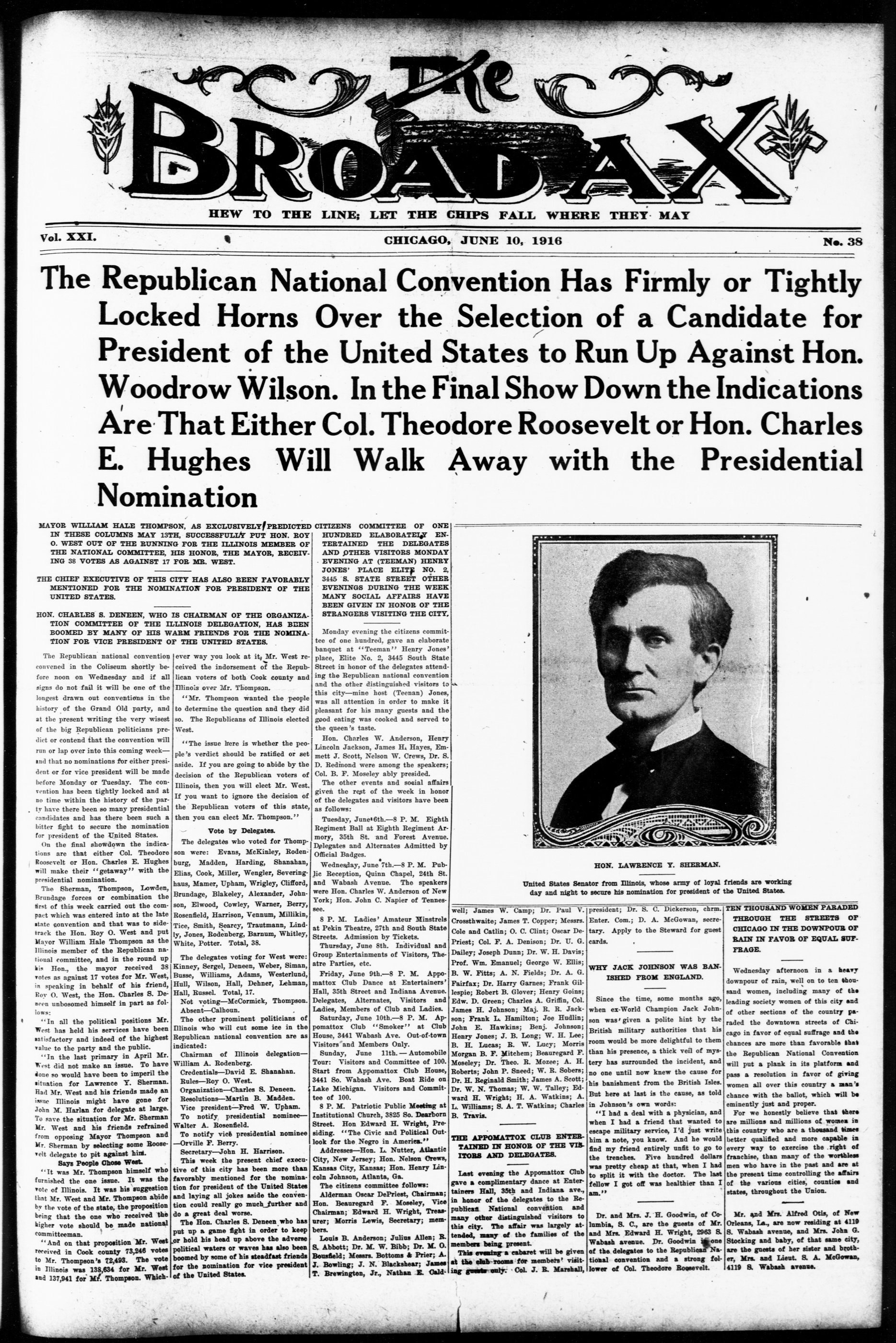
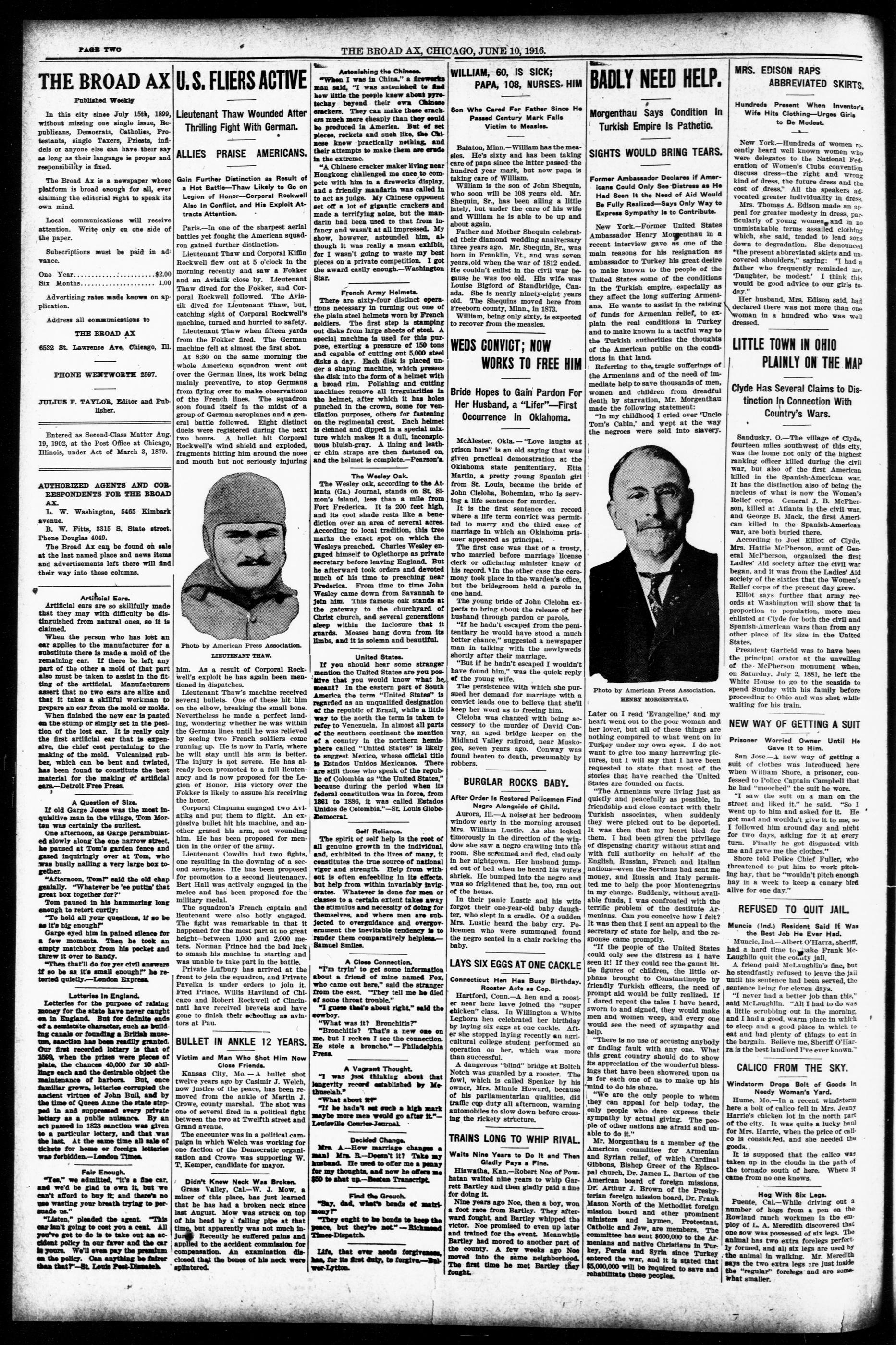
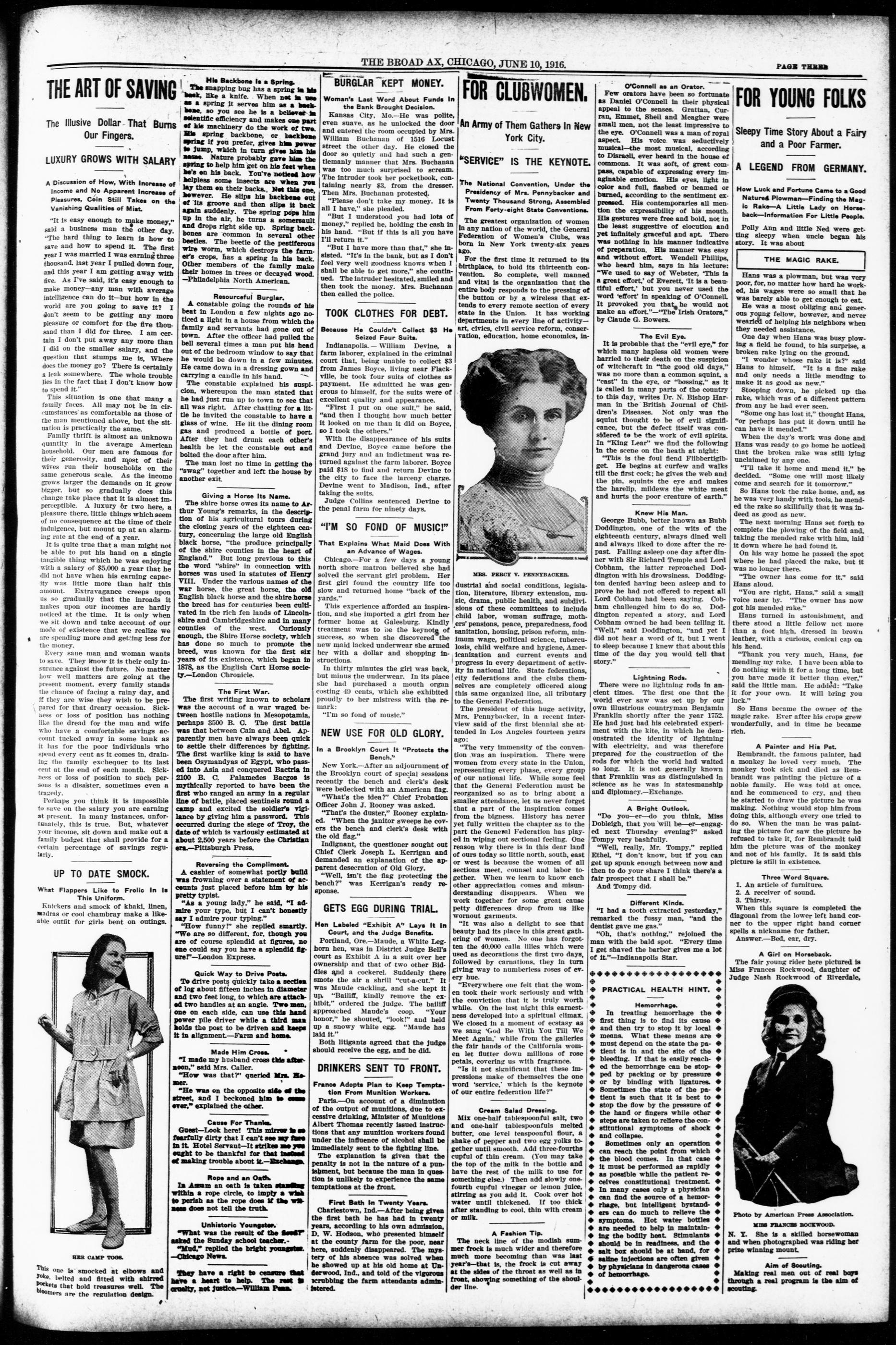
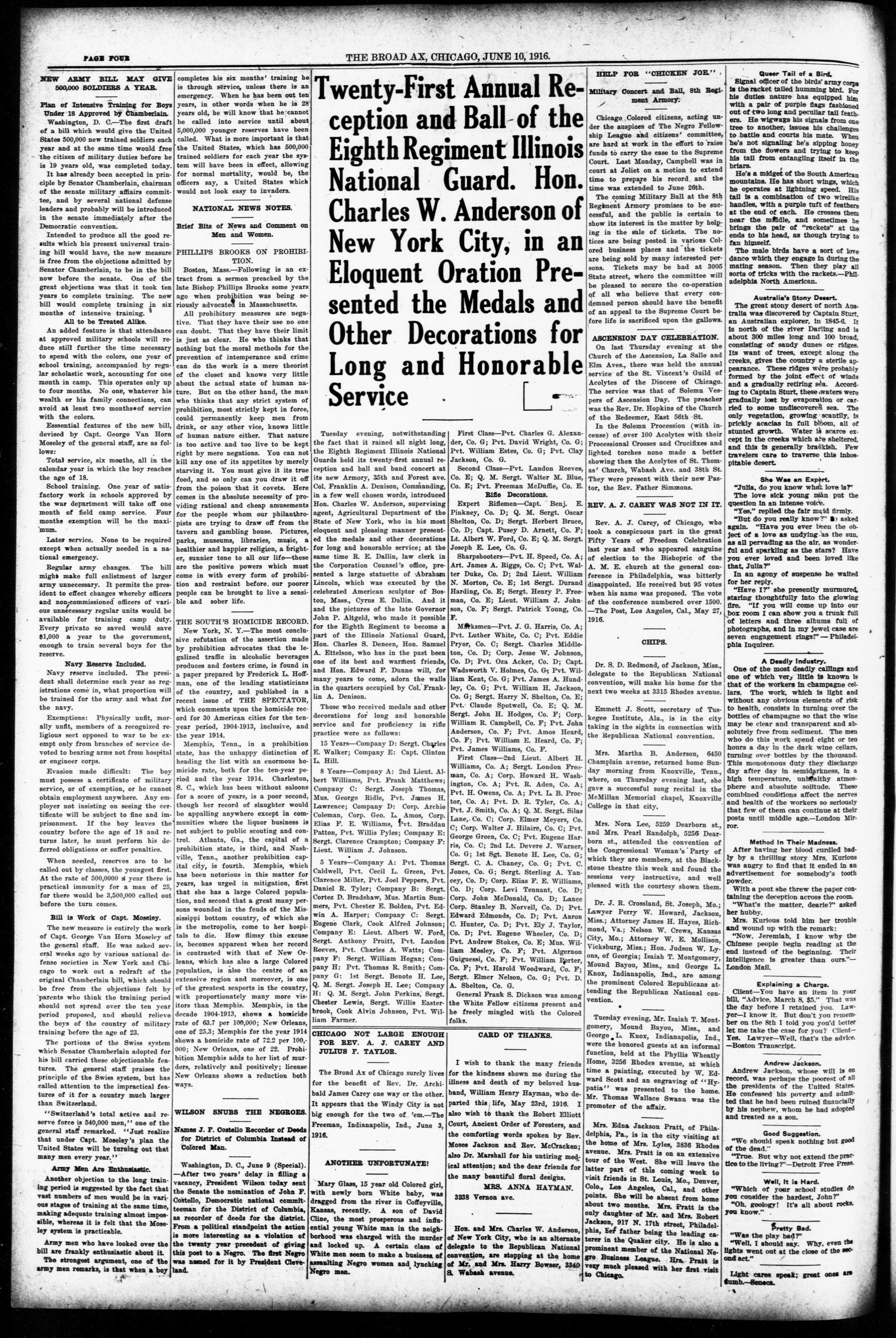
Page text (machine-generated)
THE BROAD AX
The Republican National Convention Has Firmly or Tightly Locked Horns Over the Selection of a Candidate for President of the United States to Run Up Against Hon. Woodrow Wilson. In the Final Show Down the Indications Are That Either Col. Theodore Roosevelt or Hon. Charles E. Hughes Will Walk Away with the Presidential Nomination
MAYOR WILLIAM HALE THOMPSON, AS EXCLUSIVELY PREDICTED IN THESE COLUMNS MAY 13TH, SUCCESSFULLY PUT HON. ROY O. WEST OUT OF THE RUNNING FOR THE ILLINOIS MEMBER OF THE NATIONAL COMMITTEE, HIS HONOR, THE MAYOR, RECEIVING 38 VOTES AS AGAINST 17 FOR MR. WEST.
THE CHIEF EXECUTIVE OF THIS CITY HAS ALSO BEEN FAVORABLY MENTIONED FOR THE NOMINATION FOR PRESIDENT OF THE UNITED STATES.
HON. CHARLES S. DENEEN, WHO IS CHAIRMAN OF THE ORGANIZATION COMMITTEE OF THE ILLINOIS DELEGATION, HAS BEEN BOOMED BY MANY OF HIS WARM FRIENDS FOR THE NOMINATION FOR VICE PRESIDENT OF THE UNITED STATES.
The Republican national convention convened in the Coliseum shortly before noon on Wednesday and if all signs do not fail it will be one of the longest drawn out conventions in the history of the Grand Old party, and at the present writing the very wisest of the big Republican politicians predict or contend that the convention will run or lap over into this coming week—and that no nominations for either president or for vice president will be made before Monday or Tuesday. The convention has been tightly locked and at no time within the history of the party have there been so many presidential candidates and has there been such a bitter fight to secure the nomination for president of the United States. On the final showdown the indications are that either Col. Theodore Roosevelt or Hon. Charles E. Hughes will make their "getaway" with the presidential nomination.
The Sherman, Thompson, Lowden, Brundage forces or combination the first of this week carried out the compact which was entered into at the late state convention and that was to sidetrack the Hon. Roy O. West and put Mayor William Hale Thompson as the Illinois member of the Republican national committee, and in the round up his Hon., the mayor received 38 votes as against 17 votes for Mr. West, in speaking in behalf of his friend, Roy O. West, the Hon. Charles S. Deeen unbosomed himself in part as follows:
"In all the political positions Mr. West has held his services have been satisfactory and indeed of the highest value to the party and the public.
"In the last primary in April Mr. West did not make an issue. To have done so would have been to imperil the situation for Lawrence Y. Sherman. Had Mr. West and his friends made an issue Illinois might have gone for John M. Harlan for delegate at large. To save the situation for Mr. Sherman Mr. West and his friends refrained from opposing Mayor Thompson and Mr. Sherman by selecting some Roosevelt delegate to pit against him.
Says People Gone West.
"It was Mr. Thompson himself who furnished the one issue. It was the vote of Illinois. It was his suggestion that Mr. West and Mr. Thompson abide by the vote of the state, the proposition being that the one who received the higher vote should be made national committeeman.
"And on that proposition Mr. West received in Cook county 73,246 votes to Mr. Thompson's 72,493. The vote in Illinois was 138,634 for Mr. West and 137,941 for Mr. Thompson. Which-
HEW TO THE LINE; LET THE CHIPS FALL WHERE THEY MAY
ever way you look at it, Mr. West received the indorsement of the Republican voters of both Cook county and Illinois over Mr. Thompson.
"Mr. Thompson wanted the people to determine the question and they did so. The Republicans of Illinois elected West.
"The issue here is whether the people's verdict should be ratified or set aside. If you are going to abide by the decision of the Republican voters of Illinois, then you will elect Mr. West. If you want to ignore the decision of the Republican voters of this state, then you can elect Mr. Thompson."
Vote by Delegates.
The delegates who voted for Thompson were: Evans, McKinley, Rodenburg, Madden, Harding, Shanahan, Elias, Cook, Miller, Wengler, Severinghaus, Mamer, Upham, Wrigley, Clifford, Brundage, Blakeley, Alexander, Johnson, Elwood, Cowley, Warner, Berry, Rosenfield, Harrison, Vennum, Millikin, Tice, Smith, Searcy, Trautmann, Lindly, Jones, Rodenberg, Barnum, Whitley, White, Potter. Total, 38.
The delegates voting for West were: Kinney, Sergel, Deneen, Weber, Siman, Busse, Williams, Adams, Westerlund, Hull, Wilson, Hall, Dehner, Lehman, Hall, Russel. Total, 17.
Not voting—McCormick, Thompson. Absent—Calhoun.
The other prominent politicians of Illinois who will cut some ice in the Republican national convention are as indicated:
Chairman of Illinois delegation—William A. Rodenberg.
Credentials—David E. Shanahan.
Rules—Roy O. West.
Organization—Charles S. Deneen.
Resolutions—Martin B. Madden.
Vice president—Fred W. Upham.
To notify presidential nominee—Walter A. Rosenfield.
To notify vice presidential nominee—Orville F. Berry.
Secretary—John H. Harrison.
This week the present chief executive of this city has been more than favorably mentioned for the nomination for president of the United States and laying all jokes aside the convention could really go much_further and do a great deal worse.
The Hon. Charles S. Deneen who has put up a game fight in order to keep or hold his head up above the adverse political waters or waves has also been boomed by some of his steadfast friends for the nomination for vice president of the United States.
CHICAGO, JUNE 10, 1916
CITIZENS COMMITTEE OF ONE HUNDRED ELABORATELY ENTERTAINED THE DELEGATES AND OTHER VISITORS MONDAY EVENING AT (TEEMAN) HENRY JONES' PLACE ELITE NO. 2, 3445 S. STATE STREET OTHER EVENINGS DURING THE WEEK MANY SOCIAL AFFAIRS HAVE BEEN GIVEN IN HONOR OF THE STRANGERS VISITING THE CITY.
Monday evening the citizens committee of one hundred, gave an elaborate banquet at "Teeman" Henry Jones' place, Elite No. 2, 3445 South State Street in honor of the delegates attending the Republican national convention and the other distinguished visitors to this city—mine host (Teenan) Jones, was all attention in order to make it pleasant for his many guests and the good eating was cooked and served to the queen's taste.
Hon. Charles W. Anderson, Henry Lincoln Jackson, James H. Hayes, Emmett J. Scott, Nelson W. Crews, Dr. S. D. Redmond were among the speakers; Col B. F. Moseley ably presided.
The other events and social affairs given the rest of the week in honor of the delegates and visitors have been as follows:
Tuesday, June 6th.—8 P. M. Eighth Regiment Ball at Eighth Regiment Armory, 35th St. and Forest Avenue. Delegates and Alternates Admitted by Official Badges.
Wednesday, June 7th.—8 P. M. Public Reception, Quinn Chapel, 24th St. and Wabash Avenue. The speakers were Hon. Charles W. Anderson of New York; Hon. John C. Napier of Tennessee.
8 P. M. Ladies' Amateur Minstrels at Pekin Theatre, 27th and South State Streets. Admission by Tickets.
Thursday, June 8th. Individual and Group Entertainments of Visitors, Theatre Parties, etc.
Friday, June 9th.—8 P. M. Appomattox Club Dance at Entertainers' Hall, 35th Street and Indiana Avenue. Delegates, Alternates, Visitors and Ladies, Members of Club and Ladies.
Saturday, June 10th.—8 P. M. Appomattox Club "Smoker" at Club House, 3441 Wabash Ave. Out-of-town Visitors and Members Only.
Sunday, June 11th. — Automobile Tour: Visitors and Committee of 100. Start from Appomattox Club House, 3441 So. Wabash Ave. Boat Ride on Lake Michigan. Visitors and Committee of 100.
8 P. M. Patriotic Public Meeting at Institutional Church, 3825 So. Dearborn Street. Hon Edward H. Wright, Presiding. "The Civic and Political Outlook for the Negro in America." Addresses—Hon L. Nutter, Atlantic City, New Jersey; Hon Nelson Crows, Kansas City, Kansas; Hon Henry Lincoln Johnson, Atlanta, Ga.
The citizens committee follows: Alderman Oscar DePriest, Chairman; Hon Beauregard F. Moseley, Vice Chairman; Edward H. Wright, Treasurer; Morris Lewis, Secretary; members.
Louis B. Anderson; Julius Allen; R. S. Abbott; M. D. W. Bibb; Dr. M. O. Bousfield; Messrs. Bottoms & Prier; A. J. Bowling; J. N. Blackshear; James T. Brewington, Jr., Nathan E. Gald-
[Name not visible]
United States Senator from Illinois, whose army of loyal friends are working day and night to secure his nomination for president of the United States.
well; James W. Camp; Dr. Paul V. Crosssthaite; James T. Copper; Messrs. Cole and Catlin; O. C. Clint; Oscar DePriest; Col F. A. Denison; Dr. U. G. Dailey; Joseph Dunn; Dr. W. H. Davis; Prof. Wm. Emanuel; George W. Ellis; B. W. Fitts; A. N. Fields; Dr. A. G. Fairax; Dr. Harry Garnes; Frank Gillespie; Robert B. Glover; Henry Goins; Edw. D. Green; Charles A. Griffin, Col James H. Johnson; Maj. R. R. Jackson; Frank L. Hamilton; Joe Hudlin; John E. Hawkins; Benj. Johnson; Henry Jones; J. B. Long; W. H. Lee; B. H. Lucas; R. W. Lucy; Morris Morgan B. F. Mitchem; Beauregard F. Moseley; Dr. Theo. R. Mozee; A. H. Roberts; John P. Sneed; W. R. Sobers; Dr. H. Reginald Smith; James A. Scott; Dr. W. N. Thomas; W. W. Talley; Edward H. Wright; H. A. Watkins; A. L. Williams; S. A. T. Watkins; Charles B. Travis.
THE APPOMATTOX CLUB ENTERTAINED IN HONOR OF THE VISITORS AND DELEGATES.
Last evening the Appomattox Club gave a complimentary dance at Entertainers Hall, 35th and Indiana ave., in honor of the delegates to the Republican National convention and many other distinguished visitors to this city. The affair was largely attended, many of the families of the members being present. This evening a cabaret will be given at the club rooms for members' visiting guests only. Col. J. B. Marshall,
HON. LAWRENCE Y. SHERMAN.
president; Dr. S. C. Dickerson, chrm.
Enter. Com.; D. A. McGowan, secretary.
Apply to the Steward for guest
cards.
WHY JACK JOHNSON WAS BAN
ISHED FROM ENGLAND.
Since the time, some months ago, when ex-World Champion Jack Johnson was given a polite hint by the British military authorities that his room would be more delightful to them than his presence, a thick veil of mystery has surrounded the incident, and no one until now knew the cause for his banishment from the British Isles. But here at last is the cause, as told in Johnson's own words:
"I had a deal with a physician, and when I had a friend that wanted to escape military service, I'd just write him a note, you know. And he would find my friend entirely unfit to go to the trenches. Five hundred dollars was pretty cheap at that, when I had to split it with the doctor. The last fellow I got off was healthier than I am."
Dr. and Mrs. J. H. Goodwin, of Columbia, S. C., are the guests of Mr. and Mrs. Edward H. Wright, 2963 S. Wabash avenue. Dr. Goodwin is one of the delegates to the Republican National convention and a strong follower of Col. Theodore Roosevelt.
---
No.38
TEN THOUSAND WOMEN PARADED THROUGH THE STREETS OF CHICAGO IN THE DOWNPOUR OF RAIN IN FAVOR OF EQUAL SUFFRAGE.
Wednesday afternoon in a heavy downpour of rain, well on to ten thousand women, including many of the leading society women of this city and of other sections of the country paraded the downtown streets of Chicago in favor of equal suffrage and the chances are more than favorable that the Republican National Convention will put a plank in its platform and pass a resolution in favor of giving women all over this country a man's chance with the ballot, which will be eminently just and proper.
For we honestly believe that there are millions and millions of women in this country who are a thousand times better qualified and more capable in every way to exercise the right of franchise, than many of the worthless men who have in the past and are at the present time controlling the affairs of the various cities, counties and states, throughout the Union.
Mr. and Mrs. Alfred Otis, of New Orleans, La., are now residing at 4119 S. Wabash avenue, and Mrs. John G. Stocking and baby, of that same city, are the guests of her sister and brother, Mrs. and Lieut. S. A. McGowan, 4119 S. Wabash avenue.
PAGE TWO
THE BROAD AX
Published Weekly
In this city since July 15th, 1899, without missing one single issue, Republians, Democrats, Catholies, Protestants, single Taxers, Priests, infidels or anyone else can have their say as long as their language is proper and responsibility is fixed.
The Broad Ax is a newspaper whose platform is broad enough for all, ever claiming the editorial right to speak its own mind.
Local communications will receive attention. Write only on one side of the paper.
Subscriptions must be paid in advance.
One Year.....$2.00
Six Months.....1.00
Advertising rates made known on application.
Address all communications to
6532 St. Lawrence Ave, Chicago, Ill
PHONE WENTWORTH 2597.
JULIUS P. TAYLOR, Editor and Publisher.
Entered as Second-Class Matter Aug
19, 1902, at the Post Office at Chicago
Illinois, under Act of March 3, 1879.
AUTHORIZED AGENTS AND CORRESPONDENTS FOR THE BROAD AX.
L. W. Washington, 5465 Kimbark avenue.
B. W. Fitts, 3315 S. State street. Phone Douglas 4049.
The Broad Ax can be found on sale at the last named place and news items and advertisements left there will find their way into these columns.
Artificial Ears.
Artificial ears are so skillfully made that they may with difficulty be distinguished from natural ones, so it is claimed.
When the person who has lost an ear applies to the manufacturer for a substitute there is made a mold of the remaining ear. If there be left any part of the other a mold of that part also must be taken to assist in the fitting of the artificial. Manufacturers assert that no two ears are alike and that it takes a skillful workman to prepare an ear from the mold or molds.
When finished the new ear is pasted on the stump or simply set in the position of the lost ear. It is really only the first artificial ear that is expensive, the chief cost pertaining to the making of the mold. Vulcanized rubber, which can be bent and twisted, has been found to constitute the best material for the making of artificial ears—Detroit Free Press.
A Question of Size.
If old Garge Jones was the most inquisitive man in the village, Tom Morton was certainly the surliest.
One afternoon, as Garge perambulated slowly along the one narrow street, he paused at Tom's garden fence and gased inquiringly over at Tom, who was busily nailing a very large box together.
"Afternoon, Tom!" said the old chap genially. "Whatever be 'ee puttin' that great box together for?"
Tom paused in his hammering long enough to retort curly:
"To hold all your questions, if so be as it's big enough!"
Garge eyed him in pained silence for a few moments. Then he took an empty matchbox from his pocket and threw it over to Sandy.
"Then that'll do for yer civil answers if so be as it's small enough!" he retorted quietly—London Express.
Letteries In England.
Lotteries for the purpose of raising money for the state have never caught on in England. But for definite ends of a semistate character, such as building canals or founding a British museum, sanction has been readily granted. Our first recorded lottery is that of 1699, when the prizes were pieces of plate, the chances 40,000 for 10 shillings each and the desirable object the maintenance of harbors. But, once familiar grown, lotteries corrupted the ancient virtues of John Bull, and by the time of Queen Anne the state stepped in and suppressed every private lottery as a public nuisance. By an act passed in 1823 sanction was given to a particular lottery, and that was the last. At the same time all sale of tickets for home or foreign letteries was forbidden—London Times.
Fair Enough.
"Yes," we admitted, "it's a fine car, and we'd be glad to own it, but we can't afford to buy it; and there's no use wasting your breath trying to persuade us."
"Listen," pleaded the agent. "This car isn't going to cost you a cent. All you've got to do is to take out an accident policy in our favor and the car is yours. We'll even pay the premium on the policy. Can anything be fairer than that?—St. Louis Post-Dispatch.
U.S. FLIERS ACTIVE
Lieutenant Thaw Wounded After Thrilling Fight With German.
ALLIES PRAISE AMERICANS.
Gain Further Distinction as Result of a Hot Battle—Thaw Likely to Go on Legion of Honor—Corporal Rockwell Also In Conflict, and His Exploit Attracts Attention.
Paris.—In one of the sharpest aerial battles yet fought the American squadron gained further distinction.
Lieutenant Thaw and Corporal Kiffin Rockwell flew out at 5 o'clock in the morning recently and saw a Fokker and an Aviatik close by. Lieutenant Thaw dived for the Fokker, and Corporal Rockwell followed. The Aviatik dived for Lieutenant Thaw, but, catching sight of Corporal Rockwell's machine, turned and hurried to safety.
Lieutenant Thaw when fifteen yards from the Fokker fired. The German machine fell at almost the first shot.
At 8:30 on the same morning the whole American squadron went out over the German lines, its work being mainly preventive, to stop Germans from flying over to make observations of the French lines. The squadron soon found itself in the midst of a group of German aeroplanes and a general battle followed. Eight distinct duels were registered during the next two hours. A bullet hit Corporal Rockwell's wind shield and exploded, fragments hitting him around the nose and mouth but not seriously injuring
Photo by American Press Association.
LIEUTENANT THAW.
him. As a result of Corporal Rockwell's exploit he has again been mentioned in dispatches.
Lieutenant Thaw's machine received several bullets. One of these hit him on the elbow, breaking the small bone. Nevertheless he made a perfect landing, wondering whether he was within the German lines until he was relieved by seeing two French soldiers come running up. He is now in Paris, where he will stay until his arm is better. The injury is not severe. He has already been promoted to a full lieutenancy and is now proposed for the Legion of Honor. His victory over the Fokker is likely to assure his receiving the honor.
Corporal Chapman engaged two Avlatiks and put them to flight. An explosive bullet hit his machine, and another grazed his arm, not wounding him. He has been proposed for mention in the order of the army.
Lieutenant Cowdin had two fights, one resulting in the downing of a second aeroplane. He has been proposed for promotion to a second lieutenancy. Bert Hall was actively engaged in the melee and has been proposed for the military medal.
The squadron's French captain and lieutenant were also hotly engaged. The fight was remarkable in that it happened for the most part at no great height—between 1,000 and 2,000 meters. Norman Prince had the bad luck to smash his machine in starting and was unable to take part in the battle.
Private Lufbury has arrived at the front to join the squadron, and Private Pavelka is under orders to join it. Fred Prince, Willis Haviland of Chicago and Robert Rockwell of Cincinnati have received brevets and have gone to finish their schooling as aviators at Pau.
BULLET IN ANKLE 12 YEARS.
Victim and Man Who Shot Him Now Close Friends.
Kansas City, Mo.—A bullet shot twelve years ago by Casimir J. Welch, now justice of the peace, has been removed from the ankle of Martin J. Crowe, county marshal. The shot was one of several fired in a political fight between the two at Twelfth street and Grand avenue.
The encounter was in a political campaign in which Welch was working for one faction of the Democratic organization and Crowe was supporting W. T. Kemper, candidate for mayor.
Didn't Know Neck Was Broken
Grass Valley, Cal.-W. J. Mow, a miner of this place, has just learned that he has had a broken neck since last August. Mow was struck on top of his head by a falling pipe at that time, but apparently was not much injury. Recently he suffered pains and applied to the accident commission for compensation. An examination disclosed that the bones of his neck were splintered.
THE BROAD AX. CHICAGO. JUNE 10. 1916.
"When I was in China," a fireworks man said, "I was astonished to find how little the people knew about pyrotechny beyond their own Chinese crackers. They can make these crackers much more cheaply than they could be produced in America. But of set pieces, rockets and such like, the Chinese know practically nothing, and their attempts to make them are crude in the extreme.
"A Chinese cracker maker living near Hongkong challenged me once to compete with him in a fireworks display, and a friendly mandarin was called in to act as judge. My Chinese opponent set off a lot of gigantic crackers and made a terrifying noise, but the mandarin had been used to that from infancy and wasn't at all impressed. My show, however, astounded him, although it was really a mean exhibit, for I wasn't going to waste my best pieces on a private competition. I got the award easily enough.—Washington Star
French Army Helmets
There are sixty-four distinct operations necessary in turning out one of the plain steel helmets worn by French soldiers. The first step is stamping out disks from large sheets of steel. A special machine is used for this purpose, exerting a pressure of 150 tons and capable of cutting out 5,000 steel disks a day. Each disk is placed under a shaping machine, which presses the disk into the form of a helmet with a broad rim. Polishing and cutting machines remove all irregularities in the helmet, after which it has holes punched in the crown, some for ventilation purposes, others for fastening on the regimental crest. Each helmet is cleaned and dipped in a special mixture which makes it a dull, inconspicuous blush-gray. A lining and leather chin straps are then fastened on, and the helmet is complete. Pearson's.
The Wesley Oak.
The Wesley oak, according to the Atlanta (Ga.) Journal, stands on St. Simon's island, less than a mile from Fort Frederica. It is 200 feet high, and its cool shade rests like a benediction over an area of several acres. According to local tradition, this tree marks the exact spot on which the Wesley preached. Charles Wesley engaged himself to Oglethorpe as private secretary before leaving England. But he afterward took orders and devoted much of his time to preaching near Frederica. From time to time John Wesley came down from Savannah to join him. This famous oak stands at the gateway to the churchyard of Christ church, and several generations sleep within the enclosure that it guards. Mosses hang down from its limbs, and it is solemn and beautiful.
United States.
If you should hear some stranger mention the United States are you positive that you would know what he meant? In the eastern part of South America the term "United States" is regarded as an unqualified designation of the republic of Brazil, while a little way to the north the term is taken to refer to Venezuela. In almost all parts of the southern continent the mention of a country in the northern hemisphere called "United States" is likely to suggest Mexico, whose official title is Estados Unidos Mexicanos. There are still those who speak of the republic of Colombia as "the United States," because during the period when its federal constitution was in force, from 1861 to 1886, it was called Estados Unidos de Colombia."—St. Louis Globe-Democrat.
Self Reliance.
The spirit of self help is the root of all genuine growth in the individual, and, exhibited in the lives of many, it constitutes the true source of national vigor and strength. Help from without is often enfeebling in its effects, but help from within invariably invigorates. Whatever is done for men or classes to a certain extent takes away the stimulus and necessity of doing for themselves, and where men are subjected to overguidance and overgovernment the inevitable tendency is to render them comparatively helpless.—Samuel Smiles.
A Close Connection.
"I'm tryin' to get some information about a friend of mine named Fox, who came out here," said the stranger from the east. "They tell me he died of some throat trouble."
"I guess that's about right," said the cowboy.
"What was it? Bronchitis?"
"Bronchitis? That's a new one on me, but I reckon I see the connection. He stole a broncho." — Philadelphia Press.
A Vagrant Thought
"I was just thinking about that longevity record established by Mehselah."
"What about it?"
"If he hadn't set such a high mark maybe more men would go after it"—Louisville Courtes Journal
Decided Change
Mrs. A.—How marriage changes a man! Mrs. B.—Doesn't it? Take my husband. He used to offer me a penny for my thoughts, and now he offers me $50 to suit up.—Bienn Transcript.
Find the Grouch
"Say, dad, what's bonds of matrimony?"
"They ought to be bonds to keep the peace, but they're not." — Richmond Times-Dispatch.
Life, that ever needs forgiveness, has, for its first duty, to forgive—Bulwark-Lytton.
Son Who Cared For Father Since He Passed Century Mark Falls Victim to Measles.
Balaton, Minn.—William has the measles. He's sixty and has been taking care of papa since the latter passed the hundred year mark, but now papa is taking care of William.
William is the son of John Shequin, who soon will be 108 years old. Mr. Shequin, Sr., has been alling a little lately, but under the care of his wife and William he is able to be up and about again.
Father and Mother Shequin celebrated their diamond wedding anniversary three years ago. Mr. Shequin, Sr., was born in Franklin, Vt., and was seven years, old when the war of 1812 ended. He couldn't enlist in the civil war because he was too old. His wife was Louise Bigford of Standbridge, Canada. She is nearly ninety-eight years old. The Shequins moved here from Freeborn county, Minn., in 1873. Willam, being only sixty, is expected to recover from the measles.
WEDS CONVICT; NOW WORKS TO FREE HIM
Bride Hopes to Gain Pardon For Her Husband, a "Lifer"—First Occurrence In Oklahoma.
McAster, Okla. — "Love laughs at prison bars" is an old saying that was given practical demonstration at the Oklahoma state penitentiary. Etta Martin, a pretty young Spanish girl from St. Louis, became the bride of John Cieloha, Bohemian, who is serving a life sentence for murder.
It is the first sentence on record where a life term convict was permitted to marry and the third case of marriage in which an Oklahoma prisoner appeared as principal.
The first case was that of a trusty, who married before marriage license clerk or officiating minister knew of his record. In the other case the ceremony took place in the warden's office, but the bridegroom held a parole in one hand.
The young bride of John Cieloha expects to bring about the release of her husband through pardon or parole.
"If he hadn't escaped from the penitentiary he would have stood a much better chance," suggested a newspaper man in talking with the newlyweds shortly after their marriage.
"But if he hadn't escaped I wouldn't have found him," was the quick reply of the young wife.
The persistence with which she pursued her demand for marriage with a convict leads one to believe that she'll keep her word as to freeing him.
Cleloha was charged with being accessory to the murder of David Conway, an aged bridge keeper on the Midland Valley railroad, near Muskogee, seven years ago. Conway was found beaten to death, presumably by robbers.
BURGLAR ROCKS BABY.
After Order Is Restored Policemen Find Negro Alongside of Child.
Aurora, Ill.-A noise at her bedroom window early in the morning aroused Mrs. William Lustic. As she looked timorously in the direction of the window she saw a negro crawling into the room. She screamed and fled, clad only in her nightgown. Her husband jumped out of bed when he heard his wife's shriek. He bumped into the negro and was so frightened that he, too, ran out of the house.
In their panic Lustic and his wife forgot their one-year-old baby daughter, who slept in a cradle. Of a sudden Mrs. Lustic heard the baby cry. Policemen who were summoned found the negro seated in a chair rocking the baby.
LAYS SIX EGGS AT ONE CACKLE
Connecticut Hen Has Buoy Birthday. Rooster Acts as Cop.
Hartford, Conn.—A hen and a rooster near here have joined the "super chicken" class. In Willington a White Leghorn he celebrated her birthday by laying six eggs at one cackle. After she stopped laying recently an agricultural college student performed an operation on her, which was more than successful.
A dangerous "blind" bridge at Boltch Notch was guarded by a rooster. The fowl, which is called Speaker by his owner, Mrs. Minnie Howard, because of his parliamentarian qualities, did traffic cop duty all afternoon, warning automobiles to slow down before crossing the rickety structure.
TRAINS LONG TO WHIP RIVAL
Waits Nine Years to Do It and Then Gladly Pays a Fine.
Hiawatha, Kan.-Robert Noe of Powhatan waited nine years to whip Garrett Bartley and then gladly paid a fine for doing it.
Nine years ago Noe, then a boy, won a foot race from Bartley. They afterward fought, and Bartley whipped the victor. Noe promised to even up later and trained for the event. Meanwhile Bartley had moved to another part of the county. A few weeks ago Noe moved into the same neighborhood. The first time he met Bartley they fought.
Morgenthau Says Condition In Turkish Empire Is Pathetic. SIGHTS WOULD BRING TEARS.
Former Ambassador Declares if Americans Could Only See Distress as He Had Seen It the Need of Aid Would Be Fully Realized—Says Only Way to Express Sympathy is to Contribute.
New York.—Former United States Ambassador Henry Morenthau in a recent interview gave as one of the main reasons for his resignation as ambassador to Turkey his great desire to make known to the people of the United States some of the conditions in the Turkish empire, especially as they affect the long suffering Armenians. He wants to assist in the raising of funds for Armenian relief, to explain the real conditions in Turkey and to make known in a tactful way to the Turkish authorities the thoughts of the American public on the conditions in that land.
Referring to the tragic sufferings of the Armenians and of the need of immediate help to save thousands of men, women and children from dreadful death by starvation, Mr. Morgenthau made the following statement: "In my childhood I cried over 'Uncle Tom's Cabin,' and wept at the way the negroes were sold into slavery.
1910
Photo by American Press Association.
HENRY MORGENTHAU.
Later on I read 'Evangeline,' and my heart went out to the poor woman and her lover, but all of these things are nothing compared to what went on in Turkey under my own eyes. I do not want to give too many harrowing pictures, but I will say that I have been requested to state that most of the stories that have reached the United States are founded on facts.
"The Armenians were living just as quietly and peacefully as possible, in friendship and close contact with their Turkish associates, when suddenly they were picked out to be deported. It was then that my heart bled for them. I had been given the privilege of dispensing charity without stint and with full authority on behalf of the English, Russian, French and Italian nations—even the Servians had sent me money, and Russia and Italy permitted me to help the poor Montenegrins in my charge. Suddenly, without available funds, I was confronted with the terrific problem of the destitute Armenians. Can you conceive how I felt? It was then that I sent an appeal to the secretary of state for help, and the response came promptly.
"If the people of the United States could only see the distress as I have seen it! If they could see the gaunt little figures of children, the little orphans brought to Constantinople by friendly Turkish officers, the need of prompt aid would be fully realized. If I dared repeat the tales I have heard, sworn to and signed, they would make men and women weep, and every one would see the need of sympathy and help.
"There is no use of accusing anybody or finding fault with any one. What this great country should do to show its appreciation of the wonderful blessings that have been showered upon us is for each one of us to make up his mind to do his share.
"We are the only people to whom they can appeal for help today, the only people who dare express their sympathy by actual giving. The people of other nations are afraid and unable to do it." Mr. Morgenthau is a member of the American committee for Armenian and Syrian relief, of which Cardinal Gibbons, Bishop Greer of the Episcopal church, Dr. James L. Barton of the American board of foreign missions, Dr. Arthur J. Brown of the Presbyterian foreign mission board, Dr. Frank Mason North of the Methodist foreign mission board and other prominent ministers and laymen, Protestant, Catholic and Jew, are members. The committee has sent $600,000 to the Armenians and native Christians in Turkey entered the war, and it is stated that $5,000,000 will be required to save and rehabilitate these peoples.
Hundreds Present When Inventor's Wife Hits Clothing—Urges Girls to Be Modest.
New York.—Hundreds of women recently heard well known women who were delegates to the National Federation of Women's Clubs convention discuss dress—the right and wrong kind of dress, the future dress and the cost of dress. All the speakers advocated greater individuality in dress.
Mrs. Thomas A. Edison made an appeal for greater modesty in dress, particularly of young women and in no unmistakable terms assailed clothing which, she said, tended to lead sons down to degradation. She denounced "the present abbreviated skirts and uncovered shoulders," saying: "I had a father who frequently reminded me, 'Daughter, be modest.' I think this would be good advice to our girls today."
Her husband, Mrs. Edison said, had declared there was not more than one woman in a hundred who was well dressed.
LITTLE TOWN IN OHIO
PLAINLY ON THE MAP
Clyde Has Several Claims to Distinction In Connection With Country's Wars.
Sandusky, O.—The village of Clyde, fourteen miles southwest of this city, was the home not only of the highest ranking officer killed during the civil war, but also of the first American killed in the Spanish-American war. It has the distinction also of being the nucleus of what is now the Women's Relief corps. General J. B. McPherson, killed at Atlanta in the civil war, and George Mack, the first American killed in the Spanish-American war, are both buried there.
According to Joel Elliot of Clyde, Mrs. Hattie McPherson, aunt of General McPherson, organized the first Ladies' Aid society after the civil war began, and it was from the Ladies' Aid society of the sixties that the Women's Relief corps of the present day grew.
Elliot says further that army records at Washington will show that in proportion to population, more men enlisted at Clyde for both the civil and Spanish-American wars than from any other place of its size in the United States.
President Garfield was to have been the principal orator at the unveiling of the McPherson monument when, on Saturday, July 2, 1881, he left the White House to go to the seaside to spend Sunday with his family before proceeding to Ohio and was shot while waiting for his train.
NEW WAY OF GETTING A SUIT
Prisoner Worried Owner Until He Gave It to Him.
San Jose.—A new way of getting a suit of clothes was introduced here when William Shore, a prisoner, confessed to Police Captain Campbell that he had "mooched" the suit he wore.
"I saw the suit on a man on the street and liked it," he said. "So I went up to him and asked for it. He got mad and wouldn't give it to me, so I followed him around day and night for two days, asking for it at every turn. Finally he got disgusted with me and gave me the clothes."
Shore told Police Chief Fuller, who threatened to put him to work pitching hay, that he "wouldn't pitch enough hay in a week to keep a canary bird alive for one day."
REFUSED TO QUIT JAIL
Muncie (Ind.) Resident Said If Was the Best Job He Ever Had.
Muncie, Ind.—Albert O'Harra, shellif, had a hard time to make Frank McLaughlin quit the county jail.
A friend paid McLaughlin's fine, but he steadfastly refused to leave the jail until his sentence had been served, the sentence being for eleven days.
"I never had a better job than this," said McLaughlin. "All I had to do was a little scrubbing out in the morning, and I had a good, warm place in which to sleep and a good place in which to eat and had plenty of things to eat in the bargain. Believe me, Sheriff O'Harra is the best landlord I've ever known."
CALICO FROM THE SKY.
Windstorm Drops Bolt of Goods In Needy Woman's Yard.
Hume, Mo.-In a recent windstorm here a bolt of calco fell in Mrs. Jenny Harrie's chicken lot in the north part of the city. It was quite a lucky haul for Mrs. Harrie, when the price of calco is considered, and she needed the goods.
It is supposed that the calco was taken up in the clouds in the path of the tornado south of here. Where it came from no one knows.
Hog With Six Legs.
Puente, Cal.-While driving out a number of hogs from a pen on the Rowland ranch workmen in the employ of L. A. Meredith discovered that one sow was possessed of six legs. The animal has two extra forelegs perfectly formed, and all six legs are used by the animal in walking. Mr. Meredith says the two extra legs are just inside the "regular" forelegs and are somewhat smaller
THE ART OF SAVING
The Illusive Dollar That Burns Our Fingers.
LUXURY GROWS WITH SALARY
A Discussion of How, With Increase of Income and No Apparent Increase of Pleasures, Coin Still Takes on the Vanishing Qualities of Mist.
"It is easy enough to make money," said a business man the other day. "The hard thing to learn is how to save and how to spend it. The first year I was married I was earning three thousand, last year I pulled down four, and this year I am getting away with five. As I've said, it's easy enough to make money—any man with average intelligence can do it—but how in the world are you going to save it? I don't seem to be getting any more pleasure or comfort for the five thousand than I did for three. I am certain I don't put away any more than I did on the smaller salary, and the question that stumps me is, Where does the money go? There is certainly a leak somewhere. The whole trouble lies in the fact that I don't know how to spend it."
This situation is one that many a family faces. All may not be in circumstances as comfortable as those of the man mentioned above, but the situation is practically the same.
Family thrift is almost an unknown quantity in the average American household. Our men are famous for their generosity, and most of their wives run their households on the same generous scale. As the income grows larger the demands on it grow bigger, but so gradually does this change take place that it is almost imperceptible. A luxury or two here, a pleasure there, little things which seem of no consequence at the time of their indulgence, but mount up at an alarming rate at the end of a year.
It is quite true that a man might not be able to put his hand on a single tangible thing which he was enjoying with a salary of $5,000 a year that he did not have when his earning capacity was little more than half this amount. Extravagance creeps upon us so gradually that the inroads it makes upon our incomes are hardly noticed at the time. It is only when we sit down and take account of our mode of existence that we realize we are spending more and getting less for the money.
Every sane man and woman wants to save. They know it is their only insurance against the future. No matter how well matters are going at the present moment, every family stands the chance of facing a rainy day, and if they are wise they wish to be prepared for that dreary occasion. Sickness or loss of position has nothing like the dread for the man and wife who have a comfortable savings account tucked away in some bank as it has for the poor individuals who spend the poor cent as it comes in, draining the family exchequer to its last cent at the end of each month. Sickness or loss of position to such persons is a disaster, sometimes even a tragedy.
Perhaps you think it is impossible to save on the salary you are earning at present. In many instances, unfortunately, this is true. But, whatever your income, sit down and make out a family budget that shall provide for a certain percentage of savings regularly.
UP TO DATE SMOCK
What Flappers Like to Frolic In Is This Uniform.
Knickers and smock of khaki, linen, madras or cool chambray make a likeable outfit for girls bent on outings.
1930
This one is smocked at elbows and roke, belted and fitted with shirred pockets that hold treasures well. The bloomers are the regulation design.
This one is smocked at elbows and roke, belted and fitted with shirred pockets that hold treasures well. The bloomers are the regulation design.
His Backbone Is a Spring.
The snapping bug has a spring in his book, like a knife. When not in use as a spring it serves him as a backbone, so you see he is a believer in scientific efficiency and makes one part of his machinery do the work of two. His spring backbone, or backbone spring if you prefer, gives him power to jump, which in turn gives him his name. Nature probably gave him the spring to help him get on his feet when he's on his back. You've noticed how helpless some insects are when you lay them on their backs. Not this one, however. He slips his backbone out of its groove and then slips it back again suddenly. The spring pops him up in the air, he turns a somersault and drops right side up. Spring backbones are common in several other beetles. The beetle of the pestiferous wire worm, which destroys the farmer's crops, has a spring in his back. Other members of the family make their homes in trees or decayed wood. -Philadelphia North America
Resourceful Burglar
A constable going the rounds of his beat in London a few nights ago noticed a light in a house from which the family and servants had gone out of town. After the officer had pulled the bell several times a man put his head out of the bedroom window to say that he would be down in a few minutes. He came down in a dressing gown and carrying a candle in his hand. The constable explained his suspicion, whereupon the man stated that he had just run up to town to see that all was right. After chatting for a little he invited the constable to have a glass of wine. He lit the dining room gas and produced a bottle of port. After they had drunk each other's health he let the constable out and bolted the door after him. The man lost no time in getting the "swag" together and left the house by another exit.
Giving a Horse Its Name.
Driving a Horse its Name.
The shire horse owes its name to Arthur Young's remarks, in the description of his agricultural tours during the closing years of the eighteenth century, concerning the large old English black horse, "the produce principally of the shire counties in the heart of England." But long previous to this the word "shire" in connection with horses was used in statutes of Henry VIII. Under the various names of the war horse, the great horse, the old English black horse and the shire horse the breed has for centuries been cultivated in the rich fen lands of Lincolnshire and Cambridgeshire and in many counties of the west. Curiously enough, the Shire Horse society, which has done so much to promote the breed, was known for the first six years of its existence, which began in 1878, as the English Cart Horse society—London Chronicle.
The First War.
The first writing known to scholars was the account of a war waged between hostile nations in Mesopotamia, perhaps 3500 B. C. The first battle was that between Cain and Abel. Apparently men have always been quick to settle their differences by fighting. The first warlike king is said to have been Osmandyas of Egypt, who passed into Asia and conquered Bactria in 2100 B. C. Palamedes Bacgos is mythically reported to have been the first who ranged an army in a regular line of battle, placed sentinels round a camp and excited the soldier's vigilance by giving him a password. This occurred during the siege of Troy, the date of which is variously estimated at about 2,500 years before the Christian era—Pittsburgh Press.
Reversing the Compliment
A cashier of somewhat portly build was frowning over a statement of accounts just placed before him by his pretty typlist.
"As a young lady," he said, "I admire your type, but I can't honestly say I admire your typling."
"How funny!" she replied smartly.
"We are so different, for, though you are of course splendid at figures, no one could say you have a splendid figure!"—London Express.
Quick Way to Drive Poste
To drive posts quickly take a section of log about fifteen inches in diameter and two feet long, to which are attached two handles at an angle. Two men, one on each side, can use this hand power pile driver while a third man holds the post to be driven and keeps it in alignment—Farm and home.
Made Him Cross
"I made my husband cross this afternoon," said Mrs. Caller.
"How was that?" queried Mrn. Memer.
"He was on the opposite side of the street, and I beckoned him to come ever." explained the other.
Cause For Thank You
Guest—Look here! This mirror is so fearfully dirty that I can't see my face in it. Hotel Servant—It strikes me you ought to be thankful for that instead of making trouble about it—Echemana
Rope and an Oath
In Assum an eath is taken standing within a rope circle, to imply a wish to perish as the rope does if the witness does not tell the truth.
"What was the result of the Seoul" asked the Sunday school teacher. "Mud," replied the bright youngster. —Chicago News.
They have a right to censure that have a heart to help. The rest is cruelty, not justice.—William Penn.
THE BROAD AX, CHICAGO, JUNE 10, 1916
BURGLAR KEPT MONEY.
Woman's Last Word About Funds In the Bank Brought Decision.
Kansas City, Mo.—He was polite, even suave, as he unlocked the door and entered the room occupied by Mrs. William Buchanan of 1516 Locust street the other day. He closed the door so quietly and had such a gentlemanly manner that Mrs. Buchanan was too much surprised to scream. The intruder took her pocketbook, containing nearly $3, from the dresser. Then Mrs. Buchanan protested.
"Please don't take my money. It is all I have," she pleaded.
"But I understood you had lots of money," replied he, holding the cash in his hand. "But if this is all you have I'll return it."
"But I have more than that," she insisted. "It's in the bank, but as I don't feel very well goodness knows when I shall be able to get more," she continued. The intruder hesitated, smiled and then took the money. Mrs. Buchanan then called the police.
TOOK CLOTHES FOR DEBT.
Because He Couldn't Collect $3 He Seized Four Suits.
Indianapolis. — William Devine, a farm laborer, explained in the criminal court that, being unable to collect $3 from James Boyce, living near Flackville, he took four suits of clothes as payment. He admitted he was generous to himself, for the suits were of excellent quality and appearance.
"First I put on one suit," he said, "and then I thought how much better it looked on me than it did on Boyce, so I took the others."
With the disappearance of his suits and Devine, Boyce came before the grand jury and an indictment was returned against the farm laborer. Boyce paid $18 to find and return Devine to the city to face the larceny charge. Devine went to Madison, Ind., after taking the suits.
Judge Collins sentenced Devine to the penal farm for ninety days.
"I'M SO FOND OF MUSIC!"
That Explains What Maid Does With an Advance of Wages.
Chicago.—For a few days a young north shore matron believed she had solved the servant girl problem. Her first girl found the country life too slow and returned home "back of the yards."
This experience afforded an inspiration, and she imported a girl from her former home at Galesburg. Kindly treatment was to be the keynote of success, so when she discovered the new maid lacked underwear she armed her with a dollar and shopping instructions.
In thirty minutes the girl was back, but minus the underwear. In its place she had purchased a mouth organ costing 40 cents, which she exhibited proudly to her mistress with the remark:
"I'm so fond of music."
NEW USE FOR OLD GLORY.
In a Brooklyn Court it "Protects the Bench." New York.—After an adjournment of the Brooklyn court of special sessions recently the bench and clerk's desk were bedecked with an American flag.
"What's the idea?" Chief Probation Officer John J. Rooney was asked.
"That's the duster," Rooney explained. "When the janitor sweeps he covers the bench and clerk's desk with the old flag."
Indignant, the questioner sought out Chief Clerk Joseph L. Kerrigan and demanded an explanation of the apparent desecration of Old Glory.
"Well, isn't the flag protecting the bench?" was Kerrigan's ready response.
GETS EGG DURING TRIAL
Hen Labeled "Exhibit A" Lays It In Court, and the Judge Benefits.
Portland, Ore.—Maude, a white Leg-horn hen, was in District Judge Bell's court as Exhibit A in a suit over her ownership and that of two other Biddles and a cockerel. Suddenly there smote the air a shrill "cut-a-cut." It was Maude cackling, and she kept it up. "Baillif, kindly remove the exhibit," ordered the judge. The ballif approached Maude's coop. "Your honor," he shouted, "look!" and held up a snowy white egg. "Maude has laid it."
Both litigants agreed that the judge should receive the egg, and he did.
DRINKERS SENT TO FRONT.
France Adopts Plan to Keep Tempation From Munition Workers.
Paris—On account of a diminution of the output of munitions, due to excessive drinking, Minister of Munitions Albert Thomas recently issued instructions that any munition workers found under the influence of alcohol shall be immediately sent to the fighting line. The explanation is given that the penalty is not in the nature of a punishment, but because the man in question is unlikely to experience the same temptations at the front.
First Bath In Twenty Years.
Charlestown, Ind.—After being given the first bath he has had in twenty years, according to his own admission, D. W. Hodson, who presented himself at the county farm for the poor, near here, suddenly disappeared. The mystery of his absence was solved when he showed up at his old home at Underwood, Ind., and told the vigorous scrubbing the farm attendants administered.
FOR CLUBWOMEN.
An Army of Them Gathers In New York City.
"SERVICE" IS THE KEYNOTE
The National Convention, Under the Presidency of Mrs. Pennybacker and Twenty Thousand Strong, Assembled From Forty-eight State Conventions. The greatest organization of women In any nation of the world, the General Federation of Women's Clubs, was born in New York twenty-six years ago. For the first time it returned to its birthplace, to hold its thirteenth convention. Is complete, well manned and vital is the organization that the entire body responds to the pressing of the button or by a wireless that extends to every remote section of every state in the Union. It has working departments in every line of activity—art, civics, civil service reform, conservation, education, home economics, in-
M.
MRS. PERCY V. PENNYBACKER. dustrial and social conditions, legislation, literature, library extension, music, drama, public health, and subdivisions of these committees to include child labor, woman suffrage, mothers' pensions, peace, preparedness, food sanitation, housing, prison reform, minimum wage, political science, tuberculosis, child welfare and hygiene, Americanization and current events and progress in every department of activity in national life. State federations, city federations and the clubs themselves are completely officered along this same organized line, all tributary to the General Federation.
The president of this huge activity, Mrs. Pennybacker, in a recent interview said of the first biennial she attended in Los Angeles fourteen years ago:
"The very immensity of the convention was an inspiration. There were women from every state in the Union, representing every phase, every group of our national life. While some feel that the General Federation must be reorganized so as to bring about a smaller attendance, let us never forget that a part of the inspiration comes from the bigness. History has never yet fully written the chapter as to the part the General Federation has played in wiping out sectional feeling. One reason why there is in this dear land of ours today so little north, south, east or west is because the women of all sections meet, counsel and labor together. When we learn to know each other appreciation comes and misunderstanding disappears. When we work together for some great cause petty differences drop from us like wormout garments.
"It was also a delight to see that beauty had its place in this great gathering of women. No one has forgotten the 40,000 calla lilies which were used as decorations the first two days, followed by carnations, they in turn giving way to numberless roses of every hue.
"Everywhere one felt that the women took their work seriously and with the conviction that it is truly worth while. On the last night this earnestness developed into a spiritual climax. We closed in a moment of cestasy as we sang 'God Be With You Till We Meet Again', while from the galleries the fair hands of the California women let flutter down millions of rose petals, covering us with fragrance.
"Is it not significant that these impressions make of themselves the one word 'service', which is the keynote of our entire federation life?"
Cream Salad Dressing.
Mix one-half tablespoonful salt, two and one-half tablespoonfuls melted butter, one level teaspoonful flour, a shake of pepper and two egg yolks together to smooth. Add three-fourths cupful of thin cream. (You may take the top of the milk in the bottle and have the rest of the milk to use for something else.) Then add slowly one-fourth cupful vinegar or lemon juice, stirring as you add it. Cook over hot water until thickened. If too thick after standing to cool, thin with cream or milk.
A Fashion Tip
The neck line of the modish summer frock is much wider and therefore much more becoming than was last year's-that is, the frock is cut away at the sides of the throat as well as in front, showing something of the shoulder line.
Few orators have been so fortunate as Daniel O'Connell in their physical appeal to the senses. Grattan, Curran, Emmet, Shell and Meagher were small men, not the least impressive to the eye. O'Connell was a man of royal aspect. His voice was seductively musical—the most musical, according to Disraeli, ever heard in the house of commons. It was soft, of great compass, capable of expressing every imaginable emotion. His eyes, light in color and full, flashed or beamed or burned, according to the sentiment expressed. His contemporaries all mention the expressibility of his mouth. His gestures were free and bold, not in the least suggestive of elocution and yet infinitely graceful and apt. There was nothing in his manner indicative of preparation. His manner was easy and without effort. Wendell Phillips, who heard him, says in his lecture: "We used to say of Webster, 'This is a great effort,' of Everett. It is a beautiful effort,' but you never used the word 'effort' in speaking of O'Connell. It provoked you that he would not make an effort."—"The Irish Orators," by Claude G. Bowers.
The Evil Eye.
It is probable that the "evil eye," for which many hapless old women were harried to their death on the suspicion of witchcraft in "the good old days," was no more than a common squint, a "cast" in the eye, or "bossing," as it is called in many parts of the country to this day, writes Dr. N. Bishop Harman in the British Journal of Children's Diseases. Not only was the squint thought to be of evil significance, but the defect itself was considered to be the work of evil spirits. In "King Lear" we find the following in the scene on the heath at night: "This is the foul fiend Filbertigigget. He begins at curfew and walks till the first cock; he gives the web and the pin, squints the eye and makes the harelip, mildews the white meat and hurts the poor creature of earth."
Knew His Man.
George Bubb, better known as Bubb Doddington, one of the wits of the eighteenth century, always dined well and always liked to doze after the repast. Falling asleep one day after dinner with Sir Richard Temple and Lord Cobham, the latter reproached Doddington with his drowsiness. Doddington denied having been asleep and to prove he had not offered to repeat all Lord Cobham had been saying. Cobham challenged him to do so. Doddington repeated a story, and Lord Cobham owned he had been telling it. "Well," said Doddington, "and yet I did not hear a word of it, but I went to sleep because I knew that about this time of the day you would tell that story."
Lightning Rods
There were no lightning rods in ancient times. The first one that the world ever saw was set up by our own illustrious countryman Benjamin Franklin shortly after the year 1752. He had just had his celebrated experiment with the kite, in which he demonstrated the identity of lightning with electricity, and was therefore prepared for the construction of the rods for which the world had waited so long. It is not generally known that Franklin was as distinguished in science as he was in statesmanship and diplomacy.—Exchange.
A. Bright Outlook
"Do you—er—do you think, Miss Dobleigh, that you will be—er—engaged next Thursday evening?" asked Tommy very bashfully.
"Well, really, Mr. Tompy," replied Ethel, "I don't know, but if you can get up spunk enough between now and then to do your share I think there's a fair prospect that I shall be."
And Tommy did.
Different Kinds.
"I had a tooth extracted yesterday," remarked the fussy man, "and the dentist gave me gas."
"Oh, that's nothing," rejoined the man with the bald spot. "Every time I get shaved the barber gives me a lot of it."—Indianapolis Star
Hemorrhage.
In treating hemorrhage the first thing is to find its cause and then try to stop it by local means. What these means are must depend on the state the patient is in and the site of the bleeding. If that is easily reached the hemorrhage can be stopped by packing or by pressure or by binding with ligatures. Sometimes the state of the patient is such that it is best to stop the flow by the pressure of the hand or fingers while other steps are taken to relieve the constitutional symptoms of shock and collapse.
Sometimes only an operation can reach the point from which the blood comes. In that case it must be performed as rapidly as possible while the patient receives constitutional treatment. In many cases only a physician can find the source of a hemorrhage, but intelligent bystanders can do much to relieve the symptoms. Hot water bottles are needed to help in maintaining the bodily heat. Stimulants should be in readiness, and the salt box should be at hand, for saline injections are often given by physicians in dangerous cases of hemorrhage.
PAGE THIRD
FOR YOUNG FOLKS
Sleepy Time Story About a Fairy and a Poor Farmer.
How Luck and Fortune Came to a Good Natured Plowman—Finding the Magic Rake—A Little Lady on Horsesback—Information For Little People.
Polly Ann and little Ned were getting sleepy when uncle began his story. It was about
THE MAGIC RAKE.
Hans was a plowman, but was very poor, for, no matter how hard he worked, his wages were so small that he was barely able to get enough to eat. He was a most obliging and generous young fellow, however, and never weared of helping his neighbors when they needed assistance.
One day when Hans was busy plowing a field he found, to his surprise, a broken rake lying on the ground.
"I wonder whose rake it is?" said Hans to himself. "It is a fine rake and only needs a little mending to make it as good as new."
Stooping down, he picked up the rake, which was of a different pattern from any he had ever seen.
"Some one has lost it," thought Hans, "or perhaps has put it down until he can have it mended."
When the day's work was done and Hans was ready to go home he noticed that the broken rake was still lying unclaimed by any one.
"I'll take it home and mend it," he decided. "Some one will most likely come and search for it tomorrow."
So Hans took the rake home, and, as he was very handy with tools, he mended the rake so skillfully that it was indeed as good as new.
The next morning Hans set forth to complete the plowing of the field and, taking the mended rake with him, laid it down where he had found it.
On his way home he passed the spot where he had placed the rake, but it was no longer there.
"The owner has come for it," said Hans aloud.
"You are right, Hans," said a small voice near by. "The owner has now got his mended rake."
Hans turned in astonishment, and there stood a little fellow not more than a foot high, dressed in brown leather, with a curious, conical cap on his head.
"Thank you very much, Hans, for mending my rake. I have been able to do nothing with it for a long time, but you have made it better than ever," said the little man. He added: "Take it for your own. It will bring you luck."
So Hans became the owner of the magic rake. Ever after his crops grew wonderfully, and in time he became rich.
A Painter and His Pet.
Rembrandt, the famous painter, had a monkey he loved very much. The monkey took sick and died as Rembrandt was painting the picture of a noble family. He was told at once, and he commenced to cry, and then he started to draw the picture he was making. Nothing would stop him from doing this, although every one tried to do so. When the man he was painting the picture for saw the picture he refused to take it, for Rembrandt told him the picture was of the monkey and not of his family. It is said this picture is still in existence.
Three Word Square
2. A receiver of sound.
3. Thirsty.
When this square is completed the diagonal from the lower left hand corner to the upper right hand corner spells a nickname for father.
Answer.—Bed, ear, dry.
A Girl on Horseback.
The fair young rider here pictured is Miss Frances Rockwood, daughter of Judge Nash Rockwood of Riverdale.
A.
Photo by American Press Association.
MISS FRANCES BOCKWOOD.
N. Y. She is a skilled horsewoman and when photographed was riding her prize winning mount.
Aim of Scouting.
Making real men out of real boys through a real program is the aim of scouting.
NEW ARMY BILL MAY GIVE 500,000 SOLDIERS A YEAR.
Plan of Intensive Training for Boys Under 18 Approved by Chamberlain. Washington, D. C.—The first draft of a bill which would give the United States 500,000 new trained soldiers each year and at the same time would free the citizen of military duties before he is 19 years old, was completed today. It has already been accepted in principle by Senator Chamberlain, chairman of the senate military affairs committee, and by several national defense leaders and probably will be introduced in the senate immediately after the Democratic convention.
Intended to produce all the good results which his present universal training bill would have, the new measure is free from the objections admitted by Senator Chamberlain, to be in the bill now before the senate. One of the great objections was that it took ten years to complete training. The new bill would complete training in six months of intensive training.
All to be Treated Alike.
An added feature is that attendance at approved military schools will reduce still further the time necessary to spend with the colors, one year of school training, accompanied by regular scholastic work, accounting for one month in camp. This operates only up to four months. No one, whatever his wealth or his family connections, can avoid at least two months of service with the colors.
Essential features of the new bill, devised by Capt. George Van Horn Moseley of the general staff, are as follows:
Total service, six months, all in the calendar year in which the boy reaches the age of 18.
School training. One year of satisfactory work in schools approved by the war department will take off one month of field camp service. Four months exemption will be the maximum.
Later service. None to be required except when actually needed in a national emergency.
Regular army changes. The bill might make full enlistment of larger army unnecessary. It permits the president to effect changes whereby officers and non-commissioned officers of various unnecessary regular units would be available for training camp duty. Every private so saved would save $1,000 a year to the government; enough to train several boys for the reserve.
Navy Reserve Included.
Navy reserve included. The president shall determine each year as registrations come in, what proportion will be trained for the army and what for the navy.
Exemptions: Physically unfit, morally unfit, members of a recognized religious sect opposed to war to be exempt only from branches of service devoted to bearing arms not from hospital or engineer corps.
Evasion made difficult: The boy must possess a certificate of military service, or of exemption, or he cannot obtain employment anywhere. Any employer not insisting on seeing the certificate will be subject to fine and imprisonment. If the boy leaves the country before the age of 18 and returns later, he must perform his deferred obligations or suffer penalties.
When needed, reserves are to be called out by classes, the youngest first. At the rate of 500,0000 a year there is practical immunity for a man of 25, for there would be 3,500,000 called out before the turn comes.
Bill is Work of Capt. Moseley
The new measure is entirely the work of Capt. George Van Horn Moseley of the general staff. He was asked several weeks ago by various national defense societies in New York and Chicago to work out a redraft of the original Chamberlain bill, which should be free from the objections felt by parents who think the training period should not spread over the ten year period proposed, and should relieve the boys of the country of military training before the age of 23.
The portions of the Swiss system which Senator Chamberlain adopted for his bill carried these objectionable features. The general staff praises the principle of the Swiss system, but has called attention to the impractical features of it for a country much larger than Switzerland.
"Switzerland's total active and reserve force is 540,000 men," one of the general staff remarked. "Just realize that under Capt. Moseley's plan the United States will be turning out that many men every year."
Army Men Are Enthusiastic.
Another objection to the long training period is suggested by the fact that vast numbers of men would be in various stages of training at the same time, making adequate training almost impossible, whereas it is felt that the Moseley system is practicable.
Army men who have looked over the bill are frankly enthusiastic about it. The strongest argument, one of the army men remarks, is that when a boy
completes his six months' training he is through service, unless there is an emergency. When he has been out ten years, in other words when he is 28 years old, he will know that he cannot be called into service until about 5,000,000 younger reserves have been called. What is more important is that the United States, which has 500,000 trained soldiers for each year the system will have been in effect, allowing for normal mortality, would be, the officers say, a United States which would not look easy to invaders.
NATIONAL NEWS NOTES.
Brief Bits of News and Comment on Men and Women.
PHILLIPS BROOKS ON PROHIBITION.
Boston, Mass.—Following is an extract from a sermon preached by the late Bishop Phillips Brooks some years ago when prohibition was being seriously advocated in Massachusetts.
All prohibitory measures are negative. That they have their use no one can doubt. That they have their limit is just as clear. He who thinks that nothing but the moral methods for the prevention of intemperance and crime can do the work is a mere theorist of the closet and knows very little about the actual state of human nature. But on the other hand, the man who thinks that any strict system of prohibition, most strictly kept in force, could permanently keep men from drink, or any other vice, knows little of human nature either. That nature is too active and too live to be kept right by mere negations. You can not kill any one of its appetites by merely starving it. You must give it its true food, and so only can you draw it off from the poison that it covets. Here comes in the absolute necessity of providing rational and cheap amusements for the people whom our philanthropists are trying to draw off from the tavern and gambling house. Pictures, parks, museums, libraries, music, a healthier and happier religion, a brighter, sunnier tone to all our life—these are the positive powers which must come in with every form of prohibition and restraint before, our poorer people can be brought to live a sensible and sober life.
THE SOUTH'S HOMICIDE RECORD
New York, N. Y.—The most conclusive refutation of the assertion made by prohibition advocates that the legalized traffic in alcoholic beverages produces and fosters crime, is found in a paper prepared by Frederick L. Hoffman, one of the leading statisticians of the country, and published in a recent issue of THE SPECTATOR which comments upon the homicide record for 30 American cities for the ten-year period, 1904-1913, inclusive, and the year 1914.
Memphis, Tenn., in a prohibition state, has the unhappy distinction of heading the list with an enormous homicide rate, both for the ten-year period and the year 1914. Charleston, S. C., which has been without saloons for a score of years, is a poor second, though her record of slaughter would be appalling anywhere except in communities where the liquor business is not subject to public scouting and control. Atlanta, Ga., the capital of a prohibition state, is third, and Nashville, Tenn., another prohibition capital city, is fourth. Memphis, which has been notorious in this matter for years, has urged in mitigation, first that she has a large Colored population, and second that a great many persons wounded in the feuds of the Mississippi bottom country, of which she is the metropolis, come to her hospitals to die. How flimsy this excuse is, becomes apparent when her record is contrasted with that of New Orleans, which has also a large Colored population, is also the centre of an extensive region and moreover, is one of the greatest seaports in the country, with proportionately many more visitors than Memphis. Memphis, in the decade 1904-1913, shows a homicide rate of 63.7 per 100,000; New Orleans, one of 25.3; Memphis for the year 1914 shows a homicide rate of 72.2 per 100,000; New Orleans, one of 22. Prohibition Memphis adds to her list of murders, relatively and positively; license New Orleans shows a reduction both ways.
WILSON SNUBS THE NEGROES
Names J. F. Costello Recorder of Deeds for District of Columbia Instead of Colored Man.
Washington, D. C., June 9 (Special).
—After two years' delay in filling a vacancy, President Wilson today sent the Senate the nomination of John F. Costello, Democratic national committeeman for the District of Columbia, as recorder of deeds for the district.
From a political standpoint the action is more interesting as a violation of the twenty year precedent of giving this post to a Negro. The first Negro was named for it by President Cleveland.
THE BROAD AX, CHICAGO, JUNE 10, 1916
Twenty-First Annual Reception and Ball of the Eighth Regiment Illinois National Guard. Hon. Charles W. Anderson of New York City, in an Eloquent Oration Presented the Medals and Other Decorations for Long and Honorable Service
Tuesday evening, notwithstanding the fact that it rained all night long, the Eighth Regiment Illinois National Guards held its twenty-first annual reception and ball and band concert at its new Armory, 35th and Forest ave. Col. Franklin A. Denison, Commanding, in a few well chosen words, introduced Hon. Charles W. Anderson, supervising agent, Agricultural Department of the State of New York, who in his most eloquent and pleasing manner presented the medals and other decorations for long and honorable service; at the same time R. E. Dallin, law clerk in the Corporation Counsel's office, presented a large statuette of Abraham Lincoln, which was executed by the celebrated American sculptor of Boston, Mass., Cyrus E. Dallin. And it and the pictures of the late Governor John P. Altgeld, who made it possible for the Eighth Regiment to become a part of the Illinois National Guard, Hon. Charles S. Deneen, Hon. Samuel A. Ettelson, who has in the past been one of its best and warmest friends, and Hon. Edward F. Dunne will, for many years to come, adorn the walls in the quarters occupied by Col. Franklin A. Denison.
Those who received medals and other decorations for long and honorable service and for proficiency in rifle practice were as follows:
15 Years—Company D: Sergt. Charles E. Walker; Company E: Capt. Clinton L. Hill.
8 Years—Company A: 2nd Lieut. Albert Williams, Pvt. Frank Matthews; Company C: Sergt. Joseph Thomas, Mus. George Ridle, Pvt. James H. Lawrence; Company D: Corp. Archie Coleman, Corp. Geo. L. Amos, Corp. Elias F. E. Williams, Pvt. Braddan Patton, Pvt. Willis Pyles; Company E: Sergt. Clarence Crampton; Company F. Lieut. William J. Johnson.
5 Years—Company A: Pvt. Thomas Caldwell, Pvt. Cecil L. Green, Pvt. Clarence Miller, Pvt. Joel Peppers, Pvt. Daniel R. Tyler; Company B: Sergt Cortez D. Bradshaw, Mus. Martin Summers, Pvt. Chester E. Bolden, Pvt. Edwin A. Harper; Company C: Sergt Eugene Clark, Cook Alfred Johnson; Company E: Lieut. Albert W. Ford, Sergt Anthony Prittt, Pvt. Landon Reeves, Pvt. Charles A. Watts; Company F: Sergt William Hogan; Company H: Pvt. Thomas R. Smith; Company G: 1st Sergt. Benote H. Lee, Q. M. Sergt. Joseph H. Lee; Company H: Q. M. Sergt. John Perkins, Sergt. Chester Lewis, Sergt. Willis Easterbrook, Cook Alvin Johnson, Pvt. William Farmer.
CHICAGO NOT LARGE ENOUGH FOR REV. A. J. CAREY AND JULIUS F. TAYLOR.
The Broad Ax of Chicago surely lives for the benefit of Rev. Dr. Archibald James Carey one way or the other. It appears that the Windy City is not big enough for the two of 'em.-The Freeman, Indianapolis, Ind., June 3, 1916.
ANOTHER UNFOBTUNATE
Mary Glass, 15 year old Colored girl, with newly born White baby, was dragged from the river in Coffeyville, Kansas, recently. A son of David Cline, the most prosperous and influential young White man in the neighborhood was charged with the murder and locked up. A certain class of White men seem to make a business of assaulting Negro women and lynching Negro men.
First Class—Pvt. Charles G. Alexander, Co. G; Pvt. David Wright, Co. G; Pvt. William Estes, Co. G; Pvt. Clay Jackson, Co. G.
Second Class—Pvt. Landon Reeves, Co. E; Q. M. Sergt. Walter M. Blue, Co. E; Pvt. Freeman McDuffie, Co. E
Rifle Decorations.
Expert Riflemen—Capt. Benj. E. Pinkney, Co. D; Q. M. Sergt. Oscar Shelton, Co. D; Sergt. Herbert Bruce, Co. D; Capt. Pusey D. Arnett, Co. F; Lt. Albert W. Ford, Co. E; Q. M. Sergt. Joseph E. Lee, Co. G.
Sharpshooters—Pvt. H. Speed, Co. A. Art. James A. Riggs, Co. C; Pvt. Walter Duke, Co. D; 2nd Lieut. William N. Morton, Co. E; 1st Sergt. Durand Harding, Co. E; Sergt. Henry P. Freeman, Co. E; Lieut. William J. Johnson, Co. F; Sergt. Patrick Young, Co F.
Maksmen—Pvt. J. G. Harris, Co. A; Pvt. Luther White, Co. C; Pvt. Eddie Pryor, Co. C; Sergt. Charles Middleton, Co. D; Corp. Jesse W. Johnson, Co. D; Pvt. Oza Acker, Co. D; Capt. Wadsworth V. Holmes, Co. G; Pvt. William Kent, Co. G; Pvt. James A. Hundley, Co. G; Pvt. William H. Jackson, Co. G; Sergt. Harry N. Shelton, Co. E; Pvt. Claude Spotwell, Co. E; Q. M. Sergt. John H. Hodges, Co. F; Corp. William R. Campbell, Co. F; Pvt. John Anderson, Co. F; Pvt. Amos Heard, Co. F; Pvt. William E. Heard, Co. F; Pvt. James Williams, Co. F.
First Class—2nd Lieut. Albert H. Williams, Co. A; Sergt. London Freeman, Co. A; Corp. Howard H. Washington, Co. A; Pvt. R. Aden, Co. A; Pvt. H. Owens, Co. A; Pvt. L. B. Proctor, Co. A; Pvt. D. R. Tyler, Co. A; Pvt. J. Smith, Co. A; Q. M. Sergt. Silas Lane, Co. C; Corp. Elmer Meyers, Co. C; Corp. Walter J. Hilaire, Co. C; Pvt. George Green, Co. C; Pvt. Eugene Harris, Co. C; 2nd Lt. Devere J. Warner, Co. G; 1st Sgt. Benote H. Lee, Co. G; Sergt. C. A. Chaney, Co. G; Pvt. C. Jones, Co. G; Sergt. Sterling A. Yanee, Co. D; Corp. Elias F. E. Williams, Co. D; Corp. Levi Tennant, Co. D; Corp. John McDonald, Co. D; Lance Corp. Stanley B. Norvell, Co. D; Pvt. Edward Edmonds, Co. D; Pvt. Aaron C. Hunter, Co. D; Pvt. Ely J. Taylor, Co. D; Pvt. Eugene Wheeler, Co. D; Pvt. Andrew Stokes, Co. E; Mus. William Mosley, Co. F; Pvt. Algernon Guiguese, Co. F; Pvt. William Porter, Co. F; Pvt. Harold Woodward, Co. F; Sergt. Elmer Nelson, Co. G; Pvt. D. A. Shelton, Co. G.
General Frank S. Dickson was among the White Fellow citizens present and he freely mingled with the Colored folks.
CARD OF THANKS
I wish to thank the many friends for the kindness shown me during the illness and death of my beloved husband, William Henry Hayman, who departed this life, May 23rd, 1916. I also wish to thank the Robert Elliott Court, Ancient Order of Foresters, and the comforting words spoken by Rev. Moses Jackson and Rev. McCracken; also Dr. Marshall for his untiring medical attention; and the dear friends for the many beautiful floral designs.
MRS. ANNA HAYMAN.
3238 Vernon ave.
Hon. and Mrs. Charles W. Anderson, of New York City, who is an alternate delegate to the Republican National convention, are stopping at the home of Mr. and Mrs. Harry Bowser, 3340 S. Wabash avenue.
Chicago Colored citizens, acting under the auspices of The Negro Fellowship League and citizens' committee, are hard at work in the effort to raise funds to carry the case to the Supreme Court. Last Monday, Campbell was in court at Joliet on a motion to extend time to prepare his record and the time was extended to June 26th.
The coming Military Ball at the 8th Regiment Armory promises to be successful, and the public is certain to show its interest in the matter by helping in the sale of tickets. The notices are being posted in various Colored business places and the tickets are being sold by many interested persons. Tickets may be had at 3005 State street, where the committee will be pleased to secure the co-operation of all who believe that every condemned person should have the benefit of an appeal to the Supreme Court before life is sacrificed upon the gallows.
ASCENSION DAY CELEBRATION.
On last Thursday evening at the Church of the Ascension, La Salle and Elm Aves., there was held the annual service of the St. Vincent's Guild of Acolytes of the Diocent's Chicago. The service was that of Solemn Vespers of Ascension Day. The preacher was the Rev. Dr. Hopkins of the Church of the Redeemer, East 56th St.
In the Solemn Procession (with incense) of over 100 Acolytes with their Processional Crosses and Crucifixes and lighted torches none made a better showing then the Acolytes of St. Thomas' Church, Wabash Ave. and 38th St. They were present with their new Pastor, the Rev. Father Simmons.
REV. A. J. CAREY WAS NOT IN IT.
Rev. A. J. Carey, of Chicago, who took a conspicuous part in the great Fifty Years of Freedom Celebration last year and who appeared sanguine of election to the Bishopric of the A. M. E. church at the general conference in Philadelphia, was bitterly disappointed. He received but 95 votes when his name was proposed. The vote of the conference numbered over 1500. —The Post, Los Angeles, Cal., May 27, 1916.
CHIPS
Dr. S. D. Redmond, of Jackson, Miss., delegate to the Republican National convention, will make his home for the next two weeks at 3315 Rhodes avenue.
Emmett J. Scott, secretary of Tuskegee Institute, Ala., is in the city taking in the sights in connection with the Republican National convention.
Mrs. Martha B. Anderson, 6450 Champlain avenue, returned home Sunday morning from Knoxville, Tenn., where, on Thursday evening last, she gave a successful song recital in the McMillan Memorial chapel, Knoxville College in that city.
Mrs. Nora Lee, 5259 Dearborn st., and Mrs. Pearl Randolph, 5256 Dearborn st., attended the convention of the Congressional Woman's Party of which they are members, at the Blackstone theatre this week and found the sessions very instructive, and well pleased with the courtesy shown them.
Dr. J. R. Crossland, St. Joseph, Mo.; Lawyer Perry W. Howard, Jackson, Miss.; Attorney James H. Hayes, Richmond, Va.; Nelson W. Crews, Kansas City, Mo.; Attorney W. E. Mollison, Vicksburg, Miss.; Hon. Judson W. Lyons, of Georgia; Isaiah T. Montgomery, Mound Bayou, Miss., and George L. Knox, Indianapolis, Ind., are among the prominent Colored Republicans attending the Republican National convention.
Tuesday evening, Mr. Isaiah T. Montgomery, Mound Bayou, Miss., and George L. Knox, Indianapolis, Ind., were the honored guests at an informal function, held at the Phyllis Wheatly Home, 3256 Rhodes avenue, at which time a painting, executed by W. Edward Scott and an engraving of "Hypatia" was presented to the home. Mr. Thomas Wallace Swann was the promoter of the affair.
Mrs. Edna Jackson Pratt, of Philadelphia, Pa., is in the city visiting at the home of Mrs. Lyles, 3836 Rhodes avenue. Mrs. Pratt is on an extensive tour of the West. She will leave the latter part of this coming week to visit friends in St. Louis, Mo., Denver, Colo., Los Angeles, Cal., and other points. She will be absent from home about two months. Mrs. Pratt is the only daughter of Mr. and Mrs. Robert Jackson, 917 N. 17th street, Philadelphia, hef father being the leading caterer in the Quaker city. He is also a prominent member of the National Negro Business League. Hrs. Pratt is very much pleased with her first visit to Chiago.
Queer Tail of a Bird.
Signal officer of the birds' army corps is the racket tailed humming bird. For his duties nature has equipped him with a pair of purple flags fashioned out of two long and peculiar tail feathers. He wigwags his signals from one tree to another, issues his challenges to battle and courts his mate. When he's not signaling he's sipping honey from the flowers and trying to keep his tail from entangling itself in the briars.
He's a midget of the South American mountains. He has short wings, which he operates at lightning speed. His tail is a combination of two wirelike handles, with a purple tuft of feathers at the end of each. He crosses them near the middle, and sometimes he brings the pair of "rackets" at the ends to his head, as though trying to fan himself.
The male birds have a sort of love dance which they engage in during the mating season. Then they play all sorts of tricks with the rackets.—Philadelphia North American.
Australia's Stony Desert
The great stony desert of north Australia was discovered by Captain Sturt, an Australian explorer, in 1845-6. It is north of the river Darling and is about 300 miles long and 100 broad, consisting of sandy dunes or ridges. Its want of trees, except along the creeks, gives the country a sterile appearance. These ridges were probably formed by the joint effect of winds and a gradually retiring sea. According to Captain Sturt, these waters were gradually lost by evaporation or carried to some undiscovered sea. The only vegetation, growing scantily, is prickly acacias in full bloom, all of stunted growth. Water is scarce except in the creeks which are sheltered, and this is generally brakish. Few travelers care to traverse this inhospitable desert.
She Waa an Expert.
"Julia, do you know what love is?"
The love sick young man put the question in an intense voice.
"Yes." replied the fair maid firmly.
"But do you really know?" asked again. "Have you ever been the object of a love as undying as the sun, as all pervading as the air, as wonderful and sparkling as the stars? Have you ever loved and been loved like that, Julia?" In an agony of suspense he waited for her reply. "Have I?" she presently murmured, staring thoughtfully into the glowing fire. "If you will come up into our box room I can show you a trunk full of letters and three albums full of photographs, and in my jewel case are seven engagement rings!" — Philadelphia Inquirer.
A Deadly Industry
One of the most deadly callings and one of which ver, little is known is that of the workers in champagne cellars. The work, which is light and without any obvious elements of risk to health, consists in turning over the bottles of champagne so that the wine may be clear and transparent and absolutely free from sediment. The men who do this work spend eight or ten hours a day in the dark wine cellars, turning over bottles by the thousand. This monotonous duty they discharge day after day in semidarkness, in a high temperature, unhealthy atmosphere and absolute solitude. These combined conditions affect the nerves and health of the workers so seriously that few of them can continue at their posts until middle age.—London Mirror.
Method In Their Madness.
After having her blood curdled badly by a thrilling story Mrs. Kurious was angry to find that it ended in an advertisement for somebody's tooth powder.
With a pout she threw the paper containing the deception across the room.
"What's the matter, dearie?" asked her hubby.
Mrs. Kurious told him her trouble and wound up with the remark:
"Now, Jeremiah, I know why the Chinese people begin reading at the end instead of the beginning. Their intelligence is greater than ours."—London Mail.
Explaining a Charge.
Client—You have an item in your bill, "Advice, March 8, $5." That was the day before I retained you. Lawyer—I know it. But don't you remember on the 8th I told you you'd better let me take the case for you? Client—Yes. Lawyer—Well, that's the advice. —Boston Transcript.
Andrew Jackson:
Andrew Jackson, whose will is on record, was perhaps the poorest of all the presidents of the United States. He confessed his poverty and admitted that he had been ruined financially by his nephew, whom he had adopted and treated as a son.
Good Suggestion
"We should speak nothing but good of the dead."
"True. But why not extend the practice to the living?" -Detroit Free Press.
Well. It is Hard.
"Which of your school studies do you consider the hardest, John?"
"Oh. geology! It's all about rocks, you know."
Was the play bad?
"Well, I should say. Why, even the lights went out at the close of the second act."
Light cares speak; great ones are dumb—Seneca.
Talks on
HEALTH,
CLEANLINESS,
PROPER LIVING,
SANITATION, ETC.
Dr. W. A. DRIVER
3300 So. State Street
Phode Douglas 3617
PREPAREDNESS
On the eve of the preparedness parade of Chicago, and in these times of preparedness propaganda all over the nation, let us not forget the fundamental fact upon which national preparedness must rest. There can be no preparedness that does not mean individual preparedness. The individual multiplied a hundred million times makes the United States nation. We could have a perfect nation if the hundred million were prepared. It is necessary that the individual be healthy to be prepared; it is necessary to be safe from ignorance, filth, persecution, proscription and depressing conditions generally for the individual to be prepared. A nation to be prepared, then, must look after the individual, for obvious reasons. The individual is not always able to discern or divine what is best for the individual; the collection of the hundred million individuals should have anxious care about every individual for national self preservation. Nations rise and fall just in proportion as the component parts of nations rise and fall.
As the nation is composed of a hundred million persons, so the individual is composed of millions of other divisions called cells. Each cell is microscopical in size but bears the same relation to the body of the person as the person does to the nation. Just as the nation should have anxious care for
SAVED THE DAYLIGHT IN INDIANA THIRTY YEARS AGO
Cement Mills Started at 6 A. M., and Men Got In Ten Hours a Day Even In Winter.
New Albany, Ind.—Germany, Austria and other war rent countries of Europe, which have begun to conserve daylight, are thirty years behind Indiana. A cable dispatch from Berlin recently spoke of the daylight conservation idea as having been adopted there. The tenor of the dispatch created the impression that it was something new, when, in fact, the idea was adopted thirty years ago at the Speeds Cement mills, north of this city.
It was about 1886 when David Cook, manager, who still has charge of the plant, which produces Portland cement, realized it was a sin to waste the fine daylight which permits work at 6 a.m., even on most winter days. He studied the matter, and soon the whistle for going to work sounded at 6 in the morning. It took some time for the men to get used to the change, but now they would not swap back to the old system. They begin an hour earlier and quit an hour earlier, and even during the winter the ten hour day can be made.
CONSTRUCT HOUSE IN
OHIO IN TWELVE HOURS
Two Hundred Workmen Complete Structure, Gift to a Bride, While Thousands Look On.
Toledo, O. — Seventy-two carpenters began to build a house from the ground up at 4:30 a. m. At 4 p. m. the same day it was completed in every detail and Mrs. Emma Plessner-McCann was serving tea in it to Mayor Milroy and others.
The house and lot were a wedding present from the Toledo Real Estate board and contractors. Mrs. McCann was Miss Emma Plessner until a few hours before the house was finished, when she became the bride of John J. McCann. She was assistant secretary of the real estate board for several years.
After the carpenter work had progressed a short time plumber, gas fitters, painters, paper hangers, electricians and other workmen got busy and did their share of the building work within a given time. More than 200 workmen helped build the house. It is a five room house, with a bathroom, costing $4,000. Ordarily it takes two or three months to finish such a house.
Thousands watched the construction work. Three hundred gallons of buttermilk and a cartload of sandwiches were served.
In addition to the lot and house, built in less than twelve hours, considerable furniture was presented by friends.
J. E. H.
the welfare of the individual so the person should have anxious care for every cell in the body. The brain of the person may be reasonably likened to the governing or law-making national brain, the Congress. Other organs of the body likewise may be compared to other adjuncts of the national body. The brain of the individual directs the entire manner of living of the individual. The individual is more liable to error than a number of individuals, hence the necessity of much counsel. A number of individuals met in health considering conventions have decided that personal hygiene is absolutely necessary to the preparedness of the individual. Many individuals know nothing, comparatively, of personal hygiene. IT SHOULD BE THE LAW that every person be educated in the matter of personal hygiene and be COMPELLED to practice it.
It is said that Japan is prepared. It is said that Japan has every home regularly inspected in order to enforce cleanliness and general hygiene. Japan looks after the individual and expects every individual to do an individual's duty. Japan compels individual safety and necessarily individual service. Preparedness then, is a reciprocal matter, a circle within a circle, good for all if it is conducted right. The war in Europe demonstrates that the nation that takes best care of its citizens is best prepared to fight its enemies.
Was it envy that caused the elderly spinster to criticise so severely the home and furniture of her newly married friend?
Whatever it was, the young wife was getting tired of it.
"Well, anyway," she said presently as she pointed to a pretty little china clock, "if you don't like my furniture you must surely like that." "Yes; it is rather nice," said the visitor grudgingly. "Who gave it to you?" "Oh, it wasn't a present!" explained the bride. "I won it in a raffle." "A raffle!" The spinster drew her angular figure rigidly up. "I never lend my face to such things!" "Perhaps that's just as well," retorted the younger woman as she gazed meaningly at the other's sour features, "because if you did I'm afraid nobody would buy the tickets!"—London Globe.
Man.
As a general thing, taken by and large, men are honest—except with themselves.
A man will cheat himself on his score at golf, when he knows that failing to set down the full number of strokes does not make him a better golfer.
If he is a fat man and is dieting to reduce he will shove the weight back a pound or two on the scales when he knows in his heart he is heavier than that.
Then he will tell his friends about "going around yesterday in 92" and "taking off a pound and a half in three days" by his diet.
With these two exceptions almost every man is honest. Therefore all you need to do is to discount what he says about golf or reducing—Judge.
Not a Question of Etiquette
Not a Question of Etiquette.
Mrs. Hendricks (the landlady)—Can I help you to some more soup, Mr. Dumley?
Mr. Dumley—No, thanks.
Mrs. Hendricks, (engagingly)—Don't refuse, Mr. Dumley, because it isn't considered good form to be helped twice to soup. We're not particular people here.
Mr. Dumley—Oh, etiquette has nothing to do with it, madam; it's the soup.
He Explains.
"What did you call your silver mine?"
"The American Boy."
"Any particular reason for calling it by that name?"
"Well, it had plenty of pockets, but nothing in them except rubbish."—Kansas City Journal.
By Degrees.
"My dear, isn't that dress a trifle extreme?"
"Extreme! Why. I put this on in order that you may become accustomed to the one I am having made."—Judge.
Their Kind.
"I understand this locality is considered a very aristocratic one."
"It certainly is. Even the hills out here have crests." — Baltimore American.
THE BROAD AX, CHICAGO, JUNE 10, 1916
Charles E. Stump Visited Chattanooga, Tennessee and Other Points in That State on His Travels Through the South
Chattanooga, Tenn.—It has been several days since I sent a letter to the paper, but my heart has been with you, and I have been moving so fast, and have covered so much territory that I have not sent a letter. Of course, I have been going to school, meeting big men and women and learning all I could about the world, and at the same time I have been a little sick, but will be myself again.
Have you ever traveled through the South? If so, you will understand why I should be a little sick. You will know how hard it is on one of my race to get around. You must sit up all night on the seats of the train, and sometimes where people are the manufacturers of something that you could not sell in the drugstore for extract. It is not the old German Hoyt cologne, the thing that our people used to buy by the barrel when I was a boy. But I am not going to talk about that now. It is hard to get something to eat. If you eat today you will have to go hungry tomorrow. Some of the roads will let you eat when the White folks get through eating if they think about it. When you get on, you send word back to the eating car that you would like to eat, and if they do not forget you, when the White folks are through, then they will send for you and you can go back, eat with the porters and waiters, but must pay the same price that the other people paid. There is no place for you to wash your hands, so you and dirt and food must all go together down the road where nothing but clean pure food should enter. Lord, how long!
You see where I am today, but I have been doing some riding since I wrote you the other letter and I will do some more before I get through with this trip, and you will just wait and look for me when I write your letters. I will tell you all that I can afford to tell you without making the people angry.
I have been to New York, Philadelphia, Baltimore, Washington, D. C., and I am sorry to say that I did not get to see President Wilson. He was very busy when I was there, hence I had to leave without shaking hands with him. He is all of our President, although he has not paid much attention to us since he has been in the White House. The Democrats of the South have had him in charge, and they have not allowed him to do anything for us, but a good many men have been discharged under his administration, and none have been put in their places. Such is life!
I met a good many people while in Washington, and had the pleasure of visiting one president, though, and one who could be reached, and one who is doing some real work for humanity. It was President Nannie H. Burroughs, of the National Training School for Girls and Women. She has made this one of the great schools of the country. This young woman, for she is a young woman, was born in Washington, and graduated from the high school up here, but took her time to prepare for real work. She got some real good education, education that she could apply. She learned how to do that fast writing, and when she was through, Dr. L. G. Jordan, secretary of the Foreign Mission Board of the National Baptist convention, took here into his office and made her his stenographer. She was an efficient clerk, and soon got too large for that place. She heard the call from the women of the country, and was foremost in the organization of the auxiliary convention. She was made the corresponding secretary.
It was not long before she saw the needs of the girls and women, and set about to organize the school for their training. This is a great institution. I will not be able to talk about it as much as I would desire, but believe me it is doing some work, and they have some good teachers there and many girls struggling to get the practical education. I found there a daughter of the late D. B. Peyton, of Chicago. She is one of the bookkeepers and fast writers. She deserves credit for the work she is doing.
Next I took a trip down the Chesapeake Bay, from Baltimore to Norfolk, Va., on a boat. I was hungry when I got on the boat, and heard them announce that it was supper time, and I thought I could eat, but was told that they would let me know, and they
did let me know after the White folks were through eating. But they were a little more considerate than the train, because they let me have mine for twenty-five cents less, and it looked to me like the waiter wanted to bring in the whole kitchen. I had to tell him to stop; I could not eat all he brought in. I did eat about ten pounds and when I was through could hardly walk.
I reached Norfolk Sunday morning, and went directly to Hotel Mt. Vernon. The building, grounds, and all are owned by L. W. Bright, one of the leading men in Virginia. He assigned me to room 17, which is one of the finest rooms he had, and told me that I would be his guest during the session of the Viriginia Baptist State convention. He carried me over to his private home, which was just one block away, and introduced me to his family—wife and four boys. His daughter was taking up some work in Pratt Institute, New York. Mrs. Bright is well educated, and was for a number of years one of the public school teachers. She taught, and brought before her race the things that would lift her up. She has contributed much to the whole race.
Now, to get around in Norfolk was the next thing. Believe me, the people are doing something here. I never saw so many big fine churches in my life. Great big brick churches, a fine brown stone church, and then there were other churches. The people here believe in churches. There were two big meetings in town, the Virginia Baptist State convention, with Rev. A. A. Galvine, of Danville, president, and the Baptist General Association, with Rev. Z. D. Lewis, moderator. The convention met in the First Baptist church, which is a fine two-story stone front, with Rev. R. H. Bowling, Jr., pastor, and the other is a fine brick, with paintings, etc., with Dr. C. S. Morris, pastor.
I was there to attend the convention, but went over to see the general association, and enjoyed very much getting there and seeing the people. They looked at me and I looked at them, and then we looked at each other. It was at this convention where I got to see Dr. R. H. Boyd, of Nashville, Tenn., secretary of the National Baptist Publishing Board, and Dr. E. C. Morris, president of the National Baptist convention, which will meet in September in Savannah, Ga., and Rev. W. H. Jernagin, D. D., of Washington, D. C.; Miss Nannie H. Burroughs, of Washington; Rev. W. H. Moses, of San Antonio, Texas. All of these people were on hand, and took pleasure in speaking, but did not speak about the National Baptist trouble. They talked about the race, and about Jesus Christ, and said they were pleased with that. But there was a conference between Drs. Boyd, Morris, Jernagin and Miss Burroughs, trying to get together. It is the first time these big men have met and talked since the Chicago meeting.
I would like to tell you about other things, but it would take up all the paper. I went from Norfolk, over to Hampton, and returned, then to Petersburg, Va., where I spent Sunday morning, and Sunday evening was in Lynchburg, Monday in Danville, Tuesday morning in Lynchburg, and at night in Roanoke, Va., Wednesday morning visited the Christiansburg Industrial Institute, because they were celebrating their fiftyth anniversary, and they had some White folks there from Philadelphia. It would remind one of Tuskegee big times. Wednesday night I spent in Bristol, Va.-Tenn., and Thursday morning went to Knoxville for a little while, and spent Thursday night and Friday night in Atlanta, Ga., at Morehouse college.
Speaking of Atlanta, Ga., I had the pleasure of meeting another woman of real worth of our race, Mrs. S. C. J. Bryant, who is founder and president of Bryant's Preparatory Institute. She is a graduate from Spelman, and one of the best the school has turned out. She is some worker. She is also giving the practical education, preparing our girls for living. She is the wife of Dr. P. James Bryant, one of the leading preachers in the country. I never saw so much fine needle work in my life. I wish you could have been there and looked upon some of the good things I saw. Prof. Charles
Is the Biggest Event of the Year
Program consists of Speeches, Music Singing, Dancing, Races of all kinds, Swimming, Boating, Fishing, Etc., Etc.
Special trains leave Chicago, Detroit, Grand Rapids and other places Tuesday Night, June 20th.
RESERVATIONS MUST BE MADE BEFORE JUNE 17th.
EVERYBODY INVITED
For Full Particulars CALL at
THE CHICAGO, ILLINOIS IDEA PREMIUM DEPT.
3512 South State Street—or—1110 Hartford Building
CHICAGO
Haynes was the principal of the school. He is a Morehouse college graduate and a fine young man. He is going to get where, the Lord can continue to use him, hence is going to New York to study Theology. Reaching Chattanooga, the first thing that greeted my ear: "Dick Johnson is no more." He was a man who lived for his family, and was a great contributor to the race enterprises. He was not a college man, but a good man. He was one of the best cooks in the South, and spent his time, up to a few years ago, on the road cooking. He was working for the government at the time of his death.
I called to see his widow, Mrs. Hattie Johnsoh. She is some cook herself, and I tell you the people flock to her house to get some of her cooking. She is feeding nearly a hundred people of both races from her table. I think I have said enough for this week, and will leave you now in the Lord's hands. Look out for my other letters! I am going to Texas soon.
COLORED PEOPLE'S PROGRESS.
A new race history, soon to be placed on the market at $1.50; an inspiring volume, showing the wonderful advancement of the Colored American, reads like magic, so rapid has been their progress in every department—Industry, Science, Art, Religion, Literature. Imparts practical suggestions for self-improvement and teaches the way to success. The publishers, Austin & Jenkins Co., Washington, D. C., are now placing agents. Anybody can sell. SECURE THE AGENCY AT ONCE by getting a fine prospectus FREE for 10 cents in postage. AGENTS make $10.00 per day. It sells on sight.
round on the Seacoast and Sent to Stanford University.
Stanford University, California.—A pearl estimated to have been formed 5,000,000 years ago and to be the oldest specimen of its kind in the world was found by Stanley C. Herold, a Stanford student, six months ago. The pearl will be presented to the Stanford museum.
The pearl and the cockleshell in which it was imbedded came to Stanford in a consignment of geologic material from the coast of the state of Washington.
According to university authorities, the pearl is of little value as a gem, but the oyster in which it was found originated, they said, probably in the paleozoic period.
"We have no record," said Herold, "of pearls having been formed before the time this one was created. It retains considerable luster and when thoroughly polished will regain more, but its 5,000,000 years of existence has taken out about 50 per cent of its luster.
"At the time this pearl was made the dinosaur, mastodon and sabre toothed tiger were in existence."
ROBINS ACCEPT HUMAN AID.
Man Replace Fallen Nest and Birds Occupy it.
Seattle, Wash.—"I had always understood," said Crawford E. White, the attorney, who lives at 4203 Mead street, "that birds would invariably abandon a nest which had been disturbed by human hands.
"Something that happened in my yard the other day is a distinct exception to this rule. Two robins had a nest in the branches of a cedar tree. The cross limb which held up the nest fell away and let it down on the ground.
"I thought that would be the end of that nest. But the two birds stayed near it all the next day, and finally I got the idea of rebuilding it. I took a foot ladder and fastened the nest back securely in place with some ordinary hay baling wire.
The robins apparently liked the rough job I made of it, for they came back and have been working together rebuilding the old nest.
ON OF IDLEWILD
1st, 1916
event of the Year
of Speeches, Music
Races of all kinds,
Fishing, Etc., Etc.
Go, Detroit, Grand Rapids
Sunday Night, June 20th.
ONS MUST BE
RE JUNE 17th.
Y INVITED
IDEA PREMIUM DEPT.
or—1110 Hartford Building
CAGO
Changed Words.
The English language presents a large number of words that have been completely changed in their significance since they first came into use. In some cases their meaning has been exactly reversed. A conspicuous example of this is the word "let," which Shakespeare uses several times with the meaning "to hinder." Hamlet exclaimed, "I'll make a ghost of him that lets me," of course "him that stops me."
The word is used in the same sense in the Bible, as in II Thessalonians ii. 7—"He who now letteth will let until he be taken out of the way."
"Ravel" and "unravel" mean exactly the same thing, although at one time to unravel probably meant to reduce confusion to order. Compare the words "valuable" and "invaluable" and "loose" and "unloose." As used frequently in the Bible "prevent" instead of meaning to "hinder" means to "precede" or "go before," which is, of course, its etymological meaning—Los Angeles Times.
Holy Lands of All Religions.
Christians call Palestine the Holy Land because it was the birthplace of the Christian religion on earth as well as that of the Saviour, whose birth, ministry and death are inseparably associated with the history of Jerusalem and vicinity. To the Mohammedans Mecca, in Arabia, is the holy land, it being the birthplace of Mohammed, the saviour of the followers of that faith.
India is the boly land of the Chinese and other oriental Buddhists, it being the native land of Sakya Muni, the supreme Buddha. Ellis, one of the several divisions of the ancient Peloponnesus, was the Mecca and the Jerusalem of the ancient Greeks. The temple of Olympus Zeus was situated at Ellis, and the sacred festivals were held there each year. The believers in the Shinto religion make annual pilgrimage to Sitsa Kara, the immense stone pillar where their supreme ruler last stood while talking to men.
Pigeons In Constantinople.
In no big city in the world are there so many tame pigeons as in Constantinople. In many squares in London there are small flocks of pigeons, but in the Turkish flocks they are to be seen by the thousand. These pigeons are sacred, and, indeed, many a wealthy Turk leaves money to be devoted to buying food for them. The story of why they are sacred is rather interesting. When Mohammed, the Turkish prophet, was flying from his enemies he hid in a cavern. At the mouth of the cavern two pigeons built their nest, so tradition runs, while across the entrance a spider spun its web. The soldiers who came along some days later felt certain that no one had entered the cave, seeing the birds nesting and the spider's web, and so never troubled to enter it and search. Ever since then the Turks have held pigeons and spiders to be sacred.
The grass is missed only by its absence. When we pass by a house which is minus a green lawn or grassy plot in front we exclaim, "What a blot on the landscape!" In a vague way we realize that the grass gives tone and color to outdoor life as nothing else can; that no picture is complete without it. All the beauties of the seashore—the bold rocks, the crested surf, the dashing waves, the lights and shadows which play at sunrise and sunset beside old ocean—cannot compensate for the lack of the grass beneath our feet. Friends wintering at southern beaches have told us that they grew homesick for the grassy fields and meadows of home—Margaret Woodward in Countryside Magazine.
Give your baby a name that will suit him or her throughout life. Let it be a euphonious, well balanced name, indicative of intelligence, character and success and one so easily written or spoken that no nicknames will ever be found necessary. If there is available a family name with these good qualities, all the better. Do not indulge in levity, do not give way to sentiment, do not surrender to affectation or romance in this matter of selecting a suitable name, and avoid novel combinations and plays upon words without loading the child down with cheap commonplace.—Dallas News.
PAGE FIVE
Changed Words.
Gifts of the Grass.
Naming the Baby.
PAGE 81X
Smart Outfit For the Season's Sport Girl.
Striped worsted, buff with coffee colored stripe, is the material in this short sport skirt. The same material is used
Tennis
"VANTAGE!"
for collar, cuffs, belt and pocket lids on a jersey slip on coat. The finger pockets, buttoned on, are an interesting feature. So is the slouch hat.
MINERALS IN FOODS
A Discourse on Ingredients Needed For Pure, Red Blood.
There are a large number of people who have some indefinite notion about iron in foods, thinking it is in amounts big enough to see with the naked eye if they but know how. It is not. Prospective mothers begin to learn about their mineral needs when the doctor prescribes lime tablets, which contain the inorganic mineral, known to be far less absorbable than when organic, as in plants. The plants take the inorganic minerals of the soil and make them over into live stuff for him. He cannot seem to get them so well in any other way.
Not only anaemia, but many other illnesses come because not enough foods containing minerals are eaten, or if eaten are made ineffective because the strong acids taken go after them for their own use. If we could talk baby talk to them we might say, "The acids will catch you if you don't watch out."
Now, just to get a little bit of a notion about how very slight in quantity, though so wondrous in quality, these vitalizing minerals are, any cook and any eater should study some reliable book on the matter. You will learn that there is nothing quite so heavy in lime as turnip tops, which also means the tops of the kohlrabi. How much line? Oh, about one-half of 1 per cent, but that is a lot compared with what is in the valuable spinach, which has only .00 per cent. Sherman calls these minerals "ash constituents," which is a bit old fashioned. Others call them "nutrient salts," and common everyday people say mineral matter. How great are little things is what we need to realize in this connection. They are almost comparable with radium in this respect.
A Shampoo Scheme
The possibilities of the hot water bottle as an adjunct in drying the hair after a shampoo have just been discovered by one woman. Half filled with hot water and applied to the scalp and hair it dries both rapidly and pleasantly. With a second bottle applied to the length of the hair it is possible to recline luxuriously with a book while one's hair is almost drying itself.
Pound Cake.
Take one pound two ounces of sugar, a pound of butter, a pound of flour, ten eggs, vanilla to taste. Cream the sugar and eggs together and the flour and butter. Mix both of these together, add vanilla and beat until light and creamy. It is best to use one's hand, as it makes the cake much lighter. Bake in moderate oven one hour. This makes four pounds.
Way of Woman With an Old Shirt. Men's shirts are usually made of such good materials that it seems a shame to discard them because the fronts and cuffs are worn. One woman makes good looking aprons of them by using the back of the shirt for the front of the apron, finishing with a bliss and cut from the worn fronts and getting strings from the sleeves.
Apriset Tapioca
Simmer three tablespoonfuls of tapioca in two cupfuls of milk, add two tablespoonfuls of sugar and half a teaspoonful of almond extract. Cool, add a cupful of whipped cream and pour over crushed macaroons soaked in apricot syrup. Serve chilled with whipped cream and apricots.
Gothic Architecture
The styles called Gothic, springing from a common source in Romanesque architecture and developing throughout western Europe on differing lines, are in general characterized by the following features, although not all of these will be found in all examples:
Ribbed vaulting, pointed arches, the flying arch and pinnacled buttress, clustered shafting, traceried windows in all but the earliest phases, stained glass, a progressive tendency toward loftiness, lightness of supports and suppression of wall surfaces, a system of decoration of which one element was the emphasis and adornment of structural features and another the use of sculpture and carving of human, animal, vegetable and grotesque forms, controlled by a definite didactic purpose and significance, and finally the use of available materials according to their nature upon principles in part of structural logic and in part of decorative effect.-A. D. F. Hamlin in Architectural Record.
National Flags.
If the question were asked which country's national flag had been longest in use the answer would be either the dragon banner of China or the chrysanthemum flag of Japan. The former has been used from a very early period, and the latter is as old as the present dynasty in Japan, which is the most ancient in the world. Among European national flags that of Denmark, a white St. George's cross on a red ground, is the most ancient, having been in use since 1219. No other flag has existed without change for anything like the same period as a national emblem, although there are royal standards that are older.
The Spanish colors date only from 1785, and Great Britain's flag in its present form was first flown after the union with Ireland in 1801. The stars and stripes of the United States was first planned and ordered by Washington of an upholsterer in Philadelphia and formally adopted on June 14, 1777. —London Spectator.
Shaving on One Side.
The shaving on one side only of the heads and beards of prisoners of war was obviously done to prevent any attempt at escape. But there have been other motives for such half shaving, which occurs at all sorts of points in history. Sometimes the act has been pure insult, as when Hanun, king of the children of Ammon, shaved off half of the beards of David's servants. In these days the victims would have mended matters by shaving the other half. But Jewish reverence for the beard forbade that, and David told the men to "tarry at Jericho until your beards be grown." Demosthenes, when he shut himself up for months in a subterranean chamber to practice oratory, shaved half of his head to cut off all temptation to go abroad.—London Chronicle.
Earrings Denote Widowhood
That India is a land of curious customs is confirmed by the Popular Science Monthly. A widow, instead of wearing black crape, dons ponderous earrings made of solid brass. Since her widowhood is perpetual she is obliged to wear them the rest of her life. Each year another ring is added. The constantly increasing weight of metal stretches the lobe of the ear, to which it is attached, in an extraordinary manner. It is safe to say that no widow ever forgets the fact of her widowhood when wearing such a clumsy weight.
A Silent City.
No industry brings the village of Gilthoorn, Holland, into touch with the world. It is almost wholly inaccessible except by water, and the inhabitants are shy and keep within doors, betraying not the slightest interest in visitors. Indeed, Gilthoorn has been likened, empty and silent in its green picturesqueness, to a place visited in a dream. -Argonaut.
Progressive.
"When did you commit your first fatal extravagance?"
"When my boss referred to my wages as my 'salary.'"
"And when did you perpetrate this latest folly?"
"The day my wife called my salary my 'income.'" -Cleveland Leader.
Appropriate.
Manufacturer—I'm going to call this new cigar "The American Lady In the Japanese Kimono." Dealer—Why? Manufacturer—Domestic filler and imported wrapper—Illinois Siren.
The Feminine Possimist
The feminine pessimist worries because she is not as young as she once was; the optimist of the same sex rejoices that she is not so old as she will be.—Life.
PRACTICAL HEALTH HINT.
Ptomaine Poison
"Pтомaine is a scientific name for food poison," says a physician in Farm and Fireside, "and, although all ptomaines are not dangerous to health, there is no simple test for telling the dangerous ones from the others.
Dr. Charles K. Francis, a noted chemist, gives the advice, 'When doubtful about a food do not eat it.' This applies especially to meat which has a peculiar odor or taste, canned goods, especially when they have been opened for some time, and other foods which do not seem just right.
Taking a chance may be taking your health or life. Safety first!"
THE BROAD AX, CHICAGO, JUNE 10, 1916.
JUST BLOUSES.
Latest Notes About This Pet Hobby of All Women.
This is the season for blouses. They are needed for a multitude of reasons.
are needed for a multitude of reasons. The one piece frock has not vanished into the warm summer air because the separate blouse has come into fashion again. It appears to be necessary to have both even in the average wardrobe. There is always a struggle in the mind of the woman who is not plentifully endowed with clothes money as to how she should choose between a suit and a one piece frock for constant service, and probably the married man put it correctly for all women when he said that his wife brought the subject up to him semiannually every day for a fortnight, invariably decided in the end according to her own desires and was dissatisfied about her choice, no matter what it was, for the rest of the season.
One of the advantages of blouse buying is that the average woman can get half a dozen to suit her different needs and moods. This season they are unrolled before her like a brilliant, never ending carpet. The design and the color constantly change. They have reached a degree of variety and gayety that has not been touched in several seasons.
Fine colored muslins, solid and striped, are in the forefront of fashion, and white and colored organdies, which have been so extensively used for neckwear, have been cordially taken up by the makers of blouses.
The plain white organdie waists are embroidered with one or more colors, sometimes in the simple and ever pleasing design of scallops, again in polka dots and triangles of brilliant red and blue, green, black and yellow.
Because polka dot frocks are in fashion we will be able to wear separate blouses of polka dot fabrics with the pleased feeling that we are quite in the middle of the picture. Taffeta and satin are not looked upon with any degree of warmth, but taffeta is applied to chiffon and then embroidered in gold and silver to build up an ornate blouse. Every one knows by this time that the smartest of French blouses drops over the skirt instead of going under it after the manner of a miniature Russian blouse. Cheruit sent this out in white organdle, with a sash of colored silk, and it has led the way for a dozen other conceptions by our own dressmakers.
NOVELTY VEIL
Another Interesting Accessory That Comes "by the Yard." With a close turban, flower wreathed, is worn a flyaway veil that may be as long as preferred, since it comes,
THE FILM MAKES A SUCCESS IN THE UK.
FOR MOTORING.
all striped and gay with favorite spring colors, by the yard. Draped horizontally, the effect is picturesque.
Menu For One Week.
Sunday.—Roast beef, Franconia potatoes, creamed cauliflower, orange salad, steamed apple pudding with vanilla sauce.
Monday.—Cold roast beef, hot gravy, scalloped potatoes, peas, pineapple and cake.
Tuesday.—Cottage pie (chopped roast beef, mashed potatoes and gravy), kidney beans, fruit salad, peach taploca with cream and cake.
Wednesday.—Beef croquettes with stewed mushrooms, peas, mince pie and cheese.
Thursday.—Veal cutlets, baked potatoes, macaroni and cheese and apple pie.
Friday.—Creamed fish on toast, banana salad, prune whip and cake.
Saturday.—Baked beans and brown bread, mustard pickles, Dutch apple cake with lemon sauce.
Attractive Chain
The new bead necklaces show combinations of jade and jet, coral and jet or jade, pearls and jet, with imitation pierced gold or silver filigree beads used at effective intervals for ornamentation. One chain, in which jade is used most attractively, has the pierced gold beads, with antique finish, and a piece of Chinese money used as a pendant.
"Kissing the Book."
When did "kissing the book" come to be recognized as a part of the English oath? Master William Thorpe, a priest, who was tried for heresy before the archbishop of Canterbury in 1407, has in an account of his own trial related a conversation between a "man of law" and a "master of divinity" on the subject of oaths. The man of law spoke of a witness merely laying his hand on the book, whereupon the master of divinity said, "He that chargget him to lay his hand thus upon the book, touching it and swearing by it, and kyssing it, promising in this form to do this thing, will say and witness that he that toucheth thus a book and kisseth it hath sworn upon that book." So the practice is at least 500 years old.
"Kissing the book" must have been a familiar practice in Shakespeare's day, for in "The Tempest" there is more than one jocular reference to it. "Swear by this bottle how thou camest hither," says Stephano to Trinculo. "Here, kiss the book," offering him his bottle of sack. There is also legal proof that the practice was well known in the seventeenth century.—London Opinion.
Being the Vice President
"Isn't it easy to be a vice president?" remarked a young woman who had been sitting in one of the galleries for some time watching the senate work. "Cinch," colloquially responded her escort. But senators know differently, for they are fully aware of what it means to sit hour by hour and pilot their august body through the parliamentary jungles which frequently are confronted. The rules for legislative procedure in the United States senate are practically no rules at all, paradoxical as it may seem. The course of the upper house is guided largely upon precedent and past rulings of vice presidents, and as a consequence the presiding officer must be thoroughly conversant with what his predecessors have done from the time the nation was born. This means long hours of study and extensive reading.—Cincinnati Enquirer.
Antiquity of the Ballet
Strictly defined, the ballet is properly a theatrical exhibition of the art of dancing in its highest perfection, complying generally with the rules of the drama as to its composition and form. It was in existence in Italy as far back as A. D. 1500, the court of Turin in that day making especial use of it and the royal family and nobles taking part in it. The ballet was first introduced in France in the reign of Louis XIII, and both that monarch and Louis XIV, occasionally took part in its dances. About the year 1700 women made their first appearance in the ballet, which up to that time had been performed exclusively by men, as was the case also with plays and operas, but no woman ballet dancer of any note appeared until 1700.
Leggings of the Marines.
The stout leggings worn by members of the United States marine corps are not a purely decorative adjunct to their very natty uniforms, as popularly supposed by civilians, but are a protection for the men against tropical diseases while in foreign service, naval surgeons say. Many of the most dangerous tropical diseases are transmitted by the bites of insects. Among these are malaria, yellow fever, bubonic plague, hookworm, elephantiasis and tropical ulcer. Fleas and mosquitoes are the prime carriers, and they make their first attack upon the ankles, thence working their way over the whole body. The leggings worn by the United States marines afford splendid protection to the ankles against fleas, mosquitoes and infected dirt.
Shakespeare Altered
A portable theater had been pitched in an out of the way spot where the prospective theatrical patrons were unsophisticated in matters dramatic. The players possessed the costumes for "Hamlet," and Shakespeare's tragedy was selected for representation. It then occurred to the proprietors of the show that the name might not attract, so they altered the title to "How the Stepfather Was Paid Out!"—London Mall.
A Virtue Misplaced
"I ordered this steak not well done," said the impatient guest.
"I know it," answered the intellectual waiter. "But the cook is one of those people who believe that no matter how small a thing is it should be well done."
New Version.
Mother was hacking at the fatted calf when the prodigal clumped into the kitchen.
"Aw, say, maw," he grumbled, "lay off the veal and give us a little spring lamb. These occasions don't happen every day."—Buffalo Express.
"Jack, I have a notion to give you a piece of my mind."
"You could do that, Juliet, and still have quite a surplus." — Richmond Times-Dispatch.
High Art.
Patience-They say that is a spurious painting. Patrice—Really! It looks like a watercolor to me.—Yonkers Statesman.
A Question of Gifts
"Why did you deliberately make an enemy of your old friend Jinks?"
"Because he is to be married next month."
People seldom improve when they have no other model but themselves to pattern after—Goldsmith
Raised Decorations on Eggshells. It is easy to work out a design in relief on an eggshell, whether the contents of the egg have been removed or not. The first step is to draw with a pencil the design or the lettering that you wish to appear on the egg. Make only an outline and the leading points of the design. Then melt a small quantity of candle wax in a shallow tin and let it set a little, but while it is still soft take it out of the tin and spread it over the design on the egg. If there is any difficulty in getting the wax to hold touch it here and there with the heated blade of a penknife.
Take vinegar enough to cover the egg completely and soak the egg in it for a period that may be half an hour or may be an hour and a half, according to the strength of the vinegar. At the end of that period take the egg out and peel off the wax. The design will then stand up in relief against the rest of the shell, for the acid of the vinegar will have eaten away the uncovered part and left untouched only that part which the wax protected. Youth's Companion.
Tipping In ConstantPeople
The tipping evil is no joke even in this country. But it has hardly reached the degree of insidiousness marked by this tale from the near east: "On the morning of my departure from Constantinople I gave the letter carrier who had brought my letters during my sojourn here half a medshid as a tip.
"In the afternoon a man came up to me and said: 'My lord, I am a stranger to you. You never received a telegram. But may it please you to know that I am the telegraph messenger. May it please you to know that it was up to me to deliver telegrams to you if such had been received for you in our office. I surely would have brought them to you most quickly. I know you will be just and you will not harm a man who has always been ready to serve you. I cannot be blamed that I have never been called upon to be of service to you. I, too, deserve half a medshid."—Bruno's Weekly.
Masking the Guns.
Against air craft observation one of the first precautions taken is to splash guns, limbers and ammunition wagons with different neutral tints so that they will blend with the ground about them. Any earthworks, pits, etc., that are erected or dug are strewn with leaves and branches and the earth disturbed generally, so that from above nothing unusual shall be spotted by keen eyed air men.
A battery of guns is seldom placed along the sky line, for there it is an easy mark. Generally the guns are concealed some distance down the incline in front of the sky line, unless the guns are howitzers, in which case they can be best served from behind the ridge. The idea of placing the guns in front of the ridge is that the rising ground behind them serves as an effectual screen, as the guns themselves are painted to represent earth and foliage—London Standard.
He Wanted to Know.
The late E. H. Harriman, says the Wall Street Journal, was a stickler for facts. He cared little for an approximate statement. When he asked his employees for information he wanted it definite.
While traveling through Nevada one day with a number of the officials of the Union Pacific the train passed a little station with much platform, a bleak background of sagebrush and junipers and no habitation within sight.
"What is that station there for?" asked Mr. Harriman of one of the railway officials with the party.
"They ship a few cattle and two or three cars of wool."
"Which is it, two or three?" snapped Mr. Harriman. "Which is it? There is a difference of 33 1:3 per cent."
Birds as Lamps.
The natives of Trinidad make use of the young guacharo in an unusual manner. The young are very fat and are frequently found to weigh more than the full grown birds. Their fat is used by the natives to produce an oil which is a substitute for butter. Also it is frequently the custom of the natives to draw a wick through the body of a young guacharo and use it as a lamp or candle. Thus the guacharo is sometimes called the oil bird.
A Great Secret
Old Bachelor Uncle—Well, Charlie,
what do you want now?
Charlie—Oh, I want to be rich.
"Rich! Why so?"
"Because I want to be petted. Ma
says you are an old fool, but must be
petted because you are rich. But it's
a great secret, and I mustn't tell it."
The Aftermath
Mrs. DuPuy-I was so surprised to hear that Edith and Mr. Sissingham were married. You know they always used to claim their attachment was merely platinic. Mrs. Kolkremes-Yes, I remember. But now, I fear, they wouldn't claim it was even that.
Spitzbergen's Minerals
A little of almost every precious mineral has been found in Spitzbergen, but there are no signs, according to geologists, that precious minerals exist in paying quantities.
"One of your eyebrows is a trifle
awry."
"Ah, a bit of misplaced color."
"Just so. Hue to the line, my dear."—
Exchange.
The more virtuous any man is the
less easily does he suspect others to
be vicious—Cicero.
Divine Telle Them to Think Carefully and Prayerfully About Their Wedding Day.
Cleveland — "Twelve Golden Rules For Young Ladies" was the subject of the sermon delivered by Rev. Thomas Hughon, pastor of the Rooky River Methodist church. The twelve rules are:
"Choose carefully your company of both sexes.
"Open your eyes and ears, but keep your heart closed to the gush and nonsense from the so called lovers.
"Be careful about your dress. Have it becoming and tasteful.
"Be more careful about what is in your head than what is in your heart.
"Don't be self conceived.
"Don't keep company with a sinful young man.
"Think carefully and prayerfully about your wedding day.
"Be considerate about the time and money of your gentlemen friends.
"Be true to the best ideals of womanhood."
DRIVEN INSANE BY 100 CIGARETTES A DAY
Sent to an Asylum Upon Saloon-keeper's Complaint and Doctor's Testimony.
Detroit, Mich.—Frank Winters, the man who smoked a hundred cigarettes a day, was committed to the Pontiac asylum by Judge Hulbert recently in the probate court.
The incessant use of the cigarettes was declared by Dr. S. L. Layton, who examined Winters, to have affected his mind. Frequenting a saloon at the corner of Chamberlain and Lawndale avenues, Winters smoked until his supply gave out and his money too. After that he begged smokes from the customers of the saloon, according to Joseph Berman, the proprietor of the place.
Berman petitioned the court to have Winters taken to an asylum. A German by birth, Winters was getting along well in this country until the cigarette habit got the upper hand. Given jobs by Berman, Winters even lost his power of application to simple work.
"No more work for me," he would say as he would sit down on the job, Berman told investigators.
The nicotine undoubtedly had a deteriorating effect on his mentality, Dr. Layton declared.
FEWER KANSAS FARMERS
There Are Not So Many Now as Ten Years Ago.
Abilene, Kan.—Fewer people are engaged in agricultural pursuits in Kansas now than ten years ago, according to J. C. Mohler, secretary of the state board of agriculture.
"In 1895 of those engaged in all occupations 55 per cent were in agriculture," he declared, "and in 1905 50 per cent and in 1915 46 per cent. It is a very discouraging sign in a state like Kansas, where agriculture is the overshadowing industry, that fewer instead of more people are engaging in it."
Some of the serious problems that must be solved in Kansas are those of the home seeker, the ownership of lands, employment of capital, better farming and the improvement of conditions of rural life. Mr. Mohler asserted.
WOULDN'T SPOIL HIS FINGERS
Artistic Hands, Out of a Job, Refuses to Shovel Coal.
Montclair, N. J.-If a man has "piano fingers" and is offered a job on a coal wagon should he accept the job to support his wife and six children, or should a philanthropic society place him in some position where his digital refinement would not be affected by manual labor?
This is one of the questions proounded in the annual report of Mrs. Nettle E. Patterson, superintendent of the Altruist society. Mrs. Patterson mentions the case in referring to the difficulties that confront the society.
She said that a man when offered a place on the coal wagon refused, saying he had been told he had "piano fingers" and did not wish to spoil them.
UNABLE TO FIND A WIFE
Farmer Has Been Searching Sbitem
Years, but So Far Has Failed.
Bridgeport, Conn.—Joseph Cronan, a
farmer of Derby, announced that he
had searched forty-two states and two
countries of Europe and that, while in
a receptive mood, he had not found a
girl suitable to be his spouse.
"I am strictly temperate, a healthy and strong farmer, and I have been searching sixteen years for the right kind of a wife," he declared. "I have yet to find the woman, and I wish the newspapers would help me."
Big Ate Sixty Others' Tale
Pig Ate Sixty Others Tails
Findlay, O.-Anson James, a Delaware county farmer, went into his hog yard and found sixty of his sixty-one pigs minus tails. He watched the drove for awhile and saw the sixty-first pig trying to eat his own tail.
QUINADE
GROWS HAIR
REMOVES DANDRUFF
SEND FOR SAMPLE
QUINASOAP
THE IDEAL SHAMPOO 50AP
THOROUGHLY CLEANSSES THE SCALP
QUINACOMB
HAIR STRAIGHTENER
SHAMPOO DRYER
QUINADE 25¢ QUINACOMB 50¢ QUINASOAP 25¢
AT ALL DRUGGISTS
SEEBY DRUG COMPANY, NEW YORK CITY, N.Y.
THE SANITARY and SHIP CANAL
Length - - - - - 32 Miles
Depth - - - - - 22 Feet
Width - - - 162 to 290 Feet
THE CANAL OFFERS:
Industrial Locations, Dock Facilities, Water Transportation, Railroad Connections, Electric Power, Concrete Building Material. Direct Connection with St. Louis via the Illinois River and Direct Connection with the Gulf via the Illinois and Mississippi Rivers. Electric Energy Created from Water Power for the Modern Factory Means Efficiency and Economy.
THOMAS A. SMYTH, - President
JOHN McGILLEN, - - Chief Clerk
F. D. CONNERY, - - Comptroller
Karpen Building 900 So. Michigan Ave., CHICAGO
An Artist's Fad
A Parisian artist in lieu of a picture gallery has a collection of great painters' palettes, some 500 in numbers, among them being Corot's, Isabey's and Theodore Rousseau's. On many of the palettes are sketches by the painters who used them.
Wycliffe's Bible.
John Wycliffe, completed the translation of the whole Bible for the first time into the language of the English people. He was born near Richmond, in Yorkshire, about 1324.
A Case of Fifty: Fifty
"Half the world doesn't know how
the other half lives."
"That's the half that minds its
own business probably."—Philadelphia
Ledger.
The smallest thing well done
becomes artistic—William Matthewa.
Flower of the Air-
There is a plant in Chile and a similar one in Japan called the "flower of the air." It is so called because it appears to have no root and is never fixed to the earth. It twines around a dry tree or sterile rock. Each shoot produces two or three flowers like a fly-white, transparent and odoriferous. It is capable of being transported 600 to 700 miles and vegetates as it travels suspended on a twig.
Perfect Machinery.
"Their household seems a perfect piece of machinery."
"Yes; the wife's the governor, the children safety valves and the husband a crank." -Philadelphia Bulletin.
Hia Views.
"Dear me, I forgot to send her an invitation to our wedding!"
"I imagine it won't make much difference. We won't miss one pickle fork."-Kansas City Journal.
Astronomy.
Astronomy is one of the most exact of the sciences. The powerful telescopes, the spectroscope and other almost perfect instruments come pretty near telling the truth.
Stevenson's Brownies
Stevenson maintained that much of his work was only partially original. His collaborators were the brownies who ran riot through his brain during the hours of sleep. He instances the case of "Dr. Jekyll and Mr. Hyde." "I had long been trying to write a story on this subject," he writes, "to find a body, a vehicle for that strong sense of man's double being which must at times come in upon and overwhelm the mind of every thinking creature. For two days I went about racking my brains for a plot of any sort, and on the second night I dreamed the scene at the window and a scene afterward split in two, in which Hyde, pursued for some crime, took the powder and underwent the change in the presence of his pursuers. All the rest was made awake and consciously, although I think I can trace in much of it the manner of my brownies."
Lordly Disraeli
Disraeli once told a woman that two possessions which were indispensable to other people he had always done without. "I made," she said, "every kind of conjecture, but without success, and on my asking him to enlighten me he solemnly answered that they were a watch and an umbrella. 'But how do you manage,' I asked, if there happens to be no clock in the room and you want to know the time? 'I ring for a servant,' was the magniloquent reply. 'Well,' I continued, 'and what about the umbrella? What do you do, for instance, if you are in the park and are caught in a sudden shower? 'I take refuge,' he replied, with a smile of excessive gallantry, 'under the umbrella of the first pretty woman I meet.'
A Warning
"Watch out how you holler for do wort' ter look up at you when you gits ter de mountain top," said Brother Williams. "Of all time dat's do one term ter lay low, fer de wort' will find you when it gits good an' ready. An' dis other thing is what you get to consider: De minute you hellers old man Trouble locates you an' sets his traps ter trip you an' send you rollin' down ter de bottom, whar you come from!" -Atlanta Constitution
THE BROAD AX, CHICAGO, JUNE 10, 1916.
HAS ODD CAREER.
HAS ODD CAREER.
Woman at One Time Headed Six Living Generations.
HAD FIVE SONS IN CIVIL WAR.
While She Was Celebrating Her One Hundred and Fourth Birthday It Was Figured Out That Venerable Old Lady of Wisconsin Has 185 Descendants—Is Rugged and Enjoys Life.
Prairie du Chien, Wis.—Grandma Shrake is in her one hundred and fifth year, for she celebrated her one hundred and fourth birthday anniversary recently. She is a most remarkable woman in several respects. With the aid of a cane she is able to get about quite well, and she is always cheerful and happy. Up to a year ago she was able to read the newspapers, but her eyesight has failed fast since that time, and she is now able to recognize people only when they get within a few feet of her. She has a rugged constitution and is able to take care of three square meals a day and enjoy them.
At the birthday anniversary thirty-five of her relatives were present to do honor to the event, an event that is exceedingly rare.
While the circle were enjoying dinner it was figured out that this venerable old lady had 185 descendants living at the present time, as follows: Three sons, of which Sylvester Ault, aged eighty-three, of Oelweln, Ia., was present at the celebration and who declares that he is still a young man; forty-six grandchildren, ninety-two great-grandchildren, forty great-great-grandchildren and four great-great-great-grandchildren.
Mrs. Shrake herself was the mother of ten children, of which the three sons are all that are living of the first generation.
And what a wonderful family record is Grandma Shrake's—the head at one time of six living generations, all female, the only known instance of the kind in the United States. Death has removed only two of the links. The six generations are: Mrs. Lydia Shrake of Wyoming, Mrs. Margaret Elder (deceased), Mrs. Rachel Goff (deceased), Mrs. Mallissa Spaulding of California, Mrs. Cora Gulley of California, baby Agnes Gulley of California. They all used to live at Wyalusing.
Grandma Lydia Thomas Ault-Shrake was born in Connellsville, Fayette county, Pa., and at the age of four moved with her parents to Coschoton, O., where at the age of eighteen she married William Ault in May, 1832. To them were born five children—Louisa, Sylvester, Margaret, Elias and William. Two of these sons, Sylvester and William Ault, served in the late civil war, the former in the Fifteenth Wisconsin and the latter in Company A, Thirty-first Wisconsin. In September, 1839, her husband died, and two years later she married Jacob Shrake. In 1844 they moved to Green county, Wis., and in 1850 to Wyalusing, their home ever since. To the last union were born five children—Jacob, of Bagley; Jane, David, Abner and George. Three of these sons served in the civil war, Jacob in Company A, Thirty-first Wisconsin; David in Company H, Wisconsin's Eagle regiment, and Abner in Company C, Forty-eighth Wisconsin. This makes five sons Grandma Shrake sent to the front in the dark days of the war, another remarkable thing to her credit and showing her patriotism. Her second husband, Mr. Shrake, who died in 1861, was also a soldier in the war of 1812.
HOME AFTER 21 YEARS
Kansan, Long Thought Lost at Sea, Ends His Roaming.
Pratt, Kan—Charles M. Short, who has been mourned as dead by his mother, Mrs. M. A. Annett of St. Joseph, Mo., has been found in this city and is alive and well.
Short tells a peculiar story of a roaming life, which he has at last decided to stop and go home to his mother. About twenty-one years ago Short left his home at Excelsior Springs, Mo., and started out for himself. He went to San Francisco, where he went on the seas as a sailor. He never wrote his mother, but a word to a cousin in Nebraska gave the information that he was a sailor on a certain boat. This boat was reported sunk, and there was no report of Short's name in the list of survivors.
His mother then mourned him for dead until recently a flash came over the wire from the cousin in Nebraska that Short had been found.
FALLS ASLEEP ANY PLACE.
Slumbrea In Street, on Wharf, Falls In, Savad, Snoozes In Cell.
Bayonne, N. J.—Roman Kowaski, twenty-six, of 145 Prospect avenue was found asleep recently in the street in front of his home. Passersby, believing him unconscious, had him hurried to Bayonne hospital, where doctors said he was in perfect health. He was taken home by friends.
Shortly thereafter police headquarters received a message that a man asleep at Packard's dock at the foot of East Twenty-eighth street had fallen into the bay. With long ropes he was rescued by Policeman Hunter. At police headquarters he was found to be Kowaski. He was put in a cell and fell fast asleep.
BRILLIANTINE TRIUMPHS.
Beautiful Suit of a Serviceable, Modish Material.
Navy blue brilliantine is featured in this Redfern model. the material being well adapted to the rippling folds. Fine white braid and buttons trim the
```markdown
```
sleeves, high collar and girdle. The basque front is also braided. Tiny blue ostrich tips make the stickup on the turban.
HEALTH FOR THE HAIR.
How to Keep Your Tresses Bright and Beautiful.
Fresh air is as necessary to the health of the hair as it is to the health of the lungs. The woman who is not guided by this truth has hair which, as a rule, is matted down and of an unattractive shade. The outdoor girl, whose coiffure is blown about by the wind, usually has a head of hair that is fall of life and vigor, and its coloring is fine.
Fresh air and plenty of brushing, with the shampoo and gentle massaging of the scalp, will often make sickly hair healthy.
Brush the hair for five minutes every night and massage the scalp briefly with the tips of the fingers. Then let the hair hang down unplaited until ready to get into bed.
In the morning while preparing to dress again let the hair fall loosely. On balmy days stand at an open window so that the breeze may blow the hair about and the sunshine warm it. In cold weather stand in the sunshine for a short sun bath.
When motoring or playing golf you should dress the hair loosely that it may have the benefit of the airing. Let the hair hang loosely in the sun for a few minutes each day if possible. This treatment naturally bleaches the hair slightly. The wholesome effect upon it of the sun more than compensates for the bleach. For a blond this treatment is especially effective; it maintains the fairness of the hair as nothing else will.
Close fitting hats and extra puffs and braids cause the hair to perspire and do not allow the air to circulate through it to the roots. Lack of air is responsible for so much poor hair among city women. There is no hair tonic that equals nature's.
Latest Ead of Brides.
For blankets the latest brides take pleasure in embroidering in silk immense monograms the color of the satin ribbon with which the blankets are bound. The same monogram may be used for sheets or toweling, and a pair of handsome blankets so bound and embroidered will be welcomed by any bride. For a cover for baby's crib or couch there is a charming fancy in blue or pink linen with a wide white border, the whole quilted as though made of silk. On the colored centers are appliqued fascinating white "bunnies" with long ears, cut out of white linen with embroidered black eyes.
Homemade Rag Rugs.
Take wool rags of medium weight one and one-quarter inches wide strips, no bias; turn in and baste to prevent raw edges. so wrong side will be smooth too. Braid a strand forty-eight inches long, double and sew, always carrying braid to left; hold full as you sew around ends; shade colors, growing darker as you proceed. Braid only one round at a time, so there will be equal number as you braid as regards colors. Use No. 12 cotton thread for sewing.
LINCOLN STATE BANK OF CHICAGO
CAPITAL, $200,000.00
A BOTTLE OF BANK
MONEY
NICKELS
CENTS
This Registering Home Bank FREE to our Savings Depositors; will start you saving and keep you at it. A Savings Account is the first step to wealth. OPEN one with US.
PHONES: OFFICE. MAIN 4183
AUTOMATIC 33-736
RESIDENCE, DREXEL 7990
Walter M. Farmer
ATTORNEY AT LAW
SUITE 708, 184 WASHINGTON ST.
NOTARYPUBLIC
CHICAGO
Office Phones: Res. 5133 So. Wabash Ave.
Oakland 4662, Auto. 73-658 Phone Dreszel 18815
Dr. Theo. R. Mozee
DENTIST
4709 S. STATE STREET
CHICAGO
Hours 9 A. M. to 5 P. M., 7 P. M. to 9 P. M.
Sundays by Appointment
Phone Main 2017 Automatic 32-395
A. L. WILLIAMS
ATTORNEY AND COUNSELOR AT LAW
Suite 706 Firmenich Bldg.
184 W. Washington St.
Residence 5548 Jefferson Av.
Phone Midway 5515 Chicago
Household Helps.
To cut butter in small even squares for the table use a coarse wet thread, as this leaves no ragged edges.
It is a waste of gas to allow the flames to blaze up the sides of a kettle or saucepan. This does not cause the contents to boil any more quickly.
Wooden ware which has any odor of the food which has been in it—and wood absorbs odors quickly—should be soaked in hot water in which soda is dissolved in the proportion of one tablespoonful of soda to four quarts of water.
THE BROAD AX CAN BE FOUND ON SALE AT THE FOLLOWING NEWS STANDS:
From on and after this date The Broad Ax, can be found on sale at the following news stands:
N. C. Chalmers, cigars, tobacco, notion store and news stand, 5012 S. State street.
L. E. Chilton, news stand, S. E. corner 51st and State streets.
S. Berenbaum, Cigars, Notions and News Stand; 31 W. 51 Street, near Dearborn.
E. H. Faulkner, news agency; 3109 S. State street.
George I Martin, maker of fine cigars and news stand, 18 W. 31st St., near State.
R. M. Harvey's barber shop and news stand, 3924 State street.
W. M. Marwell, notions, cigars, tobacco, confections and news stand, 5244 State St.
Edward Felix, notions, cigars and news stand, 52 W. 30th St.
F. Bishop, cigars, tobacco and news stand, 3 W. 27th St., near State.
Sylvester McGloffin, news stand and laundry office, 4122 State St.
William Ganghan, laundry office cigars, tobacco and news stand, 2636 State St.
R. M. Olives, notions, cigars and news stand, 15 W. 36th Street, near State.
A. D. Hayes, cigars, tobacco, notions, stationery and news stand, 3640 S. State St.
George McFare, shee shining parlers and news stand. 8290½ State street.
---
BANK OF CHICAGO
STATE SUPER VISION
WITH STATE STREET,
CHICAGO, ILL.
Douglas 200
SURPLUS. $20,000.00
Commercial Banking
Savings and Checking Accounts
Foreign Exchange
Safety Deposit Vaults
Mortgages and Bonds
3 Per Cent Interest on Savings Deposits Your Patronage Solicited
Depository and Correspondent, Continental & Commercial National Bank of Chicago, Illinois.
A. D. GASH
ATTORNEY AT LAW
118 North La Salle St., Chicago
Suite 615 to 618
PHONE MAIN 2214
Residence 1262 Macalister Place
Telephone Monroe 2714
MILES J. DEVINE
ATTORNEY AT LAW
Suite 313-329 Reaper Block
Clark & Washington Sts.
Phones Central 239
Auto. 41-918 CHICAGO
Franklin A. Denison
ATTORNEY AT LAW
36 West Randolph St., Chicago
Suite 708 Delaware Building
Tel. Central 3142
Phone Res. 508 K. 36th St.
FRANKLIN 2727 Phone Douglas 4397
AUTO. 41-543
J. GRAY LUCAS
ATTORNEY-AT-LAW
25 N. Dearborn St.
Union Bank Building
Suite 311 CHICAGO
FRANK DUNN Trustees Established 1877
J. B. McCAHEY
TEL. OAKLAND 1850, 1851, 1852
JOHN J. DUNN
WHOLESALE COAL RETAIL
Fifty-First and Armour Avenue
RAILYARDS
Flat St. and L. S. & M. S.
Flat St. and Armour Ave.
OMICAGO
T. B. Hall, Laundry office, cigars, tobacco and news stand. 3618 South State street.
Fred M. Waterfield, cigars, tobacco, notions and news stand, 5202 South State street.
Coleman & Glanton, cigars, tobacco and news stand, 3342 S. State street.
Miss E. M. McClain, hair dressing parlor and news stand. 30 W. 39th street.
P. M. Diffay, cigars, tobacco, notions and news stand. 3605 State street.
Why Not Be Friendly?
Less than a third of the people in the average American neighborhood are natives. In thousands of cases practically all the population was born elsewhere. So why stand off when some one moves in from another section? Why be niggardly with neighborliness? Of course one may make an occasional mistake, but for every undesirable acquaintance we find several good people worth knowing. You, your neighbor and the newcomer are problems of your community, and as each of you may be the other two the problem ought to be simple. If you are an older resident greet the newcomer. There is a double blessing in a welcome. In giving you get. If you are the newcomer—well, your duty was never better stated than in these words of huskin:
"It is a good and safe rule to sejourn in any place as if you meant to spend your life there, never omitting an opportunity of doing a kindness or speaking a true word or making a friend."
The way to fill the lonesome hours is to be friendly.—Country Gentleman.
PAGE NIGHT TEENAN JO
TEENAN JONES' PLACE
TEENAN JONES' PLACE
3445 SOUTH STATE STREET Telephone Douglas 4591
The finest and most BUFFET and CA Side. First-Class HENRY "TEENANT
A. F. CODOZOE,
J. H. WHISTON, Proprietors
CHAS. HARRIS, Manager
The Elite AND B
3030 STATE STREET
JOHN BLOCKI, President
JOHN BLOCK
PERFECT
C. E. KREYSS
5057 South
NOT ON THE
FOR HIGH GRADE DR
MEDICINAL F
All Prescriptions C
ALSO CARRY
BLOCKI'S IDEAL & IN BOTTLE
THE MOST COMPLETE OPERATION
BEST GOODS AT T
Consultation or examination FREE. We have 28 different ways of testing the eyes and guarantee to give satisfaction.
fineest and most UP-TO
BET and CAFE on the
First-Class Entertainmen
BY "TEENAN" JONES, Prod.
ZOE,
TON, Proprietors
RIS, Manager
DO
Phones DO
AU
The Elite Cafe
AND BUFFET
STATE STREET
BLOCKI, President
F. W. BLOCKI
JOHN BLOCKI & SO
PERFUMERS
GO TO
L. KREYSSLER, Dru
5057 South State Street
NOT ON THE CORNER
HIGH GRADE DRUGS, CHEMICALS
MEDICINAL PREPARATIONS
All Prescriptions Carefully Compounde
ALSO CARRY A FULL LINE OF
BLOCKI'S IDEAL & BLOCKI'S F
IN BOTTLE PERFUMES
All Eye T
SEE
Dr. LOUIE Us
The Practical
BEST COMPLETE OPTICAL ROOMS IN THE
BEST GOODS AT THE LOWEST PRICES
on or examination
have 28 different
tating the eyes and
give satisfaction.
3150 S. STAT
Phone Douglas
CHICAGO
The finest and most UP-TO-DATE BUFFET and CAFE on the South Side. First-Class Entertainers. HENRY "TEENAN" JONES, Proprietor.
A. F. CODOZOE, DOUGLAS 5971
J. H. WHISTON, Proprietors Phones DOUGLAS 3256
CHAS. HARRIS, Manager AUTO. 72-379
The Elite Cafe
AND BUFFET
3030 STATE STREET CHICAGO
BLOCKI'S IDEAL & BLOCKI'S FLOWER IN BOTTLE PERFUMES
All Eye Trouble
SEE
Dr. LOUIE USSELMANR
The Practical Obtician
THE MOST COMPLETE OPTICAL ROOMS IN THE CITY
BEST GOODS AT THE LOWEST PRICES
Consultation or examination
FREE. We have 28 different
ways of testing the eyes and
guarantee to give satisfaction.
3150 S. STATE ST.
Phone Douglas 5308
CHICAGO
Slowbetter is a calm man, not easily upset. On one occasion, as his motorcar had come to a sudden stop, he crawled underneath it to see what was the matter.
Somehow or other some petrol ignited. A fierce burst of fame and smoke came forth, enveloping Slowbetter. In the midst of the excitement he walked to one side with his usual slow and regular step. His face was black, his eyebrows and eyelashes were singed, and what was left of his hair and beard was a sight to behold.
Some one brought a mirror, and he had a look at himself. As usual, however, he took matters philosophically.
"Well," he said slowly and deliberately, "I was needing a shave and my hair cut anyway."—Exchange.
Our First Free School.
The first free school established in the United States was in the province of Massachusetts Bay in the year 1641 by order of the general colonial court. In 1647 the same authority declared that free schools should be established within every town having fifty householders under penalty of a fine of $25. This fine was doubled by a declaration made in 1671 and again doubled in 1688.
Lead Soldiers
"So you are playing with your soldiers, Willie!" said the caller. "Yes, ma'am." "They seem very heavy soldiers." "Yes, ma'am. They're on their way home from the war and they've got a lot of lead in 'em."—Youkers Statesman.
Warranted Not to Fail
Doctor—Your wife needs outdoor exercise more than anything else. Husband—But she won't go out. What am I to do? Doctor—Give her plenty of money to shop with.
Getting In Debt.
Poverty is hard, but debt is horrible. A man might as well have a smoky house and a scolding wife, which are said to be the two worst evils of our life—Sourcecon.
Madge-Did you have anything to talk about at the club meeting? Marjorie-Lotn! On account of the storm there were only three of us present. Judge.
---
Fine Field.
most UP-TO-DATE
CAFE on the South
Entertainers.
JONES, Proprietor.
DOUGLAS 5971
Phones DOUGLAS 3256
AUTO. 72-379
State Cafe
BUFFET
CHICAGO
F. W. BLOCKI, Treasurer
BLOCKI & SON
NUMERS
TO
SLER, Druggist
State Street
THE CORNER
BUGS, CHEMICALS AND
PREPARATIONS
carefully Compounded
FULL LINE OF
BLOCKI'S FLOWER
PERFUMES
All Eye Trouble
SEE
Dr. LOUIE USSELMANR
The Practical Otdician
TICAL ROOMS IN THE CITY
THE LOWEST PRICES
150 S. STATE ST.
Phone Douglas 5308
CHICAGO
Two Wonderful Clocks.
One of the most wonderful clocks in the world is owned by a Frenchman, Louis Descutter. It is mounted on a Louis Seize stand and has four faces. Besides marking the hours, it shows the tides at six different parts of the world, the mean time and the solar time, the age of the moon, the movements of the planets and all eclipses. It is also a perpetual calendar. It was made by Janvier of Paris in 1789 and took eleven years to manufacture.
San Diego, Cal., has a wonderful clock with twenty dials, which tell the time simultaneously in all parts of the world, also the days of the week and the date and month. It stands twenty-one feet high, and four of its dials are each four feet in diameter. It is enclosed in plate glass, so that every action can be seen, and the whole is illuminated every night. It is jeweled with tourmaline, topaz, agate and jade and required fifteen months to build. The motive power is a 200 pound weight. The cost of the clock was $3,000.-People's Home Journal.
Styles In Indian Names.
Although among the Indians there are not so many Deerclayers as there were in the days of James Fenimore Cooper, yet many of the names still possess strong individuality. This is shown by examining the names that were prominent in a recent sale of Indian lands in the Standing Rock reservation, in the Dakota.
Here, for instance, was found Burney Two Bears, an amable neighbor to Miss Katie Good Crow. Melda Crowghost and Mary Yellow Fat have adjoining tracts, and there are also Mrs. Crazy Walking and Jack Elk Ghost in the same section.
It is not to be wondered at that Mary Lean Dog looks enviously from her door when Agatha Big Shield goes by with her aristocratic name, nor could any one blame Jennie Dog Man and Mary Shave Head if they fell all over themselves to assume on short notice the heroic name borne by Morris Thunderhield, heir apparent to Leag Step Thunderhield.—New York Times.
Not Too Thick
"Well, not too thick, sir," answered the native. "We have to use this lake partly for navigation."—Louisville Courier-Journal.
THE BROAD AX, CHICAGO, JUNE 10, 1916.
ERNEST WILLIAMSON
Why They Walk In Circles.
"If you were lost in a desert or in a forest and tried to find your way out," says a well known scientist, "you would be almost sure to walk in a circle." This well known fact is due to a slight inequality in the length of the legs. Careful measurements of a series of skeletons have shown that only 10 per cent had the lower limbs equal in length, 35 per cent had the right limb longer than the left, while in 55 per cent the left limb was the longer.
The result of one limb being longer than the other will naturally be that a person will unconsciously take a longer step with the longer limb, and consequently will trend to the right or left, according as the left or right leg is the longer. The left leg being more frequently the longer, the inclination should take place more frequently to the right than to the left, and this conclusion is quite borne out by observations made on a number of persons when walking blindfolded. The inequality in the length of limb is not confined to any sex or race, but seems to be universal in all respects.
Courtesy In Business Pay.
In the American Magazine is a story by Fred C. Kelly to prove that courtesy in business pays. It has to do with George C. Boldt, manager of the Waldorf-Astoria in New York city and former manager of a Philadelphia hostelry.
"One night when all the hotels in Philadelphia were crowded and it was almost impossible to obtain a room a man and his wife drove up to Boldt's hotel and asked in a tone of despair if he could not give them a place to sleep, "Yes." Boldt told them; 'you can
"Yes. Boldt told them; 'you can take my room. That's all I have."
"The next morning the guest told Boldt that a manager with his sense of courtesy would be an assured success in a much larger hotel.
"And, added the guest, I'm willing to provide you with the hotel."
"Since then that same guest has invested many millions of dollars in hotels under Boldt's direction. The guest was William Waldorf Astor."
The Silver Fox.
The silver fox is really a black fox, instead, as some persons suppose, of being almost white or a silver gray. The name is given on account of the presence of glistening white and grayish hairs which appear among the black. In the better grades the long, silky brush has a tip of pure white. About a quarter of a century ago the little animal, which weighs when full grown only about twelve pounds, became almost extinct. Because of the beauty of its fur the species was trapped until almost the last of them had disappeared. For a long time the standard price offered by the Hudson Bay company for silver fox pelts was around $1,000, and the efforts of the French Canadians, half breeds and Indian trappers to obtain this sum, to them a fortune, can be better imagined than described. St. Louis Post-Dispatch
Curious Recruiting Custom.
The Russian army in the early part of the nineteenth century had a curious way of raising troops. A levy of two to four men out of every 500 were selected and then medically examined at the army's headquarters, either at Moscow or St. Petersburg (now Petrograd). If the recruit successfully passed he was then turned over to an officer, who saw to it that he was correctly measured and, if the proper height, was sent into another apartment, where the front part of his head was shaved. If rejected as being medically unfit or short of the necessary height the back part of his head was then shorn of its locks to prevent him from appearing again among new levies.
Heavy Hole.
Mrs. Newed—Well, I don't want any of it. I'm not going to pay for a pound of cheese that contains a half pound of holes!
Quite Deliberate
Do You Want
Lower Gas Bills?
YOUR GAS RATES WILL BE REDUCED
at once by the city's acceptance of the gas
company's proposal, which is now before the
city council. Here, in brief, is our proposition:
Gas Company's Pro-
posal to the City
1. Give us permission to make and sell
"heat unit" gas instead of obsolete
and expensive "candle power" gas.
2. We in turn will put into effect immedi-
diately a schedule of rates materi-
ally lower than present rates.
3. The lower rate schedule will be sub-
ject to further revision when our
property is valued, and can always
be revised at any time by the pro-
perly constituted authorities.
4. Present gas rates must be increased
unless we are permitted to make and
sell "heat unit" gas. We can prove
this to anybody's satisfaction.
The city's acceptance of this proposal will give you lower
gas rates at once. Talk to your alderman about this.
If any part of the subject puzzles you, write us about it.
Just address your letter or post card to Depart-
ment B, Peoples Gas Light & Coke Company,
and watch for the answer in the adverti-
ments now running in the big daily papers.
The Peoples Gas Light & Coke Company
Peoples Gas Building
Telephone Wahash 0000
Lines on the Palms of Hands.
Lines on the Palms or Hands.
It cannot be said that the lines on the palms of our hands are of any great service to us. Indeed, it is doubtful if they are of any value in themselves, outside of the possible aid they may be in helping us to determine the character of the surface of things which we grasp or touch. It is possible that they aid in some slight degree in this way. There is little doubt, however, that they are a result of the work the hands are constantly called upon to do rather than contrived for any particular service. The habitual tendency of the fingers in grasping and holding things throws the skin of the palms into creases which through frequent repetition make the lines of the palms permanent in several instances. The peculiarity of these lines or creases in various individuals as to details and length and variations is the chief basis of the so called science of palmistry.—Exchange.
Yourself.
If you want to be miserable think about yourself—about what you want, what you like, what respect people ought to pay to you and what people think of you.—Charles Kingsley.
Hit the Same Way.
"Professor Jones has no right to teach. He doesn't understand his subject, and he can't explain"— "Yeah; I know. He gave me a low mark too."—Exchange.
Answer It.
Little Willie (who is of a painfully inquiring turn of mind)-Mamma, tell me, do mosquitoes bite us because they like us or because they don't like us?
BROADWAY
GENERAL BANKING
3 per cent allow
Safety Deposit
REAL
As agent buy and sell Real En-
dents, including payment of tax
on Chicago Real Estate.
Especially Invites
The Cran
Building
The finest building e
Steam heat, electric light
cent allowed on Savings Acc Deposit Vaults, $3.00 per
3 per cent allowed on Savings Accounts Safety Deposit Vaults, $3.00 per Year REAL ESTATE DEPARTMENT
As agent buy and sell Real Estate on commission, manages estates for non-residents, including payment of taxes and looking after assessments. Money to loan on Chicago Real Estate.
and sell Real Estate on commission, manages estate payment of taxes and looking after assessments. Estate. Specially Invites the patronage of Chicago business.
Cranford Apartment Building. 3600. Wabash Ave.
The building ever opened to Colored tenant electric light, tile baths, marble entrance.
The Cranford Apartment Building. 3600. Wabash Ave.
H
The finest building ever opened to Colored tenants in Chicago. Steam heat, electric light, tile baths, marble entrance.
J. W. Casey, Agent,
Phone Randolph 803
74 W. WASHINGTON STREET.
---
S. E. Cor. State and 36th Place, Chicago Telephone Douglas 1565
owed on Savings Accounts at Vaults, $3.00 per Year
state on commission, manages estates for non-resi-
xes and looking after assessments. Money to loan
the patrenage of Chicago business men.
Anford Apartment
5. 3600. Wabash Ave.
ver opened to Colored tenants in Chicago
tile baths, marble entrance.
J. W. Casey, Agent,
74 W. WASHINGTON STREET.