The Broad Ax
Saturday, August 5, 1916
Chicago, Illinois
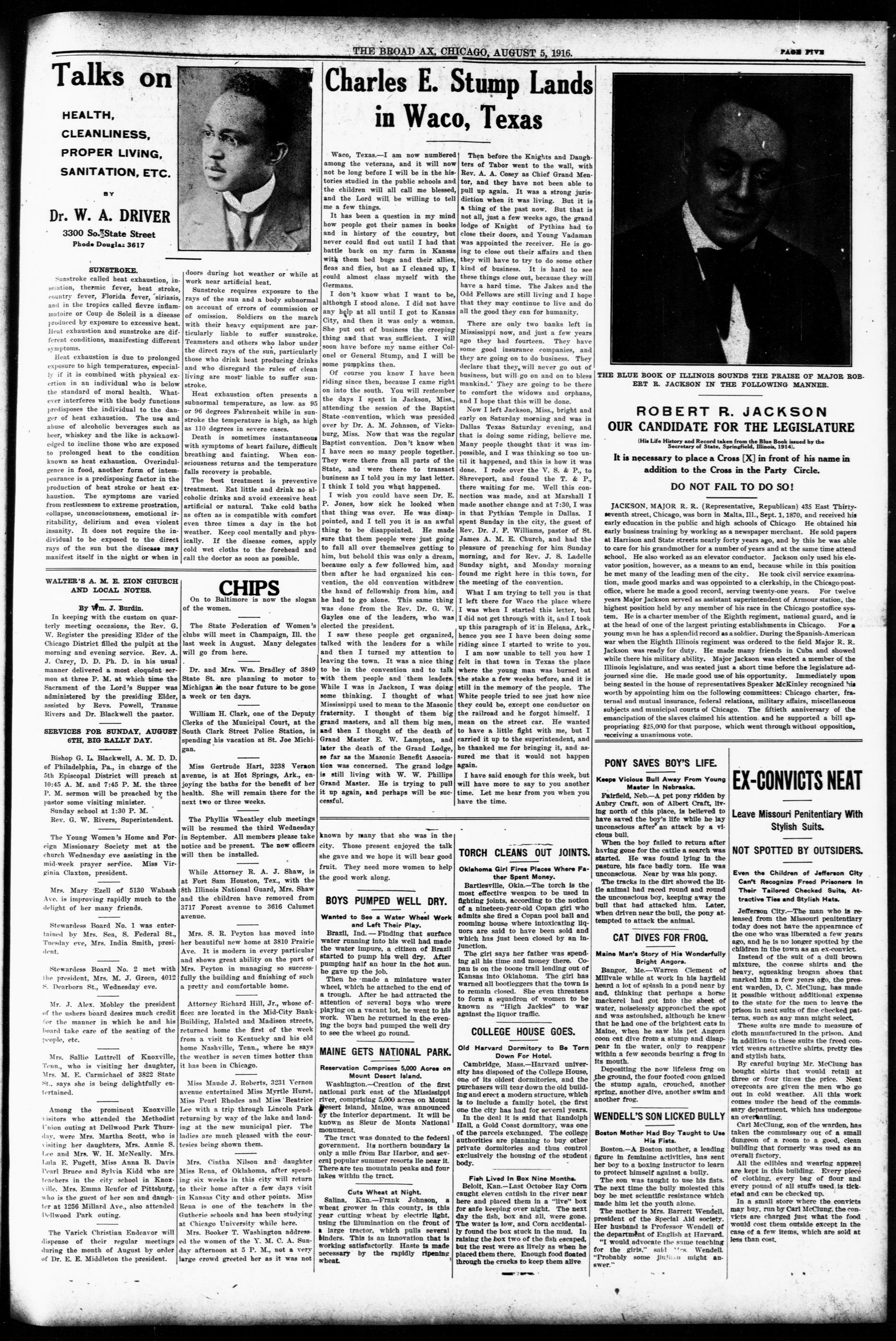
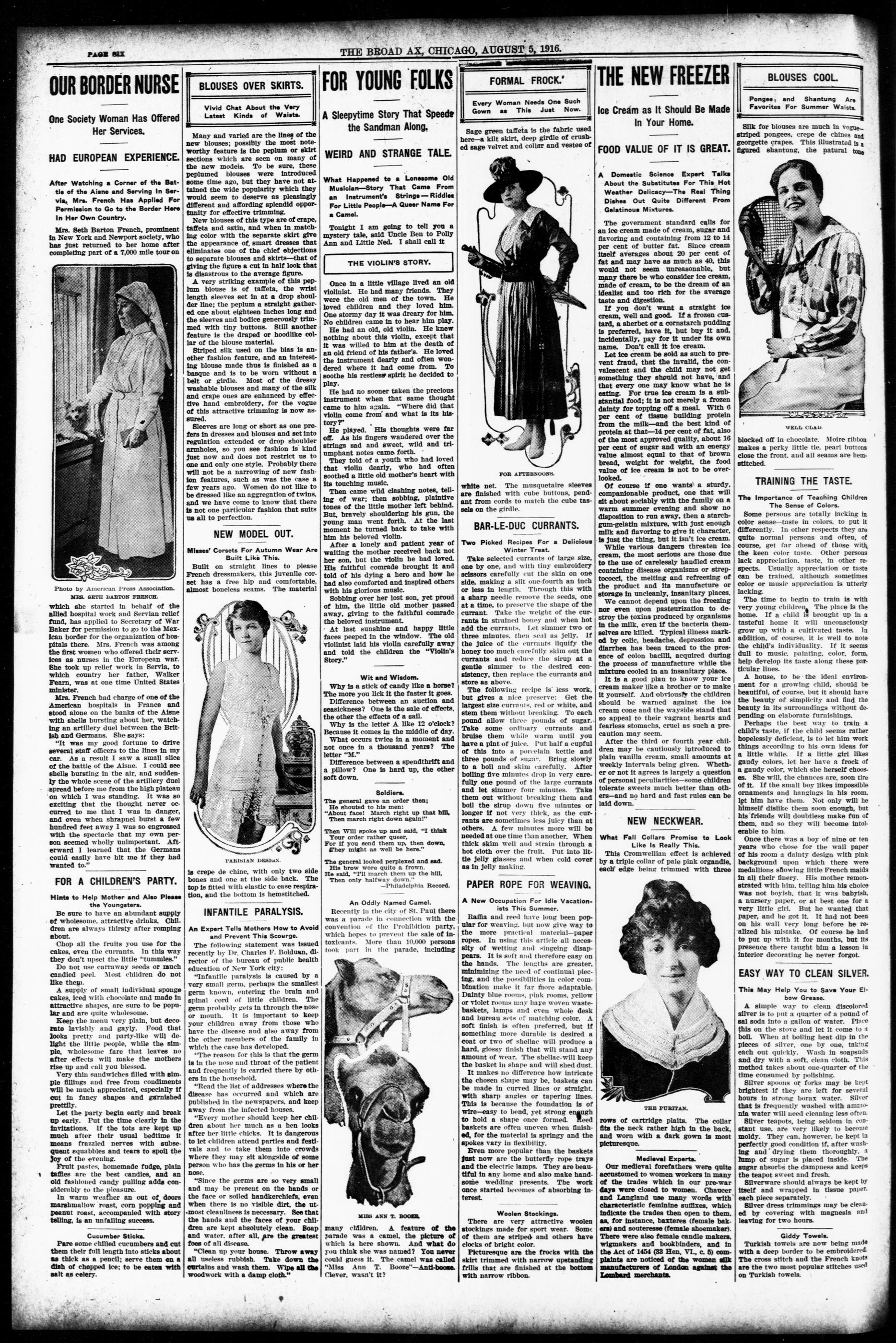
Page text (machine-generated)
THE BROAD AX
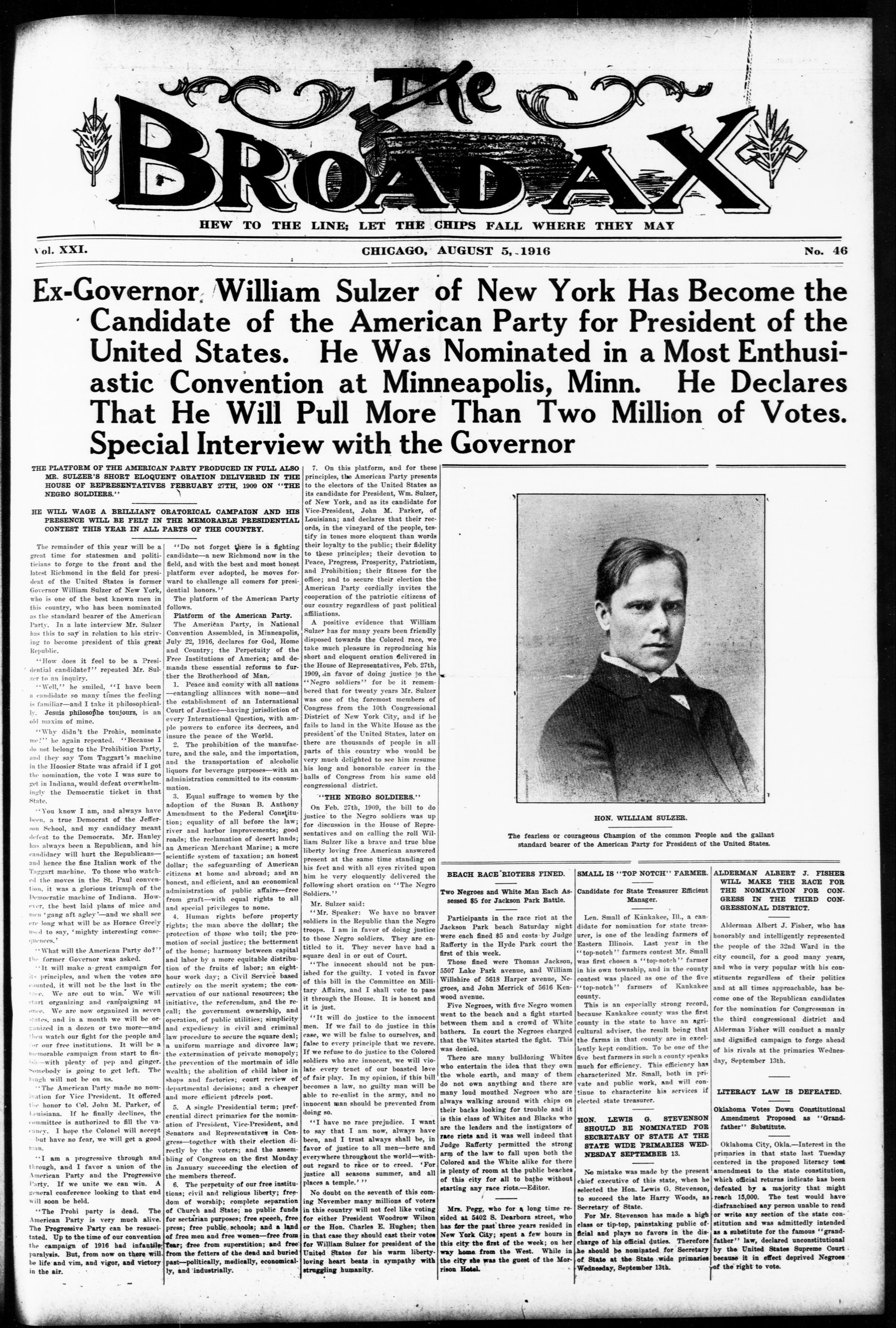
Ex-Governor William Sulzer of New York Has Become the Candidate of the American Party for President of the United States. He Was Nominated in a Most Enthusiastic Convention at Minneapolis, Minn. He Declares That He Will Pull More Than Two Million of Votes. Special Interview with the Governor
THE PLATFORM OF THE AMERICAN PARTY PRODUCED IN FULL ALSO MR. SULZER'S SHORT ELOQUENT ORATION DELIVERED IN THE HOUSE OF REPRESENTATIVES FEBRUARY 27TH, 1909 ON "THE NEGRO SOLDIERS."
HE WILL WAGE A BRILLIANT ORATORICAL CAMPAIGN AND HIS PRESENCE WILL BE FHLT IN THE MEMORABLE PRESIDENTIAL CONTEST THIS YEAR IN ALL PARTS OF THE COUNTRY.
Vol. XXI.
Ex-Governor
Cand
United
astic
That
Spec
THE PLATFORM OF THE AMERICA
MR. SULZER'S SHORT ELOQU
HOUSE OF REPRESENTATIVE
NEGRO SOLDIERS."
HE WILL WAGE A BRILLIANT
PRESENCE WILL BE FELT IN
CONTEST THIS YEAR IN ALL
The remainder of this year will be a great time for statesmen and politicians to forge to the front and the latest Richmond in the field for president of the United States is former Governor William Sulzer of New York, who is one of the best known men in this country, who has been nominated as the standard bearer of the American Party. In a late interview Mr. Sulzer has this to say in relation to his striving to become president of this great Republic.
"How does it feel to be a Presidential candidate?" repeated Mr. Sulzer to an inquiry.
"Well," he smiled, "I have been a candidate so many times the feeling is familiar—and I take it philosophically. Jesús philosophe toujours, is an old maxim of mine.
"Why didn't the Prohis, nominate me?" he again repeated. "Because I do not belong to the Prohibition Party, and they say Tom Taggart's machine in the Hoosier State was afraid if I got the nomination, the vote I was sure to get in Indiana, would defeat overwhelmingly the Democratic ticket in that State.
"You know I am, and always have been, a true Democrat of the Jefferson School, and my candidacy meant defeat to the Democrats. Mr. Hanley has always been a Republican, and his candidacy will hurt the Republicans—and hence the fine Italian work of the Taggart machine. To those who watched the moves in the St. Paul convention, it was a glorious triumph of the Democratic machine of Indiana. However, the best laid plans of mice and men 'gang aft agley'—and we shall see ere long what will be as Horace Greely used to say, 'mighty interesting consequences.'
"What will the American Party do?" the former Governor was asked.
"It will make a great campaign for its principles, and when the votes are counted, it will not be the last in the race. We are out to win." We will start organizing and campaigning at once. We are now organized in seven states, and in a month we will be organized in a dozen or two more—and then watch our fight for the people and our free institutions. It will be a memorable campaign from start to finish—with plenty of pep and ginger. Somebody is going to get left. The branch will not be on us.
"The American Party made no nomination for Vice President. It offered the honor to Col. John M. Parker, of Louisiana. If he finally declines, the committee is authorized to fill the vacancy. I hope the Colonel will accept but have no fear, we will get a good man.
"I am a progressive through and through, and I favor a union of the American Party and the Progressive Party. If we unite we can win. A general conference looking to that end will soon be held.
"The Prohi party is dead. The American Party is very much alive. The Progressive Party can be resuscitated. Up to the time of our convention the campaign of 1916 had infantile paralysis. But, from now on there will be life and vim, and vigor, and victory in the air.
"Do not forget there is a fighting candidate—a new Richmond now in the field, and with the best and most honest platform ever adopted, he moves forward to challenge all comers for presidential honors."
The platform of the American Party follows.
**Platform of the American Party.**
The American Party, in National Convention Assembled, in Minneapolis, July 22, 1916, declares for God, Home and Country; the Perpetuity of the Free Institutions of America; and demands these essential reforms to further the Brotherhood of Man.
1. Peace and comity with all nations—entangling alliances with none—and the establishment of an International Court of Justice—having jurisdiction of every International Question, with ample powers to enforce its decrees, and insure the peace of the World.
2. The prohibition of the manufacture, and the sale, and the importation, and the transportation of alcoholic liquors for beverage purposes—with an administration committed to its consummation.
3. Equal suffrage to women by the adoption of the Susan B. Anthony Amendment to the Federal Constitution; equality of all before the law; river and harbor improvements; good roads; the reclamation of desert lands; an American Merchant Marine; a more scientific system of taxation; an honest dollar; the safeguarding of American citizens at home and abroad; and an honest, and efficient, and an economical administration of public affairs—free from graft—with equal rights to all and special privileges to none.
4. Human rights before property rights; the man above the dollar; the protection of those who toil; the promotion of social justice; the betterment of the home; harmony between capital and labor by a more equitable distribution of the fruits of labor; an eight-hour work day; a Civil Service based entirely on the merit system; the conservation of our national resources; the initiative, the referendum, and the recall; the government ownership, and operation, of public utilities; simplicity and expediency in civil and criminal law procedure to secure the square deal; a uniform marriage and divorce law; the extermination of private monopoly; the prevention of the mortmain of idle wealth; the abolition of child labor in shops and factories; court review of departmental decisions; and a cheaper and more efficient ptelees post.
5. A single Presidential term; preferential direct primaries for the nomination of President, Vice-President, and Senators and Representatives in Congress—together with their election directly by the voters; and the assembling of Congress on the first Monday in January succeeding the election of the members thereof.
6. The perpetuity of our free institutions; civil and religious liberty; freedom of worship; complete separation of Church and State; no public funds for sectarian purposes; free speech, free press; free public schools; and a land of free men and free women—free from Tear; free from superstition; and free from the fetters of the dead and buried past—politically, medically, economically, and industrially.
CHICAGO, AUGUST 5, 1916
7. On this platform, and for these principles, the American Party presents to the electors of the United States as its candidate for President, Wm. Sulzer, of New York, and as its candidate for Vice-President, John M. Parker, of Louisiana; and declares that their records, in the vineyard of the people, testify in tones more eloquent than words their loyalty to the public; their fidelity to these principles; their devotion to Peace, Progress, Prosperity, Patriotism, and Prohibition; their fitness for the office; and to secure their election the American Party cordially invites the cooperation of the patriotic citizens of our country regardless of past political affiliations.
A positive evidence that William Sulzer has for many years been friendly disposed towards the Colored race, we take much pleasure in reproducing his short and eloquent oration delivered in the House of Representatives, Feb. 27th, 1909, in favor of doing justice to the "Negro soldiers" for he it remembered that for twenty years Mr. Sulzer was one of the foremost members of Congress from the 10th Congressional District of New York City, and if he fails to land in the White House as the president' of the United States, later on there are thousands of people in all parts of this country who would be very much delighted to see him resume his long and honorable career in the halls of Congress from his same old congressional district.
"THE NEGRO SOLDIERS."
On Feb. 27th, 1909, the bill to do justice to the Negro soldiers was up for discussion in the House of Representatives and on calling the roll William Sulzer like a brave and true blue liberty loving free American answered present at the same time standing on his feet and with all eyes rivited upon him he very eloquently delivered the following short oration on "The Negro Soldiers."
Mr. Sulzer said:
"Mr. Speaker: We have no braver soldiers in the Republic than the Negro troops. I am in favor of doing justice to those Negro soldiers. They are entitled to it. They never have had a square deal in or out of Court.
"The innocent should not be punished for the guilty. I voted in favor of this bill in the Committee on Military Affairs, and I shall vote to pass it through the House. It is honest and it is just.
"It will do justice to the innocent men. If we fail to do justice in this case, we will be false to ourselves, and false to every principle that we revere. If we refuse to do justice to the Colored soldiers who are innocent, we will violate every tenet of our boasted love of fair play. In my opinion, if this bill becomes a law, no guilty man will be able to re-enlist in the army, and no innocent man should be prevented from doing so.
"I have no race prejudice. I want to say that I am now, always have been, and I trust always shall be, in favor of justice to all men—here and everywhere throughout the world—without regard to race or to creed. 'For justice all seasons summer, and all places a temple.'"
No doubt on the seventh of this coming November many millions of voters in this country will not feel like voting for either President Woodrow Wilson or the Hon. Charles E. Hughes; then in that case they should cast their votes for William Sulzer for president of the United States for his warm liberty-loving heart beats in sympathy with struggling humanity.
J.
The fearless or courageous Champion of the common People and the gallant standard bearer of the American Party for President of the United States.
BEACH RACE RIOTERS FINED.
Two Negroes and White Man Each Assessed $5 for Jackson Park Battle.
Participants in the race riot at the Jackson Park beach night were each fined $5 and costs by Judge Rafferty in the Hyde Park court the first of this week.
Those fined were Thomas Jackson, 5507 Lake Park avenue, and William Willshire of 5618 Harper avenue, Negroes, and John Merrick of 5616 Kenwood avenue.
Five Negroes, with five Negro women went to the beach and a fight started between them and a crowd of White bathers. In court the Negroes charged that the Whites started the fight. This was denied
There are many buldozing Whites who entertain the idea that they own the whole earth, and many of them do not own anything and there are many loud mouthed Negroes who are always walking around with chips on their backs looking for trouble and it is this class of Whites and Blacks who are the leaders and the instigators of race riots and it was well indeed that Judge Rafferty permitted the strong arm of the law to fall upon both the Colored and the White alike for there is plenty of room at the public beaches of this city for all to bathe without starting any race riots.—Editor.
Mrs. Pegg, who for a long time resided at 5402 S. Dearborn street, who has for the past three years resided in New York City; spent a few hours in this city the first of the week; on her way home from the West. While in the city she was the guest of the Morrison Hotel.
HON. WILLIAM SULZER.
Arageous Champion of the common People of the American Party for President of
SMALL IS "TOP NOTCH" FARMER
Candidate for State Treasurer Efficient Manager.
Len. Small of Kankakee, Ill., a candidate for nomination for state treasurer, is one of the leading farmers of Eastern Illinois. Last year in the "top-notch" farmers contest Mr. Small was first chosen a "top-notch" farmer in his own township, and in the county contest was placed as one of the five "top-notch" farmers of Kankakee county.
This is an especially strong record, because Kankakee county was the first county in the state to have an agricultural adviser, the result being that the farms in that county are in excellently kept condition. To be one of the five best farmers in such a county speaks much for efficiency. This efficiency has characterized Mr. Small, both in private and public work, and will continue to characterize his services if elected state treasurer.
HON. LEWIS G. STEVENSON SHOULD BE NOMINATED FOR SECRETARY OF STATE AT THE STATE WIDE PRIMARIES WED-NESDAY SEPTEMBER 13.
No mistake was made by the present chief executive of this state, when he selected the Hon. Lewis G. Stevenson, to succeed the late Harry Woods, as Secretary of State.
For Mr. Stevenson has made a high class or tip-top, painstaking public official and plays no favors in the discharge of his official duties. Therefore he should be nominated for Secretary of State at the State wide primaries Wednesday, September 13th.
No. 46
become the
gent of the
st Enthusi-
e Declares
of Votes.
le and the gallant
the United States.
ALDERMAN ALBERT J. FISHER WILL MAKE THE RACE FOR THE NOMINATION FOR CONGRESS IN THE THIRD CONGRESSIONAL DISTRICT.
Alderman Albert J. Fisher, who has honorably and intelligently represented the people of the 32nd Ward in the city council, for a good many years, and who is very popular with his constituents regardless of their politics and at all times approachable, has become one of the Republican candidates for the nomination for Congressman in the third congressional district and Alderman Fisher will conduct a manly and dignified campaign to forge ahead of his rivals at the primaries Wednesday, September 13th.
LITERACY LAW IS DEFEATED.
Oklahoma Votes Down Constitutional Amendment Proposed as "Grandfather" Substitute.
Oklahoma City, Okla.—Interest in the primaries in that state last Tuesday centered in the proposed literacy test amendment to the state constitution, which official returns indicate has been defeated by a majority that might reach 15,000. The test would have disfranchised any person unable to read or write any section of the state constitution and was admitted intended as a substitute for the famous "grandfather" law, declared unconstitutional by the United States Supreme Court because it in effect deprived Negroes of the right to vote.
PAGE TWO
THE BROAD AX
Published Weekly
In this city since July 15th, 1899, without missing one single issue, Republicans, Democrats, Catholics, Protestants, single Taxers, Priests, infidels or anyone else can have their say as long as their language is proper and responsibility is fixed.
The Broad Ax is a newspaper whose platform is broad enough for all, ever claiming the editorial right to speak its own mind.
Local communications will receive attention. Write only on one side of the paper.
Subscriptions must be paid in advance.
One Year.....$2.00
Six Months.....1.00
Advertising rates made known on application.
Address all communications to
THE BROAD AX
6532 St. Lawrence Ave, Chicago, Ill
PHONE WENTWORTH 2507.
JULIUS F. TAYLOR, Editor and Publisher.
Entered as Second-Class Matter Aug.
19, 1902, at the Post Office at Chicago,
Illinois, under Act of March 3, 1879.
GOES LONG WAY TO WED
Pretty Newfoundland Miraveled to Vancouver to Marry.
Vancouver, Wash.—Coming all the way from St. Johns, Newfoundland, to meet her sweetheart of school days, Miss Isabel M. Ewing, a pretty, twenty-two-year-old miss, was married to Herbert G. Bradley, a restaurant man of Portland, Ore., in the office of the county auditor here recently.
It was only a few hours after her arrival in Portland, whence she had come at Bradley's call, that they came to Vancouver together and were married. Though it was several hours after the time for the marriage license bureau to close, Mrs. May R. Hacok, the county auditor, obligingly went to the courthouse and issued a license.
Justice of the Peace W. S. T. Dart was called, and the ceremony was performed in the auditor's office. Only two friends from Portland and the local officials witnessed the ceremony.
Bradley left his home in Newfoundland several years ago and came west in search of fortune. In a dairy lunch business in Portland he built up an income sufficient to send for his sweet heart.
LAD. TEASED. USED GUN.
Boy, Who Was Mountaineer, Made Onion Weeders Scatter.
Kenton, O.—A real Kentucky mountaineer of fiction type—six feet one and a half inches tall and weighing 100 pounds, although only fourteen years old—awoke the quiet settlement of Alger on the Scioto marsh, the center of the greatest onion raising district in Ohio, when he started a cannonade that sent the natives to the trenches.
He was Charles S. Hale, who hails from Greensburg, Ky., and who came to Tardin county to weed onions.
The youth bought a gun and threatened to shoot the hats off any one who opened their heads to him. He says the other weeders were teasing him. The trouble came when officers tried to arrest him. The bullet hit Harvey Porter. Spectators scattered. The lads was sent to the Lancaster Industrial school.
HAS SHAVED 243.960.
Barber Says He Has Had That Many In His Chair.
Lorain, O.—Theodore Curtis, a Lorain barber, has just celebrated the twenty-fifth anniversary of the beginning of his career. Curtis, who has kept account of every man he has shaved, says he has removed the whiskers of 23,300 men.
"I have also cut enough hair to make eleven mattresses and to pad 43,562 crutches," said Curtis.
The barber has shaved some of the country's widely known men, including Presidents McKinley, Roosevelt and Taft, Senators Mark Hanna, Matt Quay, Albert Reveridge and Ben Tillman, "Doc" Cook, Buffalo Bill, Jessie Willard, Tod Shead and Harry Thaw.
"I would like to add Charles Evans Hughes to my list of notables," observed Curtis.
NOW IT'S "SWAT THE WEED."
Arkansas Begins Campaign to Protect Soils From Useless Growths.
Fayetteville, Ark.—"Swat 'em" applies to other things in Arkansas besides the fly. A campaign against weeds was announced recently by the extension division of the University of Arkansas, with the terse advice: "Swat 'em and save future labor and soil fertility and soil moisture."
Weeds may cost a community or state millions of dollars, according to an extension division bulletin. Spread of weeds is said to be due to carelessness. After farmers let weeds ripen the seeds are scattered by travelers or birds or are sold with hay to infest other neighborhoods. The bulletin urges children be taught to "swat" weeds and never let one ripen to seed.
HUGHES IS TOLD OF NOMINATION
Republican Leader Scores Wilson Administration.
MEXICO TARGET OF ATTACK
The Nominee Intimates That He Would Have Backed Up Americans on Lusitania by Deeds, Not Words. Charges Administration With Vaciliation—Favors Woman Suffrage and Protection.
New York—In his address in Carnegie Hall, New York, accepting the Republican nomination for president, Charles Evans Hughes said:
"Senator Harding, members of the notification committee and fellow citizens—This occasion is more than a mere ceremony of notification. We are not here to indulge in formal expressions. We come to state in a plain and direct manner our faith, our purpose and our pledge. This representative gathering is in a happy augury. It means the strength of reunion. It means that the party of Lincoln is restored, alert, effective. It means the unity of a common perception of paramount national deeds. It means that we are neither deceived nor benumbed by abnormal conditions. We know that we are in a critical period, perhaps more critical than any period since the civil war. We need a dominant sense of national unity, the exercise of our best constructive powers, the vigor and resourcefulness of a quickened America. We desire that the Republican party as a great liberal party shall be the agency of national achievement, the organ of the effective expression of dominant Americanism. What do I mean by that? I mean America, conscious of power, awake to obligation, erect in self respect, prepared for every emergency devoted to the ideals of peace, instinct with the spirit of human brotherhood, safeguarding both individual opportunity and the public interest, maintaining a well ordered constitutional system adapted to local self-government without the sacrifice of essential national authority, appreciating the necessity of stability, expert knowledge and thorough organization as the indispensible conditions of security and progress; a country loved by its citizens with a patriotic fervor permitting no division in their allegiance and no rivals in their affection—I mean America first and America efficient. It is in this spirit that I respond to your summons."
Criticises Diplomatic Appointments. In discussing foreign relations and appointments Mr. Hughes declared that the executive had not commanded the respect of the world by his conduct of the state department. Competent diplomats, notably Ambassador Herrick of France, have been retired for no other reason than to meet partisan demands.
"The dealings of the administration," Mr. Hughes declared, "constitute a confused chapter of blunders. We have not helped Mexico. She lies prostrate, impoverished, famine stricken, overwhelmed with the woes and rages of internecene strife, the helpless victim of a condition of anarchy which the course of the administration only served to promote. For ourselves, we have witnessed the murder of our citizens and the destruction of their property. We have made enemies, not friends. Instead of commanding respect and deserving good will by sincerity, firmness and consistency, we provoked misapprehension and deep resentment. In the light of the conduct of the administration no one could understand its professions. In decrying interference, we interfered most exasperatingly. We have not even kept out of actual conflict. We have restored to physical invasion, only to retire without gaining the professed object. It is a record which cannot be examined without a profound sense of humiliation."
Huerta Treatment Follish Intervention.
Reviewing the interference with Huerta. Mr. Hughes characterized it as "a vacillating and ineffective intervention" and as "the height of folly."
"So far as the character of Huerta is concerned, the hollowness of the pretensions on this score is revealed by the administration subsequent patronage of Villa (whose qualifications as an assassin are indisputable) whom apparently the administration was ready to recognize had he achieved his end and fulfilled what then seemed to be its hope.
"The question is not as to the non-recognition of Huerta. The administration did not contend itself with refusing to recognize Huerta, who was recognized by Great Britain, Germany, France, Russia, Spain and Japan. The administration undertook to destroy Huerta, to control Mexican policies, even to deny Huerta the right to be a candidate for the office of president a the election the administration demanded. With what bewilderment must the Americans have regarded our assertion of their right to manage their own affairs."
Huerta More Pretext
After describing the seizure of Vera Cruz, Mr. Hughes says: "We are now informed that 'we did not go to
THE BROAD AX, CHICAGO, AUGUST 5, 1916
Vera Cruz to force Huerta to salute the flag,' we are told that we went there 'to show Mexico that we were in earnest in our demands that Huerta must go.' That is, we seized Vera Cruz to depose Huerta. The question of the salute was a mere pretext.
"Meanwhile the administration utterly failed to perform its obvious duty to secure protection for the lives and property of our citizens. The bitter hatred aroused by the curse of the administration multiplied outrages, while our failure to afford protection to our citizens evoked the scorn and contempt of Mexicans.
ate that position I am confident there would have been no deed of American lives by the slur the Lustania. Moreover, a financial policy would have been supported by our people, and opportunities of the development ter feeling would have been deuced.
"It is a great mistake to resoluteness in protecting rights would have led to war in that course lay the best a of peace. Weakness and index the maintenance of known ra always sources of grave danger forfelt respect and invite
Left Mexico to Be Ravaged.
"Destroying the government of Huerta, we left Mexico to the ravages of revolution. I shall not attempt to narrate the sickening story of the barbarities committed, of the carnival of murder and lust. We were then told that Mexico was entitled to spill as much blood as she pleased to settle her affairs. The administration vacillated with respect to the embargo on the export of arms and munitions to Mexico. There was an utter absence of consistent policy.
"For a time we bestowed friendship on Villa. Ultimately we recognized Carranza, not on the ground that he had a constitutional government, but that it was a de facto government. The complete failure to secure protection to American citizens is shown conclusively in the note of the secretary of state of June 20, 1916.
Raids Go Unpunished.
"The Santa Ysabel massacre, the raid at Columbus, the bloodshed at Carrizal are fresh in your minds. After the Columbus raid we started a punitive expedition. We sent a thin line of troops hundreds of miles into Mexico, between two lines of railway, neither of which we were allowed to use and which we did not feel at liberty to seize. We were refused permission to enter the towns. Though thus restricted, the enterprize was still regarded by the Mexicans as a menace. Out troops hostile forces and it is not remarkable that our men fell at Carrizal. What other result could be expected? We were virtually ordered to withdraw, and without accomplishing our purpose we have been withdrawing and we are now endeavoring to safeguard our own territory. The entire national guard has been ordered out, and many thousands of our citizens have been taken from their peaceful employment and hurried to the Mexican borders. The administration was to seize and punish Villa for his outrage on our soil. It has not punished any one; we went in only to retire, and future movements are apparently to be determined by a joint commission.
Wishes Peace for Mexico.
"The nation has no policy of aggression toward Mexico. We have no desire for any part of her territory. We wish her to have peace, stability and prosperity. We should be ready to aid her in binding up her wounds, in relieving her from starvation and distress and in giving her in every practicable way the benefits of our disinterested friendship. The conduct of this administration has created difficulties which we shall have to surmount. We shall have to overcome the antipathy needlessly created by that conduct and to develop genuine respect and confidence. We shall have to adopt a new policy, a policy of firmness and consistency through which we alone can promote an enduring friendship. We demand from Mexico the protection of the lives and the property of our citizens and the security of our border from depredations. Much will be gained if Mexico is convinced that we contemplate no meddlesome interference with what does not concern us, but that we propose to insist in a firm and candid manner upon the performance of international obligations. To a stable government appropriately discharging its international duties, we should give ungrudging support. A short period of firm, consistent and friendly dealing will accomplish more than many years of vacillation."
Wholehearted! for U. S.
Discussing the European war and the maintenance of American rights. Mr. Hughes declared that "national security demands that there shall be no faltering with American rights." Continuing he said: "We countenance no covert policies. No intrigues, no secret schemes. We are unreservedly devoted, wholeheartedly for the United States. That is the rallying point for all Americans. That is my position. I stand for the unfinishing maintenance of all American rights on land and sea.
Blames Wilson for Subsea Horrors. "We have had a clear and definite mission as a great neutral nation. It was for us to maintain the integrity of international law; to vindicate our rights as neutrals; to protect the lives of our citizens, their property and trade from wrongful acts. At least we were entitled to the safeguarding of American rights. But this has not been secured. We have had brave words in a series of notes, but despite out protests the lives of Americans have been destroyed. What does it avail to use some of the strongest words known to diplomacy if ambassadors can receive the impression that the words are not to be taken seriously. It is not words, but the strength and resolution behind the words that count. Had this government by the use of both informal and formal diplomatic opportunities left no doubt that when we said 'strict accountability' we meant precisely what we said and that we should unhesitatingly whi-
cate that position I am confident that there would have been no destruction of American lives by the sinking of the Lusitania. Moreover, a firm American policy would have been strongly supported by our people, and the opportunities of the development of bitter feeling would have been vastly reduced.
"It is a great mistake to say that resoluteness in protecting American rights would have led to war. Rather, in that course lay the best assurance of peace. Weakness and indecision in the maintenance of known rights are always sources of grave danger. They forfeit respect and invite serious wrongs, which in turn create an uncontrollable popular resentment. That is not the path of national security. Not only have we host of resources short of war by which to enforce our just deamads, but we shall never promote our peace by being stronger in words than in deeds. We should not have found it difficult to maintain peace, but we should have maintained peace with honor. During this critical period the only danger of war has lain in the weak course of the administration."
No Danger of Militarism.
Referring to preparedness, Mr. Hughes said: "We are a peace loving people, but we live in a world 'of arms. We have no thought of aggression, and we desire to pursue our democratic ideals without the wastes of strife. So devoted are we to these ideals, so intent upon our normal development, that I do not believe that there is the slightest danger of militarism in this country. Adequate preparedness is not militarism. It is the essential assurance of security; it is a necessary safeguard of peace.
"It is apparent that we are shockingly unprepared. There is no room for controversy on this point since the object lesson on the Mexican border. All our available regular troops, less, I believe, than 40,000, are there or in Mexico, and as these have been deemed insufficient the entire national guard has been ordered out—that is, we are summoning practically all our movable military forces in order to prevent bandit incursions. In view of the warnings of the past three years it is inexcusable that we should find ourselves in this plight.
"We demand adequate national defense, adequate protection on both our western and eastern coasts. We demand thoroughness and efficiency in both arms and services. It seems to be plain that our regular army is too small. I believe, further that there should be not only a reasonable increase in the regular army, but that the first citizen reserve subject to call should be enlisted as a federal army and trained under federal authority.
Democrats Caused Loss of Jobs.
Mr. Hughes declared that the country was deeply interested in the organization of peace. New conditions which it must meet would follow at the end of the war.
"We are undisciplined, defective in organization, loosely knit, industrially unprepared. Our opponents promised to reduce the cost of living. This they have failed to do, but they did reduce the opportunities of making a living. Let us not forget the conditions that existed in this country under the new tariff prior to the outbreak of the war. Production has decreased, business was languishing, new enterprises were not undertaken; instead of expansion there was curtailment and our streets were filled with the unemployed. It was estimated that in the city of New York over 300,000 were out of work. Throughout the country the jobless demanded relief.
"It is plain that we must have protective, upbuilding policies. It is idle to look for relief to the Democratic party, which as late as 1912 declared in its platform that it was a fundamental principle of the Democratic party that the federal government under the constitution, had no right or power to impose or collect tariff duties except or the purpose of revenue. We are told in its present platform that there have been momentous changes in the past two years, and hence repudiating its former attitude the Democratic party now declares for a non-partisan tariff commission.
Stands for Protection.
"The Republican party stands for the principle of protection. We must apply that principle fairly, without abuses, in as scientific a manner as possible, and congress should be aided by the investigations of an expert body. We stand for-the safe guarding of our economic independence, for the development of American industry, for the maintenance of American standards of living. We propose that in the competitive struggle that is about to come the American work ingman shall not suffer."
Favors Votes for Women.
Mr. Hughes came out unqualifiedly for votes for women.
He concluded as follows: "We live in a fateful hour. In a true sense the contest for the preservation of the nation is never ended. We must still be imbued with the spirit of heroic sacrifice which gave us our country and brought us safely through the days of civil war. We renew our pledge to the ancient ideals of individual liberty, of opportunity denied to none because of race or creed of unswerving loyalty. We have a vision of America prepared and secure; strong and just, equal to her tasks, an exemplar of the capacity and efficiency of a free people. I indorse the platform adopted by the convention and accept the nomination."
AID CITY WORKERS
New York Enlarges Studies For Municipal Employees.
AIM IS TO IMPROVE THEM.
Success of Experiment Results In Organization of a Great Continuation School at City College For Those Who Wish to Advance Themselves.
New York.—An advisory board was recently organized here to take part in the direction of courses at the College of the City of New York, of which Dr. Sidney E. Mezes is president, to train young men for the municipal service.
The following men were appointed by Mayor Mitchel to serve on the newly created advisory board: Alfred D. Flinn, deputy chief engineer of the board of water supply; Michael Friedsam, well known in the mercantile world; Public Service Commissioner Henry W. Hodge, Curt G. Pfeiffer, Civil Service Commissioner Henry Moskowitz, President Charles Straus of the
PETER H. HARRIS
Photo by American Press Association.
DR. SIDNEY E. MEZIES.
board of water supply, Commissioner of Accounts Leonard W. Wallstein and Gano Dunn.
In the last four years the City college has granted special student privileges to persons in the city employ, with the view to improving the efficiency of the municipal service and aiding individuals to advance. Last year the experiment was made, in cooperation with New York university, of conducting special courses for those in the city service in the municipal building.
The success of the experiment last year influenced the mayor to appoint the advisory committee and lay plans to organize a great continuation school which will aim to improve all those in the service who wish to avail themselves of the opportunity and to stimulate men to study for advancement in the city employ.
SORRY $54,923.15 WORTH.
Last Year's Conscience Fund Breaks All Records.
Washington. — Contributions to the treasury's conscience fund for the fiscal year ending June 30 amounted to $54,923.15, making a total of $498,763.54 returned by persons made uneasy by frauds against the government.
Figures compiled at the treasury department show the returns were much larger during the past year than ever before, chiefly because of two contributions, one for $30,000 and one for $10,000.
It was in 1811 when the first $5 came with a letter saying the writer had taken that amount from the government. It is an unwritten law of the department that no effort shall be made to learn the identity of these contributors, and even where the writer has confessed to theft the money has been accepted and no effort made to prosecute. From 1811 until 1827 there were no receipts. Since then, except for 1848, not a year has passed without amounts coming in.
SOLDIER FUGITIVE PARDONED
Kentuckian Says He's Now a Corporal in United States Army.
Frankfort, Ky.—A fugitive for twenty years, Milton Franklin, under sentence of life imprisonment, was pardoned recently by Governor Stanley a few hours after he had appeared at the Frankfort reformatory and surrendered to Warden Wells.
Franklin was convicted of murder in the Floyd county court twenty years ago. He escaped from the Johnson county jail, where he was held pending an appeal. According to the story he told reformatory officials, he enlisted in the United States army soon after his escape and is now a corporal stationed at Columbus, O.. on recruiting duty.
Wed When Two Steamers Met
Wed When Two Steamers Met.
Dawson, Yukon.—Miss Cassie Henderson, daughter of Robert Henderson, discoverer of the Yukon, was married on the steamer Casca when twelve miles above Dawson. The bridegroom was Irvine Crowther, employed with the Yukon Gold company on one of its dredges on Bonanza. Mr. Crowther and the Rev. Mr. Ross went up the river in the launch Reindeer, and the wedding took place immediately after the boats met.
Hartford (Conn.) Lads Promptly
Aroused at 5:30 Every Morning
ing by Pet Bird.
Hartford, Conn.—Herbert and Steward Carlson, brothers, are paper carriers in South Manchester and in order to get the papers around in time it is necessary for them to arise each morning at 5:30 o'clock. Ordinarily an alarm clock would be necessary to get them out, but they have a better method. They are called each morning by a pigeon.
About a year ago Steward Carlson found a pigeon that had met with an accident. It was only a squab. Its wing seemed to be broken and one leg was damaged. The boy took it home, gave it attention and the wing grew stronger, the leg improved and after awhile it learned to fly. Instead of flying away it remained in the neighborhood and became a chum of the boys in the territory. The pigeon must have noticed the two boys leaving the house each morning about 5:30 o'clock and appointed itself an alarm clock. Every morning now, just at 5:30, the pigeon leaves its coop, files to the window of the room in which the boys sleep and coos and pecks at the screen until they awake.
THIS SCHOOL IS RUN LIKE BASEBALL LEAGUE
Four Classes Vie to Win Games and Maintain Batting Averages by Getting High Grades.
Fort Dodge, Ia.—The following formula has been instituted in the high school here for a new game of baseball played with students and textbooks and recitations:
One recitation group equals one ball player.
One high school class equals one ball team.
One day's recitation equals one inning.
One week's work equals one game.
Average of grades made by the different recitation groups equals batting averages of the individual players.
Class with highest averages wins inning.
It is the result of studies in motivation for high school work undertaken by W. H. Blakely, principal, and is printed in a current issue of the School Review, published by the University of Chicago Press.
Mr. Blakely has 400 boys and girls engaged in an opening series of games between the four classes. The students and teachers both are said to be very enthusiastic about the scheme.
The work of figuring the averages and the standing of the teams and their members is left to the arithmetic classes of the commercial department.
The bookkeeping classes keep records, and typewriting classes publish the reports and scores.
LEFT HAMDED CHAIRS MADE.
Students In Kansas University to Get Seats For Their Convenience.
Lawrence, Kan.-Left handed students in Kansas university will have seats made for their special convenience when the classrooms are opened next fall.
John M. Shea, superintendent at the university, announced that five dozen left handed chairs had been ordered from a Grand Rapids machine firm and that they will be distributed as needed among the classrooms.
The difference between the new chairs and those previously used is that the arms are on the left side instead of on the right side. The company that made the chairs had never received a similar order, Mr. Shea said.
HONEYMOON RIDE COSTLY.
Detroit Bridegroom Gets Into Cell For Speeding In New York.
New York.—Thirty miles an hour in Detroit may not seem as fast as thirty miles an hour in New York, especially when the driver of the automobile be on his honeymoon.
William Berman, a wealthy real estate operator, married recently in Detroit, found this out when he was arrested at Twenty-third street and Fifth avenue for speeding and also learned that the mention of Henry Ford as your friend falls to impress New York cops.
At the West Twentieth street station he lacked $50 of the $500 ball required, so he spent two hours in a cell until a friend put up the money.
AUTO OWNER NO DISTINCTION
More Gold Watches and Pianos In One Kansas County.
Troy, Kan.—Owning a motor car is not the only way in which to gain distinction in Doniphan county. You can achieve almost the same exclusiveness by owning a gold watch, a piano or four dogs.
Although there are only 506 autos in the county, there are just 508 gold watches—that is, according to the assessors' reports, and 551 pianos.
Ring on a Radish.
Tiffin, O.—Four years ago Mrs. W. H. Souger, wife of an implement dealer, lost a heavy gold band ring in her garden. The other day she pulled up a radish and found the ring fastened about the root.
An Optimist's Essay.
A pessimist is a son of the man who didn't believe there was any such thing as electricity.
He is an offspring of the man who was sure that the horseless carriage would never come, and a nephew of the man who was willing to bet money that men would never fly.
A pessimist is a direct descendant of the man who was sure that wireless telegraphy was a fool's dream and a submarine merely the creation of a fiction writer's brain.
The pessimist's ancestory scoffed at the telephone, the typesetting machine, the twenty story building, anaesthetics and every forward step the optimists have taken for the betterment of human life.
If the pessimists of the past had been right men would still be living in caves and trying to get their meals with clubs and flint arrows. And evidently they died without publicly confessing their mistakes, for their pessimistic children continue to prophesy dismally that everything that is surely going to be cannot possibly come to pass. They seem to be born with the habit and cannot get over it.-Detroit Free Press.
Speed of Bullets
The rate of fall of the bullet from the line of projection is fixed by the laws of gravity, hence the more rapidly the bullet is made to pass from the rifle to the target the flatter will be this curve or "trajectory," the less accurate the estimation of distance required and the less the chances of error through an inaccurate estimate of distance.
The normal velocities of our sporting rifles, in black powder days, were about 1,300 feet per second. The first of the small bore, high power, smokeless variety raised this to 2,000 f. s. for bullets of military length and 2,200 for shorter sporting bullets. Now it has gone up to 3,100 f. s. The burning questions asked again and again by the rifleman are, "Where will we stop?" "Will the 4,000 f. s. bullet come next?"
Cultivating Amusements.
Don't provide inducements to get a child to love amusements. It may encourage a habit that will sadly interfere with a sincere and useful life. Don't make a boy feel that he cannot waste too much time in having fun and catering to his senses. Life is real and earnest, and amusement is admissible at times, but should not be the rule. The manly youth is for fun, but he is not always engaged in striving for his own pleasure. He should not be educated into that idea of life. He should not be furnished with inclinations away from what is true and real in life. It is a serious matter tempering with a youth's nobler aspiration. Providing amusement is apt to prove an unnatural adjunct in education.—Columbus Journal.
Hate All Around.
The famous English chief justice Holt and his wife hated each other to the limit, and when she fell dangerously ill he was so delighted that he became digracefully tipsy. But his wife was equal to the emergency and sent for the great Dr. Radeliffe, who hated Holt, and therefore out of spite when the case was presented to him came with great promptness and saved her life—Westminster Gazette.
High Tide.
The feminine navete that is so amusing to the nautical man has a good illustration in this question asked by a young woman who saw a monitor lying at anchor in Boston harbor. She turned to her escort and said: "What makes that boat lie so low in the water? Is it high tide?"—Sailors' Magazine.
Pope's Preference.
The Prince of Wales of Pope's time once said to the poet: "Mr. Pope, do you not like kings?" "Sir," replied the poet, "I prefer the lion before the claws are grown."
Safety First
Knicker—Folks are queer. Bocker—
Yes; the ones who stop, look and listen
at a keyhole won't do it at a railroad
crossing. New York Sun.
PRACTICAL HEALTH HINT.
Water For the Baby.
Infants suffer from not having enough water to drink. Babies are thirsty and frequently cry from the discomfort due to thirst.
In proportion to its weight an average infant during the first year of life requires a little more than six times as much water as an adult. During the time when the child is upon an entirely fluid diet the addition of much water other than that supplied by the food is unnecessary. The food (breast milk) of all young mammals consists of from 80 to 90 per cent of water. This is needed for the solution of certain parts of the food, such as the sugar and some of the proteids, and for the suspension of the other proteids and the emulsified fat. All the food is thus dissolved and minutely divided so as to be the more readily acted upon by the feeble digestive organs of the infant.
When the feeding becomes less frequent water to drink (from a bottle with a nipple on it) should be given to drink between the feedings. In summer time especially babies suffer a great deal from thirst.
Camping Courtesy.
Good camping grounds should be the special property of sportsmen and lovers of the woods, and it is a pity that they should so often be desecrated by the unappreciative. This is the season when the forest floor will be strewn with tin cans and cracker boxes, when the clean woods will be marred with all sorts of ugly rubbish, and when the pleasure of late campers will be half destroyed by the vandalism of their predecessors. Great tracts of forest will be blackened by flames set from little campfires. The growth of young timber will be checked. And all the trouble could be banished if only people would observe the few simple rules of the woods! The forest is the last refuge of solitude amid beauty; therefore do not make its secluded glades into vulgar picnic grounds. Noblesse oblige there as elsewhere, and though the after corner may not know you be will know what sort of person you are by the condition of the camping grounds you leave. Countryside Magnazine.
The Gold Dust Was There.
North America has counted as a gold producing continent only since the late forties. But it might well have done so for about 200 years. According to the London Chronicle, in the voyage round the world which began in 1719 the privateer Captain Shelvocke found in certain California valleys "a rich black mold which, as you turn it fresh up to the sun, appears as if intermingled with gold dust. Though we were a little prejudiced," he adds, "against the thought that it could be possible that this metal should be so promiscuously and universally mingled with common earth, yet we endeavored to cleanse and wash the earth from some of it, and the more we did the more it appeared like gold. In order to be further satisfied I brought away some of it, which we lost in our confusion in China."
The Number Nine
There were nine earths, according to medieval cosmogony, nine heavens, nine rivers of hell and nine orders of angels. The number being perfection since it represented divinity was often used to signify a great quantity, as in the phrases, "A nine days' wonder," "A cat has nine lives" and "Nine tailors make a man." In Scotland a distempered cow was cured by washing her in nine surfs. To see nine maggles was considered extremely lucky. Nine knots made in a black woolen thread served as a charm in the case of a sprain. It was also believed and is still by some that if a servant girl finds nine green peas in one pod and lays them on the window sill the first man that enters will be her beau. Nine grains of wheat laid on a four leaved clover enable one, it is said, to see the fairies.
Foiling a Fakir
A story used to be told at Cairo of Sir Richard Owen during one of his sojourns in Egypt. The great naturalist was seated in the shade on the veranda at Sheppeard's hotel when the inevitable snake charmer came to him and produced from his bag a lively specimen of the horned asp—the deadly cerastes. The professor gazed and, nothing daunted, stooped and plucked the horns from the head of the reptile wriggling at his feet, remarking to a bystander that the man would probably think twice before trying to palm off upon any one else a harmless snake as a cerastes by the aid of a couple of fish bones. With anybody else the charmer would probably have succeeded. He had tried it on the wrong man.
Attar of Roses.
Attar of roses, by common consent, ranks at the head of the list of perfumes. Other preparations from roses, too, hold a high place and have long been esteemed. Rosewater is historic. When Saladin entered Jerusalem in the twelfth century he had the walls of the mosque of Omar washed with it. But attar of oil of roses is by far the most precious and the most prized of all. An eastern prince will present to an honored guest rich jewels, rubies and diamonds and then add, as the rarest of all, a crystal bottle filled with this essence.
Not Necessarily.
"One wife too many!" exclaimed Mrs. Wederly as she glanced at the headlines of her husband's paper. "I suppose that is an account of the doings of some bigamist?"
"Not necessarily, my dear," replied her husband without daring to look up—Buffalo Courier.
Of Course She Doesn't
"George is such a nice chap," said the girl in pink. "I always enjoy having him call on me."
"I don't," snapped the other.
"Of course you don't, dear. You'd rather have him call on you."—St. Louis Post-Dispatch
Love.
The greatest happiness to be known in life is the conviction that we are loved; that we are loved for ourselves, or, rather, loved in spite of ourselves. -Hugo.
Too Close.
"Why are you asking me for help? Havern't you any close relatives?" "Yes. That's the reason why I'm appealing to you."—Birmingham Age-Herald.
Some Solace
"It might be worse. They usually cry in unison. You know they might work in relays."—Kansas City Journal.
Chiefly the mold of a man's fortune is in his own hands."—Bacon.
THE BROAD AX, CHICAGO, AUGUST 5. 1916.
A Coast For Curley
"Barley is strangely neglected by the cook of today," says a writer in the Woman's Home Companion. "As it contains more starch and sugar and less gluten than wheat, it might well take the place of the potato on our tables and this with benefit to purse and health.
"One cup of barley will swell to five times its original size when cooked, and its uses are wonderfully varied.
"As a breakfast dish with sugar and cream it is rich and satisfying; for dinner, as a garnish for meat or with rich meat gravy, it makes a savory entree; at tea time cold steamed barley cut in slices and browned in hot butter, then served with maple sirup, is delicious.
"Combined with dried or fresh fruits it makes as wholesome desserts as rice. Indeed, there is no way in which rice may be prepared in which barley cannot be cooked with just as good results. Barley requires a long time to cook properly, but now we have the cereal cooker and the fireless cooker and with them the opportunity to have the perfect cereal."
Queer Use For Cordite.
Some years ago Lord Haldane started the house of commons when replying to a remark made by another member as to the danger attached to the use of cordite by saying that he himself possessed a walking stick made of cordite which he sometimes brought down to the house and left in the cloakroom. An uneasy look stole over the faces of the members present, but in a scientific and highly technical speech his lordship explained that cordite was a perfectly innocent substance until brought into contact with dangerous allies, and without certain ingredients necessary to convert it into an explosive it might be handled with impunity. At the same time it was noticed that Lord Haldane's stick was given a wide berth when it was seen in the cloakroom.
Japanese Translations
A writer in a Tokyo journal reports the struggles of Japanese writers to translate English idioms into their own tongue. We cite several of these howlers. "We put our heads together" (We collided). "He could not find it for the life of him" (He could not discover it till his death). "He is a great loss to his country" (He is a great calamity to his country). "He hung his head for shame" (He committed suicide by strangulation). "He takes things easily" (He is a deft thief). "She sat over a cup of tea" (She sat upon a teacup). "I shudder at the bare idea" (I shudder to think that the man is naked). "The bare idea" is evidently translated into "the idea of bareness." "Spare me five minutes" (Spare my life—only for five minutes).
Horses In the Time of Homer
The horses used in Homer's time were war horses. The warriors were drawn in chariots. The art of riding was known, but it is alluded to as something unusual. Ulysses at the time of his shipwreck "bestrode a plank, like a horseman on a big steed." There are reasons for believing that the practice of riding was much later than that of driving, and the myth of the centaur, where, according to Shakespeare, "man is incorpred and demnatured with the beast," probably originated at an early period when the appearance of a man on horseback was a novel sight.
Too Costly.
At one of the Boston theaters recently there was shown on the screen a picture of a stock exchange. The brokers were burrying about, pushing, waving their arms, gesticulating and to the uninitiated acting like a lot of insane men. Two young ladies in the balcony watched them with breathless interest for some time, then one asked:
"Why in the world don't they sit down and rest once in awhile?" "My dear," was the enlightening answer, "don't you know that a seat in the Stock Exchange costs thousands of dollars?"—Harrer's Magazine.
Two Kinds of Joy:
The joys as well as the burdens of life are pretty evenly divided between the sexes after all, and probably a little girl derives as much innocent pleasure from being a flower girl at a wedding as a little boy does from going to school with a live garter snake in his trousers pocket.—Ohio State Journal.
The Man Behind the Message.
The value of a thing depends largely upon who says it. Words may be bullets, but character must be the powder at the back of them to give them projectile force. The man behind the message is as important as the man behind the gun.
He Told Her
"What is it, do you suppose, that keeps the moon in place and prevents it from falling?" asked Araminta.
"I think it must be the beams," replied Charlie softly.
Keeps Him Busy
The Skeptical Aunt—What does he do, Dolly, for a living? Dolly (greatly surprised)—Why, auntie, he does not have time to earn a living while we are engaged!
Unusual
"He's different to most men anyhow."
"In what way?"
"He even knows all the words in the second verse of 'America.'"—Detroit Free Press.
_____
The way to wealth is as plain as the way to market; it depends chiefly on two words—industry and frugality.—Franklin.
How the Trouble Began.
It was a bright, sunny Tuesday morning and Mrs. Brown was on the roof preparing to hang out her wash, when Mrs. Jones appeared on the scene carrying a basket of clothes.
"What are you doin' here?" demanded Mrs. Jones. "Monday is your day for hangin' out clothes."
"I know it is," replied Mrs. Brown, removing the clothespins from her mouth so she could articulate more clearly, "but it rained yesterday, an' I'm hangin' 'em out today instead. Tuesday belongs to the fourth floor back, an' that's vacant, so I guess I've got as good a right as anybody else. What is it to you, anyhow? Wednesday is your day."
"Wednesday is my day, all right," admitted Mrs. Jones. "but the paper says its goin' to rain tomorrow, an' I can't takin' any chances. You take them rags of yours downstairs again, or I'll throw 'em off the roof!"
And that's how the trouble began.—
St. Louis Post-Dispatch.
Lock Canals.
The Egyptians had canals before the days of St. Paul, but the lock canal which made it possible to cross mountains in a boat came only a few years before Columbus discovered America. To be told that Raphael in his spare moments when not painting a Raphael was constructing a locomotive would scarcely surprise you more than to be told that Leonardo da Vinci was a pioneer canal lock builder. But the hand that put upon the walls of that historic church in Milan "The Last Supper" also designed the locks for Milan's canal. That was just five years before another Italian from the nearby town of Genoa sailing a Spanish ship came to anchor at San Salvador. Before the lock system was born canals had to be on level ground, although in China they had them on slight inclines.—Philadelphia Ledger.
Green Flash of Sunset
One of the most rarely witnessed of natural phenomena, but one that has often been discussed at scientific meetings and that always awakens wonder when seen, is the so called "green flash" occasionally visible at the moment of the disappearance of the sun behind a clear horizon. The observer's eye must be fixed upon the rim of the sun as it disappears in order to catch the phenomenon. One authority tells us that he has seen the green flash, although rarely, at the instant of the setting of a bright star. Among the explanations offered is one based upon the optical principle of complementary colors. If one looks at the sun and then closes the eyes a green disk will be perceived. A sensitive eye might be similarly affected by a brilliant star.
Theft In Ancient Wales.
In some ways which might nowadays be called "sentimental" the laws of ancient Wales were in advance of those of today. J. E. Lloyd in his "History of Wales" mentions that in some of the codes (which were, as a rule, very severe on theft) a remarkable provision exempted from punishment "the starving man who, after begging for three days and receiving nothing, helped himself to the food which he needed in order to keep him alive. That every man had the right to live was a principle of the law, and the sentiment of the country demanded that every person of substance should keep open house not only for ordinary travelers, but also for the destitute and the friendless."
African Grosbecks.
The social groesbeck of South Africa live in large societies. They select a tree of considerable size and literally cover it with a grass roof, under which their common dwelling is constructed. The roof serves the double purpose of keeping off the heat and the rain, and 400 or 500 pairs of birds are known to have the same shelter. The nests in this aerial dwelling are built in regular streets and closely resemble rows of tenement houses.
Sure Bait.
"How did you manage to sell that piece of goods that's all out of date to Mrs. Hifli?"
Clerk—I told her it was a great bargain, but I thought Mrs. Richeolh had it jaid aside for one of her daughters. Then she took it right off.
Happiness.
"There is an instinct in the heart of man which makes him fear a cloudless happiness. It seems to him that he owes to misfortune a title of his life, and that which he does not pay bears interest, is amassed and largely swells a debt which sooner or later he must acquit."
Only on the Outside
"Why, Ethel, you don't mean to tell me you want to marry that baldheaded Professor Wiseman?"
"It is true he is bald," said Ethel, "but think how many young men of today are bald on the inside of their heads."
Its Risk.
"A kiss may often have deeper meaning than appears."
"Perhaps, but it is a thing you have to take on its face value."—Baltimore American.
More Noticeable.
The more rare a man's qualities are the more he will be found fault with. Dust on a diamond is alwus more noticeable than dust on a brik.—Josh Billings.
The manner of saying or doing anything goes a great way toward the value of the thing itself.—Seneca.
Feats of Endurance.
What is the limit of human endurance?
A bomb thrower has hurled bombs continuously for forty-one hours.
There are numerous striking and more peaceful record breaking feats.
A club swinging champion once swung his clubs for forty-six hours without a moment's rest.
A young Brixton athlete once swung a blacksmith's hammer for twelve hours on end. Then this same modern Samson belabored a punching bag continuously for fifteen hours at the average rate of 145 punches a minutes.
A few years ago two Frenchmen walked round and round a billiard table, playing game after game and covering sixty miles for twenty-four consecutive hours.
A band of change ringers once rang the bells of St. Martin's, Birmingham, for eight hours without pausing.
A certain Polish lady danced, with only momentary rests, for thirty-four hours, while an Italian dancer danced for fourteen hours at the rate of eighteen waltzes an hour.—London Stray Stories.
Devil Worship In Tibit.
The religion inculcated by Buddha had certain cardinal points—the encouragement of the ascetic life, the maintenance of virtue, the exhortation to persons of all castes and both sexes to aim at deliverance from the evils of existence and, lastly, the attainment of Nirvana.
But in Tibet Buddhism has been grafted on to the earlier devil worship of the people, and a religion has been evolved better expressed as Lamaism, or modified devil worship, so that in addition to the Buddhas and Bodisats there have also come to be tutelary and guardian delites of a terrifying and malignant aspect, whose duty it is to defend the faith and the faithful people from external attack. These deities are depicted in grotesque and terrible forms in all the monasteries, generally in violently colored fresco paintings at the entrance. — National Geographic Magazine.
Paste This on the Family Tool Chest.
The idea of this cabinet is to furnish amusement to the family when they have scratched up all the furniture and done all the damage elsewhere they can think of; therefore
Do not replace or put back anything that you take out of these drawers.
Try, if possible, to select and remove from this cabinet some article or tool that is absolutely indispensable, leaving it preferably out in the back yard.
If you have anything hanging about your room that is of no earthly use you might store it in one of these drawers.
Remember that the main idea of having this cabinet on the premises is gradually to fill it with utterly useless things.
And remove from it at the same time all the useful things.
Patience! Keep at it and you are bound to succeed.—Life.
Sawse Sawge.
Here is the old King Richard II. way of making sausage: "Pyggs in sawse sawge," or plgs with sage sauce. "Take pyggs skalaidf (scaled) and quarter them and seeth them in water and salt; take them and let them kele (cool); take parsel (parsley), sawge (sage) and gryne it with brede and yolkes of ayren (eggs) hards yseode (boiled); temper it with vinegar somewhat thick, and lay the pyggs in a vessel and sewe onoward (the sauce over them), and serve it forth." "Take pyggs is pretty good. Size or number seems of no consequence.
Care With Mushrooms.
Mushrooms, on account of the amount of nitrogen they contain, approach nearer to animal food than many other vegetable products. An analysis shows that mushrooms contain 3.5 per cent proteids, bolted potatoes 2.5 and onions 1.6. Experts say that mushrooms should be eaten perfectly fresh and never eaten after being "warmed over."
Salary of the President.
In the second sessions of the Sixteenth congress the president's salary was fixed at $75,000 a year, and in addition he is allowed $25,000 for traveling expenses, which is practically extra salary, as he does not have to return any of it not used for traveling expenses.
Old Enough to Notice.
"Are your papa and mamma at home?" asked the caller.
"No," replied little Marguerite. "One of them may be here, but they never are both at home at the same time."
Character.
Character is not cut in marble—it is not something solid and unalterable. It is something living and changing and may become diseased as our bodies do. —George Elkot.
Words and Actions
"Yes. But he's the kind that would be more useful in a school of elocution than in a training camp."—Washington Star.
Chest and Leg.
First Fresh-My father has a fine cedar chest. Second Fresh-Snothing. My father is a veteran and has a hickory leg. Dartmouth jack-o'-Lantern.
A. Few Words.
"Did you have many words with your wife last night?"
"No; only a few words, but they were repeated—very often."
If you would abolish avarice you must abolish the parent of it, luxury.—Cicero.
PAGE THIRD
Houses In Bagdad.
A Bagdad house in the summer is a fiery furnace, and no one, unless his name be Shadrach or Meshach or Abednego, could live within its four walls with comfort, and yet the natives have made a brave attempt to overcome the difficulties of their situation. Deep in the ground they have built cellars, or serdabs, and these serve as cooling chambers. The cellars are kept pretty dark. "The light enters," says one who has lived there, "through small windows, or openings, where, instead of glass, is placed a lattice of palm filled with a prickly camel's thorn. Several times a day the occupants sprinkle water on these thorns, and the moisture cools the hot wind as it passes through the rooms and gives a comparatively refreshing breeze. But toward night these cellars become unbearable close, and then the entire city mounts to the flat roofs, where it dines and sleeps."—Boston Transcript.
Warships In Battle
In the days of wooden war vessels two frigates, or line-of-battle ships, might be lashed together and fire shot into each other's interiors for an indefinite period. When Paul Jones was summoned to surrender he replied that he had not yet begun to fight. At a distance of eight miles there would not be much conversation between hostile commanders, even by signals, and after a vessel is hit there isn't much question as to its future. A vessel may be injured by gunfire and get away, but if a floating steel fort is hit below the armor belt by a torpedo or has its deck penetrated by a fifteen inch shell which meets expectations in the promptness of its explosions it does not remain in sight many minutes, and the crew can't float around on spars until they are picked up, for there are no spars. In ten minutes the formidable warship goes under and carries everybody on board. -Philadelphia Record.
The Title "Engineer."
It is unfortunate, according to the Engineering Record, that in America most people associate the word "engineer" with a man who runs an engine or a boiler. Even the man who operates the boilers of an apartment building is called an "engineer," although the name is entirely a misner when applied to him. He may be a good mechanic, but he is not an engineer. The gray haired man who drives the locomotive of a transcontinental limited and who holds the lives of hundreds of human beings in his care belongs to the very highest type of mechanic, but he is not an engineer, except in the United States and Canada. All foreign languages have words that properly designate the work these men are doing. In our country there is no word to distinguish them from the bridge builder, the sanitary expert, etc.
Who the Letts Are.
The Letts are a branch of the Lithuanian nation, a Slavonic division, and dwellers in the Baltic provinces of Russia. Lithuania was at one time a great kingdom, later a part of the Polish nation and now embodied in Russia and Prussia. The Letts, a subdivision of the Lithuanian people, at present number more than 2,000,000. They are of average height, well built, but seldom very tall. The finely cut features, fair hair, blue eyes and delicate skins are characteristics that distinguish a Lett from a Pole or a Russian—Philadelphia Press.
Compulsion.
"If that bad boy insists on carrying a chip on his shoulder you shouldn't notice him."
"I didn't," replied the square jawed youngster, "so long as he kept it on his shoulder, but when he took it off and hit me in the eye with it I had to do something."—Washington Star.
Her Fear.
Maud—What makes you so awfully nervous, dear?
Clara—Why. Fred is to have an interview with pana this afternoon.
"No: I fear Fred won't show up."
A Tartar Proverb.
A Turco-Tartar proverb throws a strong light on the question of the amount of veracity to be looked for in official documents by orientals. The proverb runs as follows: "He who speaks the truth will be expelled from nine villages."
PRACTICAL HEALTH HINT.
Prickly Heat.
Never use soap on a child suffering from prickly heat. Wash its sensitive skin with starch water, using a half teacupful of starch to a small baby tub of water. Keep the skin dusted with talcum powder. Morning and evening the child should be sponged from head to foot with a solution of bicarbonate of soda—a teaspoonful dissolved in a pint of hot water. Use when lukewarm. The soda water relieves the burning sensation and itching. Unless one has suffered from this affection she cannot imagine the misery of the little child who is covered all over its body or in parts with a fine red rash that stings, burns and pricks like needles. It is sometimes necessary to call in a physician to treat the baby when the condition causes great restlessness and nervousness and loss of sleep.
```markdown
```
83
83
HON. JULIUS JOHNSON.
First class business man of Moline, Illinois and Bradstreet Commercial Agencie nation for Auditor of Public Account for at the state wide primaries,
First class business man of Moline, Illinois, who is rated very high by the Dum and Bradstreet Commercial Agencies and Republican candidate for the nomination for Auditor of Public Accounts for the state of Illinois, to be voted for at the state wide primaries, Wednesday, September 13th.
Hon. Julius Johnson of Moline, Illinois, Republican candidate for the nomination for Auditor of Public Accounts for this state was born in this grand old state, April 18, 1871, at Lynn, Henry county, where his highly respected and honored parents who were among the early Swedish settlers, still reside. He received his early education in the public schools of his native town, later on in life attending Augustana College, Rock Island, Illinois, after rounding out his education he returned to farming for several years and in time he became actively interested in a newspaper and in large manufacturing industries at Moline, Illinois.
From time to time he has held various responsible positions in the office of Secretary of State, the State Treasurer, the State Insurance Department and other branches of the state service, therefore he is thoroughly familiar with the business of the various state offices and departments, having a wide acquaintance in all parts of this state and in every way he is just the man to nominate for Auditor of Public Accounts.
For more than twenty years he has worked very hard for the success of the Republican party at all times, but this is the first time that he has been a candidate for an elective office and from every point of view he is more
PALMER'S SERVANT LEAVES
MACOUPIN.
Took Care of General in War Time—Goes to Soldiers Home.
Carlinville, Illinois.—Martin Taylor has gone to the Quincy Soldiers' Home. Martin Taylor was the body servant of Brigadier General John M. Palmer before Corinth, Miss. The general became stricken from pneumonia while in active command of his troops. The faithful Colored man brought General Palmer home to Carlinville, where he remained as a servant in the Palmer family.
He is the hero of the folk-story, "Banty Jim," published in war times by John Hay, secretary of Abraham Lincoln.
The old "black laws" were still on the statutes of this state but not enforced. Some over-zalous citizens took their enforcement into their own hands and early one morning they came to the residence of the general to take his servant, and remove him from the state.
An indictment setting forth these obsolete laws was found against General Palmer for bringing Taylor into the state.
As described in "Banty Jim," force was met with force and slavery in Illinois was driven forth forever.
Miss Myrtle Hurst of Wichita, Kansas and Miss Pearl Rhodes of Topeka, Kansas, both teachers in the public schools, are visiting 'the windy city. They are guests of the Lee family, 5259 Dearborn St.
PAGE FOUR
---
Indinois, who is rated very high by the Dum
ies and Republican candidate for the nomi-
nants for the state of Illinois, to be voted
Wednesday, September 13th.
than justly entitled to receive the very
highest consideration at the hands of
his party.
Mr. Johnson is happily married and he and Mrs. Johnson are the proud parents of two bright and interesting children, they are devoted members of the Lutheran Church and they reside in a lovely home at Moline. Mr. Johnson is a prominent member of many fraternal and benevolent organizations, he is also a member of the Hamilton Club of this city. In his race for the nomination for Auditor of Public Accounts he has so far visited 75 counties out of the hundred and one counties in this state and he will visit the other 26 counties before he ends his campaign. He has traveled thousands of miles by auto, thereby enabling him to come in close contact with the voters. The Swedish American Republican League of Illinois at its meeting at Peoria the first part of last March, 443 delegates present and voting highly endorsed him for the position he is seeking.
Shortly after the middle of August Mr. Johnson will spend the most of his time from that time on until the close of the state wide primaries in Chicago, in an effort to meet thousands of its voters face to face whom he believes will greatly assist in putting him over the plate Wednesday, September 13th, for Auditor of Public Accounts for the great state of Illinois.
THE UNIVERSITY SOCIETY OF CHICAGO TO HOLD RECEPTION AT THE Y. M. C. A. 38TH STREET AND WABASH AVENUE.
Monday evening August 7th, from 8 to 11 o'clock, the University Society of Chicago will hold its fifth annual reception in the parlorors of the Y. M. C. A. 3763 S. Wabash avenue, in honor of the visiting teachers and students. The following program will be rendered:
Introductory Remarks, President; Instrumental Solo, Selected from McDowell Mr. Thos. J. Lumpkins; Welcome Address, Mr. Robert F. Dill; Instrumental Solo, Improvisto, Ed Greig, Miss Eva L. Simpson; Violin Solo, Selected, Mr. Arthur Davis; Reading, Selected, Mrs. Irene McCoy Gaines; Instrumental Solo, Fantasia, Mozart, Mr. E. O. Marshall. Refreshments.
COLORED LADY ENTERTAINER
SHOT.
Miss Ameda Lindsey Wounded with Bullets Fired in the Saloon of John Thoma.
Miss Ameda Lindsey, 34 years old, of 3604 Federal street, was shot twice and seriously wounded the first part of this week by Marie Bogie of 3410 South Wabash avenue, an entertainer in the saloon of John Thoma at 60 West Thirty-sixth street.
The wounded woman was taken to the County hospital and her assailant arrested by the West Thirty-fifth street police. Both are Colored ladies.
---
THE BROAD AX. CHICAGO. AUGUST 5, 1916.
Funeral and Burial of LAWRENCE WILLIAMS DePRIEST
Mayor William Hale Thompson, Congressman Martin B. Madden, State Senator Samuel A. Ettelson and Many Other Prominent Citizens Attended the Services at the Grace Presbyterian Church
The entire south side was shocked, then thrown into tears Friday morning of last week when the news came that Lawrence Williams DePriest, eldest son of Alderman and Mrs. Oscar DePriest, had drowned in Lake Michigan at the foot of East 34th Street.
Lawrence, as was his custom, had gone to the beach for his daily swim. An expert swimmer, he had braved the deep water for a distance of 75 feet out, but when he started the return trip he was stricken with cramps—the dread of all swimmers—and despite the assistance of his chum Robert Anderson, was carried beneath the water and to his death. Unfortunately, all the swimmers present were youngsters and most of them inexperienced in such a situation, and it was only after repeated efforts by Francis McCormick and others, covering an hour's time that the body was brought to the surface. A pulmotor was at once put into service but to no avail. The body was taken to R. W. Green's morgue. Meanwhile frantic efforts were being made to locate Alderman DePriest who was finally found in the office of Mayor Thompson in conference. Mrs. DePriest had gone down town on a shopping tour and only learned the dreadful news when she returned to her home. Utterly prostrated, her grief and suffering were indeed heartrending.
Like wildfire the doleful news spread over the city and the bereaved home was soon besieged by tearful, heavy-hearted friends, extending to the stricken family sympathetic offerings of condolence. From Friday to Monday morning a continual stream of weeping friends came to the saddened home. Men, women and children of every walk in life came to the bier of Lawrence, the beloved, a fitting testimonial of the splendid, upright, though short life he had lived. Mothers and fathers spoke of his manliness and politeness; boys and girls testified to his good nature and friendliness. By Sunday evening 'the home was a bower of beautiful
FORMER MAYOR CARTER H. HARBISON HAS NOMINATED HIS COUNTY TICKET IN OPPOSITION TO THE COUNTY TICKET SELECTED BY THE HON. ROGER C. SULLIVAN.
The first of this week the followers of former Mayor Carter H. Harrison, met in solemn convention at the Briggs house and after much firing into the Hon. Roger C. Sullivan and his head lieutenants for hogging all the nominations for offices in sight, by the "Man of Destiny" and his old time supporters the following ticket was nominated in opposition to the Sullivan ticket.
State's Attorney—Maclay Hoyne.
Clerk Superior Court—Richard J. McGrath.
Recorder—Thomas F. Little.
Members board of assessors—Frank
W. Koraleski, Leopold Pfaelzer.
Member board of review—Frank
Paschen.
President sanitary district—Philip J.
McKenna.
Members sanitary district board—
Philip J. McKenna, John Toman,
Henry P. Bergen.
Coroner—Joseph Meyers.
Clerk of the Circuit Court—L. J.
Wieneki.
Mr. and Mrs. J. F. Commodore of 3971 N. Belle Pl. St. Louis, Mo., spent a few days in the city last week en route home after visiting Excelsior Springs, Mo., Detroit, Mich., and N. Y. City. Mrs. Commodore is a sister of Mrs. Wm. W. Bradley, 3849 So. State St.
floral offerings. By telegraph, by telephone and by mail came words of condolence and solace. Alderman A. A. McCormick, wired his sympathy from Massachusetts, as did Major R. R. Jackson from Texas and Corporation Counsel Samuel A. Ettleson from Atlantic City.
Col. Frank O. Lowden, Congressman Martin B. Madden, Mayor Thompson, Comptroller Pike and a host of other public men and friends sent tender messages to the family.
Judge Sabath, Judge Crowe, Judge Barrett, Alderman Sitts, Alderman Miller, City Clerk Siman, Senator Harding, Colonel John R. Marshall, Edward H. Wright and many other friends came in person to pay their respects.
The funeral services were held from Grace Presbyterian Church on Monday morning. Long before the cortege reached the church the street in front was packed with a solemn crowd of friends of Lawrence and his father. Rev. Moses H. Jackson read the service; Dr. A. J. Carey and Mr. A. L. Jackson, Secretary of the Y. M. C. A., spoke most feelingly of the deceased. Rev. Jackson having known him from babyhood, into the Sunday School and later as a member of Grace Presbyterian Church. Interment was at Graceland Cemetery.
Lawrence Williams DePriest was born in October 1899; died Friday July 28th, 1916, 16 years and 9 months of age. He entered the public schools and graduated from Raymond Grammar School. He then entered Crane Technical High School where he specialized in wood and metal work. He was a leader in athletics in his school and also in the Y. M. C. A., being a member of the Wabash Avenue Department. He was a member of Grace Presbyterian Church and Sunday School. He is survived by a loving and indulgent mother and a father who cherished fond hopes for the future of this young son, and a younger brother Stanton—"L."
L. M. HEARD THE HUSTLING NEWSPAPER AGENT-HAS ESTABLISHED A NEW AGENCY AND SHOE SHINING PARLORS AT THE SOUTHWEST CORNER OF 35TH AND STATE STREET THE BROAD AX CAN BE FOUND ON SALE AT HIS NEW PLACE OF BUSINESS.
The first of this week, L. M. Heard, the hustling newspaper dealer, 3129 S. State Street; established a new News Stand and Shoe Shining Parlors at the Southwest corner of 35th and State street. He also has one at the Southeast corner of the same street; making all told three places under his control or management.
Mr. Heard handles all the leading race papers throughout the country and he does business right up to the handle.
The Broad Ax, can always be found on sale, at his three news stands. Miss Julia Green, is the cashier, at his new news stand and her face is covered with smiles every time any one approaches and calls for a copy of The Broad Ax. Miss Green is very pleasing at all times and is very much interested in the success of her employer.
RACING AT HAWTHORNE MAY BE
RESUMED IN SEPTEMBER.
The Illinois Jockey Club, closed its racing meet at the Hawthorne Race Track, last Saturday evening and its officials are thoroughly convinced; that the citizens of Chicago greatly enjoy that kind of sport or recreation and if satisfactory arrangements can be made with Hon. Thos. Carey, owner of the Hawthorne track; racing may be resumed there in September.
Auditor of Public Accounts STATE OF ILLINOIS
```markdown
```
M. H.
HON. FRANK W. KORALESKI, MEMBER OF THE BOARD OF ASSESSORS OF COOK COUNTY AND DEMOCRATIC CANDIDATE FOR RE-NOMINATION AND RE-ELECTION TO THAT SAME POSITION.
83
THEATRICAL NOTES.
By Karl Monte.
THE GRAND
Billy King and company remain at this house as the feature attraction for next week, changing twice a week, as usual. Other and vaudeville acts help to fill in, as well as the customary moving pictures. Their music is always a feature.
THE FOUNTAIN.
To-day at the FOUNTAIN will be presented the sixth chapter of "Who's Guilty" and to-morrow, "A Wife's Sacrifice." Next Monday the fifteenth chapter of the "Iron Claw." Tuesday, "Secret of the Submarine," #6; Wednesday, the "Mysteries of Myra" #10; Saturday, the eleventh chapter of the popular "Who's Guilty," and next Sunday, Aug. 13th, don't fail to see the wonderful "BLUE BLOOD AND RED."
THE PHOENIX
The Phoenix, 31st and State is showing all the latest serial and other feature plays the same as the other houses. Mr. Gains says their clientele demand the very best on the market, and that that is what the management is trying to give them. That this effort is very much appreciated is attested by the fact that they do about as much business this hot weather as any of the remainder of the houses.
Bert Williams appeared again last Tuesday in his famous "A Natural Born Gambler." Knocked them off their seats. The "Mysteries of Myra" on Wednesday was well attended, Thursday, the Walking the Dog contest was well received by those who care for that kind of stuff. Francis X. Bushman appeared in "The Girl at the Curtain, and on Sunday THEDA BARA in the "Eternal Sapho" packed the house. Many fans keep the place always cooler in than out.
AT THE PICKFORD
Here Mr. Rice is to be congratulated in his efforts to give his summer patrons the best on the market. No spirit of economy at the expense of the theatre-goers seems to have permeated the atmosphere there.
"Twenty degrees cooler on the inside" is a fact there, and their ventilation is about as perfect as they make 'em. Their program for the coming week follows:
Sunday, Aug. 6, Bessie Barriseale in "The Payment."
Monday, Aug. 7. The Vitagraph presents "The Shop Girl" with Edith Storey and Antonio Moreno.
Tuesday, Aug. 8, "The Quitters" with Ethel Barrymore.
Wednesday, Aug. 9, "The Three Godfathers" with Harry Carey.
Thursday, Aug. 10, "Casey at the Bat" with De Wolf Hopper.
Friday, Aug. 11, "Caprice of the Mountains" with Harry Hilliard and June Caprice. Saturday, Aug. 12, "Pay Dirt" with Henry King.
THE STATES.
Here, movie fans have been without the services of the popular Bailey, leader of the famous States Orchestra
MOLINE, ILL.
Candidate for the Republican
Nomination for
Primary Wednesday, September 13, 1916
main at tion for week, as acts help mov- always a will be "Who's Wife's fifteenth
for the past few days. Possibly an overindulgence in fried chicken around at Mrs. Blacks restaurant had something to do with it. But the information given out at the States disclosed that Mr. Bailey's indisposition was due to a bad tooth. Here again, the evidence might be applied as above.
The program for last week was such as:
Chaplin in "The Vagabond," "The Cave of Despair," "The Iron Claw," "The Deserter," "The Eye of God," "Mutt and Jeff," and other pictures of equal mention. Always good pictures at this house.
THE NEGRO FELLOWSHIP LEAGUE
The Negro Fellowship League will hold a conference on the Jackson Park Beach "Race riot," Sunday August 6th, at 4 P. M. at the Reading room 3005 State St. Persons who have been discriminated against there, at Thirty-third and Thirty-first streets will be present to give their testimony. All who have had any experience of the sort including the young Colored boy who was beaten up at Thirty-third street last week are invited to be present and give us facts.
Last Sunday's meeting was well attended considering the extreme hot weather. At the conclusion of the program it was decided to make arrangements for a picnic for the benefit of the League. The date will be August 12th, friends are beginning to make preparations to make it a success. MRS. IDA B. WELLS BARNETT, President.
COLORED DEMOCRATIC REPRESENTATIVES LEAVES FOR NEW YORK.
A party of Colored democratic representatives left Thursday for New York and Washington for the purpose of conferring with the leaders of the democratic party. They are planning to conduct a nationwide whirlwind campaign this fall, and it is with this idea in mind that they have gone to these cities for the purpose of conversing with the National White leaders of the party. The delegation was composed of Attorney A. E. Patterson, pres. the National Colored. Democratic League, and Messrs Thomas Wallace Swann, J. Gray Lucas and L. A. Newby.
Mrs. Booker T. Washington of The Oaks, Tuskegee Institute, Ala., who has been the guest of Mrs. George C. Hall, 3408 South Park avenue; is on her way to attend the National Federation of Colored Women's Clubs, which convenes in Baltimore, Md., the first of the coming week. She will return to this city the latter part of the week and remain for a few days, prior to attending the National Negro Business League, which meets in Kansas City, Mo., August, 16, 17, and 18.
HEALTH,
CLEANLINESS,
PROPER LIVING,
SANITATION, ETC.
ey
Dr. W. A. DRIVER
3300 So.'State Street
Phode Dougla: 3617
SUNSTROKE.
Sunstroke called heat exhaustion, in-
soiation, thermic fever, heat stroke,
country fever, Florida fever, ‘siriasis,
and in the tropies called fievre inflam.
matoire or Coup de Soleil is a disease
produced by exposure to excessive heat.
Iiext exhaustion and sunstroke are dif.
ferent conditions, manifesting different
symptoms.
Heat exhaustion is due to prolonged
exposure to high temperatures, especial-
ly if it is combined with physical ex-
crtion in an individual who is below
the standard of moral health. What-
ever interferes with the body functions
predisposes the individual to the dan-
ger of heat exhaustion. The use and
abuse of alcoholic beverages such as
beer, whiskey and the like is ackuowl-
edged to incline those who are exposed
to prolonged heat to the condition
known as heat exhaustion. Overindul-
gence in food, another form of intem-
pearance is a predisposing factor in the
production of heat stroke or heat ex-
haustion. The symptoms are varied
from restlessness to extreme prostration,
collapse, unconsciousness, emotional ir-
ritability, delirium and even violent
insanity. It does not require the in-
dividual to be exposed to the direct
rays of the sun but the disease may
manifest itself in the night or when in
WALTER'S A. M. E. ZION CHURCH
AND LOCAL NOTES.
By Wm. J. Burdin.
In keeping with the custom on quar-
terly meeting occasions, the Rev. G.
W. Register the presiding Elder of the
Chicago District filled the pulpit at the
morning and evening service. Rev. A.
J. Carey, D. D. Ph. D. in his usual
manner delivered a most eloquént ser-
mon at three P. M. at which time the
Sacrament of the Lord’s Supper was
administered by the presiding Elder,
assisted by Revs. Powell, ‘Transue
Rivers and Dr. Blackwell the pastor.
SERVICES FOR SUNDAY, AUGUST
6TH, BIG RALLY DAY.
Bishop G. L, Blackwell, A. M. D. D.
of Philadelphia, Pa, in charge of the
5th Episcopal District will preach at
10:45 A. M. and 7:45 P. M. the three
P. M. sermon will be preached by the
pastor some visiting minister.
Sunday school at 1:30 P. M. *
Rev. G. W. Rivers, Superintendent.
The Young Women’s Home and For-
eign Missionary Society met at the
church Wednesday eve assisting in the
mid-week prayer service. Miss Vir
ginia Claxton, president.
Mrs. Mary Ezell of 5130 Wabash
Ave. is improving rapidly much to the
delight of her many friends.
Stewardess Board No. 1 was enter-
tained by Mrs, Sea, 8. Federal St.,
Tuesday eve, Mrs, India Smith, presi-
dent.
Stewardess Board No. 2 met with
the president, Mrs, M. J. Green, 4012
S, Dearborn St., Wednesday eve.
Mr. J. Alex. Mobley the president
of the ushers board desires much credit
for the manner in which he and his
hoard take eare of the seating of the
people, ete.
Mrs. Sallie Luttrell of Knoxville,
‘Teun, who is visiting her daughter,
Mrs. M. E. Carmichael of 3822 State
St. says she is being delightfully en-
tertained.
Among the prominent Knoxville
Visitors who attended the Methodist
Union outing at Dellwood Park Thurs-
day, were Mrs. Martha Seott, who is
visiting her daughters, Mrs, Annie 8.
lee and Mra, W. H. MeNeally. Mrs.
Lala E. Pugett, Miss Anna B. Davis
Pearl Bruce and Sylvia Kidd who are
teachers in the city school in Knor-
ville, Mrs, Emma Renfor of Pittsburg,
who is the guest of her son and daugh-
tor at 1256 Millard Ave., also attended
Dellwood Park outing.
The Varick Christian Endeavor will
dispense of their regular meetings
during the month of August by order
of Dr. E, E. Middleton the president,
— @ : ;
fk
28 Nm
x 2 ay
- =
i oo
doors during hot weather or while at
work near artificial heat.
Sunstroke requires exposure to the
rays of the sun and a body subnormal
on account of errors of commission or
of omission. Soldiers on the march
with their heavy equipment are par.
ticularly liable to suffer sunstroke.
Teamsters and others who labor under
the direct rays of the sun, particularly
those who drink heat producing drinks
and who disregard the rules of clean
living are most" liable to suffer sun-
stroke,
Heat exhaustion often presents a
subnormal temperature, as low. as 95
or 96 degrees Fahrenheit while in sun-
stroke the temperature is high, as high
as 110 degrees in severe cases.
Death is sometimes instantaneous
with symptoms of heart failure, difficult
breathing and fainting. When con-
sciousness returns and the temperature
falls recovery is probable.
The best treatment is preventive
treatment. Eat little and drink no al-
coholic drinks and avoid excessive heat
artificial or natural. Take cold baths
as often as is compatible with comfort
even three times a day in the hot
weather. Keep cool mentally and phys-
ically. If the disease comes, apply
cold wet cloths to the forehead and
call the doctor as soon as possible.
On to CH is »S the slogar
of the women.
The State Federation of Women’
‘elubs will meet in Champaign, IN. the
last week in August. Many delegates
‘will go from here.
Dr. and Mrs. Wm. Bradley of 3849
State St. are planning to motor to
Michigan im the near future to be gone
a week or ten days.
William H. Clark, one of the Deputy
Clerks of the Municipal Court, at the
South Clark Street Police Station, is
spending his vacation at St. Joe Michi-
gan. -
Miss Gertrude Hart, 3238 Vernon
avenue, is at Hot Springs, Ark, en-
joying the baths for the benefit of her
health. She will remain there for the
next two or three weeks.
‘The Phyllis Wheatley club meetings
will be resumed the third Wednesday
in September. All members please take
notice and be present. The new officers
will then be installed.
While Attorney R. A. J. Shaw, is
lat Fort Sam Houston, Tex., with the
8th Illinois National Guard, Mrs. Shaw
land the children have removed from
3717 Forest avenue to 3616 Calumet
avenue.
Mrs, S. R. Peyton has moved into
her beautiful new home at 3810 Prairie
‘Ave. It is modern in every particular
and shows great ability on the part of
‘Mrs. Peyton in managing so suecess-
fully the building and finishing of such
‘a pretty and comfortable home.
Attorney Richard Hill, Jr., whose of-
fices are located in the Mid-City Bank
Building, Halsted and Madison streets,
returned home the first of the week
from a visit to Kentucky and his old
home Nashville, Tenn., where he says
the weather is seven times hotter than
it has been in Chicago.
‘Miss Mande J. Roberts, 3231 Vernon
avenue entertained Miss Myrtle Hurst,
Miss Pearl Rhodes and Miss “Beatrice
Lee with a trip through Lincoln Park
returning by way of the lake and land-
ing at the new municipal pier. The
ladies are much pleased with the cour-
teakes being shown then.
Mrs. Cintha Nilson and daughter
Miss Rena, of Oklahoma, after spend-
ing six weeks in this city will return
to their home after a few days visit
in Kansas City and other points. Miss
Rena is one of the teachers in the
Gutherie schools and has been studying
at Chicago University while here.
Mrs, Booker T. Washington address.
ed the women of the ¥. M. C. A. Sun-
day afternoon at 5 P. M., not a very
large crowd greeted her as it was not
THE BBOAD AX, CHICAGO, AUGUST 5, 1916.
Charles E. Stump Lands
in Waco, Texas
Waco, Texas—I am now numbered
among the veterans, and it will now
not be long before I will be in the his
tories studied in the public schools and
the children will all call me blessed
‘and the Lord will be willing to tell
me a few things.
It has been a question in my mind
how people got their names in books
and in history of the country, but
never could find out until I had that
battle back on my farm in Kansas
with them bed bugs and their allies
fleas and flies, but as I cleaned up, I
could almost class myself with the
Germans.
I don’t know what I want to be,
although I stood alone. I did not have
any help at all until I got to Kansas
City, and then it was only a woman.
She put out of business the creeping
thing and that was sufficient. I will
soon have before my name either Col-
onel or General Stump, and I will be
some pumpkins then.
Of course you know I have been
riding since then, beeause I came right
on into the south. You will rentember
the days I spent in Jackson, Miss.,
attending the session of the Baptist
State -convention, which was presided
over by Dr. A. M. Johnson, of Vieks-
burg, Miss. Now that was the regular
Baptist convention. Don’t know when
I have seen so many people together.
They were there from all parts of the
State, and were there to transact
business as I told you in my last letter.
I think I told you what happened.
I wish you could have seen Dr. E.
P. Jones, how sick he looked when
that thing was over. He was disap-
pointed, and I tell you it is an awful
thing to be disappointed. He made
sure that them people were’ just going
to fall all over themselves getting to
him, but behold this was only a dream,
because only a few followed him, and
then after he had organized his con-
vention, the old convention withdrew
the hand of fellowship from him, and
he had to go alone. This same thing
was done from the Rev. Dr. G. W.
Gayles one of the leaders, who was
elected the president.
I saw these people get organized,
talked with the leaders for a while
and then I turned my attention to
leaving the town. It was a nice thing
to be in the convention and to talk
with them people and ‘them leaders.
While I was in Jackson, I was doing
some thinking. I thought of what
Mississippi used to mean to the Masonic
fraternity. I thought of them big
grand masters, and all them big men,
and then I thought of the death of
Grand Master E. W. Lampton, and
later the death of the Grand Lodge,
so far as the Masonic Benefit Associa-
tion was concerned. The grand lodge
is still living with W. W. Phillips
Grand Master. He is trying to pull
it up again, and perhaps will be suc-
ccssful.
known by many that she was in the
city. Those present enjoyed the talk
she gave and we hope it will bear good
fruit. They need more women to help
the good work along.
BOYS PUMPED WELL DRY.
Wanted to See a Water Wheel Work
and Left Their Play.
Brazil, Ind.—Finding that surface
water running into his well had made
the water impure, a citizen of Brazil
started to pump his well dry. After
pumping half an hour in the hot sun.
he gave up the job.
‘Then he -made a miniature water
wheel, which he attached to the end of
a trough. After he had attracted the
attention of several boys who were
playing on a vacant lot, he went to his
work. When he returned in the even-
ing the boys had pumped the well dry
to see the wheel go round.
MAINE GETS NATIONAL PARK.
Reservation Comprises 5,000 Acres on
Mount Desert Icland.
Washington.—Creation of the first
national park east of the Mississipp!
river, comprising 5,000 acres on Mount
geoct island, Maine, was announced
Wy the interior department. It will be
known as Sieur de Monts National
monument.
The tract was donated to the federal
government. Its northern boundary is
only a mile from Bar Harbor, and sev-
eral popular summer resorts lie near it.
There are ten mountain peaks and four
lakes within the tract.
Cuts Wheat at Night.
Salina, Kan.—Frank Johnson, a
wheat grower in this county, is ‘this
Fear cutting wheat by electric light,
using the filumination on the front of
& large tractor, which pulls several
binders. This is an innovation that is
working satisfactorily. Haste is made
necessary by the rapidly ripening
wheat.
‘Then before the Knights and Daugb-
ters of Tabor went to the wall, with
Rev. A. A. Cosey as Chief Grand Men-
tor, and they have not been able to
pull up again. It was a strong juris-
diction when it was living. But it is
® thing of the past now. But that is
not all, just a few weeks ago, the grand
lodge of Knight of Pythias had to
close their doors, and Young Vadaman
was appointed the receiver. He is go-
ing to close out their affairs and then
they will have to try to do some other
kind of business. It is hard to see
these things close out, because they will
have a hard time. The Jakes and the
Odd Fellows are still living and I hope
that they may continue to live and do
all the good they can for humanity.
There are only two banks left in
Mississippi now, and just a few years
ago they had fourteen. They have
some good insurance companies, and
‘they are going on to do business. They
declare that they, will never go out of
business, but will-go on and on to bless
mankind.” They are going to be there
to comfort the widows and orphans,
and I hope that this will be done.
Now I left Jackson, Miss., bright and
early on Saturday morning and was in
Dallas Texas Saturday evening, and
that is doing some riding, believe me.
Many people thought that it was im-
possible, and I was thinking so too un-
til it happened, and this is how it was
done. I rode over the V. 8. & P., to
Shreveport, and found the T. & P.,
there waiting for me. Well this con-
nection was made, and at Marshall I
made another change and at 7:30, I was
in that Pythian Temple in Dallas. I
spent Sunday in the city, the guest of
Rev. Dr. J. F. Williams, pastor of St.
James A. M. E. Church, and had the
pleasure of preaching for him Sunday
morning, and for Rev. J. 8. Ladelle
Sunday night, and Monday morning
found me right here in this town, for
the meeting of the convention.
‘What I am trying to tell you is that
I left there for Waco the place where
I was when I started this letter, but
I did not get through with it, and I took
up this paragraph of it'in Helena, Ark.,
hence you see I have been doing some
riding since I started to write to you.
I am now unable to tell you how I
felt in that town in Texas the place
where the young man was burned at
the stake a few weeks before, and it is
still in the memory of the people. The
White people tried to see just how nice
they could be, except one conductor on
the railroad and he forgot himself. I
mean on the street car. He wanted
to have a little fight with me, but I
carried it up to the superintendent, and
he thanked me for bringing it, and as-
sured me that it would not happen
again.
Thave said enough for this week, but
will have more to say to you another
time. Let me hear from you when you
have the time.
TORCH CLEANS OUT JOINTS
Oklahoma Girl Fires Places Where Fa-
ther Spent Money.
Bartlesville, Okla.—The torch is the
most effective weapon to be used in
fighting joints, according to the notion
of a nineteen-year-old Copan girl who
admits she fired a Copan pool hall and
rooming house where intoxicating lq-
wors are said to have been sold and
which has just been closed by an in-
Junction.
The girl says her father was spend.
ing all his time and money there. Co-
pan fs on the booze trail leading out of
Kansas into Oklahoma. The girl has
warned all bootleggers that the town is
to remain closed. She even threatens
to form a squadron of women to be
known as “High Jackies” to war
against the liquor traffic.
COLLEGE HOUSE GOES.
Old Harvard Dormitory to Be Torr
Down For Hotel.
Cambridge, Mass.—Harvard univer
sity has disposed of the College House,
one of its oldest dormitories, and the
purchasers will tear down the old build.
ing and erect a modern structure, which
4s to include a family hotel, the frst
one the city has had for several years.
In the deal it is said that Randolph
Hall, a Gold Coast dormitory, was one
of the parcels exchanged. The college
authorities are planning to buy other
private dormitories and thus control
exclusively the housing of the student
body. .
Fish Lived In Box Nine Months.
Beloit, Kan.—Last October Ray Corn
caught eleven catfish in the river near
here and placed them in a “live” box
for safe keeping over night. The next
day the fish, box and all, were gone.
The water ts low, and Corn accidental-
ly found the box stuck in the mud. In
raising the box two of the fish escaped,
but the rest were as lively as when he
placed them there. Enough food floated
through the cracks to keep them alive
ue
. >
| iS
ey 2
:
|
eo
THE BLUE BOOK OF ILLINOIS SOUNDS THE PRAISE OF MAJOR ROB.
ERT RB. JACKSON IN THE FOLLOWING MANNER.
ROBERT R. JACKSON
OUR CANDIDATE FOR THE LEGISLATURE
te erst nba
It is necessary to place a Cross [X] in front of his name in
addition to the Cross in the Party Circle.
DO NOT FAIL TO DO SO!
JACKSON, MAJOR R. R. (Representative, Republican) 435 East Thirty-
seventh street, Chicago, was born in Malta, IlI., Sept. 1, 1870, and received his
early education in the public and high schools of Chicago He obtained his
early business training by working as a newspaper merchant. He sold papers
at Harrison and State streets nearly forty years ago, and by this he was able
to care for his grandmother for a number of years and at the same time attend
school. He also worked as an elevator conductor. Jackson only used his ele-
vator position, however, as a means to an end, because while in this position
he met many of the leading men of the city. He took civil service examina.
tion, made good marks and was oppointed to a clerkship, in the Chicago post-
office, where he made a good record, serving twenty-one years. For twelve
years Major Jackson served as assistant superintendent of Armour station, the
highest position held by any member of his race in the Chicago postoffice sys-
tem. He is a charter member of the Eighth regiment, national guard, and ie
at the head of one of the largest printing establishments in Chicago. For a
young man he has a splendid record asa soldier. During the Spanish-American
war when the Eighth Illinois regiment was ordered to the field Major R. R.
Jackson was ready for duty. He made many friends in Cuba and showed
while there his military ability. Major Jackson was elected a member of the
Ilinois legislature, and was seated just a short time before the legislature ad-
journed sine die. He made good use of his opportunity. Immediately upon
being seated in the house of representatives Speaker McKinley recognized his
worth by appointing him on the following committees: Chicago charter, fra-
ternal and mutual insurance, federal relations, military affairs, miscellaneous
subjects and municipal courts of Chicago. The fiftieth anniversary of the
‘emancipation of the slaves claimed his attention. and he supported a bill ap-
propriating $25,000 for that purpose, which went through without opposition,
receiving a unanimous vote.
PONY SAVES BOY’S LIFE. | .
. ‘Master In Nebraska.
Fairfield, Neb.—A pet pony ridden by
Aubry Craft, son of Albert Craft, liv-
ing north of this place, is believed to
have saved the boy's life while he lay
unconscious after’ an attack by a vi-
elous bull.
‘When the boy failed to return after
having gone for the cattle a search was
started. He was found lying in the
pasture, his face badly torn. He was
unconscious. Near by was his pony.
The tracks in the dirt showed the lt-
tle animal had raced round and round
the unconscious boy, keeping away the
bull that bad attacked him. Later,
when driven near the bull, the pony at-
tempted to attack the animal.
CAT DIVES FOR FROG.
Bright Angora.
Bangor, Me—Warren Clement of
Milivale while at work in his hayfield
heard a lot of splash in a pond near by
and, thinking that perhaps a horse
mackerel had got into the sheet of
water, noiselessly approached the spot
and was astonished, although he knew
that he had one of the brightest cats in
Maine, when he saw his pet Angora
coon cat dive froma stump and disap-
Dear in the water, only to reappear
within a few seconds bearing a frog in
its mouth.
Depositing the now lifeless frog on
the ground, the four footed coon gained
‘the stump again, crouched, another
spring, another dive, another swim and
another frog.
WENDELL’S SON LICKED BULLY
Boston Mother Had Boy Taught to Use
His Fists.
Boston.—A Boston mother, a leading
figure in feminine activities, has sent
her boy to a boxing instructor to learn
to protect himself against a bully.
The son was taught to use his fists.
‘The next time the bully molested this
bos he met scientific resistance which
made him let the youth alone.
‘The mother is Mrs. Barrett Wendell,
president of the Special Aid society.
Her husband ts Professor Wendell of
the departmént of Enclish at Harvard.
“I would advocate the sume teaching
for the girls.” sail ‘'rs. Wendell
“Probably some jiu/ii-u might an-
wer.”
°
EX-CONVICTS NEAT
Leave suiesecrt Ponnentiory With
Stylish Suits.
NOT SPOTTED BY OUTSIDERS.
‘Their Tailored Checked Suits, At-
tractive Ties and Stylish Hats.
Jefferson City.—The man who is re-
leased from the Missouri penitentiary
today does not have the appearance of
the one who was berated a few years
ago, and he is no longer spotted by the
children in the town as an ex-convict.
Instead of the suit of a dull brown
mixture, the coarse shirts and the
heavy, squeaking brogan shoes that
marked him a few years ago, the pres-
ent warden, D. C. McClung, has made
It possible without additional expense
to the state for the men to leave the
prison in neat suits of fine checked pat-
‘terns, such as any man might select.
‘These suits are made to measure of
cloth manufactured in the prison. And
‘In addition to these suits the freed con-
‘viet wears attractive shirts, pretty tles
and stylish hats.
“By careful buying Mr, McClung has
‘bought shirts that would retail at
three or four times the price. Neat
overcoats are given the men who go
ont in cold weather. All this work
comes under the head of the commis-
sary department, which has undergone
an overtauling.
Carl MeClung, son of the warden, has
taken the commissary out of a small
dungeon of a room to a good, clean
building that formerly was used as an
overall factory.
All the edibles and wearing apparel
are kept in this building. Every plece
of clothing, every bag of flour and
every pound of ail stuffs used, is tiek-
eted and can be checked up.
In a small store where the convicts
may buy, run by Carl McClung, the con-
viets are charged Just what the food
would cost them outside except in the
case of a few items, which are sold at
less than cost,
PAGE FIVE
PAGE 81X
OUR BORDER NURSE
One Society Woman Has Offered Her Services.
HAD EUROPEAN EXPERIENCE
After Watching a Corner of the Battle of the Aiine and Serving In Servia, Mrs. French Has Applied For Permission to Go to the Border Here In Her Own Country.
Mrs. Seth Barton French, prominent in New York and Newport society, who has just returned to her home after completing part of a 7,000 mile tour on
THE NURSE
Photo by American Press Association.
MRS. SETH BARTON FRENCH.
which she started in behalf of the allied hospital work and Servian relief fund, has applied to Secretary of War Baker for permission to go to the Mexican border for the organization of hospitals there. Mrs. French was among the first women who offered their services as nurses in the European war. She took up relief work in Servia, to which country her father, Walker Fearn, was at one time United States minister.
Mrs. French had charge of one of the American hospitals in France and stood alone on the banks of the Alsea with shells bursting about her, watching an artillery duel between the British and Germans. She says:
"It was my good fortune to drive several staff officers to the lines in my car. As a result I saw a small slice of the battle of the Alsine. I could see shells bursting in the air, and suddenly the whole scene of the artillery duel spread before me from the high plateau on which I was standing. It was so exciting that the thought never occurred to me that I was in danger, and even when shrapnel burst a few hundred feet away I was so engrossed with the spectacle that my own person seemed wholly unimportant. Afterward I learned that the Germans could easily have hit me if they had wanted to."
FOR A CHILDREN'S PARTY.
Hints to Help Mother and Also Please the Youngsters.
Be sure to have an abundant supply of wholesome, attractive drinks. Children are always thirsty after romping about.
Chop all the fruits you use for the cakes, even the currants. In this way they don't upset the little "tummies."
Do not use carraway seeds or much candied peel. Most children do not like them.
A supply of small individual sponge cakes, iceed with chocolate and made in attractive shapes, are sure to be popular and are quite wholesome.
Keep the menu very plain, but decorate lavishly and gayly. Food that looks pretty and party-like will delight the little people, while the simple, wholesome fare that leaves no after effects will make the mothers rise up and call you blessed.
Very thin sandwiches filled with simple fillings and free from condiments will be much appreciated, especially if out in fancy shapes and garnished prettily.
Let the party begin early and break up early. Put the time clearly in the invitations. If the tots are kept up much after their usual bedtime it means frazzled nerves with subsequent squabbles and tears to spoil the joy of the evening.
Fruit pastes, homemade fudge, plain taffies are the best candies, and an old fashioned candy pulling adds considerably to the pleasure.
In warm weather an out of doors marshmallow roast, corn popping and peanut roast, accompanied with story telling, is an unfailing success.
Cucumber Sticks.
Pare some chilled cucumbers and cut them their full length into sticks about as thick as a pencil; serve them on a dish of chopped ice; to be eaten with salt as celery.
BLOUSES OVER SKIRTS.
Vivid Chat About the Very Latest Kinds of Waists.
Many and varied are the lines of the new blouses; possibly the most noteworthy feature is the peplum or skirt sections which are seen on many of the new models. To be sure, these plumed blouses were introduced some time ago, but they have not attained the wide popularity which they would seem to deserve as pleasingly different and affording splendid opportunity for effective trimming.
New blouses of this type are of crape, taffeta and satin, and when in matching color with the separate skirt give the appearance of smart dresses that eliminates one of the chief objections to separate blouses and skirts—that of giving the figure a cut in half look that is disastrous to the average figure.
A very striking example of this peplum blouse is of taffeta, the wrist length sleeves set in at a drop shoulder line; the peplum a straight gathered one about eighteen inches long and the sleeves and bodice generously trimmed with tiny buttons. Still another feature is the draped or hoodlike collar of the blouse material.
Striped silk used on the bias is another fashion feature, and an interesting blouse made thus is finished as a basque and is to be worn without a belt or girdle. Most of the dressy washable blouses and many of the silk and crape ones are enhanced by effective hand embroidery, for the vogue of this attractive trimming is now assured.
Sleeves are long or short as one prefers in dresses and blouses and set into regulation extended or drop shoulder armholes, so you see fashion is kind just now and does not restrict us to one and only one style. Probably there will not be a narrowing of new fashion features, such as was the case a few years ago. Women do not like to be dressed like an aggregation of twins, and we have come to know that there is not one particular fashion that suits us all to perfection.
NEW MODEL OUT.
Misses' Corsets For Autumn Wear Are Built Like This. Built on straight lines to please French dressmakers, this juvenile corset has a free hip and comfortable, almost boneless seams. The material
59
PARISIAN DESIGN.
is crepe de chine, with only two side bones and one at the side back. The top is fitted with elastic to ease respiration, and the bottom is hemstitched.
INFANTILE PARALYSIS.
An Expert Tells Mothers How to Avoid and Prevent This Scourge.
The following statement was issued recently by Dr. Charles F. Bolduan, director of the bureau of public health education of New York city:
"Infantile paralysis is caused by a very small germ, perhaps the smallest germ known, entering the brain and spinal cord of little children. The germ probably gets in through the nose or mouth. It is important to keep your children away from those who have the disease and also away from the other members of the family in which the case has developed.
"The reason for this is that the germ is in the nose and throat of the patient and frequently is carried there by others in the household.
"Read the list of addresses where the disease has occurred and which are published in the newspapers, and keep away from the infected houses."
"Every mother should keep her children about her much as a hen looks after her little chicks. It is dangerous to let children attend parties and festivals and to take them into crowds where they may sit alongside of some person who has the germs in his or her nose.
"Since the germs are so very small and may be present on the hands or the face or solled handkerchiefs, even when there is no visible dirt, the utmost cleanliness is necessary. See that the hands and the faces of your children are kept absolutely clean. Soap and water, after all, are the greatest foes of all disease.
"Clean up your house. Throw away all useless rubbish. Take down the curtains and wash them. Wipe all the woodwork with a damp cloth."
THE BROAD AX, CHICAGO, AUGUST 5, 1916.
FOR YOUNG FOLKS
A Sleepytime Story That Speeds the Sandman Along.
WEIRD AND STRANGE TALE.
What Happened to a Lonesome Old Musician—Story That Came From an Instrument's Strings—Riddles For Little People—A Queer Name For a Camel.
Tonight I am going to tell you a mystery tale, said Uncle Ben to Polly App and Little Ned. I shall call it
THE VIOLIN'S STORY.
Once in a little village lived an old violinist. He had many friends. They were the old men of the town. He loved children and they loved him. One stormy day it was dreary for him. No children came in to hear him play. He had an old, old violin. He knew nothing about this violin, except that it was willed to him at the death of an old friend of his father's. He loved the instrument dearly and often wondered where it had come from. To soothe his restless spirit he decided to play. He had no sooner taken the precious instrument when that same thought came to him again. "Where did that violin come from' and what is its history?" He played. His thoughts were far off. As his fingers wandered over the strings sad and sweet, wild and triumphant notes came forth.
They told of a youth who had loved that violin dearly, who had often soothed a little old mother's heart with its touching music.
Then came wild clashing notes, telling of war; then sobbing, plaintive tones of the little mother left behind. But, bravely shouldering his gun, the young man went forth. At the last moment he turned back to take with him his beloved violin.
After a lonely and patient year of waiting the mother received back not her son, but the violin he had loved.
His faithful comrade brought it and told of his dying a hero and how he had also comforted and inspired others with his glorious music.
Sobbing over her lost son, yet proud of him, the little old mother passed away, giving to the faithful comrade the beloved instrument.
At last sunshine and happy little faces peeped in the window. The old violinist laid his violin carefully away and told the children the "Violin's Story."
Wit and Wisdom.
Why is a stick of candy like a horse? The more you lick it the faster it goes. Difference between an auction and seasickness? One is the sale of effects, the other the effects of a sail. Why is the letter A like 12 o'clock? Because it comes in the middle of day.
What occurs twice in a moment and not once in a thousand years? The letter "M." Difference between a spendthrift and a pillow? One is hard up, the other soft down.
Soldiers.
"About face! March right up that hill,
Then march right down again!"
Then Will spoke up and said, "I think
Your order rather queer,
For if you send them up, then down,
They might as well be here."
The general looked perplexed and sad.
His brow wore quite a frown.
He said, "I'll march them up the hill,
Then only halfway down."
An Oddly Named Camel.
Recently in the city of St. Paul there was a parade in connection with the convention of the Prohibition party, which hopes to prevent the sale of intoxicants. More than 10,000 persons took part in the parade, including
```markdown
```
MISS ANN T. BOOZE
many children. A feature of the
parade was a camel, the picture of
which is here shown. And what do
you think she was named? You never
could guess it. The camel was called
"Miss Ann T. Booze"—Anti-boose.
Clever, wasn't it?
FORMAL FROCK.
Every Woman Needs One Such Gown as This Just Now.
Sage green taffeta is the fabric used here—a kilt skirt, deep girdle of crushed sage velvet and collar and vestee of
A
FOR AFTERNOONS.
white net. The musquetaire sleeves are finished with cube buttons, pendant from cords to match the cube tassels on the girdle.
BAR-LE-DUC CURRANTS.
Two Picked Recipes For a Delicious Winter Treat.
Take selected currants of large size, one by one, and with thy embroidery scissors carefully cut the skin on one side, making a slit one-fourth an inch or less in length. Through this with a sharp needle remove the seeds, one at a time, to preserve the shape of the currant. Take the weight of the currants in strained honey and when hot add the currants. Let simmer two or three minutes, then seal as jelly. If the juice of the currants liquify the honey too much carefully skim out the currants and reduce the sirup at a gentle simmer to the desired consistency, then replace the currants and store as above.
The following recipe is less work, but gives a nice preserve: Get the largest size currants, red or white, and stem them without breaking. To each pound allow three pounds of sugar. Take some ordinary currants and bruise them while warm until you have a pint of juice. Put half a cupful of this into a porcelain kettle and three pounds of sugar. Bring slowly to a boll and skim carefully. After bolling five minutes drop in very carefully one pound of the large currants and let simmer four minutes. Take them out without breaking them and boll the drown down five minutes or longer if not very thick, as the currants are sometimes less juicy than at others. A few minutes more will be needed at one time than another. When thick skim well and strain through a hot cloth over the fruit. Put into little jelly glasses and when cold cover as in jelly making.
PAPER ROPE FOR WEAVING.
A New Occupation For Idle Vacationists This Summer.
Raffia and reed have long been popular for weaving, but now give way to the more practical material-paper ropes. In using this article all necessity of wetting and singeing disappears. It is soft and therefore easy on the hands. The lengths are greater, minimizing the need of continual plecing, and the possibilities in color combination make it far more adaptable. Dainty blue rooms, pink rooms, yellow or violet rooms may have woven wastebaskets, lamps and even whole desk and bureau sets of matching color. A soft finish is often preferred, but if something more durable is desired a coat or two of shellac will produce a hard, glossy finish that will stand any amount of wear. The shellac will keep the basket in shape and will shed dust
It makes no difference how intricate the chosen shape may be, baskets can be made in curved lines or straight, with sharp angles or tapering lines. This is because the foundation is of wire-easy to bend, yet strong enough to hold a shape once formed. Reed baskets are often uneven when finished, for the material is springy and the spokes vary in flexibility. Even more popular than the baskets just now are the butterfly rope trays and the electric lamps. They are beautiful in any home and also make handsome wedding presents. The work once started becomes of absorbing interest.
Woolen Stockings
There are very attractive woolen stockings made for sport wear. Some of them are striped and others have clocks of bright color.
Picturesque are the frocks with the skirt trimmed with narrow upstanding frills that are finished at the bottom with narrow ribbon.
THE NEW FREEZER
Ice Cream as It Should Be Made In Your Home.
FOOD VALUE OF IT IS GREAT.
A Domestic Science Expert Talks About the Substitutes For This Hot Weather Delicacy—The Real Thing Dishes Out Quite Different From Gelatinous Mixtures.
The government standard calls for an ice cream made of cream, sugar and flavoring and containing from 12 to 14 per cent of butter fat. Since cream itself averages about 20 per cent of fat and may have as much as 40, this would not seem unreasonable, but many there be who consider ice cream, made of cream, to be the dream of an idealist and too rich for the average taste and digestion.
If you don't want a straight ice cream, well and good. If a frozen custard, a sheerbert or a cornstarch pudding is preferred, have it, but buy it and, incidentally, pay for it under its own name. Don't call it ice cream.
Let ice cream be sold as such to prevent fraud, that the invalid, the convalescent and the child may not get something they should not have, and that every one may know what he is eating. For true ice cream is a substantial food; it is not merely a frozen dainty for topping off a meal. With 6 per cent of tissue building protein from the milk—and the best kind of protein at that—14 per cent of fat, also of the most approved quality, about 16 per cent of sugar and with an energy value almost equal to that of brown bread, weight for weight, the food value of ice cream is not to be overlooked.
Of course if one wants a sturdy, companionable product, one that will sit at sociably with the family on a warm summer evening and show no disposition to run away, then a starch-gum-gelatin mixture, with just enough milk and flavoring to give it character, is just the thing, but it isn't ice cream. While various dangers threaten ice cream, the most serious are those due to the use of carelessly handled cream containing disease organisms or streptococci, the melting and refreezing of the product and its manufacture or storage in uncleanly, insanitary places.
We cannot depend upon the freezing nor even upon pasteurization to destroy the toxins produced by organisms in the milk, even if the bacteria themselves are killed. Typical illness marked by colic, headache, depression and diarrhea has been traced to the presence of colon bacillus, acquired during the process of manufacture while the mixture cooled in an insanitary place. It is a good plan to know your ice cream maker like a brother or to make it yourself. And obviously the children should be warned against the ice cream cone and the wayside stand that so appeal to their vagrant hearts and fearless stomachs, cruel as such a precaution may seem.
After the third or fourth year children may be cautiously introduced to plain vanilla cream, small amounts at weekly intervals being given. Whether or not it agrees is largely a question of personal peculiarities—some children tolerate sweets much better than others—and no hard and fast rules can be laid down.
NEW NECKWEAR
What Fall Collars Promise to Look Like Is Really This.
This Cromwellian effect is achieved by a triple collar of pale pink organdle, eacf edge being trimmed with three
Mary
THE PURITAN.
rows of cartridge plaits. The collar fits the neck rather high in the back, and worn with a dark gown is most picturesque.
Medieval Experts.
Our medieval forefathers were quite accustomed to women workers in many of the trades which in our pre-war days were closed to women. Chaucer and Langland use many words with characteristic feminine suffixes, which indicate the trades then open to them, as, for instance, baxteres (female bakers) and soutessees (female shoemaker). There were also female candle makers, wigmakers and bookblenders, and in the Act of 1454 (38 Hen, VI., c. 5) complaints are noticed of the women silk manufacturers of London against the Lombard merchants.
Pongee; and Shantung Are Favorites For Summer Waists.
Silk for blouses are much in vogue-
striped ponges, crepe de chines and
georgette crapes. This illustrated is a
figured shantung, the natural tone
THE TENNIS WOMAN
WELL CLAD.
blocked off in chocolate. Moire ribbon makes a perky little tie. pearl buttons close the front, and all seams are hemstitched.
TRAINING THE TASTE.
The Importance of Teaching Children
The Sense of Colors.
Some persons are totally lacking in color sense—taste in colors, to put it differently. In other respects they are quite normal persons and often, of course, get far ahead of those with the keen color taste. Other persons lack appreciation, taste, in other respects. Usually appreciation or taste can be trained, although sometimes color or music appreciation is utterly lacking.
The time to begin to train is with very young children. The place is the home. If a child is brought up in a tasteful home it will unconsciously grow up with a cultivated taste. In addition, of course, it is well to note the child's individuality. If it seems dull to music, painting, color, form, help develop its taste along these particular lines.
A house, to be the ideal environment for a growing child, should be beautiful, of course, but it should have the beauty of simplicity and find the beauty in its surroundings without depending on elaborate furnishings.
Perhaps the best way to train a child's taste, if the child seems rather hopelessly deficient, is to let him work things according to his own ideas for a little while. If a little girl like gaudy colors, let her have a frock of a gaudy color, which she herself chooses. She will, the chances are, soon tire of it. If the small boy likes impossible ornaments and hangings in his room, let him have them. Not only will he himself dislike them soon enough, but his friends will doubtless make fun of them, and so they will become intolerable to him.
Once there was a boy of nine or ten years who chose for the wall paper of his room a dainty design with pink background upon which there were medallions showing little French maids in all their finery. His mother remonstrated with him, telling him his choice was not boyish, that it was babyish, a nursery paper, or at best one for a very little girl. But he wanted that paper, and he got it. It had not been on his wall very long before he realized his mistake. Of course he had to put up with it for months, but its presence there taught him a lesson in interior decorating he never forgot.
EASY WAY TO CLEAN SILVER.
This May Help You to Save Your Elbow Grease.
A simple way to clean discolored silver is to put a quarter of a pound of sal soda into a gallon of water. Place this on the stove and let it come to a boil. When at boiling heat dip in the pieces of silver, one by one, taking each out quickly. Wash in soapsuds and dry with a soft, clean cloth. This method takes about one-quarter of the time consumed by polishing.
Silver spoons or forks may be kept brightest if they are left for several hours in strong borax water. Silver that is frequently washed with ammonia water will need cleaning less often. Silver teapots, being seldom in constant use, are very likely to become moldy. They can, however, be kept in perfectly good condition if, after washing and drying them thoroughly, a lump of sugar is placed inside. The sugar absorbs the dampness and keeps the teapot sweet and fresh.
Silverware should always be kept by itself and wrapped in tissue paper, each piece separately. Silver dress trimmings may be cleaned by covering with magnesla and leaving for two hours.
Giddy Towels.
Turkish towels are now being made with a deep border to be embroidered. The cross stitch and the French knots are the two most popular stitches used on Turkish towels.
QUINADE
GROWS HAIR
REMOVES DANDRUFF
SEND FOR SAMPLE
QUINASOAP
THE IDEAL SHAMPOO SOAP
THOROUGHLY CLEANSES THE SCALP
QUINACOMB
HAIR STRAIGHTENER
SHAMPOO DRYER
QUINADE 25¢ QUINACOMB50¢ QUINASOAP25¢
AT ALL DRUGGISTS
SEEBY DRUG COMPANY, NEW YORK CITY, N.Y.
THE SANITARY and SHIP CANAL
Length - - - - - 32 Miles
Depth - - - - - 22 Feet
Width - - - 162 to 290 Feet
THE CANAL OFFERS:
Industrial Locations, Dock Facilities, Water Transportation, Railroad Connections, Electric Power, Concrete Building Material. Direct Connection with St. Louis via the Illinois River and Direct Connection with the Gulf via the Illinois and Mississippi Rivers. Electric Energy Created from Water Power for the Modern Factory Means Efficiency and Economy.
THOMAS A. SMYTH, President
JOHN McGILLEN, Chief Clerk
F. D. CONNERY, Comptroller
Karpen Building
900 So. Michigan Ave., CHICAGO
An Artist's Fad
A Parisian artist in lieu of a picture gallery has a collection of great painters' palettes, some 500 in number, among them being Corot's, Isabey's and Theodore Rousseau's. On many of the palettes are sketches by the painters who used them.
Wycliffe's Bible.
John Wycliffe, completed the translation of the whole Bible for the first time into the language of the English people. He was born near Richmond, in Yorkshire, about 1324.
A Case of Fifty-Fifty
"Half the world doesn't know how
the other half lives."
"That's the half that minds its
own business probably."—Philadelphia
Ledger.
The smallest thing well tione
becomes artistic.—William Matthews.
Flower of the Air.
There is a plant in Chile and a similar one in "span called the "flower of the air." It is so called because it appears to have no root and is never fixed to the earth. It twines around a dry free or sterile rock. Each shoot produces two or three flowers like a fly-white, transparent and odoriferous. It is capable of being transported 800 to 700 miles and vegetates as it travels suspended on a twig.
Perfect Machinery
"Their household seems a perfect piece of machinery."
"Yes; the wife's the governor, the children safety valves and the husband a crank."—Philadelphia Bulletin.
His Views
"Dear me, I forgot to send her an invitation to our wedding!"
"I imagine it won't make much difference. We won't miss one pickle fork"—Kansas City Journal
Astronomy.
Astronomy is one of the most exact of the sciences. The powerful telescopes, the spectroscope and other almost perfect instruments come pretty near telling the truth.
Stevenson maintained that much of his work was only partially original. His collaborators were the browniees who ran riot through his pain during the hours of sleep. He stances the case of "Dr. Jekyll and Mr. Hyde." "I had long been trying to write a story on this subject," he writes, "to find a body, a vehicle for that strong sense of man's double being which must at times come in upon and overwhelm the mind of every thinking creature. For two days I went about racking my brains for a plot of any sort, and on the second night I dreamed the scene at the window and a scene afterward split in two, in which Hyde, pursued for some crime, took the powder and underwent the change in the presence of his pursuers. All the rest was made awake and consciously, although I think I can trace in much of it the manner of my browniees."
Lordly Disraeli.
Disraeli once told a woman that two possessions which were indispensable to other people he had always done without. "I made," she said, "every kind of conjecture, but without success, and on my asking him to enlighten me he solemnly answered that they were a watch and an umbrella. 'But how do you manage,' I asked, if there happens to be no clock in the room and you want to know the time?' 'I ring for a servant,' was the magniloquent reply. 'Well,' I continued, 'and what about the umbrella? What do you do, for instance, if you are in the park and are caught in a sudden shower?' 'I take refuge,' he replied, with a smile of excessive gallantry, 'under the umbrella of the first pretty woman I meet.'
A Warning.
"Watch out how you holler for de worl'ter look up at you when you gits ter de mountain top," said Brother Williams. "Of all time dat's do one time ter lay low, fer de worl' will find you when it gits good an' ready. An' dis other thing is what you got to consider: De minute you hollers old man Trouble locates you an' sets his traps ter trip you an' send you reilin' down ter de bottom, whar you come from" -Attitua Constitution.
THE BROAD AX. CHICAGO. AUGUST 5. 1916
"If you could ride from the earth to Alpha Centauri on a train going at the rate of a mile a minute you would reach your destination in 48,000,000 years," says John Brashear in the American Magazine. "At the rate sound travels if a song were to be sung on Alpha Centauri it would be 3,800,000 years before we could hear it. This neighbor of ours is 35,000,000,000 miles away. A spider's thread from a cocoon reaching to it would weigh 500 tons.
"Our earth in its revolutions on its own axis and its trip around the sun and outward into space makes a journey of 984,000,000 miles a year, but the old clock never varies. There is never a jar or tremor, and we are back again on the hundredth of a second. Do you know it it would have cost me $1,500,000,000 if I had had to pay my way so far at the rate of 2 cents a mile during my journey of seventy-five years? To ride from the earth to Alpha Centauri would cost $700,000,000,000."
Sharks as Swimmers
One ill service nature has done the shark—namely, that of placing a triangular fin on his back, which acts as a danger signal and gives warning of his approach. Happily the shark has not been gifted with sufficient sagacity to be aware of this peculiarity, for had he been so he would unquestionably abandon his habit of swimming close to the surface of the water and would in that case be enabled to approach his victim unobserved. The shark is a slow swimmer for his size and strength. Byron observes, "As darts the dolphin from the shark." But Byron was a poet and does not appear to have been a close observer of the habits of inhabitants of the water or he would have known that a shark would have no more chance of catching a dolphin than a sheep would of overhauling a hare.
Value of Good Manners
Good manners, like the gold at the foundation of all money, are current the world over. Emerson noted this: "Give a boy dress and accomplishments and you give him the mastery of palaces and fortunes wherever he goes. He has not the trouble to earn or own them; they solicit him to enter and possess." "All your Greek," Chesterfield wrote to his son, "can never advance you from secretary to envoy or from envoy to ambassador, but your address, your air, your manner, if good, may." "The difference between a well bred and ill bred man is this," Samuel Johnson said, "one immediately attracts your attention, the other your aversion. You love one until you reason to hate him; you hate the other until you find reason to love him." Civility, polished manners, mean much to a youth in his first position.
Obituary Gems.
When John Sherman of New Haven, preacher, mathematician, sixman maker and father of twenty-six children, heard of the death of his good friend Jonathan Mitchell, a Harvard pastor, he explained (after due thought and many poetic pangs):
Here lies the darling of his time.
Mitchell expired in his prime.
Who, four years short of forty-seven,
Was found full ripe and plucked for heaven.
When Thomas Dudley, father of the first American poetess, Anne Bradstreet, came to his deathbed he showed where his daughter had received her surprising gift by composing such farewell lines as:
Dim eyes, deaf ears, cold stomach shew My dissolution is in view.
Eleven times seven near lived have L. And now God calls I willing die.
"Hail, Columbia."
"Hall, Columbia," was written in 1789 and "The Star Spangled Banner" in 1814. "Hall, Columbia," was first called "General Washington's March," the music having been composed by an orchestra leader in New York and the words written to be sung when Washington went to New York to be inaugurated president April 30, 1789. Later it was called "The President's March" and finally "Hall, Columbia."
Why He Was Proud.
In a particularly desolate region of the country two travelers came on a tumbledown shack in the midst of filth and barrenness. They were discussing the improbability of human beings living there and did not see a forlorn little boy sitting in the edge of the weeds. He arose with a proud flush on his face. "Ye needn't make fun of it. Tain't our n. It's jest rented!"—Exchange.
Her Uplift Scheme
"What is Gertrude Gadder's latest
nd?"
"Prison reform."
"Along what lines?"
"She thinks every convict ought to
have a canary in his cell."—Birmingham Age-Herald.
Unreasonable
Mrs. Sharpe (severely)-Norah, I can find only seven of these plates. Where are the other five? Cook (in surprise)—Sure, mum, don't ye make no allowance for ordinary wear an 'tear'?
Not as Guaranteed.
"You know these gloves I bought here the other day—you said they'd last me two years." "Well?" "I've lost them!"—Paris Rire.
Two Typists.
Jenkins—My stenographer can write
150 words a minute. Tompkins—So
can mine—but she doesn't seem to
sure what the words are.—Puck.
A sunny temper gilds the edges of
his blackest cloud.—Guthrie.
If you are a gourmet you like lobster. The man who made lobster a la Newburg famous refused to have his name go with it. He gave Delmonico the recipe, and Del gave the delicacy the name it bears today, while that of the benefactor is never heard outside of the little circle in which he lived. Well, the creator of the dish was Benjamin Wenburg, a New York broker. He used to take his luncheons at Delmonico's downtown place, not many blocks from the Battery. When he told Del how to make lobster a la Newburg—it had no name then—Del put it on his bill and called it lobster a la Wenburg. Wenburg got angry about it and told Delmonico if he didn't remove his name he would feed elsewhere. The big caterer reversed the first syllable, and the title has been what you have been accustomed to see ever since.—Richmond Times-Dispatch.
Whim of a Great Actor
Salvini, the great Italian tragedian, made it a condition that none of his sons should act in Italy so long as he remained on the stage. So Gustavo was banished to the other countries of the continent and acted in Russia and Austria with some success. Alexander learned the English language and played in this country until he died at an early age. Tomaso is now an actor in Italy and is said to have inherited to a greater degree than any of his brothers the talents of his father.
Salvini was married twice; first to Clementine Cazzola, an eminent Italian actress, who died, leaving him three small children. Many years later he married an Englishwoman named Lotte Sharp, by whom he had two children. His grandchildren have attracted attention in art and other circles in Italy.-Argonaut.
Flowers and Leaves.
Flowers are produced by the sacrifice of stem and leaves, which subordinate their own functions to the making of seed to carry on the species. In the late summer time, when plants have flowered and set their seed, the leaf spirit seems again to assert itself and in many instances becomes so strong that the miracle of its self sacrifice is revealed. One often sees roses, after producing perfect blossoms, producing some which push out a small bunch of green leaves from the heart, or perhaps the axis of the aborted stem grows right out from the middle and bears a small secondary rosebud. This secondary rose is generally smothered in a calyx more like a conglomeration of leaves than any ordinary calyx, the calyx showing a strong tendency to revert to the leaf form—Edinburgh Scottsman.
Stupendous Surnames.
The bearers of some of the surnames which appear in medieval documents must have been glad of an excuse to change them. Apparently this was done, for the more grotesque have either vanished or have been modified out of recognition. Among the former are such names as Alice Thepunders-stepdoghtre, Mazelina Stabwourchman, Frethesancecia Del Countynghouse, Godisman Attestresteesende and Thomas Wrangwisshe, which certainly have no claimants nowadays.
Many surnames derived from trade or service have been contracted, such as Le Lindraper to Draper, Le Couhdride into Coward, Le Chapelayn into Chaplin and Le Gresuenour (gros veneur) into Grosvenor, -London Opinion.
A Queer Creature.
Queer that while the male seal is a bull and the female a cow their youngster is not called a calf, but a pup.
Why "seal fisheries," too, when the seal is not a fish?
And why should the seal's breeding place be styled a rookery?
It looks as if this strange creature is only a fish in common porlance while at sea. On land (or ice) it is classed popularly with animals or birds.—Exchange.
A Glimpse of Heaven.
Paterfamilias—Well, Mr. Smith, I'm pleased to see you on the humble board for the first time. Now, is there any particular cut you fancy? Prospective Son-in-law—Oh, no, thank you. I think— Youngest Daughter of the House—Dad, aren't you going to ask Cissie? You know what a shindy she kicks up if she doesn't get first pick—London Opnition.
The Beginning and End.
Fond Mother—It was at this point in the entrancing landscape that my daughter received a declaration and accepted. Friend—And tell us the rest of the romance. Fond Mother—Unfortunately that is all there was.—Megenderfer Blatter.
The Assent Sarcastic
He (at the end of a fishing story)—
My word, it was a monster! 'Pon my
word, I never saw such a fish in my
life! She-1 don't believe you ever
did!—London Mail
Pertinent.
"I asked Arthur how old he thought I was, and he guessed right the very first time."
"Have you made up yet?"—Pittsburgh Press.
Telling the Time.
Ingenious Teacher—If the clock were to strike fourteen, what time would it be? Intelligent Pupil—Time to send the clock to be repaired.—London Telegraph.
The only competition worthy a wise man is with himself.—Mrs. Jameson
Sacrificed His Own Life.
During the war of the Revolution two British soldiers of the army of Cornwallis went into a house and abused the inmates in a most cruel and shameful manner. A third soldier, going into the house, met them coming out and recognized them. The inmates acquitted him of all blame, but he was imprisoned because he refused to disclose the names of the offenders. Every persuasion was tried, but in vain, and at length he was condemned by a court martial to die. When he was on the gallows Lord Cornwallis, surprised by his obstinacy, rode up to him, saying: "Campbell, what a fool you are to die thus! Disclose the names of the guilty men and you shall be immediately released; otherwise you have not fifteen minutes to live."
"You are in the midst of a campaign, my lord," replied Campbell. "You can better spare one man than two." And, firmly adhering to his purpose, he died.
What Am I?
Ive wrecked trains; Ive saved a rich man's life and of course married his beautiful daughter; Ive committed murder; I've preached the gospel; I've found treasure; I've led armies to victory; I've been a king; I've seen hell; I've toured heaven; I've made men slaves and freed them; I've threatened women's honor and saved it; I've condemned to death the innocent and given liberty to the guilty; I've built nations and destroyed them; I've created drought and brought flood; I've changed poverty to riches and robes to rags; I've fought in the Crusades; I've gone through the Revolution; I've made men of politicians and politicians of men; I've tortured Christians as a pagan and as a Christian enlightened the heathen; I've been lawmaker and law breaker; but, with all, I've made the world progress—I am imagination!—Life
A Phrase Explained.
Medicus tells us that it makes him mad whenever he sees some writer using the old southern phrase "the spit an' image" without showing any knowledge of what it means. Medicus says that he has even seen it spelled thus: "The spitin' image." So we have seen in the works of an English novelist: "He's the spit and image of his father, as they say in America." And an American short story writer makes a negro character say:
"Yassuh. He's de spittin' image of his ma."
The phrase was originally "the spirit and image," explains Medicus. Of course that means that one person is both mentally and physically like another. Southern people are careless about their r's, so the phrase became "the spit an image" and "the spittin' image." - Louisville Courier-Journal.
Hydroaeroplanes
The idea of the hydroaeroplane was suggested in patent specifications by Hugo Matullath of New York in 1890, but it had its practical origin in Glenn Curtiss, who added floats to the aeroplane with which he was experimenting over Lake Keuka in 1908. These were placed under each wing, so that in case of accident the machine would not sink. Langley and others had "made their experimental flights over bodies of water for like reasons". Probably the first to make the floats an integral part of his machine was Fabre, who on March 28, 1910, made the first flight with a practical hydroaeroplane at Martignes on the Seine. Curtiss soon abandoned floats and built boat bodies, and for this accomplishment he received the Aero Club of America trophy in 1911.
Butter From a Tree.
One shea tree beside each man's back porch would cut a big slice of butter off the monthly food bill. In Africa vegetable butter is made from the fruit of this tree, and it is said to be of richer taste than any butter made from cow's milk—alleged or actually scraped from a churn and squeezed into the wooden mold which leaves a yellow rosebud on top of the cake. The Arabs used it in early times.—Pittsburgh Dispatch.
High Calling.
Little Walter's uncle was attached to the commissary department. Naturally little Walter wanted to know what that meant. His father explained that it was the commissary's duty to supply the soldiers with food and drink and the like. The very next day a lady came to call and asked Walter how his Uncle Paul was.
"He's fine," said the young man. "He's a waiter now."—New York Post.
Woodwork.
"Is it your intention to offer your enemy an olive branch?" "I'm not sure," replied Senator Sorghum. "We'll try out the olive branch proposition. But we'll fix the thing so it can be turned into an ax handle."—Washington Star.
From the Stars to You.
Somewhere beneath the stars there is something that you alone were meant to do. Never rest until you have found out what it is!-John Brashear in the American Magazine.
A Long Run.
The Plan of Opposites.
"Get hold of some soft thing."—Baltimore American.
Good manners are made up of petty mericides—Emerson.
PAGE SEVEN
PHONES: OFFICE, MAIN 4188
AUTOMATIC 33-730
RESIDENCE, DREXEL 7990
Walter M. Farmer
ATTORNEY AT LAW
SUITE 708, 184 WASHINGTON ST.
NOTARYPUBLIC CHICAGO
Office Phones: Res. 5133 So. Wabash Ave.
Oakland 4662, Auto. 73-058 Phone Dresel 18815
Dr. Theo. R. Mozee
DENTIST
4709 S. STATE STREET
CHICAGO
Hours 9 A. M. to 5 P. M., 7 P. M. to 9 P. M.
Sundays by Appointment
Phone Main 2017 Automatic 32-395
A. L. WILLIAMS
ATTORNEY AND COUNSELOR AT LAW
Suite 706 Firmenich Bldg.
184 W. Washington St.
Residence 5548 Jefferson Av.
Phone Midway 5515 Chicago
A. D. GASH
ATTORNEY AT LAW
118 North La Salle St., Chicago
Suite 615 to 616
PHONE MAIN 2214
Residence 1262 Macalister Place
Telephone Monroe 2714
MILES J. DEVINE
ATTORNEY AT LAW
Suite 313-329 Reaper Block
Clark & Washington Sts.
Phones Central 239
Auto. 41-816 CHICAGO
Franklin A. Denison
ATTORNEY AT LAW
36 West Randolph St., Chicago
Suite 708 Delaware Building
Tel. Central 3142
FRANK DUNN} Trustees Established 1877
J. B. McCAHEY
TEL. OAKLAND 1850, 1851, 1852
JOHN J. DUNN
WHOLESALE COAL RETAIL
Fifty-First and Armour Avenue
RAILYARDS
51st St. and L. S. & M. S.
51st St. and Armour Ave.
THE BROAD AX CAN BE FOUND
ON SALE AT THE FOLLOWING
NEWS STANDS:
From on and after this date The
Broad Ax, can be found on sale at the
following news stands:
N. C. Chalmers, cigars, tobacco, notion store and news stand, 5012 S. State street.
L. E. Chilton, news stand, S. E. corner 51st and State streets.
S. Berenbaum, Cigars, Notions and News Stand; 31 W. 51 Street, near Dearborn.
E. H. Faulkner, news agency; 3109 S. State street.
George I Martin, maker of fine cigars and news stand, 18 W. 31st St., near State.
R. M. Harvey's barber shop and news stand, 3924 State street.
W. M. Maxwell, notions, cigars, tobacco, confections and news stand, 5244 State St.
Edward Felix, notions, cigars and news stand, 52 W. 30th St.
F. Bishop, cigars, tobacco and news stand, 3 W. 27th St., near State.
Sylvester McGloffin, news stand and laundry office, 4122 State St.
William Gaughan, laundry office cigars, tobacco and news stand, 2636 State St.
E. M. Oliver, notions, cigars and news stand, 15 W. 36th Street, near State.
A. D. Hayes, cigars, tobacco, notions, stationery and news stand, 3640 S. State St.
George McFaro, shee shining parlors and news stand. 3800½ State street.
T. B. Hall, Laundry office, cigars, tobacco and news stand. 3618 South State street.
Fred M. Waterfield, cigars, tobacco, notions and news stand. 5202 South State street.
Coleman & Glanton, cigars, tqbacco and news stand, 3342 S. State street.
Miss R. M. McClain, hair dressing parlor and news stand. 30 W. 39th street.
F. M. Diffay, cigars, tobacco, notions and news stand. 3605 State street.
PAGE EIGHT TEENAN JON
TEENAN JONES' PLACE
3445 SOUTH STATE STREET Telephone Douglas 4591
The finest and most BUFFET and CAFE Side. First-Class E HENRY "TEENAN" J
A. F. CODOZOE,
J. H. WHISTON, Proprietors
CHAS. HARRIS, Manager
The Elite AND BU
3030 STATE STREET
JOHN BLOCKI, President
JOHN BLOCKI
PERFUME
GO TO
C. E. KREYSSI
5057 South St
NOT ON THE
FOR HIGH GRADE DRUG
MEDICINAL PRE
All Prescriptions Caref
ALSO CARRY A F
BLOCKI'S IDEAL & B IN BOTTLE P
The finest and most UP-TO-DATE BUFFET and CAFE on the South Side. First-Class Entertainers. HENRY "TEENAN" JONES, Proprietor.
A. F. CODOZOE, DOUGLAS 5971
J. H. WHISTON, Proprietors Phones DOUGLAS 3256
CHAS. HARRIS, Manager AUTO. 72-379
The Elite Cafe
AND BUFFET
3030 STATE STREET CHICAGO
BLOCKI'S IDEAL & BLOCKI'S FLOWER IN BOTTLE PERFUMES
All Eye Trouble
SEE
DR. LOUIE USSELMAN
The Practical O ticia
THI MOST COMPLETE OPTICAL ROOMS IN THE CITY
BEST GOODS AT THE LOWEST PRICES
Consultation or examination
FREE. We have 28 different
ways of testing the eyes and
guarantee to give satisfaction.
3150 S. STATE ST
Phone Douglas 5308
CHICAGO
A Test of Philosophy.
Blowbetter is a calm man, not easily upset. On one occasion, as his motorcar had come to a sudden stop, he crawled underneath it to see what was the matter.
Somehow or other some petrol ignited. A fierce burst of fame and smoke came forth, enveloping Slowbetter. In the midst of the excitement he walked to one side with his usual slow and regular step. His face was black, his eyebrows and eyelashes were singed, and what was left of his hair and beard was a sight to behold.
Some one brought a mirror, and he had a look at himself. As usual, however, he took matters philosophically.
"Well," he said slowly and deliberately, "I was needing a shave and my hair cut anyway."—Exchange.
Our First Free School.
The first free school established in the United States was in the province of Massachusetts Bay in the year 1641 by order of the general colonial court. In 1647 the same authority declared that free schools should be established within every town having fifty householders under penalty of a fine of $25. This fine was doubled by a declaration made in 1671 and again doubled in 1683.
Lead Soldiers.
"So you are playing with your soldiers. Willie?" said the caller. "Yes, ma'am." "They seem very heavy soldiers." "Yes, ma'am. They're on their way home from the war and they've got a lot of lead in 'em."—Youkera Statesman.
Doctor—Your wife needs outdoor exercise more than anything else. Husband—But she won't go out. What am I to do? Doctor—Give her plenty of money to shop with.
Poverty is hard, but debt is horrible. A man might as well have a smoky house and a scarcity wife, which not to be the two worst evils of our life—Seargeen.
Midge—Did you have anything to talk about at the club meeting? Marjorie—Lets! On account of the storm there were only three of us present. Judy.
Fire Field.
most UP-TO-DATE
CAFE on the South
Entertainers.
JONES, Proprietor.
DOUGLAS 5971
Phones DOUGLAS 3256
AUTO. 72-379
State Cafe
BUFFET
CHICAGO
F. W. BLOCKI, Treasurer
BLOCKI & SON
CUMMERS
TO
SLER, Druggist
State Street
THE CORNER
DRUGS, CHEMICALS AND
PREPARATIONS
Carefully Compounded
A FULL LINE OF
BLOCKI'S FLOWER
PERFUMES
All Eye Trouble
SEE
Dr. LOUIE USSELMANN
The Practical Otician
TICAL ROOMS IN THE CITY
THE LOWEST PRICES
150 S. STATE ST.
Phone Douglas 5308
CHICAGO
One of the most wonderful clocks in the world is owned by a Frenchman, Louis Descutter. It is mounted on a Louis Seize stand and has four faces. Besides marking the hours, it shows the tides at six different parts of the world, the mean time and the solar time, the age of the moon, the movements of the planets and all eclipses. It is also a perpetual calendar. It was made by Janvier of Paris in 1790 and took eleven years to manufacture.
San Diego, Cal., has a wonderful clock with twenty dials, which tell the time simultaneously in all parts of the world, also the days of the week and the date and month. It stands twenty-one feet high, and four of its dials are each four feet in diameter. It is enclosed in plate glass, so that every action can be seen, and the whole is illuminated every night. It is jewelled with tourmaline, topaz, agate and jade and required fifteen months to build. The motive power is a 200 pound weight. The cost of the clock was $3,000—People's Home Journal.
Styles In Indian Names.
Although among the Indians there are not so many Deerslayers as there were in the days of James Fenimore Cooper, yet many of the names still possess strong individuality. This is shown by examining the names that were prominent in a recent sale of Indian lands in the Standing Rock reservation, in the Dakota.
Here, for instance, was found Barney Two Bears, an amable neighbor to Miss Katie Good Crow, Melda Crowghost and Mary Yellow Fat have adjsining tracts, and there are also Mrs. Crazy Walking and Jack Mk Ghost in the same section.
It is not to be wondered at that Mary Lean Dog looks enviously from her door when Agatha Big Shield goes by with her aristocratic name, nor could any one blame Jennie Dog Man and Mary Shave Head if they fell all over themselves to assume on short notices the heroic name borne by Morris Thundershield, heir apparent to Long Stem Thundershield—New York Times
"Well, not too thick, sir," answered the native. "We have to use this lake partly for navigation."—Louisville Co-steer Journal.
THE BROAD AX, CHICAGO, AUGUST 5, 1916. ERNEST WILLIAMSON
My Funeral Companion Auto-Care Are Revitalizing Funeral Service in Chicago. They Are Vastly Preferred to Single Carriages and Autos, as They Insure for Greater Luggage and Comfort, and Beaches
Save More than Half the High Cost of Carriages and Automobiles
Tel. Kenwood 455 Calls Promptly Answered Day or Night Auto. 73-867
PRIVATE CHAPEL UNDERTAKER NOTARY PUBLIC
5028-5030 S. State St. Automobiles for All Occasions Chicago, Ill.
Why They Walk In Circles.
"If you were lost in a desert or in a forest and tried to find your way out," says a well known scientist, "you would be almost sure to walk in a circle." This well known fact is due to a slight inequality in the length of the legs. Careful measurements of a series of skeletons have shown that only 10 per cent had the lower limbs equal in length, 35 per cent had the right limb longer than the left, while in 55 per cent the left limb was the longer.
The result of one limb being longer than the other will naturally be that a person will unconsciously take a longer step with the longer limb, and consequently will trend to the right or left, according as the left or right leg is the longer. The left leg being more frequently should take place more frequently to the right than to the left, and this conclusion is quite borne out by observations made on a number of persons when walking blindfolded. The inequality in the length of limb is not confined to any sex or race, but seems to be universal in all respects.
Courtesy In Business Pays.
In the American Magazine is a story by Fred C. Kelly to prove that courtesy in business pays. It has to do with George C. Boldt, manager of the Waldorf-Astoria in New York city and former manager of a Philadelphia hostelry.
"One night when all the hotels in Philadelphia were crowded and it was almost impossible to obtain a room a man and his wife drove up to Boldt's hotel and asked in a tone of despair if he could not give them a place to sleep.
"Yes. Boldt told them; 'you can take my room. That's all I have'
"The next morning the guest told Boldt that a manager with his sense of courtesy would be an assured success in a much larger hotel.
"And, added the guest, 'I'm willing to provide you with the hotel.'
"Since then that same guest has invested many millions of dollars in hotels under Boldt's direction. The guest was William Waldorf Astor."
The Silver Fox.
The silver fox is, really a black fox, instead, as some persons suppose, of being almost white or a silver gray. The name is given on account of the presence of glistening white and grayish hairs which appear among the black. In the better grades the long, silky brush has a tip of pure white. About a quarter of a century ago the little animal, which weighs when full grown only about twelve pounds, became almost extinct. Because of the beauty of its fur the species was trapped until almost the last of them had disappeared. For a long time the standard price offered by the Hudson Bay company for silver fox pelts was around $1,000, and the efforts of the French Canadians, half breeds and Indian trappers to obtain this sum, to them a fortune, can be better imagined than described.—St. Louis Post-Dispatch.
Curious Recruiting Custom.
The Russian army in the early part of the nineteenth century had a curious way of raising troops. A levy of two to four men out of every 500 were selected and then medically examined at the army's headquarters, either at Moscow or St. Petersburg (now Petrograd). If the recruit successfully passed he was then turned over to an officer, who saw to it that he was correctly measured and, if the proper height, was sent into another apartment, where the front part of his head was shaved. If rejected as being medically unfit or short of the necessary height the back part of his head was then shorn of its locks to prevent him from appearing again among new brides.
Grocer—Yes, ma'am; that's the way it comes.
Mrs. Newed—Well, I don't want any of it. I'm not going to pay for a pound of cheese that contains a half pound of beans!
"I am glad to say," remarked Mr. Sockton, "that I never spoke a hasty word to you."
COST A DIAMOND FOR
EACH TIME JILTED
Youth Has Only Three Remaining of Original Seven In Locket—Hopes to Find a True Lover.
Kansas City, Mo.—A well dressed young man walked into a loan office here. He brought forth his pocketbook and paid the interest on money he had borrowed on a locket.
Then he asked Frank Nevin, apprasier, to be allowed to see the trinket. Nevin produced it. The young man examined it and grew confidential.
"That socket," he said, "represents four love affairs gone astray. You will notice four of the seven diamonds with which it was originally set are missing. It was four years ago that I became engaged the first time. The girl suggested I take a diamond from the locket for our engagement ring. I have been engaged three times since, and every time I have used one of the diamonds. The girls have broken their engagements and then kept the ring.
"You see these three remaining stones? I hope to be able to find a girl that will keep her promise before they are all gone."
Mr. Nevin said the diamonds in the locket were worth about $75 each.
WAR EMAUGIPATES
THE TURKISH WOMEN
Veils Being Discarded or Modified, and Theaters Will Soon See Native Actresses Is Belief.
Constantinople.-Since the allies abandoned the Dardanelles attack Constantinople has become normal and is now as far removed from the theater of war as any big city in neutral countries. The cafes and motion picture houses are well attended, and the theaters are crowded. Recently there was a big first night in the Petit Champs, the occasion being the performance of a French comedy. The actors were Turks, but the actresses were all Armenians, as Turkish women are not yet permitted to appear on the stage, but the general opinion is expressed by all thinking Turks that before long their women will make their first appearance as actresses.
The emancipation of women in Turkey has made remarkable progress since the beginning of the war. In the best society in Constantinople the women no longer wear their vells when receiving their guests. Though vells continue to be worn by the Turkish women in the street, still the fashion has made them so dimsy and transparent that they might just as well be dispensed with.
Consequently all the fascination and mystery that heretofore has surrounded the harem has suddenly disappeared. There is no longer any such thing, and in its place there is simply the usual family life. The Turkish woman is as much a housewife as her European sister, and in this war her resources have been taxed to the utmost. Despite the fact that the rich agricultural country of Anatolia is not far distant, the prices of all necessaryes of life have increased enormously.
Turkey has awakened from its long lethargy, and the war has brought a new life in the empire. Progress is now the keynote, and the indications are that within a few years Constantinople will be one of the most advanced cities in the world.
WOMEN NOT REAL ANGLERS
New York Commissioner Pratt, Therefore, Would Let 'Em Fish Free.
Albany, N. Y.—"Women," says Conservation Commissioner Pratt, "do not constitute a factor of importance in the fishing situation."
Therefore Mr. Pratt recommends that the fair sex, as are children under sixteen years of age, be exempt from the provisions of his bill to compel fishermen to take out an annual license costing $1.10.
"It is not desired," he adds, "to put any burden upon these young fishermen."
Under the bill a license is not required to catch suckers, bullheads, carp or other plebeian fish, but to catch fish propagated by the state the $1.10 fee must be paid.
THE MUSEUM OF THE ARTS
GENERAL BANKING
3 per cent allowed
Safety Deposit Vau
REAL ESTATE
As agent buy and sell Real Estate on co-
dents, including payment of taxes and lo-
n Chicago Real Estate.
Especially Invites the patro
The Cranfor
Building. 36
The finest building ever open
Steam heat, electric light, tile ba
3 per cent allowed on Savings Accounts Safety Deposit Vaults, $3.00 per Year
As agent buy and sell Real Estate on commission, manages estates for non-residents, including payment of taxes and locking after assessments. Money to loan on Chicago Real Estate. Especially Invites the patronage of Chicago business men.
The Cranford Apartment Building. 3600-Wabash Ave.
THE FORTY-FOURTH STREET BUILDING.
The finest building ever opened to Colored tenants in Chicago. Steam heat, electric light, tile baths, marble entrance.
'Phone Randolph 803
Honolulu.—The reforestation or now barren Kahoolawe island, in the Hawaiian group, is the proposition the territorial board of agriculture, the members of which, after a visit to the small islet heretofore designated unsuitable for settlement, decided to begin the work of planting algaroba trees there.
It is recommended a portion of the island swept by the strong trade winds be fenced to prevent depredations by sheep and wild goats. Members of the board say the introduction of horses on the island would assist in the distribution of seed.
It is also proposed to construct several large reservoirs to conserve the rainwater that falls so plentifully at all times. Algaroba trees planted there ten years ago have reached a substantial growth.
COLORS EMPLOYED ON FARM.
Barnhart Tells How He Made the Whole Place Yellow and White.
Reading, Pa.—Henry A. Barnhart of Indiana told the committee of the state board of agriculture, in session here, of his efforts in behalf of the artistic side of farming.
He illustrated this by citing that his big barns and outbuildings are all painted yellow, with white trimmings; the farmhouse is painted white, with yellow trimmings; the cattle have the same yellow color, because they are Guernseys; not a horse is used except he is yellow and has a white mark on his head and white feet. The shepherd dog is yellow, with a white band around his neck; there are yellow colored chickens, yellow colored squirrels, the place being known as the "Color Scheme Farm of Indiana."
BORN WITH EIGHT TEETH.
Baby Also Brought Into World a Sufficient Quantity of Hair.
Pittsburgh. - A baby boy born with eight teeth and Samsonian locks has the attention of all Undercliff. The boy has been named Alvin Leroy King and is the son of Mr. and Mrs. Leroy King.
When the baby opened his mouth for his first lusty yell the nurse was surprised to see four teeth each in upper and lower jaws. The child's head was covered with black hair. Ever Since the King home has been an attraction for mothers, fathers and children calling to see the baby.
Protects Tame Jack Rabbit
Bloomingdale, Ind.—William B. Leonard has inserted a notice in the newspapers requesting his friends and neighbors not to harm his pet Kansas jack rabbit. The rabbit has the run of the Leonard farm, but is so domesticated that it returns at night to sleep in the kitchen
ed on Savings Accounts
fraughts, $3.00 per Year
STATE DEPARTMENT
commission, manages estates for non-resi-
lial locking after assessments. Money to loan
stronage of Chicago business men.
rd Apartment
8600. Wabash Ave.
opened to Colored tenants in Chicago.
paths, marble entrance.
J. W. Casey, Agent,
74 W. WAS-INGTON STREET.
When Twins Came Along He Asked For License, Which Was Granted.
Olympia, Wash.—A man in Vancouver has a motor driven baby carriage and has applied to the secretary of state for a license to operate it. He wrote as follows:
"A short time ago I took out a license for a motor attachment for a bicycle, and now I want to transfer that motor to a baby carriage that I purchased when twins were born into my family. May I do this without taking out a new license?"
I. M. Howell, secretary of state, in his reply to the proud though anxious father replied that the transfer would be allowed.
Cheapest Light and Fuel
Cheapest Light and Fuel
The U.S. Bureau of Standards announces, in an official bulletin, that the mantle gas light is the cheapest of all house lights.
The Bureau's tests show that the antiquated flat flame burner uses up five times as much gas as the mantle burner to produce the same amount of light.
The tests also show, that for the same amount of light, flat flame lighting costs about four times as much as mantle lighting, including cost of mantles.
Since "candle power" is useless in mantle lighting, isn't it perfectly plain that the most economical household would save money with "heat unit" gas and mantles for all lighting?
And since "heat unit" gas would be more economical than "candle power" gas for cooking and all heating purposes, what reason remains for retaining "candle power" gas in Chicago.
Talk to your Alderman about this.
---