The Broad Ax
Saturday, October 21, 1916
Chicago, Illinois
Page text (machine-generated)
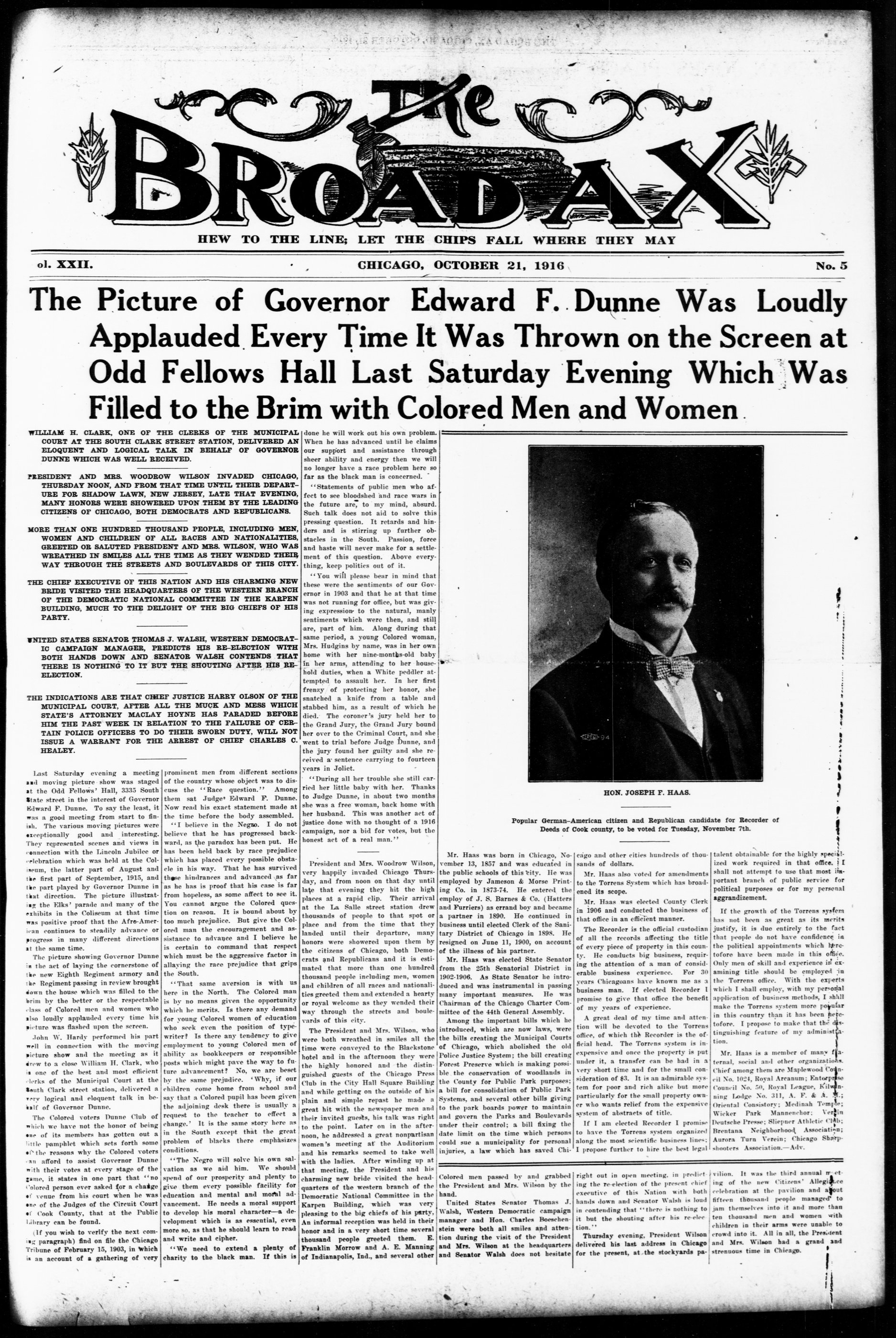
The Picture of Governor Edward F. Dunne Was Loudly Applauded Every Time It Was Thrown on the Screen at Odd Fellows Hall Last Saturday Evening Which Was Filled to the Brim with Colored Men and Women.
WILLIAM H. CLARK, ONE OF THE CLERKS OF THE MUNICIPAL COURT AT THE SOUTH CLARK STREET STATION, DELIVERED AN ELOQUENT AND LOGICAL TALK IN BEHALF OF GOVERNOR DUNNE WHICH WAS WELL RECEIVED.
PRESIDENT AND MRS. WOODROW WILSON INVADED CHICAGO, THURSDAY NOON, AND FROM THAT TIME UNTIL THEIR DEPARTURE FOR SHADOW LAWN, NEW JERSEY, LATE THAT EVENING, MANY HONORS WERE SHOWERED UPON THEM BY THE LEADING CITIZENS OF CHICAGO, BOTH DEMOCRATS AND REPUBLICANS.
MORE THAN ONE HUNDRED THOUSAND PEOPLE, INCLUDING MEN, WOMEN AND CHILDREN OF ALL RACES AND NATIONALITIES, GREETED OR SALUTED PRESIDENT AND MRS. WILSON, WHO WAS WREATHED IN SMILES ALL THE TIME AS THEY WENDED THEIR WAY THROUGH THE STREETS AND BOULEVARDS OF THIS CITY.
THE CHIEF EXECUTIVE OF THIS NATION AND HIS CHARMING NEW BRIDE VISITED THE HEADQUARTERS OF THE WESTERN BRANCH OF THE DEMOCRATIC NATIONAL COMMITTEE IN THE KARPEN BUILDING, MUCH TO THE DELIGHT OF THE BIG CHIEFS OF HIS PARTY.
UNITED STATES SENATOR THOMAS J. WALSH, WESTERN DEMOCRATIC CAMPAIGN MANAGER, PREDICTS HIS RE-ELECTION WITH BOTH HANDS DOWN AND SENATOR WALSH CONTENDS THAT THERE IS NOTHING TO IT BUT THE SHOUTING AFTER HIS RE-ELECTION.
THE INDICATIONS ARE THAT CHIEF JUSTICE HARRY OLSON OF THE MUNICIPAL COURT, AFTER ALL THE MUCK AND MESS WHICH STATE'S ATTORNEY MACLAY HOYNE HAS PARADED BEFORE HIM THE PAST WEEK IN RELATION TO THE FAILURE OF CERTAIN POLICE OFFICERS TO DO THEIR SWORN DUTY, WILL NOT ISSUE A WARRANT FOR THE ARREST OF CHIEF CHARLES C. HEALEY.
ol. XXII.
The Picture
Apple
Odd
Filled
WILLIAM H. CLARK, ONE OF THE
COURT AT THE SOUTH CLARE
ELOQUENT AND LOGICAL T
DUNNE WHICH WAS WELL RE
PRESIDENT AND MRS. WOODR
THURSDAY NOON, AND FROM
URE FOR SHADOW LAWN, NE
MANY HONORS WERE SHOWED
CITIZENS OF CHICAGO, BOTH
MORE THAN ONE HUNDRED THE
WOMEN AND CHILDREN OF
GREETED OR SALUTED PRESID
WREATHED IN SMILES ALL THE
WAY THROUGH THE STREETS
THE CHIEF EXECUTIVE OF THIS
BRIDE VISITED THE HEADQU
OF THE DEMOCRATIC NATION
BUILDING, MUCH TO THE DE
PARTY.
UNITED STATES SENATOR THOMA
IC CAMPAIGN MANAGER, PRI
BOTH HANDS DOWN AND S
THERE IS NOTHING TO IT BU
ELECTION.
THE INDICATIONS ARE THAT CHIE
MUNICIPAL COURT, AFTER A
STATE'S ATTORNEY MACLAY
HIM THE PAST WEEK IN RE
TAIN POLICE OFFICERS TO D
ISSUE A WARRANTY FOR THE
HEALEY.
Last Saturday evening a meeting and moving picture show was staged at the Odd Fellows' Hall, 3335 South State street in the interest of Governor Edward F. Dunne. To say the least, it was a good meeting from start to finish. The various moving pictures were exceptionally good and interesting. They represented scenes and views in connection with the Lincoln Jubilee or celebration which was held at the Coliseum, the latter part of August and the first part of September, 1915, and the part played by Governor Dunne in that direction. The picture illustrating the Elks' parade and many of the exhibits in the Coliseum at that time was positive proof that the Afro-American continues to steadily advance or progress in many different directions at the same time.
The picture showing Governor Dunne in the act of laying the cornerstone of the new Eighth Regiment armory and the Regiment passing in review brought down the house which was filled to the brim by the better or the respectable class of Colored men and women who also loudly applauded every time his picture was flashed upon the screen.
John W. Hardy performed his part well in connection with the moving picture show and the meeting as it drew to a close William H. Clark, who is one of the best and most efficient clerks of the Municipal Court at the South Clark street station, delivered a very logical and eloquent talk in behalf of Governor Dunne.
The Colored voters Dunne Club of which we have not the honor of being one of its members has gotten out a little pamphlet which sets forth some of the reasons why the Colored voters can afford to assist Governor Dunne with their votes at every stage of the game, it states in one part that "no Colored person ever asked for a change of venue from his court when he was one of the Judges of the Circuit Court of Cook County, that at the Public Library can be found.
(If you wish to verify the next coming paragraph) find on file the Chicago Tribune of February 15, 1903, in which is an account of a gathering of very
```markdown
```
prominent men from different sections of the country whose object was to discuss the "Race question." Among them sat Judge Edward F. Dunne. Now read his exact statement made at the time before the body assembled. "I believe in the Negro. I do not believe that he has progressed backward, as the paradox has been put. He has been held back by race prejudice which has placed every possible obstacle in his way. That he has survived those hindrances and advanced as far as he has is proof that his case is far from hopeless, as some affect to see it. You cannot argue the Colored question on reason. It is bound about by too much prejudice. But give the Colored man the encouragement and assistance to advance and I believe he is certain to command that respect which must be the aggressive factor in allaying the race prejudice that grips the South.
"That same aversion is with us here in the North. The Colored man is by no means given the opportunity which he merits. Is there any demand for young Colored women of education who seek even the position of typewriter? Is there any tendency to give employment to young Colored men of ability as bookkeepers or responsible posts which might pave the way to future advancement? No, we are beset by the same prejudice. 'Why, if our children come home from school and say that a Colored pupil has been given the adjoining desk there is usually a request to the teacher to effect a change.' It is the same story here as in the South except that the great problem of blacks there emphasizes conditions.
"The Negro will solve his own salvation as we aid him. We should spend of our prosperity and plenty to give them every possible facility for education and mental and moral advancement. He needs a moral support to develop his moral character—a development which is as essential, even more so, as that he should learn to read and write and cipher.
"We need to extend a plenty of charity to the black man. If this is
CHICAGO, OCTOBER 21, 1916
done he will work out his own problem. When he has advanced until he claims our support and assistance through sheer ability and energy then we will no longer have a race problem here so far as the black man is concerned.
"Statements of public men who affect to see bloodshed and race wars in the future are, to my mind, absurd. Such talk does not aid to solve this pressing question. It retards and hinders and is stirring up further obstacles in the South. Passion, force and haste will never make for a settlement of this question. Above everything, keep politics out of it.
"You will please bear in mind that these were the sentiments of our Governor in 1903 and that he at that time was not running for office, but was giving expression to the natural, manly sentiments which were then, and still are, part of him. Along during that same period, a young Colored woman, Mrs. Hudgins by name, was in her own home with her nine-months-old baby in her arms, attending to her household duties, when a White peddler attempted to assault her. In her first frenzy of protecting her honor, she snatched a knife from a table and stabbed him, as a result of which he died. The coroner's jury held her to the Grand Jury, the Grand Jury bound her over to the Criminal Court, and she went to trial before Judge Dunne, and the jury found her guilty and she received a sentence carrying to fourteen years in Joliet.
"During all her trouble she still carried her little baby with her. Thanks to Judge Dunne, in about two months she was a free woman, back home with her husband. This was another act of justice done with no thought of a 1916 campaign, nor a bid for votes, but the honest act of a real man."
President and Mrs. Woodrow Wilson, very happily invaded Chicago Thursday, and from noon on that day until late that evening they hit the high places at a rapid clip. Their arrival at the La Salle street station drew thousands of people to that spot or place and from the time that they landed until their departure, many honors were showered upon them by the citizens of Chicago, both Democrats and Republicans and it is estimated that more than one hundred thousand people including men, women and children of all races and nationalities greeted them and extended a hearty or royal welcome as they wended their way through the streets and boulevards of this city.
The President and Mrs. Wilson, who were both wreathed in smiles all the time were conveyed to the Blackstone hotel and in the afternoon they were the highly honored and the distinguished guests of the Chicago Press Club in the City Hall Square Building and while getting on the outside of his plain and simple repast he made a great hit with the newspaper men and their invited guests, his talk was right to the point. Later on in the afternoon, he addressed a great nonpartisan women's meeting at the Auditorium and his remarks seemed to take well with the ladies. After winding up at that meeting, the President and his charming new bride visited the headquarters of the western branch of the Democratic National Committee in the Karpen Building, which was very pleasing to the big chiefs of his party. An informal reception was held in their honor and in a very short time several thousand people greeted them. E. Franklin Morrow and A. E. Manning of Indianapolis, Ind., and several other
94
Mr. Haas was born in Chicago, November 13, 1857 and was educated in the public schools of this city. He was employed by Jameson & Morse Printing Co. in 1873-74. He entered the employ of J. S. Barnes & Co. (Hatters and Furriers) as errand boy and became a partner in 1890. He continued in business until elected Clerk of the Sanitary District of Chicago in 1898. He resigned on June 11, 1900, on account of the illness of his partner. Mr. Haas was elected State Senator from the 25th Senatorial District in 1902-1906. As State Senator he introduced and was instrumental in passing many important measures. He was Chairman of the Chicago Charter Committee of the 44th General Assembly.
Among the important bills which he introduced, which are now laws, were the bills creating the Municipal Courts of Chicago, which abolished the old Police Justice System; the bill creating Forest Preserve which is making possible the conservation of woodlands in the County for Public Park purposes; a bill for consolidation of Public Park Systems, and several other bills giving to the park boards power to maintain and govern the Parks and Boulevards under their control; a bill fixing the date limit on the time which persons could sue a municipality for personal injuries, a law which has saved Chi-
Colored men passed by and grabbed the President and Mrs. Wilson by the hand.
United States Senator Thomas J. Walsh, Western Democratic campaign manager and Hon. Charles Boeschenstein were both all smiles and attention during the visit of the President and Mrs. Wilson at the headquarters and Mrs. Walsh does not hesitate
HON. JOSEPH F. HAAS.
American citizen and Republican candidate Jook county, to be voted for Tuesday, N
cago and other cities hundreds of thousands of dollars.
Mr. Haas also voted for amendments to the Torrens System which has broadened its scope.
Mr. Haas was elected County Clerk in 1906 and conducted the business of that office in an efficient manner.
The Recorder is the official custodian of all the records affecting the title of every piece of property in this county. He conducts big business, requiring the attention of a man of considerable business experience. For 30 years Chicagoans have known me as a business man. If elected Recorder I promise to give that office the benefit of my years of experience.
A great deal of my time and attention will be devoted to the Torrens office, of which the Recorder is the official head. The Torrens system is inexpensive and once the property is put under it, a transfer can be had in a very short time and for the small consideration of $3. It is an admirable system for poor and rich alike but more particularly for the small property owner who wants relief from the expensive system of abstracts of title.
If I am elected Recorder I promise to have the Torrens system organized along the most scientific business lines; I propose further to hire the best legal
right out in open meeting, in predicting the re-election of the present chief executive of this Nation with both hands down and Senator Walsh is loud in contending that "there is nothing to it but the shouting after his re-election."
Thursday evening, President Wilson delivered his last address in Chicago for the present, at the stockyards pa-
No. 5
talent obtainable for the highly specialized work required in that office. I shall not attempt to use that most important branch of public service for political purposes or for my personal aggrandizement.
If the growth of the Torrens system has not been as great as its merits justify, it is due entirely to the fact that people do not have confidence in the political appointments which heretofore have been made in this office. Only men of skill and experience in examining title should be employed in the Torrens office. With the experts which I shall employ, with my personal application of business methods, I shall make the Torrens system more popular in this country than it has been heretofore. I propose to make that the distinguishing feature of my administration.
Mr. Haas is a member of many fa-
ternal, social and other organizations.
Chief among them are Maplewood Co-
ncil No. 1024, Royal Areanum; Enterpris-
e Council No. 50, Royal League, Killin-
wang Lodge No. 311, A. F. & A. M.
Oriental Consistory; Medinah Temple
Wicker Park Mannenchor; Verden
Deutsche Presse; Slieper Athletic Club;
Brentana Neighborhood Association;
Aurora Turn Verein; Chicago Sharp-
shooters Association.—Adv.
vilion. It was the third annual meeting of the new Citizens' Allegiance celebration at the pavilion and about fifteen thousand people managed to jam themselves into it and more than ten thousand men and women with children in their arms were unable to crowd into it. All in all, the President and Mrs. Wilson had a grand and strenuous time in Chicago.
PAGE TWO
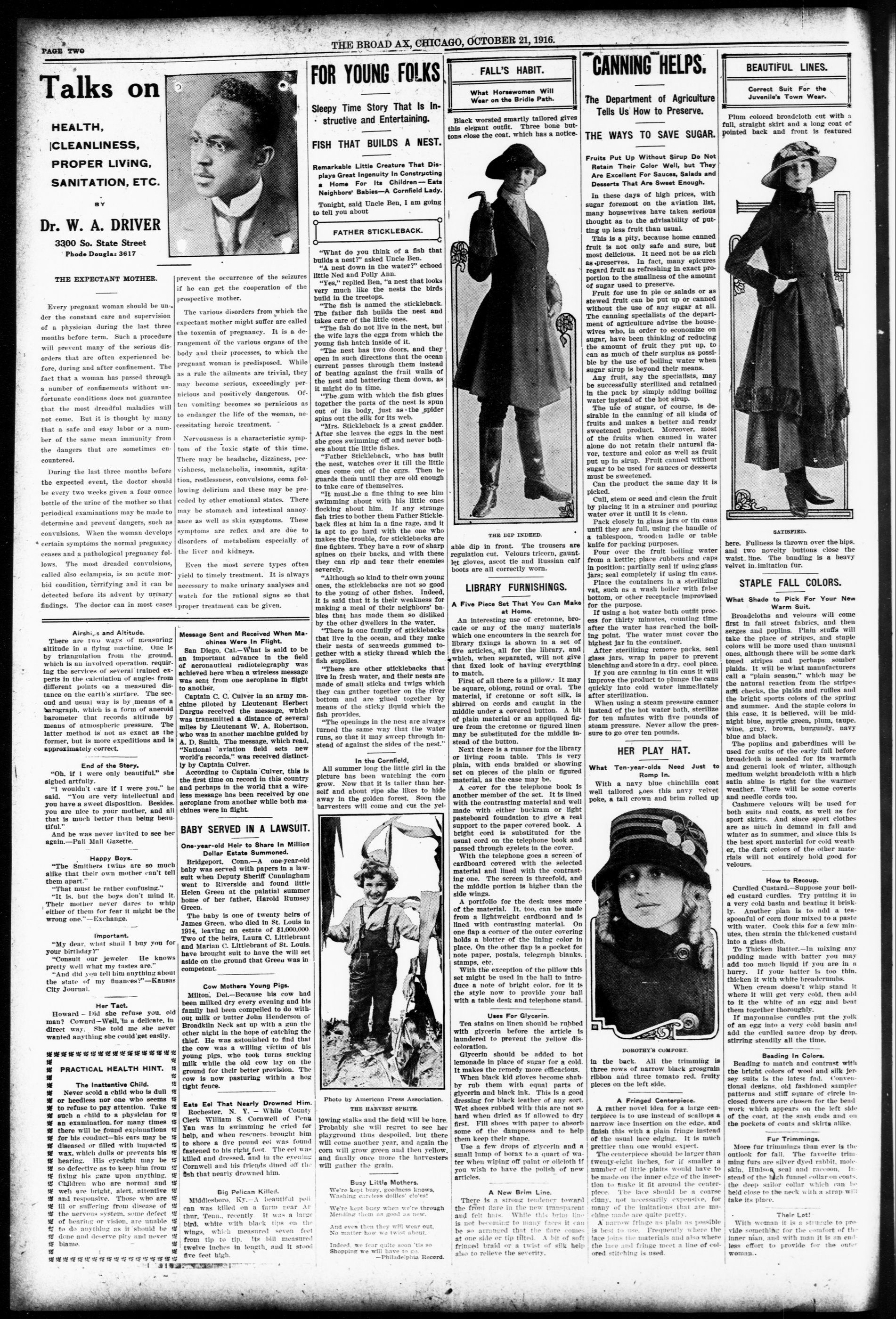
Talks on
HEALTH,
CLEANLINESS,
PROPER LIVING,
SANITATION, ETC.
Dr. W. A. DRIVER
3300 So. State Street
Phode Douglass 3617
THE EXPECTANT MOTHER
Every pregnant woman should be under the constant care and supervision of a physician during the last three months before term. Such a procedure will prevent many of the serious disorders that are often experienced before, during and after confinement. The fact that a woman has passed through a number of confinements without unfortunate conditions does not guarantee that the most dreadful maladies will not come. But it is thought by many that a safe and easy labor or a number of the same mean immunity from the dangers that are sometimes encountered.
During the last three months before the expected event, the doctor should be every two weeks given a four ounce bottle of the urine of the mother so that periodical examinations may be made to determine and prevent dangers, such as convulsions. When the woman develops certain symptoms the normal pregnancy ceases and a pathological pregnancy follows. The most dreaded convulsions, called also eclampsia, is an acute morbid condition, terrifying and it can be detected before its advent by urinary findings. The doctor can in most cases
Airshi s and Altitude
There are two ways of measuring altitude in a flying machine. One is by triangulation from the ground, which is an involved operation, requiring the services of several trained experts in the calculation of angles from different points on a measured distance on the earth's surface. The second and usual way is by means of a barograph, which is a form of aneroid barometer that records altitude by means of atmospheric pressure. The latter method is not as exact as the former, but is more expeditious and is approximately correct.
End of the Story.
"Oh, if I were only beautiful," she sighed artfully.
"I wouldn't care if I were you." he said. "You are very intellectual and you have a sweet disposition. Besides, you are nice to your mother, and all that is much better than being beautiful."
And he was never invited to see her again—Pall Mall Gazette.
Happy Boys.
"The Smithers twins are so much alike that their own mother can't tell them apart." "That must be rather confusing."
"It is, but the boys don't mind it. Their mother never dares to whip either of them for fear it might be the wrong one."—Exchange.
Important.
"My dear, what shall I buy you for your birthday?"
"Consult our jeweler. He knows pretty well what my tastes are."
"And did you tell him anything about the state of my finances?"—Kansas City Journal.
Her Tact.
Howard - Did she refuse you, old man? Coward-Well, in a delicate, in direct way. She told me she never wanted anything she could get easily.
```markdown
```
张
PRACTICAL HEALTH HINT.
The Inattentive Child.
Never scold a child who is dull or heedless nor one who seems to refuse to pay attention. Take such a child to a physician for an examination. for many times there will be found explanations for his conduct—his ears may be diseased or filled with impacted wax, which dulls or prevents his hearing. His eyesight may be so defective as to keep him from fixing his gaze upon anything. Children who are normal and we are bright, alert, attentive and responsive. Those who are ill or suffering from disease of the nervous system, some defect of hearing or vision, are unable to do anything as it should be done and deserve pity and never blame.
---
[Name]
prevent the occurrence of the seizures if he can get the cooperation of the prospective mother.
The various disorders from which the expectant mother might suffer are called the toxemia of pregnancy. It is a derangement of the various organs of the body and their processes, to which the pregnant woman is predisposed. While as a rule the ailments are trivial, they may become serious, exceedingly pernicious and positively dangerous. Often vomiting becomes so pernicious as to endanger the life of the woman, necessitating heroic treatment.
Nervousness is a characteristic symptom of the toxic state of this time. There may be headache, dizziness, peevishness, melancholia, insomnia, agitation, restlessness, convulsions, coma following delirium and these may be preceded by other emotional states. There may be stomach and intestinal annoyance as well as skin symptoms. These symptoms are reflex and are due to disorders of metabolism especially of the liver and kidneys.
Even the most severe types often yield to timely treatment. It is always necessary to make urinary analyses and watch for the rational signs so that proper treatment can be given.
Message Sent and Received When Machines Were In Flight.
San Diego, Cal.—What is said to be an important advance in the field of aeronautical radiotelegraphy was achieved here when a wireless message was sent from one aeroplane in flight to another.
Captain C. C. Culver in an army machine piloted by Lieutenant Herbert Dargue received the message, which was transmitted a distance of several miles by Lieutenant W. A. Robertson, who was in another machine guided by A. D. Smith. The message, which read, "National aviation field sets new world's records," was received distinctly by Captain Culver.
According to Captain Culver, this is the first time on record in this country and perhaps in the world that a wireless message has been received by one aeroplane from another while both machines were in flight.
BABY SERVED IN A LAWSUIT.
One-year-old Heir to Share In Million Dollar Estate Summoned.
Bridgeport, Conn. A one-year-old baby was served with papers in a lawsuit when Deputy Sheriff Cunningham went to Riverside and found little Helen Green at the palatial summer home of her father, Harold Rumsey Green.
The baby is one of twenty heirs of James Green, who died in St. Louis in 1914, leaving an estate of $1,000,000. Two of the heirs, Laura C. Littlebrant and Marian C. Littlebrant of St. Louis, have brought suit to have the will set aside on the ground that Green was in competent.
Cow Mothers Young Pigs.
Milton, Del.—Because his cow had been milked dry every evening and his family had been compelled to do without milk or butter John Henderson of Broadkiln Neck up with a gun the other night in the hope of catching the thief. He was astonished to find that the cow was a willing victim of his young pigs, who took turns sucking milk while the old cow lay on the ground for their better provision. The cow is now pasturing within a hog tight fence.
Eats Eel That Nearly Drowned Him. Rochester. N. Y. - While County Clerk William S. Cornwell of Pena Yan was in swimming he cried for help, and when rescuers brought him to shore a five pound eel was found fastened to his right foot. The eel was killed and dressed, and in the evening Cornwell and his friends dined off the fish that nearly drowned him.
Big Pelican Killed.
Middlesboro, Ky. -A beautiful poli can was killed on a farm near Arthur, Tenn., recently. It was a large bird, white with black tips on the wings, which measured seven feet from tip to tip. Its bill measured twelve inches in length, and it stood five feet high.
THE BROAD AX, CHICAGO, OCTOBER 21, 1916.
FOR YOUNG FOLKS
FOR YOUNG FOLKS
Sleepy Time Story That Is Instructive and Entertaining.
---
Tonight, said Uncle Ben, I am going to tell you about
FATHER STICKLEBACK.
"What do you think of a fish that builds a nest?" asked Uncle Ben.
bruids a nest.
"A nest down in the water?" echoed little Ned and Polly Ann.
"Yes," replied Ben, "a nest that looks very much like the nests the birds build in the treetops.
"The fish is named the stickleback.
The father fish builds the nest and takes care of the little ones.
"The fish do not live in the nest, but the wife lays the eggs from which the young fish hatch inside of it.
"The nest has two doors, and they open in such directions that the ocean current passes through them instead of beating against the frail walls of the nest and battering them down, as it might do in time.
"The gum with which the fish glues together the parts of the nest is spun out of its body, just as the spider spins out the silk for its web.
"Mrs. Stickleback is a great gadder. After she leaves the eggs in the nest she goes swimming off and never bothers about the little fishes.
"Father Stickleback, who has built the nest, watches over it till the little ones come out of the eggs. Then he guards them until they are old enough to take care of themselves.
"It must be a fine thing to see him swimming about with his little ones flocking about him. If any strange fish tries to bother them Father Stickleback flies at him in a fine rage, and it is apt to go hard with the one who makes the trouble, for sticklebacks are fine fighters. They have a row of sharp spines on their backs, and with these they can rip and tear their enemies severely.
"Although so kind to their own young ones, the sticklebacks are not so good to the young of other fishes. Indeed, it is said that it is their weakness for making a meal of their neighbors' bales that has made them so disliked by the other dwellers in the water.
"There is one family of sticklebacks that live in the ocean, and they make their nests of seaweeds gummed together with a sticky thread which the fish supplies.
"There are other sticklebacks that live in fresh water, and their nests are made of small sticks and twigs which they can gather together on the river bottom and are glued together by means of the sticky liquid which the fish provides.
"The openings in the nest are always turned the same way that the water runs, so that it may sweep through instead of against the sides of the nest."
In the Cornfield.
All summer long the little girl in the picture has been watching the corn grow. Now that it is taller than herself and about ripe she likes to hide away in the golden forest. Soon the harvesters will come and cut the yel
1930
Photo by American Press Association.
THE HARVEST SPRITE.
lowing stalks and the field will be bare. Probably she will regret to see her playground thus despoiled, but there will come another year, and again the corn will grow green and then yellow, and finally once more the harvesters will gather the grain.
Busy Little Mothers.
We're kept busy, goodness knows.
Washing earless dolles' clothes!
We're kept busy when we're through Mending them as good as new.
And even then they will wear out,
No matter how we tread about.
Indeed, we fear quite soon 'tis so Shopping we will have to go.
—Philadelphia Record.
FALL'S HABIT.
What Horsewomen Will Wear on the Bridle Path.
Black worsted smartly tailored gives this elegant outfit. Three bone buttons close the coat, which has a notice.
A
THE DIP INDEED.
able dip in front. The trousers are regulation cut. Velours tricorn, gauntlet gloves, ascot tie and Russian calf boots are all correctly worn.
LIBRARY FURNISHINGS
A Five Piece Set That You Can Make at Home.
An interesting use of cretonne, brocade or any of the many materials which one encounters in the search for library fixings is shown in a set of five articles, all for the library, and which, when separated, will not give that fixed look of having everything to match.
First of all there is a pillow. It may be square, oblong, round or oval. The material, if cretonne or soft silk, is shirred on cords and caught in the middle under a covered button. A bit of plain material or an appliqued figure from the cretonne or figured linen may be substituted for the middle instead of the button.
Next there is a runner for the library or living room table. This is very plain, with ends braided or showing set on pieces of the plain or figured material, as the case may be.
A cover for the telephone book is another member of the set. It is lined with the contrasting material and well made with either buckram or light pasteboard foundation to give a real support to the paper covered book. A bright cord is substituted for the usual cord on the telephone book and passed through eyelets in the cover. With the telephone goes a screen of cardboard covered with the selected material and lined with the contrasting one. The screen is threefold, and the middle portion is higher than the side wings. A portfolio for the desk uses more of the material. It, too, can be made from a lightweight cardboard and is lined with contrasting material. On one flap a corner of the outer covering holds a blotter of the lining color in place. On the other flap is a pocket for note paper, postals, telegraph blanks, stamps, etc.
With the exception of the pillow this set might be used in the hall to introduce a note of bright color, for it is the style now to provide your hall with a table desk and telephone stand.
Uses For Glycerin
Tea stains on linen should be rubbed with glycerin before the article is laundered to prevent the yellow discoloration. Glycerin should be added to hot lemonade in place of sugar for a cold. It makes the remedy more efficacious. When black kid gloves become shabby rub them with equal parts of glycerin and black ink. This is a good dressing for black leather of any sort. Wet shoes rubbed with this are not so hard when dried as if allowed to dry first. Fill shoes with paper to absorb some of the dampness and to help them keep their shape. Use a few drops of glycerin and a small lump of borax to a quart of water when wiping off paint or oilcloth if you wish to have the polish of new articles.
A New Brim Line.
There is a strong tendency toward the front flare in the new transparent and felt hats. While this brim line is not becoming to many faces it can be so arranged that the flare comes at one side or tip tilted. A bit of soft fringed braid or a twist of silk help also to relieve the severity.
CANNING HELPS.
The Department of Agriculture Tells Us How to Preserve.
THE WAYS TO SAVE SUGAR.
Fruits Put Up Without Sirup Do Not Retain Their Color Well, but They Are Excellent For Sauces, Salads and Desserts That Are Sweet Enough. In these days of high prices, with sugar foremost on the aviation list, many housewives have taken serious thought as to the advisability of putting up less fruit than usual. This is a pity, because home canned fruit is not only safe and sure, but most delicious. It need not be as rich as preserves. In fact, many epicures regard fruit as refreshing in exact proportion to the smallness of the amount of sugar used to preserve.
Fruit for use in pie or salads or as stewed fruit can be put up or caned without the use of any sugar at all. The canning specialists of the department of agriculture advise the housewives who, in order to economize on sugar, have been thinking of reducing the amount of fruit they put up, to can as much of their surplus as possible by the use of boiling water when sugar sirup is beyond their means. Any fruit, say the specialists, may be successfully sterilized and retained in the pack by simply adding boiling water instead of the hot sirup.
The use of sugar, of course, is desirable in the canning of all kinds of fruits and makes a better and ready sweetened product. Moreover, most of the fruits when canned in water alone do not retain their natural flavor, texture and color as well as fruit put up in sirup. Fruit canned without sugar to be used for sauces or desserts must be sweetened.
Can the product the same day it is picked.
Cull, stem or seed and clean the fruit by placing it in a strainer and pouring water over it until it is clean.
Pack closely in glass jars or tin cans until they are full, using the handle of a tablespoon, wooden ladle or table knife for packing purposes.
Pour over the fruit boiling water from a kettle; place rubbers and caps in position; partially seal if using glass jars; seal completely if using tin cans.
Place the containers in a sterilizing vat, such as a wash boiler with false bottom, or other receptacle improvised for the purpose.
If using a hot water bath outfit process for thirty minutes, counting time after the water has reached the boiling point. The water must cover the highest jar in the container.
After sterilizing remove packs, seal glass jars, wrap in paper to prevent bleaching and store in a dry, cool place.
If you are canning in tin cans it will improve the product to plunge the cans quickly into cold water immediately after sterilization.
When using a steam pressure canner instead of the hot water bath, sterilize for ten minutes with five pounds of steam pressure. Never allow the pressure to go over ten pounds.
HER PLAY HAT.
What Ten-year-olds Need Just to Romp In.
With a navy blue chinchilla coat well tailored goes this navy velvet poke, a tall crown and brim rolled up
A
DOROTHY'S COMFORT.
in the back. All the trimming is three rows of narrow black grosgrain ribbon and three tomato red. fruity pieces on the left side.
A Fringed Centerpiece.
A rather novel idea for a large centerpiece is to use instead of scallops a narrow lace insertion on the edge, and finish this with a plain fringe instead of the usual lace edging. It is much prettier than one would expect.
The centerpiece should be larger than twenty-eight inches, for if smaller a number of little plains would have to be made on the inner edge of the insertion to make it fit around the centerpiece. The lace should be a course clunk, not necessarily expensive, for many of the imitations that are machine made are quite pretty.
A narrow fringe as plain as possible is best to use. Frequently where the lace joins the materials and also where the lace and fringe meet a line of colored stitching is used.
Correct Suit For the Juvenile's Town Wear.
Plum colored broadcloth cut with a full, straight skirt and a long coat of pointed back and front is featured
I
SATISFIED.
here. Fullness is thrown over the hips, and two novelty buttons close the waist. line. The banding is a heavy velvet in imitation fur.
STAPLE FALL COLORS.
What Shade to Pick For Your New Warm Suit.
Broadcloths and velours will come first in fall street fabrics, and then serges and poplins. Plain stuffs will take the place of stripes and staple colors will be more used than unusual ones, although there will be some dark toned stripes and perhaps somber plaids. It will be what manufacturers call a "plain season," which may be the natural reaction from the stripes and checks, the plaids and ruffles and the bright sports colors of the spring and summer. And the staple colors in this case, it is believed, will be midnight blue, myrtle green, plum, taupe, wine, gray, brown, burgundy, navy blue and black.
The poplins and gaberdines will be used for suits of the early fall before broadcloth is needed for its warmth and general look of winter, although medium weight broadcloth with a high satin shine is right for the warmer weather. There will be some coverts and needle cords too. Cashmere velours will be used for both suits and coats, as well as for sport skirts. And since sport clothes are as much in demand in fall and winter as in summer, and since this is the best sport material for cold weather, the dark colors of the other materials will not entirely hold good for velours.
How to Recoup.
Curdled Custard.—Suppose your boiled custard curdles. Try putting it in a very cold basin and beating it briskly. Another plan is to add a teaspoonful of corn flour mixed to a paste with water. Cook this for a few minutes, then strain the thickened custard into a glass dish.
To Thicken Batter.—In mixing any pudding made with batter you may add too much liquid if you are in a hurry. If your batter is too thin, thicken it with white breadcrumbs.
When cream doesn't whip stand it where it will get very cold, then add to it the white of an egg and beat them together thoroughly.
If mayonnaise curdles put the yolk of an egg into a very cold basin and add the curdled sauce drop by drop, stirring steadily all the time.
Beading In Colors.
Reading to match and contrast with the bright colors of wool and silk jersey suits is the latest fad. Conventional designs, old fashioned sampler patterns and stiff square of circle inclosed flowers are chosen for the bead work which appears on the left side of the coat, at the sash ends and on the pockets of coats and skirts alike.
Fur Trimmings
More fur trimmings than ever is the outlook for fall. The favorite trimming furs are silver dyed rabbit, mole skin, Hudson seal and raccoon. Instead of the high funnel collar on coats the deep sailor collar which can be held close to the neck with a strap will take its place.
Their Lot!
With woman it is a struggle to provide something for the comfort of the inner man, and with man it is an endless effort to provide for the outer woman.
BALDHEADED ALASKAN BEARS
Volcanic Ash Brings Hardship to Bruin on Kadiak Island.
Seward, Alaska.—It will take more than two or three years of enforced diet of straight meat and fish and a loss of hair to seriously set back the bear population of Kadiak island, according to D. Winn of the United States bureau of fisheries.
Kadiak island, says Mr. Winn, in 1912 was covered with volcanic ash at no point at a depth less than eleven inches. The ash killed all vegetation, and as all bears are fond of a mixed diet of meat, fish and vegetables, they found 1913 and 1914 unpleasant from a dietary standpoint.
Another effect of the fall of ash, according to Mr. Winn, was the havoc it created with the furry coats of the animals. Bald headed bears are now as common on Kadikai island as bald headed men in the front row of a musical comedy. The ash sifted down on to the skins of the animals as it fell, and the first rain turned it to lye, which had the effect of almost tanning the skins of the bears while yet a part of their personal effects.
WHITTLES·VIOLIN FINGERS.
Player Hopes to Increase His Proficiency by Surgery.
Wichita, Kan.—In order to become a more proficient violin artist Mark Sandfort, a member of an orchestra here, had a piece of flesh taken from each of his six fingers. The incisions were drawn together and sewn with horsehair. The operation was performed by Dr. F. H. S. Hickok, and Sandfort will be able to remove the bandages soon.
Sandfort has won a reputation as a violinist. However, his execution of musical selections was not as good as he desired it to be. He hit upon a plan. He would have his fingers whittled down. He waited until the season closed and had the operation performed.
According to physicians, this is the first time that an operation of this kind has been performed.
BOY FALLS; SERVICE STOPS.
Pastor and Congregation See Lad Hit by Electric Current.
Little Rock, Ark.—Kenneth McEwen eleven years of age, was electrocuted thirty feet in the air on a lighting tower in view of the congregation of a church that was holding services on the church lawn because of the heat. The boy was knocking the wire that supplied current to the lights on the tower against the steel frame to produce sparks. Suddenly a flash of blue flames enveloped him, and he plunged downward, fracturing his skull on the pavement below. He died in a hospital a few minutes later. The pastor of the church, the Rev. E P. Aldredge, was preaching a special sermon to boys. He rushed over, alided in placing the dying lad in an ambulance and then resumed his sermon, using the accident as a warning to the boys.
GIRL'S PROFIT IN HOGS.
Raising Swine Not a Finishing School For Debutantes.
Holtville, Cal. - Raising hogs for pleasure and profit is the occupation of Miss Josie Fuller, seventeen, the youngest and best all around feminine pork producer in the Imperial valley.
It is her ambition to become the best expert on hogs in her district. Her herd numbers fifty strong and is increasing. "Pig culture isn't aesthetic work, of course," said Miss Fuller. "It can't be considered a finishing school for debutantes, but there's money in it." She has established a record of developing her porkers for the market at a cost of $3½ cents a pound.
"Women may not admire hogs, but if they don't it's because they know so little about them. Once interested they become just as capable as men in handling swine."
TWO DEATHS IN ONE HOME
Sees Mother-in-law Stricken With Heart Failure, Then Dies.
Philadelphia - Stricken with heart failure just after she had called her son to dinner at noon, Mrs. Rebecca Thomas, seventy-three years old, a sister of Jesse Pratt, former mayor of Camden, fell dead in the dining room of her Camden home.
Mrs. Madeline Thomas, her daughter-in-law, who was in an adjoining room, ran to her assistance and was leaning over her, trying to lift her form to a couch, when she, too, collapsed and fell lifeless.
ANOTHER QUITS SING SING
Officials Think Prisoner Swam to Liberty.
Ossining, N. Y.—"I'm going into the garden to get some tomatoes for break fast," said Elmer Schultz, a prisoner at Sing Sing, as he walked out of the power house, where he was doing duty as a fireman. Some hours later the big whistle tooted the message that another prisoner had escaped.
Prison officials had then found two iron pickets had been pulled apart and concluded that Schultz went through the opening, dived into the Hudson and swam to liberty.
Lost Dog Returned Home.
New York. After a year's absence a beagle belonging to Louis W. Well of Flushing. N. Y., returned home. Mr. Well went on a hunting trip a year ago and took the beagle along. He lost the dog. The dog seemed to enjoy its homecoming, and the Well family showed its delight in a way that tickled the dog's palate.
Stagestruck Women.
William A. Page, the Chicago crick and publicity writer, says in the Woman's Home Companion in an article about stestruck women;
"And what becomes of them? Caught in the eddies of frivolity, many of them temporarily abandon their stage ambitions in the kaleidoscopic life of Broadway. Others live in hall bedrooms, boll eggs over a gas jet and waste their young lives in the fruitless pursuit of a rainbow which they never find, only sooner or later to return home sadly and settle down to forget their stage ambitions. Others study, economize, sincerely strive for engagements, possibly get small roles with some obscure company and start in on a career which will be filled with many, many disappointments. And of the thousands who came so bravely to the front last year how many still remain in the lists? Not counting those who may have gone into musical comedy, perhaps a score still cherish the shrine of Marlowe and of Adams. For the rest, oblivion."
Shaw Didn't Like Himself
"Many years ago, in a house in Ashley Gardens," writes G. Bernard Shaw in the New Witness. "I was walking along a corridor with other guests at a musical evening when I saw coming toward me a man who produced an extraordinarily disagreeable impression on me, a tall young man in evening dress, with a blond beard and, as it seemed to me, a hateful expression.
"He was coming straight at me. I moved aside to avoid him, and he moved, too, apparently to get into my way again. An impulse of rage at his insult was checked just in time by the discovery that instead of walking along a corridor I was crossing a square landing and that the detestable apparition who had chilled my very soul with his abominable aspect was a reflection of myself in the wall of mirror which the tenant of the Ashley Gardens flat had put up to give his cramped dwelling an appearance of spacious magnificence."
Power In Plant Cells
Along with the formation of the sugar, and caused in part by its accumulation, there develop within the minute cells of the blueberry plants enormous osmotic pressures, which enable the plant to push its buds open. F. V. Coville writes in the National Geographic Magazine.
These pressures are frequently as high as seven atmospheres or more than 100 pounds to the square inch—a pressure that would start a leak in a low pressure steam engine. The pressure may become as high as thirty atmospheres or 450 pounds to the square inch—a force sufficient to blow the cylinder head off of a thousand horsepower Corollis engine. The reason the plant does not explode is because it is broken up into many extremely small and strongly built cells instead of having one big interior cavity. These minute chambers are often as thick walled proportionately as an artillery shell.
A Famous War Horse.
Bucephalus, the charger that carried Alexander the Great through all his campaigns, received his name from the fact that, although white, he had a black mark resembling an ox's head on his forehead.
A Thessalonian had offered the horse for sale to Philip of Macedon, but as none of the monarch's attendants could manage him the king ordered his owner to take him away. Alexander, who was present, expressed his regret at losing so fine an animal, and Philp replied that he would buy the horse if his son could ride him. The offer was accepted by Alexander, who succeeded in the attempt. Bucephalus would never suffer any other person to mount him.
Airing a Room.
In airing a room there are two things to be remembered—first, that the impure air must be allowed to escape and, secondly, that fresh air must be admitted. Impure air in a room is always warm and will therefore rise toward the ceiling, when it will escape if the window is opened at the top, while cold fresh air will enter through the lower part of the window when opened.
A Grand Canyon Sunrise.
A sunrise in the Grand canyon lasts as long as you please. Each hour is a sunrise for some cavern deeper than the last, and, in fact, there are many where it has yet to rise for the first time since the canyon was made by those ages of running water.
His Ashes.
"So you prefer to be cremated when you die?"
"So that my remains may be mingled with the ashes of the grate."—London Telegraph.
Parental Care.
"Did your bride's father give her away?"
"No. he didn't. He left me to find out a few things about her for myself."—Baltimore American.
Causes.
Bix—A physician says that yawning is caused by a lack of oxygen in the blood. Dix—Or a lack of pep in the conversation.—Boston Transcript.
The Comeback:
Skintlint—I have no money, but I will give you a little advice. Beggar—Well. If yer ain't got no money yer advice can't be very valuable.
Sooner or later the world comes around to see the truth and do the right—Hillard.
THE BROAD AX, CHICAGO, OCTOBER 21, 1916
Coney Island's Start.
Coney Island's Start.
The first man to realize the great possibilities of Coney Island as a summer resort was Austin Corbin, a banker and railway official. From the beginning of the last century the beach at Coney Island was frequented by many New Yorkers, but it remained for Corbin to initiate the movement which has made "Coney" a synonym for a certain kind of amusement. Corbin started his financial career at Davenport, Ia., but in 1865 he opened a banking house in New York, and in 1873 he purchased the eastern part of Coney Island. There he created the great resort known as Manhattan Beach. He also became president of the Long Island railroad and played a big part in the development of all the summer resorts on Long Island. In the last forty years Coney Island has become the greatest popular summer resort in the world, and in addition to the millions of transient visitors from the city who go there for the day many thousands are regular summer residents of the hotels and cottages which line its shores. - New York World.
Money Mark Twain Refused:
Money Mark Twain Refused.
By the time that Mark Twain had finally succeeded in paying off the burden of debt that had fallen upon him with the failure of his publishing venture he found himself one of the best paid authors in the world. He refused many offers of money that did not agree with his literary conscience. He declined $10,000 for a tobacco indorsement, though he liked the tobacco well enough. He declined $10,000 a year for five years to lend his name as editor to a humorous periodical. He declined another $10,000 for ten lectures and another for fifty lectures at the same rate—that is, $1,000 a night. And he was offered $1 a word for his writing, which he also declined, making a final arrangement with his regular publishers that they should print whatever he wrote, the payment being 20 (later 30) cents a word.—"Boys' Life of Mark Twain" in St. Nicholas'.
Persian Words In English.
Regarding the Persian language, we all have a few words from that source in our vocabularies, although we may not be aware of our indebentness. There are about a dozen words in the English dictionary which trace to Persia, the most common being perhaps "orange," although this was thought by some to be derived from the Latin "aurum" (gold), "Sash," meaning a ribbon or band (the "sash" of a window is the Latin "capsa"), "shawl" and "taffeta" are other Persian words which have become thoroughly acclimatized, as have "chess." "caravan," "filac," "dervish" and "lac," while "emerald" and "indigo," "azure," "bazaar," "jackal," "musk," "paradise" and "semistar" have also been traced to the same source.-London Opinion.
Sympathy With Nature
Tis an evidence of how directly we are related to nature that we more or less sympathize with the weather and take on the color of the day. Goethe said he worked easiest on a high barometer. One is like a chimney that draws well some days and won't draw at all on others, and the secret is mainly in the condition of the atmosphere. Anything positive and decided with the weather is a good omen. A pouring rain may be more auspicious than a sleeping sunshine. When the stove draws well the fogs and fumes will leave your mind. - John Burroughs.
Teeth as Sentinels.
"When thou sittest to eat with a ruler consider diligently him that is before thee," says the Hebrew proverb, warning a king's guest to regulate his appetite by his host's temper. Boswell. Dr. Johnson's biographer, gives in his notebook a modern paraphrase of the old Jewish proverb: "I said of a rich man who entertained us luxuriously that, although he was exceedingly ridiculous, we restrained ourselves from talking of him as we might doest we should lose his feasts. 'He makes our teeth sentinels on our tongues,' said I."
Fire and Matrimony
In Persia the wedding service is read in front of a fire. In Nicaragua the priest, taking the couple each by the little fingers, leads them to an apartment where a fire is lighted and there instructs the bride in her duties, extinguishing the fire by way of conclusion. In Japan the woman kindles a torch and the bridegroom lights one from it. The playthings of the wife being then burned.
A Record In Governors.
Mrs. Richard Manning of South Carolina had the distinction of being the only woman on record who was the wife of a governor, the sister of a governor, the niece of a governor, the mother of a governor and the aunt and foster mother of a governor.
Accounted For
Aunt~My goodness, Eddie! Why did you take the biggest apple in the dish? Eddie~I was afraid some one else would get it.-Chicago Herald.
Cotton Seed.
It is estimated that one seed of cotton, given the application of all possible care and skill, would produce 40,000,000,000 seeds in six years.
Almost as Bad.
Kathryn—I hear that you said I was double faced. Kitye—I never did. I merely said you were double chinned—Exchange.
Conscience is harder than our enemies. knows more, accuses with more nicety. -George Elliot.
Famous Aztec Runners.
Communication among the Asteces was maintained with the remotest parts of the country by means of couriers. Posthouses were established on the great roads, about two leagues distant from each other. The courier bearing his dispatches in the form of a hieroglyphical painting, ran with them to the first station, where they were taken by another messenger and carried forward to the next, and so on till they reached the capital. These couriers, trained from childhood, travelled with incredible swiftness; not four or five leagues an hour, as an old chronicler would make us believe, but with such speed that dispatches were carried from 100 to 200 miles a day. Fresh fish was frequently served at Montezuma's table in twenty-four hours from the time it had been taken in the gulf of Mexico, 200 miles from the capital. In this way intelligence of the movements of the royal armies was rapidly brought to court, and the dress of the courier denoting by its color that of his tidings, spreading joy or consternation in the towns through which he passed.—From Prescott's "History of the Conquest of Mexico."
Picardy Names:
Whence come the names of the Picardy villages, strange even in France? Among the names of places are Bray, which is of Celtic origin and signifies a swamp or morass. Fay is from the Latin "agus," meaning a beech tree. Hem is a home or habitation. Estree is from the Latin "strata," meaning route. Fins is from "unis," signifying the limits. Combles means vales or valleys. The termination "oy" is applied to a plantation—Quesnoy, Tilloy, Autnoy, Rosoy. The name of "Bois des Trones" is simply "the wood of the thrones." The name of the city of Albert was formerly the same as the name of the stream, Ancre. It was changed when the lordship passed to the house of Albert de Lyne of the family Alberti, originally of Florence. Peronne, noted because of the captivity of King Louis XI. at that place, was for a long time called La Puceille, "the maiden."—Indianapolis News.
Hard to Kill.
An alligator's tenacity of life is remarkable. "I remember one time," says an English traveler in India, "I was with a shooting party on the Ganges when the natives brought in a six foot alligator. They hoped some one would want to buy it, but no one did, so it was determined to kill the creature. It was hauled out of the tank and tied to a tree. Bullets from a small rifle or an ordinary twelve bore gun seemed only to irritate the saurian, and he did not seem to care very much when a native thrust a spear down his throat. Finally they were obliged to get axes and chop off its head. Even then the tall thrashed around, and the body was almost cut to pieces before all movement ceased."
A Brassy Cheek.
"You," exclaimed the indignant old gentleman—"you want to marry my daughter! Why, sir, it is only a few years ago that you were caddying for me."
"Yes, sir," said the young man, "but I don't intend to let that stand in the way. I hope I am philosopher enough to realize that a very bad golfer may make a fairly good father-in-law."—Boston Transcript.
White Specks In Butter
White specks in butter are sometimes simply fine particles of milk curd, resulting from lack of care in skimming. Sometimes they are small specks of dried cream, having been scraped from the sides of the pan and being too dry to thoroughly soften and mix with the rest.
Nothing seems so hopelessly lost, when it is lost, as a heart, yet nothing, when it is lost, is by the experience of the centuries so absolutely certain of recovery.—Puck.
As It Will Be.
The New Woman—I'm going to the club, Algenorm. Algenorm—Very well, but I have done all I could to make the home attractive—Philadelphia Ledger.
```markdown
```
PRACTICAL HEALTH HINT.
Proper Eating.
Eating is important to every one. It is a matter that calls for thought, for eating anything and everything without thought is certain to breed disease. Good health is necessary to our happiness, and health depends largely on the food we eat, its quality and quantity and the regularity of our meals. Quality includes the cooking. There are some who, as the Scotch say, "dig their graves with their teeth." Louis Corano some hundreds of years ago wrote discourses on how to acquire and keep good health. The chief thing, according to Corano, was to eat simple foods in moderation and lead a temperate life. His theories are quite as good today as in his time. Cicero said, "Eat to live, not live to eat." William Penn gave advice. "Always rise from the table with an appetite and you will never sit down without one." Overeating, eating without regard to digestion, is the cause of a large proportion of our sickness. Gluttony kills more men than the sword. "Who minds not his stomach will soon mind little else."
---
QUINADE
GROWS HAIR
REMOVES DANDRUFF
SEND FOR SAMPLE
QUINASOAP
THE IDEAL SHAMPOO SOAP
THOROUGHLY CLEANSSES THE SCALP
QUINACOMB
HAIR STRAIGHTENER
SHAMPOO DRYER
QUINADE 25¢ QUINACOMB 50¢ QUINASOAP 25¢
AT ALL DRUGGISTS
SEEBY DRUG COMPANY, NEW YORK CITY, N.Y.
Giant Grotto.
The immense cavern known as the Giant grotto is situated near Trieste, Austria, and is said to be the largest known to exist. It consists of one vast chamber, 787 feet long, 433 feet broad and 452 feet high. There are three entrances, two in the roof and one at the edge of the roof, which has been provided with ladders with steps, so that visitors can safely descend into the grotto. Once on the bottom, progress is easy. The cavern contains remarkable groups of stalactites, some of them of gigantic size and others of bizarre shapes. The tallest stalactite has a length of little more than thirty-nine feet. No side or underlying caverns have yet been discovered. The bottom of the grotto is 525 feet below the surface of the ground forming the top of the roof, which in turn is about 1,580 feet above sea level.—Pearson's Weekly.
Old Engraved Rings
Among the legends of Greece it is told that the father of Pythagorus, the famous Greek philosopher, was a celebrated engraver of gems, and, according to classical history, both Helen of Troy and Ulysses of Greece wore engraved rings.
Engraving on stones that were partly precious was an art at a very remote age. The British museum proudly boasts the possession of a small square of yellow jasper bearing the figure of a horse and the name and titles of Amenophis II., believed to date back to about the year 1450 B. C. The very finest specimen of engraved gem now in existence is a head of Nero carved on a first water diamond by the brothers Castanzel in the year 1700 A. D.-St. James' Gazette.
Gained Her Object
There's method in some people's seeming miserliness, although the reason for so much privation does not strike ordinary folk as sufficient. A Swiss village owes its fine peal of bells to this sort of self sacrifice.
About ten years ago a widow who had lived in great mlsery for no less than fifty years went to the commune and presented it with over $4,000 for a peal of bells for the old church. She had saved the amount penny by penny, dressing like a beggar and starring herself. She said she had gained the object of her life.
Breaking a Looking Glass.
The breaking of a looking glass superstition is a very old one. Hundreds of years ago it used to be a common belief that those who wished to harm others could do so by getting pictures or making images of their enemies and destroying them. The destruction of the picture would be followed by the death of its original. Even the victim's reflection in a mirror was enough for the purpose, provided the mirror was promptly broken.
All In.
Friend-I was just in the art gallery admiring your "Napoleon After Waterloo." The fidelity of expression on Bonaparte's face is positively wonderful. Where did you get it? Mr. Dobber—From life. I got my wife to pose for me the morning after she gave her first reception.—Puck.
An Old Smallpox Cure.
The following primitive "cure" for smallpox was discovered by the Leytonshire (England) guardians in one of their registers for the year 1700: "Take thirty to forty live toads and burn them to clinders in a new pot, then crush into a fine black powder. Dose for smallpox, three ounces."
A Matter of Distance.
Aesop was asked how far it was to a certain place. "Let me see you walk," replied Aesop. The man protested that he wished a civil answer "You foolish person!" said Aesop "How can I tell how far it is to that town until I see at what pace you travel?"
Three Classes on the Cars.
An Italian drummer explains in the Milan Domencia del Corriere that "in the first class the passengers abuse the trainmen, in the third class the trainmen are rude to the passengers, in the second class the passengers insult each other."
Muffled.
"They tell me Jimsos is over his earn in debt."
"Yes; so much so that he can't hear the doorbell when his creditors call."—Exchange.
It is not every man that can afford to wear a shabby coat—Colton.
PAGE THREE
NADE
S HAIR
DANDRUFF
SAMPLE
ASOAP
SHAMPOO 50AP
WEANS THE SCALP
ACOMB
RAIGHTENER
500 DRYER
50¢ QUINASOAP 25¢
DRUGGISTS
, NEW YORK CITY, N. Y.
Old English Furniture:
That fine old furniture is yet found in Great Britain in many unexpected places is said to be largely due to the stirring up of the country that was given by the great exhibition at London of 1851. This was soon after the development of the railway system in England, and there flocked to London a large number of squires and their wives. A new world had opened to the country dames. The new things had a wonderful fascination for them. On returning home they got rid of much of their old furniture and bought new. Much of the old furniture found its way to secondhand shops and was sold to poor folk who could not afford to buy new. This accounts for the finding today of much good old furniture in small houses in provincial towns and among country people.—Indianapolis News.
Napoleon Obeyed the Moh-
In "The Corsican-A Diary of Napoleon's Life In His Own Words," Bonaparte tells how as an obscure soldier he witnessed some of the opening scenes of the revolution: "I lodged at Rue du Mall, Place des Victories. At the sound of the tocosin and the news that the Tulleries were attacked I started for the Carousel. Before I had got there in the Rue des Petits Champs I was passed by a mob of horrible looking fellows parading a head stuck on a pike. Thinking I looked too much of a gentleman, they wanted me to shout "Vive la nation!" which I did promptly, as may easily be imagined."
Just Used Him
They met again at Atlantic City. The young man asked the girl:
"Now that you have become engaged to George why have you flirted with me so long and let me take you motoring, goling and theater going? Why did you encourage me so long when you intended to accept George?"
The girl blushed a little and sighed. "I wanted," she said softly, "to test my love for George."—Pittsburgh Chronicle-Telegraph
He Won the Trick
"Oh, George, dear," she whispered when he slipped the engagement ring on her tapering finger. "how sweet of you to remember just the sort of stone I preferred! None of the others was ever so thoughtful."
George was staggered but for a moment. Then he came back with: "Not at all, dear. You overrate me. This is the one I've always used."
She was inconsistent enough to cry about it.
Retort Caustic
Artist's Friend (patronizingly) - I think those thistles in your foreground are superbly realistic, old chap! 'Pow my word, they actually seem to be nodding in the breeze, don't you know! Ungrateful Artist-Yes. I have had one or two people tell me they would almost deceive an ass!
A Perfect Being
Once upon a time there was a human being who never made a mistakes And his neat little tombstone records the fact that he was one day old when he died.—Springfield Union.
Perfect Fit
Clara—Is she satisfied with her divorce suit? Bella—Yes; she wouldn't have it altered for the world.—Chicago Herald.
```markdown
```
PRACTICAL HEALTH HINT.
Bran as a Medicine.
Bread or muffins made from bran make a nutritious breakfast food. Because of its coarseness and bulk bran is highly laxative. Persons of sedentary habits and those who eat much meat invariably suffer from constipation. Uncooked bran makes a more active laxative for such cases. It should be eaten once a day—two or three tablespoonfuls of sterilized bran mixed in with the breakfast cereal or stewed fruit or taken with a pinch of salt and milk or cream over it. A warm preparation of uncooked bran can be had by stirring it into soup.
The aged enjoy the bran bread
for breakfast, dinner and sup
per. It does away with the need
for a cereal at breakfast for
them. Digestive disturbances are
apt to result from a too steady
diet of cereals, and bran prepara-
rations prevent and correct dis-
orders of digestion.
```markdown
```
M.
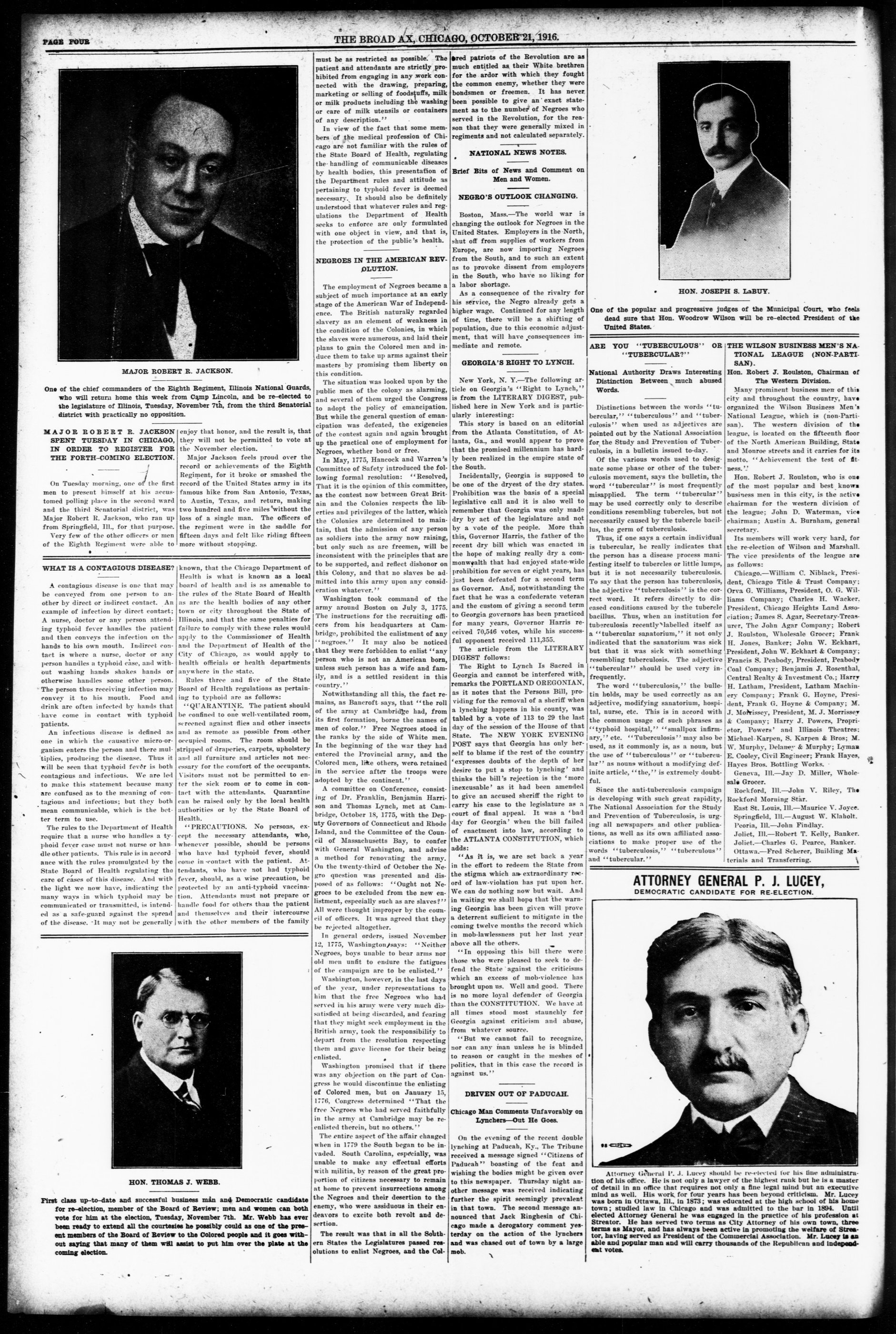
MAJOR ROBERT R. JACKSON.
One of the chief commanders of the Ei who will return home this week f the legislature of Illinois, Tuesday district with practically no opposition
One of the chief commanders of the Eighth Regiment, Illinois National Guards, who will return home this week from Camp Lincoln, and be re-elected to the legislature of Illinois, Tuesday, November 7th, from the third Senatorial district with practically no opposition.
MAJOR ROBERT R. JACKSON
SPENT TUESDAY IN CHICAGO,
IN ORDER TO REGISTER FOR
THE FORTH-COMING ELECTION.
enjoy that honor, and the result is, that they will not be permitted to vote at the November election.
Major Jackson feels proud over the
On Tuesday morning, one of the first men to present himself at his acustomed polling place in the second ward and the third Senatorial district, was Major Robert R. Jackson, who ran up from Springfield, Ill., for that purpose. Very few of the other officers or men of the Eighth Regiment were able to
WHAT IS A CONTAGIOUS DISEASE?
A contagious disease is one that may be conveyed from one person to another by direct or indirect contact. An example of infection by direct contact; a nurse, doctor or any person attending typhoid fever handles the patient and then conveys the infection on the hands to his own mouth. Indirect contact is where a nurse, doctor or any person handles a typhoid case, and without washing hands shakes hands or otherwise handles some other person. The person thus receiving infection may convey it to his mouth. Food and drink are often infected by hands that have come in contact with typhoid patients.
An infectious disease is defined as one in which the causative micro-organism enters the person and there multiplies, producing the disease. Thus it will be seen that typhoid fever is both contagious and infectious. We are led to make this statement because many are confused as to the meaning of contagious and infectious; but they both mean communicable, which is the better term to use.
The rules to the Department of Health require that a nurse who handles a typhoid fever case must not nurse or handle other patients. This rule is in accordance with the rules promulgated by the State Board of Health regulating the care of cases of this disease. And with the light we now have, indicating the many ways in which typhoid may be communicated or transmitted, is intended as a safe-guard against the spread of the disease. It may not be generally
J.
HON. THOMAS J. WEBB
First class up-to-date and successful business man for re-election, member of the Board of Review, vote for him at the election, Tuesday, November been ready to extend all the courtesies he possible members of the Board of Review to the Colour out saying that many of them will assist to put coming election.
First class up-to-date and successful business man and Democratic candidate for re-election, member of the Board of Review; men and women can both vote for him at the election, Tuesday, November 7th. Mr. Webb has ever been ready to extend all the courtesies he possibly could as one of the present members of the Board of Review to the Colored people and it goes without saying that many of them will assist to put him over the plate at the coming election.
First class up-to-date and successful business man and Democratic candidate for re-election, member of the Board of Review; men and women can both vote for him at the election, Tuesday, November 7th. Mr. Webb has ever been ready to extend all the courtesies he possibly could as one of the present members of the Board of Review to the Colored people and it goes without saying that many of them will assist to put him over the plate at the coming election.
PAGE FOUR
enjoy that honor, and the result is, that they will not be permitted to vote at the November election.
Major Jackson feels proud over the record or achievements of the Eighth Regiment, for it broke or smashed the record of the United States army in its famous hike from San Antonio, Texas, to Austin, Texas, and return, making two hundred and five miles without the loss of a single man. The officers of the regiment were in the saddle for fifteen days and felt like riding fifteen more without stopping.
known, that the Chicago Department of Health is what is known as a local board of health and is as amenable to the rules of the State Board of Health as are the health bodies of any other town or city throughout the State of Illinois, and that the same penalties for failure to comply with these rules would apply to the Commissioner of Health and the Department of Health of the City of Chicago, as would apply to health officials or health departments anywhere in the state.
Rules three and five of the State Board of Health regulations as pertaining to typhoid are as follows:
"QUARANTINE. The patient should be confined to one well-ventilated room, screened against flies and other insects and as remote as possible from other occupied rooms. The room should be stripped of draperies, carpets, upholstery and all furniture and articles not necessary for the comfort of the occupants. Visitors must not be permitted to enter the sick room or to come in contact with the attendants. Quarantine can be raised only by the local health authorities or by the State Board of Health.
"PRECAUTIONS. No persons, except the necessary attendants, who, whenever possible, should be persons who have had typhoid fever, should come in contact with the patient. Attendants, who have not had typhoid fever, should, as a wise precaution, be protected by an anti-typhoid vaccination. Attendants must not prepare or handle food for others than the patient and themselves and their intercourse with the other members of the family
must be as restricted as possible. The patient and attendants are strictly prohibited from engaging in any work connected with the drawing, preparing, marketing or selling of foodstuffs, milk or milk products including the washing or care of milk utensils or containers of any description." red patriots of the Revolution much entitled as their White for the ardor with which they the common enemy, whether the bondsmen or freemen. It has been possible to give an exac ment as to the number of Negro served in the Revolution, for
In view of the fact that some members of the medical profession of Chicago are not familiar with the rules of the State Board of Health, regulating the handling of communicable diseases by health bodies, this presentation of the Department rules and attitude as pertaining to typhoid fever is deemed necessary. It should also be definitely understood that whatever rules and regulations the Department of Health seeks to enforce are only formulated with one object in view, and that is, the protection of the public's health.
NEGROES IN THE AMERICAN REV
OLUTION.
The employment of Negroes became a subject of much importance at an early stage of the American War of Independence. The British naturally regarded slavery as an element of weakness in the condition of the Colonies, in which the slaves were numerous, and laid their plans to gain the Colored men and induce them to take up arms against their masters by promising them liberty on this condition.
The situation was looked upon by the public men of the colony as alarming, and several of them urged the Congress to adopt the policy of emancipation. But while the general question of emancipation was defeated, the exigencies of the contest again and again brought up the practical one of employment for Negroes, whether bond or free.
In May, 1775, Hancock and Warren's Committee of Safety introduced the following formal resolution: "Resolved, That it is the opinion of this committee, as the contest now between Great Britain and the Colonies respects the liberties and privileges of the latter, which the Colonies are determined to maintain, that the admission of any person as soldiers into the army now raising but only such as are freemen, will be inconsistent with the principles that are to be supported, and reflect dishonor on this Colony, and that no slaves be admitted into this army upon any consideration whatever."
Washington took command of the army around Boston on July 3, 1775. The instructions for the recruiting officers from his headquarters at Cambridge, prohibited the enlistment of any "negroes." It may also be noticed that they were forbidden to enlist "any person who is not an American born, unless such person has a wife and family, and is a settled resident in this country." Notwithstanding all this, the fact remains, as Bancroft says, that "the roll of the army at Cambridge had, from its first formation, borne the names of men of color." Free Negroes stood in the ranks by the side of White men. In the beginning of the war they had entered the Provincial army, and the Colored men, like others, were retained in the service after the troops were adopted by the continent."
A committee on Conference, consisting of Dr. Franklin, Benjamin Harrison and Thomas Lynch, met at Cambridge, October 18, 1775, with the Deputy Governors of Connecticut and Rhode Island, and the Committee of the Council of Massachusetts Bay, to confer with General Washington, and advise a method for renovating the army. On the twenty-third of October the Negro question was presented and disposed of as follows: "Ought not Negroes to be excluded from the new enlistment, especially such as are slaves?" All were thought improper by the council of officers. It was agreed that they be rejected altogether. In general orders, issued November 12, 1775, Washington says: "Neither Negroes, boys unable to bear arms nor old men unfit to endure the fatigues of the campaign are to be enlisted."
Washington, however, in the last days of the year, under representations to him that the free Negroes who had served in his army were very much dissatisfied at being discarded, and fearing that they might seek employment in the British army, took the responsibility to depart from the resolution respecting them and gave license for their being enlisted.
Washington promised that if there was any objection on the part of Congress he would discontinue the enlisting of Colored men, but on January 15, 1776, Congress determined "That the free Negroes who had served faithfully in the army at Cambridge may be re- enlisted therein, but no others."
The entire aspect of the affair changed when in 1779 the South began to be invaded. South Carolina, especially, was unable to make any effectual efforts with militia, by reason of the great proportion of citizens necessary to remain at home to prevent insurrections among the Negroes and their desertion to the enemy, who were assiduous in their endeavors to excite both revolt and desertion.
The result was that in all the Southern States the Legislatures passed resolutions to enlist Negroes, and the Col-
red patriots of the Revolution are as much entitled as their White brethren for the ardor with which they fought the common enemy, whether they were bondsmen or freemen. It has never been possible to give an exact statement as to the number of Negroes who served in the Revolution, for the reason that they were generally mixed in regiments and not calculated separately.
NATIONAL NEWS NOTES.
Brief Bits of News and Comment on Men and Women.
NEGRO'S OUTLOOK CHANGING.
Boston, Mass.-The world war is changing the outlook for Negroes in the United States. Employers in the North, shut off from supplies of workers from Europe, are now importing Negroes from the South, and to such an extent as to provoke dissent from employers in the South, who have no liking for a labor shortage.
As a consequence of the rivalry for his service, the Negro already gets a higher wage. Continued for any length of time, there will be a shifting of population, due to this economic adjustment, that will have consequences immediate and remote.
GEORGIA'S RIGHT TO LYNCH
New York, N. Y.—The following article on Georgia's "Right to Lynch," is from the LITERARY DIGEST, published here in New York and is particularly interesting:
This story is based on an editorial from the Atlanta Constitution, of Atlanta, Ga., and would appear to prove that the promised millennium has hardly been realized in the empire state of the South.
Incidentally, Georgia is supposed to be one of the dryest of the dry states. Prohibition was the basis of a special legislative call and it is also well to remember that Georgia was only made dry by act of the legislature and not by a vote of the people. More than this, Governor Harris, the father of the recent dry bill which was enacted in the hope of making really dry a commonwealth that had enjoyed state-wide prohibition for seven or eight years, has just been defeated for a second term as Governor. And, notwithstanding the fact that he was a confederate veteran and the custom of giving a second term to Georgia governors has been practiced for many years, Governor Harris received 70,546 votes, while his successful opponent received 111,355. The article from the LITERARY DIGEST follows:
The Right to Lynch Is Sacred in Georgia and cannot be interfered with, remarks the PORTLAND OREGONIAN, as it notes that the Persons Bill, providing for the removal of a sheriff when a lynching happens in his county, was tabled by a vote of 113 to 29 the last day of the session of the House of that State. The NEW YORK EVENING POST says that Georgia has only herself to blame if the rest of the country 'expresses doubts of the depth of her desire to put a stop to lynching' and thinks the bill's rejection is the 'more inexecutable' as it had been amended to give an accused sheriff the right to carry his case to the legislature as a court of final appeal. It was a 'bad day for Georgia' when the bill failed of enactment into law, according to the ATLANTA CONSTITUTION, which adds:
"As it is, we are set back a year in the effort to redeem the State from the stigma which an extraordinary record of law-violation has put upon her. We can do nothing now but wait. And in waiting we shall hope that the warning Georgia has been given will prove a deterrent sufficient to mitigate in the coming twelve months the record which in mob-lawlessness put her last year above all the others.
"In opposing this bill there were those who were pleased to seek to defend the State against the criticisms which an excess of mob-violence has brought upon us. Well and good. There is no more loyal defender of Georgia than the CONSTITUTION. We have at all times stood most staunchly for Georgia against criticism and abuse, from whatever source.
"But we cannot fail to recognize, nor can any man unless he is blinded to reason or caught in the meshes of politics, that in this case the record is against us."
DRIVEN OUT OF PADUCAH
Chicago Man Comments Unfavorably on
Lynchers—Out He Goes.
On the evening of the recent double lynching at Padueah, Ky., The Tribune received a message signed "Citizens of Padueah" boasting of the feat and wishing the bodies might be given over to this newspaper. Thursday night another message was received indicating further the spirit seemingly prevalent in that town. The second message announced that Jack Ringhesin of Chicago made a derogatory comment yesterday on the action of the lynchers and was chased out of town by a large mob.
M. B.
HON. JOSEPH S. LaBUY. One of the popular and progressive judges of the Municipal Court, who feels dead sure that Hon. Woodrow Wilson will be re-elected President of the United States.
ARE YOU "TUBERCULOUS"
"TUBERCULAR?"
National Authority Draws Interesting Distinction Between much abused Words.
Distinctions between the words "tubercular," "tuberculous" and "tuberculosis" when used as adjectives are pointed out by the National Association for the Study and Prevention of Tuberculosis, in a bulletin issued to-day.
Of the various words used to designate some phase or other of the tuberculosis movement, says the bulletin, the word "tubercular" is most frequently misapplied. The term "tubercular" may be used correctly only to describe conditions resembling tubercles, but not necessarily caused by the tubercle bacillus, the germ of tuberculosis.
Thus, if one says a certain individual is tubercular, he really indicates that the person has a disease process manifesting itself to tubercles or little lumps, but it is not necessarily tuberculosis. To say that the person has tuberculosis, the adjective "tuberculosis" is the correct word. It refers directly to diseased conditions caused by the tubercle bacillus. Thus, when an institution for tuberculosis recently"labelled itself as a "tubercular sanatorium," it not only indicated that the sanatorium was sick but that it was sick with something resembling tuberculosis. The adjective "tubercular" should be used very infrequently.
The word "tuberculosis," the bulletin holds, may be used correctly as an adjective, modifying sanatorium, hospital, nurse, etc. This is in accord with the common usage of such phrases as "typhoid hospital," "smallpox infirmary," etc. "Tuberculosis" may also be used, as it commonly is, as a noun, but the use of "tuberculous" or "tubercular" as nouns without a modifying definite article, "the," is extremely doubtful.
Since the anti-tuberculosis campaign is developing with such great rapidity, The National Association for the Study and Prevention of Tuberculosis, is urging all newspapers and other publications, as well as its own affiliated associations to make proper use of the words "tuberculosis," "tuberculous" and "tubercular."
...
Attorney General P. J. Lucey should be re-elected for his fine administration of his office. He is not only a lawyer of the highest rank but he is a master of detail in an office that requires not only a fine legal mind but an executive mind as well. His work for four years has been beyond criticism. Mr. Lucey was born in Ottawa, Ill., in 1873; was educated at the high school of his home town; studied law in Chicago and was admitted to the bar in 1894. Until elected Attorney General he was engaged in the practice of his profession at Streator. He has served two terms as City Attorney of his own town, three terms as Mayor, and has always been active in promoting the welfare of Streator, having served as President of the Commercial Association. Mr. Lucey is an able and popular man and will carry thousands of the Republican and independent votes.
THE WILSON BUSINESS MEN'S NATIONAL LEAGUE (NON-PARTISAN).
Hon. Robert J. Roulston, Chairman of The Western Division.
Many prominent business men of this city and throughout the country, have organized the Wilson Business Men's National League, which is (non-Partisan). The western division of the league, is located on the fifteenth floor of the North American Building, State and Monroe streets and it carries for its motto. "Achievement the test of fitness."
Hon. Robert J. Roulston, who is one of the most popular and best known business men in this city, is the active chairman for the western division of the league; John D. Waterman, vice chairman; Austin A. Burnham, general secretary.
Its members will work very hard, for the re-election of Wilson and Marshall. The vice presidents of the league are as follows:
Chicago.—William C. Niblack, President, Chicago Title & Trust Company; Orva G. Williams, President, O. G. Williams Company; Charles H. Wacker, President, Chicago Heights Land Association; James S. Agar, Secretary-Treasurer, The John Agar Company; Robert J. Roulston, Wholesale Grocer; Frank H. Jones, Banker; John W. Eckhart, President, John W. Eckhart & Company; Francis S. Peabody, President, Peabody Coal Company; Benjamin J. Rosenthal, Central Realty & Investment Co.; Harry H. Latham, President, Latham Machinery Company; Frank G. Hoyne, President, Frank G. Hoyne & Company; M. J. Morrissey, President, M. J. Morrissey & Company; Harry J. Powers, Proprietor, Powers' and Illinois Theatres; Michael-Karpen, S. Karpen & Bros; M. W. Murphy, Delaney & Murphy; Lyman E. Cooley, Civil Engineer; Frank Hayes, Hayes Bros. Bottling Works.
Geneva, Ill.-Jay D. Miller, Wholesale Grocer.
Rockford, Ill.-John V. Riley, The Rockford Morning Star.
East St. Louis, Ill.-Maurice V. Joyce.
Springfield, Ill.-August W. Klaholt.
Pecoria, Ill.-John Findlay.
Joliet, Ill.-Robert T. Kelly, Banker.
Joliet.-Charles G. Pearce, Banker.
Ottawa.-Fred Scherer, Building Materials and Transferring.
DEMOCRATIC LEADER OF THE STATE PRESIDENT.
One of the strong men of Illinois is Arthur W. Charles, the Democratic candidate for State Treasurer. No man on the ticket is more admirably fitted for the duties of an office than is Mr. Charles for this very important position. He is a native of White County and makes his home at Carmi, where he is editor of the White County Democrat. He has held important positions of trust in various departments of the state and has left each with an unattarnished reputation and better for his services. His first public office was that of Master in Chancery, which position he held for 12 years. He was a member of the Board of Managers of the State Reformatory, serving from 1909 to 1911 when he was appointed on the Rivers and Lakes Commission, and later acted as Chairman, Mr. Charles has been an active member of the Democratic State Central Committee since 1900, and was Chairman in 1912. The great Democratic victory in Illinois in that year was largely due to the untiring work of Mr. Charles and his genius for organization. Besides acting as editor of one of the strong newspapers down-state Mr. Charles is interested in farming. He has been President of the Farmers' Institute and was Vice President of the White County Agricultural Society.
---
ROSENWALD ON STUMP TONIGHT
FOR HUGHES.
Business Leaders Open "Schoolhouse Campaign" in Pullman and Burside.
Julius Rosenwald will take the stump tonight for Hughes. He is the headlined orator of the Hughes Business Men's league in the "schoolhouse campaign" initiated Thursday evening.
"Tonight's meetings are in the Twelfth and Thirty-fourth wards, the first at the Harrison Technical High School, 2850 West Twenty-fourth street boulevard, and the other at the Lawson school, 1256 South Homan avenue. Other speakers with Mr. Rosenwald are Edgar A. Bancero, Harry A. Wheeler, William E. Clow, Charles W. Folds, and Henry B. Rathbone.
The new style of campaigning which is the downstate system transplanted to the city, was opened in Pullman and Burrside.
William E. Clow directed attention to conditions in Chicago in the spring of 1914.
"I ask your votes for Hughes," Mr. Clow said, "because I know the Republican party insures protection to the American workingmen, while the Democratic free trade means the closing of the workshops."
ONCE BOOBLACK, NOW A
BANKER.
Jacksonville, Fla., Man's Rise Remarkable—Elegant Anniversary.
Jacksonville, Fla., (Special)—Charles H. Anderson, Colored, operating a retail fish and oyster market at 132 Broad street, is celebrating his fifteenth anniversary as a business man in Jacksonville. Anderson was once a bootblack and an ice peddler. He was also a peanut dealer in Pablo Beach during the summer before the great fire. During the winter months he sold fish and peddled oysters in Springfield and obtained his education in a night school. September 22, 1901, he opened up quarters on Broad street, and has been in business there continuously up to the present time.
After the death of Steve Melton Anderson became one of the foremost fish and oyster dealers in the city, supplying a large number of the White families, dining cars, cafes, and hotels, with game, fish and oysters. Because of his polite, sanitary and bustling manner of doing business, 95 per cent of his trade is from White people. Anderson was born in Jacksonville, and many friends in both races know him from a bootcloth to a banker.
"MEMORIES ARE CALLING ME"
NEW BOOKER T. WASHINGTON
MEMORIAL SONG.
The latest and by far the most catchy song, is entitled "Memories Are Calling Me." It is dedicated to the late Booker T. Washington. It has been set to music and published by Burkes and Arbuckle Company, 15 Court square, Boston, Mass., and for a short time it will sell for 25 cents.
This beautiful new song should be in the home of every race loving Negro throughout the United States.
STATE SENATOR HARDING NEVER WAS THE OVERLORD OF THE REDLIGHT DISTRICT.
The last Sunday morning's newspapers stated that Hon. Maclay Hoyne, State's Attorney of Cook County, would in the near future cause a warrant to be sworn out for the arrest of State Senator George F. Harding, Jr., charging him with being the overlord of the Redlight district or the man higher up.
That statement on the part of State's Attorney Hoyne caused Senator Harding to feel like starting on the war path after him and in the upstart it was that Mr. Hoyne skinned everything back which he had said in the public press in relation to Senator Harding.
RACE DIVISION IN CHURCH
Episcopal Convention Debates Plan for Colored Dioceses.
St. Louis, Mo., (Special)—Debate on a proposal to establish a racial episcopate was on the calendar on Monday, in the house of deputies, the lower body of the Protestant Episcopal convention in session here. It is proposed to amend the church constitution to authorize the creation of dioceses of Colored churches with Colored bishops presiding, and the removal of Colored parishes from the supervision of the present White diocesan heads.
Discussed for a Decade.
The question, one of the most important to come before the convention, has been discussed for a decade and resulted six years ago in the passage of an amendment permitting the election of Colored suffragan bishops in the various dioceses. Church leaders admit a wide difference of opinion. By some it is argued that the creation of dioceses of Colored churches would make more sharp the line of cleavage between the races.
B. & O. CHIEF FOR HUGHES
Favored Roosevelt, but Says He Sees No Reason for Deserting G. O. P. to Support Wilson.
New York, Oct. 20.—Daniel Willard, president of the Baltimore and 'Ohio railroad, this afternoon denied a report that he had announced he would support President Wilson, Willard said he favored Col. Roosevelt for the Republican nomination, but saw no reason for deserting his party because Roosevelt was not nominated.
DANCE TO YOUR HEART'S CON TENT.
The social event of the season, the Texas Fellowship Club; Grand Concert, reception and dance, at Entertainers Hall, 35th and Indiana Av.
The Great Dixie Concert Co. with the full Dreamland Orchestra, Come and meet your friends, and dance until 2 A. M.—Wednesday evening, October 25th. Admission 35 cents.
The Citizens Committee, met at the Eighth Regiment Armory, Wednesday evening and perfected all arrangements to give the Eighth Regiment Illinois National Guards a warm welcome, when they arrive home this coming week.
THE BROAD AX, CHICAGO, OCTOBER 21, 1916
Charles E. Stump, the Kansas Newspaper Scribbler, Travels from Claremont, Virginia to Montgomery, Alabama Without Making Many Stops
Little Rock, Ark.—Writing for newspapers and getting over the country is not like farming, and this I have discovered in the past year, but then I am willing to continue to try. I have been trying to write for The Broad Ax one year, and whether or not I have improved it will be for the editor to say, but I do know I have been off of the farm, and have not been using the plow or hee in that time.
I have been back to Kansas a number of times, yet I have not seen all there is to be seen, nor have I heard all there is to be heard, yet I am in the ring.
I wrote to you last week from a point in this country. I am sure you will remember where I have been. Now this time I have been to another part of the world—a little town known as Houston, Texas. It was indeed a pleasure to have been there and to have talked with the good people of that place.
The Baptists had their big convention in Houston, and believe me, honey, it was some convention. Rev. L. K. Williams, pastor of Olivet Baptist church, Chicago, was president and he has held that position for a long time, but he resigned to go to Chicago. I mean he held the office, and resigned the Fort Worth church. He has been there for a long time. Well, he returned to open the convention and leave in an honorable way. He was present and called the convention to order. He brought along with him, Deacon S. A. Griffin to see that the thing was properly done. He was there and was there to stay with him. He is chairman of the Olivet Deacon Board, and he made hosts of friends down in Texas. He visited the high school and made an address there, and so many other things took place in the city while he was there. I was so delighted to see him myself.
The convention is composed of some big men, such men as Rev. A. Barbour, D.D., who is a leader in thought in this section of the country, and one of the men who is working for a change in the national administration. He was a figure in the National Baptist convention and has been for years; Rev. J. B. Pius, of Austin, a well-trained and educated young minister; Prof. M. M. Rodgers, who is auditor of the National Baptist convention and one of the finest men it has been my lot to meet in this country. Rodgers' heart is in the right place and he is spending it for his people and for the cause of his church denomination. He is a good Baptist, and directly interested in the development and uplift of his own people.
It was indeed a pleasure to come in touch with all these big men, and then to have a preacher steal a fountain pen from me. I have been told that a preacher won't steal, but I found one that would. I saw him when he slipped the pen from my table, and I was so disgusted with him that I could not speak. I remember him as that same man stole when he was in the National Baptist convention one time, but I am not going to expose him. God forgive him, is all I can say.
There were some good speeches made, and a White man from Birmingham, came there to talk to our people. It was Rev. B. F. Riley, and he is interested in us, and is willing to help us all he can. God bless him, for I can't.
I had the pleasure of meeting Mrs. S. Willie Layten, president of the women's convention, auxiliary to the National Baptist convention. She is just a good woman and a worker. She was of the opinion that Miss Nannie H. Burroughs would continue with her work, and this pleased me very much. I stayed all through the convention, and heard all the sermons and speeches. I had the pleasure of going with Deacon Griffin to the high school and heard his address. He said some good things to those young people. It was his first time to be in a real Colored School, and he was pleased with what his eyes beheld. Well he should be, for those people there are doing some real good work.
Our people are busy in Houston. They have a public library there which is well patronized. Then there is a
number of drugstores, and a real live policeman. I do not know just how many police they have there belonging to my race, but they are there in good shape. I could mention other people who are interested in the work if I only had the time. Rev. J. E. Knox, who is superintendent of missions. Mrs. Olive L. Stewart, of Chicago, visited the convention. She was there with her husband, and they seemed to be getting along well.
Now I remained in that Houston a long time and then I pulled out on the I. G. N., for Texarkana, spending the night there at the home of Mrs. S. A. Matthes, and from there to Little Rock. I reached this city Sunday morning and decided to go to church, but I sent my luggage out to the home of President Joseph A. Booker, of the Arkansas Baptist college. This man has been dishing out education for a long time, and so many young people in this country making good have received education from his dishing. Not only sons and daughters of others, but he has dished some to his own children. Now, there is Miss Mattie Albert Booker, an accomplished musician, who has charge of the musical department of the Arkansas Baptist college, and his son, J. Robert Booker, a graduate from the college department and now a full-fledged lawyer, who is making good issuing out the law of the state, and telling the judges about it when people call on him to defend or prosecute. He knows some law, and I predict that he will some day be in the rank of E. H. Morris and that class of jurists. He is working side by side with Seipio Jones, an eminent lawyer. God be praised. Miss Carrie Bell Booker is now a teacher in Nowata, Okla, and all last summer she was in Chicago taking on some education at the Northwestern University. Good for that. I could just mention others, but will not do so today.
Coming back to this Arkansas Baptist college, it is a great school, and they have some fine teachers here. I could talk about them for a year and not be through. Mrs. Booker is one of those well educated women. I did not get to count all the chillen, and will not be able to do so now. God bless all of you and your good work. I want to say more, but will have to close. I think I shall have to bring this letter to a stop just now, but will write to you again next week. Look out for me.
IMPORTANT MATRIMONIAL PERSONAL.
Personal—Want to correspond with a respectable, intelligent, unineumbered middle age octoroon, with brains and money, for a wife and business partner. Only those who mean business and can fill above description need answer. Address, Mizpah, care of The Broad Ax, 6418 Champlain Ave., Chicago, Ill.
CHIPS
Mrs. I. B. W. Barnett, 3234 Rhodes avenue; has returned home from attending the race congress at Washington, D. C.
The seventh annual essay contest, will be held at Bethel Church, 30th and Dearborn streets, Sunday afternoon, December 17.
Mrs. F. A. Denison, and the young Denisons, have returned from their summer home at Benton Harbor, Mich., and are occupying their city residence, 451 E. 42nd street.
It is reported in the United States; that Col. Jack Johnson, the ex-heavyweight champion prize fighter of the world and his White wife, formerly Miss Lucile Cameron, have parted company or separated for good.
Looking Forward.
He-What makes you think Miss Sweetthing is going to be married? She-Her extraordinary efforts to be nice to everybody she knows from whom she could possibly expect a present-Richmond Times-Dispatch
99
The Democratic nominee for Lieutenant Governor of Illinois, Henry W. Huttmann, is a fine type of young manhood of Illinois, intellectual, popular, and with an unblemished name. He was born in Milwaukee in 1872. Later he moved to Wichita, Kan., where after graduating from high school he continued his studies in Fairmount college and in the University of Chicago. He was admitted to the bar in 1896. In 1911 he was appointed member of the Board of Education by Mayor Harrison and later served as Vice President of the Board. His services are highly valued. He has a high sense of honor and is well fitted for the exacting duties of the presiding officer of the State Senate where fairness and a sense of justice are conspicuous qualities. Mr. Huttmann is a member of a long list of German societies and organizations in Chicago, as well as being a member of the Scottish Rite Masons and a Shriner.
The Democratic nominee for Lieutenant Governor of Illinois, Henry W. Huttmann, is a fine type of young manhood of Illinois, intellectual, popular, and with an unblemished name. He was born in Milwaukee in 1872. Later he moved to Wichita, Kan., where after graduating from high school he continued his studies in Fairmount college and in the University of Chicago. He was admitted to the bar in 1896. In 1911 he was appointed member of the Board of Education by Mayor Harrison and later served as Vice President of the Board. His services are highly valued. He has a high sense of honor and is well fitted for the exacting duties of the presiding officer of the State Senate where fairness and a sense of justice are conspicuous qualities. Mr. Huttmann is a member of a long list of German societies and organizations in Chicago, as well as being a member of the Scottish Rite Masons and a Shriner.
---
GLAD HEARTS.
There are souls in the world who have the gift of finding joy everywhere and of leaving it behind them when they go. Their influence is an inevitable gladdening of the heart. They give light without meaning to shine. These bright hearts have a great work to do for God.—Fabar.
How to Know the Minimum.
When a snapshot does you justice.
When a cure for hay fever is discovered.
When the loser in a golf match isn't off his game.
When people stop referring to Paris as "gay Paree."
When your best friend doesn't own a dog that understands every single word that's said to him.
When you post that letter your wife gave you back in the early nineteens.—Life.
Censored Definitions.
Whereabouts—A hiding place for those who are "wanted."
Humbug — A fantastic potpourri which is sometimes called "life."
Auctioneer—One who lectures on the art of stealing.
Alms—The requiem of the rich for the peaceful repose of the living poor. People - The algebraic plural of "fool." Glory—The five senses of the dead. Library—A place where the dead lie. New York Sun.
SUCCESS.
Believe me, the talent of success is nothing more than doing what you can do well and doing whatever you do without a thought of fame. If it come at all it will come because it is deserved, not because it is so sought after. And, moreover, there will be no misgivings, no disappointment, no hasty, feverish, exhausting excitement. — Longfellow.
He Didn't Know.
One June day in 1862 near Frederickshall, Va., General Stonewall Jackson saw one of General Hood's Texans climbing a fence to get into a cherry tree. "Where are you going?" shouted Jackson. "I don't know," replied the soldier. "To what command do you belong?" "I don't know," the Texan replied. "Well, what state are you from?" "I don't know." Jackson gave the man up, but he asked a comrade what it all meant. "Well," was the reply. "Old Stonewall and General Hood gave orders yesterday that we were not to know anything until after the next fight." The soldier was left to his cherries.
Just Like Home Folks.
"Have a good time on your trip to New York?"
"Yes, but that town has been greatly overadvertised."
"Well, I stopped with friends in one of the residential districts and most of the people there actually went to bed at 10 o'clock every night."—Detroit Free Press.
Customer—What do you mean by that sign, "Shaving Pessimists, 25 Cents?" Barber—That's because it takes more time to shave a man with a long face.
PAG. FIVE
HUTTMANN,
FOR LIEUTENANT GOVERNOR.
Lieutenant Governor of Illinois, Henry W. Wood of Illinois, intellectual, popular, and born in Milwaukee in 1872. Later he graduating from high school he continued in the University of Chicago. He was appointed member of the Board of or served as Vice President of the Board. A high sense of honor and is well fitted officer of the State Senate where fairness qualities. Mr. Huttmann is a member of organizations in Chicago, as well as being a Shriner.
Marines and Their Fingers.
Men with long, tapering "plano" fingers are apt to desert after short service, while those having stubby digits, denoting stability of character and utter lack of the artistic temperament, usually stand by their oaths and make the best marines, according to finger print experts at headquarters of the United States marine corps. Although desertions from the corps are light at all times, it has been found that actors, sign writers and, strange to say, waiters furnish the largest number of deserters. Records, including finger prints, of all men enlisted in the marine corps are kept at headquarters for purposes of identification, and there are cases on record where bodies with finger tips intact have been positively identified through the finger print medium.
Quite Common.
"It's strange what interest small boys and girls take in boasting about the possessions of themselves and their families.
Mollie, aged nine, and Nancy, a year younger, were trying to outmatch each other at this game, and Mollie was several points ahead in the contest.
"Oh, you should see my mother's fan!" she boasted, thinking to make her victory complete. "It's lovely—all hand painted!"
Nancy tossed a scornful head.
"Poooh!" she retorted. "That's nothing. So's our garden fence."
Bold Court Fool
Ferdinand II. was a man of very uncertain moods and would allow his jester to take liberties with him one hour while resenting any familiarity the next. One day he turned round on Jonas, his favorite fool, and thundered: "Fellow, be silent! I never stoop to talk to a fool." "Never mind that." answered Jonas. "I do. So please listen to me in your turn."
To Make Sure.
"Won't you please leave the light burning in the hall, mother?" pleaded little Robert as he was being put to bed.
"Nonsense, Bobbie," was the reply.
"Surely you know there isn't anything to be afraid of in the dark."
"Yes, I know, but can't you leave a teeny weeny light so I can see there isn't anything there?"—Exchange.
Bob Burdette's Aaide.
When Bob Burdette was addressing the graduating class of a large eastern college for women he began his remarks with the usual salutation, "Young ladies of '97." Then in a horrified aside he added, "That's an awful age for a girl."
Envelopes.
Envelopes were practically unknown before 1725. About that time one was seen semi-occasionally. As late as 1850 letters were often sent folded and sealed. Envelopes may be said to have come into use shortly after 1844.-Exchange.
Badly Timed.
Nephew—1 tried to get a raise today aunt, but the boss refused it. Mrs Blunderby—Too bad. Dicky! Perhaps you didn't approach him at the zoological moment.—Boston Transcript.
Atlas Rejoices.
Atlas bore the world on his shoulders. "It is much easier than having it on your conscience." he explained—New York Sun.
The virtue of justice consists in moderation as regulated by wisdom.—Aristotle.
PAGE SIX
CHICAGO PAYS HIGH
Mayor Gets $18,000 a Year and Seventy Aldermen $3,000 Each.
NEW YORK IS NEXT IN LINE.
Gotham Allows Its Chief Executive $15,000, Philadelphia $12,000, Boston, St. Louis, Newark, N. J.; Cincinnati, Cleveland and Pittsburgh $10,000, Indianapolis and Seattle $7,500.
Washington—Chicago has the highest priced mayor in the country. He gets $18,000 a year and serves four years. New York comes next, with a $15,000 mayor, whose term also lasts four years. Philadelphia, third in the list, gives its mayor $12,000 a year for four years. Boston, St. Louis, Newark, N. J.; Cincinnati, Cleveland and Pittsburgh pay their mayor $10,000 annually, the term being four years in Boston, Pittsburgh and St. Louis, and two years in Cincinnati, Cleveland and Newark.
Indianapolis and Seattle pay their mayor $7,500 a year; San Francisco, Baltimore and Minneapolis $6,000 each; East St. Louis, Louisville, New Bedford, Detroit, Kansas City, Buffalo, Mount Vernon, Rochester, Columbus, Scranton, Providence, San Antonio, Tex. and Richmond pay $5,000 each.
The aldermen, who share with the mayor and certain other officials the responsibility of government in American cities, cost the taxpayers varying sums. Chicago has seventy aldermen, at $3,000 each; Boston, nine, at $1,500 each; St. Louis, twenty-nine, at $1,800 each; Newark, thirty-two, at $500 each; New York, seventy-three, at $2,000 each; Cincinnati, thirty-two, at $1,150 apiece; Cleveland, twenty-six, at $1,200 each; Philadelphia, forty-eight select councilmen and eighty-three common councilmen, all serving without salary; Pittsburgh, nine aldermen, at $6,500 each; Indianapolis, nine, at $600 apiece, and Seattle, nine, at $3,000 apiece.
The only cities that have an upper and a lower house of aldermen or councilmen are Hartford, Conn.; New Britain, Conn.; Atlanta, Louisville, Portland, Me.; Baltimore (thirty-three in all, at $1,000 each); Brockton, Mass.; Cambridge, Mass.; Everett, Mass.; Malden, Mass.; Fitchburg, Mass.; New Bedford, Mass.; Pittsfield, Mass.; Springfield, Mass.; Worcester, Mass.; Kansas City, Mo.; Manchester, N. H.; Buffalo (thirty-six in all, at $1,000 each) Lancaster, Pa.; Philadelphia, Pawtucket, R. I.; Providence, R. I.; Woonsocket, R. I.; Lynchburg, Va.; Norfolk, Va. Portsmouth, Va.; Richmond, Va., and Boonville, Va.
The commission form of government, which takes the place of mayors and aldermen, involves a smaller salary outlay. In Washington, D. C., the three commissioners get a total of $15,000; in Denver, $25,000; in San Diego, $12,000; in Topeka, $9,000; in New Orleans, $20,000; in Salem, Mass., $10,000; in St. Paul, $31,500; in Lincoln, Neb., $10,000; in Atlantic City, $15,000; in Bayonne, N. J., $10,000; in Hoboken, $10,000; in Jersey City, $25,000; in Trenton, $15,000, and in Harrisburg, $13,000.
In some of the commission governed cities a mayor is elected as such, while in others he is chosen by the commission. Sometimes he gets an extra allowance as chairman of the commission, but this rarely exceeds $500, and is included in most of the above totals.
While most cities employ assessors to fix the valuation of property for the purposes of taxation, those of some states have no assessors, but report to the county the amount required to be raised for city purposes.
SEVERED MUSCLES TRAINED
Stumps of Amputated Arms Made to Operate False Hands.
Zurich.—Three professors of Zurich university have been experimenting in the hope of training the muscles in the stumps of amputated arms to connect with artificial hands in such a way as to open and close the fingers.
Professor Sauerbach, one of the professors, says in a German medical magazine that the anatomical difficulties have been overcome so effectually that all that is now required for complete success is a somewhat better artificial hand, and he expresses expectation that this soon will be invented.
Grase Grows In Tree.
Wetmore, Kan.—In the E. W. Thornburrow yard in Wetmore is a large bunch of blue grass growing in the fork of an elm tree ten feet from the ground. Every fall the residents of Wetmore, who are watching this curiosity, expect the grass to be winter killed, but every spring it shows up green and strong and matures seed. The grass has been growing in the tree for three years.
Movies Draw More Than Church
Movies Draw More Than Church.
Belleville, Kan.—"Where the People Go" is the title of an interesting compilation prepared during the social survey taken in Belleville. It shows that during the year 105,000 attend the moving picture show, 93,000 religious services, 8,696 church socials and picnics, 12,400 the county fair and farmers' institute, 5,000 the Chautauqua and 2,870 go to ball games.
Wouldn't Say "Votes For Women."
Chicago.—Because It could not be taught to say "Votes for women," a parrot which had been recently taken to the headquarters of the woman suffragists is now back in the bird store.
BLOUSES COOL.
Pongee and Shantung Are Favorites For Summer Waists.
Silk for blouses are much in vogue—striped pongees, crepe de chines and georgette crapes. This illustrated is a figured shantung, the natural tone
TENNIS
WELL CLAD.
blocked off in chocolate. Moire ribbon makes a perky little tie, pearl buttons close the front, and all seams are hem-stitched.
TRAINING THE TASTE.
The Importance of Teaching Children The Sense of Colors.
Some persons are totally lacking in color sense—taste in colors, to put it differently. In other respects they are quite normal persons and often, of course, get far ahead of those with the keen color taste. Other persons lack appreciation, taste, in other respects. Usually appreciation or taste can be trained, although sometimes color or music appreciation is utterly lacking.
The time to begin to train is with very young children. The place is the home. If a child is brought up in a tasteful home it will unconsciously grow up with a cultivated taste. In addition, of course, it is well to note the child's individuality. If it seems dull to music, painting, color, form, help develop its taste along these particular lines.
A house, to be the ideal environment for a growing child, should be beautiful, of course, but it should have the beauty of simplicity and find the beauty in its surroundings without depending on elaborate furnishings.
Perhaps the best way to train a child's taste, if the child seems rather hopelessly deficient, is to let-him work things according to his own ideas for a little while. If a little girl like gaudy colors, let her have a frock of a gaudy color, which she herself chooses. She will, the chances are, soon tire of it. If the small boy likes impossible ornaments and hangings in his room, let him have them. Not only will he himself dislike them soon enough, but his friends will doubtless make fun of them, and so they will become intolerable to him.
Once there was a boy of nine or ten years who chose for the wall paper of his room a dainty design with pink background upon which there were medallions showing little French maids in all their finery. His mother remonstrated with him, telling him his choice was not boyish, that it was babyish, a nursery paper, or at best one for a very little girl. But he wanted that paper, and he got it. It had not been on his wall very long before he realized his mistake. Of course he had to put up with it for months, but its presence there taught him a lesson in interior decorating he never forgot.
EASY WAY TO CLEAN SILVER
This May Help You to Save Your Elbow Grease.
A simple way to clean discolored silver is to put a quarter of a pound of sal soda into a gallon of water. Place this on the stove and let it come to a boil. When at boiling heat dip in the pieces of silver, one by one, taking each out quickly. Wash in soappuds and dry with a soft, clean cloth. This method takes about one-quarter of the time consumed by polishing.
Silver spoons or forks may be kept brightest if they are left for several hours in strong borax water. Silver that is frequently washed with ammonia water will need cleaning less often.
Silver teapots, being seldom in constant use, are very likely to become moldy. They can, however, be kept in perfectly good condition if, after washing and drying them thoroughly, a lump of sugar is placed inside. The sugar absorbs the dampness and keeps the teapot sweet and fresh.
Silverware should always be kept by itself and wrapped in tissue paper, each piece separately. Silver dress trimmings may be cleaned by covering with magnesia and leaving for two hours.
Giddy Towels.
Turkish towels are now being made with a deep border to be embroidered. The cross stitch and the French knots are the two most popular stitches used on Turkish towels.
THE BROAD AX. CHICAGO, OCTOBER 21, 1916.
The Restaurant Bluffer:
"Of all the bluffers one meets socially and in business, and their name is legion," remarked a minor cynic, "none amuses me more than the restaurant bluffer. This brand is numerous. I met one today, and his embarrassment was ludicrous.
"This chap, you know, is a living lie. He lodges in a rather high priced house, but occupies a cheap little room up under the roof, to which he is careful not to invite any acquaintance. He's an underclerk somewhere, but talks familiarly of high finance. He pretends to be on friendly terms with influential men who wouldn't know him from Adam.
"Several evenings ago he was impressing me with the frequency with which he lunches at one or two places famous in the Wall street section. When I met him today bending over coffee and rolls in a place where his check was 10 cents you should have seen his face, it was a study. "Of course I wasn't surprised, but he was. I enjoyed the encounter, but he didn't"—New York Globe.
Spies In Revolutionary Days.
A curious and unfamiliar page in American history shows that the treatment of the spy in Revolutionary days was painfully prompt and rigorous. Every American schoolboy knows the fate of Major Andre, but few know of any others, with perhaps the exception of Nathan Hale, executed by the British as a spy. In the second year of our Revolutionary war General Israel Putnam caught a man lurking about his post at Peekskill, on the Hudson. A flag of truce came from Sir Henry Clinton, claiming the prisoner as Lieutenant Palmer of the British service. The answer of the stout old general was brief and to the point: Headquarters, Aug. 7, 1777. Edmund Palmer, an officer in the enemy's service, was taken as a spy lurking within our lines. He has been tried as a spy, condemned as a spy and shall be executed as a spy, and the flag is ordered to immediately.
ISRAEL PUTNAM.
P. S.—He has accordingly been executed
—Indianapolis News.
Noise and Hearing.
There are two distinct meanings to the word "sound"—one the sensation produced in the brain, the other the external vibration which produces the sensation. The physical cause may exist where there is no ear; the sensation cannot exist unless there is an ear to hear it. Suppose two men—one totally deaf, the other with a normal sense of hearing—are in the same closed room in which a third man beats upon a piece of iron with a hammer. Is there no physical vibration because the deaf man cannot hear it? The sensation may be ear splitting to the one and totally nonexistent to the other. The same vibrations beat through the air. The same sound exists in the room, but the sensation exists for only one of the men—Philadelphia Press.
The "Bad News" Bell at Lloyd's
The bell of the British frigate Lutine, which sank off the Dutch coast in 1799 with a cargo of coin and specie valued at $6,000,000, is the "bad news" bell at Lloyd's. Whenever news is received that a ship is overdue or when definite news comes of the loss of a ship the bell is rung by the "caller." At its tolling all transactions are suspended until the news it heralds is read—London Mirror.
Confused.
A flustered woman was seen running wildly about in the corridors of a large railway station.
"What are you looking for, madam?" questioned an officer.
"I—I am looking for the entrance to the outside!" responded the woman nervously.—St. Louis Post-Dispatch.
Joke In a Needle's Point
Some years ago an American firm sent to a Chinese house in Canton the smallest and finest kind of needle as a sample of our skill in delicate handicraft. It was returned to the firm with a hole through the point, which could be seen only with a microscope
Man's Littleness.
As an illustration of the insignificance of man in the scheme of nature Professor Zuccarini of Italy estimated that, taking the world's population at 1,500,000,000, the whole human race could stand comfortably shoulder to shoulder in an area 500 miles square.
Too Quiet to Be True.
Mabel—It is whispered that Belle and Bob are engaged. Jack—Who whispers it? Mabel—Belle. Jack—If they really were she'd whistle, sing and about it.—Exchange.
In the Same Boat.
The Overbearing Lawyer—Ignorance of the law excuses no one. The Culprit—I'll be sorry for you then if you ever get in trouble.—Browning's Magazine.
Compensation.
Diner--This is a very small piece of chicken you have given me, walter. Walter--Yes, sir; but you will find it will take you a long time to eat it.
Becomes Annoying
"Imitation is the sincerest fattery." "Maybe so, but I don't like to have too many women copying my gowns." —Louisville Courier-Journal.
Business In New York
Every thirty minutes a new business corporation is formed in New York, and every forty-five minutes one is dissolved.
You should stop criticising others the moment you find it gives you pleasure—Youth's Companion.
FORMAL FROCK.
Every Woman Needs One Such Gown as This Just Now.
Sage green taffeta is the fabric used here-a kilt skirt, deep girdle of crushed sage velvet and collar and vestee of
FOR AFLISHMANS
FOR AFTERNOONS.
**white net.** The musquaire sleeves are finished with cube buttons, pendant from cords to match the cube tassels on the girdle.
BAR-LE-DUC CURRANTS.
Two Picked Recipes For a Delicious Winter Treat.
Take selected currants of large size, one by one, and with tiny embroidery scissors carefully cut the skin on one side, making a slit one-fourth an inch or less in length. Through this with a sharp needle remove the seeds, one at a time, to preserve the shape of the currant. Take the weight of the currants in strained honey and when hot add the currants. Let simmer two or three minutes, then seal as jelly. If the juice of the currants liquify the honey too much carefully skim out the currants and reduce the sirup at a gentle simmer to the desired consistency, then replace the currants and store as above.
The following recipe is less work, but gives a nice preserve: Get the largest size currants, red or white, and stem them without breaking. To each pound allow three pounds of sugar. Take some ordinary currants and bruise them while warm until you have a plint of juice. Put half a cupful of this into a porcelain kettle and three pounds of sugar. Bring slowly to a boll and skim carefully. After boiling five minutes drop in very carefully one pound of the large currants and let simmer four minutes. Take them out without breaking them and boll the slurp down five minutes or longer if not very thick, as the currants are sometimes less juicy than at others. A few minutes more will be needed at one time than another. When thick skim well and strain through a hot cloth over the fruit. Put into little jelly glasses and when cold cover as in jelly making.
PAPER ROPE FOR WEAVING.
A New Occupation For Idle Vacationists This Summer.
Raffia and reed have long been popular for weaving, but now give way to the more practical material-paper ropes. In using this article all necessity of wetting and singeing disappears. It is soft and therefore easy on the hands. The lengths are greater, minimizing the need of continual plecing, and the possibilities in color combination make it far more adaptable. Dalton blue rooms, pink rooms, yellow or violet rooms may have woven wastebaskets, lamps and even whole desk and bureau sets of matching color. A soft finish is often preferred, but if something more durable is desired a coat or two of shellac will produce a hard, glossy finish that will stand any amount of wear. The shellac will keep the basket in shape and will shed dust.
It makes no difference how intricate the chosen shape may be, baskets can be made in curved lines or straight. with sharp angles or tapering lines. This is because the foundation is of wire-easy to bend, yet.strong enough to hold a shape once formed. Reed baskets are often uneven when finished, for the material is springy and the spokes vary in flexibility. Even more popular than the baskets just now are the butterfly rope trays and the electric lamps. They are beautiful in any home and also make handsome wedding presents. The work once started becomes of absorbing interest.
Woolen Stockings
There are very attractive woolen stockings made for sport wear. Some of them are striped and others have clocks of bright color.
Pictures are the frocks with the skirt trimmed with narrow upstanding frills that are finished at the bottom with narrow ribbon.
THE NEW FREEZER
Ice Cream as It Should Be Made In Your Home.
FOOD VALUE OF IT IS GREAT.
A Domestic Science Expert Talks About the Substitutes For This Hot Weather Delicacy—The Real Thing Dishes Out Quite Different From Gelatinous Mixtures.
The government standard calls for an ice cream made of cream, sugar and flavoring and containing from 12 to 14 per cent of butter fat. Since cream itself averages about 20 per cent of fat and may have as much as 40, this would not seem unreasonable, but many there be who consider ice cream, made of cream, to be the dream of an idealist and too rich for the average taste and digestion.
If you don't want a straight ice cream, well and good. If a frozen custard, a sheerer or cornstarch pudding is preferred, have it, but buy it and, incidentally, pay for it under its own name. Don't call it ice cream.
Let ice cream be sold as such to prevent fraud, that the invalid, the convalescent and the child may not get something they should not have, and that every one may know what he is eating. For true ice cream is a substantial food; it is not merely a frozen dainty for topping off a meal. With 6 per cent of tissue building protein from the milk—and the best kind of protein at that—14 per cent of fat, also of the most approved quality, about 16 per cent of sugar and with an energy value almost equal to that of brown bread, weight for weight, the food value of ice cream is not to be overlooked.
Of course if one wants a sturdy, companionable product, one that will sit about sociably with the family on a warm summer evening and show no disposition to run away, then a starch-gelatin mixture, with just enough milk and flavoring to give it character, is just the thing, but it isn't ice cream. While various dangers threaten ice cream; the most serious are those due to the use of carelessly handled cream containing disease organisms or streptococci, the melting and refreezing of the product and its manufacture or storage in uncleanly, insanitary places.
We cannot depend upon the freezing nor even upon pasteurization to destroy the toxins produced by organisms in the milk, even if the bacteria themselves are killed. Typical illness marked by colic, headache, depression and diarrhea has been traced to the presence of colon bacillus, acquired during the process of manufacture while the mixture cooled in an insanitary place. It is a good plan to know your ice cream maker like a brother or to make it yourself. And obviously the children should be warned against the ice cream cone and the wayside stand that so appeal to their vagrant hearts and fearless stomachs, cruel as such a precaution may seem.
After the third or fourth year children may be cautiously introduced to plain vanilla cream, small amounts at weekly intervals being given. Whether or not it agrees is largely a question of personal peculiarities—some children tolerate sweets much better than others—and no hard and fast rules can be laid down.
NEW NECKWEAR.
What Fall Collars Promise to Look Like Is Really This. This Cromwellian effect is achieved by a triple collar of pale pink organdle, each edge being trimmed with three
A. E.
THE PURITAN.
rows of cartridge plaits. The collar fits the neck rather high in the back, and worn with a dark gown is most picturesque.
Medieval Experts.
Our medieval forefathers were quite accustomed to women workers in many of the trades which in our pre-war days were closed to women. Chaucer and Langland use many words with characteristic feminine suffixes, which indicate the trades then open to them, as, for instance, baxteres (female bakers) and soutesseurs (female shoemaker). There were also female candle makers, wigmakers and bookbinders, and in the Act of 1454 (38 Hen, VI., c. 5) complaints are noticed of the women silk manufacturers of London against the Lombard merchants.
A Trip Into Space.
"If you could ride from the earth to Alpha Centauri on a train going at the rate of a mile a minute you would reach your destination in 48,000,000 years." says John Brashear in the American Magazine. "At the rate sound travels if a song were to be sung on Alpha Centauri it would be 3,800,000 years before we could hear it. This neighbor of ours is 35,000,000,000 miles away. A spider's thread from a cocoon reaching to it would weigh 500 tons.
"Our earth in its revolutions on its own axis and its trip around the sun and outward into space makes a journey o' 884,000,000 miles a year, but the old clock never varies. There is never a jar or tremor, and we are back again on the hundredth of a second. Do you know it would have cost me $1,500,000,000 if I had had to pay my way so far at the rate of 2 cents a mile during my journey of seventy-five years? To ride from the earth to Alpha Centauri would cost $700,000,000.00."
Sharka aa Swimmers
One ill service nature has done the shark—namely, that of placing a triangular fin on his back, which acts as a danger signal and gives warning of his approach. Happily the shark has not been gifted with sufficient sagacity to be aware of this peculiarity, for had he been so he would unquestionably abandon his habit of swimming close to the surface of the water and would in that case be enabled to approach his victim unobserved. The shark is a slow swimmer for his size and strength. Byron observes, "As darts the dolphin from the shark." But Byron was a poet and does not appear to have been a close observer of the habits of inhabitants of the water or he would have known that a shark would have no more chance of catching a dolphin than a sheep would of overhauling a hare.
Value of Good Manners.
Good manners, like the gold at the foundation of all money, are current the world over. Emerson noted this: "Give a boy dress and accomplishments and you give him the mastery of palaces and fortunes wherever he goes. He has not the trouble to earn or own them; they solicit him to enter and possess." "All your Greek," Chesterfield wrote to his son, "can never advance you from secretary to envoy or from envoy to ambassador, but your address, your air, your manner, if good, may." "The difference between a well bred and ill bred man is this," Samuel Johnson said, "one immediately attracts your attention, the other your aversion. You love one until you find reason to hate him; you hate the other until you find reason to love him." Civility, polished manners, mean much to a youth in his first position.
Obituary Gems.
When John Sherman of New Haven, preacher, mathematician, almanac maker and father of twenty-six children, heard of the death of his good friend Jonathan Mitchell, a Harvard pastor, he explained (after due thought and many poetic pangs): Here lies the darling of his time. Mitchell expired in his prime. Who, four years short of forty-seven, Was found full ripe and plucked for heaven. When Thomas Dudley, father of the first American poetess, Anne Bradstreet, came to his deathbed he showed where his daughter had received her surprising gift by composing such farewell lines as: Dim eyes, deaf ears, cold stomach shew My dissolution is in view. Eleven Gods seen near lived have I, And now God calls I willing die.
"Hail, Columbia."
"Hall, Columbia," was written in 1780 and "The Star Spangled Banner" in 1814. "Hall, Columbia," was first called "General Washington's March," the music having been composed by an orchestra leader in New York and the words written to be sung when Washington went to New York to be inaugurated president April 30, 1789. Later it was called "The President's March" and finally "Hall, Columbia."
Why He Was Proud.
In a particularly desolate region of the country two travelers came on a tumbledown shack in the midst of filth and barrenness. They were discussing the improbability of human beings living there and did not see a forlorn litle boy sitting in the edge of the weeds. He arose with a proud flush on his face. "Ye needn't make fun of it 'Tain't ourn.' It's jest rented!"—Exchange.
Her Uplift Scheme
"What is Gertrude Gadder's latest fad?"
"Prison reform."
"Along what lines?"
"She thinks every convict ought to have a canary in his cell."—Birmingham Ace-Herald.
Unreasonable.
Mrs. Sharpe (severely) -Norah, I can find only seven of these plates. Where are the other five? Cook (in surprise) -Sure, mum, don't ye make no allowance for ordinary wear an 'tear'?
Not as Guaranteed.
"You know these gloves I bought here the other day—you said they'd last me two years." "Well?" "I've lost them!"—Paris Rire.
Two Typists.
Jenkins—My stenographer can write
150 words a minute. Tompkins—So
san mine—but she doesn't seem to
sure what the words are.—Puck.
A sunny temper gilds the edges of
life's blackest cloud.—Guthrie.
Tax Burdens, Which Intangible Property Ought to Share in Carrying, Are Shifted to Farms, Cottages and Work Shops.
THE IDLE RICH ARE NOT TAXED
Vote "Yes" on the Tax Amendment and Make it Possible to Revise the Personal Property Tax Laws—To Not Vote is to Vote "No!"
The present tax law protects the rich. It enables those who live off of the interest of their money to escape taxation altogether. The wealth of the rich is largely made up of securities which produce dividends or bear interest. Very little of this sort of property is taxed in Illinois.
When a man acquires enough wealth to live off of the interest of it he can invest it in securities of some sort and live without labor or effort and without contributing any monetary aid to the community in which he resides. Such owners of accumulated wealth have all of the benefits of the places where they live—schools, police, fire and health service, roads and bridges. They have all of the rights and protection of citizenship. It is estimated that there is almost as much of taxable intangible values in Illinois as there is of real estate.
Because of the failure of our tax system real property pays practically all of the taxes to maintain public service of various kinds, which the owners of intangible wealth get the benefit of but do not aid in supporting. It is argued by some that the owner of intangible wealth who rents a house and pays the rent out of the earnings of his stocks and bonds really pays the taxes. But, while he may be paying the taxes upon the property he lives in, he is not paying the taxes upon the intangible property which he possesses and which the laws of the state protect him in holding and which goes on increasing in value. His failure to pay taxes increases the taxes on the home which the wage worker and poor man owns and perhaps owes for.
The spectacle of wholly untaxed wealth is demoralizing to the popular mind. It makes it appear that there is a tax law for the poor man and a different tax law for the rich man. The forbidding aspect of this is increased by the fact that the rich man now escapes taxation upon his intangible values by failing to comply with the law.
The law now requires that all intangible values shall be assessed and taxed at the same rate as real property. It has been found to be impossible accurately to locate intangible values the same as farms, skyscrapers, railroads. The tax rate on intangibles being the same as on real estate and other tangibles is excessive compared with other states. If fully collected it would take about one-third of the income on stocks and bonds. This is a higher rate of "income tax" than is collected under any income tax law. The result is that it is not collected at all, because the security holder hides his wealth; or, if he does not succeed in hiding it, he moves it out of the state to other states where intangible tax rates are proportioned somewhat to income.
The Tax Amendment to be voted on in Illinois November 7 will make it possible for the legislature to overhaul our entire revenue system, so far as personal property is concerned and make laws that will fit the case of each class of property, probably exempting small lots of household goods, shops and tools. A failure to vote is a vote "no."
Some of the tax dodgers—desiring to have the present system continue—claim that the pending Tax Amendment might possibly, by some sort of judicial mischance, be misconstrued to make single tax possible under it. Against this is the fact that no organized and outright opposition to the Amendment exists, except that of the single taxers. Thus it appears that the two elements that are opposing the Amendment are the tax dodgers, who pretend to think that it might make single tax possible, and the single taxers, who are vehement in their denunciations of it because it appears to them to make single tax hotless.
Quincy Journal: Equal and reasonable taxation of modern forms of wealth which escape today, will be made impossible if the tax amendment to the constitution is adopted November 7.
Chicago Tribune: In 1818, when the present unfair system was adopted, scarcely any of the intangible property which now escapes the possessor existed. This property, consisting of mortgages, stocks and bonds, is hardest to find and assess. In the aggregate it amounts to millions. If adopted, the amendment will permit the classifications of such holdings, raising them as to income and their ability to pay.
ILLINOIS PRESS COMMENT
Moline Despatch: Tax reform is necessary.
Lewistown News: There can be no greater injustice in our revenue laws than a tax upon debts.
Effingham Review: Tax conditions in Illinois are becoming intolerable. * * * No improvement can be made unless the amendment is adopted.
Galva News: There are many and devious ways of hiding taxable property from the assessor, but they are all closed to the poor man, principally because he hasn't anything to hide.
Kewance Star Courier: The farmer who has experienced the evils of double taxation * * * will vote for the pending tax amendment next fall and urge his neighbors to do likewise.
Rockford Star: An amendment to the constitution which will permit the classification of personal property will be a decided step in advance, in the direction of greater justice in taxation.
Chicago News: The Illinois tax amendment to be voted on November 7 is expected to receive stimulus at the Tenth Annual Convention of the National Tax association, to be held at Indianapolis.
Chicago Examiner: We are to vote next November on the tax reform amendment to the constitution—and attempt to bring Illinois into the ranks of progressive states that has modern tax laws.
Morris Herald: If the voters of Illinois vote to amend and revise the revenue article of the constitution next November, they will not be changing the present law; but they will make it possible for a change in the method of making assessments.
Freeport Standard: Other states, similar in character to Illinois, by modern and scientific methods, have made tax dodging a rare offense instead of a common habit, and have devised means for taxing effectively and justly those classes of property which largely escape in Illinois.
Peoria Journal: If the amendment passes it will be possible for the general assembly to provide for special taxes on intangible property such as now are successfully used in Pennsylvania and Maryland; or to establish a special recording tax on mortgages such as now is in force in New York and Minnesota.
Moline Dispatch: The old general property tax is impossible of administration. A classified system opens the door for real reform in tax matters in this state, and the proposed constitutional change which provides for this should receive the overwhelming support of the electorate on November 7.*
Edwardsville Republican: Under the general property tax law, the assessors in theory are required to levy taxes uniformly on all classes of property. In practice this has been found utterly impracticable, nor would it be just and equitable even were it practicable, for all classes of property cannot stand the same rate of taxation. The result is that we have developed a most unjust and inequitable system of taxation, under which real property, and especially real estate, is required to carry more than its share of expense of government, while intangible personal property, in the shape of stocks, bonds, mortgage, money credits and all kinds of income-producing property, which can be concealed, escapes taxation almost entirely.
TAX AMENDMENT, WHY?
Tax System Now Makes Perjurers,
Penalizes Thrift and Burdens
the Home.
What's the need of a tax amendment? asks the Chicago Herald.
Because Illinois is tied to the general property tax, under which personal and real property are taxed uniformly.
Doesn't that work unfairly?
It doesn't work well as far as the property is concerned. And if it did work, it would be practically confiscatory in character.
For instance?
Well, a savings bank account paying 3 per cent is liable to taxation. To impose the general property rate on it would mean taking nearly two-thirds of the income. The holder of a 4 per cent bond would have to pay nearly half his income in taxes. A widow with a few thousand dollars from her husband's insurance policy invested at 6 per cent would have to pay about a third of it.
What's the net result of the general property tax as at present administered?
It penalizes thrift, it makes constructive perjurers out of good citizens willing to pay fair taxes, it makes evasion almost a case of self-defense.
Is that all?
By no means. Instead of resulting in uniformity it results in crass inequality as regards personality assessments between-individuals, between different counties and sections of the state, between the owners of personality that can be seen and assessed and intangible personality.
Anything else?
By falling to reach and collect a larger revenue from personality, it throws an inequitable part of the tax burden on real estate—on the owners of the small homes, the farms as well as other real estate owners. And that doesn't end the indictment. Will the classification of personal property for taxation suited to the various classes help to remedy this situation? The experience of other states leaves no doubt on that point.
THE BROAD AX, CHICAGO, OCTOBER 21, 1916
Tax Amendment Vote Will Show If People Give Attention to Referendum Matters.
Here is a case of "referendum," for those who believe in referendum. It is also a case of "initiative" by the people, for those who believe in initiative. The constitution of the state of Illinois makes it possible for the general assembly—representing the people—to respond to the demands of the people and initiate a change in the system of government by proposing amendments to the constitution. Of course, there have been demands for an enlargement of this method of initiative and referendum—and they have been looked upon with great favor by many. The people now have a chance to show what they will do with propositions that are referred to them for action by the legislature.
In order to adopt the tax amendment it is necessary that it have a majority of all the ballots cast at the election November 7. There is no doubt about its having a majority of all who vote on the Amendment proposition. The only danger that confronts it is that some, or many, will not take the trouble to mark their ballots for it, even though they favor it. Those who believe in referendum and initiative, especially should be alert to see to it that this important referendum proposition does not result in a demonstration that referendums of great questions—such as that involved in the Tax Amendment—do not fall because of the inattention of the voter.
BILLIONS UNTAXED UNDER PRESENT LAW
Ex-Mayor Kern of Belleville and For mer State Senator Magill of Springfield Speak for Tax Amendment.
Belleville, Oct. 6.—Former State Senator Hugh S. Magill, now superintendent of the Springfield, Ill., half million dollar high school, told a small audience in the Circuit Court room last evening that Illinois' crying need was the constitutional amendment, to be voted on in the November election, by which the present constitutional limitations surrounding the restricted valuation of all classes of property could be removed.
That billions of dollars of wealth created under conditions which did not exist when the constitution of 1870 was adopted now escape taxation, and that as a result of this inequitable system every humble home owner in the state, every honest merchant whose stock of goods is in sight and every honest man who made an honest return on his possessions must bear the dishonest man's proportion of the public taxes, was the conclusion reached by Mr. Magill
Mr. Magill was followed by former Mayor Fred J. Kern of this city, who made a vigorous argument in favor of the proposed tax amendment and said that he was satisfied to vote "yes" on the proposed amendment because the Illinois Bar Association and a two-thirds membership of the Illinois senate and the lower house, regardless of partisan affiliation, had agreed to have this question submitted to the voters of the state.
The amendment in question proposes to enable the Illinois Legislature to establish a classification on property of all sorts so that there may be equitable assessment and a more certain law of reaching many classes of property that are now concealed and escape proper taxation.
The meeting was held under the auspices of the Commercial Club.
WOULD REQUIRE "TAX PAID"
STAMP ON SECURITIES.
That something will be done—and something drastic—if the Tax Amendment is not adopted now and then is indicated by the trend of discussion concerning taxation. One of the suggestions, worth while to reflect upon, is that advanced by ex-Senator Hugh S. Magill of Springfield, in his speech at Belleville. Mr. Magill pointed out that even under the present constitutional provision a tax might be ordered, and enforced, by compelling all security owners to return their securities to the tax officers and have them stamp "tax paid" thereon. This requirement would be enforced, according to Mr. Magill's plan, by some system of outlawing securities that were not so stamped.
Under the present system with the current confiscatory rates such a tax would operate to drive investments out of the state and make conditions worse than now. If the Amendment is adopted on November 7, however, reasonable rates of taxation will be possible for securities, and stamp taxes or other automatic methods would then produce revenue and make for uniformity of operation.
Chicago Herald: The Republican state platform declares for the adoption of the tax amendment and for legislation to bring about "real tax reform" in case the amendment is adopted.
Discussing the pending Tax Amendment to be voted on November 7, Paul Steinbrecher, president of the Chicago Real Estate Board, in an address to the Joliet Real Estate Board a few days ago said, "the Amendment, when adopted, will put an end to tax dodging as to personal property. Relieved of heavy and heavier taxation rents will be more reasonable; and, this, in turn, will tend to reduce the high cost of living generally." Mr. Steinbrecher said further that only ignorance on the part of the voters may defeat the Amendment, and, he pointed out that it has the endorsement of all parties and of all of the leading economists and tax experts. Mr. Steinbrecher also showed that the system of dealing with personal property—especially intangible property—which the proposed Amendment will make possible in Illinois—is now in successful operation in twenty states. Intangible wealth, as returned by the assessors, now represents only about 5 per cent of the total taxable wealth of the state. Estimates show that the taxable intangible values in Illinois are probably about one-third to one-half of the total taxable value in the state.
The misproportion of tax burden borne by real estate everywhere throughout the state tends to create increased overhead expense for the landlord, and the manufacturer, the merchant, and the tenant. A fair apportionment of the tax burden between tangible and intangible property would operate to reduce the tax rates on real property.
Many who would have to pay taxes on intangible values under a remodeled system are now escaping taxation altogether. Some of these imagine that the present system of tax dodging in Illinois can be carried into the future indefinitely. There are others who by their position and knowledge know that a change has got to be made that will bring about the taxing of intangible values at a reasonable rate. Those who think they can escape on their holdings of mortgage notes, bonds and stocks and other forms of intangibles, are opposed to any amendment or any revision of the tax laws which will compel them to pay even a small tax—such as that which intangible value owners pay in Pennsylvania, New York, Maryland and other states. The opposition which comes from tax dodgers of this sort is not outright and direct, but is covert and insinuating. They pretend to believe that the phraseology of the Amendment is such that it will do harm and deadly things to real estate owners. It is worth while to take into account that all of the leading real estate organizations in Illinois favor the Amendment on the ground that it will relieve real estate of some of its tax burdens.
"Voting for the Tax Amendment to the state constitution," says the Chicago Dally News, "will not be spectacular, but it will be highly important." This states the situation exactly. It is unfortunate that popular government has to deal with phases of public affairs which not only are difficult to understand but which are unattractive. The subject of taxation is extremely complicated, and presents great difficulty to arrive at just conclusions. In considering the Tax Amendment, the people should understand that two general assemblies have dealt with the question—one of them providing for a special tax commission, which was appointed by Governor Deneen. Another general assembly, acting upon the recommendations of the tax commission, submitted the Tax Amendment that is to be voted upon on November 7. Those who have not time to study out all the details and bearings of the Amendment may take it for granted that the proposition is the product of mature deliberation by the leaders of all parties—men who best understand taxation matters—and that it meets the requirements of the Illinois taxation situation.
In its condemnation of the general property tax, the Illinois Special Tax Commission quotes from the report of the Rhode Island Special Tax Commission: "The General Property Tax, which for many years has been general throughout the United States, and . . . is a constitutional provision in many states, has proved ineffectual in producing revenue; unjust because it places the burden upon the weak, while it allows the shrewd and powerful to escape; inadvisable because it brings the law into disrepute and debases the morals of the community."
Of the few who oppose the pending Tax Amendment some say, "Let the present law be enforced." This would mean that every savings bank depositor would have to pay about one-half of his three per cent interest to the tax collector.
"As a result of the present situation, there is a notorious evasion of the terms of the revenue law, which are unjust in principle and unenforceable In practice."—Illinois Special Tax Commission.
ILLINOIS PRESS COMMENT
Mt. Sterling Democrat Messenger: Old tax methods must go.
Chicago Post: The absurdity of levying the same proportional tax on land, banks, savings, bonds, household furniture and mortgages needs no argument.
Quincy Herald: Modern laws regard mortgages and kindred values as differing in character from other property and tax them according to ability to bear the tax.
Tiskilwa Chief: Taxation affects every citizen directly or indirectly. Our present system penalizes thrift and industry and taxes the necessities of life, increasing their cost.
Rushville Herald: The ratification of the amendment is making the start. So impress on your mind now to vote "Yes" on it when you are marking your ballot November 7.
Mansfield Express: The State Farmers' Institute and many of the farmer county institutes throughout the state have gone on record as favoring reforms in taxation, and the question is one that can no longer be evaded.
Champaign Gazette: All elements in the voting population of the state—home owners, manufacturers, wage workers and business men—ought to join in securing the adoption of the much needed tax amendment to the constitution.
Jacksonville Journal: If endorsements from party leaders and candidates for office give influence, the pending tax amendment to the state constitution should receive favorable consideration at the general election, November 7.
St. Louis Globe Democrat: The only thing that can defeat the proposed amendment to the Illinois constitution will be the indifference of the voters. The real danger is that too many voters may fail to express themselves on the question.
Springfield News-Record: The tax system established in the days of the ox cart is not suited to the age of the steam engine and electric car. The amendment will need active support, for it requires a majority of all votes cast at the election to be adopted.
Freeport Standard: It need not be feared that the legislature will abandon any source of revenue open to it by making unjust and sweeping exemptions of personal property from taxation, for the very substantial reason that the state needs and will always need the money.
Edwardsville Intelligencer: Voters of Illinois will be asked at the November election to pass judgment on an important proposed tax amendment to the state constitution. If the amendment passes it will be possible for the general assembly to provide for special taxes on intangible property such as are now successfully used in Pennsylvania and Maryland. The amendment will affect only personal, not real property.
Decatur Herald: Farmers are just as much victims as are other classes of property owners to the vicious system of double taxation which the present law promotes. They, too, take notes for payment in property transactions and pay taxes upon the note, although the original property may have been taxed. Indeed, so many farms are being bought on the part payment plan nowadays that double taxation is especially felt by farmers.
PENALIZING PART-PAYMENT
PLAN, HOME, PURCHASERS
A conspicuous injustice which the Constitutional Amendment, to be voted on November 7, will make it possible to remedy, is double taxation. Discussing this fact the Quincy Journal points out that the taxation of mortgaged property and of mortgages as well as some other forms of intangible value occasions frequent complaint of "double taxation."
Most farms and most homes in Illinois today are bought on the part-payment plan—a little cash and a note, secured by mortgage, being given by the purchaser. A mortgage on land is taxable, which in effect is double taxation. Two taxable values are thus created where only one existed before. Suppose that a man sell a horse, for say $200, and takes a note for it, the note becomes taxable. Suppose, further, that the buyer sell a horse to another man for another note, this second note becomes taxable. This same horse may be sold indefinitely on credit, creating a taxable value each time that it is sold.
Illinois—Chicago—is becoming a great money and financial center. Soon, if not already, the intangible wealth of the state will be greater than the tangible. It should bear taxes sure to be collected—and at rates that will not drive it into other states where taxes on intangibles are reasonable. Our tax laws should help, not mar, the economic growth of the state.
"The most deplorable consequence of our present tax law is the demoralizing influence of the hiatus between the written words of the law and its actual administration, which is well known and recognized both by public officials and our most highly respected citizens. This situation inevitably leads to disrespect of the law in other fields, and calls for far reaching changes in the present system of taxation."—Illinois Special Tax Commission.
If the present law is enforced as to the tax on mortgages, it will mean a higher rate of interest when you renew your mortgage.
PILED UP RICHES SHOULD BE TAXED
Unworkable Tax Laws of Illinois Enable Holders of Accumu-lated Wealth to Escape Taxes Which Others Must Pay.
TAX AMENDMENT IS NEEDED
Other Great States Have Changed From the Old Systems To Plans Which the Pending Amendment Will Make Possible In Illinois.
It is generally felt that the proposed Tax Amendment law that the people of Illinois will vote on at the November election will be passed with the unanimous expression of the voters of the state, says the Waukegan Sun. It is a known fact that the tax laws of Illinois have long been obsolete. This state has stood back while other states have forged to the front in the matter of revising their arrangements on taxing property, personal and real estate. To date the real estate of Illinois has gone to the front of taxation. Personal property has escaped in a manner which is shamful and which has forced the burden of taxation on the common people. Under the proposed tax amendment the laws will be so changed that the taxing bodies will be placed in a position to go after the personal property of wealthy residents of the state and they will be made to share the burden of taxation. As it now is, fortune upon fortune has escaped any taxation whatever, while the visible property, the real estate, is forced to carry the heavy expenses of the state. The injustice of such a taxation should have appealed to the people of Illinois long ago, and therefore voters seize the opportunity by which they will be able to equalize the burden of taxation. Several neighboring states long ago have adopted a change in taxation by which burden has been equalized and as a result nobody has suffered. Under the proposed change in Illinois, only the rich will be hit and in a way the burden which has been carried on by real estate holdings will be alleviated to a great extent.
This paper is most heartily in favor of the proposed tax amendment law and from what we have been able to learn, it will in no way be a burden on the ordinary people, but will be a step toward making the rich come to and pay their just share of running Illinois.
OUR REVENUE SYSTEM
OUTGROWN AND BAD
B. A. Eckhart Points-Out that it is like the Cradle, Sickle and Flail in Farming.
"The restriction of the constitution of 1818 are entirely unsuited to the present financial, industrial and economic conditions of the state of Illinois," said Mr. B. A. Eckhart, chairman, speaking at the Tax Amendment Campaign Committee meeting at the Press Club, Chicago, October 5. "The farmers of the agricultural portion of our state," Mr. Eckhart continued, "have adopted modern methods of producing agricultural products; they have long ago abandoned the harvesting of their grain with sickles or cradles and thrashing with the fall. In place of these antiquated implements they are using the very latest self-propelling harvesting machines and the steam-propelled thrashing machine. Our old-fashioned revenue law is no more adaptable to our modern conditions than the sickles, cradles and fail would be to our agricultural condition of today."
Chairman Eckhart declared, with great emphasis, that the pending Amendment is one of the most important matters ever placed on the small ballot in this state. He said "no state or nation can exist without an adequate and effective system of taxation that will not only produce sufficient revenue with which to administer the affairs of the state or nation, but it must do so in a manner so just as to satisfy the majority of the taxpayers. Nearly every state in the union has been confronted with the difficult question of proper taxation. Many state have enacted laws enabling classification of personal property where all of the people are fully alive to the importance of securing the adoption of the amendment.
Mr. Frank L. Shepard spoke at length, detailing the legal aspects and bearings of the proposed Amendment and pointing out that the present constitutional provision for uniform taxation was devised when uniformity was not only just but practicable. He said that it was necessary, in order to establish justice and to produce proper revenue that the Amendment be adopted. Mr. Clarence S. Darrow explained that under any and all circumstances the collection of a just and equitable tax is exceedingly difficult, adding that under the uniform tax requirement provision of the Illinois constitution it is not only difficult but practically impossible.
---
TEENAN JO
TEENAN JONES' PLACE
3445 SOUTH STATE STREET
Telephone Douglas 4591
The finest and most UP-TO BUFFET and CAFE on the Side. First-Class Entertainer
HENRY "TEENAN" JONES, Prop
The finest and most UP-TO-DATE BUFFET and CAFE on the South Side. First-Class Entertainers. HENRY "TEENAN" JONES, Proprietor.
Phone Randolph 4758
Residence, 2802 S. Tripp Ave.
Phone Lawndale 7055
C. J. Waring
Attorney and Counselor at Law
Suite 18,
143 North Dearborn Street
CHICAGO
Franklin A. Denison
ATTORNEY AT LAW
36 West Randolph St., Chicago
Suite 708 Delaware Building
Tel. Central 3142
FRANK DUNN
J. B. McCAHEY
Trustees
Established 1877
TEL. OAKLAND 1880, 1881, 1882
JOHN J. DUNN
WHOLESALE COAL BETAF
Fifty-First and Armour Avenue
'RAILYARDS
51st St. and L. S. & M. S.
51st St. and Armour Ave.
OHIOAGC
THE BROAD AX
Published Weekly
In this city since July 15th, 1890, without missing one single issue, Republicans, Democrats, Catholics, Protestants, single Taxers, Priests, infidels or anyone else can have their say as long as their language is proper and responsibility is fixed.
The Broad Ax is a newspaper whose platform is broad enough for all, ever claiming the editorial right to speak its own mind.
Local communications will receive attention. Write only on one side of the paper.
Subscriptions must be paid in advance.
One Year.....$2.00
Six Months.....1.00
Advertising rates made known on application.
Address all communications to
THE BROAD AX
6418 Champlain Ave., Chicago, Ill.
PHONE WENTWORTH 2507.
JULIUS P. TAYLOR, Editors and Publisher.
Entered as Second-Class Matter Aug
19, 1902, at the Post Office at Chicago,
Illinois, under Act of March 3, 1879.
A. F. CODOZOE,
J. H. WHISTON, Proprietor
CHAS. HARRIS, Manager
The Eli
AND B
3030 STATE STREET
A. F. CODOZOE,
J. H. WHISTON, Proprietors
CHAS. HARRIS, Manager
DOUGLAS 5971
Phones DOUGLAS 3256
AUTO. 72-379
The Elite Cafe
AND BUFFET
3030 STATE STREET
CHICAGO
From New York harbor and imme
mediate approaches alone 268 beacon
lights to navigation are required,
including forty-six shore lights, two light
vessels and thirty-eight lighted buoys,
there are 192 buoys of all classes and
thirty-seven for signals, including
sounding buoys.
The Unsafe Safe.
Willis (ready for school)—Mamma.
they are hoisting a safe down the
street. Mother—Well, be careful not
to walk on the safe side.—Boston
Transcript.
Then and Now.
"Yes, we pay spot cash for every thing."
"Ah! I often speak to my husband about the time when we had to."- Punk.
PAGE EIGHT
most UP-TO-DATE DATE on the South Entertainers. JONES, Proprietor.
EDWARD FELIX
CIGARS
TOBACCO
CANDIES
NOTIONS
LIGHT GROCERIES
3002 Dearborn Street
Office Hours Office Phones
2 to 4 P. M. Douglas 3522
7 to 8:30 P. M. Auto. 71-777
Sundays 2 to 4 P. M.
EDWARD S. MILLER, M. D.
Physician and Surgeon
Residence
3247 Wabash Avenue
Phone Douglas 2903 Auto 71-867 Chicago
PHONES: OFFICE, MAIN 4188
AUTOMATIC 33-736
RESIDENCE, DREXEL 7990
Walter M. Farmer
ATTORNEY AT LAW
SUITE 70P, 184 WASHINGTON ST.
NOTARYPUBLIC CHICAGO
Office Phones: Res. 5133 Ss. Wabash Ave.
Oakland 4662. Aute. 73-958 Phone Dresel 18151
Dr. Theo. R. Mozee
DENTIST
4709 S. STATE STREET
CHICAGO
Hours 9 A. M. to 5 P. M., 7 P. M. to 9 P. M.
Sundays by Appointment
Phone Main 2017 Automatic 32-395
A. L. WILLIAMS
ATTORNEY AND COUNSELOR AT LAW
Suite 706 Firmenich Bldg.
184 W. Washington St.
Residence 5548 Jefferson Av.
Phone Midway 5515 Chicago
A. D. GASH
ATTORNEY AT LAW
118 North La Salle St., Chicago
Suite 615 to 616
PHONE MAPN 2214
Residence 1262 Macalister Place
Telephone Monroe 2714
MILES J. DEVINE
ATTORNEY AT LAW
Suite 313-329 Reaper Block
Clark & Washington Sts.
Phones Central 239
Auto. 41-916
CHICAGO
DOUGLAS 5971
Phones DOUGLAS 3286
AUTO. 72-379
te Cafe
BUFFET
CHICAGO
How They Love Each Other!
Agnes (yawning)—Oh, dear! I feel today as if I were thirty years old.
Marle—Why, what have you been doing to rejuvenate yourself?—Boston Transcript.
Her Definition.
"Can you tell me what a smile is?"
asked a gentleman of a little girl.
"Yes, sir. It's the whisper of a laugh."—London Answers.
Oh, Did It?
Patience - What did you think of Bob's mustache? Patrice—Oh, it tickled me immensely.—Yonkers States man.
Neither hew down the whole forest nor come home without wood.—Servian Proverb.
THE BROAD AX. CHICAGO. OCTOBER 21, 1916.
As Near As Your Telephone DISTANCE IMMATERIAL
IN a Metropolitan City of this size, death knocks every thirty minutes at some door. Too often that death not only brings sorrow, but misfortune as well. Let the price you pay for a funeral be a business proposition and you will benefit by it in service, quality and cost to you in dollars and cents. The result of my campaign has built for me one of the largest and most magnificent establishments in the world.
Consult me, I can save you Worry,' Shipping to all parts of the Country Funerals a Specialty. Central Disp Chapel. Call promptly answered day
Ernest H. William
KENWOOD
455
Undertake
5028 and 5030 S. State St.,
Consult me, I can save you Worry, Time and Money. Shipping to all parts of the Country and Automobile Funerals a Specialty. Central Display Rooms and Chapel. Call promptly answered day or night.
Ernest H. Williamson,
KENWOOD
455
Undertaker
AUTOMATIC
73-867
5028 and 5030 S. State St.
State St., Chicago, Ill.
JESSE BINGA BANKER
S. E. Cor. State and 36th Place, Chicago
Telephone D
GENERAL
BANKING
allowed on Saving
Deposit Vaults, $3.00
REAL ESTATE DEPARTMENT
Real Estate on commission, manage
of taxes and looking after asse
Invites the patronage of Chicago b
UAL RELA
BETWEEN
Telephone Douglas 1565
GENERAL
BANKING
owed on Savings Accounts
at Vaults, $3.00 per Year
ESTATE DEPARTMENT
Estate on commission, manages estates for non-resi-
ces and looking after assessments. Money to loa-
n the patronage of Chicago business men.
AL RELATION
ETWEEN
GENE
BANK
3 per cent allowed
Safety Deposit Vault
REAL ESTATE
As agent buy and sell Real Estate on co-
dents, including payment of taxes and lo-
n Chicago Real Estate.
Especially Invites the patro
ACTUAL
BETV
3 per cent allowed on Savings Accounts Safety Deposit Vaults, $3.00 per Year
As agent buy and sell Real Estate on commission, manages estates for non-residents, including payment of taxes and looking after assessments. Money to loan on Chicago Real Estate. Especially Invites the patronage of Chicago business men.
Light from a modern
Amber Glow Gas Light
If You Had Your Chance
and you took the sing
of the ten-carat whit
be looking for you.
And the same squirrels will
same reason—if you p
ers instead of mantle g
The sketches at the top she
the volume of light from
The Amber Glow Ma
The Flat Flame (No. 1
Don't take chances with th
your out-of-date fl
Lights—and get five tin
The Peoples Gas Lig
BRANCH
And Your Choice of Two
You took the single-carat yellow
sten-carat white stone—the squ
ing for you.
The squirrels will camp on your
season—if you persist in using fl
ad of mantle gas units to light y
as at the top show the relative
time of light from the two units-
number Glow Mantle Light (No.
At Flame (No. 2)
Enquiries with the squirrels—ask
at of date flat flames with
and get five times the light for
Opleys Gas Light & Coke Co
BRANCH OFFICES:
NORTH SIDE
street 3069-71 Lincoln Avenue
street 3643 Irving Park Blvd.
venue 408 West North Avenue
street 1110
Your Choice of TwoDiamonds
in the single-carat yellow stone instead
of white stone—the squirrels would
you.
squirrels will camp on your trail—for the
if you persist in using flat flame burn-
mantle gas units to light your premises.
the top show the relative proportion of
light from the two units—
Glow Mantle Light (No. 1)
(No. 2)
with the squirrels—ask us to replace
date flat flames with Amber Glow
at five times the light for less money.
Gas Light & Coke Company
BRANCH OFFICES:
NORTH SIDE
3069-71 Lincoln Avenue
3643 Irving Park Blvd.
408 West North Avenue
SOUTH SIDE
731 West 63rd Street
3478 Archer Avenue
3448 Indiana Avenue
9051 Commercial Ave.
11025 Michigan Ave.
and you took the single-carat yellow stone instead of the ten-carat white stone—the squirrels would be looking for you.
And the same squirrels will camp on your trail—for the same reason—if you persist in using flat flame burners instead of mantle gas units to light your premises.
Don't take chances with the squirrels—ask us to replace your out-of-date flat flames with Amber Glow Lights—and get five times the light for less money. The Peoples Gas Light & Coke Company
Main Exhibition Room
PEOPLE GAS BUILDING
Telephone Wabash 6000
JOHN BLOCKI, President
JOHN BLO
PERFU
GO
C. E. KREYSS
ident F. W
N BLOCKI &
PERFUMERS
GO TO
F. W. BLOCKI, Treasurer
BLOCKI & SON
PERFUMERS
GO TO
YSSLER, Druggist
---
JOHN BLOCKI & SON PERFUMERS
C. E. KREYSSLER, Druggist
5057 South State Street NOT ON THE CORNER FOR HIGH GRADE DRUGS, CHEMICALS AND MEDICINAL PREPARATIONS
BLOCKI'S IDEAL & BLOCKI'S FLOWER IN BOTTLE PERFUMES
A. B.
THE MIDDLE SCHOOL FOR YOUNG PERSONS
WEST SIDE
2142 W Madison Street
1141 Milwaukee Avenue
1641 Milwaukee Avenue
4033 W Madison Street
1141 Milwaukee Avenue
Light from an out-of-date
Flat Flame Gas Light
Chicago, Ill
Accounts
Super Year
estates for non-resi-
ments. Money to loan
business men.
Diamonds
one instead
arrels would
tail—for the
flame burn-
ur premises.
THE SANITARY and SHIP CANAL
Length - - - - - 32 Miles
Depth - - - - - 22 Feet
Width - - - 162 to 290 Feet
THE CANAL OFFERS:
Industrial Locations, Dock Facilities, Water Transportation, Railroad Connections, Electric Power, Concrete Building Material. Direct Connection with St. Louis via the Illinois River and Direct Connection with the Gulf via the Illinois and Mississippi Rivers. Electric Energy Created from Water Power for the Modern Factory Means Efficiency and Economy.
THOMAS A. SMYTH, - President
JOHN McGILLEN, - - Chief Clerk
F. D. CONNERY, - - Comptroller
Karpen Building
900 So. Michigan Ave., CHICAGO
THI MOST COMPLETE OPTICAL ROOMS IN THE CITY
BEST GOODS AT THE LOWEST PRICES
The Cranford Apartment Building. 3600-Wabash Ave.
THE BROADWAY
The finest building ever opened to Colored tenants in Chicago. Steam heat, electric light, tile baths, marble entrance.
Eye
Consultation or examination FREE. We have 28 different ways of testing the eyes and guarantees to give satisfaction.
Phones {Douglas 8629
Auto 71-382
The Mission
Buffet and Billiards
3504 S. STATE STREET
CHICAGO, ILL.
MINITARY CANAL
- 32 Miles
- 22 Feet
- 52 to 290 Feet
OFFERS:
Dock Facil-
portation, Rail-
electric Power,
Material.
with St. Louis
er and Direct
e Gulf via the
api Rivers.
Created from
the Modern
efficiency and
- President
- Chief Clerk
- Comptroller
Building
e., CHICAGO
All Eye Trouble
SEE
DR. LOUIE USSELMANN
The Practical O tician
L ROOMS IN THE CITY
NWEST PRICES
D S. STATE ST.
phone Douglas 5308
CHICAGO