The Broad Ax
Saturday, November 25, 1916
Chicago, Illinois
Page text (machine-generated)
THE BROAD AX
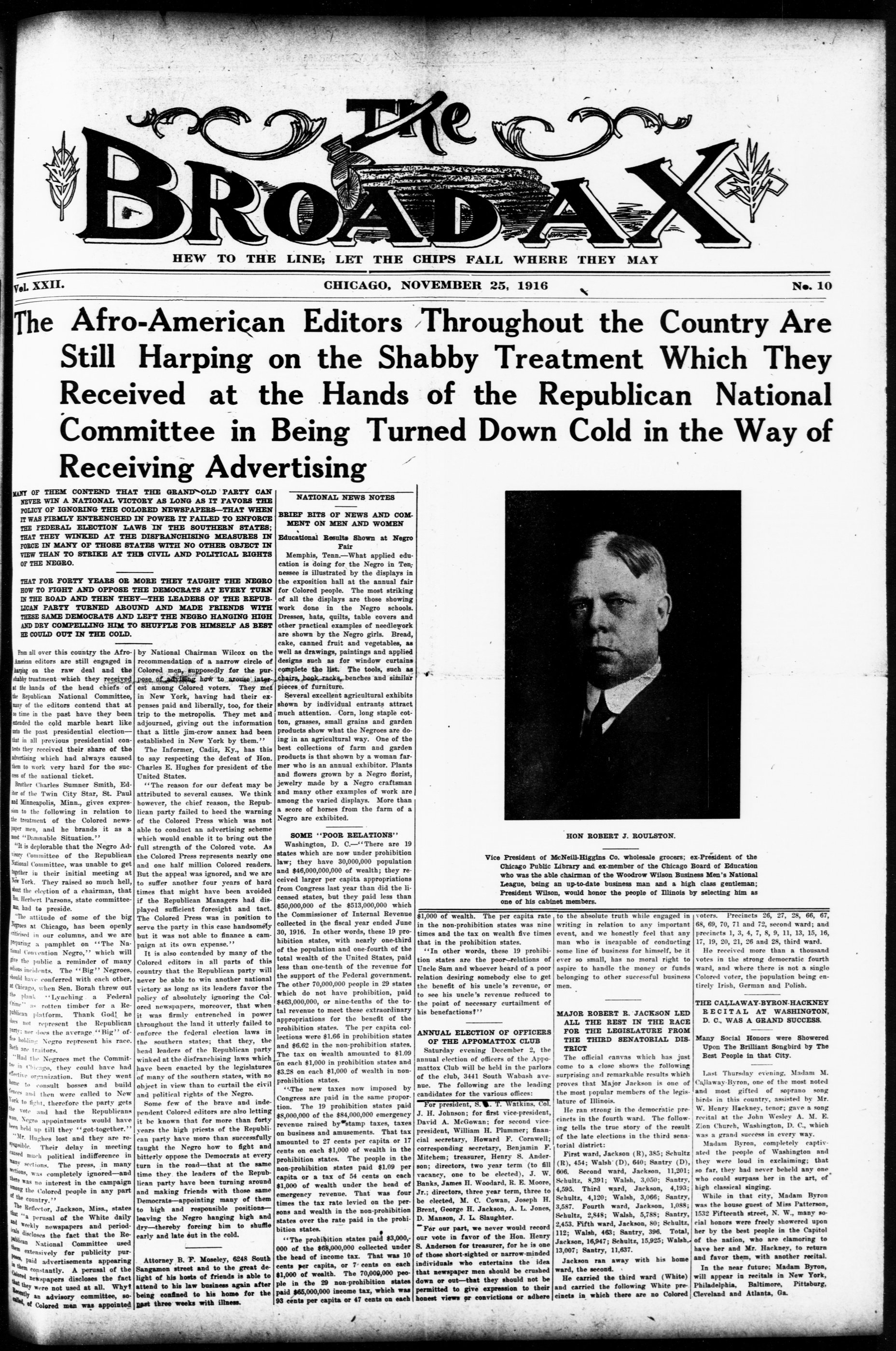
The Afro-American Editors Throughout the Country Are Still Harping on the Shabby Treatment Which They Received at the Hands of the Republican National Committee in Being Turned Down Cold in the Way of Receiving Advertising
MANY OF THEM CONTEND THAT THE GRAND-OLD PARTY CAN NEVER WIN A NATIONAL VICTORY AS LONG AS IT PAVORS THE POLICY OF IGNORING THE COLORED NEWSPAPERS—THAT WHEN IT WAS FIRMLY ENTRENCHED IN POWER IT FAILED TO ENFORCE THE FEDERAL ELECTION LAWS IN THE SOUTHERN STATES; THAT THEY WINKED AT THE DISFRANCHISING MEASURES IN FORCE IN MANY OF THOSE STATES WITH NO OTHER OBJECT IN VIEW THAN TO STRIKE AT THE CIVIL AND POLITICAL RIGHTS OF THE NEGRO.
THAT FOR PORTY YEARS OR MORE THEY TAUGHT THE NEGRO HOW TO FIGHT AND OPPOSE THE DEMOCRATS AT EVERY TURN IN THE ROAD AND THEN THEY—THE LEADERS OF THE REPUBLIC PARTY TURNED AROUND AND MADE FRIENDS WITH THESE SAME DEMOCRATS AND LEFT THE NEGRO HANGING HIGH AND DRY COMPELLING HIM TO SHUFFLE FOR HIMSELF AS BEST HE COULD OUT IN THE COLD.
Vol. XXII.
The Afro
Still
Recei
Com
Recei
MANY OF THEM CONTEND THAT
NEVER WIN A NATIONAL VIC
POLICY OF IGNORING THE CO
IT WAS FIRMLY ENTRENCHED
THE FEDERAL ELECTION LA
THAT THEY WINKED AT THE
FORCE IN MANY OF THOSE ST
VIEW THAN TO STRIKE AT T
OF THE NEGRO.
THAT FOR FORTY YEARS OB
HOW TO FIGHT AND OPPOSE
IN THE ROAD AND THEN THE
LICAN PARTY TURNED ABO
THESE SAME DEMOCRATS AND
AND DRY COMPELLING HIM T
HE COULD OUT IN THE COLD.
From all over this country the Afro-American editors are still engaged in harping on the raw deal and the stability treatment which they received at the hands of the head chiefs of the Republican National Committee, many of the editors contend that at no time in the past have they been attended the cold marble heart like into the past presidential election—that in all previous presidential contests they received their share of the advertising which had always caused them to work very hard for the success of the national ticket.
Brother Charles Sumner Smith, Editor of the Twin City Star, St. Paul and Minneapolis, Minn., gives expression to the following in relation to the treatment of the Colored newspaper men, and he brands it as a most "Damnable Situation."
"It is deplorable that the Negro Advisory Committee of the Republican National Committee, was unable to get together in their initial meeting at New York. They raised so much hell, about the election of a chairman, that Ben. Herbert Parsons, state committeeman, had to preside.
"The attitude of some of the big Negroes at Chicago, has been openly criticised in our columns, and we are preparing a pamphlet on "The National Convention Negro," which will give the public a reminder of many obvious incidents. The "Big" Negroes should have conferred with each other, at Chicago, when Sen. Borah threw out the plank "Lynching a Federal Crime" as rotten timber for a Republican platform. Thank God! he does not represent the Republican party; nor does the average "Big" office holding Negro represent his race. Both are traitors.
"Had the Negroes met the Committee in Chicago, they could have had effective organization. But they went home to consult bosses and build fences and then were called to New York to fight, therefore the party gets the vote and had the Republicans won. Negro appointments would have been held up till they "got-together." "Mr. Hughes lost and they are responsible. Their delay in meeting caused much political indifference in many sections. The press, in many sections, was completely ignored—and there was no interest in the campaign among the Colored people in any part of the country."
The Reflector, Jackson, Miss., states that "a perusal of the White daily and weekly newspapers and periodicals discloses the fact that the Republican National Committee used them extensively for publicity purposes, paid advertisements appearing in them constantly. A perusal of the Colored newspapers discloses the fact that they were not used at all. Why? Recently an advisory committee, so-called, of Colored man was appointed
by National Chairman Wileox on the recommendation of a narrow circle of Colored men, supposedly for the purpose of adyling how to arouse interest among Colored voters. They met in New York, having had their expenses paid and liberally, too, for their trip to the metropolis. They met and adjourned, giving out the information that a little jim-crow annex had been established in New York by them." The Informer, Cadiz, Ky., has this to say respecting the defeat of Hon. Charles E. Hughes for president of the United States.
"The reason for our defeat may be attributed to several causes. We think however, the chief reason, the Republican party failed to heed the warning of the Colored Press which was not able to conduct an advertising scheme which would enable it to bring out the full strength of the Colored vote. As the Colored Press represents nearly one and one half million Colored readers. But the appeal was ignored, and we are to suffer another four years of hard times that might have been avoided if the Republican Managers had displayed sufficient foresight and tact. The Colored Press was in position to serve the party in this case handsomely but it was not able to finance a campaign at its own expense."
It is also contended by many of the Colored editors in all parts of this country that the Republican party will never be able to win another national victory as long as its leaders favor the policy of absolutely ignoring the Colored newspapers, moreover, that when it was firmly entrenched in power throughout the land it utterly failed to enforce the federal election laws in the southern states; that they, the head leaders of the Republican party winked at the disfranchising laws which have been enacted by the legislatures of many of the southern states, with no object in view than to curtail the civil and political rights of the Negro.
Some few of the brave and independent Colored editors are also letting it be known that for more than forty years the high priests of the Republican party have more than successfully taught the Negro to fight and bitterly oppose the Democrats at every turn in the road—that at the same time they the leaders of the Republican party have been turning around and making friends with those same Democrats—appointing many of them to high and responsible positions—leaving the Negro hanging high and dry—thereby forcing him to shuffle early and late out in the cold.
Attorney B. F. Moseley, 6248 South Sangamon street and to the great delight of his hosts of friends is able to attend to his law business again after being confined to his home for the past three weeks with illness.
CHICAGO, NOVEMBER 25, 1916
NATIONAL NEWS NOTES
BRIEF BITS OF NEWS AND COMMENT ON MEN AND WOMEN
Educational Results Shown at Negro Fair
Memphis, Tenn.—What applied education is doing for the Negro in Tennessee is illustrated by the displays in the exposition hall at the annual fair for Colored people. The most striking of all the displays are those showing work done in the Negro schools. Dresses, hats, quilts, table covers and other practical examples of needlework are shown by the Negro girls. Bread, cake, canned fruit and vegetables, as well as drawings, paintings and applied designs such as for window curtains complete the list. The tools, such as chairs, book racks, benches and similar pieces of furniture.
Several excellent agricultural exhibits shown by individual entrants attract much attention. Corn, long staple cotton, grasses, small grains and garden products show what the Negroes are doing in an agricultural way. One of the best collections of farm and garden products is that shown by a woman farmer who is an annual exhibitor. Plants and flowers grown by a Negro florist, jewelry made by a Negro craftsman and many other examples of work are among the varied displays. More than a score of horses from the farm of a Negro are exhibited.
SOME "POOR RELATIONS"
Washington, D. C. “There are 19 states which are now under prohibition law; they have 30,000,000 population and $46,000,000,000 of wealth; they received larger per capita appropriations from Congress last year than did the licensed states, but they paid less than $50,000,000 of the $513,000,000 which the Commissioner of Internal Revenue collected in the fiscal year ended June 30, 1916. In other words, these 19 prohibition states, with nearly one-third of the population and one-fourth of the total wealth of the United States, paid less than one-tenth of the revenue for the support of the Federal government. The other 70,000,000 people in 29 states which do not have prohibition, paid $463,000,000, or nine-tenths of the total revenue to meet these extraordinary appropriations for the benefit of the prohibition states. The per capita collections were $1.66 in prohibition states and $6.62 in the non-prohibition states. The tax on wealth amounted to $1.09 on each $1,000 in prohibition states and $3.28 on each $1,000 of wealth in non-prohibition states.
"The new taxes now imposed by Congress are paid in the same proportion. The 19 prohibition states paid $8,000,000 of the $84,000,000 emergency revenue raised by stamp taxes, taxes on business and amusements. That tax amounted to 27 cents per capita or 17 cents on each $1,000 of wealth in the prohibition states. The people in the non-prohibition states paid $1.09 per capita or a tax of 54 cents on each $1,000 of wealth under the head of emergency revenue. That was four times the tax rate levied on the persons and wealth in the non-prohibition states over the rate paid in the prohibition states.
"The prohibition states paid $3,000,000 of the $68,000,000 collected under the head of income tax. That was 10 cents per capita, or 7 cents on each $1,000 of wealth. The 70,000,000 people in the 29 non-prohibition states paid $65,000,000 income tax, which was 93 cents per capita or 47 cents on each
Vice President of McNeill-Higgins Co. wholesale grocers; ex-President of the Chicago Public Library and ex-member of the Chicago Board of Education who was the able chairman of the Woodrow Wilson Business Men's National League, being an up-to-date business man and a high class gentleman; President Wilson, would honor the people of Illinois by selecting him as one of his cabinet members.
$1,000 of wealth. The per capita rate in the non-prohibition states was nine times and the tax on wealth five times that in the prohibition states.
"In other words, these 19 prohibition states are the poor relations of Uncle Sam and whoever heard of a poor relation desiring somebody else to get the benefit of his uncle's revenue, or to see his uncle's revenue reduced to the point of necessary curtailment of his benefactions?"
to the absolute truth while engaged in writing in relation to any important event, and we honestly feel that any man who is incapable of conducting some line of business for himself, be it ever so small, has no moral right to aspire to handle the money or funds belonging to other successful business men.
MAJOR ROBERT R. JACKSON LED
voters. Precincts 68, 69, 70, 71 and precincts 1, 3, 4, 7, 17, 19, 20, 21, 26 He received votes in the strong ward, and where Colored voter, the tirely Irish, Germer
THE CALLAWAY RECITAL
ANNUAL ELECTION OF OFFICERS
OF THE APPOMATTOX CLUB
Saturday evening December 2, the annual election of officers of the Appomattox Club will be held in the parlor of the club, 3441 South Wabash avenue. The following are the leading candidates for the various offices:
For president, S. A. T. Watkins, Col. J. H. Johnson; for first vice-president, David A. McGowan; for second vice-president, William H. Plummer; financial secretary, Howard F. Cornwell; corresponding secretary, Benjamin F. Mitchem; treasurer, Henry S. Anderson; directors, two year term (to fill vacancy, one to be elected), J. W. Banks, James H. Woodard, R. E. Moore Jr.; directors, three year term, three to be elected, M. C. Cowan, Joseph H. Brent, George H. Jackson, A. L. Jones, D. Manson, J. L. Slaughter.
For our part, we never would record our vote in favor of the Hon. Henry S. Anderson for treasurer, for he is one of those short-sighted or narrow-minded individuals who entertains the idea that newspaper men should be crushed down or out—that they should not be permitted to give expression to their honest views or convictions or adhere
to the absolute truth while engaged in writing in relation to any important event, and we honestly feel that any man who is incapable of conducting some line of business for himself, be it ever so small, has no moral right to aspire to handle the money or funds belonging to other successful business men.
MAJOR ROBERT R. JACKSON LED
ALL THE REST IN THE RACE
FOR THE LEGISLATURE FROM
THE THIRD SENATORIAL DIS
TRICT
The official canvas which has just come to a close shows the following surprising and remarkable results which proves that Major Jackson is one of the most popular members of the legislature of Illinois.
He ran strong in the democratic precincts in the fourth ward. The following tells the true story of the result of the late elections in the third senatorial district:
First ward, Jackson (R), 385; Schultz (R), 454; Walsh' (D), 640; Santry (D), 606. Second ward, story of the result of Schultz, 8,391; Walsh, 3,050; Santry, 4,595. Third ward, Jackson, 4,193; Schultz, 4,120; Walsh, 3,066; Santry, 3,587. Fourth ward, Jackson, 1,088; Schultz, 2,848; Walsh, 5,788; Santry, 2,453. Fifth ward, Jackson, 80; Schultz, 112; Walsh, 463; Santry, 396. Total, Jackson, 16,947; Schultz, 15,925; Walsh, 13,007; Santry, 11,637.
Jackson ran away with his home ward, the second.
He carried the third ward (White) and carried the following White precincts in which there are no Colored
No.10
voters. Preincincts 26, 27, 28, 66, 67, 68, 69, 70, 71 and 72, second ward; and precincts 1, 3, 4, 7, 8, 9, 11, 13, 15, 16, 17, 19, 20, 21, 26 and 28, third ward.
He received more than a thousand votes in the strong democratic fourth ward, and where there is not a single Colored voter, the population being entirely Irish, German and Polish.
THE CALLAWAY-BYRON-HACKNEY RECITAL AT WASHINGTON, D. C., WAS A GRAND SUCCESS.
Many Social Honors were Showered Upon The Brilliant Songbird by The Best People in that City.
Last Thursday evening, Madam M. Callaway-Byron, one of the most noted and most gifted of soprano song birds in this country, assisted by Mr. W. Henry Hackney, tenor; gave a song recital at the John Wesley A. M. E. Zion Chureh, Washington, D. C., which was a grand success in every way.
Madam Byron, completely captivated the people of Washington and they were loud in exclaiming; that so far, they had never beheld any one who could surpass her in the art, of high classical singing.
While in that city, Madam Byron was the house guest of Miss Patterson, 1532 Fifteenth street, N. W., many social honors were freely showered upon her by the best people in the Capitol of the nation, who are clamoring to have her and Mr. Hackney, to return and favor them, with another recital. In the near future; Madam Byron, will appear in recitals in New York, Philadelphia, Baltimore, Pittsburg, Cleveland and Atlanta, Ga.
Dan M. Jackson
Geo. T. Kersey
Davl d A. McGowan
Ahmed A. Reyner
The Emanuel Jackson Undertaking Co., Inc. 2959-61 South State St.
Reliable Service Courteous Treatment Reasonable Prices FREE CHAPEL IN CONNECTION Complete line of Funeral Goods. Automobiles for hire
Wonders of a Book.
There is perhaps no greater wonder than a book. By the help of little figures upon spins or paper men have been able to transmit their thoughts through thousands of years. The names and shapes of things, the deeds and sorrows that have occurred as far back as Adam, have been made known to us. Even those invisible and abstract thoughts which have no shape or substance, but which inspired the writer and have since inspired others, are all put down in the little letters and made eternal. The songs of David, the speculations of Plato, the visions of Homer, have by these means been handed down faithfully for many centuries and distributed among mankind. If there were no books our knowledge would almost be confined to the limit of sight and hearing. All that we could not see or hear would be to us like the inhabitants of the planet Saturn—a mere matter of idle conjecture—Barry Cornwall.
Felt For Him.
Bobbie Smith, aged nine, was the shining light of the family, and his father was very proud of him.
"I shall call round and see your teacher," said his fond parent, "and thank him for the kind interest he is taking in you."
"If you do, father, I want to tell you that all the boys in our class are not known by name, but by number only. My number is 25."
In due course the father called at the school and knocked at the door, which was after a few moments opened by the head master.
"Good morning, sir," said Mr. Smith.
"I am the father of 25."
"Indeed," replied the schoolmaster, with surprise. "Come inside, my friend. I can feel for you, for I am the father of twelve myself."—Iondon Globe.
Southern California of Argentina. Mendoza is the southern California of Argentina. Irrigation has long been successfully applied to its vineyards, which produce more wine than the combined vineyards of the entire United States of North America. The whole of the province lies at an altitude of more than 2,000 feet. Italians are for the most part employed in the cultivation of the grapes, the whole family accompanying husband and father to the field and assisting in tending the vines. The babies are put to sleep in improvised tents while their elders work. - National Geographic Magazine.
Eggs In the Nest.
All birds have a systematic arrangement in depositing their eggs in the nest, and there are very few species, if any, in which some peculiarity is not to be seen if careful observation is made. Many birds so plainly and invariably show a tendency to a set arrangement that their habit is generally known.
He Got the Raise
"You want more money? Why, my boy, I worked three years for $11 a month right in this establishment, and now I'm owner of it." "Well, you see what happened to your boss. No man who treats his help that way can hang on to his business."
Tea Production:
No accurate figures of the world's total production of tea can be given, but the quantity in exchange between nations amounts to about a billion pounds, worth to the producers about $150,000,000 and costing the consumers over twice as much.
Unprofitably Occupied.
Teacher—Well, Henry, are you learning anything? Henry—Please, no, sir; I am listening to you!
PRACTICAL HEALTH HINT.
Neglect of the Nose.
An organ whose unhealthy condition is much neglected by the public is the nose. The interior of the nose is really very complicated. It is divided down the center by a septum, and each half of the nose contains various small chambers formed by delicate shell-like bones covered with mucous membrane and richly supplied with nerves and blood vessels.
Any part of this complicated organ may suffer from various forms of catarrh, congestion and inflammation, the least expression of which is a more or less constant and very tiresome cold, but which may develop into more serious difficulties.
---
PAGE TWO
Phones Calumet 6164
Automatic 71-829
OPEN DAY
AND NIGHT
Freeest Animals
Writers of a century ago were firm in the conviction that the greyhound was the fastest living animal; some maintained that he could run a mile in a minute. Modern observers, however, have found that the best hound is by no means able to keep pace with a trained race horse. Indeed, the late J. A. Graham, a careful student of such otters, used to say that no living animal could outfoot a modern race horse.
A first rate horse running his best and not handicapped by carrying a rider can run a mile in less than 100 seconds. A fleet hound, such as those used in coursing, can run a mile in about a minute and fifty seconds. A jack rabbit is nearly as fast, and an antelope is considerably faster. Mr. Graham thought an antelope might run a mile across the level prairie in a minute and forty-five seconds.
On the other hand, Mr. Cottar, an old African hunter, thinks that Thomson's gazelle would have no trouble whatever in running away from the fastest horse and that Grant's gazelle and the gerenuk are almost equally fleet.—Youth's Companion.
Money No Object.
As an instance of the reckless character of the old time British tar an English writer quotes the following authenticated reminiscence:
"One morning, as an officer was standing in Fore street, Devonport, his attention was drawn to three post-chaises, with four horses to each, drawn up at the door of the King's Arms hotel. These were presently driven off. On inquiring what great person had arrived, the officer was informed that all this display was the freak of a common sailor, who had just received £500 in prize money, and, having been granted but a week's leave, his ingenuity had devised the most ostentatious mode of getting rid of this windfall. He had hired one chaise and four for himself, another for his hat and a bird for his cudgel. It was his intent to make the trip to London and back, which would, he hoped, nearly consume the whole sum."
Really Little Known of
Poland's history, with its fight for freedom, justice and equality, its struggle in defense of Christianity and European civilization and its unselfishness in aiding the weak, made it famous among the world's nations, both in success and adversity. The achievements of the Polish nation in art, music, literature, science and religion are known, as are the life deeds of its great men. But the industries, mines, trade and natural wealth of that unhappy country have since its partition been to a great extent a sealed book to most of the people outside of the nations attempting to assimilate the Poles. This was principally due to the inability of people from the outside to break through the network of foreign governmental systems in which Poland is enmeshed.-Buffalo News.
How Some Insects Multiply
The fecundity of certain insect forms is astounding. The progeny of one little insect, the "hop aphis," sees thirteen generations born to it in a single year and would, if unchecked to the end of the twelfth generation, multiply to the inconceivable number of ten sextillions of individuals. If this brood were marshaled in line, ten to the inch, it would extend to a point so sunk in the profundity of space that light from the head of the procession, traveling at the rate of 184,000 miles a second, would take 2,500 years to reach the earth. In eight years the progeny of a pair of gypsy moths could destroy all the foliage in the United States if unchecked.—Popular Science Monthly.
What Worried Him
"Papa, dear," said the anxious daughter, "you must not worry because Harold is going to marry me and take me far away from you and mamma."
"Oh, a little thing like that isn't going to worry me," replied the fond parent, "but if he ever does anything that will cause you to come back to us again I will certainly do him bodily injury."—St. Louis Post-Dispatch.
Time to Quit Then
"Do you expect to spend your whole life in the wicked pursuit of riches?" asked the ascetic person. "No," replied the brisk individual. "If I'm not rich by the time I reach fifty years of age I shall consider myself an ignoble failure."—Birmingham Age-Herald.
"Women are so awfully hard to understand"
"What's the matter now?"
THE BROAD AX. CHICAGO, NOVEMBER 25, 1916.
REWARDS HEROES
Middle West Figures Largely In Carnegie Medal Award.
ONE WOMAN ON THE LIST.
Mrs. Olive M. J. Cooper of Battle Creek, Mich., Saved Adult and Three Children from Drowning at Spencerville, Ind., by Swimming Out and Rescuing One at a Time.
Pittsburgh.—The heroism of John Murray, aged twenty-seven, a laborer, of Chicago, who risked his life to save that of Patrick Eustace, has been rewarded by the Carnegie hero fund commission, which awarded Murray a bronze medal.
Reaching out into an elevator shaft on the nineteenth floor of an uncompleted building in Chicago on June 27, 1911, Murray grasped Eustace, who had fallen from the twentieth floor. Murray gripped an iron beam with one arm and with his free arm caught Eustace as he started down the elevator shaft.
Other heroes from the middle west received honors.
Roger W. Wells of North Madison, Ind., receives a medal. Wells, forty years old, was disabled two weeks from lung congestion, due to fumes when he assisted in rescuing James E. Dougherty from suffocation at Heldelberg, Pa., on March 27, 1916.
George C. Oxley, a merchant of Marlon, Ia., rescued ten-year-old E. Emerson Harte from a runaway at Marlon on Aug. 16, 1915.
Donald H. Stoops, seventeen years old, of Nappanee, Ind., receives a medal because he saved Pauline E. Holmes, thirteen, and L. Beatrice Doswell, fifteen, from drowning at Pickwick Park, Ind., June 16, 1913. Stoops, although he had lost his left arm eight months before, swam to the point where the girls were struggling, pushed one of them ahead of him with his shoulder until she was in shallow water and swam back and rescued the other girl in the same way.
Dana S. Miller, a farm manager of Butler, Ind., is awarded a medal for having saved Elmer McDonald, a laborer, from an enraged bull on Aug. 17, 1912. McDonald had been gored and four ribs were broken. Miller attacked the animal with a pitchfork and was repeatedly knocked down. He finally seized a ring in the bull's nose and clung to it until the animal was subdued.
William T. Best, Owosso, Mich., is listed because he saved three-year-old Carney P. Lamphere from burning after a gasoline explosion at Owosso, Jan. 5, 1915. Best's burns disabled him for six weeks.
One woman is on the list. She is Mrs. Olive M. J. Cooper of Battle Creek, Mich., who saved an adult and three children from drowning at Spencerville, Ind., by swimming out on the St. Joseph river and returning with them one at a time.
TEACHER NEAR DEATH.
Pupil She Corrected Had Nitroglycerine Cap.
Oakbrook, Pa.—Miss May E. Dillon, a teacher in the primary grade of the schools, only realized the next day how narrowly she had escaped death. She was forced to reprimand one of her pupils the other day and used a ruler. The next day she learned that the culprit had a nitroglycerin cap in his pocket at the time.
Lawrence Hine, six years old, one of the pupils, found a can of the explosive in a stone quarry and distributed some caps among his friends. The next day the owner of the caps called at the school, and all the caps were recovered from the pockets and desks of the pupils, who for twenty-four hours were in danger of being hurled in midair together with their schoolhouse and teachers.
SCARED TO DEATH BY SEA.
Raw Lightship Keeper Goes Into Frenzy in First Gale.
Newport, R. I.-A case of a man literally frightened to death has just been reported. Gustav Ljunvall went to Brenton's reef lightship as assistant keeper, but before he had time to become accustomed to his surroundings the wind became a gale, accompanied by great seas, and the ship pitched at disturbing angles.
Ljunvall expressed great fear that the ship would go down. In a frenzy he tried to jump overboard, but was restrained. His violence increased, and the crew put him in an improvised straitjacket and kept him there until he died.
Indian, 122 Years Old, Works Daily. Mazatian, Mexico. - This western coast town of Mexico claims as a resident the oldest man in the world, Jose Juan Velasquez, an Indian, who, according to all records available, is 122 years old. Velasquez has the agility of a man of less than half his years and works daily as a laborer. He possesses a remarkable memory and is familiar with happenings during the Hidalgo revolution for Mexican independence from Spain in 1810-21.
Horse Wears Trays
Charleston, W. Va.—A horse wearing a pair of trousers on its front legs is a novelty seen daily on the streets. The animal is attached to an express wagon, and the owner dresses him in order to protect his forelegs from fires. The trousers are supported by the breastband of the harness.
Peasants Wore Platinum Buttons.
"With platinum now costing around $90 an ounce," said a widely known manufacturing jeweler of this city, "it may be hard to believe that half a century or so ago peasants in Russia were wearing buttons of this metal on their clothing. They were also using it for handles of knives, forks and umbrellas, and the workmen in the jewelry shops were using it for making 'pickle' pans, a contrivance, now made of copper, that plays quite an important part in the making of jewelry. At that time platinum cost about $5 an ounce, and in Russia it was so plentiful because there was so little use for it that the Russian government decided to make coins of it in lieu of silver. The Russian people, however, were suspicious of the new metal, fearing that it had no value, and it was not long before the coins were out of circulation. It was then that they began to appear as buttons and to be melted for purposes more utilitarian than decorative."—New York Times.
Man as a Meat Eater
That man has eaten beef, pork and fish since the remotest ages is deduced by Professor M. W. Lyon, Jr., of the George Washington university, in an article in Science, from the life history of three species of tapeworm. These three—the Toenia saginata, or beef tapeworm; Toenia solium, or pork tapeworm, and Dibothriocephalus latus, or fish tapeworm—are highly differentiated. Part of their lives they spend in human beings, part in the animals from which they are named, and both these hosts are necessary to their development.
"We have no evidence that species of any kind are rapidly produced," says Professor Lyon. "and the parasites have probably had as slow an evolution as man. The conclusion seems clear that man has been eating cattle and pigs or their immediate ancestors, and perhaps himself, for as many ages as needed for these tapeworms to attain their present degree of differentiation."
"Three Sheets In the Wind."
"What was the origin of the phrase for drunkenness, 'three sheets in the wind?' a landsman asked a sailor the other day. "Well," said the sailor, "I'll explain that matter to you. The two lower corners of a ship's sail are held taut by two ropes, one called a tack and another called a sheet. The tack is always kept very tight, but the sheet is loosened according to the wind, and the looser the sheet is the more freely the sail swings. If the sail is quite free its sheet is said to be 'in the wind.' Now, suppose that all three of a ship's sails were quite free. They would then fly about very crazily, and the ship would wabble. The course of the ship would be a zigzag one, and the reason for this would be that she had 'three sheets in the wind.' That, I guess, is why a man when he zigzags in his course is said to be 'three sheets in the wind' also."
Proper Breathing.
To breathe properly take a deep, slow breath, another and another. Put both the hands on your ribs and see how they expand and contract as you breathe in and out. Put one hand on the low ribs in front and the other opposite it on the back. Feel how the back swells as you breathe. There is a powerful muscle called the diaphragm that divides the chest from the abdomen. As the heart and lungs are in the chest, the diaphragm may be called the floor of the chest. It is fastened to the backbone, the ribs and the sternum, or breastbone. And when people speak of diaphragmatic breathing they mean just what we are doing now—filling the lungs with air and emptying them by the expansion and contraction.
Ranked Bails
In rounding a curve the tendency of the weight of a train is invariably to shift to the outside wheels. To counteract this tendency the outer rail of a curve is raised on a higher level than the inside, the elevation being in an exact proportion to the sharpness of the curve as determined by the principles of engineering. If both rails of a curved track were of exactly the same elevation a train would not dare round it at high speed.
In Behalf of Accuracy.
The reporter was interviewing the leading politician.
"This," said the interviewed, "is the age of steel, and"—
"Pardon me, please," interrupted the interviewer. "but in behalf of accuracy would you kindly spell that word?"—Browning's Magazine.
Diplomatic.
"I want you," said the fair society leader, "to give me a plain opinion as to my latest photograph."
"Madam," said the gallant cavaller, bowing, "to speak in plain terms of that portrait would be impossible!"—London Telegraph.
Doubtful Sympathy:
The Bride to Be—My only worry is about mother. She's bound to miss me terribly. Friend of the Family—Ah, well, she can't complain. After all, she's had you longer than most mothers keep their daughters.—Sydney Bulletin.
Fatal Error.
"I thought you had given up burnt wood art, dearie."
"Ferdinand, how can you be so heartless? This is a pie."—Kansas City Journal.
An unjust acquisition is like a barbed arrow, which must be drawn backward with horrible anguish or else will be your destruction.-Jeremy Taylor.
A. E. H.
A COLD.
Now we are having in increasing numbers persons who suffer certain physical disorder called by the average citizen a "cold." The proper name for it is in professional language, Acute Coryza. It is dangerous to neglect the disease because of its possibilities. The common "cold" often is pneumonia or that other captain of death, tuberculosis.
The earliest symptoms of a "cold" are the same as the early symptoms of more dangerous maladies, for instance influenza, bronchitis, tonsilitis and even infantile paralysis in the early stage. Hence it is the better practice to be serious with the treatment of what appears to be an ordinary "cold." All diseases of the upper air passages are capable of graduating into the fatal diseases of the lungs, nasopharynx and trachea. Diphtheria and pneumonia have been mistaken by the laity for a "cold" and sometimes "home remedies" are wasted as well as the time to save the life of the patient. The safer way and the way to ultimate economy is to consult your physician. He is fitted by training and experience to diagnose and treat prop-
GIFTS FOR HOLY LAND
GO IN CHRISTMAS SHIP
American Collier Will Carry Relief For War Sufferers.
New York.—America's 1916 Christmas ship for the relief of unfortunate victims of the war will leave New York Dec. 1. The American Red Cross is co-operating with the American committee for Armenian and Syrian relief in collecting foodstuffs and clothing to be sent to Syria on a government collier placed at the disposal of the latter committee by Secretary Daniels.
The collection of the Christmas ship cargo is in the hands of Albert W. Staub of the American Red Cross receiving and distributing station at Bush terminal, Brooklyn. Mr. Staub has already received countless bundles of old clothing, unavailable for the cargo, as military regulations preclude the shipment of second hand clothing in this cargo. He said, "It must be emphasized that the only clothing America can send to the unfortunate ones in Turkey must be new and must be sent prepaid to the American Red Cross, Bush terminal, Brooklyn." Mr. Staub sent the following letter from the war relief information and shipping office:
"It is more than significant that the first letter to go out from the newly organized Red Cross war relief information office has to do with a Christmas ship. It is doubly significant that it is to take relief to a people living so near the Holy Land."
MIKE HICKEY TELLS OF HIS REFORMATION
MIKE HICKEY TELLS OF HIS REFORMATION
Ex-Pickpocket, With Twenty Years' Prison Record, Talks to 400 Men.
Mike Hickey, once a notorious pick-pocket, with a record of nineteen and a half years behind prison bars, told 400 men at the Harlem branch Y. M. C. A., New York, how he straightened out and how other inhabitants of the underworld could be helped to do the same.
Mike's career as a thief lasted until about four years ago, when he wandered, fresh from Sing Sing, into the Cremorne mission, on Thirty-second street. It ended there. Now he is night man at the Bowery Y. M. C. A. and passes his spare time helping his old pals from Dannemora and Sing Sing to get their feet on the "straight and narrow."
The trouble with the newly emerged convict, he said, was the old story—out into the world with a $10 bill and a wish to keep straight; a job until a cop told the boss of his record, then ne more job; broke; one more trick to get money to eat; caught, and back to prison.
What the convict needs is a bit of belief and encouragement when he starts to reform, said Hickey, adding that more and more the employees are beginning to give this, so that many men with long records as criminals are now taking their places in honest life.
Talks on
HEALTH,
CLEANLINESS,
PROPER LIVING,
SANITATION, ETC
Dr. W. A. Driver
3300 So. State Street
Phone Douglas 3617
erly the condition before the disease has gone too far.
An acute catarrhal inflammation of the upper air-passages is popularly known as a "cold" or as "catarrh." That it is contagious for susceptible persons is not so well known popularly. Susceptible persons are those who are below normal or persons who disobey the rules of hygienic living and they are found everywhere. The reason that some people escape the contagion is that they are entitled to escape as a reward for careful observation of the simple rules of an orderly, natural, hygienic, normal life.
The same rule applies in other contagious diseases. It is a simple application of the natural and immutable law of the survival of the fittest.
If you have made mistakes in living that have brought the sure and proper reward of inflammation of the upper air passages, called a "cold," "sore throat," tonsillitis, lagrime, influenza, pneumonia, diphtheria, lumbago or whatever the name the guesser gives it, let one series of mistakes be enough. Do not make the serious blunder of trying to do the work that you are not qualified to do. The physician is the proper person to consult at this stage of the game.
Capitals We Have Had.
It is asserted sometimes that the United States has had five capitals but the statement is not correct. The United States has had but three capitals—New York, Philadelphia and Washington. In the period preceding the adoption of the constitution no place was legally constituted a capital. In a loose and unofficial sense it is possible to describe as a capital any city which was the seat of government. Taking the sessions of the Continental congress as establishing a seat of government in the Revolution and the confederation, the following cities may loosely rank as capitals: Philadelphia, Baltimore, Lancaster, York Princeton, Annapolis, Trenton and New York. The articles of confederation were passed by congress in Philadelphia, and the federal convention charged to prepare a constitution convened at the same place.
Not Her Fault:
The express was approaching a railway bridge that spanned a deep river, and a stout old lady in one of the compartments showed signs of nervousness. As the train went roaring across the structure she did not speak a word, but seemed to be holding her breath.
"There," said a gentleman in a neighbor boring seat, "we are over it safely."
The old lady heaved an explosive sigh.
"Well," she said. "if we had gone to the bottom I should have died with a clear conscience, for it wouldn't have been my weight that did it. I bore up so that I really made the train lighter than it would have been without me!"—London Mail.
Malabar's Lemon Grass
The hillsides of the Malabar coast of India are the scene of great commercial activity once a year, when the lemon grass harvest is under way. Oil extracted from the grass is employed in the manufacture of artificial perfumes. The hillsides are burned over to destroy the old and useless grass. Six months later the fresh crop is ready to be cut, and at once the countryside is dotted with furnaces and stills.
Life's Three Questions
The three great questions of life are "Is it right or wrong? Is it true or false? Is it beautiful or only? These our education should help us to answer, and insomuch as it fails it will lack in reaching a proper physical or moral standard.
Natural Result
She-What! He, a dirt, married a
firt! How can that be? He-Why, it's
simple enough. They set out to see
which could beat the other flirting and
it resulted in a tie-Exchange.
"It's a queer language."
"What's the matter now?"
"When you pay the cash down you call it settling up." — Detroit Free Press.
Did the Best He Could.
She (during the spat)—You should have married some stupid, credulous girl. He—Well, my dear, I did the best I could—Boston Transcript.
The birth of J. M. Barrie's play, "Peter Pan," was full of romantic interest. Barrie had agreed to write a play for Frohman and met him at dinner one night at the Garrick club in London. Barrie seemed nervous and ill at ease.
"What's the matter?" said Charles.
"Simply this," said Barrie. "You know I have an agreement to deliver you the manuscript of a play?" "Yes," said Frohman.
"Well, I have it all right," said Barrie, "but I am sure it will not be a commercial success. It is a dream child of mine, and I am so anxious to see it on the stage that I have written another play which I will be glad to give you and which will compensate you for any loss on the one I am so eager to see produced."
"Don't bother about that," said Frohman, "will produce both plays."
Now, the extraordinary thing about this episode is that the play about whose success Barrie was so doubtful was "Peter Pan," which made several fortunes. The manuscript he offered Frohman to indemnify him from loss was "Alice-Sit-by-the-Fire," which lasted only a season.—"Charles Frohman, Manager and Man."
Married Money.
"Glad to see you looking so well, old man," said the friend of a newly made benedict. "This is the first opportunity I have had of offering my congratulations on your recent marriage. From the look of things I guess you've married money. Well, it was the right thing to do. That shop walking berth of yours must have been awfully boring. Is she in? I should like to be introduced."
"Oh, she's at work," said the husband, with a placid smile. "At work? What do you mean?" asked the friend.
"Well, you see, it was this way," replied the benedict. "She had a much better position than mine—head of her department, £8 a week. Wouldn't give it up. So there was nothing for it but for me to retire from business and keep house, and here I am, you see. You have to let women have their way in some things."—London Tit-Bits.
The Business of Life
Life is a business we are all apt to mismanage, either living recklessly from day to day or suffering ourselves to be guided out of our moments by the instances of custom. We should despise a man who gave as little activity and forethought to the conduct of any other business. But in this, which is the one thing of all others, since it contains them all, we cannot see the forest for the trees. One brief impression obliterates another. There is something stupifying in the recurrence of unimportant things, and it is only on rare provocations that we can rise to take an outlook beyond daily concerns and comprehend the narrow limits and great possibilities of our existence.—Robert Louis Stevenson.
Over the wire to the parsonage came this request:
"The bishop would like to meet at the church this evening the pastor, the class leader, the Sunday school superintendent, the president of the cradle roll and of the young people's societies, the president of the missionary society, the chorister and the sexton"
"All right! I'll be there," was the answer - Christian Herald.
At Regular Rates.
Amateur Poetess-Ten dollars for correcting the meter of this little verse! Professional Poet-Oh, yes; for this sort of work I charge regular plumbers rates-Life.
Shook.
Molly—You say you shook all over
when you proposed to her? Cholly—
Yes, I did. Molly—And how about the
girl? Cholly—Oh, she only shook her
head. _____
```markdown
```
Wrong Eating.
"After all," says a bulletin from a state board of health, "good health is largely a matter of what goes into the stomach. If a person eats heavily of rich, greasy, concentrated foods, such as fried meats, rich pastries, sugary or underdone breads, he will soon find himself seeking a relief from headache, sluggishness, and the patent medicine route will be the way he will likely choose. Pills and purgations will find a hearty welcome and become a warm friend to persons who so poison themselves. The trouble arising from eating food of this kind is that it ferments in the stomach, throws off poisons and creates a condition which calls for a stronger poison in the form of medicine to throw off the food poison. The medicine habit is acquired, and the digestive organs of the stomach are wrecked and no longer perform their natural functions.
"On the other hand, whoever eats freely of fruits, vegetables, milk, butter, salads, cereals and nuts—foods prepared by nature for man—not only avoids digestive troubles, but he is spared the evil effects of food poisons, such as rheumatism, headaches, sluggishness and billiousness. He also escapes the patent medicine health. He eats according to nature's demand and needs, and no medicine is required as an after dose."
```markdown
```
Soldiers Love Their Job, and If Not Paid They Loot.
Peking.—China's toughest problem now is how to disband the army raised during the revolution. The government, hard pressed for money, will have to raise at least $30,000,000 to pay off the 800,000 men under arms, and unpaid soldiers are always a menace in China. Coolies regard military service as a very desirable occupation. Once enlisted it is difficult to persuade them to retire. They riot and become extremely troublesome if an attempt be made to disband them without liberal payment. The commanding officers are frequently as mercenary as the soldiers. When the government fails to give its soldiers what they regard as adequate pay the troops frequently become bandits and loot.
Each province has its own military governor and a distinct military organization, presumably under control of the Peking authorities, but actually independent in most cases. Consequently the Peking government is forced to deal very diplomatically with the military organizations in the provinces, particularly in the remote provinces.
HARVARD MAN FOILS SUN WITH INVENTION
Presses a Button In Bed and the Window Shade Goes Down as if by Magic.
Cambridge, Mass. — Every morning at 7 o'clock Henry R. Guild of Boston, a Harvard senior, rolls over in bed. Seven o'clock is too early for a senior to get up, so Mr. Guild presses a button and the shade at the distant end of his chamber rolls down as if by magic.
No rising sun is going to make him leave his bed unseasonably. Some morning he may miss a four alarm fire by pressing the button, but he's willing to take the chance, he asserts.
Getting up at 7 a. m. is a high crime at Harvard, the same as admitting Yale has a good football team this year.
Henry Guild framed up a motor, attached to the curtain string and laid wires to his bedside. When the sun throws its rays into his bedroom every morning, weather permitting, he presses a button and the curtain flops faster than in a vaudeville theater.
Mr. Guild's next invention probably will be a trap door to throw tiresome professors into the cellar by means of a button that any student can press. Life's attendant inconveniences aren't going to bother him while electricity can do the work.
FIREMAN SAVES BABY.
Climbed on Pilot of Locomotive, Lifted Infant From Track.
La Crosse, Wis.—Coon valley residents are talking of applying for a Carnegie medal for Fireman Peter Hensgen of the La Crosse and Southeastern. He was in a freight engine cab when he saw a child in the distance on the track.
It was down grade and the brakes were slow to grip. Hensgen climbed out along the footboard to the pilot, grasped a rod and leaned down.
He grabbed the sleeping child with his free hand and lifted her from the track. The child was the little daughter of Mr. and Mrs. Elmer Jacobson. She had wandered away in the afternoon and lay down tired between the rails and went to sleep.
NEW DIMES IN CIRCULATION.
$180,000 Worth of Coins Distributed by the Philadelphia Mint.
Philadelphia. — The new ten cent pieces which have been coined in large quantities at the Philadelphia mint were recently put into circulation for the first time, about $180,000 worth being distributed to banks and trust companies. They were introduced simultaneously in the western states from the Denver mint.
The obverse side of the new dime shows a head of Liberty in profile, while the reverse side shows a bundle of rods in the center and the protruding battlecock, symbols of unity. Surrounding the central design is an olive wreath, denoting peace.
The new coins are expected to be in general circulation within a few days.
Child Escapes Covote.
Bend, Ore.—Attracted to the dooryard by an unusual noise being made by her flock of turkeys, Mrs. Thomas Merchant, living east of Bend, found a coyote running toward her little girl, who was playing in the yard. The animal was frothing at the mouth and is believed to have been rabid. Mrs. Merchant had just time to snatch her daughter up and return to the house before the coyote reached the spot where the little girl was at play.
ante Kill Bees
Oakland, Cal.-Dr. J. H. Callen, who had two hives of bees, much alive, on his Fruitvale avenue property, is now occupied in cleaning out two hives of dead bees, victims of an unsuccessful Verdun defense against a horde of marauding ants. The evidence shows that the ants attacked in solid mass formation, carrying the bees' first, second and third line of trenches and then attacking the entrances to the hives.
THE BROAD AX, CHICAGO, NOVEMBER 25, 1916
Camera Men and War Pictures
Camera Men and War Pictures. The camera man in search of lively war pictures often enjoys the protection of a special guard, which is especially detailed to protect him. Since the camera does not shoot as far as a gun, the photographer often works at an immense disadvantage. The camera makes a conspicuous target and often draws the enemy's fire. The special camera guard, which originated in one of the early Villa campaigns in Mexico, consists of two picked men, perhaps more, who accompany the photographer or skirmish ahead of him to render his position as safe as possible when the camera is set up. Many thousands of feet of war film have been made while sharpshooters on both sides kept up a steady and effective fire. A guard of two American Indians, both crack shots, were employed for many weeks to protect L. M. Burrud, an American camera man, who accompanied Villa in one of his campaigns. The Indians' stealth and daring in reconnoitering the ground in advance often proved indispensable. "The Camera Man," by Francis Arnold Collins.
Stage Names and Real.
The extent to which favorite actresses are somebody else off the stage is not well understood. Actors generally play under their own names, but the woman who has achieved a reputation before marriage prefers to retain the name under which she became known rather than assume that of her husband. Some women, too, play while unmarried under another name than the real one.
For instance, Maude Adams is really Miss Kiskadden, and Marie Dressler is Lella Koerer. Jack and Ethel Barrymore are properly called Blythe, and Truly Shattuck is Clarice Ertrula de Bucharde, a name rather too long for the stage. Theater goers seem to like short names easily remembered. Trixie Friganza is really Della Edna O'Callahan, and Mary Mannering is Florence Friend; Elsie Janis was formerly Elisie Blerbower, and Margaret Anglin is Mary Warren. And so it goes through the list—Boston Herald.
Orkney Islands In Pawn:
The Orkney islands, says Pearson's Magazine, do not really belong to Great Britain in the sense that they were ever ceded by treaty or acquired by conquest. They were simply transferred by Denmark to Scotland in 1468, in pledge for the payment of the dowry of the Princess of Denmark, who was married to James III., king of Scotland. In the deed of transfer, which is still in existence, it is specially mentioned that Denmark shall have the right to redeem them at any future time by paying the original amount of the dowry with interest to date.
There is no likelihood, however, that Denmark will ever attempt to exercise her right of redemption, because 60,000 florins, the original amount of the dowry, plus compound interest for 448 years, would amount to perhaps £1,000,000,000,000, and that is a bit more than the islands are worth.
"Thanks For the Ducks."
An official in one of the largest manufacturing concerns in Philadelphia recently showed me the huge plant. I marveled at the labor saving machinery.
"One of our workmen," he said, "has made a great many of the improvements you see in this room. He likes to go duck shooting, and while off on a trip for a week or more he thinks out some new way to save labor."
After a moment's pause he added:
"Why, he turned up one day with a plan whereby we save $50,000 a year."
"And what." I inquired, "does that workman get out of it?"
"Oh," the happy official replied, "he gets the ducks."—Girard in Philadelphia Ledger.
Simple Arithmetic
A little boy who had not learned how to count one day received three apples from a friend.
He was very pleased and told his mother afterward.
"How many apples did you get?" she asked.
"I don't know just how many mother," he replied, "but I got one in the middle and two outside."—New York Times.
Not Guilty.
Little Charley had been spanked by his mother for stealing cookies. His cousin, who was present, wishing to comfort him, said: "Poor Charley! You have my sympathy." Looking up through his tears, he protested: "I have not! I didn't touch it!"—Boston Transcript.
The Ancient Mayas
It is urged by an archaeologist that the Mayas, who once inhabited America, had a civilization as far advanced as that of any early people except the Greeks. The dwellers in the jungles of Yucatan, Guatemala and Honduras are believed to be their descendants.
Clam Shells.
Clam shells are susceptible of a fine polish and are used for many ornamental purposes. Chinese carve them into snuffboxes, tops of walking sticks, bracelets and similar articles.
Merely a Delusion
Insurance Doctor-- Any insanity in your family? Cholly-Only-aw—the pater-thinks he's the head of the house. re know--Boston Globe.
Strong on Bills.
Winkle—My wife would make a good member of congress. Hinkle—Why? Winkle—She's always introducing bills into the house.
Where love and skill work together expect a masterpiece—Reade.
Lobster and Butterfly.
According to a scientific observer, the lobster is akin to the butterfly. The kinship is not merely that of two members of the animal kingdom. The lobster and the butterfly are actually in one and the same great group of the kingdom, like the clam and the snail or the whale and the giraffe, whose spheres of activity are so widely separated. It is simply, as Darwin pointed out in the case of other creatures many years ago, that the lobster and its friends, the crab, the prawn and the shrimp, chose one method of life, while the butterfly and its set chose another. So the first group developed characteristics suited to the conditions in which it lived, including as one of the most important, as its members do not move rapidly, a coat of armor to protect them from their innumerable enemies, while the butterflies and the great host of winged insects shed every bit of superfluous weight, trusting to swiftness to carry them out of danger and to protective coloring to conceal them when flight is unavailing.
A. Useful Coffin
A writer in an English church magazine once found in a collier's cottage in Staffordshire a coffin used as a bread and cheese cupboard. Notwithstanding his wife's remonstrance, he told the story of the coffin as follows: "Eighteen years ago I ordered that coffin. The wife and me used to have a good many words. One day she said, 'I'll never be content till I see thee in thy coffin.' 'Well, lass,' I said, 'if that'll content thee it'll soon be done.'
"Next day I gave directions to have the thing made. In a few days it came home, to the wife's horror. I got into and sald, 'Now, lass, are the content?' She began to cry and wanted the 'horrid thing' taken away. But that I wouldn't allow. In the end she got accustomed to seeing it, and as we wanted to turn it to some use we had some shelves put in and made it into a bread and cheese cupboard. We have never quarreled since it came."
Where Johnson Made a Blunder
The present Blackfriars bridge is a comparatively modern structure, which replaced the bridge of Robert Myllne after the latter had endured, with much alteration and repair, it is true, for nearly a hundred years. Myllne's design, it will be recalled by those familiar with their Boswell, was attacked by Johnson with that arrogance and, let me sadly add, ignorance which he was too wont to display in subjects of which he knew very little. Johnson, with a weight of words which might have tested any bridge, declared that no structure with elliptical arches could bear heavy weights. Myllne's bridge has gone, but the elliptical form of arch remains, and very beautiful it is and adequate for a weight of traffic of which Johnson never dreamed.—Westminster Gazette.
Lakes of Blood.
The name Lake of Blood or its equivalent has been given to places as far apart as England and South America. "Sanguelac"—l. e., the Lake of Blood—was the name given by the victorious Normans to the battlefield at Hastings, where the Saxons were overthrown and slain with terrible carnage. For a similar reason Lake Trasimene has borne the name "Sanginetto" because its waters were reddened during the second Punic war by the blood of some 15,000 Romans who fell before the troops of Hannibal. Yet another Lake of Blood, called also "Yaguar Cocha," is situated in the state of Ecuador. It is one of a series of lakes formed by the extinct craters of volcanoes on the towering heights of the Andes range of mountains.
Game.
Daughter of Western Farmer—Oh,
George, the harvest hands threaten to
quit, and papa is away!
Young Foreman—Yes, I know. I
wired him this morning for instructions.
Daughter of Western Farmer—What
did he answer?
Young Foreman—He said, "Hold
hands till I come."
Daughter of Western Farmer—Well,
it means an awful amount of spooning,
but I guess we can do it, can't we?—Life.
Feminine Sympathy.
"I could tell her how sorry all the girls felt for Mamie yesterday."
"Why so?"
"Because she sat there without a word when the others were telling indignantly how those contemptible street mashers tried to flirt with them."—Baltimore American.
Deserved to Get It.
"I want to ask you for a bit of advice." said the insinuating man.
"What is it?"
"I want you to put yourself in my place and me in yours and tell me how you would go about it if you wanted to borrow $10 from me."—Exchange.
The Irritated Tourist
"Is this the bureau of information?" asked the confused traveler. "No," replied the man. "This is the ticket office." "Great guns! Is it getting so they sell tickets now for information?"—Washington Star.
Troublesome Trait
"Brown claims that he always tells
the truth."
"Yes; he seems to have a mania for
stirring up trouble." — New York
Times.
This is the best day the world has
ever seen. Tomorrow will be better.—
R. A. Campbell.
The Horse Upstairs
Not long since we were riding on an elevated train in Chicago. We looked out of the car, and there, right at our elbow, was a horse's head, thrust through the upper floor window of a brick building. It was a startling thing. We felt like saying, "Now, what on earth are you doing up here, old man?" But the horse appeared to be very much at home. No doubt he lived there, twenty feet or so from the ground. It was like a jail. He had no barn lot or pasture. When his day's work was over he was taken direct from the wagon to his upstairs stall. Rents were too high for his owner to furnish a stall on the ground. He never had a chance to "roll over" or to nibble at a bit of fresh plowed earth. Yet that horse's life in the city was no more artificial and abnormal than the life of the average city man. The man goes of his own accord, however, and the horse has no choice in the matter. Probably the horses wonder why men want to hive together like bees.—Farm Life.
Aztecs and Human Sacrifices
Human victims were sacrificed by the Aztecs in various ways and relatively in large numbers. Hubert Howe Bancroft, in his "History of Mexico," says: "The victims were for the most part captives taken in war, and war was often made solely with a view to obtaining them. A large proportion, however, consisted of condemned criminals or slaves, and even of children, bought or presented for the purpose. Moreover, persons sometimes offered themselves voluntarily for the good of the people or for the honor of a god. The greater part of the victims died under the knife, but some were burned alive, and children were often buried alive or drowned, while we hear of criminals being crushed to death between stones. But the most cruel sacrifice of all, and yet the most common, was performed by tearing out the heart of a living human creature at the sacrificial stone."
Haiti's Sans Souci.
The palace of Sans Souci, erected by Christophie, the black leader of Haiti, is situated in the hills above the level vale of Milot, with a background of forest and a foreground sprinkled with the palms and huts of simple cultivators. Dilapidated ruins and a tangle of tropical trees are the rueful remnants of the glory that was once the palace without care and the garden of delight of the king of slaves.
It was off the coast of Haiti, near the site of this palace, that the flagship of Columbus was wrecked, and here he left most of his men when he returned to Spain for aid. Upon his return to the settlement, which he called "La Navidad," he found the whole party dead, including an Englishman named Allard and an Irishman, who was entered on the Santa Maria's books as William of Galway.—National Geographic Magazine.
The Vampire.
This is the vampire: Always inert, sitting still, spending five to seven hours a day looking out the window on the street. Nothing to give, and always giving it. Seeking amusement, entertainment, but never affording any. Taking, but never giving. Sitting quietly and listening to others converse and confer, even when her presence is unwelcome, but saying nothing but an occasional yes or no. Primitive minded and narrow, with nothing to give, she drains others of ideas without retaining them—like a sieve. Thought passes through and beyond her without stopping. She acquires nothing, gives nothing, takes everything. One person alone with her becomes exhausted while she is revivified—New York Globa.
Firm as a Rock.
"There," he said, pulling his shirt sleeves over his brawny arms and surveying the clothes prop which had taken him the best part of the afternoon to fix in the garden, "that's as firm as a rock. Even the combined forces of the elements cannot bring it down."
Later in the day he found the pole on the ground.
"Did you do this?" he roared to his eight-year-old son.
"No, father," was the answer; "a sparrow perched on it. I seed it myself."—London Globe.
A River In Brazil.
The state of Sao Paulo, in the republic of Brazil, has a river that carries one of the longest names of any stream in the world. The name is of Indian origin and is "Tandamauetaeby" and is also called without saving anything in length "river of the Great Tamanoh."
Air Movements:
The movement of air is variously designated, according to its velocity, as a zephyr, breeze, wind, gale or hurricane. A dense or thick fog, according to the weather bureau, obscures objects at a distance of 1,000 feet.
Prodiay.
"That youngster of yours is pretty bright, eh?" "Reads Henry James at sight," answered the Boston man.—Kansas City Journal.
Cruel.
Lottie—He wore my photograph ever
his heart, and it stopped the bullet.
Tottie I'm not surprised, darling; it
would stop a clock—London Sketch.
One Drawback
Confession may be good for the soul but it's often rough on the reputation. —Charleston News and Courier.
Nothing boosts the value of blessings like their removal—Chicago News.
PAGE THREE
He Used His Head.
In the American Magazine Charles M. Schwab says:
"Andrew Carnegie first attracted attention by using his head to think with. It was when he was a telegraph operator on the Pennsylvania railroad under Colonel Thomas A. Scott. One morning a series of wrecks tangled up the line. Colonel Scott was absent and young Carnegie could not locate him. Things looked bad.
"Right then Carnegie disregarded one of the road's strictest rules and sent out a dozen telegraphs signed with Colonel Scott's name, giving orders that would clear the blockade.
"Young man,' said the superintendent a few hours later, 'do you realize that you have broken this company's rules?
"Well, Mr. Scott, aren't your tracks clear and your trains running?' asked the young telegrapher.
"Colonel Scott's punishment was to make Carnegie his private secretary. A few years later, when the colonel retired from office, he was succeeded by the former telegraph operator, then only twenty-eight years old."
The Thespian's Fiasco.
Among Italians, a correspondent in Rome tells me, the origin of the term "fiasco" for failure is believed to have originated in the remark of an old Italian actor. He had in, the course of a play to deliver a somewhat lengthy monologue, in which he invariably scored a great success. It was his habit to always hold some object or other in his hand, changing the article every time he appeared and never using the same thing twice. One evening, seeing a wine battle (called in Italian fiasco), he seized it and proceeded on the stage to pronounce his soliloquy. Whether it was that on that occasion the audience was extraordinarily difficult to please or whether it was that the actor was not up to his usual form, the fact remains that for once he did not obtain his customary aplause, from which time the phrase "fare fiasco" has become general in the Italian language.—London Chronicle.
Largest Village In the World.
Open, unprotected, utterly indefensible. The Hague has basked, smiling, just behind the storm swept edge of the ocean for centuries. Bleak, shifting downs roll up to the very gardens of its suburban villas; ancient historical forests proffer mild memories of their vastness in woody parks and winding shady ways. It is essentially a place to be at peace.
Although so mingled with the doings of the house of Orange that every square has a historical association, every old palace and park its story, though the parlaments of the Dutch states have met there since, 1466 and suave ambassadors have brought it weighty questions and strange faces since the sixteenth century, there is a pretty irresponsibility about this "largest village of the world" that has endearled it to the pleasure lover of all ages.—New York Telegram.
Making Mistakes.
Big men make big mistakes. Little men could not make big mistakes if they tried; they haven't the capacity. The fellow of strong personality, the man who grabs at an opportunity with all his might and goes straight toward its accomplishment hurriedly is more likely to make big mistakes than the weazened of the world who are timid and afraid. But the mistakes do not amount to so much with him—that is the point. The little fellow who makes a mistake is lost. But the big fellow is only encouraged by making a mistake and often is able to drag success over his errors as a giant might drag a bull through the underbrush. The little fellow is not to be blamed, but the big fellow is to be admired.—Columbus (O.) Dispatch.
That Midnight Oil
"I suppose," ventured the interested friend of the family, "that John is still burning the midnight oil at college?"
"Yes, indeed," replied the fond but puzzled mother, "but the college must furnish a very inferior quality of oil. John writes me that some midnights the light is so very poor that he can hardly read his hand." — Pittsburgh Chronicle-Telegraph.
College Faculty
From the letter of a father to his son at college:
Dear Harold—Your brief letter came today. I am inclosing the check for the amount you requested. I have heard a great deal of the college faculty. I take it to be the faculty for spending money. Affectionately,
FATHER.
-New York Post.
Flying Predictions
In 1273 Friar Bacon predicted that flying would "shortly" become a general practice, and Bishop Wilkins in 1652 said, "It will yet be as usual to hear a man call for his wings when he is going on a journey as it is now to hear him call for his boots."
Some People Think So
"Lulaci di Lammermoor is a great favorite of mine," said Mrs. Van Spender to Mrs. Climber, whom she was entertaining at the opera.
"I've never met her," said Mrs. Climber. "Is she attractive?"—New York World.
Proving It
"Yes. They live with his wife's folks."—Browning's Magazine.
I am responsible before God for the work I might have done and did not do.—R. A. Torrey.
I
DR. GEORGE C. HALL.
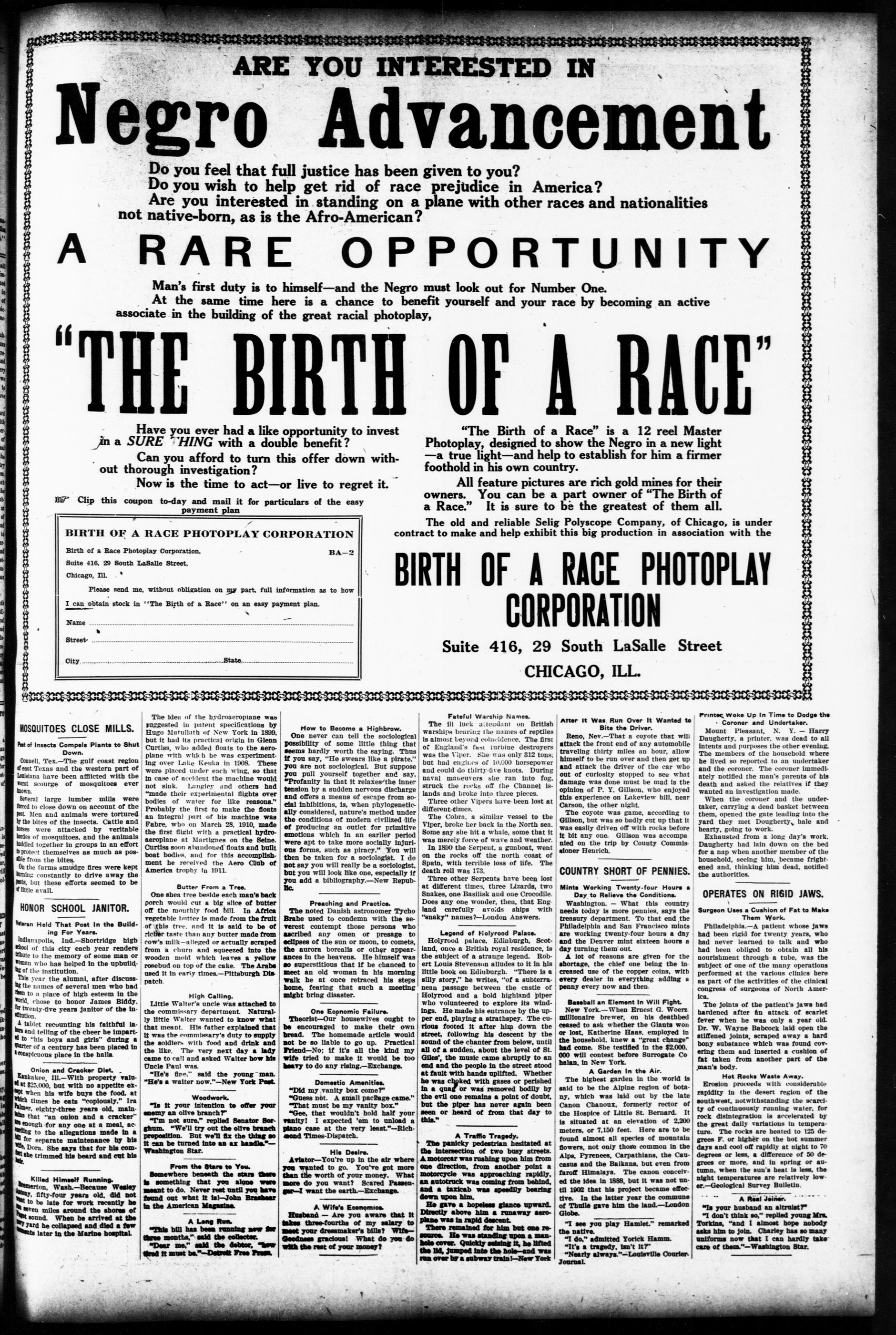
One of the head officials of the South Side branch of the Y. M. C. A. Thirty-eighth street and Wabash avenue; who is actively interested in the new moving picture which will cost well on to six hundred thousand dollars when completed, entitled "The Birth of a Race."
It often happens that neighbors living side by side do not get along well together. We are all familiar with the annoyances of chickens foraging in the neighbor's garden, children trampling flower beds and other disturbances of like nature.
But when people are forced to live in tiers, one above the other, it seems that the difficulties of getting along nicely together are very much increased. Practically every mail brings to the Department of Health complaints from flat dwellers which have to do with the thoughtlessness, the indifference and even the mischievousness of their neighbors. Chief among these are the complaints of the wrongful use of back porches. People dwelling on the upper floors sweeping dirt and rubbish down on to the porches of the neighbors who live below; beating rugs and carpets on the porches, and especially during warm weather when people must have their windows open for air and comfort and expose their own rooms to the dust and dirt from their neighbor's rugs and carpets.
There is an ordinance against this, of course. It is one of the ordinances, however, that is exceedingly difficult to enforce, because of the department's inability to get evidence on which to base suit; because of the fact that the complainants themselves do not like to go into court to testify against their neighbors.
The real remedy for these annoyances to those who dwell in flats and apartments lies with the people themselves. We should not do the things that cause other people discomfort and annoyance. There should be a golden rule of neighborly conduct here. Do not these things to the neighbor that thou woudst not have him do unto you. In other words, be thoughtful, careful, considerate and kindly to those who live nearby you.
If you have thoughtlessly been shaking rugs on your back porch, or sweeping the dirt down on to the porches below you, think how you would be annoyed by similar treatment. Just put yourself in the other woman's place. And now that lets it all out, that women do the sweeping of the back porches and women mostly beat rugs and carpets on their own back porches. Sometimes, of course, a man is hired to do the latter named task; but no matter who, the practice is wrong. More than that, it is dangerous. People should not do these things. As has been said before in these articles, be neighborly.
What would you think of the father and mother who knowingly sent their child with a sore throat to school and a few days later the child came down with a bad case of diphtheria? And how much harder would you think if you knew that the infected child had, innocently so far as it was concerned, exposed your own little boy or girl to this dread disease? Now, turn the case around and get the other view point. Suppose you were the parent that had permitted your child to infect your neighbor's child? How would you feel about it? No need to tell how your neighbors would feel toward you, because you know. Why not then be as careful and as considerate of the health of your neighbor's children as you would ask that they be in protecting the health and safety of yours?
Remember that the slightest sore throat may mean a case of diphtheria in your home, if neglected. Call your doctor early.
Be careful about your winter's supply of air. Let the outdoor air into your indoor home.
THINK THIS OVER
***
---
CONSERVATION OF NEGRO HEALTH
NATIONAL NEGRO HEALTH WEEK
TO BE OBSERVED APRIL 22-28,
1917. OFFICIAL CALL ISSUED
The Executive Committee of the National Negro Business League, at the annual session held in Kansas City, Missouri, August 16, 17 and 18, 1916, passed a resolution ratifying the suggestion of the secretary of the National Organization that a Negro Health Week be observed next year, as was done during the year 1915 under the general direction and supervision of Dr. Booker T. Washington, president, and the Executive Committee of the National Negro Business League. The secretary was authorized to work out full details of publicity in connection with the observance of National Negro Health Week, and announce same through the public press.
Since the meeting of the National Negro Business League, it has been decided by the Tuskegee Normal and Industrial Institute to devote the coming Tuskegee Negro Conference, to be held January 17 and 18, 1917, to a discussion mainly of Negro health. It has thus been decided that these two influential organizations shall join hands in a campaign for Negro health. The week beginning Sunday, April 22, 1917, has been decided upon as the week to be observed, and an invitation is hereby extended to each and every organization interested in Negro health to join with them in the effort to improve health conditions among the Negro people, especially the daily and weekly newspapers, health journals, the National Medical Association, the National Association of Graduate Nurses, the National Association of Colored Women's Clubs, the National League on Urban Conditions Among Negroes, the National Association of Teachers in Colored Schools, the National Negro Press Association, the bishops and other officers of Colored religious denominations, state medical associations, annual church conferences and associations, secret society organizations, Colored insurance companies, farmers' conferences, farmers' improvement societies, churches, schools and other local organizations, state health officers.
In the observance of this National Negro Health Week, the organizations already mentioned are exceedingly fortunate in having the co-operation of such an important agency for civic betterment as the National Clean Up and Paint Up Campaign Bureau, with headquarters in the Klnoch Building, St. Louis, Missouri. Mr. Allen W. Clark, its chairman, has written to offer its services to the National Negro Business League and other organizations, to the extent of supplying literature to any and all organizations which may be formed for the purpose of conducting campaigns in the interest of better health for Negroes, and which may write to him for same.
According to the Negro Year Book, 450,000 Negroes in the South are seriously ill all the time, at an annual cost of $75,000,000; 112,000 Negro workers in the South are sick continuously, losing annual earnings of $45,000,000; 225,000 Negroes in the South die annually, paying a funeral expense bill of $15,000,000; 100,000 of these deaths could be prevented, saving annually $6,500,000 in funeral expenses alone, and in potential earnings $170,000,000. It is thought that members of the race will again welcome the opportunity to unite its efforts in one great National Health Movement, and thus gain the benefit of the momentum and enthusiasm that will come from another great united effort for health improvement.
As the late Dr. Booker T. Washington said in the 1915 call, "Without health, and until we reduce the high
death rate, it will be impossible for us to have permanent success in business, in property getting, in acquiring education, or to show other evidences of progress. Without health and long life all else fails. We must reduce our high death-rate, dethrone disease and enthrone health and long life. We may differ on other subjects, but there is no room for difference here. Let us make a strong, long, united pull together."
(Signed) J. C. Napier, president National Negro Business League.
R. R. Moton, principal Tuskegee Normal and Industrial Institute.
Emmett J. Scott, secretary National Negro Business League, Tuskegee Institute, Alabama.
that this rivalry among cities states will stimulate the sale of Christmas seals to 100,000,000. This mean $1,000,000 for the fight against berculosis in the United States.
SAYS WOMEN VOTERS HAVE BEEN BENEFIT TO ILLINOIS
Miss Helen Hood, President of S. W. C. T. U., Urges Partial Suffrage for Indiana Sisters.
Indianapolis, Ind., Nov. 24.—(Social.)—The attainment of partial frrage by the women of Illinois throne legislative enactment has not only a tributed greatly to the advancement women's interests but has elevated
DEATH OF STEPHEN HENBY
HAMLET, 3359 FOREST AVENUE
Funeral services were held over his remains last Sunday afternoon at Grace Presbyterian church, Rev. Moses M. Jackson officiating.
In the midst of life we always find death. With hearts and minds endowed in sorrow we assemble here with the remains of the beloved Stephen Henry Hamlet, who was born in Mobile, Alabama, in 1875. Having lost his parents, Samuel and Letty Hamlet, in his youth, he was reared by an elder brother. In 1896, July 23, he was united in holy matrimony to Katherine Ruth Adams at Chicago, Illinois. After eighteen years of marriage they were blessed with one child, Stephen Hamlet, Jr., born October 3, 1914. After four months God saw fit to take the infant, only to direct their steps heavenward. Stephen Hamlet was an active member of Grace Memorial Presbyterian church, a member of the Knights of Pythias and Masonic lodges. At the time of his passing out he was in the employ of the Pullman Company. While performing his duty he dropped at his post at 8 o'clock Thursday, November 16, 1916. The remains were taken to Sedalia, Missouri to the family lot, to be laid beside his infant son to whom he was so devoted.
He leaves to mourn his loss a devoted wife of twenty years' companionship, three brothers, one sister, other relatives and a host of friends. A remarkable good temper and cheerfulness was Stephen Hamlet's dominating characteristic. His noble spirit enabled him to bear cheerfully any unpleasant besetment that came into his life.
A loving one from us has gone,
That never can be filled.
Our loss is heaven's gain.
J. W. B.
CITIES AND STATES TO COMPETE
IN RED CROSS SEAL SALE
PENNANTS TO BE AWARDED TO
WINNERS—OVER 300,000,000 SEALS
DISTRIBUTED
With the opening of the Red Cross seal sale to-day, every state and thousands of cities, towns and villages are entering a competition to see who will sell the most seals per capita for the prevention of tuberculosis in their communities. Over 300,000,000 seals have been distributed for the sale. The cities, towns and villages have been divided into 10 classes according to population ranging from 600 to 1,000,000 and over. Pennants will be awarded by the American Red Cross and The National Association for the Study and Prevention of Tuberculosis in each of the classes. Similar pennants will be awarded to states selling the most seals per inhabitant, the states being divided into three classes according to population.
Last year Hershey, Pennsylvania, sold more seals per capita than any other city or town in the United States, reaching a total of 29.04. In Rhode Island, 2.29 seals per capita were purchased by the people of the state, a record sale among the states. In addition to the pennants, a special honor certificate will be awarded to any community which sells five or more seals per inhabitant. It is hoped
T.
DR. LOUIE USSELMANN.
The up-to-date and practical optician, who makes a specialty of all eye troubles. Consultation or examination free. He also carries a fine stock of gold watches, diamond rings and other jewelry, 3150 S. State Street. Phone Douglas 5308.
that this rivalry among cities and states will stimulate the sale of Christmas seals t8 100,000,000. This will mean $1,000,000 for the fight against tuberculosis in the United States.
SAYS WOMEN VOTERS HAVE BEEN BENEFIT TO ILLINOIS.
Miss Helen Hoodl President of State W. C. T. U., Urges Partial Suffrage for Indiana Sisters.
Indianapolis, Ind., Nov. 24.—(Special.)—The attainment of partial suffrage by the women of Illinois through legislative enactment has not only contributed greatly to the advancement of women's interests but has elevated the political and moral level of the state, according to Miss Helen L. Hood, president of the Women's Christian Temperance union of Illinois.
She is decided in her opinion that Indiana women should not wait for a constitutional amendment or a new constitution, but, through obtaining legislative action, should enter into partial suffrage which would include votes in municipal elections and for presidential electors.
INTERESTING PROGRAM TO BE RENDERED AT THE LYCEUM AT GRACE PRESBYTERIAN CHURCH
This coming Sunday evening at 5 o'clock an interesting program will be rendered at the Grace Presbyterian church Lyceum.
Dr. Spencer Dickerson, Dr. Chester Booth, Capt. R. J. Patton, Capt. L. W. Lewis, Sergt. Major Lewis Johnson will be the speakers.
Miss Maude J. Roberts, assisted by Harrison Emanuel, Charles Settles and George Proctor, will furnish the music. Miss Bertha Moseley will preside. Col. Cary B. Lewis, chairman of speakers' committee.
DEATH OF MRS. ROBERT H.
STOKES
Wednesday at 1 p. m. Mrs. Robert H. Stokes, 3726 Calumet avenue, departed this life. For many years her husband has been one of the highly respected mail carriers in the downtown district.
Funeral services will be held over her remains at Quinn Chapel at one o'clock Sunday afternoon, its pastor, Rev. J. C. Anderson officiating. George T. Kersey, of the Emanuel Jackson Undertaking Company, will be in charge of the funeral arrangements.
PREFERENCES TO SIT BY NEGRO
And Congress Hotel Maid Has Usher Pinched Because He Pinched Her Arm.
Because she refused to occupy a seat next to a Negro, Miss Rose Miller, a domestic at the Congress hotel, asserted she was ejected from the Gem theater at 450 South State street, Thursday evening, and her arm pinched by an usher. Harry Steinberg of 26 West Harrison street, the usher, was arrested.
SAVED WENDELL PHILLIPS
Boston, Mass. (Special).—Thomas P. Taylor, who died in a local hospital, has just been buried after funeral services in the Charles Street A. M. E. church. For some years he and Frank B. Sanborn had been the only survivors, it is said, of the rescuers of Wendell Phillips when the latter was mobbed as an Abolitionist at the Jey Street Colored church, before the Civil War. Taylor was on board the U. S. S. Vandalia when it was wrecked in a hurricane in 1889, at Samoa.
OREGON VOTERS ELECT ALLEN
COMMITTEMAN
W. D. Allen, of Portland, Oregon, enjoys the distinction of being the first Colored man to be elected a county committeeman by the popular vote of the people in Multnomah county. Mr. Allen is a successful business man and is proprietor of the Golden West Hotel. He has been the recipient of many congratulations.
MR. EDWIN L. BARKER.
President of Birth of a Race Photoplay Corporation, formerly with Kinesis color Company, Essanay Film Company, President Barker-Swan Film Service, and creator of "The Dawn of Plenty" "The Dawn of Commerce" "Back to the Old Farm," and other feature photoplays.
RACE PHOTOPLAY CREATES IN
TENSE INTEREST.
PLAN TO GIVE NEGRO JUSTICE MEETS WITH HEARTY APPROVAL.
Unusual interest in the great feature photoplay, "The Birth of a Race," has manifested itself since the full page announcement in various papers last week. Previous to this announcement there had been no definite public information, though rumors of the project had been bandied about, since the convention of the National Negro Business League in Kansas City last August, where the plan was laid before the assembly.
Edwin L. Barker, president of the Birth of a Race Photoplay Corporation, in a recent interview, said: "We have tried to handle the whole matter carefully to avoid mistakes. We fully realize the magnitude of a project designed to cover the entire history of the Negro race. Why, we find that even among the Colored people that very few connect the Negro with the venerable Moor, who was one of the three Wise Men who visited the lowly cradle of the Christ Child. The long line of Egyptian Pharaohs guarded their Ethiopian blood so carefully that it makes royal intermarriage in European countries to-day look like a travesty on the real thing.
"We shall surprise the people of all races with the scope of our undertaking, but you may rest assured that the men who are handling it know what they are doing."
Mr. Wheeler Makes Statement.
When Geo. Frederic Wheeler, the man who is writing the scenario in collaboration with Emmett J. Scott, was approached, he exhibited much enthusiasm in the subject.
"We have frequently heard 'The Birth of a Race' spoken of as a 'Colored picture,' but believe me, it will be the whitest story that has ever
Herbert Withersoon, the well known grand opera singer, has just completed a new Victor record, singing Harry T. Burleigh's song, "Just You." Mr. Burleigh is perhaps the greatest composer the Negro race has produced. Many of his songs are being used by the most famous singers in the world. It is because of his thoroughness as a composer, and his complete knowledge of Negro folk music, that he was selected to compose the music for that big photoplay, "The Birth of a Race," which is now in course of production by the Birth of a Race Photoplay Corporation of Chicago, in association with the Selig Polyscope Company.
The musical accompaniment for the "Birth of a Race" is to be an important part of the exhibition. The wild, almost barbaric, strain that will be sounded during the early scenes of the photoplay is expected to be as haunting, as thrilling, as the plantation songs will be delightful.
A person who has not gone through the experience of fitting a musical score to the thousands of scenes which go to make up a big photoplay cannot imagine the enormous amount of work and patience required. Every note must fit every foot of film. It is estimated that daily rehearsals with an orchestra, lasting from four to six weeks, will be necessary to properly adjust the music to the photoplay, before the exhibition.
Previous to this, of course, Mr. Burleigh will have spent many weeks in the composition of the various themes.
GIVES RACE $25,000
Julius Rosenwald of Chicago has given $25,000 toward the erection of an industrial school building near Independence, Missouri. The plot on which the new schoolhouse is to be erected consists of sixteen acres. Francis E. Parker is architect. The promoters of the new institution hope to make it a big center of industrial and educational uplift for the people of that section of Missouri and adjacent states.
COLORED WOMEN PROMOTED
St. Louis, Mo. (Special).—As a result of a recent strike among White women making sausage in the plant of Armoury & Company, the Colored scrub women have been given their places.
"JUST YOU"
dealt with a black subject. We shall make a desperate effort to give an in-depth partial review of the Negro. I do not believe that a character like 'Gue' in 'The Birth of a Nation' is typical of his race, and in an epoch-making picture like that great photoplay, characters should be typical.
"I am grossly interested in the subject. I have devoted about ten hours a day for more than four months to research work in connection with it, and hope to be in position to see that every detail is carried out along the lines we have laid down, and to keep it up to the high standard of excellence we have in mind for the production.
"There can be no question in regard to the success of the proposition. With such support as is given to the entire prise by the leading men and women of the country, with a theme of universal appeal, there can be no doubt of the interest it will create. We shall not try to solve the so-called Negro Problem. That is working itself out under such leadership as has already come to the race. But we shall try to put the subject in such a light that the world large will have a broader knowledge of the Colored' people, their condition and requirements. The Negro is here to stay; it cannot be a matter of enduring him. He must live alongside and work with the rest of us, and the better the understanding of existing conditions, the quicker the differences can be adjusted."
Mr. Wheeler leaves for the south next week where he will study conditions, locate settings for the principle scenes of the photoplay and speak some time at Tuskegee, working out details with Mr. Scott. He will also consult Mr. J. C. Napier and Mr. Heath Boyd of Nashville, visit Fisk, Athan and Howard Universities, and inspect Piney Woods Country Life School and Hampton Institute while he is away.
THINK UP GOOD LIE, LANDIS %
WITNESS.
East St. Louis, Ill.—"Sit there while and think up some lie you can tell straight," remarked Federal Judge K. M. Landis to a Negro on trial for bootlegging when he became "dissed" on the witness stand the first of this week.
ERECTING $10,000 TENEMENT
Sherman, Tex. (Special).—J. W. A.
drews, a Colored farmer near here,
erecting a two-story brick and bas-
ment building in this city. A Colored
contractor, employing all Colored labor,
is doing the work. The building will
cost $10,000 and will be rented to Colored
tenants.
NEGRO LAWYER IS APPOINTED
ASSISTANT STATE'S ATTORNEY
N. W. Pardon, Negro lawyer of East St. Louis, has been appointed an assistant state attorney by Hubert Schaumieffel, of Belleville, who was elected on the republican ticket November 7. Pardon's salary will be $1,200 per year.
GET STRIKERS' PLACES
GET SIKHERS PLACE
Bridgeport, Conn. (Special).—Colored moulders have taken the place of striking Whites at the Pequonnock Foundry. The unions refuse to admit the Colored, however.
Miss Fortson, is still confined at her home, 3415 Prairie avenue with illness.
Charles A. Griffin, Robert Turnley, and William G. Anderson, are figuring on entering the race for Alderman in the second ward. Mr. Anderson, feels positive that he is the strongest of all the candidates and that he can make a home run into the city council.
William G. Wilcox, President of the New York Board of Education; has been selected to succeed the late Seth Low, as chairman of the Board of Trustees of the Tuskegee Normal and Industrial Institute, Tuskegee, Ala.
Mr. Edward D. Green, returned home Thursday evening from Pittsburgh, Pa., where he spent ten days in visiting with his sister, Mrs. Myer, who recently lost her husband through death
Negro Advancement
Man's first duty is to himself—and the Negro must look out for Number One. At the same time here is a chance to benefit yourself and your race by becoming an active associate in the building of the great racial photoplay,
"THE BIRTH OF A RACE"
---
Have you ever had a like opportunity to invest in a SURE THING with a double benefit?
Can you afford to turn this offer down without thorough investigation?
Now is the time to act-or live to regret it.
Clip this coupon to-day and mail it for particulars of the easy payment plan
Please send me, without obligation on my part, full information as to how I can obtain stock in "The Birth of a Race" on an easy payment plan.
2
MOSQUITOES CLOSE MILLS.
Past of Insects Compels Plants to Shut Down.
Connell, Tex.—The gulf coast region of east Texas and the western part of Louisiana have been afflicted with the worst source of mosquitoes ever known.
Several large lumber mills were forced to close down on account of the pest. Men and animals were tortured by the bites of the insects. Cattle and horses were attacked by veritable borders of mosquitoes, and the animals huddled together in groups in an effort to protect themselves as much as possible from the bites.
On the farms smudge fires were kept burning constantly to drive away the pests, but these efforts seemed to be of little avail.
HONOR SCHOOL JANITOR.
Veteran Held That Post In the Building For Years.
Indianaapolis, Ind.-Shortridge high school of this city each year renders tribute to the memory of some man or woman who has helped in the upbuilding of the institution.
This year the alumni, after discussing the names of several men who had risen to a place of high esteem in the world, chose to honor James Biddy, for twenty-five years janitor of the institution.
A tablet recounting his faithful labors and telling of the cheer he imparted to "his boys and girls" during a quarter of a century has been placed in a conspicuous place in the halls.
Onion and Cracker Diet
Onion and Cracker Diet.
Kankakee, Ill.-With property valued at $25,000, but with no appetite except when his wife buys the food, at which time he eats "copiously." Ira Palmer, eighty-three years old, maintains that "an onion and a cracker" are enough for any one at a meal, according to the allegations made in a bill for separate maintenance by his wife, Dora. She says that for his comfort he trimmed his beard and cut his
Killed Himself Running
Bemerton, Wash.—Because Wesley
Anthony, fifty-four years old, did not
want to be late for work recently he
seven miles around the shores of
Pearl sound. When he arrived at the
vary hard he collapsed and died a few
months later in the Marine hospital.
ARE YOU INTERESTED IN
Do you feel that full justice has been given to you?
Do you wish to help get rid of race prejudice in America?
Are you interested in standing on a plane with other races and nationalities not native-born, as is the Afro-American?
The idea of the hydroaeroplanet was suggested in patent specifications by Hugo Matullath of New York in 1899, but it had its practical origin in Glenn Curtiss, who added floats to the aeroplane with which he was experimenting over Lake Keuka in 1908. These were placed under each wing, so that in case of accident the machine would not sink. Langley and others had "made their experimental flights over bodies of water for like reasons". Probably the first to make the floats an integral part of his machine was Fabre, who on March 28, 1910, made the first flight with a practical hydroaeroplanet at Martignes on the Seine. Curtiss soon abandoned floats and built boat bodies, and for this accomplishment he received the Aero Club of America trophy in 1911.
Butter From a Tree.
One shea tree beside each man's back porch would cut a big slice of butter off the monthly food bill. In Africa vegetable butter is made from the fruit of this tree, and it is said to be of richer taste than any butter made from cow's milk—alleged or actually scraped from a churn and squeezed into the wooden mold which leaves a yellow rosebud on top of the cake. The Arabs used it in early times.—Pittsburgh Dispatch.
High Calling.
Little Walter's uncle was attached to the commissary department. Naturally little Walter wanted to know what that meant. His father explained that it was the commissary's duty to supply the soldiers with food and drink and the like. The very next day a lady came to call and asked Walter how his Uncle Paul was.
"He's fine," said the young man. "He's a waiter now."—New York Post.
Woodwork
"Is it your intention to offer your enemy an olive branch?" "I'm not sure," replied Senator Sorghum. "We'll try out the olive branch proposition. But we'll fix the thing so it can be turned into an ax handle."—Washington Star.
From the Stars to You.
Somewhere beneath the stars there is something that you alone were meant to do. Never rest until you have found out what it is!-John Brasher in the American Magazine.
A Long Run.
"This bill has been running now for three months," said the collector.
"Dear me," said the debtor, "how tired it must be"—Detroit Free Press.
How to Become a Highbrow.
One never can tell the sociological possibility of some little thing that seems hardly worth the saying. Thus if you say, "He swears like a pirate," you are not sociological. But suppose you pull yourself together and say, "Profanity in that it relaxes the inner tension by a sudden nervous discharge and offers a means of escape from social inhibitions, is, when phylogenetically considered, nature's method under the conditions of modern civilized life of producing an outlet for primitive emotions which in an earlier period were apt to take more socially injurious forms, such as piracy." You will then be taken for a sociologist. I do not say you will really be a sociologist, but you will look like one, especially if you add a bibliography.—New Republic.
Preaching and Practice.
The noted Danish astronomer Tycho Brahe used to condemn with the severest contempt those persons who ascribed any omen or presage to eclipses of the sun or moon, to comets, the aurora borealis or other appearances in the heavens. He himself was so superstitious that if he chanced to meet an old woman in his morning walk he at once retraced his steps home, fearing that such a meeting might bring disaster.
One Economic Failure.
Theorist—Our housewives ought to be encouraged to make their own bread. The homemade article would not be so liable to go up. Practical Friend—No; if it's all the kind my wife tried to make it would be too heavy to do any rising.—Exchange.
Domestic Amenities
"Guess not. A small package came."
"That must be my vanity box."
"Gee, that wouldn't hold half your vanity! I expected 'em to unload a piano case at the very least."—Richmond Times-Dispatch
Hia Desire.
Aviator—You're up in the air where you wanted to go. You've got more than the worth of your money. What more do you want? Scared Passenger—I want the earth—Exchange.
4. Wife's Economics
Husband — Are you aware that it takes three-fourths of my salary to meet your dressmaker's bills? Wife—Goodness gracious! What do you do with the rest of your money?
"The Birth of a Race" is a 12 reel Master Photoplay, designed to show the Negro in a new light a true light—and help to establish for him a firmer foothold in his own country.
All feature pictures are rich gold mines for their owners. You can be a part owner of "The Birth of a Race." It is sure to be the greatest of them all.
The old and reliable Selig Polyscope Company, of Chicago, is under contract to make and help exhibit this big production in association with the
BIRTH OF A RACE PHOTOPLAY CORPORATION
Suite 416, 29 South LaSalle Street CHICAGO. ILL.
The lil luck attendant on British warships bearing the names of reptiles is almost beyond coincidence. The first of England's fast turbine destroyers was the Viper. She was only 312 tons, but had engines of 10,000 horsepower and could do thirty-five knots. During naval maneuvers she ran into fog, struck the rocks off the Channel islands and broke into three pieces.
Three other Vipers have been lost at different times.
The Cobra, a similar vessel to the Viper, broke her back in the North sea. Some say she hit a whale, some that it was merely force of wave and weather.
In 1800 the Serpent, a gunboat, went on the rocks off the north coast of Spain, with terrible loss of life. The death roll was 173.
Three other Serpents have been lost at different times, three Lizards, two Snakes, one Basilisk and one Crocodile. Does any one wonder, then, that England carefully avoids ships with "snaky" names?—London Answers.
Holyrood palace, Edinburgh, Scotland, once a British royal residence, is the subject of a strange legend. Robert Louis Stevenson alludes to it in his little book on Edinburgh. “There is a silly story,” he writes, “of a subterranean passage between the castle of Holyrood and a bold highland piper who volunteered to explore its windings. He made his entrance by the upper end, playing a strathspey. The curious footed it after him down the street, following his descent by the sound of the chanter below, until all of a sudden, about the level of St. Giles’, the music came abruptly to an end and the people in the street stood at fault with hands uplifted. Whether he was choked with gases or perished in a quag or was removed bodily by the evil one remains a point of doubt, but the piper has never again been seen or heard of from that day to this.”
The panicky pedestrian hesitated at the intersection of two busy streets. A motorcar was rushing upon him from one direction, from another point a motorcycle was approaching rapidly, an autotruck was coming from behind, and a taxicab was speedily bearing down upon him.
He gave a hopeless glance upward. Directly above him a runaway aeroplane was in rapd descent.
There remained for him but one resource. He was standing upon a manhole cover. Quickly seizing it, he lifted the lid, jumped into the hole—and was run over by a subway train—New York
Legend of Holyrood Palace.
A Traffic Tragedy.
After It Was Run Over It Wanted to Bite the Driver.
Reno, Nev.—That a coyote that will attack the front end of any automobile traveling thirty miles an hour, allow himself to be run over and then get up and attack the driver of the car who out of curiosity stopped to see what damage was done must be mad is the opinion of P. Y. Gillson, who enjoyed this experience on Lakeview hill, near Carson, the other night.
The coyote was game, according to Gillson, but was so badly cut up that it was easily driven off with rocks before it bit any one. Gillson was accompanied on the trip by County Commissioner Henrich.
COUNTRY SHORT OF PENNIES
Mints Working Twenty-four Hours a Day to Relieve the Conditions.
Washington. - What this country needs today is more pennies, says the treasury department. To that end the Philadelphia and San Francisco mints are working twenty-four hours a day and the Denver mint sixteen hours a day turning them out.
A lot of reasons are given for the shortage, the chief one being the increased use of the copper coins, with every dealer in everything adding a penny every now and then.
Baseball an Element In Will Fight.
Baseball an Element in Will Fight.
New York.—When Ernest G. Woerz
millionaire brewer, on his deathbed
ceased to ask whether the Glants won
or lost, Katherine Haas, employed in
the household, knew a "great change"
had come. She testified in the $2,000.
000 will contest before Surrogate Co-
balan in New York.
A Garden In the Air.
The highest garden in the world is said to be the Alpine region of botany, which was laid out by the late Canon Chanoux, formerly rector of the Hospice of Little St. Bernard. It is situated at an elevation of 2,200 meters, or 7,150 feet. Here are to be found almost all species of mountain flowers, not only those common in the Alps, Pyrenees, Carpathians, the Caucasus and the Balkans, but even from faroff Himalaya. The canon conceived the idea in 1888, but it was not until 1902 that his project became effective. In the latter year the commune of Thuille gave him the land.—London Globe.
"I see you play Hamlet," remarked the native.
"Nearly always."—Louisville Courier.
Journal.
Printze Woke Up In Time to Dodge the Coroner and Undertaker.
Mount Pleasant, N. Y. — Harry Daugherty, a printer, was dead to all intents and purposes the other evening. The members of the household where he lived so reported to an undertaker and the coroner. The coroner immediately notified the man's parents of his death and asked the relatives if they wanted an investigation made.
When the coroner and the undertaker, carrying a dead basket between them, opened the gate leading into the yard they met Dougherty, hale and hearty, go to work.
Exhausted from a long day's work, Daugherty had lain down on the bed for a nap when another member of the household, seeing him, became frightened and, thinking him dead, notified the authorities.
OPERATES ON RIGID JAWS.
Surgeon Uses a Cushion of Fat to Make Them Work.
Philadelphia.—A patient whose jaws had been rigid for twenty years, who had never learned to talk and who had been obliged to obtain all his nourishment through a tube, was the subject of one of the many operations performed at the various clinics here as part of the activities of the clinical congress of surgeons of North America.
The joints of the patient's jaws had hardened after an attack of scarlet fever when he was only a year old. Dr. W. Wayne Babcock laid open the stiffened joints, scraped away a hard bony substance which was found covering them and inserted a cushion of fat taken from another part of the man's body.
Hot Rocks Waste Away.
Erosion proceeds with considerable rapidity in the desert region of the southwest, notwithstanding the scarcity of continuously running water, for rock disintegration is accelerated by the great daily variations in temperature. The rocks are heated to 125 degrees F. or higher on the hot summer days and cool off rapidly at night to 70 degrees or less, a difference of 50 degrees or more, and in spring or autumn, when the sun's heat is less, the night temperatures are relatively lower.-Geological Survey Bulletin.
A Real Jeiner.
"Is your husband an altruist?"
"I don't think so," replied young Mrs. Torkins, "and I almost hope nobody asks him to join. Charley has so many uniforms now that I can hardly take care of them."-Washington Star.
PAGE SIX
YANKEE DUCHESS
Once Miss May Ogden Golet of New York City.
FRIEND OF QUEEN MARY.
Could Not Be Appointed Mistress of the Robes Because She Was Not Born In England—Collects Jewels and Has a Marvelous Necklace of Turquoises.
It was recently reported in American newspapers that the Duchess of Roxburgh, who before her marriage was Miss May Ogden Golet of New York
Mary
DUCHESS OF ROXBURGHE and Newport, had been offered the position of mistress of the robes to Queen Mary, vacated by the Duchess of Devonshire, consequent on the appointment of the duke to the governor generalship of Canada. The rules of the court require that the mistress of the robes should not be of lower rank than a duchess, and this rule considerably limits the number of ladies to whom the premier position in Queen Mary's household could be offered. But the rules also say she must be an Englishwoman by birth, so the Duchess of Roxburghe was barred.
Of the duchesSES the two who stand most high in the regard of Queen Mary are the Duchess of Portland and the Duchess of Roxburghe. The Duchess of Portland is mistress of the robes to Queen Alexandra, otherwise it is more than possible that the position would have been offered to her. The Duchess of Roxburghe's friendship with Queen Mary is not of very long standing. Her grace was, of course, received at court after her marriage, and afterward, with her husband, was the guest on several occasions of the late King Edward VII. and Queen Alexandra. The Duke of Roxburghe is one of the best all around sportsmen in England. He shoots, skates, rides to hounds and has half a dozen other strenuous pastimes, in all of which he excels.
He took part in the South African war and won much praise. During a reconnoissance at Rensburg a private lost his mount. The duke, realizing the great danger the man was in, rode out under a heavy fire and effected his rescue, the private and peer riding into safety on the same horse. The duchess has a wonderful collection of turquoises, which has attracted a great deal of interest in society. The chief item in the collection is a large ornament for the neck composed of hundreds of turquoises, all flawless and of great beauty and value. The duchess had a hundred pieces of jewelry broken up to form this wonderful thing.
THE BIRD'S BATH.
Baking Tins Make Delightful "Tubs"
For Feathered Pets.
Some canaries simply refuse to take baths regularly in the tiny bird baths usually provided for them. The thing to do then is to take all perches out of the cage and also the bottom. Then set the cage over an oblong or square baking tin, according to the shape of the cage, just partly filled with water. This will leave no place for the bird to go but to cling to the side of the cage, of which we will soon tire, or take his plunge. Of course, if the bird simply sits in the water without bathing he must not be allowed to remain in the bath for very long, as he will catch cold. Most birds, however, will bathe if thus managed and enjoy the bath much better than if it were taken in a tiny dish. The baking tin should be new.
Freshening Velveta.
Velvet must be ironed over the iron so as not to crush the pile. The best way is to get some one to hold a hot iron upward while you draw the velvet backward and forward along the hot surface. Keep the velvet well stretched and go over every piece carefully till the pile stands up well.
DRESS TRIMMINGS.
Style Tips About the Very Latest Garnishings.
For those who may still be doubtful regarding the fashionable dress trimmings of the season a review will not be amiss.
Among the most salient trimmings is wool embroidery in separable motifs or in bands. The richest oriental colors are used for the purpose, and in some instances the wool is combined with metal embroideries. Motifs in silk combined with wool are also in vogue. Such trimmings you can use appropriately on odd shaped pockets, on belts, on flat sashes, on corners of tunics and on the ever present bags. Wool fringes in blue, gray and black are in high favor. Beaded fringes, drops and tassels are very well liked.
On evening gowns beaded bandings are very modish. They are used as garnitures, as straps for corsages, and in some instances they are used to give the effect of a necklace. These bands are particularly well liked in jet, in crystal and in opal.
Persian colorings prove an incentive in the making of bead medallions.
Combinations of bead with chenille are used on gowns for both afternoon and evening. Chenille alone is also a strong trimming and is used in all sorts of colors.
Never before have spangles been so important. They are offered in infinite variety and are used largely to form the long waisted bodice, suggestive of the moven are line.
Fur in larger quantities than ever is a favored trimming. Mole and seal are the favorites, but coney, skunk and opossum are not far behind. Fur cloth is also used a great deal and has proved a very pleasing substitute for the real fur. Where laces are concerned silver, gold and chantilly seem to be the favored ones.
HOLIDAY BASKET.
None Too Soon to Begin Your Christmas Lists.
Almost any kind of weave, sweet grass or just plain straw, will make the base of this workbasket. To keep
DAINTY GIFT.
out the dust a figured silk top is shirred on to the upper rim, closing tightly with a silk cord of the same color. Any number of variations may come from this design.
WHEN YOU SERVE TEA.
Things to Do In Order to Be Really Hospitable.
Remember to add as a finishing touch to the tray or tea table a vase with a few flowers, a single rose, three or four asters or a yellow daffodil or so placed in a bud vase or held in place in a flat dish by a Japanese frog.
Always serve cream as well as lemon. Many persons do not enjoy tea without cream, and of course they will not be so frank as to tell you so when they see that the tea tray is not supplied with any.
Serve the cut sugar in the small half lumps. For a small cup of tea a large lump often proves too much, and it is always awkward to have to break a lump or to take a lump from the cup when it is half dissolved.
Take pains to see that the teapot and hot water jug are both well heated before pouring in the boiling water. By doing so the temperature of the boiling water will not be reduced in bringing the teapot and jug to level. Remember to carry the pot to the boiling water and pour the water on the tea-leaves while the water is actually boiling. Many persons wrongly feel that if the water has boiled it matters little whether or not it is still boiling when it is applied to the tea leaves.
Always serve sandwiches or toast in small portions. It is very awkward for the tea drinker to have to manage large portions. Bread and butter sandwiches should be of wafer thinness and should be cut in inch wide strips. A goodly supply should be on hand to make up for the smallness of the single pieces.
Guimpae For Children
Gulmpes are coming into vogue again for children. The practical wash fabrics are still to be among those popular with the smart little folk. Little plaited skirts seem to be used on practically every model, even on the smallest child. Some have the jackets slipped over the head or buttoned on the shoulders. Gulmpes, which have often been made for little folk from their mothers' shirt waists, will be of much use to them this season, since practically all have the little white sleeves and yoke of lawn, linen, batiste, organdie and other sheer materials. For the fancy dresses geogette is used.
THE BROAD AX. CHICAGO, NOVEMBER 25, 1916.
FOR YOUNG FOLKS
Sleepy Time Story About a Very Popular Farmyard Fowl.
ESCAPE FROM A CRUEL FATE.
How Luck Saved a Fine, Fat Gobbler From the Oven on Thanksgiving Day. A Hungry Time In the Woods—Things of Interest to Children.
Thanksgiving was at hand, and, of course, Little Ned and Polly Ann were very much interested in it. I think, said Uncle Ben, I will have to tell you about
A TURKEY'S THANKSGIVING.
Gobble Gobble was a big fat turkey. He lived on a farm where there were lots of chickens and ducks and geese. They had a good time, for Farmer Binks, who owned the farm, gave them lots to eat and took good care of them. Gobble Gobble was fond of eating, and lie was one of the fattest turkeys of the flock.
"He'll be fine roasted," said Farmer Binks to his wife. "I think we'll keep him for Thanksgiving."
The day before Thanksgiving there was a good deal going on in the house. Every one seemed busy and gay.
When the farmer sent his son Jimmy out to feed the poultry Gobble Gobble asked him what was going on. But as Gobble Gobble used turkey talk in speaking to Jimmy of course the little boy didn't understand.
When Jimmy went whistling into the house he forgot to close the gate after him, and Gobble Gobble darted out.
"If Thanksgiving means having a good time I'm going off to have a good time myself," Gobble Gobble said, as he trotted off in the direction of the woods. "Guess I'll go off and be a wild turkey, as Grandfather Turkey Trotter said our folks all were in the long ago."
So he went through the woods looking for wild turkeys to live with, but there were none there or, of course, folks would have gone out to the woods and got one whenever they wanted a turkey dinner.
Poor Gobble Gobble couldn't find much to eat for supper. He slept in a tree, just as Grandfather Turkey Trotter said their folks had done in the long ago, but it wasn't so comfortable as he had expected.
Gobble Gobble had a crick in his neck when he got up, and breakfast was most as scarce as supper had been. He wandered about in the woods for a day or two before Farmer Binks' son found him. Thanksgiving was over. "He would have been so much tenderer than old Turkey Trotter," sighed Jimmy's mother. "We'll have to keep Gobble Gobble for Christmas."
Fun on Roller Skates.
Of course roller skates are lots of fun, and you can play hockey fairly well on broad sidewalks of asphalt, but the sport does not compare with the game played on the real ice. About
A girl in a white dress with a bow on her head, holding a stick, standing on roller skates.
Photo by American Press Association.
PLAYING HOCKEY ON THE WALK.
this time or year young folks are wishing for Jack Frost to come along with his cold breath and freeze the ponds and brooks so that real ice skates may again be in fashion. Cold toes and cold noses have no terrors for healthy little people.
Riddle.
A warm little house, red roof, red floor;
A white picket fence near the wide front
door.
And in the little house a nimble little
man
Who talks, talks, talks as hard as he
can.
Answer.-The mouth.
SKATING TOGS.
A Suit Built For Winter Sports Is This.
This season promises as interesting skating sets as we had last winter. The cut shows a short skirt and belted
A Witch
THE ICE CHAMPION.
coat of wine colored worsted flared and button trimmed. Setting it off is a lopsided tam of black velvet, a sure symbol of Mme. la Mode.
NEEDLEWORK NOTES.
Tips For Her Who Does Her Own Christmas Presents.
A pretty card table cover is made of heavy white linen, with a spread pack of cards in each corner embroidered in black and red.
Boudoir caps are good gifts for young girls. A new embroidered sort is made in the style a Dutch cap, with the embroidery is delft blue or in black on a sheer white muslin ground.
For the women who travel a corset bag—a long, narrow washable bag embroidered with the word "Corsets"—is useful. These bags can also be used to hold corsets in the bureau drawers or closet shelves.
For the young housekeeper a useful gift is a luncheon set, all in one piece, consisting of centerpiece and four plate doilies attached in the form of a Greek cross. This is embroidered in various designs and in either white or colors.
Fringe is in fashion, and it has invaded the realm of a t needlework. Some of the new sofa cushions, which would make admirable gifts for the boy or girl away at college, are of heavy tan linen or crash embroidered in conventional designs in bright colors and finished with wide tan cotton fringe.
The autumn shops are full of interesting things to embroider and make. One is a baby's shoe bag, which would make a charming gift for a baby's first Christmas—a Christmas when the baby itself is not old enough to appreciate toys and when a gift that appeals to its mother is always acceptable. This bag is to hang on a door or wall. It is made of heavy white material, and there are two sections, one above the other, each containing pockets for three pairs of little boots or shoes. Embroidered letters across the top announce that it is for baby's shoes.
THANKSGIVING CRANBERRIES
Interesting Ways to Celebrate the Red Berry on Holidays.
Cranberries are good any way. They taste good and look good, and they are very good for the health. Stewed cranberries are a delicious accompaniment to the everyday dinner, and there are few meats which do not taste the better for the addition of cranberries.
Cranberry jelly looks better, but is not as sensible for every day, as it requires more sugar.
Cranberry Pie. Ever so many like a cranberry pie. For it cover the bottom of a pie pan with a plain paste, reserving enough for an upper crust. Make a rim around the edge and pour in a filling made with one cupful of cranberries cut into halves, half a cupful of chopped, seeded raisins, three-fourths of a cupful of sugar, a tablespoonful of cornstarch and lump of butter. Cover with the upper crust and bake about half an hour.
Cranberry Pudding--Another possibility is cranberry pudding. To make it cream half a cupful of butter, add slowly one cupful of sugar; then add three well beaten eggs. Mix three teaspoonfuls of baking powder with three and a half cupfuls of flour; add this to the mixture alternately with half a cupful of milk. Add two cupfuls of cranberries which have been washed, dried and floured with some of the flour already measured. Turn into a buttered mold, cover closely and steam two hours. Serve with hard sauce.
How to Run the Furnace.
Never poke a fire from the top. Insert the poker at the bottom and raise gently. This causes a draft and makes the fire burn brightly. But it is well to make it a rule to poke the fire as seldom as you can, for the more you poke it the more quickly will the coal burn away.
INDOOR GARDENS.
You May Have Foliage In Your Home All Winter.
Experts Instruct Us That Flower Boxes Must Have Good Drainage and House Plants Be Watered Lightly and Frequently Rather Than Heavily. [Prepared by department of agriculture.] A good depth for an indoor window box is about eight inches. The bottom of the box should be covered with stones and broken pottery for drainage. This should be covered with a layer of moss to prevent the soil from working down and clogging the drainage spaces. The drainage and moss should take up together about two inches. The greater the body of soil above the moss the more uniformly moist it may be kept. The soil should fail to fill the box by from one and one-half to two inches.
The indoor window box should be as long as the window is wide, and to get as much light as possible it should be level with the window sill. It may be placed either on brackets, a table or legs permanently fastened to it. A hole or holes should be provided in the bottom of the box, and a drip pan should be placed beneath to catch drainage water. The top of the soil should be allowed to become dry occasionally. The results of watering should be closely observed and the supply regulated according to needs. In general it is better to water lightly and frequently than heavily and infrequently, although just the reverse is considered best when watering is done out of doors in summer.
Only plants of the same general character should be placed in window boxes since plants of different kinds require different treatment. Begonias are about the only plants that may be expected to flower in a window box. For the most part foliage alone must be depended upon as the contribution of the indoor plants to the attractiveness of the room. Among the plants which may be grown for foliage for window boxes are ferns, geraniums, Kenilworth ivy, smilax and aspidistra. The latter plant is especially valuable as a window box plant, as it will thrive in spite of considerable neglect, drought and dust.
An advantage in growing plants in pots instead of in boxes is that a larger variety can be grown since different treatment may be given. In addition to the plants already mentioned for growing in window boxes, palms, rubber plants and cacti may be grown in pots. It is advisable in growing all these plants to make use of regular florists' potting soil, made up of one part compost, one part good loam and one part sand. It is well to add one twentieth part bone meal to the mixture.
ODD SHAPES.
Hats Are Taking on Even Freaky Outlines and Trim.
Dark green felt ton, banded with a darker shade or green velvet, makes this wintry peach basket. The novel
6
THE ULTRA ONE
trimming is done in gay worsted, a wreath head in monkish garments, embroidered against the velvet. Oriental and ecclesiastical models are rivaling military shapes.
Some Beauty Don'ts.
Don't wear thin shoes and gossamer silk stockings in cold weather or Nature will take her revenge and you will have that pinched, chilled look that is so unbecoming. Don't economize in shoe leather. Don't take everything but exercise and then complain that you are growing stout. Exercise, even if the weather is bad, by preparing for it. A brisk walk on a cold day is a splendid complexion beautifier. Don't fail to dry your hands thoroughly after washing if you wish to prevent them from getting chapped. Don't forget to wear a veil if your skin is susceptible to cold winds. Don't wear any heavy headgear. It is very hard on the hair. Don't let your rooms get too hot and never sit in a room that gives you chills. Have plenty of heat and keep a window open a little at the top.
A long walk will take away that tired, worn look so many women have.
This special design is put up in navy
gaberdine, trimmed with navy velvet
and two sizes of buttons. The strap
I
NEVERTHELESS SMART.
lines from bust to hip give the
distance, while gray squirrel makes the
nattiest kind of collar and cuffs.
THANKSGIVING DINNER
Two Menus For the Family Coming Home For a Reunion.
Thanksgiving dinner to be enjoyed must be prepared with care and served daintily. Any one can at least have a beautifully ironed white tablecloth and nothing could be more attractive than autumn leaves, chosen for the red and brown colors, used as a centerpiece. In the center of the leaves might be a glass bowl of fern or other pretty plant. This, surrounded with four candlesticks with red shades, would make a most attractive setting for any of the following menus:
Baked Steak With Onions, Mushroom
Green Peppers and Tomatoes.
Potatoes, Mashed and Browned. Tom
Aspic on Lettuce.
Macaroon Cream and Fruit Cake
A rump steak about two inches thick
one large enough for two meals, using
only half of it and the tenderest half
for the baking. The other half may
be used for a beef loaf on the day
the holiday. You will need to purchase
but a quarter of a pound of mush
rooms, one green pepper, Spanish on
ion and use but half a can of the to
matatoes, using the other half to make
the tomato aspie for the salad course.
The macaroon cream can be made of
half a pint of cream, whipped, to which
add a dozen crushed stale macarons.
Put all in a jar and pack in salt and
ice for an hour. Sweeten and flavor
with sherry or any desired flavoring
before packing in ice.
Oyster on Half Shell
Roast Turkey, Stuffed With Chestnuts.
Cranberry Sauce.
Mashed Potatoes. Cauliflower au Gratin.
Celery. Nut Salad. Crackers.
Mince Pie. Demitasse.
For the small family where pig, turkey or goose is too large and too expensive try having a fine capon and if capon is impossible to get, a good roasting chicken. This may be stuffed with oysters or stewed chestnuts in a breadcrumb dressing.
A duck, too, might be had stuffed with a breadcrumb dressing, mixed with chopped apple or celery, prunes or nuts. Currant jelly on slices of orange might accompany the duck.
might accompany the mince ples might be individual ones.
Food Values
It is the sugar in a banana that gives its high food value. Sugar forms about 90 per cent of its bulk. Fruit is valuable largely because of the acids it contains. There is little fat in fruit, but apples contain more than any other sort. The mineral salts in vegetables are of great value.
Milk contains no starch, but it does contain sugar. It is said that half a pound of dates and a glass of milk make a complete meal. Nuts contain the food elements contained in meat. Vegetables that grow underground. the tubers, have the highest nutritive value of any vegetables.
value of any vegetables.
Soup of the clear broth order has in the food value. Its value lies in the fact that it warms the stomach and therefore helps it to start the digestive process, and that, because of its bulk, it gives a feeling of satisfaction without the necessity of overburdening the stomach with concentrated foods.
Not in the Mood.
"Are you feeling pretty good?"
Asked his wife.
"Are you handling mood.
Fit for strife."
No reply vouchsafed the guest.
Except shrugs.
For he knew she merely meant
Beating ruzz.
Chemistry Valuable Aid to New York Police.
BLOOD TESTS IMPORTANT.
Quick Determination of Nature of Suspicious Stains Saves Hours In Hunt For Assassins—Men From City Laboratory Accompany Detectives In the Search For Murderers.
New York.—Chemistry is becoming an important factor in helping the police to solve murders committed in this city. Commissioner Woods and Fifth Deputy Commissioner Scull decided recently that the work of detectives would be greatly expedited if, when they first started out to investigate a murder, they could have at their elbow a trained chemist to assist them in making a preliminary exami
Blood stains often play an important part in tracking down an assassin. A chemist can determine by a quick analysis whether stains are blood or some other substance and thus save the police loss of time and the danger of led astray in their investigations.
In connection with the work of the chemists a special laboratory devoted exclusively to police cases has been
PETER H.
Photo by American Press Association. POLICE COMMISSIONER WOODS. opened at the headquarters of the central testing laboratory. Here doctors make a thorough analysis of clothing and other articles brought to them for examination. This laboratory is equipped with the most approved chemical apparatus. There are a number of high power microscopes and a microphotographic apparatus for photographing blood stains.
The work of the narcotic squad of the laboratory takes up the entire time of three chemists and part of the time of another. Thousands of samples of heroin, cocaine, opium, yen shee and morphine are analyzed. The chemists, when necessary, appear in court to testify to their findings. Although the laboratory has been working but a short time in conjunction with the detective bureau, it has produced results highly satisfactory to police officials.
The chemists make the most searching investigation of a crime. Dust, bits of cloth, hair, wood, metal and other sources of claws are at once collected. Without loss of time rough tests are applied at the place of the crime. In these investigations of the chemists scrapings from beneath the finger nails have revealed significant fibers of cloth, and a microscopic examination of scrapings from the shoes of murdered persons has often showed that the soles bore dirt from some other locality than that in which the body was found.
SHIPS AS OILER TO VOTE.
California Judge Takes Only Available Steamer from Honolulu.
Stanley from Honolulu.
San Francisco. — W. N. Thomas, judge of the superior court of Santa Ana, arrived here on the Matson Liner Lurline, from Honolulu, having technically worked his way as an oler.
The Lurline was the last liner that would reach California in time for the election. On account of an accident the Lurline was not allowed to carry passengers. Judge Thomas felt he should vote and shipped as a member of the crew.
MAIL DOG REWARDED
Sam Watches Wagon When Driver Is Delivering.
Washington.—Sam, the faithful dog which guards the parcel post wagon at Mount Carmel, Pa., while the driver is making deliveries, has been rewarded by Postmaster General Albert S. Burleson.
The postmaster general has ordered for Sam a brass studded collar with the following inscription: "U. S. Mail. Presented to Uncle Sam's Faithful Friend by Albert S. Burleson, Postmaster General. Oct 25, 1916."
Jefferson Convicts to Work.
Jefferson City, Mo.-Governor Major of Missouri directed the work of 200 prisoners from the state penitentiary on a ten mile stretch of road near here. The governor gave every convict three cigars and supplied them with watermelons. For each day the convict do satisfactory work on the roads they will be allowed twenty days off their sentences.
Government Sets Aside 57,000 Acres For Them.
Havre, Mont.—The stony pathway of the Rocky Boy Indians has at last led to the green sward. Driven about from pillar to post ever since they wandered across the Canadian boundary through Glacier National park, Montana, several years ago as tramp tribesmen of the Cree Nation, this band of 300 red men have had so hard a lot that the nickname fell naturally upon them.
Now, with the opening of the Fort Assiniboine military reservation, embracing 200,000 acres near this city, the United States government will set aside 57,000 acres for them. They are rejoicing in the fact that they are to have a permanent home.
There are about 75,000 acres of tillable land in this tract, and this is to be thrown open to white settlers. The reservation is in the Bear Paw mountains. Uncle Sam has departed from the regular lottery in the disposition of this land to settlers. Application for parcels in this tract may be made at Havre, Mont.
FIRST SON OF MIKADO IS INSTALLED AS HEIR
FIRST SON OF MIKADO IS INSTALLED AS HEIR
Mystic Rites and Court Pomp Recall Consecration of Sovereign
Tokyo.—With mystic rite and courtly pomp which recalled the historic ceremonies attending the consecration of Emperor Yoshihito last year Hirohito, eldest son of Yoshihito, was formally installed as crown prince and heir to the throne.
Prince Hirohito, who is in his sixteenth year, was proclaimed heir apparent in 1912 after Emperor Yoshihito ascended the throne upon the death of Emperor Mutsuhito. But the formal celebration of his installation as crown prince was reserved until the birthday of the illustrious Mutsuhito. On this date also the present emperor was proclaimed crown prince. Furthermore this is the prime of the beautiful Japanese autumn, the ideal season of the year when the gorgeous chrysanthemum, the crest of the Japanese imperial house, is seen in all its glory.
The feature of the celebration was the Shinto ceremony early in the morning in the sanctuary of the "kamikodokoro," or sacred mirror, attended by the emperor, the princes of the blood, ministers of state and other high dignitaries.
After this in the state room of the palace the imperial family accepted congratulations from court and government officials.
At noon an imperial banquet was given in the Homel hall of the palace. It was accompanied with classical Japanese dances and both ancient Japanese and modern western music. Each guest received a beautiful silver commemorative medal.
At night lantern processions marched to the palaces to salute the present and future monarch.
JERSEY BARS "SKIP STOPS."
Cars Must Take Passengers at All Streets, Utility Board Rules. Montclair, N. J.-The state board of public utility commissioners has directed the Public Service Railway company to abandon the skip stop method of operating cars in this and other towns on the Bloomfield avenue lines. The skip stop plan has been in effect since April 10, when it was adopted at the request of Verona and other western Essex municipalities and with the assent of the governing bodies of the municipalities through which the line operates.
In its decision the board expressed disappointment that in its endeavor to solve the vexatious question there was an utter lack of co-operation from the various municipalities affected. The board points out that it is obvious that frequent stops slow up the operation of cars, and where any number of stops can be eliminated the inevitable result is that the cars can cover their routes more quickly.
CLEVELAND'S SON AN ORATOR
Makes One of Principal Speeches at Laying of Cornerstone.
Princeton, N. J.—Richard Cleveland, son of Grover Cleveland and a sophomore, was one of the principal speakers at the laying of the cornerstone of Princeton's new $500,000 dining hall. In behalf of the under classmen of the university he thanked the trustees and donors of the new structure.
The structure will be known as Madison hall, after President Madison, class of 1771. In his dedication address President Hilbens said the trustees had named the quadrangle, which the new structure completes, the Russell Sage hall, in compliment to Mrs. Russell Sage, through whose generosity most of the buildings that inclose it were made possible.
On the Hunting Trail at Ninety-two. Jacks Mountain, Pa.-John Gants, ninety-two years old, is entitled to be entered in the list of old sportsmen. It is said that Gants has killed more game native to Pennsylvania than any other man in the state. He has killed thousands of wild turkeys in his time. Mr. Gants is looking forward to good shooting this season.
THE BROAD AX. CHICAGO, NOVEMBER 25. 1916.
QUIT AIR BOMBS.
French Decide to Abandon Their Use In War.
ARE REGARDED DANGEROUS.
Extreme Susceptibility of Explosive Has Outweighed Its Wonderful Detonating Qualities — Tremendously Successful Experiments Were Made With Volatile Agent When It Was First Used.
Paris.—After a good deal of experimentation the French army has given up its attempts to use liquid air as a high explosive in warfare, because of its extreme susceptibility to detonate from shock.
Tremendously successful experiments were made with this volatile agent at first, but they were successful only under perfectly agreeable conditions. For instance, bombs for bombarding aeroplanes were made with liquid air as the explosive which some judged to be a hundred times more powerful than bombs of a similar size employing picric acid or any of its prototypes. But it was soon learned that the sudden descent or even rapid swooping of an aeroplane carrying liquid air zombs might set off the dangerous cargo. It happened on one occasion. An aviator dipped suddenly, and nothing was ever found of him or his machine.
Then the bombs were carried over elaborately prepared targets and dropped from captive balloons. The effect of the explosion was marvelous. Instead of reducing the target to matchwood and wreckage, the detonation actually wiped out every vestige of the place where the huge, cumbersome target had been. It was estimated that the concussion of the explosion would have killed any living creature within 150 yards.
Shell charged with liquid air cannot of course be fired from any projectile, the shock of firing would detonate the explosive and wreck the gun. Attempts have been made to use liquid air grenades and liquid air bombs in trench mortars, which are fired by a spring, much as a catapult's missile is projected. But the extreme "touchiness" of the explosive has outweighed its wonderful detonating qualities. The Germans also have failed to utilize liquid air thus far.
A TRUE GEORGE WASHINGTON
He Tells How He Won a Medal "Somewhere In France."
Philadelphia.—George Washington, a United States marine from Kentucky, who does not bid fair to emulate the truth telling record of his illustrious namesake, marched proudly down Broad street with a newly won sharpshooter's medal pinned to the breast of his uniform.
Attracted by the medal, which closely resembles the Maltese cross worn by some European heroes, an old gentleman asked him how he had won it, and George delivered a picturesque account of stirring deeds on shell torn battlefields, while one by one the crowd gathered and listened in awe-struck silence.
"But I say, old chap," interrupted a stranger, "where did all this happen?"
"Oh, somewhere in France," returned George cheerfully, and the spellbinder's audience melted away.
WHAT'S IN A NAME? $500,000.
That's the Claim of Achille Joseph Oishei, Formerly Hoschek.
New York.—There is $500,000 in this name, or, rather, in the change of it, if the owner, Achille Joseph Oishei, reckons correctly. Mr. Oishei, a lawyer, living at 189 Sterling place, Brooklyn, says that the family name was Hoschek for 1,400 years, but that his father changed it to Oishei on leaving Austria under a political cloud many years ago.
In running through papers following the death of his mother last April he found one which indicated that he as the eldest surviving Hoschek is entitled to an Italian estate worth $500,000, and he applied to County Judge Fawcett in Brooklyn for permission to assume the old name with a view to making claim on the Italian government. Permission was granted.
GETS BONUS TO STAY SINGLE
School Board Offers Premium of $5 a Month to Outwit Cupid.
Highland, Kan.—Miss Ella Eaton of Highland, who will teach in the schools of Metcalf, Ariz., during the coming year, will receive a bonus of $5 a month if she refrains from marrying until the end of the school term next spring.
Marrying girls have been in great demand at Metcalf. The school board of that town had had so much trouble looking for new teachers after school has been in session three or four months that it was decided to offer a special bonus to the schoolteachers who will remain single.
Steer Lived Six Weeks on Roots
Richmond, Ky.-Charles Benton loss a steer, or at least thought he had. Search failed to find the animal, and he had given it up as gone when, six weeks later, he passed a sinkhole on the farm and saw the steer in it. It had lived during the time on roots and whatever else it could find. Mr. Benton says the steer weighed about 1,000 pounds when it disappeared, and it only weighed 600 when it was found.
THEY TELL TIME BY COWS.
Meals In Clockless Towns Are Served Promptly.
St. Louis, Mo.-Assessors in Fort Russell and Fosterburg townships, Madison county, Ill., have arrived in Edwardsville to deliver their annual assessment reports and to find out what time it is. Old Fort Russell and Fosterburg have no timepieces, according to the officials' reports.
Time there is gauged by the length of the evening shadows, the return of the brindle cow to the barnyard for her evening meal or the crowing of the cock at dawn.
There are no clocks by which wives can measure the tardiness of husbands, no clocks to ring out the evening hours and drive swains from the sides of their sweethearts, no clocks in Fosterburg to quicken the pace or point to the approach of dinner hour. Meals in Fort Russell and Fosterburg are served at the demand of appetite. The residents continue the even tenor of their way without cuckoos to squawk them out of bed or alarms to startle the morning air.
SEARCH OF YEARS REWARDED
Veteran Finds Daughter Lost to Him Since Civil War.
Decatur, Ill.—When Archibald G. Bottoms returned to Bowling Green, Mo., at the close of the civil war he found his wife had died and the baby daughter he had left behind in 1861 absent, he knew not where.
Fifty-one years after the war ended Mrs. M. H. Roberts of Decatur got track of her father through the pension bureau in Washington and has just returned to Decatur after visiting him. He is ninety-one years old.
"I was placed with a family after my mother died, and they soon moved from Bowling Green to Illinois," said Mrs. Roberts. "They never told me of my parentage until many years afterward, and I never did know in what town I was born. Not long ago I asked J. C. Walsh, a Decatur man, to write to Washington, and thus I found out where my father lived."
Bottoms spent years searching for his child after the war.
GIRL INSISTS ON A SHAVE
Failing to Get One From Barber, She Raises a Row.
Chicago. - Helen Wade entered the barber shop of Charles Collins on West Chicago avenue and, seating herself in a barber chair, demanded a shave. For fifteen minutes the owner argued with her and finally ordered her to leave. She refused to go, and Collins called Policeman John J. Hourigan.
"I'll not leave here until I get a shave, and the sooner the better," the woman insisted.
Hourigan took a razor and began to imitate a barber's motion over her face. Finally he announced that she had been shaved and asked her to leave the shop.
"You can't kid me," the woman said when the policeman told her she had been shaved. "That razor never touched my face, and I won't leave here."
Then she was arrested.
WILD DOGS ATTACK GARDENER
Pack In Woods Near Greenwood Lake Again Terrorize Residents.
Greenwood Lake, N. J.—The great pack of wild dogs, part of which was exterminated in the woods between here and Lake Mombasha last winter by New Jersey game wardens, has again made its appearance throughout this section, creating a reign of terror in certain sections. The dogs forage on domesticated poultry and even attack persons who cross their path.
Game Warden William C. Klein reports that the pack descended on the Hewitt estate in Ringwood and attacked a gardener. Farmers who have seen the raiders say there are about twenty-five or thirty of them. Game Warden Klein will start on another extermination expedition as soon as all the leaves have fallen.
VALUE OF BABY'S EYES.
Award of $25,000 Is Set Aside by California Superior Court.
San Francisco.-The nominal value of a baby's eye was fixed at $25,000 here by Judge Frank J. Murasky in the superior court, who gave judgment for that amount to the parents of Mary Rublo, one year old, against Mrs. Amalia Razzuuol, midwife. It was alleged that the woman failed to care for the baby's eyes properly at birth, and now the child is blind.
"A pair of baby's eyes are priceless," said Judge Murasky. "No amount of money that this or any court could give, no matter how large the amount, would compensate for their loss."
Twelve Dollars For Snakes
Oxnard, Cal.—James Benton's latest rattlesnake catch is worth $432. Benton, who lives in Santa Barbara, catches rattlesnakes for a living and recently sold thirty-six of the reptiles for $12 each to Oxnard Chinese, who value them for medicinal purposes, drugs being compounded from the venom. Benton has been bitten a number of times, in one instance almost losing his life. He catches the reptiles with a pronged stick.
With Polyglot Crew Captain is Lonely, New York.—With a mixed crew of Lascars, Icelanders, Greenlanders, deck hands of Slavery extraction, men from Madagascar and some Malays the Cunard liner Pannonia docked here. She carried a cargo, but no passengers, and her captain reports the most lonesome voyage he ever sailed.
Country Needs Thousands of Aviators, Says Peary.
SHOULD BE BEGUN AT ONCE
Declares That Air Service Should Be Under Direction of Federal Department of Aeronautics, Separate From and Independent of Both Army and Navy Departments.
New York.-Sixteen thirty-five knot battle cruisers with sixteen inch guns, an air fleet manned by thousands of aviators and universal military training are what the United States needs to be properly prepared, Rear Admiral Robert E. Peary told members of the class in applied Christianity of the Mount Morris Baptist church in Fifth avenue, near One Hundred and Twenty-fifth street.
"The construction of the fleet," he said, "should be begun at once and completed within three years. With these we need the accessories of destroyers, submarines and hydroaeroplanes.
"The air service should be under the direction of a federal department of
A.
Photo by American Press Association.
REAR ADMIRAL PEARY.
aeronautics separate from and independent of both the army and navy departments and presided over by a member of the president's cabinet.
With our resources and mechanical genius under the spur of concentrated and undivided attention such a department may in the near future be more vital and important to our national safety and integrity than our navy and our army combined.
"One of the first steps should be an immediate provision for educating and training a certain number of the officers of the naval militia of each state as aviators and with them as a nucleus recruiting a full aviation section of the naval militia in every state. An appropriation of $1,500,000—about $30,000 to each state—to be expended under the direction of the secretary of the navy will permit beginning this work at once."
RETIRES AT THIRTY-SIX.
Pederson Gets Double Credit For Fourteen Years' Service.
San Juan, Porto Rico.—A record for early retirement from the United States army except for disability seems to have been made by Peder Pederson, who served as a soldier in Porto Rico, Cuba and the Philippines for fourteen out of his total sixteen years' service. He has been retired at the age of thirty-six, with a soldier's pension of $67 a month, being credited with thirty years' service—twenty-eight for foreign duty, two for home duty.
Pederson benefited by the army regulations providing for double credit for foreign service. He retired as a sergeant of ordnance and will live in Washington. He is not married, and he says that after he enjoys a little hunting and fishing he will try for some government position open to an ex-soldier.
BOY SUES CITY FOR $10,000.
Lowell Won't Let Munitions Worker Back to School.
Lowell, Mass.—Fred H. Desmond, eighteen years old, has brought suit for $10,000 against this city because the school board has refused to let him reenter high school after working in a munition factory. Young Desmond left school to work in a cartridge factory, but now wants to go back to his studies. In its refusal to let him do so the school board said:
"It is for the best interests of both the school and the boy that he should not be allowed to re-enter."
Milk Pute Out Fire
Altoona, Pa.—Milk has proved just as efficacious as water in extinguishing a fire, even if it is a bit more expensive. The dairy barn of A. M. Wasson, near Tyrone, was struck by lightning. Mrs. Wasson and her two sons, Alton and Robert, were in the building milking. Flames followed the bolt, and a delay would have doomed the structure. A dozen gallons of milk, the result of the day's milking, was at hand. The milk saved the barn and stock.
PAGE SEVEN
RAT POISON FUMES
KILL SHIP CARPENTERS
Three Die and Several Violently Ill After Inhaling Chemicals.
Boston.—Three carpenters lost their lives after inhaling fumes from chemicals with which the Leyland line steamship Devonian was fumigated in an effort to exterminate rats. Three others, members of the same working squad, who went to their rescue, were overcome. Hospital physicians said their condition was serious.
William E. Sterling and Daniel Dempsey, first to enter the hold, died on the deck of the steamer after being brought out by members of the Devonian's crew wearing improvised gas masks.
William L. Sterling, foreman of the gang and father of one of the victims, died later at a hospital.
Manager Thomas of the International Mercantile Marine company said the fumigation was under direction of the port authorities.
GIRL, BLIND FOUR YEARS, SUDDENLY REGAINS SIGHT
GIRL, BLIND FOUR YEARS, SUDDENLY REGAINS SIGHT
Physicians Baffled, Mother Regards Cure of the Child as Miraculous.
Irvington, N. J.—"I can see, mamma!" said Genevieve King, eleven-year-old daughter of Mr. and Mrs. John J. King, to her mother. The mother could hardly believe it was true, but the child can see plainly, after having been blind four years.
"It must have been the hand of God which lifted the blindness from my daughter's eyes," said Mrs. King.
"Genevieve was sent home from school four years ago by the medical inspector, with instructions that she be treated for pink eye. She rapidly grew worse, and two months later became totally blind. Physicians' treatment seemed to have no effect.
"She began to show improvement when I massaged her eyes with boracic acid, witch hazel and water. For five months I have continued this constantly. I wished to get a bill changed, and she asked if she might do the errand. I was afraid to let her go out alone, but she insisted. In a few moments she returned. She ran swiftly across the room and fung herself into my arms with the cry, 'I can see, mamma.'"
1997
The girl said she groped her way downstairs and upon the walk, "when suddenly everything was light in front of me, and I could see and ran back to tell mamma. My eyes do not hurt now, but the back of my head aches awfully."
She will return to school soon.
TWO RODE A. FISH.
Man and His Son Were Mounted For a Long Time In River.
Wichita, Kan.—C. A. Whitney of Route 9, on the west side, and his sixteen-year-old son rode around on the back of a forty-two pound catfish for half an hour in the Chickaskia river near Drury the other day. They finally landed the fish and brought it to Wichita.
Mr. Whitney and his son have been camping for the last month. Neighbors told them of several times seeing a monster fish in the river. Mr. Whitney, wading into the river, felt around until he located the fish.
He got one hand in the catfish's gills and jumped on its back. The fish darted forward and whipped around in the water until it was about to throw its rider off. Mr. Whitney's son rushed to his father's aid and climbed on top of the latter's back to weigh down the catfish. For half an hour the two men rode the fish around, struggling to get it to the bank. They finally succeeded.
BARK MAKES DOG A HERO.
Neighbors Find Mrs. Matt Allen Near Death From Gas.
New York. Should Mrs. Matthew Allen, sixty-seven years old, of 414 Fourth street, Brooklyn, wife of Matt Allen, a former racing trainer, recover she probably will owe her life to her pet dog, Baby.
The barking of her dog aroused neighbors, who detected the odor of gas coming from Mrs. Allen's apartment. They broke in and found the woman half conscious. She was taken to the Methodist Episcopal hospital. The gas escaped from a leaky jet.
WHIPPINGS HIS PENALTY.
And They Will Be With Switches From Trees Boy Cut Down.
New York.—That he got a thrashing a week for three weeks was the sentence imposed in the children's court at Jamaica on Edward Schultz, fifteen years old, of that place. The boy had admitted chopping down three trees on property owned by John J. Bliss, president of the Citizens' association.
"Lick him with switches from the trees he chopped," suggested Justice Morgan L. Ryan to the culprit's father, who nodded grimly in the affirmative.
Pawned Gold From His Teeth.
Chicago—Joseph Hefferman, according to a verdict in the Chicago municipal court, had his teeth pulled to get the gold, pawned the product and bought whisky with the proceeds. He was sent to the house of correction on complaint of the dentist, whom he failed to pay.
TEENAN JO
TEENAN JONES' PLACE
3445 SOUTH STATE STREET
Telephone Douglas 4591
The finest and most UP-TO
BUFFET and CAFE on the
Side. First-Class Entertainer
HENRY "TEENAN" JONES, Prop
Phone Randolph 4758
The finest and most UP-TO-DATE BUFFET and CAFE on the South Side. First-Class Entertainers. HENRY "TEENAN" JONES, Proprietor.
Residence, 2802 S. Tripp Ave.
Phone Lawndale 7055
C. J. Waring
Attorney and Counselor at Law
Suite 18,
143 North Dearborn Street
CHICAGO
Franklin A. Denison
ATTORNEY AT LAW
36 West Randolph St., Chicago
Suite 708 Delaware Building
Tel. Central 3142
FRANK DUNN
J. B. McCAHEY
Trustees
Established 1857
TEL. OAKLAND 1850, 1851, 1852
JOHN J. DUNN
MOLESALE COAL RETAIL
Fifty-First and Armour Avenue
RAILYARDS
Sist St. and L. S. & M. S.
Sist St. and Armour Ave.
OHIOAGO
THE BROAD AX
In this city since July 15th, 1890, without missing one single issue, Republians, Democrats, Catholies, Protestants, single Taxers, Priests, infidels or anyone else can have their say as long as their language is proper and responsibility is fixed.
The Broad Ax is a newspaper whose platform is broad enough for all, ever claiming the editorial right to speak its own mind.
Local communications will receive attention. Write only on one side of the paper.
Subscriptions must be paid in advance.
Advertising rates made known on application.
Address all communications to
THE BROAD AX
6418 Champlain Ave., Chicago, Ill.
PHONE WENTWORTH 2507.
JULIUS F. TAYLOR, Editor and Publisher.
Entered as Second-Class Matter Aug. 19, 1902, at the Post Office at Chicago, Illinois, under Act of March 3, 1879.
A. F. CODOZOE,
J. H. WHISTON, Proprietors
CHAS. HARRIS, Manager
The Eli
AND B
3030 STATE STREET
A. F. CODOZOE,
J. H. WHISTON, Proprietors
CHAS. HARRIS, Manager
DOUGLAS 5971
Phones DOUGLAS 3256
AUTO. 72-379
The Elite Cafe
AND BUFFET
3030 STATE STREET
CHICAGO
From New York harbor and immediate approaches alone 268 beacon lights to navigation are required, in including forty-six shore lights, two light vessels and thirty-eight lighted buoys, there are 192 buoys of all classes and thirty-seven for signals, including sounding buoys.
The Unsafe Safe.
Willis (ready for school)—Mamma. they are hoisting a safe down the street. Mother—Well, be careful not to walk on the safe side. - Boston Transcript.
"Ah! I often speak to my husband about the time when we had to"—Punk.
PAGE EIGHT
EDWARD FELIX
CIGARS
TOBACCO
CANDIES
NOTIONS
LIGHT GROCERIES
3002 Dearborn Street
Office Hours Office Phones
2 to 4 P. M. Douglas 3522
7 to 8:30 P. M. Auto. 71-777
Sundays 2 to 4 P. M.
EDWARD S. MILLER, M. D.
Physician and Surgeon
Residence
3247 Wabash Avenue
Phone Douglas 2903 Auto 71-867 Chicago
PHONES: OFFICE, MAIN 4183
AUTOMATIC 33-736
RESIDENCE, DREXEL 7000
Walter M. Farmer
ATTORNEY AT LAW
SUITE 708, 184 WASHINGTON ST.
NOTARYPUBLIC CHICAGO
Office Phones: Rea. 5133 S. Wynah Ave.
Oakland 6622, Auto. 73-058 Phone Dresel 18815
Dr. Theo. R. Mozee
DENTIST
4709 S. STATE STREET
CHICAGO
Hours 9 A. M. to 5 P. M., 7 P. M. to 9 P. M.
Sundays by Appointment
Phone Main 2017 Automatic 32-395
A. L. WILLIAMS
ATTORNEY AND COUNSELOR AT LAW
Suite 706 Firmenich Bldg.
184 W. Washington St.
Residence 5548 Jefferson Av.
Phone Midway 5515 Chicago
A. D. GASH
ATTORNEY AT LAW
118 North La Salle St., Chicago
Suite 615 to 616
PHONE MAIN 2214
Residence 1262 Macallister Place
Telephone Monroe 2714
MILES J. DEVINE
ATTORNEY AT LAW
Suite 313-329 Reaper Block
Clark & Washington Sts.
Phones Central 239
Auto 41-818
CHICAGO
How They Love Each Other!
Agnes (yawning)—Oh, dear! I feel today as if I were thirty years old.
Marie—Why, what have you been doing to rejuvenate yourself?—Boston Transcript.
Her Definition.
"Can you tell me what a smile is?" asked a gentleman of a little girl. "Yes, sir. It's the whisper of a laugh."—London Answers.
Oh, Did It?
Patience - What did you think of Bob's mustache? Patrice—Oh, it tickled me immensely.—Yonkers States man.
Neither hew down the whole forest nor come home without wood.—Servian Proverb.
THE BROAD AX, CHICAGO, NOVEMBER 25, 1916.
PETER H. HARRIS
Consult me, I can save
Shipping to all parts of
Funerals a Specialty.
Chapel. Call promptly a
Ernest H.
KENWOOD
455
Und
5028 and 5030 S.
Consult me, I can save you Worry, Time and Money. Shipping to all parts of the Country and Automobile Funerals a Specialty. Central Display Rooms and Chapel. Call promptly answered day or night.
Ernest H. Williamson,
KENWOOD
455
Undertaker
AUTOMATIC
73-867
5028 and 5030 S. State St.,
THE HISTORY OF THE MUSEUM
S. E. Cor. State and 36th Telephone Dougl GENERAL BANKING
3 per cent a Safety Depo
3 per cent allowed on Savings Accounts Safety Deposit Vaults, $3.00 per Year
As agent buy and sell Real Estate on commission, manages estates for non-residents, including payment of taxes and looking after assessments. Money to loan on Chicago Real Estate. Especially Invites the patronage of Chicago business men.
You Stop One Loss Why not the Other?
There isn't a bit of difference between the dollar you lose from a hole in your pocket and the dollar wasted by your flat flame gas jet.
To sew up the pocket and ignore the gas jet, after all we have told you about its wastefulness, is little short of padded-cell-folly.
Unless you have money to throw in rat holes, you should be prompted by the high cost of pork chops and baby shoes, to move as fast to stop one waste as you would to stop the other. "Dearie" can mend the hole in the pocket we can send a representative to replace your wasteful flat flame jets with Amber Glow Lights. Why not take an invoice of your lights now? Phone Wabash 6000 ask for the House Lighting Department—tell us where the offending flat flames are located—we will replace them promptly, at a small first cost, with—
Amber Glow Gas Lights
which yield five times the light of the flat flame burner at considerably less cost per hour.
Ask us, too, for the printed story of the Amber Glow Light—a story with many colored illustrations telling why amber light is easiest on the eyes—why it prevents eye strain—why it enhances the beauty of my lady's complexion—why it brings out the harmonies of dress and room decoration, etc.
The Peoples Gas Light & Coke Company
JOHN BLOCKI, President F. W. BLOCKI, Treasurer
JOHN BLOCKI & SON
PERFUMERS
GO TO
C. E. KREYSSLER, Druggist
5057 South State Street
NOT ON THE CORNER
FOR HIGH GRADE DRUGS, CHEMICALS AND
MEDICINAL PREPARATIONS
All Prescriptions Carefully Compounded
ALSO CARRY A FULL LINE OF
BLOCKI'S IDEAL & BLOCKI'S FLOWER
IN BOTTLE PERFUMES
As Near As Your Telephone DISTANCE IMMATERIAL
In a Metropolitan City of this size, death knocks every thirty minutes at some door. Too often that death not only brings sorrow, but misfortune as well. Let the price you pay for a funeral be a business proposition and you will benefit by it in service, quality and cost to you in dollars and cents. The result of my campaign has built for me one of the largest and most magnificent establishments in the world. A visit will convince you.
---
JESSE BINGA BANKER
S. E. Cor. State and 36th Place, Chicago Telephone Douglas 1565
owed on Savings Accounts at Vaults $3.00 per Year
Chicago, Ill.
QUINADE
GROWS HAIR
REMOVES DANDRUFF
SEND FOR SAMPLE
QUINASOAP
THE IDEAL SHAMPOO 50AP
THOROUGHLY CLEANSES THE SCALP
QUINACOMB
HAIR STRAIGHTENER
SHAMPOO DRYER
QUINADE 25¢ QUINASOAP 25¢
AT ALL DRUGGISTS
SEEBY DRUG COMPANY. NEW YORK CITY. N.Y.
THE SANITARY and SHIP CANAL
Length - - - - - 32 Miles
Depth - - - - - 22 Feet
Width - - - 162 to 290 Feet
THE CANAL OFFERS:
Industrial Locations, Dock Facilities, Water Transportation, Railroad Connections, Electric Power, Concrete Building Material. Direct Connection with St. Louis via the Illinois River and Direct Connection with the Gulf via the Illinois and Mississippi Rivers. Electric Energy Created from Water Power for the Modern Factory Means Efficiency and Economy.
THOMAS A. SMYTH, - President
JOHN McGILLEN, - - Chief Clerk
F. D. CONNERY, - - Comptroller
Karpen Building
900 So. Michigan Ave., CHICAGO
All Eye Trouble
SEE
DR. LOUIE USSELMAN
The Practical O ticia
THE MOST COMPLETE OPTICAL ROOMS IN THE CITY
BEST GOODS AT THE LOWEST PRICES
Consultation or examination
FREE. We have 28 different
ways of testing the eyes and
guarantee to give satisfaction.
3150 S. STATE ST
Phone Douglas 5308
CHICAGO
The Cranford Apartment Building. 3600-Wabash Ave.
THE FLOORING OF THE NEW YORK MUSEUM.
The finest building ever opened to Colored tenants in Chicago Steam heat, electric light, tile baths, marble entrance. J. W. Casey, Agent, Phone Randolph 803 74 W. WAS INGTON STREET.