The Broad Ax
Saturday, March 17, 1917
Chicago, Illinois
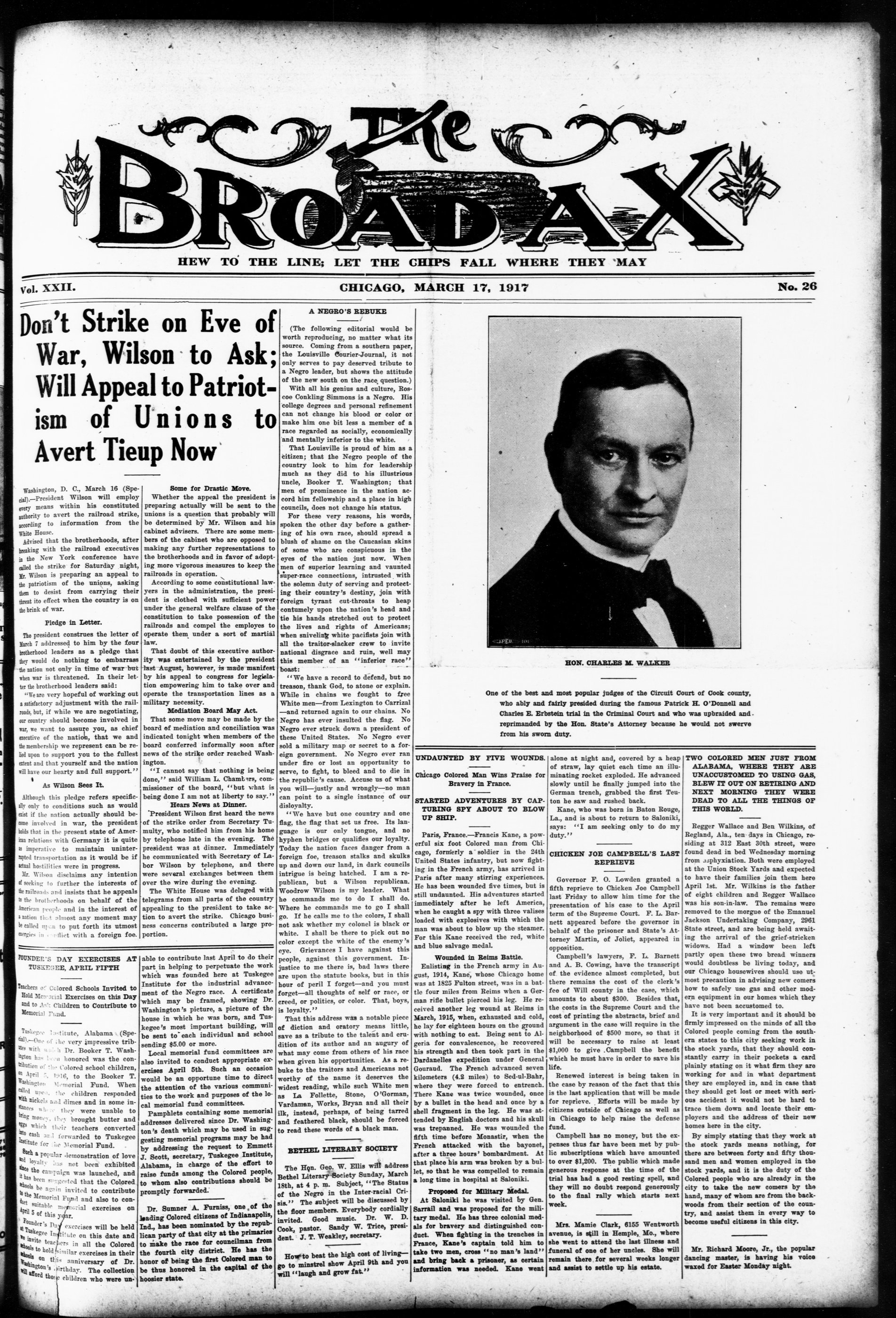
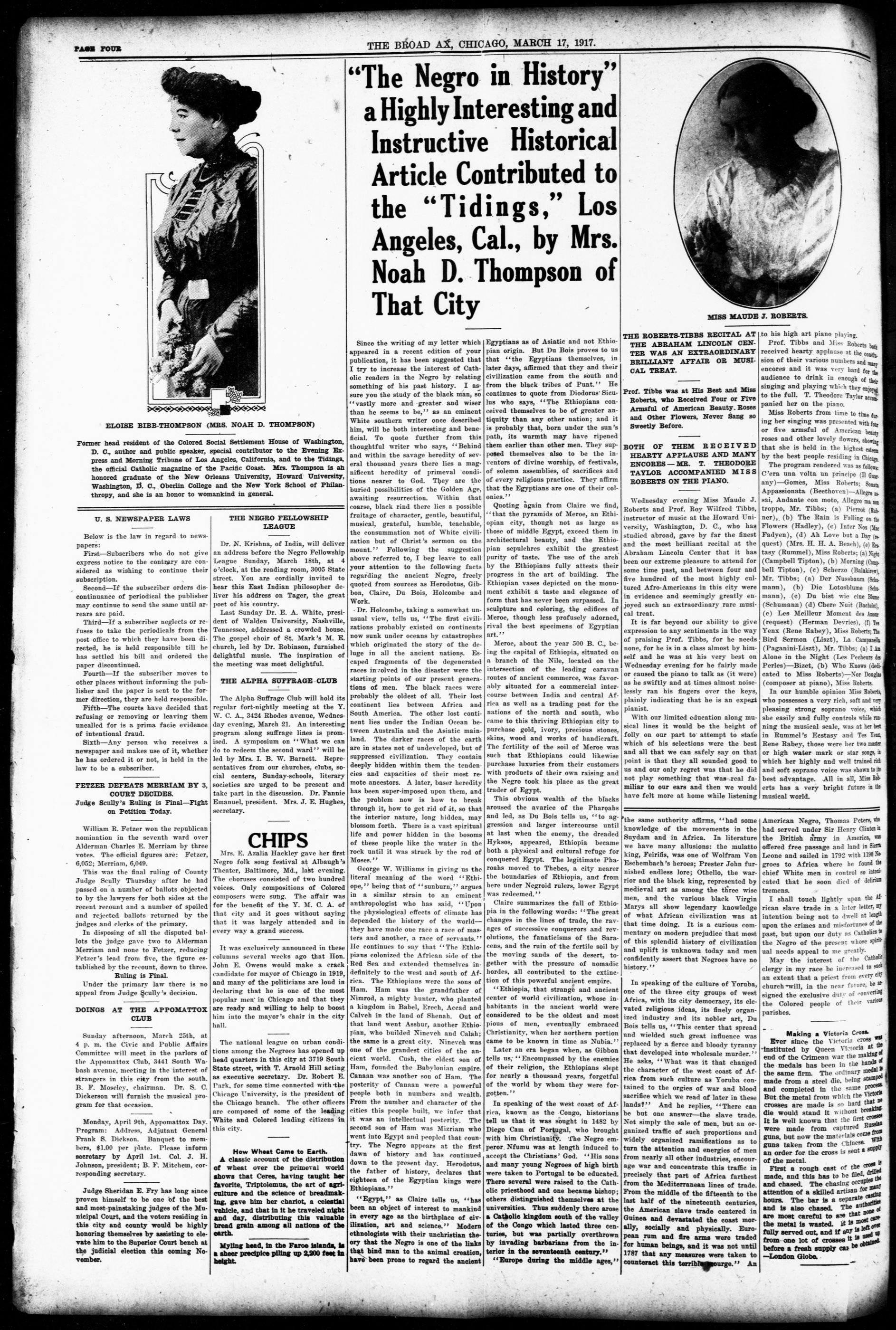
Page text (machine-generated)
THE BROAD AX
Don't Strike on Eve of War, Wilson to Ask; Will Appeal to Patriotism of Unions to Avert Tieup Now
Vol. XXII.
Don't Strike War, Will Will Appealism of U Avert Tie
Washington, D. C., March 16 (Special).—President Wilson will employ every means within his constituted authority to avert the railroad strike, according to information from the White House.
Advised that the brotherhoods, after breaking with the railroad executives in the New York conference have called the strike for Saturday night; Mr. Wilson is preparing an appeal to the patriotism of the unions, asking them to desist from carrying their threat its effect when the country is on the brink of war.
Pledge in Letter.
The president construes the letter of March 7 addressed to him by the four brotherhood leaders as a pledge that they would do nothing to embarrass the nation not only in time of war but when war is threatened. In their letter the brotherhood leaders said:
"We are very hopeful of working out a satisfactory adjustment with the railroads, but, if while we are negotiating, our country should become involved in war, we want to assure you, as chief executive of the nation, that we and the membership we represent can be relied upon to support you to the fullest extent and that yourself and the nation will have our hearty and full support."
As Wilson Sees It.
Although this pledge refers specifically only to conditions such as would exist if the nation actually should become involved in war, the president holds that in the present state of American relations with Germany it is quite as imperative to maintain uninterrupted transportation as it would be if actual hostilities were in progress.
Mr. Wilson disclaims any intention of seeking to further the interests of the railroads and insists that he appeals to the brotherhoods on behalf of the American people and in the interest of a nation that almost any moment may be called upon to put forth its utmost energies in conflict with a foreign foe.
FOUNDER'S DAY EXERCISES AT TUSKEGEE, APRIL FIFTH
Teachers of Colored Schools Invited to Hold Memorial Exercises on this Day and to Ask Children to Contribute to Memorial Fund.
Tuskegee Institute, Alabama (Special).—One of the very impressive tributes with which Dr. Booker T. Washington has been honored was the contribution of the Colored school children, on April 5, 1916, to the Booker T. Washington Memorial Fund. When called upon the children responded with nickels and dimes and in some instances where they were unable to bring money, they brought butter and eggs which their teachers converted into cash and forwarded to Tuskegee Institute for the Memorial Fund.
Such a popular demonstration of love and loyalty has not been exhibited since the campaign was launched, and it has been suggested that the Colored schools be again invited to contribute to the Memorial Fund and also to conduct suitable memorial exercises on April 5 of this year.
Founder's Day exercises will be held at Tuskegee Institute on this date and we invite teachers in all the Colored schools to hold similar exercises in their schools on this anniversary of Dr. Washington's birthday. The collection will afford those children who were un-
HEW TO THE LINE; LET THE CHIPS FALL WHERE THEY MAY
Some for Drastic Move.
Whether the appeal the president is preparing actually will be sent to the unions is a question that probably will be determined by Mr. Wilson and his cabinet advisers. There are some members of the cabinet who are opposed to making any further representations to the brotherhoods and in favor of adopting more vigorous measures to keep the railroads in operation.
According to some constitutional lawyers in the administration, the president is clothed with sufficient power under the general welfare clause of the constitution to take possession of the railroads and compel the employees to operate them under a sort of martial law.
That doubt of this executive authority was entertained by the president last August, however, is made manifest by his appeal to congress for legislation empowering him to take over and operate the transportation lines as a military necessity.
Mediation Board May Act.
That some move may be made by the board of mediation and conciliation was indicated tonight when members of the board conferred informally soon after news of the strike order reached Washington.
"I cannot say that nothing is being done," said William L. Chambers, commissioner of the board, "but what is being done I am not at liberty to say."
Hears News at Dinner.
President Wilson first heard the news of the strike order from Secretary Tumulty, who notified him from his home by telephone late in the evening. The president was at dinner. Immediately he communicated with Secretary of Labor Wilson by telephone, and there were several exchanges between them over the wire during the evening.
The White House was deluged with telegrams from all parts of the country appealing to the president to take action to avert the strike. Chicago business concerns contributed a large proportion.
able to contribute last April to do their part in helping to perpetuate the work which was founded here at Tuskegee Institute for the industrial advancement of the Negro race. A certificate which may be framed, showing Dr. Washington's picture, a picture of the house in which he was born, and Tuskegee's most important building, will be sent to each individual and school sending $5.00 or more.
Local memorial fund committees are also invited to conduct appropriate exercises April 5th. Such an occasion would be an opportune time to direct the attention of the various communities to the work and purposes of the local memorial fund committees.
Pamphlets containing some memorial addresses delivered since Dr. Washington's death which may be used in suggesting memorial programs may be had by addressing the request to Emmett J. Scott, secretary, Tuskegee Institute, Alabama, in charge of the effort to raise funds among the Colored people, to whom also contributions should be promptly forwarded.
Dr. Sumner A. Furniss, one of the leading Colored citizens of Indianapolis, Ind., has been nominated by the republican party of that city at the primaries to make the race for councilman from the fourth city district. He has the honor of being the first Colored man to be thus honored in the capital of the hoosier state.
CHICAGO, MARCH 17, 1917
A NEGRO'S REBUKE
(The following editorial would be worth reproducing, no matter what its source. Coming from a southern paper, the Louisville Courier-Journal, it not only serves to pay deserved tribute to a Negro leader, but shows the attitude of the new south on the race question.) With all his genius and culture, Roscoe Conkling Simmons is a Negro. His college degrees and personal refinement can not change his blood or color or make him one bit less a member of a race regarded as socially, economically and mentally inferior to the white. That Louisville is proud of him as a citizen; that the Negro people of the country look to him for leadership much as they did to his illustrious uncle, Booker T. Washington; that men of prominence in the nation accord him fellowship and a place in high councils, does not change his status.
For these very reasons, his words, spoken the other day before a gathering of his own race, should spread a blush of shame on the Caucasian skins of some who are conspicuous in the eyes of the nation just now. When men of superior learning and vaunted super-race connections, intrusted with the solemn duty of serving and protecting their country's destiny, join with foreign tyrant cut-throats to heap contumely upon the nation's head and tie his hands stretched out to protect the lives and rights of Americans; when sniveling white pacifists join with all the traitor-slacker crew to invite national disgrace and ruin, well may this member of an "inferior race" boast:
"We have a record to defend, but no treason, thank God, to atone or explain. While in chains we fought to free White men—from Lexington to Carrishal—and returned to our chains. No Negro has ever insulted the flag. No Negro ever struck down a president of these United States. No Negro ever sold a military map or secret to a foreign government. No Negro ever ran under fire or lost an opportunity to serve, to fight, to bleed and to die in the republic's cause. Accuse us of what you will—justly and wrongly—no man can point to a single instance of our disloyalty.
"We have but one country and one flag, the flag that set us free. Its language is our only tongue, and no hyphen bridges or qualifies our loyalty. Today the nation faces danger from a foreign foe, treason stalks and skulks up and down our land, in dark councils intrigue is being hatched. I am a republican, but a Wilson republican. Woodrow Wilson is my leader. What he commands me to do I shall do. Where he commands me to go I shall go. If he calls me to the colors, I shall not ask whether my colonel is black or white. I shall be there to pick out no color except the white of the enemy's eye. Grievances I have against this people, against this government. Injustice to me there is, bad laws there are upon the statute books, but in this hour of peril I forget—and you must forget—all thoughts of self or race, or creed, or politics, or color. That, boys, is loyalty."
That this address was a notable piece of diction and oratory means little, save as a tribute to the talent and erudition of its author and an augury of what may come from others of his race when given his opportunities. As a rebuke to the traitors and Americans not worthy of the name it deserves the widest reading, while such White men as La Follette, Stone, O'Gorman, Vardaman, Works, Bryan and all their ilk, instead, perhaps, of being tarred and feathered black, should be forced to read these words of a black man.
BETHEL LITERARY SOCIETY
The Hqn. Geo. W. Ellis will address Bethel Literary Society Sunday, March 18th, at 4 p. m. Subject, "The Status of the Negro in the Inter-racial Crisis." The subject will be discussed by the floor members. Everybody cordially invited. Good music. Dr. W. D. Cook, pastor. Sandy W. Trice, president. J. T. Weakley, secretary.
How to beat the high cost of living—go to minstrel show April 9th and you will "laugh and grow fat."
JPEU 101
One of the best and most popular judges of the Circuit Court of Cook county, who ably and fairly presided during the famous Patrick H. O'Donnell and Charles E. Erbstein trial in the Criminal Court and who was upbraided and reprimanded by the Hon. State's Attorney because he would not swerve from his sworn duty.
UNDAUNTED BY FIVE WOUNDS
Chicago Colored Man Wins Praise for Bravery in France.
STARTED ADVENTURES BY CAPTURING SPY ABOUT TO BLOW UP SHIP.
Paris, France.—Francis Kane, a powerful six foot Colored man from Chicago, formerly a soldier in the 24th United States infantry, but now fighting in the French army, has arrived in Paris after many stirring experiences. He has been wounded five times, but is still undaunted. His adventures started immediately after he left America, when he caught a spy with three valises loaded with explosives with which the man was about to blow up the steamer. For this Kane received the red, white and blue salvage medal.
Wounded in Reims Battle.
Enlisting in the French army in August, 1914, Kane, whose Chicago home was at 1825 Fulton street, was in a battle four miles from Reims when a German rifle bullet pierced his leg. He received another leg wound at Reims in March, 1915, when, exhausted and cold, he lay for eighteen hours on the ground with nothing to eat. Being sent to Algeria for convalescence, he recovered his strength and then took part in the Dardanelles expedition under General Gouraud. The French advanced seven kilometers (4.2 miles) to Sed-uL-Bahr, where they were forced to entrench. There Kane was twice wounded, once by a bullet in the head and once by a shell fragment in the leg. He was attended by English doctors and his skull was trepanned. He was wounded the fifth time before Monastir, when the French attacked with the bayonet, after a three hours' bombardment. At that place his arm was broken by a bullet, so that he was compelled to remain a long time in hospital at Saloniki.
Proposed for Military Medal
At Saloniki he was visited by Gen. Sarrail and was proposed for the military medal. He has three colonial medals for bravery and distinguished conduct. When fighting in the trenches in France, Kane's captain told him to take two men, cross "no man's land" and bring back a prisoner, as certain information was needed. Kane went
HON. CHARLES M. WALKER
and most popular judges of the Circuit Court
fairly presided during the famous Patri-
cine trial in the Criminal Court and wh
by the Hon. State's Attorney because it
on duty.
alone at night and, covered by a heap
of straw, lay quiet each time an illu-
minating rocket exploded. He advanced
slowly until he finally jumped into the
German trench, grabbed the first Teuton
he saw and rushed back.
Kane, who was born in Baton Rouge,
La., and is about to return to Saloniki,
says: "I am seeking only to do my
duty."
CHICKEN JOE CAMPBELL'S LAST
REPRIEVE
Governor F. O. Lowden granted a fifth reprieve to Chicken Joe Campbell last Friday to allow him time for the presentation of his case to the April term of the Supreme Court. F. L. Barnett appeared before the governor in behalf of the prisoner and State's Attorney Martin, of Joliet, appeared in opposition.
Campbell's lawyers, F. L. Barnett and A. B. Cowing, have the transcript of the evidence almost completed, but there remains the cost of the clerk's fee of Will county in the case, which amounts to about $300. Besides that, the costs in the Supreme Court and the cost of printing the abstracts, brief and argument in the case will require in the neighborhood of $500 more, so that it will be necessary to raise at least $1,000 to give. Campbell the benefit which he must have in order to save his life.
Renewed interest is being taken in the case by reason of the fact that this is the last application that will be made for reprieve. Efforts will be made by citizens outside of Chicago as well as in Chicago to help raise the defense fund.
Campbell has no money, but the expenses thus far have been met by public subscriptions which have amounted to over $1,200. The public which made generous response at the time of the trial has had a good resting spell, and they will no doubt respond generously to the final rally which starts next week.
Mrs. Mamie Clark, 6155 Wentworth avenue, is still in Hemple, Mo., where she went to attend the last illness and funeral of one of her uncles. She will remain there for several weeks longer and assist to settle up his estate.
No.26
court of Cook county,
Jack H. O'Donnell and
who was upbraided and.
he would not swerve
TWO COLORED MEN JUST FROM ALABAMA, WHERE THEY ARE UNACCUSTOMED TO USING GAS, BLEW IT OUT ON RETIRING AND NEXT MORNING THEY WERE DEAD TO ALL THE THINGS OF THIS WORLD.
Regger Wallace and Ben Wilkins, of Regland, Ala., ten days in Chicago, residing at 312 East 30th street, were found dead in bed Wednesday morning from asphyxiation. Both were employed at the Union Stock Yards and expected to have their families join them here April 1st. Mr. Wilkins is the father of eight children and Regger Wallace was his son-in-law. The remains were removed to the morgue of the Emanuel Jaekson Undertaking Company, 2061 State street, and are being held awaiting the arrival of the grief-striken widows. Had a window been left partly open these two bread winners would doubtless be living today, and our Chicago housewives should use utmost precaution in advising new comers how to safely use gas and other modern equipment in our homes which they have not been accustomed to.
It is very important and it should be firmly impressed on the minds of all the Colored people coming from the southern states to this city seeking work in the stock yards, that they should constantly carry in their pockets a card plainly stating on it what firm they are working for and in what department they are employed in, and in case that they should get lost or meet with serious accident it would not be hard to trace them down and locate their employers and the address of their new homes here in the city.
By simply stating that they work at the stock yards means nothing, for there are between forty and fifty thousand men and women employed in the stock yards, and it is the duty of the Colored people who are already in the city to take the new comers by the hand, many of whom are from the backwoods from their section of the country, and assist them in every way to become useful citizens in this city.
Mr. Richard Moore, Jr., the popular dancing master, is having his voice waxed for Easter Monday night.
Dan M. Jackson
Geo. T. Kersey
David A. McGowan
Ahmed A. Rayner
Phones Calumet 6164
Automatic 71-629
OPEN DAY
AND NIGHT
The Emanuel Jackson
Undertaking Co., Inc.
2959-61 South State St.
Reliable Service Courteous Treatment
Reasonable Prices
FREE CHAPEL IN CONNECTION
Complete line of Funeral Goods. Automobiles for hire
Telephone Douglas 6568
THE SOLACE BILL
"THE MODERN SCHOOL"
CIGARS-WHOLESALE AND RETAIL BOX TRADE A SPECIALTY
3556 South State Street
Real Estate Brokers
RENTING :: LOANS ::
5107 South State Street
Chicago
A Wonderful Aboriginal City.
Near Lagar, N. M., may be seen Acoma, the "sky city," claimed to be the most wonderful aboriginal city in the world. It stands on an isolated rock eminence 400 feet in height. The city embraces three rows of houses over a thousand feet in length, rising up in terraces four and five stories. One is amazed when he stops to consider that the material for these buildings were transported long distances and up the cliffs upon the heads and backs of these human burden bearers. Their graveyard consumed forty years in building by reason of the necessity of bringing earth from the plain below, and their church must have cost the labor of many generations, for its walls are sixty feet high and ten feet thick. and it has timbers forty feet long and fourteen inches square.-Exchange.
A Story of Longfellow.
In Longfellow's journal, in which he chronicled daily things that came under his observation, he notes that upon a certain occasion he attended a church where the minister took as his subject "Progress." He was very flattered when the latter quoted about half of the "Psalm of Life." After repeating the verses the minister said, "I could never read that poem without feeling the inspiration with which it was written." To this incident Longfellow adds: "But I had the conceit taken out of me on the evening of that day, when I happened to meet a lady at Prescott's and in our conversation she referred to the sermon in the morning and added, 'He quoted some beautiful verses, but nobody knew whence came the quotations.'"
We, the People.
Estimating the world's population as 1,600,000,000, the whole human race at present living could stand comfortably shoulder to shoulder in an area of 500 square miles. Taking the number of generations in the past 6,000 years as 200, the room taken up by them all on the above plan would be less than the area of the state of Colorado. To bury all the people on earth would need a graveyard little larger than that area.
What Is a Hawaiian?
A correspondent inquires whether it is proper to speak of a Hawaiian as a "Kanaka." The term is masculine. A "Kanaka" is a male Hawaiian. A "wahine" is an unmarried Hawaiian woman. A "wahinemare" is a married Hawaiian woman. These definitions are from the Hawaiian dictionary.—Bellingham American Review.
Inherited, as It Were.
Professor—Yes, sir, your daughter is pretty well grounded in French, but it will, of course, take some time and trouble for her to acquire fluency. Father—Well, you know, that's rather strange to me. I had an idea that the fluency would have come sort of natural to her—Exchange.
Explained the Matter
Papa—I'm surprised that you are at the foot of your class. Tommy. Why aren't you at the head sometimes, like little Willie Bigbee? Tommy—You see, papa, Willie's got an awful smart father, and I guess he takes after him.—London Telegraph.
Made a Difference
"Why do you fire me? I work like sixty."
"If you were sixty that might be excusable. But you're only twenty-five."
—Louisville Courier-Journal.
Happy the man who learns the very wide chasm that lies between his wishes and his powers.—Goethe.
PAGE TWO
PH ONE DREXEL 3244
Phones Calumet 6164
Automatic 71-629
OPEN DAY
AND NIGHT
Uuel Jackson
ng Co., Inc.
Automobles for hire
Automatic 73-657
LLIARD ACADEMY
- CLEAN AND RELIABLE
DOUGLAS, Prop.
RES. PHONE DREXEL 2082
INSURANCE
in State Street
Chicago
Outside the House.
How many beautiful homes on which money has been spent lavishly to make them complete are marred by some defect in the landscape work! A few hours' motor trip through the suburbs of almost any city in the country will reveal many such cases. The most frequent jar the trained eye receives is from the poorly laid out walks and driveways in which badly arranged curves are used or walks made to curve around an oval grass plot placed in the center for no other reason than to make pedestrians take time to circle about that particular grass plot. Postmen, messenger boys and others take a short cut, and soon a path in the proper direction is worn across the sod. When a curve is used in a walk or driveway there should be a reason for it. If there is no other reason plant one; place a tree or two or shrubs in a position so the curve will seem necessary. People then will keep on the walk, and the plan will seem reasonable—New York Sun.
Making a Magnet.
The simplest way of magnetizing a bar of steel is that known as "single touch." The bar to be magnetized is laid on the table, and the pole of a powerful magnet is rubbed from ten to twenty times along its length, always in the same direction. If the north pole of the magnet is employed the end of the bar first touched will also become a north pole, while the opposite end, at which the magnet is lifted before returning, will be a south pole.
There are other and more complicated methods, known as "divided touch" and "double touch," in which two and even four magnets are employed.
A steel bar can also be magnetized by placing it within a coll of insulated wire, through which a galvanic current is circulating. The magnetism induced in this way, however, is weak compared with that which can be procured if the same strength of current is employed through the intervention of an electromagnet.
Many William Shakespearea
Many William Shakespeare.
There have been many William Shakespearees in the past. Among the burials in the registers of St. Clement Danes, in the Strand, there is the entry, "Jane Shackspeer, daughter of William, 8 Aug., 1609." Warwickshire records show, among other things, that a William Shakespeare "paid 8s. to the Lay Subsidy, Walton super Olde;" another W. S. priced the goods of "Robert Shakespeare of Wroxall" on March 19, 1563; another, a shoemaker of Coventry, made his will March 18, 1605; still another William Shakespeare, "gentleman," had "his daughter Susanna" (singularly enough) baptized on March 14, 1596, and yet again another W. S., a shoemaker of Warwick, fell into the Avon and was drowned. These are a mere fraction of the full list—London Chronicle.
Falling Up Out of a Balloon
If a man falls out of a rising aeroplane or balloon he will not go toward the earth, but will continue rising into the air for an appreciable time. If the air machine were stopped in its ascent at the time it could catch the man as he came down. If the airship were ascending at the rate of thirty-two feet a second the man would rise sixteen feet before beginning to fall toward the earth. Thus, by reducing the speed of its ascent, the vessel might keep by the side of the man and rescue him. The reason why the man rises is the same as the reason for a bullet's rising when shot from a gun into the air—both the man and the bullet are given a velocity upward, and it takes some time for gravity to negative that velocity.
---
Chicago
Chicago
THE BROAD AX. CHICAGO, MARCH 17, 1917.
What Are You Worth?
Have you any idea? Did you ever capitalize your wages and figure it out? This is the way to ascertain how much your labor is really worth.
For instance, a man who has saved $20,000 and invested it at 5 per cent receives an annual income of $1,000 a year, or about $20 a week.
The clerk in the office or the workman in the factory who gets $20 a week therefore receives the income at 5 per cent on an investment of $20,000.
He is a $20,000 man—that is, he is getting as much week by week as the man with $20,000 who depends solely upon the income from his investments and who does not work for a living.
The man who earns $40 a week has about the same income as the investor with $40,000 put out at interest at 5 per cent.
So labor is capital. It has a market value. It can be called a commodity because it can be sold by its owner the same as any other possession he may have. John A. Sleicher in Leslie's.
Shotguns In War.
That shotguns should be largely utilized in modern warfare is the contention of a number of military experts. It is pointed out that such guns would be particularly useful to sentries at night, as an intruder might more easily be crippled and captured by a spreading charge of heavy shot than by a single bullet. Moreover, a person moving quickly might often be missed by a shot from a rifle, whereas a snapshot from a shotgun in semidarkness could hardly fail to find its object.
In the trenches shotguns could be used with success. A shotgun loaded with about forty-eight grains of powder and one and a half ounces of big shot, with about twenty-five pellets, would be of much more value than the rifle, as during a night attack, either for attack or defense in semidarkness, a single charge would hardly fall to inflict serious wounds on one or more of the enemy.—Exchange.
The Swiss Admiral
"As much business as a Swiss admiral" is a term sometimes used satirically. But the little inland nation actually had an admiral once. He was an Englishman, too, a Colonel Williams, who joined the Swiss colors in 1790. This Colonel Williams got together a small fleet on Lake Zurich and was ordered to oppose the French army, which was preparing to attack the Austrians and Russians massed near by. The French attacked their allied foes and routed them. Admiral Williams calmly watched the battle that was in progress on land. Then, enraged at his own inaction, he discharged his crews, scuttled his vessels and went back to England. Switzerland now has one armored boat on Lake Lucerne, but its commander is only a captain.—Kansas City Star.
A Father Vaughan Story.
Father Bernard Vaughan, the famous English Jesuit preacher, says what he means and means what he says and is never afraid of directing his criticisms even against the most powerful sections of society, especially the idle rich.
An amusing reference was once made to the fiery methods of denunciation he employs when in the pulpit. He had been preaching in Rome and had, as usual, dealt out plain truths about everybody with his accustomed force. One of the cardinals remarked that he preached like an Italian. "Yes," said another dignitary, "but he is an Italian. He was born on Vesuvius, and we only sent him to England to cool."—London Globe.
Salt and Toothbrushes.
Our dentist tells us a very interesting thing. Ordinary salt is one of the best methods for sterilizing toothbrushes that are known. But not only because it sterilizes is it so excellent, but because it has the effect of softening the bristles and making them expand in a way. One of the troubles so frequently met with is that the bristles come out and are swallowed, causing appendicitis. The salt causes the bristles to swell and so remain in the brush. This may be but another of the several million theories. It is important, however, that bristles do cause appendicitis—New York Globe.
Substitute For Tobacco
Throughout the tropical orient the natives employ a substitute for tobacco consisting of a slice of areca palm nut, wrapped in betel leaf, flavored with a fine lime made of native seashells and colored with carmine. The habit is universal, especially with the women, and sellers of "betel nut" may be seen on many of the street corners in Saigon and other cities of Indo-China.
Handsome Serenity
"George Washington was never guilty of deception." "Maybe not. I don't believe, in fact, that he ever looked like his pictures on our postage stamps. But, of course, he wasn't responsible for them."—Washington Star.
"Electric wires must be quick tempered."
"Why?"
"Because it seems so dangerous to cross them."-Baltimore American.
No Hangings.
Him—How did you like the stage hangings in that Shakespeare show? He—There weren't no hangings, y'boo! He killed 'em with a sword.—Cornell Widow.
Men who are low and are falling do not revolt. It is men who, although they may be low, are rising who revolt.—W. G. Sumner.
YOU HAVE READ MUCH! THOUGHT SOME BUT NOW IS YOUR TIME TO ACT
Your opportunity to be a part owner----to share in profits of "THE BIRTH OF A RACE"
is passing. The shares of Capital Stock have been turned over to a strong firm of brokers. The sales are big----in Chicago----all over the country. The shares are going very fast. Soon they will be entirely gone, and your chance to make a lot of money gone also----unless you get busy.
Not Next Month But TO-DAY or Next Week
This Master Photoplay is of interest to you. It will help you and your race, and make money for you at the same time.
President, EDWIN L. BARKER, a man who has produced real motion pictures. Secretary, JOHN C. WILLIAMS, for 6 years Attorney for Sanitary Dist. of Chicago. Treasurer, JOHN GULLIKSEN, Assistant Cashier of the Union Bank of Chicago. DEPOSITORY FOR FUNDS, Union Bank of Chicago.
CLIP, fill out and mail this coupon to-day, and circular telling all about "THE BIRTH OF A RACE," will be sent you at once. There is a Monthly Payment Plan which makes it very easy to own a few shares of stock.
We are continually reading in the newspapers that various battleships have been completed, launched and for how long they have been commissioned. There are probably few people, however, who know how long a battleship lasts. The average life of a modern battleship is about fifteen years. In the old days a battleship was on active service nearly the whole time of its commission, which was about a hundred years. The Victory was forty years old when she fought at Trafalgar, and the Royal William, which was built in 1670, was not "scrapped" until 1813.—London Mail.
A squab grows enormously the first twelve hours and still more rapidly after the third day. Squabs are at first sparsely covered with long filaments of down, the root of each filament indicating the point from which each future feather is to start. The down for awhile still hangs on the tips of some of the feathers during their growth and is thought by some to be finally absorbed into the shaft of the growing feather
"Oh, come! Stop borrowing trouble."
"Borrowing! Gee whiz, man, trouble isn't like money! When I borrow money I can forget about it right away."—Boston Transcript.
“The office should seek the man.”
“And the girls aren't hanging back either these days.”—Kansas City Journal.
```markdown
```
1
Using the Scrub Palette.
Once a prolific and troublesome waste product throughout Florida, the scrub palmetto is now being developed into an asset of great possibilities. Not only has it been discovered that paper of good quality can be made from it, but the manufacture of carpets, mattings, twines, rope and burlap from the plant is already an industry of high standing in the state. Only the green leaf, or fan, is used. Claim is made that the palmetto leaves when shredded and spun are very much tougher than the grass now used for mattings. The green leaves are fed just as they are cut into the shredding and spinning machines, and in three minutes they come out in twine. This avoids the discolorations and losses occasioned in drying, storing and handling grasses commonly used for matting. Palmetto can be cut every day in the year and immediately made into twine. The skeins of twine when hung up dry rapidly and uniformly. The twine is used as soon afterward as necessary.—Argonaut.
Creed of the Busy Man.
I believe in the stuff I am handing out, in the firm I am working for and in my ability to get results. I believe that honest stuff can be passed out to honest men by honest methods. I believe in working, not weeping; in boosting, not knocking, and in the pleasure of my job. I believe a man gets what he goes after, that one deed done today is worth two deeds tomorrow, and that no man is down and out until he has lost faith in himself. I believe in today and the work I am doing, in tomorrow and the work I hope to do and in the sure reward which the future holds.
I believe in courtesy, in kindness, in generosity, in good cheer, in friendship and in honest competition. I believe there is something doing, somewhere, for every man ready to do it. I believe I'm ready—right now!—Elbert Hubbard.
The Sadness of a Wedding
There is something sad about a wedding. The young groom is leaving a home in which he always has had his way and is going into one in which he never will have his way. Although his parents do not go through the formality of giving him away at the altar, they know well enough that in a few minutes he will be a son-in-law to another woman, while to them he is nothing but a son. There he comes, with another man holding to his arm. It looks as if he might have made an attempt to escape and that the strong best man captured him and brought him back. He is as happy as he is nervous and so trustful that he has no fear for the future—Claude Callan in Fort Worth Star-Telegram.
Why Not?
Clerk—Now, see here, little girl, I can't spend the whole day showing you penny toys. Do you want the earth with a little red fence around it for 1 cent?
Little Girl—Let me see it—Life
Please send me, without obligation on my part, fulll formation about "The Birth of a Race."
Life of a Battleship.
Squaba.
The Wrong Word.
Hia Grouchy Opinion:
Cleaning the Teeth:
A clean tooth never decays. The best way to clean the teeth is to place the bristles of the brush firmly against the teeth and with a rotary or scrubbing motion go up and down the surface of the upper and lower teeth both inside and out and up on the gums. Go also behind the teeth. After seeing that every bit of the surface of the teeth has been cleaned in this way rinse the mouth thoroughly, forcing the water between the teeth several times to loosen any food particles. Do this more than once and always spit it out. To keep the teeth as clean as they should be kept in order to preserve them and prevent decay it is necessary to wash them after each meal so as to remove all food particles. They should also be washed the first thing in the morning and the last thing at night. It is well to have more than one brush on hand at a time, so that it will never be necessary to use a wet, limp brush.
FREE
STYLE BOOK
--- HAIR...
To Colored Women
We are the largest
manufacturer of
Colored Women's
Hair. Our latest
book showing new
hair for dressing sent free.
Every colored woman
should have one. We sell these
samples on our toilet articles.
Safiation guaranteed
or money back.
We make our best
solid Brass STRAIGHT-
ENING combs, with extra heavy back, fully
guaranteed. With each comb we give hampop
FREE. Send money order or stamps. MONEY
BACK IF NOT SATISFACTORY. See page 11.
POSTPAID 89c.
Hair nets, brushes, combs and toilet articles
manufacturers' prices. Send two nets
Agents Wanted. Address as follows:
HUMANIA HAIR COMPANY,
181-187 Park Row,
New York 0323.
Address Dept. 84
Grapes will grow almost anywhere and are sure to bear. Grapes can be trained on trellises close to fences or to outbuildings. Spring is the best time to plant, using either one or two year old vines. Frequently cultivation during summer will improve the fruit. Wood ashes make a good fertilizer for grapes, and half a bushel to the vine will not be too much. No pruning will be required the first season, but the second season cut back the strongest canes to three or four buds and remove all others.
Proper Physical Education
Proper Physical Education
The purpose of physical education is of course, not merely to build up the bodies of boys today, but to put into the lives of boys that thing, whatever it is, that will make the boy stay strong and ablebodied when he reaches manhood. Such men—lovers of fresh air, of hiking in the wild, of sleeping under the sky—men who can both enjoy and endure, are the men who will make up a strong nation and not a nation of weaklings—Scouting.
Cape Horn's Lighthouse
Cape Horn Lighthouse
Probably the most desolate and dreary spot in the world inhabited by white men is the lighthouse that is maintained by the Arcentine government at Cape Horn. This is claimed to be the southernmost lighthouse in the world.
One at a Time.
"Does your husband worry about the grocery bill?"
"No; he says there's no sense in both himself and the grocer worrying over the same bills."—Exchange.
Queen.
"Your wife gave us a splendid lecture on cooking last evening. Why weren't you there?"
weren't you there?
"I was home with a terrible attack of dyspepsia."
Health lies in labor, and there is no earthly royal road to it; but through toll—Wendell Phillips.
Potatoes as a Food.
At high prices the potato is not a good food; it is not at any price one of the best. Civilized humanity existed without it for centuries, rising to its ninth in a potatoless old world. Habit and convenience in storage have led to overuse.
The potato is three-fourths water and not quite one-fifth starch, which is its chief food substance, an excellent one for outdoor workers in severe climates. It is less valuable for sedentary workers indoors.
Only one-five hundredth part of the potato is fat; 3 per cent nitrogen, 2 per cent sugar. These more valuable substances are so slight that during the famine of 1847 Irish cotters formed the habit of cooking potatoes "with a bone in the middle" that is, of undercooking them so that they might delay digestion and stave off hunger.
There are substitutes, of which rice nearly approaches the potato in values and defects. The correct instinct of rice eaters has mended the latter by the invention of pilaf, in which rice is supplemented by chopped meats or gravies—New York World.
Germans In America.
The total number of German born in the United States is 2,501,333. If Austria-Hungary is included the total is increased to 4,171,915. The natives of Germany and Austria-Hungary comprise 31 per cent of the total foreign population of the country and less than 5 per cent of the total. New York has the largest German population of any state in the Union. The total is 463,700. The German population of New York city is only 14 per cent of its foreign population. The half of Cincinnati's citizens were born in Germany. The other centers in the order of their population of the German vote are as follows: Baltimore, Buffalo, Chicago, Detroit, Jersey City, Los Angeles, Milwaukee, Newark, St. Louis and San Francisco. In its proportion of Germans Wisconsin leads, Minnesota second.—Syracuse Post-Standard.
Our Fishing Presidents.
Fourteen of the twenty-seven presidents of the United States have been fishermen. When fishing and the presidency are mentioned the mind instantly recalls Cleveland, the fishing president. He is the one president who wrote a book discussing angling. It is not generally known, but the first president of the republic was an enthusiastic angler. It may be of interest to the enthusiastic anglers of the nation to record the names of the fishing presidents. They are George Washington, Martin Van Buren, John Tyler, Zachary Taylor, Millard Fillmore. Franklin Pierce, Abraham Lincoln. Andrew Johnson, Ulysses Simpson Grant, James Abram Garfield, Chester Alan Arthur, Grover Cleveland, Theodore Roosevelt and William Howard Taft—New York Sun.
An Exercise For Typists.
Is it of any value to know how to say the alphabet backward? A correspondent says: "I think this is new, as I am the inventor, and it is of some use in exercising on the typewriter if for nothing else. The twenty-six letters of the alphabet are used as initials of words divided into five groups of four initials and one group of six. The groups are connected as follows: Zebras Yoked, Xylophones Whacked, Voices United To Sing.
A Way the Dutch Have
A Way the Dutch Have:
The Dutch have a delightfully original way of collecting their taxes. If after the notice has been given the money is not sent the authorities place one or two hungry militiamen in the house, to be lodged and maintained at the expense of the defaulter until the amount of the tax is paid.
Its Oddity.
"There is one thing in a lawyer's profession which is different from any other."
"What is that?"
"The longer he is at it the more he has of a brief career."—Baltimore American.
In His Line.
He is building an immense artifical mountain on his country estate." Well, I guess it comes sort of natual for him to put up a bluff."—Puck.
Marital Amenities
"My hand is always in my pocket."
"That's just what I'm complaining
about. It never comes out."—Exchange.
PRACTICAL HEALTH HINT
Consumption.
A diet of peanuts is suggested as a cure for consumption by Dr. Brewer in the Journal of Hygiene. This seems too simple to be true, but Dr. Brewer tells of two young women who had grown sick of cod liver oil and tonics and who were treated by him with sated peanuts—all they could eat—combined with inhalations of vinegar.
"One would think this a very indigestible diet," he writes, "but they craved them, and it has always been my policy to find out just what my patients desire to eat, and unless it is too unreasonable I humor them. Both young ladies have become plump and after one year's inhalation have ceased coughing, and I pronounced them cured."
Peanuts are recommended also for sleepiness.
Self Training Is Best, Saye Armour.
In the American Magazine is an article by J. O. Armour entitled "Armour Men Who Got Ahead—and Why," in which Mr. Armour gives his opinion of the qualifications that make for business success.
"One of the truest axioms I know," he says, "is the business saying that 'the best trained man is the self trained man.' It is my belief that no man developed by a formula in a business organization can ever reach the power of one who is put on his own responsibility, knowing that his advancement depends on his own brains, foresight and application.
"By tilis I do not mean that a business leader should let his men go along blindly. He must always give something of himself. He must teach them the overhand and crawl strokes where they knew only the breast stroke before. But in any office organization the man who has never had to stand squarely on his own feet is never in a position to march ahead."
Work of a Microscope
One of the newest of astronomical instruments is the blink microscope. The principle involved is similar to that of the moving picture machine. In the latter the film used consists of a series of pictures, each a little different from its predecessor. If these are presented in rapid succession the series is fused into one picture in which the succeeding differences appear as motion. The blink microscope enables one to compare a photograph of a portion of the heavens with another of the same region taken several years later. An ingenious contrivance brings first one then the other plate into view in rapid succession. If in the interval between two exposures a star in the region has changed its position appreciably it will appear to move and can be detected at once. Formerly it was necessary to measure carefully the positions of all the stars on both plates in order to detect those with large proper motions. Such stars are sometimes called "runaway" stars.
Complaint of the Stupid
It is only stupid people who complain that they are misunderstood. If they were not stupid they would know that there is absolutely no such thing as being misunderstood, and therefore that there is nothing whatsoever to be gained by complaining about it.
Wise people who want to be understood do not spend their time complaining, but in perfecting some means of expressing themselves by which they may reveal to the world about them some slight remnant, at least, of their souls or their minds or their ideas or their discoveries or their eccentricities or whatever it is they want to make known.
When you complain about not being understood the only thing you make clear is that you are a complainer.—Puck.
Eskimo Carving.
All of the Eskimo carving today is done with steel tools, but there is work in existence that dates back to the stone age. The older Eskimos say that their ancestors used tools of flint, and it is known that they have been carving ivory for many generations. Some of the very poorest of them and those that live in the most out of the way places are noted for their work of this kind. They seem to do it for pastime and make many toys and dolls for their children. They have a way of softening the bone, horn or ivory before they work it, and to make the carvings more distinct they etch lines on the surface with a black paint made of a mixture of gunpowder and blood. This, when put on the freshly cut bone, makes a permanent stain.
What He Didn't Know.
Peyton R. Hayden was long a conspicuous figure among the lawyers of Boone county. While he was fond of studying lawbooks, he cared little about literature.
During a recess one day in the Boone county courthouse a lawyer named Field from Lafayette county asked him what he thought of Byron's "Childe Harold." Hayden replied: "Egad, sir, I did not know that Byron had a child named Harold."—"Bench and Bar of Boone County, Mo."
A Giveaway.
Mrs. Blabbit—I don't like her at all, dear. She's a deceitful woman. The other day she tried to get me to say something against you. Mrs. Gaddeigh—She did! How? Mrs. B.-Why, she asked me to tell her confidentially what I really thought of you—Boston Transcript.
Oddity of the Sturgeon.
The sturgeon has no skeleton. This fish has many tubercles fixed in the skin along the back and sides. If these tubercles are boiled with a little soda it will be seen that they are beautifully ornamented, somewhat resembling very fine Chinese carving.
Easy Judgments.
"Oh, he had it easy. There were no technicalities in his day, nor did he have to decide cases with the alienists evenly divided."—Exchange.
When He Got the Hint.
"What started you thinking about marriage all at once?"
"She wouldn't let me buy her a box of candy—sald I would need the money."
—Houston Post.
Romance and Fiction.
When a very rich man marries a very poor girl, that's romance. When a very rich girl marries a very poor man, that's fiction.—Galveston News.
Meet trouble like a man and cheerfully endure what you can't cure.
THE BROAD AX. CHICAGO. MARCH 17 1917
The Ideal Kitchen.
The kitchen is the real workshop of the family. Most of the work there has to do with preparing food for the family, cleaning it up and putting it away. The old fashioned kitchens never took into account economy of steps and time, but today this is always done. There is a logical order for the arrangement of the equipment. Things that belong to each process should be together, within the reach of the worker. The icebox, cold pantry, kitchen cabinet, stove and serving table are used together and should be in a close continuous line. This is the food preparation side of the equipment. For the cleaning up of the same economy should be practiced. The sink should be near the chinos closet or in a butler's pantry, the track should be straight for clearing up. Always have plenty of table room near the sink. A drain board on each side is the best plan, or at least a set of hanging shelves, a hinged shelf and extra table or a wheeled table at the right. If the drain table is porcelain a rubber mat will prevent breakage.—Exchange.
Aluminum and Oxygen.
Aluminum is in many ways a wonderful substance, albeit in the natural world most of it is oxidized and turned to clay. Its avidity for oxygen is one of its most salient characteristics. It is said that one never sees the metal, directly, in air, but always and only through a vell of superficial oxide which forms on its free surface with marvelous rapidity. It is stated that if a fresh surface of aluminum be prepared by scraping with a knife the oxygen of the air runs in as fast as the scale is peeled off and keeps close behind the knife blade.
If it were not for this superficial scale of oxide, which acts as a barrier to further action, the metal would burn up or deflagrate in air. The large amount of heat developed by thermite, a mixture of powdered aluminum with oxygen giving substances, bears witness to the activity of the oxidizing process when completed.—Washington Star.
Tokyo's Prolific Slums.
No tourist crosses the Sumida river unless it is to visit the great amphitheater for a wrestling match or a chrysanthemum show, yet there is where the real secret of Tokyo's future lies. It is the factory and slum sections of the city, and the population there has increased in the last decade ten times as fast as has the population in the district of Kojimachi, which surrounds the palace.
In the last generation the population of the five greatest industrial and commercial cities in Japan has increased by 314 per cent as against an increase in the whole empire of 15 per cent. The trend in Japan is cityward, and the visitor to Tokyo, seeing the streets crowded with people, does not realize that in the suburbs the growth in population has run from 250 to 500 per cent in the last decade.-Christian Herald.
Argentina's Military System.
Every native or naturalized citizen of Argentina, at home or abroad, on reaching the age of eighteen years must be enrolled. The federal executive power takes charge of this national enrollment, which serves at once as a registration of voters and national defenders. A given individual, if at home, is enrolled in one of the five military districts into which the fourteen states and ten territories of Argentina are divided. If he resides abroad he is enrolled in his consulate, for the government follows him with precision wherever he may wander. With the exception of these consular registrations abroad the general enrollment is entirely in charge of the military authorities, who are counted upon to get more thorough results than a civil census provides.—World's Work.
A. Help to the Soil.
A French chemist attributes to carbonate of manganese in very minute quantities the power of rendering fertilizers more readily assimilable without undergoing any change itself. Experiments have tended to show that with the use of an ounce to about seven square yards germination was more free, growth more rapid and yield better--that is, used with other fertilizers. By itself it is supposed to have no effect whatever.
His Idea.
"Binks has an idea that he expects to make a lot of money out of." "What is it?" "An electric piano with a slot machine attachment."
"There's nothing new in that."
"Oh, yes, there is." The coin you put in stops the playing."—Buffalo Express.
Flannagan's Way.
Cassidy—Flannagan's thinking of goin' into the haulin' business. He bought a foine new cart today. Casey—But shure he has no horse. Flannagan—No, but he goin' to buy wan. Casey—Well, that's loike Flannagan. He always did git the cart befoer the horse. Philadelphia Ledger.
A Confirmed Taste
"I'm blest if I can see what Blabkins finds to admire in that Miss Jorkins," said Hinkleigh. "Why, she's wholly made up." "That's it, I guess," said Harkaway. "Blabkins always was crazy about fiction."—Harper's.
Severe Treatment
Howell—Why did Rowell allow himself to die of starvation? Powell—He said he wouldn't humor his stomach any longer, as it was getting to be a regular grafter.—New York Times.
There are things we must try to attain, yet it is not really the attainment that matters; it is the seeking.—Gilbert Murray.
An agricultural society of Florence, Italy, has recently carried out a thorough investigation of the alleged injury of fruit by bees and has completely exonerated the latter. Bees are unable to perforate the skin of the fruit, and it is only incidentally that they suck the juices of fruits injured by other natural causes. The damage sometimes attributed to these insects is due to poultry, wild birds, wind and hall, and even more frequently to hornets, wasps, vine moths and other insects. Instead of being harmful to orchards and vineyards, bees perform the useful service of effecting the cross pollination of flowers, and hence the setting of fruit as well as the destruction of damaged fruits (especially grapes) by sucking the juice and pulp and thus preventing fermentation and rot extending to sound individuals. The orchards and vineyards frequented by bees give the most constant crops.—Scientific American.
Idolatry aa It Is.
After months spent in idolatrous lands I have been unable to see much real worship in heathen shrines. The educated worship with their tongues in their cheeks and the ignorant with their hearts in their mouths. But the amount of real worship that exists in heathen temples is very small. Sometimes a bereaved mother will enter the temple and draw from her kimono the tiny bib of a departed little one and tie it to the statue of Jizo, the god of motherhood. Sometimes an old man or woman almost blind will enter the temple and rub the eyes of a wooden god and then rub his own in the hope that eternal darkness may not close in on his affrighted soul. In some places Buddhist services are as dignified, as well attended and as helpful as our own. In Hakodate I attended a Buddhist preaching service that smacked less of idolatry and more of morals than some ceremonials in our cruciform chapels.-Christian Herald.
The Arabic Language
Though the Arabs number less than the population of London, their language is one of the most widely spoken and influential in the world, for it is the language of the Koran. Seventy millions of people in Asia and north Africa speak some form of Arabic as their vernacular, and quite as many more know something of the language from the Koran, which in the original is a text book in the day schools of the Mohammedans from Turkey to Afghanistan and New Guinea. Nor is Arabic unworthy of this extensive use. Renan, after expressing his surprise that such a language should spring from the desert regions of Arabia and reach perfection in nomadic camps, declares that it surpasses all its sister Semitic languages in richness of vocabulary, delicacy of expression and the logic of its grammatical construction.—London Chronicle.
Politica and Tobacco.
Something like half a century ago a man named Dan Bradley started the custom in a little cigar store in Brooklyn of keeping a box of smoking tobacco on the counter, with a sign above it saying, "Fill your pipe." Partly on the strength of his popularity, due in no small degree to the free fillings for a pipe, Bradley ran independently for the state senate and was elected as against the regular candidate.
"Five thousand clay pipes did the trick for Dan" was a saying at the time.
"A man would have to give away automobiles to get elected to the senate nowadays," observed one of the new school of politicians.
"The days of the election cigar and tobacco are gone forever."—New York World.
Damascus. Swords.
Damascus swords, whose fame at one time made them almost one of the wonders of the world, were made of alternate layers of iron and steel, so finely tempered that the blade would bend to the hilt without breaking, with an edge so keen that no coat of mail could resist it and a surface so highly polished that when a Moslem wished to rearrange his turban he used his sword for a looking glass.
That Held Him
A Yankee clinched his heated argument with an Englishman as to the relative size of the Thames and Mississippi by saying: "Why, look here, mister, there ain't enough water in the whole of the Thames to make a gargle for the mouth of the Mississippi."
Too Much to Ask:
"Bliggins is a little annoying in manner, but his heart is in the right place." "Yes," objected Miss Cayenne, "but you can't be expected to perform a surgical operation on every disagreeable person to ascertain where his heart is."—Washington Star.
Doing Her Part
"Wife, will you thread a needle for me? I want to sew on a few buttons." "Why, certainly. There you are. Now you can sew on your buttons while I go to the bridge club. Sometimes I wonder how you managed before you were married."
Consolation
Sappleigh—It's an awful thing to realize that you've made an egregious ass of yourself. Miss Keen—Haven't you got used to it yet?—Boston Transcript.
Neutral Ground
Individuals, like nations, must have suitable, broad and natural boundaries, even a considerable neutral ground, between them.-Thoreau.
Could we but think with the same intensity we love with we might dc great things.-P. J. Bailey's "Festus."
Fragrant Fern.
Some say it has the fragrance of new mown hay. It reminds others of fresh strawberries. There are also those who detect it in the perfume of the wild rose. Opinions differ as to what the fragrance resembles, but all opinions are unanimous in praising it. So they call it the fragrant fern.
It grows in small, round clumps in clefts on the face of a prepice, out of reach of collectors, who haven't the patience to hunt for it. For this reason it is not well known. Its out of the way haunts provide an effectual hiding place.
The hardiness of the fragrant fern surprises the amateur collector. It grows in full glare of the sun, in places where more common ferns would be scorched and withered. Yet the fronds remain green throughout the year, and even the year-old fronds, which turn brown at the end of the season, curl up around the roots of the plant and cling to the rocks.—Philadelphia North American.
Tact and Success
Tact is a combination of good temper, ready wit, quickness of perception and ability to take in the exigency of the occasion instantly. It is never offensive, but is a balm allaying suspicion and soothing. It is appreciated. It is plausible without being dishonest, apparently consults the welfare of the second party and does not manifest any selfishness. It is never antagonistic, never opposes, never strokes the hair the wrong way and never irritates. Tact, like a fine manner, eases the way, takes the jar out of the joils, oils the bearings, opens doors barred to others, sits in the drawing room when others must wait in the reception hall, gets into private offices when others are turned down. It admits you into exclusive circles, where wealth abounds, even though poor. It secures the position when merit is turned away. Tact is a great manager. It easily controls people, even when combined with small ability, when genius cannot get along.
Little Things Count.
The more complex life grows the more these little things count. One or two men at the pumping station could produce a water famine for 2,000,000 people. Cut a very thin wire, and a city is in total darkness. Five cents' worth of calico is enough to eclipse Raphael's finest Madonna. When everybody walked to his appointed place of work nothing short of a universal calamity would keep everybody away from work. Now a defective feed wire will halt a hundred thousand in trolley cars. And because these little things do foot up to such big totals the human element remains important despite all our inventions. Most failures are men and women failures, not machine failures.-Philadelphia Ledger.
Lettres de Cachet
Lettres de cachet was the name given in France to warrants sealed with the king's seal ordering persons to be thrown into prison or exiled. The first came into use about 1070 and shortly became one of the popular terrors of France. It is said that no less than 9,000 lettres de cachet were issued during the reign of Louis XIV, and 80,000 during the reign of Louis XV. In many cases these terrible documents were secretly sold and used as a source of illicit revenue. They were frequently signed in blank, and the holder of one of these royal terrors could write in the name of any person against whom he happened to have a grudge. The national assembly abolished this iniquitous privilege of issuing lettres de cachet on Nov. 1, 1789.
Rattling Windows
In some houses the windows have an unpleasant habit of rattling at all times of the day and night when there is the least wind. In such a case an ordinary clothespin is most effective. It must be split in half and one half inserted on each side between the framework and the window or between the sashes. A good plan is to paint the clothespeg the same color as the window frame and secure the pieces by a cord and screw to the frame so that they will be in readiness when needed.
A Problem.
"That is my hired man asleep up there in the crotch of that oak tree," said honest Farmer Hornbeak. "You are entitled to one guess as to whether he clump up there to slumber or went to sleep on the ground on top of an acorn which grew up with him."—Kansas City Star.
A. Cent.
The habit of calling the cent piece of our American coinage a "penny" is utterly without foundation or excuse. We have no penny in our coinage. At one time half cent pieces were coloned, but now the unit is a cent, the hundredth part of a dollar.
Wonderful.
In the art department a few days ago one of the students drew the picture of a hen so lifelike that when she threw it into the waste basket it laid there. Liverpool Post.
Give Her Time.
Mother-I hope you do not allow him to kiss you as yet. Daughter-I cannot break him of all his foolish habits in a month. can I?-Life.
Brain Trouble
"It troubles him to think."—Boston
Transcript.
We have no right to say that any
good work is too hard for us to do.
PAGE THREE
Dust Dangers.
An analysis of the contents of a vacuum cleaner made recently showed that the dust which had collected on the bookshelves in a library consisted of "hair, green wool, white wool, cotton fibers, celluloid, pieces of finger nails, fly wings, sand grains, wood, paper, string, metallic iron and leather. The hair was probably derived from soft hats, the wool and cotton fibers from clothing, sand from the mud tracked in on shoes and the gradual pulverizing of the floor, fly wings from dead flies and paper from book leaves."
Curiously enough, very few germs were found in this dust. Yet there is no question that inhaling it might lead to various diseased conditions. This would not be the result of any disease germs contained in the dust itself, but to the irritating effects produced by the dust particles when brought into contact with the bronchial membranes. Thus it is evident that even germ free dust may be harmful when inhaled. Los Angeles Times.
Clever Advertising
An ingenious advertisement recently made its appearance on the walls and boardings of a French town. It said: "A wallet containing the sum of 300 francs and a large number of orders has been lost by a traveling salesman of the firm of X. & Co. The finder is requested to return the orders to X. & Co. and to keep the 300 francs as a reward for his trouble in so doing." Of course everybody read the advertisement. Of course everybody said to himself that the batch of orders on X. & Co. must be a nice, fat one. Thus by a clever stratagem X. & Co. managed to diffuse among the public the impression that theirs was a large business, with an immense number of customers. "Not even the Americans," says the proud Frenchman who reports this example of Gallic enterprise, "not even the Americans could have worked the trick better."—New York Post.
Houses Made of Glass
Glass is becoming more generally used as a building material each year. For some years glass bricks have been utilized where strength and durability as well as beauty were essential features. Glass is used for wainscoting, for partitions, for cellings and for facing the fronts of buildings. It is also being used for foundations.
It has been demonstrated that the crushing strength of glass is three times that of granite, six times that of ordinary brick and ten times that of concrete. Another advantage it has over these materials is that it is absolutely nonabsorbent, so that a glass building can be perfectly dry inside, no matter what the atmospheric conditions outside.—Atlanta Journal.
Fish Versus Mosquitoe
Myriads of mosquitoes used to infest the rice plantations of Madagascar. Dr. Legendre, a savant well known in scientific circles in Paris, conceived the idea of freeing the region of malarial trouble by the introduction into the watercourses of cyprin, or red fish, which are very fond of both mosquitoes and their eggs. Within five months 500 fish multiplied to 10,000, and these destroyed nearly all the mosquitoes. The fish besides being a malaria destroyer became very important as an addition to native food.—London Telegraph.
Smiled the Wrong Way.
"Well, my boy," he asked cheerfully at the breakfast table the morning after Cholly had taken the leap, "how did things go last evening? Did she smile on your proposal?"
"No," said Cholly faintly, pushing away a breakfast roll. "She smiled at it"—Pittsburgh Chronicle-Telegraph.
Life is compensatory to this extent: When a man reaches the point at which his wife is compelled to make the living for the family he has also reached the point at which the fact ceases to humiliate him.—Topeka Capital.
What Every Woman Knows
A woman always knows when a man is in love with her. A man often knows a woman is in love with him when she isn't—Exchange.
Skinny—What made the tower of Pisa lean? Aver D. Pols—If I knew I'd try it—Yale Record.
PRACTICAL HEALTH HINT
For acute articular rheumatism the following treatment is recommended by a writer in the Medical Adviser, quoted by the Medical Record: An ointment made of four drams each of ichthyl, methyl salicylate and oil of turpentine, mixed with four ounces of lanolin, is applied to the affected joints and covered with cotton and oiled silk. The patient is put to bed in flannel nightclothes and between blankets for absolute rest.
His diet must be liquid, preferably milk, together with fruit juices and plenty of water. Elimination through bowels, skin and kidneys must be attended to carefully. At the beginning of the treatment a dose of calomel and bicarbonate of soda is given and followed after four hours by rochelle salts or a sellditz powder. Rhubarb and soda may be given to advantage until the tongue is clean. Throughout convalescence the patient must abstain from all animal foods and alcohol.
Compensation.
He Was Fat.
Rheumatism:
```markdown
```
~ ie
ae
44,7
E/EL
fal meray)
eS i
ae
ar
Ams
| glow Z
ee
ea
DOOD DO>P>t
ELOISE BIBB-THOMPSON (MRS. NOAH D. THOMPSON)
Former head resident of the Colored Social Settlement House of Washington,
D. ©, author and public speaker, special contributor to the Evening Ex-
press and Morning Tribune of Los Angeles, California, and to the Tidings,
the official Catholic magazine of the Pacific Coast. Mrs. Thompson is an
honored graduate of the New Orleans University, Howard University,
Washington, D. C., Oberlin College and the New York School of Philan-
thropy, and she is an honor to womankind in general.
Passe FOUR
U. 8. NEWSPAPER LAWS
Below is the law in regard to news-
papers:
First—Subscribers who do not give
express notice to the contrary are con-
sidered as wishing to continue their
subscription.
Second—If the subscriber orders dis-
continuance of periodical the publisher
‘may continue to send the same until ar-
rears are paid.
Third—If a subscriber neglects or re-
fuses to take the periodicals from the
post ofice to which they have been di-
rected, he is held responsible till he
has settled his bill and ordered the
paper discontinued.
Fourth—If the subscriber moves to
other places without informing the pub-
lisher and the paper is sent to the for-
mer direction, they are held responsible.
Fifth—The courts have decided that
refusing or removing or leaving them
uncalled for is a prima facie evidence
of intentional fraud.
Sixth—Any person who receives a
newspaper and makes use of it, whether
he has ordered it or not, is held in the
law to be a subscriber.
FETZER DEFEATS MERRIAM BY 3,
COURT DECIDES.
Judge Scully’s Ruling is Final—Fight
on Petition Today.
‘William R. Fetzer won the republican
nomination in the seventh ward over
Alderman Charles E. Merriam by three
votes. The official figures are: Fetzer,
6,052; Merriam, 6,049.
‘This was the final ruling of County
Judge Seully Thursday after he had
passed on a number of ballots objected
to by the lawyers for both sides at the
recent recount and a number of spoiled
and rejected ballots returned by the
judges and clerks of the primary.
In disposing of all the disputed bal-
lots the judge gave two to Alderman
Merriam and none to Fetzer, reducing
Fetzer’s lead from five, the figure es-
tablished by the recount, down to three.
Ruling is Final.
Under the primary law there is no
appeal from Judge §eully’s decision,
DOINGS AT THE APPOMATTOX
CLUB
Sunday afternoon, March 25th, at
4 p. m. the Civie and Public Affairs
Committee will meet in the parlors of
the Appomattox Club, 3441 South Wa-
bash avenue, mecting in the interest of
strangers in this city from the south.
B. F. Moseley, chairman, Dr. 8. ©.
Dickerson will furnish the musical pro-
gram for that occasion.
Monday, April 9th, Appomattox Day.
Program: Address, Adjutant General
Frank 8. Dickson. Banquet to mem-
bers, $1.00 per plate. Please inform
secretary by April Ist. Col. J. H.
Johnson, president; B. F. Mitchem, cor-
responding secretary.
‘Judge Sheridan E. Fry has long since
Proven himself to be one of the best
and most-painstaking judges of the Mu-
nicipal Court, and the voters residing in
this city and county would be highly
honoring themselves by assisting to ele-
vate him to the Superior Court bench at
the judicial election this coming No-
vember.
THE NEGRO FELLOWSHIP
LEAGUE
Dr. N. Krishna, of India, will deliver
an address before the Negro Fellowshiy
League Sunday, March 18th, at 4
o’clock, at the reading room, 3005 State
street. You are cordially invited to
hear this East Indian philosopher de
liver his address on Tager, the great
poet of his country.
Last Sunday Dr. E. A. White, presi-
dent of Walden University, Nashville
Tennessee, addressed a crowded house
The gospel choir of St. Mark’s M. E
chureh, led by Dr. Robinson, furnished
delightful music. The inspiration of
the meeting was most delightful.
THE ALPHA SUFFRAGE CLUB
The Alpha Suffrage Club will hold its
regular fort-nightly meeting at the Y.
W. C. A. 3424 Rhodes avenue, Wednes-
day evening, March 21. An interesting
program along suffrage lines is prom-
ised. A symposium on ‘What we can
do to redeem the second ward’? will be
led by Mrs. I. B. W. Barnett. Repre-
sentatives from our churches, clubs, s0-
cial centers, Sunday-schools, literary
societies are urged to be present and
take part in the discussion. Dr. Fannie
Emanuel, president. Mrs. J. E. Hughes,
secretary.
Mrs. E, Azalia Hackley gave her first
Negro folk song festival at Albaugh’s
Theater, Baltimore, Md., last evening.
The choruses consisted of two hundred
voices. Only compositions of Colored
composers were sung. The affair was
for the benefit of the Y. M. ©. A. of
that city and it goes without saying
that it was largely attended and in
every way a grand suecess.
It was exclusively announced in these
columns several weeks ago that Hon.
John E. Owens would make a crack
candidate for mayor of Chicago in 1919,
and many of the politicians are loud in
declaring that he is one of the most
popular men‘ in Chicago and that they
are ready and willing to help to boost
him into the mayor’s chair in the city
hall.
‘The national league on urban condi-
tions among the Negroes has opened up
head quarters in this city at 3719 South
State street, with T. Arnold Hill acting
as executive secretary. Dr. Robert E.
Park, for some time connected with the
Chicago University, is the president of
the Chicago branch. The other officers
are composed of some of the leading
White and Colored leading citizens in
this eity.
How Wheat Came to Earth.
A classic account of the distribution
of wheat over the primeval world
shows that Ceres, having taught her
favorite, Triptolemus, the art of agri-
culture and the science of breadmak-
ing, gave him her chariot, a celestial
vehicle, and that in it he traveled night
and day, distributing this valuable
‘bread grain among all nations of the
earth.
Myling head, in the Faroe islands, is
& sheer precipice piling up 2,200 feet in
THE BROAD AX, CHICAGO, MARCH 17, 1917.
‘The Negro in History”
a Highly Interesting and
Instructive Historical
Article Contributed to
the “Tidings,” Los
Angeles, Cal., by Mrs.
Noah D. Thompson of
That City
Wemereroe eee at epeeeig a
appeared in a recent edition of your
publication, it has been suggested that
I try to increase the interest of Cath-
olic readers in the Negro by relating
something of his past history. I as-
sure you the study of the black man, so
‘‘vastly more and -greater and wiser
than he seems to be,’’ as an eminent
White southern writer once described
him, will be both interesting and bene-
ficial. To quote further from this
thoughtful writer who says, ‘Behind
and within the savage heredity of sev-
eral thousand years there lies a mag-
nifieent heredity of primeval condi-
tions nearer to God. They are the
buried possibilities of the Golden Age,
awaiting resurrection. Within that
coarse, black rind there lies a possible
fruitage of character, gentle, beautiful,
musical, grateful, humble, teachable,
the consummation not of White civili-
zation but of Christ’s sermon on the
mount.’? Following the suggestion
above referred to, I beg leave to call
your attention to the following facts
regarding the ancient Negro, freely
quoted from sources as Herodotus, Gib-
bon, Claire, Du Bois, Holeombe and
Work.
-Dr. Holeombe, taking a somewhat un-
usual view, tells us, ‘The first civili-
zations probably existed on continents
now sunk under oceans by catastrophes
which originated the story of the de-
luge in all the ancient nations. Es-
caped fragments of the degenerated
races involved in the disaster were the
starting points of our present genera-
tions of men. The black races were
probably the oldest of all. Their lost
continent lies between Africa and
South America. The other lost conti-
nent lies under the Indian Ocean be-
tween Australia and the Asiatic main-
land. The darker races of the earth
are in states not of undeveloped, but of
suppressed civilization. They contain
deeply hidden within them the tenden-
cies and capacities of their most re-
mote ancestors. A later, baser heredity
has been super-imposed upon them, and
the problem now is how to break
through it, how to get rid of it, so that
the interior nature, long hidden, may
blossom forth. There is a vast spiritual
life and power hidden in the bosoms
of these people like the water in the
rock until it was struck by the rod of
Moses.”
George W. Williams in giving us the
literal meaning of the word ‘‘Ethi-
ope,’? being that of “‘sunburn,’? argues
in a similar strain to an eminent
anthropologist who has said, ‘Upon
the physiological effects of climate has
depended the history of the world—
they have made one race a race of mas-
ters and another, a race of servants.’’
He continues to say that ‘‘The Ethio-
pians colonized the African side of the
Red Sea and extended themselves in-
definitely to the west and south of Af-
tiea. The Ethiopians were the sons of
Ham, Ham was the grandfather of
Nimrod, a mighty hunter, who planted
a kingdom in Babel, Erech, Acead and
Calveh in the land of Shenah. Out of
that land went Asshur, another Ethio-
pian, who builded Nineveh and Calah;
the same is a great city. Nineveh was
one of the grandest cities of the an-
cient world. Cush, the eldest son of
Ham, founded the Babylonian empire.
‘Canaan was another son of Ham. The
posterity of Canaan were a powerful
people both in numbers and wealth.
From the number and character of the
cities this people built, we infer that
it was an intellectual posterity. The
second son of Ham was Mizriam who
‘went into Egypt and peopled that coun-
‘try. The Negro appears at the first
dawn of history and has continued
down to the present day. Herodotus,
the father of history, declares that
eighteen of the Egyptian kings were
‘Ethiopians.’?
“Egypt,” as Claire tells us, “has
‘been an object of interest to mankind
im every age as the birthplace of eiv-
ilization, art and science.’ Modern
ethnologists with their unchristian the-
‘ory that the Negro is one of the links
~— man to the animal creation,
havé-been prone to regard the ancient
Egyptians as of Asiatic and not Ethio-
pian origin. But Du Bois proves to us
that ‘“‘the Egyptians themselves, in
later days, affirmed that they and their
civilization came from the south and
from the black tribes of Punt.”’ He
continues to quote from Diodorus’ Sicu-
lus who says, ‘The Ethiopians con-
ceived themselves to be of greater an-
tiquity than any other nation; and it
is probably that, born under the sun’s
path, its warmth may have ripened
‘them earlier than other men. They sup-
posed themselves also to be the in-
ventors of divine worship, of festivals,
of solemn assemblies, of sacrifices and
of every religious practice. They affirm
that the Egyptians are one of their col-
onies.’?
Quoting Again from Claire we find,
“that the pyramids of Meroe, an Ethi-
opian city, though not as large as
those of middle Egypt, exceed them in
architectural beauty, and the Ethio-
pian sepulchres exhibit the greatest
purity of taste. The use of the arch
by the Ethiopians fully attests their
progress in the art of building. The
Ethiopian vases depicted on the monu-
ment exhibit a taste and elegance of
form that has never been surpassed. In
seulpture and coloring, the edifices of
Meroe, though less profusely adorned,
rival the best specimens of Egyptian
art.??
Meroe, about the year 500 B. C., be-
ing the eapital of Ethiopia, situated on
a branch of the Nile, located on the
intersection of the leading caravan
routes of ancient commerce, was favor-
ably situated for a commercial inter-
course between India and central Af-
rica as well as a trading post for the
nations of the north and south, who
came to this thriving Ethiopian city to
purchase gold, ivory, precious stones,
skins, wood and works of handicraft.
The fertility of the soil of Meroe was
such that Ethiopians could likewise
purehase luxuries from their customers
with produets of their own raising and
the Negro took his place as the great
trader of Egypt.
This obvious wealth of the blacks
aroused the avarice of the Pharoabs
and led, as Du Bois tells us, “to ag-
gression and larger intercourse until
at last when the enemy, the dreaded
Hyksos, appeared, Ethiopia became
both a physical and cultural refuge for
conquered Egypt. The legitimate Pha-
roahs moved to Thebes, a city nearer
the boundaries of Ethiopia, ana from
here under Negroid rulers, lower Egypt
was redeemed.??
| Claire summarizes the fall of Ethio-
pia in the following words: ‘The great
changes in the lines of trade, the rav-
ages of successive conquerors and rev-
olutions, the fanaticisms of the Sara-
ens, and the ruin of the fertile soil by
the moving sands of the desert, to-
gether with the pressure of nomadic
hordes, all contributed to the extine-
tion of this powerful ancient empire.
“Ethiopia, that strange and ancient
center of world civilization, whose in-
habitants in the ancient world were
considered to be the oldest and most
pious of men, eventually embraced
Christianity, when her northern portion
came to be known in time as Nubia.”?
Later an era began when, as Gibbon
tells us; ‘Encompassed by the enemies
of their religion, the Ethiopians slept
for nearly a thousand years, forgetful
of the world by whom they were for-
gotten.’?
In speaking of the west coast of Af-
rica, known as the Congo, historians
tell us that it was sought in 1482 by
Diego Cam of Portugal, who brought
with him Christianity. ‘fhe Negro em-
peror. Nfumu was at length induced to
accept the Christians’ God. ‘His sons
and many young Negroes of high birth
were taken to Portugal to be educated.
There several were raised to the Cath-
clic priesthood and one became bishop;
others distinguished themselves at the
universities. Thus suddenly there arose
‘a Catholic kingdom south of the valley
‘of the Congo which lasted three cen-
taries, but was partially overthrown
by invading barbarians from the in-
terior in the seventeenth century.’?
“¢Burope during the middle ages,”’
—_
“A ES
[Sa %
Be =e
1 ee .
a: ee
sy Spe a Pe
{ q eile
i +) ee?
‘ Bs 4 yam ¥ |
bt,
;
{ a f
‘“t ae ee aM
. pa 5
ABS EE a
N wt
= r |
MISS MAUDE J. ROBERTS.
THE ROBERTS-TIBBS RECITAL AT
THE ABRAHAM LINCOLN CEN-
TER WAS AN EXTRAORDINARY
BRILLIANT AFFAIR OR MUSI-
CAL TREAT.
Prof. Tibbs was at His Best and Miss
Roberts, who Received Four or Five
Ammsful of American Beauty. Roses
and Other Flowers, Never Sang so
Sweetly Before.
BOTH OF THEM RECEIVED
HEARTY APPLAUSE AND MANY
ENCORES—MR. 1. THEODORE
TAYLOR ACCOMPANIED MISS
ROBERTS ON THE PIANO.
Wednesday evening Miss Maude J.
Roberts and Prof. Roy Wilfred Tibbs,
instructor of musie at the Howard Uni-
versity, Washington, D. C., who has
studied abroad, gave by far the finest
and the most brilliant recital at the
Abraham Lincoln Center that it has
been our extreme pleasure to attend for
some time past, and between four and
five hundred of the most highly cul-
tured Afro-Americans in this city were
in evidence and seemingly greatly en-
joyed such an extraordinary rare musi-
cal treat.
It is far beyond our ability to give
expression to any sentiments in the way
of praising Prof. Tibbs, for he needs
none, for he is in a elass almost by him-
self and he was at his very best on
‘Wednesday evening for he fairly made
or caused the piano to talk as (it were)
as he swiftly and at times almost noise-
lessly ran his fingers over the keys,
plainly indieating that he is an expert
pianist.
With our limited education along mu-
sical lines it would be the height of
folly on our part to” attempt to state
which of his selections were the best
and all that we can safely say on that
point is that they all sounded good to
us and our only regret was that he did
not play something that was-real fa-
miliar to our ears and then we would
have felt more at home while listening
‘the same authority affirms, ‘‘had some
knowledge of the movements in the
Suydam and in Africa, In literature
we have many allusions: the mulatto
king, Feirifis, was one of Wolfram Von
Eschembach’s heroes; Prester John fur-
nished endless lore; Othello, the war-
rior and the black king, represented by
medieval art as among the three wise
men, and the various black Virgin
Marys all show legendary knowledge
of what African civilization was at
that time doing. It is a curious com-
mentary on modern prejudice that most
of this splendid history of civilization
and uplift is unknown today and men
confidently assert that Negroes have no
history.’?
In speaking of the culture of Yoruba,
one of the three city groups of west
Africa, with its city democracy, its ele-
vated religious ideas, its finely organ-
ized industry and its nobler art, Du
Bois tells us, ‘This center that spread
jand wielded such great influence was
replaced by a fierce and bloody tyranny
‘that developed into wholesale murder.”?
He asks, ‘‘What was it that changed
the character of the west coast of Af-
rica from such culture as Yoruba con-
tained to the orgies of war and blood
sacrifice which we read of later in these
landst’” And he replies, ‘There can
be but one answer—the slave trade.
Not simply the sale of men, but an or-
ganized traffie of such proportions and
widely organized ramifieations as to
turn the attention and energies of men
from nearly all other industries, encour-
age war and concentrate this traffie in
Precisely that part of Afriea farthest
from the Mediterranean lines of trade.
‘From the middle of the fifteenth to the
last half of the nineteenth centuries,
the American slave trade centered in
Guinea and devastated the coast mor-
ally, socially and physically. Euro-
pean rum and fire arms were traded
‘for human beings, and it was not until
1787 that any measures were taken to
counteract this terriblgggpourge.’? An
to his high art piano playing. /
| Prof. Tibbs and Miss Robert tay.
received hearty applause at the couse
sion of their various numbers and may
‘encores and it was very hard for thy
audience to drink in enough of ths
singing and playing which they en
to the full. T. Theodore Tayler ak
panied her on the piano.
‘Miss Roberts from time to time a.
ing her singing was presented with fog
or five armsful of American teeny
roses and other lovely flowers, sovig
that she is held in the highest exes
by the best people residing in Chia,
‘The program rendered was as fame
C’era una volta un principe (11 Gue
any)—Gomes, Miss Roberts; Say
Appassionata (Beethoven)—Allegr
sai, Andante con moto, Allegro ma am
troppo, Mr. Tibbs; (a) Pierrot (Rb
ner), (b) The Rain is Falling on tiy
Flowers (Hadley), (¢) Inter Nos (ie
Fadyen), (a) Ah Love but a Day (te
quest) (Mrs. H. H. A. Beach), (¢) Bay
tasy (Rummel), Miss Roberts; (a) Sig
(Campbell Tipton), (b) Morning (Caap
bell Tipton), (e) Scherzo (Balakir,
Mr. Tibbs; (a) Der Nussbaum (Sie
mann), (b) Die Lotosblume (Sie
mann), (¢) Du bist wie eine Blame
(Schumann) (4) Chere Nuit (Bach),
(e) Les Meilleur Moment des sor
(request) (Herman Devries), (f) ts
‘Yenx (Rene Rabey), Miss Roberts; Tw
Bird Sermon (Liszt), La Campanda
(Paganini-Liszt), Mr. Tibbs; (a) Ta
Alone in the Night (Les Pecheurs ia
Perles)—Bizet, (b) Who Knows (de
cated to Miss Roberts)—Nor Dongia
(composer at piano), Miss Roberts.
In our humble opinion Miss Roberts
who possesses a very rich, soft and vey
pleasing strong soprano voice, wit
she easily and fully controls while nm
ning the musical seale, was at her bet
in Rummel’s Festasy and Tes Yeu
Rene Rabey, those were her two mise
or high water mark or star songs, i
which her highly and well trained ri
and soft soprano voice was shown tit
best advantage. AI in all, Miss Bob
erts has a very bright future in te
musical world.
American Negro, Thomas Peters,
had served under Sir Henry Clint
the British army in America,
offered free passage and land in Sem
Leone and sailed in 1792 with 119 Se
groes to Afriea where he found ti
chief White men in control so ints
cated that he soon died of ddirss
tremens. .
I shall toueh lightly upon the 4f
rican slave trade in a Inter letter, 7
intention being not to dwell at lesgt
upon the crimes and misfortunes of
past, but upon our duty as Catholics #
the Negro of the present whose stiti
ual needs appeal to me zreatly.
May the interest of the Cathl
clergy in my race be ineressed to se
an extent that a priest from every of
ehureh +will, in the near future, be #
signed the exclusive duty of convert
the Colored people of their vane
parishes.
= Mekina a Victoria Cree®
Ever since the Victoria cross |
fnstituted by Queen Vicioris at ©
end of the Crimean war the make
the medals has been in the bands ¢
the same firm. The ordinary medi! 8
made from a steel die, being sme
and completed in the same proces
But. the metal from which the Viet
crosses are made is <o bard that ¥
@ie would stand it without bresliaf
Tt is well known that the frst cm
were made from captured Ross
guns, but now the materials come £m
Guns taken from the chinese WB
fan order for the cross is sent & sR
of the metal.
First a rough cast of the 18 5
made, and this has to be sled, an
and chased. The chasing occu
attention of a skilled artisan £0" 5
houra. The bar is a separate ca
and is also chased, The atest
are most careful to sc tbat 2%)
the metal is wasted. it 8 B08 ty
fully served out, and if aay i 68.7%
from-ene ot of crosses t 2 5
before a fresh supply car be onto
—London Globe.
Monday Night, April 9th
8th Reg. Armory
BENEFIT
OLD FOLKS HOME
WIDOUR SNUWMEN GO
ON RECORD FOR UPLIFT
Endeavor to Check Unjust Attacks on Their Business. Sunday Sends Message.
New York. In these days of uplift movements the statement of the newly organized Association of the Outdoor Men of the World that its chief purpose in life is to uplift and purify the outdoor show business has attracted attention. The association is a unique aggregation of outdoor show interests, embracing every variety of outdoor amusement enterprises, from the big exposition and circus to the little carnival and concession men, and officers are carrying on a wide camion to secure membership in all areas of the world.
One of the outdoor showmen's announcements, made at the organization meeting and banquet at the Hotel Ascott, was that of President Frank P. Pedlman, who in explaining the scope of the organization said that Billy Sunday had been invited to become a memoir and to attend the banquet, as it was recognized that "he is the greatest dwarf of us all." Billy Sunday in knowing the letter of introduction said in characteristic fashion, "The fellows could go some for God if we would."
"We have more practical objects, of course, than the ethical uplift of the outdoor show business," said President Peliman. "We propose to exert our influence to make certain that we get a secure deal in the various state legislatures. We will have legal representatives in every city, and we will correct other abuses that we believe exist. We will endeavor to check unintentional attacks made on the outdoor show business and to secure fair and equitable treatment. We believe the public will be with us in this campaign."
LACE GROWS ON TREES
Hama Product May Take Place of
Mosquito Netting.
New Orleans, La.-Lace grows on trees on the isthmus of Panama, and the trees grow wild in the swamps. Dustin L. W. Richards of the steamship Norwalk brought a fine sample, merely as a curiosity, to induce us as to the probable utility of the fruit or the tree in this section. When the bark of the limbs is striped there are rolls of filmy substance a texture very much like mosquito bait. The size of these layers increases with the size of the tree, the strongest about a foot in diameter. The fabric is strong and can be sewn without tearing.
the natives use the stuff in makingaments. Captain Richards believes that by cultivation the trees may be become very valuable, and if the lace cannot be enlarged some process may be perfected by which they can be used into a fabric which will make the finest mosquito bar and may even be for summer raiment.
OTATO PROFIT 108 PER CENT
What South Jersey Farmers Earned & Their Stock.
Woodstown, N.J.—Farmers are proxies, at least down in southern New Jersey, where a large percentage of New York city's potatoes are grown.
The South Jersey Farmers' exchange offered a 100 per cent stock dividend and an 8 per cent cash dividend.
The exchange is a co-operative selling organization, with 750 farmers as members. At its sixteen stations last year 907 carloads of white potatoes were handled at an average price of 90 a bushel. It did a total business of $4,237.79. This was the biggest year since its organization in 1909.
Triplets Follow Twins
Haute. Ind.—Mrs. Joseph Mar-
shall, wife of a miner east of the city,
wrote to triplets, and all are doing
well. The mother is thirty-six years old
and the husband forty-seven. A year
up the mother gave birth to twins,
she still live. The triplets make ten
bring children.
BIG REAL ESTATE BARGAINS.
Biggest bargain in the City. Fine interior, new baths, good light, convenient to 38th St., Indiana surface and Elevated cars—only $500 Cash down. Phone or write H. E. Evans, 517 E. 42nd St. Phone Oakland 2726.
FOR SALE FOR COLORED PEOPLE.
Beautiful 2 flat buildings, brick and stone, hot water and furnace heat, 5, 6 and 7 room flats. Located on the North side, in one of the best districts. Only two blocks to the Wilson Ave. and Evanston “L,” and the Broadway cars.
One block to beautiful Sheridan Road, 2 blocks to the new Clarendon Bathing Beach. Convenient to the剧院, stores and churches. This neighborhood offers great opportunity for employment, many positions being open for janitors, porters, laundry work, etc. Prices range from $4,600.00 to $6,000.00. Small cash payments, balance like rent.
For further information address—Julius F. Taylor, 6418 Champlain Ave. Phone Wentworth 2597.
Designates Transcontinental Course as an Official Mail Route.
Washington. — Delivery of United States mail by aeroplane will be a feature of the cross continental race planned for next June, as the route of the contest will be designated as an aerial mail route by the postoffice department.
In accepting the Aero club's offer of co-operation the second assistant postmaster general, Otto Praeger, says in a letter read at the aeronautics exposition in the Grand Central palace, New York, by Alan R. Hawley, president of the club:
"The field superintendents of the railway mail service have presented to the department thirty-seven practicable aeroplane mail routes. The postoffice department will appreciate it if you will designate a committee to co-operate with this bureau in making an investigation as to the designation of such cities in various states as aerial mail stations, where satisfactory landing places can be provided."
SLATES MAY COME BACK.
High Price of Paper Forces Them Into Use In New Jersey.
Pennsgrove, N. J.-Slates may come into vogue again in south Jersey schools, in spite of objections to them on sanitary grounds, as a result of the shortage and increased cost of paper. County Superintendent of Schools Dixon has already issued an order to pupils of the Salem county schools to use both sides of the paper in preparing written lessons.
A number of organizations and church societies throughout this end of the state are collecting and selling old paper as an effective method of raising funds for their various schemes. The most systematic paper saving campaign in this part of the state is being conducted at the new Du Pont villages, where a salvage department has been established.
Old paper is regularly collected in wagons, and presses have been set up for baling it into 100 pound bundles for shipment.
BEAR IN RUSSIAN ARMY.
Huge Animal Fights With a Regiment on French Front.
Petrograd—Fighting with the Russian army in France is a huge bear from the Caucasian mountains, who seems to enjoy his sojourn on the French front fully as much as his masters enjoy theirs.
He is the mascot of one of the Russian regiments that were transported halfway round the world from the Russian to the French front to show the solidarity of the allies.
When the time comes for the bear's regiment to go to the front line trenches for its six days of duty the bear goes along. He keeps the all night vigils with the sentinels, and as there is nothing else to eat but the regular rations brought up from the rear he permits the soldiers to divide their share with him.
COUGARS EATING DOGS.
Live Canines as Bait Very Popular Among Mountain Beasts.
Los Angeles.—John B. Miller, president of the Southern California Edison company, has encountered a problem which he did not consider when he built his country home in Liveoak canyon, north of Pomona, last summer. The problem is how to get rid of the mountain lions.
It not only is worrying Mr. Miller, but threatens to spread to the county authorities for determination of the question whether or not live dogs may be used for bait.
Reports from the Miller home were that the tracks of the lion were as large as a man's hand and that the distance it covered when it leaped on the animal killed was fifteen feet.
Hannibal Gets Mark Twain's Chair.
Hannibal. Mo.-A willow chair,
which was Mark Twain's favorite seat,
has been presented -to the boyhood
home of the humorist in Hannibal
by Albert Bigelow Paine. Accompanying
it was a photograph taken by Twain
seated in the chair in 1909, upon which
the humorist wrote: "This is my best
Mark Twain."
THE BROAD AX. CHICAGO. MARCH 17 1917
GET TOGETHER FOR PERMANENT PROSPERITY.
Every man and woman engaged in American factories, mills and mines, whether they know English or speak it, are naturalized or intend to become citizens, have a direct interest in maintaining industrial prosperity. When times are good, all workers should not only be thrifty in habit and lay up a little something for possible rainy days, but they should do all they can to keep the good times with us. Simply because your language is different from that of the foreman, overseer, superintendent, manager or owner of the plant in which you earn a living, is no excuse for misunderstanding your own common interest in prosperity by hating your partner in your own industry or listening to and following the gospel of dissension and violence which selfish agitators so often preach
Do not blindly follow the man who tells you how hard your lot is. Often he is doing so untruthfully and for the purpose of getting you to contribute membership money for his own support in idleness. Agitators get rich by preying on the men in American industry, whom they urge into unlawful or harmful acts by misrepresenting conditions or holding out foolish and false promises of better things if they follow their orders. You know conditions yourself, and you know or ought to know that the man or men whom the agitator who pictures your employer as on inhuman driving machine is actually a partner with you, interested in having the plant or industry successful.
The more successful your plant or industry becomes, the more room for you to grow with it there will be. It should be your feeling, then, that you will not do as little as you may find it convenient to do, but to do just as much as you possibly can do, and then reasonably expect to share in the rewards that always come to the efficient worker.
Do not be a clock watcher in the factory. Those who wait for hours to strike or whistles to blow and "soldier" at the bench, machine or in the office, never get ahead in the ranks of industry. They never get any more pay because they are not worth any more, and often are worth less than they get. Remember the old adage that a man who never does any more or as much as he gets paid for, never gets paid for any more than he does.—Industrial Conservation, N. Y.
PUTTING BUSINESS RIGHT WITH THE PUBLIC
A few years ago some big industrial organizations and certain railroads employed business tactics which, according to the popular idea, would make the financial adventures of Pizarro, Morgan or Captain Kidd look as amateurish as the verbal exploits of Bobby Make-Believe.
All are more or less acquainted with the details. We will concede that there were some glaring abuses, but the public when it came to apply a remedy ignored the fact that these were peculiar to comparatively few institutions and instead of tackling the trouble where it lay furiously assailed everything classifiable as business—the trust magnate, the independent manufacturer ready and anxious to obey the law, the small retailer, a law abiding and useful citizen—the innocent and the guilty suffering alike. Seemingly the law was invoked not to regulate, but to persecute.
There could be but one result. Business was demoralized, and the whole country has felt the evil effects. Now the public is beginning to realize its error and in a rather grudging way is making some concessions.
Business is being permitted to speak for itself, and a movement has been instituted by the leading business men of the country under the title of the National Industrial Conservation Movement for the purpose of repairing the damage that has been done. Nothing revolutionary is contemplated. The plan is simply to educate the public by taking it into the business man's confidence. Meetings will be held in various trade and industrial centers. All classes of citizens will be invited. The purpose of these meetings is to give the public a new and correct viewpoint as to the effects of drastic legislation and restriction of business on the prosperity of the country. Every effort will be made to give the public a clear view of the problems and difficulties which beset business.
Special favors are not sought through these meetings, only fair play. It is believed that once the citizen grasps the situation his whole attitude toward business will change and that he will readily co-operate toward bringing about better conditions. Commercial and other civic organizations and the local press are already showing great interest in this movement, and it is reasonable to believe that much good will come from it.—Industrial Conservation, N. Y.
Common Capitalists.
Every man or woman who possesses a dollar or owns a set of tools is a capitalist. People generally make the mistake of thinking that the only form of capital in existence is the national currency—the dollar, franc, ruble, mark, lire or pound sterling. Yet everybody knows that many a successful business man's only original capital was brains, knowledge, ability, determination or ingenuity. It would be well for more people to recognize this trulism before abetting, either by action or attitude, ceaseless efforts on the part of some political or other self seekers, to hobble business men and industrial development. Such is the spirit of industrial patriotism which is needed in America.—Industrial Conservation, New York.
Art of Politeness
All truly artistic effort is a labor of love, and love never counts the cost. Art has no price and makes none.
A perfect art of politeness ever involves in one respect or another acts of self abnegation.
There is the famous example of Lord Stair and Louis XIV. when his lordship, being bidden by the king to precede him into one of the royal carriages, immediately complied.
The politeness was equal on both sides. The French sovereign gave proof of so magnanimous a monarch by abandoning his prerogative of precedence in his own dominions to the Scotch viscount.
The English ambassador returned the compliment by yielding immediate obedience to the behest of a king who was not his master. Neither sacrifice was outdone by the other.
Early Railroading.
Some seventy-five years ago when two trains of the Western Atlantic railway met on the road's single track line violent discussions ensued between the conductors as to which train should back up and take the sidetrack, and the engineers frequently joined in the dispute. Rule 14, issued March 1, 1852, says: "As a general rule when trains meet between stations the train nearest the turnout will run back. Any dispute as to which train is to retire is to be determined at once by the conductors without interference on the part of the engineman. This rule is required to be varied in favor of the heaviest loaded engine or worst grades if they meet near the center." Conductors were admonished never to leave either terminal point without the mail or at least first sending to the postoffice for it.
Frightful Friends
The friend who welcomes you by creeping up behind and knocking off your hat.
The friend who invites you to the theater and buys only one ticket.
The friend who introduces you to Miss Wallflower and then disappears.
The friend you ask to dinner on Saturday and who stays over the week end.
The friend who drops in to talk over old times and incidentally borrows all your spare cash.
The friend who insists that you visit him and continually quarrels with his wife.
The friend who telephones you in the middle of the night that he's been arrested—Life.
Seen on an Ostrich Farm.
It is no uncommon thing to see a male ostrich strutting about followed by three or four distinct broods, all of different sizes. When the incubating process is completed the cock bird leads his young ones off and, if he meets another proud papa, engages in a terrific combat with him. The vanquished bird retires without a single chick, while the other, surrounded by the two broods, walks away triumphantly.
Just a Precaution.
"So you are attending cooking school?" said the friend. "Are you going to do your own work after you are married?" "No; I want to be able to teach my husband how to prepare the meals in an emergency."
Too Much.
Doctor—Have you tried counting up to 100? Insomnia Patient—Yes, but at forty I remember that's the amount of your bill, and at eighty my wife's new gown gets my goat!—Exchange.
More Than Serious
Eulalia (elderly helress) - Do you think the baron regards me seriously? Rosa-Seriously? Why, my dear, every time I mention you he looks positively sad.-Flegende Blatter.
Tightwad.
Miss B.—What a frightful night for a dance! But, of course, you've a taxi? Frugal Sutor—Well, not exactly, but I've brought you rubbers.—Life.
Natural Preference
"Do you believe much in wives to order?"
"I'd rather have one ready maid."—Baltimore American.
Good Night.
He—Let me stay an hour more, dear;
just an hour by the clock. She—But
Billie, the clock doesn't need company.
—Penn Froth.
The truest wisdom is a resolute determination—Napoleon I.
Talks on
HEALTH,
CLEANLINESS,
PROPER LIVING,
SANITATION, ETC.
Phone Douglas 3617
FREQUENT URINATION
A sure sign of disease is the frequent voiding of the urine. It matters not whether the bladder is filled at each emptying; the mere fact that there is a frequent desire to urinate is proof enough that there is need of the advice and probably treatment by a physician. Let us remember that they that are sick need a physician and they that have the sign under consideration are surely sick.
Recently an individual sought advice of a physician. Said he, "Doctor, I am having trouble with my kidneys and being a stranger in this city, I cannot secure the brand of kidney pills my druggist sells me. I don't remember the name, but my druggist usually shows me the different kinds he carries and I easily recognize the one that gives me relief. I think it must be my kidneys that are troubling me, because I had to get out of bed several times last night. I ate, to be sociable, last night and drank coffee, an act unusual for me." The doctor replied that there was no reason to support the kidney disease guess, but that the coffee contained a dangerous principle called caffein that caused needless and hence injurious stimulation of the heart. He also informed the patient that the heart whipped or stimulated, in turn rushed being needlessly and injuriously every issue of life needlessly and injuriously. He cited the signs, easiest recognized, to prove the indictments against self medication, aided and abetted by patent medicine and misinformed or perverted pharmacists. He revealed the oft repeated indictments against coffee and its contained active principle that have made heart disease, paralysis, neurasthenia, hysteria, in-
Like many other French words relating to war and hunting, "marechal," in its older form "mareschal," is of purely Teutonic derivation in both its parts, and the word has had a curious history. Some words rise in the world with the passage of the centuries and others fall. This is one that from the very humblest of beginnings has come to great estate.
The marshals do not owe their name to Mars, though they are his votaries. In the olden times they were about the humblest men in an army—horse servants, or grooms. Then they advanced to the dignity of being horseshoes, and those highly respected artisans are still "marechals" in France, though "ferrants" has to be added to make their calling clear. And, while "marechal de France" is a magnificent title, there are also "marechals des logis," who are in cavalry regiments only what "sergeants" are in infantry regiments—Exchange.
Gun Salutes In India.
The viceroy of India, as representative of the king-emperor, is entitled to a salute of thirty-one guns. This number had its origin in a mistake. Formerly he was entitled to twenty-one guns. When the time came, years ago, for allotting the salutes to the various native rulers of India the three principal of these vassal sovereigns—namely, those of Hyderabad, Mysore and Baroda—were each accorded twenty-one guns. It was discovered a little late in the day that the superior rank of the viceroy had been overlooked in the matter, and the necessity was pointed out of his supremacy over the vassal rulers being emphasized in the eyes of the natives. So instead of reducing the number of twenty-one guns that had been accorded to the three rulers in question the viceroy was given ten more guns and is today the only person in the world who is entitled to that altogether exceptional number of guns.—London Spectator.
How Buffalo Bill Get His Name
Many years ago, when the Union Pacific railroad was completed, the question arose as to how all the laboring men were to be fed on meat, as meat was thought necessary to make muscle. General W. E. Webb had the contract to feed the men, and in talking the matter over one day with some of his subordinates one of them suggested that he call in William Cody, then a famous government scout on the plains, to help solve the problem. Cody suggested that he be allowed to hire men and kill buffaloes for the railroad men.
This plan was adopted, and Cody became later world famous as Buffalo Bill. In those days the buffaloes were so plentiful that it is on record that more than one engineer had to stop his train until a herd had crossed.—A. G. Hegeman in New York Sun.
PAGE FIVE
[Picture of a man in a suit and tie].
sanity, and hurled many into premature and ignominious physical dissolution. The doctor observed that the patient was convinced of his first error, the coffee drinking, and his second error, the attempt at treating himself, by a comprehensive appeal to reason. The rushing of the blood into the brain by the needless and injurious whipping of the heart had escaped the untrained mind of the patient, but he easily understood when the physician told him that sleeplessness as well as frequent urination are signs of coffee drinking, even in moderation. The patient needed no medicine in this case, but he sorely needed understanding, the greatest asset.
Frequent urination means that there is disease and it takes a trained mind, a diagnostician, a physician, to find the cause, because there are many, and to prescribe the treatment for cure.
Among common causes of frequent urination should be mentioned pathological psychic states principally the emotion of fear, excitement, hurry and worry and the physical toxic agents of alcoholic consistence, such as beer, wine, whisky as well as the diseases of the genito-urinary tract of which gonorrhea is the chief. Tobaceo also is a cause. Every agent or condition that hurries the action of the heart causes frequent urination. Back of the result is always the cause, and we must reason from cause to effect and from effect to cause. Back of the effect called frequent micturition or frequent urination is the cause, and that is heart hurry which shortens the life of the physical body.
The moral is: "Protect your heart with all diligence, for out of it are all the issues of life." Avoid stimulants is another way of saying the self same proverb.
Are Anglo-Saxons conceived about their pre-eminence in matters of machinery? A book, "English and American Tool Builders," by Professor J. W. Roe of Yale, answers the question thus: "Practically all the creative work in tool building has been done in England and America. * * * The French have shown an aptitude for refinements and ingenious novelties. * * * The Swiss are clever artisans, but have excelled in personal skill. * * * Germany has developed splendid mechanics, but the principal machine tools had taken shape before 1870, when the empire began. The history of English and American tool building therefore covers substantially the entire history of the art."
A Daring Voyage
The smallest boat to cross the Atlantic under her own sail was salled by Captain Andrews. This craft was but fourteen feet long, but in it Captain Andrews crossed the ocean in 1891, landing at Palos, Spain. He traveled about Europe exhibiting his boat until the World's fair in Chicago, when he returned to this country and placed it on view there. He had previously made two unsuccessful attempts to cross the ocean.
A Good Mette.
"We've got a good motto for our paper," said Kilder.
"What is it?" asked his acquaintance. "What we have we hold."
"Oh, I see! Referring to your circulation. By the way, I didn't know you were a publisher." "We're not; we manufacture fly paper."-Chicago Newa.
Inhuman-
"Gentlemen of the jury," said the lawyer for the plaintiff, "the defendant claims that when he ran over my client his car was going but three miles an hour. Think of the agony endured by my client when being run over as slowly as that!"—New York American.
Very Thoughtful.
Miss Askit-Did your husband smoke those cigars you gave him for his birthday? Mrs. Nuwed-He smoked one and said he would keep the rest to remind him of my kindness.
"How was it your wife came to give up housekeeping?"
"Just her contrary ways. First she broke down, and then she broke up."—Baltimore American.
On about 2,000,000 acres of national forest lands grazing by domestic stock is either entirely prohibited or in greatly restricted to provide range for elk.
There is no gate into heaven except at the end of the path of duty.—Van Dyka.
JAVE OLL
THE BROAD AX
Published Weekly
In this city since July 15th, 1899, without missing one single issue, Publicans, Democrats, Catholies, Protestants, single Taxers, Priests, infidels or anyone else can have their say as long as their language is proper and responsibility is fixed.
The Broad Ax is a newspaper whose platform is broad enough for all, ever claiming the editorial right to speak its own mind.
Local communications will receive attention. Write only on one side of the paper.
Subscriptions must be paid in advance.
One Year.....$2.00
Six Months.....1.00
Advertising rates made known on application.
Address all communications to
THE BROAD AX
6418 Champlain Ave., Chicago, Ill.
PHONE WENTWORTH 2567.
JULIUS P. TAYLOR, Editor and Publisher.
Entered as Second-Class Matter Aug. 19, 1902, at the Post Office at Chicago, Illinois, under Act of March 3, 1879.
with the British Armies in France, via London.-One of the most thrilling flying episodes of the war was recorded when the British observer in a two seated machine which had been damaged by German shell fire climbed out on one of the wings and steadied the airplane while the pilot brought it safely to earth.
Two young aviators were leading an offensive patrol when an anti-air craft high explosive shell burst just behind the right lower wing of the airplane. The machine was completely riddled. Three of the stay booms were cut, one blade of the propeller was blown away and all the controls except the elevator were put out of action. The machine was further smashed by the broken propeller blade and became uncontrollable.
Realizing the situation, the observer did not hesitate, but climbed out three-quarters of the way on the right wing tip in order to balance the machine. The air craft continued to fall in spirals, however, until it was about 2,000 feet above the earth. Here the observer succeeded in balancing it, and the machine glided down evenly. When about 200 feet from the earth a slight movement by the man on the wing caused the machine to spin again, but the pilot was able to control it when just ten feet above the ground, and the air craft landed with neither man injured.
PLANS FOR TRAINING
EASTERN CITIZENS
Plattsburg to Have Four Camps. Others at Portland and at Plum Island.
New York.—Major General Wood, commander of the department of the east, announces that training camps for civilians in the department will be held this summer at Plattsburg, Plum Island and Portland. The Plattsburg camp will be for the senior division and the other two for the junior division. The senior camp contemplated at Fort Oglethorpe, Ga., is still under consideration.
There will be four camps at Plattsburg—June 2 to July 1, July 7 to Aug. 5, Aug. 11 to Sept. 9 and Sept. 15 to Oct. 14. Men between eighteen and forty-five are eligible. Applicants from forty-five to fifty-five must obtain special permits to attend and do so at their own expense.
The junior division for boys from fifteen to eighteen will hold two camps at Fort Terry. They will be from June 30 to July 29 and from Aug. 2 to Aug. 30. Two camps will also be held at Portland for the same periods.
Plans are being made for a camp for negroes on Plattsburg lines. If 200 possessing the necessary qualifications apply for membership it is intended to begin instruction in June under the direction of regular army officers, assisted probably by noncommissioned officers from the crack negro regiments in the service.
WOMEN CROSS HUDSON ON ICE
Five From Highland Falls Make Perilous Trip In Safety.
Albany, N. Y.-On a dare five young women, including Miss May Strebbling of Highland Falls, safely walked across the ice on the Hudson river recently, they jubilantly reported, from Highland Falls to Manitou, Putnam county.
Although the ice could be heard cracking and rumbling in places, they hurried across safely. Few men have crossed the river south of Newburgh this winter on the ice, and no such ventures have been made by women. With Miss Strebbling on the risky trip were Miss Nora Connors, Miss Annie O'Malley, Miss May Fuller and Mrs. Mary Cook of Highland Falls.
---
AERONAUTIC BOOM
Prominent Youths Want to Serve Country In War.
FRANKLIN K. LANE, JR., IS ONE
Vincent Astor Some Time Ago Declared Willingness to Aid Defense—Admiral Peary Declares Aerial Patrol Should Consist of One Hundred Stations Along the Coast.
Washington.--There has been the liveliest interest in aviation as a means of national defense and almost every day some prominent man signifies his willingness to aid his country by joining the aviation squad. It is only a short time since Vincent Astor, one of the wealthiest youths in the country, declared that he'd serve in the air brigade. Now, Franklin K. Lane, Jr., son of the secretary of the interior, is preparing for war at Newport News, Va. Mr. Lane is only nineteen years old. All over the country there has been intense interest in aeronautics. Rear Admirals Robert E. Peary and Bradley A. Fiske, U. S. N., were the chief
AIRCRAFT FIGHTER
Photo by American Press Association.
FRANKLIN K. LANE, JR., IN AIRSHIP.
speakers at the "Congress and Aerial Defense day," observed at the pan-American aeronautical exposition recently.
Charles R. Witteman spoke of a scheme whereby the regular Whitehead auto torpedo may be launched from an airplane as effectively as it is launched from a destroyer. Mr. Witteman said:
"The aviator approaches his target from a great distance and high up in the air, and when say six or seven miles away he volplanes toward the water, runs above the surface of the water a short distance, heading toward his target and when ready simply pulls a lever. The action of pulling the lever releases the torpedo, which is rigidly held under the airplane, and at the same time throws back the starting lever, with the result that the torpedo falls into the water in the same way as if it had been dropped from a destroyer.
"I received private information from Europe about a year ago that a lieutenant in the British navy made four flights over the land into the sea of Marmora in an airplane under which a Whitehead torpedo was secured and sank four Turkish vessels, using fourteen inch torpedoes weighing 731 pounds each."
Admiral Peary said an aerial coast patrol should consist of 100 stations along the coast from San Diego to Cape Flattery and Eastport to Brownville, from each of which aerial planes would patrol as far out to sea as 100 miles.
DOG LOCATES BOY'S BODY.
Faithful Animal Leads Searchers to Victim of Shooting.
Carlisle, Pa.—After a party, headed by his father, had searched all night a faithful dog brought them to a point where Chester Nelson, aged seventeen, of Doubling Gap Springs had been accidentally shot.
The boy went hunting for raccoons, and when he did not return a search was instituted.
While the party were in the mountains the dog, which had accompanied the boy, met the party and led them to where his body was lying.
The boy had found a raccoon, and in an effort to get it out of a hole in the rocks his gun had been accidentally discharged, the entire charge entering his heart and causing instant death.
WOMAN GETS A FARM.
Mrs. Reagan Went to California With Her Parents In 1853.
Oroville, Cal.—"Once a pioneer, always a pioneer," said Mrs. Charlotte Reagan, seventy years of age, who proved up on a homestead claim near Blomer mountain recently.
Five years ago Mrs. Reagan filed a homestead under the old law and since then has lived almost continuously on the tract of 160 acres. She has built a home, planted an orchard and developed an irrigation system.
In addition, she has enrolled as a student in one of the correspondence courses of the University of California. Mrs. Reagan came to California with her parents in 1853.
THE BROAD AX, CHICAGO, MARCH 17, 1917.
Thirty-five Hundred Disappear Yearly In New York.
ONE-HALF SEEM TO VANISH.
Recent Search For Ruth Cruger Recalls Case of Dorothy Arnold and Others. Police Assign Among Reasons Family Troubles, Failure at Business, Disappointed Love.
New York.—B-z-z-z-z. It's the telephone on the lieutenant's desk at police headquarters.
"Hello, _____" "_____ is missing." The lieutenant jots down a few words, the description is flashed to every detective headquarters, and the search for "another missing person" is on.
Ruth Cruler, pretty high school girl, was sought by the police. Leaving her home, happy and contented, she was swallowed up in the swirl of the great city and no clews to her whereabouts had been unearthed. Because her family is of prominence and because of her father's insistence the case was widely discussed and given much publicity, but the case of Ruth Cruler was only one of hundreds.
Every year there are 3,500 missing persons in New York, according to police estimates. Most of the missing persons are girls—pretty, happy girls, youthful and of good home training. They are swallowed in the highways and byways of the mammoth city. Most of them never return, and the public hears of the disappearance of but very few.
Dorothy Arnold went shopping on Fifth avenue one afternoon in 1910. No one saw her leave a certain shop she entered, and the four corners of the globe have been searched for her. They still seek her.
Ruth Wheeler needed a job, and she answered an advertisement. Her battered little body was found days later, and a ne'er do well, Wolter, was later put to death for her murder.
The hacked up body of Anna Aumuler was found in the river. Hundreds of anxious mothers and fathers viewed her body, believing it might be their daughter. Her slayer was also executed.
These are but a few of the hundreds of missing. Why missing? Police answer-white slavery, lack of courage to face disgrace, failure at business, family troubles, broken faith, disappointed love, wanderlust and the lure of adventure.
Do they come back? Police say of the 3,500 or more who disappear each year perhaps a little more than half return or are found. The other half? They seem to vanish.
The telephone bell of the lieutenant's desk at police headquarters buzzes—another addition to the hundreds of missing.
PITCAIRN ISLAND MAIL
First Dispatch From United States by Steamship Australplain.
Washington.—For the first time since its colonization in 1789 by mutineers of the British warship Bounty and Tahitian women Pitcairn island, a dot in the Pacific about midway between Panama and New Zealand, is to receive mail from the United States. The historic event is announced in the usual dry, formal mail notice as follows:
“Postmaster Morgan advises that the steamship Australplain will sail from New York on or about March 15, 1917, via the Panama canal for Pitcairn island, being due to arrive there within twenty-five days of the date of sailing. He issues this notice in order that the patrons of the postal service may take advantage of this unusual opportunity for the expeditional dispatch of mail for the place named.”
It is not likely that the mail to Pitcairn island will be a heavy one, since only one Pitcairn islander, Miss Emily McCoy, has ever visited the United States to make friends here. Miss McCoy left the island about fifteen years ago to study nursing. Probably she will be the only person in the United States to whom the mail service to Pitcairn island will be of interest. There are about 170 men, women and children on the island.
INDIANS FORCED TO WED.
Young Chippewas Rush to Judge to Avoid Arrest.
Deer River, Minn.—This village was visited by a large delegation of young Chippewai Indians from the Bowstring country, who came to be married by Justice Cahill, in accordance with the ruling he made that he would give them a week in which to get married subsequent to many arrests by the sheriff of itasca county on complaint of the Indian agent at Bena.
It is not the intention of the department, it is said, to interfere with the marital rights of the older natives who married years ago under tribal laws, but it is the younger members and in most cases the well educated ones, some of whom have college educations, the department officers are watching.
Twins Run In the Family.
Evansville, Ind.—The sixteenth birthday of Elsie and Ethel Brady, who are the second of three pairs of twins in one family, was celebrated at their home at 1 Randall street. The mother of the girls is a twin sister of Mrs. Isora Young of Rockport. The younger sisters of Mrs. Brady are the third twina.
$500,000 HOSPITAL IN TOKYO
Japanese Contribute $75,000 to New Mission Structure.
Tokyo.—Announcement is made that the fund of $500,000 for the construction in Tokyo of the new St. Luke's International hospital has been completed at a luncheon given by the Japanese advisory council. The Japanese contributed $75,000, including $25,000 from Emperor Yoshihito. The remainder has been either contributed or pledged in the United States.
The proposed hospital will replace the present St. Luke's hospital, which was founded by the American Episcopal mission many years ago and which has achieved a reputation throughout the far east. Dr. R. B. Teusler, its present director, will have charge of the enlarged institution, work upon which will be started as soon as a proper site is decided upon. The hospital will be international in scope. It is hoped later to add a training department for doctors and for nurses, and to that end an effort will be made to secure further assistance in the United States. The proposed hospital will probably be the most complete modern medical institution in the far east.
HOLD AN ODD FUNERAL
Salvation Army Takes Charge of Obese
Salvation. For Victim of Diphtheria.
Chicago.—A band of Salvation Army workers stood in the alley in the rear of a dilipidated house in the slums and sang "Lead, Kindly Light," "Nearer, My God, to Thee" and then knelt in the mud while the adjutant offered a prayer. Face pressed against the dingy window, stood a blind man and a tearful woman. As the prayer ended the basement door opened and a little white casket was quickly carried out, placed in a hearse and hurried away, unescorted, to a cemetery.
Such was the unusual funeral accorded Josephine Tomaszewski, six. diphtheria victim. Her parents' home was quarantined because her two little sisters and one brother were ill from the same disease. The mother insisted upon a funeral ceremony for Josephine, and the Salvation Army hit upon holding it in the alley as the way of overcoming orders of the board of health against entering the house.
RULING FAVORS TEACHERS.
Justice Levy Sets Basis of Pay "Docking" For Absence.
New York.-Schoolteachers absent from work in the past have been "docked" one-twenty-fifth of a month's pay for each day lost. Justice Aaron J. Levy of the municipal court ruled that the proper basis is to deduct 1-365 of a year's pay for each day's absence. His decision was returned in the case of Mary A. Broughton, teacher in public school 198, who lost eleven days' work because of illness in October, 1915. The decision also holds the signing of a receipt for pay "in full" is no bar to action for recovery.
The battle is an old one which the teachers and principals have been waging against the board of education. Years ago they were "docked" only one-thirtieth of a month's pay for each day lost.
William G. Willecox, president of the board, pointed out that under the Levy ruling the teacher could be absent 190 days, a full school year, and still de mand almost half a year's pay.
PHONES FUNERAL SERMON.
Preached at Long Distance Because Storm Held Up Railways.
Fond du Lac, Wis. — A funeral by long distance telephone was conducted the other day when the body of the Rev. Frank Millar of Oakfield was sent to its last resting place through the drifts about the village where Mr. Millar had been a pastor.
The storms tied up all railroads leading to Oakfield from here, a branch line of a few miles in length, and with the main line in trouble no effort was made to resume traffic. The country roads were also drifted so deep that the village and countryside adjoining had been isolated for half a month.
The Rev. Robert S. Ingraham of this city was to conduct the services over the body of his Methodist colleague, Ingraham being the district superintendent. Trying to reach Oakfield by road, he was stalled and worked his way back to the nearest farmhouse, where he arranged to read the service by wire. A listener at the Millar home took his words and repeated them to the mourners.
RICHEST VILLAGE TO BE CITY.
Glen Cove, N. Y., Votes to Incorporate In the Third Class.
New York.—First steps toward the incorporation of the richest little city in the United States were taken when residents of Glen Cove, N. Y., in a test voted to incorporate the village as a third class city. The vote was more than two to one in favor of incorporation, which will include a population of 10,000.
Glen Cove is considered the largest millionaire colony in Long Island. Among its residents are J. P. Morgan.
J. T. Pratt, H. L. Pratt, G. D. Pratt.
Captain J. R. De Lamar, Percy Chubb.
H. W. Maxwell, Edward L. Young.
Justice Townsend Scudder, F. W. Woolworth and Harvey S. Ledew.
$50,000 For Two Daughters
Greensburg, Ind.-Iowaa Sefton, one of Decatur county's wealthiest residents, presented each of his two daughters with valuable farm land as gifts. The gifts comprise 461 acres of land that is said to be valued at $50,000.
CHINESE IN FRANCE
Thousands Imported to Work In Munitions Factories.
OTHERS EMPLOYED ON FARMS.
Contracts Provide For Double Oriental Wages and Return of, Bodies of Dead. Exportation Has Been Going on For More Then Year—Only Biggest Men Taken.
Chicago.—The pick of Chinese skilled and partly skilled laborers is being sent from Tientsin, China, to France at the rate of more than 1,000 a week, and from Indo-China to France in at least equal numbers, mainly to work in French munition factories, according to a representative of one of the largest British manufacturing and trading concerns in China, now on a visit to this country.
"They are carried over to France at the rate of between 2,000 and 3,000 a ship," he said. "It does not take a large ship to carry 2,000 Chinese, for they go practically as freight. A Chinese can flourish in a space that would hardly do a white man for his grave.
"Only the best selected stock is going to France from Tientsin. A large
10
percentage of the men are six feet tall. For the most part they are Chinese who have learned something about machinery in British mills and factories or in construction camps. Some are agricultural laborers, taken to France to increase food production. "The exportation of Chinese to France has been going on at Tientsin for considerably more than a year, and the number of Chinese now in France, including those from French China, is probably more than 100,000.
"Before they can be induced to leave China these Chinamen all insist on a contract providing not only for their wages, which are small enough, but binding the French government to ship their bodies back to China for burial if they die in France. It also provides in detail for the apparatus of a Chinese burial. Every Chinese who dies must have a new set of clothing for his appearance in the future world and for the food which goes for the spirit of a Chinese of his class, from rice to roast goose and pig. He must be assured that other funeral ceremonies will be faithfully observed, such as the burning of a string of tinfoil imitations of Chinese money, the burning of a paper house, a paper chair or carriage.
"In our factories in China we pay Chinese workingmen who have some mechanical knowledge $12\%$ cents a day, American money. The contract which induces them to go to France provides for wages of 20 or 25 cents a day, and that is enough to recruit the Chinese as fast as ships can be found to carry them out."
HE MADE GOOD.
Man Released on Forgery Charge Is Now a Wealthy Landowner.
Los Angeles, Cal.—Furnishing proof that he had made good since he was released on his own recognition thirteen years ago, after his arrest on a forgery charge, Charles Ross was given permanent freedom recently by Judge Willis and his case dismissed.
Mr. Ross now is a wealthy landowner of Mexico. He was released by Superior Judge B. N. Smith in 1904 and told to get out in the world and make good.
THIS DOG IS GIVEN AN AUTO FUNERAL
Philadelphia. — Wrinkles, the sixteen-year-old fox terrier of Professor Mauritz Leefson of Forty-fifth street and Osage avenue. West Philadelphia. was buried recently in Fred Triplett's animal cemetery, 1718 South Tenth street. Camden. It was an automobile funeral. Wrinkles had made four trips to Europe and was known to many West Philadelphia residents. The body of the dog was in a rattan basket.
C. H. Livingstone Says Half Million Are Available For Various Duties
Washington.—In the Boy Scouts of America the country has a well trained "peace army" of 202,000, backed by reserves of 350,000 "veterans," the former well qualified to take the plane of police in guard duty, to give "aid" and to do the work of older men in many things, and the latter particularly well qualified to serve their country in any capacity required of a citizen, according to Colin H. Livingstone, president of the national council of the Boy Scouts of America.
"The Boy Scouts of America is a military organization," said Mr. Livingstone. "Primarily its aims are character building and citizen making. Our boys get an outdoor training, and with them it is a case of playing harder in the field and camp, getting a handy training for the duties of citizenship, building up health and mind." "I told the boy scouts of Buffalo recently, that they were part of a military of service. In the event of war they will perform all the services that can normally be expected of them. For instance, they will be able to relieve the police of guard duty over works, reservoirs, public buildings, bridges, and so on. They will look after families whose heads have gone to war and help relieve any suffering."
"If War Comes" is the heading under which the New York Medical Journal says editorially:
"Modern warfare demands the complete mobilization of every resource of the countries involved. Defeat is the price paid for unpreparedness, and the conquered pays the bills for both sides. Therefore it pays to be prepared. Every war in which the United States has taken part has accentuated the necessity for and the deplorable lack of preliminary preparation.
"Surgeon General Lovell in his report for the year 1817 says of the war of 1812: There could be little doubt that where one man had died from improper medical treatment it had been destroyed from want of a knowledge of the many duties peculiar to an army surgeon." The same comment could have been made at the close of the civil war and of the war with Spain.
"In no direction is preparedness more important than in the medical departments of the army and the navy. The public and a large part of the medical profession erroneously assume that be cause a man is a qualified medical practitioner or surgeon he will therefore make an efficient medical officer. This is not true. The military surgeon is much more than an efficient surgeon or a competent practitioner. He must also understand sanitary tactics; he must be familiar with the organization of the medical department and know how to handle men and material. Without this knowledge he cannot perform the full measure of his duties.
"Therefore every patriotic physician should at once enroll in the medical department of the reserve officers corps, where he can learn the essentials of military medicine by devoting a few hours a week to home study without interfering with his practice. Then when the need comes he can serve his country acceptably and with credit to himself and his profession. Applications for enrollment in the corps should be addressed to the surgeon general of the army, Washing ton."
GIRL WOULD BE SOLDIER
Writes a Letter Asking to Enlist in the United States Army.
Muncie, Ind.-The following letter has been received by Sergeant R. Finney of the local recruiting station:
Union City, Ind.
Captain Finney, Army Recruiting Office.
Muncie, Ind.:
Dear Sir-I sent in my application to the army recruiting office several months ago. I was told to write you about it wish to join the United States army. Whatever way you may see fit to use me I shall be willing to give you my service. My present position is seeing an a grocery store. Now, if it is seen and way to use me let me know. If it is on the firing line I am willing even to give hope. Hoping to hear from you soon.
am, sincerely yours,
MISS MINNIE HARMON.
R. R. 2, Union City, Ind.
Sergeant Finney, after an investigation, said the young woman who asked the letter is a pretty girl who clerks in a country grocery near Union City and that she is in earnest about desire to be a soldier or to enter the army in any capacity. Sergeant Finney has written to her that he has not the authority to enlist women for any purpose, but that she might find army work with the Red Cross association.
White Negro Called a "Hoodoo.
Hot Springs, Ark.-Claiming he is a
"hoodoo" and practices sorcery, an old
negro was given five days to leave the
town of Earle, Ark., by three negroes,
who recently beat him and purged
him through the streets with brooms.
Their belief is said to be based on the
fact that the old man's skin has turned
white, except for a streak about the
eyes, giving him an uncanny look.
==
ni general Leonard Wood's
wife !s Also Busy.
ee
rien OF TWO BOYS.
————
_peputation a6 2 Hostess When
Me Husband Was Military Governor
Peat and Is Now Enthusiastic
fet ed Cross Work.
tyooa's position in Cuba when
peor ‘was military governor of
and was unique, and her oppor-
ro observe conditions and to
ot the character of the Cubans as
ecw a rare one. Here is what
pecoce said about the Cubans:
ee ae very g00d sort of peo-
p viel, only in the United States
pve pot understood. Among the
—
es 3
i — e
f
2
Ww
-
aaa evel aed
Ce re: eee
grated are us charming men and
froxa as oue Would meet anywhere.
|i their feeling toward the United
tues is extreme!y friendly. Indeed,
rs more than that, because there is
|\sacere gratitude at the bottom of
It But how can they feel otherwise
|deall that our xevernment has done
te them 7”
his easy to believe the testimony of
\welers that Mrs. Wood was a thor-
gtly tactful hostess in her Santiago
ime. Above all, she is a devoted ad-
fazer of ber busband.
Mm. Wood's personality is all her
om, vile her social adaptability 1s
doiides partly due to her training
tsa girl in the social life of Washing-
tas diplomatic circles.
is Wood has many points of per-
sa] attraction. She is tall, with a
smciy built igure that suggests ath-
He tustes; her face in repose is keen-
Thieligent and when she smiles is
te sitractive: she has good, honest
my eses and plenty of soft, reddish
tom hair.
tis probably because of Mrs. Wood's
ire determination and executive ca-
mir that the report of her. being an
lished medical student arose in
She declares, however, that she
tad no medical training, is not a
woman and has never consid-
Mia profession of any sort.
‘the cut Mrs. Wood wears a ster
a eown, worn as she made band,
®: for the New York division of the
bi Cross.
To Keep Liquids.
Gnpe juice, zinger ale, fruit juice or
kind of liquid of like nature may
‘eat for any’ period if laid upon its
eor place! bottom up. ‘Thus if the
‘Ril covers the cork, the moisture
"keep the cork expanded and there
"te no rum for the air to find its
"Fin and ruin it.
Jo remove stains from earthenware
fs and plutes caused by putting
fea in the oven, soak in strong borax
bot water
% ship x mirror without breaking
Fass pists narrow strips of paper
lly accuse the glass. ‘This breaks
“iiration and prevents the damage
Ret often results.
Nien weizhing molasses for cooking
Eres, thr the scale well and the
Meses will run off quite easily.
awe
1b caildren’s clothes, lingerie
Soe blosses a s0od imitation of pin
Rite misy he obtained by machine
Mitine. 11 is necessary to use about
Hie thewad in the bobbin and as fine
ahi ss 00 in the needle. Stitch
Renaterint oir the wrong side, letting
Fevane uiread come on the right.
2 ‘his outrse thread which looks
the pin re k, and it is ever so
Keser to do.” It might be a good
Me 0 loon the bobbin screw very
Mite in doins thie work.
Spanish Macaroni.
A meat suis: tute. Fry onions in a
Wethutter and olive oil until brown;
ms {sblespoonful of Worcestershire
quis tablespoonful of chili pow-
S, Put a hilt cupful of macaronl
A wilte water, salted, and cook un-
mare about twenty-five minutes.
it drained macaroni in a but-
Siting dish and pour the onions
& ME «can of tomatoes over it
eq" 800 sprinkle with grated
me ope © half hour in a mod-
DRAPED SKIRTS.
The Peg Top Has Brought
fm Tessslo end Jaslots.
‘The really, truly newest yet in sil
houette is that affected by the draped
skirt, worn with flowing sleeves, ball
a sash ends and wide spreading
| How this type of skirt is devised is
interesting. It looks like a straight,
rather narrow skirt, cut extra long,
then just looped up on each side to
shorten it to the required length, giv-
ing a puffed effect that somewhat re
sembles the barrel, the peg top, or
Whatever you care to call the side in-
fiated appearance of some of the new
skirts,
‘Tassels form the finish for the drap-
ing of these skirts, and the effect is
Teally pleasing, especially when the
fabric is one that drapes softly.
An interesting model of this type re-
cently seen was a fine dress serge,
decorated with a twelve inch banding
of hand embroidery, done in a con-
trasting color, the tassels being of the
embroidery color.
Following in the trend of the draped
skirt is the flounce skirt, with a close
fitting under or drop foundation. And
then the long, tunic skirt, with flaring
Pockets on each hip.
Then there is the straight, gathered
skirt, faring at the hem; then a
straight line skirt, not more than two
yards and many times less than this,
‘with a short, full tunic, either plaited
or gathered.
Some straight skirts have a cute lit-
tle apron tunic, plaited and set across
the front of the skirt. Other straight
skirts have an apron tunic effect back
and front, the back apron being longer
than the front.
Next comes, quite as a matter of
course, the perfectly slim, straight
skirt, close and trim and fashionably
short, a fitting mate for the slim,
straight jacket with which it is de-
signed to be worn.
A MUSHROOM GROWTH.
Natty Hat For Next Month Is Here Il-
lustrated.
Mushrooms in cherry chip straw are
considered nonpoisonous this spring.
This one is faced with cherry faille.
~~ 22
oo CNS
| =e ORS
i. 22
~ @
Ne ee
UNCLASSIFIED BOTANY.
while the crown is appliqued with bell
shaped flowers in gay contrasting
shades, done in loose buttonhole stitch.
FOR BIRD LOVERS.
Each Day.
Canary birds are a joy when they
sing and such comfort for a home-
maker when she is alone, but they
surely make a great deal of muss.
Most women find that the cages really
should be cleaned every day and the
floor under which they hang brushed
at the same time. If several pieces of
paper cut the shape of the bottom of
the cage are used the cage will only
have to be cleaned once a week.
Each day lift the top piece of paper
out, and the next piece will be spotless.
‘A good plan which bird lovers often
use is to make a bag for the cage.
‘This bag may serve a double pur-
pose if wanted. Make it long enough
to fit the entire cage, so that it may
be tied all over at night to protect
the birdie from the glaring light and
cold. In the day this same cover may
be tied about the middle of the cage.
It is held in place by a drawstring.
‘This prevents the bird from throwing
the seeds on the floor. Marquisette
‘and dotted swiss are good materials
for this purpose.
‘The Linoleum Rug.
If you have an irregularly shaped
kitchen and rent your house instead of
owning it do not try to cover the en-
tire kitchen floor with Iinoleum. Prob-
ably it will not fit the new kitchen
when you move, and it is rather expen-
sive to have it cut to fit the kitchen
where you are. Instead, have a large
Mnoleum rug made, just as you would
have in any other room, end have it
bound with dark tape. Leave a border
around it two feet or so, and have this
oiled and finished so that the floor
can be wiped with a mop and dusted.
Pastel Shades In Voile.
Among the daintiest dresses for
wear at semitropical resorts or for
summer are those made of fine cotton
voile in pastel shades and in white.
‘Pan, Copenhagen bine, gray, wistaria,
beige and light rose are taking wall
In straight tine styles white with
touches of hand embroidery or bead-
ing im soft colors ts also selling freely.
THE BROAD AX, CHICAGO, MARCH 17, 1917
Se
IE
FOR YOUNG FOLKS LATEST MOTOR TOGS
tol This Commanding Coat |
Sleepy Time Story About the Ear- dust the Thing For the Ca
; Pere
ly Life of a Forest Tree. iene
aah and cap, the latter of blue velou
HOW THE SEED WAS PLANTED) waterproof cloth set off with a
Many of Its Comrades Had Planned in| Sees
Advance What They Were Going to |i"fis \\
De, but Most of Them Perished—Good q y
Work of a Squirrel. K r
Well, said Uncle Ben to Little Nea| o-.
and Polly Ann, tonight I am going to x
tell the story of .
.
THE LITTLE acorn. =| yo
Once there was a beautiful big oak
tree. It grew in the woods, and it was
the only oak around there.
‘The oak was lonely, and so when fall
came and the little acorns went pat.
tering to the ground each was anxious
to hide in a nice, safe place, $0 that
when spring came they might send up
little green shoots and grow up to be
oak trees themselves.
Each little acorn as it swung on its
branch looked about carefully for a
nice place in which to fall.
“I'm going to drop right in the midst
of that pile of leaves,” said one. “The
leaves will keep me warm when the
winds blow and the snows fall, as they
say they do in the winter.”
“I am going to fall in the midst of
that bank of soft earth. Then I can
work my way down into the soil,” said
another acorn.
“I shall choose that marshy place
over yoncer,” said a third acorn.
Every acorn had something to say
except a little thing that grew on the
lower limb. ‘There wasn’t much choice
for him. Py and by when the wind
loosened his hold on the tree all he
couid do would be to fall on the rocks.
There he had Iittle chance of finding
a place in which to grow, and there,
wittout a cover, the first frosts of win-
‘er would pinch him to death. The
ther acorns did not even think it
vorth while to ask him where he meant
o fall.
One morning the biggest acorn gave
a groan.
“There's a squirrel coming up the
tree,” he said. And the tree began to
shake so that the squirrel could not
climb up and steal the acorns. The
little gray squirrel had just got as far
as the lower limb, and he grabbed the
first acorn he could see and darted
down the trunk with it. He ran to the
little hole he had dug in the ground
and popped the acorn in. But the
squirrel did not bother going back to
the tree that was so hard to climb.
After awhile the other acorns began
to drop off, but the pile of leaves blew
away and left that one to freeze. An-
other found the soil that looked so
soft very hard to pierce, and a third
rotted in the swamp.
When the spring came the only one
that was alive was the acorn which
the squirrel had buried in his little cel-
lar and forgotten to dig up.
That acorn sent up a little green
shoot, which became a tall sapling and
in time an oak tree, the pride of the
forest.
An Interesting Pair.
Recently there was held a great dog
show in New York city. It is one of
ree eee eS
ora ms wie of oeum
eel oo caccnte et tae
be i ee Ky
eee ,.
io cont
ee”
we me a
~ |.
Photo by American Press Association.
LITTLE GIRL AND HER PET.
dogs and small dogs were there to be
seen. Some won prizes and others did
not, to the grief of their owners. Among
the happy ones at the show was little
Miss Iris de Ia Torre Bueno, whose
Pekinese Alcelias Chum Chum, won a
ribbon. Their pictures are here shown.
Those Glees and Glums Again.
“Now,” said the Glums, “it’s a dark,
rainy day, and we'll just make little
girl and little boy dull and cross!”
“No, you won't,” answered the Glees,
who happened to overhear the conver-
sation, “We're just on the way to the
nursery ourselves, and we're going to
remind them of a whole lot of merry,
pleasant things to do!”—Philadelphia
‘Record. ae
Charade.
Before your relatives place © tree:
‘Tn astonishment you may ask,
‘What is the meaning of this T see?
‘Behold it is naught but « cask.
Aaserer: Fir, kin—Firkin.
LATEST MOTOR TOGS.
This Commanding Coat Is
Just the Thing For the Car.
Practical and attractive are coat
and cap, the latter of blue velours and
waterproof cloth set off with a draped
SOS glia a aaa
Sc
ao
ee
ee
as At
REAL SEKVICE.
chiffon vell. The military cape fs espe-
cially effective, and jyleaxe note how
slyly the veil is coutined from breezes
by the belt strap.
HOW TO MAKE BATH BUNS.
As Well as a Recive For Sweet Milk
Rolls That Excel.
ee
To mike bath buus take one pound
of dry, sifted tlour, one cake of com-
pressed yeast, baif a cupful of luke-
warm milk, half a cupf.l of sugar,
three-quarters of a cupful of softened
butter, a pinch of salt, grating of lem-
on rind, four eggs. Soften the yeast
in the liquid and stir it into the flour
to make a sponge. Add the other in-
gredients, knead for half an hour, add
more flour if reqdired, but keep the
dough soft.
When risen to double its bulk in a
covered pan in a warm place shape
into balls, brush over with sugar dis-
solved in’ milk and bake for about
twenty-five minutes in a moderate
oven. Brush over again and sprinkle
with crushed lump sugar. Stand in
the oven again until well glazed.
Here, too, is a recipe for sweet milk
rolls: Take half a pound of flour, one
teaspoonful of baking powder, a pinch
of salt, one ounce of butter, a teacup-
ful of cold milk. Sift four and baking
powder and salt together. Rub in the
butter with floured fingers, mix with
the milk, add a dessertspoonful of sug-
ar, make into rolls, bake at once.
Brush over with milk when half baked
and then finish.
Teo Knew Goed Linen.
‘There are many persons who do not
know how to distinguish between the
two qualities of linens. A microscopic
examination of the two qualities shows
that the needle cutting through the
chemically bleached nen _ leaves
broken and ragged threads. A punec-
ture of the needle in the grass bleach-
ed linen shows that the needle simply
separates the threads by passing be-
tween them. In one case the threads
are bent, and in the other the threads
are broken. The fibers of the chem-
ically bleached linens are uneven, brit-
tle and inferior; the fibers of the grass
bleached linens are practically unim-
paired, so that when the needle fs
withdrawn and the cloth rubbed and
pulled the threads of the latter resume
their former position, and the cloth
will be as gocd as ever.
w PATCHWORK QUILT OF SILK. 3
we — %
yé One may start a silk pateh- %
x work quilt or a cotton one, but %
w the former is easier to make be
Y€ cause of the softness of the silk. %
x€ Scraps cut from old dancing %
% frocks of taffeta or satin in
w pastel colorings make very dain- %
w€ ty quilts. r
%€ One charming quilt of this %
w€ kind was evolved from a cast- %
% off evening coat of pink faille 1
in a delicate morning glory 3
w shade and a discarded dance %
% frock of rose flowered pussy wil- %
% low taffeta. The pattern was 2
w€ done in blocks, flowered and %
s€ plain silks cut in triangles and %
#% the blocks joined with strips of %
% pink satin ribbon. Such a quilt %
% should be lined with plain color i
s€ ed thin silk and a sheet of cot- #
#¢ ton wadding laid between. EC
= *
SWEET PEAS NOW
Hasten Germination by Soaking the
‘Seeds In Warm Water and Try Put-
ting the Seeds In a Pit That Has
Been Well Fertilized.
(Prepared by Kansas State Agricultural
College]
__ Now is the time to plant the sweet
eas. These flowers are easily grown
if the soil is properly prepared and
good seed is used, according to M. F.
Ahearn, professor of landscape gar-
dening in the Kansas State Agricultur-
al college.
“Germination may be hastened by
soaking the seeds in warm water be-
fore planting,” said Professor Ahearn.
“The trench method 4s considered the
most successful way of planting. The
trench should be from six to eight inch-
es deep and a foot wide. The bottom
of the trench should be turned and
well rotted manure worked into it.
Firm the soil and plant the seeds in
the bottom of the trench in two rows
six inches apart, one seed to an inch
in the row.
“The pit should be left open until the
plants appear and filled gradually as
they grow. This encourages the de-
velopment of long roots and gives the
plant the ability to withstand the hot
summer months. If the weather is
cold when the plants first appear the
pit should be partly filled with dry
leaves to protect them until the warm
weather. Thin the plants to a dis-
tance of three inches.
“A trellis should be provided for the
vines. It may be made of wire net-
ting, crossbars being nailed between
the uprights for support. A netting
that sags causes injury to the vines
and is unsightly. The trellis should be
from four to six feet high. The tips
of the vines should be clipped when
they attain a height of six feet. More
blooms will follow each picking.”
HELPFUL HINTS.
Some Tips to Encourage the Spring
Bride's Housekeeping.
‘When making starch try mixing the
starch with cold water and pouring
this into the boiling water. Boil the
‘usual time, and if used when warm will
not need to be strained.
If sheets are wrung first by the sel-
vage and next by the hem there will be
no more bother with selvages turning
in when you iron them.
If a teaspoonful of saleratus 1s added
to the water in which onions are cook-
ing and the water poured off and new
added and this is repeated after they
have cooked a short time longer, you
will find onions more tender and di-
gestible.
‘Try baking your pork chops, sausage
and bacon. No more tiresome turning
them over and saves the stove from
being covered with grease. You will
find that the fat that cooked out of
them is clear and can be used in a
great many ways.
To make oranges juicier and sweeter
pour boiling hot water over them and
let stand for half an hour.
SISTER GOES CALLING.
Picturesque Gown For the Twelve-
Year-Olds.
Navy and green plaid taffeta is the
fabric used for this boxy jacket shirred
on to a yoke and the sbirred skirt.
Los : —
Es bes | “
E a.
ae er
Ff \
Py ; 3 a
we BAA.
ss . si et
PROUD OF IT.
Grownup touches are lent by the ecra
batiste collar and vestee edged with
creamy val lace.
Palm Leaf Beaded Stockings.
Stockings having the Paisley palm
embroidered with crystal beads are
novel and were worn first at Nice this
winter. ‘These stockings were of sheer
Diack silk and colored crystal beads
were used for the Paisley palm, which
appeared on either side of the instep.
rit PP yet Sew
PAGE SEVEN
PIQUANT STYLE.
This Spring Mode For
the Real Spring Maid.
Navy blue pussy willow satin put up
with a finely box plaited skirt and a
suggestion of hip drape, which never.
RI. RL
Pa ©
ee Sy af AS
i a
MLD
Aa Se
F wore SS
as :
oe
‘ “
i
d |
a .
SURE OF HERSELF.
theless destroys none of the straight
ines, is here featured. Georgette crape
gives the girlish waist, and hand em-
broidery in metal threads adorns the
girdle.
YOUR BEDROOM.
New Ways of Freshening Up the Same
Old Spot.
No matter how attractively one’s
bedroom may be furnished one cannot
help growing tired of one’s surround-
ings. Then, too, as the season changes
from extreme cold to extreme warm
weather it is advisable to change the
farnishings of the bedroom. For many
Years cretoune and sprigged materials
have been chosen for the summer
hangings and coverings. According to
predictions, plain chambray will be
sold extensively next summer. An
example displayed in an artistic shop
showed the bed cover, bolster sham,
rest pillow, covers for dressing table
and chiffonier and hangings for the
window of blue chambray, combined
with white. The bed cover, or spread,
being the largest piece, showed more
white than any of the other pieces.
In fact, the spread was of white sheet-
ing, fringed along all its edges. On
the center was appliqued a square of
blue chambray, which was embroider-
ed in white. A noticeable point about
the blue square was that the hem was
turned up on the right side and held
down with white tape, which looked
very much like white seam binding.
If one desires to make the set a ttle
more elaborate hand crocheted lace or
imitation cluny might be used to edge
the various articles.
Old rose, pink green or yellow cham-
bray would be equally as effective as
the blue. If you will begin now to
make a set you will have plenty of
time to do the work, and the result
will be better than if it is done in a
hurry. Think of the joy you will ex-
perience if you will be able to produce
a complete set for your bedroom or
your guest room when spring house
cleaning is over and the winter drape.
ries are put away.
Pockets Are a Feature.
In fact, principally in the pockets
lies the variety of the sport suits and
separate sport skirts. There are cres-
cent pockets which start from the
waistline down. There are also patch
pockets of any shape your fancy can
imagine and of considerable size.
enough always to be conspicuously
decorative, or if you can invent a new
pocket for a sport suit so much the
better. Otherwise the skirts seem to
be made with two or three seams and
of striped, coin spotted or plain goods.
Plain short coats of rajah or tussore
have their collars and coat fronts
faced with a contrasting color, as sol-
dier blue coat faced with ivory white.
Waistcoats of Every Sort.
Waistcoats of all kinds, shapes and
materials are being worn. Two very
attractive ones are of Chinese embroid-
ery, one of black satin having a wide
edging of the embroidery. Imitation
caracul is worn, too, but the effect of
this is rather heavy. On the whole,
the most effective waistcoats are those
of the embroidery.
emcees atk
‘The fichu style in neckwear has been
revived and shows a novelty made of
black tulle edged with fur. This piece
of neckwear takes the form of a deep
sailor collar in the back with fichu ef-
fect in front, crossing over at waistline
and tying on side front, forming long
gash ends.
TEENAN JO
TEENAN JONES' PLACE
3445 SOUTH STATE STREET
Telephone Douglas 4591
The finest and n
BUFFET and CA
Side. First-Class
HENRY "TEENAN"
Residence 1262 Macalister Place
Telephone Monroe 2714
MILES J. DEVINE
ATTORNEY AT LAW
Suite 313-329 Reaper Block
Clark & Washington Sta.
Phones Central 239
Auto 41-916
CHICAGO
finest and most UP-TO-DATE ET and CAFE on the South First-Class Entertainers. Y "TEENAN" JONES, Proprietor.
The finest and most UP-TO-DATE BUFFET and CAFE on the South Side. First-Class Entertainers. HENRY "TEENAN" JONES. Proprietor.
PHONES: OFFICE, MAIN 4183
AUTOMATIC 33-736
RESIDENCE, DREXEL 7900
Walter M. Farmer
ATTORNEY AT LAW
SUITE 708, 184 WASHINGTON ST.
NOTARYPUBLIC CHICAGO
Franklin A. Denison
ATTORNEY AT LAW
36 West Randolph St., Chicago
Suite 708 Delaware Building
Phone Main 2017 Automatic 32-395
A. L. WILLIAMS
ATTORNEY AND COUNSELOR AT LAW
Suite 706 Firmenich Bldg.
184 W. Washington St.
Residence 5548 Jefferson Av.
Phone Midway 5515 Chicago
Chicago Spr
One day it is balmy and goes out—
The next day it is cold and you have suffered enough comfortable, you start the fire
Whether you let your coat constantly burning, the cost unsatisfactory and uncomfortable temperature is dangerous
The way to keep healthy discomforts of Chicago Spr gas heater always handy—will begin to warm up a room be turned off in a second.
We have gas heaters to suit all pocketbooks. The to anyone purchasing the cost only $1.95. Larger hese connections included.
For fireplace equipment Humphrey "Radiantfire" and economical appliance known as "The Opal Fire."
For factories, offices, stove Gasteam Radiator is just the complete heating plant in required is gas.
All the above appliance monthly installments.
Talk this matter over with experts. If you cannot call on you. Ask for—
Wabash
House Heater
The Peoples Gas Light
Central 3142
Trustees Established 1877
ND 1850, 1851, 1852
Chicago Spring Weather
The day it is balmy and beautiful and the furnace out—
The next day it is cold and dark and dreary. When we have suffered enough and become thoroughly unattainable, you start the fire again.
Whether you let your coal fires go out or keep them constantly burning, the cost is excessive. Besides being unfactory and uncomfortable, this constant change temperature is dangerous to health.
The way to keep healthy and happy and defeat the efforts of Chicago Spring Weather is to have a heater always handy—ready for use. A gas heater begins to warm up a room in one minute and can be used off in a second.
We have gas heaters to meet all requirements, and pocketbooks. The smallest one we give away one purchasing the hose and connections, which only $1.95. Larger heaters can be had from $5.50, connections included.
Our fireplace equipments we recommend the new firerey "Radiantfire"—a most beautiful, effective economical appliance. This equipment is also called "The Opal Fire."
Factories, offices, stores, churches and halls at Radiator is just the thing. Every radiator a rate heating plant in itself. Only connection and is gas.
The above appliances can be paid for in small installments.
Ask this matter over with some of our house heating. If you cannot call on us, telephone and we call on you. Ask for—
Wabash 6000
House Heating Section
Peoples Gas Light & Coke Company
Chicago Spring Weather
One day it is balmy and beautiful and the furnace goes out—
The next day it is cold and dark and dreary. When you have suffered enough and become thoroughly uncomfortable, you start the fire again.
Whether you let your coal fires go out or keep them constantly burning, the cost is excessive. Besides being unsatisfactory and uncomfortable, this constant change of temperature is dangerous to health.
The way to keep healthy and happy and defeat the discomforts of Chicago Spring Weather is to have a gas heater always handy—ready for use. A gas heater will begin to warm up a room in one minute and can be turned off in a second.
We have gas heaters to meet all requirements, and suit all pocketbooks. The smallest one we give away to anyone purchasing the hose and connections, which cost only $1.95. Larger heaters can be had from $5.50, hose connections included.
For fireplace equipments we recommend the new Humphrey "Radiantfire"—a most beautiful, effective and economical appliance. This equipment is also known as "The Opal Fire."
For factories, offices, stores, churches and halls a Gasteam Radiator is just the thing. Every radiator a complete heating plant in itself. Only connection required is gas.
All the above appliances can be paid for in small monthly installments.
Talk this matter over with some of our house heating experts. If you cannot call on us, telephone and we will call on you. Ask for—
Wabash 6000
House Heating Section
The Peoples Gas Light & Coke Company
KINKY
HAIR
Atlanta, Ga.
Excargo Red. Co.
Gentlemen.
My picture shows you what your hair
EXELENTO QUININE
POMADE
has done for me up hair.
Before I used it, my hair
was short and coarse,
and now it lined
Kens, and so soft and
silky that I can do it
up any way I want.
CELLA GREER.
Your truly.
Don't let some fake Kink Remover fool you. You really can't straighten your hair
until it's nice and long. That's what
EXELENTO QUININE
POMADE
does, removes Dandruff, feeds the Roots of
the hair, and makes it grow long, soft and
silky. After using a few times you can tell
that difference, and after a little while it
will be so pretty and long, you can fix
it up to suit you. If Exelentoid does not
we claim, we will give your money back.
25c by mail on receipt of stamps or coin.
AGENTS WANTED EVERYWHERE.
Write For Particulars.
EXELENTO MEDICINE CO., Atlanta, Ga.
---
---
PAGE EIGHT
Office Phones: Req. 5133 So. Wabash Ave.
Oakland 4062, Ante. 73-658 Phone Grezel 18515
Dr. Theo. R. Mozee
DENTIST
4709 S. STATE STREET
CHICAGO
Hours 9 A.M. to 5 P.M., 7 P.M. to 6 P.M.
Sundays by Appointment
Phone Main 2017
Residence 5548 Jefferson Av.
Phone Midway 5515 Chicago
A. D. GASH
ATTORNEY AT LAW
118 North La Salle St., Chicago
Suite 615 to 616
PHONE MAIN 2214
THE BROAD AX. CHICAGO, MARCH 17, 1917.
The Starvation Point.
To the question, "If there were a siege, how long do you think the soldiers and civilians could live after the food supplies gave out?" an English paper answers: Science tells us that if he can get drinking water an ordinary man can exist for thirty days without food. At the end of that time the machinery of the body will not be spoiled and can be brought back to its former strength by careful feeding.
About a quarter of our body weight is fat, and it is mostly this fat that is absorbed as food during the period of starvation. We can absorb and burn up our muscles until 60 per cent of their weight is gone. We can do the same with from 30 to 40 per cent of our livers and digestive organs and 20 per cent of our lungs. Our hearts can lose 10 per cent and our brains and nervous systems can lose 5 per cent.
It will be seen that the more vital organs—brain and heart—yield least of their valuable substance for the life of the body, while the less essential substances—fat, muscle fiber, etc.—are consumed first.
Don't Be Afraid of Work.
Don't Be Afraid of Work.
Charles M. Schwab, the well known master of Bethelem steel works, has no more patience with the man who works by the time clock than has Adam Bede with his fellow workmen who dropped their tools at the sound of the whistle. In his book "Succeeding With What You Have" he writes: "I have yet to hear of one instance where misfortune hit a man because he worked overtime. Not long ago a man was promoted in our works. How did you happen to advance this allow? I asked his boss. 'Well,' he explained, 'I noticed that when the day shift went off duty this man stayed on the job until he had talked over the day's problems with his successor. That's why.' The man who fails to give fair service during the hours for which he is paid is dishonest. The man who is not willing to give more than this is foolish."
His First Golf Play.
H. Chandler Egan's first golf was played on a three hole course in a pasture back of his father's house, at Highland Park, Ill. The former champion and his brother laid out the links, then invited their cousin, Walter, to teach them the game. The latter teeing up a ball on the first, hit it straight down to the broomstick which served as a flag pole. The ball bounced along the uneven green and disappeared in the hole. Turning to his astonished gallery, he remarked: "There, you see, it is very simple. That is the way you do it." Chandler Egan tried, but didn't succeed, and although he won the amateur title twice, he claims he was never able to equal the wonderful drive his cousin made that day.—Golfers' Magazine.
Eyes of Rubber:
Artificial eyes of rubber are taking the place of the old style glass optic in Europe. The rubber eyes have the advantage of being unbreakable, and as they are of pneumatic construction they maintain an elastic contact between the eyelids and the back of the orbitary cavity. To make the new rubber product a cast formed of liquid plaster is made of the orbitary cavity, and from this is constructed an eyeball, the face being of vulcanite. The front and back parts are made of soft rubber, there being a space between the two parts which is occupied by air, making the eyes pneumatic.—Popular Science Monthly.
A Motorcar Race In 1895.
In 1805 a few enthusiastic "horseless carriage" manufacturers decided that the time was ripe for a race. As we look back at it now the contest was a mechanical jest. The vehicles started bravely and then stopped lamely while their drivers made repairs. One inventor followed his mechanical wonder with a team of horses. The winner of the race had averaged the mad speed of seven and one-half miles an hour. His engine, carefully tested after the feverish contest was over, was found to develop an amazing four horsepower. —Waldemar Kaempffert in Harper's Magazine.
Football and Matrimony.
"Don't talk so ridiculous!" snapped Mrs. Jones. "How can you compare football to marriage?" "Why," replied Jones, "it looks so easy to those who haven't tried it."
Should Dissemble
"You claim to have loved and lost."
"Yes."
"Yet you go around with a perpetual grin on your face. When you have loved and lost, deference to the lady makes it proper not to appear to be too cheerful a loser."—Louisville Courier-Journal.
Ellis Island.
In the prehistoric days of the American continent the Indians called what is now Ellis island, the immigrant station in New York harbor, Kloskow, which in English meant Gull island. The tribes thereabout had some strange traditions about it.
"I know," said the flippant girl. "It was a fad once. We may get back to it."—Life.
Nothing can be lasting when reason does not rule—Quintus Curtius Rufus.
Length of Our Wars.
The first American war, that of the Revolution, dated from April 19, 1775, to April 11, 1783, a period of eight years; the northwestern Indian wars, from Sept. 19, 1790, to Aug. 3, 1795; the war with France, from July 9, 1798, to Sept. 30, 1800; the war with Tripoli, from June 10, 1801, to June 4, 1805; the Creek Indian war, from July 27, 1813, to Aug. 9, 1814; the war of 1812 with Great Britain, from June 18, 1812, to Feb. 17, 1815; the Seminole Indian war, from Nov. 20, 1817, to Oct. 21, 1818; the Black Hawk Indian war, from April 21, 1831, to Sept. 30, 1832; the Cherokee disturbance or removal, from 1836 to 1837; Creek Indian war or disturbance, from May 5, 1836, to Sept. 30, 1837; the Florida Indian war, from Dec. 23, 1835, to Aug. 14, 1843; Aroostock disturbance, 1836 to 1839; the war with Mexico, April 24, 1846, to July 4, 1848; the Apache, Navajo and Utah war, from 1849 to 1855; the Seminole war, from 1856 to 1858; the war between the states, from 1861 to 1865; the Spanish-American war, April 21, 1898, to Aug. 12, 1898, and the Philippine insurrection, from 1899 to 1900.
The British Manicure Lady.
"The British Manicurist"
"In English barber shops you do not have to pay for mirrors, elaborately tiled floors and a manicurist girl," writes Homer Croy in Everybody's. "Over there a manicurist is considered the last vocable in the way of smartness. The manicurist girl hasn't the run of the shop there as she has here. She has a little cage down in one corner, where she is bottleed up as if she were a rare liquid. When a man wants to have any light housework done on his hands he thrusts one of them through the bars, while the proprietor hurries up with a newspaper for him to read. In America we would be insulted if the owner of the shop put something into our hands to read while the manicurist girl was working on us. In England the art of jollying the manicurist is unknown."
Room For Thrift
The American Society For Thrift is sounding a warning that should not go unheeded. The statistics it has gathered indicate how reckless we are with our money and how little we lay up for a rainy day. We are pre-eminently a nation of spenders who believe in living while we live.
Statistics show that ninety-five of every hundred Americans who reach the age of sixty are dependent upon their daily earnings or on others for support. The total, of course, includes wives, mothers and daughters who had not tried nor expected to accumulate a competency. But after they are eliminated the percentage of workers who have a nest egg at sixty is very small, even if that is generally considered too young for retirement.
Woman and Electricity
Woman and Electricity.
When a woman is sulky and will not speak—exciter.
If she gets too excited—controller.
If she talks too long—interrupter.
If her way of thinking is not yours—converter.
If she is willing to meet you halfway—meter.
If she will meet you all the way—receiver.
If she wants to go farther—conductor.
If she would go still farther—dispatcher.
If she wants chocolate—feeder.—Exchange.
Stamp Taxes.
Taxation through the use of stamps is nearly 300 years old. The states general of the Netherlands offered a reward for the invention of a new tax, and some person in 1624 suggested that stamps be required on legal documents. England first used stamp taxes in 1694, the United States in 1797.—New York Sun.
Getting It Right.
Mrs. Quilzzer-I see your friend, Mr. Singleton, is here. He was the best man at your wedding, was he not? Mr. Whizzer-No; he was merely the luckiest-New York Globe.
Convincing Proof.
Harker—Why do you think he is a great practical joker? Parker—Because when I played a little joke on him the other day it made him furious.—Indianapolis Star.
Hia Wish.
Willis—Would you be satisfied if you
had all the money you wanted? Gillis
—I'd be satisfied if I had all the money
my creditors wanted.—Exchange.
PRACTICAL HEALTH HINT.
Branchitis
Symptoms of an ordinary cold accompany the onset of bronchitis. A chill is rare, but there is invariably a sense of oppression, with heaviness and languor and pains in the bones and back. In mild cases there is scarcely any fever.
The bronchial symptoms set in with a feeling of tightness and rawness beneath the breastbone and a sensation of oppression in the chest. The cough is rough at first and often of a ringing character. It comes on in paroxysms, which rack and distress the patient extremely.
If you get acute bronchitis and want to play safe go to bed and stay there until you are no longer feverish. You will get well a great deal quicker if you stay in bed for a day or two at the beginning of the attack.
As Near As Your Telephone
DISTANCE IMMATERIAL
IN a Metropolitan City of this size, death knocks me
thirty minutes at some door. Too often that
not only brings sorrow, but misfortune as well. Let
price you pay for a funeral be a business proposition
you will benefit by it in service, quality and cost in
dollars and cents. The result of my campaign
built for me one of the largest and most magazine
establishments in the world.
A visit will convince you.
Consult me, I can save you Worry, Time. Shipping to all parts of the Country and Funerals a Specialty. Central Display Chapel. Call promptly answered day or night.
Ernest H. Williams
KENWOOD
455
Undertaker
5028 and 5030 S. State St.,
The Cranford Building. 3600
The finest building ever opened to Steam heat, electric lights, tile basement.
J. W.
Phone Main 263
love you Worry, Time and Money.
of the Country and Automobile
Central Display Rooms and
answered day or night.
J. Williamson,
Ldertaker AUTOMATIC
73-867
State St., Chicago,
Cranford Apartment
ing. 3600. Wabash Ave.
ing ever opened to Colored tenants in Chicago
mic lights, tile baths, marble entrance.
J. W. Casey, Ager
63 133 W. Washington
Consult me, I can save you Worry, Time and Money. Shipping to all parts of the Country and Automobile Funerals a Specialty. Central Display Rooms and Chapel. Call promptly answered day or night.
Ernest H. Williamson,
KENWOOD
455
Undertaker
AUTOMATIC
73-867
The Cranford Apartment Building. 3600. Wabash Ave.
3
The finest building ever opened to Colored tenants in Chicago Steam heat, electric lights, tile baths, marble entrance.
Eye
Consultation or examination
FREE. We have 28 different
ways of testing the eyes and
guarantee to give satisfaction.
COMPLETE OPTICAL ROOMS IN THE CITY
AT GOODS AT THE LOWEST PRICES
Examination
of different
eyes and
atisfaction.
3150 S. STATE ST
Phone Douglas 5308
CHICAGO
THE MOST COMPLETE OPTICAL ROOMS IN THE CITY
BEST GOODS AT THE LOWEST PRICES
JOHN BLOCKI & SON PERFUMERS
JOHN B. BROWN
Chicago,