The Broad Ax
Saturday, September 15, 1917
Chicago, Illinois
Page text (machine-generated)
THE BROAD AX
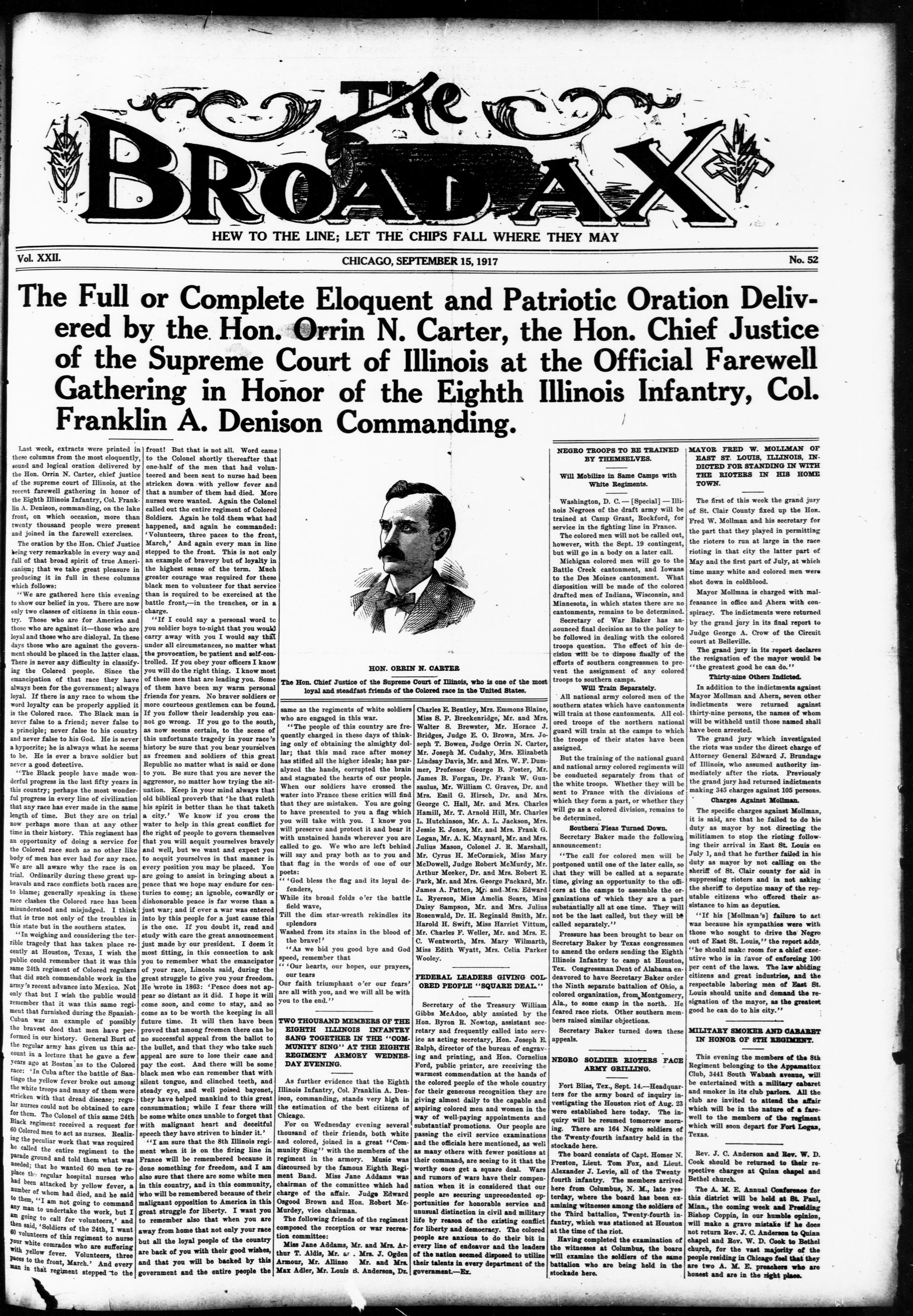
The Full or Complete Eloquent and Patriotic Oration Delivered by the Hon. Orrin N. Carter, the Hon. Chief Justice of the Supreme Court of Illinois at the Official Farewell Gathering in Honor of the Eighth Illinois Infantry, Col. Franklin A. Denison Commanding.
Vol. XXII.
The Full
ered by
of the
Gather
Frankl
Last week, extracts were printed in these columns from the most eloquently, sound and logical oration delivered by the Hon. Orrin N. Carter, chief justice of the supreme court of Illinois, at the recent farewell gathering in honor of the Eighth Illinois Infantry, Col. Franklin A. Denison, commanding, on the lake front, on which occasion, more than twenty thousand people were present and joined in the farewell exercises.
The oration by the Hon. Chief Justice being very remarkable in every way and full of that broad spirit of true Americanism; that we take great pleasure in producing it in full in these columns which follows:
"We are gathered here this evening to show our belief in you. There are now only two classes of citizens in this country. Those who are for America and those who are against it—those who are loyal and those who are disloyal. In these days those who are against the government should be placed in the latter class. There is never any difficulty in classifying the Colored people. Since the emancipation of that race they have always been for the government; always loyal. If there is any race to whom the word loyalty can be properly applied it is the Colored race. The Black man is never false to a friend; never false to a principle; never false to his country and never false to his God. He is never a hypocrite; he is always what he seems to be. He is ever a brave soldier but never a good detective.
"The Black people have made wonderful progress in the last fifty years in this country; perhaps the most wonderful progress in every line of civilization that any race has ever made in the same length of time. But they are on trial now perhaps more than at any other time in their history. This regiment has an opportunity of doing a service for the Colored race such as no other like body of men has ever had for any race. We are all aware why the race is on trial. Ordinarily during these great upheavals and race conflicts both races are to blame; generally speaking in these race clashes the Colored race has been misunderstood and misjudged. I think that is true not only of the troubles in this state but in the southern states.
"In weighing and considering the terrible tragedy that has taken place recently at Houston, Texas, I wish the public could remember that it was this same 24th regiment of Colored regulars that did such commendable work in the army's recent advance into Mexico. Not only that but I wish the public would remember that it was this same regiment that furnished during the Spanish-Cuban war an example of possibly the bravest deed that men have performed in our history. General Burt of the regular army has given us this account in a lecture that he gave a few years ago at Boston as to the Colored race: 'In Cuba after the battle of Santiago the yellow fever broke out among the white troops and many of them were stricken with that dread disease; regular nurses could not be obtained to care for them. The Colonel of this same 24th Black regiment received a request for 60 Colored men to act as nurses. Realizing the peculiar work that was required he called the entire regiment to the parade ground and told them what was needed; that he wanted 60 men to replace the regular hospital nurses who had been attacked by yellow fever, a number of whom had died, and he said to them, "I am not going to command any man to undertake the work, but I am going to call for volunteers,' and then said, 'Soldiers of the 24th, I want 60 volunteers of this regiment to nurse your white comrades who are suffering with yellow fever. Volunteers, three paces to the front, March.' And every man in that regiment stepped to the
front! But that is not all. Word came to the Colonel shortly thereafter that one-half of the men that had volunteered and been sent to nurse had been stricken down with yellow fever and that a number of them had died. More nurses were wanted. Again the Colonel called out the entire regiment of Colored Soldiers. Again he told them what had happened, and again he commanded: 'Volunteers, three paces to the front, March,' And again every man in line stepped to the front. This is not only an example of bravery but of loyalty in the highest sense of the term. Much greater courage was required for these black men to volunteer for that service than is required to be exercised at the battle front—in the trenches, or in a charge.
‘If I could say a personal word to you soldier boys to night that you would carry away with you I would say that under all circumstances, no matter what the provocation, be patient and self-controlled. If you obey your officers I know you will do the right thing. I know most of these men that are leading you. Some of them have been my warm personal friends for years. No braver soldiers or more courteous gentlemen can be found. If you follow their leadership you cannot go wrong. If you go to the south, as now seems certain, to the scene of this unfortunate tragedy in your race’s history be sure that you bear yourselves as freemen and soldiers of this great Republic no matter what is said or done to you. Be sure that you are never the aggressor, no matter how trying the situation. Keep in your mind always that old biblical proverb that ‘he that ruler his spirit is better than he that taketh a city.’ We know if you cross the water to help in this great conflict for the right of people to govern themselves that you will acquit yourselves bravely and well, but we want and expect you to acquit yourselves in that manner in every position you may be placed. You are going to assist in bringing about a peace that we hope may endure for centuries to come; an ignoble, cowardly or dishonorable peace is far worse than a just war; and if ever a war was entered into by this people for a just cause this is the one. If you doubt it, read and study with care the great announcement just made by our president. I deem it most fitting, in this connection to ask you to remember what the emancipator of your race, Lincoln said, during the great struggle to give you your freedom. He wrote in 1863: ‘Peace does not appear so distant as it did. I hope it will come soon, and come to stay, and so come as to be worth the keeping in all future time. It will then have been proved that among freemen there can be no successful appeal from the ballot to the bullet, and that they who take such appeal are sure to lose their case and pay the cost. And there will be some black men who can remember that with silent tongue, and clinched teeth, and steady eye, and well poised bayonet, they have helped mankind to this great consummation; while I fear there will be some white ones unable to forget that with malignant heart and deceitful speech they have striven to hinder it.’
"I am sure that the 8th Illinois regiment when it is on the firing line in France will be remembered because it done something for freedom, and I am also sure that there are some white men in this country, and in this community, who will be remembered because of their malignant opposition to America in this great struggle for liberty. I want you to remember also that when you are away from home that not only your race but all the loyal people of the country are back of you with their good wishes, and that you will be backed by this government and the entire people the
J. B.
same as the regiments of white soldiers who are engaged in this war.
"The people of this country are frequently charged in these days of thinking only of obtaining the almighty dollar; that this mad race after money has stifled all the higher ideals; has paralyzed the hands, corrupted the brain and stagnated the hearts of our people. When our soldiers have crossed the water into France these critics will find that they are mistaken. You are going to have presented to you a flag which you will take with you. I know you will preserve and protect it and bear it with unstained hands wherever you are called to go. We who are left behind will say and pray both as to you and that flag in the words of one of our poets:
"God bless the flag and its loyal defenders,
While its broad folds o'er the battle field wave,
Till the dim star-wreath rekindles its splendors
Washed from its stains in the blood of the brave!"
Charles E. Bentley, Mrs. Emmons Blaine, Miss S. P. Breckenridge, Mr. and Mrs. Walter S. Brewster, Mr. Horace J. Bridges, Judge E. O. Brown, Mrs. Joseph T. Bowen, Judge Orrin N. Carter, Mr. Joseph M. Cudahy, Mrs. Elizabeth Lindsay Davis, Mr. and Mrs. W. F. Dummer, Professor George B. Foster, Mr. James B. Forgan, Dr. Frank W. Gunsaule, Mr. William C. Graves, Dr. and Mrs. Emil G. Hirsch, Dr. and Mrs. George C. Hall, Mr. and Mrs. Charles Hamill, Mr. T. Arnold Hill, Mr. Charles L. Hutchinson, Mr. A. L. Jackson, Mrs. Jessie E. Jones, Mr. and Mrs. Frank G. Logan, Mr. A. K. Maynard, Mr. and Mrs. Julius Mason, Colonel J. R. Marshall, Mr. Cyrus H. McCormick, Miss Mary McDowell, Judge Robert McMurdy, Mr. Arthur Meeker, Dr. and Mrs. Robert E. Park, Mr. and Mrs. George Packard, Mr. James A. Patten, Mr. and Mrs. Edward L. Ryerson, Miss Amelia Sears, Miss Daisy Sampson, Mr. and Mrs. Julius Rosenwald, Dr. H. Reginald Smith, Mr. Harold H. Swift, Miss Harriet Vittum, Mr. Charles F. Weller, Mr. and Mrs. E. C. Wentworth, Mrs. Mary Wilmarth
"As we bid you good bye and God speed, remember that
"Our hearts, our hopes, our prayers,
our tears
Our faith triumphant o'er our fears are all with you, and we will all be with you to the end."
TWO THOUSAND MEMBERS OF THE EIGHTH ILLINOIS INFANTRY SANG TOGETHER IN THE "COMMUNITY SING" AT THE EIGHTH REGIMENT ARMORY WEDNESDAY EVENING.
As further evidence that the Eighth Illinois Infantry, Col. Franklin A. Denison, commanding, stands very high in the estimation of the best citizens of Chicago.
For on Wednesday evening several thousand of their friends, both white and colored, joined in a great "Community Sing" with the members of the regiment in the armory. Music was discourced by the famous Eighth Regiment Band. Miss Jane Addams was chairman of the committee which had charge of the affair. Judge Edward Osgood Brown and Hon. Robert McMurdey, vice chairman.
The following friends of the regiment composed the reception or war recreation committee:
Miss Addams, Mr. and Mrs. Arthur T. Aldis, Mr. ar. Mrs. J. Ogden Armour, Mr. Allinso Mr. and Mrs. Max Adler, Mr. Louis B. Anderson, Dr.
Charles E. Bentley, Mrs. Emmons Blaine, Miss S. P. Breckenridge, Mr. and Mrs. Walter S. Brewster, Mr. Horace J. Bridges, Judge E. O. Brown, Mrs. Joseph T. Bowen, Judge Orrin N. Carter, Mr. Joseph M. Cudahy, Mrs. Elizabeth Lindsay Davis, Mr. and Mrs. W. F. Dummer, Professor George B. Foster, Mr. James B. Forgan, Dr. Frank W. Gunsaulus, Mr. William C. Graves, Dr. and Mrs. Emil G. Hirsch, Dr. and Mrs. George C. Hall, Mr. and Mrs. Charles Hamill, Mr. T. Arnold Hill, Mr. Charles L. Hutchinson, Mr. A. L. Jackson, Mrs. Jessie E. Jones, Mr. and Mrs. Frank G. Logan, Mr. A. K. Maynard, Mr. and Mrs. Julius Mason, Colonel J. R. Marshall, Mr. Cyrus H. McCormick, Miss Mary McDowell, Judge Robert McMurdy, Mr. Arthur Meeker, Dr. and Mrs. Robert E. Park, Mr. and Mrs. George Packard, Mr. James A. Patten, Mr. and Mrs. Edward L. Byerson, Miss Amelia Sears, Miss Daisy Sampson, Mr. and Mrs. Julius Rosenwald, Dr. H. Reginald Smith, Mr. Harold H. Swift, Miss Harriet Vittum, Mr. Charles F. Weller, Mr. and Mrs. E. C. Wentworth, Mrs. Mary Wilmarth, Miss Edith Wyatt, Mrs. Celia Parker Wooley.
FEDEER LEADERS GIVING COL
ORED PEOPLE "SQUARE DEAL."
Secretary of the Treasury William Gibbs McAdoo, ably assisted by the Hon. Byron R. Newton, assistant secretary and frequently called into service as acting secretary, Hon. Joseph E. Ralph, director of the bureau of engraving and printing, and Hon. Cornelius Ford, public printer, are receiving the warmest commendation at the hands of the colored people of the whole country for their generous recognition they are giving almost daily to the capable and aspiring colored men and women in the way of well-paying appointments and substantial promotions. Our people are passing the civil service examinations and the officials here mentioned, as well as many others with fewer positions at their command, are seeing to it that the worthy ones get a square deal. Wars and rumors of wars have their compensation when it is considered that our people are securing unprecedented opportunities for honorable service and unusual distinction in civil and military life by reason of the existing conflict for liberty and democracy. The colored people are anxious to do their bit in every line of endeavor and the leaders of the nation seemed disposed to utilize their talents in every department of the government.—Ex.
NEGRO TROOPS TO BE TRAINED
BY THEMSELVES.
Will Mobilize in Same Camps with White Recicments.
Washington, D. C. — [Special] — Illinois Negroes of the draft army will be trained at Camp Grant, Rockford, for service in the fighting line in France. The colored men will not be called out, however, with the Sept. 19 contingent, but will go in a body on a later call. Michigan colored men will go to the Battle Creek cantonment, and Lowans to the Des Moines cantonment. What disposition will be made of the colored drafted men of Indiana, Wiseinsin, and Minnesota, in which states there are no cantonments, remains to be determined. Secretary of War Baker has announced final decision as to the policy to be followed in dealing with the colored troops question. The effect of his decision will be to dispose finally of the efforts of southern congressmen to prevent the assignment of any colored troops to southern camps.
Will Train Separately.
All national army colored men of the southern states which have cantonments will train at those cantonments. All colored troops of the northern national guard will train at the camps to which the troops of their states have been assigned.
But the training of the national guard and national army colored regiments will be conducted separately from that of the white troops. Whether they will be sent to France with the divisions of which they form a part, or whether they will go as a colored division, remains to be determined.
Southern Pleas Turned Down.
Secretary Baker made the following announcement:
"The call for colored men will be postponed until one of the later calls, so that they will be called at a separate time, giving an opportunity to the officers at the camps to assemble the organizations of which they are a part substantially all at one time. They will not be the last called, but they will be called separately."
Pressure has been brought to bear on Secretary Baker by Texas congressmen to amend the orders sending the Eighth Illinois Infantry to camp at Houston, Tex. Congressman Dent of Alabama endeavored to have Secretary Baker order the Ninth separate battalion of Ohio, a colored organization, from Montgomery, Ala., to some camp in the north. He feared race riots. Other southern members raised similar objections.
Secretary Baker turned down these appeals.
NEGRO SOLDIER BIOTERS FACE
ARMY GRILJING.
Fort Bliss, Tex., Sept. 14.—Headquarters for the army board of inquiry investigating the Houston riot of Aug. 23 were established here today. The inquiry will be resumed tomorrow morning. There are 164 Negro soldiers of the Twenty-fourth infantry held in the stockade here.
The board consists of Capt. Homer N. Preston, Lieut. Tom Fox, and Lieut. Alexander J. Levie, all of the Twenty fourth infantry. The members arrived here from Columbus, N. M., late yesterday, where the board has been examining witnesses among the soldiers of the Third battalion, Twenty-fourth infantry, which was stationed at Houston at the time of the riot.
Having completed the examination of the witnesses at Columbus, the board will examine the soldiers of the same battalion who are being held in the stockade here.
No.52
MAYOR FRED W. MOLLMAN OF EAST ST. LOUIS, ILLINOIS, INDICTED FOR STANDING IN WITH THE RIOTERS IN HIS HOME TOWN.
The first of this week the grand jury of St. Clair County fixed up the Hon. Fred W. Mollman and his secretary for the part that they played in permitting the rioters to run at large in the race rioting in that city the latter part of May and the first part of July, at which time many white and colored men were shot down in coldblood.
Mayor Mollmna is charged with malfeasance in office and Ahern with conspiracy. The indictments were returned by the grand jury in its final report to Judge George A. Crow of the Circuit court at Belleville.
The grand jury in its report declares the resignation of the mayor would be "the greatest good he can do."
Thirty-nine Others Indicted.
In addition to the indictments against Mayor Mollman and Ahern, seven other indictments were returned against thirty-nine persons, the names of whom will be withheld until those named shall have been arrested.
The grand jury which investigated the riots was under the direct charge of Attorney General Edward J. Brundage of Illinois, who assumed authority immediately after the riots. Previously the grand jury had returned indictments making 345 charges against 105 persons.
Charges Against Mollman.
The specific charges against Mollman, it is said, are that he failed to do his duty as mayor or not directing the militiamen to stop the rioting following their arrival in East St. Louis on July 1, and that he further failed in his duty as mayor by not calling on the sheriff of St. Clair county for aid in suppressing rioters and in not asking the sheriff to deputize many of the reputable citizens who offered their assistance to him as deputies.
"If his [Mollman's] failure to act was because his sympathies were with those who sought to drive the Negro out of East St. Louis," the report adds, "he should make room for a chief executive who is in favor of enforcing 100 per cent of the laws. The law abiding citizens and great industries, and the respectable laboring men of East St. Louis should unite and demand the resignation of the mayor, as the greatest good he can do to his city."
MILITARY SMOKER AND CARARET IN HONOR OF 8TH REGIMENT.
This evening the members of the 8th Regiment belonging to the Appamattox Club, 3441 South Wabash avenue, will be entertained with a military cabaret and smoker in its club parlors. All the club are invited to attend the affair which will be in the nature of a farewell to the members of the regiment which will soon depart for Fort Logan, Texas.
Rev. J. C. Anderson and Rev. W. D. Cook should be returned to their respective charges at Quinn chapel and Bethel church.
The A. M. E. Annual Conference for this district will be held at St. Paul, Minn., the coming week and Presiding Bishop Coppin, in our humble opinion, will make a grave mistake if he does not return Rev. J. C. Anderson to Quinn chapel and Rev. W. D. Cook to Bethel church, for the vast majority of the people residing in Chicago feel that they are two A. M. E. preachers who are honest and are in the right place.
THE NEW YORK TIMES
THE SOLDIER
COL. FRANKLIN A. DENISON
Commanding the Eighth Illinois Infantat thousand people on the lake front Justice Carter, that the 'Negro wi times, but he has never been proven
in Illinois Infantry, who declared in
on the lake front in responding to
the 'Negro when goaded may be
ever been proven to be a traitor to
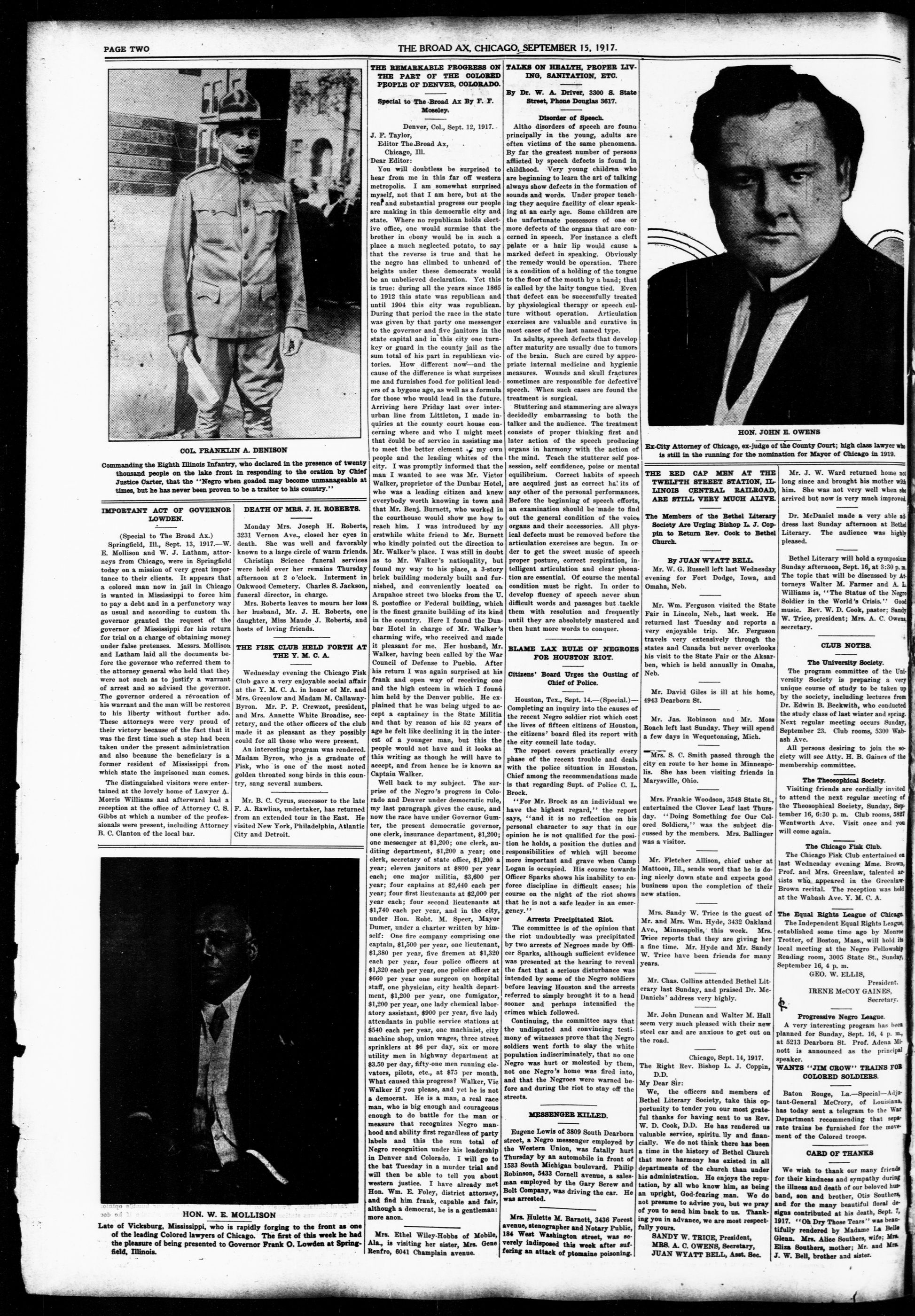
Commanding the Eighth Illinois Infantry, who declared in the presence of twenty thousand people on the lake front in responding to the oration by Chief Justice Carter, that the "Negro when goaded may become unmanageable at times, but he has never been proven to be a traitor to his country."
IMPORTANT ACT OF GOVERNOR
LOWDEN.
(Special to The Broad AX.)
Springfield, Ill., Sept. 13, 1917.—W. E. Mollison and W. J. Latham, attorneys from Chicago, were in Springfield today on a mission of very great importance to their clients. It appears that a colored man now in jail in Chicago is wanted in Mississippi to force him to pay a debt and in a perfunctory way as usual and according to custom the governor granted the request of the governor of Mississippi for his return for trial on a charge of obtaining money under false pretenses. Messrs. Mollison and Latham laid all the documents before the governor who referred them to the attorney general who held that they were not such as to justify a warrant of arrest and so advised the governor. The governor ordered a revocation of his warrant and the man will be restored to his liberty without further ado. These attorneys were very proud of their victory because of the fact that it was the first time such a step had been taken under the present administration and also because the beneficiary is a former resident of Mississippi from which state the imprisoned man comes.
The distinguished visitors were entertained at the lovely home of Lawyer A. Morris Williams and afterward had a reception at the office of Attorney C. S. Gibbs at which a number of the professionals were present, including Attorney B. C. Clanton of the local bar.
otaiigo eddard
1920
cirio old
Late of Vicksburg, Mississippi, who is rapidly for- of the leading Colored lawyers of Chicago. The the pleasure of being presented to Governor Fran field, Illinois.
mississippi, who is rapidly forging red lawyers of Chicago. The first ing presented to Governor Frank the
Late of Vicksburg, Mississippi, who is rapidly forging to the front as one of the leading Colored lawyers of Chicago. The first of this week he had the pleasure of being presented to Governor Frank O. Lowden at Springfield, Illinois.
Late of Vicksburg, Mississippi, who is rapidly forging to the front as one of the leading Colored lawyers of Chicago. The first of this week he had the pleasure of being presented to Governor Frank O. Lowden at Springfield, Illinois.
PAGE TWO
y, who declared in the presence of twenty in responding to the oration by Chief men goaded may become unmanageable at to be a traitor to his country."
DEATH OF MRS. J. H. ROBERTS.
Monday Mrs. Joseph H. Roberts,
3231 Vernon Ave., closed her eyes
in death. She was well and favorably
known to a large circle of warm friends.
Christian Science funeral services
were held over her remains Thursday
afternoon at 2 o'clock. Interment in
Oakwood Cemetery. Charles S. Jackson,
funeral director, in charge.
Mrs. Roberts leaves to mourn her loss
her husband, Mr. J. H. Roberts, one
daughter, Miss Maude J. Roberts, and
hosts of loving friends.
THE FISK CLUB HELD FORTH AT
THE Y. M. C. A.
Wednesday evening the Chicago Fisk Club gave a very enjoyable social affair at the Y. M. C. A. in honor of Mr. and Mrs. Greenlow and Madam M. Callaway-Byron. Mr. P. P. Crewzot, president, and Mrs. Annette White Broadise, secretary, and the other officers of the club made it as pleasant as they possibly could for all those who were present. An interesting program was rendered. Madam Byron, who is a graduate of Fisk, who is one of the most noted golden throated song birds in this country, sang several numbers.
Mr. B. C. Cyrus, successor to the late F. A. Rawlins, undertaker, has returned from an extended tour in the East. He visited New York, Philadelphia, Atlantic City and Detroit.
The image provided is too blurry to accurately recognize any text. It appears to be a black-and-white photograph of a person wearing a suit and tie. The background is dark, and there are no visible features that can be clearly identified.
rapidly forging to the front as one Chicago. The first of this week he had Governor Frank O. Lowden at Spring-
THE BROAD AX, CHICAGO, SEPTEMBER 15, 1917.
THE REMARKABLE PROGRESS ON THE PART OF THE COLORED PEOPLE OF DENVER, COLORADO.
TALKS ON HEALTH, PROPER ING, SANITATION, ETC.
Special to The Broad Ax By F. F. Moseley.
Denver, Col., Sept. 12, 1917.
J. F. Taylor,
Editor The.Broad Ax.
Dear Editor:
You will doubtless be surprised to hear from me in this far off western metropolis. I am somewhat surprised myself, not that I am here, but at the real and substantial progress our people are making in this democratic city and state. Where no republican holds elective office, one would surmise that the brother in ebony would be in such a place a much neglected potato, to say that the reverse is true and that he the negro has climbed to unheard of heights under these democrats would be an unbelieved declaration. Yet this is true: during all the years since 1865 to 1912 this state was republican and until 1904 this city was republican. During that period the race in the state was given by that party one messenger to the governor and five janitors in the state capital and in this city one turnkey or guard in the county jail as the sum total of his part in republic victories. How different now—and the cause of the difference is what surprises me and furnishes food for political leaders of a bygone age, as well as a formula for those who would lead in the future. Arriving here Friday last over interurban line from Littleton, I made inquiries at the county court house concerning where and who I might meet that could be of service in assisting me to meet the better element in my own people and the leading whites of the city. I was promptly informed that the man I wanted to see was Mr. Victor Walker, proprietor of the Dunbar Hotel, who was a leading citizen and knew everybody worth knowing in town and that Mr. Benj. Burnett, who worked in the courthouse would show me how to reach him. I was introduced by my erstwhile white friend to Mr. Burnett who kindly pointed out the direction to Mr. Walker's place. I was still in doubt as to Mr. Walker's nationality, but found my way to his place, a 3-story brick building modernly built and furnished, and conveniently located on Arapahoe street two blocks from the U.S. postoffice or Federal building, which is the finest granite building of its kind in the country. Here I found the Dunbar Hotel in charge of Mr. Walker's charming wife, who received and made it pleasant for me. Her husband, Mr. Walker, having been called by the War Council of Defense to Pueblo. After his return I was again surprised at his frank and open way of receiving one and the high esteem in which I found him held by the Denver public. He explained that he was being urged to accept a captaincy in the State Militia and that by reason of his 52 years of age he felt like declining it in the interest of a younger man, but this the people would not have and it looks at this writing as though he will have to accept, and from hence he is known as Captain Walker.
Well back to my subject. The surprise of the Negro's progress in Colorado and Denver under democratic rule my last paragraph gives the cause, and now the race have under Governor Gumter, the present democratic governor, one clerk, insurance department, $1,200; one messenger at $1,200; one clerk, auditing department, $1,200 a year; one clerk, secretary of state office, $1,200 a year; eleven janitors at $800 per year each; one major militia, $3,600 per year; four captains at $2,440 each per year; four first lieutenants at $2,000 per year each; four second lieutenants at $1,740 each per year, and in the city, under Hon. Robt. M. Speer, Mayor Dumer, under a charter written by himself: One fire company comprising one captain, $1,500 per year, one lieutenant, $1,380 per year, five firemen at $1,320 each per year, four police officers at $1,320 each per year, one police officer at $600 per year one surgeon on hospital staff, one physician, city health department, $1,200 per year, one fumigator, $1,200 per year, one lady chemical laboratory assistant, $900 per year, five lady attendants in public service stations at $540 each per year, one machinist, city machine shop, union wages, three street sprinklers at $6 per day, six or more utility men in highway department at $3.50 per day, fifty-one men running elevators, pilots, etc., at $75 per month. What caused this progress? Walker, Vic Walker if you please, and yet he is not a democrat. He is a man, a real race man, who is big enough and courageous enough to do battle for the man or measure that recognizes Negro manhood and ability first regardless of party labels and this the sum total of Negro recognition under his leadership in Denver and Colorado. I will go to the bat Tuesday in a murder trial and will then be able to tell you about western justice. I have already met Hon. Wm. E. Foley, district attorney, and find him frank, capable and fair, although a democrat, he is a gentleman: more anon.
Mrs. Ethel Wiley-Hobbs of Mobile, Ala., is visiting her sister, Mrs. Gene Renfro, 6041 Champlain avenue.
TALKS ON HEALTH, PROPER LIV-
ING, SANITATION, ETC.
By Dr. W. A. Driver, 3300 S. State Street, Phone Douglas 3617.
Disorder of Speech.
Altho disorders of speech are found principally in the young, adults are often victims of the same phenomena. By far the greatest number of persons afflicted by speech defects is found in childhood. Very young children who are beginning to learn the art of talking always show defects in the formation of sounds and words. Under proper teaching they acquire facility of clear speaking at an early age. Some children are the unfortunate possessors of one or more defects of the organs that are concerned in speech. For instance a cleft palate or a hair lip would cause a marked defect in speaking. Obviously the remedy would be operation. There is a condition of a holding of the tongue to the floor of the mouth by a band; that is called by the laity tongue tied. Even that defect can be successfully treated by physiological therapy or speech culture without operation. Articulation exercises are valuable and curative in most cases of the last named type.
In adults, speech defects that develop after maturity are usually due to tumors of the brain. Such are cured by appropriate internal medicine and hygienic measures. Wounds and skull fractures sometimes are responsible for defective speech. When such cases are found the treatment is surgical.
Stuttering and stammering are always decidedly embarrassing to both the talker and the audience. The treatment consists of proper thinking first and later action of the speech producing organs in harmony with the action of the mind. Teach the stutterer self possession, self confidence, poise or mental equilibrium. Correct habits of speech are acquired just as correct ha'its of any other of the personal performances. Before the beginning of speech efforts, an examination should be made to find out the general condition of the voice organs and their accessories. All physical defects must be removed before the articulation exercises are begun. In order to get the sweet music of speech proper posture, correct respiration, intelligent articulation and clear phonation are essential. Of course the mental condition must be right. In order to develop fluency of speech never shum difficult words and passages but tackle them with resolution and frequently until they are absolutely mastered and then hunt more words to conquer.
BLAME LAX RULE OF NEGROES
FOR HOUSTON RIOT.
Citizens' Board Urges the Gusting of Chief of Police.
Houston, Tex., Sept. 14.—(Special.)— Completing an inquiry into the causes of the recent Negro soldier riot which cost the lives of fifteen citizens of Houston, the citizens' board filed its report with the city council late today. The report covers practically every phase of the recent trouble and deals with the police situation in Houston. Chief among the recommendations made is that regarding Supt. of Police C. L. Brock.
"For Mr. Brock as an individual we have the highest regard," the report says, "and it is no reflection on his personal character to say that in our opinion he is not qualified for the position he holds, a position the duties and responsibilities of which will become more important and grave when Camp Logan is occupied. His course towards Officer Sparks shows his inability to enforce discipline in difficult cases; his course on the night of the riot shows that he is not a safe leader in an emergency."
Arrests Precipitated Riot
The committee is of the opinion that the riot undoubtedly was precipitated by two arrests of Negroes made by Officer Sparks, although sufficient evidence was presented at the hearing to reveal the fact that a serious disturbance was intended by some of the Negro soldiers before leaving Houston and the arrests referred to simply brought it to a head sooner and perhaps intensified the crimes which followed.
Continuing, the committee says that the undisputed and convincing testimony of witnesses prove that the Negro soldiers went forth to slay the white population indiscriminately, that no one Negro was hurt or molested by them, not one Negro's home was fired into, and that the Negroes were warned before and during the riot to stay off the streets.
MESSENGER KILLED
Eugene Lewis of 3809 South Dearborn street, a Negro messenger employed by the Western Union, was fatally hurt Thursday by an automobile in front of 1533 South Michigan boulevard. Philip Robinson, 5433 Cornell avenue, a salesman employed by the Gary Screw and Bolt Company, was driving the car. He was arrested.
Mrs. Hullette M. Barnett, 3436 Forest avenue, stenographer and Notary Public, 184 West Washington street, was severely indisposed this week after suffering an attack of pomaine poisoning.
M.
HON. JOHN E. OWENS
Ex-City Attorney of Chicago, ex-judge of the County Court; high class lawyer who is still in the running for the nomination for Mayor of Chicago in 1919.
Ex-City Attorney of Chicago, ex-judge of the County Court; high class lawyer who is still in the running for the nomination for Mayor of Chicago in 1919.
THE RED CAP MEN AT THE TWELFTH STREET STATION, ILINOIS CENTRAL RAILROAD, ARE STILL VERY MUCH ALIVE.
Mr. J. W. Ward returned home no long since and brought his mother with him. She was not very well when she arrived but now is very much improved.
The Members of the Bethel Literary Society Are Urging Bishop L. J. Coppin to Return Rev. Cook to Bethel Church.
Dr. McDaniel made a very able ad dress last Sunday afternoon at Bethel Literary. The audience was highly pleased.
By JUAN WYATT BELL
Mr. W. G. Russell left last Wednesday evening for Fort Dodge, Iowa, and Omaha, Neb.
Mr. Wm. Ferguson visited the State Fair in Lincoln, Neb., last week. He returned last Tuesday and reports a very enjoyable trip. Mr. Ferguson travels very extensively through the states and Canada but never overlooks his visit to the State Fair or the Aksarben, which is held annually in Omaha, Neb.
Mr. David Giles is ill at his home, 4943 Dearborn St.
Mr. Jas. Robinson and Mr. Moss Roach left last Sunday. They will spend a few days in Wequetonsing, Mich.
Mrs. S. C. Smith passed through the city en route to her home in Minneapolis. She has been visiting friends in Marysville, Ohio.
Mrs. Frankie Woodson, 3548 State St., entertained the Clover Leaf last Thursday. "Doing Something for Our Colored Soldiers," was the subject discussed by the members. Mrs. Ballinger was a visitor.
Mr. Fletcher Allison, chief usher at Mattoon, Ill., sends word that he is doing nicely down state and expects good business upon the completion of their new station.
Mrs. Sandy W. Trice is the guest of Mr. and Mrs. Wm. Hyde, 3432 Oakland Ave., Minneapolis, this week. Mrs. Trice reports that they are giving her a fine time. Mr. Hyde and Mr. Sandy W. Trice have been friends for many years.
Mr. Chas. Collins attended Bethel Literary last Sunday, and praised Dr. McDaniels' address very highly.
Mr. John Duncan and Walter M. Hall seem very much pleased with their new steel car and are anxious to get out on the road.
Chicago, Sept. 14, 1917.
The Right Rev. Bishop L. J. Coppin,
D.D.
We, the officers and members of Bethel Literary Society, take this opportunity to tender you our most grateful thanks for having sent to us Rev. W. D. Cook, D.D. He has rendered us valuable service, spiritu lly and financially. We do not think there has been a time in the history of Bethel Church that more harmony has existed in all departments of the church than under his administration. He enjoys the reputation, by all who know him, as being an upright, God-fearing man. We do not presume to advise you, but we pray of you to send him back to us. Thanking you in advance, we are most respectfully yours.
SANDY W. TRICE, President,
MRS. A. C. OWENS, Secretary,
JUAN WYATT BELL, Asst. Sec.
---
Mr. J. W. Ward returned home not long since and brought his mother with him. She was not very well when she arrived but now is very much improved.
Dr. McDaniel made a very able address last Sunday afternoon at Bethel Literary. The audience was highly pleased.
Bethel Literary will hold a symposium Sunday afternoon, Sept. 16, at 3:30 p.m. The topic that will be discussed by Attorneys Walter M. Farmer and A. L Williams is, "The Status of the Negro Soldier in the World's Crisis." Good music. Rev. W. D. Cook, pastor; Sandy W. Trice, president; Mrs. A. C. Owens secretary.
The program committee of the University Society is preparing a very unique course of study to be taken up by the society, including lectures from Dr. Edwin B. Beckwith, who conducted the study class of last winter and spring. Next regular meeting occurs Sunday, September 23. Club rooms, 5300 Wabash Ave. All persons desiring to join the society will see Atty. H. B. Gaines of the membership committee.
The Theosophical Society.
Visiting friends are cordially invited to attend the next regular meeting of the Theosophical Society, Sunday, September 16, 6:30 p. m. Club rooms, 5827 Wentworth Ave. Visit once and you will come again.
The Chicago Fisk Club
The Chicago Fisk Club entertained on last Wednesday evening Mme. Brown Prof. and Mrs. Greenlaw, talented artists who appeared in the Greenlaw Brown recital. The reception was held at the Wabash Ave. Y. M. C. A.
The Equal Rights League of Chicago
The Equal Rights League of Chicago
The Independent Equal Rights League
established some time ago by Monroe
Trotter, of Boston, Mass., will hold its
local meeting at the Negro Fellowship
Reading room, 3005 State St., Sunday,
September 16, 4 p. m.
Progressive Negro League
A very interesting program has been planned for Sunday, Sept. 16, 4 p.m. at 5213 Dearborn St. Prof. Adena Minott is announced as the principal speaker.
WANTS "JIM CROW" TRAINS FOR COLORED SOLDIERS.
Baton Rouge, La.—Special—Adjutant-General McCrory, of Louisiana, has today sent a telegram to the War Department recommending that separate trains be furnished for the movement of the Colored troops.
We wish to thank our many friends for their kindness and sympathy during the illness and death of our beloved husband, son and brother, Otis Southers, and for the many beautiful floral designs contributed at his death, Sept. 7, 1917. "Oh Dry Those Tears" was beautifully rendered by Madame La Belle Glenn. Mrs. Alice Southers, wife; Mrs. Eliza Southers, mother; Mr. and Mra. J. W. Bell, brother and sister.
CLUB NOTES.
The University Society
GEO. W. ELLIS,
President.
IRENE MeCOY GAINES,
Secretary.
CARD OF THANKS
[Portrait of a man in a suit with a bow tie, facing left. The background is plain black. There is a decorative border with a repeating pattern of roses and leaves.]
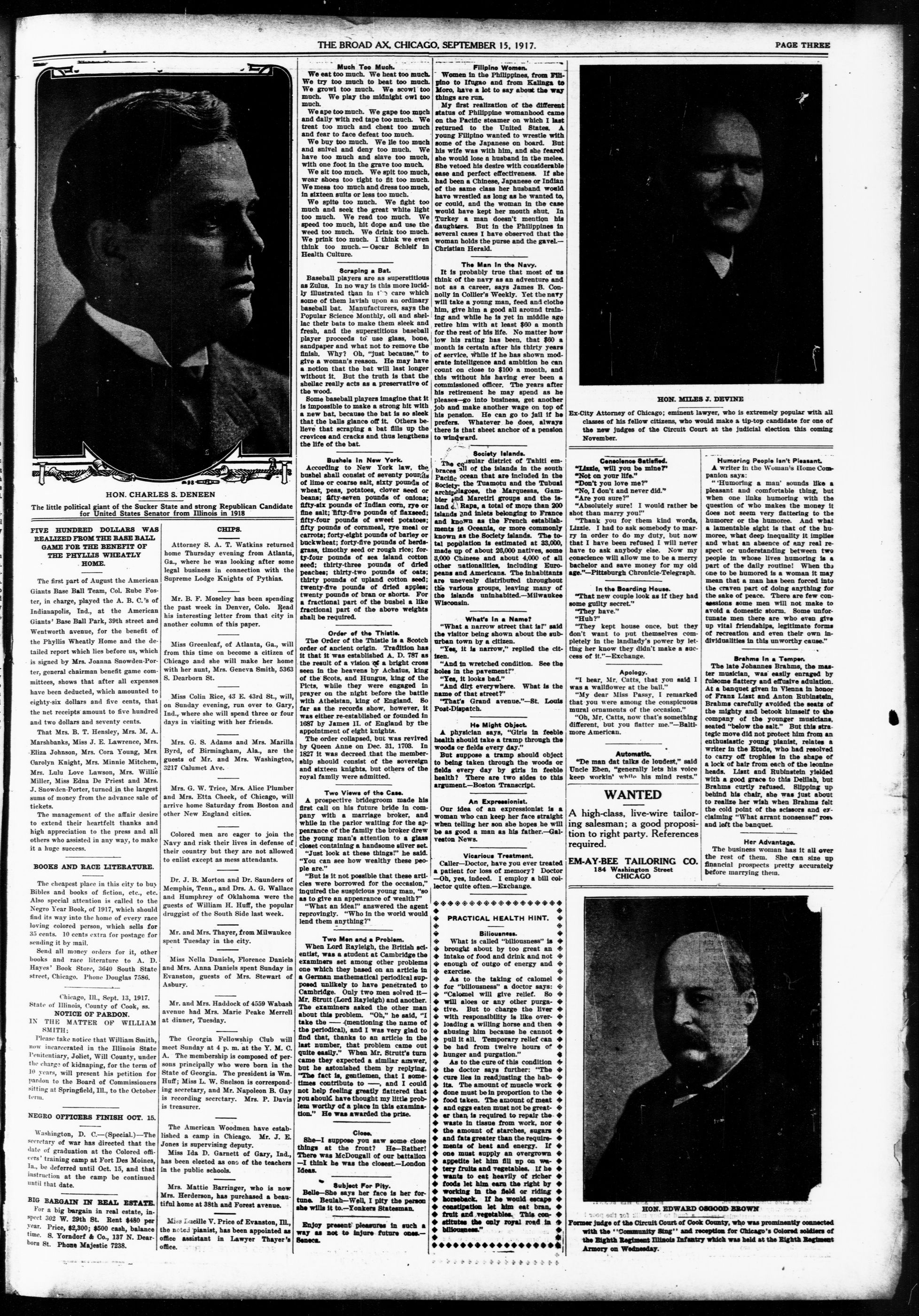
HON. CHARLES S. DENEEN The little political giant of the Sucker State and strong Republican Candidate for United States Senator from Illinois in 1918
The little political giant of the Sucker State and strong Republican Candidate for United States Senator from Illinois in 1918
FIVE HUNDRED DOLLARS WAS REALIZED FROM THE BASE BALL GAME FOR THE BENEFIT OF THE PHYLLIS WHEATLY HOME.
CHIPS.
Attorney S. A. T. Watkins returned home Thursday evening from Atlanta Ga., where he was looking after some
The first part of August the American Giants Base Ball Team, Col. Rube Foster, in charge, played the A. B. C.'s of Indianapolis, Ind., at the American Giants' Base Ball Park, 39th street and Wentworth avenue, for the benefit of the Phyllis Wheatly Home and the detailed report which lies before us, which is signed by Mrs. Joanna Snowden-Porter, general chairman benefit game committees, shows that after all expenses have been deducted, which amounted to eighty-six dollars and five cents, that the net receipts amount to five hundred and two dollars and seventy cents.
That Mrs. B. T. Hensley, Mrs. M. A. Marshbanks, Miss J. E. Lawrence, Mrs. Eliza Johnson, Mrs. Cora Young, Mrs. Carolyn Knight, Mrs. Minnie Mitchem, Mrs. Lulu Love Lawson, Mrs. Willie Miller, Miss Edna De Priest and Mrs. J. Snowden-Porter, turned in the largest sums of money from the advance sale of tickets.
The management of the affair desire to extend their heartfelt thanks and high appreciation to the press and all others who assisted in any way, to make it a huge success.
BOOKS AND RACE LITERATURE.
The cheapest place in this city to buy
Bibles and books of fiction, etc., etc.
Also special attention is called to the
Negro Year Book, of 1917, which should
find its way into the home of every race
loving colored person, which sells for
35 cents. 10 cents extra for postage for
sending it by mail.
Send all money orders for it, other
books and race literature to A. D.
Hayes' Book Store, 3640 South State
street, Chicago. Phone Douglas 7586.
Chicago, Ill., Sept. 13, 1917.
State of Illinois, County of Cook, ss.
NOTICE OF PARDON.
IN THE MATTER OF WILLIAM
SMITH:
Please take notice that William Smith, now incarcerated in the Illinois State Penitentiary, Joliet, Will County, under the charge of kidnapping, for the term of 10 years, will present his petition for pardon to the Board of Commissioners sitting at Springfield, Ill., to the October term.
NEGRO OFFICERS FINISH OCT. 15
Washington, D. C.—(Special.)—The secretary of war has directed that the date of graduation at the Colored officers' training camp at Fort Des Moines, In. be deferred until Oct. 15, and that instruction at the camp be continued until that date.
BIG BARGAIN IN REAL ESTATE.
For a big bargain in real estate, inspect 302 W. 29th St. Rent $480 per year. Price, $2,300; $500 cash, balance time. S. Yorndorf & Co., 137 N. Dearborn St. Phone Majestic 7238.
BIG BARGAIN IN REAL
State and strong Republican Candidate
ator from Illinois in 1918
CHIPS.
Attorney S. A. T. Watkins returned
home Thursday evening from Atlanta,
Ga., where he was looking after some
legal business in connection with the
Supreme Lodge Knights of Pythias.
Mr. B. F. Moseley has been spending
the past week in Denver, Colo. Read
his interesting letter from that city in
another column of this paper.
Miss Greenleaf, of Atlanta, Ga., will
from this time on become a citizen of
Chicago and she will make her home
with her aunt, Mrs. Geneva Smith, 5363
S. Dearborn St.
Miss Colin Rice, 43 E. 43rd St., will, on Sunday evening, run over to Gary, Ind., where she will spend three or four days in visiting with her friends.
Mrs. G. S. Adams and Mrs. Marilla Byrd, of Birmingham, Ala., are the guests of Mr. and Mrs. Washington, 3217 Calumet Ave.
Mrs. G. W. Trice, Mrs. Alice Plumber and Mrs. Etta Cheek, of Chicago, will arrive home Saturday from Boston and other New England cities.
Colored men are eager to join the Navy and risk their lives in defense of their country but they are not allowed to enlist except as mess attendants.
Dr. J. B. Morton and Dr. Saunders of Memphis, Tenn., and Drs. A. G. Wallace and Humphrey of Oklahoma were the guests of William H. Huff, the popular druggist of the South Side last week.
Mr. and Mrs. Thayer, from Milwaukee spent Tuesday in the city.
Miss Nella Daniels, Florence Daniels and Mrs. Anna Daniels spent Sunday in Evanston, guests of Mrs. Stewart of Asbury.
Mr. and Mrs. Haddock of 4559 Wabash avenue had Mrs. Marie Peake Merrell at dinner, Tuesday.
The Georgia Fellowship Club will meet Sunday at 4 p. m. at the Y. M. C. A. The membership is composed of persons principally who were born in the State of Georgia. The president is Wm. Huff; Miss L. W. Snelson is correspondent secretary, and Mr. Napoleon B. Gay is recording secretary. Mrs. P. Davis is treasurer.
The American Woodmen have established a camp in Chicago. Mr. J. E. Jones is supervising deputy.
Miss Ida D. Garnett of Gary, Ind., has been elected as one of the teachers in the public schools.
Mrs. Mattie Barringer, who is now Mrs. Herderson, has purchased a beautiful home at 38th and Forest avenue.
Miss Euclile V. Price of Evanston, Ill., the noted pianist, has been appointed as office assistant in Lawyer Thayer's office.
CHIPS
---
---
---
THE BROAD AX. CHICAGO. SEPTEMBER 15. 1917
Much Too Much.
We eat too much. We heat too much.
We try too much to beat too much.
We growl too much. We scowl too much. We play the midnight owl too much.
We ape too much. We gape too much and daily with red tape too much. We treat too much and cheat too much and fear to face defeat too much.
We buy too much. We lie too much and snivel and deny too much. We have too much and slave too much, with one foot in the grave too much.
We sit too much. We spit too much, wear shoes too tight to fit too much. We mess too much and dress too much, in sixteen suits or less too much.
We spite too much. We fight too much and seek the great white light too much. We read too much. We speed too much, hit dope and use the weed too much. We drink too much. We prink too much. I think we even think too much.—Oscar Schleif in Health Culture.
Scraping a Bat.
Baseball players are as superstitious as Zulus. In no way is this more lucidly illustrated than in care which some of them lavish upon an ordinary baseball bat. Manufacturers, says the Popular Science Monthly, oil and shellac their bats to make them sleek and fresh, and the superstitious baseball player proceeds to use glass, bone, sandpaper and what not to remove the finish. Why? Oh, "just because," to give a woman's reason. He may have a notion that the bat will last longer without it. But the truth is that the shellac really acts as a preservative of the wood.
Some baseball players imagine that it is impossible to make a strong hit with a new bat, because the bat is so sleek that the balls glance off it. Others believe that scraping a bat fills up the crevices and cracks and thus lengthens the life of the bat.
Bushels In New York.
According to New York law, the bushel shall consist of seventy pounds of lime or coarse salt, sixty pounds of wheat, peas, potatoes, clover seed or beans; fifty-seven pounds of onions; fifty-six pounds of Indian corn, rye or fine salt; fifty-five pounds of flaxseed; fifty-four pounds of sweet potatoes; fifty pounds of cornmeal, rye meal or carrots; forty-eight pounds of barley or buckwheat; forty-five pounds of herdsgrass, timothy seed or rough rice; forty-four pounds of sea island cotton seed; thirty-three pounds of dried peaches; thirty-two pounds of oats; thirty pounds of upland cotton seed; twenty-five pounds of dried apples; twenty pounds of bran or shorts. For a fractional part of the bushel a like fractional part of the above weights shall be required.
Order of the Thistle
The Order of the Thistle is a Scotch order of ancient origin. Tradition has it that it was established A. D. 787 as the result of a vision of a bright cross seen in the heavens by Achalus, king of the Scots, and Hungus, king of the Plcts, while they were engaged in prayer on the night before the battle with Athelstan, king of England. So far as the records show, however, it was either re-established or founded in 1087 by James II. of England by the appointment of eight knights. The order collapsed, but was revived by Queen Anne on Dec. 31, 1703. In 1827 it was decreed that the membership should consist of the sovereign and sixteen knights, but others of the royal family were admitted.
Two Views of the Case
A prospective bridegroom made his first call on his future bride in company with a marriage broker, and while in the parlor waiting for the appearance of the family the broker drew the young man's attention to a glass closet containing a handsome silver set. "Just look at these things!" he said. "You can see how wealthy these people are." "But is it not possible that these articles were borrowed for the occasion," inquired the suspicious young man, "so as to give an appearance of wealth?" "What an idea," answered the agent reprovingly. "Who in the world would lend them anything?"
Two Men and a Problem.
When Lord Rayleigh, the British scientist, was a student at Cambridge the examiners set among other problems one which they based on an article in a German mathematical periodical supposed unlikely to have penetrated to Cambridge. Only two men solved it—Mr. Strutt (Lord Rayleigh) and another. The examiners asked the other man about this problem. "Oh," he said, "I take the — (mentioning the name of the periodical), and I was very glad to find that, thanks to an article in the last number, that problem came out quite easily." When Mr. Strutt's turn came they expected a similar answer, but he astonished them by replying, "The fact is, gentlemen, that I sometimes contribute to —, and I could not help feeling greatly flattered that you should have thought my little problem worthy of a place in this examination." He was awarded the prize.
Close.
She-I suppose you saw some close things at the front? He-Rather There was McDougall of our battalion-I think he was the closest.-London Ideas
Belle--She says her face is her fortune. Beulah--Well, I pity the person she wills it to.--Yonkers Statesman.
Enjoy present pleasures in such a way as not to injure future ones.—Seneca.
Filipino Women.
Women in the Philippines, from Filipino to Ifugao and from Kalinga to Moro, have a lot to say about the way things are run.
My first realization of the different status of Philippine womanhood came on the Pacific steamer on which I last returned to the United States. A young Filipino wanted to wrestle with some of the Japanese on board. But his wife was with him, and she feared she would lose a husband in the melee. She vetoed his desire with considerable ease and perfect effectiveness. If she had been a Chinese, Japanese or Indian of the same class her husband would have wrestled as long as he wanted to, or could, and the woman in the case would have kept her mouth shut. In Turkey a man doesn't mention his daughters. But in the Philippines in several cases I have observed that the woman holds the purse and the gavel.—Christian Herald.
The Man In the Navy
It is probably true that most of us think of the navy as an adventure and not as a career, says James B. Connolly in Collier's Weekly. Yet the navy will take a young man, feed and clothe him, give him a good all around training and while he is yet in middle age retire him with at least $60 a month for the rest of his life. No matter how low his rating has been, that $60 a month is certain after his thirty years of service, while if he has shown moderate intelligence and ambition he can count on close to $100 a month, and this without his having ever been a commissioned officer. The years after his retirement he may spend as he pleases—go into business, get another job and make another wage on top of his pension. He can go to jail if he prefers. Whatever he does, always there is that sheet anchor of a pension to windward.
Society Islands
The circular district of Tahiti embraces all of the islands in the south Pacific ocean that are included in the Society, the Tuamotu and the Tubual archipelagoes, the Marquesas, Gambier and Maretii groups and the island of Rapa, a total of more than 200 islands and inlets belonging to France and known as the French establishments in Oceania, or more commonly known as the Society islands. The total population is estimated at 33,000, made up of about 26,000 natives, some 3,000 Chinese and about 4,000 of all other nationalities, including Europeans and Americans. The inhabitants are unevenly distributed throughout the various groups, leaving many of the islands uninhabited.-Milwaukee Wisconsin.
What's In a Name?
"What a narrow street that is!" said the visitor being shown about the suburban town by a citizen. "Yes, it is narrow," replied the citizen.
"And in wretched condition. See the holes in the pavement!" "Yes, it looks bad." "And dirt everywhere. What is the name of that street?" "That's Grand avenue."—St. Louis Post-Dispatch.
He Might Object
A physician says, "Girls in feeble health should take a tramp through the woods or fields every day." But suppose a tramp should object to being taken through the woods or fields every day by girls in feeble health? There are two sides to this argument—Boston Transcript.
An Expressionist
Our idea of an expressionist is a woman who can keep her face straight when telling her son she hopes he will be as good a man as his father.—Galveston News.
Vicarious Treatment
Caller—Doctor, have you ever treated a patient for loss of memory? Doctor—Oh, yes, indeed. I employ a bill collector quite often.—Exchange.
PRACTICAL HEALTH HINT.
Biliouaness.
What is called "biliousness" is brought about by too great an intake of food and drink and not enough of outgo of energy and exercise. As to the taking of calomel for "biliousness" a doctor says: "Calomel will give relief. So will aloes or any other purgative. But to charge the liver with responsibility is like overloading a willing horse and then abusing him because he cannot pull it all. Temporary relief can be had from twelve hours of hunger and purgation."
As to the cure of this condition the doctor says further: "The cure lies in readjusting the habits. The amount of muscle work done must be in proportion to the food taken. The amount of meat and eggs eaten must not be greater than is required to repair the waste in tissue from work, nor the amount of starches, sugars and fats greater than the requirements of heat and energy. If one must supply an overgrown appetite let him fill up on watery fruits and vegetables. If he wants to eat heavily of richer foods let him eam the right by working in the field or riding horseback. If he would escape constipation let him eat bran, fruit and vegetables. This constitutes the only royal road in billowness."
---
1930
HON. MILES J. DEVINE
Ex-City Attorney of Chicago; eminent classes of his fellow citizens, who w the new judges of the Circuit Court November.
Chicago; eminent lawyer, who is extra low citizens, who would make a tip-to of the Circuit Court at the judicial
Ex-City Attorney of Chicago; eminent lawyer, who is extremely popular with all classes of his fellow citizens, who would make a tip-top candidate for one of the new judges of the Circuit Court at the judicial election this coming November.
Censcience Satisfied.
"Lizzie, will you be mine?"
"Not on your life."
"Don't you love me?"
"No, I don't and never did."
"Are you sure?"
"Absolutely sure! I would rather be shot than marry you!"
"Thank you for them kind words, Lizzie. I had to ask somebody to marry in order to do my duty, but now that I have been refused I will never have to ask anybody else. Now my conscience will allow me to be a merry bachelor and save money for my old age."—Pittsburgh Chronicle-Telegraph.
In the Boarding House
"That new couple look as if they had some gullie secret."
"They kept house once, but they don't want to put themselves completely in the landlady's power by letting her know they didn't make a success of it."—Exchange
"I hear, Mr. Catts, that you said I was a wallflower at the ball."
"My dear Miss Passy, I remarked that you were among the conspicuous mural ornaments of the occasion."
"Oh, Mr. Catts, now that's something different, but you flatter me."-Baltimore American.
"De man dat talks de loudest," said Uncle Eben, "generally lets his voice keep workin' while his mind rests."
A high-class, live-wire tailoring salesman; a good proposition to right party. References required.
EM-AY-BEE TAILORING CO.
184 Washington Street
CHICAGO
[Image of a man with a mustache and a dark suit, facing slightly to the right].
alum
alz
intro
intro
M.
HON. EDWARD OSGOOD BROWN
Former judge of the Circuit Court of Cook with the "Community Sing" and m the Eighth Regiment Illinois Infantry Armory on Wednesday.
Circuit Court of Cook County, who was a
unity Sing'' and reception for Chicago
ment Illinois Infantry which was held a
tuesday.
Former judge of the Circuit Court of Cook County, who was prominently connected with the "Community Sing" and reception for Chicago's Colored soldiers of the Eighth Regiment Illinois Infantry which was held at the Eighth Regiment Armory on Wednesday.
Apology.
Automatic
WANTED
1930
lawyer, who is extremely popular with all
could make a tip-top candidate for one of
art at the judicial election this coming
Humering People isn't Pleasant
A writer in the Woman's Home Com-
panion says:
"Humoring a man" sounds like a pleasant and comfortable thing, but when one links humoring with the question of who makes the money it does not seem very flattering to the humorer or the humoree. And what a lamentable sight is that of the humoree, what deep inequality it implies and what an absence of any real respect or understanding between two people in whose lives humoring is a part of the daily routine! When the one to be humored is a woman it may mean that a man has been forced into the craven part of doing anything for the sake of peace. There are few concessions some men will not make to avoid a domestic storm. Some unfortunate men there are who even give up vital friendships, legitimate forms of recreation and even their own individualities in this unworthy cause."
Brahma In a Temper
The late Johannes Brahms, the master musician, was easily enraged by fulsome flattery and effusive adulation. At a banquet given in Vienna in honor of Franz Liszt and Anton Rubinstein, Brahms carefully avoided the seats of the mighty and betook himself to the company of the younger musicians, seated "below the salt." But this strategic move did not protect him from an enthusiastic young pianist, relates a writer in the Etude, who had resolved to carry off trophies in the shape of a lock of hair from each of the leonine heads. Liszt and Rubinstein yielded with a good grace to this Deillah, but Brahms curtly refused. Slipping up behind his chair, she was just about to realize her wish when Brahms felt the cold point of the scissors and exclaiming "What arrant nonsense" rose and left the banquet.
The business woman has it all over the rest of them. She can size up financial prospects pretty accurately before marrying them.
1930
County, who was prominently connected
exception for Chicago's Colored soldiers of
which was held at the Eighth Regiment
PAGE THREE
Her Advantage
PAGE FOUR
In this city since July 15th, 1899, without missing one single issue, Republicans, Democrats, Catholics, Protestants, Single Taxers, Priests, infidels or anyone else can have their say as long as their language is proper and responsibility is fixed. The Broad Ax is a newspaper whose platform is broad enough for all, ever claiming the editorial right to speak its own mind. Local communications will receive attention. Write only on one side of the paper. Subscriptions must be paid in advance.
Advertising rates made known on application.
Address all communications to
THE BROAD AX
6418 Champlain Ave., Chicago, Ill.
PHONE WENTWORTH 2597.
JULIUS F. TAYLOR, Editor and
Publisher.
Entered as Second-Class Matter Aug.
19, 1902, at the Post Office at Chicago,
Illinois, under Act of March 3, 1879.
CANTHETUMATOES
Three Tried Out Recipes For This Favorite Vegetable.
"A CAN A DAY!" THE SLOGAN.
The Burden of Record Breaking Crops Will Tax All Our Abilities For the Next Few Weeks When We Fall to In Canning Bouts.
[Prepared by New York State Food Supply Commission.]
Canned Tomatoes.—Select tomatoes that are ripe, but not overripe, and free from blemishes. Do not attempt to handle too many at a time, since they will not keep if allowed to stand too long at any stage of the process. Scald them for from one-half to two minutes. Dip them in cold water and remove them quickly. With a sharp knife remove the stem core and the skin.
Open Kettle Method—Place one layer of the tomatoes in an enamel kettle and for every quart add one teaspoonful of salt and from one to three teaspoonfuls of sugar. Add no water. Bring the mass to the boiling point and boil it for from six to ten minutes. Large tomatoes should be turned during the cooking. With a sterilized spoon ladle them into jars that have been sterilized by being boiled for twenty minutes, filling the jars to overflowing. Adjust the rubbers that have been placed in boiling water for five minutes and the covers that have been sterilized with the jars. Seal the jars and invert them to cool.
Cold Pack Method—Pack the prepared tomatoes into the jars, pressing them down firmly with a wooden spoon. Fill the jars to within a quarter of an inch of the top with boiling tomato juice. To each quart add one teaspoonful of salt and from one to three tablespoonfuls of sugar. Adjust the rubber, the covers and the upper clamps. Place the jars on a rack in a hot water bath, allowing the water to cover the top to a depth of one inch. Bring the water to the boiling point and boil the jars for twenty-five minutes. Remove them from the water, seal them and invert them to cool. Store in a cool, dark place.
Tomato Puree.-Two quarts thick tomato pulp, one medium sized onion, two tablespoonfuls chopped sweet red peppers, one-half teaspoonful salt, one teaspoonful sugar. Tomato puree may be made from small or broken tomatoes. Cut the tomatoes into fourths and cook them until the pieces become broken and soft. Press the pulp through a sieve, discarding only the seeds and the skins. Add the onion, the pepper pulp and the seasoning to the strained pulp and cook the mixture until it is of the consistency of ketchup. It is necessary to stir it frequently in order to keep it from burning. Pour it into jars, adjust the rubbers and the tops and sterilize them for twenty-five minutes in a hot water bath. Seal them and invert them to cool.
Dried Tomato Paste—Prepare the tomatoes as for canning. Place them in an enamel kettle and without adding any water boil them until they are tender. Rub them through a sleeve and boil down the pulp over direct heat until it is so thick that it is difficult to cook without stirring continually. Then place it over hot water or in a slow oven where there will be no danger of scorching it, but where the moisture will evaporate until the pulp is stiff enough to hold its shape when lifted from a spoon. Fill hot sterilized jars with the mixture and seal them, or spread it on plates or pans in thin sheets and dry it thoroughly in a very slow oven, from 130 degrees F. to 140 degrees F., until it can be cut in squares or rolled into sheets. It should then be stored carefully in moisture proof containers.
"I don't see why Cupid should discriminate against any particular trade or profession."
"Then why do they say that love laughs at locksmiths?"—Louisville Courier Journal.
FOR YOUNG FOLKS
FOR YOUNG FOLKS
Sleepy Time Story About a Beautiful Heavenly Body.
AN OLD INDIAN LEGEND.
LEGEND.
Tale That Delighted the Children Who Dwelt In America Before the White Men Landed Here—Two Orphans and What Became of Them.
Tonight, said Uncle Ben to Little Ned and Polly Ann, I am going to tell you
AN INDIAN FAIRY TALE.
This story was a great favorite with the little Indian children, who night after night would listen to it with shining eyes and open mouths as some clever story teller spun tale after tale to the little groups about the blazing campfires.
The Indians say that long ago there were two little orphans, a girl and a baby boy. The little girl brought up her baby brother. He was grateful for her care, and a more loving brother and sister it would have been hard to find. However, as the years passed Little Shell, as he was called, did not grow tall like other Indian lads. It was long after other Indian youths of his age went out hunting before his sister would allow him to take his bow and arrows and go into the forest alone. He was so small that at first he brought in only tiny game, but he was so clever that soon he was the best hunter in the forest.
Their parents had left the two orphans a stream in which many fine beavers built their homes. One morning Little Shell found a giant coolly killing these little animals. Instead of going away quietly when told to do so, the giant fought Little Shell so fiercely that the lad had trouble in taking care of himself, but at last he whipped the giant, sending him limping away, never to trouble any one again.
But the evil giant in going cast a curious spell over Little Shell. Little Shell was no longer content to stay at home, but felt a longing to go traveling about all over the world seeing all sorts of strange sights. Little Shell knew this was no life for his sister. He went home and told her he must leave her. "So be it, brother," she said. "Then I will await your return, where I can always watch over your wanderings. Far up in the eastern sky when the mornings are clear you will see me. I have always loved the sky and wished to live there."
So they parted, and the next morning a beautiful clear star shone far up in the sky and has shown there ever since. It is Little Morning Star, sister of Little Shell, whom the Indians sometimes call the Little Wild Man of the Mountain. And he has never come home, so the Indians tell their children. For is not Little Morning Star still to be seen waiting in the eastern heavens for the return of her roving brother? And the Indians believe that some day he will come back, and then the brother and sister will shine together in the sky.
Brown Eyed Susans.
Little brown eyed Sue did stray
Into a field of flowers gay,
And, very much to her surprise,
She saw the flowers had big brown eyes.
The flowers gayly tossed their heads
And looked at her and gently said,
"What is your name?" "My name is
Sue."
"So you're a brown eyed Susan too."
—William A. Roberts.
A Rabbit For Charity.
A Rabbit For Charity.
Not long ago there was held in a town on Long Island, New York, a fair that had for its object the raising of
THE FISH
a fund to buy milk for the poor babies of New York. Among the many articles offered for sale was a boy's pet rabbit. Although very fond of his pet, this boy gave it up readily to help needy little ones. The picture shows him with his pet in his arms.
THE BROAD AX, CHICAGO, SEPTEMBER 15, 1917.
FALL TOPCOAT.
Good Lines and Comfort Are Captured Here.
THE WORLD'S FINEST FASHIONIST
THE MOTOR
Rust brown velours cui sem-fitted front and a full ba gives this smart garment. The collar is faced with satin and fastens with pearl buttons larger than those on the cuffs and pocket lids. The hat is rust brown felt.
GIFTS FOR ROOKIES.
Don't Make a Whatnot of Your Depart-
ing Soldier Boy.
It will be no kindness to load down the departing soldier boy with sentimental but useless knickknacks which will only be a burden to him and which, however he may dislike to do it, he must throw away or otherwise get rid of before real service days come. But there are various little things which should prove to be real comforts, and the shops are full of last gifts for departing soldiers just now. The leather belongings will appeal to most men more than cretonne or silk articles of home manufacture. A man must have a very strong sentiment about stitches set by somebody's little fingers to prefer a bulging homemade sewing kit of flowered silk to a natty, shipshape kit of leather. Besides, the leather "hussufs" (housewives) furnished with thread, needles, pins and scissors for mending socks and uniforms, there are leather covered writing pads which contain pad, envelopes, stamps and fountain pen, leather photograph cases, leather toothbrush cases, hairbrush cases and complete dressing kits, the latter holding quite an extraordinary equipment of toilet belongings: packed into very small space. There are also playing cards in leather envelopes, rubber lined leather tobacco pouches, unbreakable metal mirrors in leather cases and money belts of suede with pockets of various sizes for money, letters, private papers and photographs.
Canning Peppers
Remove stem and seeds. Blanch in live steam from five to ten minutes. Remove and dip quickly in cold water. Pack in hot jars or tin cans and add boiling hot water until jars or tin cans are full. Add one level teaspoonful of salt to each quart. Put rubbers and caps of jars in position, not tight. Seal tin cans completely. Sterilize for the length of time given below for the particular type of outfit used:
Min.
Water bath, home made or commercial ..... 120
Water seal, 214 degrees ..... 90
Five pounds steam pressure ..... 60
Ten to 15 pounds steam pressure ..... 40
Remove from the container, tighten cover, invert to cool and test joints. Wrap in paper to prevent breakage and store.
Home canners in northern and western states who live in altitudes more than a thousand feet above sea level are cautioned to increase the period of cooking (processing, sterilizing) their filled containers over that recommended for ordinary localities. For altitudes above a thousand feet the time should be increased at the rate of 10 per cent for each 500 feet. This caution must not be disregarded by canners in mountainous sections. Office of Information, Department of Agriculture.
Residence, 1262 Macalister Place
Telephone Monroe 2714
MILES J. DEVINE
Attorney at Law
Suite 313-329 Reaper Block
Clark and Washington Sts.
Phones, Central 229; Auto. 41-916
CHICAGO
PHONE MAIN 2214
A. D. GASH
Attorney at Law
118 North La Salle Street
Suite 615 to 616
CHICAGO
RESIDENCE, 5548 JEFFERSON AVE.
Phone Midway 5515
A. L. WILLAMS
Attorney and
Counselor at Law
Phone Main 2017 Automatic 32-395
Suite 706 Firmenick Building
184 W. Washington St.
CHICAGO
ESIDENCE: 508 E. 36th STREET
PHONE DOUGLAS 4397
Gray Lucas
Attorney at Law
e 815 Hartford Bldg.
born St. CHICAGO
OFFICE, CENTRAL 6583
OMATIC 42-590
Residence, 4533 Prairie Avenue
Res., Kenwood 8520
WALTER M. FARMER
ATTORNEY AND
COUNSELOR AT LAW
NOTARY PUBLIC
Suite 706
184 W. Washington St.
Phones, Office, Main 4153
Auto., 33736
CHICAGO
RESIDENCE: 3353 South Park Ave.
PHONE DOUGLAS 2773
W. E. MOLLISON
ATTORNEY and COUNSELOR
Suite 815 Hartford Bldg.
PHONE: CENTRAL 6583
CHICAGO
Suite 706 Delaware Building
Telephone Central 3142
Franklin A. Denison
ATTORNEY AT LAW
36 West Randolph Street
CHICAGO
RESIDENCE 3419 South Park Avenue
PHONE DOUGLAS 2773-6823
WM. J. LATHAM
ATTORNEY AT LAW
OFFICE PHONE: CALUMET 875
2 East 31st Street
Suite 7
CHICAGO
Office Phones: Res. 5133 S. Wabash Ava.
Oakland 4682, Auto. 73-858 Phone Drexel 8815
Dr. Theo. R. Mozee
DENTIST
Hours: 9 A.M. to 5 P.M., 7 P.M. to 8 P.M.
Sundays by Appointment
4709 SOUTH STATE STREET
CHICAGO
Frank Dunn, J. B. McCahey, Trustees
Telephones: Oakland 1552, 1551, 1550
JOHN J. DUNN
ESTABLISHED 1871
Wholesale and Retail
COAL
Fifty-First and Federal Streets
CHICAGO
IN Metropolitan City of this size, death knocks every thirty minutes at some door. Too often that death not only brings sorrow, but misfortune as well. Let the price you pay for a funeral be a business proposition and you will benefit by it in service, quality and cost to you in dollars and cents. The result of my campaign has built for me one of the largest and most magnificent establishments in the world.
Consult me, I can save you W
Shipping to all parts of the Co
Funerals a Specialty. Central
Chapel. Call promptly answere
Ernest H. Wit
KENWOOD
455
Undertale
5028 and 5030 S. State
GAS
Take
The Peoples Gas L
offers to give two (2)
and every consumer
who is wholly depen
for illumination, an
Please read carefull
for taking advantage
securing—
FREE
At the right hand side o
after August 10, 1917, yo
Peoples Gas Light & Col
If you have no incandesce
in your home, sign tha
Do not tear off the coup
when you pay your gas
Junior mantle lights.
lights FREE—provided
are wholly dependent up
The Peoples
Peoples Gas Building
Consult me, I can save you Worry, Time and Money. Shipping to all parts of the Country and Automobile Funerals a Specialty. Central Display Rooms and Chapel. Call promptly answered day or night.
GAS USERS Take Notice
The Peoples Gas Light & Coke Company hereby offers to give two (2) Junior mantle lights to each and every consumer of gas in the City of Chicago who is wholly dependent upon flat flame burners for illumination, and to install them free of charge. Please read carefully the instructions given below for taking advantage of this offer and promptly securing-
At the right hand side of the first gas bill you receive on and after August 10, 1917, you will find a coupon headed, "To The Peoples Gas Light & Coke Co."
If you have no incandescent mantle gas lights or electric lights in your home, sign that coupon on the line marked X.
Do not *ear off* the coupon; just sign it and it will come to us when you pay your gas bill, as your application for the two Junior mantle lights. We will then furnish and install the lights FREE—provided, as specified by City Ordinance, you are wholly dependent upon flat flame burners for illumination.
The Peoples Gas Light & Coke Co.
Peoples Gas Building Telephone Wabash 6000
The Emanuel Jackson Undertaking Co., Inc.
2959-61 South State Street
Service Courteous
Reasoanble Prices
FREE CHAPEL IN CONNECTION
Line of Funeral Goods Automotive
Reliable Service
Real
FREE CHA
Complete Line of Funeral Goo
TEENAN J
TEENAN JONES' PLACE
3445 SOUTH STATE STREET TELEPHONE DOUGLAS 4591
The finest and BUFFET and Side. First-
HENRY "TEENA
the finest and most UP-TO-DATE
UFFET and CAFE on the So-
side. First-Class Entertainm
"TEENAN" JONES, P
E
N, Proprietors
S, Manager
Phones
The finest and most UP-TO-DATE BUFFET and CAFE on the South Side. First-Class Entertainers. HENRY "TEENAN" JONES, Proprietor
A. F. CODOZOE
J. H. WHISTON, Proprietors
CHAS. HARRIS, Manager
The Elite Cafe AND BUFFET
3030 STATE STREET
---
PETER
DAN M. JACKSON
GEO. T. KERSEY
DAVID A. McGOWAN
AHMED A. RAYNER
ERS
Notice
Company hereby
the lights to each
City of Chicago
at flame burners
free of charge.
Reasons given below
and promptly
UNIOR
Las Lights
you receive on and
in headed, "To The
lights or electric lights
the marked X.
It will come to us
education for the two
fish and install the
City Ordinance, you
ers for illumination.
& Coke Co.
Wabash 6000
Phones Calumet 6164
Automatic 71-629
Sreet
Rourteous Treatment
ACTION
Automobiles for Hire
TO-DATE
the South
tertainers.
ES, Proprietor
---
OPEN DAY AND NIGHT
Chicago, Ill.
DOUGLAS 5971
Phones DOUGLAS 3256
AUTO. 72-379
CHICAGO