The Broad Ax
Saturday, September 14, 1918
Chicago, Illinois
Page text (machine-generated)
Hon. Medill McCormick Nominated For United States Seat His Plurality Will Be Well On To Sixty-five Thousand Hale Thompson Fell Mighty Hard On The Outside works. Congressman George Edmund Foss Ran And Made A Very Poor Showing. Hon. Richard William E. Mason Nominated For Congressmen-At-L
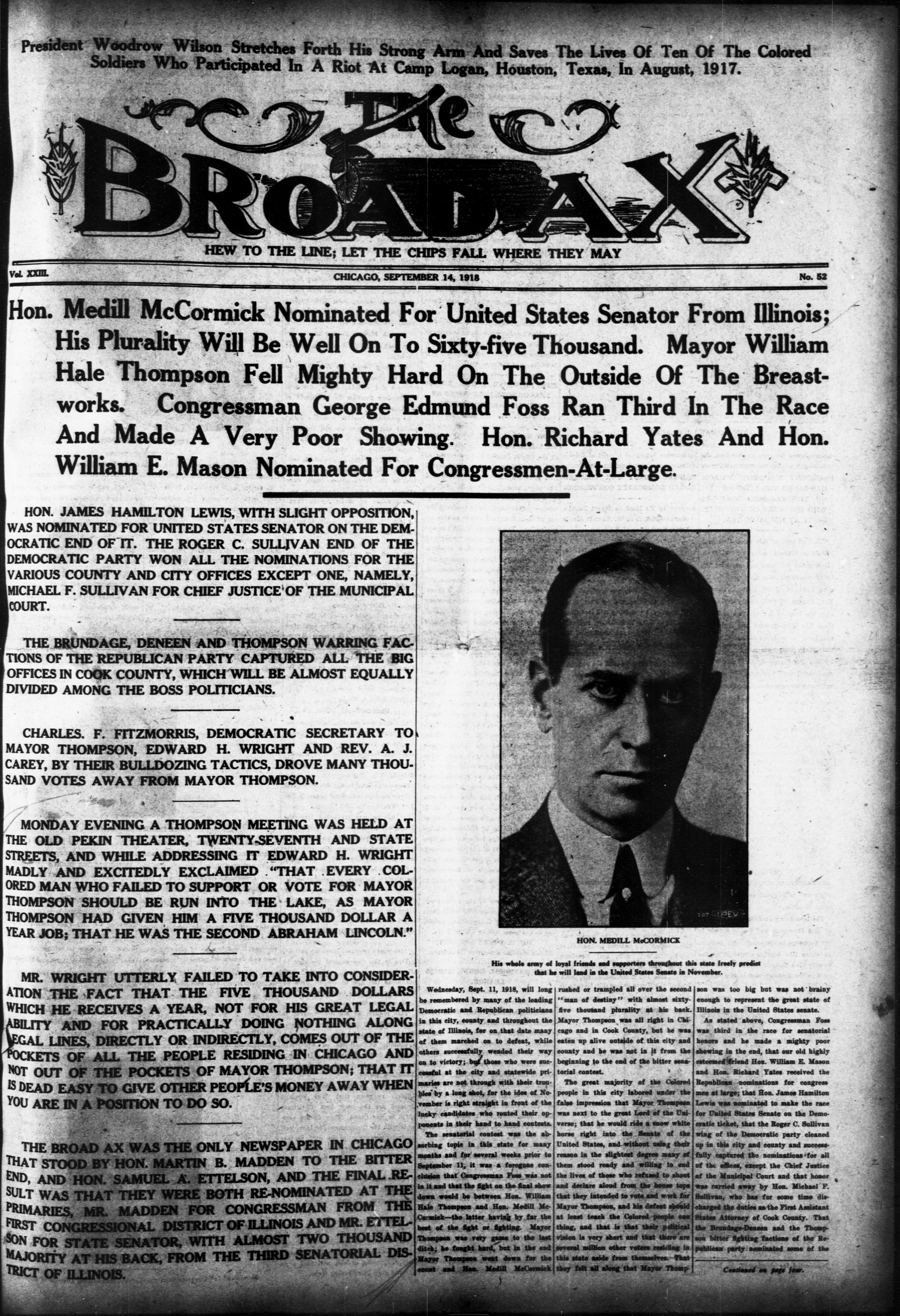
Hon. Medill McCormick Nominated For United States Senator From Illinois; His Plurality Will Be Well On To Sixty-five Thousand. Mayor William Hale Thompson Fell Mighty Hard On The Outside Of The Breastworks. Congressman George Edmund Foss Ran Third In The Race And Made A Very Poor Showing. Hon. Richard Yates And Hon. William E. Mason Nominated For Congressmen-At-Large.
HON. JAMES HAMILTON LEWIS, WITH SLIGHT OPPOSITION, WAS NOMINATED FOR UNITED STATES SENATOR ON THE DEMOCRATIC END OF IT. THE ROGER C. SULLIVAN END OF THE DEMOCRATIC PARTY WON ALL THE NOMINATIONS FOR THE VARIOUS COUNTY AND CITY OFFICES EXCEPT ONE, NAMELY, MICHAEL F. SULLIVAN FOR CHIEF JUSTICE OF THE MUNICIPAL COURT.
187 PEU
THE BRUNDAGE, DENEEN AND THOMPSON WARRING FAC TIONS OF THE REPUBLICAN PARTY CAPTURED ALL THE BIG OFFICES IN COOK COUNTY, WHICH WILL BE ALMOST EQUALLY DIVIDED AMONG THE BOSS POLITICIANS.
CHARLES. F. FITZMORRIS, DEMOCRATIC SECRETARY TO MAYOR THOMPSON, EDWARD H. WRIGHT AND REV. A. J. CAREY, BY THEIR BULLDOZING TACTICS, DROVE MANY THOUSAND VOTES AWAY FROM MAYOR THOMPSON.
MONDAY EVENING A THOMPSON MEETING WAS HELD AT THE OLD PEKIN THEATER, TWENTY-SEVENTH AND STATE STREETS, AND WHILE ADDRESSING IT EDWARD H. WRIGHT MADLY AND EXCITEDLY EXCLAIMED "THAT EVERY COL-ORED MAN WHO FAILED TO SUPPORT OR VOTE FOR MAYOR THOMPSON SHOULD BE RUN INTO THE LAKE, AS MAYOR THOMPSON HAD GIVEN HIM A FIVE THOUSAND DOLLAR A YEAR JOB: THAT HE WAS THE SECOND ABRAHAM LINCOLN."
His whole army of loyal friends and supporters throughout this state freely predict that he will land in the United States Senate in November.
MR. WRIGHT UTTERLY FAILED TO TAKE INTO CONSIDERATION THE FACT THAT THE FIVE THOUSAND DOLLARS WHICH HE RECEIVES A YEAR, NOT FOR HIS GREAT LEGAL ABILITY AND FOR PRACTICALLY DOING NOTHING ALONG LEGAL LINES, DIRECTLY OR INDIRECTLY, COMES OUT OF THE POCKETS OF ALL THE PEOPLE RESIDING IN CHICAGO AND NOT OUT OF THE POCKETS OF MAYOR THOMPSON; THAT IT IS DEAD EASY TO GIVE OTHER PEOPLE'S MONEY AWAY WHEN YOU ARE IN A POSITION TO DO SO.
THE BROAD AX WAS THE ONLY NEWSPAPER IN CHICAGO THAT STOOD BY HON. MARTIN B. MADDEN TO THE BITTER END, AND HON. SAMUEL A. ETTELSON, AND THE FINAL RESULT WAS THAT THEY WERE BOTH RE-NOMINATED AT THE PRIMARIES, MR. MADDEN FOR CONGRESSMAN FROM THE FIRST CONGRESSIONAL DISTRICT OF ILLINOIS AND MR. ETTELSON FOR STATE SENATOR, WITH ALMOST TWO THOUSAND MAJORITY AT HIS BACK, FROM THE THIRD SENATORIAL DISTRICT OF ILLINOIS.
Wednesday, Sept. 11, 1918, will long be remembered by many of the leading Democratic and Republican politicians in this city, county and throughout the state of Illinois, for on that date many of them marched on to defeat, while others successfully wended their way on to victory; but those who were successful at the city and statewide primaries are not through with their troubles by a long shot, for the ideas of November is right straight in front of the lucky candidates who routed their opponents in their hand to hand contests. The senatorial contest was the absorbing topic in this state for many months and for several weeks prior to September 11; it was a foregone conclusion that Congressman Fess was not in it and that the fight on the final show down would be between Hon. William Hale Thompson and Hon. Medill McCormick—the latter having by far the best of the fight or fighting. Mayor Thompson was very game to the last ditch; he fought hard, but in the end Mayor Thompson went down for the count and Hon. Medill McCormick
No. 52
HON. MEDILL McCORMICK
son was too big but was not 'brainy enough to represent the great state of Illinois in the United States senate.
As stated above, Congressman Foss was third in the race for senatorial honors and he made a mighty poor showing in the end, that our old highly esteemed friend Hon. William E. Mason and Hon. Richard Yates received the Republican nominations for congress men at large; that Hon. James Hamilton Lewis was nominated to make the race for United States Senate on the Democratic ticket, that the Roger C. Sullivan wing of the Democratic party cleaned up in this city and county and successfully captured the nominations for all of the offices, except the Chief Justice of the Municipal Court and that honor was carried away by Hon. Michael F. Sullivan, who has for some time discharged the duties as the First Assistant States Attorney of Cook County. That the Brundage-Deneen and the Thompson bitter fighting factions of the Republican party nominated some of the
Continued on page four.
rushed or trampled all over the second "man of destiny" with almost sixty-five thousand plurality at his back. Mayor Thompson was all right in Chicago and in Cook County, but he was eaten up alive outside of this city and county and he was not in it from the beginning to the end of the bitter senatorial contest.
The great majority of the Colored people in this city labored under the false impression that Mayor Thompson was next to the great Lord of the Universe; that he would ride a snow white horse right into the Senate of the United States, and without using their reason in the slightest degree many of them stood ready and willing to end the lives of those who refused to about and declare aloud from the house tops that they intended to vote and work for Mayor Thompson, and his defeat should at least teach the Colored people one thing, and that is that their political vision is very short and that there are several million other voters residing in this state aside from themselves. That they felt all along that Mayor Thompson
Momson Photo
HON. EDWARD J. GLACKIN
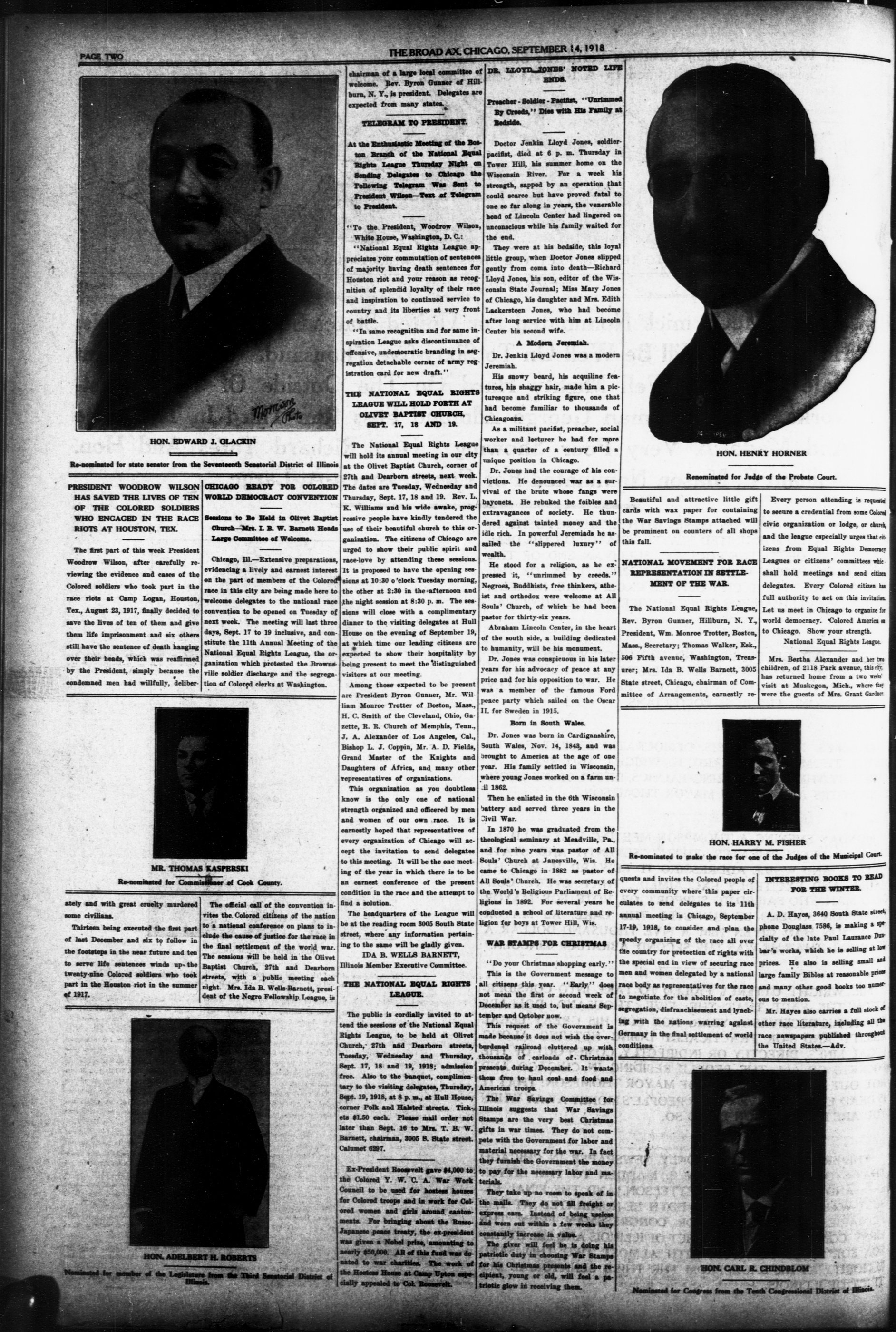
PRESIDENT WOODROW WILSON HAS SAVED THE LIVES OF TEN OF THE COLORED SOLDIERS WHO ENGAGED IN THE RACE RIOTS AT HOUSTON, TEX.
The first part of this week President Woodrow Wilson, after carefully reviewing the evidence and cases of the Colored soldiers who took part in the race riots at Camp Logan, Houston, Tex., August 23, 1917, finally decided to save the lives of ten of them and give them life imprisonment and six others still have the sentence of death hanging over their heads, which was reaffirmed by the President, simply because the condemned men had willfully, deliber-
MR. THOMAS KASPERSKI
ately and with great cruelty murdered some civilians.
Thirteen being executed the first part of last December and six to follow in the footsteps in the near future and ten to serve life sentences winds up the twenty-nine Colored soldiers who took part in the Houston riot in the summer of 1917.
[Name not visible]
9
CHICAGO READY FOR COLORED WORLD DEMOCRACY CONVENTION
Sessions to Be Held in Olivet Baptist Church—Mrs. I. B. W. Barnett Heads Large Committee of Welcome.
Chicago, Ill.—Extensive preparations, evidencing a lively and earnest interest on the part of members of the Colored race in this city are being made here to welcome delegates to the national race convention to be opened on Tuesday of next week. The meeting will last three days, Sept. 17 to 19 inclusive, and constitute the 11th Annual Meeting of the National Equal Rights League, the organization which protested the Brownsville soldier discharge and the segregation of Colored clerks at Washington.
The official call of the convention invites the Colored citizens of the nation to a national conference on plans to include the cause of justice for the race in the final settlement of the world war. The sessions will be held in the Olivet Baptist Church, 27th and Dearborn streets, with a public meeting each night. Mrs. Ida B. Wells-Barnett, president of the Negro Fellowship League, is
chairman of a large local committee of welcome. Rev. Byron Gunner of Hillburn, N. Y., is president. Delegates are expected from many states.
DR. LLOYD JONES' NOTED ENDS.
Preacher - Soldier - Pacifist, "Unrink
TELEGRAM TO PRESIDENT.
At the Enthusiastic Meeting of the Boston Branch of the National Equal Rights League Thursday Night on Sending Delegates to Chicago the Following Telegram Was Sent to President Wilson—Text of Telegram to President.
"To the President, Woodrow Wilson, White House, Washington, D. C.:
"National Equal Rights League appreciates your commutation of sentences of majority having death sentences for Houston riot and your reason as recognition of splendid loyalty of their race and inspiration to continued service to country and its liberties at very front of battle.
"In same recognition and for same inspiration League asks discontinuance of offensive, undemocratic branding in segregation detachable corner of army registration card for new draft."
THE NATIONAL EQUAL RIGHTS LEAGUE WILL HOLD FORTH AT OLIVET BAPTIST CHURCH, SEPT. 17, 18 AND 19.
The National Equal Rights League will hold its annual meeting in our city at the Olivet Baptist Church, corner of 27th and Dearborn streets, next week. The dates are Tuesday, Wednesday and Thursday, Sept. 17, 18 and 19. Rev. L. K. Williams and his wide awake, progressive people have kindly tendered the use of their beautiful church to this organization. The citizens of Chicago are urged to show their public spirit and race-love by attending these sessions. It is proposed to have the opening sessions at 10:30 o'clock Tuesday morning, the other at 2:30 in the afternoon and the night session at 8:30 p.m. The sessions will close with a complimentary dinner to the visiting delegates at Hull House on the evening of September 19, at which time our leading citizens are expected to show their hospitality by being present to meet the distinguished visitors at our meeting.
Among those expected to be present are President Byron Gunner, Mr. William Monroe Trotter of Boston, Mass., H. C. Smith of the Cleveland, Ohio, Gazette, R. R. Church of Memphis, Tenn., J. A. Alexander of Los Angeles, Cal., Bishop L. J. Coppin, Mr. A. D. Fields, Grand Master of the Knights and Daughters of Africa, and many other representatives of organizations.
This organization as you doubtless know is the only one of national strength organized and officered by men and women of our own race. It is earnestly hoped that representatives of every organization of Chicago will accept the invitation to send delegates to this meeting. It will be the one meeting of the year in which there is to be an earnest conference of the present condition in the race and the attempt to find a solution.
The headquarters of the League will be at the reading room 3005 South State street, where any information pertaining to the same will be gladly given.
IDA B. WELLS BARNETT,
Illinois Member Executive Committee.
THE NATIONAL EQUAL RIGHTS LEAGUE.
The public is cordially invited to attend the sessions of the National Equal Rights League, to be held at Olivet Church, 27th and Dearborn streets, Tuesday, Wednesday and Thursday, Sept. 17, 18 and 19, 1918; admission free. Also to the banquet, complimentary to the visiting delegates, Thursday, Sept. 19, 1918, at 8 p. m., at Hull House, corner Polk and Hasted streets. Tickets $1.50 each. Please mail order not later than Sept. 16 to Mrs. T. B. W. Barnett, chairman, 2005 S. State street. Calumet 6297.
Ex-President Roosevelt gave $4,000 to the Colored Y. W. C. A. War Work Council to be used for hostess houses for Colored troops and in work for Colored women and girls around cantonments. For bringing about the Russo-Japanese peace treaty, the ex-president was given a Nobel prize, amounting to nearly $50,000. All of this fund was donated to war charities. The work of the Hostess House at Camp Upton especially appealed to Colk Roosevelt.
DR. LLOYD_JONES' NOTED LIFE ENDS.
Preacher - Soldier - Pacifist, "Unrimmed By Creeda," Dies with His Family at Bedside.
Doctor Jenkin Lloyd Jones, soldier-pacifist, died at 6 p. m. Thursday in Tower Hill, his summer home on the Wisconsin River. For a week his strength, sapped by an operation that could scarce but have proved fatal to one so far along in years, the venerable head of Lincoln Center had lingered on unconscious while his family waited for the end.
They were at his bedside, this loyal little group, when Doctor Jones slipped gently from coma into death—Richard Lloyd Jones, his son, editor of the Wisconsin State Journal; Miss Mary Jones of Chicago, his daughter and Mrs. Edith Lackersteen Jones, who had become after long service with him at Lincoln Center his second wife.
A Modern Jeremiah.
Dr. Jenkin Lloyd Jones was a modern Jeremiah.
His snowy beard, his acquiline features, his shaggy hair, made him a picturesque and striking figure, one that had become familiar to thousands of Chicagoans.
As a militant pacifist, preacher, social worker and lecturer he had for more than a quarter of a century filled a unique position in Chicago.
Dr. Jones had the courage of his convictions. He denounced war as a survival of the brute whose fangs were bayonets. He rebuked the foibles and extravagances of society. He thundered against tainted money and the idle rich. In powerful Jeremiads he assailed the "slippered luxury" of wealth.
He stood for a religion, as he expressed it, "unrinned by creeds." Negroes, Buddhists, free thinkers, atheist and orthodox were welcome at All Souls' Church, of which he had been pastor for thirty-six years.
Abraham Lincoln Center, in the heart of the south side, a building dedicated to humanity, will be his monument.
Dr. Jones was conspicuous in his later years for his advocacy of peace at any price and for his opposition to war. He was a member of the famous Ford peace party which sailed on the Oscar II. for Sweden in 1915.
Born in South Wales.
Dr. Jones was born in Cardiganshire, South Wales, Nov. 14, 1843, and was brought to America at the age of one year. His family settled in Wisconsin, where young Jones worked on a farm until 1862. Then he enlisted in the 6th Wisconsin battery and served three years in the Civil War.
In 1870 he was graduated from the theological seminary at Meadville, Pa., and for nine years was pastor of All Souls' Church at Janesville, Wis. He came to Chicago in 1882 as pastor of All Souls' Church. He was secretary of the World's Religious Parliament of Religions in 1892. For several years he conducted a school of literature and religion for boys at Tower Hill, Wis.
WAR STAMPS FOR CHRISTMAS
"Do your Christmas shopping early." This is the Government message to all citizens this year. "Early" does not mean the first or second week of December as it used to, but means September and October now. This request of the Government is made because it does not wish the overburdened railroad cluttered up with thousands of carloads of Christmas presents during December. It wants them free to haul coal and food and American troops.
The War Savings Committee for Illinois suggests that War Savings Stamps are the very best Christmas gifts in war times. They do not compete with the Government for labor and material necessary for the war. In fact they furnish the Government the money to pay for the necessary labor and materials.
They take up no room to speak of in the malls. They do not fill freight or express carn. Instead of being useless and worn out within a few weeks they constantly increase in value.
The giver will feel he is doing his patriotic duty in choosing War Stamps for his Christmas presents and the recipient, young or old, will feel a patriotic glow in receiving them.
HON. HENRY HORNER
HON. HENRY HORNER Renominated for Judge of the Probate Court. Beautiful and attractive little gift cards with wax paper for containing the War Savings Stamps attached will be prominent on counters of all shops this fall. Every person attent to secure a credential civic organization or and the league especis
NATIONAL MOVEMENT FOR RACE REPRESENTATION IN SETTLEMENT OF THE WAR.
The National Equal Rights League, Rev. Byron Gunner, Hillburn, N. Y., President, Wm. Monroe Trotter, Boston, Mass., Secretary; Thomas Walker, Esk., 506 Fifth avenue, Washington, Treasurer; Mrs. Ida B. Wells Barnett, 3005 State street, Chicago, chairman of Committee of Arrangements, earnestly re-
HON. HARRY M. FISHER
Re-nominated to make the race for one of the Judges of the Municipal Court.
quests and invites the Colored people of every community where this paper circulates to send delegates to its 11th annual meeting in Chicago, September 17-19, 1918, to consider and plan the speedy organizing of the race all over the country for protection of rights with the special end in view of securing race men and women delegated by a national race body as representatives for the race to negotiate for the abolition of caste, segregation, disfranchisement and lynching with the nations warring against Germany in the final settlement of world conditions.
THE BROAD
HON. CARL R. CHINDBLOM
JOYAM
RESOULLED
BO
Every person attending is requested to secure a credential from some Colored civic organization or lodge, or church and the league especially urges that citizens from Equal Rights Democracy Leagues or citizens' committees which shall hold meetings and send citizen delegates. Every Colored citizen has full authority to act on this invitation. Let us meet in Chicago to organize for world democracy. Colored America on to Chicago. Show your strength. National Equal Rights League.
Mrs. Bertha Alexander and her two children, of 2118 Park avenue, this city, has returned home from a two weeks visit at Muskegon, Mich., where they were the guests of Mrs. Grant Gardner.
INTERESTING BOOKS TO READ FOR THE WINTER.
A. D. Hayes, 3640 South State street phone Douglass 7586, is making a specialty of the late Paul Laurance Dunbar's works, which he is selling at low prices. He also is selling small and large family Bibles at reasonable prices and many other good books too numerous to mention. Mr. Hayes also carries a full stock of other race literature, including all the race newspapers published throughout the United States.—Adv.
Subscriber Fourth Liberty Loan
The above is an exact reproduction of the label issued by the government for use of subscribers residing in the country—to be placed on their rural free delivery mail boxes during the campaign. Six million of these labels will be issued and distributed through the various district committees to subscribers to the loan. The idea in giving this label is that the subscription window card issued in former campaigns cannot be seen in the windows from the country roads. This mail box emblem will be very important to rural residents.
What Is Sugar?
By the U. S. Food Administration
Food Administration Urges
Test for Wheat Waste; Tells
How to Rectify Operation
A matter of unusual importance to grain growers is the food administration's official test for clean threshing, says Indianapolis News. By this
Sugar is a food as well as a flavor. One of the simple food lessons the United States food administration has driven home is "Food Is Fuel for Fighters." Sugar is one of the conspicuous fuel foods. Its great advantage is that it is quickly burning, and gives its energy to the body more rapidly than other kinds. The commercial granulated sugar we buy at the store is "not the only sugar on the shelf." Some of these other sugars have popular names which denote their origin, such as grape sugar, fruit sugar, milk sugar and malt sugar. Their technical names are, in order, glucose or dextrose; fructose; lactose; maltose. The beet sugar or cane sugar that we buy from the grocer is also an "ose." It is called "sucrose."
The department of agriculture tells us that while the canes and the sugar beet are the only commercially important sources of sucrose, this form of sugar is also found in the stems and roots of sorghum and cornstalks; in the carrot, turnip and sweet potato; in the sap of some trees, such as the date palm and sugar maple; in almost all sweet fruits, and in the nectar of flowers.
When a sucrose, or ordinary sugar, is taken into the body and goes through the process of digestion, it is changed into glucose and fructose. Lactose goes through much the same process, forming glucose and galactose. Maltose, too, changes into glucose.
Glucose is a simple sugar very easy to digest. As it is manufactured today, it contains absolutely no harmful substances.
We need to remember that all the sweeteners the United States food administration asks us to use in place of "sugar" are sugars, too, and though not always in as convenient a form, they give approximately the same food value and flavor.
Words of Wise Men.
Keep thy spirit pure from worldly taint by the strength of virtue—Bailley.
Be what your friends think you are; avoid being what your enemies say you are; go right forward and be happy—Pomeroy.
The bigot is like the pupil of the eye—the more light you put upon it the more it will contract.
—Holmea.
A man can never be a true gentleman in manner until he is a true gentleman at heart—Dickens. The price of liberty is eternal vigilance.
Bronze Powder Is Now Made in America, Not in Germany.
The United States industries use practically 6,000,000 pounds of bronze powder annually, and 35 per cent of our total consumption was formerly imported from Germany, but it is now "made in America." For many years German manufacturers have been practically controlling the bronze powder trade in this country, due to the fact that they have been offering prices which were less than those of the American producers. Bronze powder is manufactured in over 200 grades, differing in color and texture.
French Increase Wheat Crop.
The total production of wheat in France this year is estimated at 50,000,000 quintals (158,500,000 bushels) being an increase of more than 25 per cent over last year's crop, according to the Intradigest.
Food Administration Urges
Test for Wheat Waste; Tells How to Rectify Operation
A matter of unusual importance to grain growers is the food administration's official test for clean threshing, says Indianapolis News. By this rule any farmer can test the work of the threshing machine he has hired. The test is made by directing the straw blower against a blanket, sheet or canvas during the time the weighing device trips five times, recording two and one-half bushels. If more than one platt of wheat is winnowed from the straw on the canvas, bad work is indicated. One and one-half pints indicates a loss of 1 per cent. If more than three pints is found—which means a 2 per cent loss—reasonable time should be given to correct the bad operation, and a second test should be made. If improvement is not obtained, steps should be taken through the county threshing committee to discontinue operations until the avoidable waste is corrected.
Most threshing committees have formulated detailed rules for the guidance of threshing crews in effectively stopping waste of grain. But more effective than the rules and regulations, the food administration believes, has been the eagerness with which farmers and threshermen have accepted their harvest-time responsibility and the diligence with which they are now stopping every source of grain waste.
JUST BE GLAD
Oh heart of mine, we shouldn't
Worry so!
What we've missed of calm we couldn't
Have, you know!
What we've met of stormy pain,
And of savour's driving rain,
We can better meet again,
If it blow!
We have erred in that dark hour
We have known,
When the tears fall with a shower
All alone—
Were not shine and showers blent
As the gracious Master meant?
Let us temper our content
With His own.
For we know, not every morrow
Can be met;
So forming all the sorrow
We have had;
Let us fold away our fears,
And put by our foolish tears,
And through all the coming years,
Just be glad.
—James Whitcomb Riley.
Mental Hygiene, Distinct
"For the first time in the history of warfare," says New York Medical Journal, "mental hygiene as practiced among the soldiers is given the prominence it deserves, and, profiting by the experience of England and France in the present war, the surgeon general was impelled to inaugurate an elaborate organization, both in number and plan, to take care of any mental disturbances detected in the camps or among the soldiers during the war. This is a distinct innovation in the army medical work, for the subjects of mental hygiene and of mental and nervous diseases in general, as occurring among soldiers in war time, were for many reasons either slightly treated or neglected altogether."
Hollow trees are always the stiffest, but the mightiest oak, if sound, can bend. The more exalted a man is by station, the more powerful should he be by kindness. There is no policy like politeness, since a good manner often succeeds where the best tongue has failed. Politeness is most useful to inspire confidence in the timid and encourage the deserving—Magoon.
Purchase of Danish West Indies.
Under the terms of the sale whereby the United States bought the Danish West Indies—now called the Virgin islands—from Denmark, it was stipulated that German vessels in the harbors of the islands should not be commanded in the event of the United States going to war with Germany.
THE BROAD AX, CHICAGO, SEPTEMBER 14, 1918
Mrs. A. Rudolph Penn of Evanston, was a recent visitor in the city.
Lawyer and Mrs. S. Z. C. Westerfield were entertained at dinner last Friday by Mr. and Mrs. John H. Owens.
Mrs. Raymond Curry, of Cleveland, O., was a house guest of Mr. and Mrs. Robert L. Taylor. She departed for her home last Tuesday.
Miss Edith Gordon, of Pulaski, Tenn., has been visiting Mrs. Mattie M. Steele, at 3145 So. LaSalle street. She expects to remain a short while longer.
Dr. J. H. Harvey, pastor of Quinn Chapel A. M. E. Church, Louisville, Ky., has returned to his home after a very delightful visit in the city lasting several weeks.
Thursday witnessed the registration of several thousand Chicago men and boys for the selective army service, many of whom will be notified to be ready for the first call.
Mrs. Helen Peal, of Portsmouth, Va., is expected to visit the city soon. She is the wife of Maj. R. Peal, who is at present engaged in Y. M. C. A. war work among our boys in France.
Quinn Chapel Forum will be addressed next Sunday afternoon by Editor Julius F. Taylor, of The Broad Ax, on the subject of "Ancient Egypt." The public is cordially invited to attend.
Ye editor of this column spent a very delightful vacation in the National Capital recently and hopes to tell something of his sojourn in the next issue of this, CHICAGO'S GREATEST WEEKLY.
Miss Bertha Jacksón, of Memphis, Tenn., departed for home last Sunday. She is a public school teacher in that city and while here was the guest of Mr. and Mrs. Galloway, of 4757 Dearborn street.
Mr. and Mrs. John H. Owens were hosts at a box party at the Avenue theater Wednesday night, and entertained the following guests: Lawyer and Mrs. Harris B. Gaines, Lawyer and Mrs. S. Z. C. Westerfield.
Among the recent noted arrivals in the city are Prof. and Mrs. A. E. Malone, proprietors and founders of the famous Poro Hair System of St. Louis, Mo. They are the guests of Mrs. Henrietta Wilson, 3533 Wabash avenue.
Mr. Paul Bronson, of 6430 Drexel boulevard, active worker in Grace Presbyterian circles, continues quite indisposed at his home. The Broad Ax wishes for him a speedy recovery and that he will soon be able to resume his former activities.
Judge Robert H. Terrell, only member of the race on the Municipal Court bench in Washington, D. C., is expected in the city soon enroute to Michigan and other points in the Middle West. He is on a speaking tour in the interest of the National Government.
It is reported that official orders from Washington are to the effect that no more colored physicians will be given commissions in the United States Army. This will somewhat dampen the ardor of hundreds of Chicago's most competent doctors who had aspired to such positions.
Judge William Harrison, of Oklahoma City, Okla., noted orator and lawyer, will deliver one of his brilliant orations at Quinn Chapel Church, corner 24th street and Wabash avenue next Tuesday, Sept. 17th. A crowded house will likely greet him and all are urged to come early to obtain a good seat.
The A. M. E. Annual Conference, comprising the Chicago district and other adjacent districts, will be held in Evanston next week beginning Wednesday, Sept. 18, continuing until Sunday night, Sept. 22, when appointments will be read. Sessions will be held in the morning, afternoon and night of each day.
Lawyer Harris B. Gaines, precinct captain and noted worker in Republican headquarters, has been spending a few days in the city at his home, 5827 Wentworth avenue. He will return Sunday to Wilson Violet Farm, in Michigan, where he is engaged in governmental activities. Mrs. Gaines is all smiles during his stay here.
Mr. and Mrs. Robert L. Taylor entertained Saturday with a house party in honor of their cousin, Miss Lillian Vanderburg of St. Louis, Mo., at Grayland Farm, Des Plaines, Ill. A more suitable place could not have been found, for Grayland Farm is one of nature's most beautiful spots. A delightful dinner was served, after which those who cared found themselves tripping along to beautiful strains of music. Most truly the time came too quickly to say goodbye to Mr. and Mrs. Taylor, the most charming host and hostess.
CHIPS
Mrs. Grant Gardner, of Muskegon, Mich., spent the first part of last week in visiting with friends in Chicago who were highly delighted to meet her again.
Miss Nellie Byron, 3300 Rhodes avenue, celebrated her sixteenth birthday the first of the week and her mother, Madam M. Callaway Byron, gave a private dinner party in honor of the event.
Tuesday evening commencement exercises of the first Colored Women's first aid class, of the American Red Cross of the United States of America, was held at the Y. M. C. A., 3763 S. Wabash avenue. Mrs. David M. Manson was in charge of the pleasant affair, which was largely attended.
It was stated in the greatest weekly newspaper in the world last week that Col. John B. French, who thought that he was running on the Thompson ticket, would be nominated for county commissioner at the November primaries and it seems that many voters are still waiting to assist to nominate him in November.
Grand Master Edward H. Morris has been deposed as the leader of the Odd-Fellows of the country, at the recent conclave in New York. He had a long and successful career, as Grand Master until the present session. The order loses a most capable leader, from the standpoint of intellect and ability to accomplish results.
Rev. J. C. Anderson, pastor of Quinn Chapel, who has given a good account of his Stewardship, for the past five years and Rev. W. D. Cook of Bethel Church, who has also for the same length of time worked hard for his Methodist Lord and Master, should be returned to their respective charges or churches by the A. M. E. conference, which convenes in Evanston, Ill., this coming week.
PHYLLIS WHEATLEY CLUB NOTES
The first meeting for the month of the Phyllis Wheatley Woman's Club was held at the home, 3256 Rhodes avenue, Wednesday. Plans were made to have a potato booth at the American Rose Art Bazaar the last of the month. The next meeting will be Wednesday, Sept. 18, at 2 p.m. Election of officers and plans outlined for the winter's work. Members are urged to be present. Visitors are always welcome.
Dr. and Mrs. W. H. Davis were among the many visitors at Camp Grant last Sunday.
Miss Jane Hunter, general secretary of the Phyllis Wheatley Home at Cleveland, Ohio, is stopping at 3403 Prairie avenue.
Snakes Bred for Profit.
Snakes Bred For Profit.
Most of the snakes used by showmen are procured from a large "snake farm" at San Antonio, Tex., where all kinds of reptiles are bred. This farm consists of eight acres for snakes alone, besides the land required for raising rabbits, chickens, frogs and other "snake feed."
Bread Machine Most Needed
Speed Machine Most Needed.
To save labor and space in large post offices, a New Jersey man has invented a letter-sorting cabinet in which the letters are dropped into narrow slots and fall down chutes into larger compartments.
TAKES PLACE OF COW'S MILK
Substitutes for cow's milk seem to be obtainable from various vegetable sources. Drs. H. D. Chapin and Ludwig Kast of New York reported their experience with almond milk, which is prepared by first grinding the almonds fine, covering with water and placing in the icebox overnight and then pressing out with a fruit press or by hand through four layers of gauze. The water may be twice the weight of the nuts, the pressed-out liquid being further diluted. The almond milk ferments much less easily than cow's milk, is richer in easily digestible fat and in phosphorus and its small amount of carbohydrate makes it less likely to cause sugar fermentation. It has been tried in more than one thousand adults. Though some dislike it, no actual disturbances have been caused by it, and it has served well for temporary use in such conditions as nephritis, typhoid, intestinal putrefaction, malnutrition and secondary anemia. Milk is similarly prepared from the soy bean, already an important source of oil for margarine and soaps. This milk, which may be freed from its strong bean odor by heating to boiling point, contains 3.13 per cent of casein and 30 ounces of the beans are said to yield 46 ounces of cheese.
RIGID RULES OF POLITENESS
Continental Countries Carry Forms of
Salutation and Courtesy to What
We Consider Extremes.
In all continental countries men lift their hats when saluting one another. It is also customary for them to uncover their heads on entering any kind of private premises, including offices, and in some parts even banks. It was, until recently, considered extremely rude for a man in Poland to enter even a shop without removing his hat, and it was not unusual for a customer who omitted this formality to be told that he would be attended to when compliance with the demands of politeness should entitle him to the shopkeeper's consideration. It was only a few years before the war that this practice came gradually to be abandoned. The reform was largely due to the action of the more important tradespeople in the principal towns, who exhibited notices in their shops saying, "Gentlemen are requested not to remove their hats."
In Poland and Russia visitors are expected to leave in the hall not only their goloshes, but hat, cont, and stick as well, no matter how short their stay. Clients calling on professional men are expected to do the same.
Important Scientific Discovery.
Important Scientific Discovery. The use of water holding fine sand in suspension is a novel plan for separating materials of different specific gravity. A chemical solution of a density somewhat greater than that of the lighter material has served in the laboratory, but this has been commercially unsatisfactory on account of the cost of the chemicals and the difficulty of removing them from the substances separated. The mechanical mixture containing sand held up in water by agitation has been found to take the place of the true solution of the same density. It is stated that with quarts sand and water, coal may be freed from its ordinary impurities, and magnetic iron ore sand gives a fluid of sufficiently high specific gravity to float quarts, limestone and feldspar, while such heavy particles as those of galena ore or metallic copper may be used for fluids to float off still heavier solids.
Held High Rank as Phyclian
Dr. Philip S. Physick, often called "the Father of American Surgery," was one of the most eminent physicians of his day, ranked very high as a practical surgeon and was exceedingly popular as a lecturer. His father, an Englishman, had charge of the estate of the Penn family. The son was born in Philadelphia July 7, 1788, was educated for the medical professor partly in that city and partly in Edinburgh, Scotland, where he was graduated with high honors. On his return to the United States he began to practice in Philadelphia and soon won professional honors. In 1831 Doctor Physick won a national reputation by the successful performance of a surgical operation on Chief Justice Marshall, followed by a perfect cure. He died in Philadelphia December 16, 1837.
All Uphold Red Cross
The Red Cross organization is the result of an international treaty entered into by most of the leading nations at a convention held at Geneva, Switzerland, in August, 1864. The treaty sustains the neutrality of Red Cross societies in all countries and on all waters covered by the compact, and insures to it the protection of all conflicting forces in time of war. The nations that are parties to this treaty are the United States, Venezuela, Bolivia, Chile, Peru, Argentina, Great Britain, Germany, France, Belgium, Russia, Austria, Sweden, Norway, Turkey, Greece, Spain, Italy, Serbia, Persia, the Roman states, Switzerland, Japan and other governments to the number of 40 or more.
PAGE THREE
NOW KNOWS WHAT A LEA IS
The lowling herd wound slowly over the lea. The day had been a delightful one for walking and as we swung along in our tweeds and hobnail shoes, a heavy stick in our hand, we drank deep from nature's fount, learning many things. As the mild-eyed cows made their leisurely way down the road and we stood aside to watch them pass, the old lines ran through our mind, vaguely yet with new approplateness. It never before had occurred to us that we had only the loosest conception of what a lea was, and now we resolved to find out.
Retracing our steps, we followed the lowing herd to a pleasant farmstead with a windmill, a silo, and a large barn inscribed, "Grade A Pasteurized Dairy," where we found the Grade A pasteurized dairyman, by name Ole Yensen. "Are these," we asked, "your Grade A pasteurized cows?" "Sure," said Mr. Yensen; "all bane Holstein stock and not a plugged one in the bunch."
"And where is the lea o'er which they wander?"
Mr. Yensen regarded us with suspicion. Finally he said: "Ay bane have a grade cow killed on a grade crossing once. A man by name Lee he claimed him and das railroad paid him savety'f dollar and Ay get nothing. Fe bane move away now. Ay don't know where he bane gone and Ay don't care."
We know now what a lea is, but we didn't get it from Yensen.—Newark News.
GIVE CREDIT TO CERVANTES
Immortal Author of "Don Quizote"
Responsible for Many of Our
Most Famous Sayings.
With the thought of yesterday's epi-
grammatists in mind, it should be set
to record that no one has handed
down to this age more homely and immortal sayings than Cervantes. "Don Quizote" is full of them: "Why do you lead on a wild goose chase?"
"Sure as a gun;" Within a stone's
throw;" "Little said is soonest mended;"
"There is no love lost between us;" "Honesty is the best policy;"
"All is not gold that glitters;" "A word to the wise is sufficient;" "The pot calls the kettle black;" "Counting your chickens before they are hatched;" "My thoughts ran a-wool gathering;" and "As secret as the grave."
One need not look far behind to find "mad as a March hare" also attributed to this prolific Spanland, but really it was an inspiration of the English poet, John Skelton, who lived in the time of Edward IV. "Set the cart before the horse," as well as "I have other fish to fry," comes from sixteenth century Rabelais, while "A bird in hand is worth two in the bush" goes all the way back to Plutarch.
In "Little Old New York."
If a certain actor had accompanied a party of round-the-towners the other night he would have been either thrilled or embarrassed, says New York Sun. After the theater the party went to the Waldorf roof and saw one of the actor's former wives the center of a gay, laughing party. The next stop was at the Astor roof where there was another former wife of the same actor dining with a handsome young gallant who danced divinely and at the last stop on the Majestic roof was the third former wife giving a dinner to several women and two French army officers. It was hard to tell which was the most beautiful. They all seemed happy. It is remindful of another actor who went to another theater than his own to see a play. He was seated next to a former wife and her husband. They all chatted pleasantly together and later supped together. A strange town—this New York.
American Invented Electric Fan.
Michael Faraday devised the electro-magnetic rotation apparatus in the year 1822. Barlow in 1823 produced the rotation of a star wheel placed in the field of a strong magnet. These devices were very crude and simple, however, and developed infinitesimal power. Undoubtedly the first electric motor employing magnets wound with many turns of wire, and also comprising a motor which utilised both permanent steel magnets and electro-magnets, was that perfected by Prof. Joseph Henry of Princeton university, in the year 1831. Henry produced reciprocating motion as well as the rotary motion by electro-magnetic means. Henry's motor, according to Electrical Experimenter, was the forerunner of the present day electric motor.
Philippines Grow Best Hemp
Hemp may grow all over the world, but the famous Philippine fields are the ones we know best as yet. They have a real monopoly on the crop, as their soil seems to be especially adapted for it. The abaca, as they call it, looks very much like the banana tree. They belong to the same family, but the fruit of the hemp tree is not edible, and the fiber of the banana is not strong enough to use.
The very best quality of hemp grown in the Philippines comes from the fields about Mount Mayon in Luzon; The dust and ashes of this majestic volcano have formed the most perfect soil for its culture, a soil that is found nowhere else in the world.
HON. MARTIN B. MADDEN
Re-nominated for Congress in the First
loyally supported by this paper from
made on him by the Hen. Oscar De
Re-nominated for Congress in the First Congressional District of Illinois, who was loyally supported by this paper from the beginning to the end of the long fight made on him by the Hon. Oscar De Priest and his followers.
Re-nominated for Congress in the First Congressional District of Illinois, who was loyally supported by this paper from the beginning to the end of the long fight made on him by the Hon. Oscar De Priest and his followers.
NEGRO'S JUMP INTO FIGHT AGAINST GERMAN POISON
Washington, D. C., Sept. 11.—Here is the Negro's answer to German propaganda. He is going to adopt the "Serum of Silence" treatment to stop the spread of German made poison. R. T. Edwards, director of the Educational Section, of the National War Garden Commission, in a speech in Cincinnati before the Women's Association of Commerce, urged the women to meet German propaganda with silence. He urged the women of the country to turn in silence from the pedler of this German poison and likened propaganda to the prairie fire which is a great success as long as it has something to feed upon. The Women's Association of Commerce adopted a resolution starting an endless chain among its friends to get them to promise to listen no more to rumors and knocks against the government. Katherine Clemmons Gould introduced the resolution.
The "Serum of Silence" caused a great deal of comment all over the country and today the National War Garden Commission received a letter from Henry C. Bryant of the Executive Board of Colored Helpers and Laborers on Southeastern Railroads with offices in Jacksonville, Fla., indorsing the serum of silence treatment for prop-
M.
9
Congressional District of Illinois, who was the beginning to the end of the long fight Priest and his followers.
aganda and saying that a resolution had been adopted to that end.
The letter says an organization known as the Thrift Stampers of Loyal Americans has taken this up. This organization is out to sell ten million thrift stamps and E. D. Thompson, general chairman of the southeastern district will push the campaign among the Colored workers.
DISTRICT MAN DIES OVER THERE
Washington, D. C., Sept.—(Special)
—John Henry Wood, Colored, twenty-seven years old, of 1937 Ninth street, is reported in the casualty list as dead from pneumonia. Woodson was the son of Mrs. Nannie Woodson of 1937 Ninth street, northwest, and had been in France since last June. He was a drafted man and was sent to Camp Mead October 28. Two brothers and a sister survive him. Before entering the service, Woodson was employed as a chauffeur. He attended the Garnet School.
Mrs. R. A. J. Shaw, 3816 Calumet avenue, whose husband is with the old Eighth Regiment, now the 370th U. S. Infantry, which is somewhere in France, was highly delighted with the twenty-third anniversary edition of The Broad Ax and she will send her copy of it to her husband.
THE BROAD AX, CHICAGO, SEPTEMBER 14, 1918
HON. MEDILL McCORMICK DEFEATS MAYOR WILLIAM HALE
THOMPSON FOR THE NOMINATION FOR UNITED STATES
SENATOR FROM ILLINOIS
Concluded from page one.
candidates for the various offices in this city and county. It appears that the following Republican and Democratic candidates pulled through at the city and statewide, primaries Wednesday, September 11:
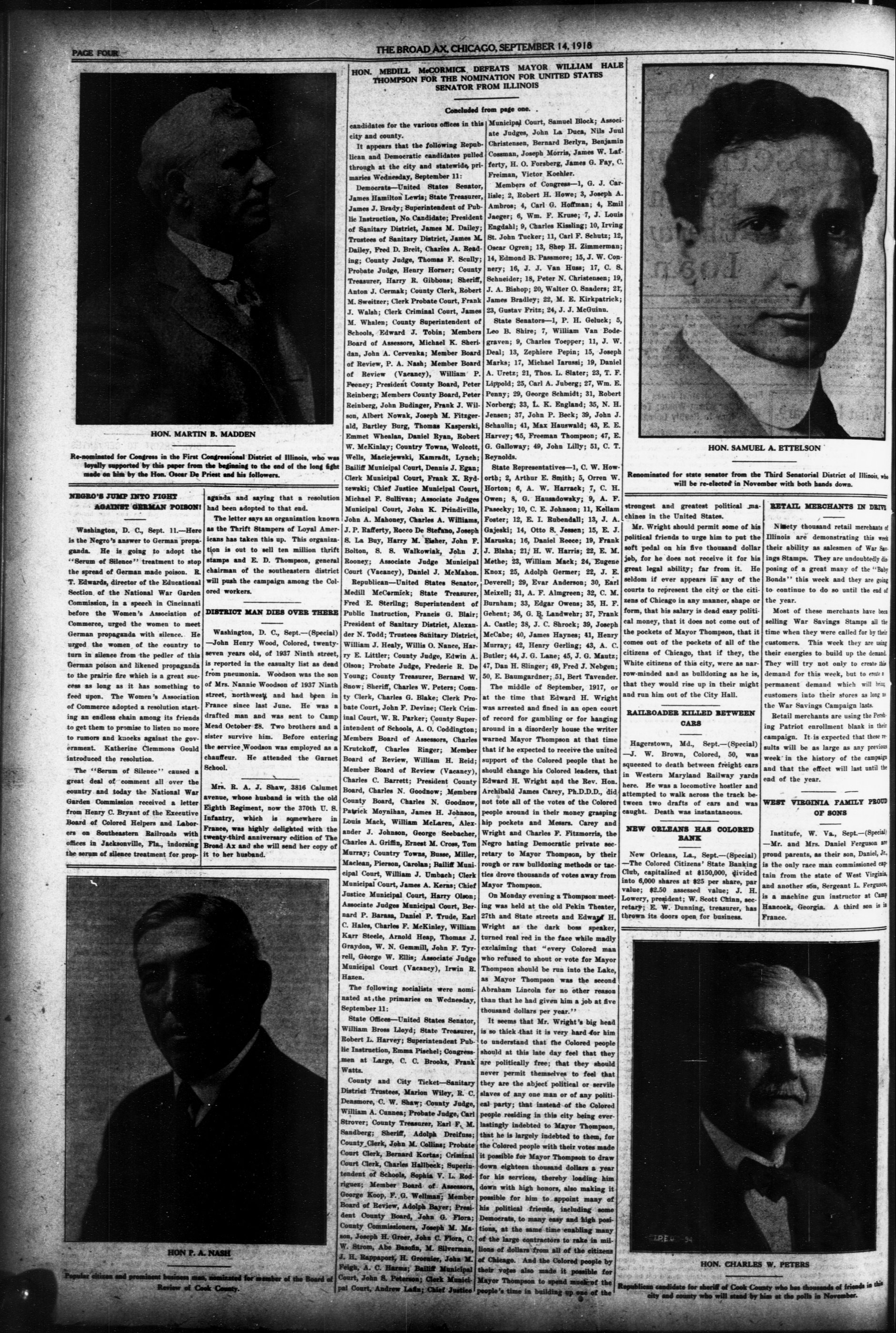
Democrats—United States Senator, James Hamilton Lewis; State Treasurer, James J. Brady; Superintendent of Public Instruction, No Candidate; President of Sanitary District, James M. Dailey; Trustees of Sanitary District, James M. Dailey, Fred D. Breit, Charles A. Reading; County Judge, Thomas F. Scully; Probate Judge, Henry Horner; County Treasurer, Harry R. Gibbons; Sheriff, Anton J. Cermak; County Clerk, Robert M. Sweitzer; Clerk Probate Court, Frank J. Walsh; Clerk Criminal Court, James M. Whalen; County Superintendent of Schools, Edward J. Tobin; Members Board of Assessors, Michael K. Sheridan, John A. Cervenka; Member Board of Review, P. A. Nash; Member Board of Review (Vacancy), William P. Feeney; President County Board, Peter Reinberg; Members County Board, Peter Reinberg, John Budinger, Frank J. Wilson, Albert Nowak, Joseph M. Fitzgerald, Bartley Burg, Thomas Kasperski, Emmet Whealan, Daniel Ryan, Robert W. McKinlay; Country Towns, Wolcott, Wells, Maciejewski, Kamradt, Lynch; Bailiff Municipal Court, Dennis J. Egan; Clerk Municipal Court, Frank X. Rydzewski; Chief Justice Municipal Court, Michael F. Sullivan; Associate Judges Municipal Court, John K. Prindiville, John A. Mahoney, Charles A. Williams, J. P. Rafferty, Rocco De Stefano, Joseph S. La Buy, Harry M. Fisher, John F. Bolton, S. S. Walkowiak, John J. Rooney; Associate Judge Municipal Court (Vacancy), Daniel J. McMahon. Republican—United States Senator, Medill McCermick; State Treasurer, Fred E. Sterling; Superintendent of Public Instruction, Francis G. Blair; President of Sanitary District, Alexander N. Todd; Trustees Sanitary District, William J. Healy, Willis O. Nance, Harry E. Littler; County Judge, Edwin A. Olson; Probate Judge, Frederic R. De Young; County Treasurer, Bernard W. Snow; Sheriff, Charles W. Peters; County Clerk, Charles G. Blake; Clerk Probate Court, John F. Devine; Clerk Criminal Court, W. R. Parker; County Superintendent of Schools, A. O. Coddington; Members Board of Assessors, Charles Krutckoff, Charles Ringer; Member Board of Review, William H. Reid; Member Board of Review (Vacancy), Charles C. Barrett; President County Board, Charles N. Goodnow; Members County Board, Charles N. Goodnow, Patrick Moynihan, James H. Johnson, Louis Mack, William McLaren, Alexander J. Johnson, George Seebach, Charles A. Griffin, Ernest M. Cross, Tom Murray; Country Towns, Busse, Miller, Maclean, Pierson, Carolan; Bailiff Municipal Court, William J. Umbach; Clerk Municipal Court, James A. Kerns; Chief Justice Municipal Court, Harry Olson; Associate Judges Municipal Court, Bernard P. Barasa, Daniel P. Trude, Earl C. Hales, Charles F. McKinley, William Karr Steele, Arnold Heap, Thomas J. Graydon, W. N. Gemmill, John F. Tyrrell, George W. Ellis; Associate Judge Municipal Court (Vacancy), Irwin R. Hazen.
The following socialists were nominated at the primaries on Wednesday, September 11: State Offices—United States Senator, William Bross Lloyd; State Treasurer, Robert L. Harvey; Superintendent Public Instruction, Emma Pischel; Congressmen at Large, C. C. Brooks, Frank Watts.
County and City Ticket—Sanitary
District Trustees, Marion Wiley, R. C.
Denamore, C. W. Shaw; County Judge,
William A. Cunnes; Probate Judge, Carl
Strover; County Treasurer, Earl F. M.
Sandberg; Sheriff, Adolph Dreifus;
County Clerk, John M. Collins; Probate
Court Clerk, Bernard Kortas; Criminal
Court Clerk, Charles Hallbeek; Superintendent of Schools, Sophia V. L. Rodriguez; Member Board of Assessors,
George Koop, F. G. Wellman; Member
Board of Review, Adolph Bayer; President County Board, John G. Flora;
County Commissioners, Joseph M. Mason,
Joseph H. Greer, John C. Flora, C.
W. Strom, Abe Basofin, M. Silverman,
J. H. Rappaport, H. Groenier, John M.
Feigh, A. C. Harma; Balliff Municipal
Court, John S. Peterson; Clerk Municipal Court, Andrew Lafun; Chief Justice
Municipal Court, Samuel Block; Associate Judges, John La Duca, Nils Juul Christensen, Bernard Berlyn, Benjamin Cossman, Joseph Morris, James W. Lafferty, H. O. Forsberg, James G. Fay, C. Freiman, Victor Koehler.
Members of Congress—1, G. J. Carlisle; 2, Robert H. Howe; 3, Joseph A. Ambros; 4, Carl G. Hoffman; 4, Emil Jaeger; 6, Wm. F. Kruse; 7, J. Louis Engdahl; 9, Charles Kissling; 10, Irving St. John Tucker; 11, Carl F. Schutz; 12, Oscar Ogren; 13, Shep H. Zimmerman; 14, Edmund B. Passmore; 15, J. W. Connery; 16, J. J. Van Huss; 17, C. S. Schneider; 18, Peter N. Christensen; 19, J. A. Bishop; 20, Walter O. Snaders; 21, James Bradley; 22, M. E. Kirkpatrick; 23, Gustav Fritz; 24, J. J. McGuinn.
State Senators—1, P. H. Geluck; 5,
Leo B. Shire; 7, William Van Bodegraven; 9, Charles Toepper; 11, J. W.
Deal; 13, Zephiere Pepin; 15, Joseph
Marks; 17, Michael Iarussi; 19, Daniel
A. Uretz; 21, Thos. L. Slater; 23, T. F.
Lippold; 25, Carl A. Juberg; 27, Wm. E.
Penny; 29, George Schmidt; 31, Robert
Norberg; 33, L. K. England; 35, N. H.
Jensen; 37, John P. Beck; 39, John J.
Schaulin; 41, Max Hauswald; 43, E. E.
Harvey; 45, Freeman Thompson; 47, E.
G. Galloway; 49, John Lilly; 51, C. T.
Reynolds.
State Representatives—1, C. W. Howorth; 2, Arthur E. Smith; 5, Orren W. Horton; 6, A. W. Harrack; 7, C. H. Owen; 8, G. Hausadowsky; 9, A. F. Pasecky; 10, C. E. Johnson; 11, Kellam Foster; 12, E. I. Bubendall; 13, J. A. Gajeski; 14, Otto S. Jessen; 15, E. J. Maruska; 16, Daniel Reece; 19, Frank J. Blaha; 21, H. W. Harris; 22, E. M. Methe; 23, William Mack; 24, Eugene Knox; 25, Adolph Germer; 22, J. E. Deverell; 29, Evar Anderson; 30, Earl Meixell; 31, A. F. Almgreen; 32, C. M. Burnham; 33, Edgar Owens; 35, H. F. Gehent; 36, G. R. Landwehr; 37, Frank A. Castle; 38, J. C. Shrock; 39, Joseph McCaste; 40, James Haynes; 41, Henry Murray; 42, Henry Gerling; 43, A. C. Butler; 44, J. G. Lane; 45, J. G. Mautz; 47, Dan H. Slinger; 49, Fred J. Nebgen; 50, E. Baumgardner; 51, Bert Tavender.
The middle of September, 1917, or at the time that Edward H. Wright was arrested and fined in an open court of record for gambling or for hanging around in a disorderly house the writer warned Mayor Thompson at that time that if he expected to receive the united support of the Colored people that he should change his Colored leaders, that Edward H. Wright and the Rev. Hon. Archibald James Carey, Ph.D.D.D., did not tote all of the votes of the Colored people around in their money grasping hip pockets and Messrs. Carey and Wright and Charles F. Fitzmorris, the Negro hating Democratic private secretary to Mayor Thompson, by their rough or raw bulldozing methods or tactics drove thousands of votes away from Mayor Thompson.
On Monday evening a Thompson meeting was held at the old Pekin Theater, 27th and State streets and Edward H. Wright as the dark boss speaker, turned real red in the face while madly exclaiming that "every Colored man who refused to shout or vote for Mayor Thompson should be run into the Lake, as Mayor Thompson was the second Abraham Lincoln for no other reason than that he had given him a job at five thousand dollars per year."
It seems that Mr. Wright's big head is so thick that it is very hard for him to understand that the Colored people should at this late day feel that they are politically free; that they should never permit themselves to feel that they are the abject political or servile slaves of any one man or of any political party; that instead of the Colored people residing in this city being everlastingly indebted to Mayor Thompson, that he is largely indebted to them, for the Colored people with their votes made it possible for Mayor Thompson to draw down eighteen thousand dollars a year for his services, thereby loading him down with high honors, also making it possible for him to appoint many of his political friends, including some Democrats, to many easy and high positions, at the same time enabling many of the large contractors to rake in millions of dollars from all of the citizens of Chicago. And the Colored people by their votes also made it possible for Mayor Thompson to spend much of the people's time in building up one of the
JOSH
HON. SAMUEL A. ETTELSON
Renominated for state senator from the will be re-elected in Nove
Remoninated for state senator from the Third Senatorial District of Illinois, who will be re-elected in November with both hands down.
strongest and greatest political machines in the United States.
Mr. Wright should permit some of his political friends to urge him to put the soft pedal on his five thousand dollar job, for he does not receive it for his great legal ability; far from it. He seldom if ever appears in any of the courts to represent the city or the citizens of Chicago in any manner, shape or form, that his salary is dead easy political money, that it does not come out of the pockets of Mayor Thompson, that it comes out of the pockets of all of the citizens of Chicago, that if they, the White citizens of this city, were as narrow-minded and as bulldozing as he is, that they would rise up in their might and run him out of the City Hall.
RAILROADER KILLED BETWEEN CARS
Hagerstown, Md., Sept.—(Special)—J. W. Brown, Colored, 50, was squeezed to death between freight cars in Western Maryland Railway yards here. He was a locomotive hostler and attempted to walk across the track between two drafts of cars and was caught. Death was instantaneous.
NEW ORLEANS HAS COLORED BANK
New Orleans, La., Sept.—(Special)
—The Colored Citizens' State Banking
Club, capitalized at $150,000, divided
into 6,000 shares at $25 per share, par
value; $2.50 assessed value; J. H.
Lowery, president; W. Scott Chinn, secre-
tary; E. W. Dunning, treasurer, has
thrown its doors open for business.
TREU 54
Third Senatorial District of Illinois, who member with both hands down.
RETAIL MERCHANTS IN DRIVE
Ninety thousand retail merchants of Illinois are demonstrating this week their ability as salesmen of War Savings Stamps. They are undoubtedly disposing of a great many of the "Baby Bonds" this week and they are going to continue to do so until the end of the year.
Most of these merchants have been selling War Savings Stamps all the time when they were called for by their customers. This week they are using their energies to build up the demand. They will try not only to create this demand for this week, but to create a permanent demand which will bring customers into their stores as long as the War Savings Campaign lasts.
Retail merchants are using the Pershing Patriot enrollment blank in their campaign. It is expected that these results will be as large as any previous week in the history of the campaign and that the effect will last until the end of the year.
WEST VIRGINIA FAMILY PROUD
OF SONS
Institute, W. Va., Sept.—(Special)
—Mr. and Mrs. Daniel Ferguson are
proud parents, as their son, Daniel, Jr.
is the only race man commissioned cap
tain from the state of West Virginia,
and another son, Sergeant L. Ferguson,
is a machine gun instructor at Camp
Hancock, Georgia. A third son is in
France.
M.
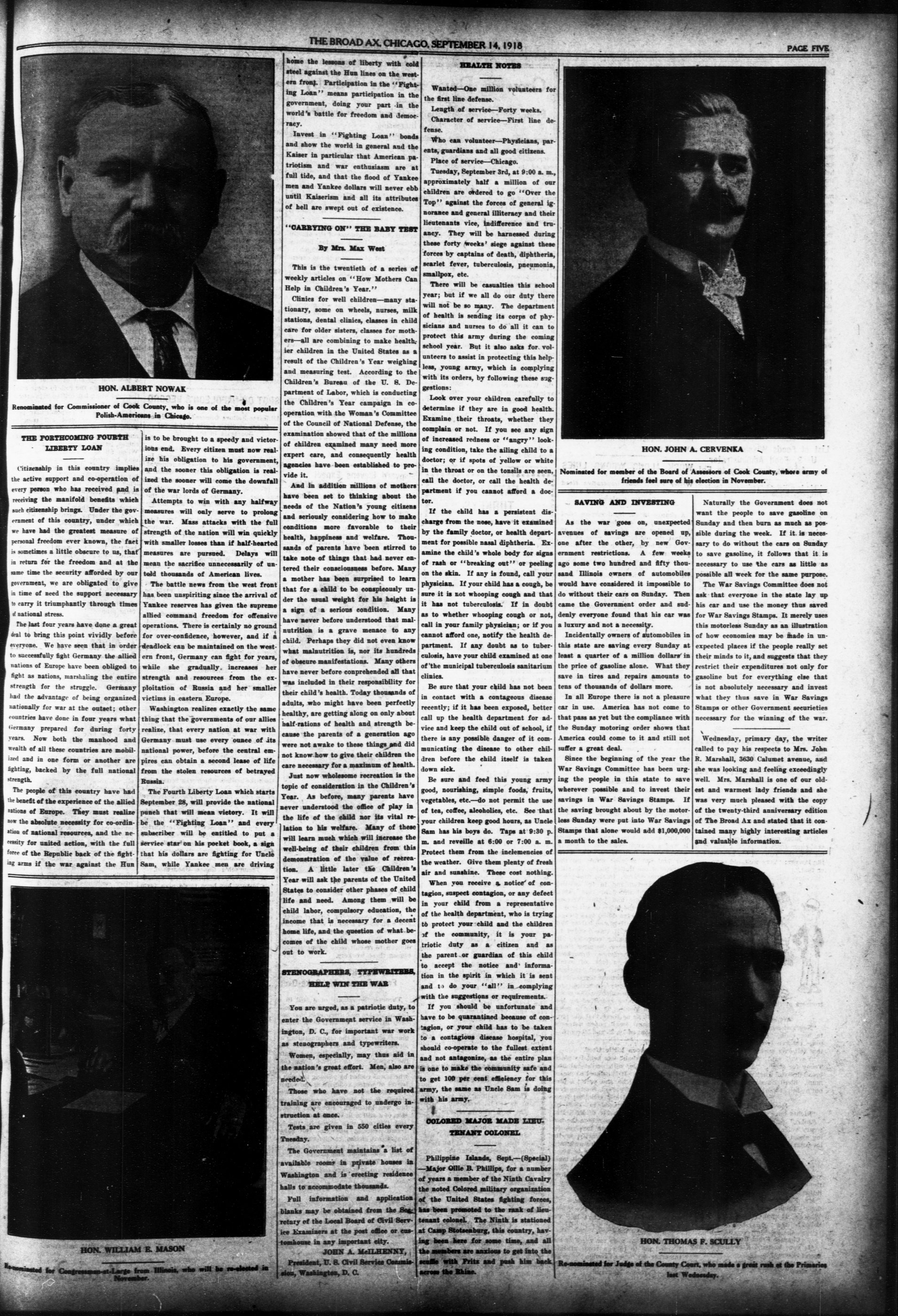
HON. ALBERT NOWAK Renominated for Commissioner of Cook County, who is one of the most popular Polish-Americans in Chicago.
THE PORTHCOMING POUBTH
LIBERTY LOAN
Citizenship in this country implies the active support and co-operation of every person who has received and is receiving the manifold benefits which such citizenship brings. Under the government of this country, under which we have had the greatest measure of personal freedom ever known, the fact is sometimes a little obscure to us, thaf in return for the freedom and at the same time the security afforded by our government, we are obligated to give in time of need the support necessary to carry it triumphantly through times of national stress.
The last four years have done a great deal to bring this point vividly before everyone. We have seen that in order to successfully fight Germany the allied nations of Europe have been obliged to fight as nations, marshaling the entire strength for the struggle. Germany had the advantage of being organized nationally for war at the outset; other countries have done in four years what Germany prepared for during forty years. Now both the manhood and wealth of all these countries are mobilized and in one form or another are fighting, backed by the full national strength.
The people of this country have had the benefit of the experience of the allied nations of Europe. They must realize now the absolute necessity for co-ordination of national resources, and the necessity for united action, with the full force of the Republic back of the fighting arms if the war against the Hun
HON. WILLIAM E. MASON
Re-nominated for Congressman-at-Large from Illinois, who will be re-elected in November.
is to be brought to a speedy and victorious end. Every citizen must now realize his obligation to his government; and the sooner this obligation is realized the sooner will come the downfall of the war lords of Germany.
Attempts to win with any halfway measures will only serve to prolong the war. Mass attacks with the full strength of the nation will win quickly with smaller losses than if half-hearted measures are pursued. Delays will mean the sacrifice unnecessarily of untold thousands of American lives.
The battle news from the west front has been unspiriting since the arrival of Yankee reserves has given the supreme allied command freedom for offensive operations. There is certainly no ground for over-confidence, however, and if a deadlock can be maintained on the western front, Germany can fight for years, while she gradually increases her strength and resources from the exploitation of Russia and her smaller victims in eastern Europe.
Washington realizes exactly the same thing that the governments of our allies realize, that every nation at war with Germany must use every ounce of its national power, before the central empires can obtain a second lease of life from the stolen resources of betrayed Russia.
The Fourth Liberty Loan which starts September 28, will provide the national punch that will mean victory. It will be the "Fighting Loan" and every subscriber will be entitled to put a service star on his pocket book, a sign that his dollars are fighting for Uncle Sam, while Yankee men are driving
home the lessons of liberty with cold steel against the Hun lines on the western front. Participation in the "Fighting Loan" means participation in the government, doing your part in the world's battle for freedom and democracy. Invest in "Fighting Loan" bonds and show the world in general and the Kaiser in particular that American patriotism and war enthusiasm are at full tide, and that the flood of Yankee men and Yankee dollars will never ebb until Kaiserism and all its attributes of hell are swept out of existence.
HEALTH NOTES
Wanted—One million volunteers the first line defense.
Length of service—Forty years.
Character of service—First fense.
Who can volunteer—Physicians, guardians and all good children.
Place of service—Chicago.
Tuesday, September 3rd, at approximately half a million children are ordered to go "Top" against the forces of g
"CARRYING ON" THE BABY TEST
By Mrs. Max West
This is the twentieth of a series of weekly articles on "How Mothers Can Help in Children's Year."
Clinics for well children—many stationary, some on wheels, nurses, milk stations, dental clinics, classes in child care for older sisters, classes for mothers—all are combining to make healthier children in the United States as a result of the Children's Year weighing and measuring test. According to the Children's Bureau of the U. S. Department of Labor, which is conducting the Children's Year campaign in cooperation with the Woman's Committee of the Council of National Defense, the examination showed that of the millions of children examined many need more expert care, and consequently health agencies have been established to provide it.
And in addition millions of mothers have been set to thinking about the needs of the Nation's young citizens and seriously considering how to make conditions more favorable to their health, happiness and welfare. Thousands of parents have been stirred to take note of things that had never entered their consciousness before. Many a mother has been surprised to learn that for a child to be conspicuously under the usual weight for his height is a sign of a serious condition. Many have never before understood that malnutrition is a grave menace to any child. Perhaps they did not even know what malnutrition is, nor its hundreds of obscure manifestations. Many others have never before comprehended all that was included in their responsibility for their child's health. Today thousands of adults, who might have been perfectly healthy, are getting along on only about half-rations of health and strength because the parents of a generation ago were not awake to these things and did not know how to give their children the care necessary for a maximum of health.
Just now wholesome recreation is the topic of consideration in the Children's Year. As before, many parents have never understood the office of play in the life of the child nor its vital relation to his welfare. Many of these will learn much which will increase the well-being of their children from this demonstration of the value of recreation. A little later the Children's Year will ask the parents of the United States to consider other phases of child life and need. Among them will be child labor, compulsory education, the income that is necessary for a decent home life, and the question of what becomes of the child whose mother goes out to work.
STENOGRAPHERS, TYPEWRITERS,
HELP WIN THE WAR
You are urged, as a patriotic duty, to enter the Government service in Washington, D. C., for important war work as stenographers and typewriters.
Women, especially, may thus aid in the nation's great effort. Men, also are needed.
Those who have not the required training are encouraged to undergo instruction at once.
Tests are given in 550 cities every Tuesday.
The Government maintains a list of available rooms in private houses in Washington and is erecting residence halls to accommodate thousands.
Full information and application blanks may be obtained from the Secretary of the Local Board of Civil Service Examiners at the post office or customhouse in any important city.
JOHN A. MEILHENNY,
President, U. S. Civil Service Commission, Washington, D. C.
Wanted—One million volunteers for the first line defense.
Length of service—Forty weeks.
Character of service—First line defense.
Who can volunteer—Physicians, parents, guardians and all good citizens.
Tuesday, September 3rd, at 9:00 a.m. approximately half a million of our children are ordered to go "Over the Top" against the forces of general ignorance and general illiteracy and their lieutenants vice, indifference and truancy. They will be harnessed during these forty weeks' siege against these forces by captains of death, diphtheria, scarlet fever, tuberculosis, pneumonia, smallpox, etc.
There will be casualties this school year; but if we all do our duty there will not be so many. The department of health is sending its corps of physicians and nurses to do all it can to protect this army during the coming school year. But it also asks for volunteers to assist in protecting this helpless, young army, which is complying with its orders, by following these suggestions:
Look over your children carefully to determine if they are in good health. Examine their throats, whether they complain or not. If you see any sign of increased redness or "angry" looking condition, take the ailing child to a doctor; or if spots of yellow or white in the throat or on the tonsils are seen, call the doctor, or call the health department if you cannot afford a doctor.
If the child has a persistent discharge from the nose, have it examined by the family doctor, or health department for possible nasal diphtheria. Examine the child's whole body for signs of rash or "breaking out" or peeling on the skin. If any is found, call your physician. If your child has a cough, be sure it is not whooping cough and that it has not tuberculosis. If in doubt as to whether whooping cough or not, call in your family physician; or if you cannot afford one, notify the health department. If any doubt as to tuberculosis, have your child examined at one of the municipal tuberculosis sanitarium clinics.
Be sure that your child has not been in contact with a contagious disease recently; if it has been exposed, better call up the health department for advice and keep the child out of school, if there is any possible danger of it communicating the disease to other children before the child itself is taken down sick.
Be sure and feed this young army good, nourishing, simple foods, fruits, vegetables, etc.—do not permit the use of tea, coffee, alcoholies, etc. See that your children keep good hours, as Uncle Sam has his boys do. Taps at 9:30 p.m. and reveille at 6:00 or 7:00 a.m. Protect them from the inclementies of the weather. Give them plenty of fresh air and sunshine. These cost nothing
When you receive a notice of contagion, suspect contagion, or any defect in your child from a representative of the health department, who is trying to protect your child and the children of the community, it is your patriotic duty as a citizen and as the parent or guardian of this child to accept the notice and information in the spirit in which it is sent and to do your "all" in complying with the suggestions or requirements.
If you should be unfortunate and have to be quarantined because of contagion, or your child has to be taken to a contagious disease hospital, you should co-operate to the fullest extent and not antagonize, as the entire plan is one to make the community safe and to get 100 per cent efficiency for this army, the same as Uncle Sam is doing with his army.
Philippine Islands, Sept.—(Special)
—Major Ollie B. Phillips, for a number of years a member of the Ninth Cavalry the noted Colored military organization of the United States fighting forces, has been promoted to the rank of lieutenant colonel. The Ninth is stationed at Camp Stotsenburg, this country, having been here for some time, and all the members are anxious to get into the saddle with Pritz and push him back across the Rhine.
Nominated for member of the Board of Assessors of Cook County, where army of friends feel sure of his election in November.
Nominated for member of the Board of Assessors of Cook County, where army of friends feel sure of his election in November.
HON. THOMAS F. SCULLY
Re-nominated for Judge of the County Court, who made a great rush at the Primaries last Wednesday.
SAVING AND INVESTING
As the war goes on, unexpected avenues of savings are opened up, one after the other, by new Government restrictions. A few weeks ago some two hundred and fifty thousand Illinois owners of automobiles would have considered it impossible to do without their cars on Sunday. Then came the Government order and suddenly everyone found that his car was a luxury and not a necessity. Incidentally owners of automobiles in this state are saving every Sunday at least a quarter of a million dollars in the price of gasoline alone. What they save in tires and repairs amounts to tens of thousands of dollars more.
In all Europe there is not a pleasure car in use. America has not come to that pass as yet but the compliance with the Sunday motoring order shows that America could come to it and still not suffer a great deal.
Since the beginning of the year the War Savings Committee has been urging the people in this state to save wherever possible and to invest their savings in War Savings Stamps. If the saving brought about by the motorless Sunday were put into War Savings Stamps that alone would add $1,000,000 a month to the sales.
PAGE FIVE
A. CERVENKA
Assessors of Cook County, whose army of election in November.
Naturally the Government does not want the people to save gasoline on Sunday and then burn as much as possible during the week. If it is necessary to do without the cars on Sunday to save gasoline, it follows that it is necessary to use the cars as little as possible all week for the same purpose.
The War Savings Committee does not ask that everyone in the state lay up his car and use the money thus saved for War Savings Stamps. It merely uses this motorless Sunday as an illustration of how economies may be made in unexpected places if the people really set their minds to it, and suggests that they restrict their expenditures not only for gasoline but for everything else that is not absolutely necessary and invest what they thus save in War Savings Stamps or other Government securities necessary for the winning of the war.
Wednesday, primary day, the writer called to pay his respects to Mrs. John R. Marshall, 3630 Calumet avenue, and she was looking and feeling exceedingly well. Mrs. Marshall is one of our oldest and warmest lady friends and she was very much pleased with the copy of the twenty-third anniversary edition of The Broad Ax and stated that it contained many highly interesting articles and valuable information.
```markdown
```
The United States government wants dogs and cats. The feline and canine creatures have come into their own, observes a Baltimore correspondent. They are being taken in large numbers all over the country. Just what use is being made of them is not known, though some of the cats are being used for experimental work in the government laboratories. The municipal dog shelter in Baltimore is furnishing, on an average, 75 dogs a week, and an effort is being made to secure as many cats. All dogs at the dog shelter on Covington street were requisitioned by the bureau of mines at Washington six weeks ago when 112 dogs were taken. Since then all that have been collected in the city have been turned over to the government agents.
The bureau of mines in asking for them asserted that they would pay all expenses of shipping, which greatly lessens the burden here as the dogs do not have to be killed as heretofore. Licensed dogs which are picked up are held for 15 days before being sent away, but strays are shipped as soon as received. Sick or maimed animals are not wanted and they are killed. Before the government asked for these animals, only dogs were taken by the "dogs catchers" throughout Baltimore. Now, however, the fellines are more desired by the government than are the dogs. Kittens are not desired but especially are the nice fat tabbles wanted. So if any housewife desires to be really patriotic all she has to do is to put kitty in a sack and call the "dog catcher."
List of Foods Which the U. S. Food Administrator Advises Everybody to Eat
This is a list of "protective foods:" Brussels sprouts. Cabbage. Cauliflower. Celery. Collards. Lettuce. Milk. Onions. Spinach. Swiss chard.
If we include some of them in our diet every day, we will be sure of getting enough mineral matter. These are all foods which the United States food administration advises you to eat.
BREAKFAST.
Hominy Grits With Top Milk.
Toast.
Coffee.
LUNCH.
Welsh Rarebit.
Buttered Beets.
Pear Salad.
DINNER.
Pan-Fried Perch.
Creamed Potatoes.
Scalloped Onions.
Brown Betty With Cream.
MERRY JESTS
Their Real Worth.
One day as a leading lawyer and a judge, both of Boston, were walking together the lawyer said:
"Judge, let's go into partnership. You furnish the money and I'll furnish the brains."
The judge quickly pulled out a two-cent-piece from his pocket, and holding it in the palm of his hand said to the lawyer: "Very well, old chap, cover that."
Qualified.
Sergeant (after investigation as to parentage). Mon, ye seem to have no qualifications for entrance into a Scottish regiment—think, noo, think; have ye nae property in Scotland?
Recruit (hopefully). Well, yes, I have a pair of trousers at the Perth dye works.
Art of Substitution.
"Neurasthenia," said Mrs. Biggums to her cook. "I think we will have some chicken croquettes today out of that left-over pork and calves' liver."
"Yes'm," said Neurasthenia, called Teeny for short. "An' we got a little bread dressin' what went wid the pork, mum. Shall I make some apple sauce out'n hit, mum?"
Money That Flower.
"Riches have wings!"
"John," said the woman with the weny voice, "I wish you'd stop reading about the reports of that airplane investigation."
At the Reception.
Professor—Do you subscribe to the theory of evolution?
Mr. Newrich—I don't think so. Where's it published?
Chapter From Regulation.
"Is your husband a member of any secret society?"
"He thinks he is, but he talks in his sleep."
1
TO RECLAIM DISMAL SWAMP
Engineers Have Long Had Their Eyes on Picturesque Wilderness Which Can Be Made Valuable.
Dismal Swamp, which lies just south of Norfolk, Va., partly in that state and partly in North Carolina, is one of the most picturesque wildernesses in the eastern United States. Although it may be reached from the busy port of Norfolk within a few hours by a boat which plies daily up and down a small canal, the Dismal Swamp remains an unspoiled wilderness where black bears and panthers still roam, while the smaller creatures of the wild exist in abundance.
The thick jungles and bottomless bogs at once offer perfect hiding places for the wild things and obstacles to the hunter which are often impassable. Then, too, the swamp is alive with snakes—the deadly copperhead and moccasin being especially abundant—and this fact alone detracts considerably from the popularity of the place as a pleasure resort.
It is nevertheless regularly visited by some hardy hunters, and is the delight of naturalists and scientists of all kinds, who here find what they most love—unpooled, primitive nature.
The Dismal Swamp has great possibilities of future usefulness. In the first place, it contains some of the deepest and richest deposits of peat in the United States, and this fuel is undoubtedly to be used in this country in the near future. Furthermore, engineers say that the swamp can be drained, and that it will then become one of the richest bits of farmland in America. Indeed, one man has already demonstrated this by draining a few hundred acres of the swamp and raising phenomenal crops on it.—Chicago Daily News.
WORK ALONG WRONG LINES
Writer Points Out Imperative Need for Change in Present Legal and Charity Systems.
A change in our legal system must be made which will take account of the complex life of the present, as against the old-fashioned form of living, which brought with it temptation, greed and jealousy. Persons who, on account of wrong environment, have stooped to illegitimate means to attain their ends should be corrected, with discipline if you please, but not with brutal punishment. After correction they should have the chance to make an honest living; they should not be ostracized as at present, so that there is nothing else left for them to do but to return to a life of crime which sooner or later reaches the depths, when the state is forced to spend thousands and thousands for their upkeep.
The creation of beggars has never been due to the exercise of kindness. All beggars are made, more or less, by the charity system. With charity abolished and every individual understanding that we are all born to work and enjoy our work in accordance with our fitness for the work we are called upon to do, there will be no need of charity, and crime and disease will be lessened tremendously.—Editorial by Misha Appelbaum in Humanitarian.
"Shinplasters."
One of the curious forms of money to which the United States government has resorted was the "shinplaster currency." These bits of paper money were called "shinplasters" by reason of their size and not because of the use to which they were put. It was a strange condition of affairs which led to their issue. The Civil war had put a great strain on the finances of the United States, Metallic money grew scarce. In the first place it was exported and in the second place it was hoarded in vast sums. The government had issued "greenbacks" to take the place of silver dollars and five and ten dollar gold pieces, and as dimes, quarters and halves had also grown scarce it was decided to issue fractional paper currency. It was seriously needed, because there was great inconvenience throughout the country from a lack of small change. Merchants used postage stamps, tokens of various forms, their own "promises to pay" or script, and even buttons were employed as small change, to be later redeemed by the merchant in goods. It was to meet such conditions as these that the government issued small paper notes in denominations of 10, 25 and 50 cents.
Pronoun Little Used.
The form "thon" has held its place in the language, with occasional use, for sixty years. It is defined as meaning "That one; he, she, or it; a pronoun of the third person, common gender; a contracted and solidified form of 'that one,' proposed in 1888 by Charles Cromat Converse of Erie, Pa., as a substitute in cases where the use of a restrictive pronoun involves either inaccuracy, or obscurity, or its non-employment necessitates awkward repetition." As an example is given the substitution of "Each pupil must learn thon's lesson" for "Each pupil must learn his or her lesson"—Literary Digest.
Try a Rumer Next Time.
Sutchter—Listen, Tellit, I've got to get another room. I don't like the landlady.
Tellit—Why not?
Sutchter—She asks too much of me. Wanted me to take a room upstairs the other day, when I couldn't even get my arms around her, let alone the room.—Curbious Magazine.
THE BROAD AX, CHICAGO, SEPTEMBER 14, 1918
That the growing of herbs, necessary in the industrial arts and in medicine, is increasing by leaps and bounds in the United States is the opinion of members of the American Pharmaceutical association. The war furnished the necessary stimulus when the most important drugs became otherwise unobtainable.
Not all that is being done can be published, but rumor has it that plants used in gas warfare are now being grown "somewhere in America." The airplane industry, too, accounts for the high cost of castor oil, which is valuable since it does not gum. Castor beans are being extensively grown in Florida, Texas and southern California.
Japan, among the foreign countries, has most rapidly taken up this plant cultivation, according to Clare O. Ewing, acting pharmacognocist of the bureau of chemistry. Nippon now exports a huge amount of insect powder, besides furnishing the United States with castor beans, mustard seed and valerian.
The plant industry is not primarily a commercial game, as it is too expensive, for the most part, to be profitable, say the growers. Much experimenting is being done today by the federal and state governments, by botanical gardens connected with the universities and colleges, by drug houses and individuals. In the case of certain drugs they have succeeded in producing the best quality and at a profit.
Doctor Rushy, dean of the College of Pharmacy, Columbia college, New York, and scientific director of the New York botanical gardens, said: "Success is possible, but is bound to be limited. Inexperienced and ignorant people will meet with failure. Special knowledge is needed to grow drugs. A good farmer is not enough. The man must be a trained botanist as well. Each separate drug must be studied and the methods of growing it be experimented with. Again, only a relatively small number of drugs can be grown in any one region."
The most important drugs now being produced in this country are:
Digitalis, the well-known heart tonic, which was found to be growing wild on the Western coast and is now collected. The University of Minnesota cultivates digitalis for the government.
Belladonna, which was difficult to obtain but which is grown on a large scale today.
Henbane leaf, which is still being experimented with by many. It is difficult to get, but is valuable in both medicine and the industrial arts.
Of the less important plants which are being cultivated, there are: Golden seal, a rare and expensive drug, difficult to grow. Twenty-five years ago it sold at 15 cents a pound. Today it is $5 and $6 a pound. Sage, peppermint, burdock root and Indian hemp, a narcotic.
The turkey, being somewhat of a wild fowl, does not take kindly to small pens and is usually fattened on the range. Birds that are to be marketed for the holiday trade are given all the cracked corn they will eat twice a day. When freezing weather comes early and destroys insect life it is advisable to furnish some form of meat feed, such as commercial meatscrap, where birds can have easy access to it.
In case a local market is to be supplied it is possible to feed turkeys in crates. The birds are put in small crates in a quiet, protected building and fed three times a day on batter made of cornmeal, low grade flour, meat scraps and a small amount of bran mixed with buttermilk. This method is more expensive and only practical where markets are to be supplied. The old range method of fattening is more desirable as well as economical.
Care should be taken to remove all breeding stock from the birds selected for market, as it is not desirable that those to be kept over should become too fat.
American Medal of Honor
Is the Hardest to Gain;
The Most Rarely Awarded
Naval and military men of America claim that their medal of honor, the equivalent to Britain's Victoria Cross, is the hardest to gain, the most rarely awarded, and therefore the most precious and least known of all such decorations throughout the world. When a man is entitled to wear an inconspicuous bronze star pendant from a blue ribbon on which are 13 white stars, it is certain that he has performed a deed of almost superhuman fearlessness. The Medal of Honor is a five-pointed star with a medallion in the center bearing the head of Minerva and around it "United States of America" in relief. On each ray of the star is an oak leaf, and the points themselves are trefoil-shaped. A laurel wreath in green enamel encircles the whole, and this wreath is surmounted by the word "Valor," which in turn is surmounted by an eagle that attaches the decoration to its ribbon. The holder of this decoration, if an army man, wears, when in service uniform, a button or badge, six-sided, and made of blue silk with 13 white stars if in the navy the decoration is represented by a small red, white and blue bow knot.
For Reflection.
There's nothing so unimportant as self-importance.
The man who is always welcomed at home is usually welcomed everywhere else.
Success is nothing more nor less than doing well at the right minute something that the world wants done well.
The reason some men succeed is because they are determined to make the knockers and the scoffers take back what they said.
Cellulose Dressing.
Swedish physicians have perfected a cellulose dressing for wounds that is made in thin sheets like tissue paper from chemical wood pulp.
Professional football will be played in the Pacific Northwest this fall. Bruce Smith, for four years star halfback of the Notre Dame team, is now a shipbuilder in Seattle, and with Tad Jones is making plans for several shipyard eleveens to be pitched against sol-
INTERNATIONAL
MEDIA SERVICES
Tad Jones.
dier and sailor teams. Smith was captain of the Notre Dame eleven in 1811. A large number of former college and high school football stars are now working in the shipyards of the Northwest, and Smith believes it will not be difficult to recruit some strong elevens among these workers.
Alcohol May Be Distilled
Through the seizure of a still in a bakery in New Mexico, where a quantity of alcohol was discovered that had been distilled from bake-oven fumes, considerable discussion has taken place concerning the manufacturing of alcohol as a by-product of bread. The still was a crudely constructed affair, the vapor from the bread being conducted from the oven into a worm, which was cooled by passing through a barrel of water, condensing the vapor. The baker was not arrested, as it was clearly shown that no evasion of the law was intended. However, possession of a still is in violation of the law, and this one was selzed by the internal revenue service. The baker states that alcohol can be manufactured for war use at a very small cost by army bake shops and bakers in large cities. The practicability of the plan remains to be worked out.
The Torrens System.
The Torrens system of registering the ownership of real property is in legal effect in California, Illinois, Massachusetts, Oregon, Minnesota, Colorado, Washington, New York, North Carolina, Ohio, Mississippi, Nebraska, South Carolina, Virginia. Georgia, North Dakota, South Dakota a nessice.
WHERE TAXES ARE UNKNOWN
Some Few Places on Earth's Surface
That Would Seem Ideal Spots
in Which to Locate.
In these days of expensive living
what a boon to live in a city without
taxes! But there are such places.
There is Orson in Sweden. This
municipality has its ordinary city
expenses, but it imposes no taxes. More-
over, the local railway is free to every
citizen and there is no charge for tele-
phone service, schools, libraries and
the like.
All this is due to the wisdom of a
former generation, who planted trees
on all the available ground, with the
result that during the past thirty
years the town authorities have sold
$5,000,000 worth of young trees and
timber, while judicious replantings
have provided for a similar income in
the future.
Then there is Mournalon, in the Midi, France. Here not only are there no taxes, but the timbers on the communal lands are sufficient to grant each person a small annuity.
Nearer home we have the island of Innismurray, off the west coast of Ireland. Here there are no taxes, simply because the fourteen families who live on the island resolutely refuse to pay. In a report to the local government board a rate collector stated that he could not get a boat on the mainland to take him to the island on such an errand as collecting rates.—London Mail.
SPOT ON NAPOLEON'S RECORD
Ultimate Failure Dimmed the Glory of Great Soldier's Early Wonderful Successes in the Field.
The military genius of Bonaparte is still a fruitful theme for discussion. In the early part of his career he achieved such successes as made his name a terror to Europe, and gained for him a prestige which a series of continuous and overwhelming defeats in the latter part of his history was unable to destroy. But in the game of war, results alone can form the criterion, and the victories of Marengo, Austerlitz and Wagram can scarcely be admitted in compensation for the blunders of the Russian campaign and the overthrow at Waterloo.
One qualification of a great general was conspicuous in his character, the capacity of recognizing and rewarding merit in whatever position it might be found. Favoritism was almost unknown in his army. He was of a cold-blooded temperament, engrossed exclusively by the master-passion, ambition, and the very cause which kept his moral purity involate made him almost insensible to the promptings of love and affection.
Scarpio
Scorpio is a constellation and the eighth sign of the zodiac. The constellation is conspicuous in early summer in the skies of the southern United States, where the whole of the magnificent tail clears the horizon. With the Chaldeans and Greeks it extended over one-sixth of the planetary circle, the Scorpio being represented with exaggerated claws embracing a circular space where Libra is now placed. From this irregularity it may be inferred that the constellation is older than the zodiac, which was formed before 2000 B. C. Libra, though later, is of no small antiquity, since it appears in the Egyptian zodiacs. Its adoption by Julius Caesar in his calendar made it familiar. Ptolemy, however, though living in Egypt nearly two centuries later, follows Babylonian and Greek astronomers in covering the place of Libra with the Scorpio's claws.
Tecumseh's Bonae Unearthed.
A discovery recalling early Canadian history has been made at a farm in the village of Thamesville, Ont., where bones were dug up which may be those of the Indian Chief Tecumseh, who fell fighting for the British in 1813. With the skeleton were metal military buttons and a pistol of the type then used. There are most trustworthy reports that the chief had been buried close to this place. Tecumseh, a Shawnee chief, fought with the British during the invasion of Canada by the Americans in 1812 and 1813. A man of great energy and decision, he was entrusted with many minor enterprises, and was finally killed in battle, when his body was treated with great indignity.
Hurry and Health
Don't hurry. It wears the system like worry. It is especially harmful in hot weather.
Hurry tears out the nerves and the body tissues rapidly, puts lines in the face, interferes with digestion and other intestinal action, and in time may produce permanent palpitation of the heart.
Loss of both physical and mental control and a number of varieties of nervous disorders may also result from chronic "hurrying up."
Hurry exhausts twice the energies in a given time that would be required to accomplish twice the work if undertaken in a leisurely manner.
"Coch. denn B. I. did for two hours
didn't catch it with a reasonable
thick of that for a man but I don'
guessed to a carp for her pity."—Boe
(Transcript).
It is not unlikely that one of the first great undertakings after the war will be the raising of the Lusitania, note New York World. The vessel carried a huge treasure to the bottom of the sea. Its value is estimated at $14,000,000, of which $2,000,000 is in gold and silver, brass and copper; a like amount in jewelry and other personal valuables; $5,000,000 in negligible and unregistered securities in the ship's vault, and a cargo valued at $000,000. Much of the latter is be-loved to be uninjured.
The great ship lies on the shifting sands at the bottom of St. George channel, in 270 feet of water. Divers and pontoons cannot operate at the depth, so an entirely new type of navage ship has been designed by a marine engineer, Carl J. Lindquist. At the surface it will be only about thirty feet in length and half that in width but sweeping downward is a hall which may be extended to a length of 300 feet, and which is mounted on big wheels, resting upon the bed of the sea.
Near the bottom is a large search light, capable of illuminating the water for a distance of thirty feet or more, and by means of this the helmsman, far below the surface, will direct the operation of a hollow, flexible steel rod. When the sunken ship is located a powerful stream of water will be forced through the rod, to clear away the sand which has drifted high around the lost craft.
Four enormous perpendicular pontoons of hollow steel will then be sunk, two on each side of the ship and to them will be attached huge cables, passing under the sunken hull. When all is in readiness the vessel may be lifted to the surface. There the gaping wound in her side can be repaired and the ship floated into port. This is but an outline of a most ingenious plan, one single feature being the hinged bases of the pontoons which permit them to sway back and forth in stormy weather without releasing their burdens.
Nor will their usefulness end with the raising of the Lusitania. The ocean bed off the west coast of Europe is dotted with rich prizes. Near Harve, is 150 feet of water, rests the Parthenon with a $7,000,000 cargo; the Healdton an American ship, carried $3,000,000 worth of goods to the bottom off the Dutch coast, while but ten miles from the Lusitania the Arabic took her fatal plunge.
Fatal effect of luxury and ease!
We drink our poison and we eat disease
Indulge our senses at our reason's cost
Till sense is pain and reason hurt or lost
Salada for the Family
The salad dressing is as important in a good salad as is the combination of ingredients.
For the lover of olive oil no dressing is as good as the French dressing and mayonnaise. In the present condition of the market when high grade oil is so costly we will have to use some substitute. Corn oil is a fair oil, of good flavor and may be used in mayonnaise, giving us a most agreeable if not as fine flavored a dressing as olive oil.
Put a yolk of egg with a half teaspoonful of salt, a teaspoonful of powdered sugar, a pinch of mustard and cayenne with two tablespoonful of lemon juice in a cold bowl, beat with a dover egg beater until thick and well blended, then add a table spoonful of corn oil, beat well and continue to add the oil, beating well after each addition until a cupful of the oil is used.
Combination Salad
Take two cupfuls of chopped apple one finely diced banana, a dozen chopped dates, a cupful of chopped celery and a cupful of good salad dressing. Mix well, and season with salt and a dash of cayenne. Serve in nests of lettuce.
Sweetbread and Almond Salad.
Parboll a pair of sweetbreads, and stand aside to cool. Cut up in small pieces. Blanch twenty-four almonds, dry in the oven, then chop rather fine. When ready to serve, cover a dish with crisp lettuce, mix the almonds and sweetbreads, add a half teaspoonful of salt, a dash of paprika, a table-spoonful of Worcestershire sauce and mix thoroughly.
Add a stiff mayonnaise dressing and arrange on the lettuce.
Peel and chop three solid tomatoes after removing the seeds, add a teaspoonful of salt, a tablespoonful of lemon juice, a tablespoonful of chopped onion, the same of green pepper and a half teaspoonful of paprika. Mix and turn into the dish in which it is to be served. Stir coconut cream until thick and pour four tablespoons over the tomatoes and serve.
To make the coconut cream, grate a good sized coconut and pour over it a pint of boiling water, stir and let stand until all the goodness has been washed out of the nut. Turn into a cheesecloth and press dry. Let this milk stand over night and by morning a good thick cream will be formed over the top. Remove the cream and use the milk underneath for various sauces.
Neeii Marneel
Draped Garment Has to Do With Waistline Question.
Most Possible to Wear Cultrass Blouse
and Chemise Tunic With the Narrow Skirt That Sweeps the Instep.
New York.—War necessity everywhere! Ingenuity expressed, therefore, in a thousand ways. Turning and twisting to find out how good results can be obtained through uncharted channels is the effort of each individual, the mass of shops, and the host of designers.
This is the summing up, writes a fashion authority, of the entire spirit is expressed in women's apparel. It not a continental spirit; it is a world spirit. It pervades lands where fighting is unknown; it rules in homes from which no fighters have gone and in which there has always been a severe confidence in the ability to arrive at a comfortable conclusion.
The old, easy method of dressing was vanished. Perhaps it is gone forever. It is a temptation to dip back into the past and recount the episodic adventures and experiences through which women have gone when great wars devastated a country and used up its raw materials.
It is not only the constitution that follows the flag; it is women's apparel that follows it for years after the flag has ceased to be a symbol of battle and remains only a symbol of patriotism. All the great wars have definitely changed the course of women's clothes, although they may not have left upon them the lasting impressions that wars have left upon men's clothes. The male portion of the world rarely thinks of this fact—that every garment he wears is almost directly responsible to some explosion of mankind.
Reverting to Pioneer Days.
It is no simple thing to saunter down Maln street today, drop into a shop and buy any kind of galloon, braid, embroidery or other ornamentation for gowns. One finds that manufactured articles are becoming more and more limited. The war industries court has gone into the situation with and thoroughness that manufacturers have been requested to lop off several thousand items that are considered as nonessentials.
Once upon a time this world, which clearly loves a phrase, twisted and turned the words "irreducible minimum" in fantastic ways to suit a variety of meanings. This phrase was a
FASHION
The sketch shows a gown of heavy black satin, with a barrel effect obtained in the skirt through width at the hips and narrowness at the hem, and the whole surface laid with flat tucks. The tight bodice finishes at the normal waistline with a narrow cravat suit. There is a fence collar of white organdie. The fluted hat is of black satin with a crown of arms.
dister in popularity to President Cleveland's famous "innocuous desuetude." Today the expression that has superceded all others is "the elimination of nonessentials," and there are thousands of women who will tell you that that means both "irreducible minimum" and "innocuous desuetude." It is well for an extravagant continent that the irreducible minimum can be arrived at through compulsion.
Trimmed With Bits of Themselves.
A report of what women have done in devising ornamentation for their clothes would read as an interesting bit of war history. Out from the depths have come some of the ornaments.
The decorations have been
have found that the best way to trim a gown is with itself. There is very little danger then of its becoming a patchwork quilt. Tucks have returned, therefore. They have been launched on the new autumn gowns as something of a novelty. They are not permitted in woolen clothes, because the government asks us to omit every inch of superfluous worsted material, but we are omitting it by the yardage instead of the inch, and are finding ourselves quite content with composition gowns that have only a dash of wool in them, and often none at all. A woman depends on furs, capes and top coats for warmth. As for the materials which are available today, they may last through the winter. There is much talk of wearing satin, taffeta, pongee and va-
A
Wide tucks trim the most fastidious gowns. The frock is of heavy Chinese silk, with tucks from hip to hem and a row of white crochet buttons. The full sleeves are held in with tucked wristlets.
rious heavy Chinese silks throughout the cold weather, making them comfortable for the open or for heatless houses by the addition of warm underwear and top coverings.
The designers have banked heavily on the usage of thin materials for next winter and therefore they have brought about this resurrected fashion of trimming a gown with itself, which is quite easily done when the material is soft and pliable.
When tucks are used they are arranged horizontally. They do not confuse themselves with pleats, which are vertical. A few of the new skirts are tacked from the bone of the hips to the hem, the tucks touching each other and made from an inch to two inches wide. Sometimes this constitutes the entire trimming of a gown. But when the shirt is extra narrow at the hem the barrel effect is more striking than it has been for two years.
Foulard First Choice for Autumn.
There is really an extraordinary amount of foulard worn in the changeable September weather. It is so comfortable in the house, and so easily covered in the open, that it presents itself as first aid to being well dressed. There are broadly checked foulards in black and white, and others that have a dull blue or orange stripe or figure running through the checks. Whatever the choice, they are made simply. One does not go in for Chinese blue, pink or amethyst these days, except when one wears gowns in the house that have served through the summer, but colors such as black and white, purple and brown, gray and deep blue are chosen in these foulards for the street.
This fabric lends itself admirably to self-trimming. The skirts are tucked from hip to hem or knees to hem, and when there is a peplum or a long chemise tunic it has five or eight tucks to finish it.
Affecting the Waistline.
There is no possibility of reducing our waists to a small measurement. The planked-shad type which has prevailed for eight years can wear its mashers where it plesses, but what about the thousands of other women, thin and stout, who have allowed their waists to broaden out into sculptural measurements? These waists have muscles that are strong and unpliable, and they will not be squeezed in by corsets. Therefore, only the willow type—the slim, little, boneless youngster—can pull in her waist and tie a cushion around it with impunity.
One thing is practically certain: If the tight, draped skirt brings back the normal waist, women will allow the straight line of their figures to continge, and they will merely drape the waist in its hew, large measurements, without an attempt to make themselves uncomfortable. (Copyright, 1991, by the McClure News-
THE BROAD AX, CHICAGO, SEPTEMBER 14, 1918
BLUE--MORE BLUE
Autumn's "Call to the Colors" Issues Summons.
Whole Rainbows of Shades in Great Fashion Shows, Correspondents Relate—New Names.
To paraphrase a much-quoted verse—Silhouettes may come and go, but new shades come forever!
There are whole rainbows in the New York fashion exhibits, writes a correspondent.
When the war began and we were bereft of imported dyes the prophets of calamity pictured the American public parading the earth in stainless white or crocky black, like animated pen and ink drawings.
All costumes were to be matters of sharp contrast and high visibility and scarlet and purple were to vanish from the earth.
Luckily their prophecies are unfulfilled and American women still go arrayed like illies of the field, in rainbow hues that stand up remarkably under repeated tubings.
The American dye makers are triumphant, and shoppers are no longer warned that heavenly colors are "not guaranteed to wash."
As usual, the new autumn season is to offer a fascinating array of new shades and of modified old shades in brand new names.
Dark blue continues its undisputed reign as the "best" color for all purposes.
Dark shades of blue are the favorites, both for street and evening wear. Mrs. Wilson, wife of the president, herself christened one deep shade of blue. "Liberty" and the war has bestowed on other dark shades the tifles of "Joffre," "Blue Devil," "Pollu," "Pershing" and "Overseas." "Casque" is the romantic name bestowed on a steel blue that reflects the light on "tin hats." Besides the war blues there are wonderful shades called Japan blues, and one alluringly dubbed "Cleopatra."
Purples, too, are exceedingly good this year, and all show the blue tints. Their new names are "Sammy," "Phlox," and "Yankee purple."
Among the browns, which range from khaki to seal shades, are many that take golden tones.
Beds will enjoy a new vogue, but they are rich rather than vivid, most of them inclining to brown tones—Burgundy, mulberry and lobster, with some wonderful "old" reds, such as Indian, geranium and terra cotta, the latter masked under a new name—"Dourga."
All grays will be unusually good, even those of bluish cast which ordinarily are reserved for the warm seasons.
However, the new ones, which hint of brown and yellow, are attractive and not so trying as the greens of other years.
FOR STREET WEAR THIS FALL
A
In selection of fall gowns one is attracted by this black satin, one-piece street frock with braid on the cuffs and top and bottom of the skirt.
THE WEEKLY PRESS
A black jet bead sunburst is scattered over this entire surface, affording a captivating and stylish adornment.
Heads in Water Color Are Effectively Used to Garnish an Attractive Evening Dress.
The water color artist has discovered new fields for conquest, and the bodices of evening dresses are the canvases used. The old flower motifs have been discarded, according to the official journal of the National Garment Retailers association, and newer things are taking their places.
"A certain evening frock's pink bodice," it says, "is ornamented with three little water-colored heads, which are about the size of a half dollar. One is the head of a giggling schoolgirl, befrilled and beribboned. Another is that of a budding "deb," and the third is of an English 'Johnny,' eyeglasses and sleek.
"The interesting point about this form of trimming lies in the fact that it is not a design or in the least conventionalized, but true life sketching very well executed. However, this makes all the more evident its harsh, exacting note on the soft bodice of an evening gown."
STYLES IN OUR HEADGEAR
Both Large and Small Hats, Loaded or Unloaded With Trimming, Fashionable This Season.
This is a season of wide diversity of ideas in millinery. As a very successful and well-known milliner remarked the other day, "Any style that is becoming is fashionable this season." You may wear big hats or little hats or hats of medium size, and they may be of any fabric practical for millinery; and as for trimming there are models rather elaborately trimmed, simply trimmed models and hats almost entirely devoid of trimming. This is indeed welcome news, and woe to the woman who does not have a becoming hat. She cannot blame it on the modes of the moment, but upon her own lack of judgment or care in the selection of this most important detail of her wardrobe.
SKIRTS SHORT AND TIGHTER
Latest Mandate From Goddess of Styles, According to Repeat Reaching New York.
Skirts are to be at least three inches shorter and much tighter this winter, writes a New York correspondent.
This is the latest mandate of the goddess of style, and the news was brought to American women here by Miss Margaret Dreaker, foreign buyer for a prominent American firm, who arrived from France.
"You can tell American women that styles for fall and winter call for skirts at least three inches shorter and much tighter," said Miss Dreaker. "Jackets are to be shorter, and tighter, too. All designs look toward the conservation of cloth. Prevailing colors will be brown, green, navy blue and taupe."
LITTLE THINGS OF FASHION
Embroidery done in colored silk floss is a form of trimming very flunch in vogue. It is widely used, especially on the sheer, thin fabrics.
The upturned hem, like a cuff at the bottom of the skirt, is not unknown. Now there appears a hem turned up for a short space—and buttoned back on the skirt.
The big collar is coming—that is, the very big, high, wide collar on the coat. It hugs up around the throat and it lies soft and close along the shoulders. Of course, it can be rolled back so that the threat is uncovered, if desired.
Wide fringe, and yet wider fringe, is used on the edges of apron tunics, on the bottom of skirts and on sleeves, either at the bottom edge or else as trimming bands. It can't, seemingly, be too wide.
Little undersleeves, slightly fulled above the snug narrow cuff, are featured on some very smart frocks of black satin. They are done sometimes in white satin, sometimes in black or white net, and have a curiously quaint look. One such set of undersleeves is finished around the wrist with tiny scallops, and the black satin edge of the sleeve is likewise scalloped in little half circles.
NEWSLEEVETRICK
Plan Admits of Extra Pairs of Arm Coverings.
Are Attached to Blouse of Muslin or Net, Which Serves as a Cornet Cover.
There has been designed a simple and popular midseason gown made with a loose pepium shirtwaist that has short sleeves and a rounded low neck. It is not only worn by young girls, but older women find it available for many of their daytime activities. It is made in black and other plain somber colors, and also in figured foulard and printed chiffon. It allows an extra pair of sleeves, and this trick is another revival of an ancient and honorable day when women were not extravagant and depended upon accessories to constantly enliven one well-chosen, dark-hued frock. The separate sleeves are made of muslin, pogee or even coarse lace.
A
Separate sleeves are a war-time invention. This frock of dark-blue and white figured fouland has a loose peplum blouse held in with a gilt hat cord. The skeleton blouse beneath has loose, flowing sleeves and a rolling collar of heavy white chiffon.
They are attached to a blouse of muslin or net, which serves as a corse-tcover and carries a collar that is pulled out over the frock.
It does not take much imagination to visualize the constant changes that can be played upon when separate sleeves and collars are permitted in one frock. True, they need constant washing, but many of them do not need starch, and all of them can be easily ironed at home.
It is prophesied, advises a fashion writer, that this form of dressing will grow more in evidence as the winter weather comes on, for the medievals saw in this method of clothing themselves a way to keep warm and to enliven their appearance. So be warned in time, and do not throw away a gown because its armholes and sleeves are worn out. It can be made into a medieval tunic or short apron, which can be worn over separate sleeves and collar attached to a skeleton blouse.
OF INTEREST TO WOMEN
Lady Marjorie Dalrymple, an English society girl, is engaged in making artificial limbs for mained British soldiers.
The fight for votes for women has been waged since 1878, and the suffrage amendment was first drafted in 1875 by Susan B. Anthony.
Mrs. Mary Sprunce grappled with and held a pickpocket until the arrival of a detective when the thief tried to steal her purse in the elevator of a Philadelphia department store.
Alice Lee, a young Chinese girl and a motion picture actress, is studying the production and operation of films with a view to exhibiting pictures in China showing the difference between the status of American and Chinese women in their respective countries and their treatment by the men of the two nationalities.
Miss Isabel Million, the Knoxville, Tenn., girl whose "dried apple dolls" have made her famous, uses her own secret process of preserving the apple after it is dried into the desired image. The department of woman's war work connected with a large department store of New York and Philadelphia held a three-day celebration in honor of Bastille day. The war emergency high school for girls held a summer course at Philadelphia, under the direction of Mrs. Lucy L. W. Williams. The course was prepared by Captain Moore of the ordnance department and included wartime housekeeping, government system of filing, bookkeeping, civic chemistry, current history, mathematics and elements of business.
PAGE 7
GOOD TIPS ABOUT FINISHING
Work About Armholes of Sleeveless Sport Blouse Furnishes Anny-ances for the inexperienced
Many an inexperienced dressmaker is going to find herself "stumped" when it comes to finishing the armholes of the sleeveless sport blouse, writes an authority. A simple "turning in" is a despairingly difficult thing to handle here, and so a binding is suggested 'instead. Quarter-inch bias pieces long enough to go easily about the circumference of the armhole are stitched close to the edge on the right side by machine, then turned over and under and slip-stitched by hand on the wrong side. This makes an attractive finish and one not in the least difficult to do.
The girl with an eye to smart trimming features will take advantage of the opportunities offered by such finishing to make it decorative and so distinguish her sport blouse from all others. The white linen blouse might be treated to a binding of rose satin, for instance. Vice versa, the white satin would be decidedly fetching bound in a colorful bit of cretonne. Also, if you want to go to the extra trouble, you might cord or pipe your binding just by way of emphasizing it; it makes an awfully smart fini*h*. There is another practical way of treating the armhole of a sleeveless jacket and that is a binding of braid, the silky kind that gives as a blaz band might. On cotton and linen material a soft cotton braid can be used in the same manner.
USE SUBSTITUTE FOR LINEN
Percale Reputed to Have Proved Practical and Popular—Good for Sheets and Pillow Cases.
The war has affected a number of things, and among others the supply, price and quality of linen. In fact, linen dealers declare that virtually no pure linen will be available next year and advise thrifty housewives to lay in as large a reserve supply as possible. This some of them are already finding it almost impossible to do, owing to the well-night prohibitive price to which household linens of all sorts have already risen. The thing to do then is to discover and use a substitute.
The substitute which has proved the most practical and popular is percale. Now percale is not particularly cheap, but, on the other hand, it is extremely serviceable, and, as the saying is, "there is no wear-out to it." It cannot be utilized as table linen, of course, but it makes excellent sheets and pillow and bolster cases. In fact, for these purposes, it has the advantage over linen, which mushes abominably after one using, while the "dressing" in percale keeps it fresh and unrumpled much longer.
SASH IS ONE REQUIREMENT
No Frock Is Modish Without the Popular Adornment—Gingham More Exclusive Than Ribbon.
No gingham or calico frock may count itself truly modish sans a sash of its own material. Much, much more exclusive is a gingham sash than one of ribbon! The sash is made of two strips of the fabric, seamed up around the edges, and usually the ends are cut in points or ovals. Such a sash falls just below the hip, one end over the other, a small butterfly bow being tied at the back of the waistline. Sometimes the sash is part of the surplice fronts of the bodice; sometimes it is quite separate from the frock. Next in favor to the modest gingham is printed cotton or percale, and it makes a charming gown, especially when the material is spotted or striped.
One of the virtues of plaid gingham is the delightful way in which it combines with plain materials. For sport wear a frock of gingham may be made very chic by the plain one-tone trimmings, or the jacket or Russian blouse may be of the plain materials, while the skirt and blouse trimmings may be of the plaid.
COAT THAT ASSURES SERVICE
MIN
Every woman with a cane of clothes that instantly recognizes a beautiful achievement in any garment, will admire the coat pictured here. It is of broadcloth with large, convertible collar of Hudson seal, and there are two fur bells on the back. The sleeves are novel and graceful with wide cuffs and there is a girdle across the front fastened with large ornamental cutouts. Other fur than seal might be used for the collar and balls.
1