The Broad Ax
Saturday, December 28, 1918
Chicago, Illinois
Page text (machine-generated)
THE BROAD AX
HEW TO THE LINE; LET THE CHIPS FALL WHERE THE MAY
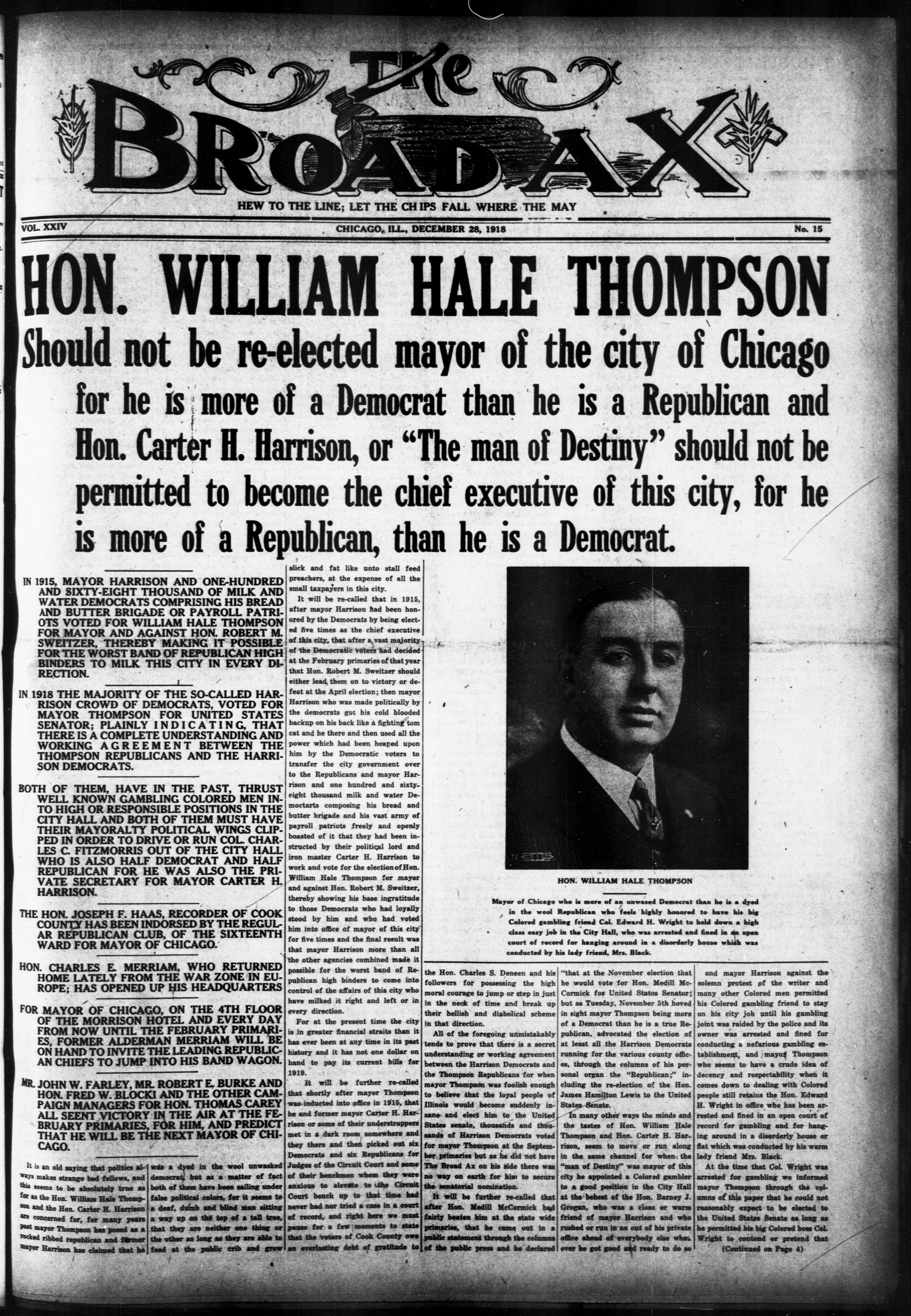
HON. WILLIAM HALE THOMPSON Should not be re-elected mayor of the city of Chicago for he is more of a Democrat than he is a Republican and Hon. Carter H. Harrison, or "The man of Destiny" should not be permitted to become the chief executive of this city, for he is more of a Republican, than he is a Democrat.
Mayor of Chicago who is more of an unwased Democrat than he is a dyed in the wool Republican who feels highly honored to have his big Colored gambling friend Col. Edward H. Wright to hold down a high class easy job in the City Hall, who was arrested and fined in an open court of record for hanging around in a disorderly house which was conducted by his lady friend, Mrs. Black.
IN 1915, MAYOR HARRISON AND ONE-HUNDRED AND SIXTY-EIGHT THOUSAND OF MILK AND WATER DEMOCRATS COMPRISING HIS BREAD AND BUTTER BRIGADE OR PAYROLL PATRIOTS VOTED FOR WILLIAM HALE THOMPSON FOR MAYOR AND AGAINST HON. ROBERT M. SWEITZER, THEREBY MAKING IT POSSIBLE FOR THE WORST BAND OF REPUBLICAN HIGH BINDERS TO MILK THIS CITY IN EVERY DIRECTION.
IN 1918 THE MAJORITY OF THE SO-CALLED HARRISON CROWD OF DEMOCRATS, VOTED FOR MAYOR THOMPSON FOR UNITED STATES SENATOR; PLAINLY INDICATING, THAT THERE IS A COMPLETE UNDERSTANDING AND WORKING AGREEMENT BETWEEN THE THOMPSON REPUBLICANS AND THE HARRISON DEMOCRATS.
BOTH OF THEM, HAVE IN THE PAST, THRUST WELL KNOWN GAMBLING COLORED MEN INTO HIGH OR RESPONSIBLE POSITIONS IN THE CITY HALL AND BOTH OF THEM MUST HAVE THEIR MAYORALTY POLITICAL WINGS CLIPPED IN ORDER TO DRIVE OR RUN COL. CHARLES C. FITZMORRIS OUT OF THE CITY HALL WHO IS ALSO HALF DEMOCRAT AND HALF REPUBLICAN FOR HE WAS ALSO THE PRIVATE SECRETARY FOR MAYOR CARTER H. HARRISON.
THE HON. JOSEPH F. HAAS, RECORDER OF COOK COUNTY HAS BEEN INDORSED BY THE REGULAR REPUBLICAN CLUB, OF THE SIXTEENTH WARD FOR MAYOR OF CHICAGO.
HON. CHARLES E. MERRIAM, WHO RETURNED HOME LATELY FROM THE WAR ZONE IN EUROPE; HAS OPENED UP HIS HEADQUARTERS
FOR MAYOR OF CHICAGO, ON THE 4TH FLOOR OF THE MORRISON HOTEL AND EVERY DAY FROM NOW UNTIL THE FEBRUARY PRIMARIES, FORMER ALDERMAN MERRIAM WILL BE ON HAND TO INVITE THE LEADING REPUBLICAN CHIEFS TO JUMP INTO HIS BAND WAGON.
MR. JOHN W. FARLEY, MR. ROBERT E. BURKE AND HON. FRED W. BLOCKI AND THE OTHER CAMPAIGN MANAGERS FOR HON. THOMAS CAREY ALL SEENT VICTORY IN THE AIR AT THE FEBRUARY PRIMARIES, FOR HIM, AND PREDICT THAT HE WILL BE THE NEXT MAYOR OF CHICAGO.
the Hon. Charles S. Deneen and his followers for possessing the high moral courage to jump or step in just in the neck of time and break up their hellish and diabolical scheme in that direction.
All of the foregoing unmistakably tends to prove that there is a secret understanding or working agreement between the Harrison Democrats and the Thompson Republicans for when mayor Thompson was foolish enough to believe that the loyal people of Illinois would become suddenly insane and elect him to the United States senate, thousands and thousands of Harrison Democrats voted for mayor Thompson at the September primaries but as he did not have The Broad Ax on his side there was no way on earth for him to secure the senatorial nomination.
It will be further re-called that after Hon. Medill McCormick had fairly beaten him at the state wide primaries, that he came out in a public statement through the columns of the public press and he declared
CHICAGO, ILL., DECEMBER 28, 1918
slick and fat like unto stall feed preachers, at the expense of all the small taxpayers in this city.
It will be re-called that in 1915, after mayor Harrison had been honored by the Democrats by being elected five times as the chief executive of this city, that after a vast majority of the Democratic voters had decided at the February primaries of that year that Hon. Robert M. Sweitzer should either lead them on to victory or defeat at the April election; then mayor Harrison who was made politically by the democrats got his cold blooded backup on his back like a fighting tom cat and he there and then used all the power which had been heaped upon him by the Democratic voters to transfer the city government over to the Republicans and mayor Harrison and one hundred and sixty-eight thousand milk and water Democtarts composing his bread and butter brigade and his vast army of payroll patriots freely and openly boasted of it that they had been instructed by their political lord and iron master Carter H. Harrison to work and vote for the election of Hon. William Hale Thompson for mayor and against Hon. Robert M. Sweitzer, thereby showing his base ingratitude to those Democrats who had loyally stood by him and who had voted him into office of mayor of this city for five times and the final result was that mayor Harrison more than all the other agencies combined made it possible for the worst band of Republican high binders to come into control of the affairs of this city who have milked it right and left or in every direction.
For at the present time the city is in greater financial straits than it has ever been at any time in its past history and it has not one dollar on hand to pay its current bills for 1919.
It will be further re-called that shortly after mayor Thompson was inducted into office in 1915, that he and former mayor Carter H. Harrison or some of their understrappers met in a dark room somewhere and they there and then picked out six Democrats and six Republicans for Judges of the Circuit Court and some of their henchmen whom they were anxious to elevate to the Circuit Court bench up to that time had never had nor tried a case in a court of record, and right here we must pause for a few moments to state that the voters of Cook County owe an everlasting debt of gratitude to
72
and mayor Harrison against the solemn protest of the writer and many other Colored men permitted his Colored gambling friend to stay on his city job until his gambling joint was raided by the police and its owner was arrested and fined for conducting a nefarious gambling establishment, and mayor Thompson who seems to have a crude idea of decency and respectability when it comes down to dealing with Colored people still retains the Hon. Edward H. Wright in office who has been arrested and fined in an open court of record for gambling and for hanging around in a disorderly house or flat which was conducted by his warm lady friend Mrs. Black.
At the time that Col. Wright was arrested for gambling we informed mayor Thompson through the columns of this paper that he could not reasonably expect to be elected to the United States Senate as long as he permitted his big Colored boss Col. Wright to contend or pretend that (Continued on Page 4)
HON. WILLIAM HALE THOMPSON
"that at the November election that he would vote for Hon. Medill McCormick for United States Senator; but as Tuesday, November 5th hoved in sight mayor Thompson being more of a Democrat than he is a true Republican, advocated the election of at least all the Harrison Democrats running for the various county offices, through the columns of his personal organ the "Republican;" including the re-election of the Hon. James Hamilton Lewis to the United States Senate.
In many other ways the minds and the tastes of Hon. William Hale Thompson and Hon. Carter H. Harrison, seem to move or run along in the same channel for when the "man of Destiny" was mayor of this city he appointed a Colored gambler to a good position in the City Hall at the behest of the Hon. Barney J. Grogan, who was a close or warm friend of mayor Harrison and who rushed or run in an out of his private office ahead of everybody else when ever he got good and ready to do so
PAGE TWO
THE BROAD AX
Published Eyesy Saturday
In this city since July 15th, 1899, without missing one single issue. Republicans, Democrats, Catholics, Protestants, Single Taxers, Priests, infidels or anyone else can have their say as long as their language is proper and responsibility is fixed.
The Broad Ax is a newspaper whose platform is broad enough for all, ever claiming the editorial right to speak its own mind.
Local communications will receive attention. Write only on one side of the paper.
Subscriptions must be paid in advance.
Advertising rates made known on application.
Address all communications to
THE BROAD AX
6206 So. Elizabeth St., Chicago, Ill.
Phone Wentworth 2597.
JULIUS F. TAYLOR
Editor and Publisher
DR. M. A. MAJORS
Associate Editor
4700 South State Street
Phone Drexel 1416
1802, at the Post Office at Chicago,
Ill, under Act of March 3, 1879
GOVERNMENT PROTECTS WOMEN WORKERS
REPORT ON PHILADELPHIA NAVAL AIRCRAFT FACTORY SHOWS PROVISION FOR WELFARE AND EFFICIENCY OF THEIR EMPLOYEES
That the government is setting an example to other employers in its provisions for women workers is shown in the report on the Philadelphia Naval Aircraft factory just issued by the Committee on Women in Industry of the Advisory Commission of the Council of National Defense.
In May, 1918, Miss May Allison, executive secretary of the committee, made her first visit to the plant. This was about six months after women had been first introduced into the factory, and about one month after the decision to place them on the skilled woodworking processes. A second visit was made in August, when about 350 women were employed, and a third in October, when 100 more had been added. The report prepared by Miss Allinson, says:
"The Navy department appreciates that the needs of the personnel must be met, as is shown by the provision of large modern and well-equipped workrooms; good washroom and toilet facilities, and a large, well-equipped lunch room; by the development of a capable staff of employment managers and by the establishment of a very good training school through which the women are inducted into their new occupations.
"As a result of its investigation of the Philadelphia Naval Aircraft factories, the Committee on Women in Industry suggested to the management in its preliminary report, September, 1918, still further developments in the provisions for efficiency and adjustment in the belief that they would add to the effectiveness of the woman workers and increase the output of the plant.
"The committee offered the following recommendations, some of which are already being put into effect. Request for the fulfillment of others have been made to the officials in charge of the factory management."
The recommendations are:
1. That adequate first aid equipment should be introduced, in charge of one or more nurses. Further-ermore, a plant employing 3,000 workers should have an emergency clinic and hospital room and at least a visiting doctor, if not one stationed at the plant throughout working hours.
The medical officer of the yard authorized the employment of two nurses and two dispensaries were built.
2. Before and after introducing women into the dope room, careful observation of the effect of the dope
---
fumes on the health of the workers should be undertaken and careful consideration given to the British methods of avoiding any possible bad effects. The sulphuric ether and the tetrachlorethane, so injurious to workers on the first airplanes, are no longer used. 3. That a rest room large enough to accommodate the greatly increased force of workers during the noon hour should be provided in each building.
4. (a) That the women service workers should have adequate quarters—an office and consultation room—where they can interview the women workers relative to their special problems. (b) That one at least should have authority and opportunity to development with the management in its executive meetings the policy relative to women's employment, and to carry out such policies and improvements
5. That a woman employment manager should be appointed on the employment staff to see women when they first enter the factory and to develop in them the proper spirit and attitude toward their work. This must be followed up by constant oversight.
"In a wholly new industry where women are coming into men's occupations they must often work side by side with men," says the report. "Their strangeness in the occupation and their dependence on the men workers for help and direction is likely to slow up production unless they have a strictly business attitude and appreciate the importance of getting out quality and quantity production. With the woman employment manager and the woman welfare workers the woman worker will discuss the difficulties which hamper her efficiency. These women executives should be in a position to take up situations with the management when necessary and to help the women themselves to meet the situation thru a new point of view or new adjustments."
6. The advisability of introducing forewomen into the departments employing large numbers of women might well be considered by the management.
7. That the management of the factory watch the output of the women working on men's occupations, and that equal work should receive equal pay.
8. That the Navy department take some measures for improving the transportation facilities for the women workers going to and coming from their work by increasing facilities for reaching the navy yard gate, and also for covering the mile from the gate to the aircraft factory.
All these recommendations had been either carried out or provided for in the future when the report was issued.
THE URBAN LEAGUE THANKS
MRS. CARY B. LEWIS
The Urban League wishes to thank Mrs. Cary B. Lewis and the generous public for the entertainment at the Eighth Regiment armory, the net proceeds of which the management donated to the league. The sum of $531.85 has been received. The total will approximate $550 when reports from several ticket sellers are all in. From this sum, however, $133 is asked by the government as a 10 per cent war tax on the gross receipts for the evening. The league recognizes its obligation to Mrs. Lewis for the wonderful success of this affair which required a voluminous amount of work which she assumed single-handed and without any assistance from the league.
Miss Sadie De Amond, was on Christmas Eve, presented with a beautiful diamond ring from her future husband; Hon. James G. Cotter, Assistant Attorney General of Illinois.
THE BROAD AX, CHICAGO, DECEMBER 28, 1918 U. S. DEPARTMENT OF LABOR
INFORMATION & EDUCATION SERVICE
EDUCATIONAL DIVISION Washington
WORK OF THE DIVISION OF NEGRO ECONOMICS COMMENDED TO CONGRESS. "RESULTS AMPLY JUSTIFY ITS CREATION," SAYS SECRETARY WILSON OF THE DEPARTMENT OF LABOR
Washington,
The report of the Secretary of Labor to congress is of great interest to Negroes. It shows that the U. S. government through the Department of Labor is really solving some of the great problems seriously affecting the economic condition of the Negro wage-earner. In referring to the establishment of the Division of Negro Economics the secretary of labor says:
"In the previous fiscal year the attention of the Department of La to rhad repeatedly been called to specific problems involving race relations. During 1916 and 1918 perplexing questions had arisen and investigations had been made with regard to Negroes. With the greater industrial efficiency demanded by the war it became apparent that a more harmonious adjustment of the labor relations between Whites and Negroes was imperative, especially in view of the fact that the latter race makes up over one-tenth of our total population and includes about one-sixth of the working population. It has long been the policy of the department to avail itself of the best expert knowledge obtainable in the administration of such problems as have arisen."
Staff Appointment Urged by Both
The appointment of a Negro as adviser to the secretary on matters relating to the Negro race was urged by many White persons as well as Negroes, and was favorably recomme the Department of Labor. After mended by the advisory council of consultation with many persons of both races, the secretary appointed. Dr. George E. Haynes as his adviser, with the title of Director of Negro Economics.
According to the secretary's report, this step was taken not only because the advice of an expert was necessary but because it was generally felt that a race which makes up such a large share of our industrial army and has contributed so generously to our military and naval forces is certainly entitled to a seat at the secretary's council table when matters affecting its interests are being considered.
"The function of the Director of Negro Economics," says the Secretary, "is to advise the Secretary on matters affecting the Negro wage-earners and to outline and direct plans toward greater productions in agriculture and other industries. The work of this Division since its establishment has amply justified its creation and my policy has been to refer to it for advice concerning administration of all problems peculiar to Negroes as wage-earners."
THE URBAN LEAGUE SCATTERED A LITTLE SUNSHINE AT CHRISTMAS
The Urban League Volunteers secured funds for several Christmas baskets and toys and delivered them to needy persons who otherwise would have been without Christmas cheer. Mrs. Olivia Ward Bush Banks, the community worker of the league, and several volunteers, accompanied the pupils of the Farren school as they sang the Christmas carols Christmas eve in front of the homes honored with service flags.
BETHEL LITERARY
Under the auspices of Bethel Literary Society on Jan. 8th, 1919, The Emancipation Celebration and a great peace meeting will be held in
Races
Duties Defined
The Work of Field Organization. Congress is informed that State conferences with local organizations have been held in North Carolina, Georgia, Kentucky, Ohio, Florida, Mississippi, and Illinois and have received the strong support of the Governors and State Councils of Defense as well as many fraternal, religious, and educational associations; that cooperative committee of whites and Negroes have been organized in seven States, namely: Florida, Georgia, Mississippi, North Carolina, Ohio, Virginia, and Kentucky; that the appointment of such committees is now in progress in five additional States—Illinois, Michigan, Missouri, Pennsylvania, and New Jersey; and that county and city committees have been appointed in seven of these States. This work is carried on under the supervision of the Director of Negro Economics and by a staff of State Supervisors of Negro Economics with the view of promoting good feeling between the races whereby Negro labor can be used to its greatest productive efficiency under the most favorable conditions. These committees have worked in close cooperation with the Federal State Directors of the U. S. Employment Service. Negro Migration of Great Concern.
Congress is also informed that a very extensive report on the migration of the Negro has been made by the Department of Labor under the supervision of Dr. James H. Dillard, President of the Jeanes and Slater Funds for Negro education in the South. The investigation was begun prior to the appointment of a Director of Negro Economics. However, the report was submitted to the Director of Negro Economics for final preparation and revision. This report is now in press and will be available for distribution in the near future.
Lynching:
"Among the circumstances disclosed by Dr. Dillard's investigation," says the Secretary, "was the fact that the exodus of Negro workers had been the largest where lynchings and other forms of race friction had been the greatest." Later reports from the field indicate that such evils are retarding the efforts of the Department of Labor to allay labor unrest and to distribute properly the labor supply throughout the South.
"While the functions of the Department do not extend to recommendation of specific means for dealing with this menace, and while its correction lies wholly with the several States, it seems proper to point out that it is a constant cause of unrest and that it is making harder the work of the Department of Labor to increase the efficiency of Negro wageearners by improving their conditions. It is a duty to point out the effects of such evils and to state that only its total abolition will serve to replace unrest with contentment. In the fulfillment of this duty the Department urges universal assistance in promoting cooperation between relations and for the vigorous and the races for the harmonizing of their unfailing enforcement of the law."
the Auditorium of the Bethel Church at 8 o'clock P. M. Attorney General Brundage is expected to be present and will be among the speakers, also Congressman Martin B.Madden, Hon. John G. Drennan of the Illinois Central and Col. Franklin A. Denison will be among the other noted men who will be present are Hon. Adelbert Roberts, Hon. Warren Douglas, Hon. S. B. Turner, Alderman L. B. Anderson, Alderman Robt. R. Jackson, Mr. Julius F. Taylor, Mr. R. S. Abbott, Attosney Henry M. Porter, Bishop Fallows will preside. Watch for full particulars in the next issue of this paper.
Sandy W. Trice, Pres.
Walter M. Farmer,
Chairman.
Rev. W. D. Cook, D, D.,
Pastor.
J. W. Bell, Sec'y.
MOTION PICTURE TO HELP AMERICANIZATION.
Bureau of Naturalization Campaign Will Be Carried on Films to 1900 Schools.
The movies have been called in to aid the Americanization campaign now being energetically pushed among America's alien population by the Bureau of Naturalization of the United States Department of Labor.
Thousands of feet of celluloid are now awaiting the zero hour to go over the top in a drive that will carry the gospel of 100 per cent. Americanism to every corner of the land. The pictures will visualize for the foreigners in our midst the message that is being sent out to them through the Bureau of Naturalization. They will show them precisely what the Government of the United States stands for and what it aims to do for its citizens.
The films will be exhibited to the members of night school classes composed of aliens who are taking advantage of the opportunity offered them of receiving free instruction in English and in the duties and privileges of American citizens, and will act as a stimulus and an inspiration to those thousands of foreigners, who have come to the "Melting Pot" to join their fortunes with those of the liberty-loving people of America.
One series of pictures will project before the eyes of the newcomers the history of the United States from the landing of Columbus to the present day, showing the struggles of the early colonists, so similar to, and yet so different from, the upward fight of the immigrant himself; the battles of the Revolution for independence; the growth from a child-nation occupying but a strip of land along the Atlantic to a country of millions on millions of free people spreading over a continent; the conflict of 1861-65 to preserve the united nation so hardly won; the agony of reconstruction, the development of a world power and the final participation of America in the world war against autocracy.
There will be travelogue pictures displaying the splendors of America's scenery and governmental, industrial, commercial, agricultural and educational activity. There will be fi.ms showing the service rendered the citizens by each of the great Federal departments. Reproduction will be thrown on the screen of, for example, the latest scientific methods of farming; the highest development of industrial machinery; penmanship; letter-writing; marketing by mail, through the parcel post; household economy—in brief, the aliens seeking a home in America and a part in its national and community life will be afforded visual representation of the benefits and responsibilities of an American, and of the social and business customs that make up the machinery of daily living. To a considerable extent the series will be a reproduction upon the film of the printed pages of the textbook of Americanism written by Raymond F. Crist, Deputy Commissioner of Naturalization, for the use in the schools of the very audiences who will watch the unrolling before their eyes of the drama of a nation.
Nineteen hundred schools throughout the country have expressed already their willingness to co-operate with the Department of Labor in the campaign, and an elaborate plan has been worked out for carrying on the work by David K. Niles, movie expert of the Information and Education Service of the Department of Labor. The films will be distributed from 28 centers, and will reach practically every American community that has alien inhabitants. The exhibitions will be held in the local motion-picture houses of each city and town. The classes will be transferred for the occasion from schoolhouse to movie theater by virtue of the co-operation of the leaders and managers of the motion picture industry, without whose cordial assistance, Mr. Niles declares, the inauguration of the campaign on such a magnificent scale would have been impossible.
Mr. and Mrs. George W. Holt, 4405 Prairie Ave.; will receive on New Years Day, Wednesday, January L. 1919, from 2 until 7 o'clock P. M.
David M. Manson, 5816 S. Michigan avenue; spent Christmas Day, in Cleveland, O. visiting with his relatives and many old friends.
Hon. Benjamin H. Lucas, ex-member of the legislature of Illinois from the first senatorial district; spent a few days the past week in St. Louis, Mo., on business.
Miss Grace E. Conkey, who has for some years been the proficient stenographer, for Attorney Miles J. Devine, Reaper Block, left Monday evening for Kansas City, Mo., where she enjoyed Christmas, with her father Theodore F. Conkey, who is 76 years old, but he is still quite spry and active and he was overjoyed to have his daughter to visit him and to present him with some appropriate Christmas presents.
CABARET AND LUNCHON AT
THE APPOMATTO CLUB
Tuesday, Dec. 31, New Year's eve a cabaret and luncheon will be on the boards at the Appomattox Club. Music, refreshments and dancing will be in order.
Real Riches
He who has fortune in love and truth and beauty is entitled to be called rich. Time and change and adversity have no power upon them. They are the only things a man can take with him when he goes. In the process of acquiring them they become part of him inseparably. He who has them "wears his commendation in his face," for it may be read as he passes that his converse is with the higher and finer things and his daily walk is on the plane where the noblest meet and greet familiarity—Philadelphia Public Ledger.
Reason Must Dominate Love.
Love is atavistic. It sprang from our prehistoric ancestors, who dwell in the cliffs and went forth and secured what they desired by brute force. It was not a question of intellect or sentiment at that time. As the human race has advanced intellectually this instinct has become polished, modernized, but the same force which actuated the cave man is still the predominating factor of modern society, and until reason displaces sentiment, until intellect displaces instinct, we shall be slaves.—Chicago News.
The Snooper.
It is bad manners, and almost bad morals, for one office employee to pry into the business of another. Be careful not to show curiosity or to examine without permission any paper left on top of a desk or pages left in a typewriter or in the drawers of a desk. Each worke.'s desk' is his private sanctum and should not be violated by the prying eyes or hands of others.—Biddy Bye.
Vegetable Diet
A well-balanced diet does not necessitate much meat. The leaf vegetables, like cabbage, spinach, celery, onions, etc., are now in their prime, and should be used as the basis of a number of appetizing dishes. Supplemented as they can be by a liberal allowance of milk, cereals and a limited number of eggs, the proper food values are fully maintained.
Builder of Pagoda
The Burman, if he acquires wealth must also acquire merit—"Kutha" and this he must do by building a pagoda on which shall be set out on a marble slab how much money he spent on building it. He likes people to address him as "Builder of a Pagoda," and he will say to his wife before others: "Oh, wife of a builder of a pagoda!"
The Mocking Bird.
The mocking bird is a native of America and the West Indies, and is remarkable for its vocal powers and for its faculty for imitating other birds as well as different sounds which it hears. Its voice is full and musical, and capable of modulation, from the clear tone of the woodthrush to the scream of the eagle.
Color of Pure Copper.
The work of a Swiss investigator suggests that absolutely pure copper may have a light gray color like that of most other metals, since it is found that copper which has been ten times distilled in vacuo has only a pale rose color, while the yellow color of gold becomes much lighter under similar treatments.
EVENTS OF YEAR TOLD IN BRIEF
COMPLETE DEFEAT OF CENTRAL POWERS IN WORLD WAR MARKS AN EPOCH IN HISTORY.
DATES OF TEUTON DOWNFALL
Twelve-Month Ends With Leaders of
Victorious Nations Gathered to Settle
Peace Terms—Other Foreign and
Domestic Occurrences.
COMPILED BY E. W. PICKARD.
THE WORLD WAR
Josh McDermott Wilson presented his way control to congress. Brush hospital ship Rewa torpeded by Germans. Jan 5-Premier Lloyd George stated ban. Jan 7-U. S. government began mobilization of 3,000,000 workers. Supreme court upheld draft law. Submarine suits meted at Kiel, killing 3 officers.
Jan. 10 - Central powers withdrew offer of general peace and offered Russia separate peace. Russia and Germany renewed armistice for month. British airmen made big successful daylight raid on Karisruhe. Germans bombarded Yarmouth from the sea.
Jan. 21—British boarding ship 'Louvain
sunk; 254 lost.
Jan. 26 - Twelve killed by explosion in Newport naval torpedo station; detained by Russian government the bolsheviks.
Jan. 25 - Russian government broke relations with Roumania. Italians began offensive between Asiago and Sicily and Roumania took Kishlnev.
Jan. 28 - German air raiders killed 47 in London. Italians defeated bolshevik troops in the third day battle and took. Italians broke through Austrian line, taking 1,500 prisoners.
Jan. 29 - German air raid on Paris; 49 killed.
Jan. 31 - Bolsheviks took Orenburg.
Feb. 3 - Allied supreme war council declared war must be carried on to victor.
Feb. 4 - U. S. government took over control of oil.
Feb. 5 - Franz von Rintelen and six convicted of conspiracy in New York.
Feb. 6 - United States transport Tuscan sunk by torpedo off Irish coast; 204 dead.
Feb. 8 - Peace treaty between Ukraine and the central powers signed.
Feb. 10 - Russia declared the war at an end, concerned and ordered complete demobilization; but refused to sign peace treaty.
Feb. 14—Bolo Pasha convicted of treason in Bolo and sentenced to death.
Feb. 14—Bolo Pasha sent to foreign trade of U. S. under license.
Eight British submarine charss sunk by German destroyers in Dover straits.
Four German aviators attacked London, killing 21.
Feb. 18—Germans resumed war on Russia, crossing the Dvina.
Feb. 18—Germans took Dvinsk and Lussek. Boishevik offered to sign peace treaty.
Feb. 20—Germans invested Reval and landed troops in Finland.
Feb. 21—Germans took Minsk and Rovno.
Jericho captured by the British.
Feb. 22—Senate passed Wilson bill to rule railroads.
Feb. 23—President issued proclamation stipulating government guaranteed price for principal primary markets, prices varying from $23 at Spokane to $2.25 at New York.
Feb. 23—Germans captured Reval.
Feb. 23—Americans repulsed strong attack in Chattanooga in the sector with heavy losses to attackers.
March 1—McAdoo announced third Liberty loan to open April 6.
March 5—Society in Toul sector, suffering many casualties; German losses very heavy.
British cruiser Calgary torpeded; 45 killed.
March 2—Germans halted invasion of Russia; Slavs signed peace treaty giving Turkey big slice of territory.
March 4—French delivered surprise blow near Verdun, penetrating German lines.
British, French and Italian ambassadors asked Japan to take necessary steps to guard allied interests in Siberia.
British advanced on 12-mile front in Palestine.
March 5—Americans in Lorraine repulsed German attack and took prisoners.
March 5—Japan sent to Japanese intervention in Russia.
Bernard M. Baruch named chairman of the war industries board.
M. Barouch-Roumania signed preliminary peace treaty up Dobrudja and control of the Danube.
March 5—Germany and Finland signed peace treaty.
British repulsed attack on Ypres-Dixmude line with heavy losses to enemy. Eleven killed, 46 injured in air raid on London.
March 9- Nine persons killed in air raid on Paris.
March 11- Sixty airplanes bombed Paris. 34 killed.
Enemy aviators attacked Naples. Seven killed in hospital.
President, in message to Soviets, pledged aid of United States to free Russia from German control. March 17. Nietzsche, thousand drafted
March 12- Ninety-five thousand drafted
called to begin movement to cannon-
British aviators dropped ten of explosives
on Coblentz.
March 12- Germans seized Odessa.
March 12- American troops invision
occupied treasury in Lunelne sector
from which they drove the enemy: first
permanent advance by Americans.
March 12- Germans repulsed with heavy
loss in Flatbush.
All-Russian congress of Soviets at Moscow ratified German peace terms.
March 15- Allied supreme war council
concluded.
British and Roumanians and refused to
acknowledge the peace treaties.
March 18-American destroyer Manley collided with British war vessel; 18 killed. March 20-America and Great Britain sank 1,000,000 tons of Dutch shipping.
Palestine crossed the Jordan.
March 23- British forces to be out
ten miles, their lines still unbroken; out-
tended casualties, German, $20,000; British,
$20,000; French and American troops
brought up to support British.
Paris shelled by new German gun from
distance of 16 miles.
Marcus Germans took Bapaume,
Nesle and Givernay.
March 28- British destroyed entire Turk
army near Hill, Mesopotamia.
March 29- Germans took Albert and
British recaptured Morlancourt and Chipilly.
armed men. Foch put in command of allied armies, and he joined in shing offered to him all his troops and armies. Shell from German long range gun killed 15 in a Paris church. Lucasus, after proclaiming its independence, made separate peace with Turkey.
April 5-Allies held their lines against heavy-attacks.
Berlin announced the capture of Ekatemmen, Japan and Great Britain landed small force at Vladivostok to protect life and property.
April 11-Third Liberty loan campaign opened in United States.
Provost Marshal General Crowder called 150,000 draft men to colors.
Provost Germans hit British front between La Basse and Armentieres, gaining $ miles.
April 10-Germans drove British back north and south of Armentieres.
American troops on firing line in great battle.
April 11-British evacuated Armentieres but recaptured other positions.
April 13-Tremendous fighting continued in Flanders, Germans advancing to Merville.
Americans won all day fight on Toul front.
British B--Berlin announced the occupation of troops by German troops. British warships. The Kattegat, sank 10 German trawlers. Allies took ten villages from Bulgarians on Macedonian front. April 15 -- Germans took Bailleul, Wytheaul, most of Messines ridge. C. M. Schwab middle director general of U. S. shipbuilding.
April 20-Germans made strong attack on Americans in Toul sector and took Selcheprey village, but were driven back with heavy loss.
April 22-British and French naval forces raided German U-boat bases at Germania and Beugleburg and sank concrete-laden vessels in mountaineer April 25-British drove back Germans east of Amiens.
Germans took Mount Kemmel and northwest, threatening Ypres. April 26-Germans captured Dranoutre and St. Elol.
April 28-Germans attacked strongly on three sides of Ypres salient and on Belgian coasts were repulsed, losing heavily. French retreated.
Senate passed Overman co-ordination bill.
May 4-Campaign for Third Liberty loan closed with over-subscribed. May 6-President Wilson took over titigation of alleged graft in aircraft work. May 7-Nicaragua declared war on Germany and her allies.
Romanian signed peace treaty with central powers.
May 10-Ostend U-boat bottle up by the sinking of old cruiser by British. May 11-Italians took the Col del Orso and Rome Corno by storm.
May 14-House passed the Overman bill.
May 17-German plot in Ireland exposed and Sinn Fein leaders arrested. May 18-Powers, Japan and China, agreed on plains preservation of the peace in far east.
May 19-Australian troops captured Ville sur Ancre.
Town air raiders killed 44 persons in London and lost five planes.
May 2-U. S. t took over carrier business of Pullman company.
British merchant troop transport Moldavia torpedoed: 55 Americans killed.
Russia-Republic of White Russia proclaimed.
Costa Rica declared war on the central powers.
May 25—Center of crown prince's army
checked advance on flanks.
May 21-Germans rescued the Marne at apex of their salient.
June 2-Allied reserves stopped German advance.
June 5-Germans shifted main attack to Oise front, with no success.
June 6-German used by German U-boat in American waters.
June 6-Americans defeated Germans in Chateau Thierry sector.
June 7-Germans advanced two miles east of Montfidélie.
Americans cleared Germans from Belleau wood.
June 11-French defeated Germans in Hildesheim with Americans won again near Chateau Thiermans man reached the Oise at Machemont and Bethancourt. Man reached of British transport Ausonia reported: 40 lost. June 13-French repulsed heavy German attack between Courcelles and Mery, and made successful counter-attack southwest of Noyon.
June 14- Turks seized Tabriz, Persia
booted American consulate and hospital
June 15- Austrians began great offensive
front of miles in Italy, crossing the
Plain of Azraq and checking Austrian
drive, retaking many positions.
June 16- Italians checked Austrian
drive, retaking many positions.
Americans stormed German trenches and positions near Cantigy. June 23-Austrians began retreat in Italy. June 22-Austrian retreat turned into a rout. June 22-Italians cleared west bank of the river of Aubergine and attacked heavily in mountain region. June 22-Second national draft drawing held in Washington. Canadian hospital ship Llandovery Castle torpedoed; many lost. American ships made by British between Hazebrouck and Bethune, and by French southwest of Solssons. First American troops landed in Italy. June 23-Packers and others attacked as profiteers in report of federal trade commission. Congress voted $21,000,000,000 for war purposes.
1- Americans captured Vaux villa
French took other important
positions.
American transport Covington, homeward bound, torpeded; 6 lost. American mariners and Americans captured Hamel. Eighty-two ships launched in American shipyards. -Count von Mirach, German ambassador to Russia, assassinated in Moscow. Population of Murman coast, Russia. lobed the entente.
U. S. army transport Westover torpeded; ten men lost.
July 12—French made a mile advance on Piccadilly from authorities of London.
July 13—President Wilson authorised to take over control of telegraph and telephone lines of country.
July 14—British forces occupied Kem, on Wales.
July 15—Germans resumed offensive, attacking along the Marne and on both sides of Reims. Americans drove them
THE BROAD AX, CHICAGO, DECEMBER 28, 1918
back across the river and French withstood all assaults further east. Hayti declared war against Germany. J.J.-Americans smashed German attacks east of Germany. Ex-Czar of Russia executed.
Americans made big advance west the Muse. Japanese liner Hirano torpeded but Oct. 5-Czar Ferdinand of Bulgaria cated in favor of Prince Boris.
B- Franco-American troops made further concessions on Solosins-Chateau Thierry front.
Germans retreated from south bank of Marne.
Be transport Justicia torpedoed off Ireland, ten of crew lost.
July 21-Chateau Thirry captured by allies.
German U-boat sank three barges and damaged a tug close to Cape Cod.
July 23-Heavy fighting north of the Marne-French retaking Reuil.
July 24-Attack along the whole front north of the Marne.
July 23-Franco-Americans crossed the Oureq on wide front.
July 23-Allies took Fere-en-Tardenols, Gisouy, Cugny and other towns, despite French retreating and gained control of the Dormans-Reimls road.
Americans in desperate fight took Serrings, Bergy and Ronchères.
July 21-Control of telegraph and telephone lines taken over by U. S. government.
Aug. 1-Americans cleared the Boes de Meuniere of Huns.
Aug. 2-Allies advanced their entire line attack. Soissons and Ville-en-Tardenols; Germans retreated precipitately toward the Vesle.
Government announced America and Japan would send troops to Vladivostok to occupy city and protect rear of Czecho-Slovak force.
Aug. 8-British and French started offensive on the Amiens front, taking many town prisoners.
Aug. 9-Further progress made by the allies in Picardy, 7,000 more prisoners taken.
Aug. 10-Allies took Montdidier and Chaulnes; Americans with British won severe fight north of the Somme.
Americans captured Fismette, across the Vesse from Fismes.
American progress sank nine fishing boats off Massachusetts coast.
Organization of First American field army, under Pershing, completed.
Aug. 15-Germans withdrew from Hebutte town, troops occupied Baku, center of Caspian sea oil region.
American regiment landed at Vladivostok.
Aug. 17-One hundred I. W. W. members convicted in Chicago of disloyalty.
Aug. 19-Germans were forced back in the Lys sector, between the Matz and the Oise.
Aug. 21-French took Lassigny and advanced in other sectors.
British attacked in the Hebuterne sector in Albert and Arras, taking several towns.
Aug. 22-British took Albert.
Aug. 24-British took Bray, Thiepval and French cleared south banks of the Oise and the Allette.
House passed draft age extension bill
House vetoed deficits by allies on Usassi
front.
Allies broke through Hindenburg line in Scarpe river region.
Scarpe left age extension bill.
Aug. 28—British advanced astride the Scarpe, taking Croiselles and Pelves.
Franch took Chaulnes and Nesie and many other towns and reached the Somme.
Aug. 29—French took Noyon.
Americans defended Germans at Juveny.
Scarpe passed bill making U. 8. dry after June 30, 1915.
Aug. 30—Germans lost Cobbles and fell back toward Peronne. In the Lys sector they abandoned Ballueil.
American naval American forces won big battle north of Soissons.
British recaptured Mount Kemmel in Lys salient.
Sept. 1—British captured Peronne.
Scarpe and American forces gained full possession of the Soissons platteau.
British smashed Drocourt-Queant line.
Sept. 4—British advanced far beyond the Canal du Nord toward Cambrai.
French drove Germans north of the Oise.
Sept. 5—Entire German line from Peronne
milestat to Reims retreated for several
miles.
Sept. 6. Knee 2.
Sept. 6.-French captured Ham and
Chauny.
Manufacture of malt liquors in U. S.
after Dec. 1 ordered stopped.
Sept. 12—American First army, aided by French, attacked on both sides of St. Bent, making big advances and taking many towns.
British took Havincourt and Moeuvreau. British steamer Galway Castle torpedoed; 189 lost, including 90 women and children.
Approximately 14,000,000 Americans registered under new draft law.
Sept. 13—Americans cleared out the St. Mihiel salient, taking nearly 20,000 prisoners.
Sept. 15—Germany asked Belgium to make peace.
Serbians and French took strong Bulgarian positions on Saloniki front.
Sept. 18—British successfully attacked once, quentin and French advanced south of that city.
Allies pushed their advance on Saloniki front to a depth of ten miles.
Belgium refused German peace offer.
Sept. 19—Big food riots in Holland town.
British and Arabs routed the Turks in Palestine.
Sept. 22—French reached the Oise river south of St. Quentin. U.S. forces their big advance in Macedonia, occupying Priephe. Sept. 24—Gen. Allenby reported capture of Acre and Haifa. Sept. 25—Serbs captured Veles and Brittany. Sept. 26—Americans and French opened big drive between the Sulppe and the Meuse, taking many towns and prisoners. British captured Strumnitzna, Bulgaria. U.S. warship Tampa torpedoed; Ils lost Sept. 27—Bulgaria asked allies for armistice. Sept. 28—Belgians and British made big advance in Ypres region, and allies gained on the front. Fourth Liberty loan campaign opened. Sept. 29—British and Americans smashed through Hindenburg line, between Cambral and St. Quentin. Belgium attacked. Sept. 29—Bulgaria signed armistice, submitting to allies' terms, including demobilization, evacuation of Greece and Serbia and surrender of all her lines of communication. French cavalry entered Uskub. Sept. 30—More victories won by allies in Flanders and on the French fronts. American cargo boat Ticonderoga torpedoed.
Germans evacuated Armentieres and Lena.
Oct. 2—French occupied St. Quentin.
The area between Alene and Voele rivers.
Oct. 3-Austria announced withdrawal of her troops from Albania.
Germans driven back everywhere except around Cambrai.
Prince Maximilian of Baden made German chancellor.
Oct. 4-Vienna asked Holland to invite the belligerents to a peace conference.
Oct. 5—Czar Ferdinand of Bulgaria abdicated in favor of Prince Boris. In 1812, an Austria asked aristocrats and peace negotiations based on Wilson's program.
Oct. 6-German line north of Reims smashed.
U. S. transport Ortano sunk in collusion.
Oct. 7—Americans in furious battle for north end of Argonne forest.
Oct. 8—President Wilson answered German accusation of all occupied territory and asking whether the chancellor meant Gerik accepted the Wilson terms, and whether only for the present authorities of the empire.
Oct. $-British occupied Cambral and pushed far beyond.
Kaiser called rulers of all German federated states to conference.
Oct. 12-German chancellor sent reply to Wilson, saying Germany accepted all his test and agreed to evacuate all invaded territories.
Entire German defense system in Champagne smashed.
Oct. 13-La Fere and Laon taken by the Prussian Serbs captured Nish.
Oct. 14-President Wilson rejected Germany's peace and armistice proposals.
Allies began big drive in Flanders, taking Roulers and other towns.
Haitian Militia Durazzo.
Oct. 15-Allies took Benin, flanked Ostend and threatened Bruges; 12,000 prisoners taken.
Oct. 16—General retreat from northern Belgium by Germans.
Americans captured Grand Pre, north of the Argonne.
Allies pursued Austrians into Montenegro.
Oct. 17-Germans evacuated Ostend, Lille and Douai.
Oct. 18-Allies occupied Turcoing, Roubax, Zeeebrug and Thlelt.
Independence of Czecho-Slovak nation doubled provisional government.
Emperor Charles declared federalization of Austro-Hungarian empire
Fourth Liberty loan closed, heavily over-subscribed.
Oct. 30-15,000 retreating Germans inter-
mitted.
Oct. 21. Germany made reply to President Wilson, full of evasions, denials and assurances.
Oct. 23—President Wilson told German government he would take up with allies the armistice that the U.S., if it must deal with the killer his crew, demanded not peace negotiations, but surrender. Britain would take through German defenses south of Vandenberg. Americans made advance in terrific fighting in Meuse valley.
Oct. 26—French in big advance in Serre-Oise region.
Ludendorff resigned.
Declaration of independence of the peoples of middle Europe promulgated in Independence Hall, Philadelphia.
Allies crossed the Piave in Italian drive.
Oct. 23-Austrian-Hungary asked for separat-
ion and peace on allies' terms.
Oct. 23-Austrian lines beyond the Piave
smashed by allies.
Oct. 31—Armistice with Turkey went into effect.
Also opened new drive on Ghent,
Kingdom of Great Britain proclaimed.
Croatian parliament decreed separation of Croatia, Slavonia and Dalmatia from Hungary.
Nov. 1—American First army smashed German lines west of the Meuse.
Allies drove Germans out of 19 towns in Belgium.
Austrian army fleeing across the Tagliamento in Italy.
Croatian former Hungarian premier, assassinated.
Ukrainians and Teutons captured Lemberg.
Nov. 2—King Boris of Bulgaria abdicated and a peasant republic was established. Hunger forces complete separation from Austria declared. Americans made great advance on both sides of the Meuse. Turkish forces in Italy. Valenciennes taken by British. Nov. 3—Trieste occupied by Italians. Armistice with Austria signed. Nov. 4—Armistice terms for Germany first defeated. British captured Le Queuser in great offensive between the Sambre and the Scheltel. Nov. 5—Americans win fierce battle for crossing of the Meuse. President Wilson told Germany to ask armistice terms from Foch. French made big advance, taking Guise as captain. Nov. 6—Great French victory on 100-mile front.
American troops entered Sedan.
Revolution spreading through Schleswig and other Germany.
No. 1—Practically all of German fleet reported in revolt.
German emissaries reached Marshal Napoleon's armies.
Germans evacuated Ghent.
Socialist party demanded abdication of the kaiser.
Social Democrats in control of government in Germany; Ebert made chancellor; republic proclaimed in Berlin. Nov. 11-Germany signed armistice terms, amounting to unconditional surrender, and the war came to a close.
Nov. 14-American and French troops moved into Alsace.
Former prince of Germany interspersed with German government appealed to President Wilson to save Germany from starvation and anarchy.
Czecho-Slovak republic under Masaryk assessment ratified by national assembly at Prague.
Nov. 16-Belgian troops entered Antwerp.
American troops march to Rhine.
Nov. 11-British troops started for the Rhine.
Nov. 15—President Wilson announced he would attend opening of peace conference. Admiral Kokchak put in control of all Russian government at Omsk. The Russian government by anti-bolshevik forces announced. Nov. 21—German fleet was surrendered. Nov. 23—King Albert of Belgium entered Brussels.
Nov. 25-Sovietis gained upper-hand in Berlin, but were outvoted elsewhere in Germany.
Nov. 25-Crown Prince Alexander of Serbia made regent of Jugo-Slav state.
Nov. 27-Bavaria broke relations with Berlin.
Nov. 28-Wilhelm definitely renounced all his rights to the throne.
Nov. 29-Hungary interned Mackenzie's King Nicholas of Montenegro deposed by national assembly.
Nov. 30-Lithuania proclaimed a republic.
Secretary Lanning, Henry White, General Bliss and Colonel House named U. 5. peace delegates.
Dec. 1- U. 5. returning army reached New York.
Dec. 2- Congress reconvened and heard President Wilson's message and farewell.
British fleet arrived at Libau.
Dec. 4- President Wilson and party leaders for France.
Dec. 5- Skoropadskij, betman of the Ukraine, killed and that country under control of the Unionists.
Dec. 6- British troops occupied Dusseldorf on he Rhine.
Bloody fighting in Berlin between socialist forces.
Dec. 7- British occupied Cologne.
Dec. 8- British troops rushed to Coblens as last German forces crossed Rhine.
Dec. 9- Former kaiser attempted suicide.
Dec. 10- French army occupied Mainz.
Dec. 12- British troops crossed the Rhine at Cologne.
Dec. 12 American troops crossed the Rhine at Coblenz.
February landed at Brest.
Dec. 14 President Wilson received in Paris.
Armistice extended to Jan. 17.
New occupied by troops of the "directory"
Dec. 15-Gen. Mannerheim elected regent of Finland.
Dec. 23—President Wilson ate Christmas
dinner with troops of American army of
occupation.
DOMESTIC
Jan. 5-Charles B. Henderson appointed senator from Nevada.
Jan. 8-Mississippi legislature ratified prohibition constitutional amendment.
Jan. 10-House adopted national woman rights amendment resolution.
Jan. 12-House adopted middle west paralyzed by terrific blizzard.
Feb. 19-Montana legislature ratified federal prohibition amendment.
Jan. 20-Wisconsin senate passed resolution, 22 to 7, denying La Follette.
March 1-Bris Gen. Thomas Cruse, quartermaster's department, U. S. A., named in charges of conspiracy in furnishing army supplies.
March 13-Anne Martin of Reno, Nev., announced her candidacy for the U. S. senate.
March 5-Wisconsin assembly deadlocked at a night on joint resolution denouncing La Follette.
March 5-Wisconsin assembly passes joint resolution denouncing La Follette.
Secretary Daniels established five-mile "zone around naval training stations.
House passed sabotage bill, 219 to 0.
March 7-Conferences agreed on administration road bill.
Secretary Barnett of commerce announced cut of 3.3 per cent in production of pleasure automobiles for fiscal year.
Metropolitan magazine for March excluded from mails for publication of article "Is America Honest?" by William Hard.
March 8—Senate ordered inquiry into price of food.
March 8—Victor Berger, Milwaukee; Adolph Gerner, I. Louis Enginahl, W. P. Krewiter, at J. Joel Tucker, Chicago, indicted under spy act.
March 11—Senate unanimously authorized-sale of German-owned property in United States to American citizens.
March 12—Senate passed urgent defender's bill.
Congressman Scott Ferris of Oklahoma elected chairman of Democratic congressional committee.
March 12—Senate passed conference report on the budget.
Maryland house of delegates defeated woman's suffrage bill.
March 14—World's largest reinforced concrete ship, launched at a Pacific port, pronounced complete success by experts.
April 2- Irvins L. Leenroot, Republica-
nica, Massachusetts legislature ratified na-
mea Massachusetts legislature ratified na-
May 15—Air mail route between Washington Philadelphia and New York
Sept. 4- Bomb explosion in federal building in Washington. Sept. 18- John W. Lewis made American ambassador to Great Britain. Sept. 21- Human suffrage amendment to constitution. Nov. 5- Republicans gained control of the House of Representatives in general election.
Dec. 16-Carter Glass sworn in as secretary of the treasury.
NECROLOGY
1. Jan-1. Dr. Frederick A. Noble, leading Congregational clergyman, at Evanston, Ill.
1. Jan-5. Dr. John S. Foley, Catholic bishop of Detroit.
1. Jan-12. U. S. Senator James H. Brady of Idaho.
1. Jan-14. Maj. A. P. Gardner, former congressman from Massachusetts.
1. Jan-30. United States Senator William Hughes of New Jersey.
1. Jan-40. John I. Sullivan, former heavyweight champion, at West Abington, Mass.
Feb. 14-Sir Cecil Spring-Rice, former British ambassador to America.
Feb. 23-Terry McGovern, former world's featherweight champion, at New York.
Feb. 26-Dr. Samuel G. Nixon, commissioner of health of Pennsylvania, at Philadelphia.
Archbishop Edmond Francis Prendergast at Philadelphia.
cabinet member and diplomat, at Boston,
Munyon of Philadelphia, at Palm Beach.
March 13-Mrs. James A. Garfield, widow of President Garfield, at Pasadena, Cal.
Charles Page Bryan, diplomat, at Washington.
March 15-Former Senator Isaac Stephens, Wisconsin. Sir George W. Henderson, English actor.
James Stillman, financier, at New York.
March 21-Warner Miller, former U. S. senator from New York.
March 22-Maggie Mitchell, famous actress, from New York.
March 26-Claude Achille Debussy, composer, in Paris.
March 27-Martin J. Sheridan, famous athlete, in New York.
April Harley Mitchell, famous Englishuglish. April II-Rep Admiral S. P. Comly, U. S. n. retired.
W. C. McDonald, first governor of New Mexico.
March 22-U. S. Senator R. F. Broussard of Louisiana.
Former Mayor Rudolph Blankenburg of Philadelphia.
U. E., at Washington.
April 22—Col. George Pope, at Hart-
ford, Conn.
April 30—Dr. Carlos de Pena, Uruguay-
an minister, in Washington.
Dr. E. Fletcher Ingala, noted physician,
in Chicago.
May 5—Mrs. Potter Palmer of Chicago,
at Sarasota, Fla.
PAGE THREE
May 8-Marcus Mayer, famous theatrical manager, at Amityville, L. I.
May 11-Federal Judge C. K. Cohlsaat, at Chicago.
May 11-Pastor Charles Wagner, in Paris.
May 14-James Gordon Bennett, proponent of New York Herald, in France.
May 22-D. Minot J. Savage, noted Unitarian minister.
May 23-Gen. John B. Castleman, famous Conederian soldier, at Louisville.
May 8-Militant Armstrong, American artist, in New York.
June 3-Ramon M. Valdez, president of Panama.
June 4-Charles Warren Friarskane, former vice president, at Indianapolis.
June 5-Brig. Gen. R. E. D. Michie, U. S. A., in France.
June 5-Dr. John Merritttee Driver, noted preacher and lecturer, at Chicago.
June 10-Br. B. Harris, head of Burlington Railway.
Arrigo Bolto, Italian composer.
June 22-Archbishop John J. Keane of Dubuque, Ia.
June 2-A. A. Mitchell, editor of Life.
July 2-Rev. Dr. Washington Gladden, at Columbus, O.
July 3-Mohammed V, sultan of Turkey.
Vaquont Rhondda, British food controller.
Benjamin R. Tillman, U. S. senator from South Carolina.
July 13-John D. O'Rear, American minister.
July 27-Gustav Kobbe, American author and critic.
Aug. 6-Congressman James H. Davidson of Oshkosh, Wis.
July 27-Rosenthal, famous artist, at Philadelphia.
Aug. 9-John D. Shoop, superintendent of schools of Chicago.
Aug. 10-William P. Kellogg, former governor of Louisiana, in Washington.
Aug. 12-Anna Held, actress, at New York.
Aug. 17-Jacob H. Gallinger, U. S. senator from New Hampshire.
Aug. 18-Norman F. Schuettler, chief of police of Chicago.
Aug. 28-Ollie M. James, U. S. senator from Kentucky.
Aug. 30-Prof. S. H. Williston, noted pediatologist, at Chicago.
Sept. 16-Christine S. Chatford, Catholic bishop of Indianapolis.
Sept. 9-Brig Gen. L. W. V. Kennon, in New York.
Sept. 9-Rev. Jenkin Lloyd Jones, noted preacher and pacifist of Chicago.
Former U. S. Senator J. C. S. Blackburn of Kentucky.
Anthony W. Dimock of New York.
Sept. 6-Cardinal John M. Farley, archbishop of New York.
Maj. Gen. Lloyd Wheaton, U. S. A., retired, in Chicago.
Viscount Ichiro Motono, Japanese statesman.
Sept. 5-John Ireland, Catholic archbishop of St. Paul.
Oct. 7-Maj. Gen. C. G. Doyan, U. S. M. C.
Oct. 8-James B. McCreary, former United States senator and governor of Kentucky.
Oct. 13—John F. Hopkins, former mayor of Chicago.
Oct. 14—Solon Menos, minister from Haiti, at Washington.
Oct. 17—Congressman John A. Sterling of Illinois.
Oct. 23—Dr. F. K. Brooke, Episcopal bishop of Oklahoma.
Oct. 25—Charles Lecoq, French composer.
Oct. 26—Ella Flagg Young, former superintendent of schools of Chicago.
Oct. 26—Charles Hale, former U. S. senator from Malne.
Oct. 30—Nelson N. Lampert, well known Chicago banker.
Nov. 4—Mrs. Russell Sage.
Morton F. Plant, financier and yachtman.
Dr. Andrew White, educator and diplomat.
Nov. 8—Robert J. Collier, editor and publisher.
Nov. 15—Gen. H. C. King, soldier and author, in New York.
Nov. 19—Dr. C. R. Van Hise, president of University of Wisconsin.
Joseph F. Smith, president of Mormon church.
Nov. 22—Former Governor W. D. Hoard of Wisconsin.
Nov. 25—N. M. Kaufman, copper and brassman and hotel man of Chicago.
Dec. 2—Edmond Rostand, poet and dramatist, in Paris.
DISASTERS
Jan. 1-Conflagration in Norfolk, Va. : Jan. 13-Conflagration in Indianapolis industrial district. Jan. 13-Million dollar fire in Indianapolis industrial district. Children killed in nugget fire in Montreal.
Feb. 24—Liner Florizel, St. Johns, N. F.
Feb. 24—back checked in blizzard near
Pasadena. Race 24: Los Angeles.
March 9- Twelve killed in collapse of moving picture theater at Winchester, Ky.
Five killed and $5,000,000 damage by tornado in northwestern Ohio.
April 13- Seventy killed in burning of insane asylum at Norman, Okla.
Earthquake in southern California; towns of Hamet and San Jacinto wrecked.
May 18—Nearly a hundred persons killed
in chemical plant,
peas Pittsburgh, Pa.
near Syracuse, N. Y., killed 16.
The boat sank in Illinois
river, $ lives lost.
Aug. 21—Tornado in Minnesota destroyed Tyler and Connors, killing about 50.
Oct. 3—Shell loading plant at Morgan, N. J., blew up: 49 killed.
Oct. 26—Earthquake in Porto Rico: 150 killed.
Oct. 12—Great forest fires in northeastern Minnesota; many towns destroyed and about 1,000 lives lost.
Oct. 22—Streamship Princess Sophia
wrecked in a plane crash.
Nov. 1—Ninety-eight persons killed in
wreck on Brooklyn Rapid Transit train.
Nov. 1—About 150 killed by explosion of
explosive container.
SPORTS
Feb. 8—Kiekchhefer won three-cushion billard championship from De Gro.
Feb. 25—Jack Dempsey defeated Bill Brennan in six rounds at Milwaukee.
March 15—Kiekchhefer successfully defended the billard championship against 'anfaxef'
Sept. 11- Boston American league team defeated the Cincinnati for world's championship, and professional baseball quit for the war. Nov. 5- Kleckefer retained three-cushions.
FOREIGN
April 22- Five hundred killed in battle between Mexican federal forces and rebels
Dec. I-Peru and Chile preparing for
many over provisions of Tibet and Laos.
Dec. I-Gustave Ador elected president
of Switzerland.
Dec. I-*Sidonio Paca*, president of Port-
ral government.
Premier Lloyd George and coalition
cabinet won in British general election.
Dec. II-Admiral Castro elected pres-
ident of Portugal.
94
94
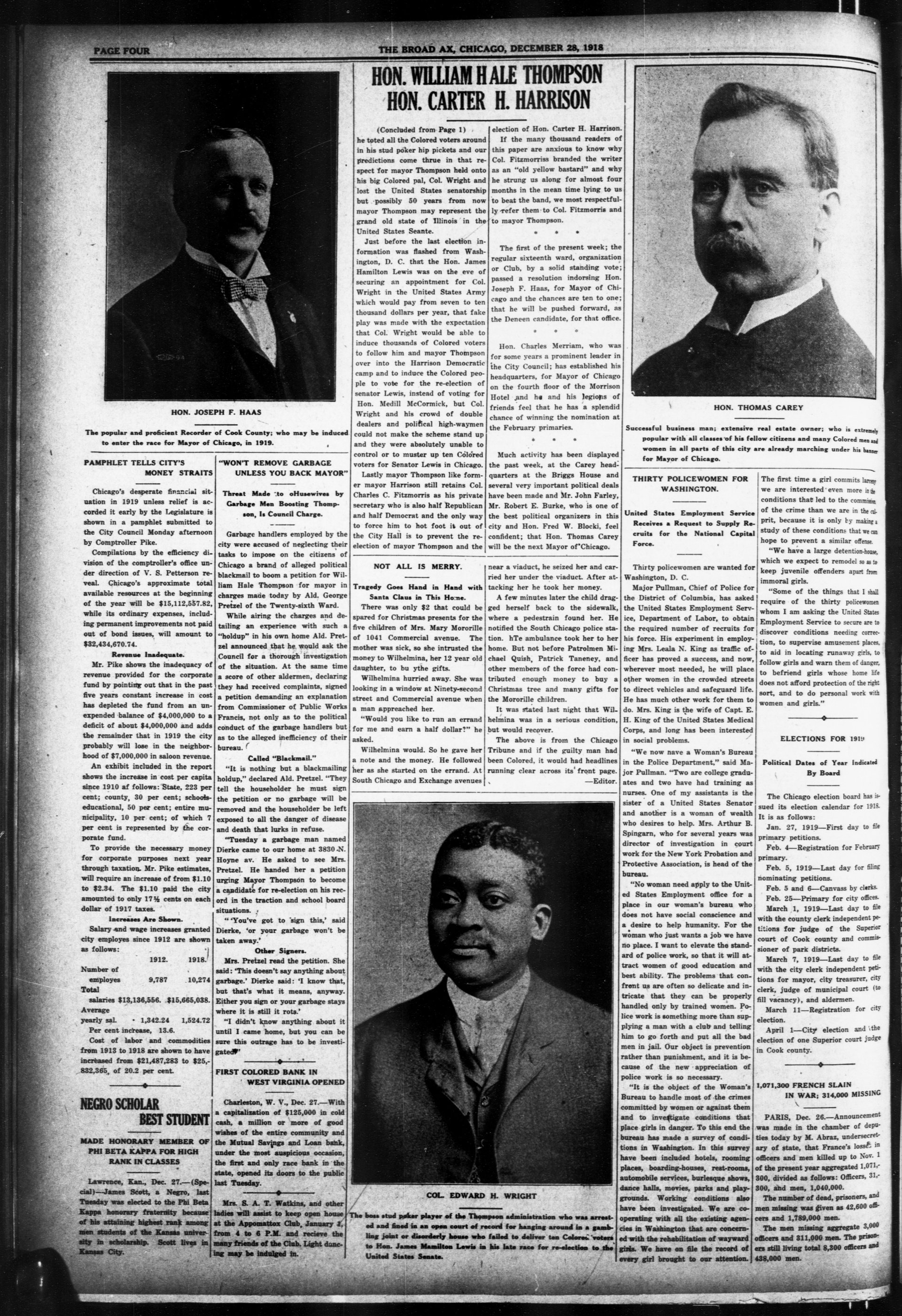
HON. JOSEPH F. HAAS
The popular and proficient Recorder to enter the race for Mayor of PAMPHLET TELLS CITY'S MONEY STRAITS
The popular and proficient Recorder of Cook County; who may be induced to enter the race for Mayor of Chicago, in 1919.
Chicago's desperate financial situation in 1919 unless relief is accorded it early by the Legislature is shown in a pamphlet submitted to the City Council Monday afternoon by Comptroller Pike.
Compilations by the efficiency division of the comptroller's office under direction of V. S. Petterson reveal. Chicago's approximate total available resources at the beginning of the year will be $15,112,557.82, while its ordinary expenses, including permanent improvements not paid out of bond issues, will amount to $32,434,670.74.
Mr. Pike shows the inadequacy of revenue provided for the corporate fund by pointing out that in the past five years constant increase in cost has depleted the fund from an unexpended balance of $4,000,000 to a deficit of about $4,000,000 and adds the remainder that in 1919 the city probably will lose in the neighborhood of $7,000,000 in saloon revenue. An exhibit included in the report shows the increase in cost per capita since 1910 af follows: State, 223 per cent; county, 30 per cent; schoolseducational, 50 per cent; entire municipality, 10 per cent; of which 7 per cent is represented by the corporate fund.
To provide the necessary money for corporate purposes next year through taxation. Mr. Pike estimates, will require an increase of from $1.10 to $2.34. The $1.10 paid the city amounted to only 17½ cents on each dollar of 1917 taxes.
Increases Are Shown.
Salary and wage increases granted city employees since 1912 are shown as follows:
1912. 1918.
Number of employees 9,787 10,274
Total salaries $13,136,556. $15,665,038.
Average
Cost of labor and commodities from 1913 to 1918 are shown to have increased from $21,487,283 to $25,-882,365. of 20.2 per cent.
BEST STUDENT
MADE HONORARY MEMBER OF PHI BETA KAPPA FOR HIGH
Lawrence, Kan., Dec. 27.—(Special)—James Scott, a Negro, last Tuesday was elected to the Phi Beta Kappa honorary fraternity because of his attaining highest rank among men students of the Kansas university in scholarship. Scott lives in Kansas City.
PAGE FOUR
Revenue Inadequate.
NEGRO SCHOLAR
of Cook County; who may be induced Chicago, in 1919.
"WON'T REMOVE GARBAGE UNLESS YOU BACK MAYOR"
Threat Made to oHusewives by Garbage Men Boosting Thomp-
Garbage handlers employed by the city were accused of neglecting their tasks to impose on the citizens of Chicago a brand of alleged political blackmail to boom a petition for William Hale Thompson for mayor in charges made today by Ald, George Pretzel of the Twenty-sixth Ward.
While airing the charges and detailing an experience with such a "holdup" in his own home Ald. Pretzel announced that he would ask the Council for a thorough investigation of the situation. At the same time a score of other aldermen, declaring they had received complaints, signed a petition demanding an explanation from Commissioner of Public Works Francis, not only as to the political conduct of the garbage handlers but as to the alleged inefficiency of their bureau.
"It is nothing but a blackmailing holdup," declared Ald. Pretzel. "They tell the householder he must sign the petition or no garbage will be removed and the householder be left exposed to all the danger of disease and death that lurks in refuse.
"Tuesday a garbage man named Dierke came to our home at 3830 N. Hoyne av. He asked to see Mrs. Pretzel. He handed her a petition urging Mayor Thompson to become a candidate for re-election on his record in the traction and school board situations.
"You've got to 'sign this,' said Dierke, 'or your garbage won't be taken away.'
Mrs. Pretzel read the petition. She said: 'This doesn't say anything about garbage.' Dierke said: 'I know that, but that's what it means, anyway. Either you sign or your garbage stays where it is still it rots.' "I didn't know anything about it until I came home, but you can be sure this outrage has to be investigated."
FIRST COLORED BANK IN
Charleston, W. V., Dec. 27.—With a capitalization of $125,000 in cold cash, a million or more of good wishes of the entire community and the Mutual Savings and Loan bank, under the most auspicious occasion, the first and only race bank in the state, opened its doors to the public last Tuesday.
Mrs. S. A. T. Watkins, and other ladies will assist to keep open house at the Appomattox Club, January 1, from 4 to 6 P.M. and receive the many friends of the Club. Light dancing may be indulged in.
---
Called "Blackmail."
Other Signers.
THE BROAD AX, CHICAGO, DECEMBER 28, 1918
HON. WILLIAM HALE THOMPSON HON. CARTER H. HARRISON
(Concluded from Page 1) he toted all the Colored voters around in his stud poker hip pickets and our predictions come thrue in that respect for mayor Thompson held onto his big Colored pal, Col. Wright and lost the United States senatorship but possibly 50 years from now mayor Thompson may represent the grand old state of Illinois in the United States Seante.
Just before the last election information was flashed from Washington, D. C. that the Hon. James Hamilton Lewis was on the eve of securing an appointment for Col. Wright in the United States Army which would pay from seven to ten thousand dollars per year, that fake play was made with the expectation that Col. Wright would be able to induce thousands of Colored voters to follow him and mayor Thompson over into the Harrison Democratic camp and to induce the Colored people to vote for the re-election of senator Lewis, instead of voting for Hon. Medill McCormick, but Col. Wright and his crowd of double dealers and political high-waymen could not make the scheme stand up and they were absolutely unable to control or to muster up ten Colored voters for Senator Lewis in Chicago.
Lastly mayor Thompson like former mayor Harrison still retains Col. Charles C. Fitzmorris as his private secretary who is also half Republican and half Democrat and the only way to force him to hot foot it out of the City Hall is to prevent the reelection of mayor Thompson and the
NOT ALL IS MERRY.
Tragedy Goes Hand in Hand with Santa Claus in This Home.
There was only $2 that could be spared for Christmas presents for the five children of Mrs. Mary Mororille of 1041 Commercial avenue. The mother was sick, so she intrusted the money to Wilhelmina, her 12 year old daughter, to bu ythe gifts.
Wilhelmina hurried away. She was looking in a window at Ninety-second street and Commercial avenue when a man approached her.
"Would you like to run an errand for me and earn a half dollar?" he asked.
Wilhelmina would. So he gave her a note and the money. He followed her as she started on the errand. At South Chicago and Exchange avenues
[Image of a man in a suit with a tie and a serious expression].
[Name not visible in the image]
COL. EDWARD H. WRIGHT
The boss stud poker player of the Thompson administ ed and fined in an open court of record for hang ling joint or disorderly house who failed to delive to Hon. James Mamilton Lewis in his late race United States Senate.
The boss stud poker player of the Thompson administration who was arrested and fined in an open court of record for hanging around in a gambling joint or disorderly house who failed to deliver tan Coloret voters to Hon. James Mamilton Lewis in his late race for re-election to the United States Senate.
election of Hon. Carter H. Harrison. If the many thousand readers of this paper are anxious to know why Col. Fitzmorriss branded the writer as an "old yellow bastard" and why he strung us along for almost four months in the mean time lying to us to beat the band, we most respectfully refer them to Col. Fitzmorris and to mayor Thompson.
The first of the present week; the regular sixteenth ward, organization or Club, by a solid standing vote; passed a resolution indorsing Hon. Joseph F. Haas, for Mayor of Chicago and the chances are ten to one; that he will be pushed forward, as the Deneen candidate, for that office.
Hon. Charles Merriam, who was for some years a prominent leader in the City Council; has established his headquarters, for Mayor of Chicago on the fourth floor of the Morrison Hotel and he and his legions of friends feel that he has a splendid chance of winning the nomination at the February primaries.
Much activity has been displayed the past week, at the Carey headquarters at the Briggs House and several very important political deals have been made and Mr. John Farley, Mr. Robert E. Burke, who is one of the best political organizers in this city and Hon. Fred W. Blocki, feel confident; that Hon. Thomas Carey will be the next Mayor of Chicago. near a viaduct, he seized her and carried her under the viaduct. After attacking her he took her money.
A few minutes later the child dragged herself back to the sidewalk, where a pedestrain found her. He notified the South Chicago police station. hTe ambulance took her to her home. But not before Patrolmen Michael Quish, Patrick Taneney, and other members of the force had contributed enough money to buy a Christmas tree and many gifts for the Mororille children. It was stated last night that Wilhelmina was in a serious condition, but would recover.
The above is from the Chicago Tribune and if the guilty man had been Colored, it would had headlines running clear across its front page. —Editor.
[Name]
spson administration who was arrest- record for hanging around in a gamb- failed to deliver ten Colores: voters his late race for re-election to the
M.
HON. THOMAS CAREY
Successful business man; extensive real estate owner; who is extremely popular with all classes of his fellow citizens and many Colored men and women in all parts of this city are already marching under his banner for Mayor of Chicago.
THIRTY POLICEWOMEN FOR WASHINGTON.
United States Employment Service Receives a Request to Supply Recruits for the National Capital Force.
Thirty policewomen are wanted for Washington, D. C. Major Pullman, Chief of Police for the District of Columbia, has asked the United States Employment Service, Department of Labor, to obtain the required number of recruits for his force. His experiment in employing Mrs. Leala N. King as traffic officer has proved a success, and now, wherever most needed, he will place other women in the crowded streets to direct vehicles and safeguard life. He has much other work for them to do. Mrs. King is the wife of Capt. E. H. King of the United States Medical Corps, and long has been interested in social problems.
"We now have a Woman's Bureau in the Police Department," said Major Pullman. "Two are college graduates and two have had training as nurses. One of my assistants is the sister of a United States Senator and another is a woman of wealth who desires to help. Mrs. Arthur B. Spingarn, who for several years was director of investigation in court work for the New York Probation and Protective Association, is head of the bureau.
"No woman need apply to the United States Employment office for a place in our woman's bureau who does not have social conscience and a desire to help humanity. For the woman who just wants a job we have no place. I want to elevate the standard of police work, so that it will attract women of good education and best ability. The problems that confront us are often so delicate and intricate that they can be properly handled only by trained women. Police work is something more than supplying a man with a club and telling him to go forth and put all the bad men in jail. Our object is prevention rather than punishment, and it is because of the new appreciation of police work is so necessary.
"It is the object of the Woman's Bureau to handle most of the crimes committed by women or against them and to investigate conditions that place girls in danger. To this end the bureau has made a survey of conditions in Washington. In this survey have been included hotels, rooming places, boarding-houses, rest-rooms, automobile services, burlesque shows, dance halls, movies, parks and playgrounds. Working conditions also have been investigated. We are cooperating with all the existing agencies in Washington that are concerned with the rehabilitation of wayward girls. We have on file the record of every girl brought to our attention.
real estate owner; who is extremely
allow citizens and many Colored men and
are already marching under his banner
The first time a girl commits larceny
we are interested even more in the
conditions that led to the commission
of the crime than we are in the cul-
prit, because it is only by making a
study of these conditions that we can
hope to prevent a similar offense.
"We have a large detention-house,
which we expect to remodel so as to
keep juvenile offenders apart from
immoral girls.
"Some of the things that I shall require of the thirty policewomen whom I am asking the United States Employment Service to secure are to discover conditions needing correction, to supervise amusement places, to aid in locating runaway girls, to follow girls and warn them of danger, to befriend girls whose home life does not afford protection of the right sort, and to do personal work with women and girls."
ELECTIONS FOR 1919
Political Dates of Year Indicated
By Board
The Chicago election board has issued its election calendar for 1918. It is as follows:
Jan. 27, 1919—First day to file primary petitions.
Feb. 4—Registration for February primary.
Feb. 5, 1919—Last day for filing nominating petitions.
Feb. 5 and 6—Canvass by clerks.
Feb. 25—Primary for city offices.
March 1, 1919—Last day to file with the county clerk independent petitions for judge of the Superior court of Cook county and commissioner of park districts.
March 7, 1919—Last day to file with the city clerk independent petitions for mayor, city treasurer, city clerk, judge of municipal court (to fill vacancy), and aldermen.
March 11—Registration for city election.
April 1—City election and the election of one Superior court judge in Cook county.
1.071.300 FRENCH SLAIN
PARIS, Dec. 26.—Announcement was made in the chamber of deputies today by M. Abraz, undersecretary of state, that France's losses in officers and men killed up to Nov. 1 of the present year aggregated 1,071,300, divided as follows: Officers, 31,300, and men, 1,040,000.
The number of dead, prisoners, and men missing was given as 42,600 officers and 1,789,000 men.
The men missing aggregate 3,000 officers and 311,000 men. The prisoners still living total 8,300 officers and 438,000 men.
---
[Name]
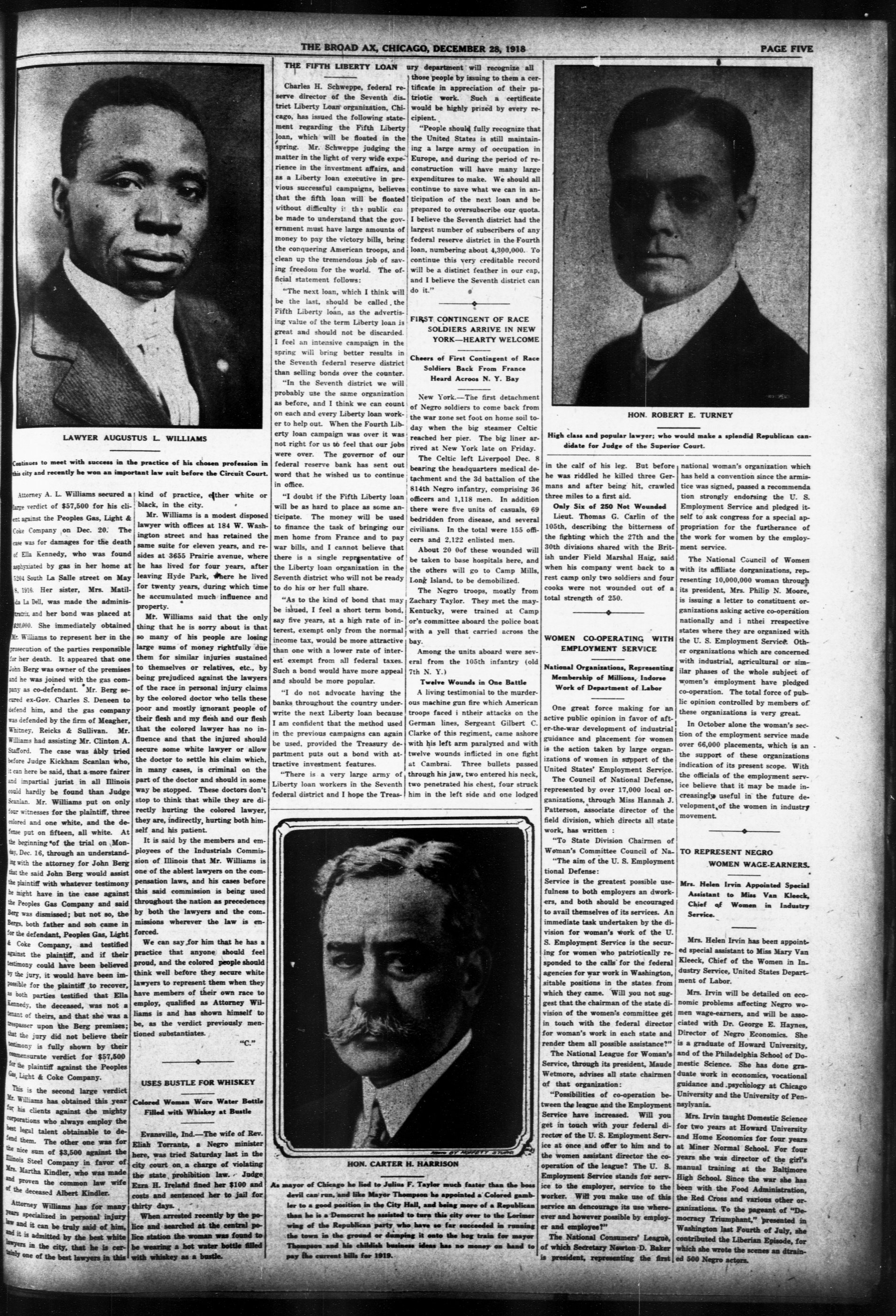
LAWYER AUGUSTUS L. WILLIAMS
Continues to meet with success in the practice of his chosen profession in this city and recently he won an important law suit before the Circuit Court.
Attorney A. L. Williams secured a large verdict of $57,500 for his client against the Peoples Gas, Light & Coke Company on Dec. 20. The case was for damages for the death of Ella Kennedy, who was found asphyxiated by gas in her home at 5204 South La Salle street on May 8, 1916. Her sister, Mrs. Matilda La Dell, was made the administrator, and her bond was placed at $20,000. She immediately obtained Mr. Williams to represent her in the prosecution of the parties responsible for her death. It appeared that one John Berg was owner of the premises and he was joined with the gas company as co-defendant. Mr. Berg secured ex-Gov. Charles S. Deneen to defend him, and the gas company was defended by the firm of Meagher, Whitney, Reicks & Sullivan. Mr. Williams had assisting Mr. Clinton A. Stafford. The case was ably tried before Judge Kickham Scanlan who, it can here be said, that a fairer and impartial jurist in all Illinois could hardly be found than Judge Scanlan. Mr. Williams put on only four witnesses for the plaintiff, three colored and one white, and the defense put on fifteen, all white. At the beginning of the trial on Monday, Dec. 16, through an understanding with the attorney for John Berg that the said John Berg would assist the plaintiff with whatever testimony he might have in the case against the Peoples Gas Company and said Berg was dismissed; but not so, the Bergs, both father and son came in for the defendant, Peoples Gas, Light & Coke Company, and testified against the plaintiff, and if their testimony could have been believed by the jury, it would have been impossible for the plaintiff to recover, as both parties testified that Ella Kennedy, the deceased, was not a tenant of theirs, and that she was a trespasser upon the Berg premises; that the jury did not believe their testimony is fully shown by their commensurate verdict for $57,500 for the plaintiff against the Peoples Gas, Light & Coke Company.
This is the second large verdict Mr. Williams has obtained this year for his clients against the mighty corporations who always employ the best legal talent obtainable to defend them. The other one was for the nice sum of $3,500 against the Illinois Steel Company in favor of Mrs. Martha Kindler, who was made and proven the common law wife of the deceased Albert Kindler.
Attorney Williams has for many years specialized in personal injury law and it can be truly said of him, and it is admitted by the best white lawyers in the city, that he is certainly one of the best lawyers in this
kind of practice, either white or black, in the city.
Mr. Williams is a modest disposed lawyer with offices at 184 W. Washington street and has retained the same suite for eleven years, and resides at 3655 Prairie avenue, where he has lived for four years, after leaving Hyde Park, where he lived for twenty years, during which time he accumulated much influence and property.
Mr. Williams said that the only thing that he is sorry about is that so many of his people are losing large sums of money rightfully due them for similar injuries sustained to themselves or relatives, etc., by being prejudiced against the lawyers of the race in personal injury claims by the colored doctor who tells these poor and mostly ignorant people of their flesh and my flesh and our flesh that the colored lawyer has no influence and that the injured should secure some white lawyer or allow the doctor to settle his claim which, in many cases, is criminal on the part of the doctor and should in some way be stopped. These doctors don't stop to think that while they are directly hurting the colored lawyer, they are, indirectly, hurting both himself and his patient.
It is said by the members and employees of the Industrials Commission of Illinois that Mr. Williams is one of the ablest lawyers on the compensation laws, and his cases before this said commission is being used throughout the nation as precedences by both the lawyers and the commissions wherever the law is enforced.
We can say for him that he has a practice that anyone should feel proud, and the colored people should think well before they secure white lawyers to represent them when they have members of their own race to employ, qualified as Attorney Williams is and has shown himself to be, as the verdict previously mentioned substantiates.
USES BUSTLE FOR WHISKEY
Colored Woman Wore Water Bottle
Filled with Whiskey at Bustle
Evansville, Ind.—The wife of Rev. Eliah Torrants, a Negro minister here, was tried Saturday last in the city court on a charge of violating the state prohibition law. Judge Ezra H. Ireland fined her $100 and costs and sentenced her to jail for thirty days.
When arrested recently by the police and searched at the central police station the woman was found to be wearing a hot water bottle filled with whiskey as a bustle.
THE BROAD AX, CHICAGO, DECEMBER 28, 1918
THE FIFTH LIBERTY LOAN
Charles H. Schweppe, federal reserve director of the Seventh district Liberty Loan organization, Chicago, has issued the following statement regarding the Fifth Liberty loan, which will be floated in the spring. Mr. Schweppe judging the matter in the light of very wide experience in the investment affairs, and as a Liberty loan executive in previous successful campaigns, believes that the fifth loan will be floated without difficulty if the public can be made to understand that the government must have large amounts of money to pay the victory bills, bring the conquering American troops, and clean up the tremendous job of saving freedom for the world. The official statement follows:
"The next loan, which I think will be the last, should be called the Fifth Liberty loan, as the advertising value of the term Liberty loan is great and should not be discarded. I feel an intensive campaign in the spring will bring better results in the Seventh federal reserve district than selling bonds over the counter.
"In the Seventh district we will probably use the same organization as before, and I think we can count on each and every Liberty loan worker to help out. When the Fourth Liberty loan campaign was over it was not right for us to feel that our jobs were over. The governor of our federal reserve bank has sent out word that he wished us to continue in office.
"I doubt if the Fifth Liberty loan will be as hard to place as some anticipate. The money will be used to finance the task of bringing our men home from France and to pay war bills, and I cannot believe that there is a single representative of the Liberty loan organization in the Seventh district who will not be ready to do his or her full share.
"As to the kind of bond that may be issued, I feel a short term bond, say five years, at a high rate of interest, exempt only from the normal income tax, would be more attractive than one with a lower rate of interest exempt from all federal taxes. Such a bond would have more appeal and should be more popular.
"I do not advocate having the banks throughout the country underwrite the next Liberty loan because I am confident that the method used in the previous campaigns can again be used, provided the Treasury department puts out a bond with attractive investment features.
"There is a very large army of Liberty loan workers in the Seventh federal district and I hope the Treas-
[Image of a man with a mustache and a suit]
BY MOHEY STUDIO
As mayor of Chicago he lied to Julius F. Taylor much devil can run, and like Mayor Thompson he appointer to a good position in the City Hall, and being than he is a Democrat he assisted to turn this city wing of the Republican party who have so far the town in the ground or dumping it onto the Thompson and his childish business ideas has not pay the current bills for 1919.
As mayor of Chicago he lied to Julius F. Taylor much faster than the boss devil can run, and like Mayor Thompson he appointed a Colored gambler to a good position in the City Hall, and being more of a Republican than he is a Democrat he assisted to turn this city over to the Lorimer wing of the Republican party who have so far succeeded in running the town in the ground or dumping it onto the hog train for mayor Thompson and his childish business ideas has no money on hand to pay the current hills for 1919.
As mayor of Chicago he lied to Julius F. Taylor much faster than the boss devil can run, and like Mayor Thompson he appointed a Colored gambler to a good position in the City Hall, and being more of a Republican than he is a Democrat he assisted to turn this city over to the Lorimer wing of the Republican party who have so far succeeded in running the town in the ground or dumping it onto the hog train for mayor Thompson and his childish business ideas has no money on hand to pay the current hills for 1919.
ury department will recognize all those people by issuing to them a certificate in appreciation of their patriotic work. Such a certificate would be highly prized by every recipient.
"People should fully recognize that the United States is still maintaining a large army of occupation in Europe, and during the period of reconstruction will have many large expenditures to make. We should all continue to save what we can in anticipation of the next loan and be prepared to oversubscribe our quota. I believe the Seventh district had the largest number of subscribers of any federal reserve district in the Fourth loan, numbering about 4,300,000. To continue this very creditable record will be a distinct feather in our cap, and I believe the Seventh district can do it."
FIRST CONTINGENT OF RACE
SOLDIERS ARRIVE IN NEW
YORK—HEARTY WELCOME
Cheers of First Contingent of Race
Soldiers Back From France
Heard Acroos N. Y. Bay
New York.—The first detachment of Negro soldiers to come back from the war zone set foot on home soil today when the big steamer Celtic reached her pier. The big liner arrived at New York late on Friday.
The Celtic left Liverpool Dec. 8 bearing the headquarters medical detachment and the 3d battalion of the 814th Negro infantry, comprising 36 officers and 1,118 men. In addition there were five units of casuals, 69 bedridden from disease, and several civilians. In the total were 155 officers and 2,122 enlisted men.
About 20 0of these wounded will be taken to base hospitals here, and the others will go to Camp Mills, Long Island, to be demobilized.
The Negro troops, mostly from Zachary Taylor. They met the may-Kentucky, were trained at Camp or's committee aboard the police boat with a yell that carried across the bay.
Among the units aboard were several from the 105th infantry (old 7th N. Y.)
Twelve Wounds in One Battle
A living testimonial to the murderous machine gun fire which American troops faced in their attacks on the German lines, Sergeant Gilbert C. Clarke of this regiment, came ashore with his left arm paralyzed and with twelve wounds inflicted in one fight at Cambrai. Three bullets passed through his jaw, two entered his neck, two penetrated his chest, four struck him in the left side and one lodged
MOVIE BY MOVETY STUDIO
F. Taylor much faster than the boss
Jampson he appointed a Colored gamb-
Hall, and being more of a Republican
to turn this city over to the Lorimer
to have so far succeeded in running
ing it onto the hog train for mayor
less ideas has no money on hand to
83 95
HON. ROBERT E. TURNEY
High class and popular lawyer; who didate for Judge of the Superior
in the calf of his leg. But before he was riddled he killed three Germans and after being hit, crawled three miles to a first aid. Only Six of 250 Not Wounded Lieut. Thomas G. Carlin of the 105th, describing the bitterness of the fighting which the 27th and the 30th divisions shared with the British under Field Marshal Haig, said when his company went back to a rest camp only two soldiers and four cooks were not wounded out of a total strength of 250.
national woman's organization which has held a convention since the armistice was signed, passed a recommendation strongly endorsing the U. S. Employment Service and pledged itself to ask congress for a special appropriation for the furtherance of the work for women by the employment service.
The National Council of Women with its affiliate organizations, representing 10,000,000 woman through its president, Mrs. Philip N. Moore, is issuing a letter to constituent or
WOMEN CO-OPERATING WITH
EMPLOYMENT SERVICE
National Organizations, Representing Membership of Millions, Indorse Work of Department of Labor
One great force making for an active public opinion in favor of after-the-war development of industrial guidance and placement for women is the action taken by large organizations of women in support of the United States' Employment Service.
The Council of National Defense, represented by over 17,000 local organizations, through Miss Hannah J. Patterson, associate director of the field division, which directs all state work, has written :
"To State Division Chairmen of Woman's Committee Council of Na-
Service is the greatest possible usefulness to both employers an dworkers, and both should be encouraged to avail themselves of its services. An immediate task undertaken by the division for woman's work of the U.S. Employment Service is the securing for women who patriotically responded to the calls for the federal agencies for war work in Washington, suitable positions in the states from which they came. Will you not suggest that the chairman of the state division of the women's committee get in touch with the federal director for woman's work in each state and render them all possible assistance?" The National League for Woman's Service, through its president, Maude Wetmore, advises all state chairmen of that organization:
"Possibilities of co-operation between the league and the Employment Service have increased. Will you get in touch with your federal director of the U. S. Employment Service at once and offer to him and to the women assistant director the cooperation of the league? The U. S. Employment Service stands for service to the employer, service to the worker. Will you make use of this service anencourage its use wherever and however possible by employer and employee?"
The National Consumers' League, of which Secretary Newton D. Baker is president, representing the first
---
1234567890
would make a splendid Republican canc or Court.
national woman's organization which has held a convention since the armistice was signed, passed a recommendation strongly endorsing the U. S. Employment Service and pledged itself to ask congress for a special appropriation for the furtherance of the work for women by the employment service.
The National Council of Women with its affiliate dorganizations, representing 10,000,000 woman through its president, Mrs. Philip N. Moore, is issuing a letter to constituent organizations asking active co-operation nationally and i nthei rrespective states where they are organized with the U. S. Employment Service. Other organizations which are concerned with industrial, agricultural or similar phases of the whole subject of women's employment have pledged co-operation. The total force of public opinion controlled by members of these organizations is very great.
In October alone the woman's section of the employment service made over 66,000 placements, which is an the support of these organizations indication of its present scope. With the officials of the employment service believe that it may be made increasingly useful in the future development of the women in industry movement.
TO REPRESENT NEGRO
Mrs. Helen Irvin Appointed Special Assistant to Miss Van Kleeck, Chief of Women in Industry Service.
Mrs. Helen Irvin has been appointed special assistant to Miss Mary Van Kleeck, Chief of the Women in Industry Service, United States Department of Labor.
Mrs. Irvin will be detailed on economic problems affecting Negro women wage-earners, and will be associated with Dr. George E. Haynes, Director of Negro Economics. She is a graduate of Howard University, and of the Philadelphia School of Domestic Science. She has done graduate work in economics, vocational guidance and psychology at Chicago University and the University of Pennsylvania.
Mrs. Irvin taught Domestic Science for two years at Howard University and Home Economics for four years at Miner Normal School. For four years she was director of the girl's manual training at the Baltimore High School. Since the war she has been with the Food Administration, the Red Cross and various other organizations. To the pageant of "Democracy Triumphant," presented in Washington last Fourth of July, she contributed the Liberian Episode, for which she wrote the scenes an dtrained 500 Negro actors.
---
PAGE FIVE
Republican can-
GRO
CE-EARNERS.
---
PAGE SIX
TUNIC IS TO BE GIVEN A TRYOUT
France Flings Magnificent Warlike Garment Upon Happy World.
Models Made of Glistening Coat-of-Mail and Metallic Cloths, and Others of Crepe de Chine or Chiffon.
New York—Some historians may know when the tunic start of its career as a fundamental fashion in the clothing of the human race, but no one has stated the exact date with an attempt at accuracy, according to a prominent fashion authority.
There are many who believe that it was the first garment worn by Adam and Eve, when they realized that clothing was to be a necessity to their species. The tunic really followed the mantle, and from Elijah to William I of England is a long, long spell in history, but we know that the former wore a mantle and the latter a tunic, Julius Caesar occupied a place in the sun between these two, but he wore a toga. Beau Brummel brought in coats and George IV, picturesque as he was in his costumery, blazed the path for the ugliest clothes that the men on this planet have ever worn.
The tunic was a masculine fashion, as most garments are that women think are their own. The critics of this generation fall upon women and smite them hard for their fripperies and frivolities, the whims and caprices of their clothing, and yet these critics are men who do not seem to realize that all the centuries of progress of the male part of the human race were given over to caprice and brilliancy in apparel, as well as to defeat and victory in arms.
War and the Primitive Tunic
No doubt the clash of arms in France brought back to the minds of the designers the long centuries of warfare that had preceded the peace since 1870. The tunic was the fundamental part of the British warrior's costume, and the cuirass—that glittering breastplate of steel and highly polished metal—was the symbol of all fighters. So France introduced the tunic of that other and primitive warfare which she thought had gone forever, and suddenly found one August morning that it had come to her with all the cruelty of the early centuries.
She did her best to enforce this tunic into the fashions of other countries, with small measure of success until late this autumn. After steady persistence, a trick she has in the making of all her forms of art, the least of
A
Oriental tunic of terra cotta and gold brocade, with narrow girdle at hips of terra cotta, tied in the back. The long, outstanding cuffs are at the top of fashion.
Oriental tunic of terra cotta and gold brocade, with narrow girdle at hips of terra cotta, tied in the back. The long, outstanding cuffs are at the top of fashion.
which is fashion, she found that America had suddenly awakened to the comfort and beauty of this garment.
It is difficult to persuade American women to go without shiizwaists. They borrowed the idea of a wash shirt from man, as they have borrowed all their fashions, and they felt, and rightly so, that there is an element of cleanliness in putting next to the skin throughout the day hours a garment that can go to the tub. The tunic does not go to the tub, and the only way to keep it entirely fresh is to wear it over a long-sleeved muslin lining, which many women do.
Practical and Ornate Blouses.
The tunic and the outside blouse are one and the same thing. You may call it a culrass, or a blouse with a peplum, or a Chinese sacque, or whatever name suits your fancy. The elemental fact is that the fashionable blouse of today hangs from shoulders to hips. It may be girdled; it may not. Its sleeves
may be cut according to the fashion of William I or they may be after the manner of Dagobert of France—long and wrinkled to the wrist.
Building on this foundation, the designers in America and Paris have thrown caution and economy to the winds and accepted this new blouse in such an extravagant manner that they seem to be making up for that time when they let it rest neglected in the dark corners.
The cables from Paris insist that coat suits are much smarter than one-piece frocks for the woman of fashion and her followers, but here in America, even with the impetus given to tailored
FASHION
Outside blouse of gray velvet embroidered in black and trimmed with bands of fur. It is worn with a skirt of black velvet embroidered in gray, suits in the early autumn, the pendulum appears to have swung back to one-piece frocks and luxurious wraps of fur and velveteen. Probably with the advent of early spring, with the southward bound tourist, the coat suit will regain the prestige of October. If it does, these extravagant, short, medieval tunics will have a high chance for development. In the interim, they are worn not only with heavy tailored suits, but as tops to separate skirts.
Can Be Made at Home.
It is in this department of dress that they are most brilliant. There are some dressmakers who feel that smart women will no longer order entire frocks if the enthusiasm for these brilliant accessories grow in strength. However, there is no reason for despair in that, for the tunic blouse, as it is displayed at this hour, is no mean thing to make and no poor thing to purchase. Its fabric and the ornamentation put upon it bring the cost well up beyond the average purse. But the best part of it is that the amateur can make these things at home, for they have nothing but straight lines and are built from loosely hanging widths of the material.
And yet there is danger in the work of the amateur, especially if she is guided by this hasty description, for it is the tunic of the Conqueror that is in fashion, not the smock of the Russian moujik or the gorgeous coat of the Arabian potentate. The widths must outline the figure, and they must cling to the hips, and the armholes must be cut with precision and perfection. The whole attempt of fashion today is to throw the figure into a sharp outline, and we must watch that tendency if we would keep abreast of what is happening and cultivate our vision to look ahead. There is no reason for women to cry aloud over the extravagance of some of the new tunics that are offered, for these may be copied in simple fabrics.
Leather Buckskin Brocade.
Here are a few of the most extreme short tunics that are sponsored by good houses in Paris and America. First, there are the blouses of leather, which were shown in America a month ago, with and without sleeves. They came out with the leather top coat and the service coat of peltry and leather. As a rich sister to the practical leather blouses are those of colored buckskin, made in deep pink and embroidered all over the surface. These are worn with long, narrow black and seal-brown velvet skirts.
The metal tricots are also used. They are reminiscent of the early centuries of warfare. They are cut on the fashion of the Conqueror's tunic. Tunics That Will See Active Service. As opposed to these gorgeous specimens of tunics that never were worn by William the Conqueror or any of the medieval warriors, there are practical ones in brilliant wool jersey. In France they are wearing them in colors taken from splendid-hued flowers. Crepe de chine is a good fabric, and all manner of velours, suede cloth and knitted wool are turned into these tunics. They are not somber or demure. The world wants color, and it is going to have it. Let none rise to cry it down. There may be other shadows threatened by the pessimists, but we have emerged from the blackest shadow of them all; and in our new state of happiness we intend to dress in scarlet and purple!
(Copyright, 1918, by McClure Newspaper Syndicate.)
THE BROAD AX, CHICAGO, DECEMBER 28, 1918
COAT IS SHORTER
Three-Quarter Length Is Adopted for Sport Garment.
Colora Continue to Be Dull, but New Note is Expressed in Brilliant Linings.
While the real long coats are still in favor for the coldest weather, the very latest models are said to be shorter. The first and foremost reason for this is that probably very few women wish to appear even a trifle wider at the bottom skirtline than is absolutely necessary. Another hint as to coats is the new straight line which is now suggested. Sport coats have already adopted this new form and the result is a return to the three-quarter length box coat of a few years ago.
Any real changes, however, are not due for many months, and contradicting the straight-line theory comes a persistent rumor that Alsace-Lorraine is to be the next field of operations in fashions, although it is hard to see exactly where the far from artistic costume of this province can be reconciled with the present modes.
Paris fashions have always their little fling at the passing events, but spring is a long way off, and should another country come suddenly forward and a diplomatic compliment be considered due, it would upset all previous calculations. For fashion may be as fickle as she pleases in war or peace, so there is no knowing what may happen between now and spring-time in fashions, which is early in February.
To return to the subject of coats: Whatever the length or width the colors continue to be dull, if not uninteresting, and this has led to the new note expressed in brilliant linings. Two good reasons for these decidedly chic linings exist. The first is as stated, that matters becoming a bit dull, and the second reason is that there seemed no other way to use the very beautiful silks both the American and French designers were turning out. "Ladies must live," but so must designers, and there seems to be no way out of it except to admit that our designers are true artists, and sheer admiration for their work is its own excuse for using their wares.
The plainer the suit or coat the more apt to be brilliant coloring in the linings. Slashes in the jackets and panels and tunics are further reasons for wishing to add a dash of color.
On a very original new suit with a rather short jacket both fur and lining contributed to the extremely clever air which it carried. The peplum of the jacket was straight and ungathered and a brilliant red laffeta lining made a strong contrast to the dull metri shade cloth. Even the high double rolling collar of the beaver fur was lined with the red, flashes of which also showed in the stashes of the peplum.
SHOP ODDS AND ENDS
Pretty little shades of colored crepe paper, cost only 25 cents and really give a soft glow to the glaring electric bulb. They are flower-like when in use, consisting of many petals, wired through the center, and all fastened to a little clamp fastener around the base of the bulb.
Along with the revived fashion for jet comes a showing in the shops of jet spangled fans. Some of them are very effective—big net fans heavily spangled with sequins of gleaming black jet.
Small platinum watches, set with diamonds, are mounted on gray, wrist ribbons. The soft gray of the ribbon forms an admirable setting for the platinum of the watch.
CHIC IMPORTED HAT MODEL
© Western Newspaper Union
This charming hat is of the taupe pressed beaver variety, the model of which has been imported into this country. The three wings that are placed high on the crown have a very interesting effect and give the hat individuality.
CRESTHAM
LONDON
This simple yet charming afternoon gown will be well received by the debutante. It is of navy chiffon, heavily beaded in iridescent blue and black beads. The underskirt is of black val.
WINTER AND SPRING MODELS
Straight Lines and Trimmed With Fur; Jersey Cloth With Long, Tight Skirt.
Hudson seal is the most popular fur this season. Draped effects and coates of seal, trimmed daintily with squirrel, are very beautiful. Mole and beaver still hold their own.
The winter suits are very stunning. They are being shown along straight lines and trimmed with fur.
And now comes the spring suit. Fashion says it will be of jersey cloth, with a long, tight skirt.
Winter coats, box effect, are being worn now, though coats are not so popular this season, many women preferring the winter suit to be worn later with their furs.
Suits without blouses seem to be just the thing now. Instead of a waist a vestee is worn, or in some cases a dainty piece of colored silk is tucked in to give the effect.
Winter coats for the children are made of bright-colored broadcloth, with the yoke waist.
The latest novelty in neckwear is an apron slipover made of georgette.
Filet and valenciennes lace now trim the daintier waist, while for every day we have striped dimity and batiste trimmed with tiny box plaits instead of the usual pin tucks.
A very popular shade this winter is nut brown.
While hitherto black has been tabooed for the young girl, many very beautiful and youthful dresses are being shown in black velvet and black satin. Most of the dresses have just a touch of trimming.
TRICOLETTE IS NOW TO FORE
Dress Material Wins Approval for Aft-
ternoon Frocks; Good for Wear
Under Heavy Coat.
Tricolette has come very much to the fore as a dress material. A number of new afternoon frocks, on the order of a very beautiful model of black tricolette which Calot brought out last season, are being sponsored by well-known American designers, and these are particularly good for wear under a heavy coat, as they do not muss and are not so bulky as to distort the line of the outer garment. Heavy coarse jersey is also being used for frocks, and there is a new fishnet jersey which has just come from Paris and which promises to have quite a vogue. Among the novelties in the more formal silks are new metal brocades, the weaves of which are replicas of the weaves of mail worn in medieval days. These are interesting and distinctively new.
HOUSEHOLD HINTS
When dishes used for cooking have become discolored, rub them with damp salt until all stain is removed.
A marble boiled in milk, porridge, custards, etc., will automatically do the stirring as the liquid cooks, and so prevent burning.
Scatter salt on a carpet when sweeping, and you will not only find it has a cleansing effect but that it also keeps away moths.
Liquid ammonia is "invaluable for washing silver, softening bath water, and producing a good lather when washing woolens.
Dissolve a teaspoonful of saltpeter in a cupful of cold water and throw over a scuttle of coal. The fire will be brighter and last longer.
If a fire has to be left unwatched for several hours put a handful of salt on the top of the coals. This will prevent the fuel burning away too quickly.
Always shrink wool to be used for darning purposes by holding the skein in the steam from a boiling kettle. Otherwise the wool will shrink and make a hole larger than the original one.
CHOICE OF BLOUSE
CHOICE OF BLOUSE
Decision on Style Is of Importance to All Women.
Garment to Accompany Suit Should Blend Properly and Coat Must Be Long Enough.
Selection of the suit blouse is a much more important matter than many women think. If the blouse chosen to accompany a suit does not blend properly with the suit the entire outfit appears at a disadvantage, declares a fashion writer. If the suit is a dressy one, the blouse should be of the same type, and if a plainly tailored or sport suit is worn the blouse should be equally severe.
The blouse shown in the sketch is a smart model for wear with a dressy suit. The coat of the suit must be long enough to cover the entire blouse, of course; but suit coats this season are practically all quite long. Thirty-eight inches is about the minimum length, and some reach almost to the hem of the skirt.
The blouse shown is made of georgette, with the front cut on surplice lines. The back is plain, finished at the neck with a little round yoke or collar embroidered to match the long panels that extend down either side of the front. This blouse would be smart, made of white georgette, with embroidery and piping of revers in oriental colorings, or a single color to match the suit with which the blouse is to be worn may be chosen. This blouse might also be made of satin or crepe de chine, with very good effect.
A great many of the smartest blouses shown this season combine two colors. The upper part or sleeves may be of rose, with lower half, from bust to waistline, of navy, or the entire blouse may be of rose color with navy sleeves for example.
There is a clever conservation scheme in utilizing last season's blouses of sheer white, such as georgette, lace, net, etc., as the foundation over which are worn little low-necked, sleeveless blouses made of georgette
BROOKLYN
Suit Blouse, Embroidery and Fringe Trimmed.
in a color to match the season's suit.
These little sleeveless georgette blouses in color are even worn over sheer lingerie blouses.
A great many tallored crepe de chine and satin blouses are shown this season made with high collars. These collars usually button severely, and are finished at the edge with a little turn-over of self-fabric.
The long Russian blouse continues to be a favorite with French designers; but Americans accept it rather reluctantly. One recently shown was made of purple georgette, embroidered in gold thread and banded about sleeves and edge with navy satin.
TO MAKE ECONOMICAL APRON
Worn-Out Shirts Can Be Turned to Good Service in These Days of High-Priced Cotton.
Every woman knows that when a man's shirt has wornout cuffs and holes below the collarband, making the shirt unwearable, there is still a quantity of good material left. When there are children in the family there is generally a way to use it; when not, it usually goes into the rag-bag.
An apron can be made of the material and in these days of high-priced cotton goods it will pay well to use the goods in this way. Cut off the neckband and yoke; cut out sleeves; lay body of shirt out flat and cut out apron, making it as large as the goods will permit. The openings on the side are sewed up. A facing for the top of the apron is cut from what is left of one of the fronts.
One sleeve will make the strings and the other sleeve will make a bib, if one is wanted, and with a little plecing a bib can be made with straps sewed into strings at the back.
This makes an apron that can be put on with one motion. No pins and no buttons, and bib always in place.
A good rule for the size of thread in making buttonholes is to have it no coarser than that used for making the garments.
BEAVER TRIMMING IS USED
Copyright
Designed
Underwood
Cafe au lait duvetyn forms the
smart winter creation. The surpri-
waist has a large collar of beaver
and the bell sleeves are edged with
the same fur. Tassels of brown skin
an effective touch.
Garments That Aid the Majority of
* Women in Solving the Economical
Dress Problem.
Every once in a while we are told
by some fashion authority that "no
one is wearing the shirtwist," or that
the blouse of the season is so modified
from the old type of tucked-in shirt
waist as to be really a different garment; that "every one" now considers it necessary to have a special blouse made with a coat costume so that it virtually becomes a one-piece frost with a coat to match.
But the "every one" in such statements, notes a fashion correspondent, is really a very inconsiderable personage and the good old shirtwist goes along solving the dress problem of all most all women—either in the home or in the workaday world outside the home.
You could prove to yourself if you wished to that it rarely if ever pays to buy a shirtwalst made of inferior material. In fact, the cheap shirtwalst is usually made on an inferior pattern and not only does the material shrink out of shape but the actual lines are such that it loses its good looks and comfort after a few launderings.
You could prove, even if you are dressing on so shirty a basis as to low yourself only $100 or $75 a year for all your clothes, that it is true economy to buy every year two blouses that cost as much as $6 or $7.
TWO NEW COLORS NOW IN USE
Overseas Blue and Artillery Red Provide Very Smart Combination—Military Effects.
There are two new colors which are beautiful, overseas blue and artillery red. The overseas blue is a shade as lovely as the sky on the most beautiful of days. Artillery red is the vivid bright scarlet one would imagine it to be. A combination of navy blue and artillery red is very smart, a mere touch of the latter being sufficient to brighten the dullest frocks. It is placed agreeably on a paneled blouse buttoning at one side with rather large round red buttons caught with silken loops of red cord.
It is curious to note, observes a fashion writer, how we reach out after as many of the military effects as possible. Epaulets, for instance, are made of fur, or gold fringe or silver, and again of some of the Japanese brocaded metallic fabrics.
Another military note is the slashing seen in some costumes. One fabric is slit and a material of contrasting color is pulled through the opening. This treatment supplies a very new and effective bit of trimming. A charming soft blouse of dove gray georgette with a tiny French chemisette of Alencon lace was slashed through with pale pink velvet ribbons at the voke and on the cuffs.
Helpful Hints.
The air of a room may be freshened by putting a few drops of oil of lavender into a bowl of boiling water and letting it stand until the water is quite cold. People who keep houses dark for fear of the sunlight spoiling their carpets or furniture have no idea of the disease-destroying influence of sunlight and air. The ends of candles are useful in kindling the fire. Cut them into small pieces and distribute them among the kindling. The fire will burn up much more quickly.
STATED BRIEFLY: ©
OUR. BUSINESS SINCE 1847 has
been that of showing, the condition of
real estate titles. s
The millions upon millions required
to build and rebuild Chicago have been
furnished relying on the accuracy of our
ABSTRACTS and TITLE POLICIES.
No man has lost a dollar by so relying.
This is our past.
Wise men judge future action by past
behavior
CHICAGO TITLE AND TRUST COMPANY
69 W. Washington Street
Assets exceed $12,000,000.00
No deposits or demand liabilities.
: PHONE DOUGLAS 3565-342
| Ogden Cafe
BEN ROTHOUSE, Proprietor ,
FINE WINES, LIQUORS AND CIGARS
3100 SOUTH STATE STREET CHICAGO, ILL.
As Near As Your Telephone
E DISTANCE IMMATERIAL
JN Metropolitan Ciy of this siz, death Knocks every
thirty minutes at some doce. Too-elten that death
not only brings sorrow, but misfortune as well. Let the
4 price you pay for @ funeral be a business proposition and
$ you will benefit by it in service, quality and cost to you
in dollars and cents. The result of my campaign has
built for me one of the largest and most magnificent
establishments in the world. “
A visit will convince you. 4
Consult me, Ican save you Worry, Time and Money. (Ay ,
Shipping to all parts of the Country and Automobile = .
Fak ‘a Specalty, Central Duplay Rooms and ——sa
Chapel. Call promptly answered day or night. er
one eS)
Ernest H. Williamson, ee
KENWOOD AUTOMATIC Al
ass” Undertaker “73-867 —
$028 and 5030S. StateSt, - - - - Chicago, IL
THE MISSION
BUFFET AND ~—
BILLIARDS E
"GEO. W. HOLT, Propr.
3504 SOUTH STATE STREET
CHICAGO, ILL-
Sm Wor kt
. ict ee
Pras ee s =
pn oS fi {=
= =e
eee aie i
i it ;
1 Cr
ore ee nee ie ee 4
THE CRANFORD
Apartment Building
3600 WABASH AVENUE Sys
The finest building ever opened to Colored tenants in Chi-
ago. Steam heat, electric lights, tile baths, marble entrance
: . J. W.CASEY, Agent
Phone Main'263 133 W. Washington Street
___ THE BROAD AX, CHICAGO, | MBER 28, 1915
——_—EE=E=— * eee ™
A. F.CODOZOE- pare 748
J. H. WHISTON, Proprietors Phones: DOUGLAS 3256
CHAS. HARRIS, Manager a sore ede
The Elite Cafe
and Buffet —
3030 STATE STREET CHICAGO
ELITE No. 2
3445 S. State St.
Special Dinner from 5 to 9:30 P. M.
on First Floor
Dancing and Entertaining on Second Floor
| PHONE CALUMET 2123 OPEN EVENINGS
BENJ. H. LUCAS
: REAL ESTATE
Life, Health, Accident and Fire
INSURANCE
2357 SOUTH STATE STREET, CHICAGO
Notary Public * .
: OWNERS AND DIRECTORS
DAN M. JACKSON
GEO. T. KERSEY Phones Calumet 6164
ANMED A. RAYNER pacers 3t ame)
OPEN DAY AND NIGHT
The Emanuel Jackson |
Undertaking Co., Inc.
2959-61 South State Street
Reliable Service Courteous Treatment
Reasonable Prices
‘FREE CHAPEL IN CONNECTION
Complete Line of Funeral Goods Automobiles for Hire
Res. 3855 Prairie Ave.,
Phone Douglas 9133
Phones: Main 2017, Auto. 32-395
ATTORNEY AND
COUNSELOR AT LAW
Suite 706 Firmenich Building
184 W. Washington St., Chicago.
Office Phone 8078 (Douglas) —
| Residence Phone, Douglas 8179
S. A. BEADLE
LAWYER
3502 SOUTH STATE ST.
CHICAGO
Tel. Central 3142 =
S. A. T. WATKINS
LAWYER
36 WEST RANDOLPH STREET
CHICAGO
Residence 3419 South Park Ave.
PHONE DOUGLAS 9354
Wii. J. LATHAM
Attorney At Law
OFFICE PHONE: CALUMET 875
2 EAST 31ST STREET
Suite 7 a
CHICAGO
Residence, 4533 Prairie Avenue
Phone Kenwood 8520
WALTER M. FARMER
ATTORNEY AND
COUNSELOR AT LAW
NOTARY PUBLIC
Suite 708
184 W. Washington St.
Tel., Office, Main 4153 Auto 33736
CHICAGO |
F. Dunn, J. B. McCahey, Trusees
Tel.: Oakland 1552, 1551, 1550
JOHN J. DUNN
ESTABLISHED 1877
Wholesale and Retail
Fifty-First and Federal Sts.
CHICAGO
Residence, 1262 Macalister Place
Tel. Monroe 2714
MILES J. DEVINE
Attorney At Law
Suite 318-20 REAPER BLOCK
Clark and Washington Streets
Phone Central 1239
Es
=a
Bers
See
EXELENTO Soace
SSeS
Soe
Eu ee
ceetearsetee
ASKS TED SNERTWNERE,
qqmaeve meaeremes 60, Ate, oo
A.D. GASH
oe
PATRONIZE OUR
ADVERTISERS.
PAGE SEVEN
TEL. FRANKLIN 2717
Louis B. Anderson
; Lawyer '
184 W. WASHINGTON ST. CHICAGO, ILL.
ALDERMAN 2nd WARD
National Hall Bldg.
4300 So. State St.
Space for Offices, Professional and Others
Lodge and Assembly Halls. .:. Large and
Spacious Dance Hall. .:. Best Ventilated
Halls in Chicago for Rent. :: :: 7:
—APPLY—
J. L. Slaughter Real Estate
4300 So. STATE STREET TEL. DREXEL 7812
Norris-Ward
Coal Co.
2545 SOUTH PARK AVENUE
Chicago
Telephone Douglas 1
GEORGE F. HARDING, JR.
, Real Estate
Up-to-Date or Modern Houses,
Apartments and Stores
: to Rent
3101 Cottage Grove Avenue
Corner Sist Street, Chicago * -
Main-office Phone Blacksone 459 :: Beanch-cflice Phone Dougine 3426
JOHNSON EXPRESS,
STORAGE AND VAN-CO).
Incorporated
EXPERT PIANO MOVERS—AUTO SERVICE -
Packers, Shippers and Storage -
TRUNKS TO AND FROM ALL DEPOTS
Main Office: 1431 East 67th Street
_ Branch Office: 444 E. 39th St, near Vernon Ave. CHICAGO, ILL.
hea: eS ey ia tes Loy SL a3
THE BR
THE BROAD AX
PUBLISHED EVERY SATURDAY
In this city since July 15th, Republicans, Democrats, Catholics, infidels or anyone else can have proper and responsibility is fixed.
The Broad Ax is a newspaper all, ever claiming the editorial Local communications will run on one side of the paper. Subscriptions must be paid
One Year
Six Months.
Advertising rates made known
VOL. XXIV DECEMBER
Address all co
THE B
6206 South Elizabeth
Phone Wet
JULIUS F. TAYLOR
DR. M. A. MAJORS
4700 South
Phone D
IMPORTANT
For resolutions, obituary must special announcements of events sion is made, and the opening of cents per line; 6 words or fraction
Personal or social items such everything of a general interest,
Entered as Second-Class Matter, August Under Act of
In this city since July 15th, 1899, without missing one single issue, Republicans, Democrats, Catholics, Protestants, Single Taxers, Priests, infidels or anyone else can have their say as long as their language is proper and responsibility is fixed.
The Broad Ax is a newspaper whose platform is broad enough for all, ever claiming the editorial right to speak its own mind. Local communications will receive attention. Write plainly, only on one side of the paper.
For resolutions, obituary notices, cards of thanks, write-ups, special announcements of events to happen, when a charge of admission is made, and the opening of new business enterprises, etc., 15 cents per line: 6 words or fraction makes one line.
Dutch Form of Golf.
Where and when golf started nobody knows of a certainty; whether or not it comes from Holland or Scotland matters little, perhaps, except to the seeker after the truth and nothing but the truth. To him we would say that some sort of a game resembling golf was played in Holland oftentimes on the ice with stakes instead of holes. No rules for such play have ever been discovered, but from pictures we learn that the finish of this Hollandish form was somewhat after the fashion of croquet, with the ball being hit between two sticks.
Wisdom of Solomon
In the proverbs of Solomon there is this bit of wisdom: "Though thou shouldst bray a fool in a mortar among wheat with a pestle, yet will not his foolishness depart from him." More than two thousand years of world experience sustains the accuracy of the Biblical proverb. Braying the fool in a mortar may not cure him, but it is sometimes the only way of ridding the community of pernicious fools intent upon spreading the contagion of their own folly.
Portuguese Cemeteries
Instead of headstones and monuments, the cemetery of Lisbon shows rows and rows of tiny chapels ranged in long avenues bordered by cypress trees. The Portuguese are reluctant to bury their dead out of sight, and these chapels serve as mortuaries for the coffins, which are placed on the shelves within. Through the iron grills the eye discerns small altars and flowers gleaming through the subdued light of the interiors.
The following are some of the answers recently given in a school examination on "general knowledge:" "Gravitation is when an apple falls on the floor." "Benjamin Franklin invented lightning." "The place where they keep all kinds of wild animals is called a theological garden." "One of the most important inventions of modern times is the North Pole."
A great many young folks make hard work of things that should be perfectly easy, and as long as there are plenty of really hard duties to be done, it seems a pity to make hard work of the rest. One of the arts of life is to learn to do our work in the easiest way, saving on the simple tasks strength to apply to the hard duties.
Ammonia is found in minute quantity in air, and is a natural product of the decay of animal substances. It is procured artificially by the destructive distillation of nitrogen organic matters, such as bones, hair, horns and hoofs, and is largely obtained as a byproduct in the manufacture of illuminating gas from coal.
Alcohol is denatured by the addition thereto of an element which renders it unfit to drink and which may not be removed from the spirit by any process short of destruction. The term arose as a convenient designation of alcohol whose nature had been altered, and its standing was made official by legislation in congress.
The World's Diamonds
Diamonds of the weight of 28 2-5 tons, of a value of $1,000,000,000, have been taken from the earth from the earliest time to the present day. These figures, however, only concern the stones before cutting, which reduce their weight by half, but multiplies their value by five.
PAGE EIGHT
"A Little Learning"
"Take It Easy."
Ammonia.
Densturing Alcohol
1899, without missing one single issue. Issues, Protestants, Single Taxers, Priests, their say as long as their language is ill.
For whose platform is broad enough for right to speak its own mind. Receive attention. Write plainly, only in advance.
$2.00
1.00
own on application.
OCTBER 28, 1918 N. 15
communications to BROAD AX
North Street, Chicago, Ill.
entworth 2597.
Editor and Publisher
Associate Editor
State Street,
Orexel 1416
RENT NOTICE
notices, cards of thanks, write-ups, to happen, when a charge of admis-
f new business enterprises, etc., 15
makes one line,
such as marriages, births, deaths and
published free of charge.
19, 1992, at the Post Office at Chicago, Ill.
March 3, 1879.
First New England White Child.
November 20 is the anniversary of the birth of Peregrine White, the first English child born in New England. He was born aboard the Mayflower in Plymouth harbor. After his father's death his mother married Gov. Edward Winslow, the first marriage in New England.
Philippine Horses
The horses in the Phillipine islands are ponies containing a mixture of the blood of ponies and small horses from northern Coma, French Indo-China and Mexico, with a considerable admixture of Arab blood. There are about 215,000 horses in the islands.
Little-Used Term.
The word Saracen was applied in the middle ages to Turks, Arabs, Moors and other Mohammedans in western Asia and northern Africa. The same kind of people live now, but the word is seldom used except in romance, poetry and history.
Delicate Compliment by Dear Wife.
There is nothing so soothing to an elderly registrant as to have his dear wife put his slippery crown and say that he needs a haircut dreadfully.—Grand Ranids Press.
Noble Attribute
Never does the human soul appear so strong and noble as when it foregoes revenge, and dares to forgive an injury.—E. H. Chapin.
Daily Thought
Wisdom provides things necessary,
not superfluous.—Solon.
Hard to Manage
A man who has lately undertaken the management of a certain temperamental star was asked, during the past week, about the young woman's well-being. "How is Miss So-and-So?" ran the query. "I don't talk to her any more," was the answer. "She's under my management now."
Origin of One Proverb
One obtains historical glimpses in proverbs. The familiar "robbing Peter to pay Paul" is said to derive its origin from the fact that in the reign of Edward VI the lands of St. Peter at Westminster were appropriated to raise money for the repair of St. Paul's.
Fish You Cannot Eat
While there are many varieties and great quantities of curious fish in the abysmal depths of the ocean (some have been trawled up from depths of three miles or more), none of these are eatable. The limit to which fish fit for food is found is 1,600 feet.
Their Need for Safety Pins
An archeologist recently dug up a safety pin from the rulers of ancient Babylon. Judging from the pictures in the Babylonian section of the histories, however, it seems that safety pins were worn mostly by the grownups in those times.
A Pen Joke.
A boy who is a firm believer in the "raise-a-pig" plan has a porker which he -has christened" "Ink." because he says the pig runs so freely from the pen.
Pacific Deepest Ocean.
It is believed that the Pacific is fully a mile deeper than any other ocean.
Daily Thought.
Wise to resolve and patient to reform.—Homer.
THE BROAD AX. CHICAGO, DECEMBER 28, 1918
EDITORIAL PAGE
The woolsack is the big red bag, without back or arms, on which the lord chancellor sits when presiding over the deliberations of the house of legis. Its origin is curious. An act was passed in Elizabeth's reign prohibiting the exportation of wool, and to keep this source of national wealth in their lordships' minds the kindergarten notion of making them sit on wool bags was tried. Nowadays, when a new chancellor is appointed he is said to be appointed to the woolsack and to sit on the woolsack.
Henry Adams on Facts
Adams was a man of industry, always doing more work than he confessed to. With him all facts had to be interrelated into meaning and significance. "For facts as such I have a profound contempt," he said one day in his classroom; just as in his education he remarks that, "nothing in education is so astonishing as the amount of ignorance it accumulates in the form of inert facts."—Henry O. Taylor in Atlantic.
Queer Find at Pompell
A soap-boiler's shop was among the things discovered in the excavation at Pompell several years ago. The city was buried beneath volcanic ashes A. D. 79. It is said that the soap found in the shop had not lost all efficacy, although it had lain under the ashes more than 1,800 years. Soap making was quite a business in a number of the Roman cities at the time that Pompell was destroyed.
Santa Not Enemy Alien
Of what nationality is Santa Claus a friend asks. Of almost every nationality, we would say. If you mean to ask the derivation of the name, it is a corrupted form of the Holland Dutch name for St. Nicholas and has no "enemy alien" taint. The saint himself was a native of Patara in the province of Lycia, Asia Minor, and was bishop of Myra in the same province.
Fiord and Farewell.
The word "fjord" comes from the old Norse, survives in the modern words "firth" and "frith," is connected with the English "fare," meaning to travel, and used in the word "farewell," and meant, most probably, in the first instance, says the author of "Norwegian Pictures," water safe for navigation on account of its sheltered position.
Antique Furniture
Those who possess pieces of antique furniture should devote personal attention to them, and especially to any of old oak, which should be kept in condition by periodical rubbings with flannel dipped in a mixture of beeswax, oil and spirits of turpentine. White painted French furniture is best cleaned with paraffin.
World's Finest Church.
November 18 is the anniversary of the dedication of St. Peter's in Rome n 1626. This largest Christian house of worship was begun about 1450. In 1546 Michelangelo was put in charge, who redesigned the dome. The height to the top of this dome is 435 feet, and the building is one of the most imposing in the world.
Westminster Abbey
The name "Westminster Abbey" is shortened from the fuller phrase, "Westminster Abbey church"—the church, that is, of the abbey of Westminster. Up to the year 1504, in the reign of Henry VIII, the "Abbey," as we call it today, was the church of a Benedictine monastery.
Literature.
Everyone knows what books are. But what is literature? It is the ark on the flood. It is the light on the candlestick. It is the flower among the leaves; the consummation of the plant's vitality, the crown of its beauty, and the treasure house of its seeds.—Henry J. van Dyke.
Site of Ancient Capital.
The governor general of Korea and a party recently on tour in northern Korea discovered the site of the capital of an old Korean kingdom known as Kukuryo. This kingdom flourished at an early stage in Korean history at 37 B. C. until A. D. 668.
Some Velocities
When the temperature is 32 degrees, sound travels 1,000 feet a second and one additional foot a second for each additional degree of temperature. Electricity over a wire where there is no resistance travels 192,924 miles a second.
Persistent
Lady—"What caused you to become a tramp?" Ragged Tim—"The family physician, mum. He advised me to take long walks after meals, and I've been walking after them ever since."
Delicate Compliment
Charles received a wagon on his birthday and promptly broke a wheel. His father soon mended it. "Tape," he said, "you are smarter than you look."
Relica of Aztecan Era.
Neat Phoenix, within the Salt river valley, are to be found seven communal settlements of the same pre-Aztecan era, with central buildings that were far larger than that at Casa Grande, a writer in the Christian Science Monitor states. To the northward and northeast every river valley retains evidence of the passage of at least a portion of these peoples, for some reason leaving their cities and their irrigated fields on the plains and seeking the mountains and the upper plateaus.
The Thrift of Years
Every man should strive to live at least 100 years and die all hitched up in working harness. Many a man feels that he would like to retire at about sixty and spend the rest of his years with nothing to do but lead a gold-headed cane around by the hand. It is thrifty to stay on the job just as long as possible. Every man should make the century plant his favorite flower and the undertaker his worst enemy.-Thrift Magazine.
Be Specific.
For business purposes, for social purposes, for any purposes in life, a rule that should admit of no exceptions is: "Be specific in everything you say. Don't take it for granted that vague, general statements will properly convey your meaning." General statements, please remember, leave wide room for inference, and there is always the liability that a wrong inference will be drawn.
Satisfied With Little Food
In the Edinburgh (Scotland) zoo there is a crocodile that is content with a rat or a piece of horseflesh every fortnight. There is an anaconda which arrived more than a year ago and has since steadily refused to take food of any kind, an example of abstention surpassed, however, by an Indian python which during its 13 months' stay has not voluntarily taken food.
Intelligent Dog
The family doctor was making a professional call one afternoon, when Johnny, who happened to be the patient on this occasion, suddenly gave a chuckle just as the physician had completed his examination and remarked in a half confidential whisper: "Say, just look at my doggy! I guess he knows you're a doctor, all right. He's got his tongue out."
Real Bonanza Kings
The "bonanza kings" were James S. Flood, A. S. O'Brien, John W. Mackay, and James C. Fair, four men of Irish parentage who acquired vast fortunes from the gold and silver mines on the Pacific coast. They had various imitators and successors who shared the name, but these four men were the "only original" bonanza kings.
Major and Minor Prophets
The major prophets of the Old Testament were Isaiah, Jeremiah, Ezekiel and Daniel. The Old Testament books contain their prophecies. The minor prophets of the group of Old Testament writers from Hosea to Malachi are so called because of the brevity of their prophecies. Malachi was the last of the minor prophets.
Snake Story
A species of viper (Viper macropa) from Bosnia, about 18 inches in length, seems to feed exclusively on grasshoppers. An interesting point about this little snake is that, although poisonous, it may be handled with impunity. If teased, it may hiss and snap, but never bites unless seriously hurt.
Substitute for Putty
A cheap substitute for putty, suitable for stopping cracks in floors and other woodwork, is made by soaking newspaper in a paste made by bolling a pound of flour in three quartes of water and adding a teaspoonful of alum. Force this mixture into the cracks with a knife.
Aceticism.
Aceticism means the practicing of severe virtues, or the mastering of desires and passions. It might be termed the extreme practice of the simple life. Among the ancient Greeks it denoted the exercise and discipline practiced by the athletes and wrestlers.
Seemed Incomplete
A new baby had come to the home, and the neighbors' little ones were allowed to come in to see him. A little one looked him over generally, then moved down to the bottom of the long dress and, quite puzzled, asked, "Ain't he dot his feet yet?"
The Shab's Share
If the Shah of Persia were to be deprived of his income he would still be one of the richest men in the world. He would only have to sell his ornaments, gems, and precious stones to become possessed of about $35,000,000.
Zoological Notes
Another thing we can't understand
4s how a woman can be a perfect cat
and yet be scared to death of a mouse.
—Cincinnati Enquirer.
Iron Duke Was Good Musician.
Most of you have heard of the Iron Duke, the duke of Wellington, who was one of the great commanders of England, winning glorious victories for her. But none of you, perhaps, know that this Iron Duke, notwithstanding that he was a famous warrior, was also something of a musician. At one time, observes a writer in the Brooklyn Eagle, he directed a concert in England, after he had become famous as a commander. Not every soldier could do that, and turn so easily from one kind of work to another.
Homes Help Community.
A wealthy Englishman once said that a good home was an institution for civilizing a community, and instead of surrounding his own home by a high hedge, like many in the vicinity, he built about it an open fence, so that whoever passed, rich or poor, might enjoy the beauty of house and lawn and garden. It is a good thing for the girls of today who are to be the home makers of tomorrow, to grow up with the idea that the home owes something to the community.
Persia's Favorite Beverage.
The great beverage in Persia is sherbet, which is plentifully supplied and of which there are many varieties—from the bowl of water with a squeeze of lemur to the clear concentrated juice of any sort of fruit to which water is added to dilute it. Only among the rich and fashionable are glasses used; in all other cases sherbet is served in china bowls and drunk from deep wooden spoons carved in pearwood.
Relic of a Lost Race
At Cusa Grande, near Florence, Italy, is the ruin, with walls still standing, of what probably was the last communal house erected on the southern plains by a race of pueblo builders that probably had departed elsewhere or had been merged with wilder tribes even before the passing to the westward of the Aztec south-bound pilgrimage about the year 1300.
Not Adapted for Pet.
The average-sized Alaska walrus' is as big as an ox and often weighs more than a ton. A walrus was recently killed by some whalers near Point Barrow whose head weighed 80 pounds, and skin, including flippers, 500 pounds. The animal had a girth of 14 feet, the skin was from half an inch to three inches in thickness, and the blubber weighed 500 pounds.
Reason for Term "Royal."
Naturally there is a good reason for calling golf a royal game, inasmuch as it was the favorite sport of the kings and queens of Scotland and England, as well as the dukes and earls in ancient times. King Charles, King James I, II, VI. Queen Mary of Scots and others were pre-eminent among the lovers of the recreation.
Famous Kaiser Wilhelm Canal
The Kaler Wilhelm canal was officially opened June 21, 1895. It is a little more than 61 miles in length, and for the easterly part of its course follows the line of the old Elder canal. It is 197 feet wide at the water surface and 72 feet feet at the bottom, with a depth of 29 feet 6 inches. The total cost of the canal was $39,000,000.
Friendship and Freedom
There can be no friendship where there is no freedom. Friendship loves a free air and will not be penned up in strait and narrow enclosures. It will speak freely and act so; too; and take nothing ill where no ill is meant; nay, where it is, 'twil easily forgive, and forget, too, upon small acknowledgments—Penn.
Venetian Gondolas
It was not until the end of the seventeenth century that the Venetian gondola assumed its present simplicity and somberness of color. A vain attempt has been made to introduce it in other countries, but it has apparently resisted all efforts at acclimatization.
Narrow Escape.
One morning the youngest pupils were obliged to sit upon a movable bench to recite; soon there was a commotion in the midst of which Edith waved her hand excitedly and said: "Teacher, Johnnie tipped the seat and I almost fell off the class!"
Great Political Truth.
Half a dozen men control every city, three or four men control every country town, two or three men control every country neighborhood. It is the natural law and no system of government will change it. -Topeka Capital.
No Charmer. Thiel
Furthermore, why do they call an ear-splitting whistle a "siren"? Our understanding of a siren is that people don't try to get away from her.—Galveston News.
Daily Thought.
Every man has at times in his mind the ideal of what he should be, but is not.—Theodore Parker.
During the Franco-German war 107-71, the armies of the various German states, though they were not Prussian while in the field were commanded by the Prussian king and his general staff. After that war there was no difference in making Prussian control permanent. One after another the various states resigned direction of their armies to the king of Prussia, and for all practical purposes the German army became one. Almost immediately after the close of the Franco-German war movement was begun to extend the imperial army, and the Prussian military system was introduced throughout the empire.
Mother of Thousand
The destruction wrought on all the hardest wood by the white ant termite, is not surprising when a few facts are known of its profile character. A nest, some six feet in height, was found in the tropics, and about one foot below the level of the ground was a conical mound of hard wood. Inside this dwelt the queen mother. After careful observation she was found to lay 9,120 eggs in an hour. On account of her great size she was unable to leave her cell, her only function being to lay eggs.
Bruges' Sacred Relief
In Bruges, Belgium, is a reminder of the past, the chapel of the Hide Blood, built by Theodoric, a dick gulished crusader, who, on his return from the holy land, brought with him so the legend says, some drops of the holy blood of the Savior, which had been preserved by Joseph of Arthon then. Whether the legend is true or not, the Church of Saint Sang, with the dainty little oratory, bears testimony to the belief of the people of that time.
Hired Hessians
The half German king, George III of England, employed about 300 troops from 30 different German states, especially from Hesse, against the colonists, before the United States was a nation. The reason was that the war was very unpopular, few men enlisted and the government dared not conscript Englishmen to fight their brothers in America.
Only Things That Prevail
What a fallacy to define riches as anything sensual! For all that is of the flesh fleshy and of the earth earth must one day perish like weeds that are slain by the reaper in the hot sun Only love and truth and beauty at their divine fellowships are immortal and only these are worth the hot bandry of the undying soul—Er change.
African Trees
A wonderful tree, known as the sheas beginning to attract commercial attention in western Africa. It supplies the natives not only with nuts, which they highly prize, but with a butter that may become an article of commercial importance. It is already exported to Europe, where makers of artificial butter find use for it.
"The Sport of Kings."
A mantle of rich silk or cloth pears to have been the usual prize for horse racing in the fourteenth century; bells and gold snailcases were rarer for in the fifteenth century; cups gradually came into fashion in the sixteenth century. Racing colors of silk and satin seem to have been in use in Henry the Eighth's reign.
Insignia of Army Officers
Insignia or Army Officers
An officer of the rank of general is allowed to choose his own insignia of rank. Some recently appointed chose four stars on the shoulder. We have therefore, this rule to indicate the different grades of general officers: One star, brigadier general; three stars, lieutenant general; four stars, general.
Odd Foods
Lizards and alligators are the latest propositions in the way of food variety. They do not seem very alluring to the United States appetites, yet lizards have been extremely popular in the Bahama islands, and Florida alligators have a reputation of being quite delicious.
Phone Kenwood 10230
Res. Phone Drexel 8021
SAM. Z. C. WESTERFIELD
Attorney At Law
Office, Suit 3A-3B Casey Bldg.
4651 SOUTH STATE STREET
Res.: 4605 Champlain Ave.
CHICAGO
Residence: 508 East 36th Street
Phone Douglas 4307
J. GRAY LUCAS
Attorney At Law
Suite 815 Hartford Building
8 S. Dearborn St., Chicago.
Phone Central 6583